MANAGEMENT
AGRIBUSINESS
Transforming drystock operation into a highly profitable farm. PAGE 28
Landcorp chair ready for role. PAGE 21
NEWS Designers carry the flag for New Zealand wool.
RURALNEWS
PAGE 15
TO ALL FARMERS, FOR ALL FARMERS
JULY 1, 2015: ISSUE 587
www.ruralnews.co.nz
Meat promo rethink pamelat@ruralnews.co.nz
THE BEEF + Lamb NZ board will need to rethink its whole strategy as an organisation after the processing companies rejected a proposal for joint in-market promotion, says BLNZ chairman James Parsons. The board will discuss the matter for the first time this Thursday and will need to regroup after the “disappointing” decision by the processing companies, says Parsons. The decision followed two years of focused discussion on setting up a 50:50 funded market development entity. “It is important that we don’t react to being turned down by the industry,” Parsons told Rural News. “It is important we think this through strategically and in the best interests of farmers.” BLNZ will need to consider what proposals it will put forward to the commodity levy vote to be held later in the year, including how much it should spend on in-market promotion in the future. One option could be that the BLNZ ceases offshore promotion. BLNZ currently spends $8.3m in total promotion as part of a $28.9m budget. Some of the promotional budget is funded from reserves, which is “an issue”, says Parsons. About $1.3m of the promotion budget is spent on domestic promotion, at least 50% of which is funded by processors and retailers. The domestic promotion will also be on BLNZ’s board meeting agenda. “We haven’t had a board meeting
since we heard from the industry on their not choosing to work with us on joint promotional entity. We need to regroup as a board.” Until board discussions were held he could not say what they would put to farmers. He says it is fair to say it has sparked a whole strategy rethink by the organisation. “We’re always asking ourselves the question ‘are we doing the best things with farmers’ money to get best returns?’ ” “Promotion has been an ongoing
discussion with industry for years, and in the last two years it has got a lot more focussed. We told the industry we want them to do it jointly because when they invest their own funds there is more accountability and ownership. “The meat companies are the ones transacting in the marketplace and selling the products. The value proposition we put up was about country of origin – telling the New Zealand story. That would be an underpinning story which individual com-
panies would springboard off in running their own commercially focused branded programmes. “So [our contribution] was the underpinning provenance, country of origin components of New Zealand sheep meat and beef.” Initially discussion was about a $15m entity with 50:50 funding, but a few months ago a smaller $8m programme was on the table. It would have had to prove itself. “We sup-
Get the new Limited Edition Kiwiana Mains Energizer. It’s as kiwi as it gets. KIWIANA EDITION AVAILABLE FROM
TO PAGE 3
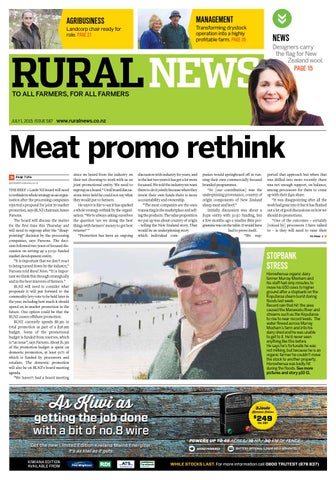
STOPBANK STRESS Horowhenua organic dairy farmer Murray Moxham and his staff had only minutes to move his 650 cows to higher ground after a stopbank on the Koputaroa steam burst during floods last week. Record rain that hit the area caused the Manawatu River and streams such as the Koputaroa to rise to near-record levels. The water flowed across Murray Moxham’s farm and into his dairy shed and he was unable to get to it. He’d never seen anything like this before. He says he’s fortunate he was not milking, but because he is an organic farmer he couldn’t move the stock to another property. Horowhenua was badly hit during the floods. See more pictures and story p10-11.
As Kiwi as
getting the job done with a bit of no.8 wire
ported that approach but when that was drilled into more recently there was not enough support, on balance, among processors for them to come up with their $4m share. “It was disappointing after all the work had gone into it but it has flushed out a lot of good discussions on how we should do promotions. “One of the outcomes – certainly [voiced by] processors I have talked to – is they will need to raise their
3Joule
Kiwiana Edition
249
$
inc. GST
POWERS UP TO 45 ACRES / 18 HA / 30 KM OF FENCE MAINS POWERED
BATTERY OPTIONAL (LEADS SOLD SEPARATELY)
WHILE STOCKS LAST. For moreKM information call 0800 TRUTEST (878 837) POWERS UP TO 45 ACRES, 18 HA
30
MAINS POWERED
BATTERY OPTIONAL (LEADS SOLD SEPARATELY)
2123TTG01
PAM TIPA
Winter
High quality kitset buildings
SALE
Relocatable Paddock Shelters
Small Borderland
Large Borderland
Small Upland
Large Upland
Size: 3.6m x 2.5m x 2.5m high
Size: 5.8m x 3.0m x 2.5m high
Size: 3.6m x 2.74m x 2.5m high
Size: 5.8m x 2.74m x 2.5m high
Model: BDL203
Model: BDL301
Model: UR103
Model: UR101
NOW $1725
NOW $2595
NOW $2995
NOW $3795
BDL203 usually $1810
BDL301 usually $2793
UR103 usually $3250
UR101 usually $4142
BDL301
Small Homestead
Homestead Shelter
Holding Stalls
Large Holding Stalls
Size: 3.6m x 2.5m x 2.8m high
Size: 5.8m x 3.0m x 2.5m high
Size: 5.8m x 2.5m x 2.8m high
Size: 5.8m x 3.5m x 2.9m high
Model: HMS253
Model: HM251
Model: HMS251GR
Model: HMS401GR
NOW $3155
NOW $4295
NOW $4990
NOW $6295
HMS253 usually $3370
HMS251 usually $4445
HMS251 usually $5240
HMS401GR usually $6645
Super Strong
Kitset Delivery
Relocatable
Outpost Buildings are super strong so you can relocate them easily. With heavy duty timber framing and a strong skid mounted base, they can be lifted by hiab or even dragged short distances!
Outpost kitsets come ready to assemble with precut & semi assembled parts as well all hardware & fixings required. You’ll just need some basic building tools to assemble it.
Outpost buildings have a heavy duty skid mounted base that makes them relocatable. This means - you can move them to another site, property or even drag them to a new paddock!
built Quality Parts tough Guaranteed high quality
Freight FREE! FREE Kitset delivery to our transport depots nationwide!
Kitset buildings
Call us today for a FREE copy of our full catalogue!
12 Month
GUARANTEE
Call 0800 688 767
craftsmanship on kitset components
Easy to order!
www.outpostbuildings.co.nz
ue February 2015
Product Catalog
Call 0800 688
767
.co.nz
ings www.outpostbuild
*Prices include GST. Extra rural delivery costs apply to some areas. Š Copyright Outpost Buildings Ltd 2015. Special prices valid until 31st July 2015.
RURAL NEWS // JULY 1, 2015
NEWS 3
ISSUE 587
www.ruralnews.co.nz
NEWS ������������������������������������ 1-15 WORLD ������������������������������� 16-17 MARKETS ������������������������� 18-19 AGRIBUSINESS �������������� 20-21 HOUND, EDNA ����������������������� 22 CONTACTS ������������������������������ 22 OPINION ���������������������������� 22-25 MANAGEMENT �������������� 26-29 ANIMAL HEALTH ���������� 30-32 MACHINERY AND PRODUCTS ���������������������� 33-37 RURAL TRADER ������������ 38-39
HEAD OFFICE Top Floor, 29 Northcroft Street, Takapuna, Auckland 0622 Phone: 09-307 0399 Fax: 09-307 0122 POSTAL ADDRESS PO Box 331100, Takapuna, Auckland 0740 Published by: Rural News Group Printed by: PMP Print CONTACTS Editorial: editor@ruralnews.co.nz Advertising material: davef@ruralnews.co.nz Rural News online: www.ruralnews.co.nz Subscriptions: subsrndn@ruralnews.co.nz
PAM TIPA
Associate Primary Industries Minister Jo Goodhew with a kid at the new Oete farm.
pamelat@ruralnews.co.nz
NEW IMAGE’S partner goat farm Oete Farms at Patumahoe will be the biggest in New Zealand when it grows from 2400 to 3000 goats next season, says Auckland-based New Image Group Ltd general manager Guy Wills. But they see the farm just south of Auckland as the forerunner of “more and more farms” as New Image grows its export trade in goat infant formula and other nutritionals and seeks to add to its NZ supply. “Oete Farms is our partner where we established a relationship to 100% supply to New Image with goat milk,” Wills told Rural News at Oete’s official opening last Thursday. “They have 2400 goats increasing to 3000 so they will be the largest goat farm in NZ. This is a partnership we set up to establish our NZ supply of goat milk.” The milk is converted at New Image’s dairy plant into nutritional products like infant formula, senior forWhile dairy products are NZ’s bigmulas and nutritional products. in kid and due to start giving birth next gest export, products such as goat milk The goat products are exported to month. One was born that morning. China, Vietnam and Malaysia, and to He and his wife Sarah have been nutritional powders are a great addithe Middle East. dairy cow farmers in the lower North “We sell it here in NZ and are export- Island for 15 years. ing a large quantity to the China market They started getting excited about which is demanding high quality prod- the goat and doing something differucts and there’s a growing demand for ent with the goats, he says. FROM PAGE 1 goat milk.” “We want to be pretty special here, New Image has its own brands such we want to produce NZ’s best goats’ their investment and promotions, as Baby Steps. New Image is regis- milk, higher quality and we want to have particularly if, as a consequence, tered for China for the manufacture of NZ’s happiest goats because we feel the Beef + Lamb reduces its funding for dairy products and its own brands have two go hand in hand. promotion. access. “We want everybody to be very “There is recognition that the pro“We’ve been in China for several proud, especially New Image and the cessors need to do more in promoyears and we’ve also been marketing public in general about what we are tion and that’s a good outcome. We out goat products in China for three doing here.” have never had a definitive answer or four years now and we’ve seen very The goats are housed and milked from the industry before on whether good growth,” says Wills. twice a day on a converted 56-bail rotary they wanted to participate in a joint Oete Farms director Matt Bolton platform. entity or not.” says the farm has 120ha of grass which Associate Minister of Agriculture BLNZ gave the idea a “really good is cut and harvested back and fed to the Jo Goodhew says goat milk powder push” and there was a lot of support goats. That is 80% of the goats’ diet and and other nutritional powders are now from industry players. “But it is up they source other roughage and locally exported to at least 20 countries. Austo processors how they choose to $350 MORE ON PEL sourced feed for the goats to SPEND balance tralia, KoreaOR and Thailand are the top STAFIX, invest their money and if they see a diets. three, but there is much growth in other value proposition OR HAYES FENCING ACCESSORIES & somewhere else, At present they have 2400 does, all areas.
tion to spread the type of product we are exporting to the rest of the world, she said.
MEAT PROMO RETHINK we respect that.” Much of BLNZ’s offshore promotion work has been not on growing the pie but just maintaining market share in more mature markets. “Whether that continues will be driven by where B + L goes and we need to have a board discussion about it. It would be quite significant if we were to exit it, but that is an option.” He says they can’t maintain $8.3m promotion spending because some of that has been funded out of reserves. “But there’s a wide range of views on promotion and whether B + L should be in it or should be leaving it to processors.”
RECEIVE A $50 RD1 GIFT CARD*
JU
O
FF
ER
LY AVAIL O ABLE N FO LY R
ABC audited circulation 81,188 as at 31.03.2015
Dairy goat farm soon to be NZ’s largest
EXCLUSIVE TO
FREE $50 GIFT CARD
* Offer valid from 1 July to 31 July 2015. Spend of $350 or more must be in one transaction. Offer restricted to 300 gift cards nationally. Excludes M63 & M36 mains energizers and Kiwiana 3J units. Limit of one gift card per customer account. This offer is non-transferable or exchangeable for cash.
2194STX01
SPEND $350 OR MORE ON STAFIX, PEL OR HAYES FENCING ACCESSORIES OR TOOLS & RECEIVE A $50 FARM SOURCE GIFT CARD*
RURAL NEWS // JULY 1, 2015
4 NEWS
Impasse leaves $4m deficit in marketing budget PAM TIPA pamelat@ruralnews.co.nz
FARMERS NEED SUPPORT ON ENVIRONMENT THE ENVIRONMENT is a big area where sheep and beef farmers need a lot more support, says Beef + Lamb NZ chairman James Parsons. BLNZ spends a lot more than just on promotion and is constantly revising priorities. “Environment has definitely been a big area where sheep and beef farmers have needed a lot more support as they engage in environmental discussions on water quality in particular,” says Parsons. “We have upped the investment there and as a consequence the investment in promotional money has been reduced over time.
“Pressures around the environment are not going away. There are a whole lot of licence-to-farm type activities that farmers need a stronger voice on. We are looking at how we balance our requirements. We need to look at getting more people into agriculture through promoting farming as a career path so there are a lot of significant areas we could invest in and need to invest in.” But that needs to be balanced with requirements in the market as well. $2m a year is invested in market access activities to try to reduce some of the $318m a year in tariffs that farmers pay.
An on-farm trial found that a mob of spring drop ewes carrying twin lambs that were supplemented into lambing and then their offspring up to weaning produced considerably more meat compared to another mob that had no supplement. The weaning rates were substantially different.
MEAT INDUSTRY Association chairman Bill Falconer expects more discussions with Beef + Lamb NZ about promotion further down the track. He agrees that if BLNZ decides in the long term not to continue with its country-of-origin marketing there will be a ‘gap’ in NZ’s overseas promotion. But how that gap is filled would have to be discussed by the industry at large. Meat processors and exporters decided not to contribute 50% of the $8m cost of country-of-origin marketing now sponsored by BLNZ. Traditionally, BLNZ and its producer board predecessors have undertaken the generic marketing of beef and
The supplement mob achieved 159% while the control group attained 139%. With a lamb birth weight of 4kg, the creep fed supplemented mob grew 25% faster to weaning. To learn more, visit: advantagefeeders.co.nz/downloads/trials and see: AF_FACT-SHEET-EWE-SUP-NZ.pdf
Supporting ewes with multiple lambs in late pregnancy and creep feeding pays!
lamb, which latterly has been funded by the BLNZ commodity levy paid by farmers. Falconer says processors already spend at least $8 million on their own brand promotions and this will increase as new markets are developed. “Considerable time was spent usefully exploring the possible content and cost of a country-of-origin programme. “However, a solution could not be identified that would justify processors assuming 50% of the cost over and above the marketing investments they are committed to making and growing,” he says. “Processors’ investment will continue to be directed to the product and consumer branded activities they develop with their distributors and retailer partners in existing and developing markets.” John Mc Carthy, who said he could not talk as
Bill Falconer
the Meat Industry Excellence chairman as they had not discussed the issue, but as a former Meat Board director, says the industry has had a lucky escape. “Generic promotion does not work. Every study of generic promotion proves it is the least effective form of promotional activity there is. It is too bland and in this instance it would be too non-specific to make a difference. “It is actually illustrates the destructive competitive model that is ruining this industry
beyond the farmgate; why BLNZ is supporting this is beyond me. “It belies common sense to imagine that where you’ve got a market model in which at least 50 different export licence holders, all competing against each other with basically the same product, all NZers competing against each other in a global market place – that any form of marketing using countryof-origin is going to make a blind bit of difference, let alone any profit to be attributed back to farmers.” He says we currently don’t have a NZ provenance story; we have a number of players all trying to sell their stuff on the basis of individual company differentiation. “We’ve got the best provenance story in the world and we are wasting it through a destructively competitive model. “This is what is driving the meat industry into oblivion.”
RURAL NEWS // JULY 1, 2015
NEWS 5
Cost-cutting dairymen scan the milk price horizon for respite A RECOVERY in global dairy prices is on the horizon but farmers may not benefit until next season, says Rabobank. In its latest rural confidence survey, the bank says confidence among dairy has taken a hit from the slumping dairy prices. The last seven GDT events have recorded a drop in the price index covering all products; the next auction will be on Thursday.
The Rabobank survey earlier this month found confidence in the agricultural economy had fallen significantly this quarter to a negative net reading of -45%, down from 13% in the March quarter. However, sheep and beef farmers’ confidence remains the same as last year. The hangover from a dry summer, coupled with disappointing farmgate returns, flowed into the
neutral outlook held by sheep and beef producers. Similar to last quarter, half of drystock farmers (52%) expect a similar farm business performance to last year, and they were almost equally spilt as to whether conditions would improve or deteriorate – at 22% and 25%, respectively. Rabobank New Zealand chief executive Ben Russell says that while dairy farmers are likely to get a better farmgate milk price
Dairy prices are now tipped to rise later this year.
than last season, it was still likely to be below the full production cost for many farmers. Russell says dairy farmers were taking steps to reduce their costs. “In response to current pricing signals, we are seeing dairy farmers cut back their rates of supplementary feed and some lower their stocking rates by culling lower performing cows, and maximising feed available to a higher quality, but smaller, herd.” Russell says subdued sentiment in the dairy sector not only had significant flow-on effects to other agricultural sectors and service providers – highlighting the impact of reduced expenditure on grazing and feed inputs by dairy farmers – but also to the wider NZ economy. In aggregate, NZ farm-
Champ’s last blast
David Fagan.
THE NEW Zealand shearing team is about to start a five-week UK tour which includes a surprise return from a brief retirement by Te Kuiti legend David Fagan. Hastings shearer Dion King and Tony Coster, of Rakaia, open the eight-test tour with a match against Scotland at the Lochearnhead Shears on Saturday. But, with Coster available only for the first three matches, Fagan is stepping in for the second of two tests against England, and an annual four-test series against Wales. Fagan (53) had retired in April after 30 years on the open-class competition stage, bowing out with victory in the NZ Shears Circuit final in front of his home crowd. While that event qualified him for a place in the team, he initially stuck to his guns and turned down the position, despite the pleadings of Welsh team manager Bill Jones who said that
in Wales “David Fagan is like God – they love him over there.” When NZ circuit runner-up Coster confirmed he would not be available for the whole tour, Fagan agreed to fill the gap, having already expected to be in the UK for shearing machinery giant Lister. His return will be at the Great Yorkshire Show, where five years ago he won his 600th open-class title. He’s expected to attract capacity crowds in Wales, including as defending champion at the Royal Welsh Show, one of the biggest A&P shows in the world. King, who at Te Kuiti claimed his place in the team with victory in the NZ Open Championships final, is determined to help NZ to its first Wales series victory in Wales since he was last in the team in the UK in 2011. “But it’s an honour just to be in the team for David Fagan’s last blast,” he said.
ers revised down their expectations for their own farm business performance to a net negative reading of -17%, from 14% last quarter. This flowed into investment intentions, with 60% of respondents expecting to maintain their investment, but a smaller proportion expecting to increase it. Russell says the investment appetite amongst dairy farmers had waned, with only 8% holding expansionary intentions during the year. “This is reflective of the market that dairy farmers are operating in despite the longer-term fundamentals remaining positive,” he says. The Rabobank Rural Confidence Survey is run by research firm TNS, interviewing about 450 farmers each quarter.
9
$ 91 Line 7 Aqua Dairy Combo Deals Jacket and Over Trouser
e brands it r u o v fa r u o y ll A
available now!
Swanndri Egmont Brushed Cotton Shirt Assorted Colours S-3XL Normally $39.90 twin pack Valid 1/7/2015 - 31/7/2015
289
$ Twin pac k
29
$
99
Jacket and Bib Trouser
299
$
Valid 1/5/2015 - 31/8/2015
Terms and Conditions: Valid for dates specified or while stocks last. Prices include GST and are subject to change. Some products may not be available in all stores but may be ordered on request. Prices do not include delivery, delivery costs are additional. Images are for illustrative purposes only.
Freephone Freephone0800 080010 1022 2276 76 www.pggwrightson.co.nz www.pggwrightson.co.nz
Helping grow the country
RURAL NEWS // JULY 1, 2015
6 NEWS
Hort growers tipped to be star performers PAM TIPA pamelat@ruralnews.co.nz
HORTICULTURE COULD be the star performer in the primary sector this year. Horticulture NZ outgoing chief executive Peter Silcock says horticulture is in a very strong position. “The recovery of kiwifruit is coming through, the apple industry is performing quite well. It’s all about changing varieties and targeting Asian markets,” he says. “There’s been a reasonably good harvest both volume wise and quality wise. “Avocado is going from strength to strength. The vegetable industry is more steady-asyou-go. With exports of squash and onions people always want them to be better, but it is looking positive for the future, “Probably this year we had one of our best cherry seasons for a very long time which is not a huge
export crop, but significant.” Cherries and things like blueberries are very sought after in the Asian market.” By June most of the major harvest seasons have finished, starting with asparagus and through to the end of kiwifruit which has just finished harvesting. But then the product goes into the market season; for product like kiwifruit and onions that will stretch out for quite a few months. “One thing is to have a good crop in terms of volume and quality and the other thing is what are the international markets doing? There’s pretty good demand out there and we’ve had the dollar going the right way from an exporter point of view, and with a lot of countries. “From a market perspective we are seeing continued strong alignment of the specific exporters in the industry linking much more strongly with their customers and
Peter Silcock has retired as HortNZ chief executive.
that’s where the future is for New Zealand horticulture. “We’ve just got to get better and better at doing that and delivering what they want. That is what a big part of our success to date has been. The big change in values for horticulture is all about connecting with those customers, and scale, and being able to deal
with those big customers, being able to invest in product development, R&D and getting the delivery mechanisms right within the market share. “We’re really positive and it’s a good time to be in the horticulture industry.” Horticulture has a target of becoming a $10 billion industry by 2020. With setbacks like Psa they have wondered at times if they would make that. “But in the last few years we have seen really strong growth; it is a stretch target but the industry is moving rapidly towards that. You just have to look at the increased value of the pipfruit industry…. That continued recovery in kiwifruit will help as well. You are getting growth in those really big industries. The target of $10b by 2020 probably with Psa has taken a hit but we are back on track and growing. We may not get to the $10b but we will get close to that.”
IN BRIEF PRECISION TOPDRESSING PRECISE APPLICATION of fertiliser on hill country by fixed-wing aircraft is now a reality, says Balance Agri-Nutrients. New SpreadSmart technology in topdressing planes will “take precision up a gear,” the company says. SpreadSmart, a variable rate application system, allows different amounts of fertiliser to be applied to different areas of a farm. The technology results from Balance’s $19.5 million Clearview Innovations Primary Growth Partnership with MPI, which aims to improve nitrogen and phosphorus use efficiency and reduce losses to the environment.
HAT-TRICK VINTAGE IF THERE was ever a year to be a wine judge, 2015 is it, says one of New Zealand’s most respected wine industry leaders. This year will see Master of Wine Steve Smith return to the judging panel of the Hawke’s Bay A&P Bayleys Wine Awards. “After a decade, it’s great to be back. I’m thrilled to be joining a judging team again for an exceptional year on the back of three outstanding Hawke’s Bay vintages,” says Smith. Hawke’s Bay is in for some of the best wines the region has ever produced – which was the culmination of three big factors, he says.
It’s just been one hell of a bike to us. It just goes and goes and goes. Lance Limmer Kawhia
SEE MORE HONDA STORIES AT
www.hondamotorbikes.co.nz/hondastories
RURAL NEWS // JULY 1, 2015
NEWS 7
Award winners hold profit, environment ROTORUA SHEEP and beef farmers John and Catherine Ford are the National Ballance Farm Environment Award winners for 2015. The Fords also took home the Gordon Stephenson trophy; they are the first North Island farming business to win the award. Chosen from 10 outstanding regional supreme winners, the Fords’ 1240ha sheep and cattle property stood out for its environmental sustainability and production and performance figures. Highlands Station is located in the Lake Tarawera and Lake Rotokakahi (Green Lake) catchments so the careful and responsible
management of nutrient runoff was rated by the winners as one of their most critical onfarm issues to get right. The award judges were impressed with the Fords’ knowledge of how to achieve this including the mix of stock and up to 200 detention dams built to slow runoff and scouring from the hills during heavy rainfall. Detaining water allows it to infiltrate the pervious pumice layer and substantially reduce the runoff of phosphate into waterways and lakes. Winning this national award depends on having a farming business sit comfortably with environmental sustainability. Highlands Station sheep and cattle production and
profitability was rated in the top 5% in the country with excellent stock in top condition producing an economic farm surplus. Alongside this the judges saw wise and appropriate land use based on soil capabilities, extensive native bush reserves with 140ha in QEII National Trust covenants and other bush areas protected with the Bay of Plenty Regional Council and good shelter and shade for stock. Staff relationships and management were excellent, the Fords being ready to seek external advice on any issue. The Fords and the property had strong ties to their community and displayed a deep understanding of a wide range of topics
during the interview stage of the competition. This Rotorua property had the ‘wow’ factor; it stood out as something special when visited by the judges. The judges said the Fords were worthy winners of the Gordon Stephenson trophy, and as the 2015 Ballance Farm Environment
Ballance Farm Environment Award winners John and Catherine Ford with Nathan Guy.
Awards National Winners they will be excellent ambassadors.
“They have clearly demonstrated that profitable farming and
good environmental management go hand in hand.”
COMMITTED TO FARMING HIGHLANDS STATION was shaped by volcanic activity which flattened forests, carved out hill faces and left the area covered in phosphaterich mud. John Ford’s father Allen began developing the station in the early 1930s and award judges noted the Ford’s “strong family history of
commitment to agriculture”. The station has a “much loved feel” and its outstanding meat and wool production puts it among New Zealand’s leading sheep and beef farming operations. The Fords are careful to manage the volcanic soils appropriately, with farm management prac-
tices matching the capabilities and catchment of the land. Highlands Station also has extensive native bush areas, including 140ha under QE II National Trust covenants. The owners are passionate about minimising erosion on the challenging contour.
To Celebrate
40
Years oforing Spons Receive a Prezzy card to the value of
500
$
TRX500FM2 ⊲ ⊲ ⊲ ⊲ ⊲ ⊲ ⊲
Proven 475cc Honda Engine Programmed Fuel Injection 385kg Towing Capacity TraxLok 4WD Electric Power Steering Aggressive Body-styling Rack Capacity 40kg Front, 80kg Rear ⊲ Front Diff Lock ⊲ 5 Speed Manual Transmission
www.hondamotorbikes.co.nz Available while stocks last. Promotion runs from 8th June 2015 - 31st July 2015. Only new units of TRX500FM2 receive a $500 Prezzy Card and new units of TRX420FA2 receive a $420 Prezzy Card. Available at participating Honda dealers only. Prezzy card terms and conditions apply.
RURAL NEWS // JULY 1, 2015
8 LOWER NORTH ISLAND FLOOD
Flooding worse than 2004? Many farmers in the lower North Island say the heavy rain that hit the area last week was worse than the 2004 floods which devastated the area. Peter Burke reports. THERE ARE reports of more than 2000 slips on roads alone and countless more on farms, plus 25 road closures and a dozen farms underwater in the area covered by the Horizons Regional Council. Farmers spoken to by Rural News say that while the 2004 floods were widespread, this event – 130-302mm of rainfall in region – was more localised and worse than 2004. Farms from Otaki in the south to Waitotara in the north and inland to Hunterville were all badly hit. A major problem was the lack of power to many farms; helicopters were used to fly in emergency supplies of food. Fences wiped out by slips have caused huge prob-
lems with stock that were in specific mobs and got mixed up; sorting this out will add to the stress of dealing with flood damage. In Horowhenua two streams – the Main Drain and the Koputaroa, between Levin and Foxton – broke their banks, flooding dairy farms and forcing farmers to hurriedly move their stock to higher ground – what little there was of it. Badly hit was the small settlement of Opiki, north of Shannon, where dairy farms and commercial growers found parts of their farms underwater. Clive Akers, who has farmed in the area all his life and takes recordings for NIWA, says this was heaviest rain ever
Flooding north of Shannon cut off access to dairy farms.
recorded in the area. He says 137mm fell over two days. The road through Opiki to Palmerston North was closed, as water from the Manawatu River came within a few feet of overtopping the stopbank near the main bridge. James Stewart, Federated Farmers president for the Manawatu/Rangitikei area, says meetings have been held with Beef + Lamb NZ, DairyNZ, Horizons and MPI to get a complete picture of the scale of the damage. “Our main concern is the Rangitikei and Whanganui areas with the slips. That’s pretty devastating with a lot of farmers saying it’s the worst they have seen,” he told
STOP RATS
Pest Free Domestic for homes, garages, etc to 200sq,m – $159.90 incl. GST & post.
NESTING IN HOMES, BUILDINGS, MACHINERY
• Pest Free puts 50Hz pulse along power cables • Rats and mice stress, dehydrate, exit • No harm to humans, pets, computers, etc. • Models to suit buildings/plant 200sq.m to 1000sq.m • Australian developed, patented, science proven • Used in ten countries • Two-year warranty • 100% 60-DAY MONEY-BACK GUARANTEE STOP RATS with Pest Free Buy with confidence from authorised rural sales agent
N+J Keating, 70 Rimu Street, New Lynn, Auckland 0600. Tel. 09 833 1931, cell 021 230 1863; email keating@orcon.net.nz
TWO WAYS TO ORDER/PAY:
1) POST: cheque to N. Keating telling us the product(s) you want, plus your name, address and telephone number. 2) INTERNET: direct credit ASB 12 3039 0893559 00 (your surname as reference) PLUS telephone or email us, saying which product(s) you want.
A cow escapes to higher ground as flood waters rage.
Rural News. “However, it appears to be more localised than in 2004, with some areas like Taihape unscathed. It’s more the Whanganui and Hunterville areas that have been hammered.” Stewart knows of at least one farmer who has lost half the tracks on his farm and says it’ll be months before all the fences and tracks and other damage is repaired.
Pest Free PRO for large homes, small offices & factories, etc to 400sq.m – $299.95 incl. GST & post. Pest Free Commercial New, improved, for dairy sheds, grain mills, etc. $1250 incl. GST & post.
Damaged fencing on a farm in Waikawa.
please add $12 freight per order
0800 16 00 24 9am-5pm
cheques -
EARTHWALK, R D 2, PALMERSTON NORTH
sizes: boots
8 - 13 rainwear xs - xxxl
RURAL NEWS // JULY 1, 2015
LOWER NORTH ISLAND FLOOD 9
Farmers will cope, says Guy PRIMARY INDUSTRIES Minister Nathan Guy toured some of the worst-hit farms in the Whanganaui and Rangitikei areas. During that tour he declared the flooded area a medium-scale adverse event for the primary sector, following a request from farming leaders in the region to do this. Guy says declaring a medium-scale adverse event triggers additional Government support for farmers in the area covered by the Horizons and Taranaki regional councils. MPI will continue monitoring conditions closely. “A recovery coordinator will be appointed to coordinate the activities of local rural support trusts and other industry groups in order to provide help where it is most needed and to provide a liaison point for government agencies.” He says many rural people can be reluctant to ask for help, but it is important for them to know that support is available. Guy says during his tour he saw a lot of damage to private property and roads and, in particular, a lot of slipping. Some farmers say it’s worse than 2004, while others don’t think it’s as bad.
Cows in a flooded maize paddock in the Manawatu.
“The difference between this one and ‘04 is this one is in the middle of winter and the soil was pretty wet before the rain arrived.” Guy says the weather bomb will be challenging for some dairying, coming as it did just weeks before calving. But he believes farmers will cope and says many plan for such events.
E R E H T T U O HOW ? T E G U O Y N A C
HERE USE T T U O T S O EM SHOW US TH ER AND YOU IZ G R E N E E IT oPro®. G OF A SPEEDR N W O Y R E OUR V COULD WIN Y
Silage bales couldn’t escape the floods.
WIN 1 OF 10 GoPros
st h of the wackie tc e k s a r o o e re, vid r it at Submit a pictu rgizer and ente e n e te ri d e s e p use of a S ’s red and look it s a g n lo s A . .nz funnystuff.co in! er, you could w like an energiz
Go on, check out entries and submit your own at www.funnystuff.co.nz Entries accepted up until 9th August. Terms and conditions apply. A flooded paddock in the Manawatu.
IT’S
OUT THERE ALRIGHT!
RURAL NEWS // JULY 1, 2015
10 SOUTH ISLAND DAIRY EVENT
Failing to plan is planning to fail ANDREW SWALLOW
so that when I’m overwhelmed – and I know I will be at some point – I just stick to the plan and take the next step.” Their comments set the scene for the three day conference in Lincoln which splices practical management workshops with inspirational keynote addresses.
Allsop, one of only half a dozen people ever to have run seven marathons on seven continents in seven days, relayed his three foundations or principles: to dream; to plan; and to “never, ever, give up.” “If I don’t give up I can never fail.” By dreaming he refines ideas to the point they
become goals, though he stressed the process is “completely different to goal setting”. Meanwhile the planning for Everest included meticulously analysing why others had failed and mentally preparing for things like passing dead climbers on the route. “The number one
Sir Ray Avery speaking at SIDE last week.
SAL
EE ND SS
OON
IF THERE was one takehome message from the first day of last week’s South Island Dairy Event it was the need to plan. “If you do plan, you will be much more successful in life,” renowned entrepreneur Sir Ray Avery told the 500 or so
delegates during his opening keynote address. “If you don’t plan, you’re living a life of ricochets bouncing from one event to the next.” Later, Everest-conquering mountaineer and extreme marathon runner Mike Allsop echoed the planning point. “I just build a really strong plan
WAS $3,738GST NOW EXCL
$3,449
WAS $5,520GST NOW EXCL
$4,999
EXCL
GST
EXCL
GST
in life.” reason I found people Avery, an ex-pat failed was punctuality,” orphan, lauded the New he said, explaining how a Zealand attitude that summit attempt needs to nothing is impossible, start at 9pm the previous explaining how after a evening. “I started getting couple of years travelling ready at 4pm.” the world he knew from Another ‘take home’ the moment he arrived from Avery was to focus at Auckland airport he’d on customer needs, not “found home.” what you produce. “In “For Kiwis ‘impossieverything you do, you must be customer centric, ble’ is just a starting point. None of the not product things I’ve centric. That achieved on applies to “If you don’t the world everyone in plan you are stage would this room,” living a life have haphe told the pened if mostly dairy of ricochets I hadn’t farmer audibouncing from come to ence. New ZeaHe also one event to land.” stressed the the next.” Not that power of his early teams during career in a broad the UK – starting at age 14 ranging and entertaining with running away from “journey” through his life and how he became a New an orphanage for the umpteenth time – had been Zealander. “Everyone in a failure. “I wanted to be this room is clever, but a millionaire by 26. Well not one of us is as clever I got that wrong. I was a as all of us put together. triple millionaire by 26,” The thing that’s made me the now 67-year-old told very successful is building the SIDE audience. teams…. If you get it right you will become unassail@rural_news able in everything you do facebook.com/ruralnews Mike Allsop
- Built Kiwi tough since March 1979. - Convenient features including dual side stands, clutch lock, oversize tool compartment, low seat height and fully enclosed chain.
MASSIVE savings across the entire AG100/200, utility ATV and ROV range. YAM6124F
Contact your local authorised Yamaha dealer for more information. Prices, availability and specifications are subject to change. Offer available 21 May to 31 July 2015. *Different models and optional extras may result in different savings amounts. 4.99%, first payment at 12 Months, 3 annual payments. **4.99% annual percentage rate is available to GST registered purchasers over a 3 year term. Offer available to approved applicants of Yamaha Motor Finance New Zealand. Fees and charges apply. Offer available through participating dealers between 21 May and 31 July 2015 or while stocks last.
www.yamaha-motor.co.nz
RURAL NEWS // JULY 1, 2015
SOUTH ISLAND DAIRY EVENT 11
Rural health service on a precipice ANDREW SWALLOW
DON’T ACCEPT a second-rate health service just because you live in a rural area, delegates at last week’s South Island Dairy Event heard. “You get a pretty raw deal in rural communities and I think people need to be complaining about it,” Kaikoura-based GP and hospital doctor Chris Henry said. Already 25% of rural practices are down a doctor and the average age of rural GPs is 54 and rising. Many are over retirement age but still
working so numbers could “drop off a cliff ” as they retire given young medics’ reluctance to work in rural areas, he warned. Lack of internet, limited social life and school choice, long or anti-social hours are all factors in that reluctance which Henry suggested Government needs to do more to counter. However, rural communities could also play a part by championing rural life and welcoming newcomers into their social networks, he said. “The whole community needs to
think about promoting the rural sector, whatever their skill is.” Telemedicine where doctor and patient consult by phone or preferably visual internet link such as Skype has an increasing role but won’t happen without better broadband. Meanwhile rural stoicism over ailments or injury can do more harm than good, particularly with ACC using delay in going to the doctor as a reason not to pay. Henry pointed out that for all the publicity over injury rates in forestry, dairy is in fact the worst sector with
45,000 injuries in the past five years. Stock, followed by vehicles, lifting and falls are the most frequent causes, with a spike in injuries during August. Within vehicles, across the whole of agriculture quadbikes accounted for 2500 serious injuries and on average five deaths/ year in 2008-2013. Some of those would have been rural recreation, not farming, and of the injuries only 10% were head injuries and only 20% of those (ie 2% of total quadbike injuries) were concussions. The quadbike deaths
Kaikoura GP Chris Henry say rural residents are getting a raw deal in health service.
were “nearly all crush injuries.” “Helmets are clearly a good idea but they’re not the whole answer.” Over the same 20082013 period 180 rural suicides were recorded and that toll is rising whereas there were 112 farm accident deaths and that toll is falling, he added. “There were over
five times as many rural suicides as there were quadbike deaths. Is there the same level of Government interest?.... Sadly not,” he said. Henry urged SIDE delegates to look after themselves better both mentally and physically and not to confuse being busy with being physically active. “Perhaps this is the
most dangerous thing about quadbikes.” Half of dairy farmers have high blood pressure, three-quarters have high cholesterol and nearly as many are overweight, he pointed out. “These are primary risk factors for heart disease. This is going to emerge as quite a significant problem.”
INDUSTRY TOO PRODUCT FOCUSED SPEAKING TO Rural News after his SIDE speech, Sir Ray Avery said he thinks the whole dairy industry is too “product focussed”. “Fonterra would be the first to say they haven’t really diversified into higher value products but I think farmers could think about that too.” Some are breaking away from Fonterra with their own customerfocussed ventures, he noted, but they
should also be pushing their co-operative to be more market led, he said, criticising the light-proof milk bottle initiative. “That’s all just rubbish in terms of the real science on the time the product sees light. It’s really a failed marketing thing.” A better approach is marketing “boutique” milk products such as nutritionally fortified blends, he
Well fed ewes produce well grown lambs Feeding ewes to maintain body condition over winter ensures good lamb birth weights and colostrum production, improving lamb survival. Talk to the team at PGG Wrightson about your winter sheep requirements today.
Freephone 0800 10 22 76
believes. “I would buy a super-fat milk for instance.” Avery says Fonterra is starting to move in the right direction, but the inertia for that is coming from competitors and typically it takes 20 years to ring the changes in “embedded” industry organisations such as Fonterra, he warned. – Andrew Swallow
Sir Ray Avery has criticised Fonterra’s light-proof milk bottles.
Zolvix®
ALLIANCE®
Expo™
MAGNUM®
Zolvix contains Monepantel, a broad spectrum anthelmintic not found in any other drench. This is a great choice for an exit drench following a long acting drench in ewes. Remove any resistant worms with Zolvix.
The potent, low-dose, triple combination oral drench that can be used in both sheep and cattle. Triple combinations are best practice for drench resistance management, and are ideal for use as a routine drench.
Fast, easy spinosad lice pour-on treatment. Ideal for rotating your lice products to slow the development of resistance. Nil meat and wool withholding period.
With correct application, MAGNUM’s high-tech water-based formula means you get a highly effective, thorough lice kill.
www.pggwrightson.co.nz
Helping grow the country
RURAL NEWS // JULY 1, 2015
12 NEWS
‘Proud to be a farmer’ campaign coming PAM TIPA pamelat@ruralnews.co.nz
A ‘PROUD to be a Farmer’ campaign is to be launched by a group of influential New Zealand and Australian livestock primary producers. “We will tell the farmer’s journey, grow a couple of inches taller and be incredibly proud,” says Shane McManaway, chairman of the Platinum Primary Producers (PPP). The ‘proud’ campaign is a key outcome of the tenth conference of PPP held in Darwin last week. “As farmers we are inclined to be conservative in nature and take the ‘stay hidden, stay happy approach’,”
says McManaway. “We are saying ‘to hell with that, we have been in the chute too long and it is time we opened the gate’, to use a rodeo term, and get out there and start to tell people, especially the urban people.” PPP was founded by McManaway, a Wairarapa farmer and Allflex Australasia head, and comprises 137 agribusiness men and women in sheep, beef, dairy and deer. McManaway told Rural News the group will promote and launch the ‘Proud to be a Farmer’ campaign. “It is pretty obvious that across the two countries we share the same challenges and issues.
They are environmental sustainability, animal welfare and food safety,” he says. “There is a divide between the rural sector and the urban sector and we think that is by and large a misunderstanding, so we will see if we can bridge that gap.” PPP will formulate a plan for what ‘proud to be a farmer’ means. “Then we will build a title that cascades down from under that, of those three pillars, environmental, welfare and safety.” A media campaign will then be launched aimed at the urban sector and where urban people will be reading it. McManaway says they want urban cafe
customers in Sydney, Auckland or Wellington to pick it up and read about “proud to be a farmer”. A couple of PPP members who are large farmers in both countries will give testimonials on what makes them proud to be a farmer with pictures of their properties. PPP represents a massive part of farming in two countries and has a strong Anzac spirit, McManaway says. McManaway says in NZ a lot of people are looking over farmers’ shoulders making sure they do the right thing for the environment. “More importantly we want to do things right,”
he says. “More than 98% of farmers do things by the letter of the law and want the place to be kept in a pristine condition so our future generations can enjoy what we are enjoying today. “In terms of animal welfare, that goes without saying. If you are a farmer and not looking after your animals you shouldn’t be a farmer. Again we all live and breathe looking after our animals. It is critically important that their welfare is maintained and that goes across both countries and should go across the world.” In this age of social media it is easy thing to get caught out. “And you should get caught
Platinum Primary Producers chairman Shane McManaway.
out, so you need to make sure you’ve got all those areas covered off, all our employees understand what it means and we tell the message to the greater world that animals are everything to us. “Food safety is critically important for Australia and NZ. Speaking for NZ, we have a clean green image and everywhere around the world people know us for that…. We need to
maintain that because if we lost that label we would have a difficult job as a nation to sell our produce anywhere. “Australia is in exactly the same boat. Without question all the people in our group are unanimous we must maintain that aspect of agriculture.” PPP represents about 20 million livestock and some 12 million hectares (around 25%) of land ownership in Australia and NZ.
TIP TRAILERS STRENGTH / QUALITY / PERFORMANCE
Designed to an uncompromising strength standard. Our trailers offer exceptional tonnage ratings, thanks to super-strong chassis, heavy-duty deck runners and closelyspaced cross members. Combining a high quality of build and an emphasis on strength, McIntosh Tip Trailers have earned a reputation as the toughest and most durable farming trailers on the market.
Craig Ward with Bay of Plenty MP Todd Muller.
Inspired by Maggie in the garden PETER BURKE peterb@ruralnews.co.nz
www.mcintosh.net.nz FREEPHONE: 0800 622 276
THE WINNER of the Bay of Plenty Young Fruit Grower of Year, Craig Ward (26), says from early childhood he wanted a career in horticulture. As a primary-schooler in Katikati he may have been the only child who watched Maggies Garden Show on television. He then told his mother he wanted to own an orchard or work in horticulture. Last week Ward, a technical manager for the Apata Group packhouse company, won the award ahead of seven other competitors from the region. He now goes on to compete with young fruitgrowers from other regions and potentially to the young horticulturalist of the year competition later in 2015. Ward, B.Appl.Sc in horticulture from Massey University, says though he was happy with his science knowledge, he spent time before the competition honing
practical skills such as pruning and tractor driving. Local MP and former Zespri employee Todd Muller presented Ward with the winner’s cup. He told the 250 guests at the awards evening that the kiwifruit industry should do more to celebrate the way it has managed its way through the Psa crisis. This has taken phenomenal collective fortitude, he says. “The kiwifruit industry sets the benchmark for focusing on the things that unite it rather than getting distracted by the things that could divide it. It has come through an extraordinary period to where great confidence is now being expressed about its performance.” Muller says now the industry has recovered from Psa the time might be right to look at whether the people who work at all levels of the kiwifruit industry are being valued appropriately – whether people are being paid in a way that reflects the success of the industry.
IS TODAY THE DAY YOU COULD DIE FOR A BIT MORE SLEEP? Every year, fatigue and lack of sleep are the cause of hundreds of accidents, injuries and deaths. Just one momentary lapse of concentration could cost you your health, your livelihood, or even your life. For the right advice on making your farm safer, call 0800 030 040 or visit
KEEP SAFE, KEEP FARMING
M 002 MB MBI 0 5/I 5 5/
SAFERFARMS.ORG.NZ
RURAL NEWS // JULY 1, 2015
14 NEWS Fonterra needs to perform – Miraka THE CHAIR of the Maori dairy company tion through all those challenges.” Despite the incessant rain, the field Miraka, Kingi Smiler, says his company is more resilient in lower payout years than day attracted at least 100 people who heard from FOMA, DairyNZ, WMI staff Fonterra. Smiler has faith in the business model and WorkSafe NZ. Knowing the weather and strategy of Miraka, but wants Fon- was going to be bad, WMI staff placed terra to improve its performance so that large hay bales inside the covered yards his company can pay more to its farmer of the woolshed, and installed lighting suppliers. Traditionally Miraka has paid and heating, comfortable for the morning presentations. In the afternoon, visi10c/kgMS more than Fonterra. Smiler’s comments came at a field tors were bussed to see new dairy sheds day at Wairarapa Moana Incorporation and other infrastructure on the 3900ha property. This included the (WMI) which he also chairs. It huge pivot irrigators which, is a 27% shareholder in Miraka surprise surprise, weren’t and the dairy company’s bigrunning. gest single supplier. At least a third of the farm WMI is located near Manis irrigated. New pasture spegakino, central North Island, cies such as lucerne have where it runs 10,000 cows on been planted to deal with the 12 farms plus three support dry summers on the porous blocks, producing 4 million Kingi Smiler pumice soils. kgMS annually. “The success of WMI is having a clear The field day, run jointly with the Federation of Maori Authorities (FOMA) strategy, a lot of discipline and the ability and DairyNZ, was intended to share at the end of the day to train and retain WMI’s journey with Maori farmers in good staff,” Smiler says. “That will be the fundamental chalparticular, and with other farmers. “Our objective has always been to lenge for us going forward, as it has been run a vertically integrated business and in the past. To build a resilient business Miraka is part of the strategy we created we have to have the best people who are well-trained and we do a lot of work five years ago,” Smiler explains. “The operation now aims to keep building that capability and capacity in building on that and to make sure we our staff.” Field day attendees told Rural News have a resilient business that can manage the volatility in payout and the environ- they couldn’t help being impressed by ment and all those challenges likely to the hard work that had made the farms come in future. We still expect to be run- as good as they are. “The land here wasn’t ning a resilient and profitable organisa- always like this,” one said. – Peter Burke
t “Don’t get caugh with your
down” s k n ta
0800 370 007
Patented and fully ribbed and domed for strength and rigidity Highest certified polyethylene rotational tank manufacturer. Two risers for multiple inlets and overflows Can be buried up to 700mm Free delivery of our large tanks* *conditions apply 08 May 2015
Scope of Registration:
08 May 2015
Design and manufacture of large, rotational moulded Polyethylene products
Registered Site(s):
Registered Site(s): 36 Cryers Road, East Tamaki, Auckland, 2013, New Zealand
C32748
Scope of Registration:
24 Feb 2018
24 Feb 2018
Registered Site(s): 36 Cryers Road, East Tamaki, Auckland, 2013, New Zealand
C34613
Scope of Registration: Design and manufacture of large, rotational moulded Polyethylene products
Design and manufacture of large, rotational moulded Polyethylene products 24 Feb 2018
Galloway International Ltd
Galloway International Ltd
Galloway International Ltd
08 May 2015
36 Cryers Road, East Tamaki, Auckland, 2013, New Zealand
C34614
We are the highest certified polyethylene water tank manufacturer in New Zealand. Our aim is simple – to provide quality products and service to satisfied customers.
WWW.AQUATANKS.CO.NZ Visit our showroom: 36 Cryers Rd, East Tamaki
NZ must fight for dairy in trade deal PAM TIPA pamelat@ruralnews.co.nz
THE TRANS Pacific Partnership (TPP) trade deal could now be completed by the end of the year but New Zealand will have to work hard to get a good deal for dairy, says NZ International Business Forum executive director Stephen Jacobi. US President Barack Obama will now want to move fast on TPP, having resolved political issues to get the 12-country deal fast-tracked. Jacobi says both Prime Minister John Key and Trade Minister Tim Groser have indicated the stage reached on dairy so far in negotiations is not attractive enough for NZ. “From what we know of negotiations we understand there has not been any meaningful discussion on those dairy issues between the United States, Canada and Japan
and that’s got to happen,” Jacobi told Rural News. “That means we still have quite a bit of hard negotiating to do. “One risk is that the Americans, having sorted out their own backyard, will now be telling everybody to get on with it as quickly as possible and will be bringing a lot of pressure to bear with negotiations. We will just have to stand tough for a deal which meets our interests.” Others will also have products – such as sugar, textiles or beef – they want a good deal for. The NZ team will have to make sure everyone stands together on those deals. “NZ will not have a lot of strength on its own; that is why we will need to rally the others. All of them have market access issues they want to be dealt with as well,” Jacobi says. “Clearly if we were just
Stephen Jacobi
negotiating by ourselves it would be complicated. This is a little better but I don’t underestimate the difficulty and we will have to see where that process takes us.” The deal could be done by the end of the year, but this depends on the negotiating process. The Americans will want to finish it but our Government has been clear it will only sign up to a high quality TPP that
delivers overall benefits for NZ. “It’s not after a deal at any cost,” says Jacobi. Trade Minister Groser says dairy remains one of the most sensitive issues in the TPP negotiations. “While good progress has been made, further work is required to ensure the end result is acceptable to NZ and aligns with the objectives Leaders have set for TPP,” he told Rural News.
TRANSPARENCY WILL ASSIST PUBLIC DEBATE MORE OPENESS on some aspects of the Trans Pacific Partnership negotiations would help the public debate, says NZ International Business Forum executive director Stephen Jacobi. It would also help the
public understand the Government is trying to do its best in a complicated area, he told Rural News. “It is difficult for the Government to negotiate in public. I wouldn’t be advocating that and I
wouldn’t be advocating that the text for negotiations or the market access schedules be released – that would run the risk of making the negotiations too complicated and too difficult to conclude,” he says.
“But the Government could be more open about background information on the negotiation, how it is being negotiated, what is under negotiation, what the process is and how it might be ratified.”
SHEEP MILK VENTURE EYES ASIA A JOINT venture looking to export high quality sheep milk products to Asian consumers will start operation later this year. Spring Sheep Dairy is a joint venture between Landcorp and the SLC Group. Spring Sheep Dairy chief executive and director Scottie Chapman says SSD’s long term goal is to export high value, high quality sheep milk products to Asian consumers. “We’re still to milk our first sheep so obviously there’s a long way to go and we will take a careful, considered approach, but we are excited about the opportunities this joint venture
offers,” Chapman says. Landcorp chief executive Steven Carden says the company is wellplaced to make a go of the new venture. “Landcorp has the scale to create a thriving sheep milk business. We have a lot of experience farming sheep, a successful sheep genetics business, the country’s largest dairy cow herd and a network of innovative farms throughout New Zealand,” Carden says. Spring Sheep Dairy’s first farm will be on 400ha at Reporoa, central North Island, now converting to milk 3000 East Friesian sheep this spring.
When fully operational, it will milk 3500 sheep and produce about 1 million litres of milk. Chapman says most of the milk will be sent to independent processor FoodWaikato for drying. Small volumes of other products will also be developed for trial in-market. “It’s a fledgling operation at present, with a focus on building a quality East Friesian sheep milking flock and working with end market consumers to find out what their needs are so we can create and supply the right branded products.” Customers in Taiwan and Korea are the initial focus.
RURAL NEWS // JULY 1, 2015
NEWS 15
Designers carry the flag for wool PAM TIPA pamelat@ruralnews.co.nz
THE INSPIRING way in which Australia promotes wool used in its fashion and interiors sectors prompted Auckland fashion editor and stylist Anna Caselberg to initiate a fashion wool week this year – ‘Choose Wool 2015’. The inaugural ‘We’re loving Wool’ week last year involved a number of New Zealand high fashion designers, with a major kick-off event – including sheep shearing – in the trendy Britomart precinct of Auckland. It was organised in conjunction with Elders Primary Wool. Caselberg says the designers were asking if it was happening again, but despite funding not being available from the farming sector this year for the fashion wool sector, she decided “let’s just do it”. Twenty designer window displays were got up for the ‘Choose Wool 2015’ initiative, held June 8-15. A campaign image depicted a girl in a wool coat made by Beverley Forrester from the South Island’s BlackHills which produces yarns and fashion from its own sheep on its Canterbury farm. Forrester also met some costs of the promotional material for ‘Choose Wool 2015’. The designers were mainly in Auckland, some in Wellington. Caselberg had reports that the campaign brought people into the stores asking questions and generally raised awareness of wool. In the South Island she suggested to fashion brand Untouched World that they emblazon winter fashion images and Choose Wool 2015 on a ‘sustainable’ car to tie in with the sustainable image of wool; they used a Nissan Leaf electric car sponsored by Cockram Nissan. Caselberg says together with major knitwear brand Standard Issue they have launched a tertiary design competition for students, to stimulate interest in designing in
wool. Make Wool Modern will be judged next week. The winner will get work with the company’s principal designers as they create their next range. Caselberg would like next year to approach the interiors sector about getting involved, especially given the prevalence of strong wool in New Zealand. “Any way we can educate the public to think about wool, especially in our sectors, is the aim of these initiatives,” she says. She admires the way Australian Wool Innovation and Woolmark get behind fashion and elevate wool continually over the Tasman and around the world, she says. “I am stimulated by what they do, but in our country we have no one championing the use of wool in fashion and interior design, yet it is being used in those products. It needs to be talked about and shown.” Caselberg says she has always been pro-wool as a fashion stylist and editor, and formerly did media shows for the Wool Board. “I have loved wool for a long time and now that there is an international Campaign for Wool it is time to get in behind them. It is fantastic what we do with wool; we need to keep the conversation going with consumers.” She says some people even in New Zealand do not know wool comes from a sheep. “It’s not as if we don’t have an industry; it’s being used in fashion and interiors. But it’s not being talked about how fabulous it is.” The motto for the event this year was ‘Choose Wool – Support New Zealand’s overachieving fibre’ and all its attributes were named. “We want to shout loud. I do it myself because I’ve got the support of all the design companies. I am very motivated to support wool; New Zealand has to have its hand up. “We are hoping for a bigger event backed by farmers next year. This
is year two; we will keep the conversation going and as soon as the farmers can support it I know they will. “Somebody has to be
out there championing the benefits of wool in this sector. The rurals all know the benefits of wool; we need to turn the heads of the urban sector.”
FEATURES • • Detachable for Break feeding with ‘Connect’ quick coupling. • Compact & Robust construction • New Pilot Flow Filter • Side & Bottom Mounting
FEATURES • Adjustable Mounting positions • Built in check valve • Flow stops when unscrewed for servicing • Low Flow applications
CODE MFV2025D MFV20D MFV25D MFV32D
CODE
Caselberg also plans a Wool Show at Vector Arena as part of Fashion Week in August. @rural_news facebook.com/ruralnews
INLET SIZES 20/25mm 20mm 25mm 32mm
INLET SIZES
Auckland fashion stylist Anna Caselberg.
FEATURES • High Flow • Fully Adjustable Mounting • Detachable for Break feeding with ‘Connect’ quick coupling. • Compact Robust construction
CODE TPV20D TPV25D TPV32D
INLET SIZES 20mm 25mm 32mm
FEATURES • High Flow • Keeps pump operation to a minimum • Adjustable levels from 50mm-2.5M • Detachable • 15mm-50mm Inlet models available
FEATURES • Tough Stainless Steel bracket • Fits all models of tanks • Highly Visible Yellow Indicator • Proven design
RJV15 15mm RJV20 20mm
Jobe Valves Ltd
PO Box 17, Matamata P 07 880 9090
0800 JOBE VALVES www.jobevalves.com
RURAL NEWS // JULY 1, 2015
16 WORLD
EU moves will slash grain supply ANDREW SWALLOW
EUROPEAN LEGISLATION threatens to slash the trading bloc’s grain output, so boosting prices globally, growers at the UK’s Cereals event were told last month. Moves to ban triazole fungicides will see the alternative SDHI chemistry soon overcome by resistant strains of disease resulting in lower yields across the board, NIAB TAG’s Bill Clarke warned. For European growers the outcome won’t be catastrophic: yields will fall but prices will rise to compensate, Clarke predicted. But for poor countries reliant on grain imports the outlook is grim. “I believe people will starve,” he said. The reason EU legislators plan to ban triazoles is a theoretical endocrine disruption risk, but after four decades
of widespread use there’s little or no data to show they’re causing problems, said Clarke. He’s lobbied hard to get legislators to reconsider but says he has “almost stopped” because his arguments are falling on deaf ears in France and Germany. “The UK Government is very aware of this issue. The problem is in the European context.” Clarke said he was at a loss how to persuade the policymakers to reconsider, but later made a comment which could hold the answer. “How many migrants will be picked up from the Mediterranean when these people are starving as well as being persecuted?” he asked, reflecting on the tens of thousands who have already fled North Africa and Syria this European summer. New chemistry won’t replace the triazoles, he says, as the extreme cost of
product development and meeting ever more stringent legislative requirements has slowed the supply of novel actives “to a trickle”. “This is part of the problem. People think the cavalry in the form of new chemistry will come over the hill at the last minute but all the new chemistry we’ll see in the next 10 years will not replace the triazoles…. This is a very short-term thing that’s going to happen and it will happen in less than ten years, and possibly within five years. We have to react now.” That reaction, from a UK perspective, should be a change to the Recommended List system to favour more disease resistant cultivars. “If you had 5% lower yield but half the spend on fungicides why wouldn’t you grow it? At the moment we don’t have a system for doing that.” Average wheat yield response to
Grain output in Europe is tipped to fall.
fungicides in UK Recommended List varieties in 2014 was 1.7t/ha, with the response of the more disease susceptible recommended cultivars up to 2.7t/ha. The highest response in the trials was 7.9t/ha with a wheat cultivar that would “never get recommended” but the fact it was entered for consideration highlights
breeders’ focus on yield before disease resistance. “We select on treated yield all too often.” Clarke says the looming triazole legislation means frequently aired aspirations of raising yields in the UK are a pipe dream. “Everybody talks about getting off the yield plateau. Well we’ll be lucky to stay on it,” he said.
GET ON WITH TB FIGHT – UK FARMERS UK FARMERS are urging their Government to implement its 25-year TB eradication strategy immediately and in full to ensure farmer support for it remains strong. NFU president Meurig Raymond says farmers support the strategy but are frustrated at the lack
of action to introduce its various elements. “The farming industry needs to see more urgency in the implementation of the whole strategy and better communication of its measures and aims. Now is the time to build on the determination of the
farming industry to eradicate this disease which is destroying farming businesses and families.” Raymond says different elements of the strategy are urgently needed in different parts of the country and needed to be introduced as a matter of urgency.
“We need appropriate and proportionate measures to keep the disease out of the low risk area of England. “We need more targeted measures to stop the spread in the edge area (between the high and low risk areas). In particular we need better
information on the local infection rate in wildlife in this area. “And we need further pilot culls in the high risk area. Farmers are committed to playing their part in this but need to see that commitment reciprocated by the Government.”
Statistics released by the UK Government in April show the provisional incidence rate for January 2015 was 3.9% compared to 4.5% for January 2014. However, it states that care needs to be taken not to read too much into short term figures,
especially as this figure includes a number of unclassified incidents. The number of new herd incidents in January 2015 was 494 compared to 534 in January 2014. The number of cattle compulsorily slaughtered in January 2015 was 2977 vs 2923 in January 2014.
RURAL NEWS // JULY 1, 2015
WORLD 17
UK farmers’ popularity continues to grow FARMERS ARE becoming more popular in England and Wales, according to a recent survey by National Farmers Union. A OnePoll survey of 2000 people from England and Wales had 68% of respondents expressing a positive view of farmers, up from 60% in 2012. The survey also reveals that at least 90% of people said they thought agriculture was important to the UK economy, up from 83% in 2012. And on looking after the countryside, 75% of people said they believed farmers had a beneficial or very beneficial effect, up from
comes from.” where farmers threw 72%. He says the massive open their farm gates NFU president growth trend in NFU’s to speak directly to the Meurig Raymond social media channels public about what they believes the growing also goes hand-in-hand do. positive trend was due with farming’s growing “At the NFU we have in part to farmers and public support. used our Back British growers being more NFU’s open and “We’ve seen in recent Twitter championing what they do. weeks very visible public channel has gone from “I am seeing 4600 in 2012 more and more support for farming and to around how farmers farmers in public and in 31,000 today. are speaking the media.” And views on directly to the YouTube have public,” he gone from hundreds four Farming campaign says. “Whether that’s years ago to reaching to focus on farming’s capitalising on social hundreds of thousands contribution to the media to share with of interested people them compelling reasons economy and to the today. countryside; as expert to back British farming “In the run up to the food producers we have and buy British food, general election our capitalised the public’s or the recent successes website also received desire to know more seen during Open Farm more than 15,000 about where their food Sunday last weekend
NFU president Meurig Raymond.
pledges from people casting their vote for British food,” he says. “All of this is great news for a sector that has had its fair share of challenges in recent times. “We’ve seen in recent weeks very visible public
Oz lamb cooks up a win MEAT & LIVESTOCK Australia’s (MLA) Australia Day lamb advertisement has won TV Ad of the Year. The ‘Richie’s BBQ’ Australia Day campaign ad, developed by independent media agency The Monkeys, claimed ‘TV Ad of the Year’ at the annual Mumbrella media awards with a popular vote of 41,000. The commercial features Australian cricket commentator the late Richie Benaud calling on the original Lambassador Sam Kekovich and a host of other national icons – including Captain Cook – to join him in bringing Australians together to share lamb on Australia Day. MLA’s “You’re better on Beef ” campaign also made the final six, recognised for their effectiveness before being put to a popular vote. MLA consumer programmes marketing manager Andrew
Howie said the ‘Richie’s BBQ’ Australia Day campaign saw a 35.3% sales lift versus the weekly average, for the week preceding Australia Day. Media coverage of the campaign also reached 69 million people. “This is one of MLA’s most successful Australia Day campaigns on record in 10 years of campaigns. Our objective is to ensure we drive lamb demand and equally to foster Australia’s love affair with lamb. “In conjunction with last year’s Spring Lamb campaign, these campaigns have returned $3.99 of value for each $1 of investment,” Howie said. MLA central marketing general manager Lisa Sharp says recognition of both beef and lamb ads underpinned MLA’s whole body of work. “We are delighted to receive these accolades from industry, particularly going up against some of the best in the business,
HARROWS HARROWS HARROWS
The late Ritchie Bernard fronted the TV campaign.
support for farming and farmers in public and in the media and I would like to thank them for that. But we cannot rest on our laurels. We must continue using all the tools we have to tell our story and state the case for British food and
farming. This survey is a clear indicator of public support. Now, when farm gate prices are low, retailers and government must also continue showing their support and visibly back British farming.”
CAMBRIDGE FARM ROLLERS
NEW 10ft Roller with Extension Drawbar & Screw Jack $6900 Vee Ring Roller Seeder Drill with Vee bottom seed box, hydraulic clutch, ext. drawbar, ........................ $18,800 Special rollers made to order, • All prices ex-Factory, Excl GST • Spare parts, Rings and Bearings. Competitive freight rates to the North Island $ 26"dia rings ............................ 90.00 Ph: 0800-838 963 24"dia rings ............................$85.00 AUSTINS FOUNDRY LTD 131 King Street, Timaru www.austinsfoundry.co.nz
If undelivered please return to: Ltd
Shoof International PO Box 522,
Cambridge 3450, New Zealand 121674
LOGUE 2015 FARMER’S CATA NEW ZEALAND
April 2016 01 May 2015 to 30 Twenty Fifth Edition
CONTENTS
and with a significantly smaller budget,” she said. “For MLA, what matters most is driving demand for red meat in Australia. We will continue to pursue effective marketing programmes that deliver returns for producers and across the industry.” MLA’s domestic marketing
team was also named runner-up in the Marketing Team of the Year, competing against IAG, Tourism Australia, Sportsbet and Barnados. The new beef ad has also won an international gong as one of only three ads from around the world recognised as a New York Festival finalist.
Full range of harrows available with over 50 types, styles, combinations and weights to choose from. WWW.LYNDONHARROWS.CO.NZ
03 347 8516 Ph 0800 HARROWS
Pages ...2-15 Calving & Rearing ............. -23 Dairy & Beef ......................16 6 .....24-3 Milking .......................... .....37-47 Hoofcare Large Animal ....48-50 ation Identific & Marking 59 ........51Injecting & g Drenchin .....60-68 Sheep & Goats ............. -77 Pig & Poultry......................69 78-85 Grooming & Show ............. 6-97 Companion Animal ............8 15 Home & Farm ..................98-1 INDEX AT BACK
RURAL NEWS // JULY 1, 2015
18 MARKETS & TRENDS MARKET SNAPSHOT
BEEF MARKET TRENDS
LAMB MARKET TRENDS LAMB PRICES
BEEF PRICES
NI
Change
c/kgCWT
+2
P2 Steer - 300kg
P2 Cow - 230kg
+2
Local Trade - 230kg
n/c
M2 Bull - 300kg
n/c
P2 Steer - 300kg
5.57
5.55
4.60
5.52
5.50
4.70
3.90
5.35
5.35
4.75
4.60
5.20
P2 Cow - 230kg
n/c
3.85
Local Trade - 230kg
n/c
5.20
3.75
5.20
5.05
n/c
4.70
4.72 4.62
n/c
M Cow - 200kg
Last Year
+2
M Cow - 200kg
2 Wks Ago
+2
M2 Bull - 300kg
SI
Last Week
4.25
5.05 3.85
3.75
YM - 13.5kg
5.20
Mutton
SI Lamb
YM - 13.5kg
+5
2.40
+25
2 Wks Ago
Last Year
5yr Ave
7.38
2.27 5.75
1.93
2.35
7.63
5.39
3 Wks Ago
72.7%
-2%
% Returned SI
74.5%
66.2%
67.8%
Last Year
5yr Ave
79.97%
79.8%
71.3%
72.5%
2 Wks Ago
7.83
7.75
1.68
Last Year 5yr Ave
1.68
2.18
8.45
1.95
8.18
Procurement Indicator Change -1% -1%
2Wks Ago
3 Wks Ago
61.9%
62.6%
67.0%
67.7%
Last Year 5yr Ave 72.2% 69.8%
72.9% 67.2%
% Returned SI
3.20
Last Week
+8
% Returned NI
2Wks Ago
-2%
n/c
NZ$/kg
% Returned NI
Change
5.81
2.58
Procurement Indicator
UK Leg £/lb
Last Week
2.58
Export Market Demand
5.80
4.83
4.83
5.78
4.83
4.83
5.76
4.83
NZ$/kg
4.83
n/c
3.65
4.83
95CL US$/lb
4.83
n/c
6.06
3.15
Change
3.15
n/c
6.05
5.16
Change
5.16
n/c
6.01
5.15
Export Market Demand
6.03
5.15
n/c
MX1 - 21kg
5.13
5.11
Slaughter
5.13
5.11
n/c
PX - 19.0kg
Mutton
Last Year
n/c
MX1 - 21kg
PH - 22.0kg
2 Wks Ago
n/c
PH - 22.0kg
2.97
Last Week
n/c
PX - 19.0kg
PM - 16.0kg
4.40
n/c
PM - 16.0kg
4.10
Slaughter
NI Lamb
3.02
3.75
Change
c/kgCWT
Venison Prices
Change
NI Stag - 60kg SI Stag - 60kg
Beef & venison prices are reported as gross (before normal levies & charges are deducted). Lamb & mutton prices are reported nett (after levies & charges are deducted).
Check out our website BREAKING NEWS
MANAGEMENT STORIES
MACHINERY REVIEWS
COMPETITIONS
MARKETS & TRENDS AND MUCH MORE...
www.ruralnews.co.nz
n/c
n/c
Last Week
2 Wks Ago
6.35
6.35
6.58
6.58
Last Year 5yr Ave 6.15
6.20
6.82
7.01
RURAL NEWS // JULY 1, 2015
MARKETS & TRENDS 19 NEWS
PRICE WATCH Overseas Wool Price Indicators
WOOL PRICE WATCH Cattle slaughter prices across the country are generally firming on the back of a lower NZD and a tighter supply of slaughter stock. Processing capacity has been reduced to winter numbers, however procurement competition is inevitable at this time of year. Heavy kill rates year to date could put additional pressure on this year’s winter slaughter rates. While slaughter rates are certainly slowing in the North Island (NI), the volume being processed is higher than expected for this time of year. This is being driven by tight feed supplies in some parts and dairy farmers continuing to cull deeper into their herds. In the South Island (SI) cattle slaughter is in winter mode and most farmers have winter numbers tidied. A shortage of local trade supply is expected to see prices firm in the short term which could result in export prime schedules following suit.
before prices get higher. The market is picked to continue to improve from here on in but the acceleration is expected to be slow with large quantities of meat in transition to the market and inventories high. Kill rates from Australia have yet to abate, and until they drop off, imported prices will be restricted.
BEEF
Market prices for lamb remain depressed, however a weaker NZD is helping to offset the negative impact on NZD returns. Demand from the UK and EU remains quiet for NZ product as UK production is soaking up most of the demand. Frozen leg prices remain under pressure. Flap
BEEF:
SHEEP: Lamb processing chains in the NI are full this week. While slaughter rates are higher than normal for this time of year, the problem has been exasperated by processors reducing capacity. Waiting times of up to 2 weeks for kill space are common. Any lifts in shedules through June are unlikely against this background. In the SI lamb operating prices are holding their own despite falling printed schedules. Lamb kill numbers are winding down with plants preparing for maintenance closures.
SHEEP INTERNATIONAL:
US imported beef prices have found the bottom and are on the way back up, albiet slowly. The lift has been driven by a reduction in forward offers out of NZ as cattle slaughter rates decline. As the market improves the level of interest has lifted as end-users buy
INTERNATIONAL:
Indicators in NZ$
Change
11-Jun
Last Year
04-Jun
Coarse Xbred
-9
5.54
5.63
5.25
Fine Xbred
-4
6.53
6.57
5.57
Lamb
-6
7.33
7.39
5.35
Mid Micron
-
-
-
7.00
Indicators in US$/kg Coarse Xbred Fine Xbred Lamb Mid Micron
11-Jun
Last Year
04-Jun
-14
3.89
4.03
4.51
-11
4.58
4.70
4.79
-14
5.15
5.28
4.60
-
-
-
6.02
Change
inventories in China are still making this item a hard sell, but prices for other items are being aided by the lower NZD. Demand from the US has picked up as Australian exports have dropped back. Middle Eastern markets remain under pressure with high inventories of product from both Australia and NZ. The NZ kill continues to
track higher than expectations. Against a backdrop of slow global sales this is not an ideal situation for processors, and most will be looking for a drop off in slaughter rates to prevent inventories growing.
Don’t muck around It may be dirty work, but our Spreaders get it done without any fuss. Available in three sizes with recessed floors. Tick it off with heavy duty, low-maintenance Kiwi engineering.
www.bucktonag.co.nz
P 07 533 1259
RURAL NEWS // JULY 1, 2015
20 AGRIBUSINESS
Staying the course in value add ROBERT SPURWAY
FMG0055DPSC
IN RECENT months we’ve seen speculation from some commentators on the uncertain future of co-operative dairying in New Zealand – in which private companies and foreign investment trumps generations of local market expertise and value add is lost in the margins. There is no question that a fight is on for share of New Zealand milk, and while there are new players entering the market – many backed by foreign capital – having the balance sheet to build a dryer will only ever be half the equation. When it comes to high volume commodities such as whole milk powder, adding value is reliant on a secure, high volume of milk. With scale in milk supply comes lower cost of production per litre, greater efficiency and more value out the back end when that product reaches the market. Driving value for farmers by leveraging scale – one of Fonterra’s competitive advantages – is where we excel. Those who cannot compete at scale typically see their margins in
Fonterra managing director global operations Robert Spurway.
commodities becoming increasingly unsustainable and, as a result, burn capital in their attempt to pay a competitive milk price that attracts and retains supply. We add further value by driving every last cent out of the cost of processing. This focus on efficiency has seen our skim milk dryers, for example, running 20% more efficiently than comparable plants in the US, despite their lower energy costs and, in many cases, lower wage costs.
At our Studholme site in South Canterbury we have been able to achieve a 25% increase in efficiency on the previous owner’s output by implementing our systems and processes and maintaining stringent cost and quality control measures. Continuing to identify and generate value in commodities is vital. We are confident that growth in demand for milk powder, which sits at around 5%, will bounce back. Our competition sees it too, which is why they are building their dryers here in New Zealand and chasing supply. We’ll meet that growth and get every cent of value out of our powders with new high efficiency dryers at Pahiatua and Lichfield which are on track for completion in the coming seasons. Investing ahead of the milk growth curve gives us greater flexibility to take advantage of relative market prices, especially around the peak of the season. It also gives us options in the products we can make, meaning we are more agile in meeting product trends and changes in customer demand. On top of this, we’re growing our consumer and foodservice businesses,
Anchor milk from Fonerra’s UHT plant in Waitoa.
whose revenue has increased from $4.6 billion in 2003 to $6.3 billion in 2014. Whereas two years ago, foodservice accounted for less than 5% of our global milk pool, it now represents more than 8% of an even larger milk pool. The co-operative’s goal is for 40% of sales volumes to be made up of these value added products by 2025, and we are investing to meet this target with recent expansions in UHT, cream cheese and mozzarella processing, and the doubling of our slice-on-slice cheese manufacturing later this year.
At this difficult time for New Zealand dairy farmers, we will take nothing for granted and will continue to fight for every dollar. We’ll achieve that through a focus on operational excellence and by staying the course on our value add strategy. Our farmers understand better than anyone the benefits of our scale, particularly when times are tough, and it’s that scale and efficiency that will unquestionably see us through. • Robert Spurway is Fonterra’s managing director global operations.
RURAL NEWS // JULY 1, 2015
AGRIBUSINESS 21
Houpapa confirmed as Landcorp chair PETER BURKE peterb@ruralnews.co.nz
MAORI BUSINESS leader Traci Houpapa has been appointed chair of Landcorp Farming. She has acted in the position since May last year. Houpapa is also the chair of the Federation of Maori Authorities (FOMA), a collective with an asset base of $8 billion in primary industries, energy, tourism and other commercial interests. She is also chair of the Te Uranga B2 Incorporation with major farming interests – dairying and sheep and beef – in the central North Island, and she is a director of other companies – Maori and pakeha. Houpapa was in 2012 named one of the ten most influential women in New Zealand agribusiness. She told Rural News her Landcorp appointment confirms that the direction of the state-owned business was supported by the shareholder – the Government.
She says chairing Landcorp is exciting, with the implementation of its new strategy focus on the core business and a diversification which includes sheep milking. “We are seeing a different face of Landcorp – a more focused and strategic face. Our board and team are focused on how we can transform NZ farming. “Landcorp’s focus is predominantly on how we do business and drilling down to make sure we do the fundamentals right. “Then we can look at doing innovative work on genetics, added value and the value chain. For example, we are working with NZ Light Leathers, Merino NZ and other industry partners. More recently Landcorp has focused on how it can partner with iwi and Maori authorities.” Houpapa says in dairying Landcorp is looking hard at how it farms – milk production and its environmental footprint. Its commitments with
business partners in dairying will roll through over time. Houpapa is regarded as a highly influential and respected business person and leader with a great understanding of agribusiness. “The experience I bring as a Maori and a mainstream farmer [combines knowing] who we are and where we are going – as Landcorp and as a New Zealand agribusiness. We have the ability to capitalise to positively leverage Maori farming into the mainstream. Landcorp is a great vehicle to help facilitate that.” Meanwhile former Invercargill MP and farmer Eric Roy has been appointed to the Landcorp board. Roy spent ten years in Southland as an electorate and list MP for the National Party. He retired from Parliament last year. He has long been involved in the primary sector and now farms two properties in Te Anau and leases a holding in the Hokonui Hills.
Landcorp chair Traci Houpapa.
KEEPING RURAL COVERED. Staying on top of risk is vitally important when you’re running a rural business. And no one knows rural risk better than FMG – because we’re farmers too. We’ve been providing insurance cover to rural New Zealand for over 100 years. Ask around about us, or call 0800 366 466.
We’re here for the good of the country.
RURAL NEWS // JULY 1, 2015
22 OPINION EDITORIAL
EDNA
Floods to remember WHILE THE latest floods in the lower North Island are not as widespread and therefore not in the same league as those of 2004, they are nonetheless distressing and devastating to many farming families. The damage seems confined to fewer farms, but it seems some of these have been hit even worse than some in 2004. This latest event occurred before calving and so the interruption to milking is limited except for those who do winter milk. But the bad news is pastures inundated with silt will take longer to clear and re-grass. It will take a lot of time to repair fences, races and sheds and to buy in more supplementary feed for cows effectively stranded on the high ground of many farms. This is extra work farmers don’t need as they head into the busiest time of the year. For sheep and beef farmers, the damage caused by slips is in many cases horrendous. Tracks are wiped out making it difficult to even assess damage. Fences are down and animals are wandering around farms. Farmers don’t need this at this time of year. It’s hard to imagine how difficult this must be for them and their staff. Understandably the mainstream media focus on the woes of city folk badly hit, their homes trashed by the floods. But most still have a job. However for farming families and others in rural communities they face not only damage to their homes but worse still to their businesses and way of life. Businesses facing the storm of market volatility now also face nature’s onslaught with its stress and extra costs. The prospect of getting to a supermarket by road could still be weeks away for some households. And when will life get back to normal? Who knows? What we do know is that land that has slipped takes generations to recover and return to some sort of productivity. Rehabilitating land covered in silt is again a long-term task. While the images of city houses inundated by flood waters are tragic and terrible, the pain suffered by the rural community is on-going and any loss of production will impact city folk. Rural News extends its sympathy to all those affected by this latest terrible event and assures them of our support as they deal with the many challenges they face.
RURAL NEWS HEAD OFFICE POSTAL ADDRESS: PO Box 331100, Takapuna, Auckland 0740 PUBLISHER: Brian Hight .............................................. Ph 09 307 0399 GENERAL MANAGER: Adam Fricker ........................................... Ph 09 913 9632 CONSULTING EDITOR: David Anderson .......................................Ph 09 307 0399 davida@ruralnews.co.nz
THE HOUND Dead horse floggers YOUR OLD mate reckons the anti-GE nutters at GE Free NZ can’t help flogging their dead horse theme about the evils of genetic modification. In their latest scare tactic, GE Free NZ tried to claim that a recent spate of cow sickness and some deaths was due to genetic modification. However, as Feds president – and former pro GE lobby spokesman in a previous life – William Rolleston rightly pointed out, it was more likely to have been caused by high sugar content in the fodder beet they had been eating. The Hound suggests the anti-GE lobby do themselves no favours when they make up crazy conspiracy theories like this to justify their stance.
Want to share your opinion or gossip with the Hound? Send your emails to: hound@ruralnews.co.nz
MIA!
You sure?
Why not?
YOUR CANINE crusader always thought politicians were full of the proverbial, but it seems the drongos at NZ First have taken this even a step further. While the National, Labour and Green parties managed to find MPs to attend the finance and expenditure select committee session with the Reserve Bank on the Monetary Policy Statement, NZ First was absent. Given that it was the only select committee hearing all week – during a parliamentary recess – it should not have been too difficult to find someone to go along. Considering much of the discussion was about immigration and the exchange rate and Auckland housing – supposedly hot topics on which NZ First is forever issuing inane media statements about.
THE HOUND reckons Labour’s agriculture spokesman Damien O’Connor may be treading on thin ice in calling for Fonterra chief executive Theo Spierings to take a pay cut due to poor performance of the dairy co-op. O’Connor suggested Spierings should take a voluntary pay cut and that such a move would restore credibility with farmers and staff. However, a mate of yours truly wondered if O’Connor and his Labour colleagues would heed their own advice? The Hound’s confidant suggested that O’Connor, his struggling leader Andrew Little and the rest of the Labour caucus could also take a ‘voluntary’ pay cut for Labour’s continuing woeful performance. He suggests what is good enough for the goose (Fonterra) should be good enough for the gander (Labour).
A MATE of the Hound reckons in light of all the hoo-ha about new health and safety regulations, why doesn’t WorkSafe NZ publish its reports into workplace accidents. “When there is a mishap with an aircraft, the CAA investigates and its findings are published,” the Hound’s pal says. “NZ pilots of all ages and qualifications have grown up reading these reports and thereby learning from others’ mistakes.” But your canine crusader’s confidant reckons when WorkSafe investigates an accident “the findings are seemingly shoved in a filing cabinet and never see the light of day”. He suggests making these accident findings public would be educational: he cites the example of Worksafe British Columbia, which presents its accident reports on You-Tube.
PRODUCTION: Dave Ferguson ........................Ph 09 913 9633 Becky Williams ........................Ph 09 913 9634
NATIONAL SALES MANAGER: Ted Darley .......... Ph 07 854 6292/021 832 505 ted@ruralnews.co.nz
WELLINGTON SALES REPRESENTATIVE: Ron Mackay ......... Ph 04 234 6239/021 453 914 ronm@ruralnews.co.nz
REPORTERS: Sudesh Kissun ....................... Ph 09 913 9627 Pamela Tipa ............................ Ph 09 913 9630 Peter Burke .............................Ph 06 362 6319 Andrew Swallow ................... Ph 03 688 2080 Tony Hopkinson ......................Ph 07 579 1010
AUCKLAND SALES REPRESENTATIVE: Stephen Pollard ....Ph 09 913 9637/021 963 166 stephenp@ruralnews.co.nz
SOUTH ISLAND SALES REPRESENTATIVE: Kaye Sutherland Ph 03 337 3828/021 221 1994 kayes@ruralnews.co.nz
MACHINERY EDITOR: Mark Daniel .............................Ph 021-906 723 or 07-824 1190 SUB-EDITOR: Neil Keating ............................Ph 09 913 9628
ABC audited circulation 81,188 as at 31.03.2015
WEBSITE PRODUCER: Emily Gordon .......................... Ph 09 913 9621
Rural News is published by Rural News Group Ltd. All editorial copy and photographs are subject to copyright and may not be reproduced without prior written permission of the publisher. Opinions or comments expressed within this publication are not necessarily those of staff, management or directors of Rural News Group Ltd.
RURAL NEWS // JULY 1, 2015
OPINION 23
MIE reforms the way to go DAVE McGAVESTON
AS A significant Alliance Group (AGL) shareholder I am prompted to lay bare the facts to my fellow shareholders. The constant fudging of the truth by AGL governance and management via shareholder emails and in the farming media is unacceptable. To be fair to our new chief executive, he will only just be beginning to understand the challenges he has taken on. Mr (David) Surveyor doesn’t have time to waste on petty politics and I trust he will focus on the key issues and listen to his shareholders. True co-op behaviour encourages a culture of loyalty, transparency and most of all honesty, and from this flows commitment between producer and processor. Throwing up ‘red herrings’ such as, “the Commerce Commission won’t approve” or “our trading part-
ners will block our exports” is inherent nonsense. These are our farms, our families, our businesses and this is our country. Clearly highlighted in the MIE report is that there are hundreds of millions of dollars of commercial reasons for consolidation. But— just as importantly – it is clear that strong levels of competition remain. Farmers need not fear consolidation, they should embrace it. The sweetheart deals now prevalent with traders, third parties and producer groups are foreign to co-op culture. No farmer should or would invest further outside the farmgate until this changes. The MIE report shows a pathway to establish this new co-op model and how this culture will encourage farmer support through commitment and investment. The New Zealand Government has promised legislation provided we have a large majority of producer sup-
ag twits
Rural News’ irreverent and hypothetical look at what’s happening in the farming world Top Bleats view all @drbillfeds: Fed Farmers would like to know just how exactly WorkSafe NZ managed to come up with possibly the most unworkable work laws ever invented. Looks like we dropped the ball again! #dazedandconfused #headlesschooks @fbartonworksafenz@drbillfeds: Our new Safer Farms campaign aims to make farms safer by sending WorkSafe NZ inspectors all over the country and ensuring no work is ever done on any farm thereby making them safe! #farmerswillloveit @littleandrewlabour: Labour opposes any moves to water down new health and safety regulations. The unions tell us these new laws are needed and we need the unions – end of story! #payingthepiper @johnkeypm: Can I reassure everyone that the sudden review of proposed new H&S regulations was not forced on us by a backbench revolt, but by a careful and considered assessment of our latest polling, which told us these new laws are very unpopular with our backbench. #forwhomthepolltolls @johnmcarthymie: MIE’s plan for meat sector profitability is so clever and cunning you could pin a tail on it and call it a weasel or Murray Taggart! Now that all the hard work is done it’ll be easy to convince farmers to come up with $15k each to fund it. #dreaming #planetcuckoo @robhewettsff: Nice to know MIE has worked out what’s best for our shareholders – eh @mtaggartalliance? Pity they don’t have the $100-150 million we need right now. Just wait for the wailing and gnashing of MIE teeth when we reveal our new foreign investor in a couple of weeks. #cupofcoldsick #toughsell @winstonfirstandlast: Fonterra puts the terror in terrible. Chinese dairy companies put the yellow in butter. Only we – by which I mean me – at NZ First have the answers to our dairy woes. But I’m not going to tell you what that is. #fullofit #makingitupasigo @jwilsonfonterra: The good news is that this year has been so bad that things cannot get any worse next year. Now we’ve engaged some very expensive consultants to tell us that we are actually a great company. #newbuzzswordfor2016 #mckinseyreview ibrownshc@jwilsonfontera: Obviously Fonterra has top-flight management and a very good board. Look at the numbers: why else would we be paying our chief executive $4 million and our chairman $250k a year? #thenumbersdon’tlie @doconnorlabourmp: How does an underperforming, out-of-touch, useless and increasingly irrelevant leader command such a huge salary? It’s seriously time for a salary review. Just to be clear, I mean Theo Spierings not Andrew Little. #gladiclearedthatup #doasisaynotasido
GET SOCIAL WITH RURALNEWS Keep up with the latest stories from by following us at facebook.com/ruralnews
twitter.com/Rural_News
Multiple exporters offering meat at the same high spec is price destructive, says farmer Dave McGaveston.
port for this model. So the AGL claim to the contrary and its threat of five months backlog during drought and peak kill times are just scaremongering. Waiting lists to kill stock are not caused by lack of
plant to process stock. If every South Island plant operated a single shift for 44 hours per week the entire South Island’s lamb kill would be processed in 28 days. What other industry has the luxury
during peak periods like Christmas to take two weeks off and then only operate 5.5 days per week thereafter. Nelson AGL plant only killed 35% of the days from January 31 to February 8 2015. Farmers are used not only as a holding paddock to stretch out the season, but the processors also cynically use our overdrafts to fund their poor performance. Meanwhile, farmers pay heavily to carry 51% overcapacity when most is not used during droughts. The structure of our industry today is the problem. What processor would engage their surplus chain or introduce another shift with no guarantee of supply? Another company’s idle plant could be engaged and steal supply, leaving them severely disadvantaged financially. Many farmers are so restrained financially that for the lure of a few TO PAGE 24
RURAL NEWS // JULY 1, 2015
24 OPINION
MIE only way to save red meat sector FROM PAGE 23
cents/kg more they will supply the second company in this case. The companies then have the cheek to call the cash-strapped farmer disloyal, despite it being the co-op’s unfair procurement behaviour that is the root cause of farmers needing to look for an alternative to survive. This is an inherent problem and we must change the model and refocus our attention on the $/kg we are leaving on the marketplace table. The current level of overcapacity is costing every farmer an estimated $10.35/lamb. Multiple exporters offering meat at the same high spec is price destructive. There is ample evidence of trade relationships between a NZ exporter and international supermarkets only lasting a short while, until their price is not the cheapest. This is the reason our UK counterparts protest at NZ meat whole-
saling at half their domestic value. If, as we are told, our lamb is the best in the world, why on earth sell it for half price? It seems to me that this form of selling is simply an exercise in disposal to recover costs, rather than any kind of concerted effort and investment to grow our share of the value chain. The Red Meat Industry ‘Pathways to Long-term Sustainability’ report identifies the need for some plant closures. It is must be understood a hypothetical model was used in the report to identify the inefficiencies (read cost!) absorbed by every farmer in NZ. Any closures will be determined by farmers’ supply behaviour and future profitability. MIE has a goal to drive sustainable profitability across the entire red meat sector and hence arrest the 3000 sheep per day decline of the past 20-plus years. Real opportunity to grow our drystock farming exists with reform, so we must
reverse this trend. We, the farmers of NZ, have made incredible productivity gains on farm and now it is imperative we capture real value back from the market otherwise we will simply have to run faster to stand still. The threat of foreign ownership is real and our co-ops’ balance sheets are not strong enough to compete with next to zero percent sovereign fund capital via off shore multinational conglomerates. I urge all farmers to read the MIE report and understand the issues. The report also highlights that if we choose, we as farmers can grasp the exciting opportunity unravelling right in front of us – an opportunity that could just provide the long-term sustainability we need. The world needs our high quality meat protein. • Nelson farmer Dave McGaveston is a shareholder of Alliance Group and a member of the Meat Industry Excellence Group.
COUNCILS NEED EYEBALLING LYNDA MURCHISON
SO MUCH time and energy is spent managing land and water at present, and decisions about rules are only the first step. What those rules look like and how much they will cost farmers and the community to implement also needs close scrutiny. Take a couple of examples from Canterbury. Overseer: like it or hate it. Canterbury farmers are required to record an estimate of their nitrogen losses using Overseer. Personally I don’t have an issue with that. But I do have a problem with the rules which require farmers to redo their Overseer assessment every year, whether or not they have made significant changes on the farm. Then you keep that filed away in case the council ever wants to
see it. Sounds like a dolly, until you start looking at the cost. I’ve been given estimates for annual Overseer assessments (from certified practitioners) ranging from $1000-$1500 for a simple farming operation to $5000-$10,000 for more complex arable and mixed farming systems. So assuming the 7000odd farmers in Canterbury were all ‘simple’ Overseer assessments, that rule is costing $7m-$10.5m per annum, but probably a lot more. Call me a pragmatic greenie, but I would much rather money was spent on doing something constructive on the ground, and keeping the Overseer assessments for when they’re needed. Some catchment plans require all farms to have a farm environment plan
(FEP). Now don’t get me wrong, I happen to think farm plans are a useful tool, and there are some excellent industry programmes. My beef is that the rules require all farmers to have an audited FEP irrespective of whether there are any potential issues with water quality. North Canterbury Federated Farmers raised this matter in a recent hearing in Canterbury and the rules in that catchment plan were revised as a result. My favourite example has to be a water plan in Canterbury which requires all farmers to enter into some sort of binding collective by 2017 or get resource consent to keep farming. • Lynda Murchison is North Canterbury Federated Farmers provincial president.
THE NEXT PHASE FOR NAIT
1 July – the start of the next phase for OSPRI’s NAIT programme. It’s a date you may have heard about, but what does it mean for you? Here we’ll explain what’s changing and how this may affect you. TAG AND REGISTER ALL CATTLE
IMPRACTICAL TO TAG ANIMALS
The three year exemption for cattle born before 1 July 2012 ends on 1 July this year. This means that all cattle must be tagged and registered in the NAIT system.
There will be no change to the process for your animals that are impractical to tag. You can continue sending these animals to a meat processor, and pay a $13 untagged levy. The legislation around impractical to tag animals is going to be reviewed and the process for them may change in the future.
Tag and register calves before they are six months old or before they move off your property, whichever is soonest. Tag and register all cattle, including stock born before 1 July 2012, even if they’re not moving off farm. Exceptions: Impractical to tag stock and bobby calves (calves less than 30 days old going to a meat processor).
A QUICK AND EASY WAY TO GET UP TO DATE There’s an easy new way to get your NAIT account up to date called ‘stocktake’. Using a scanner, you can scan all your animals (or a group of them) and upload one file to the NAIT system. The system will then do some behind the scenes magic to help update your account – easy. Find out more at nait.co.nz/stocktake
TAG CHANGES From July, traka and management RFID tags will not be sold. You will only be able to purchase either birth tags or replacement tags. Birth tag For all newborn animals
Replacement tag For animals that lose their birth tag
Find out more at nait.co.nz/changes-to-tags
NAIT is an OSPRI programme
WHAT HAPPENS IF YOU’RE NOT PLAYING BY THE RULES? At OSPRI our goal is to get everybody on board with NAIT so that you, your community and New Zealand can reap the benefits of tighter disease control and continued access to export markets. The first step in our approach to getting NAIT working for everyone is to work with farmers, educating them on their obligations and helping them to meet them. The information collected by NAIT allows OSPRI to identify people who aren’t playing by the rules, so if you aren’t doing your bit we will let you know where you’re falling short and offer a hand to get you back on track.
WHERE WE’RE AT
THREE YEARS 80,000+ PEOPLE 1.6M+ MOVEMENTS 16.4M+ ANIMALS
However sometimes people just don’t want to play by the rules. This jeopardises the effort put in by other farmers throughout the country – it also breaks the law. If we’ve spoken to you a number of times and you continue to ignore your NAIT obligations, your case may be escalated to MPI who may seek to recover infringement fees in the first instance. In some cases MPI may take legal action against repeat offenders. Find out more at nait.co.nz/needtoknow
nait.co.nz
0800 482 463
RURAL NEWS // JULY 1, 2015
OPINION 25
Sustainability and prosperity can go hand-in-hand GABRIEL MAKHLOUF
WE LIVE in a remarkable country, one that’s rich in natural beauty and wealthy in natural resources. New Zealand has plentiful, fresh water; clean air; fertile soil and a climate wellsuited to growing things. We have long coastlines and significant aquaculture resources; sizeable mineral and petroleum reserves; and extraordinary bio-diversity. The World Bank estimates that NZ ranks eighth out of 120 countries and second out of the 34 OECD countries in natural capital per capita, which helps explain why three-quarters of our merchandise exports are from the primary sector. While primary sector exports may have dipped over the past year, steady growth is expected in the four years ahead. We are fortunate to make our living off the land in a land worth living in. But we cannot be complacent if we want things to stay that way. We’re not pristine, and we can do better. New Zealanders have to make wellinformed choices about how we conserve, use and manage our natural resources for the greatest overall benefit to society now and into the future. I want to talk about choice. I want to challenge some false ‘choices’; expose a few choices that we are denied by the systems we have created; and highlight the fact that more informed public debate can deliver us a system with more choice in it. For a long time discussions over natural resources have been dominated by false dichotomies. A key example is the supposed ‘choice’ between sustainability and prosperity. It’s nonsense to believe you have to pick one or the other and can’t achieve both. A more prosperous economy creates higher
incomes and jobs for New Zealanders. Higher incomes are linked to better outcomes across a range of economic, social, and indeed environmental measures that matter for living standards. Sustainability and prosperity are interconnected in the Treasury’s wider view of wellbeing and are encapsulated in our Living Standards Framework. This identifies five ‘dimensions’ which we seek to advance when developing policy: sustainability; equity; social infrastructure; risk management; and of course economic growth. When wellbeing is understood in this broader sense, the assumption that there’s immutable conflict between prosperity and sustainability just doesn’t stack up. The falseness of the ‘choice’ between prosperity and sustainability is being shown up not just by countries and companies, but by consumers too. The premium on ethical, sustainably produced, healthy goods continues to rise. Interest in working practices and supply chains means that companies have to be able to clearly demonstrate their sustainability credentials. It’s also clear that productivity and sustainability are converging in ways not seen before. For example, in recent years we have seen irrigation infrastructure, originally installed to boost farming productivity, helping to alleviate further pressure on struggling river and stream ecosystems. By mapping soil characteristics, tailoring the use of irrigation, fertiliser and other inputs to match, and ensuring accurate spatial delivery, the use of inputs can be reduced. This results in savings of energy, time and inputs, while pasture and crop yields increase and less nutrients are lost to the environment, leading to better water quality in our
Gabriel Makhlouf
rivers and groundwater. Progress in GIS technology and nutrient management data is enabling farmers to understand their farms in new ways. This is delivering environmental improvements and driving the best increases in productivity in the whole economy. Another false ‘choice’ is between protection and use of natural resources. Instead of accepting these false ‘choices’ we have an opportunity to focus on ensuring our system gives us the freedom to make the choices we actually want. One example is in the area of bio-technology. I
New Zealanders have to make well-informed choices about how we use and manage our natural resources.
am not going to get into the question of genetic modification specifically. What I will say is that when new technologies come along – both GM and non-GM – our current system denies us the choice over whether we want them. Meanwhile, our international competitors do have this option. Our current regime for regulating new organisms is highly restrictive in practice, which means we do not have the flexibility to choose whether this is something we would want in NZ. I’ve heard it said that our current regulatory regime would deny us the choice to adopt many new plants and species that today offer us huge advantages: kiwifruit, ryegrass, and even the ubiquitous pinus radiata. Another example of a choice we are currently denied is found in our approach to risk. This is particularly important when we consider the potential to sustainably
use the resources contained in our precious marine environments. I am not going to tell you that NZ does not take enough risk. That is for the country, through elected representatives, to decide. The point I want to make is that we often deny ourselves the choice over how much risk we want to take. When systems adopt rigid approaches to risk, for example, rather than genuinely enabling adaptive management approaches, we limit our ability to explore and assess the potential risks of our actions. Freshwater policy is another area where we are reclaiming choice. Here, communities are able to debate the value of public goods; public discussion is exposing and tradingoff risks; and collaboration through the Land and Water Forum continues to
help create a management system responsive to the goals of users. However, businesses and industry sectors must also play a part in setting the conditions for a more informed debate. On the issue of climate change, for example, the agriculture sector has the opportunity to contribute to the public debate about NZ’s future emissions targets, and options for meeting these targets. It is important that we focus on what the science tells us. As the IPCC told us last year, carbon dioxide emissions fundamentally drive long-term global warming. Methane has a larger impact initially, but its effect is only short lived. This clearly has little impact on most other developed countries whose emissions consist mainly of carbon dioxide, but it makes a huge dif-
ference for NZ because of our high agricultural emissions. NZ has invested heavily in finding ways to mitigate the effects of biological emissions, though commercialisation is still some way away. So science clearly plays an important role in helping us work out how we can have the greatest impact in reducing emissions. I, for one, look forward to working together to make these challenging, but ultimately vital, choices about the future of our natural resources, the prosperity of our country and the living standards of New Zealanders. • Gabriel Makhlouf is secretary of the NZ Treasury, this is an edited version of a speech he gave at National Fieldays titled: Reclaiming Choice: Making Informed Decisions about our Natural Resources.
PURPOSE BUILT FOR RURAL CONDITIONS
The most power diesel UTV in the world
62
Both built with automotive components, not quad components
hp
• 14 inch wheels • Power steering • Full engine braking • Disc brakes front and rear • Bench seat for three people • Adjustable shock suspension • Quietest machine in the market • Electric self adjusting handbrake • Full all around independent suspension visit www.avatar-products.com or phone Hamish 022-543 4704
The toughest petrol UTV in its class
RURAL NEWS // JULY 1, 2015
26 MANAGEMENT
Scientists help drive China sheep venture PETER BURKE peterb@ruralnews.co.nz
THREE MASSEY University agricultural scientists have been appointed advisors to a massive indoor sheep farming operation in China. This has potential to benefit New Zealand long term, says one of the scientists, Professor Hugh Blair. Professors Paul Kenyon, Hugh Blair and Steve Morris have visited China often over the past ten years, establishing strong collaborative relationships with the Chinese Academy of Sciences and Shihezi University.
Last year they connected there with a company called XinBao, now setting up a huge in-door sheep farming, Blair says. “Their objective in the immediate future is to have 500,000 ewes lambing indoors all year round with intensive feeding systems to cope with at least one million lambs which they will slaughter. The longer term objective is one million ewes, then two million – all under cover. They say to house two million ewes the sheds will stretch for 10km – huge by anyone’s standards.” Blair says this scale of
operation will have many challenges, not least the control of disease which in that type of operation can spread quickly. He says to counter that the Chinese will create ‘biosecurity breaks’ within the farm. He says the farming venture is to produce lamb for meat and to process by-products, “including the blood they can collect at their slaughter premises and process into human pharmaceuticals”. “The waste generated from the shed will be digested and turned into methane and all the sheds will be covered in solar
Professor Paul Kenyon is one of three Massey Uni sheep researchers working with Chinese farmers.
panels…. They say when they hit 500,000 ewes their net profit from electricity will be around $20 million so they are feeding directly into the national grid,” he says. Blair and his colleagues are to bring their expertise, that of Massey University and other NZers and NZ companies into the project. Massey cannot do it all, he says. At National Fieldays they spoke to people and companies that could benefit involvement -- companies
with expertise in eartags, weighing equipment and feeding. All three scientists are world leaders in their respective science fields and have practical farming experience: all are from farms. Blair is an expert in genetics, Kenyon in grazing management and hogget mating and Morris in grazing agriculture and beef cattle. The latter two have completed a world leading study on yearround lambing. Blair says the practical scientific approach NZers bring complements what the Chinese scientists offer. “We probably have
the largest sheep research group in the world now, especially groups operating at farm level. “When the Chinese take us into a shed we’re able to answer questions about the animal. Some of their people are bench scientists – they do biochemistry and molecular genetics but they don’t necessarily know what an animal needs to be fed during pregnancy or lactation.” Blair says he has no qualms about engaging in collaborative work of this nature with China. He says farmers sometimes accuse him and others
of “selling off the crown jewels” and giving away trade secrets. “If we want to do business in China we need to show partnership and collaboration. That’s just perfect for science because virtually all our science around the world is done in a collaborate fashion. My reaction to the criticism is that most of what we do in NZ we have ourselves brought in from somewhere else and we have modified it. The Chinese are going to do the same and whatever we do here is in no way going to be directly applicable in their system.”
The option of housing sheep has potential, says Hugh Blair, Massey University.
WHY WOULDN’T YOU HOUSE THEM? ACCORDING TO Professor Hugh Blair being involved in a major sheep indoor housing farm could have spin-off benefits for NZ. He says as NZ sheep are forced onto some of the tougher country, the option of housing sheep – especially to quickly finish lambs – has potential. “Sheep milking would be an obvious one. Interestingly in China they never drink sheep milk. They drink yak milk, camel milk and horse milk but they never drink sheep milk and to us that seemed strange,” Blair says. “But in NZ why wouldn’t you house milking sheep and feed them high quality feed or rocket fuel if you like. You’d certainly improve milk production. I don’t know the answer but let’s try it and if it works, great. The Chinese are so keen. They say they’ll send people down to help us.” Blair says the Chinese are developing effluent disposal systems which
would be of interest to NZ given the emphasis now on environmental sustainability. But he says working with China goes beyond science and contributes to the overall trade and political relationship between the two countries. “Having a comfortable relationship with China is important for trade. We will get benefit out of our research collaboration, even if it is just to show their intensive system won’t work in NZ. Put simply, I think there is great opportunity for NZ to show that we want to communicate and collaborate and engage with China,” he says. Meanwhile the Massey Scientists are working on seven research projects, the first of which is worth $400,000 on the XinBao sheep venture, one that is likely to yield more opportunities in future and lead to others as the word gets around about the expertise NZ has to offer.
RURAL NEWS // JULY 1, 2015
MANAGEMENT 27
Dairy experts rally to support floodravaged farms DAIRYNZ SAYS it is working alongside other groups to support farmers and ensure that around 5000 cows in central Manawatu and Horowhenua have enough feed for the winter after dozens of paddocks were flooded on dairy farms last week. DairyNZ’s lower North Island regional leader James Muwunganirwa says detailed advice on wet weather grazing management and pasture recovery is going out to all farmers in the impacted regions. “We are also providing feed budgeting support to a dozen or so dairy farms seriously under water in central Manawatu and Horowhenua,” says Muwunganirwa. Rural and farming organisations,
co-ordinated by Federated Farmers, met last week to discuss support for farmers, share reports of the scale of impacts and discuss how to work together. These also include Federated Farmers, Fonterra, Rural Support Trust, Horizons Regional Council, Manawatu District Council, Beef + Lamb NZ and banks. Damage to farms includes flooded paddocks and farm tracks, slips and fencing down. “We are all sharing information and working together to find out who needs help. Fonterra’s emergency response team is in action and ringing around its 600 farmers in the central districts. Some farmers are milking through the winter and others are wintering dry
cows on the farm so keeping their stock fed is a top priority. DairyNZ is giving one-on-one advice to those farmers whose pastures are flooded,” says Muwunganirwa. “There is already a lot of flood information and advice on our website. We have learnt a lot from helping farmers through other floods particularly in Northland. Stock losses, power outages, slips, bridges washed away, silt covered pastures requiring regrassing – there are a range of effects on a farm business. “Knowing what to do will reduce the immediate impact of the flood and planning strategies to deal with the aftermath will allow for a quicker recovery,” he says.
Flooded farms in the Manawatu last week.
“One lesson we learnt from the Northland situation in July last year was that waiting for ideal conditions to regrass is not always the best option. For the farm system (feed supply) to recovery quickly, early action is required to get the farm growing again quickly. The Northland farmers who recovered the quickest last year were those who followed the water out with their seed drill.” Muwunganirwa says three things farmers with farms under water must do quickly are work out a feed and
action plan, plan pasture renovation and relocate stock if necessary. “We have a ‘decision tree’ document for flooded land that can help farmers make decisions.” Federated Farmers is co-ordinating any urgent need of grazing. If farmers are in need or in a position to offer assistance, they can telephone 0800 376 844 or contact John Stroud, Federated Farmers field officer, on 027 217 6744 or email jstroud@fedfarm.org.nz. The Rural Support Trust number is 0800 787 254.
TB plan out for discussion
Proposed changes to the TBfree programme will have a big impact on pest control work.
THE FUTURE of TB control in New Zealand is in the hands of farmers and other key stakeholders, with the TB Plan proposal now open for consultation. Michelle Edge, chief executive of OSPRI, says the proposed changes to the TBfree programme “would have a big impact on the pest control work… and disease testing we currently undertake on farms. It is important that farmers and other industry participants understand the proposal and have their say,” she says. An independent plan
governance group (PGG) of representatives from the dairy, beef and deer industries, Government, OSPRI and its stakeholders’ council has been reviewing the TB Plan over the past few months. The group is examining policy issues and an independent science review. Edge says its initial view on the proposal is positive, recognising it is expected to achieve eradication more quickly than under the current plan and at a lower cost. “This is good news for farmers. The proposal is expected to see all herds
clear of TB by 2026, with full eradication of the disease from NZ by 2055.” The potential changes represent an evolution in OSPRI’s approach to TB control, Edge says. NAIT is new since the last plan review, and with the ability to eradicate TB now proven, and significant improvements in data quality, surveillance
and control techniques, the plan can now move to an eradication goal. Edge says over the next few weeks all parties will review the proposal and talk with key stakeholders. During June and July, the PGG is holding workshops in 30 locations where details of the proposal, and questions and comments, can be discussed. Consultation ends
on 31 July. For more information about the consultation and how to make a submission, see the TB Plan review website. Since the start of 2000, NZ has spent $1.2 billion fighting bovine TB and killing pests (especially possums) that spread the disease. @rural_news facebook.com/ruralnews
Prosem K Precision Seeders
• Robust, accurate planters for fodder beet, maize, cabbage, swedes, kale • Indent order 6 row - 12 row • Double opener disc at 9 degrees of tilt Better seed placement & more even planting depth • Elements with heavy frame and bushings to suit NZ conditions • Some used units available Seed Drills
• Air seeders - 6 metre working width • 3m transport width • One seed drill for direct drilling or drilling into cultivated ground • 4 rows of tall tynes for excellent trash clearance • 3 point linkage or trailing options
Phone Grant on 027 434 7325 for more details PAUL WILKINS TRACTORS LTD 70 Racecourse Road, Washdyke • 03 688 2031 • www.paulwilkinstractors.co.nz
RURAL NEWS // JULY 1, 2015
28 MANAGEMENT
Subdivision and round length prove successful for drystock farmers GARETH GILLATT
SUBDIVISION and longer round length has transformed George and Peggy Morrison’s Northland drystock farm into a highly profitable operation. The farm was the subject of a recent Beef + Lamb NZ field day. The Morrisons grow 600-700 bulls on their 390ha (eff) farm 5km northeast of Kaitaia, a property he has seen grow from scratch. When he and his father Jim bought the 345ha property in late 1978 it had no infrastructure. A half-round hayshed was built in the first week, in which they lived for 12 months until a site was chosen and a house built. During the first 16 months
they also erected 4km of fencing and cattle yards, developed land, farmed 100 Murray Grey and Angus Cows, raised their progeny and bought in steers. George then left on OE and Jim continued with fencing and development, including a water system. George returned in 1988 with his wife Peggy and took over managing the farm completely in 1990. By then there were 28 paddocks from 5-25ha and they continued with Jim’s practice of selling bulls from the Murray Grey stud to dairy farmers and carrying progeny through as steers and heifers for hooking for a short period. The couple switched from a stud to a marketing
farm after their accountant’s budget showed an income of $100,000 and costs of $100,000. They initially used South Devon genetics to produce cross bred steers. While various permutations were tried, including Charolais, Maine Anjou and Simmental bulls over Friesian Hereford cows, the couple left the bulls after finding that a rig running with steers continuously outperformed the steers he was running with. In 1995 they bought an adjoining 97ha block. In 2007 the breeding herd was sold and they turned all their attention to bull farming. Set stocking policy was trialed in 2009 – win-
Effective effluent dispersal for enhanced sustainability Our slow-absorbing sewage treatment tanks and irrigation systems help improve soil, reduce pollutants, and decrease the costs involved in running your farm. To find out more contact your local merchant or visit rxplastics.co.nz
George and Peggy Morrison.
tering two-three bulls per paddock, then in the spring bringing bulls back together in mobs of 20-25 and farming through till the autumn for hooking. This was a good lifestyle policy over the winter months but they felt there were better options. The following year 8-15 bulls per mob were left together and farmed on a three-day rotation, each mob having their own set number of paddocks depending on mob size, paddock size and grass quality. This system meant some mobs were on as little as a nine-day rotation if they had three paddocks, to an 18-day round if they had six paddocks. This system was used for three years, but they often faced feed holes as pasture was grazed too low and didn’t get enough time to recover from the previous grazing. Then George bought Peggy 60 Kiwitech reels and 500 Kiwitech standards for her birthday in 2013 and the couple started running an intensive beef system, carrying 25-30 head per mob, giving them 10 paddocks per mob and shifting them every second day. Using the sticks and strings gave the new operation a lot more flexibility: the 10 paddocks could be
broken into three breaks per paddock giving a 60 day rotation, or half giving a 40 day rotation, or left whole for a 20 day rotation. The Morrisons now buy bulls at 300-400kgLW in December-May, grow them through the winter and start hooking December-May the following year when they reach target weights of 600750kgLW. Their farm is now divided into 220 paddocks and they carry 22 mobs during the winter. Late autumn is the pressure time when setting the mobs up for the winter rotation: paddocks are recovering from mowing, bull mobs need to be fitted into the rotations and the whole system must be synchronised so the mobs are kept away from each other in the following months. Apart from these few weeks, during the rest of the year the operation has allowed the couple to marry production with lifestyle and environmental goals. Performance is better, the farm going from 460 R2 bulls to an average of 607 R2 bulls since winter 2013. While some of the field day attendees who walked the property said feed levels could comfortably handle a lot more mouths,
the Morrisons are very aware of winter weather pressures and choose to farm accordingly. They also say farming is as much about the lifestyle and environmental stewardship as about profit. Wanting to give an opportunity in farming to the next generation, they have employed a worker during the last couple of seasons: the capable Shay Carey now fills the role of stockman. Taking on a fulltime worker caused them to see that though they knew how the farm operated and worked best, they had written down little about this, a hindrance to a newcomer adapting to the operation. “We started out writing down our core farm values, put down headings about everything we needed and went from there.” Now they have a fourpage document covering everything about the farm including expected behavior, safety and rules. The document was recognised by health and safety experts at the field day as offering a lot of the basis of a good contract, and one that would put the couple in good stead with Worksafe. They identify this as a ‘living’ document and after monthly meetings it can be changed/updated as necessary.
RURAL NEWS // JULY 1, 2015
MANAGEMENT 29
Set up the young to succeed PETER BURKE peterb@ruralnews.co.nz
SETTING PEOPLE up to be successful – that’s the challenge Massey University faces according to its new pro vice-chancellor, science, Professor Ray Geor. Geor, a veterinary graduate of Massey who has worked most of his life in academia in the US and Canada has just returned to take up his new post at the university. He says New Zealand faces the same challenges as other countries in trying to attract young people into agricultural and science, because the world is becoming urbanised. “The urban myth is that milk comes from a carton or a bottle not a cow. There is an education challenge for us inform people about the excellent career opportunities
that exist in agriculture. This is a big challenge and as universities we need to be outward facing and be as connected as possible to the industries we are linked to. “But the world outside the university also has a role to play in informing young people of the opportunities that lie before them. Young people may not know about them and it’s our collective responsibility to get that message to them.” Geor says he’s impressed with the mini farm venture at Mt Albert Grammar school in Auckland. He says universities have to work with them and support that initiative. City kids need to hear that they can have a successful career in agriculture even though they don’t come from a farming background. According to Geor, the fundamental role of a uni-
versity is teaching and research. He says the challenge is having qualifications that are constantly evolving and are futureproofed to meet the needs of industry and the goals of students. He says it’s also pleasing to see that the importance of science and
the Prime Minister is recognising the importance of science in agriculture. Those of us on the inside have recognised that for decades and some for our entire working lives. It is excellent that the public is learning more about that and that there is wider recognition that science
innovation in agriculture are being recognised at the highest level in the country. At Fieldays the Prime Minister spoke about the importance of science and innovation in the primary sector as one of the main tools for economic growth in NZ. “It’s outstanding that
Professor Ray Geor, Massey University.
110hp High-tech European Powerhouse
AGRI ECONOMIST JOINS LINCOLN
5110 The new 5 Series 5110 Vista combines all the features of a high horsepower tractor with a comfort package we guarantee will exceed your expectations.
ONLY
89,990
$
110hp Deutz-TCD 3.6L tier 4 Engine 30x30, 3 speed Powershift Transmission Easy to operate ‘Stop & Go’ function Large air conditioned cab with high-vis roof True 4 wheel brakes 100% front and rear diff lock – push button 4 speed PTO (auto PTO) 60 ECO L/min hydro pump, 3 rear remote valves 4855kg lift capacity
†
+GST
/3 1/3 1/3 PAY 1 NOW *
**
IN 12 MONTHS
POW0508B
LINCOLN UNIVERSITY has appointed Dr Alan Renwick professor of agricultural economics. Renwick is now professor of agricultural and food economics at University College Dublin (UCD). He will start at Lincoln University later this year. Dr Alan Renwick “Dr Renwick has exactly the background we need to further strengthen Lincoln’s teaching and research in agricultural economics,” says deputy vice-chancellor, scholarship and research, Stefanie Rixecker. “He spent many years at the University of Cambridge in the department of land economy, before heading the Scottish Agricultural College’s land economy and environmental research team.” At UCD Renwick teaches undergraduate food and agribusiness management and post-graduate food business strategy. He also supervises research students. “Lincoln University has been through a period of remarkable change in the last couple of years,” says the dean of the faculty of agribusiness and commerce, Professor Hugh Bigsby, “The appointment of Renwick signals another step-change in the development of our core areas of expertise. The role is one of four senior positions to be appointed this year.” Renwick will support Lincoln’s new bachelor of commerce (food and resource economics) and research masters’ and PhD supervision in agricultural economics, and will support the faculty’s agribusiness research and teaching. Renwick sees himself “joining a world-renowned university with a well-established reputation with the agricultural sector in New Zealand, and helping to build this reputation in the area of agricultural and food economics…. It is an exciting time to be heading to New Zealand and joining Lincoln University.”
and innovation will allow the economy to grow. “The efficiency of agricultural production and our ability to add value to the products we produce is all going to come from innovation, and we need bright people with the right skills to do that,” he says.
**
IN 24 MONTHS
* Pay 1/3 as deposit plus all the GST. ** Pay 1/3 in 2016 and 1/3 in 2017 at 5.99%. † Offer only available while stocks last. Consult your Power Farming dealer for specific terms & conditions. Normal lending criteria and fees apply.
Includes a European TRIMA x56 self levelling loader with multi dock, 3rd service and soft ride standard.
FIND A DEALER AT www.deutzdeals.co.nz
RURAL NEWS // JULY 1, 2015
30 ANIMAL HEALTH
Ewe output key to selection policy At Mangarata Farm in Wairarapa they are selecting for ewes that will ‘bounce back’ after lambing and conceive twins each year.
MANGARATA FARM’S ewe selection is an aspect of fine-tuning a breeding and finishing operation that could quickly bring gains from producing more quality finishing lambs. The farm runs 4400 stock units on 476ha (eff) and is one of four commercial sheep and beef farms operated by the Taratahi Agricultural Training Centre. The sheep breeding programme is based on high-performance composite and Romney genetics with an emphasis on per-head and per-hectare performance. They run two mobs – a maternal mob producing ewe replacements and a terminal mob producing fastgrowing finishing lambs. “We want to identify the type of topperforming animals that suit our management systems and fit into our commercial farming reality,” says Taratahi sheep and beef manager Paul Crick. “We can’t necessarily finish all lambs at Mangarata because of our dry summers and topography. So the bottom line is we want all the ewes to have twins and wean their own bodyweight in lambs.” To get an assessment of the ewes’ bounceback ability from weaning, they’re using a combination of scanning and condition scoring, with all results recorded against each animal’s EID tag. The information is stored in an online database so it’s easy to sort through and analyse. Crick says ewe body condition score is measured at weaning, pre-mating and scanning. They’re given every opportunity to perform. “At weaning and premating ewes are drafted according to condition
score, and any ewe at less than BCS3.0 goes into a light mob that gets preferential treatment.” After scanning, there is the moment of truth. The database will be used to create a draft list of inefficient ewes. These are ewes in the light mob that despite some special attention have still struggled to gain condition after weaning, and they are allocated to the terminal mob. And with EID tags there is less need to get out the spray can or another colour of eartags, as a computer file of their numbers can be used to run the auto-drafter. Crick says the combination of the selection policy and measurements through the year makes it clear which animals are best suited for Mangarata and that’s where the focus needs to be. A quick calculation shows where the early monetary gain will be. If they can maintain the maternal mob’s lambing percentage at 160% (Mangarata’s 201415 result), they will get enough good quality replacements and be able to confidently run a higher proportion of ewes in the terminal mob, probably going from 35 to 50%. With hybrid vigour, the greater number of terminal ewes will be producing lambs that grow quicker, are up to 2kg heavier at weaning and of a type more marketable as store lambs. That extra weight at weaning, at $2.50/kg liveweight, could be worth up $5 per lamb. Crick says it’s a longterm strategy and the value equation is as much about the cost of not doing it. “If you do what you always did, you’ll get what you always got.”
Mangarata Farm is looking at gains from producing more quality finishing lambs.
OUR STORIES. “I had heard of BVD, but I didn’t know what it was. So I presented three very poor animals for testing, and all three came back as being positive with BVD.” Stephen Pound, Beef farmer, Mauriceville Since implementing a vaccination programme with Bovilis, all of Stephen’s animals have proved negative, including the calves born from vaccinated cows.
“My advice is don’t be on your own with it. Go to your vet, put a plan in place and monitor that plan until you’ve completely finished with it.” Ciarán Tully , Dairy farmer, Thames Vaccinating with Bovilis has played a big role in increasing Ciarán’s herd’s reproductive efficiency and has given Ciarán ‘huge peace of mind’.
To hear the full stories of how Stephen and Ciarán successfully tackled BVD go to www.bvd.co.nz
RURAL NEWS // JULY 1, 2015
ANIMAL HEALTH 31
Gong for Oamaru vet NZVA’s inaugural sheep and beef vet of the year Oamaru’s Dave Robinson.
OAMARU VET Dave Robinson has been recognised for his huge contribution to the sheep and beef sector, receiving the inaugural award Vet of the Year – Sheep and Beef Cattle Veterinarian. The award, from the Sheep and Beef Cattle Branch, New Zealand
Veterinary Association (NZVA), celebrates success in the profession and recognises significant veterinary contribution to the sheep and beef industry in the past 18 months. Branch president Anthony Oswald says Robinson’s determination and commitment has
seen him contributing to research, education and support of veterinarians and farmers. Robinson has done research, particularly in lameness and footrot, carrying out pilot trials for the product Micotil. “This work has the potential for Micotil to
OUR HERO.
be licensed in NZ and would be a major step forward for veterinarians to manage footrot and lameness, working alongside their farmer clients,” Oswald says. “Dave has demonstrated strong stewardship of this antibiotic product, working with the NZVA antibiotic steering committee to develop prudent guidelines for its use when it is launched commercially. “He has strongly advocated the product be veterinarian-only and used responsibly as part of a whole farm plan approach.” Oswald says Robinson is a clinical veterinarian who constantly pushes the boundaries, offering services such as embryo transfer and AI, in sheep and cattle, using skills he has perfected on his own stud flock. “He’s the epitome of
someone who lives and breathes sheep and beef and is making huge inroads for the veterinary profession and the sheep and beef industry. He has a great relationship with his farmer clients and is 100% committed to supporting them in their endeavours. We also acknowledge his outstanding work as a mentor to younger veterinarians.” Robinson has also spoken at ‘Winter Roadshows’ regional farmer meetings on topics such as fodder beet feeding and the benefits of tape drench. Responding to this year’s nationwide drought, he has also organised ‘drought BBQs’ in the worst hit regions to support and offer practical advice to those who are struggling – supporting farmers, veterinarians and the wider rural community.
ANTIBIOTIC RESISTANCE PLANS NEED ATTENTION
✔ Proven in New Zealand conditions for over 10 years ✔ Formulated for safety in pregnant cows1 ✔ Improves fertility on farms with active BVD infection2 ✔ Doesn’t cause a drop in milk production
2
✔ Provides fetal protection for 6 months1 1. Patel, J.R. et al. Prevention of transplacental infection of bovine fetus by bovine viral diarrhoea virus through vaccination. Arch. Virol. (2002), 147:2453-2463. 2. MSD Data on file. AVAILABLE ONLY UNDER VETERINARY AUTHORISATION. ACVM No: A8237 ®Registered trademark. Schering-Plough Animal Health Ltd. Phone: 0800 800 543. www.msd-animal-health.co.nz NZ/BOV/0515/0005
Bovilis® BVD has been tested and proven in New Zealand conditions against the potentially devastating impact of Bovine Viral Diarrhoea (BVD). To give your BVD story a happy ending, ask your vet about implementing a vaccinationled programme with Bovilis BVD.
AGCARM WANTS the Government to speed up the process of introducing management of antimicrobial resistance (AMR) in New Zealand, says Agcarm chief executive Mark Ross. Agcarm and the New Zealand Veterinary Association are trying to push things along, he told Rural News. Although there is no international pressure as such, they want to be proactive because what is happening overseas is a big part of the need for a management strategy on resistance, Ross says. “Hopefully we will organise a workshop later in the year, about October, on antimicrobial resistance, to update people where things are at,” he says. “We are talking but we would like the Government to take it seriously and be more proactive.” Agcarm and the NZVA have been promoting a partnership between industry and government to manage and oversee AMR. A dedicated governance group to address AMR issues in New Zealand was proposed late last year to the AMR steering group, run by MPI, of regulators and industry associations with an interest in AMR. Agcarm is now trying to push for the governance group to get underway, Ross says. There was unanimous support for the initiative from the steering group. The priorities for the governance group will be to coordinate research and surveillance of AMR. Results will help identify where and when resistance is most likely to occur and steps which should be taken. Dr Karl Dawson, chief scientific officer of animal health and nutrition company Alltech told a recent US symposium attended by Rural News that the era is over when the livestock industry can use antimicrobials or antibiotics. They will still be used at times for health issues but indiscriminate use will come to an end in the US in the next two-three years. – Pam Tipa
RURAL NEWS // JULY 1, 2015
32 ANIMAL HEALTH
TB control plan under fire THE ANTI-1080 lobby Farmers Against Ten Eighty (FATE) is claiming possums are scapegoats for TB outbreaks nationwide. “The spreading of 1080
Anti-1080 campaigners claim possums are scapegoats for TB outbreaks nationwide.
poison is flawed, ill-conceived, failed and ecologically destructive,” says the West Coast dairy farmer, Mary Molloy, who formed FATE.
Get it right from the start There is no comparison between FiberStart® and straw or hay as the fibre source in the calf shed.
S
traw or hay only fills up the rumen with little nutritional value and provides no real benefit for the calf’s development.
FiberStart® is the only scientifically proven forage fibre that develops the rumen producing a healthier better performing calf.
Feed FiberStart® and get: 3 3 3 3
Bigger, stronger, heavier rumens Grass ready calves in 7 weeks No weaning check Proven, better performance (2.4%)
Feed fibre first...feed Fiber Fresh
www.fiber-fresh.com
1301 © ICON / FIB
vs
However, OSPRI NZ, which manages the TBfree programme on behalf of New Zealand farmers and the public, rebuffs these claims. OSPRI NZ general manager Peter Alsop says its programme has resulted in a reduction of infected cattle and deer herds from around 1700 in the late 1990s to the current level of under 50 herds. “TB infection in possums causes about 70% of herd infections. The remaining infections are caused by movement of undetected TB in cattle or deer, but those infections are also likely to have initially been generated by infected wildlife.” He says there is a large body of scientific evidence about TB infection in possums and how it is spread. “Even if there are no infected cattle and deer, unless TB is eradicated from the possum population, TB infections in cattle and deer can return,” Alsop adds. He adds the programme is running effectively and ahead of predictions, both with regards to infected herds (an all-time low of less than 50) and the area of land free of TB (about 1 million ha). Molloy points to claims by NZ First MP Richard Prosser in Parliament recently that TBinfected possums exist at low, insignificant rates of 0.04%. She believes Prosser deserves praise for putting into the public arena the wasteful and incompetent policies and administration involved in TB eradication. “The current TB testing which gives rise to undetected infectious bovine TB and ‘sleeper animals’ gives no confidence to farmers,” Molloy claims. She says under the current regime, TB in herds or bought-in stock escape testing at a rate of nearly 30% and are falsely identified at nearly 30%. “Perfectly healthy young stock are killed most years and found to
have no TB, but leaving undetected and infectious animals in farm herds. On top of that grossly inefficient system, the authorities by specious reasoning, with science lacking, then turn to 1080 poison as the solution.” Molloy says it’s easy to erroneously make the connection to possums if an infected marsupial is found. “The reality is possums are not infected almost everywhere. Remember, what maintains TB in the wild is inherently farmed cattle and deer with undetected infectious bovine TB.” But Alsop says the figures quoted by Prosser relate to how many TBinfected possums are caught and then examined to determine whether they have TB. “Where we know TB exists in wildlife, our focus is on controlling the disease through possum [killing], not on spending money unnecessarily capturing and examining possums for signs of disease,” he explains. “In other areas, where the programme is getting close to eradicating the disease, the emphasis switches to surveillance work to carefully prove that the disease no longer exists – a process that does require individual possum capture and examination.” Alsop adds that finding fewer and fewer infected possums, and fewer and fewer infected herds, is a positive sign OSPRI’s programme is working and is a good outcome for NZ. Meanwhile, Molloy has called for a new culture under OSPRI where farm strategies are shared with all farmers especially those who buy in infected stock or have a herd which in the absence of TBinfected possums appears to break down regularly. “We need strategies for lessening stress on animals to remove the likelihood of TB breakdown on farms,” she says. @rural_news facebook.com/ruralnews
RURAL NEWS // JULY 1, 2015
MACHINERY & PRODUCTS 33
Goat feeders meet growing need is showing that the products are performing better than expected.” The range offers the ability to feed milk, hay and meal to suit all applications. Milk feeders can be fence mounted or ground anchored and offer a choice of 8 or 15 teats. Capacities range from 25 to 90L. All are fitted with tough goat teats for a long life. The hay feeders have 12 small holes to ensure goat kids pull out the appropriate amount of hay at each bite. Meal feeders are offered with a choice of 15 or 30kg capacity and a three- or six-hole design. These are engineered to be mounted high on a fence to allow kids to step up, but not to spoil the meal. As part of the package all mountings are adjustable and have galvanised frames, and where necessary are fitted with carrying handles to enable easy use.
MARK DANIEL markd@ruralnews.co.nz
A JCB ICX-T levelling a barn.
A JCB but not as we know it MARK DANIEL markd@ruralnews.co.nz
IT’S NO surprise to see JCB bring new products to the market, but the recent release of the 1CX-T combines their know-how of back-hoe loaders with the go-anywhere ability of rubber tracks. The 1CX-T in reality combines the nimble compact dimensions of a typical skid steer loader with that of a tracked mini-excavator in a machine much more versatile, and should prove a hit with many industries including agriculture. The Tier3, naturally aspirated engine from the Perkins stable delivers 49hp and couples to the Danfoss/Rexroth hydrostatic transmission via a power management system (PMS) that controls output while maintaining fuel economy. In practice the system acts as a cruise control by setting a fixed forward speed at low engine revs for minimum fuel usage; or alternatively engine revs can be set to maxi-
mum and forward speed adjusted to give the best pushing or break-out forces without spinning the tracks or stalling the engine. The 320mm wide tracks ensure easy movement over difficult terrain, and are carried by a solid under-carriage with four triple flanged rollers. With the power of a typical 2.5 tonne excavator, the backhoe can be specified with the Extradig, extendable dipper arm to allow up to 36% deeper digging depths of over 3m, so it easily outperforms a skid steer with a clip-on digger attachment. This is achievable because the backhoe was always designed to be an integral part of the machine while maintaining compact dimensions. The frontloader uses a standard skid steer hitch so will be compatible with a wide range of attachments, and also features parallel lift for maximum load retention and safety. With a maximum capacity of 1000kg, and a break-out force of around 2500kg its performance is high,
and combines with a lift height of around 2.65m to easily load over the side of road trucks. Unlike the layout of conventional skid steers the JCB uses a full height, side-entry door to allow the operator easy access to the seat without the need to climb over often dangerous attachments. Full cab or canopy options are offered, both meeting FOPS and ROPS certification. As with any machine of this type hydraulic power is king: the open centre system delivers 45L/min as standard, with the option to upgrade to 100L/min for flow intensive jobs. The introduction of the 1CXT should provide a useful machine for many industries, and the peace of mind of buying a backhoe loader from a manufacturer that sells nearly half of all this type of machines produced in the world today.
A new range of goat feeding equipment will soon hit the shelves.
farms, talking to users and understanding the behaviour of the animals,” says Grant Allen of Stallion Plastics. “This new range will help them get the job done efficiently and cost effectively with as little hassle as possible. Feedback from initial users
www.stallion.co.nz
DEPENDABILITY
TH KAWASAKI STREBNILGIT Y
UTILITIES
STA SAFETY
TICKING ALL THE
BOXES SINCE ‘88
www.claasharvestcentre. co.nz @rural_news facebook.com/ruralnews
MULE 600 2X4 RRP $11,995 $10,430*+GST
IN BRIEF
MULE 610 4X4
YOUNG GUNS SHOW THE WAY THEY SAY “start ‘em young” and this is certainly the case with the winners of the Young Inventors Award at Fieldays. A trio of students from St. Pauls Collegiate School, Hamilton, knocked out the opposition with their EasyUse feed bin. Brought about to ease logistics at the feed pad on a one-man dairy operation near Te Aroha, a system by Scott Spence, Kinnear Groube and Jess Crow allows an electric ‘hot’ wire to be placed in front of the concrete bunkers at the feed pad. After milking is finished the wire can be raised to
A RECENTLY introduced premium range of goat feeding equipment from Stallion Plastics should hit the shelves in time for this year’s kid rearing season. With a growing dairy goat milk industry – no doubt driven by intolerances to cow’s milk – the range is a first of its kind in New Zealand. It came about because the manufacturer has seen goat farmers trying to modify dairy calf feeding equipment, to work with goat kids. While there is an obvious difference in size between the two species there is also a need to take into account the inquisitive nature of goats, which will climb like the proverbial mountain breed and get inside the feeders, “As part of the product development we spent a lot of time on goat
allow access to the previously laid ration and the whole herd gets a fair go. As well as winning the Young Inventor Award the team – who call themselves Extra Feed Solutions as part of their business studies curriculum – also picked up the James and Webb Intellectual Property Service Award, allowing them access to a professional team of designers who will help them to further develop and refine their idea, so as to eventually bring it to the commercial market. So watch out Richard Branson, the Kiwis are coming. – Mark Daniel
RRP $13,450 $11,696*+GST
MULE 610 XC 4X4 (Bigfoot) RRP $14,995 $13,039*+GST
MULE 4010 4X4 RRP $17,825 $15,500*+GST
MULE 4010 Diesel 4X4 RRP $19,750 $17,381*+GST
MULE Pro-FXT 4X4 RRP $25,995 $22,604*+GST
*Limited time. While current stock lasts.
FARM UTILITY VEHICLES
www.kawasaki.co.nz 0800-4 KAWASAKI (0800-5292 7292)
RURAL NEWS // JULY 1, 2015
34 MACHINERY & PRODUCTS
A howling success from South Korea markd@ruralnews.co.nz
THERE’S NO doubt South Korea knows a thing or two about producing great products at extremely competitive prices and the Samsung, Kia and Hyundai are recognised in most households. In farming circles, particularly in New Zealand, the name Kioti springs to mind, but that has not always been the case. Power Farming started importing Daedong tractors to NZ and Australia in 2002, and used the name of Kioti’s parent company until 2009, when they followed the rest of the world in adopting the Kioti name. Kioti now has a reputation for no nonsense performance, showing Power Farming’s choice of this ‘alternative’ brand to be a clever one as it can be landed on farms for a lot less than its mainstream competitors. So it was good to catch up at the Fieldays to see new Kioti models about to go on sale in NZ. With a target market of lifestyle block owners, hobby farmers and the landscaping trades, the new CK Hydro series tractors are sure to find a ready market where versatility is more important than power, and brand
recognition is much less important than in the agricultural market. First impression of the new series is of a bold new look taken from the higher powered brothers in the stable. Available in 35hp (3710) and 40hp (4210), both models use a 3-cyl Kioti engine that will prove economical to run. Mated to a 3-stage hydrostatic transmission with operating speeds from 0-30km/h, control is via dedicated forward and reverse pedals, rather than the more common lawnmower-style rocker pedal that places huge strain on ankle joints. Available in ROPS format only, access to the flat platform is good, and leads to a comfortable seat and controls that fall easily to hand, including a concise dashboard to monitor all key functions. With a heavy duty cast front axle, power steering is standard, so direction changes are safe and easy, and an integral joystick takes care of the self-levelling loader frees up two external remotes to the rear of the tractor. As part of the package the tractor/loader combination is supplied with a 4-in-1 bucket that should prove extremely useful to the target market as a single unit allows stan-
dard loader functions as well as grading and clamping – sure to find many uses around any property. The new DK Series sees the introduction of higher-powered models in the 45hp (4810) and the 55hp (5810) tractors, and should again suit small block owners, but also show potential for beef, sheep and dairy units as a good second tractor. Power comes from a 4-cyl naturally aspirated Kioti engine coupled to a conventional transmission with 8 forward and 8 reverse speeds. The smaller 4810 uses a synchro-shuttle unit
(dry clutch), the larger 5810 a hydraulic shuttle (wet clutch) for forward reverse movement and removes the need to use the clutch pedal. Both models have 2-speed PTO with 540 or 1000rpm options, single rear hydraulic remote and, once again, an integral joystick for frontloader control. The loader is a self-levelling unit with third service and the previously mentioned 4-in-1 bucket. Power steering with 58 degree steering angle and a comprehensive two year warranty complete the package. Brett Maber, national
sales manager for Power Farming, commented, “the Kioti of today is a long way advanced from the first units we brought into the country in late 2001. The range runs from 26hp to 100hp and offers class leading specifications, sometimes not even offered by supposedly mainstream players who in reality just carry out re-badging exercises. The Kioti product is designed and engineered in-house so they control their own destiny and adapt to changing markets much more quickly when required.”
KIOTI FACTS ❱❱ Situated Daegu South Korea ❱❱ 23ha site – 9ha covered ❱❱ Founded 1947 ❱❱ 820 employees ❱❱ Makes 30,000 tractors per year ❱❱ Exports to 30 countries ❱❱ Revenue US$560 million.
HI-TECH DISPLAYS AWE VISITORS ments. Those wishing to talk about particular machines in detail could move to ‘break-out’ areas where interactive screens allowed access to look at units in more detail. “Fieldays is extremely important to us, but the traditional style of display brought with it huge transport and logistics costs,” says John Tulloch. “And then we still couldn’t show every machine in the ranges because of limitations on site space. This concept allows us to look at all the ranges in detail in comfortable surroundings.”
MARK DANIEL markd@ruralnews.co.nz
THEY SAY innovation is changing the way we do business and this was professionally demonstrated by the Tulloch site at National Fieldays. Rather than the traditional site layout of a range of machines spread across a site, the Tulloch display featured a full-width facade with a life size photograph of one of Krone’s mighty forage harvesters. Visitors entered through the ‘throat’ of the harvester into an airport-style visitors’ lounge with comfortable seating and refresh-
FOR A LIMITED TIME ONLY
www.tulloch.co.nz
ANNUAL Interest*
MONTHLY Payments*
Across the entire range of New Holland tractors and RB series round balers NEW HOLLAND PROTECTION PLAN 3 YEARS/3,000 HOURS1 PREMIUM PEACE OF MIND2
For more information contact your local New Holland dealer today. *Payment Structure: Full GST content at outset and 50% deposit, followed by 36 monthly payments at 0% interest. Subject to normal lending terms and conditions. 1Whichever occurs first. 2Offer only available on new New Holland tractors. Valid until 30th September 2015.
www.newholland.co.nz
15NH008l - Imported by C B Norwood Distributors Ltd
MARK DANIEL
RURAL NEWS // JULY 1, 2015
MACHINERY & PRODUCTS 35
We came, we saw, we ate WELL IT’S all over for another year. The tents and flagpoles have been taken down, the bark and mulch have been swept up and flogged off to the local garden centres: that was Fieldays 2015. Some things have changed: the lake beneath the main pavilion was filled in to create new stand space, and a new one has been constructed at the north end of the site where the tractor pull used to be. The tractor pull is now on the eastern side of the site next to the river and now sits in an amphitheatre with its heavy metal fans looking down. Talking to the exhibitors, the other big change noted was the general theme of covering one’s backside with the implementation of new
health and safety rules as required by WorkSafe NZ. During the set-up phase, nearly 5000 people were inducted into safety on site and given blindingly obvious instructions – not to stand under machines, fall off ladders or poke fingers into electrical sockets. Of course hi–viz vests were hautecouture, to prevent you from any of these eventualities. One day the nanny state will start teaching common sense in schools. Catching up with lots of old faces on the
machinery lines revealed a hint of trepidation at the start of the event: the news of the low dairy payout, a beat-up on TV news of Fonterra layoffs, and the live sheep exports from Timaru on the first night. However, as the event progressed, reports coming back suggested there was life beyond milk powder, which gave rise to good enquiries and generated some orders. Again, the Innovations Awards area was a hive of activity and showcased that particular brand of New Zealander who spotted a problem, thought out and built a prototype and then put it up for scrutiny amongst their peers. They certainly are a different breed from the rest of us – who see a problem, call a tradesman and then moan about the bill.
The National Fieldays generated enquiries and orders for exhibitors despite the downturn in dairying.
Some things don’t change, however: the set-up days when all access is through gate 2 only and results in a big traffic jam in the middle of the site; the machinery distributors who insist
on getting a few extra machines on the site when they know they shouldn’t and the resultant knocked shins. Compound this with the majority of food stalls selling food that would
make fast food outlets cringe – no butter on the rolls (come on Fonterra) and the only accompaniment being Watties red… wow, ever heard of English mustard or horseradish sauce?
Oh and of course, the weather – it’s wet…it’s dry… it’s windy, but you know that’s what makes Fieldays. And we’ll all be back again in 2016. @rural_news facebook.com/ruralnews
GRUNT STABILITY
PERFORMANCE AND
KAWASAKI
CAPACITY
SIDE X SIDES
YOU CAN HAVE EVERYTHING
(NO( BULL
Outgoing TAMA president Ian Massicks (left) hands over the reins to Mark Hamilton-Manns.
CHANGE IN TRACTOR, MACHINERY ROLE MARK DANIEL markd@ruralnews.co.nz
THE TRACTOR and Machinery Association (TAMA) has a new president: Mark Hamilton-Manns, of John Deere, took the reins from the president of six years, Ian Massicks of Kubota NZ, after his six years in the role. TAMA represents the interests of importers and manufacturers of tractors and machinery, keeping an eye on legislation and safety, and trying to ensure edicts originating Parliament are workable when they reach farms. It also strives to ensure that modern agricultural machin-
ery, sourced from many countries, meets required NZ standards, and it provides members with historical data on sales by area and machine type. Asked how Fieldays panned out for TAMA members, Massicks commented, “I arrived at Fieldays with a little apprehension, but found little negativity, and indeed there was some business done,” despite the market for tractors to the end of June being down around 20%. Massicks said, “while that’s disappointing, it comes off the back of 2014 which was a very big year for sales, and one could argue that 2015 is just coming back to a little normality.”
TERYX 800 EPS
2/4X4. Liquid-cooled 800cc. V-Twin Power. CVT Transmission. RRP $24,995 $20,865*+GST *Limited time. While current stock
lasts.
TERYX 4 EPS HG
2/4X4. Liquid-cooled 800cc. V-Twin Power. CVT Transmission. Four-seat, wide, stable chassis. RRP $27,995 $23,474*+GST *Limited time. While current stock
lasts.
FARM UTILITY VEHICLES
www.kawasaki.co.nz 0800-4 KAWASAKI (0800-5292 7292)
RURAL NEWS // JULY 1, 2015
36 MACHINERY & PRODUCTS
Polish grassland gear cuts into NZ market Samasz grassland range.
MARK DANIEL markd@ruralnews.co.nz
TOPLINK MACHINERY has added the Samasz range of grassland machinery to its stable at Te Awamutu. Produced in Poland by 650 employees in a factory turning out 10,000 units per year, the company has specialised in harvest equipment for 30 years. A range of disc mowers is available from 1.6 to 9.4m, with front, rear and butterfly options and in mounted or trailed variants. All units are offered with a comprehensive 24 month warranty. Cutter bars, produced in-house, have high content boron steel for heavy duty operation while keeping overall weight lower. Fitted with oval discs carrying two quick-fit blades, the cutter has a break-back mechanism for dealing with hidden obstructions. This is
Fodder beet cut into right size for cows.
supplemented by a shear key under the disc, to protect the machine driveline. Each disc module is quickly removable and replaceable, and contractors will keep a spare module on the shelf for such eventualities. Export manager for Samasz,
Lucas Lapinski, visiting New Zealand for the first time during Fieldays, said, “These mowers are extremely heavy duty and have a long working life so are extremely cost effective. They will suit the New Zealand market very well.� www.toplink.co.nz
Cut into bite-size pieces for cows MARK DANIEL markd@ruralnews.co.nz
FODDER BEET has seen a surge of interest, particularly in the South Island and, with this growth, importers have introduced machines for planting, harvesting and feeding. One such machine for the latter group is the VDW beet cutter introduced by Agriline of Gore. Offered in a range of
four machines with 850, 1200, 1700 and 3000kg capacities, these units are suitable for tractor/loader, telehandler and payloader applications. The 1200kg unit displayed at Fieldays would suit a 120hp, 6-cylinder tractor loader and would discharge its contents in around 80-90 seconds. Its heavy duty hopper has a hydraulically driven chopping rotor in the base, chopping beet
through a frame that releases hydraulically should any foreign objects such as stones or rocks be inadvertently loaded. Mike Hamlin from Agriline says stock fed unchopped beet took around three hours to consume 5kgDM, while those taking chopped beet consumed the same amount in 30-40 minutes, so the system gets much better crop utilisation rates. www.agriline.co.nz
ONE FOR THE TECHIES MARK DANIEL markd@ruralnews.co.nz
PASTURE
THE CHEAPEST FORM OF FEED.
REDUCE YOUR FERTILISER BILL AND GROW MORE GRASS WITH TOW AND FERT.
Multi1200
Multi 1000
Multi 4000
The Tow and Fert allows you to dissolve your own urea to reduce your enabling you to apply multiple fertilisers or animal health products or herbicides in one application. Talk to us about the cost reduction you can achieve right now.
TF TOW AND FARM by metalform
0508 747 040 Call us for your FREE demo now: WWW.TOWANDFARM.CO.NZ
OUR LIVES seem to revolve around smartphones and tablets, so the recent launch of a useful app by AGCO will hit the mark with the techies out there. Available for download from The App Store, the Parts Book to Go app supports the full MF, Fendt, Valtra and Challenger tractor ranges, from current models back to historic icons like the MF 35, as well as hay and harvest products, and is available in a multi-language format. It allows operators to look at exploded view drawings of the complete machines, identify the parts required and add them to a shopping basket. This list can be exported via email straight to the local dealer for ordering, and usual next day delivery, or in the case of employees, back to base for confirmation. The app also has an offline books function that, after downloading the relevant parts books, allows users to create a parts list when out in the backblocks, and action once they are back in a coverage area. It should also prove useful to create a list on the return to base of an evening
and send it to the dealer, who can action it at the start of the next working day, and allow users to have a discussion with the dealer and carry out fault diagnosis with the drawings in front of the operator. The app should allow users to identify parts quickly thus saving time during critical harvest periods, but also removes the need to carry bulky and easily damaged parts book in the tractor. www.masseyferguson.co.nz
RURAL NEWS // JULY 1, 2015
MACHINERY & PRODUCTS 37
Mighty Elephant beet machine no dumbo MARK DANIEL markd@ruralnews.co.nz
WITH A history dating back to 1990, and a background based on serving the sugar beet industry in the UK and Ireland via a supply partnership with Armer Salmon (AS), Cross Engineering had to make a major change of direction when the only sugar beet factory in Ireland closed and AS was forced into liquidation. Fortuitously, the growth in anaerobic digesters gave the company an avenue to produce beet cleaning equipment as the crop became important in this area, not least because the gas production could be started after 15 days,
compared to maize which took around 55 days to ferment. With the massive rise in the plantings of fodder beet in New Zealand, it made sense to look at supplying machinery for the sector, and the Elephant looks like it might fit the bill nicely. Mounted on a semi-trailer chassis, and moved by a tractor cab unit, it is easily moved from job to job, and being fully self-contained is easy to set it up, carry out the work, pack up and move to the next job. Power comes from a 120hp JCB Dieselmax engine that delivers the necessary get-up-and-go to the hydraulic systems that are the heart of the unit.
McKee Plastics Built to last Prices include GST
Washed beet is transported by elevator to the discharge point.
With the massive rise in the plantings of fodder beet in New Zealand, it made sense to look at supplying machinery for the sector. ‘Dirty’ beet is loaded into the hopper at the front of the machine where a cyclone effect removes stones and any large particles of dirt. Debris is transferred by an elevator into a trailer for eventual removal. Beet then moves into the wash cycle which ensures the crop is clean and safe for cattle and presents an acceptable sample for anaerobic digester plants.
The wash has a recycling system that removes dirt from the water to ensure minimum amounts are used for each job. From the cleaning area, washed beet is transported by elevator to the discharge point where the choice is either to discharge into a trailer for onward transportation or direct into a stack. There is also an option at the end
of the discharge elevator to engage a chopper unit to cut up the beet. This is swung into work hydraulically and uses a rotary drum to slice the beet, with a degree of chop influenced by a hydraulically adjusted re-cutting frame. The chopped material can then be fed direct to cattle, or as is becoming more common, ensiled normally with citrus pulp or forage maize. With outputs around 100 tonnes per hour for washing only, or 80 tonnes when chopping, the Elephant will make a large pile of cleaned beet by the end of the working day, and no doubt increase the popularity of this crop. www.crossagrieng.ie
PHONE 0800 625 826 For your nearest stockists
FENCE MOUNT GRAVITY CALF FEEDERS
OPEN YET CLOSED FEEDER
5 Teat
12 Teat
Range: 40 Teat x 550 Litre ....................$ 3975.00 50 Teat x 550 Litre .....................$ 4315.00 60 Teat x 750 Litre Tandem .....$5895.00 80 Teat x 1100 Litre Tandem....$9595.00
GRAIN FEEDER ON SKIDS
16 Teat
20L Meal Trough
80 Litre on Skids ...........$ 455.00 160 Litre on Skids .........$ 660.00
MEAL FEEDERS
TRANSPORT 1 50 0 L i t re . . . . $ 900.00 1000 Litre ......... $ 715.00 550 Litre ............ $ 540.00
20 Litre Meal ........ $ 71.00 16 Litre Meal ......... $ 71.00 12 Litre Meal ......... $ 57.25
Grain Feeder on Skids 550L Colostrum
WATER TROUGHS 20 Litre Water ... $ 99.95 16 Litre Water .... $ 99.95 12 Litre Water .... $ 86.50
12L Water Trough
Other Options Available Open 1 Teat ...........$ 41.00 3 Teat ..........$ 59.00 5 Teat ..........$ 89.00 7 Teat ..........$ 128.50 8 Teat..........$ 165.00 11 Teat .........$ 185.00 16 Teat .......$ 285.00
McKee Plastics, Mahinui Street, Feilding | Phone 06 323 4181 | Fax 06 323 4183
sales@mckeeplastics.co.nz | www.mckeeplastics.co.nz
Compartment 3 Teat .........$ 99.00 6 Teat .........$ 150.00 12 Teat.........$ 290.00 16 Teat ........$ 325.00
RURAL NEWS // JULY 1, 2015
38 RURAL TRADER Tunnelhouses
Rubber Safety Matting • ATV Carrier Mats • Exit/Entry Areas • Calf Trailers • Horse Floats & Trucks • Weigh Platforms • Bale Mats • Comfort Mats for Wet & Dry Areas • Utility Deck Matting
Phone: 0800 80 8570
EPOXY FLOOR REPAIR Cretex™ TR Epotread™SL250 TROWEL GRADE EPOXY FILLER
Incredible adhesion Rapid cure Chemical resistant Extremely hard in 6 hours
EPOXY SCREED FOR ERODED FLOORS
Non Toxic, Solvent Free Chemical Resistant Self smoothing, easy to spread Covers eroded & pitted floors
www.burgessmatting.co.nz
CRAIGCO SENSOR JET DEAL TO FLY AND LICE
SIMPLE TO APPLY !
• Cost Effective
• Ideal addition to your block • Grow vegetables all year round and reduce your grocery bill • Very affordable and easy to install • Totally NZ made by family business making tunnelhouses for 30 years • Range of models from 2m to 8m long
T/F 03 214 4262 E morrifield@clear.net.nz
• Complete Package
ORDERS AND ENQUIRIES Ph:
0800 542 542
• Unbeatable pricing
WEBSITE:
• Performance Guaranteed
RegisCoatings.co.nz
REGIS COATINGS
P 06 835 6863 - www.craigcojetters.com
www.morrifield.com Just order your Dual Axle or Tandem Trailer NOW to avoid disappointment for June / July / August Delivery
~~Specialists in ATV Trailers ~~
www.nzchillersandcoolrooms.com | 021 389 198
NEW! 3600 x 1800 Dual Axle Calf Trailer Also 3000 x 1500 Available NEW! “Fence Mate” Fence Standard & Reel Carrier
see Farmlands or ph 0508 805 801
working with farmers for 40 years
FOOTWEAR LTD
NZ MADE BOOTS
Excellence in Black Alpaca
Come and see our Alpacas ✔ ✔ ✔ ✔
Great pets (& lawnmowers) Easy care Beautiful soft fleeces A craft person's delight
30 Suncrest Drive (turn off at Marriages Rd and off Awa Awa Rd Tasman) Ph: 021 472 070 www.alpaca-blacks.co.nz
SINGLE DOG BOX GST $525 incl
contact us on 0508 805 801 or see your local Farmlands or Motorcycle Dealer for more information
TOP DOG BOX Accommodates up to 4 dogs 6 individual air vents Removable centre board 2 lockable galvanised gates In-house drainage Tie down lugs on each side Fits all wellside & flatdeck utes (2 models) ❱❱ Raised floor for insulation ❱❱ ❱❱ ❱❱ ❱❱ ❱❱ ❱❱ ❱❱
$745
incl GST
The heavy duty sole construction makes this a robust boot designed for climbing over rugged ground. This boot has a soft toe and is made from a thick Mad Dog Nubuck Leather, stitched and screwed construction with a rubber, replaceable sole, that is glued and screwed. Soft padding for ankle support and D-Rings for your laces are an added advantage. Great fitting boots full of comfort, ideal for those long hunting and tramping trips.
FARMER BOOTS Lastrite’s Farmer boots are made
for comfort. Constructed from Reverse kip leather they are an ideal farmers, fencers and builders boot. Very sturdy and made to last this boot is robust with a heavy duty construction. It has a leather insole and midsole that is stitched and screwed construction with a rubber, replaceable sole, that is glued and screwed. Update your old boots now and you will never look back.
10 HALL ROAD, RD5, WHANGAREI Phone 09 438 8907
www.ruralnews.co.nz
DIESEL HEATER
Visit www.lastrite.co.nz for more quality products
HUNTER BOOTS Comfortable, durable and stylish.
DOLOMITE
NZ’s finest BioGro certified Mg fertiliser For a delivered price call... 0800 436 566
Phone 0800 625 826 www.mckeeplastics.co.nz
ANOTHER MAN SAVED BY
LIFEGUARD
Guy Scullin attributes his lucky escape to getting a Lifeguard. “Without it” he says “it was potentially a life ending accident.” DON’T BE TOLD QUADS DON’T NEED CRUSH PROTECTION! It’s the unxpected that causes rollovers. Lifeguard is proving it saves lives. It is the only flexible CPD and the safest in the world. You can buy one today for $1,200 +GST Contact us on 0800 782 3763
lifeguard@ag-tech.co.nz
How much is a life worth - it’s a small price to pay
0800 379 247 see it now
www.avonheating.co.nz
ZETOR DIRECT Genuine Parts
Ph 0061 35482 3277 Fax 0061 35482 3288
or email
parts@zetor.com.au
RURAL NEWS // JULY 1, 2015
RURAL TRADER 39
Culvert Pipes
Phone
0800 625 826
for your nearest stockist
New Zealand’s CHEAPEST Culvert Pipes! FREE joiners supplied on request. ONE STOP WATER SHOP 300mm x 6 metre ................................ $410 400mm x 6 metre ................................ $515 500mm x 6 metre ................................ $690 600mm x 6 metre ................................ $925 800mm x 6 metre .............................. $1399 1000mm x 6 metre ............................ $2175 1200mm x 6 metre ............................ $3475
McKee Plastics Mahinui Street, Feilding Ph 06 323 4181 Fax 06 323 4183
sales@mckeeplastics.co.nz | www.mckeeplastics.co.nz
ALL PRICES INCLUDE G.S.T.
FLY OR LICE PROBLEM?
Check out our websites www.ruralnews.co.nz www.dairynews.co.nz
FLYSTRIKE AND LICE ❖
Fantastic Penetration
Joiners supplied FREE with culvert pipes
• Lightweight, easy to install • Made from polyethylene
SOLAR PACKAGES Grid Tied and Off Grid
• The magic eye sheepjetter since 1989 Unique • Quality construction and options self adjusting • Get the contractors choice sides • Direct from the manufacturer • Efficient application and unequalled cost savings
Starting from as little as
Phone 07 573 8512 • www.electrodip.com
$6750
❖
NO ONE BEATS OUR PRICE
+ GST
• Make a big job quick & easy • Total body coverage, 2.5 litres/sheep
PPP Super Jetter
INDUSTRIAL 8-700 KVA
powered by John Deere®
RESIDENTIAL
Free Range & Barn Eggs
10.5-16 KVA
powered by Kohler
SUPPLIERS OF:
• Nest boxes - manual or automated • Feed & Drinking • Plastic egg trays QUALITY PRODUCTS MADE IN EUROPE OR BY PPP
❖
A trusted name in Poultry Industry for over 50 years ❖
Call us today on 0800 229 669 www.abwelectric.co.nz
MOBILE FEED TROUGHS 4.5M (3 Wheel) Jumbo Culvert PK Feeder $3695.00 inc
6M Culvert (mobile) $1450.00 inc
4M - 800L Budget Drawbar $2150.00 inc
6.0M (6 Wheel) Jumbo Culvert PK Feeder $5250.00 inc
1700 Litres
McKee Plastics, Mahinui Street, Feilding | Phone 06 323 4181 | Fax 06 323 4183 sales@mckeeplastics.co.nz | www.mckeeplastics.co.nz
2400 Litres
eferred Ask about our d
on selected s! uct calf rearing p(Conrodid tions apply)
NZAgbiz Ancalf™ Calf Milk Replacer with Deccox 20 kg
NZAgbiz Supacalf™ Calf Milk Replacer with Deccox 20 kg
Premium curding Calf Milk Replacer with extra calcium for bone development, Actigen® for gut health and Deccox™ to help prevent Coccidiosis.
Premium curding Calf Milk Replacer with essential vitamins and minerals. Contains Actigen® for gut health and Deccox™ to help prevent Coccidiosis.
NZAgbiz Supastart by Denkavit Calf Milk Replacer 20 kg Denkavit Supastart Premium Whey Calf Milk Replacer is a scientifically proven blend of highly digestible proteins and fats formulated in Holland for New Zealand conditions.
NZAgbiz Brown Bag CMR™ Calf Milk Replacer 20 kg Formulated with high quality dairy ingredients and contains Actigen® to combat Salmonella and E Coli.
Calflyx® Easy Breather 5 kg Aids immune function and rumen development and reduces the risk of respiratory disease. Use from birth until weaning.
3098
$
SealesWinslow Calf Pro1® 20% and Calf Grow® 16% Pellets 25 kg Delivers optimum intake, rumen development and contains coccidiostat and mineral additives.
Gusto 16% and 20% Textured Calf Feed 25 kg Designed for young calves, Gusto textured calf feeds are high quality, highly palatable feeds, developed by dairy nutritionists to provide essential nutrients for growth and rumen development.
McKee Plastics Pen Meal Trough 20 L
McKee Plastics Semi-Open Mobile Calf Feeder 50 Teat, 550 L
Free
3,795
TOP BOX*
Normally $69.99 ea
$
Valid 1/7/2015 - 31/7/2015
*When you purchase a McKee Plastics Mobile Calf Feeder. Made for quad bikes and available in red only.
109
$
18
28782
$
ALLIANCE® 10 L
$
709
Cobalex 2000 B12 Injection 500 ml
Calf Scour Paste 30 g
MetaBoost 4 in 1 Injection 500 ml Pillow
Normally $29.99
Normally $18.99 ea
9499 $9999 $2499
Plain
$
Selenium
Nil meat withholding
1599
$
EA
Pro-Cal Oral 500 ml
Normally $22.99
2199
$
Terms and Conditions: All offers and prices are valid 1/7/2015 - 30/9/2015 unless stated otherwise, or while stocks last. Prices include GST and are subject to change. Some products may not be available in all stores but may be ordered on request. Prices do not include delivery, delivery costs are additional. Images are for illustrative purposes only.
Freephone 0800 10 22 76
www.pggwrightson.co.nz
Helping grow the country