HORTNEWS JANUARY 2019
WWW.RURALNEWS.CO.NZ
Sun shines on Gold Peter Burke peterb@ruralnews.co.nz
ZESPRI WILL this year issue licences for an additional 700ha of SunGold kiwifruit and 50ha of organics. Dave Courtney, the chief grower and alliance officer, says Zespri and the kiwifruit industry are in a strong period of supply growth and are working hard to meet growing consumer demand. He told Hort News that to help achieve this, Zespri’s board has confirmed the latest releases; the expansion will occur in all growing regions from Kerikeri to Nelson. Courtney says Zespri’s supply growth allows it to serve more consumers and to sustain good value across the supply chain from grower to consumer. “Growers will have also recently
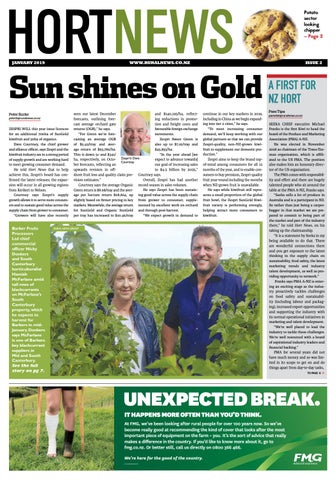
Barker Fruits Processors Ltd chief commercial officer Nicky Donkers and South Canterbury horticulturalist Hamish McFarlane amid tall rows of blackcurrants on McFarlane’s South Canterbury property, which he expects to harvest for Barkers in midJanuary. Donkers says McFarlane is one of Barkers key blackcurrant suppliers in Mid and South Canterbury. See the full story on pg 7.
Potato sector looking chipper – Page 2
and $140,195/ha, reflectseen our latest December ing reductions in promoforecasts, outlining foretion and freight costs and cast average orchard gate favourable foreign exchange returns (OGR),” he says. movements. “For Green we’re foreZespri Sweet Green is casting an average OGR also up to $7.16/tray and of $5.42/tray and aver$45,855/ha. age return of $63,786/ha. “In the year ahead [we This is down 5c and $341/ expect to advance towards] ha, respectively, on Octo- Zespri’s Dave Courtney our goal of increasing sales ber forecasts, reflecting an to $4.5 billion by 2025,” upwards revision in offshore fruit loss and quality claim pro- Courtney says. Overall, Zespri has had another vision estimates.” Courtney says the average Organic record season in sales volumes. He says Zespri has been sustainGreen return is $8.68/tray and the average per hectare return $68,864, up ing good value across the supply chain slightly based on firmer pricing in key from grower to consumer, supplemarkets. Meanwhile, the average return mented by excellent work on orchard for SunGold and Organic SunGold and through post-harvest. “We expect growth in demand to per tray has increased to $10.46/tray
continue in our key markets in 2019, including in China as we begin expanding into tier 2 cities,” he says. “To meet increasing consumer demand, we’ll keep working with our global partners so that we can provide Zespri-quality, non-NZ-grown kiwifruit to supplement our domestic production.” Zespri aims to keep the brand topof-mind among consumers for all 12 months of the year, and to enable consumers to buy premium, Zespri-quality fruit year-round including the months when NZ-grown fruit is unavailable. He says while kiwifruit still represents a small proportion of the global fruit bowl, the Zespri SunGold Kiwifruit variety is performing strongly, helping attract more consumers to kiwifruit.
RURAL NEWS GROUP
ISSUE 2
A FIRST FOR NZ HORT Pam Tipa pamelat@ruralnews.co.nz
SEEKA CHIEF executive Michael Franks is the first Kiwi to head the board of the Produce and Marketing Association (PMA) A-NZ. He was elected in November 2018 as chairman of the Trans-Tasman organisation, which is affiliated to the US PMA. The position also makes him an honorary director of the US organisation. The PMA comes with responsibility and effort and there are hugely talented people who sit around the table at the PMA A-NZ, Franks says. “Seeka sells a lot of produce in Australia and is a participant in NZ. So rather than just being a carpetbagger in that market we are prepared to commit to being part of the market and part of the industry there,” he told Hort News, on his taking up the chairmanship. “It is a statement by Seeka in my being available to do that. There are wonderful connections there and you get exposure to the latest thinking in the supply chain on sustainability, food safety, the latest marketing trends and industry talent development, as well as providing opportunity to network.” Franks says PMA A-NZ is entering an exciting stage as the industry proactively tackles challenges on food safety and sustainability (including labour and packaging), increased export opportunities and supporting the industry with its normal operational initiatives in marketing and talent development. “We’re well placed to lead the industry to tackle these challenges. We’re well resourced with a board of aspirational industry leaders and financial backing.” PMA for several years did not have much money and so was limited in its scope to get on and do things apart from day-to-day tasks, TO PAGE 6
UNEXPECTED BREAK. IT HAPPENS MORE OFTEN THAN YOU’D THINK.
At FMG, we’ve been looking after rural people for over 100 years now. So we’ve become really good at recommending the kind of cover that looks after the most important piece of equipment on the farm – you. It’s the sort of advice that really makes a difference in the country. If you’d like to know more about it, go to fmg.co.nz. Or better still, call us directly on 0800 366 466. We’re here for the good of the country. FMG0550HNFPS
2 HORTNEWS
JANUARY 2019
Potato sector looking chipper Pam Tipa pamelat@ruralnews.co.nz
THE OPPORTUNITIES for the potato industry lie in a planned series of sustainable developments, says Potatoes NZ chief executive Chris Claridge. “We don’t see a boom and bust with potatoes, just a gradual improvement,” he says. The sector is now close to a one billion dollar industry. Claridge says looking at the value of exports per hectare they estimate the export receipts per hectare are three times that of dairy. “Our environmental footprint is good as well, so it is a good crop in terms of generating domestic value and export opportunities.” He says Potatoes NZ set up a strategy in 2013 to look at three key targets. The first was to increase the profit for growers by $150/ha per annum. “We have gone back and looked at how we are tracking against those key industry targets and we found the 2013 farmgate value of $103 million increased to $170m in 2017,” Claridge told Hort News. “So we have seen an increase of 65% at the farmgate over that period. “Our hectares have
remained reasonably constant – we are planting about 10,000ha per annum – and there has been a corresponding increase in the farmgate value of that crop.” The second target was to double the value of fresh and processed exports by 2025. In 2013, the value of exports was $110.5m and in 2017 it was $130m. “That’s a 17% increase in export value; our current annual growth rate is 3.5% in export values but we need to get to an annual growth rate of 6% until 2025 to achieve our target of doubling. That is an achievable goal.” The third is to increase the domestic market value by 50% by 2025. The 2013 value – including chips, crisps, retail and food service – was about $650m and the current domestic market is $852m. This is an increase of 28% “We had an annual growth target of 3.5% and our current growth rate in the domestic market is 5% so we are on target to reach our goals,” Clar-
The potato sector’s total industry value at the end of 2017 was $982 million – making it close to a billiondollar-a-year industry.
idge says. “Our total industry value at the end of 2017 was $982m, so it is close to a one billion dollar industry.” Frozen Fry exports have gone from $76.7m to $91.70m between 2013 and 2017.
The industry has 173 growers, many based in mid Canterbury. “Almost two thirds of our crop is grown in the Canterbury region now. In the Canterbury region and North Otago you have five chip processing plants. “We have two large
THREE KEY AIMS IN STRATEGY THE POTATO industry has a clear strategy and key strategic initiatives to achieve its three goals, says Claridge. They fall into the three main themes of market, quality and R&D. “We work in R&D alongside Plant and Food, Otago University and Massey University to identify onfarm and off-farm research projects,” he told Hort News. “The market strategy is to promote healthy chips and fresh table potatoes. We work with a lot of strategic partners to develop healthier chips. “We have our best chip shop competition coming next year. We hold that every two years. We have just had the People’s Choice chip shop awards and 500 chip shops entered. “We continue to promote fresh table potatoes as a complete meal -- you could live on them. People call them
nature’s vitamin pill,” Claridge adds. “We are positive about the future: potato consumption is steady, we have seen good returns in export markets for fresh table potatoes. We are competing well against rice and quinoa which we think should be [supplemented] by potatoes at all times. “Consumers are always concerned about health. We have potatoes that cover all consumer requirements. We have the low carb potato Lotatoes which have been a very popular Turners and Growers brand, then you go to your classic Oamaru Jersey Bennies and more staple Ilam Hardies. There’s potato for almost every occasion.” The industry strategy also emphasises good biosecurity systems and quality and ensuring that high quality seed for the industry is maintained.
Potatoes NZ chief executive Chris Claridge.
processors – McCains in Ashburton and Talleys in Timaru -- and smaller processors, Mahikhi Fries, Heartland Chips and Mr Chips, with small plants at Christchurch. “Heartland is a good example of vertical integration where the farming family is both a grower
and processor,” Claridge says. “But then you see bigger, more international corporate models in McCains. So there is room for both types of operations in the marketplace.” The industry sees opportunities in fitting in with other farming prac-
tices – small seeds, specialised seeds, mixed cropping and dairying. “Potatoes go quite well in a rotation system. “The industry also has good added value – a mixture of retail ready and food service products.”
JANUARY 2019
Tariffs put squeeze on tomato exports In the year ended TOMATOES NEW ZeaMarch 31, 2018, the land represents NZ’s 123 fresh tomato industry commercial fresh tomato exported 3641 tonnes growers who produce at a value of $12.24m about 42,500 tonnes of (FOB). Key markets fresh tomatoes in 120ha include Japan, Ausof greenhouses. tralia, Pacific Islands The fresh tomato and Canada. Over industry has an annual Barry O’Neil winter, last year, we farmgate value of $130m, saw higher levels of including export sales of INDUSTRY imported tomatoes over $10m per year. from Australia than We focus our efforts on is normal, which have being economically and environmentally sustainable growers of to be irradiated due to the fruit fly risk healthy, safe and nutritious fresh toma- they present. A key issue for our industry is toes in a progressive industry that will attract investment. And our goal is to carbon zero 2050 and the associated double the value of the fresh tomato government policies and Emissions sector from its 2014 value to $200m by Trading Scheme (ETS) that will be used to reach this goal. The tomato industry October 2020. Given the finite opportunity to is already part of the NZETS through increase domestic value and sales, units paid on heating greenhouses, we have a major focus on export mar- which results in significant produckets and delivering high quality fresh tion costs for our growers. While we can understand the aspitomatoes that attract a premium price.
Comment
rational government goals, we believe there needs to be significant investment in research and the development of new technology to give growers the tools they will need to lower net emissions while still remaining competitive economically especially considering our competitors internationally don’t have these additional production costs. Any government policy changes in such a significant area need to be progressed in a consistent and fiscally prudent manner. Biosecurity of course is another key focus for us. We are signatories to the Government Industry Agreement on Biosecurity Readiness and Response (GIA) and the Brown Marmorated Stink Bug and Fruit Fly readiness and response operational agreements, and we’re currently working towards a tomato sector operational agreement for our top priority pests which we hope to sign with MPI before the end of this year. Last year, members of Tomatoes NZ
voted in favour of a biosecurity levy, now being signed off by MPI. But existing pests in NZ at times cause major production challenges and as an industry we are spending much time and effort on finding biological control approaches for these. We applied and obtained approval from the Environmental Protection Authority (EPA) to import Tamarixia to control a recently introduced psyllid, but these processes are expensive and take
AGROPLUS SERIES
HORTNEWS
a lot of time, resulting in us also looking within NZ to find biological control solutions. We are working with the Bio-Protection Research Centre at Lincoln University and funding a PhD student to identify insects already present in NZ that will kill some of our glasshouse pests, especially whitefly. • Barry O’Neil is the chair Tomatoes NZ and newly elected president of Horticulture NZ.
UP TO
YEARS
5
AGRO CARE
WARRANTY
RUN-OUT
SALE
LIMITED STOCK
FA867HN
30% DEPOSIT + TOTAL GST THEN ONLY
1,183
$
/MONTH*
DEUTZ-FAHR V320 ROPS 82HP
DEUTZ-FAHR V320 GS CAB 82HP
• SDF 1000 Series, 3 cylinder tier 3 engine
• SDF 1000 Series, 3 cylinder tier 3 engine
• Synchronised dry clutch transmission with 30 forward and 15 reverse speeds and shuttle lever on dash for greater convenience
• Wet clutch powershuttle transmission with 30 forward and 15 reverse speeds with Stop & Go clutchless braking
• Double hydraulic pump for enhanced flow rates when working with more demanding implements that require higher oil flow
• Air conditioned 4-post cabin with interchangeable filters for spraying and working with chemicals
• 40 km/h forward speed and 50 degree steering lock for further enhanced efficiency and manoeuvrability • Run-out sale price only $56,990+GST
30% DEPOSIT + TOTAL GST THEN ONLY
1,449
$
/MONTH*
• 4 Wheel braking and 100% locking front & rear differentials for safety and control when working with big loads or on hills • Tractor only $69,990+GST
Offer valid until 31/01/19. * Terms and conditions and normal lending criteria apply. Requires 30% of price + total GST paid as deposit then 36 monthly payments at 3.75% interest. ** Terms and conditions apply. Go to deutztractors.co.nz/trydeutz for detailed terms and conditions. Contact your local dealership for more information.
0800 801 888
|
d e u t z t r a c t o r s .c o .n z
|
F b deu tz N Z
3
4 HORTNEWS
JANUARY 2019
Hort’s growing profile changing Peter Burke peterb@ruralnews.co.nz
THE PROFILE of horticulture is changing, according to a report by the Horticultural Export Authority (HEA). The report says the industry has consolidated greatly in the last two years. Some sectors have fewer growers but larger commercial growing operations and in some cases the acreage of crops has increased. Two examples of this are the onion and capsicum industries. In 2016, there were 95 onion growers with 4895ha in production versus 2018 with 91 growers and 5225ha planted. In the case of capsicums, in 2016 there were 75 growers. However, in the past two years the number of growers has dropped to 46 – yet production has increased from 15,000 tonnes to 19,000t. HEA chief executive Simon Hegarty says economics are the chief cause of the consolidation, notably compliance, increasing costs of labour and transport, all of which have pushed up production costs per hectare. World trade is at present in a bit of mess with uncertainty over Brexit and other trade issues, he says. “People don’t like uncertainty and we have enough uncertainty in what the climate throws up every year without the uncertainty of trading conditions being overlaid on the industry as well,” Hegarty told Hort News. “A hefty risk goes with producing perishable products.” Hegarty says tariffs cost the NZ horticultural export sector an estimated $214 million and while this amount will reduce with the phasing in of the CTPP this year, tariffs remain a significant impediment. He cites the example of Europe where NZ pays an estimated $70m
Trade Minister David Parker
BENEFITS COMING FROM REVAMPED TPP DEAL
Hegarty estimates that tariffs cost NZ horticultural exports $214 million a year
“Tariffs are a tax on product coming across the border; there is no justification for them. And it’s not just charged on the product itself, but on the insurance and freight costs as well.” in tariffs. “Tariffs are a tax on product coming across the border; there is no justification for them. And it’s not just charged on the product itself, but on the insurance and freight costs as well.” Hegarty says NZ respects the right of countries to protect their borders, but some nations take actions which simply aren’t justified. He points to situations where both sides accept the science relating to imports but politics enters the fray. “It can be a grey area and that’s where the challenges lie. We believe
in argument based on sound science, but sometimes it is not always science that is causing delays or disruptions in products getting into markets. “You can have situations where ports of entry are limited or extra requirements or checks pre-shipment cause delays. There are also delays in getting access to new markets because in some cases countries will only consider one or two applications at a time and that is a problem for us.” Hegarty says exporters rely heavily on organisations such as MPI to sort out problems and it’s critical
Horticultural Export Authority chair Simon Hegarty.
that it and other agencies are suitably resourced and have people with the right skills to assist exporters.
NZ EXPORTERS exporters are among the first to benefit from the Comprehensive and Progressive Agreement for Trans-Pacific Partnership (CPTPP) which took effect at the beginning of the new year. Minister for Trade and Export Growth David Parker says the CPTPP provides NZ with trade agreements for the first time with three big economies -- Japan, Canada and Mexico. He says tariffs in those countries will start to reduce immediately, giving a further boost to the competitiveness of NZ products in those markets. “When Vietnam joins the agreement on January 14, 2019 it will make an immediate double tariff cut to catch up. Japan’s second tariff cut will take place three months later on April 1. “The CPTPP has the potential to deliver an estimated $222 million of tariff savings to NZ exporters annually once it is fully in force, with almost half of that ($105m) now available in the first 12 months. This will benefit NZ workers and businesses from Kaitaia to Bluff.” Parkers says Bay of Plenty, which produces 79% of NZ’s kiwifruit and is our largest producer of avocados, stands to gain as tariffs disappear immediately across the CPTPP region.
NOW READ IT ONLINE GENERAL NEWS PEOPLE PROFILES AND MUCH MORE... REGIONAL UPDATES OPINION
www.nzwinegrower.co.nz
Reading the magazine online has never been easier.
HORTNEWS
JANUARY 2019
Marlborough maintains its title as home of NZ garlic
Tessa Nicholson
THERE WAS a time 20 years ago when the aroma of garlic was what Marlburians woke up to during the months of January and February. The unmistakable tang permeated the air, as the country’s largest garlic producing region harvested its crops. Those days may be long gone, due to the ever-growing onslaught of vineyards taking over garlic paddocks, but Marlborough still maintains the title of New Zealand garlic king, producing about 70% of the country’s total crop. John Murphy, chief executive of Marlborough Garlic (one of two major producers in the region) says there is no way they
can compete against the US and China in volume, but they can excel in quality. Interestingly, given Marlborough’s renown for wine, it is the brix (sugar level) of the garlic grown here that sets it apart from that grown elsewhere, he explains. You may not think of garlic as sweet, but to put it in perspective, a ripe sauvignon blanc grape would contain about 23 brix. A ripe garlic clove, ready for picking would hit the 40 brix level – something almost impossible to achieve elsewhere in the world. What is it about Marlborough that allows this? Murphy says it’s hard to tell, but it’s likely to be the same influences that
impact on grapes – sunshine, rainfall, GDD and soil. Marlborough Garlic has 80ha of garlic under production and harvests close to 7 tonnes/ha. That, Murphy says, is considered a reasonable yield worldwide, even if it is well below the 10 – 12tph grown in some other countries. The smaller yield goes into premium products -- fresh, dehydrated, crushed or peeled. “It doesn’t matter which product the garlic ends up in, it is all grown and treated in the same way -- as a premium product,” he tells Hort News. But perhaps the most intriguing garlic product to come out of Marlborough Garlic’s factory
Chief executive of Marlborough Garlic John Murphy.
is Garlic Noir – or Black Garlic. No, it isn’t grown in darker soils and it is not a different form of bulb; instead it is normal garlic
that is slow roasted (or fermented as some would say) for weeks on end. Six weeks, in fact. Marlborough Garlic has three massive ovens
that hold 218 roasting dishes each. Each dish is filled with garlic that is broken and peeled, prior to spending those long weeks roasting away slowly. The slow cooking triggers the Maillard reaction, which like caramelisation is a form of non-enzymatic browning. The process takes away the astringency of garlic as we know it, and the pungent aroma. The end product is often compared to a dried fruit -- smoky, sweet and slightly chewy. And believe it or not, it is a perfect match for cheese and chocolate -- not a food match you probably would have considered with normal garlic. “Probably the most important thing about
this,” Murphy says, “is that there are no ingredients other than fresh Marlborough garlic -nothing at all, yet you are left with this intriguing product that sits somewhere between sweet and savoury.” But as with all new products, consumer acceptance takes time. “Consumer research we have done shows that its biggest attribute is its mystique. “And its biggest problem is its mystique, in that people don’t quite know what it is, but they are absolutely intrigued by it,” he told Hort News. The new product is a diversification by the company, which Murphy says is vital if they want to stay ahead of the pack.
CROPLANDS SELF-PROPELLED CROPLINER SPRAY WITH CONFIDENCE
2.9% FINANCE OFFER*
2 YR
OR 1500 HOUR WARRANTY*
This lightweight performer features large flotation tyres for improved stability, reduced soil compaction, greater climbing abilities and ground clearance. The Self Propelled Cropliner will empower you to spray in conditions other sprayers simply can’t. » Kiwi-specific fan system delivers consistently even coverage on both sides of the canes and canopy on a single pass » Simple, user-friendly tractor unit and controls » Auto alignment, 2, 4 and crab steering system » Strong and reliable new mechanical drive - backed by an extended driveline warranty*
» Superior protection on pruning, fruit picking and leaf fall scars » Even spray distribution over the entire canopy with less run off points and improved chemical retention » No need for alternate direction spraying » Greater coverage into difficult to spray areas, e.g. heavily wooded vines *Terms and conditions apply
5
FOR SALES ENQUIRIES CONTACT Croplands Territory Manager & NZ Horticulture Product Lead Greg Small 0276 879010
www.croplands.co.nz
6 HORTNEWS
JANUARY 2019
Hort’s growth not just in paddock Nigel Malthus
HORTICULTURE IS in a growth phase and has ambitious goals, says the director of the HortNZ Leadership Programme, Sue Pickering. Many people who have been a long time in the industry are now looking towards retirement, she says. “The whole realm of
succession, and people with skills and leadership qualities, has become high on the radar. It means programmes like this are popular, and people are recognising the need for them.” Last year, a record 35 people applied for the 18 places available on the course. “We’re finding a real demand at the moment.”
A 25-year veteran of the horticultural industry, Pickering has held roles in HortNZ including senior business manager and acting chief executive, developing such initiatives as the Leadership Programme and the Young Grower of the Year. She has recently struck out on her own with a business coaching consultancy but continues to
run the Leadership Programme for HortNZ. Having started in 2001 with 12 participants a year, it is going “from strength to strength” and now has at least 225 graduates, many of them now “popping up everywhere” in the industry. A survey of horticultural employers last year also gave it positive feedback. Pickering runs the
NOW READ IT ONLINE READING THE PAPER ONLINE HAS NEVER BEEN EASIER. ■ BREAKING NEWS
■ MANAGEMENT STORIES
■ MACHINERY REVIEWS
■ COMPETITIONS
■ MARKETS & TRENDS
■ AND MUCH MORE...
Director of the HortNZ Leadership Programme, Sue Pickering.
course with the help of two other directors -- Lincoln University professor Tony Zwart and Dr Patrick Aldwell. The programme runs between August and October each year in three parts: a four-day residential at Lincoln, a six-week project in which each participant works on their own personal and professional development, then three days in Wellington where they present their projects and get an introduction to the country’s regulatory and administrative landscape. Pickering says an objective of the programme is to give participants an understanding of how Wellington works from an industry leadership point of view. They get to call on and discuss the state of the industry
with the Minister of Agriculture. “We’re very lucky to have had that connection ever since the year dot,” she says. “The context of this is some of the bigger issues in industry -- biosecurity, environment, natural resources, labour issues -across the board. We connect with folks who are already leading, and focus on strategic thinking at all different levels -- whether industry, organisational or individual.” Pickering says there is no age limit to participation and past attendees have ranged from their early 20s to their mid50s. It is open to anyone committed to horticulture and who either shows potential for or is already in a leadership role in the industry.
“That diversity of ages is a real advantage point for the programme because we work with the people in each year. We find part of the philosophy of this programme is that there’s a lot to be gained from the participants themselves. They find they’ve got a lot in common. They feed off each other and the issues that we work with. “You can have kiwifruit folk, cherry growers from Otago, someone from the corporate T&G world, someone from the citrus area north of Auckland; you name it, we have it, across different types of businesses, across different sectors and across the regions.” Entries for this year’s course open in early March and close on May 31.
A FIRST FOR NZ HORT BOSS FROM PAGE 1
HEADER Ferist et quati aut pedici te vollab imod quamet atur soleniet quiatibu. PAGE 15
HEADER Ferist et quati aut pedici te vollab imod quamet atur soleniet quiatibu. PAGE 23
RURALNEWS
HEADER Ferist et quati aut pedici te vollab imod quamet atur soleniet quiatibu.
PAGE 24
TO ALL FARMERS, FOR ALL FARMERS
www.ruralnews.co.nz
Franks told Hort News. Latterly it has found itself better-off and “having some means to invest,” he says. So the board and management are now working out exactly what they will invest in. “We know what our platforms are but we are looking at what we will deliver under those platforms. We have to focus on what we are going to achieve. “It is exciting. Food safety is hugely important in Australia and NZ, ensuring that Harps (Harmonised Australian Retailer Produce Scheme) in the retail systems are working correctly and that people are safe when they consume products bought through the supply chain.”
Sustainability is another platform along with providing the latest marketing trends in Australia and New Zealand. PMA runs great seminars on those trends, Franks says. “They have an excellent supply chain, produce executive-focused series of training courses and they provide opportunities for members to talk and meet together outside of their conference.” As the chairman he is part of an executive and a board. “Part of my role is to make sure the association functions properly as a governance body and goes through the process of challenging itself and making sure it knows what its members want it to do and then to get it done.”
HORTNEWS
JANUARY 2019
7
South Canterbury horticulturalist Hamish McFarlane amid tall rows of blackcurrants which he expects to harvest for Barkers in mid-January. RURAL NEWS GROUP
Region helps magic berries to thrive Nigel Malthus
THE RICH black colour of blackcurrants is what makes them so valuable, says South Canterbury grower Hamish McFarlane. The colour comes from a class of antioxidants called anthocyanins. “Little wee bits of magic,” he tells Hort News; they give blackcurrants the health and wellness benefits they are famous for. McFarlane believes something about the climate that makes South Canterbury ideal for growing the fruit. “Some of the varieties we have here are the same as what’s grown overseas but ours would probably be double the anthocyanins. We believe it’s due to our latitude.” McFarlane is carrying on a tradition begun by his father, who started supplying fruit in 1981 to the iconic Geraldine fruit processor Barkers, who use blackcurrants in a range of syrups, jams and condiments. About 100ha of his 550ha is planted in blackcurrants. He also grows barley, seeds, potatoes for McCains, and variously coloured carrots for a Timaru company that juices them for export. He also grazes a few trade lambs and dairy heifers. Barkers’ chief commercial officer, Nicky Donkers, says McFarlane is one of their key blackcurrant suppliers in Mid and South Canterbury. She agrees that New Zealand blackcurrants contain some of the highest levels of anthocyanins in the world and they are also an excellent source of vitamin C and other antioxidant polyphenols.
Ripe Blackcurrants. SUPPLIED/CROP & FOOD RESEARCH
“Some of the varieties we have here are the same as what’s grown overseas but ours would probably be double the anthocyanins. We believe it’s due to our latitude.” Donkers says proof of their health benefits, backed by “credible and continually evolving research,” is stronger than ever and that is a message Barkers and the industry want to get out to the public. People are going to live longer but want to be fit. “Many sportspeople are also now using blackcurrants in some form for exercise recovery. They are a natural functional ingredient powerhouse,” she adds. McFarlane says part of the reason he likes blackcurrants is their low environmental footprint, low fertiliser needs and their not being grown in a monoculture. Grass grows between the rows and crowds out most weeds. Blackcurrants are planted in winter from cuttings, produce their first crop two and half years later, and may produce for up to 15 years. Depending on variety, McFarlane may mow them right back to ground level once during their lifetime. He side prunes annually to take out branches encroaching into the space between rows. He runs an integrated pest management (IPM) programme incorporating cultural, biological and chemical controls, aiming to let nature sort out problems where possible. Cultural control means being
smart about what gets planted, where and how. Biological control includes releasing a predator species to deal with a pest called the two-spotted mite, which otherwise can be a problem in the heat of January. Pheromone ties every 3m down the rows attack another significant pest -- the currant clearwing moth -- by confusing them “so they forget to mate,” says McFarlane. He makes sure any chemicals used are carefully targeted to pests and are safe for the beneficials. “So we’re not organic, but we use best practice.” McFarlane has half a dozen main blackcurrant varieties with different behaviours, flavour profiles and harvesting dates, to spread harvest (using a mechanical harvester which shakes the fruit free) across about six weeks from early in the new year. McFarlane says his varieties aren’t chosen by accident, but to suit the taste profile and other parameters Barkers looks for. Donkers gives away no details but hints at a new cane fruit soon to come to market with McFarlane’s help. “The beauty of what we’re trying to do as a business is work closely with growers like Hamish so that we can look at our future,” she says. “Collaboration is key as we move forward.”
Barker Fruits Processors Ltd chief commerical officer Nicky Donkers amid the blackcurrant canes on Hamish McFarlane’s farm. RURAL NEWS GROUP
SUSTAINABILITY IMPORTANT IT IS important for Barkers to partner with responsible caretakers of the land, says Barkers’ chief commercial officer, Nicky Donkers. “Regarding our brand and transparency, people want to know where their food is coming from and how it is grown.” That is why Barkers recently partnered with Irrigation NZ and others, to put on an interactive display that went to the Ashburton A&P Show (where it won an award for the best small trade site) and the New Zealand Agricultural Show (Canterbury). The display aimed to inform people of the very wide use of irrigation in all sectors including horticulture. “It’s fair to say that water and dairying get a lot of ‘air time’,” Donkers told Hort News. “But that’s only part of what water is actually used for in NZ. People may not realise that it’s an important contributor to growing great food. It’s one component, along with location, great natural light and sunshine, and general care. “People see our products on the shelf or consume them in a cafe but may not be aware of where some of them originated so let’s trace it back to where it all begins,” she said. Responsible use of the land by its suppliers is important for Barkers. “Even though farmers from time to time get criticised for what they do, most farmers are doing an amazing job caring for the land, wanting to leave it in great shape for the next generation. We want to make sure we’re working with responsible partners in growing fruit because our brand is at stake as well.” McFarlane’s farm has had an approved farm environment plan (FEP) for the past five years. He is also chair of the Orari Temuka Opihi Pareora water zone committee. A wet spring meant very little irrigation in the early part of this season, but most years he will irrigate, by dripline, pivot or gun.
8 HORTNEWS
JANUARY 2019
Frost fans strike a blow for yields Mark Daniel markd@ruralnews.co.nz
DAMAGING FROSTS typically occur after a cold, cloudy day followed by a still night with clear skies. The earth quickly radiates any stored heat after sunset and an inversion layer occurs -- the air being coldest near the ground with a warmer layer of air above it. The degree of crop damage depends on the minimum temperature reached, the rate at which the temperature falls and the amount of time below a critical temperature. Critical temperature is defined by Young (1966) and Johnson and Howell (1981) as “the lowest temperature a bud (or shoot) can endure for 30 minutes or less without injury”. However, it’s not all about avoiding catastrophic loss; the aim is also to protect against cold injury to increase a
grower’s current yields and improve the quality of the fruit while ensuring continuity of supply or shelf space. Assessing frost risk is the first step; site selection is still the key to lowering frost risk. Crops become more susceptible to frost damage when they are located at high elevations, in low lying areas where cold air settles and next to obstacles to air movement such as tall vegetation, levees and buildings. Orchard design should allow for orienting trees in the direction of predominant slopes to promote air movement down-slope and through the orchard. In flatter areas, orient trees in the direction of the prevailing wind. After selecting the location and orchard design/orientation, methods to protect against frost and cold injury fall
The Frost Boss C49 fan is one of the quietest on the market.
into one of four main groups: wind (frost fans or helicopters), water sprinkling, heat introduction and orchard management/maintenance practices (such as removing ground cover). Frost fans are a well proven technology for mitigating the devastating losses. Many growers use them as a tool to combat cold injury by program-
ming them to start, based on a preset temperature, helping to prevent damage from events that may only last a few hours in the middle of the night or early morning. Frost fans work by utilising warmer/drier air from the ‘inversion’ layer to create air movement at the fruiting/flowering height in orchards on still, cold nights, pre-
venting damage to flowers, soft tissue and fruit. Anecdotal evidence from growers has shown that while the use of frost fans can save a crop from total loss in a severe frost, they can also play a significant role in improving the yields and quality of fruit that can slowly be eroded by several previously unrecognised cold snaps. New Zealand Frost
HORTNEWS Introducing Hort News, a new national publication serving the needs of our booming horticulture sector. Distributed with the leading national farming publication Rural News, Hort News will be delivered to all key horticulture regions nationwide. It is the complete solution for readers and advertisers, covering every aspect of the wider horticulture industry – news, agribusiness, management, markets, machinery and technology.
Fans Ltd (NZFF) manufactures a range of frost fans (aka wind machines) under the FrostBoss trade mark, including the C24 (2-blade), C39 (3-blade), C49 (4-blade) and FrostBoss C59 (5-blade) machines. The FrostBoss C49 (4-blade) machine is claimed to be the bestselling frost fan in NZ and Australia. The FrostBoss C49
was developed with help from former Team New Zealand aerodynamics research engineer Richard Karn, to optimise noise reduction by using a greater blade working area and slower rotational speed than a 2-blade fan. In addition, the much higher blade passage frequency of the 4-blade fan means the noise signature no longer has a low frequency beating sound, such as with an Iroquois helicopter. Along with the FrostBoss C49, the FrostBoss C59 (5-blade machine) is the quietest on the market. Fan upgrades can improve efficiency and productivity, such as by retrofitting composite blades, centrifugal clutches and gearboxes, particularly when coupled with automated controllers and web-based monitoring. www.nzfrostfans.com
HORTNEWS
The secret behind success – Page 6
ISSUE 1
! g n i k s i t i u r f i w i K WS.CO.NZ WWW.RURALNE
OCTOBER 2018
Peter Burke
peterb@ruralnew
s.co.nz
by consumers to A UNIVERSAL trend er lives is driving live better and healthi Zealand kiwifruit. the demand for New ve Don MathieZespri chief executi fits perfectly into son says kiwifruit strong demand that scenario, causing in all its markets. growth has sales says Mathieson
this year: 150 milbeen strong again about 120 million lion trays, up from trays last year. by the SunA lot of that is driven is good growth there gold variety, and green. Zespri also in we see that “Looking long term, with consumers trend continuing ts, great food wanting great produc with nutrition,” items that are filled News. Mathieson told Hort
in that space “Kiwifruit is a real king s and fibre and with all the vitamin ts it has versus the nutritional elemen on that trend we see other fruits. Based strong demand.” group of conHe says their target very health consumers tend to be region-specific but scious, which is not the board. Zespri is tends to be across in both green and getting good growth China going very gold in Asia, with
Jack Frost never sleeps Cromwell orchardist d at Simon Webb picture ss sunrise after a sleeple night of frost-fighting. Overhead sprinklers d are a common metho of preventing frost damage as water on buds releases a little as warmth into the buds ts it freezes, then protec of them from the worst air. cold the 7 – See more page
attractive price and sumers at a more d. well. has helped drive deman and they are that Taiwan is doing “It’s going well in Japan “At the same time, r-one market in number-one conour now is once again our numbe and well are also seeing great per capita in the market on Asia this year. We sumpti and have seen the growth in Korea world.” lly come down. ers have always duties start to gradua European consum duty on our ters of Zespri green, “We used to pay 45% been strong suppor there but with NZ’s free son says consumers exports to Korea, the duties but Mathie them with ent be attracted to Suntrade agreem are now starting to off and we have is because Suncome to this s started believe have gold. He is kiwifruit to consweeter taste and slightly a been able to offer our has gold easy to eat. and continues “France is going well RURAL NEWS GROUP market for us. In to be a high growth a been has years, it the last couple of European region. real performer in the good growth in And we are also seeing in Spain, the Bens market major all our ny and Italy.” elux region, Germa
YOUR HORT NEWS!
first issue of Welcome to the Hort News. is proud Rural News Group national to launch this new the fastserve to tion publica sector. ltural horticu g growin op Hort News is a one-st lture read for all horticu industry sectors, covering , markets, news, management nery, technology, machi opinion and more. Rural News Distributed with regions, in key horticulture the only Hort News will be tion independent publica horticulcovering the entire tural industry. it. We hope you enjoy Adam Fricker General manager Rural News Group
RTAIN, NTY IS CECO UNCERTAILE BECAUSEFM CROP VER. AB AR G E’S THER So it you least expect it. ts they can all hit when from FMG. It protec lightning or frost, Hail or windstorm, with Arable Crop cover e been harvested. ard your livelihood months after they’v makes sense to safegu of g, and for up to 12 days 40 growin within they’re if you have a loss your crops while of replanting costs 0800 366 466. on 80% us to call up a us pay still, give We’ll even about us. Or better ting criteria tation and underwri planting. So ask around specific product documen is subject to our us on 0800 366 466. of our product and .co.nz or by calling This is a summary on our website www.fmg which can be found
We’re here for the
ry.
good of the count
FMG0828HNFPS
To book your advert contact your local sales rep
• It’s the one-stop way to reach the horticultural sector • News and information for all types of growers • 10,000 nationwide distribution • Sent out with the trusted and established publication Rural News
Publishers of
RURAL NEWS TO ALL FARMERS, FOR ALL FARMERS
Contact: STEPHEN POLLARD National Sales Manager and Auckland Rep Ph 09-913 9637 or 021 963 166 TED DARLEY Waikato Sales Representative Ph 07-854 6292 or 021 832 505 RON MACKAY Wellington Sales Representative Ph 04-234 6239 or 021 453 914 KAYE SUTHERLAND Christchurch Sales Representative Ph 03-337 3828 or 021 221 1994