Sharemilkers warned about M.bovis. PAGE 3 CRUISE CONTROL
DOWN TO THE WIRE
Fieldays turning 50 PAGE 14
Hilux makeover PAGE 34
FEBRUARY 27, 2018 ISSUE 395 // www.dairynews.co.nz
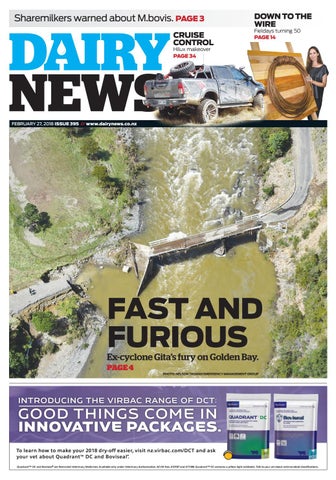
FAST AND FURIOUS
Ex-cyclone Gita’s fury on Golden Bay . PAGE 4
PHOTO: NELSON TASMAN EMERGENCY MANAGEMENT GROUP
INTRODUCING THE VIRBAC RANGE OF DCT:
GOOD THINGS COME IN INNOVATIVE PACKAGES. To learn how to make your 2018 dry-off easier, visit nz.virbac.com/DCT and ask your vet about Quadrant ™ DC and Boviseal . ®
Quadrant™ DC and Boviseal® are Restricted Veterinary Medicines. Available only under Veterinary Authorisation. ACVM Nos. A10107 and A11406. Quadrant™ DC contains a yellow light antibiotic. Talk to your vet about antimicrobial classifications.
Fast track your pasture growth
Express gibberellic acid ®
As temperatures cool off, shortages in your feed wedge can develop. Research shows that combining Express® gibberellic acid with nitrogen will give you greater pasture growth.
64
EXPRESS 20g/Ha
+ WIDESPREAD 1000 + 20Kg N/Ha
%*
+
Kg DM/Ha
Boost your dry matter production during the cooler periods with Express, the water soluble form of gibberellic acid.
USE WIDESPREAD® 1000 WITH EXPRESS® FOR BETTER COVERAGE AND RESULTS
*Control 781Kg DM/ha
Get the most out of your pasture this season. Order Express® today.
RAV-27FEB-DN
0800 100 123 | ravensdown.co.nz
Smarter farming for a better New Zealand™
DAIRY NEWS FEBRUARY 27, 2018
NEWS // 3
Cow disease putting sharemilkers in peril PETER BURKE peterb@ruralnews.co.nz
Crackdown on dodgy employers. PG.10
More than just making money. PG.20
Urine sensors on cows. PG.22
SHAREMILKERS – ESPECIALLY those with 50/50 contracts -- must be on guard against the risk of M.bovis if they are planning to move at the end of the season or to buy new stock. James Allen of AgFirst says 50/50 sharemilkers are especially at risk because their herd is their only asset, so they need to be cautious when buying new stock. If by chance they get M.bovis in their herd the implications are enormous. A 50/50 sharemilker moving to an area known to have a case of M.bovis must be very aware of the risks he is taking, Allen says. “We are now asking all our dairy clients to start thinking about the issues and looking at the risk areas and what it might mean if their herd were to get M.bovis. “Essentially it’s transferred by animal-to-animal contact so farmers need to think about where this might happen; for example, could it come
‘FARMERS GOT OFF LIGHTLY’ ALL the damage inflicted on the dairy sector by excyclone Gita, the Minister of Agriculture Damien O’Connor thinks farmers got off lightly. He told Dairy News, just after flying over badly hit Takaka and the West Coast, that it could have been worse. He praised the local councils, farmers and others who prepared for the cyclone, and Fonterra for
DESPITE
NEWS ������������������������������������������������������3-15 AGRIBUSINESS ������������������������������������16 OPINION ����������������������������������������������18-19 MANAGEMENT ������������������������������� 20-21 ANIMAL HEALTH ��������������������������������� 22 MILK COOLING ������������������������������ 24-32 MACHINERY & PRODUCTS �������������������������������������� 33-34
moving unless they have to. when buying in-calf heifers His members face huge or bulls?” turmoil if they get M.bovis Allen says farmers need to in their herd, he says. They know where stock is coming need to be aware of the risks from and get some security of any move. about the status of these aniHe recommends sharemals in respect of M.bovis. milkers read a leaflet pubThere can be no guaranlished by Feds, DairyNZ and tee, he warns. the NZ Veterinary Associa“For example, if you buy tion on precautions against young calves from a sale you M.bovis. have no control over the bios“These include buying ecurity of such animals.” annals from as few farms as Allen says the 50/50 sharepossible, supplying a farm milker is by far the dairy owner with any M.bovis tests industry’s most vulnerable to you have and asking whether M.bovis in financial terms. A James Allen, AgFirst a herd has been mixed with manager, a contract milker or a lower-order sharemilker may take a one-year any other animals, including wintering stock financial hit by losing income. But a 50/50 share- during the past twelve months,” he says. Sharemilkers should also ask the farm they are milker has all their assets on the line. Meanwhile, Richard McIntyre, who represents going to if it’s been the subject of MPI tracing sharemilkers in Federated Farmers, says from for M.bovis. • More on page 6 what he has heard most sharemilkers are not
working hard to barge milk from dairy farmers to the processing plant. “Takaka itself is isolated and milk processing is an issue as is getting petrol and other supplies into the town.The northern part around Takaka and Riwaka had been hard hit by the water and some of the slips on the road. “Further down the Coast there was a bit of wind damage but they
got out of it quite well. In general we got off relatively lightly from what was a big storm,” he says. O’Connor says big pockets of rain had come down hard in some catchments but not in others, having a mitigating effect in terms of damage. But the slips will take people a lot of time to clean up, especially with this latest storm following hard on the previous one – “a big
challenge for people”. O’Connor says some Westport farm buildings had their roofs blown off and drought there means farmers don’t have a lot of surplus feed. “We hope we get some fine weather to get the grass growing before winter,” he says. – Peter Burke • More coverage on storm damage – page 4
DAIRY NEWS FEBRUARY 27, 2018
4 // NEWS
Down to the sea in barges NIGEL MALTHUS
SEVERE DAMAGE to the Takaka Hill road from ex-cyclone Gita is forcing Fonterra to barge product by sea from its Takaka factory. Golden Bay, at the top of the South Island, was among the regions hardest hit by the storm, which washed out roads and bridges, inundated farmland and sent ‘a wall of water’ down the Takaka
River. Worst was damage to the Takaka Hill road, the only land access between the district and the rest of the country. Early estimates were that it could remain closed for at least several days. Fonterra’s operations manager for the upper South Island, Chris Win, said a barge organised with Civil Defence would initially bring in an empty tanker and trucks for Fonterra and supplies for res-
idents and visitors. The barge would ferry goods back and forth to Nelson for as long as necessary. Golden Bay has 83 dairy farms suppling Fonterra’s factory at Takaka, which can process about 525,000L a day into skim milk powder. It also produces cream as a by-product which is normally tankered out for further processing at Clandeboye. With limited storage at the factory, both would be barged out as necessary.
WESTPORT COPS ANOTHER ONE WESTPORT WAS again in the firing line as cyclone Gita unleashed itself along the West Coast. Rebecca Keoghan, Landcorp, who runs several dairy farms at Cape Foulwind near Westport says they prepared for Gita by tying down anything that might have blown away. But they still lost small sheds and a few trees. “The biggest gust we recorded was 123km/h before the wind blew the weather station away. We had big tides but they weren’t as bad as the previous cyclone.”
Keoghan says they also lost power, but that didn’t affect their oncea-day milking; they had already milked the cows before cyclone Gita struck just after lunchtime. If they were not on OAD the high winds would have prevented their afternoon milking. “It would have been too dangerous,” she says. OAD gave them leeway and helped them prepare for the storm and get though it reasonably well. “It’s been a couple of big weeks. We are over these storms now and they can stop,” she says.
Win said a power outage at Takaka lasted only about two and half hours but a boiler had to be shut down and restarted, losing several hours production. At the height of the storm about half the district’s farms were not collected from for safety reasons but all but about three were reached the next day. Takaka farmer Corrigan Sowman said the storm brought “probably a 100-year flood” in the Takaka River, which bounds his farm. “In fact I don’t think they’ve recorded 980 cubes (cu.m/sec) at Upper Takaka before. But in terms of damage, when I look around our property this morning it wouldn’t be any more than a typical 10-year event. We got a few broken wires.” Sowman believed the district’s farmers were “pretty well organised” before the storm, so stock were all well out of the
SPECIALISING IN RURAL REAL ESTATE THROUGHOUT CANTERBURY
If you need a confidential chat about the current rural property market, call me today.
027 434 2545 chris@propertybrokers.co.nz
Made in NZ for NZ dairy sheds
“Electric power remains on at the Hokitika site and all milk collected has been processed,” said Westland Milk Products chief executive Toni Brendish. A state of emergency was declared by all three district councils in Westland’s primary catchment area (Buller, Grey and Westland) and some localised road closures prevented tanker access to some farms, but most roads were open, she said. A state of emergency was also declared in
THE VAGARIES of the weather over the past year are starting to worry some dairy farmers in the lower North Island. While the Taranaki and Manawatu regions are affected in some way, the degree of impact varies much from region to region. In Taranaki, DairyNZ consulting officer Sarah Payne says in the central and northern areas the situation is a lot better than in the coastal areas. In the past two or three weeks, pasture covers in the central and northern areas have bounced back due mainly to heavy rain – 30 - 70mm in some places. But farmers on the coast got no more than 10mm.
❱❱ Local knowledge ❱❱ Over 20 years experience ❱❱ Tens of $millions of rural property sold
QUALITY NZ MADE DAIRY HOT WATER CYLINDERS
flood path. “The alarming thing last night was the sheer rate that the river came up; it was literally a wall of water.” Meanwhile, Fonterra reported few problems in other regions. Fifteen Taranaki farms missed one collection for safety reasons. Westland Milk Products, which was badly affected by the tail end of cyclone Fehi about three weeks earlier, also escaped serious disruption by Gita.
Christchurch and Selwyn districts but there was no impact on Westland’s plant at Rolleston or access to its Canterbury suppliers. Brendish said media reports of Westland Milk tankers being “stranded” at Hari Hari were incorrect. They were queued at Hari Hari waiting to see if they could get further south but were never cut off. Once advised the road was not going to be open in time, they collected milk locally then returned to Hokitika.
PATCHY WEATHER WOES
Chris Murdoch...
Hastings McLeod Limited. Licensed under the Real Estate Agents Act 2008 217 West Street, Ashburton
A swollen Takaka River at the height of last week’s storm. PHOTO SUPPLIED
“The coast is the worst hit, especially around Opunake and Okato and coming down south of Hawera as well. They just haven’t had the rain and while it’s greened up a bit we haven’t seen any major bounce-back in covers.” Payne says while cow condition is better in north and central Taranaki, it is still far from satisfactory in coastal regions. The situation is the same in Manawatu, Rangitikei and Horowhenua regions. The head consulting officer for the region, James Muwunganirwa, says the biggest challenge for farmers there will be having enough feed for winter. – Peter Burke
Our dairy cylinders are made in New Zealand and are available in a range of sizes from 180 to 1500 litres Special sizes can be made on request.
Our dairy water cylinder range includes: • Copper inner barrel with galvanised or stainless steel outer case • Stainless steel inner barrel with plastic blue outer case • Stainless steel inner barrel with stainless steel outer case Our cylinders include elements, thermostats, valve pack, vacuum break and sight tube. We now have stock of dairy water cylinders in our Hamilton based warehouse for quicker North Island deliveries.
superheat Dairy hot water cylinders
Find a local dairy merchant by calling us on (03) 389 9500 You can also visit our website:
www.superheat.co.nz
DAIRY NEWS FEBRUARY 27, 2018
NEWS // 5
Co-op finally makes a move on a2 milk PAM TIPA pamelat@ruralnews.co.nz
a2 MILK Co has struck a deal with Fonterra that will enable it, over time, to diversify its milk sourcing, processing and manufacturing to meet growing demand for its products, the company says. It will not affect its current relationship with Synlait, a spokesman told Dairy News. Fonterra and a2 Milk Company (a2MC) have signed a deal that links the co-op’s global milk pool and supply chain, manufacturing, and sales and distribution with a2MC’s brand strength and capabilities. Fonterra will now begin talking to its farmers to source an A2 milk pool for a2MC products in New Zealand. A similar milk pool in Australia will also be developed. Fonterra chief executive Theo Spierings and a2MC chief executive Geoffrey Babidge say they expect to grow demand in NZ and offshore for a2MC’s products.
“The partnership is intended to fast-track market growth and this creates opportunity for our farmers to create additional value from their milk,” says Spierings. The a2MC products will fit well in the co-op’s product range, he said. “Consumers like to have choices and the growth of a2MC branded nutritional powders and fresh milk sales in Australia, for example, show the potential.” Babidge says the partnership gives a2MC significant medium and long-term opportunities via “multi-site and geographic diversification and new product development”. It will give access to large scale manufacturing performance and competitive terms in a global context, he said. “The relationship with Fonterra is the ideal model to build brand awareness and deliver a consistent high-quality product to the broadest customer base in this market. “The opportunity to work together with Fon-
terra to explore new markets and products is also significant,” Babidge said. The co-op’s resources and capability in many of a2MC’s new priority markets should help speed the distribution of a2MC products. Goldman Sachs advised a2MC in negotiating with Fonterra. An a2MC spokesman told Dairy News that its relationship with Synlait and the new agreement with Fonterra are for separate purposes. “There’s no question of the arrangement with Fonterra superseding the one with Synlait,” the spokesman said. Synlait
has performed outstandingly under the infant formula supply deal the two companies have, he said. “Synlait [retains] exclusive rights to produce and supply infant formula [for] NZ, Australia and China.” The new Fonterra partnership: ■■ New Zealand and Australian milk pools will support the partnership. Fonterra will talk to its farmers on the best way to source A2 milk and share the value it will create for farmers. The milk pools will expand over time. ■■ Under a ‘nutritional
products manufacturing and supply agreement’ (NPMSA) with a2MC, Fonterra will exclusively supply nutritional milk powder products in bulk and consumer packages for sale in a2MC’s new priority markets in South East Asia and the Middle East. These products will be at Fonterra’s NZ plants and at its nutritionals plant, Darnum, in Victoria. The two companies plan distribution and sales arrangements to assist a2MC’s entry into its new priority markets in South East Asia and the Middle
Fonterra will talk to its farmer suppliers about a2 milk.
East. ■■ Exclusive period to explore a2MC branded butter and cheese, and China-sourced liquid milk for sale in Australia, NZ and China. These would be complementary to Fonterra’s existing product range.
FIRST HALF REVENUE RISES 70% a2 MILK Company boosted its firsthalf revenue to $434.7 million, a 70% increase on the same period in the previous year. Earnings before tax of $143m for the first half to December 31, 2017 were up 123% on the previous year and net profit after tax of $98.5m was 150% ahead. Basic earnings per share of 13.6 cents were an increase of 147%.
Growth continued strongly in the infant formula business, and liquid milk sales were again higher in each of the company’s core markets, the company says. Managing director Geoffrey Babidge says, “Our financial performance reflects the growing strength of our brand, successful in-market growth strategies and the strong performance of our supply chain.”
■■
A jointly owned packaging facility will be explored under the NPMSA to cater for growth. A New Zealand fresh milk exclusive licence will enable Fonterra to produce, distribute, market and sell a2 Milk fresh milk in NZ.
DOLOMITE NZ’s finest BioGro certified Mg fertiliser For a delivered price call... 0800 436 566
Dairy effluent solutions!
SILAGE NT A L U C O IN R E W O L AT A COST!
The Irrigator everyone wants!
ly ed successfu s u n e e b s a Gold h yward, • Bio Power & Susan Ha n h o J y b * utu on farm td, Te Awam L s ie ir a D y Judge Valle PPP io Power by B e s u to r to ontrac hout • Ask your c ur costs wit o y l o tr n o c nd Probiotics a e compromis t try Bio ge inoculan a il s a e s u ’t missing • If you don hat you are w e e s d n a Power PPP CAN ALSO SUPPLY SILAGE INOCULANT APPLICATORS FOR HARVESTERS
■■
ADCAM750 Travelling Irrigator • • • •
* Previous advertisements stated that Bio Power Gold had been “proven on farm”. This was incorrect. Use of the product by Judge Valley Dairies Ltd involved normal, on farm usage, not a scientific trial which proves Bio Power Gold’s performance.
Low application – maximise nutrient uptake Rugged construction – built to last Unique boom design – even spread pattern Quick release nozzles – simple to clean
FOR MORE INFORMATION CALL
0800 686 334
Numedic Ltd, 70 Riri Street, Rotorua, New Zealand P: +64 7 347 9974 F: +64 7 347 9975 E: info@numedic.co.nz W: www.numedic.co.nz
DAIRY NEWS FEBRUARY 27, 2018
6 // M.BOVIS UPDATE
M.bovis eradication still on the cards NIGEL MALTHUS
FIRST RESULTS from the nationwide milk surveillance testing for Mycoplasma bovis have all come back clear. Welcoming the early results, Agriculture and Biosecurity Minister Damien O’Connor said it showed that eradication remains a viable option. “This is a good result and gives us confidence we are on the right track as we hunt down this disease,” he said. “However, there is still a big job to do to determine the extent of the spread; we have two rounds of discarded milk testing to complete. The discarded milk comes
from animals displaying an illness of some type and may paint a different picture.” The surveillance involves testing milk from all New Zealand’s 12,000 dairy farms, in three rounds: first a sample of bulk milk from the tanker, followed by two samples -- two weeks apart -- of each farm’s discarded or mastitic milk. O’Connor was speaking after 9100 of the bulk samples had been tested but before any results were available from the discard samples. He said MPI is working with urgency to get a full picture of the scale and location of the disease so as to see clearly whether nationwide eradication is
feasible and economically viable. “MPI’s own tracing programme is a critical part of this. To date a vast web of some 1500 farms has been connected from animal movements, and more than 85,000 samples from at-risk herds have been tested. Clearly most of these farms have been ruled out from having the disease but the task is intensive and MPI has accelerated this work through additional laboratory and field capacity.” O’Connor said the tracing programme was made more difficult by, it seems, many unrecorded calf movements around the Southland infection cluster. MPI will soon start
51 COMPENSATION CLAIMS MPI’S DAVID Yard said it had received 51 claims for compensation; one had been rejected, leaving 50 valid claims to date. Of those, 10 had already been partly or wholly paid (totalling $2.5 million); pending claims totalled $4.8 million. Yard confirmed that “some” of the claims from the Van Leeuwen Dairy Group, whose South Canterbury farms were where M. bovis was first detected in July, have been paid. Commenting on suggestions the
publicly encouraging farmers to report any at risk-animal movements that are not captured in recording systems such as NAIT. MPI response coordinator David Yard stressed that ‘not detected’ meant only that the disease had not been found in the 9100 samples. “There is a possibility that we have ‘silent shedders’ -- cows that aren’t shedding.” (He was speaking to Dairy News from Northland where he was attending meetings where
the milk sampling packs were distributed to farmers.) Yard could not give figures on farmers’ compliance with the testing but he believes their take-up
Norwegian researchers could increase suspicion of imported semen as the possible source of New Zealand’s Mycoplasma bovis infection. The study, ‘Semen as a source of Mycoplasma bovis mastitis in dairy herds’, is published in Veterinary Microbiology, March 2018. “To our knowledge this is the first study describ-
ing the introduction of M. bovis infection into a naive dairy herd via processed semen,” say the Norwegians. “The antibiotics used in semen extenders should be re-evaluated in order to provide farms with M. bovis-free semen, or tested M. bovis-free semen should be available.” The researchers found that M. bovis was intro-
EFFLUENT PONDS BUILDING PRODUCTS • Roll widths from 3m up • to Rolls uptherefore to 15m wide, 15m, fewer joins, therefore less risk therefore fewer joins, which and faster equals lessinstallation, risk and faster reducing digger hire costs. installation saving you • Design assistance digger hire costs. and volume calculations • available. Design assistance and volume calculations • Material warranty from aavailable. global company – Building from a • Firestone Material warranty Products. global company – Firestone • Compliant with IPENZ Building Products. Practice Note 21
• Nationwide Firestone Nationwide Firestone trained trained and accredited installation contractors. installation contractors. • Futureproof – dependable • Futureproof – dependable performance, year performance, 5050 year lifelife expectancy even when expectancy even when exposed, 20 year Firestone exposed, 20 year Firestone material warranty. material warranty. • Over 120 million • Over 120metres millioninstalled square square metres installed worldwide. worldwide. •
Cosio Industries years • • Cosio Industries 3030 years inin the NZ lining business. the NZ lining business.
For your nearest installation contractor call
0800 109 093 or 021 280 7266
has been good. “Once we’ve explained what the benefits are to the industry and that we’re doing this for them, I think we’ve swung a lot of people over.”
60% of farmers invited to their district meetings had attended; absentees were followed up by their dairy companies. @dairy_news facebook.com/dairynews
SUSPECT IMPORTED SEMEN – NORWAY STUDY A STUDY by a group of
compensation bill could reach $100 million, Yard said many claims are still expected to come in, “and some of those will be big.” Meanwhile, another farm in Southland has tested positive, bringing the total to 24 infected properties. MPI said the property was connected with other infected farms in the area through movement of calves. It had been placed under movement restrictions several weeks ago.
Canterbury farmers collect their milk sampling kits at a recent meeting in Dunsandel.
Email: vaughan@cosio.co.nz www.cosio.co.nz
Authorised importer and distributor of Firestone Building Products
duced into two dairy herds via contaminated semen used for artificial insemination. They were able to identify the bacteria in straws of frozen semen, and traced both farms’ infections to a single infected bull. Describing the farms as “closed and adequately biosecure,” they say their epidemiological analysis did not find any significant route of infection other than semen. Although Norway has been cited -- along with NZ -- as previously free of the disease, the researchers said it had first been identified there in late 2012. But its relatively low prevalence meant that transmission by “less common sources” could be better studied there than in high prevalence countries. In October, the US National Association of Animal Breeders (NAAB) had said that while there were reports in scientific literature of M. bovis transmission in unprocessed bovine semen, there had been no documented reports of transmission by the commercial use of frozen semen. NAAB protocols call for a cocktail of antibiotics in the extended semen, and the use
of only frozen semen, because fresh semen would require more or stronger antibiotics, which would then have a spermicidal effect. Hank Lina, general manager of World Wide Sires NZ, whose American parent company is a NAAB member, emphasised that it had supplied 50 million straws without a known case of M. bovis infection. In NZ, MPI has prepared a Pathway Tracing Report looking into the various possible sources of the outbreak. Although it was complete before Christmas 2017, its public release was delayed to coincide with a report by an international technical advisory group asked to evaluate NZ’s response to the outbreak. MPI response coordinator David Yard declined to comment on the Norwegian study but said the reports would be fully in the public domain “in a couple of weeks”. “It’s quite unusual that we do this, but I think it is important that we do this.” MPI had already largely acted on the advisory group’s recommendations to improve on the response, he said. – Nigel Malthus
DAIRY NEWS FEBRUARY 27, 2018
NEWS // 7
Fonterra’s Chinese mate hobbling payout prospect PAM TIPA pamelat@ruralnews.co.nz
FONTERRA HAS
scope to lift its payout from current guidance, but its losses on Beingmate will likely weigh on its earnings and dividend payments, says New Zealand brokerage firm OMF Financial. With dairy prices strengthening, OMF says milk price models show scope for Fonterra to lift its milk prices by 25c/ kgMS from its current guidance of $6.40/kgMS. This is unaffected by the GDT price index easing by 0.5% at last week’s auction, the first decline of the year. “We see scope for Fonterra to raise their payout by NZ$0.25/kgMS for 2017-18, which would provide a buffer against the co-op’s likely losses and write-down associated with its investment in Beingmate,” OMF says in its monthly dairy report. “Recently, there have been growing concerns over Fonterra’s investment in Chinese infant formula producer Beingmate Baby & Child Food,”
OMF says. “Beingmate’s poor performance has a direct impact on Fonterra’s profitability: Fonterra’s share of Beingmate’s net loss was reported at $42 million in the full year 2017. We expect losses this year to weigh on Fonterra’s earnings and dividend payments.” BNZ’s Doug Steel says the easing by 0.5% at last week’s GDT Event auction was close to expectations. “Prices remain 12.9% higher than at the start of the year and 3.5% up on a year ago. Wholemilk powder prices rose 0.3%, with an average price of US$3246/t.” Steel says the result fits with the idea that the upward price influence from NZ’s adverse weather has run its course, although there may have been some reduction in demand due to the lunar new year. Only 152 bidders took part in this auction, the lowest number seen in the past year. “The ongoing theme of large EU stockpiles of skim milk powder and elevated EU milk production continues to weigh on
skim milk powder prices,” Steel said. “SMP prices fell 3%, with an average price of US$1,832/t. “The level of current dairy product prices helps Fonterra’s $6.40 milk price forecast for
the 2017-18 season look achieveable. “There is upside [possibility] to our $6.30 view at current product price levels. Indeed, if current prices were to persist for the remainder of the
season something above $6.40 looks possible. It all depends on where international prices track over the coming months and, critically, what effective exchange rate Fonterra has managed to achieve.”
Fonterra’s infant formula deal with Beingmate in China is in tatters.
A good start goes a long way.
FOCUS TURNING TO NEXT SEASON
We all know how important clover is to any pastoral farming system. Superstrike clover seed treatment protects plants when they need it most. Superstrike includes pesticide and nutrient additives, helping maximise plant establishment and early plant growth. For a little extra cost, you get a whole lot more peace of mind – protect your seed, protect your future.
Protect your seed, protect your future. Talk to your local seed supplier about Superstrike clover or visit seedtreatment.co.nz
PWS 1840
FOCUS IS turning to the 2018-19 season, BNZ’s Doug Steel says. BNZ sees international dairy product prices drifting lower over 2018 as world milk supply continues to expand, driven by more milk out of the EU. “However, recent gains in the EUR and oil prices have somewhat lessened the downside for dairy prices of late.” ASB’s Nathan Penny says last week’s auction result reflects dairy markets perceiving that the NZ production outlook is not as bad as first feared. The improved outlook follows widespread recent rain. “From here, we expect prices to ease. Further improvements in production should put downward pressure on prices. However, with recent price lifts in the bank and the season nearing its end, we reconfirm our 2017-18 milk price forecast of $6.50/kgMS.” Westpac’s Anne Boniface says prices have improved noticeably since the start of the year, although this has partly been due to concerns that poor weather may curtail NZ production. “Higher prices over the last couple of months have prompted us to lift our milk price forecast to $6.50 this season earlier this month. However, we still expect prices to moderate in 2018 as growth in China slows and global production increases (particularly in Europe).” But Boniface notes that solid farmgate prices for most export commodities have done little to bolster farmers confidence.
PWS 1840 Superstrike Clover Press Ad_280x187mm_ƒ.indd 1
20/12/17 4:00 PM
DAIRY NEWS FEBRUARY 27, 2018
8 // AUSTRALIAN DAIRY CONFERENCE
Sustainable industry, not racy prices – Oz farmers SUDESH KISSUN sudeshk@ruralnews.co.nz
AUSTRALIAN DAIRY
farmers supplying milk to Fonterra say any proposal to them on owner-
Bonlac Supply Company deputy chairman Aubrey Pellett.
ship options must have a sound economic rationale. Bonlac Supply Company (BSC) deputy chairman Aubrey Pellett says it has talked to Fonterra about its 1300 farmer suppliers investing in the co-
op’s Australia’s business. Bonlac has a milk supply agency agreement with Fonterra; any Australian farmer supplying Fonterra automatically becomes a member of Bonlac. Pellett told Dairy News
with the Tow and Fert One machine for every job, across all seasons
WIN T
ER
• Gib nesium • Magolve Urea • Diss hate of Ammonsiiacas • Sulprsow with bras • Ove Urea e v l o s s i •D orina P r o f y • Spra esium • Magner • Copp
N M
SU M M E
ide • Mag Ox ds • ee Spray W pper • Co Iodine / sphate • Pho Di-calcic f Ammonia • o Sulphate with • w o s r e v O ntain a l p / y r o chic rea • U e v l o s Dis de • Zinc Oxi ib • G
G
SPR IN
R
AU T U Multi 1000 FROM $17,660
Multi 2800 FROM $39,680
tralia. “I would like to see membership of the co-op enable you to capture some of the value-add component of the total dairy market. “Also there is security in farmers sending milk to a globally connected dairy player.” But not all Bonlac members are enthusiastic about becoming Fonterra Australia shareholders. “There’s a range of appetites out there: some farmers are very enthusiastic, some a lot less enthusiastic and others will look to wait until they can assess the opportunity,” says Pellett. Owning shares in dairy co-ops hasn’t always worked for Australian dairy farmers: two years ago the country’s biggest processor Murray Goulburn was forced to reduce its forecast milk price and claw back money advanced to suppliers. MG is now being sold to Canadian processor Saputo. Pellett says there are many examples of dairy co-ops not being successful in Australia, “as opposed to NZ where dairy co-ops are held up high; they are very successful and dominant in a small country”. “This side of the Tasman is a totally different environment: farmers here have a lot of choice about where they want to supply their milk.”
MG’S LOSS IS FONTERRA’S GAIN
COMINNG SOO Multi 1200 FROM $14,840
at this month’s Australian Dairy Conference that any co-op ownership proposal would need to be economically viable for farmers. “The mindset here is different from across the ditch; in NZ farmers are encouraged to invest in co-ops. “Farmers on both sides of the Tasman have a range of choice, so the co-op proposal should not be just emotionally attractive but financially attractive too.” Bonlac’s milk supply agreement with Fonterra expires in December 2019; a broad concept of investing in Fonterra’s Australia operations has been discussed and Bonlac believes it is worth investigating further. Bonlac meets monthly with Fonterra and discussions are continuing, says Pellett. “There is no proposal on the table for Bonlac to evaluate; it’s just a concept at this stage. The boundaries are still being worked through and our understanding is that it will be an Australian opportunity.” Pellett, a Kiwi with banking background, took up dairy farming in 2001. After 12 months on a Canterbury farm he moved to Gippsland in 2002, milking 450 cows. Personally, Pellett supports the idea of Australian farmers holding shares in Fonterra Aus-
Multi 4000 FROM $79,800
FONTERRA AUSTRALIA has benefitted from rival Murray Goulburn’s recent financial woes. Bonlac Supply Company deputy chairman Aubrey Pellett says it had 1000 members supplying Fonterra two years ago; today it has 1300. “Fonterra has definitely seen an increase in farmer numbers and milk volume,” he says. Bonlac members farm in four regions of Victoria and Tasmania. While milk production is up in Victoria and Tasmania, farmer confidence still remains low, but has improved. “Farmer confidence across the industry is not great; a lot of people had higher expectations of where the milk price [would be],” says Pellett. “Because of what happened two years when dairy companies cut prices and milk payout forecasts, and because of the recent climate challenges, farmers were hoping to see a higher price to restore confidence.”
DAIRY NEWS FEBRUARY 27, 2018
AUSTRALIAN DAIRY CONFERENCE // 9
What is volatility? Dairy Australia senior industry analyst John Droppert chaired a panel discussion on volatility in the dairy industry. Here are excerpts: VOLATILITY IS a word we hear a
lot in dairy these days. But it’s more than a buzzword; it’s a phenomenon that anyone running a business in this industry can firmly attest is the swinging voter on big dollars and many sleepless nights. Volatility is actually a tricky term to nail down. Everyone has an idea of what it is, but outside the mathematics and chemistry definitions you get a lot of variation. Put simply, volatility is the liability to change rapidly and unpredictably, especially for the worse. It’s fluctuation, variation, risk. Movement of a given measure around the expected value is part of it – that’s variance (the up and down). The other aspect of volatility is the frequency. So how big are these fluctuations, and how fast are they happening? In the dairy industry, we face volatility in the price of inputs – feed, water, even electricity (and the availability of some), volatility in the milk price, the weather, sentiment, business relationships (for example
Everyone has an idea of what it is, but outside the mathematics and chemistry definitions you get a lot of variation. between farmer and processor), in corporate structure – who owns what – in market access, in milk production, and who wants it. Those risks are interrelated, some have causal relationships, where volatility breeds more volatility. Some of that volatility is driven by market interactions (like growing milk production drives prices down) and some by shocks (a drought, or closure of a key market, for example). Some recent examples are millennium drought, 2010-11 floods, DCD, botulism, bluetongue. Volatility is everywhere. And in many cases, it’s becoming a bigger deal. We’re told the climate is becom-
John Droppert, Dairy Australia.
ing more volatile. Dairy markets certainly are and that reflects commodity markets more broadly. Very few of the driving forces are within our control, and economic history in particular is littered with examples of well-intentioned attempts to ‘smooth out’ markets ending in expensive failure (examples: wool scheme, Thai rice stockpile, European exchange rate mechanism).
SOURCING BETTER DEALS IN OZ FONTERRA SAYS its launch of Farm Source in Australia is another way of growing its partnership with farmer suppliers. The co-op’s 1300 Australian farmer suppliers are getting a comprehensive package of tools and services to assist with farm business management. Launching Farm Source at the Australian Dairy Conference in Melbourne this month, Fonterra Australia managing director Rene Dedoncker said the co-op is optimistic about the future of dairy. “Demand for high-quality dairy is growing, and there are great opportunities for our business and farmers. “However we cannot meet this global demand without our farmers and their milk. Farm Source is using Fonterra’s scale to provide the level of service our farmers deserve, so that we all benefit,” says Dedoncker. Farm Source will grow and evolve over time in Australia; some elements are available now, while other services are scheduled over the coming months. For instance, to assist with onfarm
profitability, Farm Source Digital is now available for farmers to monitor their farm operations, manage finances or run their own income estimates for a full 12 months, with the ability to adjust according to production and composition changes on their farm. It can be easily done from anywhere, on almost any device including a cellphone, computer or tablet. In the coming months, Farm Source will provide greater levels of service, information, support, financial options and discounts to help improve onfarm profitability and business management. Dedoncker says the co-op has been talking to its Australian farmer suppliers about further supporting them and their businesses. “Through these discussions, we’ve extended Farm Source, a global initiative which we’ve tailored uniquely for Australian farmers. Leongatha share farmer Tim Kooloos has been trialling Farm Source Digital for some time, and says it is changing the way he runs his business. – Sudesh Kissun
DAIRY NEWS FEBRUARY 27, 2018
10 // NEWS
Dodgy employers risk right to migrants PAM TIPA pamelat@ruralnews.co.nz
DAIRY FARMERS Employers found breaching employment standards can’t sponsor migrant worker visa.
found seriously breaching minimum employment standards could end
up on the stand-down list, warns Labour Inspectorate regional manager Natalie Gardiner. Labour inspectors will visit farms later this year. Farmer employers on this list are stood down
Beat the seasons!
for up to two years from sponsoring visas to recruit migrant workers, she explained to Dairy News. About 160 employers have been stood down since the list was introduced by Immigration NZ and the Labour Inspectorate in April 2017. But only three of those were dairy farmers. “However if that list had been in place during their last dairy operation
written employment agreements in place, she says. “Those are the two main areas in which we see farmers falling down. [But] there are plenty of tools to help them get this right.” The websites employment.govt.nz or business.govt.nz employment agreement builder will help farmers develop a compliant agreement or
“We believe more farmers and the industry as a whole are taking greater notice; they are realising they must take employment law seriously.”
Loafing barns …
ite s n o t l i u B 0 5 5 $ m o r f * per cow! 60,000 cows enjoy their free range clearroofed Redpath shelter N Effective off-pasture management system N Superior feed utilisation N Control effluent within your standoff/ feed areas
Cover your feedpad …
N Clear-roof for superior floor condition and natural environment for the herd N Peace of mind farming N Cover your existing concrete pad and eliminate rainfall washing N Buy direct – we install nationwide Free phone or email for a no obligation free quote
FREE PH 0508 733 728 www.redpath.co.nz Email: sales@redpath.co.nz * GST & conditions apply
an additional seven dairy farmers would have found themselves on standdown,” says Gardiner. Employers are stood down for clear breaches of employment standards. Gardiner says the inspectorate hopes farmers will continue to make gains in meeting employment standards “and when we visit dairy farms later on this year [we will hope to see] they have records in place and are meeting all their obligations”. “In that way we can keep the number of farmers on that list small,” she says. “We believe more farmers and the industry as a whole are taking greater notice; they are realising they must take employment law seriously. “Most farmers want to do the right thing, but for those choosing to ignore the clear standards in place, or attempting to exploit their employees, these penalties (standdown) will mean they face serious consequences, so they need to get it right.” Farmers can keep on top of most requirements by keeping good records, Gardiner says. “The real issue we are seeing with dairy farmers is time-keeping records. Obviously in dairy farming the hours tend be fluctuating and quite long during different periods of the year.” Also essential is having
they can talk to the industry bodies who have quite a few tools as well. “There is new technology out there which makes it easier for farmers to keep good records and particularly good records of hours. In that way they can ensure their employees are receiving the minimum wage for every hour worked. “Good time sheet apps have been developed that are working really well.” Farmers should aim to be best-practice employers, she says. “Part of being a good employer is ensuring that everyone on your farm is getting all their minimum employment entitlements. “This requires keeping good wage, time, holiday and leave records, compliant employment agreements, and paying your employees all their entitlements such as for working on public holidays. “Our most recent investigation found 28% of the farms we visited were failing to meet their record keeping obligations, resulting in $11,000 in fines; we want to see farmers do better this year. “While this was an improvement on our previous visits, no farmer should be failing to meet these basic and longstanding requirements of New Zealand employment law,” Natalie Gardiner says.
Lime
Elemental Sulphur
MAXIMISE YOUR MILK PRODUCTION WITH PHASEDN. The elements of success are all combined to make PhaSedN
See the results for yourself. Call Ballance on 0800 222 090 or talk to your Nutrient Specialist. Get the full story at www.ballance.co.nz
WAVE24011DAIRY_400X280
PhaSedN is uniquely formulated to boost pasture in autumn to extend your milking. It also supports spring growth to help you reach peak milk faster. It’s the ideal way to provide your herd with the quality pasture they need to successfully maximise milk production.
DAIRY NEWS FEBRUARY 27, 2018
12 // NEWS
Richie McCaw’s flying milk run FONTERRA PROVIDED nearly 20 mil-
Richie McCaw
lion packs of milk free to 145,000 primary school students last year as part of its Milk for Schools scheme, now in its fifth year.
At the 2012 launch, 119 schools joined and last year 1431 schools took part. To mark the fifth year, former All Black captain Richie McCaw will fly special helicopter milk runs
to schools. He will visit four schools selected from online entries saying why he should visit. Where possible, he will fly in to deliver milk. Local farmers will also be part of the visit. Primary schools can be nominated until March 19 on Fonterra.com. Updates can be followed on Fonterra’s Facebook page. Fonterra general manager, community programmes, Chris Ward says Milk for Schools is still growing. “Two things stand out about it for us: ensuring
Kiwi kids get a daily dose of quality nutrition and the generosity of Fonterra and its farmers to make it happen.” The programme is also said to help with a sustainability initiative in which the Tetrapak milk packs are recycled in Thailand into school books, roof tiles, etc. There is no such recycling machine in NZ. Milk for Schools has been underlined by two university health studies showing health benefits to children, particularly improved bone and dental health.
Corporate farmer sponsors award THELAND FARM Group has become a gold spon-
sor of this year’s Dairy Business of the Year (DBOY) competition. One New Zealand’s largest dairy farmers, the Chinese-owned group has farms in the North Island (exCrafar Farms) and South Island. Chief executive Justine Kidd refers to the group’s “business-wide talent strategy” and making DBOY a “critical component” of the business. “We will be entering the DBOY competition and then working with them on an internal process for our own management awards. “We are looking forward to this industry-first initiative and hope other corporate farm groups will join us in supporting a competition event that can make our businesses and industry stronger.” Theland will sponsor the DBOY18 Supreme Winner’s prize, a trip for two to China to look at markets, supply chains and consumer trends. DBOY chair Warren Morritt says the prize will enable the best farmers to get in touch with a large global customer and build knowledge and connections that will help their business and NZ dairying. CRV Ambreed and NZI are bronze sponsors of DBOY. CRV sales and marketing manager Matt Macfie sees the contest as “a chance for farmers to stand back and review their business”. “Dairy farmers need to look forward and plan to ensure they can achieve their goals; the process you go through with DBOY will assist with that.” It enables farmers to define their business, understand the key drivers of profitability, resilience and sustainability and benchmark themselves against their counterparts, Macfie says. Previous entrants have valued the networking with other dairy farmers through the DBOY organised events. Entries close March 31. Entry information can be found online at www.dboy.co.nz.
DAIRY NEWS FEBRUARY 27, 2018
NEWS // 13
Finalists named for Ahuwhenua Trophy PETER BURKE peterb@ruralnews.co.nz
MAORI FARMS near Rotorua and Hokitika are the finalists in this year’s Ahuwhenua trophy for dairy. They are Onuku Māori Lands Trust near Rotorua and The Proprietors of Mawhera Incorporation located near Hokitika on the West Coast. The finalists were announced at a function at parliament in Wellington last week hosted by the Minister for Maori Development Nanaia Mahuta and the Minister of Agriculture Damien O’Connor. About 100 people with links to agri-
business, in particular the dairy industry, attended the function in the Grand Hall at Parliament. Kingi Smiler, the chairman of the Ahuwhenua Trophy management committee, which runs the competition, applauded the choice of farms. He says they are performing well in challenging times, especially the volatile weather hitting farmers in the past two months; but they are positive and confident about their future. Farming has never been easy in New Zealand’s environment, Smiler says. “We are a long way from our markets, yet by innovation and determination we are able to put a wide range
From left: James Russell, Mawhera Incorporation chair and sharemilkers Debbie and Mark van Beek.
NOTED BEAUTY MAWHERA INCORPORATION Farm is a 348ha property in the Arahura Valley, north of Hokitika. The river here is famous for its prized pounamu (greenstone) and the river and tracks into the bush are a popular tourist attraction. The long, narrow farm, beside the river, runs from the coast up into the valley. The backdrop is lush native bush sometimes partly obscured by mist. Rainfall is about
of quality products on supermarkets shelves, restaurant menus and processing plants around the world. “NZ farmers know farming is about managing cycles, be they weather or market, and they take account of this when drawing up their business plans. NZ is lucky to have Māori farmers because it is in their DNA to manage the fragile environment, care for their people and build a sustainable business.” Field days will be held at the two farms in April to showcase the finalists and allow people see why the farms made the finals. The winner will be announced on Friday May 25 at the Air Force Museum, Wigram, Christchurch.
BLAST FROM THE PAST 3500mm annually (yes, 3.5 metres!). The milking platform is 257ha, with two support blocks of 35ha and an undeveloped block of 55ha. The soils are river silt over alluvial gravel. The silt/top soil layer progressively deepens as you move south. Mawhera Tuatahu, milking 500 cows this season, is targeting 190,000kgMS. All stock are wintered on farm.
Fifty/fifty share miilkers Mark and Debbie Van Beek are in their twelfth season there and employ four staff. The incorporation says dairy farming is now one of its major investments. It has three dairy farms and commercial and residential properties on the West Coast. The farm has a long proud history dating back to the 1800s when the Mawhera Incorporation was formed.
THE ONUKU Maori Lands Trust Boundary Road farm, a competition finalist, is on 72ha near Lake Rotomahana, 30km south of Rotorua. There the trust milks 220 cows which produce about 90,000kgMS. The small attractive farm has many trees on its flat to rolling countryside. It has views of Mt Tarawera which erupted in June 1886, wiping out the Rangitihi Pa at Moura on the shores of Lake Tarawera and the world famous Pink and White Terraces. The surrounding land, including
Onuku, was covered with Rotomahana mud and Tarawera ash and gravel. These soils form the base of the Onuku Farms. Onuku has a goal of buying land on its boundaries, and in 2004 it bought Northern Boundary Road dairy farm from Rotorua District Council. The farm was run down but was brought up to standard; production now averages 1214 kgMS/ha. The Rotorua consultancy AgFirst supervises the farm; contract milkers Jim and Trina Braithwaite see to the daily running.
Environment, animal welfare and profit...have it all! performance ✓ Environmental Utilising on/off grazing can lead to reduced soil pugging and compaction, decreased N leaching and a reduction in overgrazing
Animal welfare
animals with a shelter choice limits the impact of heat, cold and ✓ Providing rain & improves calving survival rates.
Profit
✓ See the new and improved design. More loafing space, increased effluent storage and a stronger roof. Ask the farmer why they picked HerdHomes® shelters and see for yourself how it is working out.
0800 HERDHOMES (0800 437 346) www.herdhomes.co.nz
Farmers are growing more grass and utilising supplementary feeds far more efficiently when fully using a HerdHomes Shelter—this is leading to higher productivity and profit.
Autumn / Winter HerdHomes® shelters users throughout New Zealand continue to talk to us about the benefits they get throughout the autumn and winter. It allows for users to manage pasture residuals and round lengths with ease. Drying off is based on calving date as all stock are wintered at home where putting on a condition score is simple
NZ Patent Numbers: 521150, 544190, 550635, 545042. Further patents pending. International Patent Numbers: 2003267874, 03748807.9. Further patents pending
DAIRY NEWS FEBRUARY 27, 2018
14 // NEWS
50 years of taking country to town NATIONAL FIELDAYS will this year
celebrate 50 years of showing farming’s best to country and town. Launched in 1969 at Te Rapa Racecourse, the Town and Country Fair was aimed at bringing together rural and urban people to celebrate New Zealand farming’s industry and lifestyle and the contribution it makes to the economy. It moved to Mystery Creek in 1971
and is now a fixture on many calendars, with several hundred thousand people visiting each June. Celebrations began this month with an event at Te Rapa Racecourse: local politicians and district mayors, agricultural leaders, past and present presidents and members of the NZ National Fieldays Society, Waikato Racing Club members and other VIP guests relived
the early days with speeches and anecdotes, and the unveiling of an anniversary sculpture. Many who attended helped at the inaugural Fieldays in 1969, including John Kneebone, who sparked during a trip to the UK as a Nuffield scholar. National Fieldays chief executive Peter Nation thanked the Waikato Racing Club for its collaboration and
SCULPTURE UNVEILED THE ANNIVERSARY sculpture unveiled at the launch, entitled Origin ‘68, incorporates the same copper wire that was thrown onto the bank manager’s desk decades ago; it is mounted on reclaimed native timber that once lined the Fieldays Society’s original boardroom. “The copper in the sculpture is very important,” says Nation. “It’s a valued commodity, and it signifies communication and the
transfer of information, and relationships and collaboration. It also speaks to that No.8 wire mentality, that Kiwi way of just getting it done. “It’s important the sculpture be for everyone to enjoy, because Fieldays isn’t just an event for farmers and the agricultural industry – it’s a chance for everyone to get together and celebrate agriculture as a fantastic, integral part of NZ’s lifestyle and economy.”
Auckland sculptor and jewellery designer Cherise Thomson said it was “an honour to be chosen” to create the sculpture. Thomson won second place in the Fieldays No.8 Wire National Art Awards in 2016 with her wire sculpture Korowai and was a finalist again in 2017. She says the 12 copper loops framed with native timber is a tribute to the seasonal life of farming and the dedication of Fieldays’ volunteers and staff.
Designer Cherise Thomson and Fieldays chief executive Peter Nation at the launch.
sacrifices in the early days. “The organisers at that first event in 1969 thought they’d have a couple of thousand people turn up. But on the day more than 10,000, with cars parked all the way up the Te Rapa straight, which was farmland back then,” Nation said. “I can only imagine the state of the racecourse after the first day with all those people trampling across it. We’re very grateful for that early relationship with the racing club, a relationship we’re still proud to have.” He thanked the original six farmers of the Fieldays Society, whose tenac-
ity and perseverance he said paved the way for Fieldays to become the premiere agricultural showcase it is today. “Those first six farmers approached ANZ in North Hamilton for a loan of $62,500 -- $430,000 in today’s money -- so they could move Fieldays to Mystery Creek, which then a run-down dairy farm. “The story goes that when the society went into the bank they were asked what security they had for the loan, and one of the farmers threw a roll of copper wire on the bank manager’s desk and said, ‘this is the only asset we own’.”
SPECIAL REPORTS
EFFLUENT & WATER MANAGEMENT Water and effluent can be both a FEATURE: valuable resource and a headache, BOOKING DEADLINE: depending on how they are managed. MATERIAL REQUIRED: This special report will examine the latest technology available for efficient water and effluent management. To be in this special report contact your advertising representative now to promote your products and/or service to all NZ dairy farmers and sharemilkers. Contact your closest Sales Representative
National Sales Manager Stephen Pollard .... Ph 09-913 9637 Waikato Ted Darley ............ Ph 07-854 6292 Wellington Ron Mackay ......... Ph 04-234 6239 Christchurch Kaye Sutherland ... Ph 03-337 3828
13 March
28 FEBRUARY 6 MARCH
DAIRY NEWS FEBRUARY 27, 2018
NEWS // 15
$30m project FERTILISER CO-OP
Ravensdown says its new blending plant and distribution centre in New Plymouth will change the way farmers receive and use products. The $30 million facility, opened last week, brings economic and environmental benefits throughout the supply
chain, says Ravensdown chief executive Greg Campbell. Located on a 7.5ha site, the plant is a huge capital project for the co-op; production starts March 5. The project has been a great example of teamwork with the council and contracting partners, Campbell says. “There
were 27km of roofing and cladding involved in the construction.” The newly installed precision blending plant will make precise blends and coatings of fertiliser to order and of better quality. Environmental performance has been ‘designed in’ to the facility’s operation.
The new site has enclosed operation for mixing, handling and bagging fertiliser to reduce dust and prevent trucks tracking product out of the store site. All stormwater is collected using a site water capture and bioremediation system to strip nutrients from the water.
Ravensdown’s new $30m facility in New Plymouth.
“Farmers will be able to order custom blends of fertilisers tailored from their soil test results. Using these precise
blends with our precision spreading technology and digital mapping system will enable smarter farming,” says Campbell.
“Farmers being able to spread the exact amount of nutrients required reduces the environmental impact onfarm.”
IMPORTS HELP PORT THE NEW plant is reckoned good news for Port Taranaki and the western and central North Island. Ravensdown imports 100,000 tonnes of mineral fertilisers through the port each year, supplying 150,000 tonnes to about 4300 farms. “We also have strong control of our supply chain, from the port through our 17 stores across the western and central North Island to farm gates, ensuring quality, consistency and competitive pricing,” says Campbell. This is the second precision blending plant in Australasia; the company opened one at its Christchurch site in 2016.
FEED IMPORTERS 0800 665 277 37 www.wintonstockfeed.co.nz
0800 MOLASSES
or 03 326 6089
INDEPENDENT IMPORTER DIRECT TO FARM
FERT SPREADERS - HAVE YOUR SAY THE NEW Zealand Groundspread Fertiliser Asso-
We deliver to farm from depots nationwide
NZ WIDE DISTRIBUTION
We have most of New Zealand covered
XL TRAILER MULTI-FEED
• • • •
Rigid galvanised frame and bin Scalloped bin allows cows easy access Feed efficient - reduced spillage/waste Holds up to 2 tonne of PKE or 3 bales
st
+g
90
$5
0
ciation (NZGFA) is calling on fertiliser spreaders to have their say ahead of a review of the industry’s Spreadmark programme. Dean Brooks, NZGFA’s president, says the programme – first developed in 1994 to raise the standard of fertiliser spreading performance and to provide a benchmark for best practice – will soon be reviewed by the Fertiliser Quality Council (FQC). “Spreadmark accreditation provides a robust standard for the ground and aerial spreading industries in NZ. It gives farmers and growers quality assurance that their fertiliser has been spread accurately and evenly by highly trained operators,” he says. “However, the scheme has not been reviewed since 1999 when the Spreadmark test process was altered. This is a great opportunity for the spreading industry to have its say in how this initiative can be fine-tuned to provide more value.” Brooks says farmers, growers and fertiliser users are learning they can provide proof of good management practice in spreading is by using a Spreadmark accredited company. However, he recognises that not all fertiliser spreaders in NZ are affiliated to the scheme. “It is important that we survey fertiliser spreaders and include our findings in the Spreadmark review process. If there is an issue preventing someone from joining this scheme, we need to know.” Fertiliser spreaders are invited to submit their feedback by email to the NZGFA executive director Kevin Geddes at kgeddes@fedfarmers.org.nz The FQC will soon confer with industry auditors, industry members, food processing companies and the NZGFA to work through all aspects of the Spreadmark programme.
WIDE BIN AND QUICK HITCH Easy Loading Easy Handling Bin Length 5 metres Bin width 1.58M
SOLID CONSTRUCTION No steel less than 3mm thick Quality Welding
DAIRY NEWS FEBRUARY 27, 2018
16 // AGRIBUSINESS
Good story needs telling NIGEL MALTHUS
THE DAIRY industry is full of pas-
sionate people -- farmers who take ownership of their problems and want to be recognised for their good work, says Dairy Holdings chief executive Colin Glass. Recently elected to the board of DairyNZ, Glass says it is time for DairyNZ to take a lead, tell its story and make people aware of what it is doing. Glass said dairying has become the country’s whipping boy over issues such as farm intensification, animal welfare and health and safety. But for farmers, dairying is more than just a job: they are part of their communities and take their responsibilities seriously. “Dairy is such a big part of the NZ economy now it can’t operate in isolation as we may have done in days gone by. “What I, like most farmers, was
shocked about was how dairy had greater attention in the lead-up to the election for all the wrong reasons.” Glass said DairyNZ must speak for the industry in ways the commercial players like Fonterra and LIC cannot. “For DairyNZ it’s about the position we take in local communities -the need to be doing the right thing locally. Yes, you’ve got to make a dollar but you’ve got to be seen to be good custodians of the land and do the right things environmentally as well.” As chief executive of Dairy Holdings, a company he has headed since its inception in 2001, Glass runs the country’s largest dairy enterprise. With his wife Paula and two daughters, he also farms in his own right, with a dairy farm and two beef rearing and finishing properties near Methven, Mid-Canterbury. He is also involved in several other agri-businesses. The Dairy Holdings office is 100km away in central Timaru, but the Methven district is where Glass was born
Dairy Holdings chief executive Colin Glass.
and raised, on a dairy farm owned by his father and uncle. On the day Dairy News caught up with him on his dairy farm, a contract milker was taking the 650 cows through their afternoon milking.
BACK TO BASICS AFTER PRICE CRASH IN 2001, Tasman’s majority shareholder, Brierley Investments, moved to sell its dairy interests, as did the other big farming corporate of the time, Dairy Brands. “So they’d all looked at farming as being all about property development and less about farming. They really were speculators; they were property developers, that was their business,” said Colin Glass. “That told me… that every business has changes in shareholders; every business reassesses where they want to be. Doesn’t matter whether you’re a family business or you’ve got corporate shareholders; every 10 years there’s change.” Most of the Tasman Agriculture
farms north of Dunedin were taken up by investors Allan Hubbard, Alan Pye, Colin and Dale Armer and a group of three Americans, so beginning Dairy Holdings. “Effectively with those farms they got me as well; I started as general manager in that business in 2001,” said Glass. In the first year, Dairy Holdings had 30 farms and produced 7 million kgMS. Then came the 9/11 attack on the World Trade Centre and a crash in international milk prices. It was “a pretty wild start” for the company and it brought the realisation they had to make sure it had good profitable systems. The key was efficient pasture
management and utilisation, said Glass. “It took that low payout year for us to focus on what we did; that was a push back to pasture management and re-laying the basics. The interesting thing is that in the $3.63/kgMS year for Dairy Holdings we made more money that season than we did in the $5.30/ kgMS year the year before.” A high-payout environment allows slack into the business, he says. “Your grazing residuals are lifted, lots of creep takes place. Out of that we learned a few things with Dairy Holdings. You always want to keep yourself under pressure.”
Glass has owned the farm only two years and says his modernisation efforts so far run to pivot irrigation
and automated cup removers in the old herringbone shed. He had always intended going farming but, growing up in the late 1980s, when farming was relatively unprofitable, chose the indirect route, studying at Lincoln for a BCom in Farm Management, followed by a post-graduate Diploma in Accountancy and Corporate Finance. Following a period with Price Waterhouse, an overseas secondment to Singapore, and an exchange scholarship to UK, Glass became the chief financial officer of Tasman Agriculture, Dunedin, in 1997. Those were the early days of corporate farming in NZ. Tasman was at the forefront of dairy conversions, buying up sheep, beef and cropping farms and expanding quickly. “It was quite a baptism of fire for me, moving into that role,” said Glass.
ANOTHER CHALLENGE THE NEXT big challenge was the shareholding changes partly brought about by the 2011 collapse of Allan Hubbard’s South Canterbury Finance. With Hubbard’s holdings up for sale and other shareholders also wanting out, at one point 83% of DH shares were on the market at the same time. But Glass said a “fantastic” board of directors under chairman Bill Baylis was able to keep a clear division between the shareholding changes and the day-to-day operations. “We were able to navigate that two-year process with Dairy Holdings intact at the other end.” The changes brought in two new shareholders: Margaret and Murray Turley, South Canter-
bury, and JD and RD Wallace Ltd, Waikato; the Armers’ shareholding rose from about 17% to more than a third. “It was a long period in which the company had grown aggressively and we had major shareholding changes, but because we had simple systems in place to keep us profitable we were able to come through these pretty unsettling times,” says Glass. The company has since enjoyed long-term stable shareholding and growth, investing heavily in upgraded irrigation and establishing its own dairy support systems. Today the group milks 51,000 cows on 60 farms supported by nearly 20 of its own grazing blocks.
NEVER MISS A STORY FACEBOOK.COM/DAIRYNEWS
TWITTER.COM/DAIRY_NEWS
KEEP UP-TO-DATE WITH OUR WEEKLY NEWSLETTER. Registration is FREE!
www.ruralnews.co.nz/enewsletter
NE
W
Give your clover a boost. Give it Nutrimax Moly.
NutriMax Moly is a 1% molybdenum granule that can be added to your next fertiliser application. Exclusive to Ballance, NutriMax Moly is a new, refined product which applies more granules and gives greater pasture coverage, boosting clover growth and improving nitrogen fixation. 0800 222 090 | ballance.co.nz/micronutrients
Together, creating the best soil and feed on earth
Contact your local Nutrient Specialist for a herbage test today to discover whether NutriMax Moly and other NutriMax micronutrients would be beneficial for your farm.
DAIRY NEWS FEBRUARY 27, 2018
18 // OPINION RUMINATING
EDITORIAL
Here to stay
MILKING IT... Escape from death A POLISH cow has become a celebrity after ramming a fence and swimming to an island to avoid being taken for slaughter. The runaway has sought sanctuary on the islands of Lake Nyskie in southern Poland for the past few weeks. Its owner gave up on capture after the cow repeatedly swam off. Locals fiercely opposed calls to have the cow shot, with a local politician saying it is his mission to save the “hero cow”. It started when the animal was being led to a truck bound for an abattoir.
Sorry SPECIALTY MILK company Lewis Road Creamery has pulled its latest milk product from shelves after discovering the sugar content was incorrectly stated on the label. The company’s new Breakfast Drink had nutritional labels detailing added sugars only, but omitting the sugar that occurs naturally in milk. Company founder Peter Cullinane said the omission was a genuine error. Each Breakfast Drink bottle contains 250ml, with total sugar 22g per bottle for the chocolate flavour and a little less than 21g for the vanilla variety.
Cow milk holds its rank
Marketing gimmick?
OTHER ‘MILK’ types may be good alternatives to cow milk, but the bovinederived product is still tops, according to a recent study. Analysis of non-dairy alternatives showed cow’s milk is still the most wholesome, providing fat, carbohydrates and protein. The researchers analysed the four commonly consumed soya, almond, rice and coconut products. Soy ‘milk’ is the healthiest alternative to cow milk, the new research suggests. It was found to have the greatest nutritional profile due to its high levels of anti-cancer compounds, known as isoflavones.
FONTERRA WAS never a big fan of A2 milk: ask retired professor Keith Woodford. But last week the co-op finally jumped on the A2 bandwagon by tying up with the small rival, a2 Milk Company, which has grown massively in the past decade. Some years ago Woodford wrote a book called Devil in the Milk, about the health and politics of A1 versus A2 milk. Fonterra then called A2 milk just a marketing gimmick. What has changed?
ANOTHER WEEK and another farm has tested positive for Mycoplasma bovis (M. bovis). The bacterium that causes illness in cattle, including udder infection (mastitis), abortion, pneumonia and arthritis, shows no signs of slowing down. So the question needs to be asked, is M.bovis here to stay? While M. bovis is a new disease in New Zealand, if it becomes endemic it can be managed, much like TB, leptospirosis, BVD and Johne’s disease. Have we reached that stage? There will come a time when the Ministry of Primary Industries (MPI) will call time on its nationwide surveillance programme; we’d have to accept defeat and add M.bovis to the list above. Retired professor Keith Woodford believes that, like the rest of the world, we must learn how to live with it. We do not yet have to give up totally on hopes of eradication, but eradication is looking more and more unlikely. The chances are that M. bovis has been here for some years, in which case eradication was always going to be impossible. A major concern for MPI is the farm changeover due in May/June; this will demand extra special precautions because M. bovis is spread by the movement of infected animals and incoming infected cows (calves, heifers, bulls, beef cattle and milking cows); these can bring the disease onto a farm even if they show no signs of having it. Once in a herd the disease is spread by animal-to-animal contact Farmers working the sharemilking and contract milking business model are particularly vulnerable to financial shocks should M. bovis come onto their farm MPI’s advice is that, if at all possible, stay on the current farm with the same herd. Or, if you are a farmowner, keep the current sharemilker with the current herd. However, this may not be possible or desired. There are simple precautions sharemilkers, contract milkers and farm owners can take to minimise the risk of bringing it onfarm. If everyone is clear about the level of risk being faced, decisions can be made; good communication is vital. Testing is underway on dairy farms nationwide and individual farmers should know the results two weeks after their final milk sample has been collected. A ‘not detected’ result can give a farmer a degree of confidence that the herd is free of the disease; however, the tests are not 100% accurate due to the difficult nature of the organism. It’s clear that M. bovis is another reality dairy farmers will have to learn live with.
Publisher: Brian Hight ...................... Ph 09-307 0399 Head Office: Top Floor, 29 Northcroft St, Takapuna, Auckland 0622 Phone 09-307 0399. Fax 09-307 0122 Postal Address: Published by: Printed by: Contacts: Advertising material: Rural News on-line: Subscriptions:
PO Box 331100, Takapuna, Auckland 0740 Rural News Group PMP Print Editorial: sudeshk@ruralnews.co.nz davef@ruralnews.co.nz www.ruralnews.co.nz subsrndn@ruralnews.co.nz
ABC audited circulation 27,023 as at 30/09/2017
ISSN 1175-463X
Editor: Sudesh Kissun ................ Ph 09-913 9627 Sub Editor: Neil Keating .................... Ph 09-913 9628
NATIONAL SALES MANAGER: Stephen Pollard.................. Ph 09-913 9637, 021-963 166 stephenp@ruralnews.co.nz
Machinery Editor: Mark Daniel...................... Ph 07-824 1190 Reporters: Peter Burke....................... Ph 06-362 6319 Pamela Tipa...................... Ph 021-842 220 Nigel Malthus .............. Ph 021-164 4258 Subscriptions: Julie Beech ...................... Ph 09-307 0399 Production: Dave Ferguson ............... Ph 09-913 9633 Becky Williams ................ Ph 09-913 9634 Website Producer: Jessica Wilson.................. Ph 09-913 9621
Dairy News is published by Rural News Group Limited. All editorial copy and photographs are subject to copyright and may not be reproduced without prior written permission of the publisher. Opinions or comments expressed within this publication are not necessarily those of the staff, management or directors of Rural News Group Limited.
WAIKATO: Ted Darley ........................... Ph 07-854 6292, 021-832 505 ted@ruralnews.co.nz WELLINGTON: Ron Mackay ........................ Ph 04-234 6239, 021-453 914 ronm@ruralnews.co.nz SOUTH ISLAND: Kaye Sutherland ..............Ph 03-337 3828, 021-221 1994 kayes@ruralnews.co.nz
DAIRY NEWS FEBRUARY 27, 2018
OPINION // 19
Chance for farmers to take leadership on climate change REDUCING ONFARM
emissions is a challenge facing all farmers, not just dairy. In fact, it is one of the biggest challenges facing the food producing sector worldwide. New Zealand is more reliant on agriculture than many of its peers, and this year is a big one for farmers. The Government is on track to introduce a zero carbon bill this year which will set an ambitious net zero emissions goal, and it plans to form an independent climate commission that will decide whether agricultural emissions will face a price in the ETS. I recently joined Climate Change Minister James Shaw on a visit to Wairarapa to meet with dairy, sheep and beef, and arable farmers. The minister wanted to discuss the effects of climate change in the regions, and the mitigations by which farmers are reducing their carbon footprint. What the minister made clear was the need for farmers to get a head start on regulations by looking at what mitigations they can adopt right now. One person’s ‘impossible’ is another’s ‘possible’. While there is a perception that dairy farmers have their heads in the sand, in fact most want to do something about it. It was a reflection on how engaged the agricultural sector is in addressing our emissions that representatives from so many farming sectors attended the Wairarapa meetings. They understand that an integrated approach to addressing water quality, biodiversity
and onfarm emissions is needed if the sector is to meet the challenges of climate change. Some farmers are ahead of the curve, planting extensively on their properties, adopting more efficient effluent manage-
sector to show the public we are taking climate change seriously and that we are doing something
about it. • Kara Lok is a senior climate change advisor to DairyNZ.
A good start goes a long way.
Kara Lok
ment systems, and changing feed type, all while remaining profitable. Kaiwaiwai dairy farm, one of the farms I visited with Minister Shaw, has even managed to halve the amount of water used on the farm and built a wetland to process nitrate runoff and reduce nitrous oxide emissions. This year is the crunch point for all farmers. Through the Dairy Action for Climate Change, which is a DairyNZ and Fonterra initiative, we are working to educate farmers so they understand the issue and the mitigations now available, and the policy and science behind onfarm emissions. The next step will be to work with the Government and the climate change commission to develop an emission reduction plan for the sector; that way we will know what to expect and can plan ahead. This is our chance to take a leadership position on climate change. Getting ahead of the regulations is a great opportunity for the agricultural
We all know how important new grass is to a farming system. Superstrike grass seed treatment protects plants when they need it most. Superstrike delivers outstanding levels of insecticide and fungicide protection, helping maximise plant establishment and early plant growth.
Protect your seed, protect your future. Talk to your local seed supplier about Superstrike grass or visit seedtreatment.co.nz
For a little extra cost, you get a whole lot more peace of mind – protect your seed, protect your future. PWS 1839
KARA LOK
Climate Change Minister James Shaw (centre) with farmer Aiden Bichan (left) at Kaiwaiwai Farm Wetlands, Featherston.
PWS 1839 Superstrike Grass Press Ad_280x187mm_ƒ.indd 1
20/12/17 3:53 PM
DAIRY NEWS FEBRUARY 27, 2018
20 // MANAGEMENT
More to this than money SUDESH KISSUN sudeshk@ruralnews.co.nz
DAIRY FARMING is not
all about making money, say South Waikato farmers Stefan Goldwater and Bronwen Klippel. They own a 123ha farm at Okoroire, near Tirau; 360 cows are milked and last year they produced 115,000kgMS. Goldwater and Klippel hosted a field day on their farm last month, with DairyNZ, Farm Source and Waikato Regional Council on farm environ-
ment and riparian planning. About 70 farmers heard about the riparian planting the owners and their manager Bas Nelis are doing. Klippel said that since buying the farm in 2007 they have retired 13ha for planting. “Our vision is that we are not only farming for money; the environment is as important, not only for NZ but for generations.” Since the farm hired Nelis the riparian planting has taken off, but “we still have a long way to go,”
Klippel says. Three gullies are featured and the Waihou River runs around the farm. Nelis says restoration work in one of the gullies has finished; 16000 plants have gone in and weeds are sprayed annually. A digger was used to rip trees and logs out of the waterway before replanting. Work will start soon on a second gully. Despite the low milk payout of the past few seasons, the farm owners went ahead with riparian planting.
“I’m extremely fortunate that the farm owners were willing to put money into the property; there’s a huge cost attached to this,” Nelis says. The owners spent about $50,000 restoring one gully; regional councils have subsidised some of the riparian planting. Farmers at the field day also looked at the farm’s environment plan (FEP), prepared free of charge by Farm Source, a Fonterra subsidiary. The plan starts with a summary map showing
A gully restored on farm with native plants.
Bas Nelis
key points of interest, for example, effluent pond, defined stock excluded waterways, shed location, compliant crossing and feed storage. A summary table includes all open or ongoing actions the farmer has agreed to as part of the farm environment plan. They are organised in date order with the ‘risk rating’ of each feature. The plan shows the risk rating for the farm effluent pond as medium; the pond has a clay lining and isn’t artificially lined as per Waikato Regional Council regulations. The FEP recommends that to prove sealing standard compliance they need to have the pond tested by a company approved by WRC. Effluent management has a low risk rating; effluent is capable of being spread to 29ha via
FEED SYSTEMS SINCE 1962
HELP FROM CO-OP FONTERRA IS helping its farmers put together farm environment plans. A Fonterra sustainable dairy advisor told the field day that with Waikato Regional Council’s proposed healthy rivers plan, all dairy farms will require a FEP. He says if Fonterra waited till the WRC came out with its final rules on water quality, a lot of resource would be required to do FEPs for all its farmers. So Farm Source is now helping farmers in Waikato draw up FEPs. While Goldwater and Klippel’s farm is not included in Healthy River Plan Change 1, Farm Source has done a FEP. “Basically it allows another set of eyes through your farm; we go through monitoring issues and give farmers tips on best practices.” Fonterra believes it is highly likely other regional councils will move on water quality in the same way as WRC, so FEPs are likely to be required in other regions.
a travelling irrigator complying with WRC’s nitrogen loading rules. The risk of waterway contamination is low; stock are excluded from waterways by permanent fencing. The FEP says extensive riparian restoration has been done on most internal waterways. “Tens of thousands of natives have been planted since the property was purchased; these riparian zones are well established and help filter sediment
and nutrient from overland flow, provide bank stability and improve biodiversity.” The risk of erosion is also low. Annual summer crops are grown on a small section of the farm. Soil tests are done every two years. A Fonterra representative told the field day that a FEP is designed to improve waterways by monitoring nitrogen, phosphate, sediment and bacteria levels on farm.
WHAT IS A FARM ENVIRONMENT PLAN?
Supreme quality stainless steel feed trays / Exceptional back-up support / Easy to use and maintain First class installations / Robust construction / Skiold Disc Mills Grain Holding Silos / Utility Augers / Mobile Auger
LK0080053©
DAIRY FEED SYSTEMS
FARM ENVIRONMENT plans are a key means of reducing the nitrogen, phosphorus, sediment and bacteria entering waterways. Landowners will need to understand their current losses, identify how contaminants are lost from their farms and take action to reduce these losses. Plans in Waikato Region will be due from 2020, depending on the priority of the catchment in which a farm is located. Plans may be developed under a certified industry scheme or a Waikato Regional Council resource consent, depending on individual circumstances. All commercial vegetable growers and most farmers farming over 20ha will have to prepare a FEP. Properties with small and low intensity farming or with low risk factors for water quality won’t need a FEP.
DAIRY NEWS FEBRUARY 27, 2018
MANAGEMENT // 21
Lessons from days gone by AS A young Ministry of Agriculture and Fisheries consultant in Northland in the early 1980s, I was intrigued how even in the toughest conditions – droughts caused by extreme La Nino weather – some farmers still did well. One of the best in my region was a gnarly old chap with a wry smile whom I asked one day what the secret of farming in Northland was. He said, “It’s simple son: a stack of silage and a barn of hay.” What he was saying was that a backup feed supply as a risk control measure made good economic sense. A few other lessons I have learnt when I remember back to seasons like the present one are: Bank the feed Unlike grazed forages, maize silage is one of those feeds that keeps well if you don’t need it. This year we have seen farmers being forced to feed their turnip crops off even though they have heaps of grass available. The beauty of stored forage such as maize silage
and grass silage is that as long as the cover stays intact, once the maize silage has been ensiled it will keep forever. If you don’t need to open the stack because you have enough grass, don’t open it. As sure as eggs, there will come a time in the next 365 days when you will need that feed. Honour the contract Due to regular rain and warm growing conditions most farms now have heaps of grass. In past seasons some farms have been tempted to pull out of contracted maize silage simply because they currently have enough grass. In almost every situation, farmers who have done this have regretted the decision as sometime in the following season they wished they had honoured their contract and bought the feed. Remember, consistent farming requires a good backup feed source and there is no better feed than maize silage. Drymatter doesn’t mean much
Five seasons ago we had a maize season similar to this one. It was hot and sunny and we had enough rain to grow magnificent maize. Many farmers signed contracts stipulating they didn’t want maize silage with drymatter over 40%, only to get maize with dry matter above this. I got many phone calls from maize sellers and maize buyers worried about high drymatter maize despite the plant being relatively green at harvest. The
answer was simple: seasonal conditions resulted in the plant producing a lot of grain. As grain is high in drymatter and because grain made up a large part of the plant, the maize silage had a lot higher dry matter than normal. Typically we were seeing maize at 40%DM or higher, 35% starch and an ME level of 11.2-11.5mkme/kgDM. I suspect we may have one of those seasons. Relax, the contractor will get there Many farmers get wound up about
things unnecessarily. There has been a lot of heat this year. While we have found it pretty hard to cope with, the maize has absolutely loved it. The wet spring planting season was troublesome in many regions and many growers were worried that we would have another delayed harvest. As is often the case, the worry was pointless. The season meant that many farmers were reporting maize well above fence height at Christmas and our area managers are reporting that the harvest looks like it will be early and condensed. This is something you may not want to hear. But just as the worry in the spring was pointless, worry now is just as pointless. As long as you have communicated with your contractor well in advance, he will get to your maize. The wet summer is likely to mean that the plant will stay greener for longer and will be laying down more starch while you wait. So relax and keep communicating; the contractor will get there. • Ian Williams is a Pioneer forage specialist. Contact him at iwilliams@ genetic.co.nz
NEW ZEALAND’S NUMBER 1 IN SIDE BY SIDES #
48 $15,6 GST EX
+ FREE SPORTS ROOF & WI*PER READY GLASS SCREEN AWD Mode Turf Mode
44 HP
ON DEMAND TRUE ALL-WHEEL-DRIVE (AWD)
UNLOCKING REAR DIFF
HEAVY DUTY FEATURES
SEAT BELT INTERLOCK
SPEED KEY READY
ENGINE BRAKING SYSTEM & 4 WHEEL DESCENT CONTROL (4WDC)
ELECTRONIC POWER STEERING NG
IRS WITH 25.4CM OF TRAVEL DUMP BOX CAPACITY CITY - 227KG
*Offer ends 31/3/18 or while stocks last. Roof and Screen are to the value of $2,100 inc GST. Offer only available at participating Polaris Dealers. Not valid with any other Offer. Excludes fleet clients. #IndustryData2017
0800 440 290 | www.polarisnewzealand.com |
/PolarisNZ
DAIRY NEWS FEBRUARY 27, 2018
22 // ANIMAL HEALTH
Teat sealant use rising for noninfected cows PAM TIPA pamelat@ruralnews.co.nz
THE USE of internal teat sealants
(ITS) at drying off has been increasing annually, say Kristen Baxter and Greg Chambers of Zoetis NZ Ltd. Although its effectiveness was known in the 1990s, its use has grown faster since work was published on teatsealing heifers in 2008 and also due to the general move away from antibiotic dry cow therapy. The development of heifer teatsealing trailers in Canterbury in 2009, and technician teams, have led to many veterinary practices administering ITS to at least 60% of heifers, Baxter and Chambers said in a paper to the New Zealand Veterinary Association (NZVA) Conference last year. They were speaking to the Large Animal Veterinary Technicians Group (LAVT), a special interest branch of the NZVA formed under the Society of Dairy Cattle Veterinarians. It is often the veterinary technicians who administer dry cow treatments. In cows, ITS can be more effective at preventing mastitis than antibiotic
dry cow therapy (ABDCT), due to long duration of action and no limitations from an antibiotic’s spectrum of activity, the paper said. Many studies have compared outcomes in cows that received ITS alone at drying off with cows that received ABDCT or no treatment. They have found that although antibiotics are the best way to cure existing intramammary infections, they are less effective than ITS in preventing new infections. “In the last few years, with increasing concern about antibiotic resistance and a continually decreasing average herd bulk tank somatic cell count, more and more farms are also choosing to treat cows that are uninfected at drying off with an ITS alone,” the authors say. Although this has appeared to be a recent change in the industry, the DairyNZ SmartSAMM (Seasonal Approach to Minimising Mastitis) has been advocating ITS alone in uninfected cows since the early 2000s. “Increasingly, the default position for a cow at drying off is to treat only with an ITS, and use ABDCT when justified,” the paper says. “This practice has extended the timeframe in
which intramammary treatments can be applied, so that in many [veterinary] practices ITS/ dry cow therapy insertion now stretches from early April to mid July.” How dry cow therapy is chosen All dry cow therapies, including ITS, are restricted veterinary medicines and so must be prescribed by the farmer’s veterinarian after a consultation. Every farm is unique and the approach depends on many factors that can require a lot of information. Data management systems like Infovet may be used. Veterinarians typically make herd level assessments before making dry cow therapy decisions for individual cows. “Without performing milk cultures on every quarter of every cow, we do not truly know which cows are infected and so require ABDCT. “In practice, cows with a higher risk of being infected at drying off are identified from the current milking season’s data – herd test somatic cells counts and clinical mastitis history. “The definition of an infected cow varies around the world, especially the individual somatic cell count (ISCC) above which cows are deemed infected.”
APPROPRIATE INSERTION CRITICAL APPROPRIATE INSERTION OF all intramammary products is critical for not only avoiding adverse events (e.g. mastitis caused by a hygiene breakdown) but also maximising their efficacy, and therefore the farmer’s return on investment. Among best practice advice, the paper says veterinarians and technicians must ensure farmers
remove internal teat sealant at calving by manually stripping each quarter 10-12 times before the first milking, to prevent entry of sealant particles into the vat. “Remind farmers that internal teat sealants have an eight milking withholding period, which is also defined as the colostrum period.” Full and appropriate advice
on best practice administration can be accessed by contacting a Zoetis area manager or visiting www.dairywellness.co.nz. This advice is continually updated from years of experience in New Zealand and overseas. In addition, the Society for Dairy Cattle Veterinarians has recently created several dry cow therapy resources.
Cow wearing a urine sensor.
SENSORS JOINING THE MOB TO GUARD WATERWAYS AGRESEARCH SAYS it has devel-
oped world-leading sensors to better understand how nitrogen is being excreted by cows, and so how best to tackle its effects on the environment. The urine sensors, a work in progress since 2010, are attached to grazing dairy cows to get detailed measurements every time the cow urinates, including volume and frequency, and crucially the concentration of nitrogen in the urine that may leach into soil and waterways, perhaps causing algal bloom. The urine sensors give much greater understanding of the behaviour of the cows, which can help develop techniques to mitigate nitrogen leaching from farms, says AgResearch senior scientist Dr Brendon Welten. “Other sensors exist around the world to provide data from livestock, but these sensors we’ve developed are unique in their ability to record nitrogen concentrations each time the cow urinates during grazing,” Welten says. “We can learn, for example, how different species of pasture affect the amount of nitrogen excreted in urine.” The sensors weigh about 1.5kg and attach to the cow by a harness connected to a lightweight cow cover. Several instruments record the data (temperature, pressure and refractive index), storing it in a data logger
remotely accessed via a wireless network system. The sensors have already been used in the UK and Australia. “The operation of the sensors is complex, and at this stage we are working towards offering the sensors to other researchers around the world to allow them to use the technology to make similar gains,” Welten says. “AgResearch will have the expertise to support those researchers to use the technology and maximise the benefits from it.” The sensors have contributed to important progress made in the Forages for Reduced Nitrate Leaching (FRNL) programme involving DairyNZ, AgResearch, Plant & Food Research, Lincoln University, the Foundation for Arable Research and Manaaki Whenua (Landcare Research). DairyNZ senior scientist Ina Pinxterhuis says the results confirm the variability in urinary nitrogen excretion over the day, necessitating many repeated measures. “The sensors make this possible.” “It is also great to see that the options we examine to reduce nitrate leaching result in lower daily urinary nitrogen excretion and lower nitrogen concentration, if not during the whole 24 hours of the day, at least for some parts. This information provides new options for management too.”
0800 888 212
info@onfarmsolutions.com www.onfarmsolutions.com
Reduce teat spray usage!
EFFICIENT & AFFORDABLE
AND FOR THE HERRINGBONE...
Better than a manual teat sprayer and no labour unit. Two nozzles deliver highly accurate bursts of teat spray.
• Reliable and durable
• Labour saving device • Highly accurate • Low teat spray usage The original Teatwand 400 remains in the product range.
• Optimal droplet size • The better alternative Distributor for:
Dairy Equipment Co Ltd
NZ’S LEADING DRY COW THERAPY
Trusted by farmers for over 40 years. Protecting 9 million cows in the last 10 alone. IT’S ANOTHER SEASON, LET’S DO IT AGAIN. You’re investing in the future of your farm – and so are we. We’ve worked to keep CEPRAVIN at the forefront of innovative mastitis management, so you can be sure that your herd is performing at its peak. So at a critical time, when you’re selecting cows for antibiotic dry cow therapy treatment, choose the tried, trusted and proven number one dry cow therapy - CEPRAVIN.
AVAILABLE ONLY UNDER VETERINARY AUTHORISATION ACVM No: A3322. ®Registered trademark. Schering-Plough Animal Health Ltd. www.msd-animal-health.co.nz . Phone 0800 800 543. NZ/CEP/1217/0008 New Zealand’s leading DCT – Baron Audit data, September 2017. MSD data on file.
DAIRY NEWS FEBRUARY 27, 2018
24 // MILK COOLING
FREE PHONE
0800 324 455
Is Your Milk Cold Enough?
EziChill C O S T- E F F E C T I V E P L U G A N D P L AY PRE- CHILLING SYSTEM
Simple fast pre cooling Zero water usage Guaranteed results Milk entering vat at 6-8 degrees
SIMPLE - FAST - COMPACT Chilled water
Ice banks
Glycol
Vat chillers
Rules will ensure best quality milk reach factories New milk cooling regulations for all farm dairies will take effect on June 1, 2018. Fonterra explains to its farmer shareholders the need for milk collection temperature requirements. RAW MILK naturally contains low
levels of bacteria. Effective cooling minimises bacterial growth and ensures the best quality milk gets to the co-op’s manufacturing plants. Effectively cooled milk is also likely to reduce the risk of bacterial and/or senses demerits. Milk collected at elevated temperatures can put milk already in the tanker and milk at manufacturing sites at risk of failing regulatory temperature and microbiological requirements, and can contribute to fat damage during pumping. What’s the right temperature for milk? MPI regulates milk cooling through the Code of Practice for the Design and Operation of Farm Dairies NZCP1, which states that milk needs to be cooled to 18.0°C at the completion of milking and to 7.0°C within three hours of the completion of milking. The temperature of your farm’s milk is measured during collection by calibrated temperature probes on the tanker. The pump on the tanker will cut off automatically if predetermined temperature thresholds are met. What happens if milk is not cooled to the required temperature? Because food safety is so important to the co-op, there are circumstances in which Fonterra will not collect your farm’s milk: ■■ If the temperature of your milk is greater than 18.0°C up to three hours into your collection window or greater than 14.0°C at any other time ■■ If the temperature displayed on
Temperature probes on tankers measure milk.
your gauge does not meet Fonterra’s temperature acceptance requirements (even if the temperature of the milk in the vat does meet those requirements) ■■ If the temperature of your milk is greater than 18.0°C outside your collection window (unless you are still milking into a vat that was empty at the start of that milking). If Fonterra doesn’t collect your milk because it does not temperature requirements, it will consider that rejected milk to have not been supplied. You need to dispose of that milk at your own cost and it cannot be represented for collection. Any milk pumped into the tanker to verify the temperature may be subject to quality testing, and any demerits you receive for presenting this milk will stand. If you have a refrigeration fault and the milk temperature is 18.0°C or less up to three hours into your collection window or 14.0°C or less
at any other time, Fonterra will typically: ■■ Check the availability in the collection schedule to determine whether we can accommodate a special collection request ■■ Try to collect your milk at the earliest possible time achievable based on tanker schedules. This milk must meet all MPI requirements. If Fonterra pumps milk into the tanker then ascertains that it does not meet temperature requirements, it can reject the remainder of your milk. Fonterra cannot collect the remainder of the milk in the vat due to regulatory requirements. In any such case it will consider that milk to have not been supplied and you need to dispose of that milk at your own cost and it cannot be represented for collection. Any milk pumped into the tanker to verify the temperature may be subject to quality testing, and any demerits you receive for presenting this milk will stand.
TEMPERATURE TOO HIGH?
PLATE COOLER SPECIAL $1,000 off every double-bank plate cooler till 31st March 2018 Double-bank plate coolers High quality DairyChill plate heat exchanger Various sizes to suit all farms
dairychill.co.nz Find Us at the Central Districts Field Days 15-17 March - Site No. O37
WHAT IF I think my farm’s milk is over 18.0°C at the completion of milking? 1. The first step is to secure the vat with an approved vat lock (available from your local Farm Source store). 2. Contact Fonterra as soon as possible to let us know you will not be supplying milk due to a cooling failure. 3. Dispose of the milk responsibly if you do not intend to hold it on farm for feeding to other animals. 4. If you need assistance with your cooling system, contact your local service provider or call the Farm Source service centre on 0800 65 65 68 for simple trouble shooting advice. How can I be sure that my
farm’s milk meets the requirements? ■■ Check that your primary cooling is working correctly and efficiently: Your primary cooling water should be as cold as possible. If it is above 16°C you should consider installing water tanks and a water cooling tower system Avoid recirculation of primary cooling water; this increases the temperature of the water Check that your water flow through the cooler is 2.5 - 3 times that of the maximum milk Check your cooler plates are not dirty or blocked. Check the cooler plate compression is correct; over-tightening plate coolers will reduce its flow and
efficiency. ■■ Check your refrigeration unit before the peak of the season, to be sure that during the warmer months it can chill the milk to the required temperatures. ■■
Work with your refrigeration provider/service company to be sure that your refrigeration unit is appropriate for your vat and volume of milk.
■■
Install an effective digital vat temperature display that is easily read by your staff and tanker drivers.
If your vat base is faulty, contact your regional onfarm asset specialist or the Farm Source service centre on 0800 65 65 68.
T H G I R T I O D RIGHT’ E B L L ’ E H NOT ‘S
uipment q e g n li o co k il m e ons has th Dairy Cooling Soluti ly with the new regulations. to help you comp
Over 100 New Zealand PIB Installations
WHY A DCS MILK COOLING SYSTEM IS THE BEST INVESTMENT IN YOUR FARM European design and quality - Over 50 years experience in developing milk cooling tanks and one of Europe’s leading Dairy Cooling Systems producers for the needs of farmers around the world – from Mexico to Japan, from Russia to South Africa, Australia and New Zealand.
PIB 230 - 370
Horizontal Milk Cooling Tanks with Iced Water Cooling – 50% more effective in cooling the milk compared to standard direct expansion systems without any risk of freezing the milk due to the water temperature of +0.5 > 1.0degC. Highly suitable for AMS (Robotic Farming Systems) with low milk flows – no risk of freezing the milk. Energy Saving with Packo Ice Builders (PIB’s) – thanks to the ice energy store build-up during night time hours, a smaller refrigeration unit can be installed, plus the potential savings of off-peak power rates.
Packo Milk Tanks
Water Saving with PIB’s – bore water pre-cooling is not necessary with the correctly sized PIB. This is ideal for drought prone regions or where water supplies are restricted. Improved Milk quality through Snap Chilling = potentially a higher return adding PROFITS to the farm.
PIB 25-160
For 30yrs Eurotec has been supplying the NZ Refrigeration Industry with leading Global Brands. The only NZ supplier of this technology providing nationwide coverage and After Sales Support with branches in Auckland, Wellington and Christchurch with over 30 Approved Refrigeration Installers throughout the country from Invercargill to Whangarei. Check out the DCS website www.dairycoolingsolutions.nz or talk to your refrigeration contractor, and come and see us operating at the Northland Field Days (Site 206B) and the Central Districts Field Days (Site H18), March 2018
Dairy Cooling Solutions
Tradition meets Technology
Find us on Facebook too, www.facebook.com/DairyCoolingSolutions
www.dairycoolingsolutions.nz
DAIRY NEWS FEBRUARY 27, 2018
26 // MILK COOLING
LATEST STORIES EVERY DAY www.ruralnewsgroup.co.nz
Your primary cooler is the cheapest way to cool milk.
“We’ve had the same soft plastic tubing in for two years now, we were going to replace it but upon cutting it open we found it good as new!” - Johan - Morrinsville.
SOFT PLASTIC LONG TAIL BEND
PACK OF 6
$86.09
+gst
NZ FREIGHT FREE
Buy online: dairyflo.co.nz Ph:
Make your primary cooler as efficient as possible – co-op EFFECTIVE MILK cooling is a key determinant of milk quality: the more rapidly milk is cooled the better quality it will be when it is collected from the farm. Fonterra says understanding how milk cooling systems work will help you decide what options will best suit your situation, as there is not a ‘one-size fits all’ solution. You may need to seek advice from your refrigeration specialist, milking machine specialist and electrician. Your primary cooler is
CSL Chillboost Introduces our new...
An inexpensive and novel device designed for use where milk blend temperatures are marginal or too high to meet the new cooling requirements.
CSL Chillboost is a simple solution to drop the blend temperature of milk in your vat. CSL Chillboost quickly retrofits to your existing cooling system. CSL Chillboost is easy to install and user programmable to fine tune your cooling. Not the answer for everyone but will assist even if other cooling shortcomings exist. Talk to us today about this exciting new product.
NEW PRODUCT!
0800 10 7006 www.corkillsystems.co.nz
the cheapest way to cool your milk. Fonterra recommends getting your primary cooler as efficient as possible, even if your water source is not as cold as required, as this is a good way to save power costs; you can ask your milking machine fitter to help adjust your cooler. With an efficient plate cooler, the milk leaving the cooler should be no more than 3 degrees C warmer than the water entering the cooler. A primary cooler’s performance can be affected by a number of factors. 1. Flow rate of cooling water to milk The cooler should be sized for the peak milk flow from the milk pump. (The milk pump should go as slowly as possible during milking without flooding the plant.) • ‘M series’ plate coolers work most efficiently with a water-tomilk flow ratio of 3:1. This means 3L of water must pass through the cooler for every 1L of milk. For newer industrial coolers, a 2:1 ratio is adequate. • Water flow rate can be restricted by: - Over-compressed cooler plates. Allow about 3mm per plate. - Undersized pipelines that connect to and from the cooler. - The pump not being large enough to provide required flow rate.
2. Temperature of the water source The water source should be as cold as possible, particularly for plate coolers. • Bury any water lines that come from the water source (bore, stream or dam). • Avoid recirculating water from the primary plate cooler back into the same tank, as the tank water temperature will increase during milking. Water recirculation will increase the temperature of the milk entering the vat and so the milk will need extra chilling in the vat. 3. Number of plates The peak flow of milk from the milk pump will determine the type (M series or industrial) and the number of plates you need. You may not gain any benefit by adding more plates to a cooler without the correct waterto-milk ratio. 4. Plate cleanliness will affect performance A cooler’s capacity will be affected by contaminants (i.e. iron water) that adhere to the plates, reducing performance. 5. Correct plumbing will help cooling performance Water should flow in the opposite direction to the milk in the cooler. Otherwise, the milk will cool less efficiently and will need more cooling in the vat.
DAIRY NEWS FEBRUARY 27, 2018
MILK COOLING // 27
Get ready for new regulations NEW RAW milk temperature standards, set by the Ministry of Primary Industries, will be mandatory for all dairy farms from June 1. Under the new standards, raw milk must: ■■ be cooled to 10 degrees C or below within four hours of the start of milking; and ■■ be cooled to 6 degrees
capture and recording systems are installed, MPI recommends that such systems be capable of holding delivery line and bulk milk tank temperature data for the previous 30 days for milk and CIP. Fonterra recommends using the checklist below to assess whether the farm’s cooling system is likely to meet the pro-
vat refrigeration and discuss changes needed to meet the new standards. Look at simple solutions before implementing expensive changes. Fonterra recommends you research
options and shop around if you decide to install a new cooling system. Acting early will mean you are less likely to get caught by higher costs and long waits for refrigeration suppliers.
Farmers must audit their milk cooling systems.
Temperature at time of Y/N assessment 1
2
If you milk for less than 4 hours Is the milk temperature two hours after milking less than 6˚C? Does the milk temperature stay below 10˚C during the next milking? (Measure this by taking a temperature reading at the completion of the second milking into the vat)
Since you have to do it You may as well do it right
If you milk for 4-6 hours Is the milk temperature less than 10˚C four hours into milking? Is the milk temperature less than 6˚C six hours from the beginning of milking? Does the milk temperature stay below 10˚C during the next milking? If you milk for 6 hours + Does the milk enter the vat at less than 6˚C?
posed new cooling regulations. By assessing your system at two specific times in the season, you will get a bigger picture of its performance relative to the new standards. These times are: 1. Peak milk production, when milk cooling systems are likely to be under the most pressure; and 2. February, when air temperature is usually highest. By completing this assessment you are taking a snapshot of your cooling performance, which only provides an indication of current temperature. It does not necessarily mean you will meet the standards for 365 days of the year. ■■ If you remove milk from the milking system to determine its temperature, do not return it to the vat. Use an accurate temperature gauge suitable for use in the farm dairy (i.e. no glass thermometers). If you answer ‘no’ to any of the questions that apply to your situation, contact your refrigeration specialist to review your
With the new regulations coming into force in June, in most cases doing nothing is not an option. Rather than settling for any solution, why not take the opportunity to get the best solution. With a DeLaval chiller you can actually reduce your current electricity bill which will help you get payback even faster.
B&DEL0278/A
C or below within the sooner of: i) six hours of the start of milking, or ii) two hours from the completion of milking; and ■■ be held at or below 6 degrees C without freezing until collection or the next milking; and ■■ not exceed 10 degrees C during subsequent milkings. Where there is continuous or extended milking, such as in automated milking systems, the milk must enter the bulk milk tank at 6 degrees C or below. (Continuous milking is defined as milking for six hours or longer from the time the milk first enters any bulk milk tank.) Farm dairy operators must have an auditable system that confirms milk cooling requirements are met. As a minimum, milk cooling performance must be monitored and recorded on at least two occasions per dairy season, including: ■■ about the time of peak milk production; and ■■ February each year. Where electronic data
delaval.com | 0800 222 228
DAIRY NEWS FEBRUARY 27, 2018
28 // MILK COOLING
A plate heat exchanger is one way to cool milk.
Milk cooling made simple Make a decision about your cooling system based on your data.
At GEA we analyse your current systems performance and advise a solution based on the results collected. The team will ensure your solution will fit now and into the future. Contact GEA on 0800 GEA FARM (0800 432 327)
REGISTER ONLINE TODAY
FOR A FREE
COOLING EVALUATION www.geadairyfarming.co.nz /free-cooling-evaluation
The faster, the better MILK COOLING affects milk quality: the faster the milk is cooled after milking, the better its quality when it is collected from the farm. Choosing the right cooling system for your farm is important, says DairyNZ, which lists some of the options available to farmers. Plate heat exchangers Plate heat exchangers (PHE) are a highly cost-effective means of cooling milk. A PHE consists of a series of very thin stainless steel plates. Water flows along one side of each plate while milk flows along the other. Heat is transferred from the milk to the water via the plate. The capacity of a plate cooler is adjusted by adding or subtracting plates. Cooling towers Cooling towers can be very effective at cooling water especially in areas of low humidity. Water can be cooled to within 5°C of the wet bulb temperature in a properly designed plant.
The most effective plants are fan forced and turn over a large store of water every hour. They operate overnight to cool a large volume of water, usually 4½ times the volume of the daily milk yield. Ice banks Ice banks generate ice along evaporator coils using night-rate power. The ice is used to chill water for the pre-cooler. The warm water is then returned from the pre-cooler to the top of the ice bank and cooled again as it runs down the ice. If working on night electricity rates they may save money; ice banks take up less space than storage of chilled water. Thermal stores Thermal storage systems chill water using off-peak power and require an insulated storage tank to hold a large (one day’s milking) volume of chilled water. Using more energy than a direct expansion tank, they have advantages relating to
installation and maintenance procedures. Snap chillers Another option is to use a refrigeration system to cool water or a food grade glycol/water mixture. Glycol systems tend to use a very small volume of fluid and chill the fluid on demand (at milking time). Vat wraps Vat wraps are only used by 20% of dairy farms in New Zealand but can save about 15-25% of milk cooling costs. They insulate milk from outside temperatures and weather, preventing it from heating up and reducing energy used by the refrigeration unit. Effectiveness of a vat wrap will depend on whether your vat is inside or outside and where in NZ you are located. Estimate savings from vat wrap installation and payback using the Energy Efficiency and Conservation Authority (EECA) calculator.
Cool your milk instantly!
with the revolutionary and efficient Haye Snap Chiller
MILK CHILLED INSTANTLY TO 4-5 DEGREES PRIOR TO ENTERING VAT This single large refrigeration system accommodates growth in milk volumes... ➤ Efficient ➤ Superb milk quality ➤ No risk of milk freezing ➤ Industry proven NZ & Australia ➤ Provides lower stresses on milk ➤ Fully installed and peformance guaranteed ➤ Compatible with Mahaha Blue & Desuperheater heat recovery systems DAIRY COOL LTD Lee Gilbert : Ph 03-307 8903 : 027-334 4365 email : lee@dairycool.co.nz • web : Dairycool.co.nz
DAIRY NEWS FEBRUARY 27, 2018
MILK COOLING // 29
Are you compliant with the new rules? ARE YOU prepared for
the new milk cooling regulations to take effect on June 1? June is just around the corner and some farmers are known already to be compliant with the new regulations; others may need to assess their system to see if changes need to be made. The new regulations require milk to be chilled to: ■■ 6°C within six hours of starting milking; or ■■ 6°C within two hours of completion of milking; and ■■ must be held at 6°C or below until collection or the next milking; and ■■ must not exceed 10°C during subsequent milkings. ■■ Monitoring of these new regulations will require that these temperatures are proven: ■■ at the end of calving, once the full herd is milking ■■ during peak milk flow in November; and ■■ during February. If you haven’t checked your milk cooling system yet, I’d recommend testing it to see if it meets the new criteria before spending on an unnecessary upgrade. A good place to start is to monitor the temperature of your vat over several milkings to see if it meets the new requirements. If not you should first check the performance of your plate heat exchanger (PHE), also known as a plate cooler. Various ways exist to check if it’s performing efficiently; you could approach a rural professional or do it yourself. Checking the plate cooler The easiest way to check the plate cooler is to compare the tempera-
ture difference between the incoming temperature of the cooling water and the outgoing temperature of the milk leaving. A PVC strip thermometer is an easy way to self-check. The thermometers have a paper backing which is peeled off and stuck directly onto a clean, dry metal pipe. The temperature dif-
on rural professionals or suppliers may get higher the closer we get to the regulation date. If you’re looking at making changes, do your homework and get several quotes.
For more information on milk cooling visit dairynz.co.nz/milking/ the-milking-plant or talk to your milk supply company. • Nick Tait is a DairyNZ developer.
Freeze your power bill at the same time
Nick Tait, DairyNZ
ference needs to be no more than 3°C to ensure your PHE is working efficiently. If the temperature exchange isn’t under 3°C, make sure you have sufficient water flow and the PHE size is sufficient for your herd size. Optimum water flow for the PHE is about 3L to every 1L of milk. To check this, hook up a flow meter to see how much water is going through the PHE and compare it to the peak flow from your milk lift pump. Water entering your PHE also needs to be as cold as possible. Investigate taking it straight from your bore rather than storing in tanks. Don’t recycle PHE water unless it’s chilled between uses. Wrap your vat An inexpensive way to make your cooling system more efficient is to install a vat wrap, if it’s single skinned, which can save 15-25% of the energy required for milk cooling. If you do need to make changes to your system, don’t leave it to the last minute, as the pressure
DeLaval chillers use snap-chilling technology, which unlike other more basic methods, makes it possible for you to actually reduce your power bill. In addition to this, for every litre of milk chilled, a DeLaval chiller can also produce 0.7 litres of hot water. And because they only run during milking you save on electricity costs at both ends of the process.
Since you have to do it You may as well do it right
B&DEL0278/B
NICK TAIT
delaval.com | 0800 222 228
Vat wraps also make milk cooling more efficient.
DAIRY NEWS FEBRUARY 27, 2018
30 // MILK COOLING
Figure out how to cut heat expenses on your farm MANY FIXED farm
costs cannot be reduced or skimped on, e.g. feed, vet bills and rates. But you can control
and reduce energy spending, and have the option to plough substantial savings back into your farm or used in leaner months
to keep the farm going. A starting point for this is the Energy Efficiency and Conservation Authority’s (EECA)
Energy use on farm can be reduced.
‘Dairy Farm Energy Efficiency’ tool, which helps you compare your energy use with that of 150 dairy farms. By answering a few simple questions, you can find out how you compare with others, and the savings possible by improving your milking shed (see graph, right). Heat recovery (reusing wasted heat) helps reduce carbon emissions and energy costs. It can often increase the capacity of process heat and refrigeration systems, avoiding spending money
on new plant. Heat recovery systems are common in food processing, which uses heating and cooling systems. Wherever heat is produced there’s potential to recover it to cut costs and carbon emissions. If your business needs heating or cooling on a reasonably large scale, you should consider heat recovery. The most common sources of waste heat in business are: boiler exhaust, refrigeration systems, air compressors, hot
SPECIAL OFFER!
Celebration
waste water streams and other hot gas discharges. First, identify the source of your waste heat and where it can be applied, then work out if heat recovery would be practical and economic for your business. Temperature is the key: the hotter the waste stream is compared to its surroundings, the easier it will be to re-use it. Also, recovered heat must be at
a temperature higher than needed at its final destination. Other important considerations include: type of waste heat stream (gas or liquid), timing and availability of heat, distance heat has to travel, effects on the original process and capacity of heat systems, cost of energy substituted, and the capital costs of the heat recovery system.
• 50 years of Danfoss VLT, 25 years Corkill Systems partnership with Danfoss VLT Division. • TRADE IN any variable speed drive 10 years +, any make, used in the rural sector. • Upgrade your speed controllers on your vacuum pump, milk pump, irrigators, gates sludge pump, etc. • Not restricted to the dairy industry. OFFER ONLY • 20% discount and 5 year warranty. AVAILABLE IN • TRADE IN model to be returned for green recycling. 2018 • Some conditions apply
0800 10 7006 www.corkillsystems.co.nz
Heat recovery reduces energy costs on farm.
DAIRY NEWS FEBRUARY 27, 2018
MILK COOLING // 31
Boosting electricity in your milk shed FONTERRA SAYS
farmers who need extra electricity for refrigeration should ask: ■■ Is the transformer big enough to take the bigger load? ■■ Are line sizes and pole fuses sufficient? ■■ Will line charges rise during a bigger peak load (in kW)? ■■ Can effluent irrigation, for example, be locked out during milking to reduce the peak load? ■■ Is the farm limited by single-phase power? Think about a thermal storage solution if you need more refrigeration and are limited by any of the above. Seek advice from an electrician if changes are needed; he will be doing the electrical work. Vat refrigeration system
The size of your vat refrigeration pad determines how many kW of heat it can remove. Beyond the pad’s maximum heat-removal capacity you will be unable to get more from it by adding extra power (kW). Vat refrigeration units should only be serviced or maintained by a qualified refrigeration technician. But make these simple checks to ensure it is functioning efficiently: • Clear debris from the condenser / condenser fins to ensure a clear flow path for the cooling air. • Check that cool fresh air is flowing over the condenser. You don’t want the warm air from behind the refrigeration unit to return to the front of the condenser. A piece of plywood may be all it takes to prevent that.
• Check how often your refrigeration unit is switching on and off once your milk reaches the desired temperature. If it is still on most of the time or constantly clicking on and off, your
system may not be working efficiently. If you are unable to meet the new milk cooling standards with your vat refrigeration system, you will need to install a first-stage cooling system.
Ice banks use off-peak power.
FIRST-STAGE COOLING SYSTEM OPTIONS ASK YOUR refrigeration provider to help maximise the efficiency of your vat refrigeration. They can also recommend first-stage cooling system solutions. There are three main types: Thermal storage • Chilled water: thermal storage systems chill water in a large tank and reticulate it through a plate cooler after the primary cooler (you can use a double-banked cooler). Water is usually chilled to 7 – 10 degrees C. Benefit: You could use off-peak power, reducing your peak power consumption. • Ice banks: these generate ice along evaporator coils. The ice is used to chill water for the pre-cooler. The warm water is then returned from the pre-cooler to the top of the ice bank and cooled again as it runs down the ice. Benefits: You could use off-peak power, reducing peak power consumption. Ice banks can also cool milk to lower temperatures than the chilled water system and take up less space. Instant chilling during milking • A refrigeration system is used to cool water or food-grade glycol/water mixture. Glycol systems tend to use a small volume of fluid and chill the fluid on demand (at milking time). • You will need a larger compressor than other systems require. • Limited power supply in some areas may cause supply problems, i.e. transformers, line sizes, fuses. • Benefits: They are reasonably compact and can cool milk to lower temperatures than chilled water if desired. No energy is lost when storing a large volume of ice or chilled water.
We don’t just snap-chill your milk. We’re also freezing our interest rates at 0% on any purchase of a DeLaval chiller for the next 24 months. This is a deal that will be hard to beat. Visit your local DeLaval dealer to put the best chiller on the market, onto your farm.
B&DEL0278/C
Since you have to do it You may as well do it right
delaval.com | 0800 222 228
DAIRY NEWS FEBRUARY 27, 2018
32 // MILK COOLING
Keep a close watch on plant FARMERS MUST from
time to time confirm that their milk cooling performance is up to standard, says the Ministry of Primary Industries.
Milk cooling performance must be monitored regularly.
MPI says in a booklet, ‘Design and Operation of Farm Dairies’, that dairy farmers must have records to confirm that milk cooling requirements
state the time that milking is completed and the temperature of the milk in the bulk milk tank at the completion of milking. Temperature measurements and recording can be done using any one of these methods: an electronic monitoring system, a chart recorder, a ‘tiny tag’ or similar temperature logging device, manual measurements using an electronic thermometer or any other equivalent method. The accuracy of the temperature measurement device must be known because the data collected is an official record.
are being met; these would confirm the capability of their milk cooling equipment. The performance should be monitored monthly, but as a minimum must be monitored and recorded about the time of expected peak milk production and in February. Each performance check must cover at least two consecutive milkings, and the records must include the temperature of milk in each bulk milk tank immediately prior to the start of milking (if there is any) and the time that milking starts Records must also
DO YOU KNOW WHAT’S HAPPENING WITH YOUR MILK COOLING?
Milk not cooled in line with regulations must be withheld from supply.
KNOW WITH MILK VAT MONITORING
WANT TO LEARN MORE? VISIT US AT THE FIELDAYS Central Districts Fieldays, March 15 to 17th Site N17 Northern Fieldays, March 1st to 3rd Site 248 Contact us for more information on 0800 453 866 or visit our website www.levno.com
FIX IT NOW! A FARMER must act to correct milk cooling performance should the information collected show that milk is not being cooled within the required parameters. In such cases the milk cooling performance checks described above must be repeated to confirm compliance with the milk cooling requirements. Milk not cooled in line with regulations must be withheld from supply, unless the milk has been assessed and confirmed fit for purpose by the dairy company.
NOW READ IT ONLINE READING THE PAPER ONLINE HAS NEVER BEEN EASIER
■ BREAKING NEWS ■ MACHINERY REVIEWS ■ MARKETS & TRENDS ■ MANAGEMENT STORIES ■ COMPETITIONS ■ AND MUCH MORE...
All the latest stories and more at www.dairynews.co.nz
DAIRY NEWS FEBRUARY 27, 2018
MACHINERY & PRODUCTS // 33
A big tick for XR190 MARK DANIEL
HOOF HEALTH MADE EASY
markd@ruralnews.co.nz
SOMETIMES WHEN you throw your
leg over a motorcycle it feels just right, which is certainly the case with the new Ag-XR 190 launched in New Zealand late last year. Its single cylinder, 184cc, four-stroke with electronic fuel injection -- a first for Honda on a farm bike -- starts instantly without the need to hunt for a choke, and it runs smoothly from the get go. Started by push-button and backed up with a kick start, the motor has no ignition kill switch -- a godsend for the rider who forgets to turn off the ignition and so comes back to a flat battery. A slick 5-speed transmission offers a speed for every occasion, with selection smooth and neutral easy to find. Acceleration is smooth, without hesitation, even with a cold engine, and rider comfort is right up there, with a well sorted suspension -- tele-forks up front and a long travel mono rear swing arm that soaks up the roughest terrain. A 20-inch wheel up front and 18-inch at the rear, fitted with off-road profile rubber, plug through the mud with ease; bringing things to a stop is the job of
Honda Ag-XR190
a front-end disc and rear drum set-up, both combining to deliver sure, safe stopping. That mud is kept under control by wide mudguards and oversized mud-flaps on both wheels. Living with the XR190 day to day is easy, helped by the attention to detail of the Honda designers. A 12L fuel tank should last for a long day’s work, and heavy-duty front and rear racks offer 3kg and 20kg capacities, respectively, with the front unit also having a heavy spring to keep things secure Mounting is a breeze with an 823mm seat height, and once aboard the wide comfortable seat pad delivers a com-
fortable ride. Parking up is by twin Big Foot side-stands that resist sinking into soft ground For the operator, a clean, concise dial delivers machine and speed information, sensible lever guards protect the rider and the machine in the case of a tumble or fall over, and a broad beam halogen headlamp brightens the darkest mornings. Importantly, the XR 190 seems to be geared just right, with tick-over in bottom gear being slow enough to follow a lethargic mob of cows back to the milking shed, without needing to slip the clutch.
DESPITE MOST cows having to do a lot of walking to and from the milking shed, many farmers only look at hoof health on an ‘as and when’ basis. Research shows that lameness can cost up to $70 per cow per season, with obvious losses in production, and also poorer fertility, poorer longevity and the costs incurred in remedial foot trimming. CeeMee from Rotorua, known for its temporary barriers and race tapes, has launched the Hoof Haven footbath to improve hoof welfare by addressing bacterial infections, foot rot and heel erosion. Made from 3mm galvanised steel frame with double-skin foam mats, the unit measures 2300mm long by 900mm wide, to allow easy fitment into existing races; and it has a sloped entry and exit ramp. On entry, this has the effect of spreading the animal’s claws to allow effective penetration of the treatment, while the design also
s E S A E R C IN ix m y it l a u q r A jaylo
it f o r p & y it iv t c u d o pr
WITH THE ABILITY TO BLEND GRASS WITH OTHER FEED INTO A BALANCED MIX RATION, JAYLOR WAGONS OFFER BETTER CONTROL OVER WHAT YOUR COWS EAT AND PROVIDE THE NUTRITION THEY REQUIRE. Each patented auger has up to 13 knives fitted allowing them to work at speeds up to 38 RPM, creating better feed management which can make a big difference to the profitability of your farm. Talk to us today about matching the right machine to your operation and how we can support you in using supplements efficiently.
TWIN AUGER MIXERS FOR LARGE HERDS 800 TO 1000 COWS
62,900
+GST
FROM ONLY $
SINGLE AUGER MIXERS 500 COWS WITH SPLIT HERDS
CALL US TODAY FOR THE BEST PRICE & FINANCE* DEAL OPTION! *Normal lending criteria & conditions apply
ww w. p o w e rf a rmi n g .c o .n z FA317
jaylor.co.nz
takes care of a cow’s preference to step up rather than into liquid of an unknown depth. In the base of the unit, hoofcushioning mats are secured at one end to prevent movement or sliding; these are reversible to ensure a useful life. The mats are also stitched in a diamond pattern through their centre to resist movement and rolling at the edges. Delwyn Wilkins of CeeMee says the action of the cow walking over the mat ensures solution is pushed between the claws and into any cracks or perforations. The action also helps wash away the small stones that often cause localised inflammation in soft skin or under the horn lining. On Wilkins’ dairy farm a unit is installed in the exit race from the milking shed, with cows only needing a hurry-up to use the footbath for the first three or four days after installation before taking it in their stride. – Mark Daniel
ASK US HOW A BALANCED jaylor DIET INCREASES MILK PRODUCTION
DAIRY NEWS FEBRUARY 27, 2018
34 // MACHINERY & PRODUCTS
Hilux toughens up its act MARK DANIEL markd@ruralnews.co.nz
WHILE THE Toyota Hilux is the ‘go
to’ for anyone looking for a no-nonsense ute, it’s probably been losing some ground to Ford and Holden, with their blinged-up Ranger WildTrak and Colarado Z71 models that seem to catch the eye of downtown dwelling drivers. This has prompted Palmerston North-based Toyota New Zealand to give the relatively new Hilux a refresh that sees the SR5 Limited discontinued, and the introduction of a brace of hero editions called Cruiser and Gladiator. This has come about asToyota NZ recognises that high-end models appear to make up about 30% of its competitors’ offerings, but SR5 only achieved 10% of the Hilux mix. Now a new flagship dubbed SR5 Cruiser will be available in 2WD PreRunner (4WD chassis with 2Wd driveline) and 4WD formats. The look will
Toyota’s refreshed Hilux.
see a more upright frontal aspect, meatier front bumpers, black alloy wheels and door handles. Also in the range offering, and because of the concept shown at the 2017 Fieldays in June, will be the Gladiator Series. The concept has uprated suspension, 20-inch alloys with mud terrain tyres, sump guards, bull bar, winch and futuristic graphics.
A range of Gladiator packages will allow customers to personalise their Hilux to their hearts’ content, with a stage one version offering a different front grille and bonnet lip, 20-inch wheels and all-terrain tyres, Gladiator-embossed upgraded seats and the graphics package. Stage two will take the look further with flared fender extensions; stage
three goes the whole hog, with 20-inch mud tyres, heavy-duty steel fenders front and rear, Gladiator scuff plates and a leather sports seat upgrade. Depending on the package selected, the price will increase by between $8k to $19k, which shouldn’t deter enthusiasts who already spend in the region of $3k on bog-standard machines anyway, purchasing tow bars, canopies and
deck liners as a matter of course. Interestingly, Toyota NZ general manager of product Spencer Morris notes “we offer in the region of 300 different accessories, that delivers us about $30 million in business each year; but the record for a single vehicle accessory upgrade stands at a little over $31,000.” Elsewhere in the range for 2018, which is targeted to deliver Toyota NZ 9000 sales, more models will be available with auto transmissions. Four of the nine 2WD variants and seven of the twelve 4WD models can now be specified with auto and this is likely to increase as customer demand changes from manual. The company has dropped all three 4.0L V6 petrol models from the range, and the parent company will cease production soon because of reduced demand. Elsewhere, the range now offers a common 3.5 tonne towing capacity across the range of PreRunner and 4WD drivetrains, and the addition of a differential lock to the 2WD PreRunner format.
AMAZONE’S AMAZING SPRAYER EQUIPPED WITH a
2000L tank and 15 - 30m booms, the new Amazone UF2002 sprayer should find favour with small or medium-sized operations that require professional spraying performance in the convenience of a tractor-mounted layout. It’s said to be easy to connect and even easier
to operate thanks to its innovative SmartCenter operator station; and a large hinged door protects the operating controls and the induction bowl from dirt and water. The door opens backwards towards the boom, protecting the operator from chemical contact and creating a clear
working space. The inside panel of the door doubles as a store for gloves and a measuring jug. All operations are controlled using a seven-way pressure tap, with each function easily selected without the need to open or close separate circuits. Once the desired function is selected, the relevant
valve for the corresponding circuit opens. This means the fresh water rinse tank can be topped up while the sprayer is being filled. The 60L induction bowl, with a dust and waterproof sealed lid, is located beneath the control valves, comprising a conical shape, central-
ised aperture and 150 L/ min suction capacity to ensure quick, troublefree mixing. Additionally, a mixing nozzle under the suction aperture prevents blockages when inducting powders or granular formulations. The induction bowl can also be supplied
TR AILED PL ANTER 8-ROW NX WINGFOLD • A folding, pull-type frame – The advantage of the pull-type frame is that it can be used with lower powered tractors. • Four wheel units – This pull-type frame is equipped with 4 hydraulic wheel lifts. • High capacity fertiliser attachment with FertiDriveVM – for easy and rapid adjustment. • Easy adjustments and operating – All planter functions operate from the tractor cab using a function selector.
www.tulloch.co.nz
0800 88 55 624
DEALERSNATIONWIDE
with fresh water via the optional rinse water pump when pressure filling from a bowser. The new canister cleaning nozzle, positioned to the right-hand side of the bowl, is activated by pushing down. Other handy features include a 30L sealed locker to store personal protective gear and a 20L hand wash tank and soap dispenser that flows directly into the induction bowl. In operation, filling occurs at the bottom of the tank, reducing the formation of foam, and the agitator is also positioned on the bottom of the tank to minimise foam and prevent any deposits settling in the tank. The UF2002 is equipped with a newly developed 250L or 300L/ min piston diaphragm pump with a large piston diameter and reduced stroke that allows even capacity at high pressure,
ComfortPack Plus terminal provides automatic control.
as well as reducing strain on the diaphragms. The UF2002 has a 350L fresh water tank and an optional fresh water pump for continuous internal cleaning during spraying. The additional pump is driven directly via the PTO shaft and can if required be actuated via a solenoid clutch from the tractor cab; it is automatically switched off once the flush tank is empty. The maker’s optional Comfort-Pack Plus terminal provides automatic control of agitation intensity, fill stop function, boom rinsing, line cleaning, tank cleaning and tank-mix dilution. The polyethylene 2000L tank is integrated into a reinforced steel main frame, and the layout is configured to offer the best centre of gravity given the 2000L tank volume. @dairy_news facebook.com/dairynews
DOW/7402/DNEW
AT LEAST 20 WEEKS. AROUND HERE THAT’S A GOOD CONVERSATION STARTER.
ONLY TEATSEAL IS PROVEN TO LAST FOR AT LEAST 20 WEEKS.*
Having a quiet word with your veterinarian has always been the best way to tackle changes in animal welfare. Lowering the use of antibiotics, particularly at dry off, is something more and more kiwi farmers are talking about. With Teatseal’s tried and tested efficacy, now also proven to last for 20 weeks, you can be sure you’re covered and doing the right thing. Start a conversation and be a part of the change.
Learn more at teatseal.co.nz
*Zoetis Study No.A131R-NZ-14-251 (A3251). Zoetis New Zealand Limited. Tel: 0800 963 847; www.zoetis.co.nz. TEATSEAL is a registered trade mark of Zoetis. ACVM No. A7294. RVM; Available only under Veterinary Authorisation. ZOE0030DNFV