FEATURE
Why do we garden? Everyone probably has a different motivation for gardening, but common reasons are to create a calm refuge and a haven away from the hustle and bustle of everyday life. BY MARIE TAYLOR
32
RE AL FARM E R
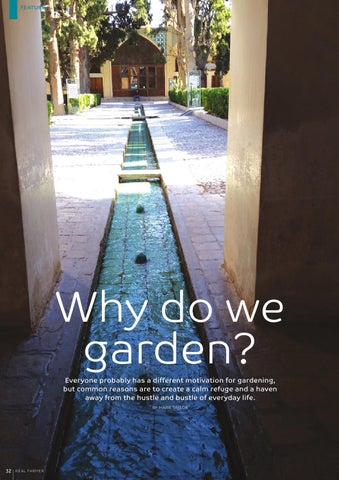
FEATURE I’d spent a week once, years ago, in Kyoto looking at gardens, many of them surrounding temples. They are some of the most peaceful places you could ever be. When I read about garden design many books referenced Persian gardens as being where formal gardening began. But there were no descriptions of what Persian gardens looked like, or were laid out, or even, were like today. For a long time I’d been wanting to travel to Persia to see these gardens, and late in 2014 had the opportunity when Timaru tour manager Jill Worrall took a group of 18 Kiwis to Iran on a Tours Direct trip. The 3,500km clockwise three-week trip through the central part of Iran—all by bus except for a quick 900km flight across a desert—included half a dozen exquisite Persian gardens. These are harsh landscapes in which to foster world heritage listed gardens. For example, Kerman, in the southeast of Iran, where we encounter our first Persian garden, is 1,775m above sea level. Annual rainfall is around 158mm, and summer temperatures average 36°C. Even much further north in the capital Tehran, rainfall is still very low at around 230mm a year. To cope with living in such difficult terrain, the Persians created oases of green. The word paradise derives from a Persian word meaning garden, explains our tour guide Reza Mirkhalaf-Zadeh. He says all Persian gardens are surrounded by walls, either brick or adobe, limiting the extent of the garden from an unlimited desert. The first garden we visited east of Kerman at Mahan, the Bagh-e Shahzadeh, or Prince’s Garden, is the perfect example. Its thick adobe walls protect it from the wind and desert dust, creating a clearly rectangular garden oasis out in the dry, stony desert. Water carried from the nearby mountains cascades down a series of formal pools through the centre of the garden, and is also used to irrigate orchards set back on both sides of the formal central garden. “Fruit trees are the main trees in Persian gardens, providing shade and fruit,” he says. Apricots, apples, figs, pomegranates and quince are common examples. The more formal central garden is an avenue of pines, planes and cypress trees. Cypress trees have
been in Iran a very long time, and symbolise long life and immortality. Throughout Persian art the cypress is ubiquitous, appearing on carpets and decorations on buildings. It also features carved on spectacular reliefs at Persepolis, which was the Persian capital in 500BC. There’s a little place called Abarkuh (which to Iranians is so far away from anywhere else they think of it like Timbuktu) where we saw a cypress (Cupressus sempervirens) reputed to be 4,000 years old. This tree is described not only as the oldest in Iran, but also, according to Wikipedia, as the second oldest tree in the world. It was in superb condition, thanks in part to being flood irrigated now and again with the surrounding paddock of lucerne. Along with pines and planes, cypresses provide a green backbone to Persian gardens. They create the height and shade in the garden, and a tall cool dark avenue along which water is channelled. “Water has a very important role, and in a Persian garden you can always see, feel and listen to the water,” Reza says. Persian gardens feature a pavilion, a passageway in which to walk in front of the pavilion, a reflecting pool of water in front of the pavilion fed by open channels called jubs, and the gardens. The gardens are divided regularly into areas the same size, on each side of the main channel of water. One hotel we stayed in, the magical Moshir Garden Hotel in Yazd, has water channels and fountains right through the midst of the hotel buildings. Poets are revered in Iran, and we visited several poets’ shrines, among them Omar Khayyam, Attar, Ferdowsi and Hafez. All have immaculate gardens around the shrines, but the one which I liked the most was Attar’s tomb just outside Mashhad. There, a small blue-tiled dome was reflected in a pool of water, and gardens of geraniums contrasted beautifully with the blue. The garden was surrounded by tall towering pines. We also visited restored adobe houses with cool courtyards. One, in Kashan, about half a day’s travel south of Tehran, featured plantings of red roses. Several varieties of deep red shrub roses were planted closely together, giving a long flowering period. The last garden we visited was the Bagh-e Fin in Kashan. Turquoise coloured tiles line the channels
between old cypress trees, some of which are propped up with poles for support. Throughout the channels, which are fed by gravity, are many little bubbling fountains, so wherever you are in the garden, you can hear the water. It’s a very peaceful memory to bring home. Quelling Misconceptions
Timaru-based tour manager Jill Worrall, who has visited Iran 12 times now, describes Iranians as the least understood people. She’s a vastly experienced tour guide, but says she is still surprised people don’t dig a little deeper when thinking about Iran. “It is always good to have people who are prepared to ignore all that and come anyway. “My philosophy when visiting Iran is to pack flexibility and a sense of humour, and leave the misconceptions and preconceptions at home. “Be prepared to step outside your comfort zone‑that is when sometimes when you have the most interesting and memorable experiences. If you want things to be like they are at home, stay at home. “I really feel very strongly that so much of people being afraid of other cultures is based on ignorance and misconceptions. “It is not a matter of supporting political regimes, it is about people. People are very much the same all around the world; they have very similar concerns. “It comes down to very basic things, things like do I love someone, does someone love me and if I have got kids, looking after their future. It is the same with everyone. “After travelling, people realise that some of the nationalities they might fear or understand the least are some of the loveliest which is definitely the case with Iran.” ABOVE: The blue-tiled tomb of the poet Attar near Mashhad LEFT: The Bagh-e Shahzadeh or Prince’s Garden at Mahan features cascades, simple fountains, beautiful trees and picturesque pavilions OPPOSITE: At the Bagh-e Fin in Kashan, the sound of bubbling water is heard from small fountains spaced throughout long turquoise-tiled channel
RE A L FA RM E R
33