FEATURE
2
RE AL FARM E R
FEATURE
Redefining the concept of dry land mixed model farming South Canterbury is renowned for its limestone overhangs and caves, providing a ready-made canvas for Maori rock art. BY BRENT MELVILLE
Herstall doesn’t believe in putting all his eggs in one basket, converting the now 140 hectare Moa Flat farm to dairy last year. “It was a substantial capital investment, but with fluctuating commodity prices we, like many farmers, wanted to ensure multiple streams of income while also reducing overall risk.” Herstall and Aly believe strongly that farmers should have a stake in the next stage of processing off farm. They are contract suppliers to Silver Fern Farms (of which Herstall has been a director since 2008), Fonterra and Wools of New Zealand. “We actively back New Zealand primary producers who move into the production of higher value products. As we know, milk powder is one of the world’s most volatile commodities, so we’d certainly encourage Fonterra to continue adding value.” In supporting that commercial position the farm currently supplies into Fonterra’s winter liquid milk contract for local consumption, merino cross lambs for Silver Fern Farms’ winter spring contract and wool into Wools of New Zealand’s successful traceability programme, Laneve.
It’s a fitting backdrop to Rock Farm, a 485-hectare dry land hill country sheep and beef farm owned by Ruralco Cardholders Herstall and Alyson Ulrich, third generation farmers who are boldly embracing new ideas and technologies in farming.
The catalyst to converting the Moa Flat farm, up until then a finishing and forestry block, was the return of son Alex (27) from cropping work in the UK two years ago. “It was an opportunity to spread the income base while enabling us to
grow considerably without buying more land,” said Herstall. Because of the size of the farm, the Ulrich’s opted to invest in a state-of-the-art automated, 3,100-square metre herd home, with capacity to milk 300 cows 24/7, 12 months of the year via six robot units. “We couldn’t really have gone with a conventional model without buying more property as South Canterbury dairy farms tend to average about 200 hectares with 800 or more cows.” Alex said the herd home currently housed 300 cows which was getting close to optimum production levels. “We need to be filling every stall and milking 300 cows every day of the year. With a few heifers, we really have a milking herd of 365, with calving evenly spread throughout the year.” Alex, a graduate of Lincoln like his father and his grandfather Gerry Ulrich before him, accepts that people have different attitudes about intensive farming practice. “We’ve had a lot of people through the barn, from students
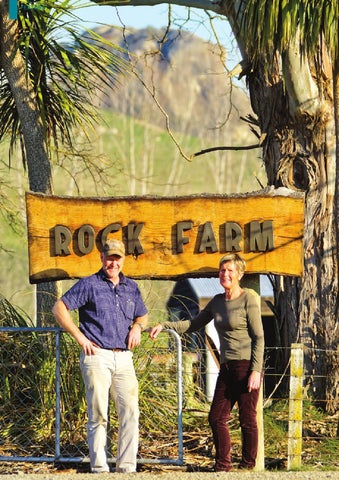
ABOVE LEFT: Herstall and Aly Ulrich, third generation farmers near Cave BELOW: Herstall (left) with son Alex in their herd home on their converted Moa Flat farm OPPOSITE: Herstall and Aly at the entry to Rock Farm a dry land hill country sheep and beef farm
Located off the Pleasant Point Cave road near the village of Cave, Rock Farm has been in the Ulrich family for 90 years, originally part of the Cave Outstation acquired by Herstall’s maternal grandfather, Geoffrey Rich, who relocated to South Canterbury from Port Levy on the Banks Peninsula in 1924. “As part of the Levels Station, it was regarded as a reasonably run down farm then, primarily used to grow oats to feed the horses and working stock,” said Herstall. “I think the locals took pity and later he was able to buy the adjacent 100 hectare Moa Flat site, though then it was mainly a sheep business.” Today, sheep and beef breeding and finishing remains a strong focus of Rock Farm. With between 1,600 and 1,800 ewes, the farm finishes 1,500 to 2,000 lambs, 700 cross bred merino and 120 two year old bulls.
RE A L FA RM E R
3
FEATURE the top producers are probably going in five to six times a day,” said Alex. The dairy operation operates on a three staff working flexi time. “The hi-tech system has taken man hours away, but there is always work to do bearing in mind that we mow all the silage and there is a bit of tractor work cultivating to sow maize and fodder beet, ensuring it is done at the right time. “Culturally it’s a different system to what we have traditionally operated. The fact that we converted in the midst of the new Canterbury Land and Water Plan added a lot more rigour to the process and also opened our eyes to the track that dairy is on and what is sustainable,” said Alex. In converting the farm, they have created a fully compliant effluent system, future proofing the conversion so it will sit above environmental compliance levels. “Our Overseer modelling during the resource consenting process showed nitrogen leaching at a very low level compared to standard grass based dairy farms.” Nutrient testing has been an ongoing focus for the Ulrich’s, whose long term commitment to sustainable farm management principles helped land them the Farm Environment Livestock Award in 2003. Their approach is underpinned by a holistic grazing management system focused on harnessing the biodiversity of the property. As with most family run farms, everybody has a role to play. Herstall manages the ‘bigger picture stuff’ including office work, leaving the day to day management of the sheep and beef farm to the stock manager and the dairy farm to Alex. and bankers to other farmers and you could see some of them had made up their minds beforehand. Without exception, they’ve been blown away by the technology and by how contented the cows are. “Two herds of 150 each side can wander anywhere they like, including milking themselves when they like. So there is nothing regimented about it at all, a system that allows the cows to get into their own rhythm of doing things.” “When we take the cows out to dry off they’ll often break over fences trying to get back in to the herd home.” Alex thinks some of that has to do with the year round pleasant climate inside and his choice of music in the barn, which leans towards Dire Straits and Eric Clapton. Whatever the reasons, it’s working a treat. When the family did its’ forecasting for the dairy farm they worked on production numbers of 550 kilograms of milk solids per cow. Scarcely a year into production the cows are producing closer to 700 kilograms of milk solids on average, or about 2,500 kilograms per hectare all in. It has also quickly become the biggest contributor to gross income for the entire business. Outside of the new milking technology and farm management practice, Alex attributes the production numbers to the excellent gene pool 4
RE AL FARM E R
of the European Holstein-Friesians the farm has managed to buy. “These are proven top performers. It’s also about providing balanced nutrition and when our cows are milking they’re fed a total mixed ration each day. They milk themselves through the robotic milkers on average about three times a day while
Aly, a qualified teacher, contributes ideas, manages upkeep of the farm’s four residences and oversees health and safety for both farms, implementing what she describes as ‘common ABOVE: The Ulrich’s opted to invest in a state-of-the-art automated, 3,100-square metre herd home BELOW: The catalyst to converting the Moa Flat farm was the return of Aly and Hersall’s son Alex (right)
FEATURE of trees on the property, with about 65 hectares of mainly Radiata pine which helps with gorse control and is milled by Laurie Forestry out of Waimate. Leyland cypress and Cedrus deodara have also been planted for shelter belts. As part of the same income pool, returns from tree sales has enabled the addition of an irrigation pond for dairy.
sense policies.’ Their youngest daughter Rosie, also a teacher, works at nearby Waihi boy’s school. She provides the creative flair for the business and her portfolio includes the design of the Moa Flat trademark. Ten years ago Herstall and Aly effectively went back to the basics of growing grass in the belief that good soil health translates to improved plant and stock health.
“We have dry spells and summers verging on drought and Lucerne continues growing on the primarily clay base. I do recall we had a field day here in our early days with Lucerne and every time we grazed we had to take the height of the Lucerne, record it and the residuals left behind and we fed all that information up to Professor Derrick Moot. He reckoned the Lucerne was doing over 20 tonnes of dry matter. That’s not something we budgeted on. Similar rye grass pasture sites would grow on average six to seven tonnes and last on average two to three years. “We’ll carry on sowing pure Lucerne in paddocks that we can harvest easily otherwise we’ll move to a mix of Lucerne, prairie grass and plantain mixes for grazing.” Herstall and Alex agree that one of the major opportunities is in the transfer of knowledge and understanding of good nutrition from the dairy into the sheep and beef unit. “We’ve still got a way to go in terms of nutrition and getting the sheep to do well on it. Once it’s cut and made into silage the cows do very well on it as a mixed part of their diet so it’s a key feed source for the dairy shed.” Another element of the business is in forested land. The family has been strategic in their use
Herstall said the trees were planted for a fundamental purpose, to generate income from unproductive land that weren’t in generally good grazing areas. “I’m not a person who just loves planting trees for the sake of it. They have to actually yield a benefit. We haven’t lost any grazing and we’ve gained productivity.” Herstall is positive about the future. ”The dairy farm presented a lot of challenges and was a steep learning curve. It’s also generated a lot of interest across the board. It’s not like we’re advertising tours, but for a farm it’s a busy place. It’s great to have Alex on board and would only see his role expanding. We think there’s merit in providing an advisory service to farmers who want to tap into what we learned. It would have been great to have had the benefit of that ourselves. This farm and the area are important to us as a family. South and Mid Canterbury in particular are becoming highly sought after regions to farm in. Timaru, too, is experiencing good growth. There’s no doubt that farming has been and will continue to be a vital part of that for at least another 90 years.” ABOVE LEFT: The Ulrich’s on their farm in South Canterbury LEFT: The farm and the area are important to the Ulrich’s as a family BELOW: The herd home currently houses 300 cows
Their fertiliser regime largely follows the Albrecht soil fertility system, with regular soil testing and use of DAP fertilisers plus other macro and micro elements and trace elements as required. Impressed by the results from Marlborough farmer Doug Avery and work done by Professor Derrick Moot the Ulrich’s have also been early adopters of Lucerne as a key component of their grazing system. Herstall says they’ve been extremely pleased with the results. “In the past my father had planted varieties of Lucerne for hay or silage that had little resistance to pests, but a few years ago I became re-interested in Lucerne after seeing how the numbers stacked up in relation to dry matter production on dry land farms.” So far about 25% of the farm’s cultivated area is in Lucerne and grass mixes and the business has reaped huge benefits of up to three times the dry matter produced per hectare and resultant flexible stock management options for dealing with dry summers.
RE A L FA RM E R
5