FEATURE
Punchbowl continues innovative legacy 2
RE AL FARM E R
FEATURE
As a farmer, meat company director and regional councillor Doug Brown carries a broad view of farming, its place and its value within the growing Otago economy. It is a view underpinned by some long standing ties to the land he and wife Jeannie farm today. BY RICHARD RENNIE The couple’s 380ha “Punchbowl” home property in the Maheno district of North Otago has long held a reputation for breeding quality genetics, with changes in breed type and composition aptly reflecting changes in market and farming expectations through the past 100 years. The foundation of the family’s ties to Punchbowl lie with Doug’s maternal grandfather HJ (Henry) Andrew whose father purchased the property exactly a century ago this year. Henry made the move onto the farm after completing study in agriculture at Canterbury Agricultural College (now Lincoln University) in 1915.
“He certainly enjoyed a long and rewarding farming career, he was here for 70 years and very active over almost all of them…” His time at Lincoln helped fulfil Henry’s thirst for new techniques, breeds and approaches to farming. It was also a tenure that was to later recognise his contributions to farming by awarding him the prestigious Bledisloe Medal in 1939 for his outstanding contributions to breeding Southdown sheep, and his long service to many farming organisations. “He certainly enjoyed a long and rewarding farming career, he was here for 70 years and very active over almost all of them until his death in 1985,” says Doug. Doug regards Henry as something of an inspiration and mentor who retained his interest in farming well into his dotage, often querying Doug about aspects of his study when he was also attending Lincoln College in the ‘70s. “We had a great relationship, he was highly regarded in the community, farming was his life and he was always keen to catch up and find out what new techniques we were learning—he farmed for the love of farming first, rather than for any money that may be in it.” After Henry’s death the property was run as an estate for four years, while Doug and Jeannie continued to farm on their Totara property, northeast of Punchbowl. When they stepped onto Punchbowl in 1989, Doug welcomed the opportunity to pick up and continue a family
legacy, and also to shape the property in a way that would keep it sustainable for the next generation and beyond. “I guess I can say I am through and through a stockman first. I was keen to be able to look after the stock as best we could, and that involved wanting to have more shelter for them, so shelter belts became a first priority.”
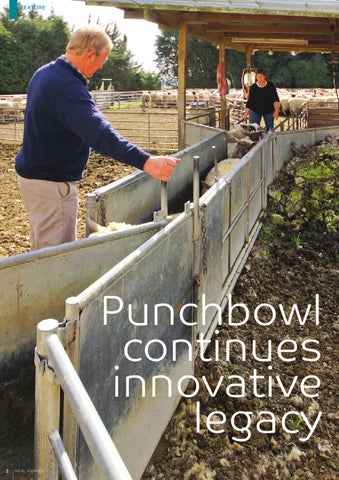
ABOVE: Doug and Jeannie welcomed the opportunity to continue the family legacy on Punchbowl OPPOSITE PAGE: Punchbowl has long held a reputation for breeding quality sheep genetics
Doug estimates that since 1989 they would have put in about 15km of shelter belts, and have learned much about what makes a good shelter better in that time.
In presenting the award to the couple, the judges praised their efforts with the shelter planting and their acknowledgement of the drought risks North Otago poses. To adjust for that they run a conservative stocking rate, lambed early and integrated well with the original “Totara” property they originally farmed on, 15km to the north east.
“Initially we worked on double row shelters, with a fast growing row like eucalypts on one side and slower growing cyprus on the other. Nowadays we would do a single row, using something like a cyprus.”
That block winters 400-500 dairy cows and 900 caste for age early lambing ewes, with most of the lambs off by early December then the property receives the surplus late lambs from the home property.
“I was keen to be able to look after the stock as best we could, and that involved wanting to have more shelter for them, so shelter belts became a first priority.” Given the relative proximity to the sea the Maheno district is not subject to the bone chilling winters of Central Otago, but the shelters have paid dividends over the years, moderating wind flows and providing shelter at critical periods. Over two decades of planting also culminated in helping the couple receive the 2012 Otago Beef + Lamb Livestock award in the Ballance Farm Environment Awards.
“The cows are good, we know when we are getting them, and how much feed we need for them. It is about risk management for us in the drier country—we could stock up with more of our own animals, but then we have the risk it gets dry. The cows also fit into our work programme, which is lighter over winter.” Doug’s grandfather Henry was long regarded as a master of Southdown breeding in the country, at a time when few other breeds were available as terminal sires. Arriving at Punchbowl Doug moved to Dorsets and Suffoks, and then Texel crosses in the late nineties. “We had Polled Dorsets and Suffolks as Southdown went out of favour but Southdown has bounced back in recent times, with the newer type today offering a bigger, stretchier sheep that is popular for hogget mating.”
RE A L FA RM E R
3
FEATURE The move to Texel crosses increased the muscle and confirmation within the carcass, more critical as processors moved towards a greater focus on carcass yield, versus outright weight.
“Doug admits he has more interest in stock than machinery, and it’s a view that has helped him and Jeannie keep farm costs low and avoid significant capital equipment investment over the years…” “We find the Suffolk-Texel cross is quite popular south of the Waitaki. They are a bit hardier with the Texel element in there.” Lambing percentages are recording between 160-170% and tailing percentages of 140–150%. Doug admits he has more interest in stock than machinery, and it’s a view that has helped him and Jeannie keep farm costs low and avoid significant capital equipment investment over the years, something the award judges also appreciated in the higher risk, drought prone region.
Doug’s passion for the livestock sector extends well off the farm too, with 12 years on the Alliance Group board. Over that time the most significant shift he has witnessed is the very rapid move to China becoming NZ’s most significant sheepmeat market in recent years. Alliance can count itself as one of the first companies to engage with the Chinese, through its Grand Farm alliance, and Doug was the first director to visit the country when that alliance was formed. “It is still early days for the Chinese market and I guess you could expect that growth rate to stabilise but the potential is there for NZ to move up the value chain, and that is slowly starting to happen.” However Doug is also heartened by the increasingly positive news coming out of NZ’s traditional European markets, as consumers there start to revisit quality red meat products in the recovering post financial crisis environment. “There is also a real appreciation there too that supply is pretty tight for sheepmeat, and that there are others competing for that supply these days too.”
ABOVE: Doug and Jeannie have a positive feeling about where the sheep meat industry is going BELOW: Doug and Jeannie on their family farm OPPOSITE: The iconic North Otago property
Overall Doug has a positive feeling about where the sheep meat industry is heading, and while acknowledging there does need to be some more co-ordination among processors, he still sees potential for improvement within the gates of many farms too.
“We are also probably fortunate here in Otago that our water quality issues are not as pressing as some other areas yet.” As a regional councillor he has had first-hand experience helping shape the region’s freshwater management plans, and believes the Otago Regional Council’s Plan Change 6a provides some flexibility to its region’s farmers. “It’s an effects based policy that leaves the land use choice with the land owner but they must comply with the nutrient and contaminants standards in Plan Change 6a by 2020.”
“We are also probably fortunate here in Otago that our water quality issues are not as pressing as some other areas yet.” Farmer feedback from a recent road show through the region has given him confidence farmers are on board with the plan’s requirements. “We are also probably fortunate here in Otago that our water quality issues are not as pressing as some other areas yet.” However I am also confident we will see 4
RE AL FARM E R
FEATURE technology develop that will help us cope with those challenges.” Thanks in part to the Downlands irrigation development providing irrigation to 10,000ha, the accompanying surge in dairy farms has bought a welcome injection of people and commerce to the region. Doug is watching with interest as the stage two of the project starts to unfold.
“When the judges awarded Doug and Jeannie the Otago Beef + Lamb Livestock Farm award in 2012, they commented how it was a superb intergenerational property.” He does see the impact of nutrient constraints as one of the biggest challenges facing future farm development in an area that has experienced such a shift in its land use over the past decade.
At present he and Jeannie remain committed to sheep farming, but he is entertaining the possibility of a few extra cattle to help ease the inevitable sheep induced work load on the property. “We are also looking at getting into some more lucerne planting, it offers some versatility and resistance against drought, and lucerne balage is excellent supplement.” He is also exploring his options to use fodder beet as a high yielding winter feed crop. Doug sees potential for sheep to graze fodder beet, with their transition being simpler than it is for cows. “The beauty of it is you can feed it well into spring when feed can be tight, and it is a good supplement for hoggets.” When the judges awarded Doug and Jeannie the Otago Beef + Lamb Livestock Farm award in 2012, they commented how it was a superb intergenerational property. Doug has one eye on the next generation; with the possibility his accountant son Simon may return to continue the family name on an iconic North Otago property.
Farm Details: Location: Maheno, North Otago.
Owners: Doug and Jeannie Brown.
Size: Punchbowl (home block) 360 eff ha, Totara (15km north east) 140 eff ha.
Contour: Flat-rolling
Rainfall: 500mm a year.
Stock: Romney commercial flock 2200 ewes, 1000 recorded ewes (Suffolk,Polled Dorset, Texel-cross), 550 commercial Romney ewe hoggets, 350 recorded stud ewe hoggets, 300 ram recorded hoggets, 24 beef cattle. 400–500 cows wintered on Totara block.
RE A L FA RM E R
5