FEATURE
Narrowing the urban-rural divide
2
RE AL FARM E R
track. They had realised after catering for the Molesworth Tour Company a few years ago how much the gulf had grown between rural people and city people and the fascination many nonfarmers have for what happens on a farm in back country New Zealand. “Some of the most basic things are interesting to them like clothes on the washing line, chooks, home baking, it’s an eye opener for many of them and we enjoy sharing it,” says Lynda. “People who are keen to get their boots on and get into the outdoors are generally positive, interested and interesting people.” “I have to be careful what I say to the dogs at times,” laughs Simon. “It’s not totally our domain anymore but that’s okay. It changes from being just us, the dogs and animals then the walking season starts and we are sharing our home and lives with others.”
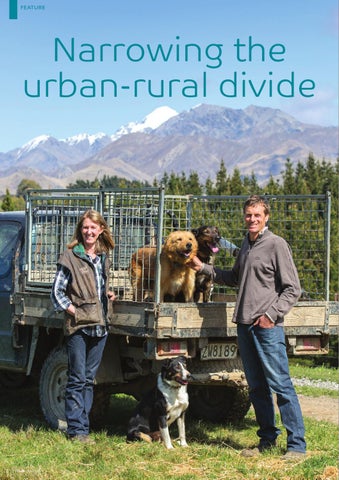
A Marlborough farming family is sharing its slice of paradise with national and international trampers in an effort to help bridge the growing urban-rural divide. BY KATE TAYLOR
Simon and Lynda Harvey’s paradise is known as Glen Orkney and is home to the 26km Awatere Tussock Track and 5,500 Merino sheep producing wool for the Icebreaker clothing brand. Part of that is diversification of income; part of it is future proofing the conservation areas that need protection; and part of it is purely for love of showing their way of life to people who know little about it.
“Lynda and I have been focused on creating a productive, profitable and resilient property and if we continue to farm with that philosophy then succession should not be a problem.” The Harvey’s farm plan has clearly identified which land is suitable for pastoralism and which is better to be left undisturbed and fenced off if necessary to encourage regeneration. Typically these areas are rough gullies or shady faces that have pockets of indigenous forest. “There are some lovely old trees in places and we have
FEATURE designed the track to go through some of these special areas.” The way they have decided to manage their land means their daily and seasonal farming routines sometimes have to be tailored to accommodate their conservation values. Seven areas of regenerating native bush have been fenced on the property and covenanted with the QEII National Trust. There are also a number of bigger areas that are not practical to fence, but are now largely ungrazed by stock, such as Mt Malvern (at 1,400m above sea level) and the nearby Cregan Bluffs. Simon is enthusiastic about current innovation regarding targeted rate aerial spreading, which will allow “more efficient and more effective” fertiliser placement. The farm is currently fertilised bi-annually with sulphur-boosted superphosphate (half one year and half the next) with the amount roughly aligned to stocking rates. The property carries 140 Angus breeding cows with young cattle used as trading stock. While the cattle are valuable for pasture clean-up duty, their ready tradability is also helping the Harveys to be more adaptable in increasingly erratic seasons. “In a good season we will keep all the calves on and finish them all,” Simon says. “In a difficult season we will sell all of them except what we need as replacements. The cattle are one of the relief valves to help cater for these hugely variable seasons. We also send ABOVE: Glen Orkney is home to the 26km Awatere Tussock Track BELOW: Some of the 5,500 Merino sheep producing wool for Icebreaker OPPOSITE: Lynda and Simon Harvey
The 1,926ha station, which now includes the neighbouring property Stronsay, is at the top of the Medway Valley, a tributary of the Awatere Valley. It is mostly open tussock country running back to rugged high country. Pockets of regenerating native species line the steeper banks of the creeks that bisect the property. Simon’s parents bought the property in 1967 and sold to Simon and Lynda in 1984. They have three sons in their 20’s. The eldest is Thomas, who enjoys farming and has been working on the property for the past two years after obtaining an agricultural science degree at Massey University and working overseas. Henry has a degree in industrial design and is currently working from home and Edward is an electrical engineer in Christchurch. “They have all been encouraged to do what they have a passion for,” says Simon. “Lynda and I have been focused on creating a productive, profitable and resilient property and if we continue to farm with that philosophy then succession should not be a problem.” The couple enjoy farming and also enjoy the talking-to-people aspect of operating the
RE A L FA RM E R
3
FEATURE a breeding group assisted by the NZ Merino Company that is focused on improving disease resistance, survival and carcass attributes.” Another challenge for hill country farmers is the competition from dairying and grapes. “There is less finishing land available so hill country properties are getting the message to focus more on growing quality pasture.” “In the past advisors told us hill country was breeding country and that we were best to produce store stock for ‘down country’ finishers. There’s a clear push now for us to work on our farming systems so we can finish as much as possible as the traditional finishing country is servicing potentially higher paying options.” The couple believe accountability, traceability and consumer expectations will become increasingly important aspects of producing quality product. “We respect people’s wish to know how the food and fibre they buy is produced and we accept there will continue to be a greater degree of scrutiny of our farming practices. No doubt it will present some challenges that will have to be worked through.” hoggets to graze vineyards over winter and try to store a couple of years’ worth of hay in the sheds. Most years we don’t feed out much but in a difficult year we might empty the sheds and have to buy in feed as well.”
“The way they have decided to manage their land means their daily and seasonal farming routines sometimes have to be tailored to accommodate their conservation values.” Glen Orkney has 3,500 Merino ewes with 40–50 percent mated to a Poll Dorset/Texel terminal sire. “Those ewes are lambed on the best country and weaned before Christmas. We kill as many as we can off their mothers. In good years we have killed over 50 percent. If it’s not a particularly good year then we sell everything pre-Christmas, the better lambs go to the works and the rest go store.” “The remaining ewes are mated to Merino rams from their own small stud, with their lambs not weaned as early as the others. Surplus Merino lambs are not always easy to sell store so the use of a terminal sire is another tool to help give us the flexibility to cater for the huge variations we can get in dry matter produced from season to season.” Wethers are no longer run on the property with ewes being more profitable even at a lower stocking rate. Ewes don’t graze the fragile steeper land as severely either. 4
RE AL FARM E R
In an average year the Merino ewes tail 100–110 percent and the terminal sire ewes tail at 110–120 percent. “Fecundity is good though lamb survival is a challenge. Merino sheep generally have evolved in a warmer, drier climate and their lambs can succumb to cold weather. Having well fed ewes will certainly negate this problem to some extent though.” “In the 30 years we have been farming Glen Orkney Merino sheep have given us a good return. They are not perfect but they produce valuable wool and quality meat and are arguably the best dual purpose sheep that we could run on this type of country. Having said that, we are involved in
The Harveys have been supplying Merino wool to the Icebreaker brand for about 15 years. They say it is a valuable partnership that has given them more consistent prices and a clear focus on the type of wool required. Lynda says the family is enthusiastic about wool. “We promote wool with the walkers although most of them are already wearing it and already aware of its attributes. It’s a wonderful, natural product that we think is good for the planet and good for us—warm, biodegradable and durable.” ABOVE: Simon and Lynda on their 1,926ha station BELOW: Simon and Lynda Harvey with their sons Thomas
(far left) and Henry (far right)
FEATURE
A insight into Marlborough back country “A breath-taking environment and a sense of calm and solitude that is simply awe-inspiring” is one of the descriptions of the Awatere Tussock Track. The 26km, three day, unguided walking track through Glen Orkney was opened in 2008 giving trampers the opportunity to gain an insight into high country farming in Marlborough—taking them along rolling, tussock-covered hills, through bush clad creeks and into rugged back country including the Cregan Bluffs and around the front of Mt Malvern. The southern-most point of the farm is actually the northern-most part of the Inland Kaikoura Ranges, hence it is a summer and autumn activity.The track is open from mid-November to mid-May and requires walkers to have a good level of fitness and agility. Welcoming and clean accommodation at the cottage and purpose-built back country hut provides walkers with tramping luxuries. “We describe it more as a tramp than a walk, but with the luxuries of pack cartage, a comfortable bed, hot shower and a flush toilet,” Lynda says. The first day of the track is 9km and takes four to five hours to climb steadily through rolling tussock country with grazing stock and pockets of protected native plants. After staying in a well-equipped and comfortable hut, the second day (four to six hours over 7km) takes walkers on a loop track over high ridges and saddles from where spectacular views of the eastern Marlborough high country unfold. On a good day the panorama includes the east coast, Ure and Clarence Valleys and Mt Tapuaenuku (2,887m). The third day (four to five hours over 10km) sees a return walk through the interior of the property, passing an old musterers hut and leads up a rugged bushy creek through a native reserve before following an easy track back to the cottage. Lynda says they enjoy the variety of questions that come their way. “We don’t pretend to know it all but we enjoy sharing our life and explaining how and why we do things. Their questions make us see the farm from someone else’s perspective.” The woolshed is an interesting place for the walkers to visit, says Simon. “We talk to them about the whole operation from growing wool through to the products we wear. They feel the wool as it is when it comes off the sheep’s back and we show them what it’s made into. Many are already wearing Icebreaker or are aware of the brand but they’re still interested to see where it comes from.” Simon says the farm (wool, sheep meat and beef ) is by far the bigger money earner but the track is designed to complement it. “People enjoy the covenanted areas but they also come for the farm experience. We are honest with people about the good and the hard times. Every year is different, one year it’s a struggle to feed animals because it’s too dry but the next year it could be really wet causing other problems. Staying on-farm gives people a realistic view of farming.” Simon says farming is a business but it is also a way of life. “If you really care for what you’re doing, you can’t make it a five-day-a-week job.” Lynda adds “most of the time we just thoroughly enjoy being here.”
RE A L FA RM E R
5