RealFarmer FOR EVERYTHING FARMING AND FAMILY
The new and improved Ruralco website
Protecting your water quality
OCTOBER / N OV EM B E R 2 0 1 4
Celebrating success at Ruralco Supplier Awards
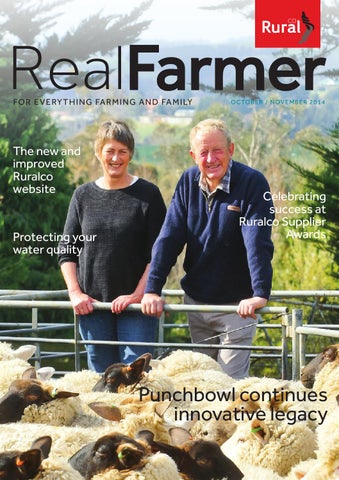
Punchbowl continues innovative legacy
Contents
OCTOBER / NOVEMBER 2014
Features
Cover Story
2 Punchbowl continues innovative legacy 12 Protecting your water quality 18 Redefining the concept of dry land mixed model farming 28 Celebrating success at Ruralco Supplier Awards 32 Showcasing local art and culture 35 The nutrient mindfield
Profiles 15 Local workshop a buzz Peter May Ltd 23 Leading edge company offers a whole new outlook on life Laser Vision 31 Well above water all year round Pool & Pump World 37 Quality meat for a quality meal Upper Cuts Butchery 39 Celebrate an occasion, last a lifetime McLeay Jewellers
2
Regulars
Punchbowl continues innovative legacy
7 Big positives with Ruralco’s first birthday 8 The new and improved Ruralco website 11 Slices of the herd fertility cake 17 Thoughts from across the rivers 24 Importance of nutrition leading up to mating 40 Ruralco News 41 Classifieds DISCLAIMER:
8
The new and improved Ruralco website
12
Protecting your water quality
All information contained within Real Farmer is to the best of the author’s knowledge true and accurate. Opinions expressed are those of the author and not of Ruralco NZ Ltd. Items herein are general comments only and do not constitute or convey advice. This publication is issued as a helpful guide to cardholders.
FEATURE
Punchbowl continues innovative legacy 2
RE AL FARM E R
FEATURE
As a farmer, meat company director and regional councillor Doug Brown carries a broad view of farming, its place and its value within the growing Otago economy. It is a view underpinned by some long standing ties to the land he and wife Jeannie farm today. BY RICHARD RENNIE The couple’s 380ha “Punchbowl” home property in the Maheno district of North Otago has long held a reputation for breeding quality genetics, with changes in breed type and composition aptly reflecting changes in market and farming expectations through the past 100 years. The foundation of the family’s ties to Punchbowl lie with Doug’s maternal grandfather HJ (Henry) Andrew whose father purchased the property exactly a century ago this year. Henry made the move onto the farm after completing study in agriculture at Canterbury Agricultural College (now Lincoln University) in 1915.
“He certainly enjoyed a long and rewarding farming career, he was here for 70 years and very active over almost all of them…” His time at Lincoln helped fulfil Henry’s thirst for new techniques, breeds and approaches to farming. It was also a tenure that was to later recognise his contributions to farming by awarding him the prestigious Bledisloe Medal in 1939 for his outstanding contributions to breeding Southdown sheep, and his long service to many farming organisations. “He certainly enjoyed a long and rewarding farming career, he was here for 70 years and very active over almost all of them until his death in 1985,” says Doug. Doug regards Henry as something of an inspiration and mentor who retained his interest in farming well into his dotage, often querying Doug about aspects of his study when he was also attending Lincoln College in the ‘70s. “We had a great relationship, he was highly regarded in the community, farming was his life and he was always keen to catch up and find out what new techniques we were learning—he farmed for the love of farming first, rather than for any money that may be in it.” After Henry’s death the property was run as an estate for four years, while Doug and Jeannie continued to farm on their Totara property, northeast of Punchbowl. When they stepped onto Punchbowl in 1989, Doug welcomed the opportunity to pick up and continue a family
legacy, and also to shape the property in a way that would keep it sustainable for the next generation and beyond. “I guess I can say I am through and through a stockman first. I was keen to be able to look after the stock as best we could, and that involved wanting to have more shelter for them, so shelter belts became a first priority.”
ABOVE: Doug and Jeannie welcomed the opportunity to continue the family legacy on Punchbowl OPPOSITE PAGE: Punchbowl has long held a reputation for breeding quality sheep genetics
Doug estimates that since 1989 they would have put in about 15km of shelter belts, and have learned much about what makes a good shelter better in that time.
In presenting the award to the couple, the judges praised their efforts with the shelter planting and their acknowledgement of the drought risks North Otago poses. To adjust for that they run a conservative stocking rate, lambed early and integrated well with the original “Totara” property they originally farmed on, 15km to the north east.
“Initially we worked on double row shelters, with a fast growing row like eucalypts on one side and slower growing cyprus on the other. Nowadays we would do a single row, using something like a cyprus.”
That block winters 400-500 dairy cows and 900 caste for age early lambing ewes, with most of the lambs off by early December then the property receives the surplus late lambs from the home property.
“I was keen to be able to look after the stock as best we could, and that involved wanting to have more shelter for them, so shelter belts became a first priority.” Given the relative proximity to the sea the Maheno district is not subject to the bone chilling winters of Central Otago, but the shelters have paid dividends over the years, moderating wind flows and providing shelter at critical periods. Over two decades of planting also culminated in helping the couple receive the 2012 Otago Beef + Lamb Livestock award in the Ballance Farm Environment Awards.
“The cows are good, we know when we are getting them, and how much feed we need for them. It is about risk management for us in the drier country—we could stock up with more of our own animals, but then we have the risk it gets dry. The cows also fit into our work programme, which is lighter over winter.” Doug’s grandfather Henry was long regarded as a master of Southdown breeding in the country, at a time when few other breeds were available as terminal sires. Arriving at Punchbowl Doug moved to Dorsets and Suffoks, and then Texel crosses in the late nineties. “We had Polled Dorsets and Suffolks as Southdown went out of favour but Southdown has bounced back in recent times, with the newer type today offering a bigger, stretchier sheep that is popular for hogget mating.”
RE A L FA RM E R
3
FEATURE The move to Texel crosses increased the muscle and confirmation within the carcass, more critical as processors moved towards a greater focus on carcass yield, versus outright weight.
“Doug admits he has more interest in stock than machinery, and it’s a view that has helped him and Jeannie keep farm costs low and avoid significant capital equipment investment over the years…” “We find the Suffolk-Texel cross is quite popular south of the Waitaki. They are a bit hardier with the Texel element in there.” Lambing percentages are recording between 160-170% and tailing percentages of 140–150%. Doug admits he has more interest in stock than machinery, and it’s a view that has helped him and Jeannie keep farm costs low and avoid significant capital equipment investment over the years, something the award judges also appreciated in the higher risk, drought prone region.
Doug’s passion for the livestock sector extends well off the farm too, with 12 years on the Alliance Group board. Over that time the most significant shift he has witnessed is the very rapid move to China becoming NZ’s most significant sheepmeat market in recent years. Alliance can count itself as one of the first companies to engage with the Chinese, through its Grand Farm alliance, and Doug was the first director to visit the country when that alliance was formed. “It is still early days for the Chinese market and I guess you could expect that growth rate to stabilise but the potential is there for NZ to move up the value chain, and that is slowly starting to happen.” However Doug is also heartened by the increasingly positive news coming out of NZ’s traditional European markets, as consumers there start to revisit quality red meat products in the recovering post financial crisis environment. “There is also a real appreciation there too that supply is pretty tight for sheepmeat, and that there are others competing for that supply these days too.”
ABOVE: Doug and Jeannie have a positive feeling about where the sheep meat industry is going BELOW: Doug and Jeannie on their family farm OPPOSITE: The iconic North Otago property
Overall Doug has a positive feeling about where the sheep meat industry is heading, and while acknowledging there does need to be some more co-ordination among processors, he still sees potential for improvement within the gates of many farms too.
“We are also probably fortunate here in Otago that our water quality issues are not as pressing as some other areas yet.” As a regional councillor he has had first-hand experience helping shape the region’s freshwater management plans, and believes the Otago Regional Council’s Plan Change 6a provides some flexibility to its region’s farmers. “It’s an effects based policy that leaves the land use choice with the land owner but they must comply with the nutrient and contaminants standards in Plan Change 6a by 2020.”
“We are also probably fortunate here in Otago that our water quality issues are not as pressing as some other areas yet.” Farmer feedback from a recent road show through the region has given him confidence farmers are on board with the plan’s requirements. “We are also probably fortunate here in Otago that our water quality issues are not as pressing as some other areas yet.” However I am also confident we will see 4
RE AL FARM E R
FEATURE technology develop that will help us cope with those challenges.” Thanks in part to the Downlands irrigation development providing irrigation to 10,000ha, the accompanying surge in dairy farms has bought a welcome injection of people and commerce to the region. Doug is watching with interest as the stage two of the project starts to unfold.
“When the judges awarded Doug and Jeannie the Otago Beef + Lamb Livestock Farm award in 2012, they commented how it was a superb intergenerational property.” He does see the impact of nutrient constraints as one of the biggest challenges facing future farm development in an area that has experienced such a shift in its land use over the past decade.
At present he and Jeannie remain committed to sheep farming, but he is entertaining the possibility of a few extra cattle to help ease the inevitable sheep induced work load on the property. “We are also looking at getting into some more lucerne planting, it offers some versatility and resistance against drought, and lucerne balage is excellent supplement.” He is also exploring his options to use fodder beet as a high yielding winter feed crop. Doug sees potential for sheep to graze fodder beet, with their transition being simpler than it is for cows. “The beauty of it is you can feed it well into spring when feed can be tight, and it is a good supplement for hoggets.” When the judges awarded Doug and Jeannie the Otago Beef + Lamb Livestock Farm award in 2012, they commented how it was a superb intergenerational property. Doug has one eye on the next generation; with the possibility his accountant son Simon may return to continue the family name on an iconic North Otago property.
Farm Details: Location: Maheno, North Otago.
Owners: Doug and Jeannie Brown.
Size: Punchbowl (home block) 360 eff ha, Totara (15km north east) 140 eff ha.
Contour: Flat-rolling
Rainfall: 500mm a year.
Stock: Romney commercial flock 2200 ewes, 1000 recorded ewes (Suffolk,Polled Dorset, Texel-cross), 550 commercial Romney ewe hoggets, 350 recorded stud ewe hoggets, 300 ram recorded hoggets, 24 beef cattle. 400–500 cows wintered on Totara block.
RE A L FA RM E R
5
6
RE AL FARM E R
COMMENTARY
Big positives with Ruralco’s first birthday July 2013 marked the beginning for the Ruralco joint venture card service, and the opportunity for suppliers and farmers alike to be part of a charge card focussed as much upon rural communities as it is serving the needs of farmers. NEAL SHAW, GROUP CEO A year on and we have much to be proud of, and much to look forward to, as we continue striving to offer our cardholders an ever wider choice of approved suppliers and Ruralco Card services. The Ruralco team is now at full strength to develop the South Island supplier network, with representatives based in Nelson-Marlborough, Christchurch and the West Coast, Ashburton, South Canterbury and Otago-Southland. Their skills in developing supplier networks which fit the Ruralco ethos is backed by our well qualified and experienced marketing and finance teams in Ashburton. Ruralco has invested heavily in the “back room” technology to ensure cardholders have seamless transactions all summarised in a single invoice received at the end of the month.
The appeal of Ruralco Card is also growing within farming families. The flexible card structure means family members are able to have their own card charged to a central account. This has provided options for families with children who may be studying away from home, or who are based on another family farm and require access to charge facilities for card business. We have made no apologies for staying close to our South Island roots in launching Ruralco over the past year. It has been a massive undertaking for Ruralco to develop and expand the technology and resources required to roll out what is essentially a new brand, and we wanted to get it right with “small steps” to begin.
For this reason we have recently established Ruralco in the last South Island region, NelsonMarlborough. This does not stop North Island farming families enjoying a Ruralco Card, and given the strong links many have with the South Island through farm ownership and investment, it is a logical choice. The coming year promises to have Ruralco become more prominent now our roll out in the South Island is complete. We are looking forward to raising Ruralco’s profile, building our cardholder numbers further, and cementing Ruralco as the card of choice for farming families.
BELOW: Neal Shaw, Group CEO
We have undertaken to make the Ruralco venture a partnership in every sense of the word, and our card technology means we are able to gather excellent insights into where cardholders are using their Ruralco Card, and where we may need to increase the choice of suppliers or outlets for the card. To ensure we can communicate to our suppliers as we do to our valued cardholders, we have also developed a supplier booklet, focused on providing them with information and advice intended to ensure they can make the most out of their Ruralco Supplier status. The one service most cardholders will be most familiar with after Ruralco’s first year is fuel purchases. After intense work building our relationship with Mobil, the Ruralco Card can now be used in all 380 stations nationwide. In addition we have number of national businesses that accept Ruralco, including FMG, VTNZ and PlaceMakers. Because farming is such a part of a rural family’s lifestyle we have endeavoured to make the Ruralco Card as much about farming families as it is about farmers. To date the most popular use for Ruralco Card has been to purchase fuel, with the 9c per litre discount. Our occasional 20c per litre discounts has also prompted many cardholders to top up their portable farm storage tanks along with vehicles. Our range of suppliers has expanded through the past 12 months as we have moved to recognise and fill gaps in services, both farm and family related. You will now find a trip to town can be completed entirely upon your Ruralco Card, and a trip out of town for a break will be covered too.
RE A L FA RM E R
7
REGULAR
Our new website Over the past few months we’ve been busy working away on a brand new Ruralco website. It’s jammed packed full of simple, useful features to help you make the most of your Ruralco Card. So what’s new? SEARCHING FOR A SUPPLIER OR DISCOUNT
The search function is located along the top of every page and allows you to search by supplier name, category, town or even by products and services that you may require. Please remember, to view the fantastic supplier discounts negotiated on your behalf, make sure you are logged in. BROWSE
This comes hand in hand with the search bar and allows you to look through our huge range of suppliers to see who we have on board, without having to input anything specific. MY RURALCO
To access My Ruralco you must be logged in to the website. This area provides you with key information from Ruralco and allows you to be in control of your profile: Dashboard Come here for the latest news and updates for you from Ruralco, as well as new suppliers and suppliers you may be interested in. This is personalised by the options you select in your profile. Profile Here you can set your interests and update your contact details to help us personalise your experience by displaying suppliers which relate to you and sending you only the things you are interested in. My Favourites Do you have favourite suppliers whose pages you visit often? Save them to My Favourites and then come here to easily and quickly find them again.
Supplier pages These now have a new easy to read layout with a summary of all the information you need about a supplier. You can even view the products and services they have on offer. There is also a map on the right hand side where you can get directions to a supplier from your current location, or view their location (see below for more information).
Review a Supplier We want you to tell us about those suppliers who provide a great discount, service or product as it assists others to choose the best supplier for them based on your reviews.
Want access to Ruralco on the go? We have put a lot of time into making sure that the website is easy and simple to use on your mobile phone or tablet Did you know that you can save our website to your home screen? Follow the instructions below and you’ll have instant access* to Ruralco no matter where you are. *You must have an internet connection, either through the cellular network or Wi-Fi to connect to the Ruralco website. APPLE
• ANDROID
• Visit www.ruralco.co.nz in Safari
• Visit www.ruralco.co.nz in your browser
• Tap the (arrow coming out of square) icon • Select Add to Homescreen from the options which appear
8
RE AL FARM E R
• Add the bookmark • Press and hold the bookmark you just created
Maps You will notice in the Search, Browse and on Supplier pages we have added in maps marking their locations. Now you can easily view where a supplier is, and if you have allowed the website to view your location, you can get directions to the supplier from your current location and see an approximation of the distance they are from you.
• Press the menu button and select bookmarks
• Select add shortcut to Home
Feedback We would love to hear your thoughts and suggestions around the new Ruralco website, our suppliers and anything else you would like to tell us. Contact us on 0800 RURALNZ (787 256) or email us at ruralco@ruralco.co.nz to get in touch.
REGULAR
www.ruralco.co.nz SEARCH: Search for a supplier or discount by name, category or location
BROWSE: Click to search for a supplier or discount
LOGIN: Click here to login or to join
NEW SUPPLIERS: Quickly spot new suppliers as they join
POPULAR LISTINGS: One click to the most popular suppliers and categories
BROWSE: Search for a supplier or discount by category, if they’re near you, visit on-farm, or by rating
SUPPLIER PAGES: Click on a supplier name for extra details, maps and directions, or write reviews
RE A L FA RM E R
9
10
RE AL FARM E R
REGULAR
Slices of the herd fertility cake
Animal Health
October is an extremely important month in the dairy farmer’s calendar. BY IAN HODGE. BVSC., MACVSC. VETERINARY ENTERPRISES GROUP.
The process of getting the herd back in calf usually begins in late October for most seasonal herds in the South Island. In the absence of being able to induce cows any more we now need to ensure that we establish a sustainable and achievable reproduction programme. I believe this means keeping the total mating period to around 10 weeks and keeping the final non pregnant percentage to 10% of the herd or less. In practice this is not an easy thing to achieve, but by doing the basics well many herds will be able to come pretty close to achieving these targets. Heat detection accuracy is critical to achieving a high and accurate three and six week submission rate which in turn should result in a high pregnancy rate to first service. Over 90% of the herd must be accurately submitted to be mated in the first three weeks of the mating period. There are many factors which will affect the three week submission rate: days since calving will have an impact as later calvers will most likely not be ready to be mated within the first three weeks. Cow health and body condition are critical. Any uterine infections that have not been treated at this point will most likely result in an empty cow or at least a very late calver next season. Rumen diseases also have an impact. We commonly see rumen issues around October and through the summer. These may be related to poor feeding management but can also be seen in cows grazing good quality pasture. Lameness and mastitis must be controlled and kept to minimal levels. In fact any process that results in inflammation can potentially lower conception rates and submission rates. Body condition is critical to mating success. As cows approach mating they should be at or close to body condition score 4.5-5 on a 1-10 scale. Less than 15% of the herd should be less than four and above five. Regular body condition scoring done by an independent and properly trained body condition scorer is highly recommended. The first six weeks of the breeding period require intense observation by a person well trained in detecting heat (oestrus) in dairy cows. Many farms will use heat detection aids like tail paint, stick-on patches and even cameras in some cases. These all assist in the accurate detection of heat which can so easily be missed or incorrectly interpreted. Remember the basics: cows ready to be mated are those in standing heat i.e. they will allow other cows to ride them. Those doing the riding are most likely coming in to heat. Cows in standing heat must be drafted and mated as soon
as possible. We often see poor heat detection in herds and low three week submission rates. Commonly this is associated with the job of heat detection being given to someone who has not been adequately trained or to someone who is expected to milk the cows and do the heat detection. Assuming you are able to achieve a 90% three week submission rate there is a good chance that your first service conception rate will also be high. The latter depends on good AI practices as well. After 6 weeks of breeding you should have 78% of the herd in calf at least. This leaves 4-5 weeks for bulls to get the rest of the herd in calf. It is very important that you know what proportion of the herd are still empty at the six week point so you can calculate the correct number of bulls to run with the herd. Another common error is to have too few bulls available to mate cycling cows and
this is often the cause of a higher than expected final empty percentage. The bulls that you use should be free of diseases especially Bovine Viral Diarrhoea Virus and they should be checked by a dairy cattle veterinarian to ensure suitability for breeding. Using early pregnancy diagnosis can help establish your true conception rate to AI and this can help make the required calculations. Phantom cows will also be detected by this practice and this will further reduce the empty percentage. Remember herd fertility is like a cake made up of eight slices: Cow health, non cyclers, body condition and nutrition, bulls, calving pattern, heifer management, heat detection, genetics and AI. All these factors integrate with each other to result in high herd fertility. For the best reproduction advice for your herd please contact your veterinarian.
Herd Fertility The Herd fertility cake which like herd management has eight key ingredients in New Zealand
CALVING PATTERN
HEIFER MANAGEMENT
BODY CONDITION & NUTRITION
HEAT DETECTION
DEALING WITH NONCYCLERS
GENETICS & AB PRACTICES
BULL MANAGEMENT
COW HEALTH
RE A L FA RM E R
11
FEATURE
Protecting your water quality • A riparian management plan is a requirement of the Sustainable Dairying Water Accord, the dairy industry’s commitment to water quality developed in 2013. • The Water Accord signs all dairy farmers up to stock-exclusion from all their waterways and drains wider than a metre and deeper than 30cm. There’s also a specific need to protect all significant wetlands by the end of May 2015. • By the end of May 2016, half of New Zealand’s dairy farmers with waterways will need a riparian planting plan, and all by the end of May 2020. • Riparian management plans must document the location of waterways, fencing and planting in an action plan with a clear objective for the farm waterways, such as improving water quality, better native habitat and reduced erosion. BY MARIE TAYLOR
12
Carex, flax and toetoe are always in the top five plants to grow in riparian areas.
But each stream planting should be considered separately, he says.
Nelson nurseryman Tim Le Gros of Titoki Nursery says Carex secta or virgata, flax and toetoe will all lie down in a flood, and recover well afterwards.
Tim recommends using one year old “root-trainer” plants which are cost-effective, get away faster when planted, and are easiest to handle.
Cabbage trees and coprosma species such as karamu are two plants to put in drier sites further up the stream banks.
Riparian plants should be spaced out between 1m apart and 1.5m apart. “It comes down to maintenance,” he says.
RE AL FARM E R
“If maintenance is going to slip, it’s best to put the plants in a bit tighter. If we are looking after projects we recommend a spacing of 1.5m apart. And people plant Carex closer at 1m.” He recommends ordering plants the year before planting riparian strips, as plants take time to grow, and there’s fencing to do first. It is useful to get good advice from skilled people before the planting stage too. “Ideally farmers will
FEATURE problem weeds is a critical step alongside fencing and planting. There’s lots of advice out there on what to use, but they all say the same thing: use a guard or shield when spraying because native plants are easily knocked back by herbicides.” “Taking the right advice and tackling the job well will mean you get to enjoy your waterways improving and your farm looking even better. Before you know it you’ll probably look at putting in secondary plantings such as kahikatea, tree fuchsia, totara or wineberry, if you’re in Southland.” DairyNZ’s riparian management guides are geared at getting the ball rolling and identifying what to do, how to do it and when to do it. Matt says the best place to start for advice is DairyNZ and the local regional council. “Also talk to nurseries for planting, but maybe the easiest
be mapping out projects over a four to five year period, and I would go out and look at sites and recommend species for them. “It’s a good investment to get a skilled local person to help plan out your project and treat each stream individually, preparing plant schedules to fit each waterway’s profile in terms of toe and batter slopes, and then the river bank at the top where a wider range of species and shade providers can often be used. “Fences need to be far enough back from the river bank to reduce stock erosion pressure.” Ideally he advises building a stock-proof fence, and setting it far enough back from the stream to be able to plant at least three rows of trees and shrubs, but it’s also important to be practical and flexible. A space of five to six metres from the stream to the fence would be best, he says. That will allow the three rows of plants to create enough shade to both cool the stream water and to reduce maintenance in the planted zone. Tim’s advice aligns very closely with the advice DairyNZ has available on its website. Matt Highway, a senior developer in sustainability and land management from DairyNZ says anyone, not just dairy farmers, can use the riparian planners on the DairyNZ website. So far three regions have specific guides to successful riparian planting: Waikato, Horizons and Southland. Each includes specific choices of plants, actions and conditions which reflect regional soils, climate and plans. Most of the
remaining regions will have guides in place by early next year. Developing the guides in partnership with local regional council staff and experts from crown research institutes, nurseries and consultants was key to ensuring the right advice is available to do the job first time. The guides are pitched at the first-time planter. They also feature “Fast 5 plants”, the ideal goto plants to start off any riparian project. For Southland they are cabbage trees, swamp flax, Carex secta, red tussock and mingimingi (also known as swamp coprosma).
ABOVE LEFT: Riparian planting at its beginning by Tim Le Gros in Golden Bay ABOVE: The same location after four years
way is to talk to a farmer you know who is already planting, or contact a catchment or streamcare group. The NZ Farm Forestry Association and Tane’s Tree Trust are also excellent sources of information.”
“We chose these plants from experience. They are the ones to use. They work in any situation but especially when planting into bare areas. And they are some of the hardiest plants out there.” The guides also show that planting may not be needed everywhere, especially if worried by cost or on drains less than a metre wide, Matt says. “You can still get water quality benefits from stock exclusion and rank grass, which is great at stripping sediment and other contaminants from runoff.” “The key is asking what you want to achieve. Grass strips are great for drains and plantings are better in seeps, gullies and channels wider than a metre where they create homes for birds, bees and our unique native fish.” All planting jobs take a few years to do well. “You’ll have a job to keep weeds under control for the first few years, but then your plantings will take over much of the job for you. Taking out
ABOVE: An example of riparian planting protecting waterways
More? www.titokinursery.co.nz www.dairynz.co.nz Click on enviro/land and nutrients/waterways. www.nzffa.org.nz www.tanestrees.org.nz
RE A L FA RM E R
13
14
RE AL FARM E R
PROFILE
Local workshop a buzz There’s a buzz on the workshop floor at canvas and fabricator Peter May in Ashburton. BY LINDA CLARKE
A new computerised auto cutter has just arrived, promising cutting technology precise to a millimetre.
3.6m x 25m rectangle or double width 7.2m x 20–30m. The fabric is made in Japan especially for New Zealand’s UV conditions.
The business was set up 30 years ago by Peter and Toni May and has a reputation for quality goods and outstanding service. They are well known for their farm range including long lasting hay cover, but they also make shade cloths and other sun protection items for urban and commercial clients. Over the years, the business has invested in technology that benefits both customers and staff.
Peter May can custom design and make a whole range of durable high quality PVC and canvas products and protective covers for around the farm, the house and for vehicles. They also carry out restoration and repair.
Toni, who handles the marketing, said the new auto-cutter was about keeping abreast with technological advances in the industry. It will also reduce the number of hours Peter and his staff spend on their hands and knees laying out patterns.
A new range of cantilever umbrellas is proving popular; these are strong, have a huge range of locking positions and fold back to the mast when closed. They can be installed in ground, on wooden decking or straight onto concrete.
She said the machine, imported from Australia, included a Magic-eye camera mounted above a table. “It takes an image of the patterns and digitises it in the computer. The table itself has a vacuum so the material sucks down and a head moves across the membrane. It can cut, mark with a pen, punch a hole, create a notch and crease.” Hay covers remain one of their most popular items and Peter uses olive Maxlite, a fabric unique to their business. The covers come in a standard
While hay covers are in demand all year round, the Mays are preparing for summer customers looking for everything from sail shades and lateral awnings to umbrellas and blinds.
Toni said products like the umbrellas and hay covers could be shipped easily anywhere in New Zealand. Peter May uses a webpage and Facebook to keep customers up with developments, and they feature plenty of images. A growing side of the business is their marquee and event hire service, with top end tables,
ABOVE: The Peter May workshop in Ashburton MAIN IMAGE: Over the years, the business has invested
in technology that benefits both customers and staff
glasses, cutlery, linen and even a luxury restroom. Toni has weddings nearly every weekend from October to April and can travel to most Canterbury locations. A special showroom has been set up at their Alford Forest Road site to show a range of elegant products that can be hired for special events. The business has been in the news over the past 12 months with a range of awards. Apprentice Travis Howden won the national canvas fabricator apprentice of the year award recently, a fitting culmination of three years of top notch practical and theoretical work with the Mays. Peter May also won this year’s Ruralco Excellence in Marketing Award, following on from their Supreme Supplier Award last year.
Peter May Ltd 151 Alford Forest Road Ashburton Tel 03 308 8893
info@petermay.co.nz www.petermay.co.nz
RE A L FA RM E R
15
16
RE AL FARM E R
REGULAR
Opinion
Thoughts from across the rivers If winter comes can spring be far behind? BY ELE LUDEMANN Shelley’s question was rhetorical. Spring follows winter, summer follows spring, autumn follows summer and then it’s winter again. But the weather isn’t as orderly as the seasons, especially in North Otago when we can get several in a day and weather that does whatever it wants at any time of year. The summer before last was a proper one like those I remember from childhood with day after day of cloudless skies and warm to hot temperatures. However, it was too much of a good thing in much of the country which suffered from drought and all the trials which go with too little rain for too long.
Last summer couldn’t have been more different. We hardly saw the sun. Instead we endured day after day of grey skies. While anyone in a drought-prone district would hesitate to complain of too much rain, most of us were saying we’d had enough.
“The summer before last was a proper one like those I remember from childhood with day after day of cloudless skies and warm to hot temperatures.”
ABOVE: Spring is here with lambs gambolling in the paddocks
we are a very pluvial country. Unfortunately the pluviosity isn’t evenly and moderately distributed. More rain than we are accustomed to was a relatively minor inconvenience in North Otago but Northland farms were completely under water. In frustrating contrast to too much rain on the Northland plains there wasn’t enough snow on the southern mountains for skiers for much of the season. It really was a winter of too much weather but as I write this, daffodils are blooming, blossom is appearing on trees, tulips are about to bud and calves and lambs are gambolling in the paddocks.
Having not really had a summer to speak We used to suffer that too. Now, thanks to of, autumn came and went with no major widespread irrigation, North Otago is insured against the worst effects of prolonged dry spells. change in temperature then days shortened, winter appeared and it was an unseasonably Nothing beats the water which falls from the Spring is here and summer won’t be far behind wet one for us. sky, in the right amounts at the right times. But but only time will tell if the weather will be irrigation is a very good second best and while As I squelched my way across the lawn seasonally summery or not. between the house and office one morning I we were enjoying hot, sunny days during the remembered that Sir Geoffrey Palmer remarked 2012/13 summer the grass was still growing.
RE A L FA RM E R
17
FEATURE
18
RE AL FARM E R
FEATURE
Redefining the concept of dry land mixed model farming South Canterbury is renowned for its limestone overhangs and caves, providing a ready-made canvas for Maori rock art. BY BRENT MELVILLE
Herstall doesn’t believe in putting all his eggs in one basket, converting the now 140 hectare Moa Flat farm to dairy last year. “It was a substantial capital investment, but with fluctuating commodity prices we, like many farmers, wanted to ensure multiple streams of income while also reducing overall risk.” Herstall and Aly believe strongly that farmers should have a stake in the next stage of processing off farm. They are contract suppliers to Silver Fern Farms (of which Herstall has been a director since 2008), Fonterra and Wools of New Zealand. “We actively back New Zealand primary producers who move into the production of higher value products. As we know, milk powder is one of the world’s most volatile commodities, so we’d certainly encourage Fonterra to continue adding value.” In supporting that commercial position the farm currently supplies into Fonterra’s winter liquid milk contract for local consumption, merino cross lambs for Silver Fern Farms’ winter spring contract and wool into Wools of New Zealand’s successful traceability programme, Laneve.
It’s a fitting backdrop to Rock Farm, a 485-hectare dry land hill country sheep and beef farm owned by Ruralco Cardholders Herstall and Alyson Ulrich, third generation farmers who are boldly embracing new ideas and technologies in farming.
The catalyst to converting the Moa Flat farm, up until then a finishing and forestry block, was the return of son Alex (27) from cropping work in the UK two years ago. “It was an opportunity to spread the income base while enabling us to
grow considerably without buying more land,” said Herstall. Because of the size of the farm, the Ulrich’s opted to invest in a state-of-the-art automated, 3,100-square metre herd home, with capacity to milk 300 cows 24/7, 12 months of the year via six robot units. “We couldn’t really have gone with a conventional model without buying more property as South Canterbury dairy farms tend to average about 200 hectares with 800 or more cows.” Alex said the herd home currently housed 300 cows which was getting close to optimum production levels. “We need to be filling every stall and milking 300 cows every day of the year. With a few heifers, we really have a milking herd of 365, with calving evenly spread throughout the year.” Alex, a graduate of Lincoln like his father and his grandfather Gerry Ulrich before him, accepts that people have different attitudes about intensive farming practice. “We’ve had a lot of people through the barn, from students
ABOVE LEFT: Herstall and Aly Ulrich, third generation farmers near Cave BELOW: Herstall (left) with son Alex in their herd home on their converted Moa Flat farm OPPOSITE: Herstall and Aly at the entry to Rock Farm a dry land hill country sheep and beef farm
Located off the Pleasant Point Cave road near the village of Cave, Rock Farm has been in the Ulrich family for 90 years, originally part of the Cave Outstation acquired by Herstall’s maternal grandfather, Geoffrey Rich, who relocated to South Canterbury from Port Levy on the Banks Peninsula in 1924. “As part of the Levels Station, it was regarded as a reasonably run down farm then, primarily used to grow oats to feed the horses and working stock,” said Herstall. “I think the locals took pity and later he was able to buy the adjacent 100 hectare Moa Flat site, though then it was mainly a sheep business.” Today, sheep and beef breeding and finishing remains a strong focus of Rock Farm. With between 1,600 and 1,800 ewes, the farm finishes 1,500 to 2,000 lambs, 700 cross bred merino and 120 two year old bulls.
RE A L FA RM E R
19
FEATURE the top producers are probably going in five to six times a day,” said Alex. The dairy operation operates on a three staff working flexi time. “The hi-tech system has taken man hours away, but there is always work to do bearing in mind that we mow all the silage and there is a bit of tractor work cultivating to sow maize and fodder beet, ensuring it is done at the right time. “Culturally it’s a different system to what we have traditionally operated. The fact that we converted in the midst of the new Canterbury Land and Water Plan added a lot more rigour to the process and also opened our eyes to the track that dairy is on and what is sustainable,” said Alex. In converting the farm, they have created a fully compliant effluent system, future proofing the conversion so it will sit above environmental compliance levels. “Our Overseer modelling during the resource consenting process showed nitrogen leaching at a very low level compared to standard grass based dairy farms.” Nutrient testing has been an ongoing focus for the Ulrich’s, whose long term commitment to sustainable farm management principles helped land them the Farm Environment Livestock Award in 2003. Their approach is underpinned by a holistic grazing management system focused on harnessing the biodiversity of the property. As with most family run farms, everybody has a role to play. Herstall manages the ‘bigger picture stuff’ including office work, leaving the day to day management of the sheep and beef farm to the stock manager and the dairy farm to Alex. and bankers to other farmers and you could see some of them had made up their minds beforehand. Without exception, they’ve been blown away by the technology and by how contented the cows are. “Two herds of 150 each side can wander anywhere they like, including milking themselves when they like. So there is nothing regimented about it at all, a system that allows the cows to get into their own rhythm of doing things.” “When we take the cows out to dry off they’ll often break over fences trying to get back in to the herd home.” Alex thinks some of that has to do with the year round pleasant climate inside and his choice of music in the barn, which leans towards Dire Straits and Eric Clapton. Whatever the reasons, it’s working a treat. When the family did its’ forecasting for the dairy farm they worked on production numbers of 550 kilograms of milk solids per cow. Scarcely a year into production the cows are producing closer to 700 kilograms of milk solids on average, or about 2,500 kilograms per hectare all in. It has also quickly become the biggest contributor to gross income for the entire business. Outside of the new milking technology and farm management practice, Alex attributes the production numbers to the excellent gene pool 20
RE AL FARM E R
of the European Holstein-Friesians the farm has managed to buy. “These are proven top performers. It’s also about providing balanced nutrition and when our cows are milking they’re fed a total mixed ration each day. They milk themselves through the robotic milkers on average about three times a day while
Aly, a qualified teacher, contributes ideas, manages upkeep of the farm’s four residences and oversees health and safety for both farms, implementing what she describes as ‘common ABOVE: The Ulrich’s opted to invest in a state-of-the-art automated, 3,100-square metre herd home BELOW: The catalyst to converting the Moa Flat farm was the return of Aly and Hersall’s son Alex (right)
FEATURE of trees on the property, with about 65 hectares of mainly Radiata pine which helps with gorse control and is milled by Laurie Forestry out of Waimate. Leyland cypress and Cedrus deodara have also been planted for shelter belts. As part of the same income pool, returns from tree sales has enabled the addition of an irrigation pond for dairy.
sense policies.’ Their youngest daughter Rosie, also a teacher, works at nearby Waihi boy’s school. She provides the creative flair for the business and her portfolio includes the design of the Moa Flat trademark. Ten years ago Herstall and Aly effectively went back to the basics of growing grass in the belief that good soil health translates to improved plant and stock health.
“We have dry spells and summers verging on drought and Lucerne continues growing on the primarily clay base. I do recall we had a field day here in our early days with Lucerne and every time we grazed we had to take the height of the Lucerne, record it and the residuals left behind and we fed all that information up to Professor Derrick Moot. He reckoned the Lucerne was doing over 20 tonnes of dry matter. That’s not something we budgeted on. Similar rye grass pasture sites would grow on average six to seven tonnes and last on average two to three years. “We’ll carry on sowing pure Lucerne in paddocks that we can harvest easily otherwise we’ll move to a mix of Lucerne, prairie grass and plantain mixes for grazing.” Herstall and Alex agree that one of the major opportunities is in the transfer of knowledge and understanding of good nutrition from the dairy into the sheep and beef unit. “We’ve still got a way to go in terms of nutrition and getting the sheep to do well on it. Once it’s cut and made into silage the cows do very well on it as a mixed part of their diet so it’s a key feed source for the dairy shed.” Another element of the business is in forested land. The family has been strategic in their use
Herstall said the trees were planted for a fundamental purpose, to generate income from unproductive land that weren’t in generally good grazing areas. “I’m not a person who just loves planting trees for the sake of it. They have to actually yield a benefit. We haven’t lost any grazing and we’ve gained productivity.” Herstall is positive about the future. ”The dairy farm presented a lot of challenges and was a steep learning curve. It’s also generated a lot of interest across the board. It’s not like we’re advertising tours, but for a farm it’s a busy place. It’s great to have Alex on board and would only see his role expanding. We think there’s merit in providing an advisory service to farmers who want to tap into what we learned. It would have been great to have had the benefit of that ourselves. This farm and the area are important to us as a family. South and Mid Canterbury in particular are becoming highly sought after regions to farm in. Timaru, too, is experiencing good growth. There’s no doubt that farming has been and will continue to be a vital part of that for at least another 90 years.” ABOVE LEFT: The Ulrich’s on their farm in South Canterbury LEFT: The farm and the area are important to the Ulrich’s as a family BELOW: The herd home currently houses 300 cows
Their fertiliser regime largely follows the Albrecht soil fertility system, with regular soil testing and use of DAP fertilisers plus other macro and micro elements and trace elements as required. Impressed by the results from Marlborough farmer Doug Avery and work done by Professor Derrick Moot the Ulrich’s have also been early adopters of Lucerne as a key component of their grazing system. Herstall says they’ve been extremely pleased with the results. “In the past my father had planted varieties of Lucerne for hay or silage that had little resistance to pests, but a few years ago I became re-interested in Lucerne after seeing how the numbers stacked up in relation to dry matter production on dry land farms.” So far about 25% of the farm’s cultivated area is in Lucerne and grass mixes and the business has reaped huge benefits of up to three times the dry matter produced per hectare and resultant flexible stock management options for dealing with dry summers.
RE A L FA RM E R
21
22
RE AL FARM E R
PROFILE
Leading edge company offers a whole new outlook on life Life is for living—but sometimes the restrictions of wearing glasses or contact lenses stop us enjoying life to the fullest. It doesn’t have to be that way. ARTICLE SUPPLIED BY LASERVISION Laservision Eye Clinic Merivale offers leadingedge technology, world-class surgical expertise and impeccable, friendly service. They can deliver outstanding results to improve eyesight that are easier and more affordable than you might think. Established in 1997, Laservision Eye Clinic Merivale is one of New Zealand’s leading providers of laser eye surgery and committed to providing patients with outstanding results and the highest levels of safety, comfort and care. LASIK surgery corrects long-sightedness, shortsightedness and astigmatism, delivering (in almost all cases) excellent 20/20 vision and the freedom of life without glasses or contact lenses. The procedure is quick and virtually painless, using a laser to reshape the cornea to correct the refractive problem. Patients experience corrected vision within 24 hours of surgery and most day-to-day activities can be resumed within a matter of days or weeks. Worldwide, patient satisfaction with LASIK surgery is very high. In most surveys, 92% to 98% of patients describe themselves as satisfied or very satisfied with the results of their surgery. For most people, the decision to undergo laser eye surgery, like any elective surgery, is not made lightly.
For this reason, Laservision Eye Clinic Merivale offer free, no obligation assessments to anyone interested in having laser refractive surgery. The assessments are performed by one of Laservision’s trained staff and normally take between 30 minutes and an hour, depending on the depth of information needed to cover. Initially, Laservision establish if patients are a suitable candidate for laser eye surgery. They do this by performing a few simple eye tests (similar to an optometrist’s tests) and discussing the results with the patient. Assuming they are a suitable candidate, Laservision then explain how LASIK surgery works and what’s involved in the procedure. Patients are encouraged to ask questions at any stage of the assessment. The aim is also to ensure that at the end of the assessment patients feel confident in making the decision. This requires a good understanding of what’s involved in laser surgery and the results they can expect.
ABOVE: The new look Laservision Eye Clinic
For people who live outside of Christchurch, Laservision works alongside most qualified optometrists who can carry out a free assessment in other regions on their behalf. Patients are encouraged to call Laservision FIRST, with the name of their preferred local optometrist and Laservision will arrange a suitable appointment. As well as offering patients a new outlook on life, the future for Laservision Eye Clinic Merivale is also looking brighter. As the Christchurch rebuild gains momentum after the 2010/11 earthquakes, Laservision is about to start construction of it’s own brand new purpose-built facility at its former location on the north-west corner of Papanui Rd and Heaton Street. The new building will accommodate three consulting rooms, reception and waiting area, a fully-speced operating theatre, a diagnostics and set-up room, and recovery. The design is very much in keeping with the residential nature of the location. “Construction is expected to take up to nine months.” says Dr Dallison. “Our primary aim is to continue to provide the very best in laser refractive surgery and general ophthalmology.” Laservision Eye Clinic Merivale are working temporarily out of 170 Heaton Street directly across the road from their original site.
Laservision Eye Clinic Merivale 170 Heaton Street Merivale, Christchurch Tel 03 355 0223
Fax 03 355 5660 laservision@xtra.co.nz www.laservision.co.nz RE A L FA RM E R
23
REGULAR
Importance of nutrition leading up to mating If being consistently inconsistent is considered inconsistent, why isn’t being inconsistently consistent considered to be consistent? BY CRAIG TROTTER, CENTRE FOR DAIRY EXCELLENCE
I will say flatly I don’t know the answer to the above but it does pose an interesting question and gets your attention, now on to matters of more consistency. Pasture covers of many 24
RE AL FARM E R
platforms across the district should be in good health as we enter the second round of the season; by following as best as possible, a wellstructured spring rotation plan, we should have covers of around that 2,000–2,200kg dry matter (DM) per hectare beginning early October. With mating for most properties beginning in mid-October for heifers and around 20 October for the main herd, we have to ensure feeding strategies in the mating period are consistently consistent. That is of course, through ensuring cows are fed to meet their dry matter consumption requirements, usually at least 3.5–4% of their live weight i.e. a 475kg
crossbred cow wants to be offered at least 16.6–19kg DM/day. It is very important that feed composition through the mating period also stays as stable, or as consistent, as possible at least through the AI period. Ensure that there is a sufficient quantity of grain at your current feeding levels to get you through at least AI and if not through the majority of the mating period, any considerable fluctuation in feeding quantity and/or quality can have devastating impacts on the reproductive performance of the herd. Depending on the season, many farms do often see a feed pinch early in the second round and
Nutrition
LEFT: We have to ensure feeding strategies in the mating period are consistent
the herd recording a heat cycle at 10 days prior to planned start of mating (PSM), this will then provide you with the number of non and late cyclers, it is best to talk to your local vet or advisor around the specific options available to get these cows cranking in time for at least the second cycle. Nutritional options with these late or non-cyclers involve splitting cows up from the herd and once a day (OaD) milking. Work from DairyNZ has shown positive effects of OaD milking showing increased submission (SR) and conception rates (CR) as a result of OaD from calving to mating. However splitting non-cycling cows 10 days prior to mating and preferentially feeding these cows showed no difference in SR or CR. Thus it is predominantly determined by the length of time that cows are either preferentially fed or put on a reduced milking regime. Through removing those cows which have a low state of body condition score (BCS 4 and less) earlier, i.e. 6–8 weeks, post calving and preferentially feeding these cows or putting them on an OaD milking regime may well have a positive response at mating time. The length of time cows are on OaD dictates the effect that it will have on total milk solid (MS) production for the season (Table 1), milking cows OaD for up to three weeks will have around a 7–12% loss in full season production for those individual cows. As we all know the industry target of a six week in-calf rate is 78%, to achieve this, there are
two main drivers in cow fertility that we need; these are the conception rate and three week submission rate, see Table 2 as an example. Our industry targets are 54, 78 and 90% for 3, 6, and 9 weeks of mating respectively, to achieve these we must at least obtain a 3 week SR of 90% and CR of 60% throughout each 3 week block.
“…any considerable fluctuation in feeding quantity and/or quality can have devastating impacts on the reproductive performance of the herd.” Once over 50% of the cows have calved, take the time to speak to your vet or advisor around options to ensure that mating is a success this season. Through achieving and maintaining cow BCS targets through the season, you will find that many of the animal health and production issues we typically see on farm fall back into place. Time and money spent preventing potential issues arising will minimise reactive problems on farm resulting in less stress on man, beast and the overdraft alike as well as a consistently consistent cashflow.
Table 1. Effect of OAD milking in early lactation on immediate and carryover milk production responses
if the feed supply to the cows does fall, this will in turn have negative consequences on the success of mating and as well of course have implications for the calving rate next season. In this situation with average covers less than 2,000kg DM/ha, it will be important to hold round length to at least 25 days, utilise good quality supplement and not be tempted to enter the spiral of death through speeding the round up to keep the cows fed and run even more short of available pasture at the end of the first mating cycle. This may potentially be enhanced on many platforms this season through taking ground out of the rotation for fodder beet sowing upon the platform and is something to be wary of.
“…we have to ensure feeding strategies in the mating period are consistently consistent.” The importance of identifying pre-mating heats is always critical in the lead up to mating, by the time of reading all cows should have been tail painted in order to read pre-mating heats; the magical figure we want of course is 75% of
ONE WEEK
THREE WEEKS
SIX WEEKS
FULL LACTATION
IMMEDIATE LOSS
15–20%
15–20%
25–30%
–
CARRY OVER LOSS
0 to <5%
5–10%
10–15%
–
1–2%
7–12%
12–20%
30%
FULL LACTATION LOSS
Table 2. An example of the targets we must reach to achieve industry targets of 3, 6 and 9 incalf rates of 65, 78 and 90%
CONCEPTION RATE
NOT INCALF RATE AT START OF BLOCK
INCALF RATE OF COWS AT END OF BLOCK
ACCUMULATED INCALF RATE
90%
60%
100%
54%
54%
4–6 WEEKS
90%
60%
46%
24%
78%
7–9 WEEKS
90%
60%
22%
12%
90%
THREE WEEK SUBMISSION RATE
0–3 WEEKS
MATING BLOCK
RE A L FA RM E R
25
26
RE AL FARM E R
RE A L FA RM E R
27
FEATURE
Celebrating success at Ruralco Supplier Awards You could have almost heard a pin drop when it came time to announce the major winners at this year’s Ruralco Supplier Awards. It is an indication of the prestige and value placed on these awards which recognise excellence and shows how far the event has come since its launch four years ago. BY ANITA BODY “The award is a reflection of the whole team— from when customers phone us, to our staff getting the job done, to getting the invoice out the door. It is a whole team approach to customer service and it is obviously working.” He says the 35 strong staff works hard as a team, and it’s a strength the business will continue focusing on. Exceptional customer service is also a criteria of the much sought after Members’ Choice Award, won by another long-standing Ashburton based Ruralco Supplier, Smith & Church Appliances + Beds. For this award Ruralco Cardholders nominate suppliers they feel offer great value for money, deliver outstanding customer service, and who go beyond the call of duty. This year the majority of cardholders had their say online with most votes being cast by email and reminders and prompts to encourage voting were delivered via text or Facebook messages. Sales Manager, Dean Crosson says if they wanted to win an award, this was it. “It’s a great accolade for us and is recognition from our customers for the good job we are doing. We’d like to thank them for their votes.”
Ruralco National Sales Manager, Lester Chambers says the awards have become an increasingly important event with awareness and support growing every year. “For Ruralco it’s about recognition for the suppliers who have done a really good job, and it provides an opportunity to further strengthen partnerships between all suppliers and Ruralco.” Following the tried and tested format of recent years, the 2014 Ruralco Supplier Awards were held in Ashburton and featured a motivational speaker – David Todd from Hawke’s Bay. With a background in farming and the agricultural corporate world, David delivered a simple but effective message on the keys to being successful. The motivational address and dinner coupled with the presentation of the awards recognising business growth and development, marketing and customer service, provided all attendees with a memorable evening. Four major awards, and 17 Business Growth and Development Awards recognising the highest 28
RE AL FARM E R
ABOVE: Supreme Supplier Winner ElectraServe’s Blair Watson with Ruralco Group CEO Neal Shaw
percentage of growth relative to turnover within each business category were up for the taking. This means all businesses have a shot at the awards, no matter how big or small the operation, putting big businesses on a level playing field with the smaller owner/operators. The most coveted awards recognising exceptional service and business excellence are the Supreme Supplier Award, the Members’ Choice Award, Excellence in Marketing Award and the Emerging Business Award. This year’s Supreme Supplier Award winner was Ashburton’s ElectraServe. It’s positive promotion of the Ruralco relationship, its strong customer relationship and excellent customer service reports were behind the win. General Manager, Blair Watson says it was a fantastic surprise to take out the main award, and describes it as a reflection of the great team culture the business has been fostering over the last couple of years.
“We don’t feel like we do anything special. We just do what we do every day, with the focus on people and relationships.” Last year’s winner of the Supreme Supplier Award took out this year’s Excellence in Marketing Award, and the promotion of the previous success was an unintentional contributing factor towards the surprise win, says Toni May of Ashburton based, canvas fabricator, Peter May Ltd. “When you promote your business you use every tool available to you. It was great to have the winner’s logo to use on our website, on vehicles, in our front window and on footpath signage.” The business also took the opportunity to proactively introduce new members to Ruralco, and help existing cardholders activate their new Ruralco Cards following the establishment of Ruralco last year. “It was mutually beneficial for us to get them (cardholders) to activate their cards. We are thrilled to be part of Ruralco.” Methven Pharmacy won the Emerging Business Award, which is open to businesses who have joined Ruralco as an exclusive supplier within the last 12 months. The supplier needs to be the
FEATURE owner of a new business, or as in the case of the Methven Pharmacy, the new owner of an already established business. Pharmacist and owner, Peter Shenoda, says the pharmacy had a long history with ATS previously and now Ruralco and it was an easy decision to continue this relationship. Since he took over the pharmacy in May last year, the business has worked hard to meet the needs of its local community, by making it easy for customers to shop locally instead of looking for alternatives out of town. This award also recognises business growth and forward planning of the business. Plans are already underway for next year’s Ruralco Supplier Awards, which will aim to incorporate the growing network of Ruralco Suppliers across the South Island. Lester Chambers says a format to recognise this growth is currently being worked through. It is safe to say interest in the awards is likely to remain competitive, with some suppliers already setting their sights on winning. “We have already had suppliers asking what do we have to do to win next year?” says Lester. “It has been great for us to have so many suppliers wanting to win these awards, and always looking for ways to do it better. The criteria to become a Ruralco Supplier is already high, so to achieve above this is a credit to the businesses involved. It shows a real commitment to excellence.”
Full List of Prize Winners: Supreme Supplier Award Winner: ElectraServe Runner Up: Laser Electrical Ashburton
Excellence in Marketing Award Winner: Peter May Ltd Runner Up: Stocker Dairy Services
Members’ Choice Award Winner: Smith & Church Appliances + Beds Runner Up: ATS Farm Supplies
Emerging Business Award Winner: Methven Pharmacy Runner Up: Annie’s Country Quilts
Business Growth & Development Award Winners C ATE G ORY WINNER
Accommodation & Travel Animal Feed, Animal Health, Livestock, Canvas & Upholstery Building, Hardware & Fencing Chainsaws, Mowers & Motorcycles Clothing, Footwear & Accessories Consultants, Insurance, Employment & Training Contracting, Dairy Services Electrical, Plumbing, Gas & Water Engineering, Machinery, Repairs & Maintenance Farm Merchandise, Fertiliser & Seed Health & Beauty Home, Garden, Cleaning & Waste Disposal Office, Supplies, Subscriptions & Communication Restaurant & Liquor Retail Supermarket & Butchery Vehicle & Tyres
House of Travel Ashburton Vetlife Limited PlaceMakers Ashburton Jeff Marshall Motorcycles TCR – The Clothes Rack FMG Harrison Spraying Services Ltd ElectraServe Limited G J Blacklow & Co Ltd Masterguard Security Cameras Ltd Body Treats 4 U Smith & Church Appliances + Beds Telecom Landlines Liquorland Tinwald Ashburton Hunting & Fishing Methven Four Square Supermarket Neumann’s Tyre Services Ltd
IMAGES CLOCKWISE FROM TOP LEFT: The winners of the top prizes of the night: Dean Crosson from Smith & Church Appliances + Beds, Peter and Toni May from Peter May Ltd, Ruralco Group CEO Neal Shaw, and Allanah and Blair Watson from ElectraServe (Absent Methven Pharmacy); Guests enjoying the night: Christine and Tony Todd from Todds of Ashburton with Ruralco Chairman Alister Body; Alan Neumanns from Neumann Tyres with Chris Wylie and Mel Brooks from the BNZ; Ruralco National Sales Manager Lester Chambers with Sid Russell from Unique Solutions and Mike Hanham of Hanham Enterprises.
RE A L FA RM E R
29
30
RE AL FARM E R
PROFILE
Well above water all year round
In years gone by swimming pools were only a summer thing, but times have changed. For Paul and Jackie Cooper of Ashburton Pool & Pump World, what started out as a seasonal business has developed into a thriving year-round operation servicing the needs of customers South Island wide. BY ANNIE STUDHOLME Despite business growth, the Coopers have deliberately kept the team small to retain complete control over every facet of their business. Jackie takes care of the administration, while Paul handles the dayto-day physical side ably supported by Clark Stanger with daughter Michelle Hope involved in a sales capacity. During the busy summer months additional staff are brought in to cover the extra workload. Jackie puts much of their success down to word of mouth, with their Kiwi “can-do” personal service striking a chord, which hasn’t been hampered by their move from East Street, Ashburton, to their home on Gordons Road.
Paul and Jackie offer a one-stop shop for all your swimming and spa pool needs, from new installations, service, upgrades and repairs, through to rural and domestic water systems, pumps, free water testing, chemicals and accessories. No job is too big or too small, with the pair committed to find a solution to fit every budget. Paul comes from a farming background and had years of experience in the water business, including six years working for the previous owners, prior to the couple purchasing Ashburton Pool & Pump World back in 2006. “The perception back then was that pools were only put in from October to March, but that’s not the case anymore,”says Jackie.“We used to always have a downturn in winter. However, business growth into servicing and upgrading now means it’s pretty constant.”
from the Rakaia River south. “It’s exciting for us. We have done new pools on the West Coast, Otago and Southland.” The Coopers pride themselves on their ability to offer the whole package with new builds, from conceptual design through to digging the hole, fencing and even landscaping. They manage the whole installation bringing in their own trusted band of sub-contractors if required. “We really enjoy meeting with customers and working together with them to bring their dreams to fruition. Sometimes it’s hard for people to envisage a swimming pool from a hole in the ground. Everyone is different,” says Jackie.
“We are small, but we are very particular about the finished product with everything done to a standard we would expect ourselves. Everything we sell is tried and tested by us, and we are prepared to go the extra mile for people. We both enjoy the challenge of finding a solution to people’s problems.” The convenience factor gained through their on-going relationship with Ruralco has also played a key role in their success with cardholders still making up the majority of their client base, she adds. As the Ruralco network expands, Jackie is excited about their business opportunities in other areas and welcomes enquiries from throughout the South Island. ABOVE: One of the many pool builds Pool & Pump World have undertaken BELOW: The Pool & Pump World team from left Clark Stanger, Paul Cooper, Jackie Cooper and Michelle Hope
Monthly maintenance visits have also increased, with many of their regular clients taking full advantage of this unique service. “It’s much like getting a gardener in to do your garden. Some people just prefer to leave the pool side of it up to us. We can take care of everything from chemicals to starting pools up for summer or shutting them down for winter,” she says. While servicing and maintenances forms the bulk of their business, Ashburton Pool & Pump World specialises in the installation of new liner pools but also installs the polystyrene block reinforced concrete Insulform pools. They can also order in a wide range of spas, with choices available to suit every budget. Recently Pool & Pump World became sole agent for the hugely popular Paramount Pools (formally known as Para Pools) servicing the South Island
Pool & Pump World 27 Gordons Road Ashburton Tel 03 308 2245
admin@poolworld.co.nz www.poolandpumpworld.co.nz
RE A L FA RM E R
31
FEATURE
Showcasing local art and culture BY ANNIE STUDHOLME
Toss Wollaston (1910-1998), Kiln near Riwaka 1971, watercolour on paper, which was gifted to The Suter Collection in 1979 by the artist
The gallery is set to close later this year for redevelopment, moving into temporary premises but it has a full complement of exhibitions until then drawn from The Suter Collection. For more information www.thesuter.org.nz. Open daily 10.30am until 4.30pm. Closed Christmas Day, New Year’s Day and Good Friday.
Culverden Gallery, Culverden The Culverden Gallery is a must-see for travellers and locals alike.
The Suter Art Gallery, Nelson The oldest purpose-built art gallery in New Zealand, The Suter Art Gallery in Nelson is a regional gallery of national significance with a treasured collection of art and ceramics. Dating back to 1899, The Suter is a memorial to the second Bishop of Nelson, Andrew Burn Suter, an amateur painter and collector. Following his death in 1895 his wife Amelia gifted some land, money and his art collection as the founding donation, leaving a group of enthusiastic trustees to bring it to fruition.
Originally built by the Amuri Mounted Rifles in 1902, retired farmer Bruce Johns has transformed the former Public Hall into a large spacious gallery which plays host to more than 100 original works from over 15 artists. Today, The Suter is considered a classic art museum featuring exhibits of both traditional and contemporary art, from painters through to potters and other artists. “Our goal is that there is an artwork here for everyone,” says curator Anna-Marie hite. It features New Zealand’s largest collection of watercolours by much-loved nineteenth century landscape painter John Gully, who lived most of his adult life in the area, as well as a representative collection of works by modern art pioneer, Sir Mountfort Tosswill (Toss) Woollaston. It also has a significant collection of ceramics by artists of national and local renown. To the rural community, its collection of local landscapes, which shows change over time is of great interest, says Anna-Marie. In all, it has four exhibition spaces which change regularly with works from The Suter Collection as well as national and international touring exhibitions. It also has a retail gallery offering quality sale pieces and a lunch café overlooking the neighboring Queen’s Gardens, as well as running a comprehensive education programme for preschools, primary, secondary and tertiary schools in the Nelson, Tasman and Golden Bay area.
32
RE AL FARM E R
As well as supporting local emerging artists, the Culverden Gallery boasts pieces by established talents the likes of Ben Woollcombe, Svetlana Orinko, Lindsay Muirhead, Ivan Button and Joel Hart, to name a few. In addition, its expansive collection of different mediums including its quality selection of prints, along with mainly metal sculptures, plus some quirky items make it an engaging viewing opportunity. Bruce’s aim is to constantly raise the standard of art, while retaining the affordability to suit all budgets. “It is an extremely enjoyable challenge. The comments from visitors and repeat purchases, confirms that the gallery is on the right pathway, culturally and business-wise,” says Bruce.
FEATURE The gallery’s fifth exhibition featuring works by talented local artist Lissa Holland opens on October 23, while Christchurch-based designer Joel Hart will present a selection of large modern acrylics with punk rock themes. Both are exclusive to the Culverden Gallery. For more information www.culverdengallery.co.nz. Opening hours are 10am–4pm, Thursday to Sunday.
Selwyn Gallery, Darfield The Selwyn Gallery in Darfield is a dynamic small gallery run by the local Malvern community for the community. Started by the Malvern Community Arts Council (MCAC) 16 years ago, the Selwyn Gallery has two exhibition spaces with one hosting monthly exhibitions by a wide programme of both national
The Forrester Gallery, Oamaru Art meets architecture at The Forrester Gallery in the heart of Oamaru’s historic district. Housed in the impressive neo-classical Heritage NZ Category I Listed historic site, which was originally built for the Bank of New South Wales in 1884, the Forrester Gallery was opened in 1983 with substantial bequest from architect and former curator of the North Otago Museum, John Meggett Forrester. Funded and administered by the Waitaki District Council, The Forrester offers the North Otago and wider Waitaki region a varied and exciting exhibition programme, regularly hosting national exhibitions in all media, which both reflect and challenge community interest. Meanwhile, it still actively supports local and regional artists through the community gallery where pieces are for sale and also runs the annual Burns Memorial Art Exhibition showcasing students’ work from throughout North Otago. “We like to think that we represent the entire district, not just Oamaru,” says Jane Macknight, director of the Forrester Gallery and North Otago Museum.
and locally known artists across all mediums, while the other provides an important outlet for the sale of works by more than 60 predominantly local artists. The MCAC is committed to providing great art and cultural experiences as well as activities to the people of Malvern, and the gallery plays an important role in making that happen. “The only reason the gallery’s here is because the local community supports it, which makes it pretty unique,” says MCAC chairperson Kirsty Peel, who heads the team of dedicated volunteers. This October the gallery has a special tribute to renowned Canterbury artist Austen Deans, while the MCAC hosts the highly successful Darfield Artweek (October 11–19), which is now in its 32nd year and attracts more than 100 exhibiting artists at the local recreation centre. Last month it also ran a Have A Go weekend where people could try art related activities available in the area for free. The council is also very supportive of local creative groups and schools making space regularly available, and has also funded an Artist in Residence at Darfield High School this year to help expose the younger community, following the successful primary school workshops it ran last year. For more information visit www.selwyngallery. co.nz. Opening hours 10am–4pm every day, except Mondays. Admission Free.
Over time the gallery has built an enviable collection of artworks significant to the region, including a small collection of New Zealand’s foremost painter Colin McCahon, as well as an assortment of paintings by local artist Colin Wheeler, and a number of unique architectural drawings, of both businesses and private homes, celebrating Oamaru’s rich heritage. “It’s quite an amazing feat as it’s relied very much on substantial support from the community,” says Jane. Currently the gallery is showing protagonist Marian Maquire’s print series Titokowaru’s Dilemma. For more information www.culturewaitaki.org.nz or visit www.facebook.com/forrestergallery. Open daily 10.30am–4.30pm. Admission Free.
Eastern Southland Gallery, Gore Nicknamed the ‘Goreggenheim’ after the famed Guggenheim in New York by Saatchi & Saatchi boss Kevin Roberts, the Eastern Southland Gallery is responsible for attracting people to the country music capital of New Zealand. Established in the former Carnegie Library building in 1984, the gallery is staffed and supported by the Arts and Heritage Department of the Gore District Council. It maintains a vibrant and energetic annual programme of both national and international exhibitions changing every five to six weeks, as well as performances, workshops, lectures, masterclasses, and artist-in-residence projects, utilsing key national and international artists, writers, musicians and performers. But what sets it apart from its small regional counterparts, are its permanent collections, explains curator Jim Geddes. The gallery boasts the internationally regarded John Money Collection, which features more than 300 pieces by African, American, Australian and New Zealand artists gifted to the gallery by expatriate Kiwi, psychologist and controversial sexologist, Dr John Money of Baltimore. It also features one of this country’s largest collections of major New Zealand artist Ralph Hotere comprising of more than 60 graphic works and paintings, as well as holding more than 300 works that focus on early New Zealand, Southland and Otago, and contemporary New Zealand artists. Being a rural service town, Jim says the gallery has a huge rural support base, but it also attracts people into the district, which in turn has a positive spin-off for everybody. Currently the gallery is running Perfect Match (finishes October 19), an exhibition featuring treasures from all over Southland assembled jointly by the Eastern Southland Gallery and the Anderson Park Art Gallery in Invercargill. It will be followed by (October 25–December 7) an exhibition by acclaimed artist Grahame Sydney, as well as an international photography exhibition from private collections. For more information www.esgallery.co.nz. Opening hours Monday to Friday 10am–4.30pm, weekends and public holidays 1–4pm. Closed Good Friday, Christmas Day, Boxing Day, and New Year’s Day. Admission Free.
RE A L FA RM E R
33
34
RE AL FARM E R
FEATURE
The nutrient minefield It is simply not an option to bury your head in the sand and ignore regulatory change around freshwater quality. The train has left the station and farmers will be faced with a future of farming within nutrient limits. ARTICLE PROVIDED BY GUY ENSOR, NATIONAL MANAGER WATER AND IRRIGATION BNZ
By now all farmers should be aware that they will be farming with nutrient leaching limits in the future. The reasons for this are well documented, and those reasons centre round the National Policy Statement for Freshwater (NPS) which requires every regional council in the country to rewrite their land and water plan to comply with the NPS. NZ is taking an output regulated approach in the form of nutrient leaching limits which is a direct contrast to the northern hemisphere input restriction approach. Whilst there are many imperfections with the output based approach, the general consensus is that it encourages innovation in the form of research and development, science and technology advancements. Most importantly farmers have autonomy to farm how they wish to so long as they comply with the nutrient limits. Each regional council is taking a different approach to NPS and some are further progressed than others. For example ECan has chosen to focus on a community collaborative process and by contrast Horizons One Plan has been determined in the environment court. The subject of freshwater quality is vast and we don’t have all the answers yet as there is a void from a significant lack of research and development over the last two decades. However we do know that change is in the wind and farmers need to adapt to new regulatory frameworks. The many unknowns create significant uncertainty in the primary sector, however each farmer has an obligation to understand the issues within their catchment and how they translate to their own situation. It is simply not an option to bury your head in the sand and assume that common sense will prevail. Whilst the primary sector is putting forward very compelling evidence and rationale for common sense outcomes, the reality is the primary sector will have to vastly improve how it manages the freshwater resource. We’re not just talking about irrigated land. Farming with nutrient limits applies to all farmers in NZ including the high country, foothills and flat land and is applicable across all land use types. Generally speaking, nitrate leaches on flat land and is an issue on the Canterbury and Otago plains, whereas phosphate enters the waterways by way of erosion and run off and is an issue in on rolling and hill country. In some catchments both nitrate and phosphate are an issue. I am not a scientist and won’t attempt to regurgitate some of the science and innovation out there, suffice
to say there is some very exciting advancements in the pipeline which will greatly enable the primary sector to reduce our nutrient leaching. So long as the primary sector is given a sufficient time horizon, there is a general confidence that a combination of good management practice, research and development and technology will greatly assist the primary sector in achieving freshwater quality objectives. The main reason why it is so important for farmers to fully understand farming with nutrient limits is that effectively nutrient limits will determine to what extent a property may be intensified. That means that nutrient limits will influence on farm profitability. Nutrient limits and the allocation of such limits will also influence capital values. Further to that, the issue of how limits will be allocated within catchments remain unanswered, for example will they be grandfathered, equal allocation or relative to soil type? This is a huge issue within itself as it really impacts the capital value of land.
ABOVE: It is imperative that farmers understand the issues within their catchment
their current farming system, and to understand what their options are with regard to either changing land use or reducing their nutrient output if required to do so. Recently a BNZ Agribusiness Partner had a discussion with a farming couple in Canterbury who weren’t aware of the local rules and the implications associated with them. It transpired they had inadvertently made a decision to not winter stock on their run off block which would effectively lower their OVERSEER baseline and ultimately undermine the capital value of their asset. Subsequently they are now engaging in due diligence about how to best manage their runoff.
It is imperative that farmers understand the issues within their catchment and surround themselves with a professional team who are able to assist them navigate the situation. Most farmers in most regions will be required to complete annual farm environment plans (FEP’s) detailing how they run their farm and what mitigants are in place to remedy any impact on the environment. The most significant piece of work a farmer needs to do once they understand the implications of the plan for their catchment, is to work through and understand what their nutrient output is for
The BNZ is taking an active thought leadership role in the space of nutrients. If you would like to discuss farming with nutrient limits, contact Guy Ensor, National Manager Rural Water Infrastructure, BNZ.
RE A L FA RM E R
35
36
RE AL FARM E R
PROFILE
Quality meat for a quality meal Uppercuts Butchery in Winton is a real family affair. BY LINDA CLARKE
Qualified butcher Nathan Kean runs the new business with his father Terence, who operates a home kill service, and mum Sharon behind the retail counter. Nathan said they worked well together, with two other butchers and an apprentice, in new purpose-built premises on the outskirts of town on the corner of Winton Browns Highway and Florence Road.
“I think more people are moving away from buying their meat at supermarkets. We have more product range, and we can tell them the best way to cook it.” Terence has been working as a home kill slaughter man around Southland for 10 years and Nathan became interested in the butchery trade helping out as a youngster. Nathan did his time as an apprentice and the family eventually decided their joint venture could fly in Winton.
Nathan said both the retail and home kill sides of the business were busy. “I think more people are moving away from buying their meat at supermarkets. We have more product range, and we can tell them the best way to cook it.” As well as friendly advice, the retail store has all manner of meat cuts and small goods. Customers can choose beef, lamb and other cuts to their liking or from ready-to-go vacuum packed parcels. The range is huge and small goods include meatballs and patties and an interesting variety of sausages; there’s also frankfurters, silverside, lamb shanks, crumbed chicken and beef cordon bleu, all designed to make life easier for those cooking dinner at night. In season, Uppercuts also sells Bluff oysters and can custom-make goods like paua and pork sausages. The specialty home kill service is also popular, with customers all over Southland. Nathan said a new four-wheel drive, fully-refrigerated truck contained all the
ABOVE: As well as friendly advice, Uppercuts Butchery has all manner of meat cuts and small goods
necessary equipment for stock to be killed on farm, then skinned, gutted and quartered before being transported in a chilled environment back to the butchery in Winton. The carcasses are left to hang for several days to tenderise the meat. The beast is processed into portion or layer packs and frozen for customers. Usual cuts included steak, roasts, mince and sausages. “It’s a really growing side of the business and we make it easy and cheap for them.”
“The specialty home kill service is also popular, with customers all over Southland.” Government regulates home kill operators, who must be specially registered. Animals must be slaughtered humanely and their meat not traded or sold. Uppercuts also makes good use of the social media to spread the word about specials. The butchery’s Facebook page has been running since the store opened in July last year and features meal deals and photographs. Like their page to keep up with the latest news.
Uppercuts Butchery
Tel 03 236 0288
Corner Winton Browns Highway & Florence Road, Winton
info@uppercutsbutchery.co.nz
RE A L FA RM E R
37
RealFarmer FO R EVERYT HING FARMING AND FAMILY
ON THE COVER:
Jeannie and Doug Brown on their Punchbowl farm in North Otago
RURALCO NZ LIMITED
PO Box 433, Ashburton 7740 0800 RURALNZ (787 256) www.ruralco.co.nz EDITORIAL ENQUIRIES:
Our team welcome your contributions, enquiries and letters. Please post or email to: marketing@ruralco.co.nz ADVERTISING ENQUIRIES:
Please contact the Marketing Department on: Tel: 03 307 5100; marketing@ruralco.co.nz
CONTRIBUTORS:
REGULAR ARTICLES:
Anita Body Linda Clarke Brent Melville Richard Rennie Annie Studholme Kate Taylor Marie Taylor
Animal Health Ian Hodge Veterinarian VetEnt Riverside Ashburton Tel 03 308 2321 riverside@vetent.co.nz www.vetent.co.nz
PHOTOGRAPHY:
Opinion Ele Ludemann Homepaddock.wordpress.com
Stu Jackson David Letsche Charlotte Mackenzie Melody Shaw Annie Studholme
Animal Nutrition Craig Trotter Centre for Dairy Excellence Tel 03 693 1045 info@dairyexcellence.co.nz www.dairyexcellence.co.nz
Which business in your region would make a great Ruralco Supplier? Help us get it right by having your say 0800 RURALNZ (787 256) 38
RE AL FARM E R
PROFILE
Celebrate an occasion, last a lifetime Jewellery is for many occasions and events: Engagements, weddings, anniversaries, graduations, life-changing moments. BY LINDA CLARKE
McLeay Jewellers in Invercargill has been party to many special happenings in its community over 50 years providing rings, pendants, brooches, cups, trophies and more. Glenn McLeay knows himself the value of these heirlooms and mementoes. The top cyclist won a gold medal at the Commonwealth Games in Auckland in 1990 and silver four years later. The medals remind him of the hard graft needed to be the best.
“It is not just about selling any article of jewellery. It is about selling an article that means something to the customer.” Glenn’s father Trevor is the jeweller in the family and bought the store just over 50 years ago. Back then, jewellers did a lot more service and repair work. Trevor is still an important staff member today, though he is dialling back his hours of work. Glenn started in the business around 1987 while he was competing as a top level cyclist. He worked on the retail side while following an arduous training programme.
He has always enjoyed a challenge and keeping pace with changes in the jewellery business. He leads a team of five and says quality, good service and knowledge keep McLeay Jewellers ahead of the big box retailers.
“I am big on quality. I don’t want to sell something to someone that causes a problem. Sometimes a little extra weight means a longer life.” “It is not just about selling any article of jewellery. It is about selling an article that means something to the customer.” McLeays have a unique design and build service that allows customers to create their perfect piece, be it ring, pendant or something else. Glenn went to the United States to do a course that taught him to use computer technology to create three dimensional (3D) versions of jewellery. He draws top and side views, then a 3D image is created. Once customers have given their approval or made changes, a 3D image is printed in wax and
ABOVE: Jewellery trends may come and go, but quality is important
then it is cast in gold, platinum or other metal. This along with the stone setting is done by specialists. Glenn said it is an excellent process and allows customers plenty of input. He gives plenty of advice along the way too. “I am big on quality. I don’t want to sell something to someone that causes a problem. Sometimes a little extra weight means a longer life.” McLeays can also remake and remodel jewellery, they sell cups, trophies, medals and offer an engraving service. Glenn said they handle engraving for sports clubs and use a hi-tech computerised engraver, rather than a hand-held engraver. The engraver can handle all sizes and shapes, and curved surfaces. “One of the most unusual things we have engraved was a big cannon shell, about a metre long, for someone that was in the armed forces long ago.” He says jewellery trends may come and go, but quality is important. “Jewellery often celebrates an occasion and should be designed to last a lifetime.”
McLeay Jewellers Corner Dee & Don Streets Invercargill
Tel 03 218 7605 glenn@mcleayjewellers.co.nz
RE A L FA RM E R
39
Ruralco News Setting up your accounts Sub accounts provide cardholders with the opportunity to create an account under their main ATS or Ravensdown accounts, saving you time and money when it comes to doing your bookwork. A sub account allows you to separate your personal spending from your main farm account, or to create separate accounts for different enterprises within your farming operation.
SHAREHOLDER CARD
Sub accounts are attached to a shareholder account, and each application must be signed by the shareholder. SUB ACCOUNT CARD The shareholder is the account owner and is ultimately liable for any non-payment. A shareholder account can have a number of sub accounts attached to it—including family members, a farm manager or an employee. Sub accounts receive the same discounts and benefits and operate in the same way as shareholder accounts, but no shares are purchased and there are no rebates paid on these accounts. For ATS however, spend from sub accounts are included in the shareholder’s account when calculating rebates. For Ravensdown customers rebates are calculated on Fertiliser purchases only. The monthly invoice is sent direct to the account holder giving them extra privacy. For further information, please contact the ATS Customer Service team on 0800 BUY ATS (289 287) or Ravensdown Customer centre on 0800 100 123. Reminder: Shareholders are responsible for all sub accounts connected to their main account, whether the person is still in their employment or not. If you are unsure of exactly what sub accounts are connected to your main account, please contact ATS or Ravensdown to verify.
Where to get your Ruralco invoices As a Ruralco Cardholder you receive an invoice from any business at which you use your Ruralco Card manually. That is from those businesses who don’t swipe your Ruralco Card through an EFTPOS terminal, they take down your details manually.
Keeping your farm and family on the move Do you have someone be it a family member, staff member or simply a vehicle that needs a fuel card? But you don’t want to give them access to all the businesses available on the Ruralco Card, the Ruralco Mobilcard achieves this. The Ruralco Mobilcard card still gets you 9¢ off per litre at an participating Mobil station New Zealand wide but also gives you access to unattended payment terminals, truck stops and some convenience stations. You are also able to track fuel spend per Ruralco Mobilcard with a separate invoice per card on your account sent with your Shareholding invoice once a month. The Ruralco Mobilcard is designed to be convenient whilst also helping lower your farm’s input costs. For more information head to www.ruralco.co.nz/fuel
Ruralco Calendar 21 October
E A Hayes Instore Day (Invercargill)
27 October
Labour Day
22 November
West Otago A&P Show
29 November
South Otago A&P Show
6 December
Otago Peninsula A&P Show
6 December
Wyndham A&P Show
13 December
Tokomairiro (Milton) A&P Show
25 December
Christmas Day
26 December
Boxing Day
Keep an eye out for Christmas specials at your local suppliers in your region from 1–7 December 2014
All Ravensdown Shareholders with Ruralco Cards will receive your Ravensdown statement in the post. To view individual invoices from businesses at which you used your Ruralco Card please logon to My Ravensdown and head to the finance tab. ATS Members will receive all of these Invoices attached to their ATS invoice through the post. Any questions please contact your co-operative.
Lost or Stolen Cards? If you are a Ruralco Cardholder and your card has been lost or stolen, you should contact your co-operative immediately. In all cases, be sure to quote your member number—this can be found on your statement. ATS 0800 BUY ATS (289 287) or Ravensdown 0800 100 123 40
RE AL FARM E R
Classifieds
USE YOUR RURALCO CARD AND SAVE
AIRPORT SERVICES
APPLIANCES
CLOTHING
DECORATING
ELECTRICAL
ENERGY
EQUIPMENT
HARDWARE
POWER EQUIPMENT
KITCHENS
PLUMBING
QUILTING
RE A L FA RM E R
41