RealFarmer FOR EVERYTHING FARMING AND FAMILY
Balancing farm profitability with environmental sustainability
FEBRUA RY / M A R C H 2 0 1 5
Exciting arable future for Ahitana Farm
Why do we garden? Combining tourism with coastal farming
Health and safety reform to bring changes on farm
Real discounts for real farmers Real farmers need more than just a charge card, you deserve a card with genuine discounts
Fuel
Federated Farmers
Porter Hire
0800 650 600 www.portergroup.co.nz
0800 RURALNZ (787 256) www.ruralco.co.nz
12¢
0800 FARMING (327 646) www.fedfarm.org.nz
Up to 20% discount off
per litre* discount off the pump price at Mobil Service Stations everyday nationwide
heavy earth works and construction equipment hire
Pay your annual membership or purchase contracts with your Ruralco Card
RURALCO TOGETHER WITH ITS SUPPLIERS SAVING YOU SERIOUS MONEY
RURALCO TOGETHER WITH ITS SUPPLIERS SAVING YOU SERIOUS MONEY
RURALCO TOGETHER WITH ITS SUPPLIERS SAVING YOU SERIOUS MONEY
CUSTOMER COPY / CONDITIONS APPLY
CUSTOMER COPY / CONDITIONS APPLY
CUSTOMER COPY / CONDITIONS APPLY
----------------------------------------------
*Discount current as at 20 October 2014
----------------------------------------------
Check the Ruralco website for full discount details
Check the Ruralco website for full discount details
Bridon NZ Ltd
----------------------------------------------
Check the Ruralco website for full discount details
House of Travel
TyreLand
all your chain and wire rope requirements
Book your next Easter break with your local experienced travel team
5-15% discount off all
RURALCO TOGETHER WITH ITS SUPPLIERS SAVING YOU SERIOUS MONEY
RURALCO TOGETHER WITH ITS SUPPLIERS SAVING YOU SERIOUS MONEY
RURALCO TOGETHER WITH ITS SUPPLIERS SAVING YOU SERIOUS MONEY
CUSTOMER COPY / CONDITIONS APPLY
CUSTOMER COPY / CONDITIONS APPLY
0508 274 366 www.bridon.co.nz
0800 713 715 www.houseoftravel.co.nz
12.5% discount off
----------------------------------------------
-------------------------------------------DISCOUNT
Richmond Flooring First Smart Engineering Richmond The Gun Shop Motueka Total Mechanical Motueka
10% 5% 13% 5-10%
Central South Island --------------------------------------------
DISCOUNT
Brownies Mattress Direct Christchurch 10% Laser Vision Eye Clinic
3.5% 6%
Stihlshop Timaru Tapper Industries Leeston
----------------------------------------------
CUSTOMER COPY / CONDITIONS APPLY Check the Ruralco website for full discount details
Check the Ruralco website for full discount details
Upper South Island Imagine Designs Takaka
agricultural tyres
----------------------------------------------
Check the Ruralco website for full discount details
Automotive Solutions Blenheim
0800 4 Tread (487 323) www.tyreland.co.nz
10%
7%
Ultimate Broadband
5-10%
10%
Watson Contracting
10%
Lower South Island
--------------------------------------------
DISCOUNT
Dunnes Flooring First Oamaru Milton Hammer Hardware Polythene & PVC Products Gore Southern Saddlery Winton Southland Batteries Invercargill
Don’t have a Ruralco Card? Call now and start saving 0800 RURALNZ (787 256)
www.ruralco.co.nz
5%
Ludemann Spraying Contractors Oamaru 10%
Real discounts for real farmers
5% 5-10% 5% 10%
Contents
FEBRUARY / MARCH 2015
Features
Cover Story
2 Balancing farm profitability with environmental sustainability 10 Health and safety reform to bring changes on farm 18 Exciting arable future for Ahitana Farm 32 Why do we garden? 44 Combining tourism with coastal farming
Profiles
2
13 More than just a showroom Mico Plumbing 23 Stay safe and visible Work Outfitters
Balancing farm profitability with environmental sustainability
31 Looking after the kids Southern Cross 37 The trick is knowing your fabrics Elite Embroidery 41 Animals deserve quality care too The Vet Centre 51 Robot dispenser gives pharmacy the edge Life Pharmacy
10
Health and safety reform to bring changes on farm
18
Exciting arable future for Ahitana Farm
Regulars 7 Sharing our message 15 Enzootic Pneumonia 27 Back to basics 39 Thoughts from across the rivers 49 Tech Tips 53 Fuel prices continue to fall 57 Ruralco News 58 Classifieds
ON THE COVER:
32
Why do we garden?
44
Combining tourism with coastal farming
DISCLAIMER: All information contained within Real Farmer is to the best of the author’s knowledge true and accurate. Opinions expressed are those of the author and not of Ruralco NZ Ltd. Items herein are general comments only and do not constitute or convey advice. This publication is issued as a helpful guide to cardholders.
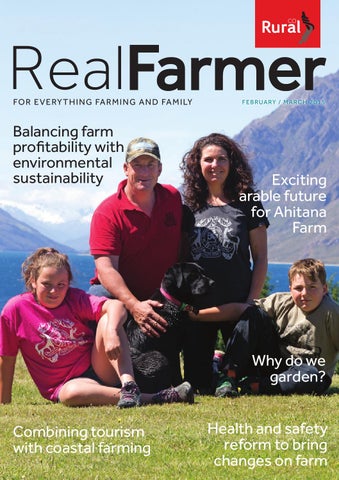
The Burdon family from Glen Dene Station at Lake Hawea
FEATURE
Balancing farm profitability with environmental sustainability
2
RE AL FARM E R
Changes to the farming landscape across Central Otago largely due to the Tenure Review process, the increase in dairying and growth in tourism, coupled with falling prices, a lack of confidence in the industry and increased on-farm costs, has seen many high country stations shy away from the traditional sheep and beef model in favour of recreational pursuits. And nowhere are the changes more evident than Glen Dene Station on the shores of Lake Hawea.
Burdon’s have diversified into tourism operating the Lake Hawea Holiday Camp and a successful trophy hunting and adventure tourism business, maximising their unique location being only one hour from Queenstown’s international airport as well as their own skill set. Both love people and love entertaining, and what’s more, they’re good at it. It makes for a chaotic life full of challenges, but one they both relish.
FEATURE Well-suited to merinos, Glen Dene built an enviable reputation for producing fine, bright well-nourished wool of high quality and quantity with the stud playing an important role in providing sheep that would thrive in a higher rainfall under high country conditions. Growth in commercial deer farming, which was then still in its infancy, saw Glen Dene branch out with the first deer fences and deer yards put up in 1984.
Richard oversees the day-to-day running of the farming operation, ably supported by head shepherd Colin Anderson, who has been at Glen Dene for 27 years. They also employ five other staff and casual musterers, as well as specialised internationally rated guides for the hunting business. The camp is Sarah’s domain, utilising her extensive tourism background, while being fulltime mother to their two children, Georgie (11) and Charlie (10).
After leaving secondary school, Richard spent time in Australia working as a jackaroo on merino studs before returning to Lincoln University to complete a Diploma in Farm Management then
Richard is the third generation to have farmed the iconic lakefront station. Located just five minutes from Hawea township on State Highway 6, Glen Dene Station covers 5,974 hectares, running from the neck south between Lakes Wanaka and Hawea to its border with Mt Burke Station near the township. Purchased by his grandfather, George Burdon in 1929—the very same year a start was made on the main road through to Haast—Glen Dene Station was part of the original Mt Burke Station until it was subdivided in 1979 with Richard’s parents, Jerry and Lesley Burdon, moving to take over the running of the northern portion (now known as Glen Dene Station).
setting off on his big OE travelling and working overseas. He returned home to Glen Dene in 1994 as a shepherd and the following year started managing Wilkin Vale, a freehold flat land property which they owned for a time at Makarora.
BELOW: Rising one year old bulls on Rocky Point looking across to Dingle Burn Station BELOW LEFT: Looking across Glene Dene towards Silver Island and Dingle Burn Station OPPOSITE: Burdon family with spikers in the background
BY ANNIE STUDHOLME
Once known as the Home of Icebreaker running approximately 8,000 merino sheep at its height, merinos have now almost entirely been replaced with a large deer operation, cattle, winter dairy grazing and cash crops (like lucerne, barley and silage), as owners Richard and Sarah Burdon look to diversify their operation in a bid to safeguard the property for future generations. For the Burdons, it’s about striking a balance between farm profitability with environmental sustainability through careful planning and land management practices, while capitalising on Glen Dene’s SLAM (Significant Landscape Amenity Measure) factor. “It’s always a battle. We love where we live and we choose to live here but it needs to make money, it can’t just be a beautiful place to live,” says Sarah. “It’s been a bit mad for a few years, running around putting the plans in place, but we are getting there. We are really excited about the future moving forward.” Aside from the farming operation, which includes 4,000 composite sheep (and decreasing), 280 beef cattle, 750 breeding hinds, 300 velvet stags, 700 replacement deer and around 70 trophy stags, the
Having lost large amounts of its lower country when Lake Hawea was raised in 1958 for hydro-electric storage, development on the fledging property was slow. Over time amenities such as staff accommodation, a woolshed and cattle yards were built, fences erected and land cultivated.
“Well-suited to merinos, Glen Dene built an enviable reputation for producing fine, bright well-nourished wool of high quality and quantity.” Richard’s wife, Sarah, grew up in Clare, South Australia, where her father and grandfather were well-known Merino breeders. A chance meeting in 1987 when Jerry and Richard visited her father regarding rams sparked off a friendship, which later blossomed into a romance a decade later when Sarah came to New Zealand as part of her eco-tourism degree.
RE A L FA RM E R
3
FEATURE done successfully, he believes it could increase the stocking rate by two to four stock units a hectare but it’s not a cheap undertaking. “It’s much like a paddock rotation; we do what the budget allows and are aiming to develop 2,000 hectares into a 15-year rotation. It’s a slow process but it’s giving us results.” The Burdons have also ploughed thousands into 212km of new fencing and more than 70km of four-wheel drive tracks which provide good access for guided hunters, farm work and the increasing range of recreational activities. Despite the development, they’ve ensured it hasn’t come at the expense of their conservation efforts. Through work with Dunedin-based land consultants Landward Group, of which Richard is a director, the Burdon’s have become inherently aware of the importance of conservation values. “They’re worth twice the as much as farming values so if you have high conservation values and look after them it can pay off,” says Richard. The couple married in 2000, with Sarah exchanging life in the bustling Australian tourism industry, where she had worked as both a travel agent and a hostess on boats in Queensland, for farm life here in New Zealand. That same year the pair took over the management of Glen Dene Limited initiating a family succession plan which was finally completed last November (2014). “Although it was a long process, the general workings were done back in the 1990s so everyone had a clear plan and goals we were working towards. Sometimes it just takes time to resolve these family businesses,” explains Richard.
“In a bid to protect the unique hill environment, steep gullies, beech forest and waterways have been fenced off, and they have also fenced bush margins in the deer farmed areas.” Glen Dene also entered Tenure Review, the process whereby the Crown brought back land it wanted for conservation and ecological reasons and which farmers used for grazing in exchange for the opportunity to freehold land they had farmed under Crown or Pastoral Lease, in 2000 completing it in 2007 with around 2,000ha of Glen Dene returned to Crown control as well as a number of covenants put in place together with public access tracks and easements. “At the end of the day, it was a good outcome for Glen Dene and a good outcome for the Crown.” In the early 2000s a focus on productivity led to the Burdons leasing more land. Their plan was to increase merino numbers, with the aim of reducing the wool micron of the ewe flock to 18.5 micron, as well as developing a new breed called the fine merino composite (half dohne merino with quarter merino and quarter finn). At that time the majority of their wool clip went to Icebreaker as well as relationships with 4
RE AL FARM E R
Smart Wool, John Smedley and Loria Piana. “When I returned home (in the mid-1990s) almost all of the farm’s income was derived from merino wool, but with Tenure Review, falling wool prices and a lack of confidence in the merino industry, we soon realised we had to start looking to diversify into other options,” says Richard. Increasing the deer operation was the logical next move. “The industry looked positive and they fitted our land class really well and fitted the growth patterns of the farm.” Mid-altitude land previously the domain of merinos now became home to breeding hinds. The hills keep them fit, the natural vegetation provides excellent cover for calving, and they thrive on the native and over sown cover. They are often integrated with ewes and cattle, explains Richard. Keeping the bracken fern, horatium, toot and sweet briar at bay is a constant battle especially on the intermediate hill country. Richard hopes to develop the bracken fern country over time, doubling its carrying capacity. If
In a bid to protect the unique hill environment, steep gullies, beech forest and waterways have been fenced off, and they have also fenced bush margins in the deer farmed areas. Land unsuited to stock is being planted in exotic and native plants. The Burdon’s management practices and efforts in combining economical farming, conservation and tourism drew national praise when they were announced as Supreme winners of the 2008 Otago Ballance Farm Environment award, followed with the Supreme winners of the Ballance Farm Environment and Minister of Agriculture Scholarship in 2009. Despite all their hard work, failure by the meat and wool industry to provide farmers around the country with sustainable returns along with increased pressure from local and regional ABOVE: The Burdon family from left Georgie, Richard, Charlie and Sarah BELOW LEFT: View inside the Lake Hawea Camping Ground BELOW RIGHT: Richard looking at an irrigated barley crop on their leased land
FEATURE Glen Dene Hunting and Fishing regularly attending hunting and fishing shows in the United States. Hunting is big business in New Zealand with the industry bringing in $45 million of revenue to economy annually. Clients range from eight to nearly 80, from Alaskan helicopter pilots to truck drivers that have worked hard earning $18-$20 an hour all their lives; the one thing they have in common is they all share a passion for hunting, explains Richard.
ABOVE: Second cut lucerne with the Sentential Peak Mountains in the background BELOW: The view of Lake Hawea from the camp ground
government through the Resource Management Act (RMA) and district plans, has forced them to look off-farm. “We have diversified away from farming because the returns are not good enough. In tourism you set your own rates and if you’re good at what you do then you should be
successful, but in farming you’re told what you’re going to get and you still have to pay the freight both ways. The lack of understanding from local and regional councils is also a huge risk to farming down here,” says Richard. In addition to Waitoa, a four bedroom holiday rental accommodation they run in Hawea, some lunch tours and occasional farm stays, the couple’s tourism interests grew significantly with the purchase of the lease of the Lake Hawea Holiday Park in 2009 after more than 40 years in the Cotter family.
“The timing couldn’t have been better with the children now growing up. We owned the land behind it and it was a great opportunity to buy it and incorporate some of that land into the camp in the future,” says Sarah. Sarah oversees the running of the business and marketing, while a manager is employed to take care of the day-to-day management. Coming from a tourism background, she knew there was more to the camping ground’s success that simply taking a
booking. Although they haven’t made any sweeping changes, they have steadily been improving the grounds and facilities which has found favour with campers of all ages, especially families. In time, Sarah hopes to better utilise the facilities, its beautiful lake frontage and sheltered location for special events, groups, weddings, retreats and family getaways. Over the years Glen Dene has been home to various hunting outfits stalking pigs, wild chamois, and red stags at high altitudes, but recently the Burdon’s have focused on developing their own clientele through
Sited between two World Heritage sites, Glen Dene offer unparalleled hunting experiences stalking everything from trophy chamois, red deer, arapawa rams, south pacific goats, tahr and fallow deer. It also has concessions for hunting on other private land. Currently they produce around 70 Glen Dene-bred trophy stags to supplement the wild take. Sarah’s love of food and wine and consummate attention to detail ensures no stone is left unturned with all needs catered to, especially for those non-hunters in the travelling party. “We really do love that side of the business; that’s part of the reason we are heading in that direction. Our future energy will be devoted to the hunting and camping ground, fully integrating the deer
operation so we breed and rear our own deer, reducing sheep numbers, running our own beef herd and increasing the cropping programme, ” says Richard. With farming changing constantly, he says farmers have to constantly review and challenge what they are doing to make sure what they’re doing is profitable. “Going forward, it’s about keeping it simple, focusing on profit rather than production, simplifying our farming systems and reducing costs so we can enjoy this magical place where we live.”
RE A L FA RM E R
5
6
RE AL FARM E R
COMMENTARY
Sharing our message It always amazes me how many people say they didn’t know about an event or deal or some other information which I know has been sent to them. NEAL SHAW, GROUP CEO
It is obvious they haven’t read the correspondence we have sent and I have to ask why? Is it apathy or are we overloaded by the sheer volume of information we receive everyday through a variety of media and mediums?
Is it apathy or information overload with not enough time to read what we receive? Is it a matter of information only being digested on a need-to-know-basis?
A University of Southern California study has found that we are bombarded with the equivalent of 174 newspapers worth of data every day. Compare that to the estimated 40 newspapers of information per day we received in 1986 and it’s not hard to see why we now filter the information which comes our way.
“Our challenge is to find the most effective way to share our information with members, in a way that is easy to digest and understand.”
Email, social media, 24 hour TV, mobile phones and the internet all have their part to play in the information overload we experience. And this doesn’t include the information which still comes through our mail boxes, either subscribed or unsubscribed to.
There’s a generational element to this problem too. While there’s little opportunity to escape the technological age we live in, it doesn’t necessarily come easy to all of us. Some of us grew up in an era with no computers or mobile phones. Many of us in this category are still happy to flick through a newspaper or find a telephone number in the phone book.
“Are we overloaded by the sheer volume of information we receive everyday through a variety of media and mediums?”
While we have this mixture of generational experiences, there will continue to be both technological and tangible information options available—all of which makes it difficult for businesses and organisations looking to inform their members, clients and customers. Our challenge is to find the most effective way to share our information with members, in a way that is easy to digest and understand. When there is so much competition for information sharing, we have to make sure our news gets to those who need it while remaining competitive and current. I am always interested in hearing your opinions on these matters and would welcome any feedback.
BELOW: Neal Shaw, Group CEO
While we obviously feel bombarded by this, it seems we are also part of the problem. The same study estimates we each send a much greater volume of information than we receive. In 1986 we sent around two and a half pages of a newspaper each day. Now with new technology this has sky-rocketed to six whole newspapers (around 85 pages per newspaper was the analogy for the study) every day. As a business, we share a lot of information, and consequently we are contributing to this growth in information sharing. We use social media; we have our website; a variety of publications; we text message and we email out information about deals, discounts and events we are running or attending. Despite this we are still constantly asked about why we did not promote certain deals or an event even though the information has been shared. A good example of this is Ruralco and its fuel offerings. We are often asked why members do not know about the discounts available to them or how the Ruralco card works. This is despite many media releases and plenty of publicity around the business and its launch, including five seminars held in Hinds, Mayfield, Methven, Rakaia and Ashburton. Sadly only 50 people attended in total. Despite these efforts I still have people saying they do not understand the Ruralco card 18 months later.
RE A L FA RM E R
7
8
RE AL FARM E R
RE A L FA RM E R
9
FEATURE
Health and safety reform to bring changes on farm Just over three years ago the Pike River tragedy became seared into New Zealand’s history as one of our worst disasters. BY RICHARD RENNIE
10
RE AL FARM E R
FEATURE In the ensuing investigation it quickly became apparent work place procedures and safety processes were sadly lacking, falling far short of the minimum standards Australian and other western nation miners could reasonably expect.
The two groups have developed website information sources that are regularly updated with latest developments, with Worksafe promising to keep industry informed as the Bill makes its way through Parliament.
Following the recommendations of an independent taskforce on workplace health and safety, and the Pike River Royal Commission, the government created “Working Safer”—a blueprint for workplace health and safety reforms.
A comprehensive background is also provided on what exactly the bill means, and why it is developing the way it is (see accompanying article).
It contains proposals that promise to make New Zealand equal with other western countries to ensure workers in all fields are more likely to come home safely at the end of the day. These changes have been captured in the Health and Safety Reform Bill, now working its way through Parliament and likely to be in place by mid-2015. The farming sector has been warily eyeing the Bill and its implications, knowing very well the sector sits near the top of an unenviable list for the level of workplace injuries and accidents, claiming on average 20 farmers and farm workers a year. Ashburton based health and safety consultant Cindy Meadows has been engaging with the rural sector for over two years in her role as director and founder of Unique Solutions. Cindy has drawn on her extensive experience in the meat processing sector developing safety procedures and policies. Ten years ago the industry was forced to address health and safety issues. It now sets benchmarks and standards that provide some useful templates for the farming sector. “I think we are seeing farming at about where the meat sector used to be, and just starting to recognise that something needs to change, and looking at the methods and means to affect that change,” she says. As a Ruralco Supplier providing advice to cardholders on health and safety issues, she has been heartened by the level of interest from farmers in the region wanting to instil a stronger culture of safety into their businesses. “Most farmers have that desire, but what really frustrates them is knowing where to start from. They hear all the media stories about quad bike accidents in particular, but rather than being a motivator, that can actually scare you off from making changes that will prevent such things happening. What they want is constructive, easily accessed information on how and where to start.” She applauds the work done by WorksafeNZ and DairyNZ to provide such resources to farmers on how to lay down a foundation of health and safety practices. “There is also a real willingness among WorksafeNZ staff to try and better understand the issues individual sectors like farming face when it comes to instilling those standards. It’s less of a ‘policeman’ approach and more of a consultative, collaborative attitude which is really appreciated.”
“Before you would have to try and sift through a lot of separate material to try and find what you needed.” Her meat industry experience highlighted the need for health and safety buy in across all levels of the business. Successful processes did not only include the process workers on the floor conducting what was often the most dangerous work, but also buy in from their supervisors, middle and upper management too. While a processing plant’s footprint is far more compact than that of an extensive pastoral farming business, setting the principles and processes in place remains a “must do”, regardless. Cindy will typically visit a farmer client and conduct an audit including interviewing them and their staff to get a gauge on how deep the operation’s health and safety culture is already embedded. From there she can identify actions that need to be taken and processes to review the plan once it is in place. “It could be you just do a quarterly review on it. Most farmers would prefer something like that, rather than a five hour review once a year.” In addition Cindy also runs monthly health and safety forums as part of her relationship with Ruralco as a supplier. Recently the forestry industry launched its Forest Safety Review which provides a full blueprint for the industry to instil a culture of safety from the point of felling to final timber processing. Cindy said she would welcome an industry specific framework for farming, given the industry’s own unique challenges. Staff awareness of health and safety is also proving a valuable catalyst for farmers wanting to bring more formal processes and procedures to their business. “It is certainly greater than it was 10 years ago, and you do notice it when you have an older and younger generation together at my forums, perhaps it is just that the older generation have got away with things when they were younger, so now don’t always see it the same way.” She believes worker engagement is vital, particularly under the reforms proposed. The Bill aims to ensure workers are required to take some personal responsibility when on the job for their own safety. This reflects a key requirement in the Bill that health and safety is the responsibility of everyone who is on the work site.
Health and Safety Reform Bill: What it means The reform bill aims to ensure New Zealand brings down its workplace accident and injury rate. On average 75 people a year die in the work place, and 10% of workers are harmed, with another 600-900 dying from work related diseases. Farming and forestry claim two of the top spots for workplace death and injury – in 2012-13 19 farmers were killed on the job, and the sector is likely to be a focus for getting the Bill’s reforms in action quickly. Some key points:
Primary Duty of Care: Person Conducting a Business or Undertaking (PCBU) This is a key part of the reform, with PCBUs being the entity or person in best position to control risks to work health and safety. They have the primary duty under the new law for workplace safety. In farm situations contractors visiting who are self-employed will have a “duty of care” themselves to take reasonable steps to ensure their safety. However the farmer will also be required to take reasonable steps to ensure their safety ie identifying any risks and hazards the contractor would not know about.
PCBUs and Primary Duty of Care The Primary Duty of Care will require all PCBUs to take “reasonably” practicable steps to ensure workplace safety. This encompasses all aspects of the environment’s plant, systems, handling, facilities, training and monitoring of health and conditions. PCBUs cannot contract out of their Primary Duty of Care responsibility, and have to work with other PCBUs involved in a workplace, coordinating responsibilities.
Workers and their duties. Responsibilities for safety will be shared, and workers will be required to ensure they too take “reasonable care” to do so.
RE A L FA RM E R
11
12
RE AL FARM E R
PROFILE
More than just a showroom Mico is reshaping its bathroom and plumbing business, with a new emphasis on supplying trade plumbers and farmers wanting anything from pressure fittings for the dairy shed to irrigation cables and valves. BY LINDA CLARKE Ashburton Store Manager Todd Walker said the new face of the business embraced both bathrooms and farming needs alike. Mico has a long relationship with Ruralco, with 50 branches nationwide. New owners Fletchers have moved the large pipe business to another arm of the company and Mico Bathrooms and Mico Plumbing have been reborn, with a mix of old and new staff, a new look showroom and a growing clientele including trade plumbers and farmers. “Our business model has totally changed and we want people to know about our new focus. We can service farms, and we’ve got all types of pressure fittings, dairy cylinders, irrigation cables and alkethene pipe. We’ve got a lot of valves for trades and the like, and we have a good working relationship with Hydroflow and Apex.” Apex designs and makes control valves for low and high pressure hot water and filtration systems, and also manufactures a big range of float and reservoir valves for the agricultural industry. They are known for their long-lasting and hard wearing components. Hydroflow is the distribution company for Apex and other products. Hydroflow distributes many of the world’s leading industrial brands, selected not only on product innovation but also on quality and technical support.
He said building relationships with trade and farming customers was important and Mico wanted to be known as trusted and reliable suppliers. Mico has its own exclusive range of tapware, vanities, showers, baths and toilets; biggest sellers include Raymor, Adesso, Kodler and Hansgrohe. Whether a total bathroom overhaul is needed, or a small change, skilled staff can recommend the right piece depending on the scale and budget of the project. For big jobs, customers should book an appointment and bring their plans with them, including dimensions of the room to be renovated and with existing electrical points and drains. Todd said bathroom make-overs usually required the assistance of a plumber, electrician and builder and Mico staff could hook customers up with good tradespeople. Wet areas must be built and installed correctly, so getting the right builder or plumber is key. The exclusive products Mico supports are the result of over 100 years of experience and
ABOVE: TOP A bathroom showroom ABOVE: Todd Walker, the Ashburton Store Manager MAIN IMAGE: Mico Plumbing can cover all of your
plumbing needs from the dairy shed to the home stead
knowledge of plumbing products and brands. Supporting a select few quality suppliers gives Mico the advantage of being competitive on pricing and stock availability; with genuine backup if needed.
Locations nationwide
Tel 0800 844 448 www.micobathrooms.co.nz
RE A L FA RM E R
13
14
RE AL FARM E R
REGULAR
Animal Health
Enzootic Pneumonia Pneumonia refers to inflammation and infection of the lungs. ARTICLE SUPPLIED BY IAN HODGE. BVSC.,MACVSC. VETENT RIVERSIDE.
It can affect all grazing animals and is often more prevalent in autumn and winter as the seasons change from warm consistent temperatures to warm days and cold nights. Sheep are commonly affected by pneumonia, and in New Zealand it is a leading cause of reduced lamb growth rates sometimes by as much as 50% relative to unaffected lambs. As well as reduced growth rates, slaughter downgrades become much more common in affected lines of lambs. Cattle can also be affected by pneumonia throughout the grazing season. Affected cattle become ill quickly and soon develop a characteristic “laboured breathing” clinical sign which is diagnostic for pneumonia. Sheep pneumonia is a complex disease. In New Zealand two forms of pneumonia are recognised: These are chronic non progressive pneumonia which is often seen in lambs 3–10 months of age and acute fibrinous pneumonia which is seen in sheep of all ages. Chronic non progressive pneumonia results from invasion of damaged lungs by viruses and bacteria. The infection establishes because local immune systems in the lungs and respiratory tract are compromised by stressors placed on the animal or the respiratory tract. Such stressful events
include cold wet nights, droving sheep in dusty yards, changes in nutrition, poor animal health (lungworm), shearing, lack of shelter etc. Once established, viruses may further predispose the lungs to secondary invasion by bacteria. In combination, viruses and bacteria will damage healthy lung tissue and so reduce the ability of the lungs to exchange oxygen and carbon dioxide. Ultimately this process reduces an animals’ growth rate and can result in death in some cases.
“Pneumonia is a disease that, at least in sheep, needs to be prevented rather than treated.” When animals become severely stressed and the lungs are invaded by more potent bacteria the severe form of pneumonia may occur. In this situation abscesses will form throughout the lungs, the outside lining of the lungs will also be affected, and eventually the bacteria will invade the animals’ blood stream resulting in the sudden death of that animal. The classic situation for pneumonia to develop is in late summer early autumn. It may be dry and dusty and there may be a feed shortage. Ewe
hoggets may be brought in to yards for drenching or other treatments and they may have been previously shorn. They may be held in the yards for a few days. In this situation the risk of these animals developing acute pneumonia is high. Because respiratory infections can be infectious through aerosolisation (coughing) many animals can be affected in a short period of time and the number of dead animals can be significant. Pneumonia is a disease that, at least in sheep, needs to be prevented rather than treated. Avoid droving lambs in hot dusty conditions. Maybe the yards can be dampened down prior to use to reduce dust. Hold lambs close to the yards to reduce the distance they have to move. Maintain a good drench programme to eliminate lungworm as this can be a predisposing factor for pneumonia. Keep lambs healthy through consistently good feeding avoiding peaks and troughs in feeding levels. Maintain a good weaning protocol to keep stress down and ensure trace elements are supplemented to help maximise lamb immunity. Your veterinarian will be able to assist you plan a pneumonia prevention programme and will also be able to assist with a diagnosis especially if your lamb growth rates are not where they should be.
RE A L FA RM E R
15
16
RE AL FARM E R
RE A L FA RM E R
17
FEATURE
Exciting arable future for Ahitana Farm Dairying’s steamroller arrival across Canterbury in the past decade left many fearing for the region’s arable farming future. BY RICHARD RENNIE
18
RE AL FARM E R
But Deane and Jo Taylor of Ahitana Farm, east of Ashburton prove there is little to fear. Their 400ha operation is proof that with some innovation, optimism and hard work Canterbury’s cropping farmers are capable of going toe to toe with dairy farming businesses to deliver strong returns, and a sustainable future for the sector. The Taylor family has farmed the property for almost 138 years. Each generation has been able to adapt the farming operation to the market, but it is over Deane and Jo’s tenure that has witnessed the most significant changes in direction and technology. This is due, in no small part, to irrigation infrastructure and a move from predominantly sheep and mixed cropping to the intensive crop system on the farm today. This has been the usual ‘adapt or die’ that goes with any farming system.
“The Taylor family has farmed the property for almost 138 years. Each generation has been able to adapt the farming operation to the market, but it is over Deane and Jo’s tenure that has witnessed the most significant changes in direction and technology.” But it is also because Deane has sought to recognise how their land use fits into a wider global picture. That is one where the United States, Europe and Australia will always dominate the grain commodity markets, simply due to their scale, proximity to market, and lower land values.
“We came to see that we also have to compete with and complement dairying in terms of getting a reasonable return to remain cropping. I’m a strong believer in cycles and the need for balance in the big picture for agriculture here in New Zealand.” The move into more specialty crops represents a significantly more complex operation than even a decade ago. Sheep numbers have rapidly declined on the farm, down from only 600 Romney-cross ewes three years ago, to a handful today. “With the crop variety we have, having ewes simply no longer fitted in very well, in terms of the paddock size and set up, and the complexity of also having livestock in the system was just too much.” That complexity is reflected in the wide variety of crops grown, in a typical season more than a dozen different species as varied as hemp, chrysanthemums, kale, beetroot, parsnip and carrot seed, all bringing their own demands on fertility, irrigation and, ultimately, timing of harvest. Deane has turned to greater use of technology to embrace and manage the demands such variety bring and this has included adopting the ProductionWise online crop management system. Introduced to New Zealand in 2012 by FAR (Foundation for Arable Research) and adopted from an Australian system, ProductionWise enables growers to map paddocks, record all paddock operations and associated inputs, record all stored grain and grain sales and provide gross margins at paddock level through to whole farm reporting. Critical aspects like avoiding cross pollination and potential crop conflicts are now also well
FEATURE flagged, helped by the region’s Seed Crop Isolation Distance (SCID) system. The technology, along with good agronomic advice, has helped Deane take his cropping skills and apply them to smaller areas of multiple specialty crops. He admits there are not many crops he would not consider trying, taking advantage of the property’s heavy silt soil.
“That complexity is reflected in the wide variety of crops grown, in a typical season more than a dozen different species as varied as hemp, chrysanthemums, kale, beetroot, parsnip and carrot seed…” This year for example he is growing pearling barley for human consumption for the first time, and has some Japanese malting barley also in the ground. The malting option provides a premium on conventional barley which can struggle domestically due to the relatively small scale of plantings. This season is also the first for potatoes on Ahitana, with a little known variety “Bondi”, a high yielding, early-maturing variety that has Deane keen to see how it performs on his land. Another first this year is an Italian parsley which Deane has planted for seed production. OPPOSITE PAGE: Jo and Deane in the vibrant parsnip crop on Ahitana Farm BELOW: Deane and Jo Taylor of Ahitana Farm with two of their children Tom (9) and Kate (6)
“Doing what you do well”, for them has been increasingly about growing specialist crops under contract. They are ones not sold as global commodities, subject to the whims of traders, speculators and distant overseas conditions. The sheer variety and specialty would surprise anyone who ever wondered where the assorted brightly packaged vegetable seeds have come from. “We simply do not have the scale to compete with the broadacre operations of the US MidWest and Europe, we are barely a bit player, so we realised we needed to focus on high value, specialty crops where we could,” says Deane. “We need to work with the market and focus on specialist seed multiplication predominantly for the northern hemisphere which complements our ryegrass seed and cereal part of our business.” The scale of the overseas broadacre operations even threatens New Zealand’s dominance in dairy exports, thanks to the ability of US growers to produce vast amounts of lower priced grains, and deliver them cheaply to large scale dairy units now often located in close proximity to the grain growing source.
RE A L FA RM E R
19
FEATURE
A challenge like no other When a seething mass of cyclists, runners and walkers started at last year’s ATS Longbeach Coastal Challenge in late November, an army of volunteers was there to cheer them on, point the way, and offer a steak sandwich at the finish line. The steak sandwich is just part of the country hospitality that has helped make the challenge an increasingly popular and fun event for the Canterbury community. It does much to explain why the number of participants has climbed each year.
“It is quite unique for two groups like this to come together, but between us we have been able to ensure the Coastal Challenge continues to go from strength to strength.”
One of the more unusual crops has included hemp, grown for its seed which has a high oil content used as a nutritional supplement.
high cost of capital equipment for cropping, and the critical nature of timing can put added pressure on a farm’s balance sheet.
“Typically the higher returning crops will have a higher risk associated with them, and you have to balance that within your plantings for the season.”
He shares some critical pieces of equipment, including a 24m Househam self-propelled sprayer with two neighbours, spreading the capital cost, maintenance and operation of this state-of-the-art technology.
However that risk can carry across all crops, as anyone trying to harvest last summer would testify.
“I find these aspects of technology exciting and it all adds to the challenge of doing what we do. I have a lot of faith in technology to deal with some of these challenges ahead.” “I think that was probably one of the worst harvest seasons we have seen, with really high moisture levels and rain that compromised both yields and quality.” Underpinning the complex tapestry of crops Deane has irrigation technology now capable of variable rates of application along with GPS guided fertiliser applications. He sees the combined technologies going a long way to ensuring crop operations can remain viable under impending nutrient controls. “I find these aspects of technology exciting and it all adds to the challenge of doing what we do. I have a lot of faith in technology to deal with some of these challenges ahead.” Some of the advances in technology Deane has enjoyed have also come through old fashioned honest, trusting relationships. The 20
RE AL FARM E R
Just as dairying’s arrival has prompted many crop operators to lift their focus on crop returns, it has also bought some opportunities. Deane recalls the days when straw from the grass seed and cereal harvest would be piled up and burnt. This residual now has a market in feeding dairy cows and provides another income stream for the farm. Another vital element to the success of an arable system is the crop pollinator, bees. “They are absolutely essential, and we have a base number of hives on the farm, and also hire additional hives for some crops, especially the carrots, which are not particularly palatable for bees.” Deane admits he has considered a partial conversion to dairy across some of the 400ha, but issues with drains and heavy soil types made it less appealing. He does admit sometimes looking at his dairy neighbours, envying that their marketing and sales are taken care of as the tanker drives out the gate. “I have always enjoyed the marketing part of our enterprise and I love the challenge of pulling it all together each year. In the end it’s a privilege to run a business such as this that allows us the opportunity of choice along with a great lifestyle for us to share as a family.
“There is a good rural feel to the event that we have worked hard to foster, and the fact it covers all ages, all levels of fitness and allows for biking, running or walking means it is quite a unique event in the country,” says Jo Taylor. Jo has been part of the organising team of school parents and local Lions Club members since the events inception in 2007, and is quietly proud of how it has developed over that time. Originally started as a mountain bike race, the addition of a run and walk option has ABOVE: Deane and Jo in a white clover crop BELOW: This season is also the first for potatoes on
Ahitana
FEATURE opened the event up to almost anyone in the community keen to participate in a valued fund raiser for the Longbeach School and the Hinds and Districts Lions Club. “It is quite unique for two groups like this to come together, but between us we have been able to ensure the Coastal Challenge continues to go from strength to strength.” This has included varying the route along a stunning part of the Canterbury coastline. The Coastal Challenge gives competitors the choice of either a 23km or 35km mountain bike race, a 12km family mountain bike ride, a 21km run, a 12km run/walk and a 5km run/walk.
“Latitude is a Canterburyfocussed, high-quality magazine with a wide readership throughout the region and further afield.” Jo’s other main interest off farm is her business, Latitude magazine which she started from home seven years ago. Latitude is a Canterbury-focussed, high-quality magazine with a wide readership throughout the region and further afield. Not having a background in publishing did not put Joanne off launching Latitude, and she attributes its success to having a great team of staff and contributors around her.
“The key has also been to keep producing good quality, positive content that people want to read.” Even with this busy life, which includes five children aged from 21 down to six, Jo is closely involved in the family cropping business, helping Deane negotiate the increasing levels of technology now available for arable farmers.
“For us to grow the high value crops we do, we need to be very specific in record keeping, knowing every paddock’s history. I enjoy the technology side of the business as much as Deane and share his passion for the challenge and variety in our operation.” ABOVE: Jo working on her many other responsibilities off the farm BELOW: Another vital element to the success of an arable system is the crop pollinator, bees
RE A L FA RM E R
21
22
RE AL FARM E R
PROFILE
Stay safe and visible New health and safety regulations later this year will make high visibility vests and personal protection equipment compulsory on farms and other workplaces. BY LINDA CLARKE
But don’t fret if you need compliance advice. Work Outfitters in Timaru are experts in the safety business, providing clothing, equipment and sensible advice that won’t cost the earth. Owner Annie Light said well trained staff could offer sound advice to farmers and all business owners about how to meet the new regulations, and a plan to make clothing and equipment compliant. Work Outfitters has a big showroom on Bank Street in Timaru, and an easy-to-navigate website with details about the huge range of stock available— from smaller sized safety vests for women to safety goggles, boots, hydration packs and hard wearing wet weather gear. They also stock gear for recreational hunters, and adventure clothing for adults and children. Annie said distance was no problem and gear was sold to customers around New Zealand and in other countries. Customers range from dairy farmers in New Zealand to gold miners in Egypt, with stock couriered from the store or warehouse to the customers’ doors. “We really have everything. We deal a lot with the rural market, providing lots of hi-vis vests and wet weather gear for dairy workers. It’s good quality gear that is warm and hard-wearing and doesn’t necessarily cost a fortune.” She said protective clothing and other equipment needed to be comfortable and long-lasting as well as meet health and safety regulations.
Work Outfitters staff can visit customers at their workplaces to assess requirements and offer customised advice. The new regulations would be daunting for some, Annie said, but were part of a nationwide campaign to reduce farm deaths and accidents. In 2013, 51 agriculture-related deaths were reported to the Department of Labour, which is also making sure farmers know their workplace hazards and work to reduce or eliminate them. Work Outfitters also has a range of clothing for vegetable and meat processing factories that meets food hygiene regulations. Annie said the protective clothing was designed to be practical and comfortable for employees working long and irregular hours. “One of the new things we now have is a hydration drink which replaces lost electrolytes but is low in sugar. At the end of a 12-hour shift you don’t want your workers to crash, but have energy for their afterwork lives and for the next day as well.” She said the store was a one-stop shop for anything workers needed – from underpants to Arctic jackets and sunscreen. “And once we’ve got them kitted out, we follow up with new technological advances or products
ABOVE: Annie Light with some of their large Hi-Vis range designed to keep you safe in the workplace MAIN IMAGE: The Work Outfitters store in Timaru
as they become available. We just want to make it easier for everyone in the workforce.” Annie said protective clothing and equipment must be comfortable and easy to wear, and not restrictive, or safety gear could be set aside while the job was done. Work Outfitters has clothing to cover the body (like overalls and aprons), gloves, safety boots, dust masks and respirators, safety glasses and goggles, hard hats and hi-vis vests, that staff would want to wear rather than had to. Like campaigns to change attitudes to drink-driving and smoking, the Government wants workplaces around the country to take health and safety seriously and will ramp up education and engagement, and enforcement. The aim is to cut the death toll in workplaces by 25 percent by 2020.
30 Bank Street Timaru
Tel 03 688 6638 sales@workoutfitters.co.nz www.workoutfitters.co.nz
RE A L FA RM E R
23
24
RE AL FARM E R
RE A L FA RM E R
25
26
RE AL FARM E R
REGULAR
Nutrition
Back to basics
With the payout forecast being the way it is, many producers have gone ‘old school’ and are re-evaluating their cost structures and supplement usage as a way to minimise extra expense as we shift into the second half of the season. BY CRAIG TROTTER, CENTRE FOR DAIRY EXCELLENCE
Typically if you start calving on 1st of August, if you multiply your season to date pick-up on around Christmas day, it provides you with a fairly good idea on the full season milk solid (MS) production, barring any disasters through the rest of the season of course. The term ‘production is vanity and profit sanity’ rings a little clearer in the current market conditions. Data from both DairyNZ Farmbase benchmarking and Dairy Systems Monitoring data show that there is a strong relationship between kg of pasture dry matter (DM) harvested and farm profitability (Figure 1) with a relative poor correlation between profitability and supplement input on farm (Figure 2).
$ EBIT/Ha
4000
2000
y = 448.35x - 2338.4 R2 = 0.7561
0 7.0
9.0
11.0
13.0
15.0
PASTURE HARVESTED t DM/Ha
Figure 1. The relationship of pasture harvested and earnings before interest and tax (EBIT/ha) courtesy of the McFarlane Rural Business Dairy Systems Monitoring benchmarking season 2013/2014 report.
EBIT (MODELLED) $/Ha
10000
y = 1.4651x - 4410.5 R2 = 0.1289
9000 8000 7000 6000 5000 4000 3000 2000 1000 0
0
500
1000
1500
2000
2500
solid production up through the summer but this may well be at the expense of farm operating profit and most likely on farm feed quality, it is not so much how much supplement is used rather than how it is used principally through the summer months. In figure 3 below, we can see two scenarios of per cow milk production through a typical season versus an optimal rate of decline in milk production with cows peaking at just over 2kg MS/per cow/ per day. The red line shows a reasonable peak but a swift decline in milk production particularly through December and January which then begins to flatten out across from February onwards. In comparison, the green line shows the same peak point but a more gradual decline in milk production as the cow’s milk on through the season, roughly this difference in milk solid production equates to an extra $40,000 in income based on this seasons pay-out schedule (as at 12 December 2014) and a 500 cow herd.
SUPPLEMENT (kg/DM/Cow)
Looking at the figures above, it is clear that the major player in terms of farm profitability is the utilisation of feed grown on farm. The efficient use of imported supplement is pre-determined on the farmer’s performance i.e. an excellent farmer will make better use of imported supplement than what a poorer farmer will; in the latter case, imported supplement will be used to hold milk
MILK SOLID PRODUCTION (kgMS/c/d)
Figure 2. The relationship between supplement input (kgDM/cow) and earnings before interest and tax (EBIT/ha) courtesy of the McFarlane Rural Business Dairy Systems Monitoring benchmarking season 2013/2014 report.
2.1 1.8 1.5 1.2 0.9 0.6 0.3 0
JUL AUG
SEP
OCT NOV DEC
JAN
FEB MAR APR MAY JUN
MONTH OF SEASON
Figure 3. A tale of two figures. The green line representing a stalled summer production curve versus an optimal one.
Assuming similar supplement inputs, reasons for this difference in milk solid production are mostly due to declining feed quality through the summer period, particularly as pasture species enter the reproductive phase and we see reductions in overall feed quality. Steps to minimise this reduction in feed quality and the resultant milk production curve revolve around maintaining a sufficiently short platform rotation length and grazing down to satisfactory residuals to ensure there is not a build-up of dead plant leaf material, on top of this are shutting paddocks up sufficiently early for silage production. All good pasture feed wedge calculators should have the option to create a forecast feed wedge which can allow an appreciation of where covers will be in two weeks’ time, use these for your benefit. Through focusing on feed utilisation, we can minimise the use of imported supplements, hold a higher pasture quality and maximise farm profitability. With the current beef market, many farmers are going through their herd test production figures and scrutinising individual cow performance more harshly than in other seasons, short term gains can be made but it is important that cuts don’t go to deep in order to make the most when ‘normal’ pricing returns in seasons ahead. Remember that the number of replacements entering the herd is already locked in for the next two seasons though saying that, this season may be the best opportunity yet to give operators the real chance to shift their thinking from the traditional production per hectare to a production per cow performance system.
RE A L FA RM E R
27
28
RE AL FARM E R
RE A L FA RM E R
29
30
RE AL FARM E R
Looking after the kids When talking about health insurance we often focus on the benefits to the employer of having employees that are fit, healthy and productive in their jobs. ARTICLE PROVIDED BY SOUTHERN CROSS
PROFILE We’ve heard from a number of businesses that employees really appreciate the chance to look after their families’ long-term health and wellbeing by adding them to their existing Southern Cross policy. One of these, Ravensdown, New Zealand’s largest supplier of fertiliser, has been providing subsidised health insurance to its employees and their loved ones and finds it a powerful retention tool. Tracey Paterson, Ravensdown General Manager of Human Resources, says it means their people don’t have to sit at work for months worrying while they wait for treatment for themselves or their family on the public health system. “Our people are used to being looked after. For full-time employees, cover extends to partners and children—that’s a benefit you don’t give up lightly.” To join Southern Cross call 0800 438 268 or email getcover@southerncross.co.nz. Top surgical claims in 2013 by age band 0-4
GIRLS
However the health of an employee’s loved one is equally important. Having a sick partner or child can cause worry and stress, and taking care of them often requires time off work.
mean waiting on public lists for appointments, diagnostics and treatments.
A 2013 research project, Wellness in the Workplace, carried out by Southern Cross Health Society, Business NZ and Gallagher Bassett, looked at the drivers of workplace absence.
“The public system does an incredible job”, says Tynan. “However what the public has seen in recent years, is that increasing demand for health services means that many patients don’t meet the criteria that allows them onto the surgical waiting lists for elective treatment.”
Unsurprisingly the survey showed the main cause of absence was illness unrelated to the workplace (60%), however the second cause was caring for a family member or other dependent due to illness or injury (38%).
Health insurance can remove the stress that comes from the uncertainty over whether they will be able to access public surgery, or will have to wait and Tynan says early childhood is the optimal time to get health insurance.
This sends a strong indication that employers don’t just need to think about the health of their employees, but also the health of their families. The farming sector is no exception.
Those with Southern Cross health insurance receive a child’s rate for their first two children aged under 21— the third and following children receive free cover.
Finding the money to pay for private specialist care for very young children can place a huge amount of stress on families. Southern Cross’ claims information shows the top claims for its members aged between 0 and 4 years in 2013 ranged from $6,000 to $15,000. Peter Tynan, Southern Cross Health Society CEO, says that when a child is ill, all a parent wants is having them well again as soon as possible. “But the costs for tests and consultations can quickly add up, especially if multiple treatments are required,” says Tynan. For example, private specialist charges for an ongoing throat disorder resulting in a tonsillectomy can be as high as $7,000. The alternative may
“There’s no doubt that the best time to get insurance is when you’re young and healthy. You’re not only less likely to have pre-existing conditions but it means ensuring optimal treatment at an age when some common problems have been known to cause other health or developmental issues. Last year Southern Cross paid over 260,000 claims for its members aged under 20. Reassuringly, the majority of these were for medical consultations.
1
Tympanoplasty (eardrum surgery)
$9,000
2
Cochlear implant surgery
$9,000
3
Ear canal surgery
$8,000
4
Adenoidectomy
$8,000
5
Tonsillectomy
$7,000
6
Strabismus surgery (eye correction)
$7,000
7
Strabismus surgery (eye correction)
$7,000
8
Strabismus surgery (eye correction)
$7,000
9
Tonsillectomy
$7,000
10
Tonsillectomy
$6,000
1
Urethroplasty (urethra repair)
$15,000
2
Multiple procedure
$13,000
3
Paroidectomy (salivary gland removal)
$13,000
4
Multiple procedure
$13,000
5
Urethroplasty (urethra repair)
$12,000
6
Nephrectomy (kidney removal)
$12,000
7
Urethroplasty (urethra repair)
$11,000
8
Nephrectomy (kidney removal)
$10,000
9
Orchidopexy (undescended testicle)
$10,000
10
Tympanoplasty (eardrum surgery)
$8,000
BOYS
Tel 0800 800 181 info@southerncross.co.nz www.southerncross.co.nz
RE A L FA RM E R
31
FEATURE
Why do we garden? Everyone probably has a different motivation for gardening, but common reasons are to create a calm refuge and a haven away from the hustle and bustle of everyday life. BY MARIE TAYLOR
32
RE AL FARM E R
FEATURE I’d spent a week once, years ago, in Kyoto looking at gardens, many of them surrounding temples. They are some of the most peaceful places you could ever be. When I read about garden design many books referenced Persian gardens as being where formal gardening began. But there were no descriptions of what Persian gardens looked like, or were laid out, or even, were like today. For a long time I’d been wanting to travel to Persia to see these gardens, and late in 2014 had the opportunity when Timaru tour manager Jill Worrall took a group of 18 Kiwis to Iran on a Tours Direct trip. The 3,500km clockwise three-week trip through the central part of Iran—all by bus except for a quick 900km flight across a desert—included half a dozen exquisite Persian gardens. These are harsh landscapes in which to foster world heritage listed gardens. For example, Kerman, in the southeast of Iran, where we encounter our first Persian garden, is 1,775m above sea level. Annual rainfall is around 158mm, and summer temperatures average 36°C. Even much further north in the capital Tehran, rainfall is still very low at around 230mm a year. To cope with living in such difficult terrain, the Persians created oases of green. The word paradise derives from a Persian word meaning garden, explains our tour guide Reza Mirkhalaf-Zadeh. He says all Persian gardens are surrounded by walls, either brick or adobe, limiting the extent of the garden from an unlimited desert. The first garden we visited east of Kerman at Mahan, the Bagh-e Shahzadeh, or Prince’s Garden, is the perfect example. Its thick adobe walls protect it from the wind and desert dust, creating a clearly rectangular garden oasis out in the dry, stony desert. Water carried from the nearby mountains cascades down a series of formal pools through the centre of the garden, and is also used to irrigate orchards set back on both sides of the formal central garden. “Fruit trees are the main trees in Persian gardens, providing shade and fruit,” he says. Apricots, apples, figs, pomegranates and quince are common examples. The more formal central garden is an avenue of pines, planes and cypress trees. Cypress trees have
been in Iran a very long time, and symbolise long life and immortality. Throughout Persian art the cypress is ubiquitous, appearing on carpets and decorations on buildings. It also features carved on spectacular reliefs at Persepolis, which was the Persian capital in 500BC. There’s a little place called Abarkuh (which to Iranians is so far away from anywhere else they think of it like Timbuktu) where we saw a cypress (Cupressus sempervirens) reputed to be 4,000 years old. This tree is described not only as the oldest in Iran, but also, according to Wikipedia, as the second oldest tree in the world. It was in superb condition, thanks in part to being flood irrigated now and again with the surrounding paddock of lucerne. Along with pines and planes, cypresses provide a green backbone to Persian gardens. They create the height and shade in the garden, and a tall cool dark avenue along which water is channelled. “Water has a very important role, and in a Persian garden you can always see, feel and listen to the water,” Reza says. Persian gardens feature a pavilion, a passageway in which to walk in front of the pavilion, a reflecting pool of water in front of the pavilion fed by open channels called jubs, and the gardens. The gardens are divided regularly into areas the same size, on each side of the main channel of water. One hotel we stayed in, the magical Moshir Garden Hotel in Yazd, has water channels and fountains right through the midst of the hotel buildings. Poets are revered in Iran, and we visited several poets’ shrines, among them Omar Khayyam, Attar, Ferdowsi and Hafez. All have immaculate gardens around the shrines, but the one which I liked the most was Attar’s tomb just outside Mashhad. There, a small blue-tiled dome was reflected in a pool of water, and gardens of geraniums contrasted beautifully with the blue. The garden was surrounded by tall towering pines. We also visited restored adobe houses with cool courtyards. One, in Kashan, about half a day’s travel south of Tehran, featured plantings of red roses. Several varieties of deep red shrub roses were planted closely together, giving a long flowering period. The last garden we visited was the Bagh-e Fin in Kashan. Turquoise coloured tiles line the channels
between old cypress trees, some of which are propped up with poles for support. Throughout the channels, which are fed by gravity, are many little bubbling fountains, so wherever you are in the garden, you can hear the water. It’s a very peaceful memory to bring home. Quelling Misconceptions
Timaru-based tour manager Jill Worrall, who has visited Iran 12 times now, describes Iranians as the least understood people. She’s a vastly experienced tour guide, but says she is still surprised people don’t dig a little deeper when thinking about Iran. “It is always good to have people who are prepared to ignore all that and come anyway. “My philosophy when visiting Iran is to pack flexibility and a sense of humour, and leave the misconceptions and preconceptions at home. “Be prepared to step outside your comfort zone‑that is when sometimes when you have the most interesting and memorable experiences. If you want things to be like they are at home, stay at home. “I really feel very strongly that so much of people being afraid of other cultures is based on ignorance and misconceptions. “It is not a matter of supporting political regimes, it is about people. People are very much the same all around the world; they have very similar concerns. “It comes down to very basic things, things like do I love someone, does someone love me and if I have got kids, looking after their future. It is the same with everyone. “After travelling, people realise that some of the nationalities they might fear or understand the least are some of the loveliest which is definitely the case with Iran.” ABOVE: The blue-tiled tomb of the poet Attar near Mashhad LEFT: The Bagh-e Shahzadeh or Prince’s Garden at Mahan features cascades, simple fountains, beautiful trees and picturesque pavilions OPPOSITE: At the Bagh-e Fin in Kashan, the sound of bubbling water is heard from small fountains spaced throughout long turquoise-tiled channel
RE A L FA RM E R
33
34
RE AL FARM E R
RE A L FA RM E R
35
36
RE AL FARM E R
PROFILE
The trick is knowing your fabrics Embroidery on an industrial level has given Keith Pickford and his team at Elite Embroidery in Ashburton a unique take on the corporate, sporting, farming and personal lives of the people in his community. BY LINDA CLARKE Shirts, caps and jackets embroidered or screenprinted by Elite have appeared around the country, and the world, worn by athletes, school groups, business partners, workers and tourists. Then there’s the one-off items embroidered or printed for special occasions like significant birthdays, weddings and cherished grandchildren. Health and safety regulations enforced on many farming and constructions sites mean high-visibility clothing, and worker identification are a must. Embroidering both the worker’s name and company on work shirts achieved these requirements. The trick, says Keith, is knowing your fabrics, from polyester to cotton and wool. He has plenty of experience to call on, having started out in the drycleaning trade over 30 years ago. When the business started cleaning overalls, embroidered badges with the worker’s name and company logo were sewn on the garments. The badges were made in Wellington, but as technology advanced in the early 1990s, Keith sourced an early-model computerised embroidery machine to do the job himself and installed it alongside the drycleaning gear. Over six months he taught himself how to use the machine and then demand for the commercial embroidery took off. He was soon embroidering business shirts and work tops for a range of customers, from the Ashburton Trust to Singapore
Airlines. Business was transacted from afar by fax or post, as customers sent their logos for Keith to convert to stitched images. Demand was so great, he bought a larger fourhead machine and then he sold the drycleaning business in 2003 to concentrate on Elite Embroidery business, working from premises in Ashburton’s Victoria Street. At the time, the space was too large for Elite’s needs, but now it is too small, with new computerised machines and clothing samples filling every conceivable space. Much of the business is conducted by email these days, and Elite has many filing cabinets filled with logos of customers ready to use at a moment’s notice.
embroidered
heat-sealed onto fabrics, but photos also gas-dyed onto fabrics. Keith was recently able to provide an express service for a member of a bridal party who wanted a photo from the wedding printed onto a teeshirt that he planned to wear at the reception. Mission completed, and much appreciated by the guests of honour. Keith said years of experience meant he could help customers decide on size and shape of logos, as well as placement and choice of clothing.
Keith says advances in the embroidery technology and software had sped up the embroidery process, but machines still have to be loaded with thread, have their needles changed and moving parts maintained. The newest Japanese machine has 90 needles and can embroider six garments with the same logo at once. The screen printing process has also improved, with not only letters and numbers able to be
ABOVE: Any colour combination is possible MAIN IMAGE: Keith Pickford preparing some shirts to be
Much of his clothing range is from Biz Collection and Elite has plenty of catalogues that customers can borrow overnight or longer to help choose styles. Many samples from the range are available in the showroom to be tried on, with sizes from very small to 5XL able to be ordered. Keith said one-off orders were as welcome as shirts for a thousand, and the work could usually be completed within a two-week timeframe. He and his staff often work miracles with much shorter notice.
108 Victoria Street Ashburton
eliteemb@xtra.co.nz
Tel 03 307 8361
RE A L FA RM E R
37
38
RE AL FARM E R
REGULAR
Thoughts from across the rivers
Opinion
“Expect the unexpected” Shammi Sandhu, our guide, said in preparing us for her India. BY ELE LUDEMANN were introduced to the king of spice, black pepper and the queen, cardamom. The most expensive spice of all, saffron is particularly valued in India because of its colour.
So what were we expecting? Cows of course, but not in such good condition as they were when they appeared to live on only what they could scavenge in city streets. However, we learned that the first chapatti (flat bread) made in every home each morning goes to a cow. The second goes to the gods and only the third and subsequent servings are eaten by people. Cattle also get the first vegetables from stalls which line the streets. We’d known cows are sacred but not why. It’s because people can use everything they produce—the milk, urine, manure (for biofuel or dried as fuel for fires) and hides, but not meat because Hindus are vegetarian.
While the cows ate, two men scraped the manure into baskets which they lifted onto the heads of a couple of women whose job it was to carry the load to a trailer about 20 metres away. This reminded us of a comment by the owner of a farm we’d visited earlier. “The only time we celebrate the birth of a daughter in India, is when it’s a calf.” We weren’t sure if he was joking. That farm, which also ran an eco-tourism business, had 20 cows, only 10 of which were in milk at a time. If the milk wasn’t sold by lunchtime it was fed back to the cows.
In a country where rice is eaten for breakfast, lunch and dinner we were expecting paddy fields. What came as a surprise was the While we had been expecting cows contrast between age-old methods and individually wandering round the streets, we hadn’t expected to find a feedlot full of them in modern machines. Rice is planted by hand but harvested by combines. The harvested grain the middle of a city. was shovelled onto a trailer by five men but We’d spent the morning visiting Amritsar’s the tractor pulling the load was a new model. Golden Temple which operates a kitchen around the clock every day, feeding up to 70,000 people a day. A few blocks away, 600 cows were being fed and milked.
TOP: Coming back for the next load of manure ABOVE: Milking time in India MAIN IMAGE: A dairy in the city
At the start of the tour we were treated to a delicious tea made from cardamom, lemongrass and ginger. At the end they served feni—a liquor produced only in Goa which comes from fermented cashew apples and is about 45% alcohol.
Shammi’s India lived up to its promise of presenting us with the unexpected. India was full of surprises and, to our relief, because the 18 of us on her tour had all had We’d expected hot curries but were pleasantly some reservations, almost all of them were surprised by the delicate spices in many dishes. positive ones. We saw them growing on a farm where we
RE A L FA RM E R
39
40
RE AL FARM E R
PROFILE
Animals deserve quality care too Whether you have cattle, horses, dogs or cats, the staff at The Vet Centre in Richmond and Motueka endeavour to treat each animal and client as an individual with personal patient care, ensuring a happier, healthier animal, family and lifestyle. BY LINDA CLARKE
Their clinic in Richmond was purpose built in 1993 and is located in an easy-to-find spot on the corner of King Street and the main road south. The Vet Centre then moved on to purchase Motueka and Mapua, clinics which were previously Tasman Bay Vets. Both are busy clinics providing wonderful services and care to the Tasman region, and staff are proud to provide a broad set of skills across the region and encompass whatever your pet, livestock or equine need may be. The clinics are equipped with modern equipment to provide a broad range of diagnostic, medical, advisory and surgical services.
“All services suited to the furred, feathered, great and small.” The Vet Centre offers a wide variety of services including in-house lab testing and diagnostics, portable ultrasound and portable digital x-ray services, acupuncture and integrated medicine including Chinese and western medicine, physiotherapy, as well as general and routine surgery, orthopaedics, equine lameness profiles and pre-purchase exams. They have even performed orthopaedics with great success on geese, owls, goats, miniature ponies and horses. All services suited to the furred, feathered, great and small. The clinics also support local charities as well as having founded their own Wildlife Fund which takes in sick and injured animals— whether it be hawks, owls, hedgehogs, or
strays they will endeavour to provide the best care and approach appropriate for the critter. Staff work directly with the local DOC vet to adapt care as necessary and then hand over for rehabilitation. The clinics also offer Puppy Play Centre both at Motueka and Richmond with both trainers keeping up to date with modern training techniques as well as having an array of experience and years of training behind them. The classes offer safe socialisation in controlled environments to help shape the dog your puppy will become as well as teaching basic training. Central to their core work is their best practice accreditation through the New Zealand Veterinary Association. There are around 400 vet practices in New Zealand but only 65 with current accreditation. The Vet Centre is the only practice accredited in the Tasman region.
ABOVE: The Vet Centre Richmond BELOW: Mogwai the adopted vet centre cat
equipment, diagnostic services and the storage and dispensing of medicines. To keep an eye on the latest promotions throughout the clinics, visit their Facebook pages and the website , as well as keeping in touch with the lovely staff to set up nutritional loyalty cards in clinic. They look forward to providing you and your animals with the service and care they deserve, so you can have the vet you’ve always wanted.
“The Vet Centre is the only practice accredited in the Tasman region.” Meeting the association’s standards of practice means animals and their owners receive the best possible care. And accreditation is reviewed every two years through an audit covering 24-hour service, personnel, communication, premises and vetcentre@clear.net.nz www.vetcentre.net.nz
Corner of King St & Main Rd South Richmond Tel 03 544 5566
78 Aranui Rd 400D High St Mapua Motueka Tel 03 528 8459 Tel 03 540 2329 RE A L FA RM E R
41
42
RE AL FARM E R
RE A L FA RM E R
43
FEATURE
Combining tourism with coastal farming
44
RE AL FARM E R
FEATURE
A difficult farm with wild animal issues and plenty of gorse is becoming a jewel in Nelson’s tourism crown thanks to its other assets. BY KATE TAYLOR
The 1,000ha coastal hill country farm has walking access through protected native bush and along a beautiful coastal bluff just 20 minutes from the city, it has a historic touch as well. Farmed for 40 years by Ian and Barbara Stuart and by Ian’s parents before them, it is now the turn of sons Hamish and Sam to continue the tradition of combining tourism with farming. It is part of the Nelson boulder bank, which at 13km, is the longest of its kind in the Southern Hemisphere. The township of Glenduan, or the Glen to locals, was home to the Mackays, the first farmers in the Nelson area. It’s about 5km from Mackay’s Bluff to Cable Bay.
“At that stage though, money was ‘disappearing into the farm like a black hole’ according to the accountant, says Barbara.” Cable Bay Farm has been home to a public walkway for more than three decades. “Lands and Survey approached us back in the mid-1980s, about 1984 I think. We had a track from one end of the farm to the other that my father in law had put in and people were always ringing us wanting to walk the track. The Commission asked if we’d officially open to the public—we’ve had an easement with DOC and the NZ Walkways Commission ever since.” At that stage though, money was “disappearing into the farm like a black hole” according to the accountant, says Barbara.
A forestry company came knocking in the mid-1990s. “We were farming a lot of gorse at that stage. It was a difficult farm with wild animal issues and a lot of gorse. We put in some forestry, 200ha of pines, in 1995. That was just after we lost our eldest son Evan (then 18) in the Cave Creek tragedy. “Although we had the pine trees in partnership with other investors, the project meant reducing stock numbers. Ian thought we needed to do something else. We couldn’t just wait for the pine trees to grow. We needed the money. We had to get a better cash flow. So we started the camping ground. It doubled as a ‘keep New Zealand clean’ campaign as well.” “Campervans had started parking on the boulder bank overnight where there were no facilities for them. We thought that was a business opportunity.” A feasibility study was done, but the resource consent in 2001 cost the Stuarts $20,000. “It was at a time when camping grounds were closing around the country because they weren’t economical. It’s not a big camping ground. It has its own water supply so we didn’t want to get too big too soon.”
ABOVE: The Stuarts have 1,100 open-face Romney ewes on their farm OPPOSITE: The Stuart Family with Ian and Barbara at the top and below from left Hamish, Ellen, Anni and Sam
Barbara also went to work. She has been a regional co-ordinator for the NZ Landcare Trust (based from home) since 2000 working with private landowners on sustainable land management issues on a catchment scale on water quality issues—basically helping farmers to improve water quality on their properties, she says. The Stuart family has farmed the original Cable Station site since the early 1930s. Ian’s parents Fred and Tess Stuart took over the 81ha Cable Station site after the Second World War and purchased further land when the Huria Matenga Estate was divided (Ngati Tama land). In 1965 they purchased the Cain Estate part of the original Mackay property (the first farm in Nelson). The property is marginal gorse clad, steep hill country but Ian was able to exploit the deer farming opportunity by capturing wild deer for sale and also goats when those boom times were on. He no longer farms deer but kept the goats (now completely feral) for gorse control.
The Stuart family has farmed the original Cable Station site since the early 1930s. “We would be a lot worse off without the goats on the bluffs for weed control,” says Barbara. Increasing subdivision for lifestyle blocks in the Nelson North area brought a few more people to Cable Bay. The camping ground attracted more tourists to share the beauty and peace of the area. Barbara and Ian have been on the farm since they were married 40 years ago and are passionate about the place. However, a stroke in 2010 caused Ian to take a step back from the rigours of daily farming and as of July 1st (last year) the next generation stepped in with sons Sam and Hamish now running the farm and camping ground respectively.
RE A L FA RM E R
45
FEATURE can. To have $4,000 worth of grazing destroyed at the most important time of year with lambs on the ground… well, it’s crucial for us to get on top of them.” He is importing a new trap from the US. New cell phone technology and a game camera means Sam can watch a live stream of footage from the trap and use his cell phone to simultaneously drop the two gates at either end.
“Cable Bay was home to New Zealand’s first international telegraph cable in 1876.”
Youngest son Sam and his wife Anni have leased the farm under the trading name Drumduan Ltd (named after the highest peak on the farm, also known as Horoirangi). Sam was previously working for Meadowbank Station in Marlborough and had been shepherding in central North Island (Ohinewairua and Papanui) and doing a Wanaka/ Hawea mustering run before that.
and 65 cows. The Herefords are sourced from McConochie’s Lake Station at St Arnaud and the Angus from the Martin Brothers’ Angus Enterprises at Wakefield.
The Stuarts have 1,100 open-face Romney ewes averaging 132 percent lambing. They are put to Romney rams from Jackson’s Piquet Hill Stud at Ngaruawahia. About 300 of the older ewes go to a terminal sire.
There’s one block Ian isn’t giving up on yet. He is developing six hectares at the Glen end its fenced
Progeny are sold as weaners at the Brightwater Saleyards in the autumn. “Sam has taken over so progeny will be his responsibility now,” Barbara says.
“We can’t just use a simple trap because we don’t want to catch one pig. We need to catch a whole mob. It is not a toy, but a proper business decision to rid us of something that is costing us a lot of money and creating havoc,” says Sam. “It works overseas and I think we can make it work here provided we keep the pig dogs away from ABOVE: Some of the farms sheep population BELOW: Cable Bay Farm has been home to a public
walkway along the beautiful coast bluff for more than three decades BELOW LEFT: Barbara and Ian Stuart have farmed Cable Bay for 40 years
“It was a tough year with the drought last year but we still took 400 off their mothers in spite of the season. They weighed 16.6kg carcass weight in the first cut on the seventh of November and a drought-affected 15.5kg after that. Then 600 stores averaging 25.5kg liveweight off their mothers.” The cattle side of the business is an Aberdeen Angus/Hereford cross herd with two bulls
and limed but the drought meant the seed did not germinate this spring. He likes the aspect and has fenced off a part with a nice little wetland and is keen to protect it. Wild pigs are the main issue for Sam—he lost 10ha of valuable grazing just before lambing and is determined to put a stop to their growing numbers. “We can’t afford to farm like that long term. We’re on a tight budget and we need to do the best we 46
RE AL FARM E R
the trap. We thought once the pine trees were higher the pigs wouldn’t have as many places to hide. We have one guy who shoots about 100 pigs a year here and we’re still not getting on top of them, so we need to do something else.” The pigs breed up over summer so Sam is hoping to have the trap in place by autumn. Middle son Hamish, previously working in possum control, and his partner Ellen have leased the camping ground, Cable Bay Holiday Park. It
has powered and non-powered sites for caravans and tents, as well as a couple of cabins. “Hamish has also bought a Yamaha Viking from America,” says Barbara.
“We are loving seeing the kids run with these opportunities and we do try to leave the work to them.” “It’s like a quad bike but it takes six people including the driver. They’re planning to do tours over the farm mainly for people staying at the camp or for those not fit enough or with physical disabilities who aren’t able to do the walking track. It’s all still in the very early stages of setting up. They also have a little self-contained cabin they have set up on the top overlooking the bluff to offer as well. People can get a ride up to that and have the peace and solitude of a night out of the bluff as well.”
Places Trust monument beside the café. Cable Bay was home to New Zealand’s first international telegraph cable in 1876. “It was cutting-edge technology when it left Botany Bay in Australia. It was supposed to go to Nelson but it only reached here. There was quite a township here for a while—they were training young men in morse code. It was a new industry—it came from Plymouth in England all the way to Nelson, New Zealand via the Middle East and the top of the Northern Territory around to Sydney and came this way. There was a whole community living here in those days.”
FEATURE because they tell you things the animals can well deal with by themselves, but the intention is there and the public do appreciate the ability to walk through farmland and are trying to be helpful.” Ian and Barbara also want to be helpful, but are aware of not stepping on the toes of their sons now wanting to move the businesses forward. It’s a delicate one. We are loving seeing the kids run with these opportunities and we do try to leave the work to them.” BELOW: The cattle side of the business is an Aberdeen Angus Hereford cross herd
Ian and Barbara have also leased out the licensed café at their front gate, Cable Bay Cakes and Bakes. The walkway itself takes walkers through the middle of a 120ha of native bush in the middle of the farm protected by a QEII National Trust covenant. “It has lovely sweeping views across Tasman Bay and the boulder bank and Pepin Island just out
from us. It’s not really an island but joined to the mainland by a small boulder bank as part of the Cable Bay/Delaware Bay estuary.” As well as being a visitor destination in terms of walking, snorkelling, boating and swimming… the area is home to the 904ha, 5km long Horoirangi Marine Reserve, which extends northeast from Glenduan (the Glen) to Ataata Point at the southern headland of Cable Bay. There is also historic significance with a Historic
The cable burnt down in 1914 and was moved to Wellington in 1917. Although clearly farmland, Cable Bay is officially part of Nelson City. “A lot of locals love coming out here. They’re great. One of the benefits in having people walking on the farm is that our stock are very quiet because they’re used to people. Visitors also report to us if something’s not right up on the hills. Of course that can be a nuisance too,
They do plan to stay for the long term though— Ian’s 91 year old mother Tess still lives on the farm and still likes to help docking lambs. What we have has been built on the backs of our pioneering forebears. We are part of that and it is all appreciated. “Ian and I will endeavour to carry on the tradition. We’re still useful but in a more background way. After the stroke we needed to make these changes but we’re not quite ready to put the rug over our knees yet.”
RE A L FA RM E R
47
48
RE AL FARM E R
REGULAR
Tech Tips
BECOME TECH-SAVVY WITH RURALCO’S TOP TECHNOLOGY TIPS
Storing photos and files in the cloud
Make Ruralco your homepage on your desktop computer
Did you know there’s a place to save all of your precious digital photos, files and music that you can access from anywhere? It’s called The Cloud and it provides storage space on the internet.
This means that Ruralco will be the first webpage to appear when the browser (internet) is opened. To achieve this for the browser you use, follow the simple instructions below:
The Cloud is a fantastic place to keep all your digital photos, files and music that you can access from anywhere that has internet on any device.
1. Open Internet Explorer
The Cloud has many benefits whether you are using it for personal or business, such as; •
The ability to backup and retrieve your photos, files, and documents should you unfortunately lose your mobile device or tablet
•
The ability to share files and documents with friends and colleagues
•
It removes the reliance for businesses to store crucial files on a fallible, physical hard drive
•
Enables people to work remotely, and collaboratively so long as they have an internet connection
There are a lot of great apps that will store your digital photos and other data in The Cloud. Three of the biggest are Dropbox, iCloud, and OneDrive, which are available for free through your phone’s app store. Remember, when storing items in The Cloud it will use up data so make sure that you connect to your nearest WiFi network, whether that is at home, work or at your nearest café – that will ensure that you won’t chew through all your mobile data. If you would like to know more about The Cloud or any of our other products check out www.spark.co.nz/help/techinasec. Thanks from the team at Spark. Never Stop Starting.
Internet Explorer
2. Click the Tools button, and then click Internet options. 3. On the General tab, under Home page, enter www. ruralco.co.nz 4. Click Apply, and then tap or click OK.
Firefox
1. Open Firefox 2. Open a tab and enter www.ruralco.co.nz 3. Drag and drop that tab onto the Home button. 4. Click Yes to set this as your home page.
Google Chrome
1. Open Google Chrome 2. In the top-right corner of your window, click the Chrome menu. 3. Select Settings. 4. Under “Appearance” check the box Show Home button. 5. Below “Show Home button,” click the link “Change to choose your homepage.” 6. Enter www.ruralco.co.nz
Keep your information up to date Did you know you can update your contact information on the Ruralco website? Simply log in to the Ruralco website, visit Profile under My Ruralco and edit your information from there. You can also set your preferences around how you would like us to keep in touch with you, let us know your main farm type and even fill out your interests to help us give you information that is relevant to you.
Safari
1. Open Safari 2. Enter www.ruralco.co.nz 3. Choose Safari > Preferences, and then click General. 4. Click “Set to Current Page” For the most up to date instructions, search “set homepage“on your browser. Instructions may vary depending on browser type and version. Now you will be able to see all the new Ruralco suppliers and what Ruralco has to offer as soon as you open your browser.
Don’t have a login to the Ruralco Website? If you don’t have a login visit www.ruralco.co.nz/create-a-login to create one. The login will be confirmed within one business working day.
RE A L FA RM E R
49
50
RE AL FARM E R
PROFILE
Robot dispenser gives pharmacy the edge
A cutting-edge robotic medicine dispenser is allowing Ashburton pharmacists Jane Kelly and Rachel Eaton to spend more time helping customers with their health issues. BY LINDA CLARKE
Instead of spending hours counting tablets and repacking medicines, the Life Pharmacy owners have invested in a robot dispenser that takes less than a minute to fill a prescription. The dispensing programme interfaces with the robot, telling it what should be packed and where and when, e.g. breakfast, lunch or dinner. The robot drops the exact tablets precisely into the packing material which is then manually sealed and ready to go. The Alpaca robot is the second of its kind in the South Island and reflects the pharmacy’s aim to be at the top of their game. They are keen to embrace new innovations in pharmacy and are already investigating a second robot which will pack directly into vials for general daily dispensing. Jane and Rachel bought the pharmacy, then known as Unichem, from well-known pharmacist and local body politician Bede O’Malley in 2007 after working part-time with a small share in the business. They have grown both the dispensing and retail side, embracing new technology like the robotic dispenser, and becoming accredited to give vaccinations for influenza, meningococcal disease, shingles and whooping cough, as well as medication for uncomplicated urinary infections and the emergency contraceptive pill. They provide dispensing services to two Ashburton resthomes and Idea Services, help patients manage medications with medical packing, and provide a community delivery service.
Recently they have become the only pharmacists in Ashburton accredited to supply Sildenafil, which is the Viagra equivalent. The pharmacy has rebranded recently to become a Life Pharmacy, as part of the Green Cross Health group. The wider health group has around 300 pharmacies and offers many chances for pharmacists to keep abreast of trends and health developments. Rachel and Jane have just completed a new qualification around wound care and diabetic foot care. The pharmacy has a high-profile site on the corner of Burnett and East Streets, and the dispensary and retail space was refurbished in 2011, adding upstairs therapy rooms and spaces to hold skincare or make-up workshops. There is also a private consultation area where Jane, Rachel and the pharmacy’s other full-time pharmacist Melissa West can talk to patients. The size and layout of the store is important to showcase the huge range of products available, from skincare and make-up by Shiseido and Elizabeth Arden to hair products, first aid supplies and health remedies and supplements. The experienced staff instore are experts, with awards for customer service. The pharmacy employs 16 full and part-time staff, who work
ABOVE TOP: The beauty counter at Life Pharmacy in Ashburton ABOVE: Rachel Eaton and Jane Kelly MAIN IMAGE: The Alpaca robot dispenser that takes less than a minute to fill a prescription
in the dispensing and retail areas. Experience and ongoing training are important and Life Pharmacy encourages them to undertake a dispensing technician’s course or some sort of retail education through a polytechnic. Jane and Rachel are hands-on as both pharmacists and owners, providing plenty of interaction with customers. They say the time saved by the robotic dispenser has meant more time to work with clients, who are increasingly consulting with pharmacists before deciding to book an appointment with their GP. Pre-robot, two technicians spent four or five days a week packing pills; now packing time has more than halved. The automatic hands-free dispensing system also has a lower error rate when compared to repetitive manual dispensing tasks. The robot contains units for 120 of the pharmacy’s fastest-moving tablets, and pill bottles and blister packs in different sizes. The units are easily refilled and the system barcoded to ensure no mix-ups.
Corner East & Burnett Streets Ashburton
UniASH@xtra.co.nz
Tel 03 308 7222
RE A L FA RM E R
51
52
RE AL FARM E R
REGULAR
Fuel
Fuel prices continue to fall Fuel prices have continued to fall at the pump, which is good news for Ruralco Cardholders also receiving an extra 12¢* off the pump price with their Ruralco Card or Ruralco Mobilcard. BY KATE TAYLOR
been well received by farmers and contractors who rely on supply when it is needed. NPD has recently been added as an additional bulk fuel supplier for cardholders. It is an independent wholesale fuel distributor with 45 years of experience and 30 retail sites in the South Island. NPD also has bulk fuel storage tanks available including trailer tanks and ute tanks for hire to cardholders, specifically for those high users of around 80,000 litres per year. These are particularly useful for contractors who have a few months of high fuel usage and then some months with low fuel usage but meet the overall annual volume required and want to make sure supply is available during their busy periods. “We believe through Allied and NPD we can match or better all market offers for our cardholders. Our bulk fuel discounts have been up to 24¢ off the pump price but as the prices at the pump have decreased, we anticipate the bulk fuel discount to be less competitive against the fuel card discount, and that gap will close.” Ruralco is here to make sure cardholders get the best on-farm fuel deals so if you feel at any time our pricing is not competitive, please let us know, says Don. It will be followed up as the objective is to use the power of the combined members to obtain the best prices for real farmers.
As at 14 January, national average prices were $1.079 for diesel, $1.729 for petrol 91 and $1.819 for petrol 95. There have been 20 petrol cuts since mid-October amounting to 49¢ per litre. For diesel the reduction has been 45¢ per litre. These drops are due to the continuing reduction in international commodity prices, now the lowest in nearly five years, said Ruralco’s Fuel Account Manager Don Joseph. United States shale production has meant they are producing their oil needs internally but in a depressed world market. This combined with OPEC deciding to maintain its present level of production is the main reason we have seen further price reductions. OPEC-Saudi Arabia blocked moves from smaller producers to curb output in the belief that by doing so, low prices would ultimately hurt US shale oil. Venezuela has really suffered from the price reductions along with Russia and Iran—these economies are all based mainly on their energy. “Discounts at the pump have also continued in New Zealand with competition among oil companies and distributors to regain lost market share.”
So what does all this mean for Ruralco Card or Ruralco Mobilcard holders? You will continue to get the best deal at the pumps thanks to the dropping prices on top of membership discounts.
Members can use one of two cards to purchase fuel—the Ruralco Card or the Ruralco Mobilcard. Unlike some competitors, Ruralco does not charge monthly card or transaction fees and there are no requirements for other farm purchases through Ruralco and the discount is off the pump price, not the listed national price.
Some competitors have advertised up to 23¢ off bulk fuel purchases but the emphasis here is on The Ruralco Card provides a discount of 12¢* off the “up to” as we don’t hear of many customers the pump price at any Mobil station throughout actually receiving the highest discount amount, plus the discount offered has been lowered to 20¢. New Zealand (shown as a credit on your monthly account). This card also provides access to the “Cardholders have advised Ruralco when they Ruralco supplier network with more than 2,000 called another company to enquire about the bulk businesses nationwide. fuel discount; they were asked what their usage was. They were told it would be around 8¢ or more The Ruralco Mobilcard can be used at outside pump terminals or truck stops and all listed depending on volume used, so again, the words Mobil, Allied, NPD and Pak’n Save stations and “up to” are important to note.” truck stops nationwide as well as New World, Ruralco uses three suppliers to compare weekly Waitomo, Weallens Stations and truck stops in bulk fuel pricing from each—Allied Petroleum, the North Island. Plus you still get the 12*¢ off RD Petroleum and NPD or Nelson Petroleum the pump price. Distribution (with Allied and NPD being Ruralco’s *No volume limits. Discount current as at 20 October 2014 two bulk fuel suppliers). Allied has been supplying Ruralco Cardholders for many years. They are a valuable bulk fuel partner with an international reputation for safety and quality standards. With a large network of service stations and truck stops to meet rural community needs, the Allied motto is “we never run out” has
and is subject to change. Not available at convenience stations or in conjunction with other discounts or offers.
For more information or if you have any questions contact Don Joseph on 0800 RURALNZ (787 256).
RE A L FA RM E R
53
54
RE AL FARM E R
RE A L FA RM E R
55
RealFarmer FOR EVERY THIN G FARMIN G AN D FAMILY
RURALCO NZ LIMITED
PO Box 433, Ashburton 7740 0800 RURALNZ (787 256) www.ruralco.co.nz EDITORIAL ENQUIRIES:
Our team welcome your contributions, enquiries and letters. Please post or email to: marketing@ruralco.co.nz ADVERTISING ENQUIRIES:
Please contact the Marketing Department on: Tel: 0800 RURALNZ (787 256); marketing@ruralco.co.nz CONTRIBUTORS:
REGULAR ARTICLES:
Anita Body Linda Clarke Richard Rennie Annie Studholme Kate Taylor Marie Taylor
Animal Health Ian Hodge Veterinarian VetEnt Riverside Ashburton Tel 03 308 2321 riverside@vetent.co.nz www.vetent.co.nz
PHOTOGRAPHY:
Stu Jackson David Letsche Jason McKenzie Sarah Paton Amy Piper Annie Studholme Marie Taylor
56
RE AL FARM E R
Opinion Ele Ludemann Homepaddock.wordpress.com Nutrition Craig Trotter Centre for Dairy Excellence Tel 03 693 1045 info@dairyexcellence.co.nz www.dairyexcellence.co.nz
Ruralco News Visit us at the Wanaka A&P Show 13–14 March 2015 We will be at the Wanaka A&P Show on 13–14 March 2015. Find us in the Ravensdown tent. Make a weekend of it, bring the family and be entertained on the shores of Lake Wanaka—known as one of the best shows in the South Island. Remember to bring your Ruralco Card for great deals on the day with all businesses that accept the Ruralco card.
Find a Ruralco fuel station quickly and easily on your mobile phone Simply follow the steps below and save the Ruralco website to your home screen of your mobile phone and you’ll have access* to a full list of fuel stations which accept the Ruralco Card no matter where you are. *You must have an internet connection, either through the cellular network or Wi-Fi to connect to the Ruralco website
Are you coming to the South Island Agricultural Field Days? 25–27 March 2015 We are going to be at the South Island Agricultural Field Days and we are bringing some suppliers with us. This three day event is held at Kirwee (1191 Courtenay Road) on 25–27 March. The field days give farmers and others in the rural sector the opportunity to see the latest in agricultural machinery and services that are available on the market, particularly home grown products. We would love to catch up with you in the Ruralco marquee, so drop in for a hot drink and catch up with the team.
You will be able to see the current discount offered, the distance to the station from your current location and even directions on how to get there.
APPLE
Additional bulk fuel distributor comes on board Nelson Petroleum Distributors (NPD) has recently come on board as a bulk on-farm fuel provider. This new Ruralco partner is well known for its flexibility and competitive price. NPD currently has 29 retail sites in the South Island, delivering bulk fuel throughout the Nelson, Marlborough, West Coast and Canterbury regions with aims to expand nationwide. Plus they also provide an extensive range of equipment including storage tanks for Ruralco Cardholders.
1. 2. 3.
Visit www.ruralco.co.nz in Safari Tap the icon Select ‘Add to Homescreen’ from the options which appear
4.
Add
ANDROID 1. 2. 3.
Visit www.ruralco.co.nz in your internet browser Press the menu button Select ‘Add Shortcut’ from the options which appear
Check out page 53 for more information on bulk fuel.
Check out our Facebook page
Valentine’s Day is nearly here
If you get caught on camera by the Ruralco team at any events, you will be able to find those photos on our Facebook page www.facebook.co.nz/ruralco. We also post the latest publications and any exclusive deals to you. So stay in the loop by liking the Ruralco page and Ruralco posts will then appear on your Facebook home page.
14 February 2015 Finding that something special is easy with Ruralco. You have access to deals at a wide variety of florists, gift shops, restaurants and jewellers that accept the Ruralco Card. Get the perfect gift for your someone special, and a discount too! Check out www.ruralco.co.nz/suppliers to find a supplier near you.
Lost or Stolen Cards? If you are a Ruralco Cardholder and your card has been lost or stolen, you should contact your co-operative immediately. In all cases, be sure to quote your member number—this can be found on your statement. ATS 0800 BUY ATS (289 287) or Ravensdown 0800 100 123
RE A L FA RM E R
57
Classifieds AIRPORT SERVICES
UPPER SOUTH ISLAND AUTOMOTIVE
AUTO & MARINE
CHEMISTS
ENERGY
58
RE AL FARM E R
BAR / BISTRO
DECORATING
JEWELLERS
MOWERS & CHAINSAWS
CENTRAL SOUTH ISLAND AUTOMOTIVE
AIRPORT SERVICES
CANVAS & UPHOLSTERY
CLEANING
COMPUTING
Pre Inspection & Regular Cleaning contracts
Ashburton’s leading computer company.
Dairy Housing Domestic Housing Industrial Commercial
144 Moore St Ashburton Ph: 03 308 3400 Fax: 03 308 3401
We clean to a standard,not a price
Email: info@comsol.net.nz
PO Box 133 Ashburton
www.comsol.net.nz
Tel: 03 307 2656 info@ashburtoncleaning.co.nz
DECORATING
DRY CLEANERS
FLORISTS
ENGINEERING SUPPLIES
RE A L FA RM E R
59
CENTRAL SOUTH ISLAND FUNCTIONS
FURNITURE MOVERS
LAWNMOWERS
MARINE
HOME
HYDRAULICS
PEST CONTROL
• Accessories • Sales • Service • Fibreglass Repairs • Servicing of all makes & models 177 Alford Forest Road Ashburton Tel 03 308 58 42 Fax 03 308 5842 ashburtonmarine@xtra.co.nz
www.ashburtonmarine.co.nz
SADDLERY
VEHICLE REPAIRS
PANEL BEATING SPRAY PAINTING
&
Insurance Work
Repairs, Refurbishment and Maintenance of…
60
RE AL FARM E R
Trucks, Buses, Coaches & Motorhomes, Caravans, Trailers & Farm Machinery, Horse Coaches & Floats, Jet Boats & Light Engineering. 17 Range St
(Industrial Estate)
Ashburton Phone 307 0378
WASTE
WEBSITE DESIGN
LOWER SOUTH ISLAND AIRPORT SERVICES
APPLIANCES
CLOTHING
DECORATING
ELECTRICAL
ENERGY
HARDWARE
KITCHENS
LIQUOR
POWER EQUIPMENT
PLUMBING
QUILTING
RE A L FA RM E R
61
Use your Ruralco Card or Ruralco Mobilcard &
save 12¢ per litre *
off the pump price at over 380 service stations everyday nationwide
RURALCO CARD
RURALCO MOBILCARD
This is the charge card for the real farmer, offering great discounts for all your farming and family needs and gives you:
This card means you can kit out an entire fleet of farm, work or family vehicles and gives you:
• 12¢* per litre off the fuel pump price at any Mobil Service Station nationwide; • Plus access to an ever increasing network of local and national suppliers; • The ability to monitor fuel spend by vehicle and set spending limits if required; • Pin security; • All purchases listed on one monthly account.
• 12¢* per litre off the fuel pump price with the most extensive network of fuel outlets in New Zealand, over 380 stations nationwide; • The ability to monitor fuel spend by vehicle and set spending limits if required; • Control over purchases by selecting petrol only, diesel only, or all purchases; • Pin security; • All purchases listed by individual cards on one monthly account.
Check the Ruralco website for locations and full discount details www.ruralco.co.nz/fuel *No volume limits. Discount current as at 20 October 2014, and is subject to change. Not available at convenience stations or in conjunction with other discounts or offers.
0800 RURALNZ (787 256)
www.ruralco.co.nz
Real discounts for real farmers