FEATURE
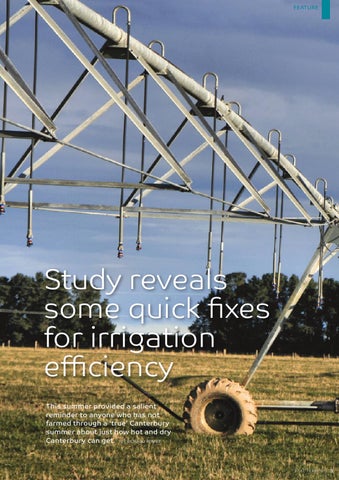
Study reveals some quick fixes for irrigation efficiency This summer provided a salient reminder to anyone who has not farmed through a ‘true’ Canterbury summer about just how hot and dry Canterbury can get. BY RICHARD RENNIE
RE A L FA RM E R
9
FEATURE
It has strained the irrigation infrastructure to its limit and even beyond in some cases. The closure of the Opuha scheme in South Canterbury marked a first in the scheme’s 17 year history and has left over 200 farms desperate heading into the autumn and beyond for feed. But while the shift to dairying has significantly lifted water demand on the plains, it has also contributed to some major improvements in water use efficiency. Gains in the past decade when summers have been relatively benign have included replacing borderdyke systems on most farms with more efficient centre pivots. On farm storage ponds have been the most noticeable recent addition, an invaluable buffer. Had these not been installed, many farms would have been in far more dire circumstances after a tough summer pulled in restrictions on scheme supply. But a recent study on irrigation efficiency has revealed some “low hanging fruit” that can be picked to help irrigators save even more on water and energy to deliver it. The Energy Efficiency and Conservation Authority (EECA) and lines companies in Canterbury and North Otago teamed up with Irrigation NZ to produce the report last year. The study aimed to find out what opportunities exist to lift energy efficiency of farm irrigation systems, and included dairy, arable and drystock operations. The 14 farm systems studied used a mix of surface and ground water for their source, and it represented a relatively random study, avoiding top end irrigators. 10
RE AL FARM E R
With metering now commonplace, such studies become more useful in their ability to measure and benchmark systems and their efficiency. In evaluating the farm systems, two key areas were focused upon. One was the motor, pump and delivery system’s performance, or system design. The other was the timing of applications, examining when pumps were turned on or off and the amount (depth) of the water being applied.
“There were nine key areas identified in the survey that could deliver greater efficiencies.” When the participating farmers were questioned at the start of the survey about how well they thought their system ran there was a variety of responses, and few knew how much it cost per unit of water delivered in their particular system. One barrier to the survey’s completeness was the absence of water meters on five properties that were on schemes where water take was measured on a scheme basis, rather than individually. There were nine key areas identified in the survey that could deliver greater efficiencies. The most common area requiring improvement was the most relatively simple. Nine, or two thirds of the properties required soil moisture monitoring for improved scheduling and more precise application. For a relatively low cost of between $6,000 and $10,000 soil moisture monitoring can deliver a
payback within one to two years thanks to its direct impact on irrigation scheduling efficiency. Irrigation NZ project manager Paul Reese says this summer has highlighted just how important using the metering data is to ensure more efficient use of a restricted resource. He welcomes an EECA spin off project from the study that involves closer monitoring of irrigator water use. “Using portable ultrasonic meters it is possible to monitor individual irrigator application, and just how much it is applying.” This will help determine how much water is going onto dedicated areas and not fudged as an average over a number of irrigators. Seasonal allocation limits this year have been problematic for some farmers. With such a dry year some farmers need more water to get them through. This raises two questions. Firstly, is the volume allocated sufficient in the first place for the area being irrigated? Secondly, is the allocation being used to best effect through efficient application and scheduling? “For those under pressure I suspect it is a bit of both. Ensuring you have enough water to irrigate the whole season begins on day one. “Metering can help determine if what you have been allocated is enough to meet your demand, or is what you have enough and importantly are you using it to best effect.” Another change required on some farms to lift energy efficiency involved the need to alter the distribution network to irrigators, requiring more
FEATURE
Irrigation efficiencies—start with the basics The team at Waterforce offer a practical perspective to some of the improvements that can be made to irrigation systems to lift their efficiency, in terms of consuming less electricity and providing more effective water applications. Currently the talk of the irrigation sector is improving system offerings through technologies like variable rate irrigation (VRI), soil moisture sensing, flow meter monitoring and proof of placement data. All are critical tools for the irrigation sector but there are also some basics offering significant increases in yield and savings in operational costs and water use. Despite the huge application and benefits of technology within irrigation sector for the Canterbury market, it is critical to ensure the basics are maintained throughout a system’s lifespan and where possible utilise improved technologies to support these systems. One area particularly concerning this season is the pivot sprinkler arrays. Sprinklers age and wear, and over time sprinklers get replaced with ‘stop gap’ measures and not necessarily the correct products. With the increased pressure through 2014/15 on a lot of systems, worn and aged sprinkler systems have shown up particularly badly. These cause a loss of production whilst often putting more strain on pumping systems. The wear in the sprinkler systems results in higher or incorrect flow rates making pumping systems work harder than they need, or in the worst case costly failures and downtime.
direct and resized pipes to reduce friction losses. Paul says a big issue with many systems is not that the design has been done poorly to start with, but that the system has been changed over time. It has been added to or altered from its original— for example an extra water source or pump added in, only to now have two pumps ‘fighting’ each other to supply water. “As things grow organically on properties those original efficiencies get lost or diluted.” A typical example could be where a Roto Rainer was used in the 1970s, to be replaced with a centre pivot covering a larger area with a higher flow but still with the original main line.
Often clients will not see the value of reviewing or replacing the sprinkler set up. These will often have a lifespan of 7,000-12,000 run hours, but in some cases clients are happy to run them out over 20,000 hours, or until they are literally falling of the hose droppers. The sprinkler/outlet in any irrigation system from Rotorainers, to pods, to centre pivot irrigators are the key item to the system’s application and efficiency. If something this critical is not right, then any technology added to the system, like VRI, soil moisture, or remote telemetry, is not offering the client the best outcome for their investment. However technology can also benefit systems in a more simplistic way. Advances in sprinkler technology mean today’s pivot arrays are capable of applying water more efficiently, using less electricity. It means many of the systems installed over the past decade could receive gains in application and energy efficiencies through advancements in the product design if they were updated today. This information is backed up by some key findings in the irrigation survey. Key areas for efficiency gains:
“Seasonal allocation limits this year have been problematic for some farmers.”
•
Irrigator evaluation: simple client run bucket tests on a regular basis will help measure performance and identify any weaknesses in delivery. Combined with information from pressure gauges mounted on the pivots, headworks and flow meters mounted at the pumps stations core KPI’s (key performance indicators) can be logged and referenced against the initial set up.
Further info can be found http://irrigationnz.co.nz/newsresources/irrigation-resources/ irrigation-system-checklist/
•
Soil moisture monitoring strips: for improved scheduling and application. A payback period of between 1–2 years is achievable.
Four farms surveyed required head works alterations, including removing obstructions, and “right sizing” pipes with more monitoring points installed for better consumption measurement. The changes that can be made on most farms to increase efficiency are often simple first steps, and easily made before more capital intensive high tech options need to be considered. “Making sure your irrigator is operating correctly and making good management decisions about where and when to use them are critical first steps. New technology will not serve you if you don’t start from there.”
•
Install Variable Speed Drivers (VSD’s): This can allow systems to be tuned to be more efficient through the operation of the system as the duty varies throughout a season. Existing drives and pump systems should also be reviewed and serviced regularly. VSD’s can often mask pump deterioration, which helps maintain system performance.
•
Supply reconfiguration: especially on multiple interconnected irrigators and pump systems, redirecting of supply to match demand where possible rather than retaining existing ring mains and complex pipework systems from previous systems.
RE A L FA RM E R
11