FEATURE
Moving south and crossbreeding proved best farming decision
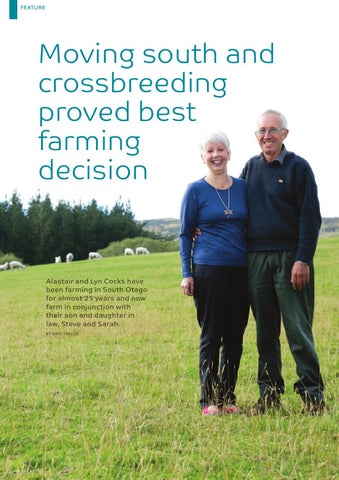
Alastair and Lyn Cocks have been farming in South Otago for almost 25 years and now farm in conjunction with their son and daughter in law, Steve and Sarah. BY KATE TAYLOR
22
RE AL FARM E R
FEATURE Their 1,023ha sheep and beef farm is about 20km south of Clinton and has 6,000 Coopdale ewes, incorporating the Braeburn Coopdale Stud, and 100 Angus cows plus replacements. Steve, 32, worked a couple of years on the farm when he finished school and worked on two other farms in Northern Southland before returning home in 2006. Three years ago, the family formed a company to own the property’s stock and plant. “At the time, we drew up a list of things people needed to take responsibility for. Alastair and Lyn look after paying the bills (after Steve checks them), doing the cashbook and selling the rams. Steve’s name got put alongside everything else.” The land is held in a family trust. “Lyn and I had been leasing the farm off the trust in a partnership. Now the company is leasing it,” Alastair says. “Steve and Sarah own half the stock and plant. The intention is for them to move into full ownership of the place eventually.” They have daughter Ella, 4, and son Sam, 1. Sarah works two days a week at the Little Oaks Early Learning Centre in Clinton. Steve also has his brother Jack at a high country station and sister Emma, who is a nurse in Wellington. The family moved from a mixed cropping property in mid-Canterbury in 1990 mainly to get away from droughts and irrigation. We wanted more low-cost farming, Alastair says. “Cropping has more machinery and higher inputs. It had been working okay for us but that was the main reason for the change. We’d been looking around for two years in areas like West Otago and very nearly bought a place in Southland. But this ended up being the right place at the right time.” About half of the property’s 1,023 hectares is tussock country and the other half is cultivated. “We didn’t do much development for the first few years, although we could see areas for improvement. Instead, we wanted to learn about the place, find out what worked and what didn’t, as it was totally different to what we had before. We
were a bit financially constrained after the move as well so we couldn’t just rip in and spend money. “Joining the Kuriwao Farm Discussion Group in that first year was a great move. We’ve learnt a lot from being part of a group of progressive farmers who are happy to share their knowledge.”
“We wanted to learn about the place, find out what worked and what didn’t, as it was totally different to what we had before.” One of the changes they did make straight away was to put the cows behind two-wire electrics in a 200ha area of the farm with parts overrun with thick bracken. “We rotated the cows out there and made them stay on the bracken—both eating it and tramping it out. Previously, cattle didn’t really go into the thick bracken because they didn’t need to, so the fencing change was to make them go where we wanted them to go.”
ABOVE: Some of the 6,000 Coopdale ewes on the farm OPPOSITE PAGE: Alastair and Lyn Cocks on their South
Otago farm BELOW: The Cocks family from left Sarah, Sam, Steve, Ella, Lynn and Alastair
Alastair says they also started growing swedes the first year to start a rotation into younger pastures. “We’ve been right around the whole place a couple of times now,” he says. Subdivision has also taken place. There are 12 tussock blocks where there used to be seven and 42 main paddocks where there used to be 21. “We’ve doubled the number of paddocks and also increased the number of tussock blocks through subdivision, mainly for controlling the feed. We’ve put new fences in, improved the tracks and ploughed some of the easier hill blocks just to improve the balance of the place. At the start, we had a lot of hill country and it was difficult to fatten lambs when we didn’t have enough paddocks to get a rotation going. It had been well farmed in line with what the previous owner wanted to do and we came in with different ideas on how we wanted to farm it.” This year the farm is mating about 6,000 Coopdale ewes, which includes up to 1,300 stud ewes, across Coopdale rams. The Cocks have their own stud—Braeburn Coopdales. “We started the stud after we bought this place as a going concern and it was running a two-flock system with Romneys on the paddocks and Perendales on the hills. We had a good flock of Coopworth ewes in Canterbury based on Dad’s Alford Park Coopworth Stud so we sold the Romneys and brought them down. Even with the Coopworth and Perendale mix, we still didn’t like the two-flock system. A lot of the time we were doing the same thing with both breeds anyway. But at the same time, we didn’t want to let go of either breed. They both had their good points so we tried crossing them. At the time, it was regarded as a bit of a lunatic thing to do probably, but it worked,” he says.
RE A L FA RM E R
23
FEATURE LEFT: Alastair with his son Steve who is the next generation on the family farm BELOW: Alastair and his prized rams
it’s definitely a challenging place for stock sometimes.” All progeny is fattened, says Alastair, with lambs sent to Alliance starting with a sizeable draft at weaning. “Over the past six seasons, our lambs have averaged about 18kg carcass weight with three quarters usually gone by the end of March usually to Lorneville.” It hasn’t been that simple for the past two years though, with dry conditions and the effects of the clover root weevil, which has reduced the quality and the quantity of the pasture. “Our weights last year were down a kilogram and a quarter on the previous season and that would be typical around this area.” He says AgResearch had done a great job publicising the use of an Irish wasp as a control against the weevil. He knows of other farmers who noticed the weevil a year before they did. “They’ve come out of it this year so hopefully we’ll be done with it too, this time next year.” On the cattle side of the business, the Cocks made the decision four years ago to reduce beef cow numbers because they were getting difficult to winter.
“We experimented for a couple of years and then took the bull by the horns and put all the Coopworth rams with the Perendale ewes and vice versa. That was in 1994. But the problem then was what to put over those first-cross ewes. Dad was initially breeding me a few rams by putting Perendales over some of his stud Coopworths, but I could see we needed a long term ram supply. Dad wasn’t going to be farming forever. So we got into breeding a few rams for ourselves, which we did, and it grew from there really. It turned out to be one of the two best farming decisions we’ve made.”
“They both had their good points so we tried crossing them. At the time, it was regarded as a bit of a lunatic thing to do probably, but it worked.” He says word soon spread. People heard what they were doing and enquired about rams. “We built the stud up by screening the best out of our two-tooth Coopdale ewes and as well as that, for several years, Dad was breeding first-cross Coopdales but he didn’t want to keep ewe lamb progeny so we bought all them off him for a few years in a row. It helped to increase our ewe numbers without compromising on quality. At that stage I think we were the only ones doing it, 24
RE AL FARM E R
“It works well for both of us.”
“We have good tussock cover and we want to keep it that way but if we run too many cows over the winter for too long, the tussock doesn’t like it. With top dressing and careful management, we are getting stronger tussock cover over the most of the farm. Both Steve and I regard the tussock as quite a valuable asset. We tried for a few years wintering cows on self-fed silage. They did well but the problem was containing the effluent when it got really wet so we put a stop to that and cut the cow numbers down.”
“One advantage of breeding sheep in an area like this… rams will shift just about anywhere in the country. I think this is a great place, but
The farm now carries 100 Angus cows instead of 200 and sells calves at the April sales instead of fattening them.
but now there are a handful of other Coopdale breeders and some Coopworth and Perendale breeders are producing first cross rams.” Braeburn Coopdales works in with Chris Miller’s Roslyn Downs Coopdale Stud at Glencoe, between Mataura and Winton, swapping a ram each year to help broaden the genetic base.
FEATURE Angus bulls are bought from John Cochrane’s Delmont Stud near Clinton. Murray Grey bulls from Mervyn Mitchell’s Kilradie Stud are put over the heifers. “We’ve chosen Angus because we feel they have more options when it comes to selling because of the Five Star Beef Feedlot. They do well in these conditions—cold hill country.” The property’s height above sea level ranges from 150 metres up to 450m and has an annual rainfall of 1,500mm-1,600mm. “Winters are colder and longer than a lot of other areas but we are usually more reliable in the summer. We don’t have as many frosts compared to where we were at Ashburton Forks but we get a lot of wet days. Winters definitely tend to be wet.” There’s also the occasional snowfall, but it’s not a regular occurrence. The farm has 46ha of pine and macrocarpa trees to be harvested—varying in age from 22 years old down to two years old. They have been planted mainly in unproductive corners and bad gorse areas.
“We found things that grew in Owaka and looked great, but wouldn’t grow here.” “We saw it as a means of developing another income stream initially—we have it spread out and aim to plant a bit every few years. Someone will have a relatively regular income in years to come.” Alastair spent a number of years in a farm forestry discussion group, where he says he learnt a lot
“We’ve found some things that grow elsewhere, just don’t grow here. Douglas fir, for example, the branches all grow on one side of the tree—it’s too wet and windy for them. The ones that do work are mainly leyland cypress, eucalyptus cordata and rodwayii. The forestry group I was in basically went down to Owaka. We found things that grew in Owaka and looked great, but wouldn’t grow here.” Steve has been actively planting red tussocks in places where we need more,” says Alastair. “He has experimented with seedlings but most of them are being transplanted from places where we have a surplus of tussocks. We’re still finding our way
ABOVE: Steve with some of the 100 Angus cows the farm now carries BELOW: The Cocks have their own stud—Braeburn Coopdales
“There’s a strong possibility that we will look into a water system one day, perhaps that’s something Steve and Sarah can look into in the future.” He says there are a lot of little creeks that are impractical to fence off. “We feel stock aren’t doing any damage to them because of the extensive nature of the farm and when we’re feeding off swedes, we keep all the water ways fenced off with hotwires so they can’t get in them.”
“The farm isn’t isolated compared to many, but supporting local is a big part of being rural.” Traditionally the Cocks have employed a Lincoln University student over the summer holidays, but for the past two years they have employed a permanent single shepherd. For the past 12 months that employee has been Bradley Catto, 18, from West Otago. The farm isn’t isolated compared to many, but supporting local is a big part of being rural. about the dos and don’ts of farm forestry. Planting and silviculture has been done by contractors. There are several “decent-sized” blocks of native bush towards the back of the farm. One is fenced off with a block of pine trees, while another isn’t fenced off but run as part of a large tussock block. “The sheep tend to stay out of there,” he says. “In addition, we have a lot of blocks with scattered coprosma and or whole gullies of coprosma. It’s valuable shelter.” A few different species have been tried as shelter belts on the property.
with what’s going to work. We’re targeting paddocks going into swedes and at the time the paddock is sprayed off, Steve plants the tussocks where he wants to thicken them up and keeps them fenced off when the swedes are grazed over the winter. In spring, the paddock goes into grass again so the tussock has a 16–18 month spell before stock get anywhere near them. With the seedling ones, this is the first time we’ve done any significant number so we’re still finding our way with them and we’re not sure how long we will have to keep them fenced off.” The property’s water supply is natural with a lot of creeks. He says water can become an issue in dry seasons.
Gore is the family’s main shopping centre but Clinton has business ranging from the garage and an engineer through to the Clinton Waipahi Transport. “There’s also a dairy and community-owned fuel station and convenience store. We’re shareholders in the community company that owns the fuel outlet and the convenience store. Things like that are important to Clinton.” Clinton has a primary school, squash and rugby clubs, community centre, the Oak Tree Inn and an active Lions Club, of which Alastair is a member. “Clinton is a great little community and we’ve really enjoyed the move. It’s a great place looking into future for Steve and Sarah to farm and bring up their children.”
RE A L FA RM E R
25