FEATURE
Farming with a boot in both provinces
2
RE AL FARM E R
Ashburton based farm consultant Jeremy Savage could well claim to have his heart in two homes across two quite different regions. BY RICHARD RENNIE
Canterbury is his base for his farm consulting work through Macfarlane Rural Business, while Takaka in Golden Bay is where he grew up and owns shares in farms today. Jeremy has been consulting to pastoral farmers in Canterbury since 1996 but has also been closely involved with his family’s dairy farm business at Takaka. It means he physically spends time between the two regions, sometimes swapping his more formal consulting clothes for overalls and gumboots when back up in Takaka.
“My Dad had some experience in governance and said to me, the day I start consulting, I needed to be out of the farm dairy shed. It was a good lesson on learning to separate supervision roles, farming roles and shareholder roles.” Over the past decade since the death of his father Mike, the family farming business in Golden Bay has expanded from 340 to 900 cows. It is a growth achieved with the involvement of his siblings and mother Karen in a stepped expansion and succession process not always achieved in farming families. The planned and open process has also enabled the family to be involved in the farming business, without having to be actively involved in the day to day running of the properties. His brother Andrew is a contractor in Christchurch, and sister Lisa now has an operations role on one of the family properties and a tourism business.
neighbouring farm came up for sale. It was well positioned for a “clean slate” conversion, linking it into the original family farm. Today the 400 cow property features a highly automated 30 bail herringbone farm dairy, a centre pivot irrigator and a state of the art effluent management system. The other property “Matariki” was a farm traded up eight years ago, and has gone from 160 cows to 500, with one third irrigated with K line irrigators. It has not only been careful saving, attention to costs and good timing that has helped the family build their equity however. Jeremy attributes an equal amount of the success to having a good governance structure as much as good cash flow. “We have a good family friend who we got on board early on. He was able to help deal with any potential conflicts. At the time we had shareholders from next door, landlords and family to involve.” His help was invaluable in allowing management to execute strategy while also keeping shareholders engaged, without becoming bogged down in day to day operational issues. “It was tricky, there were multiple relationships there and it was fantastic from my point of view as operations manager to have someone to help and support my role.” It was also an opportunity for Jeremy to “walk the walk” when dealing with his clients in both regions as a consultant. He acknowledges his personal experience has made him more assertive with clients when the issue of succession comes up. He has also formalised the experience with additional training in farm succession management. “Only 30% of family businesses achieve successful succession to the next generation, and only 10% make it to the third generation, which we have just achieved.” He is not sure the industry is getting much better at dealing with succession issues,
FEATURE although discussion and analysis of it appears to be more prevalent than a few years ago. “I think we have probably been viewing farm succession in terms of who has control of the asset, versus the wider dynamic of the family members and how we can use these assets to engage greater participation as a family. “Family farms can put family relationships under pressure, but if managed right they can be used to bring family members together more, without necessarily being involved day to day on the farm itself.” He likens it to moving the farm from the centre of the “wheel” of focus, to the edge, whilst putting the family members in the centre of the discussion on opportunities and resources they bring. A key focus in recent years has also been to ensure there is income within the structure for Karen.
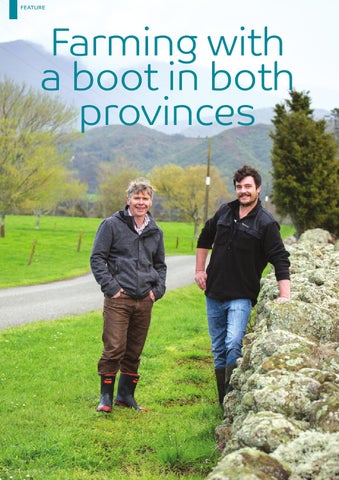
“Family farms can put family relationships under pressure, but if managed right they can be used to bring family members together more, without necessarily being involved day to day on the farm itself.” “It’s been important to ensure she has a steady cash flow for income, so she can pursue her interests of travelling, mountain biking and now a venture growing walnuts.” Now sharing ownership with Karen, Jeremy says the structures around governance are able to be relaxed, although they still maintain a formal budget reported on every year, and hold an AGM. OPPOSITE: Jeremy (left) with farm manager Mark Roberts BELOW: Jeremy at home with his wife Rachel and Sons
Jack (left) and Charlie
“My Dad had some experience in governance and said to me, the day I start consulting, I needed to be out of the farm dairy shed. It was a good lesson on learning to separate supervision roles, farming roles and shareholder roles.” Today Jeremy and his wife Rachel farm with Jeremy’s mother Karen, holding a 75% share in the farm business. They were initially 50:50, purchasing their share from consulting income and utilising profits from leasing neighbouring land. The cash flow from leasing was sufficient over 10 years to pay off stock and share debt, and at the end provide Rachel and him the equity to purchase their share in the home farm. Two years ago when the lease ended on one neighbouring property, the other
RE A L FA RM E R
3
FEATURE If his personal experience with succession has given him an insight to deliver to clients still grappling with it, his dairying clients provide the ideas and incentives to maintain production on his properties. When they installed the new herringbone dairy on the Takaka property Jeremy applied some lessons taken from his consulting observations about technology. “One of the things I had learned was the early adopters tend to end up with a higher cost for that technology than the followers, and it’s better to follow what has been proven robustly.” To that end they took steps to integrate the best of proven automated technology into the dairy. Automated teat spraying, drafting, and cup removers mean only one staff member is required to milk, spending around 2.5 hours in the morning, and two in the afternoon. A herringbone installation is not an obvious first choice, but the economics meant a capital saving of about $4 per kg milksolids compared to a rotary that would also have required the automation features. It also provided the ability to invest funds into a centre pivot irrigator, an additional labour saving investment. In converting the Takaka farm, efforts were made to ensure effluent management was beyond compliant, including 30 day storage and a “weeping wall” for solids separation management.
4
RE AL FARM E R
Because the region is known for its major rainfall events, water quality in the catchment is relatively good, with no major environmental issues lurking, and a network of farmers increasingly conscious about maintaining water quality in the short run catchments of Takaka and Aorere river catchments.
“One of the things I had learned was the early adopters tend to end up with a higher cost for that technology than the followers, and it’s better to follow what has been proven robustly.” Water take is limited in the region at present and based on flow rates at the Te Waikoropupu Springs. In response to increased demand to water resources in the Takaka valley, the Tasman District Council is now being asked to review the water resources with a community based discussion on future development potential. The ability to expand irrigation use in the region would help improve pastoral production in the region. “We can experience dry spells that are surprisingly similar to Canterbury. Rainfall events can be impressive, 200 mm plus, but can be also spaced widely apart.”
For his Canterbury clients, Jeremy sees the greatest challenge in coming years being managing nutrient loss reductions. The ability to achieve the reductions can often initially be achieved by more operators adjusting their stocking rate downwards. He has clients achieving 500kg/MS a cow with 800kg dry matter of supplement per head, thanks to lowering their stocking rate to 3.2-3.5 cows a hectare. He believes with smarter irrigation, no winter application of nitrogen and a lowered stocking rate nitrogen reduction targets can be achieved without compromising profit.
FEATURE
Consulting as a career option gets funding boost
ABOVE: The misty landscape of the family farm in Takaka BELOW LEFT: The next generation of milkers taking
shelter
BELOW: Jeremy (right) with farm manager Mark Roberts
and their dairy herd
“I think some sensitive areas will require housing, where high wintering costs and water logged soils are prevalent in winter months, but housing is always going to be expensive, and an area we can’t compete
with the likes of the United States on in terms of scale and cost.” As dairy pay outs take a slide this season, Jeremy’s advice to clients has been to drill down into their costs, cutting back where possible and focussing on strong, positive cash flows. “And of course capital expenditure needs to be strongly justified with a positive return. I also advise my clients not to get caught with ‘steel and concrete disease’, which is easy to do when dairying.”
Farm management consulting has been recognised as an area deserving of Primary Growth Partnership (PGP) funding, with the dairy industry including investment in building the capability of rural professionals to better help farmers improve business, nutrient and effluent management skills. It is a move that has been welcomed by Jeremy Savage. He acknowledges consulting can deliver an interesting, varied and relatively well paid career. However it is also a profession where it can be challenging to employ and train new consultants who can engage with a business model that they can buy into. “The business model can struggle to justify the cost of employing new, young consultants. There can also be a reluctance by farmers to engage with consultants, and it is good to see the Ministry for Primary Industries has recognised this through the PGP.” The Transforming the Dairy Value Chain PGP has improving farm productivity and reducing environmental impacts among its goals. Funds of $85 million in PGP funding are matched dollar for dollar by industry partners including DairyNZ, Fonterra, LIC, Synlait, Zespri and Landcorp.
“…There can also be a reluctance by farmers to engage with consultants, and it is good to see the Ministry for Primary Industries has recognised this through the PGP.” As a board member of the NZ Institute of Primary Industry Management, Jeremy has also welcomed the institute’s focus on developing career pathways for rural professionals. “It is an area that is getting increasingly complex, with the addition of having skills with Overseer, governance and developing environmental plans for farms. There is a knowledge base required there and it is good that is being recognised.”
RE A L FA RM E R
5