FEATURE
20
RE AL FARM E R
FEATURE
Farming passion pursued down under Farming brings plenty of challenges in the best of years, but adding in a 20,000km journey to do it in another country gives an indication of Michael and Nicky Salvesen’s commitment to make a new life on the land. BY RICHARD RENNIE
Mike and his wife Nicky had their first insight to rural New Zealand back in 1984 when they spent their OE here. It was to be almost 20 years before the couple pulled up stakes from their well established Scottish Borders country property to come to the bottom of the world, seriously scouting for a farm to call home. The property in Scotland was a family farm that was relatively large by Scottish standards at 600ha and a further 1,100ha of leased land. However like many in the region there were succession issues, and struggles with a climate that bought a very short growing season. Soils were thin and the short seasons required heavy capital equipment demands that did nothing to lessen the labour costs and staffing numbers also required. “At the peak of our harvest time we would have anything up to 40 staff, you needed all hands on to get crops in due to the short harvest period, so you not only had a lot of expensive equipment, you also needed all these staff at once, it was stressful at times,” says Michael. The farm business in Scotland was a patchwork of cropping enterprises, covering potatoes, parsnips, grains, carrots and even daffodils all alongside 800 head of cattle. Add in an ever growing layer of compliance and growing political unrest within Scotland, and suddenly it seemed time to call somewhere else home. He came down under resolutely committed to getting more balance into his life to make the most of family time to spend with Nicky and four sons then aged between 11 and 16. “We were also looking for somewhere within 90 minutes of Christchurch for the boys’ schooling, and close to services.” The Canterbury climate bore a few changes for the family. Perhaps surprisingly it exhibits more intense, if shorter, winters with a higher number of frosts
than in Scotland, and greater extremes between night and day temperatures all year round. “We were more familiar with weather where there would be days with much less variation in temperature, but we do sit at a higher altitude where we are now.” The first property the family bought was on the Plains themselves, up Tramway Road near Mount Somers. While never intending the 350ha to be a “starter” farm, it did prove a valuable starting point as Michael came to understand the intricacies of running a dry stock property. “I quickly learned there were some extremely capable operators in Canterbury to learn things from. The seasons bought a few surprises, including snow at lambing time, managing stock without any housing and determining which crops were best to plant to do best over the summer dry period on the un-irrigated farm.” Careful management of cash flow and working capital, trading stock where possible through some lean early years eventually saw the family see a clear pathway ahead in their new home. “We had to tune up our stock numbers a bit to suit the season, where we learned spring was okay, autumns were fine, summer was always dry, and winter was an expensive time running stock on kale.”
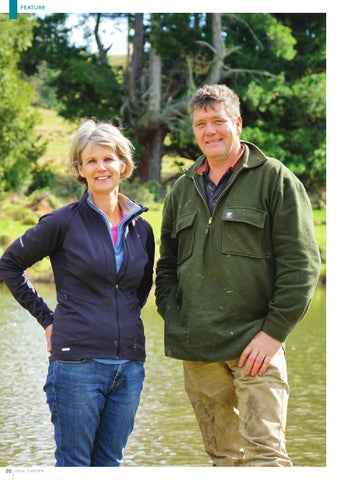
ABOVE: The station runs a mix of deer, cattle and dairy grazers MAIN IMAGE: Canterbury farmers Nicky and Michael Salvesen
Michael has since come to regard fodder beet as a “game changer” crop for livestock farmers on the Plains, thanks to their potential for high yield reducing the area required to be cultivated, and their exceptional energy value as feed. “We are now getting a crop that is costing abut 12c/kg drymatter with yields of about 22t/ha.” Michael has become something of a focus today for his fodder beet growing skills, having been involved in the Beef + Lamb Beef for Profit Partnership which morphed into a fodder beet partnership, now in its second year of three. After five years at Tramway Road Michael and Nicky moved to today’s farm on Upper Downs Road at Mount Somers. The picturesque property stretches from 500m above sea level up to 850m, and while its southern faces will chill down earlier in winter, they also hold on well through drier summer months. Today the station is running a mix of deer, cattle and dairy grazers, all providing a buffered level of income through some uncertain times for commodity returns.
RE A L FA RM E R
21
FEATURE Today sheep are entirely absent from Wakare, and the 100 year old woolshed remains as it is, with the economics remaining firmly in favour of the deer and beef. Not having sheep on the property means Michael has been able to pursue some wholesale pasture conversion to tetraploid rye grasses capable of rapid efficient regrowth under the more intensive rotational grazing system he uses with the cattle and deer. Stock are worked in mobs around a property that has its creeks and waterways well fenced off and protected with riparian strips. “The protection work has been something of a work in progress for us and we now have a fair number of wetlands and strips for sediment trapping.”
ABOVE: The picturesque property stretches from 500m above sea level up to 850m BELOW: Deer include 900 hinds and rising two year olds, with progeny also finished on the property
The beef cattle comprise 500 Angus and Hereford cows with all progeny run through to finishing, or for sale to Five Star Beef near Ashburton. Deer include 900 hinds and rising two year olds, with all progeny also finished on the property. More recently Michael has started to run Angus and Charolais cross bulls alongside Hereford bulls which also have a ready market among dairy farmers for tail end mating. The bulls provide valuable and flexible cash flow, and Michael is confident some of this year’s mob will achieve 600kg by Christmas as 15 month old animals. Dairy grazer numbers are down to 170, with some uncertainty over how this business will play out as the dairy downturn bites. Running deer, cattle and dairy grazers, Mike has bought the lessons learned from fodder beet cropping to good use on the 1,460ha Wakere Station property. Last year he had 50ha of fodder beet in the ground, and this year it will be nearer 60ha. “There are two reasons for increasing the area this season. One is the well broadcast risk of El Nino, so more area means greater insurance against lower crop yield. The second reason relates to nitrogen losses. By having greater area with a lower expected yield we can still maintain a stocking rate and leaching will therefore be no greater.” While an effective crop, fodder beet does require attention to detail around weed control, with some highly effective treatments now available. However timing is everything. “Usually if you think you need to do something to control the weeds, it is already too late.” Michael has also found fodder beet a crop relatively easily fed to deer and beef cattle without any significant health problems. 22
RE AL FARM E R
“The deer will self-regulate very well when fed them, and it is also pretty difficult to kill the likes of rising two cattle. Dairy cows however can be a different story; they are used to eating intensively in quite a short period of time, and can gorge themselves on them very quickly, and fatally.” Feed levels are topped up with lucerne balage for the deer and ryegrass straw for the cattle through winter. The rising two year olds have also received some palm kernel extract, responding well with weight gains of up to 1.5kg a day.
The voluntary work he has done is a contrast to some of the requirements laid down on farmers in Scotland with mandated retirement areas and zero nitrogen areas, often all part of the bargain when farmers sign up for European Union subsidies. The farm is unirrigated, receiving around 1,000mm of rain a year and its southern facing slopes with heavier soils tend to hold on well over summer. “But come winter, like we are now, we do get quite waterlogged on the heavier silt soil with its clay base, so you have to manage quite a large number of mobs carefully.” Longer term Michael has a refreshing optimistic take on the future of farming in New Zealand and in Canterbury. Acutely aware of NZ’s small domestic market he appreciates the benefits in being a niche player in areas like venison supply, and is intending to gradually ramp up deer numbers on the Wakere. But even this market is subject to some unlikely international forces. Greater unemployment in Europe has meant more Spanish and Polish hunters putting feral venison onto the market, keeping prices lower than they should be. “And being a premium meat, venison has also taken a bit longer to recover from the GFC after selling at a higher price for a period, it was hit harder and fell further, and has taken longer to recover.” Northern hemisphere gives world view to Canterbury farmer
In the 12 years since leaving their native Scotland, Mike Salvesen and his wife Nicky have cemented a place in Canterbury’s rural community and beyond. Relishing the opportunities for involvement within the NZ farming sector and the multiple strands that make up Canterbury’s farming sector Mike is Mid Canterbury meat and fibre chairperson for Federated Farmers. He is proud to be part of an organisation manned by some intelligent, well educated people capable of providing policy advice and knowledge that puts the Feds on equal footing around negotiating tables in Wellington. Meantime Nicky has also been able to take advantage of their farm’s relative proximity to towns and services, being on the road as a SPELD
FEATURE (Specific Learning Difficulties) tutor in schools around the region. The couple have also raised their four sons who are making their own mark either here or overseas. Oldest son Andrew works in farm insurance in Scotland, Peter in tourism in Christchurch, Robert is a funds manager in London and Hamish completed his BSc (hons) in genetics at Otago. With his broad world view of agriculture and focused approach to their own farm business Mike has some insights to what the latest challenges to dairying represent not only for that sector, but also the knock on effects through the rest of the region. “There are really two big challenges for the region right now. The first is the North Canterbury drought, and there is little to indicate that will be easing soon, particularly if we are to believe the forecasters about El Nino. “Meantime with the dairy downturn you are seeing some real shifts in how dairy farmers are running their businesses. They are shifting more focus back to the milking platform, reducing their demand for dairy support country, and therefore the income those operators are going to get this season, maybe beyond.” Inevitably this will put greater pressure on lamb supplies as operators try to fill the stock and income gap with store lambs. “We can’t have everyone do that though, it will only put pressure on store lamb prices, push the price up and lower the margin at the end.” He sagely points to Newton’s second law coming into play on the Plains with “every action having a direct and opposite reaction.” Meantime arable farmers are hit with lower demand for grains and other supplements, with cropping options like potatoes limited by local demand and the ability to tip over into surplus relatively quickly. “This is all putting a considerable level of stress across the rural community and the people who serve it.” Coming from a United Kingdom farming environment that has a domestic market of 60 million, he is highly conscious of New Zealand’s small domestic market which offers little buffer to the realities of global trade. With that comes the necessity to have compelling, innovative products to entice foreign consumers looking for a quality food experience. Meantime despite its critics, he believes the meat sector has exhibited some remarkable and innovative products that are making NZ red meat an easier choice for consumers to make, here and abroad. “We are seeing a very consistent product being delivered within quality parameters, which is bought at a premium, taken home and easily prepared and bought again.” ABOVE AND RIGHT: The beef cattle comprise 500 Angus and Hereford cows with all progeny run through to finishing. The Salvesen’s have also started to run Angus and Charolais cross bulls alongside Hereford bulls
RE A L FA RM E R
23