FEATURE
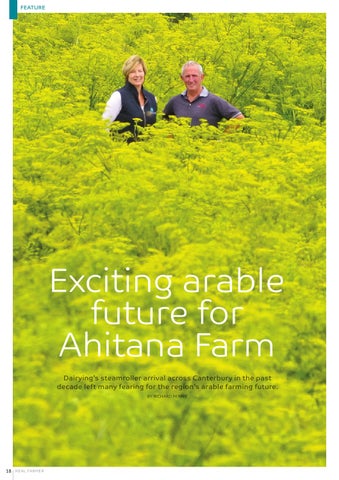
Exciting arable future for Ahitana Farm Dairying’s steamroller arrival across Canterbury in the past decade left many fearing for the region’s arable farming future. BY RICHARD RENNIE
18
RE AL FARM E R
But Deane and Jo Taylor of Ahitana Farm, east of Ashburton prove there is little to fear. Their 400ha operation is proof that with some innovation, optimism and hard work Canterbury’s cropping farmers are capable of going toe to toe with dairy farming businesses to deliver strong returns, and a sustainable future for the sector. The Taylor family has farmed the property for almost 138 years. Each generation has been able to adapt the farming operation to the market, but it is over Deane and Jo’s tenure that has witnessed the most significant changes in direction and technology. This is due, in no small part, to irrigation infrastructure and a move from predominantly sheep and mixed cropping to the intensive crop system on the farm today. This has been the usual ‘adapt or die’ that goes with any farming system.
“The Taylor family has farmed the property for almost 138 years. Each generation has been able to adapt the farming operation to the market, but it is over Deane and Jo’s tenure that has witnessed the most significant changes in direction and technology.” But it is also because Deane has sought to recognise how their land use fits into a wider global picture. That is one where the United States, Europe and Australia will always dominate the grain commodity markets, simply due to their scale, proximity to market, and lower land values.
“We came to see that we also have to compete with and complement dairying in terms of getting a reasonable return to remain cropping. I’m a strong believer in cycles and the need for balance in the big picture for agriculture here in New Zealand.” The move into more specialty crops represents a significantly more complex operation than even a decade ago. Sheep numbers have rapidly declined on the farm, down from only 600 Romney-cross ewes three years ago, to a handful today. “With the crop variety we have, having ewes simply no longer fitted in very well, in terms of the paddock size and set up, and the complexity of also having livestock in the system was just too much.” That complexity is reflected in the wide variety of crops grown, in a typical season more than a dozen different species as varied as hemp, chrysanthemums, kale, beetroot, parsnip and carrot seed, all bringing their own demands on fertility, irrigation and, ultimately, timing of harvest. Deane has turned to greater use of technology to embrace and manage the demands such variety bring and this has included adopting the ProductionWise online crop management system. Introduced to New Zealand in 2012 by FAR (Foundation for Arable Research) and adopted from an Australian system, ProductionWise enables growers to map paddocks, record all paddock operations and associated inputs, record all stored grain and grain sales and provide gross margins at paddock level through to whole farm reporting. Critical aspects like avoiding cross pollination and potential crop conflicts are now also well
FEATURE flagged, helped by the region’s Seed Crop Isolation Distance (SCID) system. The technology, along with good agronomic advice, has helped Deane take his cropping skills and apply them to smaller areas of multiple specialty crops. He admits there are not many crops he would not consider trying, taking advantage of the property’s heavy silt soil.
“That complexity is reflected in the wide variety of crops grown, in a typical season more than a dozen different species as varied as hemp, chrysanthemums, kale, beetroot, parsnip and carrot seed…” This year for example he is growing pearling barley for human consumption for the first time, and has some Japanese malting barley also in the ground. The malting option provides a premium on conventional barley which can struggle domestically due to the relatively small scale of plantings. This season is also the first for potatoes on Ahitana, with a little known variety “Bondi”, a high yielding, early-maturing variety that has Deane keen to see how it performs on his land. Another first this year is an Italian parsley which Deane has planted for seed production. OPPOSITE PAGE: Jo and Deane in the vibrant parsnip crop on Ahitana Farm BELOW: Deane and Jo Taylor of Ahitana Farm with two of their children Tom (9) and Kate (6)
“Doing what you do well”, for them has been increasingly about growing specialist crops under contract. They are ones not sold as global commodities, subject to the whims of traders, speculators and distant overseas conditions. The sheer variety and specialty would surprise anyone who ever wondered where the assorted brightly packaged vegetable seeds have come from. “We simply do not have the scale to compete with the broadacre operations of the US MidWest and Europe, we are barely a bit player, so we realised we needed to focus on high value, specialty crops where we could,” says Deane. “We need to work with the market and focus on specialist seed multiplication predominantly for the northern hemisphere which complements our ryegrass seed and cereal part of our business.” The scale of the overseas broadacre operations even threatens New Zealand’s dominance in dairy exports, thanks to the ability of US growers to produce vast amounts of lower priced grains, and deliver them cheaply to large scale dairy units now often located in close proximity to the grain growing source.
RE A L FA RM E R
19
FEATURE
A challenge like no other When a seething mass of cyclists, runners and walkers started at last year’s ATS Longbeach Coastal Challenge in late November, an army of volunteers was there to cheer them on, point the way, and offer a steak sandwich at the finish line. The steak sandwich is just part of the country hospitality that has helped make the challenge an increasingly popular and fun event for the Canterbury community. It does much to explain why the number of participants has climbed each year.
“It is quite unique for two groups like this to come together, but between us we have been able to ensure the Coastal Challenge continues to go from strength to strength.”
One of the more unusual crops has included hemp, grown for its seed which has a high oil content used as a nutritional supplement.
high cost of capital equipment for cropping, and the critical nature of timing can put added pressure on a farm’s balance sheet.
“Typically the higher returning crops will have a higher risk associated with them, and you have to balance that within your plantings for the season.”
He shares some critical pieces of equipment, including a 24m Househam self-propelled sprayer with two neighbours, spreading the capital cost, maintenance and operation of this state-of-the-art technology.
However that risk can carry across all crops, as anyone trying to harvest last summer would testify.
“I find these aspects of technology exciting and it all adds to the challenge of doing what we do. I have a lot of faith in technology to deal with some of these challenges ahead.” “I think that was probably one of the worst harvest seasons we have seen, with really high moisture levels and rain that compromised both yields and quality.” Underpinning the complex tapestry of crops Deane has irrigation technology now capable of variable rates of application along with GPS guided fertiliser applications. He sees the combined technologies going a long way to ensuring crop operations can remain viable under impending nutrient controls. “I find these aspects of technology exciting and it all adds to the challenge of doing what we do. I have a lot of faith in technology to deal with some of these challenges ahead.” Some of the advances in technology Deane has enjoyed have also come through old fashioned honest, trusting relationships. The 20
RE AL FARM E R
Just as dairying’s arrival has prompted many crop operators to lift their focus on crop returns, it has also bought some opportunities. Deane recalls the days when straw from the grass seed and cereal harvest would be piled up and burnt. This residual now has a market in feeding dairy cows and provides another income stream for the farm. Another vital element to the success of an arable system is the crop pollinator, bees. “They are absolutely essential, and we have a base number of hives on the farm, and also hire additional hives for some crops, especially the carrots, which are not particularly palatable for bees.” Deane admits he has considered a partial conversion to dairy across some of the 400ha, but issues with drains and heavy soil types made it less appealing. He does admit sometimes looking at his dairy neighbours, envying that their marketing and sales are taken care of as the tanker drives out the gate. “I have always enjoyed the marketing part of our enterprise and I love the challenge of pulling it all together each year. In the end it’s a privilege to run a business such as this that allows us the opportunity of choice along with a great lifestyle for us to share as a family.
“There is a good rural feel to the event that we have worked hard to foster, and the fact it covers all ages, all levels of fitness and allows for biking, running or walking means it is quite a unique event in the country,” says Jo Taylor. Jo has been part of the organising team of school parents and local Lions Club members since the events inception in 2007, and is quietly proud of how it has developed over that time. Originally started as a mountain bike race, the addition of a run and walk option has ABOVE: Deane and Jo in a white clover crop BELOW: This season is also the first for potatoes on
Ahitana
FEATURE opened the event up to almost anyone in the community keen to participate in a valued fund raiser for the Longbeach School and the Hinds and Districts Lions Club. “It is quite unique for two groups like this to come together, but between us we have been able to ensure the Coastal Challenge continues to go from strength to strength.” This has included varying the route along a stunning part of the Canterbury coastline. The Coastal Challenge gives competitors the choice of either a 23km or 35km mountain bike race, a 12km family mountain bike ride, a 21km run, a 12km run/walk and a 5km run/walk.
“Latitude is a Canterburyfocussed, high-quality magazine with a wide readership throughout the region and further afield.” Jo’s other main interest off farm is her business, Latitude magazine which she started from home seven years ago. Latitude is a Canterbury-focussed, high-quality magazine with a wide readership throughout the region and further afield. Not having a background in publishing did not put Joanne off launching Latitude, and she attributes its success to having a great team of staff and contributors around her.
“The key has also been to keep producing good quality, positive content that people want to read.” Even with this busy life, which includes five children aged from 21 down to six, Jo is closely involved in the family cropping business, helping Deane negotiate the increasing levels of technology now available for arable farmers.
“For us to grow the high value crops we do, we need to be very specific in record keeping, knowing every paddock’s history. I enjoy the technology side of the business as much as Deane and share his passion for the challenge and variety in our operation.” ABOVE: Jo working on her many other responsibilities off the farm BELOW: Another vital element to the success of an arable system is the crop pollinator, bees
RE A L FA RM E R
21