FEATURE
Combining tourism with coastal farming
44
RE AL FARM E R
FEATURE
A difficult farm with wild animal issues and plenty of gorse is becoming a jewel in Nelson’s tourism crown thanks to its other assets. BY KATE TAYLOR
The 1,000ha coastal hill country farm has walking access through protected native bush and along a beautiful coastal bluff just 20 minutes from the city, it has a historic touch as well. Farmed for 40 years by Ian and Barbara Stuart and by Ian’s parents before them, it is now the turn of sons Hamish and Sam to continue the tradition of combining tourism with farming. It is part of the Nelson boulder bank, which at 13km, is the longest of its kind in the Southern Hemisphere. The township of Glenduan, or the Glen to locals, was home to the Mackays, the first farmers in the Nelson area. It’s about 5km from Mackay’s Bluff to Cable Bay.
“At that stage though, money was ‘disappearing into the farm like a black hole’ according to the accountant, says Barbara.” Cable Bay Farm has been home to a public walkway for more than three decades. “Lands and Survey approached us back in the mid-1980s, about 1984 I think. We had a track from one end of the farm to the other that my father in law had put in and people were always ringing us wanting to walk the track. The Commission asked if we’d officially open to the public—we’ve had an easement with DOC and the NZ Walkways Commission ever since.” At that stage though, money was “disappearing into the farm like a black hole” according to the accountant, says Barbara.
A forestry company came knocking in the mid-1990s. “We were farming a lot of gorse at that stage. It was a difficult farm with wild animal issues and a lot of gorse. We put in some forestry, 200ha of pines, in 1995. That was just after we lost our eldest son Evan (then 18) in the Cave Creek tragedy. “Although we had the pine trees in partnership with other investors, the project meant reducing stock numbers. Ian thought we needed to do something else. We couldn’t just wait for the pine trees to grow. We needed the money. We had to get a better cash flow. So we started the camping ground. It doubled as a ‘keep New Zealand clean’ campaign as well.” “Campervans had started parking on the boulder bank overnight where there were no facilities for them. We thought that was a business opportunity.” A feasibility study was done, but the resource consent in 2001 cost the Stuarts $20,000. “It was at a time when camping grounds were closing around the country because they weren’t economical. It’s not a big camping ground. It has its own water supply so we didn’t want to get too big too soon.”
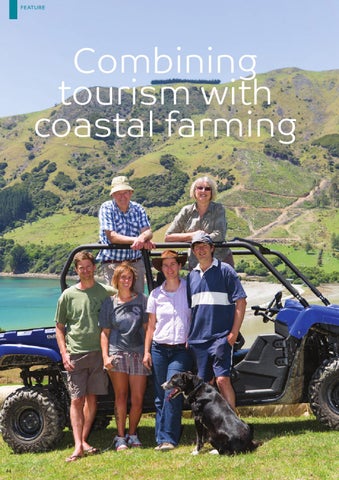
ABOVE: The Stuarts have 1,100 open-face Romney ewes on their farm OPPOSITE: The Stuart Family with Ian and Barbara at the top and below from left Hamish, Ellen, Anni and Sam
Barbara also went to work. She has been a regional co-ordinator for the NZ Landcare Trust (based from home) since 2000 working with private landowners on sustainable land management issues on a catchment scale on water quality issues—basically helping farmers to improve water quality on their properties, she says. The Stuart family has farmed the original Cable Station site since the early 1930s. Ian’s parents Fred and Tess Stuart took over the 81ha Cable Station site after the Second World War and purchased further land when the Huria Matenga Estate was divided (Ngati Tama land). In 1965 they purchased the Cain Estate part of the original Mackay property (the first farm in Nelson). The property is marginal gorse clad, steep hill country but Ian was able to exploit the deer farming opportunity by capturing wild deer for sale and also goats when those boom times were on. He no longer farms deer but kept the goats (now completely feral) for gorse control.
The Stuart family has farmed the original Cable Station site since the early 1930s. “We would be a lot worse off without the goats on the bluffs for weed control,” says Barbara. Increasing subdivision for lifestyle blocks in the Nelson North area brought a few more people to Cable Bay. The camping ground attracted more tourists to share the beauty and peace of the area. Barbara and Ian have been on the farm since they were married 40 years ago and are passionate about the place. However, a stroke in 2010 caused Ian to take a step back from the rigours of daily farming and as of July 1st (last year) the next generation stepped in with sons Sam and Hamish now running the farm and camping ground respectively.
RE A L FA RM E R
45
FEATURE can. To have $4,000 worth of grazing destroyed at the most important time of year with lambs on the ground… well, it’s crucial for us to get on top of them.” He is importing a new trap from the US. New cell phone technology and a game camera means Sam can watch a live stream of footage from the trap and use his cell phone to simultaneously drop the two gates at either end.
“Cable Bay was home to New Zealand’s first international telegraph cable in 1876.”
Youngest son Sam and his wife Anni have leased the farm under the trading name Drumduan Ltd (named after the highest peak on the farm, also known as Horoirangi). Sam was previously working for Meadowbank Station in Marlborough and had been shepherding in central North Island (Ohinewairua and Papanui) and doing a Wanaka/ Hawea mustering run before that.
and 65 cows. The Herefords are sourced from McConochie’s Lake Station at St Arnaud and the Angus from the Martin Brothers’ Angus Enterprises at Wakefield.
The Stuarts have 1,100 open-face Romney ewes averaging 132 percent lambing. They are put to Romney rams from Jackson’s Piquet Hill Stud at Ngaruawahia. About 300 of the older ewes go to a terminal sire.
There’s one block Ian isn’t giving up on yet. He is developing six hectares at the Glen end its fenced
Progeny are sold as weaners at the Brightwater Saleyards in the autumn. “Sam has taken over so progeny will be his responsibility now,” Barbara says.
“We can’t just use a simple trap because we don’t want to catch one pig. We need to catch a whole mob. It is not a toy, but a proper business decision to rid us of something that is costing us a lot of money and creating havoc,” says Sam. “It works overseas and I think we can make it work here provided we keep the pig dogs away from ABOVE: Some of the farms sheep population BELOW: Cable Bay Farm has been home to a public
walkway along the beautiful coast bluff for more than three decades BELOW LEFT: Barbara and Ian Stuart have farmed Cable Bay for 40 years
“It was a tough year with the drought last year but we still took 400 off their mothers in spite of the season. They weighed 16.6kg carcass weight in the first cut on the seventh of November and a drought-affected 15.5kg after that. Then 600 stores averaging 25.5kg liveweight off their mothers.” The cattle side of the business is an Aberdeen Angus/Hereford cross herd with two bulls
and limed but the drought meant the seed did not germinate this spring. He likes the aspect and has fenced off a part with a nice little wetland and is keen to protect it. Wild pigs are the main issue for Sam—he lost 10ha of valuable grazing just before lambing and is determined to put a stop to their growing numbers. “We can’t afford to farm like that long term. We’re on a tight budget and we need to do the best we 46
RE AL FARM E R
the trap. We thought once the pine trees were higher the pigs wouldn’t have as many places to hide. We have one guy who shoots about 100 pigs a year here and we’re still not getting on top of them, so we need to do something else.” The pigs breed up over summer so Sam is hoping to have the trap in place by autumn. Middle son Hamish, previously working in possum control, and his partner Ellen have leased the camping ground, Cable Bay Holiday Park. It
has powered and non-powered sites for caravans and tents, as well as a couple of cabins. “Hamish has also bought a Yamaha Viking from America,” says Barbara.
“We are loving seeing the kids run with these opportunities and we do try to leave the work to them.” “It’s like a quad bike but it takes six people including the driver. They’re planning to do tours over the farm mainly for people staying at the camp or for those not fit enough or with physical disabilities who aren’t able to do the walking track. It’s all still in the very early stages of setting up. They also have a little self-contained cabin they have set up on the top overlooking the bluff to offer as well. People can get a ride up to that and have the peace and solitude of a night out of the bluff as well.”
Places Trust monument beside the café. Cable Bay was home to New Zealand’s first international telegraph cable in 1876. “It was cutting-edge technology when it left Botany Bay in Australia. It was supposed to go to Nelson but it only reached here. There was quite a township here for a while—they were training young men in morse code. It was a new industry—it came from Plymouth in England all the way to Nelson, New Zealand via the Middle East and the top of the Northern Territory around to Sydney and came this way. There was a whole community living here in those days.”
FEATURE because they tell you things the animals can well deal with by themselves, but the intention is there and the public do appreciate the ability to walk through farmland and are trying to be helpful.” Ian and Barbara also want to be helpful, but are aware of not stepping on the toes of their sons now wanting to move the businesses forward. It’s a delicate one. We are loving seeing the kids run with these opportunities and we do try to leave the work to them.” BELOW: The cattle side of the business is an Aberdeen Angus Hereford cross herd
Ian and Barbara have also leased out the licensed café at their front gate, Cable Bay Cakes and Bakes. The walkway itself takes walkers through the middle of a 120ha of native bush in the middle of the farm protected by a QEII National Trust covenant. “It has lovely sweeping views across Tasman Bay and the boulder bank and Pepin Island just out
from us. It’s not really an island but joined to the mainland by a small boulder bank as part of the Cable Bay/Delaware Bay estuary.” As well as being a visitor destination in terms of walking, snorkelling, boating and swimming… the area is home to the 904ha, 5km long Horoirangi Marine Reserve, which extends northeast from Glenduan (the Glen) to Ataata Point at the southern headland of Cable Bay. There is also historic significance with a Historic
The cable burnt down in 1914 and was moved to Wellington in 1917. Although clearly farmland, Cable Bay is officially part of Nelson City. “A lot of locals love coming out here. They’re great. One of the benefits in having people walking on the farm is that our stock are very quiet because they’re used to people. Visitors also report to us if something’s not right up on the hills. Of course that can be a nuisance too,
They do plan to stay for the long term though— Ian’s 91 year old mother Tess still lives on the farm and still likes to help docking lambs. What we have has been built on the backs of our pioneering forebears. We are part of that and it is all appreciated. “Ian and I will endeavour to carry on the tradition. We’re still useful but in a more background way. After the stroke we needed to make these changes but we’re not quite ready to put the rug over our knees yet.”
RE A L FA RM E R
47