FEATURE
Balancing farm profitability with environmental sustainability
2
RE AL FARM E R
Changes to the farming landscape across Central Otago largely due to the Tenure Review process, the increase in dairying and growth in tourism, coupled with falling prices, a lack of confidence in the industry and increased on-farm costs, has seen many high country stations shy away from the traditional sheep and beef model in favour of recreational pursuits. And nowhere are the changes more evident than Glen Dene Station on the shores of Lake Hawea.
Burdon’s have diversified into tourism operating the Lake Hawea Holiday Camp and a successful trophy hunting and adventure tourism business, maximising their unique location being only one hour from Queenstown’s international airport as well as their own skill set. Both love people and love entertaining, and what’s more, they’re good at it. It makes for a chaotic life full of challenges, but one they both relish.
FEATURE Well-suited to merinos, Glen Dene built an enviable reputation for producing fine, bright well-nourished wool of high quality and quantity with the stud playing an important role in providing sheep that would thrive in a higher rainfall under high country conditions. Growth in commercial deer farming, which was then still in its infancy, saw Glen Dene branch out with the first deer fences and deer yards put up in 1984.
Richard oversees the day-to-day running of the farming operation, ably supported by head shepherd Colin Anderson, who has been at Glen Dene for 27 years. They also employ five other staff and casual musterers, as well as specialised internationally rated guides for the hunting business. The camp is Sarah’s domain, utilising her extensive tourism background, while being fulltime mother to their two children, Georgie (11) and Charlie (10).
After leaving secondary school, Richard spent time in Australia working as a jackaroo on merino studs before returning to Lincoln University to complete a Diploma in Farm Management then
Richard is the third generation to have farmed the iconic lakefront station. Located just five minutes from Hawea township on State Highway 6, Glen Dene Station covers 5,974 hectares, running from the neck south between Lakes Wanaka and Hawea to its border with Mt Burke Station near the township. Purchased by his grandfather, George Burdon in 1929—the very same year a start was made on the main road through to Haast—Glen Dene Station was part of the original Mt Burke Station until it was subdivided in 1979 with Richard’s parents, Jerry and Lesley Burdon, moving to take over the running of the northern portion (now known as Glen Dene Station).
setting off on his big OE travelling and working overseas. He returned home to Glen Dene in 1994 as a shepherd and the following year started managing Wilkin Vale, a freehold flat land property which they owned for a time at Makarora.
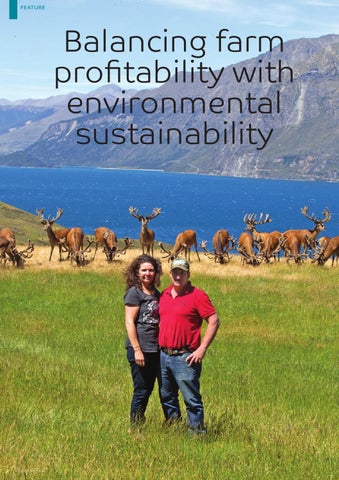
BELOW: Rising one year old bulls on Rocky Point looking across to Dingle Burn Station BELOW LEFT: Looking across Glene Dene towards Silver Island and Dingle Burn Station OPPOSITE: Burdon family with spikers in the background
BY ANNIE STUDHOLME
Once known as the Home of Icebreaker running approximately 8,000 merino sheep at its height, merinos have now almost entirely been replaced with a large deer operation, cattle, winter dairy grazing and cash crops (like lucerne, barley and silage), as owners Richard and Sarah Burdon look to diversify their operation in a bid to safeguard the property for future generations. For the Burdons, it’s about striking a balance between farm profitability with environmental sustainability through careful planning and land management practices, while capitalising on Glen Dene’s SLAM (Significant Landscape Amenity Measure) factor. “It’s always a battle. We love where we live and we choose to live here but it needs to make money, it can’t just be a beautiful place to live,” says Sarah. “It’s been a bit mad for a few years, running around putting the plans in place, but we are getting there. We are really excited about the future moving forward.” Aside from the farming operation, which includes 4,000 composite sheep (and decreasing), 280 beef cattle, 750 breeding hinds, 300 velvet stags, 700 replacement deer and around 70 trophy stags, the
Having lost large amounts of its lower country when Lake Hawea was raised in 1958 for hydro-electric storage, development on the fledging property was slow. Over time amenities such as staff accommodation, a woolshed and cattle yards were built, fences erected and land cultivated.
“Well-suited to merinos, Glen Dene built an enviable reputation for producing fine, bright well-nourished wool of high quality and quantity.” Richard’s wife, Sarah, grew up in Clare, South Australia, where her father and grandfather were well-known Merino breeders. A chance meeting in 1987 when Jerry and Richard visited her father regarding rams sparked off a friendship, which later blossomed into a romance a decade later when Sarah came to New Zealand as part of her eco-tourism degree.
RE A L FA RM E R
3
FEATURE done successfully, he believes it could increase the stocking rate by two to four stock units a hectare but it’s not a cheap undertaking. “It’s much like a paddock rotation; we do what the budget allows and are aiming to develop 2,000 hectares into a 15-year rotation. It’s a slow process but it’s giving us results.” The Burdons have also ploughed thousands into 212km of new fencing and more than 70km of four-wheel drive tracks which provide good access for guided hunters, farm work and the increasing range of recreational activities. Despite the development, they’ve ensured it hasn’t come at the expense of their conservation efforts. Through work with Dunedin-based land consultants Landward Group, of which Richard is a director, the Burdon’s have become inherently aware of the importance of conservation values. “They’re worth twice the as much as farming values so if you have high conservation values and look after them it can pay off,” says Richard. The couple married in 2000, with Sarah exchanging life in the bustling Australian tourism industry, where she had worked as both a travel agent and a hostess on boats in Queensland, for farm life here in New Zealand. That same year the pair took over the management of Glen Dene Limited initiating a family succession plan which was finally completed last November (2014). “Although it was a long process, the general workings were done back in the 1990s so everyone had a clear plan and goals we were working towards. Sometimes it just takes time to resolve these family businesses,” explains Richard.
“In a bid to protect the unique hill environment, steep gullies, beech forest and waterways have been fenced off, and they have also fenced bush margins in the deer farmed areas.” Glen Dene also entered Tenure Review, the process whereby the Crown brought back land it wanted for conservation and ecological reasons and which farmers used for grazing in exchange for the opportunity to freehold land they had farmed under Crown or Pastoral Lease, in 2000 completing it in 2007 with around 2,000ha of Glen Dene returned to Crown control as well as a number of covenants put in place together with public access tracks and easements. “At the end of the day, it was a good outcome for Glen Dene and a good outcome for the Crown.” In the early 2000s a focus on productivity led to the Burdons leasing more land. Their plan was to increase merino numbers, with the aim of reducing the wool micron of the ewe flock to 18.5 micron, as well as developing a new breed called the fine merino composite (half dohne merino with quarter merino and quarter finn). At that time the majority of their wool clip went to Icebreaker as well as relationships with 4
RE AL FARM E R
Smart Wool, John Smedley and Loria Piana. “When I returned home (in the mid-1990s) almost all of the farm’s income was derived from merino wool, but with Tenure Review, falling wool prices and a lack of confidence in the merino industry, we soon realised we had to start looking to diversify into other options,” says Richard. Increasing the deer operation was the logical next move. “The industry looked positive and they fitted our land class really well and fitted the growth patterns of the farm.” Mid-altitude land previously the domain of merinos now became home to breeding hinds. The hills keep them fit, the natural vegetation provides excellent cover for calving, and they thrive on the native and over sown cover. They are often integrated with ewes and cattle, explains Richard. Keeping the bracken fern, horatium, toot and sweet briar at bay is a constant battle especially on the intermediate hill country. Richard hopes to develop the bracken fern country over time, doubling its carrying capacity. If
In a bid to protect the unique hill environment, steep gullies, beech forest and waterways have been fenced off, and they have also fenced bush margins in the deer farmed areas. Land unsuited to stock is being planted in exotic and native plants. The Burdon’s management practices and efforts in combining economical farming, conservation and tourism drew national praise when they were announced as Supreme winners of the 2008 Otago Ballance Farm Environment award, followed with the Supreme winners of the Ballance Farm Environment and Minister of Agriculture Scholarship in 2009. Despite all their hard work, failure by the meat and wool industry to provide farmers around the country with sustainable returns along with increased pressure from local and regional ABOVE: The Burdon family from left Georgie, Richard, Charlie and Sarah BELOW LEFT: View inside the Lake Hawea Camping Ground BELOW RIGHT: Richard looking at an irrigated barley crop on their leased land
FEATURE Glen Dene Hunting and Fishing regularly attending hunting and fishing shows in the United States. Hunting is big business in New Zealand with the industry bringing in $45 million of revenue to economy annually. Clients range from eight to nearly 80, from Alaskan helicopter pilots to truck drivers that have worked hard earning $18-$20 an hour all their lives; the one thing they have in common is they all share a passion for hunting, explains Richard.
ABOVE: Second cut lucerne with the Sentential Peak Mountains in the background BELOW: The view of Lake Hawea from the camp ground
government through the Resource Management Act (RMA) and district plans, has forced them to look off-farm. “We have diversified away from farming because the returns are not good enough. In tourism you set your own rates and if you’re good at what you do then you should be
successful, but in farming you’re told what you’re going to get and you still have to pay the freight both ways. The lack of understanding from local and regional councils is also a huge risk to farming down here,” says Richard. In addition to Waitoa, a four bedroom holiday rental accommodation they run in Hawea, some lunch tours and occasional farm stays, the couple’s tourism interests grew significantly with the purchase of the lease of the Lake Hawea Holiday Park in 2009 after more than 40 years in the Cotter family.
“The timing couldn’t have been better with the children now growing up. We owned the land behind it and it was a great opportunity to buy it and incorporate some of that land into the camp in the future,” says Sarah. Sarah oversees the running of the business and marketing, while a manager is employed to take care of the day-to-day management. Coming from a tourism background, she knew there was more to the camping ground’s success that simply taking a
booking. Although they haven’t made any sweeping changes, they have steadily been improving the grounds and facilities which has found favour with campers of all ages, especially families. In time, Sarah hopes to better utilise the facilities, its beautiful lake frontage and sheltered location for special events, groups, weddings, retreats and family getaways. Over the years Glen Dene has been home to various hunting outfits stalking pigs, wild chamois, and red stags at high altitudes, but recently the Burdon’s have focused on developing their own clientele through
Sited between two World Heritage sites, Glen Dene offer unparalleled hunting experiences stalking everything from trophy chamois, red deer, arapawa rams, south pacific goats, tahr and fallow deer. It also has concessions for hunting on other private land. Currently they produce around 70 Glen Dene-bred trophy stags to supplement the wild take. Sarah’s love of food and wine and consummate attention to detail ensures no stone is left unturned with all needs catered to, especially for those non-hunters in the travelling party. “We really do love that side of the business; that’s part of the reason we are heading in that direction. Our future energy will be devoted to the hunting and camping ground, fully integrating the deer
operation so we breed and rear our own deer, reducing sheep numbers, running our own beef herd and increasing the cropping programme, ” says Richard. With farming changing constantly, he says farmers have to constantly review and challenge what they are doing to make sure what they’re doing is profitable. “Going forward, it’s about keeping it simple, focusing on profit rather than production, simplifying our farming systems and reducing costs so we can enjoy this magical place where we live.”
RE A L FA RM E R
5