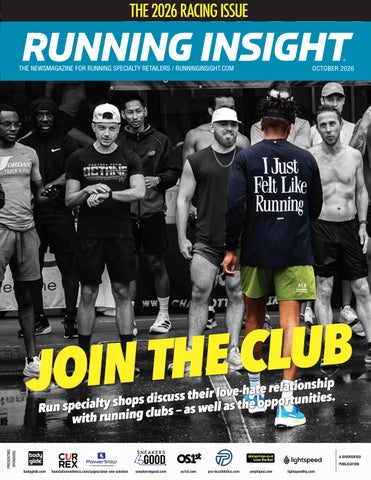
THE 2026 RACING ISSUE NEWSMAGAZINE RUNNING SPECIALTY RETAILERS / RUNNINGINSIGHT.COM THETHE NEWSMAGAZINE FOR FOR RUNNING SPECIALTY RETAILERS / RUNNINGINSIGHT.COM
MARCH OCTOBER 202616, 202
B U L C E H T JOIN ship n o i t a l e r e t a -h eir love h t s s u c s i ities. d n s u p t o r o h s p p y t o l a e i h c t e Run sp well as s a — s b u l c g n i with runn
A DIVERSIFIED PUBLICATION bodyglide.com
foundationwellness.com/pages/shoe-one-solution
sneakers4good.com
os1st.com
pro-tecathletics.com
amphipod.com
lightspeedhq.com
THE RACING ISSUE
RUN CLUBS: FRIEND OR FOE?
RUNNING INSIGHT ® is a registered trademark of Diversified. © 2026 all rights reserved. Running Insight is published monthly, is edited for owners and top executives at running specialty stores and available only via email except for two print issues year. The opinions by authors and contributors to Running Insight are not necessarily those of the editors or publishers. Articles appearing in Running Insight may not be reproduced in whole or in part without the express permission of the publisher. Diversified Communications, Portland Square Suite 200, Portland ME 04101; (207) 842-5500.
2
runninginsight.com
Advertise
Glenn Dulberg...................................................gdulberg@Divcom.com Scott Huffman.................................................shuffman@divcom.com
Editorial
Michael Jacobsen.........................................mjacobsen@Divcom.com
BACK ISSUES runninginsight.com SUBSCRIBE runninginsight.com
© 2026 Diversified
Run clubs have brought undeniable attention to the sport and, in some cases, frustration. Run specialty shops discuss harnessing the momentum for good. / By Danny Smith
B
a i ley Ness never lack thereof with run specialty connections at a time when people into the sport and doesn’t intended to create a retailers, many of whom seek to many prize precisely those feel elitist,” Dvorak says. “Isn’t run club. In fact, the harness the momentum of run elements. bringing people into the sport former University clubs and cultivate synergistic W hen Scott Dvora k co- a good thing?” of Minnesota harrier’s prior- relationships. founded Charlotte Running Earlier this year, Brooks ity was to create a running Company (CRC) in 2000, he released results of a study conapparel brand. The run club surge says the North Carolina metrop- ducted with YouGov exploring But when introducing her Strava’s 12th annual Year in olis had “maybe” two active run how run clubs were shaping the clothing brand took longer than Sport: Trend Report released clubs. Today, he counts well running experience of people expected, Ness initiated a slight last December said run clubs over 100 organized and well- ages 18–35. Of the nearly 1300 detour in September 2022 and more than tripled over the previ- attended run clubs in and around young adults surveyed, two out launched a Denver-based run- ous 12 months – and that comes Charlotte, many of them more of three reported significant ning club called cooldown. on the heels of already rampant socially oriented than perfor- improvements in wellbeing What followed was unimagi- growth this decade. Run clubs mance driven. since joining a run club. nable to Ness: co oldow n have tapped into the zeitgeist, “The growth of run clubs has “Runners frequently pointed chapters in New York City blending wellness and social been great because it’s gotten to reduced stress, improved and Austin and, now four mood and having someyears later, 20 other cities. Participation in run clubs like cooldown (opposite) have surged across the country and thing to look forward to Cooldown also holds year- prompted a response from running stores like Charlotte Running Company, which founded each week as key benefits The Sole last year as a “running club for running clubs.” long exclusives with Altra of being part of a running and Garmin and recently community,” Brooks noted. entered into a strategic The running industry partnership with Fleet Feet should celebrate such that makes the national chain data, which underscores the official retail partner of the myriad physical and cooldown and includes colmental benefits of the sport, laboration on select in-person particularly when done in experiences, product educaa group setting. tion and more. Of course, something That’s quite the outcome else has driven the run club for an alternative plan. boom – something even Cooldown’s soaring growth more powerful in the age tracks with the overall exploof Siri and screens and sion of running clubs across AI: personal, in-the-flesh the county. New groups are connection. forming every month and According to the Brooks thousands of runners are survey, 91 percent of young participating in events from run club members formed Seattle to Savannah. a relationship through their Run clubs have brought an run club, including friendundeniable influx of energy ships, closer social bonds and participation to the sport. and romantic relationships. At the same time, however, A recent Zappos survey, fr ustration has emerged meanwhile, saw nearly around some running clubs’ half of run club members involvement with brands or identify a run club as their 3
runninginsight.com
© 2026 Diversified
Run Clubs: Friend or Foe? (continued)
Charlotte Running Company founded The Sole in April 2025 to create connective tissue among the North Carolina city’s burgeoning run club scene. The group meets Thursday mornings at the CRC’s Dilworth location.
primary way of meeting new people. Even more, 84 percent of run club members said they prioritized a run club over a night out. With figures like that, it shouldn’t come as a surprise that run clubs have been called the “new nightclub” as well as “the new Tinder,” increasingly embraced by those suffering from dating app fatigue. (Our favorite: “A drinking club disguised as a run club.”) However they might come to running – an earnest hunger for physical activity, the promise of a free beer or the hope of securing a mate – the truth is run clubs are inviting people into the sport, which should be a resounding win. “We all need more runners 4
runninginsight.com
and run clubs are creating more runners,” says Greg Koch, owner of 605 Running Co. in Sioux Falls, SD. Love/hate relationship The rise of run clubs, however, hasn’t come without its frustrations. Dvorak, in fact, called the run club surge both a “good thing” for running and “a bear.” Other running retailers expressed similar sentiments, some even describing a love/ hate relationship with running clubs. A veteran retailer on the East Coast said he was thrilled run clubs in his area continued bringing attention to the sport and driving participation. At the same time, he lamented a lack of genuine partnership with clubs.
“We do our best to try and promote them, but we don’t see a ton of reciprocation,” the retailer said. One long-time indust r y member referred to run clubs as the “wild west.” As clubs start to grow, some leaders look to monetize the operation or otherwise capitalize on it. After all, they have a captive audience and (largely) a prized demographic. “That’s gotta be worth something?” many wonder. Some clubs have started charging for events; others, like college football players entering the transfer portal year after year to score a bigger payday at the next school, actively – and sometimes with a heavy hand – solicit sponsorships and exclusives from brands
at a pace creating a degree of unease amongst those on the other end. To be certain, running clubs’ involvement with brands’ directto-consumer (DTC) businesses has emerged a thorny sticking point among running retailers, in particular. In some cases, it’s the clubs leveraging their group’s size at both runs or on digital platforms to score beneficial arrangements; in other cases, brands are pursuing these deals themselves, fueling frustration among their run specialty accounts in the market. “That undercuts retailers who have built their businesses serving and developing new runners and promoting these brands,” a retailer told Running Insight. © 2026 Diversified
B2B RETAIL | CASE STUDY RESULTS
THE MOST OVERLOOKED PART OF FIT, COMFORT, AND PERFORMANCE. When retailers fit the sock with the shoe, performance improves-and so does sell-through.
Every great footwear experience starts with: ✓ Proper foot support
✓ Proper shoe selection
FOOT
SOCK
✓ Proper insole / underfoot system
INSOLE
SHOE
+47%
SOCK CATEGORY REVENUE GROWTH 3-Year Retail Case Study Real Independent Running Retailers
SEE HOW LEADING RUNNING RETAILERS DO IT DIFFERENTLY OS1ST.COM/RETAIL-PARTNERS
Run Clubs: Friend or Foe? (continued)
In Sioux Falls, SD, 605 Running Co. has sought to deepen ties with established and emerging run clubs across the region while also maintaining the strength of its own running club.
Adm ittedly, too, there’s also a twinge of envy with the momentum run clubs are riding. Many feature lively vibes and have developed strong, loyal followings. “You’ve worked so hard to create something with your own group runs and then, someone comes along and does it better – that’s hard to swallow,” one long-time run shop owner says. Creating connections As run clubs have become more commonplace in Sioux Falls, Koch has worked hard to turn any frustrations into solutions. “Run clubs have gotten people running curious, now it’s my job to figure it out – to curate good product, to put on a compelling race and position 605 Running Co. as the running solutions center,” he says. Dvorak has adopted a similar solutions-oriented mindset at CRC. The company hired Dan Keller and specifically 6
runninginsight.com
charged him to connect with Charlotte’s burgeoning run club scene. Keller attends multiple events each week and is CRC’s face with run clubs. “We jokingly call him a professional drinker,” says Dvorak, adding that Keller’s presence has helped CRC create inroads with run clubs. In April 2025, meanwhile, CRC started The Sole, which Dvorak describes as “a running club for running clubs.” Every Thursday morning at 6:00 a.m., upward of 300 people gather at CRC’s Dilworth location for a morning run. Dvorak says The Sole is intentionally not transactional and focuses more heavily on support and community, such as openly celebrating “wins” within the group like individuals who earned a World Marathon Majors medal, set a new PR or completed their first Hyrox event. “If people feel good about us, then they’ll buy from us,” Dvorak says.
Others have similarly worked to strengthen ties with local running clubs. In northern Virginia, for instance, Pacers has formalized official partnerships with two prominent crews, District Run Collective and WeOffTheCouch. Such engagement can increase awareness of the local running store and also reduce the intimidation factor some newer runners, in particular, feel with run specialty shops. Getting strategic with clubs To counter DTC offers, CRC leadership has engaged in conversations with its vendors about including CRC in interactions with local run clubs. Others, including Koch at 605 Running Co., have similarly worked to foster ongoing, honest dialogue with brands and drive collaboration. “We’ve tried to impress upon our vendors that if clubs reach out to them, include Charlotte Running Company,” Dvorak
says. “We should be the ones there to support.” Spurred by earnest conversation, one East Coast retailer noted “some pullback” with brands in his market. Now, he says, a number of brands have committed to only doing run club demo runs through his store. “That’s a positive development,” the retailer says. In its earliest years, Ness says cooldown worked with local running shops in various markets, including promoting group runs from stores and post-run parties. She encourages running shops to see run clubs as an ally, not competition, and to reach out to them with a collaborative spirit. “I think 99 percent of running clubs are down for that, so long as you allow the run club to still be the run club and meet at your location versus folding them into your run club,” she says. With some strategic intent, running retailers might even have an opportunity to capitalize on the growth of running clubs to foster new relationships and invite purchases. For instance, perhaps shops bring a remote POS to demo runs held in conjunction with a club, provide a bounceback offer to encourage in-store visits or tout complementary store programming to help r unners elevate their performance. “In an era when these folks can shop anywhere and most are especially comfortable shopping online, run shops can’t lay back and wait for people to come through their doors,” one footwear brand executive says. “As run clubs continue to grow, running stores have to give serious thought to how they get in the game.” n © 2026 Diversified
THE RACING ISSUE
Running USA Hits the Road Led by new executive director Shawn Sullivan, Running USA looks to deepen its ties to run specialty. / By Danny Smith
T
he last 12 months have been extra busy for Shawn Sullivan, particularly his ears. Appointed Running USA executive director last October, Sullivan immediately engaged in a “listening tour” to understand how others interact with Running USA, the leading trade organization for the sport of road running and mass participation endurance events. Sullivan attended road races from coast to coast, connecting with race directors of small community 5Ks and marquee events. He met with personnel from major running brands and providers of endurance event services. He visited run specialty shops and spoke with retail leaders. He engaged in conversations – formal and informal – at Running USA’s annual conference and other industry events. He queried Running USA staff and board members about achievements, challenges, solutions and improvements. Intentional and earnest, Sullivan’s listening tour is now informing his stewardship of Running USA’s strategy, membership and programming. “What’s so clear to me is people have a great deal of passion not just for the running industry, road racing and events, but for Running USA as an organization. Now, it’s about building on that in innovative and collaborative ways,” says Sullivan, who spent more than two decades spearheading communications, marketing, licensing and fan experience efforts in collegiate athletics before joining Running USA. Sullivan, a former Division I crosscountry and track and field athlete and run specialty store employee in Chicago, chats with Running Insight about his immediate priorities and aspirations for Running 8
runninginsight.com
USA, including how running stores fit into the mix. What were your initial impressions of Running USA when you stepped into the
executive director role last fall? I was amazed at the production of such a small team and the broad expertise of our board of directors. Then, seeing our industry conference occur for the first time
Shawn Sullivan was appointed executive director of Running USA last October. The veteran sports marketing executive – and former running store employee – is eager to accelerate the organization’s pace, particularly with running specialty shops across the country.
© 2026 Diversified
“We see run shops producing events and races, putting on fun runs, hosting education and having brands in their shops, and they’ll find several Running USA member benefits impactful, whether that’s our insurance coverage, music licensing, our research or our race reports.” this past winter in St. Louis proved the knowledge, passion and energy is real. Our industry is on the rise with individuals who are positive and ambitious, which only shows there’s so much more potential to unlock. Now a year in, what’s at the top of your whiteboard? E xe c u t i n g t h e l e a d i n g industry conference, which is presented by haku here in early 2027 in Henderson, NV, is at the top of the list. The conference is our bread and butter at Running USA. The programming, our registrations, our exhibitors, our sponsors – all of it’s on the rise, so we want to capitalize there. Additionally, our team is working hard to support a few new things at the Bank of America Chicago Marathon. We have our inaugural Running USA Charity Team participating in the race itself and raising funds to support Running USA’s initiatives and industry growth. Plus, we’re hosting our first Running USA Member Village at Chicago’s Abbott Health & Fitness Expo. That features eight 9
runninginsight.com
of our Running USA member road races promoting their events all under one Running USA umbrella. Finally, the Global Runner Survey presented by Active Network in partnership with haku just released as well. That’s the biggest piece of research we produce annually and it features terrific takeaways for industry folks to make the most informed decisions. Taken together, these efforts demonstrate how we’re trying to expa nd member va lue, st reng t hen resou rces a nd advance professional development and industry collaboration for events of all sizes. What are your longer-term aspirations for Running USA? Ultimately, we want to reinforce Running USA as the organization where the running industry connects, which we can achieve by educating, elevating and engaging the running industry and its constituents. We have aspirations to grow our organization financially. We want to raise the profile of Running USA. We want to highlight our members, creating, growing and delivering on our meaningful member benefits. We want to expand our research in terms of the breadth, quality and consistency. We want to continue to grow our industry conference and leverage that to create yearround dialogue in the industry supporting events of all sizes and disciplines. And then, we’ve been a traditional business-to-business trade organization for more than 25 years and we want to explore ways to become more consumer-facing.
When you talk about being more consumer-facing, what could that mean? It’s about being intentional about what we could do for an individual runner or even fans of running. It’s a longer-term play, but we are intrigued by the possibilities of creating opportunities and benefits for individual runners in addition to the organizations and events themselves. And that segues into a related piece, which is running stores, run clubs and run crews. We want to explore how our benefits might help those parties as well. Let’s stick with the run shops. Where do you see run specialty shops fitting into the Running USA orbit? We do have run specialty shops as members and collaborators, and for that, we’re super grateful. But the opportunity is even greater for collaboration. Right now, we see run shops producing events and races, putting on fun runs, hosting education and having brands in their shops, and they’ll find several Running USA member benefits impactful, whether that’s our insurance coverage, music licensing, our research or our race reports. Signing up for our email newsletter can be a helpful starting point, too. That can equip those on the retail floor with running industry context, news, event happenings and trends and add another tool to their toolbelt. Now, we need to engage further with run shops and ask how we can support them. In initial talks, we’re hearing about employee development, retention and event support, so we’re thinking about ways we
“We want to include the run shop perspective in everything we’re doing, we are an open ear to assist you and we have a blank canvas in which to partner on items. We can be helpful to you and we’d love to collaborate and grow the running industry.” can contribute there. But retailers should know this: We want to include the run shop perspective in everything we’re doing, we are an open ear to assist you and we have a blank canvas in which to partner on items. Maybe it’s a research project. Maybe it’s helping you understand the event space. Maybe you’re trying to develop young professionals and retain them. We can be helpful to you and we’d love to collaborate and grow the running industry. What does success look like for Running USA? It all comes down to supporting our members and all running industry personnel in the growth of road running and endurance sports. That means serving as the hub of our industry in all facets and contributing to an inclusive and unified running industry. If we’re doing this the right way, we’ll see our membership grow, we’ll see the industry conference expand, we’ll see our education become more bountiful and we’ll be able to deliver even more services to our members. n © 2026 Diversified
THE RACING ISSUE
Running Fast at the Shack Track Shack sets the standard for run retailers in road racing management. / By Dominique Smith
F
or almost 50 years, Track Shack in Orlando has been a pioneer and a staple in the Central Florida running community. While the retail side of the business continues to flourish after 49 years, Central Florida has become a racing hub under the umbrella of Track Shack events. One of the marquee races that the company hosts is the OUC Half-Marathon and 5K, which has featured professional runners such as Amanda Vestri, Reid Buchanan and, this year, Des Linden. The company co-produces and times races held at Walt Disney World, including the Disney Marathon. And in a real high-profile event, the company also cohosted the 2024 Olympic Marathon Trials in Orlando As time has progressed, so has the company in the way that they conduct successful races, while also keeping a people-first mentality that gives participants the best experience. Humble beginnings at the Shack Jon Hughes, who owns the store with his wife Betsy Hughes, has been a co-owner of Track Shack since 1978. Jon admitted that race directing wasn’t anything that he originally planned to do early on in his career. “The reason I was producing events back in the late ’70s was to promote our new store, Track Shack,” Jon tells Running Insight. “It was really a way to promote the sport and at the same time promote our store.” In 1978, Track Shack created the Track Shack Running Series, which is now its premier road-racing competitive series that includes six races held across Central Florida from August through March. They helped with the development of the Winter Park Road Race 10K and also created and 10
runninginsight.com
Betsy and Jon Hughes have been operating Track Shack in Orlando for almost 50 years and formed the Track Shack Running Series in 1978. Betsy will be a part of a panel at The Running Event in December that will take a look at lessons learned and how the industry has changed in the 20 years since TRE first opened.
produced the Lady Track Shack 5K, which started in 1978. In 1990, Jon and Betsy started the Track Shack Events business, which handles event management and marketing for the store. Since then, the pair has accumulated numerous awards, including Jon winning National Race Director of the Year honors in 1999 and Jon and Betsy’s recent induction into the Run Specialty Hall of Fame. Jon was the race director for the inaugural Disney World Marathon in 1994. The evolution of technology is one of the ways the business has continued to maintain success. Jon says that when the team first started, they used to score runners by writing their names on index cards and time them with a stopwatch. “When you think of those humble beginnings to where we are now, the transponder tag is already attached to your bib,” Jon
explains. “You go run and you get scored. So on the technology side, we went from handwritten to barcodes.” Changing of the guard Alicia Albert joined the Track Shack Events team in 2015 as a senior event manager after working for the runDisney event team for seven years. She was promoted to senior event director for Track Shack Events in 2020 and now handles the dayto-day aspects of the business. Albert and her team work constantly with municipalities, while gathering information from participants of the races that Track Shack puts on to continue to find creative and innovative ways to make the experience the best that it can be for each participant who signs up. For Albert, effective communication and organization between the team she leads,
© 2026 Diversified
Let’s Get Runners Visible!
New! Ultra-Luminator™ Headlamp
New! Run Bright™ 1.5L HydrationVest
One-Stop for Top-Selling Visibility Essentials B2B: dealer.amphipod.com E: order@amphipod.com T: 800.806.1288
Running Fast at The Shack (continued) as well as everyone involved in every aspect of the event, helps to bring value and success to the races that the company puts on. “A successful event doesn’t grow just by itself in isolation,” Albert says. “It grows because the entire community sees the value in it and then wants to be a part of that success.” Chris Hughes is the son of Jon and Betsy Hughes and is currently VP-business operations for Track Shack. Albert says the relationship between the retail side of the business with the event side plays a major role in the success of the store. “So as these events are changing over time, it is so important for Chris and the retail store to be aligned with the event side,” Albert points out. “Those folks that are coming into that retail store need to be aware of what our goals are and so having that close relationship between the store is obviously the thread. You know what keeps everything succinct.”
Jon also credits Betsy for the impact she’s had in the store and in the events. With the operations element of the business happening in-house, the partnership between events and retail is very organic and the numbers show that it works. “We are the packet pickup location and the correlation between when we have an event weekend and a regular weekend, it’s very obvious just in sales,” Jon says. “It’s always been a huge plus for the store and they work so well hand in hand. The store promotes the events and the events promote the store and you know it’s real.” Albert and her team oversee 16 races yearly in Central Florida and manage the runDisney partnership. She admits that no two days are the same and that the risk of burnout is real. Albert tries to lead by example when it comes to prioritizing mental health and taking breaks when needed. “Being on the forefront of planning those mental breaks and
Track Shack Events senior event manager Alicia Albert makes sure every event goes off without a hitch. Photo Courtesy of Natalie Casey
really focusing on yourself and what I want to be for my kids, that’s really what I’m focusing on,” Albert says. “I am consistently making sure that my team is doing that same thing.
There’s a place for everyone at the many Track Shack events held annually throughout central Florida.
12
runninginsight.com
Advice for race directors One nugget of advice Albert offers to other race directors is to make sure that you have a clear and critical-thinking mind, especially when things may go awry, specifically on race day. She believes that it’s a key characteristic of a great race manager and event director. Jon advises race directors to remember that safety comes first above all, even if it means less profit at the end of the day. He also urges leaders to invest in building the right team and put them in a position to succeed. “Choose your team wisely,” Jon advises. “I had a guy who said, ‘If you put the right people on the bus, you can drive it anywhere.’ And I do believe that, so I think that’s one of the most important things — finding the right people and putting your trust in them.” n © 2026 Diversified
EVERYDAY COMFORT. PROVEN SUPPORT.
This fall, give customers the support they need with the comfort they want for everyday ® life. PowerStep Pinnacle combines clinically proven arch support with dual-layer cushioning to provide stability and lasting comfort for walking, working and everything in between.
LEARN MORE ABOUT PINNACLE
THE RACING ISSUE
Mad Magazines How Run Madtown’s Beth Salinger leverages digital race magazines over goody bags. / By Kimberly Valentine
W
hen Beth Salinger took over Run Madtown as owner and race director, she knew she would need to leverage her marketing expertise to bring new life into the half marathon, 10K and 5K. The annual Memorial Day weekend event in Madison, WI, started as a marathon more than 30 years ago. The organization scaled down its race distances over the years and paused entirely during the COVID19 pandemic. When the race returned in 2022 with a fraction of its participants, the owners decided to sell it. Salinger came into the position with extensive experience helping race directors grow 14
runninginsight.com
their events as founder of Endurance Marketing and owner and race director of Fort2Base. To revive Run Madtown, share its story, and disseminate information to race participants and the community, Salinger saw an opportunity for an initiative she’s produced in the past: a digital race weekend magazine. The goody bag/race magazine debate “I’ve been working in the industry for over 25 years and, really, there’s always an issue with participants finding information,” Salinger shares. “So, I’ve done magazines of some sort, or general race weekend information, for probably the last 15-plus years.”
Race magazines are most often associated with major marathons. The Boston Marathon has its Official Program, a printed magazine-style booklet that’s handed out at bib pickup. And the London, New York City and Chicago marathons each have magazine-style digital race guides. But, according to Salinger, there’s also a place for race weekend magazines at smaller events and she believes they’re more functional than the status quo physical and virtual goody bags. Regarding physical goody bags, Salinger shares, “I stopped doing them years ago because most of the people throw out 90 percent of the stuff in it and it’s really not environmentally friendly.” Virtual goody bags, which grew in popularity in the 2010s, eliminated the costs of materials and the time it takes to stuff thousands of physical bags. When delivered via email, race directors can track open rate metrics to share with race sponsors. The problem, Salinger says, “A lot of people don’t really care about those, because there’s really nothing that forces them to go into the goody bag.” A digital magazine, however, includes race weekend information people need: where to park, what time the race starts, road closures, course maps, athlete tracking details, age-group breakdowns and more. “That’s why we see people go in multiple times,” Salinger says. Run Madtown had just over 3400 participants in 2026 and the race weekend magazine was opened 4200 times with an average read time of just under five minutes. While distributing race weekend information to participants, spectators and community members is the primary objective, the resulting performance metrics are of value to sponsors.
© 2026 Diversified
“We can say we put this magazine out this many times, people have opened it this many times, your link was clicked this many, so that is really nice,” Salinger says. Creating a digital narrative In true magazine style, the race’s culture is captured on the pages throughout Run Madtown Race Weekend Magazine, from a feature article on the race organization’s Equity in Motion Scholarship to a race ambassador profile. “We feel like we constantly need to be telling our stories so that people understand the history and where we’re coming from and why we do certain things the way we do,” Salinger shares. When Salinger took over Run Madtown, everything changed: the logo, the courses, the start and finish lines. In 2026, 53 percent of participants were first-timers at Run Madtown. Sharing stories about the
Owner and race director Beth Salinger (center) stops for a moment at a recent race to thank some of the many interns who make an event like Run Madtown such a success. Photo courtesy of Run Madtown.
race’s history and current initiatives helps to create more engagement and excitement for participants going into race day. Among stories, Salinger shares: “Who made our course maps and why is that important? Why don’t we use the word ‘runner,’ and why is that important?” But storytelling is worthwhile
Five Tips on Developing a Race Magazine
Reflecting on her experience and what’s worked best in the magazine development process, Beth Salinger shares these five tips for race directors and run retailers interested in launching their own race weekend magazine: 1. Have a second set of eyes to proofread the magazine. In fact, the more eyes, the better. 2. Use the technology you’re comfortable with, whether that’s InDesign, Canva or another program that allows you to build a magazine. 3. Every race has a different look and feel. Identify your race’s culture and style and build your magazine to reflect it. 4. You won’t be able to do everything at once. Start simple in Year One and expand the magazine as you establish your process and build out your team. 5. Don’t be afraid to think outside the box. In the most recent Run Madtown Race Weekend Magazine, Salinger’s team added a flamingo coloring page that one of her interns created with the help of AI — a flamingo is Run Madtown’s mascot. Salinger says, “That was super fun and super different, and I loved it.” 15
runninginsight.com
for every race, not only those that are new or rebranded. “A lot of races are hitting 50 years right around now,” Salinger notes. “You need to tell the story of the history of your event. There’s a lot of newer people coming into running.” While social media channels can help amplify or add a video element to these stories, the magazine features provide the fodder. Pulling it all together Perhaps the biggest barrier to transitioning from a goody bag to a race magazine is the team needed to put it all together. Magazine writing, editing and layout and design require more dedicated hands and professional expertise than an afternoon with a room full of volunteers stuffing goody bags with provided materials. Sa l i nge r wo r k s w it h a student-run organization at the University of WisconsinMadison, called Wisconsin Marketing Organization, to develop Run Madtown Race Weekend Magazine. Stories are decided in the fall
and written over winter break. Salinger writes the “guts” of the magazine, which includes the race weekend participant and spectator information. Race sponsors create and submit their ads by a pre-determined deadline. “For the past two years, for ’25 and ’26, we actually had an intern that put together the whole magazine. She did all the layout,” Salinger says. “It’s nice that when you’re doing this internship that you have something concrete that you can then take and say, ‘Hey, this is a true example of something I’ve worked on.’” The team has several sets of eyes on the magazine to catch typos and errors and Salinger makes final adjustments to the information, ad placements and photo decisions. Just in case a page needs to be updated with accurate information if details change after the magazine is published, each page is created separately. It’s a lot to pull together, but the feedback is positive. In this year’s post-event participant survey, the magazine was rated 4.5 out of five. n © 2026 Diversified
THE RACING ISSUE
Gazelle Hears A Who
Creating an event based on nostalgia over performance, Gazelle Sports brings Whoville to life. / By Kimberly Valentine Serving as inspiration, Cross has watched the success of runDisney’s events over the years.
O
ne morning each December, Grand Rapids’ Riverside Park turns into Dr. Seuss’ Whoville. It’s where runners and walkers convene for a 5K alongside beloved Whos: the Whoville Mayor, Mrs. Mayor and, of course, the Grinch. Participants run through a decoratively themed village, take photos with their favorite characters and dress up in holiday costumes of their own. The Whoville 5K became a community tradition over the past two decades and since 2019 it has been owned and organized by local running store Gazelle Sports. Cara Cross, Gazelle’s co-owner and CMO, says the untimed event is about creating an opportunity to experience joy and nostalgia — not about performance. Intentions are clear in the event’s tagline: 16
runninginsight.com
“Whoville is a place, not a race.” In a running culture that’s typically intertwined with performance, it’s a break from the mold. Yet, as more people get into running, many are placing less emphasis on pace. According to the “Global Running Culture 2025” report by Redtorch and the Running Industry Alliance, “Runners are moving away from individual performance goals like PBs and races towards community-driven, experience-based local participation. People are actively choosing connection and enjoyment over metrics in their running behavior.” With that in mind, running retail owners and race directors may stand to benefit from applying Gazelle Sports’ model in their own communities.
Taking a cue from runDisney “It doesn’t start in the logistics or the organization or the execution of the event,” Cross explains. “It starts in Disney’s amazing ability to connect nostalgia, that childhood wonder and joy of a place.” Runners navigate the Magic Kingdom, taking photos with Disney’s princesses and other well-known characters along the route to the finish line. The runDisney event series has grown a loyal fan base of runners and walkers who care much more about moments and memories than they do their finish times. Last April, Cross attended the Brooks Run Specialty Summit and ran a 5K during the runDisney Springtime Surprise Weekend. Her experience reinforced her team’s approach to the Whoville 5K and provided ideas to extend and amplify their storytelling. Leading up to this year’s event, the Gazelle Sports marketing team is working on a video series to spotlight each of the Whoville 5K’s main characters. The team plans to share the videos on Gazelle Sports’ social media channels, YouTube and in email marketing. “We can build these stories up around these characters leading into the event, so that when we get to event weekend, there is a little bit more of that awe and wonder when you see those characters in person,” Cross shares. This storytelling initiative adds to the Whoville 5K’s Dr. Seuss-inspired language on the event’s website and the team’s commitment to stay in character for each media interview. The magic is in the details, both
© 2026 Diversified
In an AI-Driven World, Your Customers Expect More. Meet the next generation of 3D foot scanning technology, combining precision scanning with AI-powered shoe recommendations and hands-free voice guidance. In seconds, shoppers receive personalized fit recommendations built around their unique feet, helping retailers deliver better fits, fewer returns, and a more confident customer experience.
Zoe Pro, St ar ting at $1,995
< Watch the movie
Gazelle Hears A Who (continued)
leading up to and during the event. “Our world is really heavy right now and I think the places and experiences that provide joy for joy’s sake are so important to the continued growth and relevance of the running industry and the running community,” Cross says. “That’s what’s going to sustain us through and beyond this running boom that we’re seeing.” Retail’s prime position This latest surge in new
to drive more traffic into their stores. While some retailers may put on races within their community, Cross shares, “I think what people are craving that they haven’t always had access to in running culture is a celebration of movement and community in a way that separates it from performance.”
Gazelle Sports doesn’t take a profit from the Whoville 5K –all proceeds benefit the event’s charity partner, Down Syndrome Association of West Michigan – it does gain greater brand awareness, a strengthened reputation and new customers. P a c k e t p i c k u p fo r t h e Whoville 5K is held inside Gazelle Sports, introducing many new runners and walkers to the store. On event day, participants’ positive experiences and memories bolster their connection to the company. Cross says her team has noted a high rate of new event participants turning into customers. Further, participants in Gazelle Sports’ signature events, which includes the Whoville 5K, have
P ro duci ng a n exp er ience-based event requires infrastructure: logistics and marketing help, community connections and partnerships, the materials and decorations to bring the event to life and the storage space to house it all. It’s not an initiative a run club could undertake as easily. But a running retail business can make all of this happen — and may have the most to gain from the investment. While
a higher-than-average number of annual store visits compared to nonparticipants. The benefits extend into the local community as well, igniting a love of movement and fitness. “Our opportunity is to be a bridge from this joyful experience of movement to a continued movement journey,” Cross says. “That is one of the most critical roles that we can play as a run specialty store.” n
runners has ushered in more run clubs than ever and greater race participation. But running stores are still competing against direct-to-consumer online sellers and searching for new ways
No Grinches Here: Advice on Bringing the Joy
Gazelle Sports’ co-owner and CMO Cara Cross offers three tips for running retailers and race directors on creating running events rooted in joy and nostalgia: 1. Find a theme that resonates with your community. It could be character-driven or affinity-driven, based on a cultural celebration or connected to something unique in your city. 2. Make sustainable decisions, such as building decorations with durable materials. This keeps costs down and connects to runners’ values. 3. The more you get into it, the more you’ll get out of it. Lean into the details that pull together an authentic and nostalgic, joy-based event. Providing an exceptional experience for participants results in increased brand awareness and a positive reputation in your community. 18
runninginsight.com
© 2026 Diversified
THE RACING ISSUE
Getting Back Into It
Back on My Feet uses running to give hope and ambition to people in all walks of life. / By Chris McDougall
Power of the people: Back on My Feet brings women and men together for community, encouragement and a little bit of running!
T
his was going to be awful. Really, really bad. Unless … I glanced up and down the street, then checked my phone before ducking back into the lobby of our AirBnB. It was nearly 5 a.m., still pitch dark and freezing outside, the kind of insanely penetrating cold that makes you wish you were in the Arctic Circle instead of downtown Manhattan. In a few minutes, I was supposed to be joining a morning run in Times Square with Back on My Feet, but I was desperately hoping they’d call it off. Hot coffee in a warm bed was the only sane way to spend a morning like that, not jogging through the dark streets 20
runninginsight.com
of Manhattan with a bunch of strangers. The night before, it seemed like a great offer. I’d known about Back on My Feet for years and I loved the ingenuity and incredible effectiveness of their mission. By an odd coincidence, we both entered the running world at the same time. Back in 2007, I was hunkered in a little wooden cabin on a farm outside Philadelphia, tapping away at a keyboard as I tried to describe this bizarre adventure I’d had with a remote tribe at the bottom of a canyon in Mexico. So much of what I’d seen was almost unknown in the outside world and I had serious doubts that anyone would take me seriously. It’s
strange to think of it now, but at the time, no one was eating chia seeds or wearing “barefoot” shoes except the Tarahumara Indians. Even ultramarathons were still a fringe sport; to most people, cruising 100 miles on foot seemed impossible. Taking the gamble While I was hammering away at a book I wasn’t sure anyone would ever read, another Philadelphian named Anne Mahlum was taking an even bigger gamble. During her morning runs through downtown Philly, Anne used to pass a homeless shelter. One day, she did something remarkable. Instead of breezing
© 2026 Diversified
X-Tended™ Knee
Support Beyond the Knee
Back in the Run (continued)
Individuals who never considered themselves “runners” have made giant strides through Back on My Feet efforts.
past like everyone else, she stopped to say hi. She didn’t judge — she listened, curious to understand what had led her new friends into their situation and wondering what could lead them back out again. Some of the residents were just as curious about her and were tickled to hear that it was possible to run all the way from Philly to New Jersey and back across the Benjamin Franklin Bridge. From those conversations ca me a bra instor m: A n ne could never truly explain to the houseless residents how much joy and purpose she got from her runs, but what if they experienced it for themselves? What if they could share everything else she got from running: the self-esteem, the sense of accomplishment, the feeling of strength and perseverance?
22
runninginsight.com
No one would ever accept her offer, she figured — but she figured wrong. Once Anne began reaching out to shelters, she discovered that an astonishing number of people struggling with addiction and houselessness were interested in giving it a try. That is the genesis of Back on My Feet. Helping thousands, one step at a time Ever since she launched Back on My Feet (BoMF), thousands of people in recovery and on the streets have been gathering before dawn three times a week to “Circle Up” and share a morning affirmation before heading out for a run. They’re accompanied by tens of thousands of recreational runners who volunteer as guides and, more importantly, running
companions. Like many others in Philly, I’d heard about BoMF from the start and applauded its success at helping our neighbors rebuild their lives and find a path to long-term jobs and housing. Coincidentally, I was becoming known in the same place at the same time. I’d finished writing that peculiar book I’d been working on — “Born to Run” — and I’d started selling it out of the back of my car at local fun runs. Word of mouth began to spread and by the end of the year, I was being invited to events all over the country. At one of them, I met Coach Amazing himself, the human cyclone otherwise known as Terence Gerchberg. He told me about Back on My Feet’s expansion into more than a dozen cities nationwide and
I was happy to get involved. I spoke at Back on My Feet galas in Baltimore and New York and ran the Boston Marathon with a Back on My Feet bib. When my next book came out, Back on My Feet was right there as my partner, throwing an amazing launch party and securing access to an enormous theater for the unveiling. But one experience I never had was actually running with a Back on My Feet crew. Due to odd quirks in timing, I was never in the right place at the right time to join them. That was about to change — and I was dreading it. A Back on My Feet volunteer was supposed to jog by to pick up me and my wife and the longer he failed to show, the more hopeful I got. Outside, the sidewalks were icy and a fierce wind was screeching. They had to cancel, right? No way are they getting new runners out in weather like — BAM BAM BAM! Time to run My heart sank. Someone was banging on the door. We opened it to find our Back on My Feet guide with a smile on his face and frost on his eyebrows. I faked a smile in return and we were off. We jogged through the dark to Times Square, then down a silent side street until suddenly, we spotted a minimob of maniacs. Twenty or 30 people were bouncing up and down, banging out jumping jacks while chatting away with apparently no clue that the temperature was below freezing. I spotted Terence on the far side of the circle, deep in conversation with a woman who kept cracking him up. He spotted us
© 2026 Diversified
and yelled for everyone to quiet down so he could begin introductions. As we went around the circle, sharing names, I realized I’d never been in a more intriguingly diverse running group in my life. People of all ages, body types and backgrounds were there, uniting in a common cause. “Yes,” I thought. “This is the real magic of Back on My Feet.” But then we started to run — and I discovered I was wrong. We were trotting down Broadway toward Union Square Park in a pitter-pattering parade and that’s when it clicked. I saw faces staring at us out of passing taxis and the surprised expressions from a few early-morning commuters and it finally dawned on me what Back on My Feet is really all about. It was right in front of my eyes for years, but I had to experience it for myself to understand. Back on My Feet isn’t really about running. It’s about visibility. It re-creates the same special moment that Anne Mahlum had years ago, back when she took the time to actually look into the eyes of the people she was passing on the street. That’s the true power of Back on My Feet: it gives invisible people the opportunity to be seen, to occupy the streets with pride. And right alongside them, sharing the same space and mission, is an army of volunteers who are proud to show that running has a purpose greater than themselves. That’s why the race bibs are such a big deal. They’re more than a special prize for dedicated Back on My Feet runners
23
runninginsight.com
One for all, all for one: The power of community is evidenced in the success stories surrounding Back on My Feet.
— they’re an opportunity to be seen on some of the greatest stages in the sport. This fall, more than two million spectators will line the streets of New York City for the marathon.
And who will they see? • Luis N., a 59-year-old who should be dead or behind bars by now, but instead outran his drug dependence and PTSD from incarceration and military duty to become a strong, sober and utterly dependable Back on My Feet alum (By the way, you can hear Luis tell his story in person at a panel at The Running Event in San Antonio, TX, in December.) • And somewhere else in the pack will be June O. You’d never guess it from her beaming smile, but June has struggled with alcoholism and houselessness since she was a teenager. Since joining Back on My Feet, June has maintained the longest sobriety of her life and has become one of the most dependable r unners in her BoMF squad. At age 31, she’s locked into a running routine
at a moment that can change her future forever. Stories behind the bibs Most people watching the marathon will never know the stories behind those bibs. But anyone who’s ever heard of Back on My Feet will witness something special. They’ll watch those runners stream past and feel a special thrum of joy, knowing that somewhere in that crowd, a handful of people have lifted themselves off the streets to run them with pride. n Back on My Feet operates in 14 cities nationwide, using running and community to help people experiencing homelessness and addiction build toward greater independence. Learn how to get involved at backonmyfeet.org.
© 2026 Diversified
THE RACING ISSUE
The Road Less Run
S
Simeon Birnbaum talks racing goals and his unlikely NIL deal with Diadora. / By Danny Smith
University of Oregon distance running star Simeon Birnbaum shocked many when he signed an NIL deal earlier this year not with hometown Nike but with Italian brand Diadora.
24
runninginsight.com
imeon Birnbaum is accustomed to capt u r i ng hea d l i nes. Such is life as one of America’s brightest distance running stars. As a prep harrier at Stevens Hig h i n Rapid Cit y, SD, Bi r nbau m won 13 Sout h Dakota state titles (11 in track and two in cross-country) in addition to breaking 4:00 in mile (3:57.53) and hustling to the second-fastest two-mile (8:34.10) and 150 0 -meter time (3:37.93) in high school history. B i r n b a u m ’s s t a r h a s continued to shine at the University of Oregon, where h e h a s c l a i m e d n u m e rous All-American honors, i n clu d i n g a 15 0 0 - m e t e r title at last spring’s NCAA Championships, and set the NCAA men’s outdoor 1500meter record (3:31.69). I n J a n u a r y, h o w e v e r, Birnbaum scored headlines of a different sort. Though running at Nike’s flagship school, a university so closely aligned with Nike that a statue of company cofounder Bill Bowerman sits a short dash from the campus track’s starting line, Birnbaum signed an NIL (name, image, likeness) deal with Diadora. Bi r nbau m wa s D iador a’s second NIL athlete following the brand’s April 2025 signing of Villanova star Marco Langon. (Langon recently
© 2026 Diversified
turned professional and signed with Diadora.) It was an unexpected move, to say the least. If Birnbaum a l ig ned h i msel f wit h a ny footwear brand, it seemed a rather safe bet he would follow a path blazed by former Duck superstars – Steve Prefontaine, Ga len Rupp a nd Mat thew Centrowitz among them – and sport The Swoosh. All of which made Birnbaum’s deal with Diadora that much more shocking – and admittedly “awkward,” Birnbaum himself has said. In a company statement announcing the deal, Birnbaum said he “chose to partner with Diadora because I believe they want to win as badly as I do.” While Birnbaum must wear Nike while training and racing with Oregon, he donned Diadora gear when he toed the starting line this summer at marquee events like the London Diamond League and the 2026 Toyota USATF Outdoor Championships in New York City. Bi r nbaum recently connected with Running Insight to discuss his immediate and long-term racing goals, signing with Diadora and contributing to the Italian brand’s ascent.
A Lap with Simeon Birnbaum
Favorite Diadora running shoe: Cellula Typical weekly mileage: 70 Favorite workout: 400-meter repeats Favorite race distance: 1500 meters Favorite running locale: Pre’s Trail in Eugene, OR Socks or no socks with spikes: No socks Go-to post-workout snack: Granola Besides footwear, one piece of running gear you wouldn’t want to live without: Sunglasses Best piece of running advice you ever received: “The more you run, the better you will become. It seems very obvious, but when I was younger, it wasn’t.”
On his top athletic priority at the moment: “My immediate focus is on trying to win a national title with the men of Oregon cross-country this fall. After the track season, I didn’t take much time off. I got back to grinding, got good mileage and now, I’m ready for this cross-country season.” O n hi s s hor t- ter m and long-term racing goals:
25
runninginsight.com
“This year, I want more NCAA titles. I’m going to try to win this cross-country national title and think I have a good chance at titles indoors and outdoors. Long-term, I’ve always said I’m chasing gold medals. I care about times, but I care about gold medals a lot more.” On signing an NIL deal with Diadora: “It was just a personal decision. I saw alignment and I got along with the team. When you’re choosing what you want to be a part of, you want to put relationships first. And being part of a smaller team feels a little more specified. You get to know people better. They get to know your goals. I get to know their goals. When they offered me, I accepted and haven’t looked back. I love it.” On what most impressed about Diadora: “Passion. They’re extremely passionate. They’re very involved. And they care a lot. Those are some very important characteristics I desire and appreciate.” On contributing to Diadora’s ascent in the U.S. market: “I feel like Marco and I have had a big part in that. I don’t know how many, especially high schoolers, knew about Diadora. Really, I didn’t know about Diadora until Marco signed and I did a lot of research into the brand. But I think we’ve definitely helped them grow, especially in the U.S. high school space. And if we can keep continuing to perform and putting ourselves out there, I think it’s just going to keep on that trajectory.” n
© 2026 Diversified
THE RACING ISSUE
The Myth of Racing Equality Women in Ultrarunning and other grassroots groups strive to increase inclusion in racing. / By Lia Beatty and Alix Ford
A
nyone in the running community or its periphery is almost guaranteed to have heard statements like “Running is for everyone! Just put on a pair of shoes and go!” But for many people, these statements and others like it ignore the very real barriers to enter into the sport. While these sentiments may be wellmeaning, they push diverse athletes and novices further to the margins. This disparity of participation exists across all running domains and only increases as distances grow and races get further from the road. Before we can consider correcting these disparities, we must understand why they exist. Why do we see these myths of equality and opportunity in running, ultrarunning, and trail running and for whom? In her book “Running While Black,” Alison Mariella Désir details side by side the history of running Black people’s reality in the United States, demonstrating systemic barriers: longstanding, intentional obstacles built into the fabric of society which shape individuals and groups of peoples’ experiences and opportunities. Black Americans were excluded from many public parks, athletic clubs and recreational spaces; women were historically barred from participating in organized athletics and major races; and people with disabilities have long-encountered physical and structural barriers to participation. Another important concept to understand is “intersectionality,” a theory by Kimberlé Crenshaw recognizing that race, gender, sexual orientation, class and other social demographics intertwine to shape a person’s experiences. When considered in the context of trail and ultrarunning communities, this means that a Black, trans woman, would face greater barriers to entry than a white woman. Participation data tells the story in real 26
runninginsight.com
Women in Ultrarunning aims to break down the many barriers women face in the racing community.
time. According to the database produced by runrepeat.com, 69 percent of trail runners are white, 63.5 percent are men, and 31 percent make more than $100,000 annually. While trail and ultrarunning may not be exclusionary on paper, if communities, industries and races are not actively working against those systemic barriers, then they are upholding them. Understanding the barriers What are some of those barriers that organizations such as Women in Ultrarunning are working to overcome? Finances, safety, access to trails and outdoors, time, pregnancy-related experiences and inclusion policies are some of the most easily identifiable. Recent data show that wealth inequality in the United States continues to grow. In 2020 Black women were on average paid 36 percent less than white men and 20
percent less than white women. A full 84 percent of women have experienced some form of harassment while on a run, 46 percent of women avoid parks or wooded areas due to fear of attack, and 72 percent of attacks have happened while running during daylight or “safe” hours. Hate crimes for LGBTQ+ individuals have increased in recent years and race/ ethnicity-related crimes make up more than 50 percent of hate crimes. As a result, many people, especially lowincome folks living in cities do not have access to safe running environments, let alone trails. Training for ultramarathons takes a lot of time, six-to-eight hours of training per week for six-to-eight weeks is often sighted as a minimum training dosage for a 50K. Data also show us that women, especially in opposite-sex relationships, are more likely to take on additional roles within
© 2026 Diversified
IF THE SKIN FAILS,
AND
THE RUN FAILS.
SOMETIMES RECOVERY TAKES DAYS
THE ORIGINAL
ANTI-CHAFE STICK ™
SENSITIVE SKIN
ANTI-CHAFE STICK ™
FOOT GLIDE ®
ANTI BLISTER STICK ™
LIQUIFIED POWDER
ANTI-CHAFE CREAM ™
CREAM TO POWDER FINISH
for two persistent problems among runners
anti chafing
anti blister
essential to running for 30+ years ©2026 Body Glide
bodyglide.com
The Myth of Racing Equality (continued)
Getting more women to sign up for running – whether it is an ultra or a shorter road or trail race – will go a long way to eliminating the discrepancies in gender participation in the sport or racing.
the home even when working outside of the home- meaning they have less time for leisure. Menstruation and pregnancyrelated policies can also shape women’s and LGBTQ+ individuals’ abilities to participate in trail and ultrarunning. Some ultramarathons entry systems are very competitive, requiring qualifiers and some luck to get on the start line. If a person is pregnant or gives birth, they may have to start this entry process from the start if inclusive policies are not in place, or if other races do not consider deferrals for adoptions, IVF treatments or miscarriages. Lastly, races that do not have trans or gender non-conforming 28
runninginsight.com
(GNC) categories, runners quite literally must misgender themselves to even register for the race. Enter Women in Ultrarunning This is where the idea that running is simply for “everyone” falls short. If we want to understand why some communities remain underrepresented in trail and ultrarunning, then the question is not simply, How do we get more people to sign up? Perhaps the question to ask is: What stands between people and participation and what could the running community change to remove those barriers? Women In Ultrarunning grew
out of a contradiction founder Rachel Bambrick kept running into: If women are capable of running 50Ks, 100-milers and 200-mile races, sometimes winning them outright, why are they still so underrepresented at the start line? While women’s participation has increased drastically in trail and ultramarathon running since the early 2000s, we still see women making up approximately 35 percent of trail race start lines and 25 percent of ultramarathon start lines. The percentages for transgender and gender non-conforming (GNC) individuals starting trail and ultramarathon races tends to be fewer than one percent.
Women In Ultrar unning (WIU) started in 2024 as an event series local to Bambrick’s Philadelphia running community. It quickly grew into a global movement helping to empower more women to feel empowered within the sport of ultrarunning. With in-person chapters across the United States and a vibrant online community, virtual education workshops, and grant programming, WIU works to ensure all women feel like they have a place in the sport. The barrier is not that women and trans/GNS folks need to be convinced they can run far. Ultrarunning can be intimidating to enter with a steep, largely unwritten learning curve. How do you fuel for 30 hours on your feet? What gear do you actually need? How do you pace through the night? What happens when your stomach stops cooperating at mile 70? Much of that knowledge is passed through existing communities and relationships. If you don’t already know someone who runs ultras, you may not even know which questions to ask. WIU is working to make that knowledge–and the community around it– easier to access. WIU has four chapters in Pennsylvania, Montana, Colorado and New Jersey where in-person events are held monthly to create community and provide each attendee with empowering knowledge about the sport of ultrarunning. WIU also has a growing online community via the app Heylo. This online community allows members to find other trail and ultrarunners in their area, plan for races, chat about the best gear, share fun stories © 2026 Diversified
A disparity of participation exists across all running domains and only increases as distances grow and races get further from the road. We must understand why they exist. Why do we see these myths of equality and opportunity in running, ultrarunning and trail running and for whom? of adventure, absolutely spam the chat when watching Rachel Entrekin won Cocodona 250 outright and even a space to share some of the not-so-great things that can happen when pursuing big running goals, like injury or harassment. WIU also hosts regular virtual skillbuilding sessions to help the community feel more confident taking on these massive feats. WIU has created scholarship funds to reduce some of the barriers to entry for women and trans/GNC folks getting to the start lines of races. Since their incorporation as a non-profit in 2025, they have awarded nearly $10,000 in grant funding to support female and gender nonconforming ultrarunners. Most recently, the Colorado chapter leader Katie Burns, ran the entirety of the Highline Canal, creating two grant opportunities for trans women in the sport. The path into ultrarunning doesn’t begin at the start line or with an ultramarathon. For many runners, it begins much earlier, with questions of whether there is a place for them out on the trail at all. 29
runninginsight.com
You can see these more of these inclusive running communities popping up in the United States and across the globe. Let’s take a look at some of them: • Women of the Wasatch (WoW) began in 2020 with a relatively simple premise: Make trail running more accessible to women and to create a sense of belonging. What started as a group of about 10 women grew to more than 650 members within the first two years and now encompasses more than 2000 members across seven Utah chapters along the Wasatch Front. WoW’s growth points to a need that goes beyond simply finding people to run with. For many, getting onto the trail isn’t the hardest part. It’s knowing where to start, who to ask, what you need and whether there’s a place for you there. For WoW, community isn’t just something that happens alongside trail running — it’s part of how people find their way into the sport. Part of WoW’s work is simply making showing up a little less scary. Group runs welcome a range of abilities, including a designated “party pace,” led by a volunteer chapter leader who keeps the group together at a conversational pace, with walking breaks welcome. WoW helps runners build the practical knowledge to navigate the trails, with workshops on gear, skill development and safety. Online, members can ask questions, share resources, find running partners, and stay connected outside of weekly group runs. The result is a community that can meet runners where they are and give them the confidence, connections, and know-how to keep showing up.
Community, however, is only one piece of the puzzle. WoW also supports runners pursuing trail and ultraracing, from someone eyeing their first ultra to an experienced runner chasing a podium finish. WoW’s annual Breaking Down the Barrier Scholarship recognizes that barriers to trail and ultrarunning don’t look the same for everyone, offering scholarships for BIPOC, LGBTQ+, disabled/ adaptive and mom/caregiver athletes. Recipients receive shoes, gear, race entries and coaching, helping remove some of the financial and practical barriers to getting started and going further. The Start Line Project, a collaboration between WoW and Speedgoat Mountain Races by UTMB, pairs direct race access with community and support needed to get women to the start line. This initiative combines race scholarships for five women with training runs, education, childcare support and race-weekend programming, all designed to increase the number of women at the start line of the Speedgoat 50K, acclaimed to be the hardest 50K in North America. WoW’s work illustrates that community, confidence, practical resources, and support networks can turn participation into a sense of belonging–and a reason to stay. Toeing the start line is one thing. Getting there and finding that no one looks like you is another. The further you go, the harder those familiar faces can be to find. That can mean fewer visible role models for a newer runner figuring out how to enter the sport, and it can also mean fewer opportunities
Participation data tells the story in real time: 69 percent of trail runners are white. While trail and ultrarunning may not be exclusionary on paper, if communities, industries and races are not actively working against those systemic barriers, then they are upholding them. for accomplished BIPOC athletes to see themselves reflected in the broader ultrarunning community. • We Run Long is working to change that by building a pathway into endurance sports for Black, Indigenous and people of color, particularly for runners who are newer to trail running or looking to progress into longer distances. Through initiatives such as Camp We Run Long, in collaboration with Altra Running, Freestone Endurance and Trail Mix Fund, the organization brings BIPOC runners together around the shared experience of trail and ultrarunning, while giving runners at different stages of their journey access to resources, connections, and community. We Run Long selects a geographically diverse cohort of about 20 runners across ages and experience levels. In the months leading up to the race participants meet regularly, receive training plans, and have access to guidance, resources, and a network of fellow runners. The © 2026 Diversified
The Myth of Racing Equality (continued) Camp itself is an all-inclusive race-weekend experience and covers ground transportation, lodging, meals, shoes and race entry to help offset some of the financial barriers that can make racing inaccessible. The support extends beyond race weekend, giving participants a community to draw on before, during and after the race. The goal isn’t simply to put more diverse runners on a start line; it’s to make sure they aren’t arriving or leaving alone. Camp participants experience the race weekend alongside a cohort of BIPOC athletes. The relationships can become mentorship, training partners, pacing and crew networks, the kinds of social infrastructure that are often difficult to find when representation is thin. By making racing a shared experience rather than a one-time achievement, We Run Long can help turn a first race into a pathway for continued participation. But creating pathways for individuals and groups of runners doesn’t necessarily change the structures they’re entering. What happens when races, brands, media and organizations surrounding the sport remain unchanged? • Black Trail Runners (BTR), a UK-based nonprofit that combines community building with advocacy to increase participation, representation and visibility of Black people and People of Color in trail r unning. BT R recognized that you cannot meaningfully address representation if the sport doesn’t even know who is participating, doesn’t reflect those participants in its media and events and doesn’t create space for them in the first place. 30
runninginsight.com
Everyone is welcome: The goal of groups such as Women in Ultrarunning is to ensure that not only is a more diverse group of runners participating, but to make sure they aren’t arriving or leaving alone.
BTR began by asking a deceptively simple question: Who is actually participating in trail running? When the organization began working with race organizers to collect ethnicity data in 2020, there was little information available beyond anecdotal experiences. The data revealed a significant representation gap: Black people make up about 4.5 percent of the UK population, but accounted for less than one percent of trail race entries. For BTR, identifying the gap was a starting point, not an end point. Their response has operated at multiple levels. BTR creates opportunities for Black runners to participate through free community trail runs, trail-taster events and skills workshops, including transportation to help address the geographic and financial barriers to accessing
trails. They have also pushed against the visibility gap. A lack of representation in the media encouraged accomplished Black runners to deliberately show up at events, increasing the opportunities for Black runners to be represented in running media and making representation harder to overlook. And rather than waiting for the existing race calendar to become more representative, BTR created its own space with Black to the Trails, a trail running festival designed to be UK and Europe’s most ethnically diverse trailrunning event. Taken together, BTR’s work points to a different kind of intervention. Representation isn’t only about who participates; it’s about who gets counted, who gets seen and who gets to shape
the sport. Diversifying the participants without changing the systems around them has limits. BTR demonstrates what it can look like to push for change not just on the trail, but in the institutions, events, media and decision-making structures surrounding it. So far, we’ve demonstrated ways to make ultrarunning more accessible: How do we create belonging? How do we build pathways? How do we change the systems around participation? But there’s another question worth asking: What if inclusion isn’t simply about bringing more people into the existing culture of ultrarunning? • Rising Hearts offers an example of what that can look like. Its Running on Native Lands © 2026 Diversified
DECEMBER 1-3, 2026 HENRY B. GONZÁLEZ CONVENTION CENTER / SAN ANTONIO, TX
The Running Event 2026
EDUCATION EDUCATION PROGRAM PROGRAM is here.
This year’s education theme, Celebrating Run Specialty: Now and Tomorrow, sets the stage for the ideas, insights, and conversations shaping the industry today and where it goes next. The TRE 2026 programming will feature curated focus areas for retailers, dynamic main stage moments, and expanded content in the exhibit hall.
See the full program at therunningevent.com/education-program
Get access to all education, 350+ exhibiting brands, and endless networking opportunities with a TRE All-Access Pass.
@therunningevent
REGISTER NOW
Produced by:
The Myth of Racing Equality (continued)
Inclusion isn’t a single intervention. It can mean opening the door to a sport that feels difficult to enter, building the community that makes people want to stay, changing the systems that determine who gets opportunities or making space for communities to have a say in what the sport becomes. Initiative works with race directors, brands and event organizers to go beyond land acknowledgements as a symbolic gesture and toward an ongoing relationship with Indigenous communities connected to the lands where races take place. That can mean connecting event organizers with local communities, bringing Indigenous voices into races and events and helping runners understand how to respectfully interact with the lands and ecosystems they move through, including recognizing that many of the places treated as public recreational spaces are Indigenous lands shaped by histories of Indigenous dispossession and displacement. Rising Heart works both to increase Indigenous representation in trail running and to change how the running community understands its relationship to land, community and responsibility. Welcoming more people into the sport doesn’t require everyone to experience it in the same way. It can mean allowing the sport to be shaped by the people it hopes to include, making room for different histories, 32
runninginsight.com
relationships, values and ways of moving through the outdoors. Taken together, these organizations make one thing clear: inclusion isn’t a single intervention. It can mean opening the door to a sport that feels difficult to enter, building the community that makes people want to stay, changing the systems that determine who gets opportunities or making space for communities to have a say in what the sport becomes. Those changes don’t belong to non-profit organizations alone. The people and institutions surrounding the sport make decisions every day that shape who sees a place for themselves, who has the opportunity to participate and what participation looks like once they arrive. Race directors, brands, retailers, media and athletes all have a role in shaping what comes next. Race directors have perhaps the most immediate influence over that experience. Before a runner even reaches the start line, a race has already made decisions about registration, pricing, race categories, accessibility, pregnancy and childcare policies, and safety. During race weekend, those decisions extend to volunteer recruitment, staff and medical teams, and whose stories and achievements are highlighted. Small choices can determine whether a race feels like an invitation or an obstacle course of its own.Some very practical steps race directors can take to make their races more inclusive include 50/50 lottery policies, racing categories for trans/GNC competitors, working with local BIPoC and LGTBQ+ organizations, equal prize purses
for winners, 50/50 start lines, menstrual hygiene products at aid stations, equal coverage of men and women’s elite races, clear policies for accountability for violent behavior, and longer cut off times for back of the pack runners to name a few. The role of brands, retailers Brands influence who gets to see themselves in the sport and who gets the resources to pursue it. Sponsorships and ambassador programs can create opportunities for athletes from underrepresented communities, while support for grassroots organizations can strengthen the communities around them. Product development, hiring, and leadership matter too. The people making decisions about what gets designed, marketed, and funded inevitably influence who the sport is built for. Retailers have a different kind of influence. They can shape someone’s first encounter with the sport. A store can be a place where a curious runner learns what gear they actually need, finds a welcoming community run or connects with people who can answer the questions they were too afraid to ask. Partnerships with local affinity groups, beginner-friendly events and products that reflect a wider range of bodies and needs can make the first step feel possible. The media shapes what – and who – the sport sees. Whose stories are considered interesting? Who gets photographs? Who is described as an “elite?” Who appears in the images that tell people what an ultrarunner looks like? Representation in media doesn’t simply reflect the sport; it also helps define who can imagine themselves belonging in it.
Making the sport more accessible and more representative doesn’t take anything away from the people who already love it. If anything, a sport is strengthened when more people can bring their experiences, perspective and ways of participating to it. The responsibility doesn’t rest entirely with the industry. Athletes and community members shape the culture of the sport every time they decide who to welcome, who to teach and who to make room for. Experienced runners can share knowledge rather than gatekeep it, make introductions, mentor newer athletes, invite people into their communities and amplify runners who might not otherwise be visible. These gestures may seem small, but they can determine whether someone arrives at the start line feeling like an outsider or like they belong there. The numbers tell us where ultrarunning stands — these organizations show us where it can go. Making the sport more accessible and more representative doesn’t take anything away from the people who already love it. If anything, a sport is strengthened when more people can bring their experiences, perspective, and ways of participating to it. A healthy sport isn’t one that stays the same. It’s one that can grow without losing what makes people love it. n © 2026 Diversified
DECEMBER 1-3, 2026 HENRY B. GONZÁLEZ CONVENTION CENTER SAN ANTONIO, TX
THE FLOOR IS YOURS. The running industry is coming to San Antonio. Will you be there?
Book your booth for the 20th edition of The Running Event. Contact TRE Sales Manager Glenn Dulberg to get the conversation started. gdulberg@divcom.com / 207-842-5694 Produced by:
THE RACING ISSUE
Hats off for Charity
A
How an upstart brand found its niche and entrepreneurial momentum with charity racing teams. / By Danny Smith
s senior manager of development at the American Lung Association, a role that includes overseeing the organization’s charity team for next month’s TCS New York City Marathon, Calloway Korbisch is always on the hunt for unique merchandise to gift the non-profit’s top fundraisers and event participants. So, when Dispatch Running founder Jason Manis reached out this summer, Korbisch listened. Manis explained Dispatch: a new running brand built around performance running hats with interchangeable patches allowing runners to tell their story through the races, teams and milestones that matter to them. Manis pitched the idea of providing Dispatch hats and an American Lung Association patch to the charity team’s marathoners. Korbisch was intrigued by the product’s novelty and versatility and ordered hats for her 11-member New York City Marathon team. “I like the hats because some of our runners run all around the world, and I thought it would be a great gift for them to continue to add to throughout their running careers,” Korbisch says. His ‘lightbulb moment’ The Tennessee-bred, Brooklyn-based Manis founded Dispatch earlier this year, drawing inspiration from his two previous experiences running the New York City Marathon. In his debut marathon, Manis ran in honor of his late father for Tedy’s Team, a non-profit raising awareness and funds for stroke and heart disease research. With “Jason” printed across his top, random fans cheered his name and shouted encouragement, stirring motivation that propelled him to the finish line. In his second marathon, however, Manis ditched the personalized singlet. 34
runninginsight.com
Dispatch Running founder Jason Manis sports one of his upstart brand’s hats while running in New York City. The hat features Dispatch’s unique calling card: an interchangeable patch – in this case, a patch celebrating the American Lung Association.
© 2026 Diversified
In addition to non-profits, Jason Manis hopes to heighten Dispatch’s relationship with run clubs. He would also like to pursue a presence in run specialty shops, for whom he can develop custom patches in addition to offering an assortment of instock options. “It was a completely different experience,” he recalls. No shouts of “Go Jason!” No “You got this, Jason!” No “Keep going, Jason!” All was not lost, however, as Manis’s second marathon sparked the idea for Dispatch. He envisioned a product with graphic versatility rather than permanence. “And a hat seemed like a perfect canvas to do that,” Manis says. Dispatch offers a performance running hat with a collection of interchangeable patches runners can attach and detach as they wish via performance Velcro. The upstart company’s currently available patches include options celebrating major marathons like New York and Chicago, finishing goals like “Sub 4” and a customizable name patch. The charity opportunity With fall marathon season approaching, the entrepreneurial Manis began reaching out to non-profits knowing many marathon charity teams provide their runners swag for the event. 35
runninginsight.com
“I originally built Dispatch with individual runners in mind, but charity teams have quickly become one of the most compelling use cases,” says Manis, who has competed in numerous events as a charity runner and will run this month’s Bank of America Chicago Marathon for the Northern Illinois Food Bank. Manis found non-profits liked the ability to have a customized patch for their organization and enjoyed gifting runners a highvalue product they could use down the line. “It’s branded. It’s customizable. It’s small and compact. We thought it was a brilliant idea,” says Janine Guzzone, who leads the marathon team at Crime Victims Treatment Center (CVTC), a New York City-based non-profit that offers free healing services to victims of violent crimes. CVTC committed to purchasing hats for its 10 charity marathoners, who together are aiming to raise more than $40,000 for the organization. Dispatch created a package for CVTC with the hat and four patches – the runner’s individual name alongside patches for CVTC, New York City and Dispatch Running. “The customization is so cool because it’s four hats in one,” Guzzone says. Beyond the NYC Marathon CVTC and the American Lung Association are two of the five nonprofit teams moving forward with Dispatch ahead of this year’s NYC Marathon. Manis has worked directly with the nonprofits to design their specific patch, and he says many see the interchangeable
Dispatch Running pairs a performance running hat with interchangeable patches, allowing runners to personalize the cap’s front. Patches might showcase races, teams, milestones or even one’s name.
patches as a tool to incentivize runners to fundraise beyond their minimums. “Raise more, ear n more patches,” Manis says. Moving forward, Manis sees an opportunity to further expand Dispatch’s collaboration with non-profits, both in extending relationships with early adopters and stretching his company’s reach to other races and charity marathon teams. “What’s been most exciting about building Dispatch is seeing the idea become bigger than just the product,” he says. “It started with wanting to give runners a way to tell their own
story, and now we’re seeing teams and charities use it to represent the communities and causes they’re running for.” In addition to non-profits, Manis, who is running his third New York City Marathon next month, hopes to heighten Dispatch’s relationship with run clubs. He would also like to pursue a presence in run specialty shops, for whom he can develop custom patches in addition to offering an assortment of in-stock options. “Ultimately, we want to offer the hat runners grab when they’re heading out the door for a run,” Manis says. n © 2026 Diversified
THE RACING ISSUE
The Voice at the Wall
E
How Back My Run turns personal encouragement into a new race-day sponsorship asset.
very race has an emotional geograthe event a new reason to communicate That question reaches beyond the participhy. The start carries excitement. pant. Partners, children, friends, training during the build-up and gives supporters Halfway brings perspective. The a role before they ever reach the course. A groups, charity donors and colleagues can closing kilometers can expose partner campaign can ask a simple quesall become part of the runner’s preparation. every doubt a runner brought to the line. tion: Whose voice will carry you when the The experience turns passive supporters At those difficult points, another pace race gets difficult? into contributors, then brings their voices alert is not always what the runner onto the course without requiring needs. A familiar voice can recon- Back My Run founder Daniel Moores believes that “hearing the right new physical infrastructure. nect someone with the reason they person at the right moment” goes a long way ion a race experience. “The emotional value is not added entered, the people who helped them by the technology alone,” says Daniel train and the promise they made to Moores, founder of Back My Run. “It themselves before the race began. comes from hearing the right person That’s where a technology called at the right moment. The technology Back My Run comes in. Back My should make that possible, then get Run turns voice notes from family out of the way.” and friends into an emotional raceday experience. For race directors, An asset that contributes the same platform can create sponsor That emotional value creates a inventory that contributes something different kind of sponsorship opporuseful to the runner instead of simply tunity. Race directors already sell competing for attention. visibility through naming rights, Back My Run is built around that expo space, start gantries, hydration moment. Before an event, a runner stations, digital media and course shares a private web link with friends, signage. Back My Run adds a new family and supporters. They record asset: a limited number of approved voice notes without downloading audio placements delivered at agreed an app or creating an account. The milestones to participating runners. runner prepares the messages in The most important design prinadvance and the Back My Run app ciple is simple: personal messages uses GPS to play them automatically come first. Sponsor messages are through headphones at selected disadditions to the experience and never tance milestones. replace the voices a runner has colHow cool. lected from family and friends. The The experience runs in the backnumber of placements, their timing ground and the prepared audio is and their content are agreed for each available offline. That matters on event. A message can run for up to 60 crowded city courses, at overloaded seconds, although a shorter, useful start lines and on remote routes where message will usually fit the moment mobile coverage cannot be trusted. better. Imagine an illustrative marathon. Encouragement becomes A title sponsor welcomes runners at part of the event Mile One. A radio partner’s familiar For an organizer, the value begins presenter marks halfway. A nutrition well before race morning. Inviting partner offers concise encouragement runners to collect messages gives near an agreed late-race fuel point. 36
runninginsight.com
© 2026 Diversified
The remaining miles belong to the runner’s own people, including the voices chosen to carry them through the difficult middle and the final push. The line between contribution and interruption is critical. A conventional advertisement dropped into someone’s headphones would wea ken the idea. The strongest placements acknowledge what the runner is experiencing, offer genuine encouragement and make the sponsor feel like an enabler of the moment rather than an intruder. “A sponsor should be remembered for contributing to the run, not interrupting it,” Moores adds. “If a brand helps thousands of runners hear the people they love, that is a more meaningful association than another logo they pass on the course.” There are three ways race directors can structure it 1. Organizer funded. The event purchases licenses for some or all of its field. Eligible runners use an event code and bib number to unlock the full race package without paying personally. 2. Organizer sold. The race organizer buys access, then packages a limited number of approved milestone audio placements for existing or new sponsors. This creates new inventory without adding another physical structure to the course. 3. Sponsor funded. A brand funds Back My Run for an agreed participant group or the full eligible field. Runners receive a useful benefit, while the sponsor receives approved placements and an association with the support that helped make the experience possible. 37
runninginsight.com
Each model can start with a selected group, such as charity runners, first-time marathoners, ambassadors or an official training community, before expanding. Event codes, bib-number matching and redemptions give the organizer practical measures of activation and participation. Feedback can then test whether runners found the experience helpful, emotional, distracting or worth using again. The activation can extend across the event lifecycle. Before race day, the campaign encourages runners to invite their supporters. At an expo or race village, staff can help runners set up and supporters can record messages on the spot. After the event, opt-in stories can show what a particular voice meant when the race became difficult. The retailer connection For run specialty retailers, the clearest opportunity is not asking staff to sell another app at the till.
It is using Back My Run as a sponsorship or community activation around an event the retailer already supports. A store could fund access for a local race, charity team or training group, host a recording activation during a marathonpreparation evening or become the partner that gives runners the experience. This connects the retailer wit h prepa rat ion, community and the emotional meaning of the event, while codes and redemptions provide a more tangible activation than passive branding alone. The genesis of Back My Run The idea for Back My Run came during Moores’ training for his first marathon. His grandparents had already passed away and he was preparing to run in their memory. During a difficult training run, he imagined how meaningful it would be to hear a recorded voice from someone he loved at exactly the moment he needed it. That thought became Back My Run. Moores later completed the Abu Dhabi Marathon in 4:12 in memory of his grandparents. “I could see plenty of tools measuring the run, but nothing that recreated the emotional lift a familiar voice can give you,” he recalls. “Back My Run came from wanting other runners to carry the people they love through the hardest part of an event.” Now the concept can apply
to a first 5K, a personal-best attempt, a marathon, an ultradistance event or a run in memory of someone. Its strongest use cases are often the ones in which the finish line represents more than a time: a comeback after illness or injury, a charity challenge, a major life milestone or a tribute to someone who cannot be there. For organizers and sponsors, that breadth creates several possible entry points. The important decision is not whether every participant needs the experience. It is identifying the communities for whom it may be most meaningful, then testing it in a clear, supported and measurable way. The running industry has become exceptionally good at collecting data. The next opportunity may be to use technology more selectively, not to add another metric, but to strengthen the relationship between runners and the people supporting them. Back My Run gives race directors a practical way to explore that idea. It can deepen pa r ticipa nt a nd suppor ter engagement, create sponsorship inventory beyond passive signage and add a personal layer to race day without changing the course itself. The commercial opportunity follows the emotional one. If the experience remains personal, limited and useful, a sponsor can help make something memorable possible. The runner hears the people who matter. The organizer creates new value. The brand earns a place in the story by helping, not interrupting. n More information: backmyrun.com/partners © 2026 Diversified
THE RACING ISSUE
Thirsty? Call the Culligan Man Major marathons are turning to on-course refill stations in sustainability effort.
R
unners need hydration. Races need to provide that hydration. But the times and ways that they fill this vital need are changing drastically as races and runners become more conscious of their environmental impact. A key step forward in this movement occurred recently when the Bank of America Chicago Marathon announced the introduction of structured, on-course refill stations in partnership with Culligan International, the provider of water services. The new initiative marks a sustainability and social responsibility milestone for the event, enabling race participants to refill personal hydration gear on course with cleaner, great-tasting water while reducing plastic waste. Part of Culligan’s multi-year partnership with the Bank of America Chicago Distance Series, the on-course refill stations reinforce the events’ commitment to environmental responsibility with a first-ofits-kind approach in the United States and a first for World Major Marathons, leveraging Culligan’s water services expertise to reliably hydrate participants while accelerating practices that protect the planet. “Sustainability has been one of our core focus areas for more than a decade, and the introduction of on-course refill stations represents an important next step,” says Carey Pinkowski, executive race director, Bank of America Chicago Distance Series. “Working with our partners at Culligan helps us sustainably meet the evolving needs of runners while continuing to reduce race day waste across our events — a win, win for everyone.” 38
runninginsight.com
The Culligan Water Refill Stations leverage proven science to deliver cleaner, better-tasting drinking water at high flow rates. Using high-capacity activated carbon filtration, the systems effectively reduce microplastics and unpleasant tastes or odors while ensuring high-quality hydration for participants throughout the course. The Bank of America Chicago Marathon (October 11, 2026) course will feature four
Culligan Water Refill Stations, located immediately prior to Aid Station 4 (Mile 5.7), Aid Station 7 (Mile 10.1), Aid Station 12 (Mile 15.7), and Aid Station 16 (Mile 20.3). Chicago is the first Abbott World Marathon Major to formally enable personal hydration refills on course as participants can now refill their own approved selfcarried hydration gear with Culligan-filtered water at each station. “We are proud to innovate and leverage
our expertise in service, science and sustainability right here in our hometown with the new Culligan Refill Stations,” adds Al Hamood, president and chief operating officer at Culligan International. “Our partnership with the Bank of America Chicago Distance Series reflects our commitment to improving lives while protecting the planet, setting new industry standards in endurance races and elevating runner experiences.” Sustainable advancements like this are only possible with collaboration across industries. HydraPak, an Official Vendor Partner of the Bank of America Chicago Marathon, is supporting this new experience providing race-day hydration products to help participants comfortably and safely carry their own gear while training and throughout major events like the Chicago Marathon. In recent news, the New Yo r k Ro a d Ru n n e r s h a s announced that water refill stations a re also debuting at the TCS New York City Marathon in November. This mirrors much of what Chicago is testing. In addition to the race’s 25 traditional water aid stations, the race will offer Culligan-filtered self-serve water refill stations along the course – one in each borough – and at additional locations on race day. The new stations will complement the race’s 25 traditional on-course fluid stations. The initiative is part of a broader effort to reduce reliance on single-use containers and will be supported by a new licensing partnership with HydraPak, which will offer co-branded reusable water bottles. n
© 2026 Diversified
THE RACING ISSUE
Running New York in Style
New Balance unveils 2026 TCS New York City Marathon collection.
O
ne of the reliable signs that it is marathon season again is the unveiling of the official New Balance 2026 TCS New York City Marathon Collection, which every year presents a comprehensive assortment of apparel, footwear and race day essentials designed to celebrate every stage of the marathon journey. The collection is launching in phases, beginning in early September, continuing with the New York City Marathon Finisher Collection on Oct. 8 and concluding with a limited-edition Five-Borough Collection, available exclusively at the TCS New York City Marathon Expo, Oct. 29–31. The initial launch featured the full collection, including the New Balance SuperComp Elite v6, Ellipse and a broad assortment of apparel and accessories, including the Pinnacle Race Day Collection. Then in early October New Balance will introduce the 2026 TCS New York City Marathon Finisher Collection, allowing participants to commemorate their achievement. Apparel in the collection ranges from a suggested retail price of $45 to $190, while footwear ranges from $155 to $290. The collection draws inspiration from New York City’s vibrant culture, featuring a signature marathon print that appears across a variety of apparel offerings. Inspired by the iconic wheat-pasted posters that define the city’s streetscape, the design reflects the layers of stories, experiences and energy that shape New York. Through these bold graphics and layered storytelling, the collection celebrates movement, culture, and the shared story of runners and the urban landscape. “This collection was created to honor both the journey and the achievement of every runner preparing for the 2026 TCS New York City Marathon,” explains Kara 39
runninginsight.com
O’Malley, New Balance senior merchant, product creation. “As we celebrate the 50th anniversary of the five-borough course, we’re proud to continue our partnership with New Balance
on a collection that captures the unique connection between runners and the city, while supporting them throughout their marathon journey,” adds Christine Burke, chief commercial officer for the New York Road Runners. To support runners throughout training and race preparation, the collection features performance-driven apparel including the RC Essential Shorts, RC Pocket Half Tight, Athletics Tees, Athletics Tanks, Heat Grid Half Zips, Fast Days Jackets, and the Ellipse. Race day offerings include pinnacle performance products such as the Race Day Ultra Light Printed Singlet, Race Day Printed Ultra Light T-Shirt, and the SuperComp Elite v6, while other apparel offerings that include the Reimagined Fleece Hoodie, Graphic T-Shirts, 50th Boroughs Collection, and Finisher Collection. n
© 2026 Diversified
ONE MORE THING ...
Get Ahead of the Curve L Coaching your manager to be more strategic and the benefits that can result. / By Tom Griffen
eadership differs from management. In the specialty running world, leadership is a strategic role generally reserved for owners, while the tactical daily ops are generally delegated to managers responsible for what’s happening in the store at any given minute. And though these managers are primarily tasked with the specific needs of the day, the best of them tend to think strategically about their roles, too. They think like leaders. A manager’s focus may be less geared toward the big picture plan and instead viewed more through a short-term lens. But that doesn’t mean what they do is less important. Equal attention to both, or close to it, is likely what’s gotten you this far, after all. On any given day, your store manager likely ponders all or some of the following questions: Is the printer out of ink? Are there still piles of dust bunnies in the corners of the dressing room? Do the wipe-down rags at the foot scanner look gross? Did that disgruntled customer from the weekend get the call back that was promised? Does the POS need a software update? Are all the shoes on the wall? And in the right place?
All in a day’s work From one hour to the next, the manager probably notices gaps on the essentials racks. Missing sock sizes, insole options, recovery sandals, sunglasses. They notice if there’s a scarcity of women’s size 8s in the back room. Or if the fridge has turned into a petri dish. They, perhaps, stress out about next week’s schedule since all those college students are headed back to school. They may also freak out when they get the call saying tonight’s closer is out with the flu. 40
runninginsight.com
Coaching is less about you writing new policies and more about challenging your manager to think bigger about their day-to-
day. It’s about empowering them to honestly witness, and critique, their daily efforts. Then consider fresh and more effective ways to approach their multi-faceted role.
Answering such questions, and so much more, is all in a day’s work for a typical store manager. And more than likely they’re adept at dealing with anything that arises. This, of course, is part of why you promoted them to manager in the first place. They are good at handling such tasks. Perhaps better than you. But if your store is similar to the majority of stores I’ve visited through the years, your managers, though highly skilled at being reactive, are not very proactive. Which is to say, they are tactical, but not very strategic. Herein lies
the opportunity for them, you and your business. Imagine if your manager’s approach landed them ahead of the store’s most common issues, rather than constantly chasing them. Imagine if they were driving the train, not holding on for dear life. Rather than tactically put out fires all day, you and your manager should design a strategic landscape that anticipates the chaos in the first place. You should implement various preemptive systems that, for example, ensure you’re never out of printer ink, never embarrassed by an unswept floor, always restocked and never, ever, out of women’s core footwear sizes. You should reimagine with them how to look at the schedule. How to plan, well in advance, for those seasonal departures. You should discuss the value of having a bench of folks at the ready when callouts threaten your sanity. And really, this is less about you writing new policies and more about challenging your manager to think bigger about their day-to-day. It’s about empowering them to honestly witness, and critique, their daily efforts. Then consider fresh and more effective ways to approach their multi-faceted role. Start simple. Ask, “How can you make sure you’re never out of printer ink?” Let them identify the solution so that they are more likely to implement it. And once they’ve upgraded some small stuff, challenge them further. “How can you be sure you’re roster is never one callout away from a disaster?” Nudge them to discover the answer to the things that are keeping them stuck in tactical mode. An empowered manager is a strategic manager. It may take some time to get them there, but in the end it will be well worth the effort. n
© 2026 Diversified