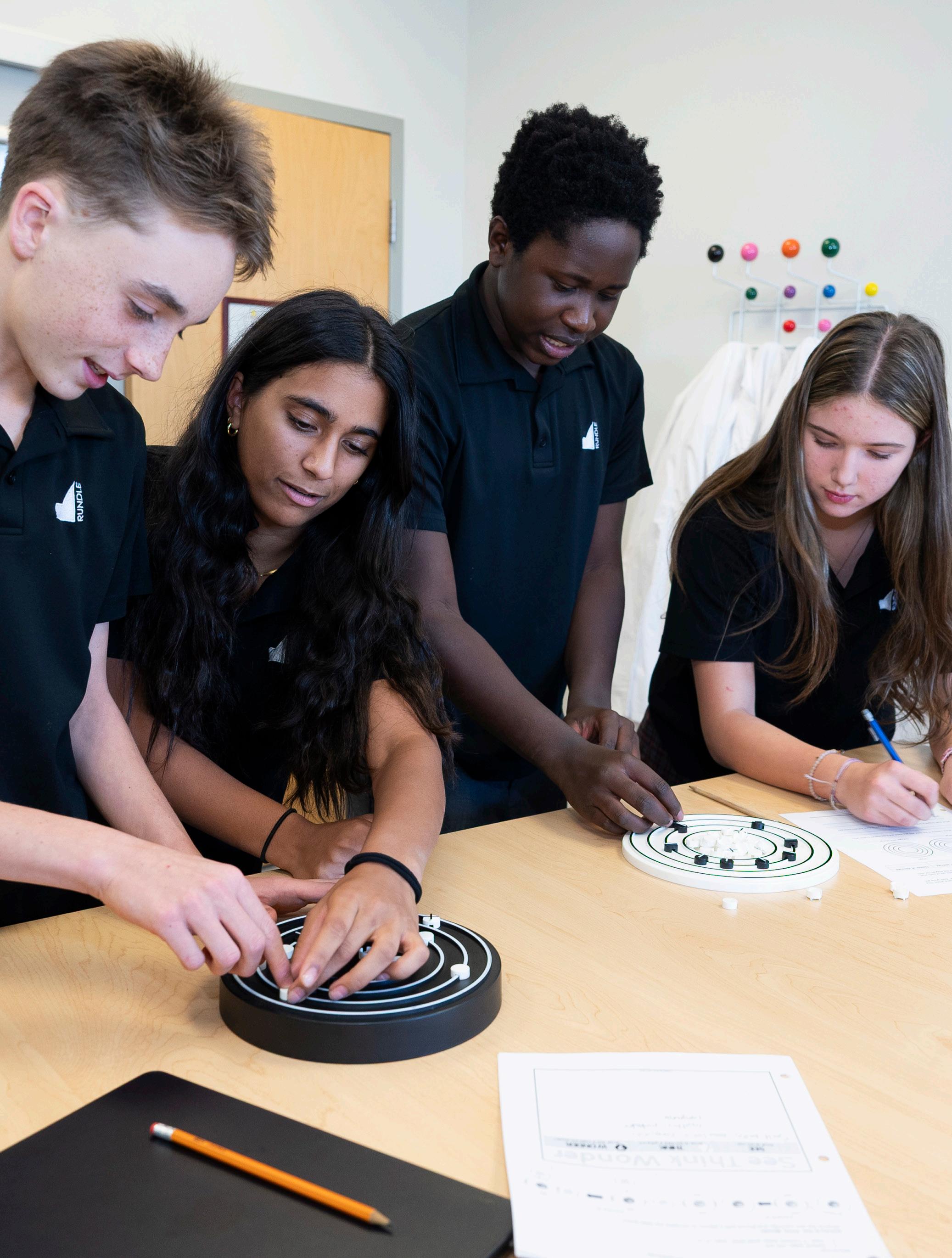
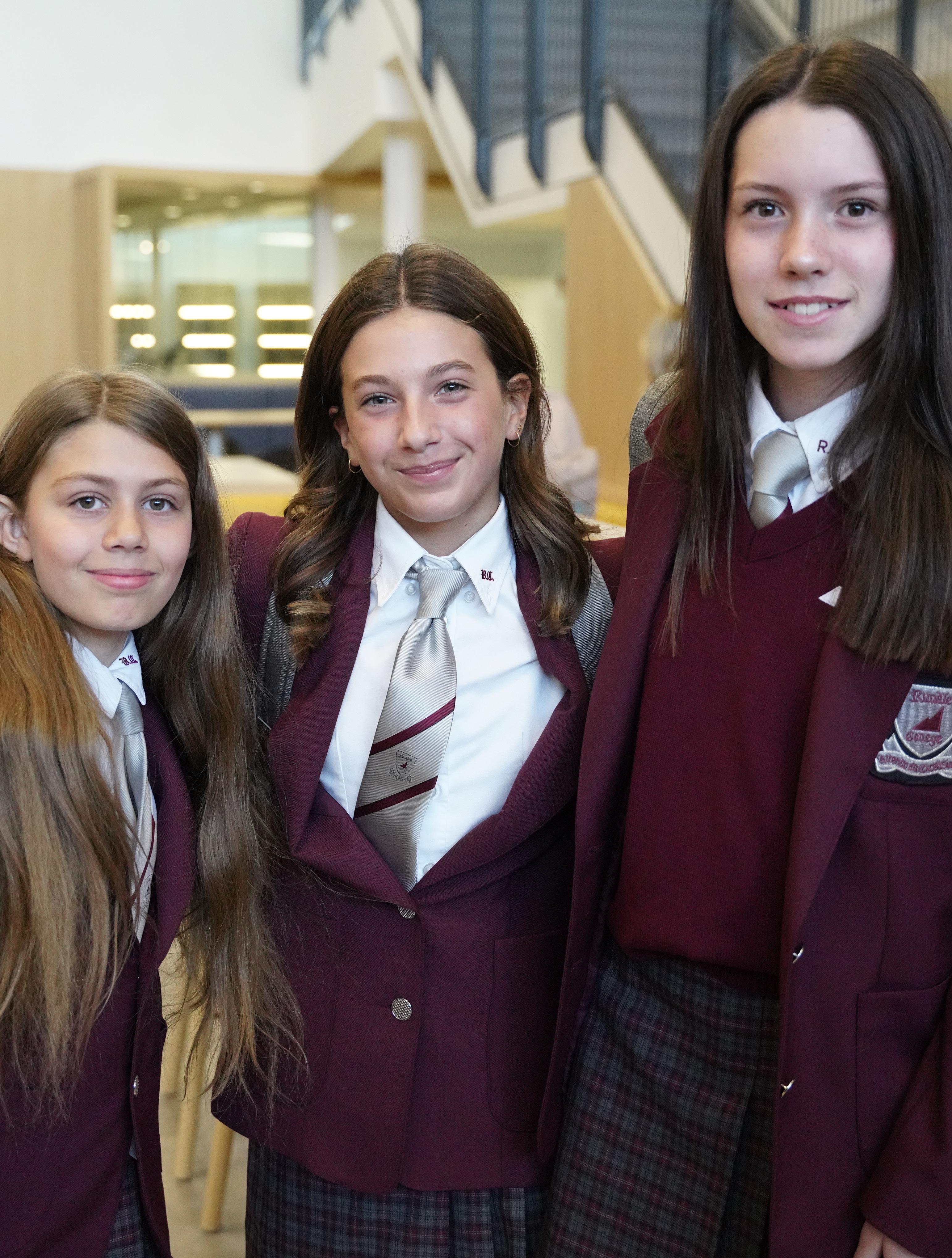
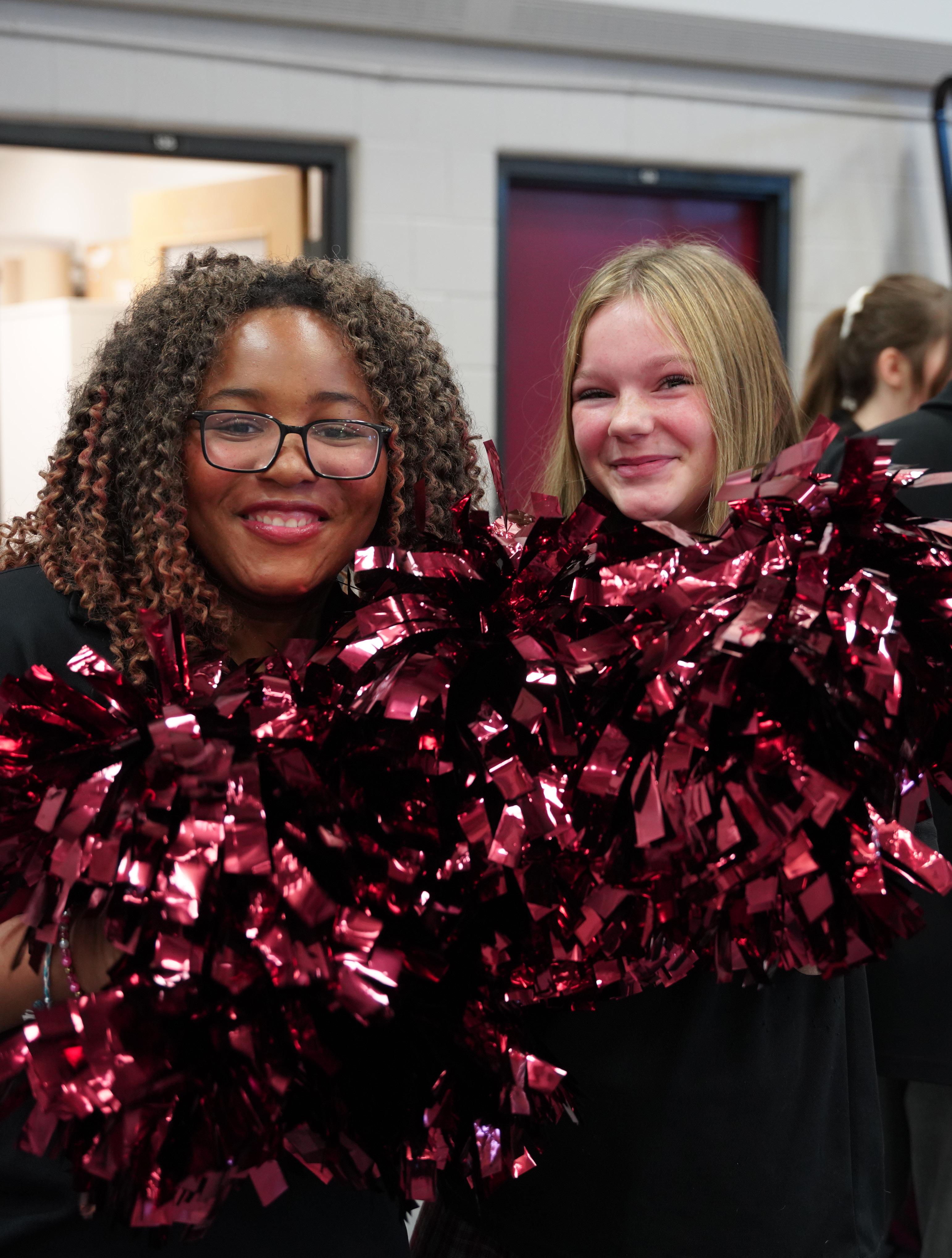
To create a nurturing, engaging environment that provides an enriched, personalized education, preparing students for an ever-changing world.
Rundle will:
• help students discover their potential;
• challenge students to attain their best; and
• celebrate with them when they do.
OUR VISION
To develop inspired minds and unparalleled character.
OUR VALUES
Together: Be Kind, Be Curious, Be Well
Our value statement guides our thoughts and actions. By following these simple words, we strengthen character.
We truly believe one’s character is central to a life of fulfillment, happiness, and success.
Throughout Rundle, you see this value statement come to life in our students’ learning and actions.
LAND ACKNOWLEDGEMENT
In the spirit of reconciliation, we acknowledge that we live, work and play on the traditional territories of the Blackfoot Confederacy (Siksika, Kainai, and Piikani Nations), the Tsuut’ina, the Îyâxe Nakoda Nations (Bearspaw, Chiniki, and Goodstoney Nations), the Métis Nation Districts 5 and 6, and all people who make their homes in the Treaty 7 region of Southern Alberta.
PATHWAYS TO LEARNING
Academics are at the core of our programs; however, at Rundle, we aim to balance academic, co-curricular, and character programs. Students are so much more than just the grades on their papers. We encourage them to develop many talents and to choose kindness above all else.
Work hard to make your grades extraordinary. Work twice as hard to make sure they are the least impressive thing about you.” — Drew Dudley
ACADEMICS
Rundle engages students’ minds, helping them to discover their passions and potential. Through our rigorous academic programs, students have every opportunity to become leaders of the future.
Rundle students’ provincial exam results and the success of Rundle alumni who receive top scholarships and bursaries from leading post-secondary institutions reflect the profound impact of Rundle’s learning environment.
CHARACTER
Rundle’s character education program creates a kind and caring community with positive and healthy relationships for students, staff, and parents.
We believe that social and emotional learning is just as important as academic learning. Moreover, we want to inspire our students to practice and commit to moral and ethical behaviours.
CO-CURRICULARS
Our extensive co-curricular program is offered within and alongside the curriculum. Students participate in artistic, athletic, character, and intellectual pursuits as part of their elevated Rundle education.
What our students experience and learn alongside classmates prepares them for success in every aspect of their personal lives and sets the foundation for careers that may not even exist today.
COLLEGE 7 - 12
OUR ACADEMIC PHILOSOPHY
Our students are accepted into highly competitive post-secondary programs throughout the world based on their final marks in our academic program, including the diploma exam. The academic results of Rundle College students consistently rise above the provincial averages on subject-specific diploma exams, a direct reflection of the quality of instruction our students receive and their commitment to their studies.
Rundle College’s decision not to offer IB or AP programs is rooted in our values and our history of success with students as we focus on the program of studies mandated by the Province of Alberta.
We support and challenge students in the areas of their passions. Academically, this is done through our enriched programs, where students join like-minded individuals in their pursuit of excellence, tackling topics and activities that go beyond the confines of the curriculum. In alignment with our values, students are supported as they embrace interests beyond academics. Rundle College’s program of studies provides students with time to focus on mental and physical wellness, volunteering, athletics, co-curricular clubs, and humanitarian pursuits.
ELEVATIONS PROGRAM
Our students’ post-secondary success is largely the result of being taught the Alberta curriculum to an exceptionally high standard. In addition, our Elevations Program offers opportunities for students to elevate their learning and to explore an area of personal interest linked to their post-secondary and career aspirations. Elevations may be included as a component of a course, additional coursework that allows study at an advanced level, or excursions and activities that lay outside the typical timetabled day.
Our Elevations Program allows us the flexibility to respond to the ever-changing educational, societal, and scientific environments in which our students dwell. Students are immersed in areas of study that are both authentic and relevant. Alberta Education credits
are offered in some, but not all, of these elevations. Regardless of whether or not credits are offered, evidence of completion of work that goes above the standards can serve as significant differentiators in a competitive post-secondary environment.
ATHLETICS
A member of the Calgary Independent Schools’ Athletic Association (CISAA), and the Alberta Schools Athletic Association (ASAA), Rundle is widely known for the strength of its Cobra athletics program. Showing strong results locally within the CISAA across all grades. Our senior teams are highly regarded provincially, capturing numerous ASAA provincial titles in all sports. Many of our graduating student athletes continue their athletic pursuits at post-secondary institutions across Canada and abroad.
Grade 7
Grade 7 competitive sports teams engage in league play in Calgary.
Grade 8
Grade 8 competitive sports teams play league games and attend tournaments in Calgary and the surrounding area.
Grade 9
Grade 9 teams play league games and may attend overnight tournaments throughout the province.
Grades 10-12
Grades 10-12 competitive teams play league games in the Calgary area. Overnight trips can be expected as Rundle students compete in tournaments throughout Alberta and Canada. Some of our senior teams travel internationally, as well. For example, our rugby teams have travelled to the Bahamas, Hong Kong, South Africa, and Argentina.
COLLEGE
7 - 12
TRAVEL PROGRAM
High school travel programs are transformative experiences that extend learning far beyond the four walls of a classroom. By immersing students in unfamiliar cultures and environments, these programs foster global citizenship and empathy, helping students dismantle stereotypes through firsthand interaction. Beyond social awareness, travel acts as a catalyst for personal growth; students often return with increased independence, sharpened problem-solving skills, and a more defined sense of self-confidence.
These experiences also bridge the gap between theory and reality; turning a history lesson on the Renaissance or a biology lecture on marine ecosystems into a tangible, lived memory. Ultimately, travel programs equip students with a broadened perspective that is essential for navigating an increasingly interconnected world.
Grades 7 – Orientation Camp
Grade 7 students attend an orientation camp at the beginning of the school year in either September or October. The goal is to foster a sense of community as a grade, welcome new students, and participate in outdoor educational pursuits. Grade 9 WEB leaders join Orientation Camp to foster mentor-mentee relationships and practice their leadership.
Grade 7-8 Band Camp
Our band camp trip offers students an enriching musical experience through specialized brass, woodwind, and percussion clinics led by professionals in the field. A session with a guest conductor provides a unique opportunity to explore new musical perspectives and enhance ensemble performance. While the camp is academic in nature, it also fosters meaningful connections that allow students to build lifelong memories through shared musical experiences.
Grade 8 – Cheakamus
Cheakamus Center is an environmental education facility near Squamish, B.C. This four-night enrichment and leadership trip links with social studies and science. Activities include aquatic and rainforest studies, outdoor pursuits, and cultural studies of the Squamish people’s traditions.
Grade 9 – Japan
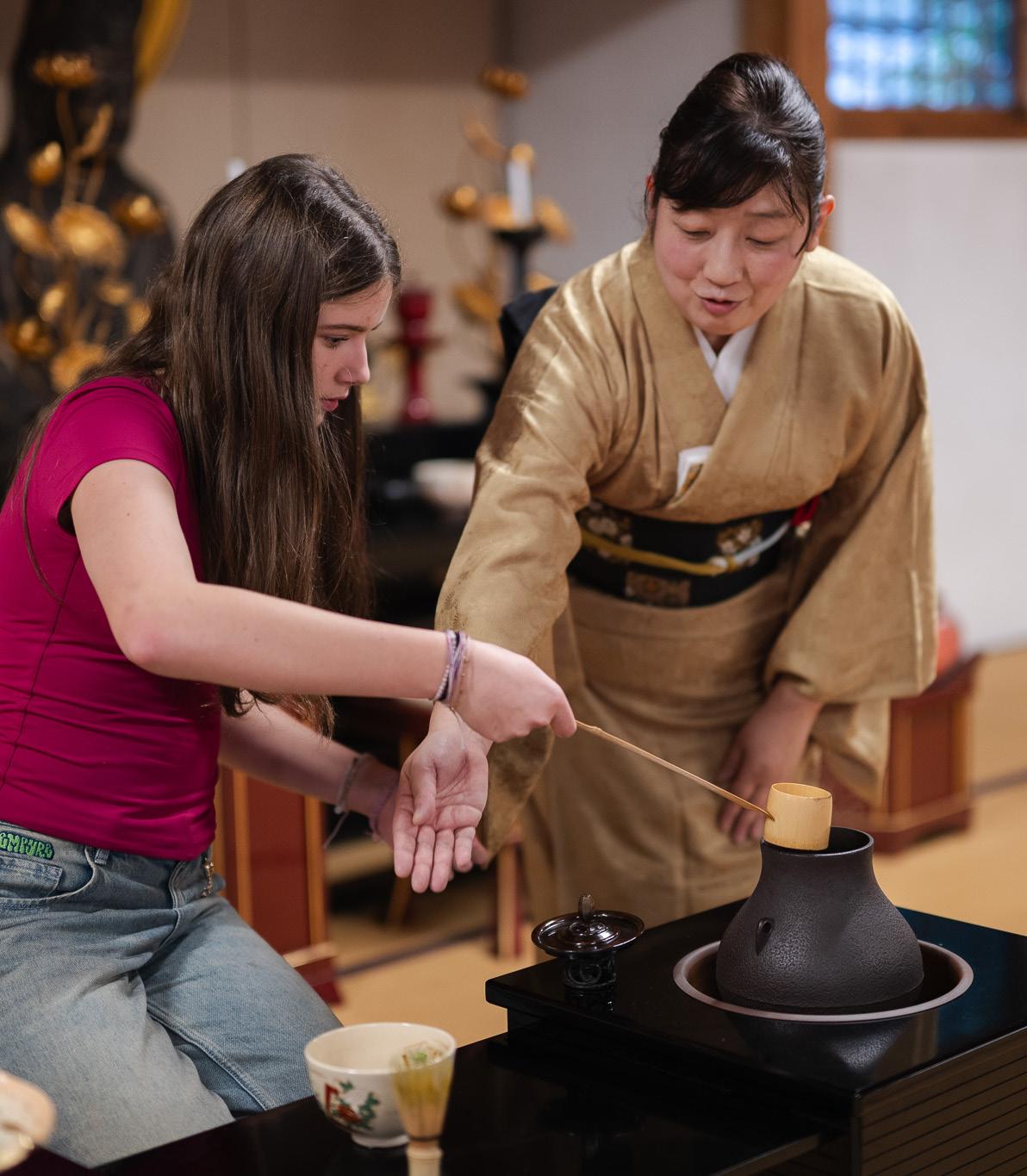
Our Japan trip itinerary includes Tokyo, Osaka, Kanazawa, Shirakawago, and the historical-cultural centres of Nara and Kyoto. While visiting places studied in the social studies curriculum, travel highlights range from ancient temples to modern electronics, and include taiko drumming, sushi making, and a tea ceremony.
Grades 9-12 – Band
Annual senior high band trips include international travel. Previous trips have been to Chicago, New York, New Orleans (to march in a Mardi Gras parade), Los Angeles, Honolulu, and San Francisco. On these trips, Rundle students pair with local high schools, participate in cultural events, and perform concerts for a wide range of audiences. Grade 9 students who participate in senior band throughout the year are also eligible to travel with the group.
Grade 10 TREK
Our TREKs Program in Grade 10 is an opportunity for students to elevate their learning. Whether it is within our Teacher Advisor Groups or during our Grade 10 Travel week, it is an opportunity for our students to explore an area beyond their academic courses. Through these activities and travel opportunities, students build on their learning within the classroom, explore an area of interest or passion, and try something new.
Grade 10 Elevated Experiential Learning
For a number of days in October, Grade 10 students embrace the opportunity to take their learning beyond the classroom walls. The excursions contain cultural, art, academic, leadership, and outdoor learning experiences.
Destinations vary from year to year depending on availability, budget, and student interest. Past trips have included the following destinations:
• Bamfield Marine Science Centre | Vancouver Island | Science focus
• New Mexico Cultural Immersion | Santa Fe and Albuquerque, New Mexico | Cultural, science and art focus
• Huntsman Science Centre | New Brunswick | Science focus
• Polar Bear Expedition | Winnipeg and Churchill, Manitoba | science, social studies and outdoor learning focus
• Local Immersion | Calgary, Alberta | Science, art and outdoor learning focus
Grade 11 – Leadership Conference
Grade 11 student leaders can apply to represent Rundle at the CAIS Student Leadership Conference. Every spring, around 130 Canadian independent school student leaders come together at the host school to develop their leadership skills, complete a service project, and connect with other like-minded leaders from top schools across Canada. Students at the host school will take on additional leadership roles such as developing programming, scheduling speakers, and organizing trips to showcase their region.
Grades 11-12 – Service Learning
Rundle’s service learning trips hone students’ understanding of global citizenship. Our students have traveled to Cambodia, Costa Rica, Ecuador, Guatemala, Kenya, Vietnam, Thailand, and Peru.
Grades 11-12 – France
The purpose of this trip is to provide a combined French language and social studies experience for our grades 11 and 12 students. This highly cultural experience gives our French students an opportunity to use and celebrate their acquired linguistic skills in an authentic setting. Students also explore significant memorial and battlefield sites where Canadians played a pivotal role in both the First World War and Second World War.
Grades 11-12 – Costa Rica
Our grades 11 and 12 students with a keen interest in Spanish elevate their learning on a trip to Costa Rica. This highly cultural experience gives students an opportunity to use their Spanish language learning in real life contexts. During this trip, students engage in turtle and community conservation work, contributing to wildlife protection and local initiatives. Alongside their conservation efforts, they also participate in adventure travel, exploring Costa Rica’s stunning landscapes and vibrant culture while creating unforgettable experiences.
COLLEGE 7 - 12
STUDENT SERVICES
Our Student Services department is composed of qualified, knowledgeable student success coaches, academic and future planning advisors, a school counsellor and a registered nurse who share some roles and have specialties within each school.
Academic Support
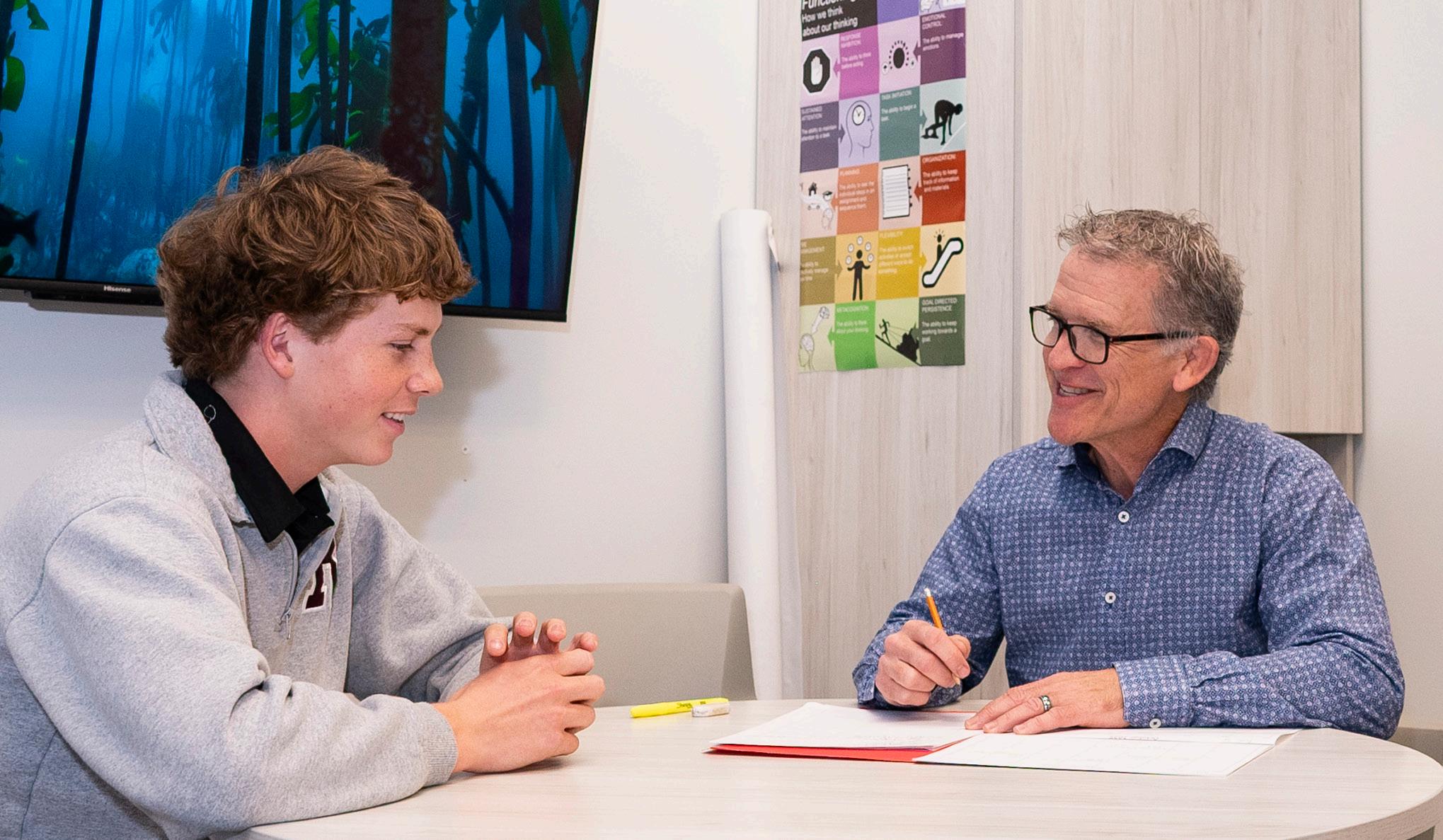
Elevated academic support is offered to students through homeroom/TA teachers, subject teachers, and/or individual sessions with student success coaches. Student success coaches (SSCs) focus on coaching and empowering our students, and equipping them with personalized tools and resources. SSCs do not provide targeted literacy or numeracy intervention. SSCs take a student-centred, strength-based approach, challenging all students to attain their best, and celebrating them when they do.
Supports from student success coaches include:
• Providing strategies to help develop students’ executive functioning skills, including organization, time management, study skills, planning, and prioritization.
• Collaborating with classroom teachers to support inclusion, using evidence-based practices.
• Setting personal goals with students and developing advocacy skills.
• Identifying student needs, and providing recommendations or referrals.
• Creating and coordinating Student Support Plans if necessary, to guide strategy development, and enhance collaboration between the student, teachers, student success coaches, and parents/ guardians.
• Providing resources and tools to students.
• Providing resources to parents/guardians to assist them in helping their child reach their full potential.
• Providing exam accommodations.
PEAC Program
The PEAC Program is a specialized support initiative designed to accommodate and empower students who face unique circumstances that impact their regular school attendance or require tailored academic navigation. It’s built on the understanding that true excellence can be achieved even amidst demanding schedules or personal challenges, by providing structured flexibility and strategic guidance. This program is distinct from personal/ social emotional counselling or direct academic tutoring; instead, it focuses on strategic support and resource coordination. The PEAC program champions a proactive approach, facilitating communication and outlining clear pathways for students and their families.
Social-Emotional Counselling
Within our Student Services department there is a team of qualified, knowledgeable, and skilled school counsellors who share some roles and have specialties within their school department.
Counsellors provide social and emotional counselling in a framework of short-term support for students in a number of different areas, including but not limited to, anxiety, depression, grief and loss, transitions, and relationship concerns. They work closely with administration and other members of the Student Services team on school-related matters, such as monitoring academic concerns, attendance, personal development, and crisis intervention.
Counsellors also collaborate with outside supports, triage, refer to external resources, and liaise with these referrals when needed.
Physical Health
Our school nurse promotes a healthy school environment by initiating directives from Alberta Health Services and health-related education in an effort to ensure students remain safe and well at school. Liaising between school personnel, families, and community healthcare providers, our nurse actively participates in school safety plans,
coordinates referrals to private healthcare providers, and assesses the school environment to prevent injury and promote student well-being.
Academic & Future Planning
Our Academic and Future Planning Advisors provide comprehensive career and post-secondary support for students from junior high through high school. Parent presentations and coffee talks are conducted for each grade level based on their career and postsecondary needs. Students have access to career mentors from our alumni network throughout high school.
Grade 9
High School Planning
• high school showcase events and presentations, student and alumni panel, transitional activities, goal setting, and grade 10 course planning
Grade 10
Career Direction and Exploration in Journey
• self-assessments, career exploration and postsecondary research, creation of a high school course plan
Grade 11
Career Exploration and Post-Secondary Planning
• comprehensive career assessment, career and post-secondary research and course selection
• Canadian and international admissions support
Grade 12
One-On-One Support with Post-Secondary Admissions
• individualized support with admissions, transcripts, and scholarships
• connections with post-secondary representatives
Off-Campus Education
Our Director of Off-Campus Education is available to support senior high students in both experiential
and academic career-based learning opportunities. Experiential learning opportunities include work experience, internship, and the Registered Apprenticeship Program (RAP). In these experiences, students earn high school credits for both volunteer and paid experiences. Students also have the opportunity to explore their career interests through a wide range of both Global Online Academy (GOA) and Dual Credit (Post Secondary Institution) academic courses.
Traverse Program
The Traverse post-secondary transition program is a Rundle-developed program that supports our graduating students as they transition into postsecondary education.
As demonstrated in academic research, students are most successful with this transition if they have the following skills and attributes: self-determination, learning strategies, and the ability to self-advocate. Rundle focuses on the development of these skills.
The Traverse aims to seamlessly bridge the gap between high school and post-secondary studies for our students and bring them closer to academic autonomy while maintaining their confidence.
2025-26 STUDENT SERVICES TEAM
SARAH DUNSFORD
Head of Student Services Dept.
Academic & Future Planning Advisor Grades 9-12
HAYLEY BOBYEMAGNUSSON
School Nurse
Grades 7-12
NEIL DOMSTAD
Student Success Coach
PEAC Program
Grades 7-12
MELISSA MANN
Academic Success Coach Grades 7-12
BRAD MELLOR
School Counsellor
Grades 7-12
LISA MESZAROS
Student Life Coordinator Traverse Coach
JESSICA RYNN
Academic &
Future Planning Advisor Grades 7-12
HEATHER SCOTT
Director of Off-Campus
Education | Traverse Coach
JUNIOR HIGH AT RUNDLE
Junior high serves as a vital bridge between the foundational learning of elementary school and the fastpaced environment of high school. It is a unique period of rapid cognitive and social development, where students transition from concrete thinkers to individuals capable of abstract reasoning and critical analysis. This stage is crucial because it allows adolescents
CO-CURRICULARS
Below is a sample of the co-curricular programs offered to Grade 7-9 students. Programs change each year depending on the interest level of our students.
Arts: Art Club, Band, Drama Production, Pit Band, Junior Pom Squad, Yearbook Club
Intellectual Pursuits: Biomedical Engineering Club, Eco Club, Games Club, GETT Club (Girls Exploring Trades and Technology), Library Leadership, Literacy Leaders, Metal and LEGO® Robotics teams, Reach for the Top, Speech and Debate
Athletics: badminton, basketball, co-ed soccer, cross country, football (Grade 9), golf, intramurals (non-competitive athletics), rugby, track and field, volleyball, wrestling
Character: Assembly Leaders, Homeroom Advisory Program, House Teams, L.E.A.D.E.R.S. Council, Open Parachute Character Program, PASS (People About Standing up for Social Change) Club, WEB Ambassadors
to explore diverse interests through their academics and co-curriculars, helping them shape their identity and self-reliance. Furthermore, it is the primary training ground for essential soft skills like time management, organization, and navigating complex social dynamics, which are just as important for long-term success as the curriculum itself.
SKILL AND R-BLOCK PROGRAMS
R-Block is intentional community building time, and a chance for homeroom teachers to provide personalized support for all students in their homeroom and support their overall well-being at school. Activities include: assemblies, grade-based activities, guest speakers, house competitions.
SKILL is a weekly block of time where students work with their homeroom on mastering essential skills for junior high and beyond.
Direct lessons and discussions are held in the following areas:
• digital intelligence
• executive functioning
• mentorship
• reflective practice
• social emotional learning
COLLEGE 7 -9
REQUIRED COURSES
• English Language Arts
• Mathematics
• Physical Education
• Science
• Social Studies
COMPLEMENTARY COURSES
• Art
• Band
• Computer Science
• Drama
• French
• Spanish
Junior high students choose two complementary courses every year. They continue at least one of them for their entire time in junior high.
ART
Art 7
This course offers an engaging exploration of artistic expression. Through a variety of mediums and techniques, students will develop their understanding and appreciation of visual art while honing their technical skills. By the end of the course, students will have developed their artistic abilities, as well as their critical thinking skills, creativity, and confidence as artists. This course is open to all students who would like to participate in a fun and creative atmosphere while enhancing their appreciation for the visual arts.
Art 8
This course pushes students to think creatively and critically. Students explore a range of techniques in drawing, painting, sculpture, and mixed media. Through hands-on projects and critical discussions, students refine their artistic skills, critical thinking abilities, and appreciation for diverse artistic perspectives. This course is open to all students who would like to participate in a fun and creative atmosphere while enhancing their appreciation for the visual arts.
Art 9
Art 9 is a studio-focused course where students will experiment with various mediums, and discover their unique artistic voice through hands-on projects and critical discussions. Technique practice and design thinking strategies are combined with engaging prompts that will help students refine their abilities to create and express themselves. This course is open to all students who would like to participate in a fun and creative atmosphere while enhancing their appreciation for the visual arts.
No pre-requisite required.
* Please note that these courses have an annual materials fee.
BAND
Band 7
In Band 7, students dive into the world of musicmaking by learning to play a wind, brass, or percussion instrument in a supportive ensemble setting. They discover the benefits of making music together, developing their listening skills as they blend their sounds with those of their peers. Through rehearsals and performances, they not only improve their instrumental proficiency but also learn valuable lessons in cooperation and collaboration, laying the foundation for lifelong musical exploration.
No pre-requisite required.
Band 8
In Band 8, students continue to build upon their musical foundation as they delve deeper into the art of performance. Through focused instruction, students refine their technique and musicianship, learn how to shape music, control volume, and blend their sounds harmoniously. As they tackle more challenging repertoire, they discover the satisfaction of mastering new skills and the joy of creating music that resonates deeply with both themselves and their audience.
This course has a prerequisite. Band 7 or prior music knowledge with the ability to accelerate their level of performance skills.
Band 9
In Band 9, students refine their performance technique and artistic growth, expanding their overall musical capabilities. Through the exploration of more advanced repertoire and musical concepts, they deepen their understanding of expressive nuance and interpretive artistry. Students emerge from band class as confident musicians ensuring their success in senior high instrumental music.
This course has a prerequisite. Band 8 or a strong background in music with a demonstrated desire to accelerate their technical skills on a wind/percussion instrument.
* Please note that these courses have an annual materials fee.
COMPUTER SCIENCE
Computer Science 7
An entry-level course, Computer Science 7 prepares students for their journey in computational thinking, technology literacy and programming. It equips all learners with foundational computer science and coding knowledge while they explore the societal impact of technology and computing on our world. Using a computational thinking lens, learners will have fun developing their knowledge of a variety of programming languages and applications through text-based and block-based coding languages, handson projects and robotics. Learners are expected to gain practical knowledge as well as critical thinking and problem-solving skills as part of their journey as lifelong learners and contributing members of our community. Topics covered include: computer science and the Fourth Industrial Revolution, computational thinking, virtual reality (VR) and augmented reality (AR) applications, and programming external devices.
COURSES
Computer Science 8
Building on the foundations established in Computer Science 7, students go beyond the basics to enhance their coding knowledge and strengthen their understanding of the impact of the Fourth Industrial Revolution on our society. Students will experience how to design and build practical applications using block-based and text-based platforms including developing an appreciation for the user experience (UX) and user interface (UI). With a focus on problemsolving for the real world, students will also explore virtual reality (VR) and augmented reality (AR) spaces to grow their creative and computational thinking skills for the 21st century. In their explorations, students further their prototyping knowledge and grow their design thinking, critical thinking and problem-solving skills, all while strengthening their understanding of the impact of coding as part of the bigger picture of the future of technology. Topics covered include: computer science and the Fourth Industrial Revolution, computational thinking, robotics, virtual reality (VR) and augmented reality (AR) applications, and programming external devices.
This course has a prerequisite. It is designed for students who have completed Computer Science 7 or an appropriate equivalent. Students who are new to the program will be asked to take a written test at the start of the school year to determine their ability to move into Computer Science 8.
Computer Science 9
Our drone program is a highlight for the grade 9 coders. This exploration of unmanned aerial vehicles provides critical insight as to how technology evolved in the Fourth Industrial Revolution but also serves to exemplify how technology’s diverse uses are an asset to our future, solidifying the understanding of its impacts on society at large. Students will also prepare for an external certification in text-based coding, alongside building their toolkit in virtual reality, augmented reality, and other applied uses of coding, Computer Assisted D and robotics. In their explorations, students further their prototyping knowledge and grow their design thinking, critical thinking and problem-solving skills,
COLLEGE 7 -9
all while strengthening their understanding of the impact of coding and how they can make a difference in the future of our world. Topics covered include: drones, computer science and the Fourth Industrial Revolution, robotics, computational thinking, and programming external devices.
This course has a prerequisite. It is designed for students who have completed Computer Science 8 or an appropriate equivalent. Students who are new to the program will be asked to take a written test at the start of the school year to determine their ability to move into Computer Science 9.
* Please note that these courses have an annual materials fee.
DRAMA
Drama encourages students to acquire knowledge of themselves and others through participation in and reflection on dramatic experiences. By using their imagination, role-playing and observing as audience members, students will explore sides of themselves, and come to understand others better. More importantly, this class emphasizes working with others and developing students’ confidence in presentation and performance.
Drama 7
In Drama 7, students begin to build their skills with theatre games, improvisation, movement, speech, technical theatre and a variety of performance opportunities. Students focus on the theatrical element of speech and vocal variety by creating radio plays which are originally scripted, produced and performed. Our goal for the Drama 7 student is to gain confidence, learn to appreciate the many aspects of theatre and have fun.
Drama 8
In Drama 8, students continue to build theatrical skills with theatre games, improvisation, movement, speech, technical theatre and a variety of performance opportunities. This year has a focus on the film element
of the theatre, and students will analyze the difference between stage and film performance and the use of camera techniques to develop a story. Our goal for the Drama 8 student is to continue to gain confidence, learn to appreciate the many aspects of film and theatre; and have fun.
Drama 9
In Drama 9, students continue to hone their theatrical skills with a continued focus on theatre history, improvisation, movement, speech, technical theatre, and a variety of performance opportunities. This year is focused on performance and honing the skills in speech and movement. In class, they will participate in a mock production where they learn about auditions, rehearsals, and the final performance. Our goal for the Drama 9 student is to have fun, gain confidence in performance and learn to appreciate the many aspects of theatre.
No pre-requisites required.
ENGLISH LANGUAGE ARTS
Students develop proficiency in reading, writing, listening, speaking, viewing, and representing. Distinct units of study introduce students to a wide variety of texts. The close reading of these texts to understand literal and figurative meaning is a focus throughout each grade level. Students have opportunities to experiment and gain confidence with different writing and oral skills. The curriculum also offers students opportunities to reflect on their learning which encourages independent and critical thinking.
English Language Arts 7
The foundational elements of writing are emphasized with a focus on personal and analytical responses. Independent reading is integrated throughout instruction. Texts studied include poetry, short stories, fiction, non-fiction, and film.
English Language Arts 8
Students continue to build analytical writing skills. Independent reading is integrated throughout instruction. Texts studied include poetry, short stories, fiction, non-fiction, and film.
English Language Arts 9
Students work on mastering fundamental essaywriting skills in preparation for the Alberta Provincial Achievement Test as well as for senior high school. Independent reading is integrated throughout instruction. Texts studied include poetry, short stories, fiction, non-fiction, and film.
FRENCH
French 7
The goal of the Junior High French program is to provide an opportunity for students to develop the knowledge, skills, and attitudes necessary to communicate effectively in French in a variety of reallife situations. Students will learn and implement themebased vocabulary. An increased focus will be placed on sentence structure and grammar. All students will be encouraged to use French as a target language. Ultimately, our program aims to have students fully appreciate and enjoy the benefits of learning French as a second language.
This course has a prerequisite. This course is for students who have had some previous French as a Second Language exposure in elementary school as it follows the 9-year curriculum set by Alberta Education. It is not an appropriate choice for native speakers or previous French Immersion students.
French 8
This course provides an opportunity for students to continue to develop their linguistic speaking ability as well as their written comprehension and production. Students will build upon previous skills in speaking, listening, and written expression. Increased focus is placed on sentence structure, vocabulary, and
COURSES
figures of speech. Students are encouraged to speak French more frequently and increase their overall level of exposure to language and culture outside the classroom.
This course has a prerequisite. This course is for students who have completed French 7 or an appropriate equivalent. Students new to the program will be asked to take a written test at the start of the school year to determine their overall written comprehension and production skills. This course is not an appropriate choice for native speakers or previous French Immersion students but may be suitable for students who were part of an immersion program in their primary or elementary years.
French 9
This course is intended for students who wish to complete the Junior High French program. It also serves as a stepping stone for students interested in continuing in French 10(9y), French 20(9y), and French 30(9y). Students will further enhance their linguistic speaking abilities, written expression, and cultural awareness and appreciation. Students are highly encouraged to increase their overall use of French and appreciate the benefits of second language learning.
This course has a prerequisite This course is for students who have completed French 8 or an appropriate equivalent. Students new to the program will be asked to take a written test at the start of the school year to determine their overall written comprehension and production skills. This course is not an appropriate choice for native speakers or previous French Immersion students but may be suitable for students who were part of an immersion program in their primary or elementary years.
Choosing to not take French in Junior High? The Senior High may offer a 3-year track program sequence which is for students who are starting to study French.
COLLEGE 7 -9
MATHEMATICS
Mathematics 7
Students develop a strong number sense (working comfortably and interchangeably with whole numbers, decimals, integers, and percentages). They also build a strong algebraic foundation that will be augmented further in Grades 8 and 9.
Course Units
• Number Relationships
• Fractions and Decimal Numbers
• Percentages and Circle Graphs
• Integers
• Linear Relations and Equations
• 2-Dimensional Geometry
• Probability and Statistics
Mathematics 8
In Grade 8, there is continued emphasis on number sense as students further hone their understanding of the relationship between fractions, percentages, decimals, ratios, and algebra (ratios, rates and proportions, linear equations, and percentages).
Course Units
• Integers
• Fractions and Rational Numbers
• Exponents, Roots, Pythagorean Theorem
• Ratios, Rates, and Proportions
• Solving Linear Equations
• Linear Relations
• 3D Drawings, Surface Area, Volume
• Data Analysis and Probability
• Transformations
• Percentages
Mathematics 9
In Grade 9, there is a strong emphasis on algebra (polynomials, linear equations, inequalities, and relations). Students deepen and strengthen their
algebraic skills in order to be well-prepared for high school.
Course Units
• Rational Numbers
• Powers and Exponents
• Polynomials
• Data Analysis
• Linear Equations and Inequalities
• Linear Relations
• Measurement
• Circle Geometry
PHYSICAL EDUCATION
Physical education in Grades 7, 8, and 9 is integrated with health components throughout the school year. Through participation in various activities, students develop an appreciation for physical education, physical fitness, outdoor education, and health-related topics.
Physical Education 7
In addition to participating in core activities, students in Physical Education 7 take part in a outdoor education activities during orientation camp in the fall.
Physical Education 8
In addition to participating in core activities, students in Physical Education 8 travel to Cheakamus, a 420acre ecological reserve in the Paradise Valley outside of Squamish, B.C. The program includes nature-based and outdoor activities, youth leadership, recreation, and other hands-on experiences intended to instill respect and appreciation for the natural world.
Physical Education 9
In addition to participating in core activities, students in Physical Education 9 have the opportunity to travel to Japan where they are exposed to outdoor pursuits and cultural activities. Students not travelling to Japan
participate in TREK activities that may include rock climbing, cooking, hiking, canoeing, and kayaking.
SCIENCE
Science 7
Science 7 focuses on the natural sciences. Throughout the year, students continue developing the fundamental skills of scientific inquiry, problem-solving, critical thinking, sustainability, safety, collaboration, and respect for varied perspectives.
Course Units
• Interactions and Ecosystems
• Plants for Food and Fibre
• Heat and Temperature
• Structures and Forces
• Planet Earth
Science 8
Students develop a critical sense of wonder and curiosity about scientific and technological endeavours. They are inspired to use science and technology to acquire new knowledge and to solve problems so they may improve the quality of their own lives and the lives of others. Students become more knowledgeable about the wide spectrum of careers related to science, technology, and the environment.
Course Units
• Mix and Flow of Matter
• Cells and Systems
• Light and Optical Systems
• Mechanical Systems
• Fresh and Saltwater Systems
Science
9
Students are encouraged to develop a critical sense of wonder and curiosity about scientific and technological endeavours. They are inspired to use science and technology to acquire new knowledge and to solve problems so they may improve the quality of their own lives and the lives of others. Students become more
COURSES
knowledgeable about the wide spectrum of careers related to science, technology, and the environment. Building on previous learning, several new concepts, including genetics and the periodic table, are introduced, and the integration of mathematics increases.
Course Units
• Matter and Chemical Change
• Biological Diversity
• Space Exploration
• Electrical Principles and Technologies
• Environmental Chemistry
SOCIAL STUDIES
Social Studies 7
This course is a comprehensive examination of Canadian history preceding and following Confederation. The concept of intercultural contact is introduced through an examination of migration and immigration. Social Studies 7 forms the foundation for the continued dialogue on citizenship and identity in Canada, and current events receive continual focus throughout the year.
Course Units
• Diverse Peoples
• Toward Confederation
• After Confederation
Social Studies 8
Students examine issues related to contact between societies with differing worldviews. The focus is on exploring elements of worldview and how these views are expressed by people living in different times and places. Students also reflect on their worldviews and assess the influence the past has on the present. Current events are explored throughout the year.
COLLEGE 7 -9
Course Units
• Origins of a Western Worldview: Renaissance Europe
• From Isolation to Adaptation: Ancient Japan
• Worldviews in Conflict: The Spanish and the Aztecs
Social Studies 9
The focus of study is on current issues and how they impact Canadian quality of life, citizenship, and identity. Current events are also explored throughout the year.
Course Units
• Canada's federal political system, the youth justice system
• Rights, responsibilities, and immigration
• economics, consumerism, and decision-making
SPANISH
Spanish 7
Spanish 7 is an introductory course that dives into the culture, history, and traditions of Hispanic countries. Students will learn basic vocabulary to greet others, share personal information and ask questions. Students will learn to conjugate verbs and structure basic sentences while participating in conversations. Ultimately, the aim of our program is to have students fully appreciate and enjoy the benefits of learning Spanish as a second language.
No pre-requisites required. This course is for students who have little or no previous Spanish language exposure. It is not an appropriate choice for native speakers or previous Spanish Immersion students.
Spanish 8
This course provides an opportunity for students to continue to develop their linguistic speaking ability as
well as their written comprehension and production. Students will build upon previous skills in speaking, listening and written expression. Increased focus is placed on sentence structure, vocabulary and figures of speech. Students are encouraged to speak in Spanish more frequently and increase their overall level of exposure to language and culture outside the classroom.
This course has a prerequisite. This course is for students who have completed Spanish 7 or an appropriate equivalent. Students who are new to the program will be asked to take a written test at the start of the school year to determine their overall written comprehension and production skills. This course is not an appropriate choice for native speakers or previous Spanish Immersion students but may be suitable for students who were part of an immersion program in their primary years.
Spanish 9
This course is intended for students who wish to complete the Junior High program. It also serves as a stepping stone for students interested in continuing in Spanish 10, Spanish 20, and Spanish 30. Students will further enhance their linguistic speaking abilities, written expression and cultural awareness and appreciation. Students are highly encouraged to increase their overall use of Spanish and appreciate the benefits of second language learning.
This course has a prerequisite. This course is for students who have completed Spanish 8 or an appropriate equivalent. Students who are new to the program will be asked to take a written test at the start of the school year to determine their overall written comprehension and production skills. This course is not an appropriate choice for native speakers or previous Spanish Immersion students but may be suitable for students who were part of an immersion program in their primary years.
Choose to not do Spanish in Junior High? The Senior High may offer a 10-12 program with no pre-requisites.
SENIOR HIGH AT RUNDLE
Welcome to your senior high school years; a pivotal time designed for discovery, challenge, and personal growth. This course guide serves as your roadmap for Grades 10 through 12, offering a diverse array of academic paths that balance rigorous core requirements with elective opportunities tailored to your unique interests. Whether you are aiming for post-secondary enrolment, exploring technical vocations, diving into the work force, or traveling the world, the selections found within these pages are curated to help you build a versatile skill set and a strong foundation for the future. We encourage you to choose courses that not only fulfil graduation requirements but also ignite your curiosity and push you to see the world from new perspectives.
CO-CURRICULARS
Below is a sample of the co-curricular programs offered to Grade 10-12 students. Program offerings may change each year depending on the interest level of our students and student-driven initiatives. Through involvement in the co-curricular program, students elevate their Rundle experience.
Arts: Art Club, Drama Productions, Jazz Band, Pom Squad, Rundle Review (student newspaper), Yearbook Club
Intellectual Pursuits: Ascent, Business Club, Competitive Speech and Debate, Games Club, International Travel, Reach for the Top, Rundle Review (student newsletter), Robotics, University Ambassadors, Stem Rx
Athletics: badminton, basketball, co-ed soccer, cross country, football, golf, Intramurals (noncompetitive athletics), rugby, track and field, volleyball, wrestling. Most teams have the opportunity to travel during their respective season.
Character: CAUSE (Creating Action Using Student Empathy), DEI (Diversity, Equity, Inclusion), Duke of Edinburgh, Elevated Leadership Program, Grad Committee, HEART (Health Empowerment and Resiliency Team), International Travel Trips, Junior Cobras, Prefects, Peer Support, Peer Tutoring, QSA (Queer Straight Alliance), Spirit Leaders
Grade 10: Exploring self, academics, post secondary and careers
Grade 11: Goal setting for life beyond Rundle
Grade 12: Preparing for your next journey
TEACHER ADVISOR R-BLOCK PROGRAM
Students are placed in a grade-specific Teacher Advisor (TA) group as a grade 10 student. The TA community of students and one teacher stay together throughout the senior high journey.
TA groups meet Monday morning between periods 1 and 2 to review weekly announcements and as an opportunity to touch base with their teacher advisor.
On Thursdays, TA students come together again during R-Block. The use of the R-Block focuses on our senior high community with students sometimes coming together as an entire student group in our monthly assembly. Senior high assemblies are studentled with a focus on promoting upcoming events and celebrating students. During other R-Blocks, students will come together as grade groups for presentations or activities. R-Blocks are also used for TA-specific lessons with a focus on character education and postsecondary planning as well as local initiatives.
COLLEGE 10-12
REQUIRED COURSES
• English Language Arts
• Journey 101 (multi-credit course including Career and Life Management)
• Mathematics
• Physical Education 10
• Science (Biology, Chemistry, Physics)
• Social Studies
COMPLEMENTARY COURSES
• Art
• Band
• Career Internship 10
• Computer Science Courses
• Drama
• Dual-Credit Opportunities
• French as a Second Language
• Global Online Academy Courses
ART
• Physical Education 20/30
• Registered Apprenticeship Program (RAP)
• Spanish Language and Culture
• Sports Medicine
• Work Experience
ALBERTA EDUCATION GRADUATION REQUIREMENTS
Visual Arts Program
At Rundle College, we take great pride in the student artwork displayed in our hallways and annual art showcase. These beautiful handcrafted objects become artifacts of our treasured moments and community members.
Our art studio is a lab of creativity where we help students build their innovation strategies while focusing on a visual arts curriculum. There is a strong emphasis on essential studio skills such as drawing, colour, design, sculpture, and other contemporary media. Visits to galleries, collaborations with guest artists, and investigations into contemporary and historical artwork are highlights of the course.
Our visual arts faculty members are dedicated art-specialist teachers. Many of our students who have taken this program have been accepted into postsecondary creative fields such as visual communication, architecture, design, and digital illustration.
Art 10
FNA1400 • 5 credits
Art 10 is a foundation course for those who want to explore art. Students develop ideas and creative/ critical thinking while working on assignments that address the visual language of art and design. Students are introduced to many different media while exploring different art movements.
No pre-requisites required.
Art 20
FNA2400 • 5 credits
Art 20 expands upon the creative processes and media skills explored in Art 10. Students build confidence and use their unique artistic style to express their ideas and feelings, as well as to create intrigue in a variety of media. Students begin critically analyzing works of art.
This course is designed to encourage lifelong participation and appreciation of art.
This course has a prerequisite of Art 10.
Art 30
FNA3400 • 5 credits
Art 30 is an advanced studio-based class that builds creative problem-solving skills and technical proficiency acquired in Art 20. Students are encouraged to express
their artistic voice by creating powerful personal statements through various media. Critical explorations of contemporary art help place their work within current art practices.
This course is designed to help prepare portfolios and a lifelong enrichment through participation in art.
This course has a prerequisite of Art 20.
Art 31
FNA3405 • 5 credits
Art 31 is an extension of the senior art program for students who are passionate about art and want to pursue their art practice beyond Art 30. Studio projects become increasingly self-directed and strongly linked to art history and contemporary practices. This course is designed for students to develop a unique personal style, build portfolios, and prepare for life-long involvement in art.
This course has a prerequisite of Art 30.
BAND
Music students have the opportunity to take part in formal concerts and other performance opportunities throughout the year including, but not limited to, Remembrance Day, athletic events, and graduation.
Band 10, 20, and 30 is a sequential and developmental approach to music instruction while appreciating and supporting the abilities and achievements of participating students. Each course level builds on the previous.
Band 10
FNA1425 • 5 credits
Band 10 immerses students in a playing environment that challenges skills and knowledge learned at the junior high school level. Students become comfortable with performing at a higher level and with peers who have more experience. Students develop competencies and strive for excellence in performing, listening, creating, researching, and valuing music.
COURSES
A prerequisite is the ability to read music. Some junior high band and/or music experience is preferred.
Band 20
NA2425 • 5 credits
Continuing with the sequential and developmental approach to music instruction, Band 20 prepares young musicians to be the future leaders of their section, focusing on leadership and musicality. Students continue improving their technical abilities and their general knowledge of music, while increasing their level of responsibility within their section. Students develop competencies and strive for excellence in performing, listening, creating, researching, and valuing music.
This course has a prerequisite of Band 10.
Band 30
FNA3425 • 5 credits
Further building on the sequential and developmental approach to music instruction, Instrumental Music 30 expects students to continue to improve their leadership skills as they learn to lead their peers within their section and within the band as a whole. Demonstrating a solid understanding of the inner workings of a concert band and of their instrument, students develop competencies and strive for excellence in performing, listening, creating, researching, and valuing music.
This course has a prerequisite of Band 20.
CAREER INTERNSHIP
Career Internship 10
“Other Instruction” Course • 3, 4 or 5 credits (25 hours per credit, maximum of 5 credits)
This is a workplace-based curriculum designed to assist students in making informed decisions about their transitions from high school to post-secondary and/or the workplace. This course is designed to help students:
• discover their career interest and aptitudes through work experience
COLLEGE 10-12
• develop and apply knowledge, skills, and attitudes appropriate for the workplace
COMPUTER SCIENCE
Computer Science I
CSE Modules from Alberta’s CTS Program • 5 credits
Designed for beginners, Computer Science I introduces students to foundational concepts in computing, programming, and problem-solving. The course aims to provide a fundamental understanding of key principles in computer science, programming, and technology, while allowing students to develop basic skills in this field. It also examines the impact of technology on society. Students who have never taken coding or programming are welcome.
No pre-requisites required. Rundle College students who have taken Computer Science 7-9 at the Junior High, or a similar program, are likely too advanced for this beginner program opportunity.
Computer Science II
Intermediate CSE Modules from Alberta’s CTS Program • 5 credits
Building upon the foundational knowledge gained in Computer Science I, this Level II course is designed to elevate students’ understanding and skills in the dynamic field of computer science. This intermediate level course delves deeper into the realms of computer science, programming, and technology, offering a more comprehensive exploration of the subject.
Please note: This course has a pre-requisite. Students must satisfy the prerequisites for Computer Science II in order to take this course. These details can be discussed with the Computer Science Teaching team as applicable.
Computer Science III
Advanced CSE Modules from Alberta’s CTS Program • 5 credits
In the culminating level of our Computer Science program, Senior High students in Level III embark on
a journey towards the art of computational excellence. This advanced course focuses on intricate coding challenges, algorithmic complexities, and cutting-edge technologies.
Please note: Students must satisfy the prerequisites for Computer Science III in order to take this course. These details can be discussed with the computer science teaching team.
DRAMA
Drama fosters students’ positive self-concept as they explore life through assuming roles and acquiring dramatic skills. This imaginative exploration involves setting, “acting out”, and communicating within a dramatic situation. Students then reflect on the consequences. This reflection provides the platform for self-development. Students have opportunities to perform at school events and the spring production.
Drama 10
FNA1410 • 5 credits
Drama at the senior high level emphasizes the development of the individual as a creator, performer, historian, critic, and patron through dramatic forms of expression learned in junior high. Drama at the senior level is a combined course with 10-, 20-, and 30-level students in one class.
Course Units
• Improvisation
• Film Study
• Movement and Speech
No pre-requisites required.
Drama 20
FNA2410 • 5 credits
• Orientation
• Technical Theatre and Design
• Theatre Studies
Drama 20 continues students’ development as a creator, performer, historian, critic, and patron through dramatic forms of expression learned in junior high and in Drama 10. Drama at the senior level is a combined course with 10-, 20-, and 30-level students in one class.
Course Units
• Acting and Improvisation
• Film Study
• Orientation
• Playwriting
• Speech
• Technical Theatre and Design
• Theatre Studies
This course has a prerequisite of Drama 10.
Drama 30
FNA3410 • 5 credits
Drama 30 extends students’ development as a creator, performer, historian, critic, and patron through dramatic forms of expression learned in junior high and subsequently in Drama 10 and Drama 20. Drama at the senior level is a combined course with 10-, 20- and 30-level students in one class.
Students have the opportunity to earn both high school credits and credits that count toward a post-secondary certificate (including a journeyperson certificate), diploma, or degree. Courses are offered in partnership with a post-secondary institution and may be taught synchronously and/or asynchronously. These courses are designed to allow for increased choice and flexibility in the learning, while supporting students in developing important life skills and exploring options for their futures.
Sample dual credit course offerings include:
• Introduction to Business
COURSES
• Introduction to Law
• Medical Terminology
• Anatomy & Physiology
• Training for Performance
• Pre-Employment Autobody
• Pre-Employment Carpentry
• Pre-Employment Heavy Equipment Technician
• Pre-Employment Welding
ENGLISH LANGUAGE ARTS
English Language Arts 10-1
ELA1105 • 5 credits
Integrating the study of literature and language, this course emphasizes skill development in reading, writing, listening, speaking, representing, and viewing. Students study thought-provoking poetry, short stories, novels, Shakespearean drama, modern drama, films, and nonfiction. Knowledge of texts is applied to writing personal responses and critical essays, where students are encouraged to think critically and creatively. Students also show their understanding through class discussions, projects, and presentations. Achieving the expectations of reading and writing at the senior high level is the primary focus, but the guiding principles are to provide a broader perspective of humanity and to inspire students to become open-minded, lifelong learners.
This course has a prerequisite of English Language Arts 9.
English Language Arts 20-1
ELA2105 • 5 credits
Building on the foundation of English Language Arts 10-1, this course continues to integrate the study of literature and language, emphasizing skill development in reading, writing, listening, speaking, representing, and viewing. Students study thought-provoking texts: poetry, short stories, novels, Shakespearean drama, modern drama, films, and nonfiction. Knowledge of
COLLEGE 10-12
texts is applied to writing of personal responses and critical essays, where students are encouraged to think critically and creatively. Students also show their understanding through class discussions, projects and presentations. Preparation for Grade 12 and, ultimately, post-secondary education is the primary focus, but the guiding principle is to provide a broader perspective of humanity and to inspire students to become open-minded, lifelong learners.
This course has a prerequisite of English Language Arts 10-1.
English Language Arts 30-1
ELA3105 • 5 credits
English Language Arts 30-1 continues students’ skill development in reading, writing, listening, speaking, representing, and viewing. It integrates the study of literature and language, providing students with thought-provoking texts: poetry, short stories, novels, Shakespearean drama, modern drama, films, and nonfiction. Knowledge of texts is then applied to writing personal responses and critical essays, where students are encouraged to think critically and creatively. Students also show their understanding through class discussions, projects, and presentations. Preparation for the Diploma examination and for post-secondary education is the primary focus in this culminating course, but the guiding principles are to provide a broader perspective of humanity and to inspire students to become open-minded, lifelong learners.
This course has a prerequisite of English Language Arts 20-1.
FRENCH AS A SECOND LANGUAGE
French as a Second Language
Our French program follows the French as a Second Language 9-year program of studies. The “9Y” route builds on skills developed in grades 4-9.
If there is sufficient interest in an introductory level high school course, consideration will be made to offer the 3-year (“3Y”) stream of French as a Second language.
French as a Second Language 10-3Y, 20-3Y, and 30-3Y
FSL1093 • 5 credits
FSL2093 • 5 credits
FSL3093 • 5 credits
This program is dependent on interest with a minimum number of students required.
Designed for students with little or no background in the French language, students develop a balanced foundation in the language skills of comprehension and production. Students are guided toward activating these skills and applying them in communicative environments. The main goal is for our students to have a functional ability to communicate in French in basic situations, based on familiar topics and structures, using cultural and strategic knowledge they have gained to sustain their communication.
French as a Second Language 10-9y
FSL1099 • 5 credits
The aim of this course is to have students fully appreciate and enjoy the benefits of learning French as a second language and to gain strong linguistic competence. We focus on developing a balanced foundation in the communicative modes of interpretive, interpersonal, and presentational competences. Students become capable, independent language learners with a functional competence to communicate in the French language. Prerequisite: French as a Second Language 7-9 or equivalent.
French as a Second Language 20-9y
FSL2099 • 5 credits
Building on the framework established in French as a Second Language 10-9y and preparing students for the next part of their language journey, students expand their communication skills and explore Francophone culture. Continuing previously acquired French language expertise, students develop a balanced foundation of language comprehension and production skills through reading, listening, speaking, and writing in both interpersonal and presentational contexts. The program stresses the importance
of successful communication enabling students to use French in increasingly diverse situations.
This course has a prerequisite of French as a Second Language 10-9y or equivalent.
French as a Second Language 30-9y
FSL3099 • 5 credits
The final chapter of our French as a Second Language program aims to not only strengthen fluency skills and functional ability to communicate in the target language, but also to explore the personal and career opportunities that can be enhanced with the acquisition of a second language. Previous accomplishments function as the foundation from which students put to use new grammatical structures, bind novel expressions, and carry forth linguistic ability to new heights. There is no diploma exam for this course.
This course has a prerequisite of French as a Second Language 20-9y or equivalent.
French as a Second Language 31a
FSL3306 • 5 credits
This elevated French course is for students who wish to further their language learning and skills. There is no diploma exam for this course
This course has a prerequisite of French Language and Culture 30-3y.
GLOBAL ONLINE ACADEMY
Rundle College is a proud member of Global Online Academy (GOA), whose programs offer students a way to pursue their passions, learn with peers from around the globe, and acquire and practice modern learning skills that will serve them well in postsecondary institutions, career, and life. Students fit GOA courses into their Rundle timetable, and are taught by experienced faculty from renowned peer schools all over the world.
GOA offers online classes where relationships and connections drive students to share their perspectives
COURSES
and learn from those of others. Rundle staff also participate in GOA’s world-renowned professional learning programs as teachers seek to continually improve their practice as modern educators.
Sample GOA course offerings
• Advocacy
• Architecture
• Art, Media, and Design
• Bioethics
• Business Problem Solving
• Comparative Politics
• Computer Science and Technology
• Creative Nonfiction
• Entrepreneurship in a Global Context
• Fiction Writing
• Game Theory
• Global Health
• Introduction to Investments
• Macro/Microeconomics
• Medical Problem Solving
• Multivariable Calculus
• Neuropsychology
• Number Theory
• Positive Psychology
• Psychology
• Problem Solving with Engineering and Design
• World Languages: Arabic | Japanese
Some courses receive credit, and all participants can highlight GOA classes in their post-secondary applications. The GOA experience shows students’ passion for learning as well as their ability to collaborate and problem solve in non-traditional ways.
JOURNEY 101
Career and Life Management
PED0770 • 3 credits
Career Directions Expansion
CTR2310 • 1 credit
Career Directions Transitions
CTR3310 • 1 credit
COLLEGE 10-12
Completing Journey 101 comprises three components, including Career and Life Management which is a required course for high school graduation in the Province of Alberta. At Rundle College, all students are required to take Career and Life Management, Career Directions Expansion, and Career Directions Transitions.
The course content in Journey 101 equips students to make sound personal and professional decisions and also develops their ability to apply effective thinking and communication skills. Students develop a positive self-concept and an understanding of personal interests, values, aptitudes, and abilities. Independent personal management is promoted, and students develop the ability to make choices and accept challenges that consider significant others, values, responsibilities, and resources. They gain an awareness of health as a resource for everyday living, and learn health maintenance’s connection with personal well-being, realizing goals, satisfying needs, and coping with change.
The career-focused aspects of the course develop knowledge about career options and enable students to determine personal career strategies. Students gain an awareness of the relationships between personal economics, lifestyle, and occupational planning.
Please note: Because this program encourages students to focus on how they see themselves, how they cope with life’s challenges, and how they relate to others, areas which may be considered sensitive or controversial may arise. Rundle College strives to deal with these issues appropriately, and students are encouraged to discuss sensitive issues with their parents or guardians.
Course Themes
• Careers and the World of Work
• Human Sexuality
• Independent Living
• Financial Literacy
• Relationships
• Self-Management
• Well-Being
PERSONALIZING THE RIGHT PATH FOR HIGH SCHOOL MATH
At Rundle College, we pride ourselves in offering our senior high students a curriculum that challenges them and prepares them for post-secondary success.
As your child enters Grade 11 and 12 and looks toward the next steps in their educational journey, choosing between Mathematics 30-1 and Mathematics 30-2 is an important decision. We are sharing this document with you to provide clarity on these two math courses to ensure your child makes the best decision for their academic journey at Rundle and for their postsecondary plans.
Choosing the Right DASH Math Pathway
Both Math 30-1 and Math 30-2 are academic, diplomaexam courses and are recognized by many postsecondary programs. The most important goal is choosing the course in which your child can be most successful.
Many parents and students feel that Math 30-1 is needed to “keep doors open.” While this is true for some very specialized university programs, it is not the best choice for every student.
Universities and colleges look closely at overall academic performance, and in many cases a strong grade in Math 30-2 is more beneficial for university admissions than a lower grade in Math 30-1.
Who should take Math 30-1?
Math 30-1 is the best choice if your child plans to take Math 31 (calculus) and continue on to calculus at the university level. If your child intends to pursue STEM programs, such as applying to Engineering, Sciences, Computer Science, Mathematics, or some Business programs, Math 30-1 is a requirement. The course places a strong emphasis on advanced algebraic skills essential for success in university-level calculus.
We recommend this rigorous course only for students whose future degrees specifically require it, as the content and heavy workload are designed to prepare them for the expectations of a science-based or mathbased faculty.
Who should take Math 30-2?
This course is the best choice for many students pursuing post-secondary education who do not plan to take Math 31 or calculus at the university level. If your child is applying to Business, Social Sciences, Nursing, or Education programs, Math 30-2 is widely accepted as a 30-level mathematics course by universities. The course emphasizes logical reasoning and critical thinking skills that are directly applicable to these fields. From a university admissions standpoint, a strong grade in Math 30-2 is far more valuable than a lower grade in Math 30-1. Choosing Mathematics 30-2 allows students to maintain a competitive GPA and focus their efforts on the subjects that best align with their post-secondary goals.
The Importance of Balance
We want every student to graduate with a high school transcript from Rundle that reflects their true potential. Every year, some students are challenged by the pace and critical thinking required in Math 30-1. The misconception that they should pursue the course to "keep doors open" leads to a negative impact on their overall well-being. The faster pace and heavier workload of Math 30-1 can place significant demands on students, sometimes at the expense of performance in other required courses.
For many students, Math 30-2 allows them to demonstrate their true mathematical ability, maintain confidence, and achieve stronger overall results. We want our students to pursue their goals without sacrificing their meaningful social connections and cocurricular activities.
COURSES
Choosing the right pathway is about positioning your child for success, not limiting future options. When students are placed in the course that best matches their strengths, they are more likely to graduate with confidence, strong grades, and a competitive postsecondary application.
We encourage students and families to review university program admission requirements and speak with Rundle’s Future Planning Advisors to help choose the right math course.
MATHEMATICS
Mathematics 10C
MAT1791 • 5 credits
Students gain the mathematical understanding and critical-thinking skills needed for success in Mathematics 20-1. This is also an introductory course to pre-calculus mathematics.
Course Units
• Polynomials and Factoring
• Real Numbers, Exponents and Radicals
• Relations and Functions
• Systems of Linear Equations
• Measurement and Trigonometry
Mathematics 20-1
MAT2791 • 5 credits
Mathematics 20-1 is for students who plan to enter post-secondary programs such as engineering, mathematics, sciences, and some business studies that require advanced mathematics courses. It provides the mathematical understanding and critical thinking skills needed for Mathematics 30-1, Mathematics 30-2, and Mathematics 31. Course Units
• Sequences and Series
• Radical Expressions and Equations
• Trigonometry
COLLEGE 10-12
• Quadratic Functions and Equations
• Rational, Absolute Value and Reciprocal Functions and Equations
This course has a prerequisite of Math 10C (70%+ recommended).
Mathematics 30-1
MAT3791 • 5 credits
Mathematics 30-1 is for students planning to apply for post-secondary programs requiring calculus and advanced mathematics courses, such as engineering, mathematics, sciences, and some business studies. The focus is on demonstrating advanced algebra skills, mathematical literacy, comprehension, and reasoning. Mathematics 30-1 may be required for post-secondary calculus courses.
Course Units
• Exponential and Logarithmic Functions
• Permutations and Combinations
• Relations and Functions
• Transformations
• Trigonometric Equations
• Trigonometric Functions
This course has a prerequisite of Mathematics 20-1 (70%+ recommended) and teacher recommendation.
Mathematics 30-2
MAT3792 • 5 credits
Mathematics 30-2 is an academic course for students who do not require calculus and advanced mathematics in post-secondary. The focus of the course is on critical thinking skills involving probability, permutations, functions and through analyzing games and puzzles. Math 30-2 is accepted at most postsecondary institutions.
Course Units
• Set Theory and Counting Methods
• Probability
• Exponential and Logarithmic Functions
• Rational Expressions and Equations Functions
• Polynomial and Sinusoidal Functions
• Analysis of Games and Puzzles
This course has a prerequisite of Mathematics 20-1 or 20-2.
Mathematics 31
MAT3211 • 5 credits
Mathematics 31 emphasizes the theoretical and practical development of topics in the algebra of functions, trigonometry, differential calculus, and integral calculus. It bridges the gap between high school pre-calculus courses (Math 20-1 and Math 301) and the calculus courses offered by post-secondary institutions.
Course Units
• Limits and Rates of Change
• Derivatives
• Applications of Derivatives
• Extreme Values and Curve Sketching
• Trigonometric, Exponential, and Logarithmic Functions
• Differential Equations and Area
• Integrals
This course has a prerequisite of Mathematics 30-1.
PHYSICAL EDUCATION
Physical Education 10
PED1445 • 5 credits
Physical education at Rundle College enables students to enhance their quality of life through active living, exposure to a choice of activities, and developing skills and positive attitudes in both individual and team pursuits. Activities typically include flag football, hiking, volleyball, field hockey, basketball, wrestling, dance, yoga, track and field, rugby, soccer, handball, fencing, badminton, and kickball. In addition to these activities, students earn their certification in CPR. Emphasis is
placed on developing key components of fitness: cardiovascular endurance, muscular endurance and strength, flexibility, power, coordination, and agility. No pre-requisites required.
Physical Education 20
Physical Education 30
PED2445 • 5 credits | PED3445 • 5 credits
Building on the foundation of Physical Education 10, these two courses enable students to enhance their quality of life through active living, exposure to a choice of activities, and developing skills and positive attitudes that promote engagement in lifelong recreational pursuits. Activities may include fitness, handball, bowling, taekwondo, racquetball, squash, tennis, golf, kayaking, batting cages, ultimate frisbee, yoga, badminton, curling, Indigenous games, dance, rock climbing, and several team and individual activities. Emphasis is placed on developing key components of fitness: cardiovascular endurance, muscular endurance and strength, flexibility, power, coordination, and agility.
This course has a prerequisite of Physical Education 10
REGISTERED APPRENTICESHIP PROGRAM
“Registered Apprenticeship” Course • 5 credits (per 125 hours, maximum 40 credits in each trade)
The Registered Apprenticeship Program (RAP) enables students to spend part of their time in school and part in industry as registered apprentices in a designated trade. Students enrolled in RAP are counted as full-time high school students and as registered apprentices. Complete details about becoming an apprentice can be found at www.tradesecrets.gov.ab.ca
SCIENCE
Science 10
SCN1270 • 5 credits
This introductory science course is the basis for all other science courses at Rundle. Students continue to expand their knowledge of science and its relationship
COURSES
to technology and society. They further develop the broad-based skills needed to identify and analyze problems, to explore and test solutions, and to seek, interpret, and evaluate information. Prerequisite: Science 9 and Math 9.
Course Units
• Cycling of Matting in Living Systems
• Energy and Matter in Chemical Change
• Energy Flow in Technical Systems
This course has a prerequisite of Science 9 and Math 9
Biology 20
SCN2231 • 5 credits
The world around us is explored from the perspective of ecosystem interactions. Students expand their knowledge of science and its relationship to technology and society. They develop the broad-based skills needed to identify and analyze problems, explore and test solutions, and seek, interpret, and evaluate information. Prerequisite: Science 10. Recommended grade: 65% or higher.
Course Units
• Photosynthesis and Cellular Respiration
• Human Systems 1
• Human Systems 2
• Ecology and Evolution
This course has a prerequisite of Science 10 (65%+ recommended).
Biology 30
SCN3230 • 5 credits
Students study aspects of the living world from the molecular level to complex ecosystems. They continue developing skills in scientific inquiry, problem solving, critical thinking, sustainability, safety, collaboration, and respect for different perspectives. Prerequisite: Biology
COLLEGE 10-12
20. Recommended grade: 65% or higher.
Course Units
• Cell Division, Genetics and Molecular Biology
• Nervous and Endocrine Systems
• Population and Community Dynamics
• Reproduction and Development
This course has a prerequisite of Biology 20 (65%+ recommended)
Chemistry 20
SCN2796 • 5 credits
This course ties several disciplines together by describing events at a molecular level. Students work through structured laboratory activities, computer simulations, and visual aids to assist in thinking critically about qualitative and quantitative aspects of chemical reactions. Prerequisite: Science 10. Recommended grade: 65% or higher.
Course Units
• Diversity of Matter and Chemical Bonding
• Forms of Matter
• Matter as Solutions, Acids, and Bases
• Quantitative Relationships in Chemical Changes
This course has a prerequisite of Science 10 (65%+ recommended).
Chemistry 30
SCN3796 • 5 credits
Chemistry 30 deals with inorganic chemistry, thermochemistry, electrochemistry, and equilibrium systems. Students continue improving their laboratory inquiry skills and solving mathematical problems related to predicting yields and the extent of equilibria. Students also develop an awareness of social, environmental, and economic issues related to chemistry. Prerequisite: Chemistry 20. Recommended grade: 65% or higher.
Course Units
• Equilibrium/Acids and Bases
• Organic Chemistry
• Oxidation and Reduction
• Thermochemistry
This course has a prerequisite of Chemistry 20 (65% recommended).
Physics 20
SCN2797 • 5 credits
Energy is the theme common to all units in Physics 20, with change, diversity, equilibrium, matter, and systems also playing a role. Energy in its many forms causes change and determines the kind of change matter and systems undergo. The major concepts enable connections to be drawn among the four course units.
• Circular Motion and Gravitation
• Dynamics
• Kinematics
• Mechanical Waves
This course has a prerequisite of Science 10 and Math 10C (75+ recommended in both).
Physics 30
SCN3797 • 5 credits
Physics 30 is a university preparatory course for students planning to pursue further physics courses at the post-secondary level. It helps to explain much about the world in which we live.
Course Units
• Electromagnetic Radiation
• Forces and Fields
• Momentum and Impulse
• Nuclear Physics
This course has a prerequisite of Physics 20 (75%+ recommended).
SOCIAL STUDIES
Social Studies 10-1
SST1771 • 5 credits
Globalization has significantly influenced the modern world. Students examine the origins of globalization and its impact on lands, cultures, human rights, and quality of life. Additionally, students address the legacies of historical globalization and examine human rights
violations that take place in our modern globalized world. They identify multiple perspectives on globalization and re-examine their roles as responsible and active citizens.
Concepts/Events Studied
• Historical Globalization Case Studies (slavery, the Scramble for Africa, the Industrial Revolution)
• Modern Responses to the Legacies of Globalization
• Globalization and Economic Development (capitalism, free trade, trade agreements)
• Human Rights, Democracy, and Globalization
• Impact of Media and Technology
• Impact of Globalization on Indigenous Peoples
• Globalization as it Relates to Current Events
This course has a prerequisite of Social Studies 9.
Social Studies 20-1
SST2771
• 5 credits
Nationalism continues to shape the modern world. Students examine the principles of nationalism and its subsequent effects on individuals, cultures, human rights, and international relations. They identify multiple perspectives regarding nationalism and re-examine their roles and responsibilities as active citizens.
Concepts/Events Studied
• Types of Nations and their impact on identity
• Historical and Contemporary Revolutions
• First and Second World Wars
• Genocides Throughout History
• Ultranationalism
• Internationalism and International Organizations
• Nationalism as it Relates to Current Events
This course has a prerequisite of Social Studies 10-1.
Social Studies 30-1
SST3771
• 5 credits
Students explore the origins and complexities of ideologies and examine multiple perspectives regarding the principles of classical and modern liberalism. An analysis of political and economic systems, as well as
COURSES
past and current events, enable students to assess the viability of the principles of liberalism. Understanding the roles and responsibilities associated with citizenship encourages students to respond to emerging global issues.
Concepts/Events Studied
• Democratic Systems and Rights and Freedoms (political systems and frameworks, suffrage, the Civil Rights Movement) and Non-Democratic Systems in Historical and Modern Contexts
• Perspectives Regarding Liberalism and the Imposition of Liberalism (terrorism, impact on Indigenous Peoples)
• Private and Public Enterprise Economic Systems
• Terrorism
• The Cold War and Competing Ideologies
• Ideologies as they relate to current events
This course has a prerequisite of Social Studies 20-1.
SPANISH LANGUAGE AND CULTURE
Our Spanish program follows the Spanish Language and Culture three-year program of studies. Students who completed courses in our junior high program proceed directly to Spanish 20-3y.
Spanish Language and Culture 10-3y
SPN1345 • 5 credits
This Spanish course is designed for students with little to no Spanish language background. The primary goal of the program is to develop a balanced foundation in language learning skills, an appreciation for the Spanish-speaking cultures of the world, and to acquire solid basic language skills that enable them to converse comfortably in Spanish.
No pre-requisites required.
Spanish Language and Culture 20-3y
SPN2345 • 5 credits
This course reflects a continuation of study from the
COLLEGE 10-12
previously built framework of Spanish 10-3y or Spanish Language and Culture 7-9. Students continue developing a balanced foundation of language comprehension skills through reading and listening as well as language production skills through speaking and writing in both interpersonal and presentational contexts. Students explore aspects of Spanish-speaking cultures while reinforcing previous language skills enabling them to communicate comfortably in Spanish.
This course has a prerequisite of Spanish Language and Culture 10-3y or equivalent.
Spanish Language and Culture 30-3y
SPN3345 • 5 credits
Building on previous Spanish language expertise, students continue developing a balanced foundation of language comprehension skills through reading and listening as well as language production skills through speaking and writing in both interpersonal and presentational contexts. Students are guided in becoming more capable, independent language learners in order to have a functional ability to communicate in the target language. There is no diploma exam for this course.
This course has a prerequisite of Spanish Language and Culture 20-3y or equivalent.
Spanish Language and Culture 30-6y
SPN349• 5 credits
This elevated Spanish course is for students who wish to further their language learning and skills. There is no diploma exam for this course. Prerequisite: Spanish Language and Culture 30-3y.
SPORTS MEDICINE
See modules for course numbers • 5 x 1 credit
Sports medicine is offered to high school students and consists of five modules focusing on the fundamentals of health services and what this means to client and athlete care. Students learn how body systems operate and how to properly care for each system during recreational and sport-related activities, including a
focus on the technical side of injury management. This consists of acquiring skills such as taping, wrapping, assessing potential injuries, exploring the role of the athletic therapist, injury treatment, and rehabilitation procedures.
Course Numbers
• Caring for Body Systems (CCS1030)
• Health Services Fundamentals (HSS1010)
• Injury Management (REC1020)
• Musculoskeletal System (HCS1050)
• Technical Foundations of Injury Management (REC1030)
WORK EXPERIENCE 15-25-35
“Other Instruction” Course • 3, 4 or 5 credits (25 hours per credit, maximum of 5 credits per level)
Work Experience 15-25-35 are separate courses for credit that provide experiential learning activities undertaken by a student as an integral part of a planned school program under the cooperative supervision of the Director of Off Campus Education. These courses provide opportunities for students to apply knowledge, skills, and attitudes acquired through other course work and to discover their career interests and aptitudes in meaningful work activities.
10-12 SAMPLE TIMETABLE
SAMPLE TIMETABLE FOR: Students with a Science/Engineering Focus
12
SAMPLE TIMETABLE FOR: Students with a Fine Arts/Second Language Focus GRADE 10