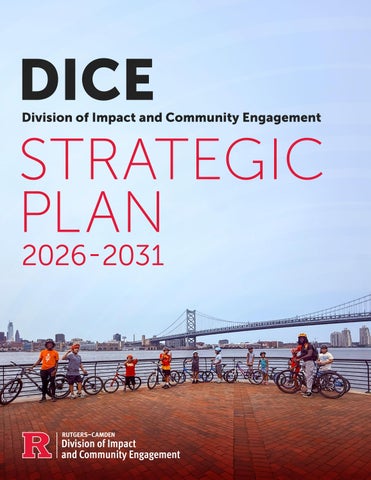
DICE STRATEGIC PLAN Division of Impact and Community Engagement
2026-2031
1
Why Impact, Why Now? Higher education is being called to demonstrate not only the quality of the education it provides, but also the value it creates for society. As expectations evolve, universities are increasingly challenged to show how they expand opportunity, strengthen communities, and contribute to the public good. For Rutgers University–Camden, this responsibility has always been central to who we are. As an anchor institution in the city of Camden, our success is deeply connected to the success of our students, our neighbors, and the South Jersey region. Our commitment to access, civic engagement, contributing to student success, and community partnership reflects a long-standing belief that universities can serve as powerful engines of opportunity and community transformation.
The Division of Impact and Community Engagement (DICE) exists to help advance that public mission. DICE brings together educational opportunity, civic and community engagement, campus culture, strategic partnerships, and institutional effectiveness into one integrated approach to creating meaningful impact. Rather than viewing these priorities as separate initiatives, we believe they are most powerful when intentionally connected.
This strategic plan reflects that belief.
2
DICE STRATEGIC PLAN 2026-2031
A Message from the Senior Vice Chancellor Organized around five interconnected strategic pillars, it provides a roadmap for expanding educational opportunity, cultivating civic leaders, strengthening campus culture, measuring impact, and building the organizational capacity necessary to sustain our work. Ultimately, this is more than a plan for one division. It is a commitment to advancing Rutgers–Camden’s public mission through purposeful collaboration, measurable outcomes, and relationships that strengthen both our university and the communities we serve. As Senior Vice Chancellor, I believe that the future of higher education depends not only on what universities know, but on how intentionally they connect knowledge, people, and communities in service of the public good. Throughout my career at Rutgers–Camden, I have had the privilege of working alongside students, faculty, staff, community leaders, and partners who have demonstrated that lasting change is rarely the result of a single program or initiative. Instead, it is created through trust, collaboration, and a shared commitment to improving lives. That belief has shaped both my leadership and the evolution of the Division of Impact and Community Engagement.
Our five strategic pillars bring this philosophy to life. Together, they provide a framework for expanding educational opportunities, preparing civic leaders, fostering a thriving campus culture, learning through impact, and building the organizational capacity needed to sustain this work. While this document establishes a strategic direction, its success ultimately depends on people. I am grateful to the faculty, staff, students, community partners, alumni, university leaders, and the DICE staff whose commitment and collaboration continue to shape DICE and Rutgers–Camden.
I believe our greatest impact still lies ahead. Together, we will continue expanding opportunity, strengthening communities, and advancing Rutgers– Camden’s public mission — one relationship at a time.
At the heart of this strategic plan is a philosophy we call:
Relational Impact. Relational Impact reflects our belief that sustainable change is built through authentic relationships — relationships that expand opportunity, strengthen communities, deepen learning, and inspire civic responsibility. They connect Camden students to higher education, faculty to community-engaged scholarship, staff to institutional collaboration, and our university to the communities we are privileged to serve.
Nyeema C. Watson, Ph.D. Senior Vice Chancellor, Institutional Strategy and Engagement Division of Impact and Community Engagement Rutgers University–Camden
3
About DICE
Relational Impact The Division of Impact and Community Engagement is built upon one fundamental belief: Lasting impact is created through meaningful relationships. We call this philosophy Relational Impact. Relational Impact recognizes that sustainable change happens when universities intentionally invest in relationships that are rooted in trust, reciprocity, shared purpose, and a commitment to continuous learning. Rather than measuring success solely by programs delivered or services provided, we seek to understand how relationships create opportunities, strengthen communities, and improve lives.
This philosophy shapes every aspect of DICE’s work. It guides how we expand pathways to higher education, cultivate civic leaders, foster belonging and well-being, strengthen community partnerships, and use evidence to continuously improve our work. It also challenges us to collaborate across disciplines, divisions, and communities because the most significant challenges — and opportunities — cannot be addressed in isolation. Our five strategic pillars are expressions of Relational Impact. Together they create an integrated approach that advances student success, institutional excellence, and community well-being while fulfilling Rutgers–Camden’s public mission.
Mission The Division of Impact and Community Engagement advances Rutgers–Camden’s public mission by expanding pathways to higher education, integrating civic and community engagement across the institution, fostering an engaged campus climate, protecting equal opportunity, and strengthening mutual partnerships with the communities it serves. Through coordination, collaboration, and advocacy, DICE aligns access and engagement across the Rutgers–Camden experience to drive campus engagement, and institutional impact.
Vision DICE aligns access, engagement, partnerships, and external affairs to advance Rutgers–Camden’s public mission and impact. Through this work, Rutgers–Camden will be recognized as a national exemplar of impact-driven higher education and a trusted anchor institution that expands opportunity, strengthens communities, and prepares students to lead and serve.
4
DICE STRATEGIC PLAN 2026-2031
Our Strategic Framework
From Philosophy to Practice The philosophy of Relational Impact comes to life through five interconnected strategic pillars. Together, they provide a comprehensive framework for advancing Rutgers–Camden’s public mission by expanding opportunity, strengthening community, and building institutional capacity for long-term impact. Each pillar addresses a distinct area of focus, yet none operates independently. Progress in one strengthens the others, creating an integrated approach to student success, community engagement, organizational excellence, and public impact.
O U R F I V E STR ATEGI C P I L L ARS 1 Expanding Opportunity for Camden Youth
4 Measuring Impact Building a culture of learning and continuous
Expanding educational opportunity by creating
improvement that uses evidence, storytelling, and
coordinated pathways that enable Camden youth and
shared accountability to demonstrate and strengthen
other historically underserved students to successfully
DICE’s impact across the university and community.
access, navigate, and complete higher education.
2 Developing Civic Impact Leaders
5 Building Organizational Excellence
Preparing students to become informed, engaged, and
Developing the systems, people, resources, and
responsible civic leaders through meaningful community-
organizational capacity necessary to sustain DICE’s
engaged learning, democratic participation, leadership
work and position the division for long-term
development, and public problem-solving.
institutional leadership and public impact.
3 Cultivating Connection Cultivating a campus environment where students, faculty, and staff experience belonging, well-being, meaningful relationships, and opportunities to flourish personally and professionally.
5
STRATEGIC PILL AR 1 Expanding Opportunity for Camden Youth OUR COMMITMENT Educational opportunity changes lives. As Camden’s anchor institution, we believe our responsibility begins with the city we call home. Every young person in Camden should have a clear pathway to higher education and the opportunity to achieve their full potential. Expanding access is about more than enrollment — it is about strengthening families, creating economic mobility, and investing in the future of Camden. Through Relational Impact, DICE works alongside students, families, schools, community organizations, and university partners to remove barriers, expand opportunity, and ensure more Camden students choose — and thrive — at Rutgers–Camden.
VISION DICE will strengthen Rutgers–Camden’s Camden First commitment by creating an integrated college access ecosystem that connects K–12 students, families, schools, community organizations, and the university. Through coordinated partnerships and comprehensive supports, Camden students will experience a seamless pathway to higher education that increases college access, enrollment, persistence, and success.
6
DICE STRATEGIC PLAN 2026-2031
REL ATIONAL IMPACT IN ACTION The Camden College Access Network (CCAN) Relational Impact is best demonstrated through partnerships that bring organizations together around a shared purpose. The Camden College Access Network (CCAN) exemplifies this approach. Convened by Rutgers–Camden, CCAN brings together K–12 educators, college
STRATEGIC PRIORITIES Over the next five years, DICE will focus on three strategic priorities. 1. Strengthen College Access Ecosystem Coordinate recruitment, outreach, and student support efforts across Rutgers–Camden and community partners to create a unified approach to college access.
2. Expand College Access Programming Expand comprehensive college readiness programming that supports students and families from middle school through enrollment at Rutgers–Camden.
3. Re-invigorate the Camden College Access Network Deepen strategic partnerships with Camden City School District, youth-serving organizations, and community leaders while reestablishing CCAN as Camden’s collaborative backbone for postsecondary success.
access professionals, nonprofit organizations, and university partners to strengthen educational pathways for Camden students. Rather than working independently, CCAN creates opportunities for organizations to share knowledge, coordinate services, identify gaps, and align strategies that increase college enrollment and student success. By serving as the convener of this citywide network, Rutgers– Camden strengthens the collective capacity of Camden’s educational community while reinforcing its role as the city’s university. CCAN reflects DICE’s belief that the most meaningful impact occurs when relationships become the foundation for collective action.
7
STRATEGIC PRIORIT Y ONE Strengthen College Access Ecosystem Purpose DICE will work in partnership with Enrollment Management, Student Academic Success, and other campus stakeholders to develop a coordinated recruitment strategy for Camden students and families.
Desired Outcomes • S tronger collaboration among university enrollment partners • I mproved college advising and application support • I ncreased Rutgers–Camden applications and enrollment from Camden high schools • A coordinated, student-centered recruitment process
Measures of Success • Y ear-over-year increase in Rutgers–Camden applications from Camden students • Annual shared recruitment calendar • Coordinated referral and communication system • Improved student and staff satisfaction with the admissions process
STRATEGIC PRIORIT Y TWO Expand College Access Programming Purpose Provide comprehensive, relationship-centered support that prepares Camden students and their families to successfully navigate the transition from high school to college.
Desired Outcomes • I ncreased FAFSA completion and college application submission • Greater student confidence navigating the admissions process • Increased family engagement in college planning • Higher enrollment and persistence among DICE participants
Measures of Success • FAFSA completion rates • College application completion rates • Participation in advising and college readiness workshops • National Student Clearinghouse enrollment and persistence data
8
DICE STRATEGIC PLAN 2026-2031
STRATEGIC PRIORIT Y THREE Re-invigorate the Camden College Access Network Purpose Re-establish CCAN as Camden’s collaborative network for advancing college access through shared leadership, coordinated programming, professional development, and data-informed decision making.
Desired Outcomes • R utgers–Camden serves as the regional convener for college access • Stronger collaboration among schools, nonprofit organizations, and higher education institutions • Shared accountability for improving postsecondary access • Increased visibility of Camden’s college-going efforts and successes
Measures of Success • Annual CCAN Summit hosted at Rutgers–Camden • Regular convenings of college access professionals • Annual Camden College Access Report • Growth in active partner participation
PILL AR ONE DASHBOARD KEY OUTCOMES
KEY INDICATORS
• C amden students experience a stronger sense of belonging at Rutgers–Camden
• Applications, admissions, enrollment, and persistence data
• M ore Camden students apply, enroll, and persist in higher education
• FAFSA completion
• S tronger collaboration among university and community partners
• Camden school partnership engagement
• I ncreased educational aspirations and college-going success
• Student belonging survey results
• College readiness participation
• National Student Clearinghouse outcomes
9
STRATEGIC PILL AR 2 Developing Civic Impact Leaders OUR COMMITMENT Higher education has a responsibility to prepare graduates not only for successful careers, but also for meaningful lives of purpose, service, and leadership. At Rutgers–Camden, civic learning is more than volunteerism or community service. It is a developmental journey that equips students with the knowledge, skills, relationships, and experiences needed to lead, collaborate, solve complex problems, and strengthen the communities they will serve throughout their lives. Through Relational Impact, DICE prepares students to become thoughtful citizens, engaged leaders, and communityminded professionals who understand that leadership begins with listening, partnership, and a commitment to the public good.
VISION DICE will establish Rutgers–Camden as a national leader in Civic Impact Leadership by creating an integrated civic learning pathway that prepares every student to engage meaningfully with communities, contribute to democracy, and graduate with the knowledge, skills, and experiences necessary to lead positive social change.
10
DICE STRATEGIC PLAN 2026-2031
REL ATIONAL IMPACT IN ACTION Every Student. Every Degree.
STRATEGIC PRIORITIES Over the next five years, DICE will focus on five strategic priorities. 1. Create a University-Wide Civic Learning Pathway Develop a scaffolded framework that intentionally integrates civic and community-engaged learning throughout students’ academic and co-curricular experiences.
2. Expand Civic Living and Learning Develop a Civic Impact Leadership Living-Learning Community that strengthens student leadership, community engagement, and peer learning.
3. Strengthen Democratic Engagement Increase opportunities for civic dialogue, voter engagement, public deliberation, and democratic participation that prepare students to become informed and engaged citizens.
4. Build Civic Learning Across the DICE Pipeline Integrate evidence-based civic education into youth programs, leadership initiatives, and community engagement experiences that serve students from middle school through graduation.
5. Advance Community-Engaged Scholarship Support faculty and community partners in developing engaged teaching, research, and scholarship that connects academic learning with community impact.
Relational Impact is realized when civic learning becomes part of every student’s educational journey— not as an isolated experience, but as an intentional pathway woven throughout the Rutgers–Camden experience. Through the “Every Student. Every Degree.” framework, DICE is working to ensure that every Rutgers– Camden student has opportunities to engage in community-based learning, civic dialogue, democratic participation, and public problemsolving regardless of major or career aspirations. By connecting classroom learning with community experience, students deepen their understanding of complex social issues while developing the leadership, communication, and collaborative skills that prepare them to make meaningful contributions throughout their lives. This initiative reflects DICE’s belief that civic leadership is not reserved for a select group of students — it is an essential outcome of a Rutgers– Camden education.
11
STRATEGIC PRIORIT Y ONE Create a University-Wide Civic Learning Pathway Purpose Develop a comprehensive framework that integrates civic learning throughout the Rutgers–Camden student experience, creating intentional opportunities for every student to build civic knowledge, leadership capacity, and community engagement.
Desired Outcomes • C ivic learning becomes an identifiable component of the Rutgers–Camden experience • Increased participation in community-engaged learning • Growth in students’ civic identity, leadership skills, and sense of social responsibility • Increased completion of the Certificate in Civic Engagement and Social Change
Measures of Success • P articipation in civic learning experiences • Certificate completion rates • Civic identity assessment results • Student leadership participation • Community partner feedback
STRATEGIC PRIORIT Y TWO Expand Civic Living and Learning Purpose Create a Living-Learning Community (LLC) that connects residential life, civic engagement, leadership development, and community partnerships.
Desired Outcomes • I ncreased student belonging • Greater civic engagement among residential students • Signature partnerships with community organizations • Increased student leadership participation
Measures of Success • LLC enrollment • Student engagement surveys • Leadership participation • Community partnership activities • Growth in active partner participation 12
DICE STRATEGIC PLAN 2026-2031
STRATEGIC PRIORIT Y THREE Strengthen Democratic Engagement Purpose Provide students with meaningful opportunities to understand democratic institutions, engage in public dialogue, and participate in civic life.
Desired Outcomes • I ncreased civic knowledge • Greater voter participation • Increased confidence engaging across differences • Stronger civic agency
Measures of Success • Student voter registration and turnout • Participation in civic dialogue programs • Civic knowledge assessments • Student reflections
STRATEGIC PRIORIT Y FOUR Build Civic Learning Across the DICE Pipeline Purpose Integrate civic learning throughout DICE’s youth development and leadership programs, creating a continuous pathway from middle school through college.
Desired Outcomes • C ivic learning embedded across DICE programs • Increased civic identity among pipeline students • Greater leadership confidence • Stronger college-to-community connections
Measures of Success • Youth civic learning participation • Leadership assessments • Civic identity measures • Program completion
13
STRATEGIC PRIORIT Y FIVE Advance Community-Engaged Scholarship Purpose Support faculty and community partners in developing engaged teaching, scholarship, and research that enriches student learning while addressing community priorities.
Desired Outcomes • I ncreased community-engaged courses • Expanded faculty-community partnerships • Growth in engaged scholarship • Greater student participation in community-based research
Measures of Success • Community-engaged learning courses • Faculty participation • Publications and presentations • Community partner satisfaction
PILL AR TWO DASHBOARD
14
KEY OUTCOMES
KEY INDICATORS
• S tudents develop strong civic identities
• Civic identity assessments
• S tudents demonstrate civic leadership and democratic engagement
• Community-engaged learning participation
• F aculty expand community-engaged teaching and scholarship
• Student voter engagement
• R utgers–Camden is recognized as a leader in Civic Impact Leadership
• NACE Career Readiness Competencies
DICE STRATEGIC PLAN 2026-2031
• Certificate completion
• AAC&U VALUE Rubrics
• Faculty scholarship and community partnerships
STRATEGIC PILL AR 3 Cultivating Connection OUR COMMITMENT A university is more than a place of learning — it is a community of relationships. Students, faculty, and staff thrive when they feel connected, valued, and supported. Meaningful relationships foster belonging, strengthen well-being, encourage collaboration, and create the conditions where individuals can learn, lead, and flourish. Through Relational Impact, DICE is committed to cultivating a campus culture where every member of the Rutgers– Camden community experiences authentic connection, shared purpose, and opportunities to grow.
VISION DICE will cultivate a campus culture where belonging, well-being, and engagement are intentionally woven into the Rutgers–Camden experience. Through relationship-centered programming, collaborative partnerships, and a culture of care, Rutgers–Camden will be recognized as a place where students, faculty, and staff flourish academically, professionally, and personally.
15
REL ATIONAL IMPACT IN ACTION The Bridge: A Hub for Connection and Community Relational Impact comes to life when spaces are intentionally designed to build meaningful relationships.
STRATEGIC PRIORITIES Over the next five years, DICE will focus on four strategic priorities. 1. Advance a Campus-Wide Engagement and WellBeing Strategy Develop and implement a comprehensive framework that promotes well-being, flourishing, and engagement for faculty, staff, and students.
2. Strengthen Relationship-Centered Student Engagement Expand programs and experiences that foster belonging, leadership, connection, and personal development throughout the student journey.
3. Foster a Culture of Flourishing Create opportunities for faculty and staff to strengthen workplace well-being, psychological safety, collaboration, and professional growth.
4. Build a Connected Campus Community Increase collaboration across divisions, departments, and community partners to create a more integrated and relationshipcentered campus experience.
16
DICE STRATEGIC PLAN 2026-2031
The Bridge serves as more than a student gathering space — it is a relationship-centered hub where students connect with peers, faculty, staff, mentors, and campus resources. Through leadership development, community-building experiences, identity exploration, wellness programming, and intentional referrals, The Bridge helps students build the confidence, networks, and sense of belonging that support persistence and success. As DICE continues to evolve, The Bridge will remain a cornerstone of Rutgers–Camden’s campus engagement strategy, demonstrating how authentic relationships create stronger students, stronger communities, and a stronger university.
STRATEGIC PRIORIT Y ONE Advance a Campus-Wide Engagement and Well-Being Strategy Purpose Develop a coordinated framework that aligns student engagement, employee well-being, psychological safety, and organizational flourishing into one comprehensive campus strategy.
Desired Outcomes • I ncreased sense of belonging across campus • Greater employee engagement and well-being • Stronger culture of psychological safety • Shared understanding of flourishing at Rutgers–Camden
Measures of Success • Campus climate survey results • Employee engagement indicators • Participation in well-being initiatives • Psychological safety assessments
STRATEGIC PRIORIT Y TWO Strengthen Relationship-Centered Student Engagement Purpose Create meaningful opportunities for students to build relationships, develop leadership skills, and connect with the people and resources that support their success.
Desired Outcomes • I ncreased student belonging • Greater participation in campus life • Improved confidence navigating academic and personal challenges • Stronger peer and mentor networks
Measures of Success • Student engagement survey data • Participation in The Bridge programs • Leadership involvement • Campus resource utilization
17
STRATEGIC PRIORIT Y THREE Foster a Culture of Flourishing Purpose Support faculty and staff through initiatives that strengthen well-being, professional development, collaboration, and workplace sustainability.
Desired Outcomes • I ncreased employee well-being • Stronger collegial relationships • Greater workplace satisfaction • Improved organizational resilience
Measures of Success • E mployee engagement survey results • Participation in Flourishing initiatives • Retention trends • Qualitative feedback
STRATEGIC PRIORIT Y FOUR Build a Connected Campus Community Purpose Create opportunities for students, faculty, staff, and community partners to engage across traditional boundaries, strengthening collaboration and institutional connection.
Desired Outcomes • I ncreased cross-campus collaboration • Greater participation in campus traditions and signature events • Stronger institutional identity • Increased awareness of campus resources and opportunities
Measures of Success • Cross-divisional partnerships • Participation in campus-wide initiatives • Co-sponsored programs • Community feedback
18
DICE STRATEGIC PLAN 2026-2031
PILL AR THREE DASHBOARD KEY OUTCOMES
KEY INDICATORS
• Students experience increased belonging and connection
• Student belonging surveys
• F aculty and staff report greater wellbeing and engagement • P sychological safety and collaboration increase across the institution • R utgers–Camden cultivates a thriving, relationship-centered campus culture
• Campus climate assessments • Employee engagement data • Psychological safety measures • Participation in The Bridge and Flourishing initiatives • Cross-campus collaboration metrics
19
STRATEGIC PILL AR 4 Measuring Impact OUR COMMITMENT Meaningful impact is measured not only by what we accomplish, but by what we learn. As a division committed to Relational Impact, DICE believes that assessment is more than accountability — it is a tool for continuous learning, improvement, and responsible stewardship. By listening to students, faculty, staff, community partners, and one another, we strengthen our ability to make informed decisions, demonstrate our value, and continuously improve our work.
Our commitment is to build a culture where evidence and relationships work together to advance meaningful and measurable impact.
VISION DICE will cultivate a division-wide culture of learning by integrating assessment, storytelling, and continuous improvement into every aspect of our work. Through thoughtful measurement and shared learning, we will demonstrate our impact, strengthen decision-making, and position Rutgers–Camden as a national leader in evidence-informed community engagement.
20
DICE STRATEGIC PLAN 2026-2031
REL ATIONAL IMPACT IN ACTION The DICE Annual Impact Report Relational Impact is most meaningful when the stories we tell are supported by the evidence we gather.
STRATEGIC PRIORITIES Over the next five years, DICE will focus on four strategic priorities. 1. Build a Division-Wide Learning and Assessment Framework Develop a comprehensive approach to measuring outcomes, evaluating programs, and supporting continuous improvement across every DICE unit.
2. Strengthen Data-Informed Decision Making Build staff capacity to collect, interpret, and apply data in ways that improve programs, strengthen partnerships, and guide strategic decisions.
The DICE Annual Impact Report will serve as the division’s signature vehicle for demonstrating public impact. By integrating quantitative data with the lived experiences of students, faculty, staff, and community partners, the report will communicate not only what DICE accomplished, but how relationships created measurable change. More than a reporting tool, the Annual Impact Report will strengthen transparency, celebrate success, inform strategic decisions, and reinforce a culture of continuous learning across the division.
3. Elevate Strategic Communications and Impact Storytelling Integrate evidence and storytelling to communicate DICE’s impact to students, community partners, university leadership, funders, and external audiences.
4. Position DICE as a Thought Leader Share lessons learned through publications, conference presentations, and collaborative partnerships that contribute to the national conversation on public impact in higher education.
21
STRATEGIC PRIORIT Y ONE Build a Division-Wide Learning and Assessment Framework Purpose Develop shared outcomes, indicators, assessment tools, and reporting systems that create consistency while supporting continuous learning across the division.
Desired Outcomes • S hared assessment framework across DICE • Clear outcomes and indicators for every initiative • Increased confidence using data for planning and decision-making • Consistent reporting across all units
Measures of Success • D ivision-wide assessment framework implemented • Annual outcome reporting completed • Staff confidence in data use • Completion of annual assessment cycles
STRATEGIC PRIORIT Y TWO Strengthen Data-Informed Decision Making Purpose Equip staff with the systems, tools, and professional development necessary to use evidence in ways that strengthen programs and improve outcomes.
Desired Outcomes • I ncreased staff capacity • Higher quality data • More timely reporting • Stronger program improvement
Measures of Success • Staff participation in assessment training • Reduction in missing or inconsistent data • Increased use of data in planning • Timely reporting across all units
22
DICE STRATEGIC PLAN 2026-2031
STRATEGIC PRIORIT Y THREE Elevate Strategic Communications and Impact Storytelling Purpose Communicate DICE’s impact through compelling stories supported by meaningful evidence that demonstrate value to internal and external audiences.
Desired Outcomes • S tronger institutional visibility • Increased stakeholder understanding of DICE’s work • Greater external funding opportunities • Enhanced reputation for public impact
Measures of Success • A nnual Impact Report published • Impact briefs and dashboards produced • Growth in external communications • Increased grant funding and stakeholder engagement
STRATEGIC PRIORIT Y FOUR Position DICE as a Thought Leader Purpose Share DICE’s work nationally through scholarship, presentations, partnerships, and collaborative learning that advances the field of public engagement in higher education.
Desired Outcomes • I ncreased national visibility • Expanded conference presentations • Growth in publications and collaborative scholarship • Recognition as an innovator in public impact
Measures of Success • Conference presentations • Publications and reports • National partnerships • Awards and external recognition
23
PILL AR FOUR DASHBOARD KEY OUTCOMES
KEY INDICATORS
• DICE demonstrates measurable institutional and community impact
• Annual Impact Report
• S taff consistently use evidence to strengthen programs • S takeholders clearly understand DICE’s value • R utgers–Camden is recognized nationally for impact-driven practice
24
DICE STRATEGIC PLAN 2026-2031
• Division dashboard • Staff assessment capacity • External funding growth • Publications and presentations • Stakeholder engagement and communications metrics
STRATEGIC PILL AR 5 Building Organizational Excellence OUR COMMITMENT Meaningful impact requires more than vision — it requires the organizational capacity to sustain it. As DICE continues to grow, our ability to expand opportunity, strengthen communities, and advance Rutgers– Camden’s public mission depends upon strong leadership, effective systems, strategic investments, and a culture that supports collaboration, innovation, and continuous improvement. Through Relational Impact, we recognize that organizational excellence is not measured solely by operational efficiency. It is reflected in our ability to build an organization where people thrive, partnerships flourish, resources are stewarded responsibly, and the division is positioned to create lasting impact for years to come.
VISION DICE will be a high-performing, integrated division that aligns people, resources, operations, and strategy to maximize institutional and community impact. By investing in our people, strengthening organizational systems, and planning for long-term sustainability, DICE will build the capacity needed to fulfill Rutgers–Camden’s public mission for generations to come.
25
REL ATIONAL IMPACT IN ACTION Building One DICE Relational Impact begins within our own organization.
STRATEGIC PRIORITIES Over the next five years, DICE will focus on four strategic priorities. 1. Build an Integrated Division Strengthen collaboration, shared planning, and operational alignment across DICE to create a coordinated and efficient organization.
2. Invest in People and Leadership Develop the knowledge, skills, and leadership capacity of DICE employees while fostering a culture of well-being, accountability, and continuous professional growth.
3. Strengthen Financial Sustainability Align budgeting, fundraising, and resource development with DICE’s strategic priorities to ensure long-term organizational resilience.
4. Foster a Culture of Continuous Improvement Create organizational systems that encourage innovation, shared learning, thoughtful planning, and continuous refinement of programs and operations.
26
DICE STRATEGIC PLAN 2026-2031
Over the past several years, DICE has intentionally evolved from a collection of individual departments into an integrated division united by a shared mission, common values, and a collective commitment to public impact. Organizational redesign, cross-functional collaboration, shared planning, and intentional leadership development have strengthened the division’s ability to work as one team rather than as independent units. Building One DICE reflects our belief that organizational excellence is achieved when relationships among colleagues are as intentional as the relationships we cultivate throughout our community.
STRATEGIC PRIORIT Y ONE Build an Integrated Division Purpose Strengthen collaboration, communication, and operational alignment across DICE to ensure the division functions as one integrated organization.
Desired Outcomes • G reater cross-unit collaboration • Shared ownership of divisional priorities • Increased operational consistency • Improved coordination across initiatives
Measures of Success • C ross-functional projects and workgroups • Staff collaboration survey results • Standardized operational practices • Timely completion of divisional priorities
STRATEGIC PRIORIT Y TWO Invest in People and Leadership Purpose Support staff through intentional leadership development, coaching, supervision, and professional growth while fostering a culture of trust, accountability, and well-being.
Desired Outcomes • I ncreased employee engagement • Greater leadership capacity • Improved role clarity • Higher staff retention
Measures of Success • Employee engagement survey results • Professional development participation • Staff retention • Annual performance and goal-setting completion
27
STRATEGIC PRIORIT Y THREE Strengthen Financial Sustainability Purpose Develop a long-term financial strategy that aligns institutional resources, external funding, and philanthropic investment with DICE’s strategic priorities.
Desired Outcomes • I ncreased financial sustainability • Expanded external funding • Stronger resource alignment • Greater organizational resilience
Measures of Success • G rowth in grant and philanthropic funding • Multi-year funding commitments • Strategic budget alignment • Annual financial sustainability review
STRATEGIC PRIORIT Y FOUR Foster a Culture of Continuous Improvement Purpose Build organizational practices that encourage innovation, shared learning, strategic planning, and continuous refinement across the division.
Desired Outcomes • I ncreased organizational learning • Greater innovation • Improved strategic alignment • Enhanced organizational effectiveness
Measures of Success • Annual strategic plan progress review • Completion of division-wide improvement initiatives • Staff participation in planning and innovation activities • Continuous improvement recommendations implemented
28
DICE STRATEGIC PLAN 2026-2031
PILL AR FIVE DASHBOARD KEY OUTCOMES
KEY INDICATORS
• DICE operates as one integrated division
• Employee engagement and retention
• S taff are engaged, supported, and prepared to lead
• Professional development participation
• F inancial resources are aligned with strategic priorities • T he division is positioned for long-term sustainability and growth
• Cross-functional collaboration • External funding growth • Strategic budget alignment • Annual implementation and progress reviews
29
OUR COMMITMENT TO
IMPACT The Division of Impact and Community Engagement was created from a simple belief: Lasting impact is created through meaningful relationships. This strategic plan reflects our commitment to putting that belief into practice every day. Through Relational Impact, we will continue expanding opportunity, preparing civic leaders, cultivating connection, learning from evidence, and building the organizational capacity needed to sustain our work for generations to come. Together, these five strategic pillars represent more than a roadmap for one division. They reflect Rutgers– Camden’s enduring commitment to its public mission and our shared responsibility to strengthen the communities we serve. This plan is not the conclusion of our work — it is the beginning of our next chapter. As we move forward, we will continue listening, learning, partnering, and leading with purpose, knowing that our greatest impact will always be measured not only by what we accomplish, but by the relationships we build and the lives we help transform.
Together, we will continue expanding opportunity, strengthening communities, and advancing impact.
30
DICE STRATEGIC PLAN 2026-2031
DICE
Division of Impact and Community Engagement 121 Market Street, Camden, NJ 08102 (856) 225-7060 camden.rutgers.edu/dice ruc-dice@camden.rutgers.edu @ruc_dice
31