20
40
60
80
100
20
40
60
80
100
20
40
60
80
100
20
40
60
80
100
100
100
100
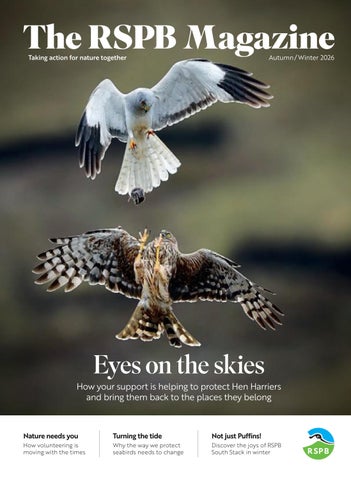
The RSPB Magazine
Taking action for nature together
Autumn / Winter 2026
Eyes on the skies
How your support is helping to protect Hen Harriers and bring them back to the places they belong
Autumn/ Winter 2026
Nature needs you
Turning the tide
Not just Puffins!
How volunteering is moving with the times
Why the way we protect seabirds needs to change
Discover the joys of RSPB South Stack in winter
TRM_247_p1_coverF1.pgs 03.09.2026 17:08
20
40
60
80
100
20
40
60
80
100
20
40
60
80
100
20
40
60
80
100
100
100
100
AD_TRM_247_p2_adV1.pgs 03.09.2026 09:28
20
40
60
80
100
20
40
60
The team The RSPB
Head of Supporter Communications Luke Phillips Supporter Communications Manager and Editor Jamie Wyver
Our Media
Content Lead Carey Davies Senior Visual Creative Nick Cox Art Editor Kit Cheung Production Editor Emily Freer Head of Client Services Ellen Wade Account Manager Jessica Pratten Advertising Di Marsh Thank you to our advertisers for helping cover the costs of this magazine, saving more money for nature. To advertise, email Di.Marsh@ourmedia.co.uk
Contact us Magazine
RSPBmagazine@rspb.org.uk (photos max 3MB each, no watermarks) The RSPB Magazine, The Lodge, Sandy, Bedfordshire SG19 2DL
Membership enquiries
01767 693680 membership@rspb.org.uk
Wildlife enquiries
01767 693690 wildlife@rspb.org.uk
Terms & conditions Advertisements in The RSPB Magazine are accepted on the understanding that they conform to the British Code of Advertising Practice. Adverts are not endorsed by the RSPB, unless otherwise stated. The RSPB Magazine is available on CD for visually impaired members. Call 01767 693680 for information. Views expressed by contributors are not necessarily those of the RSPB. While every effort is taken to ensure accuracy, we cannot accept liability for errors or omissions.
80
100
20
40
60
80
100
20
40
60
80
100
100
100
100
Welcome This issue of The RSPB Magazine is brimming with autumnal wildlife wonders, including fabulous fungi and surprise garden visitors. We’ve got inspiration for magical days (and dusks) out on RSPB nature reserves (p14), as well as a trip to South Stack (p52) to meet cave-nesting Choughs. Closer to home, the change of seasons will soon mean a change of menu for garden birds. As part of our new birdfeeding guidance we’re helping you prepare to bring seeds and nuts back to your feeders in November. See p68 for plenty of tips on helping your local birdlife stay disease-free. Elsewhere in the magazine, RSPB Marine Policy Officer Caitlin Turner explains what’s needed to save our seabird populations, from Puffins at RSPB Dunnet Head to Manx Shearwaters on Lundy (p29). RSPB Senior Investigations Officer Will Hayward tells us how satellite tagging to help protect Hen Harriers from persecution is also revealing fascinating new insights into their lives (p18). And we explore the work of some of the RSPB’s amazing 12,500 volunteers, whose roles include capturing videos, surveying rare insects and helping with lambing. One volunteer, Nigel Hewitt, has been helping for over 60 years! Find out what drives these dedicated individuals on p72. There’s great news for nature as the network of RSPB nature reserves grows, with Bass Rock, Craigleith, Gallt-ybere, Inishcreenry and Stuckindroin joining the charity’s list of wildlife havens (p38). As ever, we couldn’t do all this without the support you give us. So, on behalf of the Black Grouse, Curlews, Gannets, Golden Eagles, Puffins, Wood Warblers and all the other wildlife that will benefit as a result of these new RSPB reserves – thank you!
Circulation 520,642 Jan–Dec 2025 (ABC); The RSPB has 1,163,600 members. Registered charity in England & Wales 207076, in Scotland SC037654. Member of BirdLife International. Designed, edited and published by Our Media Limited. Printed by William Gibbons. Our Media Company is working to ensure that all of its paper comes from well-managed, FSC®-certified forests and other controlled sources. This magazine is printed on Forest Stewardship Council® (FSC®) certified paper. This magazine can be recycled, for use in newspapers and packaging.
Jamie Wyver Editor
Protecting habitats, saving species and helping to end the nature and climate emergency.
3
TRM_247_p3_welcomeF1.pgs 03.09.2026 17:13
20
40
60
80
100
20
40
60
80
100
20
40
60
80
100
20
40
60
80
100
100
100
100
See the clarity. Feel the focus.
Get closer to nature
Put RSPB Optics to the test this season Binocular & Telescope Demo Weekends 10-11 October | 27-29 November Visit a participating RSPB nature reserve to try our full optics range in the wild, including the Skylark® 8x42 binocular – rated Which? Great Value. Plus, you’ll get expert advice and enjoy double loyalty points with every purchase.
Scan to find your nearest event.
events.rspb.org.uk/binoculars The RSPB is a registered charity in England and Wales 207076, in Scotland SC037654. Image by Simon McCabe. 13150 - 25-26
AD_TRM_247_p4_adV1.pgs 03.09.2026 09:57
20
40
60
80
100
20
40
60
80
100
20
40
60
80
100
20
40
60
80
100
100
100
100
Comment
Beccy Speight
Stronger nature, safer future Beccy Speight has been the RSPB’s Chief Executive since 2019 and has led the organisation through some of nature’s most urgent challenges.
This summer we really felt the effects of the climate crisis across the UK. As I write this, we’ll have probably just experienced our warmest summer on record. Parts of the UK are also thought to have had some of the driest summer periods on record. Unfortunately this provided the optimal conditions for exceptionally large, destructive wildfires. Predominantly sparked by people, these fires took hold easily and spread quickly in these unprecedented conditions. I’m incredibly grateful to our nature reserve teams who have worked so hard in tackling blazes on the reserves they look after. It’s stressful, exhausting, physically demanding work, made all the more distressing as our teams witness the destruction of habitat they have often spent years or even decades improving for rare birds and other wildlife. We’re also very thankful for the fire and rescue services, and the local land managers and communities and other partners who all pitched in to help when we needed them most. At RSPB Minsmere in Suffolk, a wildfire decimated the reserve’s largest area of heathland alongside National Trust-managed Dunwich Heath. Luckily, rare birds including Dartford Warblers, Nightjars and Woodlarks should have fledged their young by the time the fire started. The challenge we face now is the loss of the habitat they all need in the future. It will take decades to recover. RSPB Dove Stone in the Peak District has suffered two wildfires, with the first beginning in June, and coinciding with a critical time for ground-nesting birds. Here, as well as the loss of wildlife and habitat, wildfires on peatland
‘When we invest in nature, we also help increase resilience in our changing climate’
contribute to a longer-term challenge. When damaged and dried out, peat can carry on ‘hot spotting’ for weeks and releases a great deal of carbon into the atmosphere, contributing to the climate crisis. However, where the blanket bog had been restored to health, there is emerging photographic evidence that the rewetted landscape did not burn. There was significant damage to RSPB Abernethy in the Cairngorms too, where a vast wildfire burned for several weeks. If you’ve visited Abernethy, or read the feature about the nature reserve in the previous issue of The RSPB Magazine, you’ll know how important it is for a huge range of rare species. Among the devastation caused by the fires, there have been so many hopeful and positive stories of neighbours lending a hand. At Abernethy, the local community brought up rounds of sandwiches and ready-cooked meals to sustain the team of 130 RSPB staff and volunteers, along with firefighters and other land managers, fighting the fire. In County Fermanagh, firefighters working with PeacePlus Nature staff from the RSPB and the Sliabh Beagh Curlew Conservation Trust managed to rescue a brood of Curlew chicks. As we assess the damage to RSPB nature reserves and the other important areas we work in, we also need to continue preparing for the future. The climate crisis means that we can probably expect an increased likelihood of wildfires each summer. While it’s not possible to completely prevent these from happening, we can reduce the risk by addressing the root causes of climate change, preventing ignition, adequately resourcing our fire and rescue services around wildfire risk and ensuring we have healthier, wetter, more resilient landscapes. That includes rewetted peatlands and restored wetlands. It struck me that at Minsmere, fire crews described the reserve’s wetlands as a ‘natural firebreak’, which shows how vital these areas can be during hot, dry weather. When we invest in nature, we also help increase the country’s resilience in our changing climate. 5
TRM_247_p5_columnbeccyF1.pgs 03.09.2026 17:10
20
40
60
80
100
20
40
60
80
100
20
40
60
80
100
20
40
60
80
100
100
Easy Movement, Whatever the Weather D Highly absorbable turmeric formulation to support joint comfort
100
100
Try it now
with code
'L ĉĆ
D Added vitamins C & D to support
healthy bones, muscles and joints
D 87% of users noticed benefits within 8 weeks of daily use+
30% OFF
YOUR FIRST ORDER Subscribe to Turmeric Gold+ for just £16.24 (normally £29), change or cancel anytime. Prefer to try it once? £20.30 to get started.
FutureYouHealth.com or freephone
0800 808 5740 quoting code
'L 30 +Based on a 2025 survey of Turmeric+ Gold customers (23) Turmeric+ Gold contains vitamin C which contributes to normal collagen formation for the normal function of cartilage and bones. Vitamin D contributes to the maintenance of normal muscle function. Introductory offer valid for new UK customers only. 30% off one time purchase or subscription applies to new customers only. Subscription order reverts to 20% off thereafter (delivered every 28 days). Offer expires 31st December 2026 and cannot be used in conjunction with any other promotions. Cancel any time, without obligation. See FutureYouHealth.com/ 'L 30 for full terms and conditions.
Science-backed. Developed in Cambridge, UK.
Rated EXCELLENT with over 18,000 reviews
AD_TRM_247_p6_adV1.pgs 03.09.2026 09:42
20
40
60
80
100
20
40
60
80
100
20
40
60
80
100
20
40
60
80
100
100
100
100
52
29
RSPB Dunnet Head is a nationally significant site for seabirds and other wildlife
72
Contents Photos: John Bracegirdle (Alamy Stock Photo); RSPB/Annabel Sharpe; Katie Shepherd
This season
Features
10 How to: find and photograph fungi 11 Nature notes: uplifting results from the Heathland Bird Survey 12 ID challenge: birds that may visit your garden this winter and how you can help them 13 Species focus: learn about the UK’s smallest bird, the Goldcrest 14 Days out in nature: embrace all nature has to offer this season 16 Designed by nature: the importance of translocations in conservation
18 Wildlife: how the RSPB is helping the UK’s most intensely persecuted bird of prey, the Hen Harrier 29 Bigger picture: seabirds need protected areas 52 Our places: a wild day out with charismatic corvids and Razorbills at RSPB South Stack 72 Our work: meet some of our volunteers who give their time, passion and knowledge to help nature 76 Bird-feeding update: seeds and peanuts are back on the menu from 1 November
Comment
Together for nature
05 Beccy Speight: Wildfires on RSPB reserves 25 Simon Barnes: Leaving a legacy 78 David Lindo: Our night skies are brighter than ever, and it’s taking a toll on wildlife
Action for nature
38 Places: The RSPB’s new land acquisitions mean more space for nature to thrive 39 Places: A new Accessible Trail brings wild wonders to more people 45 Species: The legacy of the Major Oak
59 Your stories: fresh design – the family team behind Finches Friend feeders 60 Your say: “The joys, trials and tribulations of everyday life were non-existent for a while” 61 Crossword: test your wildlife knowledge 62 Your photos: chunky bills and a plover down under! 64 Your gardens: How Andrew transformed his bare new-build garden into a wild oasis 68 Your questions: the RSPB’s Wildlife Enquiries team answer your bird-feeding questions
On the cover
Learn more about the fascinating lives and behaviours of Hen Harriers on page 18. Photo: Dean Eades Wildlife Photography
7
TRM_247_p7_contentsF1.pgs 03.09.2026 17:17
20
40
60
80
100
20
40
60
80
100
20
40
60
80
100
20
40
60
80
100
100
100
100
This season n
What to see in nature | Great days out | Ways to help wildlife
Species
Wigeon As the cooler, fresher winds of autumn sweep in, chasing away the last embers of summer, thousands of Wigeon arrive in large flocks. On crisp winter days, they can be seen whirling overhead, their white bellies a ripple of silver in the sunlight. These new arrivals join much smaller numbers of resident breeding pairs to find refuge dabbling in the water and grazing among the gently sloping edges of wet grasslands, reedbeds and floodplains. Here, they feed on aquatic plants, roots and grasses. The male Wigeon’s pastel colours, reminiscent of muted sunsets, combine a pink breast, orange head and yellow forehead. These tones are matched by their counterparts’ earthy copper, not dissimilar to female Mallards but distinguishable by a more pointed tail. Though their name in early 17th-century slang once implied a fool, these birds are anything but. In fact, they’ve been known to save energy by waiting for other waterfowl to gather plant material from beneath the water, only to steal it from their beaks when they resurface. When it comes to their conservation, diversity of habitat is key. The teams at RSPB Otmoor, Rainham Marshes and beyond carefully manage wetland habitat to create an enticing patchwork of wet grassland and semi-permanent pools. The result is an exuberance of avian sounds and life, through which the Wigeon’s clear, piercing whistle cascades: ‘pjiew, pjiew!’
8
TRM_247_p8_thisseasonF1.pgs 08.09.2026 11:37
20
40
60
80
100
20
40
60
80
100
20
40
60
80
100
20
40
60
80
100
100
100
100
Switch to digital to hear the Wigeon’s whistling call
9
TRM_247_p9_thisseasonF1.pgs 08.09.2026 11:37
20
40
60
80
100
20
40
60
80
100
20
40
60
80
100
20
40
60
80
100
100
100
100
This season How to
Identify and photograph fungi Step into the magical world of mycology with tips from David Mitchell, author of A Brush with Fungi, and RSPB Photographer Ben Andrew. Autumn is a fantastic season to look for fungi. Explore woodlands, fields and grassy verges to see them springing up through the leaf litter and growing shelflike from trees and branches.
Essential ID tips and tools from author and artist David Mitchell: 1. All fungi release spores which are the
reproductive particles, and they can show up on the fungus. Bracket fungi are often found in layers, and the more mature ones, usually at the top, can release their spores which show up on the ones below. In fungi with caps, often the spores adhere to the stem and stem ring. Inkcaps are a good example of this. The spore colour can help with identification.
2. When you find a specimen, observe its characteristics: look closely at the different parts and make a note of what you see. Also note any trees nearby as some fungi are found with certain trees, for example Larch Bolete is only found by larch trees.
Capturing your fungi finds by photographer Ben Andrew: 1. Fungi come in all shapes, colours
3. Many fungus types consist of a cap
and stem. Let’s look at the cap – note the shape: is it conical, rounded, flat or funnel shaped? Note the colour and size, too. Is the cap surface dry, slimy or scaly? Now check the underside. Not all of them have gills. Some have a spongy underside, others have small spikes. Now look at the stem – is it coloured? Smooth or scaly? Does it have a stem ring (a small circle of tissue around the stem)?
4. Some fungi have a distinct smell
which can be a useful identifier. The aptly named Stinkhorn has an obnoxious odour, and you will likely smell it before you see it! Some are more subtle; sniff a single chanterelle and you will struggle to pick up a scent, but a bunch of them together give off a fruity apricot aroma. Sometimes there is an obvious clue in the name: Stinking Earthfan has a pungent aroma of rotten garlic.
Shaggy Inkcap
and sizes. Recognise what angles work best for which type of fungus. Some, like the popular Fly Agaric (pictured above) or Magpie Inkcap, suit being photographed at eye level – so get low and shoot along the ground. This will diffuse your background so that their classic mushroom shape can be seen. Other species have features that suit an alternative viewpoint. Earthstar fungus look best from above, whereas Porcelain Fungus have beautiful, shiny gills, perfect for a shot taken from below.
2. Many of our fungi species are incredibly small, which means you need specialist equipment to capture them. A close-focusing macro lens enables you to show the micro world where these fungi dwell, and pick out their delicate details. Combine this lens with a tripod
10
TRM_247_p10_thisseasonF1.pgs 08.09.2026 11:36
20
40
60
80
100
20
40
60
80
100
20
40
60
80
100
20
40
60
80
100
100
100
100
Nature notes Nicola Chester
With over 400 watercolour illustrations, David’s ID guide is a fungiforay essential.
to keep your lens steady for super-sharp results. A pocket-sized LED light can also make a difference. Fungi tend to show up in gloomy conditions on a woodland floor. Adding a small amount of ambient or directional light can not only make photography easier but also add interest to your images.
3. Sometimes, when faced with a static
subject, you can struggle for ideas. Turn this into an advantage. Fungi aren’t going to run away, so you have plenty of time to experiment. Explore different light conditions during the day; stay until sunset for silhouettes or even after sunset to photograph during the ‘blue hour’. Visit during a damp but sunny morning to get some interesting textures as dew twinkles around the subject. Explore a range of lenses – maybe a fisheye can create something different or, if you’re feeling extra creative, try an in-camera double exposure!
Heathlands are the most wonderfully atmospheric and rich places to visit, particularly in autumn. One of the most contested habitats in the UK, threatened with forestry, development and urban expansion, they are also an RSPB priority landscape. Amongst purple heathers, russetleaved Bracken, spider web-glittered gorse and the red and gold of Birch and Rowan, you might glimpse one of our reptiles – a Common Lizard, an Adder or a Grass Snake perhaps, powering up in a last late patch of sunshine before hibernation, or the jewel of a ruby-tailed wasp, or a dragonfly over a heathy pool. Summer seems to linger on the open expanses of these wild-feeling places; a certain warmth is retained, and the slide into autumn done with colour, interest and quiet grace. You may catch the sweet, melancholy alleluias of Woodlark (pictured above) that sometimes sing on, as they do on my local patch, or even, in earliest autumn, a last churring Nightjar before they leave for sub-Sahara. I remember my first survey of them, years ago, where I began to record a nearby generator beyond the common on my patch (where I also saw my first fire-eyed Dartford Warbler) until a real Nightjar struck up, and I recognised, laughing, their true mechanical melody. This year, when I visit those autumnal heathlands, I shall be comforted with good news: something that often feels Red-listed itself, when it comes to nature. In 2025, 1,200 volunteer birdwatchers and six research assistants surveyed heathland birds across the UK and Channel Islands, updating knowledge of their numbers and
distribution for the first time in 20 years. Led by the British Trust for Ornithology and the RSPB, with support from Natural England, the survey focused on Woodlark, Dartford Warbler and Nightjar. The survey found that Dartford Warbler and Woodlark territories increased by around 27% and 29% respectively since their last national survey in 2006. As the northernmost population of this resident warbler, Dartford Warblers have benefited from milder winters, although hotter, drier summers bring greater fire risk to heathland, as has happened to devastating effect this summer. Although some aspects of climate change are predicted to benefit the UK Dartford Warbler population, it is also expected to severely affect populations at the southern limit of the species’ range in Spain and Portugal. Nightjar territories also showed an increase of around 20% since the last national survey in 2004. Both Woodlarks and Nightjars showed notable range expansion, with Nightjars breeding in increasing numbers in Scotland. Success seems to be down to careful habitat management and restoration (at RSPB Arne, Nightjar numbers have tripled since 1990, helped by this type of work). Volunteer time is key to all this, and to the future success of heathland. Good news is rare in this wild realm that we love; I shall use this to spur me on, and to know that together, we helped make this happen. Nicola Chester is a columnist, nature writer and award-winning @nicolawriting or author. nicolachester.com
Previous: Words: Freddie Emms. Photo: Maciej Olszewski (Alamy Stock Photo). This page: Photos: RSPB/Ben Andrew; Paul Sawer (Alamy Stock Photo). Illustration: David Mitchell
Finding hope on the heath
11
TRM_247_p11_thisseasonF1.pgs 08.09.2026 11:36
20
40
60
80
100
20
40
60
80
100
20
40
60
80
100
20
40
60
80
100
100
100
100
This season Identification
As well as providing seeds and peanuts from 1 November–30 April, low-maintenance plants can help finches through the colder months
Greenfinch
Siskin
Chaffinch
Brambling
Bullfinch
Goldfinch
Similar in size to a House Sparrow but with a large head, the Greenfinch is often seen in small groups. Males are olive-green with a bright yellow wing patch and a greyish head. The females are not so brightly coloured and have a smaller yellow wing patch. Both have a pale conical bill. They eat seeds from plants and trees such as rose, Yew, Hornbeam and bramble.
This bright finch is a mix of mottled black, browns, white and orange. Males have a darker mottled head; females are much browner and have two black lines running across the top of the head and down the back of the neck. Look for a white rump in flight. Their stubby bill is used to feed on seeds, and they will visit garden feeders in the colder months.
Smaller than the Greenfinch and bold in colour. Females are a pale yellow-green and streakier than males; males have a black crown and chin. Both have a forked tail and two pale yellow wing bars seen in flight. Their narrow bill is ideal for feeding on seeds from trees such as pine, spruce, Alder and Silver Birch. In winter, birds from breeding grounds in Europe arrive.
Males are unmistakeable with a bright pink-red breast and contrasting black cap and grey back. Females are brown in colour but with the same black cap and tail as the male. Both have a bright white rump in flight and short, black bill which is perfectly curved to feed on tree buds. Oak, hawthorn, bramble and winter berries are all on their menu.
Our people
Three questions Georgie Bray, Farm Manager at RSPB Hope Farm
Switch to digital to read more about finches in winter
A plump finch, often seen hopping on the ground. In flight, a white shoulder patch, wing bars and white outer tail feathers can be seen. Males have a blue-grey head and a greenish rump often covered by their wings. The females are much browner, both have pinkish legs. They prefer to feed on the ground and one of their favourite natural winter foods is beech mast.
Males and females look similar with red faces, white cheeks and black crowns. Both have a broad yellow wing bar with white spots. Their beak is perfectly shaped to reach the smallest seeds from wildflowers such as Teasel. They will come to feeders in gardens for a supplementary snack, with a particular liking for Nyjer seed and sunflower hearts.
Words: Katie Nethercoat; Nicola Chester. Illustrations: Mike Langman. Photo: RSPB/Ben Andrew
Winter garden visitors
What is your role and what does it entail? I am Farm Manager at the RSPB’s research and demonstration farm, Hope Farm. My job involves working with our contractors, researchers, ecologists, advisors and many others to deliver for nature, business and food production on the farm. One day I can be working with our contractor to plan farm management, out collecting soil samples the next, hosting events for training or policy visits, or helping to feed into our teams about the practical hurdles we face in trying to work for nature and food production. Every day is very different from the next!
12
TRM_247_p12_thisseasonF1.pgs 08.09.2026 11:36
20
40
60
80
100
20
40
60
80
100
20
40
Species focus
Goldcrest Along with the Firecrest, the Goldcrest is the UK’s tiniest bird. Weighing in at just 6g (six paperclips) it’s a member of the kinglet family. Regulus regulus – their latin name – means ‘little king’ for its gold crown. Olive green and grey with large eyes, Goldcrests’ punky crest (more orange in males) highlights a thin black cap that looks shaved. Green-listed and widespread, you’re likely to hear their ‘wheedling’ song almost anywhere (it sounds like a squeaky wheelbarrow on repeat). Mortality for our smallest songbird can be up to 80% in cold winters; they can lose 20% body fat on a winter’s night. These busy and agile birds must constantly feed during daylight. Two annual broods of up to 12 eggs help population recovery. Orange-sized, hammock-like nests are usually constructed near the ends of conifer branches. Thickly lined with feathers, they are reinforced with spider silk. Often seen in mixed flocks with tits and warblers, look for these birds in the treetops of conifers, mixed woodland and other mature trees. When they come down to lower branches, they can be surprisingly confiding. Each autumn, resident birds are joined by migrant birds from Scandinavia and Russia. In folklore they were known as ‘Woodcock Pilots’ from the old belief that they crossed the North Sea on the backs of that larger migrant. Firecrests, rarer and predominantly found in southern England, have a blacker edge to a more flame-coloured crest and a dramatic black eye stripe, giving them a fierce expression. The Goldcrest’s face is plainer and more ‘worried’ or surprised in expression.
What has been your biggest success so far? The results of our monitoring over RSPB’s ownership of the farm tells a fantastic story. We have 26 years’ worth of robust data that demonstrates the positive impact farming can have on nature, whilst running a profitable arable farm. We also have enough information that we are able to start to look at some more detailed analysis as well. The relationships we have built up with others outside of the organisation mean that we have been able to learn so much, and we continue to build collaborations to help with our advice and research. We’re always learning.
60
80
100
20
40
60
80
100
100
100
100
A fine bill tweezes tiny insects such as aphids and moth eggs from between pine needles. Females have a more yellow crown patch; in males this stripe has a deep orange centre.
These tiny birds are rarely still. They can often be seen hanging from the undersides of leaves and branches to catch insect prey.
What is your biggest challenge in your role? It’s hard to balance the multiple needs from the farm, particularly in the challenging climate we are in. Our core aims are to deliver for good food, profit, nature, reduced carbon emissions, and other environmental benefits. The weather plays such a pivotal role, often making it harder to deliver all those goals. Staying focused on the long-term benefits of our work helps us to reliably deliver on our strategy despite the difficult weather. Trying to work all of that into a farm business model can make life quite complicated, though!
13
TRM_247_p13_thisseasonF1.pgs 08.09.2026 11:36
20
40
60
80
100
20
40
60
80
100
20
40
60
80
100
20
40
60
80
100
100
100
100
This season Events and entertainment
The RSPB recommends...
Good reads, days out and sustainable gifts to enjoy 1. Iluminate
See nature in a whole new light on these magical after-dark events. Armed with a UV torch, you’ll uncover hidden fungi, lichens and other biofluorescent wildlife. Tickets are limited, so book now for an unforgettable evening. events.rspb.org.uk/illuminate
2. Dusk discoveries
Experience the magic of autumn evenings at your local RSPB nature reserve. Watch Badgers emerge, track bats with detectors or discover the wonderful world of moths. events.rspb.org.uk/dusk
3. Exclusive nature experiences
Looking for a unique adventure? Enjoy the glowing spectacle of WildLights at RSPB Old Moor (pictured right), celebrate the festive season by helping protect rare heathland at RSPB Arne’s Pull a Pine weekend, or join a thrilling Red Deer safari during the peak of the rut. events.rspb.org.uk/natureexperiences
4. Binocular and telescope demo weekends
See the difference great optics can make. Compare different models, test them in the wild, and get friendly, expert advice to help you choose the right kit. events.rspb.org.uk/binoculars
5. Christmas with the RSPB
Enjoy all nature has to offer this festive season. Create decorations in our wreath making and lino printing workshops, or find the perfect gift for someone special at one of our Christmas markets. Wrap up warm and follow a frosty family trail or kick-start the new year with an organised walk. events.rspb.org.uk/christmas 1
3
2
5
Leopard Slug under UV light
14
TRM_247_p14_thisseasonF1.pgs 08.09.2026 11:52
20
40
60
80
100
20
40
60
80
100
20
40
60
80
100
20
40
60
80
100
100
100
100
RSPBshop.co.uk
Something to buy O RSPB Skylark binoculars £90–110 Binoculars designed by nature lovers for nature lovers. Easy-to-use, comfortable, and complete with crystal-clear viewing lenses, the Skylarks are a winning choice for entry-level binoculars. Get yours in time for the Big Garden Birdwatch!
In Thin Air by Spell Songs, the musical companion to The Book of Birds by Robert Macfarlane and Jackie Morris, is an evocative celebration of birds. Available from hudsonrecords.co.uk
Shopping with the RSPB helps keep our world wild. Profits go to conservation, and all products are as nature-friendly as possible. RSPBshop.co.uk
Out now
Something to read RSPB Pocket Book of Hedgehogs Hugh Warwick £10.99 Enjoy quirky and lesser-known facts about the habits, history and homes of Hedgehogs.
RSPB Pocket Book of Owls Marianne Taylor £10.99 An illustrated celebration of and guide to the fascinating world and lives of owls.
Something to listen to
Sean Bean is joined by guests – including a few familiar RSPB faces – in the Get Birding podcast. Debunking myths, gardening tips and birdwatching fashion advice – it’s got it all!
Something for the family
Did you know we also produce magazines for young nature lovers? Sign up for a youth or family membership and they’ll receive Wild Times (0–7), Wild Explorer (8–12) or Wingbeat (13–18) magazine in the post. Each issue is filled with crafts, factfiles and tips for taking action for nature to inspire the next generation to enjoy and protect our precious wildlife. Find out more at rspb.org.uk/membership
Nature smash!
Glorious greens!
Red Squirrel
Dangling strands of String-of-sausages Lichen can measure up to one metre long!
Bullfinch
LOL!
lush, te rainforests are life! The UK’s tempera es bursting with untamed landscap
moss What did the say to the rock? I’m growing quite attached to you!
The UK’s temperate rainforests are under threat from climate change, air pollution, invasive plant species, disease and overgrazing by deer.
of these rare and he humid conditions are perfect for moisturemagical places mosses, ferns loving lichens, liverworts, eat them. animals that and fungi, and the
T
Hazel Dormouse
* DBO XBML VOEFSXBUFS
Speckled Wood butterfly
Common Toad Temperate rainforest is one of the rarest habitats on Earth, and also one of the most biodiverse!
Grey Wagtail Tree Lungwort is one of the UK’s largest lichens. It looks like the inside of a human lung!
Barnacle Lichen
#VMMIFBET MJWF BU UIF CPUUPN PG TUPOZ TUSFBNT BOE SJWFST
Greater Whipwort
Slender Mouse-tail Moss Pine Marten
Glittering Wood-moss
Use code RSPB25 at pelagicpublishing. com for 25% off
Planning for Nature Simon Marsh £29.99 Planning battles lost and won and tips for protecting nature and highquality habitats.
Wild Roots The Nuthatch Press £10 A compilation of nature poetry, with all profits from the book donated to the RSPB.
)B[FM (MPWFT GVOHVT POMZ HSPXT JO UFNQFSBUF SBJOGPSFTUT
Dipper
5IFTF FYDFMMFOU USFF DMJNCFST BSF BCPVU UIF TJ[F PG B DBU
Polypody fern
04
PLANET SAVER
These rainforests are important stores of carbon. The soil plants absorb and carbon from the air and lock it up.
Wood Warbler
These woodlands are some of the UK’s oldest ecosystems, with most temperate rainforests being over 400 years old!
'MZ "HBSJDsT XIJUF TQPUT DBO CF XBTIFE BXBZ CZ SBJO
Redstarts migrate to Africa in late August or early September.
Blue Ground Beetles hunt slugs under the cover of darkness. They are the UK’s largest ground beetle.
Western Earwort
*sN UIF 6,sT MBSHFTU MBOE TMVH Ash-black Slug
Wilson’s Filmy-fern
05
Wild Explorer magazine
In the September–October issue of Wild Explorer, children can explore the UK’s ancient temperate rainforests, learn all about migration with a ‘goose on the loose’ game, build a wormery, become seed detectives and craft a fungi friend and Great Spotted Woodpecker.
Photos: RSPB/James Mulkeen, Ben Andrew, Niamh Priest; Our Media Studio. Illustration: Jackie Morris; Wesley Robins
O RSPB crackers £18 Folksy Robin and Curious Hare crackers are new for 2026. Beautifully illustrated and filled with Christmas tree decorations showcasing iconic UK wildlife or signature pin badges – including hat-donning Turtle Doves!
Words: Pete Dommett. Illustration: Wesley Robins
O RSPB RSPB puzzles from £12 After embracing the wild weather with a day spent birdwatching, unwind and enjoy nature from the comfort of your home with an RSPB puzzle! With lots of different designs to choose from, there’s a picture-perfect puzzle for everyone.
Something to listen to
15
TRM_247_p15_thisseasonF1.pgs 08.09.2026 11:52
20
40
60
80
100
20
40
60
80
100
20
40
60
80
100
20
40
60
80
100
100
100
100
Designed by nature Dominic Couzens
A helping hand
In our nature-depleted country, wildlife sometimes needs a helping hand. If a species has been lost because of human interference, there can be an argument for putting it back. This is what translocations are for – deliberately restoring animals and plants to suitable places where they once occurred, could occur or are just hanging on. There are numerous projects of this kind in the UK, including the reintroductions of Beavers, Cirl Buntings and Red Kites, but most take place well away from the headlines. Take the case of the Shore Dock. You might never have heard of it, but this plant is astonishingly rare, with fewer than 5,000 individuals in the whole world, in scattered places along the Atlantic coast of Europe. At one of its sites, Newborough Warren in Anglesey, it has been declining for years. Intensive conservation work has recreated suitable habitat, but there are so few plants left (36) that natural spread is unlikely. So, in conjunction with Chester Zoo, Natur am Byth! – Wales’ flagship species recovery programme in which the RSPB is a partner – has collected and propagated seeds and is planning to plant 500 extra individuals. In Scotland, the Dark Bordered Beauty moth (pictured above), which relies on Aspen suckers for its caterpillar to thrive, is being newly introduced to two apparently suitable sites. Moths were collected from RSPB Insh Marshes to start a captive breeding programme at the Royal Zoological Society of
Scotland’s Highland Wildlife Park where the resulting larvae are reared and released. Both these projects are highly experimental, and their success is not guaranteed. In the case of plant and insect reintroductions, so little may be known about the species concerned that their precise requirements might be missed, which is rarely the case for birds. It takes many attempts, often over years, before any organism can be established successfully. Translocation is a great conservation tool, but it is highly involved. There are strict protocols in place to ensure that it is realistic and potentially beneficial to the organism, as well as to the other components of its habitat. It must be proven, or strongly suspected, that the animal or plant is unlikely to succeed without help. Another important step is to keep the relevant people and stakeholders informed and happy. This is usually much easier for plants and insects than it is for such birds as White-tailed Eagles, where reintroductions can be contentious. Nevertheless, translocations are here and happening, offering hope to many of our rarest or lost wildlife. Dominic Couzens is a wildlife writer and tour leader living in Dorset. Visit birdwords.co.uk or @DominicCouzens
Photo: Henrik Larsson (Alamy Stock Photo)
Translocation is an important conservation tool for protecting and re-establishing species – how, and why, is it done?
16
TRM_247_p16_thisseasonF1.pgs 08.09.2026 11:37
20
40
60
80
100
20
40
60
80
100
20
40
60
80
100
20
40
60
80
100
100
100
100
5%
discount for RSPB Supporters
10%
donation to the RSPB
Nobody shows you Norway like we do
Simply quote UK13HRRTRSPB5
For over 130 years, we’ve sailed Norway’s coastline – combining generations of expertise to bring you closer to nature and its wildlife.
THE COASTAL EXPRESS Bergen – Kirkenes – Bergen | Regular departures
12 days from £2,545pp
Including flights from London | 3rd Dec 2026
Call 0203 811 4783 | Visit hurtigruten.com
Terms and Conditions: Price correct at time of printing. Excludes the RSPB 5% discount, applies to the voyage portion only, and is subject to availability. Image: © Hans Petter Sørensen/FarOutFicus/Visit Norway.
Scan here for more information
Travel with Confidence
AD_TRM_247_p17_adV1.pgs 03.09.2026 09:31
20
40
60
80
100
20
40
60
80
100
20
40
60
80
100
20
40
60
80
100
100
100
100
Wildlife Hen Harrier
Sky dance Hen Harriers in the UK are blighted by persecution. But as Will Hayward reveals, satellite tagging is helping to protect these astonishing, acrobatic hunters – and shedding new light on their lives
18
TRM_247_p18_wildlifefeatureF1.pgs 07.09.2026 11:51
20
40
60
80
100
20
40
60
80
100
20
40
60
80
100
20
40
60
80
100
100
100
100
19
TRM_247_p19_wildlifefeatureF1.pgs 07.09.2026 11:51
20
40
60
80
100
20
40
60
80
100
20
40
60
80
T
100
20
40
60
80
100
100
100
100
Wildlife Hen Harrier
Previous: A female Hen Harrier dives with nesting material 1. Nests are built on the ground amongst dense vegetation 2. Gilda was tagged as a chick at Tarras Valley Nature Reserve and named by one of the raptor workers there 3. The Hen Harrier food pass is a spectacular sight
The Hen Harrier food pass is just as impressive to watch. Once a pair has formed, the male spends long hours quartering the moor in search of prey, drifting across it like a ‘grey ghost’, while the female incubates the eggs, hidden among the heather. When the male arrives with prey, the female launches into the air to meet him, rolling upside down to catch the food he drops with uncanny accuracy before disappearing back into the heather. It is a spectacular sight, like an aerial circus stunt, but it serves practical purposes – keeping their nest location hidden and strengthening the pair’s bond. From my first experience of witnessing these extraordinary displays I knew I was working with a remarkable species. When I joined the RSPB 20 years ago, my first job involved working around the clock as part of a small team protecting a rare Hen Harrier nest at RSPB Geltsdale nature reserve in Cumbria. The nights spent patrolling the hillside and the days closely following every movement of the breeding birds paid off when young Hen Harriers fledged from the nest later that summer. However, illegal persecution and the species’ perilous status as a breeding bird in England meant it was a decade before this happened again at the site. Following that special introduction to the Hen Harrier, it has been a privilege to contribute to the RSPB’s satellite-tracking project over the past 10 years. This project brings together RSPB staff, volunteers, raptor workers, landowners and partner organisations. It has shed new – and often surprising – light on how Hen Harriers live, where they travel, and why protecting them at every stage of their lives matters.
‘In 2023 alone, 32 tagged Hen Harriers vanished or were confirmed persecuted, the highest annual loss recorded’
Vanishing from the skies When given a chance, Hen Harriers can have remarkable breeding success. But that progress can be so easily undone by persecution. That frustrating contrast still defines the Hen Harrier story. Scotland remains the UK stronghold, supporting around 530 territorial pairs – more than threequarters of the UK and Isle of Man population. Yet both England and Wales support only around one-sixth of the Hen Harriers their suitable habitat could support. Breeding attempts in England rose from a historic low to 54 in 2023, before dropping to 34 in 2024 and recovering only partly to 39 in 2025. Wales supports about 40 territorial pairs. There is tentative cause for optimism. Successful conservation work at places such as RSPB Geltsdale, Tarras Valley nature reserve in the Scottish Borders and the Forest of Bowland in Lancashire (where 36 young fledged from 10 nests this year, continuing a remarkable recovery from no breeding birds just nine years ago) shows what is possible when Hen Harriers are given space to thrive. But persecution persists. In 2023 alone, 32 satellite-tagged Hen Harriers vanished or were confirmed persecuted in England – the highest annual loss recorded. In short, Hen Harriers are beginning to reclaim parts of their former range. But until illegal persecution is tackled, they will remain far scarcer than the UK uplands could support. Keeping track Since 2014, the RSPB has fitted more than 250 satellite tags to Hen Harriers across their breeding range in the UK and Ireland. Each lightweight, solar-powered tag acts like a tiny GPS tracker, transmitting a bird’s location as it travels. They allow us to follow Hen Harriers through every stage of their lives, revealing where they hunt, migrate and breed – but also where too many of them disappear. Between 2016 and 2025, 72 satellite-tagged Hen Harriers monitored by the RSPB and Natural England vanished in suspicious circumstances in England, with 85% disappearing on or near land managed for grouse shooting. The tags are fitted under licence to young birds shortly before they can fly. We work closely with experienced raptor workers – many of them volunteers – and supportive landowners to time each visit correctly. Together we’ve tagged birds on private moorlands, community land, nature reserves and public forests: places where a commitment to conservation allows raptors to flourish. The project relies on the detailed monitoring carried out by raptor workers, without whom it simply wouldn’t be possible. Many partners also name the birds, making them easier to follow and helping people connect with their stories. Jenny Barlow, Manager of Tarras Valley Nature Reserve, says: “Since the community buy-out of Tarras Valley, 13 Hen Harriers have been tagged in partnership with the RSPB, Hen Harrier Action and our volunteer raptor group. Tagging gives a unique insight into the unseen lives of these amazing birds
Previous: Nature Picture Library (Alamy Stock Photo) Photos: Nature Photographers Ltd, Jerome Murray (both Alamy Stock Photo), John Wright. Map sources: Esri, TomTom, Garmin, FAO, NOAA, USGS, ©OpenStreetMap contributors, and the GIS User Community
here are few sights in UK nature more exhilarating than the Hen Harrier’s courtship display. The male climbs almost vertically, soaring to high above the moor, before rolling onto his back and plunging earthwards in a series of spectacular barrelling corkscrews. This breathtaking ‘skydance’ has captivated generations of birdwatchers.
20
TRM_247_p20_wildlifefeatureF1.pgs 07.09.2026 11:52
20
40
60
80
100
20
40
60
80
100
20
40
60
80
100
20
40
60
80
100
100
100
100
1
Migration map
Flight paths
RSPB satellite tagging has revealed just how far Hen Harriers can roam on their migrations – as shown by these two male Hen Harriers Syrcas Apollo 2
3
TRM_247_p21_wildlifefeatureF1.pgs 07.09.2026 11:52
20
40
60
80
100
20
40
60
80
100
20
40
60
80
100
20
40
60
80
100
100
100
100
4
once they leave the valley.” Hen Harriers nest on the ground, though reaching them can still mean slogging for miles over steep slopes and rough heather. One or two of the oldest chicks are fitted with a lightweight, solar-powered tag worn like a small rucksack. The well-established technique requires specialist training and is approved annually by the British Trust for Ornithology to ensure the birds’ welfare is not compromised. The information gathered by these satellite tags builds an extraordinarily detailed picture of how Hen Harriers live, move and survive. Shedding light Hen Harriers can die naturally and tags can fail on occasion, but repeated disappearances clustered on or near grouse moors form a pattern that cannot be explained by chance. Satellite tracking has turned losses that were once hidden into evidence that can
4. Male Hen Harriers glide low to the ground with their wings in a ‘V’ shape as they hunt 5. Both males and females have a rounded face, similar to an owl
be mapped, tested and placed before policymakers. A 2023 scientific paper based on the project showed that Hen Harriers had a very poor chance of surviving from one year to the next, especially among young birds, largely because of illegal killing associated with grouse moor management. It also identified spring and the grouse-shooting season as periods of greatest risk, when young birds are exploring new ground and often enter areas dominated by intensive gamebird management. Hen Harriers that survive their first couple of years can go on to lead long lives, and satellite data reveals striking differences between adults. Bryony, the oldest tagged bird in the project, returned to the same Highland hillside to attempt breeding throughout her eight years. Dynamo, a male from the Forest of Bowland, remained faithful to a small area for six breeding seasons. By contrast, Wendy nested at sites spread widely across Scotland during her five years, with successive nests more than 38 miles apart. Hen Harriers should be thriving across our uplands, but decades of illegal killing linked to land managed for grouse shooting continue to hold back their recovery. Because bodies are often concealed or destroyed, these crimes can be hard to detect directly.
‘I followed a tagged bird and found nearly 20 Hen Harriers Monitoring movements tagging doesn’t just expose the dangers Hen hunting. Watching that living Satellite Harriers face – it also offers an extraordinary window into their natural lives. Ring recoveries had long swirl was unforgettable’ shown that some birds from the UK and Ireland 22
TRM_247_p22_wildlifefeatureF1.pgs 07.09.2026 11:52
20
40
60
80
100
20
40
60
80
100
20
40
60
80
100
20
40
60
80
100
100
100
100
Hen Harrier Wildlife One November, I followed a tagged bird into a remote part of Scotland and found nearly 20 Hen Harriers hunting together over vole-rich ground. After following so many solitary lines across a screen, witnessing that living swirl of harriers was an unforgettable moment.
5
Will Hayward is a Senior Investigations Officer at the RSPB, part of a dedicated team fighting wildlife crime. A lifelong nature-lover, he has worked with birds of prey for 20 years.
Photos: Duncan Usher, AGAMI Photo Agency (both Alamy Stock Photo)
winter in continental Europe, but satellite tracking now reveals how often they migrate and the routes they take. Around 10% of our tagged birds have flown to France, Spain or Portugal, while a smaller number have crossed to Ireland. Both sexes migrate, although around 70% of those making continental journeys have been males. Every bird that survived its first winter abroad returned the next spring. Apollo, a male tagged in the Forest of Bowland, spent two winters in Extremadura, Spain, where stubble fields, wetlands and uncultivated margins provide rich hunting. His route – across the Channel into France before continuing through the Pyrenees – is typical of many tagged Hen Harriers. Syrcas, a male tagged in Conwy, took a far bolder route. Instead of crossing to France, he flew more than 385 miles non-stop over open water from Cornwall to south-west Portugal, completing the journey in just over 36 hours. Niall Owen, an RSPB Investigations Officer who organised tagging in Wales, says: “Syrcas’ journey demonstrates the immense value of tagging these fascinating birds, although it was a nerve-racking wait before we knew he had reached land.” After dispersing from their breeding sites, young Hen Harriers usually settle into a winter territory before often returning to the same areas in subsequent years. Tag data is also revealing the importance of communal winter roosts, sometimes showing birds returning to sites that had been unused for years.
Dancing on air Satellite tracking is helping answer some of the biggest remaining questions about Hen Harriers. Why do some birds migrate to Spain while others stay close to home? How do changes in land management influence where they settle, hunt and breed? And will new measures, such as Scotland’s grouse moor licensing legislation, make a measurable difference to their survival? As each new bird adds another chapter to the story, the dataset becomes a record of the past decade and a benchmark against which future recovery can be measured. For everyone involved, following a Hen Harrier’s life is an emotional rollercoaster. The arrival of a signal from Portugal, the discovery of a restored winter roost or the first movements of a newly fledged chick can lift everyone involved. The sudden loss of another bird can be devastating. Yet taken together, those lives form more than a collection of dots on a map. They show the landscapes Hen Harriers need, expose the dangers that still hold them back and provide the evidence needed to support demands for change. We thank RSPB members, project partners and generous donors who have funded satellite tags and data costs. Without their support, this work would not be possible. “Satellite-tagging is delivering crucial information about Hen Harriers,” says Ian Thomson, RSPB Investigations Manager and Species Lead for Hen Harrier, “but the bottom line is that there are far fewer of them in our skies than there ought to be.” The aim is not just to follow these birds as they disappear; it is to reach the day when many more of them can skydance across the moors, marshes and grasslands where they belong.
How to help
Protect our birds of prey The illegal killing of Hen Harriers, alongside other incredible birds of prey, must stop. Help us to help them by urging your MP to introduce a licensing scheme for all gamebird shooting in the UK. The UK Government is currently considering this; take action today and help us get it over the line. Go to rspb.org.uk/gamebird-licensing
23
TRM_247_p23_wildlifefeatureF1.pgs 07.09.2026 11:52
20
40
60
80
100
20
40
60
80
100
20
40
60
80
100
20
40
60
80
100
100
100
100
™
» M . ʅ Û ʅ ʅ¦ q . ® » ʅ Û . g q . ʅ » ʅ ® .
ʅsůƖƪĻěƖţʅgŀgĻƪƞʅčƖƲŀƞěʅNjŀƪĻʅ šČðƞƞðĔůƖʅŀƞʅšůƖěʅƪĻðţʅšěěƪƞʅƪĻěʅƞŕǑɐʅ ÛĻěƪĻěƖʅ ǑůƲʅ čĻůůƞěʅ ƪůʅ ěšČðƖŕʅ ůţʅ ðʅ ƓůŘðƖʅ ţŀgĻƪʅ ŀƪŀţěƖðƖǑʅ ůƖʅ ůƓƪʅ ijůƖʅ ƪĻěʅ ěǐƪěţĔěĔʅĔðǑŘŀgĻƪʅĻůƲƖƞʅůijʅsůƖNjðǑɼƞʅŘŀgĻƪʅNjŀţƪěƖ ʅůƲƖʅsůƖƪĻěƖţʅgŀgĻƪƞʅŀƪŀţěƖðƖŀěƞʅ ðƖěʅčĻůƞěţʅijůƖʅƪĻěŀƖʅĻŀƞƪůƖŀčʅƞƲččěƞƞʅNjŀƪĻʅƞŀgĻƪŀţgƞ ʅůȁěƖŀţgʅƪĻěʅČěƞƪʅƓůƞƞŀČŘěʅ čĻðţčěʅůijʅƞƓůƪƪŀţgʅƪĻěʅðƲƖůƖðɐʅ ƲƪʅƪĻěƞěʅčƖƲŀƞěƞʅðƖěʅšƲčĻʅšůƖěʅƪĻðţʅčĻðƞŀţg ƪĻěʅ ŘŀgĻƪƞ ʅ ƪĻěƖěɼƞʅ ƓŘěţƪǑʅ ƪůʅ ȆŘŘʅ ǑůƲƖʅ ĔðǑƞʅ NjŀƪĻɐʅ ÛĻðƪěvěƖʅ ĔƖðNjƞʅ ǑůƲʅ ţůƖƪĻ ʅ ðʅ sůƖƪĻěƖţʅgŀgĻƪƞʅčƖƲŀƞěʅNjŀƪĻʅ šČðƞƞðĔůƖʅČƲţĔŘěƞʅƞčěţěƖǑ ʅNjŀŘĔŘŀijě ʅĻŀƞƪůƖǑʅðţĔʅ čƲŘƪƲƖěʅNjŀƪĻʅƪĻěʅčĻðţčěʅƪůʅƞƓůƪʅƪĻěʅðƲƖůƖðɐʅ ěʅŀƪʅðʅƓůŘðƖʅţŀgĻƪʅŀƪŀţěƖðƖǑʅůƖʅðʅŘŀgĻƪʅ NjŀţƪěƖʅðĔvěţƪƲƖě ʅěvěƖǑʅ ƖčƪŀčʅƞðŀŘŀţgʅĻðƞʅðʅNjðǑʅůijʅƞƲƖƓƖŀƞŀţgʅǑůƲɐʅ
®.ʅ %.ʅBIRDS5ʅE ¦ʅ sʅ %%R»R s gʅ5% BONUS DISCOUNT Visit ambassadorcruiseline.com
Call 03330 606 181
4.7/5 Service Rating 12,154 Reviews
»ĻěʅƓƖůšůƪŀůţðŘʅčůĔěʅčðţţůƪʅČěʅčůšČŀţěĔʅNjŀƪĻʅůƪĻěƖʅčĻðƖŀƪǑɖšěšČěƖɖðƞƞůčŀðƪŀůţɖšěĔŀðʅůƖʅðȂŘŀðƪěʅƓƖůšůƪŀůţʅčůĔěƞʅůƖʅůţČůðƖĔʅijƲƪƲƖěʅčƖƲŀƞěʅůȁěƖƞɐʅRƪʅšðǑʅůţŘǑʅČěʅčůšČŀţěĔʅNjŀƪĻʅðţʅ šČðƞƞðĔůƖʅ ðšƓðŀgţʅ £ƖůšůƪŀůţðŘʅčůĔěʅðĔvěƖƪŀƞěĔʅůţʅƪĻěʅ šČðƞƞðĔůƖʅNjěČƞŀƪěɐʅ»ĻěʅƓƖůšůƪŀůţðŘʅčůĔěʅŀƞʅţůƪʅvðŘŀĔʅůţʅ šČðƞƞðĔůƖɼƞʅEěƞƪŀvěʅ.věţƪƞ ʅEŘǑɮ ƖƲŀƞěƞ ʅƞěŘěčƪěĔʅčĻðƖƪěƖƞʅðţĔʅčðţţůƪʅČěʅƲƞěĔʅůvěƖʅ šČðƞƞðĔůƖɼƞʅ ŘðčŕʅEƖŀĔðǑʅ ƓƖůšůƪŀůţðŘʅƓěƖŀůĔɐʅ»ĻěʅƓƖůšůƪŀůţðŘʅčůĔěʅčðţʅůţŘǑʅČěʅƲƞěĔʅijůƖʅţěNjʅČůůŕŀţgƞʅůţŘǑʅšðĔěʅĔŀƖěčƪŘǑʅůţʅ šČðƞƞðĔůƖɼƞʅNjěČƞŀƪěʅůƖʅƪĻƖůƲgĻʅůƲƖʅčðŘŘʅčěţƪƖě ʅŀƪʅčðţţůƪʅČěʅƲƞěĔʅijůƖʅČůůŕŀţgƞʅšðĔěʅƪĻƖůƲgĻʅƪƖðvěŘʅðgěţƪƞʅ ůƖʅůƪĻěƖʅƪĻŀƖĔʅƓðƖƪŀěƞɐʅ£ƖůšůƪŀůţðŘʅčůĔěʅŀƞʅvðŘŀĔʅůţʅðŘŘʅţěNjʅČůůŕŀţgƞʅijƖůšʅȌƞƪʅqðƖčĻʅȍȋȍȑʅƲţƪŀŘʅȎȌƞƪʅqðƖčĻʅȍȋȍȒʅčŘůƞŀţgʅðƪʅȍȎ ȐȔʅijůƖʅðŘŘʅȍȋȍȑɖȍȋȍȒɖȍȋȍȓʅƞěðƞůţʅƞðŀŘŀţgƞɐʅ»ĻěʅƓƖůšůƪŀůţðŘʅčůĔěʅšðǑʅČěʅĔŀƞčůţƪŀţƲěĔʅ ðƪʅðţǑʅƪŀšěʅðƪʅ šČðƞƞðĔůƖɼƞʅĔŀƞčƖěƪŀůţɐʅEůƖʅijƲŘŘʅƪěƖšƞʅðţĔʅčůţĔŀƪŀůţƞʅůijʅČůůŕŀţg vŀƞŀƪʅNjNjNjɐðšČðƞƞðĔůƖčƖƲŀƞěŘŀţěɐčůšɐʅ ƖƲŀƞěʅĻůŘŀĔðǑƞʅČůůŕěĔʅNjŀƪĻʅ šČðƞƞðĔůƖʅ ƖƲŀƞěʅMůŘŀĔðǑƞʅgŀšŀƪěĔ ʅƪƖðĔŀţgʅðƞʅ šČðƞƞðĔůƖʅ ƖƲŀƞěʅgŀţě ʅðƖěʅȆţðţčŀðŘŘǑʅƓƖůƪěčƪěĔʅŀţʅðččůƖĔðţčěʅNjŀƪĻʅƪĻěʅ£ðčŕðgěʅ»ƖðvěŘʅðţĔʅgŀţŕěĔʅ ƖƖðţgěšěţƪƞʅ¦ěgƲŘðƪŀůţƞʅȍȋȌȓɐʅ ůƓǑƖŀgĻƪʅȍȋȍȑɐʅ šČðƞƞðĔůƖʅ ƖƲŀƞěʅMůŘŀĔðǑƞʅgŀšŀƪěĔʅŀƞʅðʅčůšƓðţǑʅƖěgŀƞƪěƖěĔʅŀţʅ.ţgŘðţĔʅ ðţĔʅÛðŘěƞɐʅ¦ěgŀƞƪěƖěĔʅţƲšČěƖ ʅȌȎȍȔȔȎȑȐɐ
AD_TRM_247_p24_adV1.pgs 03.09.2026 09:32
20
40
60
80
100
20
40
60
80
100
20
40
60
80
100
20
40
60
80
100
100
100
100
Comment
Simon Barnes
Simon Barnes is a bird and wildlife writer and author. How to Fly: Taking Wing with Birds, Bats, Insects and Humans, published by Bloomsbury, is out now.
A flicker in my peripheral vision, way to the left as I sat writing at my desk. I turned my head in a reflex jerk and there he was, glorious and ineffable. A male Marsh Harrier, his wings picked out in argent, sable and chestnut. As I watched he dipped a wing, stopped dead while performing a 180 and dropped from the sky like a giant shuttlecock. He was down and he stayed down. I rejoiced: and the reasons for rejoicing were many. The first was that the harrier was surely staying down there because he’d caught something. I’d seen him several times already that day: the reason he was so busy was because he was feeding a nestful of chicks. The land that had given his family their next meal was ours. We – my family – have owned this chunk of marshland in the Broads for 14 years, and it’s been feeding Marsh Harriers all this time. It’s about a dozen acres. This year it’s had six species of breeding warblers, plus a new breeding bird, Reed Bunting. They like the way the reeds are now outcompeting the nettles: it’s turned into their sort of place. If any Bitterns are reading this, you’re welcome to join us; conditions are getting better every year. There’s always pleasure when wildlife is part of your daily routine: and that pleasure is made deeper by the fact that we are part of the reason it’s there. I hope our marsh will still be supporting life in 100 years’ time. Now here are two very important facts about life. One: life comes to an end. Two: life doesn’t come to an end. I’ve been watching
‘We can take pleasure in the knowledge we’ve contributed to the future of a world with millions of different species’
Marsh Harriers crissing and crossing this marsh ever since we moved in, but the harrier I saw today is not the harrier I saw when we arrived here for the first viewing. That primordial harrier is long dead: perhaps that was his son, his grandson or even his greatgrandson hunting the marsh with such casual mastery. Not the original harrier but his legacy. The harrier is dead: long live the harrier. I saw a Painted Lady the other day, flying busily across the marsh looking for nice plants to nectar on. “You’re a bit early,” I said: the Hemp-agrimony – the best pub on the marsh if you’re a butterfly – won’t be out for a fortnight. Painted Ladies are famous migrants. They travel from Africa to enjoy the northern summer: in some years they get as far as the Arctic Circle. They make this glorious journey in a series of generations: the butterfly that makes a triumphant return to Africa might be the great-great-great granddaughter of the butterfly that set off northwards all those months ago. They die, and at the same time they carry on. Woody Allen famously said that he didn’t want to achieve immortality by way of his art. He wanted to achieve immortality by not dying. We can all relate to that, but alas, the option is not available. So we have to think about the way life will continue without us. We can say, so what? I don’t care, I won’t be there. Or we can take pleasure in the knowledge that we’ve made some small contribution to life’s continuation: to the future of a world that contains millions of different species, rather than just a dozen or so. There are countless ways of doing so: planting a tree, managing a garden, making a Will, inspiring others, showing people the wonders all around us – wonders that won’t survive without our cherishing. I’ve just checked. A total of 113 species of bird have come by this place since we moved in, the latest being a passing Osprey. I wonder how many other species were here before we took over. I wonder how many will be using it in 100 years’ time.
The opinions expressed in this column are those of the author and do not represent the official policy or position of the RSPB.
The joy of leaving a legacy of life
25
TRM_247_p25_columnbarnesF1.pgs 03.09.2026 17:20
20
40
60
80
100
20
40
60
80
100
20
40
60
80
100
20
40
60
80
100
100
100
100
BIRD ISLANDS
An exploration of the seabird islands of the western British Isles aboard the Ocean Nova 5th to 15th May 2028
The seabird islands of the western British Isles are the envy of the birding world and yet it is not easy to sample the wonderful diversity of their character and come face-to-face with seagoing inhabitants. This unusual expedition cruise will appeal to those who wish to explore our coastal waters, observe the marvellous seabird and marine life and walk >VÀ ÃÃ Õ Ì ÕV i` V >ÃÌ> Ü `iÀ iÃà >Ài>ð / i v VÕà v ÕÀ iÝ«i` Ì Ã Ì i «À wV birdlife but the region is also rich in historical and cultural heritage and with our naturalists and local guides we will discover some of the most remote and uninhabited islands that surround the coast of Britain. Our exploration of inlets, estuaries and protected coastal waters will be made all the more enjoyable by the use of our Zodiac landing craft which enable us to land in remote places such as St Kilda, providing for an unusual perspective and making the otherwise inaccessible readily available. This is a wonderful opportunity to see some of our most beautiful places and view some of the extensive birdlife. No matter what Þ ÕÀ iÛi v iÝ«iÀÌ Ãi] Þ Õ Ü w ` > Ü>À Üi V i > ` > V À ÕV « > v ÃÌÕ } sights and sounds.
Stac Lee St Kilda
OUTER HEBRIDES
Loch Sealg Shiant Islands Lochmaddy Wiay Island
SCOTLAND Oban
Lunga Staffa
Ailsa Craig Cairnryan Calf of Man Holyhead
WALES Grassholm
Skomer
ENGLAND Poole
Isles of Scilly Alderney
OCEAN NOVA accommodates just 70 passengers in comfortable cabins which feature sea-view and private facilities. The Panorama lounge affords excellent views and is the main meeting place where you can enjoy a drink with a breathtaking view of the surrounding landscape. It is here that our expedition Ìi> Ü i ÌiÀÌ> > ` i`ÕV>Ìi Þ Õ Ü Ì iVÌÕÀià > ` `> Þ LÀ iw }ð / iÀi à > à > LÀ>ÀÞ Ü Ì «> À> V Û iÜÃ] ë>V Õà LÃiÀÛ>Ì Ã `iV à > ` à > }Þ ° / i comfortable dining room seats all passengers in a single sitting and offers delicious hearty meals with a mixture of table service and buffet. The informal dining arrangement adds to the friendly atmosphere on board.
For full details on this holiday call us today on 020 7752 0000 for your copy of our brochure.
AD_TRM_247_p26_adV1.pgs 03.09.2026 09:34
20
40
60
80
100
20
40
60
80
100
20
40
60
80
100
20
40
60
80
100
100
100
100
SMALL SHIPS – BIG EXPERIENCES WITH NOBLE CALEDONIA
THE ITINERARY IN BRIEF Day 1 Poole, England. Embark the Ocean Nova this afternoon. A transfer will be provided from * i ,> Ü>Þ -Ì>Ì >Ì > wÝi` Ì i° Day 2 Alderney, Channel Islands. Arrive in the Channel Islands and spend the morning on Alderney where our onboard team will lead a series of walks to explore the island. Visit the island’s only town, St Anne, which has all the old world charm of a Normandy village. You may wish to visit the museum which is packed with historical artefacts ranging from the Romans to the German occupation during the Second World War. Those feeling active V> > Ü> Ì Ãii Ì i iÀ > v ÀÌ wV>Ì Ã > ` Victorian forts along the coastline before arriving at Les Etacs gannet colony. These rocks are situated just 100 metres offshore and are home to 6000 pairs of gannets. Return to the ship for lunch and maybe attend a lecture during our afternoon at sea. Day 3 Isles of Scilly, England. We have a day in the Isles of Scilly where depending on weather > ` Ãi> V ` Ì Ã Üi «i Ì Û Ã Ì ÌÀ>vwV vÀii Tresco, walking its idyllic lanes from the beach to the famous subtropical Abbey Gardens which are home to more than 20,000 species of plants from over 80 countries. Later we hope to land on St Agnes, the most south-westerly community in the UK. Surrounded by rocks and reefs, this delightful tiny island offers marvellous coastal walks. En-route we plan to sail past the nearby island of Annet, the second largest of the uninhabited islands and a bird sanctuary. We will VÀÕ Ãi > } Ì i V >ÃÌ i > Ûi Ü Ì «Õvw Ã] European storm petrels and shag.
will visit the RSPB’s reserve at South Stack, a beautiful but fragile maritime sward and heathland which is home to a large population of guillemots and razorbills. Returning to the ship for lunch we hope to arrive in the early evening at the Calf of Man, home to thousands of seabirds including Manx shearwater, kittiwake and razorbill. Day 6 Mull of Galloway & Ailsa Craig, Scotland. Arriving at our berth in Cairnryan a scenic drive brings us to the unspoilt Mull of Galloway, Scotland’s most southerly point. Here, the RSPB à Ìi à > - Ìi v -«iV > -V i Ì wV ÌiÀiÃÌ Ü Ì Îä >VÀià v À } i>Ì > ` > ` Ü `y ÜiÀà overlooking dramatic cliffs which are home to }Õ i ÌÃ] à >}à > ` ÌÌ Ü> ið 7i > à w ` Ì i Mull of Galloway Lighthouse which was built by Robert Stevenson and offers fabulous views over the cliffs and coast. Later this afternoon we will anchor off the granite island of Ailsa Craig which is an RSPB reserve and home to the third largest gannet colony in Britain. We will use the Zodiacs and cruise the coastal waters for a closer look Ãi>ÀV } v À «Õvw Ã] }Õ i Ìà > ` }Õ Ã° Day 7 Staffa & Luga. Overnight we will sail to Staffa, where the perpendicular rock face features an imposing series of black basalt columns, known as the Colonnade, which have been cut by the sea into cathedralesque caverns, most notably Fingal’s Cave. Weather permitting, we will use our Zodiacs to explore more closely. We continue to Lunga, the >À}iÃÌ v Ì i /Àià à à ið / iÀi à «À wV birdlife on the island including storm petrels, «Õvw Ã] ÌÌ Ü> ià > ` > Ý Ã i>ÀÜ>ÌiÀð
two of the largest gannetries in the world at Stac Lee and Boreray. These impressive stacs rise 170 metres from the sea and are home to up to 60,000 breeding pairs of northern gannets. Day 9 Shiant Islands & Isle of Lewis. This morning we will board the Zodiacs for a cruise around the spectacular basalt cliffs of the Shiant Islands, a group of little islands located a few miles off the shores of the Isle of Lewis. This is an excellent place to spot «Õvw Ã] À>â ÀL Ã] }Õ i ÌÃ] Ãi> Ã > ` «ivÕ Þ white-tailed eagles. Over lunch we sail the short distance to Loch Sealg on the southern coast of Lewis where we can stretch our legs as we explore the abandoned, former crofters’ village of Stiomrabhaigh. Day 10 Lochmaddy & Wiay Island. Arriving off the coast of North Uist we will use our Zodiacs to land at the village of Lochmaddy. A scenic drive will take us across the island to Balranald RSPB nature reserve which plays host to a number of intriguing bird species including corncrakes and corn buntings. Return to the ship for lunch as we sail to Wiay Island where we will take a Zodiac cruise along the coast to explore the many inlets and arches in the basaltic lava which makes up the island. As we search for black guillemots and nesting shags, the clear waters offer a fascinating view into the underwater world that lies beneath. Day 11 Oban. Disembark after breakfast. Transfers will be provided to Glasgow Airport and Glasgow i ÌÀ> ,> Ü>Þ -Ì>Ì >Ì > wÝi` Ì i°
PRICES & INCLUSIONS Day 4 Skomer Island & Grassholm Island, Wales. We awake this morning off the Pembrokeshire Coast at the island of Skomer which is one of the most important wildlife sites in Northern Europe with fantastic birdlife including over 41,000 ` Û `Õ> «Õvw Ã] V Õ Ì iÃÃ Õ LiÀÃ v }Õ i ÌÃ] fulmar, kittiwakes and the elusive Manx shearwater and storm petrel. We will use our Zodiacs to take a closer look and may also see some of the resident seals. Return to the ship for lunch as we sail to Grassholm, one of the world’s largest gannetries. Day 5 Holyhead, Wales & Calf of Man, Isle of Man. Over breakfast we arrive at Holyhead, adjacent to Anglesey, with its spectacular sea cliffs. Here we
Day 8 St Kilda & Stac Lee, Outer Hebrides. Arrive this morning at St Kilda, a remarkable uninhabited archipelago some 50 miles beyond the Outer Hebrides. Dominated by the highest cliffs and sea stacks in Britain, Hirta, St Kilda’s main island was occupied on and off for at least 2000 years, with the last 36 Gaelic speaking inhabitants evacuated at their request in 1930. Immediately after the evacuation, the island was bought by the Marquess of Bute to protect the island’s thousands v Ãi>L À`à V Õ` } «Õvw à > ` vÕ >ÀÃ] > ` 1957 it was bequeathed to the National Trust for Scotland. The local ranger will join us on board before our expedition staff lead several guided walks on the island. This afternoon we cruise past
Alternatively view or request online at www.noble-caledonia.co.uk
Prices per person based on double occupancy start from £5295 for a Category 1 cabin.
WHAT’S INCLUDED: 10 nights aboard the Ocean Nova on a full board basis • House wine, beer and soft drinks with lunch and dinner • Noble Caledonia expedition team • Shore excursions • Gratuities • Transfers • Port taxes. NB. Ports and itinerary are subject to change. Our current booking conditions apply to all reservations. Travel insurance is not included in the price. Zodiacs will be used regularly during this expedition.
SMALL SHIPS - BIG EXPERIENCES
AD_TRM_247_p27_adV1.pgs 03.09.2026 09:34
ADVERTISEMENT
Poor sleep? Aches and pains? Here’s the solution... A father’s devotion leads to incredible patented pillow – one day all pillows will be made this way
A
NEAR tragedy has led to an amazing new development in sleep technology. When Georgia Miles was recovering from a lifethreatening accident, her father Alexander looked everywhere for a pillow that would keep her comfortable throughout the night. After purchasing dozens of different types and finding none that worked, Alex, a renowned furniture and domestic product designer, decided to engineer his own.
EXTRA COMFORT AND SUPPORT The innovative model that Alex designed has internal ties that hold the filling in place, and pull the pillow in and up to cradle the head and neck. This provides extra comfort and support that lasts through the night and ensures that you get the most benefit from an undisturbed sleep.
“
I can honestly say that your pillow has made the world of difference… and fully endorse your pillow as being quite unique in its ability to maintain support throughout the night.
UNIQUE BREAKTHROUGH
“
He made a breakthrough when he realised that all pillows spread out and flatten down as the weight of the head rests on them. This flattening progresses through the night, leaving the head and neck poorly supported – and sleep interrupted. This is why many people find themselves half awake and ‘pillow-punching’ in the middle of the night, desperately trying to get comfortable.
(SL_HUKLY 4PSLZ PU]LU[VY VM [OL ._ 7PSSV^ WPJ[\YLK ^P[O OPZ PU]LU[PVU to prefer, or Medium-firm for those who like a little more
Dr Deane Halfpenny Harley Street Consultant and Spinal Pain Specialist
resistance. Alex’s desperate desire to help his daughter Georgia has led to a pillow that has also transformed the lives of thousands of people. So if you have spent a lifetime looking for the perfect pillow, your search may well be over!
MADE IN THE UK Made in the UK, the Gx Pillow comes in a choice of two levels of support: Medium-soft, which most people seem
INFORMATION: gxpillows/0800 316 2689
BIGGEST EVER DISCOUNT for The RSPB Magazine readers – 25% off!
The amazing 25
£39.99
£29.99 £59.99
£44.99
er
PB Magazine
“
I cannot believe that after 40 \HDUV , KDYH À QDOO\ IRXQG the best pillow ever!!!! It simply stays put and so comfy, fabulous, must buy more for hubby and a spare.
3 patented and made in 3 Designed, the UK Over 500,000 UK sales
from Medium-soft or 3 Choose Medium-firm
Izzy, Yorkshire
Post to: FREEPOST BEAUTIFUL SLEEP
Enjoy a great night’s sleep AND 25% OFF! THAT’S...
£15 off!
2 x Medium-soft (was £59.99)
£44.99
2 PILLOWS FOR
Gx Pillows Twin pack
2 x Medium-firm (was £59.99)
£44.99
1 x Med-soft + 1 x Med-firm (was £59.99)
£44.99
£10 off!
1 x Medium-soft (was £39.99)
£29.99
1 x Medium-firm (was £39.99)
£29.99
£44.99! £15
25% off for The RSPB Magazine readers with code
TRM17
SAVING!
&KRRVH IURP 0HGLXP VRIW 0HGLXP Ć UP RU RQH RI HDFK
£10
Or buy 1 Gx PILLOW for £39.99 £29.99 SAVING!
SCAN HERE and code will automatically be applied
ORDER NOW! FREEPHONE: OR GO ONLINE:
0800 316 2689 gxpillows.co.uk Lines open Mon - Fri 9am - 5pm. Quote TRM17 for 25% off
Enter TRM17 in discount box for 25% off *Terms and conditions apply - please see website for details.
No other details or stamp required Description Tick your preferred pillow(s)
Single pillow
I enclose a cheque payable to Beautiful Sleep for £________ Or charge my credit/debit card:
Card No. Expiry
/
TRM17 Price
ORDER TOTAL
CVC
Postcode Email
Qty Subtotal
Postage & Packing
Signature Name Address
Tel no
re
“
3 Provides comfort and support 3 Integral air vent keeps you cool 3 Luxurious 100% cotton shell 3 Hypoallergenic Polycoz filling
RS
ad
rT
he
s
TWIN PACK
OUR PROMISE TO YOU! Sleep on the Gx Pillow for 30 nights and if you are not completely satisfied, we’ll give you your money back*
£59.99
RM
fo
the night
ith code T
SINGLE PILLOW
helps thousands sleep better internal tie technology 3 Unique maintains shape throughout
%
fw
17
Pillow
TM
of
£4.95
20
40
60
80
100
20
40
60
80
100
20
40
60
80
100
20
40
60
80
100
100
100
100
Protected areas Bigger picture
Hope on the horizon
W
hen my family arrive at RSPB Dunnet Head, it’s just after 10pm. The June sun hangs low behind a thin stretch of cloud but is yet to set. This is the very edge of the British mainland, right at the tip of Scotland. Upon the horizon lies Orkney.
A gentle breeze ruffles the calm sea and the waves below merge into a soft white noise. But the tranquility is punctured by a very distinctive sound. ‘Ohhhhwahhh! Oh, oh, oh oh.’ My sister describes it as “a nasally old man coming to a realisation about something, then laughing about it”. A few metres in front of us, the source: a Puffin standing by its burrow. It shakes out its wings, wags its colourful bill skywards, then potters into the depths below the turf. Puffins polka-dot the grass before us, while Razorbills, Guillemots, Fulmars and Kittiwakes wheel beyond the cliff edge. The cliffs, grass and sky are alive with their chorus.
Photo: DP Landscapes (Alamy Stock Photo).
The threats facing our seabird communities are growing, but the system designed to protect them hasn’t kept pace. Caitlin Turner explains how we can create a brighter future
29
TRM_247_p29_biggerpictureF1.pgs 07.09.2026 11:37
40
60
80
100
20
40
60
80
Dunnet Head is a Site of Special Scientific Interest (SSSI), recognising it as nationally significant for wildlife and protecting its seabirds while they breed on the cliffs. But that protection doesn’t follow them out to sea, where they feed. Out there, on the open water beyond Dunnet Head, seabirds are largely unprotected, despite threats which are multiplying throughout much of their range. A map that hasn’t kept up But we do have a solution, at least in theory – a SPA. I know what you’re thinking: Razorbills bobbing in a hot tub, Fulmars in clay face masks. While it isn’t that kind of spa, Special Protection Areas (SPAs) could be just as good at reducing seabird stress levels. Right now, though, they aren’t working as well as they could for many of our seabirds. SPAs are designated specifically for birds and work best when species depend on relatively fixed, easy-to-define sites. But for highly mobile seabirds, our understanding of where they need protection has moved on dramatically since much of the network was established. The UK has 130 marine SPAs. While that may seem like a lot, only 0.01% of the network extends into offshore waters (those beyond 12 nautical miles from shore), despite these being key seabird feeding areas. Some teeming, internationally important seabird colonies still lack SPA designation altogether, while species that breed outside the UK remain exposed because the feeding grounds they depend on here are left unprotected.
100
20
40
60
80
100
20
40
60
80
100
100
100
100
‘Seabirds don’t just stick to the coast – they travel to feed in places where their protection often ends’ In short, the SPA network reflects what we knew 20 or 30 years ago, not what we know today. New threats have moved in, and although our understanding has moved on, the map hasn’t. Today, it is failing to protect the most critical areas for our seabirds. With 62% of our seabird species in decline and 10 now on the Red List of Birds of Conservation Concern, we are calling on governments across the UK to review the marine SPA network so it provides the protection seabirds need to survive. Protect where they breed At the other end of the UK to Dunnet Head, Lundy Island sits within the Bristol Channel. From early spring till early autumn, this granite outcrop thrums with seabird activity. Guillemots, Razorbills and Puffins nest here until July, while Manx Shearwaters extend their stay to September. Kittiwakes arrive around February, with
Previous: The 1831 lighthouse at RSPB Dunnet Head sits atop the towering cliffs 1. More than 10,000 seabirds nest in the cliff crevices and ledges at RSPB Dunnet Head 2. Amber-listed Fulmars are found all round UK coasts 3. The Shiant Isles are designated a Special Protection Area for breeding birds such as Guillemots, Shags and Razorbills
Photos: John Bracegirdle (Alamy Stock Photo), RSPB/Rachel Bigsby and Aidan MacCormick
20
30
TRM_247_p30_biggerpictureF1.pgs 07.09.2026 11:38
20
40
60
80
100
20
40
60
80
100
20
40
60
80
100
20
40
60
80
100
100
100
100
Protected areas Bigger picture
1
2
3
TRM_247_p31_biggerpictureF1.pgs 07.09.2026 11:38
20
40
60
80
100
20
40
60
80
100
20
40
60
80
100
20
40
60
80
100
100
100
100
Bigger picture Protected areas
5
6
7
TRM_247_p32_biggerpictureF1.pgs 07.09.2026 11:39
20
40
60
80
100
20
40
60
80
100
20
40
60
80
100
20
40
60
80
100
100
100
100
‘Conservation transformed Lundy’s fortunes, yet the protected area network hasn’t caught up’ 4. Lundy Island is designated a Site of Special Scientific Interest and Marine Protection Area 5. Lundy’s Puffin population has seen huge increases 6. The exposed cliff ledges on Lundy make an ideal breeding site for Fulmars 7. Around 80% of the global breeding population of Manx Shearwaters return to the UK to breed
other gulls and Fulmars seen year-round. It’s apt that the name ‘Lundy’ is derived from the Norse for ‘Puffin Island’. But Lundy’s seabird colony once suffered enormous losses. An accidental introduction of rats saw the number of seabirds plummet from 80,000 in 1939 to just 7,000 by the year 2000. In 2002, a rat eradication programme was launched – thanks to a partnership between the RSPB, Natural England, The Landmark Trust and The National Trust – and by 2006, the island was declared rat-free. Today, Lundy is one of England’s largest seabird colonies and an internationally important site, with over 40,000 seabirds calling it their home, including 25,000 Manx Shearwaters – 95% of England’s Manx Shearwater population! The Puffin population has also surged from just 13 individual birds in 2000 to a thriving colony of 1,335 birds today. Lundy’s cliffs, reefs and surrounding seas already benefit from several conservation designations,
including SSSI, Special Area of Conservation (SAC) and Marine Conservation Zone (MCZ). But while these designations protect many of the island’s special habitats and wildlife, none of them protect the seabirds at sea – something only a marine SPA can provide. Lundy’s seabirds remain at risk from additional pressures when they leave the colony, including from the rapid increase in offshore wind development in the area. The RSPB fully supports renewable energy in the right places, but windfarms located within or close to seabird breeding or feeding areas can increase the risk of collisions, disturbance, loss of access to feeding grounds, and obstruction of migration routes. Designating an SPA for Lundy’s seabirds would mean future developments in the area must be assessed for their potential impacts and ensure the integrity of the protected area network is maintained. Following the efforts to protect seabirds on Lundy, the site now qualifies to become an SPA, meeting the criteria twice over thanks to its overall seabird assemblage and its significant Manx Shearwater population (which also lacks any protected area designations in English waters). Conservation transformed Lundy’s fortunes, yet the protected area network hasn’t caught up. As seabird populations continue to decline elsewhere in the UK, it’s critical that we protect these pockets of hope. That’s why we’re calling on the UK Government to give Lundy the much-needed and overdue SPA designation.
Photos: Paul White Aerial Views and Tony Mills (both Alamy Stock Photo), RSPB/Annabel Sharpe
4
33
TRM_247_p33_biggerpictureF1.pgs 07.09.2026 11:39
20
40
60
80
100
20
40
60
80
100
20
40
60
80
100
20
40
60
80
100
100
100
100
Bigger picture Protected areas
Create safer seas for seabirds Offshore wind is just one piece of the puzzle of threats that seabirds face when they feed at sea. Across much of their feeding grounds, they must contend with another pressure; unsustainable fishing practices. The incidental capture of seabirds in fishing operations, or bycatch, has been recognised
8
8. Over 250,000 birds nest along the Flamborough and Filey coast each year 9. Small numbers of the Critically Endangered Balearic Shearwater can be seen off the coasts of Britain each year 10. Razorbills foraging around the coast of the Shiant Isles 11. The Shiant Isles holds Scotland’s second largest Puffin colony with over 60,000 pairs
‘Seabirds are resilient and can bounce back, but only if we give them the protection they need’
as one of the top three threats to seabirds worldwide, alongside invasive species and climate change. Fisheries may also catch the same forage fish on which seabirds depend. Heavy gear such as bottomtrawls may also damage the sensitive habitats these fish use for nursery grounds. The Shiant Isles SPA, off the west of Scotland, was designated to protect breeding seabirds, and the area has also been found to have important forage fish nursery grounds. But the SPA protects only a small proportion of its seabirds’ foraging range and beyond this, a lack of fisheries management measures mean that feeding and fishing grounds overlap. Gillnets, one of the most high-risk gear types for bycatch, are used to fish in the area, putting the survival of the Shiant Isles’ seabirds at risk. A consultation on fisheries management for Scotland’s inshore Marine Protected Areas (MPAs) and marine and coastal SPAs was expected in 2016 but has been repeatedly delayed. Putting measures to manage fisheries into action for protected areas is essential to remove the threat of bycatch and alleviate pressure on forage fish habitat. While publication of the consultation is anticipated shortly, it is important that this is followed by timely implementation of effective measures. For Scotland to remain a stronghold for seabirds, there can be no further delays in action. Time for change There’s something special about watching seabirds at sunset. If you’ve had the fortune of experiencing it,
Photos: Maciej Olszewski and George Reszeter (both Alamy Stock Photo), RSPB/Aidan MacCormick and Paul Turner
Protect where they feed Few individual seabird species illustrate the shortcomings of the network more starkly than the Balearic Shearwater. The only regularly occurring bird in the UK listed as Critically Endangered globally, it breeds only in the Balearic Islands but depends on south-west UK seas during the nonbreeding season, where almost a quarter of the world’s population gathers to feed. The Balearic Shearwater is at high risk of extinction, with an estimated breeding population of just 3,000 pairs left, yet there are no protected areas for them in the UK. This critical shortfall highlights the importance of a marine SPA sufficiency review, which could identify gaps in the network and inform action to improve protection for seabirds where they feed. To ensure the survival of the Balearic Shearwater, this review is urgently needed. Studies undertaken on behalf of The Crown Estate by the RSPB and partners have identified other important seabird foraging sites that fall outside of the current SPA network. Flamborough Front is one of these places. Here, the waters to the north and south of Flamborough Head mix, giving rise to nutrient upwellings which fuel the food web. This makes the perfect foraging spot for seabirds nesting at the nearby Flamborough and Filey Coast SPA, including England’s only mainland colony of Gannets, and one of the largest Kittiwake colonies in the UK. This SPA – which includes RSPB Bempton Cliffs – protects them when breeding along the cliffs and when in the inshore waters adjacent to them (out to 1.2 miles), where their protection then ends. But seabirds don’t just stick to the coast. They travel beyond the boundaries of SPAs to forage at sea, and many book a table at the Flamborough Front seafood buffet. Here, poorly located offshore wind development is a looming threat, and there’s growing concern that it might also affect the productivity of ocean fronts in other places. This would have a cascading impact across all seabird communities that depend on these hotspots for biological productivity, as well as the wider marine ecosystem.
34
TRM_247_p34_biggerpictureF1.pgs 07.09.2026 11:39
20
40
60
80
100
20
40
60
80
100
20
40
60
80
100
20
40
60
80
100
100
100
100
9
10
like I have at Dunnet Head, you’ll know it’s impossible to convey the beauty of it. The RSPB is calling on the UK Government to conduct a marine SPA sufficiency review to see where the current network is falling short. We’re also asking that the Scottish Government implements fisheries management measures for inshore SPAs following the upcoming inshore MPA consultation. The acronyms can be a bit confusing, but the bottom line is this – as the ocean becomes busier, and nature tries to compete with marine industries for space, it’s more important than ever that we protect the places where seabirds feed and breed if we are to reverse further population decline. Seabirds are incredibly resilient and can bounce back, but only if we give them protection. You can support our seabirds by signing up to be an RSPB campaigner. Every action we take creates a ripple, and with enough ripples we can create a wave of change. As I watch the sun sink below the clouds, streaks of amber reach out toward the cliffs. Wingtips illuminate and white feathers are set aglow. Hope is on the horizon for our seabirds. RSPB Marine Policy Officer Caitlin Turner is a marine biologist and conservationist. She is working to drive policies to reduce bycatch and improve fisheries management for seabirds.
11
How you can help
Campaign with us! You can support our work for seabirds by signing up to take action for nature, where you’ll receive ideas and advice on getting involved in our campaigns. Thanks to the support of our members, the RSPB can keep working to give seabirds a voice. Sign up at:
Scan to sign up Take action for nature!
rspb.org.uk/takeaction
35
TRM_247_p35_biggerpictureF1.pgs 07.09.2026 11:39
20
40
60
80
100
20
40
60
80
100
20
40
60
80
100
20
40
60
80
100
100
100
100
Imagine... Fantastic holidays Breathtaking scenery Magical locations
+3% 7,*+ 025 6&277,6+ +,*+/$1'6
Exclusive holidays for life An initial payment from £5,000 and a quarterly fee of under £39 (that is around £155 a year), which can increase in line with but not exceed the Retail Price Index Excluding Mortgage Interest (RPIX), gives you access to all HPB’s holiday homes. For each HPB holiday, you will pay a no-profit user charge covering only property running and maintenance costs and use of on-site facilities. The average charge is the same throughout the year, the average weekly charge for a studio sleeping two is around £388 and around £597 for a two bedroom property, larger properties are also available. After an initial charge of 25% your money is invested in a fund of holiday properties and securities. The fund itself meets annual charges of 2.5% of its net assets at cost, calculated monthly. Your investment return is purely in the form of holidays and, as with most investments, your capital is at risk. You can surrender your investment to the company after two years or more (subject to deferral in exceptional circumstances) but you will get back less than you invested because of the charges referred to above, as well as other overheads and changes in the value of the fund’s properties and securities.
AD_TRM_247_p36_adV1.pgs 03.09.2026 09:39
20
40
60
80
100
20
40
60
80
100
20
40
60
80
100
20
40
60
80
100
100
100
100
HPB. Your passport to wonderful holiday adventures, year after year Imagine being able to enjoy fantastic holidays in beautiful locations like this.That’s exactly what over 40,000 discerning holidaymakers have already done. The Holiday Property Bond’s portfolio currently includes more than 1,500 holiday homes in over 30 exclusive UK and European destinations. Discover this refreshing new approach to the way you plan and enjoy your holidays. <RX FDQ HYHQ SDVV WKH EHQH WV RQ WR \RXU FKLOGUHQ DQG grandchildren so they will also have a lifetime of wonderful holidays to look forward to. Become a Bondholder with HPB and you could take your pick from a range of magical locations with breathtaking scenery right on your doorstep, every year for life. ΖWȇV QHYHU EHHQ HDVLHU WR QG RXW PRUH DERXW WKH +ROLGD\ Property Bond for yourself, free and without obligation.
Please request your free brochure today Visit
hpb.co.uk/therspbmagazine Or scan the QR code
Interestfree loan available <RX FRXOG ZLQ e ZKHQ \RX QG RXW PRUH Enquire by 30th October 2026 and you will be entered into our prize draw to win one of six individual cash prizes totalling £3,000.
This advertisement is issued by HPB Management Limited (HPBM), the main UK agent and the property manager for HPB, authorised and regulated by the Financial Conduct Authority, registered at HPB House, Newmarket, Suffolk, CB8 8EH. HPB is available exclusively through HPBM. HPB is issued by HPB Assurance Limited (HPBA) registered in the Isle of Man and authorised by the Financial Services Authority there. The Trustee of HPB is Equiom (Isle of Man) Limited, registered at Jubilee Buildings, Victoria Street, Douglas, Isle of Man, IM1 2SH. The Securities Adviser is Stanhope Capital LLP of 35 Portman Square, London W1H 6LR. No medical examination is required. HPBM promotes only HPB and is not independent of HPBA. Holders of policies issued by HPBA will not be protected by the Financial Services Compensation Scheme if the company becomes unable to meet its liabilities to them but Isle of Man compensation arrangements apply to new policies. We are now unable to accept new applications from residents of EU countries and some other jurisdictions. HPB Assurance Limited reserves the right to decline an application at its sole discretion. Prize draw: 1st prize £2,500, plus 5 runners up prizes of £100, all in cash. No purchase necessary. Drawn 30th October 2026. Winners notified 6th November 2026. Claim prizes by 30th December 2026. Under 18s, HPB investors, employees, associates or those in their households are not eligible. One entry per household. Full rules at hpb.co.uk/therspbmagazine.
AD_TRM_247_p37_adV1.pgs 03.09.2026 09:39
20
40
60
80
100
20
40
60
80
100
20
40
60
80
100
20
40
60
80
100
100
100
100
Action for nature Work made possible thanks to your membership and support
Places
Boost for wildlife as RSPB nature reserve network grows From one of the world’s largest Gannet colonies to rare fragments of temperate rainforest, we’ve welcomed several new places and the life they contain into RSPB protection in Scotland, Northern Ireland and Wales. The new nature reserves encompass a hugely diverse range of wildlife-rich habitats. The largest new nature reserve, Stuckindroin, spans 1,461 hectares on the northwest bank of Loch Lomond, from the summit of Ben Vorlich to the shoreline opposite our existing Inversnaid nature reserve. Lower reaches feature wood pasture and remnant temperate rainforest, home to Wood Warblers, while higher elevations host alpine plants including the endemic Vorlich Hawkweed. Thanks to a partnership with wildlife tour operator Naturetrek, we aim to restore these habitats to support Golden Eagles, Whinchats, Merlins, Ptarmigans, Red Squirrels and Adders. In the Firth of Forth, we’ve taken on Bass Rock, which hosts one of the world’s largest Gannet colonies (pictured), and Craigleith, home to thousands of breeding Puffins each spring. “Working with the Scottish Seabird Centre, we will ensure these extraordinary islands are safeguarded for generations
to come,” said Anne McCall, Director of RSPB Scotland. “We can secure a brighter future for species such as Puffins and Gannets.” This is possible with support from the National Heritage Memorial Fund, funded by the UK Government, The National Lottery Heritage Fund and private donors. In mid-Wales, the purchase of the 96-hectare Gallt-y-bere creates a corridor between two sections of RSPB GwenffrwdDinas reserve, boosting our work to restore, conserve and connect internationally important habitats including rare temperate rainforest. And in Northern Ireland, Inishcreenry is a new 60-hectare reserve on the shores of Upper Lough Erne in County Fermanagh. This will be managed to support breeding waders including Curlews, Snipe and Redshanks. “We will restore the damp, invertebrate-rich habitats that chicks need to survive and thrive,” said Nancy Reed, RSPB Senior Site Manager for the area. The project is supported by PeacePlus Nature, funded by PEACEPLUS and managed by the Special EU Programmes Body (SEUPB).
38
TRM_247_p38_newsF1.pgs 08.09.2026 11:32
20
40
60
80
100
20
40
60
80
100
20
40
60
80
100
20
40
60
80
100
100
100
100
Top stories RSPB
Places
Triple-tramping trail
An array of the UK’s most important and impressive wildlife habitats and landscapes are now more accessible thanks to an ambitious new trail through Arnside and Silverdale National Landscape on the Cumbria-Lancashire border. The six-mile Three Nature Reserves Accessible Trail, launched in May, enables people with mobility issues to discover wild wonders including rare birds, butterflies and orchids. Crucially, three free-to-hire all-terrain ‘Tramper’ vehicles are available to book at the gateway site, RSPB Leighton Moss, allowing almost anyone to roam the route. From Leighton Moss, the trail visits northwest England’s largest area of reedbed, home to birds such as Bitterns, Marsh Harriers and Bearded Tits. Continuing to Trowbarrow Local Nature Reserve, find fascinating fossils plus scarce Bee and Fly Orchids. And in Gait Barrows National Nature Reserve, admire a wide variety of butterflies in one of Britain’s most important limestone landscapes. Profuse wildflowers, Skylarks, veteran Yews and dramatic views across Silverdale Moss to Arnside Tower round off the newly accessible sensory spectacle.
People
The stories of conservation wins that appear on these pages are possible only thanks to the ongoing support of more than a million loyal RSPB members. Thank you. We literally couldn’t do it without you! For example, six decades ago the Dartford Warbler (pictured left) teetered on the brink of extinction in the UK. Since then, RSPB staff and volunteers have restored lowland heath habitat, and the recent Heathland Birds Survey revealed the highestever number of Dartford Warblers recorded on our reserves: 264 pairs, up 44% in just five years. Across the UK, breeding pairs reached 4,100, up nearly one-third in the past two decades. As previously explained, some members will see an increase in their membership fee when they renew, depending on how much they currently pay. This change will help us continue doing more for birds and nature, protecting species and the places they depend on. We’re also updating our membership Terms & Conditions to make them clearer and easier to understand. The latest version will be available at rspb.org. uk/memberterms. If you have any queries or concerns, please visit rspb.org.uk/ membership or contact Supporter Services on membership@rspb.org.uk or 01767 693680.
Photos: James Glossop for Scottish Seabird Centre; RSPB/Les Cater
Your membership supports our success
39
TRM_247_p39_newsF1.pgs 08.09.2026 11:32
20
40
60
80
100
20
40
60
80
100
20
40
60
80
100
20
40
60
80
hśįƖ ƒƫ őôƏƣ őśƓƭƒŊƗƦƫĆ ŊÙƌƏư
ķƘŊ ŇôƗ ƠƄį ŗƕÙƳƈĨ ƗƬķ
Why have a stairlift when you can have a real lift? Peace of mind
Buy with confidence directly from Stiltz, the UK’s largest homelift provider and you can sit back and let us reconnect all the areas of your home.
Safety as standard
Quiet as a whisper
Economic to use
100
100
Rated ‘Excellent’
oēſƈ ƬƉ Ù őƐƄƩĨ ÙŊƐƠĎƄƦƕ
Regain access to all areas of your home with a stylish, cost-effective homelift. Save the cost and upheaval of moving and maintain your independent lifestyle with a Stiltz Homelift. It allows you to travel easily and safely between floors without any of the hassles of a stairlift. Quick and easy install
100
Over 37,000 Homelifts Installed
Reconnect your home
Fits into any home
100
We handle everything
Chat with our friendly, UK-based homelift team today.
Call:0808 291 2536 or visit: stiltz.co.uk
AD_TRM_247_p40_adV1.pgs 03.09.2026 09:50
20
40
60
80
100
20
40
60
80
100
20
40
60
80
100
20
40
60
80
100
100
100
100
Top stories RSPB People
We’re delighted that young conservationist and wildlife writer Kabir Kaul has been recognised with a British Empire Medal for services to nature in the 2026 King’s Birthday Honours. Kabir is an influential and inspiring advocate for nature and the environment, connecting young people with the world around them – and he’s only just out of his teens. He was part of the RSPB Youth Council for six years and served on our Conservation Advisory Committee. As a specialist volunteer in our Policy and Advocacy team, Kabir supported our Swift policy and national nature planning policy initiatives. He also volunteers as a ranger at London National Park City, and he played an important role in the campaign to designate Warren Farm, home to a quarter of London’s Skylarks, with Local Nature Reserve status. He created the first interactive map of London’s nature reserves, too. “It feels surreal to receive this medal,” Kabir said. “Working with the RSPB significantly deepened my love of nature and my understanding of how to make a difference for our biodiversity. I’ve always been passionate about nature, particularly birds, and I have no doubt that the RSPB will continue to inspire more people.”
Places
Restoring peat for the planet
We’re celebrating key milestones in the restoration of rare and important peatland at RSPB Forsinard Flows in Scotland’s far north. Peat bogs cover just 3% of the world’s land area, yet hold nearly 30% of the Earth’s carbon; Scottish bogs also host raptors such as Hen Harriers, waders including Golden Plovers and Dunlins, plus Red-throated Divers and carnivorous sundew plants. The Flow Country, a UNESCO World Heritage Site in Caithness and Sutherland, encompasses the planet’s largest blanket bog, spanning over 400,000ha. Much of this landscape was drained for forestry in the 1980s, resulting in large-scale carbon emission, increased flood and fire risk, and threats to wildlife. To reverse this trend, we’re undertaking a major programme of research and forest-to-bog conservation work. In 2026, the restoration of 120ha of peat bog was completed at the Caol site, and nearly 600ha is ongoing at Nam Breac, helping the likes of Greenshanks and dragonflies, as well as contributing to climate and nature recovery efforts.
Conservation
Craftivism for conservation We’re joining forces with multi-award-winning wildlife artist and writer Jackie Morris on an ambitious new project using art and crafts to raise awareness among politicians of the urgent need for action to support nature recovery. We’ll use Jackie’s gorgeous illustrations for The Book of Birds, written by Robert Macfarlane, to inspire stitching, painting and creating of beautiful bird motifs by nature-lovers, to combine in larger displays as symbols of collective activity and a shared love of birds. By sharing these artworks with politicians, we’ll demonstrate their constituents’ connections with wildlife and demand more ambition and action for nature recovery. We’ll focus particularly on raising awareness of the protected areas that are home to so many of the birds painted by Jackie, including the Bittern shown right. If you would like to get involved in any way, please email: campaigns@rspb.org.uk
Photos: RSPB/Kevin Arrowsmith; Aryan Kaul Illustration: Jackie Morris, The Book of Birds: A Field Guide to Wonder and Loss, written by Robert Macfarlane and published by Hamish Hamilton
RSPB youth champion
TRM_247_p41_newsF1.pgs 08.09.2026 11:32
20
40
60
80
100
20
40
60
80
100
20
40
60
80
100
20
40
60
80
100
100
100
100
RSPB Top stories Policy
Nature benefits the economy Research commissioned by the RSPB details the economic benefits that new investment in nature recovery would provide to the UK economy. The Economic Case for Nature – a report prepared by economic consultancy eftec (Economics for the Environment Consultancy Ltd) – shows how addressing the nature finance gap through additional investment in species recovery and habitat restoration – including woodland, peatland and the marine environment – would help deliver economic growth, create jobs, improve national security and support wellbeing improvements. Developing a global leadership role in nature recovery could create important new export opportunities for nature-related businesses. Investing in nature recovery would also contribute to climate mitigation, adaptation and food security, helping address risks to crops, livestock and commercial trees from climate hazards. To achieve these successes, we’re calling on the Government to: set out a new Green Finance Strategy showing how public and private finance will combine to address the nature finance gap; task the Office for Budget Responsibility to assess nature-related financial risks; and ensure the Chancellor’s fiscal rules put nature on an equal footing with other assets, and allow borrowing to invest in natural capital.
£56bn
80,000
£1tn
The size of the nature finance gap
Long-term, skilled and productive jobs supported by closing the nature finance gap
Potential maximum benefit of value to UK society by closing the nature finance gap
£80bn
Potential direct economic output from that nature recovery investment
Conservation
Wildfires While production of this issue of The RSPB Magazine was under way, wildfires brought devastation to the UK countryside. Sadly, the areas affected included several RSPB nature reserves including Abernethy, Dove Stone and Minsmere (pictured above). Our incredible reserve teams, aided by fire and rescue services, our partners and our local communities, have worked tirelessly in challenging conditions to get the fires under control. It’s likely that the impacts will be long-lasting, with fragile habitats and rare wildlife needing many years to recover. The climate crisis makes the occurrence of these fires more likely, more intense and more prolonged. That’s why it’s more important than ever to tackle the causes of our changing climate, and to manage our landscapes so that wildlife and people continue to thrive.
Correction In the Summer/Autumn 2026 issue, we shared incorrect bus details for accessing RSPB Abernethy (p48). The bus service is 37 (including 37A and X37) and the stop is Osprey Centre Road End. Please also note a correction about the accessible toilets
at the reserve: a Changing Places Toilet is available in the car park for Radar key holders, and there is an accessible toilet at the Nature Centre (available during centre opening hours only).
Species
New RSPB research reveals that more than nine out of 10 Swifts return to the same nest sites each year, confirming long-held understanding of nest loyalty, and reinforcing the urgent need to maintain and protect existing sites as well as providing new ones. RSPB scientists studied 190 Swifts from 243 nests over 15 years breeding in and around a Dartmoor village, and found that 94% of Swifts reused the same nesting site as the previous year. Swifts are long-lived – 15% of individuals studied were at least eight years old, with the oldest no less than 12 – but they’re also threatened, the species declining by 70% in the past 30 years. “This highlights just how important it is to protect their nesting sites in our neighbourhoods,” said RSPB Principal Conservation Scientist Malcolm Burgess. “Without increasing the availability of nest sites, and replacing those that are being lost, we will see further declines of this extraordinary bird in our towns and cities.”
Photos: RSPB/Ben Andrew, Mark Glanville
Swift home truths
42
TRM_247_p42_newsF1.pgs 08.09.2026 11:32
20
40
60
80
100
20
40
60
80
100
20
40
60
80
100
20
40
60
80
100
100
100
100
The secret to a better night’s sleep and a way to improve your health Discover how Wool is better for you, and for the Environment
10%
OFF
INTRODUCTORY OFFER When you use discount code RS926
Discount cannot be used in conjunction with any other offer.
The service at Baavet is amazing! “I placed my order and received it the next day. I spoke to a person before placing my order to discuss the pillow. I bought the Baavet wool duvet a while ago and the service was just as good then. I have recommended this company to family and they’ve also had good experiences. The quality is fantastic and their product checking process seems super stringent. I definitely recommend Baavet and will be purchasing from them again.” Trusted Customer
Just what we were looking for “Your service following our purchase of a new duvet was impeccable. It was delivered on time within 2 days of our order being placed. The duvet has proved to be just what we were looking for and we are very pleased with it.” Trusted Customer
So what makes a Baavet so special? Wool regulates your temperature in bed, even two different temperatures in the same bed. Wool is naturally breathable and will wick away moisture, leaving the duvet dry and mould-free. Wool is naturally antibacterial. Wool is so dry that dust mites hate it. It’s so clean and cooling it makes it ideal for asthmatics, eczema and allergy sufferers. You don’t need to wash it – just air it on a nice sunny day.
A Baavet is made from completely natural and sustainable materials. Baavet buys its wool directly from British farmers and pays them a premium price for their wool. And now science proves that wool is superior to polyester feather or down duvets. A recent study by the University of Bangor found wool duvets regulated heat and moisture far better than the polyester feather or down duvets. 30-day no-quibble money-back guarantee.
LOVE YOUR BAAVET AND IT WILL LAST A LIFETIME. Your Baavet is available in four different weights. Prices start from £121 for a Super Light single. We also make wool pillows, mattress protectors, and wool mattresses. All our products are British-made using British wool.
To buy online or for further details visit: www.baavet.co.uk or phone 01766 780 780 to speak to one of our friendly team.
See how we make your Baavets
YOU CAN’T BUY BETTER THAN A BAAVET, NATURALLY BETTER FOR YOU AND NATURALLY BETTER FOR THE PLANET
AD_TRM_247_p43_adV1.pgs 03.09.2026 09:41
20
40
60
80
100
20
40
60
80
100
20
40
60
80
100
20
40
60
80
100
100
100
100
AD_TRM_247_p44_adV1.pgs 03.09.2026 09:52
20
40
60
80
100
20
40
60
80
100
20
40
60
80
100
20
40
60
80
100
100
100
100
Top stories RSPB Species
Going in to bat for Black Grouse
Species
Major legacy The Major Oak in Sherwood Forest, managed by the RSPB since 2018, produced no leaves this spring and is believed to have died. Sadly, the popularity of the 1,200-year-old tree contributed to its decline. Millions of visitors’ feet compacted the sandy soil, hindering the ecosystem’s natural functions and reducing water, nutrients and oxygen reaching the roots. Well-intentioned historical interventions – adding struts and lead or fibreglass sheets, filling holes with concrete or sealants, and injudicious pruning – added to its problems. Though its own life may be over, the oak will continue to provide habitat and food for a variety of organisms. The knowledge gained from caring for the Major Oak will help to shape how we protect other ancient trees, in Sherwood and beyond. And with saplings from the Major Oak’s acorns growing far and wide, its legacy will endure for centuries more. Share your stories by emailing sherwoodforest@rspb.org.uk with the subject ‘Major Oak Legacy’.
The RSPB has been working to halt the decline in Black Grouse in Scotland’s southern uplands. Black Grouse have suffered long declines across the UK, now estimated at fewer than 5,000 males. Declines in the southern upland’s population have been estimated at 10% each year, and fewer than 200 lekking males have been recorded there since 2023. Populations are increasingly fragmented, with breeding success hit by poor weather and loss or disturbance of habitat. With support from the Scottish Government’s Nature Restoration Fund, managed by NatureScot, we’ve begun work to assess breeding habitat condition and availability, and to provide information to farmers and other landowners on how to manage this habitat for Black Grouse. Meanwhile, volunteers are helping monitor the birds’ status through field surveys and using audio recording technology.
People
Adrian Edmondson (left) and Samuel West (right)
Actor, nature-lover and RSPB Ambassador Samuel West again guides his mate Adrian Edmondson to some of the UK’s finest habitats for the second series of 5’s Sam & Ade Go Birding, airing this autumn. Among their destinations are RSPB Bempton Cliffs in North Yorkshire and RSPB Ynys-hir in midWales. “If you look hard enough you can enjoy nature anywhere, but nature reserves are especially good places to watch birds,” enthused Samuel. “I always anticipate a visit to an RSPB reserve, excited by what I might see there.”
Photos: RSPB/Ben Andrew; Dom Davies (Frank Films)
Feathered friends on screen
45
TRM_247_p45_newsF1.pgs 08.09.2026 11:32
20
40
60
80
100
20
40
60
80
100
20
40
60
80
100
20
40
60
80
100
100
100
100
RSPB Top stories
Conservation
Beaches for birds A £2.5m project to create and restore nearly 2 hectares of vegetated shingle beach in the Blackwater Estuary will provide vital habitat for beach-nesting birds including Little Terns, Ringed Plovers and Oystercatchers (pictured). The work, led by the RSPB in partnership with Harwich Haven Authority and Essex Wildlife Trust – and funded by the Environment Agency’s Natural Flood Management Programme and the Endangered Landscapes and Seascapes Programme’s Transforming the Thames project – involves moving sediment dredged from Harwich Haven approach channels and port berths during routine maintenance. That sand and shingle will be placed strategically to protect sheltered creeks and channels from larger waves. This will reduce saltmarsh erosion and help shield flood defences surrounding RSPB Old Hall Marshes and Essex Wildlife Trust’s Tollesbury Wick nature reserves. This work will also protect local communities from flooding, and reduce wave impacts on boat moorings and oyster beds.
People
Inspiring Nature calendar competition
First prize will receive a pair of RSPB Buzzard binoculars worth Got a great snap of a bird, animal, plant or landscape? We’re searching for £540! 12 photographs captured by you to feature in the Inspiring Nature Calendar 2028. Send your entry in by 31 October 2026 and you could be in with a chance of winning great prizes for watching or exploring nature. Find out more and enter here: rspb.org.uk/inspiring-nature-calendar-competition
Policy
As the UK shifts to renewable energy and offshore wind turbines proliferate, we must balance meeting climate goals with the need to protect species – particularly seabirds, which continue to decline. That’s the message of the RSPB’s updated report Powering Healthy Seas: Turning a vision into reality, published this summer. The expansion of offshore wind is helping the UK progress towards meeting ambitious climate goals, but much more work is needed to meet nature targets. Offshore wind can pose various threats to seabirds, including risk of collision, displacement from feeding areas, disturbance, and alteration of marine habitats. But, when developed with nature in mind, there is a solution. We’re calling for a raft of actions by government, including: marine spatial planning that avoids critical areas for seabirds; continuing research to expand the evidence base and inform decision-making; robust mitigation measures backed by evidence; and action to secure seabird recovery. We believe its possible to deliver on our Net Zero targets while also ensuring nature is given the best opportunity for recovery.
Photos: RSPB/Ben Andrew, Katie Nethercoat
Sea changes needed
46
TRM_247_p46_newsF1.pgs 08.09.2026 11:51
20
40
60
80
100
20
40
60
80
100
20
40
60
80
100
20
40
60
80
100
100
100
100
All-Inclusive expeditions to A N TA R C T I C A | G A L Á PA G O S | G R E E N L A N D | A L A S K A | N O R WAY | S VA L B A R D
“I felt like a true explorer.” Anne, Hampshire E X C L U S I V E R S P B O F F E R*
5% 10% +
DISCOUNT
for RSPB supporters
DONATION to the RSPB
Quote code HX-UK-RSPB when you call to book
Change the way you see the world
020 3733 0115 | travelhx.com
†
Terms and Conditions: *RSPB supporter offer – 5% discount on voyage only, 10% from each cruise booking sold and departed will be donated to the RSPB, a registered charity in England and Wales, number 207076, and in Scotland, number SC037654. Supporters must book direct with HX, not through a travel agent. Visit travelhx.com/en-gb/campaigns/partnerships-rspb for full T&Cs and to learn more about HX’s partnership with RSPB. † Source: Cruise Industry News Expedition Report 2026. Image: © Espen Mills.
AD_TRM_247_p47_adV1.pgs 03.09.2026 09:43
20
40
60
80
100
20
40
60
80
100
20
40
60
80
100
20
40
60
80
100
100
100
100
RSPB Accounts From the Treasurer
Patrick Butcher This is my first annual report as Treasurer of the RSPB, covering the year ended March 2026. We continue to restore nature on a truly significant scale with worldleading conservation activities, both on our reserves and with numerous partners. The strong science base underpins our conservation work as well as all our policy and campaigning work. Everyone at the society is committed to making the best use of the resources provided by your astounding generosity and wholehearted support. Everything we do is focused on delivering the greatest outcomes for nature and doing so effectively and efficiently. In the light of the overall reductions in income across the charity sector, it is encouraging that our income has remained strong. The reduction of £4.5 million from last year is in the context of three sizeable one-off donations received last year that amounted to £8.7 million. Despite this slight reduction, because of funds brought forward we were able to increase total expenditure to £181.5 million. The majority of this is spent on activities that directly contribute to our charitable purpose, protecting birds and nature, the balance is spent to support our commercial activity, raising funds and on the necessary infrastructure to support the overall organisation. The charity holds free financial reserves to ensure we can continue operating if there is volatility in our income or significant unforeseen expenditure. At the end of the year these totalled £36.6 million, which represents 10 weeks’ expenditure against the stated policy of 8 to 16 weeks. The initial reduction in free reserves post-Covid was planned, as we invested funds built up during Covid. In the last few years, increases in the costs of employment and general inflation mean that despite several cost reduction measures taken, free financial reserves continue to reduce. This is not sustainable and so action has been taken early in the new financial year to simplify and streamline the organisation, which will yield substantial costs savings to address this trajectory. Nothing that we do would be possible without the generous financial and other support provided by you, our members and supporters. We are both mindful of and grateful for this commitment. It is this support that drives us all to work tirelessly to meet the challenges of the nature and climate emergency in the UK and internationally.
Raising money for charitable purposes
2026 (£m)
2025 (£m)
Income (£m)
Cost (£m)
Available for charitable purposes
Available for charitable purposes
Membership subscriptions and donations
58.3
(12.2)
46.1
45.4
Legacies
45.7
(1.8)
43.9
47.4
Grants, corporates and trusts
45.3
(2.4)
42.9
47.8
Commercial activities
36.3
(26.3)
10.0
8.3
Land income, events and media sales
2.7
0.0
2.7
1.7
Financial income
2.2
(0.1)
2.1
1.7
190.5
(42.8)
147.7
152.3
Investment gains
1.4
0.0
1.4
0.6
Total income plus investment gains
191.9
(42.8)
149.1
152.9
2026 (£m)
2025 (£m)
Managing RSPB nature reserves
61.6
57.8
Research, policy and advisory
50.2
49.7
Education and inspiring support
22.1
21.7
Supporter care
4.9
4.9
Total expenditure
138.7
134.1
Net income
10.4
18.8
2026 (£m)
2025 (£m)
235.5
232.5
Equipment
7.2
6.7
Intangible – website
2.1
1.5
244.8
240.7
Pension liability
(7.2)
(11.8)
Long-term liabilities
(3.6)
0
Cash and investments
47.6
59.3
Stock, debtors and creditors
21.3
5.2
Total representing available financial reserves
68.9
64.5
Total
302.9
293.4
2026 (£m)
2025 (£m)
Available financial reserves
68.9
64.5
Held for specific purposes
(32.3)
(24.2)
Free financial reserves
36.6
40.3
10 weeks
12 weeks
Total income
Expenditure on charitable purposes
Assets and liabilities Nature reserves – land and buildings
Total
Amount held for future purposes
Representing total expenditure cover of
48
TRM_247_p48_accountsF1.pgs 03.09.2026 17:24
20
40
60
80
100
20
40
60
80
100
20
40
60
80
100
20
Income Membership subscriptions and donations: £58.3m Legacies: £45.7m Grants, corporates and trusts: £45.3m Commercial activities: £36.3m Farming, events and other income: £4.9m
Charitable expenditure Conservation on RSPB nature reserves: £61.6m Conservation – research, policy and advisory: £50.2m Education and inspiring support: £22.1m Supporter care: £4.9m
Total income available for charitable purposes £46.1m
£43.9m
Legacies
Grants, corporates and trusts
80
100
100
100
100
Report by the Trustees on the summarised financial statements These summarised financial statements are extracted from the full statutory trustees’ annual report and financial statements, which were approved by the trustees and signed on their behalf. The full financial statements, on which the auditors Crowe UK LLP gave an unqualified audit report in August 2026, are available on our website within our annual report: rspb.org.uk/ annualreport The auditors have confirmed to the trustees that, in their opinion, the summarised financial statements are consistent with the full financial statements for the year ended 31 March 2026. These summarised financial statements may not contain sufficient information to gain a complete understanding of the financial affairs of the charity. The full statutory trustees’ report, financial statements and auditors’ report may be obtained from the website.
£147.7m Sir Andrew Cahn Chair, RSPB Council
£10m
Membership subscriptions and donations
60
Signed on behalf of the trustees
Total:
£42.9m
40
Commercial activities
£2.7m
£2.1m
Land income, events and media sales
Financial income and investment gains/loss
49
TRM_247_p49_accountsF1.pgs 03.09.2026 17:24
THE MAJESTIC DANUBE A journey from Bucharest to Regensburg aboard the MS River Crown 23rd September to 5th October 2027
THE ITINERARY IN BRIEF Regensburg GERMANY
Munich
Durnstein Melk
Passau Linz Salzburg
Day 1 London to Giurgiu, Romania. Fly by ÃV i`Õ i` y } Ì Ì ÕV >ÀiÃÌ° " >ÀÀ Û> ÌÀ> ÃviÀ Ì the MS River Crown.
Cesky Krumlov
WACHAU VALLEY
AUSTRIA
SLOVAKIA
Bratislava
Vienna
DANUBE BEND
Danube
Budapest
HUNGARY
Pecs
Kalosca
Villany
ROMANIA DANUBE DELTA
IRON GATES
Novi Sad Belgrade SERBIA
Belogradchik
Bucharest Danube
Giurgiu BULGARIA
BLACK SEA
Veliko Tarnovo
During this navigation of the Danube River from Romania in the east to the romantic city of Regensburg in the west we will travel through the heart of Europe visiting seven countries; Romania, Bulgaria, Serbia, Hungary, Slovakia, Austria and Germany. From the earliest of times the Danube has been one of Europe’s most important trade routes linking the eastern shores with central Europe and this stretch of the river offers a diversity of history and culture quite unlike anywhere else. We will journey through some of Europe’s most beautiful landscapes aboard the elegant, 100-passenger MS River Crown, visiting the historic cities of Belgrade, Budapest and Vienna, as well as picturesque riverside and inland towns. From the great comfort of our vessel we will cruise effortlessly, enjoying the varied scenery and architecture whilst learning about the fascinating history and culture of the region. The combination of music, traditional culture, wine tasting and folklore along the way makes for a fascinating trip. Our included tours with excellent local guides, together with interesting talks by our Guest Speaker, will create an enjoyable, informative and lively atmosphere as we sail along the majestic Danube.
Day 2 Veliko Tarnovo, Bulgaria. From Rousse we depart by coach for a full day tour to Veliko Tarnovo, the capital of the Second Bulgarian Kingdom from 1187 to 1393. The city formed a natural fortress, located on three hills surrounding the Yantra River. Ƃ «> >Vi] v ÀÌ wV>Ì Ã > ` V ÕÀV ià ÜiÀi LÕ Ì Ì the terrain. Across the river, ancient stone houses seemingly perched on top of each other rise up the steep riverbank. After lunch in a local restaurant we visit the museum town of Arbanassi, famous for its 17th and 18th century architecture and the unique Church of the Nativity of Christ. Day 3 Belogradchik & Vidin. Arrive today in the Bulgarian port of Vidin. From here we will drive to Belogradchik which is located close to the Serbian border. The Belogradchik Rocks are a famous Bulgarian beauty spot. The sandstone has been weathered into all manner of bizarre shapes, and housed amongst the rocks is an Ottoman fort, built on the remains of a Roman structure. Return to the MS River Crown for lunch and this afternoon we will visit Vidin for a performance by the Vidin Symphonic Orchestra in the Philharmonic concert hall. Day 4 Cruising through the Iron Gates. Today the scenery becomes truly spectacular as we cruise through the Iron Gates, a narrow Danube gorge between the Carpathian and Balkan Mountains. Enjoy a relaxing day on board, witnessing the beautiful scenery and attend a lecture by our onboard Guest Speaker.
For full details on this holiday call us today on 020 7752 0000 for your copy of our brochure.
20
40
60
80
100
20
40
60
80
100
20
40
60
80
100
20
40
60
80
100
100
100
100
SP OFF ECIAL ER – SAVE
RIVER CRUISING WITH NOBLE CALEDONIA
£500 PER
Day 5 Belgrade, Serbia. A morning guided tour of Belgrade will visit the city’s main attractions including the Kalemegdan fortress as it looms over the V yÕi Vi v Ì i ->Û> > ` > ÕLi À ÛiÀà > ` -> Ì Sava Cathedral, the largest Orthodox Church in the Ü À `° "ÕÀ Ì ÕÀ Ü w Ã Ü Ì > ÃÕ«iÀL V> v Ài performance before we return to the ship for lunch. Day 6 Pecs, Hungary. Spend a leisurely morning on board sailing to Mohacs and after lunch we will depart for a tour of the city of Pecs which enjoys a w i « Ã Ì Ì i à «ià v Ì i iVÃi ð "ÕÀ guided tour of the city will feature the sites associated with the city’s Roman, Ottoman, and Hapsburg past, as well as the splendid Pecs Cathedral where we will listen to the sound of its organ. Day 7 Budapest. We have the day to explore Hungary’s elegant capital. After breakfast our guided tour will include the old quarter, visiting the Matthias Church and the Fisherman’s Bastion from where there are stunning views of the city. Return to the ship for lunch and enjoy an afternoon at leisure to explore at your own pace before we sail in the early evening. Day 8 Bratislava, Slovakia. Arrive in Bratislava and join a guided walking tour of the city which was known as Pressburg and a former capital of Hungary. See the old quarter, the ornate Baroque Palace and the ancient city gates before our tour ends with a concert of music by Dvorak and Mozart by a string quartet.
Day 9 Vienna, Austria. A morning city tour of Austria’s elegant capital will take us around the famous Ringstrasse and the Old Quarter including St Stephen’s Cathedral. Alternatively, travel to the Vienna Woods, including a visit to the Mayerling hunting lodge, where scandal once rocked the royal family, as well as the Cistercian Abbey of Heiligenkreuz. Return to the ship for lunch and this afternoon join a tour to see Schonbrunn Palace and Gardens, the favourite summer residence of Maria Theresa. Day 10 Wachau Valley & Melk. Spend the morning cruising through the beautiful Wachau Valley, famous for its wines, and arrive this afternoon in Melk with its majestic Baroque abbey situated on a cliff, high above the Danube. After lunch, depart for a guided tour of the abbey, including the Imperial Staircase, the Marble Hall and the abbey church. Continue on to Weissenkirchen to taste some of the wonderful wines of this region. Day 11 Linz for Salzburg. After breakfast today there will be an opportunity to join a full day tour to Salzburg, birthplace of Mozart and famous for its architectural treasures and music festival. Our guided excursion will concentrate on Mozart’s family and his musical contemporaries. After lunch in a local restaurant we will enjoy a special concert of music by Salzburg’s most famous son before returning to the MS River Crown in the late afternoon. Alternatively, you can choose to join
PERS
ON
a morning guided tour of Linz, and after lunch on board enjoy an afternoon at leisure. Day 12 Passau, Germany. Enjoy a morning walking tour of the ancient fairytale city of Passau, the meeting point of the Danube, Ilz and Inn Rivers. See the old town and cathedral that houses one of the largest pipe organs in the world. After a short organ recital we will return to the vessel. Day 13 Regensburg to London. Disembark this morning and transfer to Munich Airport for our ÃV i`Õ i` y } Ì Ì ` °
PRICES & INCLUSIONS Special offer prices per person based on double occupancy start from £5795 for a Premium Cabin with French Balcony.
WHAT’S INCLUDED: Economy class scheduled air travel • 12 nights aboard the MS River Crown on a full board basis • House wine, beer & soft drinks with lunch & dinner • Shore excursions • Noble Caledonia onboard team including Guest Speaker • Gratuities • Transfers • Port & airport taxes. NB. Ports and itinerary are subject to change. Travel insurance is not included in the price. All special offers are subject to availability. Our current booking conditions apply to all reservations.
MS RIVER CROWN is an elegant 100-passenger river vessel which we have exclusively chartered for this voyage. The vessel is spacious and welldesigned and the atmosphere on board is friendly and informal. All cabins for double occupancy feature a French Balcony providing wonderful views and access to fresh air along with ample storage, a dressing table, television, individually controlled air-conditioning and en-suite bathroom. The open seating ,iÃÌ>ÕÀ> Ì > ` Ì i Õ }i > ` >À >Ài Ì i 1««iÀ iV > ` vi>ÌÕÀi y À Ì Vi } Ü ` ÜÃ >vv À` } iÝVi i Ì Û iÜÃ >Ã Þ Õ ` i] Ài >Ý À ÃÌi Ì Ì i onboard lectures. There is also The Club, a perfect place if you are seeking somewhere to relax with a good book and a tea or coffee. The huge Sun Deck covers almost the entire length of the vessel, interrupted only by the bridge and is the ideal location to watch the changing scenery.
Alternatively view or request online at www.noble-caledonia.co.uk
SMALL SHIPS - BIG EXPERIENCES
AD_TRM_247_p51_adV1.pgs 03.09.2026 09:44
20
40
60
80
100
20
40
60
80
100
20
40
60
80
100
20
40
60
80
100
100
100
100
Our places South Stack
Days out in nature
South Stack
Known for its iconic population of seabirds in the summer, Lucy McGuire discovers that this thrilling, sea-sprayed reserve at the far edge of Wales holds plenty of treasures in the colder months, too
52
TRM_247_p52_reservesF1.pgs 08.09.2026 14:08
20
40
60
80
100
20
40
60
80
100
20
40
60
80
100
20
40
60
80
100
100
100
100
Scan for more info
Visitor guide South Stack Getting there There is no public transport to the reserve. If travelling by bike, it’s 3 miles from Route 8 of the National Cycle Network, or a 3.3 mile bike ride from Holyhead train station. Entry Free entry and parking for RSPB members; free entry for non-members but parking fees apply. Seasonal highlights Choughs swooping along the cliffs; Peregrines circling high; and the sounds of Ravens performing their vocal, tumbling display flights at dawn and dusk. Witness dramatic sunsets and storms here in winter too. Accessibility Parking: Seven Blue Badge spaces in the visitor hub car park and three Blue Badge spaces in Ellin’s Tower car park. Wheelchairs: There is a level path from Ellin’s Tower car park to the viewpoint. There are 25 uneven steps from the visitor hub to Ellin’s Tower. The coastal trail is rugged and narrow. Dogs: Dogs on leads are welcome on the reserve and in Ellin’s Tower, but not in the café from Easter until October. Assistance dogs welcome. rspb.org.uk/south-stack
53
TRM_247_p53_reservesF1.pgs 08.09.2026 14:08
20
40
60
80
100
20
40
60
80
100
20
40
60
80
100
20
40
60
80
100
100
100
100
I
’m feet away from a 100-metre vertical drop, and an unrelenting wind is doing its best to unsteady me while whipping my hair skywards. Scraping the unruly strands out of my face, I take in a cinnamon-hued, creviced rockface ahead of me and listen to the waves lashing below. Previous: Ellin’s Tower (right) offers stunning views across the Irish Sea and lighthouse 1. Rugged, windswept and wild, the cliffs here are quieter in winter, but no less dramatic 2. In the colder months, take refuge in the visitor hub. You could even join one of the many creative workshops held at the reserve 3. Razorbills only come to land between March and July to breed 4. Flocks of Choughs in autumn and winter are a highlight at RSPB South Stack
The Irish Sea rumbles while a Raven pluckily soars beneath the billowing clouds ahead. If you want to feel the Earth’s elements, head to RSPB South Stack on Anglesey’s Holy Island as winter starts to creep in. It feels raw, dramatic and wonderfully wild. It’s easy to see why this nature reserve acts as a poster child for Wales tourism. Between April and July, its shelving cliffs, which include the aptly named Red Wall, reverberate with the cacophony of some 13,500-plus nesting seabirds – including Guillemots, Razorbills, Fulmars, Puffins and Kittiwakes. Remarkably, this can all be taken in from land. Corvid conservation Today, on this bracing late October afternoon, the only nod to these spring and summertime spectacles is the guano that stains these jagged, and temporarily quiet, sedimentary ledges, like spilt paint. There are, however, many reasons to visit during these bleaker, sun-deprived months; one of them being the chance to spot the rare Chough. This member of the corvid (crow) family provides awesome aerial displays, tumbling and twisting through the skies. “They’re acrobatic fliers,” Senior Site Manager Laura Kudelska explains over a cup of tea in the visitor café where we sit with Commercial Operations Manager Chantal Frazer. “They sort of swoop around the sea cliff caves, closing their wings and swooping down and back up again. Nesting in caves is unusual for corvids, and this pattern of behaviour protects them from predators.” The relatively stable population of Anglesey’s Chough – whose Welsh name, Brân Goesgoch, means ‘red-legged crow’ – has become a success story for RSPB South Stack, a site which the RSPB started managing in 1977 when this species’ population was low. You could say the odds are stacked against this
‘If you want to feel the Earth’s elements, head to RSPB South Stack. It feels raw, and wonderfully wild’
particular bird, since its survival rate is around 40% in the fledgings’ first year. Its numbers across the UK also declined during the Victorian years when coastal egg collecting was prolific. However, thanks to the hard work of the team here, who carry out extensive habitat protection work while monitoring breeding sites and fledgling numbers, there are now 15 breeding pairs on this reserve, with two more pairs just outside its periphery. RSPB Ramsey Island in south-west Wales has been designated a Special Protection Area for its population of Choughs, and as reported in a 2024 study by NatureScot, Wales now holds 75% of the UK’s breeding population. Alongside the RSPB’s work, the Cross & Stratford Welsh Chough Project – a study which has seen more than 6,500 birds colour-ringed over 30 years – helps the RSPB track the Chough’s movements over time. “It creates a lovely novel about each bird: where it was hatched, where it’s been seen in the UK, and if it’s come back to nest again,” Laura explains. As we sip our drinks, Laura speaks affectionately about these famously flamboyant creatures, and it surprises me how detailed their individual stories are, with names attributed to each bird. “There’s Mr Mousetrap, for example,” she says, (so-called due to the namesake section of rock where he nests). “He’s over 20 – our oldest male on the reserve – and we’ve tracked him since he hatched. He went to the Isle of Man, and when he returned, he partnered up with ‘Old Mrs Mousetrap’. She was our oldest breeding female and she passed away when she was 22.” I could easily while away a morning hearing these tales and gazing at the silver-blue horizon through the visitor café’s floor-to-ceiling windows. I can’t help but smile when I hear about ‘Blue Blue’ who “changed his girlfriend five times” which “never happens in the Chough world”. I also enjoy studying the intricate bird wall paintings by local artist Lora Alaw Art, who holds art workshops and children’s craft activities here. But it’s time to pull on our coats and explore. Putting nature first We start with a section of the Puffin Trail which descends to the viewpoint of that famous Red Wall, one of the unique Cambrian-era features that gained Anglesey its UNESCO Global Geopark status. Moments earlier, Laura had highlighted how these dramatic, folding rock inlets, or zawns, are a magnet to coasteerers and rock climbers. And although some of the Choughs have adapted to human activity here, disturbance – alongside predatory behaviour and high storm tides – remains one of the key threats to South Stack’s bird and mammal species. Between September and November, this includes Grey Seals and their young. “This year, we ran a second exclusion zone to allow nature to come back,” she had explained. “South Stack was the first site to have climbing restrictions in the 1980s, and they are now a nationally recognised part of what the British Mountaineering Council (BMC) do. We hope the exclusion will help people to see the importance of
Previous: Our Media Studio. Photos: Our Media Studio; RSPB/Annabel Sharpe; Ian Lucas (Alamy Stock Photo)
Our places South Stack
54
TRM_247_p54_reservesF1.pgs 08.09.2026 14:07
20
40
60
80
100
20
40
60
80
100
20
40
60
80
100
20
40
60
80
100
100
100
100
1
3
2
4
TRM_247_p55_reservesF1.pgs 08.09.2026 14:07
20
40
60
80
100
20
40
60
80
100
20
40
60
80
100
20
40
60
80
100
100
100
100
5
6
7
8
TRM_247_p56_reservesF1.pgs 08.09.2026 14:09
20
40
60
80
100
20
40
60
80
100
20
40
60
80
100
20
40
60
80
100
100
100
100
South Stack Our places typically Peregrines – or, if you’re here as dawn breaks, a clatter of swooping Choughs. Beside this coast-curving path we rejoin the Puffin Trail to intersect a swathe of maritime heathland. Laura explains that this mix of hardy, low-lying shrubs such as heather and gorse was used as agricultural land by the country’s first Iron Age farmers who used the heather “to brew ale and for spring in their mattresses”. She explains how this type of terrain has disappeared across much of the UK but has become an important habitat for reptiles and Choughs, while the Silver-studded Blue, a rare 5. The cliffs are visiting these cliffs outside of the bird breeding and butterfly in Wales, and other insects thrive here. a vital breeding seal pupping season.” This exclusion zone meant “Choughs primarily eat grubs from the ground, ground for Puffins visitors could access the coastal path but not the land and those grubs live on grass roots,” Laura had and Razorbills below, and it proved highly effective – gull numbers explained during our chat. “You need to keep the (pictured) as well in the area reached a record high, Oystercatchers vegetation short so that they can get their beaks into as Guillemots returned to cliff areas they had not been seen for over the ground to get the grubs out.” 6. Look for Choughs along the coastal a decade and Chough activity increased. While the team occasionally manages small path We take some respite from the gales inside the sections of heather, creating bare ground which 7. Climb over 400 Grade II-listed Ellin’s Tower, a crenellated summer benefits plants, insects and reptiles, they also lean on steps down the house which MP William Owen Stanley of the then their team of ‘land managers’. These are a flock of cliffs to reach the Penrhos Estate built for his wife in the 1860s. On its Manx and Hebridean Sheep who Denise Shaw – the lighthouse on the ground floor, exciting changes are afoot to install an great granddaughter of one of the last South Stack tiny island of interactive history exhibition. After climbing the lighthouse keepers – introduces us to after we take a Ynys Lawd 8. Grey Seals give stairway, I reach two big picture windows that frame detour to a nearby field. Led by a shepherd, these birth to fluffy white views of South Stack Rock, a tiny isle and key seabird hardy and self-shedding breeds graze on the heathland pups in autumn and nesting site whose 19th-century lighthouse can be for 40 days a year, keeping vegetation at the optimum winter reached via over 400 steps and an over-water foot length for insects and birds. Above Denise’s cottage, bridge. Two friendly staff – Joel, a membership around which various ‘retired’ and ‘semi-retired’ fundraiser, and Mat, an RSPB volunteer – chat to members of the flock plod and graze, I’m excited to visitors while children wrestle excitedly for free-tospot a group of Choughs, their glossy black wings use binoculars. This little haven feels like a highlight spread like fingers and their ‘chee-ow’ cry just about of this reserve. audible in the gusty wind. After rejoining the main road, we pass the remains Sights to behold of an Iron Age farmstead whose Tŷ Mawr hut circles Returning outdoors, we join a section of the Wales and archaeological remains intrigued the keen Coast Path – an 870-mile-long trail that hems the historian and previous landowner William Owen entire Welsh coast – where the scenery wows with its Stanley. We then head towards the rocky grey hulking rocks ringed by frothing tides. To our right, quartzite of Holyhead Mountain: not a mountain per Laura points out a pyramidal formation some like to se at 220-metres high, but Anglesey’s highest vantage call ‘Queen Victoria Rock’, whose jet-black edges point. Here, I take in breathtaking views of the North resemble the mourning dresses which Britain’s Stack fog station and the South Stack Lighthouse longest reigning monarch was known for. Sit on one from a World War II lookout tower. As we stride of the path’s benches and you could have plenty of across heathland towards the RSPB visitor hub, Laura fun conjuring up names for these various sea stacks. tells me about Anglesey’s Spotted Rock-rose – its Keep your eyes peeled for stooping falcons – county flower – whose flowers you might spot between May and June. There are also nesting Ravens here who, just like the Choughs, may treat you to an acrobatic display during winter months. A few weeks from now, as the nights draw in further, this visitor hub will provide front-row seats to Get involved beautiful sunset skies. Just one more reason to visit Discover your nearest this spectacularly placed reserve come winter.
Photos: Our Media Studio; RSPB/Jake Stephen, Ben Andrew
‘I’m excited to spot a group of Choughs, glossy wings spread like fingers and their ‘chee-ow’ cry just audible’
natural treasure
From forests to sea cliffs, we protect some of Dropped in headshot- please check the UK’s most hardworking natural treasures. These priceless protected areas are a haven for precious wildlife, a defence against the climate crisis... and are closer than you think. Scan the QR code or follow the link to learn more. rspb.org.uk/protectedareas
Lucy McGuire is a well-travelled writer whose job has taken her to islands as far-flung as the Caribbean, but the Isle of Anglesey’s coastline and wildlife repeatedly lures her back.
57
TRM_247_p57_reservesF1.pgs 08.09.2026 14:09
Rediscover
England
Join a River Cruise Holiday in the Beautiful Severn Vale Luxury hot el boat cruises up to 22 passengers.
Moori ngs cl ose to t ours or transport provi ded.
New dest inat ions dail y. 3-6 night s long.
Cosy twi n cabins - cl imat e control , wi ndows, ensuite.
Tradi tional Engl ish food, special diet s wel comed.
All deposits financially protected.
Incl udes food, drink, tours & more - no hi dden ext r as.
Pre-crui se hot el packages avail abl e.
FREE BROCHURE: Call 01452 410411 englishholidaycruises.co.uk
Scotland’s Finest Footwear Since 1888 ™
Lightweight ‘Hydry’only £44.95 Hiking Boots
Why pay twice as much for a pair of boots of this quality, when these superb Rambler Boots (for men and women) are under £45. All the advantages of a ‘performance boot’ for half the price. Bird watchers, dog walkers and serious outdoor types have been trusting 0WOO[ WN .QNM JWW\[ NWZ W^MZ aMIZ[ ;W X]\ aW]Z NMM\ QV ;KW\TIVL¼[ Å VM[\ Order today. Unisex sizes: 4, 5, 6, 7, 8, 9, 10, 11, 12 Colours: Fern Green, French Navy Rambler Boots Normal Price £59.95 a pair Special Price £44.95 SAVE £15 plus FREE P&P (worth £4.95) French Navy Please quote code 26BIRDS4 on our website, by ‘phone or return coupon to: FREEPOST RTCK-ZKYJ-GGRB Fife Country, Cupar, Fife KY15 4RB PLEASE SEND
Fern Green
for Men & Women
CODE
Rambler Boots 0904 Rambler Boots 0904 FREE P&P SAVE £4.95
COLOUR
SIZE
QTY
TOTAL
Fern Green French Navy P&P £ FREE
Total £ I enclose a cheque made payable to Fife Country Please charge £________________ from my credit/debit card
Save
O Fully waterproof and breathable O Lightweight unisex boot for all ages O Hydry™ lining wicks away moisture O Comfortable padded ankle support plus FREE P&P O Real suede/fabric uppers worth £4.95 O Quick release D-ring fastening O Shock absorbing sure-grip sole Returns O Replaceable cushioned insole aids air circulation
£15
FREE
www.fifecountry.co.uk Tel: 0345 607 6632 Quote 26BIRDS4 Mon-Fri 9-7pm, Sat 9-5pm, Sun 11-4pm
Card Type: Visa Debit T Visa Credit T Mastercard T Card No Valid From
Expiry Date
Security No
Name Address Postcode
Tel
email ;OHUR `V\ MVY `V\Y VYKLY 0M `V\ +6 56; ^PZO [V YLJLP]L V LYZ MYVT JHYLM\SS` ZLSLJ[LK JVTWHUPLZ WSLHZL [PJR [OL IV_ 7SLHZL ZLL V\Y M\SS WYP]HJ` WVSPJ` H[ ^^^ Ä MLJV\U[Y` JV \R Company Reg No 15281 Trusted for over 138 Years
20
40
60
80
100
20
40
60
80
100
20
40
60
80
100
20
40
60
80
100
100
100
100
Your stories | Your questions | Your gardens | Your wildlife
Together for nature Your stories
“We have to try and reverse the damage done”
Photo: Dick Woods
I’ve always had a lot of finches in my garden, in the east Kent village where my wife Tina and I have lived for 12 years. But then our Greenfinches started to die; every day I would find more sick birds. Within a month we lost around 60. It was 2016. At that point I was still working and travelling, which gave me time for research. I learned the culprit was trichomonosis and that wet food was an issue. I began to picture new feeder designs. I grew up on a small farm, learning a love of nature and fixing things from a young age, so this came naturally to me. But all my experience was in metal fabrication – could I work with plastics? I found suppliers, people who could support me through a journey I didn’t fully understand. Injection moulding is complex – pictured left is one of the many injection moulding tools used to make components. It was obvious we were taking on a huge challenge. My son Andrew and I became designers, assemblers and campaigners – we really didn’t know what we were letting ourselves in for. We were guided by science from Canada. We designed to protect the food from rain and minimise the opportunity for parasite access, and we introduced sub-five-minute cleaning with the food flow switchable. We created products to combat the parasite in all areas of garden bird feeding. When the RSPB announced a trichomonosis study and removed flat surface products from sale, we were no longer alone. We were invited to share our ideas and it was clear that 10 years of work had not been wasted; the RSPB science fitted perfectly with the Finches Friend design. Now we have a high-quality, easy-to-clean feeder, manufactured in the UK, that is enabling safer feeding of finches and other species. The world I grew up in almost 70 years ago would be unrecognisable to my grandchildren. I remember huge flocks of birds dominating the sky. Today, we have to try and reverse the damage done. Trichomonosis is an example of citizens unknowingly causing damage, and of how citizens can put things right. Andrew particularly is doing just that, giving his time to inform and educate. I am really proud to say that. Dick Woods
59
TRM_247_p59_yourstoryF1.pgs 03.09.2026 17:36
20
40
60
80
100
20
40
60
80
100
20
40
60
80
100
20
40
60
80
100
100
100
100
Together for nature Your say
Your say Star letter
Badge of honour I wanted to share how much I’ve enjoyed collecting the RSPB badges over the last 12 months. Last year I bought a digital camera to take with me when I visit the RSPB nature reserves and decided to start buying a pin badge every time I photographed a new species. I then have a little Polaroid-style print of my photo printed which I hang on a canvas with the badge (pictured). As you can see, I’ve been very successful this past year in seeing different birds around the country as well as finding the badges! So much so that I’ve had to order a new canvas for my next collection. The badges are a great keepsake to remember those special moments when you see a new bird for the first time.
The star letter wins a pair of RSPB 8x32 Avocet binoculars from our Viking Optical range – waterproof, nitrogen-filled and robust. To see the full range, visit rspbshop.co.uk
Laura Peyton
Caught on camera I’ve been into birds on and off most of my life, and since spending 68 days in the intensive therapy unit with Covid, I’ve got back into photography as it brings me a sense of calm. One of my favourite raptors has always been the Osprey, and when I heard of a sighting around some local reservoirs near me, I grabbed my camera and off I went to chance my luck. I set off in eager anticipation but soon realised I was missing the point of being there; with all the other wildlife around I was focused on chasing a ‘maybe’. So, I slowed, sat, listened and watched the huge variety of birds on show. I was there for five hours and photographed more than 13 species. Whilst watching House Martins collecting mud for their nests, I saw what looked like a Buzzard above me in the tree line. I swung my camera and managed six shots before it disappeared, but due to the light I couldn’t tell what I’d seen. Once home, I dropped the images onto my phone and started editing the ‘dark buzzard’ shots only to find it was the Osprey! To see this once persecuted bird here, in South
Yorkshire, was, well, overwhelming! Craig Bray A magnificent dawn chorus I left home just before 4am and 20 minutes later was sat in a field on the edge of deciduous woods. There was a light frost, it was the end of April, and the sky was nearly clear. There was a glimmer of light in the eastern sky. The stars were out. From time to time a Lyrid meteor shot across the sky. I settled down on my camping chair and heard a Tawny Owl hooting. Shortly after, I heard a Pheasant. Then a Woodpigeon. Then a Carrion Crow. Then it really started. Over the next hour and a half, the volume and variety of the chorus was increasingly impressive. I identified 20 different species, mainly by their song, sometimes by sight, sometimes with the help of my app. When a Robin began to sing in the tree above me it was so sudden and loud that it almost hurt my eardrums. And then the same experience with a Willow Warbler which was just as close. Two hours later, the first rays of the spring sun were hitting the treetops, and the birds were in majestic full
voice. I was so immersed in this intense experience that the cold morning, my wish for a warm breakfast, and the joys, trials and tribulations of everyday life had all been non-existent for a while. Activities like this have been shown to be beneficial for mental health, blood pressure and these sorts of things. I can well believe it. Steve Bober Special sightings As a birder of almost 40 years, lifer birds get rarer and rarer to get on the list, and we all have those bogey birds we can never spot. However, this year I’ve already got four lifer birds and it’s only May! New to me this year are White Stork, Cattle Egret, Bearded Tit and one of my bogey birds – the Bittern. It has given me such a smile to see yellow highlights on my year list, but the watching continues as the Kingfisher still eludes me. Who knows when the next lifer will come along, but the fun of birdwatching continues, and the unexpected arrivals will always be a cherry on top of this wonderful hobby we all share. Sarah Nugent
60
TRM_247_p60_LettersCrossWordF1.pgs 03.09.2026 17:40
20
40
60
80
100
20
40
60
80
100
20
40
60
80
100
20
40
60
80
100
100
100
100
Crossword Test your knowledge
The RSPB crossword Give Lapwings a flying start Over winter, dedicated RSPB staff and volunteers are restoring habitats to boost the chances of these charismatic birds next spring. It’s a busy time – there’s grazing and rush mowing, fence-fixing and wetland creation! This work is vital to the breeding success of Lapwings and many other species next year. Find out more and donate here: rspb.org. uk/protect-lapwings
Some, but not all, answers can be found in this issue. Most are straightforward but a couple might take you in a cryptic direction!
Across
2 A Goldcrest weighs about the same as six of these (p13) (9) 8 Another word for a meadow or grassland (3) 9 These winter ducks – white nuns and redheads – are now rare visitors (5) 10 Ta-da! unravelled gives vital information for conservation (4) 11 Hope __ is the name of which pioneering RSPB site? (p12) (4) 12 A tree also known as Mountain Ash (5) 13 Formerly a coal mining site, RSPB Fairburn __ is now a haven for wildlife (4) 14 Every bird has one – sometimes it’s a cross or a spoon! (4) 15 Home to Dartford Warblers at RSPB Arne and other lowland heathland
reserves (5) 4 Upset rebel’s reward found in Answers 16 The sound a bird might make if wetland vegetation (4, 8) on page 70 it isn’t singing (4) 5 The cry of a Carrion Crow (3) 17 Which actor Sean has started a 6 Until the RSPB’s early birding podcast? (p15) (4) campaigning, the fancy feathers of 18 This bear is a huge Arctic predator (5) birds of __ adorned women’s hats (8) 22 Nature-friendly farming can help this 7 A white-rumped finch which visits in Red-listed UK bird (rarely found in pear winter (p12) (9) trees) (4, 9) 18 Add this to sand and you get a family 24 In Scotland, the __ Bordered Beauty of wading birds (5) moth was part of a translocation project 19 Not urban? (5) (p16) (4) 20 The RSPB’s most northerly mainland 25 What colour is associated with a UK nature reserve is at Dunnet __ particular characterful Chough at RSPB (p29) (4) South Stack (p54)? (4) 21 The LIFE on the __ project run by the RSPB and National Trust restored coastal sites for terns and waders (4) Down 1 In winter, Nyjer and sunflower seed may 22 A prefix for a large hawk (3) attract this small bird to your garden (p12) 23 Flightless Australian bird (3) (9) 2 Some of our tagged Hen Harriers have visited this country (p23) (8) 3 Helmet conceals a tree (3)
Crossword complied by Jamie Wyver. Photo: Laura Peyton
Scan for more info
61
TRM_247_p61_LettersCrossWordF1.pgs 03.09.2026 17:40
20
40
60
80
100
20
40
60
80
100
20
40
60
80
100
20
40
60
80
100
100
100
100
Your photos
Star photo
Wren “This little Wren landed right next to me.” Jayne Dickinson
rspbshop.co.uk
RSPB Shop bundle worth £250!
Send your wildlife photos to us at RSPBmagazine@ rspb.org.uk rspb b.o
Our star amateur photo wins £250 to spend on anything at the RSPB Shop! From wildlife garden ideas to homewares, books and even chocolate, everything is produced in the most sustainable and nature-friendly way possible, and proceeds go directly towards wildlife conservation. So treat yourself or a loved one, safe in the knowledge that you’re supporting both wildlife and sustainable, ethical businesses.
62
TRM_247_p62_yourphotosF1.pgs 03.09.2026 17:52
20
40
60
80
100
20
40
60
80
100
20
40
60
80
100
20
40
60
80
100
100
100
100
Your photos Together for nature
2
1
4
3
1. Male Crossbill at RSPB Arne by Dave Gilbert
5
6
2. Hawfinch by Sarah Reilly 3. Masked Lapwing (in Australia) by Phil Prescott 4. Robin by Alex Shaw 5. Water Vole at RSPB Fowlmere by Liza Welfare 6. Redshank and chick by Jon Feakin
63
TRM_247_p63_yourphotosF1.pgs 03.09.2026 17:52
20
40
60
80
100
20
40
60
80
100
20
40
60
80
100
20
40
60
80
100
100
100
100
Every boundary is planted to create privacy and the sense of a green oasis.
It is hard to believe the garden is only five years old! Dense ground cover creates luxurious habitats.
Your gardens Gardening for wildlife? Share your achievements with us at rspbmagazine@rspb.org.uk
From bare earth to a wildlife haven
Follow Andrew on Instagram at @andrewjacksonwriter to see more of his incredible garden transformation.
Adrian Thomas visits the man showing what is possible with a new-build garden
When Andrew Jackson bought his new-build house in Yorkshire in 2021, the garden was a small square of bare clay, heavily compacted and surrounded by high, blank walls. “It was overlooked on every angle and felt like an empty goldfish bowl,” he says. This is the prospect many people face when buying one of the thousands of new homes built each year. It is hardly an encouraging start for wildlife, or indeed homeowners, but Andrew saw it as an opportunity! He had always been passionate about wildlife. “I remember helping my dad ring birds in our garden, so I thought wouldn’t it be fantastic to have nature in our own space?”
However, in his own words, he didn’t know one end of a trowel from the other! Undaunted, he set about designing the garden. “My first step was thinking how to make it private,” he explains. “So, I planted the edges with trees and shrubs such as Portuguese Laurels and Chanticleer Pears. Because I wanted instant impact, I bought ‘big’!” There are also two Crab Apples that extend the season for birds at both ends of the year with the early blossom and then the late-hanging fruit. Within the garden are more shrubs. “They are massively underrated,” Andrew says. “They give brilliant all-year structure and seasonal changes.”
The pond was an important addition, and Andrew filled the rest of the garden with flowering plants, so much so that there is now very little ground to be seen, apart from a network of paths. The impact for wildlife has been astonishing. “It’s been so successful for birds that they get annoyed when I go out there,” laughs Andrew. “They feel it’s their space!” At the time of my visit, the Blackbirds had already pulled off their first brood and were onto their second, and a Wren was busy in the thick cover. Andrew has flocks of up to 100 Starlings visit, plus 20 House Sparrows and two Grey Wagtails. The garden is also great for bees which converge on rosemary and lavender.
64
TRM_247_p64_yourgardensF1.pgs 03.09.2026 17:57
20
40
60
80
100
20
40
60
80
100
20
40
60
80
100
20
40
60
80
100
100
100
100
1
2
3
4
What Andrew couldn’t have foreseen is how this journey would lead to him launching a campaign to transform attitudes to new-build gardens. He calls it the ‘New-Build Manifesto’. Its essence is to encourage new homeowners to see the potential of their bare garden for wildlife, and for housing developers to do more to help new garden owners succeed. It chimes perfectly with the RSPB’s ongoing work in our major partnership with Barratt-Redrow. Andrew’s new-found love of gardening for wildlife has even led to him designing a gold-medal-winning show garden at the Harrogate Flower Show this spring, followed by opening his own garden to the public. “And it all stems from seeing what wildlife a new-build garden can support,” he enthuses. “Knowing it is there because of what I’ve done is an amazing feeling!”
Andrew’s top tips for a new-build garden
1
Break up the work into sections. Take your time; do everything slowly and surely, not in one go.
2
Think about what wildlife you would like to see. Birds? Frogs? Hedgehogs? You may end up attracting them all, but it is good to have a target to start with.
3
Give yourself time to understand your space. I deliberately didn’t do anything for the first six months to see how the garden responds to light and sun.
4 5
1. The garden in 2021, the blankest of canvases, which for many new owners must be daunting 2. Andrew’s shrubs include Cistus x hybridus, a hybrid of two southern European species wellsuited to our warming climate 3. A diagonal path adds dynamism to the design plus access to the beds and a wellused bird bath 4. Andrew augments the ‘inground’ planting with plenty of pots. Note how deep the steel planter is – this allows plants to grow a good root system, making them easier to maintain
Take care when planting – it’s all about the right plant in the right place.
Keeping it looking good takes far less time than you might think, so don’t be daunted, just get started!
Words: Adrian Thomas. Photos: Adrian Thomas; Andrew Jackson
Your gardens Together for nature
65
TRM_247_p65_yourgardensF1.pgs 03.09.2026 17:57
20
40
60
80
100
20
40
60
80
100
20
40
60
80
100
20
40
60
80
100
100
100
100
Together for nature Your gardens What to grow
Masterwort Astrantia
How to
Make a stream Andrew’s pond features a delightful little stream cascading into it. “Having water running has been so important,” he says. “Birds are in there every day to bathe. In winter it can get down to minus 12 degrees here, but the running water stays ice-free.” Typically, these stream features use an electric pump to circulate water from the main pond via a hidden pipe up to the top of the cascade. It is more challenging to create than a pond –
Activity
Wildlife gardening ideas: climbing frames Many gardens are created to be perfectly flat, so providing plants with opportunities to climb requires some creative solutions. Andrew uses a range of wigwam structures, which themselves look attractive and provide perches for birds. And, of course, he helps plants grow up the garden and house walls, including the roses pictured cloaking the garage here. Wigwams can be expensive to buy, so it is worth exploring ways to make your own. A few bamboo canes or Hazel or willow stems tied together look pleasantly rustic. Try growing sweet peas, runner beans, Honeysuckle and Hop, which will all deliver value for wildlife. Find more advice on growing climbers at rspb.org.uk/climbing-plants
the skill is in hiding a pipe, making the cascade look natural, ensuring it is watertight, and ensuring the electrics are safely laid across the garden. Andrew designed the pond and cascade but, having not installed one before, he employed specialist contractors to build it. The sound of moving water can also be very relaxing for us, and the circulation can help keep the pond oxygenated and free of algae.
The pink flower in the photo above is typically known by its scientific name, Astrantia. The name comes from the Latin word ‘aster’ meaning ‘star’ – for obvious reasons! It grows to about 75cm (2.5ft) tall and flowers from June to August. It is a herbaceous perennial, the leaves dying back in autumn but then fresh growth coming back up from the roots in spring, with each clump gradually expanding over time. Its origin is in mainland Europe, where you can find several species growing in open alpine woods. The wild species tend to have white flowers, but growers have bred varieties that are much pinker, with popular varieties including ‘Roma’ and ‘Ruby Wedding’. It doesn’t like conditions too dry or wet, nor too sunny or shady, so give it somewhere nice and average! It is a very good plant for pollinators, including bumblebees and solitary bees. Andrew has paired it beautifully with the rich purple-blue flowers of Anchusa azurea, another perennial from Europe, this time from Mediterranean countries such as Italy.
66
TRM_247_p66_yourgardensF1.pgs 03.09.2026 17:57
20
40
60
80
100
20
40
60
80
100
20
40
60
80
100
20
40
60
80
100
100
100
100
Spotlight
Blackbirds The Blackbird (male pictured right) is one of the UK’s most familiar birds, and often is endearingly tame. Most UK Blackbirds are resident and highly sedentary. However, in winter they are joined by an influx of continental Blackbirds from the low countries and southern Scandinavia. They feed on insects and worms, berries and fruit, often feeding on the ground, so their ‘home needs’ are a mix of bare ground, leaf litter and short grass, plus the thick cover of trees and bushes. They raise two or three broods between March and July. In some parts of the UK, Blackbirds are now suffering from a disease caused by the mosquito-bourne Usutu virus. First noted in London in 2020 and recently identified in Scotland in April 2026, it is often fatal for them and is causing populations in affected areas to fall. It remains to be seen whether the impact will be short-lived or whether this is going to have a major national impact.
Your letters
My wife and I moved house in January 2024 and have planted our small front and back gardens with wildlife in mind. Unfortunately, I am somewhat restricted by Parkinson’s disease and now spend increasing amounts of time sitting watching the garden and the wildlife within it. However, it gives me the opportunity to continue birdwatching. We were keen to have a pond to encourage wildlife. By September 2024 the job was done and, since then, the flora and fauna have been building up nicely. The pond was heaving with frogs earlier in the year and now contains a good population of tadpoles. We put in Ramshorn Snails, but backswimmers, pond skaters and water beetles have all found their own way there, as have Smooth Newts. We have had Common Darter dragonflies laying eggs which was very exciting. Last year a male Broad-bodied Chaser hung around for a few days, and Southern Hawker was also a regular visitor. Brimstone butterflies have been regularly passing through the garden, so we have planted two buckthorn trees for their caterpillars. Orange-tip, Red Admiral, Painted Lady and Comma are among the 11 butterfly species spotted to date. The garden and its wildlife is so important for both of us. Phil and Rose Dykes Adrian says: Phil and Rose’s story is a powerful reminder of just how valuable our gardens are, for wildlife and for us.
Words: Adrian Thomas. Photos: Adrian Thomas; Phil Dykes; RSPB/Ben Andrew
Garden therapy
Get in touch
If you have been creative for wildlife in your garden, we’d love to see your efforts, whether it be unusual nest boxes, grand bee hotels, or stick and log art taken to a new level. Send your photos and story to: rspbmagazine@rspb.org.uk
67
TRM_247_p67_yourgardensF1.pgs 03.09.2026 17:57
20
40
60
80
100
20
40
60
80
100
20
40
60
80
100
20
40
60
80
100
100
100
100
Together for nature Your questions
Your questions
Questions answered by India James, Beth Dean and Alex Wilkins, from the RSPB Wildlife Enquiries team. Send your wildlife questions to YourQuestions@rspb.org.uk Mixed hedgerow with Dog-rose, Blackthorn and Bramble
How should I clean my feeders?
Nikol Allen
What should I plant for birds at this time of year? Anita Meriweather
Having a variety of trees, shrubs, climbers and flowers can provide a long-term supply of natural foods that your garden visitors will enjoy. They can either mine the seeds and fruits they produce or prey on the insects that are attracted to them. Most plant species typically like to be planted or have their seeds sown in spring or autumn, so now is the time to put your green fingers to use. Species of plants which produce seeds that garden birds will mine in the autumn and winter include Cardoon, Common Knapweed, teasels, thistles, birch, chickweed and dandelion. Species that can be planted in autumn which are beneficial to a variety of birds at different times of the year include bramble, ivy, oak, Honeysuckle, Burnet Rose, Rowan, Blackthorn and hawthorn. More wildlife-friendly plants can be found on our website rspb.org.uk/natural-food-for-birds
Once a week, give your feeders a thorough clean. Take feeders apart so that every part is cleaned and give them a good scrub with hot, soapy water. Use a non-toxic disinfectant such as Ark-Klens or a weak solution of domestic bleach (5% sodium hypochlorite). Make sure to thoroughly rinse them and allow them to air dry naturally before reassembling and filling. Remember to clean feeders outside, using separate utensils. It’s important to wear gloves when cleaning and to always wash your hands and forearms with soap afterwards. Even daily feeder cleaning will not completely prevent birds consuming regurgitated food, which is why we don’t advise using flat-surface feeders.
How to...
We know supplementary water can be an important resource for birds, but studies have shown water can be a source of disease transmission. To reduce risk of disease, we recommend you change the water in bird baths daily to remove build-up of bird droppings, algae, and other debris. You should thoroughly disinfect the water container at least once a week using a nontoxic disinfectant. We advise using tap water as it is weakly chlorinated so it’s likely to provide more protection against disease transmission than rainwater. However, if your water is chloraminated (treated with chlorine and ammonia) we would advise sticking to rainwater. You can find out how your water is treated on your water company’s website. If you or your neighbours have a wildlife pond, supplementary water is not necessary.
Photos: RSPB/Ben Andrew
Supply water safely
68
TRM_247_p68_yourquestionsF1.pgs 03.09.2026 18:02
20
40
60
80
100
20
40
60
80
100
20
40
60
80
100
20
40
60
80
100
100
100
100
Male Chaffinch
What should I do if I think I have seen a bird with trichomonosis in my garden? Deanna Robbins
Finches affected by trichomonosis may show signs such as difficulty swallowing whilst trying to feed, since the disease affects their gullet. This often results in food stuck to the beak or a messy face. However, a range of diseases can affect garden birds, and a diagnosis can only be reached through veterinary investigation. Please report any sick or dead garden birds to our partners at Garden Wildlife Health (gardenwildlifehealth.org), and the project vets will provide specific advice. In general, where sick birds are seen, it is recommended to stop feeding for around four weeks to reduce birds congregating at feeders, and to leave bird baths empty. Only once no further signs of ill-health are observed, gradually reintroduce food and water, whilst closely monitoring the health of the visiting garden birds. 69
TRM_247_p69_yourquestionsF1.pgs 03.09.2026 18:02
20
40
60
80
100
20
40
60
80
100
20
40
60
80
100
20
40
60
80
100
100
100
100
What should I feed birds at this time of year? Jaime Sims
Until 31 October, we recommend you continue with our current advice to just feed mealworms and suet. From 1 November until 30 April, our guidance says people can start providing seeds and peanuts again in moderation. We advise adjusting the amount you offer based on demand, to avoid overfeeding and encouraging large gatherings. Limit the amount of all food types that are put out to the volume that the birds in your garden will eat within one to two days for seed and peanuts, within one day by dusk for mealworms, and up to seven days for suet. You may need to only put out a small offering at first to reintroduce seed-eating birds to your garden. This nuance in our guidance is designed to lower the risks of disease transmission and provide food at times of the year where they can have the most benefit due to natural foods being in short supply during colder months. The period of March to April is also a period of natural food shortage for seed-eating birds, often referred to as the hungry gap. So, a seed offering for these birds at this time of year can be very helpful.
Great Tit
Crossword answers here
Across: 2. Paperclip, 8. Lea, 9. Smews, 10. Data, 11. Farm, 12. Rowan, 13. Ings, 14. Bill, 15. Gorse, 16. Call, 17. Bean, 18. Polar, 22. Grey Partridge, 24. Dark, 25. Blue Down: 1. Goldfinch, 2. Portugal, 3. Elm, 4. Reed Warbler, 5. Caw, 6. Paradise, 7. Brambling, 18. Piper, 19. Rural, 20. Head, 21. Edge, 22. Gos, 23. Emu
Together for nature Your questions
I don’t get finches at my feeders. Should I still follow this advice? We recommend that people follow our best practice guidance (rspb. org.uk/feeding), irrespective of the species you are seeing in your gardens. Our best scientific research shows that the activity of feeding birds in gardens is exacerbating the spread of this disease and the ongoing decline of finch species. Trichomonosis is known to affect all species of finch, including Greenfinches (pictured), but it can also affect species such as House Sparrows, pigeons, doves, Blackbirds and Dunnocks, among others, in gardens where there are outbreaks of this disease. If we continue to feed birds in the way we do now it’s likely that trichomonosis will continue to spread amongst our garden birds and the declines will continue, which is why we felt it was necessary to update our policy and guidance.
Photos: RSPB/David Tipling, Ben Andrew
Christina Silver
70
TRM_247_p70_yourquestionsF1.pgs 03.09.2026 18:01
20
40
60
80
100
20
40
60
80
100
20
40
60
80
100
20
40
60
80
100
100
100
100
AD_TRM_247_p71_adV1.pgs 03.09.2026 09:44
20
40
60
80
100
20
40
60
80
100
20
40
60
80
100
20
40
60
80
100
100
100
100
Giving to nature
From content creators to rare bee specialists, from students to 60-year veterans, volunteering for the RSPB comes in many forms. Meet some of the people giving their time, skills and passion to help nature thrive
72
TRM_247_p72_volunteersfeatureF1.pgs 04.09.2026 10:45
20
40
60
80
100
20
40
60
80
100
20
40
60
80
100
20
40
60
80
100
100
100
100
Volunteers Our work
Left: Bangor University student Skye is project leader for RSPB Flight Club, which is helping her, and other students, gain hands-on conservation experience 1. Katie carrying out habitat management work at RSPB Conwy 2. Jack D’Gama’s films are inspiring more people to discover RSPB Loch Leven
1
Katie Shepherd Alongside volunteering with the RSPB, I’m a Zoology student at Bangor University. I lead a university volunteering group called RSPB Flight Club which takes students to different RSPB reserves around North Wales, getting involved in projects including monitoring nesting Choughs, the annual Black Grouse lek count and analysing camera trap footage of Buzzard and Red Kite feeding stations. My aim is to work in UK wildlife conservation, so volunteering has given me lots of relevant skills and experience. But more importantly, I have so much fun being outside and helping conserve our local North Wales wildlife! I love travelling to incredible conservation sites, from the Denbighshire moors to the Anglesey coast. Volunteering with the RSPB has been my favourite part of university life so far. Skye Tsang I’m also a Zoology student – with Ornithology! – at Bangor University, and I hope to pursue wildlife avian veterinary work afterwards. My previous volunteering was at a wildlife hospital, so seeing the conservation side has been really interesting. I was never much of an outdoors person, to be honest, but
becoming a project leader for Flight Club has been a real eye-opener. I love getting outside and seeing all the birds I’m used to seeing on a screen, right in front of me in the most amazing locations! I’ve also been able to help others gain experience in their fields. There’s never too much you can learn about the wildlife around you, and volunteering teaches you to appreciate it while helping out. Jack D’Gama: the video volunteer Nature and the creative arts have always been the biggest themes in my life. As a video volunteer, I help RSPB Loch Leven connect with the local community and anyone who might want to visit or simply find out what’s happening here. As well as capturing the action, I try to reflect the changing seasons – Pink-footed Geese arriving from Iceland and Greenland for the winter, Red Squirrels building food caches in autumn, or the excitement of Ospreys hunting fish in summer. Before I head out filming, Sarah Allen, Visitor Experience Manager at RSPB Loch Leven, gives me ideas of what to capture. After that, it’s over to me – you just have to hope the wildlife plays ball! Sarah has told me that people have visited the reserve after seeing one of my videos on Instagram or Facebook, hoping to experience the same wildlife for themselves. That’s incredibly rewarding.
Photos: Katie Shepherd; Skye Tsang; Sarah Allen
Katie Shepherd and Skye Tsang: the student volunteers
2
TRM_247_p73_volunteersfeatureF1.pgs 04.09.2026 10:45
20
40
60
80
100
20
40
60
80
100
20
40
60
80
100
20
40
60
80
100
100
100
100
3
4
Nigel Hewitt: the RSPB’s longest-serving volunteer It all started when I was 17. I was a very keen young birdwatcher, and I drove from London to Loch Garten in the Scottish Highlands to spend a week guarding one of the first pairs of Ospreys to breed in the UK for more than a century. We watched the nest in shifts around the clock to protect it from egg thieves. I still remember one night shift when I was rudely startled by a Red Grouse coughing into the microphone beneath the nest tree! I went on to build a career with Barclays Bank, working my way up from a junior role shovelling cheques to managing large corporate customers. But birds were never far away. After moving to the south-west of England and taking early retirement at 50, I threw myself into helping Cirl Buntings recover in Devon and Cornwall. Over the past 27 years I’ve been involved in almost every aspect of the Cirl Bunting recovery project, from surveys and habitat management to leading walks and talks for visitors. I’ve been volunteering with the RSPB for 60 years now. There’s a real satisfaction in seeing a bird you know you’ve helped protect, whether that’s Cirl Buntings, Ospreys or Red-backed Shrikes. I’ve been very lucky to have had the time to do all these things. And who knows? I certainly won’t be volunteering for another 60 years, but David Attenborough is 100 years old, so perhaps I’ll still be pottering around for a while yet.
‘Through the Wild Dundee project, I’ve helped people connect with and take action for nature in the city ’ Eliza Ralph Eilidh Laurie: the inspirational young volunteer I’ve been a residential volunteer at RSPB Loch Gruinart and The Oa on Islay since summer 2025, helping both the nature reserve and peatland restoration teams. At Gruinart and The Oa, I’ve carried out a whole range of surveys, as well as habitat management such as iris and nettle transplantation to create early cover for Corncrakes, and strimming rushes to create habitat for wading birds. My role has also included practical tasks such as repairing fences and maintaining visitor infrastructure such as trails. On Oronsay, I was also involved in monitoring, as well as building and repairing. On top of that there was plenty of farming work, including helping with lambing and calving. The best thing about volunteering with the RSPB is getting to spend so much time out in nature, working with friendly, supportive people. I’ve also
3. Nigel Hewitt (on the right) has volunteered with the RSPB for an extraordinary 60 years 4. Eilidh Laurie has gained practical conservation experience on Islay, helping wildlife from Corncrakes to breeding waders
74
TRM_247_p74_volunteersfeatureF1.pgs 04.09.2026 10:44
20
40
60
80
100
20
40
60
80
100
20
40
60
80
100
20
40
60
80
100
100
100
100
Volunteers Our work
been lucky enough to watch Hen Harrier food passes and White-tailed Eagles hunting geese – my highest count has been five White-tailed Eagles in one day. Eilidh Laurie is the RSPB’s Inspirational Young Volunteer of the Year at the RSPB President’s Awards 2026.
5. Through Wild Dundee, Eliza Ralph is encouraging more people to discover nature close to home 6. Peter Stronach’s surveys have transformed our understanding of the rare Small Scabious Mining Bee in the Cairngorms National Park
Eliza Ralph: the community champion My background spans software engineering, game development, research and entrepreneurship, with a focus on using technology and games to support conservation and connect people with nature. As someone without specialist field skills, volunteering gave me the opportunity to contribute through the skills I already had, bringing a digital and creative perspective. The RSPB was a natural choice because I’ve long admired its conservation leadership and its commitment to the natural world. Through the Wild Dundee project, I’ve helped people connect with and take action for nature in the city. What I find most rewarding is seeing how small actions can lead to meaningful advocacy. I’ve consulted on an Osprey migration game for a student project, helped deliver a public engagement event about urban gulls and created Dundee’s first Pigeon Walk. Across these activities, I’ve enjoyed encouraging people to develop a deeper connection with nature on their doorstep. The highlight was 5
undoubtedly the Pigeon Walk, showing how an often-overlooked bird can become a gateway to urban birdwatching. Peter Stronach: the species champion I work as a field ecologist in the Scottish Highlands, but volunteering with the RSPB has given me the chance to help protect one of Scotland’s rarest insects: the Small Scabious Mining Bee. I became involved through the Rare Invertebrates in the Cairngorms project. As the bee’s species champion, I spend as much time as I can surveying for new sites across Strathspey. Recently, several developments have destroyed bee locations, making it vital that we know where their breeding sites are so this can be avoided in future. Between the project team and volunteers, we’ve completely redrawn the bee’s known distribution within the Cairngorms National Park, helping build a much clearer picture of where it lives and breeds. One of my favourite memories was finding our first confirmed nest. Hardly any had ever been recorded in Scotland before, so watching a bee repeatedly disappear into a tiny hole in a sandy bank was incredibly exciting. Another discovery was more unexpected: we eventually realised the only likely nesting site in one woodland was the local mountain bike pump track. Watching bees come and go from their nest while riders sailed over the top on jumps was hilarious – proof that wildlife can thrive in the most unlikely places. It’s rewarding knowing I’m helping protect a rare and threatened species that might otherwise receive very little attention. If you’re thinking about volunteering, don’t worry about what you don’t know. The process of learning is the fun part.
How to help
Feeling inspired? From field work and surveys to working with RSPB Local Groups or gardening, there’s a volunteering opportunity for everyone at the RSPB. Find yours at volunteer.rspb.org.uk
Photos: Blair Dingwall; Morgan Vaughan; Toby Taylor; Peter Stronach
‘If you’re thinking about volunteering, don’t worry about what you don’t know. The process of learning is the fun part’ Peter Stronach
6
75
TRM_247_p75_volunteersfeatureF1.pgs 04.09.2026 10:44
20
40
60
80
100
20
40
60
80
100
20
40
60
80
100
20
40
60
80
100
100
100
100
Update Bird feeding
New season, new menu
Scan the code for advice on garden bird feeding
With winter on the way, Jamie Wyver explains why it will soon be time to bring seeds and nuts back to your feeders
Time to restart feeding seeds and peanuts As food resources start to run low in the wild, birds will be travelling further to forage, and by providing food in our gardens we can help them survive the winter. And with the arrival of cooler weather, the risk of the spread of trichomonosis among finches is reduced, meaning that if we follow the RSPB guidance, it’s now a good time to welcome finches back into our gardens. From 1 November we’ll be hanging seed and nut feeders back up in our gardens. It’s always good to see familiar birds return in autumn after they’ve been foraging elsewhere during the summer, often joined by others that have made much greater journeys from northern and eastern Europe. What will turn up in your garden this winter? We love to hear about your gardens, balconies and window boxes and the birds and other wildlife that visit, so please carry on sending in your interesting observations (see p3 for contact details). Our experts have plenty of advice on how to feed birds safely, including how to clean feeders and how much food to offer, plus some planting suggestions, in Your Questions on p68.
Thanks to our members and supporters, the RSPB, as part of the Garden Wildlife Health partnership, has been able to monitor, research and diagnose the threat to Greenfinches, Chaffinches and other affected birds. Your support has meant we’ve had the resources to publicise our updated garden bird feeding guidance and to work on improved feeder designs. We’re committed to following the science across the RSPB, and our bird food buyers are working hard to ensure the products we sell help our supporters to feed seasonally and feed safely. We select the best-quality wild bird food, and our shops and the RSPB online shop are relaunching our bestselling sunflower hearts and favourites blends and peanuts, both now in easier-to-recycle paper packaging. Watch out for new special purchases, such as the Big Garden Birdwatch seed blend, available online and in selected retailers. Scan the QR code above for our full advice on garden bird feeding, and look out for news of the Big Garden Birdwatch 2027 in your Winter/Spring issue of The RSPB Magazine. Feed seasonally Seeds Peanuts Mealworms Suet Fatballs
1 May
31 October
Photo: RSPB/Ben Andrew. Illustration: Emma Jones
Thank you to everyone who has been following the RSPB’s new garden bird-feeding guidance. You’re helping to reduce the spread of trichomonosis, a disease particularly affecting finches. I stopped putting out seed for garden birds at the end of April. Fortunately, I’ve been able to maximise our garden’s potential to cater for wildlife over summer with a small pond, hedgerow and mini wildflower meadow. By attracting plenty of insects and other invertebrates, providing water and leaving meadow flower seedheads, I’ve encouraged birds including Goldfinches and House Sparrows to continue visiting. It’s also felt good to be part of a bigger conservation project, knowing that the simple measures we can take at home should contribute to reducing the spread of disease and give populations of threatened birds a chance to recover.
76
TRM_247_p76_birdfeedingF1.pgs 03.09.2026 18:13
20
40
60
80
100
20
40
60
80
100
20
40
60
80
100
20
40
60
80
100
100
100
100
THE MOST COMPLETE ANSWER TO BATHING DIFFICULTIES
SHOWER HEAVEN IN JUST ONE DAY!
*
Do you struggle to get in and out of your old bath? Worried about your safety? Then let Aquability turn your bathing difficulty into shower heaven with the amazing Easy Access Shower. Designed to fit in the same space as your old bath, the Easy Access Shower’s unique construction enables it to be FITTED IN JUST ONE DAY* with NO MESS, NO FUSS and NO RE-TILING either!
FREE
TOILET & BASIN with any shower purchased**
O FITS WHERE YOUR OLD BATH
USED TO BE!
O NEW sliding door option O Optional fold down seat O Other door styles available O Easy access - low step in O Hygienic easy clean tile
effect panels
O Built-in shelving O Thermostatic controls
32
YEARS
O Slip-resistant floor Rated ‘Excellent’
FITTED IN JUST*
ONE DAY
OVER 55,000 INSTALLATIONS IN THE UK For more details and a FREE brochure call
0800 316 0110
ASK FOR EXT. 84044
To learn more scan the QR code or visit aquability.com For more information and a FREE colour brochure return this coupon to FREEPOST RRGY-AHAX-AHSX, Aquability UK Ltd, Farnborough, GU14 0NR.
84044
Name
Shower standing or sitting down
Tel Address
Postcode *Time based on straightforward fitting. **Not in conjunction with any other offer.
EASY, SAFE BATHING
AD_TRM_247_p77_adV1.pgs 03.09.2026 09:45
20
40
60
80
100
20
40
60
80
100
20
40
60
80
100
20
40
60
80
100
100
100
100
Comment
David Lindo
David Lindo is The Urban Birder and founder of The Urban Birder World, theurbanbirder world.com Find out more about light pollution and how you can help reduce it at: cfdsnetwork.org
When it gets dark, we take the lights in our towns and cities as a given. Our night-time activities are illuminated by streetlights, shop lights, traffic lights, lights in our homes and offices, even floodlights beaming out into the blackness of the sky. According to research scientist Christopher Kyba, near cities, cloudy skies are now hundreds or even thousands of times brighter than they were 200 years ago. Light pollution now affects 23% of the Earth’s surface and it is rapidly intensifying. The evidence suggests that this pollution causes urban birds to sing and be active for nearly an hour longer every day than their rural counterparts. Needless to say, the night light also detrimentally affects other animals including amphibians, mammals and insects, causing changes to their normal behaviour. We have all seen moths aimlessly attracted to bright lights. It turns their night into day. Migratory birds follow ancient routes, and now these routes mean flying over cities. I saw this whilst recording Ring Ouzels during the spring at Wormwood Scrubs, my local patch in west London. This species usually shuns being anywhere near us, yet on migration they will stop off at either historical or other suitable refuelling sites en-route to their breeding grounds. This migration strategy, although never as good as stopping in wild areas, has worked for birds ever since the birth of cities. But as our cities grew, so did the office blocks and skyscrapers that sprouted up from the ground, all festooned with bright lights. Birds were already dealing with human noise and pollution on the land, sea and in the air.
‘Light pollution now affects 23% of the Earth’s surface and it is rapidly intensifying ’
Now, they have to contend with the humanmade night lights. Our lights disrupt their biological clocks. Birds exposed to light pollution at their overwintering sites may start their migrations earlier than the ones not exposed to artificial light. Worldwide, literally millions of birds are attracted by the lights and die after flying into windows. In North America, this is a particular problem with buildings with huge glass atriums. Tired migrating birds make a beeline for what seems like the inviting sanctuary of trees and other vegetation within the atriums only to fatally collide with the glass. Because the UK does not lie on one of the world’s major migatory corridors, these mass-scale window strikes due to light are not a huge issue. But illuminated buildings can still disorientate migrants. One Canada Square in London’s Canary Wharf is an iconic 50-storey pyramid-roofed skyscraper. Before energysaving policies dimmed it, the brightest night light in eastern Britain shone atop the pyramid, seen for tens of miles. The result was an array of migratory disorientated birds discovered in the mornings in the spartan gardens below the building. I personally found Wheatear and Firecrest often feeding around lunching office workers. Scarcities such as Wrynecks and rarities such as Blyth’s Reed Warbler were also discovered in similar circumstances. Although these sightings are a bonanza for local birders, it generally does not bode well. Night-time used to be the safest time for smaller birds to travel. Now, the dangers they face also include predation from Peregrines who have learnt to use to the illuminated night cityscape as another hunting opportunity. So, what can we do to mitigate this growing problem? We can turn off unnecessary outdoor lights, impress on office block owners to at least turn some of their lights off. Indeed, just to turn off unnecessary lights. We can all do our bit. My mum has taken down her LED garden strip lights, for example. Every light switched off can make a difference.
The opinions expressed in this column are those of the author and do not represent the official policy or position of the RSPB.
Lights out: why birds need darkness
78
TRM_247_p78_columnlindoF1.pgs 03.09.2026 18:14
20
40
60
80
100
20
40
60
80
100
20
40
60
80
100
20
40
60
80
100
100
100
100
Classified
To advertise here, please contact Kirsty Hibbert, 0117 476 7383, kirsty.hibbert@ourmedia.co.uk
ENGLAND
Hampshire
Norfolk (continued)
Suffolk
Cornwall
Titchfield Common. 2 bed 2 bath lux mod holiday cottage. Slps 4. Free use of on-site Abshot Country Club facilities. Perfect for bird watching, New Forest & IOW. lapwingscottage@gmail.com
SNETTISHAM BEACH, right next to RSPB reserve. Quirky secluded holiday home created around a Victorian railway carriage, available all year. 4 bdrms, Wi-Fi, woodstove, big garden. www.the-patch.com
Close to RSPB Minsmere, in the pretty village of Westleton. Self-catering cottage, newly refurbished and well equipped, 3 bedrooms, sleeps 5. Outside space and off road parking. Short breaks or longer stays. Sue Brett 01728 648700 or 07970 968342, www.westletonbandb.co.uk
Nr Penzance. 2 remote cottages on Penwith moors. Slps 2-4. Available all year. See for miles across fields & heathland down to the sea. Nr Marazion Marsh & Hayle Estuary. Tel: 01736 363677. www.dingdongcottages.co.uk Cottage/Annexe in Cornwall to let. Selfcontained 1 double bedroom in very rural location. Ideal for wildlife and bird lovers. Close to the coast www.carwynnen.com. Nr. Rock/Polzeath. ++++holiday cottage slps 6. Peaceful setting, private grounds, wifi, parking. Close to Camel Estuary, coastline and moors. 07980 161306
Cumbria Arnside, s/c flat on promenade slps 4, estuary views, Leighton Moss 15 mins. 01524 761749. www.inglewoodcourt.co.uk Lake District, Ravenglass. Enchanting coastal cottage, sleeps 3, panoramic sea/estuary views. Near Drigg, Duddon, St Bees, Hawk & Owl Centre, Eskdale, Wasdale, Scafell. www.rosycot.co.uk 01946 723413
Devon Beaver, otter, owls, dipper, kingfisher Cosy cottage, slps 2, near river with 34 acres. On Devon/Cornwall border 01566 784196 www.coombemillshippen.co.uk
Glorious North Devon. Only 9 cosy caravans on peaceful farm. Wonderful walks in woods & meadows. Easy reach sea, moors & lovely days out. £125-£395pw. Discount couples. Nice pets welcome. 01769 540366 www.snapdown.co.uk Exmoor, nr Dulverton. Very comfy cottage in tranquil secret setting, fine views, direct access ancient woodland nature reserve (SSSI), moor & river. Ideal location for birdwatching and walking. Sleeps 2-4. Tel: 07974 770761. www.mounseyend.co.uk
Dorset POOLE HARBOUR shoreline cottage sleeps 4. Stunning views. Close Poole Quay. Prices from £350pw–£1040pw. www.sandbanksview.co.uk. Simon 07860 866183
WEYMOUTH Overlooking RSPB Lodmoor. Well appointed bungalow. 2 double bedrooms. Wi-Fi. Off street parking. Booking through: www.holidaycottages.co.uk. Property: Frensham Nr. Weymouth. Comfortable VE4+ cottage slps 4. Nr Jurassic coast & bird reserves. 01305 760120. www.stonebank-chickerell.co.uk
Kent DUNGENESS: comfortable cottage ideal for RSPB. 2 en suite double bedrooms. Openplan kitchen/dining, large lounge, wood fire, Wi-Fi. Sightings of rare birds. RSPB site next door. www.wiwurri-dungeness.co.uk or annpatriciamcferran@gmail.com Nr Dungeness/Rye, B&B, All Ensuite, RSPB 3 night or more 10% discount. 01797 362381. www.broadacrehotel.co.uk
Lincolnshire N Lincs. Marshlands Lakeside Nature Retreat. 5 berth cabin on Waters’ Edge Nature Reserve. Near Far Ings Reserve. Bittern, Marsh Harrier, Cetti’s Warbler. Airbnb, Booking.com or 07742 146468. No pets. Holiday cottages. . Between Boston & Skegness. Ideal for RSPB Freiston Shore, Frampton Marsh & Gibraltar Point. For brochure: crewyardholidaycottages.co.uk 01205 871389
Hunstanton, Cosy 2 bed annexe sleeps 2/3, Great location for beaches RSPB Titchwell and Snettisham, Ken Hill and stunning coastal path. Parking. Open all year. 07432563331. Joannabostrom@hotmail.co.uk www.seahenge.co.uk SHERINGHAM: Comfortable, convenient, flint fishermen’s cottage, close to beach, shops and amenities. Wi-Fi. Sleeps 2-5. 01223 834476. sue.hunting@ntlworld.com
Northumberland Lindisfarne Reserve. Cosy farm cottages 4. 1/2m shore or mainland slps 5. The Lookout, s/c studio slps 2. 01668 213533. www.fenham-le-moor.co.uk
The Mill House at Lindisfarne Bay
Norfolk WEYBOURNE Two self-catering holiday lets (sleep 4/5 and 6/7) within private nature reserve. Beach 250m. Bird list 251 species! Tel: 01263 588131 www.denmarkhousenorfolk.co.uk Cromer. Coach House Studio. Delightful. Sleeps 2. Private courtyard. Large reception. Ideal for exploring N Norfolk, both east & west. Dogs welcome. www.coachhouse.studio
Wells-next-the-Sea. ‘The Snug’, a cosy hideaway for 2. Also 1 double room B&B 01328 710594. www.thesnuginwells.co.uk Holme next the Sea. Comfortable bungalow near beach, sleeps up to 6. Convenient for Wild Ken Hill, RSPB at Titchwell & Snettisham, and 2 long distance paths. Dogs accepted. davidtuthill28@hotmail.com
Between Blakeney & Cley. S-C annexe slps 2. Garden area, birdsong and parking. Also B&B suite. 01263 740 840 Period cottage, N Norfolk, 1 mile coast. Sleeps 2+2. Quiet village, large garden, private parking, Wi-Fi. 07850 989531. www.churchcottagelangham.co.uk The Norfolkman Shepherds Hut. Heart of Norfolk nr Whitwell steam train station on Marriotts Way. Country views, walks, wildlife. King bed, shower, log fire, kitchen, lounge, garden, BBQ hut. 07788 986872
Brancaster Staithe. S/c cottage, slps 2-7, Titchwell 3 mls, coastal path 200m, 07717 454944. www.seaaster.co.uk
Gloucestershire
Thornham. Bungalow slps 6, dogs welcome. Sea/ marsh views, enclosed garden, ample parking. suehaines1087@outlook.com Tel: 01449 781145
Slimbridge. Tudor Arms. Real ale & good food pub with rooms. Close to WWT. enquiries@thetudorarms.co.uk Tel: 01453 890 306. www.thetudorarms.co.uk
Brancaster. Comfortable SC house 6 bedrooms slps 10. Pet friendly. 07768 333373. tinyurl.com/3zuxspey
Sea Views of Nature Reserve
Unique birdwatching cottage near Southwold
01767 261407
www www.southwoldbirdwatchingcottage.co.uk w sou u thw woldbiir
5 Marsh View, Aldeburgh. Comfortable holiday lodge on Church Farm beside RSPB North Warren, close to the beach & 25 mins from RSPB Minsmere. Slps 2-4, parking. www.airbnb.com/h/5marshview Snape. Rose Tree Cottage. Short walk to Snape Maltings; Minsmere 7m; 2 bedroom, sleeps 4, excellent facilities, private garden. www.snape-cottage.com 07957 212118 Close to Minsmere. Superior 4 Gold Award barn conversions. Both sleep 2. Perfect location for exploring Suffolk Heritage Coast and Heathlands. Weekly/short breaks. 07860 222616. holidaysatprioryfarm.co.uk Argyll House Bed & Breakfast, Westleton near Minsmere, open all year on the stunning Suffolk Coast. www.argyllhousebnb.co.uk, tel 01728 649054 or 07794 873099 MINSMERE 3 miles 2 ground floor level cottages, each sleeps 2 adults. Pets free, dedicated gardens. Tel. 01728 648377. www.suffolk-selfcatering.co.uk
5 Gold Award
www.lindisfarnebaycottages.co.uk
Nottinghamshire Farnsfield, Southwell. The Hedgerow Hide, lovely shepherd hut, rural setting. Self-catering for 2. Walk/ cycle the Southwell Trail & visit RSPB Sherwood Forest. 07866 497045. h.carter328@btinternet.com
Shropshire Close to Wenlock Edge. Self-catering coach house, ideal for 2, walks from the door, tranquility and views. Phone 01584 841649 or www.ferndaleflat.co.uk
Somerset Meare. Licensed 4 B&B close to the Moors & Wetland bird reserves. 01458 860449 www.mearemanor.co.uk Westhay. Farmhouse B&B 4 silver, 1/2 mile Avalon marshes, Shapwick Heath etc. 01458 860238. www.newhousefarmbandb.co.uk Shapwick. Take advantage of our location, staying in one of our unique luxury cottages. Easy access to Avalon Marshes, RSPB’s Ham Wall & other reserves. 07513 438623. info@wheelwrightscottages.com
Staffordshire Eco award winning s/c Peak District. Slp 2/3. Stream, woods, nature reserves. Teeming with wildlife. Birds paradise. 01538 703331. www.oldfurnace.co.uk
SIBTON WHITE HORSE INN 01728 660337 Rural, peaceful setting 15 minutes from Minsmere. Relaxed, informal, friendly (with no younger children). 5 well appointed rooms with gold comforts in separate guest lodge with countryside views. 2 AA Rosettes. Family owned and managed for 19 years. www.sibtonwhitehorseinn.co.uk Walk to Minsmere or enjoy wildlife from peaceful garden. Cosy cottage in Eastbridge. Sleeps 4, log fire, dogs welcome. lizpierce@talk21.com 07941 530559 www.suffolkcottages.info
Sussex
South of Chichester
Rural detached 2 b bedroom cottage, ensuite & wet room. Footpath to Medmerry RSPB 07710 314251 Reserve. Full honeysucklelodge.co.uk central heating.
Worcestershire Malvern Hills – cosy log cabin on outskirts of lovely village. 2 dble beds, all mod cons, dogs welcome. Private let. Please call Scott on 07768 340 645. www.simplyowners.net use property ID P27668
Yorkshire Yorkshire Wolds & coast, RSPB Bempton Stylish 4&5character cottages. Sleeps 2&4. Dog friendly. Short breaks. 01377 255639 www.churchfarmgarton.co.uk Flamborough. 10 mins RSPB Bempton. Newly renovated former waterworks. Wildlife haven off the beaten track. Slps 8. davidfirth09@gmail.com 07871 759875. Search Reservoir House on Airbnb.
USEFUL INFORMATION Every care is taken to avoid mistakes but the publisher cannot accept liability for any errors. The properties in the classified section are not inspected by RSPB staff.
AD_TRM_247_p79_adV1.pgs 03.09.2026 09:58
20
40
60
SCOTLAND
80
100
20
40
60
80
100
20
Mid Wales (continued)
Borders Near Jedburgh. Modern guesthouse in peaceful setting beside Jed Water. Wide variety of birds on doorstep. Pets welcome by arrangement. Own riding stables. AA. 01835 863279. www.ferniehirstmill.co.uk
Dumfries & Galloway Luce Bay. Comfy trad seaside cottage. Sleeps 4. Dogs welcome. Mrs McMillan 01581 500233. www.lucebayholidaycottages.co.uk
Tree sparrows galore! Peaceful s/c cottages, wonderful views. Dumfries 5 miles. www.mcmurdoston.co.uk 01387 740200
40
60
80
Nethybridge. High standard s/c cottage. Open all year, red squirrels and crests in the garden. Tel: 01479 821803 or email salmonpools@googlemail.com
Highland – Islands Isle of Mull Luxury 4 S/C just for adults. Abundance of birds & wildlife.
01688 317713 www.hideawaylodges.co.uk
Orkney www.Brodgarcottage.co.uk on RSPB Nature Reserve in the heart of Neolithic Orkney, Brodgar otters featured on Spring Watch. Slps 4
Uninterrupted views perfect for bird watching from both cottage and new lodge. www.denecottage-orkney.co.uk Relaxed tailor-made wildlife and culture holidays for small groups of up to 5 people
Contact Steve Sankey Gerraquoy, Grimness South Ronaldsay Orkney KW17 2TH Tel: 07730 004911
Shetland Secluded cottage nr Breckon Beach. N.Yell slps 2+2. Run by a Shetland Nature tour guide & ex RSPB Warden. www.westerbrake.com
WALES Mid Wales Dyfi Valley nr RSPB Ynys-Hir (Springwatch) & Dyfi Osprey project. S/c cottage, sleeps 5. Tel: 01654 702952. glangwyneddcottage@gmail.com
20
40
60
80
West Wales (continued)
100
100
100
100
PROPERTY FOR SALE
LUXURY COTTAGES Sleep 2–4 bordering Cors Caron NNR. Over 140 recorded bird species. www.cruglasfarmcottages.co.uk
BIRD COTTAGE, sleeps 4. Fantastic birdlife, views & walking. Peace & quiet. Close to Kite centre & Elan Valley. Tel John 01483 200079. www.birdcottagewales.co.uk
Rustic cottage in Pembrokeshire National Park, SA42 0QY. Sleeps 6. Remote location, stunning coastal views, ample bird life including resident swallows. duncan.laura@btinternet.com
FRANCE
Cottage for two with own nature reserve in quiet valley next to RSPB reserve, Elan Valley. A very special place for wildlife and birdwatchers. 01597 811169. www.wildlifecottagewales.co.uk
Y Felinheli/Menai Straits. Close to Anglesey & Snowdonia. Modern cottage, garden, sleeps 2. WTB 07910 095991. trefeddyg.cymru
Llyn Peninsula near Abersoch. Close to Wales Coast path. Static caravan off beaten track. Peaceful location, birds, walking, golf. Beach 5 mins. Dogs welcome. 07811 186969. margery.griffin@gmail.com Llanfairfechan. N. Wales Two 4+ self-catering sea front apartments on Wales coastal path. Short walk to Morfa Madryn Nature reserve. Close to Conwy RSPB. www.gwylanedd.com 07931489600
West Wales Beautiful eco holiday cottages seek birders. Wild flower meadows. Underfloor heating, log burner, EV charger. Strumble Head, Pembrokeshire www.stonescottages.co.uk 01348 891344
ROSEMOOR COUNTRY COTTAGES
PEMBROKESHIRE COAST NATIONAL PARK
Our warm and comfortable red sandstone cottages provide a spacious home from home, including biomass fuelled central heating, in lovely countryside two miles from the sea at Little Haven, with Skomer nearby. On your doorstep you’ll find the Rosemoor Nature Reserve, with its 5 acre lake, home to otter, wildfowl and kingfisher. Peregrine Falcons breed within view of our gardens.
John M. and Jacqui Janssen, Rosemoor, Walwyn’s Castle, Haverfordwest
Tel: 01437 781326
rosemoor@walwynscastle.com www.rosemoor.com (with lots of photographs) Abereiddy, Pembrokeshire. Beach, cliffs, coastpath 1/2 m. Traditional stone cottages on farm in peregrine territory, CH, one with log stove, 2 or 4 bedrooms, might suit 3-generation parties. Pets welcome. Brochure 01348 831482
Cleddau Estuary, Pembs. Isolated cottage on shore, slps 2-8, birder’s paradise. brickyard-cottage.co or thcb@cam.ac.uk
PROPERTY FOR SALE
Limousin, France
Le Moulin de Pensol. Self catering gites set in 8ha of nature reserve. 68 species of butterflies. English hosts, tour included. Tel: 0033 0647720095
North-West Wales
Highland – Mainland
100
Former mill in 34-acre nature reserve with river, woodland, meadows, ponds near Devon/Cornwall border. Ex-home of environmental scientist James Lovelock, together with successful holiday let. Beaver, otter, owls, kingfisher, dipper. Tel: 01566 784196
www.lemoulindepensol.com SPAIN
Fabulous Apartment Southern Spain Views to Gib & Morocco. bushchat.co.uk for details & bird list. 07802 924940
ART & PHOTOGRAPHY RCK Photography – Images of birds & wildlife taken by RC Kilgour on mainland Britain & the off islands available to view at rckphotography.co.uk or tel: 07930 420146
BIRD PAINTINGS BY BRIAN EYDEN
combine bold colours with scientific detail and add a focal point to any home or office interior. See Brian’s art at https://brian.lettsart.com
BIRD PHOTOGRAPHY COURSES Friendly professional help & advice 01483 200079, 07811 341600 www.birdphotographycourses.co.uk
CLUBS & GROUPS Gay Birders Club. LGBT group. 60+ events annually, UK & abroad. www.gbc-online.org.uk
EXHIBITIONS
To advertise here, please contact: Kirsty Hibbert kirsty.hibbert@ ourmedia.co.uk
Exploring the life and legacy of the SS Guard who conducted Europe’s most infamous bird survey. ARCHER at House 88 until October 30, 2026 88 Legionów Street, Oświęcim, Poland
archer.counterextremism.com/
Ystrad Meurig, Mid Wales. Spacious, modern bungalow, sleeps 2, adjacent Cors Caron nature reserve. Excellent birding, walking, touring. WTB No smokers/ pets. Brochure 01974 831471. www.maesgylfinir.co.uk
www.troedyrhiw.com 01239 811564
AD_TRM_247_p80_adV1.pgs 03.09.2026 09:59
WILDLIFE HOLIDAYS
MISCELLANEOUS The Old Buttress at Rotherhope Towers, Alston, Cumbria
H ER
U
RN
O
Inaudible to humans and harmless to all species
K
YO
hideawaysholidays.co.uk h deaw y
E TO B
E
A
SC
N
OK
From F rom charming charmin country cottages to spectacular coastal retreats, we have hav something for everyone in our collection ll tion of beautiful, self-catering holiday homes. Our expert local teams are always on hand to help Ou plan your our perfect perfec getaway – so why not escape to one of our properties today? ur proper
A
Find your perfect hideaway
EXT BR
Looking to let your holiday property? Email us at: newowners@hideawaysholidays.co.uk
WILDLIFE HOLIDAYS BRATI LE
8 6 -2 0 2
6
19
NG
CE
WILDLIFE HOLIDAYS
A portfolio of over 800 luxury self-catering holiday properties across the UK Minafon Colwyn Bay, Conwy, Wales
FIELD CENTRE
• The internationally-acclaimed, award-winning Field Centre for the Highlands of Scotland • All inclusive wildlife holidays with no single supplement • Brilliant bird watching • Comfortable accommodation and exceptional food • Pine marten, red squirrel, beaver and wildcat hides, nature trails and a loch
FTY
Looking to let your holiday property? Email us at newowners@ruralretreats.co.uk
H ER
O
K
RN
E TO B
E
A
A
U
N
OK
www.aigas.co.uk
01386 897 959 | ruralretreats.co.uk
YO
Tel: 01463 782443
From contemporary coastal barn conversions to charming thatched cottages, we’ve hand-picked holiday memories to treasure.
SC
Find your special place
EXT BR
20
40
60
80
100
20
40
60
80
100
20
40
60
80
100
20
40
60
80
100
100
100
100
Takeouts
Three things to take away from this issue – and do
Greenfinch
1. A seasonal shift When this issue arrives with you in September, we will still be offering our garden birds small amounts of mealworms, fatballs and suet. Come 1 November, it will be time to reintroduce seeds and peanuts to help supplement their diet as natural resources become more scarce over the winter months. We will all enjoy seeing our regular visitors fill our outdoor spaces with life and chatter again as the trees become bare and the days get shorter. Thank you to everyone who has followed our updated advice so far. This simple change in habit is giving our garden birds the best chance of survival. You can find out more about our guidance on safe and seasonal feeding at rspb.org.uk/feeding, and turn to page 68 for the RSPB Wildlife Enquiries team’s answers to your bird-feeding questions.
As a member of the RSPB, you are already helping us to protect wildlife and wild places. If you’d like to do more, why not take the extra step and join our ever-growing team of volunteers? Around 12,500 dedicated and passionate volunteers make up 85% of our workforce; we truly couldn’t do the work we do without them. There are so many ways you can use your time, skills and passion to help save nature, from helping on our nature reserves to getting involved in RSPB Local Groups or sharing your specialist skills such as graphic design or photography. Find out more at volunteer. rspb.org.uk
3. Help Hen Harriers thrive Once relatively common, Hen Harriers have suffered dramatic declines since the 19th century. Populations of this now Red-listed raptor – an iconic bird of our uplands – are struggling to recover due to continued persecution. Despite legal protections, Hen Harriers are the UK’s most intensely persecuted bird of prey. Thanks to satellite tagging, we can identify where these crimes take place, and a significant proportion of illegal killings have taken place on or near land managed for grouse shooting. Thanks to the determined and persistent efforts of the RSPB Investigations team and others, there is some cause for optimism, but more help is required. We need a licensing system for grouse shooting in England to put a stop to the killing. Read more about these magnificent birds on page 18, and take action by writing to your local MP about gamebird licensing. Find out more at rspb.org.uk/gamebird-licensing
Male Hen Harrier
Photos: FLPAStirrup (both (both AlamyAlamy Stock Stock Photo); RSPB/Phil BarnesAndrew Photos: imageBROKER.com, Graham Prentice, Simon Photo); RSPB/Ben
2. Get involved
82
TRM_247_p82_takeoutsF1.pgs 03.09.2026 18:16
20
40
60
80
100
20
40
60
80
100
20
40
60
80
100
20
40
60
80
100
100
100
100
AD_TRM_247_p83_adV1.pgs 03.09.2026 09:47
20
40
60
80
100
20
40
60
80
100
20
40
60
80
100
20
40
60
80
100
100
100
100
NIKON SPORT OPTICS
Travel Light. See More.
AD_TRM_247_p84_adV1.pgs 03.09.2026 09:48