Winter/Spring 2026
News from RSPB Scotland
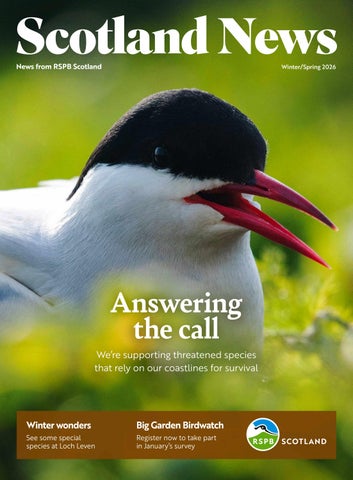
Answering the call We’re supporting threatened species that rely on our coastlines for survival
Winter wonders
Big Garden Birdwatch
See some special species at Loch Leven
Register now to take part in January’s survey
Action for nature
In winter, being in nature can be restorative, and spending time in the outdoors or taking action together can help build stronger connections in our communities. Big Garden Birdwatch is always a highlight, where so many of you get involved to celebrate local wildlife. It’s coming up soon (23–25 January) and I hope you’ll take part. The end of another year is a time to reflect and celebrate. As a member, you’ve made a difference for Scotland’s wildlife. In 2025, you used your voice to stand up for some of our most threatened species, such as Puffins and Curlews. You supported vital conservation work and inspired more people to care for nature. The projects and partnerships you help to support have continued to deliver ambitious habitat restoration, campaigns for change and community engagement, fostering connections between people across Scotland and the wildlife near them. In Glasgow, Giving Nature a Home is transforming urban nature and engaging different communities (p4). Further north, young people are discovering remarkable landscapes like those at RSPB Abernethy with hands-on activities through Cairngorms Connect (p4). In 2026, there will be more to celebrate and fight for. Thank you for helping to save nature. I’m looking forward to what we’ll achieve together.
Our places
Sixty years of North Uist nature reserve RSPB Scotland Balranald celebrates 60 years as a nature reserve in 2026. It covers 658 ha, with ownership divided between the Scottish Government, the Church of Scotland and North Uist Estates. Working with partners to manage the land, especially crofters, makes it different from other reserves. Balranald is a key site in the UK Corncrake recovery programme. The RSPB works with local crofters who provide early cover and cut crops later to help Corncrakes and other ground-nesting birds. It’s also home to breeding birds, including Oystercatchers, Ringed Plovers, Redshanks and Lapwings, and farmland birds such as Reed Buntings, Twites and Skylarks.
The nature reserve has seen many changes over the years; the number of people crofting, how the land is managed and the machinery used to farm the land have all altered. One of the most noticeable changes, though, is the improvements that were made to Goular Cottage, which was turned into the Balranald visitor centre and opened in 1982, with further renovations and an official opening in 1997. To celebrate the anniversary, there will be events to bring together memories, stories and photos. If you have anything you would like to share, please send it to outerhebrides@rspb.org.uk
Anne McCall Director, RSPB Scotland Follow Anne on
2
@stranyannie
Above: Goular Cottage was turned into a visitor centre in 1982, with an official opening in 1997
Cover: Arctic Tern by Jack Barton. Photos: Jake Stephen (rspb-images.com); RSPB Scotland, Orkney Native Wildlife Project. Illustration: Mike Langman (rspb-images.com)
Welcome!
Top stories
Our science
New tech to detect Stoats Thermal imaging cameras equipped with artificial intelligence capabilities are being used across Orkney as part of efforts to protect the isles’ native wildlife. The Orkney Native Wildlife Project (ONWP) is trialling the new tech in its effort to remove invasive non-native Stoats from the isles. Unlike traditional field cameras, which require staff to manually collect and sift through thousands of images, these smart cameras are being trained to automatically detect the thermal print of Stoats in the landscape and instantly alert the team with a text message. This new tech will become especially useful as Stoat numbers in Orkney decrease and the final remaining animals become harder to find. The cameras could provide an extra set of ‘eyes’, working day and night in places that otherwise might be difficult to monitor. While still in the trial stage, early results are encouraging. By combining this cutting-edge technology with the existing trap network, Stoat detection dogs and reports from the public, the ONWP is building a stronger toolkit to restore Orkney as a Stoat-free haven for native wildlife. orkneynativewildlife.org.uk
Scan me
Our people
Big Garden Birdwatch 2026 Registration is now open for Big Garden Birdwatch 2026! Whether you’re joining a flock of friends or flying solo it’s your chance to switch off, relax and watch the birds in your garden, park or green space for an hour between 23–25 January. Every count matters and we’d love to know your sightings. Once you register, we’ll keep you updated with top tips on how to get ready for your best Birdwatch ever. Register now at www.rspb.org.uk/birdwatch
41,630 748,392 No.1
people in Scotland took part in 2025
birds were counted last January
Will the House Sparrow hold on to the top spot again this year?
3
Top stories Our projects
Counting Leach’s Storm Petrels Learning the ropes: Leach’s Storm Petrel surveys on North Rona Staff and volunteers undertaking improvement work
Our projects
Boost to urban species The Giving Nature a Home team has been working in Springburn, Glasgow, to enhance biodiversity. North Glasgow Greener Futures is working with volunteers, local communities and organisations to restore the quality and connectivity of urban spaces through rich grassland and hedgerow habitats. This will help pollinators, while birds and bats will benefit from additional food sources, shelter, roosting and nesting sites. The spaces will also connect people with wildlife and other areas. The project is supported by the Scottish Government’s Nature Restoration Fund, managed by NatureScot.
Our people
Youth action wins awards
Cardboard Contours workshop at the Loch Garten Nature Centre
Our projects
Imagining landscapes Young people have constructed a large cardboard ‘tabletop’ replica of the Loch A’an basin, part of RSPB Abernethy, one OS map grid square at a time with Cairngorms Connect. By repurposing, cutting and arranging cardboard into layers, an accurate scale topography has been formed. Extra creative flourishes include colouring, drawing and even secret messages. This landscape is powerful, and it is for all of us. Cardboard Contours, supported by the Cairngorms National Park Authority, brings the landscape into communities, becoming something we can touch, imagine and learn about.
4
BioLit Stirling field trip
Young people across Scotland have an incredible passion for nature that inspires action for precious species and habitats. This year, the Nature of Scotland Awards, with headline sponsor NatureScot, celebrated two winners of the Youth Action Award. The Ullapool Sea Savers make an amazing contribution to marine conservation in their local area, gaining valuable new skills as part of the journey. At the University
Ullapool Sea Savers
of St Andrews, the student-led Biodiversity Literacy project has been transforming the way nature is understood and embedded at the institution. To discover more about the people and projects celebrated this year, visit rspb.org.uk/ natureofscotland
Photos: Sam Turley, Andy Hay, Ben Andrew (all rspb-images.com); BioLit Stirling; Ullapool Sea Savers; Lizzie Brotherston; Joseph Everest; RSPB Scotland
“I’ve always wanted to do something a bit mad and interesting, and this perfectly ticked that box,” says Rebecca McHugh, RSPB Conservation Data Scientist and member of a team surveying Leach’s Storm Petrels. These tiny birds are capable of immense journeys. Sadly, populations of this remarkable species are in decline. North Rona and the Flannan Isles are home to some of the largest populations in the UK, but reaching these islands to understand how they’re doing is no easy task. This year, RSPB staff, sabbaticals and volunteers made the trip to undertake a Leach’s Storm Petrel census. Follow their journey: bit.ly/AWildJourney
Our places RSPB Scotland Loch Leven
Winter walks with wildlife
The magic of winter wiinter wildlife will brighten briighten your day when you y step into a mix of woodlands and wetlands, bustling with activity at Loch Leven nature reserve
Star species 1. Pink-footed Geese 2. Red Squirrel 3. Fieldfare 4. Whooper Swan
1
2
3
4
N
othing beats the sights and sounds of the graceful Whooper Swans and gaggles of Pink-footed Geese across Loch Leven on a winter’s day. They arrive from Iceland to spend the season here, creating a hub of activity in the wetland and making an early morning visit to this nature reserve an extra-special treat. There is also much to see in the scenic woodlands. The Leafy Loop trail is accessible to buggies and wheelchairs, and there are two mobility scooters available to hire. It’s a great place to see Red Squirrels, and lots of species of birds including Great Spotted Woodpeckers, Jays and Treecreepers. It’s also a lovely peaceful place for a moment of calm, when you make a stop at the sky bench and watch the world go by. When it’s time to get cosy again, you can soak up the beautiful views looking out across the wetland and the Loch, holding a warm coffee in the café. The hides and trails at Loch Leven are open 24/7 and so are the toilets and car park. With a variety of
Our people
Sarah Allen Sarah Allen is Visitor Experience Manager at Loch Leven What is the most interesting part of your job? The most interesting thing is the variety; truly no two days are the same. That not only applies to the wildlife you might see, but the tasks I’m doing – on one day
RSPB Scotland Loch Leven Seasonal highlights Listen and look for the fluttering and rustling of autumn migrants like Redwings and, if you’re lucky, Bramblings bringing a dash of colour as they Scan me feast amongst the pictureperfect frosty trees. rspb.org.uk/ lochleven
walks to explore, a spectacular view from the visitor centre and a wide variety of wildlife to see, it’s the perfect place for anyone to stay connected with nature in winter.
I could be in the visitor centre, welcoming people to the reserve, running a bat walk or posting content on social media. There’s never a boring moment! I’m incredibly lucky to have a nature reserve as my office. Do you have any standout memories from Loch Leven? I love seeing visitors’ enthusiasm for the wildlife. It’s a privilege to be able to help someone see their first Red Squirrel, or any other species! Seeing their excitement will always be memorable to me.
5
Living on the edge Rare coastal species of wildlife are being supported by conservation organisations working to protect their habitats and raise awareness of the threats they face
Above: Planting Oysterplant in Orkney Right: Conducting a bumblebee survey
‘So far, we’ve taken part in a variety of tasks, including fencing, repairing boardwalks and habitat management’ 6
Photos: Lorne Gill; Sam Stringer; Mike Bolam; Gareth Powell; RSPB Shetland; Helen Cromarty
A
long Scotland’s dramatic coastlines and across the islands, remarkable wildlife finds a home. This nature is an important part of our culture and history, and species also play a vital role in our environment, helping us have breathable air and food to eat. Taking action together is essential to ensure these species don’t disappear from our landscapes. Species on the Edge, funded by The National Lottery Heritage Fund, is a collaboration of eight conservation organisations, working hand in hand with communities across seven areas in Scotland to build a sustainable future for our rarest coastal wildlife. Since 2023, the project has been working to boost the fortunes of 37 threatened species, including Twite, Natterjack Toad, Lapwing and more, through both hands-on conservation work and crucial community engagement throughout Scotland. Project officers, partners and volunteers have celebrated many successes delivering a huge range of practical conservation efforts. From surveying and monitoring to creating and enhancing important habitat, wins have been celebrated for species such as Arctic Tern, which have new, safer nesting sites, and the Great Yellow Bumblebee, with more nectar-rich flowers being planted to support them and other pollinators. We can’t save nature without the people that live alongside it. Engagement through events, volunteering and training is not only raising awareness of some of these special creatures and the threats they face now, but also builds a legacy for the project. Connecting communities with the vibrant wildlife near them will help ensure efforts to protect these species continue long after the Species on the Edge project ends.
Feature
Area highlights 1. Orkney In the past century 97% of UK wildflower meadows have disappeared, putting important pollinators at risk. The Species on the Edge ‘Gardening for Pollinators’ project in Orkney is rallying the community to grow wildflowers in their gardens and community spaces. Species on the Edge People Engagement Officer Sam Stringer and a team of volunteers have gathered local wildflower seeds and grown them into plug plants to distribute at events – nearly 100 plants have been given away so far! Local schools and groups have joined the effort, helping species like Great Yellow and Moss Carder Bumblebees. As more people get involved, Orkney’s pollinators get the best chance to thrive!
2
1 2. Shetland After multiple searches throughout the year, numerous heartbreaks and sighs of defeat, the Shetland team have found the rare Plantain Leaf Beetle on the Keen of Hamar. The elusive insect (above) is an endangered species in the UK, only found in three places in Scotland. The search involved five hours of stone turning with local expert and volunteer Mike Pennington. In total, the team found two living beetles and a few elytra (wing cases) in the nearby area. 4 These beetles were probably part of a second emergence, believed to happen in the annual cycle of this rare beastie.
4. East Coast 3. Solway Together with the Bat Conservation Trust (BCT), Jack Barton (above), Species on the Edge Project Officer in Solway, has been engaging local communities to protect Scotland’s 3 bat species. Through bat talks, walks and volunteer training, the project is building enthusiasm for bats such as pipistrelles in the local community. Earlier this year, the team delivered a bat-box building session with local Police Scotland Youth Volunteers, giving young people a hands-on opportunity to help local wildlife. Dalbeattie Men’s Shed also crafted bat boxes, which were distributed to members of Dumfries and Galloway Woodlands to install in their gardens. A fantastic evening event was hosted to put the finishing touches on the boxes and encourage people to take part in BCT National Bat Monitoring Programme surveys.
Species on the Edge has funded two paid RSPB traineeships based at Loch of Strathbeg. Lottie Hunter, Species on the Edge trainee (below), said, “The traineeship has been an amazing introduction to the conservation sector. I have gained a lot from this invaluable experience, an overarching theme being confidence in myself and my abilities and knowledge. I have been able to build on my pre-existing knowledge of practical work and wildlife from my previous volunteering. Working in a wetland habitat has been a new environment for me and it has been extremely rewarding. The richness of wildlife here continues to amaze me every day!”
7
Your photos
Your photos
2
Many thanks to everyone who has shared their nature photos with us – we always love to see them! Do you have photos that feature summer wildlife? Please send them to Allie, our Editor, at Allie.McGregor @rspb.org.uk
1
4
1. White-tailed Eagle by Evan Michael
5
3
2. Red Squirrel by Mike Kiely 3. Mute Swan by Charles Colliar
Stay connected
4. Blue Tits by Joanne Jeffreys
On social media: RSPBScotland @rspb.scotland
5. Rock Pipit by Nigel Wells
@RSPBScotland
rspbscotland. bsky.social
Contact us
Local groups
RSPB Scotland Headquarters 2 Lochside View, Edinburgh Park, Edinburgh EH12 9DH 0131 317 4100 rspb.scotland@rspb.org.uk
Suite 2.25, 2nd Floor, H1 Building, Hill of Rubislaw, Anderson Drive, AB15 6BL 01224 624824 nsro@rspb.org.uk
North Scotland offices Etive House, Beechwood Park, Inverness IV2 3BW 01463 715000 nsro@rspb.org.uk
South Scotland office 10 Park Quadrant, Glasgow G3 6BS 0141 331 0993 glasgow@rspb.org.uk
RSPB Scotland has a network of enthusiastic local groups. Find one near you: rspb.org.uk/localgroups
RSPB Scotland is part of the RSPB, the UK’s largest nature conservation charity. The RSPB is a registered charity in England & Wales 207076 and in Scotland SC037654
Our Media Company is working to ensure that all of its paper comes from well-managed, Forest Stewardship Council® (FSC®)-certified forests and other controlled sources. This magazine is printed on FSC®-certified paper. This magazine can be recycled, for use in newspapers and packaging.
With our podcast: bit.ly/rspb-scotland-podcast With our YouTube playlist: bit.ly/rspb-scotland-playlist On our website: rspb.org.uk/scotland