Nature’s Voice
News from RSPB Northern Ireland and the Isle of Man
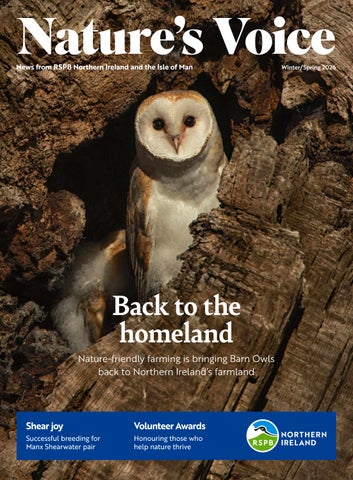
Back to the homeland Nature-friendly farming is bringing Barn Owls back to Northern Ireland’s farmland
Shear joy
Volunteer Awards
Successful breeding for Manx Shearwater pair
Honouring those who help nature thrive
Winter/Spring 2026
Action for nature Welcome!
Joanne Sherwood Director, RSPB NI 2
Our places
A life raft for seabirds The LIFE Raft project welcomes a new Programme Manager, Erin McKeown. With a strong background in marine policy and conservation, Erin brings a deep understanding of Rathlin Island’s importance as Northern Ireland’s largest seabird colony and the UK’s largest Guillemot site. Seabird populations face alarming declines, with over 60% of breeding species in the UK decreasing in the past two decades, including a 70% fall in Puffin numbers in Northern Ireland. LIFE Raft is tackling these declines by removing invasive rats and ferrets. The project aims to secure Rathlin’s
internationally important seabird populations and support wider ecological recovery. Progress has been significant: no ferrets have been recorded since autumn 2023, with only two rat sightings in 2025. Further eradication began in November this year, alongside new biosecurity measures to ensure a lasting legacy. Beyond restoring seabirds, LIFE Raft has the potential to boost eco-tourism and local opportunities, ensuring Rathlin thrives as a model for island restoration. Learn more about Rathlin Island at rathlin360.com/life-raft
Species
Manx Shearwaters are multiplying For the first time in decades, Manx Shearwaters have been recorded breeding on Rathlin Island. The species, which has been driven to near extinction, has been spotted in recent years flying in and around the cliffs where they like to set up home. This year, however, the team on the island was thrilled to see that a pair has successfully bred and fledged a chick. Their presence highlights Rathlin’s importance as a haven for wildlife and continued efforts to safeguard this special island for future generations. A true conservation success worth celebrating.
Cover: Ben Andrew (rspb-images.com). Photos: Chris Gomersall, Chris Curran, Anna Feeney (all rspb-images.com), Brian Morrison
As we prepare for 2026, I’d like to take a moment to reflect on 2025 and some of RSPB NI’s key achievements. From the return of Barn Owl chicks to a County Down farm in summer to a lively autumn at the Fields Good Festival, we’ve continued to champion nature-friendly farming and highlight the crucial role Environmental Farming Schemes play for nature. In this issue, you’ll see the breadth of work our Farm Advisory team is doing with farmers and landowners across Northern Ireland. We also held our Volunteer Day at Oxford Island, which was a chance to thank our volunteers for their support and celebrate their achievements at the RSPB NI Volunteer Awards. This year, we welcomed two new leaders to our leadership team. Sharon Thompson joins as Head of Policy and Advocacy from RSPB Cymru, while Jess McVicar, formerly our Head of Engagement, is now Head of Fundraising, Engagement and Communications. I’m excited to work with them as we strengthen our impact. We also welcomed a new Programme Manager for LIFE Raft, Erin McKeown, who shares an update on the project (opposite). To our readers, thank you for your continued support as valued members of the RSPB. We wish you a happy and joyous festive season.
Top stories
Species
Nature notes
Breeding Barn Owls
Nature reserve spotlight Barn Owls have chosen nest boxes on Kelly’s Farm in County Down as the perfect place to raise their young. The farm, part of the County Down Farmland Bird Initiative and supported by RSPB NI, has long been a haven for wildlife. Michelle Duggan, RSPB NI’s Conservation Officer in County Down, shared her excitement: “We’re absolutely delighted. The farm’s rich mix of habitats not only supports birds such as the
Yellowhammer but also creates ideal hunting grounds for Barn Owls.” With seed-rich fields, rough grass margins and healthy hedgerows, it’s no wonder these owls have settled in. Mark McCormick, Policy Officer, added: “This is a powerful example of naturefriendly farming. With the right support, farmers can restore wildlife to their land, demonstrating the urgent need for greater investment in schemes like this.”
Jack Kelly and Michelle Duggan
Visiting RSPB NI’s Belfast Window on Wildlife in winter offers a captivating glimpse into nature’s seasonal shift. As migratory visitors, such as Blacktailed Godwits, Lapwings (pictured) and Curlews arrive, the reserve comes alive with vibrant bird activity. The hides provide tranquil observation points to watch the assemblage of ducks and waterbirds on the lagoon. The changing foliage enhances the reserve’s beauty, while crisp air and softer light make wildlife photography especially rewarding. It’s a perfect time to connect and enjoy peaceful moments in nature.
Our members
Volunteering for good On 20 September, RSPB NI gathered at Oxford Island to celebrate and thank dedicated volunteers. The event shone a light on the people who give their time, skills and enthusiasm to protect wildlife and habitats across Northern Ireland. Their efforts are the backbone of the RSPB’s work, from restoring landscapes to supporting communities to engage with nature. Jess McVicar, our new Head of Fundraising, Engagement and Communications, presented long-service awards and shared her appreciation for the lasting impact of volunteers. Among those recognised was the volunteer team for the Giving Corncrake a
Home project; their dedication to habitat restoration enabled the incredible success of Corncrakes earlier this year on Rathlin. Check out the back page for the other amazing award winners. Speaking at the event, Jess thanked every volunteer for their role in helping the RSPB deliver for nature. “Our volunteers are integral to everything we do,” she said. “Your energy, knowledge and dedication makes a huge difference for wildlife and for people.” To those who give their time to RSPB NI, thank you. Your support is vital in helping us tackle the nature and climate emergency and ensure a brighter future for the places and species we protect.
3
Events
Feeling good about farming This summer, RSPB NI joined with farmers, growers and others passionate about nature at the vibrant Fields Good Festival in Glenarm – a celebration of regenerative agriculture, soil health and sustainable food systems. Among the highlights was guest speaker Richard Winspear, from RSPB’s Hope Farm in Cambridgeshire, who shared inspiring insights from over two decades of nature-friendly farming. His panel talk, ‘When Land Comes Alive’, explored how restorative ecosystems like those in place at Hope Farm can support wildlife and profitable farming. RSPB NI’s advisory team spent the day connecting with farmers, listening to their experiences and offering practical advice on agri-environment schemes. It was a great opportunity
Star species
Barn Owl With its heart-shaped face, beige back and wings and pure white underparts, the Barn Owl is a distinctive and much-loved countryside bird. Widely distributed across the UK and the rest of the world, this bird suffered declines through the 20th century. In Northern Ireland, there are believed to be fewer than 30 breeding pairs left. RSPB NI is working in partnership with farmers and Ulster Wildlife to protect the species. You can read more about the recent work on page six.
to hear first-hand what farmers think about nature-friendly farming and how RSPB NI can support them. From speaker tents to muddy boots and meaningful chats, the festival was a reminder of what’s possible when farming and nature work hand in hand.
Events
Left: Mark Sandford and John McAuley collecting their Nature-Friendly Farmer of the Year awards at the 2025 Farming Life Awards
Celebrate
Rewarding farmers for helping nature Huge congratulations to Mark Sandford, Downpatrick, and John McAuley, Glendun, who were named joint Nature-Friendly Farmer of the Year, sponsored by RSPB NI, at the 2025 Farming Life Awards. The farmers were selected as they lead by example, true inspirations showcasing how farming and nature can thrive together. Both Mark and John’s commitment to integrating wildlife, habitats and sustainable practices into their everyday farm life, truly embodies the spirit of nature-friendly farming. The competition in the category was strong, and all of the farmers shortlisted are a credit to the farming community. Jack Kelly (page three) was also Highly Commended in the same category. At RSPB NI, we’re proud to support farmers such as Mark, John and Jack, who put nature at the heart of their work, to help create a more resilient countryside for future generations. Well done Mark, John and Jack – very well-deserved recognition.
4
Birds are counting on you Registration for Big Garden Birdwatch 2026 is now open! Join thousands of bird lovers across the country in celebrating our feathered friends. Just one hour of your time between 23–25 January helps provide insights into how garden birds are faring. Whether you’re in a garden or park or on a balcony, your observations matter. It’s fun, free and family-friendly, making it perfect for beginners and seasoned spotters alike. Don’t miss out on this chance to connect with nature and protect it for the future. Find out how to sign up by visiting www.rspb.org.uk/ SCAN TO FIND birdwatch OUT MORE
Top stories
Your questions I’ve really enjoyed the range of summer visitors I’ve had to my garden. But I’ve always wondered, why do some birds migrate and others don’t? Scientific name Tyto alba
Wingspan 80–95cm
Length 33–39cm
Where to see Farmland, marine and intertidal, wetland, grassland
Conservation status Red List (Irish Birds of Conservation Concern)
Photos: Ben Andrew, Brian Morrison, Katie Nethercoat, Michael Harvey (all rspb-images.com), Farming Life, Gemma McAdam
Allison Leonard, Managing Director Manx BirdLife
Getting nature back online After months of writing, photo editing and checking, Manx BirdLife is excited to launch its brand-new website, featuring a fresh look and a much more user-friendly experience. All the familiar features are still there, including the popular sightings system, as well as some new and improved content. One great new feature is the option to sign up for our quarterly newsletter. It’s a simple
way to stay in the loop, with all the latest news and exciting updates from the charity delivered straight to your inbox. Thanks to Julie Parys of Arts Interactive for all her hard work and creativity in bringing the new website to life. Explore the new site and find out more about the amazing wildlife on the Isle of Man: manxbirdlife.im
Kirsty, Moneyglass Birds migrate to escape cold weather and find food, especially insect-eaters such as Swallows. Others, such as Robins (pictured), stay because they can survive winter on berries and seeds. Some Robins come from Scandinavia in search of milder conditions. Whether a bird stays or goes depends on diet, habitat and preferred climate.
I’m keen to identify some new bird species while out on the dog walk. Are there any I should keep an eye out for this winter? Gerard, Hillsborough Yes! Winter brings some exciting visitors. Species such as the Waxwing (pictured), Brambling and Redwing migrate from colder regions and can be spotted in gardens, parks and hedgerows. These birds are often drawn to berries and feeders, so are easier to see than in other seasons. Keep an eye out – winter can be a great time for rare sightings.
I want to make my garden wildlifefriendly for next spring/summer. When is the best time to plant, and what should I include to attract more wildlife? Ronan, Glengormley
Cormorant
While autumn is ideal for planting, you can still prepare for a wildlife-friendly garden next spring. Plan and prep soil over winter, then sow hardy annuals such as Cornflowers or Common Poppies in spring. Plant bulbs such as Snowdrops (pictured), Daffodils and crocuses once the ground softens. Native wildflowers and shrubs provide food and shelter for birds and insects year-round.
5
FIND OUT MORE Learn how RSPB works with Northern Ireland’s government to safeguard our diverse wildlife and natural habitats: rspb. org.uk/northernireland
Protecting our wild spaces We’re continuing to help wildlife and people thrive across Northern Ireland by supporting nature-friendly farming
orthern Ireland is blessed with rolling hills, dramatic coastlines and hidden forests that paint a breathtaking picture right outside our doors. From the windswept cliffs of Antrim to the tranquil lakes of Fermanagh, our landscapes offer endless beauty and opportunities for peaceful exploration. But this natural heritage is more than just a background to our lives – it’s something we all share a responsibility to protect. Imagine future generations stepping into the same wild spaces, breathing in crisp air, listening to birdsong and perhaps catching sight of a rare species. That vision is at the heart of RSPB NI’s work, where conservation projects focus on threatened birds such as the Curlew, Lapwing and Corncrake.
N
For more than 30 years, RSPB NI has partnered with farmers across the country to deliver ambitious programmes that restore habitats and safeguard vulnerable species. Today, it continues that vital mission, leading several Environmental Farming Scheme (EFS) Group Projects, funded by the Department of Agriculture, Environment and Rural Affairs (DAERA). Nature-friendly farming keeps our soils rich, our waters clean and our food production secure. It creates more habitats for farmland species, reduces carbon emissions and helps wildlife and farming thrive side by side. Across NI, many inspiring farmers are already proving it’s possible to work the land productively while giving nature the space it needs to flourish. This vision of farming and nature working hand in hand is already coming to life. From rugged uplands to quiet wetlands, each landscape tells its own story of people and wildlife thriving, and of the dedicated conservation efforts helping them to succeed.
‘When we invest in nature-friendly farming, we invest in a brighter future’ 6
Nature-friendly farming in numbers
500+
letters sent to MLAs
77%
of Northern Ireland’s land is used for agriculture
350
supporters contacted the DAERA Minister to ask for naturefriendly farming to be prioritised in NI
400
farmers in Northern Ireland are working with us
Feature
Where we’re working
Agri-environment schemes at risk 2
Across all corners of the country, RSPB NI’s Advisory team is working to protect habitats and restore breeding grounds for threatened species
3 1
6
1. Antrim Hills
4
Conservation Officers Stephen Magennis and Jazmin Winzer support farmers with the management of upland grasslands, moorlands and peatlands for the recovery of breeding Curlew and other endangered wader species such as Lapwing and Snipe within the Antrim Hills.
5
2. Causeway Coast and Rathlin Island For 15 years, Anne Guichard has worked for RSPB NI, specialising in bird and habitat surveys. Since 2022, she’s facilitated the Causeway Coast Farmland Bird Initiative, advising farmers on wildlife-friendly practices via surveys, reports, practical training and farm visits. Anne is also an EFS planner for DAERA, advocating fair rewards for sustainable, nature-friendly farming.
Agri-environment schemes (AES) are when farmers are financially incentivised to maintain and create habitats on their farms, and implement nature-friendly farming practices. However, these schemes in Northern Ireland have long been under-resourced. In 2023, the Environmental Farming Scheme Wider-Level was withdrawn without a replacement put in place, leaving many farmers in Northern Ireland with no access to nature-friendly farming grants between 2023–2025. The Farming with Nature Transition Scheme (FwNT) launched in 2025 but with limited options, and far from what farmers and nature urgently need. We want to ensure farmers are supported to help nature with robust investment in nature-friendly farming in the future.
Thank you to our supporters This is a glimpse into a critical strand of work for RSPB NI, and we’re deeply grateful to everyone who supported our campaigns throughout 2025. Whether you signed the petition, contacted the Minister or your MLA or simply shared a post on social media, your collective action has amplified our voice. When we invest in nature-friendly farming, we invest in a brighter future – for our wildlife, our farmers and all of us.
3. Garron Plateau Emma Denton works with farmers to help deliver large-scale peatland restoration, as well as other work on upland habitats and species. Garron Plateau now provides an exemplar model of peatland restoration that not only benefits nature but also provides crucial ecosystem services.
4. Lough Erne Jonathan Pinnock and Tom Saxon support livestock farmers with habitat advice to benefit breeding waders, such as Curlews and Lapwings. Jonathan recently led projects to restore wet grassland and fen sites, including the removal of non-native conifers to semi-natural grassland. They work in partnership with Ulster Wildlife through their EFS Group.
Photos: Amy Burns; Chris Curran; Brian Morrison
5. County Down Michelle Duggan provides tailored conservation advice to arable and mixed farmers, helping to create and manage habitats that support threatened farmland birds, including Yellowhammers, Linnets, Tree Sparrows, Barn Owls and Kestrels. On page three, you can read about the recent success for a local farm in County Down, a proud moment for Michelle and the team supporting nature-friendly farming.
Get involved...
Be a campaign champion Don’t want to miss out on future campaign actions? Sign up to be a Campaign Champion and we’ll keep you up to date on all our latest campaign news and actions at bit.ly/BecomeCampaignChampion Read about our ongoing advocacy for nature-friendly farming in 2025 by scanning this code or visiting rspb.org.uk/nothern-ireland/news/ our-on-going-farming-advocacy
6. Lough Neagh and Lower Bann Rachel McConnell advises on restoration and management of peatlands and wet grasslands for breeding waders and rare species such as Irish Lady’s Tresses orchids and Marsh Fritillary butterflies. As facilitator for the Bann Valley EFS Group, Rachel provides tailored one-to-one advice and best practice demonstration events. Each of these places is different, but together they form part of a shared mission: protecting Northern Ireland’s precious landscapes so both people and nature can thrive.
7
Volunteer highlights
RSPB NI Volunteer Awards In September, RSPB NI gathered at Oxford Island to celebrate and thank dedicated volunteers. Here are our very worthy winners
Community Champion: Someone who brings people together and uplifts the team Eleanor Brennan
Spirit of the RSPB: Someone who embodies the values and the mission of the RSPB Dot Blakely
Friendly Robin: For the volunteer who is always cheerful and welcoming Sarah Nicol (collected by Siobhan Bentley, Volunteering Development Officer)
Rain or Shine Award: For the volunteer who shows up no matter the weather Peter Guy (collected by Seamus Burns, Area Manager – West)
Kingfisher Award: The volunteer who is always enthusiastic and positive David Miller
Photos: Brian Morrison
Nature Hero Award: A volunteer who goes above and beyond for nature James McDowell
Contact us
Local Groups
RSPB Northern Ireland Headquarters Belvoir Park Forest, Belfast BT8 7QT 028 9049 1547 rspb.nireland@rspb.org.uk
Antrim Brenda Campbell, 028 9332 3657 group.rspb.org.uk/antrim
Fermanagh Rosalind McConkey, 028 6632 0794 group.rspb.org.uk/fermanagh
Belfast Eleanor Brennan, group.rspb.org.uk/belfast
Lisburn Ian Raine, group.rspb.org.uk/lisburn
Follow us facebook.com/RSPBNI twitter.com/RSPBNI @rspb_ni
Coleraine James McDowell, 07596 503 435 group.rspb.org.uk/coleraine
For information on RSPB NI events, visit rspbni.eventbrite.com or email rspbnievents@rspb.org.uk. RSPB Northern Ireland is part of the RSPB, the UK’s largest nature conservation charity. The RSPB is a registered charity in England & Wales 207076, in Scotland SC037654
Our Media Company is working to ensure that all of its paper comes from well-managed, Forest Stewardship Council® (FSC®)-certified forests and other controlled sources. This magazine is printed on FSC®-certified paper. This magazine can be recycled, for use in newspapers and packaging.