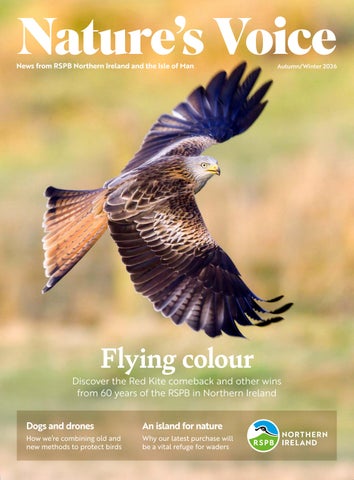
Nature’s Voice
News from RSPB Northern Ireland and the Isle of Man
Flying colour
Autumn/Winter 2026
Discover the Red Kite comeback and other wins from 60 years of the RSPB in Northern Ireland Dogs and drones
An island for nature
How we’re combining old and new methods to protect birds
Why our latest purchase will be a vital refuge for waders
Action for nature Welcome!
Joanne Sherwood Director, RSPB NI 2
Our places
Lough island now part of nature reserve Lough Erne, the RSPB’s most westerly nature reserve, has expanded with the purchase of Carr Island (pictured) on Lower Lough Erne. Supported by funding from the Department of Agriculture, Environment and Rural Affairs (DAERA), this significant addition strengthens RSPB NI’s long-term commitment to protecting wildlife and restoring nature across this special landscape. This purchase will help our wider conservation work to enhance habitat for some of our most threatened breeding waders, including Lapwings, Curlews, Redshanks and Snipe.
Mike Rafferty, Estate Operations Manager for Lower Lough Erne, said: “Bringing Carr Island into the reserve is an exciting step for nature in this area. Through habitat management such as sustainable grazing, we can create the conditions breeding waders need to survive, strengthening the network of habitats needed to support their recovery.” Habitat restoration work across Lower Lough Erne has already delivered encouraging results for breeding waders. Carr Island provides an exciting opportunity to build on this success.
Our places
Curlews survive fire Early in the breeding season, wildfire ripped through a vital Fermanagh habitat managed for nature through PeacePlus Nature. However, there was a remarkable story of survival. Acting quickly under pressure, Conservation Adviser Róisín located a Curlew nest directly in the path of the advancing flames and, working in tandem with the firefighters and Sliabh Beagh Curlew Conservation Trust, rescued the endangered clutch. Dedicated volunteers carefully nurtured the eggs, hatching four healthy chicks (one pictured) who’ve been returned to a safe home in Fermanagh.
Cover: Red Kite, Robert Harding (Alamy Stock Photo). Photos: RSPB/Mike Rafferty, Róisín Normanly
For over 60 years, RSPB Northern Ireland has worked to protect and restore the wildlife and landscapes that make this place so special. While we are proud of what has been achieved, the challenges facing nature have never been greater. In this edition, I wanted to share a new chapter of conservation for RSPB NI – one where innovation and technology are working hand in hand with the expertise and dedication of our staff and volunteers. These new approaches are transforming how we understand and protect our local wildlife (page 6). You’ll discover how cameras are revealing encouraging signs of Corncrake breeding success, giving us valuable insights into the recovery of one of Northern Ireland’s rarest birds. I’m also delighted to share how our conservation stories are reaching far beyond our shores. Springwatch’s recent visit to Lough Erne (opposite) showcased the importance of our work to new audiences, while Sam Bentley’s visit (page 4) helped highlight stories of recovery over the last six decades. None of this would’ve been possible without your support. As a member, you’re helping to give nature the best chance to recover. Thank you for being a part of this journey.
Top stories
Nature notes Staff highlight
Liam McFaul, RSPB NI’s Warden on Rathlin Island
Left RSPB Northern Ireland staff with the Springwatch team
Our species
Spectacular nature caught on camera Did you catch the latest series of BBC’s Springwatch? This year, viewers across the UK were treated to the wild beauty of County Fermanagh, including learning about some of the conservation work at RSPB NI’s Lough Erne nature reserve. RSPB NI were delighted to welcome Springwatch presenter Jack Baddams to visit Trasna Island with Breeding Wader Monitoring Officer Ken. Once a hotspot for breeding waders in the 1920s, Trasna is now at the heart of ongoing annual habitat work
to recreate ideal grassland for birds such as Curlews, Lapwings and Snipe. The effort is already paying off, with Curlews returning to breed again in recent years. Nature provided a memorable spectacle during filming, with adult Curlews gliding over the site and some of the season’s first chicks spotted nearby, showcasing powerful evidence of recovery in action. It was a proud moment to share this success story with a national audience. Catch the episodes at bbc.co.uk/springwatch
“Working as Warden here is a privilege. I spend my days monitoring one of Europe’s largest seabird colonies and helping to protect the island’s incredible wildlife. This year, one of the most rewarding moments has been seeing Puffins return to nest higher up the cliffs for the first time in years, thanks to the LIFE Raft Project. Witnessing conservation deliver real results like this makes every challenge worthwhile.” Use the QR code to donate to the LIFE Raft Project appeal or visit rspb.org.uk/ island-appeal Scan me
Our projects
Photos: Mike Rafferty, Christopher Curran, Chloe Dixon
Measuring peat health In the windswept expanses of the Antrim Hills, through PeacePlus Nature, a vital mission is under way to restore the region’s degraded peatlands, starting with the Altnahinch Site (right). Once vibrant ecosystems, large areas have been scarred by artificial drains that divert crucial water away, leaving behind deep erosion gullies and exposed peat haggs. To heal this landscape, Peatland Project Manager Chloe has been measuring peat depths, assessing vegetation condition and mapping erosion features to prepare for 80 hectares (or over 3,000 tennis courts) of restoration works in the winter of 2027/28. This will form part of a catchment scale plan of action for the Altnahinch area of the Antrim Hills. To supercharge these efforts, the PeacePlus Nature project recently welcomed three new peatland scientists – Adam, William and James. Armed with surveying tools, they’ll be capturing an invaluable snapshot of the peatland’s current health over the next year before restoration work begins. The monitoring will continue during and post restoration too, which will continue to quantify environmental and other benefits. This PeacePlus Nature initiative ensures that every ditch blocked and hagg reprofiled is backed by data. It’s a race against time to turn these carbon-emitting scars back into thriving, water-retaining blankets of life, securing the future of the Antrim Hills for generations to come.
3
Top stories
Our projects
Showcasing conservation successes These successes are only possible thanks to the continued support of RSPB members, like you. Keep an eye on our social channels to see videos of the tour.
Action for nature-friendly farming and supporters together at Stormont to call for long-term investment in nature-friendly farming. With more than 75% of Northern Ireland’s land farmed, supporting farmers to work with nature is essential if species such as Curlew, Yellowhammer and Lapwing are to thrive. Thank you to everyone who took action and helped give nature a stronger voice.
RSPB NI staff, volunteers and local farmers at Stormont
4
Whooper Swans spend their winters in the UK, arriving from Iceland in late autumn before returning north in spring. They often feed on leftover grains in fields during the day, before heading to roost on open water – they can sometimes be seen at RSPB Portmore Lough and Lough Beg nature reserves. Larger than the Bewick’s Swan, the Whooper has more yellow on its bill. With its beautiful white plumage, long neck and black legs that are typical characteristics of all swans, they’re a stunning sight on an autumn walk around the reserves. These noisy birds have a very distinctive call – their loud trumpeting sounds much like an old-fashioned car horn.
Campaigns
Our events
This summer, RSPB NI helped put nature-friendly farming firmly on the political agenda. Hundreds of people backed our e-action calling for greater investment in nature-friendly farming, showing Members of the Legislative Assembly (MLA) that farmers need support to restore habitats, improve water quality and help wildlife. To highlight the campaign, RSPB NI brought farmers, our Youth Network
Whooper Swan
Nature is our priority RSPB NI is backing Lough Erne efforts at the Northern Ireland Assembly to introduce new laws that would set clear, legally binding targets for nature’s recovery. This is urgently needed if we are to bring Northern Ireland into line with the rest of the UK and Ireland. These targets would help ensure that nature’s recovery is a priority, no matter who is in government. In May, the Bill proposed by Mark H Durkan MLA achieved a major milestone. Approval of the drafting budget means that the Bill can now be written, the last step before it can be brought forward for debate by MLAs. Public support has helped to keep momentum going, with people contacting their MLAs to urge them to support the legislation. Now it’s time to keep the pressure up and make sure the proposed Bill becomes law.
Photos: RSPB/Ben Andrew, Brian Morrison, David Wootton
This year marks 60 years of RSPB NI. To celebrate, RSPB ambassador and sustainability content creator Sam Bentley (pictured) joined RSPB NI Director Joanne Sherwood to learn more about key project sites highlighting species recovery and habitat restoration. In County Down, Sam visited the Kellys’ farm with Conservation Officer Michelle Duggan, learning about advisory work supporting farmers to manage their land for wildlife, particularly farmland birds such as the Yellowhammer. He also met Conservation Manager Neal Warnock to observe Red Kites, once extinct in Northern Ireland for over 200 years but now seen across all counties, thanks to collaborative efforts. On Rathlin Island, Sam saw ongoing work to bring the Corncrake back from local extinction through the Giving Corncrake a Home project.
Star species
Top stories
Scientific name Cygnus cygnus
Wingspan 205–235cm
Length
140–160cm
Where to see
RSPB Portmore Lough reserve
Conservation status
Amber List (Northern Ireland priority species)
Allison Leonard, Managing Director at Manx BirdLife
Photos: RSPB/Ben Andrew, Neil G Morris
Mixed breeding success so far As the end of the breeding season approaches, the final breeding outcomes are still unfolding across the Manx BirdLife nature reserves. So far, it has been a mixed season. At the Point of Ayre nature reserve, Shoveler have probably attempted to breed for the past couple of years, but this year a pair was seen with a duckling – the first confirmed breeding record for the reserve. Gadwall have also continued their recent success, with sightings of adults accompanied by young confirming breeding for the third consecutive year. At Langness, it was encouraging to see a pair of Shelducks successfully raising six ducklings. In contrast, very few wader chicks were recorded this season, highlighting the varied fortunes of different species. Among the scrub habitats at the Point of Ayre, Willow Warbler
(pictured) and Sedge Warbler numbers appear to have held up reasonably well, despite recent UK-wide declines (31% and 4% respectively in 2025). Whitethroats, however, continue to be a concern. Numbers at the reserve fell by 42% last year and have shown no sign of recovery in 2026. The breeding season is not quite finished, and we look forward to seeing what the remaining weeks bring before the final picture for 2026 emerges.
Your questions With the new feeding guidelines, what should I be doing for my local birds over winter? Aoife, Portadown We recommend feeding birds the full range of feed from 1 November to 30 April, when natural food is scarce. Clean feeders and bird baths weekly with hot, soapy water and a non-toxic disinfectant and change bath water daily. Move feeders weekly to prevent debris build-up. Feed only what birds will eat within a set period: enough seeds and peanuts for 1–2 days, suet for a week and mealworms only until dusk, to stop them being eaten by Hedgehogs.
Are there any good places I can see migrating birds when they visit this autumn? Joe, Newry Yes, there are many spots to see birds on their migration journey across Northern Ireland. Some good ones include RSPB Belfast’s Window on Wildlife, where you can use binoculars to view the birds up close as they take a moment’s respite on the lagoon, or visit RSPB Portmore Lough to see hundreds of migratory wildfowl and Whooper Swans (pictured) as they arrive for winter.
Is there anything I can do to help the birds in my garden over the winter? Katie, Bangor Yes! Supplementary food and bird baths (make sure to clear ice) can give vital support. Dense hedges, Ivy and Holly offer shelter during bad weather. Leave leaf litter under trees and shrubs to provide shelter for small creatures and food for birds. Keeping old wildflower stems and seed heads can also attract species such as Goldfinch and House Sparrow (male pictured above).
5
Eye spy How the RSPB is using technology to help carry out some of its vital conservation work
Dogs, drones and Curlews
The evocative, bubbling cry of the Curlew is a sound deeply woven into the fabric of our landscape. Yet across Northern Ireland, this iconic call is growing dangerously quiet. With Curlew populations facing devastating declines, conservation has become a race against time. Protecting these ground-nesting birds requires finding their beautifully camouflaged nests before predators do.
6
Thanks to funding through PeacePlus Nature, the RSPB NI conservation teams around Lough Erne and in the Antrim Hills are integrating new technology to help breeding waders. This new initiative has been contracted with Conservation Detection Dogs NI, utilising their thermal drones and nest-detection dogs. Locating a Curlew nest in a vast and sprawling field is like trying to find a needle in haystack. Curlews are masters of stealth, blending seamlessly into the landscape, which is where thermal imaging technology steps in. Flying high above the fields in the early mornings, the drones are equipped with advanced thermal cameras that can detect the heat signature of an incubating adult bird. From the air, a nest that is completely invisible to the human eye shows bright and clear on the drone pilot’s screen, pinpointing the exact coordinates without disturbing the habitat. But technology is only half the equation, and this is where Paco, a stunning black labrador, comes into play. While the drone offers a bird’s-eye view, Paco’s incredible sense of smell can track faint wildlife scents through the dense vegetation. Along with his handler, Lisa, they work together to mark out fields, using his keen sense of smell to find potential nest sites. Working together, these four-legged conservationists and aerial drones form an incredible tag-team,
PeacePlus Nature is supported by PEACEPLUS, a programme managed by the Special EU Programmes Body (SEUPB). Above: Curlews blend into the environment Below right: Manx Shearwaters captured on a thermal imaging camera
Photo: RSPB/Jake Stephen
R
SPB NI has stood as a dedicated guardian of natural heritage for over 60 years, working tirelessly to protect our unique landscapes and the wildlife that calls them home. However, species have continued to face devasting declines across Northern Ireland – from the evocative cry of the Curlew and the secretive crex of the Corncrake, to the dwindling numbers of our coastal seabirds and delicate butterflies. Faced with this urgent reality, it was time to boldly embrace recent technology with a new approach in conservation methods, including thermal drones used with conservation dogs, nest cameras and biosecurity training. This critical shift toward modern innovation is being made possible through vital funding from projects including PeacePlus Nature, ACCLIMATISE and LIFE Raft.
‘From the air, a nest shows up bright on the drone pilot’s screen’ and managed to locate five nest sites across the Lough Erne landscape. The real magic of this new approach using dogs and drones is the speed. In conservation, time is everything. By combining aerial thermal mapping with the precise canine tracking, the conservation team at RSPB NI were able to locate active nests faster than before. Once a nest is found, the team mark it on the map and leave it for a few hours to let the Curlew settle and minimise disturbance, going back later to put up essential predator fencing. This rapid intervention shields the vulnerable eggs from predators while drastically improving the chick’s chances of hatching safely.
Corncrake on camera
Building on the phenomenal success of live camera traps in Scotland, the Corncrake Project (the successor to the Giving Corncrake a Home project) recently introduced new camera technology to known habitats on Rathlin Island. For years, confirming the presence of Corncrake chicks on the island remained an elusive goal. This year, that changed. We are thrilled to share that our cameras successfully captured chicks on film – a historic first for the project. This heartening milestone offers clear, tangible proof that our dedicated habitat management on the island is truly working.
Capturing their call
Photo: Ric Else, Julien Renoult (licenced under CC-zero)
How do you find a vulnerable species that’s rarely seen? By listening for it. Following the successful eradication of invasive ferrets from RSPB Rathlin Island through the LIFE Raft Project, the RSPB is monitoring the recovery of its elusive, nocturnal seabirds using passive acoustic monitoring stations. They were installed by LIFE Raft,
Above: Recording calls can tell us if European Storm Petrels are returning to RSPB Rathlin Island
alongside the RSPB and British Trust for Ornithology (BTO) under the ACCLIMATISE project. ACCLIMATISE is a project supported by PEACEPLUS, a programme managed by the Special EU Programmes Body (SEUPB) and led by the Agri-Food and Biosciences Institute (AFBI). These monitoring stations record overnight calls, allowing researchers to detect elusive species such as Manx Shearwaters and, hopefully, European Storm Petrels. Confirming Storm Petrels would be a first for Rathlin and another encouraging sign that the island’s wildlife is recovering. The monitoring on Rathlin is a collaboration between LIFE Raft, the RSPB and BTO.
Thermal surveys
LIFE Raft is now monitoring for presence of rats on Rathlin Island. To support this work, LIFE Raft conducts thermal night-time surveys using specialist thermal imaging binoculars capable of detecting the heat signatures of animals in complete darkness. This quiet, unobtrusive tool allows the team to scan large sections of terrain in high-risk areas such as the cliffs, shoreline, harbours and other places where a ferret or rat would most likely appear without disturbance. The data from the surveys help to build the evidence base required for formally declaring Rathlin ferret- and rat-free in the future.
5
Curlew nests found with thermal drones
40
years approximately since Manx Shearwaters were last known to breed on Rathlin Island
How to help
Volunteer with us
Scan me
If you’re interested in helping with exciting projects such as these, surveying wildlife or helping at events, our volunteers make an incredible difference across Northern Ireland. Join our friendly team and help give nature a home. Find out more at rspb.org.uk/volunteer
7
Our nature reserve photos
Team photos
2
Shots from RSPB NI staff and volunteers from the breeding season 1
3
5
4
1. Micheál Scullion – Sunrise during a bird survey on Slieveanorra
6
2. Stephen Magennis – First Curlew chicks on Glenwherry 3. Niamh Dornan – Green Hairstreak on Moneystaghan Bog 4. Emma Denton – Curlew in Glencloy, Antrim 5. Fionnbarr Cross – Six-spot Burnet Moth on Quaking Grass on Lowery, Lower Lough Erne 6. Jill Edgar – Juvenile Whitetailed Eagle with Hooded Crows
Contact us
RSPB Local Groups
RSPB Northern Ireland Headquarters Belvoir Park Forest, Belfast BT8 7QT 028 9049 1547 rspb.nireland@rspb.org.uk
Antrim Michael Ingleston (Leader), 028 9332 3657 rspbantrim@gmail.com
Fermanagh Rosalind McConkey, 028 6632 0794 rosalindmcconkey@gmail.com
Belfast Eleanor Brennan, rspbbelfastlg@proton.me
Lisburn Siobhan McGrath (Leader), rspblisburn@gmail.com
Follow us facebook.com/RSPBNI @rspb_ni
Coleraine James McDowell, 07596 503 435 group.rspb.org.uk/coleraine
For information on RSPB NI events, visit rspbni.eventbrite.com or email rspbnievents@rspb.org.uk. RSPB Northern Ireland is part of the RSPB, the UK’s largest nature conservation charity. The RSPB is a registered charity in England & Wales 207076, in Scotland SC037654
Our Media Company is working to ensure that all of its paper comes from well-managed, Forest Stewardship Council® (FSC®)-certified forests and other controlled sources. This magazine is printed on FSC®-certified paper. This magazine can be recycled, for use in newspapers and packaging.