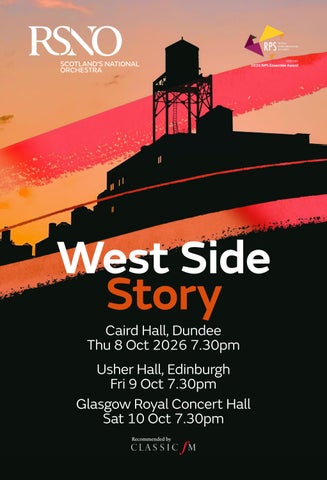
Winner 2026 RPS Ensemble Award
West Side Story Caird Hall, Dundee Thu 8 Oct 2026 7.30pm
Usher Hall, Edinburgh Fri 9 Oct 7.30pm Glasgow Royal Concert Hall Sat 10 Oct 7.30pm
2 West Side Story
Due to an injury, Jeneba Kanneh-Mason is unable to perform Florence Price’s Piano Concerto in One Movement. We wish her a speedy recovery. We are delighted that RSNO Leader Maya Iwabuchi has stepped in at short notice and will instead play Three Pieces from Schindler’s List by John Williams.
John Williams (Born 1932)
Three Pieces from Schindler’s List FIRST PERFORMANCE 1993 DURATION 15 minutes 1. Theme from Schindler’s List 2. Jewish Town (Kraków Ghetto – Winter ’41) 3. Remembrances
Maya Iwabuchi Violin
Maya began violin lessons at the age of two, and since her concert debut at age five, she has enjoyed an international career as a solo violinist, chamber musician, orchestral leader and teacher. Her performances have taken her to the major concert halls of Europe, the Americas, Australia and Asia. Highlights include concertos with the Los Angeles and New York Philharmonic orchestras, Philharmonia Orchestra and RSNO, and performances at the BBC Proms and
Edinburgh and Salzburg festivals. She is Artistic Director of the Hellensmusic Chamber Music Festival. She is regularly invited as guest concertmaster to many European orchestras, and as Leader of the Philharmonia Orchestra from 1994 to 2012, she led for legendary conductors such as Kurt Sanderling, Gennady Rozhdestvensky, Riccardo Muti, Esa-Pekka Salonen, Andris Nelsons and Gustavo Dudamel. Maya moved to Scotland in 2010, has served as Leader of the RSNO since 2011, and joined the faculty at the Royal Conservatoire of Scotland in 2015. Her violin was made by Fabrizio Senta in Turin, c1685.
West Side Story Caird Hall, Dundee Thu 8 Oct 2026 7.30pm Usher Hall, Edinburgh Fri 9 Oct 7.30pm Glasgow Royal Concert Hall Sat 10 Oct 7.30pm From the open landscapes of Copland’s Appalachian Spring to the spiritual-inspired lyricism of Florence Price’s Piano Concerto in One Movement, and from the warmth of William Grant Still’s First Symphony to Bernstein’s electrifying Symphonic Dances from West Side Story, join Scotland’s National Orchestra on a vibrant journey through American music at its most exciting. Rising star Jeneba Kanneh-Mason joins RSNO Associate Artist Kellen Gray for a concert packed with orchestral colour and irresistible rhythm.
ANDERSON The Syncopated Clock [3’] Side by Side with Big Noise Douglas (Dundee Only) COPLAND Appalachian Spring Suite [24’] PRICE Piano Concerto in One Movement [19’] Scottish Premiere INTERVAL STILL Symphony No1 in A flat Major Afro-American [23’] BERNSTEIN Symphonic Dances from West Side Story [23’] Kellen Gray Conductor Jeneba Kanneh-Mason Piano Big Noise Douglas Royal Scottish National Orchestra
The Glasgow performance will be recorded for the RSNO Archive. Supported by the Iain and Pamela Sinclair Legacy. If viewing these notes at the concert, please do so considerately and not during performances. Please silence all mobile telephones and alerts, and refrain from taking photographs, without flash, until the end of each piece.
4 West Side Story
£1
return train travel Kids for a Quid
RSNO: Scotland’s National Orchestra 5
Welcome Welcome to this evening’s concert. I hope you enjoy this journey through some of America’s finest music. And welcome in particular to our Dundee audience, who join us for the first time this Season. We open the Dundee Season with a special performance of music by Leroy Anderson from Big Noise Douglas, with their young musicians sitting alongside the RSNO. These side-by-side performances give young people the opportunity to work with our musicians, including our Assistant Conductor Celia Llácer, and experience what it’s like to play on a national concert-hall stage. We always look forward to these concerts and to hearing what we hope will be the next generation of players. We’re joined this week by the fantastic Kellen Gray, who began his journey with us during the Covid-19 pandemic, flying over from the USA for his audition to become our then Assistant Conductor. Kellen spent two weeks in quarantine in preparation for his 20 minutes with the Orchestra, and his dedication and skill blew us away. He held the position from 2021 to 2023, and it’s great to have him back with us as a 2026:27 Season conductor. Kellen is the most articulate advocate for some of the music we are performing tonight, and indeed he and the Orchestra recorded William Grant Still’s First Symphony on African American Voices, released on Linn Records in 2022 and streaming in all the usual places. We are delighted that the hugely talented pianist Jeneba KannehMason makes her RSNO debut this weekend, giving the Scottish premiere of Florence Price’s Piano Concerto in One Movement, a piece that, although written in 1934, was lost for more than 65 years. Please join me in giving a warm welcome to both Kellen and Jeneba.
Alistair Mackie
Keep in touch with the RSNO
Royal Scottish National Orchestra 19 Killermont Street Glasgow G2 3NX T: +44 (0)141 226 3868
rsno.org.uk Scottish Company No. 27809 Scottish Charity No. SC010702
CHIEF EXECUTIVE
The RSNO is supported by the Scottish Government
6 West Side Story
Royal Scottish National Orchestra
Formed in 1891, the Royal Scottish National Orchestra (RSNO) is one of Europe’s leading symphony orchestras. Awarded royal patronage by Her Late Majesty The Queen in 1977, its special status in the UK’s cultural life was cemented in 2007 when it was recognised as one of Scotland’s five National Performing Companies, supported by the Scottish Government. Led by Music Director Thomas Søndergård, the Orchestra performs across Scotland, including concerts in Glasgow, Edinburgh, Dundee, Aberdeen, Perth and Inverness, and appears regularly at the Edinburgh International Festival and BBC Proms. The RSNO tours internationally, most recently visiting China and Europe. In May 2026, Giedrė Šlekytė was announced as the RSNO’s Music Director Designate and will formally become Music Director from the beginning of the 2027:28 Season, with Thomas Søndergård taking on the new position of Music Director Emeritus. The RSNO has a worldwide reputation for the quality of its recordings, receiving a 2020 Gramophone Classical Music Award for Chopin’s Piano Concertos (soloist: Benjamin Grosvenor), conducted by Elim Chan, two Diapason d’Or awards (Denève/Roussel 2007; Denève/Debussy 2012) and eight GRAMMY Award nominations. In recent years, the RSNO has cultivated an international reputation for world-class film, television and videogame soundtrack recording. The Orchestra has recorded for BAFTA-winning
series Silo (Apple TV) and worked with the likes of GRAMMY Award-winning composer Lorne Balfe on Life on Our Planet (Netflix). Other notable titles include Nuremberg (Sony Pictures), Now You See Me: Now You Don’t (Lionsgate), Horizon: An American Saga (Warner Bros) and Star Wars Outlaws (Ubisoft). The Orchestra records at its bespoke in-house facility in Glasgow, Scotland’s Studio. In 2026 the RSNO was the first professional orchestra since 2014 to be awarded the Royal Philharmonic Society’s Ensemble Award. The award recognises musical ensembles for outstanding quality and scope of performances and work. The RSNO believes that music can enrich lives and aims to inspire, educate and entertain people throughout Scotland and beyond with its performances, recordings and engagement programmes. Supporting schools, families, young professionals and wider communities, the RSNO delivers high-quality initiatives for all ages and abilities. The RSNO’s engagement offering includes its singing strand, encompassing a Buggy Choir and Chorus Academy in both Dundee and Glasgow and a lunchtime Workplace Choir, which complements the well-established and highly respected RSNO Youth Choruses and RSNO Chorus. The community choruses are designed with the benefits of group singing for health and wellbeing at their core and are open to all.
RSNO: Scotland’s National Orchestra 7
On Stage LEADER
CELLO Pei-Jee Ng
PRINCIPAL
HORN Amadea Dazeley-Gaist
Shlomy Dobrinsky
Kennedy Leitch Yuuki Bouterey-Ishido Rachael Lee Sarah Digger Robert Anderson Gunda Baranauskaitė Niamh Molloy
Alison Murray Andrew McLean David McClenaghan Martin Murphy
DOUBLE BASS Ted Merritt
Ben Jarvis Jason Lewis Goodwin Robert Baxter
FIRST VIOLIN Maya Iwabuchi ASSOCIATE LEADER
Patrick Curlett Joana Rodrigues Caroline Parry Ursula Heidecker Allen Elizabeth Bamping Susannah Lowdon Alan Manson Liam Lynch Veronica Marziano Freya Hall Sophie Sild Annabelle Stevens SECOND VIOLIN Marion Wilson ASSOCIATE PRINCIPAL
Helena Rose Paul Medd Anne Bünemann Sophie Lang Robin Wilson Kirstin Drew Colin McKee Jessica Hall Tom Greed Seona Glen Celia Griffiths VIOLA Tom Dunn PRINCIPAL
Felix Tanner Asher Zaccardelli Susan Buchan Nicola McWhirter Claire Dunn Maria Trittinger Francesca Hunt Beth Woodford Elaine Koene
GUEST PRINCIPAL
Michael Rae Yat Hei Lee Moray Jones Alexandre Cruz dos Santos Yehor Podkolzin FLUTE Katherine Bryan PRINCIPAL
Oliver Roberts Janet Richardson PRINCIPAL PICCOLO
OBOE Peter Dykes
ASSOCIATE PRINCIPAL
Fraser Kelman Henry Clay
PRINCIPAL COR ANGLAIS
CLARINET Timothy Orpen PRINCIPAL
William Knight Rebecca Whitener Duncan Swindells
PRINCIPAL
TRUMPET Christopher Hart PRINCIPAL
TROMBONE Dávur Juul Magnussen PRINCIPAL
Cillian Ó Ceallacháin Alastair Sinclair PRINCIPAL BASS TROMBONE
TUBA Dannielle Price GUEST PRINCIPAL
TIMPANI Tom Pritchard GUEST PRINCIPAL
PERCUSSION Simon Lowdon PRINCIPAL
Stuart Semple Tom Hunter Ewan Millar Stanley Talman Catriona Duncan
PRINCIPAL BASS CLARINET
HARP Pippa Tunnell
BASSOON David Hubbard
PIANO/CELESTE Lynda Cochrane
Matthew Kitteringham Paolo Dutto
BANJO Tom Green
PRINCIPAL
PRINCIPAL CONTRABASSOON
ALTO SAXOPHONE Lewis Banks
Orchestra list and programme details correct at time of going to print.
8 West Side Story
Kellen Gray Conductor
Kellen credits the many folk music styles of the south-eastern US as his earliest and most impactful musical influences, and his repertoire interests to date have been fuelled by the engaged pursuit of that same spirit of cultural authenticity. This has led to a particular mastery not only of works that incorporate American folk idioms, but also in-depth explorations of heavily folk-inspired European composers such as Béla Bartók, Manuel de Falla and Ralph Vaughan Williams.
Scotland-based American conductor Kellen Gray is Associate Artist of the RSNO, following his twoyear tenure as Assistant Conductor (2021-23), a post supported by the Solti Foundation. He is one of the foremost experts and interpreters of the music of African-diasporic composers, for whom he is a passionate advocate and champion. Born and raised in Rock Hill, South Carolina, Kellen’s early professional life took him on a diverse path ranging from orchestral violinist to beekeeper, before turning his full-time attention to conducting. As well as RSNO Associate Artist, he is Conductor and Artistic Director of the Lafayette Symphony Orchestra in Indiana. Recent and forthcoming guest conducting highlights include engagements with such leading American orchestras as the Baltimore Symphony, Cincinnati Symphony, Houston Symphony, Minnesota Orchestra, National Symphony Orchestra (Washington, DC) and Seattle Opera. He also works in the UK with the BBC National Orchestra of Wales, BBC Philharmonic Orchestra, London Philharmonic Orchestra and Royal Liverpool Philharmonic Orchestra.
Kellen was the Founder and Curator of Charleston Symphony’s Project Aurora, a programming and performance initiative aiming to illustrate the importance of African American arts and culture as equally valuable to its European equivalent. Additionally, he serves as Assistant Editor and Conductor Liaison for the African Diaspora Music Project, after extensive research at The Center for Black Music Research (CBMR) at Columbia College Chicago. Kellen’s discography to date comprises two celebrated releases – African American Voices and African American Voices II, made with the RSNO – showcasing music by Margaret Bonds, William Dawson, William Grant Still, Coleridge Taylor Perkinson, Florence Price and George Walker. Both have met with the highest critical acclaim, including an elusive 5-star review from the prestigious Diapason magazine. Kellen’s previous positions include successful tenures with the Charleston Symphony Orchestra (Associate Conductor, 2018-23), Chicago Sinfonietta (Conducting Fellow and Assistant Conductor, 2016-18) and Valdosta Symphony Orchestra (Assistant Conductor, 2014-16).
RSNO: Scotland’s National Orchestra 9
Every Child, Every Community: Bring a School Class to the Concert Hall
‘Bus bursaries are essential at the moment. Funding has been cut by so much that participation in external events is nearly impossible.’ Teacher, Edinburgh Scan the QR code opposite to be taken to our donate page or visit rsno.org.uk/every-child
The RSNO is supported by the Scottish Government
10 West Side Story
Leroy Anderson (1908-1975)
The Syncopated Clock To listeners and players in 2026, Leroy Anderson is the consummate craftsman who composed such classic gems as The Typewriter (known to BBC Radio 4 listeners as the theme tune to The News Quiz) and Sleigh Ride (whose famous lyrics, added later, describe ‘a sleigh ride together with you’). But Anderson held a parallel career in the US military, which drew on his PhD in German and Scandinavian languages, and first saw him stationed in Iceland as a translator and interpreter, before he became Chief of the Scandinavian Desk of US Military Intelligence at The Pentagon.
FIRST PERFORMANCE Boston, 28 May 1945 DURATION 3 minutes
Anderson needed special wartime dispensation, in fact, to leave his lofty post in order to conduct the premiere of The Syncopated Clock with the Boston Pops Orchestra (which had commissioned the piece) on 28 May 1945. Not that there’s anything remotely military-sounding about his whimsical creation: instead, the idea came to Anderson of a clock whose regular ticktocking is sometimes interrupted by irregular syncopations. Two woodblocks keep up the tick-tocking (almost) throughout, accompanying the piece’s nonchalant main tune. And that tune is embedded in the memories of many Americans of a certain age, as the theme music to CBS’s The Late Show evening movie slot from the 1950s.
RSNO: Scotland’s National Orchestra 11
Big Noise Douglas
LOGO TOOLKIT
A simple guide to using the Big Noise logo
01 LOGO
DOWNLOAD
Our main charity logo Our main charity logo should be used to clearly identify Big Noise across external communications and materials.
VIOLIN Ash Ramsay Ayowade Pegba-Otemolu Erin Jones Everly Butler Harley Morrison Jude Lynch Malvin Odegbesan
CELLO Ariana Anghel Elliot Olugbade Hunter Jones Princess Mbakwe Taylor McMillan DOUBLE BASS Ella Kiernan
Clear space: An invisible exclusion zone around the Big Noise logo
VIOLA ensures it remains clear and prominent. Emmanuel Sibusiso Maposa Noah O’Neill Olivia-Mae McMillan Where possible, maintain a minimum clear space of 0.3x around Zion Faniyan
the logo, where ‘x’ is the height of the logo.
12 West Side Story
Aaron Copland (1900-1990)
Appalachian Spring Suite FIRST PERFORMANCE Full ballet: Washington, DC, 30 October 1944. Suite: New York, 4 October 1945 DURATION Suite: 24 minutes Appalachian Spring was the third in a series of ballets on American themes which Aaron Copland composed during the late 1930s and early 1940s – the previous two being Billy the Kid (1938) and Rodeo (1942). Commissioned by the famous arts patron, Elisabeth Sprague Coolidge, it was written for Martha Graham and her dance company, and first staged at the Library of Congress, Washington in 1944 alongside newly written ballets by Hindemith and Milhaud. According to the composer, the ballet’s scenario depicts ‘a pioneer celebration in spring that takes place around a newly-built farmhouse in the Pennsylvanian Hills during the early part of the 19th century’. The bride-to-be and the young farmer experience a varied range of emotions from joy to apprehension in anticipation of their impending domestic partnership. An older neighbour weighs in with their pearls of wisdom alongside a revivalist and his followers, who warn the new householders of the unpredictable and potentially tragic circumstances of human fate. However, at the end, the young couple are left alone to enjoy peace and contentment in their new house. Copland originally conceived Appalachian Spring for a chamber ensemble of 13 instrumentalists. But it was given far wider dissemination the following year when he created a Suite drawn from the ballet which was rescored for large orchestra. Premiered in October 1945 by the New York Philharmonic under Artur Rodziński, the Suite soon became one of Copland’s most frequently performed works. Its lasting popularity
can be attributed to the more lyrical and musically accessible vernacular the composer cultivated during this period, in contrast to the abrasive modernist idiom of his earlier works. The Suite is divided into eight continuous sections that juxtapose slow calm music with more upbeat animated material. In the introduction, Copland creates a marvellous sense of the wideopen spaces of the American prairie through the use of sustained pedal notes and gentle slow-moving harmonies. This stillness is suddenly interrupted by a faster section which opens with a fanfare-like unison passage in upper strings, piano and xylophone. As the music becomes more excitable, Copland ingeniously combines this vivacious rhythmic activity with a religiously tinged chorale. The tempo then slackens for a more intimately scored passage depicting a dance between the farmer and his bride-to-be. In the fourth section, entitled ‘The Revivalist and his flock’, we return to a more extrovert and playful mode of expression with obvious imitations of folk fiddles and square dances. After a huge climax, there is a momentary passage of calm before Copland ratchets up the tension even further with a jagged and angular dance for the solo bride that moves at breakneck speed. Another moment of repose, reminiscent of the opening of the work, leads to the penultimate section, in which Copland constructs an increasingly rousing set of variations on the American Shaker folk tune ‘The Gift to be Simple’, which is first heard on the solo clarinet. After such life-affirming music, the work concludes with a hushed prayer-like chorale on muted strings and a final heart-warming recollection of the work’s opening section. © Erik Levi
RSNO: Scotland’s National Orchestra 13
William Grant Still (1895-1978)
Symphony No1
in A flat Major Afro-American (now university), he began working as a dance band musician in Columbus, Ohio in the spring of 1915. In the summer of 1916, composer, publisher and bandleader W C Handy invited Still to join his band as cellist and arranger in Memphis, Tennessee, near the Mississippi Delta. Still learned to play and compose blues while with Handy. Also in Memphis, Still delved into all forms of Black vernacular music and dance. A few months later, a small inheritance enabled him to study at Oberlin College in Ohio. After Navy service during World War I, Still returned to Oberlin in the spring of 1919. He moved to New York later that year.
FIRST PERFORMANCE Rochester, NY, 1931 DURATION 23 minutes 1. Longing: Moderato assai 2. Sorrow: Adagio 3. Humor: Animato 4. Aspiration: Lento, con risoluzione Harlem Renaissance composer William Grant Still fused African American vernacular music with the Classical-Romantic symphony in the Afro-American Symphony of 1931. Born in Woodville, Mississippi, on 11 May 1895, Still was raised by his widowed mother, Carrie Fambro Still, in Arkansas. He had direct ties to slavery and 19th-century spirituals, oral history and folk traditions through his formerly enslaved grandmother. Still’s stepfather, Charles Shepperson, introduced him to opera. Still became seriously interested in music in high school. After attending a Wilberforce
During 15 years in New York, Still worked as a popular music, musical theatre and radio arranger. He also studied with avant-garde composer Edgard Varèse between 1923 and 1925. Still’s ‘Ultramodern’ style combined dissonant atonal harmony with traditional African American blues-inflected melody and formal structures (for example, 1924’s Darker America). Realising Ultramodern techniques were incompatible with African American music, Still embraced a consonant, lyrical ‘Racial’ style. Still composed the Afro-American Symphony in 1930. In his ‘Racial’ style, the work reflects the aesthetic of the Harlem Renaissance. This cultural and political movement aimed to show the beauty of African American art, music, language, etc. As Howard University professor Alain Locke wrote in the 1925 manifesto The New Negro, a new generation of Black artists was using vernacular culture to create new art forms. The Harlem Renaissance also had political goals. In 1903 W E B Du Bois referred to the Talented Tenth – formally educated and artistic African Americans. In his and Locke’s philosophy, the arts and culture of the Talented Tenth could educate White Americans about African Americans,
14 West Side Story
thereby promoting racial understanding and the end of racism. Du Bois believed African American composers should draw upon the spirituals, or ‘sorrow songs’, which, he wrote, expressed the hopes, emotions and inner lives of the enslaved. Yet the Black music of Still’s adulthood also included the new 1920s urban jazz and blues. All three idioms can be heard in his compositions, especially his orchestral works.
Poems by Paul Laurence Dunbar used by William Grant Still as movement epigraphs:
Still’s Afro-American Symphony reflects the history and culture of African Americans. He sought to show the beauty, depth and richness of the blues by incorporating it within the Symphony. He also drew upon spirituals and 19th-century Black folk dance. The work is in four movements. The first, Longing: Moderato assai, displays modified sonata form. The first theme is a blues, with the blues scale, call and response, and in a 12-bar blues form (the standard form in jazz and blues). The second theme is a spiritual. In the development, Still uses procedures borrowed from jazz and blues, including the chorus structure. The theme of the second movement, Sorrow: Adagio, resembles a spiritual. Still draws upon the 19th-century Juba dance in the scherzo, Humor: Animato. (Gershwin later used its opening motif in I Got Rhythm.) The final movement departs from the ClassicalRomantic symphonic tradition: rather than an up-tempo rondo, it is sombre and resolute.
All my life long twell de night has pas’ Let de wo’k come ez it will, So dat I fin’ you, my honey, at last, Somewhaih des ovah de hill.
A poem by African American poet Paul Laurence Dunbar (1872-1906), known for his dialect poetry, prefaces each movement to create a programme that traces the history of African Americans.
For Aspiration: Lento, con risoluzione
© Gayle Murchison
For Longing: Moderato assai: All de night long twell de moon goes down, Lovin’ I set at huh feet, Den fu’ de long jou’ney back f’om de town, Ha’d, but de dreams mek it sweet.
For Sorrow: Adagio: It’s moughty tiahsome layin’ ’roun’ Dis sorer-laden erfly groun’, An’ oftentimes I thinks, thinks I, ’T would be a sweet t’ing des to die, An go ’long home.
For Humor: Animato: An’ we’ll shout ouah halleluyahs, On dat mighty reck’nin’ day.
Be proud, my Race, in mind and soul, Thy name is writ on Glory’s scroll In characters of fire. High ’mid the clouds of Fame’s bright sky, Thy banner’s blazoned folds now fly, And truth shall lift them higher.
RSNO: Scotland’s National Orchestra 15
Leonard Bernstein (1918-1990)
Symphonic Dances from West Side Story FIRST PERFORMANCE Full musical: Washington, DC, 19 August 1957. Symphonic Dances: New York, 13 February 1961 DURATION 23 minutes If one figure encapsulates the sheer richness and breadth of American music more than any other, it’s surely Leonard Bernstein. Nowhere is that breadth more apparent than in his refusal to draw boundaries between classical and popular styles in his immensely wide-ranging music. He’s the composer of symphonies, sonatas, songs and many more classical works, for example, but he’s also the composer of what’s undeniably the 20th century’s most iconic musical. West Side Story was a collaboration between composer Bernstein, lyricist Stephen Sondheim and book-writer Arthur Laurents, to an original idea from choreographer Jerome Robbins. It updated Shakespeare’s Romeo and Juliet to the warring gangs of Manhattan’s Upper West Side in the 1950s, and it was a stunning success at its Broadway premiere in September 1957, running for two years. It was also a stunning success, as scholars and musicologists have pointed out ever since, in its apparently effortless melding of allAmerican musical comedy with the high tragedy and sophistication of a more European operatic style. Bernstein himself extracted the Symphonic Dances from his complete musical score for a 1961 fundraising gala held by the New York Philharmonic, where he was Music Director. And he chose that unusual title intentionally: this is a foot-tapping celebration of the music’s vibrant dance episodes (plus two of its best-known vocal numbers, ‘Somewhere’ and ‘Maria’), but Bernstein conceived that
dance music symphonically, deploying highly distinctive themes and developing, reworking and combining those themes in a manner more associated with classical symphonic thinking than that of earlier musicals. With its slinky sax melody and finger clicks, the opening ‘Prologue’ describes the growing tensions between rival gangs the Sharks and the Jets, with only a cop’s whistle putting a lid on its more aggressive later music. ‘Somewhere’ takes us to an idyllic vision, too good to be true, where the two gangs coexist in peace, a mood continued in the ‘Scherzo’, which imagines these youngsters finding freedom and happiness away from the city in music that might distinctly remind you of Copland’s Appalachian Spring, heard earlier this evening. We’re back with a jolt in the real world, however, with the clattering Latin percussion of ‘Mambo’, which describes a competitive gym work-out between the two gangs. The music calms for lovers Tony and Maria’s first tentative dance together in ‘Cha-cha’, and the brief ‘Meeting Scene’ – led by Bernstein’s famous ‘Maria’ rising motif – accompanies their first words to each other. The pace picks up again in ‘Cool’, as the Jets’ leader goads his gang into open hostility, and violence finally erupts in the brutal ‘Rumble’, leaving several dead, and a lone flute surveying the devastation. In the shocked, quiet ‘Finale’, the gangs find an uneasy sense of peace, as well as grief, and – perhaps – hope. © David Kettle
16 West Side Story
Brahms’ Violin Concerto Aberdeen | Thu 22 Oct: 7.30pm Edinburgh | Fri 23 Oct: 7.30pm Glasgow | Sat 24 Oct: 7.30pm Emilia Hoving Conductor Maya Iwabuchi Violin
Book online at
rsno.org.uk
RSNO: Scotland’s National Orchestra 17
Big Noise
LOGO TOOLKIT A simple guide to using the Big Noise logo
Please support Big Noise by visiting Big Noise is a charity that delivers social change and music education programmes, working with www.bignoise.org.uk or by scanning almost 4,200 children and families to improve lives the QR code. and strengthen communities across Scotland. Big Noise’s immersive and long-term programmes use DOWNLOAD music and nurturing relationships to help children and young people fulfil their potential. Our main charity logo
01 LOGO
02 CO
At Big Noise the symphony orchestra becomes Our which mainsupports charityyoung logo people shouldtobe used to clearly identify Big Noise a community across external communications gain an invaluable range of life skills. Independent and materials. evaluation shows that Big Noise supports children to improve their learning, wellbeing and confidence, bringing communities together and paving the way for positive futures. The programmes are delivered by inspirational staff musicians who act as role models and mentors, and foster supportive, long-term relationships. Big Noise Douglas is the fourth Big Noise programme. First established in 2017, the programme now works with almost 800 children and young people and their families.
space: An invisible Big NoiseClear is delivered with support from exclusion a range of zone around the Big Noise logo public partners, trusts, foundations and individuals. ensures it remains clear and prominent. Big Noise runs music education programmes in the targeted communities of Big Noise Raploch Where possible, maintain a minimum clear space of 0.3x around & Fallin (Stirling), Govanhill (Glasgow), Torry theDouglas logo, where is Wester the height (Aberdeen), (Dundee)‘x’ and Hailes of the logo. (Edinburgh).
Preferred Black and backgroun
Three riddles. Two hearts. A life at risk. 18 West Side Story
Turandot P U C C I N I
Core funded by
A new production from Sir David McVicar A new co-production with Irish National Opera Supported by Dunard Fund
Registered in Scotland Number SC037531 Scottish Charity Number SC019787
Glasgow & Edinburgh 22 October – 22 November
RSNO: Scotland’s National Orchestra 19
Shostakovich Seven Featuring the UK Premiere of Lera Auerbach’s Violin Concerto No1
Edinburgh | Fri 30 Oct: 7.30pm Glasgow | Sat 31 Oct: 7.30pm Dundee | Sun 1 Nov: 3pm Bassem Akiki Conductor Philippe Quint Violin
Book online at
rsno.org.uk
20 West Side Story
RSNO Benefactors, Patrons and Circle members We are grateful to all our individual supporters for their generous philanthropy and loyalty. Your support enables the Orchestra to achieve its most ambitious goals and to continue inspiring people across Scotland both on and off the concert stage.
RSNO Benefactors
RSNO Conductors’ Circle
RSNO Patrons
Sir Ewan and Lady Brown Gavin and Kate Gemmell Kat Heathcote and Iain Macneil Ms Chris Grace Hartness Stina Bruce Jones Shirley Murray
Ardgowan Charitable Trust Ian and Evelyn Crombie Kenneth and Julia Greig David and Alix Stevenson Eric and Karen Young
Geoff and Mary Ball Lady Rebecca Fraser Don and Lois Macleod Walter and Janet Reid Charitable Trust George Ritchie Stephen Sweeney Valerie Wells
Learning and Engagement Patrons William Brown, W.S The Dundee RSNO Circle Committee Neil and Nicola Gordon Professor Gillian Mead, FRSE Nicholas and Alison Muntz Maurice and Nicola Taylor Charitable Trust David and Marilyn Wilson
Chair Patrons Assistant Conductor
Second Violin
Cello
The Solti Foundation Chair
The Nigel & Margot Russell Chair
Ms Chris Grace Hartness Chair
Celia Llácer First Violin
Maya Iwabuchi LEADER
Dunard Fund Chair
Marion Wilson ASSOCIATE PRINCIPAL
Pei-Jee Ng PRINCIPAL
Sophie Lang
Betsy Taylor ASSOCIATE PRINCIPAL
Viola
Kennedy Leitch ASSISTANT PRINCIPAL
The Cathy & Keith MacGillivray Chair
Rachael Lee
The Ian & Evelyn Crombie Chair
The Maxwell Armstrong Chair
The David and Anne Smith Chair
Tamás Fejes ASSISTANT LEADER
Tom Dunn PRINCIPAL
Ursula Heidecker Allen
Lisa Rourke SUB PRINCIPAL The Meta Ramsay Chair
The Christine and Arthur Hamilton Chair
Elizabeth Bamping
Francesca Hunt
Double Bass
The Bill and Rosalind Gregson Chair The James and Iris Miller Chair The WL and Vera Heywood Chair
Alan Manson
The Hugh and Linda Bruce-Watt Chair
Liam Lynch
Ms Chris Grace Hartness Chair
Lorna Rough
The Sir Richard Dunbar Chair
The Rolf Thornqvist and Celia Sinclair Thornqvist MBE Chair
Nikita Naumov PRINCIPAL
The Gregor Forbes John Clark Chair
Michael Rae ASSISTANT PRINCIPAL
James Wood Bequest Fund Chair
RSNO: Scotland’s National Orchestra 21
Flute
Clarinet
Andrew McLean ASSOCIATE PRINCIPAL
The David and Anne Smith Chair
The Shirley Murray Chair
Trumpet
Katherine Bryan PRINCIPAL
Timothy Orpen PRINCIPAL William Knight ASSOCIATE PRINCIPAL
Oboe
Adrian Wilson PRINCIPAL The Hedley Wright Chair
Peter Dykes ASSOCIATE PRINCIPAL
The Turcan Connell Chair
Horn
David McClenaghan SUB-PRINCIPAL
Witherby Publishing Group Charitable Trust Chair
The Springbank Distillers Chair
Cor Anglais
Mr & Mrs Pierre and Alison Girard
In memory of a dear friend, Fiona H
The Gordon Fraser Charitable Trust Chair
Henry Clay PRINCIPAL
Alison Murray ASSISTANT PRINCIPAL Martin Murphy ASSISTANT PRINCIPAL
The Catherine McLagan Chair
Christopher Hart PRINCIPAL Ms Chris Grace Hartness
Staff
Chiko Parkinson
COMMUNITY SINGING ASSISTANT
Supported by ScotRail
We are also grateful to those who give but who wish to remain anonymous.
If you would like to discuss how you can become an RSNO Patron, please contact Constance Fraser, Head of Development (Individuals and Partnerships), at constance.fraser@rsno.org.uk
RSNO Circle Virtuoso Ms Catherine Y Alexander Mrs A M Bennett Mr Alan and Mrs Carolyn Bonnyman Dame Susan and Mr John Bruce Francesca and Eoghan Contini Mackie Dr Clive Criper Scott and Frieda Grier Judith and David Halkerston Iain MacNeil and Kat Heathcote MBE Ian and Sarah Lister Miss A McGrory Maureen Michie Mr James Miller CBE David Moncur Mrs Abigail Morrison Nicholas and Alison Muntz Bernard and Jane Nelson Mr and Mrs W Semple Gregor and Lesley Stewart Mr Ian Taft Claire and Mark Urquhart Raymond and Brenda Williamson Margaret Duffy and Peter Williamson
Symphony Martin and Jackie Beard Mr John Brownlie Mr A Campbell Dr K Chapman and Ms S Adam Dr C Cradock and Dr S Todd Mr W G Geddes Dr Robert Gibb Mr I Gow Hon Lord McGhie Mrs A McQueen Kathryn Michael Mr Iain Percival James and Pam Robertson David and Maggie Robinson Mrs Henrietta Simpson Ian and Janet Szymanski Nelson and Barbara Waters Tom and Lisa Watson Philip Whitely and Robert H Mackay Concerto Neil Barton Mrs Mary Black Miss D Blackie Dr C M Bronte-Stewart Dr F L Brown Mr and Mrs Burnside David Caldwell Ms H Calvert
Ross Cavanagh Myk Cichla Terry and Joan Cole Dr J Coleiro Christine and Jo Danbolt Steven J Davis Mr and Mrs K B Dietz Dr A Ewing David and Sheila Ferrier Mr C Ffoulkes William Findlay Mr and Mrs M Gilbert Simon and Fiona Guest Lord and Lady Hamilton P Hayes David G Henderson Dr and Mrs P Heywood Ms H Kay Mr and Mrs W Kean Nicholas Kilpatrick Christine Lessels Morag MacCormick Mr and Mrs Marwick Mr S Marwick Mrs Sandra Maxwell Mr and Mrs G McAllister Mrs M McDonald Dr A H McKee Mr Rod McLoughlin Morag Millar
22 West Side Story
Mrs B Morinaud Dr and Mrs D Mowle Ms A and Miss I Reeve Mrs E M Robertson Sheriff Linda Ruxton Dr and Mrs G K Simpson Dr Norma H Smith Mr and Mrs A Stewart Jenny Stewart David and Helen Strachan Mr I Strachan Dr G R Sutherland Mr and Mrs J B Watson Helen and Peter Wilde David W Wren Roderick Wylie Sonata Mr and Mrs G H Ainsley Mr K Allen Dr A D Beattie Mrs H Benzie Mr R Billingham John Bradshaw and Shiona Mackie Mrs Bryan Andrew Burrows Mrs C M Campbell Miss S M Carlyon Amanda Carter-Fraser Lady Coulsfield Adam and Lesley Cumming Mrs C Donald J Donald and L Knifton Mr John Duffy Mr R M Duncan Brigadier and Mrs C C Dunphie Mrs E Egan Mr R Ellis Mr R B Erskine Dr E Evans Kenneth Forbes Mr D Fraser Philip and Karen Gaskell Elizabeth Gibb Mrs M Gibson Mrs M Gillan Mrs J K Gowans Dr J and Mrs H Graham
Professor and Mrs A R Grieve Mr Martin Hammick Dr P J Harper Dr N Harrison Mr and Mrs R J Hart Bobby and Rhona Hogg Mr and Mrs F Howell Mrs A Hunter Inez Hutchison Professor R N Ibbett Thomas Jakobsen Burns Geoffrey and Elizabeth Johnston Iain M Lanaghan Ms K Lang Mrs Anne Lindsay Dr Dorothy A Lunt Alison and Bryn Martin Mrs Jean C Martin Mr and Mrs J Martin Ms S McArthur Jean McCutcheon Rhyse McDermid Mr M McGarvie Dr Colin McHardy Ms H L McLaren Margaret McLay Libby McLean Mr and Mrs B Mellon Simon Michaelson Mr I Mills Mrs P Molyneaux Kenneth M Murray Bruce and Christine Nelson Alastair Ogilvie Mr and Mrs K O’Hare Mr and Mrs K Osborne Dr G Osbourne Mr A Ownsworth Stephanie Park Mr R Parry John Paterson Misses J and M Penman Mr J W Pottinger Miss J A Raiker Alastair Reid Ms F Reith Dr and Mrs D Robb Anne Robertson
Ms A Robson Mrs J Shanks Mr J A Shipley Dr M J and Mrs J A Shirreffs Richard and Gillian Shirreffs Ana Smith Mrs E Smith Mr M Smith Dr and Mrs B Stack Mrs Lorna Statham Mrs R F Stewart Mr and Mrs B Tait Lisbeth Thoms Dr and Mrs T Thomson Dr Morag Ward Dr Alex Watson Mr W Watters Alan Weddell Mr R Young
Thank you to all our members of the Circle, including Overture members and those who wish to remain anonymous.
If you would like to discuss how you can become an RSNO Circle member, please contact Polly Lightbody, Development Manager, at polly.lightbody@rsno.org.uk
RSNO: Scotland’s National Orchestra 23
Charitable Trusts and Foundations Charitable trusts and foundations have a distinguished history of supporting the RSNO, both on and off the stage. From one-off donations for specific concerts and musicians’ chairs, to multi-year funding for our community engagement initiatives, including our Schools Programme, every grant in support of our work is truly appreciated. We are grateful to the following trusts and foundations for their generosity: Aberdeen Endowments Trust Alexander Moncur Charitable Trust Alma & Leslie Wolfson Charitable Trust Boris Karloff Charitable Foundation Castansa Trust CMS Charitable Trust Common Humanity Arts Trust Cookie Matheson Charitable Trust Cruden Foundation David and June Gordon Memorial Trust Educational Institute of Scotland Ettrick Charitable Trust Evelyn Drysdale Charitable Trust Fidelio Charitable Trust Gannochy Trust Gaelic Language Promotion Trust Gordon Fraser Charitable Trust Hinrichsen Foundation Harbinson Charitable Trust Hugh Fraser Foundation James Wood Bequest Fund Jennie S Gordon Memorial Foundation Jean & Roger Miller’s Charitable Trust John Mather Trust JTH Charitable Trust Leach Family Charitable Trust Leisure & Culture Dundee Leng Charitable Trust Lethendy Charitable Trust Marchus Trust Mary Janet King Memorial Fund, administered by Foundation Scotland McGlashan Charitable Trust MEB Charitable Trust Meikle Foundation Miss E C Hendry Charitable Trust Miss Jean R Stirrat’s Charitable Trust
Nancie Massey Charitable Trust Noël Coward Foundation Northwood Charitable Trust Pear Tree Fund for Music PF Charitable Trust Q Charitable Trust Radcliffe Trust Ronald Miller Foundation Russell Trust Scott-Davidson Charitable Trust Scottish Enterprise Solti Foundation Souter Charitable Trust Stevenston Charitable Trust Sylvia Aitken Charitable Trust Tay Charitable Trust Thriplow Charitable Trust Tillyloss Trust Trades House of Glasgow Commonweal Fund W A Cargill Fund W M Sword Charitable Trust Walter Scott Giving Group Walter Craig Charitable Trust Weir Charitable Trust Zich Trust We are also grateful to a number of trusts that wish to stay anonymous.
If you would like more information about our work and how you can make a difference, please contact Niamh Kelly, Head of Trusts and Projects, at niamh.kelly@rsno.org.uk
24 West Side Story
A big Thank You to our supporters FUNDERS
CORPORATE SUPPORTERS
Ecosse
PRINCIPAL MEDIA PARTNER
PRINCIPAL TRANSPORT PARTNER
EXCLUSIVE AIR TRAVEL PARTNER
BROADCAST PARTNER
PARTNERS Adelaide Place • Age Scotland • Black Lives in Music • Charanga • Children’s Classic Concerts Children’s Hospices Across Scotland • Classic FM • Douglas Academy • Dundee Science Centre • Dunedin Consort Edinburgh Zoo • Education Scotland • Fanzclub • Gig Buddies • Glasgow Life • GMAC Film Heads of Instrumental Teaching Scotland • Hebrides Ensemble Kibble • Luminate • Marine Conservation Society MARSM • Music Education Partnership Group • ParentZone • The Pyramid at Anderston Royal Conservatoire of Scotland • Scottish Book Trust • Scottish Chamber Orchestra • Scottish Refugee Council Sistema Scotland • St Mary’s Music School • Tayside Healthcare Arts Trust • Trees for Life • University of Glasgow V&A Dundee • Visible Fictions
With thanks to all RSNO Benefactors, Patrons, Circle Members and appeal donors for their support of the RSNO.
If you would like more information about sponsorships, corporate partnerships or fundraising events with the RSNO, please contact Constance Fraser, Head of Development (Individuals and Partnerships), at constance.fraser@rsno.org.uk
RSNO: Scotland’s National Orchestra 25
Royal Scottish National Orchestra PATRON His Majesty The King
Andrew McTaggart
DIRECTOR OF CHANGED VOICES
NOMINATED DIRECTOR
ARTISTIC TEAM Thomas Søndergård
COMMUNITY SINGING DIRECTOR (GLASGOW)
COMPANY SECRETARY
Giedrė Šlekytė
RSNO BOARD OF DIRECTORS
MUSIC DIRECTOR
MUSIC DIRECTOR DESIGNATE
Patrick Hahn
Aimee Toshney David McLean
COMMUNITY SINGING DIRECTOR (DUNDEE)
Celia Llácer
Elected Directors Gregor Stewart
Ellie Slorach
Gail Blain
PRINCIPAL GUEST CONDUCTOR ASSISTANT CONDUCTOR ENGAGEMENT CONDUCTOR
Kellen Gray
ASSOCIATE ARTIST
Neeme Järvi
CONDUCTOR LAUREATE
Alexander Lazarev CONDUCTOR EMERITUS
Stephen Doughty DIRECTOR, RSNO CHORUS
Patrick Barrett
CHAIR
HONORARY TREASURER
Kayla-Megan Burns Ken Hay Don Macleod David Macluskey Louise Mitchell John Stewart David Strachan
Cllr Edward Thornley
Julia Miller
Player Directors Kirstin Drew David Hubbard William Knight Liam Lynch David McClenaghan Felix Tanner SCHOOLS ADVISORY GROUP
Pam Black Norman Bolton Martin Greig Neil Millar Mae Murray
DIRECTOR, RSNO YOUTH CHORUSES
CHIEF EXECUTIVE
Dylan Findlay
Polly Lightbody
Alistair Mackie
ASSISTANT STAGE MANAGER
CHIEF EXECUTIVE
Ted Howie
FACILITIES MANAGER
Graham Ramage
Dr Jane Donald
DEPUTY CHIEF EXECUTIVE
Nicola Kelman
EXECUTIVE ASSISTANT
PLANNING
Tammo Schuelke
DIRECTOR OF ARTISTIC PLANNING
Xander van Vliet
ARTISTIC PLANNING MANAGER
Rachel Pullin
ARTISTIC PLANNING OFFICER
Richard Payne
LEARNING AND ENGAGEMENT
Andrew Stevenson DIRECTOR OF ENGAGEMENT
Anna Crawford
ENGAGEMENT PRODUCER
Chiko Parkinson
EXTERNAL RELATIONS
Dr Jane Donald
ORCHESTRA MANAGEMENT
Aria Tsvetanova
PARTNERSHIPS AND EVENTS ADMINISTRATOR
Ross Williamson
VIDEO PRODUCER (MARKETING)
Hedd Morfett-Jones
Maisie Leddy
CHORUS MANAGER YOUTH CHORUS MANAGER
INFORMATION SERVICES MANAGER
AUDIO
LIBRARY ASSISTANT
Christine Walker
Sam Stone
ENGAGEMENT DELIVERY MANAGER
Rachel Naismith
COMMUNITY CHORUS AND PARTNERSHIPS COORDINATOR SUPPORTED BY SCOTRAIL
Anna Burns
GRAPHIC DESIGNER
ENGAGEMENT DELIVERY MANAGER
HEAD OF LIBRARY SERVICES
Megan Bousfield
DEVELOPMENT MANAGER
DIRECTOR OF EXTERNAL RELATIONS
Carol Fleming
STUDIO MANAGER
Sam McErlean
MEDIA MANAGER AND AUDIO ENGINEER
Nico
TRAINEE AUDIO ENGINEER
FINANCE AND CORPORATE SERVICES
Nicola Mills
HEAD OF MARKETING
DIRECTOR OF FINANCE AND CORPORATE SERVICES
HEAD OF DEVELOPMENT
HEAD OF FINANCE
Constance Fraser
Matthias Van Der Swaagh
Ian Brooke
Brodie Smith
Fred Bruce
HEAD OF ORCHESTRA MANAGEMENT
PROGRAMMES EDITOR
DEPUTY ORCHESTRA MANAGER
TRUSTS AND PROJECTS ADMINISTRATOR
OPERATIONS AND PRODUCTION
MARKETING MANAGER
Craig Swindells
Katie Kean
Adam Dundas
Niamh Kelly
Clara Cowen
Seonaid Eadie
EXTERNAL RELATIONS OFFICER
HEAD OF PRODUCTION
COMMUNICATIONS AND MARKETING OFFICER
STAGE MANAGER
HEAD OF TRUSTS AND PROJECTS
Susan Rennie Jade Wilson FINANCE OFFICER
Abby Dennison
FINANCE ADMINISTRATOR
Phoebe Connolly FINANCE ASSISTANT
David Hazel
FINANCE BUSINESS PARTNER AND ANALYST (INTERIM)
Contents © Copyright RSNO and named authors.