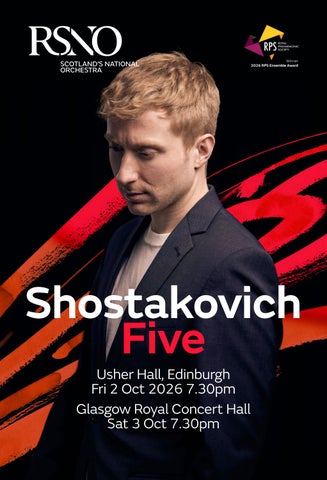
Winner 2026 RPS Ensemble Award
Shostakovich Five Usher Hall, Edinburgh Fri 2 Oct 2026 7.30pm Glasgow Royal Concert Hall Sat 3 Oct 7.30pm
2 Shostakovich Five
SAVE 1/3 UP TO
GroupSave tickets
Shostakovich Five Usher Hall, Edinburgh Fri 2 Oct 2026 7.30pm Glasgow Royal Concert Hall Sat 3 Oct 7.30pm In Stalin’s Russia, music really was a matter of life and death. Written under political oppression, Shostakovich gambled everything on his Fifth Symphony, and when it was first played, the audience wept – and then cheered. Make no mistake, this is a musical thriller with a devastating emotional punch, and tonight Principal Guest Conductor Patrick Hahn sets the scene with another Cold War classic, Schnittke’s haunting Viola Concerto, with the brilliant Lawrence Power as soloist. Expect shadows, secrets and some powerful surprises.
J S BACH arr. STOKOWSKI Komm, süsser Tod BWV 478 [4’] SCHNITTKE Viola Concerto [35’] INTERVAL SHOSTAKOVICH Symphony No5 in D Minor Op47 [46’] Patrick Hahn Conductor Lawrence Power Viola Royal Scottish National Orchestra
The Glasgow performance will be recorded for the RSNO Archive. Supported by the Iain and Pamela Sinclair Legacy. If viewing these notes at the concert, please do so considerately and not during performances. Please silence all mobile telephones and alerts, and refrain from taking photographs, without flash, until the end of each piece.
4 Shostakovich Five
West Side Story A vibrant journey through American music at its most exciting
Edinburgh | Fri 9 Oct: 7.30pm Glasgow | Sat 10 Oct: 7.30pm Kellen Gray Conductor Jeneba Kanneh-Mason Piano
Book online at
rsno.org.uk
RSNO: Scotland’s National Orchestra 5
Welcome Thank you for joining us this evening, for what is the first of two concerts this month featuring symphonies by Shostakovich. I’d like to welcome Principal Guest Conductor Patrick Hahn for his first concert of the 2026:27 Season. However, some of you may have already seen Patrick lead the Orchestra on Thursday night as part of the Sonica Festival at Glasgow’s Tramway in Philip Glass’ Bowie Symphony, where he was joined by visual artist Tatsuru Arai. Tonight’s programme is a little different, with the fantastic violist Lawrence Power taking the spotlight in Alfred Schnittke’s extraordinary concerto – we are definitely in for a treat! On Sunday afternoon Lawrence is back with us in Glasgow Royal Concert Hall’s New Auditorium for a matinee with five of the RSNO’s string players. They will perform a programme of Brahms and Schoenberg, and I thoroughly recommend you join us – it will be something quite special. Those of you joining us in Glasgow this evening will have had the opportunity to see the young musicians of the Music School of Douglas Academy performing in a pre-concert showcase. It is an important part of our commitment as a National Performing Company to nurture upcoming talent, and this is just one of the many ways in which we do this alongside our extensive engagement work. It’s always a pleasure to welcome these young people onto the stage and see them flourish.
Keep in touch with the RSNO
In the meantime, I hope you enjoy tonight’s performance.
rsno.org.uk
Royal Scottish National Orchestra 19 Killermont Street Glasgow G2 3NX T: +44 (0)141 226 3868
Alistair Mackie CHIEF EXECUTIVE
Scottish Company No. 27809 Scottish Charity No. SC010702
The RSNO is supported by the Scottish Government
6 Shostakovich Five
Royal Scottish National Orchestra
Formed in 1891, the Royal Scottish National Orchestra (RSNO) is one of Europe’s leading symphony orchestras. Awarded royal patronage by Her Late Majesty The Queen in 1977, its special status in the UK’s cultural life was cemented in 2007 when it was recognised as one of Scotland’s five National Performing Companies, supported by the Scottish Government. Led by Music Director Thomas Søndergård, the Orchestra performs across Scotland, including concerts in Glasgow, Edinburgh, Dundee, Aberdeen, Perth and Inverness, and appears regularly at the Edinburgh International Festival and BBC Proms. The RSNO tours internationally, most recently visiting China and Europe. In May 2026, Giedrė Šlekytė was announced as the RSNO’s Music Director Designate and will formally become Music Director from the beginning of the 2027:28 Season, with Thomas Søndergård taking on the new position of Music Director Emeritus. The RSNO has a worldwide reputation for the quality of its recordings, receiving a 2020 Gramophone Classical Music Award for Chopin’s Piano Concertos (soloist: Benjamin Grosvenor), conducted by Elim Chan, two Diapason d’Or awards (Denève/Roussel 2007; Denève/Debussy 2012) and eight GRAMMY Award nominations. In recent years, the RSNO has cultivated an international reputation for world-class film, television and videogame soundtrack recording. The Orchestra has recorded for BAFTA-winning
series Silo (Apple TV) and worked with the likes of GRAMMY Award-winning composer Lorne Balfe on Life on Our Planet (Netflix). Other notable titles include Nuremberg (Sony Pictures), Now You See Me: Now You Don’t (Lionsgate), Horizon: An American Saga (Warner Bros) and Star Wars Outlaws (Ubisoft). The Orchestra records at its bespoke in-house facility in Glasgow, Scotland’s Studio. In 2026 the RSNO was the first professional orchestra since 2014 to be awarded the Royal Philharmonic Society’s Ensemble Award. The award recognises musical ensembles for outstanding quality and scope of performances and work. The RSNO believes that music can enrich lives and aims to inspire, educate and entertain people throughout Scotland and beyond with its performances, recordings and engagement programmes. Supporting schools, families, young professionals and wider communities, the RSNO delivers high-quality initiatives for all ages and abilities. The RSNO’s engagement offering includes its singing strand, encompassing a Buggy Choir and Chorus Academy in both Dundee and Glasgow and a lunchtime Workplace Choir, which complements the well-established and highly respected RSNO Youth Choruses and RSNO Chorus. The community choruses are designed with the benefits of group singing for health and wellbeing at their core and are open to all.
RSNO: Scotland’s National Orchestra 7
On Stage FIRST VIOLIN Maya Iwabuchi LEADER
CELLO Pei-Jee Ng
PRINCIPAL
HORN Amadea Dazeley-Gaist
Shlomy Dobrinsky
Betsy Taylor Kennedy Leitch Yuuki Bouterey-Ishido Rachael Lee Sarah Digger Robert Anderson Gunda Baranauskaitė
Alison Murray Andrew McLean David McClenaghan Martin Murphy
DOUBLE BASS Nikita Naumov
Ben Jarvis Jason Lewis Goodwin Robert Baxter
ASSOCIATE LEADER
Tamás Fejes
ASSISTANT LEADER
Patrick Curlett Liu-Yi Retallick Veronica Marziano Susannah Lowdon Caroline Parry Elizabeth Bamping Ursula Heidecker Allen Alan Manson Helena Rose Wen Wang SECOND VIOLIN Marion Wilson ASSOCIATE PRINCIPAL
Kirstin Drew Anne Bünemann Colin McKee Robin Wilson Paul Medd Emily Nenniger Sophie Lang Seona Glen Gary Ngan Sophie Sild VIOLA Felix Tanner
ASSOCIATE PRINCIPAL
Asher Zaccardelli Beth Woodford Francesca Hunt Nicola McWhirter Claire Dunn Maria Trittinger Katherine Wren David McCreadie
PRINCIPAL
Ted Merritt Michael Rae Yat Hei Lee Moray Jones Alexandre Cruz dos Santos Neus Camp Kirsty Matheson FLUTE Katherine Bryan PRINCIPAL
Oliver Roberts Jack Welch PRINCIPAL PICCOLO
OBOE Adrian Wilson PRINCIPAL
Peter Dykes Henry Clay
PRINCIPAL COR ANGLAIS
CLARINET Timothy Orpen PRINCIPAL
William Knight Duncan Swindells
PRINCIPAL BASS CLARINET
BASSOON David Hubbard PRINCIPAL
Matthew Kitteringham Paolo Dutto PRINCIPAL CONTRABASSOON
PRINCIPAL
TRUMPET Christopher Hart PRINCIPAL
TROMBONE Dávur Juul Magnussen PRINCIPAL
Cillian Ó Ceallacháin Alastair Sinclair PRINCIPAL BASS TROMBONE
Huw Evans TUBA John Whitener PRINCIPAL
TIMPANI Joe Mathers
GUEST PRINCIPAL
PERCUSSION Simon Lowdon PRINCIPAL
Stuart Semple Julian Wolstencroft Lauren O’Malley Robbie Bremner Peter Murch HARP Pippa Tunnell PIANO AND CELESTE Lynda Cochrane Judith Keaney HARPSICHORD William Cole
Orchestra list and programme details correct at time of going to print.
8 Shostakovich Five
Patrick Hahn Conductor
Highlights of recent seasons include engagements with the Münchner Philharmoniker, Gewandhausorchester Leipzig, TonhalleOrchester Zürich and London Philharmonic Orchestra, alongside opera productions at the Opernhaus Zürich, Bayerische Staatsoper and Dutch National Opera. Patrick’s highly successful tenure as General Music Director in Wuppertal made a lasting impact over five seasons. He concluded his directorship with concert performances of Wagner’s monumental Ring cycle across the 2025/26 season, featuring an internationally acclaimed cast including Catherine Foster, Benjamin Bruns, Michael Kupfer-Radecky and Karen Cargill. Patrick Hahn is Principal Guest Conductor of the RSNO and the BR Münchner Rundfunkorchester. In the 2026/27 season, he conducts Barrie Kosky’s production of Mozart’s Le nozze di Figaro at the Wiener Staatsoper, and new productions of Prokofiev’s The Love for Three Oranges at Oper Frankfurt, directed by Damiano Michieletto, and Wagner’s Rienzi at the Semperoper Dresden, directed by Eva-Maria Höckmayr. He also returns to the New National Theatre Tokyo for a revival of Jonathan Miller’s production of Richard Strauss’ Der Rosenkavalier. Patrick’s 2026/27 concert engagements include debut appearances with the Rotterdam Philharmonic Orchestra, performances of Mahler’s Symphony No9 with the Berner Symphonieorchester and the Academy of St Martin in the Fields, and return invitations from the Wiener Symphoniker and RAI Torino with pianist Jan Lisiecki. He also returns to the RSNO and BR Münchner Rundfunkorchester as Principal Guest Conductor.
Patrick’s critically acclaimed discography includes an all-Gottfried von Einem album with the RSNO on Linn Records, and Ethel Smyth’s Der Wald with the Sinfonieorchester Wuppertal for cpo, marking the opera’s first-ever recording in its original German. Recordings of Zemlinsky’s Eine florentinische Tragödie and Ullmann’s Der Kaiser von Atlantis with the Münchner Rundfunkorchester have been released on the BR Klassik label. Alongside his classical career, Patrick performs the cabaret songs of Austrian satirist and composer Georg Kreisler, accompanying himself at the piano. An accomplished jazz pianist, he has received awards from the Chicago Jazz Festival and the University of Wisconsin – La Crosse, where he was honoured with the Outstanding Soloist Award as Best Jazz Pianist at the 37th annual jazz festival.
RSNO: Scotland’s National Orchestra 9
Shostakovich Seven Featuring the UK Premiere of Lera Auerbach’s Violin Concerto No1
Edinburgh | Fri 30 Oct: 7.30pm Glasgow | Sat 31 Oct: 7.30pm Dundee | Sun 1 Nov: 3pm Bassem Akiki Conductor Philippe Quint Violin
Book online at
rsno.org.uk
10 Shostakovich Five
Johann Sebastian Bach (1685-1750) arr. Leopold Stokowski (1882-1977)
Komm, süsser Tod BWV 478
His arrangement of Bach’s Komm, süsser Tod (Come, sweet death) dates from 1946. It is a richly expressive work for orchestra, leaning fully into the pain and the longing for sweet release found in Johann Sebastian Bach’s original piece. Bach composed it in 1736 as one of the 69 sacred songs and arias attributed to the composer (the volume was edited by Georg Christian Schemelli). The text is both heartbreaking and courageous, with its exhausted yet impassioned plea for death:
COMPOSED 1736; Stokowski arrangement 1946 DURATION 4 minutes Polish-Irish Leopold Stokowski, born in Nether Wallop in Hampshire, emigrated in the 1930s to the USA, where he worked for most of his life. He was an extraordinary figure – a champion of modern music and a tireless arranger of pieces from earlier eras, such as Bach’s Toccata and Fugue, for full orchestra. His aim in both cases was to introduce classical music to as many people as possible. He was highly successful at it too, partly through the strength of his own personality, described variously as ‘charismatic’, ‘seductive’ and even ‘magical’ in terms of his effect on both audiences and orchestras. Something of a maverick, Stokowski could play fast and loose with older symphonic scores, which at times caused a certain amount of critical pearl-clutching. He did not revere the Western canon to the exclusion of other music, nor did he believe that ‘canonical’ works couldn’t be bettered by a little Stokowski sheen.
Come, sweet death, come, blessed rest! Come lead me to peace for I am weary of the world, O come! I wait for you, come soon and lead me, close my eyes. Come, blessed rest! As a transcription of Bach’s original song, it still divides critical opinion (a reviewer in recent years suggested that Stokowski ‘soaked the original in dense orchestral syrup’). Yet others have admired its sincerity and seriousness, especially in the context of Stokowski’s own era. While Bach’s song was composed for a bass soloist with continuo accompaniment, Stokowski transforms the single voice into a collective entreaty. Given it was arranged and first performed only a year after the end of World War II, the arrangement takes on the quality of an elegy, or even a memorial. © Lucy Walker
RSNO: Scotland’s National Orchestra 11
Alfred Schnittke (1934-1998)
Viola Concerto
FIRST PERFORMANCE Amsterdam, 9 January 1986 DURATION 35 minutes 1. Largo 2. Allegro molto 3. Largo
Alfred Schnittke was one of the most individual of Soviet composers, a cat who very much walked by himself. No doubt this stemmed to some degree from a lifelong sense of being an outsider. He was born in 1934 to a LatvianJewish father and a Catholic-German mother in the city of Engels, a port on the Volga river that was a historical centre of German settlement, and his first language was German. At the age of 12 he spent two years with his parents in Vienna, where they felt equally alien. After a lengthy education at the Moscow Conservatoire, his early music largely consisted of film scores, of which he wrote 70. It was also there that he developed the technique of mixing various styles of music together, which he would then import into his ‘serious’ music to significant effect. The inflexible Soviet musical establishment didn’t really know what to make of this unbiddable composer who went his own way, and he was always marginal to that establishment (at least until it was too late to matter to him). His First Symphony, finished in 1974, was a baffling piece in an entirely new style, with quotations from 19th-century composers colliding (often simultaneously) with jazz improvisations, film music, café music. Machinations in the all-powerful Union of Composers meant the premiere wasn’t permitted to be in Moscow, and instead happened in Gorky, hundreds of miles to the east (and the Symphony wasn’t played in Moscow until 1984). Schnittke’s lifelong obsession was to ‘unify serious music and light music’, in an idiom he called polystylism. But this was at bottom a technique to allow the spiritual struggle that is at the heart of all his music to express itself: Schnittke was deeply religious, was baptised as a Roman Catholic in 1983, and was obsessed
12 Shostakovich Five
with the figure of the devil. But it would be a mistake to identify the rather sweet strains, like something out of Johann Strauss, that feature prominently in his music, as representing unalloyed ‘goodness’, and likewise the many anguished passages are not necessarily about ‘the devil’. In the clubbish Soviet musical world, Schnittke had close relationships with the cream of performers, writing music for among others Gidon Kremer and Oleg Kagan (violin), Natalya Gutman and Mstislav Rostropovich (cello) – and the outstanding violist Yuri Bashmet, for whom the Viola Concerto was composed in 1984/5. It was these performers, when they performed abroad, who exported Schnittke’s music to the West, where it became very popular in the 1980s. Now, for centuries composers have entertained themselves by encoding their names – or those of others – into their music, and Schnittke was no exception: here, it is the name of Bashmet (using a complicated system of different musical notations) that lies inside the notes of a theme that pervades the Concerto. The name emerges as the notes B flat – A – E flat – C – B – E, a theme that emerges very near the beginning of the work (see below). The solo viola launches the piece with a sort of tormented declaration, softening into a lyrical passage over harmonious chords that could almost be by Vaughan Williams, then returning to a growing sense of anguish leading to the shrieking climax – tailed off with the cutest pseudo-classical curlicue of a cadence.
Piano
And that is the first movement. The next two, in effect, go over the same ground at increasing length and depth, each movement longer than its predecessor. The second begins with frantic viola arpeggios over a bass derived from the Bashmet theme, with the feeling of silent horror-movie music. But nothing lasts very long in a movement packed with all kinds of very contrasting things: military music, café waltzes, most notably a long, increasingly sugary development of the classical cadence from the previous movement, and finally a cadenza for the soloist. The last movement, in a much calmer way, continues the expansion and development with a sort of resigned air, the viola trying and not really succeeding in getting any themes going, or eliciting a response from the orchestra. There is a gloomy lyricism, but none of the passion of the second movement, and finally the Concerto decides to go nowhere at all but to ebb away in an endless chord, with odd pulses, that you feel could go on for ever. Soon after finishing the Concerto, Schnittke suffered the first of many strokes that severely compromised the rest of his life. He wrote of the piece: ‘Like a premonition of what was to come, the music took on the character of a restless chase through life (the second movement) and a slow and sad overview of life on the threshold of death (in the third).’ © Robert Thicknesse
RSNO: Scotland’s National Orchestra 13
Lawrence Power Viola
including the UK premiere of Cassandra Miller’s The Years. Elsewhere, he makes his debut with the RSNO, Orchestre National de Lille, Tonkünstler-Orchester and Hyogo Performing Arts Center Orchestra, marking his Japanese debut. Lawrence returns to the City of Birmingham Symphony Orchestra for the world premiere of Anna Clyne’s Viola Concerto, Resonant Forms, followed later in the season by its Australian premiere with the Adelaide Symphony Orchestra, and performs Brahms’ Double Concerto with Nicolas Altstaedt and the Tapiola Sinfonietta and Britten’s Double Concerto with Vilde Frang and the Lucerne Symphony Orchestra.
Internationally acclaimed viola player Lawrence Power is widely praised for his richness of sound, technical mastery and advocacy for new music. Heralded by the New York Times as ‘a musician on a mission to make us pay attention to the viola’, Lawrence has advanced the cause of the instrument through outstanding performances as well as through the creation of the Viola Commissioning Circle. This pioneering initiative has inspired a significant body of new repertoire by today’s leading composers. Highlights of Lawrence’s 2026/27 season include an Artist Residency at the Barbican Centre, featuring the London premiere of Anders Hillborg’s Viola Concerto with the BBC Symphony Orchestra; Travellers’ Tales, a cross-arts collaboration with violinist Vilde Frang and creative director Jessie Rodger, bringing together music and film; a play-direct programme with his Collegium Orchestra; and a chamber programme with Ilya Gringolts, Nicolas Altstaedt and EXAUDI,
Chamber music highlights include an appearance at Carnegie Hall, and duo recitals with longstanding collaborator Simon Crawford-Phillips in Madrid and Australia. Lawrence also enjoys playdirecting from both violin and viola, with recent projects including the Scottish Chamber Orchestra and a three-week tour with the Australian Chamber Orchestra.
14 Shostakovich Five
Dmitri Shostakovich (1906-1975)
Symphony No5 in D Minor Op47
Shostakovich’s fractious relationship with the Soviet dictator Joseph Stalin pushed the composer close to mental breakdown. Stalin had clear ideas about what artists in Soviet Russia should create. Composers in particular, he decreed, should write literal, uplifting and easily understandable music. There was no place for the brutal, the complex or the worrisome. In 1934, ten years after Stalin came to power, Shostakovich’s opera Lady Macbeth of Mtsensk District was first performed. A claustrophobic satire full of darkly expressionistic music, it ticked none of those boxes. Stalin’s newspaper condemned the opera as ‘muddle instead of music’. Shostakovich was in the firing line. FIRST PERFORMANCE Leningrad, 21 November 1937 DURATION 46 minutes 1. Moderato 2. Allegretto 3. Largo 4. Allegro non troppo
With his reputation in tatters and his life under threat, the composer quietly locked away in a drawer the score he was working on at the time – his ominous Symphony No4. In its place, he started work on a new symphony, his Fifth. It has since become the most performed and adored of the composer’s 15 symphonies while remaining shrouded in ambiguity. When the work was first performed in Leningrad, today’s St Petersburg, in November 1937, it was cheered to the rafters. The composer described the piece as ‘a Soviet artist’s response to just criticism’ while faintly touting it as ‘a lengthy spiritual battle, crowned by victory’. But Shostakovich was a master of diverting and distracting comments. He had to be. With the benefit of hindsight, of some knowledge of his views on Stalin, of comments made in private and of how seriously his took his art, it’s easy to hear Shostakovich’s Fifth as an act of defiance disguised as a gesture of compliance.
RSNO: Scotland’s National Orchestra 15
It helped that the work was a wordless, abstract symphony absolutely open to interpretation. The music appeared to channel the spirits of Beethoven and Mahler, doing so with clear themes and melodies (ostensibly, what Stalin wanted). Those themes do become complex, to a point. More interesting is the ambiguity of feeling in which Shostakovich envelops them. The first two movements appear to look outwards to the world that immediately surrounded the composer. The opening, by turns menacing and drudging, presents a series of themes in the strings. Each of them tries to push upwards only to fall down again. The second movement, a folksy scherzo marked ‘fairly brisk’, has something of the vulgarity of street life in Soviet Russia. In the slow third movement, Shostakovich begins to look inward. Brass instruments remain silent and strings are divided even within their sections. The music resembles a prayer; after incantations from oboe and clarinet, the orchestra musters in a moment of quivering intensity. Shostakovich’s striking final movement is the most likely to carry the sort of double meaning its composer was adept at conjuring. It resembles a monumental chase, in which Shostakovich plays the musical trick of having the tempo get faster and faster while actually ending up at the same speed – perhaps a metaphor for the plight of those who, during Stalin’s reign of terror, could run but never hide. Then there is Shostakovich’s depiction of ‘triumph’. Apparently, the composer privately described the Symphony’s last movement as a satire on Stalin himself – deliberately hollow,
pumped up by disingenuous adulation. Brass and percussion are back, hammering home an apparent message of triumph in the Symphony’s final pages. But it’s the strings that draw more attention, slashing out a repeated note ‘A’ for seven whole pages of the score. Commentators have described these relentless notes variously as ‘brainwashing’ or ‘lashes on the backs of the Russian people’. Others have pointed to the sense of a ‘mask of triumph’ concealing unbearable pain. And Shostakovich himself? He eventually described the Symphony’s ending as an ‘irreparable tragedy’. © Andrew Mellor
Listen again to the RSNO
Shostakovich Symphony No5 Plus Ballet Suite No5 from The Bolt Neeme Järvi Conductor More information rsno.org.uk/recordings
If you enjoyed Shostakovich’s Fifth Symphony, why not try his Seventh Symphony Leningrad (performances in Edinburgh 30 Oct, Glasgow 31 Oct and Dundee 1 Nov).
Three riddles. Two hearts. A life at risk. 16 Shostakovich Five
Turandot P U C C I N I
Core funded by
A new production from Sir David McVicar A new co-production with Irish National Opera Supported by Dunard Fund
Registered in Scotland Number SC037531 Scottish Charity Number SC019787
Glasgow & Edinburgh 22 October – 22 November
A VERY KIMPTON CHRISTMAS
kimptonblythswoodsquare.com/christmas
18 Shostakovich Five
RSNO Benefactors, Patrons and Circle members We are grateful to all our individual supporters for their generous philanthropy and loyalty. Your support enables the Orchestra to achieve its most ambitious goals and to continue inspiring people across Scotland both on and off the concert stage.
RSNO Benefactors
RSNO Conductors’ Circle
RSNO Patrons
Sir Ewan and Lady Brown Gavin and Kate Gemmell Kat Heathcote and Iain Macneil Ms Chris Grace Hartness Stina Bruce Jones Shirley Murray
Ardgowan Charitable Trust Ian and Evelyn Crombie Kenneth and Julia Greig David and Alix Stevenson Eric and Karen Young
Geoff and Mary Ball Lady Rebecca Fraser Don and Lois Macleod Walter and Janet Reid Charitable Trust George Ritchie Stephen Sweeney Valerie Wells
Learning and Engagement Patrons William Brown, W.S The Dundee RSNO Circle Committee Neil and Nicola Gordon Professor Gillian Mead, FRSE Nicholas and Alison Muntz Maurice and Nicola Taylor Charitable Trust
Chair Patrons Assistant Conductor
Second Violin
Cello
The Solti Foundation Chair
The Nigel & Margot Russell Chair
Ms Chris Grace Hartness Chair
Celia Llácer First Violin
Maya Iwabuchi LEADER
Dunard Fund Chair
Marion Wilson ASSOCIATE PRINCIPAL
Pei-Jee Ng PRINCIPAL
Sophie Lang
Betsy Taylor ASSOCIATE PRINCIPAL
Viola
Kennedy Leitch ASSISTANT PRINCIPAL
The Cathy & Keith MacGillivray Chair
Rachael Lee
The Ian & Evelyn Crombie Chair
The Maxwell Armstrong Chair
The David and Anne Smith Chair
Tamás Fejes ASSISTANT LEADER
Tom Dunn PRINCIPAL
Ursula Heidecker Allen
Lisa Rourke SUB PRINCIPAL The Meta Ramsay Chair
The Christine and Arthur Hamilton Chair
Elizabeth Bamping
Francesca Hunt
Double Bass
The Bill and Rosalind Gregson Chair The James and Iris Miller Chair The WL and Vera Heywood Chair
Alan Manson
The Hugh and Linda Bruce-Watt Chair
Liam Lynch
Ms Chris Grace Hartness Chair
Lorna Rough
The Sir Richard Dunbar Chair
The Rolf Thornqvist and Celia Sinclair Thornqvist MBE Chair
Nikita Naumov PRINCIPAL
The Gregor Forbes John Clark Chair
Michael Rae ASSISTANT PRINCIPAL
James Wood Bequest Fund Chair
RSNO: Scotland’s National Orchestra 19
Flute
Clarinet
Trumpet
The David and Anne Smith Chair
The Shirley Murray Chair
Ms Chris Grace Hartness
Katherine Bryan PRINCIPAL
Timothy Orpen PRINCIPAL William Knight
Oboe
Adrian Wilson PRINCIPAL The Hedley Wright Chair
Peter Dykes ASSOCIATE PRINCIPAL
The Turcan Connell Chair
Horn
Timpani
Paul Philbert PRINCIPAL
Ms Chris Grace Hartness
David McClenaghan SUB-PRINCIPAL
Staff
Alison Murray ASSISTANT PRINCIPAL
COMMUNITY SINGING ASSISTANT
Martin Murphy ASSISTANT PRINCIPAL
We are also grateful to those who give but who wish to remain anonymous.
Witherby Publishing Group Charitable Trust Chair
The Springbank Distillers Chair
Cor Anglais
Mr & Mrs Pierre and Alison Girard
In memory of a dear friend, Fiona H
The Gordon Fraser Charitable Trust Chair
Henry Clay PRINCIPAL
Christopher Hart PRINCIPAL
Chiko Parkinson
Supported by ScotRail
Andrew McLean
The Catherine McLagan Chair
If you would like to discuss how you can become an RSNO Patron, please contact Constance Fraser, Head of Development (Individuals and Partnerships), at constance.fraser@rsno.org.uk
RSNO Circle Virtuoso Ms Catherine Y Alexander Mrs A M Bennett Mr Alan and Mrs Carolyn Bonnyman Dame Susan and Mr John Bruce Francesca and Eoghan Contini Mackie Dr Clive Criper Scott and Frieda Grier Judith and David Halkerston Iain MacNeil and Kat Heathcote MBE Ian and Sarah Lister Miss A McGrory Maureen Michie Mr James Miller CBE David Moncur Mrs Abigail Morrison Nicholas and Alison Muntz Bernard and Jane Nelson Mr and Mrs W Semple Gregor and Lesley Stewart Mr Ian Taft Claire and Mark Urquhart Raymond and Brenda Williamson Margaret Duffy and Peter Williamson
Symphony Martin and Jackie Beard Mr John Brownlie Mr A Campbell Dr K Chapman and Ms S Adam Dr C Cradock and Dr S Todd Mr W G Geddes Dr Robert Gibb Mr I Gow Hon Lord McGhie Mrs A McQueen Kathryn Michael Mr Iain Percival James and Pam Robertson David and Maggie Robinson Mrs Henrietta Simpson Ian and Janet Szymanski Nelson and Barbara Waters Tom and Lisa Watson Philip Whitely and Robert H Mackay Concerto Neil Barton Mrs Mary Black Miss D Blackie Dr C M Bronte-Stewart Dr F L Brown Mr and Mrs Burnside David Caldwell Ms H Calvert
Ross Cavanagh Myk Cichla Terry and Joan Cole Dr J Coleiro Christine and Jo Danbolt Steven J Davis Mr and Mrs K B Dietz Dr A Ewing David and Sheila Ferrier Mr C Ffoulkes William Findlay Mr and Mrs M Gilbert Simon and Fiona Guest Lord and Lady Hamilton P Hayes David G Henderson Dr and Mrs P Heywood Ms H Kay Mr and Mrs W Kean Nicholas Kilpatrick Christine Lessels Morag MacCormick Mr and Mrs Marwick Mr S Marwick Mrs Sandra Maxwell Mr and Mrs G McAllister Mrs M McDonald Dr A H McKee Mr Rod McLoughlin Morag Millar
20 Shostakovich Five
Mrs B Morinaud Dr and Mrs D Mowle Ms A and Miss I Reeve Mrs E M Robertson Sheriff Linda Ruxton Dr and Mrs G K Simpson Dr Norma H Smith Mr and Mrs A Stewart Jenny Stewart David and Helen Strachan Mr I Strachan Dr G R Sutherland Mr and Mrs J B Watson Helen and Peter Wilde David W Wren Roderick Wylie Sonata Mr and Mrs G H Ainsley Mr K Allen Dr A D Beattie Mrs H Benzie Mr R Billingham John Bradshaw and Shiona Mackie Mrs Bryan Andrew Burrows Mrs C M Campbell Miss S M Carlyon Amanda Carter-Fraser Lady Coulsfield Adam and Lesley Cumming Mrs C Donald J Donald and L Knifton Mr John Duffy Mr R M Duncan Brigadier and Mrs C C Dunphie Mrs E Egan Mr R Ellis Mr R B Erskine Dr E Evans Kenneth Forbes Mr D Fraser Philip and Karen Gaskell Elizabeth Gibb Mrs M Gibson Mrs M Gillan Mrs J K Gowans Dr J and Mrs H Graham
Professor and Mrs A R Grieve Mr Martin Hammick Dr P J Harper Dr N Harrison Mr and Mrs R J Hart Bobby and Rhona Hogg Mr and Mrs F Howell Mrs A Hunter Inez Hutchison Professor R N Ibbett Thomas Jakobsen Burns Geoffrey and Elizabeth Johnston Iain M Lanaghan Ms K Lang Mrs Anne Lindsay Dr Dorothy A Lunt Alison and Bryn Martin Mrs Jean C Martin Mr and Mrs J Martin Ms S McArthur Jean McCutcheon Rhyse McDermid Mr M McGarvie Dr Colin McHardy Ms H L McLaren Margaret McLay Libby McLean Mr and Mrs B Mellon Simon Michaelson Mr I Mills Mrs P Molyneaux Kenneth M Murray Bruce and Christine Nelson Alastair Ogilvie Mr and Mrs K O’Hare Mr and Mrs K Osborne Dr G Osbourne Mr A Ownsworth Stephanie Park Mr R Parry John Paterson Misses J and M Penman Mr J W Pottinger Miss J A Raiker Alastair Reid Ms F Reith Dr and Mrs D Robb Anne Robertson
Ms A Robson Mrs J Shanks Mr J A Shipley Dr M J and Mrs J A Shirreffs Richard and Gillian Shirreffs Ana Smith Mrs E Smith Mr M Smith Dr and Mrs B Stack Mrs Lorna Statham Mrs R F Stewart Mr and Mrs B Tait Lisbeth Thoms Dr and Mrs T Thomson Dr Morag Ward Dr Alex Watson Mr W Watters Alan Weddell Mr R Young
Thank you to all our members of the Circle, including Overture members and those who wish to remain anonymous.
If you would like to discuss how you can become an RSNO Circle member, please contact Polly Lightbody, Development Manager, at polly.lightbody@rsno.org.uk
RSNO: Scotland’s National Orchestra 21
Charitable Trusts and Foundations Charitable trusts and foundations have a distinguished history of supporting the RSNO, both on and off the stage. From one-off donations for specific concerts and musicians’ chairs, to multi-year funding for our community engagement initiatives, including our Schools Programme, every grant in support of our work is truly appreciated. We are grateful to the following trusts and foundations for their generosity: Aberdeen Endowments Trust Alexander Moncur Charitable Trust Alma & Leslie Wolfson Charitable Trust Boris Karloff Charitable Foundation Castansa Trust CMS Charitable Trust Common Humanity Arts Trust Cookie Matheson Charitable Trust Cruden Foundation David and June Gordon Memorial Trust Educational Institute of Scotland Ettrick Charitable Trust Evelyn Drysdale Charitable Trust Fidelio Charitable Trust Gannochy Trust Gaelic Language Promotion Trust Gordon Fraser Charitable Trust Hinrichsen Foundation Harbinson Charitable Trust Hugh Fraser Foundation James Wood Bequest Fund Jennie S Gordon Memorial Foundation Jean & Roger Miller’s Charitable Trust John Mather Trust JTH Charitable Trust Leach Family Charitable Trust Leisure & Culture Dundee Leng Charitable Trust Lethendy Charitable Trust Marchus Trust Mary Janet King Memorial Fund, administered by Foundation Scotland McGlashan Charitable Trust MEB Charitable Trust Meikle Foundation Miss E C Hendry Charitable Trust Miss Jean R Stirrat’s Charitable Trust
Nancie Massey Charitable Trust Noël Coward Foundation Northwood Charitable Trust Pear Tree Fund for Music PF Charitable Trust Q Charitable Trust Radcliffe Trust Ronald Miller Foundation Russell Trust Scott-Davidson Charitable Trust Scottish Enterprise Solti Foundation Souter Charitable Trust Stevenston Charitable Trust Sylvia Aitken Charitable Trust Tay Charitable Trust Thriplow Charitable Trust Tillyloss Trust Trades House of Glasgow Commonweal Fund W A Cargill Fund W M Sword Charitable Trust Walter Scott Giving Group Walter Craig Charitable Trust Weir Charitable Trust Zich Trust We are also grateful to a number of trusts that wish to stay anonymous.
If you would like more information about our work and how you can make a difference, please contact Niamh Kelly, Head of Trusts and Projects, at niamh.kelly@rsno.org.uk
22 Shostakovich Five
A big Thank You to our supporters FUNDERS
CORPORATE SUPPORTERS
Ecosse
PRINCIPAL MEDIA PARTNER
PRINCIPAL TRANSPORT PARTNER
BROADCAST PARTNER
PARTNERS Adelaide Place • Age Scotland • Black Lives in Music • Charanga • Children’s Classic Concerts Children’s Hospices Across Scotland • Classic FM • Douglas Academy • Dundee Science Centre • Dunedin Consort Edinburgh Zoo • Education Scotland • Fanzclub • Gig Buddies • Glasgow Life • GMAC Film Heads of Instrumental Teaching Scotland • Hebrides Ensemble Kibble • Luminate • Marine Conservation Society MARSM • Music Education Partnership Group • ParentZone • The Pyramid at Anderston Royal Conservatoire of Scotland • Scottish Book Trust • Scottish Chamber Orchestra • Scottish Refugee Council Sistema Scotland • St Mary’s Music School • Tayside Healthcare Arts Trust • Trees for Life • University of Glasgow V&A Dundee • Visible Fictions
With thanks to all RSNO Benefactors, Patrons, Circle Members and appeal donors for their support of the RSNO.
If you would like more information about sponsorships, corporate partnerships or fundraising events with the RSNO, please contact Constance Fraser, Head of Development (Individuals and Partnerships), at constance.fraser@rsno.org.uk
RSNO: Scotland’s National Orchestra 23
Royal Scottish National Orchestra PATRON His Majesty The King
Andrew McTaggart
DIRECTOR OF CHANGED VOICES
NOMINATED DIRECTOR
ARTISTIC TEAM Thomas Søndergård
COMMUNITY SINGING DIRECTOR (GLASGOW)
COMPANY SECRETARY
Giedrė Šlekytė
RSNO BOARD OF DIRECTORS
MUSIC DIRECTOR
MUSIC DIRECTOR DESIGNATE
Patrick Hahn
Aimee Toshney David McLean
COMMUNITY SINGING DIRECTOR (DUNDEE)
Celia Llácer
Elected Directors Gregor Stewart
Ellie Slorach
Gail Blain
PRINCIPAL GUEST CONDUCTOR ASSISTANT CONDUCTOR ENGAGEMENT CONDUCTOR
Kellen Gray
ASSOCIATE ARTIST
Neeme Järvi
CONDUCTOR LAUREATE
Alexander Lazarev CONDUCTOR EMERITUS
Stephen Doughty DIRECTOR, RSNO CHORUS
Patrick Barrett
CHAIR
HONORARY TREASURER
Kayla-Megan Burns Ken Hay Don Macleod David McCluskey Louise Mitchell John Stewart David Strachan
Cllr Edward Thornley
Julia Miller
Player Directors Kirstin Drew David Hubbard William Knight Liam Lynch David McClenaghan Felix Tanner SCHOOLS ADVISORY GROUP
Pam Black Norman Bolton Martin Greig Neil Millar Mae Murray
DIRECTOR, RSNO YOUTH CHORUSES
CHIEF EXECUTIVE
Dylan Findlay
Polly Lightbody
Alistair Mackie
ASSISTANT STAGE MANAGER
CHIEF EXECUTIVE
Ted Howie
FACILITIES MANAGER
Graham Ramage
Dr Jane Donald
DEPUTY CHIEF EXECUTIVE
Nicola Kelman
EXECUTIVE ASSISTANT
PLANNING
Tammo Schuelke
DIRECTOR OF ARTISTIC PLANNING
Xander van Vliet
ARTISTIC PLANNING MANAGER
Rachel Pullin
ARTISTIC PLANNING OFFICER
Richard Payne
LEARNING AND ENGAGEMENT
Andrew Stevenson DIRECTOR OF ENGAGEMENT
Anna Crawford
ENGAGEMENT PRODUCER
Chiko Parkinson
EXTERNAL RELATIONS
Dr Jane Donald
ORCHESTRA MANAGEMENT
Aria Tsvetanova
PARTNERSHIPS AND EVENTS ADMINISTRATOR
Ross Williamson
VIDEO PRODUCER (MARKETING)
Hedd Morfett-Jones
Maisie Leddy
CHORUS MANAGER YOUTH CHORUS MANAGER
INFORMATION SERVICES MANAGER
AUDIO
LIBRARY ASSISTANT
Christine Walker
Sam Stone
ENGAGEMENT DELIVERY MANAGER
Rachel Naismith
COMMUNITY CHORUS AND PARTNERSHIPS COORDINATOR SUPPORTED BY SCOTRAIL
Anna Burns
GRAPHIC DESIGNER
ENGAGEMENT DELIVERY MANAGER
HEAD OF LIBRARY SERVICES
Megan Bousfield
DEVELOPMENT MANAGER
DIRECTOR OF EXTERNAL RELATIONS
Carol Fleming
STUDIO MANAGER
Sam McErlean
MEDIA MANAGER AND AUDIO ENGINEER
Nico
TRAINEE AUDIO ENGINEER
FINANCE AND CORPORATE SERVICES
Nicola Mills
HEAD OF MARKETING
DIRECTOR OF FINANCE AND CORPORATE SERVICES
HEAD OF DEVELOPMENT
HEAD OF FINANCE
Constance Fraser
Matthias Van Der Swaagh
Ian Brooke
Brodie Smith
Fred Bruce
HEAD OF ORCHESTRA MANAGEMENT
PROGRAMMES EDITOR
DEPUTY ORCHESTRA MANAGER
TRUSTS AND PROJECTS ADMINISTRATOR
OPERATIONS AND PRODUCTION
MARKETING MANAGER
Craig Swindells
Katie Kean
Adam Dundas
Niamh Kelly
Clara Cowen
Seonaid Eadie
EXTERNAL RELATIONS OFFICER
HEAD OF PRODUCTION
COMMUNICATIONS AND MARKETING OFFICER
STAGE MANAGER
HEAD OF TRUSTS AND PROJECTS
Susan Rennie Jade Wilson FINANCE OFFICER
Abby Dennison
FINANCE ADMINISTRATOR
Phoebe Connolly FINANCE ASSISTANT
David Hazel
FINANCE BUSINESS PARTNER AND ANALYST (INTERIM)
Contents © Copyright RSNO and named authors.