Winner 2026 RPS Ensemble Award
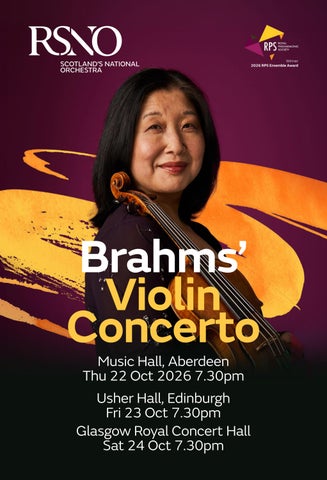
Brahms’ Violin Concerto Music Hall, Aberdeen Thu 22 Oct 2026 7.30pm
Usher Hall, Edinburgh Fri 23 Oct 7.30pm Glasgow Royal Concert Hall Sat 24 Oct 7.30pm
2 Brahms’ Violin Concerto
£1
return train travel Kids for a Quid
Brahms’ Violin Concerto Music Hall, Aberdeen Thu 22 Oct 2026 7.30pm Usher Hall, Edinburgh Fri 23 Oct 7.30pm Glasgow Royal Concert Hall Sat 24 Oct 7.30pm With some pieces, you just want to close your eyes and let your imagination paint a picture. For our Finnish guest conductor Emilia Hoving, it’s all about the landscape of the far North: lakes, forests, midnight sunlight and the shimmering wonder of the Northern Lights. So let your ears do the gazing in Finnish classics by Saariaho and Sibelius – and join RSNO Leader Maya Iwabuchi on an autumn getaway to the Austrian Alps, in Brahms’ magnificent Violin Concerto.
JOËLLE BROAD Saturn [4’] Side by Side with Big Noise Torry (Aberdeen only) BRITTA BYSTRÖM A Walk to Brahms’ Violin Concerto [6’] SCOTTISH PREMIERE BRAHMS Violin Concerto in D Major Op77 [40’] INTERVAL SAARIAHO Ciel d’Hiver [10’] SIBELIUS Symphony No6 in D Minor Op104 [33’] Emilia Hoving Conductor Maya Iwabuchi Violin Big Noise Torry Royal Scottish National Orchestra
The Glasgow performance will be recorded for the RSNO Archive. Supported by the Iain and Pamela Sinclair Legacy. If viewing these notes at the concert, please do so considerately and not during performances. Please silence all mobile telephones and alerts, and refrain from taking photographs, without flash, until the end of each piece.
4 Brahms’ Violin Concerto
Shostakovich Seven Featuring the UK Premiere of Lera Auerbach’s Violin Concerto No1
Edinburgh | Fri 30 Oct: 7.30pm Glasgow | Sat 31 Oct: 7.30pm Dundee | Sun 1 Nov: 3pm Bassem Akiki Conductor Philippe Quint Violin
Book online at
rsno.org.uk
RSNO: Scotland’s National Orchestra 5
Welcome It’s a special concert this evening, with our Leader Maya Iwabuchi taking the solo spot for Brahms’ Violin Concerto. I’ve worked with Maya for over 30 years, from back when we were two of the youngest members of the Philharmonia in London. I remember the first time we went on tour, and hearing her play the massive violin solo in Rimsky-Korsakov’s Scheherazade after a gruelling day of travel to Sicily – I was completely in awe. It’s great to celebrate one of our own! We’re so pleased to have Emilia Hoving back with us for these concerts – some of you will remember her appearance in the 2024:25 Season alongside cellist Senja Rummukainen. Emilia had tremendous reviews from our players and critics alike, so we knew we had to get her back. I am certain that Emilia and Maya performing together will be a rare treat. To our Aberdeen audience, welcome for the first time this Season, and welcome too to the young musicians of Big Noise Torry who open the Music Hall concert with Joëlle Broad’s Saturn. These sideby-side performances with the Orchestra give so much joy to the Big Noise musicians, to our players and to our audiences. Those of you in Edinburgh and Glasgow can look forward to Big Noise Wester Hailes and Big Noise Govanhill taking to the stage on Friday 23 April and Saturday 8 May 2027 respectively. Our recent Glasgow performance with Principal Guest Conductor Patrick Hahn and violist Lawrence Power was broadcast on BBC Radio 3’s In Concert on Tuesday 13 October, recorded by our fantastic team of in-house sound engineers. You can listen back to the concert, which featured Shostakovich’s Fifth Symphony and Schnittke’s Viola Concerto, on BBC Sounds.
Keep in touch with the RSNO
Royal Scottish National Orchestra 19 Killermont Street Glasgow G2 3NX T: +44 (0)141 226 3868
rsno.org.uk Scottish Company No. 27809 Scottish Charity No. SC010702
In the meantime, I hope you enjoy this evening’s performance.
Alistair Mackie CHIEF EXECUTIVE
The RSNO is supported by the Scottish Government
6 Brahms’ Violin Concerto
Royal Scottish National Orchestra
Formed in 1891, the Royal Scottish National Orchestra (RSNO) is one of Europe’s leading symphony orchestras. Awarded royal patronage by Her Late Majesty The Queen in 1977, its special status in the UK’s cultural life was cemented in 2007 when it was recognised as one of Scotland’s five National Performing Companies, supported by the Scottish Government. Led by Music Director Thomas Søndergård, the Orchestra performs across Scotland, including concerts in Glasgow, Edinburgh, Dundee, Aberdeen, Perth and Inverness, and appears regularly at the Edinburgh International Festival and BBC Proms. The RSNO tours internationally, most recently visiting China and Europe. In May 2026, Giedrė Šlekytė was announced as the RSNO’s Music Director Designate and will formally become Music Director from the beginning of the 2027:28 Season, with Thomas Søndergård taking on the new position of Music Director Emeritus. The RSNO has a worldwide reputation for the quality of its recordings, receiving a 2020 Gramophone Classical Music Award for Chopin’s Piano Concertos (soloist: Benjamin Grosvenor), conducted by Elim Chan, two Diapason d’Or awards (Denève/Roussel 2007; Denève/Debussy 2012) and eight GRAMMY Award nominations. In recent years, the RSNO has cultivated an international reputation for world-class film, television and videogame soundtrack recording. The Orchestra has recorded for BAFTA-winning
series Silo (Apple TV) and worked with the likes of GRAMMY Award-winning composer Lorne Balfe on Life on Our Planet (Netflix). Other notable titles include Nuremberg (Sony Pictures), Now You See Me: Now You Don’t (Lionsgate), Horizon: An American Saga (Warner Bros) and Star Wars Outlaws (Ubisoft). The Orchestra records at its bespoke in-house facility in Glasgow, Scotland’s Studio. In 2026 the RSNO was the first professional orchestra since 2014 to be awarded the Royal Philharmonic Society’s Ensemble Award. The award recognises musical ensembles for outstanding quality and scope of performances and work. The RSNO believes that music can enrich lives and aims to inspire, educate and entertain people throughout Scotland and beyond with its performances, recordings and engagement programmes. Supporting schools, families, young professionals and wider communities, the RSNO delivers high-quality initiatives for all ages and abilities. The RSNO’s engagement offering includes its singing strand, encompassing a Buggy Choir and Chorus Academy in both Dundee and Glasgow and a lunchtime Workplace Choir, which complements the well-established and highly respected RSNO Youth Choruses and RSNO Chorus. The community choruses are designed with the benefits of group singing for health and wellbeing at their core and are open to all.
RSNO: Scotland’s National Orchestra 7
On Stage FIRST VIOLIN Igor Yuzefovich LEADER
CELLO Pei-Jee Ng
PRINCIPAL
HORN Amadea Dazeley-Gaist
Lena Zeliszewska
Betsy Taylor Kennedy Leitch Yuuki Bouterey-Ishido Gunda Baranauskaitė Rachael Lee Sarah Digger Robert Anderson
Alison Murray Andrew McLean David McClenaghan Martin Murphy
DOUBLE BASS Nikita Naumov
Ben Jarvis Jason Lewis Goodwin
Ted Merritt Michael Rae Yat Hei Lee Moray Jones Alexandre Cruz dos Santos
TROMBONE Dávur Juul Magnussen
ASSOCIATE LEADER
Tamás Fejes
ASSISTANT LEADER
Patrick Curlett Mabelle Park Caroline Parry Ursula Heidecker Allen Elizabeth Bamping Lorna Rough Susannah Lowdon Alan Manson Liam Lynch Veronica Marziano Wen Wang SECOND VIOLIN Cheryl Crockett GUEST PRINCIPAL
Marion Wilson Joana Rodrigues Paul Medd Anne Bünemann Sophie Lang Robin Wilson Kirstin Drew Colin McKee Flora Yeung Fiona Stephen Seona Glen VIOLA Jane Atkins
GUEST PRINCIPAL
Felix Tanner Asher Zaccardelli Susan Buchan Claire Dunn Katherine Wren Maria Trittinger Francesca Hunt Beth Woodford David McCreadie
PRINCIPAL
FLUTE Katherine Bryan PRINCIPAL
Oliver Roberts Janet Richardson PRINCIPAL PICCOLO
OBOE Adrian Wilson PRINCIPAL
Peter Dykes CLARINET Timothy Orpen PRINCIPAL
William Knight Duncan Swindells
PRINCIPAL BASS CLARINET
BASSOON Matthew Kitteringham
PRINCIPAL
TRUMPET Christopher Hart PRINCIPAL
PRINCIPAL
Cillian Ó Ceallacháin Alastair Sinclair PRINCIPAL BASS TROMBONE
TUBA John Whitener PRINCIPAL
TIMPANI Tom Lee
GUEST PRINCIPAL
PERCUSSION Simon Lowdon PRINCIPAL
Stuart Semple HARP Pippa Tunnell PIANO/CELESTE Lynda Cochrane Judith Keaney
ASSOCIATE PRINCIPAL
Paolo Dutto
PRINCIPAL CONTRABASSOON
Orchestra list and programme details correct at time of going to print.
8 Brahms’ Violin Concerto
Emilia Hoving Conductor
Strasbourg Philharmonic, Nagoya Philharmonic, Tasmania Symphony and New Zealand Symphony, and returned to the Finnish Radio Symphony, Helsinki Philharmonic, Gothenburg Symphony, Lausanne Chamber and Adelaide Symphony. She made her main-stage opera debut in 2025 conducting Opera North in several performances of The Magic Flute. Hoving regularly conducts works by living (especially Finnish) composers. In 2024 she conducted the BBC Scottish Symphony in the prestigious Nordic Music Days festival and has been closely involved with the Helsinki Philharmonic’s ongoing project to revive works by neglected Finnish composers from the last century. Finnish conductor Emilia Hoving is Associate Conductor of the Royal Philharmonic Orchestra, appearing annually with them in their London subscription season and on tour throughout the UK. She is also a popular guest across the UK, the Nordic countries and Benelux in particular, as well as in Australia; concerts in 2026/27 include her debut with the Melbourne Symphony and returns to the Netherlands Radio Philharmonic, Hallé Orchestra, BBC Scottish Symphony, RSNO, Swedish Radio Symphony, Malmö Symphony, Sinfonia Lahti, Turku Philharmonic, Stavanger Symphony and Trondheim Symphony. She conducts a Betsy Jolas celebration at Stockholm Royal Concert Hall with the Norrköping Symphony, debuts at the Paris Philharmonie with the Orchestre National de l’Île-de-France, and further afield will premiere Augusta Holmes’ rediscovered Ode Triomphale on her return to the São Paulo Symphony. In the past couple of seasons she has debuted with the Bamberg Symphony, Belgian National,
Hoving’s career began as Assistant to Hannu Lintu at the Finnish Radio Symphony (2019) and to Mikko Franck at Radio France (2020-22). Both posts led to important jump-ins which catapulted her into the limelight, notably when she took over a concert with the Orchestre Philharmonique de Radio France in the Berlin Philharmonie at only a few hours’ notice. She went on to make significant debuts at Tokyo’s Suntory Hall with the Yomiuri Nippon Symphony (2022), at the Amsterdam Concertgebouw with the Netherlands Radio Philharmonic (2024) and at London’s Royal Festival Hall with the Philharmonia (also 2024). Born in 1994, Hoving studied at the Sibelius Academy in Helsinki with Professors Sakari Oramo and Atso Almila, having begun conducting studies in 2015 with Jorma Panula. She previously studied piano (from age six) as well as the clarinet. In 2021 she won the Finnish critics’ prize for the Best Newcomer in the Arts.
Take Your Seat: Become a Chair Patron Our Chair Patrons support the musicians at the heart of our performances ‘Although I never learned to play an instrument (apart from trying to teach myself to play the piano), I have always been attracted to the double bass – the foundation of the orchestra. I love its mellifluous tone whether within an orchestra, jazz group or another type of musical ensemble. It was not unexpected, then, for me to choose to sponsor a chair in that section of the Orchestra back in 2014.’ Maureen Michie, Chair Patron and Circle Member
Maureen supported Tutti Double Bass John Clark for eight years, until his passing in 2022, and has supported Principal Double Bass Nikita Naumov since his appointment in November 2024, now with the title of ‘The Gregor Forbes John Clark Chair’. If you have a passion for a particular instrument or seek an insight into the life of an orchestral musician, find out more about becoming a Chair Patron by contacting Constance Fraser, Head of Development at constance.fraser@rsno.org.uk
10 Brahms’ Violin Concerto
Joëlle Broad
Saturn Benedetti Foundation. FIRST PERFORMANCE Big Noise Wester Hailes and RSNO, Usher Hall, Edinburgh, 8 March 2024 DURATION 4 minutes Saturn was originally written by Joëlle for the Benedetti Foundation, and is being performed with their permission. Nicola Benedetti has worked closely with both the RSNO and Big Noise, and has been Big Noise’s ‘Big Sister’ for many years. This is the first time that Saturn has been performed in Aberdeen. The piece depicts an intergalactic disco taking place on the planet’s rings.
Joëlle Broad Composer Joëlle Broad is a musician, teacher, composer, mentor and workshop leader. She learned violin through the peripatetic music service on the Wirral. Participating in a rich experience of youth ensembles and orchestras led to her pursuing music as her career. Joëlle studied at the Royal Scottish Academy of Music and Drama and has worked with many Scottish arts organisations, including the Scottish Chamber Orchestra and Drake Music Scotland. She was one of the original team members at Big Noise Raploch in Stirling, the first Big Noise programme which began work in 2008, and worked as Curriculum Leader (Strings) across Sistema Scotland’s Big Noise programmes until February of this year. Joëlle’s music has musical development at its heart and is committed to creating pieces that are musically interesting at the early stages of playing. She also teaches violin for the Royal Conservatoire of Scotland’s Junior Department in the primary instrumental programme.
RSNO: Scotland’s National Orchestra 11
Big Noise Torry
LOGO TOOLKIT A simple guide to using the Big Noise logo
01 LOGO
DOWNLOAD
Our main charity logo Our main charity logo should be used to clearly identify Big Noise across external communications and materials.
Julian Chiduziem Onyewuchi Aaron Davidson CELLO VIOLIN Aiden Dey PERCUSSION Khadija Isiaq PERCUSSION Amanda Naczas VIOLIN Kimberly Anderson VIOLIN Amber Cardozo VIOLIN Livi Angus CELLO Amira Adebayo VIOLIN Louis He VIOLA Archie Young VIOLIN Madisyn Miskimmons VIOLA Aria Ross VIOLIN Olivia Campbell CELLO Azeem Adesima VIOLIN Olivia Potts VIOLIN Benjamin Jamikorn VIOLIN Clear space: An invisible exclusion zone around the Big Noise logo Peniel Osibajo DOUBLE BASS Catherine Stephen VIOLIN ensures itPrecious remains clear and prominent. Oladapo CELLO Chichi Ojukwu VIOLA Rena Orbue CELLO Cody Duncan PERCUSSION Stephanie Osakwe DOUBLE BASS clear space of 0.3x around Daniel Sanders VIOLA Where possible, maintain a minimum Veronika Chernobai VIOLA Derrick Osakwe VIOLIN the logo, where ‘x’ is the height of the logo. Volodymyr Kozachuk CELLO Dylan Collins VIOLIN Yolanda Osibajo VIOLIN Elizabeth Ajimisinmi VIOLA Zlata Aleksejeva VIOLA Goodness Obineche CELLO Israel Amao PERCUSSION
12 Brahms’ Violin Concerto
Britta Byström (Born 1977)
A Walk to Brahms’ Violin Concerto © Arne Hyckenberg SCOTTISH PREMIERE FIRST PERFORMANCE Västerås Concert Hall, Västerås, Sweden, 15 October 2026 DURATION 6 minutes
My Walks form a series of – up to now – more than 20 pieces, all of them composed since 2016. The first two Walks, for string orchestra, were written for a concert in which my Violin Concerto was combined with Britten’s Variations on a Theme of Frank Bridge and Biber’s Battaglia. On that occasion, I wrote A Walk to Britten and A Walk to Biber – one-minute pieces which, on a background of ‘wandering’ pizzicato playing, included small quotes from the piece that was to come. Since then, many other Walks have followed, from one to ten minutes in length and written for a range of forces from viola and double bass duet to symphonic wind orchestra. The concept, though, has remained the same: it is always a rhythmical, wandering music which serves as an introduction to another composer’s work. The idea is to take a musical stroll and catch a glimpse of the next work on the programme, similar to when, from far away, one can begin to make out the silhouette of an approaching town. A Walk to Brahms’ Violin Concerto (2023) was, as the title indicates, commissioned as an introduction to Brahms’ beautiful Concerto. It is mainly material from the first movement that can be discerned in my piece – written for exactly the same orchestral forces but without the soloist. And as in all my Walks, the piece begins with small steps from nowhere and dies away quietly at the end, as if the music is passing by like a marching orchestra. © Britta Byström
RSNO: Scotland’s National Orchestra 13
Britta Byström Composer
Britta Byström has become one of the most performed Nordic composers alive and is enjoying burgeoning relationships with some of the world’s great performers. In 2024, Janine Jansen, Sakari Oramo and the NDR Elbphilharmonie Orchestra gave the world premiere of her new violin concerto Shortening Days, while orchestras in the USA, Great Britain, Central Europe and beyond continue to take up her orchestral works as they are celebrated around Sweden. Byström is a composer whose boundless imagination is tethered by fastidious care. Her work list already contains a number of beguiling orchestral scores and she is known for engaging ensemble, vocal and stage works. Despite its noble beauty, residual melancholy and occasional sparse elegance, her music has a tendency to ensnare both audiences and musicians. Byström was raised in Sundsvall on Sweden’s east coast, starting out as a trainee trumpeter. She was soon drawn to writing music and was lured into the universe of orchestral sound by her hometown’s professional orchestra. ‘I was lucky to be able to hear my music being played professionally from an early age,’ she says. By 18, she was a student at the Royal College of Music in Stockholm. She graduated with the orchestral work Sera (2002), a seductive journey through assorted landscapes imagined under the light of an Italian evening. By the time of Persuasion (2004), Byström was refining her music’s textures, shaping themes more distinctly and lengthily, and sharpening focus with a minimalistic tendency to spin a work’s entire discourse out from a single entity (shape, chord, theme). That characteristic is felt in the more than 20 works to Byström’s name that form part of her A Walk to … series, taking the form of musical strolls that offer glimpses of
landscapes, ideas or the works of other composers alongside which some are designed to be played. Voyages extraordinaires (2019) extends the principle of the ‘walk’ with the concept of recurring transformation. Shortening Days journeys continuously from time-constrained day to time-loosened night and back again. A chamber opera, The Play of the Night (2024), a setting of the story of Odysseus and Penelope to a libretto by Peter Bäckström, was first performed in Copenhagen in 2025. Previous theatre works include the bijoux existential opera If You Lose Your Luggage (2003), and Gállábártnit (2015) for choir, soloists and ensemble, based on a Sámi myth and with a libretto in Sámi by Rawdna Carita Eira. Byström has been a member of the Royal Swedish Academy of Music since 2016 and was awarded the Academy’s Järnåkerstipendium in 2024 for her work Alfabet for soprano and septet, based on the Danish writer Inger Christensen’s poem and applying the same principles of the Fibonacci sequence to the music as Christensen does the poem. Byström’s music has been the subject of festivals mounted by the Royal Stockholm Philharmonic and Swedish Radio Symphony orchestras, and in 2021 her work Parallel Universes marked 150 years of the Royal Albert Hall at the BBC Proms. © Andrew Mellor
14 Brahms’ Violin Concerto
Johannes Brahms (1833-1897)
Violin Concerto in D Major Op77
Looked at with less partisan eyes, there is more than enough virtuosity for the solo violin, even if it is not of the dazzling variety beloved of many composers of violin concertos whose works have not survived beyond their day.
FIRST PERFORMANCE Leipzig, 1 January 1879 DURATION 40 minutes 1. Allegro non troppo 2. Adagio 3. Allegro giocoso, ma non troppo vivace Given its central position in the 19th-century concerto repertoire, it seems strange that Brahms’ Violin Concerto could have excited controversy at any stage in its career. But far from achieving universal acceptance, although it soon became popular after its premiere on New Year’s Day 1879, many an authority found fault with its fundamental nature. Brahms’ symphonic intentions, which gave the orchestra a far more extensive role than that of mere accompanist, excited the violinist Josef Helmesberger, the Emperor’s Kappelmeister, to describe it as a concerto ‘not for, but against the violin’. Others felt that Brahms had produced a work that ignored the interests of the soloist unduly.
Brahms had spent much of his time around violinists, both listening to them and accompanying them; before his celebrated friendship with Joseph Joachim, he had partnered the Hungarian violinist Eduard Reményi in an extensive tour of Germany. Curiously enough, although Brahms collaborated with Joachim over the solo part of his Violin Concerto, he quite often did not accept his friend’s advice, although he did him the honour of allowing him to compose the cadenza for the first movement. If Brahms had any doubts about the work, they were ironed out in the months after the work’s premiere as the composer made refinements to the score in advance of publication in October 1879. In style and melodic content, the Concerto has much in common with Brahms’ Second Symphony, also in D Major, composed only a year before. The first movement opens with a gesture of supreme confidence in an age where introductions to a main motif were almost de rigueur: the principal melody of the movement is stated by the bassoons and lower strings (later joined by the horns) and concludes with a simple cadence. What follows is one of Brahms’ most inspired moments of fantasy: slipping down a tone from the main key of the movement, the oboe intones a reply to the main theme before the full orchestra enters. The movement unfolds with effortless logic. There are many points of meditation and reverie, not least after the cadenza, but Brahms never loses his grip on a clear sense of progress, shifting the proceedings along with business-like dotted rhythms where necessary.
RSNO: Scotland’s National Orchestra 15
At one stage Brahms considered having two middle movements in his Violin Concerto, one of which eventually found a home as the scherzo of his Second Piano Concerto. In the end he opted for a single, as he described it, ‘feeble’ Adagio. In fact, this is one of his most exquisitely lyrical slow movements, in which the sweetness of the opening melody, and the soloist’s elaboration of it, is balanced by a more intense central section.
The equally successful finale pays tribute to the ‘Hungarian’ style practised by Joachim and often adopted by Brahms himself. Full of daring bravura and infectious melody, the movement still observes some rigorous symphonic development before the rollicking coda sweeps all before it. © Jan Smaczny
Maya Iwabuchi Violin
performances have taken her to the major concert halls of Europe, the Americas, Australia and Asia. Highlights include concertos with the Los Angeles and New York Philharmonic orchestras, Philharmonia Orchestra and RSNO, and performances at the BBC Proms and Edinburgh and Salzburg festivals. Maya is Artistic Director of the Hellensmusic Chamber Music Festival. She is regularly invited as guest concertmaster to many European orchestras, and as Leader of the Philharmonia Orchestra from 1994 to 2012, she led for legendary conductors such as Kurt Sanderling, Gennady Rozhdestvensky, Riccardo Muti, EsaPekka Salonen, Andris Nelsons and Gustavo Dudamel. Maya is Leader of the RSNO. She began violin lessons at the age of two, and since her concert debut at age five, she has enjoyed an international career as a solo violinist, chamber musician, orchestral leader and teacher. Her
Maya moved to Scotland in 2010, has served as Leader of the RSNO since 2011, and joined the faculty at the Royal Conservatoire of Scotland in 2015. Her violin was made by Fabrizio Senta in Turin, c1685.
16 Brahms’ Violin Concerto
Kaija Saariaho (1952-2023)
Ciel d’hiver
© Maarit Kytoharju FIRST PERFORMANCE Paris, 7 April 2014 DURATION 10 minutes
When Kaija Saariaho died following treatment for brain cancer in 2023, The Guardian remembered her as ‘a leading, perhaps the leading, musical modernist of her generation’. Famed for her lush, ethereal soundscapes that married live electronics and spectral sound textures, she rose to international fame in the 1980s, spending the next four decades redefining orchestral and operatic music on the global stage. She, along with fellow Finnish composers including Esa-Pekka Salonen and Magnus Lindberg, founded the Korvat auki (Ears Open) society for contemporary music in the late 1970s. She then moved to Paris to work at Pierre Boulez’s research institute IRCAM (Institut de Recherche et Coordination Acoustique/Musique), where her early artistic direction was defined by the exploration of computer-assisted composition. Here, she buried herself in the art of spectralism, a musical technique that uses the acoustic properties and frequency of sound as the main building blocks for composition. While her work remained rooted in the avantgarde throughout her career, Saariaho’s sound gradually developed. She moved into opera, expanding her horizons beyond her modernist origins, translating historic tales and contemporary dramas into compelling narratives. She also became known for her dreamlike soundworlds, which often evoke the raw, elemental power of nature. Visions of the night, myths and quiet mysteries haunt much of her work. Ciel d’hiver is a prime example of this in action. Translating as ‘Winter Sky’, the short piece is an arrangement of the second movement of Saariaho’s 2002 Orion, her largest purely symphonic composition. At the heart of the piece is the central figure of Orion, the demigod son of sea god Poseidon, who is mortal. His figure – and accompanying constellation – is brought
RSNO: Scotland’s National Orchestra 17
to life across three movements: Memento mori (Remember that you will die), Winter Sky and Hunter. In 2013, Saariaho decided to reorchestrate the work’s central movement, scored for a large orchestra – although smaller in scale than Orion’s forces, which include two timpani sets, two harps and an organ. Orchestre Lamoureux gave the world premiere in 2014 at the Théâtre du Châtelet in Paris, with Saariaho praised for her downsized arrangement, and the miniature commended for its vivid portrayal of the harsh winter elements. Ciel d’hiver opens with a bed of cool, hollow string textures, from which a fragile piccolo appears in its highest register, as if from nowhere. A glittering, ominous atmosphere is created from the off, capturing the stinging cold clarity of a winter sky. The timbre shifts as the piccolo opens up a dialogue with the first violin, with the woodwind instruments then picking up new motifs and melodies, gradually evolving them as they go. The haunting strings remain, a base for the shimmering new textures. Extended techniques are used by several soloists, making their instruments growl.
What was happening in 2014? 13 Feb Belgium became the first country to legalise euthanasia for terminally ill patients of any age 21 Mar Russia annexed the Crimean Peninsula, part of Ukraine, with President Vladimir Putin signing a bill formalising the process 14 Apr The Nigerian militant group Boko Haram abducted over 270 mostly Christian girls and women from a school at Chibok and held them hostage 10 May The Eurovision Song Contest was won by Austrian entrant Conchita Wurst, with the song Rise Like a Phoenix 26 May Narendra Modi became the 14th Prime Minister of India 5 Jun The Sunni militant group later to be known as ISIS began an offensive through northern Iraq, aiming to take Baghdad and overthrow the Shiite government; on 8 Aug the US led a military intervention in Iraq
The orchestra grows hauntingly in dynamic, motifs thrown across the ensemble creating continuous ripples. A darkness persists, a shimmering harp glissando sits atop a series of ominous, sustained notes, building tension. Occasional offbeat motifs create a sense of chaos among the ordered textures, representing the sounds of distant thunder, rain and wind, and undermining any possible sense of comfort.
19 Jun Felipe VI became King of Spain on the abdication of his father, Juan Carlos I
A celestial atmosphere abounds, the orchestra’s ethereal textures creating a contemplative mood that captures the broad sweep of a cool, winter sky. A piano motif is repeated endlessly, until it disappears into the darkness.
12 Nov Rosetta’s Philae probe landed on Comet 67P, the first time a spacecraft had landed on such an object
© Freya Parr
23 Jul-3 Aug Glasgow hosted the 20th Commonwealth Games 9 Aug African American Michael Brown was shot by a police officer in Ferguson, Missouri 18 Sep Scotland voted against independence from the United Kingdom
18 Brahms’ Violin Concerto
Jean Sibelius (1865-1957)
Symphony No6 in D Minor Op104
The Finnish composer Jean Sibelius reimagined the structure and grammar of orchestral music. By imitating the cyclic, mutating patterns of the rune singers who recounted Finland’s ancient stories in chanted songs, Sibelius moved the symphony away from the Germanic tradition of musical argument and gave the Nordic region a distinctive symphonic voice of its own. The musical scores which resulted from that process sound as startling to the ear as they look unusual to the eye. Tunes emerge from streams of identical notes. Motifs are moulded gradually through repetition. Displaced rhythmic emphases induce gradual transformations. Foreground and background are merged. FIRST PERFORMANCE Helsinki, 19 February 1923 DURATION 33 minutes 1. Allegro molto moderato 2. Allegro moderato 3. Poco vivace 4. Allegro molto
Over time, Sibelius also freed himself from the European orthodoxy that a symphony had to arrive somewhere conclusive or ‘win’ an argument before it could end; that the symphonic circle must at all costs be closed, whether through triumph or exhausted collapse. By the time of his last three symphonies, 5-7 – work on each of which overlapped either side of 1920 – Sibelius had apparently concluded that a form of centrifugal energy, gently manipulated by rhythm, could take his music wherever it needed to go. The symphonic circle, therefore, might not close at all – even if a symphony ended in the same key with which it had started. The kinetic playfulness that characterises Sibelius’ sixth and penultimate symphony has its roots in the composer’s idyllic childhood in the rural town of Hämeenlinna. By 1922, when Sibelius came to knit his sketches for the Symphony together, dark clouds had returned to his life. The composer was mourning the death of his brother Christian, while his financial situation seemed increasingly hopeless. Sibelius had been reunited with alcohol after a sevenyear abstinence, despite the newly constituted Finland having prohibited the substance.
RSNO: Scotland’s National Orchestra 19
Nonetheless, his concentration on the Symphony remained steadfast: Sibelius would follow bouts of drinking with long, solitary days at work on the score. On 19 February 1923, the finished work was given its first performance, the composer himself conducting the Helsinki Philharmonic Orchestra. The Symphony has an atmosphere all of its own that sits in contrast to that of its predecessor, the Symphony No5, despite the similarities in their construction. There is little overt drama in the Sixth, while many have heard in its textures a musical image of the distinctive, limpid Nordic light prevalent in Finland, especially in early spring and autumn. The Symphony sounds light and high, many instruments clinging to their upper registers, while a harp glistens on top. Much of the music sits in the Dorian mode – an elusive scale that lends the music a certain aloofness and mysticism while allowing Sibelius to exploit the inherent tension between elements rooted in D and the standard major scale in C. Sibelius described the Symphony as a ‘fantasy’, reflected in its sense of free-falling momentum. The music is derived from a single cell, alluded to at various stages but heard most clearly when the oboe steps upwards through the five notes from D just over a minute into the first movement. Sibelius used the phrase ‘pure, cold water’ to describe the Symphony. It drifts into being courtesy of music the composer associated with winter; in the fluttering flute and darting harp that punctuate the first movement later on, we sense the more sunlit spirit of his childhood. The denser second movement takes us a few steps deeper into the woods, while the third is a genial game fuelled by the gentle ragging of rhythms. Sibelius referred to elements of the final movement, notably the second theme, as
‘the spirit of the pine tree’. There are passions in this final movement but no fortifying hymn to close. Instead, the Symphony drifts back into the silence from which it emerged. © Andrew Mellor
Listen again to the RSNO
Sibelius Symphony No6 Plus Symphony No3 Alexander Gibson Conductor More information rsno.org.uk/recordings
RSNO Connections Sir Alexander Gibson, Principal Conductor and Artistic Director of the Scottish National Orchestra from 1959 to 1984, had a special affinity with the music of Sibelius, and championed the composer in concert programming and many recordings, including of all seven symphonies and all the tone poems. His work was recognised in 1978, when the Sibelius Society of Finland awarded him the Sibelius Medal. Other recipients of the award since it was inaugurated in 1965 include Sir John Barbirolli, Benjamin Britten, Leonard Bernstein, Sir Simon Rattle and Finnish violinist and composer Pekka Kuusisto.
20 Brahms’ Violin Concerto
Big Noise
LOGO TOOLKIT A simple guide to using the Big Noise logo
Please support Big Noise by visiting Big Noise is a charity that delivers social change and music education programmes, working with www.bignoise.org.uk or by scanning almost 4,200 children and families to improve lives the QR code. and strengthen communities across Scotland. Big Noise’s immersive and long-term programmes use DOWNLOAD music and nurturing relationships to help children and young people fulfil their potential. Our main charity logo
01 LOGO
02 CO
At Big Noise the symphony orchestra becomes Our which mainsupports charityyoung logo people shouldtobe used to clearly identify Big Noise a community across external communications gain an invaluable range of life skills. Independent and materials. evaluation shows that Big Noise supports children to improve their learning, wellbeing and confidence, bringing communities together and paving the way for positive futures. The programmes are delivered by inspirational staff musicians who act as role models and mentors, and foster supportive, long-term relationships. Big Noise Torry is the third Big Noise programme. First established in 2015, the programme now works with more than 700 children and young people and their families.
space: An invisible Big NoiseClear is delivered with support from exclusion a range of zone around the Big Noise logo public partners, trusts, foundations and individuals. ensures it remains clear and prominent. Big Noise runs music education programmes in the targeted communities of Big Noise Raploch Where possible, maintain a minimum clear space of 0.3x around & Fallin (Stirling), Govanhill (Glasgow), Torry theDouglas logo, where is Wester the height (Aberdeen), (Dundee)‘x’ and Hailes of the logo. (Edinburgh).
Preferred Black and backgroun
RSNO: Scotland’s National Orchestra 21
Verdi Requiem Edinburgh | Fri 6 Nov: 7.30pm Glasgow | Sat 7 Nov: 7.30pm Patrick Hahn Conductor | Jennifer Davis Soprano | Deniz Uzun Mezzo-soprano Mario Lerchenberger Tenor | Edwin Crossley-Mercer Bass RSNO Chorus | Stephen Doughty Director, RSNO Chorus Edinburgh Festival Chorus | James Grossmith Director, Edinburgh Festival Chorus Paul Whittaker BSL Performer Supported by the Jennie S. Gordon Memorial Foundation
Book online at
rsno.org.uk
22 Brahms’ Violin Concerto
Benefactors, Patrons and Circle members We are grateful to all our individual supporters for their generous philanthropy and loyalty. Your support enables the Orchestra to achieve its most ambitious goals and to continue inspiring people across Scotland both on and off the concert stage.
RSNO Benefactors
RSNO Conductors’ Circle
RSNO Patrons
Sir Ewan and Lady Brown Gavin and Kate Gemmell Kat Heathcote and Iain Macneil Ms Chris Grace Hartness Stina Bruce Jones Shirley Murray
Ardgowan Charitable Trust Ian and Evelyn Crombie Kenneth and Julia Greig David and Alix Stevenson Eric and Karen Young
Geoff and Mary Ball Lady Rebecca Fraser Don and Lois Macleod Walter and Janet Reid Charitable Trust George Ritchie Stephen Sweeney Valerie Wells
Learning and Engagement Patrons William Brown, W.S The Dundee RSNO Circle Committee Neil and Nicola Gordon Professor Gillian Mead, FRSE Nicholas and Alison Muntz Maurice and Nicola Taylor Charitable Trust David and Marilyn Wilson
Chair Patrons Assistant Conductor
Second Violin
The Solti Foundation Chair
The Nigel and Margot Russell Chair
Celia Llácer
Marion Wilson ASSOCIATE PRINCIPAL
Double Bass
Nikita Naumov PRINCIPAL
The Gregor Forbes John Clark Chair
First Violin
Sophie Lang
The Ian and Evelyn Crombie Chair
James Wood Bequest Fund Chair
Dunard Fund Chair
Viola
Flute
The Cathy and Keith MacGillivray Chair
The David and Anne Smith Chair
Maya Iwabuchi LEADER
Tamás Fejes ASSISTANT LEADER
The Bill and Rosalind Gregson Chair
Ursula Heidecker Allen
The James and Iris Miller Chair
Tom Dunn PRINCIPAL Francesca Hunt
Elizabeth Bamping
The Rolf Thornqvist and Celia Sinclair Thornqvist MBE Chair
Alan Manson
Cello
The WL and Vera Heywood Chair The Hugh and Linda Bruce-Watt Chair
Pei-Jee Ng PRINCIPAL
Ms Chris Grace Hartness Chair
Liam Lynch
Betsy Taylor ASSOCIATE PRINCIPAL
Lorna Rough
Kennedy Leitch ASSISTANT PRINCIPAL
Ms Chris Grace Hartness Chair The Sir Richard Dunbar Chair
The Maxwell Armstrong Chair
The David and Anne Smith Chair
Rachael Lee
The Christine and Arthur Hamilton Chair
Michael Rae ASSISTANT PRINCIPAL Katherine Bryan PRINCIPAL Oboe
Adrian Wilson PRINCIPAL The Hedley Wright Chair
Peter Dykes ASSOCIATE PRINCIPAL
Witherby Publishing Group Charitable Trust Chair
Cor Anglais
Henry Clay PRINCIPAL
In memory of a dear friend, Fiona H
RSNO: Scotland’s National Orchestra 23
Clarinet
Alison Murray ASSISTANT PRINCIPAL
Trumpet
The Shirley Murray Chair
Martin Murphy ASSISTANT PRINCIPAL
Ms Chris Grace Hartness Chair
Timothy Orpen PRINCIPAL
Mr and Mrs Pierre and Alison Girard
Christopher Hart PRINCIPAL
The Turcan Connell Chair
The Gordon Fraser Charitable Trust Chair
Staff
Horn
Andrew McLean ASSOCIATE PRINCIPAL The Catherine McLagan Chair
COMMUNITY SINGING ASSISTANT
William Knight ASSOCIATE PRINCIPAL David McClenaghan SUB-PRINCIPAL
Chiko Parkinson
Supported by ScotRail
The Springbank Distillers Chair
We are also grateful to those who give but who wish to remain anonymous.
If you would like to discuss how you can become an RSNO Patron, please contact Constance Fraser, Head of Development (Individuals and Partnerships), at constance.fraser@rsno.org.uk
RSNO Circle Virtuoso Ms Catherine Y Alexander Mrs A M Bennett Mr Alan and Mrs Carolyn Bonnyman Dame Susan and Mr John Bruce Francesca and Eoghan Contini Mackie Dr Clive Criper Scott and Frieda Grier Judith and David Halkerston Iain MacNeil and Kat Heathcote MBE Ian and Sarah Lister Miss A McGrory Maureen Michie Mr James Miller CBE David Moncur Mrs Abigail Morrison Nicholas and Alison Muntz Bernard and Jane Nelson Mr and Mrs W Semple Gregor and Lesley Stewart Mr Ian Taft Claire and Mark Urquhart Raymond and Brenda Williamson Margaret Duffy and Peter Williamson Symphony Martin and Jackie Beard Mr John Brownlie Mr A Campbell Dr K Chapman and Ms S Adam Dr C Cradock and Dr S Todd Mr W G Geddes Dr Robert Gibb Mr I Gow Hon Lord McGhie
Mrs A McQueen Kathryn Michael Mr Iain Percival James and Pam Robertson David and Maggie Robinson Mrs Henrietta Simpson Ian and Janet Szymanski Nelson and Barbara Waters Tom and Lisa Watson Philip Whitely and Robert H Mackay Concerto Neil Barton Mrs Mary Black Miss D Blackie Dr C M Bronte-Stewart Dr F L Brown Mr and Mrs Burnside David Caldwell Ms H Calvert Ross Cavanagh Myk Cichla Terry and Joan Cole Dr J Coleiro Christine and Jo Danbolt Steven J Davis Mr and Mrs K B Dietz Dr A Ewing David and Sheila Ferrier Mr C Ffoulkes William Findlay Mr and Mrs M Gilbert Simon and Fiona Guest Lord and Lady Hamilton P Hayes David G Henderson Dr and Mrs P Heywood Ms H Kay
Mr and Mrs W Kean Nicholas Kilpatrick Christine Lessels Morag MacCormick Mr and Mrs Marwick Mr S Marwick Mrs Sandra Maxwell Mr and Mrs G McAllister Mrs M McDonald Dr A H McKee Mr Rod McLoughlin Morag Millar Mrs B Morinaud Dr and Mrs D Mowle Ms A and Miss I Reeve Mrs E M Robertson Sheriff Linda Ruxton Dr and Mrs G K Simpson Dr Norma H Smith Mr and Mrs A Stewart Jenny Stewart David and Helen Strachan Mr I Strachan Dr G R Sutherland Mr and Mrs J B Watson Helen and Peter Wilde David W Wren Roderick Wylie Sonata Mr and Mrs G H Ainsley Mr K Allen Dr A D Beattie Mrs H Benzie Mr R Billingham John Bradshaw and Shiona Mackie Jen Brown and Ken Donaldson Mrs Bryan
24 Brahms’ Violin Concerto
Andrew Burrows Mrs C M Campbell Miss S M Carlyon Amanda Carter-Fraser Lady Coulsfield Adam and Lesley Cumming Mrs C Donald J Donald and L Knifton Mr John Duffy Mr R M Duncan Brigadier and Mrs C C Dunphie Mrs E Egan Mr R Ellis Mr R B Erskine Dr E Evans Kenneth Forbes Mr D Fraser Philip and Karen Gaskell Elizabeth Gibb Mrs M Gibson Mrs M Gillan Mrs J K Gowans Dr J and Mrs H Graham Professor and Mrs A R Grieve Mr Martin Hammick Dr P J Harper Dr N Harrison Mr and Mrs R J Hart Bobby and Rhona Hogg Mr and Mrs F Howell
Mrs A Hunter Inez Hutchison Professor R N Ibbett Thomas Jakobsen Burns Geoffrey and Elizabeth Johnston Iain M and Maire Lanaghan Ms K Lang Mrs Anne Lindsay Dr Dorothy A Lunt Alison and Bryn Martin Mrs Jean C Martin Mr and Mrs J Martin Ms S McArthur Jean McCutcheon Rhyse McDermid Mr M McGarvie Dr Colin McHardy Ms H L McLaren Margaret McLay Libby McLean Mr and Mrs B Mellon Simon Michaelson Mr I Mills Mrs P Molyneaux Kenneth M Murray Bruce and Christine Nelson Alastair Ogilvie Mr and Mrs K O’Hare Mr and Mrs K Osborne Dr G Osbourne
Mr A Ownsworth Stephanie Park Mr R Parry John Paterson Misses J and M Penman Mr J W Pottinger Miss J A Raiker Alastair Reid Ms F Reith Dr and Mrs D Robb Anne Robertson Ms A Robson Mrs J Shanks Mr J A Shipley Dr M J and Mrs J A Shirreffs Richard and Gillian Shirreffs Ana Smith Mrs E Smith Mr M Smith Dr and Mrs B Stack Mrs Lorna Statham Mrs R F Stewart Mr and Mrs B Tait Lisbeth Thoms Dr and Mrs T Thomson Dr Morag Ward Dr Alex Watson Mr W Watters Alan Weddell Mr R Young
Thank you to all our members of the Circle, including 40 who wish to remain anonymous and over 230 Overture members.
If you would like to discuss how you can become an RSNO Circle member, please contact Polly Lightbody, Development Manager, at polly.lightbody@rsno.org.uk
RSNO Foundation The RSNO Foundation was founded in 2004 with the sole purpose of supporting the work of the RSNO, encouraging the performance, study, practice and knowledge of music in Scotland, and elsewhere throughout the world. The independently registered charity is governed by its own Board of Trustees (Scottish charity no. SC035934).
RSNO Foundation Trustees Gareth Howlett Chris Huckle Chair Don Macleod Mariella MacLeod Christine Macpherson Jane Reid James Inglis Secretary and Treasurer
RSNO: Scotland’s National Orchestra 25
Charitable Trusts and Foundations Charitable trusts and foundations have a distinguished history of supporting the RSNO, both on and off the stage. From one-off donations for specific concerts and musicians’ chairs, to multi-year funding for our community engagement initiatives, including our Schools Programme, every grant in support of our work is truly appreciated. We are grateful to the following trusts and foundations for their generosity: Aberdeen Endowments Trust Alexander Moncur Charitable Trust Alma & Leslie Wolfson Charitable Trust Boris Karloff Charitable Foundation Castansa Trust CMS Charitable Trust Common Humanity Arts Trust Cookie Matheson Charitable Trust Cruden Foundation David and June Gordon Memorial Trust Educational Institute of Scotland Ettrick Charitable Trust Evelyn Drysdale Charitable Trust Fidelio Charitable Trust Gannochy Trust Gaelic Language Promotion Trust Gordon Fraser Charitable Trust Hinrichsen Foundation Harbinson Charitable Trust Hugh Fraser Foundation James Wood Bequest Fund Jennie S Gordon Memorial Foundation Jean & Roger Miller’s Charitable Trust John Mather Trust JTH Charitable Trust Leach Family Charitable Trust Leisure & Culture Dundee Leng Charitable Trust Lethendy Charitable Trust Marchus Trust Mary Janet King Memorial Fund, administered by Foundation Scotland McGlashan Charitable Trust MEB Charitable Trust Meikle Foundation Miss E C Hendry Charitable Trust Miss Jean R Stirrat’s Charitable Trust Nancie Massey Charitable Trust Noël Coward Foundation Northwood Charitable Trust
Pear Tree Fund for Music PF Charitable Trust Q Charitable Trust Radcliffe Trust Ronald Miller Foundation Russell Trust Scott-Davidson Charitable Trust Scottish Enterprise Solti Foundation Souter Charitable Trust Stevenston Charitable Trust Sylvia Aitken Charitable Trust Tay Charitable Trust Thriplow Charitable Trust Tillyloss Trust Trades House of Glasgow Commonweal Fund W A Cargill Fund W M Sword Charitable Trust Walter Scott Giving Group Walter Craig Charitable Trust Weir Charitable Trust Zich Trust We are also grateful to a number of trusts that wish to stay anonymous.
If you would like more information about our work and how you can make a difference, please contact Niamh Kelly, Head of Trusts and Projects, at niamh.kelly@rsno.org.uk
26 Brahms’ Violin Concerto
A big Thank You to our supporters FUNDERS
CORPORATE SUPPORTERS
Ecosse
PRINCIPAL MEDIA PARTNER
PRINCIPAL TRANSPORT PARTNER
EXCLUSIVE AIR TRAVEL PARTNER
BROADCAST PARTNER
PARTNERS Adelaide Place • Age Scotland • Black Lives in Music • Charanga • Children’s Classic Concerts Children’s Hospices Across Scotland • Classic FM • Douglas Academy • Dundee Science Centre • Dunedin Consort Edinburgh Zoo • Education Scotland • Fanzclub • Gig Buddies • Glasgow Life • GMAC Film Heads of Instrumental Teaching Scotland • Hebrides Ensemble Kibble • Luminate • Marine Conservation Society MARSM • Music Education Partnership Group • ParentZone • The Pyramid at Anderston Royal Conservatoire of Scotland • Scottish Book Trust • Scottish Chamber Orchestra • Scottish Refugee Council Sistema Scotland • St Mary’s Music School • Tayside Healthcare Arts Trust • Trees for Life • University of Glasgow V&A Dundee • Visible Fictions
With thanks to all RSNO Benefactors, Patrons, Circle Members and appeal donors for their support of the RSNO.
If you would like more information about sponsorships, corporate partnerships or fundraising events with the RSNO, please contact Constance Fraser, Head of Development (Individuals and Partnerships), at constance.fraser@rsno.org.uk
RSNO: Scotland’s National Orchestra 27
Royal Scottish National Orchestra PATRON His Majesty The King
Andrew McTaggart
DIRECTOR OF CHANGED VOICES
NOMINATED DIRECTOR
ARTISTIC TEAM Thomas Søndergård
COMMUNITY SINGING DIRECTOR (GLASGOW)
COMPANY SECRETARY
Giedrė Šlekytė
RSNO BOARD OF DIRECTORS
MUSIC DIRECTOR
MUSIC DIRECTOR DESIGNATE
Patrick Hahn
Aimee Toshney David McLean
COMMUNITY SINGING DIRECTOR (DUNDEE)
Celia Llácer
Elected Directors Gregor Stewart
Ellie Slorach
Gail Blain
PRINCIPAL GUEST CONDUCTOR ASSISTANT CONDUCTOR ENGAGEMENT CONDUCTOR
Kellen Gray
ASSOCIATE ARTIST
Neeme Järvi
CONDUCTOR LAUREATE
Alexander Lazarev CONDUCTOR EMERITUS
Stephen Doughty DIRECTOR, RSNO CHORUS
Patrick Barrett
CHAIR
HONORARY TREASURER
Kayla-Megan Burns Ken Hay Don Macleod David Macluskey Louise Mitchell John Stewart David Strachan
Cllr Edward Thornley
Julia Miller
Player Directors Kirstin Drew David Hubbard William Knight Liam Lynch David McClenaghan Felix Tanner SCHOOLS ADVISORY GROUP
Pam Black Norman Bolton Martin Greig Neil Millar Mae Murray
DIRECTOR, RSNO YOUTH CHORUSES
CHIEF EXECUTIVE
Dylan Findlay
Polly Lightbody
Alistair Mackie
ASSISTANT STAGE MANAGER
CHIEF EXECUTIVE
Ted Howie
FACILITIES MANAGER
Graham Ramage
Dr Jane Donald
DEPUTY CHIEF EXECUTIVE
Nicola Kelman
EXECUTIVE ASSISTANT
PLANNING
Tammo Schuelke
DIRECTOR OF ARTISTIC PLANNING
Xander van Vliet
ARTISTIC PLANNING MANAGER
Rachel Pullin
ARTISTIC PLANNING OFFICER
Richard Payne
LEARNING AND ENGAGEMENT
Andrew Stevenson DIRECTOR OF ENGAGEMENT
Anna Crawford
ENGAGEMENT PRODUCER
Chiko Parkinson
EXTERNAL RELATIONS
Dr Jane Donald
ORCHESTRA MANAGEMENT
Aria Tsvetanova
PARTNERSHIPS AND EVENTS ADMINISTRATOR
Ross Williamson
VIDEO PRODUCER (MARKETING)
Hedd Morfett-Jones
Maisie Leddy
CHORUS MANAGER YOUTH CHORUS MANAGER
INFORMATION SERVICES MANAGER
AUDIO
LIBRARY ASSISTANT
Christine Walker
Sam Stone
ENGAGEMENT DELIVERY MANAGER
Rachel Naismith
COMMUNITY CHORUS AND PARTNERSHIPS COORDINATOR SUPPORTED BY SCOTRAIL
Anna Burns
GRAPHIC DESIGNER
ENGAGEMENT DELIVERY MANAGER
HEAD OF LIBRARY SERVICES
Megan Bousfield
DEVELOPMENT MANAGER
DIRECTOR OF EXTERNAL RELATIONS
Carol Fleming
STUDIO MANAGER
Sam McErlean
MEDIA MANAGER AND AUDIO ENGINEER
Nico
TRAINEE AUDIO ENGINEER
FINANCE AND CORPORATE SERVICES
Nicola Mills
HEAD OF MARKETING
DIRECTOR OF FINANCE AND CORPORATE SERVICES
HEAD OF DEVELOPMENT
HEAD OF FINANCE
Constance Fraser
Matthias Van Der Swaagh
Ian Brooke
Brodie Smith
Fred Bruce
HEAD OF ORCHESTRA MANAGEMENT
PROGRAMMES EDITOR
DEPUTY ORCHESTRA MANAGER
TRUSTS AND PROJECTS ADMINISTRATOR
OPERATIONS AND PRODUCTION
MARKETING MANAGER
Craig Swindells
Katie Kean
Adam Dundas
Niamh Kelly
Clara Cowen
Seonaid Eadie
EXTERNAL RELATIONS OFFICER
HEAD OF PRODUCTION
COMMUNICATIONS AND MARKETING OFFICER
STAGE MANAGER
HEAD OF TRUSTS AND PROJECTS
Susan Rennie Jade Wilson FINANCE OFFICER
Abby Dennison
FINANCE ADMINISTRATOR
Phoebe Connolly FINANCE ASSISTANT
David Hazel
FINANCE BUSINESS PARTNER AND ANALYST (INTERIM)
Contents © Copyright RSNO and named authors.