RSL NEWS Q U E EN S L A N D
2026 // EDITION 3
NEW
IPSWICH CENTRE
STRENGTHENS VETERAN SUPPORT NETWORK KICKING GOALS IN SERVICE AND SPORT The official publication of the Returned & Services League of Australia (Queensland Branch)
As a member, you form part of a network that’s united by service and committed to supporting each other through care, commemoration and camaraderie. By joining RSL Queensland, you help strengthen the veteran community, enabling us to better serve and advocate for the needs of veterans and their families. There are plenty of ways to get involved with your local RSL Sub Branch and make a difference for veterans, their families and others in your community.
RSL NEWS STAFF & ASSOCIATES Returned & Services League of Australia (Queensland Branch) ABN 79 902 601 713 State President Major General Stephen Day DSC AM State Deputy President Cherisa Pearce State Vice President Arran Hassell CSC
16
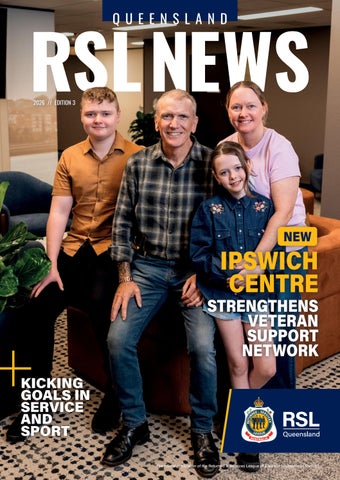
COVER STORY RSL Queensland has opened its newest Veteran & Family Wellbeing Centre, providing essential services and support for veterans, Defence members, and their families.
Content Coordinators, Graphic Design Varsity Graphics W: varsitygraphics.com.au
61
Printing & Distribution Printcraft W: printcraft.com.au
Disclaimer: Advertisers and contributors to Queensland RSL News acknowledge that they are aware of the provisions of the Anti-Discrimination Act 1977 and the Competition and Consumer Act 2000 in relation to false and misleading advertising or statements under other unfair practices and the penalties for breach of provisions of these Acts. The publisher accepts no responsibility for such breaches. Opinions expressed by contributors are their own and not necessarily endorsed by Queensland RSL News or the publishers. All material in Queensland RSL News is copyright and may not be reproduced in whole or in part without the express permission of the publishers. All articles are general in nature. Individuals should seek expert advice before acting on any information. Please note: This publication may contain images of deceased Aboriginal and Torres Strait Islander peoples.
The Indigenous Veterans’ Ceremony was held to coincide with National Reconciliation Week and acknowledged the contributions of all Aboriginal and Torres Strait Islander peoples who have served, and continue to serve our nation.
As ‘pop’ psychology spreads across our social media platforms, experts warn that oversimplified advice can mislead the community.
Editor RSL Queensland E: editor@rslqld.org
Submissions: Editorial and photographic contributions are welcome. Please contact the Editor for guidelines. Preference will be given to electronic submissions that adhere to word limits and are accompanied by high resolution photos. Originals of all material should be retained by contributors and only copies sent to Queensland RSL News.
RECOGNISING INDIGENOUS SERVICE AND LEGACY
STAYING AWARE OF POP PSYCHOLOGY
Advertising Peter Scruby E: massmedia@ themediaworkshop.com.au
Queensland RSL News distribution: 30,000
INSIDE EDITION 03, 2026
52
Administration PO Box 629, Spring Hill, Qld 4004 T: 07 3634 9444 E: reception@rslqld.org W: rslqld.org
RSL Queensland current membership: 35,688
46
FROM MANLY TO VILLIERS-BRETONNEUX
36
KICKING GOALS IN SERVICE AND SPORT
In April 2026, Jessie Hawkins was one of eight Queensland high school students participating in the Premier’s Anzac Prize who travelled to the Western Front in search of the stories of the ANZACs.
69
HOW VETERANS COME TOGETHER IN CHARTERS TOWERS Camaraderie and preserving legacy are strong attributes among the veterans in Charters Towers.
Julia Robinson shares how her Army career helped launch her rise through the sporting ranks.
83
FINDING FREEDOM TOGETHER
39
VIETNAM VETERANS’ DAY On Vietnam Veterans’ Day, we honoured Australians who served in the Vietnam War and marked 60 years since the Battle of Long Tan. More than 60,000 Australians served between 1962 and 1973, with many returning home without the respect they deserved.
The REBOOT Trauma Recovery program helped a veteran and his wife rediscover hope, freedom and family connection.
66
THE SECRET WAR OF SYBIL BECK The covert service history of Sybil Beck is just one of the many remarkable veteran stories that have been uncovered by Sandgate RSL Sub Branch.
Jamie and Rebecca Flemett with their children Ross and Ivy at the new Ipswich Veteran & Family Wellbeing Centre.
PRESIDENT’S MESSAGE
Wellbeing your way. With free and easy 20-minute online learning modules, RSL Be:Well can help you improve your health and wellbeing at your own pace, in your own time.
CONNECT TODAY rslqld.org/rslbewell 4
0370VS_0726
STATE PRESIDENT’S MESSAGE
Honouring a life of principle Vale Vic Reading One of RSL Queensland’s true believers, Vic Reading, passed away in July. Vic was a soldier, Director, President and muchloved member of the RSL family. Most would know Vic as a humble, practical and honourable man with a strong sense of purpose and justice. He served across the RSL and helped shape who we are today – a legacy left by people of Vic’s calibre. We will miss him. My deepest sympathies to his wife Helen and family, and all of his mates across the RSL in Queensland. Welcoming new leadership Following State Congress, I’m pleased to welcome Cherisa Pearce, who was elected State Deputy President, and congratulate Ashley Naughton on his re-election as Director. Cherisa brings more than 20 years of Army experience across command, training, operations and strategic logistics roles in Australia and overseas, including three deployments to Timor-Leste. Since transitioning from military service in 2016, she has remained closely connected to the veteran community as an active member of Currumbin/ Palm Beach RSL Sub Branch. I also warmly thank Wendy Taylor, who has stepped down after six years as State Deputy President. A former President of RSL South Eastern District, Wendy generously shared her expertise, leadership and deep commitment to our purpose. Proposed cap on allied health services I know many of you are concerned about the
proposed $5,000 annual cap on Department of Veterans’ Affairs (DVA) funded allied health services for Veteran Card holders. So am I. Announced in the Federal Budget, the cap is due to begin on 1 July 2027 and will apply to physiotherapy, psychology, podiatry, exercise physiology, dietetics, social work and speech therapy. The cap will not apply to dental, optical, hearing, medical or specialist services, or Open Arms psychology and counselling. While the intent is to address over-servicing and inappropriate use of allied health services by businesses exploiting veterans for profit, we are concerned that it could, even inadvertently, disadvantage veterans in need. This is unacceptable to us. RSL Australia is advocating for the removal of the cap and a rethink on how best to address the problem of exploiting veterans for profit. Legislation responding to the Royal Commission On 25 June, the Federal Government introduced the Defence Legislation Amendment (RCDVS Implementation and Related Measures No. 2) Bill 2026, the next stage in its response to the Royal Commission into Defence and Veteran Suicide. The Bill aims to strengthen support for current and former Defence members, and their families, including through better information sharing between Defence, DVA and related agencies, so people can be identified and supported earlier, particularly during transition.
5
The Senate has referred the Bill to the Senate Foreign Affairs, Defence and Trade Legislation Committee for inquiry and report by 24 August 2026. The RSL has been invited to make a submission. At the time of writing, the RSL response is in draft, but is likely to support most elements while raising reservations about schedules 1 and 3, centring on data privacy, protection and consent. We are likely to ask the Committee to scrutinise these provisions and recommend they be strengthened. Strategy supporting veterans and their families RSL Queensland welcomed the announcement of the firstever Queensland Veterans and Veterans’ Families Strategy by the Queensland Government on 10 August. The six-year strategy enables veterans and their families to be recognised for their capabilities and experience, while also enabling support for them to thrive. Read more on page 14.
Stephen Day
RSL Queensland State President Major General Stephen Day DSC AM
CEO’S MESSAGE
The importance of State Congress Thank you to everyone who attended our 2026 State Congress, and to all members keeping our mission alive across Queensland every day. For those who were not at State Congress, I’ll share why it was important. The Opening Ceremony was a chance to pause and reflect on the sacrifice and service of those before us. Our Patron, Her Excellency, the Honourable Dr Jeannette Young AC PSM, Governor of Queensland, addressed the League. The Annual General Meeting (AGM) formalises the decisions required for RSL Queensland, in line with our Constitution. It is distinct from the rest of State Congress, which is for the League in Queensland. The Business Sessions were League-focused and allowed Sub Branches and Districts to showcase their evolution and share ideas or opportunities. The Gala Dinner in the evening provided an opportunity for delegates to enjoy camaraderie. The combined effect focuses on our pillars of care, commemoration and camaraderie across the day. Contributing to the veteran support ecosystem During the AGM, I highlighted work happening in RSL Queensland in pursuit of our mission. I spoke about how we are contributing in a complementary way to the ecosystem supporting veterans and their families. We don’t know what these changes will ultimately look like. However, it is important to continually test ourselves to determine whether we
are providing services that complement the evolving ecosystem. For example, many programs we have developed – in particular scalable digital programs such as RSL Be:Well – have benefit beyond Queensland. Working with the newly formed Veteran and Family Wellbeing Agency may allow these programs to be extended further. Additionally, future program investments may consider broader stakeholders in their design, enabling them to meet demands not otherwise invested in. In doing so, we can ensure that when we add value to the veteran community, that value can be extended further if required. This inter-agency co-design will ensure we are scrupulous in our investments. Our evolution At the recent opening of the Veteran & Family Wellbeing Centre in Ipswich, I was reminded of the role our Centres play in providing safe spaces for veterans and their families to get support. They are part of a broader network of RSL Sub Branches and ex-service organisations supporting the veteran community. The ecosystem supporting veterans is clearly growing and improving. The RSL Moreton District honour boards prompted me to reflect on the League’s history, and the legacy we continue to build on. The strong connection on the day demonstrated the welcoming environment these Centres offer, and I am pleased you can read about these impacts in this edition.
6
At State Congress, I spoke about systems evolution underway to enhance our Dream Home Art Union. After almost a year of hard work, we have reached a major milestone – moving to a new technology system powered by the Jumbo Lottery Platform. We can now unlock further value for our generous supporters, and I look forward to them seeing these improvements as we strengthen our Art Union for long-term success. Vale Vic Reading In closing, I would like to acknowledge the recent passing of Vic Reading. Vic was always a great source of advice to us in his role as Director of RSL Queensland, particularly steering the Art Union in the right direction on the Fundraising and Lotteries Committee. He remained very interested and engaged in the work of our organisation, and our team were in regular contact with him about the business. He will be missed.
Robert Skoda
RSL Queensland Chief Executive Officer Robert Skoda
STATE SECRETARY’S MESSAGE
How we do things around here matters Veterans must remain at the centre of everything we do I want to speak plainly about who we are, why we exist and what’s expected of us. First, congratulations to you all for the outstanding commitment you make daily to supporting veterans and their families with dignity and respect. Our purpose is clear: to honour service by supporting veterans, standing beside their families, and building a community where respect, dignity and practical help are real. From time to time, we can become consumed by process or personal disagreement. We must stay focused on our purpose. Every member should ask one simple question before making a decision: does this help veterans and their families? If the answer is no, stop and reconsider. Service shapes our culture Veterans understand service, accountability and looking out for one another. Those values should be visible in how we behave every day. Every member and veteran is different, and we should listen and understand their lived experience before forming judgement. A veteran approaching any RSL Queensland District, Sub Branch, Veteran & Family Wellbeing Centre or event should be greeted warmly and made to feel they belong. Culture is what people experience when they walk through the door and there should be no wrong door to access the RSL.
Respect is doing the right thing Respect must be the baseline for how we deal with each other. We won’t always agree, but disagreement is no excuse for personal attacks, intimidation or gossip. Concerns about conduct should be raised early, calmly and through the right channels. Respect is earned, and if we do the right thing, it will be afforded. Leadership requires humility and courage Leadership isn’t about position or title – it’s shown in conduct. It means listening, acknowledging we don’t know everything, and putting the mission ahead of ego. When a veteran raises a concern, leadership means responding constructively, not avoiding the issue or becoming defensive. Veterans shouldn’t have to fight to be heard in the organisation built to support them. We contribute to the veteran experience Creating a safe, welcoming environment isn’t just the job of office bearers or staff – every member shapes the veteran experience. The way we run meetings and handle disagreements sends a message about who we are. If meetings are dominated by conflict or ego, veterans lose confidence in us. When things get tense, we should apply due process fairly, even if it takes longer. We honour service by doing the right thing Honouring service isn’t
7
limited to commemorative days. We honour service by being trustworthy, steady and effective every day – protecting dignity, supporting families and choosing to do the right thing even when it’s hard. So, why does all this matter? If we stay true to our purpose and keep our focus on practical support and community, we’ll strengthen our Sub Branches and carry RSL Queensland’s legacy forward. As we move into our next 110 years, we must embed our “no wrong door” approach, so every veteran feels safe seeking our support. The message is simple Keep members and veterans at the centre of what we do. Include their families. Lead with courage and humility. Act early. Support one another with compassion. Welcome those who seek connection. Earn trust through conduct and ask yourself: how are we committed to doing the right thing around here?
Iain Carty
RSL Queensland State Secretary Iain Carty CSM
News Queensland members connect at State Congress Delegates from across Queensland came together on Saturday 20 June for the RSL Queensland 2026 State Congress. The event provided members with the opportunity to attend the Opening Ceremony, contribute to the Annual General Meeting (AGM), actively participate in the Business Sessions and celebrate at the Gala Dinner. This year’s sessions reinforced the importance of RSL Queensland and its Sub Branches continuing to place veterans and their families at the centre of everything we do. Throughout the day, delegates also heard from Peta McKinnon, Acting Deputy Commissioner Queensland, Department of Veterans’ Affairs (DVA) who spoke about the up and coming allied health changes. These changes are due to commence in July 2027 and DVA will consult with veterans and their families over the next 12 months on the planned change. Delegates also heard from Commissioner Penny McKay on how the Defence and Veterans’ Services Commission is supporting veterans and their families, as well as updates from a number of RSL Sub Branches on their work building camaraderie within their local community. As part of the AGM proceedings, Cherisa Pearce was elected as State Deputy President and Ashley Naughton was re-elected as Director. Cherisa brings more than 20 years’ experience in the Army, with her career spanning command, training, operational and strategic
ABOVE: Outgoing State Deputy President Wendy Taylor, incoming State Deputy President Cherisa Pearce and State President MAJGEN Stephen Day DSC AM.
logistics appointments across Australia and on operations, including three deployments to Timor-Leste. Following her transition from military service in 2016, Cherisa has been an active member of Currumbin/Palm Beach RSL Sub Branch. RSL Queensland also acknowledged the service of Wendy Taylor, who stepped down after her tenure as State Deputy 8
President. A former President of RSL South Eastern District, Wendy has long been an integral part of RSL Queensland’s journey, contributing not only her expertise and leadership but also a deep passion for our purpose. She was formally thanked for her dedication, generosity and positive impact. Next year’s State Congress will be held on Saturday 19 June 2027.
News 01
01 RSL Queensland Patrons Her Excellency, the Honourable Dr Jeannette Young AC PSM, Governor of Queensland and Professor Graeme Nimmo RFD lay a wreath during the Opening Ceremony. 02 Beenleigh RSL Sub Branch member Amy McGregor. 03 RSL Central Queensland District Vice President Sharon Price chatting with fellow attendees. 04 Guests watch a short film to celebrate 110 years of RSL Queensland at the Gala Dinner. 05 Kalbar RSL Sub Branch member Stephen Pace. 06 Bundaberg RSL Sub Branch President Luke Harding. 07 Runaway Bay RSL Sub Branch delegate Barry Medlin. 08 Nerang RSL Sub Branch member Nea Storan, right, meets a member of the catafalque party from 1 SIG REGT Australian Army.
02
03
05
04
06
07
9
08
News Queenslanders recognised with national RSL honours Three RSL Queensland members have been recognised nationally for their outstanding service to the veteran community. The RSL ANZAC Peace Prize Lieutenant Colonel George Hulse OAM was named the 2026 recipient of The RSL ANZAC Peace Prize, recognising decades of work promoting peace through remembrance. The Prize recognises outstanding efforts by an Australian citizen to promote international understanding and contribute to world peace. Lieutenant Colonel Hulse, a member of Toowong RSL Sub Branch, was recognised in part for gifting a Bailey Bridge to France as a permanent memorial to the Australia-France partnership of World War I.
His advocacy also helped secure the Victoria Cross for Private Richard Norden in 2025, while his book The First ANZACs reflects his commitment to honouring service. Lieutenant Colonel Hulse was unable to attend State Congress and received his award at ANZAC House on 19 August. RSL ANZAC of the Year Award The 2026 RSL ANZAC of the Year Awards were presented to Queensland recipients Douglas Henderson OAM and Tony Stevenson OAM at State Congress. Runaway Bay RSL Sub Branch member Douglas Henderson OAM was recognised for turning his experience as a wounded Vietnam veteran into the Kokoda Youth Foundation.
ABOVE: RSL Queensland State President Major General Stephen Day DSC AM, left, presents Lieutenant Colonel George Hulse OAM with The RSL Anzac Peace Prize for 2026.
Since 2005, the Foundation has taken more than 1,300 young people to walk the Kokoda Track and learn the values of courage, endurance, mateship and sacrifice. Salisbury RSL Sub Branch member Tony Stevenson OAM was recognised for more than 25 years of service to his Sub Branch and the National Servicemen’s Association of Australia. Approaching 90, Tony continues to support remembrance and veteran welfare through ANZAC Day and Remembrance Day services, memorial park maintenance and graveside poppy services.
RSL Australia National President Peter Tinley AM, centre, presented 2026 RSL ANZAC of the Year Awards to Douglas Henderson OAM, left, and Tony Stevenson OAM at the 2026 State Congress.
10
News The King’s Birthday 2026 Honours List Congratulations to all who have been recognised in The King’s Birthday 2026 Honours List for their exceptional service to the community. The King’s Birthday 2026 Honours List recognised 949 Australians for their outstanding work, dedication and commitment to serving their local community. This included awards in the Order of Australia (General and Military Divisions), meritorious awards and recognition for distinguished and conspicuous service. This year, 142 Queenslanders were recognised for their significant contributions to their communities across the state, including eight RSL Queensland members who were awarded either the Member of the Order of Australia (AM) or Medal of the Order of Australia (OAM) in the General Division for service to veterans and their families, and the community.
ABOVE: Pictured at the announcement at Ballymore Stadium on 28 June, from left, RSL Queensland State President Major General Stephen Day DSC AM, Deputy Mayor of Brisbane Fiona Cunningham, Commander of the 7th Brigade, Brigadier Jennifer Harris CSC, Queensland Premier David Crisafulli and acting Minister for Sport and Racing Andrew Powell.
First-ever ANZAC Day Bledisloe Cup secured for Queensland The Queensland Government has secured a historic six-year deal with Rugby Australia to host three ANZAC Day Bledisloe Cup matches at Suncorp Stadium. RSL Queensland is proud to support the Queensland Government and Rugby Australia in bringing the iconic fixture to the Sunshine State. The Wallabies and All Blacks will meet in Brisbane on ANZAC Day in 2027, 2029 and 2031, with New Zealand to host the fixture in alternate years. The annual match commemorates the bond forged through the sacrifice of Australian and New Zealand troops at Gallipoli in 1915. “ANZAC Day is a time when Australians and New Zealanders unite to honour the courage, sacrifice and mateship of all who have served,” RSL Queensland State President Major General Stephen Day DSC AM says. “Australia and New Zealand have one of sport’s fiercest rivalries, which is grounded in deep respect. It mirrors our shared ANZAC history – standing side by side in service. “The ANZAC spirit of mateship reflects the bonds formed in sport. Whether in battle or competition, looking out for one another and standing together under pressure is central to both. When the final whistle blows, the rivalry fades, but the shared history remains.”
Member of the Order of Australia (AM) • Howard William Hobbs, Roma QLD – For significant service to the people and Parliament of Queensland, and to the community. Medal of the Order of Australia (OAM) in the General Division • Christopher Edward Burgess, Nevilton QLD – For service to veterans and their families. • John Sydenham Custance, Southport QLD – For service to surf lifesaving. • Florence Drury, QLD – For service to the community through a range of roles. • Mark Anthony Neave, QLD – For service to youth. • Kenneth John Roma, QLD – For service to veterans. • Charles James Sherrin, Birkdale QLD – For service to veterans and their families. • Karen Anne Wallwork, Beachmere QLD – For service to community history. To view the full list of honours, visit the GovernorGeneral’s website. Thank you for your continued dedication and commitment to supporting your local community. 11
News Strengthening veteran support across the sector More than 100 attendees from 50 ex-service and veteran support organisations gathered in Brisbane on 19 May for the bi-annual RSL Queensland and Legacy Brisbane Veteran & Family Wellbeing Network Forum. The Forum brought organisations together to hear sector updates and strengthen collaboration in support of veterans and their families. It also provides Defence and
government agencies with a way to engage the wider veteran support system on legislative and health system changes affecting Australia’s veteran community. Presentations included Department of Veterans’ Affairs updates on the National ESO Peak Body, Federal Budget funding changes and the introduction of the Veterans’ Entitlements, Treatment and Support (VETS) Act. Attendees also heard updates
from the Institute of Veterans’ Advocacy, Defence Force Welfare Association, Gallipoli Medical Research and Legacy Brisbane. RSL Queensland General Manager of Strategic Partnerships and Research Katie Maloney says the Forum is a valuable space for organisations to connect and strengthen their capacity to support the Defence community. The next VFWN Forum is scheduled for November 2026.
ABOVE: Pictured at the Forum on 19 May were, from left, Emma Campbell, Senior Manager, Partnerships – RSL Queensland; Brendan Cox, CEO – Legacy Brisbane; Dr Sanket Raut MBBS PhD, GMR Research Lead – Gallipoli Medical Research; Peta McKinnon, Acting Deputy Commissioner QLD – DVA; Margaret Jenyns, Director – The Institute of Veterans’ Advocacy (IVA); John Lowis, Acting President – Defence Force Welfare Association (QLD); Nick Booth MVO, Special Advisor – National ESO Peak Body Project; Katie Maloney, General Manager, Strategic Partnerships & Research – RSL Queensland; and Jeff McLean – Buddy Up Australia and Australian Commando Association. 12
News LEFT: RSL Brisbane North District President Mark Orreal, centre, receives a team-signed Dolphins jersey alongside, from left, Dolphins fullback Jamayne Isaako, Dolphins CEO Terry Reader, Ausbuild Joint Managing Director Matthew Bell and Dolphins halfback Kodi Nikorima. BELOW: Sandgate RSL Sub Branch members John Scales, left, and Ben Duncan enjoying the Dolphins game.
Veterans presented with signed ANZAC Round jersey RSL Brisbane North District received a team-signed Dolphins ANZAC Round jersey on 10 July, following a memorable game-day experience shared by more than 150 veterans and their families earlier this season. Among those who attended was RSL Brisbane North District President Mark Orreal, who served 21 years in the Australian Army. “Being part of the Guard of Honour was an incredible opportunity, and it was wonderful to spend the evening with our families and fellow veterans. “I also received so many heartfelt messages
following the game from those who attended,” Mark says. The jersey, from the Dolphins’ commemorative fixture in New Zealand earlier this season, was presented during the club’s Captain’s Run at Kayo Stadium. “It will take pride of place within our District as a lasting reminder of the respect shown to our veterans and the wonderful experience our members were able to share together,” Mark explains.
Dolphins winger Tevita Naufahu signs autographs for young fans.
13
News
RIGHT: Queensland Premier and Minister for Veterans David Crisafulli announced the Veterans and Veterans’ Families Strategy on 10 August.
Queensland launches first-ever Veterans and Veterans’ Families Strategy The State Government announced Queensland’s first Veterans and Veterans’ Families Strategy on 10 August, marking a significant milestone in recognising and supporting the more than 163,000 veterans and their families who call Queensland home. The six-year Strategy sets out a coordinated approach to improving outcomes for veterans
and their families, ensuring they have access to the services they need. It builds on the State Government’s broader commitment to strengthen support for veterans and their families, in areas such as employment, housing, health services and community programs. Queensland’s veteran
ABOVE: RSL Queensland State President Major General Stephen Day DSC AM said the Strategy enables veterans and their families to be recognised for their capabilities and experience, while also enabling support for them to thrive. 14
population is the largest in Australia and the new Strategy recognises both the unique challenges veterans may face, and the valuable contribution they continue to make to communities across the state. “Queensland veterans have served our nation with distinction, and this Strategy ensures we honour that service with real, practical support,” Premier and Minister for Veterans David Crisafulli said. RSL Queensland State President Major General Stephen Day DSC AM said that the veteran strategy has three key strengths underpinning it. “Firstly, that it recognises both veterans and their families. Secondly, that it recognises veterans as a valuable asset to our state – they are well trained, disciplined and willing to have a go. Thirdly, it recognises that transition from military to civilian life can be a vulnerable period for some veterans,” MAJGEN Day said. “As with all plans, the hard part is the execution phase that follows. We look forward to continuing to work with the Crisafulli Government to ensure the clarity of intent of this strategy is executed as intended.” For more information, visit qld.gov.au
News
Residential treatment for alcohol and drug issues in a safe and private country setting • White and Gold Card holders accepted • Working with veterans for over 8 years • 30 minutes from the Gold Coast Airport • Individual air-conditioned rooms • 6 acres surrounded by nature • Gym, resort pool, sauna and great offsite activities 15
(02) 5661 9530 586 Nobbys Creek Rd, Nobbys Creek NSW gunnebah.com.au
The newest Veteran & Family Wellbeing Centre in Ipswich officially opened on 29 July.
New
Ipswich Centre
strengthens veteran support network RSL Queensland officially opened its newest Veteran & Family Wellbeing Centre in Ipswich on Wednesday 29 July, providing essential services and community support for local veterans, Defence members and their families. A growing network of Centres The Ipswich opening brings RSL Queensland’s network of Veteran & Family Wellbeing Centres in Queensland and the Northern Territory to six, with Centres already supporting thousands of veterans in Brisbane, the Sunshine Coast, Townsville, Cairns and Darwin. The Ipswich Centre will support a region home to 10,000 veterans, plus an additional 5,000 personnel based at RAAF Base Amberley, bringing together complementary programs and specialist services delivered by RSL Queensland, Mates4Mates and RSL Moreton District. Designed with veterans in mind, the purposebuilt Centre on Brisbane Street in West Ipswich provides rehabilitation, health and wellbeing, advocacy, financial assistance and social connection opportunities under one roof.
17
VETERAN & FAMILY WELLBEING CENTRES
Supporting the largest population of veterans RSL Queensland Deputy CEO – Veteran Services Troy Watson says the Centre represents the ongoing investment by RSL Queensland in the veteran and Defence community in the region. “Queensland has the largest population of current and ex-serving Australian Defence Force members, and it was vital that we extended the range and capability of support services available to veterans, Defence members and their families in the local community,” Mr Watson says. “This Veteran & Family Wellbeing Centre will build on our long-standing support offerings in Ipswich and the surrounding area and symbolises RSL Queensland’s commitment to meeting the ever-evolving needs of the Defence and veteran community.” The Centre has been made possible through the $5.4 million grant agreement between RSL Queensland and the Department of Veterans’ Affairs as part of the Veterans and Families’ Hub Network Program. The Centres play an integral role in RSL Queensland’s mission to help veterans and their families find purpose, connection and care when and where it is needed most. As RSL Queensland’s network grows, so does its impact. There was a 3.9% increase in people supported in 2025, with 4,670 people checking into Centres in Brisbane, Ipswich, the Sunshine Coast, Townsville, Cairns and Darwin.
Services provide opportunities for positive futures Across the network, Centres are thoughtfully designed as welcoming, collaborative spaces where Defence members and their families can access centralised care and feel at home. While each Centre varies slightly, services across the network include: • DVA claims and appeals • employment support • emergency financial assistance • mental health and wellbeing support • homelessness support • physical rehabilitation • Skills for Recovery Programs • social connection activities • GP and healthcare support. Many Centres feature rehabilitation gyms, consultation and multipurpose rooms and outdoor spaces. Three of the Centres also include RSL District Offices, including RSL Sunshine Coast and Regional District Office on the Sunshine Coast, RSL Far Northern District Office in Cairns and RSL Moreton District in Ipswich.
ABOVE: RAAF Amberley officers were among the Defence representatives who attended the opening of the Ipswich Centre. LEFT: RSL Queensland State President Major General Stephen Day DSC AM, centre, speaks with RSL Moreton District President Paul Rogers, left, and Laidley RSL Sub Branch President Neville Hayne at the opening of the Ipswich Centre. 18
RSL Queensland officially opened its newest Veteran & Family Wellbeing Centre in Ipswich on Wednesday 29 July.
From the beginning, our goal has been to make it easier for veterans, Defence members and their families to access the care, connection and practical assistance they need. With six Centres now open across Queensland and the Northern Territory, we are continuing to build a network that responds to local needs and strengthens support for the Defence community.”
Building on the first Centre opened in 2023 The first RSL Queensland Veteran & Family Wellbeing Centre opened in Brisbane (Stafford), on 12 March 2023. The official opening was conducted by RSL Queensland State President Major General Stephen Day DSC AM and Her Excellency the Honourable Dr Jeannette Young AC PSM, Governor of Queensland. As the network grows, the Centres continue to make care, connection and practical support more accessible for veterans, Defence members and their families.
How to access support Find your closest Centre:
vfwc.org.au
Troy Watson
134 775
If you can’t make it into a Centre, there are many services available online or over the phone, including DVA claims and appeals, employment services, emergency financial support, specialist services, and mental health and wellbeing support.
Deputy CEO – Veteran Services RSL Queensland
Reach out today. 19
Centre locations Darwin
Townsville Cairns
Sunshine Coast
Brisbane
Ipswich
VETERAN & FAMILY WELLBEING CENTRES
A guide to our
Veteran & Family Wellbeing Centres
Brisbane Centre Located in Stafford, the Brisbane Centre offers physical rehabilitation, health and wellbeing, employment, DVA advocacy (claims and appeals), financial and other specialist services, plus social and recreational activities. Support is available from RSL Queensland, Mates4Mates and other organisations. Contact details: brisbane@vfwc.org.au 07 3130 8800 Level 1, 274 Stafford Road, Stafford, Qld 4053 Open Monday to Friday, 8:30am-4:30pm (Some social activities may operate outside these hours)
22
VETERAN & FAMILY WELLBEING CENTRES
Sunshine Coast Centre Located in Maroochydore, the Centre offers social connection activities, DVA advocacy (claims and appeals), plus financial and other specialist support services. Facilities include a veterans’ lounge, kitchen, consultation spaces, rehabilitation gym, and areas for regular social activities. Support is available from RSL Queensland, Mates4Mates, RSL Sunshine Coast and Regional District and other organisations. Contact details: sunshinecoast@vfwc.org.au 07 5458 8300 Level 2, 21 Carnaby Street, Maroochydore, Qld 4558 Open Monday to Thursday, 8:30am-4:30pm and Friday 8:30am-4pm (Some social activities may operate outside these hours)
Ipswich Centre Conveniently close to RAAF Base Amberley, the Ipswich Centre is equipped with a veterans’ lounge and rehabilitation gym, and offers physical rehabilitation, health and wellbeing, compensation assistance, DVA advocacy (claims and appeals), financial and other specialist services, plus social and recreational activities. Support is available from RSL Queensland, Mates4Mates and RSL Moreton District. Contact details: ipswich@vfwc.org.au 07 2800 8900 Level 1, 260 Brisbane Street, West Ipswich, Qld 4305 Open Monday to Friday, 8:30am-4:30pm (Some social activities may operate outside these hours)
23
VETERAN & FAMILY WELLBEING CENTRES
Townsville Centre Equipped with a veterans’ lounge and gym, the Townsville Centre (located in Aitkenvale) combines RSL Queensland and Mates4Mates services. The team can help with DVA compensation claims, wellbeing services (such as employment and emergency financial support), and clinical support including physical rehabilitation and mental health and wellbeing services. Support is available from RSL Queensland, Mates4Mates and other organisations. Contact details: vs@rslqld.org 07 4771 9600 40 Anne Street, Aitkenvale, Qld 4814 Open Monday to Friday, 8:30am-4:30pm
Cairns Centre
Contact details: vs@rslqld.org
Compensation Advocates are on hand at the Cairns Centre to support with DVA claims and appeals, or wellbeing services such as employment or emergency financial support. Support is available from RSL Queensland, RSL Far Northern District and other organisations.
134 775 280-286 Sheridan Street, North Cairns, Qld 4870 Open Monday to Friday, 8:30am-4:30pm
24
VETERAN & FAMILY WELLBEING CENTRES
Darwin Centre
Contact details:
The Darwin Centre is a welcoming, dedicated support hub that includes RSL Queensland, Mates4Mates, Soldier On and veteran healthcare providers. Access a wide range of support, from free help with DVA compensation claims to employment and emergency financial assistance, GP appointments and other health and wellbeing services. The Centre also features a veterans’ lounge and social space, which hosts regular activities throughout the year.
vfwc.darwin@mates4mates.org 08 7943 2800 39 Stuart Highway, Stuart Park NT 0820 (entry via Ramirez Road) Open Monday to Friday, 8:30am-4:30pm (Some social activities may operate outside these hours)
All our Centres are: Wheelchair accessible
Offer free parking
Learn more about our Centres vfwc.org.au
Located close to public transport
VETERAN & FAMILY WELLBEING CENTRES
Connection and support help ease family’s relocation
When the Flemett family relocated to Ipswich, they found a new network and vital support through RSL Queensland’s Veteran & Family Wellbeing Centre in Ipswich. Kylie Hatfield
THE
transition from Townsville to Ipswich was a big adjustment for Jamie and Rebecca Flemett. But connecting with the Ipswich Veteran & Family Wellbeing Centre (VFWC) has proved to be one of the best things they did to gain support and broaden their local network, while staying connected to their military past.
“I remember going to Canberra to help fight the bushfires when I was with 85 Transport. One day I’m at home and next day I’m getting a police escort through Canberra, driving a truck. “It was great fun; a great life. I really enjoyed it.” It was in the Army’s Transport unit that Jamie met Rebecca, who had joined the Army Reserves in 1995 before joining the regular Army for a stint, including an overseas posting. “I was deployed overseas for six months to East Timor back in 2000,” Rebecca says. “I think the Army gave me a lot of good life experiences.” Rebecca and Jamie describe having “fortunate” experiences leaving the Army, which included staggered transitions for both.
A great life in Defence Jamie Flemett first joined the Army in 1984 and described his time in Defence as being “thoroughly enjoyable”. “I liked the structure of it. I liked knowing what I was going to do basically from day-to-day, and week-to-week. But there were also a lot of sudden things that would happen; I would get sent away at the drop of a hat on many occasions,” Jamie says.
26
Rebecca and Jamie Flemett with their children Ivy and Ross at the Ipswich Veteran & Family Wellbeing Centre.
Rebecca transitioned from the regular Army back to the Reserves before eventually moving into a civilian role. Jamie first discharged in 1993, re-enlisted in 1999, and then discharged for the final time in 2008. Based in Townsville at the time, when Jamie left the Army for the second time, he was drawn to civilian roles that had similarities to his Defence experiences. “Being in transport, I did rider training and driver training, which I enjoyed,” Jamie says. “And because I enjoyed art, I got into tattooing. I was a tattooist for many years; I owned and operated my own shop with my family.”
Army veteran Rebecca Flemett enjoys being around like-minded people with similar experiences at the Centre.
27
VETERAN & FAMILY WELLBEING CENTRES
One of the things I like about coming to the Centre is how welcoming they are. The first thing we get is ‘how are you going? How’s the family? Can we get you anything?’ I don’t always relax in social situations, but I do find this quite easy.”
“We had touched base with Mates4Mates in Townsville, but we started coming to the Centre when we moved to Ipswich,” Jamie says. “The first activity we ever did through Mates4Mates was archery tag. We just went down there to the park, and there were a whole lot of other families and Mates4Mates people there. I have never seen so many adults acting like little kids; it was fantastic. I didn’t think I was going to enjoy it, but I got out there and had a go and ended up having a great day. “It was a fun day for the whole family.” Describing himself as reserved, Jamie acknowledges it can be daunting to step out of his comfort zone, meet new people and try new activities. But at the VFWC, he feels right at home. “You think it’s going to be scary to visit, but it turns out not to be. Everybody that we’ve met has been very open, warm and easy to talk to,” Jamie says. “One of the things I like about coming to the Centre is how welcoming they are. The first thing we get is ‘how are you going? How’s the family? Can we get you anything?’ I don’t always relax in social situations, but I do find this quite easy. “When we first moved here, it was nice to walk into the Centre and see a familiar face. It gave us something in common and helped me broaden my network, because we could talk about what we were doing with Mates4Mates.”
Jamie Flemett Veteran
Relocation forges new connections The family – including children Ross, 14, and Ivy, 10 – relocated to Ipswich in 2022. Rebecca first heard about Mates4Mates through her work. When the family realised they were living close to the Ipswich Veteran & Family Wellbeing Centre, where Mates4Mates is co-located, they decided to explore what was available.
The Flemett family look over upcoming activities organised for veterans and their families by the Ipswich Centre.
28
VETERAN & FAMILY WELLBEING CENTRES
The Ipswich Centre provides a welcoming place for families like the Flemetts.
Invaluable support for the whole family For Rebecca, having their whole family welcomed and able to participate in activities together has been affirming. “It’s nice to be around like-minded people with similar experiences and to be able to take your kids to the activities,” Rebecca says. “We came down to Brisbane for family reasons, and we found that the Ipswich Centre has been fantastic for different activities. We were able to do the online activities early on, which gave Ross, being homeschooled, that opportunity to meet people via those means. It just sort of opened up the world a little bit in regard to activities and being involved.” The family has also benefited from free access to professional services such as psychology, along with shared experiences including cooking classes. “We had wanted to do the Grandchester Steam Train excursion; when it came up as an option with Mates4Mates, we put our names down and were accepted for it and we had a great day,” Rebecca says.
“It was informal and casual. We had train rides, food, drinks and we had good company. It was just a really good day.” Even when they can’t attend in person, the family feels reassured knowing the Centre is there when they need it – something Jamie says is a huge help. “The fact that it’s there even if I’m not using it, in the back of my mind I know it’s there if I need it. That’s a massive crutch to be able to lean on,” Jamie says. “Through this support, my wife and I and our family have been able to access these Centres. We’ve done some amazing activities with them and just had wonderful support. So, for that, we thank you.” For the Flemett family, the Centre has become more than a place to attend activities – it is a source of connection, familiarity and support as they continue building life in Ipswich.
Support for the whole family to Scan Video h watc
Veterans and families can access support, activities and services through RSL Queensland’s Veteran & Family Wellbeing Centres located in Ipswich, Brisbane, the Sunshine Coast, Townsville, Cairns and Darwin.
vfwc.org.au
VETERAN & FAMILY WELLBEING CENTRES
Step by step: Helping veterans navigate
the road ahead When it comes to supporting veterans through life after service, RSL Queensland Compensation Advocate Greg Ludlow knows lived experience can make all the difference. Ellise Gill
ARMY
veteran turned Compensation Advocate Greg Ludlow has been supporting veterans at the RSL Queensland Veteran Family & Wellbeing Centre (VFWC) in Cairns for the past three years. Searching for purpose after finishing high school, Greg joined the Army in 2003 as an Administration Clerk and was posted to the 4th Field Regiment with the Royal Australian Artillery. He said the experience gave him a sense of discipline, and a unique understanding of military life, both of which he now employs in his current role. “Supporting a unit or regiment gives you that understanding of service, which transfers well into the compensation space. There are many similarities when it comes to understanding legislation, policies and standard operating procedures,” Greg says. After transitioning out of the Army in 2010, Greg worked in the disability sector before finding his way back to the Defence community. “Although the community sector was rewarding, I never really felt that real sense of connection to the people I support until I came to RSL Queensland,” he adds. “I’d been out of Defence for 13 years when I started working as a Compensation Advocate. Connecting with the veteran community again was just awesome.”
RSL Queensland Compensation Advocate Greg Ludlow joined the Army in 2003 and posted with the Royal Australian Artillery.
30
VETERAN & FAMILY WELLBEING CENTRES
Compassion and heart Greg’s client engagements are diverse and can vary greatly. One day he could be supporting new clients with liability claims, the next he could be hearing from a client he first met four years ago and is now returning to seek his support again. Greg describes his role at RSL Queensland as highly rewarding, but one that requires you to commit with your whole heart. “We are working with a diverse cohort of veterans who are often in their most vulnerable state. They may be transitioning out of Defence, experiencing homelessness or living with mental health concerns,” he says. “No case is identical. There’s often complex legislation applied to each case, and it’s our role to support and educate our veterans through this process. “I always put myself in that veteran’s shoes. When I have a case come across my desk, I try to picture how that looks for that veteran. What are the best steps forward?” Community connections One of the challenges Greg faces most often is engaging older veterans who might need support, but are too proud, or unsure, how to get started. “I find our older veterans a little less likely to seek support. When we spend time with clients at the VFWC or out in the community, we like to share education around RSL Queensland support services and DVA entitlements that they may be unaware of,” he shares. As a Cairns local for more than 30 years, Greg has built important relationships within the community so he can connect with veterans in need. Regular contact with Sub Branch members and RSL Queensland’s Far Northern District President, Ken Willoughby, keeps him informed and better able to understand the challenges some veterans may be facing. “Our relationship with the Sub Branches is crucial. It helps us maintain that connection with the veteran community and reach people who may not have reached out otherwise – especially in our more regional and remote areas,” Greg reflects.
to Scan Video h watc
“There have been so many occasions where Ken has gone out of his way to assist our veterans and connect them with our services. This filters down through all the RSL Sub Branches, regardless of if the veterans are members or not.” Supporting veterans for better outcomes For Greg, empathy is at the centre of every conversation he has with clients. “In this role, you need to be a people person and understand a range of different perspectives and circumstances,” he says. “You have to form a sense of camaraderie with the current serving members and veterans you’re assisting, so that they feel supported.” Though some cases may be more complex to navigate than others, he says it’s always so rewarding to support veterans on their journey. “A successful outcome doesn’t have to look like the biggest compensation payout every time. Sometimes it’s just about getting someone the medical support they need. “Supporting people who have served for our country is a great honour. As an ex-serving member it feels good to give back to the veteran community that has done so much for this country.”
Need help navigating DVA claims and the appeals process? RSL Queensland provides free advocacy services online, in person and over the phone to ensure veterans get the best possible outcome.
vfwc.org.au
VETERAN & FAMILY WELLBEING CENTRES
Support that meets you
where you are
Walk into the RSL Queensland Veteran & Family Wellbeing Centre (VFWC) in Maroochydore on the Sunshine Coast and you will likely be offered a freshly brewed coffee when you’re offered a chair. Anneka Salvat
FOR
Watching the conversation change Sally has spent nearly two decades working with veterans, beginning with her first placement as a psychologist at the Austin Rehabilitation Hospital’s Veteran Psychiatry Unit in Melbourne. Since then, she has worked in several mental health services, including the Keith Payne Unit at Greenslopes and the Trauma Recovery Program at Buderim Private Hospital, before joining the VFWC on the Sunshine Coast. Over time, she has watched the conversation around veteran mental health shift. “Before, we tended to focus mainly on traumatic experiences during deployment,” she explains. “Whereas now, we focus on that transition into civilian life and recognising moral injury. “At the VFWC, the team understand the unique challenges that veterans and families can experience, and we’re here to provide support in a safe, non-judgemental space.”
Clinical Psychologist Sally Rostas, that first impression matters. “The Centre is a very friendly place,” she says. “When a veteran or family member has an appointment, it’s important to us that they feel as comfortable and relaxed as possible.”
Clinical Psychologist Sally Rostas. 32
Holistic care all under one roof A typical week for Sally involves seeing around four or five clients a day, four days a week. While it’s mostly veterans who take a seat in her office, she also works with the partners and children of Defence families. Those she supports can be experiencing any number of challenges including PTSD and trauma; grief; depression and anxiety; emotional regulation; relationship difficulties; transition adjustment or addiction. For those who are meeting Sally for the first time, they will go through a relaxed, semi-structured intake process, which helps her understand their needs and challenges to develop a plan. Ongoing clients work through therapeutic goals using an approach that draws on a range of different therapies including Cognitive Behavioural Therapy (CBT), Schema Therapy and Eye Movement Desensitisation and Reprocessing (EMDR) – the last of which she has found particularly effective for trauma. “EMDR can be less confronting for a veteran, as it doesn’t require them to talk so much about what happened,” Sally says. What sets the VFWC model apart, Sally says, is the team around her: a social worker, physiotherapist, wellbeing officers, advocates and the District team all working together to achieve the best outcomes for veterans and their families. “As a team, we provide a more holistic service that is friendly, trauma-informed and supportive.”
Accessing the support you need vfwc.org.au
Dispelling the myths With no military bases on the Sunshine Coast, very few of Sally’s clients are currently serving. Most are veterans who deployed to Afghanistan, Iraq or East Timor, even Vietnam, with some navigating the loss of structure and identity that comes after a life of service. “Feeling lost, let down and without purpose can often show up as anger and trying to maintain control,” she says. Building trust takes time, particularly with veterans used to “toughing it out”. Sally’s approach to her appointments is simple: be genuine, listen without judgement, and let people know they can always take a break. Sally is also careful to dispel some of the myths that keep people away – that therapy means “being grilled with questions” or “endlessly analysing dreams”. The truth is that sessions are a conversation, not an interrogation. She says it’s not uncommon for veterans to put off seeking support because of those myths – “I wish I hadn’t left it so long to visit the Centre,” one client has shared with Sally after seeking support after so many years. Resilience and compassion After nearly 20 years in the field, Sally is still surprised by people’s resilience and capacity to heal. “I’ve heard some very difficult stories, and I’m always astounded by people’s ability to experience or witness things most of us could never imagine yet come through the other side with their kindness and compassion intact.” For veterans and their families who aren’t sure what’s right for them or where to start, Sally says they aren’t alone and it’s common to feel apprehensive. “Reaching out for help is often the hardest part for people, but once they do, it can be a huge relief knowing they now have that support, even on the tough days.” “The first step is to speak with your GP and get a referral to see a psychologist, then reach out to a Veteran & Family Wellbeing Centre, so we can help support you.”
Veterans and their families can access mental health support from psychologists, counsellors and social workers, as well as physical rehabilitation from exercise physiologists and physiotherapists at Veteran & Family Wellbeing Centres, either in person or via telehealth.
Reach out to your local Centre to find out more.
Veteran Grant Thomas with Accredited Exercise Physiologist Cathy Rowe at the Townsville Centre.
Keeping Townsville’s veterans
moving
Townsville is a city where Defence families are woven into daily life, and the need for services that support veterans through transition, injury and health changes is ongoing. Anneka Salvat
AT
RSL Queensland’s Townsville Veteran & Family Wellbeing Centre located in Aitkenvale, the Physical Rehabilitation team has become one of the most integral parts of that support network – not just for physical recovery, but for the sense of routine, purpose and community that so many veterans can lose when they leave behind the structure of life in the military. Cathy Rowe is one of the Accredited Exercise Physiologists in Townsville. Her path into the field began early, playing sport as a teenager and studying physical education in high school, but it was a family experience that really gave her the push. “My grandma had a stroke that left her really weak on one side. I became involved in her rehabilitation process, and my interest grew from there,” she says. Combined with a family connection to Defence – her grandfather served in the RAAF and her father in the Army Reserves – Cathy eventually found her niche supporting the veteran community.
34
VETERAN & FAMILY WELLBEING CENTRES
Meeting veterans where they are Following a career of pushing their bodies to the limit, veterans can walk through the Centre doors with a variety of issues, including musculoskeletal pain and injury, chronic pain, type 2 diabetes, heart disease and mental health conditions. Working with veterans, however, is rarely straightforward. “Veterans come with a lot of layers. It could be physical layers, psychological layers, or often, both of them,” Cathy says. “Much of the job is about listening first. Most people just want to be heard. So, I give them that space to tell their story if they want to.” Sessions might shift entirely depending on how someone feels that day. Sometimes it’s a quiet, repetitive exercise while a client offloads; other times it’s a hard workout that pushes them physically with a few words of reassurance along the way that what they are doing is safe and that they are okay. The team runs a mix of group programs – Functional Fitness, Strong and Steady, a Pilates-style Mat Movement class, and Strength Fundamentals – alongside one-on-one sessions, with referral pathways covering veterans with a White Card or Gold Card; family members through Medicare’s chronic condition management plan; and even current serving members. The Physical Rehabilitation team also works in collaboration with the Centre’s psychologists, counsellors and social workers, sharing weekly clinical catch-ups and monthly supervision sessions. “There’s really good evidence behind combining therapies to support veterans – or any person really,” Cathy explains.
A tailored approach For veteran Grant Thomas, the Veteran & Family Wellbeing Centre in Townsville has been a core part of his transition back to civilian life. Grant served in the Australian Army Band Corps for 20 years, primarily with 1RAR Band in Townsville. After his cardiologist warned him to start exercising, and recurring knee bursitis left him bedridden for days at a time, Grant found his way to the Centre, years after performing with 1RAR Band at the Centre’s official opening. “I told them what was happening with my bursitis and how my knees were really playing up. My main concern was that I didn’t want to end up immobile,” Grant recalls. Cathy worked with Grant to build a program that not only addressed his injuries, but also built strength, flexibility and improved movement. Grant now trains up to four times a week around his ‘gigging’ schedule. More than a gym Grant says the Centre has many benefits beyond the gym floor and encourages fellow veterans to give it a try. “I appreciate what the Centre has provided me as a veteran, and also my family,” Grant says. That quiet, steady impact is something that Cathy hopes becomes synonymous with the Centre, and its place in the veteran ecosystem. “The Centre is a non-judgmental space where people can connect and have a conversation with someone who understands. We have a range of programs, classes and activities so there’s something for everyone,” she says. For veterans or family members still on the fence about reaching out, Cathy’s advice is simple: “Just come in for a chat. There’s no obligation to get a referral straight away, but if you’re open to receiving help, we will be there.” As Grant puts it, “Sometimes all it takes is someone showing you what you’re still capable of.”
Cathy works with veteran Grant Thomas in the Centre’s rehabilitation gym.
35
JULIA ROBINSON
Kicking goals in service and sport Julia Robinson shares how her Army career helped launch her rise through the sporting ranks. Courtney Adams
BORN
in Ipswich and raised in a Defence family, Julia Robinson understands better than most what it takes to thrive in uniform. “Coming from a Defence family, we moved around a fair bit, but I didn’t mind – I got to meet heaps of new friends and play for a few netball teams, which I loved,” she recalls. “I always had that dream when I was growing up to be a professional athlete, but I didn’t know what I wanted to do after school, so I joined the Australian Defence Force (ADF) because I knew there were so many opportunities, and I knew the lifestyle and values that the Army had aligned with mine.” After enlisting in 2017, Julia became a Lance Corporal in the Army’s Royal Australian Corps of Transport. She was posted to Townsville in 2018 and started playing rugby league with the Defence Force team there to feed her sporting passion. Having never followed rugby league in childhood, her talent and passion for the sport came as a bit of a surprise.
“I didn’t know that girls were playing rugby league when I was growing up, so when I got my first taste of it playing for the ADF team, I loved it. The values align – hard work, discipline, resilience, teamwork – those are all the values I live by and work in both of these worlds,” Julia explains. Pursuing both careers had its challenging moments, but Julia’s passion and mental fortitude drove her to succeed in both fields. “When I first started playing, my mum (obviously being in the Army) was like, ‘you can’t play rugby league in Defence and do Defence!’ But now she’s like, ‘wow, how cool that you’re able to play rugby league and still work for the Defence Force’,” Julia laughs. “Times can be hard since I’m not a full-time player yet. It can be long days of working a full-time job and then going to training in the afternoon, and still being able to put in 110%, but you make it work. “I’ve always been headstrong, so I feel like it came easy because I knew it was something I was so passionate about and loved.” 36
JULIA ROBINSON
to Scan Video watch Brisbane Broncos player Julia Robinson first started playing rugby league while serving in the Army’s Royal Australian Corps of Transport. 37
JULIA ROBINSON
members and veterans to access RSL Queensland services. There are so many people out there that need support. It can often be the little things that you can do for someone else that make such a big difference. “Finding your community post-Defence is so important because I guess when you’re in the Defence Force, that’s what you live by. I feel like some people can feel lost without that when they leave, so it’s really cool that the RSL Sub Branches and community can give that support.”
I feel very fortunate to represent Australia both in rugby league and serving as a Defence member. Being able to wear the green and gold jersey with the Coat of Arms and also being able to put that Australian Army uniform on is pretty cool.”
Reaching the next level Since discharging from the Army full-time, Julia has thrown herself head-first into life not only as a footy player, but also as a role model and advocate. It’s a life that she describes as surreal. “It’s so cool that I get to go play in front of thousands of people and sign autographs for young girls and boys that want to be like me when they’re older – it’s really special and I’ll never take it for granted,” Julia says. Reflecting on her journey, Julia is grateful for her Defence roots. “If I never joined the Defence Force and played rugby league there, I wouldn’t be sitting where I am today. Now I just want to keep getting bigger and better in anything I do. I feel like there’s never that finish line – I just want to keep growing as a person and a player,” she says. “My biggest advice would just be to have a go. Don’t be scared. Just keep believing in yourself and take any opportunity you get, because if you dream big, good things will come.”
Thriving on and off the field Julia’s days playing for the Defence Force turned heads in the rugby league world. She has since become one of the game’s best, representing the Brisbane Broncos, Queensland Maroons and Australian Jillaroos. She is the Brisbane Broncos’ first female Game Development Officer, and last year alone averaged more than 220 run metres per game, scored nine tries, recorded 93 tackle breaks and produced 15 line breaks in the Broncos’ premiership-winning season. In 2025, she was honoured with the International Rugby League Golden Boot award, named the Broncos’ Most Consistent Player, finished as Dally M Medal runner-up and was selected in the Dally M Team of the Year. Julia credits these achievements to her Army foundations. “The Defence Force has always been a massive support, and I’m very lucky to have that backing from them. They were able to post me back down to Brisbane in 2019 when I signed for the Brisbane Broncos, so I wouldn’t be where I am today if it wasn’t for them,” Julia explains. “I feel very fortunate to represent Australia both in rugby league and serving as a Defence member – it has so much meaning to me and my family. Being able to wear the green and gold jersey with the Coat of Arms and also being able to put that Australian Army uniform on is pretty cool.” While Julia recently discharged from the Army after seven years of service to pursue rugby full-time, she continues to give back as an inactive Reservist advocating for veterans. Commenting on her motivation, Julia says, “the beauty of both the Army and sport is that you have so many people around you, so you can lean on your mates. Seeing the community come together as one to support veterans is very heartwarming.” “It’s so good that there’s opportunities for Defence
Julia feels fortunate to have represented Australia both in rugby league and serving in the Army.
38
VIETNAM VETERANS’ DAY
On Vietnam Veterans’ Day, we honoured Australians who served in the Vietnam War and marked the 60th anniversary of the Battle of Long Tan. More than 60,000 Australians served in Vietnam between 1962 and 1973, with some returning for humanitarian operations in 1975. Of those who served, 523 died and about 3,000 were evacuated with wounds, injuries or illnesses. Many Vietnam veterans returned home to strong community opposition to the war and were not given the respect they deserved. Vietnam Veterans’ Day recognises their service, sacrifice and ongoing contribution as community leaders and volunteers.
Keep an eye out for more photos from Vietnam Veterans’ Day services across Queensland in Edition 4.
The Vietnam Veterans’ Day service at Anzac Square in Brisbane honoured those who fell at the Battle of Long Tan 60 years ago. Photo by Simon Brooks.
39
VIETNAM VETERANS’ DAY
A veteran pays his respects at the service in Anzac Square. Photo by Simon Brooks.
Battle of Long Tan survivor Major Bill ‘Yank’ Akell CSM (Retd) at the Vietnam Veterans’ Day service marking the battle’s 60th anniversary at Gallipoli Barracks, Enoggera.
Goondiwindi RSL Sub Branch members on Vietnam Veterans’ Day.
Vietnam veteran Darryl Shipp walks alongside The Governor of Queensland, the Honourable Dr Jeannette Young AC PSM. Photo by Stewart Munro. 40
VIETNAM VETERANS’ DAY
Veterans gather at the Vietnam Veterans’ Day service in Brisbane. Photo by Stewart Munro.
About 90 veterans and their family members attended a Vietnam Veterans’ Day service organised by Forest Lake and Districts RSL Sub Branch at the Chapel at the National Servicemen’s Military Museum in Wacol. Sub Branch President Shaun Richards CSM delivered a moving speech that detailed the stories of two Vietnam veterans.
Hervey Bay RSL Sub Branch held a Vietnam Veterans’ Day service in Freedom Park for the 60th anniversary of the Battle of Long Tan.
The Vietnam Veterans’ Day service in Bundaberg.
41
VIETNAM VETERANS’ DAY
Queensland Premier David Crisafulli speaks to guests at the 60th anniversary reunion of the Battle of Long Tan in Brisbane on 18 August.
Survivors of the Battle of Long Tan gathered in Brisbane for a 60th anniversary memorial dinner on Vietnam Veterans’ Day. Attendees included former infantrymen from D Company, 6th Battalion, Royal Australian Regiment (D Coy 6RAR), who were engaged in the initial enemy contact and suffered the majority of the casualties, as well as members of A and B Coy, who provided infantry reinforcements. Other guests were from the 103, 105 and 161 (NZ) Field Batteries and 1APC Sqn.
The widow of Vietnam veteran and Toogoom and District RSL Sub Branch Wellbeing Officer Greg Harris was presented with a Quilt of Valour in acknowledgement of his service during the Sub Branch’s Vietnam Veterans’ Day commemorative service. The service also marked the 60th anniversary of the Battle of Long Tan.
Manly Lota RSL Sub Branch members hold Australian flags in honour of Vietnam Veterans’ Day. 42
VIETNAM VETERANS’ DAY
Darryl Shipp’s brush with death, and life of service If you look up lucky in the dictionary, you might just see a photo of Vietnam veteran, Darryl “Skippy” Shipp. At just 20 years old, Darryl had already survived a grenade explosion, and a near drowning, but he wasn’t done yet. By Ellise Gill
A
“regular” 9-5 job was never on the cards for Darryl Shipp. He quit school and began driving trucks before he was even old enough to hold a license. Most days, he’d work from sunrise to midnight, travelling the bustling streets of Brisbane to deliver fruit and veggies to restaurants across the city. Many assumed he was being primed to take over his dad’s trucking business, but Darryl had other plans. At 15, he was accepted as a Navy Apprentice, intent on following in his father’s footsteps who had served in WWII. Just two days out from being shipped to Leeuwin Barracks in Western Australia, Darryl had a change of heart, fearing his sea sickness might get the best of him. Instead, he continued to drive trucks for his father’s business, until he turned 17 and enlisted in the Royal Australian Air Force. Darryl joined as an Airfield Defence Guard and spent two years training, including stints with Army units such as Charlie Company, 4RAR, until he was of age to go to Vietnam. “I wanted to go to Vietnam because I believed in what was going on at the time. That’s what I wanted and I never looked back,” he says. On 10 June 1970, Darryl touched down in Vietnam.
Vietnam veteran Darryl Shipp found solace in connection, learning and veteran advocacy after returning home from service. 43
VIETNAM VETERANS’ DAY
ABOVE: Darryl, second from the right, pictured with his Commanding Officer and the Provost Marshall, holding a box of shrapnel that was extracted from his chest after a grenade explosion.
An unexpected beginning Fresh off the plane, after a big night of celebrations with his rugby mates in Brisbane, Darryl was put on guard duty on the main gate at Vung Tau base. As he stood in the sweltering heat, he recalls feeling a little under the weather – thinking his climbing temperature and swimming head was the result of a bad hangover. The next thing he remembers was waking up in hospital. “I’d collapsed on duty, and they’d rushed me to the Army hospital. I came to and said, ‘What the hell happened’, and the doctor replied, ‘You’re running a temperature well over 100 and you’ve got glandular fever, so you’re stuck here.’” For Darryl, who’d already spent years waiting and preparing for his first days in Vietnam, the sickness was a big blow to his psyche. “I was a young person who had come to Vietnam to fight for his country, so laying in a hospital bed for 4 weeks was a killer,” he says.
ABOVE: Darryl Shipp volunteered to serve in Vietnam and says his willingness to serve hasn’t changed: “Even now, if they asked me to go, I’d go.”
All it took was for one reed to wrap around his canteen, and he was gone. “I just disappeared underwater and it all went black. I couldn’t touch the bottom, I couldn’t get up and I couldn’t get down. It was just lucky that a guy on my left flank saw me disappear. He searched desperately through the water until he grabbed hold of my rifle and yanked me out,” Darryl says. “When they pulled me out, I was dead and I didn’t wake up until I was in the back of a Land Rover being rushed to hospital. When I woke up, I screamed, ‘Get off me, you’re breaking my ribs!’ The doctor said I was clinically dead and my mate had bought me back to life. “I still don’t know how long I was dead for, but I had sore ribs for a month!” Not long after, Darryl had another near miss on duty. While investigating a fire that had broken out near base, Darryl was hit by an exploding grenade. “At first I thought I was walking towards a flare, but I quickly found out, it was something much more,” he remembers. “Everybody thought I was dead. I had a concussion and blood running out of my ears. Everyone was yelling but I couldn’t hear anything. I couldn’t feel anything. My body was totally numb.”
Back from the dead When Darryl was released from hospital, he was assigned to the Quick Reaction Force. “My commander said, ‘Oh, you’ll be safe there. Other than the occasional rocket, we haven’t been attacked for months.’ Lo and behold, the second night I was on shift, we got attacked with grenades at the fenceline.” Joining his fellow troops, Darryl rushed to sweep the area for enemy threats. In the pitch black, he waded through murky waist high water with mud and knots of thick reeds at his feet. He was still weak from his illness and struggled to keep his head above water as it grew deeper and deeper. 44
VIETNAM VETERANS’ DAY
To commemorate his brush with death, his Commanding Officer and the Provost Marshall presented Darryl with the remains of the grenade that had injured him, and the shrapnel recovered from his chest – just below his heart. “When you’re young like that, it doesn’t bother you. I just kept going. I felt invincible over there.”
“I had been through my own health challenges after service and wanted to help others, so I became a certified counsellor, and undertook advocacy training with DVA,” he says. “I had a permanent table in one of the coffee shops – that was my office. Any time a veteran was in strife, I’d say, ‘Meet me at that table – I’m on my way.’” Now, Darryl continues to support veterans through his role as Secretary of the Vietnam Veterans Association – a position he has held for 15 years – member of Caboolture RSL Sub Branch, State President of the Australian Federation of Totally and Permanently Incapacitated Ex-Servicemen and Women (Queensland Branch) Incorporated, and organiser of the annual Vietnam Veterans’ Remembrance Service in Brisbane. On the 60th anniversary of the Battle of Long Tan, Darryl is reminded of the sacrifice of his brothers in arms. Even at 75 years old, he remains a warrior at heart. “It’s important to me that we remember those who served in Vietnam, whether it be in the Battle of Long Tan or the Battle of Coral-Balmoral,” Darryl says. “I volunteered to go to Vietnam to defend our way of life, and I’d do it again at a drop of a hat. Even now, if they asked me to go, I’d go.”
Homecoming In June 1971, Darryl’s deployment in Vietnam came to an end. The Air Force had already been notified that 9 Squadron in Vung Tau were pulling out of Vietnam, so Darryl put his hand up to stay a little longer and help with the transition. “When I volunteered, my Commanding Officer just turned to me and said, ‘Skippy, you’ve cost me so much paperwork already. You’re getting on that plane now! I’m not letting you stay.’” Adjusting to life back home was challenging at first and made even more difficult by shifting political views at the time. “When we came home from Vietnam, we didn’t get the same warm welcome that troops did in WWI and WWII. It was a pretty hollow feeling,” he says. Over time, Darryl found solace in connection and learning – something that continued even after he left Defence and forged a career in veteran advocacy. A proud veteran Darryl’s work in the veteran space began almost 40 years ago when he was living in the small country town of Biloela. As a member of the local RSL Sub Branch, and the then emerging Vietnam Veterans Association, Darryl had come to know many of the local veterans and saw the need for advocacy and counselling support.
ABOVE: A captured Viet Cong prisoner hands Darryl his weapon in Nui Dat, circa 1970-71. A South Vietnamese Army (ARVN) interpreter is at far left. Either side of Darryl are two other Airfield Defence Guards. LEFT: Darryl Shipp at the main gate of the RAAF base at Vung Tau, circa 1970, shortly after he arrived in Vietnam. This is where he collapsed on duty from glandular fever. 45
*Aboriginal and Torres Strait Islander people should be aware that this article may contain images or names of deceased Aboriginal and Torres Strait Islander peoples. INDIGENOUS VETERANS’ CEREMONY
Recognising Indigenous service and legacy Romy Photography
to Scan Video h c t wa
46
INDIGENOUS VETERANS’ CEREMONY
Vietnam veteran James Canuto was the keynote speaker at the 2026 Indigenous Veterans’ Ceremony in Cairns on Saturday 30 May. The ceremony was held to coincide with National Reconciliation Week and acknowledged the contributions of all Aboriginal and Torres Strait Islander peoples who have served or sacrificed for Australia. “RSL Queensland is proud – in this 20th year of this ceremony – to acknowledge those Indigenous peoples who served and were treated unfairly either during service or when they returned home, and also reflect on our history and correct that history for some of the injustices faced by those men and women,” RSL Queensland State Secretary Iain Carty CSM says. The event aims to create a deeper understanding of our military history, and deeper recognition of all who served, by helping to tell this story.
47
INDIGENOUS VETERANS’ CEREMONY
James Canuto
A leader in war and peace What began as an escape from life on Yarrabah Reserve turned into a career that spanned over two decades of service. Ellise Gill
48
INDIGENOUS VETERANS’ CEREMONY
49
Portrait of James Canuto from the Serving Country Project by Belinda Mason OAM.
INDIGENOUS VETERANS’ CEREMONY
Soon after enlisting in the Army, James Canuto was deployed to Vietnam.
AS
a kid, James Canuto dreamed of adventure. But adventure didn’t always come easy. James was classed as an ‘Assisted Aborigine’, unable to leave his hometown without a permit. The Army was his way out. Duty calls At just 20 years old, James enlisted alongside his next-door neighbour. Soon after, James was deployed to Vietnam for his first tour. “It was going to be my first trip on a military aircraft (an American C-130 Hercules). “Jokingly, the Loadmaster said, ‘Welcome aboard this flight to Nui Dat. The flight will take 40 minutes. If you look above you, you will see a set of lights. At the moment, they’re showing white. If they turn green, we’re taking enemy fire. If they turn red, we’re going to ditch the aircraft.’ So, for the entire 40-minute flight, I didn’t take my eyes off those lights.” “When we got to Vietnam, we flew into Tan Son Nhu Airbase. That was the busiest airport in the world in 1969.”
James Canuto during the Vietnam War.
“The worst days were Mondays, specifically Mondays during the dry season, because we’d have to check for mines. During the wet season (when the rain fell from 4.00pm to 7.00pm), the mines couldn’t function properly, but during the dry season, the batteries never got affected. “Then there were the ants! The antennas of the vehicle would flick the nest up in the trees and the nest would sometimes fall right into the driver’s lap. You’d see this 52-ton vehicle going through the bush and suddenly come to a full stop: the crew bailing out, armed with cans of fly spray.”
Landmines, grenades and... red ants Over the next year, James would work as an armoured vehicle operator, driving M113A1 APCs in dangerous enemy territory. “Some of our biggest concerns were landmines, rocket propelled grenades (RPGs), and red ants,” he recalls.
Near misses and lifelong mates Red ants would soon become the least of James’ problems. Throughout his two tours of Vietnam, 50
INDIGENOUS VETERANS’ CEREMONY
James and his comrades experienced near misses on a regular basis. One story he recounts is of his mate, who survived a near-death explosion on the way to secure a landing pad for a medical helicopter. In the unit, the commander was nicknamed Charlie Charlie, and the driver, Jockey. “In our three-car convoy where I was in the second vehicle, the first two went over a bump in the road,” he recalls. “But my friend, who was the Jockey driving the third vehicle, wanted to give his Charlie Charlie a gentle ride, so he went around that bump. That’s where the switch was and up he went.” Getting out of his vehicle to help his friend, James realised that there were three injured parties that needed his immediate attention. “In that moment, the Jockey asked me to shoot him. The next time I saw him was October 1970, back in Sydney, and I said, ‘Look at you, you silly bugger. Six months ago, you asked me to shoot you, now you’re walking around.’ He had a back brace on, but he was alive.” Ike, another good mate of James’, had a similar close call while towing a broken-down vehicle back to their nearest Night Defence Position (NDP). “We were prepping the vehicle to be towed, and Ike was sitting in the driver’s seat. I said, ‘What are you doing in there? You’re not supposed to travel in a vehicle that’s being towed,’ and he said, ‘Oh, Jimmy, that’s draining. Don’t worry about that. I’ll stay here. I’ll be right,’ and off we went.” James remembers that they must have moved about 20 metres along Route 329 before there was an almighty explosion. “I jumped out of my seat and looked around frantically. The commander was standing in his turret with his headset knocked off his head and his hair was pointing straight up, but he was alright. “There was black oil everywhere I looked, but that’s when I spotted Ike – uninjured and smiling. “I yelled, ‘What the hell happened to you?’ and Ike responded, ‘Well, a mate I made at Kapooka came past and said I should come for a walk with them. So, I jumped out of the driver’s seat and went for a walk.’” James couldn’t believe it – “Ike was one lucky guy.”
in the Yarrabah community, helping to found Yarrabah RSL Sub Branch, and residing as president of the local football club. Reflecting on his service, James says, “I was a leader in war, and peace, and not too many Indigenous people have done that. “I’m proud to have served. I wear my medals on ANZAC Day; I’ll wear them any opportunity I have. And it’s not just me. Indigenous veterans wear their medals like any other soldier.” The cost of freedom Beneath the accolades and larrikin grin lies a hard truth. For all his bravery and sacrifice in Vietnam, James was still, in many ways, a prisoner in his own country. That was, until a letter from the government arrived during his first tour. The letter read, ‘Dear Mr. Canuto, it has come to our attention you have joined the Australian Army. Therefore, you are no longer considered an Assisted Aborigine, and you are free to travel anywhere.’ James hopes the prejudices of his childhood can be left behind so the next generation can live without limitations. “A lot of kids don’t want to leave Yarrabah because they still think that the world is flat. That if they go past Gordonvale, they’re going to fall off,” he says. “But the world’s not flat anymore. You can go anywhere.”
Vietnam and beyond James deployed for his second tour to Vietnam in 1971 as a Corporal, eventually returning to Australia in March 1972 after “655 days in the war zone”. For the remainder of his military career, James was posted around Australia, including Townsville, Puckapunyal and Sydney, and was discharged in 1989 with the rank of Warrant Officer Class Two. After service, James returned to Yarrabah to be with family, and pursued a career in aged care, often leading ANZAC Day commemorations with staff and residents. In the years since, he has become a steady leader
Trooper James ‘Jimmy’ Canuto, B Squadron, 3rd Cavalry Regiment preparing to reverse his M113A1 Armoured Personnel Carrier out of a bomb crater he has accidentally driven into. Australian War Memorial P04568.002.
51
MATES4MATES
Staying aware of pop psychology As ‘pop’ psychology spreads across our social media platforms, experts warn that oversimplified advice can mislead vulnerable people, particularly veterans, and should never replace professional care. Jonathan Moscrop, Mates4Mates Clinical Lead – Psychological Services and Psychologist
THE
term ‘pop’ psychology refers to psychological ideas that have been simplified for a general audience, typically due to social media and podcasts – ‘pop’ular content. While increased mental health awareness is great, and helpful information should be accessible to the public, the growing concern is the over-simplification of mental health issues and the risks that this can pose.
complex, highly researched and scientific theories, stripping away the important context, and offering only misinformation and inaccuracies. This over-simplification of psychological concepts can result in people incorrectly pathologising (or interpreting) normal thoughts, emotions or reactions, or applying labels to themselves that don’t fit. It can also drive unnecessary worry or a sense that something is wrong with themselves, when there isn’t. This creates a tendency for self-diagnosis and perfectionism, where people feel pressure to constantly analyse or optimise themselves based on incomplete information. This is particularly noticeable in psychology but also in fitness and nutrition content. Another key concern is that this content-driven psychoanalysing can also lead people to not seek
The risks with social media therapists Most psychological models are complicated and nuanced – this is why working with a mental health professional like a psychologist is the gold standard. The key issue with ‘pop’ psychology is that a short 30-second video or 10-minute podcast can skip the 52
MATES4MATES
professional support, particularly if they believe they already understand the issue and their own mental health concerns due to what they’ve consumed online. The impact on veterans While it can be easy to assume that young people who are generally more online are at higher risk of the dangers of ‘pop’ psychology, vulnerable and isolated members of the community are also at risk. This is due to avoidant coping strategies resulting in more passive methods of accessing information, such as consuming online sources rather than visiting a health professional. For veterans in particular, mental health conditions like PTSD, depression and anxiety are often complex, layered and tied to identity, service and lived experience. Some ‘pop’ psychology sources can tend to flatten that complexity into simple explanations or quick fixes, which can lead to misunderstandings about what the mental health condition is, how it presents and what recovery actually involves. In some cases, it can reinforce unhelpful beliefs, increase avoidance or create unrealistic expectations about healing for veterans in need of support.
saying anything or try to sell an online course, so check whether the person you’re listening to has relevant qualifications, whether they’re drawing on established evidence and whether they acknowledge nuance rather than presenting things as absolute. When discussing psychological ideas, nuance is key – is the person generalising a condition and offering a diagnosis with a very broad stroke or are they referring to the fact each person is different and a diagnosis is dependent on various considerations? If there is nuance in what they are saying, then that’s a step in the right direction. Remember, if something piques your interest online, it’s best to discuss it with a professional who can look at your specific situation in context. Online research should be a starting point, but it should never replace speaking with your GP or psychologist and carefully considered care plans. Support at Mates4Mates The mental health team at Mates4Mates includes psychologists, counsellors and social workers who are military informed and are available to support veterans and their families either at a Veteran & Family Wellbeing Centre or via telehealth. These clinicians understand not just the nuances of mental health conditions, but how they interact with the complex and layered experiences of serving in the Defence Force or supporting someone who did serve.
What to keep an eye out for While turning to the internet to research a health condition is still perfectly fine (ensuring the website is academic and from a reputable source), it’s worth being a bit more sceptical of simple claims when engaging on social media. Anyone with a phone can record themselves
More info
If you have seen something on social media or heard something in a podcast that has raised concerns about your mental health for you, reach out to the Mates4Mates team today on 1300 4 MATES (62 837) for a confidential chat.
53
MATES4MATES
Building healthy movement habits after service Transitioning out of the Defence Force can see veterans face a range of new challenges and adjusting to a new fitness mindset can be tricky to manage – starting with the basics is a good step forward. Andrew Crawshaw, Mates4Mates Exercise Physiologist
EXERCISE
Rethinking your approach to exercise The military uses exercise to train personnel to be fit and functional on a battlefield, and while civilians don’t need to train to this level, it can be difficult for veterans to unlearn this behaviour. Veterans are therefore susceptible to what’s known as the “boom-bust” cycle, potentially due to the cultural fitness norms adopted within the ADF. The “go hard or go home” attitude perpetuates the idea that every session must be high-intensity and taking it easy is seen as “weak”, so let’s look at this boom-bust cycle: Boom: You feel great; you’ve recovered from an
can play a key role in supporting a veteran who is adjusting to their new “normal” following their transition out of the military. As fitness is common to both those in the military and in the community – although the intensity and purpose may differ greatly – it can be used to help gently reintegrate veterans with life outside of the Australian Defence Force and adapt to a new identity. However, re-learning the cultural norms of undertaking exercise post-military can be challenging, and understanding the foundations of movement, with the right support, can help. 54
MATES4MATES
injury or time off from exercising post-Defence, and you decide you need to catch up to others from your unit or where you think you ought to be if you hadn’t left the military. Bust: The result is you push yourself harder than your body is ready for, and you reinjure yourself or suffer over-training fatigue. The injury or fatigue is severe enough to prevent you from doing your normal training or regular daily tasks, which can lead to feelings of depression or anxiety. You may experience frustrations with your body and thoughts of it being “too weak” and that you will “never return to my old fitness levels”, etc. The solution is to relearn new habits around exercise that will allow you to pace yourself slowly into training, diversify your exercise types away from just running and weights, adjust your cultural views of exercise, and learn to listen to your body and train how you feel on the day (called intuitive movement).
be functional to keep you safe on a battlefield but no longer serve your civilian life (e.g. pack-marching 15km) is a helpful way to reflect on what is useful or enjoyable for your new life and what is not. Take the time to actively seek out and engage in civilian activities, exercises and lifestyles that support your personal values, such as spending time with family, freedom and fitness for travel, reducing the impact of disease on your quality of life, etc. It is also important to have patience with yourself and understand that this is a time of transition, and structures in your brain are changing and adapting to your new environment and culture. Think of the time and training it took you to become accustomed to military culture – how long might it take you to adjust back? An exercise professional, like an exercise physiologist or physiotherapist, can help with this process, guiding you in a more balanced and healthier direction that supports long-term health and wellbeing. Psychology or counselling support may also help you identify beliefs or behaviours that no longer serve your new life.
The benefits of relearning your fitness habits More balanced exercise and movement behaviours and beliefs may help veterans to: • reduce injuries • improve enjoyment of exercise • reduce pain and improve quality of life • improve participation in exercise and physical activity • expand your social and professional networks • reduce and delay the risk of diseases of older age (i.e., heart disease, neurodegenerative conditions, osteoporosis, etc.).
Support at Mates4Mates Mates4Mates has a range of physical rehabilitation services available to support your return to exercise, including appointments with an exercise physiologist or physiotherapist and group exercise classes, as well as mental health support through psychology and counselling. Group-based clinical programs and workshops are also available, designed to improve your relationship with and understanding of exercise, and assist in transition. For more information on exercising right for your health and wellbeing, the Exercise Right website (exerciseright.com.au) is a useful resource.
How to shift away from the military mindset Relearning new fitness habits after transitioning out of the Defence Force can be difficult if you have lived your entire adult life in uniform. Identifying and questioning behaviours that may
More info
To find out more about how Mates4Mates can help support you, reach out on 1300 4 MATES (62 837) for a confidential chat.
55
A LIVING TRIBUTE
From flight line to flower bed How one veteran’s garden became a living tribute Oakey RSL Sub Branch member Heather Smith channels her RAAF service into her Toowoomba garden, including a moving Lest We Forget tribute to those passed. Annéka Salvat
WHEN
Heather Smith tends her Toowoomba garden, she does more than pull weeds and water seedlings. She is healing. She is remembering. And this September, when the gates swing open for the Toowoomba Carnival of Flowers Garden Competition, she hopes visitors will feel it too. Heather served almost nine years in the Royal Australian Air Force, enlisting in April 1985 before accepting a voluntary redundancy in late 1993. As a Supply Clerk, she worked across two very different postings. At No. 2 Stores Depot in Sydney, her team was the backbone of supply for the entire East Coast of Australia. At RAAF Base Pearce in Western Australia, she worked on the flight line with 25 Squadron to fuel aircraft, strap pilots in and load and unload cargo planes.
Her dream, she admits, was to become a loadmaster – but women were not permitted in the role at the time. “About 18 months after I discharged, they changed the policy,” she laughs. “If only I’d known!” Gardening has been a constant throughout Heather’s life. She traces it back to her British-born father, a wartime baby raised during rationing whose grandfather kept an allotment. Vegetables, chickens, fruit trees – growing things was simply part of life. When Heather joined the Air Force and moved between postings, a small patch of garden followed her wherever she landed. Miniature roses in Perth. Dahlias. Whatever the soil and climate would allow. “I guess it’s always been in my blood to garden,” she says. “Everywhere you go, gardening is different 56
A LIVING TRIBUTE
– the soil is different and things that succeed in one place don’t succeed in others.” That spirit of adaptability – familiar to anyone who has served – now shapes how Heather approaches her garden up on the Toowoomba Range. She grows annuals alongside perennials, knowing that some things are meant to be temporary while others are meant to endure. It is, she reflects, not unlike the rhythm of military life itself. “I plant perennials because you know they’re going to be the background, the bones of the garden,” she says. “As a military person, we want to leave a positive legacy. And I think that’s why I joined.”
Oakey RSL Sub Branch member Heather Smith.
A living tribute to those passed The commemorative heart of the garden is a dedicated “Lest We Forget” area, planted with forgetme-nots – flowers that were tucked into the Bibles and letters of WWI soldiers by their sweethearts – alongside Flanders poppies, blue cornflowers (the French equivalent of the poppy), and a Gallipoli rosemary grown from cuttings traced back to the original site. A flagpole also bears the names of Australian battles. Alongside the flowers, Heather’s husband, who also served, has handcrafted a model Iroquois helicopter from scratch to sit in the space – a nod to their previous life when they were just friends while serving in the Royal Australian Air Force. It is a garden of layers: annual and perennial, personal and collective, grief and growth. Heather is also planning two morning working bees before the competition opens, inviting young veterans from Oakey RSL Sub Branch, where she is a Life Subscriber, and across the Toowoomba region to come and help finish the garden. “My mates from the support group we have at the Sub Branch will come and I’m hoping others will too,” she says, “even if some of them are just there for the morning tea.”
This year, Heather’s entry into the Carnival of Flowers competition is dedicated to her friend Zoe – a horticulturalist and a fellow gardener, who sadly passed away last year. Heather and Zoe met through their shared love of gardening and her final job before she died was growing tree seedlings at a local nursery down the range. Zoe was passionate about fungi, about the interrelationship of plants and about the quiet intelligence of the natural world. “Zoe’s favourite flowers were sunflowers, so they are planted throughout the space and scattered across the garden, so she can be in every space,” Heather adds. Green thumb therapy When asked if Heather would recommend gardening to veterans who may be struggling, she doesn’t hesitate to answer with a resounding yes. “It takes you out of yourself,” she says. “It gives you something else to think about. It stops people being inside their head too much.” For veterans who have seen active service, Heather believes there is power in those quiet moments in the backyard. “Gardening is almost the opposite of combat. It’s gentle, unhurried and focused on life rather than its absence. It brings you back to a sense of normal,” she says. “You’re in the moment. You’re not thinking about anything else except: I’m going to dig this hole. I’m going to put this in there. I’m going to water that.” The fresh air, the sunshine and the feeling of soil under your hands, Heather sees all of it as part of the healing process. “It doesn’t take a lot of effort, but you get a lot of reward,” she says. “You see these things flourish and you go: I did that.” The Toowoomba Carnival of Flowers runs from 18 to 27 September 2026. Heather’s garden at 114 Nelson Street, Middle Ridge, will be open to visitors, with wheelchair access, parking for buses, espresso coffee, and a range of souvenirs and plants for sale, all in aid of Protea Place and a local koala rescue hospital. 57
BALCONY
UPSTAIRS LIVING
MAIN BEDROOM
DOWNSTAIRS LIVING
Scan for your chance to win! INFINITY POOL
Join the VIP Club and never miss your chance to win! 58
dreamhomeartunion. com.au/vip-club
Dream Home Art Union | Draw 434 | AU434L | $10,218,381 | Tickets $5 Close: 8pm (AEST) Wed 14 Oct 2026 | Drawn: 10am (AEST) Tue 20 Oct 2026 | T&Cs apply
dreamhomeartunion.com.au | 1300 775 888 ©️ 2026 Returned & Services League of Australia (Queensland Branch) 59
Win
$10.2m Currumbin Gold Coast Dream (draw 434) dreamhomeartunion.com.au 1300 775 888
888
17/7/2026 11:15 am
ABOVE: The lucky winners of Draw 431 in their new prize home on the Gold Coast.
An East Coast dream come true and the chance to design the perfect East Coast way of life. With $1 million in gold included, Leonie now has the ultimate flexibility to celebrate, travel or simply enjoy life on an entirely new level. This isn’t just a win; it’s a total lifestyle transformation. From sun-soaked mornings to elegant evenings across three states, every moment can now be lived on Leonie’s terms. Few people ever get to choose between ocean, harbour and bay views, Leonie now owns them all. “I don’t believe it. We have worked so hard, often until two in the morning, and honestly, he is the hardest-working husband in the world. $50,000 was an absolute treat but to win the lot, it’s just mindblowing,” Leonie says. As a $50 ticket book buyer, Leonie also wins a bonus $50,000 in gold! Congratulations, Leonie, we wish you every happiness as you step into an extraordinary future filled with choice, freedom and unforgettable moments across Australia’s East Coast. A heartfelt thank you to Leonie, and to everyone who supports Dream Home Art Union. Each ticket sold supports veterans and families.
Congratulations to Leonie from Central Queensland – winner of Dream Home Art Union Draw 431: The $12 Million East Coast Triple! A jaw-dropping $12 million win means Leonie has just redefined what “starting a new chapter” looks like. As the proud holder of Ticket 08313679 in Dream Home Art Union Draw 431, Leonie was absolutely stunned when we called to deliver the life-changing news that she is now the owner of three extraordinary dream homes along Australia’s iconic East Coast, including $1 million in gold bullion. This once-in-a-lifetime prize includes an instant luxury property portfolio. Absolute beachfront living on the Gold Coast, harbourfront glamour in Potts Point, Sydney, and a striking modern retreat overlooking Port Phillip Bay in Mount Martha. Three homes. Three lifestyles. Endless possibilities. Imagine the freedom of choice. Wake to ocean views on the Gold Coast, spend summers by the bay on the Mornington Peninsula, and enjoy vibrant city living with harbour views in Sydney. Whether Leonie chooses to live in one home, share time between all three, or pass one on to someone else, this remarkable prize offers endless lifestyle possibilities
60
PREMIER’S ANZAC PRIZE
From Manly to Villiers-Bretonneux Jessie’s search for her ancestors Annéka Salvat
61
Year 11 Moreton Bay College student Jessie Hawkins at the ‘White Gloves Experience’ at the State Library of Queensland, organised for recipients of the Premier’s Anzac Prize.
PREMIER’S ANZAC PRIZE
In April 2026, Jessie Hawkins was one of eight Queensland high school students participating in the Premier’s Anzac Prize who travelled to the Western Front in search of the stories of the ANZACs.
Sergeant David Gibson Jude Badger enlisted on 24 May 1915, and sailed from Adelaide on RMS Morea in August 1915 with the 3rd Reinforcements. He fought along the Western Front, including at Pozières, and was promoted to Sergeant in August 1916. As Sgt of B Company, he was leading his men during the Battle at Mouquet Farm when a shell landed among them. Unfortunately, he was killed alongside several of his men, aged 21. His memorial is at Villiers-Bretonneux, where Jessie and her fellow students took part in this year’s ANZAC Day Dawn Service. “It was so surreal to see his name alongside tens of thousands of soldiers carved into the wall,” Jessie said. “Some of the others in my group did eulogies there, and it really brought home that they aren’t just names, they are people with families like ours.” From the memorial, the group travelled to Mouquet Farm – the very ground where Sgt Badger was killed. “I always imagined it would be this massive war zone,” Jessie remembers. “But when we got there, it just looked like a normal farm. And yet so many Australians – so many people – are still buried there, and no one knows where they are. Their families don’t know where they are. Our family doesn’t know where he is.” “It was really quite surreal to think he made that same journey, from Australia all the way to France, and was fighting in those exact places where I was standing.”
WHILE
Year 11 Moreton Bay College student, Jessie Hawkins, might have heard about the Premier’s Anzac Prize from her mum, she already had a strong connection to the Defence Force – her grandfather, Alex Cockerill, had served with 549 Squadron during WWII as a Leading Aircraftman. “I never got to meet him, but my mum has shared what stories she could. He didn’t like to talk about it much,” Jessie said. As one of eight Queensland students participating in the Premier’s Anzac Prize, Jessie has been able to research and learn a lot more about her grandfather’s military career. “It’s really meant a lot to our family to rediscover this part of our history. It’s been a life-changing experience,” she reflects. Lost but not forgotten When Jessie came to Brisbane for the three-day Young Historians Workshop in January, she wasn’t expecting to find another connection – this time on her father’s side. 62
PREMIER’S ANZAC PRIZE
Nothing can prepare you One of the most striking revelations for Jessie was the reality of No Man’s Land. Standing on the German frontline at Fromelles, their tour guide pointed out the Allied frontline just 300 metres away – easily visible across what is now a quiet, grassy field. “In films and textbooks, you always imagine the front lines are kilometres apart,” she said. “But I was standing on the German frontline and could see the Allied frontline. I could have run it in under a minute. And yet thousands of Australians died in that gap.” Walking over shell craters and stepping into preserved trenches made the human cost impossible to ignore. “Seeing pictures is just so different to actually being in the space and thinking about what it was like to live there for months on end, hearing shells almost 24 hours a day.”
You can read that the ANZACs had courage and mateship, but seeing how much they still mean to these little rural French towns makes it real. They didn’t just show mateship to their own – they showed it to everyone around them. And 111 years later, that still means something.”
Mateship outside of mates Before the trip, Jessie had hoped to understand how the ANZACs were remembered outside of Australia.
What she found exceeded her expectations. “In every village we visited – Villiers-Bretonneux, Le Hamel, Bullecourt – the locals were so happy to see us. There were Australian and New Zealand flags everywhere.” That enduring warmth, more than a century on, has shifted how she thinks about those from generations past, and the enduring legacy of the ANZAC spirit. “You can read that the ANZACs had courage and mateship, but seeing how much they still mean to these little rural French towns makes it real. They didn’t just show mateship to their own – they showed it to everyone around them. And 111 years later, that still means something.”
Jessie Hawkins at Villiers-Bretonneux.
Make it personal For any student thinking about applying for the Premier’s Anzac Prize, Jessie’s advice is simple: don’t treat it like a history assignment. “Just show who you really are. Choose something about the ANZACs and their legacy that you’re genuinely passionate about and delve into it.” And for those wondering if it’s worth it? “One hundred percent. The number of things I learned that you could never get from a textbook is incredible. It is most definitely worth it.”
Learn more
RSL Queensland has partnered with the Queensland Department of Education to sponsor the Premier’s Anzac Prize. The Prize is open to Queensland high school students and primary or high school teachers (state and non-state). Students must be in years 8 to 11 at the time of application. Applications for the 2028 prize will open in 2027.
63
EMERGENCY FINANCIAL CASE STUDY
The call for help that changed everything
“My body broke down, and as a physical trainer, my job did too. On top of that, my relationship broke down and I suddenly became a single mum,” she shares. When Jane discharged in 2020, she knew she had to look after herself and make some changes. “I was in pain, depressed and at rock bottom, but supporting myself and the kids was what mattered most – it was time to turn over a new leaf,” she says. This new chapter took her to the Gold Coast with her daughter to encourage her sporting endeavours while her eldest son remained in Townsville. Supporting her children was always Jane’s focus, but the foundations she had built after her transition soon began to crumble. “You can go from having support around you and taking care of the kids, to suddenly being worse off but still needing to support them, and it can really break you,” she notes. “I hit breaking point and was back to square one again, living on a dollar, thinking, ‘How will we get through this?’” “That’s when I reached out to RSL Queensland.”
“We were struggling and I thought, ‘What now?’” So, she called RSL Queensland. Camella Brightman
The wake-up call that answered Needing to leave the Gold Coast to protect her mental health – while managing her children’s father’s passing and funeral costs – Jane reluctantly asked for help. “The truth is that I didn’t want to reach out for help, but I had to. I originally called the Department of Veterans’ Affairs, and they talked me into giving RSL Queensland a call,” she explains candidly. At the end of that call last year was Abbie, an RSL Queensland wellbeing practitioner. “In our role, we support veterans and currentserving Defence members and their families with financial assistance, housing and help them to navigate mental and physical health services and social supports,” Abbie explains. When she first spoke to Jane about financial assistance, Abbie was struck by her instinct to care for others first, despite the situation she was facing. “Jane’s focus was her family, and she would do anything to continue supporting them.” That first call was scary, and sharing her financial struggle felt vulnerable, but Jane is grateful she made it. “Abbie was so calm. I said, ‘Look, I’m in a really bad space now and don’t know what to do,’ and she just set everything up,” Jane says. “On that initial phone call, we reviewed what I needed, went through my financials and the forms and she handled the rest.” After back-and-forth calls over two weeks, Jane’s urgent bills were paid. She relocated to the countryside and found safety in a new space, and her children were able to farewell their father with dignity. Before moving, Jane wanted to do one last thing – meet Abbie.
JOINING
the Australian Army in 1995 at the age of 19, veteran Jane* became used to packing up and relocating to a new house, city, state or territory. Across her service, she moved from Wagga Wagga to Brisbane, Townsville, Albury-Wodonga, Canberra, Darwin and Perth, before returning to Townsville. “I originally went in as a cook and, in five years, rose from Junior Private to Corporal to Sergeant,” she says. “Once I was in Townsville, I had my first overseas deployment where I was the only female in an allmale team – I was sort of the face of catering, you could say.” A change of pace After five years and completing a course in Melbourne, Jane moved into the role of physical trainer, again rising to Corporal. As a mum of two, who was juggling the life of being a Defence spouse while also in service herself, the cracks began to show. “As a Defence family, my partner was away a lot, and I don’t know how I did it, but I was committed to finding time for the kids, no matter what,” she recalls. “It’s a familiar Defence story, but looking back now, it was a really hard journey.” Life beyond the ranks After more than 20 years in the Army, life caught up with Jane and threw her some tough curve balls. 64
EMERGENCY FINANCIAL CASE STUDY
“My daughter said, ‘I don’t know how we could have done it, mum.’” When reflecting on the support she received, one lesson stands out: asking for help can be the hardest step, but it’s okay. “We were struggling and I thought, ‘What now?’, but Abbie was right there to help me,” Jane says. “If you’re a veteran and you’re truly struggling financially; you don’t have to do it alone – reach out to RSL Queensland. They helped me at my most vulnerable and I couldn’t be more grateful.” For Abbie and RSL Queensland, their role is one of empathy. “We understand that everyone has a different story and we will work with you to tailor your support, drawing on your strengths and empowering you for the future,” Abbie notes. * Name changed for privacy reasons
“I said, ‘I’d love to come in, say thank you and have a chat,’ because it mattered to put a face to the name that helped me breathe again.” Abbie sees Jane’s story as one of resilience. “She showed dedication to her family and the strength to navigate the hard challenges she was facing,” Abbie says. “As wellbeing practitioners, our aim is for veterans and families – like Jane’s – to thrive and achieve their goals.” Finding light again These days, Jane is doing better. Country quiet has given her space to pause and heal both her mind and body. “The emergency financial support from RSL Queensland let my daughter and me move forward and begin processing the grief,” she acknowledges.
Services that open the door to more
Whether it’s DVA advocacy, employment support, financial assistance or practical online learning, RSL Queensland offers a suite of services to support every step of your Defence and post-service journey. Learn more at rslqld.org/services
65
SYBIL BECK
The secret war of Sybil Beck The covert service history of Sybil Beck is just one of the many remarkable veteran stories that have been uncovered by Sandgate RSL Sub Branch. Annéka Salvat
ON
the surface, Sybil Joan Brady (née Beck) was a quiet Brisbane woman. A mother. A grandmother. A great-grandmother. Someone who briefly mentioned the war, and then said nothing more. In fact, if you spoke to her husband or children about her life growing up, they barely knew she had served at all. It was only after Sybil’s passing in November 2025, aged 101, that her incredible story came to light with the help of Sandgate RSL Sub Branch.
and so her career followed her into the Air Force. On 16 February 1944, Sybil enlisted in the Women’s Auxiliary Australian Air Force and pledged to serve for the duration of the war and an additional 12 months – a remarkable commitment from someone still in her late-teens at a time when no-one could guarantee when, or if, the war would end. What came next was something Sybil would carry quietly for the rest of her life. A life bound by secrecy Based on her skills and character, Sybil was selected to join one of the most secretive operations of WWII: the Central Bureau. Established in Brisbane by General Douglas MacArthur on 15 April 1942, the Central Bureau was a joint American and Australian signals intelligence organisation – Australia’s very own Bletchley Park. Its mission was to intercept and cryptanalyse Japanese Army and Air Force communications to provide intelligence to Allied Forces in the Pacific. Sybil was a recorder – a role that placed her at the centre of some of the most sensitive intelligence work during the war. It also meant she signed the Official Secrets Act, forbidding her to talk about her service until well into the 21st century. The precise nature of her knowledge and contributions is known only to her and a select few others. “She may not have carried a rifle, but her work helped save the lives of countless Australians and members of the Allied Forces,” Jim explains.
Hidden histories Jim Lakey, a member of Sandgate RSL Sub Branch, conducted Sybil’s poppy service after she had passed. It’s a role he’s performed many times and takes very seriously. Before he steps up to speak, Jim does his homework. “I only say things I can verify to be 100% true,” Jim explains. “And then I turn those facts into a bit of a story to tell the family about the service of their loved one.” It was while researching Sybil in the National Archives that Jim discovered exactly why she had kept her service history quiet, stopping him in his tracks. Born in 1924, Sybil was 15 years old when World War II broke out, finding work as a typist for a United States Colonel based in Brisbane as part of General Douglas MacArthur’s staff. When the Americans moved on and her role came to an end, Sybil knew she wanted to keep working, 66
SYBIL BECK
Sybil and her husband Tom Brady after the war ended.
67
SYBIL BECK
Sybil Beck was a member of one of the most secretive operations of WWII: the Central Bureau.
“W 102063 Sybil Joan Beck” Jim pieced Sybil’s story together through a combination of official service records in the National Archives of Australia and careful, methodical research. For him, learning about Sybil was a “wow moment”, and her family agrees. “We never heard anything about what Mum did in the war growing up,” Sybil’s daughter Jan Dauth reflects. “She was always a bit sad on ANZAC Day, but she said she’d lost a couple of friends. That was all.” As part of his research, Jim discovered that Sybil was eligible for medals for her wartime service. He helped her family with the evidence and application and Sybil was posthumously awarded the War Medal 1939-1945, known as the Commonwealth WWII Victory Medal, and the Australia Service Medal 1939-1945. Both are inscribed “W 102063 SYBIL JOAN BECK” and her family received them with immense pride. “It was such a huge moment finding out about her part in the war, even my dad didn’t know,” Sybil’s son Mark Brady says. “We always knew she was a strong, intelligent woman.”
Since he started conducting poppy services for Sandgate RSL Sub Branch in 2023, he has brought the same careful dedication to each one – turning a veteran’s service record and archival paperwork into a living tribute at a time when a family needs it most. It is this work, unhurried, voluntary and deeply human, that sits at the heart of what Sandgate RSL Sub Branch does for its community. Veterans like Sybil kept their secrets for decades; it’s Sub Branch members like Jim Lakey who make sure those secrets aren’t lost forever. “If we don’t tell their stories, who will?” Jim asks.
Sybil, later in life.
Gone but not forgotten For Jim, Sybil’s story is one of many that he has helped uncover. 68
CHARTERS TOWERS RSL SUB BRANCH
How veterans come together in Charters Towers Camaraderie and preserving legacy are strong attributes among the veterans in Charters Towers RSL Sub Branch. Jasmine Halley
to Scan Video h watc
Charters Towers RSL Sub Branch Vice President Bob Murch. 69
CHARTERS TOWERS RSL SUB BRANCH
Charters Towers RSL Sub Branch members.
THE
north Queensland country town of Charters Towers is built on camaraderie and mateship. To Charters Towers RSL Sub Branch Vice President Bob Murch, the Sub Branch provides a space for veterans, local ex-service organisations (ESOs) and community groups to come together. “We host quite a few social events here at the Sub Branch,” he says. “We’ll have birthdays, wakes and funerals for our Sub Branch members, and also have end-of-year functions for community groups, sporting teams or other ESOs. Now that we’ve got our kitchen up and running, we’re able to host a variety of events here. “Recently, we had the North Queensland Veterans’ Motorcycle Club stay here overnight. It was great to have so many more veterans in town. Alongside his duties with the RSL, Bob is also involved with the local Legacy branch and Brighter Lives, which is the official charity partner of Townsville Hospital and Health Service. “It’s a great little community here. Even when I was posted to Townsville during my service, I would always come out to Charters Towers with the kids,” he says. “I enjoy volunteering here and giving my time to talk and listen to people in the nursing homes and the hospitals. I like to visit the veterans in there too with my PTSD service dog, Gearbox. He’s very popular with everyone there and is a great conversation starter. I also enjoy keeping in touch with the folks from Legacy.
“While volunteering for these organisations and groups has given me a purpose, I find that I can relate better to the RSL. People understand Defence life and what it involves here. I just feel like I’m giving back to my mates: giving them the camaraderie they deserve.” Kevin Gardener, who’s been a member of Charters Towers RSL Sub Branch for close to 50 years, enjoys the camaraderie the Sub Branch offers. “I look forward to Fridays when we have our weekly social. It’s great to be able to catch up with your mates regularly, not just at the commemorations,” he says. A town of history During World War II (WWII), Charters Towers and Townsville became the largest staging posts for Australian and US troops in the north Queensland region. The US Army’s Fifth Air Force stationed several squadrons near Charters Towers. “There are still air raid bunkers at Towers Hill, which were used by the townspeople of the time,” Bob says. “So, there’s a lot of military history and families with Defence connections here.” Vietnam veteran and fellow Sub Branch member Ron Mann says the Sub Branch has a great collection of military memorabilia that has been donated by members and houses a rich history of some of the town’s veterans. “We have a great collection here at the Sub Branch, and frequently receive donations too,” he says. 70
CHARTERS TOWERS RSL SUB BRANCH
The donations are not only from Sub Branch members, but also the local community. Ron says many people in town are interested in preserving the memory of their ex-serving loved ones and know that the Sub Branch is the best place to store and honour their history. “A few of us also help uncover the service history of who the memorabilia belongs to as sometimes the relatives don’t know their full story. It’s great to work together and find out their history,” Ron says. “One of the displays we have here is for the local Brisky family. All six brothers served in WWII and all six – Lieutenant William Ernest Briskey, Sergeant Arthur Frederick Briskey, Corporal Edward Leslie Briskey, Lance Corporal Colin Lenoard Briskey, Private Henry Albert Briskey and Private Percival John Briskey – were fortunate enough to return home. “One of the brother’s great-grandson still lives in Charters Towers and is a member of our Sub Branch, which is a great full circle moment.”
RIGHT: Charters Towers RSL Sub Branch member Ron Mann.
Continuing the legacy into the future The Sub Branch also values its relationships with the neighbouring schools of the area. “We’ll have teachers come to the Sub Branch for their functions, but we also engage with the schools for ANZAC Day, Remembrance Day and Vietnam Veterans’ Day. It’s great to see the children be a part of commemorations,” Bob says. Ron agrees. “It means a lot to see the kids eager to learn how to pay their respects or pause for a minute’s silence,” he says. “I remember seeing one father explaining the minute’s silence to his group of kids, and when they saw all of us standing there quietly looking at the plaque, they all moved, stood up and did exactly what we were doing. It was great; it just puts a lump in your throat to watch the kids do it with respect.” Because there are a lot of families in town, Charters Towers RSL Sub Branch is one of the few in the state that have a few junior (12 to 18-year-old) members. “We have about half a dozen junior members at our Sub Branch,” Ron says with a smile. “It’s wonderful to have them around the Sub Branch.” Eileen says the support from the schools is important to keep RSL membership numbers growing. “It’s important to engage with the younger generation so they can learn about the legacy of our veterans,” she says. “We are lucky in Charters Towers because our schools are very supportive of the Sub Branch, especially around ANZAC Day. We probably have about 1,000 children on parade here for ANZAC Day.” “It’s just a great place to be,” Bob says of the Sub Branch.
Morning teas with Legacy One of the regular events hosted at the Sub Branch is a monthly morning tea for the ladies of Legacy. In Charters Towers, there are now 10 widows of ex-servicemen that Legacy looks after. Sub Branch member and Legacy volunteer Eileen Vogele says the ladies love attending the Sub Branch. “We have a good rapport with the RSL Sub Branch here and have been hosting these monthly morning teas for about 15 years. The ladies love it,” she says. “Sometimes we have guest speakers who come in to talk about what services the ladies are entitled to. Other times the ladies just have general chitchat; they’re long-time friends and appreciate these visits now as it’s difficult for them to physically get to each other. These morning teas are so important to them; it’s their way of getting to see each other again. “We also work closely with the 10th Force Support Battalion (10 FSB), which has previously organised current serving soldiers to come up from Townsville and visit the ladies for lunches. The ladies thought it was wonderful and of course the soldiers also loved interacting with the ladies and hearing their stories.” In addition to the monthly morning teas, Eileen says the Sub Branch always includes Legacy in commemorations. “We’re always included in ANZAC Day parades, Remembrance Day and Vietnam Veterans’ Day services. The RSL always includes us in everything they do,” she says.
Connect with your veteran community 71
Keen to help or connect with your local veteran community? Learn more at rslqld.org/get-involved
RECOGNISING FAMILIES SCULPTURE
Our families serve too The Recognising Families Sculpture is a tribute to the sacrifice that goes unseen, because the families of our veterans serve too. For Jessica-Hollie van Beek, it was her mother and son’s support that helped her manage the demands of Defence life.
The van Beek family Navigating the world of Defence was made easier through the words of wisdom bestowed to Jessica from her family who also served, including her father in the Navy and her sister and brother-in-law who served in the Army. However, as a single mother to her son – who was born on ANZAC Day – it was the unwavering support of her mother, who would drop everything to look after him when Jessica was away on deployments and training exercises. “My mum has always been there to care for my son during my long absences,” Jessica says. “Whether it was ensuring he could continue to attend all his swimming and footy training over the years, spend time with family and friends, or provide the emotional support he needed – mum was there.” Through the quiet service of her mother, Jessica has achieved career successes and been able to engage in opportunities and experiences as she navigates the demands of working within the Defence Force. It’s this support that Jessica says, “thank you” to her mum and son for. “I would not be the person I am today without my family’s support.”
Army veteran Jessica-Hollie van Beek with her son, who was born on ANZAC Day.
If you can, please donate today
72
Through your valuable contribution, you’re recognising the strength, sacrifice and hope of those who serve without being seen or saluted. recognisingfamilies.org.au
RECOGNISING FAMILIES SCULPTURE
Dialysis at Home. Giving you back dignity and comfort. As a veteran, you may be eligible for Dialysis at home at no cost.
For veterans living with kidney disease, dialysis no longer means hours of travel and ongoing hospital visits. With Dialysis Australia, full treatment of Haemodialysis and Peritoneal Dialysis can be delivered in the comfort of your own home with a nurse by your side. times, improved quality of life, lower costs As a DVA Gold Card holder, you’re fully covered with no out-of-pocket costs while
For more information call Dialysis Australia today on 1800 994 244 or visit www.dialysisaustralia.com.au 73
GARRY CHAD
Courage under fire Garry Chad’s extraordinary service From a young age, Garry Chad was destined for the battlefield. Now his bravery has been honoured with one of Australia’s most prestigious military honours – the Medal of Gallantry. Ellise Gill
GARRY
Chad was only five when the sound of celebration stopped him in his tracks and set the course for the rest of his life. “I have a distinct memory of hearing the sound of drums, trumpets and people singing,” he says. “I asked my Nana, ‘What’s going on?’ and she said, ’Come and have a look. It’s the end of World War II.’ “That’s the moment I decided I wanted to join the Army.” Little did young Garry, or “Chaddy” as he is now known to his mates, know that he would one day receive one of Australia’s highest military awards: the Medal of Gallantry.
Just 14 days shy of his one-year stint in Vietnam, Garry was forced to return home after sustaining a serious shoulder injury. “When we came home and landed at Richmond Airfield, we were put in ambulances and escorted by police straight to the hospital. We zoomed through every bloody red light! It was terrific,” he says. “I stayed in hospital for five weeks. The bullet came right through my shoulder, and a bit of shrapnel had almost gone through my bicep too, so my arm was pretty well stuffed.” Determined not to be out of action for long, Garry spent the next four years in rehabilitation in order to return to the frontlines. “They sent all of us wounded warriors to Singleton training camp, where we had trained for National Service,” he remembers. “For a long time, it looked like I’d never see Vietnam again, but I found a way. I wanted to go back because I knew so much about the enemy – their tactics, their defence and their attacks. I knew I’d save lives.”
Life on the frontline Garry’s first taste of military life came in 1959 when he enlisted as part of the National Service. After completing three months of bootcamp and livefire training, he was dispatched to his local Citizen Military Force in Chatswood near Sydney to assist with natural disasters. Like many of his National Service comrades, Garry enlisted in the Australian Army in 1964, destined for his first deployment to Vietnam. To prepare, he underwent training at Kapooka, Wagga Wagga and, finally, Singleton before embarking on the first of two tours with 1RAR. “When you first arrive in Vietnam, you’re a bit scared, you’re a bit worried about things, but after a while it’s just the normal drill and you don’t worry about things too much,” he reflects. “You patch up your mates, and you get on with it. “You get used to it after a while – even burying soldiers. I was at Long Tan when they buried 240 blokes there.”
Acts of gallantry With a bit of luck, and some trademark “Chaddy charm”, Garry eventually returned to service, joining 4RAR for a second tour of Vietnam. As Forward Scout, Garry saw a lot of action on the battlefield, learning from his fellow soldiers to identify threats and disarm the enemy. When faced with danger, Garry would always think back to those waiting for them at home. “Before you go overseas, you have a platoon party in someone’s backyard, and you meet everyone’s wives and kids. There are certain things that you 74
GARRY CHAD
ABOVE: The Governor of Queensland, the Honourable Dr Jeannette Young AC PSM, awarded Army veteran Garry Chad with the Medal of Gallantry in April 2026 for his life-saving action in the Long Khanh Province in 1971.
regained the initiative. His selfless actions in the face of danger exemplified the highest tradition of the Australian Army and the Australian Defence Force. Reflecting on his award, Garry says, “I kept fighting until it was over and then I got a chopper out. They dusted me off and I went back to the hospital to get cleaned up. After three days, I was back out again. “You never give up! No matter how bad it is, you keep fighting back and never stop.”
couldn’t do [on the battlefield] unless you had those kids or wives in the back of your mind. You could never go back and face them if you hadn’t done everything you could to help your mates.” It’s this bravery and unbreakable spirit that led Garry to be awarded with the Medal of Gallantry by the Governor of Queensland, the Honorable Dr Jeannette Young AC PSM in April. Garry describes the honour as “just part of the job” but was proud to be recognised for his life-saving action in 1971. The official citation reads: Sergeant Chad performed acts of gallantry in the Long Khanh Province, Vietnam on 29 July 1971. While towards the rear of 7 Platoon, C Company, 4 RAR, a heavily defended bunker system by a numerically superior enemy force was encountered. Sergeant Chad advanced to take control of the forward elements which were being pinned down by heavy enemy fire. He was wounded after engaging the enemy with rifle white phosphorus grenades which eliminated their command group, machine gun group and rocket propelled grenade capacity. Despite his wound, Sergeant Chad continued to direct his fire with an accuracy and lethality that enabled the forward elements of his platoon to withdraw with only light casualties; he was the last of the platoon to retreat. Sergeant Chad’s aggressiveness, boldness and professional skills undoubtedly saved many lives and
Once a soldier, always a soldier Four months after he was injured in battle, Garry made the journey home to Australia to begin the next chapter of his career. He took up a new post in Darwin, and worked alongside the Navy, Air Force and local Indigenous people to combat illegal activity across the Kimberley region in Western Australia. In 1976, after 22 years of service, Garry retired from his military career before relocating to Queensland where he enjoyed a role in security at Dreamworld, and life with his wife, daughters, and now, grandchildren. Garry’s connection to service continues to this day. He has been a dedicated member of Currumbin/Palm Beach RSL Sub Branch for more than two decades and regularly takes part in the commemorative services with his family. His hope is that future generations continue to show up for their mates and protect the home we so often take for granted. 75
RETROSPECTIVE: A HOME FOR THE LEAGUE (PART 3)
A home for the League PART 3
A truly useful war memorial
In this, the third article in this series, we look at the construction and opening of the Returned Sailors and Soldiers Imperial League of Australia’s (RSSILA’s) second Anzac House. Dr Susan E. M. Kellett
DURING
and after World War I (WWI), the League opposed the construction of symbolic war memorials as it believed commemorative halls, which gave returned men a place to meet, were a more appropriate form of remembrance. Nevertheless, many communities built local war memorials as sites where citizens could gather to collectively mourn the loss of soldier sons. In 1921 in Brisbane, the Anzac Memorial Committee was established to determine the form of Queensland’s National War Memorial. Unsurprisingly, the League’s State President, James Caanan, advocated for “an AIF Memorial Building in a central position” to serve the needs of the state’s returned men. However, given the magnitude of grief being experienced in the community, an elegant cenotaph surrounded by parklands was built to provide “hundreds of relatives [the] opportunity of freely rendering their homage to the glorious dead”.
growing population with practical structures that recalled the cost of war in their everyday use. For the Returned Sailors’, Soldiers’ and Airmen’s Imperial League (RSSAILA), this change conformed to its earlier stance regarding memorialisation. In June 1944, delegates at the Queensland State Congress voted in favour of the League building homes, halls and hospitals as memorials to the current conflict. A year later, they voted to launch an appeal to build Queensland’s National War Memorial: a new Anzac House. In doing so, the League stamped its authority upon the guardianship of the state’s remembrance practices. “A memorial of the greatest utility to all returned men” League members believed the post-war challenges facing the new generation of service personnel were like those experienced in 1919. Costing around £200,000, a new Anzac House would become the state’s “Rehabilitation, Reconstruction and Service Centre” and the hub for the League’s post war support of returned servicemen and women”. It would also house the headquarters of the League and its employment and pension (compensation) sections, whilst providing accommodation for regional veterans visiting Brisbane for treatment.
Another war, another style of remembrance After World War II (WWII), many towns and suburbs attached a commemorative plaque to their existing monuments and focused on building useful forms of remembrance: war memorial hospitals, swimming pools, halls and libraries. These provided Australia’s 76
RETROSPECTIVE: A HOME FOR THE LEAGUE (PART 3)
ABOVE: HRH Princess Alexandra, arriving to open Anzac House on 20 August 1959. State President Raymond Huish can be seen far right adjusting his tie (Photographer unknown, Huish Papers).
LEFT: Membership fob for the Anzac Memorial Club. Anzac House can be seen on the upper half of the badge, while the circular slot likely accommodated an annual membership clip like that worn on the crown of the badge (Brayden Davies, 2026, RSL Queensland Papers).
After announcing its plans, State Branch lost little time in selling the existing Anzac House in Elizabeth Street. A year later, it vacated the latter and relocated to a temporary home in the Lady Bowen Hospital on Wickham Terrace. During the war, this building had served as a servicemen’s hostel, and its spacious dormitories enabled the League to begin offering temporary accommodation to returned servicemen. Raising the money Acting Queensland Premier Ned Hanlon immediately kicked off fundraising with a cheque for £5,000. He expressed approval over the “very happy idea on the part of the RSSAILA to develop the proposed centre”, rather than the responsibility falling to the local and state governments as it had after the previous war. In early 1945, Sydney’s Sun newspaper announced a Miss Australia competition to financially support charities working with returning service personnel. In Brisbane, the RSSAILA and Courier Mail worked together to coordinate Queensland entrants. Sub Branches and other community organisations sponsored young women to vie for the crown and a League entrant – Miss Rhondda Kelly – took the honours after raising £90,000 for the Anzac House Appeal.
ABOVE: The Union Jack Club (far left and since demolished). During WWII, the Queensland Turf Club donated money to the state’s nurses to purchase this building. Part of the United Services Club can be seen far right (W. A. Jones, c. 1940s, State Library of Queensland). 77
RETROSPECTIVE: A HOME FOR THE LEAGUE (PART 3)
Novel solutions to meet an unavoidable cost Fifteen years had passed since a new Anzac House was first proposed. As the memory of the war receded and life moved on, its purpose as the state’s monument to WWII was also forgotten. By 1958, construction costs had increased by £50,000. Rather than turn to a financial institution for help, State Branch launched the ‘Anzac House Loan’. This gave members, Sub Branches and Districts the opportunity to invest money for five years at a competitive 5% per annum interest rate. The scheme proved so popular that it was offered again in 1964. In 1959, the state of Queensland celebrated its centenary. Three years earlier, State Branch had launched the Dream Home Art Union to fund its War Veterans’ Homes program. To raise the remaining money for Anzac House, the Art Union combined with a ‘Centenary Queen Quest’, whereby Sub Branches and Districts sponsored young women to raise funds. It was a match made in heaven, with a record £10,700 raised. The following year, in 1960, the League launched the ‘Girl in a Million Quest’ as its major annual fundraiser.
Unexpected delays After WWII, construction limitations imposed during the Great Depression of the 1930s and wartime shortages of building materials resulted in an acute housing shortage across the nation. Many returned servicemen experienced homelessness, and during its first year in the Lady Bowen Hospital, the League provided 50,000 bed nights to local veterans. Consequently, the RSSAILA suspended fundraising in 1947 as it believed it to be “unwise, unfair and inconsistent for the League to commence a building project for Anzac House” when it was lobbying the government for adequate housing for returned service personnel. Locating a suitable site for the new Anzac House was also proving difficult. Finally, in late 1954, the League purchased the Union Jack Club, another servicemen’s hostel on Wickham Terrace that had been run by the state’s nurses during WWII. The League faced one final hurdle when an existing tenant proved difficult to dislodge. It was not until 1958 that it finally took possession of the site and work on Anzac House could finally begin.
ABOVE: RSL Queensland State President Raymond Huish chats with Rhondda Kelly, the League entrant who won the Miss Australia Quest in June 1948 (Photographer unknown, Huish Papers). RIGHT: The second Anzac House (since demolished) was located on the corner of Wickham Terrace and Berry Street in Spring Hill (John Tanner, 1960, National Archives of Australia). 78
RETROSPECTIVE: A HOME FOR THE LEAGUE (PART 3)
Rather than turn to a financial institution for help, State Branch launched the ‘Anzac House Loan’. This gave members, Sub Branches and Districts the opportunity to invest money for five years at a competitive 5% per annum interest rate. The scheme proved so popular that it was offered again in 1964.”
BELOW: A glass slide used to advertise the Miss Australia Quest in cinemas across Queensland during 1945 (State Library of Queensland).
A royal event On 20 August 1959, more than 600 returned service personnel and members of the public crowded together on Wickham Terrace to watch Her Royal Highness (HRH) Princess Alexandra officially open Anzac House. Afterwards, the young princess spent time meeting returned nurses and servicewomen before the public was given the opportunity to tour the new facility. State headquarters was located on the ground floor of the modern four-level building, which was designed by local architect and returned serviceman Godfrey Blackburn. The Anzac Memorial Club occupied its lower level and boasted a kitchen, bar, dining facilities, library, reception, and reading and billiard rooms. Members paid a small fee, in addition to their annual subscription, to use the club. The nurses and ex-servicewomen were allocated their own space, while on the upper levels, 34 rooms offered temporary accommodation to single and married returned service personnel visiting Brisbane for rehabilitation needs. With Anzac House finally built and operational, the League turned its attention to constructing a space within the structure that would adequately reflect the service and sacrifice of WWII. *References available upon request.
Part 4 of the history of Anzac House will continue in a future edition of Queensland RSL News.
More info
To read other articles in this series, visit rslqld.org/news and search ‘history of Anzac House’.
79
KOREAN VETERANS’ DAY
Maurice Pears remembers the forgotten war It may be 75 years since veteran Maurice ‘Maurie’ Pears has seen the battlefields of Korea, but it feels like only yesterday he was in the trenches of Maryang San. Ellise Gill
ON
14 November 1929, in the midst of the Great Depression, Maurice Pears came into the world. Born to a working-class family in Paddington, Sydney, Maurice’s formative years looked like many other children of the era, struggling to make ends meet in the wake of WWII, and unsure of the future that lay ahead. In 1941, when Maurice was just 12 years old, his father passed away unexpectedly. Unbeknownst to young Maurice, this harrowing event would set the course for the rest of his adult life. In an interview with the Australians at War Film Archive in 2004, Maurice said, “I think I was very strongly motivated to do something with my life. 80
KOREAN VETERANS’ DAY
“I was very proud of being able to graduate because I thought, my life was now complete. I was educated, and I was ready to take on the rest of the world. My first step after Duntroon was onto an airplane to Korea,” he said in a recent interview with the Korean War Legacy Foundation.
War is a humbling and poignant experience. It changes your life forever. For me, it was my salvation. In battle, many soldiers and their officers realise, sometimes for the first time, how strong and brave is their fellow man and how deficient is their own character by comparison. Brash and irresponsible young subalterns are pulled together by the sheer guts of their soldiers; the meek and mild of all ranks are strengthened by the performance of their colleagues and the bold are tempered by their fallen comrades. War brings out the best in men as well as the worst.”
Under fire at Maryang San It took three days in an unpressurised DC passenger aircraft, travelling through storms and bad weather to arrive in Japan, before Maurice finally reached Korea. It was there that he embarked on 10 months of active duty as Platoon Commander with 3 RAR, taking part in Operation Minden, and The Battle of Maryang San, including raids on Hills 227, 355, and 317. During this time, Maurice spent countless days and nights dug in, awaiting enemy attack. “We lived in fox holes for five to six weeks at a time, in the searing heat of summer and the freezing cold of winter, without showers or fresh uniforms. We lived off cold rations and played cards to pass the hours,” he says. “In the daytime, we tried to clean up our defensive positions, restore the wire, get rid of all the mines, and train so we were ready to go out and do patrols.” When reflecting on his experiences in the field, Maurice stresses that The Battle of Maryang San was a particularly complex and dangerous conflict. “Though we lost quite heavily in our casualties, this battle is recorded as one of the most memorable and significant infantry battles in Commonwealth history. It occurred over five days and we managed to occupy both 355 and 317, which were the two commanding features of the Samichon at the time. “On one occasion in this battle, we were shredded with live mortars. My field service pocketbook that I kept in my left upper pocket got a great hunk of shrapnel in it. It was a very difficult time. But, if we hadn’t kept going, it would have been disastrous.” Maurice has captured this and many more stories from the frontline of the Korean War in his 2013 book, Battlefield Korea.
– Lieutenant Maurice Bertram Pears (2/35017), 3rd Battalion, Royal Australian Regiment, 1951
“I was always searching for something that I could do well. “When my father passed away, I asked myself, ‘What can I do to make my mark on the world?’, and that’s when I joined the cadets.” After high school, Maurice thought he might get a job “digging the streets or working on the trains”, but instead, he was selected to apply for the Royal Military College at Duntroon. “I thought, now here’s an opportunity to get a career! School work wasn’t a big strength of mine, so university wasn’t an option. That was really when it all started, and in 1947 I went to Duntroon,” he recalls. Maurice quickly adjusted to the rhythm of military life with 1st Battalion at Holsworthy Barracks, finding comfort in the routine and sense of camaraderie he’d longed for growing up. In 1950, the very same year he graduated, he was deployed to Korea with the Australian Army.
Honour and bravery on the battlefield It was Maurice’s bravery and tireless contributions to the Battle of Maryang San that would later earn him a Military Cross. His commendation reads: Throughout his ten-month service with 3 RAR, Lieutenant Pears displayed courage and ability of a very high order. During the heavy fighting in October/ November 1951 in the area of Point 317, Lieutenant Pears commanded a platoon from C Company. He led the platoon with great dash and determination and was, to a large extent, responsible for the success achieved by his company in that operation. At all times throughout periods of heavy shelling and close-quarter fighting, his courage and qualities of leadership were outstanding. Although wounded at 81
KOREAN VETERANS’ DAY
one stage of this action, he carried on for several days until a comparatively quiet period permitted his being evacuated for treatment. In subsequent operations, Lieutenant Pears maintained this high standard. In a company raid on Point 227 in March 1952, Lieutenant Pears commanded the supporting platoon and his steadiness despite the heavy enemy shelling and mortaring which killed and wounded five men sharing his own and adjacent pits was an inspiration to the remaining members of the platoon. All patrols led by Lieutenant Pears were carefully planned and conducted with skills and determination. He established a reputation as being one of the most able platoon commanders in the battalion.
With the support of local government, the Gold Coast City Council, the Korean War Legacy Foundation and the Korean Embassy, the Queensland Korean War Memorial was erected in 2011. The Memorial not only honours the 17,000 volunteer veterans of the Navy, Army and Air Force who fought in the Korean War, but it also remembers the veterans and citizens of the Republic of Korea. “To the war veteran, a memorial is a living, breathing thing that grows in stature as time passes. It is the soul and spirit of those who returned and those 340 who failed to return and who now sleep in the bosom of the Korean people in Busan,” Maurice says. “It is a place of homage for the veterans and their loved ones and a place of tribute for those who will follow.”
Remembering Korea Seventy-five years on, we remember both the Battle of Kapyong and the Battle of Maryang San and all those who served in the Korean War, including those who lost their lives. Even after Maurice retired from his 23-year career in service, he remained a staunch advocate for veterans. For over 60 years, he has been a member of Surfers Paradise RSL Sub Branch and contributed to countless commemorations, events and initiatives to support his comrades in arms. Today, at the age of 96, his legacy lives on in the Queensland Korean War Memorial on the Gold Coast. “After I retired, I was looking for something to do. I was involved with RSL Queensland through my local Sub Branch in Surfers Paradise and I thought it’d be nice if I could build a memorial to honour Korean veterans,” Maurice says. “In my mind, everyone had forgotten about Korea, and I wanted to build something that would stand the test of time.”
The ‘forgotten war’ More than 17,000 Australians served in the Korean War, supporting South Korea alongside 20 other allied nations in defence of freedom and peace. Tragically, some 340 Australians lost their lives, more than 1,200 were wounded, 29 were taken prisoner, and more than 40 remain missing in action. These efforts went largely unnoticed in Australia, causing added suffering for many who served in the so-called ‘forgotten war’. Korean Veterans’ Day (27 July) marks the anniversary of the armistice that ended the Korean War (1950-53). 82
PTSD RESURRECTED
Finding freedom together A veteran’s journey back to family
After years of hidden struggle, a veteran and his wife rediscover hope, freedom and family connection through the lived‑experience‑based REBOOT Trauma Recovery program. Belinda Crossman
to Scan Video h c t a w
83
PTSD RESURRECTED
HEALING
from trauma hasn’t been easy for veteran Dan
“It helped for a little bit, but it wasn’t lasting. I was looking for a forever solution to my problems.”
After Afghanistan Dan served as an Airfield Defence Guard in the Royal Australian Air Force from 2009 to 2014, working in domestic and international disaster relief, and deploying to Afghanistan in 2012. While Afghanistan was a career highlight, it also left him changed. “I witnessed some things there that sort of went against my moral values, and came back a little bit different,” Dan says. Around 10 years later, the effects of trauma caught up to him. “It was definitely hard,” Dan’s wife Ruia recalls. “Dan was always angry, the kids were scared of him, and I’d got to the point that I resented him. “I was in a very dark place trying to hold myself and my family together.” “I had a lot of addictions, I was in mental health hospitals, and it was sort of a Band-Aid effect,” Dan shares.
REBOOT Trauma Recovery Dan had “tried everything” before joining the REBOOT Trauma Recovery program in 2025. REBOOT is a three-day, evidence-informed program designed to help veterans and their families heal from service-related trauma. Gold Coast-based charity PTSD Resurrected delivers the program across Australia, both face-toface and online. There’s no cost to participate, thanks to RSL Queensland and other funding partners. “We deliver REBOOT as a result of our own lived experience with PTSD, depression, anxiety and all the issues that go along with service-related trauma,” PTSD Resurrected co-founder Andy, another Afghanistan veteran, explains. “When we found hope, healing and purpose again in our own lives and realised, hey, you can actually overcome this stuff, we wanted to share that with others.” According to Andy’s wife, fellow PTSD Resurrected co-founder Zoe Cullen, the program also provides much needed support for veterans’ partners. “Before REBOOT, I found that there wasn’t a lot of help for people who were experiencing what I was experiencing as the partner, as the support person,” she says. “REBOOT is about being in a room with other people who have been through the same thing and overcame it. It’s the power of lived experience. That’s where hope is for people who come on these courses.”
Baldry and his family. But together, they’re growing ever stronger, thanks in part to the REBOOT Trauma Recovery program by PTSD Resurrected. “Doing the REBOOT program with my wife was one of the most rewarding things I’d ever done,” Dan says. “I’d done a lot of other programs, but nothing quite like REBOOT. It really brought our relationship so much closer than any other program, and our marriage is constantly getting stronger and stronger.”
84
PTSD RESURRECTED
Healing from moral injury Unlike a support group or counselling session, REBOOT equips participants with practical tools to help them understand trauma, process moral injury, rebuild their sense of purpose and identity, and develop sustainable strategies for long-term recovery. Each course is delivered in a safe, structured environment by trained facilitators with lived experience and professional backgrounds in trauma recovery. “Ultimately, REBOOT is a moral injury program. It’s helping people dig down to the root causes of the issues they’re facing, not just the symptoms like anger, drug addiction, alcohol addiction or marriage dysfunction,” Andy explains. “We allow people the space and time to really identify what they’re really struggling with – things like loss of identity, loss of purpose, unforgiveness of self and others, unresolved guilt, shame and regret. “Many veterans and their partners are exposed to these moral traumas and don’t have a clear pathway of how to deal with it. REBOOT offers that in a peer support setting. It’s like tribe helping tribe, community helping community.” Guilt and false guilt, and forgiveness and ‘unforgiveness’ were breakthrough lessons for Dan. “I realised that I’d held onto things that were out of my power to change. Letting go of those things was beneficial to my healing,” he says. “It wasn’t until REBOOT that I really understood the impact that unforgiveness has on me, not the other person.”
RIGHT: Andy and Zoe Cullen, co-founders of PTSD Resurrected
deeper level and talk about things that we otherwise never would’ve spoken about.” “Probably the biggest reward is seeing my family see the changes in me,” Dan says. “They’ve seen the person I was and now they see me becoming a better father, a better husband, and a better person in general.” Helping others heal Dan and Ruia now volunteer as mentors on the REBOOT Trauma Recovery program, determined to help others like them. “We just have a heart to see other people get healing, because we don’t want other people going through what our family went through,” Dan says. “Seeing people get freedom from addiction, anger, hurt, any pain that they’re carrying – you see joy in people come to life, and that’s the only payment we ever need.” “We just love that we’re able to mentor others. It is a blessing to be that community for them,” Ruia adds. “I highly recommend that couples do programs like this together. There’s so much strength and power to be gained from that.” “If you’ve tried everything, come give it a go,” Dan says. “You’ve got nothing to lose. You’ve got everything to gain.”
Hope and comfort Going through REBOOT gave Dan and Ruia comfort and hope. “It was uplifting and very rewarding and gave us tools to be able to keep moving forward,” Dan says. “It gives hope because it’s lived experience. It’s people that have been there, been through the struggles and now they’re just walking in freedom.” Sharing her experiences, and hearing that of other veterans and partners, was particularly beneficial for Ruia. “REBOOT allowed a space for us to be really vulnerable and also connect with others who have been on a very similar journey,” she says. “Seeing the breakthrough and healing that people have had over three days was also uplifting. “I think that it’s definitely a need for veterans and spouses to be able to do REBOOT together. It really helps having everyone be able to be vulnerable and for me to hear a different side of what Dan’s been dealing with.” Since REBOOT, the changes in Dan, Ruia and their children have been profound. “After REBOOT, Dan was a lot more patient, calm, loving, and more open to being vulnerable and showing emotions,” Ruia says. “The program allowed us to communicate on a
Learn more REBOOT Trauma Recovery by PTSD Resurrected is proudly funded by RSL Queensland. Attendance is free and the program is open to current or ex-serving Defence members and their families. Learn more by searching ‘PTSD Resurrected’ on rslqld.org If you or someone you know needs urgent support, please contact Open Arms on 1800 011 046 or Lifeline on 13 11 14. 85
MATESHIP
01 Banyo members recognised for volunteering Banyo RSL Sub Branch member Jim Comerford was presented with an award for volunteering by President Michael Frawley at a special lunch on 24 May. Three other members – Sue Edwards, Shane Warhurst from the Citizens Auxiliary, and Richard Morse from the Sub Branch – received the Elaine Darling Lifetime Contribution to Volunteering Award from Anita Wells MP during National Volunteer Week. 02 Quilts of Valour for Macleay Island veterans At a Macleay Island RSL Sub Branch morning tea, four local veterans were surprised with handmade Quilts of Valour in recognition of their service. Michelle Lafferty from Quilts of Valour Queensland and Bulimba District RSL Sub Branch President Brian Daley travelled to the island, where Keith Fox, Jeffery Lambert, Robert Martin and Russell Hearps were honoured. Rebecca Young MP was also in attendance. 03 A new home for Cloncurry Veterans and members of the community gathered to officially open the new Cloncurry RSL Sub Branch building on 8 May, marking the end of a seven-year wait since the old premises was torn down. The new building is a place for the community to come together, with plans for a remembrance garden and regular get-togethers.
01
02
03
04
04 Veteran-themed mural Veteran artist and Darwin Veteran & Family Wellbeing Centre Coordinator Robby McKenzie contributed to a 86
MATESHIP
collaborative mural project during Darwin’s street art festival. The artwork represents service personnel across the ages and was deliberately left without rank or insignia, reflecting that it could represent any service person. Subtle changes in the colour of the background symbolise some of the major theatres of conflict involving Australia.
05
05 The Nurses’ Station Defence Service Nurses RSL Sub Branch now has a home of its own – The Nurses’ Station. Launched in May, the new space in RSL South Eastern District’s upstairs foyer will serve as a memorial, museum and meeting place, complete with a trilogy of paintings depicting the sinking of AHS Centaur, donated by local artist Donna Gibb.
06
06 Golfers raise money for Emerald veterans Emerald RSL Sub Branch was pleased to receive a donation of more than $700, presented by Treasurer Shane Pilkington, pictured right, following the 2026 ANZAC Day 2 Ball Ambrose, sponsored by Dave and Trudy Morgan, pictured left. The Sub Branch extended appreciation to Emerald Golf Club members for their generosity, which will directly support work with local veterans and the wider community.
07
07 Author visits Forest Lake Author Brig Kevin O’Brien (Retd), centre, visited Forest Lake and Districts RSL Sub Branch recently to talk about his recent book Long Tan - Memories, Myths and Reality. He is pictured with Chris Browne OAM, left, and Sub Branch President Shaun Richards CSM. 87
MATESHIP
01 A good team in Goondiwindi The dedication of Goondiwindi RSL Sub Branch members Bill Brasington, Terry Farrell, Ian MacCue, Rob Collins, Ron Kyte and Erle Williamson continues to make a difference, with their work organising commemorations valued by the local community. 02 Quiet heroes of Gracemere Gracemere RSL Sub Branch members Tony and Ruth Harris, along with Basil Soper, showed extraordinary kindness to Korean War veteran the late Vincent Carrington Mathers in his final year. From reciting the Ode to helping with doctor visits, meals, errands and hospital support, they cared for Vince with dignity and grace. When he moved closer to family in Brisbane, they launched ‘Operation Safe Hands’, escorting him safely to his daughter’s care. 03 A new hub for Greenbank veterans Greenbank RSL Sub Branch has officially opened its new Veterans and Families Advocacy and Wellbeing Centre. Opened by then South Eastern District RSL President Kerry Gallagher AM on 14 May, the centre will provide a dedicated space for wellbeing and advocacy support for local veterans and Sub Branches. Kerry Gallagher AM is pictured with Greenbank RSL Sub Branch President Stewart Rae.
01
02
03
04
04 Raffles raise $10,000 for care Herbert River RSL Sub Branch raised $10,000 for Ingham Palliative Care through Friday night raffles and a Mother’s Day raffle. 88
MATESHIP
The Sub Branch thanked its patrons, members, guests and supporters for their generosity, which will make a real difference locally.
05
05 Honouring Operation Rimau Hervey Bay RSL Sub Branch held a KRAIT/ Rimau commemoration at Dayman Park, Urangan, honouring those who served in Operation Rimau. Led by President Brad Gray, the service included cadets, prayers, a catafalque party and a bell rung for each member named.
06
06 110th anniversary of the Battle of Fromelles RSL Queensland Director Chris Hamilton, left, and State Vice President Arran Hassell CSC attended a 110th anniversary Battle of Fromelles service on 19 July. Organised by the 31st Infantry Battalion Association and hosted by Ipswich RSL Sub Branch, the event welcomed former GovernorGeneral Dame Quentin Bryce AD CVO as an honoured guest, along with more than 10 descendants of soldiers who fought in the battle. 07 A night aboard history Kedron-Wavell RSL Sub Branch member and National Serviceman James Henderson (88) recalls a remarkable childhood night aboard HMS Indomitable in blacked-out Sydney Harbour during 1944. Aged seven, he was taken aboard the British aircraft carrier by his father, a naval officer, and explored it with wonder. The experience left a lasting impression, offering an early glimpse of service life that stayed with him long after he returned home in the early hours to a very unimpressed mother.
07
89
MATESHIP
01 Queensland bowlers shine at national carnival Queensland RSL Bowls enjoyed a standout National RSL Bowls Carnival, finishing runner-up in the Test Series, third in the Sydney Krantz and champions in the National 4s. Current serving members, veterans, National Servicemen and women, and Allied veterans are invited to join the RSL Bowls community and get involved. 02 Connected through wellbeing Redlands RSL Sub Branch’s monthly veterans’ wellbeing excursions and veterans’ cuppas help service members and their partners stay active and supported. From local outings to relaxed coffee catch-ups, the programs foster friendship and remind veterans they remain part of a caring community. 03 Celebrating 105 years of Dennis Wellbelove Redlands RSL Sub Branch member Dennis Wellbelove celebrated the remarkable milestone of his 105th birthday on 6 June 2026. Dennis’ special day was met with an incredible outpouring of support from Sub Branch members and the wider community. A birthday tribute shared on the Redlands RSL Facebook page received more than 1,070 likes and reactions, along with 74 heartfelt comments from people wishing Dennis a wonderful birthday and thanking him for his service.
01
02
03
04
04 Stephens celebrates a century of service Stephens Sub Branch marked 100 years since its 90
MATESHIP
1926 charter with a centenary dinner on 2 May. From flood relief and school bursaries to its Memorial Wall and veteran advocacy, the Sub Branch continues to honour service, support veterans and strengthen community connections across Brisbane’s inner south.
05
05 Honouring 75 years of National Service The National Servicemen’s Association held its annual service in Townsville on 30 June, honouring the contribution of National Servicemen as 2026 marks 75 years since the scheme began. Photo: Troy Rodgers. 06 Three decades of dedication Townsville RSL Women’s Auxiliary celebrated Sandra Twigg’s 30 years of membership and service. A Life Member and longserving President, Sandra has supported fundraising, badge sales, veteran visits and the refurbishment of Townsville RSL respite units after the 2019 weather event. RSL North Queensland District President Garry Player is pictured presenting her certificate.
06
07 Eighty years of quiet service Townsville RSL Women’s Auxiliary marked its 80th anniversary with a special lunch celebrating generations of members who have supported veterans, families and the wider community through fundraising, welfare visits, commemorative activities and practical help behind the scenes.
07
91
REUNIONS
9-11
RAAOC reunion reminder
Oct 2026
The Royal Australian Army Ordnance Corps (RAAOC) reunion will be held at Kedron Wavell RSL on 9-11 October 2026. For more information, contact Bill Abboud via billabboud47@gmail.com or 0412 088 349.
16-20 Nov 2026
3-5
Dec 2026
HQ 1ATF Association reunion reminder
The ‘A’ Battery 155-year celebration rescheduled
The HQ 1ATF Association reunion will be held at Tiona Holiday Park from 16-20 November 2026, marking 60 years since the first march into Nui Dat. For details, contact John Verhelst via 0437 212 121, jeverhelst@gmail.com or hq1atf.org
The ‘A’ Battery, Royal Australian Artillery rescheduled its 155th birthday and reunion activities in Brisbane to 3-5 December 2026. For all inquiries, contact event coordinator Paul Johnston via a155@abtyassn.org.au
23-26 Apr 2027
D Company 2RAR/NZ (ANZAC) Battalion reunion Former members of D Company 2RAR/NZ (ANZAC) Battalion are invited to a reunion in Melbourne from 23-26 April 2027, marking the 60th anniversary of the Battalion’s deployment to the Vietnam War. The reunion will include Melbourne ANZAC Day ceremonies and civic activities. For details, contact Gordon Hurford on 0407 926 270 or Aub Terry on 0412 396 103.
92
COMMUNITY CONNECT
FAMILY FAMILY Missing medals Brian Wood is seeking help to locate the British War Medal and Victory Medal awarded to his great uncle, 3860 Pte Robert Stephens Wood, who served in France with the 13th Australian Light Trench Mortar Battery. Robert survived World War I but was killed in an accident at Warracknabeal, Victoria, in 1924, and the medals have been missing since then. If you can help, please contact Brian via ww39@ozemail.com.au
Medals seeking owners Gympie RSL Sub Branch is seeking help to return two medals handed in on 1 May 2026 to their rightful owners or families. The medals are an Anniversary of National Service Medal awarded to 1702117 Pte N.R. Freidman, and an unofficial Australian Merchant Navy Service Cross. If you can help, please contact GJ Alford via mrbo@gympiersla.com.au
93
GIVEAWAYS For your chance to win a copy of one of the books in this competition, please enter using one of the following methods:
Queensland RSL News
WINNERS Edition 2 2026
Dogs of War C Ellis, Samford L Slaughter, New Beith B Copeland, Goondiwindi D Mantei, Springfield
A Journey Shared
Great Australian Odysseys K Tilyard, The Gap P Sugars, Little Mountain K Barber, Loganholme R Cross, Banksia Beach
Of Air and Men W Muerant, Urangan J Sparksman, Allora R Smith, Highfields V Wing, Willowbank
Email your name, address and contact number (using the book title as the subject line) to editor@rslqld.org OR Post your name, address and contact number to [Book title you wish to win], PO Box 629, Spring Hill Qld 4004. Competition closes 5 October 2026.
The First Anzacs W Habel, Minden B Stevenson, Benowa B Krosch, Kingaroy W Tapp, Sinnamon Park
* Winners’ books will be posted to the addresses supplied in the weeks following publication of the magazine. 94
A Journey Shared: Mateship, Malaya and Me by John Meldrum and Sam Everingham is published by Stethoscope Research Pty Limited (RRP: $26.89) From the crowded streets of post-war Annandale to the steaming jungles of Malaya, this book follows John Meldrum’s transformation from a restless Sydney teenager into a disciplined young soldier. Raised in a workingclass family shadowed by hardship and a heavy-drinking father, John sought freedom and purpose in the Australian Army. What began as an escape from the confines of home became a coming-of-age adventure – from gruelling training at Kapooka and Ingleburn to the camaraderie and chaos of service abroad with 2RAR. Immersed in the heat, culture and danger of 1960s Malaya, he learned the true meaning of mateship, courage and resilience – not against an enemy, but against fear, fatigue and self-doubt. Told with warmth, humour and honesty, this memoir captures an era when duty called ordinary young Australians to distant lands, forging bonds that would last a lifetime. Proceeds from the sale of this book will be donated to MND Research.
Long Tan: Memories, Myths and Reality Long Tan: Memories, Myths and Reality by Kevin O’Brien is published by Edmund and Alexander (RRP: $39.95) On Saturday 20 August 1966, frontpage reports in every Australian newspaper trumpeted to the nation news of an epic victory in South Vietnam. Described by Defence Minister Allen Fairhall as “an outstanding demonstration of courage and skill”, the battle was viewed with respect and admiration by the Australian and US military communities for the courage and resilience displayed by the Australian soldiers. With the award of the United States Presidential Distinguished Unit Citation to D Company 6 RAR by President Lyndon B. Johnson in May 1968 for its “extraordinary heroism while engaged in military operations against an opposing armed force in Vietnam on 18 August 1966”, the Battle of Long Tan quickly cemented its place as the stuff of legend. This book examines in detail the reality of that battle and its wider impact on veterans and the Vietnam War.
The Burning Blue
Mavericks
The Burning Blue by Mike Carlton is published by Penguin Random House (RRP: $36.99)
Mavericks by Nick Higham is published by Bloomsbury Publishing (RRP: $31.49)
Throughout the 20th century, the pilots of the Royal Australian Navy carved their name with pride to build a service that would take shape as the Navy’s Fleet Air Arm. Australian naval aviators stood tall in the gallant ranks of the fighter Aces of World War I. They fought above the bloody trenches of France and Flanders, where – alone in the freezing, open cockpits of aircraft made from wood, wire and canvas – they duelled with the likes of Germany’s legendary Red Baron. The next generation flew in the grey gloom of the North Sea and the icy Arctic against Hitler’s battleships, and in the sunny blue skies or the dust storms of the Mediterranean to meet the Luftwaffe and Mussolini’s air force. In Korea, they launched with bombs and rockets from the snowy and ice-encrusted flight deck of the aircraft carrier HMAS Sydney. Vietnam, the first helicopter war, was a theatre of sometimes tempestuous tropical skies, of rain forests, rice paddies and the perils of a ‘hot’ landing zone under fire in some jungle clearing. This book tells the stories of these aviators.
As WWI drew to a close and regimes began to collapse across Europe, British officials plotted a daring campaign to send an unlikely band of maverick soldiers, diplomats and spies to the chaotic region around the Caspian Sea. Their mission: to block the advance of the Turks, to hold back the rising Bolsheviks and prevent a Turkish-inspired jihad overwhelming India, and to secure the vital supply of oil from Baku. It was an almost impossible task, but Mavericks tells the gripping stories of the remarkable and enterprising characters at the centre of it all, who would be tested to the limit. Drawing on personal diaries, memoirs and once-secret government archives, Mavericks brings to life a cast of eccentric heroes who survived against all odds to tell their extraordinary tales. This is a propulsive story of boldness and intrigue, set in a forgotten corner of the Great War where the rules were made to be broken.
95
GALLIPOLI MEDICAL RESEARCH
When health feels overwhelming: finding a way forward for veterans For veterans managing interconnected mental and physical health challenges, small, achievable changes can interrupt negative cycles and create a powerful ripple effect.
It’s no surprise many veterans describe managing their health as all-consuming, involving appointments, medications and different health professionals, each focused on one piece of the puzzle. Where to begin Yet within this complexity lies hope. Rather than trying to fix everything at once, positive momentum can begin by focusing on a single area within your control. Even small changes can interrupt a negative cycle and start to influence other parts of your health. Sleep is often a good place to start. Many veterans experience insomnia, obstructive sleep apnoea or trauma-related nightmares. In fact, two in three recently transitioned Australian Defence Force members reported fatigue and poor sleep. The encouraging news is that simple habits such as maintaining a consistent sleep schedule, reducing screen time before bed, limiting caffeine and getting out of bed when unable to sleep can improve sleep over time.
Dr Sarah Hampton, Clinical Psychologist and Research Fellow, Gallipoli Medical Research
For many veterans, health challenges rarely come one at a time. Mental health conditions such as post-traumatic stress disorder (PTSD), anxiety, depression and substance use disorders often occur alongside chronic physical health issues including pain, sleep disturbances, tinnitus, and diseases of the liver, heart and lungs. These conditions don’t simply coexist. They interact in complex ways, reflecting the close connection between mind and body. Take sleep, for example. Poor sleep can worsen PTSD symptoms and amplify chronic pain, while PTSD and pain can, in turn, disrupt sleep. Alcohol or other substances may sometimes be used to help with sleep in the short term, but over time they often make sleep worse and can intensify both pain and PTSD symptoms. Before long, negative feedback loops can develop, where one issue feeds into another.
Start with small changes Small changes can create a powerful ripple effect. Better sleep may lead to clearer thinking, improved mood and more energy, making it easier to engage in physical activity, manage other health conditions and take further positive steps. Over time, progress in one area can support progress in others. A sense of agency is crucial. Even within a complex health system, there are meaningful ways to regain some control.
The scale of the challenge For many Australian veterans, these challenges can feel overwhelming. Compared to the general population, veterans experience higher rates of mental health conditions. More than one in four male veterans (27%) report a long-term mental health condition, compared to 17% of non-veteran males. Disability is also more common, with 37% reporting a condition that limits daily activities, compared to 17% of non-veteran males. Managing this complexity often means navigating multiple treatments. Research from Gallipoli Medical Research shows that up to 49% of veterans with chronic conditions take five or more medications, compared to around 17% in civilian populations.
Taking the next step For many people, veterans and civilians alike, a GP is a practical starting point, particularly for symptoms such as poor sleep, fatigue or ongoing health concerns. These conversations can help build a clearer picture of overall health and connect people with appropriate support. For those who need additional help, effective evidence-based treatments are available. Speaking with your GP is an important first step towards finding the right support for you.
Improve your health and wellbeing with RSL Be:Well: A free online health and wellbeing program for veterans and their families, provides education, practical tools and simple first steps across a range of common concerns. Developed by Gallipoli Medical Research and RSL Queensland, the program translates research into realistic, everyday actions and helps participants understand what evidence-based care looks like and how to access it. Connect today at rslqld.org/rslbewell
96
Last Post
Queensland RSL News has published this list at the request of RSL members. The publication takes no responsibility for inaccuracies outside the control of RSL Queensland. This list was correct as at 9 July 2026. Surnames flagged with an asterisk (*) have an unconfirmed date of their passing. The list includes each member’s surname, first name, service number (where provided) and Sub Branch.
ADDISON RAMON 2/724389 Kilcoy AHLERS JOHN 1/705756 Mareeba ALTHAUS ALEXANDER 123146 CabooltureMorayfield and District ARTHURS TOM 488925 Hervey Bay ATHERTON KENNETH R37591 Tweed Heads and Coolangatta BACZYNSKYJ ANDRIJ 2132638 Hervey Bay BAKER ERIC 19032705 Seaforth BARTCZAK HENRY A227027 Gympie BARTEL* WILMA WR4323 Allora BATES JOHN 1411210 Edge Hill/Cairns West BAXTER IAN A46892 Hervey Bay BEH GRAHAM 156504 Cooktown BELL C 17632 Mackay BELL* JORIKA F12342 Redlands BENTLEY BENJAMIN A34931 Redlands BERNDT GRAHAM 1/718738 Gaythorne BERRY ALEXANDER 1200880 Kingaroy/ Memerambi BICE DAVID S145207 Hervey Bay BIGHAM DESMOND 424849 Maryborough BLOOD JOHN 3802942 Townsville BLOOMFIELD ROBERT 1/771638 Toowoomba BOSHAMMER GARRY 1204060 Caloundra BOWERMAN DENNIS 318320 Emerald BOWMAN JOHN 17673 Currumbin/Palm Beach BREWER KAYE W120248 Emerald BROOKS GWENETH F18177 Beerwah and District BROOKS WARWICK R55605 Tin Can Bay BROOMFIELD PAUL 1738582 Goodna BROWNING EDWARD 15125 SherwoodIndooroopilly BUNDY MATTHEW 8094954 Mackay BURGOYNE GRAHAM 144832 Nambour BUSHNELL GREG A121885 Sandgate CALLIER ROBERT 410803 National Servicemens
CAMPBELL IAN 1737068 Barcaldine CAMPBELL TERENCE 1732831 Maleny CAMPBELL GEOFFREY 217794 Tamborine Mountain CAREY PETER 37489 Gympie CAREY THOMAS NS7482 Maroochydore CARLYON JOHN 44204 Sandgate CARROLL BRIAN A19418 Tewantin/Noosa CASSELLS JUDITH F18148 Kedron-Wavell CHADBURN RAYMOND 1410373 Bray Park-Strathpine CHANDLER* ROBERT 123632 Allora CHILDS FREDERICK 4/714232 Yeronga-Dutton Park CHRISTIAN ERIC 224011 Townsville CLARK PETER A219811 Sunnybank CLARKE KEVIN 213069 Maroochydore CLAYFIELD MURRAY 4720932 Ipswich Railway COLBRAN RONALD R50160 Hervey Bay COLLINS ROBERT 235374 Beenleigh and District COLLINS GEORGE 5719 Cairns COLLINS MAXWELL A22507 Tin Can Bay CONGDON WILLIAM QX61908 Bayside South COOKE GEOFFREY Rollingstone COTTON IAN 215913 Hervey Bay CRANDELL KEVIN 243042 Toowoomba CRAWFORD GLEN 3792009 RSL QLD State Branch CROZIER* DAVID 127615 Gemfields CRUICE (NEE STODDART) ENID QFX64885 (Q272755) Warwick CUNEO THOMAS B5468 Sherwood-Indooroopilly DASHWOOD LESLIE 22963729 Sandgate DELLAR JAMES R62985 Hervey Bay DENT RICHARD 3/722220 Maleny DEVITT JAMES 14102 Maleny DIXON PETER Manly-Lota DOBSON JOSHUA 22793453 Harlaxton 97
DOHERTY RAYMOND R64187 Bundaberg DONALD GRAHAM 155483 Gaythorne DUGGAN ISABELLA W61289 Rosewood DUN ALBERT 434780 Yeronga-Dutton Park DUNN JOHN 526093 Bundaberg DWYER GLENN 135153 Kilcoy DWYER DREW 234134 Tewantin/Noosa ELLINGSEN REGINALD 14596 Coorparoo and Districts EMMETT GRAHAM 1736113 Redlands EVANS LEONIE 8531619 Gympie FAGAN WILLIAM A313296 Ipswich FENERTY ALAN 2784351 Southport FISCHER KNUD 130091/52 Innisfail FOSTER CLIVE 3/715152 Runaway Bay FRAWLEY (NEE JAGGS) ELIZABETH W14800 Banyo FRENCH DAVID 8272191 / 227161 Townsville FRIEDRICH RONALD Maroochydore FUHLBOHM* (NEE GUYDER) JANICE F/12345 Gaythorne FULLARTON DAVID 1705387 Ipswich Railway GALLAGHER PATRICK 164018 Gaythorne GALLAGHER* GREGORY 2720217 Redcliffe GARDNER KEVIN a118824 Toowoomba GIBBON PETER A125973 Marian GIBBONS MARGARET The Gap GORMAN GEORGE 15821 Townsville GOUGH JUSTIN 4800420 Townsville GRIMES DONALD 123585 Southport GROCOTT ALBERT 22360078 Surfers Paradise GROVES ALBERT QX60804 Townsville GUTHRIE BARRY 1201808 Gaythorne HALL (NEE PLINT) IVY Q142466 Redcliffe HANKINSON IVAN 1731447 Maleny HANSEN MAURICE A114799 Murgon HARDING WILLIAM 1700539 CabooltureMorayfield and District HART LESLIE 45340 Townsville HASLET RONALD A19510 Manly-Lota HOCKIN GERALD A44186 Helidon HOLLIDAY PETER R55347 Greenbank HOLLOWAY ALLAN 2/410695 CabooltureMorayfield and District HOOPER* GORDON 151690 Kedron-Wavell HOWER WAYNE 318405 Gemfields HUGHES CRISTOPHER 1200689 Goodna JAMIESON KEVIN A17830 Currumbin/Palm Beach JOHNSON DAVID 1411070 Kalbar JOHNSTON DARREN 236750 Thuringowa JONES WILLIAM 28366770 Tewantin/Noosa JORDAN DAVID 1725376 Redlands
JORNA THEODORE 1736863 Redlands KEARNS JAMES D078755 Redlands KEEN JEFFREY 1/729985 Hervey Bay KELLY RAYMOND 216696 Tweed Heads and Coolangatta KENNEDY PETER Currumbin/Palm Beach KHAN JUSUF A19522 Caboolture-Morayfield and District KHAN ARTHUR R57680 Redlands KINNEALLY COLIN 79995 Tweed Heads and Coolangatta LAARHOVEN MAURICE 1200073 North Gold Coast LAWSON FRANCIS 1/721566 Bray Park-Strathpine LEWIS DEBRA F159045 Gaythorne LEWIS HAROLD QX63496 Maryborough LINES KEVIN 1/701838 Bundaberg LOHREY ANTHONY A124783 Palmwoods and District Chapter of the Sunshine Coast and Regional District LOUGHREY ADAM 2812463 / 8266302 Caloundra LOUTTIT ERIC 1/707934 Bundaberg LYNCH KEVIN A119566 Ayr MAKOWIECKI EDMUND 2412562 Gympie MANN JOHN A38639 Tweed Heads and Coolangatta MARSH WILLIAM A46596 Mareeba MARSHALL LESTER 1734150 Ipswich MARTIN KELVYN A19548 Caboolture-Morayfield and District MARTIN RAYMOND A117896 Cairns MARTIN PIO 1733933 Kedron-Wavell MATTHEWS GRANT 126691 Stanthorpe MCDONALD* PHILIP J30081 Beenleigh and District MCDONNELL WILLIAM 1/701118 CabooltureMorayfield and District MCINTYRE PHILLIP A117263 Pine Rivers District MCLAREN WILLIAM 31582 Tewantin/Noosa MCLEAN ALLAN 15279 Caloundra MCMILLAN MAVIS 1039 Emu Park MEAD* GORDON SX35218 Rockhampton MEAR HOWARD 1/702942 Maleny METCALFE RONALD R54389 Townsville MITCHELL ALFRED 214689 Warwick MONTEFIORE* MAVIS WR/1185 Caloundra MORGAN THOMAS 8551768 Townsville MORRIS JOSEPH 171802 Kedron-Wavell MUMFORD DONALD 1/711843 Kenmore/Moggill MUNRO MARK NX7592 Calliope MURDOCH ALLAN A120490 Redlands MURRAY GEOFFREY 1/719300 CabooltureMorayfield and District 98
MYLER NOEL 173948 Redlands NEUENDORF MURRAY 1707363 Jimboomba NEWSHAM (NEE AINSWORTH) JEANETTE W217376 Nerang NOCK ROBERT 217473 Townsville NORGATE DAVID 318835 Oakey NORRIS ROY 23423343 Southport O’BRIEN WALTER 2411544 Townsville O’KEEFE BRENDAN 3800103 Agnes Water/1770 O’ROURKE TREVOR R64323 Ipswich Railway OWEN DEREK 224461 Ipswich Railway PAPANDREAS JAMES 2117106 Currumbin/ Palm Beach PERREN RUSSELL A118046 Caloundra PHELAN BERNARD 3/724633 Bundaberg PIPER JEFFREY 1731919 Townsville PITT COLIN 14892 Chinchilla PLENTY EDWARD R59329 Beenleigh and District POHLNER HOWARD 3714853 Beaudesert POMFRET MARJORIE W/372984 Runaway Bay POTTER ALFRED 14831983 Hervey Bay POWELL RODNEY 176266 Ipswich Railway PRICE GORDON Not Provided Townsville QUINN BRIAN 2780969 Beaudesert RAE* GEOFFREY Not Provided Mackay READING VICTOR 1200361 Redcliffe REARDON BRIAN 38910 Oakey REES KENNETH R50480 Hervey Bay REES RONALD 1/746493 Kedron-Wavell REID JOHN 1/716026 Bribie Island REIS RAYMOND Q1608 Caloundra REISENLEITER ALWYN 017897 Grantham Ma Ma Creek RICHARDS ROBERT 8215978 Townsville RICHARDSON MURRAY S113744 Bundaberg RICHARDSON MAXWELL R64026 / 2137928 Townsville RIDDING DONALD A29374 Currumbin/ Palm Beach RILEY PHILLIP A117262 Townsville ROBERTS ROBERT 112050 Kedron-Wavell ROBERTS PETER 1737917 Maroochydore ROBERTSON GORDON 1/703095 Townsville ROBINSON GILLIAN F15313 Southport ROBINSON WILLIAM 122218 Wynnum ROSE DUANE 018816 Centenary Suburbs ROSE RONDA W117727 Hervey Bay RUSH KEVIN S120895 Townsville RYDER KEVIN 4719557 Townsville SALMON MARK A218409 Townsville SANDEMAN MERVYN A110113 Deception Bay SANDERS MICHAEL 23755897 Bundaberg
SAUNDERS* JOHN 23480943 Allora SCHOFIELD DALLAS 217281 Redlands SEELEY COLIN 1/715664 Ipswich Railway SEYMOUR MICHAEL 215694 Innisfail SHANNON WALLACE 442508 Kedron-Wavell SIMONDS DOUGLAS A79523 Ipswich Railway SINTON* ROBERT 1/10418 Allora SMALL RAY 134136 Tweed Heads and Coolangatta SMILEY JACK 18635 Maleny SMITH ALAN 3411655 Emu Park SMITH KEVIN 2788145 Southport STEVENSON JOHN 14726632 Maleny STORRS MICHAEL O67259 Caloundra STREETS FREDERICK A114910 Southport STRICKLAND NEVILLE Mackay SYCAMORE ROY NZ971910 Bribie Island TAYLOR PAUL 3166239 Southport TAYLOR* ERIC 79406 Allora TAYLOR* ANTHONY 56987 Redlands THOMAS TRUDY F119190 Bribie Island THOMPSON PATRICK 243513 Townsville THOMSON ROBIN 178447 Rollingstone TIBBEY GLEN A126071 Bundaberg TOWNLEY-JONES RICHARD R66140 Tewantin/ Noosa TREMBATH MAX 1410657 Townsville VAGGELAS GEORGE 1/717367 Currumbin/ Palm Beach VAN BUREN LEENDERT Hervey Bay VEITCH WILLIAM 3782364 Maleny WALLACE RAYMOND QX28389 Tweed Heads and Coolangatta WALSH JAMES 13237 Kedron-Wavell WARNCKE RONALD 1731189 Gordonvale WATSON KENNETH A316644 Kedron-Wavell WEBSTER GARY 38679/3112345 Bray Park-Strathpine WEBSTER SYD 24105 Sandgate WHITE ARTHUR 23686 Maroochydore WHITEHOUSE WILLIAM POX5418 Maleny WIEMANN HARTMUT 4716854 Maryborough WILES ERROL O225968 Babinda WILLIAMS BRIAN R38618 Burleigh Heads WILLIAMS ALAN NX117459 Hervey Bay WILLIAMS STEPHEN 1205259/8239109 Ipswich WILLING RICHARD 335112 Maleny WILSON C 1200021 Bribie Island WILSON CRAIG 1801985 Malanda WILSON DAVID QX54535 Maleny WILSON BEATRICE AB1805 Unattached List WOLFE RAYMOND 1/3071 Cairns
99
This Remembrance Day, join millions worldwide in honouring those who died in service to their country and help keep our service people’s legacy alive. To find a Remembrance Day service near you, visit remembertoremember.com.au
Lest we forget.
100