
“Plus ça change, plus c’est la même chose.” This has been on my mind while preparing this (slightly delayed) issue of Scottish Country Dancer. I’ve been dancing and teaching long enough to remember my father hauling a record player to class and using vinyl records. This was also before we had ready access to dance and music resources on our computers; getting in touch with other dancers meant dialing a telephone number rather than emailing, texting, or using WhatsApp.
While we can’t take for granted that everyone has ready access to newer technologies, or even wishes to, were they available, they are part of our lives now and can provide advantages. That said, it is very clear that many members want to continue receiving the magazine in print form, even those who readily use digital media. Like a good book, there is pleasure in having the magazine arrive in the post, sitting down comfortably, and paging through articles, photos, and news about dancing and friends worldwide. This won’t change, despite the move to primarily digital distribution. Elsewhere in this issue, and in communication with branches, members will learn how to opt for a print subscription. The increasing costs of production and postage necessitated a move to a digital default and a charge for ongoing print distribution; still, it was essential to maintain an option for the same familiar printed copy.
This issue also focuses on the health benefits of Scottish country dancing. We all know we enjoy dancing and socializing, but it is worth taking a closer look at the advantages our beloved pastime offers. Any exercise or physical activity does provide benefits, of course, but many are undertaken in a solitary or individual fashion, e.g., running, swimming, or working out at a gym. But for us, every step and figure, every dance, every event involves interaction with others, a chance to smile and share the joy of friendship, and the inspiration and motivation provided by wonderful music.
That this offers a lifetime of healthy activity is evident in two items in the Dancing Around the World section. Look at those dancing into their 80s and 90s and still with a joyful spring in their steps. No matter what changes occur in the world, in society, or even within our own organization, this amazing, healthy consistency is sustained in our interactions, locally and globally. We are indeed fortunate, young and old, to engage in this healthy activity.
Historically, there have been enormous changes in this form of social dancing, from the fashionable Assembly Halls of the 18th century to the ebbing popularity of country dancing in the late 19th and early 20th centuries. Yet today, retaining historical dances, figures, music, and social customs, we have seen a modern Scottish country dance develop in Scotland and worldwide. New figures have been introduced (and have produced their own multitude of variations), and clever devisers and musicians provide us with a wealth of new material every year. But fundamentally, we are sustaining a centuries-old tradition and giving it new life and energy. It has changed, but it’s still the same.
Marjorie McLaughlin, Editor, San Diego, California
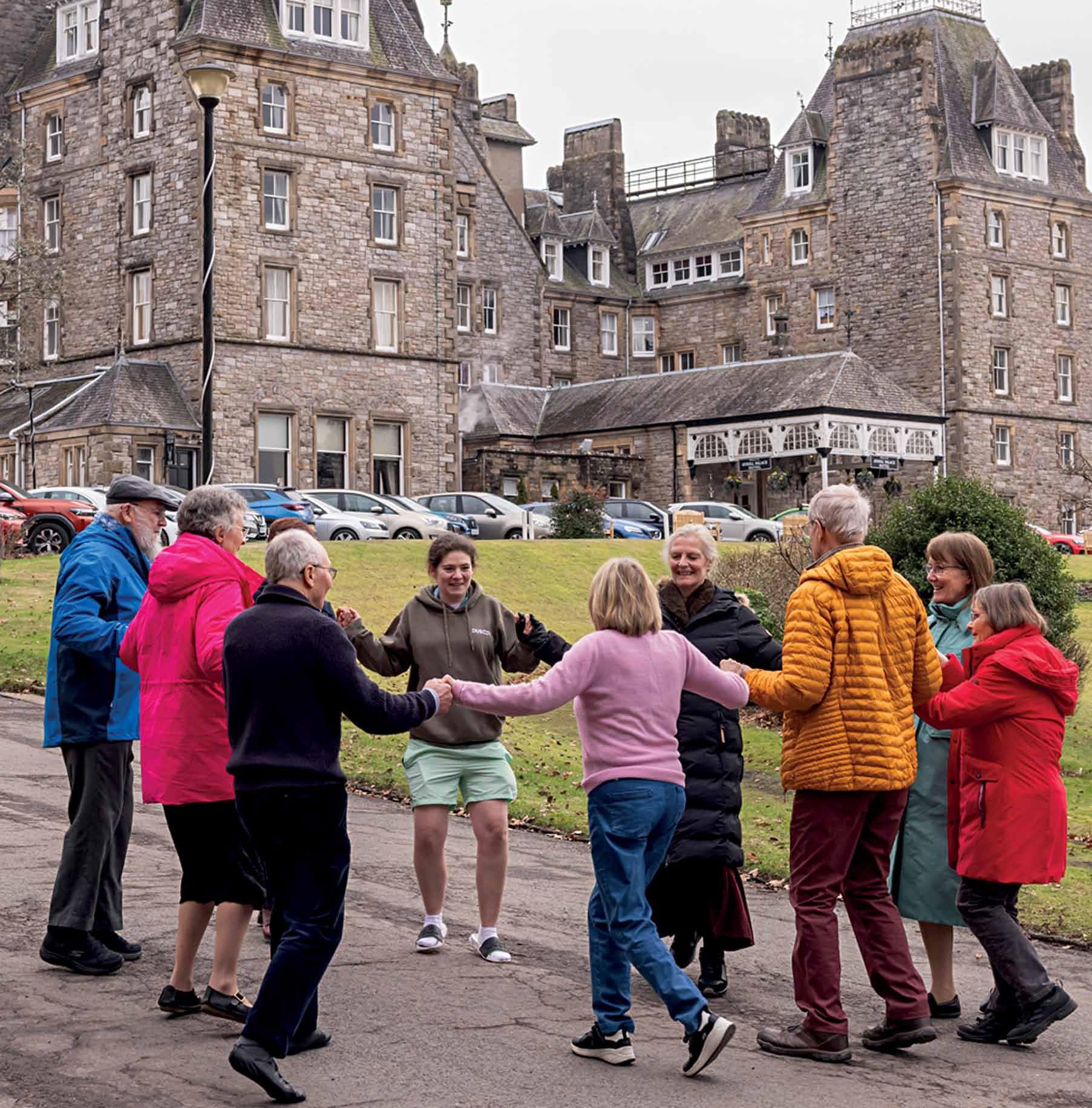
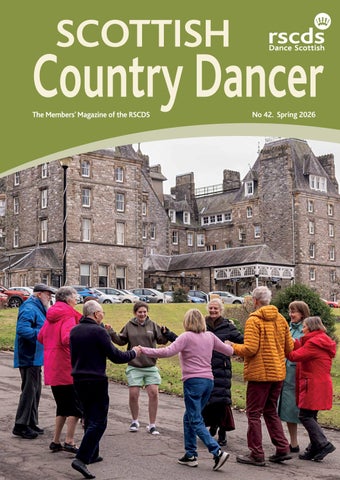
Cover: Dancers enjoying the brisk air outside the Atholl Palace Hotel during Winter School 2026. Cover image by Charlotte Davies. http://charlottedaviesphotography.co.uk/
The next issue of Scottish Country Dancer will be published in October 2026. Please refer to Notes for Contributors on the website. Send materials for inclusion to the editor: mag.editor@rscds.org no later than 31 July 2026. Please send enquiries about advertising to Cécile Hascoët: mag.advertising@rscds.org
Editor
Marjorie McLaughlin
Editorial Team
Caroline Brockbank, Elisabeth Drumm, Helen McGinley
Publisher
The Royal Scottish Country Dance Society 12 Coates Crescent, Edinburgh, EH3 7AF
Website Telephone Email www.rscds.org 0131 225 3854 info@rscds.org
Graphic Designer
Its All Good
10 The Haughs, Cromdale, Grantown on Spey, PH26 3PQ info@itsallgood.org.uk t: 07729 439 514
Printer
The Lavenham Press Ltd, Arbons House, 47 Water Street, Lavenham, Suffolk, CO10 9RN


C E l E braT i NG b ra NC h aNN iv E r S ari ES i N 2026
Kilmarnock & District, Scotland
West Lothian, Scotland
Belfast, Northern Ireland
Birmingham, England
Adelaide, Australia
Liverpool, England
Lorn, Argyll, Scotland
Norwich, England
London, Ontario, Canada
Royal Leamington Spa, England
Hague District, Netherlands
Los Angeles, USA
Ottawa, Canada
Atlanta, USA
Calgary, Canada
Gothenburg, Sweden
Kitchener-Waterloo, Canada
Royal Tunbridge Wells, England
Stockholm, Sweden
Western Australia, Australia
SCroll of hoNour 2025
90 years
90 years
80 years
80 years
75 years
75 years
70 years
70 years
65 years
65 years
60 years
60 years
60 years
50 years
50 years
50 years
50 years
50 years
50 years
50 years
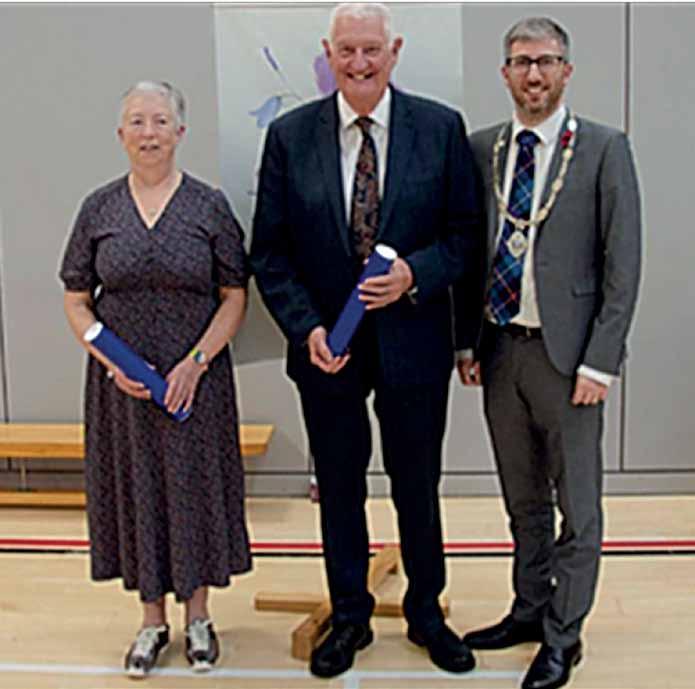
Recognising three exceptional contributors whose longstanding dedication has enriched Scottish Country Dancing worldwide: Ros McKie for over five decades of inspirational teaching, mentoring, and leadership in the Hunter Valley Branch and across Australia; Allana Creighton for her sustained commitment to the Perth & Perthshire Branch through teaching, volunteering, and preserving RSCDS traditions; and Jim Lindsay for more than 50 years of outstanding musicianship, recordings, and support for dancers and teachers who have shaped the sound of Scottish country dancing for generations.
rESulTS of ThE 96th aNNual GENEral MEETiNG 2025
Thank you to all members who attended the AGM – either in person or online – and to everyone who submitted votes in advance. Branches once again voted on behalf of their members, ensuring strong representation across the Society.
This year’s AGM saw excellent engagement, with lively discussion and active participation in both motions and elections. Your involvement continues to shape the future direction of the RSCDS.
Management board
New trustees are Duncan Brown (Exeter), William Gray (North Ayrshire), and Debra McAlees (Glasgow).
Education & Training Committee
Aymeric Fromherz (France) and Maria Elena Bonacini (Italy) were both elected to three-year terms.
Membership Services Committee
Erica De Gannes (Canada) and Katharine Hoskyn (New Zealand) were both elected to three-year terms.
Youth Services Committee
Ilona Brown (Scotland) and Julia Turi (Hungary) were both elected to three-year terms
Positions available for election at the 2026 aGM
Management Board:
3 x Trustees for 3 years – 1 x Trustee for 1 year.
Membership Services Committee: 1 x Convener Elect – 2 x Members for 3 years.
Youth Services Committee: 1 x Convener Elect – 2 x Members for 3 years.
Education & Training Committee: 3 x Members for 3 years.
The RSCDS offers a variety of flexible volunteer roles – from supporting membership records and helping with events to assisting with media, digital resources, archives, and creative projects. Many opportunities can be carried out remotely, making it easy to get involved from anywhere. To explore all current roles and find one that suits your skills and interests, please visit the Volunteering page on the RSCDS website.
The Constitution and Governance Panel seeks two volunteers to help ensure the RSCDS maintains high standards of governance through its Rules, Procedures, Articles, and Constitution. The Panel advises the Management Board and Branches on constitutional matters and reviews documentation to meet current requirements.
The Panel meets remotely 4-5 times a year, with additional work by email. Interested members may contact Christopher Smith, Panel Lead, for more information.
Volunteers will review documents and address queries from Branches or the Board. Knowledge of Branch Committee work, attention to details, and practical problem-solving skills are useful.
A minimum three-year term is recommended.
To speak with Christopher or express interest, email: info@rscds.org by June 15th
Our Branches remain at the core of the Society. We currently have 159 branches, in addition to the Headquarters Members. RSCDS membership runs from July to June. At the time of going to press, the total of RSCDS branch members was just over 9,300. The final total number of members for the year will be published in the autumn magazine and the annual report.
The RSCDS counts 229 affiliated groups worldwide, along with teachers’ local associations—the SCD Teachers’ Association (Canada), SERTA (UK), ATA (Australia), and the Teachers’ Association of Scotland. There are five university groups: Cambridge University Strathspey & Reel Club, Dundee University Scottish Dance Society, Edinburgh University New Scotland Dance Society, Oxford University Scottish Dance Society, St Andrews University Celtic Society.
r SCDS S ub SC ri PT io NS f EES for 2026-2027
From 1 July 2026, as agreed at the 2025 AGM, the basic full annual subscription will rise to £30. Joint Membership for 2 adults at the same address will be £52 (£26 per adult). All other subscriptions will continue to be calculated pro rata from the full rate.
From October 2026, the Scottish Country Dancer magazine will become digital-first, with digital access included in membership. Members may opt for a printed copy for an additional charge.
Branches will add their own fees to the RSCDS membership rates.
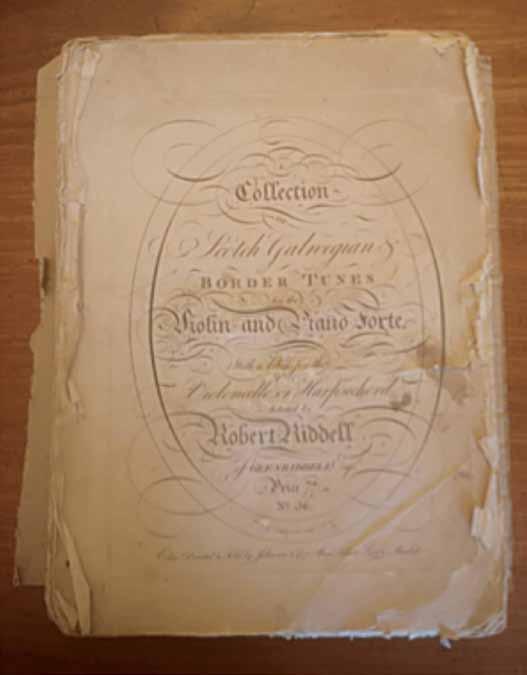
also embraced the digital sphere with a joint online talk by Prof. Bob Harris (University of Oxford) and Alan Macpherson, organised with the European Association for Dance History. The speakers explored leisure culture, provincial Scotland, and early dance resources in our collection. In addition, we prepared and recorded a presentation tracing the evolution of Scottish country dance through archival sources for the Virtual Teachers’ Conference in early March, inviting new questions and reflections on our shared practice.
These projects prompted us to examine individual items, revealing the fragile condition of several rare 19th-century music publications. We are now exploring conservation options, and donations to the Archive will help us continue this essential preservation journey.
Youth Affiliation Fee (where 50% of members are under 25 or in full-time education)
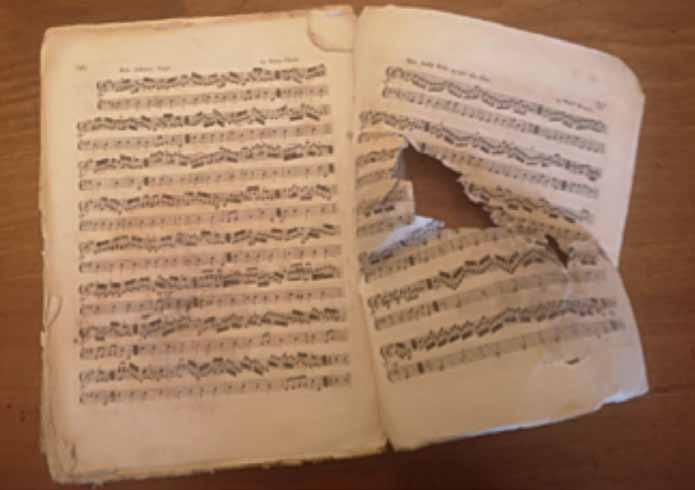
Open Days welcomed visitors into the heart of the collection, where early Society history, dance treasures, and musical gems filled Jon’s office and the boardroom. We
In 2027, we celebrate 100 years since the first (R)SCDS Summer School at St Andrews! We want your help to tell the full story. We are compiling a book to capture a wide range of materials celebrating 100 years of magic: photos, unforgettable stories, archival material, tunes, songs, and poems. Do you have other ideas? Please share them with us!
We are looking for material that reflects the entire period, from the 1920s to the 2020s.
Please send us your ideas, contributions or stories in a short chat with our team – get in touch via book55@rscds.org
We can’t wait to see Summer School through your eyes - help us preserve the spirit of the last 100 years for the next century of dancers!
Gary Coull
We often talk about the sense of community within the Scottish country dancing world and just how special the RSCDS’s togetherness truly is. Earlier this year, that sense of connection became very real for me following the passing of my dad. The kindness, messages, and support from dancers across the world meant more than I can say. Thank you. I know many of you will have had similar moments when the dancing community helped you through something hard. It is one of the greatest strengths of our global Society.
You’ll notice this edition of the Scottish Country Dancer has arrived a little later than usual, and I appreciate your patience. We wanted you to share in the excitement of the newly launched RSCDS brand and website, which you can read about later in this edition. This is an important step forward for us as it enables us to present the Society in a way that is modern, relevant, and recognisable not only to current members but to potential and returning dancers. A refreshed identity helps us open doors, spark curiosity, and show the wider world that Scottish country dancing is fun and welcoming.
Another highlight of recent months was a very successful Winter School. My thanks go to Ian Robertson for his hard work over his two years as Director, helping deliver memorable experiences for dancers from across the world. We now welcome David Oswald into the role, and I’m sure he will bring great enthusiasm and fresh ideas.
I am also pleased to welcome Caroline Sexton as our new Fundraising Manager. Caroline brings a wealth of experience that will strengthen the Society’s work. It’s important to note that the rebrand, website, new CRM system, and this new post have all been made possible through legacy funding–an excellent reminder of how transformative these generous gifts can be.
It is always a pleasure to attend branch events, and a particular delight recently was joining West Renfrewshire Branch to celebrate their 100th anniversary. Congratulations to them, and to all branches marking special milestones this year – you are at the heart of everything we do. Congratulations as well to the Lyon Branch for hosting a fantastic Spring Fling. Their hard work and warm hospitality ensured a wonderful weekend for dancers from across Europe and beyond.
Looking ahead, I am pleased that the Autumn Gathering will return to Dumfries. It has been many years since we were last there, and it feels good to be going back. We know the AG weekend has become expensive, and this move allows us to reduce ticket prices and offer a location with more affordable accommodation. We hope this will make the weekend more accessible and enjoyable for everyone.
Building on the strength of our history and embracing the opportunities ahead, we enter a new chapter with optimism and pride. The RSCDS is at its best when we look outward, support one another, and welcome new ideas. Together, we can ensure future generations enjoy Scottish country dancing just as much as we do.
We were delighted in November 2025 to welcome Erica de Gannes from the Toronto, Canada, Branch to the Committee, and to see Katharine Hoskyn continue for a further three years. Debbie Crossley stepped down but happily has continued her involvement in the Carnforth project (see below).
Ian T. Muir took on the role of Music Director, with additional support from a Music subcommittee for all music-related work across the Society’s activities.
The Committee has several exciting projects underway, starting with the publication in February of the latest combined book of dances from RSCDS Books 45-49. This was a great team effort, with volunteers from within and outside the Committee joining forces to review the instructions for the 62 dances and provide greater clarity and consistency, along with additional supporting material in a compact format. Copies are available from the RSCDS shop https://shop.rscds.org/
The programme for International Dance Day on 29th April deliberately included traditional dances alongside more modern compositions (from the numbered books including the number 6), and we were delighted that many groups took the opportunity to connect to this worldwide UNESCO initiative.
As well as being an inspirational teacher (and dancer) of Highland and Scottish country dance, Derek Haynes was the deviser of many popular dances. His self-published Carnforth Collection booklets have long been unavailable, so this year the Society is publishing the first volume of these dances. Accompanying tunes, where specified, will be available for download separately, and Liam Stewart and his band have been in the studio to produce recordings to accompany the dances. 18 groups volunteered to produce videos for this first volume and publication of all the materials is on track to be available for (Northern hemisphere) summer schools this year.
Looking further ahead, the process is well underway to prepare what will be RSCDS Book 55 for the summer of 2027. The assessment process is ongoing at the time of publication, with 60 groups from around the world trying the 183 dances submitted. The mix was interesting: 50 reels, 39 jigs, 83 strathspeys, and 11 medleys, with a great variety of forms included. A long list will be created based on the trials, which will then be further refined to create a book of dances with suitable variety and balance.
The Society’s Articles of Association include the activity of publishing “descriptions of Scottish country dances with music and diagrams”, and this exercise generates global interest in new dances. Indeed, this ongoing refresh of our repertoire is what makes Scottish country dancing new and interesting. But our dancing should continue to reflect the entire rich history of our dance form. The proposed programme for International Dance Day deliberately sets traditional dances alongside more modern compositions – I confess I’m always sorry to find dance programmes that draw from only a narrow range.
Book 55 will contain other materials alongside the dances, particularly by picking up the theme of 100 years since the first summer school in St Andrews in 1927. Watch this space for further information on this.
As always, please do get in touch if you are interested in hearing more about any of our activities.
msc@rscds.org
Graham Donald
Firstly, I want to express my thanks to Deb Lees for her time and expertise during her successful time as my predecessor. I was fortunate to have worked with Deb on the committee for the past four years, so I can ensure continuity in our work.
So, what have we been doing?
In February, we held another highly successful Winter School in Pitlochry under the leadership of Ian Robertson, ably assisted by our Events and Marketing Manager, Kirsty Bernard. A big thank you to Ian and his team for ensuring the school ran so smoothly.
As a committee, we have produced and issued the Teachers’ Newsletter to all teachers and instructors. It’s a fantastic way to keep sharing knowledge and help those of us who lead our classes or groups.
The Virtual Teachers’ Conference remains a popular resource for teachers, and the videos, available from March 2-6, 2026, covered a range of topics that will be of interest and useful to you all. There is something there for everyone, so please take the time to watch them. They will remain available on the RSCDS website if you were not free to look at them when they first came out.
Other areas we are progressing in include a review of our teacher training to provide the best support for our teachers, both in mentoring and training materials. The work to grade all the dances published by the RSCDS continues to categorise them by degree of difficulty. You will see these gradings on dance programmes to help dancers know whether a dance is within their capabilities.
The Core Training for Instructors programme (CTI) continues to expand. This course may be of interest if you are teaching or helping in a regular class and need some guidance on what approach you should take.
We have also offered support for exams for all 5 units of the Teachers Certificate, and it is encouraging to see so many prospective teachers from around the world. Unit 2,3 and 5 exams were held in Vancouver in April, 2026. Their commitment will ensure that we continue to spread our love of Scottish country dancing.
Many dancers are keen to have their dancing standard assessed. It is available globally, and assessments have taken place this year in Toronto, Canada; Hertfordshire, UK; and Sydney, Australia. If your branch or group is interested in running this, check out the Dancing Achievement Awards on the RSCDS website. Register your interest at E&T@rscds.org
Looking ahead, Summer School in St Andrews will be held over four weeks from 19 July to 16 August, so why not get your application in now if you haven’t already done so?
If you want any more information about E&T’s work, please email me at graham.donald@rscds.org.
All the best.
linda Williamson
Time has flown by since my last report, and I am delighted to share the exciting activities that have taken place over recent months.
In September 2025, a very successful Families & Friends Weekend was held in Moffat, Dumfriesshire. The weekend truly celebrated the joy and friendliness of Scottish country dancing for all ages in a wonderful community atmosphere.
It was then time for the Virtual Festival 2025, and I would like to thank everyone who participated. Your energy, creativity, and support made the event another success.
With thoughts on engaging the next generation, the start of 2026 focused on attracting new dancers through social media. Posts offering tips on getting started, along with videos highlighting the fun, friendly, and social aspects of SCD, have received an excellent response on Facebook. The committee aims to build on this positive momentum with even more engaging video content in the coming months.
I look forward to sharing highlights from Southern Fling in Canberra and Spring Fling in Lyon 2026 in my next report.
An exciting new event – World Cup Ceilidh Week – took place from 19–23 January 2026 as a joint project between the Scottish Association of Teachers of Physical Education (SATPE) and the RSCDS. Over 50 schools signed up, with two schools participating in launch events.
Building on this success, we hope to deliver a “Dance Scottish” experience for children and families across Glasgow, as part of the Commonwealth Games 2026 Festival. The project will continue the “World Cup” theme, with popular dances renamed after some of the Scotland qualifying team players—a fun way to engage young dancers. We are currently awaiting the outcome of our funding application and have our fingers crossed for good news!
Lorna Valentine, Chair of the Scottish Schools Working Group (SSWG), and I have been invited to contribute to and support an exciting new national Physical Education curriculum resource, Ready to Move, due to launch in August 2026—a great opportunity to raise the profile of SCD within schools.
Events on the Horizon
l Junior Summer Camp / Young Dancer Week, 2nd - 9th August 2026, will welcome new and returning young dancers to St Andrews for another week of fun, learning, and friendship.
l We’re thrilled to announce that the next Families & Friends Weekend will again be held in Moffat, Dumfriesshire, from 18th - 20th September 2026. We encourage as many young people, families, and friends as possible to join us for this lively, fun-packed weekend.
l The theme for the Virtual Festival 2026 will be “Opposites”, with two categories: Creative and Technical. Some groups have already begun their preparations, and we can’t wait to see your innovative ideas and submissions!
l Following expressions of interest, we’re delighted to confirm that Spring Fling 2027 will be held in Oxford, 16th - 18th April. Further details will be released soon—watch this space!
The Youth Services Committee continues to be inspired by the enthusiasm and passion of young dancers worldwide. Your involvement keeps the spirit of SCD vibrant and growing for future generations. Thank you to everyone who continues to support our events and initiatives.

Dear Members,
We are writing at a special moment as we share the final complimentary printed edition of Scottish Country Dancer. For many of us, receiving the magazine through the letterbox has been a cherished tradition, and we know that this change may bring a touch of disappointment. However, please be assured that going forward the Scottish Country Dancer magazine will remain a valued part of RSCDS membership – just in a new and evolving way.
As we look to the future, we’re introducing changes to how we share Scottish Country Dancer to ensure we use our resources wisely while continuing to keep members informed, inspired, and connected. From October 2026, the magazine will move to a digital-first model, giving you quick and easy access online, wherever you are in the world.
This change opens the door to a whole new level of interactivity. Modern technology now allows us to include exciting features that simply aren’t possible in print such as video content including demonstrations; interviews and behind-the-scenes clips; direct links to music, events, and resources; and richer photo galleries and expanded stories
We’re genuinely excited about the new opportunities this will bring, helping us showcase our dancers, musicians, teachers, and branches in an even more engaging way.
At the same time, moving to digital first will help us use our funds more effectively. With printing and postage costs currently around £30,000 each year, this shift will allow us to significantly reduce expenditure and lessen our environmental footprint. These savings will help ensure the magazine remains a sustainable and high-quality benefit for many years to come as well as keeping membership subscriptions down.
We also want to reassure those who still love the feel of a paper copy in their hands that printed editions will still be available. Members who wish to receive a hard-copy magazine can do so for a small charge of £6 per year. This can be paid to your branch when you renew your membership, or you will be able to order it directly from the RSCDS online shop.
We want to reduce this cost where possible, and we’ve already begun exploring a range of potential solutions – such as local printing and distribution – to help us achieve that. The feasibility of these options will be clearer once we understand the level of demand for the printed edition.
This is an exciting moment for Scottish Country Dancer, and we hope you will enjoy exploring its new look, new features, and new possibilities. Thank you for your continued support, enthusiasm, and love of Scottish country dancing. Together, we can ensure the magazine – and the RSCDS – continues to thrive for generations to come.
With warmest wishes, Gary Coull
Marjorie McLaughlin
RSCDS Chair Editor, Scottish Country Dancer
By Jon Berridge, Chief Operating Officer
In 2025, thanks to several exceptionally generous legacy gifts, we were given that opportunity. Rather than using this one off income to relieve short-term pressures, the Management Board made a deliberate choice to invest in the Society’s longterm future.
Three major priorities are now moving forward: a complete rebuild of our website, the replacement of our outdated membership database, and a refresh of our brand.
These are practical improvements. They are designed to make it easier for members and prospective dancers to connect with us, find information quickly, manage memberships, events, and communications, and much more. Many of you have been very honest about the limitations of our current systems. You told us what feels clunky, unclear, or overly complicated – and we listened.
The website and database upgrades are relatively straightforward improvements, even if they are complex behind the scenes. The brand refresh, however, naturally raises more questions. What does “brand” mean for a Society like ours? Why does it matter? And why now?
This article explains the thinking behind that decision – and why it matters more than it might first appear.
h ow a re We Seen?
When members hear RSCDS, the response is often immediate and personal: music, friendship, laughter, travel, shared achievement, and a lifelong love of Scottish country dancing. For us, the Society represents community and continuity. It connects generations through reels, jigs, and strathspeys. We experience the Society as welcoming, sociable, and full of life. We know it as energetic and international.
But over the past year, we asked ourselves an important question: Is that what people outside the Society see?
Through surveys, workshops, and conversations with members, branch administrators, and non-members – alongside a wider communications review – we took an honest look at how the RSCDS is perceived. A clear theme emerged. The Society is widely respected, but there is a gap between perception and reality.
Our culture has become more inclusive and forward-looking, yet our image does not always reflect that. Many members told us the Society can appear dated. Around six in ten said they find it difficult to explain the value of RSCDS membership to potential new dancers. Some non-members described us as formal or even exclusive – “not for people like me”.
That perception matters. It influences whether someone walks into a class for the first time. It affects whether branches can attract new and younger dancers. Ultimately, it determines whether or not Scottish country dancing continues to thrive around the world.
The issue is not who we are. It is how clearly we communicate who we are.
A brand is more than a logo or colour palette. It is the overall impression we create. It is the language we use, the images we choose, the tone of our communications, and the feeling people have when they encounter us.
A strong brand helps people understand what we stand for. It makes it easier for members to explain the Society with confidence. It supports branches in promoting classes and events. And it helps new audiences see that there is a place for them.
Refreshing our brand gives us the opportunity to align how we look and sound with who we truly are: a vibrant, welcoming, international community united by a love of Scottish country dancing.
Just as importantly, this refresh is not about abandoning our history, chasing trends, or changing our values. It is about ensuring that the strength of our tradition is visible, relevant, and accessible in today’s world.
To guide this work, we appointed Touch, an Edinburgh-based brand and digital agency with significant experience in the arts and charity sectors. Their clients include the Edinburgh International Festival, the Scottish Chamber Orchestra, and Dancebase.
Following a thorough selection process, we felt they understood both our heritage and our ambitions. Their work has been collaborative and informed by what they learned from members and stakeholders across the Society.
You will begin to see the refreshed visual identity rolled out alongside the new website. It is lighter and clearer, while still respecting our heritage and global reach. The colour palette draws inspiration from the RSCDS tartan and the Scottish landscape. The typography is modern and easier to read in both print and digital formats. But the most important shift is not purely visual. It is about focus.
The refreshed brand places greater emphasis on dancers themselves – on movement, connection, and enjoyment.
Dancing is what unites us. It is social, communal, and uplifting. You do not need a partner. You do not need prior experience. You do not need to fit a particular mould.
Scottish country dancing supports physical health, mental wellbeing, and friendship across generations. These are powerful messages for people who may be curious but hesitant.
Our Royal connection remains an important part of our history and identity, and it continues to be reflected in the new branding. But by leading with dancers and participation, we focus on what matters most: people coming together to dance.
A strong brand also brings practical benefits. It creates clarity and consistency. It means that when someone encounters RSCDS – whether through a poster in a village hall, a social
media post in Canada, a workshop in Japan, or a Summer School brochure – they can recognise us immediately and feel invited. Branches will have access to clear guidelines, templates, and tools to make promotion easier and more consistent. This is about support, not restriction. Consistency strengthens us collectively, while still allowing space for local character and creativity.
Over time, this clearer identity will work alongside the new website and database to create a smoother experience – from first enquiry through to long-term membership.
What h appens Next?
The success of this refresh does not rest solely with Headquarters or the Management Board. It depends on all of us.
A brand only comes to life when people use it confidently. That means making good use of the new materials. It means speaking clearly and positively about the value of membership. It means inviting friends, family, and colleagues to try a class. It means explaining what we do in ways that feel natural and welcoming.
We have every reason to be proud of our history. Few organisations can claim such a rich archive of dances, music, and international friendships. But tradition grows stronger when it is shared.
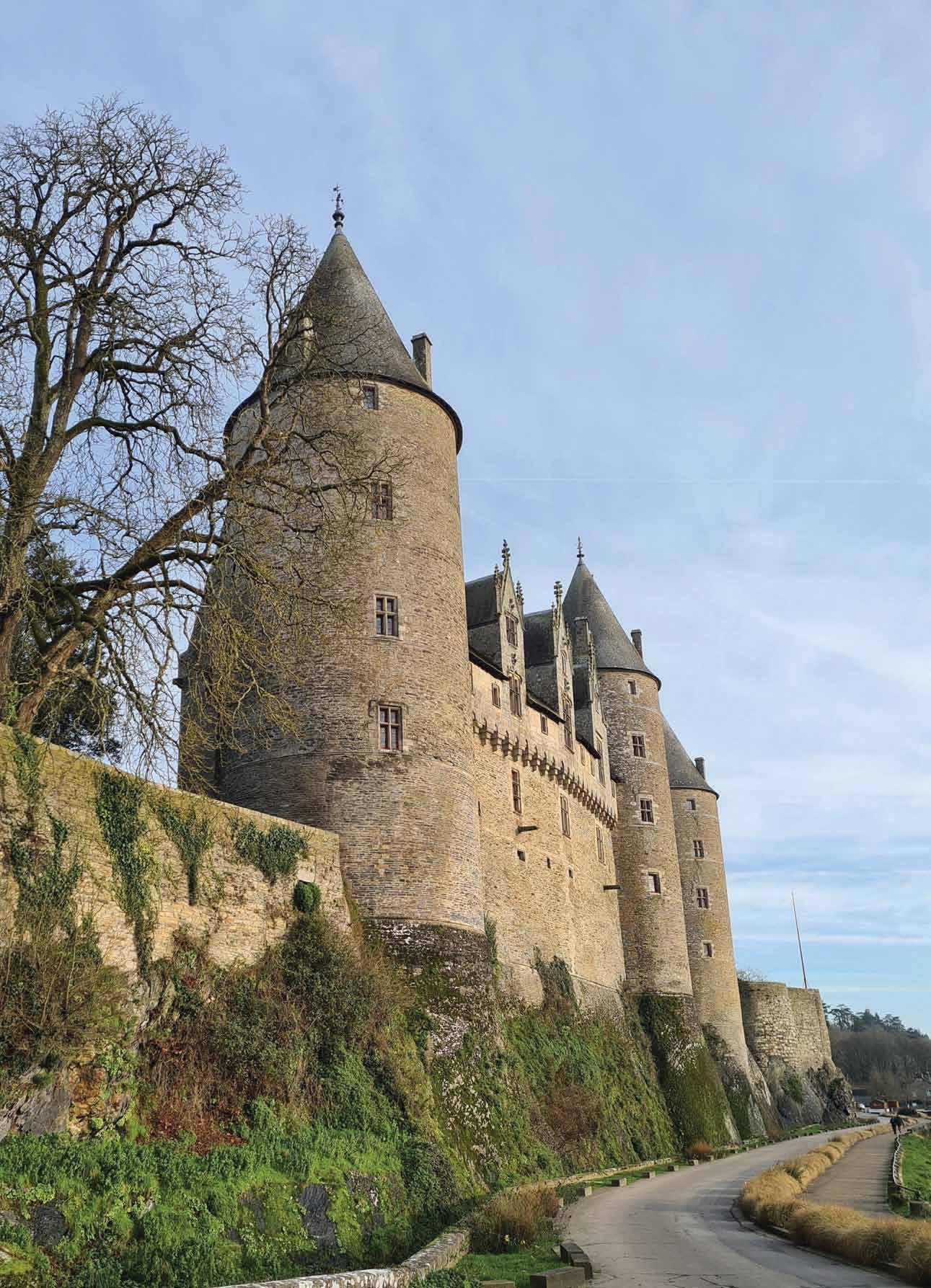
Thanks to the generosity of our legators, we have been given a rare opportunity to strengthen the Society’s foundations for decades to come. We have chosen to invest in infrastructure, clarity, and welcome – the building blocks that will support branches and members around the world.
Now comes the exciting part: putting these changes into action and making them work for everyone.
If we do that well, we will make it easier for new people to find us, join us, and remain involved. We will ensure that the RSCDS is recognised not only for its heritage, but for its warmth, energy, and relevance today.
And most importantly, we will help more people see us, understand us, and join us on the dance floor.

This QR code will link to a counter showing the number of days until the website launch event.

th
28 June – 5 July 2026
The RSCDS & District Branch Inc extends a warm invitation to all dancers to meet at University College, University of Melbourne, Parkville, Melbourne, Victoria, Australia for a fun filled week of Scottish Country Dancing with great teachers and musicians.
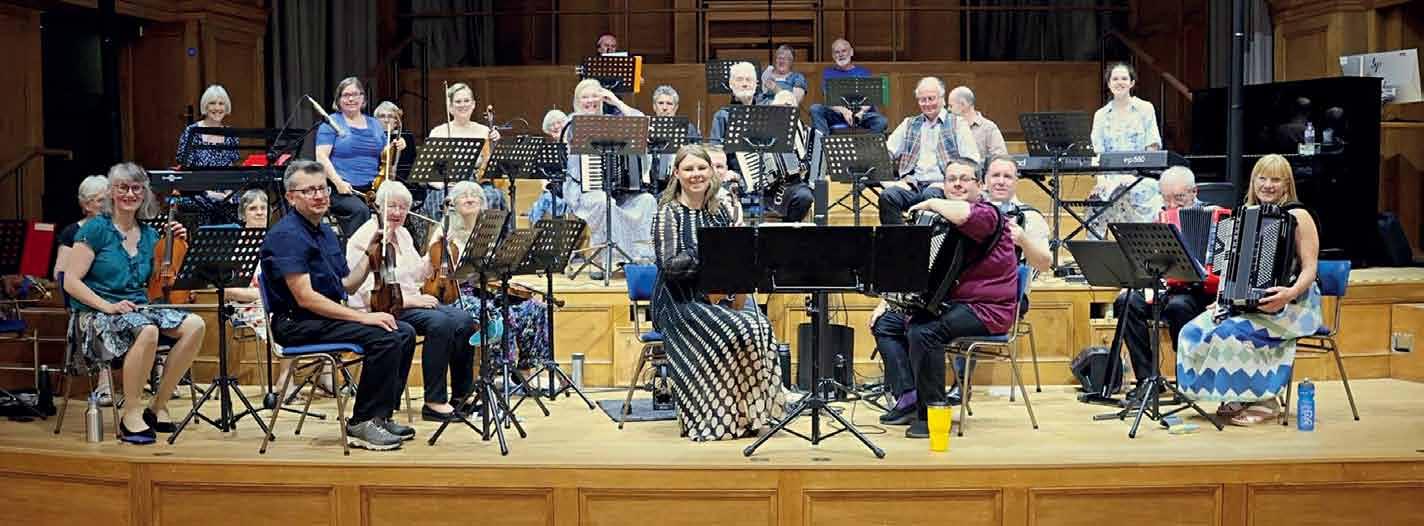
Antonia McClintock, a dancer and musician currently living in London, attended her first-ever musicians’ course at St. Andrews Summer School in 2025. She produced a delightful video recounting her experiences, her anxiety, and the opportunities she gained during the course. In this interview, we learn more about this enthusiastic and dedicated young musician.
Where did you grow up, and when did you begin studying music?
I was born in the south of England, and I received a piano at age 5 as a birthday gift; that began my journey. I also studied cello, but then began singing, which I loved. I stopped piano lessons and completed an academic music degree in singing at Oxford in 2025.
What made you go back to the piano and start playing Scottish country dance tunes?
I began dancing in 2022 and eventually became chair of the Oxford University SCD club; I loved the dancing and the music. I made a New Year’s resolution in 2024 to begin playing for Scottish country dancing. Major Ian Stewart was a favourite dance, but the tune The Scottish Horse was hard and took weeks to learn. Scottish country dance music felt so hard, but I fulfilled my resolution on the last day of 2024 and applied for the Music Scholarship!
What did you hope to gain from the music course?
Having never done a music course before, I had no idea what to expect. There were 25 of us on the course, and Luke Brady and Gillian Stevenson were so encouraging and helpful. It was
daunting at first, but after practicing the tunes ahead of time, which did help, it was exciting to play with all of these other musicians and to learn from them.
Was there a particular moment that stands out?
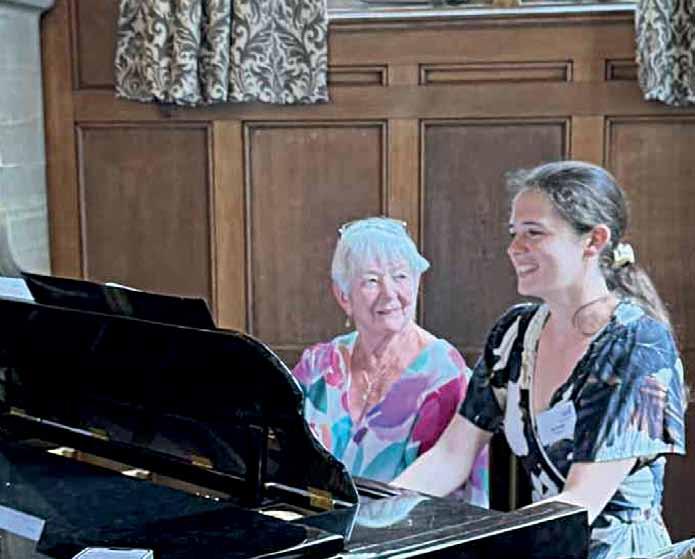
Getting to meet and talk with other music course attendees and all of the musicians on staff was a wonderful part of the week. George Meikle, Ian Muir - Music Director, David Oswald, Judith and Ian Muir were all generous with their time. Ian Muir and George Meikle would join us in the Party Room, and Muriel Johnstone made a surprise visit. I had met her in Paris after my friend Beth introduced us, and I was starstruck. She showed up unexpectedly at the musicians’ course, and I was thrilled to sit at the piano and play with her. Nerve-wracking but thrilling!
a nd what opportunities have you had to play since Summer School?
Since the music course, I have been playing for the London Branch classes for lots of different teachers, and I’ve also played for classes in Cambridge. I was invited to play for the Young German Dancers’ weekend in late 2025. Learning to put sets together and to play for classes and social programmes has been very rewarding. Luke was so supportive in helping us understand how to play for classes. I also had the opportunity to play for the International Team at the Newcastle Festival and will be playing for weekends in Strasbourg and Lyon later this year.
i t sounds as though you have made excellent use of what you learned on the music course.
I have enjoyed all that I’ve been able to do, but I also want to keep dancing and socializing. All of this makes me enjoy the world of Scottish country dancing.

Antonia’s video can be found on YouTube: https://www.youtube. com/watch?v=SP723qQhMQQ or by linking from this QR Code
- Michael Darby
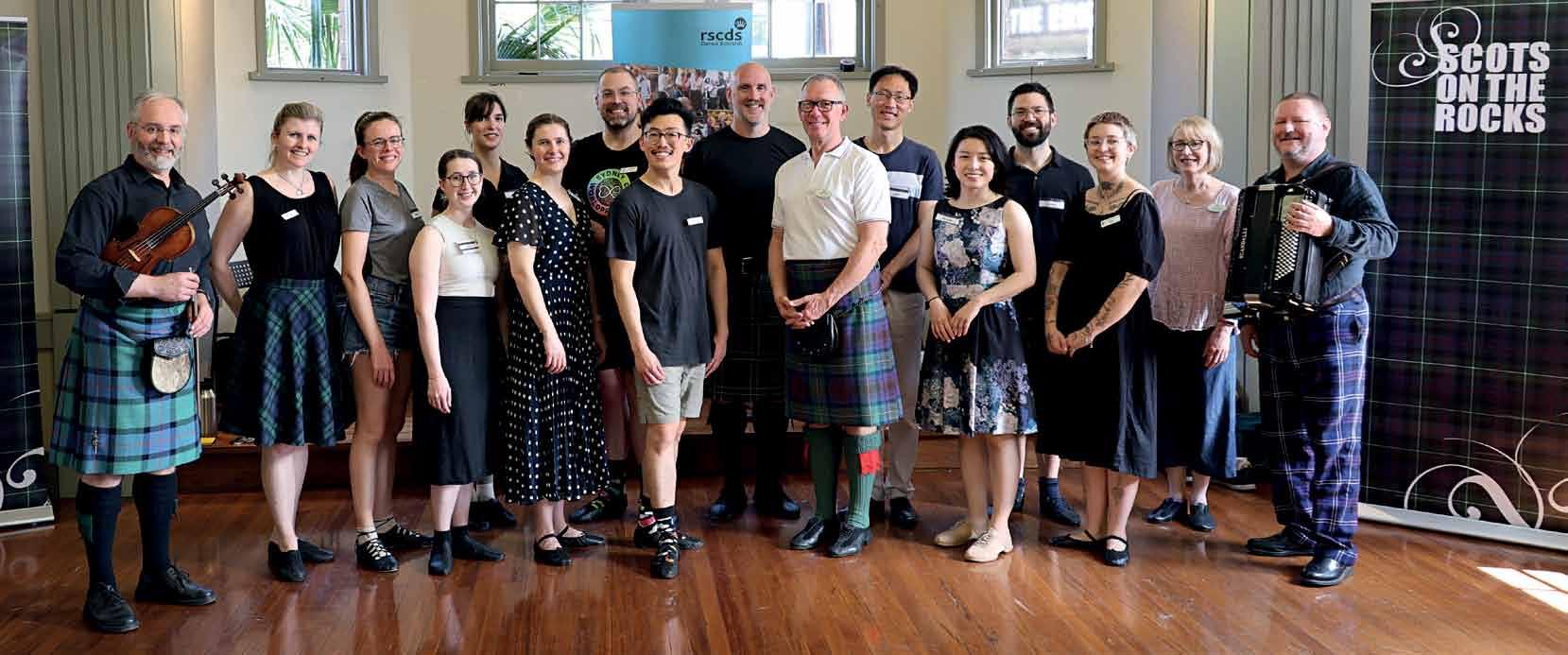
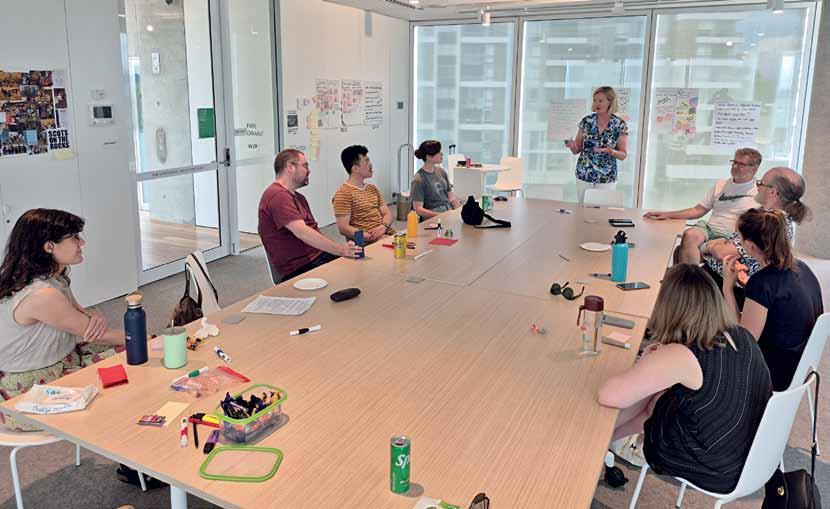
One of the biggest issues facing the Scottish country dancing world is ensuring its longevity and legacy. A number of International Branch and Scots on The Rocks members met in February 2025 for an afternoon planning workshop. Facilitated by RSCDS and IB member Karen Haig, the workshop posed several questions and issues to participants.
Brainstorming covered a range of strengths, weaknesses, opportunities, and threats to the future of SCD. The focus was on the up-and-coming dancers and what they would like to see in this space now and into the future. The results were interesting and challenged some commonly held misconceptions. Younger/ newer dancers want technique and the sense of community offered by the SCD world, balanced with casual dancing opportunities, such as ceilidhs, and opening up the SCD world to be more inclusive and welcoming. Newer and younger dancers do want to contribute and volunteer in a sustainable fashion. Live music was also a key issue, with its positive impact on dancing and the need to ensure SCD musicians can thrive financially.
Also present was Barry Jay, representing the Jay Family Trust, which was established as a legacy to Morton and June Jay (she was The Immigrant Lass of Book 39 fame) to financially support and help foster the growth of SCD in Australia. The afternoon brought a succinct, comprehensive one-page matrix to serve as a blueprint for moving forward on a range of actions and activities supported by Scots on The Rocks.
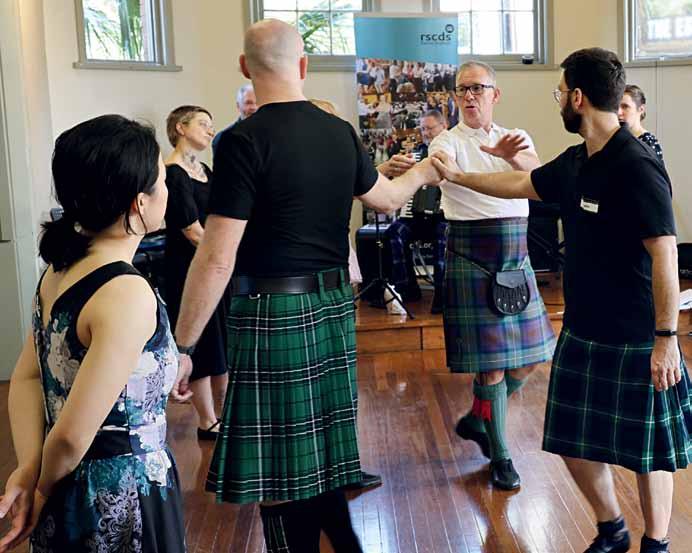
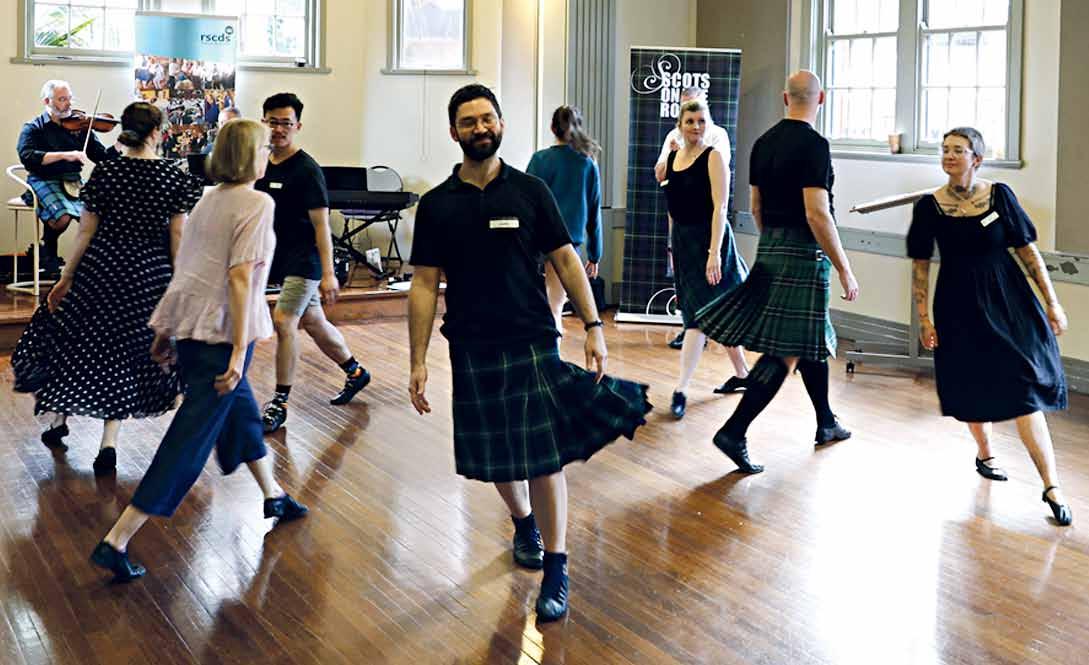
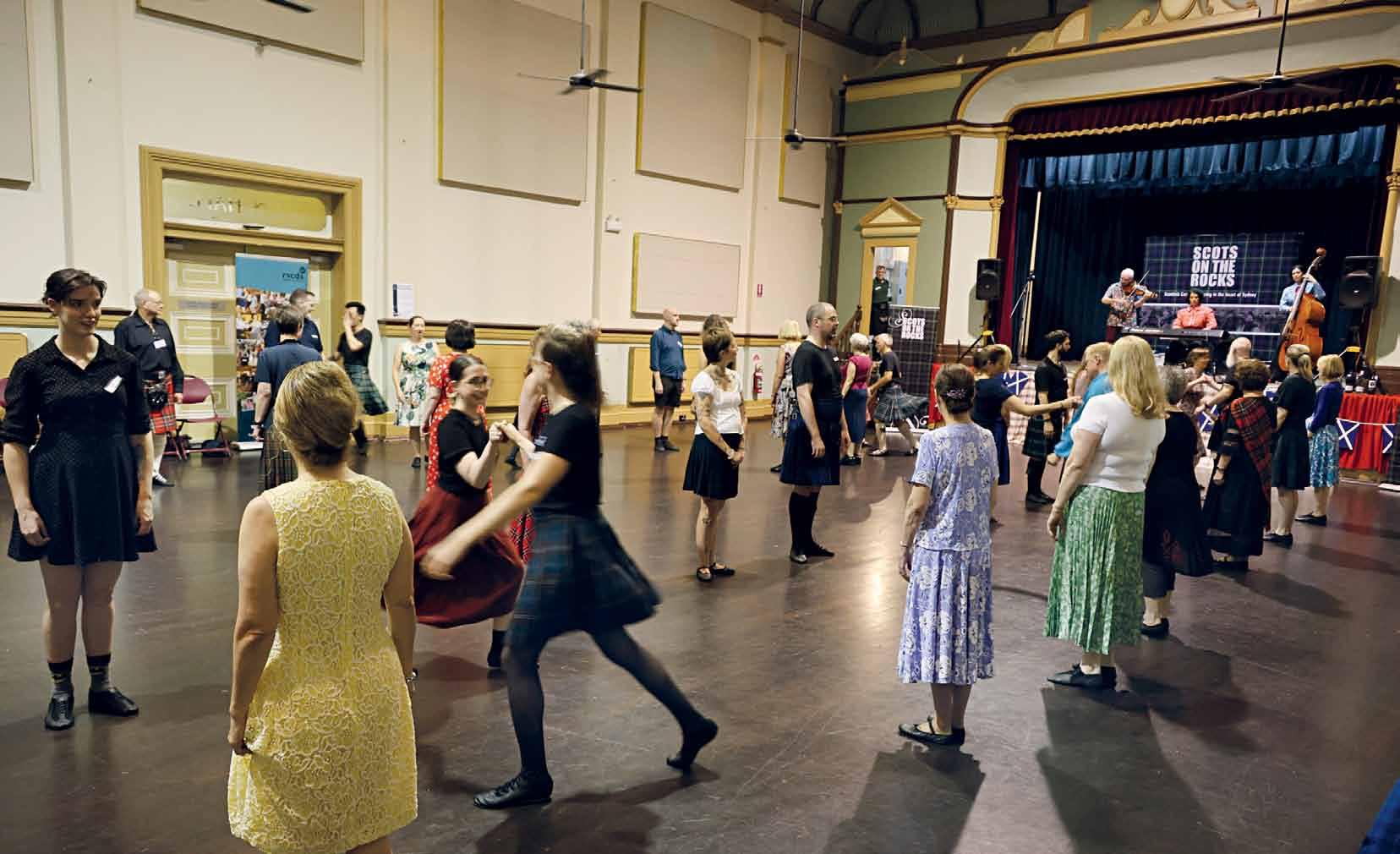
To start off the programme, Scots on The Rocks held a Gen Y to Z Workshop taught by RSCDS and IB member Steve McAleer. With the generous support of the International Branch Susi Mayr Fund, we were able to bring Melbourne musicians Matthew Robertson (fiddle) and David South (accordion) to play for the full-day workshop. A number of dancers were also Unit 2/3 candidates, so this was an invaluable experience to learn and dance with their peers and to receive advice and critique. A follow-up survey was sent to participants to gather anonymous feedback/suggestions for the workshop and any future workshops.
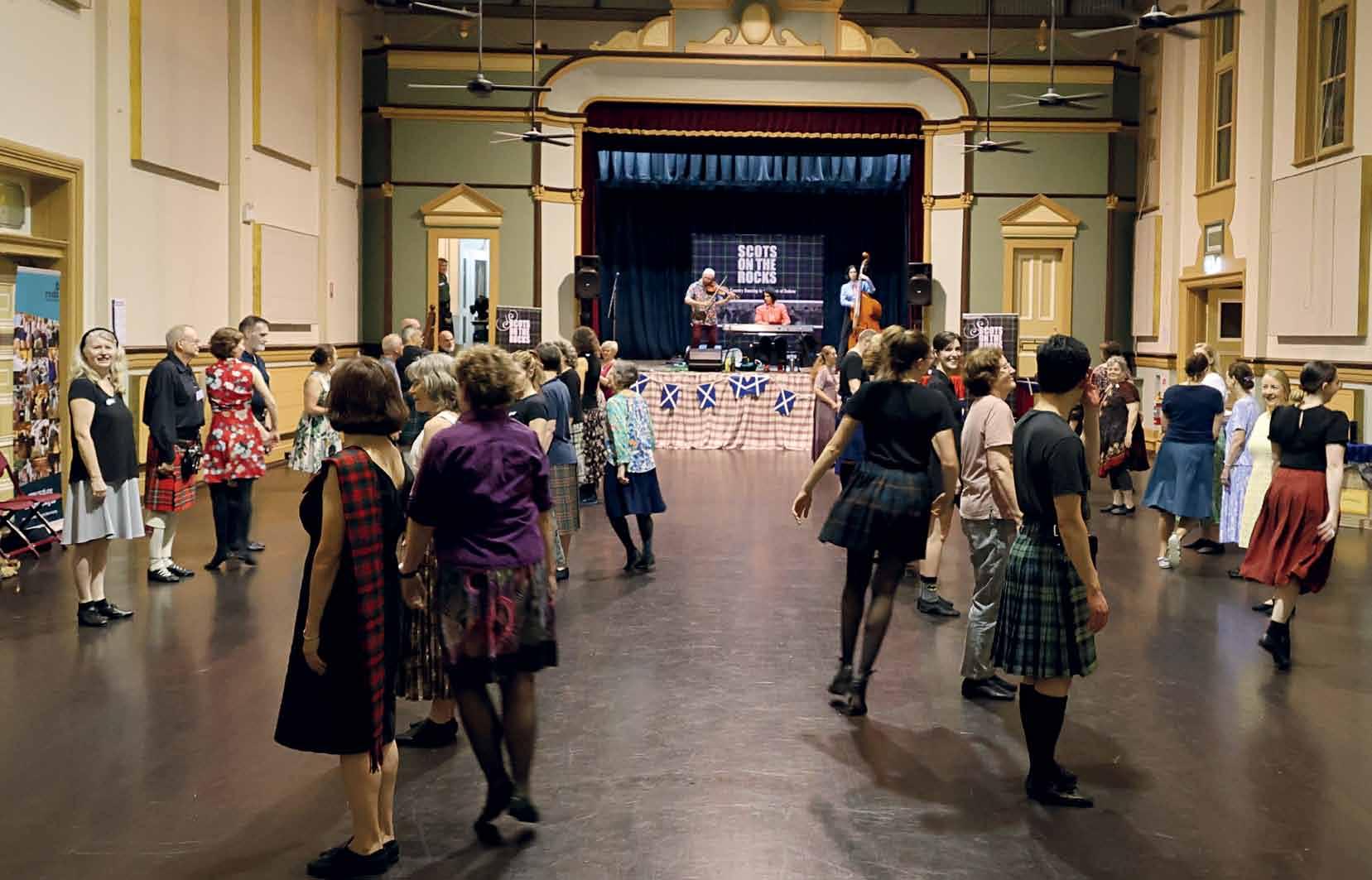
The next event was a Dance Scottish Easygoing Social. Some feedback from the February workshop was that newer dancers felt intimidated and were apprehensive about attending the more formal socials for fear of being out of their depth or being blamed
if a set fell apart. The Social was held at Leichhardt Town Hall in November 2025, featuring musicians Chris Duncan, Catherine Strutt, and Jennifer Strutt, joined by Hannah Duque, currently under tuition by Chris Duncan. Dances were walked through (more than once if needed) and were intended to be danceable while also stretching the dancing muscles. As one dancer put it, the newer dancers were “chuffed” by their achievements. There was also an opportunity for newer dancers to recap the dances. There couldn’t have been a safer environment in which to cut their teeth!
A lot of valuable feedback has been received about these events and will be incorporated into future events in 2026. This will include exploring a Ceilidh Calling training course for newer dancers and ensuring musicians are trained to play for SCD. As one musician noted, they need to be able to dance Scottish country dancing to truly play for it.
The one thing that has been key in this process and was raised at the February workshop – there are two types of Scottish country dancers. Those who remember what it was like to be a beginner, and those who do not.
All branches and affiliated groups are invited to send in their news (maximum 200 words) to Caroline Brockbank caroline@ceilidhkids.com
boston branch
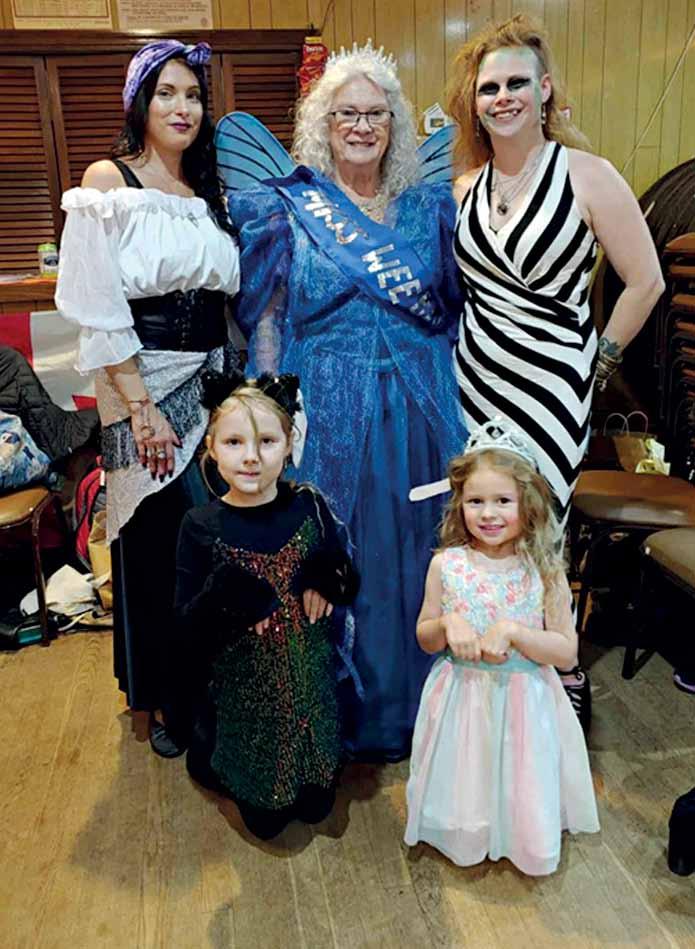
The photo shows MaryEllen Scannell receiving her Branch Award at the Cambridge Class (MA) Halloween party in October 2025. She is flanked by her daughters Catherine Scannell (left) and Ellen Woods (right), both of whom are Scottish dancers, and by her granddaughters Ellie and Ember Woods.
The award was a surprise element of the party, which was attended by 70 Boston dancers (in-person or on Zoom) eager to thank her for her enthusiastic service. They included the members of the Salem (MA) Class, which MaryEllen has led for decades, and grateful attendees of the many Balls and Pinewoods Scottish Sessions she volunteered to chair. The second half of the program featured her favorite dances. A gifted seamstress, MaryEllen doubtless made all the costumes seen in the photo! Many thanks to Cécile for her assistance with this award. It is so important to recognize and thank our sterling volunteers and organizational heroes!
Linda McJannet
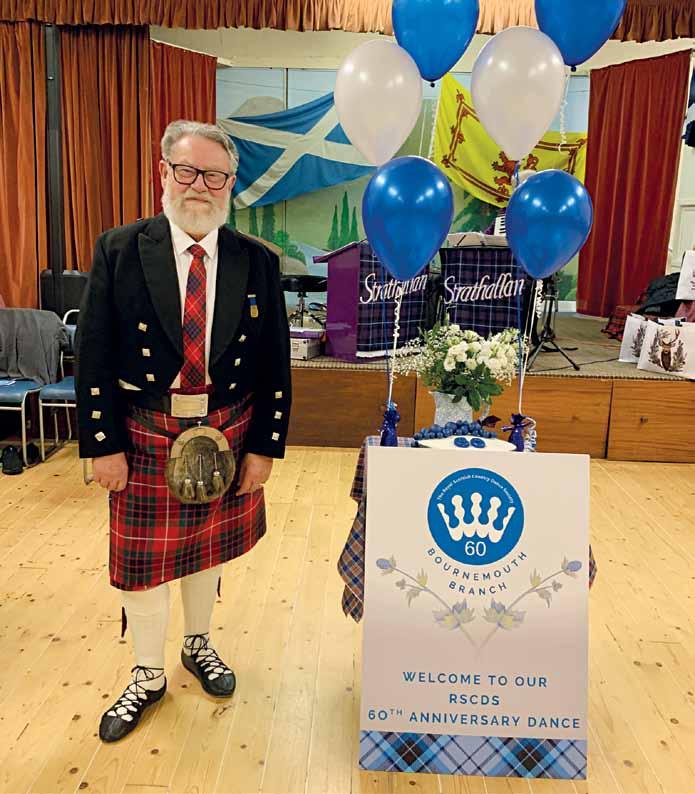
bournemouth branch 60th anniversary Tea Dance
Bournemouth Branch celebrated its 60th Anniversary on 22 November 2025 when visitors from Ashill, Ashley, Bournemouth Caledonian, Bridport, Isle of Wight, Salisbury, Ringwood, Weymouth and Winchester joined many members for a splendid afternoon in The Scottish Hall, almost full to capacity.
The programme reflected the past 60 years, with dances popular in the 1960s up to Book 54, and included Sixth ofAugust devised by founder member Ron Watson years ago to celebrate the date
on which Bournemouth became an RSCDS Branch. The wonderful music of Chris Oxtoby and Ann Stonehouse (Strathallan) with their smiling faces gave us some lovely tunes and certainly created a very happy atmosphere. New dancers attending their first Branch dance could relax and enjoy the sociability which is such a feature of Scottish country dancing.
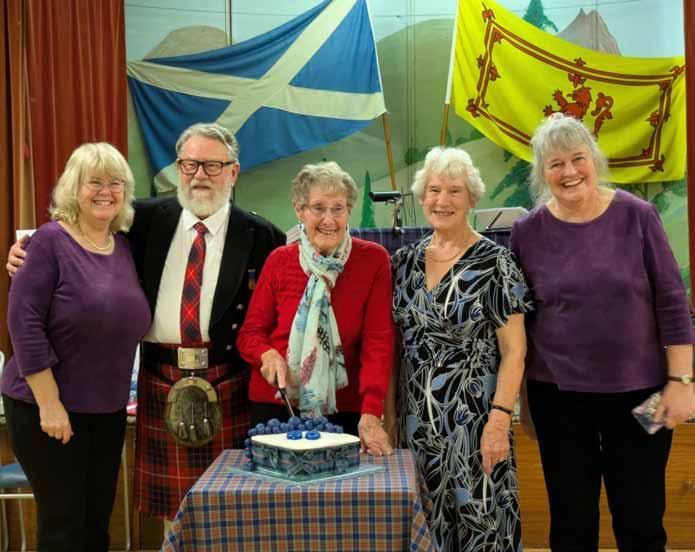
A beautiful celebration cake was made by our Chairman’s wife, Sue Fraser, and cut by our past Chairman and teacher, Marilyn Watson. A raffle raised £225 in aid of the Dorset and Somerset Air Ambulance, and the afternoon closed with a delicious afternoon tea provided by the committee and volunteers.
Margaret Robson
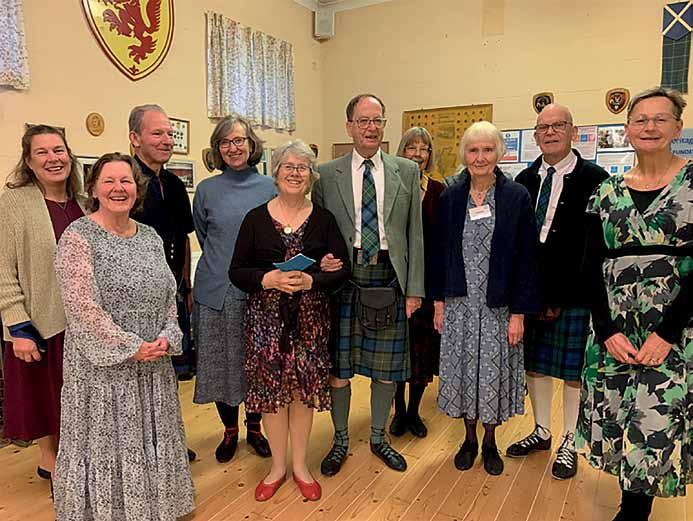
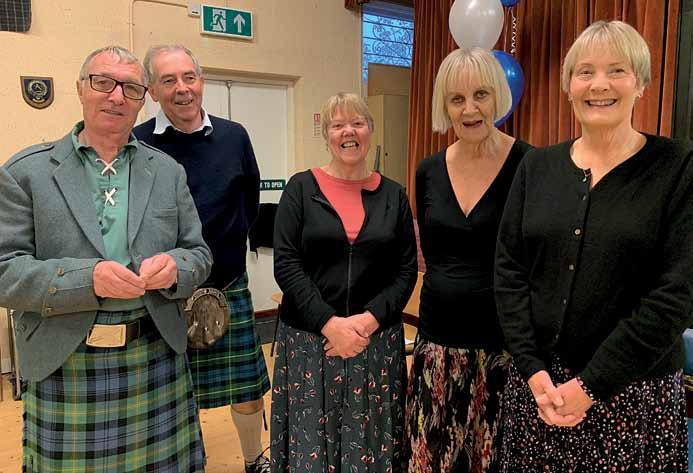
IsleofWightdancers(Thisisasmallislandoffthesouthcoastof England but which has many S.C.D groups – in fact there are classes everynightoftheweek!)
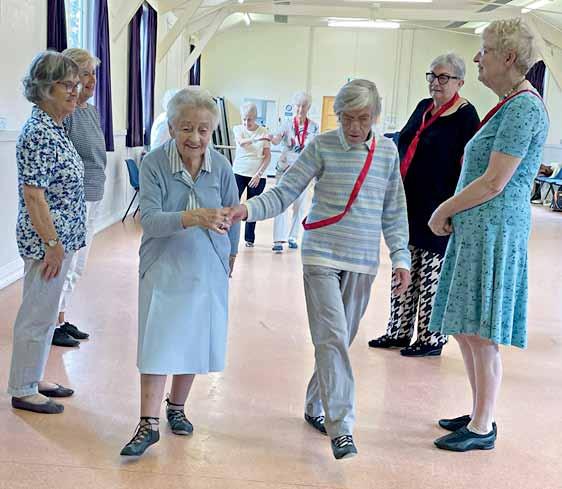
Dancing in Millport, Isle of Cumbrae, at the ‘Last Friday of the Month’ morning class, are Miss Elizabeth Howie and Mrs Elizabeth (Bett) Christie coming up the middle. Mrs Christie is well into her 90s and very rarely misses the weekly Friday-morning class. Miss Howie is in her 80s and still teaching in Saltcoats, plus recapping at North Ayrshire Branch Dances.
The message is ‘Keep Dancing’ as their ages total 180 years.
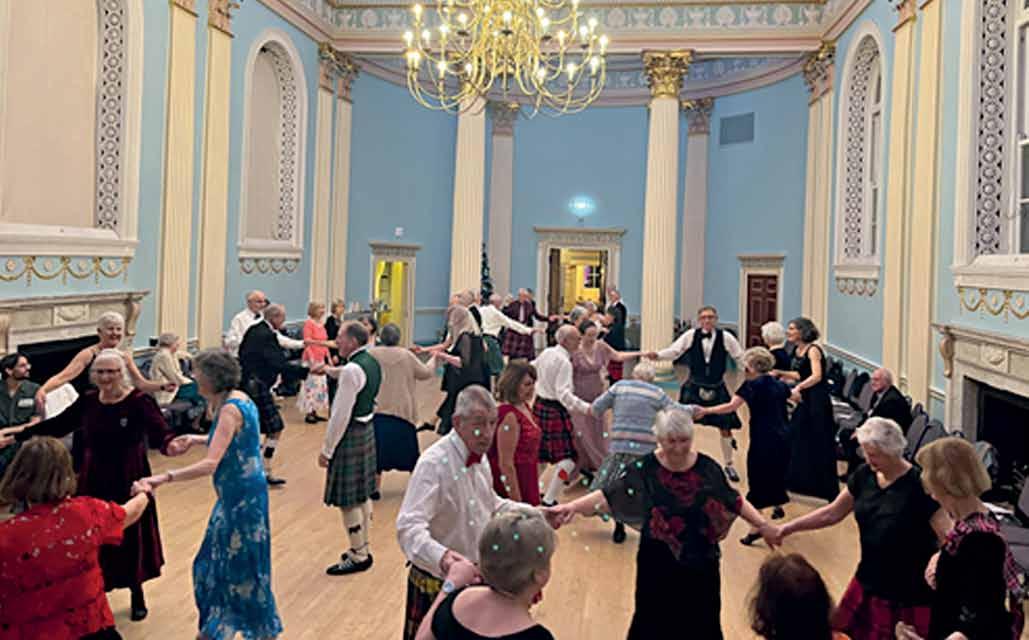
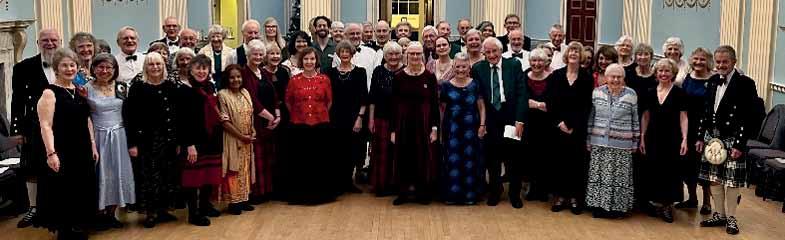
Newark Scottish Country Dance Society held its first Christmas Charity Ball in 2005. It took place in the Georgian Ballroom of Newark Town Hall, which has housed the Mayor and the Newark civic administration since it was built in 1776 by John Carr of York. The Grade 1 listed building is now recognised as one of the finest Georgian town halls in the country.
The event has been eagerly anticipated each year since, but sadly, 2025 will be its final year, as changes in the Town Hall’s management over the Christmas period mean the venue will no longer be available for our event. Two of our long-standing members, Godfrey and Sylvia Cozens, organised the first Ball and their continued contribution was recognised at the beginning of the dance. Godfrey was the MC for the evening while the Ian Robertson Duo played some lovely tunes.
The photographs shows the magnificent setting of the ballroom, and Godfrey and Sylvia can be seen in the front row of the group photo.
John Aitken, Newark Scottish Country Dance Society
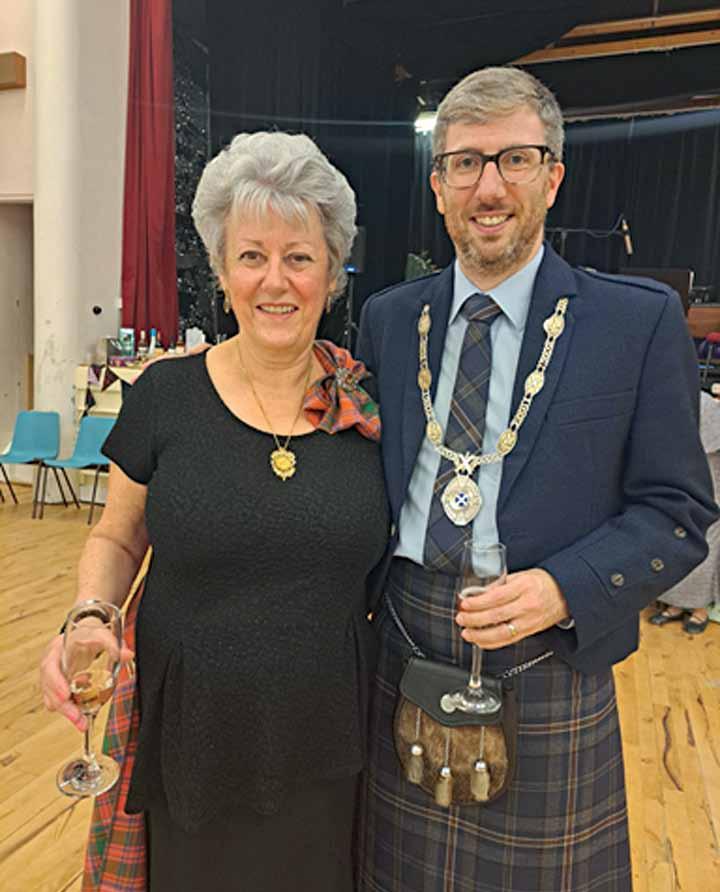
ForresChristineGrant(chair)andGaryCoull
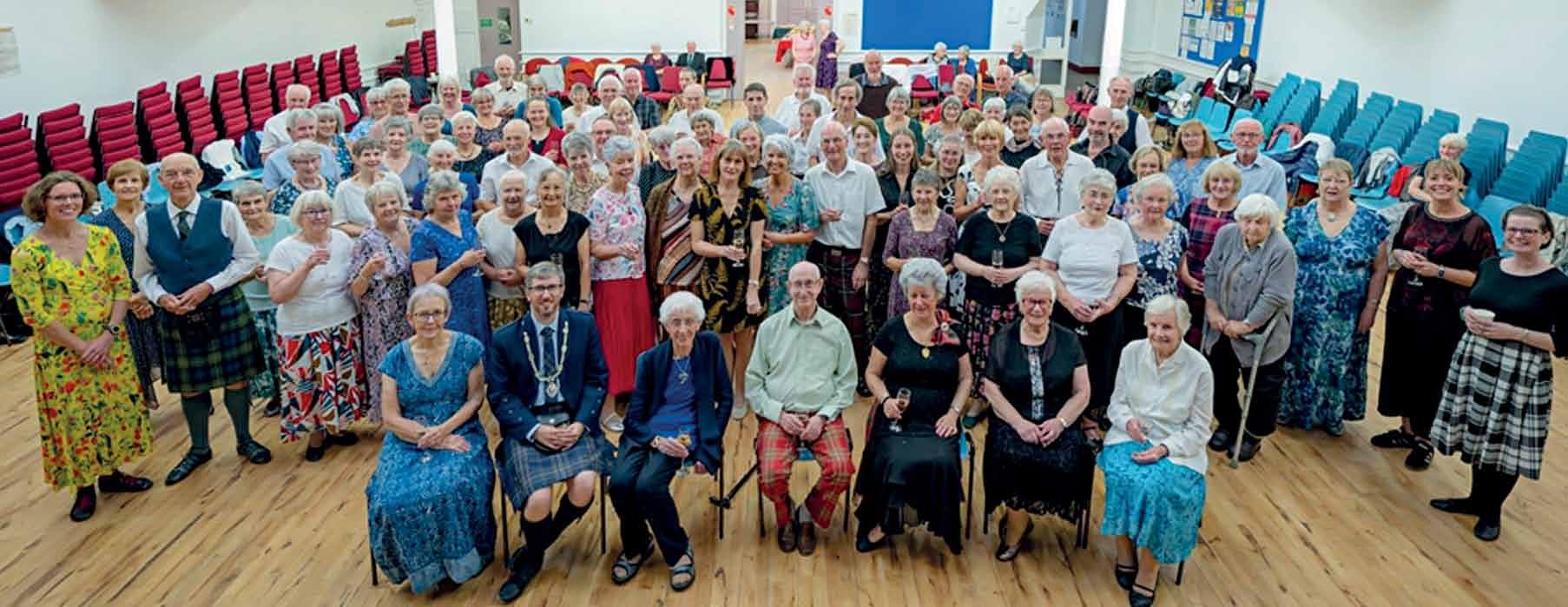
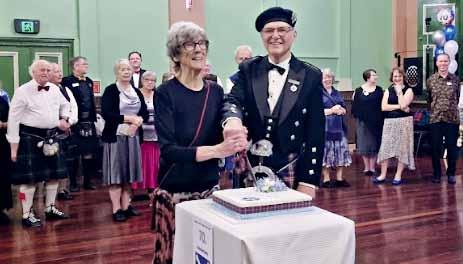
On 26 September 2025 Forres Branch held a celebration dance for our 75th Anniversary in Forres Town Hall. A great speech was given by current chair Christine Grant, including excerpts from old minute books and references to 75 years ago, for example the prices of dances in those days.
Nine sets of dancers enjoyed fantastic music from Ewan Galloway Trio. The committee provided a lovely buffet, bubbly and celebration cakes. The cake was cut by Neil M Grant and Margaret Ross who are our longest serving members and teachers. We also invited many retired committee members who were in attendance.
Caroline Nobee-Marshall
M E lbour NE :
Glenroy Scottish Country Dance Group
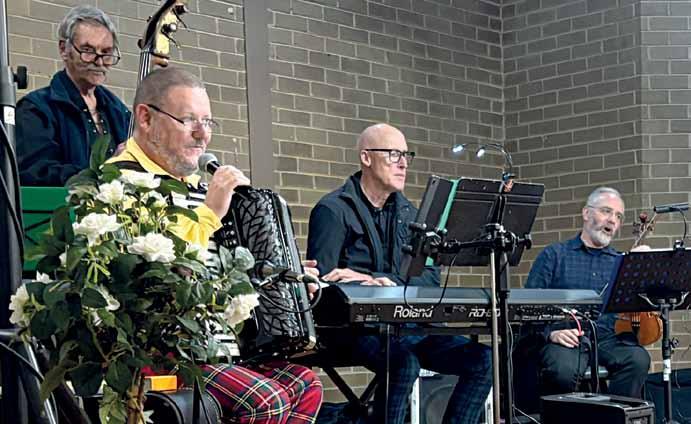
Band at Glenroy
Glenroy SCD is a group within the Melbourne and District Branch, and their biggest undertaking for the year was the celebration of their 50th Anniversary on 15 June. Members were generous with their time, attending planning meetings, organising the venue, music, and food, creating mementoes, and working together on the day. A dance titled Anniversary Jig was devised by long-term member Jenny Jhoty, and David South wrote music for it entitled Jenny Jhoty’s Jig.
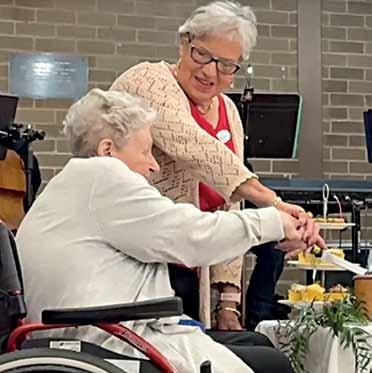
Long-time group members
Rose Dawson and Bebh Tait cut the anniversary cake. Feedback about the event was positive, with more than 80 dancers, past and present, attending. Live music added to the joy on the day, and everyone had lots of fun
Christine Freeman
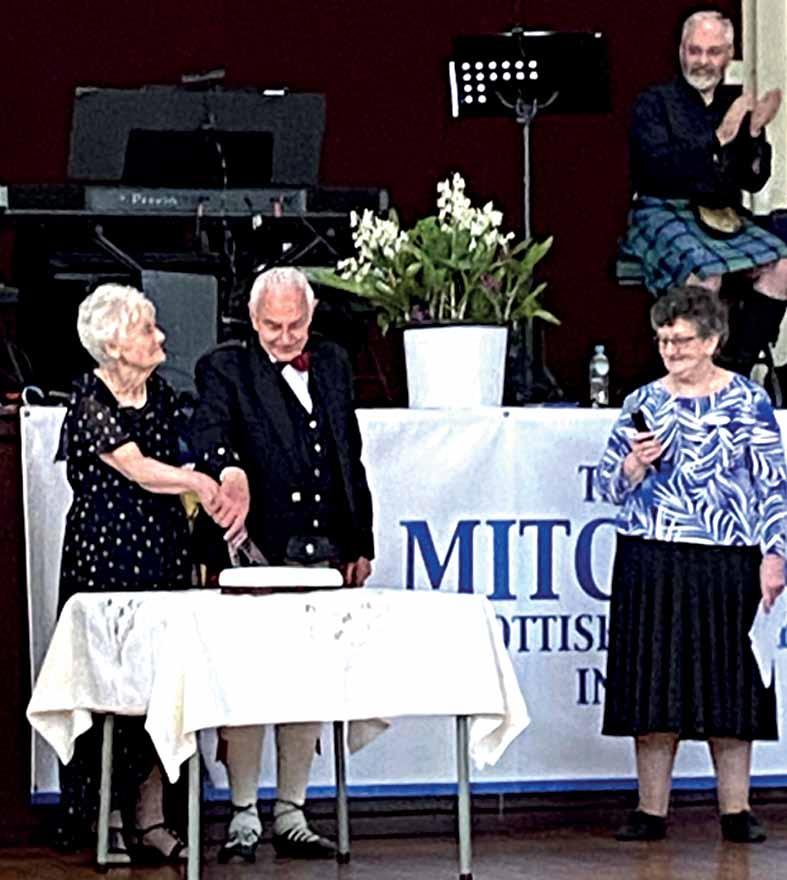
A group within the Melbourne and District Branch, Mitcham Scottish Society, held its 70th Anniversary on Saturday, 18 October. What an afternoon it proved to be! Held at the Ringwood Community Hall, 86 dancers from Melbourne, country Victoria and interstate came to help celebrate. The program included dances with connections to dates or special things to do with the group. Member Margaret Johnstone wrote a medley for four couples in a square set for the occasion, entitled Platinum Anniversary. The

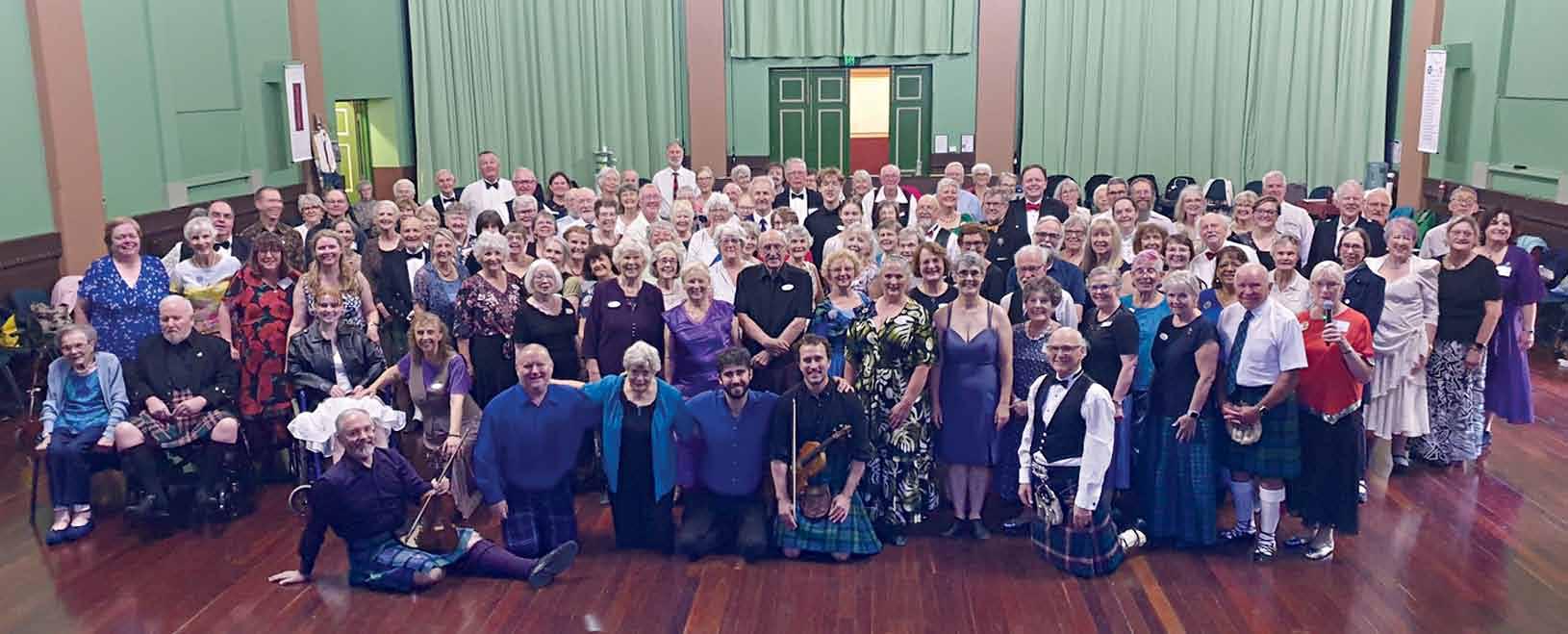
AllatBallarat’s70thSCDAnniversary
dance was so well-received at the social that everyone requested a repeat! David South wrote the music, naming the strathspey after two life members of the Mitcham Society, Don and Maimie Chitts, who were piped into the hall to cut the anniversary cake. The reel music was titled The Mitcham Scottish Society. Again, music was provided by David South, Matthew Robertson, Julia Arnold and Philip Healy. Everyone left the social with a souvenir of a spurtle, carved by member Geoff Carroll, and, of course, cake!
All four Melbourne-area groups were very pleased to receive a letter from Chair Gary Coull congratulating them on their achievements and years of dancing, as well as one from the Secretary of the Melbourne Branch on behalf of the Branch Committee of Management
Christine Freeman
North Essendon uniting Church Scottish Country Dance Group
proud they were to witness the transition to a newer generation. Music was provided by David South, Matthew Robertson, Philip Healey and Boris Conroy.
All those who attended left with a gift of a carved ‘highland coo’ and a piece of anniversary cake.
Christine Freeman
b allarat Scottish Country Dance Group

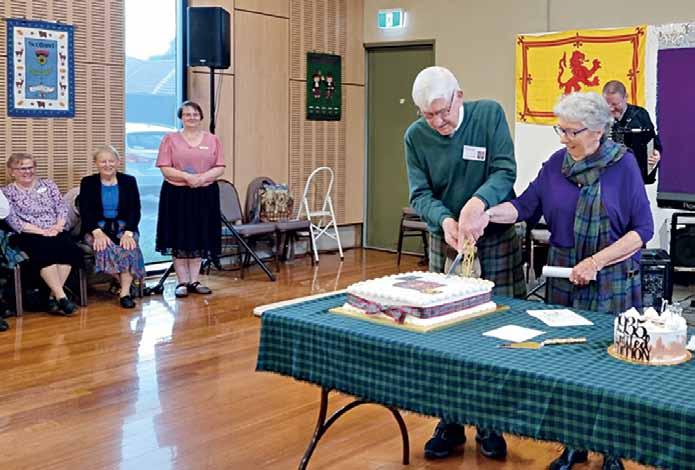
Helen and David cut the anniversary cake
North Essendon Uniting Church Scottish Country Dance Group’s 50th-anniversary social was held on 31 August; a milestone event and a fabulous success, with 97 people attending. The group is one of several within the Melbourne and District Branch, and the weeks of preparation leading up to the event were well worth it. The feedback received during and after the event was very positive. The social also celebrated the 90th birthday of Don Gregory, a long-time dancer and member of the group. Helen and David Dickie, life members who founded the group 50 years ago, spoke about the group’s history and development and how
On 30 March, the Ballarat Scottish Country Dance Group, a group within Melbourne and District Branch, held an afternoon social in the Minerva Space, Ballarat, to celebrate their 70th anniversary. Over 100 dancers came from Melbourne, country Victoria and interstate to dance to the music of David South, Matthew Robertson, Julia Arnold, Philip Healy and Ben Saffir.
Life Members Helen Reavey and Graham Gooding were piped into the hall to cut the anniversary cake. An abundant afternoon tea provided refreshment, with time for chatter, viewing memorial photos, and browsing memorabilia displays.
After Auld Lang Syne, the Gay Gordons was danced as the band cooled down, and Ballarat hospitality meant more refreshments were available. It was 7 pm when the last guest left, with everyone taking home a piece of the anniversary cake and a souvenir bookmark.
The following night, 31 March, the Ballarat Group celebrated the success of their 70th social by welcoming dancers who had stayed on in Ballarat to an after-party at their Monday night class. With music by David South and a special supper, it was a fitting way to reflect on a very successful event.
Christine Freeman
San francisco – kathleen Mcadam 95th
November 22, 2025, Kathleen McAdam, one of the San Francisco Branch’s most beloved members, celebrated her 95th birthday. Despite her daughter, dancer Cathy Bertics, having misgivings, Kathleen insisted on a 15-dance program for the celebratory dance. It appears Kathleen was the only one who was up for every dance, and the encores! She was inspired by music by Andy Imbrie, David Mostardi, Janet Kurnick, Patty Van Winkle, Micah Reinhold, and Sherryl Faux.
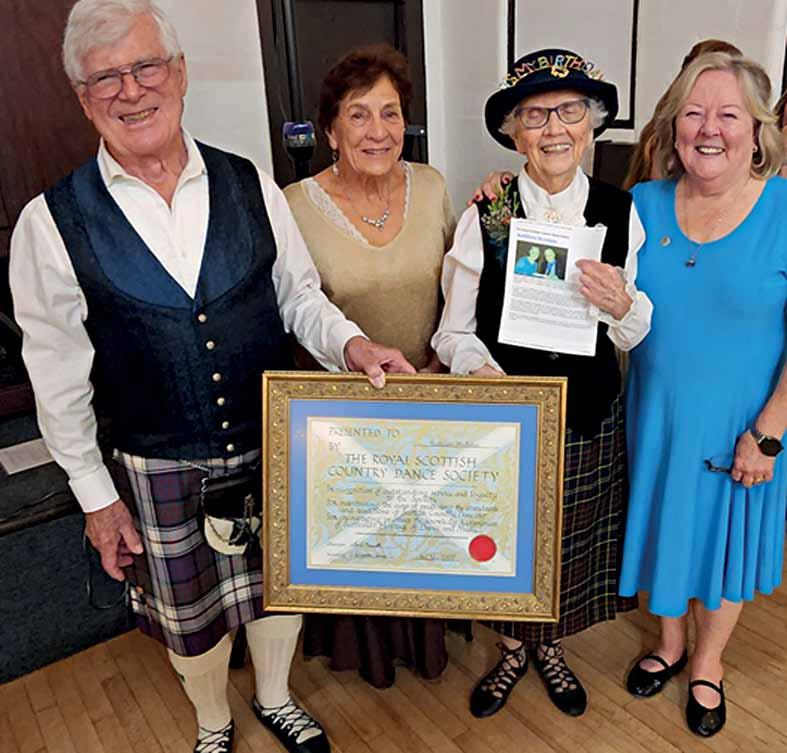
Dancers from all around the San Francisco Bay Area attended this wonderful event. Kathleen nurtured dancers of all ages, taught classes for 60+ years in the East Bay, and continues to delight and inspire everyone she meets. Lang May Her Lum Reek.
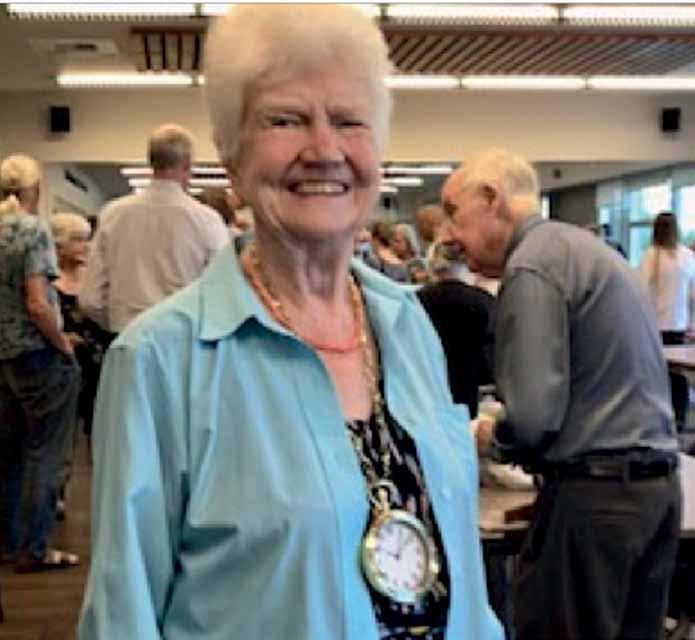
Seattle Branch’s living treasure, Elinor Vandegrift, was fêted in September at a special Branch retirement party. The event toasted her fifty (!) years of teaching in the Seattle Branch. The retirement party brought out almost 60 present and former dancers. Many
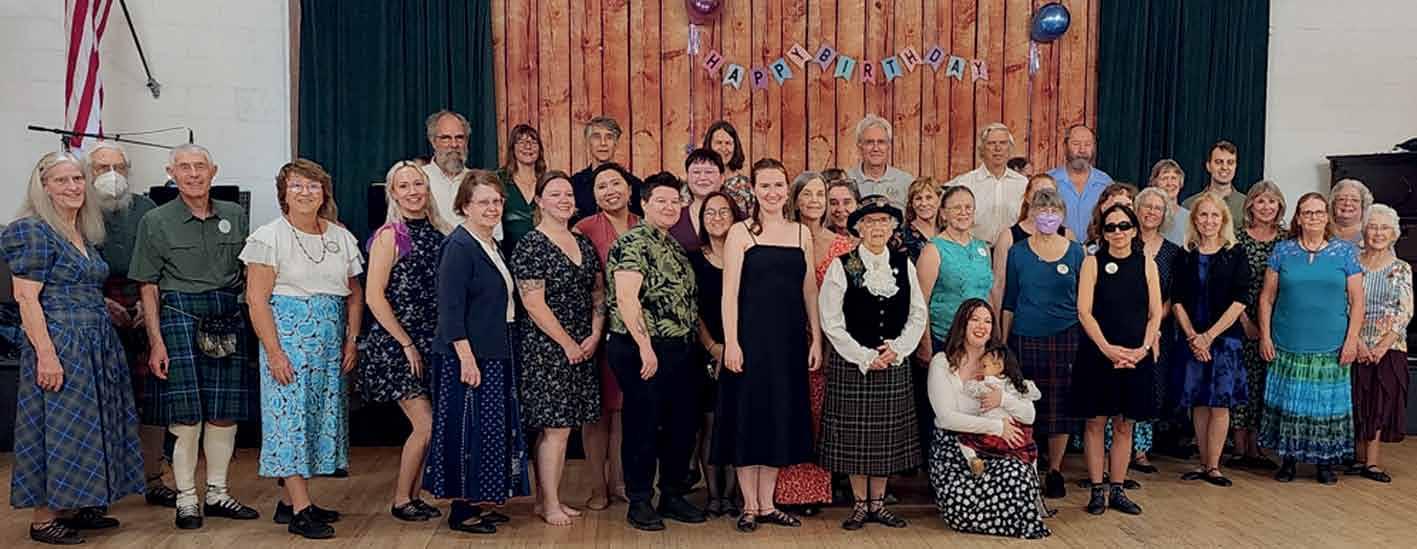
dancers who could not attend sent greetings that were read aloud at the event. Her longtime fellow teacher, Geoffrey Selling from the Delaware Valley Branch, composed a poem for Elinor, who herself had penned many special-occasion poems.
Master fiddler Calum Mackinnon praised Elinor for her role in helping him and other musicians understand the special aspects of playing music for Scottish country dancing, then he played a fiddle tune he had written for her. Many attendees shared stories about Elinor’s impact on them. RSCDS Headquarters honored the occasion by sending her special greetings from the Education and Training Committee. In addition to teaching classes and training teachers, Elinor was one of the first two North American teacher examiners.
The Branch presented Elinor with a gift card to her favorite local theatre. What is a retirement party without giving the retiree a watch? In Elinor’s case, it was a huge pocket watch and chain— solid “gold,” of course.
TracyAntley-Olander,Seattle Branch
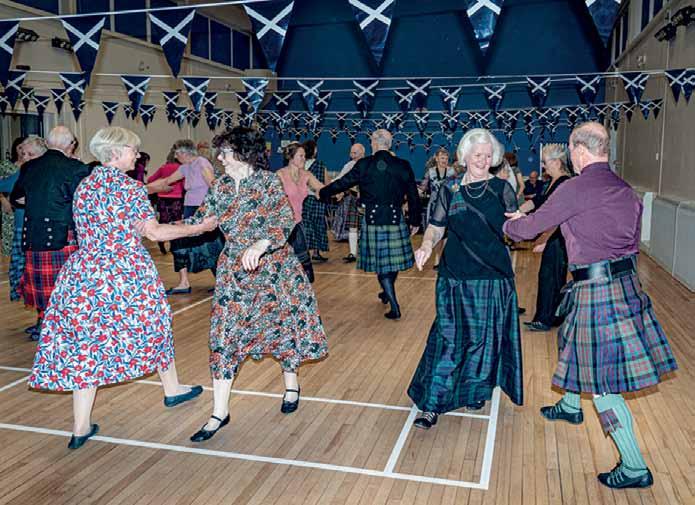
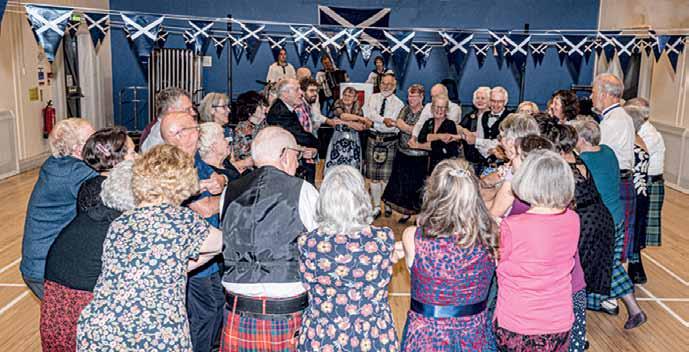
In October 2024, Stone Scottish Dancing Group proudly celebrated its 70th Anniversary with a ball and a buffet supper at Bradwell Lodge Community Centre in Newcastle-under-Lyme, and the occasion was a great success. We are a small group, so we were pleased to have 48 people attend the event. Many of our visitors said how much they enjoyed the evening and commented on the venue (larger than our usual hall), the friendly atmosphere, the splendid buffet and the excellent musicians Chris, Julie and Nick Dewhurst. The programme of 21 dances included JB Milne, which was written in 1954, the year when our group was founded, and Heather’s Strathspey for 3 couples, an adaptation of a dance specially written for our 30th Anniversary Ball in 1984, for Heather Davie, a former RSCDS-trained teacher who has been a member of our group for longer than everyone
else. We are delighted that she is still dancing and could join us for the ball. Our charity raffle raised £160, a record for our group. A successful and thoroughly enjoyable evening, ending with us linking arms and singing the traditional Auld Lang Syne.
Dilys Riley
Editor’s apologies. The April 2025 issue of the SCD included an article in Dancing Around the World celebrating the 70th Anniversary of the Stone SCD Group. To our great regret, we learned that the article appeared below a photograph of the Southern Fling Fringe, totally unrelated to their celebration. To make matters worse, their own photos were not published. The Editor offers her heartfelt apologies to the Stone dancers and hopes that the belated inclusion of their joyful photos and a repeat of their article will, in some small way, make up for this error.
Sydney branch’s Day of Dance 2025 Celebrating olivia roberts’ 100th birthday
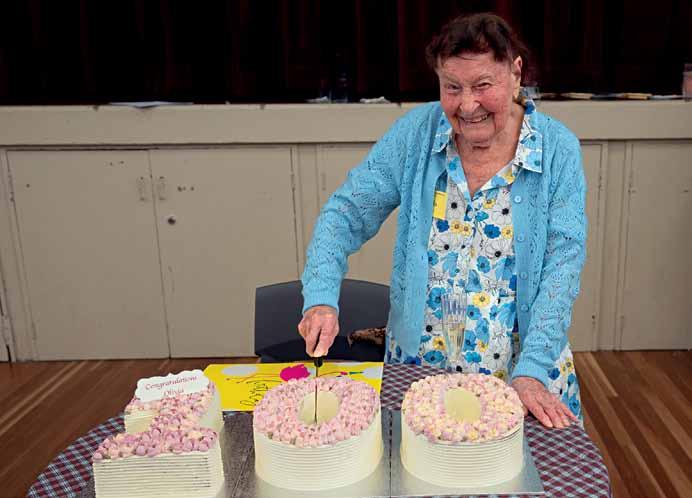
Sydney Branch’s annual Day of Dance in February honoured Olivia Roberts, making her dances and life the theme of the day. It acknowledged Olivia’s 100th birthday and many contributions to the SCD community.
Olivia’s interest in SCD was kindled at school in the UK. After migrating to Sydney in the mid-1960s, Olivia joined the Sydney SCD Club and the Harbord Club, teaching at both for many years.
Olivia devised many interesting dances. The First Fleet Hornpipe won the Bicentennial Competition in 1988. In 1989, The Golden Trillium, commissioned by Sydney Branch, was presented to three founding members, celebrating their 50 years of dancing. Sydney Branch’s 2002 50th anniversary book contained several of Olivia’s dances and a cover designed by Olivia.
Olivia was awarded life membership to the Sydney Branch and served on the Branch committee for many years. This included the Branch’s Winter School committees, and Olivia designed logos and mementoes for Winter School since 1981, including for the most recent, 2023 in Kiama.
During the Day of Dance, three of Olivia’s dances were taught. The Branch teachers also demonstrated Olivia’s beautiful strathspey, Silver Lagoon. Five dancers from the Avalon club, once taught by Olivia in Harbord – one almost 40 years ago – danced Olivia’s Corrievreckan Morag Napier gave a wonderful tribute to Olivia, highlighting her contributions to Scottish dancing. This was followed by a champagne toast and birthday cake.
With her selfless attitude to life, her willingness to share her talents, and her love of dance, Olivia imbues the finest traditions of Scottish country dancing.
Emily Prichard, Sydney Branch
(Thanks to Margot Paul and Morag Napier for their contributions to this article.)
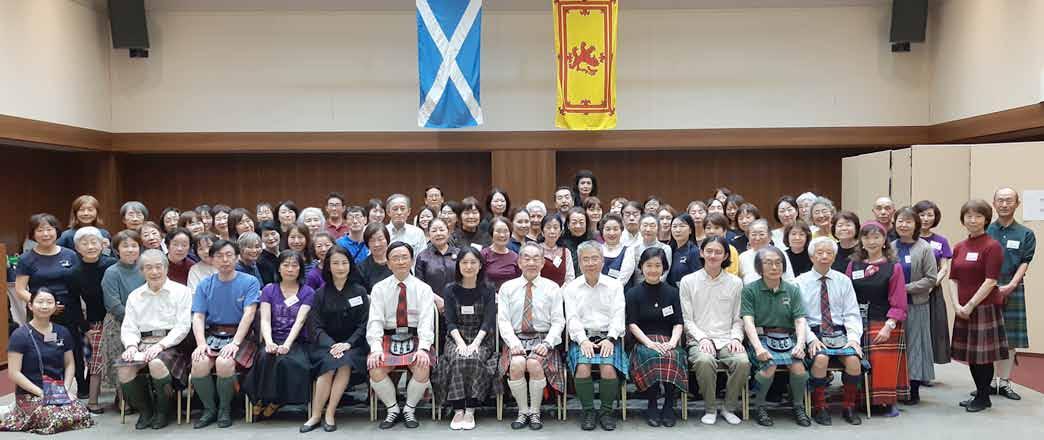
our first Music Course at the Tokai branch Weekend
I held the first Music Course at the Tokai Branch Weekend. It became a big band of 18 members: accordion, whistle, piano, melodica, fiddle, harp, guitar, snare drum & tambourine and bodhran, including one professional violinist. We would play Miss Gibson’s Strathspey and The Irish Rover. Some months ago, I sent them sheet music, a recording of my playing of the entire piece 8 times through on piano, and they practised hard. I had to think how to get the tempo up to the dance speed in rehearsal, because I heard from several members that the pieces were too difficult and they couldn’t play them at dance tempo. At the weekend, even before rehearsals, I was so surprised they already started playing Miss Gibson eight times through in a dance tempo, naturally and spontaneously on their own!
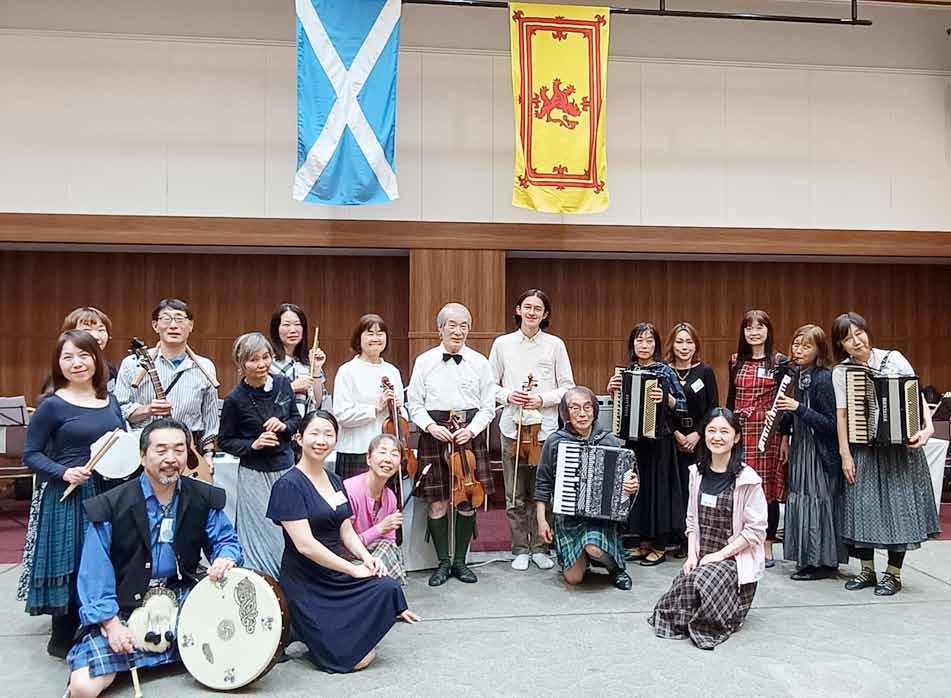
Music course membersTokai Branch
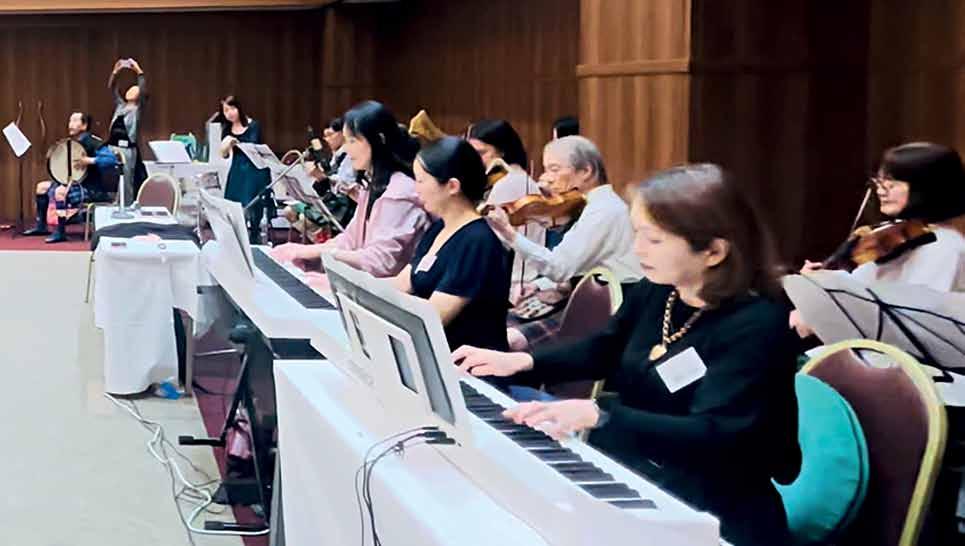
During rehearsals, we made a bagpipe drone arrangement (extending the tonic chord with no rhythm, together with the melody, for 8 bars), a fiddle solo, and we even practiced an expected encore.
The performances were superb, and sounded like an orchestra with people knowing dances well. All the dancers were amazed and excited and called for an encore. Now we are dreaming of how to develop it in the future
Akiko Kasama
Toronto association – Don bartlett branch award
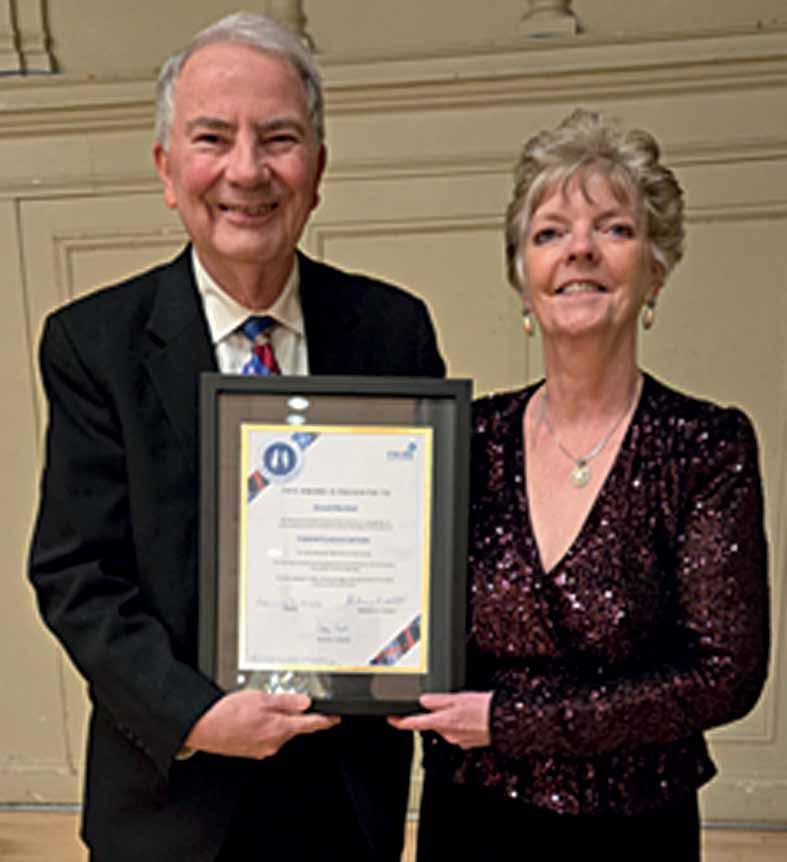
Don Bartlett has been an invaluable part of the Toronto Association since the 1970s. His original tunes and recordings, his consummate playing for dances and events, and his support of candidates and teachers have all made important contributions to the health and success of the branch, its teachers, and its dancers. We were proud to present the Branch Award to Don during the 60th Anniversary of the Tartan Ball in February 2026. Arlene Koteff, Chair of the Toronto Association.
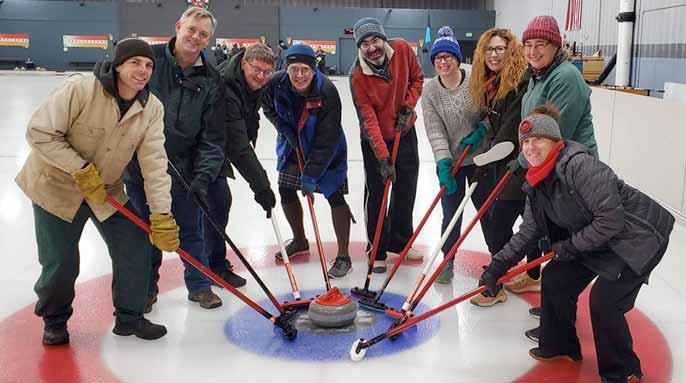
Twin Cities curling
50th anniversary of Twin Cities branch, Minnesota, uSa
The Twin Cities Branch has always considered 1975 to be our birthday, although records show that, due to communicationand international mail-related delays, approval wasn’t official until early the following year. We celebrated our fiftieth anniversary with a series of events throughout 2025, beginning with a New Year’s Day dance.
The highlight was our Semicentennial Ball in April, featuring fiddler Alistair McCulloch and pianist Tom Pixton, a timeline display, and reminiscences from members. The guest of honor was Sandy White, one of our first certificated teachers and a founding member of the Branch.
Other events included a group curling outing (it turns out dancing skills are not particularly transferable), two Scottish whisky tastings, an evening of Irish ceili dancing (a bit of cross-cultural enrichment!), and a summer picnic. We also published a cookbook compiling favorite recipes from the historical reenactment event where we perform every autumn, where all cooking is over an open fire.
In November, we held a 50th anniversary workshop weekend with guest teacher Janice Lacock from Beloit, Wisconsin. In conjunction, we were excited to release Ladyslipper andThistle: Fifty Years of Scottish Country Dancing Together. The book includes 28 dances, mostly written by Branch members over the last quarter of a century, with original tunes for 12 of them.
Fer Horn
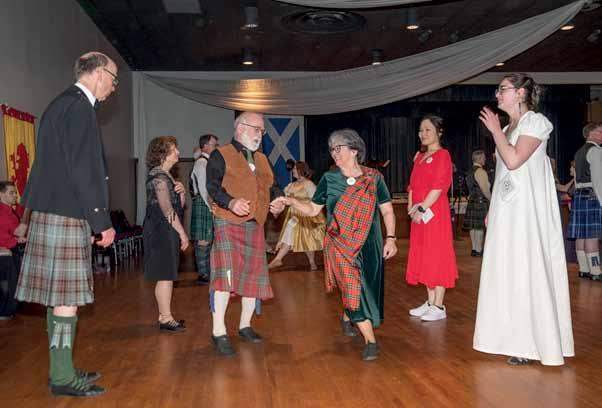
Another week has ended, and I’ve had time to rest and reflect on the memories made at Blue Ridge Scottish Dance School (BRSDS) in Boone, North Carolina. On Sunday, we welcomed new and old friends from around the country and the world! Everyone settled into the accommodations at Appalachian State University, a beautiful campus in the middle of the Blue Ridge Mountains. That evening, we met on the dance floor for our first of five nightly dances and were introduced to this year’s musicians: Julie Gorka, Ian Muir, and Judi Nicolson. We ended the first evening with our Sunday Sundaes tradition, everyone enjoying our first “Afters” with a sweet treat.
On Monday, we began our morning classes. Our teachers, the wonderful Linda Henderson, Fiona Mackie, Jeff Corrigan, and Eilean Yates, taught us steps, figures, and dances. It was exciting to be among the first to learn dances from Book 54. I especially loved hearing the stories behind each dance.
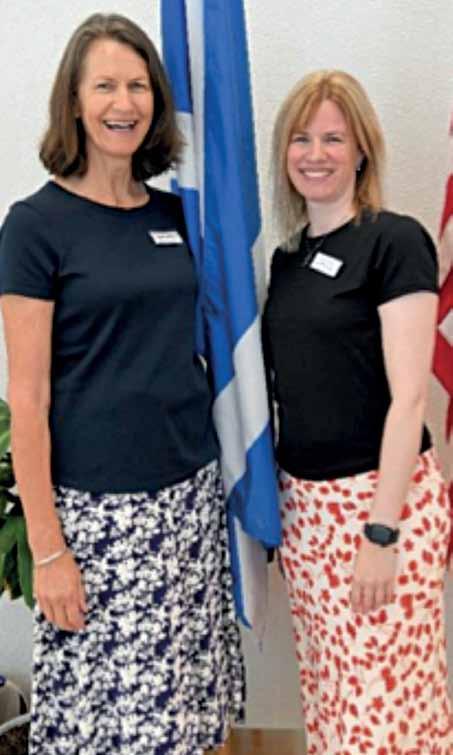
Every afternoon was filled with optional activities, such as ceilidh dancing, tunematching, or waltzing. We also received updates from members of various RSCDS committees. It made me feel more connected to RSCDS headquarters.
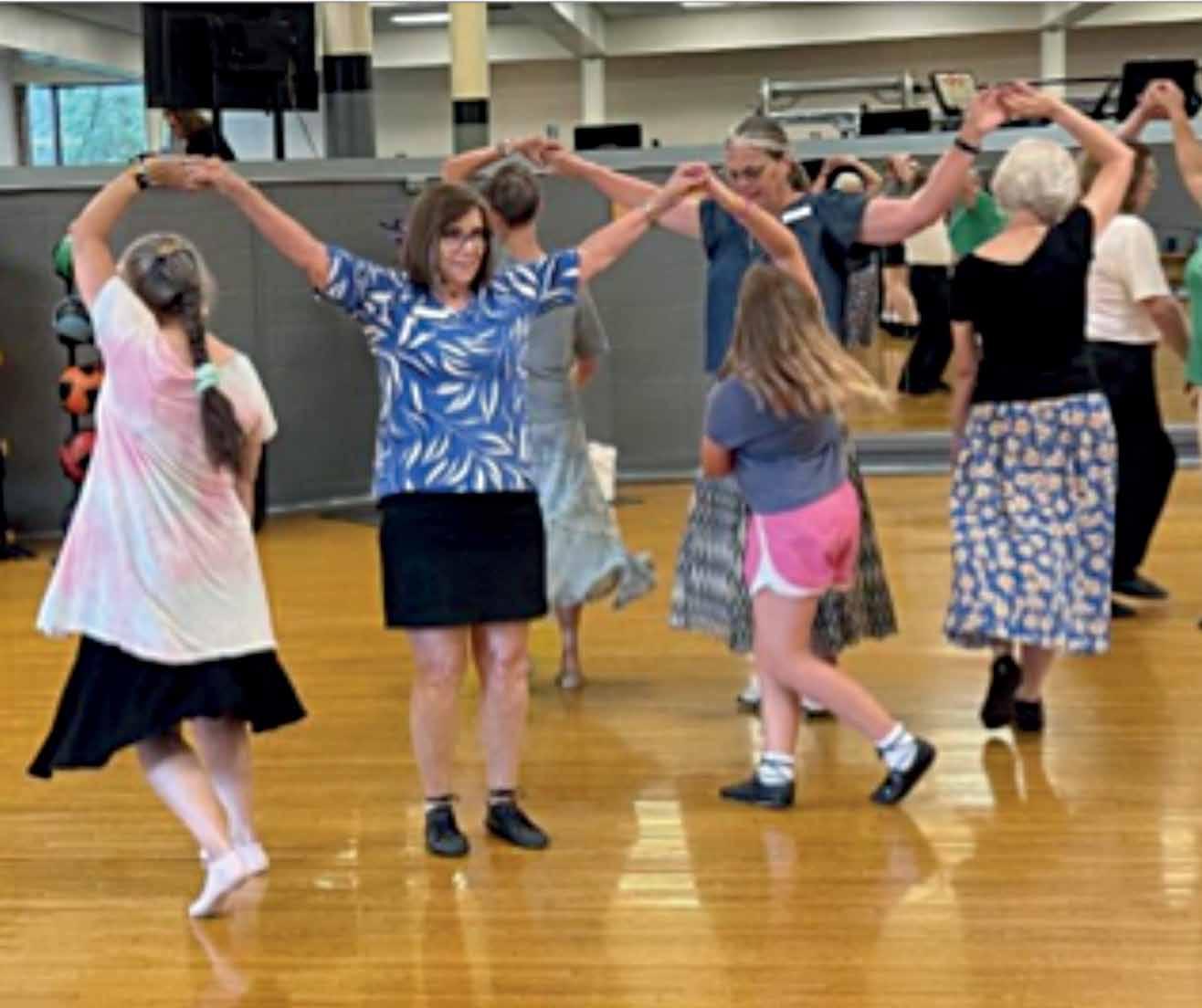
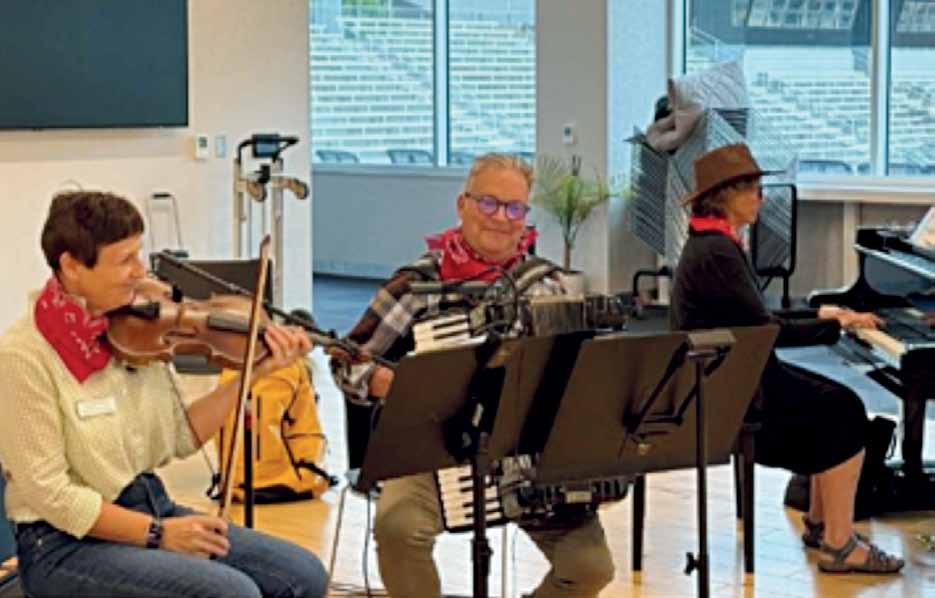
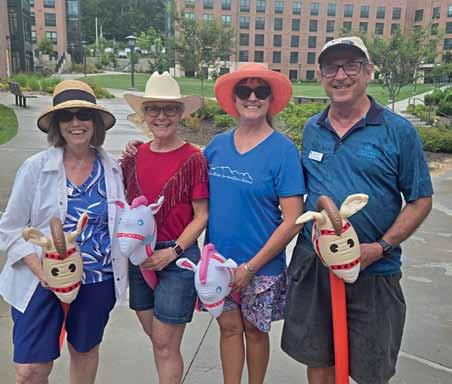
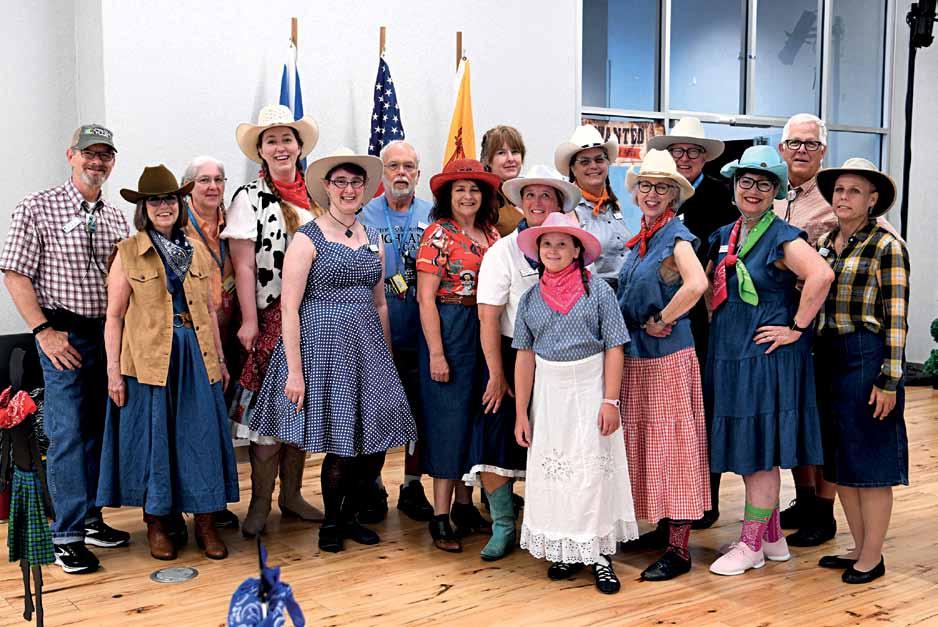
One of our most fun traditions at Blue Ridge is to have a theme night - this time it was Country/Western. Everyone was dressed up in their hats, plaids, and boots for a night full of dancing. Our musicians treated us to an opening medley of You Are My Sunshine and Take Me Home, Country Roads. It was a blast! The Blue Ridge Roundup on Tuesday afternoon continued this theme and was a success, with attendees competing in barrel racing, dressage, lassoing, and an egg toss.
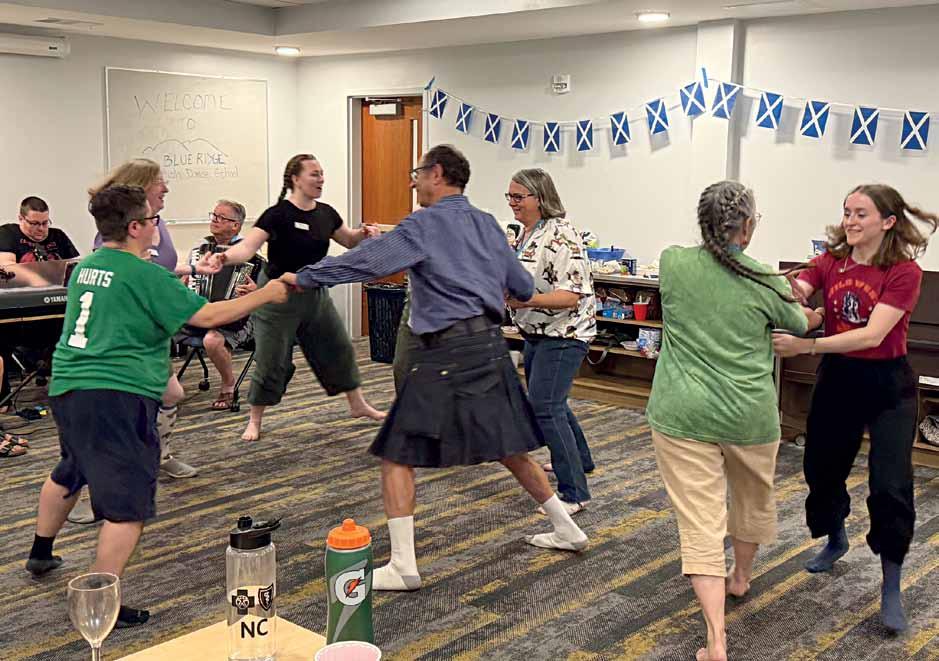
Outside of the scheduled activities, one of the best parts of Blue Ridge is the friendliness and camaraderie exemplified in our “Afters” celebrations. Every night, we meet up in the common room for food, drinks, and music. Sometimes, someone has a talent to share, a dance to organize, or a game to play.
On Friday morning, we combined all classes into one for a joint session with both Linda and Fiona. They tag-teamed the teaching, and we enjoyed music from
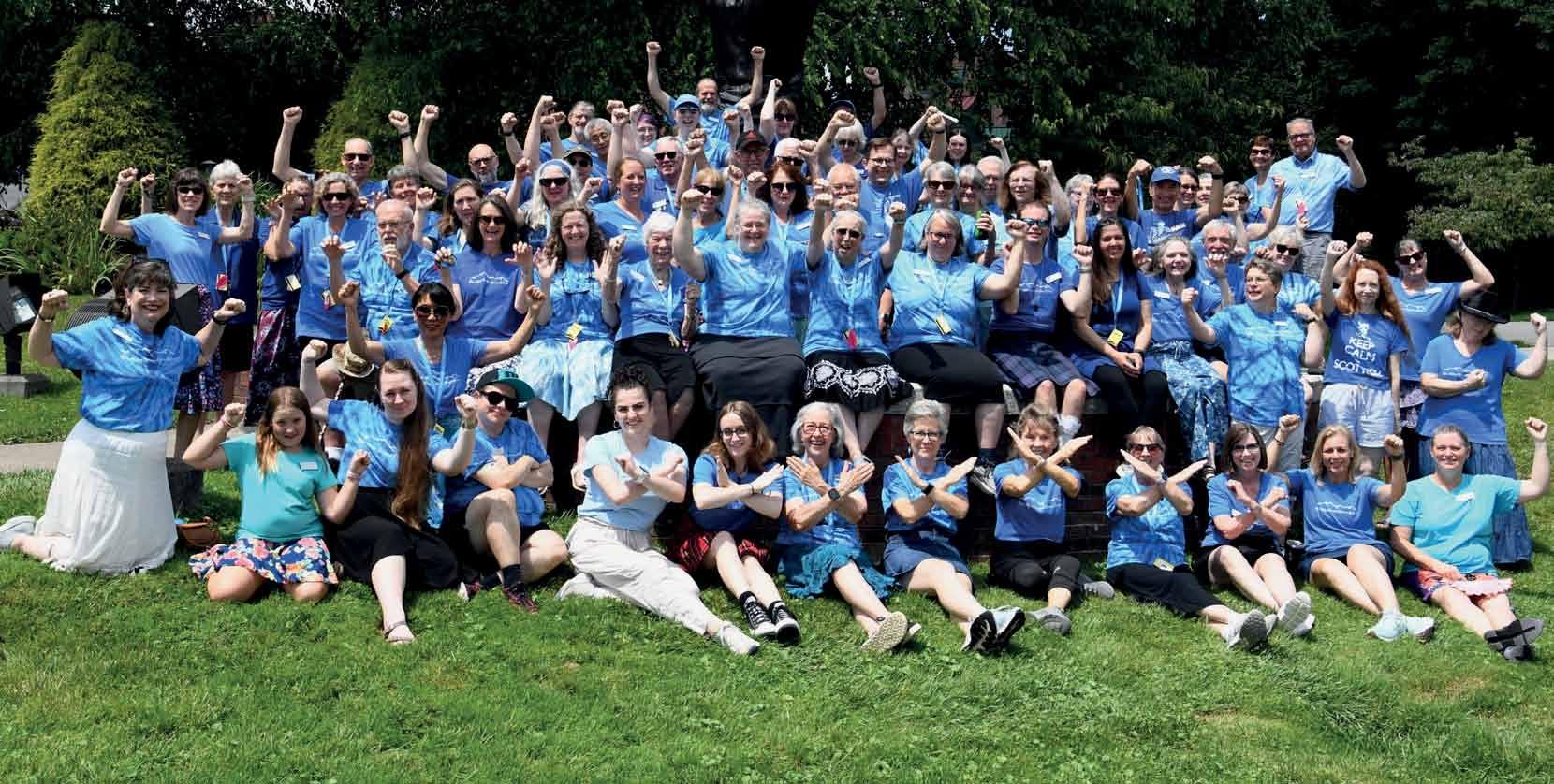
all three musicians. And, of course, we gathered in front of the Appalachian State University Mascot, Yosef, for our “Shades of Blue” photo.
That afternoon, we held our Annual General Meeting. Highlights included our fundraising efforts: we awarded five scholarships this year and raised funds for future scholarships. We elected a new officer and reelected two more. It was amazing how fast the week went, and before we knew it, it was time for our final evening ball! How wonderful to see everyone dressed up and ready to dance! Each night, we danced in the Grandview Ballroom at Appalachian State, a beautiful room overlooking the nearby mountain peaks. We marched in and danced the night away, celebrating a wonderful week together. Our feet were sore, but our hearts were full!
This year, BRSDS will be held July 511, 2026, with Deb Lees, Fred DeMarse, and Jeanne Moody as teachers and Mara Shea, Julie Gorka, and Tom Pixton as musicians. Hope to see you there!
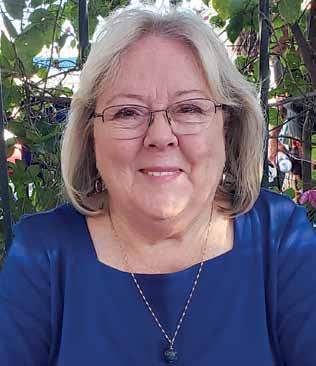
any opinions expressed in the letters below are personal to the writers and do not reflect the views of the rSCDS or the Management board
In my opinion, the Society makes too little effort pinning down its members and not only members but those dancers who join in on a regular, weekly basis, but, critically, are not members.
Where are our vanishing eight times through strathspeys?
More and more dance programmes only have three and four times through strathspeys, and our beautiful, big, powerful strathspeys are being relegated to second best.
I accept that later in the evening there is a place for the shorter dances, but then PLEASE don’t repeat them. This surely defeats the purpose of having them!
A world of Scottish country dancing without The Gentleman, Margaret Parker’s Strathspey, The Bonnie Tree, The Silver Strathspey and, of course, TheGlasgowHighlanders is not a place I want to dance in.
These wondrous eight times through dances give you plenty of time and opportunity to show off your best dancing, with covering, phrasing, eye contact, and the sheer pleasure of dancing all there for you to enjoy.
Yes, reels and jigs are joyous and lively, but there are also some dull and boring ones. Like strathspeys, they come in all sizes and shapes, but we still dance most of them eight times through. Certainly, it takes longer to dance a big strathspey, but surely we should be celebrating that, promoting it and encouraging all dancers to appreciate them.
These dances showcase the power and strength of our dancing and deserve to be treasured, not written off as too long, too slow, or too boring (all of which I have seen written down).
Let’s start a campaign to Save our Big Strathspeys (SOBS) and ensure that eight times through is the standard, not the also-ran.
Fiona Bullivant, New Zealand Branch
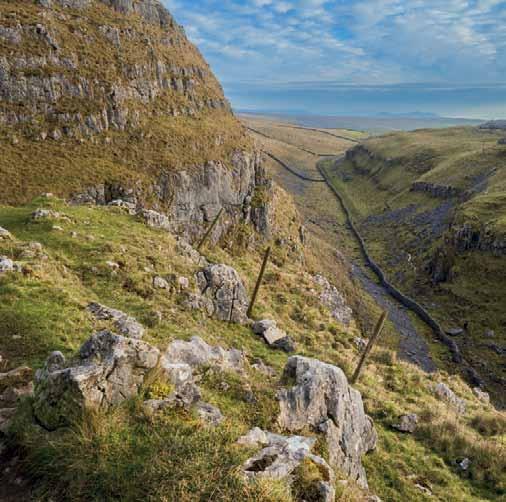
Archbishop William Temple famously mused that the Church of England is an organisation that exists for its non-members; the RSCDS is similar.
It is not only a matter of counting them but also of tracking them at classes, regular weekly social evenings, and Saturday evening Dances.
We should not be deterred by those who say we are breaching Privacy Laws; the Society should produce a common register for completion with columns for Branch members, Affiliated Group members, Visitors and none of the above to be completed at every class, dance and workshop and returned to Headquarters, say, every month with a view to numbers being compiled giving a better idea of not only the number of members but non members and their contact details. Branches would be directed to follow up on non-members and visitors with a view to bringing them into the fold.
Presently, if a register is kept, it is unlikely that those in the hall are separated by membership category.
Roger Brooks, NorthWest Craven Branch,UK.
and definitely a landmark experience.
By Claudine Auriacombe and Laure Gardell
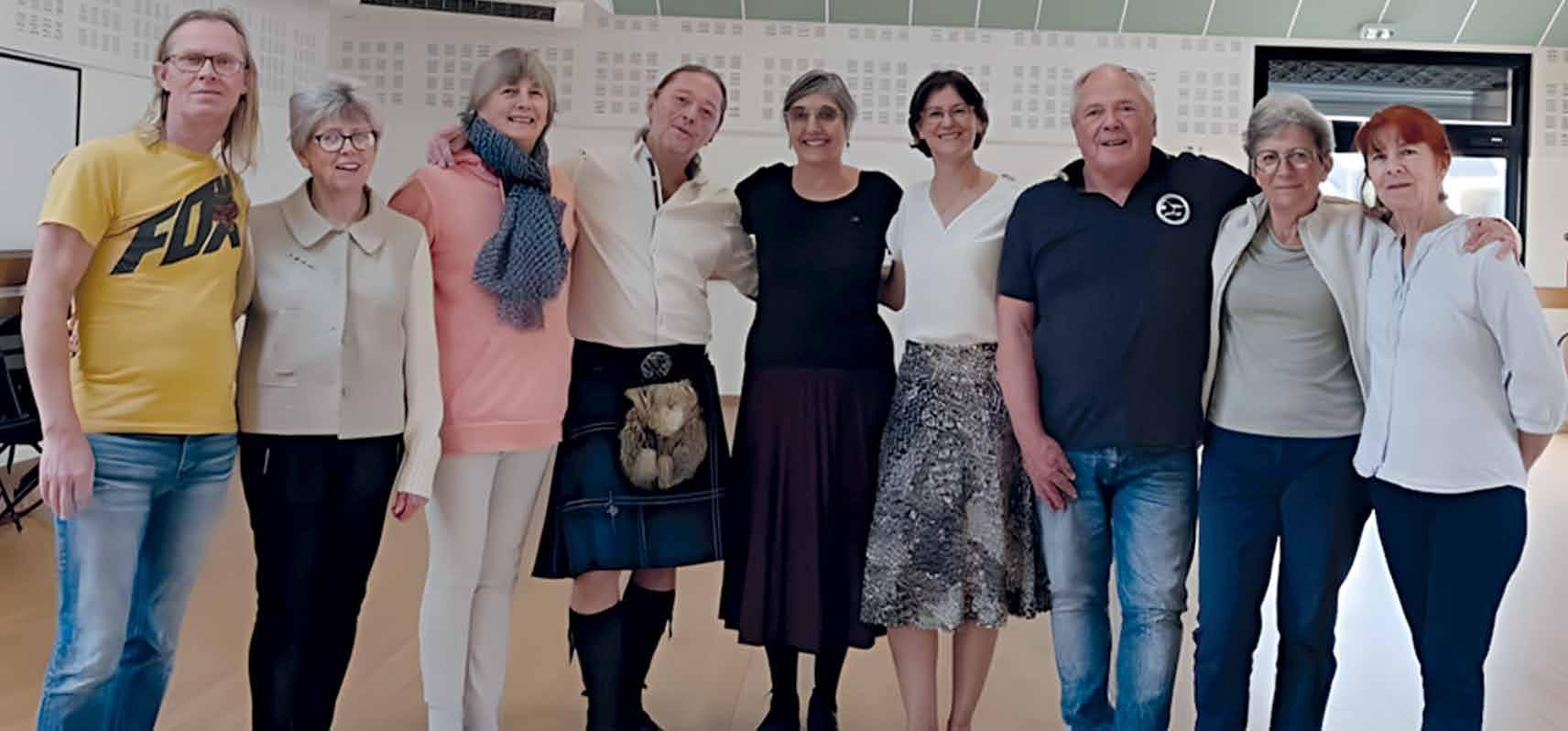
The idea came during the 2025 annual workshop organised by Alba Bihan, the SCD group in Séné: why not embark on a DAA adventure with volunteer dancers in the group? A slightly crazy project, but such a stimulating one, which would give intermediate dancers the chance to improve their skills locally, and to work as a team towards a common aim – the Dancing Achievement Award, with its 9 dances, 23 formations, and particular attention to phrasing, posture, hands and arms, feet, covering, and eye contact. The idea was put forward by Claudine Auriacombe, the group’s teacher, and enthusiastically seconded by Laure Gardelle, the certificated RSCDS Lyon Branch teacher who was teaching the annual workshop.
The project soon came to life with support from Alba Bihan and its president, Michel Hance, and eventually involved seven eager volunteers (Chantal, Christine, Claudine, Michel, Michèle, Murielle, and Stephan) and two non-assessed dancers, Jean and Lionel, who acted as supporting dancers or spares. The course teacher was Laure Gardelle, who also liaised with Headquarters, as communication in English was somewhat difficult for the group. For the same reason, she also produced a booklet with French translations of all pages of the Manual relevant to the syllabus, as well as instructions for the nine dances (with advice on tricky points).
Because Laure lives on the other side of France, nearly 500 miles east of Séné, the next challenge was how to best organise the course at a reasonable cost. The choice was to have two training sessions: one in October 2025 and the other in February 2026 (immediately following the 2026 annual workshop, taught by Laure, so that there were no extra travel costs). The time in between these two sessions allowed the dancers to meet up and practice together, also to record themselves thanks to Stephan, occasionally asking Laure questions about finer points or getting feedback on chosen videos – long live WhatsApp and phone cameras! The group was also greatly helped by the official RSCDS DAA videos of the nine dances. These were performed at an intermediate level, which helped target the requirements for a “pass”. For advanced performances of the same dances, which are good ways to improve, the group relied on a selection of videos from the Scottish Country Dance Database website.
The DAA candidates truly bonded during those rehearsals –sometimes wondering why on earth they had chosen to sweat for an exam, but also having many bursts of laughter and always turning up with great pleasure. Christine says: “Initially, I just wanted to help out as a non-assessed dancer, but when I decided to actually take the DAA, I felt more motivation to progress. Then, as I got to know the other dancers better, came the pleasure of sharing small and big victories, the joy of dancing together, the giggles, the winks, understanding of each other, and support for low morale. In short, we started out as individuals and became a team! And we all passed!” This sums up everyone’s state of mind. Health issues that had an impact on the quality of dancing were taken into account for the assessment, which made everyone feel acknowledged in their efforts to do their best, even when their best could not be their ideal best.
As the assessment day drew nearer, stress increased, especially because this was the first DAA Intermediate course in France and the RSCDS was commissioning two assessors just for us!
The assessors, Patrick Chamoin and Matthias Ferber, immediately put us at ease and reminded us that the aim of the exam was just to see us dance and take pleasure in dancing as a team. The exam itself had a dream-like quality: all those dances and formations we had spent so many hours learning and revising translated into what felt like a few minutes of dancing. We were probably not at our very best with the stress we felt, but we were so glad to have been part of the project! Having all of us pass was also pure joy – the team united to the end. We even have a dance to remember the DAA by: The Séné Penguins, devised for us by Laure. The title echoes the nickname that emerged during our training, reflecting how clumsy we felt at times… also how lovely the whole experience was.
The DAA adventure is definitely not over: this was just a first step. We all improved, and we feel more confident guiding beginners, but we are also aware of what we need to do to improve further. We feel deeply grateful to the RSCDS for creating the DAA and for contributing to the assessors’ expenses when organised locally, even for such a small group as ours. We can only encourage other dancers to give it a try!
We would appreciate it if obituaries (max. 150 words) are submitted by branch or club secretaries.
a ase h ansen, l os a ngeles b ranch
Aase Hansen, beloved teacher of the Los Angeles Branch, passed away on September 16, 2025, at the age of 89. She was a “rock” of the branch and of the entire Southern California SCD community. Aase was born in the Copenhagen suburb of Kastrup and, as a young adult, worked at a local bank and then at one in Switzerland. As an adventurous spirit, she set out for California in 1959 to become an au pair. In 1961, Aase married the son of Danish immigrants. They had two children, and by 1968, she had become an American citizen. It was her husband’s love of bagpipe music that circuitously led Aase to Scottish country dancing, and it was the SCDers who then became her best friends and her American extended family. Aase served several years as Branch Chairman, also becoming a longtime SCD teacher for the Branch and ultimately receiving a Branch Award.
Robb Quint, LosAngeles Branch
Carol Madden, l os a ngeles b ranch
Carol Madden, a longtime Southern California dancer, passed away on December 8, 2025, at the age of 78, following a sudden illness. Carol was born in Atlanta. Because her father was a wellknown pathologist, her family moved frequently as his projects took them around the world. In those early years, she had the opportunity to spend a year in Japan at the age of eleven. Eventually, her family settled in California, where she spent all of her adult life. As an adult, Carol’s greatest interest and indeed passion was Scottish country dancing. Across many decades, it was typical to see her enjoying myriad SCD social events during the year. And she participated in several performance groups, including the late Jimmy Lomath’s Scottish Dance Ensemble, the Waverley Dancers, the MacLeod Dancers, and the Los Angeles Branch Demonstration Team.
Robb Quint, LosAngeles Branch
Elma l eiper McCausland, M b E, b elfast b ranch
Elma began country dancing as a child in Aberdeen, then joined the RSCDS and danced in displays, festivals, and TV performances. She qualified as a Society teacher in 1956, becoming a highly respected tutor and examiner, sharing knowledge and expertise with sensitivity in her measured, caring, and gentle manner. Elma also taught step dancing and trained demonstration teams. Maintaining standards and respecting the individual were paramount. At Summer School, she met Cecil, also a talented dancer. Following their marriage, they settled in Northern Ireland. Elma enjoyed teaching all ages, nurturing the joy and benefits of dancing, and helping everyone she engaged with reach their best. With Cecil’s support, she continued to deliver classes throughout political unrest and encouraged and trained other teachers to bring dancing to schoolchildren. She served as Convenor of the Examination Committee, on Education and Training, and as Depute Director of Summer School, and was awarded the Society Scroll in 2004 and MBE for services to Scottish dance in 2017. Elma enjoyed a joyous celebration of dance for her 90th birthday in September.
Aileen Patterson, Belfast Branch
Griff Evans, Windsor, o ntario b ranch
The Windsor Ontario Branch is deeply saddened by the passing of long-time member and beloved teacher, Griff Evans, in February 2025. Griff began dancing in the early 1990s after meeting and falling for the lovely Terry Murphy, who danced with our branch. Although he said he began as “the worst dancer ever,” Griff became a dedicated, enthusiastic, knowledgeable, and muchloved member of our branch. He was a fixture at workshops and balls across Ontario and a regular attendee at TAC Summer Schools. After Terry’s passing in 2008, Griff began his teaching certification and became a beloved teacher, inspiring new and experienced dancers with his passion, creativity, wit, and commitment to excellence. Griff’s love for dance was contagious, and his charm and gentlemanly demeanour made him a much sought-after partner at balls and workshops. He is greatly missed, but his spirit lives on in the love of dance he inspired.
Heidi LM Jacobs,Windsor Branch
Jack rennie, l os a ngeles b ranch
Jack Rennie passed away on October 3, 2025, at the age of 94. A fixture of the Los Angeles Branch for many decades, he was a founding member of the branch and long a member of its management committee, serving multiple terms as its chairman. Twice, he was in charge of special dance weekends.
Jack taught SCD in multiple classes for five decades, during which he served as chairman of the teachers’ committee and taught classes for candidates for the RSCDS teaching certificate. He was a guest teacher at many special workshops in the United States, Canada, Australia, and even Brazil.
Jack was the founder and director of his Thistle Band, which played at countless local and regional events across North America. Jack was also the founding editor of the Branch’s stillongoing newsletter.
For more than can be cited, Jack was awarded the RSCDS Scroll of Honour in 2014.
Robb Quint, LosAngeles Branch
Joan reeves, Peterborough, o ntario
Born and raised in Buffalo, New York, Joan had a desire to travel and lived for several years in France and Portugal. She was passionate about the environment and volunteered for many environmental causes. By the mid-80s, with her children grown, she took up Scottish country dancing. In 1985, at the TAC Summer School in Ontario, she met John Reeves. Shortly thereafter, they married, and she moved to the Peterborough area. They continued to dance, eventually becoming certificated teachers and making hundreds of friends through their dancing. Joan loved helping new dancers and especially beginning teachers. She became well known to all who attended TAC candidate courses as she rounded up participants for the classes. Many teachers commented that Joan’s positive energy was always a lift, and her willingness to be there helped them through the exam process. Even in her later years, when dancing was not as easy, Joan continued to support TAC, at every opportunity.
Fiona Miller, Lethbridge SCD
Dave Wilson, reno, Nevada
Dave Wilson’s SCD experience began in Williamsburg, Virginia, and launched a lifetime of dancing and teaching worldwide. He loved attending workshops, balls, and camps, and directing and performing in demos: Asilomar, Ft Worden, Reno Celtic Celebration, and more. Dave remains famous for the Punjabi dinners he prepared for the winner of the Pinewoods’ annual raffle. He was instrumental in starting and leading the Reno, NV dance group for over 20 years. The annual Truckee Workshop and Dance hosted by the Reno class was not complete without the day-after hike up to Loch Leven with a small tape recorder in Dave’s pack for dancing in our hiking boots in the woods around the lake. The 2017 Workshop was titled Dave’s Wanderlust to honor the many places he lived, worked, and danced – watching sunsets with baboons in South Africa, playing polo in Pakistan, dancing in Japan. Fair winds and following seas, Dave.
Crystal Goodwin, Reno SCD Group
Sandra b inns-Johnstone
Sandra Binns-Johnstone was born in Toronto, Ontario, to British parents; her mother came from Aberdeen, and her father from Yorkshire. Sandra began Highland dancing at age seven and, some years later, started Scottish country dancing. In 1965 in Toronto, she passed the Preliminary Test, examined by Miss Milligan, and in 1967, earned the Teacher’s Certificate in St. Catharines, where she had moved. She then taught Scottish dancing at all levels, including classes for teacher candidates. She also began to teach a small group of interested dancers in nearby Buffalo, New York, starting what is now the Buffalo Branch. Sandra was an active member of the Teachers’ Association (Canada), where she served as Coordinator of Area Representatives before becoming ViceChairman, then Chairman.
Arlene Koteff, Chair,Toronto Association
b arry Skelton, New Zealand
Barry Skelton died peacefully in his sleep on April 6 after years of ill health. A prolific deviser, he published his first dance book in 1991 and his final book in 2011 (over 370 dances). Pelorus Jack first appeared in the Dolphin Book of 1994. Submitted by the New Zealand Branch for the RSCDS Millennium Collection Book 41 in 2000, it is the dance for which he is best known, having been on international lists of most-danced dances ever since – a truly loved dance.
Gail Michener
We are saddened by the loss of Gail Michener, who passed away in her sleep on March 20, 2026. Gail was born in England and grew up in Australia. She emigrated to Canada to pursue her career in Biology and, after several stops, arrived in Lethbridge as a professor at the University. One day, she walked into an SCD class being held in the building, and the rest, as they say, is history. She loved the dancing, especially the patterns, the socialising, and the chance to strive for excellence. She gained her full certificate in 1990 and taught the Lethbridge classes until her health began to deteriorate in 2023. Gail was a much sought-after instructor for day, weekend, and summer schools. SCD allowed her to follow her passion for travel, and she gained many international friends. She will be missed for her grace on the dance floor and her beautiful pink wardrobe.
Fiona Miller, Lethbridge SCD group


Dance in historic Merrill Hall by the beaches and tide pools of Monterey Bay to music by Elizabeth and Ben Anderson, Dave Wiesler, Audrey Lee Jabber, Christopher Jacoby
Barry danced in Auckland and Northland in New Zealand. He was dedicated to the organisation of dancing, serving as an active member on local dance committees.
Barry’s memory will be immortalised through Pelorus Jack - the tip of the iceberg for this prolific deviser.
Katharine Hoskyn, New Zealand
Join dancers from near and far for classes with Andrew Nolan Katherine Giacoletti Kathy Jorgensen Moira Korus Alan Twhigg
Applications available April 1st at

by Sebastian Wanless, rSCDS Chair-elect
Those of us who delight in Scottish country dancing have always suspected that it is secretly a recipe for better living. But in just how many ways does this centuries-old pastime do us good? This article takes a deep dive into the many perks of Scottish country dancing, from the obvious to the delightfully unexpected – all supported by solid scientific evidence. What’s truly remarkable about Scottish country dancing is its universal appeal: anyone, whether spry of limb or just young at heart, can join the set. And the benefits don’t stop at toned legs or a healthy heart. Beyond the physical workout, add the psychological boost that comes from belonging to a spirited, welcoming community, and you’ve got a pastime that’s as good for the soul as it is for the body.
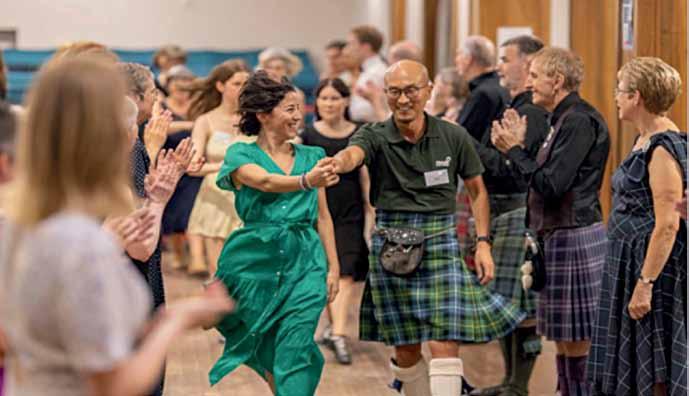
Let’s start with the physical perks. In 2010, researchers from Strathclyde University, Glasgow, compared older women dancers with their non-dancing peers.1 The results? Dancers outpaced nondancing, yet still active, women in body composition, functional ability, and balance. When challenged to a six-minute walk, the dancers left the competition behind (p < 0.05, for you data lovers!).
steps, a fact endorsed by the Royal Osteoporosis Society.3 Menopausal women also find an extra helping of benefits, as explored elsewhere in this magazine (no spoilers!).
Finally, it’s important to note that the benefits of physical activity are graded.4,5 Even modest improvements can lower your risk of cardiovascular disease. Scottish country dancing offers just the right tempo for those seeking gentle, heart-friendly movement.
A recent roundup of 23 studies took a deep dive into the world of dance. The verdict? Dancing does wonders for your mood, body image, and overall zest for life. It can even help cut down anxiety and depression. 6
These benefits are great for younger folks as well. 7,8 Dance has even proven to be a secret weapon against daytime drowsiness in teens. So for those who would rather dance a jig than pump iron, it’s an appealing way to get active without setting foot in a gym.
But here’s a real showstopper: when it comes to warding off dementia, dance steals the spotlight. Among other leisure pastimes: reading, board games, jamming on a musical instrument, tennis, golf, swimming, bicycling, dancing - dancing was the only physical activity linked to a lower risk of dementia.10 Dance also improves the quality of life of people with mild cognitive impairment and more advanced dementia through positive effects on cognitive, physical, emotional and social performance. 11,12,13
Joining a community of Scottish country dancers isn’t just about fancy footwork - it’s a unique social phenomenon. When it comes to forging connections, it is in a league of its own. All ages are welcome, partners are optional, and everyone leaves with a smile. An additional secret ingredient is our irresistibly cheerful dance music. If you’re wondering about the health perks of music - yes, science has our back on that as well. 14,15
And it’s not just the Scottish country dancers who benefit. According to Keogh J. et al., a mere 8–12 weeks of dance can pump up aerobic power, muscle strength, flexibility, and endurance. Improved walking, change of direction, timed up-and-go, and stairclimb speed have been reported, along with better balance. 2
Certain dancers can expect specific physical benefits. Take osteoporosis, for example – there is nothing quite like the preventative effect of the repetitive impact of our energetic
Scottish country dancing excels as a triple treat: good for your body, your brain, and your social calendar. Personally, I’m convinced that this dance and its vibrant community make the world a brighter place. There’s nothing quite like the post-dance buzz - uplifted by our distinctive music and the company of enthusiastic friends. Honestly, can you think of a better way to enjoy “fun, fitness, and friendship”? Our motto pretty much says it all!
1. Dewhurst S, Nelson N, Dougall P, Bampouras, T. (2014). Scottish Country Dance: Benefits to Functional Ability in Older Women. Journal of aging and physical activity. 22. 146-53.
2. Justin W.L. Keogh, Andrew Kilding, Philippa Pidgeon, Linda Ashley, Dawn Gillis. Effects of different weekly frequencies of dance on older adults’ functional performance and physical activity patterns. European Journal of Sports and Exercise Science, 2012, 1 (1):14-23.
3. Shall we dance? Why we should all be dancing for our bones. Available at: https://theros.org.uk/latest-news/2017-12-21shall-we-dance-why-we-should-all-be-dancing-for-our-bones/
4. Erikssen G. Physical fitness and changes in mortality: the survival of the fittest. Sports Med. 2001;31(8):571-6.
5. Erikssen G, Liestøl K, Bjørnholt J, Thaulow E, Sandvik L, Erikssen J. Changes in physical fitness and changes in mortality. Lancet. 1998 Sep 5;352(9130):759-62.
6. Koch SC, Riege RFF, Tisborn K, Biondo J, Martin L, Beelmann A. Effects of Dance Movement Therapy and Dance on HealthRelated Psychological Outcomes. A Meta-Analysis Update. Front Psychol. 2019 Aug 20;10: 1806.
7. Salihu D, Kwan R, Wong E. The effect of dancing interventions on depression symptoms, anxiety, and stress in adults without musculoskeletal disorders: An integrative review and meta-analysis. ComplementaryTherapies in Clinical Practice, Volume 45, 2021, 101467.
8. Faria B, Frontini R, Artunes R. Body image and well-being in dance practitioners: An exploratory study. Cuadernos de Psicología del Deporte, vol. 21, no. 3, pp. 168-178, 2021.
9. Sandberg E, Möller M, Särnblad S, Appelros P, Duberg A. Dance intervention for adolescent girls: Effects on daytime tiredness, alertness and school satisfaction. A randomised controlled trial. J Bodyw MovTher. 2021, 26:505-514.
10. Verghese J, Lipton, R Katz M, Hall C, Derby C, Kuslansky G, Ambrose, A Sliwinski M, Buschke H. Leisure Activities and the Risk of Dementia in the Elderly. New England Journal of Medicine. Volume 348 • Number 25 • June 19, 2003.Pages: 2508-2516
11. Huang CS, Yan YJ, Luo YT, Lin R, Li H. Effects of dance therapy on cognitive and mental health in adults aged 55 years and older with mild cognitive impairment: a systematic review and meta-analysis. BMC Geriatr. 2023 Oct 26;23(1):695.
12. Charras K, Mabire J, Bouaziz N, Deschamps P, Froget B, Malherbe A, Rosa S, Aquino J. Dance intervention for people with dementia: Lessons learned from a small-sample crossover explorative study. The Arts in Psychotherapy, Volume 70, 2020, 101676.
13. Bennett CG, Fox H, McLain M, Medina-Pacheco C. Impacts of dance on agitation and anxiety among persons living with dementia: An integrative review. Geriatr Nurs. 2021 JanFeb;42(1):181-187.
14. Rebecchini L. Music, mental health, and immunity. Brain Behav Immun Health. 2021 Oct 21;18: 100374.
15. Zaatar M, Alhakim K, Enayeh M, Tamer R. The transformative power of music: Insights into neuroplasticity, health, and disease. Brain Behav Immun Health. 2023 Dec 12;35: 100716.
The reel deal since 1954
For 60 years James Senior has been leading the way with our extensive range of Scottish Country and Highland dance footwear. Classic styling married with high-tech full-forefoot in-built shock absorption* ensures you can look the part without getting jiggered.

Tel: 01334 880545 Email: sales@jamessenior.co.uk
* James Senior was the first to develop a completely integrated shock absorption system, medically proven to protect the metatarsal area and minimise the risk of injuries associated with Scottish dancing. manufactured by st.andrews shoemakers jamessenior.co.uk
Dr Heather Currie
by Dr heather Currie MbE. Mb bS, frCoG, DrCoG, MrCGP
Dance combines physical exertion, individual interpretation, and social interaction. It offers several advantages for people experiencing menopause:
l Physical benefits: Dance is a weight-bearing exercise that supports bone health and muscular strength while improving flexibility and balance.
l Cardiovascular fitness: Movement increases the heart rate, improving cardiovascular function and helping with weight management.
l Mental health: Learning new steps and routines stimulates brain function, which may help to counteract memory lapses and “brain fog.”
l Mood improvement: Music and movement release endorphins, reducing stress and creating feelings of joy.
l Community building: Dance facilitates connection, a sense of belonging, and mutual support—powerful antidotes to isolation.
While many forms of dance offer health and social benefits, Scottish country dancing is particularly well-suited to those navigating the changes of menopause. It is open to people of all fitness levels and ages.
The sequences of steps and formations are performed in lines or sets. Whether gentle or lively, they require coordination, balance, and mild aerobic effort.
The mental stimulation of remembering patterns, adapting to changing partners, and focusing on the music and intricacies of the dance keeps the mind active and positive. With uplifting reels and jigs, participants often describe feeling more optimistic and resilient after a session on the dance floor.
Dancers interacting, communicating, and relying on one another create a sense of community. This is especially beneficial during menopause, when people may feel isolated or disconnected.
Factors related to diet and lifestyle can contribute to menopausal symptoms and the effectiveness of treatments such as HRT. Lifestyle modifications, such as improved nutrition and regular exercise, can not only help reduce menopausal symptoms (even in those already taking HRT) but also improve health later in life, including cardiovascular and bone health. Not every woman wants to or is able to take HRT, and many seek additional, holistic ways to cope. Movement-based interventions, especially those that include socialising and are fun, have been shown to benefit health and well-being.
Menopause can be challenging, both for early-onset symptoms and later health risks, but it can also be a wake-up call: a time
to invest in our own health, reflect on demands and pressures, and consider what is working and what we can do differently. Whether or not we decide to take medication to control symptoms, focusing on our nutrition and exercise is essential for symptom control and improving long-term health. Find a type of exercise that you enjoy and that is sustainable. Scottish country dancing offers a particular form of exercise that integrates movement, music, and companionship; the dance floor may be just the beginning.
Dr Currie is a Gynaecologist in Dumfries and Galloway. Co-Editor ofPostReproductiveHealth, the JournaloftheBritishMenopause Society (BMS), Trustee and past Chair of the BMS, Founder and Managing Director of Menopause Matters Ltd, which runs the award-winning website www.menopausematters.co.uk and publishes the award-winning Menopause Matters magazine. The author of the award-winning book, Menopause, has published many papers and reviewed articles in scientific journals.
Previously, clinical advisor to the Scottish Government for the development of the Women’s Health plan for Scotland, Dr Currie was awarded MBE for services to healthcare in June 2021.





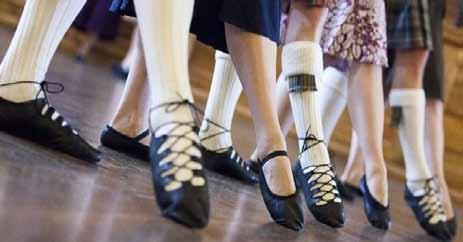

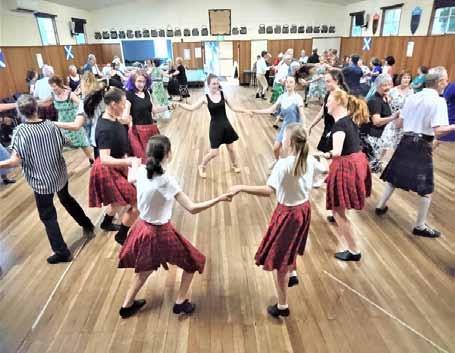

Ian Brockbank compiles the Day School Diary. Please send details to ian@scottishdance.net . Issue 43 will cover events from October 2026 to April 2027.
M AY 2026
1-3 Catalina Island Weekend Workshop & Ball, Los Angeles, CA, USA
15-17 70th Duns May Weekend, Scotland, UK
15-17 Pawling Weekend, Ashokan Center Olivebridge, NY, USA (new location)
22-23 Belfast Branch 80th anniversary weekend school, Belfast, UK
Ju NE 2026
5-7 Midwest Scottish Weekend, Beaver Dam, Wisconsin, USA
12-14 CAMMAC Scottish Country Dance Retreat, Harrington, Quebec, Canada
28-Jul 5 49th Australian Winter School, Melbourne, Australia
24-28 RSCDS Germany Summer Course, Kuckucksnest, Schlüchtern, Germany
Ju LY 2026
5-11 Blue Ridge Scottish Dance School, Boone, North Carolina, USA
19–Aug 16 RSCDS Summer School, St Andrews, Scotland, UK
18-Aug 2 TAC Candidate Course, Medicine Hat, Alberta, Canada
24-26 TAC Teachers Conference Weekend, Medicine Hat, Alberta, Canada
26-Aug 2 TAC Summer School, Medicine Hat, Alberta, Canada
Au G u ST 2026
19 Jul–Aug 16 RSCDS Summer School, St Andrews, Scotland, UK
S EPTEMBER 2026
4-6 TAS 20th Anniversary Weekend, Dundee, Scotland
11-13 Breton Branch, Scottish Weekend & Day School, Josselin, Brittany, France
18-20 Scottish Weekend, Camp Saginaw, Oxford, PA, USA
19 Leeds Branch, Advanced/Intermediate Workshop, Headingley, Leeds, UK
26 Ayr Branch Half Day School, Walker Hall, Troon, Scotland, UK
25-27 Central Germany Branch SCD Weekend, Kuckucksnest, Schlüchtern, Germany
O CTOBER 2026
2-4 Seattle Branch, Fort Worden Workshop, Port Townsend, WA, USA
3 York & N. Humberside Branch Half-Day School, Stockton on the Forest, York, UK
9-11 RSCDS Paris Branch October Weekend, Paris, France
11-14 Mervyn Short Scottish Country Dance Break for advanced dancers, Great Malvern, UK
15-18 Central Germany Autumn Course, Kuckucksnest, Schlüchtern, Germany
17 London Branch Day school & dance, Maria Fidelis School, London, UK
17 London Branch musicians’ workshop, Maria Fidelis School, London, UK
23-25 Calgary Branch 50th Anniversary Weekend, Calgary, Alberta, Canada
31 RSCDS Sheffield Autumn Day School, Sheffield, England
N OVEMBER 2026
6-8 Northern Virginia Branch Argyle Weekend, Arlington, VA, USA
7 Nova Scotia Branch Fall Workshop, Dartmouth, NS, Canada
13-15 RSCDS Croydon Weekend School, Hotel Cumberland, Eastbourne, England, UK
13-15 Northern Italy Branch SCD weekend, Bologna, Italy
14 Bristol Day School, Oatley Hall, St Monica Trust, Bristol, UK
18-22 Central Germany November Course, Kuckucksnest, Schlüchtern, Germany
27-28 Belfast Branch 80th Anniversary Weekend, Belfast, Northern Ireland
27-29 Leeds Branch Weekend School Malhamdale, Newfield Hall, Malham, Skipton, UK
D ECEMBER 2026
28-5 Jan 2027 RSCDS NZ Branch Summer School, Auckland, New Zealand
The Day School Diary just has space for day and weekend schools. For other events in your area, please check: l Scotland and Cumbria: https://scotdancediary.co.uk/ l Europe: https://www.celtic-circle.de/events.html l Canada and uSA: https://calendar.google.com/ calendar/embed?src=northamericanscdevents%40gmail. com&ctz=America%2FNew_York
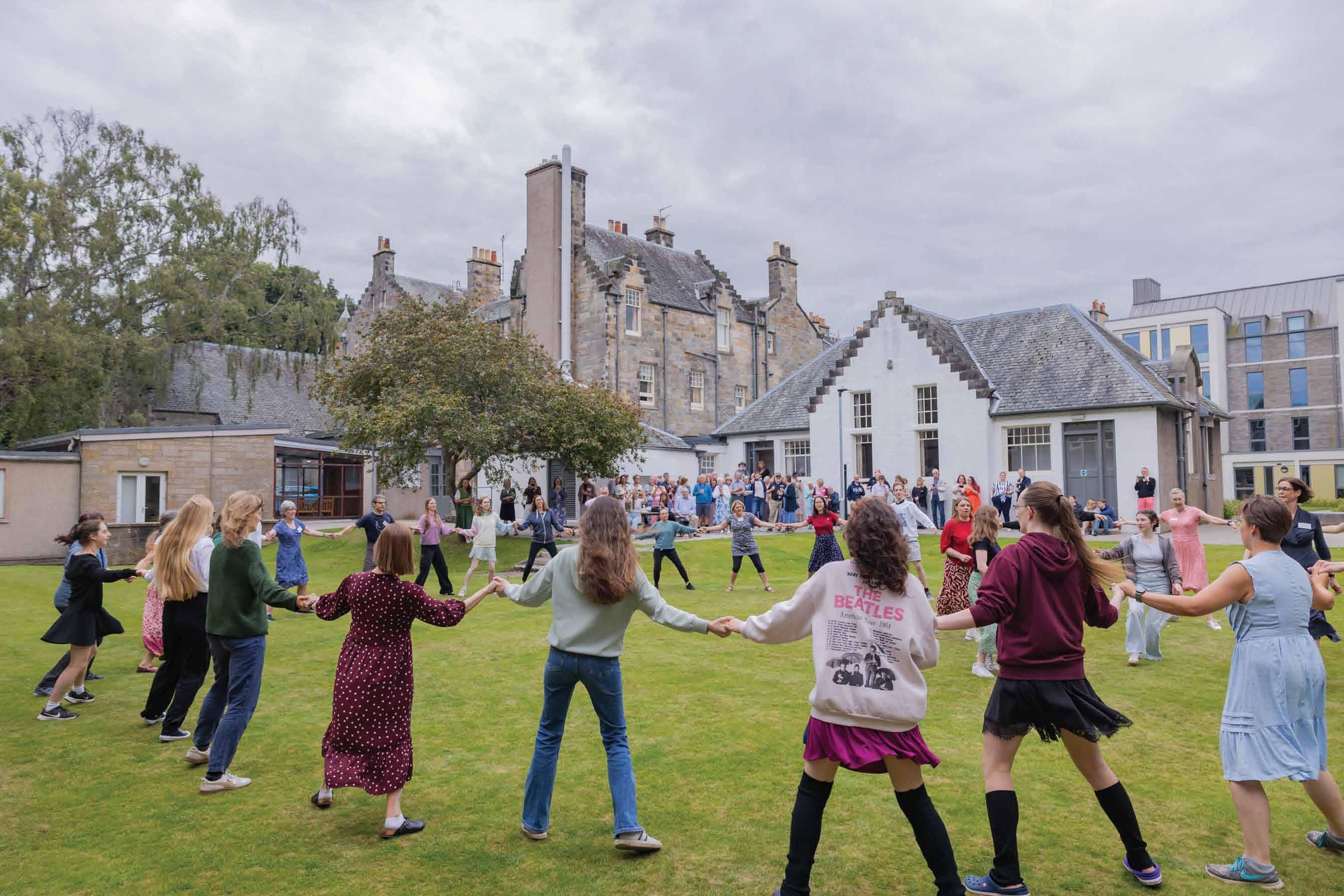
“