SCOTTISH
Country Dancer The Members’ Magazine of the RSCDS
No 29 October 2019
2
www.rscds.org
Editorial
Contents
The cover photograph of this issue is from the Saturday Ball of the highly successful Spring Fling and Fringe in Paris. It shows the smiling faces of dancers of all ages. Mathieu Trouillet’s brilliant photographs of the weekend are testament to a wonderfully organised event of both serious and fun-filled classes, inspiring music, and inclusive, enjoyable evening dances.
RSCDS Events
2
News from Coates Crescent
4
Chairman and Convenors’ Reports
6
Born into the Society – Janette McSporran
8
The Opinion column in this issue is by the well-known Parisian teacher, Antoine Rousseau. He gives us the background to the success of Paris Branch and its mission to attract new dancers. Antoine gives sound advice to all branches trying to recruit young adult dancers. Well done Paris! On the theme of recruitment, Diana Hastie of Sydney Branch describes the success of beginners’ classes not only in the Branch but also in nearby clubs. Recruiting beginners is not easy, wherever you are. It should be the primary aim of the RSCDS – bringing country dancing to the general public. The magazine has always contained articles about our history. We seem to be celebrating a lot of significant Branch Anniversaries at the moment and it is right and proper that we do so. In my interview with Janette McSporran we learn more about the early years of the Society. Janette’s father was one of our founders at that first meeting in November 1923, and her mother was one of our earliest teachers, a friend of Jean Milligan, and a direct link with our roots. We need to know more about the 20s, 30s and 40s, so if you know of anyone with any memories of that time, please ask them to be in touch with us. Looking back on past issues, we seem to have neglected the Festival scene. Festivals take place all over the world, but one of the oldest and certainly the largest is the Aberdeen Festival, running over two days every March. Martha Harris, who has been the organiser for many years, gives us a flavour of what it is like. With so many schoolchildren taking part, it is a big community event finishing up with dancers and audience coming together in an exuberant Dashing White Sergeant.
In My Opinion – Antoine Rousseau
11
Country Dance News
12
The Aberdeen Festival
15
Spring Fling
16
Summer School
17
Branch Anniversaries
18
Beginners in Sydney
20
Young Dancers
21
Dancing Around the World
22
Letters to the Editor
26
Reviews 28 Sadly Missed
29
Day School Diary
30
More News
30
When I was in the middle of editing this issue, I got an email from a Branch to the ‘staff’ of the magazine. We on the Editorial Team are all volunteers!
The next issue of Scottish Country Dancer will be published in Aprill 2020. Please refer to Notes for Contributors on the website. Send materials for inclusion to the editor: mag.editor@rscds.org no later than 1 February 2020.
The feedback from the last issue is that you prefer the new format of Dancing Around the World, where any branch or club can write in, rather than the system of area correspondents. One constant problem the Editorial Team has is branches and groups keeping their events secret! If there is no report of your branch’s amazing successes this year, it’s because nobody sent anything to us, and if your group’s day school is not in the Day School Diary, it is because nobody told us. Please do check with your club or branch secretary that they are keeping us informed.
Please send enquiries about advertising to Cécile Hascoët: mag.advertising@rscds.org
Finally, one small request. Most of the photographs we receive are labelled IMG_20190601_194505.jpg. It would really help us if you re-labelled them with your name or branch.
Jimmie Hill, Edinburgh Cover: Spring Fling, Paris. Photograph by Mathieu Trouillet. Gabriel Perea for photographs on page 8 and 18; Fotosearch for p11 and 20; Walter Kerr for the picture of Duncan Macrae on p9; Mathieu Trouillet for p16
Editor Jimmie Hill Editorial Team Caroline Brockbank, Helen McGinley and Jean Martin. Publisher The Royal Scottish Country Dance Society 12 Coates Crescent, Edinburgh, EH3 7AF Website www.rscds.org
Telephone Email 0131 225 3854 info@rscds.org
Graphic Designer Its All Good The Haughs, Cromdale, Grantown on Spey, PH26 3PQ info@itsallgood.org.uk t: 01479 870 435 Printer J Thomson Colour Printers Ltd, 14-16 Carnoustie Place, Glasgow G5 8PB The Royal Scottish Country Dance Society is a Scottish charitable company limited by guarantee. Registered Office: 12 Coates Crescent, Edinburgh EH3 7AF Charity No: SC 016085 Company No: SC 480530
www.rscds.org
3
News from Coates Crescent Branch Awards update The RSCDS presents Branch Awards to members who make a contribution in support of their local Branch, and once again a number of individuals have been honoured. Listed below are all those members who have received Awards since October 2018 – congratulations to you all! Aberdeen Lynn Wood Berks, Hants, Surrey Border Deborah Draffin Birmingham Joan Williams Birmingham Kenneth Reid Bournemouth Valerie Scriven Bournemouth Mary Phippard Carlisle Joe Murphy Castle Douglas Deanna Hutchison Central Germany Carola Fischer Exeter Laura Brown Exeter Duncan Brown Gothenburg Claes Lindeborg Helensburgh and District David Reid Helensburgh and District John MacCallum Herefordshire Margaret Campbell International George Flett International Christopher Harris Inverness and District Elizabeth MacKenzie Leeds Irene Dracup London, Ontario Karen and Scott MacCrone Los Angeles Doris Fisher Los Angeles Deanna St. Amand Manchester Helen Freer Melbourne Sheena and William McLatchin New Zealand Alan Burn New Zealand Maureen Robson Ottawa Claire M. ApSimon Richmond Geoff and Jan Robinson San Francisco Eugene Bissell South Wales Jan Proudfoot South Wales Catherine Marianne Gray St Andrews Jonathan Wilson Sydney Helen Margaret Wales Tokyo Etsuko Ikema Toronto Association Margaret Rieger Vancouver Isobel Hyde Vancouver Jack Vlug Since Branch Awards were introduced in 2004, 467 members have received one. 120 branches have given at least one award, with Vancouver leading the way with 21. For more information about Branch Awards, visit: www.rscds.org/get-involved/membership/member-recognition
4
www.rscds.org
Two Members of Los Angeles receiving their Branch Awards – Deanna St Amand (left) with Doris Fisher
Elections to Management Posts Nominees for this year’s elections are listed below. Their profiles are on the website. The results will be announced at the Autumn Gathering on 2 November 2019.
Management Board 4 places, no nominations received.
Education and Training 4 places, 3 for 3 years, 1 for 1 year. Allana Creighton Deirdre MacCuish Bark Anne Robertson Chris Ronald Angelika Schmidkonz Mervyn Short
Membership Services 3 places, no nominations received.
Youth Services 3 places, 2 for 3 years, 1 for 1 year. Malin Altenmüller Margaret Lambourne Philippa McKee
Motion to AGM 2019 ‘The Management Board proposes that for the year from 1 July 2020, the basic full annual subscription shall be reduced by £2.00 to £18.00, with other membership subscriptions based pro-rata on this amount.’ Management Board. See the Chairman’s column on page 6 for the background to this motion.
New Publications Thirty Popular Dances – Volume Two will be going on sale for the first time at the Autumn Gathering, along with the accompanying CDs. One CD was recorded by James Coutts and his Scottish dance band and the second is a compilation CD. The two CDs cover all the dances in the book. The selection includes some well-known dances that have retained their popularity over many years. We hope you will enjoy this fantastic new publication which will also be available to purchase from the website. Just a reminder that the The Imperial Book of Scottish Country Dances, Volumes 4, 5 and more was also published earlier this year, along with our calendar for 2020 which is a celebration of Scottish country dancing and was created by the Membership Services Committee.
Your SCD magazine in digital form Following consultation, we listened to your feedback and members can now choose to be emailed a digital copy of Scottish Country Dancer as soon as it is published. By doing so, you will help us to reduce our carbon footprint and reduce costs. To receive your future edition in digital format, remember to log on to the website, click ‘Edit my Profile’ and tick the relevant box. If the option is not ticked then you will continue to receive a paper copy of the magazine.
Marketing Strategy Over the course of Summer School, we held a number of focusgroup sessions to seek feedback on various aspects of our new marketing and communication strategy. We would like to thank everybody who contributed to these sessions, and please note that further opportunities for all members to share their views will be available over the next few weeks.
RSCDS Staffing – New Office Manager
She has fond memories of attending Scottish country dance lessons when she was about 10 years old, taught after school by her Primary 6 teacher. She enjoys ceilidh dancing and has also attended Scotch Hop in Linlithgow, the annual summer dances held in the courtyard of Linlithgow Palace and organised for 30 years by Society member, John Carswell. Clare loves dancing and has taken ballet and tap classes as an adult. She very much appreciates how dancing contributes to our physical, mental and emotional well-being. She is keen to support the team of seven staff in the office and she was very impressed by all the work done by members at Summer School. She finds us a remarkable organisation and is looking forward to working with all the volunteers who contribute so much. The biggest surprise for her was realising how international the Society is and how passionate people are all over the world about our dancing.
Volunteers Wanted 1. Editor of Scottish Country Dancer The current Editor of Scottish Country Dancer was asked by the Management Board to produce six issues. The April 2020 issue will be his last. We want to appoint a successor soon so that he or she can shadow the current Editor for his last issue before taking over from the October 2020 Issue. 2. Music Director Ian Muir comes to the end of his term as Music Director in November 2020 after six years in the role. We are planning to appoint his successor early next year so he or she has the opportunity of shadowing Ian before taking on the job. Music Directors normally serve for three years. If you are interested in either of the above roles, please contact office.manager@rscds.org for a job description and application form by 30 November.
Be Part of a Tradition!
Asilomar Weekend Workshop RSCDS San Francisco Branch
2019: 1 November - 3 November 2020: 30 October - 1 November World-Class Teachers Friday Welcome Dance & Saturday Ball Live music for all classes Clare MacGregor, Office Manager
We are delighted to welcome Clare MacGregor as our new Office Manager in Coates Crescent. Clare grew up in Linlithgow, near Edinburgh, and apart from living in Glasgow as a student and spending a study abroad year in America, she has always lived in or near Edinburgh. She comes to us from a career in Higher Education where she worked in student recruitment to encourage young people to go to university.
Join dancers from near & far at Asilomar! Asilomar Conference Grounds, Pacific Grove, California by the beaches and tidepools of the Monterey Peninsula Visit our website for more information
Asilomar.rscds-sf.org www.rscds.org
5
From the Chairman
Education and Training Andrew Kellett
Getting away from Coates Crescent and meeting and dancing with members has been a highlight of my first year in the chair. As I wrote in my previous column, it is with you, in our branches and groups, that many of the charitable objectives of the RSCDS are achieved. Thank you, again, for what you do, and I look forward to seeing many of you at our Autumn Gathering in November. We have re-branded the Annual Conference as an Autumn Gathering to emphasise that it is a dancing and social weekend as well as a ‘business’ event. However, for an organisation like ours, the AGM will remain an important part of the Gathering.
Malcolm Brown The work of the committee is ongoing, and when things are changed it is hard to keep everyone informed. If you are involved in anything to do with E&T, I recommend looking at the E&T Noticeboard on the website to keep abreast of new developments. We have run two DAA Assessor training courses this year, one in Edinburgh and one at the TAC Teachers’ Weekend in Calgary. We are working on taking the material used in these courses to develop an on-line course. The Syllabus for the DAA has been revised, and the latest information is now on the website.
“Reduction in the annual subscription” At every AGM delegates from your branch are asked to vote on a Management Board motion proposing the level of membership subscription for the following year. For the last three years the Board has recommended no increase, and I expect at this stage those of you experienced in Society AGMs will think you know what’s coming next. Well, you would be wrong. At this year’s AGM the Board will recommend a reduction of £2 in the annual subscription that members pay to Coates Crescent (with the usual variations for juniors and multiple-member households). At the same time, we are recommending that branches increase by the same amount the local fee that members pay to their branch. The net result would be that members pay the same, the Society would have the same level of income worldwide, but there would be an adjustment in where money is available to be spent. Branches would have some extra cash to spend on promoting Scottish country dancing locally. For most branches, £2 per member is not a lot, but enough, for example, for a half-day workshop or live music at an event or an initiative to take dancing to the public. It can help to make a difference. The Board is confident that the corresponding loss of income at Coates Crescent will not result in any diminution in the services provided by the office. Branches will still be eligible to apply for funding from the Jean Milligan Memorial Fund and the Development Fund. In addition, the Board will oversee further improvements to the Society’s website, introduce a ‘social’ teaching qualification and finance material to support a marketing strategy. However, all this activity at the centre will not result in new dancers and new members without the efforts of branches. The RSCDS must be funded appropriately at the centre and at the local level. This includes the distribution of the money paid annually by members to Coates Crescent and their branch. In proposing this motion, the Board is not claiming it achieves the ‘right’ balance, but it does recognise the essential role that branches play within the RSCDS. Do encourage your branch committees, and through them your delegates, to support the motion, and accept the challenge of doing something positive with the cash, no matter how small, to further Scottish country dancing in your area. I look forward to hearing, a year or so from now, what has been achieved.
6
www.rscds.org
The DAA Assessors’ Course held in Edinburgh
There are many scholarships available to assist people attending Summer School, as well as some for young people attending Spring Fling, and we have just added some more to assist people to attend Teacher Training courses at overseas schools. Again, details can be found on the website. We have now reached a point in the development of the new website where we plan to incorporate it into our exam processes. The teacher training, DAA and Medal Tests processes are fairly similar and the intention is to develop a web interface to record everything in the Membership Database. Talking of exams, we have just received notice of Marilyn Watson’s resignation as one of our examiners. Marilyn has served the Society in many ways over the years. As well as being an Examiner and DAA and Medal Test assessor, she has trained young dancers who have gone on to become teachers, served on the Youth Committee, and as a member of the team at Summer School working with young people.
New course – Core Training for Instructors Arising from the teacher training review there have been two initiatives; one is known as the ‘Teacher Resource’, which is a web-based series of documents and videos, in three ‘layers’. The top layer, or introductory level, is up on the website and can be found on the eLearning page as ‘Enjoy Scottish Country Dancing! Teachers Handbook’. The other initiative is of course the new CTI (Core Training for Instructors), which will be launched at the Teachers’ Conference as part of the Autumn Gathering. At the AGM in November I come to the end of my three-year term of office, so this will be my last report for the Magazine. I would like to take this opportunity to thank my committee for all their support, and send Anne Taylor the new Convenor my best wishes for the future.
Membership Services
Youth Services
Peter Knapman
Joana Stausberg
My first year as convenor of Membership Services is just about over with no major mishaps so far.
I thoroughly enjoyed this year’s Young Dancers’ Week at St Andrews – more than 50 dancers aged 8 to 16 and a large and happy bunch of ‘young but not that young’ ones.
We have recently produced a calendar for 2020 showing a wide range of dances and associated pictures which also contains some interesting additional information. It looks great and is available at the shop. The committee has been busy with the video project and we are extremely grateful to all the branches that have volunteered to take part. However, as of now we have reached a bit of a hiatus with the project, working through videos that have been recorded to date. This has highlighted a bit of a bottleneck in the editing. So, for the immediate future we are putting a hold on recording any more videos. Once we start to move forward, we will again be asking for volunteers to record the remaining dances. Our main task for this year has been to put together Thirty Popular Dances – Volume Two, which will be available at the Autumn Gathering in November. The book will be more than just a set of instructions for the dances. It will also include additional information covering topics such as the devisers of the dances, history of the dances – and background to some of the music. Our aim is to educate and entertain by providing background information rather than just instructions: putting the dances and music into a context. I hope you enjoy this. Thirty Popular Dances – Volume Two has been used as the basis for the Friday night programme at this year’s Autumn Gathering, augmented by a few dances from the original Thirty Popular Scottish Country Dances plus one other: The Eightsome Reel. Why The Eightsome? Well, we can rightly be proud that Scottish country dance is a living and developing tradition but for this tradition to be relevant we should not lose sight of our roots. In this respect The Eightsome is arguably one of our most iconic dances.
The Eightsome – one of our most iconic dances It is still danced regularly in Scotland at social functions outside the narrow confines of the Scottish country dance circuit and it is instantly associated with Scotland and its music. Whilst it is not the oldest dance in our repertoire – the earliest references being in the late 19th century – its roots go back much further. The dance is a compilation of different Scottish dance traditions, combining elements of quadrilles, Scottish reels and country dancing, all wrapped up in a simple but effective social dance with amazing traditional Scottish music. Although it is a fairly straightforward dance, its appeal is not just its history and tradition but in the pleasure of dance and moving to music. It doesn’t matter whether you dance The Eightsome Reel beautifully in accordance with the RSCDS tradition or whether you relax a bit, let your hair down and stop worrying about how you dance: just join in and celebrate taking part in a dance with roots going back many years.
To me, the best part was the social dancing on the last night, when all generations mixed on the dance floor to the wonderful music of the musicians’ course ensemble. The evening had the thrill of a really good social dance: dancing with our best friends, the pride of managing a dance well, and the relief when experienced dancers help us through a dance. The atmosphere was exhilarating: it was also very tolerant, something which I would like to thank all participants of that week for.
All generations mix at St Andrews. So, what can we do to offer more children and teenagers such dance experiences? There are lots of children’s classes – how do you link these with your wider local dance scene? Do you hold regular family ceilidhs? We want to hear your success stories because the gap between children’s classes and the local dance community is a worldwide issue we need to address. Please get in touch: ysc@rscds.org.
Young people at Summer School
One of our plans is to support affordable family weekends that allow families to bring small children, too. Would your branch be interested in getting involved with that? Workshops aimed at young dancers are also important. Do ask us for support if you want to start one. We are most grateful for the Scottish Schools Working Group, which the Management Board introduced last year. Already, initiatives like the schools’ accreditation programme reach out to numerous school children, and Active Schools has proved a very worthwhile way to introduce Scottish dance in Dumfries. Now, what will autumn bring? In early November, the Autumn Gathering encourages young dancers and university groups to come to the Friday night especially. The end of November sees Global Youth Week, when branches worldwide get creative – we so look forward to all your videos, texts and photos on social media! And we’re curious which initiatives will be granted the Youth Development Award. The elections for committee members will bring new faces to Youth Services. Thanks go to Marilyn Watson, for 4 years of good ideas, support and encouragement on the committee.
www.rscds.org
7
Born into the Society
Janette McSporran with Jean Martin and Andrew Kellett at Dunfermline’s 90th.
There are few people in the Society with memories of the pre-war period. Janette McSporran is one of them. Originally from Glasgow, Janette was ‘born into the Society’ – both her parents were very much involved in the early years of the Scottish Country Dance Society. Her father, Capt. Robert Percy Thomson, was one of our founders, present at the Inaugural Meeting in 1923. He fought in the 6th Battalion of the The Highland Light Infantry – the famous HLI – during the First World War, rising to the rank of Captain. He had graduated MA from Glasgow University in 1906 and after the war worked as a solicitor. Through his involvement in music he knew Michael Diack, another of our founders, who suggested he might like to come along to the meeting on 26 November 1923. Janette’s mother, Margaret (Daisy) Campbell, knew Jean Milligan and had danced in her team of dancers before 1923. She then taught in the early years of Summer School. The Thomsons knew the Milligans, living in the same part of the city. While only 3 years old Janette attended Summer School with her mother, who was teaching there in 1933. Janette herself became a pianist at St Andrews. Janette eventually moved to Dunfermline, where she is Branch President and still dances regularly in class and at dances. In this interview with Editor Jimmie Hill she reminisces about many aspects of dancing and the Society. How did your father know Michael Diack? My father was very musical. Not only was he a member of a musical club, he sang in choirs, so maybe that was where he met Mr Diack, who was really very well known in the musical world and not just in Glasgow. My father was also a piper. What do you know of Mr Diack? Well, his arrangements in the early books are classic. I remember Muriel Johnstone years ago saying that she wouldn’t change any of Michael Diack’s harmonies in the early books. She said she would never change anything Diack did. And then after Diack we got Herbert Wiseman. He was Director of Music in Edinburgh, then Director of Music at BBC Scotland. His arrangements are very artistic and very clever. Both Diack and
8
www.rscds.org
Wiseman really were very distinguished people. Wiseman was a ‘very Edinburgh’ sort of person. Later on, Diack and the Society parted company and the Society started publishing its own books.
Percy Thomson, Janette’s father
How involved were your parents in dancing? My father became Secretary of Glasgow Branch because he was a solicitor. There wasn’t much for a solicitor to do in Glasgow in the 1930s. This was during the Depression. My father liked country dancing and he went to St Andrews. As well as the Branch, there were also dancing clubs. My mother was in a little dance group which Miss Milligan had started before the Society was founded. They did both ballroom and country dancing. My parents married in 1929. So when Miss Milligan wanted someone to
teach a certificate class at St Andrews, she asked my mother, making her one of the first teachers to teach candidates at summer school, but, of course, she never had a certificate herself. In the 1930s in Glasgow there were country dance ‘circles’ – groups of like-minded people who met once a week or once a fortnight for country dancing. There was the Doctors’ Circle – they lasted till after the war – they mostly lived in the Park district of the city, where many doctors lived. My parents danced with them during the war, and I went there once or twice after the war with them. It petered out in the late 1950s. And there was the Belmont Circle – that’s where my folks mostly went. There were other districts of the city where there were other country dance circles. There was a lot of dancing in folks’ houses. I remember we got a parquet floor laid in our house so that we could have little country dance evenings in the house with a pianist. Glasgow was full of pianists at that time. My mother was not a pianist, but she played. There was always dance music on the piano at home. An important person in the early days was Colonel Gooderson. He was the last of the ‘gym sergeants’ – retired army sergeants who taught PE and country dancing in the schools before there were properly trained PE teachers. Do you remember Mrs Stewart? No, I never saw or met her. I remember my mother’s friends talking about her at St Andrews before the war. She used to treat them as if they were in a girls’ boarding school! A lot of those aristocratic people who were involved in the Society knew nothing about the practicalities of organising dancing. I knew the famous Margaret Morris, the founder of Scottish Ballet and husband of the Scottish Colourist JD Fergusson. My mother knew her, as did Miss Milligan. She had no idea how to organise anything – unlike Miss Milligan who was eminently practical. Margaret Morris loved cultivated people with titles, but in my experience they are of no use practically and won’t part with a penny! In those days every branch had a titled person at the top of their notepaper. You knew Miss Milligan’s family, didn’t you? Yes, she was one of six. She had three brothers. Her sister, Gertude, taught Classics and Margaret taught English Literature, but in their eyes Jean was ‘just a gymnast’! Little did they know that Jean would be voted Scotswoman of the Year in 1973, would travel all over the world and be fêted wherever she went. All three sisters lived together in the same flat until they died. None married. They lived in Rosslyn Terrace, just off Great Western Road. When their mother died, they moved a few streets away to Roxburgh
St, and they finally moved round the corner to Saltoun Street in Hillhead – all beautiful houses. In the RSCDS we have a high opinion of Miss Milligan and think she is wonderful, but at home she was considered the black sheep of the family. Her sisters had gone to university – she hadn’t. Physical Education was her chosen career, but it was an unusual one at that time for a woman. After she trained down in Dartford, she got a very good job in the teacher training college in Glasgow. I don’t think she ever worked in a school – she went straight into teacher training. And of course, the gym teachers she trained went all over the country. Jean Milligan was an extraordinary woman, very interesting and amusing – and her sisters were the same. My mother knew them all quite well. There is no question in my mind, Jean Milligan was a brilliant teacher.
The famous Scottish actor Duncan Macrae What are your memories from the 1930s? My mother took me to St Andrews one year when I was little and I stayed with her. There is a photograph in the Society Archive of my mother and me with Winnie Forgan on the beach about 1933 when I was 3 years old. My mother taught at St Andrews in the very early years before she got married in 1929. She taught in Glasgow Branch and I remember she taught down in Greenock. Greenock was quite a place for country dancing. And you’re from Millport on the Isle of Cumbrae. You will remember Duncan Macrae, the famous actor, because he had a house there. His real name was John, but his stage name was Duncan. Before he became famous, he was a primary school teacher – well known for his teaching of country dancing in Glasgow primary schools. Miss Milligan was full of praise for his teaching. What are your earliest memories of the Society? I went to a children’s class in Glasgow before the war. Winnie Carnie worked at
the Athenaeum, where the Society was founded. She had a children’s dancing class – it was more eurythmics than country dancing. The class was held in either Paterson’s or Cuthbertson’s Music Shop. In those days these music shops had studios attached to them which dance teachers could hire and my mother took me to a children’s class in one of them. I remember it well. It was 1938 because Book 12 had just appeared and we all learned The Machine Without Horses. We thought we were so smart doing the very latest book! Then the war came and my school was evacuated up to Auchterarder in Perthshire. We had country dancing in school there. Our teacher, a Miss Cessford, had brothers in the Services and one of them was among those captured at St Valery. When The St Valery Reel was devised in the POW camp, the soldiers were told to send it home, which they did, but the Germans thought it was a secret code so they stopped all the letters – except one – the one which arrived for my teacher, Miss Cessford, in Auchterarder. In 1940 she taught us the dance, which became known as The Reel of the 51st, so my class of ten-yearolds danced it before anyone else in the country! It must have been in the autumn because I remember going home to Glasgow for Christmas and my folks told me about this new dance. “I know,” I said, “we’ve been doing it!” Once the dance got home, it became popular and there was no stopping it. Some people think that dancing stopped in Glasgow during the war, but it didn’t. My father was busy in the Home Guard and doing fire-watch duty, but my mother certainly went to a class. Miss Milligan had her class all during the war. When did you start playing for country dancing? I was sent to music classes and at home we had all the Society books as well as all my father’s pipe music. I was about 16 or 17 when I began playing for classes. It didn’t pay as well as working in a shop or a café but it was quite a nice way of earning a little. I think I got one and ninepence an hour and I played for Glasgow Branch all through my time as a student. That is 9p an hour in today’s money – only a few pounds. All my mother’s family were ministers or teachers, so I did a degree in history then trained as a teacher at Jordanhill. It was just after the war and the universities and colleges were full of ex-service people. I first taught in Glasgow, then Clydebank, then at a private school, before moving to Dunfermline. Throughout my working life I continued to play for country dancing. I really enjoyed playing for the children’s class in Stirling and for Alan Macpherson’s technique class, and, of course, I played at St Andrews – first in 1950, when I was just twenty years old.
www.rscds.org
9
Jean Milligan really favoured the piano, didn’t she? Yes, and she hated the accordion. I think she felt it was not the right instrument for a class. If you use the accordion in class, the musician needs to get a good ringing, singing tone. The playing used to be a bit faster than today and there was a time when there were no slow airs for strathspeys. If you slow the music down, you need good technique. Did Miss Milligan teach at all levels? Well, she was always given the most advanced classes. She was so popular she only allowed fully certificated dancers into her class at St Andrews. That’s why, when we were learning to dance, we all took our certificates – just to get in to the good classes. Miss Milligan certainly liked the best class. She was full of nonsense, but everyone made allowances for her. She would open her mouth and say anything at all, which made her very amusing in class. Miss Milligan in Glasgow taught gymnasts while Allie Anderson in Edinburgh taught children. Was their approach very different? They sparred with each other! Miss Milligan was a little afraid of Allie Anderson. I didn’t know Miss Anderson very well, but I do know she could be quite fierce. Allie had a big following, but she wasn’t like Miss Milligan. She wasn’t so subtle and she wasn’t such good company. Miss Milligan referred to her as ‘that woman Anderson’. I think they were in competition with each other for the top place in the Society. Allie taught skip change – not pas de basque – in turns, and it’s interesting that no modern dances use pas de basque in turns. Coming from Glasgow, there was no way we were going to turn using skip change because that was the Edinburgh style! Some people today think that Miss Milligan was very strict but I remember her teaching dancers to birl – she called it ‘pivoting’. She liked to see it done properly. She emphasised that you had to use your biceps to control the turning. Your elbow was the only muscle which would stop you fleeing all over the floor. She taught elbow grip because you can’t rely on your wrist – that gives you no support and your shoulder gives you no support. She taught birling with both the pivot hold and the ‘waltz’ or ‘grippit’ hold – that was more what country people used. I remember one dancer who always gave you a waltz hold when turning corners. And keep the feet parallel when pivoting and don’t kick out your other foot up behind you, she used to say! Do you remember when the Society became ‘Royal’? Oh yes, I had just been in Canada for a while. I came home, thinking everyone would be pleased to see me but no, all they could talk about was the EGM when
10
www.rscds.org
The early 1950s at St Andrews with Tibbie Cramb in the middle, holding hands with Janette on the right and Margaret Brander on the left. the Society had become Royal. It wasn’t that the King made us ‘Royal’. The Society applied for it because they were afraid that some other organisation might come along and apply for it and if we were the Royal Scottish Country Dance Society, nobody else could claim the word ‘royal’. It was to give us a certain exclusivity. When you lived in Glasgow, you danced at the BBC. Oh yes, on Saturday evenings Jack Nugent conducted the BBC Light Orchestra for country dancing. They usually invited in two sets and about a dozen people as an audience. I danced on the opening night of STV in 1957. And I danced in The Kilt is My Delight (1956-1963) from the BBC in Edinburgh. The dancers usually came from Edinburgh Branch but if they were in a tizzy – they were always ‘fechting’ with each other! – the Glasgow team would get an emergency call that we were needed for this Saturday’s programme. I think the Edinburgh Branch administration was a bit dicey at the time! Of course, The Kilt is My Delight was a bit more prestigious than The White Heather Club (1958-1968). I remember going to Biarritz with Miss Milligan’s International Team in 1963. There was Nan Thomson, John Baird from Perth, Irene Fidler from Newcastle, and Charlie’s Todd’s sister, Alison. Miss Milligan just adored Charlie. He was a Fife PE teacher. When did you move to Dunfermline? It was in 1965 and what a great place for dancing Dunfermline was! It was one of the main branches and when the Queen came in 1961 to open the new office, dancers from the main Scottish branches danced for her and Dunfermline was included. Miss Milligan approved of the new Headquarters in Coates Crescent. She saw it as a kind of club where any member of the Society could go and sit and chat and meet other people interested in country dancing and they could have tea or coffee – more like a social centre for country dancers. The people in Glasgow didn’t really approve of it because it was in Edinburgh. A lot of people at the time thought that our headquarters should have included a small hall for dancing, which could be let out and provide an income, which would then
run the place. Headquarters couldn’t even host the Executive Council. We had to rent a hotel room or church hall in the centre of Edinburgh for meetings. And we had a caretaker and a flat in the basement! It was just the wrong kind of property! At the time I was young and female so nobody listened to me – but it wasn’t just me who thought that, it was most members. And now parking there is a nightmare. It’s a lovely building and it will keep its value, but it wasn’t what we needed. What did Miss Milligan think about all the new devisers who were getting their new dances published? She liked Hugh Foss. He was just her type of person. But Drewry, less so. I remember when his Silver Tassie was published with the tune Lady Charlotte Campbell. I don’t think he was articulate enough for her. It depended who you were. If she was in a good mood, you were all right. I remember there was a lot of discussion about copyright and if a dance had already been published, there might be problems if the Society were to publish it. And that was one of the reasons why the Society didn’t publish many newly composed dances. The Duke and Duchess of Edinburgh wasn’t published by us until 2001 in Book 39 and it had come out in 1948. I remember Iain Robertson could wind Miss Milligan round his little finger. He would butter her up, but I don’t think he thought much of her. I remember when Hoopers’ Jig came out in the Miscellany. She said that when you clap and cross, your hands go up. I remember her demonstrating the wrong way with your hands going down! Do you see any changes in the music we dance to? Yes, it used to be more informal. It’s much more sophisticated now. It’s more subtle with more different tunes, and different types of tune, different types of strathspey. I think before the war they didn’t use as many alternative tunes. Finally, what are your favourite dance tunes? Going around my head at the moment is Mrs Stewart’s Strathspey, and for a reel I would pick Archie Menzies.
In my Opinion Antoine Rousseau, Paris For me it is always a great pleasure, when travelling abroad to teach or to dance, to meet new and old friends, to check and compare similarities and differences between cultures and habits. Whether it is over a drink, during a teachers’ workshop, or just staying with friends, all are times to share our experiences and discover new aspects of dancing and teaching. One of the most common talking points is always the ageing nature of groups and the challenge of attracting younger dancers. I have often been asked if we have some magic gift as we have so many young people dancing in Paris! Of course, there is no magic recipe and the situation varies a lot from one group to another, depending, for example, on how big the town is, the proximity of universities, etc. The RSCDS has developed a strategy and tools such as Spring Fling,Youth Weeks, the Youth Services Committee, a Youth Branch, dedicated grants, all of which encourage the younger generation. At branch level, a lot can be done and it may be of interest here to share how the Paris Branch has evolved over the years. The original group of dancers formed nearly 50 years ago from people mostly in their 20s and 30s: this group later became the Branch. A few years later, when I started dancing as a teenager, the group was still young and extremely dynamic and I was ecstatic when I was able to go to classes or evening dances. By the late 90s, however, many of those founding members had stopped dancing for whatever reason. The Paris Branch had turned into a social but much older group. Ten years later we started a technique class, dedicated to newcomers, to complement the social class. Some young people joined; some brought their friends; the critical thing was that we attracted a core of young dancers, who then attracted more. Some started to play for class, some qualified as teachers, some joined the committee. They rejuvenated the Branch by running a beginners’ technique class at the same time as the advanced one, both followed by a social, hectic and fun dance altogether. Here are some of the tactics we have used: l What do young dancers look for when joining a Scottish country dance group for the first time? The answer is fun, friends, energy and movement. Those are their priorities. Scottish dancing can easily fulfil all their expectations. Any beginners’ class should be fun and emphasize from the start the pleasure of dancing together using energetic simple dances with driving tunes. Avoid formality. Go a little bit wild from time
to time with clapping and shouting! At the same time encourage newcomers to bring their friends, brothers, sisters, cousins to make the social experience even better. Going to the pub before and after dancing; and making use of social media are very effective ways to build relationships and create a welcoming ethos. Having special welcome nights such as a Youth Week has proven to be very valuable. l
Young dancers want technique! They insist on having more technique classes. Young dancers do not generally start dancing for the sake of technique, but they soon realize that dancing better increases the pleasure they get from dancing. I personally don’t know of any dancer who does not want to improve or, at least, dance to the best of his or her ability. This is true for all generations, but it is particularly true of younger dancers because they have the greatest potential for improvement.
l
How do we retain young people in the group for longer than a few weeks or months? This is critical. Apart from the fun and social aspect, as well as the technical challenge of dancing, it is important to ask them what they are interested in doing in the group and encouraging them. Some want to join the committee, or start MC’ing or teaching, or playing music, or devising dances, or organizing events. The energy and commitment of our young Parisian dancers is absolutely amazing. They have created a modern website, published a book of dances with original tunes, formed a band
for evening dances and organized musicians for the weekly class. They have started teaching and MC’ing, and last but not least, organized a brilliant and successful Spring Fling and Fringe here in Paris. None of this could have happened without the creation of a welcoming, inclusive ethos, where everyone is valued and their talents encouraged. Scottish dancing is global! When young dancers realize they can dance and make new friends in other parts of the world, they are hooked. Although some will move to other places to study or for their career, they will hopefully keep dancing wherever they find themselves. At the same time, we in Paris Branch are so happy to welcome young dancers who started elsewhere. This guarantees the future of Scottish dancing and the unique pleasure of all generations dancing together.
Antoine dancing at the Spring Fling and Fringe
www.rscds.org
11
Country Dance News examinations and, of course, graduation. It was also planned as a social space for students and included the installation of the sprung floor ‘for the delight of those to whom dancing appeals’. After almost a century of use, however, the Younger Hall requires a significant programme of refurbishment and upgrade. The £12 million programme of works will include improved disabled access, structural renewal and upgrades, improved sound-proofing and acoustics and new flexible lecture, classroom and tutorial spaces.
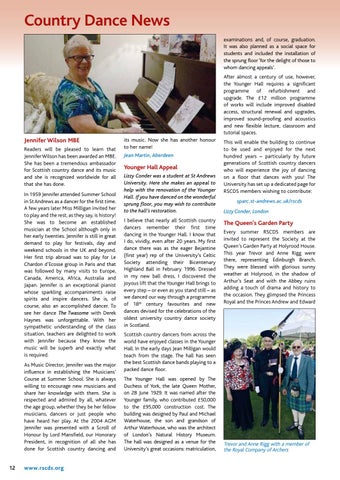
Jennifer Wilson MBE Readers will be pleased to learn that Jennifer Wilson has been awarded an MBE. She has been a tremendous ambassador for Scottish country dance and its music and she is recognized worldwide for all that she has done. In 1959 Jennifer attended Summer School in St Andrews as a dancer for the first time. A few years later Miss Milligan invited her to play and the rest, as they say, is history! She was to become an established musician at the School although only in her early twenties. Jennifer is still in great demand to play for festivals, day and weekend schools in the UK and beyond. Her first trip abroad was to play for Le Chardon d’Ecosse group in Paris and that was followed by many visits to Europe, Canada, America, Africa, Australia and Japan. Jennifer is an exceptional pianist whose sparkling accompaniments raise spirits and inspire dancers. She is, of course, also an accomplished dancer. To see her dance The Twasome with Derek Haynes was unforgettable. With her sympathetic understanding of the class situation, teachers are delighted to work with Jennifer because they know the music will be superb and exactly what is required. As Music Director, Jennifer was the major influence in establishing the Musicians’ Course at Summer School. She is always willing to encourage new musicians and share her knowledge with them. She is respected and admired by all, whatever the age group, whether they be her fellow musicians, dancers or just people who have heard her play. At the 2004 AGM Jennifer was presented with a Scroll of Honour by Lord Mansfield, our Honorary President, in recognition of all she has done for Scottish country dancing and
12
www.rscds.org
its music. Now she has another honour to her name! Jean Martin, Aberdeen
Younger Hall Appeal Lizzy Conder was a student at St Andrews University. Here she makes an appeal to help with the renovation of the Younger Hall. If you have danced on the wonderful sprung floor, you may wish to contribute to the hall’s restoration. I believe that nearly all Scottish country dancers remember their first time dancing in the Younger Hall. I know that I do, vividly, even after 20 years. My first dance there was as the eager Bejantine (first year) rep of the University’s Celtic Society attending their Bicentenary Highland Ball in February 1996. Dressed in my new ball dress, I discovered the joyous lift that the Younger Hall brings to every step – or even as you stand still – as we danced our way through a programme of 18th century favourites and new dances devised for the celebrations of the oldest university country dance society in Scotland.
This will enable the building to continue to be used and enjoyed for the next hundred years – particularly by future generations of Scottish country dancers who will experience the joy of dancing on a floor that dances with you! The University has set up a dedicated page for RSCDS members wishing to contribute: sparc.st-andrews.ac.uk/rscds Lizzy Conder, London
The Queen’s Garden Party Every summer RSCDS members are invited to represent the Society at the Queen’s Garden Party at Holyrood House. This year Trevor and Anne Rigg were there, representing Edinburgh Branch. They were blessed with glorious sunny weather at Holyrood, in the shadow of Arthur’s Seat and with the Abbey ruins adding a touch of drama and history to the occasion. They glimpsed the Princess Royal and the Princes Andrew and Edward
Scottish country dancers from across the world have enjoyed classes in the Younger Hall. In the early days Jean Milligan would teach from the stage. The hall has seen the best Scottish dance bands playing to a packed dance floor. The Younger Hall was opened by The Duchess of York, the late Queen Mother, on 28 June 1929. It was named after the Younger family, who contributed £50,000 to the £95,000 construction cost. The building was designed by Paul and Michael Waterhouse, the son and grandson of Arthur Waterhouse, who was the architect of London’s Natural History Museum. The hall was designed as a venue for the University’s great occasions: matriculation,
Trevor and Anne Rigg with a member of the Royal Company of Archers
mingling freely with the crowd in a most relaxed and informal way. They had the presence of mind to ask this very splendid fellow to pose for a photo. He is one of the Royal Company of Archers, the Queen’s ceremonial bodyguard when she is in Scotland.
and cutting of the Anniversary cake and finished with the traditional ‘Passing of the Buck’ from Christine Freeman to John Brenchley, convenor of next year’s School in Western Australia. Christine had asked attendees of the Ball and School if they had enjoyed themselves. John Brenchley replied on behalf of everyone when he said: “You know we enjoyed ourselves. Melbourne has again raised the bar.”
Last Thistle This July saw the 39th and final Thistle Summer School in Banner Elk, North Carolina. Founded by BettyLee Barnes of Washington, DC, and Ted and Marilyn Blaschke of Atlanta, the school has served dancers and clubs in the southern states of the US well over the years. Thistle built up a loyal community of dancers, teachers and musicians, most notably Bobby Brown and John Middleton of Hamilton, Ontario. BettyLee and Duard Barnes have done amazing work through all those years and are held in great esteem by all ‘Thistlers’. Next year the Atlanta and Carolinas Branches are starting a new summer school in nearby Boone, The Blue Ridge Scottish Dance School, in the same week, culminating in a visit to the Grandfather Mountain Highland Games. Eilean Yates, North Carolina, and Susan Tumlin, Atlanta
Winter School in Australia The Melbourne and District Branch were the hosts of this year’s Australian Winter School at University College, part of the University of Melbourne. The School coincided with the 50th Anniversary of the formation of the Branch, so the School had a definite Golden glow. There were over 170 dancers with almost 4 sets from New Zealand and representatives from the UK, US, Canada and Spain. Morning classes with live music were followed by a variety of afternoon events: optional Scottish dance classes; ceilidh dances; international folk dances; a music talk; and a teachers’ workshop. In addition to the usual morning class levels, a new class for Newer Dancers was offered this year to encourage dancers with less than 2 years’ experience to attend Winter School and improve their technique while having fun. This class was taken by Cairistiona Tait from Australia. Other teachers at the School were Linda Henderson from the US, Graeme Donald from Spain, and Patsy Marks and Jan McCudden from Australia. Evenings were filled with social dancing to music provided by the School musicians assisted
Leanne Smith
Sailing to a dance! Cutting Melbourne’s Anniversary Cake Photo: Margaret Gawler by local musicians, a musical evening, a formal dinner and ball, and all these were followed by after-parties for the young at heart. As part of Melbourne’s 50th Anniversary celebrations, members were asked to devise dances to mark the occasion. The resulting book, A Melbourne Miscellany, containing thirty-one dances has been published by the Branch and was launched by Frances Wallace, the co-ordinator of the project, at the School. The Golden Age Strathspey devised by Rachel Goerke from the Werribee SCD Group was selected from these dances to be included on the dance program for the Ball. An original tune was composed for the dance by Matthew Robertson and named for Christine Freeman, the convenor of this year’s School. A highlight of the School was ‘The Musicale’. Matthew Robertson, the Winter School Musical Director was joined by our wonderful musicians Kathy Fraser-Collins, Ian Muir, Judi Nicolson and Sharlene Penman to explore Scottish music from all aspects, not just dance music. As an extra treat, we had guest musicians joining in: Fred Collins on drums, David South on piano accordion and piano, Isaac Ganoo on double bass, Allan Evans on flute, Ian Marks on guitar and song, Don Chitts on bagpipes large and small, Peg Whalley on piano, Cecilia Johnson on harp and last but not least George Copper on accordion. It was a wonderful way to celebrate Kathy’s birthday and Fred and Kathy’s wedding anniversary. The School ended with a Grand Ball to celebrate Melbourne’s 50th Anniversary at the historic Collingwood Town Hall attended by both School attendees and the wider Melbourne and District Branch community. The Ball started with a toast
Ian Whittaker of Duns and District Branch has a novel way of arriving for a dance weekend – on his boat, the ‘Ros Donn’. It was built in 1954 as a fishing boat in Killybegs, County Donegal. Ian bought the boat in 2010 and converted her to use to cruise around the West Coast of Scotland. He lives on the east coast, but attends dances in the summer on the west coast. So far he has arrived at dances at Killmallie, Islay, Cumbrae, Oban and Lismore! He tried to get to Helensburgh and Ballachulish this summer, but the weather was against him.
Ian Whittaker on his way to a dance
Law Society of Scotland Jig Patricia Wilson is a country dancer who works for the Law Society of Scotland. This year it celebrates its 70th Anniversary. It is the professional body for all Scottish solicitors, existing to assure members of the public that when they instruct a Scottish solicitor, they can trust that they are dealing with highlytrained and regulated professionals. Patricia wanted to give back something to the Law Society for all that it has done for her. As a keen Scottish country dancer, she devised
www.rscds.org
13
a jig called The Law Society of Scotland 70th Anniversary. Ewan Galloway composed a tune called The Law Society of Scotland Platinum Jig. Patricia taught the dance to some of her work colleagues. They were full of enthusiasm and they danced the dance at the Law Society Gala Dinner and the guests enjoyed their dancing demonstration. If you would like a copy of the dance instructions with the music, email Patricia at IASW1933@gmail.com
would be interested to hear from other teachers / callers / MCs who use recorded music regularly. If you are willing to share your secrets, they could be combined into an article for the next issue of Scottish Country Dancer, and everyone could benefit. Please send Caroline your helpful hints for getting the best out of recorded music to ceilidhkids@ceilidhkids.com
The Fringe classes were held in the beautiful university sports complex dance studios which were bright and had good floors. Each of the two classes had four sets which made for an enjoyable and very sociable two days. Corinne Hilpert and I taught the classes and the music was in the very capable hands of Keith Smith and Rodger McAndrew.
Spring Fringe in Paris
Do you use recorded music?
‘I love Paris in the Springtime’, or so the old song says, and in Spring 2019 she didn’t disappoint. With hundreds of Scottish country dancers arriving from every corner of the globe and with the Auld Alliance in good heart, we were in for a cracking weekend at this year’s Spring Fling and Fringe. Staying in accommodation, just off the Paris Péripherique, there was much camaraderie amongst the dancers and musicians. After a hearty breakfast all headed to the tram station, kilts swinging and watched by curious Parisians. The locations of the venues for the two events meant we had to travel in opposite directions with the Flingers going one way and the Fringers the other. There were many cries of au revoir and other, supposedly, French words that would have been more at home in the TV comedy Allo Allo!
It always worried me that at the evening dances, when we all came together, there would be a divide between Fling and Fringe participants. As in Glasgow last year, nothing could have been further from the truth with everyone mixing and enjoying the dancing. This is a huge strength in the RSCDS that people come together and enjoy each other’s company irrespective of their age differences. After some adventures into the city and a couple of late nights for some, it was time to start our journeys home with stories to tell and new friendships made.
Caroline Brockbank would like to hear from you if you are a teacher using recorded music in your classes. There are many talented musicians around the world, playing fantastic music for Scottish country dancing. Many teachers are lucky enough to work with a class musician, providing ‘eight bars please’ or able to respond immediately to ‘can we have that twice through, with a chord?’, and many groups are able to book bands regularly, or for the occasional special event. Many teachers, however, rely on using recordings of these excellent musicians and bands, most or all of the time. Caroline loves her iPod and her CD collection and has acquired a few useful tips and tricks over the years to get the best out of recorded music, especially in a class situation. She
14
www.rscds.org
Congratulations to the organisers of Spring Fling and Fringe Paris 2019. Merci beaucoup! William Williamson
The Aberdeen Festival The Aberdeen Scottish Country Dance Festival is the largest Scottish country dance festival in the UK. It is part of the Aberdeen and North East of Scotland Music Festival. Held on a Friday and Saturday in March each year, school and children’s teams compete on the Friday morning, afternoon and evening. Saturday morning sees more young dancers while the afternoon is devoted to adult teams. The Music Festival began in 1909, but the date of the first country dance section is uncertain. It is minuted in 1926 that 18 Guide teams entered the Festival. Two beautiful medals – the Mrs Fyfe Medal and the Mrs Galloway medal – were donated to the Festival by the Guide Commissioners and are still amongst the trophies awarded to this day. For many years one redoubtable figure from the Aberdeen SCD dance world was synonymous with the Festival – Annie O. Cumming. From the 1950s until 1988 Annie O, as she was affectionally known, organised the Festival. After her, Lesley Martin aided by Jane Leys took over. Both have since retired, but the remaining members of the committee continue to organise the Festival.
Doris Young with the Airyhall Dancers
show that the renowned pianist, Nan Main, frequently played. The well-known local bandleader, Annie Shand Scott, also accompanied the dancers. In more recent years Jennifer Wilson, Frank Thomson and James Coutts have been the official musicians at the festival and all have inspired the dancers with their music. Although the Festival is a competitive event, over the last few years, several non-competitive classes have been introduced and a new non-competitive class for adults will be on the 2020 syllabus.
The 1951 Festival programme shows that it was held in the Music Hall, Aberdeen, and Jean Milligan was the adjudicator. Some of Winning Aberdeen teams at the 2014 Festival
Today there are 29 classes to choose from including some for children under 10, some for over 10, primary and secondary age groups, adults over 16, adults over 60, adults with no teaching certificates and adults with teaching certificates. l What a tremendous day! Clashmore Scotttish Country Dancers l Glashie’s won! It’s the best day ever! Sheila Bain l My husband won’t believe we won! A lady in the Aberdeen Branch Ceilidh Class
A few kent faces in this Aberdeen Branch team from the 1950s Men: John Dunbar, John Kinghorn, Archie Patterson and Cliff Robertson Women: Jean Yeats, Lesley Martin, Maisie Hall and Elma McCausland
the dances on the programme such as The Deil amang the Tailors, The Machine without Horses and Ladies’ Fancy still appear on programmes today. Other well-known adjudicators who have officiated over the years include Allie Anderson from Edinburgh, Duncan Macleod from Glasgow, Florence Adams from Glasgow, Alastair Aitkenhead from Saltcoats, Johan McLean from Glasgow and Margaret Ross from Forres. No dancing festival could function without music. Old programmes
The Music Hall has been a frequent venue for the Festival, but recently the beautiful art-deco Beach Ballroom, which has a wonderful sprung floor, has hosted it. There is usually a good audience of parents, friends and the general public. The Festival has been a constant in the life of dancers in Aberdeen and the North East of Scotland. There is no question that it helps maintain a good standard of dancing in the area while giving both children and adults something to aim for. It is always reported in the local press, thus keeping country dancing, and the RSCDS, visible in the community. ‘Not to gain a prize or defeat a rival but to pace one another on the road to excellence’ has always been the motto of the Festival. Martha Harris, Aberdeen
www.rscds.org
15
Spring Fling in Paris 19 – 21 April saw dancers of all ages converge on Paris for the Spring Fling weekend. Two young dancers share their enthusiasm. The festival theme of Love was reflected in the evening programme with Chased Lovers, Love in the Marais and Dance of Love. Paris Branch welcomed everyone with open arms and old friends were reunited on the dance floor. A 12-piece band provided beautiful music. The classes kicked off on Saturday with Ramona Zohm leading the Very Advanced workshop. Ramona, followed by David Hall, taught around 70 young dancers a range of complicated dances including Paranoid Jig, Summer in Paris, and Celtic Border. Both teachers led the session with ease and accommodated an atmosphere of laughter and enthusiasm for all. It was good to dance with dancers of a similar age and ability allowing for in-set variations and high energy spins – a truly fun and rare opportunity to dance really challenging figures with competent dancers! After some baguettes and cheese in the scorching sun, Ramona again took the ‘Old but Fun’ Scottish country dances with another very large turn-out. Hamilton House, The Priest and his Books, Couteraller’s Rant’ and Teviot Bridge featured in the afternoon class. The introduction to an older style of dancing with unusual progressions and a full dance of only pas de basque was highly enjoyed. According to tradition, we danced an all-male Reel of the 51st as per the dance’s army origins.
Fun with cups!
Blindfold fun on Sunday morning
Saturday night brought together the Fling and Fringe once again for the Ball. Love featured strongly again – Love is in the Air, and The Kissing Bridge were enjoyed along with favourites such as The Deil Amang the Tailors and The Glasgow Highlanders keeping spirits high well into the night. St Petersburg Branch introduced the 2020 Spring Fling as we danced Links with St Petersburg. A night of dance and fun, a real testimony to the work of this year’s committee. Sunday morning was a surprise class. A few sore heads and tired feet found their way to the hall. It all began with a class with a twist. Each dance had a ‘rule’ applied after teaching, such as one member of the set being blindfolded, completing the dance with no hands given, everyone holding a cup of water and even replacing a member of the set with a baguette! A great way to bring the weekend to a close – hilarity shared by all. The fun and games concluded with an outdoor pizza party where we all shared our favourite moments of the weekend, had a chance to thank the organisers, and say goodbye to good friends.
16
My partner is a baguette!
I thoroughly enjoyed my weekend in Paris. With thanks to Youth Services and TAS (Teachers Association Scotland) for their help in getting me to the event, I was able to dance with young dancers from across the world. Attending last year’s event in Glasgow solidified my interest in the Fling and I would highly recommend everyone that is able to attend the next one. I made new friends and caught up with familiar faces while participating in an international celebration of our hobby. A massive thank you and well done to all those who organised, played and taught – until next time, au revoir!
Spring Fling 2019 in Paris was not only my very first Fling, it was also my first international Scottish dance event. I had such a wonderful time meeting dancers from all over the world. The teachers for the weekend were excellent and really pushed us to be better dancers. And how could you not enjoy dancing when there was such wonderful music to dance to from such talented musicians? It was great to see so many younger dancers and to see the passion they have for Scottish country dancing. The Spring Fling Committee did a fantastic job of organizing the event. Being with so many dancers was great because you could tell how much everyone just loved being there. Paris is called the City of Love and the halls were filled with the love of dance. I want to thank the Society and the Youth Services Committee for offering the scholarship to me. Hope I can make it to Toronto in 2020!
Scott Smith, Glasgow
Janet Peterson,Columbia, Maryland
www.rscds.org
Summer School We welcomed 628 dancers at our 2019 Summer School, including 50 junior dancers during Week 3. It was fantastic to see so many people of all ages and nationalities enjoying Summer School again in St Andrews. The wonderful feedback received about the exciting and fun atmosphere the Summer School participants enjoyed is testament to all the hard work of the Directors, Jim Stott and Anne Taylor, the Deputy Directors, Susan MacFadyen and Anne Robertson, the Events Manager, Moira Thomson, all the teaching staff, every musician and the volunteers in each week. Jim Stott, who has come to the end of his term as Summer School Director, was thanked for all his commitment and hard work over the last four years.
Well done to Jim Stott for four years of hard work.
Here are some quotes from dancers this summer:
It was utterly amazing and I loved every second. Friendly, welcoming, encouraging and joyful. Already looking forward to next year. A much treasured experience. I had excellent patient teachers. A life-changing experience. It was hands down the best week of my life. I’ll be back!
www.rscds.org
17
Anniversaries
The Inverness Branch at the historic Town House
Edinburgh – 95th Edinburgh Branch celebrated their 95th Anniversary at their Annual Ball in Greyfriars Kirk on 11 May. As usual it was a lovely evening of dancing to the music of Iain MacPhail and his band. It was a sell-out with dancers coming from as far afield as New Zealand. During the evening, Andrew Kellett, Society Chairman, presented a certificate to Branch Chairman, Stephen Carr, commemorating the 95th Anniversary. Margo Priestley
Dunfermline – 90th Scottish country dancers in Dunfermline gathered to celebrate the 90th Anniversary of the Branch in 1929. Originally part of the Fife Branch, in 1937 Dunfermline broke away to create their own group, and Kirkcaldy and St Andrews Branches were formed later. 160 dancers converged on the Glen Pavilion, from Singapore to San Francisco and many corners of the United Kingdom, to enjoy an evening dancing to Frank Thomson’s band from Aberdeen. To celebrate this milestone the Branch has produced a book of 16 original dances, devised by Dunfermline members and friends, and a CD of music written for the new dances was recorded by Frank Thomson.
Aberdeen bandleader Frank Thomson surrounded by the devisers of the dances in the Dunfermline 90th Anniversary Book.
18
www.rscds.org
We were honoured to have Jean Martin and Andrew Kellett representing the Society, and following their short speeches Dunfermline’s Honorary President, Janette McSporran, cut a magnificent cake. The Dunfermline Branch is closely affiliated to the children’s class run by Agnes Leighton in Rosyth during term time and it seemed apt they should entertain the guests to a demonstration of several dances, two of which had been written by girls in the group. Their energy and enthusiasm certainly set the guests up for a wonderful programme which included three of the newly devised compositions. Linda MacDougall
Inverness – 70th Sometimes one cake is just not enough – especially when you hold two celebrations. Inverness and District Branch did just that in March this year when the Branch marked its 70th Anniversary with two grand celebratory events, one at its traditional March Rally which was attended by over 100 dancers from clubs across the north of Scotland and beyond, the other for members only in the grand setting of the newly-refurbished Inverness Town House. We were pleased to welcome Society Chairman, Andrew Kellett, to the first of these events at Cauldeen Primary School in Inverness. Toasting the Branch and bringing the greetings of the wider Society, Andrew pointed out that, but for the Second World War, the Branch could have been celebrating its 90th Anniversary! Originally formed in 1929, the Branch was ‘mothballed’ for the duration of hostilities in 1939 and not inaugurated again until 1949. He complimented the Branch on its active role in promoting Scottish country dancing in the Highlands and contributing to the wider aims of the Society. He then cut the first of the cakes with Mrs Lilian Meiklejohn, the Branch’s Honorary President, to great applause from the assembled dancers. Dancing was to the superb music of Nicky McMichan, Alasdair MacLeod and Gus Millar. After a few days’ breather, Branch members reassembled at the Inverness Town House. We were formally welcomed by Councillor Duncan MacPherson, who stayed for the entire evening, taking photos and conducting impromptu guided tours of the Council Chamber for those interested. A few short speeches followed. Marlene Munro, Branch Chairwoman, introduced Jean Martin, RSCDS President, who reiterated the Society’s appreciation of the work done by the Branch since its inception. After a brief reply on behalf of the Branch from Derek Darnell, Branch ViceChair, Jean presented a Branch Award to Liz Mackenzie for her
outstanding contribution to the Branch over many years, before joining Lilian Meiklejohn to cut the second of the celebration cakes – we don’t do things by halves in the Highlands! By this time, everyone was eager to start the dancing – a programme of dances selected from each decade of the Branch’s existence – accompanied by the lively music of Jock Fraser and Susie Simpson. The sparkling chandeliers and historical regalia added greatly to the atmosphere and at the end of the evening everyone agreed it had been a wonderful evening! Derek Darnell
Nottingham – 60th Over 70 dancers from around the region celebrated Nottingham Branch’s 60th Anniversary in May with a dance in the Lutterell Hall in West Bridgford, dancing to the wonderful music of George Meikle and the Lothian Band. Branch Chairman, Elizabeth Gull, welcomed everyone and introduced our special guest, the Society Chairman. Andrew Kellett cut the anniversary cake and proposed a toast to the continued success of the Branch. There was a commemorative mug for each dancer and a display of photos and memorabilia. Everyone thoroughly enjoyed the programme of popular dances with fabulous music, including Nottingham Lace written by former Branch teacher Jenny Bradley. It was a truly memorable evening, Scottish country dancing at its best with lots of very happy, smiling faces. Elizabeth Gull
the public to participate in others. Again, it was very well received. We had our Go-Texan dance in March in a historic dance hall in Columbus, Texas. Last year, our informal dancing events were very successful. We hosted two informal summer dance parties, a mix of ceilidh and easy Scottish country dances and we are preparing another of our big events for October, the Houston Ball. Marcela Diz
Delft – 40th Delft Branch was founded in 1979, but dancing in Delft goes back to 1969 with the founding of the St. Andrew Society, originally a staff club of the Dutch Research Institute of TNO, the Netherlands Organisation for Applied Scientific Research. Our first Whitsuncourse was in 1971 with 44 participants, with Bill Little as teacher and Peggy Rae as pianist. Our Day School and Ball in October 1977 was special. We had a Scottish Band – probably the first Scottish band playing on the Continent. This year on 23 November we celebrate 50 years of Scottish dancing. There will be an afternoon workshop, followed by a Ball. Carla Brijer
Reading St Andrew’s Scottish Dancing Society – 70th Reading St Andrew’s was founded in September 1949. The first event to mark the anniversary was a reunion on 31 August to which we invited all former and current members to have tea, chat and do a little dancing. Our annual ball in February will have a programme that includes favourite dances from earlier years.
Duncan Barnet
Andrew Kellett helping to cut the cake at Nottingham Branch’s 60th Anniversary
Houston and District – 40th Our Branch celebrated its 40th anniversary. Our enthusiastic dancers are of all ages and levels. We started off the year with our Burns Ceilidh and Dinner. For the second year in a row it was a huge success and, with over 200 guests, we had a full house! It was great to see the enthusiasm of so many people with no experience in Scottish dancing. In February we were invited by The Museum of Fine Arts in Houston to perform as part of their ‘Tudors to Windsors’ exhibition. We did some demo dances and invited
www.rscds.org
19
Beginners in Sydney Diana Hastie Diana Hastie is a young teacher in Sydney Branch. In this report she gives an overview of how the Sydney Branch and Sydney clubs are encouraging new dancers.
Diana Hastie (right) with friends at St Andrews How do keep your dance community thriving? You need to attract and retain new dancers. This has been a long-term issue in Scottish country dancing with an ageing population of dancers less and less able to join in. Many regions have had great success while others have struggled to get enough dancers together to hold a viable class. So, how are we managing in Sydney? We are lucky in Sydney that two of our local clubs, Epping and Scots on The Rocks, have a great track record of running beginners’ courses to attract new people to our hobby. Sydney Branch recently inherited this task from one of the clubs and has so far run two courses. Each of our beginners’ courses lasts for eight weeks and is quickly followed by an eight-week follow-on course to further teach those who choose to continue in the hope they will join a regular class. We have also started running community ceilidhs, which one of our clubs, Scots on The Rocks, has been doing for years and often got their beginners by that means. Last year’s Branch ceilidh brought one dancer to a beginners’ course, I’m hoping we can improve on that number this year. The 2018 Branch beginners’ course attracted 15 dancers and we always had at least one set. In 2019 registrations reached 24 so we regularly had two sets. This year we have six dancers who had previously done some beginners’ classes and wanted more – they are still dancing along with at least three more who were brand new to beginners this year.
20
www.rscds.org
One of our local clubs, Killara, welcomes beginners to the first part of the evening and has found eight new dancers over the past couple of years who still attend the regular class. The newer dancers are encouraged to arrive early to learn the main formations for that evening. There will be some dances later on which they are asked to watch to allow the experienced dancers to try more complex formations. Another club, Caringbah, has nurtured approximately eight beginners in the past two years, mostly retired people with a background in Highland or Bush dancing, and have retained most of them by being very welcoming, inclusive and sociable. Yet another group welcomes beginners at the start of each term and after five years has produced a display team of Asian dancers which has started to attract more participants to Scottish country dancing. The main Branch class has always welcomed beginners and has had up to 20 dancers try it out over the past two years. Less than half continue, often due to injury, despite careful warm ups and cool downs. Others expected the class to be Highland or ceilidh dancing. The Epping club ran a beginners’ course again this year and taught a set of new dancers topped up by volunteers from the general class during absences. From this group, four now attend the regular class with separate tuition for part of the evening. Having sent a survey to beginners’ course attendees I received eleven responses; likely biased towards those who are keen to continue as 80% said they would continue to dance Scottish. 55% found the course advertised through a google search; online advertising works and was vital in achieving the numbers we did. Some classes report success from newspaper advertisements and articles. This certainly worked very well for our ceilidh. 33% were told about SCD by a friend; word of mouth is still a great way to encourage more dancers. 33% had done a beginners’ course previously; they wanted to spend more time as beginners, possibly daunted by the thought of attending a general class. 25% wanted a more sociable form of exercise, saying we should allow time for dancers to chat between dances or after class, having supper together afterwards works well here. The best things about the classes were deemed to be: meeting people, learning a new skill/challenging the brain, exercise, stress reduction, lively music and a fun teacher. By the time you are reading this, Sydney Branch should be in the middle of another beginners’ course which we hope to follow up with an easy-dance ball before the end of the year.
Young Dancers News of young dancers is edited by Olga McIntosh. Please send her news of your youth events to ol.mcintosh@gmail.com
Youth Week at Summer School I knew that going to Summer School with my friends was going to be great, but it turned out to be even better than expected. We were able to spend lots of time together and form strong friendships. We were a very international bunch: from England, Scotland, France, Belgium, Germany, Hungary, the USA and Canada. We had a brilliant time in class, taught by Rachel Shankland and Alice Stainer. We were invited to perform a dem in the Younger Hall, which we all worked hard on. We really enjoyed the performance and were so pleased with how it turned out. I organised a group of 16 young people to do a double version of Ian Powrie’s Farewell to Auchterarder in the Friday Ceilidh. Our musician friend Catriona played for us, joined by Alan Ross. Most nights we all went to the party room where we chatted and did some manic dances. It was such a good experience for us to be together as we are often the only young dancers in our local groups. We are the future of the RSCDS! Beth Fairbairn
Youth Ball in Toronto We have held a Youth Ball each spring in Toronto since 2005. They have been well attended over the years by the children and teen groups from Toronto and Buffalo. It is an opportunity for young dancers to get together and enjoy dancing with other dancers of their own age. Lately we decided to change the age range which was initially 10-18 to closer match that of the RSCDS definition of youth – 10-35. We moved the date of the ball to coincide with the end of university exams and aimed to attract back some of our former dancers and other young dancers in the area. This has allowed us to continue to provide a fun, energetic and financially viable option for the young dancers. It is a definite highlight of their dancing season. 2019 marked our 14th annual ball and for 2020, the youth ball will be replaced by the Toronto Spring Fling. We are hoping to attract lots of young dancers from many parts of the world to come together to enjoy the weekend with fabulous teachers and with others of their own age in our great city. Moira Korus
All smiles in Youth Week at St Andrews
Spring School in Russia Spring School started as a Unit 2 and 3 course in 2013 in Voronezh. The School’s success made the event annual with the host city changing each year. The School developed gradually, expanding with more clubs participating and more classes. Country dance classes were followed by Ladies’ Step, Cape Breton and Highland dance workshops. Spring School is an event to unite the whole country from the Far East coast to Northwest Russia. It is for everyone who cannot live without Scottish dancing and wants to share this passion with others. A typical day is full of different classes from morning till night with small breaks for a rest and lunch. There is a variety of classes at different levels. Every evening there is something interesting: social dancing, a ball, a ceilidh or even a barbecue. Taisiia Demicheva, Anna Skopina
JAM Camp, New Zealand One small step for a dancer, one giant leap for Scottish country dancing! Dancers at the JAM Camp (Junior Associate members of NZ Branch) in Auckland in July know that the Moonwalk is Real. We hold a JAM Camp every two years. This year it was one week before the 50th anniversary of the first moon walk. The moon landing theme ran through the camp from the opening (lift off), to landing and the planting of the Scottish flag on the moon and the return to earth when the JAMs performed a display for their parents. The camp was organized by a team of Mission Control (adults) and Mission Specialists (JAMs), all of whom took responsibility for some aspect of the camp. The Mission Specialists took several key roles in the camp – including attending the team meetings. 50 JAMs attended the event. They were put through their paces by four teachers in classes named Apollo, Gemini, Mercury and Skylab. The two evening social events were led by Moon Commanders (MCs), one of whom happened to be called Neil. The camp came together for a practice for a mass display and for a visit to the local observatory, Skydome. With the spirited music of the Dunwofflin Ceilidh Band, the JAMs demonstrated lift-off in their steps and dancing. Katharine Hoskyn
The JAM Mini-March!
www.rscds.org
21
Dancing around the World All branches and affiliated groups are invited to send in their news (maximum 200 words) to Caroline Brockbank caroline@ceilidhkids.com
BASCDancers, Buenos Aires In Buenos Aires March is the time we resume dance classes: Friday is for beginners and intermediates and Sunday is for the more advanced dancers. In May we held an event on Scottish Legends and Fairy Tales. Stories about these fantastic creatures, told by our invited storyteller, created an atmosphere full of magic and mystery for related Scottish country dances. In July we had a wonderful event of Argentinian folk dances and Scottish country dances. It’s amazing how many similarities have been found in the different formations. We share advance and retire, back to back and promenade, just to mention a few. We are now looking forward to our third Scottish Halloween Party in October, and an awayday in the Delta of Paraná river, where we dance, have a typical Argentinian barbecue, and row in the canals. As has been customary for the last six years, the BASCDancers had a representative at Summer School in week 4! Marcela Galve
dance teacher, is also a schoolteacher and she has received approval from her school to offer a Scottish country dance elective course this fall. Karen McKenzie
Canberra Youth Last November Canberra and District Branch started an initiative aimed at introducing young people aged 18-35 to Scottish country dancing. Now running every two months, Young Dancers’ Socials (YDS) welcome young people of all experience levels to join others like them to dance fun and accessible dances. After an evening of lively dances such as The Piper and the Penguin and The Duke of Atholl’s Reel, there’s plenty of time to chat and make new friends over supper. The socials are organised, run, and taught by young members of the Branch, with about 20 young people usually attending. It is very encouraging to see some of the YDS dancers starting to attend general classes occasionally. We are excited to be hosting Southern Fling in 2020, the Southern Hemisphere’s Youth SCD Weekend, and very much appreciate support from the JMMF. We hope to welcome our YDS dancers to this event, plus new and experienced dancers from Australia, New Zealand, the Southern Hemisphere, or from anywhere in the world! Kira Dowling
Coffs Harbour Class – Hunter Valley Cowboys and girls in Calgary
Calgary Branch Calgary Branch, along with all other branches in Alberta, had loads of fun serving up some western hospitality for the TAC Summer School in Calgary. Everyone received a cowboy hat; and many local dancers joined in for the evening dancing. We were thrilled to hear how many dancers combined the Summer School with further travels in our province. We look forward to hosting again in 2020. We now have a qualified DAA Assessor, Sharon Barker. Nancy Laing and Sheree Iffla passed their teacher exams this summer. With this new talent, we hope to add a new beginners’ class in January. Ann Vanderwal, another area
22
www.rscds.org
The Coffs Harbour Class is a lively group of people. Our dedicated teacher Joyce Macleod has been teaching in Coffs and the surrounding area for 10 years. The class meets on Monday and Tuesday afternoons
Coffs Harbour Dancers
for the over-50s, and for all age groups on the Thursday night. We have a great bunch of dancers of all ages on the Thursday night and always learn many new and exciting dances. Joyce has worked hard to make the dances enjoyable for both young and old, and for experienced and novice dancers. Donald Macdonald
Edmonton Caledonian Branch – 100 teenagers In early May, a few hundred Brownies and Guides gathered for the Tamara Area Girl Guide Rally 2019, held in St. Albert, Alberta. One of the leaders happened to be a Scottish country dancer, so what better than to teach them some dancing? Two different groups of approximately 50 teenage girls in grades 7 to 12 joined a teacher from the Edmonton Caledonian Branch for a dance session. In one hour they clapped, counted and moved to the music, were exposed to skip change, and then learned three easy dances. They did a Roy Goldring, once-to-the-bottom dance, a circle ceilidh dance changing partners, and then finished off with The Flying Scotsman. Two of the Guides dance with the Branch youth group – and were a great help. Truth be told, when they arrived, these teenagers didn’t look completely thrilled with whatever it was they were supposed to learn. But they had a blast! Their leaders were very impressed with how the girls enjoyed the session, and thought it a very good activity for the age group. But the best part is, several participants asked for information about when and where they could do it again. Who knows, we may substantially grow our youth group as a result of this event. Louise McGillivray
Exeter Branch Help the Blind The Exeter Branch Matched Funding was used to run a multi-sensory Burns Night ceilidh for about 30 teenagers and young adults who are residents of the WESC Foundation, a specialist centre for visual impairment, here in Exeter. Almost all have other disabilities alongside their visual ones. Each had their own carer, and we had enough dancers to provide a dancer to each pair. This was not aimed as a recruiting exercise, although some of the carers and one resident said that they were interested in coming to our beginners’ classes this autumn, having enjoyed themselves so much. After the address to the haggis and the bagpipes, the dancers did a short demonstration using catchy music – The Piper and the Penguin, City of Belfast. We then invited the students to join us in dances with simple movements. The music was very much enjoyed and about half the students joined in with dancing, often in wheelchairs. All stayed for the whole evening, clapping along and cheering if they weren’t dancing, and the staff were very pleased with their engagement. The dancers all had a great time as well – we think we will be invited back.
according to an origami technique). It was presented to them to wish success in their concerts in Japan, and friendship between Scotland and Japan. Momoyo Suzuki
Grantham U3A Scottish Dancers Granthan U3A (University of the Third Age) Scottish Dancers began in May 2016 with no one who had done any before; over the next weeks many tried and gave up before it settled down to a regular 20 or so weekly who are now competent dancers. Particularly pleasing is that about 70% of them now go to at least one additional class and are beginning to attend Saturday night socials. Seven of us went on a dancing holiday in Spain
Rosemary West
Gifu Scottish Country Dance Club The Gifu Scottish Country Dance Club held an annual weekend camp in June. The theme for the year was ‘Scotland’. One member who is an excellent dressmaker reproduced a dress from a Japanese Kimono. She used Yukata which is an informal summer Kimono, and made a dress which looked like the national flag of Scotland! On 7 July, they went to the concert of The Ayrshire Fiddle Orchestra: The Rising Sun Tour Japan 2019 at Uji in Kyoto. Gifu SCDC made a flag with the senbazuru (senbazuru refers to one thousand paper cranes made
A Scottish Japanese Yukata
Summer evening garden dancing in Grantham in February with dancers from other East Midlands groups, exploring during the day and dancing in the evenings. We have just celebrated our third birthday. Year one we had a cake; by year two I had designed a logo for polo shirts which we now use when we show our dancing at local Care Homes or WIs. For our third birthday, I decided to have a small dance and invited experienced dancers to make the numbers up to four sets. The U3A members enjoyed dancing with more experienced dancers and the afternoon was a great success. It has been a thoroughly enjoyable experience seeing complete beginners develop; many found the physical exercise challenging, but what I found surprising was what they described as the mental challenge, stimulating their brain cells and then the reward of success when the dance was mastered – and an encore requested! Other local groups have also benefited from having the U3A dancers boost their numbers on different weekdays. John Aitken, Grantham
Japan Examination Committee Examinations for the Teaching Certificate were held in Japan under the Japan Examination Committee (which is the joint sponsorship of all Japanese Branches; Tokyo, Tokai and Saitama, since 2006) at the beginning of May. JEC organised the training courses and examinations. We received very good results. Congratulations to all eight candidates who took Part One and six candidates who took Part Two exams! Momoyo Suzuki
Katikati Scottish Country Dance Club, New Zealand Katikati is a town in New Zealand’s North Island. In June it hosted Scottish country dancers from around New Zealand and overseas taking part in the Waikato, Bay of Plenty Regional weekend dance and music school over Queen’s Birthday Weekend. The Katikati club provided Scottish country dance classes for Elementary, Intermediate, Advanced (Low Impact) and Advanced (Technique) dancers, together with a Musicians’ class, which students from Katikati College were encouraged to attend. There was a presentation of ‘What to do with your ears while your feet are busy’, and a demonstration by a team of very proficient dancers. We had a Ball on the Saturday evening attended by dancers from throughout the region, with an outstanding 11 sets. At a Ceilidh on the Sunday evening, a significant number of ‘non-dancers’ enjoyed various items, as well as dancing simpler dances to music from professional musicians combined with the Musicians’ Class. At a ‘Combined Class’ on the Monday morning, less experienced dancers enjoyed a dance class with highly experienced dancers. Linda Carter
Midwest Scottish Weekend, June 2019 7 – 9 June found old friends and new dancing through the 10th Midwest Scottish Weekend at Beaver Dam, Wisconsin. Susan Worland on fiddle, Dave Wiesler on piano, and Ralph Gordon on bass, represented the best of east and west coasts with their outstanding music. A Welcome Dance opened the weekend. Saturday morning classes were led by Tine MacKay, Pennsylvania, who was light-hearted and graceful, teaching fun and informative lessons. An informal chat session discussed ways to encourage dancers to become certificated teachers. Afternoon classes featured Kate Deck,
www.rscds.org
23
a Madison teacher, leading a technique class while Tine’s class focused on timing and phrasing strategies to make dancing more fun and elegant. Afterwards, dancers could select swimming, ball walk-through, or a music workshop. After a delicious banquet, we were piped to the ball. The program provided entertaining dances and delightful music; later we were entertained with creative ceilidh acts. On Sunday morning, Tine’s lesson gave dancers a ‘license to flirt’, then she and Kate led our final class. We do get better every year, mostly because of the wonderful people who attend! Diana Hankes
Northern Virginia Branch Inspired by the RSCDS report on the ‘2018 Open Forum on Branch Success Stories,’ the Northern Virginia Branch held two ‘Challenge Classes’ as a way to engage longer-term, more experienced dancers and keep them coming back! The Branch already has a thriving program for new dancers (i.e. FUNdamentals classes and Beginners Boost workshops), hence the decision to focus on more advanced dancers. Two classes were scheduled in Spring 2019 and were well received and well attended (23 dancers per class). Ellie Briscoe taught the first class, and Yvonne Yang the second. Live music by Liz Donaldson on piano, Barbara Saliunas on fiddle, and Becky Ross on fiddle enhanced the proceedings tremendously. Dancers who were surveyed following the class gave overwhelming praise. Typical comments included ‘liked trying out new figures…and practicing ones we don’t do often,’ ‘liked the technique points,’ ‘liked the chance to do trickier dances with experienced dancers,’ ‘interest is in learning dances that are clever and fun, but probably too complicated for most ball programs’. One dancer summed it up by commenting that the classes ‘responded to a clear need’. Given the success of the first two challenge classes, the Branch has decided to schedule more of these classes in 2019-2020.
The wonderful rural setting of the Pawling Weekend Williams, Ryan McKasson, Susie Petrov, A new initiative, Brisbane Reelers, with and Jim Stevenson-Mathews. The dancers financial support through the ‘Matched appreciated the excellent wooden floors Funding’ initiative, held their first monthly for dancing, the simple but comfortable dance in April and then once a month. rooms with en-suite bathrooms, and the Other events included a very successful wide porches for congregating. Watching weekend of dancing at Kingscliff, northern the turtles in the lake proved a popular NSW and ‘A Day of Dancing in the entertainment! Next year, the event Countryside’ in June. Both functions were will be a week later than usual on May successful in attracting dancers from areas 22 – 24 to enable dancers to attend both some distance from Brisbane. On 13 July Spring Fling/Fringe in Toronto and the the Branch supported a day-long dance event at the Maleny SCD Club, north of Pawling Weekend. Brisbane, with elementary and advanced Deborah O’Leary classes in the morning followed by an afternoon social, another very successful Queensland Branch day of dancing. The Queensland Branch has had a busy few months. The Branch Opening Social Bryan Hacker was held on 30 March and dancers raised more than $1,000 for the Townsville Flood Roxburgh, Selkirk and Peebles Appeal, this north Queensland city having Branch recently been devastated by floods. The A number of dancers from Roxburgh, Selkirk AGM was held on 26 May. A special event and Peebles Branch responded to a request was the awarding of certificates to those from Tesco in Galashiels to take part in dancers who had been Branch Members Dance Beats, a three-day dance marathon for 25 years or more. Nine received their in support of the vital work of its charity certificates from Chairman Heather Heron partners: Cancer Research UK, British Heart with a further ten unable to attend the Foundation and Diabetes UK. Dance groups meeting. The AGM was combined with were invited to ‘step up, show off their an afternoon social featuring Australian- moves and have fun’ while raising money devised dances. for the UK’s biggest health challenges.
Anne Dempsey, Northern Virginia
Pawling Weekend 2019 The New York Branch held their 56th annual Pawling Weekend in May. This was the third year in its new location – a peaceful rural setting in the foothills of the Berkshire Mountains. Dancers enjoyed beautiful spring weather and the teaching of Jimmie Hill, Rebecca Blackhall-Peters, and Terry Harvey. For the two evening dances, the classes and a closing champagne brunch dance, we were treated to the impeccable musicianship of Laura Risk, Nicholas
24
www.rscds.org
Dancing in the aisles at Tesco
How could we refuse? We put together a set of six dances with the emphasis being on fun and, with the music relayed via tannoy round the store, shoppers were literally dancing in the aisles as they filled their trolleys. The response from the staff and public was really positive, so much so that an encore was requested! We took the opportunity to hand out leaflets promoting the benefits of SCD – lots of fun, great exercise, good for the brain, and a way to make new friends, as well as advertising local classes. Fingers crossed we might recruit a few new dancers once classes resume in September. Our next ‘booking’ is Peebles Highland Games! Eleanor Wood
St Catharines Branch and Toronto Association The Shaw Festival Theatre in Niagara-onthe-Lake, Ontario, ran a production of the musical Brigadoon from May until October. Several Canadian branches, in conjunction with the RSCDS, donated money to sponsor a quarter page advertisement for Scottish country dancing in the Brigadoon program. In addition to the advertisement, the Toronto Association performed a dance demo on 16 June with two 4-couple sets dancing The Blooms of Bon Accord and The Deil Amang the Tailors. St Catharines Entertainment Team performed two or three times a month throughout the season prior to the performances. Demonstrations consisted of two demo dances and two for the audience to join in. The Shaw Festival attracts an audience from a wide area and response to the demonstrations was enthusiastic. At the time of writing, three people have joined the tickle list on the Toronto website, specifically ticking the Shaw advert box. The response will be monitored for the next few months. This has been an excellent opportunity to increase the exposure of Scottish country dancing to a wider audience. Jean Rittenhouse, St Catharines Branch
Somerset Branch A busy few months began with Burns Night displays and ceilidhs, followed in March by our very successful Day School for dancers and musicians, led by Jane Rose, Bill Ewan and Ian T Muir. We received Matched Funding, allowing the Branch to run a series of six Free, Fun, Family Friendly ceilidhs around the county. These have generated interest, attracted new dancers, raised awareness of dance opportunities, and increased the profile of the Branch within the community.
We take every opportunity to showcase Scottish country dancing and in June took part in the South Petherton Folk Festival, with two displays and a workshop for aspiring dancers, which was very well attended. In July we held our annual Tea Dance, which was a sell-out and attracted many of our newer dancers who enjoyed a programme of easy dances plus a Somerset cream tea! September saw our annual ‘New / Interesting Dance Day workshop’. The Branch has a general class, a U3A group at Somerton and a beginners’ class at Ashill, begun in January 2019, but already proving very popular. We are now planning next year’s Day School with Duncan Brown, Roger McAndrew and Ian T Muir and a First Birthday dance for the Ashill Scottish dance group. Anita Wilson
Stockholm Branch Dancers from eight countries took part in the Stockholm Branch weekend at the end of June, with William Williamson teaching and Ian Muir from Prestwick playing. The dancers gathered on the Friday evening for a delicious buffet followed by social dancing. William taught with the central aspects of country dancing in mind; happy spirit and pleasing manners. After the ball, on their way back to the hotel in the mild light night, the dancers agreed that the programme had been perfect and the music inspiring. After the Sunday morning class, the weekend finished after lunch and so ‘party time’ turned into ‘parting time’. Agne Hanson, Branch Chairman
TAC Summer School in Calgary In late July, at Mount Royal University in Calgary, Canada, more than 100 teachers attended the annual Teachers’ Weekend Conference and AGM organized by Scottish Country Dance Teachers’ Association (Canada), better known as TAC. Classes and discussions were led by Jimmie Hill. The following week, numbers swelled to over 200 when more dancers arrived for the annual week of dance that followed. Dancers of all levels, basic to advanced challenge, from nine different countries enjoyed morning classes taught by Jimmie Hill, Geoffrey Selling, Moira Korus and Linda Henderson. Wonderful music was provided by Reel of Seven from the San Francisco Bay area. Attendees were offered a wide choice of optional afternoon classes taught by close to 20 different teachers ranging from music classes, a stretching class,
Country dancing at TAC - Canadian style! personal technique and dance reviews. Jim Stott taught a DAA course for a dedicated group of dancers who received their assessments at the end of the week. For everyone, there was the added enjoyment of themed evening social dances, a chance to try line dancing, a multi talented ceilidh and sightseeing trips. The week finished with a formal ball and Canadian ‘stampede breakfast’ on the last morning. Lin Pettengil
Tokyo Branch In May, Tokyo Branch celebrated its 35th Anniversary three-day Weekend 2019 at Lake Kawaguchi, which is located at the foot of Mt. Fuji. Two classes were taught by William Williamson and Atsuko Clement; the musicians were Keith Smith and Ann-Laure Latour. At this weekend, each class had one lesson a day, and there were optional plans for half-day trips around the venue. At the anniversary Ball, piper Makoto Kaneko led the dancers into the hall. At the Anniversary Ceremony, William handed a congratulatory greeting from the RSCDS to the Chairman, Hiroko Terakubo. At this Weekend, a Branch Award was presented to Etsuko Ikema for her devoted service to the Branch over the 35 years since it was founded. About 110 participants enjoyed the weekend very much. Momoyo Suzuki
Tokyo Branch at Lake Kawaguchi
www.rscds.org
25
Letters to the Editor Any opinions expressed in the letters below are personal to the writers and do not reflect the views of the RSCDS or the Management Board.
Dear Editor Break for Summer? Many dancing groups in the UK have a dancing ‘year’ which begins in September and then finishes sometime between Easter and the end of May. I know some groups have a complete break to recharge their batteries, sort out allotments and have holidays. Our Newark group dance till the end of May and then continue, but outside! Anyone who has a patch of grass big enough for two or three sets can offer to host a Garden Dance on the usual class night. We dance from 7.30 till about 9pm and then share supper contributions and watch the sun go down! It’s a lovely experience and an opportunity to look at other gardens and sometimes exchange ideas and plants. I have also taken the opportunity the last few years to run what I describe as a Footwork and Formations (F&F) class through the summer break. Many dancers tell me that they come along to classes and find that there is insufficient time in a mixed ability class for the teacher to take enough time to teach and explain formations, so we spend time on hands, timing, covering etc, as well as the basic geography. A series of six classes through the summer break, open to anyone from different local groups, covers 18 different formations; this means that we can spend about two hours on two to four formations and have one dance chosen for each. Tartan bean bags (square red and round blue!) are used to mark positions on the floor to help the shape of demonstrated formations; questions are encouraged and we don’t move on until everyone is happy. As well as always making time for footwork, we also help those who have questions about cribs and diagrams. At the end of the six sessions we have a social dance made up of the 18 dances used during the classes, which of course means that 18 formations will be involved (sometimes more than once). The dance is open to all, and many experienced dancers say how much they enjoy the straightforward programme. John Aitken, Newark, Nottinghamshire
Dear Editor A New Book Every Year? At a recent Branch committee meeting we discussed a growing difficulty that we face here. Recently, we have been fortunate to have had a number of new dancers joining us at various times, but not in sufficient numbers to enable us to form a separate beginners’ class, so these people have to be absorbed quite quickly into the general class. We allocate the first thirty minutes of our dancing evening to learning formations and technique and then go on to learning dances. We rely on our experienced dancers to help support the beginners, but many of our long-standing members are now having problems with memory and are therefore much less reliable in helping others. We always enjoy learning dances from the new books, but we have taken the decision not to include these new dances on our dance programmes until the following year to allow us to consolidate the popular ones. We always find that there are several dances in these books which are not popular and which we feel are not worthy of inclusion. With this in mind we would like to suggest that a new book of dances every year is not necessary or even desirable. We would not like to see a complete moratorium on new books, as suggested by Colin Campbell in Scottish Country Dancer No 28, but we feel that issuing books of new dances less frequently would be preferable. Tony Salmon, Norwich Branch
26
www.rscds.org
Dear Editor Ladies’ Sashes A few years ago, I read that wearing a sash was not to be done at random, as it all depended on one’s social rank: over the right shoulder across the chest to the waist for clanswomen; over the left shoulder across the chest to the waist for wives of clan chiefs and wives of colonels of Scottish regiments; over the right shoulder, fastened in a large bow on the left hip, for ladies who had married out of their clan but wished to use their original tartan. But as far as Scottish country dancers were concerned, the social distinction could not be applied and that there were only two ways of wearing a sash: attached to the dress at the back of the waist and at the right shoulder by a pin or brooch so that the ends fall backward from the right shoulder and hang behind the right arm; or laid over the left shoulder and tied with a knot at the waist. So for many years I used to wear my sash on the right shoulder attached by a brooch. I was told that Her Majesty the Queen wore it on the left shoulder, and as the Scottish Country Dance Society was a Royal society, I had to wear it on the left shoulder to show I was supporting the RSCDS! I really no longer know on which shoulder I should wear my sash. Can someone re-explain the rule, if such a rule exists? Sophie Marchand, Méaudre Reel, France
Dear Editor Recapping Dances I do so agree with Colin Campbell of the Toronto Branch in Scottish Country Dancer number 28. Over the last couple of years or so it has become commonplace at social dances for each dance to be recapped before dancing it. Nor is it uncommon for several dances on a programme to be walked through first. Like Colin, I too began Scottish country dancing in the 1960s. I regularly attended and enjoyed monthly dances when it was unusual for dance cribs to be available. Generally, everyone was able to get up and dance each dance without dances being recapped. Certainly, there were no ‘walk throughs’ of any of the dances, since, as Colin said, the dances on the programmes were familiar for the most part, having been danced repeatedly over the years. Of late, we seem to have lost that familiarity with dances, and with it, the enthusiasm and enjoyment of social dancing. It would appear that in some quarters, programmes are prepared to show how up-to-date the organisers are with the latest and newest dances, rather than for the enjoyment of people simply dancing
together. As an experienced dancer, I do like the challenge of learning a new dance from time to time, but find it frustrating that having learned a new dance, it is then rarely danced again. I note that dances taught in classes seem to reflect this trend. Does all this explain why we are losing people from our classes, and why numbers attending monthly social dances are dwindling? And what is the point in learning new dances if there are fewer and fewer people with whom to dance? Consequently, I fully support the four suggestions that Colin makes at the close of his letter. Rod Morrison, Doncaster
Dear Editor Dem Dancing with only 4 Dancers! When the 2017 Jersey Ball coincided with our St Quay annual dance demo for local associations, most dancers sailed off to Jersey, leaving us with just four people. The demo went well. Sylvie Le Charpentier taught us The Four Winds by Terry Glasspool, and the French audience loved it. Four dancers proved to be easier for a non-specialist audience to watch in a small space; the formations were easier to understand than watching eight dancers in set lines. When the same conflict occurred in September last year, we dragooned a couple of our beginners to make up five dancers for the trapezoid demo dance Dragonflies by Jane Lataille. The French name Libellules rolls off the tongue: it is a beautiful French word. Our audience was so enthusiastic, we danced Dragonflies three times! Our beginners were thrilled to participate in the demo. The experience suggests that we have been missing something: every demo should include one
or two dances for 4 or 5 dancers, providing visual variety. With just four dancers, the audience can see all the dancers (and their formations) clearly in half-profile. We recommend every branch try this out for themselves. Martine Guilbert and Robin Poulton, Scots Bonnet Group, Brittany
Dear Editor Vancouver Branch Recruitment As most branches and clubs know, recruitment is a challenge and Vancouver Branch is addressing this issue head on. In November our Board set up a Recruitment and Retention committee. The highlights so far are: 1. A survey of current members showing that people join SCD through friends/acquaintances or a Scottish background, and they continue because they like to dance, it’s fun, and they enjoy the social aspect. 2. Brainstorming sessions in person and on-line with club presidents/reps to produce new ideas. 3. The creation of a detailed plan from identified objectives and strategy. The main points are (a) to increase membership by 5% in 2019/20 (b) to involve the entire membership and (c) to use word of mouth, ads in newspapers/TV/social media, events, and to contact other groups. The campaign roll-out is scheduled for mid-August through September. If another branch or group has additional suggestions for recruitment, please share with us. Janet Mason, Vancouver
Unit 3, Newark Road South, Eastfield Industrial Estate Glenrothes, Fife, Scotland KY7 4NS
Factory visits welcome
+44 (0) 1592 779111 info@thistleshoes.com | www.thistleshoes.com Made in Scotland
Our shoes are made with the skills and crafts of old. We use the finest leathers that we can find for flexibility and durability. •
Over 30 years manufacturing experience
•
Hand made in Scotland
•
Quality from a brand you can trust
•
Shock absorber / Anti-Stress insole
•
Authentic & Original
Bill Zobel: NOENE is the ultimate shock absorption and dispersant system, absorbing about 98% of the shock which in turn helps to relieve and rule out back pain, tendonitis and repetitive strain injuries. It has also passed the strictest tests to become a Class 1 medical device, the only shock dispersing insole to do so, which means it has proven medical benefits.
Thistle Shoes with the impact sole are exactly what I have been looking for. The quality is excellent. In all these years I have never had such superb service and attention to detail as I have from Thistle Shoes.
www.rscds.org
27
Reviews Does your branch or club have a new book which you would like reviewed? If you teach a class and are interested in reviewing books from a teaching point of view, please be in touch via mag.editor@rscds.org
Book 52 Twelve dances, ranging from straightforward to complex. It is interesting to see the repetition of formations with several occurrences of corners pass and turn, and set and link for 2 couples, as well as a focus on newer formations, and variations on some older ones. City Lights has a pleasing variation on corners pass and turn, incorporating an allemande turn. Finishing with a birl adds enjoyment for active dancers! The Ullapool Ferry features the lively hello goodbye poussette to Muriel Johnstone’s music – I love a dance where I can make a connection to Scottish history or legend to emphasise the Scottish element in SCD. The ferry, The Loch Seaforth, crosses the waters of the Minch to Stornoway, Isle of Lewis – a stormy stretch of water, with the legend of the Blue Men who inhabit The Minch and control the storms. However, if a ship’s captain can speak a verse in Gaelic, they are given safe passage. Slytherin House has a smooth entry from hands across into the Snake Pass formation, combined with the music, endearing this dance to fans of Harry Potter. Instant recognition from my classes! Forty and Counting has an interesting variation on the three-couple chain progression which is challenging and lively. The Scallywag is a flirtatious jig with the allemande turn. Ruby Wilkinson’s Farewell to Cranshaws has intriguing music. Dancers need very precise phrasing to travel those interweaving reels of 4 on the diagonal, but they are enjoyable when mastered. Farewell to Balfour Road is a deceptively simple five-couple dance, which becomes more complex when the next couple begin on bar 17 and the class realise it’s a canon. A fun dance! My classes loved it. Ysobel Stewart of Fish Hoek, is an elegant strathspey with a tourbillion. The Aviator contains a challenging combination of half tandem reels and full reels of 3, with the exhilaration of dancing down as far as you can in the first 4 bars of the dance. Triple Happiness is a strathspey with corners pass and turn from the knot, much appreciated by both my classes. The Bon Viveur medley is interesting with its men’s chain, into Schiehallion reels, an easily remembered dance to great music. Trip to Timber Ridge is an enjoyable reel with corners pass and turn flowing into double triangles. Not having a chance to dance any of the dances before teaching them, it was extraordinarily helpful to watch videos of these dances, from a variety of dancers, young and old. The devisers are to be congratulated on the multiple variations on formations; thanks also to Ian R Muir for his music arrangements. The accompanying CD by Jim Lindsay and his Scottish Dance Band, has an interesting selection of recordings, some far from traditional when using modern music themes. Deirdre MacCuish Bark, Toronto Association
28
www.rscds.org
Dunfermline Branch 95th Dunfermline Branch has released a book of dances, and a CD to celebrate their 90th Anniversary. The book contains 16 dances (7 reels, 3 jigs and 6 strathspeys), devised by members and friends of Dunfermline Branch. Frank Thomson and his Scottish country dance band have recorded the accompanying CD. Frank himself plays lead accordion with Sarah Beattie on fiddle, Dennis Morrison on bass and piano, and the versatile Nicky McMichan on drums. Although some of the tunes chosen by Frank are traditional, most of them are from a range of celebrated musicians from across the centuries including Nathaniel Gow, J Scott Skinner, Jimmy Shand, Jim Johnstone and Ian Powrie. There are also tunes composed by contemporary musicians such as Ian T Muir, Graeme Mitchell, Neil Barron, George Meikle and Alan Ross. Frank has skilfully put some great sets together which makes the CD ideal to listen to as well as to dance to. I particularly liked the sets for A Reel or Two for Sheila, Peacocks in the Glen, The Red Rose and Nethertown Nights. The dances have been devised to honour a number of people who have been involved in Dunfermline Branch, as well as iconic aspects of Dunfermline – the Louise Carnegie Gates, the Glen Pavilion and the peacocks in the Glen. There is a good range of dances suitable for both the experienced and the less experienced dancer. The Red Rose is a straightforward strathspey in a square set with lovely flowing movements danced to beautiful traditional tunes including Durisdeer, which is one of my favourites. A few dances contain formations which have become particular favourites with dancers in recent times: the half Celtic reel in Linktown Strathspey; the espagnole in Dunfermline to Sarasota; the schiehallion reel in Queen Margaret’s Crown and la baratte in 90 Years On. I also particularly liked Nethertown Nights which contains a split set and rotate formation and is danced to the beautiful traditional tune Bonnie Gallowa’. Some of the dances such as The Louise Carnegie Gates and A Jig for John Philip require dancers to dance with flight and energy and the set of tunes selected by Frank certainly give the dancers this in abundance. At the end of the book the dances are also presented in diagram form and I found this particularly useful to clarify some of the dance instructions. The dances I have taught from this book have been well received and I feel that many of them will find their way into dance programmes across the dancing community. My husband, who is not a Scottish country dancer, has also enjoyed listening to the CD. Overall they make a great combination. Anne Thorn, RSCDS Helensburgh and District Branch
Sadly Missed We would appreciate it if obituaries for inclusion were sent from Branch or Club Secretaries.
Christine Margaret Mair, Cupar, Fife It was as a child at primary school in Winchburgh and at Mary Erskine School in Edinburgh that Christine began her dancing career, being part of winning teams at Festivals. Christine and Alan married in 1968, moving first to Somerset and then to Teesside, where both became active members of the Branch. After moving to Islay, they undertook RSCDS teacher training at Summer School, and returned to teach classes on the island. The next move was to Aberdeen where they continued to enjoy Branch functions. On coming to Fife in 1980, Christine and Alan became stalwart members of St Andrews Branch. Christine taught classes, organised dances, served on committees and was Chairman of the Branch in 1999 while ably supporting Alan in his role as Vice Chairman of the Society. Christine taught all levels of classes at Summer School, including certificate classes and she was a popular teacher at residential and day schools both in the UK and abroad for many years. She particularly enjoyed her visits, with Alan, to New Zealand and Canada. All who attended her classes were inspired by her knowledge of, and expertise in, dance and music, especially her lessons on the intricacies of reels of three! It was as a tutor and examiner that Christine’s discerning eye, quiet authority and sympathetic personality encouraged and motivated aspiring Scottish dance teachers. We will all miss her as a dancer, a teacher, an examiner, but most of all as a friend. Linda Gaul, Pitlochry
Alexander Jappy, Vancouver Alexander Jappy, the ‘Buckie Loon’, died in March. He was very proud of his Buckie, Aberdeenshire, roots. Alex emigrated to Canada in 1952, where he met and married Ruth Gordon in Ontario. They were soulmates for sixty-three years. Alex was well known in Scottish country dance music circles across Canada, because of his clear phrasing, precise steady tempos, and arrangements. Alex played for weekly classes for the Delta Borderers Club for 40 years, and danced with Ruth every week, helping to instruct the class in Old Time Dancing. Don Bartlett’s band, The Scotians, with Alex as the accordionist, produced two CDs, which are still in demand. The Jappys moved to the west coast in 1978. They hosted visiting band members and dancers from around the globe. He and daughter Maureen, a fine pianist, brought great joie de vivre to many events. It was after Maureen moved to Vancouver Island that the Jappys learned computer skills to make it possible for Maureen to learn arrangements sent electronically. The great father-daughter duo was back in business. After moving out west, Freddy Collins joined the duo. Alex was renowned for his patience and interest in helping many new musicians play Scottish country dance music. We thank Alex for his legacy to the world of Scottish music. For his musical skills, cheery persona, and sartorial elegance, the Buckie Loon will be missed. Elinor Vandegrift, Seattle Branch
Susan Taft Langdon Kass, San Francisco Susie Langdon Kass passed away in June – indomitable to the end! Born and raised in Providence, Rhode Island, she attended Brown University, then moved to the Bay Area to teach high
school biology. She met Sid Kass; they married and enjoyed all sorts of folk dance, then in 1975 they found Scottish country dance in Berkeley, and were completely hooked! It became a major focus in Susie’s life. She became a teacher and taught in San Francisco for more than 30 years, both with the San Francisco class and at UCSF Fitness Center. Her enthusiasm was in large part responsible for getting classes going in San Francisco. She served on the Branch Committee many times in different roles, including Chair in 1998-99. Susie was powerful and enthusiastic about the things that mattered to her – a force of nature. Trina Merriman, San Francisco Branch
Margaret Johnston Collier, Northern Virginia Peggy Collier was an active member of the Northern Virginia Branch for many years. On the occasion of her 90th birthday, she graciously hosted a celebratory dance, welcoming folks from both the DC area and beyond. Those who attended will always remember when, during the interval, she addressed the crowd and thanked them for helping to commemorate her 90th birthday. You could have heard a pin drop! No one could believe that this vivacious and energetic woman was actually 90. Her vitality did not seem to diminish as time passed, as she continued to dance for at least five more years. Peggy was just three months shy of her 101st birthday when she passed away. She will be greatly missed. Chuck VanSant, Northern Virginia Branch
Catherine Prentice, Kitchener Waterloo Scottish dancing was Catherine Prentice’s passion. She was instrumental in the development and promotion of Scottish country dance and culture in the Kitchener-Waterloo area in Ontario. She taught in the branch for 50 years. Lynn Dramnitzki, Kitchener Waterloo Branch
Steve Wyrick, San Francisco California greatly mourns the untimely passing of fiddler and dancer Steve Wyrick following a protracted battle with cancer. Steve, of Walnut Creek in the San Francisco Bay Area, was beloved in Southern California, where he on fiddle and wife Julie on keyboard provided flawless and vibrant music for many of our dance events. It’s difficult to imagine no future dances with that musical duo. Happily though, Steve and Julie’s new CD Second Chances, much of it with Steve’s own composed tunes, is now available. We only wish that the title of that album had applied as well to a conquest of his illness. Rob Quint, Thousand Oaks, California
Mary Dow Mary Dow was a very supportive member of the Kirkcudbright Branch. Mary and her husband Charlie moved to Kirkcudbright on retirement from Northern Ireland. A respected member of the community, fulfilling the role of treasurer for several organisations in the town, Mary was our treasurer for many years. For this she received a Branch Award in 2011. Along with being treasurer, and for many years our Branch delegate to the AGM, Mary danced each Tuesday evening with us and took part in demonstrations, including on the Harbour Square for the Kirkcudbright Tattoo. We will all miss Mary’s bright smile and sense of humour, not to mention the cakes she decorated for special occasions and the floral arrangements she provided as raffle prizes. Margaret Wright, Kirkcudbright Branch
www.rscds.org
29
Day School Diary The Day School Diary is compiled by Ian Brockbank. Please send details to ian@scottishdance.net. Issue 30 will cover events from April 2020 to April 2021.
October 2019
May 2020
17-20 Central Germany Branch Autumn Course, Kuckucksnest 19 London Branch Day School and Musicians Workshop 19-20 Fall Workshop, Dartmouth, Nova Scotia 26 Sheffield Branch Day School and Dance 26 Thistle Club Eindhoven Day School and Musicians’ Workshop 26-27 Kingston Ontario Branch Ball Weekend
1-3 RSCDS Spring Fling and Fringe, St Petersburg 8 – 9 Millport Weekend, Isle of Cumbrae 15-16 Isle of Skye Weekend, Portree 15-17 RSCDS Spring Fling and Fringe, Toronto 15-17 Duns and District Branch Weekend 15-17 SCD Weekend, Méaudre, Vercours, France 22-24 New York Branch Pawling Weekend, Copake, NY 29-1/6 Munich Whitsun Course 31 Sacramento Branch Workshop, Sacramento, CA
November 2019 1-3 RSCDS Autumn Gathering, Perth 1-3 San Francisco Branch, Asilomar Weekend 8-10 Northern Virginia Branch Argyle Weekend, Alexandria, Virginia 9 Toronto Annual Workshop, Toronto 9 Bristol Branch Day School 9 Central Iowa Day School, Des Moines, Iowa 16 Norwich Branch Day School 16 Swilcan Drewry Workshop, Utrecht, NL 17 Berkhamsted Strathspey and Reel Club Day School 20-24 Central Germany Branch November Course, Kuckucksnest 23 Cheshire Branch Day School, Tarporley 29-1/12 Leeds Branch Malhamdale Weekend 29-30 Combined Edinburgh Youth Weekend – Branch, Dunedin, CeilidhKids, EU New Scotland SCDC 30-1/12 Zurich SCD Club Weekend Course
December 2019 6-8 6th SCD December Weekend, Curia, Portugal 28-5/1 New Zealand Branch, Summer School, Cambridge 30-1/1 Zurich SCD Club Weekend
January 2020 31-2/2 Southern Fling, Youth SCD Weekend, Canberra 31-2/2 York and North Humberside Branch Weekend, Harrogate
February 2020 1 Inverness and District Branch Day School 1-2 Swilcan Weekend School, Nunspeet, Utrecht, NL 14-16 Aloha Winter Weekend, Honolulu, Hawaii, USA 14-16 Isle of Wight Weekend School, the Shanklin Hotel 15 Oxford Branch Day School 22 Leeds Branch Musicians’ Workshop
June 2020 12-14 Midwest Scottish Weekend, Beaver Dam, WI 19-21 Stornoway Weekend, Isle of Lewis 24-28 Central Germany Branch Summer Course, Kuckucksnet
July 2020 5-11 Blue Ridge Scottish Dance School, Boone, NC 10-18 Pinewoods Camp Scottish Sessions, Massachusetts 19-16/8 RSCDS Summer School at St Andrews 26-2/8 TAC Summer School, Calgary
Festivals 20 January 8 February 29 February 2 March 5 March 14 March 14 March 20/21 March 11 July
Inverclyde Festival Newcastle Festival Dumfries Festival Inverness Festival Ayr Festival Glasgow Festival Perth Festival Aberdeen Festival Leeds Branch White Rose Festival
For our 45th Anniversary, we're hosting a Dinner and Ball in San Diego... You know you want to be there.
March 2020 5-8 Central Germany Branch Spring Course, Kuckucksnet 6-8 25th Iberian SCD Weekend, Madrid 13-14 Oban and Lorn Branch Weekend School, Oban 13-15 Atlanta Branch Spring Workshop, Unicoi, Helen, Georgia 14 BHS Border Branch, Day and Musicians School, Fleet, Hampshire 14 Swilcan Day School, Utrecht, NL 18 Arran Festival, Lamlash 21 Dundee Half Day School and Dance, Dundee 21-22 Highland Ball and Workshop, Pittsburgh 27-28 Belfast Branch Weekend School 28 Detroit/Windsor Border Cities Workshop 28 Bath Day School, Tetbury 28-29 West End Workshop and Teacher Workshop, Toronto
April 2020 3-5 Helensburgh and District Branch Weekend 4 Swilcan Workshop, Utrecht, NL 9-14 Central Germany Branch Advanced Course, Kuckucksnet 17-19 Winnipeg Branch Workshop, Winnipeg 18 Argyll Scottish Dancing Group Day School, Guildford 25 Leeds Branch Highland and Scottish National Workshop
30
www.rscds.org
RSCDS San Diego's Sapphire Ball Saturday, March 7, 2020
Featuring the music of Reel of Seven For information and registration: www.DanceScottishSD.org programs@rscds-sandiego.org
Blue Ridge Advert:Layout 1 11/09/2019 10:21 Page 1
New Scottish Country Dance Summer School in the Appalachians Fly to Charlotte International Airport Contact: blueridgesds.org July 5 - 11, 2020 The Appalachian State University, Boone, NC, USA Teachers: Linda Henderson (San Francisco) William Williamson (Dumfries) Music: Neil Copland – accordion (Perth) Mo Rutherford – piano (Perth) Mara Shea – fiddle (Raleigh)
Enjoy a week of Scottish dance in beautiful Calgary, Canada Don’t miss it – plan now for 2020! For dancers of all levels Basic | Intermediate | Advanced
July 26 – August 2, 2020 Daily classes | evening social dances | formal ball and banquet | evening after parties | accommodations and dancing at Mount Royal University
Teachers Janet Johnston, Scotland Ron Wallace, California Alan Twhigg, California Barbara Johnston, Canada
Musicians Judi Nicolson, Fred Collins, Ian Muir, Kathy Fraser Collins
Not pictured Terry Traub, Mary Ross
Registration opens March 1, 2020 tac-rscds.org Sponsored by Scottish Country Dance Teachers’ Association (Canada)
www.rscds.org
31