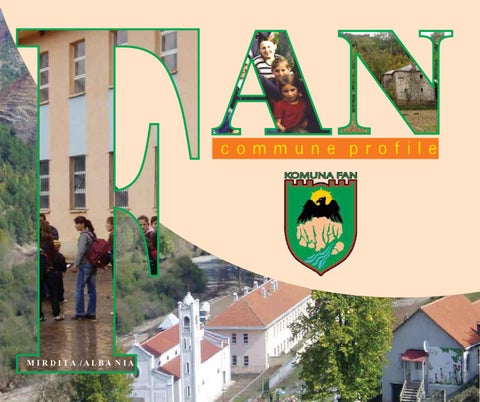
commune profile
M I R D I TA /ALBA N IA
2
M I R D I T A
Commune p r o f i l e A
L
B
A
N
I
A
ents t n o of c e l Tab
I II III IV V VI VII VIII IX X XI XIII XIV XV XVI XVII
4
Acknowledgements Chairman’s foreword History 6 Traditions, Rites, Customs 7 Geographical Position and Relief 8 Climate 8 Population 9 Natural Resources Agriculture and Breeding 1 Business and Employment 1 Local Government 1 Education 1 Health Public Utilities Social Assistance 1 Non-Governmental Organizations
0 2 3 5
2
9 0
Ackno wled gme nts We thank the Task Force set up by the Fan Commune and the experts and staff of CANGO’s Capacity Building Programme who provided technical assistance in the preparation of the Fan Commune Profile. We also are indebted to MGS (Urban International Associates) in Bulgaria. This Profile’s preparation and publication would have been impossibile without the finacial assistance CAFOD UK (UK’s Catholic Fund for Overseas Development) and we wish to use this opportunity to express our gratitude to them.
This Profile is part of a CAFODfinanced project
This Profile is part of Project implemented by CANGO (Center for cooperation between Communities, Local Authorities and NGOs)
DISCLAIMER: The Fan Commune and CANGO Albania solely are responsible for the contents of this publication and it should, under no circumstance, be regarded as reflecting the position of CAFOD UK.
5
ord w e or F s n’ a irm he Fan Commune has a h started to cooperate C
T
with CANGO, a nongovernmental organization, for the preparation of this profile and of the strategic plan for our commune’s economic development. This opportunity has been very highly valued by our staff and community, therefore, in their and my name, I would like to cordially thank CANGO and CAFOD. A special acknowledgement goes also to the Task Force involved in the profile and strategic plan preparation who, with their devotion and earnestness, played an important role in its successful accomplishment. The Working Group was composed of commune staff, the village chairmen, and representatives from education and health institutions, business groups, civic society and religious associations. This profile intends to modestly reveal Fan’s human and natural resources, its
6
history, tradition and culture to both the Albanian and foreigner reader. In order to improve the living conditions in Fan, we would be grateful to anyone wishing to become part of our experience as a visitor, collaborator or donor. Fan’s chairman Gjergj Prenga
REPUBLIC OF ALBANIA
MAP OF MIRIDITA
Intr odu cti an is in the noron thern Albania,
F
in the northeast of Mirdita region. As the birth-place of many important figures, it has contributed to the patriotic and educational heritage of Albania. Fan can boast of wonderful landscapes, but most of all of friendly and hardworking inhabitants.
MIRDITA
FAN COMMUNE
The Durrës-Kukës-Morinë road construction, which for many kilometers goes through the commune, shall usher in a new development age for Fan. Increased movement opportunities for people and goods on both the sides of the border will bring a change for better.
7
H
ry o t is
Kepi i Qytezës, Xhuxhë
The country town’s cape, Xhuxhë
F 8
an is mentioned in a document of 1387 which reads that Tanush Lek Dukagjini has been its lord and that his household owned a large territory in Northern Albania. Purportedly, Fan is named after the “Fan i Vogël” river. Its population descends from the Pirus tribe which had been engaged in smelting copper and other metals. This fact is confirmed by the existing ruins of primitive ovens, the so-called “Gurët e Xhudhive” (Xhudhis’ stones). Fan is an ancient dwelling-place (Batras country town and the Domgjon’s source date back to the times of Illyria). In 1529 Fan had 11 villages and 240 households. Until 1770 it was united with Peja’s Begoll, but afterwards was annexed to Mirdita. In the course of time it was populated by the Bisas, Domgjonas, Xhuxhas, Konajs and Shëngjinis households wherefrom some of the Fan villages derived their names.
Bisak is a village spreading out in Shtil, Shtrungaj, Klos, Fan (Kujte) and is composed of the Upper Bisak and the Lower Bisak. The most ancient dwelling place there is the old Bisas’village. Domgjon is made up of five tribes and lies in Domgjon, Gjakëz, Hebe and Mollkuqe. There is also the Domgjon’s source, used for irrigation, with a perfect architecture and one of the most interesting sources in the Balkans. The oldest dwelling-place is Sukbukëra. Xhuxha is composed of five tribes, the first to arrive there are the Dedkolajs’, then the Gjinajs’, Gjonajs’, Milicajts’, Menajts’, Vocajts’ and Zezajts’ These tribes live in Bizhë, Zall-Xhuxhë, Thirrë, Sang and Srriçe. The oldest dwelling-place is Xhuxha’s hill. In Xhuxhë is the country town’s cape inhabited since the times of the Roman Empire.
Domgjon’s source, old aqueduct (in use even nowadays)
Konajt is made up of 5 tribes. The oldest tribe is that of Biblekajs divided into seven other tribes, such as the Gjonajs, Gjilekajs, Kolpërgjonajs, Margjonajs, Kolgjeçajs and Halilajs who moved toward Barthor, Zubajë and Mrizë. The earliest dwellingplace is the Katundi i Vjetër (the Old Village). They say the Konajs have arrived from Berisha, moving first to Peqin, afterwards at Qafë-Mollë and finally at Konaj. Shëngjin is made up of four villages, the first tribe being the Nokajs. The oldest dwelling-place is Rrugja and the territories of Cahan in Çipën. It seems that Shëngjin had arrived from Dukagjin. From earliest times Fan has been governed by the village elders pursuant to inherited traditional precepts. The elders would resolve every conflict St. Mark’s Church, Klos
His tor y
Characteristic house (called “tower”) and, in case of disagreement, the Gjonmarkajs had the prerogative of the last say. Fan is the cradle of many distinguished figures, leaders, writers and political activists such as Gjergj Fishta from the Domgjon’s Paci tribe, a clergyman, national poet, Anton Çeta of Xhuxha origin, who moved to Kosovo 70 years back, chairman for blood reconciliation in Kosovo; Zef Kol Noka from Shëngjin, moved to Gjakova, commander of battles against the Turks and the Serbs, fellow fighter of Isa Boletini and Bajram Curri; Ndrec Ndue Gjoka, emeritus teacher who contributed to the opening of 50 schools in Mirdita. During the communist dictatorship, from 1945 till 1992, the commune’s inhabitants mainly worked in farming, breeding and forestry. There was mass diffusion of education, the area was electrified and grain production increased at the expense of deforested land, damaging thus the oldest riches in the area. Nevertheless the living standards remained very low.
9
s, e t i R , s ion t i ad r T Fan woman outfit
ms o t s Cu
F
an is one of the fewest regions in Albania whose population belongs entirely to the Catholic religion. Its people are hospitable, brave and loyal. Their positive traits are best displayed in wedding and death gatherings. In the northern-east part of Fan is Batra and a bit further the ruins of the country town, that has, they say, served as a citadel during many wars. The road constructed by the Romans served them as a thoroughfare from Shkodër to Nish. Domgjon’s source is in the ruins of the old country town which had its own aqueduct. This monument has underground tunnels and a control well with its vault 8 meters above the water level. The source was built in the fourth century AD and is connected with the aqueduct. This same aqueduct supplied water even to Sukbukëra, the oldest dwelling-place in Domgjon. It is held as one of the oldest of its kind in the Balkans.
Old tower, Zall-Xhuxhë
10
“Guri i Nuses” mountain in winter
Geogra phica l Pos ition and Re lie f
T
he Fan Commune is in the north-eastern part of Mirdita. Its surface is 175 km2. The commune is an administrative unit of the Mirdita region, district of Lezha. In the south west it borders the Orosh commune, in north-west abuts on the communes of Gjegjan and Fushë-Arrëz, and in the north on two communes of the Kukës district. The commune has a mostly disrupted mountainous terrain, with a 21 km long north-south extension and 9 km east-west extension. It lies along a valley surrounded by the Zepa and Munella mountains and the Qafa e Kumbullës highland. The commune’s height above sea level varies from 250m (Shtrungajë village) up to 1992m (Munella mountain), making thus the climate differ from village to village.
11
te a m Cli
T
12
he commune has a mountainous continental Mediterranean climate, with a very cold winter and hot summer. The only exception is Shtrungaj village that has pre-mountain continental clime. This latter’s mountain terrain tones down the summer hot, with average maximum (July) and minimum temperatures respectively 23°C and 35°C; whereas the winter is not very cold as the mountains surrounding the village screen out the freezing northern winds. The average January temperature is about -3°C, the lowest -8°C and rarely reaches -12 and -13°C. The greatest rainfalls, 1400 to 1500cm, occur over the November April span. During winter the snow covers the whole territory with 20–30 cm thick layers in altitudes of 700m and 70–100 cm thick layers in higher areas. Snowy days vary from 20 in low areas up to 60 in high mountain areas. The winds blowing in the commune are mainly the northern murlan, dry and cold, and the warm and humid southern and south-eastern winds. The vegetation period commences by the end of April and ends in October, in all 200 days.
View from Munella mountain
“Guri i Nuses” mountain in winter
T
he population of Fan has continually moved from Fan to Kosovo and vice-versa. These movements have resulted in continual demographic change. In 1529 Fan had 240 households with 1000 inhabitants, whereas in 1641 had 2 000 inhabitants. After the Turkish occupation, population in 1916 numbered 3661 inhabitants and gradually increased reaching its peak in 1989 with 13,000 inhabitants.
The center, commune of Fan
Pop ul
ati on
Table 1: Structure of Population
In the aftermath of post 1990 population movements (migration in great urban areas and emigration especially in Italy and Greece) the population dropped by 60%. Most of those who left were of young age. Current population amounts to 5368 inhabitants. Source: Register OfďŹ ce in Commune
13
ces r u so e R l a r he Fan commune’s land tu a surface is mainly comN
T
posed of pastures and forests. Its large territory makes the commune rich in water and diverse vegetation. The most widespread low vegetation are heathers and shrubs; the most common mountainous vegetation: the oak, beech and pine forests; and the most widespread high vegetation consists in pastures. Fan has many trees and
shrubs, such as cashew, heath, oak, fir, beech, hazelnut, arista (a rare tree) ash, juniper, hornbeam, etc.. Weeds such as telish, and clover are predominant in meadows. There are 250 kinds of medical plants, the most known of which are thyme, savory, cashew, orchis, mountain tea and the strawberry. Fan i Vogël river crosses the whole of the commune with its dense network of mountainous torrents. Brrena e Domgjonit and Knella e Shëngjinit torrents ever-flowing currents, inexhau-
The vally of “Fan i vogel” river Fan river
14
stible even in summer. They have few kinds of fish, mainly trout. The area is inhabited by a variety of wild animals and fowls favoured by an open and broken territory. The area abounds also in forests. The most common animals are the wolf, fox, bear, badger, roe, squirrel, boar and the hedgehog. The most common fowls are the blackbird, sparrow, culver, eagle, falcon, crow, lumberjack, partridge and, during summer, the swallow and cuckoo.
Agric ultur e an dB ree din g
AGRICULTURE The commune of Fan has a limited land area, in all 738 ha. Of this, a 416 ha field area has been divided among the farmers, whereas the rest, 322 ha, are poor lands and, moreover, impossible to utilize because of their remoteness. Land surface amounts to approximately 750 m2 per capita. The biggest land areas are in Katundi i Ri village: 36 ha and in Shëngjin: 35 ha; and the smallest in Shtrungaj, Sang and Gjakëz villages: 8 ha each. In general, the conditions in the commune of Fan are conducive to agricultural development. The most cultivated plants are maize, potato, lucern and vegetables. The arboriculture has favourite conditions for production. The trees and grape-vines are not disposed in blocks and vineyards. The commune has 47,000 grape-vines and 23,000 fruittrees, mainly fig, nut, cherry, plum, apple, pear, peach and quince trees. The most cultivated vegetables are tomato, pepper, cabbage, onion, cucumber and garlic.
Landscape, Hebe Table 2. Land Structure in the Commune
Source: Cadastral Office
The terrain is propitious to the heterooil plants’ growth which would improve the sowing structure, utilizing the unproductive (infertile) lands Vineyard, Zall-Xhuxhë
15
ding e e r B nd a e r ultu c i r Ag Table 3. Agricultural Production Indicators for the year
Source: Agriculture and Food Office, Lezhë Table 4. Cultivated Land by village
Autumn, Hebe village
Plum trees, Petoq village
16
Source: Cadastral office
Agric ultur e an dB ree din g
BREEDING The Fan commune has advantageous conditions for breeding development. From its outset it has relied on breeding wherefrom 90% of its revenues are generated. A peculiarity in the commune is that goats (with an average 40 kg weight per head and 150 liters of milk annual production), account for 75% of the cattle. Goat breeding is of low cost. Pasture capacity is nearly 25,000-30,000 heads of cattle and 10,000 heads of bovine.
Cattle, ThirrĂŤ village Table 5 -Data on the living stock in 1995 and 2007
Source: Commune’s veterinary inspector
17
ment y o l p d Em n a ss e n i Bus
L
ately the business in the commune has started to liven up. It consists mainly in family businesses such as wood material processing, fire wood production, stone processing, quarries, trade of live stock and agricultural productions, apiculture (bee breeding), and milk processing. The “DurrësKukës-Morinë” highway construction shall strengthen the extant breeding and other businesses and shall encourage the birth of new business activities. Breeding production at present is destined to meet family needs. Pasture capacity enables breeding and hibernation of 20-30 thousand heads of cattle and 5 thousand heads of bovine. Wood processing business, Klos
Bee hives, Petoq
18
Fuel station in Klos Table 6.
Busin ess and Em plo y
me nt
Stone –pit in Klos Source: Tax Office in commune
The public sector provides job for most of the population. • Education
67 people
• Health
27
• Forest sector
7
• Road maintenance
33
• Commune administration
18
• Public Order
4
19
ent m n r ove G l a Loc
I
The Fan commune administration in a meeting with church representatives
n the territory of the Fan commune there are 17 villages: Shtrungaj, Bisakë, Klos, Fan, Katund i Ri, Konaj, Shëngjin, Petoç, Zall-Xhuxhë, Gjakëz, Munellë, Domgjon, Hebë, Sang, Thirrë, Dardhaz and Xhuxhë. Klos village is the administrative center housing the local government building. The local government is made up of a decision-making body: the Commune Council and an executive body: the Commune chairman and his staff. Both the Council and Chairman are directly elected by the voters. The present Council, elected in 18 February 2007 for a 4 year mandate, has 15 members from 13 political parties. The commune administration has 18 employees paid by state budget funds. Each village is represented by its own chairman elected by the citizens. The Villages’ leadership, depending on the village size, ranges from three to five members.
20
Meeting with village chairmen and commune councilors
Table 7. Budget of the Commune over years, in 000/ALL
Loca l Go ver nm en t
The Fan commune administration
Source: Finance Office
Commune’s Organization Chart
21
tion a c Edu
T
he first school in the Fan area was opened in 1927, in the house of Gjon Ndue Ndreca. It had only 13 pupils. From 1932 till 1936 Dom Zef Skana let the pupils, 27, have their lessons in the church premises. After the liberation of the country, on 14 December 1944, at Bisakë the first school was opened (38 pupils). It was followed by the opening of other schools in Konaj, (35 pupils, whereof 13 females), in Domgjon (59 pupils, whereof 14 females), in Xhuxhë (60 pupils, whereof 18 females), in Klos-Zallë (59 pupils, whereof 19 females), in Hebe, Mollkuqe, Dardhaz and Petoq. Secondary schools were opened at Bisakë in 1951 and at Domgjon in 1960. High School “Ndrec Ndue Gjoka” in Klos
In September 1976 a high school, agronomy branch, was opened in Klos and in 1985 a global branch was added to it. In the ‘80s, the United High School of Klos had 800 pupils and 50 teachers.
22
Following the democratic changes and movements, the number of pupils and teachers dropped. At present Fan has 14 schools: 7 primary, 6 secondary and 1 high (the United High School).
Table 8. Children and Nursery-schools in the Commune
High school class, Klos
Edu cat ion
Source: Directorate of Education, Rrëshen
Table 9. Pupils and Schools in the Commune
Secondary school, Domgjon Source: Directorate of Education, Rrëshen
23
lth a e H
H
ealth service in the commune of Fan is provided around the clock in health centers both in the commune center and in villages, including the maternity service. The health staff is composed of 2 physicians and 24 employees. The commune center has also an autoambulance.
Table 10 . Statistics on Health in the Commune
24
Source: Health Center, Klos
Medical examination at the health centre
T
Pub lic Uti liti es
he commune of Fan offers a number of public services, namely:
1. ROAD NETWORK IMPROVEMENT AND MAINTENANCE UTILITY.
Working site for the highway Durres Kukes Morine in Fan Road under construction
Foot bright in Mashterkore
Road maintenance service is provided for the internal roads connecting the villages with each other and with the center of the commune. The Fan commune is connected with the town of Rrëshen through the 45 km long Fan-Reps-Rrëshen thoroughfare, a road that connects the Fan commune with the Orosh commune and the villages of Shtrungaj, Bisakë, Klos with the Fan commune center. The road network in the Fan commune is 84km long and has a125 km2 surface. 25% of it is paved with flint stone and 75% with gravel (mountain grit). At present Durrës-Kukës-Morinë (RrëshenKalimash) highway is under construction. It goes across the central part of the Fan commune for 67km connecting six of its villages: Shtrungaj, Bisakë, Klos, ZallXhuxhë, Sang and Thirrë (at Thirrë is the entrance of the Qafë-Kumbulla tunnel)
25
lic b u P
ties i l i t U
Table 11 - Distances in km
Bridge upon the Fan river, Gjakëz
Source: Office of Utilities
2. TELEPHONE UTILITY. The mobile Vodafone and AMC providers account for 90% of the telephone service. The remaining 10% is covered by the fixed system network offered by Rrëshen Telelecom. 3. DRINKING WATER PROVISION. Being a predominantly mountain zone, the Fan commune has abundant waters springing from the mountains. These are used for familiy needs and irrigation. At present there are a number of water-suppliers built over years such as those of Domgjon’s Source, one of the oldrest in the Balkans, that of Klos restructured only a few years ago, those of Xhuxhë, Shëngjin and Bargjan, the latter supplying water to Rrëshen town and Shtrungaj village. The commune, through a grant and other funds, is making improvement and maintenance works and plans to construct new water-suppliers.
26
Watersupply in Bargjan
4. FUNERAL AND CEMETERY Churchyard, MAINTENANCE Klos SERVICE. Funeral and cemetery maintenance service is offered by the commune, religious associations and by the inhabitants. Almost every village has its own cemetery, Table 12.. Capital Investments in the Commune of Fan during 2003 -2007 except three of them covered by the cemetery of the Fan commune center.
Pub lic Uti liti es
Water Source, Shëngjin
Source: Finance Office and Utility Office
27
ial c o S
nce a t i s As
S
ocial assistance in the commune is offered by the Office of Economic Aid which is dependent both upon the Regional Directorate and the Commune. Social assi-
Table 13.
28
Source:Office of Economic Aid
stance is supported by Central Government funds allocated by the Ministry of Work and Social Affairs in the form of a grant based on the need assessment carried out by the Office of Economic Aid through the Regional Directorate.
Z
EPA, Association of Forests, Pastures and Waters Zepa Association was founded in March 2004 from a group of 5 initiators. Ever since, it has continually grown in number. From August 2004 until October 2005, under the patronage of the General Directorate of Forests and of the World Food Aid Programme, it has implemented a number of projects such as works for the protection of areas in danger of erosion, cleansing of the territory from rotten trees, etc.
Non G overn men tal O rga niz ati on s
Sisters of Charity
In 27 September 1998, in response to a call from Monsignor Angelo Massafra, bishop of Lezhë-Rrëshen, the Sisters of Charity started to provide services and qualification courses: sewing for women and embroidery for female teenagers. They have also offered ambulatory health services and have distributed medicines for nursery school children. The Sisters of Charity and the Albanian Caritas have jointly embarked on a project (the ECHO project) funded by the European Community which provides for financial aid for pupils and villages. During the summer, Italian or French volunteers assisted Albanian youngsters, run summer camps for Fan commune teenagers.
Sisters of Charity
29
nizations a g r O ntal e m n over G Non The commune working group in charge of the profile preparation and CANGO experts
CANGO
CANGO (Center for cooperation between Communities, Local Authorities & NGOs) is intensively involved in capacity building for public administration and key representatives of the civic society and community in the commune as well as in developing a Development Strategic Plan for the commune. It has offered a special help through a series of trainings on management (such as Human Resources & Financial Management), public communication, duties and responsibilities of the commune councils, etc.
Austrian Caritas
From 1994, the Austrian Caritas has made considerable contributions, initially offering human aid, food and clothing for families in need. It has also financed the construction of a bakery in Klos, the reconstruction of several schools, the provision of didactic supplies, books, clothes and food mainly to orphans and needy children in secondary schools at Gjakëz, Petoq, Shëngjin, Xhuxhë, Hebe, Shtrungaj, Domgjon, Konaj and in “Ndrec Ndue Gjoka” global high school Caritas Austria activites in commune
30
31
commune profile MIRDITA-ALBANIA
32
For more information about Fan commune please contact at: Address: Komuna Fan, Mirdita Contact Person: Gjergj Prenga, Chairman of Fan Commune, Mirdite Tel: +355 692567020 Tel:+355 684069212 Email:komunafan@yahoo.com