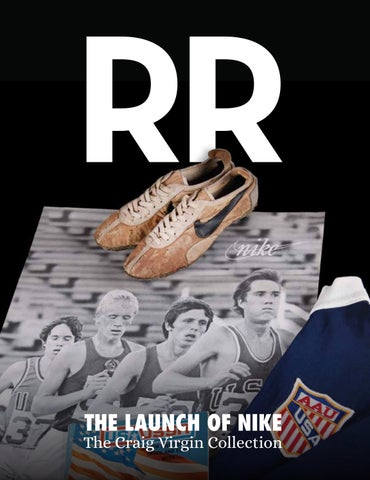
THE LAUNCH OF NIKE
The Craig Virgin Collection
“They didn’t tell me the poster was coming. About three weeks after the race I was back in school, and the secretary sent a note down to my classroom to come to the office. I thought I was in trouble. She handed me a mailing tube that Geoff [Hollister] had sent to the school. I opened it up and there were four of those posters. I said, ‘Hey, that’s me!’ I showed them off. I was so proud and happy!” Craig Virgin recalls the poster in Lot 9001
CRAIG VIRGIN Nike’s original ‘poster boy’ for athletic excellence Auction closes December 15, 2026 Bid online at www.RRAuction.com RR Auction is pleased to present an exceptional collection of early Nike memorabilia and historic running artifacts from the personal collection of Craig Virgin, one of America’s greatest distance runners and a pioneering figure in Nike’s formative years. Highlighting the selection is an extraordinary pair of handmade 1972 Nike prototype racing spikes, created by company co-founder Bill Bowerman and orthotics specialist Dennis Vixie and worn by the 16-year-old Virgin in international competition against the Soviet Union. Captured in the photograph used for Nike’s first-ever advertising poster, these historic shoes represent a remarkable link to the launch of one of the world’s most recognizable athletic shoe and apparel brands. Accompanied by Virgin’s original USA warm-up suit, meet program, and the landmark promotional poster, the archive documents a pivotal moment in Nike’s emergence from a fledgling footwear company into a major force in competitive athletics. Other highlights include an exceptionally rare three-page handwritten letter from legendary runner Steve Prefontaine, personally recruiting Virgin to the University of Oregon in 1972; several pairs of Virgin’s high school-worn Onitsuka Tiger racing shoes dating to the Blue Ribbon Sports Tiger distribution era; and scarce original Nike advertising materials from the early 1970s. Among these are an early investor relations brochure chronicling Nike’s remarkable first year, rare promotional posters featuring Prefontaine and other pioneering Nike athletes, and a striking 1976 Olympic Trials poster celebrating the company’s sweep of the men’s 10,000-meter qualifying positions. Together, these remarkable artifacts offer collectors a unique opportunity to explore the intertwined histories of American distance running and the rise of Nike, preserving the people, performances, and innovations that helped transform the athletic footwear industry.
Lot 9001 - Starting Bid $25,000
THE LAUNCH OF NIKE
Craig Virgin’s historic 1972 Bowerman prototype spikes, immortalized on the company’s first advertising poster In the summer of 1972, Nike was still in its infancy, having only recently introduced footwear under its now-iconic name and Swoosh logo trademark. Co-founder Bill Bowerman, the legendary University of Oregon track coach, was relentlessly experimenting with shoe construction, developing lightweight racing footwear intended to give competitive runners every possible advantage. One beneficiary was 16-year-old Illinois distance-running prodigy Craig Virgin, who received a pair of handmade prototype spikes created by Bowerman and orthotics specialist Dennis Vixie through pioneer Nike promotional representative Geoff Hollister.
Virgin wore the handmade experimental shoes on July 29, 1972, while representing the United States in the 5000-meter race at the USA– USSR Junior Invitational Track and Field Meet in Sacramento, California. The nationally televised Cold War-era competition is believed to mark the first appearance of Nike racing spikes in international track and field competition. A photograph of Virgin leading two Soviet runners was subsequently selected for Nike’s first promotional advertising poster, released in August 1972, forever linking the young athlete and his prototype footwear to the company’s earliest marketing and sports competition history. Virgin went on to become one of America’s greatest distance runners as a five-time Illinois state high school champion, nine-time Big 10 champion, and nine-time NCAA All-American. He won one NCAA cross-country championship at the University of Illinois, became a three-time Olympian, and captured consecutive World Cross Country Championships in 1980 and 1981—the first and only American man to win the prestigious event. This extraordinary archive from the launch of Nike is highlighted by Virgin’s original handmade 1972 prototype spikes, accompanied by his warm-up suit from the event, official meet program, and an example of Nike’s historic first-ever promotional poster. Together, these artifacts preserve a remarkable moment in the company’s formative years, when groundbreaking footwear experimentation and the achievements of promising young athletes helped establish the foundation of a new global athletic shoe and apparel empire.
MARKETING HISTORY was made in 1972, forever linking the young athlete and his prototype footwear to Nike’s founding era
Lot 9001 - Starting Bid $25,000
Personally worn by Virgin during his first international competition—a “leap of faith” in what was then the biggest race of his life
The archive includes: ORIGINAL 1972 NIKE PROTOTYPE RACING SPIKES CUSTOM-MADE FOR CRAIG VIRGIN BY BILL BOWERMAN AND DENNIS VIXIE: an original pair of track spikes featuring white nylon uppers, contrasting black leather Nike Swooshes, white laces, reinforced heel panels, and specially modified spike plates. Created during Nike’s early, experimental era, the shoes incorporate several pioneering design features reflecting Bowerman’s pursuit of lighter, faster, and more efficient racing footwear. These innovative qualities include: lightweight nylon uppers, an unconventional material for competitive racing footwear at the time, which Bowerman had pioneered through his earlier work with Japanese manufacturer Onitsuka Tiger; a raised, cushioned heel, departing from the flat-soled design of racing spikes at that time, providing relief to the Achilles tendon over long distances and offering better support for Virgin’s midfoot running mechanics; and plastic forefoot spike plates hand-drilled and grooved to reduce weight and increase flexibility. Notably, four of the spikes actually fell off during Virgin’s race, a telling reminder of the risky and experimental nature of these early prototypes, which were still being developed and refined through competition.
The shoes also boast a singular aesthetic innovation: the now-iconic Nike Swoosh logo. Virgin recalls the running community’s reaction in 1972: “The Swoosh, nobody’s seen yet. It’s just—what is that? A Swoosh? What the hell is a Swoosh? And ‘Nike’? How’s that pronounced?” Though worn only once, the shoes exhibit pronounced discoloration due to age-toning of the glue used in their custom construction, as well as deterioration to the soles. Virgin reflects: “Bowerman did not wear gloves while making them and got glue residue all over the white uppers. Fifteen, twenty years later, it all started to discolor from oxidization of the glue residue and Bowerman’s ‘handprints or smudges’ began to magically appear. The spiked shoe soles had a sheet of green urethane rubber stitched to the shoe last that Bowerman thought would provide additional traction on a modern urethane rubber track. But, unbeknownst to him, Sacramento had an old fashioned baked clay track popular in California which I’m sure didn’t help. Over the years, the urethane polymers started to break down.” Personally worn by Virgin during his first international competition—a “leap of faith” in what was then the biggest race of his life—this exceptionally early Nike prototype represents a tangible connection to Bowerman’s pioneering experiments in athletic footwear.
FIRST-EVER PROMOTIONAL POSTER
THE FIRST NIKE PROMOTIONAL POSTER, ISSUED IN AUGUST 1972: an original black-and-white 20.5 x 34 Nike running poster depicting Craig Virgin, wearing bib number 38, leading a group of American and Soviet runners during the 1972 USA–USSR meet. The poster features Nike’s earliest script logo and Swoosh at the upper right. The memorable photograph captures Virgin in full stride at the front of the pack, wearing his USA competition uniform and prototype Nike racing spikes. Craig Virgin recalls: “They didn’t tell me the poster was coming. About three weeks after the race I was back in school, and the secretary sent a note down to my classroom to come to the office. I thought I was in trouble. She handed me a mailing tube that Geoff [Hollister] had sent to the school. I opened it up and there were four of those posters. I said, ‘Hey, that’s me!’ I showed them off. I was so proud and happy!”
Lot 9001 - Starting Bid $25,000
ORIGINAL 1972 USA–USSR JUNIOR INVITATIONAL TRACK AND FIELD MEET PROGRAM: the official illustrated program for the international competition held at Hughes Stadium in Sacramento, California, July 28–29, 1972, featuring the American and Soviet flags on the front cover. The program identifies Craig Virgin, then just 16 years old, as an American entrant in the 5000-meter run, with his photograph and biographical details, and personal-best time of 13:40.8 appearing on page 45.
CRAIG VIRGIN’S 1972 USA WARM-UP SUIT: a two-piece navy blue nylon Russell Athletic warm-up suit consisting of a zip-front jacket and matching pants. The jacket features a white ribbed stand-up collar, red-and-white striped cuffs and waistband, an embroidered AAU USA shield patch on the left breast, and large red-and-white “USA” lettering across the back. The matching navy blue pants feature red-and-white stripes along the outer legs, an elastic drawstring waistband, and zippered lower legs. Both garments retain their original Russell manufacturer’s labels, marked size medium. The jacket additionally bears a handwritten identification marking, “Virgin,” on the tag.
“My high school record is not out of your reach”
PREFONTAINE RECRUITS ILLINOIS RUNNING PRODIGY
“You would fit in our program very nicely” Lot 9002 - Starting Bid $1,000
STEVE PREFONTAINE RARE AUTOGRAPH LETTER SIGNED, RECRUITING CRAIG VIRGIN: “IF YOU WANT TO BE A RUNNER OREGON IS THE PLACE” Autograph letter signed “Your Friend, Sincerely, Steve Prefontaine,” three pages, 5 x 8, March 3, [1972]. Handwritten recruiting letter by the legendary Oregon runner to Craig Virgin, in full: “Dear Craig, My coach Bill Dellinger told me about you on his return from the east. You have run some very fine times this year, keep it up my high school record is not out of your reach. About Oregon it is a very beautiful school with lots of green trees and grass. Track is a big sport in Eugene we get an average of 8,000 or more for our duel [sic] meets sometimes over 10,000. With the NCAA and the Olympic trials here I can just about state that Eugene is the track capital of the United States. You would fit in our program very nicely. There is always somebody to workout with and the competition is great. About leaving your family that will be up to you. As good as you are and as good as you can get they can watch you on T.V. Think about Oregon if you want to be a runner Oregon is the place.” Includes the original mailing envelope, hand-addressed by Prefontaine and incorporating his full name in the return address area: “Steve Prefontaine, 4501 Franklin Blvd. #17, Eugene, Oregon, 97403,” pointing to the River Bank Trailer Park, where Prefontaine shared a mobile home with his close friend and fellow Oregon track teammate, Pat Tyson. In overall fine condition, with a small tear through Prefontaine’s name in the return address (“I probably opened it nervously with a kitchen knife,” says Virgin). Written just months before the 1972 U.S. Olympic Trials in Eugene, this remarkable letter captures Steve Prefontaine at the height of his collegiate stardom, personally recruiting one of America’s most promising young distance runners to the University
of Oregon. Already a national sensation for his fearless front-running style and extraordinary success under coaches Bill Bowerman and Bill Dellinger, Prefontaine would win the 5,000 meters at the Olympic Trials that July before finishing a heartbreaking fourth at the Munich Games. His enthusiastic endorsement of Oregon, particularly his declaration that “if you want to be a runner Oregon is the place,” reflects both his fierce loyalty to the university and his role in establishing Eugene as America’s distance-running capital. Further, Prefontaine’s prescient observation—”my high school record is not out of your reach”—would indeed come true. About a year later, on June 9, 1973, Virgin ran a national high school two-mile record of 8:40.9, breaking Prefontaine’s previous mark of 8:41.5. Later, in 1979, Virgin would also break Prefontaine’s American record in the 10,000 meters with a time of 27:39.4. “I was chasing his records more than anybody else,” says Virgin. “He was a guy I modeled my running style after, someone I looked up to.” Despite Prefontaine’s encouragement, Virgin would ultimately attend the University of Illinois, becoming an NCAA cross-country champion, two-time world crosscountry champion, and three-time U.S. Olympian. Prefontaine’s untimely death in a 1975 automobile accident at just 24 years old brought his extraordinary career to a tragic end, leaving a remarkably limited body of autograph material. While his signatures are themselves scarce, substantial handwritten letters are exceptionally rare, particularly examples of such length and significant athletic content. Written with the passion, enthusiasm, and fierce loyalty that defined Prefontaine, this exceptional letter is made all the more compelling by its recipient—a young runner who admired him, sought to emulate his achievements, and would ultimately surpass two of his most celebrated records.
Lot 9003 - Starting Bid $500
CRAIG VIRGIN’S HIGH SCHOOL-WORN WHITE ONITSUKA TIGER TRACK SPIKES WITH BLUE RIBBON SPORTS BAG Craig Virgin’s personally-owned and -worn Onitsuka Tiger track spikes in white and black, purchased by him in the fall of 1970 and worn during his sophomore, junior, and senior years of high school. The lightweight racing shoes feature off-white nylon uppers with contrasting black Onitsuka Tiger stripes along the sides, traditional lace-up closures, and reinforced stitching around the toe boxes. Both shoes exhibit extensive wear from many competitions, with pronounced discoloration, soiling, and fraying to the fabric, particularly around the heels and side panels. Includes a hard-tofind yellow carrying bag co-branded by Onitsuka Tiger and Blue Ribbon Sports, their exclusive distributors in the United States. Founded in 1964 by Phil Knight and Bill Bowerman, Blue Ribbon Sports began as a small importer of Onitsuka Tiger running shoes before launching its own footwear line under the Nike brand name in 1972. These were Craig’s most worn racing shoes during his legendary high school running career and total competitive results for these shoes will be furnished with this lot. His fastest races in them were a 4:09 mile and an 8:51 2-mile on the track, both winning times at the State Track Meet Finals in May 1972.
READ FULL DESCRIPTIONS AT WWW.RRAUCTION.COM Lot 9004 - Starting Bid $500
CRAIG VIRGIN’S HIGH SCHOOL-WORN MAROON ONITSUKA TIGER RACING FLATS Craig Virgin’s personally-owned and -worn Onitsuka Tiger racing flats in maroon and white, purchased by him in the fall of 1970 and worn during his sophomore, junior, and senior years of high school. The lightweight racing shoes feature maroon nylon uppers with contrasting white Onitsuka Tiger stripes along the sides, traditional lace-up closures, and reinforced leather panels at the back of the heels and toe boxes at the front. Both shoes exhibit some wear from use, with some discoloration, tears and fraying to the fabric stripe appliqué. These were Craig’s second most worn racing shoes during his legendary high school running career and total competitive results for these shoes will be furnished with this lot. His fastest races in them were a 14:08 three-mile in crosscountry and an 8:48 2-mile on the track in May 1973.
Lot 9005 - Starting Bid $500
CRAIG VIRGIN’S HIGH SCHOOL-WORN BLUE ONITSUKA TIGER TRACK SPIKES WITH ONITSUKA BAG Craig Virgin’s personally-owned and -worn Onitsuka Tiger track spikes in blue and white, purchased by him in the fall of 1972 and worn only during his senior outdoor track season, and only on cinder tracks. His fastest race in them was an 8:46 2-mile in May 1973. The lightweight racing shoes feature light blue nylon uppers with contrasting white Onitsuka Tiger stripes along the sides, traditional lace-up closures, and reinforced leather panels at the heels. Both sets of spikes are protected by blue rubber Onitsuka Tiger–branded covers. Both shoes exhibit some wear from use, with some staining and fraying along edges. Includes a yellow carrying bag branded only by Onitsuka Tiger, carrying the slogan: “The Original Onitsuka Line, The Champion of Sports Shoes,” without Blue Ribbon Sports co-branding. By this time, Onitsuka had discontinued its partnership with Blue Ribbon Sports, which then introduced the Nike brand.
READ FULL DESCRIPTIONS AT WWW.RRAUCTION.COM
Lot 9006 - Starting Bid $500
CRAIG VIRGIN’S HIGH SCHOOL-WORN ONITSUKA TIGER ‘BOSTON’ RACING FLATS Craig Virgin’s personally-owned and -worn Onitsuka Tiger ‘Boston’ racing flats in blue and white, one of the most successful long-distance racing flats of its era, worn by many of the top American marathoners of the 1970s. The lightweight racing shoes feature blue nylon uppers with contrasting white Onitsuka Tiger stripes along the sides, traditional lace-up closures, reinforced suede leather panels at the heels and toe boxes, and extra cushioning in the heel. Both shoes exhibit some wear from use, with cracking to the stripes. They were a half size too small and rarely worn by Craig.
Lot 9007 - Starting Bid $500
NIKE: 1972 “YEAR IN REVIEW” INVESTOR RELATIONS BROCHURE
Lot 9010 - Starting Bid $300
NIKE: (2) ORIGINAL VINTAGE 1970S SHOE BOXES
READ FULL DESCRIPTIONS AT WWW.RRAUCTION.COM
Lot 9008 - Starting Bid $300
NIKE: BIG “N” PROMOTIONAL POSTER (C. 1973-1974) WITH STEVE PREFONTAINE, GEOFF PETRIE, AND ILIE NASTASE
Lot 9009 - Starting Bid $300
NIKE: 1976 U.S. OLYMPIC TRIALS POSTER CELEBRATING NIKE’S FIRST-EVER OLYMPIANS (L-R) BJORKLUND 3RD, VIRGIN 2ND, AND SHORTER 1ST
HISTORICAL SIGNIFICANCE OF CRAIG VIRGIN WITH NIKE SHOES 1. FIRST NIKE SHOES IN INTERNATIONAL COMPETITION Craig wore the first ever pair of Nike spikes in international competition. Date: July 1972 2. FIRST NIKE SHOES ON NATIONAL TELEVISION Craig wore the first pair of Nike spikes ever seen on national TV. Date: July 1972 3. NIKE’S FIRST PROMOTIONAL POSTER Craig and those spikes were the subject of Nike’s first ever promotional poster. Date: August 1972 4. NIKE’S FIRST NATIONAL RECORD HOLDER Craig was Nike’s first ever national record holder in running. Date: June 1973 5. NIKE’S FIRST BIG TEN CONFERENCE INDIVIDUAL CHAMPION Craig was Nike’s first ever Big Ten Conference individual champion in running. Date: November 1973 6. NIKE’S SECOND NCAA NATIONAL CROSS COUNTRY CHAMPION Craig was Nike’s second ever NCAA National Cross Country Champion behind only Steve Prefontaine who won in November 1973. Date: November 1975 7. NIKE’S SECOND U.S. OLYMPIAN Craig Was Nike’s second ever U.S. Olympian. The first being Frank Shorter right in front of him and the third being Garry Bjorklund right behind him. All 3 in the same Olympic Trials 10,000 m. race! Date: July 1976 8. CHARTER MEMBER OF NIKE’S FIRST SPONSORED RUNNING CLUB Craig was Nike’s first ever (charter) member of Nike’s first ever sponsored running club, Athletics West. Date: August 1977 9. NIKE’S FIRST NATIONAL CHAMPION AT 10,000 METERS Craig was Nike’s first ever national champion at 10,000 meters in the AAU/TAC/USATF Championships. Date: June 1978
THE LAUNCH OF NIKE: THE CRAIG VIRGIN COLLECTION Auction closes December 15, 2026 Bid online at www.RRAuction.com
www.RRAuction.com
|
(603) 732-4280
|
Boston, Massachusetts