World War II
|
November 19, 2026
|
www.RRAuction.com
Since 1976
Let’s make history—together For 50 years, relationships have been the backbone of RR Auction. We have made it a priority to keep our consignors informed and involved, encouraging them to share their voices, to instill their knowledge, and to forge a partnership based on our shared passion for history. With a mutual desire to achieve greatness, these relationships are at the heart of our success.
RR Auction
|
Est. 1976
|
www.RRAuction.com
|
(800) 937-3880
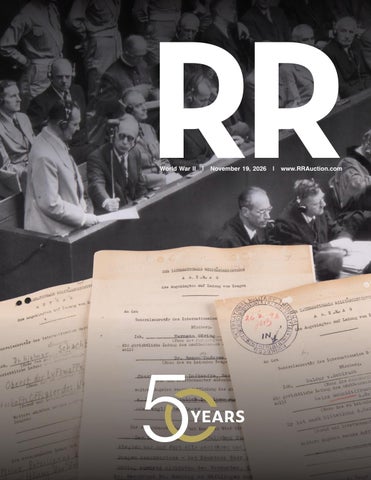
World War II RR Auction’s November 2026 World War II sale presents an extraordinary selection of historic documents, photographs, and artifacts spanning the road to war through the Nuremberg trials. Leading the sale is a remarkable archive of original Nuremberg trial papers, offered 80 years after the tribunal, signed by defendants including Hermann Göring, Rudolf Hess, Joachim von Ribbentrop, Wilhelm Keitel, Alfred Jodl, and Albert Speer, along with Ribbentrop’s typed final plea and Speer’s handwritten letter to his attorney. Montgomery highlights include the Field Marshal’s top-secret battle orders for the liberation of Europe, his wartime Personal Messages to the Eighth Army, and his iconic double-badged beret. Additional standouts include a Geli Raubal photograph inscribed to “Onkel Adolf,” Mussolini’s draft telegram to Hitler after the 20 July plot, artifacts recovered from the Hindenburg wreckage, John F. Kennedy’s hand-corrected Why England Slept manuscript, and an Iwo Jima flag-raisers signed photograph.
Bidding closes November 19, 2026
Bob Eaton CEO, Acquisitions bob.eaton@rrauction.com
Elizebeth Otto SVP of Consignments & Acquisitions elizebeth.otto@rrauction.com
Carla Eaton Owner, Auctioneer carla.eaton@rrauction.com
Jeff Cafferelli Consignment Director jeff.cafferelli@rrauction.com
Bobby Livingston Executive Vice President, Public Relations bobby.livingston@rrauction.com
Adam Dias Consignment Director adam.dias@rrauction.com
Bobby Eaton VP, Business Development Auctioneer, MA/Lic. #3214 bobby.eaton@rrauction.com Sue Recks Customer Service Manager Accounts Receivable sue.recks@rrauction.com Melissa Adams Accounting Executive melissa.adams@rrauction.com Amey Fuller Staff Accountant amey.fuller@rrauction.com
Fiona Lenaire Consignor Customer Service Manager fiona.lenaire@rrauction.com Cecily Gruce Inventory Manager Customer Service cecily.gruce@rrauction.com Grace Maggio Executive Assistant grace.maggio@rrauction.com Kevin Lessard Shipping Manager kevin.lessard@rrauction.com Robert S. Eaton Sr. 1940–2001
Matt Klein Filemaker Developer and IT Administrator matt.klein@rrauction.com Bill White Lead Autograph Appraiser bill.white@rrauction.com Dan McCarthy Writer, Researcher dan.mccarthy@rrauction.com Evan Mugford Writer, Researcher evan.mugford@rrauction.com Sarina Carlo Head of Production sarina.carlo@rrauction.com Nikki Brickett Photographer nikki.brickett@rrauction.com Joe Boucher Production Assistant joe.boucher@rrauction.com
2 | November 19, 2026
| World War II
Appeasement
“It was not that people were ignorant of the possible menaces of Hitlerism”— JFK’s original 13-page typed manuscript draft of a Why England Slept chapter on Britain’s failure to rearm, with his handwritten chapter heading and extensive revisions throughout 7001. John F. Kennedy Original Hand-Corrected Manuscript for Why England Slept (circa 1939–1940) - 13-Page Chapter on British Rearmament. Original typed manuscript draft of a chapter from John F. Kennedy’s book Why England Slept, 13 pages, 8.5 x 11, undated [circa 1939–1940], with extensive handwritten corrections and revisions by Kennedy to the fronts and backs. The first page bears his handwritten chapter heading, “Influence of the Desire for Economy and General Disarmament Conference on British Armaments.”
Focusing on 1933, the chapter examines how economic restraint, public pacifism, and hopes for international disarmament shaped British military policy as Hitler rose to power. Kennedy draws on parliamentary debates and contemporary press commentary, describing deficiencies in the British Army: “The Army also came in for its share of criticism…There were only four battalions of tanks in the whole army.” Turning to the political outlook of the Saturday Review, he observes that it “was very ‘right’ and Tory from the beginning, and at different times…was to beseech King Edward to be a dictator, cheer Mussolini, and call for a war against Russia.” His analysis
distinguishes awareness of the German threat from willingness to rearm: “It was not that people were ignorant of the possible menaces of Hitlerism, but…their reactions to that menace took a different form than demanding armaments.” In fine condition. Accompanied by a custom cloth-bound presentation case. Kennedy’s research grew out of his experiences in Europe in 1939, when his father, Joseph P. Kennedy, was serving as American ambassador to Great Britain. Returning to Harvard that fall, he drew on parliamentary debates, British newspapers, and material supplied through the embassy to examine the political and public pressures behind Britain’s failure to rearm. He completed his senior thesis, ‘Appeasement at Munich,’ in 1940, at age 22. With editorial assistance from New York Times columnist Arthur Krock, Kennedy revised the thesis for publication. Krock also suggested the title Why England Slept, a play on Winston Churchill’s While England Slept. Published in July 1940, shortly after Kennedy’s graduation and the fall of France, the book appeared as Americans debated their own military preparedness. Starting Bid $2,500
www.RRAuction.com | 3
4 | November 19, 2026
| World War II
Prime Minister Chamberlain refers to Churchill’s famous ‘House of Many Mansions’ address at the outset of WWII: “In the case of Mr. Winston Churchill the manuscript was, I am given to understand, only finished shortly before he went to the microphone” 7002. Neville Chamberlain WWII-Dated Typed Letter Signed on Churchill’s ‘House of Many Mansions’ Address. World War II–dated TLS signed “Yours ever, Neville Chamberlain,” two pages, 7.5 x 9.5, Prime Minister, 10 Downing Street letterhead, January 25, 1940. Letter to newspaper publisher Gomer Berry, 1st Viscount Kemsley, referring to Winston Churchill’s famous ‘House of Many Mansions’ speech. In full: “Thank you for your letter of January 23rd drawing my attention to the fact that no manuscripts were available for the Press either of the speech by Lord Halifax on Saturday or of the broadcast by Mr. Winston Churchill on Saturday night. I know you will appreciate the fact that wherever possible the Ministers concerned or their Departments do their best to provide the Press with manuscripts, knowing full well the difficulties under which newspapers are produced in these days. At the same time, I am sure you will fully sympathise with Ministers when, on occasion, it is found physically impossible to render this service, and also when, in some circumstances, the speaker himself decides to speak from notes rather than from a fully prepared document. As regards Lord Halifax’s speech, I understand that the Foreign Secretary definitely decided to speak from notes and no full manuscript was therefore prepared. In the case of Mr. Winston Churchill the manuscript was, I am given to understand, only finished shortly before he went to the microphone and copies were issued to the Press as soon as possible. I fully appreciate the advantage to all concerned of distributing speeches beforehand wherever possible, but I am sure you will also realise that the demands made upon Cabinet Ministers is such that it is often found impossible to provide facilities which in other circumstances they would be only too happy to give.” In fine condition.
Chamberlain refers to Winston Churchill’s speech of January 20, 1940, known as the ‘House of Many Mansions’ address, which was broadcast from London during the early months of World War II. Speaking as First Lord of the Admiralty, Churchill framed the conflict not merely as a military contest, but placed it in stark moral terms. He painted a grim picture of the plight of small neutral nations: ‘Every one of them is wondering which will be the next victim on whom the criminal adventurers of Berlin will cast their rending stroke.’ He hailed Finland’s resistance to Russian invasion as a spotlight on the rot of totalitarian regimes: ‘Everyone can see how Communism rots the soul of a nation; how it makes it abject and hungry in peace, and proves it base and abominable in war.’ Churchill warned that if Britain and France were to capitulate, ‘nothing would remain for the smaller States of Europe…but to be divided between the opposite, though similar, barbarisms of Nazidom and Bolshevism.’ Yet he ended on a note of hope. Churchill foresaw a time when ‘victorious nations…will plan and build in justice, in tradition, and in freedom a house of many mansions where there will be room for all.’ In doing so, Churchill situated the war not as an isolated British struggle but as a fight for the very idea of civilization, whose outcome would determine whether a pluralistic Europe could survive. Churchill, whose famous oratory strengthened British resolve in the face of Nazi terror, would soon supplant Chamberlain as prime minister. On May 10, 1940, Chamberlain resigned following growing criticism of his failed policy of appeasement and the disastrous Allied campaign in Norway. As Germany launched its invasion of France and the Low Countries that same day, King George VI turned to Winston Churchill to form a new government. Churchill, long a critic of appeasement, was seen as the leader best suited to rally the nation in its darkest hour, declaring upon taking office that he had nothing to offer but ‘blood, toil, tears, and sweat.’ Starting Bid $300
www.RRAuction.com | 5
A vintage portrait of Prime Minister Neville Chamberlain, signed and inscribed “To Miss Lamont, with grateful recollections of her care and attention” in June 1940 7003. Neville and Anne Chamberlain (2) Signed Photographs — Inscribed by Chamberlain Just Weeks After His Resignation as Prime Minister.
British politician (1869–1940) who served as prime minister from 1937 to 1940, and is remembered for his foreign policy of appeasement toward Nazi Germany; by signing the Munich Agreement in 1938, he allowed Hitler to annex Czechoslovakia’s Sudetenland in what is now recognized as one of the major early steps toward World War II. Vintage matte-finish 7 x 8.75 photo of Prime Minister Neville Chamberlain in a suit and tie, affixed to its original 10 x 12.5 mount, signed and inscribed on the mount in fountain pen, “To Miss Lamont, with grateful recollections of her care and attention, Neville Chamberlain, June 1940,” shortly after his resignation as prime minister on May 10, 1940. Accompanied by an unmounted 7 x 9 example of the same portrait, signed on the reverse in fountain pen by his wife, “Taken at 10 Downing St. on March 10th 1938, Anne Chamberlain,” identifying the date and location of the original sitting. In very good to fine condition, with scattered light foxing and staining, and a small area of border surface loss, to the Neville-signed portrait. Starting Bid $200
‘The Navy is here’—Churchill signs the menu for the Guildhall luncheon honoring the crews of HMS Ajax and HMS Exeter, where, as First Lord of the Admiralty, he hailed their victory over the Graf Spee 7004. Winston Churchill Signed ‘Guildhall Luncheon’ Menu, Honoring HMS Ajax and HMS Exeter for Their Victory Over the Graf Spee (1940). World War II-dated menu and program for the luncheon held
at London’s Guildhall on February 23, 1940, honoring the officers and men of HMS Ajax and HMS Exeter for their victory over the German warship Admiral Graf Spee at the Battle of the River Plate, 4.5 x 7, signed on the front cover in fountain pen by Winston Churchill (“W. S. Churchill”). In fine condition, with light wear, soiling, and scattered stains. Housed in a custom cloth-bound presentation case. Read more online at www.RRAuction.com. Starting Bid $200
6 | November 19, 2026
| World War II
“The Scuttling of Admiral Graf Spee” is “a refreshing little poem”—Churchill thanks Trinidad’s governor for a calypso song celebrating Britain’s naval victory 7005. Winston Churchill War-Dated Typed Letter Signed, Praising a Calypso Song Celebrating the ‘Scuttling of Admiral Graf Spee’. World War II-dated TLS,
signed “Yours sincerely, Winston S. Churchill,” one page, 6.25 x 8.5, Admiralty, Whitehall letterhead, March 28, 1940. Letter to Major Sir Hubert Young, then governor of Trinidad, written while Churchill was serving as First Lord of the Admiralty, in full: “I was very pleased to have your letter of February 15. ‘The Scuttling of Admiral Graf Spee’ is a refreshing little poem. I am so glad to hear that you are now better.” Churchill adds the salutation in his own hand. Archivally double-matted and framed with a fulllength portrait of Churchill descending the stairs at 10 Downing Street, to an overall size of 18 x 15. In fine condition. The German ‘pocket battleship’ Admiral Graf Spee had inflicted severe losses on British merchant shipping before being intercepted by the cruisers Exeter, Ajax, and Achilles at the Battle of the River Plate on December 13, 1939. Following the engagement, she took refuge in Montevideo, Uruguay, and was scuttled by her own crew outside the harbor on December 17. Her destruction caused jubilation in London and was celebrated in the Trinidadian calypso that Young sent to Churchill. The victory provided a welcome boost to British morale during the early months of the war. Starting Bid $200
Former Abwehr chief Conrad Patzig honors an Admiral Graf Spee sailor during the pocket battleship’s formative prewar years 7007. Conrad Patzig Signed Admiral Graf Spee Commendation Certificate (1939). German naval officer
(1888–1975) who served through both world wars and headed the Abwehr, Germany’s military intelligence service, from 1932 to 1935. His resistance to SS interference contributed to his removal, though his expertise in naval personnel later made him valuable to U.S. intelligence. Partly-printed DS, in German, signed “Patzig,” one page, 13 x 9.75, dated 1936. Printed commendation certificate (“Anerkennung”) for Corporal Christiansen of the crew of the Panzerschiff Admiral Graf Spee, featuring an etching of the ship, boldly signed in fountain pen by Captain Conrad Patzig, commander of the Graf Spee, and stamped with the ship’s Kommando seal. In very good to fine condition, with staining to the lower left corner. Patzig commanded the Admiral Graf Spee from 1935 to 1937, during the early years of Germany’s naval rearmament under the Nazi regime. This 1936 commendation comes from that formative period, three years before the Graf Spee became internationally famous under Hans Langsdorff during the Battle of the River Plate and its subsequent scuttling off Montevideo. Starting Bid $200 www.RRAuction.com | 7
Rare 1939 commendation signed by Admiral Graf Spee captain Hans Langsdorff during his final command
7006. Hans Langsdorff Signed Admiral Graf Spee Commendation Certificate (1939). German naval
officer (1894–1939) best known as captain of the pocket battleship Admiral Graf Spee. After the ship was damaged and trapped following the 1939 Battle of the River Plate, Langsdorff ordered her scuttled off Montevideo; three days later, he died by suicide in Buenos Aires. Extremely rare partly-printed DS, in German, signed “Langsdorff,” one page, 13 x 9.75, dated 1939. Printed commendation certificate (“Anerkennung”) for Senior Machinist’s Mate Christiansen of the crew of the Panzerschiff Admiral Graf Spee, featuring an etching of the ship, boldly signed in fountain pen by Captain Hans Langsdorff, commander of the Graf Spee, and stamped with the ship’s Kommando seal. In fine condition. The Admiral Graf Spee was one of Nazi Germany’s most celebrated surface raiders at the opening of World War II, preying on Allied merchant shipping in the South Atlantic under Captain Hans Langsdorff. In December 1939, the ship was engaged by three British cruisers in the Battle of the River Plate and forced into neutral Montevideo for repairs. Convinced that a superior British force awaited him outside the harbor, Langsdorff chose to scuttle the Graf Spee on December 17 rather than risk the lives of his crew in a hopeless engagement. He died by suicide in Buenos Aires three days later, making documents signed by him during his brief wartime command exceptionally scarce. Starting Bid $500
8 | November 19, 2026
| World War II
Road to War Fresh from wartime fame in 1919, Göring promotes new altitude records and press attention while flying for Fokker in Copenhagen 7008. Hermann Göring Telegram on “New Altitude Records” Amidst His Post-WWI Fokker Aviation Career. Telegram in German, signed within the printed text, “Goering,” one page, 10.75 x 5.75, May 11, 1919. Göring writes from Copenhagen, in full (translated): “Shall recommend matter strongly. Am setting up here with new altitude records. Newspapers follow.” In fine condition. Read more online at www.RRAuction.com. Starting Bid $200
“Am in very difficult situation”— Göring urgently presses Fokker for money amid his 1919 aviation work in Copenhagen 7009. Hermann Göring Telegram to Anthony Fokker, Seeking Relief of Financial Distress. Telegram in Ger-
man, signed within the printed text, “Goering,” one page, 10.75 x 8, July 27, 1919. Göring writes to aviation pioneer Anthony Fokker from Copenhagen, in full (translated): “Your telegram received. Await telegraphic money transfer for this once, since am in very difficult situation.” In very good to fine condition, with a tear through the “Rijkstelegraaf” letterhead. Read more online at www.RRAuction.com. Starting Bid $200
www.RRAuction.com | 9
10 | November 19, 2026
| World War II
Göring boasts of introducing Fokker aircraft to the Danish market: “I fly everywhere, and the newspapers write whole columns of the loops, turns, etc.” 7011. Hermann Göring Autograph Letter Signed to Anthony Fokker on Promoting His Aircraft in Denmark: “I landed right in the middle of Copenhagen... people here were absolutely astounded”. ALS in
German, signed “Hermann Göring,” four pages both sides, 8.5 x 11, Klampenborg Spa and Seaside Hotel letterhead, July 12, 1929. Handwritten letter to aviation pioneer Anthony Fokker, writing at length about his work promoting Fokker aircraft in Denmark: flying Fokker aircraft on exhibition and demonstration flights around Copenhagen, competing German and Danish manufacturers active in the Danish market, his financial situation, pressing Fokker for a transfer of money and a percentage on machines sold, and a separate claim for commission on 100 BMW aircraft engines he says he helped secure for Fokker through his contact with Wagenfuhr. In small part (translated): “As you know, originally the flying authorities invited me to come here with an aircraft. Hence, I got immediately into all circles interested in flying and other matters, and have worked up good relationships here. In spite of this, there is naturally no great business to be hoped for at once, especially since the authorities here work extraordinarily slowly. Aviation as a whole is supposed to start here on very
‘correct’ lines, and that state of affairs will go on for some time…But the main point is this—the firm is fully represented here, and everyone sees the Fokker machine and learns to know what is good…Naturally, I fly everywhere, and the newspapers write whole columns of the loops, turns, etc…I landed right in the middle of Copenhagen, near a barracks. Naturally, people here were absolutely astounded by this. Well, as soon as the two seater gets here, and I do loops with passengers, they will be even more amazed.” In fine condition, with a few small edge tears. Accompanied by a full English translation. Göring’s work for Anthony Fokker in Denmark marked an important chapter in his postwar aviation career, when the celebrated former fighter ace used his reputation, flying skill, and personal connections to promote Fokker aircraft in the Scandinavian market. His exhibition flights around Copenhagen attracted substantial public and press attention, while his access to aviation officials gave Fokker a conspicuous presence in a developing commercial market. Written directly to Fokker, this detailed letter offers an unusually revealing firsthand account of Göring as salesman, demonstration pilot, and intermediary during the unsettled years between his wartime fame and later political rise. Starting Bid $500
www.RRAuction.com | 11
Chasing payment after his Copenhagen \flying campaign, Göring presses Fokker \for 2,325 kroner to settle his obligations
7010. Hermann Göring Autograph Letter Signed to Anthony Fokker, Seeking Reimbursement for Danish Aviation Expenses.
ALS in German, signed “Oberleutnant Göring,” one page, 8.5 x 11.25, September 23, 1919. Handwritten letter to aviation pioneer Anthony Fokker, in full (translated): “I respectfully ask for the remainder of my account for 2325 Danish Krone (two thousand three hundred and twenty five), addressed to the Fokker Works in Berlin, to be sent at the earliest to my address here. This relates to my expenditure, incurred on behalf of the Fokker Works, during my stay in Denmark. The manager there, Seckatz, has already reported to Amsterdam on the matter, and has told me that I shall now receive the sum, since I need the money urgently here for settling my obligations.” In fine condition, with a stain to the right edge. Read more online at www.RRAuction.com. Starting Bid $200
Benito Mussolini sends his portrait to an American— “personally signed by him” 7012. Benito Mussolini Signed Photograph. Vintage matte-
finish 7 x 9.25 photo of Benito Mussolini in a seated pose by Ballerini e Fratini, signed in purple fountain pen, “Mussolini,” and dated below. In fine condition. Accompanied by a transmittal letter signed by Emilio Axerio, Royal Consul General of Italy, dated August 17, 1926, in part: “The Italian Premier, His Excellency Mussolini, has entrusted me with the pleasant duty of delivering to you his photograph, personally signed by him.” Starting Bid $200
12 | November 19, 2026
| World War II
7013. Umberto II Oversized Signed Photograph. Umberto II
of Italy (1904–1983), son of Victor Emmanuel III and the nation’s last king, served in senior military commands during World War II and became the monarchy’s effective head after Rome’s liberation in 1944. He reigned for less than a month in 1946 before Italy voted to abolish the monarchy. Vintage matte-finish 6.75 x 9.25 photo of Umberto di Savoia in military dress uniform by Luce, affixed to its original 9.75 x 13.75 studio mount, signed and inscribed on the mount in fountain pen, “Al 1° Capitano Veterinario Dott. Ettore Cerracchio, Umberto di Savoia, 1936.” In fine condition, with light staining to the mount. A desirable portrait signed as Prince of Piedmont, before he became King Umberto II in 1946. Starting Bid $200
Hindenburg and Brüning on the eve of the 1930 Reichstag crisis—weeks before the election that transformed the Nazis into a national political force 7014. Paul von Hindenburg and Heinrich Brüning Document Signed, Preceding the Reichstag Dissolution Crisis. DS in German, signed “von Hindenburg” and “Dr.
Brüning,” one page, 8 x 11.75, June 26, 1930. Document releasing Brüning from his duties as acting Reich Finance Minister, a post he had held for six days in addition to his role as Chancellor. In full: “In the Name of the Reich, I release the Reich Chancellor Dr. Heinrich Brüning from officially looking after the duties of the Reich Minister of Finance.” Signed at the conclusion in fountain pen by Paul von Hindenburg and Heinrich Brüning. In fine condition. Read more at www.RRAuction.com. Starting Bid $200
www.RRAuction.com | 13
14 | November 19, 2026
| World War II
Incredibly rare ticket for the Hindenburg’s final flight from Frankfurt to Lakehurst, New Jersey, and a radiogram received aboard the airship the day before the disaster, both belonging to survivor Philip Mangone, the man made famous by Herbert Morrison’s broadcast, with a burnt wine menu and broken china fragment 7015. Hindenburg Disaster: Original Ticket, Radiogram, Wine Menu, and Zeppelin China Fragment Recovered from Wreckage. Remarkable group
of four items recovered from the wreckage of the LZ 129 Hindenburg following its destruction at Lakehurst, New Jersey, on May 6, 1937, anchored by the passenger ticket and in-flight radiogram of Philip Mangone, the New York clothing designer whose survival was announced by Herb Morrison in the most famous eyewitness broadcast of the disaster. Together, the ticket and radiogram document Mangone’s journey from his boarding at Frankfurt to the eve of the landing at Lakehurst. Of additional note, Mangone’s passenger ticket is one of only two known to survive from the Hindenburg’s final flight, and the onboard wine menu is the only known example recovered from the disaster. The group includes: - Mangone’s Deutsche Zeppelin-Reederei passenger ticket, 5.25 x 3.5, partly printed in five languages and typed with his name, “Herrn Philip Mangone,” the airship “Hindenburg,” the date “3. Mai 1937,” the route from “Frankfurt a.M.” to “Lakehurst,” and the fare, “RM 1000”; the reverse bears the terms of carriage. - Radio-Telegramm form, 7.75 x 7.25, received aboard the airship via “Chathamradio wcc,” RCA’s ship-to-shore station on Cape Cod, at 20:33 Greenwich time on May 5, 1937, the day before the disaster, typed to “philip mangone dekka,” using the Hindenburg’s radio call sign, aboard the “Hindenburg,” and reading in part, “will meet yo[u].” - Onboard Hindenburg wine menu, measuring 9.5 x 7 open, with the cover printed “An Bord des Luftschiffes ‘Hindenburg’” and the interior listing white wines, sparkling wines, dessert wines, and non-alcoholic beverages priced in Reichsmarks. Highlights include a “Schloß Johannisberg Cabinett Gelblack” and a “34er Wehlener Nonnenberg” at “6.—” per bottle, a Nahe Riesling Auslese by the “Magnum” at “9.—,” and Champagnes from “Pommery & Greno” and “1928er Dry Monopol Heidsieck.” - Fragment of a Deutsche Zeppelin-Reederei porcelain plate, 3.75 x 3.25, bearing the company’s globe-and-airship emblem within a gilt and blue border. In overall very good condition, with expected crash-related wear and damage, including heavy soiling, staining, and edge losses to the wine list. According to the consignor, all four items were recovered
from the wreckage at Lakehurst. Accompanied by a period clipping of “Crash Covers,” a short piece concerning mail recovered from the Hindenburg disaster, published in The New Yorker on May 29, 1937. Born in southern Italy to a family of tailors, Philip Mangone (1884–1957) emigrated to New York as a child and founded Mangone Models in 1916, building a women’s suit and coat business whose designs were sold in more than 200 stores across the country. A frequent transatlantic traveler, he had booked passage on the Lusitania’s final voyage in 1915 but canceled at the last minute. Returning from a European business trip in May 1937, he boarded the Hindenburg at Frankfurt on the evening of May 3. Two days into the crossing, on the evening of May 5, a radiogram reached him by way of Chatham Radio on Cape Cod, the busiest ship-to-shore station in the country, with the brief promise, “will meet yo[u].” As the airship approached its mooring mast at Lakehurst on May 6, Mangone was watching the landing from the passenger deck windows when the stern erupted in flames. He smashed a window with a chair and jumped as the ship sank toward the ground, only to be pinned beneath the burning framework. Badly burned, he clawed a hole in the dirt and burrowed his way out from under the wreckage. On the field, Mangone’s daughter Catherine had climbed the fence to search for her father when she was stopped by Herb Morrison, the WLS Chicago announcer who had been recording the landing. Morrison asked for her father’s name and promised that, if he were found alive, he would broadcast it so the family would know he was safe. Minutes later, Morrison came upon Mangone himself, dazed and staggering away from the fire, and guided him to his daughter and an ambulance. He then returned to his microphone and kept his promise: ‘I grabbed ahold of him: it’s Philip Mangone. Philip Mangone, M-A-N-G-O-N-E, of New York… he’s burned terribly in the hands, and he’s burned terribly in the face… but he’s walking and talking, plainly and distinctly, and he told me he jumped!’ Mangone spent six months in the hospital and underwent skin grafts on his hands, but he recovered and resumed his career, later designing the uniform and coat of the Women’s Army Corps during World War II. Morrison’s recording, with its anguished cry of ‘Oh, the humanity!,’ remains the most famous eyewitness account of the disaster, and Mangone’s name is preserved within it as one of the first survivors announced to the world. Starting Bid $1000
www.RRAuction.com | 15
16 | November 19, 2026
| World War II
Blitzkrieg
38 invasion maps and studies of Belgium and the Netherlands, as Nazi Germany pushed across Europe 7017. German Army General Staff Archive of (38) Maps and Studies of Belgium and the Netherlands, with Coverage of Luxembourg (1939–1940). Archive of 38 German military-geographic maps, booklets, and portfolios covering Belgium and the Netherlands, with coverage of Luxembourg, issued by the Generalstab des Heeres, Abteilung für Kriegskarten und Vermessungswesen, Berlin, between October 1939 and June 1940, comprising 27 maps and town plans, eight booklets, two portfolios, and a map wrapper. The earlier studies, compiled as Hitler’s army readied its offensive in the West, assess the region’s rivers and canals, terrain, soils, roads, communications, and civil administration as military obstacles and objectives. Many pieces are marked “Nur für den Dienstgebrauch!” (For official use only). The archive also includes a special-edition map set of Belgium printed in June 1940, weeks after the Belgian surrender.
Belgium: Orange portfolio, “Mappe A,” “Militärgeographischer Überblick über Belgien und angrenzende Gebiete,” 2. Auflage, “Abgeschlossen 20. Januar 1940,” “Nur für den Dienstgebrauch!”, containing the green text volume of the same title, a “Landschaftsbilder” booklet, a “Stadt-Durchfahrten in Belgien” booklet, and eight folding maps. These include “Übersichtskarte der Gewässerabschnitte in Belgien und den angrenzenden Gebieten,” 1:500,000, “Fertiggestellt 1939,” grading rivers and canals from “kein Hindernis” to “bedeutendes Hindernis,” and “Flandern und Nordbelgien / Gewässerabschnitte und Höhenlage,” 1:300,000, “Fertiggestellt 1940.” Also present are “Geologische Übersichtskarte von Belgien,” 1:1,000,000, with a table rating each formation for trafficability, fortifications, artillery, and water supply, “Fernsprech- und Telegraphennetz von Belgien und Luxemburg,” “Stand vom: 10.10.39,” mapping exchanges, repeater stations, and cable lines, and “Belgien 1:300000 Verwaltungskarte,” showing commune boundaries. Completing the eight maps are “Karte des nordbelgischen Kanalsystems und des Julianakanals mit Übergängen und Schleusen,” 1:160,000, charting the bridges, locks, ferries, and fuel depots along the Albert Canal from Antwerp to Liège, and two Justus Perthes base maps of the Low Countries overprinted by the General Staff with soil types (“Bodenarten”) and landscape
divisions (“Landschaftsgliederung”). Also included are second copies of “Landschaftsbilder aus Belgien, den südlichen Niederlanden und Luxemburg,” Berlin 1939, containing 69 numbered terrain photographs keyed to a location map, among them the Albert Canal, the Monsin lock, the Meuse valley at Visé, and Antwerp’s harbors, and “StadtDurchfahrten in Belgien und angrenzenden Gebieten,” Berlin 1939. The Netherlands: Green portfolio, “Militärgeographischer Überblick über die Niederlande,” “Abgeschlossen 20. November 1939,” “Nur für den Dienstgebrauch!”, with its text volume, a “Sonderbeilage” wrapper holding five “Stadtverkehrspläne” of Amsterdam, Rotterdam, ’s Gravenhage, Utrecht, and Groningen, each 1:15,000, and the booklets “Landschaftsbilder aus den Niederlanden,” Berlin 1939, and “Stadtdurchfahrtpläne der Niederlande,” Berlin 1939. Also included are three folding maps: “Gewässerabschnitte, Höhenlage und Pegelstationen der Niederlande,” 1:300,000, “Ausgabe 1939,” “Nur für den Dienstgebrauch!”, with a table of water levels at the principal gauging stations, “Straßenkarte Niederlande – Mittelblatt,” 1:200,000, dated November 1939, and “Verwaltungskarte der Niederlande,” 1:300,000. Road maps: Two sheets of “Straßenkarte von Belgien,” 1:200,000, reprinted from the Michelin road map: “Blatt III Brüssel–Lüttich (Liège),” “Stand 1938,” and “Blatt IV Mons–Luxemburg,” “Stand 1939,” the latter covering the Ardennes, Sedan, and Luxembourg. 1940 map set: Eight linen-backed folding maps, “Karte von Belgien 1:100000 (1 cm Karte),” each sectioned into 15 panels, 33 x 25 unfolded, in linen covers with printed labels numbered I through VIII (Brügge, Antwerpen, Turnhout, Tournai, Brüssel, Lüttich, Mons, and Dinant), each stamped “Kraftfahrausbildungsstelle 1.” Together with a large linen-backed composite map, 66.5 x 51, joining four sheets of the same series, its margin reading “Sonderausgabe VI. 1940” and “Nur für den Dienstgebrauch!”, reproducing a 1932 Belgian survey. In overall very good to fine condition, with toning and scattered wear, including creases and tears. Starting Bid $300
www.RRAuction.com | 17
“Crossed frontier about 0100 hours without incident”—the first military telegram of World War II, reporting the Jablunkov incident 7016. Hans-Albrecht Herzner Autograph Telegram Signed - The First Military Telegram of World War II. ALS pencil,
in German, signed “Herzner,” one page on a 5.75 x 7.75 partly-printed German telegram form, August 26, 1939. Herzner reports on the ‘Jablunkov incident,’ when a group of German Abwehr agents under his command attacked a rail station along the Polish-Slovak border in an effort to capture the Jablunkov Pass. In full (translated): “2 Company crossed frontier about 0100 hours without incident.” In fine condition, with uniform toning and a chip to one corner. The telegram is dated a week before the generally cited start of the war. It documents a covert German commando mission led by Hans-Albrecht Herzner, part of preparations for the invasion of Poland. Herzner’s force, estimated at around 30 men, crossed the border near Jablunkov, on the German-Polish-Czech border (now in Czechia), with orders to seize a strategic rail tunnel through the mountain pass. The full invasion was set for August 26 but was postponed a week by Hitler after the United Kingdom and Poland signed a mutual defense treaty the day before. Herzner’s unit did not receive word of the postponement and carried out its mission regardless, withdrawing after Polish railroad workers alerted the Polish army to the German presence. The Jablunkov incident was one of several German border provocations staged in the days before the September 1 invasion, intended to be used as justification for the attack as a response to Polish aggression. Starting Bid $500
18 | November 19, 2026
| World War II
“London, Savoy Hotel u. Somersethouse”—Secret Luftwaffe target map from the opening weeks of the Blitz, outlining the Savoy and Somerset House for German bomber crews
7018. German Luftwaffe ‘Secret’ Target Map of London Marking the Savoy Hotel and Somerset House (Sept. 1940). Secret Luftwaffe target map of central London, 13 x 13.25, September 1940, printed in gray with red overprinting. Titled at the head, “London, Savoy Hotel u. Somersethouse, Direktorat des Luftforschungswes.” (London, Savoy Hotel and Somerset House, Directorate of Aeronautical Research), and marked “Geheim” (Secret) with the target designation “GB 1315a” and map-center coordinates. The Savoy Hotel and Somerset House are outlined in red and numbered “1315” and “1316.” More numbered targets are marked across Westminster and Whitehall, a red line along New Oxford Street is labeled “GB 548,” and a dashed zone in Marylebone is captioned “Neutrale Botschaften u.s.w.” (Neutral embassies, etc.). The lower border bears a red scale bar, “Maßstab 1:10 560,” and the issuing command, “Lft. Kdo. 2, Sept. 1940.” A sheet reference in the upper right carries a handwritten correction. In very good to fine condition, with edgewear, scattered stains, and a horizontal fold with short separations at both ends. Consignor notes that this map originates from the archives of Somerset House. Starting Bid $200 www.RRAuction.com | 19
7020. Winston Churchill Lot of (9) Items, Featuring the 1940 ‘If the Invader Comes’ Leaflet and ‘Dunkirk to Berlin’ Poster Map. Group of nine Churchill-related items, highlighted by the British government’s June 1940 civilian
defense leaflet, “If the Invader Comes: What to Do—and How to Do It.” Issued by the Ministry of Information in cooperation with the War Office and the Ministry of Home Security, the two-sided leaflet, 8.25 x 10.75, prepares the public for a German invasion: “Yet the ordinary men and women of the civilian population will also have their part to play.” Warning that civilians in Poland, Holland, and Belgium had been taken by surprise, it urges readers to study its instructions and be prepared to act. Read more at www.RRAuction.com. In overall very good to fine condition, with scattered creasing to the wire photo, tag, and slip, and a tear to the top edge of the poster. Starting Bid $200 20 | November 19, 2026
| World War II
“In my mind, the Reich Research Council should be a comprehensive group of outstanding experts from all technological and scientific disciplines”— Speer outlines plans for Göring’s Reich Research Council, the body coordinating scientific research for Germany’s war effort 7019. Albert Speer Typed Letter Signed to Hermann Göring, Proposing the Organization of the Reich Research Council (1942).
German architect and Nazi armaments minister (1905–1981) who belonged to Hitler’s inner circle and designed the New Reich Chancellery and structures at the Nuremberg rally grounds. As armaments minister during World War II, Speer oversaw production that exploited forced labor. Convicted of war crimes and crimes against humanity at Nuremberg, he served 20 years in prison before his release in 1966. World War II-dated TLS in German, two pages, 8.25 x 11.75, Reich Minister for Armament and Ammunition letterhead, September 11, 1942. Letter sent from Berlin to Hermann Göring, addressed as the Reich Marshal of the Greater German Reich, proposing appointments and the organization of the Reich Research Council. In full (translated): “Your remarks of July 24 outline the future organization of the Reich Research Council. As to the composition of the steering committee I would like to ask you to consider the question whether a representative of the Navy would have to be a member of this group since the Air Force is represented by one member and the Army by two. The appointment of a representative for the Navy was delayed at the time since the name of the successor of the chief of Navy headquarters was not yet known. I now suggest that the new chief, general admiral Schmundt, be made a member of the steering committee. As to the Reich Research Council, I suggest the appointment of the researchers and heads of research organizations listed on the attached document. In my mind, the Reich Research Council should be a comprehensive group of outstanding experts from all technological and scientific disciplines. For each field we shall nominate a scientist who is informed about the expertise and work of the researchers in all institutions of that field. Detailed subdivision of the major fields listed by me would have to be correlated with the names of all the representatives of these sciences. The Reich Research Council could then – given a systematic subdivision covering all the sciences – fulfill the task of advising the steering committee [Präsidialrat] and the executive advisory board in matters of specific research issues. This function of the Reich Research Council is in my opinion a necessary addition which the executive advisory board needs in order to do its work. The members of the steering committee - according to the planned subdivision - do not oversee certain fields of research but rather groups of organizations which are carrying out research projects. It cannot be expected that each member of the executive advisory board knows the full range of scientific work. The executives will therefore have to cooperate closely as far as issues from specific fields of research are concerned, with the exponents of the Reich Research Council. My suggestions as to the appointment of executive members of the advisory board for the groups of armament, for research teams, and for independent research are also listed in the attachment. Heil Hitler!” In fine condition. Starting Bid $300
www.RRAuction.com | 21
22 | November 19, 2026
| World War II
“Torpedo German battleship close range”— logbook of 258 secret naval messages chronicles the pursuit and sinking of Bismarck—“I torpedoed Bismarck on both sides before she sank. She had ceased firing but her colors were still flying” 7021. German Battleship Bismarck: Original File of 258 Decrypted Secret Naval Messages (1941), Chronicling Its Pursuit and Sinking. Original file of 258
decoded secret naval messages chronicling the pursuit and sinking of the German battleship Bismarck, dated May 23–27, 1941, contained in a file binder with labels to spine marked, “S-329a, Signal Log, Originals” and “No. 2 Log.” Comprising messages written in pencil and carbon copies on secret signal forms, the file records communications from the Admiralty, Home Fleet ships, the naval base at Scapa Flow, and supporting aircraft throughout the pursuit and final engagement.
The messages begin at 12:50 a.m. on May 23 with a communication from the Admiralty to British ships relaying a sighting of the approximately 45,000-ton Bismarck. During the initial encounters, one of the British warships made visual contact at the dangerously short range of six miles, and Bismarck fired the first shots. Around 5 a.m. on May 24, Prince of Wales signaled the Admiralty reporting a probable battleship at a range of 17 miles; at approximately the same time, Hood confirmed contact. Within the hour, Hood had been sunk with the loss of 1,415 lives, and Prince of Wales had been severely damaged, both events recorded in the messages. At 6:37 a.m.: “HOOD sunk… Proceed to search for survivors.” Forty-three minutes later: “Prince of Wales has a bridge out of action.” At 7:57 a.m., in a message classified “emergency,” Suffolk reported to Scapa that Prince of Wales had scored two hits on Bismarck and that her speed had been reduced. By 10:29 a.m., Norfolk radioed “enemy zigzagging,” and another message stated that she was leaving a “considerable wake of fuel oil.” The Admiralty dispatched virtually every available ship, including aircraft carriers, for the pursuit, but Bismarck again could not be found. An air search was ordered to begin at dawn, and the search continued in vain throughout May 25. The Admiralty correctly surmised that Bismarck was heading toward western France, and at 10:30 a.m. the following morning, an aircraft sighted her. In an attempt to slow the damaged battleship’s flight and allow the main body of the fleet to close, Swordfish torpedo bombers from Ark Royal undertook an initial strike, associated in the supplied account with a 6:41 p.m. report: “striking force scored no hits.” A subsequent attack at 8:47 p.m. scored two hits from 13 torpedoes launched. One struck the
armor belt and had no effect, but the other damaged the propellers, wrecked the steering gear, and jammed the rudders. A later signal, at 12:46 a.m. on May 27, from the attacking force reported: “after being torpedoed German battleship Bismarck made complete circles and speed reduced.” The signals describe her erratic course during this final phase of the chase, veering from port to starboard and back again. During the night, several destroyers made torpedo attacks. At 2:12 a.m., one reported: “one-hit confirmed. Fire on forecastle.” At 2:34 a.m., the battleship was reported stopped, but a few minutes later she was underway again “and is still capable of heavy and accurate fire.” She continued to zigzag, and at 10:22 a.m. on May 27, Dorsetshire received the succinct order: “torpedo German battleship close range.” Forty-five minutes later, she signaled: “I torpedoed Bismarck on both sides before she sank. She had ceased firing but her colors were still flying.” In very good to fine condition, with edgewear and stains, heaviest to the opening and closing pages; the binder bears rusted parts and overall wear. Accompanied by a custom cloth-bound presentation case. Launched in February 1939, the state-of-the-art battleship Bismarck embodied Adolf Hitler’s ambition to revive the German surface navy. The intention was that she would evade tracking while wreaking havoc on the Allied convoys supplying Britain. Her pursuit and sinking became one of the most famous and important naval engagements of World War II, with consequences for both Britain’s maritime security and Germany’s use of surface warships in the Atlantic. Winston Churchill described the stakes in The Second World War: ‘Had she escaped the moral effects of her continuing existence as much as the material damage she might have inflicted on our shipping would have been calamitous. Many misgivings would have arisen regarding our capacity to control the oceans, and these would have been trumpeted round the world to our great detriment.’ It was a battle Britain had to win. Admiral Karl Dönitz described its importance from the German perspective in his memoirs: ‘The sinking of the Bismarck had… Shown that the enemy had improved his system of patrolling the Atlantic to such a degree that our own surface vessels could obviously no longer operate in these sea areas.’ Starting Bid $1000
www.RRAuction.com | 23
24 | November 19, 2026
| World War II
“Funny people these American newspaper publishers”—Stalin asks about life in New York and dismisses reports of Bolshevik atrocities as he imposes forced collectivization— “It’s just downright comical” 7022. Joseph Stalin Autograph Letter Signed to Comrade Duriman, Discussing American Life and Dismissing Reports of Bolshevik Atrocities (1930).
ALS in Russian, signed “J. Stalin,” two pages, 5.25 x 8.25, March 27, 1930. Handwritten letter to Comrade Duriman, identified in the supplied background as a worker involved in the construction of New York skyscrapers during the 1930s who became a respected citizen of the city. In full (translated): “1. Could you write me about your American impressions? On whatever you like, with no limitations. 2. Are you happy with your trip? Do the Americans give you the chance to learn, to get practical experience. Are there many Russians with you? Are they learning with or without success? 3. Is it true that Amtorg [the Soviet trade organization] is preventing you from attending university? Do you need my mediation? Write if you think it is possible. Write without qualms, without regard to rank. Here in the USSR things are not going badly at all. We are slowly moving ahead. Recently I read in an American newspaper about ‘brutal atrocities’ of the Bolsheviks, ‘brutal anti-American’ propaganda. In a word ‘the latest sound of the latest fashion’ of the gutter press. Funny people these American newspaper publishers. It’s just downright comical. Although they are in their way ‘practical,’ it also appears that they make money with this notion of ‘atrocities.’ One must understand that there are such people in America, too, who willingly believe the sensationalism of atrocities. What a culture.” In very good to fine condition, with professionally repaired horizontal folds and toning. Accompanied by a custom cloth-bound presentation case. Soviet political leader Joseph Stalin consolidated his power after Lenin’s death in 1924, establishing a dictatorship that would govern the Soviet Union through World War II and its
defeat of the Nazi invasion. This letter dates to the forced collectivization and rapid industrialization that transformed Soviet society. Beginning in 1928, Stalin abandoned Lenin’s New Economic Policy, which had permitted limited private enterprise, in favor of state-directed development under successive five-year plans. His ‘revolution from above’ extended far beyond the political changes of 1917, bringing sweeping economic upheaval, repression, and loss of life. The burden fell especially heavily on the peasantry. A countryside comprising approximately 25 million peasant households became the target of a campaign to replace individual farming with collective and state farms. Peasants, traditionally known as muzhiks, resisted the loss of their land and livestock; those branded kulaks or opponents of collectivization faced armed repression, mass arrests, execution, exile, and imprisonment in Stalin’s expanding forced-labor camp system, where starvation, overwork, and harsh conditions killed many. Collectivization and grain requisitions contributed to the catastrophic famine of 1932–1933, particularly in Ukraine, while the government continued exporting grain rather than directing all available supplies toward famine relief. Estimates of the human toll vary, with some placing deaths associated with collectivization, repression, and famine during these years at approximately 10 million. Crash industrialization produced fewer deaths than the agricultural catastrophe but brought its own failures and coercion. Industrial managers and engineers were prosecuted in successive show trials, pressured into confessing fabricated crimes, and made scapegoats for breakdowns arising from unrealistic targets and government policies. Despite these failures and the enormous human cost, Stalin’s programs rapidly expanded the industrial capacity of a predominantly agrarian country. Starting Bid $2500
www.RRAuction.com | 25
On August 23, 1941, just two months after the launch of Operation Barbarossa, Joseph Stalin personally approves a new tank-brigade staff structure as the Red Army urgently reorganizes its battered armored forces 7023. Joseph Stalin Document Signed Approving Red Army Tank Brigade Organization During Operation Barbarossa (1941). World War II-dated DS, in Russian, signed “J. Stalin,” one page, 8 x 11.5, August 23, 1941. Marked “Secret” and “Copy No. 1,” an official Soviet military document approving the organization and authorized personnel strength of a Red Army tank brigade. The document lists the brigade’s nine component units, including its headquarters, staff company, reconnaissance company, tank regiment, motorized rifle and machine-gun battalion, anti-aircraft battalion, repair and recovery company, motor transport company, and medical-sanitary platoon, with corresponding staff numbers and personnel allocations totaling 1,991 men. Signed in blue indelible pencil at the top by Joseph Stalin as People’s Commissar of Defense, with additional endorsements at the conclusion by Lieutenant General of Tank Troops Yakov Fedorenko, chief of the Red Army’s Main Auto-Armored Directorate, and Army Commissar 2nd Rank Nikolai Ivanovich Biryukov, military commissar of the directorate. In fine condition, with light toning and edgewear.
This document dates to the collapse of the Red Army’s prewar mechanized corps structure. Operation Barbarossa began June 22, 1941, and within weeks the large mechanized corps meant to counter such an invasion were being destroyed in the border battles and early encirclements; Soviet General Staff records place the decision to disband them at mid-July 1941, barely three weeks into the war. In their place, the Red Army began forming the smaller tank-brigade organization reflected in this document. The nine-component structure it lists, staff, staff company, reconnaissance company, a two-battalion tank regiment, a motorized rifle-machine-gun battalion, an air-defense battalion, a repair company, a motor transport company, and a medical platoon, matches the documented organization of tank brigades formed in the weeks that followed, including brigades formed as late as September and October 1941, suggesting this establishment table served as a template for the new brigade structure. The document gives a total authorized strength of 1,991 men; published figures for comparable tank-brigade establishments from this period sometimes cite 1,992, a one-man discrepancy that remains to be resolved. The document’s signatories reflect the command structure overseeing Soviet armor at this stage of the war. Yakov Fedorenko headed the Main Auto-Armored Directorate from mid-1940 through the end of 1942, making him the top authority on tank forces organization throughout this period, while Nikolai Biryukov served as the directorate’s military commissar. Their endorsements alongside Stalin’s signature as People’s Commissar of Defense place all three levels of authority on the document. Stalin’s personal approval of a tank-brigade staff structure, a granular administrative act specifying headcount by sub-unit, just two months after the German invasion reflects his direct involvement in the emergency reorganization of Soviet armored forces during one of the most critical stretches of the war. Starting Bid $500
26 | November 19, 2026
| World War II
“The citizens of Stalingrad accepted this sword as a symbol of the fighting alliance of two great and mighty peoples”—Stalingrad thanks the British craftsmen who forged King George VI’s Sword of Honor with a hand-carved casket and photographic album of the city’s ordeal and rebirth 7024. Stalingrad Sword Presentation Casket (c. 1944) from the People of Stalingrad to Wilkinson Sword Craftsman J. W. Latam, with Album of (80+) Photographs.
Extraordinary hand-carved wooden presentation casket from the people of Stalingrad to the British craftsmen who made the Stalingrad Sword, circa 1944, 16.25 x 4.75 x 11.5. The lid is richly carved in relief with scrolling foliate arabesques surrounding a central panel set with a brass plaque engraved in script, “J. W. Latam.” A fall-front on brass hinges opens to reveal the interior lid, inset with a dramatic photograph of the ruined city titled “Stalingrad,” above a presentation album bound in red cloth, its double-door covers joined by a pierced brass mount. The album opens with a letter in Russian and English addressed “To the British Craftsmen Who Helped Make the Sword for Stalingrad,” signed in facsimile by dozens of “The Citizens of Stalingrad,” in part: “The citizens of Stalingrad accepted this sword as a symbol of the fighting alliance of two great and mighty peoples—the Soviet and the British—waging a mortal struggle against Nazi Germany.” Captioned photographs follow the sword from Tehran to a Kremlin ceremony, where Marshal S. M. Budyonny handed it to D. M. Pigalev, Chairman of the Stalingrad City Soviet. The pages then tell the story of the city in gold-lettered text and approximately 85 photographs: Stalingrad before the war; the German assault of August 1942; street fighting and supply crossings of the Volga; portraits of Chuikov, Rodimtsev, Voronov, and Rokossovsky; a hand-colored map of the November 1942 encirclement; the surrender of the German 6th Army, including the building that housed Paulus’s headquarters; tributes from Roosevelt, Churchill, and Stalin; and finally the ruined city’s rebirth, with orphaned children, reopened schools and shops, and plans for “a new city, even more splendid than the old one.” Accompanied by a red cloth cover and a printed card reading, “Presentation Casket from the People of Stalingrad to the Craftsmen Who Made the Stalingrad Sword.” In very good to fine condition, with light wear to the casket, including small chips and cracks, light oxidation to the plaque and hinges, and scattered light spotting to a few pages and photographs. Commissioned by King George VI as a tribute to the defenders of Stalingrad, the jeweled two-handed Sword of Stalingrad was forged by the craftsmen of the Wilkinson Sword Company and inscribed on its blade, “To the steel-hearted citizens of Stalingrad, the gift of King George VI in token of the homage of the British people.” After drawing enormous crowds on exhibition across Britain, it was presented by Winston Churchill to Joseph Stalin at the Tehran Conference on November 29, 1943. In gratitude, the people of Stalingrad sent carved caskets of photographs to the men who made the sword. Reportedly only 14 were produced, and this example was presented to J. W. Latam. A remarkable artifact of the wartime Anglo-Soviet alliance, linking the most celebrated British gift of the war to the city that turned the tide on the Eastern Front. Starting Bid $200 www.RRAuction.com | 27
28 | November 19, 2026
| World War II
The Desert War
“Who is still on the front? I would rather say: fight while falling back”—instructor Erwin Rommel critiques a cadet’s tactical exercise at the Dresden Infantry School, marking up the report throughout and signing his verdict 7026. Erwin Rommel Signed and Annotated 1932 Infantry School Training Report, with His Handwritten Tactical Critiques of a Cadet’s Combat Exercise.
Exceptional handwritten training report in German by officer cadet Fähnrich Barnstorf of Infantry Regiment 18, extensively annotated in pencil by his instructor at the Dresden Infantry School, Erwin Rommel, 12 pages on six sheets, 8.25 x 11.75, Dresden, April 5, 1932. Titled “Infanteriedienst” (Infantry Service), the report lays out a tactical exercise for an infantry platoon holding the Geiersberg, east of the Harthwald, against a strengthening enemy. It includes five hand-drawn maps in blue, red, and green pencil tracking positions, fields of fire, and the withdrawal; the opening map is captioned “Ausgangslage v. Lager Ohrdruf,” placing the exercise at the Ohrdruf training ground. Rommel reads the cadet’s work closely and marks it up throughout, adding lengthy handwritten comments in the margins of pages 1, 4, and 6. On page 4, beside the cadet’s account of the forward combat outposts, he presses him on the situation at the front, in part (translated): “Do the combat positions have any contact with the enemy? Who is still on the front? I would rather say: Fight while falling back (than retreating).” On pages 7 and 11 he marks his approval, “Gut!” (Good!). At
the conclusion, he delivers his verdict and signs, “Fleißige, durchdachte Arbeit. E. Rommel” (“Diligent, well-thought-out work”). In fine condition. Accompanied by the original folder, a 3.25 x 4.5 postcard photo of a young soldier in uniform and steel helmet, identified as Barnstorf, and an 8.25 x 6.5 photo of a large group of uniformed officers and cadets, along with several civilians, posed on the steps of Sanssouci Palace in Potsdam. Already a decorated hero of the First World War, Rommel received the Pour le Mérite, Prussia’s highest military order for officers, for his daring capture of Mount Matajur during the 1917 Battle of Caporetto. In October 1929, he was posted to the Infantry School at Dresden, where he spent four years training officer candidates. His lectures there became the foundation of his 1937 book Infanterie greift an (Infantry Attacks), a best-selling study of small-unit tactics drawn from his own combat experience. This report offers a rare look at Rommel the teacher. His pencil notes push a young cadet on the same questions of contact with the enemy, initiative at the front, and the fighting withdrawal that would define his command in North Africa less than a decade later. A fascinating record of one of history’s great field commanders shaping the next generation of officers. Starting Bid $300
www.RRAuction.com | 29
30 | November 19, 2026
| World War II
From the desert to V-E Day: an exceptional archive of Field Marshal Montgomery’s signed wartime personal messages to the Eighth Armyand 21 Army Group, 1942–1945 7027. Field Marshal Bernard Law Montgomery’s Signed Wartime Personal Messages to the Eighth Army and 21 Army Group — “Forward to Victory”: A Near-Complete Archive from El Alamein to the Defeat of Germany, 1942–1945. Exceptional archive of Field Marshal
Bernard Law Montgomery’s signed wartime “Personal Messages” to the Eighth Army and 21 Army Group, an almost complete and deeply historic collection tracing Montgomery’s command from the desert crisis before El Alamein through the defeat of Germany and the aftermath of victory in Europe. Comprising Montgomery’s stirring battle messages, a privately printed presentation volume, and related material, the archive preserves the voice of Britain’s most celebrated field commander at the very moments his armies helped alter the course of World War II. The archive includes 39 items signed by Montgomery, including 16 of the 17 Eighth Army messages collected in Forward to Victory—with two additional rare Eighth Army messages not in the book—followed by a near-complete run of signed 21 Army Group messages. Most were signed during the war, with a few signed in postwar years; three messages are also duplicated within the collection. The Eighth Army sequence opens with Montgomery’s exceedingly rare August 31, 1942 “Special Message to Officers and Men of Eighth Army,” issued during the desert battle against Rommel at Alam el Halfa, boldly declaring: “The Eighth Army bars the way,” and vowing, “there will be no withdrawal and no surrender.” It continues with his October 23, 1942 message before El Alamein, in which Montgomery announces: “We are ready now. The battle which is now about to begin will be one of the decisive battles of history. It will be the turning point of the war.” With characteristic directness, he tells his men that victory will depend on their determination “to fight and to kill—and finally, to win.” From there, the archive follows the Eighth Army’s relentless advance across North Africa. In his Christmas 1942 message, Montgomery reflects that “it is wonderful what has been achieved since the 23rd October,” while his January 12, 1943 message before Tripoli declares: “Nothing has stopped us since the battle of Egypt began… Nothing will stop us now.” After Tripoli’s capture, Montgomery hailed the 1,400-mile pursuit from Alamein as “probably without parallel in history.” His March 1943 messages are especially vivid, describing the enemy as “caught like a rat in a trap,” promising to give Rommel “a very ‘bloody nose,’” and exhorting the Eighth Army: “Forward to Tunis! Drive the enemy into the sea!” The North African campaign culminates in Montgomery’s May 14, 1943 message, celebrating the enemy’s complete removal from Africa: “There was no Dunkirk on the beaches of Tunisia,” he writes, adding that it would be a lifelong honor to say, “I marched and fought with the Eighth Army.” The archive then carries forward into Sicily and Italy, with Montgomery’s July 10, 1943 message announcing that “the time has now come to carry the war
into Italy,” and his September 2, 1943 message calling the Eighth Army “the first troops of the Allied Armies to land on the mainland of the continent of Europe.” In his final January 1, 1944 farewell to the Eighth Army, Montgomery writes movingly: “I am leaving officers and men who have been my comrades during months of hard and victorious fighting… I will miss you more than I can say.” The 21 Army Group material is equally compelling, beginning with Montgomery’s June 5, 1944 message on the eve of D-Day: “The time has come to deal the enemy a terrific blow in Western Europe.” He describes the coming invasion as “the honour of striking a blow for freedom which will live in history,” and by June 10 could report that the Allied armies had secured “a good and firm lodgehead on the mainland of France.” His subsequent Normandy messages trace the hard-won development of the campaign: Cherbourg in the west, Caen in the east, “and much territory in between,” followed by the decisive destruction of German forces in the “Normandy pocket,” which Montgomery called “definite, complete and decisive.” The archive then follows the Allied advance through France, Belgium, Holland, and into Germany. In September 1944, Montgomery writes that the Allies “stand at the door of Germany,” proclaiming the triumphant cry: “Forward into Germany.” His February 7, 1945 message presents the campaign in boxing terms: “we now come to the last and final round; and we want, and will go for, the knock-out blow.” On March 23, as the Rhine crossing began, he urges: “Over the Rhine, then, let us go.” The sequence culminates in Montgomery’s May 8, 1945 V-E Day message, a dignified tribute to sacrifice and Allied unity: “We have won the German war. Let us now win the peace.” The archive is filled out by a hardbound privatelyprinted “Collection of General Montgomery’s Personal Messages to the Eighth Army, El Alamein–Ortona, 23 October 1942–31 December 1943,” printed and bound by Printing and Stationery Services, 21 Army Group, signed and inscribed on the first free end page in fountain pen, “To: Tate Spooner, in memory of our days together in the Eighth Army. B. L. Montgomery, Field-Marshal, Berlin, 27-8-1945”; signed messages from Oliver Leese (May 1944; August 1944; October 1, 1944) and Richard L. McCreery (October 12, 1944; April 1945; May 3, 1945); and an ALS signed “B. L. Montgomery,” one page, Headquarters, 21 Army Group letterhead, May 27, 1945, in part: “Thank you for your note. I send you a couple of photographs; and also a signed copy of my last message. I hope you keep well.” A superb and nearly comprehensive Montgomery archive, uniting rare signed field messages and other materials into an extraordinary documentary record of Allied command in the Second World War. From Alam el Halfa and El Alamein to Tripoli, Tunis, Sicily, Normandy, the Rhine, and V-E Day, the collection offers an almost unparalleled signed chronicle of Montgomery’s unmistakable voice—brisk, confident, combative, inspirational, and historic. Starting Bid $5000
www.RRAuction.com | 31
FDR acknowledges Congressional support for the Balfour Declaration amid the Holocaust 7028. Franklin D. Roosevelt Typed Letter Signed as President, Acknowledging Congressional Support for the Balfour Declaration Amid the Holocaust. TLS as president, one page, 7 x 8.75, White House
letterhead, December 29, 1942. Letter to the Hon. Robert F. Wagner, chairman of the American Palestine Committee, in full: “I appreciate your thoughtfulness in transmitting with your letter of December 4, 1942 a statement commemorating the twenty-fifth anniversary of the Balfour Declaration, signed by members of the Senate and of the House of Representatives.” In fine condition. Accompanied by the original White House mailing envelope.
Written in the midst of World War II, this letter reflects growing American political support for the Zionist movement at a moment of mounting catastrophe for European Jewry. The statement forwarded by Senator Robert F. Wagner, chairman of the American Palestine Committee, commemorated the 25th anniversary of the 1917 Balfour Declaration and was signed by 63 senators and 182 representatives, reaffirming support for a Jewish national home in Palestine while explicitly citing Nazi Germany’s campaign of extermination against the Jews: ‘Faced as we are by the fact that the Nazi government, in its Jewish policy, is attempting to exterminate a whole people, we declare that, when the war is over, it shall be the common purpose of civilized mankind to right this cruel wrong insofar as may lie in our power, and, above all, to enable large numbers of the survivors to reconstruct their lives in Palestine where the Jewish people may once more assume a position of dignity and equality among the peoples of the earth.’ Roosevelt’s acknowledgment thus connects the White House to an important wartime expression of congressional support for Zionism, several years before the establishment of the State of Israel in 1948. Starting Bid $200
A remarkable Allied Command souvenir: Eisenhower, Randolph Churchill, Terry Allen, and five other senior officers sign a British Military one-shilling note 7029. Dwight D. Eisenhower and WWII Officers Signed Short Snorter. One shilling note issued by the British Military Authority, signed in
fountain pen by Lt. Gen. Dwight D. Eisenhower, Lt. Gen. K.A.N. Anderson, Brig. C. V. McNabb, Col. Louis Baril, Capt. Randolph Churchill, Maj. Gen. F. Browning, Brig. Gen. L.S. Kuter, and Maj. Gen. Terry Allen. In fine condition. Accompanied by a contemporary copy of an application for commission from XIX Corps headquarters, dated March 2, 1943, whose author appears to have collected the signatures sometime between June 1942 and March 1943. Starting Bid $200
32 | November 19, 2026
| World War II
“Co-pilot of the plane that has carried me many miles”—Eisenhower inscribes a wartime portrait to his personal pilot in North Africa, 1943 7030. Dwight D. Eisenhower Signed Photograph to His Personal Pilot (1943). Vintage matte-finish 6.5 x 9 bust-length photo of General Eisenhower in uniform, signed and inscribed in fountain pen to his personal pilot, “To Lieut. L. J. Hansen, Co-pilot of the plane that has carried me many miles in this theater. Africa—1943. Dwight D. Eisenhower.” In fine condition, with a couple light creases. Accompanied by an unsigned original program from Eisenhower’s 1957 inauguration as president. Laurence J. Hansen served as a U.S. Army Air Forces officer during World War II, rising to the rank of lieutenant colonel and earning the Bronze Star, Air Medal, and Legion of Merit. From November 1942 through November 1946, he served as Dwight D. Eisenhower’s personal pilot, flying the general extensively during the North African and European campaigns. Hansen later chronicled his experiences in the memoir ‘What It Was Like Flying for Ike,’ making Eisenhower’s warm 1943 inscription to his trusted pilot especially significant. Starting Bid $200
“The last enemy forces in Africa are being captured or destroyed and the debt of Dunkirk repaid” 7031. Dwight D. Eisenhower War-Dated Typed Letter Signed - Relaying King George VI’s Congratulations on Victory in North Africa - “The debt of Dunkirk repaid”. World War II-dated
TLS, one page, 8 x 10.5, Allied Force Headquarters, Office of the Commander-inChief letterhead, May 10, 1943. Memorandum to Maj. Gen. Humfrey Gale, chief administrative officer at Allied Force Headquarters, addressed “General Gale,” in full: “Will you please distribute to all ranks under your command the following message to the Allied Forces from His Majesty the King: ‘Throughout the six months during which you have been in command of the Allied Forces in North Africa, I have watched with admiration the progress of operations on sea, on land, and in the air. Under your leadership, forces diverse in nationality and race have been knit into one united and successful whole. Their task has not been easy and the resistance of the enemy has been determined and desperate. But now, with the capture of Tunis and Bizerta, your campaign is almost concluded; the last enemy forces in Africa are being captured or destroyed and the debt of Dunkirk repaid. On behalf of all my peoples, I express to you, as supreme Commander of Allied Forces, and to all ranks under your command our heartfelt congratulations on your victory.’ I am profoundly grateful to all portions of the Allied Forces for having carried out their assigned tasks so magnificently as to earn this commendation from His Majesty.” In very good to fine condition, with light scattered spotting, and a tear and paper loss to the top left edge. Read more online at www.RRAuction. com. Starting Bid $200
www.RRAuction.com | 33
“A lot of snow…The cable cars are all running and there are a lot of people”—Weeks after parachuting into France as de Gaulle’s secret envoy, Resistance leader Jean Moulin sends his mother and sister a cheerful postcard from a ski holiday at Megève 7032. Jean Moulin Autograph Letter Signed - Written From Megève Weeks After His Secret Return to France (1942).
French civil servant and resistant (1899-1943) who succeeded in unifying the main networks of the French Resistance, a unique act in Europe. He served as the first President of the National Council of the Resistance during World War II from May 27, 1943, until his death less than two months later. Rare World War II-dated ALS in French, signed “Jean,” penned on a glossy 5.5 x 3.5 postcard of Mont Blanc, February 10 [1942]. Addressed from Megève, a handwritten letter to his mother and his sister, Laure, in part (translated): “Contrary to what I thought, I found nice sunshine, which made my stay much better. A lot of snow. We made excellent runs. The lifts are working and there are a lot of people. I am returning at the end of the week to Saint-Auriol.” In fine condition. Jean Moulin wrote this card a little over a month after returning to France as Charles de Gaulle’s secret envoy. Dismissed by Vichy as prefect of Eure-et-Loir in November 1940, he was parachuted into Provence on January 2, 1942, charged with uniting the resistance movements of the southern zone under Free French leadership. Shortly before writing this card, he had met Colette Pons at Megève; a year later, in February 1943, she would open the Galerie Romanin in Nice, the art gallery that served as his cover. His sister, one of the card’s two recipients, was drawn into his clandestine work as well. In January 1942, Laure Moulin traveled to Toulon to help locate his missing radio operator, Hervé Monjaret, and obtained information on his whereabouts. Moulin went on to bring together resistance movements, political parties, and trade unions in the National Council of the Resistance, chairing its first meeting on May 27, 1943. He was arrested by the Gestapo at Caluire, near Lyon, on June 21, 1943, and died in German custody the following month. Starting Bid $200
34 | November 19, 2026
| World War II
D-Day 7035. Dwight D. Eisenhower Signed Certificate of Merit for a Canadian Army Captain. World War
II-era DS, one page, 7.5 x 10.5, no date. An impressive “Certificate of Merit” issued by The Supreme Commander Allied Expeditionary Force to “Alexander R. Thom, Captain Canadian Army, Public Relations Division, In Recognition of Conspicuously Meritorious and Outstanding Performance of Duty.” A typed caption below reads: “Captain Thom, while serving as Film Analyst, Film Analysis Subsection from May 1944 to May 1945, assisted in establishing this operation and published catalogues and film analysis reports which received the highest praise from all concerned with their use.” Signed nicely at the conclusion in fountain pen by Dwight S. Eisenhower. Archivally double-matted and framed to an overall size of 23.5 x 17.5. In very fine condition. Starting Bid $200
Two months before D-Day, Eisenhower looks ahead to the Allied “second front” in Europe 7036. Dwight D. Eisenhower World War II–Dated Typed Letter Signed on the Coming “Second Front”. World
War II–dated TLS, one page, 6 x 7.75, Supreme Headquarters, Allied Expeditionary Force letterhead, April 5, 1944. Letter to W. H. Matthews, in full: “Thank you so much for your very enthusiastic letter wishing me and all my command good luck for a second front. It was indeed thoughtful of you to write and I shall be very happy to comply with your request and hope that my signature at the end of this letter will serve as the autograph you want.” In fair to good condition, with separations to intersecting folds, creasing, and heavy tape stains. Dated just two months before D-Day, this letter was written as Eisenhower and his staff at Supreme Headquarters Allied Expeditionary Force were immersed in the final planning for Operation Overlord, the long-awaited Allied return to occupied Western Europe. By early April 1944, preparations for the cross-Channel invasion were accelerating under extraordinary secrecy, with Eisenhower serving as Supreme Commander of the massive multinational force soon to land in Normandy. His reference to “good luck for a second front” thus carries exceptional immediacy: on June 6, 1944, Eisenhower would give the order that launched the largest amphibious invasion in history and opened the decisive Western front against Nazi Germany. Starting Bid $200 www.RRAuction.com | 35
Top-secret British defense map of the Normandy coast from St. Aubin-sur-Mer to Lion-sur-Mer, updated to May 1944, charting the German fortifications facing the commandos who landed there on D-Day 7037. D-Day British ‘Top Secret’ St. Aubin Defense Map (1944) - Juno and Sword Beach Areas, 28˝ x 21.5˝. British military defense
map of the Normandy coast, 28 x 21.5, titled “Defences, St. Aubin,” sheet number 40/18 S.W., issued at a scale of 1:25,000 as part of the G.S.G.S. 4347 series. Identified as the third edition of April 1944, with defense information updated to May 1944. Printed red security warnings read: “Top Secret until issued for briefing ground troops; thereafter Secret” and “This map will not be carried in operational aircraft.” The map covers St. Aubin-surMer, Langrune-sur-Mer, Lucsur-Mer, Lion-sur-Mer, and the surrounding countryside, detailing coastal gun positions, fortified buildings, beach obstacles, minefields, radar installations, and inland roads. Blue markings identify confirmed defenses, while purple indicates unconfirmed information. Notations describe bricked-up windows, fortified houses, hedgehog obstacles, stakes, and rooftop antiaircraft guns at 100-yard intervals. The reverse bears an extensive “Defence Legend” explaining symbols for weapons, field and concrete defenses, obstacles, minefields, demolitions, naval barriers, communications installations, storage facilities, and airfields. In very good condition, with intersecting folds, overall creasing, tears to edges, and areas of scattered staining. The mapped coastline includes St. Aubin-sur-Mer at the eastern end of Juno Beach and extends eastward into the Sword Beach area. On June 6, 1944, British No. 48 (Royal Marine) Commando landed at St. Aubin in Juno’s Nan Red sector and advanced toward Langrune-sur-Mer, tasked with assaulting the strongpoint there and linking up with No. 41 (Royal Marine) Commando, coming west from Sword, with the aim of closing the gap between the Canadian and British beachheads. Langrune was defended by a large anti-tank wall and the strongpoint designated Wn 26, manned by the 9th Company of Grenadier-Regiment 736. The commandos suffered heavy casualties during the landing and the subsequent fighting at Langrune, while 41 Commando was held up at Lion-sur-Mer, and the planned junction was not made that day. The German strongpoint at Langrune held out until the afternoon of June 7, when its garrison surrendered following a renewed assault supported by armored vehicles. That evening, 41 Commando made contact with No. 46 (Royal Marine) Commando at Luc-sur-Mer, joining the two beachheads. Commando units later contained and, on June 17, captured the German radar station at Douvres-la-Délivrande. Maps of this kind remained in use as the campaign moved inland: in its account of an action near Dozulé in August 1944, 48 Commando’s war diary cites as its reference a 1/25,000 sheet, No 40/16 NE, numbered in the same system as this map. Starting Bid $200
36 | November 19, 2026
| World War II
7039. World War II Silk Escape Maps (3) of Occupied Europe. Group of three World War II silk escape maps from
the European theater, printed for Allied airmen, agents, and escaping prisoners of war operating in France, Germany, Austria, and Italy. Covering escape routes to neutral Spain, Switzerland, and Sweden, and over the Alps into Yugoslavia, these light, water-resistant maps could be sewn into flight jackets or hidden in clothing, giving a downed airman or escaped prisoner his best chance of reaching safety. A desirable grouping from a collection assembled when such maps rarely appeared on the market. Read more online at www.RRAuction.com. In overall very good to fine condition, with scattered wear such as creasing, light fraying, and foxing. Starting Bid $200
Clandestine communications in a suitcase— World War II AN/PRC-5 portable shortwave radio set 7038. AN/PRC-5 Spy Radio Set (1944). World War II-era AN/PRC-5 radio set used for clandestine communication and military purposes. The portable radio set is housed in its original brown luggage-type carrying case, measuring 12.5 x 11 x 5.5, with functioning latches, a keyed center lock, hinges, and a leather handle. Affixed inside the lid is the original schematic diagram, captioned “Figure 15. Radio Set AN/PRC-5, schematic diagram.” The front panel retains its controls and fittings, including both plug-in coils, a crystal marked “76.9,” a Westinghouse milliampere meter, green pilot lamp, fuse, antenna and ground terminals, and key and phone jacks. The transmitter covers 4 to 16 MHz in four bands, and the receiver covers 4.5 to 16 MHz in two bands. No accessories are included. In very good condition, with expected wear to the luggage case, including scuffs, edge and corner wear, small tears to the covering, and wear to the leather handle; the inner diagram bears overall toning. The radio is unrestored and has not been tested for operation. The War Department’s technical manual for the radio (TM 11-265), issued in June 1944 and classified as secret, was not declassified until 1984. The manual defines the radio set as follows: Radio Set AN/PRC-5 is designed for shortwave communication over medium distances from variable points. It is a portable transceiver, the parts of which are a radio telegraph transmitter, a radio receiver, and a power supply unit common to both. All three are constructed in one unit which is mounted in a luggagetype carrying case, designed to house the radio’s peripherals and accessories. The transmitter is of the radio-telegraph type, with a power output of 16 watts when the output frequency is the same as that of the crystal, and an output of 10 watts when the output frequency is twice that of the crystal. The transmitter is composed of two stages: a crystal-controlled oscillator stage followed by a power-amplifier stage. Both of these stages are keyed during periods of transmission. The receiver is of the superheterodyne type. An eight-tube transceiver, the AN/PRC-5 employs two tubes in the transmitter, five in the receiver, and one in the power supply, and was designed for Morse transmission using a J-37 telegraph key. Starting Bid $200
www.RRAuction.com | 37
38 | November 19, 2026
| World War II
In January 1940, Wehrmacht staff officer Claus von Stauffenberg signs a ‘War Winter Relief Fund’ donation certificate for a special appeal marking the anniversary of Hitler’s appointment as Reich Chancellor 7033. Claus von Stauffenberg War-Dated Signed ‘War Winter Relief Fund’ Donation Certificate (1940). Ger-
man Army officer (1907–1944) who played a central role in the July 20, 1944 plot to assassinate Adolf Hitler and overthrow the Nazi regime as part of Operation Valkyrie. Shortly after the plot failed, Stauffenberg was arrested and executed by firing squad in the early hours of July 21st. World War II-dated DS in German, signed “Stauffenberg,” one page, 8 x 5.75, January 2, 1940. Ornately printed donation certificate for the Winterhilfswerk [Winter Relief], headed “Dem Kriegswinterhilfswerk des deutschen Volkes” [To the War Winter Relief of the German People] and issued for a “Sonderspende zum Tag der nationalen Revolution!” [Special Donation for the Day of the National Revolution]. The certificate records a donation of “ZWANZIG” [twenty] Reichsmarks and bears the date January 23, 1940, with printed instructions identifying the accounts to which the contribution could be transferred; the elaborate border incorporates swastika emblems, swords, oak leaves, and the years 1939 and 1940. Signed at the conclusion in fountain pen by Claus von Stauffenberg. In fine condition. Accompanied by a period illustrated booklet, “Winterhilfswerk des Deutschen Volkes, Gau Franken” [Winter Relief of the German People, Franconia District], explaining the organization’s donation program and procedures, including eligibility for the “Türplakette” [door plaque] issued to contributors; and a 1933–34 Winterhilfswerk lottery envelope headed “Winterhilfswerk des deutschen Volkes 1933/34” [Winter Relief of the German People 1933/34], containing printed lottery information for a 50-pfennig ticket. The document’s heading identifies it as issued under the “Kriegswinterhilfswerk,” the wartime designation adopted for the Winterhilfswerk des Deutschen Volkes (WHW) during World War II. The WHW, established in 1933, conducted nationwide fundraising campaigns that became a pervasive feature of everyday life under the Nazi regime; during the war, its collection campaigns continued under the renamed Kriegswinterhilfswerk. The special donation solicited by this certificate was tied to the annual commemoration of January 30, 1933, the date Adolf Hitler was appointed Reich Chancellor, an anniversary identified on the certificate as the “Tag der nationalen Revolution” [Day of the National Revolution]. Stauffenberg was then serving as Ib, the second General Staff officer with the 6th Panzer Division, a role principally concerned with the division’s supply and logistics. He joined its predecessor, the 1st Light Division, in this capacity in August 1938 and served with the unit during the invasion of Poland before it was reorganized as the 6th Panzer Division in October 1939. Stauffenberg remained with the division for the invasion of France in May 1940 before being transferred at the end of that month to the Army High Command. These events preceded by several years his involvement in the German military resistance and his central role in the July 20, 1944 attempt to assassinate Hitler. Starting Bid $500
www.RRAuction.com | 39
40 | November 19, 2026
| World War II
Ten days after Hitler survives the bomb plot, Mussolini writes that his conviction of victory “has been particularly strengthened after having seen that Supreme Providence watches over your life and hence, over the future of your people” 7034. Benito Mussolini Autograph Telegram Draft to Adolf Hitler, Following the Failed 20 July Assassination Attempt: “Supreme Providence watches over your life”. ALS in Italian, signed “Mussolini,” two pages,
8.25 x 12, Telegramma in Partenza [Outgoing Telegram] letterhead, July 30, 1944. Handwritten draft of a telegram to “The Führer of the Great German Reich,” in full (translated): “I was, as always, particularly pleased to receive your good wishes on the occasion of my birthday, and above all because they were addressed also to the Italian people, who are resolved to take up the struggle again at the side of your courageous soldiers. stop. The vicissitudes of a war like the present one, which are of a magnitude previously unknown in history, do not alter my deep conviction of ultimate victory, which has been particularly strengthened after having seen that Supreme Providence watches over your life and hence, over the future of your people. stop. Please accept from me, Führer, the warm greetings of a comrade.” In fine condition. Accompanied by an original vintage glossy 5 x 7 press photo of Hitler meeting with Mussolini on July 22, 1944, following
the failed ‘Operation Valkyrie’ attempt on Hitler’s life. Written just ten days after the failed July 20, 1944 attempt on Hitler’s life, this extraordinary message captures Mussolini reaffirming his loyalty to the Führer at one of the darkest moments for the Axis. Mussolini had visited Hitler at the Wolf’s Lair shortly after the bombing, where the two inspected the damage from Claus von Stauffenberg’s briefcase bomb; Hitler’s survival was quickly presented by Nazi propaganda as evidence that “Providence” had preserved him for a historic mission. Mussolini echoes that theme explicitly here, declaring that “Supreme Providence watches over your life” and professing an undiminished belief in “ultimate victory.” By July 1944, however, such confidence stood in stark contrast to military reality: Allied forces had established themselves in Normandy, the Red Army was advancing from the east, and Mussolini himself ruled only the German-supported Italian Social Republic in northern Italy. The telegram is thus a striking testament to the personal and political bond between the two dictators, written less than nine months before both regimes collapsed. Starting Bid $1000
www.RRAuction.com | 41
42 | November 19, 2026
| World War II
Historic archive of Field Marshal Montgomery’s signed top-secret operational directives from D-Day to Victory in Europe, 1944–45 7040. Field Marshal Bernard Law Montgomery’s Top-Secret Battle Orders for the Liberation of Europe, May 1944-June 1945 - (28) Documents from the Papers of Major-General Miles Graham. One of
the most important surviving private archives of Allied high command operational papers from the Second World War: a near-sequential sequence of top-secret battle directives issued by Field Marshal Bernard Law Montgomery during the campaign from Normandy to the fall of Nazi Germany, preserved from the personal files of Major-General Miles Graham, Montgomery’s senior administrative officer at 21st Army Group. Covering every major phase of the Northwest Europe campaign—from D-Day and Operation Cobra to Market Garden, the Ardennes, the Rhine crossing, and the final advance into Germany— the archive provides an offensive-by-offensive documentary record of how victory in Western Europe was planned, directed, and executed at the highest level.
The comprehensive collection consists of 28 original World War II–dated “Top Secret” battle orders and briefs, totaling approximately 116 pages, including 21 signed in ink by Bernard Law Montgomery. These orders were circulated in limited numbers to no more than twenty members of the senior Anglo-American leadership of the war in Western Europe—the named recipients are a small and immediately recognizable circle including Churchill, Eisenhower, Bradley, Patton, Dempsey, Crerar, Bedell-Smith, Alan Brooke, de Guingand, LeighMallory, Cunningham, Simpson, with the staff officers Graham, Poole, and Belchem. Most retain Graham’s contemporary ‘seen’ initials, acknowledging receipt. Most significantly, these are operational documents, issued in their day by Field Marshal Montgomery and his staff, carrying throughout Montgomery’s unmistakable command voice: his personality runs through them with directness, certainty, the occasional flash of impatience, and an unmistakable sense of a single mind in command. As Supreme Commander of the Allied Expeditionary Force, General Eisenhower delegated to Montgomery the conduct of all Allied ground forces in the field from D-Day until 1 September 1944, the date on which the United States 12th Army Group under Bradley and the 6th Army Group under Devers were fully deployed in France and Eisenhower assumed direct ground command himself. For those eighty-eight days, a British general directed American armies in the field—a circumstance which had not occurred since the eighteenth century, and which speaks to the trust that existed between the two commanders. The directives of this period are accordingly of unusual significance, and the archive contains the fullest sequence of them known to remain in private hands. In June 1944 he explains the Allied design in Normandy: “to draw the main enemy forces in to the
battle on our Eastern flank…so that our affairs on the Western flank could proceed the easier.” By late July, as Operation Cobra opened, that logic had sharpened into urgency: “it is ports that we require, and quickly,” especially Cherbourg, Brittany, and later Antwerp. The archive is especially vivid during the Falaise campaign. On August 4, Montgomery declares that the Allies had “unloosed the shackles” and “knocked away the ‘key rivets,’” leaving the German front ready to “disintegrate completely.” Two days later he states the aim plainly: “We will proceed relentlessly, and rapidly, with our plans for his destruction.” By August 20, after the German armies had been shattered between the Seine and Loire, he calls the moment “the beginning of the end of the war,” but warns there is “no time to relax, or to sit back and congratulate ourselves.” The documents also reveal strategic overconfidence and strain. The December 16 directive, issued on the eve of the Ardennes offensive, wrongly asserts that Germany “cannot stage major offensive operations,” making it one of the archive’s most striking intelligence failures. Yet after the Ardennes, Montgomery returns to the central objective: “The main objective of the Allies on the western front is the Ruhr.” The final wartime orders regain their sweeping momentum. For Operation Plunder, the Rhine is “the last great river barrier,” and Montgomery demands that all go “all out.” After the crossing, he announces: “We have won the Battle of the Rhine,” and urges armored forces to go “‘flat out’ for the Elbe.” The last battle order, April 22, turns from pursuit to occupation, warning commanders to avoid clashes with Soviet forces. The postwar papers close the arc: Montgomery’s priority becomes “food, housing, freedom from disease,” and the transformation from battlefield command to military government. In overall very good to fine condition, with expected wartime handling wear including folds, filing holes, staple rust, occasional edge wear, and toning. Comparable command-level operational archives of the Second World War are today overwhelmingly preserved in institutions such as the Imperial War Museum, the U.S. National Archives, and the Liddell Hart Centre for Military Archives. Complete private holdings of this scale and continuity—especially retaining original Montgomery signatures across the campaign chronology—are virtually unknown to the market. Taken together, the archive constitutes a remarkable chronicle of the Allied liberation of Western Europe, preserving Montgomery’s operational thinking in real time across the decisive final year of the war. Few surviving private archives capture the conduct of modern coalition warfare at such proximity to supreme command, and fewer still do so across the entire campaign from Normandy to occupied Germany. Starting Bid $5000
www.RRAuction.com | 43
“Originally we had selected June 5th as the day to launch the assault,” the general recalls planning his D-Day attack: “Success could be achieved only with the proper timing of the tides” 7041. Dwight D. Eisenhower HandCorrected Typed Manuscript on D-Day. Page from a typed manuscript draft copiously revised in pencil by Eisenhower, unsigned, one page, 8.5 x 14, no date but circa 1964. Part of a draft for an article published in Paris Match in honor of the 20th anniversary of D-Day, explaining the grounds for the lastminute postponement of the landings. In part (as corrected): “Originally we had selected June 5th as the day to launch the assault… Success could be achieved only with the proper timing of the tides-a half-tide at dawn to permit the clearing of obstacles and high tide soon thereafter to allow landing craft to come in-a good moon to aid in an air drop of men, and at least half an hour of daylight before the touchdown of our first landing craft to allow for final bombardment.” Nearly every line has multiple corrections in Eisenhower’s hand, most making significant corrections, emendations, and additions. In very good condition, with heavy toning to borders and a small stain to the top edge.
Written two decades after D-Day, this heavily revised manuscript page shows Eisenhower revisiting one of the most consequential command decisions of World War II: the postponement of the Normandy invasion from June 5 to June 6, 1944. His extensive corrections emphasize the narrow combination of tides, moonlight, daylight, and weather required for success, offering a revealing glimpse of how the Supreme Allied Commander remembered and explained the immense operational risks behind the landings. Starting Bid $500
44 | November 19, 2026
| World War II
7042. 101st Airborne: Wally Strobel and Bill Hayes Signed Photograph. Cardstock 11.5 x 8.25 photo of the
502nd Parachute Infantry Regiment, 101st Airborne Division, being briefed by Gen. Eisenhower before their Normandy jump in June 1944, signed in black felt tip, “Wallace C. Strobel, 1st Lt. Co. E 502nd Parachute Inf. 101st A/B Div.” and “Bill Hayes, Co. R Cpl., 502 Prcht, 101st A/B.” In very good to fine condition, with wear and creasing to edges, and a bit of haloing to Strobel’s autograph. Accompanied by a cardboard piece inscribed by Strobel to thank the consignor for a pen he’d sent him. Starting Bid $200
7043. Wallace Strobel Signed Commemorative D-Day Cover. United States Army officer and paratrooper (1922–199)
who was the subject of a famous World War II photograph of Eisenhower speaking to the paratroopers of the 101st Airborne Division the night before D-Day. Commemorative cover with a cachet honoring D-Day, signed in black felt tip, “Wallace C. Strobel, 1st Lt. 502nd Parachute Inf. Reg., 101st Airborne Div., WWII.” In fine condition. Starting Bid $200
7044. Band of Brothers: Robert Sink Signed Photograph.
United States Army officer (1905–1965) who fought during World War II and the Korean War, most famous for his WWII command of the 506th Parachute Infantry Regiment, part of the 101st Airborne Division immortalized in the miniseries Band of Brothers. Vintage glossy 7 x 9.5 photo of Sink in uniform, signed and inscribed in fountain pen, “Ft. Lewis, Wa., 7 Sept. 54, To Col. Fred L. Plahte—With thanks and warm regards, Rt. Sink, Maj. Gen. U.S. Army.” In fine condition, with a small surface scuff near the right edge. Starting Bid $200
www.RRAuction.com | 45
46 | November 19, 2026
| World War II
“This morning between 0600 and 0700 the greatest invasion the world has ever seen started”—D-Day 48-star American flag from LST-176, a U.S. Navy tank-landing ship that participated in the Normandy invasion off the coast of France on June 6, 1944, accompanied by wartime artifacts of one of the ship’s motor machinists, including his firsthand journal, service gaiters, and a Coast Guard ensign 7045. Normandy Invasion Flag from USS LST-176 - 48-Star American Flag with Wartime Journal from D-Day. Important Important World War II-dated 48-star U.S.
flag from LST-176, a tank-landing ship that took part in the DDay invasion of Normandy. It comes from the family of Charles ‘Carl’ Marx, Motor Machinist’s Mate Second Class, U.S. Coast Guard, who served aboard. The flag, 63˝ x 35˝, features 48 individually appliquéd stars, sewn stripes, and metal grommets on the canvas header, which bears a faint stamp, “No. 10.” According to Marx’s daughter, it was the only American flag flown aboard the ship. In very good to fine condition, with overall soiling, scattered small holes, and fraying and losses to the fly end.
Also included is Marx’s handwritten wartime journal, 4.5˝ x 7˝, dated July 27, 1943, to October 24, 1944, with entries written on D-Day and the days surrounding it. His June 6, 1944, entry reads, in part: “This morning between 0600 and 0700 the greatest invasion the world has ever seen started…Our L.S.T. and the rest of them hit the beach about 1800.” Six days later he records the ship being struck by a liberty ship, which put “a big hole in our port side.” Also included are two pairs of his canvas service gaiters, one stenciled “C. H. MARX,” and a U.S. Coast Guard ensign, 49.25˝ x 29.5˝, stenciled “COAST GUARD ENSIGN NO 4.” Marx obtained the ensign from LST-176; it is not represented as having been flown from the vessel. A more detailed description can be found on our website.Starting Bid $1000
www.RRAuction.com | 47
48 | November 19, 2026
| World War II
The Dambusters leader picks the name for one of the most famous war memoirs ever published — and lists six alternatives he rejected, including the chillingly prophetic “The Boys Die Young” — written just seven weeks before he was killed in action at 26 7046. Guy Gibson Chooses the Title for Enemy Coast Ahead — One of the Most Famous Wartime Memoirs Ever Written — Seven Weeks Before His Death in Action. The first Commanding Officer of the Royal
Air Force’s No. 617 Squadron (1918–1944), whose ‘Dam Busters’ raid in 1943 destroyed two large dams in the Ruhr area of Germany. He was awarded the Victoria Cross and, in June 1943, became the most highly decorated serviceman in the country. Gibson completed over 170 war operations before dying in action at the age of 26. World War II-dated TLS signed “Yours sincerely, Guy Gibson,” one page, 7 x 8.75, British Royal Air Force (RAF) emblem letterhead, August 1, 1944. Letter to literary agent Nancy R. Pearn, co-founder of the London firm Pearn, Pollinger & Higham, Ltd., which represented authors including Graham Greene, Paul Scott, and James Herriot. In full: “I have sent to-day by Registered Post the manuscript of the Book and I will ring up Geoffrey Harmsworth at Air Ministry and ask him if he will contact you so that he can get it through Security as quickly as possible. The illustrations for the book are partly in London and some are Crown Copyright Air Ministry photographs which I think I will try and wangle out of Geoffrey Harmsworth. I cannot seem to think of a good title for this Book, but on a separate bit of paper enclosed, I have put down a few suggestions.” Gibson adds the salutation in his own hand. Included with the letter is the referenced enclosure, which contains a list of seven possible book titles penned in the hand of Gibson. The titles are as follows: “1. Four Years Lifetime. / 2. Flak – Fun – Fear. / 3. The Boys Die Young. / 4. Enemy Coast Ahead / 5. Eight Are Missing / 6. Reich Wreckers / 7. By Fire and By Water.” A pencil notation to the right, likely in the hand of Pearn, reads, “(A stock phrase?),” with a line extending to the title “Enemy Coast Ahead.” Annotated below: “Photo as frontispiece? (not the cover?).” The agent’s tenta-
tive aside stands in contrast to the title’s eventual fate: Enemy Coast Ahead would be retained and become one of the most recognizable memoirs of RAF Bomber Command. Read in hindsight, several of the discarded alternatives, most notably “The Boys Die Young,” carry an unintended weight given the author’s fate only weeks later. In very good to fine condition, with folds, creases, and scattered foxing. Written just seven weeks before his death in September 1944, the letter captures Gibson at the moment he was finalizing a personal account of his wartime service, selecting a title for a book he would not live to see published. By the summer of 1944, Wing Commander Guy Gibson, already renowned for leading the Dambusters raid, was serving in a staff role at RAF East Kirkby after completing multiple operational tours. Restless and eager to return to combat as Allied forces advanced following D-Day, he had resumed flying duties in July while assisting with operational planning at No. 55 Base. The day after writing this letter, he was posted to No. 54 Base at RAF Coningsby, where he continued to pursue limited operational flying amid concern that the war might end before he could fully return to action. Enemy Coast Ahead is Gibson’s autobiographical account of his World War II service in RAF Bomber Command, written in 1944 when he was just 25 years old. Covering his career from the outbreak of war through 1943, including two full operational tours, night-fighter duty, and his leadership of Operation Chastise, the work stands as a firsthand narrative of the air war over Europe. Following Gibson’s death, the book was first serialized in the Sunday Express beginning in December 1944 and was published in book form by Michael Joseph in February 1946. Retaining the very title tentatively queried in this letter, it secured its place as a lasting account of RAF operations in World War II. Starting Bid $500
www.RRAuction.com | 49
General Patton praises the “aggressive and efficient manner” of Major General Manton S. Eddy and his XII Corps for “attacking east, seizing and holding a bridgehead east of Yonne River at Sens and protecting the south flank of the Army, all in the short space of three days” 7047. George S. Patton War-Dated Typed Letter Signed to XII Corps Commander Manton Eddy, Praising His Calculated Risks in the Advance Across France. World War II-dated
TLS signed “G S Patton Jr,” one page, 8 x 10.5, August 26, 1944. Letter written as commander of the Third United States Army to Major General Manton S. Eddy, commanding general of XII Corps, commending his rapid advance across France and willingness to accept calculated risks. In full:
“1. Your Corps has most expeditiously accomplished its mission of attacking east, seizing and holding a bridgehead east of YONNE RIVER at SENS and protecting the south flank of the Army, all in the short space of three days. “2. The aggressive and efficient manner in which this mission has been carried out reflects credit upon the Corps in keeping with the high traditions of the service and upon you as its Commanding General. Your ability to accept calculated risks without becoming involved in unwarranted delays has contributed substantially to the successful accomplishment of the mission. “3. You and the personnel of your Command are hereby highly commended for your splendid accomplishment of this mission.” In fine condition, with a tear to the top edge and trivial soiling. Accompanied by a custom cloth-bound presentation case. The commendation dates from Third Army’s rapid exploitation of the Allied breakout from Normandy. As Martin Blumenson recounts in Patton: The Man Behind the Legend, 1885–1945, Eisenhower, Montgomery, and Bradley decided in early August that a single corps would suffice for the advance into Brittany, freeing the remainder of Patton’s army to turn eastward and southeastward from Avranches toward the Seine and Loire. Troy Middleton’s VIII Corps swept into Brittany, with armored forces advancing through Rennes toward Lorient, where a substantial German force had barricaded itself, and westward toward Brest. As Brittany declined in strategic importance, Wade Haislip’s XV Corps drove through the Avranches corridor and advanced some seventy-five miles to Le Mans in less than a week. Three developments then reshaped the pursuit: Hitler ordered a counterattack toward Avranches that ultimately failed, Canadian forces attacked southward from Caen toward Falaise, and the Allied commanders directed Haislip to turn north from Le Mans. Bradley subsequently halted the American advance near Argentan at the boundary separating the American and British army groups. Blumenson describes this as one of the war’s most controversial decisions, rooted in Bradley’s prudence. Patton disagreed with the halt and secured permission to resume his eastward advance. On August 14, Patton left three divisions along the Argentan line and sent Haislip’s XV Corps eastward with two divisions toward Dreux. Walton Walker’s XX Corps advanced toward Chartres, while XII Corps moved toward Orléans, the three thrusts reaching their objectives within days. Eddy assumed command of XII Corps on August 19, replacing the ailing Gilbert R. Cook, and continued the pursuit eastward. Patton called the advance ‘probably the fastest and biggest pursuit in history,’ while Blumenson concluded: ‘No army had ever moved with such speed and dash.’ Starting Bid $300
50 | November 19, 2026
| World War II
7048. Pierre Koenig’s ‘Liberation of Paris’ Presentation Album (1945), Featuring (50) Photographs of Leclerc’s Armored Division, Street Fighting, and Charles de Gaulle. Presentation album of 50 photographs docu-
menting the Liberation of Paris, presented to General Pierre Koenig (1898–1970), military governor of Paris and later Marshal of France. Published in Paris by Peeters Photographic Report, [1945], the oblong folio album, 16 x 11.5, features a printed cardboard cover and spiral binding. The page adjacent to the title page states (translated): “This album was printed in an edition of 100 copies numbered from 1 to 100, plus three copies not for sale. The first was respectfully presented to General de Gaulle. The second to General Koenig, Military Governor of Paris. The third to General Leclerc.” Printed below in red is: “Copy presented to General Koenig.” The photographic report depicts the arrival of the first armored vehicles of the Leclerc Division in front of the Arc de Triomphe, fighting near the Hôtel Majestic, the capture of a German officer, General de Gaulle saluting the Tomb of the Unknown Soldier, and other scenes from the liberation. In fine condition, with toning and light wear to the edges.
Accompanied by a school record book for the student “König Pierre” from the Sainte-Marie Institution in Caen, dated 1915–1916. The partly printed quarto volume, bound in cloth, is annotated and signed by the institution’s director and Koenig’s teachers, with an assessment describing him as “A very good student, intelligent and hardworking. Deserves to succeed.” Starting Bid $200
7049. Pierre Koenig’s General Staff Hand-Painted Liberation of Paris Album (123 Photographs), Featuring Eisenhower’s September 1944 Visit. Hand-decorated com-
memorative album of the liberation of Paris, compiled in 1944 by the “Photo” Service of General Koenig’s General Staff, 10.25 x 12.75, containing 108 photographs and photographic cutouts mounted on numbered pages, with handwritten captions and vibrant gouache embellishments, plus 15 unmounted photographs. The album is bound in black half-cloth boards, the front cover is hand-lettered in gold, “Service ‘Photo’ de l’Etat-Major du Général Koenig,” beneath a gouache flag of the Military Governor of Paris bearing “G.M.P.” and the arms of the city, tied with a tricolor ribbon. Inside, a tricolor “1944” opens the album, followed by an oval portrait of Koenig framed by the Paris motto, “Fluctuat Nec Mergitur,” and crossed flags of the Military Government and Free France with the Cross of Lorraine. The succeeding pages chronicle the liberation of Paris through press photographs of Koenig, de Gaulle, and Leclerc, including a striking image of the three generals together and de Gaulle saluting at the Tomb of the Unknown Soldier. The highlight is a sequence documenting Eisenhower’s visit of September 8, 1944: his tribute at the Arc de Triomphe, where he “dépose une plaque commémorant la libération de Paris” (lays a plaque commemorating the liberation of Paris), and a ceremony in which “Le Général Eisenhower décore le Général Koenig de la Croix de Commandeur de la Légion du Mérite, une des plus hautes distinctions américaines” (General Eisenhower decorates General Koenig with the Commander’s Cross of the Legion of Merit, one of the highest American distinctions). These pages are decorated with hand-painted American, British, and French flags. The album also features Omar Bradley, heroes of the Resistance, members of the French Forces of the Interior (FFI), and veterans. Also included is a press photograph bearing the stamp of the Washington-Lafayette Committee, showing General de Gaulle decorating Eisenhower with the Croix de la Libération (Medal of Liberation). In very good to fine condition, with wear and scuffing to the covers, silvering and small areas of surface loss to a few photographs, and at least one page lacking its photograph. Starting Bid $200
www.RRAuction.com | 51
7050. Anthony McAuliffe Typed Letter Signed on the Death of 101st Airborne Chief of Staff Raymond D. Millener. United States Army general (1898–1975) who com-
manded the force defending Bastogne, Belgium, during the Battle of the Bulge in World War II, most famous for his brief reply to a German surrender ultimatum: ‘Nuts.’ TLS signed “A. C. McAuliffe,” one page, 8 x 10.5, Department of the Army, Office of the Chief, Chemical Corps letterhead, June 22, 1950. Letter to noted New York lawyer Ashley T. Cole, in full: “Your letter of May 3, to me inquiring about Colonel Millener, former Chief of Staff of the 101st Airborne Division, went to Japan and has just reached me here in Washington. Colonel Millener is dead. A brilliant and able chief of staff, he wore himself out in Normandy and Holland. After some rest and recuperation in the hospital, he returned to duty and appeared to be in fine health. Then one morning in early December 1944, he committed suicide in the little house at our rest camp near Reims, where four of us lived together. Millener won the DSC in Normandy and was brilliant and able in every respect. We missed him during the Battle of the Bulge. He was replaced by Colonel Ned Moore, who is now on duty at MacArthur’s headquarters in Tokyo.” In fine condition. Read more online at www.RRAuction.com.. Starting Bid $200
7052. WWII Allied Bilingual ‘Warning!’ Broadside to German Soldiers and Civilians - 20˝ x 15˝. Bilingual
World War II Allied broadside, 20 x 15, no date (circa 1944–1945), printed in parallel German and English columns beneath the eagle of the Great Seal of the United States and headed “Warnung!” and “Warning!” The English text reads, in full: “To the German Soldier: Report immediately to the Military Government. If you are caught attempting to escape identification by wearing civilian clothes you may be shot as a spy. To the German Civilian: If you have helped stragglers from the German army, in accordance with instructions from the Allies, report them immediately to the Military Government. Any failure on your part to do so is a crime under the laws of Military Government and may be punished by the heaviest penalty. German soldiers are treated well as Prisoners of War in accordance with the Geneva Convention. They will be sent home as soon as the war is over.” The lower left is printed with the Psychological Warfare Branch code “PWB 34,” which is repeated in pencil in the right margin. Housed in a clear protective sleeve and in fine condition, with intersecting folds and some chipping and short tears to the edges. Starting Bid $200 52 | November 19, 2026
| World War II
“Today the war, for the U.S., is one day over three years old. How I wish it would end tomorrow” 7051. Dwight D. Eisenhower WWII-Dated Autograph Letter Signed to His Wife, Mamie, Three Years Into the War—”How I wish it would end tomorrow”. Exceptional
World War II-dated ALS signed “Ike,” two pages, 8 x 10.5, [December 8, 1944, erroneously dated “Nov. 8”]. Handwritten letter home to his wife Mamie, in part: “Today I completed part of my current trip, and will be at forward h.q. for 2 days. During that time I have to entertain, at lunch, a party of Congressmen. I hear that there is a total of 23… so I’ll be pushed to find some way of feeding them. The boys are hunting tables, chairs, utensils, etc…The other day I learned that Lucius Clay is not coming back. That’s a blow to me, because I depend upon him and trust him without reservation. But I suppose it’s right to keep him there-he’s just so good he has to be at the place he is most needed…The Christmas cards & small presents are starting to arrive. Lord knows how many boxes of hominy grits we’ve received…Most Christmas packages are nuts, candy, sox and other items of that kind. We have a regular system worked out where we thank the sender & say we’re taking the package to the hospital. Then, when the package reaches the hospital we ask the recipient to send another note of thanks. Once in a while, when the present is a lucky coin, or some other trinket, I keep it myself…Today the war, for the U.S., is one day over three years old. How I wish it would end tomorrow. I want to see you! But it’s just work & work some more.” In fine condition. A remarkable example of one of General Eisenhower’s letters home from the front. Starting Bid $300
www.RRAuction.com | 53
Victory in Europe
7054. George S. Patton Typed Letter Signed to Maxwell Taylor in the Aftermath of the Battle of the Bulge. World War II-dated
TLS signed “G. S. Patton, Jr.,” one page, 8 x 10, Headquarters, Third United States Army, Office of the Commanding General (APO 403) letterhead, January 29, 1945. Letter to Major General Maxwell D. Taylor: “Here are a few pictures which I came across which you may not have seen. With all good wishes to you and the Division.” In fine condition. By January 1945, Patton’s Third Army and Maxwell Taylor’s 101st Airborne Division were linked by one of the most famous episodes of the war. When German forces encircled Bastogne during the Battle of the Bulge in December 1944, the 101st held the town against repeated attacks and a surrender ultimatum famously answered ‘Nuts!’ Patton’s Third Army responded by rapidly redirecting three divisions toward the German salient, and on December 26th the 4th Armored Division broke through to Bastogne, opening a corridor to the surrounded garrison. Taylor himself had missed the siege while attending a staff conference in the United States; in his absence, Brigadier General Anthony McAuliffe commanded the division at Bastogne and delivered the celebrated reply to the German surrender demand. Patton wrote this letter on January 29, 1945, just four days after the Battle of the Bulge officially ended. Sending Taylor a few photographs that he had “come across” and thought he “may not have seen,” Patton closes with “all good wishes to you and the Division.” Although the subjects of the photographs are not identified in the letter, its date places the note in the immediate aftermath of the Ardennes campaign, little more than a month after Third Army’s drive relieved the 101st at Bastogne. Starting Bid $200
54 | November 19, 2026
| World War II
Drawn in the shadow of defeat: von Friedeburg’s seating chart for the German surrender at Lüneburg Heath 7053. Hans-Georg von Friedeburg Hand-Drawn Seating Chart for the German Surrender at Lüneburg Heath (May 4, 1945). Hand-drawn
seating chart for the signing of the German instrument of surrender at Lüneburg Heath on May 4, 1945, accomplished in pencil on an off-white 11.75 x 8 card by Hans-Georg von Friedeburg, German Commander of the Marine High Command. Von Friedeburg writes the name and rank of each member of his delegation—”v. Friedeburg,” “Wagner,” “Freidel,” “Pollek,” and “Kinzel”—indicating each seating position with an “X,” with Field Marshal Bernard Law Montgomery denoted merely by an abbreviation of his rank, “F. M.” In fine condition. The seating plan was drawn up at the instigation of one of Montgomery’s public relations officers, Major Geoffrey Keating, who can be seen in photographs of the ceremony; those images also verify that all the participants in the ceremony occupied their positions as defined in the seating plan, which was drawn up by von Friedeburg sometime between 5 PM and 6:30 PM on May 4th. On May 4, 1945, Field Marshal Bernard Montgomery accepted the unconditional surrender of German forces operating in the Netherlands, northwest Germany—including the Frisian Islands and Heligoland—and Denmark. The signing took place in a carpeted tent at Montgomery’s headquarters on the Timeloberg hill at Wendisch Evern, near Lüneburg Heath, south of Hamburg. Representing Germany were: Admiral Hans-Georg von Friedeburg, Commander-in-Chief of the German Navy; Lt. Gen. Eberhard Kinzel, chief of staff to Field Marshal Busch (Commander-in-Chief of the German armies in the Northwest); Rear Admiral Gerhard Wagner, Director of the German Military Cabinet; Colonel Fritz Poleck, staff officer; and Major Hans Jochen Friedel, another staff officer. This surrender, effective from May 5 at 08:00, encompassed all land, sea, and air forces in the specified regions, including naval vessels. It marked a significant step toward the conclusion of World War II in Europe, preceding the broader German Instrument of Surrender signed on May 8, 1945.? It is interesting to note that of the five Germans who signed the surrender documents, three died shortly thereafter: Admiral von Friedeburg committed suicide by swallowing poison on May 23, 1945; General Kinzel committed suicide on June 25, 1945; and Major Friedel was shot and killed sometime in 1945. Starting Bid $200 www.RRAuction.com | 55
7055. World War II: Original 35mm Negatives (109 Exposures): The Fallen Ludendorff Bridge at Remagen and Soviet Forces in Czechoslovakia. Group of
three rolls of original 35mm black-and-white negatives, each a continuous strip trimmed at the ends, circa 1945, totaling 109 exposures. Each roll is housed in a paper-covered film canister with a metal lid and base, numbered by hand in black on the side and red on the lid: “64,” “73,” and “91.” Canister 91 is further annotated on the side, “Russians in occup. Ger.” Roll 64 is on Gevaert stock, edge-marked “Gevaert Belgium,” approximately 49˝ with 33 exposures. Roll 73 is on Agfa stock, edge-marked “Agfa 381,” approximately 59˝ with 38 exposures. Roll 91 is on Agfa stock, edge-marked “Agfa 144,” approximately 60.5˝ with 38 exposures. Read more about each roll online at www.RRAuction.com. In overall very good to fine condition. According to the consignor, the negatives come from Colonel T. C. Bourke. The name matches Thomas C. Bourke (1893–1977), who served in France during World War I as a first lieutenant in Battery B of the 129th Field Artillery, 35th Division, and as adjutant of the regiment’s 1st Battalion; Harry S. Truman served as a captain in the same regiment. American troops captured the Ludendorff Bridge at Remagen intact on March 7, 1945, and the span collapsed into the Rhine on March 17; the wreckage on roll 64 is consistent with the bridge after its fall. The banners on roll 91 place that roll in Czechoslovakia, where American and Soviet commanders had agreed that U.S. forces would halt at a line marked by Karlovy Vary, Plzenˇ, and Cˇeské Budeˇjovice. On May 7, 1945, Combat Command A of the 9th Armored Division, advancing toward Karlovy Vary, was ordered to stop in place. The architecture on roll 91 is consistent with Karlovy Vary, though the location has not been confirmed. Starting Bid $200
President Truman writes to studio boss Darryl Zanuck on the day of Nazi Germany’s unconditional surrender 7056. Harry S. Truman Typed Letter Signed as President on Day of Germany’s Unconditional Surrender (May 7, 1945) - “It is helpful indeed to know that you liked my Message to the Congress”. World War
II-dated TLS as president, one page, 7 x 9, White House letterhead, May 7, 1945. Letter to Oscar-winning film executive Darryl F. Zanuck of Twentieth Century-Fox Films, in full: “I have read your letter of April sixteenth with sincere appreciation and your assurances of confidence have moved me deeply. It is helpful indeed to know that you liked my Message to the Congress, and that I can call upon you for any assistance in the days ahead.” In very fine condition. Read more online at www.RRAuction.com. Starting Bid $200
56 | November 19, 2026
| World War II
7057. Victory in Europe Day: Christian Science Monitor Newspaper from May 7, 1945, Announcing “Germans Surrender”. Partial issue of
The Christian Science Monitor, Atlantic Edition, Boston, dated Monday, May 7, 1945, Volume 37, No. 137, comprising the front leaf (pages 1–2), 16.25 x 22.75. The front page carries the banner headline “Germans Surrender,” with the subhead “Tuesday Set as VE-Day, Great Britain Announces,” and the War Editor’s lead story, in part: “Germany has signed a preliminary instrument of surrender to the Allies. Tomorrow will be observed as V-Day in Europe…In a brief ceremony, the greatest and most destructive war in history virtually came to an end.” The story reports the signing at Eisenhower’s headquarters in a schoolhouse at Rheims, where Gen. Alfred Jodl signed for Germany, with Lt. Gen. Walter Bedell Smith for the Allies, Gen. Ivan Susloparoff for the Soviet Union, and Gen. François Sevez for France, who signed as a witness. Additional front-page coverage includes “Truman Holds Fire; Why Nazi Reich Fell,” the “Text of Statement by Dönitz Declaring End of Fighting,” “Boston a Wee Bit Skeptical,” and a brief report of four million killed at the Os´wie˛cim (Auschwitz) camp. The front also features a large illustration of the Statue of Liberty beneath a lighted map of Europe, captioned with a verse from James 1:25. Page 2 includes a photograph of Joe Rosenthal showing Spencer Tracy the Seventh War Loan poster made from his photograph of the flag raising on Iwo Jima. In fragile condition, with extensive splits along the folds threatening separation, and chipping and small losses to the edges. Starting Bid $200
“Things are extremely hectic here”—President-elect Eisenhower thanks his former SHAEF intelligence chief just weeks after winning the White House 7059. Dwight D. Eisenhower Typed Letter Signed on His Election Victory, Sent to His Former SHAEF Intelligence Chief. TLS signed “D.E.,” one page, 7 x 10.25, personal letterhead, November 22, 1952. Letter to Major General K. W. D. Strong of the British Ministry of Defence, sent in the aftermath of his election to the presidency. In full: “Things are extremely hectic here as you can probably imagine and your thoughtful congratulatory note of November 5th has only now come to my attention. Thank you very much for your good wishes.” In fine condition. Accompanied by a vintage glossy 10 x 8 photo of Eisenhower giving a presidential address. Written just eighteen days after Dwight D. Eisenhower’s decisive victory in the 1952 presidential election, this brief note captures the president-elect amid the intense transition from celebrated wartime commander to chief executive. Eisenhower had defeated Adlai Stevenson on November 4, and by late November was already receiving national-security briefings and organizing an administration that would inherit the Korean War and mounting Cold War tensions. His correspondent, Major General Kenneth W. D. Strong, was a particularly fitting well-wisher: the British intelligence officer had served under Eisenhower during World War II as chief of intelligence at SHAEF, making the letter a personal acknowledgment between two veterans of the Allied command as Eisenhower prepared to assume the presidency. Starting Bid $200
www.RRAuction.com | 57
“If the Germans have any sense they will devote their full energies to getting ready for next winter. The destruction of cities, docks, railways, bridges, roads – is something. We have here a good example of the cost and waste of war” 7058. Dwight D. Eisenhower Autograph Letter Signed to Mamie, Describing Devastated Germany After V-E Day (1945). World War II-dated ALS
signed “Ike,” three pages, 8 x 10.5, May 27 [1945, “Sunday”]. Sent from Frankfurt, a handwritten letter to his wife, Mamie D. Eisenhower, in part: “Last eve we moved into our new house, up here in Germany. The place itself is very nice – but it is 30 minutes from headquarters (with some rather bad roads) so I have to give up going home to lunch. That’s a disappointment – my noon lunch period has always been a restful period when I’m at my own headquarters. But German cities are so desolate – so destroyed – that we have to pick houses where we can get them. The population is sullen but only a very few individuals have tried sabotaging and brigandize. A few stray soldiers have been slugged – and there have been a small number of unpleasant incidents on the streets of the town. The Hqrs Command has gone back to guarding my car – mainly to prevent any embarrassment – and all of us carry our pistols. But I think there will be no real trouble. If the Germans have any sense they will devote their full energies to getting ready for next winter. The destruction of cities, docks, railways, bridges, roads – is something. We have here a good example of the cost and waste of war. Since Johnny and I went off for our one V.E. celebration I have had no word from him. He is really a non-letter-writer! In this whole war that was my only time in a restaurant or a theater and John was tickled to go with me on my one celebration. Stack will probably forward this to you at White Sulphur. My present hopes are to see you shortly after the middle of June-I trust you’ll be in top form by that time. Be sure to do exactly as the doctor says – and get well!! I’m truly impatient to see you – I didn’t realize how much so until the shooting stopped.” Includes the original mailing envelope, which bears Eisenhower’s ink censorship signature. In overall fine condition, with uniform toning and some chips to edges. Less than three weeks earlier, in the early hours of May 7, 1945, Germany had signed its unconditional surrender at Eisenhower’s headquarters in Reims, and the Allies celebrated V-E Day on May 8. Written as SHAEF established its headquarters in Frankfurt, the letter dates from the beginning of Eisenhower’s work at the IG Farben Building, which had survived largely intact despite the bombing that destroyed much of the city. His residence was the Reimers villa, known as Haus Hohenbuchen, in nearby Bad Homburg, explaining the commute he describes. Requisitioned until 1953, the villa later housed U.S. military governor Lucius D. Clay and High Commissioner John McCloy. His comments about security came amid Allied concerns over possible sabotage and resistance to the occupation, including by the Nazi ‘Werwolf’ movement. Though SHAEF was dissolved in July, Eisenhower continued to work from the IG Farben Building as military governor of the U.S. occupation zone and commander of U.S. Forces, European Theater. Mamie, meanwhile, was recuperating at White Sulphur Springs, West Virginia, where the Army had converted The Greenbrier resort into Ashford General Hospital. His hope of seeing her “shortly after the middle of June” was realized on June 18, 1945, when she met him at Washington’s National Airport. Starting Bid $300
58 | November 19, 2026
| World War II
“This beret was worn by me in the campaign in Germany in 1945”—iconic black, double-badged beret worn by Montgomery of Alamein during the final months of World War II and later personally presented by the Field Marshal to B. Altman & Co.
7060. Montgomery of Alamein’s Iconic World War II Double-Badged Beret, Personally Worn During the 1945 Campaign in Germany. Field Marshal Bernard Law
Montgomery’s personally owned and worn black beret from the final campaign of World War II, worn by Montgomery of Alamein during the Allied advance into Germany in 1945. Manufactured by Kangol Wear Limited, the black wool beret is size 7 and bears an interior War Department broad-arrow mark and a “1945” date. Mounted to the front are Montgomery’s distinctive paired insignia: the silver-colored Royal Tank Regiment badge, depicting a tank within a laurel wreath beneath a crown and bearing the motto “FEAR NAUGHT,” and his embroidered General Officer’s badge, featuring crossed batons within a wreath surmounted by a crown. Included with the hat is a handwritten presentation note by Montgomery, executed in ink on an 8.75 x 4 “Deputy Supreme Commander / Allied Powers Europe / Paris - France” envelope, which reads: “This beret was worn by me in the campaign in Germany in 1945. I now present it to B. Altman & Co as a small token of my admiration and high regard. Montgomery of Alamein F.M., January 1956.” The envelope is displayed in an acrylic holder. In overall fine condition. Accompanied by a display case and a letter of provenance from the son of the original recipient, who states that the beret was presented
to his father by his boss, Mr. Burke, upon his retirement from B. Altman & Company in approximately 1986. A World War II Marine, his father spent his entire 43-year career with B. Altman, beginning as an elevator operator while attending Pratt Institute at night to earn his engineering degree and eventually becoming the company’s chief engineer. The consignor recalls that his father was an immensely proud Marine and American who treasured the beret, and that the gift “meant more to him than words could describe.” Few pieces of military dress became as closely identified with a single commander as Montgomery’s black, double-badged beret. Like Napoleon’s bicorne, MacArthur’s peaked cap, or Moshe Dayan’s eye patch, it became an instantly recognizable visual signature of the man who wore it. Montgomery adopted the black beret of the Royal Tank Regiment while commanding the Eighth Army in North Africa in 1942, adding his General Officer’s badge alongside the regiment’s tank badge. He quickly recognized its value on the battlefield, later recalling that the distinctive beret allowed his troops to recognize his presence. ‘It became, if you like, my signature,’ Montgomery wrote in his memoirs. He continued wearing the double-badged black beret through the campaigns that followed, and images of Montgomery in North Africa, Normandy, and across Europe made it inseparable from his wartime identity. Starting Bid $2500
www.RRAuction.com | 59
Patton’s question mark— the general signs “3rd Army” as his only home during his 1945 Victory Tour 7061. George S. Patton Signed Servicemen’s Roster, c. June 1945, Noting “3rd Army” as His Home.
World War II service roster, 8 x 10, done in a standard bound lined composition book, boldly signed in blue pencil on the twentysixth page, “G. S. Patton, Jr., 3rd Army,” adding a question mark under the column entitled “Home until date.” Patton signs alongside 850+ other ordinary servicemen registering arrivals and destinations, dated June and July 1945—likely signed during Patton’s June 1945 ‘Welcome Home Tour,’ when he arrived at Bedford Airport, Massachusetts on June 7th and visited Boston, Denver, and Los Angeles before returning to Europe. The emotional resonance of the entry lies in its contrast with the ordinary servicemen surrounding him. While the other men list hometowns and dates of leave, Patton gives his “address” simply as “3rd Army”—revealing that, even amid America’s victory celebrations, home for Patton was not a place, but his command. The question mark beneath his return date is especially poignant in hindsight: rather than remaining in the United States, Patton returned to occupied Germany shortly thereafter. He would be relieved of Third Army command in October 1945 and die only months later following an automobile accident in December. More than a simple autograph, the roster captures a fleeting and deeply human moment for one of World War II’s most legendary commanders—celebrated at home, yet already bound for the uncertainties awaiting him overseas. In very good to fine condition, with creasing and wear to the covers; inner pages are all clean and unaffected. Starting Bid $200
60 | November 19, 2026
| World War II
Winston Churchill dedicates “The Winston Club” in Berlin weeks after victory in Europe
7062. Winston Churchill Signed Sign for “The Winston Club,” Dedicated in Berlin, July 21, 1945.
Historic hand-lettered sign, 10.25 x 8.25, formally naming “The Winston Club” in Berlin, signed in fountain pen by the prime minister during his visit on July 21, 1945, “Winston S. Churchill.” Accomplished on beige cardstock with a red border, the sign reads: “156 KURFURSTENDAMM BERLIN. A.W.S. NAAFI/ EFI. This building is for the use of other ranks of the British & Imperial Troops and on the occasion of my visit to Berlin I have pleasure in naming it The Winston Club.” In fine condition. The sign commemorates Churchill’s formal opening of the Winston Club on Berlin’s Kurfürstendamm, a recreational facility established for enlisted members of the British and Imperial forces, following the British Victory Parade held in the conquered German capital. The ceremony came during Churchill’s visit to Berlin for the Potsdam Conference and only
weeks after the end of the war in Europe. Addressing veterans of the famed 7th Armoured Division, the ‘Desert Rats,’ Churchill praised their remarkable wartime advance from North Africa into the heart of Germany, declaring: ‘Dear Desert Rats! May your glory ever shine! May your laurels never fade! May the memory of this glorious pilgrimage of war which you have made from Alamein, via the Baltic to Berlin never die!’ Accompanied by the text of Churchill’s remarks and printouts of contemporary photographs documenting the occasion, showing Churchill leaving the club after the ceremony, along with images from the Imperial War Museum and the Australian War Memorial showing him with troops outside the building and the club’s exterior signage. A superb and highly visual Churchill artifact from occupied Berlin, signed at a moment of Allied triumph in the immediate aftermath of World War II. Starting Bid $1000
www.RRAuction.com | 61
7063. Winston Churchill’s Cuban Cigar Case - From the Collection of His Nurses, Johanna and Ivan Sheppard. Winston Churchill’s
personally-owned aluminum cigar tube, measuring 7˝ long, marked: “Santa Maria, Havana, Erik Stokkebye, Odense, Supplier to The Right Honorable Winston S. Churchill.” Toward the bottom is a dedication: “Dedicated to The Right Honorable Winston Churchill, Doctor philosophiae honoris causa, The University of Copenhagen, Oct. the 11th 1950.” In very good to fine condition, with light overall wear. Accompanied by a letter of provenance signed by Victoria Sheppard, in full: “I can confirm that Winston Churchill’s cigar case was inherited from my grandparents Johanna and Ivan Sheppard, who were gifted it by Winston Churchilll. They had travelled around the world with him as nurses from 1956-1961. They resided at the Chartwell Estate and visited iconic locations with the Churchills, including La Mamounia, La Pausa, Christina yacht, and la Capponcina.” On October 10, 1950, Churchill attended a ceremony in Denmark to accept an honorary doctorate from University of Copenhagen, where he was introduced as the ‘architect of victory’ in World War II. The speech he gave spoke volumes about his appreciation of the mission of the university, memorably declaring: ‘The first duty of a university is to teach wisdom, not a trade; character, not technicalities. We want a lot of engineers in the modern world, but we do not want a world of engineers.’ It seems that Erik Stokkebye, the official supplier of Churchill’s cigars and a native of Denmark, prepared special Cuban cigars to present to Churchill in honor of the occasion. Starting Bid $200
7064. Winston Churchill’s ‘Congress’ Facsimile Signature Playing Cards - From the Collection of His Nurses, Johanna and Ivan Sheppard. Winston Churchill’s personallyowned factory-sealed pair of playing card decks featuring his facsimile signature, labeled with the manufacturer’s foil seal on the back of the box: “Congress Playing Cards, Cel-U-Tone Finish.” In fine condition, with a small piece of tape affixed to the cellophane on the back.
Accompanied by a letter of provenance signed by Victoria Sheppard, in full: “I can confirm that Winston Churchill’s ‘Congress’ playing cards were inherited from my grandparents Johanna and Ivan Sheppard, who were gifted them by Winston Churchilll. They had travelled around the world with him as nurses from 1956-1961. They resided at the Chartwell Estate and visited iconic locations with the Churchills, including La Mamounia, La Pausa, Christina yacht, and la Capponcina.” Churchill was a keen card player—with a particular passion for bezique and a two-deck version of solitaire—making these personally owned decks a fitting relic of his private life away from politics and public affairs. Preserved unopened and gifted to nurses who accompanied him at Chartwell and on his later travels, they offer an intimate glimpse into the domestic world of the celebrated statesman. Starting Bid $300
62 | November 19, 2026
| World War II
7065. Winston Churchill Signed Photograph by Vivienne of London. Iconic matte-finish 5 x 6.5 portrait of Winston Churchill by Vivienne of London, affixed to its original studio mount that is signed in fountain pen, “Winston S. Churchill, 1953.” Attractively double-matted and framed to an overall size of 12.5 x 14.5. In fine condition, with slight soiling to the upper border. Vivienne (1889–1982) was a leading society portrait photographer who began as an assistant to her husband Ernest and their son, Antony. In 1949, Antony, by then making a career photographing actors in Hollywood, married Churchill’s daughter Sarah, an actress. Both families became friends, and Vivienne made many portraits of Churchill. This is one of her most enduring images. Starting Bid $500
7066. World War II Generals (5) Multi-signed First Day Cover - Bradley, Ridgway, Clark, Clay, and Wedemeyer.
FDC with a cachet honoring the 25th anniversary of the United States Savings Bonds, postmarked at Sioux City, Iowa, on October 26, 1966, signed in ink and ballpoint by five American generals from World War II: “Omar N. Bradley, General of the Army,” “M. B. Ridgway, Gen. US Army, Rtd,” “Mark W. Clark, General U.S. Army (ret.),” “Lucius D. Clay, Gen USA (Ret),” and “A. C. Wedemeyer, Gen. U.S.A. Ret.” In fine condition. Read more online at www.RRAuction.com. Starting Bid $200
www.RRAuction.com | 63
War in the Pacific Magnificent formal presentation portraits of Hirohito and Nagako, displayed in leather frames boasting the Imperial Seal of Japan 7067. Emperor Hirohito and Empress Nagako Signed Photographs. Majestic pairing of official matte-
finish 6 x 8.5 formal portraits of Emperor Hirohito and his wife Princess Nagako Kuni, depicting the heads of Japanese state in handsome three-quarter-length poses, both beautifully signed in bold black ink in Japanese. Beautifully presented in their original 8 x 10.5 leather frames with the Imperial Seal of Japan (golden chrysanthemum) at the top. In overall very fine condition, with a bit of tarnishing to the golden chrysanthemums. Few Hirohito portraits are made available to the collecting public, particularly in photos of this superior quality. Starting Bid $300
7068. Emperor Hirohito Document Signed, Awarding the Order of the Sacred Treasure. Manuscript DS in
Japanese, one page, 23 x 18.5, January 15, 1940. Document by which Emperor Hirohito confers the Order of the Sacred Treasure, Second Class, upon a worthy recipient. Boldly signed at the top center by Hirohito. Tightly rolled and in fine condition. Accompanied by its original wooden box, which exhibits some staining on the top.
Established as the Order of the Meiji in 1888 by Hirohito’s grandfather, the Order of the Sacred Treasure is awarded to those who have made distinguished achievements in a wide variety of civil or military services, ranging from research fields, to social work, to state and local government. These documents, by which the emperor himself honors a citizen, become a part of the recipient’s family legacy and do not often leave Japan. This example is especially desirable, dating to mere months prior to Japan’s entry into World War II—the nation officially entered WWII on September 27, 1940, when they signed the Tripartite Pact with Germany and Italy. Starting Bid $200
64 | November 19, 2026
| World War II
On the eve of Pearl Harbor, Emperor Hirohito recognizes Mexico’s Consul General in Japan 7069. Hirohito Signed 1941 Letter of State to the Mexican President, Two Months Before Pearl Harbor.
LS in Japanese, boldly signed in black ink by Emperor Hirohito, two pages on two adjoining sheets, 9.25 x 12.5, dated “ninth day of the tenth month of the sixteenth Showa year” (October 9, 1941). An official letter of state, in full (translated): “By the Grace of God, Emperor of Japan, placed on the Throne eternally held by the same Dynasty; Hail to all who will see these letters! Having examined the officially recognized letters dated April 11, 1941 from His Excellency Mr. Manuel Avila Camacho, President of the United States of Mexico, by which [the letters] he has named Mr. Carlos Gutierrez Macias Consul General of Mexico at Yokohama, with consular jurisdiction over all Japan Empire, at the exception of Hyogo, Nara, Kyoto and Osaka Prefectures, We have recognized him in such and We have granted him all privileges relative to his duties. We consequently order to the proper Authorities to give to Mr. Carlos Gutierrez Macias all necessary assistance in the exercise of his duties, in accordance to the present exequatur. Witness my hand and official Empire seal, in our Imperial Palace in Tokyo, this ninth day of the tenth month of the sixteenth Showa year, corresponding to year two thousand six-hundred one of enthroned Emperor Jimmu.” Signed at the conclusion by Hirohito, and countersigned by Minister of Foreign Affairs, Teijiro Toyoda. In fine condition. Accompanied by an official French translation. Reliant on America for over 80% of its oil, Japan faced a major crisis when the US and Britain initiated a complete embargo of all resources to the island nation in 1941. Though outwardly supportive of the Allied forces, Mexico’s long ties with Spain (led by fascist dictator Francisco Franco) left many of its citizens sympathetic to the Axis powers. In control of a massive oil reserve and focused on maintaining their own stability above all else, Mexico remained open to the idea of carrying out the lucrative trade with Japan. Several discussions between the two nations took place during October and November of 1941, but when Japan launched their surprise attack on Pearl Harbor in December—immediately involving the United States with full force—Mexico withdrew from negotiations. Starting Bid $500
www.RRAuction.com | 65
Pair of 1942 Western Defense Command broadsides ordering the removal of Japanese Americans from Los Angeles and Kings County, issued days before families were sent to assembly centers 7073. Japanese American Internment (2) Western Defense Command Exclusion Broadsides for Los Angeles and Kings County (1942) - Both 14˝ x 22˝. Two origi-
nal World War II-dated broadsides, 14 x 22, issued by Lieutenant General J. L. DeWitt of the Western Defense Command and Fourth Army, Presidio of San Francisco, ordering the forced removal of Japanese Americans from two areas of California in May 1942. The first, dated May 3, 1942, announces “Civilian Exclusion Order No. 32,” ordering that “all persons of Japanese ancestry, both alien and non-alien, be excluded” after “12 o’clock noon, P. W. T., of Saturday, May 9, 1942,” from the portion of Los Angeles bounded by East Ninth Street (Olympic Boulevard), Central Avenue, Adams Boulevard, and South Main Street. A responsible member of each family is directed to report to the Civil Control Station at the “Japanese Christian Church, 822 East 20th Street,” and those who fail to comply are warned that they “will be liable to the criminal penalties provided by Public Law No. 503” and that “alien Japanese will be subject to immediate apprehension and internment.” The second, dated May 6, 1942, and bearing the headings of the Western Defense Command and Fourth Army and the Wartime Civil Control Administration, is headed “Instructions to All Persons of Japanese Ancestry Living in the Following Area,” covering “All of the County of Kings, State of California,” under “Civilian Exclusion Order No. 45.” It orders evacuation “by 12 o’clock noon, P. W. T., Wednesday, May 13, 1942,” directs families to the Civil Control Station at the “Hanford Civic Auditorium,” and lists what evacuees could bring to the Assembly Center (bedding and linens, toilet articles, extra clothing, eating utensils, and “essential personal effects”), with packages “limited to that which can be carried by the individual or family group.” It adds: “No pets of any kind will be permitted.” The second broadside is housed in a protective plastic sleeve. In overall fine condition, with slight edgewear, including a few short tears. On February 19, 1942, ten weeks after Pearl Harbor, President Franklin D. Roosevelt signed Executive Order 9066, authorizing the military to designate areas from which ‘any or all persons may be excluded.’ Lieutenant General John L. DeWitt, commanding the Western Defense Command, used that authority to declare the western portions of Washington, Oregon, and California, along with southern Arizona, as Military Area No. 1. In March, Congress gave his orders the force of law through Public Law 503, which made violating them a federal crime. Read more online at www.RRAuction.com. Starting Bid $200
66 | November 19, 2026
| World War II
MacArthur salutes the “men of the squadron of the motor torpedo” for their “splendid service” along the New Guinea coast 7075. Douglas MacArthur War-Dated Autograph Letter Signed to Admiral Kinkaid, Praising PT Boat Crews in the New Guinea Campaign. World War II-era
ALS in pencil signed “MacA,” one page, 8 x 10, undated [1944]. Handwritten letter to Admiral Thomas C. Kinkaid, praising the officers and men of the motor torpedo boats serving in the New Guinea campaign. In part: “Please accept for yourself and express to all officers and men of the squadron of the motor torpedo [craft] concerned my appreciation of the splendid service they are so consistently rendering in the New Guinea Campaign. It is creating high tradi[ti]ons for this branch of our Navy.” MacArthur strikes through several words of the text. In fine condition, with toning to borders, paperclip impressions, and a repaired right edge. Accompanied by a period photo of MacArthur released by the U.S. Army Signal Corps. Before the Allies could push northward to the Philippines, they had to subdue Japanese-held northern New Guinea. American troops landed at Saidor on January 2, 1944, and established an air base there; Australian forces reached Sio in mid-January. American reinforcements then landed at Yalau Plantation, near Mindiri, on March 5, and Australian troops advanced westward to take Bogadjim, Madang, and Alexishafen in April. On April 22, the Allies made two simultaneous landings at Hollandia, at Humboldt Bay and Tanahmerah Bay, along with a third landing at Aitape, and captured the Hollandia airfields within four days. In the following months, Hollandia was converted into a major base and the headquarters for the Southwest Pacific Area. The Allies then captured other Japanese strongholds in western New Guinea, including Wakde, Biak, Noemfoor, and Sansapor. Admiral Thomas C. Kinkaid held important commands throughout the Pacific War. He commanded cruiser forces at the battles of the Coral Sea and Midway, led carrier task forces during the Guadalcanal campaign, and, as commander of the North Pacific Force, directed the 1943 recapture of Attu and Kiska in the Aleutians. In November 1943 he took command of the U.S. Seventh Fleet, which supported General MacArthur’s advance along New Guinea. In the invasion of the Philippines, Kinkaid commanded the naval forces responsible for moving the landing force ashore at Leyte and later at Lingayen Gulf, and his fleet fought the battles of Surigao Strait and Samar during the Battle of Leyte Gulf. Starting Bid $200
7076. Richard Bong Signature - America’s HighestScoring World War II Ace. Fighter pilot (1920-1945) known
as the highest-scoring air ace of the United States, having shot down at least 40 Japanese aircraft during World War II; he was killed in a crash while working as a Lockheed test pilot. Rare ink signature, “Major Richard I. Bong O433784, 9th F/Sq, 49th F/Gp., c/o Postmaster A.P.O. 503, San Francisco, Cal.,” penned as a return address on the reverse panel of a mailing envelope. In fine condition, with envelope glue-related staining. Starting Bid $200
www.RRAuction.com | 67
68 | November 19, 2026
| World War II
From “Top Secret” invasion plans to daily ammunition tallies, an archive of the 5th Marine Division’s working record of the battle for Iwo Jima 7077. Iwo Jima 5th Marine Division Archive of (120+) Pages of Top Secret Invasion Plans, Intelligence Reports, Maps, and Battlefield Ammunition Records.
Archive of approximately 130 pages of documents and maps from the 5th Marine Division’s planning and logistics files for the invasion of Iwo Jima, several signed in ink by division staff officers. Highlights include the division’s daily ammunition “Stock Record,” February 27 through March 25, 1945, bound in a binder hand-lettered “Units of Fire,” tracking ammunition on hand, received, and expended, with columns relabeled for individual regiments—the March 21 report alone records 447,000 rounds of belted .30 caliber expended; the Top Secret “General Instructions for Ship to Shore Movement,” in part: “The scheme of maneuver for this operation requires the landing of two divisions abreast on a 3000 yard beach in a seven battalion front”; a Top Secret intelligence report updating Japanese defenses from aerial photographs, signed by D-2
Lt. Col. George A. Roll; a Top Secret color road construction map dated December 14, 1944; and the division’s post-battle ordnance report. Also included are a Secret training bulletin signed by D-3 Col. J. F. Shaw, Jr.; a printed map of Iwo Jima with what appears to be a pencil game of Battleship on the reverse; a later Marine Corps print; material from the January 1945 Lingayen Gulf landings; and a Japanese 10-yen note annotated “Recovered from Jap Cave on Iwo Jima 18 April 1945.” In overall very good condition, with toning, edge chipping, fold separations, staining, and old tape repairs, chiefly to the binder and maps. The 5th Marine Division landed on Iwo Jima on February 19, 1945, and its 28th Marines raised the flag on Mount Suribachi four days later. The division fought on until March 26, 10 days after the island was declared secure, and suffered the heaviest losses of the three Marine divisions there. Starting Bid $300
www.RRAuction.com | 69
“The three survivors of the flag raising on Iwo Jima”—Hayes, Bradley, and Gagnon examine the battle-tattered flag
7080. Iwo Jima Flag-Raisers Signed Photograph. Outstanding vintage 10 x 8 photo of three of the men credited with the raising of an American flag atop Iwo Jima’s Mount Suribachi, shown examining the tattered flag, signed in fountain pen by all three: “Ira H. Hayes, Pfc., U.S.M.C.,” “John H. Bradley, Ph. M. 2/c,” and “Pfc. R. A. Gagnon.” A contemporary notation on reverse reads: “The three survivors of the flag raising on Iwo Jima with the original flag. Boston, Mass. May 14, 1945.” In very good to fine condition, with scattered creasing and rippling and a small stain to the upper right corner.
The iconic moment caught in AP photographer Joe Rosenthal’s photograph was not appreciated until his film was processed on Guam several days later. When the dramatic importance of the flag-raising photograph was understood, the Marines set out to find the servicemen depicted. Hayes, Bradley, and Gagnon were identified as the three survivors and given a
70 | November 19, 2026
| World War II
domestic reassignment to help raise funds for the Seventh War Loan drive. The trio toured the nation for two months with the flag and raised over $26 billion, twice the original goal. We now know that Hayes is the only one of the three actually seen in Rosenthal’s photograph. Bradley had participated in an earlier flag-raising on Mount Suribachi and was long believed to appear in the image until later research showed that figure to be Marine Harold Schultz. Gagnon participated in the second flag-raising, delivering a larger replacement flag to the summit, but is not seen in Rosenthal’s famous photograph, initially mistaken for Harold Keller. These identities were not conclusively established until the 21st century. Nevertheless, this triple-signed photograph presents a phenomenal union of three unlikely heroes who, along with their fallen comrades, became the collective ‘face’ of World War II in the United States. Starting Bid $500
7070. Mitsuo Fuchida Autograph Letter Signed.
7071. World War II: Japanese Map of the Pacific Annotated.
7072. James H. Doolittle Signed Photograph.
7074. World War II: (10) Multisigned P-38 Lightning Photo
7078. Iwo Jima Collection of (100+) Photographs.
7079. Iwo Jima (39) Reconnaissance Photos.
7081. Iwo Jima: Joe Rosenthal Signed Photograph.
7082. Iwo Jima: John H. Bradley Signed Photograph.
7083. John H. Bradley and Rene Gagnon Signed Poster.
7084. World War II: Okinawa Invasion Communications Diagram (1945).
7085. Douglas MacArthur Signed Photograph.
7086. Chester Nimitz War-Dated Typed Letter Signed.
Starting Bid $200
Starting Bid $200
Starting Bid $200
Starting Bid $200
Starting Bid $200
Starting Bid $200
Starting Bid $200
Starting Bid $200
Starting Bid $200
Starting Bid $200
Starting Bid $200
Starting Bid $200
www.RRAuction.com | 71
The Atomic Bomb 7092. Enola Gay: Paul Tibbets (2) Signed Items: Photograph and Newspaper. Two
items signed by Paul W. Tibbets, pilot of the Enola Gay: a satin-finish 10 x 8 aerial reconnaissance photo of Hiroshima, signed and inscribed along the borders in black ink, “Aerial Recon Photo of Hiroshima Taken in July 1945” and “For Tom Barry — Paul W. Tibbets”; and the front page of the London Daily Express from August 7, 1945, 16.5 x 23.5, headlined “The Bomb That Has Changed the World,” signed at the upper right in blue ballpoint, “Paul W. Tibbets,” above a stamp reading “Pilot of the Enola Gay, Hiroshima, Japan 6 Aug. 1945.” In overall very good to fine condition, with chipping and some light paper loss to newspaper folds. Starting Bid $200
7094. Enola Gay: George R. Caron (4) Signed Items. Four
7093. Enola Gay: Theodore ‘Dutch’ Van Kirk (2) Signed Letters. Two letters signed by Theodore ‘Dutch’
Van Kirk, navigator of the Enola Gay: TLS signed “‘Dutch’ Theodore J. Van Kirk,” one page, 8.5 x 11, personal letterhead, no date. Letter to “John,” recounting his wartime service with Paul Tibbets and Tom Ferebee and the Hiroshima mission. Van Kirk makes four handwritten corrections to the text. ALS signed “Dutch,” four pages, 8.5 x 11, March 5, 1994. Letter to “Joe,” copied to Paul Tibbets and Tom Ferebee, disputing a dealer’s claimed stock of 6,000 crew-signed photos. Read more on each letter online at www.RRAuction.com. In overall fine condition. Starting Bid $200
72 | November 19, 2026
| World War II
items signed by George R. Caron, tail gunner of the Enola Gay, highlighted by two ALSs discussing the Hiroshima mission and his years as a B-29 flight test gunner alongside Paul Tibbets: The first ALS, one page both sides, 8.5 x 11, July 24, 1990. Handwritten letter to “Joe,” penned around a printed image of a gun mount. The second ALS, one page, 8.5 x 11, no date. Handwritten draft of his recollection of the Hiroshima mission, addressed “Dear (Al, Sam, Jim, Bob, Tony),” headed “George Caron letterhead” and “various dates all 1985,” and followed by five alternate closing lines, introduced “last line changes to each letter.” The other two items: a softcover copy of his eyewitness account, Hiroshima: I Saw It First, 1993, 8.5 x 11, 39 pages, signed on the first page in blue ballpoint, “George R. Caron”; and a printed sheet headed “The Atomic Bomb, Hiroshima,” 8.5 x 11, recounting how he took the first photographs of the blast, signed at the top in ballpoint, “George R. Caron, Hiroshima 8/6/45.” In overall fine condition. Starting Bid $200
7096. Hiroshima Mission Pilots Multi-Signed Photograph - Paul Tibbets, Charles W. Sweeney, and George Marquardt. Glossy 8 x 10 photo of the mushroom cloud
over Hiroshima, signed in blue and black felt tip by the pilots of the three B-29s in the Hiroshima strike formation on August 6, 1945, atomic bombing mission, each adding his plane and flight assignment below. The signers are Paul Tibbets, pilot of the Enola Gay, which dropped the bomb; Charles W. Sweeney, pilot of The Great Artiste, which carried the blast-measurement instruments, and who three days later piloted Bockscar over Nagasaki; and George Marquardt, pilot of Necessary Evil, which carried the photographic equipment that recorded the blast. In fine condition. Starting Bid $200
Three weeks after the atomic bombings of Hiroshima and Nagasaki, Interim Committee member James Conant writes to the wife of the Los Alamos Army post commander, expressing relief and justification 7098. James B. Conant Autograph Letter Signed on the Atomic Bomb - “Without taking Winston Churchill’s words too literally we can believe that a great many American lives were saved”. World War II-dated ALS, one
page both sides, 5.75 x 9.5, Ravine House in the White Mountains (Randolph, New Hampshire) letterhead, August 29, 1945. Handwritten letter to Mrs. Ashbridge, the wife of Lt. Col. Whitney Ashbridge, former military commander of the Army Post at Los Alamos during the Manhattan Project, written just weeks after the atomic bombings of Hiroshima and Nagasaki. Conant writes candidly of his “personal sense of relief now it is all over,” adding: “Without taking Winston Churchill’s words too literally we can believe that a great many American lives were saved and that is sufficient for most of us.” He further reflects on Ashbridge’s role at Los Alamos, remarking: “I am sorry he was not at Los Alamos to see the climax of the effort to which he devoted himself so wholeheartedly at the outset.” In fine condition. Accompanied by the original hand-addressed mailing envelope signed in the return address field, “J. B. Conant.” Read more online at www. RRAuction.com. Starting Bid $200 www.RRAuction.com | 73
“We were wise to drop the atom bomb on Japan”— Eaker on Hap Arnold’s views on the Manhattan Project and the bombing of Hiroshima and Nagasaki 7099. Ira C. Eaker Typed Letter Signed - Recalling Hap Arnold, the Manhattan Project, and the Decision to Drop the Atomic Bomb.
American Army Air Forces general (1896–1987) who organized and commanded the Eighth Air Force’s strategic bombing campaign during World War II. He later led the Mediterranean Allied Air Forces and served as deputy commander of the Army Air Forces. TLS, one page, 7.25 x 10.5, personal letterhead, December 12, 1979. Letter to Miss Tirra Mary Walton, in part: “When I returned from Europe, April 1945, to be General Arnold’s deputy so that General Marshall could send him to the hospital because of his heart condition, one of the early things he discussed with me was the Manhattan Project (I had not had any prior knowledge of it). General Arnold also said he would ask General Groves to give me a briefing on it so that I could take his place in making any recommendations concerning it while he was away. He also told me that his view as to whether the atomic bomb should be dropped, was approximately as follows: It would not be necessary to drop the atom bomb on Japanese cities in order to force their early surrender. The Japanese were already, as we all knew, contacting the Russians to ask them to obtain the best surrender terms possible from the Allied leaders. Regular, conventional bombing had already destroyed a major portion of the war-making potential and their capital had been partially destroyed. General Arnold continued, that he had no objection to the dropping of the bomb, since it might give the Emperor of Japan a better opportunity to overcome the resistance to surrender by the Japanese war lords. There was also the possibility, he said, that having developed the bomb under the Manhattan Project, if we did not demonstrate its utility some other nation might do so in the future to our great disadvantage. I represented General Arnold’s views, as above, in subsequent conferences on the decision to bomb Hiroshima and Nagasaki. Colonel Stone was right in the undated memorandum which he signed, and which you attached, when in the third paragraph he said General Spaatz and I were aware of the facts as outlined in that memorandum. It is my view, in light of all subsequent events, that we were wise to drop the atom bomb on Japan. This undoubtedly brought the war to an earlier conclusion, and saved many thousands of lives. Also, had we not completed the Manhattan Project with these demonstrations the likelihood is much greater that we would not have produced the hydrogen bomb and continued experiments in this area. Our continued emphasis on nuclear weapons development is undoubtedly largely responsible for the uneasy truce which has prevailed since World War II.” In fine condition, with light creasing to the left side. A pioneer of American air power, Ira C. Eaker flew the record-setting ‘Question Mark’ refueling endurance flight in 1929. In World War II he built and led the Eighth Air Force’s heavy-bomber campaign over Europe, flying on its first B-17 mission against Rouen in August 1942. He later commanded the Mediterranean Allied Air Forces. In April 1945 he returned to Washington as deputy commander of the Army Air Forces and chief of the Air Staff, serving under Gen. Henry H. ‘Hap’ Arnold, whose repeated heart attacks often kept him from his duties. In that role Eaker represented Arnold at the June 18, 1945, White House meeting where President Truman and his military chiefs reviewed plans for the invasion of Japan, and he took part in the deliberations that preceded the atomic missions against Hiroshima and Nagasaki that August. The “Colonel Stone” he mentions is presumably Col. John N. Stone, Arnold’s staff officer for atomic bomb matters. Eaker retired in 1947 as a lieutenant general, wrote widely on national defense, and was advanced to four-star rank by act of Congress in 1985. He died on August 6, 1987, the 42nd anniversary of the bombing of Hiroshima. Starting Bid $300 74 | November 19, 2026
| World War II
“New ‘Atomic’ Bomb dropped for first time by Yanks on Japan. State of damage unknown but believed to be terrific” 7100. World War II Naval Diary - Recording News of the Atomic Bomb and Japan’s Surrender (June–September 1945). World War II Naval Diary (1945), Recording News of the Atomic Bomb and Japan’s Surrender
World War II naval diary, hardcover, 6.25 x 9.25, containing 41 pages of handwritten entries dating from June 22 through September 16, 1945. Apparently kept by a British naval serviceman whose name is not identified, the diary records shipboard life and news of the war’s conclusion, highlighted by references to the atomic bomb and Japan’s surrender. Selected entries include: August 7: “New ‘Atomic’ Bomb dropped for first time by Yanks on Japan. State of damage unknown but believed to be terrific.” August 10: “Japan announces her acceptance of Potsdam surrender terms, providing we leave the Emperor alone. The Atomic Bomb seems to have shaken the little rats up.” August 15: “Fell in to the blare of sirens and hooters. Japan surrendered officially at Midnight. This is indeed good news.” The August 15 entry also records a thanksgiving service, celebrations in Malta, and preparations to leave for Sicily the following morning. Other entries describe the writer’s return from home leave, departure from Portsmouth, passage through Gibraltar, and arrival at Malta, alongside daily duties in the engine and boiler rooms, electrical maintenance, shore leave, swimming, meals, and correspondence with “Nellie.” In very good to fine condition, with scattered wear and stains to the covers and spine. Starting Bid $200
7101. Chester Nimitz Oversized TwiceSigned Photograph - Japanese Surrender on USS Missouri. Vintage matte-finish 13 x 9
photo of Fleet Admiral Chester Nimitz signing the Japanese surrender aboard the USS Missouri on September 2, 1945, signed and inscribed in the lower border in black ballpoint “To Al Araneo—with best wishes and congratulations on your expert planning for the Navy Exchange, Treasure Island. C. W. Nimitz, Fleet Admiral, USN.” He signs again, “C. W. Nimitz, U.S Representative,” on the surrender documents in the image. Matted and framed to an overall size of 18.25 x 13.75. In fine condition. Starting Bid $200
www.RRAuction.com | 75
Nimitz signs the surrender that ended World War II 7102. Chester Nimitz Signed Photograph. Vintage matte-finish 7 x 5
photo of Fleet Admiral Chester Nimitz signing the Japanese surrender aboard the USS Missouri on September 2, 1945, signed in the lower border in ink, “C. W. Nimitz, Fleet Admiral, USN.” His facsimile signature is also inherent to the print, over the surrender documents. In fine condition, with light bends Starting Bid $200
Witnesses to Victory: Nimitz, MacArthur, Wainwright, and Percival sign a Japanese surrender cover
7103. Japanese Surrender: Nimitz, MacArthur, Wainwright, and Percival Signed First Day Cover. FDC with an affixed book photo of the signing of the Japanese surrender in 1945, signed in fountain pen by Chester Nimitz (“C. W. Nimitz”), Douglas MacArthur (“Doug MacA.”), Jonathan Wainwright (“J. M. Wainwright”), and A. E. Percival (“Arthur E. Percival, Lt. Gen.”). In fine condition. This remarkable cover brings together four senior Allied commanders whose wartime experiences converged at Japan’s formal surrender aboard the USS Missouri on September 2, 1945. MacArthur signed the Instrument of Surrender as Supreme Commander for the Allied Powers, while Nimitz signed on behalf of the United States. Also present at the ceremony were Generals Jonathan Wainwright and Arthur Percival, recently liberated from Japanese captivity after surrendering American forces in the Philippines and British forces at Singapore, respectively. MacArthur deliberately invited the two former prisoners of war to witness the surrender, giving their presence—and their signatures here—powerful symbolic significance at the close of the Pacific War. Starting Bid $200
76 | November 19, 2026
| World War II
Oppenheimer commends a Los Alamos soldier who assembled explosives for the implosion bomb and witnessed the Trinity test 7105. Robert Oppenheimer Typed Letter Signed to a Los Alamos Explosives Division Technician, Praising Work That Was “Distasteful and Dangerous”. TLS signed “J. R. Oppenheimer,” one page, 8 x 10.5, P.O. Box 1663, Santa Fe, New Mexico letterhead, October 1, 1945. Letter to T/4 Elvert T. Nelson at Los Alamos, in full: “This letter is to acknowledge your contribution to the work of the Los Alamos Bomb Project. Your group leader has asked me to commend you for your work in the Explosives Division of this project. The superior manner in which you executed assignments in an entirely new field of employment even though some were distasteful and dangerous has been responsible in a large measure for the success of this project. We regret that a description of your precise job and details of your personal accomplishments must remain a secret of the U.S. Government. However, this in itself is an indication of the importance of your contribution to the project.” In fine condition, with light staining to the lower border.
Includes a typed roster, 8 x 13, headed “Operation Crossroads, Santa Fe Detachment,” listing the names and home addresses of the “Men on Historic Atom Bomb Tests—Bikini Atoll 46,” among them “Nelson, E.T., Box 21, Hordville, Nebraska,” and a TLS from noted American physician and radiologist Stafford L. Warren, signed “Stafford L. Warren,” one page, 8 x 10.5, Joint Task Force One, Navy Department letterhead, September 1, 1946, sent to Nelson, now a T/3, at his home in Hordville, Nebraska, in full: “I wish to express my appreciation for the valuable services you rendered as a member of the Radiological Safety Section of Joint Task Force ONE. Although we were facing an unknown situation, the initiative and flexibility of each individual member of the section permitted completion of Operation CROSSROADS without a single case of injury from radiation, and at the same time accumulated a wealth of scientific data. Your devotion to duty made an important contribution to the successful accomplishment of our mission.” Accompanied by a framed display, 35 x 45.5, assembled by the family and exhibited at the Plainsman Museum in Aurora, Nebraska, featuring enlarged reproductions of both letters, a copy of Nelson’s Joint Task Force One “Atomic Bomb Test” staff identification badge for Project Crossroads, No. 3843, and both pages of Bill Hord’s Omaha World-Herald feature on Nelson, ‘Nebraskan Recruited for Atomic Project.’ As recounted in the World-Herald, Nelson was an 18-year-old from Hordville when he was drafted and, after just six weeks of civilian work at the Grand Island ordnance plant, handpicked for a secret assignment. Ordered to an unmarked Santa Fe storefront in April 1945, he was bused to ‘the Hill’ at Los Alamos and assigned to S Site, where he helped assemble the high explosives for the implosion bomb, the plutonium design developed by the Explosives Division under chemist George Kistiakowsky. In mid-July, Oppenheimer himself addressed the soldiers of S Site and revealed the purpose of their work, and Nelson watched the Trinity test through goggles from about seven miles away, later recalling that the yellow mushroom cloud ‘reminded me of a butterscotch sundae with whipped cream around the edges.’ A bomb of the same design was dropped on Nagasaki on August 9. Nelson remained in the atomic program after the war, serving in the Radiological Safety Section of Operation Crossroads at Bikini Atoll in July 1946, under the radiological direction of Colonel Stafford L. Warren, the Manhattan Project’s chief medical officer. He witnessed both atomic detonations there and worked on a crew measuring the radioactivity of the target ships, and he told the World-Herald he was exposed above safe levels numerous times. He left the Army in November 1946, later taught welding and diesel mechanics for 22 years at Southeast Community College in Milford, and rarely spoke of his service. ‘It was something that had to be done, and we did it,’ he said. ‘And that was it.’ Starting Bid $1000
www.RRAuction.com | 77
7087. Whitney Ashbridge War-Dated Document Signed. Starting Bid $200
7090. Enola Gay: Dutch Van Kirk Signed Newspaper. Starting Bid $200
7088. Elmer E. Kirkpatrick War-Dated Typed Letter Signed. Starting Bid $200
7089. Enola Gay: Theodore Van Kirk’s World War II Maps and Photographs.
7091. Enola Gay: Paul Tibbets Signed Book
7095. (4) Ferebee, Marquardt, and Olivi.
Starting Bid $200
Starting Bid $200
Starting Bid $200
7097. Nagasaki Atomic Bomb Archive of (36) Original Photographs, With Damage Maps, Wartime Newsmaps, and Government Reports on the Bombings Starting Bid $200
7104. Harry S. Truman Signed Booklet. Starting Bid $200
7106. Mark Oliphant Autograph Letter Signed. Starting Bid $200
78 | November 19, 2026
7107. Oak Ridge: Joseph H. Rush Typed Letter Signed.
| World War II
Starting Bid $200
7108. Japanese Reparations: “Secret” Report by Edwin W. Pauley. Starting Bid $200
Nuremberg Trials Goering’s broken “word of honor”: the Nazi deception that doomed Czechoslovakia 7109. Hermann Göring Document Signed at Nuremberg, Defending His Broken “Word of Honor” to Czechoslovakia. Partly-printed DS, in German, signed “Hermann Göring,” one page, 8 x 12.75, December 5, 1945. Document headed (translated), “The International Military Tribunal, Defendant’s Application for Summons for Witness,” made while preparing his defense for the Nuremberg trials. Göring and his defense lawyer request testimony from “Dr. Mastny,” citing his knowledge of these facts: “The word of honor given by the Defendant Goering to the Ambassador Dr. Mastny referred only to whether the occasion of German troops marching into Austria in March 1938 was intended as proceedings by Germany against Czechoslovakia. Goering replied to the inquiry of witness—as the witness would not quiet down after the reply by the defendant—he gives his word of honor that the intended action concerns only the annexation of Austria and that Czechoslovakia will not be touched by it. The conversation referred only to this case and had nothing to do with later events.”
Göring seeks the testimony as “proof that Goering did not break his word of honor.” Signed at the conclusion in pencil by Hermann Göring, and countersigned by his defense counsel, Otto Stahmer. Backed by archival paper and in fine condition, with a small spot of paper loss affecting the text. Accompanied by a contemporary English translation. Göring’s application sought the testimony of Dr. Vojteˇch Mastny´, Czechoslovakia’s minister in Berlin, concerning a personal assurance Göring had given during the Anschluss crisis of March 1938. According to Göring’s account, he pledged his “word of honor” that German military action was directed solely toward Austria and posed no threat to Czechoslovakia. He now asked the Tribunal to establish that the promise had been truthful when made and applied only to the immediate circumstances of the Austrian annexation. The request carries striking historical irony. Czechoslovakia did not mobilize during the Anschluss, and within a year Germany had dismantled the Czechoslovak state. At Nuremberg, such assurances were cited as part of the regime’s pattern of calming one neighbor while preparing the next act of expansion. By asking the Tribunal to vindicate his “word of honor,” Göring effectively drew renewed attention to a pledge whose credibility had been overwhelmed by the events that followed—a revealing and unusually self-defeating feature of his defense. Starting Bid $500
www.RRAuction.com | 79
Göring claims he initiated the Munich meeting to avert war, a peacemaker defense that collapsed under severe cross-examination 7110. Hermann Göring Document Signed at Nuremberg, Requesting Testimony from Ernst von Weizsäcker: “Goering wanted to prevent a war under any circumstance”. Partly-printed DS, in German,
signed “Hermann Göring,” one page, 7.75 x 12.75, November 14, 1945. Document headed, “The International Military Tribunal, Defendant’s Application for Summons for Witness,” made while preparing his defense for the Nuremberg trials. Göring and his defense lawyer request testimony from “v. Weisszäcker,” citing his knowledge of these facts: “The consent for the meeting in Munich in September 1938 was obtained through the influence of Goering who wanted to prevent a war under any circumstance. At this meeting, the situation created up to that point (Germany’s renunciation of the Treaty of Versailles) was recognized.” Göring seeks the testimony as “proof that Goering was working eagerly for a peaceful understanding.” Signed at the conclusion in fountain pen by Hermann Göring, and countersigned by his defense counsel, Otto Stahmer. Backed by lightweight cardstock and in fine condition. Read more online at www.RRAuction.com. Starting Bid $300
Göring pleads ‘peace in our time’ as a defense by invoking the Munich Agreement, subsequently destroyed in cross-examination 7111. Hermann Göring Document Signed at Nuremberg, Invoking the Munich Agreement in His ‘Peace in Our Time’ Defense. Partly-printed DS, in
German, signed “Hermann Göring,” one page, 8 x 12.75, December 12, 1945. Document headed (translated), “The International Military Tribunal, Defendant’s Application for Summons for Witness,” made while preparing his defense for the Nuremberg trials. Göring and his defense lawyer request testimony from “Francois-Poncet,” citing his knowledge of these facts: “The witness knows that Goering successfully used his influence on the occasion of the Sudeten German question in the fall of 1938 in order to reach a peaceful settlement and conclusion of the Munich treaty.” Göring seeks the testimony to refute “the charge that Goering wanted aggressive warfare.” Signed at the conclusion in pencil by Hermann Göring, and countersigned by his defense counsel, Otto Stahmer. Backed by archival paper and in fine condition. Read more online at www. RRAuction.com. Starting Bid $300
80 | November 19, 2026
| World War II
Göring claims last-ditch effort with Chamberlain to prevent war 7112. Hermann Göring Document Signed at Nuremberg - Witness Application for Birger Dahlerus, Citing Secret 1939 Peace Negotiations with Britain. Partly-printed DS, in German, signed “Hermann Göring,” one page both sides, 7.75 x 12.75, November 14, 1945. Document headed, “The International Military Tribunal, Defendant’s Application for Summons for Witness,” made while preparing his defense for the Nuremberg trials. Göring and his defense lawyer request testimony from “Birger Dahlerus,” a Swedish businessman and director of the Bolinder factory in Stockholm, citing his knowledge of five separate facts (translated):
“1) In July and August 1939 at Soenke Nissen-Koog, Goering negotiated for the creation of a friendly atmosphere after the disturbance which was created by the invasion of the Czech part of Czechoslovakia. The negotiation was made possible through the mediation of the witness Dahlerus in agreement with Chamberlain. The negotiations seemed to have good prospects for success. 2) As the problem of Danzig was brought up at the end of August 1939, in order to try a peaceful solution, Goering took up direct connection with the English Minister of Foreign Affairs Halifax by passing the German Foreign Office. 3) After the English ambassador was snubbed by Ribbentrop as he read to him the note of reply, Goering as he learned of that event immediately invited, per telephone, Henderson. Henderson followed the call. Between him and Goering was a discussion by which Goering made known to Henderson the meaning of the note. Hereto, Goering asked again Henderson’s help inducing the Poles to negotiate. 4) Goering was an opponent of the Foreign Minister v. Ribbentrop, he considered him unfit, because England and France rejected him. He demanded many times that the Fuehrer should dismiss v. Ribbentrop as Foreign Minister. Goering attributed great importance to the establishing relations with England. 5) After the war against Poland as well as after the war against France, Goering made again attempts for a peaceful settlement and offered the Fuehrer his connection with foreign countries for the purpose of mediation.” Backed by lightweight cardstock and in fine condition. Accompanied by a contemporary English translation. Birger Dahlerus, a Swedish industrialist with close ties in both Britain and Germany, became an unofficial intermediary during the final frantic days before the outbreak of World War II, shuttling between Göring and senior British officials in an effort to avert hostilities. Göring cited those negotiations at Nuremberg as evidence that he had worked for a peaceful settlement, bypassing Ribbentrop to communicate with Lord Halifax and Sir Nevile Henderson and pressing for renewed talks over Danzig. Dahlerus did testify at the trial in March 1946, initially called by Göring’s own counsel, and confirmed many details of the backchannel diplomacy; under cross-examination, however, his testimony also exposed the limits of Göring’s narrative, including that crucial German military intentions had been concealed from him while he was being used as an intermediary. Rather than establishing Göring as an opponent of aggressive war, Dahlerus’s appearance illustrated how diplomatic overtures unfolded alongside preparations for the invasion of Poland, which began on September 1, 1939. Ultimately, Dahlerus’s testimony damaged rather than strengthened Göring’s defense, undermining his attempt to portray himself as a consistent advocate for peace and exposing the deceptive character of the diplomacy surrounding the outbreak of war. Göring was convicted on all four counts before the International Military Tribunal and sentenced to death; he committed suicide by cyanide on October 15, 1946, hours before his scheduled execution. Starting Bid $500
www.RRAuction.com | 81
Göring calls witness to deny his culpability in the violation of the Russian pact 7113. Hermann Göring Document Signed at Nuremberg, Seeking Friedrich Gaus to Shift Blame for Aggressive War. Partly-
printed DS, in German, signed “Hermann Göring,” one page, 7.75 x 12.75, November 30, 1945. Document headed (translated), “The International Military Tribunal, Defendant’s Application for Summons for Witness,” made while preparing his defense for the Nuremberg trials. Göring and his defense lawyer request testimony from “Ambassador Gauss,” citing his knowledge of these facts: “a) That various enemy states for a long time before the outbreak of the last world war had made preparations for a war of aggression against Germany. b) That the enemy states to a considerable extent have violated the Hague Convention.” Göring seeks the testimony to refute “the accusation made with regard to Germany and the accused Göring of similar behavior.” Signed at the conclusion in pencil by Hermann Göring, and countersigned by his defense counsel, Otto Stahmer. Backed by archival paper and in fine condition. Accompanied by a contemporary English translation. Read more online at www.RRAuction.com. Starting Bid $300
At Nuremberg, Göring insists that a trusted interpreter is “as important in my defense as the lawyer” 7115. Hermann Göring Autograph Letter Signed at Nuremberg, Requesting a “Countryman” as His Interpreter: “I consider the interpreter as important in my defense as the lawyer”. ALS in German, signed “Hermann Göring,” one page, 7.75 x 12.5, no date but circa 1945–1946. Handwritten letter to the General Secretary of the International Military Tribunal at Nuremberg, in full (translated): “I request for my defense in addition to the official interpreter another interpreter of my confidence and a countryman of mine. Reasons: I must be certain that my statements are correctly expressed in spirit as well as in word and would like to be sure that the interpreter is accurately interpreting what I say. I consider the interpreter as important in my defense as the lawyer. As interpreter I should like to have Minister Paul Schmidt (well-known interpreter and at present in American imprisonment).” Backed by lightweight cardstock and in fine condition.Read more online at www.RRAuction.com. Starting Bid $200
82 | November 19, 2026
| World War II
Göring denies knowledge of Dachau medical experiments on prisoners 7114. Hermann Göring Document Signed at Nuremberg: “Goering did not know anything of the experiments carried out on prisoners in Dachau”. Partly-printed DS,
in German, signed “Hermann Göring,” one page, 7.75 x 12.75, January 15, 1946. Document headed (translated), “The International Military Tribunal, Defendant’s Application for Summons for Witness,” made while preparing his defense for the Nuremberg trials. Göring and his defense lawyer request testimony from “Dr. Ramon von Ondarze,” citing his knowledge of these facts: “The witness, who was a member of the personal staff of the defendant and answered all sanitary and medical questions turning up there, has knowledge of the following facts: Goering did not know anything of the experiments carried out on prisoners in Dachau by Dr. Rascher and Dr. Romberg.” Göring seeks the testimony to refute “the reproach of committing crimes against humanity.” Signed at the conclusion in pencil by Hermann Göring, and countersigned by his defense counsel, Otto Stahmer. Backed by lightweight cardstock and in fine condition. Accompanied by a contemporary English translation, as well as an official copy of a letter by W. L. Mitchell, Secretary-General of the International Military Tribunal at Nuremberg, concerning the witness request. At Nuremberg, Göring’s defense sought to separate him personally from the notorious Dachau medical experiments conducted by Sigmund Rascher and Hans Romberg, which included high-altitude and freezing tests carried out on concentration camp prisoners for research connected to Luftwaffe operational problems. Dr. Ramon von Ondarza, Göring’s longtime physician and a member of his personal staff, was requested specifically to testify that Göring had no knowledge of the experiments. When the application was argued before the Tribunal on February 23, 1946, British prosecutor Sir David Maxwell-Fyfe acknowledged that such testimony could be relevant, but von Ondarza had not been located; the court instead permitted testimony from Field Marshal Erhard Milch and left open the possibility of interrogatories should von Ondarza be found. Göring continued to deny any personal role in assigning or authorizing experiments on concentration camp prisoners, maintaining at trial that he had learned of Rascher’s activities only through the Nuremberg proceedings themselves. Göring was convicted on all four counts charged against him: conspiracy, crimes against peace, war crimes, and crimes against humanity. He was sentenced to death by hanging, but committed suicide by cyanide in his Nuremberg prison cell on October 15, 1946, just hours before the scheduled executions. Starting Bid $500
www.RRAuction.com | 83
84 | November 19, 2026
| World War II
Hermann Göring seeks evidence that he “was opposed to a war of aggression,” while Emmy Göring begs the Nuremberg Tribunal for one final meeting 7116. Hermann Göring Document Signed at Nuremberg and Emmy Göring Autograph Letter Signed to the International Military Tribunal, Pleading for a Final Visit with Her Husband. Two items stemming from Göring’s incarceration and trial at Nuremberg:
- Partly-printed DS, in German, signed “Hermann Göring,” one page, 7.75 x 10.5, November 14, 1945. Document headed, “The International Military Tribunal, Defendant’s Application for Document,” made while preparing his defense for the Nuremberg trials. Göring and his defense lawyer request the book “Author: Neville Hendersson, Title: Failure of a Mission,” saying that “Henderson describes in this book Goering’s endeavors to preserve the peace...as evidence that Goering was opposed to a war of aggression and strove for a peaceful understanding.” Signed at the conclusion in fountain pen by Hermann Göring, and countersigned by his defense counsel. Backed by lightweight cardstock and in fine condition. Accompanied by a contemporary English translation; a translation of his wife Emmy Göring’s letter to the IMT is affixed to the reverse. - ALS in German, signed “Emmy Göring,” three pages, 8 x 10.25, July 24, 1946. Handwritten letter to the International Military Tribunal, in full (translated): “I am submitting herewith a great request. Would it be possible for me to see my husband for a few minutes? I haven’t seen my husband for a year and a quarter and I am longing so terribly for him that I don’t see any way out; I need strength to carry on without my husband. A few minutes when I see him and could hold his hand would help me to no end. From the depths of my heart,
I implore you not to refuse my request. I would be obliged if I could see him as soon as possible, in any case, however, before his last word. My husband is very much worried about my child and myself, who are without protection and help. It would also be, for him, of tremendous help if we could see each other.” Backed by lightweight cardstock (with pages two and three back-to-back) and in fine condition, with slight blurring and offsetting to ink; affixed to the reverse of the first page is a contemporary copy of a letter by Nuremberg commandant Burton C. Andrus, dated October 17, 1946, noting that “Goering’s carcass was delivered to the execution team at 0254.” Emmy Göring’s appeal came at a pivotal moment in the Nuremberg proceedings. When she wrote on July 24, 1946, the trial of her husband—Hitler’s designated successor for much of the Third Reich and the most prominent defendant before the International Military Tribunal—was nearing its conclusion. Her reference to seeing him “before his last word” anticipated the defendants’ final statements to the Tribunal, delivered on August 31, when Göring again denied responsibility for the crimes charged against him. On October 1, Göring was convicted on all four counts and sentenced to death by hanging; Emmy and their daughter Edda were ultimately permitted a final visit. Göring avoided the gallows by swallowing cyanide on the night of October 15, only hours before the executions, lending a grim immediacy to the Andrus memorandum affixed to this letter recording the transfer of his body to the execution detail at 2:54 a.m. Starting Bid $500
www.RRAuction.com | 85
Hess signs request to prove his overseas Nazi network wasn’t a spy ring 7117. Rudolf Hess Document Signed at Nuremberg, Challenging the Prosecution’s ‘Fifth Column’ Charge.
Partly-printed DS, in German, one page, 8 x 12.75, February 16, 1946. Document headed (translated), “The International Military Tribunal, Defendant’s Application for Summons for Witness,” made while preparing his defense for the Nuremberg trials. Hess and his defense lawyer request testimony from “Bohle Ernst, Regional Leader of the Foreign (Auslands) Organization of the NSDAP,” explaining: “The Auslands (Foreign) organization of the NSDAP, the Volks Bund for Germanism (Deutschtum) abroad (VDA) and the Bund German East (Bund Deutscher Osten) (BDO) had nothing to do with the activity of a fifth column (if such an organization ever existed).” Hess says this testimony will reveal the “contradiction of the statements in the Trial brief Rudolf Hess, Page 12.” Signed at the conclusion in fountain pen by Rudolf Hess, and countersigned by his defense counsel. Backed by lightweight cardstock and in fine condition, with uniform toning. Accompanied by a contemporary English translation. Hess’s application targets a specific prosecution claim: that the Nazi Party’s overseas organizations functioned as a clandestine “fifth column” capable of undermining foreign governments from within. To rebut that charge, Hess sought testimony from Ernst Wilhelm Bohle, head of the NSDAP’s Foreign Organization, who was then imprisoned at Nuremberg. The strategy achieved a rare measure of success. In its final judgment, the Tribunal specifically cited the testimony of Bohle, Karl Strölin, and Alfred Hess in finding that Rudolf Hess had instructed these organizations not to interfere in the internal affairs of other countries. Although this point did little to alter the broader case against him—Hess was convicted of conspiracy and crimes against peace and sentenced to life imprisonment—it stands as one of the limited instances in which the Tribunal accepted a substantive element of his defense. Starting Bid $500
86 | November 19, 2026
| World War II
His sanity questioned, Rudolf Hess insists he will “undertake my own defense for the remainder of the trial”
7118. Rudolf Hess Letter Signed at Nuremberg, Demanding to Represent Himself at Trial. LS in Ger-
man,, one page, 8 x 12.75, January 23, 1946. Letter to the president of the International Military Tribunal at Nuremberg, in full (translated): “The accident suffered by the attorney, Dr. von Rohrscheidt, who, up to the present, was my defense counsel, causes me to declare that I am availing myself of my right, provided by the Charter, to undertake my own defense for the remainder of the trial.” Backed by lightweight cardstock and in fine condition, with a band to toning across the top. Accompanied by a contemporary English translation.
Hess’s original counsel, Dr. Gunther von Rohrscheidt, had represented him through the November 1945 sanity hearings, where Rohrscheidt argued Hess’s amnesia made him unfit to properly participate in his own defense, only for Hess to interrupt and insist he was fit to plead. Rohrscheidt’s disabling accident in January 1946 forced a sudden gap in Hess’s representation; this document is Hess’s own response, asserting his right to speak for himself rather than wait. His turn at self-representation was brief: by February 5, 1946, Dr. Alfred Seidl had formally taken over as his defense counsel for the remainder of the trial, through the verdict. Starting Bid $500
www.RRAuction.com | 87
88 | November 19, 2026
| World War II
Facing trial at Nuremberg, Hitler’s foreign minister seeks British testimony to refute charges of aggressive war 7119. Joachim von Ribbentrop (3) Documents Signed at Nuremberg, Seeking Testimony from Three Prominent British Figures: Lords Londonderry, Beaverbrook, and Derby. Three witness applications signed by
Joachim von Ribbentrop while preparing his defense at the Nuremberg trials, seeking testimony from three prominent British political figures—Lord Londonderry, Lord Beaverbrook, and Lord Derby—to support his claim that his prewar diplomatic efforts were directed toward Anglo-German friendship rather than preparation for aggressive war:
- Partly-printed DS, in German and English, signed “J. v. Ribbentrop,” one page, 8 x 12.75, November 13, 1945. Document headed, “The International Military Tribunal, Defendant’s Application for Summons for Witness,” made while preparing his defense for the Nuremberg trials. Ribbentrop and his defense lawyer request testimony from “Lord Londonderry,” citing his knowledge that “for over 10 years I endeavored to bring about a class friendship and an alliance with Great Britain, for which purpose I had also discussions with the witness along these very lines.” Ribbentrop states that the testimony is relevant “to refute the accusation that I participated in any preparation for a war of aggression.” Signed at the conclusion in pencil by Joachim von Ribbentrop, and countersigned by his defense counsel. Backed by lightweight cardstock and in fine condition. Accompanied by a contemporary English translation. - Partly-printed DS, in German, signed “J. v. Ribbentrop,” one page, 8 x 12.75, November 13, 1945. Document headed (translated), “The International Military Tribunal, Defendant’s Application for Summons for Witness,” made while preparing his defense for the Nuremberg trials. Ribbentrop and his defense lawyer request testimony from “Lord Beaverbrook,” citing his knowledge of these facts: “For over ten years I endeavored to bring about a close friendship and an alliance with Great Britain, for which purpose I had also discussions with the witness along these very lines.” Ribbentrop states that the testimony is necessary “to refute the accusation that I participated in any preparation for a war of aggression.” Signed at the conclusion in pencil by Joachim von Ribbentrop, and countersigned by his defense counsel. Backed by lightweight cardstock and in fine condition. - Partly-printed DS, in German, signed “J. v. Ribbentrop,” one page, 8 x 13, January 29, 1946. Document headed (translated), “The International Military Tribunal, Defendant’s Application for Summons for Witness,” made while preparing his defense for the Nuremberg trials. Ribbentrop and his defense lawyer request testimony from “Lord Derby,” citing his knowledge that “v. Ribbentrop was a politician and diplomat had spoken with
the witness about the need of bringing about friendly relations between Germany and England.” Ribbentrop states that the testimony is relevant “to weaken the points I and II of the general indictment and the points in question of the special accusations.” Signed at the conclusion in pencil by Joachim von Ribbentrop, and countersigned by his defense counsel. Backed by archival paper and in fine condition, with professional cleaning to the paper. Accompanied by a contemporary English translation. Joachim von Ribbentrop served as Hitler’s Reich Foreign Minister from 1938 to 1945 and was among the most senior Nazi officials tried at Nuremberg. The three applications reflect a coordinated effort to enlist prominent members of the British establishment in support of his defense. Charles, 7th Marquess of Londonderry, was an influential aristocrat and outspoken advocate of Anglo-German rapprochement and appeasement during the 1930s who had personally met with Ribbentrop and other Nazi leaders. Max Aitken, Lord Beaverbrook, was one of Britain’s most powerful newspaper publishers and served in Winston Churchill’s wartime government, most notably as Minister of Aircraft Production during the Battle of Britain. Edward Stanley, 17th Earl of Derby, was a senior Conservative politician and former British Ambassador to France. Through these applications, Ribbentrop sought to portray his prewar activities, particularly his tenure as German Ambassador to Britain from 1936 to 1938, as sincere attempts to establish a lasting Anglo-German alliance rather than steps toward military aggression. By calling upon influential British figures with firsthand knowledge of his diplomatic overtures, he hoped to undermine the prosecution’s charges of conspiracy and crimes against peace, while suggesting that Britain’s own policy of appeasement complicated the question of responsibility for the outbreak of war. The strategy ultimately failed. Although written interrogatories submitted to several British figures, including Londonderry and Beaverbrook, were answered, Ribbentrop’s defense was overwhelmed by documentary evidence of his central role in Nazi foreign policy, including his involvement in negotiating the German-Soviet Nonaggression Pact that preceded the invasion of Poland and his later efforts to secure the deportation of Jews from Germany’s European allies. The International Military Tribunal convicted Ribbentrop on all four counts—conspiracy, crimes against peace, war crimes, and crimes against humanity—and sentenced him to death. He was executed by hanging on October 16, 1946, becoming the first of the condemned Nazi leaders to be executed at Nuremberg. Starting Bid $500 www.RRAuction.com | 89
Ribbentrop asks Lord Kemsley to back his claimed pursuit of “an alliance with Great Britain” and rebut accusations of aggressive war 7120. Joachim von Ribbentrop Document Signed at Nuremberg, Seeking Lord Kemsley’s Testimony on Anglo-German Relations. Partly-printed DS,
in German, signed “J. v. Ribbentrop,” one page, 8 x 12.75, November 13, 1945. Document headed (translated), “The International Military Tribunal, Defendant’s Application for Summons for Witness,” made while preparing his defense for the Nuremberg trials. Ribbentrop and his defense lawyer request testimony from “Lord Kensley [sic],” citing his knowledge of these facts: “For over ten years I endeavored to bring about a close friendship and an alliance with Great Britain, for which purpose I had also discussions with the witness along these very lines.” Ribbentrop states that the testimony is necessary “to refute the accusation that I participated in any preparation for a war of aggression.” Signed at the conclusion in pencil by Joachim von Ribbentrop, and countersigned by his defense counsel. Backed by lightweight cardstock and in fine condition. Accompanied by a contemporary English translation. Read more online at www.RRAuction. com. Starting Bid $200
Facing charges of conspiracy and aggressive war, Ribbentrop seeks testimony that Hitler “desired an understanding with England” 7121. Joachim von Ribbentrop Document Signed at Nuremberg, Seeking the Controversial Duke of Buccleuch as a Defense Witness. Partly-printed DS, in German, signed “J. v. Ribbentrop,” one page, 8 x 12.75, January 25, 1946. Document headed (translated), “The International Military Tribunal, Defendant’s Application for Summons for Witness,” made while preparing his defense for the Nuremberg trials. Ribbentrop and his defense lawyer request testimony from the “Duke of Buccleugh,” citing his knowledge of these facts: “In the summer of 1939, on the occasion of a visit of the witness in Berlin, Von Ribbentrop, as a politician and diplomat, expressed deep regret over the increasing tension between Germany and England and pointed to the war promoting forces in England. He said the Fuehrer now as before desired an understanding with England, for 20 years, von Ribbentrop had pursued no other policy than that of an understanding with England, but now England was turning against Germany. But a friendship between England and Germany would also be the only way to maintain the British Empire. Now, under Hitler, the one-time-chance had come.” Ribbentrop states that the testimony will “disprove counts I and II of the General Indictment and the respective counts of the special indictments filed up to now.” Signed at the conclusion in pencil by Joachim von Ribbentrop, and countersigned by his defense counsel. Backed by archival paper and in fine condition, with professional cleaning and some small restorations to tiny edge tears and losses. Read more online at www.RRAuction.com. Starting Bid $200
90 | November 19, 2026
| World War II
Ribbentrop calls on a key Moscow diplomat to testify about the 1939 German-Soviet negotiations behind the Molotov-Ribbentrop Pact 7122. Joachim von Ribbentrop Document Signed at Nuremberg, Seeking Testimony on the Molotov-Ribbentrop Pact. Partly-printed DS,
in German, signed “J. v. Ribbentrop,” one page, 8 x 13, February 9, 1946. Document headed (translated), “The International Military Tribunal, Defendant’s Application for Summons for Witness,” made while preparing his defense for the Nuremberg trials. Ribbentrop and his defense lawyer request testimony from the “Hilger, Counsellor at the Embassy in Moscow,” citing his knowledge of these facts: “The German/Russian negotiations in August/September 1939 until the outbreak of hostilities.” Ribbentrop states that the testimony is necessary for the “invalidation of Nos. 2 and 3 of the general points of the indictment and the specific accusations against me.” Signed at the conclusion in pencil by Joachim von Ribbentrop, and countersigned by his defense counsel. Backed by archival paper and in fine condition, with professional cleaning to the paper. Accompanied by a contemporary English translation. Gustav Hilger served as Counsellor at the German Embassy in Moscow and was a key participant in and eyewitness to the negotiation of the Molotov-Ribbentrop Pact. Ribbentrop’s defense sought his testimony to frame the pact as a diplomatic necessity and to shift blame for subsequent aggression onto the Soviet Union, an attempt that also aimed to embarrass the Soviet prosecutors at Nuremberg. The testimony did not ultimately help Ribbentrop’s case, and it did not establish that German foreign policy was purely defensive; Hilger himself, per later declassified documents, had knowledge of the regime’s wider complicity, including having received reports from the Einsatzgruppen while serving as Ribbentrop’s deputy in Berlin. He was never prosecuted, and went on to a long postwar career as a valued Cold War intelligence asset for the United States, working with the Gehlen Organization and later under CIA contract before serving as a counselor to the West German Foreign Office. Ribbentrop was convicted on all four counts and executed in October 1946. Starting Bid $200
www.RRAuction.com | 91
92 | November 19, 2026
| World War II
Ribbentrop seeks testimony that he demanded humane treatment of British POWs from Swiss and German diplomats 7123. Joachim von Ribbentrop (3) Documents Signed at Nuremberg, Concerning Geneva Convention Protections for Prisoners of War. Three witness applications signed by Joachim von Ribbentrop while preparing his
defense at the Nuremberg trials, seeking testimony from Swiss diplomats Carl Jacob Burckhardt and Peter Anton Feldscher, and German diplomat Dr. Fritz Hesse, to support his claims that he had intervened with Hitler to uphold the Geneva Convention and ensure humane treatment of prisoners of war:
- Partly-printed DS, in German, signed “J. v. Ribbentrop,” one page, 8 x 12.75, February 13, 1946. Document headed (translated), “The International Military Tribunal, Defendant’s Application for Summons for Witness,” made while preparing his defense for the Nuremberg trials. Ribbentrop and his defense lawyer request testimony from the “Professor Burckhardt,” citing his knowledge of these facts: “Ribbentrop accomplished through his intervention with the Führer the unshackling of English prisoners of war; he emphatically requested observance of the Geneva Convention and informed Burckhardt about this.” Ribbentrop states that the testimony will “refute counts I and II of the indictment and individual indictment as well as the oral charges, presented by the prosecution against Ribbentrop.” Signed at the conclusion in pencil by Joachim von Ribbentrop, and countersigned by his defense counsel. In fine condition, with professional cleaning to the paper. Accompanied by a contemporary English translation. - Partly-printed DS, in German, signed “J. v. Ribbentrop,” one page, 8 x 13, February 13, 1946. Document headed (translated), “The International Military Tribunal, Defendant’s Application for Summons for Witness,” made while preparing his defense for the Nuremberg trials. Ribbentrop and his defense lawyer request testimony from “Ambassador Feldscher,” citing his knowledge of “Ribbentrop’s efforts to absolutely conform with the Geneva Convention in the treatment of prisoners of war and his presentation to the Führer against a deviation from this convention.” Ribbentrop states that the testimony is necessary for the “refutation of points III and IV of the indictment.” Signed at the conclusion in pencil by Joachim von Ribbentrop, and countersigned by his defense counsel. Backed by archival paper and in fine condition, with professional cleaning and some small restorations to tiny edge tears and losses. Accompanied by a contemporary English translation. - Partly-printed DS, in German, signed “J. v. Ribbentrop,” one page, 8 x 13, February 13, 1946. Document headed (translated), “The International Military Tribunal, Defendant’s Application for Summons for Witness,” made while preparing his defense for the Nuremberg trials. Ribbentrop and his defense lawyer request testimony from “Dr. Hesse,” citing his knowledge of “the efforts of Ribbentrop for absolute compliance with the Geneva Convention concerning the treatment of prisoners of war and his representations to the Führer against a deviation from this convention.” Ribbentrop states that the testimony is necessary “to refute counts II and IV of the indictment, as well as the oral charges brought against Ribbentrop by the prosecution.” Signed at the conclusion in pencil by Joachim von Ribbentrop, and countersigned by his defense counsel. Backed by archival paper and in fine condition, with professional cleaning and some small restorations to tiny edge tears and losses. Joachim von Ribbentrop served as Hitler’s Foreign Minister from 1938 to 1945 and was among the most senior Nazi officials tried at Nuremberg. These three applications reflect his effort to portray himself as an advocate for humane treatment of prisoners of war who opposed violations of international law. Carl Jacob Burckhardt was a Swiss diplomat and president of the International Committee of the Red Cross; Peter Anton Feldscher was Switzerland’s diplomatic representative in Berlin; and Dr. Fritz Hesse was a German diplomat and Ribbentrop’s adviser on British affairs. Central to the applications was Ribbentrop’s claim that he had intervened with Hitler to remove shackles from British prisoners and advocated adherence to the Geneva Convention. Germany’s retaliatory shackling of British and Canadian prisoners had sparked a serious wartime controversy. Through these witnesses, Ribbentrop sought to establish his moderating influence within Hitler’s government. Ultimately, extensive evidence of Ribbentrop’s involvement in Nazi aggression and persecution undermined his defense. Convicted on all four counts, he was sentenced to death and hanged on October 16, 1946, becoming the first condemned Nazi leader executed at Nuremberg. Starting Bid $500
www.RRAuction.com | 93
Ribbentrop’s final defense at Nuremberg— denouncing Versailles, rejecting the “historical falsehood” of conspiracy, and declaring his only guilt was to the German people 7124. Joachim von Ribbentrop Typed Manuscript Signed at Nuremberg - His Final Defense Plea. TMS in German, signed “Joachim v. Ribbentrop,” five pages, 8 x 13, no date but delivered before the International Military Tribunal at Nuremberg on the 216th day of the trial, Saturday, August 31, 1946. Ribbentrop’s closing address to the Tribunal, delivered roughly six weeks before his conviction and execution. He argues the trial failed to address the true root causes of the war, principally the Treaty of Versailles, and states he devoted over twenty years of his life to eliminating the “evil” of Versailles. He denies German foreign policy was a premeditated conspiracy for aggressive war, arguing Germany’s territorial demands were no different in kind from British, American, and Russian territorial and imperial interests, only smaller in scale.
He recounts his 1939 meeting with Stalin in Moscow, quoting Stalin’s own telegram praising German-Soviet friendship “based on the blood which they have shed together” as evidence that waging war was not then regarded as an international crime. He argues the Tribunal’s own defense evidence was heavily restricted (over half of submitted defense documents rejected), calls the conspiracy charge a “historical falsehood,” and states that fate made him an exponent of the Nazi “revolution,” whose atrocities he says he deplores but could not have foreseen. He closes stating the only guilt he feels is before his own people, not before the Tribunal, for having failed in his foreign policy aims. In overall very good to fine condition, with uniform toning and some unobtrusive edge tears and paper loss. Accompanied by a deckle-edge photograph of Ribbentrop’s corpse after his execution by hanging. Ribbentrop delivered this statement on August 31, 1946, the final day of courtroom proceedings, when Article 24(d)(j) of the Tribunal’s Charter gave each defendant an opportunity to make a last personal statement before judgment. His address distilled the central themes of his defense: that Versailles, rather than Nazi expansionism, lay at the root of the European crisis; that German foreign policy had not been directed toward aggressive war; and that he had merely carried out a policy ultimately determined by Hitler. The Tribunal rejected that account. On October 1, 1946, just one month later, Ribbentrop was convicted on all four counts against him—conspiracy, crimes against peace, war crimes, and crimes against humanity—and sentenced to death. He was hanged at Nuremberg on October 16. As such, this manuscript represents Ribbentrop’s final substantive defense before the court: an attempt to recast two decades of Nazi foreign policy as a response to Versailles and national necessity at the very moment the Tribunal was preparing to hold him personally responsible for helping plan and execute aggressive war. Starting Bid $500 94 | November 19, 2026
| World War II
Weeks before his war crimes trial, Keitel lays out his life, family, military career, and declining health for Nuremberg psychiatrist Douglas Kelley 7125. Wilhelm Keitel Autograph Manuscript Signed at Nuremberg, His Autobiographical Statement for Psychiatrist Douglas Kelley. AMS in pencil, in German, signed “W. Keitel,” three pages both sides, 8 x 13, October 10, 1945. A lengthy autobiographical account prepared by Ketiel for Major Douglas Kelley, the U.S. Army psychiatrist assigned to evaluate the Nuremberg defendants’ mental state ahead of trial. Keitel recounts his family background, childhood, education, and military career, from joining the 46th Field Artillery Regiment in 1901 through his First World War service and eventual appointment as chief of the Armed Forces High Command under Adolf Hitler. He also writes extensively about his health and family, including serious illnesses, the wartime deaths of two of his children, and the fate of relatives scattered or displaced at the end of the war.
Turning to his own condition, Keitel describes a life consumed by military duty and claims that years of relentless work, the volume of wartime events, and months of captivity had weakened both his health and memory. He closes with a detailed account of prison life, complaining of weight loss, restricted exercise, poor lighting, inadequate furnishings, and mounting physical and psychological strain, while praising the treatment he had received from American doctors and the prison commandant. In very good to fine condition, with uniform toning and small chips, tears, and paper loss to the fragile top edge. Accompanied by a full English translation. Written just weeks before the opening of the Nuremberg trial, the statement offers an unusually personal portrait of Hitler’s former chief military adviser as he submitted to psychiatric evaluation by Douglas Kelley. Kelley interviewed Göring, Hess, Keitel, and the other leading prisoners, administering psychological tests and collecting biographical material to determine whether any showed signs of insanity or diminished capacity, while also probing the broader question of how seemingly ordinary men could participate in mass atrocity. Prepared only days into Keitel’s examination period, this document captures him cooperating directly with that process, laying out his life, health, family history, and wartime career in his own words for Kelley’s file. Notably, Douglas Kelley is portrayed by Rami Malek in the recent historical drama film Nuremberg (2025), directed by James Vanderbilt. Starting Bid $500
www.RRAuction.com | 95
Keitel calls Nuremberg Race Laws co-author Wilhelm Stuckart to argue that his OKW post did not carry the sweeping authority alleged by prosecutors 7126. Wilhelm Keitel Document Signed at Nuremberg, Calling Wilhelm Stuckart to Testify to His Responsibilities as Chief of the OKW. Partly-printed DS, in German, signed “W. Keitel,” one page, 7.75 x 12.25, January 15, 1946. Document headed (translated), “The International Military Tribunal, Defendant’s Application for Summons for Witness,” made while preparing his defense for the Nuremberg trials. Keitel and his defense lawyer request testimony from “Dr. Stuckart, undersecretary in retirement, last Ministry of the Interior,” noting that he was, to his knowledge, “at present in the military prison at Nuremberg. Keitel cites Stuckart’s knowledge of these facts: “1) He knows that a meeting of the Reichs Defense Council has never taken place. 2) He can testify to the position of the Chief of the High Command of the Armed Forces relating to constitutional laws.”
Keitel states that the testimony is relevant because “my responsibility in the opinion of the prosecution shall result from my position as Chief of the High Command of the Armed Forces and as a member of the Reichs Defense Council.” Signed at the conclusion in pencil by Wilhelm Keitel, and countersigned by his defense counsel. Backed by archival paper and in fine condition, with professional cleaning and minor restorations to the paper. Accompanied by a contemporary English translation. As State Secretary in the Reich Ministry of the Interior, Stuckart was deeply involved in the legal machinery of the Nazi state, including helping draft the Nuremberg Race Laws and later attending the Wannsee Conference. Keitel’s counsel, however, sought to use him on the much narrower question of governmental structure: whether the Reich Defense Council ever actually convened and whether Keitel’s position as chief of the OKW carried the constitutional authority the prosecution attributed to it. This formed part of a broader defense effort to portray Keitel as a military-administrative subordinate rather than an independent policymaker; other testimony at Nuremberg likewise maintained that the Reich Defense Council existed largely on paper and never formally met. The argument ultimately did not shield Keitel from responsibility: the Tribunal convicted him on all four counts, emphasizing his direct participation in transmitting and signing criminal orders rather than relying solely on his formal titles within the Nazi government. Starting Bid $500
96 | November 19, 2026
| World War II
At Nuremberg, Keitel calls on Hitler’s chancellery chief to argue that signing Nazi laws did not make him responsible for their contents 7127. Wilhelm Keitel Document Signed at Nuremberg, Denying His ‘Constitutional Responsibility’ for Nazi Laws. Partly-printed DS, in German, signed “W. Keitel,” one page, 8 x 12, January 19, 1946. Document headed (translated), “The International Military Tribunal, Defendant’s Application for Summons for Witness,” made while preparing his defense for the Nuremberg trials. Keitel and his defense lawyer request testimony from “Dr. Hans-Heinrich Lammers, formerly Reich Minister and Head of the Reich Chancellery,” noting that he was, to his knowledge, “at present in the military prison at Nuremberg.”
Keitel cites Lammers’s knowledge of these facts: “That I signed laws, although I was not minister; furthermore that in Adolf Hitler’s Reich this signing did not imply that I assumed a constitutional responsibility, but merely that I took cognizance for the Wehermacht.” Keitel states that the testimony is relevant because “the prosecution feels that I am responsible for the contents of various laws signed by me.” Signed at the conclusion in pencil by Wilhelm Keitel, and countersigned by his defense counsel. Backed by archival paper and in fine condition, with professional cleaning to the paper. Accompanied by a contemporary English translation. Hans-Heinrich Lammers was an especially important witness for Keitel’s defense. As chief of the Reich Chancellery, Lammers occupied the center of the Nazi government’s administrative machinery and could explain the formal significance of signatures affixed to Hitler’s decrees. When he later testified at Nuremberg, Lammers supported Keitel’s argument, stating that Keitel signed Führer decrees when Wehrmacht interests were involved and denying that his signature necessarily made him responsible for the legislation itself. Keitel sought to use this distinction as part of his broader claim that, as chief of the OKW, he functioned principally as Hitler’s military staff officer rather than an independent policymaker. The Tribunal nevertheless found that his personal participation went well beyond merely acknowledging or transmitting orders, citing his role in such criminal directives as the Commissar Order, the Night and Fog decree, and the Commando Order. He was convicted on all four counts and executed at Nuremberg on October 16, 1946. Starting Bid $500
www.RRAuction.com | 97
Keitel admits he never read the Nazi “White Book” that he signed to justify the invasion of Belgium and Holland
7128. Wilhelm Keitel Autograph Manuscript Signed at Nuremberg, Distancing Himself from the Nazi ‘White Book’ Used to Justify the Invasion of Belgium and Holland. AMS in pencil, in German, signed twice, “W. Keitel,” one
page both sides, 8 x 12.5, October 5, 1945. Handwritten statement submitted to Col. John Amen, who served as Nuremberg Prison Chief Interrogator during the Nuremberg War Crimes Trials. Keitel addresses a specific document put to him at his examination, the “White Book” (Weißbuch), produced by the German Foreign Office in May 1940 through Under-Secretary of State Gaus, purporting to justify the invasion of Belgium and Holland by claiming secret Allied plans to violate their neutrality first. Keitel states plainly that he never personally read the White Book, that only the military-relevant points were shown to him, and that his signature was wanted precisely because a soldier in a senior post signing it would lend the document credibility. He says he can no longer recall the specific contents “after the most diligent search of my memory,” and offers only unreliable conjecture: that Hitler had repeatedly raised fears of a secret Franco-Belgian agreement for a French armored thrust through Belgium into the Ruhr, and a secret British-Dutch agreement for a landing in Holland against the German
98 | November 19, 2026
| World War II
north flank. He closes saying he cannot assert any of this definitely, only guess at it. In fine condition, with uniform toning. Accompanied by a full English translation. The White Book formed part of Germany’s effort to portray the May 1940 invasion of Belgium and the Netherlands as a preemptive response to alleged Allied plans to violate their neutrality. At Nuremberg, that justification was undermined by Germany’s own captured records, which demonstrated that the attack on the Low Countries had been planned as part of Germany’s wider campaign of aggressive war. The invasion figured in the prosecution of Keitel under Count 1, conspiracy to wage aggressive war, and Count 2, crimes against peace, on both of which he was ultimately convicted. Written during the pretrial interrogations, this remarkable statement catches Keitel already distancing himself from the White Book—admitting that he had never read it in full, acknowledging that his signature was sought to lend it military credibility, and professing himself unable to substantiate the claims it advanced. Starting Bid $500
Keitel seeks testimony from Wilhelm Canaris, the Abwehr chief executed after the July 20 plot, on Hitler’s anti-sabotage orders and the prosecution’s alleged “common plan” for war crimes 7130. Wilhelm Keitel Document Signed at Nuremberg, Seeking Testimony from Executed Abwehr Chief Wilhelm Canaris. Partly-printed DS, in German, one page, 7.75 x 11.75, November 5, 1945. Document headed (translated), “The International Military Tribunal, Defendant’s Application for Summons for Witness,” made while preparing his defense for the Nuremberg trials. Keitel and his defense lawyer request testimony from “Admiral Canaris, Chief Office Foreign Counter Intelligence Armed Forces High Command,” noting that he “had been arrested by the Gestapo upon information of having had knowledge of the plot of July 20, 1944”—Colonel Claus von Stauffenberg’s ‘Operation Valkyrie’ plot to assassinate Adolf Hitler.
Keitel cites Canaris’s knowledge of “reasons for orders of the Führer against sabotage, guerrilla warfare, and foreign agents…whether and if so, what kind of a ‘common plan’ existed for the perpetration of war crimes…activities of enemy agents, sabotage, promotion of resistance and underground organizations.” Signed at the conclusion in pencil by Wilhelm Keitel, and countersigned by his defense counsel. Backed by a lightweight cardstock sheet and in fine condition. Accompanied by a contemporary English translation. Keitel’s request to summon Wilhelm Canaris was already impossible when it was filed. The former head of the Abwehr had been arrested after the July 20, 1944 attempt on Hitler’s life and was ultimately implicated in the German resistance. On April 9, 1945, just weeks before the end of the war, Canaris was executed by the SS at Flossenbürg concentration camp. Unaware—or at least not acknowledging—that Canaris was dead, Keitel sought his testimony on the justification for Hitler’s orders against sabotage, partisan warfare, and enemy agents, as well as the prosecution’s allegation that Germany’s leadership had participated in a “common plan” to commit war crimes. Ironically, surviving evidence associated with Canaris proved damaging rather than helpful to Keitel. In 1941, Canaris had transmitted legal objections to the proposed treatment and execution of Soviet prisoners of war; Keitel responded in the margin by dismissing those objections and endorsing the ideological basis of the measures. The memorandum was introduced at Nuremberg as evidence of Kettle’s knowledge and approval of criminal policies. His broader effort to portray himself as a military subordinate carrying out unavoidable orders failed: Keitel was convicted on all four counts before the International Military Tribunal and executed by hanging on October 16, 1946. Starting Bid $500
www.RRAuction.com | 99
Days before judgment at Nuremberg, Keitel denies any OKW order to kill downed Allied flyers: “The responsibility for it lies with others, but not with us soldiers” 7131. Wilhelm Keitel Triple-Signed Typed Nuremberg Interrogation Transcript on the Killing of Downed Allied Airmen: “The responsibility for it lies with others, but not with us soldiers”.
Typed interrogation transcript in German, signed three times, “W. Keitel,” and initialed seven times, “K,” three pages, 8 x 10.5, September 27, 1946. The transcript covers Keitel’s final answers on the question of downed Allied airmen and parachutists being “dealt with” over German territory, meaning summary killing by civilians or the SS rather than proper POW treatment. Keitel’s position, consistent throughout, is that OKW never issued and never would have issued such an order, that any order along those lines came from Himmler and Bormann’s directives to the Gauleiters and police, and that he only learned of those documents during the trial itself.
He is pressed specifically on an order of June 12, 1944, out of Koblenz, addressed to the Inspector of the Security Police and SD concerning shot-down enemy flyers, signed by an SS officer named Wiebens. Keitel calls the whole line of questioning “entirely untrue,” the same maneuver he says was used with the notorious handover of POWs to the SD: “Show me the order, it isn’t there.” He closes with his defense philosophy stated plainly: “If an order was issued, then the responsibility for it lies with others, but not with us soldiers.”. In very good to fine condition, with scattered creasing, small edge tears, and paper loss to the top edge of the last page. Accompanied by a full English translation and a deckle-edge photograph of Keitel’s corpse after his execution by hanging. This interrogation came at the very end of the Nuremberg proceedings, just four days before the International Military Tribunal delivered its judgment on October 1, 1946. Keitel’s hand-corrected answers show him still advancing a central theme of his defense: that criminal directives attributed to the German military leadership either did not exist or originated with Nazi Party and SS authorities outside the OKW, leaving professional soldiers without responsibility. The Tribunal rejected that broader effort to distance himself from the regime’s criminal orders, finding that Keitel had personally participated in or transmitted directives involving unlawful killings, forced labor, and the mistreatment of prisoners. He was convicted on all four counts, sentenced to death, and hanged at Nuremberg on October 16, 1946. Starting Bid $500
100 | November 19, 2026
| World War II
7132. Wilhelm Keitel Autograph Letter Signed Twice from Nuremberg Prison, Requesting His Cell’s Heat Be Shut Off. German field marshal (1882–1946) who served as chief of the German Armed Forces High Command during
World War II. Convicted on all four counts at the Nuremberg trials, he was executed by hanging in 1946. ALS in pencil, signed twice “W. Keitel,” one page, 8 x 4.5, March 31, 1946. Handwritten letter in German headed “Zelle 8,” written from his cell in the Nuremberg prison during his trial before the International Military Tribunal, with “To Office” added across the top in another hand, in full (translated): “I request that the heating supply to my Cell 8 be shut off immediately. Despite the open window, it is too warm! Otherwise I cannot sleep!” Keitel underlines the words for “supply,” “heating,” and “shut off.” In very good to fine condition, with toning, a tear to the bottom edge, and light show-through from mounting remnants on the reverse. Accompanied by an original Associated Press wire photo, 10 x 7.75, showing Hermann Göring standing in the defendants’ dock to deliver his final statement at Nuremberg on August 31, 1946, with Keitel seated among the defendants in the front row. As chief of the Oberkommando der Wehrmacht from 1938 to 1945, Keitel was Hitler’s senior military staff officer, and he signed Germany’s unconditional surrender in Berlin on May 8, 1945. Imprisoned at Nuremberg as one of the major war criminals, he wrote this request just days before taking the witness stand in his own defense in early April 1946. He was convicted on all four counts, and on October 16, 1946, he was executed by hanging, less than seven months after writing this letter. Starting Bid $200
7133. Ernst Kaltenbrunner Autograph Document Signed at Nuremberg, Appointing His Attorney. ADS in pencil, in German, signed “Kaltenbrunner,” one page, 8 x 12.25, October 22, 1945. Handwritten document submitted to the General Secretary of the International Military Tribunal in Nuremberg, in full (translated): “As my defense counsel I should like to retain Dr. Barwirsch, Attorney at Law in Davos, Switzerland, and request that I be allowed to confer with him at the earliest possible moment. (Yesterday I erroneously gave Zurich as his address). In case Dr. Barwisch cannot be available at this time, I should like for him to choose another Swiss attorney to take over the case. If the retaining of a substitute defense counsel is necessary, I should like to mention: Dr. Arnulf Hummer, Att’y at Law, St. Poelten, Lower Austria, Dr. Huber, Att’y at Law, Salzburg, Kaigasse.” Backed by archival paper and in fine condition, with professional cleaning and minor restorations. Accompanied by a contemporary English translation and a deckle-edge photograph of Kaltenbrunner’s corpse after his execution by hanging. Read more online at www.RRAuction.com. Starting Bid $200
www.RRAuction.com | 101
In his own hand, Rosenberg catalogs the antisemitic writings that built Nazi ideology, including the book that stood alongside Mein Kampf 7134. Alfred Rosenberg Autograph Document Signed at Nuremberg, Listing the Books that Built Nazi Ideology. ADS in pencil, in German, signed
“A. Rosenberg,” one page both sides, 8 x 10.5, no date. Rosenberg catalogs his own published output since 1923 for the International Military Tribunal’s biographical record. The list includes (translated): “The Protocols of the Wise Men of Zion and the Jewish Weltpolitik,” “International Politics of the Masons,” “The Congress of International Conspirators at Basle,” and “The Myth of the 20th Century,” the book that stood alongside Mein Kampf as a foundational text of Nazi racial ideology and helped supply the intellectual framework for the persecution and extermination that followed. Rosenberg also lists his role compiling “Schriften und Reden,” a two-volume collection of his essays and speeches, and states he spoke at “public rallies in innumerable provinces, at school assemblies and festive hours,” adding that giving an exact number is “not possible for me.” In fine condition, with uniform toning and a small tear to the top edge. Accompanied by a deckle-edge photograph of Rosenberg’s corpse after his execution by hanging. Read more online at www.RRAuction.com. Starting Bid $200
Rosenberg’s peace defense collapses: his star witness was a British spy all along 7135. Alfred Rosenberg Document Signed at Nuremberg, Calling an MI6 Spy to Testify. Partly-printed DS, in German, signed “A. Rosenberg,” one page, 8 x 11.75, November 13, 1945. Document headed (translated), “The International Military Tribunal, Defendant’s Application for Summons for Witness,” made while preparing his defense for the Nuremberg trials. Rosenberg and his defense lawyer request testimony from “Major (1939) Winterbotham,” citing his knowledge of these facts: “1) That for long years (1931–1939) I endeavored personally in an enlightening manner and sincerely to bring about a German-British understanding. 2) That he knows of my trips to London (1931 and 1933) undertaken for his purpose.” Rosenberg asserts that the testimony will “prove that I did not aim at a conspiracy against peace.” Signed at the conclusion in pencil by Alfred Rosenberg, and countersigned by his defense counsel. Backed by lightweight cardstock and in fine condition. Read more online at www.RRAuction.com. Starting Bid $300
102 | November 19, 2026
| World War II
Rosenberg calls ‘Hunger Plan’ architect Riecke to deny responsibility for starving the East 7136. Alfred Rosenberg Document Signed at Nuremberg, Calling the Architect of the ‘Hunger Plan’ to Testify. Partly-printed DS, in German,
signed “A. Rosenberg,” one page, 7.75 x 11.75, November 4, 1945. Document headed (translated), “The International Military Tribunal, Defendant’s Application for Summons for Witness,” made while preparing his defense for the Nuremberg trials. Rosenberg and his defense lawyer request testimony from “Riecke, Secretary of State, in charge of Agricultural matters in the Ministry for the East,” citing his knowledge of these facts: “1) Nature and purposes of the Agrarian Reform Act of 15 Feb. 1942. 2) Situation of labor from the East on the farms in the German Reich.” Signed at the conclusion in pencil by Alfred Rosenberg. In fine condition. Read more online at www.RRAuction.com. Starting Bid $300
Rosenberg claims his ministry fought to improve conditions for millions of slave laborers from the East 7137. Alfred Rosenberg Document Signed at Nuremberg, Seeking Testimony on His Ministry’s Treatment of Slave Laborers. Partly-
printed DS, in German, signed “A. Rosenberg,” one page, 8 x 12, November 4, 1945. Document headed (translated), “The International Military Tribunal, Defendant’s Application for Summons for Witness,” made while preparing his defense for the Nuremberg trials. Rosenberg and his defense lawyer request testimony from “Beil, Ministerial counselor, concerned with social and labor policy in the Ministry for the Eastern Territories,” citing his knowledge of these facts: “1) Attitude of the Ministry for the Eastern Territories to the output by Eastern workers. 2) On the collaboration with the German Labor Front. 3) On the general treatment of Eastern workers.” Signed at the conclusion in pencil by Alfred Rosenberg. Backed by archival paper and fine condition, with a repaired tear toward the top center. Albert Beil, a ministerial counselor in Rosenberg’s Reich Ministry for the Occupied Eastern Territories, was sought as a defense witness to testify about the ministry’s labor policies and treatment of Eastern workers. Rosenberg’s request reflects an effort to recast the exploitation of millions of Soviet civilians as a matter of labor administration and welfare. As head of the ministry, he presided over a system in which so-called Ostarbeiter were forcibly deported to Germany, subjected to brutal working conditions, and treated as an expendable source of labor under policies his office helped shape and administer. By seeking Beil’s testimony on “the general treatment of Eastern workers” and measures supposedly taken “to improve” their situation, Rosenberg attempted to distance himself from the coercive reality of the program. The Tribunal initially approved the request, but Beil became seriously ill and never testified. Rosenberg was ultimately convicted on all four counts, including war crimes and crimes against humanity, and was executed by hanging on October 16, 1946. Starting Bid $300
www.RRAuction.com | 103
Rosenberg blames Hitler’s “Special Decree” for Koch’s brutal rule in Ukraine 7138. Alfred Rosenberg Document Signed at Nuremberg, Seeking Hans Lammers’ Testimony on a “Special Decree of the Führer’s” and His Restricted Authority in the Occupied East. Partly-printed DS, in Ger-
man, signed “A. Rosenberg,” one page, 8 x 12, November 13, 1945. Document headed (translated), “The International Military Tribunal, Defendant’s Application for Summons for Witness,” made while preparing his defense for the Nuremberg trials. Rosenberg and his defense lawyer request testimony from “Dr. H. N. Lammers,” citing his knowledge of these facts: “1) That I was instructed, in a special decree of the Fuehrer’s, dated June 1943, to confine myself to matters of principle. 2) When Kochs was appointed Reich Commissioner in Riga at the end of 1944, I was instructed not to restrict him in the execution of his duties.” Rosenberg asserts that the testimony will “prove that I did not aim at a conspiracy against peace.” Signed at the conclusion in pencil by Alfred Rosenberg, and countersigned by his defense counsel. Backed by lightweight cardstock and in very good to fine condition, with a repaired tear at center. Read more online at www.RRAuction. com. Starting Bid $300
“I request a bit of adhesive plaster”— Nazi governor-general Hans Frank requests treatment for a bleeding foot from Nuremberg prison 7140. Hans Frank Autograph Letter Signed from Nuremberg Prison (1945), Requesting Treatment for a Bleeding Foot. Nazi politician and lawyer (1900–1946) who served as Hitler’s
personal legal adviser and governor-general of occupied Poland from 1939 to 1945. His administration imposed terror and forced labor on the civilian population and participated in the mass murder of Jews. Convicted of war crimes and crimes against humanity at Nuremberg, Frank was executed by hanging on October 16, 1946. ALS in pencil, one page, 8 x 8, no date [1945]. Handwritten letter in German, written while held in Nuremberg prison awaiting or standing trial for Nazi war crimes, addressed to “the German doctor via Prison Office,” requesting treatment for a minor injury. The letter reads (translated): “I request a bit of adhesive plaster, as I have bumped my foot and it is bleeding—a very small matter.” In fine condition, with light creasing and show-through from mounting remnants on the reverse. Read more online at www.RRAuction.com. Starting Bid $200
104 | November 19, 2026
| World War II
The ‘Butcher of Poland’ seeks the Stroop Report at Nuremberg, amidst efforts to distance himself from the destruction of the Warsaw Ghetto 7139. Hans Frank Document Signed at Nuremberg, Requesting the ‘Stroop Report’ on the Destruction of the Warsaw Ghetto.
Nazi politician (1900–1946) who served as GovernorGeneral of the occupied Polish territories; he instituted a reign of terror against the civilian population and became directly involved in the mass murder of Jews. Partly-printed DS in German, signed “Dr. Hans Frank,” one page, 8 x 12.25, November 21, 1945. Document headed (translated), “The International Military Tribunal, Defendant’s Application for Document,” made while preparing his defense for the Nuremberg trials. In part (translated): “I, Hans Frank, hereby request that the Tribunal require the production of the following document to be used for my defense: Report of the SS Leader Strupp [sic] to RFSS Himmler re: Warsaw Ghetto…The Report was presented by the American Prosecutor Judge Jackson, 21.11.45, to the International Military Tribunal for reference.” Frank attests that the report was not addressed to him, nor requested by him, and denies accusations “that he had anything to do with the events in Warsaw Ghetto, especially that he has participated in it in any form.” Signed at the conclusion in indelible pencil by Hans Frank, and countersigned by his attorney Alfred Seidl. Restored to near fine condition, with professional cleaning and archival backing to fill in minor paper loss to edges. Accompanied by a contemporary English translation and a deckle-edge photograph of Frank’s corpse after his execution by hanging. The document refers to the notorious Stroop Report, the detailed official record compiled by SS commander Jürgen Stroop following the destruction of the Warsaw Ghetto in the spring of 1943. Entitled ‘The Jewish Quarter of Warsaw Is No More!,’ the report combined operational summaries, casualty figures, and photographs documenting the German suppression of the Warsaw Ghetto Uprising and the systematic burning and demolition of the district. At Nuremberg it became particularly powerful evidence for the prosecution because it recorded the operation in the perpetrators’ own words and images; chief U.S. prosecutor Robert H. Jackson brought the report before the Tribunal on November 21, 1945, specifically noting that Hans Frank had been Governor-General of occupied Poland. Frank’s request for the document, made that same day, reflects his defense strategy of distancing himself from the Warsaw action and emphasizing that Stroop reported through the SS hierarchy to Heinrich Himmler rather than to Frank himself—an argument his counsel later returned to when the report was discussed before the Tribunal. This defense was ultimately contradicted by Frank’s own hand. His 43-volume personal diary, which he voluntarily surrendered to American forces, contained his own conference notes from August 24, 1942, in which he wrote of new food regulations in the General Government: ‘That we sentence 1,200,000 Jews to die of hunger should be noted only marginally. It is a matter of course that should the Jews not starve to death it would, we hope, result in a speeding up of the anti-Jewish measures.’ The diary further recorded his own public calls to ‘rid yourself of pity’ toward the Jewish population under his administration. The Tribunal found that while the SS operated the Warsaw Ghetto’s liquidation independently, Frank remained legally and morally responsible as Governor-General for the broader policy of terror, starvation, and exploitation that made the Holocaust possible in occupied Poland. His attempt to distance himself from the Stroop Report and the ghetto’s destruction was rejected. Frank was convicted on both counts, sentenced to death, and hanged on October 16, 1946. Starting Bid $500 www.RRAuction.com | 105
“Let me be silent about all the hardships I have brought on you, for what is the point of asking for forgiveness?” 7141. Hans Frank Autograph Letter Signed from Nuremberg to His Wife: “What is the point of asking for forgiveness?”. Nazi politician (1900–1946) who served as
Governor-General of the occupied Polish territories; he instituted a reign of terror against the civilian population and became directly involved in the mass murder of Jews. ALS in pencil, in German, signed “Hans,” one page, 8 x 11.75, U.S. Government “Prisoner of War” letterhead, March 24, 1946. Handwritten letter to his wife Brigitte, sent from Nuremberg prison in the days before his twenty-first wedding anniversary. In full (translated): “Today, on the first Sunday of this spring, the celebration bells are ringing in my heart, and in deep loving thought I am standing beside you, to send you my most fervent good wishes for 2nd April, inspired by my sincerest feelings. Twenty-one years have passed since that day we were married. I never imagined that such a fate would rear up out of the shining hopes we then had. Let me be silent about all the hardships I have brought on you, for what is the point of asking for forgiveness? We have to take up the cross prepared for us, as God wills. It is over a sea of tears that my ship of life and yours, and that of our children and of our people, must all make their voyage. Love me still, because I am calling to you, as I did then. You wonderful little wife.” Frank writes his full name and Nuremberg internment address at the bottom. In fine condition, with toning across the top. Read more online at www.RRAuction.com. Starting Bid $200
Nazi Interior Minister Wilhelm Frick attempts to discredit an American diplomat’s damning testimony on Hitler’s disregard for international treaties—just months before his conviction and execution at Nuremberg 7142. Wilhelm Frick Document Signed at Nuremberg, Summoning American Diplomat George S. Messersmith as a Witness. Partly-printed DS, in German, signed “Frick,” one page, 8 x 12.5, January 18, 1946. Document headed (translated), “The International Military Tribunal, Defendant’s Application for Summons for Witness,” made while preparing his defense for the Nuremberg trials. Frick and his defense lawyer request testimony from “Georg Messerschmidt [sic],” explaining: “He made an affidavit dated 30 August 1945, on page 4 of the English text of which he repeated an alleged statement of Frick which is of vital importance to the Prosecution.” Frick says that “under cross-examination, the witness will not be able to support this statement.” Signed at the conclusion in pencil by Wilhelm Frick, and countersigned by his defense counsel. Backed by lightweight cardstock and in fine condition, with a band of toning to the top. Accompanied by a contemporary English translation. Read more online at www.RRAuction.com. Starting Bid $200
106 | November 19, 2026
| World War II
Frick calls on SS General Kurt Daluege to testify that he opposed Kristallnacht, attempting to distance himself from the 1938 anti-Jewish pogrom during his Nuremberg war crimes trial 7143. Wilhelm Frick Document Signed at Nuremberg, Distancing Himself from Kristallnacht. Partly-printed DS, in German, signed “Frick,” one page, 8 x 12, January 18, 1946. Document headed (translated), “The International Military Tribunal, Defendant’s Application for Summons for Witness,” made while preparing his defense for the Nuremberg trials. Frick and his defense lawyer request testimony from “General Daluege,” citing his knowledge that “Frick expressed opposition against the Jewish pogrom of 9 November 1938 and demanded that the police should act.”
Frick maintains that Daluege’s testimony will counter the prosecution’s allegation that he participated in the anti-Jewish violence: “The prosecuting authority assumed that Frick was participating in the measure for the Jewish pogrom.” Signed at the conclusion in pencil by Wilhelm Frick, and countersigned by his defense counsel. Backed by lightweight cardstock and in fine condition, with a thin band of toning to the top. Read more online at www.RRAuction.com. Starting Bid $300
Frick seeks to shift responsibility for atrocities in occupied Europe to Himmler’s SS, calling upon ‘Nuremberg Race Laws’ co-author Wilhelm Stuckart to support his defense 7144. Wilhelm Frick Document Signed at Nuremberg, Denying Responsibility for Nazi Crimes in Occupied Territories. Partly-printed
DS, in German, signed “Frick,” one page, 8 x 12, January 18, 1946. Document headed (translated), “The International Military Tribunal, Defendant’s Application for Summons for Witness,” made while preparing his defense for the Nuremberg trials. Frick and his defense lawyer request testimony from “Stuckart,” explaining: “He was the head of the central office in the Reich Ministry of the Interior. He is informed about the tasks and activities of this office. This office had no executive power in the occupied territories. Compared to the other ministries, it was a concentrating bureaucratic central office for the assimilation of laws.” Frick attests that for these reasons, he “cannot be held responsible for occurrences in the occupied territories. He had no influence whatever over the executive organs, especially over the Police, in the occupied areas since it was not under his jurisdiction but entirely under the Reichsfuehrer SS.” Signed at the conclusion in pencil by Wilhelm Frick, and countersigned by his defense counsel. Backed by lightweight cardstock and in fine condition, with a band of toning to the top. Read more online at www.RRAuction.com. Starting Bid $300
www.RRAuction.com | 107
Facing trial for Nazi war crimes, Hitler’s former Reich Minister of the Interior personally arranges his defense at Nuremberg in October 1945 7145. Wilhelm Frick (3) Autograph Letters Signed at Nuremberg, Arranging for His Defense. Three ALSs in German by Wilhelm Frick, former
Reich Minister of the Interior and Reich Protector of Bohemia and Moravia, to the General Secretary of the International Military Tribunal at Nuremberg, all concerning his defense. The first, dated October 20, 1945, cites Article 2(d) of the Indictment’s procedural rules and requests that Rechtsanwalt Gustaf von Scanzoni of Munich be appointed as his defense counsel, signed “Dr. Wilhelm Frick.” The second, dated October 22, 1945, follows up two days later: should von Scanzoni be unable to take the case, Frick asks that Dr. J.R. Viereck of Berlin be retained in his place, signed “Frick.” The third, dated October 30, 1945, addressed to Major Neave at the General Secretary’s office, requests a conversation regarding his defense, signed “Frick.” In overall fine condition, with two backed by lightweight cardstock. Accompanied by contemporary English translations for the first two letters. As Reich Minister of the Interior from 1933 to 1943, Frick co-authored the Nuremberg Laws stripping German Jews of citizenship and later administered Bohemia and Moravia as Reich Protector, where deportations to Auschwitz and other camps continued under his authority. He was convicted at Nuremberg on all four counts, including war crimes and crimes against humanity, and hanged on October 16, 1946. Starting Bid $300
Frick updates his wife from Nuremberg Prison: “Goering was finished with first; now Hess is in play” 7146. Wilhelm Frick Autograph Letter Signed from Nuremberg Prison to His Wife: “Goering was finished with first; now Hess is in play”.
ALS in German, signed “Your W.,” one page, 8 x 11.75, U.S. Government “Prisoner of War” letterhead, March 24, 1946. Handwritten letter to his wife Margarete, in full (translated): “I got your last letter on Wednesday. You will have had my postcard of the 20th in reply, and already it seems to me like half an eternity, and I wait with longing for further news of you. Perhaps it will come tomorrow. Oh, in these lovely spring days I have a longing for you, my dear Grete, and for the children which is doubly strong. How happily I could ramble with you, as we used to do, through the field and meadow, and eavesdrop on nature as she awakens. Today I have to content myself with the miserable, silent circuit of a courtyard, and I am delighted to hear the happy little song of a chaffinch. But I won’t become sentimental, otherwise one could jump out of one’s skin. The trial still grinds along. Goering was finished with first; now Hess is in play. My turn will probably come next of the week after. I reckon that we shan’t be finished before Whitsun. Dr. P. has been in Berlin all week, I expect him back tomorrow. Hopefully, Paul is with you now and can help you a bit. How glad I should be to do that. I will do my best with the defense. Above all, keep well and don’t let anything make you lose your composure. With a thousand kisses for you, R. and D.” Frick writes his full name, “Dr. Wilhelm Frick,” and Nuremberg internment address at the bottom. In fine condition. Read more online at www.RRAuction.com. Starting Bid $300
108 | November 19, 2026
| World War II
“I did not without exact foundation quote from the Talmud”: Julius Streicher tries to prove his antisemitic propaganda was accurately sourced 7147. Julius Streicher Document Signed at Nuremberg, Defending His Antisemitic Propaganda as Fact. Partly-printed DS, in German, one page, 8 x 12, December 16, 1945. Document headed (translated), “The International Military Tribunal, Defendant’s Application for Summons for Witness,” made while preparing his defense for the Nuremberg trials. Streicher and his defense lawyer request testimony from “Dr. Pohl,” identified as a “teacher at the ‘High School’ of the N.S.D.A.P. at Frankfurt,” citing his knowledge that Streicher “did not without exact foundation quote from the Talmud, but that these passages have been accurately translated by Dr. Pohl, who is an expert of the Hebrew language.” Signed at the conclusion in pencil by Julius Streicher, and countersigned by his defense attorney. In fine condition, with professional cleaning to the paper. Accompanied by a contemporary English translation. Read more online at www.RRAuction. com. Starting Bid $200
“This is to advise you that your application... has been denied”: The Nuremberg Tribunal rejects Streicher’s bid on Dr. Lelck 7148. Julius Streicher Document Signed at Nuremberg, Seeking a Hebrew Translator to Defend Der Stürmer Talmud Quotations. Partly-
printed DS, in German, one page, 8 x 12, November 9, 1945. Document headed, “The International Military Tribunal, Defendant’s Application for Summons for Witness,” made while preparing his defense for the Nuremberg trials. Streicher and his defense lawyer request testimony from “Dr. Lelck,” identified as a “translator of Hebrew writings in the Sturmer publishing house,” citing his knowledge that “the passages quoted in the Sturmer from the Talmud and other Hebrew writings were translated.” Streicher insists that the testimony will refute claims that “the Sturmer slandered the Jews with false material.” Signed at the conclusion in pencil by Julius Streicher. Backed by lightweight cardstock and in fine condition, with professional cleaning to the paper. Accompanied by a contemporary copy of a letter from the Tribunal’s General Secretary W. L. Mitchell, denying Streicher’s request. Read more online at www.RRAuction.com. Starting Bid $200
www.RRAuction.com | 109
7149. Julius Streicher (2) Documents Signed at Nuremberg, Pleading Innocence in Kristallnacht: “All violence against the Jews was to be strictly avoided”. Two witness applications
signed by Julius Streicher while preparing his Nuremberg defense, affixed back-to-back on a single cardstock sheet: Partly-printed DS, in English, one page, 8 x 12, November 25, 1945. Document headed, “The International Military Tribunal, Defendant’s Application for Summons for Witness.” Streicher and his defense lawyer request testimony from “Wurzbacher,” explaining: “On 31 March 1933 Streicher had a notice printed in the Voelkischer Beobachter…that all violence against the Jews was to be strictly avoided, and gave this order also to Wurzbacher directly…Streicher declined all participation in the Jewish Program of 8/9 November 1938 and showed himself very angry and annoyed that such deeds of violence had taken place. The direct order for the undertaking of this demonstration was given by Obergruppenfuehrer von Obernitz, who claimed to have orders from Berlin.” Signed at the conclusion in pencil by Julius Streicher, and countersigned by his defense attorney. Partly-printed DS, in German, one page, 8 x 12, November 25, 1945. Document headed, “The International Military Tribunal, Defendant’s Application for Summons for Witness.” Streicher and his defense lawyer request testimony from “Frau Herrwerth,” explaining (translated): “I name this witness because her husband, Fritz Herrwerth, told her, on the night of 8 to 9 November 1938 or very soon afterward, of the demonstration against the Jews planned between myself and von Obernitz, and that from this account it could be gathered that I rejected all participation in and all responsibility for the intended action against the Jews.” Signed at the conclusion in pencil by Julius Streicher, and countersigned by his defense attorney. Backed by lightweight cardstock and in fine condition, with a small piece of paper affixed to the lower corner of the Wurzbacher document. Read more online at www.RRAuction.com. Starting Bid $200
7150. Julius Streicher (2) Documents Signed at Nuremberg, Seeking Testimony on Kristallnacht and Concentration Camp Prisoners. Two witness applications signed by
Julius Streicher while preparing his Nuremberg defense, affixed back-to-back on a single cardstock sheet: Partly-printed DS, in English, one page, 7.75 x 12.25, November 25, 1945. Document headed, “The International Military Tribunal, Defendant’s Application for Summons for Witness.” Streicher and his defense lawyer request testimony from “Fritz Herrwerth,” explaining: “This witness was present in the night of 9 November 1938 at the conversation which took place between the SA Obergruppenfuehrer von Obernitz and me concerning the proposed demonstration against the Jews. He immediately informed his wife hereof. The witness knows further that when those events were discussed in Pleikershof I was again enraged at the events of that time and got very excited about the acts of the SS. Herrwerth will also remember that in spring 1939 the editor Fink came to my garden in the Cramer-Klett Strasse and accused himself of having made untrue statements to the Police with regard to my part in the acquisition of shares of the Kohn Bank.” Signed at the conclusion in pencil by Julius Streicher, and countersigned by his defense attorney. Partly-printed DS, in German, one page, 7.75 x 12.25, November 25, 1945. Document headed, “The International Military Tribunal, Defendant’s Application for Summons for Witness.” Streicher and his defense lawyer request testimony from “Senior Detective Superintendent Otto,” explaining (translated): “This witness should testify that I yearly took about 20 to 30 former members of the Communist Party of Germany (KPD) and of the Social-Democratic Labor Party of Germany (SDP) out of concentration camps. Through this I incurred the displeasure of the highest leaders of the Gestapo in Berlin, and it was suggested to me that I no longer free so many prisoners from the concentration camps. Otto will also know that I was reproached for this by the highest Party court, and criticized for unpatriotic conduct and economic sabotage, especially since I put such former members of the KPD to work and into armament industries at that.” Signed at the conclusion in pencil by Julius Streicher, and countersigned by his defense attorney. Accompanied by a contemporary English translation. Backed by lightweight cardstock and in fine condition, with a band of toning across the top of the second document. Read more onlinw at www.RRAuction.com. Starting Bid $200 110 | November 19, 2026
| World War II
7151. Julius Streicher Document Signed at Nuremberg, Denying Support for Kristallnacht: “I have always been opposed to taking violent measures”. Partly-
printed DS, in German, one page, 8 x 12.25, January 4, 1946. Document headed (translated), “The International Military Tribunal, Defendant’s Application for Summons for Witness,” made while preparing his defense for the Nuremberg trials. Streicher and his defense lawyer request testimony from “Fritz Herrwerth,” explaining: “The witness can testify that I made it known, before the demonstration planned against the Jewish population on the night of 8/9th November 1938, that I did not wish to have anything to do with it. I considered the proposed action, particularly the burning of synagogues, as misguided, because the world Press would thus merely be given an opportunity of taking up an unfavorable attitude towards Germany…I have always been opposed to taking violent measures.” Streicher continues: “It is precisely the events of the night of 8/9th November which appear to be particularly important for the passing of judgement on the defendant Streicher…The particulars given by the witness Benno Martin in his affidavit can carry no decisive weight in face of the evidence of the witness Herrwerth, for Martin can merely repeat a statement made by the deceased S.A. Obergruppenfuehrer v. Obernitz, which might not have been true. Herrwerth, on the other hand, was present from beginning to end at the interview between v. Obernitz and Streicher, which took place at Streicher’s house before the start of the demonstration and is, therefore, the only available witness from whom the truth may be discovered.” Signed at the conclusion in pencil by Julius Streicher, and countersigned by his defense counsel. Backed by lightweight cardstock and in fine condition, with uniform toning. Accompanied by a contemporary English translation. Read more online at www.RRAuction.com. Starting Bid $200
‘In such a manner it is impossible to fight a power like World Jewry’: Julius Streicher ducks responsibility for Kristallnacht, claims he wanted Madagascar as a homeland for the Jews 7152. Julius Streicher Document Signed at Nuremberg, Denying Responsibility for Kristallnacht. Partly-printed DS, in German, one page,
8 x 12, February 18, 1946. Document headed (translated), “The International Military Tribunal, Defendant’s Application for Summons for Witness,” made while preparing his defense for the Nuremberg trials. Streicher and his defense lawyer request testimony from “Friedrich Strobel, Attorney-at-Law,” citing his knowledge that “Streicher addressed a meeting of the National Socialist Lawyers’ League on 3 December 1938, and stated in the course of his lecture that the demonstration against the Jewish population, which took place in the night from November 9th to 10th, was a completely erroneous measure, that the World Jewish Question could not be solved in this way, but would only provoke an unfavorable counter-reaction” and “that Streicher made the proposal, in his ‘Stuermer’ Publishing House, that the island of Madagascar be considered as a settlement area for the Jews.” Signed at the conclusion in pencil by Julius Streicher, and countersigned by his defense attorney. Backed by archival paper and in fine condition, with professional cleaning to the paper. Accompanied by a contemporary English translation. Read more online at www.RRAuction.com. Starting Bid $300
www.RRAuction.com | 111
“I refused to shield Holz before the Fuehrer”— Julius Streicher signs his own document blaming a subordinate for the theft of Jewish property 7153. Julius Streicher Document Signed, Denying Participation in the Theft of Jewish Real Estate. Partly-printed DS, one page, 8 x 12, November
25, 1945. Document headed, “The International Military Tribunal, Defendant’s Application for Summons for Witness,” made while preparing his defense for the Nuremberg trials. Streicher and his defense lawyer request testimony from “Gau Treasurer Hoellrich,” citing his knowledge that Streicher “did not participate in the forcible transfer of Jewish real estate to Gentile ownership, which took place toward the end of 1938 or the beginning of 1939; that these ‘forcible transfers to gentile ownership’ were undertaken without my knowledge by deputy Gau Leader Holz and that I refused to shield Holz before the Fuehrer afterwards, thus drawing his enmity upon myself.” Signed at the conclusion in pencil by Julius Streicher, and countersigned by his defense attorney. In fine condition. Read more online at www. RRAuction.com. Starting Bid $200
“I did not participate in the forcible transfer of Jewish real estate”—on trial at Nuremberg, Julius Streicher seeks testimony blaming his deputy, Karl Holz, for the seizures 7154. Julius Streicher Document Signed at Nuremberg (1945), Seeking a Witness to Deny Involvement in the Seizure of Jewish Property. Nazi
politician and propagandist (1885–1946) who served as Gauleiter of Franconia and founded and published the virulently antisemitic newspaper Der Stürmer. Convicted of crimes against humanity at Nuremberg for his incitement to persecution and extermination of Jews, Streicher was executed by hanging on October 16, 1946. DS in German, one page, 8 x 12, November 25, 1945. A “Defendant’s Application for Summons for Witness,” prepared for submission to the International Military Tribunal in support of Julius Streicher’s defense at Nuremberg. He requests that “Gau Treasurer Hoellrich” be called to testify, stating: “Through this witness I can prove that I did not participate in the forcible transfer of Jewish real estate to Gentile ownership, which took place toward the end of 1938 or the beginning of 1939, that these forcible transfers were undertaken without my knowledge by Gau Leader Holz and that I refused to shield Holz before the Fuhrer afterwards thus drawing this enmity upon myself.” Signed at the conclusion in pencil by Streicher and by his attorney. Restored to fine condition. The document was professionally conserved in the early 1980s, with the work carried out under the supervision of the India Office in London. Read more online at www.RRAuction.com. Starting Bid $200 112 | November 19, 2026
| World War II
Julius Streicher’s own hand claims humane treatment of French POWs on his farm, and no personal profit from Der Sturmer 7155. Julius Streicher (2) Documents Signed at Nuremberg, Claiming Humane Treatment of French POWs and Denying Business Interest in Der Sturmer. Two witness applications
signed by Julius Streicher while preparing his Nuremberg defense, affixed back-to-back on a single cardstock sheet: Partly-printed DS, in English, one page, 8 x 12.25, November 25, 1945. Document headed, “The International Military Tribunal, Defendant’s Application for Summons for Witness.” Streicher and his defense lawyer request testimony from “Hans Gassner,” explaining: “The witness may testify that I did not bother with the financial and business matters of publication, that at the end of the year I showed no interest, and monthly drew only 1000 RM for managing my household. I have him full control in respect to all financial matters.” Signed at the conclusion in pencil by Julius Streicher, and countersigned by his defense attorney. Partly-printed DS, in German, one page, 7.75 x 12.25, November 25, 1945. Document headed, “The International Military Tribunal, Defendant’s Application for Summons for Witness.” Streicher and his defense lawyer request testimony from “N. Samwald, former Estate Agent,” explaining (translated): “The above-mentioned witness can confirm that I always treated the French prisoners of war employed on my farm in a humane manner and that, as far as possible, I provided them with additional food. The French also expressed their gratitude to me. I acted in the same way also towards the Slovenes who were in a forced labor camp in the neighborhood.” Signed at the conclusion in pencil by Julius Streicher, and countersigned by his defense attorney. Accompanied by a contemporary English translation. Backed by lightweight cardstock and in fine condition, with a band of toning across the top of the second document. Read more online at www.RRAuction.com. Starting Bid $200
“In spite of everything, chins up! I send you warmest best wishes from captivity” 7156. Julius Streicher Autograph Letter Signed as Prisoner of War: “Warmest best wishes from captivity”. ALS in pencil, in German, one page on a 5.5 x 3.25 “Prisoner of War Post Card,” September 28, 1945. Handwritten letter to “Eggerts,” in full (translated): “In spite of everything, chins up! I send you warmest best wishes from captivity.” In very good to fine condition, with scattered staining. Written a full year before his execution, at a point when the scope of the coming trial was not yet public, this postcard shows Streicher in a private, almost casual register, offering encouragement to an acquaintance rather than defending himself to a tribunal. Starting Bid $200
www.RRAuction.com | 113
“In no way am I a war criminal”—Sauckel’s 35-page prison declaration of innocence, written weeks after capture, blaming Himmler and Bormann 7157. Fritz Sauckel Autograph Manuscript Signed at Nuremberg - A 35-Page Declaration of Innocence: “In no way am I a war criminal”. AMS in German, signed three times, “Fritz Sauckel,”
35 pages on 18 sheets, no date but circa 1945. A detailed autograph declaration of innocence written by Sauckel as a prisoner shortly after his capture, addressed to the camp commandant and American authorities. He opens by identifying himself as a former sailor and factory worker who understood the hardships of the German people, and states plainly, “In no way am I a war criminal, just as many of my fellow comrades are not.” The manuscript goes on to discuss Hitler’s leadership, the changing role of the Nazi Party, and his own claimed exclusion from policy decisions, laying blame for the concentration camps on Himmler and Bormann while denying any knowledge of the atrocities. He closes with a statement on behalf of the German people: “The German People have acted in absolute trust; they fought for their lives, gave their best, and sacrificed all for it. They are totally innocent of any actual happenings.” In fine condition, with overall toning. Written little more than a month after Germany’s surrender, before any formal charges had been filed against him, this is Sauckel constructing his defense from the very first days of captivity, a position he would hold through his conviction and execution sixteen months later. He was found guilty on two counts, war crimes and crimes against humanity, and hanged October 16, 1946. Starting Bid $300
Sauckel acknowledges his enslavement of 5 million people but denies knowledge of any atrocities 7158. Fritz Sauckel Autograph Letter Signed, Admitting His Role Over Concentration Camp Labor While Denying Knowledge of Atrocities. ALS in German, signed
“Fritz Sauckel,” eight pages, 8 x 11.5, no date but circa 1945. A lengthy self-exculpation written by Sauckel shortly after his capture and imprisonment, addressed to the proper authorities at Camp Baerenkeller. Sauckel admits his own adherence to the Nazi program and his position as head of the Labor Procurement Service, acknowledging his connection to the concentration camps and other atrocities after the fact of his capture. He nevertheless denies any knowledge of the conditions inside them, stating that he only became aware of their nature afterward, and argues at length that his position gave him no real power to improve conditions for the workers under his authority, using the worn phrase that he did everything “in his power” to help them. In fine condition. Sauckel was convicted on two counts, war crimes and crimes against humanity, and hanged October 16, 1946. Starting Bid $200
114 | November 19, 2026
| World War II
Sauckel, in prison days after capture, names the Nazi banker he hopes can save him at Nuremberg 7159. Fritz Sauckel Autograph Letter Signed, Naming a Nazi Banker for His Defense. ALS
in pencil, in German, signed “Fritz Sauckel,” one page both sides, 8 x 11.25, June 24, 1945. Written in pencil from his prison room barely six weeks after Germany’s surrender, Sauckel opens with an apology: an unauthorized visit to “Minister Ohnsorge” had drawn a disciplinary punishment, which he accepts, while asking to be restored to his old room once the punishment ends. He explains he had gone to Ohnsorge only to seek “a little advice.” The substantive portion follows, with Sauckel naming a witness he wants on record for his defense: Director Karl Goetz, a Dresdner Bank executive who Sauckel states “was never in the Party” and was arrested and imprisoned in connection with the July 20, 1944 assassination attempt on Hitler, a claim Sauckel presents as evidence of Goetz’s anti-Nazi credibility. Sauckel describes bringing Goetz onto his staff as a consultant on wage payments to the families of foreign workers, and argues Goetz, “held in high esteem, especially abroad,” could speak credibly to his conduct and character. He supplies Goetz’s address near Munich for the record. In fine condition, with uniform toning. Read more online at www.RRAuction.com. Starting Bid $200
Fritz Sauckel, architect of Nazi slave labor, pleads for a meeting to try and save his life 7160. Fritz Sauckel Autograph Letter Signed at Nuremberg, Pleading for a Meeting to Save Himself. ALS in pencil, in German, signed “Fritz
Sauckel,” one page, 8 x 11.75, October 31, 1945. Handwritten letter to the “Major and Liaison Officer of the General Secretary of the Court of Justice,” in full (translated): “Herewith I should like to respectfully request that I be allowed to speak with you today in regard to my defense.” Backed by lightweight cardstock and in fine condition, with a closed tear to the right edge. Accompanied by a contemporary English translation.
As General Plenipotentiary for the Employment of Labor under the Four Year Plan, Sauckel ran the program that forcibly deported roughly five million people from occupied territories to work in German industry, agriculture, and war production under conditions that killed enormous numbers of them. This brief, almost pleading note finds him just weeks into captivity, reaching out for a private word with his liaison officer as he began building a defense against charges that would end in his execution. Sauckel was convicted on two counts, war crimes and crimes against humanity, and hanged October 16, 1946. Starting Bid $200
www.RRAuction.com | 115
7161. Fritz Sauckel Autograph Letter Signed at Nuremberg, Requesting Volumes for His Lawyer, Robert Servatius. Nazi politician (1894–1946) who served
as Gauleiter of Thuringia and General Plenipotentiary for Labor Deployment, overseeing the deportation of millions of workers from occupied territories for forced labor in Germany during World War II. Convicted of war crimes and crimes against humanity at Nuremberg, Sauckel was executed by hanging on October 16, 1946. ALS in pencil, signed twice, “Sauckel,” one page, 8 x 7, no date [1945-46]. Handwritten letter in German, ostensibly written during the Nuremberg trials, requesting the urgent return of two volumes to his defense lawyer, Dr. Robert Servatius. In full (translated): “I’m asking that these two volumes be returned to my lawyer, Dr. Servatius, this morning. He needs them urgently today.” In fine condition, with show-through from mounting remnants on the reverse. Dr. Robert Servatius (1894–1983), the lawyer named in Sauckel’s letter, was a Cologne attorney who represented him before the International Military Tribunal at Nuremberg. Originally a specialist in tax and business law, Servatius subsequently defended Karl Brandt and Paul Pleiger in the later Nuremberg proceedings and became internationally known for representing Adolf Eichmann at his 1961 trial in Jerusalem. Starting Bid $200
Sauckel rushes final instructions to his lawyer five days before his closing defense at Nuremberg 7162. Fritz Sauckel Autograph Letter Signed to His Nuremberg Defense Counsel, Robert Servatius.
ALS in pencil, in German, signed “Sauckel,” one page both sides, 8 x 11.75, July 13, 1946. Handwritten letter to his defense counsel, “Dr. Servatius,” in full (translated): “I am requesting you herewith to call on me yet once again today. I should like to put you in possession of some important points.” On the reverse, Sauckel writes a second note in broken English: “Please give those lettre to my lawore, Dr. Servatius,” signing twice, “Sauckel.” In very good to fine condition, with intersecting folds. Dr. Robert Servatius was Sauckel’s defense counsel at the main IMT trial and would go on to represent Adolf Eichmann at his 1961 trial in Jerusalem. This letter falls just five days before Servatius delivered Sauckel’s closing defense argument on July 18, 1946, built around the claim that Sauckel’s forced labor program was comparable to a seaman’s employment agency, not responsible for what happened to the workers once deployed. The Tribunal did not accept it. Sauckel was convicted on two counts, war crimes and crimes against humanity, and hanged October 16, 1946, the man who ran what has been called the largest program of forced labor deployment in history. Starting Bid $200
116 | November 19, 2026
| World War II
Jodl attempts to distance himself from the Nazi rise to power, calling a General Staff Officer to testify to his pre-1933 “Anti-National Socialist” views 7163. Alfred Jodl Document Signed at Nuremberg, Seeking Testimony on His “Anti-National Socialist Attitude” Before 1933. Partly-printed DS,
in German, signed “A. Jodl,” one page, 7.75 x 12, November 14, 1945. Document headed (translated), “The International Military Tribunal, Defendant’s Application for Summons for Witness,” made while preparing his defense for the Nuremberg trials. Jodl and his defense lawyer, Franz Exner, request testimony from “Schoch, Colonel on the General Staff,” citing his knowledge of Jodl’s “anti-National Socialist attitude before 1933.” Jodl asserts that the testimony will “exonerate me from the accusation of having helped the NSDAP to power.” Signed at the conclusion in fountain pen by Alfred Jodl, and countersigned by his defense counsel, Franz Exner. Backed by a lightweight cardstock sheet and in very good to fine condition, with light toning and dampstaining to the upper half. The witness, Hans-Wolfgang Karl Albert Schoch, was a career German General Staff officer who had known Jodl before the Nazi seizure of power. Jodl sought his testimony to establish that he had held anti-Nazi views prior to 1933 and therefore had not helped bring the NSDAP to power. Unlike many witnesses requested by Jodl, Schoch ultimately submitted a sworn affidavit, dated June 16, 1946, that was entered into the defense record. In his affidavit, Schoch addressed several points used by Jodl’s defense to portray him as a conventional professional soldier rather than an ideological Nazi. He testified that the much-publicized ‘Alpine Fortress’—the supposed plan for a fanatical last stand in the mountains of southern Germany and Austria—had no real military substance, and he also described German operations on the Italian front as being conducted under ordinary military rules rather than pursuant to a program of indiscriminate resistance or unlawful warfare. The testimony supported Jodl’s broader effort to distance himself from Nazi political aims and criminal orders, but it did not change the outcome: the tribunal convicted him on all four counts, and he was executed on October 16, 1946. Starting Bid $500
www.RRAuction.com | 117
Jodl prepares his Nuremberg defense, denying his role in planning and waging aggressive war 7164. Alfred Jodl Document Signed at Nuremberg, Seeking Testimony to “relieve me of the blame for the intention to attack France before her declaration of war”. Partly-printed DS in German,
signed “A. Jodl,” one page, 8 x 12, November 14, 1945. Document headed (translated), “The International Military Tribunal, Defendant’s Application for Summons for Witness,” made while preparing his defense for the Nuremberg trials. Jodl and his defense lawyer, Franz Exner, request testimony from “Hans von Greiffenberg, General of the Infantry” citing his knowledge of the following facts: “1. About the way in which I protected the Greeks against the stricter Italian armistice terms; 2. That the plans for the march into France and Belgium were drawn up only after the Polish campaign.” Jodl asserts that the testimony will “characterize my personality” and “relieve me of the blame for the intention to attack France before her declaration of war.” Signed at the conclusion in fountain pen by Alfred Jodl, and countersigned by his defense counsel, Franz Exner. Backed by a lightweight cardstock sheet and in very good to fine condition, with light dampstaining to the upper half. As chief of the Operations Staff of the Armed Forces High Command (OKW), Jodl had been closely involved in German military planning throughout the war. At Nuremberg, his defense sought to establish that operational plans for invading France, Belgium, and the Netherlands were developed only after the conclusion of the Polish campaign, portraying the western offensive as a response to the developing military situation rather than evidence of a premeditated war of aggression. The prosecution challenged that argument with documentary evidence, including Jodl’s own contemporary records, showing that Hitler and senior military leaders had discussed possible operations against France and the neutral Low Countries well before the invasion of Poland. Greiffenberg’s proposed testimony concerning Jodl’s efforts to moderate Italian armistice demands on Greece was likewise intended to present evidence of Jodl’s personal conduct and character. The tribunal ultimately rejected Jodl’s defense, finding him guilty on all four counts—conspiracy, crimes against peace, war crimes, and crimes against humanity. He was sentenced to death and executed at Nuremberg on October 16, 1946. Starting Bid $500
118 | November 19, 2026
| World War II
Alfred Jodl’s Nuremberg defense, seeking Franz Halder’s testimony on the fate of Leningrad and Moscow 7165. Alfred Jodl Document Signed at Nuremberg, Seeking to Limit His Responsibility for the Leningrad and Moscow Orders.
Partly-printed DS, in German, signed “A. Jodl,” one page, 8 x 12.25, November 14, 1945. Document headed (translated), “The International Military Tribunal, Defendant’s Application for Summons for Witness,” made while preparing his defense for the Nuremberg trials. Jodl and his defense lawyer, Franz Exner, request testimony from “Franz Halder…Chief of the German Army General Staff until 1943” citing his knowledge of “the causes which led to the UK 55 (the forcing of inhabitants of Leningrad and Moscow to the East)—about the division of responsibility for the Eastern and other theaters of war.” Jodl asserts that the testimony will “exonerate me from the reproach of UK 55 and in general limit my responsibility.” Signed at the conclusion in fountain pen by Alfred Jodl, and countersigned by his defense counsel, Franz Exner. Backed by a lightweight cardstock sheet and in fine condition, with light toning. “UK-55” concerned German plans for the civilian populations of Leningrad and Moscow during the 1941 invasion of the Soviet Union. As German forces advanced, the high command faced the question of what to do if either city fell or surrendered. The policy that emerged was exceptionally severe: the cities were to be isolated rather than occupied, their surrender was to be refused, and civilians were to be pushed eastward instead of being allowed through German lines or becoming the responsibility of the German military. Jodl’s own October 7, 1941 directive, Document C-123, reflected this policy and was later introduced at Nuremberg as evidence against him. By calling Franz Halder, the former Chief of the Army General Staff, Jodl hoped to show how these decisions had been formulated and how responsibility was divided between Hitler, the Army leadership, and the OKW. His defense sought to portray the policy as one imposed from above and shaped by wider strategic and logistical concerns, rather than as a decision for which Jodl alone bore responsibility. Halder’s testimony was therefore intended to help Jodl contest the UK-55 charge and limit his broader responsibility for German conduct on the Eastern Front. Jodl’s defense ultimately failed. The International Military Tribunal found him guilty on all four counts, concluding that his role went beyond merely transmitting Hitler’s orders and that he had participated directly in the planning and execution of Germany’s wars of aggression and related criminal policies. He was sentenced to death and hanged at Nuremberg on October 16, 1946. Starting Bid $500
www.RRAuction.com | 119
Jodl confronts the “Commando Order” at Nuremberg—the secret Nazi directive mandating the execution of captured Allied commandos 7166. Alfred Jodl Document Signed at Nuremberg, Concerning Hitler’s Infamous “Commando Order”. Partlyprinted DS, in German, signed “Jodl,” one page, 8 x 12.25, December 11, 1945. Document headed (translated), “The International Military Tribunal, Defendant’s Application for Summons for Witness,” made while preparing his defense for the Nuremberg trials. Jodl and his defense lawyer, Franz Exner, request testimony from “Kipp, Major in the Staff of Armed Forces” citing his knowledge of “the events in Dieppe, which led to issue of Order of 18.10.42 (chaining of prisoners).” Jodl asserts that the testimony will result in “exoneration from the eventual reproach of taking part in this order.” Signed at the conclusion in fountain pen by Alfred Jodl, and countersigned by his defense counsel, Franz Exner. Backed by a lightweight cardstock sheet and in fine condition, with light toning.
Jodl refers to the infamous “Commando Order” (Kommandobefehl), one of the most notorious directives issued by the German High Command during World War II. Signed by Field Marshal Wilhelm Keitel on October 18, 1942, and distributed through Alfred Jodl’s Operations Staff the following day, the secret order directed that Allied commandos captured in Europe or Africa be executed without trial, even if they were in uniform or attempting to surrender. Drafted in the aftermath of the Dieppe Raid and a smaller British operation on Sark, it was circulated in only a dozen or so copies with strict instructions that it not fall into enemy hands. At Nuremberg, Jodl sought to distance himself from the order by calling Major Kipp, a specialist in international law whom he claimed to have consulted after Hitler first demanded the executions. Jodl hoped to show that he regarded the directive as legally indefensible and had attempted to delay or soften its implementation. The tribunal was not persuaded: Jodl had nevertheless helped transmit the order to German forces in the field. He was convicted on all four counts against him and executed by hanging in October 1946. Starting Bid $500
120 | November 19, 2026
| World War II
Alfred Jodl calls on Hitler’s stenographer at Nuremberg, seeking testimony on his “relations with the Führer” 7167. Alfred Jodl Document Signed at Nuremberg, Calling for Hitler’s Stenographer to Testify on His “Relations with the Fuhrer”. Partly-
printed DS, in German, signed “A. Jodl,” one page, 7.75 x 12, November 14, 1945. Document headed (translated), “The International Military Tribunal, Defendant’s Application for Summons for Witness,” made while preparing his defense for the Nuremberg trials. Jodl and his defense lawyer, Franz Exner, request testimony from “Dr. Peschel, Stenographer to the Fuhrer” citing his knowledge of Jodl’s “relations with the Fuhrer.” Jodl asserts that the testimony will reveal his personality and correct some misconceptions. Signed at the conclusion in fountain pen by Alfred Jodl, and countersigned by his defense counsel, Franz Exner. Backed by a lightweight cardstock sheet and in fine condition, with light toning.
Kurt Peschel was a particularly significant witness for Jodl’s defense. A veteran parliamentary stenographer who became head of the stenographic service at Hitler’s headquarters in 1942, Peschel attended the Führer’s military conferences and recorded exchanges between Hitler and his senior commanders. Jodl hoped Peschel could clarify the nature of his relationship with Hitler and support his contention that he was not merely a compliant instrument of the Führer’s will. The evidentiary value of Peschel’s testimony was complicated by his role in the destruction of more than 100,000 pages of Hitler conference stenograms near the end of the war. The Tribunal declined to call him as a live witness, permitting written interrogatories instead. Jodl was ultimately convicted on all four counts before the International Military Tribunal and executed on October 16, 1946. Starting Bid $500
www.RRAuction.com | 121
Jodl seeks testimony from Hitler’s war-room stenographer in his Nuremberg defense 7168. Alfred Jodl Document Signed at Nuremberg, Summoning Testimony from Hitler’s Stenographer on His “Relations with the Führer”.
Partly-printed DS, in German, signed “A. Jodl,” one page, 7.75 x 12, November 14, 1945. Document headed (translated), “The International Military Tribunal, Defendant’s Application for Summons for Witness,” made while preparing his defense for the Nuremberg trials. Jodl and his defense lawyer, Franz Exner, request testimony from “Dr. Krieger, Stenographer to the Fuhrer” citing his knowledge of Jodl’s “relations with the Fuhrer.” Jodl asserts that the testimony will “show the character of my personality to remove certain mistakes.” Signed at the conclusion in fountain pen by Alfred Jodl, and countersigned by his defense counsel, Franz Exner. Backed by a lightweight cardstock sheet and in fine condition, with light toning. Ludwig Krieger was uniquely positioned to observe the relationship between Hitler and his senior military commanders. A veteran Reichstag stenographer, he was assigned to Hitler’s headquarters in February 1943 as part of the small stenographic staff charged with recording the Führer’s military conferences, producing detailed transcripts of discussions with Jodl, Keitel, and other members of the German high command. Krieger therefore witnessed firsthand the often contentious exchanges in which Hitler issued strategic directives and his generals attempted to raise objections. Jodl hoped Krieger’s testimony would help portray him as a professional soldier operating beneath Hitler’s highly centralized command rather than as an independent architect of Nazi policy. Contemporary records confirm that Jodl did at times raise military objections—including concerns during planning for the Ardennes Offensive—only to have Hitler overrule them. The defense sought to use such episodes to demonstrate the limits of Jodl’s influence and to counter the prosecution’s portrayal of his close association with Hitler. Krieger ultimately furnished sworn testimony at Nuremberg concerning the relationship between Hitler and members of the OKW; an affidavit dated March 31, 1946, was admitted into evidence and described Hitler’s dealings with senior commanders and their treatment of his decisions as orders. Such evidence did not alter Jodl’s fate: the tribunal found him guilty on all four counts charged against him—conspiracy, crimes against peace, war crimes, and crimes against humanity—and he was executed on October 16, 1946. Starting Bid $500
122 | November 19, 2026
| World War II
Awaiting judgment at Nuremberg, Alfred Jodl asks Hans Frank an obscure question of German civil law 7169. Alfred Jodl Autograph Note Signed to Hans Frank on German Civil Law at Nuremberg, with Frank’s Handwritten Reply. ANS in pencil, in German, signed at the
head, “Jodl,” and initialed at the conclusion, “J.,” one page, 8 x 6.5, no date but circa 1945–1946. Handwritten letter to Dr. Hans Frank, in full (translated): “Can you answer for me the following question (thanks in advance): Can a married woman, according to the last valid edition of the civil law code published in Germany, set up any kind of bank account, without permission or full powers from her husband?” Below, Frank replies: “In principle: No. But with the assistance of the court (discretionary jurisdiction) the necessary authorization can be replaced by Court-Order.” In fine condition. An unusual glimpse of daily life among the defendants at Nuremberg, this brief exchange finds Alfred Jodl turning to Hans Frank—Hitler’s former legal adviser and Governor-General of occupied Poland—for an opinion on an obscure point of German civil law. The mundane nature of the question is striking given the circumstances: both men were then standing trial before the International Military Tribunal on grave charges arising from the Nazi regime and the war. Frank was ultimately convicted of war crimes and crimes against humanity, while Jodl was convicted on all four counts against him; both were sentenced to death and hanged at Nuremberg on October 16, 1946. Starting Bid $200
Springtime at Nuremberg: “I also see the spring, the tiny fragment which my prison exercise walk allows me, and the singing of blackbirds penetrates into my cell” 7170. Alfred Jodl Autograph Letter Signed from Nuremberg Prison: “The singing of blackbirds penetrates into my cell”. ALS in German,
signed “A. Jodl,” one page, 8 x 11.75, U.S. Government “Prisoner of War” letterhead, March 24, 1946. Handwritten letter to an unnamed woman, in full (translated): “I received your kind thoughts after only four days. They emanate from a region of life which I love very deeply and which I already inhabit more than you may suppose. That you should have drawn for me this silent, noble picture with the aid of a few words proves to me what a fund of warm-hearted sympathy you have for men who stand in need of it. I thank you with all my heart for this. I also see the spring, the tiny fragment which my prison exercise walk allows me, and the singing of blackbirds penetrates into my cell; that produces such a sensation of vitality and recreation, after the atmosphere of the court-room, in which I have nothing but artificial light, and in which I have already spent 88 days. I wonder if my aunt has ever come back there again? I have never had any direct news of her. I send my best wishes to you and your husband.” Jodl writes his full name and Nuremberg internment address at the bottom. In fine condition. Read more online at www.RRAuction.com. Starting Bid $200
www.RRAuction.com | 123
Friedrich Rainer, the Nazi insider whose report convicted Seyss-Inquart, is summoned to explain a damning meeting with Hitler, yet he too would be condemned 7171. Arthur Seyss-Inquart Document Signed at Nuremberg, Seeking Testimony from Friedrich Rainer on the 1938 Anschluss. Partly-printed
DS, in German, signed “Seyss-Inquart,” one page, 8 x 12.5, November 6, 1945. Document headed (translated), “The International Military Tribunal, Defendant’s Application for Summons for Witness,” made while preparing his defense for the Nuremberg trials. Seyss-Inquart and his defense lawyer request testimony from “Dr. Friedrich Reiner, former Governor of Carinthia,” citing his knowledge of these facts: “1) Has been currently oriented about my political intentions and plans. 2) Conversation in the train on the evening of 18 February, I do orient Dr. Reiner about the contents of my talk with Hitler as represented in the documents. 3) My standing aloof from the political situation on 11 March 1939 beginning with 1600 in the afternoon.” Seyss-Inquart elaborates: “My political plan was, that the Austrian National Socialists should receive permission to take an active part and share responsibility in the State, but this on account of an express declaration by Hitler as a Party Leader that the Austrian Party should stand upon the basis of the Austrian State and be completely independent from the Reich Party. Those were also my demands from Hitler on the 17th of February. Therefore, the reproach of my participation in the conspiracy against Austrian independence becomes nullified. Further, beginning about 1600 on 11 March, no more influence upon the political developments.” Signed at the conclusion in pencil by Seyss-Inquart, and countersigned by his defense counsel. Backed by archival paper and in fine condition, with professional cleaning to the paper. Accompanied by a contemporary English translation. Read more online at www.RRAuction.com. Starting Bid $200
‘Aggressive war’ doesn’t mean what you think: Seyss-Inquart’s legal memo tries to redefine his way out of the charge that hanged him 7172. Arthur Seyss-Inquart Autograph Manuscript Signed at Nuremberg, Defending Against Charges of a “War of Aggression”. AMS in pencil, in
German, signed “Seyss-Inquart,” one page, 6.5 x 8, no date but circa 1946. Handwritten statement setting out a three-point legal argument challenging the Tribunal’s definition of aggressive war under Count One of the indictment, Crimes Against Peace. In full (translated): “1) The criterion of a war of aggression does not lie in the fact of starting military operations. These can be defense against an imminent attack. This fact merely shifts the onus of proof. 2) The starting of a war without a declaration of war also still does not make this into a war of aggression. The development of means of information and transport allows the defense, within a few hours, to be so organized that a ‘forewarning,’ effected by means of a declaration of war, will subsequently cost the lives of tens of thousands of one’s own soldiers. Therefore, the decision to wage war leads to the decision to begin it without a declaration of war. 3) A definition of more from the point of view of the philosophy of history: the securing of imperial objectives, in the sphere of foreign politics, by the employment of military means. ‘Imperial’ is what goes beyond the safeguarding of the territory of one’s own people.” In fine condition. Read more online at www.RRAuction.com. Starting Bid $200
124 | November 19, 2026
| World War II
“The accused intervened with Hitler and Himmler”— Seyss-Inquart’s own words on shootings without trial and the deportation of 400 Jews to Mauthausen 7173. Arthur Seyss-Inquart Document Signed at Nuremberg on the Shooting of Dutch Resistors: “The accused intervened with Hitler and Himmler against the order”. Partly-printed DS, in German, signed “Seyss-
Inquart,” one page, 8 x 12.25, December 6, 1945. Document headed (translated), “The International Military Tribunal, Defendant’s Application for Summons for Witness,” made while preparing his defense for the Nuremberg trials. Seyss-Inquart and his defense lawyer request testimony from “Dr. Friedrich Wimmer,” citing his knowledge of these facts: “(1) The administration of the Netherlands was carried out in the closest possible agreement with the Dutch authorities, particularly changes in personnel were undertaken only with the utmost care. (2) The accused returned the Dutchmen, who had been sentenced to prison and who had been deported to the labour camp Rees near Koeln, to Holland on the protest of the Dutch Judges. (3) The accused intervened with Hitler and Himmler against the order, that Dutchmen, who had acted against the security of the Reich, should be shot without trial. (4) The accused, who was informed of the fact only after the deportation of 400 Jews to Mauthausen, had been carried out, protested against such deportations. (5) The shooting of 50 hostages ordered by the High Command of the Army was reduced to 5 by the intervention of the accused; the accused could not prevent the shooting, because the order was issued to the Police by the Armed Forces.” Seyss-Inquart argues that these facts prove “that the accused did everything to avoid offenses against the provisions of International Law.” Signed at the conclusion in pencil by Seyss-Inquart, and countersigned by his defense counsel. Backed by lightweight cardstock and in fine condition. Accompanied by a contemporary English translation. Read more online at www.RRAuction.com. Starting Bid $200
7174. Arthur Seyss-Inquart Document Signed at Nuremberg, Claiming He “did everything in order to master the nutrition crisis of the Netherlands”.
Partly-printed DS, in German, signed “Seyss-Inquart,” one page, 8 x 12.5, December 6, 1945. Document headed (translated), “The International Military Tribunal, Defendant’s Application for Summons for Witness,” made while preparing his defense for the Nuremberg trials. Seyss-Inquart and his defense lawyer request testimony from “Ministerial Counsellor von der Wense,” citing his knowledge of these facts: “1. The accused has always resisted the claims for the delivery of food-stuff directed to the Netherlands by the Reich. 2. The accused maintained the nutrition apparatus of the Netherlands, in spite of the protests of the Police and the Reich and in spite of the fact that he knew that it contained elements hostile to the occupation forces. 3. The accused had 230,000 hectares of meadows and pasture-land put to the plow for the nutrition economy of the Dutch population. 4. The accused prohibited the export of food-stuff during travels, in the interest of the Dutch nutrition. 5. The accused had all the taverns of low repute (Schlemmerlokale) closed. 6. The accused used all his influence particularly for the executions of the Red Cross actions from abroad. 7. The accused went immediately to the place of disaster, on the occasion of the catastrophe on the Island of Walcheren, in order to organize relief action. 8. On the occasion of the acute nutrition peril of Holland in the autumn of 1944 the accused founded the central shipping office (Zentralshederii) which brought Holland 200,000 tons of food-stuff.” Seyss-Inquart states that this testimony will serve as proof “that the accused did everything in order to master the nutrition crisis of the Netherlands.” Signed at the conclusion in pencil by Seyss-Inquart, and countersigned by his defense counsel. Backed by lightweight cardstock and in fine condition. Read more online at www. RRAuction.com. Starting Bid $200 www.RRAuction.com | 125
Seyss-Inquart’s claim: he begged Hitler to spare Holland from starvation, which failed and led to the hangman’s noose 7175. Arthur Seyss-Inquart Document Signed at Nuremberg, Claiming He Begged Hitler to Spare Holland from Starvation. Partly-
printed DS, in German, signed “Seyss-Inquart,” one page, 8 x 12.25, December 6, 1945. Document headed (translated), “The International Military Tribunal, Defendant’s Application for Summons for Witness,” made while preparing his defense for the Nuremberg trials. Seyss-Inquart and his defense lawyer request testimony from “General of the Cavalry von Kleffel,” citing his knowledge of these facts: “The accused personally applied to Hitler, in cooperation with the witness who was Supreme Commander at that time; he has told Hitler about the possibilities to defend Holland and has especially emphasized the possibility of the destruction of the country and the impossibility of a defense, with a starving population. The accused inquired, if it would not be better to evacuate Holland and to incorporate the troops and the material into the defense front of the Reich. The accused received no reply to his letter which was directed to Hitler.” Seyss-Inquart states that this testimony will serve as “proof that the accused has tried everything to prevent violations against the provisions of international law.” Signed at the conclusion in pencil by Seyss-Inquart, and countersigned by his defense counsel. Backed by archival paper and in fine condition, with professional cleaning to the paper. Accompanied by a contemporary English translation. Read more online at www. RRAuction.com. Starting Bid $200
“Have you heard anything of Faust? I am in good health. But of my people, since March, I know nothing” 7176. Arthur Seyss-Inquart Autograph Letter Signed as Prisoner of War: “Have you heard anything of Faust?”. ALS in pencil, in German, signed “Seyss-Inquart,”
one page on a 5.5 x 3.25 “Prisoner of War Post Card,” September 17, 1945. Handwritten letter asking for news on the Dutch famine, in full (translated): “Hopefully, this card may reach you and find you well. Have you heard anything of Faust? I am in good health. But of my people, since March, I know nothing. If you know anything, I should be grateful if you would send me news by prisoner of war postcard. All best wishes to you and your loved ones.” In very good to fine condition, with scattered staining. The postcard’s reference to “Faust” is especially evocative in light of Seyss-Inquart’s final weeks as Reich Commissioner of the occupied Netherlands. During the catastrophic Dutch “Hunger Winter” of 1944–45, widespread food shortages brought much of the western Netherlands to the brink of starvation. In April 1945, Seyss-Inquart entered negotiations with Dutch and Allied representatives that permitted emergency food relief to reach the population before the German surrender. The best-known efforts were the Allied air drops of Operations Manna and Chowhound, while Operation Faust carried supplies overland: beginning May 2, Canadian and British trucks moved thousands of tons of food across the lines into still German-held western Holland. Seyss-Inquart personally participated in the negotiations at Achterveld that made these relief measures possible. Starting Bid $200 126 | November 19, 2026
| World War II
Nazi war criminal’s prison mail runs through two U.S. generals: Seyss-Inquart’s fight just to read his own case file 7177. Arthur Seyss-Inquart Autograph Letter Signed at Nuremberg: “I request an interview in the matter of my defense”. ALS in pencil, in Ger-
man, signed “Seyss-Inquart,” one page, 8 x 11.75, October 19, 1945. Handwritten letter to the General Secretary of the International Military Tribunal at Nuremberg, in full (translated): “I request an interview in the matter of my defense. If the officer who so far participated as interpreter at the interrogation is qualified for this interview, I request that he be designated.” Backed by lightweight cardstock and in fine condition, with uniform toning. Accompanied by a contemporary English translation. Affixed on the reverse is a TLS by William L. Mitchell, General Secretary of the International Military Tribunal, dated December 20, 1945, in part: “Upon consideration of the request by Seyss-Inquart for permission to receive copies of the trial proceedings and documents from his Counsel for use by the defendant during the Christmas recess…The Tribunal expresses the desire that, subject to proper security regulations, this request be met as fully as possible.” Also includes a TLS by Leroy H. Watson, dated December 19, 1945, explaining: “If it is the desire of the Tribunal that prisoners be furnished the trial proceedings and documents, this can be done only by these documents being furnished directly from the Document Division…Upon receipt, they will be subjected to complete scrutiny…and all paper clips or other metal removed…Eve this is recommended against as it would open the way for a great accumulation of papers in the cell tending to untidiness, providing possible concealment of contraband, and creating a fire hazard.” REad more online at www.RRAuction.com. Starting Bid $200
The man who sent 100,000 Dutch Jews to their deaths fights the Nuremberg bureaucracy for a lawyer 7178. Arthur Seyss-Inquart (2) Autograph Letters Signed at Nuremberg, Working Within the IMT’s Bureaucracy to Mount His Defense.
Two ALSs by Arthur Seyss-Inquart, both written while imprisoned at Nuremberg: ALS in pencil, in German, signed “Seyss-Inquart,” one page, 8 x 10.5, October 21, 1945. Handwritten letter sent to the attention of Airey Neave at Nuremberg, in full (translated): “I have prepared a report of my activities in the Netherlands (20 pages). The Interrogating Officer gave me to believe that I would be able to dictate this work to a typist and simultaneously to have it translated into English. I request that this be made possible.” ALS in pencil, in German, signed “Seyss-Inquart,” one page, 8 x 11.25, October 27, 1945. Handwritten letter to Airey Neave, in full (translated): “As regards the indictment, in as far as I thought it relative to me, I have explained my position in a statement, and I request to produce this. I request to be informed about the position regarding my defense. I request a decision regarding reproduction in typewriting of my memorandum on the Netherlands.” Both backed by lightweight cardstock and in fine condition, with professional cleaning to the paper. Read more online at www.RRAuction.com. Starting Bid $200
www.RRAuction.com | 127
Seyss-Inquart’s race against the clock: urgent pleas to Airey Neave for a lawyer and access to his own case file 7179. Arthur Seyss-Inquart (2) Autograph Letters Signed at Nuremberg, Urgently Preparing His Defense.
Two ALSs by Arthur Seyss-Inquart, both written while imprisoned at Nuremberg and affixed back-to-back on a single cardstock sheet: ALS in pencil, in German, signed “Seyss-Inquart,” one page, 8 x 10.5, November 5, 1945. Handwritten letter sent to the attention of Airey Neave at Nuremberg, in full (translated): “Since time is getting short, I urgently request that the question of my defense counsel be cleared and that I be allowed to inspect the documents, as requested before.” Accompanied by a contemporary English translation. ALS in pencil, in German, signed “Seyss-Inquart,” one page, 8 x 10.5, November 10, 1945. Handwritten letter to Airey Neave, in full (translated): “Yesterday I received as defense first Dr. Servatius then Dr. Golling. I beg now however to be informed whether these names and/or which names were mentioned by Dr. Hans Frank. This should be, as I was told, permitted. Also inform me whether a defense has arrived from Vienna.” An English translation has been typed in the lower margin. Backed by lightweight cardstock and in fine condition, with professional cleaning to the paper. Read more online at www.RRAuction.com. Starting Bid $200
Arthur Seyss-Inquart’s last letter from his Nuremberg cell, curating his legacy for his children with the story of “a Jew whom I had helped to emigrate to Australia” 7180. Arthur Seyss-Inquart Autograph Letter Signed from Nuremberg Prison to His Children, Referencing Aid to a Jewish Emigrant. ALS in pencil,
in German, signed “Your Father,” one page, 8 x 11.75, U.S. Government “Prisoner of War” letterhead, March 23, 1946. Handwritten letter to his children, written from Nuremberg Prison. In full (translated): “I have just got Mummy’s letter of 28.2. Thanks, thanks from the bottom of my heart! And that we understand each other still so well after the long separation and all that has happened in between. Please hold fast to that, I am terribly proud of you. Dick is our great sorrow, but he will not surrender his principles, perhaps they will help him yet. I am delighted about your news from Vienna. Yes—friends! That’s how the best side of people really shows itself. I had an absolutely wonderful example of it here myself. From a Jew whom I had helped to emigrate to Australia. You don’t know him. Today is a real spring day, I looked at the first dwarf asters in the grass and strolled in the sunshine. I’ve got over a terrible head cold, everything streaming, but no headache. My cell looked like a room in a maternity ward, with four or five handkerchiefs hang up to dry. Now, nothing more from me. I am delighted that you can enjoy the spring, and that Dick will not miss it either. Best love to all, and write long and often. I have no worries, as far as concerns myself, but I do not think of that, only always of you.” Seyss-Inquart writes his name, “Arth. Seyss-Inquart,” and Nuremberg internment address at the bottom. In fine condition. Read more online at www.RRAuction.com. Starting Bid $200
128 | November 19, 2026
| World War II
Arthur Seyss-Inquart’s last will and testament, with a photograph taken after the hanging 7181. Arthur Seyss-Inquart Autograph Manuscript Signed at Nuremberg - His Last Will and Testament. AMS in pencil, in German, signed
“Arthur Seyss-Inquart,” one page, 8 x 12, October 13, 1946. Three days before his execution, Seyss-Inquart writes out his formal last will and testament. He directs that all his possessions be forwarded to his wife, Gertrud Seyss-Inquart, at Nattsee 6, Salzburg, Austria, and states she has free disposal of everything “in favor of my nearest relatives, as she decides best.” He then lists what remains: two wrist watches (Cintra, and Susina-Geneva), two table clocks (Junghans and Haller), a medal in the form of a cross, 1,210 Reich Mark in cash, and a final accounting of his effects, a leather coat, a raincoat, a leather waistcoat, document cases, a pair of boots, and two books: Goethe’s Faust and Brentano’s Jochel. In fine condition. Accompanied by a contemporary deckle-edge photo taken after the execution, showing Seyss-Inquart with the noose still around his neck and an identification card visible on his chest. Condemned prisoners at Nuremberg were required to submit a final will along with any final statement and letters to family, and the prison administration handled the disposition of personal property since the Tribunal itself had no jurisdiction over civil matters. This document was produced in the final 72 hours of Seyss-Inquart’s life, after his death sentence on 1 October 1946 and just before his execution. Together the two pieces bracket the same 72 hours, the will written in anticipation of the sentence, the photograph documenting its completion. Starting Bid $300
Attempting to evade responsibility for Nazi war financing, Reichsbank president Walther Funk claims financial authority was “exercised by Hitler himself” 7182. Walther Funk Document Signed at Nuremberg, Seeking Testimony from Hitler’s Finance Minister. Partly-printed DS, in German, one
page, 8 x 11.75, January 10, 1946. Document headed (translated), “The International Military Tribunal, Defendant’s Application for Summons for Witness,” made while preparing his defense for the Nuremberg trials. Funk and his defense lawyer, Fritz Sauter, request testimony from “Count Schwerin-Krosigk, former Reich Minister of Finance, presumably in American imprisonment,” citing his knowledge of the following facts: “He can testify that the moment the Defendant Funk assumed direction of the Reichsbank, the authority to determine the amount of Reich notes to be discounted by the Reichsbank was withdrawn from the President of the Reichsbank and was thenceforth exercised by Hitler himself…that the proposal for a war emergency levy in August 1939 was not made by the Defendant Funk… that the preparations for financing the war and for a civilian war economy, mentioned in a letter from the Defendant Funk, to Hitler, dated 25 August 1939, were initiated in August 1939.” Signed at the conclusion in pencil by Walther Funk, and countersigned by his defense counsel, Fritz Sauter. Restored to near fine condition, with professional cleaning and archival backing to fill in minor paper loss to edges. Accompanied by a contemporary English translation. Read more online at www.RRAuction.com. Starting Bid $300
www.RRAuction.com | 129
Walther Funk calls Reichsbank vice-president Emil Puhl as a defense witness—only to have Puhl implicate him in Nazi loot 7183. Walther Funk Document Signed at Nuremberg, Seeking Testimony from an Economist Implicated in the ‘Nazi Gold’ Scandal. Partly-printed
DS, in German, one page, 8 x 12.25, January 10, 1946. Document headed (translated), “The International Military Tribunal, Defendant’s Application for Summons for Witness,” made while preparing his defense for the Nuremberg trials. Funk and his defense lawyer, Fritz Sauter, request testimony from “Emil Puhl, formerly vicechairman of the Reichsbank in Berlin,” citing his knowledge of the following facts: “That the accused Funk stood out constantly, throughout the whole duration of the war, against the devaluation of currencies in the occupied countries…that Funk always adopted the standpoint, in relation to German foreign exchange debts to other countries, that these debts should be cleared by deliveries of goods…that Funk was constantly striving to stabilize the exchange rates of occupied territories…that Funk tried to cover German occupation costs as quickly as possible by trade.” Signed at the conclusion in pencil by Walther Funk, and countersigned by his defense counsel, Fritz Sauter. Backed by a lightweight cardstock sheet and in fine condition. Read more online at www.RRAuction.com. Starting Bid $300
At Nuremberg, Walther Funk tries to rebut evidence linking him personally to the Dachau concentration camp 7184. Walther Funk Document Signed at Nuremberg: “Funk has never been in the concentration camp at Dachau or in any other such camp”. Partly-printed DS, in German, one page, 8 x 12.25, no date but circa 1946.
Document headed (translated), “The International Military Tribunal, Defendant’s Application for Summons for Witness,” made while preparing his defense for the Nuremberg trials. Funk and his defense lawyer, Fritz Sauter, request testimony from “Dr. Schwedler, Reichsbank director” citing his knowledge of the following facts: “This witness can confirm that, for years, he was constantly in the company of the accused Funk, especially on journeys, (when they travelled together), that in particular he also made all the arrangements for the accused Funk’s journeys and that, in consequence, he can state that, to his knowledge, Funk has never visited a concentration camp, and in particular, not the one at Dachau, and that the accused Funk never took part in a Finance Minister’s conference, no matter where. These facts are important for my defense on the following grounds: The witness Dr. Blaha has stated in his deposition in the present trial that he was told that the accused Funk had once made a visit to the Dachau concentration camp. In fact, Funk has never been in the concentration camp at Dachau or in any other such camp. Through the testimony of the witness named above, the account of Dr. Blaha can be set aside and shown to be false.” Signed at the conclusion in pencil by Walther Funk. Backed by a lightweight cardstock sheet and in very good to fine condition, with professional cleaning having evidently obliterated the date and Sauter’s signature. Read more onlne at www.RRAuction.com. Starting Bid $300
130 | November 19, 2026
| World War II
Walther Funk assembles his Nuremberg defense team as he faces charges tied to the Reichsbank and Nazi plunder 7185. Walther Funk Autograph Document Signed, Naming His Preferred Attorney for the Nuremberg Trials. ADS in pencil, in German, signed
“Walther Funk,” one page, 8 x 10.5, no date but circa 1945. Funk addresses the General Secretary of the International Military Tribunal in Nuremberg, in part (translated): “Subject: retaining legal counsel in the trial which has been opened against me. I request that I may retain as my counsel: 1) Attorney Dr. Franz Ludwig, Breslau…formerly a major in the Heereswaffenamt…Or, if he is not available: 2) Attorney Professor Dr. Friedrich Grimm, Berlin and Essen…Or, in case he is also not available, as substitutes: 3) one of the lawyers on this list: Gustaf von Scanzoni (Munich), Fritz Sautter (Munich), Moessmer (Munich).” Backed by lightweight cardstock and in fine condition. Accompanied by a contemporary English translation. Funk submitted this request while indicted before the International Military Tribunal as one of the principal economic officials of Nazi Germany. As Reich Minister of Economics and president of the Reichsbank, he faced prosecution over his role in the economic exploitation of occupied Europe and the Reichsbank’s receipt of valuables seized from concentration camp victims, including jewelry, currency, and dental gold. Significantly, one of the attorneys Funk named in this January 1946 request, Dr. Fritz Sauter, ultimately served as his defense counsel during the Nuremberg proceedings. Funk was convicted of crimes against peace, war crimes, and crimes against humanity and sentenced to life imprisonment, making this document a direct record of his efforts to secure representation during the trial that would determine his fate. Starting Bid $200
Funk prepares “the plan for my interrogation” at Nuremberg 7186. Walther Funk Autograph Note Signed to His Nuremberg Defense Counsel, Fritz Sauter. ANS in German, signed “Funk,” one page, 6.5 x 8, April
15, [1946]. Handwritten note to his Nuremberg defense counsel, Dr. Fritz Sauter, in full (translated): “In the plan for my interrogation we must have the marked passages from the questionnaire on the public peace picked up and copied.” In fine condition. Written as Walther Funk and his attorney Fritz Sauter were preparing his defense before the International Military Tribunal, this note reflects the detailed work of assembling documents and testimony for Funk’s own examination. Funk’s case was presented in early May 1946, when Sauter questioned him extensively about his roles in the Nazi government, wartime economic policy, and the Reichsbank; this April 15 note shows Funk personally directing attention to passages he wanted incorporated into that defense. The effort ultimately failed to secure his acquittal: on October 1, 1946, Funk was convicted on counts of crimes against peace, war crimes, and crimes against humanity, and sentenced to life imprisonment. Starting Bid $200
www.RRAuction.com | 131
From Imperial Germany to command of Hitler’s navy, Raeder recounts his rise through the ranks, World War I service, and fifteen years as Supreme Commander of the German Navy 7187. Erich Raeder Autograph Manuscript Signed at Nuremberg, Outlining His Life and Naval Career. AMS in
German, signed twice, “Erich Raeder” and “E. Raeder,” two pages both sides, 8 x 13, no date but circa 1945. An autobiographical account in which Raeder writes that he was born April 24, 1876 in Wandsbek, near Hamburg, the oldest son of secondary school teacher Dr. Hans Raeder and his wife Gertraudt (née Hartmann), and notes that two brothers, Hans and Albert, were killed in action in 1915. He describes a modest, strictly religious Lutheran upbringing, his schooling in Wandsbek and later Grünberg in Silesia, childhood illnesses, and his decision, made only shortly before leaving high school, to become a naval officer rather than pursue the academic and medical path his father had wished for him. He details his naval cadet enrollment in April 1894, training, and his subsequent career command by command: signal officer aboard HMS Deutschland in East Asia (1897-99), Admiral Staff study (190305), adviser in the Intelligence Department of the Imperial Naval Office (1906-08), navigational officer, navigator on the yacht Hohenzollern (1910-12), First Admiral Staff Officer under Admiral Hipper through the battles of Dogger Bank and Skagerrak, command of the cruiser Köln, postwar naval archive work, Inspector of Naval Education, Head of the Baltic Naval District, and finally Supreme Commander of the Navy from October 1, 1928 until January 30, 1943. He closes with a detailed account of his health: arthritis, kidney gravel, jaundice, a 1945 collapse with dysentery while a prisoner in Lichtenberg/Berlin, recovery in Moscow under good care, and longstanding circulatory issues dating to 1932. At the head of the second page, partially struck through, Raeder records a few notes from the Nuremberg trial proceedings of November 23, 1945, referring to his indictment on “wars of aggression.” In very good to fine condition, with uniform toning and a few small edge chips and tears. Starting Bid $200
“The Navy and I had no idea that an attack by Japan on Pearl Harbor was planned” 7188. Erich Raeder Document Signed at Nuremberg - Witness Request for Architect of Germany’s Secret Naval Rearmament. Partly-printed DS, in German, one page, 8 x 11.75, January 19, 1946. Document headed (translated), “The International Military Tribunal, Defendant’s Application for Summons for Witness,” made while preparing his defense for the Nuremberg trials. Raeder and his defense lawyer request testimony from “Walter Lohmann, Viceadmiral,” stating that his testimony is necessary for “refutation of point 1 of the indictment.” Signed at the conclusion in fountain pen by Raeder, and countersigned by his defense counsel. Backed by lightweight cardstock and in fine condition. Read more online at www.RRAuction.com. Starting Bid $200
132 | November 19, 2026
| World War II
Raeder defends secret naval rearmament, citing government responsibility for “Violations of the Versailles Treaty” 7189. Erich Raeder Document Signed at Nuremberg, Seeking Testimony on Secret German Naval Rearmament and Alleged “Violations of the Versailles Treaty”. Partly-printed DS, in German,
signed “Raeder,” one page, 8 x 12.25, February 21, 1946. Document headed (translated), “The International Military Tribunal, Defendant’s Application for Summons for Witness,” made while preparing his defense for the Nuremberg trials. Raeder and his defense lawyer request testimony from “Reichsminister Severing,” citing his knowledge of these facts: “That I have never dealt with matters concerning naval armament ‘Behind the back of the Reich Cabinet’ and that rather, the Reich Cabinet from the time of my entry into office expressly accepted sole responsibility, particularly for ‘Violations of the Versailles Treaty.’” Raeder states that the testimony is relevant “to refute the charge that I pushed forward matters concerning naval armament ‘behind the back of the Reich Cabinet.’” Signed at the conclusion in fountain pen by Raeder, and countersigned by his defense counsel. Backed by lightweight cardstock and in fine condition, with slightly irregular toning. Read more online at www.RRAuction. com. Starting Bid $200
At Nuremberg, Raeder calls on a fellow admiral to refute charges that he joined a “plan and conspiracy to wage wars of attack” 7190. Erich Raeder Document Signed at Nuremberg, Calling a Witness to Refute Charges of a “Plan and Conspiracy to Wage Wars of Attack”. Partly-printed DS, in German, one page, 8 x 12.25, January 19, 1946.
Document headed (translated), “The International Military Tribunal, Defendant’s Application for Summons for Witness,” made while preparing his defense for the Nuremberg trials. Raeder and his defense lawyer request testimony from his longtime colleague, “Generadmiral Conrad Albrecht,” stating that his testimony will “refute the indictment, according to which I took part in a plan and conspiracy to wage wars of attack and in other war crimes.” Signed at the conclusion in fountain pen by Raeder, and countersigned by his defense counsel. Backed by lightweight cardstock and in fine condition. Read more online at www.RRAuction. com. Starting Bid $200
www.RRAuction.com | 133
Raeder calls on his former adjutant to help refute the Nuremberg indictment and defend his conduct in Norway 7191. Erich Raeder (2) Documents Signed at Nuremberg, Requesting Testimony from His Former Adjutant Erich Schulte-Mönting. Two partly-printed DSs, in German,
signed “Erich Raeder,” each one page, 8 x 12, December 10, 1945, and January 19, 1946. Documents headed (translated), “The International Military Tribunal, Defendant’s Application for Summons for Witness,” made while preparing his defense for the Nuremberg trials. Raeder and his defense lawyer request testimony from “Erich SchulteMönting,” noting: “The witness was my adjutant, later was the chief of staff; after my departure he was admiral in command of the Norwegian west coast in Drontheim, there he was taken prisoner, and is probably in a prisoner-of-war camp in England (Scotland).” Raeder states that he “discussed with the witness all important questions, especially my fundamental attitude (no war of aggression, organization of navy only for defense measures, occupation of Norway only on account of forced military position),” and that the testimony is relevant “for refutation of points one and two of the indictment.” Each is signed at the conclusion in fountain pen by Raeder, and countersigned by his defense counsel. Backed by lightweight cardstock and in overall fine condition. Read more online at www.RRAuction.com. Starting Bid $200
“I fear that these things were stolen on my arrival at night” 7192. Erich Raeder Autograph Letter Signed from Nuremberg (1945), Requesting an Investigation into Missing Personal Belongings. ALS in German, one page both
sides, 8 x 13, November 22, 1945. Handwritten letter to Colonel Andrews, written from Cell 31 of Nuremberg prison, adjoining the Palace of Justice, concerning personal belongings taken from Raeder upon his arrival and subsequently unavailable despite repeated requests. The letter reads, in part (translated): “I was brought here on 11-1-45 in the evening. They took a small piece of hand luggage from me with a brown covering, containing in part: one collar bag with white collars and handkerchiefs, 2 black ties, shoelaces and buttons (among them 1 pr. gold cufflinks with monogram, 1 pr. goldplated and numerous shirt buttons); an oilcloth bag with skincream, green pomade…shaving brush, toothbrush, 1 razor strop; 1 flannel cloth. / 1 wool vest (green-red) / 1 wool cloth (bright green) / 1 catskin with ribbons (or laces) / 1 glass soapdish w. soap/1 glass with pomade (still 1/4 full) / 1 nickle box with…shaving soap/1 bottle eau de Cologne, toothpaste (Russian) 1 mirror (broken) 1 glass with cotton / 1 glass (empty) / 1 comb, 1 brush, 1 nail file / almost only gray suspenders, 1 red long necktie. When I asked for the red tie or a pair of the black suspenders for the court, they weren’t there; similarly, I also received no answer on requesting the wool vest, which I need for my sciatica at night. I likewise received, despite repeated requests, no pomade in a matchbox, as I would like to keep my scalp clean (glass receptacles are of course not allowed). I fear that these things were stolen on my arrival at night; otherwise they would have given me the things for the court. I therefore request a thorough investigation, perhaps by having my property shown to me for determination, so that I can report more precisely on what is missing. It could be that I haven’t mentioned some of the things above, as they escaped my memory.” In very good condition, with partial separations to the fragile intersecting folds, including a near-complete separation to the central horizontal fold. Starting Bid $200
134 | November 19, 2026
| World War II
Raeder writes candidly from Nuremberg about his trial, possible sentence, and hope to clear his name in memoirs 7193. Erich Raeder Autograph Letter Signed from Nuremberg Prison: “It’s a purely political trial”. ALS in German, signed “Erich,” one page, 8 x 11.75, U.S. Government “Prisoner of War”
letterhead, March 24, 1946. Handwritten letter to “Liebe Annemie,” in part (translated): “Hope your bad time is behind you; warm and bright here, so more getting outside. Am well. It can hardly end before May/June. If it were a legal affair, result could be good, but it’s a purely political trial, so hard to foresee. Prefer being shot to any imprisonment, with or without hard labor. Would willingly go back with Eri to Moscow; impossible for us to live in this Germany. Would still like to write memoirs, so as to clear my name. Greatest worry is Eri, because of ill-health. The house looks after itself; so do Anita and the family. Hope you are all sound and well. Heinz? Your hands? Chalk’s really good for them! In the British zone only 720 calories; in the US zone it’s dropping even lower! And this law too on militarists and Nazis. Would you please give an outline account to Eri of one of the 2 letters which I am writing to you today, as well as of your reply. Afraid that mine don’t get there.” Raeder writes his full name and Nuremberg internment address at the bottom. In fine condition, with a tiny edge tear to the upper right. Read more online at www.RRAuction.com. Starting Bid $200
From Nuremberg prison, Raeder urgently appeals to American authorities for help after his wife disappears in Soviet custody 7194. Erich Raeder Autograph Letter Signed from Nuremberg on His Wife’s Soviet Detention and “Kidnapping”. ALS in German, signed
“Erich Raeder,” five pages on three sheets, 8 x 10.5, January 12, 1947. Handwritten letter to “Major Teich, Commander of the USA Military Prison, Nuremberg.” Raeder reports that on January 11, 1947 he received word from his sister-in-law that his wife Erika had disappeared from Luckenwalde/Mark, Castle 23, where she had been held in Russian custody. He asks that steps be taken through the U.S. Chief Theater Commander in Germany, via the U.S. Ambassador in Moscow, to secure her immediate release from the Internal Commissariat there. He then lays out, in detail, the full history of his wife’s ordeal: he was taken prisoner of war to Moscow on July 7, 1945, and his wife voluntarily accompanied him to nurse him through illness; their Potsdam apartment was looted by Soviet forces both before and after her departure; they lived together in Moscow under reasonable conditions from July to October 1945, with assurances she was “not considered a War Criminal”; he was then suddenly transferred to Nuremberg while she was released from the Commissariat but, instead of being allowed to return to Potsdam, was taken by a Colonel Pilmanoff to Luckenwalde and held in solitary confinement at Castle 23 for months, with no social contact, doctor, or dentist, poor food causing hunger and weight loss, and correspondence only rarely permitted. He describes a brief improvement after an August 1946 visit by Pilmanoff (timed to coincide with other Nuremberg wives being allowed to visit their husbands), followed by a letter his wife was forced to write on Russian terms that never reached him, and further deterioration after visits were cut off September 30, 1946. Raeder speculates on the Soviets’ motives, possibly to suppress knowledge of the looted Potsdam house, or retaliation for his own attempts to reach American military authorities on her behalf, and states plainly that his wife never belonged to the Nazi Party or any organization and went to Potsdam voluntarily. He closes fearing for her ruined health following her “kidnapping” in mid December 1946, and begs for urgent, energetic steps, offering to provide further information at any time. In fine condition. Starting Bid $200
www.RRAuction.com | 135
Von Schirach tries to rebrand the Hitler Youth as harmless, denying it trained child spies and paratroopers 7196. Baldur von Schirach Document Signed at Nuremberg: “The Hitler Youth, on principle, never had anything to do with the use and training of agents and spies”.
Partly-printed DS, in German, signed “v. Schirach,” one page, 8 x 12.25, February 23, 1946. Document headed (translated), “The International Military Tribunal, Defendant’s Application for Summons for Witness,” made while preparing his defense for the Nuremberg trials. Schirach and his defense lawyer request testimony from “Heinz Schmidt (formerly consultant for foreign countries in the Reich Youth Leadership,” explaining: “He is to confirm that the assertion made by the representative of the Russian prosecution during the session of the International Military Tribunal is incorrect: the assertion was that members of the Hitler Youth were used as agents and spies in the East, especially in Poland, that they were sent to Germany for courses lasting several months where they were trained as parachutists.”
Schirach further states: “The Hitler Youth, on principle, never had anything to do with the use and training of agents and spies and, on principle, it trained none of its members as parachutists; rather did it refuse any kind of military training of the Hitler Youth for a war of aggression. The assertion of the use and training of agents and parachutists arose from the fact that the Reich Leader of the Hitler Youth, v. Schirach, took part in the preparation and direction of a war of aggression; it therefore does not correspond to the facts. The witness, Heinz Schmidt, belonged to the Hitler Youth for years as a consultant for foreign countries and, were the assertion true, he would naturally know all there was to know about the use and training of members of the Hitler Youth as agents and spies, or as parachutists.” Signed at the conclusion in fountain pen by Baldur von Schirach, and countersigned by his defense counsel. Backed by lightweight cardstock and in fine condition, with a band of toning across the top. Accompanied by a contemporary English translation. Von Schirach argues the Hitler Youth, “never had anything to do with the use and training of agents and spies” and refused any military training for a war of aggression, insisting the accusation arose only because he personally, as Reich Youth Leader, had taken part in preparing and directing a war of aggression, not because the organization itself trained child operatives. This was the core of von Schirach’s defense strategy at trial, an attempt to recast the Hitler Youth as a sports and cultural movement rather than a militarized pipeline into the Wehrmacht and SS. It failed. The Tribunal rejected the premise outright, and while von Schirach was acquitted on Crimes Against Peace, his central role as Gauleiter of Vienna, where he oversaw the deportation of roughly 65,000 Austrian Jews to ghettos and camps in Poland, brought a conviction on Crimes Against Humanity and a twenty-year sentence, served in full at Spandau until his release in 1966. Starting Bid $500 136 | November 19, 2026
| World War II
Von Schirach’s own propaganda backfires: a book he sponsored becomes evidence against him
7195. Baldur von Schirach Document Signed at Nuremberg, Requesting ‘Look, the Heart of Europe’ as Proof of His “Effort of Trying to Preserve Peace”. Partly-printed DS, in German, signed “v. Schirach,” one
page, 8 x 12, January 23, 1946. Document headed (translated), “The International Military Tribunal, Defendant’s Application for Document,” made while preparing his defense for the Nuremberg trials. Schirach and his defense lawyer request the book “’Look, the heart of Europe,’ 1937, Stanley McClatchie,” explaining that it will show “that the defendant v. Schirach had not educated German youth in the spirit of militarism and that he had for years been concerned with the effort of trying to preserve peace.” Read more online at www.RRAuction.com. Starting Bid $200
At Nuremberg, Hitler’s former foreign minister seeks Bishop Theophil Wurm’s testimony that he opposed Nazi attacks on the Church and Jews 7197. Konstantin von Neurath Document Signed at Nuremberg, Calling on Bishop Theophil Wurm to Support His Claim of Opposition to the Nazi Regime. Partly-printed DS, in German, signed “C. von Neurath,” one
page, 8 x 12.5, December 8, 1945. Document headed (translated), “The International Military Tribunal, Defendant’s Application for Summons for Witness,” made while preparing his defense for the Nuremberg trials. Neurath and his defense lawyer request testimony from “State Bishop Dr. Wurm,” citing his knowledge of these facts: “That the defendant Von Neurath has always been opposed to the policy pursued by Hitler and by the Nazi regime and to their legislation about Christianity, the Catholic Church and against the Jews and that he protested against them; that he has used his influence on behalf of the Church and the Jews, wherever he could possibly do so.” Neurath states that the testimony is relevant “as proof for his opposition to the Nazi Regime.” Signed at the conclusion in fountain pen by Konstantin von Neurath, and countersigned by his defense counsel. Backed by lightweight cardstock and in fine condition. Read more online at www.RRAuction.com. Starting Bid $200
www.RRAuction.com | 137
138 | November 19, 2026
| World War II
Britain’s former foreign secretary answers von Neurath’s defense at Nuremberg, recalling that German claims over Austria, Danzig, and the Sudetenland were to be settled by negotiation—not force 7199. Edward Wood, 1st Earl of Halifax Typed Letter Signed to the International Military Tribunal at Nuremberg on Konstantin von Neurath. Senior British Conservative politician of the 1930s (1881–1959) who held several senior ministerial
posts during this time, most notably those of Viceroy of India from 1925 to 1931 and of Foreign Secretary between 1938 and 1940; on Neville Chamberlain’s resignation early in May 1940, Halifax effectively declined the position of Prime Minister as he felt that Churchill would be a more suitable war leader. TLS signed “Halifax,” two pages, 8 x 12.75, March 22, 1946. Letter headed, “Reply to Interrogatory submitted by the Counsel for the Defence of Freiherr von Neurath in the present trial before the International Military Tribunal at Nuremberg by the Right Honourable the Earl of Halifax, His Britannic Majesty’s Ambassador at Washington, D.C.,” recording responses to three questions put to Lord Halifax by von Neurath’s defense counsel, asking whether, during his November 1937 visit to Berlin, Halifax told von Neurath (then Reich Foreign Minister) that the English people would not understand going to war over a union of Germany and Austria, and whether Halifax gave von Neurath to understand that Britain had no objection to and would not oppose the Anschluss, and whether he repeated the same to Hitler at Berchtesgaden. Halifax’s reply, in full: “All that I remember saying, either to Hitler or von Neurath, on the matter referred to in the above three questions is as follows:—I made it clear that it was not necessarily the policy of His Majesty’s Government to stand for the status quo in Europe as it existed in November 1937. We were, however, directly concerned to see that the various questions which we had discussed—Anschluss Dansig, Sudeten Deutsch—should be handled by negotiation and not by force, and with the free assent and goodwill of those primarily concerned.” Signed at the conclusion in ballpoint by Halifax, and countersigned and stamped by Hubert Norton Pullar, certifying the ambassador’s signature. In fine condition, with the signed page backed by lightweight cardstock. Halifax’s response went directly to one of the central issues in von Neurath’s defense against the charge of crimes against peace: whether German demands concerning Austria and other disputed territories could still have appeared, in late 1937, to be legitimate subjects for diplomatic negotiation rather than steps in a predetermined program of conquest. Halifax had visited Hitler at Berchtesgaden on November 19, 1937, accompanied by von Neurath, and publicly described the trip days later as an effort to promote closer Anglo-German understanding. Von Neurath’s counsel sought to use Halifax’s recollection to show that Britain itself had contemplated peaceful revision of the European status quo, including questions surrounding Austria, Danzig, and the Sudeten Germans. The prosecution, however, possessed the sharply contrasting Hossbach Memorandum, recording a secret November 5 conference—just two weeks before Halifax met Hitler—at which Hitler discussed territorial expansion and the possible use of force against Austria and Czechoslovakia, with von Neurath himself in attendance. Halifax’s signed testimony therefore captures a striking collision between the diplomatic face presented to Britain in November 1937 and the expansionist planning being discussed inside Hitler’s leadership circle at virtually the same moment. The defense’s argument did not prevail. The Tribunal found von Neurath guilty on all four counts of the indictment and, on October 1, 1946, sentenced him to 15 years’ imprisonment. Starting Bid $300
www.RRAuction.com | 139
“Von Neurath has always opposed the politics carried on by Hitler and by the Nazi regime and to their legislation against Christianity, the Catholic Church, and against the Jews”
7198. Konstantin von Neurath, Calling on Papal Nuncio Cesare Orsenigo to Testify on His Opposition to Hitler and the Nazi Regime’s Anti-Jewish Measures. Partly-printed DS, in German, signed “C. von Neur-
ath,” one page, 8 x 12.5, December 8, 1945. Document headed (translated), “The International Military Tribunal, Defendant’s Application for Summons for Witness,” made while preparing his defense for the Nuremberg trials. Neurath and his defense lawyer request testimony from “Nuntius Orsenigo,” citing his knowledge of these facts: “That the defendant Von Neurath has always opposed the politics carried on by Hitler and by the Nazi regime and to their legislation against Christianity, the Catholic Church, and against the Jews and that he had always protested against it; that he has used his influence in favor of the Church and of the Jews, whenever he could possibly do so.” Neurath states that the testimony is relevant “as proof for his opposition to the Nazi Regime.” Signed at the conclusion in fountain pen by Konstantin von Neurath, and countersigned by his defense counsel. Backed by lightweight cardstock and in fine condition. Accompanied by a contemporary English translation. Read more online at www.RRAuction.com. Starting Bid $200
Days before the opening of the Nuremberg trials, von Neurath anxiously asks what happened to his absent attorney 7200. Konstantin von Neurath Autograph Letter Signed, Seeking His Absent Defense Counsel Six Days Before the Opening of the International Military Tribunal at Nuremberg. ALS in English, signed “C. von Neurath,” one
page, 8 x 10.5, November 14, 1945. Handwritten letter to “the Secretary General of the International Court,” in full: “My counsel Dr. von Lüdinghausen has gone away to Berlin the 30th of October. He told me that he would be back the 5th of November. Up to to-day I have nothing more heard. Could you kindly let make inquiries, whether something has happened to him or what else is the matter.” In fine condition, with uniform toning and small edge splits to the horizontal fold. Read more online at www.RRAuction.com. Starting Bid $200
140 | November 19, 2026
| World War II
On trial at Nuremberg, von Neurath writes home of illness, displaced relatives, plunder, and the chaos of postwar Germany 7201. Konstantin von Neurath Autograph Letter Signed from Nuremberg to His Wife, Commenting on Upheaval in Postwar Germany. ALS in German, signed “Constantin von Neurath,” one page, 8 x 11.75, U.S. Government “Prisoner of War” letterhead, March 24, 1946. Handwritten letter to his wife, sent from Nuremberg prison while on trial before the International Military Tribunal. In full (translated): “I try to give you news every week, even when I have nothing special in the way of information. At the moment, I’m suffering from a slight touch of flu, with the usual symptoms like headaches, aches in the limbs, etc. But I am already feeling better, although naturally it contributes nothing towards raising morale. I have news from Wilhelm, dated 17th. Nothing new; he is complaining again about Frau Leuterin, who is very presumptuous towards him, and wants to get Wally out of the apartment. The servants’ house is packed with refugees from the East, and our house is the same. Naturally, that creates all kinds of difficulty and no one knows what will happen in the future. I have already told you in a letter that Jaanson suddenly appeared at Theda. His wife, children and parents are with him. He’s in Baldur’s situation, terribly miserable, looking for a place. Ignaz has been interned for months past, Peter has finally subsided completely, the hunting-lodge has been plundered. From Glattbach, the only news is that Mito was arrested, but is free again.” In fine condition. Read more online at www.RRAuction.com. Starting Bid $200
Facing trial at Nuremberg, Karl Dönitz requests a meeting with indictment officer Airey Neave 7202. Karl Dönitz Autograph Note Signed to the International Military Tribunal at Nuremberg. ANS in pencil, in German, signed “Karl Dönitz,”
one page, 8 x 10.5, October 26, 1945. Handwritten note to the Nuremberg IMT requesting to speak with Major Airey Neave, in full (translated): “Prison Office. To the General Secretary of the International Military Tribunal, Court House, Nuremberg. Please may I speak to Major Neave.” Backed by archival paper and in fine condition. Written just days after Dönitz was formally served with the Nuremberg indictment on October 19, 1945, this note dates to the tense preparatory period before the International Military Tribunal opened on November 20. Dönitz, Hitler’s designated successor and former commander-in-chief of the German Navy, was among the senior Nazi leaders charged by the tribunal. Major Airey Neave, a British barrister and celebrated wartime escapee from Colditz, was serving with the Nuremberg administration and personally participated in serving the defendants with their indictments and advising them of their right to counsel. Dönitz was ultimately found guilty on two of three counts, war crimes and crimes against peace. He was sentenced to ten years’ imprisonment, the lightest sentence handed down to any of the major defendants. Starting Bid $200
www.RRAuction.com | 141
Preparing for Nuremberg, Karl Dönitz personally selects his defense counsel 7203. Karl Dönitz Autograph Document Signed, Requesting His Attorney at Nuremberg. ADS
in German, signed “Karl Dönitz,” one page both sides, 8 x 12.75, October 30, 1945. Dönitz addresses the “General Secretary of the International Military Tribunal, Court House, Nuremberg,” in part (translated): “I wish to have as my defense advocate: 1) Naval Judge Dr. Kranzbühler… or 2) Judge Admiral Dr. Rudolphi,” both listed at the High Command of the Navy, Glücksburg near Flensburg. Dönitz continues: “The current addresses of these naval judges can easily be confirmed via the winding-up office of the High Command of the Navy. If neither of these two should be available, I request General Admiral Warzecha, High Command of the Navy, to propose a suitable naval judge to act as my advocate.” In very good to fine condition, with the reverse side backed by archival paper, making the last paragraph and signature difficult to read. Otto Kranzbühler went on to serve as Dönitz’s actual defense counsel at trial, delivering one of the most respected legal defenses of the entire Nuremberg proceedings, credited in the years since with helping secure Dönitz’s comparatively light ten-year sentence. Starting Bid $200
Amidst his trial at Nuremberg, Dönitz writes home to his wife 7204. Karl Dönitz Autograph Letter Signed from Nuremberg to His Wife: “The fate of our poor country weighs on me in real earnest”.
ALS in pencil, in German, one page, 8 x 11.75, U.S. Government “Prisoner of War” letterhead, March 24, 1946. Handwritten letter to his wife Ingeborg, written from Nuremberg prison during his trial. In full (translated): “I thank you warmly for your letter of 13.3; all your letters have arrived, the post is now moving really fast. I have also got a card from Ursula. My little Inge, you need have no worries about my being cold. Actually, from a health point of view, things are going well, and I don’t let myself make a fuss about trifles. But it is natural that the fate of our poor country weighs on me in real earnest. I believe that you managed well in turning down Walsrode in the first instance; although I personally know nothing about the subject, too many things point in the same direction. But at the outset one ought to wait. Have you got over feeling fed up and how are things with Ursula and the children? Hopefully, you have succeeded in arranging other sources of food supply. I have been deeply touched by the loyalty and constancy shown by many of my old salts, as I hear from all sides. This is no empty illusion, and the most lasting memorial a man can have is to find houseroom in true hearts. I am very glad, my little Inge, that you are so brave and energetic; your frank, loving letters are a great joy to me. Goodbye my Inge. With love, from your young man.” Dönitz writes his name and Nuremberg internment address at the bottom. In fine condition. Read more online at www.RRAuction.com. Starting Bid $200
142 | November 19, 2026
| World War II
Schacht’s own life story, written in English for the psychiatrist studying the Nazi mind at Nuremberg 7205. Hjalmar Schacht Autograph Manuscript Signed at Nuremberg, His Autobiographical Statement for Psychiatrist Douglas Kelley. AMS in
pencil, in English, signed at the head with his full name, “Horace Greeley Hjalmar Schacht,” two pages, 8 x 12.75, no date but circa 1945. A lengthy autobiographical account prepared by Schacht for Major Douglas Kelley, the U.S. Army psychiatrist assigned to evaluate the Nuremberg defendants’ mental state ahead of trial. Schacht details his family’s longevity, his education in Hamburg and study of political economy at Berlin, Munich, Leipzig, Paris, and Kiel, his early career in banking, his 1916 entry into the Dresdner Bank, his 1923 appointment as currency commissioner and President of the Reichsbank, and his dismissal by Hitler in January 1939, after which he lived on his farm forty miles north of Berlin. He goes on to describe his health history in detail, a 1931 automobile accident with a slight brain concussion from which he recovered fully, recurring neuralgia relieved by aspirin, his 1941 second marriage to a woman thirty years his junior, his habits around drink and tobacco, and closes by describing himself as “of even temperament and good humour, fond of patience and aequa mens.” In very good to fine condition, with uniform toning and small chips and tears to edges. Read more online at www.RRAuction.com. Starting Bid $200
Schacht calls the founder of the Gestapo to testify to his character and opposition to Hitler 7206. Hjalmar Schacht Document Signed at Nuremberg, Calling the Gestapo Founder to Testify to His “Repudiation of Hitler”. Partly-printed
DS, in German, signed “Hjalmar Schacht,” one page, 7.75 x 11.75, December 5, 1945. Document headed, “The International Military Tribunal, Defendant’s Application for Summons for Witness,” made while preparing his defense for the Nuremberg trials. Schacht and his defense lawyer request testimony from “President of the Administrative District Dr. Diehls,” explaining (translated): “Dr. Diehls furnishes information on Schacht’s personality, his fundamental attitude, and his repudiation of Hitler…Dr. Diehls’ testimony has special, objective value as evidence, since, on the bases of his former known official position, he is more thoroughly acquainted than almost anyone else with the actual sociological backgrounds of the German people and of the ruling class and is therefore able to make especially substantial and reliable depositions concerning Schacht’s ever increasing opposition to the regime and, in particular, to Hitler’s personal rule. His knowledge derives from direct observation of the happenings in this connection.” Signed at the conclusion in pencil by Hjalmar Schacht, and countersigned by his defense counsel. Backed by lightweight cardstock and in fine condition. Accompanied by a contemporary English translation. Read more online at www.RRAuction.com. Starting Bid $200
www.RRAuction.com | 143
The Nazi defendant who walked free: Schacht’s witness request names the man who helped win his acquittal 7207. Hjalmar Schacht Document Signed at Nuremberg, Calling a Banker Who Testified to His “Opposition to the Party”. Partly-printed
DS, in German, one page, 8 x 11.75, November 9, 1945. Document headed (translated), “The International Military Tribunal, Defendant’s Application for Summons for Witness,” made while preparing his defense for the Nuremberg trials. Schacht and his defense lawyer request testimony from “Senior Ministerial Counsellor Sperl,” citing his knowledge of Schacht’s “struggles against the party, especially against the Gauleiters.” Schacht asserts that this will demonstrate his “opposition to the Party.” Signed at the conclusion in pencil by Hjalmar Schacht, and countersigned by his defense counsel. Backed by archival paper and in fine condition, with professional cleaning to the paper. Accompanied by a contemporary English translation. Friedrich Sperl was a high-ranking civil servant who managed the Banking Department under Schacht at the Reich Ministry of Economics before moving to the private sector under Nazi pressure. Both men were arrested by the Gestapo after the failed July 20, 1944 plot against Hitler, and Sperl survived concentration camp imprisonment until the war’s end. His testimony backed Schacht’s central defense argument, that his early economic warnings and his protection of nonNazi personnel showed opposition rather than conspiracy. It worked: Schacht was one of only three defendants at the main International Military Tribunal to be acquitted outright, found not guilty on all charges against him. Starting Bid $200
“My attempts to win the military over to an attack on Hitler” 7208. Hjalmar Schacht Document Signed at Nuremberg, Concerning Attempts to Recruit General Hoepner to Overthrow Hitler. Partly-printed
DS, in German, one page, 8 x 12, December 5, 1945. Document headed (translated), “The International Military Tribunal, Defendant’s Application for Summons for Witness,” made while preparing his defense for the Nuremberg trials. Schacht and his defense lawyer request testimony from “Carl Christian Schmidt,” explaining: “He is the only witness who can testify that in addition to my attempts to win the military over to an attack on Hitler, in particular General Hoeppner.” Schacht asserts that this testimony is “very important as evidence of my activity against Hitler after I had recognized his bad intentions.” Signed at the conclusion in pencil by Hjalmar Schacht, and countersigned by his defense counsel. Backed by archival paper and in fine condition, with professional cleaning to the paper. Read more online at www. RRAuction.com. Starting Bid $200
144 | November 19, 2026
| World War II
Schacht names the resistance widow whose testimony helped prove his 1938 plot to depose Hitler 7209. Hjalmar Schacht Document Signed at Nuremberg, Calling for Testimony from for Elisabeth Strünck, Widow of an Executed Anti-Hitler Conspirator. Partly-printed DS, in German, one page, 7.75 x 12, November 7,
1945. Document headed (translated), “The International Military Tribunal, Defendant’s Application for Summons for Witness,” made while preparing his defense for the Nuremberg trials. Schacht and his defense lawyer request testimony from “Frau Elisabeth Strünk,” explaining: “She is the second of my two foremost witnesses because her husband (who was killed by the Gestapo) has cooperated with me for years against Hitler. She is fully informed in every way about what we did.” Signed at the conclusion in pencil by Hjalmar Schacht. In fine condition. Accompanied by a contemporary English translation. Read more online at www.RRAuction.com. Starting Bid $200
Schacht calls a Luftwaffe colonel to prove his involvement in the July 20 plot against Hitler 7210. Hjalmar Schacht Document Signed at Nuremberg, Attesting to “the active part taken by me against Hitler” in the 20 July Plot . Partly-printed DS, in German, one page, 8 x 11.75, No-
vember 9, 1945. Document headed (translated), “The International Military Tribunal, Defendant’s Application for Summons for Witness,” made while preparing his defense for the Nuremberg trials. Schacht and his defense lawyer request testimony from “Colonel of the Airforce Gronau,” citing his knowledge of these facts: “My part in the Plot of 20 July 1944 through the connivance of the late General of Artillery Lindemann.” Schacht asserts that this will demonstrate “proof of the active part taken by me against Hitler.” Signed at the conclusion in pencil by Hjalmar Schacht, and countersigned by his defense counsel. In fine condition, with professional cleaning to the paper. Accompanied by a contemporary English translation. Schacht’s request for Colonel Gronau’s testimony formed part of a broader effort to portray himself at Nuremberg not merely as a former Nazi economic official who had fallen from favor, but as an active participant in the German resistance. By invoking Gronau’s knowledge of his connection to General Fritz Lindemann and the July 20, 1944 conspiracy, Schacht sought direct military corroboration for his claim that he had worked against Hitler from within conservative resistance circles. His association with the anti-Hitler opposition had serious consequences: after the failed assassination attempt, Schacht was arrested and imprisoned by the Nazis. At Nuremberg, where he was charged with conspiracy and crimes against peace, this record of opposition became an important element of his defense; the Tribunal ultimately acquitted him on both counts. Starting Bid $200
www.RRAuction.com | 145
“My opposition against Hitler and Goering”— Schacht’s buried evidence, dug up by the Russians days after surrender 7211. Hjalmar Schacht Document Signed at Nuremberg, Calling for Buried Evidence of His “Opposition against Hitler and Goering”. Partly-printed
DS, in German, one page, 8 x 12, November 25, 1945. Document headed (translated), “The International Military Tribunal, Defendant’s Application for Document,” made while preparing his defense for the Nuremberg trials. Schacht and his defense lawyer request “statements against Hitler, letters by Lammer in matters of administration, copies of letters addressed to Funk, ‘Das Reich’ Hitler, etc.,” which “were buried in a steel box in my garden in Lindow (Mark). This box with its contents was dug up and carried away by the Russians on 21st May 1945.” Schacht asserts that these documents will prove his “opposition against Hitler and Goering” and that he “did not participate in a conspiracy.” Signed at the conclusion in pencil by Hjalmar Schacht, and countersigned by his defense counsel. Backed by archival paper and in fine condition, with professional cleaning to the paper. Accompanied by a contemporary English translation. Read more online at www.RRAuction.com. Starting Bid $200
From his cell at Nuremberg, Schacht writes his daughter: “The greatest interest which fate has vouchsafed me is my children” 7212. Hjalmar Schacht Autograph Letter Signed from Nuremberg Prison: “The present catastrophe does not affect Germany only, but our whole civilization”. ALS in pencil, in German, signed “Papa,” one page, 8 x 11.75, U.S. Government
“Prisoner of War” letterhead, March 24, 1946. Handwritten letter to his daughter, Inge, written from Nuremberg Prison. In full (translated): “The post is erratic. So I am already writing today with view of the baptism and consecration. The greatest interest which fate has vouchsafed me is my children and that part of myself which is operative in them. You and your children will prove in due course whether it was worthless or otherwise. I know only that I have directed all my love on that. I have not experimented with defiance of the Eternal, but have striven in harmony with it, not just for the first time in old age. And I know that, in this, I am at one with you. If in a few months I quit my cell, I hope that our inner lives will draw even closer together. ‘All good thoughts and wishes to you, your husband and children. Manci and I will be among you in spirit.’ I have worries over Jens, from whom no news of any kind. Manci takes pains over him, and you certainly do so as well. The children will have no easy life. But they will try their strength and not renege. The present catastrophe does not affect Germany only, but our whole civilization. I was reading Nietzsche today, and was once again amazed by his confusion. Keep your love for me.” Schacht writes his name, “Dr. Schacht,” and Nuremberg internment address at the bottom. In fine condition Written five months before his acquittal, this is Schacht turning inward during the long wait for verdict, a father’s letter shaped as much by philosophy and reflection on Nietzsche as by family news, sent home on the same standardized POW form issued to every prisoner in the compound regardless of rank or fate. Starting Bid $200
146 | November 19, 2026
| World War II
As he prepares his Nuremberg defense, Papen turns to fellow defendant Hjalmar Schacht for help choosing an attorney suited to a “political trial”
7213. Franz von Papen Autograph Letter Signed at Nuremberg, Requesting Legal Advice from Hjalmar Schacht in Advance of the “Political Trial”. ALS in German, signed “Papen,” one page, 8 x 10.5, October
22, [1945]. Handwritten letter to the Secretary of the International Military Tribunal at Nuremberg, in full: “As I know superficially only two gentlemen on the list of attorneys, not knowing however whether these are suited to conduct a political trial, I request a short conference with Dr. Schacht. Dr. Schacht, who is from Berlin, is probably the only person who knows the two gentlemen and who could advise me as to which person could be chosen for the conduct of a political trial.” Backed by archival paper and in fine condition. Read more online at www.RRAuction.com. Starting Bid $200
Papen formally names his defense attorneys before the International Military Tribunal at Nuremberg 7214. Franz von Papen Autograph Letter Signed at Nuremberg, Appointing His Attorneys. ALS in German, signed “F. v. Papen,” one page, 8 x
8.5, October 20, 1945. Handwritten letter to the General Secretary of the International Military Tribunal at Nuremberg, in full (translated): “I request that the following be designated counsel in my behalf: 1) Dr. Karl Sarre, Berlin, 2) Dr. Gustaf von Scanzoni, Munich.” Backed by lightweight cardstock and in fine condition, with a closed tear to the right edge.
Written just weeks before the opening of the International Military Tribunal, this letter records Franz von Papen formally naming his preferred defense counsel as he prepared to answer charges of conspiracy and crimes against peace. The former German chancellor was ultimately represented at Nuremberg by Dr. Egon Kubuschok and was one of only three defendants acquitted by the Tribunal, which found insufficient evidence that he had participated in the planning of aggressive war. Starting Bid $200
www.RRAuction.com | 147
Facing trial at Nuremberg, Papen asks that his POW son be added to the defense team to help reconstruct the critical years of Hitler’s rise to power 7215. Franz von Papen Autograph Letter Signed at Nuremberg, Requesting His Son Join His Defense Team. ALS in German, signed “F. v.
Papen (v. Papen),” one page, 8 x 11.75, November 1, 1945. Handwritten letter to the General Secretary of the International Military Tribunal at Nuremberg, requesting that his son be added to his defense team. In full (translated): “I most respectfully request permission for my son to be granted admission as an assistant defense counsel, in support of my attorney Dr. Kubuschok. During the years 1932–34, in my activity as Reich Chancellor and Vice- Chancellor, my son was constantly at my side, and he will be able to refresh my memory on many points. His address is: Captain Franz von Papen, Prisoner-of-War Camp: Stuttgart. He has completed his legal studies and examinations, but was not practicing as a lawyer. He was never a member of the N.S.D.A.P. [Nazi Party].” Backed by lightweight cardstock and in fine condition. Read more online at www.RRAuction.com. Starting Bid $200
Carefully preparing his Nuremberg defense, von Papen requests his anti-Nazi Marburg speech, Hitler-era laws, and diplomatic witnesses from Vienna and Ankara 7216. Franz von Papen Autograph Document Signed at Nuremberg, Requesting Evidence and Witnesses for His Defense. ADS in German,
signed “Papen (v. Papen),” one page, 8 x 12.75, October 23, 1945. Document submitted to the General Secretary of the International Military Tribunal at Nuremberg, requesting several documents and witnesses for his defense. In part: “After conference with Major Neare, I should like to make the following requests: 1) As material evidence to be used in my defense: A) Speeches made by me as Vice Chancellor in 1933…b) A Speech made by me in Marburg in 1934…c) The Reich Code from 30 Jan. 33 to 30 Jun. 34, or the most important of the laws and proclamations promulgated by the Reich government during this period,” plus further transcripts of laws and a “Hitler speech in the Reichstag of 20 Feb. 1938.” As to witnesses, he wishes to call several of his diplomatic colleagues—Guido Schmidt, Victor Erbach, Dr. Kroll, and Turkish Foreign Minister Nuban—in anticipation of the prosecution’s reference to his work in Vienna or Ankara. Backed by lightweight cardstock and in fine condition. Read more online at www.RRAuction.com. Starting Bid $200
148 | November 19, 2026
| World War II
Hans Fritzsche looks back on family tragedy, Jewish friendships, wartime service, and early encounters with Hitler in a Nuremberg defense memoir 7217. Hans Fritzsche Autograph Manuscript Signed - Autobiographical Statement Prepared for His Nuremberg Defense, Stating that He ‘Kept Hitler at a Distance’. AMS in pencil, in German, signed “Fritzsche,” nine
pages, 8 x 13, no date but circa 1945–1946, written while preparing his defense in the Nuremberg trials. In this lengthy autobiographical statement, Fritzsche recounts his life from birth through the start of his journalism career. He writes in detail about his family: born April 21, 1900, in Bochum, the youngest of four children of a post office employee; his father’s side traced armorers back to 1570 near Leipzig, his mother’s side gardeners near Münster, both families originally from Holland. He describes a lonely, bookish childhood, a sister whose fiancé was reported missing in Russia in 1914 and who years later died in a car accident on the eve of her second engagement, a brother who died by suicide in 1928 believing himself betrayed, and another brother who lost a leg as a Russian prisoner of war. He recalls close boyhood friendships with two Jewish classmates in Breslau, one of whom he sponsored into Protestant confirmation, and reflects on his schooling, his brief wartime service in Flanders at seventeen, his university studies in Greifswald, and his early 1920s associations with figures including Karl Radek, Mussolini, and Hitler, whom he says he “kept at a distance.” The narrative closes with his entry into journalism in 1924. In very good to fine condition, with overall toning and a few small edge tears. Accompanied by a full English translation. Read more online at www.RRAuction.com. Starting Bid $200
“Even in the opinion of the allied radio commentators, I did not agitate anti-Jewish measures or crimes against humanity” 7218. Hans Fritzsche Document Signed at Nuremberg, Preparing His Defense: “Even in the opinion of the allied radio commentators, I did not agitate anti-Jewish measures or crimes against humanity”. Partly-printed DS, in German, signed “Hans Fritzsche,” one page, 8 x 12.5, November 13, 1945. Document headed (translated), “The International Military Tribunal, Defendant’s Application for Document,” made while preparing his defense in the Nuremberg trials. In part (translated): “I, Hans Fritzsche, hereby request that the Tribunal require the production of the following document to be used for my defense: collection of foreign opinions and attacks on me…put up for preservation in the radio room of the air raid shelter (basement) of the Ministry for Propaganda.” Fritzsche asserts that “even in the opinion of the allied radio commentators, I did not agitate anti-Jewish measures or crimes against humanity.” Signed at the conclusion in pencil by Fritzsche, and countersigned by his defense counsel. Backed by archival paper and in fine condition. Accompanied by a contemporary English translation. Read more online at www.RRAuction.com. Starting Bid $200
www.RRAuction.com | 149
“The prosecution is likely to select isolated sentences during the main trial to support certain things for which I am being blamed” 7219. Hans Fritzsche Document Signed at Nuremberg, Preparing His Defense: “I have not encouraged and incited to the commitment of war crimes and crimes against humanity”. Partly-printed DS, in German, signed “Hans Fritzsche,” one page, 8 x 12.5, November 13, 1945. Document headed (translated), “The International Military Tribunal, Defendant’s Application for Document,” made while preparing his defense in the Nuremberg trials. In part (translated): “I, Hans Fritzsche, hereby request that the Tribunal require the production of the following document to be used for my defense: texts of all my broadcast addressed during the years 1932–1945… kept in the radio room of the air raid shelter cellar of the Propaganda Ministry.” Fritzsche asserts that “against the claims in the indictment I have not encouraged and incited to the commitment of war crimes and crimes against humanity, to anti-Jewish measures or to ruthless exploitation of occupied territories.” He further notes: “The prosecution is likely to select isolated sentences during the main trial to support certain things for which I am being blamed in the indictment.” Signed at the conclusion in pencil by Fritzsche, and countersigned by his defense counsel. Backed by archival paper and in fine condition. Read more online at www.RRAuction.com. Starting Bid $200
Hans Fritzsche builds his successful Nuremberg defense, demanding records on Nazi atrocity reports 7220. Hans Fritzsche Document Signed at Nuremberg, on Examining “each report of German atrocities, murders and war crimes”.
Partly-printed DS, in German, signed “Hans Fritzsche,” one page, 8 x 12.5, December 12, 1945. Document headed (translated), “The International Military Tribunal, Defendant’s Application for Document,” made while preparing his defense in the Nuremberg trials. In part (translated): “I, Hans Fritzsche, hereby request that the Tribunal require the production of the following document to be used for my defense: archives of the report ‘Deutscher Schnelldienst’ of the department ‘Deutsche Presse’ in the Reich Ministry of Propaganda.” He notes that “Before and during the war, the defendant Fritzsche, through his employees and through proper authorities, has examined each report of German atrocities, murders and war crimes that came from abroad…The above mentioned official communication always stated that, either nothing has happened, or that the claim, according to international law has legal facts at its basis. These facts are important in examining the deeds of which the defendant Fritzsche has been accused.” Signed at the conclusion in pencil by Fritzsche, and countersigned by his defense counsel. Backed by lightweight cardstock and in fine condition. Accompanied by a contemporary English translation. Read more online at www.RRAuction.com. Starting Bid $200
150 | November 19, 2026
| World War II
“The activities of the defendant as an architect were of a non-political nature”—Albert Speer requests Hitler’s own words to prove he was never part of the Nazi leadership 7221. Albert Speer Document Signed at Nuremberg, Seeking Proof that “the activities of the defendant as an architect were of a non-political nature”. Partly-printed
DS, in German, signed “Speer,” one page, 8 x 12.5, November 8, 1945. Document headed (translated), “The International Military Tribunal, Defendant’s Application for Document,” made while preparing his defense for the Nuremberg trials. In part: “I, Albert Speer, hereby request that the Tribunal require the production of the following document to be used for my defense: Minutes of a meeting with Hitler in Feb. 1941, Signed Speer. Camp DustbinF.I.A.T. c/o USFET, Main. Other information that may aid in location of document: My secretaries, Miss Kempf or Magiera, know the document.” Speer states that the document will prove that “the activities of the defendant as an architect were of a non-political nature. These facts are relevant to my defense for the following reasons: To prove that the designation ‘Commissioner of Construction’ is, as far as the party is concerned, to be valued as non-political.” Signed at the conclusion in pencil by Albert Speer, and countersigned by his defense counsel. Backed by lightweight cardstock and in fine condition, with uniform toning. This request came just three weeks after the tribunal formally indicted Speer, and it targets the minutes of a specific February 1941 Führer conference where Hitler himself defined the boundaries of Speer’s job. Speer wanted that record because it would show, in Hitler’s own words, that his title as Commissioner of Construction carried no ideological authority, no command over the police or the SS, and no role in Party politics, nothing beyond building and planning. If the prosecution’s case rested on Speer’s titles making him part of the Nazi leadership, Speer’s answer was to produce the one document that could show, from the source itself, that those titles were defined as strictly technical from the start. Starting Bid $500 www.RRAuction.com | 151
152 | November 19, 2026
| World War II
Albert Speer requests the “Scorched Earth” files: his own hand, two weeks before Nuremberg, successfully building the case that he defied Hitler’s order to destroy Germany 7222. Albert Speer Autograph Document Signed at Nuremberg, Requesting the “Scorched Earth” Files - His Ultimate Act of Defiance Against Hitler. ADS
in German, signed “Speer,” two pages, 8 x 12.5, November 6, 1945. Speer’s handwritten application to the Nuremberg tribunal, in part (translated): “I, Albert Speer, hereby request that the court order the production of the following documents for use in my defense: 1) Attachments to the interrogation with Professor Graham concerning ‘Self-Responsibility of Industry’ (document excerpts); 2) Attachments to the interrogation with Capt. Benson [Economic Warfare, London] concerning ‘Questions of Construction’; 3) Document excerpts concerning ‘Scorched Earth’; 4) Document excerpts concerning ‘The Effects of the Air War and the Land War on Production’; 5) A collection of various transcripts and excerpts, designated ‘Collection Folder A.’ Camp Dustbin, T.I.A.T. (H.Q. U.S.F.E.T. Main), last known location where these documents are held. Further information for the purpose of locating the documents: the two secretaries, Mrs. Kempf and Miss Magiera (in Camp Dustbin until 25 September 1945), are familiar with the documents.” Camp Dustbin was the Allied interrogation and document-exploitation center at Kransberg Castle, where Speer had already been extensively debriefed by American and British intelligence in the summer of 1945 on the workings of the German war economy. He is asking the tribunal to pull records out of that same interrogation archive, material he knew existed because he had helped generate it himself weeks earlier. The document then states precisely what each item is meant to establish, and Speer is exact about the legal distinction he is drawing: “Regarding 1 and 2: The official competence, and thereby the responsibility, of the defendant is defined… Regarding 3: The defendant’s attitude toward the destruction of industrial installations in Alsace-Lorraine, Luxembourg, Polish Upper Silesia, Czechoslovakia and other territories, ordered by other agencies, which was prevented as a result.
Regarding 4 and 5: Proof that the defendant endeavored, as far as it was possible for him, to prevent hardships in the carrying out of orders issued by Hitler, without regard to his own person or any danger that might result to him from doing so… Regarding 3 to 5: The charges raised in the indictment are (in part) refuted.” Backed by lightweight cardstock and in fine condition. The item numbered 3, the “Scorched Earth” material, points directly to Hitler’s Nero Decree of 19 March 1945, which ordered the total destruction of German infrastructure ahead of the advancing Allies. Speer had opposed the order at the time and worked to blunt its execution, and he clearly understood from the outset of his defense that this single episode, more than any other, could be turned into evidence that he had acted against Hitler rather than merely for him. The distinction he draws between “amtliche Kompetenz,” official competence, in items 1 and 2, and direct personal risk in items 4 and 5, shows a defendant thinking in the precise categories the tribunal would use to assign guilt, responsibility by position versus responsibility by individual act, before a single witness had been called. It worked. Speer was the only major defendant to accept a measure of responsibility at trial, and the only one convicted primarily on forced-labor charges to escape execution, receiving twenty years instead of the rope. The scale of what the Nero Decree targeted is worth remembering. Hitler’s order called for the destruction of every railway, bridge, canal, power plant, water and gas works, and industrial facility on German soil, the entire infrastructure a defeated population would need to survive the winter and rebuild. Had it been carried out in full, the devastation would have fallen not on the war machine but on the civilians left behind, with consequences that would have shaped the region for a generation. Speer’s decision to quietly work against it, and his effort here to document that work for the tribunal, points to one of the more consequential acts of defiance to come out of the regime’s final months. Starting Bid $500
www.RRAuction.com | 153
Albert Speer summons a witness to prove he blocked Hitler’s Nero ‘Scorched Earth’ decree, two weeks before facing the Nuremberg Tribunal 7223. Albert Speer Document Signed at Nuremberg, Summoning a Witness to Prove He Blocked Hitler’s ‘Scorched Earth’ Decree. Partly-printed DS, in German, signed “Speer,” one page, 8 x 12, November 8, 1945. Document headed (translated), “The International Military Tribunal, Defendant’s Application for Summons for Witness,” made while preparing his defense for the Nuremberg trials. Speer and his defense lawyer request testimony from “von Poser, Lt. Col.,” citing his knowledge that “the witness accompanied defendant since the middle of 1944 on almost every trip. He is familiar with the steps taken to prevent Hitler’s orders of Sept. 1944 and March 1945 from being carried out and his knowledge of other ‘illegal’ acts of the defendant.”
Speer claims that this “preventative action applied equally to orders also in Luxembourg, Alsace, Lorraine, Czechoslovakia, large parts of Poland and Austria,” and that his authority was “actually limited to ‘Greater Germany.’” Signed at the conclusion in fountain pen by Albert Speer, and countersigned by his defense counsel. In fine condition. The March 1945 order at the center of Speer’s application was Hitler’s infamous ‘Nero Decree,’ which called for the destruction of Germany’s industrial and transportation infrastructure rather than allow it to fall intact into Allied hands. Speer later maintained that he worked actively to frustrate the order, issuing counter-instructions and intervening to preserve factories, bridges, power facilities, and other essential resources as the Reich collapsed. Lt. Col. von Poser, Speer’s aide from mid-1944 and a companion on nearly all of his wartime travels during the final months of the conflict, was therefore a potentially valuable defense witness, capable of testifying firsthand to the measures Speer claimed to have taken against Hitler’s September 1944 and March 1945 directives. The application is a revealing example of Speer’s emerging Nuremberg defense: portraying himself not merely as a senior Nazi official, but as a technocrat who had increasingly defied Hitler and sought to limit the destruction accompanying Germany’s defeat. The application also anticipates the central strategy Speer would pursue throughout the trial: acknowledging his place near the summit of the Nazi regime while separating himself from Hitler’s most destructive decisions. His opposition to the ‘Nero Decree’ became one of the most important examples he used to support that distinction, reinforcing his claim that by the final months of the war he had moved from obedience toward active resistance.Starting Bid $500 154 | November 19, 2026
| World War II
Albert Speer’s earliest bid to prove he saved Germany from Hitler’s Götterdämmerung: “Through the personal intervention of Speer this purpose was prevented” 7224. Albert Speer Document Signed at Nuremberg, Seeking an Allied Radio Broadcast as Proof He Defied Hitler’s Orders to Destroy Germany.
Partly-printed DS, in German, signed “Speer,” one page, 8 x 12.5, December 6, 1945. Document headed (translated), “The International Military Tribunal, Defendant’s Application for Document,” made while preparing his defense for the Nuremberg trials. In part: “I, Albert Speer, hereby request that the Tribunal require the production of the following document to be used for my defense: Announcement by the American Atlantic Transmitting Station of April, 1945. Must be obtained from the archives of the Transmitting Station (probably from the archives of the B.B.C.)…One of the Allied Transmitting Stations in German, probably the Atlantic Transmitting Station, broadcast at the beginning or middle of April, that Hitler had ordered the destruction of all industrial undertakings, and that Speer had prevented this by his counter-orders.”
He then lays out exactly what he needs the broadcast to prove: “Hitler, in an order of 19.3.45, had ordered the destruction of all industrial undertakings, electricity, water and gasworks, of everything of value, of the bridges and the Post Offices. Through the personal intervention of Speer this purpose was prevented. Only the bridges were destroyed. This was done, however, by the Armed Forces. The prevention of this demolition was, by the Defendant Speer, confined not only to the original German territory, but he also took care that no demolitions took place also in the occupied territories still in German hands, in Polish Upper Silesia, in Czecho-Slovakia, in Hungary and Austria.” Signed at the conclusion in pencil by Albert Speer, and countersigned by his defense counsel. Backed by lightweight cardstock and in fine condition. Accompanied by a contemporary English transcription. Speer’s request is remarkable for the source he hoped to use in his own defense: an Allied wartime radio broadcast. His argument was straightforward—if British or American broadcasters had reported in April 1945 that he had defied Hitler’s destruction orders, while the war was still underway, the claim could not easily be dismissed as a postwar fabrication devised for the Nuremberg tribunal. Filed amid Speer’s broader effort to document his opposition to Hitler’s scorched-earth policy, the application shows him looking beyond German records for independent corroboration already created by the enemy. At issue was Hitler’s March 19, 1945 ‘Nero Decree,’ which ordered the destruction of industrial plants, power facilities, water and gas works, bridges, communications infrastructure, and other resources that might fall into Allied hands. Speer maintains here that his intervention prevented much of that destruction not only in Germany, but also in territories still under German control, including parts of Poland, Czechoslovakia, Hungary, and Austria. The document thus captures one of the central themes of Speer’s Nuremberg defense: that in the final weeks of the war he had broken with Hitler and acted to preserve the industrial and civic infrastructure on which postwar Europe would depend. Starting Bid $1000 www.RRAuction.com | 155
156 | November 19, 2026
| World War II
“I am proud to have acted successfully against the will of Hitler”—Albert Speer’s private letter to his own defense counsel, weeks into his Nuremberg trial 7225. Albert Speer Autograph Letter Signed to His Attorney, Constructing His Nuremberg Defense: “I am proud to have acted successfully against the will of Hitler”. ALS in German, signed “Speer,” seven pages
on four sheets, 8 x 13, no date but circa November 1945. Handwritten letter to his Nuremberg defense counsel, Dr. Hans Flächsner, written in the earliest weeks of the Nuremberg trial, shortly after Speer had read the opening address delivered by chief American prosecutor Robert H. Jackson on November 21, 1945. Speer lays out, in his own words and before the bulk of the evidence had even been heard, why he did not intend to mount the kind of defense his co-defendants were building around him. He opens by telling Flächsner he can no longer keep his own reasoning to himself (translated): “The more we approach the time at which the basic line of our defense in this case must be made clear before the public, the clearer I feel what position I have to take…I want to use the Sunday to give you my point in writing.” What follows is not a legal strategy memo, but a confession of moral exhaustion: “In this court case I am not as a private person accused but as a former minister of the state. Even though the former system has very little to admire in it, and since therefore there is little cause to be proud of this activity, there is still the following fact: Millions of soldiers have been killed for this false ideal, and hundred thousands of men, women, and children in our cities have perished terribly. Today untold Germans wander without a home on the roads and have nothing else to expect than a pitiable life.” He goes on: “That is what depresses me and what makes it impossible for me to defend myself for my person with the necessary energy. Everything we talk about appears to me, seen on the background of the whole, as unimportant and ridiculous. Unfortunately, I am often too weak to stick to this line with consequence. I shall only then be able to do so if you support me also in this respect and cut off any attempt on my side to offer any petty defense.” Speer then frames the only purpose he is willing to claim for his own testimony, not acquittal, but a reckoning aimed at his own countrymen: “There is only one aim in this case: to lead to reason those in the German nation who still believe in the past time. That must be the main purpose of my actions here. But I can do even that only with inner decency if I do not take cowardly
care of my own person, for otherwise every word looks like dastardly flight from responsibility.” The letter closes with Speer’s read of Jackson’s opening statement, noting with something close to relief that the American prosecution had named him only in passing, “mentioned ‘only’ three times,” and running through, point by point, how the case for conspiracy was shaping up against him and his codefendants, naming Neurath, Schacht, von Papen, Raeder, Dönitz, and Jodl. He is candid that the overall picture is “not too unfavorable,” even as he catalogs the specific accusations still to come. In a postscript, he adds: “I am proud to have acted successfully against the will of Hitler in respect of enormous destructions in Germany ever since June 1944, also in other European countries. If I had thereby as a kind of traitor to Hitler, then this happened with those unprincipled means which were alone possible in an unprincipled conduct of the affairs of state. The only reproach I can make myself is that I have not done my duty as a German earlier and more thoroughly. None of the surviving leaders of this period has however a moral right to condemn my actions. I leave it to history to evaluate the actions of the individual persons.” In fine condition, with light toning and creasing to the top edge. Among the defendants at Nuremberg, Speer stands apart for having said, in open court, that he accepted a share of collective responsibility for the regime rather than hiding behind superior orders, a position that later scholarship has treated with real skepticism given how selectively he applied it. This letter shows that posture forming in private, addressed only to his own lawyer, weeks before he ever spoke those words for the tribunal’s record. He does not deny the war’s catastrophe or minimize what happened to the millions of soldiers and civilians he references in the letter’s opening lines. What he withholds, even here, is any specific accounting of his own actions inside the machinery that produced those deaths, the slave labor, the concentration camp workers, the war economy he ran. The self-awareness in this letter, that fighting the charges point by point would look “unimportant and ridiculous” against the scale of what Germany had done, sits alongside a defense strategy built, from this very moment, around exactly that kind of careful, document-by-document rebuttal of the individual charges against him. Starting Bid $1000 www.RRAuction.com | 157
7226. Robert H. Jackson Signature. Lawyer, jurist, and politician (1892–1954) who served as chief U.S. prosecutor at the Nuremberg trials, on leave from his seat on the U.S. Supreme Court, and delivered the trial’s opening address on November 21, 1945. Fountain pen signature, “Best wishes, Robert H. Jackson,” on an off-white 3.25 x 5.5 card bearing an affixed newspaper photo of Jackson at the prosecution table during the Nuremberg trial. In very good to fine condition, with light soiling. Starting Bid $200
The former German Army commander challenges the Nuremberg Tribunal, warning that declaring the German High Command a “criminal organization” would permanently disgrace the nation’s military leadership 7227. Walther von Brauchitsch Partial Typed Letter Signed at Nuremberg, Defending the German General Staff. TLS
in German (absent its first page), signed “von Brauchitsch,” six pages, 8 x 10.5, January 3, 1946. Letter to Lord Justice Sir Geoffrey Lawrence, President of the International Military Tribunal, arguing that the German Army and its High Command were apolitical, professional institutions separate from the Nazi Party, and not part of a ‘criminal organization.’ In part (translated): “We…gathered from a newspaper that the declaration as a ‘criminal organization’ should form the basis of a later prosecution of its individual members. In these later trials only the usual rights of defense should be conceded. The declaration as a ‘criminal organization’ however could not be contested. The German defense counsel Dr. Exner finally informed us that in his capacity as counsel of General Jodl, he had also been charged with defending the general staff in the current trial. If the International Court should consent to this arrangement, a number of German generals respectively the general staff, in contrast to the actual conditions designated as an ‘organization’ would be deprived of an effective defense against the accusation raised against them as an ‘organization’…“The decisive point however is that already before the war and during the war the general staff of the Army and most of its higher ranking officers found themselves in a severe opposition to the leading men of the OKW of whom Jodl was a member. Therefore it is impossible that Dr. Exner at the same time can defend him and the general staff in an unprejudiced way. The unburdening of the one could result in incriminating the other... “By the declaration as a ‘criminal organization’ the final judgment of the individual—it is true—would not have been given. It however would offer an excuse further to keep under arrest in a degrading manner all persons belonging thereto. Years might elapse until all trials resulting from that declaration would be concluded… “We are being tried not as the representatives of a temporary organization as the political organizations were. We are the last representatives of an institution who were educated and worked up to the last in the spirit of its greatest incumbent, Field Marshal Count Moltke. It is the inheritance of this great soldier and character, esteemed by all the world, which we are out to defend. The German general staff furthermore has served as a model to many other armies…I request full rights of a defendant be conceded to the general staff.” In overall very good to fine condition, with the first German page of text missing, preserved in a contemporary English translation; most pages are backed by lightweight cardstock or archival paper, and a few have been silked on the front. Starting Bid $300 158 | November 19, 2026
| World War II
From his Nuremberg prison cell, Göring’s second-in-command fights to shield the Luftwaffe’s highest-ranking officers from prosecution as a criminal organization 7228. Erhard Milch (2) Typed Letters Signed at Nuremberg, Defending the Luftwaffe High Command Against War Crimes Charges. Two
TLSs in German by Generalfeldmarschall Erhard Milch, former State Secretary of the Reich Aviation Ministry and second-in-command of the Luftwaffe under Hermann Göring, wrote from his cell at Nuremberg to the International Military Tribunal.
In the first letter, dated December 20, 1945, and addressed to the Tribunal’s Secretary General, Milch petitions on behalf of the senior surviving Luftwaffe commanders held at Nuremberg as witnesses, Generalfeldmarschalls Albert Kesselring and Hugo Sperrle, and Generaloberst Hans-Jürgen Stumpff, requesting that a chief defense counsel be recognized, that the officers be permitted to testify personally before the Tribunal, and that the charges against them be made known so a defense could be prepared. In the second letter, dated January 4, 1946, one day after Field Marshal Walther von Brauchitsch submitted his own defense memorandum to Lord Justice Geoffrey Lawrence, Milch writes directly to Lawrence to formally join the Luftwaffe’s senior leadership to Brauchitsch’s petition, writing as a British prisoner of war on behalf of the former Luftwaffe’s highest-ranking officers present in Nuremberg. Both backed by lightweight cardstock and in overall fine condition. Accompanied by contemporary English translations of both (one affixed to the reverse of the December 20th letter). These letters date to a critical phase of the Nuremberg trials, when Allied prosecutors sought to have the German General Staff and High Command declared a criminal organization, potentially exposing its senior officers to subsequent prosecution on the basis of their membership. Milch’s appeals formed part of a broader effort by Germany’s surviving military leadership to challenge the collective criminality charge and secure the opportunity to defend their wartime conduct. The effort ultimately succeeded on a narrow legal point: on September 30, 1946, the International Military Tribunal declined to declare the General Staff and High Command a criminal organization, finding that the loosely defined collection of senior officers did not constitute an organization within the meaning of its charter. The Tribunal nevertheless condemned the complicity of many German military leaders in Nazi aggression and atrocities, leaving them vulnerable to individual prosecution. Milch himself would face a subsequent Nuremberg trial in 1947, where he was convicted of war crimes and crimes against humanity involving the exploitation of forced labor and sentenced to life imprisonment. These letters thus capture a remarkable moment when one of Göring’s highest-ranking deputies sought to shield the Luftwaffe’s leadership from collective condemnation, even as his own reckoning with Allied justice lay ahead. Starting Bid $500 www.RRAuction.com | 159
“One hopes again and again because a hopeless state means just dying away” 7229. Albert Kesselring Autograph Letter Signed from Werl Prison (1951). ALS in German, signed “AK,” one page both sides, Febru-
ary 27, 1951. Handwritten letter to Herr Schneider, written during Kesselring’s imprisonment at Werl, thanking him for a gift shared with fellow prisoners and reflecting on his health and hopes for freedom. In part (translated): “The mills of God grind slowly especially when ‘competent capacities’ intervene. Only now did I receive your amiable letter…. I couldn’t be angry at all if you, not knowing the circumstances, call me ungrateful and non-Christian. Because, if one makes presents out of active Christian attitude, then one would like to hear that he who was to receive the gift received it and was given joy. This you did indeed, and my comrades-in-destiny, out of the same box, share with me enjoyment and pleasure. If I am sorry for anything then it is the uncomfortable feeling that you had large expenditures….” Kesselring sends his best wishes for Christmas, hoping that the coming year will be a most happy one, and continues: “Maybe the year 1952 brings us closer to peace and with it also the enjoyment of freedom we so desire. With all the setbacks one doesn’t dare to give hope too much consideration; and nevertheless one hopes again and again because a hopeless state means just dying away. One would be untrue not recognizing the many improvements observed, however these do not balance the tensions. Healthwise it could also be a bit better, but can one stay healthy in such surroundings? To ask that question means to answer it negatively.” In fine condition, with a small stain to the bottom and short separations to the top and bottom of the central vertical fold. Accompanied by the original mailing envelope. Starting Bid $200
“Think always with love of your Dad”—Leonardo Conti’s final letter to his daughter from Nuremberg 7230. Leonardo Conti Autograph Letter Signed with U.S. Army Nuremberg Mug Shot - His Last Letter to His Daughter, Written from His Nuremberg Prison Cell. Physician (1900–1944) who served as Reich Health
Leader in Nazi Germany, known for his involvement in the planning and execution of Aktion T4 that murdered hundreds of thousands of adults and children with severe mental and physical handicaps; he was subsequently imprisoned and held as a witness for the Nuremberg trials, and hanged himself in his Nuremberg cell. ALS in German, one page on a 5.5 x 3.25 “Prisoner of War Post Card,” August 19, 1945. Conti’s final letter to his young daughter, Irmgard, sent from his Nuremberg prison cell. In full (translated): “All best wishes to you. Remain dear and good. Be very brave as you have already shown your parents. Frau Kelle and Frau Schiller are going to be as dear to you as I am. Think always with love of your Dad.” In very good to fine condition, with scattered staining. Accompanied by a vintage glossy 7.25 x 4.25 mug shot photo of Conti by the U.S. Army Signal Corps, taken August 7, 1945, identification number , with an “Office of Chief of Counsel for War Crimes, Nürnberg, Germany” press stamp on the reverse. Seven weeks after writing this postcard, on October 6, 1945, while awaiting the main Nuremberg proceedings, Conti hanged himself in his cell, becoming one of the first of the accused to die before facing judgment. Starting Bid $200
160 | November 19, 2026
| World War II
7231. Nuremberg Doctors’ Trial: (4) Original Press Photographs. Four original
vintage glossy 10 x 8 press photos from the first of the twelve ‘subsequent Nuremberg trials,’ all stamped on the reverse with a “Günther Peis” photographer’s credit and US Army stamp: “From Public Relations Photo Section, Office Chief of Counsel for War Crimes, Nürnberg, Germany, APO 696-A, US Army.” Subjects include Nuremberg courtroom scenes, a view of the defendants’ dock as Gerhard Rose pleads ‘not guilty,’ and the prosecution tables on November 21, 1946, the arraignment day for the Doctors’ Trial. In overall fine condition. Starting Bid $200
7232. Nuremberg Doctors’ Trial: (4) Original Press Photographs. Four original vintage glossy press photos
from the first of the twelve ‘subsequent Nuremberg trials,’ ranging in size from 7 x 4.75 to 10 x 8, all stamped on the reverse with US Army stamps: “From Public Relations Photo Section, Office Chief of Counsel for War Crimes, Nürnberg, Germany.” Subjects include Nuremberg courtroom scenes, a view of SS Colonel Helmut Poppendick during sentencing, and the judges of U.S. Military Tribunal #1. In overall fine condition. Starting Bid $200
7233. Nuremberg Doctors’ Trial: (4) Original Press Photographs. Four original vintage glossy press photos
from the first of the twelve ‘subsequent Nuremberg trials,’ ranging in size from 7 x 4.75 to 10 x 8, all stamped on the reverse with a “Günther Peis” photographer’s credit and US Army stamp: “From Public Relations Photo Section, Office Chief of Counsel for War Crimes, Nürnberg, Germany, APO 696-A, US Army.” Subjects include Nuremberg courtroom scenes, with defendant Rudolf Brandt taking the witness stand, the sentencing of Wilhelm Beiglböck, and the pronouncement of the death sentence upon SS Colonel Joachim Mrugowsky. In overall fine condition. Starting Bid $200
www.RRAuction.com | 161
7236. Nuremberg Doctors’ Trial: (4) Original Press Photographs. Four original
vintage glossy 10 x 8 press photos from the first of the twelve ‘subsequent Nuremberg trials,’ all stamped on the reverse with a “Günther Peis” photographer’s credit and US Army stamp: “From Public Relations Photo Section, Office Chief of Counsel for War Crimes, Nürnberg, Germany.” Subjects include Nuremberg courtroom scenes, with shots of defendant Wilhelm Beiglboeck studying records of experiments performed at Dachau and defendant Oskar Schroeder consulting with his defense attorney. In overall very good to fine condition, with a rusty paperclip mark to one photo. Starting Bid $200
7234. Nuremberg Doctors’ Trial: (4) Original Press Photographs. Four original vintage press photos from the
first of the twelve ‘subsequent Nuremberg trials,’ 8 x 10 and 10 x 8, all stamped on the reverse with US Army stamps: “From Public Relations Photo Section, Office Chief of Counsel for War Crimes, Nürnberg, Germany.” Subjects include Nuremberg courtroom scenes, with defendant Karl Genzken taking the witness stand, Konrad Schaefer testifying in his own defense, and shots of the defendants’ dock, with Karl Brandt, Siegfried Handloser, Karl Gebhardt, Viktor Brack, Kurt Blome, Paul Rostock, and others in view. In overall fine condition. Starting Bid $200
162 | November 19, 2026
| World War II
7235. Nuremberg Doctors’ Trial: (4) Original Press Photographs. Four original vintage press photos from
the first of the twelve ‘subsequent Nuremberg trials,’ 8 x 10 and 10 x 8, all stamped on the reverse with a “Günther Peis” photographer’s credit and US Army stamp: “From Public Relations Photo Section, Office Chief of Counsel for War Crimes, Nürnberg, Germany, APO 124-A, US Army.” Subjects include Nuremberg courtroom scenes, with shots of defendants Joachim Mrugowsky, Hans Wolfgang Romberg, and Siegried Ruff entering their ‘not guilty’ pleas. In overall very good to fine condition, with staining to one of the photos. Starting Bid $200
Witnesses to War “My Uncle Adolf, Your Geli”—exceptionally rare portrait of Hitler’s niece, warmly inscribed to the future dictator before her tragic death at 23 7237. Geli Raubal Signed Photograph Inscribed to Hitler, “Onkel Adolf”. Vintage matte-finish 6.75 x 9 photo
of Geli Raubal in a full-length pose, seated in an ornate carved wooden armchair and wearing an elegant evening dress with a fox stole draped across her lap, signed and inscribed in fountain pen to Adolf Hitler, “Meinem Onkel Adolf, Deine Geli.” In very fine condition.
Angela Maria ‘Geli’ Raubal (1908–1931) was the daughter of Adolf Hitler’s half-sister Angela Raubal and one of the most enigmatic figures in the dictator’s private life. A lively young woman with aspirations of becoming a professional singer, Geli entered Hitler’s inner circle in the mid-1920s and eventually took up residence in his spacious Munich apartment at Prinzregentenplatz 16. Their relationship was extraordinarily close and deeply troubled. Hitler lavished attention and material comforts upon his attractive young niece, accompanying her to social engagements and taking a keen interest in her personal affairs, while simultaneously exerting increasingly restrictive control over her movements, friendships, and romantic relationships. His attachment to Geli has been characterized by historians as possessive and emotionally obsessive, although the precise nature of their relationship, including longstanding allegations of a sexual involvement, remains a subject of historical debate. The relationship ended in tragedy in September 1931, when the 23-year-old Raubal was found dead from a gunshot wound in Hitler’s Munich apartment, with his Walther pistol at the scene. Her death was officially ruled a suicide, reportedly following an argument with Hitler over her desire to travel to Vienna, where she hoped to pursue her musical ambitions. The incident provoked a sensational political scandal at a particularly sensitive moment in Hitler’s rise to power, with opposition newspapers questioning the circumstances of her death and the nature of their relationship. Hitler was reportedly devastated, withdrawing from public life for a period and subsequently preserving Geli’s memory through photographs and portraits displayed in his residences. The circumstances of her death have remained controversial for nearly a century, with recently uncovered archival records raising fresh questions about the official timeline and the reliability of the original investigation. An exceptionally rare and historically compelling association photograph, distinguished not merely by Raubal’s scarce autograph but by its personal dedication to Adolf Hitler himself. The affectionate inscription (translated), “My Uncle Adolf, Your Geli,” offers a direct and intimate connection to a relationship that has fascinated Hitler’s biographers for generations. Signed during her brief lifetime, the portrait captures Raubal in an elegant, carefully composed image that stands in poignant contrast to the circumstances of her untimely death. A remarkable surviving artifact of Hitler’s private world before his assumption of power in 1933, combining extraordinary autograph rarity, a historically consequential recipient, and one of the most haunting personal associations of the Nazi era. Starting Bid $1000 www.RRAuction.com | 163
Hitler’s half-sister Angela Hammitzsch writes in 1940 of personally appealing to Nazi Interior Minister Wilhelm Frick
7238. Angela Hitler Autograph Letter Signed, Referencing Reich Minister Wilhelm Frick. Elder half-sister (1883–1949) of Adolf Hitler and the mother of Geli Raubal, who died mysteriously in Hitler’s apartment in 1931. ALS in German, signed “Angela Hammitzsch,” one page on a 3.5 x 5.5 photo postcard, January 8, 1940. Handwritten letter to Professor Hans Pant in Lilienfeld, in full (translated): “I have sent the matter direct to Dr. Frick, the Reich Minister, and I hope that, a communication has arrived from there.” In fine condition. Read more online at www.RRAuction.com. Starting Bid $200
Writing from Hitler’s Berghof retreat, his half-sister Angela reveals her personal intervention with Reich Minister Wilhelm Frick to aid Catholic nursing sisters 7239. Angela Hitler Typed Letter Signed from the Berghof, Interceding with Nazi Interior Minister Wilhelm Frick on Behalf of Catholic Nursing Sisters. Elder half-sister (1883–1949) of
Adolf Hitler and the mother of Geli Raubal, who died mysteriously in Hitler’s apartment in 1931. TLS in German, signed “Geli,” one page both sides, 8.25 x 11.75, March 20, 1940. Letter to Hans Pant, sent from Hitler’s holiday home in the Bavarian Alps, the ‘Berghof.’ Read partial translation online www.RRAuction.com. In very good to fine condition, with central vertical and horizontal folds and a few scattered stains. Johann ‘Hans’ Pant, a Catholic priest, had known Adolf Hitler for years and maintained connections with the Hitler family. Pant officiated at the September 23, 1931, funeral of Hitler’s niece, Geli Raubal, whose mysterious death in Hitler’s Munich apartment had been officially ruled a suicide. Pant subsequently questioned that explanation, declaring in a 1939 newspaper statement that he would never have permitted a suicide to receive a Catholic burial. Starting Bid $200
164 | November 19, 2026
| World War II
7240. World War II: German Feldpost Collection of (250+) Covers and Letters Assembled Around the V-1 and V-2 Programs. Collection of over 250 German covers, postcards, and
letters, 1940–1946, predominantly World War II Feldpost, with many covers retaining their original handwritten letters and additional loose correspondence. The extensive grouping includes several runs of family correspondence, among them letters between Obergefreiter Karl Wachter and his wife, Anni, of Wernau am Neckar, spanning 1942 to 1945. A cover postmarked Esslingen on August 21, 1943, is addressed to Wachter at “Lehr- u. Erpr. Kdo. Wachtel Kdo. 8, Karlshagen I/Pommern” and retains Anni’s letter of August 20, written the day after she said goodbye to him. Other material includes wartime letters to families in Dresden, an October 1944 letter from a father seeking news after an attack on the city, and postwar correspondence between a German prisoner of war and his family in Löbau, Saxony, including International Red Cross postal forms. Picture postcards, returned mail, and covers bearing unit cachets are also present. Many covers carry legible Feldpost numbers that may help identify the units involved. The letters are in German and have not been systematically transcribed or researched. In overall very good to fine condition, with toning, soiling, and edge wear to some covers. According to the consignor, a German collector assembled the group as part of a study of the V-1 and V-2 weapons programs. The consignor notes that most of the letters have not been read and, given the secrecy surrounding the programs, are likely to contain little or no direct reference to them. Formed in 1943 under Max Wachtel, the Lehr- und Erprobungskommando Wachtel tested the Fieseler Fi 103 flying bomb, later known as the V-1, and prepared personnel to launch it from field sites. Its work took place in the Peenemünde and Zempin area on the island of Usedom, near the Karlshagen address on Wachter’s cover. The command became the basis of Flak-Regiment 155 (W), which operated V-1 launch sites during the campaign against Britain. Starting Bid $200
‘We’ll always have Paris’—Bergman as Casablanca’s Ilsa Lund 7242. Ingrid Bergman Signed Photograph. Attractive 7.5 x 10 book photo of Ingrid Bergman and Humphrey Bogart as they appeared in the 1942 WWII romantic drama Casablanca, signed in black felt tip, “Ingrid Bergman.” Matted and framed to an overall size of 11.5 x 14.5. In fine condition. Starting Bid $200
www.RRAuction.com | 165
166 | November 19, 2026
| World War II
“The real mystery for me is that intelligent and responsible people could be so blind for this danger”—Writing days after Dunkirk, Albert Einstein tells New York lawyer Charles C. Burlingham of the “hysteria” backed by “so many guns, airplanes, tanks and industrial productive power” 7241. Albert Einstein Typed Letter Signed, Written Days After Dunkirk on the ‘Danger’ Long Ignored by ‘Intelligent and Responsible People’ (1940). World
War II-dated TLS signed “A. Einstein,” one page, 8.5 x 11, embossed personal letterhead, June 8, 1940. Letter to prominent New York City lawyer Charles Culp Burlingham, in full: “I was very astonished about the kind letter I received through you. I have never delivered any lecture of spiritual contents. It seems to me admirable that in all those terrible hardships of our day there is a person who was able to conserve so completely kindness and superiority. The evil is that the hysteria Miss Stillman writes about in her letter is associated with so many guns, airplanes, tanks, and industrial productive power. But the real mystery for me is that intelligent and responsible people could be so blind for this danger for a number of years. In the hope that this letter will find you in good health.” In fine condition, with slight creasing and the signature a shade light. When Einstein wrote this letter, the war in Europe had just turned decisively against the Allies. The evacuation of British and French troops from Dunkirk had ended on June 4, four
days earlier, and German forces would enter Paris on June 14. Einstein, who had left Germany in 1933 for the Institute for Advanced Study in Princeton, was then in the process of becoming an American citizen, a step he completed on October 1, 1940. He had already lent his name to warnings about Germany’s potential military strength: in August 1939 he signed the letter to Franklin D. Roosevelt alerting the president to the possibility of an atomic bomb, and in the spring of 1940 he wrote follow-up letters to Alexander Sachs and Lyman Briggs intended to keep the matter before the administration. His correspondent, Charles Culp Burlingham (1858–1959), was a noted NYC lawyer, legal reformer, and former president of the New York City Bar Association, known as the ‘first citizen of New York.’ After gaining fame defending the White Star Line following the sinking of the Titanic, he devoted himself to civic causes, and though he held no elected office, he had influence with many who did, including Fiorello La Guardia and Franklin Roosevelt. Starting Bid $1000
www.RRAuction.com | 167
168 | November 19, 2026
| World War II
Letter from “old mountain man E Hemingway,” reflecting on his wartime head injuries in April 1945, having concealed a concussion to cover D-Day off Omaha Beach— “Have had 5 concussions in a little over two years,” adding that it is “not the way to treat what you make your liveing with” 7243. Ernest Hemingway War-Dated Typed Letter Signed to His Future Wife Mary Welsh, Discussing Five Concussions and Concealing His Injury Before D-Day. World War II-dated TLS signed in pencil “old mountain man
E Hemingway,” one page, 8.5 x 11, personal Finca Vigia stationery, April 14, 1945. Letter to his future wife, journalist Mary Welsh, written from San Francisco de Paula, Cuba. Hemingway discusses his repeated concussions, admits concealing an injury before D-Day, and reassures Welsh about his recovery. In part (spelling and grammar retained): “This morning wrote seven letters and have one for you to mail but am so cockeyed lonely for you write now again. It’s twenty five minutes to five. Wrote Giggy, Buck, Pauline, Max Perkins, and business letters. Also have put a thousand bucks in a saveings account for Tom. Don’t tell him so he won’t get nigger rich.
Dr. Jose Luis Herrera who is a fine brain surgeon and did thousands of operations on the head when he was chief surgeon for our old 12th Int. Brigade was out today and we had lunch by the pool. He has been studying my head. What should have been done was open and drain the original hemmorage (from 1st concussion) but that was impossible on acct of me haveing to lie about it and deny the concussion on acct. D.Day. The second one, it seems was very bad for it. A lot of the things we took as just unlovely (as they certainly were unlovely) traits were symptoms. Brandy, for instance, is a definite poison when your head is like that. Champagne does very little harm. Almost none. Wine, unless too heavy, neither. But the slowness, loss of verbal memory, tendency to write backhand and backwards and the headaches, condition Mr. S. was in and the inertia, headaches and ringing in the ears were all symptoms of what had been done to head. Everything will clear up and be fine but he says have to take it easy, not worry about it at all, and let everything recuperate same way other things did. But remember how it was always either Brandy or the poison gin that made me not myself. He said it was a miracle kept going at all. (He is not a bit romantic and knows me for ten years and all my faults). Says I should have had three months convalescence after the London incident (had four days in bed and put the blue clothes on the fifth) and by all rules would have been liable to bad cerebral hemmorage after the August 5 business. He says we have it whipped now and I won’t have any more headaches and that you and me should just
take care of head for a while and train it slow and good. Do some intellectual work each day and not too much and will be better than ever because will know more. But it seems Pickle that it was pretty bad. So that’s the Gen as of now. Nothing to be worried about. All up to date. But have had 5 concussions in a little over two years. Which is not the way to treat what you make your liveing with. But we know, from poem, that she is still a fine instrument and we will bring her into form again good. I know that truer than I know anything.” An unknown hand has added marks and underlines in ballpoint to the letter. In fine condition. Accompanied by a custom cloth-bound presentation case. Ernest Hemingway arrived in London in May 1944 to cover the Allied invasion for Collier’s, and soon met Mary Welsh, a correspondent for Time and Life. Both were married at the time: Hemingway to the journalist Martha Gellhorn, Welsh to Australian reporter Noel Monks. In the early hours of May 25, after a party thrown by Robert Capa, Hemingway accepted a ride with a fellow guest whose car crashed, and his head struck the windscreen hard, resulting in a concussion and a deep head wound. The London Clinic discharged him on May 29, consistent with his recollection here of four days in bed before putting “the blue clothes on the fifth.” On June 6, he watched the landings at Omaha Beach from a landing craft offshore. He suffered another concussion that August, when he banged his head hard on a rock while seeking cover after the motorcycle he was riding came under German fire. He went on to accompany Colonel Charles T. “Buck” Lanham’s 22nd Infantry Regiment through the fighting in the Hürtgen Forest that fall, before returning to Cuba in the spring of 1945. At the Finca Vigía, Hemingway’s recovery was overseen by José Luis Herrera Sotolongo, a Cuban physician who had served as a surgeon with the International Brigades during the Spanish Civil War, where the two first met, and who remained his doctor for years. When Hemingway wrote this letter on April 14, his eldest son, Jack, an OSS officer captured in the Vosges the previous October, was still a German prisoner of war; he was liberated on April 29, 1945. Hemingway’s divorce from Gellhorn became final on December 21, 1945, and he and Welsh married in Havana on March 14, 1946. Important work still lay ahead: after Across the River and Into the Trees (1950), he published The Old Man and the Sea (1952), which won the 1953 Pulitzer Prize, and he received the Nobel Prize in Literature in 1954. Starting Bid $300
www.RRAuction.com | 169
World War II Posters
7244. World War II: ‘The Curtain Has Been Torn Away’ Starting Bid $300
7245. WWII British ‘Every Rivet a Bullet’ Shipbuilding Poster (1941) Starting Bid $200
7246. World War II: ‘Red Sword of Retribution’ (1941) Starting Bid $300
7247. British WWII (2) Posters Starting Bid $200
7248. Norman Rockwell (2) WWII Posters Starting Bid $200
7249. Original 1943 Atlantic Charter Poster Starting Bid $200
7250. World War II: U.S. War Bonds ‘Statue of Liberty’ Poster (1943) Starting Bid $300
7251. Soviet WWII (2) Propaganda Posters Starting Bid $300
7252. WWII British ‘Great Britain’s War Effort’ Poster (1944) Starting Bid $200
7253. ‘You Mined This Mine’ Coal Poster Starting Bid $200
7254. WWII British and American Group (10) Posters Starting Bid $200
7255. WWII: Allied and German Propaganda (10) Starting Bid $200
170 | November 19, 2026
| World War II
World War II Signed Prints
7256. Enola Gay Multi-Signed Nose Art Panel Reproduction - Paul Tibbets, Dutch Van Kirk, and Morris Jeppson. Sheet metal reproduction of the Enola Gay nose art panel, 26 x 25, signed in black felt tip, “Paul Tibbets, Pilot 6 Aug 1945,” “Dutch Van Kirk, Navigator-Enola Gay,” and “Morris Jeppson, Enola Gay Mission, Weapons Test Officer.” The reverse, which is signed in an unknown hand, dated to October 22, 2004, features an affixed Enola Gay Remember, Inc. label. In fine condition, with scattered wear and some bending to corners. Starting Bid $200
7257. Enola Gay: Tibbets, Ferebee, and Van Kirk Signed Navigator’s Log Print (18˝ x 24˝). Color 18 x 24 print reproducing the navigator’s log of the Enola Gay from its historic flight to drop the atomic bomb on Hiroshima on August 6, 1945, signed in the lower left in blue felt tip by Paul W. Tibbets, Thomas W. Ferebee, and Theodore ‘Dutch’ Van Kirk. In fine condition, with a horizontal fold and some light surface marks. Starting Bid $200
www.RRAuction.com | 171
7258. Lithograph Signed by Erich Hartmann (Ltd. Ed. #874/950). Starting Bid $200
7259. Lithograph Signed by Erich Hartmann (Ltd. Ed. #993/1250). Starting Bid $200
7260. Robert Taylor Lithograph Signed by (4) (Ltd. Ed. #351/1250). Starting Bid $200
7261. Nicholas Trudgian Lithograph Signed by (3) (Ltd. Ed. #38/50). Starting Bid $200
7262. Frank Wootton Lithograph Signed by (2) (Ltd. Ed. #230/1250). Starting Bid $200
7263. Nicholas Trudgian Lithograph Signed by (4) (Ltd. Ed. #517/1000). Starting Bid $200
7264. Robert Taylor Lithograph Signed by (26) (Ltd. Ed. #409/850). Starting Bid $200
7265. Robert Taylor Lithograph Signed by (6) (Ltd. Ed. #485/550). Starting Bid $200
7266. Robert Bailey Lithograph Signed by (4) (Ltd. Ed. #183/300). Starting Bid $200
7267. Robert Taylor Lithograph Signed by (5) (Ltd. Ed. #1017/1250). Starting Bid $200
7268. Jack Fellows: ‘Too Close for Comfort’ Litho Signed by (2) (Ltd. Ed. #259/850). Starting Bid $200
7269. John D. Shaw Lithograph Signed by (5) (Ltd. Ed. #674/750). Starting Bid $200
7270. Michael Short Lithograph Signed by (4) (Ltd. Ed. #233/1250). Starting Bid $200
7271. Robert Taylor Lithograph Signed by (8) (Ltd. Ed. #123/300). Starting Bid $200
7272. Robert Taylor: ‘Running the Gauntlet’ Lithograph Signed by (8) (Ltd. Ed. #113/200). Starting Bid $200
7273. Robert Taylor Lithograph Signed by (5) (Ltd. Ed. #101/125). Starting Bid $200
172 | November 19, 2026
| World War II
Codes and Ciphers Le Sphinx: an ingenious French pocket cipher device from the ‘Golden Age’ of cryptography 7274. Le Sphinx Cipher Machine - An Ingenious 1930s Pocket Cryptographic Device. Scarce
circa 1930s French “Le Sphinx” pocket cryptographic device, serial no. “B 515,” developed by the Société des Codes Télégraphiques Georges Lugagne of Paris and Marseille for the encryption and decoding of confidential telegrams and other short messages. Measuring approximately 6.25˝ x 3.25˝ x .75˝, the compact mechanical cipher consists of a die-cast metal frame containing ten cogwheel-driven lanes, each accommodating a pair of movable alphabet bars. The twenty interchangeable alphabets are individually numbered in red and arranged so that plaintext entered through the upper viewing window could be converted into ciphertext appearing in the lower window. Ten knurled control knobs along the side operate the internal gearing, allowing messages to be processed in groups of ten characters. Complete with its original hinged Bakelite case with raised sphinx motif and in fine condition. The Sphinx evolved from a mechanical transposition cipher patented by French inventor Georges Lugagne in 1913. The design was significantly improved in 1931 by Lugagne employee Paul Godillon, who introduced the geared mechanism and distinctive interlocking alphabet bars, permitting the twenty alphabets to be freely paired and rearranged. This produced an enormous theoretical number of possible alphabet configurations—20!, or more than 2.4 quintillion arrangements—although its fixed substitution system remained vulnerable to frequency analysis when used for longer messages. Contemporary advertising promoted the portable instrument as a practical means of ‘secret writing’ for radio and telegraphic communications. A compact and ingenious example of interwar French cryptography, Le Sphinx offered users a portable alternative to cipher tables and code books for short telegraphic messages. Surviving examples are uncommon: the Crypto Museum presently records only a small number of known serial-numbered specimens in institutional and private collections. Starting Bid $500
www.RRAuction.com | 173
The Swiss successor to the Enigma machine: “Only issue in case of war mobilization!” 7275. Swiss NEMA Model 45 Cipher Machine - Successor to Enigma. Original
Swiss NEMA Model 45 cipher machine, serial no. TD-486, developed by Zellweger AG in Uster, Switzerland, during World War II as a replacement for the German Enigma Model K that was being used by the Swiss Army. The machine is also known as T-D, which stands for Tasten-Drücker Maschine (key-press machine). The electro-mechanical wheel-based cipher machine features ten wheels: four electrical rotors with 26 contacts at each end, one electrical reflector with 26 pairwise cross connected contacts, and five drive wheels that control the stepping of the rotors and reflector. The stepping mechanism is adjustable and irregular, making the machine much less predictable than its predecessor—and therefore far more difficult to crack. This NEMA machine was stored away to be used in the event of a war—the three-language label on the lid reads (translated), “Only issue in case of war mobilization!” The original external power cord and external lamp panel are stored inside the lid, as is a set of spare light bulbs (one broken). Untested and in fine cosmetic condition, with scuffing to the exterior of the case. During WWII, the Swiss Army used a modified version of the German-made commercial Enigma Model K machine. After the Swiss discovered that their Enigma K traffic was being read by both the Allied forces and the Germans, they started the development of their own improved machine, which they called NEMA, derived from “NEue MAschine [NEw MAchine].” The NEMA cipher machine was developed between 1941 and 1943, and the first prototype was ready in early 1944. After a few modifications and improvements, the machine was finally approved in March 1945. Production started in 1946, with the first machines entering service in 1947. The NEMA was used by the Swiss Army in the years following WWII, and by the Swiss Diplomatic Service. The NEMA was officially declassified in 1992. Starting Bid $1000
174 | November 19, 2026
| World War II
Hagelin CX-52 cipher machine with B-52 keyboard add-on—a complete Cold War-era BCX-52 cryptographic system 7276. Hagelin CX-52 Cipher Machine - An Advanced Cold War Cryptographic System.
Scarce Cold War–era Hagelin CX-52 cipher machine, measuring 8.5˝ x 5.25˝ x 4.25˝, developed by Swedish cryptographer and inventor Boris Hagelin and manufactured by his firm, Crypto AG, carrying the manufacturer’s plate on the side: “Type CX 52, No. 35159, Series D, Crypto AG, Zug, Switzerland.” A substantially more advanced successor to Hagelin’s wartime C-series machines, the CX-52 is a compact, fully mechanical pin-and-lug cipher device incorporating six removable cipher wheels, an elaborate rotating cage of 32 movable bars, a letter-selection dial, strip printer, and hand-operated advance lever. Also included is its complementary B-52 keyboard unit, introduced by Crypto AG in 1956 to convert the manually operated CX-52 into a much faster motor-driven cipher machine with typewriter-style input; together, the combination was designated the BCX-52. Untested and in very good cosmetic condition. Introduced in the early 1950s, the CX-52 represented one of Hagelin’s most sophisticated mechanical cryptographic designs. Unlike earlier machines such as the C-38 and M-209, whose cipher wheels advanced in a relatively predictable fashion, the CX-52 could employ irregular wheel movements, dramatically increasing the complexity and period of the resulting cipher. Depending on the particular version, its six pin wheels could be installed in varying combinations and configured individually, while the configurable lugs of the internal drum further controlled the machine’s cryptographic sequence. Operation is entirely mechanical and requires no electrical power. To establish the cryptographic key, the operator sets the pins on the six cipher wheels and installs the wheels in the prescribed order according to a key sheet. The selector is then placed in cipher or decipher mode; letters are entered one at a time on the selection dial at left, and each pull of the advance lever operates the wheel-and-drum mechanism and prints the resulting character onto a narrow paper strip. When correctly configured, the original CX-52 was considered remarkably secure. Its cryptographic complexity initially frustrated existing American methods for attacking Hagelin systems, and the NSA regarded properly used examples as extremely difficult to break. The machine nevertheless had an important weakness: careless key settings could create short repeating cycles and substantially reduce its security. This vulnerability later led to modified versions, including the CX-52M. The CX-52 became an important international cipher machine of the Cold War. By the mid-1950s, versions of the machine were reportedly in use by approximately 50 countries, and some governments continued ordering them through the 1960s. Because the machine was entirely mechanical and therefore unaffected by electrical failure or electromagnetic pulse, CX-52 systems also remained in reserve service for decades afterward. The history of the CX-52 is also inseparable from the extraordinary covert relationship between Hagelin’s Crypto AG and American intelligence. During the 1950s, Hagelin maintained a secret arrangement with the CIA—later known as the ‘Gentleman’s Agreement’—which intentionally limited the effectiveness of cryptographic equipment sold to certain customers. The CX-52 consequently stands not only as an ingenious piece of mechanical cryptography, but as a tangible artifact from the hidden intelligence struggles of the Cold War. Starting Bid $300
www.RRAuction.com | 175
The Soviet Union’s Cold War answer to ‘Enigma’— a scarce Fialka cipher machine
7277. Soviet Cold War-era FIALKA (M-125) Electro-Mechanical Cipher Machine. Scarce original Cold War-era Russian M-125 cipher machine, codenamed ‘Fialka,’ in its case with separate original power supply. The machine’s case measures 11? x 13? x 9?, and is stenciled on the front with a serial number, “9587.”
The Fialka is an electromechanical, wheel-based codegenerating and decoding machine. Its development came after World War II, and was based loosely on the German Enigma machine, with rotors moving to a new position each time a key is pressed, creating a new electrical circuit and an alphabetic substitution for the letter that was pressed. However, the Fialka incorporates a number of different features from the Enigma that made it a much more daunting cipher-generating machine. These features include the use of 10 rotors (each with 30 contacts), wheels rotating in opposite directions, and more frequent wheel stepping. In addition, the rotors could be quickly rewired in the field, and input and output from the machine was accelerated via the use of punched paper tape, a spool of which is included. This example has ten rotors installed in the device’s drum and the machine is accompanied by an additional set of ten spare rotors.The installed wheelset contains ten adjustable rotors (with black plastic center discs) originating from the PROTON-2 operating procedure;
176 | November 19, 2026
| World War II
the spares are all of the earlier, fixed type. The wheels would be arranged on the rotor based on a daily key, as with the Enigma. The adjustable rotors in this wheel-set stem were introduced with the PROTON-2 operating procedure in 1978, which added greater complexity to the wheels—like the initial, fixed rotor set, each wheel has 30 electrical contacts on either side. These adjustable wheels additionally feature moveable letter index rings and interchangeable/rotating wiring cores, thereby increasing complexity and making encoded messages more difficult to decode. Being regularly produced starting in 1956, the Fialka quickly became a primary cipher machine for all of the Warsaw Pact countries and Cuba. Each country had the Fialka keyboard modified to their language—this example has Cyrillic and Latin characters—and had specially wired rotors. The Fialka was in use by Russia and its allies well into the 1990s, and very little information was available about this machine until 2005 as it had been kept secret. Few Fialka machines remain as they were systematically destroyed by the Soviet Union and its successors as the machines were taken out of service. Untested and in very good cosmetic condition. A significant piece of Cold War code-making history. Starting Bid $1000
Conditions of Sale ANYONE EITHER REGISTERING TO BID OR PLACING A BID (“BIDDER”) ACCEPTS THESE CONDITIONS OF SALE AND ENTERS INTO A LEGALLY, BINDING, ENFORCEABLE AGREEMENT WITH R&R AUCTION COMPANY OF MASSACHUSETTS, LLC (“RR AUCTION”) TOGETHER WITH BIDDER, THE “PARTIES”). This Agreement contains important provisions that control rights and liabilities, and specifically has provisions governing how disputes are handled as well as LIMITATIONS OF LIABILITY that can be imposed upon RR Auction, WAIVER OF JURY and ARBITRATION PROVISIONS. This acknowledgement is a material term of these Conditions of Sale and of the consideration under which RR Auction agrees to these terms. PLEASE READ CAREFULLY. The following terms and conditions (“Conditions of Sale”) constitute the sole terms and conditions under which RR Auction will offer for sale and sell the property on its website, and/or described in the catalog of items for auction (the “Catalog”). These Conditions of Sale constitute a binding agreement between the Parties with respect to the auction in which Bidder participates (the “Auction”). By bidding at the Auction, whether in person, through an agent or representative, by telephone, facsimile, online, absentee bid, or by any other form of bid or by any other means, Bidder acknowledges the thorough reading and understanding of all of these Conditions of Sale, all descriptions of items in the Catalog, and all matters incorporated herein by reference, and agrees to be fully bound thereby.
Section 1 The Parties1.1 RR Auction and Auction This Auction is presented by RR Auction, a d/b/a/ of R&R Auction Company of Massachusetts, LLC, as identified with the applicable licensing information on the title page of the Catalog or on the www.RRauction.com Internet site. The Auction is conducted under these Conditions of Sale. Announcements and corrections from the podium at live auctions and those made through the Conditions of Sale appearing on the Internet at RRauction.com supersede those in the printed Catalog. 1.2 Bidder Bidder shall mean the original Bidder on the property offered for sale by RR Auction and not any subsequent owner or other person who may acquire or have acquired an interest therein. If Bidder is an agent, the agency must be disclosed in writing to RR Auction prior to the time of sale, otherwise the benefits of the warranty shall be limited to the agent and not transferable to the undisclosed principal. The rights granted to Bidder under these Conditions of Sale are personal and may not be assigned or transferred to any other person or entity, whether by operation of law or otherwise without the express written assent of RR Auction. Bidder may not transfer, assign, or otherwise convey these Conditions of Sale or any of the rights herein, and such purported transfer, assignment, or conveyance shall be null and void. No third party may rely on any benefit or right conferred on any Bidder by these Conditions of Sale, and no third party is intended as a beneficiary of these Conditions of Sale. Bids will not be accepted from minor persons under eighteen (18) years of age without a parent or legal guardian’s written consent containing an acknowledgment of the Conditions of Sale herein and indicating their agreement to be bound thereby on behalf of the Bidder. All Bidders must meet RR Auction’s qualifications to bid. Any Bidder who is not a client in good standing of RR Auction may be disqualified at RR Auction’s sole option and will not be awarded lots. Such determination may be made by RR Auction in its sole and unlimited discretion, at any time prior to, during, or even after the close of the Auction. RR Auction reserves the right to exclude any person from the Auction. If an entity places a bid, then the person executing the bid on behalf of the entity agrees to personally guarantee payment for any successful bid and agrees to be bound by these Conditions of Sale in addition to company for whom the Bidder is acting By accepting the Conditions of Sale, Bidder personally and unconditionally guarantees payment. Section 2 Bidding Privileges
2.1 In order to place bids, Bidders who have not established an account with RR Auction must either furnish satisfactory credit information (including two collectibles-related business references) or supply additional information if requested, well in advance of the Auction. Bidders who are not members of RRAuction.com should pre-register before the close of the Auction to allow adequate time to contact references. Privileges will be granted at the sole discretion of RR Auction. Additionally, Bidders who have not previously established credit or who wish to bid in excess of their established credit history may be required to provide a cash deposit prior to RR Auction’s acceptance of a bid. Check writing privileges and immediate delivery of merchandise may also be determined by pre-approval of credit based on a combination of criteria: RRAuction.com history, related industry references, bank verification, a credit bureau report and/or a personal guarantee for a corporate or partnership entity in advance of the Auction venue. 2.2 Bidder providing any false or misleading information provided in connection with the registration shall be a material breach of the Conditions of Sale and in addition to any other remedies at law shall excuse RR Auction from performance under these Conditions of Sale, including the right to any refund. 2.3 Bidding privileges may be revoked without notice, for any reason, at the sole discretion of RR Auction . Section 3 Buyer’s Premium 3.1 The Bidder acknowledges and agrees that a 25% buyer’s premium will be added to the hammer price on all individual lots sold in timed and live Auctions. . For payment other than by cash, delivery will not be made unless and until full payment has been received by RR Auction, i.e., check or wired funds have fully cleared. Unless otherwise agreed in writing, signed by RR Auction, payment in full is due within thirteen (13) calendar days of the Auction or within twelve (12) calendar days of the invoice date, whichever is earlier. Bidder’s failure to pay any payment in full when due required shall constitute a material breach, and in addition to other damages available under contract or law, at RR Auction’s election, RR Auction may cancel the sale and require full premium still be due along with interest at 1.5% per month from the date of breach, or at the maximum legally allowable rate. Section 4 Bidding 4.1 Each Bidder’s determination of its bid should be based upon its own examination of the item(s) and independent investigation, rather than any reliance as to what is represented in the Catalog, online or elsewhere. Bidder affirms that it regards any statements made by RR Auction concerning the item as solely opinion and that Bidder is making its own inspection and independent evaluation of the goods, and is not relying upon any description or statements by RR Auction (including as to quality, authenticity, provenance, ownership, liens existing, on goods legality, or value) in making its determination to bid on or purchase an item. In any purchase or sale, the value of the item(s) is determined by the price. THE BIDDER HEREBY ASSUMES ALL RISKS CONCERNING ANY AND ALL PURCHASES TO THE FULLEST EXTENT UNDER APPLICABLE LAW. 4.2 RR AUCTION IS NOT RESPONSIBLE FOR ERRORS IN BIDDING. A Bidder should make certain to bid on the correct lot and that the bid is the maximum (plus the Buyer’s Premium) that the Bidder is willing and able to pay. Since other Bidders (by mail, facsimile, online, and in person) will be present, and since a reoffering could damage the momentum of the sale, once the hammer has fallen and RR Auction has announced the winning Bidder, such Bidder is unconditionally bound to pay for the lot, even if the Bidder has made a mistake. 4.3 All prospective Bidders who examine lots in person prior to the sale shall personally assume all responsibility for any damage they cause in so doing. RR Auction shall have sole discretion in determining the value of the damage caused, which shall be promptly paid by the prospective Bidder. 4.4 Title to any lot remains with Consignor, any secured party of the Consignor, or assignee of Consignor, as the case may be, until the lot is paid for in full by Bidder and Bidder has fully satisfied any outstanding financial obligations to RR Auction (including as it concerns any other lots). RR Auction reserves the right to require payment in full before delivering any lot to the successful Bidder. 4.5 It is the Bidder’s responsibility and obligation to have the lots fully insured while in their possession. Bidder assumes any and all risk of loss upon the earlier of shipment to Bidder or in Bidder’s possession. 4.6 Bidder grants to RR Auction or its assigns the right to offset any sums due, or found to be due by RR Auction, and to make such offset from any past, subsequent or future consignment, or items acquired by Bidder in possession or control of RR Auction or from any sums due to Bidder by RR Auction. Bidder fur-
ther grants RR Auction a lien consisting of a senior security interest (or purchase money security interest to the extent applicable) in such sums or items to the fullest extent applicable, authorizes RR Auction to file documents concerning the interest, and Bidder agrees to execute any further documents as may be reasonably necessary to grant RR Auction such security interest. Bidder agrees that RR Auction and its assigns shall be a secured party with respect to items bought by Bidder and in the possession of RR Auction, to the extent of the maximum indebtedness, plus all accrued fees and expenses, until the indebtedness is paid. 4.7 By bidding in this sale, Bidder personally and unconditionally guarantees payment. The authorized representative of any corporate Bidder who is present at the sale shall provide RR Auction or its agent, prior to the commencement of the bidding (or at the time of registration), with a statement signed by a principal, director or officer that they he or she personally and unconditionally guarantees any payment due RR Auction. 4.8 RR Auction may at its sole and absolute discretion, make loans or advances to Consignors and/or prospective Bidders. Section 5 Bidding Options 5.1 Non-Internet bids (including but not limited to in-person, facsimile, phone and mail bids) are treated similarly to floor bids in that they must be on-increment. Any in-person, facsimile, phone, or mail bids that do not conform to a full increment will be rounded up or down to the nearest full increment and this revised amount will be considered Bidder’s high bid. 5.2 When identical bids are submitted, preference is given to the first received. To ensure the greatest accuracy, written bids should be entered on the standard printed bid sheet and be received at RR Auction’s place of business at least twenty-four (24) hours before the Auction start. RR Auction is not responsible for executing mail bids or facsimile bids received on or after the day the first lot is sold, nor Internet bids submitted after the published closing time; nor is RR Auction responsible for proper execution of bids submitted by telephone, mail, facsimile, e-mail, Internet, or in person once the Auction begins. 5.3 In all Auctions, bids on an item must raise the current high bid by at least 10%, or as specified on a per-Auction basis. Bids will be accepted in whole dollar amounts only. No “buy” or “unlimited” bids will be accepted. In a live sale, bids on an item can change at the discretion of RR Auction. 5.4 RR Auction reserves the right to accept or decline any bid. Bids must be for an entire lot and each lot constitutes a separate sale. All bids are per lot unless otherwise announced. Live auction lots will be sold in their numbered sequence unless RR Auction directs otherwise. It is unlawful and illegal for Bidders to collude, pool, or agree with another Bidder to pay less than the fair value for lot(s). For live auctions, RR Auction will have final discretion in the event that any dispute should arise between Bidders. RR Auction will determine the successful Bidder, cancel the sale, or re-offer and resell the lot or lots in dispute. RR Auction will have final discretion to resolve any disputes arising after the sale and in online auctions. If any dispute arises, RR Auction’s sale record is conclusive. Section 6 Payment 6.1 Subject to fulfillment of all of the Conditions of Sale set forth herein, upon the sooner of (1) the passing of title to the offered lot pursuant to these Conditions of Sale, or (2) possession of the offered lot by the Bidder, Bidder thereupon (a) assumes full risk and responsibility (including without limitation, liability for or damage to frames or glass covering prints, paintings, photos, or other works), and (b) will immediately pay the full purchase price or such part as RR Auction may require. In addition to other remedies available to RR Auction by law, RR Auction reserves the right to impose from the date of sale a late charge of 1.5% per month of the total purchase price if payment is not made in accordance with the conditions set forth herein. All property must be removed from RR Auction’s premises by the Bidder at his/her expense not later than sixty (60) business days following its sale and, if it is not so removed, RR Auction may send the purchased property to a public warehouse for the account, at the risk and expense of the Bidder. 6.2 Payment is due upon closing of the Auction session, or upon presentment of an invoice. RR Auction reserves the right to void an invoice if payment in full is not received within thirteen (13) calendar days of the Auction or within twelve (12) calendar days of the invoice date. In cases of nonpayment, RR Auction’s election to void a sale does not relieve the Bidder from their obligation to pay RR Auction its fees (seller’s and Buyer’s Premium) on the lot and any other damages pertaining to the lot. 6.3 All sales for total invoices greater than $1,000 are strictly for cash in United States dollars (including U.S. currency, bank wire, cashier checks, eChecks, and bank money orders), and are subject to all reporting requirements.
6.4 All deliveries are subject to good funds; funds being received in RR Auction’s account before delivery of the Purchases; and all payments are subject to a clearing period. RR Auction reserves the right to determine if a check constitutes “good funds”: checks drawn on a U.S. bank are subject to a ten (10) calendar day hold, and ten (10) business days when drawn on an international bank. Clients with pre-arranged credit status may receive immediate credit for payments via e-Check, personal or corporate checks. 6.5 In the event that a Bidder’s payment is dishonored upon presentment(s), Bidder shall pay the maximum statutory processing fee set by applicable state law. If Bidder attempts to pay via check and the financial institution denies the transfer from Bidder’s bank account, or the payment cannot be completed using the selected funding source, Bidder agrees to complete payment. 6.7 If RR Auction refers any unpaid invoice to an attorney for collection, the Bidder agrees to pay and shall be liable for RR Auction’s attorney’s fees, court costs, and other collection costs incurred by RR Auction in addition to the invoice amount and interest the greater of 1.5% per month or at the maximum legally allowable rate from date of invoice to collection. If RR Auction assigns collection to its house counsel, such attorney’s time expended on the matter shall be compensated at a rate comparable to the hourly rate of independent attorneys. 6.8 RR Auction shall have a lien against the merchandise purchased by the Bidder (as well as to the extent it is a consignor any other monies owed or due to Bidder) to secure payment of the Auction invoice. RR Auction is further granted a lien and the right to retain possession of any other property of the Bidder then held by RR Auction or its affiliates to secure payment of any Auction invoice or any other amounts due RR Auction or affiliates from the Bidder. With respect to these lien rights, RR Auction shall have all the rights of a secured creditor, including but not limited to the right of sale. In addition, with respect to payment of the Auction invoice(s), the Bidder waives any and all rights of offset he might otherwise have against RR Auction and the consignor of the merchandise included on the invoice (the Consignor”). If a Bidder owes RR Auction or its affiliates on any account, RR Auction and its affiliates shall have the right to offset such unpaid account by any credit balance due Bidder, and it may secure by possessory lien any unpaid amount by any of the Bidder’s property in their possession. 6.9 All checks, cashiers checks, bank checks, or money orders are payable to R&R Auction Company of Massachusetts, LLC. RR Auction clients with an invoice totaling $1,000 or under will have the option to pay by VISA, Mastercard, Discover or Paypal. All Paypal payments must be sent to FinanceDepartment@ rrauction.com. Authorize.net, a third-party service provider contracted by RR Auction for processing on-line payments, charges a nonrefundable service fee of 3%, which will be added to your final invoice should you pay by credit/debit card. Section 7 Sales Tax RR Auction is a remote seller and we are now required to collect Sales/Use Tax from our bidders. The states that we have nexus in we will be required to collect and remit sales tax on your behalf. Each state has different requirements to meet nexus. When RR Auction has achieved a certain monetary and/or invoice threshold in each state we will apply sales tax to your total invoice. The states that are affected are: ARIZONA, ARKANSAS, CALIFORNIA, COLORADO, CONNECTICUT, FLORIDA, GEORGIA, ILLINOIS, INDIANA, IOWA, KANSAS, KENTUCKY, MAINE, MARYLAND, MASSACHUSETTS, MICHIGAN, MINNESOTA, NEBRASKA, NEVADA, NEW JERSEY, NEW YORK, NORTH CAROLINA, OHIO, OKLAHOMA, PENNSYLVANIA,RHODE ISLAND, TENNESSEE, TEXAS, UTAH, VIRGINIA, WASHINGTON, WISCONSIN If we have not achieved nexus in a particular state it is still your responsibility to pay sales tax on your purchases. The sales tax rate is determined by the State, Country, and City where purchases are shipped to. If you decide to pick up your purchases at our New Hampshire location you will not be required to pay sales tax. The State of New Hampshire does not have a general sales and use tax. All purchases picked up at our Massachusetts location will be taxed at the current rate of 6.25%. If you have a resale number please email Sue@RRAuction.com or fax to (603) 732-4288 a copy of your state resale certificate and you will be exempt from paying sales tax. Section 8 Delivery; Shipping; and Handling Charges Bidder is liable for shipping and handling and providing accurate information as to shipping or delivery locations and arranging for such. RR Auction is unable to combine purchases from other auctions or affiliates into one package for shipping purposes. Lots won will be shipped in a commercially reasonable time after payment in good funds for the merchandise and the shipping fees is received or credit extended, except when third-party shipment occurs. Bidder agrees that
service and handling charges related to shipping items which are not pre-paid may be charged to a credit card on file with RR Auction. Successful international Bidders shall provide written shipping instructions, including specified Customs declarations, to RR Auction for any lots to be delivered outside of the United States. NOTE: Declaration value shall be the item’(s) hammer price and RR Auction shall use the correct harmonized code for the lot. Domestic Bidders on lots designated for third-party shipment must designate the common carrier, accept risk of loss, and prepay shipping costs. All duties, customs, and any other import charges are the responsibility of the bidder.
Section 9 Title Title shall not pass to the successful Bidder until all invoices of Bidder (including those pertaining to the item(s) at issue) and amounts owed to RR Auction are paid in full. It is the responsibility of the Bidder to provide adequate insurance coverage for the items once they have been delivered to a common carrier or third-party shipper. Section 10 Rights Reserved RR Auction reserves the right, at any time before, during or after an auction has ended to: withdraw any lot before or at the time of the Auction, cancel any bid, and/or to postpone the Auction of all or any lots or parts thereof, for any reason. RR Auction shall not be liable to any Bidder in the event of such withdrawal, cancellation, or postponement under any circumstances. RR Auction reserves the right to refuse to accept bids from anyone at any time. Section 11 Conducting the Auction 11.1 RR Auction reserves the right to postpone the Auction or any session thereof for a reasonable period of time for any reason whatsoever, and no Bidder or prospective Bidder shall have any claim as a result thereof, including consequential damages. 11.2 RR Auction’s Discretion: RR Auction shall determine opening bids and bidding increments. RR Auction has the right in its absolute discretion to reject any bid in the event of dispute between Bidders or if RR Auction has doubt as to the validity of any bid, to advance the bidding at its absolute discretion and to determine the successful Bidder in the event of a dispute between Bidders, to continue the bidding or to reoffer and resell the lot in question. In the event of a dispute after the sale, RR Auctions record of final sale shall be conclusive. RR Auction also may reject any bid if RR Auction decides either that any bid is below the reserve of the lot or article or that an advance is insufficient. Unless otherwise announced by RR Auction at the time of sale, no lots may be divided for the purpose of sale. 11.3 Reserves Lots may be subject to a reserve which is the confidential minimum price below which the lot will not be sold. Consignors may not bid on their own lots or property. RR Auction may, from time to time, bid on items that it does not own. RR Auction may execute bids consecutively or otherwise up to one bid increment below the reserve. 11.4 Off-Site Bidding Bidding by telephone, facsimile, online, or absentee bidding (advance written bids submitted by mail) are offered solely as a convenience and permitted subject to advance arrangements, availability, and RR Auction’s approval which shall be exercised at RR Auction’s sole discretion. Neither RR Auction nor its agents or employees shall be held liable for the failure to execute bids or for errors relating to any transmission or execution thereof. In order to be considered for off-site bidding in any manner, Bidders must comply with all of these Conditions of Sale and the terms contained on the Registration Form. 11.5 Estimate Prices: In addition to descriptive information, each item in the Catalog sometimes includes a price range which reflects opinion as to the price expected at auction (the “Estimate Prices”). In other instances, Estimate Prices can be obtained by calling RR Auction at (603) 732-4280. The Estimate Prices are based upon various factors including prices recently paid at auction for comparable property, condition, rarity, quality, history and provenance. Estimate Prices are prepared well in advance of the sale and subject to revision. Estimates do not include the Buyer’s Premium or sales tax (see under separate heading).
11.6 Owned or Guaranteed Property: RR Auction generally offers property consigned by others for sale at public auction; in very limited occasion, lots are offered that are the property of RR Auction. 11.7 Before the Auction: Bidder may attend pre-sale viewing for all of RR Auction’s auctions at no charge. All property to be auctioned is usually on view for several days prior to the sale. Bidder is encouraged to examine lots thoroughly. Bidder may also request condition reports (see below). RR Auction’s staff are available at viewings and by appointment. 11.8 Maximum Bids In All Auctions: To maximize Bidder’s chance of winning, RR Auction strongly encourages the use of maximum bids. RR Auction will then bid for Bidder until the lot reaches Bidder’s specified maximum. Maximum bids are strictly confidential. Placing arbitrary, non-incremental bids on lots with prior maximum bids may result in these lots being sold for less than 10% above the under Bidder’s bid. 11.9 Successful Bids: The fall of RR Auction’s hammer indicates the final bid. RR Auction will record the paddle number of the Bidder. If Bidder’s salesroom or absentee bid is successful, Bidder will be notified after the sale by mailed or emailed invoice. 11.10 Unsold Lots: If a lot does not reach the reserve, it is bought-in. In other words, it remains unsold and is returned to the Consignor. RR Auction has the right to sell certain unsold items after the close of the Auction. Such lots shall be considered sold during the Auction and all these Terms and Conditions shall apply to such sales including but not limited to the Buyer’s Premium, return rights, and disclaimers. 11.11 Bidding in Timed Auction: Bidder may open, monitor, and/or raise bids at any time before the close of a lot through www.rrauction.com. RR Auction offers a callback service the day of the Auction, but Bidder is responsible for supplying a correct telephone number(s) where Bidder can be reached until the Auction closes. Bidder must request this service in writing. RR Auction will make reasonable efforts to ensure that Bidders who request a callback are contacted if outbid; however, RR Auction does not guarantee this service and it is merely a courtesy and not an enforceable right. The auctioneer may also execute a bid on behalf of the consignor to protect the reserve, either by entering a bid in response to salesroom, telephone or absentee bids. Under no circumstances will the auctioneer place any bid on behalf of the consignor above the reserve. The auctioneer will not specifically identify bids placed on behalf of the consignor to protect the reserve. To ensure proper registration, those Bidders intending to bid via the Internet must visit www.RRauction.com and register accordingly at least one full day prior to the actual auction. Winning bidders will be notified by RR Auction. RR Auction is not responsible or liable for any problems, delays, or any other issues or problems resulting out of use of the Internet generally or specifically, including but not limited to transmission, execution or processing of bids. Any Bidder may bid on any lot prior to 6 pm EST/EDT. At that time, an extended bidding period goes into effect. If Bidder has not bid on a lot before 6 pm EST/ EDT, Bidder may not bid on that lot after 6 pm EST/EDT. Only those Bidders who have placed bids on a lot before 6 pm EST/EDT will be allowed to bid on that lot after 6 pm EST/EDT. If Bidder is the only Bidder on a lot at 6 pm EST/ EDT, that lot is awarded to Bidder. During the extended bidding period, a lot will remain open only to those who bid on that lot prior to 6 pm EST/EDT. All lots WITHOUT an opening bid at 6 pm EST/EDT will remain OPEN to ALL Bidders until 7 pm EST/EDT or until they receive their first bid. These lots will close immediately upon receipt of a bid or at 7 pm EST/EDT, whichever comes first. For all lots that are active after 7 pm EST/EDT, bidding will remain open until 30 minutes pass without a bid being placed on THAT lot (the “30 Minute Rule”). The 30 Minute Rule is applied on a PER LOT BASIS; each lot in the Auction closes individually based on bidding activity after 7 pm EST/EDT. On a PER LOT BASIS, the 30 minute timer will reset each time a bid is placed after 7 pm EST/EDT. If Bidder is the high Bidder, raising Bidder’s maximum bid will NOT reset the timer. RR Auction reserves the right to close the Auction at any time at its sole discretion. 11.12 Bidding - Internet Live Auction: Bidder may open, monitor, and/or raise bids at any time before the close of a lot through www.rrauction.com. RR Auction offers a callback service the day of the Auction, but Bidder is responsible for supplying a correct telephone number(s) where Bidder can be reached until the Auction closes. Bidder must request this service in writing. RR Auction will make reasonable efforts to ensure that Bidders who request a callback are contacted if outbid; however, RR Auction does not guarantee this service and it is merely a courtesy and not an enforceable right. To ensure proper registration, those Bidders intending to bid via the Internet must visit www.RRauction.com and register accordingly at least one full day prior to the actual auction. Winning bidders will be notified by RR Auction. RR Auction is not responsible or liable for any problems, delays, or any other issues or problems resulting out of use of the Internet generally or specifically, including
but not limited to transmission, execution or processing of bids.
Commonwealth of Massachusetts.
During live internet or live auction, property is auctioned in consecutive numerical order, as it appears in the catalog. The auctioneer will accept bids from those present in the salesroom or absentee bidders participating by telephone, internet or by written bid left with RR Auction in advance of the auction. The auctioneer may also execute a bid or bids (successively or otherwise) on behalf of the consignor to protect the reserve, either by entering a bid in response to salesroom, telephone or absentee bids. Under no circumstances will the auctioneer place any bid on behalf of the consignor above the reserve. The auctioneer will not specifically identify bids placed on behalf of the consignor to protect the reserve. All auctions for lots are with reserve unless specifically stated otherwise.
Section 13 Warranties
During live Auctions, internet bids can be placed in real time through one or more of the following Third Party services: www.liveauctioneers.com, www.invaluable. com and www.icollector.com. RR Auction is not responsible or liable for any problems, delays, or any other issues or problems resulting out of use of the Internet generally or specifically, including but not limited to transmission, execution or processing of bids. RR Auction treats any third-party site bids as floor or telephone bids. Floor bids and telephone bids are always considered first over third party sites bids, and floor bids are considered earlier than telephone bids. All RR Auction lots purchased through the third-party sites carry an additional Buyer’s Premium. 11.13 Miscellaneous: Agreements between Bidders and Consignors to effectuate a non-sale of an item at Auction, inhibit bidding on a consigned item to enter into a private sale agreement for said item, or to utilize RR Auction’s Auction to obtain sales for non-selling consigned items subsequent to the Auction, are strictly prohibited. If a subsequent sale of a previously consigned item occurs in violation of this provision, RR Auction reserves the right to charge Bidder the applicable Buyer’s Premium and Consignor a Seller’s Commission as determined for each auction venue and by the terms of the seller’s agreement. Acceptance of these Terms and Conditions qualifies Bidder as a client who has consented to be contacted by RR Auction in the future. In conformity with ”donot-call” regulations promulgated by the Federal or State regulatory agencies, participation by the Bidder is affirmative consent to being contacted at the phone number shown in his application and this consent shall remain in effect until it is revoked in writing. RR Auction may from time to time contact Bidder concerning sale, purchase, and auction opportunities available. 11.14 Rules of Construction: RR Auction presents properties in a number of collectible fields, and as such, specific venues have promulgated supplemental Terms and Conditions. Nothing herein shall be construed to waive the general Conditions of Sale by these additional rules and shall be construed to give force and effect to the rules in their entirety. Section 12 RR Auction’s Remedies Failure of the Bidder to comply with any of these Conditions of Sale or the terms of the Registration Form is an event of material breach or default. In such event, RR Auction may, in addition to any other available remedies specifically including the right to hold the defaulting Bidder liable for the Purchase Price or to charge and collect from the defaulting Bidder’s credit or debit accounts as provided for elsewhere herein: (a) cancel the sale, retaining any payment made by the Bidder as damages (the Bidder understands and acknowledges that RR Auction will be substantially damaged should such default occur, and that damages under subpart (a) are necessary to compensate RR Auction for such damages); (b) resell the property without reserve at public auction or privately; (c) charge the Bidder interest on the Purchase Price at the rate of one and one-half percent (1.5%) per month or the highest allowable interest rate; (d) take any other action that RR Auction, in its sole discretion, deems necessary or appropriate to preserve and protect RR Auction’s rights and remedies. Should RR Auction resell the property, the original defaulting Bidder shall be liable for the payment of any deficiency in the purchase price and all costs and expenses associated there with, including but not limited to warehousing, sales-related expenses, reasonable attorney fees and court costs, commissions, incidental damages and any other charges due hereunder which were not collected or collectable. In the event that such Bidder is the successful Bidder on more than one lot and pays less than the purchase price for the total lots purchased, RR Auction shall apply the payment received to such lot or lots that RR Auction, in its sole discretion, deems appropriate. If RR Auction does not exercise such discretion, the lots to which the payment shall be applied will be in descending order from the highest purchase price to the lowest. Any Bidder failing to comply with these Conditions of Sale shall be deemed to have granted RR Auction a security interest in, and RR Auction may retain as collateral such security for such Bidder’s obligations to RR Auction, any Bidder’s property in RR Auction’s possession or to which title has not yet passed to Bidder. RR Auction shall have the benefit of all rights of a secured party under the Uniform Commercial Code (U.C.C.) as adopted by the
13.1 RR Auction does not provide any warranties to Bidders, whether expressed or implied, beyond those expressly provided in these Conditions of Sale. All property and lots are sold ”as is” and “where is”. By way of illustration rather than limitation, neither RR Auction nor the Consignor makes any representation or warranty, expressed or implied, as to merchantability or fitness for intended use, condition of the property (including any condition report), correctness of description, origin, measurement, quality, rarity, importance, exhibition, relevance, attribution, source, provenance, date, authorship, condition, culture, genuineness, value, or period of the property. Additionally, neither RR Auction nor the Consignor makes any representation or warranty, expressed or implied, as to whether the Bidder acquires rights in copyright, trademark, or other intellectual property (including exhibition or reproduction rights) related to the item, or whether the property is subject to any limitations or other rights. RR Auction does not make any representation or warranty as to title. 13.2 All descriptions, photographs, illustrations, and terminology including but not limited to words describing condition (including any condition reports requested by Bidder, see also Terminology), authorship, period, culture, source, origin, measurement, quality, rarity, provenance, importance, exhibition, and relevance, used in the Catalog, bill of sale, invoice, or anywhere else, represent a good faith effort made by RR Auction to fairly represent the lots and property offered for sale as to origin, date, condition, and other information contained therein; they are statements of opinion only. They are not representations or warranties and Bidder agrees and acknowledges that he or she shall not rely on them in determining whether or not to bid or for what price. Price estimates (which are determined well in advance of the Auction and are therefore subject to revision) and condition reports are provided solely as a convenience to Bidders and are not intended nor shall they be relied on by Bidders as statements, representations or warranties of actual value or predictions of final bid prices. 13.3 Bidders are accorded the opportunity to inspect the lots and to otherwise satisfy themselves as to the nature and sufficiency of each lot prior to bidding, and RR Auction urges Bidders to avail themselves accordingly. 13.4 All lots sold by RR Auction are accompanied by an Auction Certificate (“AC”). On any lot presented with an AC issued by RR Auction, the certification is only as to its attribution to the person or entity described or to the lot’s usage and only as explicitly stated therein (the “AC”), to the exclusion of any other warranties, express or implied, including but not limited to those pursuant to the Uniform Commercial Code. The AC inures only to the original Bidder (as shown in RR Auction’s records). Bidder may not transfer, assign, or otherwise convey the AC and such purported transfer, assignment, or conveyance shall be null and void. Section 14 Firearms RR Auction complies with all Federal and State rules and regulations relating to the purchasing, registration and shipping of firearms. A Bidder is required to provide appropriate documents and the payment of associated fees, if any. Bidder is responsible for providing a shipping address that is suitable for the receipt of a firearm. Section 15 Unauthorized Statements Under no circumstances is any employee, agent or representative of RR Auction authorized by RR Auction to modify, amend, waive or contradict any of these Conditions of Sale, any term or condition set forth on a registration form, any warranty or limitation or exclusion of warranty, any term or condition in either the Registration Form or these Terms and Conditions regarding payment requirements, including but not limited to due date, manner of payment, and what constitutes payment in full, or any other term or condition contained in any documents issued by RR Auction unless such modification, amendment, waiver or contradiction is contained in a writing signed by all parties. Any statements, oral or written, made by employees, agents or representatives of RR Auction to Bidder, including statements regarding specific lots, even if such employee, agent or representative represents that such statement is authorized, unless reduced to a writing signed Bidder and by an authorized officer of RR Auction by all parties, are statements of personal opinion only and are not binding on RR Auction, and under no circumstances shall be relied upon by Bidder as a statement, representation or warranty of RR Auction. Section 16 Bidder’s Remedies 16.1 Except as stated expressly herein, Bidder’s sole and exclusive remedy related to or pertaining to items it bids upon, views, or purchases from RR Auc-
tion, and any claims by Bidder related to authenticity, ownership, condition, title or value, shall be against Consignor only.
any and all claims by Bidder pertaining to the item other than with respect to authenticity; and
16.2 This section sets forth the sole and exclusive remedies of Bidder as against RR Auction (inclusive of its affiliates, officers, managers, employees or agents), or in any way arising out of, related to, or in connection with these Conditions of Sale, , and is expressly in lieu of any other rights or remedies which might be available to Bidder by law. Time is of the essence with respect to these procedures.
(2) Provided that the Bidder has engaged in the Lot Challenge Process, any claim concerning such must be brought no later than one (1) year of the Auction Date for the item or lot at issue and is subject to the other limitations and conditions stated in the Conditions of Sale.
16.3 Title to Items The Bidder hereby accepts the benefit of the Consignor’s warranty of title and any other representations and warranties made by the Consignor for the Bidder’s benefit. In the event that Bidder demonstrates in writing, satisfactory to the sole discretion of RR Auction, that there was a breach of the Consignor’s warranty of title concerning a lot purchased by Bidder, RR Auction may make demand upon the Consignor to pay to Bidder the Purchase Price (including any premiums, taxes, or other amounts paid or due to RR Auction). Should the Consignor not pay the Purchase Price to Bidder within thirty days after such demand (if any made), RR Auction may disclose the identity of the Consignor to Bidder and may assign to Bidder all or some of RR Auction’s rights against the Consignor with respect to such lot or property. Upon such disclosure and/or assignment, all responsibility and liability of RR Auction, if any, with respect to said lot or item shall automatically terminate related to or arising from these Conditions of Sale or such transaction operating as a complete waiver and general release by Bidder as to RR Auction and its agents, contractors, and affiliates, as to any and all claims concerning or related to the item, if any . RR Auction shall be entitled to retain the premiums and other amounts paid to RR Auction by Consignor only. The rights and remedies provided herein are for the original Bidder only and they may not be assigned or relied upon by any transferee or assignee under any circumstances. 16.4 Authenticity Challenge Process (1) If Bidder wishes to dispute or challenge the Authenticity of the lot or item (including asserting that it is incorrect), Bidder must adhere to the following procedure: Within 30 days of the Auction Date, Bidder must present written evidence to RR Auction, that the lot is not authentic as determined by a known expert in the field (and one recognized by RR Auction within its discretion) and send the physical item or lot at issue to RR Auction along with all evidence relied upon by Bidder for contesting the Authenticity. (“Authenticity Challenge Process”) “Authenticity” shall mean a gross discrepancy in the between the description, genuiness, or attribution of the item as represented by RR Auction in the Catalog or at the auction, and the item. If RR Auction concurs that the lot is not Authentic as was represented (it is sole discretion), Bidder’s sole and exclusive remedy as against RR Auction (inclusive of its affiliates, agents, employees, and contractors) shall be a refund of the purchase price of the subject item paid by Bidder, with no other costs, liabilities or amounts recoverable by Bidder. If RR Auction does not agree with the assertion by Bidder, then the Parties shall follow the dispute resolution procedures of these Conditions of Sale. Strict adherence to the Authenticity Challenge Process is a condition of standing for Bidder to initiate suit or claim. (2) So long as Bidder has complied with the Authenticity Challenge Process, any claim, suit or action, by Bidder concerning an AC or Certification of Authenticity, or related to the authenticity of the item must, without any exception, be brought within one (1) year of Auction Date and is subject to the other limitations and conditions stated in the Conditions of Sale. 16.5 Other Issues. Any dispute or claim by Bidder against RR Auction (or its affiliates, directors, employees, officers, agents, or contractors)) other than Authenticity, concerning any item or lot bid upon, or purchased, including value, title, condition, bidding process, or description must be asserted (if at all) in the following manner: (1) If the description of any lot in the Catalog is materially or grossly incorrect (e.g., gross cataloging error), or there is any other gross material issue pertaining to the item or lot, the item or lot may be returned if returned within five (5) calendar days of receipt, and received by RR Auction no later than twenty-one (21) calendar days after the Auction Date with explanation in writing.. If there is any discrepancy between the description in the Catalog and a certificate of auction, then the description in the certificate of auction (“Lot Challenge Process”). This paragraph shall constitute Bidder’s sole right with respect to the return of items, and no refunds shall be given for any items not returned to and received by RR Auction within the period of time stated herein or not materially or grossly in deviation from the description. Such a refund is subject to RR Auction’s sole discretionary review, and any request for refund must be made concurrently with returning the physical item or lot to RR Auction. Any item not returned within said frame will constitute acceptance of the item and a waiver and release of
NO RETURN OR REFUND OF ANY AUCTION LOT WILL BE CONSIDERED OR PROVIDED EXCEPT AS PROVIDED IN THESE CONDITIONS OF SALE AND BIDDERS OR AS MAY BE REQUIRED BY LAW. FAILURE TO COMPLY WITH SUCH SHALL BE A COMPLETE DEFENSE TO ANY CLAIMS BY BIDDER RELATED TO THE CONDITIONS OF SALE, ANY AUCTION OR BID. 16.6 LIMITATION OF LIABILITY. For any and all claims by Bidder arising out of or related to this Agreement, Bidder’s viewing, bid, or purchase of items, or any agreement between the Parties, or otherwise, Bidder agrees that to the fullest extent such can be limited under the law, Bidder shall have no right to recover and hereby waives any and all rights to recover from against RR Auction or its affiliates, directors, employees, officers, agents, or contractors, consequential or indirect damages, lost profits damages, punitive, exemplary, statutory (or multiplier damages), physical or emotional distress damages, general or special damages of any kind (beyond amounts actually paid by Bidder for item(s) at issue), and in the event of recovery of any damages whatsoever, such shall be limited by the amounts actually paid by Bidder to RR Auction for the item(s) at issue in such claim, or if no money was paid to RR Auction by Bidder for items at issue, or there items are at issue, the amount of $150.00. Section 17 RR Auction’s Additional Services For Bidders who do not remove purchased property from RR Auction’s premises, RR Auction, in its sole discretion and solely as a service and accommodation to Bidders, may arrange to have purchased lots packed, insured and forwarded at the sole request, expense, and risk of Bidder. RR Auction assumes no and disclaims all responsibility and liability for acts or omissions in such packing or shipping by RR Auction or other packers and carriers, whether or not recommended by RR Auction. RR Auction assumes no and disclaims all responsibility and liability for damage to frames, glass or other breakable items. Where RR Auction arranges and bills for such services via invoice, RR Auction will include an administration charge. Section 18 Headings Headings are for convenience only and shall not be used to interpret the substantive sections to which they refer. Section 19 Entire Agreement Except to the extent Bidder is also a consignor (in which case the terms of the consignment agreement shall also govern), these Conditions of Sale constitute the entire agreement between the Parties together with the terms and conditions contained in the auction Registration Form. They may not be amended, modified or superseded except in a signed writing executed by all parties. No oral or written statement by anyone employed by RR Auction or acting as agent or representative of RR Auction may amend, modify, waive or supersede the terms herein unless such amendment, waiver or modification is contained in a writing signed by all parties. If any section of these Conditions of Sale or any term or provision of any section is held to be invalid, void, or unenforceable by any court or arbitrator of competent jurisdiction, the remaining parts of the agreement and remainder of the sections or terms and provisions of the section and all sections shall continue in full force and effect without being impaired or invalidated in any way. Section 20 Governing Law and Enforcement 20.1 The Parties agree that all agreements between the Parties including but not limited to these Conditions of Sale are entered into in Boston, Massachusetts, no matter where Bidder is situated and no matter by what means or where Bidder was informed of the Auction and regardless of whether catalogs, materials, or other communications were received by Bidder in another location. 20.2 The Parties agree that these Conditions of Sale, any other related agreement(s), along with all claims between the Parties, including those arising out of or related to such are governed by the laws of the Commonwealth of Mas-
sachusetts, without regard for its conflict of laws principles. The Parties agree that any dispute between the Parties, including but not limited to those related to or arising out of these Conditions of Sale, or related to or arising out of any other related agreement(s) shall be submitted to confidential binding arbitration (the ”Arbitration”) before a single Arbitrator of the American Arbitration Association (the “AAA”) The Parties agree that the Arbitration shall be conducted pursuant to the commercial rules of the AAA in Boston, Massachusetts, unless the Consumer Arbitration Rules apply, in which case, such rules and venue will govern. In the event that the Parties cannot agree on the selection of the Arbitrator, then the Arbitrator shall be selected by the AAA. The prevailing Party in the Arbitration shall also recover all of its related fees and costs, whether before or after the formal institution of the Arbitration, including but not limited to its reasonable attorneys’ fees and costs, if RR Auction prevails, such recovery, in addition to all remedies available at agreement or law, shall include the Buyer’s Premium as defined in these Conditions of Sale. Federal arbitration law, including the Federal Arbitration Act apply to this agreement to arbitrate and its related provisions. The arbitration and all related proceedings shall be held strictly confidential and all documents and discovery shall be held confidential and not used, published or disclosed publically or to anyone outside the Parties or expert consultants or counsel who shall agree to hold such confidential. 20.3 The Parties consent to the Commonwealth of Massachusetts as exclusive jurisdiction and venue for all claims between the Parties except as provided specifically herein and may seek confirmation of the decision in the Arbitration pursuant to the Federal Arbitration Act in any Court of competent jurisdiction, including the courts of the Commonwealth of Massachusetts or the United States District Court for the District of Massachusetts. To the extent such is necessary under the law, RR Auction may enforce the Arbitration award against Bidder and any related Party in any court of competent jurisdiction. Nothing in this Agreement shall be construed as RR Auction consenting to jurisdiction or venue in any location outside of the Commonwealth of Massachusetts. THE PARTIES MAY NOT BRING CLAIMS AGAINST EACH OTHER AS A CLASS OR CLASS MEMBER IN ANY CLAIMED CLASS, OR IN A REPRESENTATIVE ACTION UNLESS OTHERWISE AGREED. UNLESS OTHERWISE AGREED, THE CLAIMS AGAINST EACH OF THE OTHER CANNOT BE CONSOLIDATED OR JOINED WITH MORE THAN ONE ADDITIONAL PERSON OR ENTITIES’ CLAIMS. NO INJUNCTIVE OR DECLARATORY RELIEF SOUGHT BY BIDDER IF ANY, CAN AFFECT OR BE ORDERED TO AFFECT ANY OTHER BIDDERS OR PERSONS. 20.4 Except as provided specifically in these Conditions of Sale in Bidder’s Remedies against RR Auction (along with its affiliates, directors, agents, officers, employees, and contractors) for any dispute, claim, cause of action related to or arising out of these Conditions of Sale or any other related agreement(s), brought by Bidder must be brought within the earlier of the Auction Date as it pertains to the item(s) at issue or no later than one (1) year of the acts, omissions or circumstances occurred giving rise to the alleged claim, without exception. This provision is intended as a full, complete and absolute bar to and release of any claims by Bidder initiated after one (1) year of such acts, omissions or circumstances. The Parties agree further that these waiver provisions are intended to be binding in the event of any dispute, specifically including but not limited to third party claims and cross-actions brought by Bidder. These provisions are consideration for the execution of these Conditions of Sale. 20.5 To the fullest extent under applicable law and except as specifically stated herein Bidder hereby holds harmless, releases and discharges RR Auction and its agents, officer’s directors, affiliates, successors, and assigns from any and all claims, liabilities, obligations, promises, agreements, damages, causes of action, suits, demands, losses, debts, and expenses of any nature whatsoever, known or unknown, suspected or unsuspected existing prior to these Conditions of Sale. Bidder agrees to the Conditions of Sale and upon each instance that Bidder participates in any auction, bids, or otherwise agrees to such terms and reaffirms this release as of the date of so participating or agreeing unless Bidder otherwise provides clear written notice to RR Auction prior to so bidding. 20.6 The Bidder hereby agrees that RR Auction shall be entitled to present these Conditions of Sale to a court in any jurisdiction other than set forth in this paragraph as conclusive evidence of the Parties agreement, and the Parties further agree that the court shall immediately dismiss any action filed in such jurisdiction. 20.7 Liquidated Damages for Specific Breaches In the event that Bidder provides false information in connection with registering for bidding, fails to correct or update information or breaches the Conditions of Sale by failing to pay the purchase price when due after becoming the winning bidder, as liquidated damages associated with such breaches, R&R may obtain from Bidder the greater of (1) 150% the reserve of the item (if any); (2) the amount bidder bid; or (3), the full amount that bidder would have otherwise paid. Bidder will also be liable for an additional 20% of such amount to account for additional administrative costs, shipping, additional advertising, and other dam-
ages and liabilities fees that are difficult to calculate on an item-by-item basis. 20.8 Indemnity. Bidder agrees to defend, indemnify, hold harmless RR Auction (along with its officers, directors, agents, contractors, and affiliates) from and against any and all claims, costs, fees, damages, and liabilities arising out of or related to these Conditions of Sale, view of items, or lots, bidding, or participation in any auction by RR Auction, and/or or in any way connected to any item you viewed, bid upon or purchased through RR Auction. Section 21: State-by-State Law Issues This Auction is being conducted in and the sale shall take place in the State of Massachusetts. Notwithstanding, the foregoing, should these terms and conditions violate the law of any State should that state’s law be found to govern, or any provision herein determined to be invalid, the clause itself and the remainder of the Agreement shall be valid to the fullest extent allowed. Also, to the extent other states law apply to any transaction arising out of the Agreement (without admitting such), RR Auction states: For Residents of California: SALE OF AUTOGRAPHED COLLECTIBLES: AS REQUIRED BY LAW, A DEALER WHO SELLS TO A CONSUMER ANY COLLECTIBLE DESCRIBED AS BEING AUTOGRAPHED MUST PROVIDE A WRITTEN EXPRESS WARRANTY AT THE TIME OF SALE. THIS DEALER MAY BE SURETY BONDED OR OTHERWISE INSURED TO ENSURE THE AUTHENTICITY OF ANY AUTOGRAPHED COLLECTIBLE SOLD BY THIS DEALER. A written express warranty is provided with each autographed collectible, as required by law. This dealer may be surety bonded or otherwise insured to ensure the authenticity of any autographed collectible sold by this dealer.
Section 22 Glossary of Condition terms Information provided to prospective Bidders with respect of any lot, including any pre-sale estimate, whether written or oral, and information in any catalogue, condition or other report, commentary or valuation, is not a representation of fact but rather a statement of opinion held by RR Auction. Use of the following terms constitutes an opinion as follows: VERY FINE describes an item believed to be in virtually flawless condition, and is used sparingly for items of exceptionally attractive appearance. FINE is the most common statement of condition, and applies to most items that we offer. It describes items that we believe to show expected handling wear, generally acceptable random flaws (such as light creases, small bends, etc.), and an overall appearance that is pleasing to the majority of collectors. VERY GOOD describes an item that we believe exhibits more moderate flaws (such as toning, light staining, professional reinforcements or repairs, etc.). Most collectors would be comfortable with items in very good condition, and this would be the expected condition for many formats (early presidential documents, for example). GOOD describes an item which we believe to have obvious visible flaws, including heavy wear, missing portions, or repairs that affect appearance; generally items in this condition are offered only if an item is otherwise believed to be exceedingly rare or important. Bidder may call and request further details and information about RR Auction’s opinions concerning any item via phone or email which shall provided in RR Auction’s discretion. Certificate of Auction, Certificate of Authenticity and Goods Acquired: Bidder warrants that Bidder (and its agents, assigns, successors, and affiliates) shall not purposely deface, destroy, dismember, cut-up into parts the item or Lot purchased at auction from RR Auction and in the event such shall occur whether purposefully or accidently, Bidder (and its agents, assigns, successors, and affiliates) shall refrain from advertising, promoting, or marketing the item as having been purchased from RR Auction and shall in no event display, expressly claim, or imply that the item was certified or auctioned in such state by RR Auction. As liquidated damages for such breach, Bidder agrees to be liable to RR Auction for the greater of the amount of three (3) times the hammer price of the item along with all other fees and costs as otherwise provided in this Terms of Sale.
Since 1976
Let’s make history—together For 50 years, relationships have been the backbone of RR Auction. We have made it a priority to keep our consignors informed and involved, encouraging them to share their voices, to instill their knowledge, and to forge a partnership based on our shared passion for history. With a mutual desire to achieve greatness, these relationships are at the heart of our success.
RR Auction
|
Est. 1976
|
www.RRAuction.com
|
(800) 937-3880
WE ARE CURRENTLY SEEKING CONSIGNMENTS FOR MANY OF OUR EXCITING SALES PRESIDENTS OLYMPICS STEVE JOBS AND THE APPLE REVOLUTION
www.RRAuction.com
|
(603) 732-4280
|
Boston, Massachusetts