The Apple 50th Anniversary Auction | January 29, 2026
Hundreds of more items are listed online at www.RRAuction.com | 1
THANK YOU FOR BEING PART OF THIS 50 YEAR JOURNEY
T
his year marks fifty years since I started RR Auction. It’s hard to believe. Back in 1976, I was a kid in Boston with a love of collecting and no real sense of where it would all lead. My grandfather handed me $1,800 to get things going. He never asked a question and never asked for it back. He just believed in me. That belief is what set everything in motion.
Over the years, we’ve also handled some remarkable pieces in space exploration. We’ve represented several of the moonwalkers themselves and the things they carried with them, Dave Scott from Apollo 15, Gene Cernan, the last man on the moon, and Alan Bean, Charlie Duke, and others. Space-flown hardware and mission-used artifacts have been a meaningful part of our story, and I never take for granted the trust those astronauts placed in us.
What began as a one-man operation selling baseball memorabilia and simple autographs grew slowly, one step at a time. I spent ten years working out of my parents’ basement, doing whatever it took to keep the business alive. I typed up my own little mail-bid catalogs and mailed them out myself. I didn’t have much, but I cared about doing things the right way, learning as I went, and treating people well.
In the world of technology, we share something meaningful with Apple, we both started in 1976. It’s been something special to help tell that early Apple story through the documents and artifacts from those first months in the garage, the early checks, contracts, and Steve Jobs’s actual Apple-1 prototype. This January, we’re offering Apple Check #1, the first check the company ever issued.
Carla, my wife at the time, was always there to help me from the very beginning when I was just trying to make things work. In 1986, I hired Bill White as our first team member, and he’s still with the company today, almost forty years later. And in 1996, Elizabeth Otto joined the consignment department, and she’s still here too. I’m proud of the people who have stood by this company, and I’m just as proud that my children and other family members have worked here at one point or another, including my son Bobby, who now serves as our COO. Watching him help lead the business has meant a great deal to me. We became known as specialists in documents and manuscripts. Since 1976, we’ve handled pieces that span the full stretch of written history, from Einstein to Edison, from Henry VIII to Henry David Thoreau, and from Beethoven to Bob Dylan. At the heart of it all are the handwritten letters and manuscripts. They tell the story in the writer’s own words, and that’s always been the foundation of this company. And as the country marks its 250th anniversary this summer, we’ll be offering a full set of all the signers of the Declaration of Independence, including Button Gwinnett. For someone who started out selling single autographs, bringing all the Founders together again carries a certain weight.
Along the way, some things have come through our doors that I never expected. We sold the $28 million seat on Jeff Bezos’s first Blue Origin flight. We handled Jim Sanborn’s Kryptos archive, tied to one of the great modern codebreaking puzzles. And we even revealed and sold a previously unknown JFK film taken in Dealey Plaza. These aren’t the kinds of things you picture selling when you’re typing up catalogs in your parents’ basement, but they’ve become part of the story nonetheless. And the truth is, the moments that stay with me aren’t the big headlines. They’re the times when we helped someone change their life, often by exceeding their financial expectations. When a consignor’s item, whether it was an Elon Musk archive, an Einstein letter, or a family heirloom, made a difference for them. That has always been at the center of this company. RR Auction has always been about people. Consignors. Buyers. The people who referred us to someone who needed help. And the staff who worked hard behind the scenes. None of this would have happened without them. And through it all, I think about my grandfather’s gesture, the quiet belief he showed when he handed me that $1,800. He didn’t make a big deal out of it. He just always believed in me. Half a century later, everything we’ve built has come from that same kind of belief. People believed in what we were trying to do. They gave us a chance. They sent others our way. For that, we are grateful.
WITH GRATITUDE, BOB EATON FOUNDER, RR AUCTION
2 |
January 29, 2026
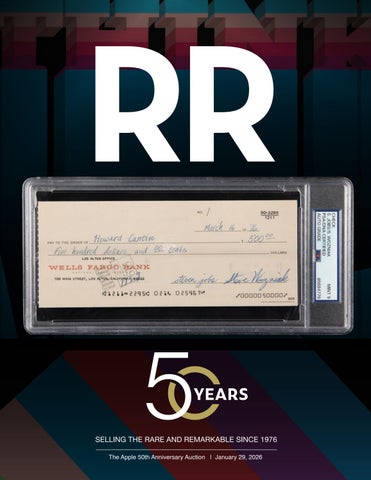
STEVE JOBS Historic Apple Computer check “No. 1,” signed by Jobs and Woz to pay for the design of the Apple-1 printed circuit board—a foundational document of the personal computer revolution 6000. Steve Jobs and Steve Wozniak Historic Signed 1976 Apple Computer Check (No. 1) to Howard Cantin, Designer of the Apple-1 Printed Circuit Board - PSA MINT 9. Massively significant Wells Fargo bank
and never paid me the rest...And Steve sold his VW van for another few hundred dollars. He figured he could ride around on his bicycle if he had to. That was it. We were in business.’
check, 7.5 x 3, filled out and signed by Steve Jobs, “steven jobs,” and countersigned by Steve Wozniak, “Steve Wozniak,” payable to Howard Cantin for $500, March 16, 1976; also endorsed on the reverse by Cantin, “Howard V. Cantin.” This temporary check, issued upon opening Apple’s first bank account, bears the same routing and account numbers as the other early Apple Computer Company checks we have offered; remarkably, this was the very first check to be drawn on the account, paying Howard Cantin for his services as the designer of the Apple-1 printed circuit board (PCB). The later checks carrying this account number were imprinted with Apple’s first official address at ‘770 Welch Rd., Ste. 154, Palo Alto’—the location of an answering service and mail drop that they used while still operating out of the famous Jobs family garage. In very fine condition. Encapsulated and graded by PSA/DNA as “MINT 9.”
These early sacrifices are witnessed in Apple Computer’s first bank statement, offered in this sale as Lot #6002, which shows that their very first deposit—a mere $500—came on the same day that they wrote this check. It also documents the $500 deduction from the account on March 23rd, matching the Wells Fargo stamp on the check’s reverse.
Marked as check “No. 1,” this historically important check pre-dates the official founding of Apple Computer, Inc.—some sixteen days later, on April 1, 1976, co-founders Steve Jobs, Steve Wozniak, and Ronald Wayne would sign the partnership agreement that officially brought Apple Computer into existence. The agreement assigned 45% of the company to each of the Steves, and 10% to Wayne. It also required any expenditure over $100 to be approved by two of the partners— perhaps the reason that both Jobs and Woz signed this check.
Cantin’s involvement was crucial: although Wozniak’s design defined the logic, the aesthetics and manufacturability of the Apple-1 board depended on Cantin’s layout work. The board that Cantin laid out in 1976 used manual techniques (tape for trace routing) and helped form the physical foundation of what became one of the most celebrated early personal computers.
During this early period, Jobs and Woz envisioned the Apple-1 as a bare-board kit to be soldered together by hobbyist users—their initial target market, Silicon Valley’s Homebrew Computer Club. As the two were effectively penniless, Jobs sold his beloved Volkswagen Bus and Woz sold his prized HP-65 pocket calculator to raise the initial working capital to fund the Apple Computer Company. In his autobiography iWoz, Wozniak recounts: ‘To come up with the $1,000 we thought we’d need to built ready-made printed circuit boards, I sold my HP 65 calculator for $500. The guy who bought it only paid me half, though,
Howard Cantin was the printed-circuit-board (PCB) layout engineer who translated Apple‑1 designer Steve Wozniak’s schematic into the actual board that became the first product of Apple Computer Company in 1976. At the time, Cantin was working for Atari, Inc. and had experience doing PCB layouts for early Atari machines; Wozniak tapped him because he trusted Cantin’s craftsmanship for the delicate job of laying traces, component placement, and routing on a board intended for manufacture in small numbers.
This inaugural Apple check thus stands as an extraordinary artifact from the very moment theory became product—when a visionary schematic, a garage workshop, and a fledgling partnership crossed the threshold into an operating business. Bearing the signatures of co-founders Jobs and Woz and issued to the craftsman who physically realized the Apple-1, it encapsulates the collaborative ingenuity and scrappy resourcefulness that defined Apple’s genesis. As the first financial instrument ever drawn on the Apple Computer Company’s original account, it is the foundational document that financed the creation of Apple’s very first product and brought forth the personal computing revolution. Estimate: $500,000-600,000
www.RRAuction.com | 3
4 |
January 29, 2026
In July 1976, Steve Jobs cuts an early ‘Apple Computer Company’ check to their first seed investor—repaying a loan that helped them finance the first run of Apple-1 computers 6001. Steve Jobs Signed 1976 ‘Apple Computer Company’ Check (#181) - Payable to Apple’s First Seed Investor, Elmer Baum. Early Apple Computer
Company check, 6 x 3, filled out in type and signed by Jobs, “steven jobs,” payable Elmer Baum for $125, July 13, 1976. Headed “Apple Computer Company,” the check uses Apple’s first official address at “770 Welch Rd., Ste. 154, Palo Alto”—the location of the answering service and mail drop that they used while still operating out of the famous Jobs family garage. In very fine condition. Encapsulated in a PSA/DNA authentication holder. Boldly signed by Jobs during this foundational era of Apple Computer, this is an ideal example of his autograph. The check’s recipient, Elmer Baum, was the first seed investor of the Apple Computer Company. His son, Allen, was friends with Steve Jobs and Steve Wozniak, and Elmer, formerly an engineer at SRI International, saw promise in the exceptional young duo’s vision. Needing capital to buy parts to create the first run of Apple-1 computers, Jobs and Wozniak borrowed $5,000 from Baum on April 6, 1976—five days after founding Apple Computer—to be repaid in full, plus a flat $250 in interest, by July 6th, with an additional 5% quarterly accrual
for payments made after that date. This check is presumed to represent one such payment. In his 1993 obituary, the Associated Press reported: “Elmer Baum, who helped start Apple Computer by lending its founders $5,000, died Saturday at his home here. He was 75…Mr. Baum made the loan to Stephen Wozniak and Steven Jobs in the mid-1970’s. The two young entrepreneurs were friends of Mr. Baum’s son Allen. ‘The $5,000 from him really was what allowed us to build the Apple I,’ Mr. Wozniak said. Mr. Jobs agreed, saying, ‘Without that, we wouldn’t have made it.’ Mr. Baum worked at SRI International until his engineering group was laid off. Soon thereafter, he saw promise in Mr. Wozniak and Mr. Jobs and gave them the loan for the Apple I computer board. They ‘paid it back fairly quickly,’ Allen Baum said. The partners made and sold hundreds of boards before the Apple II came out in 1977 and the fledgling company took off. Mr. Wozniak and Mr. Jobs rewarded Mr. Baum with a job, and he became Apple employee No. 34. The company now employs about 15,000 people. Mr. Baum’s sons, Allen, Michael and Peter, also worked for Apple.” Estimate: $25,000-30,000
www.RRAuction.com | 5
6 |
January 29, 2026
The first financial record of the “Apple Computer Co.”—a March 1976 Wells Fargo bank statement chronicling the company’s inception 6002. Steve Jobs: March 1976 Wells Fargo Account Statement for Apple Computer Co. - Apple’s First Financial Record. Historic Wells Fargo Bank account statement prepared by the Los Altos Office for “Apple Computer Co.,” one page, 8.5 x 14, for the period ending March 31, 1976. This represents Apple Computer’s first financial record—predating the official founding of the company itself—documenting the opening of the company’s first bank account, its initial deposits, and the amounts of the first six checks ever drawn on the account.
The statement records deposits amounting to $840—beginning with a $500 deposit on March 16, 1976, with subsequent deposits of smaller amounts. Steve Jobs and Steve Wozniak each sold their most valuable possessions—Jobs his beloved Volkswagen Bus, and Woz his prized HP 65 calculator—to raise the initial working capital to fund the Apple Computer Company. In his autobiography iWoz, Wozniak recounts: ‘To come up with the $1,000 we thought we’d need to built ready-made printed circuit boards, I sold my HP 65 calculator for $500. The guy who bought it only paid me half, though, and never paid me the rest...And Steve sold his VW van for another few hundred dollars. He figured he could ride around on his bicycle if he had to. That was it. We were in business.’ The statement also lists debits totaling $697.45. These included a $500 payment to Howard Cantin, designer of the Apple-1
printed circuit board layout; $116.97 to PCB maker Ramlor, Inc.; $13.86 to Elmar Electronics, an electronics distribution house with locations in Palo Alto and Mountain View, California; and $4.95 to Zack Electronics, another local electronics distributor; $13.25 to University Art Center; and $47.50 to Pacific Telephone. At the end of the month, Apple Computer was down to a meager $142.55. Each of these checks was returned with the statement—it notes, “6 Items Enclosed”—and all but the very first have been sold by RR Auction; Apple Computer Company check #1 is offered in the present sale as Lot #6001. In fine condition. This early Wells Fargo account statement holds exceptional significance as the earliest financial record of the Apple Computer Company, created even before the company’s official founding on April 1, 1976. It chronicles, in real time, the transformation of Steve Jobs and Steve Wozniak’s garage startup into a functioning business, documenting the company’s very first deposits and its earliest expenditures—spending that fueled the manufacture of the Apple-1 computer. Itemizing payments to the PCB designer, board fabricators, electronics suppliers, and even the modest telephone bill that kept the founders connected, the statement offers a tangible snapshot of Apple at its moment of inception. Estimate: $2,500-3,000
www.RRAuction.com | 7
8 |
January 29, 2026
The “Celebration” Apple-1: earliest known fiberglass prototype used to validate Apple’s first computer 6003. Apple-1 Computer Prototype The “Celebration” Board, Representing the Earliest Known Fiberglass Apple-1 Prototype. Unique, preproduction Apple-1 pre-NTI board, representing the earliest known fiberglass Apple-1 prototype assembled before the first Byte Shop production run. It occupies a singular and critical place in Apple history as the first corrected-layout board used by Steve Jobs and Steve Wozniak to validate the Apple-1 design before entering into commercial production.
Historical documentation shows that Apple commissioned the initial Apple-1 PCB layout from Howard Cantin in March 1976. From this work came the tan phenolic prototype board, sold by RR Auction in August 2022—an inexpensive test board that required extensive reworking to operate properly. After those issues were identified and corrected, Apple needed to confirm that the revised design functioned correctly when produced on a proper fiberglass PCB. The “Celebration” Apple-1 is that transitional board: the validation unit assembled before Apple built the first fifty machines for Paul Terrell’s Byte Shop order. Its construction clearly distinguishes it from all other surviving Apple-1 computers. This board uses wave-soldered RobinsonNugent sockets instead of the cheaper Texas Instruments sockets used on production boards, and it incorporates a unique mix of hand-soldered components sourced locally for testing rather than from Apple’s later standardized purchasing (e.g. two common silver Sprague 39D capacitors that were not computer-rated, but easily available at a radio repair shop). The board carries a smaller, non-standard heatsink, and the voltage regulation area displays no evidence that the larger, production-style heatsink was ever installed. The board also contains a unique modification to the 74123 timing circuit used for DRAM refresh, consistent with the diagnosis of timing issues before full-scale production. These characteristics demonstrate that the “Celebration” Apple-1 predates all Byte Shop boards and was never intended for retail sale. It embodies the moment of Apple’s transition from an experimental prototype to a manufacturable product, marking the beginning of Apple’s emergence as a computer company.
This Apple-1 computer was examined by Apple-1 expert Corey Cohen in May 2016, with revisions to his report made in December 2025. A comprehensive, technical condition report prepared by Cohen is available to qualified bidders; he evaluates the cosmetic condition of the unit as 6.5 to 7.0. It has not been tested for functionality. The computer is recorded as #75 in the Apple-1 Registry, listed as the “Celebration” Apple-1.
THE SET INCLUDES: • original Apple-1 board, distinguished as the earliest known fiberglass prototype • vintage, period-correct Key Tronic keyboard (c. 1977) • vintage, period-correct power supply • vintage Sony TV set • replica Apple-1 Operation Manual, signed in blue felt tip by Steve Wozniak • replicaApple-1 schematic, signed in blue felt tip by Steve Wozniak Estimate: $500,000-600,000
www.RRAuction.com | 9
10 |
January 29, 2026
Wooden ‘Byte Shop’ case for the Apple-1, long preserved in the Jobs family’s famous ‘Apple Garage’ 6004. Steve Jobs’s Personally-Owned Apple-1 ‘Byte Shop’ Wooden Case. Steve Jobs’s personally-owned ‘Byte Shop’–style wooden Apple-1 case of unusual construction, modified with a vented metal baseplate with rear ports for audio/video out, a power plug, and a fuse; typical Byte Shop cases had wooden rear and bottom panels. The top panel features the standard keyboard cutout. This case was long kept in the attached garage of the Jobs family home in Los Altos, famously known as the ‘Apple Garage.’
The Apple-1 was originally conceived by Steve Jobs and Steve ‘Woz’ Wozniak as a bare circuit board to be sold as a kit and completed by electronics hobbyists, their initial market being Palo Alto’s Homebrew Computer Club. Seeking a larger audience, Jobs approached Paul Terrell, owner of The Byte Shop in Mountain View, California, one of the first personal computer stores in the world. Aiming to elevate the computer beyond the realm of the hobbyist tinkerer, Terrell offered to buy 50 of the computers—at a wholesale price of $500 a piece, to retail at $666.66—but only if they came fully assembled. Jobs and Woz agreed to the deal, setting the stage for Apple’s early success.
The Byte Shop cases gave the machines a polished, finished appearance, really setting them apart from typical hobbyist kits of the era; the Apple-1 thus became one of the first ‘personal’ computers which did not require assembly by the end user. Steve Wozniak later placed Terrell’s purchase order in perspective: ‘That was the biggest single episode in all of the company’s history. Nothing in subsequent years was so great and so unexpected.’ This wooden Apple-1 ‘Byte Shop’ case, personally-owned by Steve Jobs and preserved in the now-mythic ‘Apple Garage’ where Jobs and Wozniak assembled their earliest machines— traces a direct line to Apple’s origin story, bridging the founders’ raw ingenuity with the commercial ambition sparked by the Byte Shop order. As both an artifact of Apple’s first product and a survivor of its storied birthplace, this case stands as a tangible witness to the company’s genesis, when a garagebuilt computer helped ignite the personal computing revolution. Provenance: from the personal collection of John Chovanec, stepbrother of Steve Jobs. Estimate: $5,000-10,000
www.RRAuction.com | 11
6005. Steve Jobs’s Personally-Owned Apple-1 Computer Heat Sink. Steve Jobs’s personally-
owned original vintage circa 1976 heat sink for an Apple-1 Computer, evidently a prototype or modified version as the fins are shorter than those of a stock Apple-1 heat sink. The component measures 1.75˝ x 1.75˝ x .75˝. In fine condition. This heat sink resided on the Jobs family’s famous ‘Apple Garage’ property in Los Altos for many years. Estimate: $1,000-1,500
6006. Steve Jobs’s Personally-Owned Apple-1 Computer Ribbon Cable. Steve Jobs’s personally-owned
original vintage circa 1976 connector and colorful ribbon cable for an Apple-1 Computer, featuring a 10˝ rainbow ribbon cable terminating in a 16-pin connector. In very good to fine condition. This cable resided on the Jobs family’s famous ‘Apple Garage’ property in Los Altos for many years. Estimate: $1,000-1,500
12 |
January 29, 2026
Spare Apple-1 components and tinkered-with electronic parts, long stored inside the famous Jobs family ‘Apple Garage’ 6 0 0 7 . S t e v e J o b s ’s Personally-Owned Apple-1 Computer Components and Miscellaneous Electronic Parts, Stored in an EwingFoley Box Addressed to the ‘Apple Garage’ Family Home. Unique archive of Steve
Jobs’s personally-owned spare Apple-1 components and miscellaneous electronic parts, long stored in the famous ‘Apple Garage’—the attached garage at his family’s home in Los Altos—inside a package from Ewing-Foley, a local electronics distributor/manufacturer’s representative. The box measures 9.25˝ x 8˝ x 2˝ and carries a label from Ewing-Foley, Inc., addressed to “Steve Jobs, 11161 Christ [sic] Dr., Los Altos, Ca. 94022,” and postmarked October 11, 1975.
Parts affiliated with the Apple-1 include: a total of 31 ceramic disc capacitors (“.1 BEL”); five Texas Instruments chip sockets; two MPS3704 transistors; two six-pin power connectors; and a four-pin video connector. Other parts include: a small bag of Motorola chips, with attached slip ostensibly labeled in Steve Jobs’s own hand, “Clock driver, Bus driver”; two gray-and-white HP integrated circuit ships (1820-0633 and 1820-0634); three digital displays; two prototyping boards with soldered jumpers; a couple of Sprague capacitors; heatsink parts; some resistors; and a variety of other chips and sockets.In overall very good to fine condition, with overall wear and one split corner to the box lid. Ewing-Foley’s offices were about five miles from the Jobs’ family home in Los Altos. In 2023, the Los Altos Town Crier published a piece on one of the company’s founders, Dick Foley, who recalled ‘donating a couple of sample toggle switches to a young man named Steve Jobs, who wandered into his office one day when he was building one of his early computers.’ This remarkable assortment provides a rare glimpse into the humble, hands-on origins of Apple Computer, when Jobs and Wozniak were sourcing components locally and assembling their first breakthrough machines by hand. As spare parts contemporary to the formative Apple-1 era—and kept for decades within the very garage that would become synonymous with the dawn of Silicon Valley—these items embody the experimental spirit and resourceful ingenuity that defined Apple’s earliest days. With several components aligning directly with known Apple-1 specifications, and others reflecting Jobs’s broad sweep of tinkering and prototyping interests, the archive offers both technical significance and exceptional provenance, firmly rooted in the mythology of Apple’s creation story. Provenance: from the personal collection of John Chovanec, stepbrother of Steve Jobs. Estimate: $1,000-2,000
www.RRAuction.com | 13
14 |
January 29, 2026
Steve Jobs’s hand-annotated Volkswagen Bus repair manuals— relics from the car he sold to finance Apple’s founding 6 0 0 8 . S t e v e J o b s ’s P e r s o n a l l y - O w n e d , Hand-Annotated Volkswagen Repair Manuals (2) Relics from the Car Sold to Finance Apple’s Founding. Steve Jobs’s pair of personally-owned Volkswagen manuals, long stored in the famous ‘Apple Garage’—the attached garage at his family’s home in Los Altos—inside a box bearing his name. Much of Steve Jobs’s creative drive might be attributed to the influence of his father, Paul R. Jobs, a machinist and handyman that restored and flipped used cars on the side. Steve would famously sell his Volkswagen Transporter—better known as the Volkswagen ‘Bus’—at the age of 21 to raise the working capital to found Apple Computer; his co-founder, Steve Wozniak, sold his beloved HP 65 calculator, and together they raised about $1,300 in capital to start their firm. Includes: - a softcover third printing of Clymer Publications’ “Volkswagen Service–Repair Handbook, Transporter (1961–1972),” 7 x 10, 247 pages, published in December 1972, annotated on the last page in Steve Jobs’s hand in blue ink with information on his vehicle: “Engine #H0014808, Chassis #246 011 985.” A couple of headings inside are highlighted in blue, referring to “Tire Rotation” and “Spark Polarity.” Also annotated inside the front cover, “S. Jobs,” penned in an indeterminate hand. - a spiral-bound softcover fourteenth printing of “How to Keep Your Volkswagen Alive: A Manual of Step-by-Step Procedures for the Compleat Idiot” by John Muir and Tosh Gregg, 8.5 x 11, 327 pages, published in March 1975, annotated on the last page in Steve Jobs’s hand in blue ink with the same information: “Engine #H0014808, Chassis #246 011 985.” Among the highlighted sections are colorfully-worded passages about warming up the engine, shifting speeds, tune-up procedures,
and tire rotations, along with a suggestion for a source of hard-to-find parts located in Sacramento; interestingly, the book also recommends that the chassis and engine numbers be recorded in a safe place—a suggestion that Jobs clearly followed, noting them down in both repair manuals. In overall very good to fine condition, with some edgewear and scuffing to covers. Steve Jobs grew up immersed in the hippie culture and hackertinkerer ethos of 1970s Silicon Valley, and the Volkswagen Bus was symbolic of both—this is no less evident than in “How to Keep Your Volkswagen Alive,” a legendary, countercultural repair guide that blends practical mechanical instruction with warmth, humor, and a deeply human approach to car care (for example, when it comes to tire rotation, the book suggests: “Don’t rotate your tires! It takes about 500 miles for a tire to get used to its position on a car, and changing it around just messes up its head”). Beyond their practical use, these humble manuals stand as artifacts of Jobs’s formative years—a period defined by handson experimentation and a belief in the union of intuition and engineering. Well before Apple became synonymous with sleek, closed-system design, Jobs was literally elbow-deep in the workings of his Volkswagen, absorbing the lessons of simplicity, clarity, and user-centered thinking that would later shape his design philosophy. Long preserved in the storied ‘Apple Garage,’ these well-used guides bridge the countercultural DIY ethos of the 1970s with the revolutionary technological vision that would soon follow. Provenance: from the personal collection of John Chovanec, stepbrother of Steve Jobs. Estimate: $1,000-2,000
www.RRAuction.com | 15
16 |
January 29, 2026
Steve Jobs’s personally-owned Bob Dylan and Joan Baez 8-track tapes—reflecting the creative DNA that formed Apple’s ethos 6009. Steve Jobs’s Personally-Owned Bob Dylan and Joan Baez 8-Track Tapes (6). Six of Steve Jobs’s personallyowned 8-track tapes—five by Bob Dylan (Highway 61 Revisited, Blonde on Blonde, John Wesley Harding, Blood on the Tracks, and Desire) and one by Joan Baez (Diamonds & Rust)—retrieved from the bedroom closet of his boyhood home. The tapes are well worn, with evidence of extensive use—including heavy wear to the labels and scratches to the plastic. In overall good to very good condition.
The music of Bob Dylan and Joan Baez played a pivotal role in Steve Jobs’s life, and, indeed, the formation and success of Apple itself. According to Walter Isaacson’s biography of Steve Jobs, Apple cofounder Steve Wozniak turned Jobs on to the music of Dylan shortly after they met, and part of their early friendship was built upon chasing down live bootlegs of Dylan concerts: “’The two of us would go tramping through San Jose and ask about Dylan bootlegs and collect them,’ said Wozniak. ‘We’d buy brochures of Dylan lyrics and stay up late interpreting them. Dylan’s words struck chords of creative thinking.’ Added Jobs, ‘I had more than a hundred hours, including every concert on the ‘65 and ‘66 tour…Instead of big speakers I bought a pair of awesome headphones and would just lie in my bed and listen to that stuff for hours’” (p. 25–26). His Dylan 8-tracks are mentioned in a later passage, as his friend Elizabeth Holmes—who had joined a religious cult in San Francisco— recalls an odd car ride: “[Jobs] arrived at the cult house in his Ford Ranchero one day and announced that he was driving up to Friedland’s apple farm and she was to come. Even more brazenly, he said she would have to drive part of the way, even though she didn’t know how to use the stick shift. ‘Once we got to the open road, he made me get behind the wheel, and he shifted the car until we got up to 55 miles per hour,’ she recalled. ‘Then he puts on a tape of Dylan’s ‘Blood on the Tracks’, lays his head in my lap, and goes to sleep. He had the attitude that he could do anything, and therefore so can you. He put his life in my hands” (p. 51–52). While working on the development of the pioneering Macintosh computer, Jobs was introduced to Joan Baez through her sister, Mimi Fariña. Writes Isaacson: “He was twenty-seven and Baez was fortyone, but for a few years they had a romance. ‘It turned into a serious relationship between two accidental friends who became loves,’ Jobs recalled in a somewhat wistful tone. Elizabeth Holmes, Jobs’s friend from Reed College, believed that one of the reasons he went out with Baez—other than the fact that she was beautiful and funny and talented—was that she had once been the lover of Bob Dylan. ‘Steve loved that connection to Dylan,’ she later said” (p. 251).
At the Apple shareholder’s meeting on January 24, 1984—during which Steve Jobs publicly unveiled the Macintosh—he opened his remarks by quoting from “part of a twenty-year-old poem by Dylan, that’s Bob Dylan,” reciting the second verse of his enduring protest anthem: “Come writers and critics who prophesize with your pens, and keep your eyes wide, the chance won’t come again, and don’t speak too soon, for the wheel’s still in spin, and there’s no tellin’ who that it’s namin’, for the loser now will be later to win, for the times they are a-changin’.” Jobs would go on to meet Dylan in 2004, when the legendary songwriter was playing near Palo Alto. Jobs recalled: ‘We say on the patio outside his room and talked for two hours. I was really nervous, because he was one of my heroes….He was as sharp as a tack. He was everything I’d hoped. He was really open and honest. He was just telling me about his life and about writing his songs. He said, ‘They just came through me, it wasn’t like I was having to compose them’” (p. 415–416). A few years after introducing the iPod and iTunes store, after a few years of effort, Jobs was able to lure Dylan into a distribution and marketing agreement. In 2006, in conjunction with the release of Modern Times, Dylan allowed Apple to sell a $199 digital boxed set of all the music he had ever recorded, and appeared in a commercial for the iPod. Jobs was intimately involved with the creation of the ad—he even convinced Dylan to retape the entire thing when he was dissatisfied with the first version. The campaign was a massive success, and helped propel Dylan to the top of the charts for the first time since 1976, when Desire—Jobs’s own copy included here—reached No. 1 on the Billboard Pop Albums chart. The next year, Jobs would play “Like a Rolling Stone,” off of Dylan’s celebrated Highway 61 album, during his introductory demonstration of the iPhone. Dylan’s influence on Jobs—and by extension, on Apple—was profound. Jobs admired Dylan’s relentless reinvention and artistic fearlessness, traits he sought to emulate in his own work. The ethos of challenging convention, simplifying to essentials, and forging new paths that Dylan embodied became foundational to Apple’s identity. From quoting Dylan in his most important product unveilings to personally shaping the iPod campaign that brought Dylan back to the top of the charts, Jobs continually wove the songwriter’s spirit into Apple’s narrative. These well-worn tapes, pulled from the closet of his childhood home, thus represent more than youthful listening—they are artifacts that reflect the creative DNA that helped shape one of the modern world’s most influential companies. Provenance: from the personal collection of John Chovanec, stepbrother of Steve Jobs. Estimate: $3,000-5,000
www.RRAuction.com | 17
18 |
January 29, 2026
Steve Jobs’s bedroom desk from the famous ‘Apple Garage’ property, filled with pre-Apple papers from his days at Reed, Atari, and HP 6010. Steve Jobs’s Bedroom Desk from the ‘Apple Garage’ Property, with Archive of Early Reed College, Atari, and HP Papers. Steve Jobs’s bedroom desk from his family’s
famed ‘Apple Garage’ property in Los Altos, California, filled with a remarkable archive of papers found in situ, tracing elements of his early path—Atari papers, a Reed College notepad, programming and circuitry notes, HP manuals, and other relics of a life before Apple. The desk itself is a mid-century modern design featuring clean lines, integrated recessed drawer pulls, and sturdy tapered legs. Its symmetrical double-pedestal construction offers six spacious drawers, all in a matching light honey finish that highlights the natural wood grain. The desktop exhibits signs of age, wear, and youthful impulse within the Jobs household, with a few carvings incised into the wood—one being the name of his sister, Patricia. This desk comes from the personal collection of John Chovanec, the stepbrother of Steve Jobs. One afternoon at the Jobs family’s Los Altos home, famed as the site of the ‘Apple Garage,’ Steve led John into his childhood bedroom, walked over to this desk, and powered up the Macintosh he had given to his father, Paul R. Jobs. For 45 minutes, Steve walked through the computer’s capabilities and explained challenges they faced during development. John recalls thinking, “How am I privately sitting with Steve Jobs in his childhood bedroom, demonstrating the Mac on his childhood desk… To me this was like sitting down with Willie Mays or Joe Montana in the house they grew up in.” When Paul Jobs passed away in 1993, Steve served as executor of the estate. John remembers: “Paul had given my mom a life estate to live at the Apple house… After Paul’s funeral we were in the dining room when my mom told Steve she felt funny living there… Steve took charge and explained that his dad wanted this for her and I quote: ‘You need to live here until you drop.’”
In the aftermath, Steve Jobs visited the Apple house several times to help organize and dispose of his father’s belongings. Steve’s childhood bedroom still contained the desk on which he had studied and dreamed throughout his youth, filled with papers from his teenage years and early twenties. Though John and his mother encouraged Steve to keep the desk and its contents, Steve declined, explaining that although the desk held “a lot of memories,” he had no use for it. When John asked if he could have it, Steve Jobs told his stepbrother, “Take it.” Provenance: from the personal collection of John Chovanec, stepbrother of Steve Jobs. Estimate: $25,000-30,000
HISTORIC PAPERS INCLUDE:
- a Hewlett-Packard mailing envelope addressed to Jobs, postmarked January 26, 1971. - a Hewlett-Packard Company ‘Wage and Tax’ statement documenting $1080 wages paid to “Steve P. Jobs” in 1971, during Jobs’s teenage years. - a notepad of 19 sheets of blank Reed College stationery paper. - a bright orange Atari folder with nine blank Atari inter-office memo sheets, and two blank sheets of embossed Atari letterhead. - a page of yellow handwritten programming notes, decisively written in Jobs’s own hand. - three pages of handwritten electronics notes in blue ink, penned in an indistinguishable style but possibly incorporating Jobs’s handwriting. - three pages of photocopied schematics, one heavily annotated in pencil in an unknown hand. - two photocopied schematics for an RF device, one with some intriguing early computer word processing experiments printed on the reverse, offering evidence of Jobs’s playfulness and early predilection for lowercase lettering: “ttttttttttthis is a computer,” “this is 12 point , no no no 10 point!!!,” “this is 12 point not 10 point!!!,” “this is courier in 12 point,” “this is courier in 10 point.” - loose-leaf manual for the Hewlett-Packard Measuring System 5300A. - Hewlett-Packard “Application Note 931” for their “Solid State Alphanumeric Display Decoder/Driver Circuitry.” - Hewlett-Packard technical data sheet for their “Solid State Numeric Indicator.” - Hewlett-Packard internal integrated circuit data sheet for “Time Base Hexade,” marked “Company Confidential.” - Hewlett-Packard Journals from February 1969, July 1970, August 1971, and May 1974. - Hewlett-Packard Components “Optoelectronics Designer’s Catalog” from 1975. - Advent Videobeam Projection Color Television brochure.
www.RRAuction.com | 19
6011. Steve Jobs’s Personally-Owned Caltech FORTH Report on Owens Valley Radio Observatory (September 1974). Steve
Jobs’s personally-owned report entitled “An Internal Report of the Owens Valley Radio Observatory, California Institute of Technology, Pasadena, California 91109, September, 1974, The Caltech FORTH Manual by Martin S. Ewing, with an Appendix by H. Wayne Hammond.” Bound in the original softcover wrappers, 8.25 x 10.75, 108 pages. The manual describes Caltech FORTH, a programming language developed for controlling the Owens Valley Radio Observatory’s 40-meter telescope. The introduction begins: “The rapid acceptance of minicomputers for data acquisition and system control has created a need for matching software systems. High level languages like FORTRAN, ALGOL, or PL/1 are not normally effective in environments with less than 16K words and limited peripheral devices. Even when these languages can be used, they are all designed for batch processing and lack features needed for direct interaction with the operator. By default most programmers have been forced to use assembly language. This is efficient for small programs, but there can be great practical difficulties in writing and maintaining larger assembly programs. The FORTH system meets the problem described above; it provides a flexible operating system for minicomputers of moderate size. A machine with 8K 16-bit words and at least one mass storage device can make effective use of FORTH. Most new laboratory computers will have at least this size; the programming difficulties with smaller machines will more and more outweigh the falling cost of memory and peripherals.” The manual provides a comprehensive overview of FORTH, covering its history, structure, vocabulary, and operations. In very good to fine condition, with losses to the head and tail of the spine. This was found amongst the reports and papers within Steve Jobs’s childhood desk. His ownership of this early programming manual situates him within the intellectual milieu that directly inspired the personal computing revolution. FORTH’s focus on simplicity, efficiency, and tight hardware–software integration prefigured the core design philosophy of Apple’s earliest machines: powerful tools that placed interactive computing in the hands of individuals. A remarkable convergence of institutional research and Silicon Valley vision, this volume bridges the gap between the mainframe era and the microcomputing world that Steve Jobs would soon help transform. Provenance: from the personal collection of John Chovanec, stepbrother of Steve Jobs. Estimate: $500-1,000
20 |
January 29, 2026
1975 Atari “Astrochart” papers, hand-annotated by 20-year-old developer/designer Steve Jobs 6012. Steve Jobs’s Hand-Annotated Atari Horoscope Program Report and Memo to Stephen Bristow, with “All-One Farm Design” Invoice Blank. Archive pertain-
ing to the development of “Astrochart,” an astrology/horoscope application that Steve Jobs was working on for Atari in the summer of 1975, once preserved inside his childhood desk. The archive includes: - a ten-page typescript report by Jobs, the cover sheet reading, “Where Are the Stars? A Report to Stephen Bristow on the Derevation of the Final Equations for Calculation of Planetary Coordinates, Submitted by Steven Jobs, All-One Farm Design,” which proposes to be “the final definetion of the equations to be used as a large subset in the complete programming of ‘Astrochart,’ the function being to calculate the current planetary coordinates of the ten planets of our solar system (for the following discussion, the moon is refered to as a planets), and to do so using a reletively limited size of reference storage.” One page of equations is heavily annotated in pencil in Jobs’s hand, making extensive revisions to several of the calculations. - a four-page Atari inter-office memo from Jobs to Bristow, dated August 23, 1975, headed: “Addendum to Final Equations for Astrochart.” The addendum contains “revisions of the final equations for planetary coordinates” and encloses a “printout of the changes made in comparison to the original data. As you can see, the results are most satisfactory, with the greatest deviance being in Pluto’s orbit—still less than 3 degrees!”
- a blank invoice form for Jobs’s early company, “All-One Farm Design”—a name Jobs appropriated from the commune he frequented at the time—giving the address of his parents’ house in Los Altos, backed by two carbon copy layers. In overall fine condition. In 1974, Jobs was perusing the tech industry’s help-wanted classifieds in the San Jose Mercury when an Atari headline caught his eye: ‘Have fun, make money.’ When the unkempt teen showed up in Atari’s office—and refused to leave until they gave him a job—the personnel manager didn’t know whether to let him in or call the cops. Knowing that the dropout youngster would be cheap to hire, Atari’s chief engineer—Pong creator Allan Alcorn—said: ‘Send him in!’ Since Jobs knew how to solder and wire wrap, he was hired on as a technician. At Atari, Jobs learned to keep user interfaces simple and intuitive—after all, the company’s success was rooted in Pong’s simplicity: ‘Deposit Quarter, Avoid Missing Ball for High Score.’ This sort of elegant user-friendliness would become a hallmark of Jobs’s later products—from the one-button mouse to the touchscreen iPhone. He also refined his business acumen—Jobs famously farmed out the engineering of the Atari ‘Breakout’ prototype to his friend, Steve Wozniak, who implemented several innovative cost-savings circuit designs. Jobs earned a $5000 bonus for the project’s success and reportedly kept it a secret. In this archive, Jobs provides some “Astrochart” equations and concepts to his supervisor, Stephen Bristow—the video game pioneer who helped develop the design concept of Breakout, and assigned Jobs to that project. In an interview with retrogamer. net, Bristow recalled: ‘Steve Jobs always had an appreciation of his own ability. He wasn’t allowed onto the production floor because he wouldn’t wear shoes, only sandals. There was a special-ness to him.’ Provenance: from the personal collection of John Chovanec, stepbrother of Steve Jobs. Estimate: $500-1,000 www.RRAuction.com | 21
Photomatched to the Jobs family’s wall— Apple Computer Inc.’s first advertising poster, presented by Steve Jobs to his proud father 6014. Steve Jobs’s Personally-Owned 1977 Apple Computer Inc. Poster, Which Hung in His Family’s Living Room. Steve
Jobs’s personally-owned vintage circa 1977 Apple Computer Inc. poster, 16 x 20, produced shortly after the company was funded by Mike Markkula and presented by Steve Jobs to his father, Paul, who proudly displayed it in the living room of the Jobs family home in Los Altos. Created as the first advertisement for “Apple Computer, Inc.”—the newly formed corporation that succeeded the Jobs-and-Woz ‘Apple Computer Company’ partnership—this simple image of a bright red apple preceded the development of Apple’s iconic rainbow logo. The photograph would be leveraged in Apple’s advertising for the Apple II, often carrying the tagline: ‘Simplicity is the ultimate sophistication.’ Displayed in the original red metal frame to an overall size of 16.25 x 20.25. In fine condition, with slight rippling to the poster and a few scratches to the frame. Accompanied by an image of Steve Jobs taken during a visit to his parents’ house in the 1990s, this poster seen on the wall behind him. This poster represents a tangible link to the origins of Apple’s identity and vision, capturing the moment before the company’s visual and cultural transformation into a global icon. Beyond its rarity, its familial provenance—from Jobs himself to his father—embodies the deeply personal nature of Apple’s early story, when the brand’s revolutionary ideals were still rooted in a family garage. As such, it serves not only as an early artifact of Apple’s marketing but also as a symbol of the passion and authenticity that defined Jobs’s approach to innovation. Provenance: from the personal collection of John Chovanec, stepbrother of Steve Jobs. Estimate: $5,000-10,000
22 |
January 29, 2026
6015. Steve Jobs’s Personally-Owned Apple Computer “Pascal” Poster. Steve Jobs’s per-
sonally-owned vintage circa 1979–1980 Apple Pascal poster, 20 x 15, featuring “Pascal: Spoken Here” in a combination of Apple’s trademark rainbow-striped lettering and elegant faux-chrome script. Below, the “Apple Computer Inc.” logo is imprinted in glossy black lettering against the matte black background. Affixed to a same-size mount and in very good to fine condition, with unobtrusive dampstaining to the upper left corner. This scarce poster features the same “Pascal: Spoken Here” emblem as a 1979 advertisement which featured it as an iron-on decal, designed to be put on a t-shirt and ‘let the world know who speaks Pascal.’ The posters were apparently distributed to Apple authorized dealers during the 1980s. This was one of several Apple promotional posters kept in the back garage of the Los Altos family home. Provenance: from the personal collection of John Chovanec, stepbrother of Steve Jobs. Estimate: $1,000-2,000
6016. Steve Jobs’s Personally-Owned Apple Personal Computers Poster (1980). Steve Jobs’s
personally-owned vintage circa 1980 “Apple Personal Computers” poster, 23 x 35, featuring a huge image of the iconic six-color Apple logo against a black gridded background, with text in the classic ‘Motter Tektura’ font. Imprinted in the lower left corner with “MSR# M30-0580 50K,” and in the lower right corner with “©1980 Apple computer Inc.” In very good to fine condition, with scattered surface marks and creases, and two old tape remnants to the reverse. This was one of several Apple promotional posters kept in the back garage of the Los Altos family home. Provenance: from the personal collection of John Chovanec, stepbrother of Steve Jobs. Estimate: $1,000-2,000
www.RRAuction.com | 23
6017. Steve Jobs’s Personally-Owned Apple Milestones Poster (1982). Steve Jobs’s personally-owned
vintage circa 1982 “Apple Milestones” employee appreciation poster, 23 x 35, featuring a huge image of the iconic six-color Apple logo against a black gridded background, with golden text: “Thanks to you! Thanks to you, Apple has grown faster than any company in modern business history. Our historic rise to the top has been made possible only through the combined effort of all Apple people.” It then lists Apple’s achievements from its incorporation in January 1977 to its first “$1 Billion Sales Rate” in December 1982, with the facsimile signature of CEO Mike Markkula imprinted below. In very good to fine condition, with a few surface creases, light edgewear, and old tape residue to reverse upper corners. This was one of several Apple promotional posters kept in the back garage of the Los Altos family home. Provenance: from the personal collection of John Chovanec, stepbrother of Steve Jobs. Estimate: $1,000-2,000
6018. Steve Jobs’s Personally-Owned Apple Computer “Think” Poster. Steve Jobs’s personally-owned vintage circa 1979–1980 internal Apple Computer “THINK” poster, 22 x 11.75, featuring “THINK” in rainbow-striped floating block letters against a matte-black background. Below, the “Apple Computer Inc.” logo is imprinted in glossy black lettering. Affixed to a same-size mount and in fine condition, with a few minor surface dings toward the edges, and some fading to the once-vivid bands of color.
This playful poster was devised as an internal parody of IBM’s “THINK” slogan, reproducing it in Apple’s trademark six bands of color. It was never publicly distributed, reserved solely for Apple employees and select external VIPs. Steve Jobs proudly displayed one of the posters at his desk, as seen in Tony Korody’s famous 1981 portraits of the Apple executive. This was one of several Apple promotional posters kept in the back garage of the Los Altos family home. Provenance: from the personal collection of John Chovanec, stepbrother of Steve Jobs. Estimate: $1,000-2,000
24 |
January 29, 2026
6019. Steve Jobs’s Personally-Owned Bow Ties (12), Retrieved from His Boyhood Bedroom Closet. Collection of twelve of Steve Jobs’s personally-owned clip-on bowties, retrieved from the bedroom closet of his boyhood home. The bow ties display a wide variety of patterns and colors—ranging from solid to plaid to polka-dotted—with hues leaning towards reds, blues, and browns. Makers include Ty-Rex, Ormond, Wembley, Spur, Ever-Grip, and Best Clip. In overall fine condition.
In his 1972 high school yearbook photo, Steve Jobs appears wearing a solid black bow tie—a small but telling detail that hints at his early flair for individuality. In the years that followed, he occasionally wore bow ties at Apple’s early events, projecting a mix of youthful confidence and quirky intellect. This brief fashion phase contrasted sharply with the minimalist black turtleneck and jeans that would later define his public image. The shift reflected Jobs’ evolution from an ambitious young innovator to a visionary with a distinct and enduring personal brand. Provenance: from the personal collection of John Chovanec, stepbrother of Steve Jobs. Estimate: $2,000-4,000
www.RRAuction.com | 25
“Hi, I’m back”—Steve Jobs announces his return to the ‘Apple Garage’ family home
6020. Steve Jobs’s Personally-Owned Apple Computer Business Card, with Handwritten Note to His Father: “Hi, I’m back.” Steve Jobs’s hand-annotated original Apple Computer business card, 3.5 x 2, featuring the company’s colorful rainbow logo, with a note to his father penned in black felt tip, “Hi, I’m back.” The card’s text reads: “Steven P. Jobs, Chairman of the Board, Apple Computer, Inc., 20525 Mariani Avenue, MS: 3K, Cupertino, California 95014, 408 973-2121 or 996-1010.” In fine condition, with subtle toning. Encapsulated in a PSA/ DNA authentication holder. This was one of several business cards found along with Apple promotional posters kept in the back garage of the Los Altos family home. The card dates to the period when Jobs served as Apple’s chairman, from February 1981 until his resignation in September 1985. Although Jobs returned to Apple in 1997, he didn’t reassume the role of chairman until August 24, 2011, the date of his resignation as CEO and some six weeks before his passing. Though ostensibly announcing his return from a trip with this message, Steve Jobs’s words echo his famous 2009 keynote where he announced his return to Apple from a liver transplant: ‘I’m vertical. I’m back at Apple. Loving every day of it. I’m getting to work with our incredibly talented teams to come up with some great new products for you all in the future. So it’s wonderful, and thank you.’ Provenance: from the personal collection of John Chovanec, stepbrother of Steve Jobs. Estimate: $10,000-15,000
26 |
January 29, 2026
Jobs thanks the AppleWorks creator: “I wanted to congratulate you on the phenomenal success of your AppleWorks program and thank you for the contribution you have made to Apple Computer” 6022. Steve Jobs Typed Letter Signed to AppleWorks Creator Rupert ‘Robert’ Lissner: “I wanted to congratulate you on the phenomenal success of your AppleWorks program.” TLS signed
“steve,” one page, 7.25 x 10.5, personal Apple Computer, Inc. letterhead, May 9, 1985. Letter to AppleWorks creator Rupert Lissner, in full: “I wanted to congratulate you on the phenomenal success of your AppleWorks program and thank you for the contribution you have made to Apple Computer. I very much respect the creativity and quality of your work and wanted to let you know how much I appreciate your efforts.” In fine condition. Accompanied by Lissner’s own archive of AppleWorks clippings and ephemera, including his “inCider Magazine People’s Choice Award” certificate from December 1986, various relevant clipped magazine covers and reviews of the AppleWorks software, and an AppleWorks sales brochure. Accompanied by a letter of provenance signed by Lissner, in part: “My name is Robert Lissner, though many in the early Apple community knew me by my given name, Rupert Lissner, which I later legally changed. I am providing this letter to formally document the provenance of the enclosed Steve Jobs-signed letter dated May 9, 1985, addressed to me at that time as ‘Rupert.’ In the early 1980s, I created the software program AppleWorks, which became one of the most successful and influential productivity applications in Apple’s history. AppleWorks combined word processing, spreadsheet, and database functions into a single integrated suite, and it quickly became the cornerstone product for Apple II users worldwide. The program’s commercial success had a meaningful impact on Apple’s software ecosystem, user adoption, and market growth during a critical period in the company’s development. The letter offered here was written to me personally by Steve Jobs, Chairman of the Board of Apple Computer at the time. In it, Steve congratulates me on the ‘phenomenal success’ of AppleWorks and expresses appreciation for my contribution to Apple. This letter has remained in my possession since the day I received it in 1985. It is an authentic, direct communication from Steve Jobs to me, acknowledging my work and its importance to the company.” Estimate: $15,000-20,000
www.RRAuction.com | 27
28 |
January 29, 2026
‘And we’re all gonna miss you’— one-of-a-kind Steve Jobs-signed Apple Computer 1982 ‘farewell roast’ certificate presented to Taylor Pohlman, a former Apple product manager and the future developer of PowerPoint, accompanied by its original Apple Macintosh 128K computer send-off gift 6021. Steve Jobs Signed ‘Farewell Roast’ Award Certificate (1982) with Original Apple Macintosh 128K Gift Computer. Exceptionally rare in-house Apple Computer award certificate, signed “steve p. jobs,” who personally presented this award during a farewell roast in honor of Taylor Pohlman, a Product Marketing Manager at Apple Computer, one page, 10.75 x 8.75, December 7, 1982. The illuminated handwritten certificate reads, in full: “Apple Computer presents to Taylor Pohlman, A Macintosh computer in recognition of his valuable contributions towards Apple’s success.” The lower portion is signed prominently in black ballpoint by Steve Jobs as “Chairman of the Board,” across from a hand-painted Apple ‘rainbow’ logo. Included with the certificate is the referenced “Macintosh computer” presented to Pohlman: an original Apple Macintosh 128K computer, Model No. M0001, Serial No. F4174PQM0001,
with the FCC ID plate on the back and the serial number label affixed below the front bezel. The serial number indicates that this Macintosh was manufactured in Fremont, California, during the 17th week of 1984; Pohlman later updated the computer to a Macintosh Plus 1Mb (Model No. M0001A). The computer includes a power cord, and original mouse (M0100), and keyboard (M0110). The award is framed and in fine condition, with light dampstaining to the right side, near but not touching the signature. The computer is fully functional and in fine cosmetic condition. Accompanied by a signed letter of provenance from Pohlman, a floppy disk marked “MacWrite/MacPaint, MMC 9/91,” a photo of Jobs and Pohlman at the banquet, and a DVD containing video of Jobs’ roast of Pohlman, which shows the Apple cofounder reading the certificate before handing it to Pohlman. Estimate: $30,000-40,000
www.RRAuction.com | 29
Steve Jobs signs his NeXT business card with a visionary statement: “Your generation will change the world using computers” 6023. Steve Jobs Signed NeXT Business Card: “Your generation will change the world using computers” - PSA NM-MT 8. Scarce circa 1988 NeXT Computer, Inc.
business card of Steve Jobs, 3.5 x 2, listing him as “Steven P. Jobs, President,” signed and inscribed on the reverse in blue ballpoint: “Daniel, Your generation will change the world using computers. Lets go! steve jobs.” The off-white card boasts NeXT’s iconic logo designed by Paul Rand, and gives the address of the company’s headquarters as “3475 Deer Creek Road, Palo Alto, CA 94304.” In very fine condition. Encapsulated and graded by PSA/DNA as “NM-MT 8.” Having been ousted from Apple in the fall of 1985, Jobs founded the innovative NeXT project, a computer and software company aimed at the markets of business and higher education. The first NeXT Computer was introduced in 1988 with great fanfare thanks to Jobs’s marketing strategy. At NeXT, Jobs helped to develop a pioneering ‘fingerless’ automated manufacturing line right in Silicon Valley. He believed that keeping the design, development, and manufacturing in close proximity—all in a single plant, rather than outsourced overseas—would help NeXT out-innovate its competitors by allowing continuous improvement of their products. NeXT occupied the 3475 Deer Creek Road address from 1986 to 1989, where the staff was spoiled by fancy perks such as hi-fi systems and an unlimited supply of fresh juice. The luxurious common area featured large Ansel Adams prints, hardwood floors, a kitchen with granite countertops, and 12-seat U-shape sofas. Originating from this pivotal moment in Steve Jobs’s career, this NeXT business card is offered by the original recipient, who obtained it directly from Steve Jobs at the EDUCOM ’88 Conference in Washington, D.C., the first academic unveiling of the NeXT Computer. Held from October 25–28, 1988, EDUCOM ’88 followed NeXT’s private press debut in San Francisco and marked Jobs’s first major public return to higher education computing. The consignor accompanied his mother, a journalist for The Chronicle of Higher Education, to the conference venue to interview Jobs; she had previously interviewed Jobs at Apple and was meeting him again for this new venture. Their meeting took place not on the bustling conference floor but in the exclusivity of Jobs’s private hotel suite, where he discussed his vision for NeXT. During this intimate conversation, Jobs inscribed and signed the business card with a visionary statement about the next generation using computers to change the world. The consignor recalls Jobs speaking passionately about the power of PostScript, and clarifying that he viewed it not merely as a printer language but as a display language—a distinction that would become central to the architecture of NeXTSTEP and, ultimately, macOS and iOS. Accompanied by the consignor’s signed provenance statement. Estimate: $40,000-60,000
30 |
January 29, 2026
“steven jobs, executor” sells his late father’s 1984 Ford Ranger pickup truck
6024. Steve Jobs Document Signed for the Sale of His Father’s Car. Unique partly-printed DS, signed “steven jobs, executor,” one page, 4.75 x 4.75, no date but circa mid-1990s. California Department of Motor Vehicles “Notice of Release of Liability” form, partially filled out in blue ballpoint by Steve Jobs for the sale of his father’s car. Jobs writes his father’s name,”Paul R. Jobs,” notes the vehicle’s price as “$5,000.00,” and signs as the executor of the estate; the vehicle data and seller’s address—that of the famous Jobs family home in Los Altos—are filled out in another hand. The document retains its attached carbon copy, which carries an interesting ‘ghost’ of a second Steve Jobs signature, apparently formed while signing a second document over this one during the settlement of his father’s estate. In fine condition. A machinist, Coast Guard veteran, and used car salesman, Paul Reinhold Jobs (1922-1993) was known for his skill with tools and appreciation of fine craftsmanship, qualities that deeply influenced Steve’s design sensibilities and work ethic. Despite living a modest life—this release documents the sale of an older car—Paul’s steady guidance and hands-on approach helped shape one of the most creative minds in modern technology. This document originates from the settlement of Paul Jobs’s estate in the mid-1990s. Steve Jobs’s stepbrother, John Chovanec, recalls: “When we sold Paul’s car to family friends down the street, I presented Steve with the notice of release form that he filled out and signed. When I asked him if he wanted it, he told me to keep it.” Estimate: $8,000-10,000
www.RRAuction.com | 31
‘In Technology’ newsletter signed by Steve Jobs at a Pittsburgh tech luncheon, dated to the dedication of NeXT’s new East Coast headquarters 6025. Steve Jobs Signed ‘In Technology’ Newsletter (April 17, 1990). Scarce ‘In Technology’
newsletter published by the Pittsburgh High Technology Council in November/December 1989, Vol. 2, No. 9, nineteen pages, signed on the front cover in black felt tip, “steve jobs.” In fine condition, with light handling wear, and a small tear to the upper left corner. Accompanied by a letter of provenance from the original recipient, who notes that Jobs signed this newsletter following his presentation before the Pittsburgh High Technology Council at the David L. Lawrence Convention Center on April 17, 1990. Having been ousted from Apple in the fall of 1985, Jobs founded the innovative NeXT project, a computer and software company aimed at the markets of business and higher education. The first NeXT Computer was introduced in 1988 with great fanfare thanks to Jobs’s marketing strategy. At NeXT, Jobs helped to develop a pioneering ‘fingerless’ automated manufacturing line right in Silicon Valley. He believed that keeping the design, development, and manufacturing in close proximity—all in a single plant, rather than outsourced overseas—would help NeXT out-innovate its competitors by allowing continuous improvement of their products. In 1990, he traveled to Pittsburgh for the dedication of NeXT’s new East Coast headquarters.
Pittsburgh Magazine reports: ‘NeXT first located its offices in the North Shore Center and later moved into more spacious accommodations in the Union Trust Building, downtown…Jobs’ only restriction was that the office not be in PPG Place because he didn’t like that building or its architect, Philip Johnson. When Jobs came in April 1990 to dedicate the NeXT offices, he also agreed to speak at a luncheon meeting of the Pittsburgh High Technology Council. Jobs wasn’t happy with the lighting at the David L. Lawrence Convention Center, among other issues. Backstage, he wanted to cancel. Organizers convinced him to go on; he had the whole audience move their chairs so the set-up was more to his liking, and he went on to wow the assembled crowd.’ Although NeXT computers encountered subpar sales, the NeXTSTEP operating system and development environment proved highly influential. The OS offered an intuitive GUI with features like an application dock, true multitasking, drag-and-drop tools, large full-color icons, real-time scrolling, and other elements that are considered ubiquitous today. This was the innovative platform on which Tim Berners-Lee would create the first web browser, and that would form the basis for Mac OS X. Unix derivatives incorporating NeXTSTEP would eventually power all of Apple’s platforms, including the iPhone. Apple purchased NeXT in 1997 for $429 million and 1.5 million shares of Apple stock, with Steve Jobs, as part of the agreement, returning to the company he had co-founded in 1976. Estimate: $8,000-12,000
32 |
January 29, 2026
6026. Steve Jobs Pixar Business Card (c. 1990). Original Pixar business card for Steve
Jobs as chairman and CEO, 3.5 x 2, likely printed shortly after the company moved from San Rafael to Point Richmond. The card is elegantly embossed with silvery gray text: “Steven P. Jobs, Chairman and CEO, Pixar, 1001 West Cutting, Richmond, CA 94804, Tel 415-780-3700.” In very fine condition.
Steve Jobs played a pivotal role in transforming Pixar into one of the most influential animation studios in history. After acquiring the small graphics division from Lucasfilm in 1986, he funded and guided Pixar through years of technological development and creative experimentation. His belief in the power of computer animation—paired with the visionary storytelling of Pixar’s creative team—led to groundbreaking films like Toy Story, the first fully computer-animated feature. Jobs’ blend of entrepreneurial drive and design sensibility helped turn Pixar into a studio known for innovation, emotional storytelling, and enduring cultural impact. Estimate: $2,500-3,000
6028. Paul R. Jobs’s Personally-Owned Report and Magazine Collection (9), with a 1982 Apple Computer Annual Report. Collection of nine magazines and reports
personally-owned by Paul R. Jobs, the father of Steve Jobs, retrieved from the bedroom closet of the ‘Apple Garage’ family home in Los Altos. Includes: the 1982 Apple Computer, Inc. annual report, detailing the company’s second year as a public company; a 1983 Apple booklet entitled “The Way We Give: Philanthropic Programs of Apple Computer, Inc.”; the March/April 1980 issue of “Apple Orchard: The Apple Newsmagazine of the Fifth Annual West Coast Computer Faire” (Volume One/Number One); the Fall 1983 issue of Financial Enterprise, featuring Steve Jobs and John Sculley as “The Magician and the Manager”; a special issue of Newsweek Access from Fall 1984, featuring a lengthy interview with Steve Jobs, containing his commentary on ethics, status, and money in Silicon Valley; the April 1989 issue of Inc. magazine, honoring Steve Jobs as “Entrepreneur of the Decade”; the October 1989 issue of Publish!, featuring Jobs and his NeXT computer; the October 9, 1989 issue of Fortune, with a cover story on “How Steve Jobs Linked Up With IBM”; and the August 26, 1991 issue of Fortune, featuring Steve Jobs and Bill Gates on the cover. In overall fine condition, with some rippling to the Jobs/Gates issue of Fortune. Estimate: $500-1,000
www.RRAuction.com | 33
Woz’s fabled Apple ‘rainbow’ sunglasses, one of 30 custom-made by an optometrist circa 1979
6029. Steve Wozniak’s Apple Rainbow Glasses. Sought-after pair of Apple ‘rainbow’ sunglasses that Steve Wozniak
had custom made by an optometrist circa 1979. One of a limited issue of 30, the sunglasses have Metzler 7800 frames and feature vibrant rainbow-colored lenses designed in the shape of the iconic Apple logo. In fine condition. The cover of Steve Carr’s 1984 book, WOZ: the Prodigal Son of Silicon Valley, depicts Wozniak wearing a pair of these totally hip sunglasses. Estimate: $10,000-20,000
34 |
January 29, 2026
6031. Steve Wozniak Signed ‘AppleShare Server’ Floppy Disk. Gray 3.5-inch floppy disk signed on the Apple Computer label in blue ballpoint by Steve Wozniak, “Woz.” The label, which is annotated in pencil, “AppleShare Server 1.0, 12/1/87,” is affixed over another label that reads: “Appleshare Workstation, Version 1…Sept. 25, 1986, Confidential.” In fine condition. The consignor, a former Apple Computer employee who worked at Apple France and Europe (1985-1996), had Wozniak sign this disk in January 1987 following the former’s public demonstration of the AppleShare server. Estimate: $1,500-2,000
6032. Steve Jobs: Macworld Magazine Premiere Issue (February 1984). Premiere issue of Macworld: The Macintosh
Magazine from February 1984, 144 pages, 9 x 10.75, with the classic front cover picturing Jobs as Apple Computer’s chairman of the board, posing with a trio of Macintosh computers upon their introduction to the world. Jobs is pictured two more times in the magazine: in an opening congratulatory Macintosh team group picture and at the end of a ‘Community’ section. In fine to very fine condition, with a couple minor creases to the back cover. Upon its release in early 1984, Macworld magazine became the most popular Macintosh-focused magazine in North America. Estimate: $500-700
www.RRAuction.com | 35
36 |
January 29, 2026
On the road with Apple—stunning 1989 Jaguar XJS V12 convertible registered to Apple Computer and issued under its short-lived Executive Automobile Policy to storied engineer Taylor Pohlman, the future developer of PowerPoint 6030. Apple Computer-Registered 1989 Jaguar XJS V12 Convertible with Complete Apple Fleet Documentation - The Executive Vehicle of Apple Engineer Taylor Pohlman. Apple Computer-assigned 1989 Jaguar XJS V12
Dorchester grey convertible originally issued to Apple engineer Taylor Pohlman through the company’s Executive Automobile Policy, preserved with its full Apple fleet file and supporting documentation. Introduced as the first fully factory-built convertible version of the XJS, the 1989 Jaguar XJS V12 two-door coupe paired the maker’s rare and refined 5.3-liter V12 engine with a three-speed automatic transmission. Its luxurious grand-touring design features leather upholstery, wood trim, heated seats, power amenities, and a soft-top roof. Positioned as a flagship model, the car embodied Jaguar’s signature blend of British elegance and smooth, powerful performance.
The archive includes Apple’s program-termination letter, the official buyout offer signed by Senior Vice President Kevin Sullivan, GE Capital Fleet Services forms identifying “Apple Computer” as owner/lessor, the original Apple insurance ID card, driver packet instructions, and internal correspondence regarding registration, maintenance, and the March 1990 deadline to purchase or return the vehicle. Apple’s fleet depreciation documents record the vehicle specifically as a 1989 Jaguar XJS with an Apple book value of $42,307 at the time of purchase. The car is accompanied by the full set of Jaguar books, a leather folio, manuals, security radio information, and a substantial archive of Jaguar service records spanning its life; the car’s odometer reads 29,000 miles. With its confirmed Apple provenance, complete corporate paperwork, and continuity of documentation rarely seen with executiveissued vehicles, this Apple-registered XJS stands as a distinctive artifact linking Silicon Valley corporate culture with a classic grand-touring marque. The vehicle is located in Germany; the winning bidder will be responsible for all shipping and export/ import fees. Estimate: $50,000-70,000
www.RRAuction.com | 37
38 |
January 29, 2026
Rare issue of Macworld #1 signed by Apple co-founders Steve Jobs and Steve Wozniak 6033. Steve Jobs and Steve Wozniak Signed Issue of Macworld #1. Original issue of Macworld #1 from February 1984, 144 pages, 9 x 10.75, signed on the front cover in blue ink by Apple co-founders Steve Jobs (“steve jobs”) and Steve Wozniak (“Think Different! Woz”). The classic cover depicts Jobs as Apple Computer’s chairman of the board, posing with a trio of Macintosh computers upon their introduction to the world. In fine condition, with scattered foxing along the edges of the front cover and a minor brush to Woz’s signature.
Introduced in February 1984, Macworld magazine became the most popular Macintosh-focused magazine in North America; the premier issue is scarce and desirable in its own right. This rare, signed example initially originated from the collection of a senior product manager at Apple’s corporate office in Cupertino, CA, from 1991-1998, who acquired the Jobs autograph. It was sold by RR Auction in 2022, and the buyer subsequently obtained Wozniak’s signature at a conference in Toronto (‘Rare Earth Mines, Magnets, Motors 2025’) on September 22, 2025. Also includes a full letter of authenticity from PSA/DNA. Accompanied by a detailed letter of provenance documenting the history of the piece, including an image of Wozniak with the magazine. In full: “I am writing to document the provenance of my copy of Macworld magazine, Volume 1, Number 1 (February 1984), signed on the cover by Apple co-founders Steve Jobs and Steve Wozniak. I acquired this magazine directly from RR Auction in 2022, where it was offered as part of their sale of Apple-related historical material. At the time of purchase, RR Auction provided detailed provenance from the individual who originally obtained Steve Jobs’s signature. He was a senior product manager at Apple’s
corporate offices in Cupertino from 1991–1998, deeply involved with the development and strategy of QuickTime and other multimedia technologies of that era. He had kept a first-issue copy of Macworld magazine in his office. When Jobs returned to Apple in the late 1990s and met with product managers to review ongoing technologies, he brought this magazine into the meeting. After demonstrating QuickTime’s capabilities to Jobs and discussing the technology’s future, he asked Steve to sign the magazine. The product manager later noted that he did not realize at the time that Jobs rarely granted autograph requests, making the signing all the more remarkable. The magazine remained in his possession until the 2022 RR Auction sale, at which time I purchased it. Having long admired both Apple co-founders, it was my goal to complete the dual signature by meeting Steve Wozniak in person. I had the opportunity on Monday, September 22, 2025, during the opening cocktail event for the ‘Rare Earth Mines, Magnets, Motors 2025’ conference in Toronto. The reception was held at the Hockey Hall of Fame, and Wozniak attended accompanied by his wife, Janet Hill. When I approached him with the magazine, he was exceptionally welcoming and generous with his time. Upon seeing the 1984 Macworld cover—already bearing Steve Jobs’s autograph—Woz smiled and added his own inscription in blue ink: ‘Think Different! Woz.’ During our conversation, he also signed my Ritz-Carlton room key card and gifted me a sheet from his well-known $2 notepad, which he signed as well. I have met him on several occasions, and his kindness and enthusiasm have been consistent each time.” Estimate: $100,000-125,000
www.RRAuction.com | 39
40 |
January 29, 2026
APPLE COMPUTER HARDWARE, SOFTWARE, AND MANUALS
“Rev. 0” Apple II in its original ventless case—one of the rarest production Apple computers 6045. Apple II Computer with Early Rev. 0 Board in Rare Ventless Case (Serial No. A2S1-0062). Very
early Apple II computer in its extremely rare original ventless case, carrying a scarce Rev. 0 logic board (green), featuring the “Apple Computer, Inc.” logo with a copyright date of 1977, hand numbered in the corner in felt tip: “1-258.” No revision number is printed within the 6502 socket, which is populated with a white Synertek M0S 6502 microprocessor, marked with date code “7702.” The board is fully populated in a stock configuration, with a replaced A2M0030 power supply. The bottom bears an “Apple Computer Inc.” label, identifying it as “Serial No. A2S1-0062.” Untested and in fine cosmetic condition, with one of the Velcro-type plastic cover closure tabs missing. Accompanied by an uncommon brown Apple carrying bag with the Apple logo embossed on the front.
The early success of the Apple-1 in 1976 paved the way for the introduction of the Apple II in the spring of 1977. In Apple’s
1980 IPO prospectus, the company described its progress: ‘In April 1977 the Company introduced the Apple II computer mainframe which was similar to the Apple I but incorporated additional circuitry and a keyboard, and was packaged in a plastic housing.’ In other words, the Apple II built upon the Apple-1 to become an even more capable, more consumerready machine. Apple II computers initially came in this ventless case, but they experienced frequent overheating issues: this often led to various custom modifications to the original cases, with users cutting their own ventilation holes or wiring DIY fans into the housing. Within months, Apple introduced a vented case that solved the overheating problem and offered existing users a free replacement. As most early Apple II users took advantage of the upgrade or vented their cases themselves, unmodified ventless Apple II computers are very rare. Estimate: $40,000-50,000
www.RRAuction.com | 41
1977 Apple II Computer with an original Rev. 0 board
6044. Apple II Computer with Early Rev. 0 Board (Serial No. A2S1-0279). Very early Apple II computer in its stan-
dard vented case, carrying a scarce Rev. 0 logic board (green), featuring the “Apple Computer, Inc.” logo with a copyright date of 1977, hand numbered in the corner in black felt tip: “519.” No revision number is printed within the 6502 socket, which is populated with a Synertek M0S 6502 microprocessor, marked with correct date code “7726.” Only eight of the 24 RAM sockets are populated, and no cards are installed on the board. The bottom bears an “Apple Computer Inc.” label, identifying it as “Serial No. A2S1-0279.” The case exhibits some chipping and rubbing to paint. The early success of the Apple-1 in 1976 paved the way for the introduction of the Apple II in the spring of 1977. In Apple’s 1980 IPO prospectus, the company described its progress: ‘In April 1977 the Company introduced the Apple II computer mainframe which was similar to the Apple I but incorporated additional circuitry and a keyboard, and was packaged in a plastic housing.’ In other words, the Apple II built upon the Apple-1 to become an even more capable, more consumer-ready machine. Between 1977 and 1980, on the sales of the Apple II and its peripherals, accessories, and software, Apple Computer’s yearly revenue grew from $774,000 to $118 million, making it one of the great growth stories of Silicon Valley. Estimate: $7,000-10,000
42 |
January 29, 2026
Steve Wozniak’s Rev. 0 Apple II logic board, gifted to a hacker scene pal in 1978
6046. Steve Wozniak’s Personally-Owned Apple II Computer Logic Board (Rev. 0). Extremely scarce Apple
II Rev. 0 logic board (green) that once belonged to Steve Wozniak, featuring the “Apple Computer, Inc.” logo with a copyright date of 1977, hand numbered in the corner in blue felt tip: “1-174.” No revision number is printed within the 6502 socket, which is populated with a white ceramic Synertek M0S 6502 microprocessor, marked with date code “7702.” The board has just one third of its RAM sockets populated, and has hand-soldered “Memory Select” jumpers. In fine condition. Accompanied by a photocopied letter of provenance from Wozniak’s friend, Mark Bitter, documenting its history: “The Apple II Computer Setup (Serial Number #1-174) offered for sale was one of the first of the original Apple II computers. I acquired this Apple II in the spring of 1978. It was a gift to me
from Apple II’s Head Designer, the legendary Steve Wozniak. Back in the day, Steve and I were fellow hackers and friends. I was honored that he invited me to his wedding…He was also kind enough to give me a gift from his personal collection—the Apple II computer now listed for sale.” As the technical genius behind the company’s early success, Steve Wozniak single-handedly designed both the hardware and software for Apple’s first products, and acted as the primary designer for the Apple II. Featuring color graphics, a built-in keyboard, and expandable architecture, the Apple II became one of the first highly successful massproduced personal computers and helped establish Apple as a major force in the emerging personal computer industry. Estimate: $12,000-15,000
www.RRAuction.com | 43
44 |
January 29, 2026
Exceptional group of eight early Apple II computers—all with scarce 1977 Rev. 0 motherboards, marking the dawn of personal computing 6047. Apple II Computer Collection of (8) - All Early Rev. 0 Boards - With Manuals, Software and Disk II Drives. Amazing collection of eight very early Apple II
computers in their standard vented cases, all carrying scarce Rev. 0 logic boards (green), featuring the “Apple Computer, Inc.” logo with a copyright date of 1977. These scarce Rev. 0 boards are significant as the first iteration of the Apple II’s motherboard from 1977, representing the earliest hardware designed for the groundbreaking computer—distinguished from later versions by characteristics like a large prototyping area, slightly different hi-res graphics provisions, and the absence of a power-on reset circuit—making them prized for their connection to the birth of personal computing. All boards are numbered in the rear corner in felt tip, as indicated below. The computers are: - Apple II Computer with Early Rev. 0 Board (Serial No. A2S11104) - Board #1834 - Disk II Interface and Microsoft Language Cards Installed - in original box, with power cord, two game paddles, and cables. - Apple II Computer with Early Rev. 0 Board (Serial No. A2S11194) - Board #5851 - Disk II Interface and Language Cards Installed - Apple II Computer with Early Rev. 0 Board (Serial No. A2S12696) - Board #2974 - Disk II Interface Card Installed - in original box, with power cord, two game paddles, and cloth dust cover. - Apple II Computer with Early Rev. 0 Board (Serial No. A2S13099) - Board #3388 - Apple II Computer with Early Rev. 0 Board (Serial No. A2S13358) - Board #3651 - Apple II Computer with Early Rev. 0 Board (Serial No. A2S13465) - Board #3759 - Apple II Computer with Early Rev. 0 Board (Serial No. A2S13552) - Board #3854 - Apple ROM Card Installed
- Apple II Computer with Early Rev. 0 Board (Serial No. A2S13785) - Board #3518 - Disk II Interface and Apple ROM Cards Installed Also included are four Apple Disk II external floppy disk drives (one in its original box), plus a wealth of manuals, related literature, and software. Manuals include: the ‘Redbook’ Apple II Reference Manual (January 1978); Apple II Reference Manual (spiral-bound); Apple II BASIC Programming Manual; Applesoft Reference Manual; Applesoft II BASIC Programming Reference Manual; The Applesoft Tutorial; DOS 3.2 Reference Manual; Apple II Add In Memory Installation and Testing Manual; Apple II User’s Guide; and many others. Software cassettes include: Apple-Lis’ner; S-C Assembler; Apple-Talker; Applesoft; Applesoft IIa; High Resolution Graphics; and a few unmarked tapes. Floppy disks include: System Master Diskette: DOS 3.1.1; DOS 3.3 System Master; DOS 3.3 Basics; VisiTerm; and various other copied system utilities. The computers are untested and in overall very good to fine cosmetic condition. Accompanied by two uncommon brown Apple II carrying bags with the Apple logo embossed on the front. The early success of the Apple-1 in 1976 paved the way for the introduction of the Apple II in the spring of 1977. In Apple’s 1980 IPO prospectus, the company described its progress: ‘In April 1977 the Company introduced the Apple II computer mainframe which was similar to the Apple I but incorporated additional circuitry and a keyboard, and was packaged in a plastic housing.’ In other words, the Apple II built upon the Apple-1 to become an even more capable, more consumerready machine. Between 1977 and 1980, on the sales of the Apple II and its peripherals, accessories, and software, Apple Computer’s yearly revenue grew from $774,000 to $118 million, making it one of the great growth stories of Silicon Valley. Estimate: $30,000-40,000
www.RRAuction.com | 45
6048. Apple II Reference Manual (January 1978). Original
“Apple II Reference Manual” published in January 1978, 8.5 x 11, 151 pages, famously known as the ‘Apple II Redbook’ due to its distinctive red covers. The manual provides an introduction to the Apple II computer, followed by information on of Apple II Integer BASIC, Apple II firmware, and Apple II hardware. In very good to fine condition, with some edgewear and scuffing to the covers. Estimate: $100-200
6049. Apple II Keyboard Prototype. Early pre-production prototype keyboard for the Apple II computer, 13.25˝ x 4.5˝ x 1.25˝, with an unusual hand-soldered board, hand annotated on the back as “SN 013,” with printed part numbers: “PCB: 8200019-00, AW: 820-1019-00, Assy 620-4005-00.” The keyboard features a standard QWERTY layout, with lighted ‘Power’ indicator (cap missing) and several unpopulated switches, including ‘Shift,’ ‘S,’ ‘Rept,’ and ‘=/-.” In overall very good to fine condition.
The early success of the Apple-1 in 1976 paved the way for the introduction of the Apple II in the spring of 1977. In Apple’s 1980 IPO prospectus, the company described its progress: ‘In April 1977 the Company introduced the Apple II computer mainframe which was similar to the Apple I but incorporated additional circuitry and a keyboard, and was packaged in a plastic housing.’ Estimate: $1,500-2,000
46 |
January 29, 2026
6050.Apple IIGS 3.5 Floppy Drive Prototype. Early and scarce pre-production prototype of the Apple 3.5˝ floppy disk drive (A9M0106), introduced in 1986 with the Apple IIGS, produced for internal use at Apple with a smooth texture to the case, allowing easier identification of possible structural weaknesses. The unit features the colorful rainbow-striped Apple logo on the front, with the manufacturer’s label on the bottom: “Unified Drive, Model MPX-036, Made in Japan, No. 10040, 0-241671-01.” In fine condition. Estimate: $2,500-3,000
6051.Apple IIc 5.25 Floppy Disk Drive Prototype. Scarce and unusual pre-production prototype of the Apple
Disk IIc external 5.25˝ floppy disk drive (A2M4050), featuring a smooth lower case and textured top half, with the Apple logo molded into the top. Inside, the upper half is annotated in black felt tip: “12-14-84, 1st Tryout w/ texture, Approved,” and signed by an engineer. In very good to fine condition. Estimate: $5,000-7,000
www.RRAuction.com | 47
6052. VisiCalc Advanced for Apple III (with Swedish Handbook). VisiCalc (Advanced Version) software bundle for the Apple III, including seven 5.25˝ floppy disks and two versions of the Swedish instruction manual, one housed in its original VisiCorp binder. Complete with its original box. In overall fine condition. VisiCalc Advanced for the Apple III was an enhanced version of the original VisiCalc spreadsheet program, designed to take advantage of the Apple III’s improved hardware and operating system. It offered faster performance, expanded memory capacity, and better file management compared to the Apple II version. The program was marketed toward business users seeking more robust financial modeling and data analysis tools on the Apple III platform. Estimate: $500-700
6053. ITT 2020 Computer (Apple II Clone). ITT 2020 personal computer,
manufactured by ITT for the European market under license from Apple Computer as the first licensed Apple II clone. The top of the case features an “ITT 2020” plate, with a smaller “Apple System” emblem below the keyboard. On the bottom is an ITT Consumer Products (UK) Ltd. label, hand-labeled with serial no. “10699.” Installed inside is a generic clone of the Microsoft Z80 SoftCard, along with several other cards. The principal difference between the ITT 2020 and the Apple II was that its color video signal output conformed to the European PAL standard, rather than the American NTSC standard, meaning that it could be viewed on a standard European monitor or TV set; a European user of the Apple II would have needed to import an NTSC monitor. The ITT 2020 also increased the horizontal resolution of the output, a necessary consequence of the higher frequency of the PAL color subcarrier. Estimate: $1,500-2,000
48 |
January 29, 2026
6054. Apple III Computer with Apple III Monitor, ProFile Hard Drive, Apple III Disk, and Various Software. Apple III computer set, with Apple Monitor III, an Apple ProFile hard disk drive, and an Apple Disk III drive. The computer’s underside bears an affixed Apple Computer label checked “256K” with serial number “A3S2-110059,” and the backside features an on/off switch and various ports for power supply, printer interface, floppy disk drive, and monitor outputs. Apple III features include an 80-column, 24-line display with upper and lowercase characters, a numeric keypad, dualspeed (pressure-sensitive) cursor control keys, 6-bit (DAC) audio, and a built-in 140-kilobyte 5.25-inch floppy disk drive. The backs of the monitor (Model No. A3M0039, Serial No. B21 118070), the ProFile (Model A9M0005, 101793), and Disk III (Serial No. A3M0004-014474) all bear their original Apple parts labels. Wires and cables included. The computer and monitor were tested to boot up using the Disk III, and are in overall fine cosmetic condition; the ProFile powers on and there are accesses with the included interface card, but Apple III files are not installed.
The bundle additionally includes the original boxes for Apple III and the Apple Monitor III (with owner’s manual), the ProFile Owner’s manual and Demonstration software, boxed software for Apple III System Software, Apple III Pascal, and Apple III Business Basic, an Apple III Software Guide, an Apple III
Information Analyst booklet, the Spring 1981 Apple Computer Special Delivery Software catalog, spiral-bound ‘Special Delivery Software’ booklets for ‘Script’ and ‘Business Graphics,’ an Apple Computer ‘Suggested Retail Price List’ from March 1, 1981, and several Apple III Diskware Program floppy disks with various utilities and programs. Released with a whopping price tag orbiting $5000, the business-oriented Apple III computer, equipped with the Apple SOS operating system, seemed predestined to fail. Designed to serve as the successor to the Apple II series, the Apple III suffered from stability issues shortly after its November 1980 release, which resulted in the first 14,000 machines produced being recalled. The bugs were fixed, but the computer’s reputation was not. The Apple III was discontinued on April 24, 1984, and its last successor, the III Plus, was dropped from the Apple product line in September 1985. Apple co-founder Steve Wozniak stated that the primary reason for the Apple III’s failure was that the system was designed by Apple’s marketing department, unlike Apple’s previous engineeringdriven projects. This computer was used by Roger Wagner, an early pioneer in personal computing, in software development at his company. The original box is included, with a “Roger Wagner Publishing, Inc.” label on the bottom. Estimate: $2,000-3,000
www.RRAuction.com | 49
6055. Apple III Computer with Apple III Monitor and Apple III Disk.
Apple III computer set, with Apple Monitor III and an Apple Disk III drive. The computer’s underside bears an affixed Apple Computer label checked “256K” with serial number “A3S2-113365,” and the backside features an on/off switch and various ports for power supply, printer interface, floppy disk drive, and monitor outputs. Apple III features include an 80-column, 24-line display with upper and lowercase characters, a numeric keypad, dual-speed (pressure-sensitive) cursor control keys, 6-bit (DAC) audio, and a built-in 140-kilobyte 5.25-inch floppy disk drive. The backs of the monitor (Model No. A3M0039, Serial No. Y1L 018898) and Disk III (Serial No. A3M0004-06337) all bear their original Apple parts labels. Wires and cables included, as are various floppy disks for installation and software like Visicalc and Apple Writer, and Apple III manuals, such as Owner’s Guide, Standard Device Drivers Manual, The Applesoft Tutorial, and PFS: Report User’s Manual. In overall very good to fine condition, with the computer missing its space bar and hyphen-minus keys; the “6” key on the numeric keypad is loose but present. The monitor bears scattered marks and scuffs, and two small tears to the screen cover.
Released with a whopping price tag orbiting $5000, the business-oriented Apple III computer, equipped with the Apple SOS operating system, seemed predestined to fail. Designed to succeed the Apple II series, the Apple III suffered from stability issues shortly after its November 1980 release, leading to the recall of the first 14,000 machines. The bugs were fixed, but the computer’s reputation was not. The Apple III was discontinued on April 24, 1984, and its last successor, the III Plus, was dropped from the Apple product line in September 1985. Apple co-founder Steve Wozniak stated that the primary reason for the Apple III’s failure was that the system was designed by Apple’s marketing department, unlike Apple’s previous engineering-driven projects. Estimate: $2,000-3,000
50 |
January 29, 2026
6056. Apple IIe ‘Super II’ Prototype Logic Board (1981). Rare Apple IIe prototype logic board #61 (of approximately 100 known to be made), known as the ‘Super II,’ marked on the edge with a 1981 copyright date and part/serial numbers, “SK4501-01, 620-XXXX-.” This unreleased prototype predates the release of the retail Apple IIe by two years, developed primarily to stop clone makers from copying Apple’s design. The board is marked with the names of designers Walt Broedner and John MacPhee below the Apple Computer, Inc. logo. Desirably, all chip sockets are populated. Ultimately released as the third model in the Apple II series in January 1983, the Apple IIe was manufactured and sold for nearly 11 years with relatively few changes, giving it the distinction of being the longest-lived computer in Apple’s history. Estimate: $2,000-3,000
6058. Apple Color Plotter 410. Scarce, fully functional Apple Color Plotter 410, Model No. A9M0302P, Serial No. E01155, including extra ink cartridge pens, two pads of paper, and an “Apple Color Plotter Test” page. Sold by Apple Computer from 1983 to 1988, this plotter could be connected to an Apple II (with an installed Super Serial Card) or Apple III computer. A desirable example of a rather obscure piece of Apple hardware. Estimate: $2,000-2,500
www.RRAuction.com | 51
6057. Apple TechStep Diagnostic Tool Prototype “Demo Use Only”. Early working prototype of the Apple
TechStep handheld diagnostic tool, deriving from the personal collection of Taylor Pohlman, a former product manager at Apple who left the company in 1982 to cofound Forethought, Inc., developers of the world-famous presentation program PowerPoint. Designed for use by Apple technicians between 1991 and 1993, the tool, which measures 4.25˝ x 9.5˝ x 2.5˝, was designed to diagnose and troubleshoot most 68K Macintosh systems, including the Macintosh Classic, Macintosh SE, Macintosh SE/30, Macintosh II, and several others, communicating with the computer over the SCSI port. The underside bears an affixed label marked: “Demo Use Only, Test Tool – Not FCC Tested or Approved, Prototype – Not for Sale or Distribution, Serial #304.” The ports on the back of the device are marked in felt tip: “ADB1,” “ADB2,” “Printer,” “Modem,” Sound,” and “SCSI.” The machine, which contains all of its diagnostic ROMs, is housed in its original padded case with cables and a power supply. In fine, working condition. Macworld reports: ‘This little-known diagnostic tool, which allowed technicians to troubleshoot Mac systems, unintentionally represented Apple’s first handheld mobile computer 52 |
January 29, 2026
platform. While most consider this small device an accessory, the TechStep itself contains an embedded computer running specialized software from Apple-provided ROM software packs. No third-party development occurred for this limited diagnostic platform.’ Pohlman notes: ‘When I was Director of Apple Service, we started an innovative project to develop a hand-held diagnostic tool to diagnose problems with Mac computers. The device used special ROM-based diagnostic software and connected to ports on the back of various Macintosh computer models, and could remotely control the Macs and troubleshoot them. It was sold exclusively to Apple dealers for the first few years. The unit you’re seeing here is an early working prototype of what was eventually shipped in the early 90s, given to me by the development team headed by Patricia McDougal, who reported directly to me at the time. You will note the ‘prototype’ label on the back of the unit, and the hand-lettered cable port labels on the rear of the unit. I have seen one of these for sale online, a final model, but to my knowledge, no other prototypes are still around, certainly not available online.’ Estimate: $1,000-2,000
6060. Apple Lisa Office Suite User’s Guide Collection (7). Collection of seven slipcased Apple Lisa software
user’s guides—for LisaDraw, LisaGraph, LisaWrite, LisaList, LisaProject, LisaTerminal, and LisaCalc—all in their original binders. In very good to fine condition, with some edgewear and staining to the slipcases. The disks are not included. These seven pieces of office productivity software made up the Apple Lisa Office System, a groundbreaking, integrated software suite bundled with Apple’s expensive Lisa computer in 1983. Together, they formed one of the first cohesive point-and-click office environments, enabling users to create, edit, and interlink different types of documents with an unprecedented level of ease. Estimate: $800-1,000
www.RRAuction.com | 53
54 |
January 29, 2026
Rare, fully functional Apple Lisa-1 computer with its original ‘Twiggy’ drives—an iconic milestone marking the mass-market debut of the mouse and GUI, complete with ProFile hard drive, printer, manuals, mouse, and keyboard 6059. Apple Lisa Computer with ‘Twiggy’ Drives, ProFile Hard Drive, Manuals, and Printer. Rare Apple Lisa desktop computer (Model A6SB100, Memory Option A6SB108), representing an innovative step in the transition between the Apple I and II and the Macintosh. It was one of the first personal computers to present a graphical user interface (GUI), and is remembered for its high price and lack of sales. This example, with Apple label reading “Serial No: B08B831330016, Applenet No: 00103161, Manufactured: 83133,” features the rare original-configuration ‘Twiggy’ floppy drives.
The concept of a GUI-based system was initially developed by Xerox in 1973, but it was Apple that brought it to market with the release of the Lisa in January 1983. Lisa introduced revolutionary features such as overlapping windows, pull-down menus, and drag-and-drop functionality. Despite its groundbreaking design, the Lisa was expensive, and its specially designed ‘Twiggy’ drives were notoriously unreliable. These ‘Twiggy’ drives were prone to frequent failures, which significantly hindered the commercial success of the Lisa. To address these issues, Apple quickly introduced the Lisa-2 with a modified front panel and standard floppy disk drive. Apple offered Lisa-1 owners a free upgrade to Lisa-2, requiring the return of the original front panel and Twiggy drives, which were then destroyed. As a result, a complete Lisa-1, like the one offered here, is extremely rare. It is estimated that only 30 to 100 Lisa-1 machines still exist today. This Apple Lisa-1 is fully functional and in exceptional condition, both visually and technically. The system also includes original peripherals, software, and manuals required for operation: the Apple Lisa mouse (A9M0050), Apple Lisa keyboard (A6MB101), Apple ProFile 5MB hard drive (Model A9M0005, Serial No. 138651), Apple 9-Pin Dot Matrix Printer (A2M0058), and the following programs and manuals: LisaDraw, LisaCalc, LisaList, LisaWrite, LisaProject, LisaGraph, and the Lisa Owener’s Guide and ProFile User’s Manual The mouse is particularly desirable as Apple’s first mouse—representing a major transition to point-and-click personal computing with Lisa’s revolutionary graphical user interface. Development of the Lisa project began in 1978, aimed at individual business users. Officially, ‘Lisa’ stood for ‘Local Integrated Software Architecture,’ but it was also the name of Steve Jobs’ daughter. The Lisa was first introduced in January 1983 at a cost of $9,995, as
one of the first commercial personal computers to have a GUI and a mouse. This initial, original model of Lisa computer features the dual, custom, 5 1/4˝ ‘Twiggy’ drives. These floppy drives, designed in-house at Apple, were innovative—featuring a high capacity, variable spindle speed, and being double-sided. The Lisa had initially been designed with the idea of running its operating system entirely from these disks. But due to the lack of speed and the increasing needs of the operating system, the Lisa shipped with an external 5MB ProFile hard drive. The Twiggy drives, with their unique custom diskettes, high manufacturing cost, and field unreliability, were soon replaced by Apple with a free upgrade to the later ‘Lisa 2’ machine, which replaced disk drives with a single 3 1/2” Sony drive, and a new faceplate to accommodate it. As this was offered to customers at no charge, and Apple required the return of the original disk drives and faceplate, it is incredibly rare to find a surviving machine with the original Twiggy drives. The Lisa did not do well in the marketplace. A large part of this was its hefty price tag, and another being the relative lack of available software. The machine was also perhaps too much of a radical change in computing environments, offering the graphical interface and the mouse to consumers for the first time. The Lisa was also fairly slow, which was reflected in the user experience with the operating system, but it did offer a vast array of advanced features, from multitasking to soft power, that took years to make it into other platforms. The Macintosh, released just a year later in 1984, inherited much of the graphical functionality and the mouse from the Lisa—but did so at a far lower cost, and it was faster as well. Apple attempted to market and sell the Lisa alongside the Macintosh— eventually releasing a modification kit to allow the Lisa hardware to run Macintosh software, and sold a so-modified machine as the Macintosh XL. This had the distinct advantage of having a larger screen and a lot more memory, but was somewhat slower than an actual Macintosh due to the lower processor clock speed. Ultimately, Lisa didn’t find commercial success and sold only 10,000 units before being discontinued in 1985. On top of not selling well, many were subsequently traded in to Apple for a substantial discount on the Macintosh Plus—another factor in the rarity of the Lisa today. A rare, desirable, and complete example of a pioneering Apple product. Estimate: $60,000-80,000
www.RRAuction.com | 55
6061. Apple Macintosh 128K/Macintosh Plus 1MB Computer (User-Upgraded with Original Hardware and Boxes). Original Apple Macintosh 128K computer, upgraded with the Macintosh Plus 1MB kit (which included a new motherboard, floppy disk drive, and rear case), with label beneath the bezel reading: “Model No. M0001, F4284B7M0001.” The FCC identification plate on the rear identifies the unit as “Macintosh Plus 1MB.”
This Macintosh bundle includes the original Macintosh 128K ‘Picasso’ box, with boxed Macintosh Keyboard (M0110) with curly cord, and Apple mouse (M0100). At the top of the box is the original plastic box with spiral-bound introduction manual, two floppy disks (“System Tools” and “Guided Tour”), cassette tape, A/C power cord, plus the MacWrite/MacPaint software bundle. Additionally includes the original box for the upgrade kit, containing original Macintosh 128K logic board, original Macintosh 400K disk drive, and original Macintosh 128K rear caseback,
56 |
January 29, 2026
which famously has the facsimile signatures of the Macintosh development team molded into the inner housing. Also includes the packing list and associated paperwork, including blank product return forms, plus an original Macintosh carrying bag. In very good to fine condition, with moderate-to-heavy wear to the ‘Picasso’ box; the Macintosh successfully boots into Mac System 6. The consignor notes that the original owner was an Apple dealer. The items in this lot are the complete set that Apple offered to dealer employees when the Mac was introduced in January 1984. The computer was upgraded by an authorized Apple technician from the 128k system to be a Macintosh Plus (which included a new motherboard with 1MB RAM, replacement floppy disk drive, and new rear caseback). As part of the upgrade, the 1MB of RAM on the new motherboard was replaced by the technician with 4MB of RAM. Estimate: $2,000-2,500
6062. Apple Macintosh Software: Microsoft Chart and Microsoft Multiplan (First Versions, c. 1984). Suite
of two pieces of Microsoft software developed for the Apple Macintosh—including Microsoft Chart and Microsoft Multiplan—in their original packaging, including floppy disks and user’s guides, with Microsoft Multiplan marked as a promotional sample, not for resale. In overall very good to fine condition. At the time of the introduction of the Macintosh in 1984, Microsoft was the biggest third-party developer for Apple Computer. Bill Gates was so impressed with the Macintosh operating system—especially the novelty and user-friendliness of the GUI—that he convinced Apple to license the use of Macintosh features in Windows 1.0 and all future Microsoft software programs. Apple would bring a famous lawsuit against Microsoft in March 1988, in which courts found that any allegations of copyright infringement by Apple were covered by the existing license. By the time all related appeals and petitions came to an end in 1995, Microsoft had grown into a personal computing behemoth, and Apple teetered on the brink of collapse. Estimate: $1,000-1,500
6063. Apple LLC Keyboard Prototype. Rare prototype keyboard
for the Apple IIc computer, 11˝ x 5.5˝ x 1.25˝, featuring a standard QWERTY layout, with arrow keys along the bottom edge and a blank, rhombus-shaped ‘Reset’ key at the upper left. The back of the unusual development board is marked: “Apple Computer Inc. KPT-0032D-05.” In very good to fine condition, with a few keys missing (including the space bar, the ‘6,’ and two function buttons). The Apple IIc, released in April 1984, was Apple Computer’s first endeavor to produce a portable computer—it was essentially a complete Apple II squeezed into a smaller housing, and the ‘c’ stood for ‘compact.’ Estimate: $1,500-2,000
www.RRAuction.com | 57
6064. Apple Macintosh SE Signed by Dan Kottke. Macin-
tosh SE personal computer from Apple Computer, signed on the top in black felt tip by early Apple engineer Daniel Kottke. Model No. M5011, serial no. F8491S3M5011, which indicates that it was manufactured in Fremont, California, during the 49th week of 1988. The back features the computer’s technical plate, which lists “1 Mbyte RAM, 800K Drive, 20SC Hard Disk.” Includes an AppleDesign Keyboard with cable, Apple Desktop Bus Mouse II, and power cord. In fine, fully tested condition, with trivial toning. The hard drive includes 1980’s programs and games, including the 1988 Tetris game. Daniel Kottke was a college friend of Steve Jobs and one of the first employees of Apple Inc. He met Jobs at Reed College in 1972, and they trekked together through India for spiritual enlightenment and to the All One Farm. In 1976, Kottke realized his interest in computers when Jobs hired him to assemble hobbyist computer projects and then to be a part-time employee at the newly founded Apple Computer Company. Introduced at the AppleWorld conference in Los Angeles on March 2, 1987, the Macintosh SE offered a compact design with an integrated 9-inch monochrome display and a hard drive option, enhancing the usability for small businesses and home users. It was one of the first Macs to include an expansion slot and improved SCSI support, allowing for greater customization and connectivity options. Additionally, the SE was the first Macintosh to feature a cooling fan, leading to better reliability and improved longevity. All told, the Macintosh SE marked a significant advancement in Apple’s Macintosh line. Estimate: $400-600
6065. Apple Desktop Bus Mouse (Sealed). Unopened
Apple Desktop Bus Mouse (Model M0142), sealed in its original packaging, with “Assembled in U.S.A.” and a 1988 copyright notice imprinted on the box. The top of the box features an image of the mouse, “Apple Desktop Bus Mouse” in red and black, and the rainbow Apple logo. In brand new, factory-sealed condition, with light foxing to the bottom panel of the box. This item has been professionally X-rayed in order to evidence its contents without opening the original wrapping. The Apple Desktop Bus Mouse, introduced in 1986 alongside the Apple IIGS, was the first mouse to use Apple’s new Apple Desktop Bus (ADB) interface. It featured a simple one-button design and a compact, angular shape consistent with Apple’s design language of the era. This mouse became a standard peripheral for many Macintosh models through the late 1980s and early 1990s, helping to cement the single-button mouse as a hallmark of Apple’s user interface philosophy. Estimate: $1,000-2,000
58 |
January 29, 2026
6066. Apple Macintosh Portable - Backlit Model (M5126). Original
‘backlit’ Apple Macintosh Portable computer (40MB), Model M5126, Serial No. F3107MD9M60, measuring approximately 15.25˝ x 14.25˝ x 4˝ when closed, with a monochrome screen, 80-key keyboard with numeric keypad, built-in trackball mouse, 1MB of memory, and 40 MB of storage. The unit includes its original power cord, rechargeable battery, and Apple carrying case. The computer bears light scuffing and marks, and is confirmed and tested to be fully functional and in working condition. Apple’s very first battery-powered computer, the Macintosh Portable, was a total failure when it was released in 1989. It was slow, expensive, and heavy—earning the unwanted nickname ‘The Luggable’ due to its 16-pound weight and less than one hour of battery life. Another drawback of the Macintosh Portable was poor readability in low-light situations. Consequently, in February 1991, Apple introduced a backlit Macintosh Portable (model M5126) with a lowered price. Unfortunately, the backlight, combined with a switch from an expensive SRAM to a cheaper, more power-hungry pseudo-SRAM, reduced the battery life by about half. While voted one of the worst tech gadgets of all time, the Portable holds the title as the first computer to ever send an e-mail from space. It did, however, pave the way for the PowerBook 100, which has since been named the 10th greatest personal computer of all time. Estimate: $1,000-2,000
6067. Apple Newton MessagePad 2000 (Employee Issued - Higher Education). Newton MessagePad 2000,
Model No. H0149, the underside bearing an affixed “Apple Computer, Inc. Higher Education” label issued as “Asset No. 1244.” Includes a Newton 9W Power Adapter and a Newton 2MB flash storage card. In very good condition. The system boots up, but the right side of the screen is damaged. Estimate: $200-400
www.RRAuction.com | 59
6068. Apple Twentieth Anniversary Macintosh (TAM). Scarce, complete example of the limited edition Twentieth Anniversary Macintosh (TAM), released by Apple in 1997 to commemorate the 20th anniversary of the company’s founding. Aimed at the executive market, the innovative computer boasted a $7,500 price tag and feature-packed performance that exceeded most personal computers of the era. In like new condition, in its original packaging, complete with all cables, manuals, and accessories.
This Twentieth Anniversary Macintosh set (Part No. M4934LL/A, Serial No. MW75164Z8HA) includes the computer with a built-in 12.1” LCD screen, Bose speakers, and vertically-mounted CD-ROM drive; keyboard with built-in trackpad; base unit power supply/subwoofer; remote control; and user’s manual. Despite its feature-rich technology, the Twentieth Anniversary Macintosh was met with slow sales, presumably due to its price tag and limited means for expansion. However, its design proved influential in future product lines; until recently, modern iMacs featured vertically oriented optical drives behind their LCD screens (similar to the floppy drive on the TAM), and the Magic Trackpad is offered as a popular peripheral (like the trackpad on the TAM keyboard). Estimate: $3,000-5,000
6069. Apple Newton MessagePad 2100 (Unused). New, unused Newton MessagePad 2100 by Apple Computer with built-in 8MB of RAM (4MB of DRAM and 4MB of flash memory), 160-MHz StrongARM SA-110 RISC processor, built-in speaker and microphone for voice recording and playback, and more. The MessagePad is housed in its original box, sealed in its original plastic. Also includes the sealed software/paperwork package, a Newton power adapter, and two stickers. In very fine condition. The Newton MessagePad was one of the first series of handheld systems, or PDAs (Personal Digital Assistants), to attempt to recognize natural handwriting and use a basic form of artificial intelligence to ‘tie’ relevant information together. On November 7, 1997, Apple released the Newton MessagePad 2100, the last and best iteration of the company’s early line of handheld devices. Among its improvements over previous generations, the MessagePad 2100 packed expanded memory, enhanced speed, and upgraded communications software. Nevertheless, the Newton’s fate was sealed. Steve Jobs, freshly returned to Apple, scrapped the product line only months later. Estimate: $600-800
60 |
January 29, 2026
APPLE IPHONES, IPODS, AND IPADS Amazing collection of 23 factory-sealed iPods, from the first to the seventh generation— a tangible timeline of a decade of innovation
6070. Apple iPod Collection of (23) Unopened, Factory Sealed iPods - From the 1st Generation to the 7th Generation. Amazing collection of 23 brand new,
factory sealed iPods, chronicling the evolution of Apple’s pioneering music player from its origin in 2001 to its final form. Spanning from the original 5GB first-generation model—an icon that redefined how people listened to music—to the sleek, high-capacity 7th generation iPod classic, this collection captures the technological and aesthetic evolution of one of the most influential consumer electronics lines in history. Each device marks a step forward in design, functionality, and cultural impact: from the mechanical scroll wheel of the early 2000s to the refined click wheel and video capabilities of later models, culminating in the anodized aluminum bodies and vast storage of the final iterations.
The collection is highlighted by an extremely desirable unopened first generation original Apple iPod (5GB), Model M8541, Part No. M8513LL/A, Serial No. U21457H3LG6. The top of the box features the iconic Apple logo in white-on-gray, with the cube’s sides showing front and side views of the iPod and listing the pioneering music player’s specifications. In brand new, factory-sealed mint condition. The rest of the archive presents a remarkable history of Apple’s leading role in the digital music revolution, with the inclusion of less common editions—such as a UK version of the U2 Special Edition—underscoring the iPod’s international impact and its influence on music culture itself. As a whole, this archive stands as a tangible timeline of innovation—documenting the rise of portable digital music and Apple’s transformation into a global design leader. Full list of all IPods avialble online at www.RRAuction.com. Estimate: $40,000-60,000
www.RRAuction.com | 61
Never-opened 1st generation ‘Bob Marley’ iPod, released as part of Apple’s early efforts to promote their pioneering music player
6071. Apple iPod (1st Generation, Bob Marley Edition, Sealed - 5GB). Sought-after unopened first
generation original Apple iPod (5GB) with special ‘limited release’ box featuring the image of Bob Marley, Model M8541, Part No. M8513LL/A, Serial No. U22083XSLG6. The top of the box features the iconic Apple logo in white, with the four sides showing front and side views of the iPod, as well as a wonderful two-panel image of the reggae legend with closed eyes and floating dreadlocks as he sings into a microphone. The underside lists the pioneering player’s specifications, including its 1,000-song capacity and 10-hour battery life. In brand new, factory-sealed mint condition. In 2001, Apple announced the iPod, a device that promised to ‘put 1,000 songs in your pocket.’ It was not the first MP3 player on the market, but it was the best—good looking, user
62 |
January 29, 2026
friendly, and spacious enough to hold an entire music library. What resulted was a mass adoption that would change the way we interact with music forever. Leading innovation for other devices like the iPhone, the iPod is one of the most critically important hardware innovations of the 21st century. According to CNET, ‘the iPod was the device that helped transform Apple from a computer company into a consumer electronics company.’ While the number of new-in-box, first-gen iPods is unknown, only around 600k were sold in the first year, and the vast majority of them were used immediately. As part of an early promotional campaign, Apple created limitedrelease boxes featuring popular artists—Jimi Hendrix, Billie Holiday, Bob Marley, Alanis Morissette, and Run-DMC—all of which are scarce and highly sought-after today, especially in still-sealed examples. Estimate: $30,000-35,000
Factory-sealed, first-gen iPod in its original Apple shipping box
6072. Apple iPod (1st Generation, Sealed - 5GB).
Sought-after unopened first generation original Apple iPod (5GB), Model M8541, Part No. M8513LL/A, Serial No. U22044V3LG6. The top of the box features the iconic Apple logo in white-on-gray, with the cube’s sides showing front and side views of the iPod and listing the pioneering music player’s specifications. In brand new, factory-sealed mint condition. Accompanied by the original shipping box, documenting a ship date of January 26, 2002. The consignor notes that at the time he was an Apple employee, and ordered two iPods through the employee store; he used one, and left one sealed.
In 2001, Apple announced the iPod, a device that promised to ‘put 1,000 songs in your pocket.’ It was not the first MP3 player on the market, but it was the best—good looking, user friendly, and spacious enough to hold an entire music library. What resulted was a mass adoption that would change the way we interact with music forever. Leading innovation for other devices like the iPhone, the iPod is one of the most critically important hardware innovations of the 21st century. According to CNET, ‘the iPod was the device that helped transform Apple from a computer company into a consumer electronics company.’ While the number of new-in-box, firstgen iPods is unknown, only around 600k were sold in the first year, and the vast majority of them were used immediately. Estimate: $20,000-25,000
www.RRAuction.com | 63
6073. Apple iPod (2nd Generation, Unused - 20GB). Unused second generation Apple iPod, Part No. M8738LL/A,
Serial No. U23060LQMMC (20GB). The gray cube-shaped box features a large white Apple logo on the front, and opens to reveal the unused iPod (sealed in its “Don’t Steal Music” plastic wrapper), alongside the sealed software/booklet package, sealed earbud headphones, sealed FireWire cable, sealed remote, sealed power adapter, and carrying case. All interior items are in brand-new, unused condition; the earbud foam has disintegrated within its package. Read more online at www.RRAuction.com. Estimate: $500-1,000
6074. Apple iPod (3rd Generation, Sealed, 15GB).
Unopened third generation Apple iPod, Part No. M9460LL/A, Serial No. JQ406FYVQQF (15GB). The cube-shaped box features a white Apple logo on the top, and the sides have images of the iPod that highlight some of its new features: illuminated controls, a backlit LCD screen, and touch-sensitive scroll wheel and buttons. The underside of the box lists the device’s specifications. In brand new, factory-sealed condition. The completely redesigned third-generation iPod, introduced by Apple in the spring of 2003, replaced the FireWire port with a new proprietary 30-pin Dock Connector and introduced the Touch Wheel, a completely non-mechanical interface with the four auxiliary buttons located in a row between the screen and the touch wheel. ‘The competition hasn’t even caught up with our first generation iPod, and we’re introducing our third generation,’ said Steve Jobs as he unveiled the music player. Estimate: $2,500-3,000
64 |
January 29, 2026
6075. Apple iPod (3rd Generation, Sealed - 30GB). Unopened third generation Apple iPod, Part No. M8948LL/A, Serial No. U23255PHNLY (30GB). The cube-shaped box features a white Apple logo on the top, and the sides have images of the iPod that highlight some of its new features: illuminated controls, a backlit LCD screen, and touch-sensitive scroll wheel and buttons. The underside of the box lists the device’s specifications. In brand new, factory-sealed condition. The completely redesigned third-generation iPod, introduced by Apple in the spring of 2003, replaced the FireWire port with a new proprietary 30-pin Dock Connector and introduced the Touch Wheel, a completely non-mechanical interface with the four auxiliary buttons located in a row between the screen and the touch wheel. ‘The competition hasn’t even caught up with our first generation iPod, and we’re introducing our third generation,’ said Steve Jobs as he unveiled the music player. Estimate: $1,500-2,000
6076. Apple iPod (4th Generation, Unused - 20GB). Unused fourth generation Apple iPod, Part No. P9282LL/A, Serial
No. JQ4499Z3Q8U (20GB). The cube-shaped box features a colorful slipcover with a life-size image of the iPod, two silhouetted figures, and large text: “iPod, 20GB Mac + PC.” The top features the Apple logo in white, and the underside lists the device’s specifications. The box opens to reveal the iPod (with “Don’t Steal Music” plastic cover intact), sealed software package, and accessories in their original plastic: a power brick, earbud headphones, USB cable, and FireWire cable. The iPod has been personalized, with “Howard” engraved on the mirrored caseback. In very fine, as new condition. Introduced on July 19, 2004, the fourth generation iPod added the innovative ‘click wheel’ with integrated music control buttons, combining the smooth and continuous scrolling of a touch-sensitive wheel with five push buttons for superior one handed navigation. Said CEO Steve Jobs, ‘The best digital music player just got better. The fourth generation iPod features Apple’s amazing Click Wheel for superb one handed control, 12 hour battery life and the new Shuffle Songs command in the main menu—all in an even smaller design that puts up to 10,000 songs in your pocket.’ Estimate: $300-500 www.RRAuction.com | 65
6077. Apple iPod U2 Special Edition (2004, Sealed - 20GB). Unopened fourth-generation original Apple iPod U2
Special Edition, Part No. M9787LL/A (20GB), Serial No. JQ5037VSS2X, released for Mac and Windows. The sides of the box show life-size images of the device’s front screen and case back, the latter featuring facsimile signatures of each member of U2. Another side contains an image of the band, and the underside contains the device’s specifications. In brand new, factorysealed condition, with a small tear to the shrinkwrap. Launched to coincide with the release of U2’s album How to Dismantle an Atomic Bomb, this U2 Special Edition iPod was the first of four released by Apple between 2004 and 2006, with the second version based on an iPod photo and the third and fourth versions based on 5th-generation iPods. They were available in two storage capacities, 20 GB and 30 GB, and these iPods came preloaded with U2’s entire music catalog, including the new album. In addition to the unique design and preloaded content, the U2 iPods also included exclusive U2-branded earphones and a coupon for a discount on the complete box set of U2’s digital music collection. Estimate: $2,500-3,000
6078. Apple iPod Mini (2nd Generation, Sealed - Blue, 4GB). Unopened second-generation original blue Apple iPod Mini, Part No. M9802LL/A (4GB), Serial No. YM51943MS43. The box features life-size front and side images of the iPod Mini, a list of the music player’s specifications, and text reading: “iPod mini, 4GB 1000 songs PC+Mac.” In brand new condition, with dings to corners, and tears to the original shrink wrap. Unveiled on February 23, 2005, the popular second-gen device saw a price reduction and improved battery life: ‘The iPod mini is now available at the magic price point of $199,’ said Steve Jobs, Apple’s CEO. ‘At this breakthrough price point, and with more than twice the battery life, the new iPod mini should appeal to even more music lovers.’ The iPod Mini quickly gained popularity due to its compact size, stylish design, and impressive storage capacity, and became one of Apple’s best-selling iPod models. The iPod Mini was ultimately discontinued by Apple a year later in September 2005, as the company shifted its focus to the iPod Nano, which offered a slimmer design and flash-based storage. Estimate: $800-1,000
66 |
January 29, 2026
6079. Apple iPod Touch (1st Generation, Sealed - 8GB).
Unopened first generation original Apple iPod Touch, Part No. MA623LL/A (8GB), Serial No. 1C746TPBW4N. The front of the box features a life-size image of the device’s front screen with Lennon Legend album cover, and the back details the device’s specifications. In brand new, factory-sealed condition, with a couple of snags to the plastic. Released after the first-generation iPhone as a companion device, the first-generation iPod touch was a significant step forward in the iPod lineup, combining the music playback capabilities of earlier iPods with the touch interface and internet connectivity of the iPhone. It offered a rich multimedia experience, access to a wide range of applications, and the freedom to browse the web and stay connected on the go with its built-in Wi-Fi connectivity. Per Steve Jobs at the device’s unveiling on September 5, 2007: ‘The iPod Touch is the most advanced iPod we have ever created. It features a revolutionary multi-touch interface, stunning 3.5-inch display, and a thin design. It’s like having the whole internet in your pocket.’ Estimate: $1,500-1,800
6080. Apple iPod Touch (2nd Generation, Sealed - 8GB). Unopened
second generation Apple iPod Touch, Part No. MC86LL/A (8GB), Serial No. 8Q946QB675J. The clear plastic box showcases the sleek iPod front-and-center, with colorful icons displayed on the innovative touchscreen; specifications of the device are listed on the back. In brand new, factory-sealed condition. The successor to the first-generation iPod Touch, the improved gen-two version was unveiled at Apple’s media event on September 9, 2008. Said Steve Jobs: ‘iPod touch is the funnest iPod we’ve ever created. Users can listen to millions of songs, watch thousands of Hollywood movies and now, thanks to the App Store, download and play hundreds of great games on their iPod touch.’ Estimate: $600-800
www.RRAuction.com | 67
6081. Apple iPod Mini (1st Generation, Sealed - Pink, 4GB) with Dock. Unopened first generation pink Apple iPod Mini, Part No. M9435J/A, Serial No. 4J451890QKK (4GB), packaged for sale in Japan. The box features life-size front and side images of the iPod Mini, a large closeup of the click wheel, and player specifications in English and Japanese, with front text reading: “iPod mini, 4GB Mac + PC iTunes included.” In brand new, factory-sealed condition. Accompanied by an iPod Mini Dock (M9467G/A), also sealed in its original packaging.
Released by Apple on January 6, 2004, the first generation iPod Mini was introduced as a smaller and more compact version of the original iPod, offering a more lightweight and pocket-friendly design, a 4GB hard drive allowing users to store approximately 1,000 songs, and built-in iTunes integration. The iPod Mini quickly gained popularity due to its compact size, stylish design, and impressive storage capacity, and in due time became one of Apple’s best-selling iPod models. The iPod Mini was discontinued by Apple a year later in September 2005, as the company shifted its focus to the iPod Nano, which offered a slimmer design and flash-based storage. So popular was the iPod Mini during its brief run at the top, that Steve Jobs, at the Q4 2004 Earnings Conference Call, gushed over the success of the miniature media player: ‘We’re also thrilled with the performance of the iPod Mini, which now accounts for over half of all iPods sold at retail. The iPod Mini is off to an incredible start, and we’re confident it will become one of the top choices for this holiday season.’ Estimate: $1,000-1,500
6082. Apple iPod Nano (1st Generation, Sealed - 2GB, White). Unopened first generation original white Apple iPod Nano, Part No. PA004LL/A (2GB), Serial No. YM6141VASZV. The front and back of the box feature life-size images of the audio player, and the sides feature the silver Apple logo, “2GB 500 songs PC + Mac,” and specifications on the bottom. In brand new, factory-sealed condition.
On September 7, 2005, Apple introduced the iPod Nano at a media event with Steve Jobs pointing to the small watch pocket in his jeans and asking, ‘Ever wonder what this pocket is for?’ With much of the emphasis on its small size—1.6? wide, 3.5? long, and .27? thick, with a weight of 42 grams—the Nano also served as a worthy replacement for the adored but short-lived iPod Mini. Per Jobs: ‘The iPod Nano is the biggest revolution since the original iPod. We’ve taken the best-selling MP3 player in the world and made it better with a thinner design, color screen, and a brand new user interface.’ Estimate: $800-1,000
68 |
January 29, 2026
6083. Apple iPod Nano Collection (3) (1st Generation, Sealed - 2GB (Black, White) and 4GB (Black)). Collection of three sealed first generation Apple iPod Nanos, including:
- Unopened first generation original white Apple iPod Nano, Part No. MA004LL/A (2GB), Serial No. YM632RSWSZB. The front and back of the box feature life-size images of the audio player, and the sides feature the silver Apple logo, “2GB 500 songs PC + Mac,” and specifications on the bottom. - Unopened first generation original black Apple iPod Nano, Part No. MA099LL/A (2GB), Serial No. YM6233KATJT. The front and back of the box feature life-size images of the audio player, and the sides feature the silver Apple logo, “2GB 500 songs PC + Mac,” and specifications on the bottom. - Unopened first generation original black Apple iPod Nano, Part No. MA107LL/A (4GB), Serial No. YM535B07TK2. The front and back of the box feature life-size images of the audio
player, and the sides feature the silver Apple logo, “4GB 1000 songs PC + Mac,” and specifications on the bottom. All in brand new, factory-sealed condition. Accompanied by a pair of iPod Nano Lanyard Headphones (MA093G/A) and iPod Nano Armband (MA094G/A), both sealed in their original packages. On September 7, 2005, Apple introduced the iPod Nano at a media event with Steve Jobs pointing to the small watch pocket in his jeans and asking, ‘Ever wonder what this pocket is for?’ With much of the emphasis on its small size—1.6″ wide, 3.5″ long, and .27″ thick, with a weight of 42 grams—the Nano also served as a worthy replacement for the adored but short-lived iPod Mini. Per Jobs: ‘The iPod Nano is the biggest revolution since the original iPod. We’ve taken the best-selling MP3 player in the world and made it better with a thinner design, color screen, and a brand new user interface.’ Estimate: $1,500-2,000
www.RRAuction.com | 69
6084. Apple iPod Nano (2nd Generation, Limited Bob Dylan Edition, #67/200 - 2GB). Limited edition second generation ‘Dylan’ special edition Apple iPod Nano, Part No. MA477LL/A (2GB), Serial No. 5U72883GVQ5. The silver iPod Nano features lyrics from Bob Dylan’s classic ‘Like a Rolling Stone’ engraved on the front; the reverse is engraved, “Limited Edition, 67 of 200,” with “Dylan” in large block letters above. In fine condition. Accompanied by a replacement box (non-matching serial), with sealed earbud headphones, USB cable, and dock adapter inside.. The second-gen iPod Nano was introduced on September 25, 2006, improving upon screen brightness, battery life, storage capacity, audio playback, and search functions. This highly limited promo version came loaded with the deluxe edition of Dylan’s 2007 greatest hits box set, plus the 2007 Mark Ronson remix of ‘Most Likely You Go Your Way (And I’ll Go Mine).’Estimate: $1,000-1,500
6085. Apple iPod Nano (2nd Generation, Sealed - 2GB). Unopened
second-generation Apple iPod Nano, Part No. MA477LL/A (2GB), Serial No. 7N648Z9PVQ5. The clear plastic box features the silver iPod front and center, with gray text on the top and sides: “2GB 500 songs PC + Mac,” and “iPod Nano.” In brand new, factory-sealed condition. The second-gen iPod Nano was introduced on September 25, 2006, improving upon screen brightness, battery life, storage capacity, audio playback, and search functions. Estimate: $200-400
70 |
January 29, 2026
6086. Apple iPod Shuffle (1st Generation, Sealed).
Unopened first-generation original white Apple iPod Shuffle, Order MA133LL/A (512MB). The green box features a front window showing the audio player, text to the top and sides, “PC + Mac 120 Songs 512MB,” and “iPod Shuffle,” and specifications to the back. In brand new, sealed condition.
Released by Apple on January 11, 2005, the first-generation iPod Shuffle was designed to be a small and lightweight device primarily focused on music playback, simplicity, and user-friendly controls, which Steve Jobs emphasized during the audio player’s launch: ‘With iPod shuffle, we’ve created the most wearable iPod ever…It’s incredibly easy to use with its super-simple controls and ultra-compact design.’ With a unique and ultra-compact design, the iPod Shuffle resembled a small USB stick without a display or click wheel. In spite of its size, the 512 MB model could hold approximately 120 songs, the 1 GB model could hold approximately 240 songs, and the player’s battery life offered up to 12 hours of continuous music playback on a single charge. In addition to the player’s VoiceOver feature, the iPod Shuffle’s built-in USB connector at the base eliminated the need for a separate cable and allowed users to connect it directly to a computer’s USB port for syncing music and charging. Estimate: $500-1,000
6087. Apple iPod Shuffle (2nd Generation, Sealed - 1GB). Unopened second-generation Apple iPod Shuffle, Part No. MA565LL/A (1GB), Serial No. 5G701SBYVTE. The clear plastic box displays the silver Shuffle front and center, lime green logos and designs to the sides, and the device’s specifications on the reverse. In brand new, factory-sealed condition. Introducing the second-gen iPod Shuffle on September 12, 2006, Apple issued a press release touting its small form factor and ease of use: ‘Nearly half the size of the original, the new iPod shuffle is just half a cubic inch in volume, weighs just half an ounce and features a stunning all-new aluminum design and a built-in clip which makes it the most wearable iPod ever…’It’s hard to believe the new iPod is a real music player when you first see it,’ said Steve Jobs, Apple’s CEO. ‘But it is real, and holds up to 240 songs in an incredibly compact and wearable design that weighs just half an ounce.’ Estimate: $100-200
www.RRAuction.com | 71
72 |
January 29, 2026
Rare 4GB iPhone infamously jailbroken by teen hacker geohot, traded for a Nissan 350Z in 2007 6088. Apple iPhone (1st Generation, 4GB), Jailbroken by Hacker Geohot. Original 4GB iPhone jailbroken by teenage hacker George Hotz, known as “geohot,” and famously traded to Terry Daidone, the founder of CertiCell, for a Nissan 350Z and three new iPhones. Signed on the back in black felt tip with his hacker handle, “geohot.” At the time, Daidone, the founder of CertiCell, expressed interest in displaying the iPhone at their offices in Kentucky and at trade shows. Complete with its original box, which has been modified with Velcro on the back for display purposes.
In 2007, just weeks after Apple released the first iPhone, a 17-year-old hacker named George Hotz—better known online as ‘geohot’—set out to do what many thought was impossible: unlock the device so it could be used on networks other than AT&T, Apple’s exclusive carrier partner at the time. Working from his parents’ basement in New Jersey, Hotz spent weeks dissecting the iPhone’s hardware and software. He used a combination of software exploits and physical modifications to gain low-level access to the device, eventually discovering a way to rewrite its baseband firmware—the layer that controlled the phone’s connection to AT&T’s network. After more than 500 hours of work, on August 24, 2007, Hotz announced that he had successfully ‘jailbroken’ and unlocked his iPhone. He posted the breakthrough on his blog and shared detailed instructions for others to follow. The process was complicated, requiring not only software steps but also soldering connections inside the phone—a daunting task for most users. Nonetheless, it marked the first public method for breaking Apple’s carrier lock and opened the door for enthusiasts to run unauthorized apps and tweaks on the iPhone. Hotz’s achievement instantly made headlines around the world. He traded his unlocked iPhone for a Nissan 350Z and three locked iPhones, and his fame in the hacker community skyrocketed. Apple quickly moved to patch the exploit in later updates, but the ‘jailbreak’ movement had already begun. geohot’s work inspired a generation of iPhone hackers and developers to challenge the limitations of closed ecosystems, leading to the creation of entire communities dedicated to iPhone customization and security research. His bold act of digital rebellion became a defining moment in the early history of smartphone hacking. Estimate: $50,000-60,000
www.RRAuction.com | 73
Factory-sealed first-gen 4GB original iPhone— the ‘holy grail’ of all modern Apple products
6089. Apple iPhone - Rare 4GB Model (First Generation, Sealed). Exceptionally rare and desir-
able unopened first-generation, first release original Apple iPhone, Model A1203, Part No. MA501LL/A (4GB), Serial No. 7R729VR1VR0. The box features a life-size image of the iPhone with twelve icons on the screen, indicating that it is from the earliest production (2007); a 13th icon, for iTunes, came later in the year. The 4GB iPhone is the rarest of all original iPhones, as it was discontinued by Apple on September 5, 2007, just over two months after the pioneering product’s debut. Priced at $499, the 4GB iPhone model encountered lackluster sales as most consumers opted for the $100 upgrade to double its storage capacity to 8GB. In brand new, factory-sealed condition, with a tear to the shrinkwrap on the right side. Accompanied by a scarce original Apple Store rectangular ‘launch day’ bag, and a Belkin protective “Acrylic Case for iPhone.” Original sealed Apple products have seen a dramatic surge in collector interest in recent years, with iPhones consistently
74 |
January 29, 2026
setting new record prices. Chief among them are factory-sealed 4GB iPhones, widely regarded as the holy grail of modern Apple collectibles. ‘iPhone is a revolutionary and magical product that is literally five years ahead of any other mobile phone,’ Steve Jobs said during his keynote speech that introduced the innovative product. He was right. Developed in secrecy, the original iPhone is the smartphone that transformed the industry, revolutionizing cellphone design as one of the first ‘slate’ form factor phones. The iPhone removed nearly all physical controls in favor of an easy-to-use capacitive touchscreen interface. It put the internet into our pockets with the first full-featured mobile web browser, and essentially launched the market for apps with the introduction of the App Store, making third-party applications easy to access and download. The iPhone ushered in the modern age of the smartphone and catapulted Apple to the top of the charts as one of the world’s most valuable companies. Estimate: $50,000-60,000
Brand new, factory-sealed example of Apple’s groundbreaking smartphone, the first-generation iPhone 6090. Apple iPhone (First Generation, Sealed 8GB).
Unopened first-generation original Apple iPhone, Model A1203, Part No. MA712LL/A (8GB), Serial No. 7S7282W9WH8. The box features a life-size image of the iPhone with twelve icons on the screen, indicating that it is from the earliest production (2007); a 13th icon, for iTunes, came later in the year. In brand new, factory-sealed condition. Accompanied by its original cardboard shipping box with matching parts label. ‘iPhone is a revolutionary and magical product that is literally five years ahead of any other mobile phone,’ Steve Jobs said during his keynote speech that introduced the innovative product. He was right. Developed in secrecy, the original iPhone is the smartphone that transformed the industry, revolutionizing cellphone design as one of the first ‘slate’ form factor phones. The iPhone removed nearly all physical controls in favor of an easy-to-use capacitive touchscreen interface. It put the internet into our pockets with the first fullfeatured mobile web browser, and essentially launched the market for apps with the introduction of the App Store, making third-party applications easy to access and download. The iPhone ushered in the modern age of the smartphone and catapulted Apple to the top of the charts as one of the world’s most valuable companies. Estimate: $20,000-25,000
www.RRAuction.com | 75
Brand new, factory-sealed example of the original Apple iPhone 6091. Apple iPhone (First Generation, Sealed - 8GB).
Unopened first-generation original Apple iPhone, Model A1203, Part No. MA712LL/A (8GB), Serial No. 7U7413QMWH8. The box features a life-size image of the iPhone with twelve icons on the screen, indicating that it is from the earliest production (2007); a 13th icon, for iTunes, came later in the year. In brand new, factorysealed condition, with large tears to the shrinkwrap on the back, affecting about half of the rear panel, and a bit of scuffing to the front.
‘iPhone is a revolutionary and magical product that is literally five years ahead of any other mobile phone,’ Steve Jobs said during his keynote speech that introduced the innovative product. He was right. Developed in secrecy, the original iPhone is the smartphone that transformed the industry, revolutionizing cellphone design as one of the first ‘slate’ form factor phones. The iPhone removed nearly all physical controls in favor of an easy-to-use capacitive touchscreen interface. It put the internet into our pockets with the first full-featured mobile web browser, and essentially launched the market for apps with the introduction of the App Store, making third-party applications easy to access and download. The iPhone ushered in the modern age of the smartphone and catapulted Apple to the top of the charts as one of the world’s most valuable companies. Estimate: $8,000-10,000
76 |
January 29, 2026
6092. Apple iPhone 3GS (3rd Generation, Sealed - 8GB). Unopened third-generation original Apple iPhone
3GS, Part No. MC555L/A (8GB), Serial No. 87126N2SEDG. The front of the box shows a life-size image of the device’s front screen, and the back contains the device’s specifications. In brand new, factory-sealed condition, with some scuffs and small tears to plastic.
The successor to the second-generation iPhone 3G, the Apple iPhone 3GS was unveiled as the company’s flagship smartphone on June 8, 2009, at the WWDC 2009, which took place at the Moscone Center in San Francisco. Released between June and August of the same year, the 3GS featured improved performance, a 3-megapixel camera with higher resolution and video ability, voice control, and support for 7.2 Mbit/s HSDPA downloading. Per Steve Jobs: ‘The ‘S’ stands for speed. We’ve built on the things that we introduced with the iPhone 3G and have really amped up the performance.’ Estimate: $1,000-1,500
6093. Apple iPhone 5s (7th Generation, Sealed - 16GB). Unopened
original space gray Apple iPhone 5s, Model A1453, Part No. ME350LL/A (16GB), Serial No. F17LXCGQFF9Y. The front of the box shows a life-size image of the device’s front screen, and the back features the device’s specifications. In brand new, factory-sealed condition. The successor to the sixth-generation iPhone 5, the Apple iPhone 5s was unveiled alongside the iPhone 5c and released on September 20, 2013 — the first time that Apple launched two models simultaneously. In contrast to the 5, the 5s featured vastly upgraded internal hardware, including the A7 64-bit dual-core system-on-chip, an M7 coprocessor, a redesigned home button with the innovative fingerprint recognition Touch ID, and an updated camera with a larger aperture and a dual-LED flash. The 5s was the first iPhone to be supported through six major versions of iOS, from iOS 7 to iOS 12. Estimate: $500-600
www.RRAuction.com | 77
6094. Apple iPhone 6 (8th Generation, Sealed - 16GB). Unopened
original space gray Apple iPhone 6, Model A1549, Part No. MG5W2LL/A (16GB), Serial No. FFNRWTCQG5MC. The front of the box shows a life-size image of the device’s front screen, and the back features the device’s specifications. In brand new, factory-sealed condition, with a thin slice to the shrinkwrap. The successor to the seventh-generation iPhone 5, the Apple iPhone 6 and the iPhone 6 Plus were officially unveiled during a press event at the Flint Center for Performing Arts in Cupertino, California, on September 9, 2014, and released on September 19, 2014. In contrast to the 5, the iPhone 6 and 6 Plus, respectively, included larger 4.7-inch and 5.5-inch displays, a faster processor, upgraded cameras, improved LTE and Wi-Fi connectivity, and support for a near-field communications-based mobile payments offering. At the unveiling, Tim Cook described the iPhone 6 and iPhone 6 Plus as having the ‘biggest advancements in iPhone history.’ Estimate: $500-600
6095. Apple iPhone 6 Plus (8th Generation, Sealed - 16GB).
Unopened original silver Apple iPhone 6 Plus, Model A1522, Part No. MG9N2CL/A (16GB), Serial No. FK1PWXB4G5QG. The front of the box shows a life-size image of the device’s front screen, and the back features the device’s specifications. In brand new, factory-sealed condition, with a couple of small tears to the shrinkwrap.
The successor to the seventh-generation iPhone 5, the Apple iPhone 6 and the iPhone 6 Plus were officially unveiled during a press event at the Flint Center for Performing Arts in Cupertino, California, on September 9, 2014, and released on September 19, 2014. In contrast to the 5, the iPhone 6 and 6 Plus, respectively, included larger 4.7-inch and 5.5-inch displays, a faster processor, upgraded cameras, improved LTE and Wi-Fi connectivity, and support for a near-field communications-based mobile payments offering. At the unveiling, Tim Cook described the iPhone 6 and iPhone 6 Plus as having the ‘biggest advancements in iPhone history.’ Estimate: $600-800
78 |
January 29, 2026
Launch day box for Apple’s latest iPhone— the iPhone 17 Pro—signed by Tim Cook at the Apple Fifth Avenue store
6096. Tim Cook Signed iPhone 17 Pro ‘Launch Day’ Box. Launch box for an iPhone 17 Pro, Model A3256
(512GB), Part No. MG7Q4LL/A, 3.5˝ x 6.5˝ x 1˝, signed on the front of the box in black felt tip by Apple CEO Tim Cook, who the consignor attests signed the box in person at the Apple Fifth Avenue store in New York City on the official launch day, September 19, 2025. In very fine condition. The iPhone is not included. Accompanied by the original Apple Store carrying bag. A sought-after signature of Apple’s CEO, who increased Apple’s market value from $348 billion to $1.9 trillion since taking the reins from Steve Jobs in 2011. A video of Cook signing the box can be viewed on our website. Estimate: $1,000-2,000
www.RRAuction.com | 79
6097. Apple iPad (1st Generation, Sealed - 64GB/3G). Unopened first generation original Apple iPad, Model A1337,
Part No. MC497C/A, Serial No. D4047AV1ETV. Packaged for the Canadian market, the box features a life-size image of the iPad with ten icons on the screen; labels on the reverse identify the model as “MC497C/A iPad Wi-Fi + 3G 64GB-CAN,” and describe the contents of the box in English and French: “Includes iPad, Dock Connector to USB Cable, and 10W USB Power Adapter.” In brand new, factory-sealed condition, with bumped box corners. Development of the iPad began as early as 2002, and Steve Jobs told Walt Mossberg and Kara Swisher that the idea for the iPhone actually came from the development of the iPad: “I’ll tell you a secret. It began with the tablet. I had this idea about having a glass display, a multitouch display you could type on with your fingers. I asked our people about it. And six months later, they came back with this amazing display. And I gave it to one of our really brilliant UI guys. He got [rubber band] scrolling working and some other things, and I thought, ‘my God, we can build a phone with this!’ So we put the tablet aside, and we went to work on the iPhone.” After the iPhone’s massively successful release in 2007, Apple’s engineers were free to return their focus to the tablet project—essentially bringing the iPhone’s intuitive multi-touch interface to a much larger display, allowing it to be used more like a laptop or netbook. When introducing the first iPad on January 27, 2010, Steve Jobs promised: “iPad is our most advanced technology in a magical and revolutionary device at an unbelievable price… iPad creates and defines an entirely new category of devices that will connect users with their apps and content in a much more intimate, intuitive and fun way than ever before.” Since that time, the iPad has become the best-selling tablet computer series in history, with over 670 million units sold. Estimate: $1,500-2,000
80 |
January 29, 2026
6098. Apple iPad (2nd Generation, Sealed - 32GB, Black). Unopened second genera-
tion Apple iPad, Model MC770LL/A, Serial No. F8QPG029DFHY. The box features an image of the iPad, showcasing its slim, sleek nature; labels on the reverse identify the model as “MC770LL/A iPad 2 WiFi 32GB Black - USA.” In brand new, factory-sealed condition, with fading to the Apple label on the rear, and an inventory label affixed to the top. Released in March 2011, the iPad 2 featured a thinner and lighter design than the original iPad, with a faster dual-core A5 processor for improved performance. The iPad 2 also introduced front and rear cameras, enabling FaceTime video calls and photo or video capture for the first time on an iPad. Estimate: $500-1,000
6099. Apple iPad Mini (1st Generation, Sealed - Black, 64GB). Unopened first-generation black Apple iPad Mini,
Model A1454, Part No. MD536C/A (64GB, Wi-Fi), Serial No. F4KJW9N6F19D. The front of the box features a side-profile image of the miniature tablet, and the back lists the device’s specifications in English and French (as it was packaged for sale in the Canadian market). In brand new, factory-sealed condition.
On October 23, 2012, Philip Schiller, Apple’s senior vice president of worldwide marketing, introduced the iPad Mini: ‘iPad mini is as thin as a pencil and as light as a pad of paper, yet packs a fast A5 chip, FaceTime HD and 5 megapixel iSight cameras and ultrafast wireless—all while delivering up to 10 hours of battery life.’ Estimate: $500-700
www.RRAuction.com | 81
Unique, opulent diplomatic gift— a 24K gold, diamond encrusted iPad given to George H. W. Bush by the King of Saudi Arabia
6100. George H. W. Bush’s 24K Gold-Plated, Diamond-Encrusted Apple iPad 2, Presented by King Abdullah of Saudi Arabia. Unique bespoke edition
of the Apple iPad 2 (64GB 3G/WiFi version) customized by Gold & Co. London & Damas in 2012 for King Abdullah bin Abdulaziz Al Saud of Saudi Arabia, and presented as a gift to former president George H. W. Bush. The iPad’s caseback has been luxuriously plated in 24K gold and encrusted with 1,147 prong-set round diamonds forming tree-and-sword emblem of Saudi Arabia (10.50 TW). Inscribed at the bottom in English and Arabic: “To our Dearest Friend president George Bush, Wishing you all the health and happiness, Abdullah Bin Abdelaziz Al Saud.” In fine condition, with some light scratches to the polished gold finish. The iPad is housed in a gorgeous burlwood box with “Gold & Co./Damas” inlay in the lid. Accompanied by a presentation card, “With the Compliments of
82 |
January 29, 2026
Abdullah Ben Abdulaziz Al Saud,” in its envelope addressed to “President George H. W. Bush,” as well as a letter to Bush from Ambassador Adel bin Ahmed Al-Jubeir, dated March 21, 2012, in full: “Dear President Bush, I have the honor of forwarding to you the enclosed gift from the Custodian of the Two Holy Mosques, King Abdullah bin Abdulaziz Al-Saud.” Includes a photocopy of Bush’s reply, sent to the king, in part: “Your able Ambassador, Adel bin Ahmed Al-Jubeir, dutifully forwarded your gift. I am overwhelmed. Certainly this is one of the most beautiful and unique gifts I have received in a very long time.” Also includes a certificate of authenticity from Gold. & Co., London, and two appraisal letters from Bullock Estate & Diamond Brokers. A remarkably opulent diplomatic gift, connecting two world leaders. Estimate: $20,000-30,000
Stunning first-generation Apple Watch Hermès— 38 mm, stainless steel, never opened
6101. Apple Watch Hermes Series 0 (Steel, 38 mm - Sealed). Rare unopened Apple Watch Hermès Series 0 (Model
A1553, Part No. MLX82LL/A, Serial No. FHLR50HQGR7R), which premiered in October 2015 as an exclusive collaborative release between Apple and the Hermès luxury design house in Paris. This first-generation Apple Watch Hermès features a 38 mm case made of 316L grade polished stainless steel, a sapphire crystal retina display, and a ceramic back, which houses a 520 MHz processor, 512 MB of onboard RAM, and 8 GB of storage capacity. Includes a “Double Tour L” leather band in brown Fauve Barenia calf leather with a stainless steel buckle. Accompanied by its original shipping box and January 2016 receipt from the Apple Online Store. The Apple Watch Hermès Series 0 was discontinued on September 7, 2016. Estimate: $10,000-15,000
www.RRAuction.com | 83
Unopened 18K yellow gold first-gen Apple Watch
6102. Apple Watch (1st Generation, Sealed - 18K Yellow Gold, 42mm, 8GB). Unopened first-generation
Apple Watch (18-Karat Yellow Gold), Model No. A1554, Part No. Mj8Q2ZP/A, Serial No. FHLPJ001G9JF, which debuted in 2015. This first-generation Apple Watch features a 42mm case made of 18-karat yellow gold, a sapphire crystal retina display, and a ceramic back, which houses a 520 MHz processor, 512 MB of onboard RAM, and 8 GB of storage capacity. Includes a black sport band with an 18-karat yellow gold pin. In brand new, factory-sealed condition, with some scuffs and small tears to the plastic outer film. Estimate: $10,000-15,000
84 |
January 29, 2026
6103. Apple Watch (1st Generation, Sealed - Stainless Steel, 38mm, 8GB, Product Red). Un-
opened first-generation Apple Watch (‘Product Red’ edition), Model No. A1553, Part No. MLLD2LL/A, Serial No. FH7Q2L5UG9HM, which debuted in 2015. This first-generation Apple Watch features a 38mm case made of 316L stainless steel, a sapphire crystal retina display, and a ceramic back, which houses a 520 MHz processor, 512 MB of onboard RAM, and 8 GB of storage capacity. Includes a ‘Product Red’ sport band with stainless steel pin. In brand new, factory-sealed condition. Accompanied by its original cardboard box with matching parts label. Estimate: $2,000-4,000
6104. Apple Watch Series 1 (2nd Generation, Sealed - 42mm). Un-
opened Series 1 Apple Watch (42mm, space gray), Model A1803, Part No. MP032LL/A, Serial No. G99V1GWEHJLG. The all-white box features a simple embossed design to the top, “[Apple logo] Watch,” with a label to the right end, and specifications to the underside of the box. In brand new, factory-sealed condition.
Announced in September 2016, the Apple Watch Series 1 improved on its 1st generation predecessor by incorporating a variant of the dual-core Apple S2 processor, which offered faster performance for apps and interface responsiveness. Key specs include an 8 GB storage capacity, 512 MB of RAM, a Retina OLED display (312 * 390 pixels for the 42 mm model), and up to 18 hours of battery life under typical use. It shared the same aluminum 42.5 * 36.4 * 10.5 mm case and roughly 30-gram weight as earlier models, but added the improved S1P chip. The Series 1 marked Apple’s transition to a more performancefocused smartwatch line. Estimate: $1,000-1,500
www.RRAuction.com | 85
APPLE MARKETING MEMORABILIA 6105. Apple Cafe Collection of (13) Conceptual Photographs. Collection of original concept material for the ‘Apple
Cafe,’ a planned cybercafe and predecessor to the Apple retail store, where customers could gather to eat, do business, and use Apple computers. The collection contains 13 color photographs, including three glossy 11 x 8.5 photos of early concept artwork, and a group of color 11 x 8.5 laserprint photographs, which contain images of the Apple Cafe logo (six pictograms orbiting around an uncommon globe-inspired Apple logo), and the various layouts of the Apple Cafe touchscreen that would allow customers to order food, set up a video conference, watch movies, and surf the internet. Three glossy photos are marked “1996 Apple Computer” in the lower right and feature detailed conceptual renderings of the cafe’s interior and exterior. In overall fine condition. Not long before Steve Jobs returned to Apple in 1997, the company began working on a conceptual cybercafe where clientele could order food, watch movies, surf the web, play video games, and, of course, buy Apple products. The project was the ‘Apple Cafe’ and it was very nearly a done deal; Apple was far enough along in the design process that there was a website promoting the Apple Cafe, and planned openings in Paris, London, New York, Tokyo, and Sydney, but the stores never materialized. Although the logo doesn’t resemble the clean, simple design of today’s Apple, the central idea — connecting with customers — inspired both the cafe and Apple’s eventual line of retail stores. Estimate: $1,500-2,000
6106. Steve Jobs: First Apple-1 Ad and Review in Interface Age Magazine from July 1976 - CGC 6.0. Complete newsstand edition of Interface Age magazine (Vol. 1, Issue 8) from July 1976, published “for the home computerist” by the Southern California Computer Society, 8.25 x 11, with the front cover picturing a pile of early personal computers in a wagon. This “special hardware edition” of the magazine contains the first Apple-1 advertisement and a review of the Apple-1 computer, which had just been introduced by Steve Jobs and Steve Wozniak. In the ad, the pioneering Apple computer system is priced at $666.66, and notes that it is “a fully assembled, tested & burned-in microprocessor board.” The review, “Comparing Apples and Oranges,” offers a brief overview of the Apple-1 system and offers some insight into the company’s goals and background, quoting Steve Jobs: “This hobby market may still be only a baby, but it’s going to grow up fast like the CB market did and we plan to grow with it. We’re here for the hobbyist to give him the best performance system that makes sense economically.” Encapsulated by CGC with a qualified grade of 6.0 (Off-White to White Pages, missing subscription/reader service card insert). Estimate: $1,000-2,000
86 |
January 29, 2026
6107. Steve Jobs: Apple-1 Ad and Article in Interface Age Magazine from October 1976 - CGC .5. Complete newsstand
edition of Interface Age magazine (Vol. 1, Issue 11) from October 1976, 8.25 x 11, with the front cover picturing “National’s New Portable Terminal.” This edition, focusing on microcomputing for home and small business, carries an early Apple-1 ad, an article by Steve Jobs called “Interfacing the Apple Computer,” and a photo of Jobs demonstrating the Apple-1. Encapsulated by CGC with a universal grade of .5 (Off-White to White Pages, with a section cut from the back cover and coupon removed from the subscription/reader service insert). Estimate: $1,000-2,000
6108. Steve Jobs: (8) 1976-78 Interface Age Magazines - CGC .5 to 7.5. Estimate: $500-700
6109. Steve Jobs: First National Mention in The New Yorker, November 1977 - CGC 6.5. Estimate: $500-700
www.RRAuction.com | 87
6110. Apple: The Personal Computer Magazine and Catalog, First Four Issues (Vol. 1, No. 1-4, 1979). Estimate: $100-200
6111. Apple Computer Inc. 1979 Suggested Retail Price List. Estimate: $100-200
6112. Apple Employee Patches (2) and Key Chains (2) (c. 1978-1979). Four circa
1978–1979 items featuring Apple Computer’s iconic rainbow-striped logo, including: a 3˝ circular embroidered patch; a 6˝ embroidered patch in the shape of an apple; a 2.5˝ keychain featuring translucent stripes; and a 1.25˝ keychain with enameled stripes. In overall very fine condition. Steve Jobs reportedly commissioned a local patch shop to create the small 3˝ patch in advance of the 1978 West Coast Computer Fair; it thus stands as one of the earliest pieces of Apple merchandising material. Estimate: $1,000-2,000
88 |
January 29, 2026
6113. Niklaus Wirth Signed Apple 1979 Pascal ‘Syntax’ Poster - 21.75˝ x 33.75˝. Niklaus
Wirth was a Swiss computer scientist (1934-2024) who designed several programming languages, including Pascal, and pioneered several classic topics in software engineering. In 1984, he won the Turing Award, generally recognized as the highest distinction in computer science, ‘for developing a sequence of innovative computer languages.’ Classic 1979 color 21.75 x 33.75 Apple Computer poster of the syntax chart for the Apple Pascal programming language, signed neatly in the upper Apple ‘rainbow logo’ in black ballpoint by Niklaus Wirth, the designer of the Pascal language. The lower left bears the preprinted signature of Tom Kamifuji, a San Francisco artist hired by Steve Jobs to implement the flow chart’s color design. Although unmentioned, the idea and design of the poster were strongly influenced by Jef Raskin, the father of the Macintosh. Framed and in very good to fine condition, with scattered scuffs and stains, most noticeably to the bottom section. Accompanied by a signed letter of provenance from Taylor Pohlman, a former product manager for Apple Pascal, who was given this signed poster by a colleague who traveled to Switzerland in 1980. A sought-after vintage Apple poster that, per Raskin, ‘ended up being over the desk of every programmer at Apple and over the desks of many programmers outside of Apple.’ Pascal creator Niklaus Wirth remains exceedingly rare across all signed formats—this being our first such example. Estimate: $2,000-4,000
6114. Apple Computer International Sales Overhead Slides (c. early 1980s). Estimate: $100-200
6115. Apple Computer (6) Vintage Logo Caps. Estimate: $200-400
6116. Apple Computer (2) Coffee Mugs. Estimate: $200-400
www.RRAuction.com | 89
6117. Apple Computer 5 and 10-Year Service Gold Pins. Desirable pairing of two gold Apple
Computer employee anniversary pins:
- a 18K gold-and-diamond five-year Apple pin, featuring the company’s iconic Apple logo inset with five diamonds, marked “18K” on the reverse. - a 14K gold ten-year Apple pin, featuring the company’s iconic Apple logo with “Ten” in an elegant script, marked “14K” on the reverse. In overall fine condition. Estimate: $2,000-2,500
6118. Apple Computer (2) ‘Rainbow Logo’ Sweaters. Estimate: $400-600
90 |
January 29, 2026
6120. Steve Jobs: Fortune Magazine from February 1983 - CGC 4.5. Estimate: $200-400
“So revolutionary that it immediately obsoletes everything before it”— Apple’s internal marketing plan for the pioneering Macintosh 6119. Apple: 1983 Macintosh Introduction Plan - “So revolutionary that it immediately obsoletes everything before it”. Original spiral-bound
“Macintosh Product Introduction Plan,” 9 x 11, 106 pages, with the title page reading: “7 October 1983, Company Confidential, Reproduction Prohibited, Document Number: 72.” The fascinating document offers a summary of the Macintosh product and outlines a detailed marketing plan to include national advertisements, promo materials, educational resources, and support for software developers. In particular, the plan offers insight into Apple’s business strategy during the era, with commentary on target demographics: “Macintosh is an advanced personal productivity tool for knowledge workers.” The plan sees medium businesses as the main target market, followed by home/ home businesses, small businesses, large businesses, universities, and scientific/ industrial firms. A significant “Competitive Analysis” section foresees potential attacks by IBM and offers Apple’s responses to criticisms involving lack of expandability, limited hardware, lack of software, and incompatibility with other Apple products (the Macintosh is “so revolutionary that it immediately obsoletes everything before it”), among others. The plan also offers messaging guidelines for Apple’s marketers, PR people, and retailers. Although the advertising plan does include “Announce Mac on network TV,” there is no reference to the famous ‘1984’ ad, which aired on CBS during the broadcast of Super Bowl XVIII on January 22, 1984. According to this timeline, the original plan was to ‘tease’ the Mac throughout the month of January before announcing it on January 29th, followed by advertisements during the Winter Olympics (February 7-19). As it happens, the Macintosh got its blockbuster tease during the Super Bowl and was formally introduced two days later on January 24th. Other intriguing facets of the plan include Apple’s international strategy, distribution channels, sales forecasts, introduction events, and more. Moreover, the final page highlights a key business use of the Macintosh: “This is a sample of high resolution printing using Macintosh and an Apple Imagewriter Printer. As you can see, the quality is excellent. We expect this level of print quality to be acceptable to processionals for all office communications.” In fine condition, with light soiling to the covers and minor handling wear. Estimate: $2,000-5,000
www.RRAuction.com | 91
Completed 1983 Apple ‘rainbow logo’ latch hook rug 6121. Apple Computer Latch Hook Rug (1983). Apple
Computer logo latch-hook rug wall hanging sold through Apple’s 1983 Gift Catalog, which described the rug as such: ‘Have hours of enjoyment creating your own latch-hook rug. Everything is included in your kit to produce a 100% polyester and acrylic rug that can also double as a wall-hanging. Imagine the compliments when friends discover that you did all the work!” The tufted rug measures 34˝ x 33.5˝ and prominently features Rob Janoff’s iconic rainbow Apple logo centered against an off-white background. In fine condition. This completed rug, which was sold as ‘A Latch-Hook Rug Kit,’ was inspired by the wall hanging artwork of Myra Burg, who, in 1983, was commissioned by Steve Jobs to create a limited edition of 25 wall hangings that were also sold in their upcoming Apple Gift Catalog; whereas the rug kits sold for $75, each Burg rug was priced at $350. Burg ultimately created a total of 27 Apple logo latch hook rugs, the last two of which she presented to Jobs and Steve Wozniak. Estimate: $1,000-1,500
6122. Apple Computer ‘Rainbow Logo’ Latch-Hook Rug Kit (1983). Apple Com-
puter logo ‘Latch-Hook Rug Kit’ sold through Apple’s 1983 Gift Catalog, which described the kit as such: ‘Have hours of enjoyment creating your own latch-hook rug. Everything is included in your kit to produce a 100% polyester and acrylic rug that can also double as a wall-hanging. Imagine the compliments when friends discover that you did all the work!” Includes its original instruction sheet, two latch hooks, canvas, border fabric, and 58 skeins of rug yarn, which includes the following colors: Midnight Blue (4), Deep Purple (5), Bright Red (5), Persimmon (5), Goldenrod (5), Lime Green (5), and White (29). When completed, the tufted rug measures 34.5˝ x 34˝ and prominently features Rob Janoff’s iconic rainbow Apple logo centered against an off-white background. In fine, unused condition. Accompanied by its original cardboard shipping box, which is stamped “Apple Gift Catalog.” This completed rug, which was sold as ‘A Latch-Hook Rug Kit,’ was inspired by the wall hanging artwork of Myra Burg, who, in 1983, was commissioned by Steve Jobs to create a limited edition of 25 wall hangings that were also sold in their upcoming Apple Gift Catalog; whereas the rug kits sold for $75, each Burg rug was priced at $350. Burg ultimately created a total of 27 Apple logo latch hook rugs, the last two of which she presented to Jobs and Steve Wozniak. Estimate: $1,000-1,500
92 |
January 29, 2026
6123. Apple Computer ‘Rainbow Logo’ Kite (1983). Estimate: $200-400
6125. Apple Macintosh Lot of (17) Promotional Launch Items. Estimate: $200-400
6126. Apple Computer ‘Rainbow Logo’ Winter Hat. Estimate: $400-600
6124. Stephen Sondheim Original Oversized Photograph and the Apple 1984 Annual Report. Marvelous original
semi-glossy 10.5 x 12 silver gelatin portrait photo of award-winning composer and lyricist Stephen Sondheim, originally taken by noted photographer Cheryl Rossum for Apple Computer’s 1984 Annual Report. The photo depicts Sondheim smiling and seated with his arms folded on a bench next to an upright piano, imagery similar to the report’s final result, which shows the musician resting his left elbow on the piano’s side arm. Cloth-matted and framed to an overall size of 17.5 x 21.75.
Included with the photo is the 1984 Annual Report, one of Apple’s most iconic early design projects. The report, 68 pages, 9 x 11, is renowned not only for its detailed financial and operational review of a pivotal year in Apple’s history, but also for its stylish, innovative design and influential content: this year marked the release of the original Macintosh, a revolutionary product that redefined personal computing. Also notable was a closing section dedicated to “eleven great imaginations,” well-known Macintosh users Jim Henson, Kurt Vonnegut, Ted Turner, Maya Lin, Peter Martins, Milton Glaser, Bob Ciano, Lee Iacocca, Dianne Feinstein, David Rockefeller, and Stephen Sondheim. In overall fine condition, with some slight silvering and discoloration to the bottom of the photograph, and trivial wear to the report. From the Clement Mok Collection. Estimate: $1,000-2,000
www.RRAuction.com | 93
6127. Apple Computer ‘Super Bowl XIX’ Seat Cushion. Estimate: $100-200
6128. Apple Computer Promotional Merchandise Collection.
6129. Apple Computer Casio Portable Mini Television.
6130. Apple Office Lot of (6) Mouse Pads and (2) Floppy Disk Storage Boxes.
6131. Apple Computer Collection of (20) ‘Rainbow Logo’ Marketing Ephemera.
6132. Apple Computer Vintage Souvenir Watch from the Collection of Rupert “Robert” Lessner.
Estimate: $100-200
6133. WhaleSong Book First Coffee-Table Book Created with Apple’s Desktop Publishing Tools. Estimate: $100-200
94 |
January 29, 2026
Estimate: $100-200
Estimate: $200-400
6134. Apple IIGS Developer ‘Crystal Apple’ Award. Estimate: $600-800
Estimate: $200-400
Estimate: $400-600
6135. Apple Corporate Identity Guidelines Posters (3). Estimate: $100-200
6136. Apple Computer Glassware - Champagne and Wine Glasses, Beer Mug, and IS&T Jar.
6137. Apple Computer Lot of (12) Business Ephemera. Estimate: $200-400
6138. Apple Computer Lot of (6) ‘Learning Series’ Posters. Estimate: $100-200
Estimate: $400-600
6139. Apple Creative Services Collection of (100) Marketing Collateral. Estimate: $200-400
6140. Mike Markkula Apple Business Card (c. early 1990s). Original early 1990s Apple Computer business card
for Mike Markkula, the company’s original angel investor, first chairman, and second CEO. The card, 3.5 x 2, issued to “A. C. (Mike) Markkula, Chairman of the Board,” features the Apple ‘rainbow’ logo to the left and printed contact text to the right: “Apple Computer, Inc., P.O. Box 620170, Woodside, California 94062, 415 851-4425, Fax: 415 851-0188, AppleLink: ACM.” In fine condition.
6141. Apple Computer Collection of (20) Merchandise Materials from the 1990s.
Markkula served as Apple’s chairman of the board from 1985 to 1997. When Steve Jobs returned to Apple as interim CEO in 1996, Markkula supported Jobs’ comeback and agreed to step down from Apple’s board. Wozniak, who designed the first two Apple computers, credits Markkula for the success of Apple more than himself. Estimate: $1,000-1,500
Estimate: $200-400
www.RRAuction.com | 95
6142. Apple 10-Year Employee Service Award. Estimate: $500-700
6143. Apple Sweatshirt (c. 1990). Estimate: $500-700
6145. Steve Jobs and Bill Gates (2) Grolier ‘Story of America’ Biographical Cards. Estimate: $200-400
6144. Apple Sales Awards: ‘High Flyer’ Leather Bomber Jacket, Gold-Plated Apple/Parker Writing Set, and “So Far” 10-Year Anniversary Book. Leather “Apple High Flyer” bomber jacket from circa 1989, size XL, awarded exclu-
sively to top-performing Apple employees and sales reps, featuring a golden Apple logo and “Apple High Flyer” embroidered on the chest. The inner tag features the rainbow Apple logo, with contact information on the opposite side. Accompanied by its companion gold-plated Parker pen-and-pencil set, both engraved on the barrel, “Apple High Flyer,” with the Apple emblem on the clip. Additionally includes the 152-page hardcover book, “So Far: The First Ten Years of a Vision,” conceived, developed, and produced by Apple Creative Services for the firm’s tenth anniversary. In overall fine condition, with edgewear and a small tear to the dust jacket of the book. Consignor notes that he was an Apple ‘Dealer of the Year’ for 1989 in the UK; he was flown in by helicopter to an exclusive lunch and awarded this scarce merchandise. Estimate: $1,000-1,500
96 |
January 29, 2026
6202.Apple Computer Employee Service Award Pins (3) - 5, 10, and 15-Year Gold and Diamond Pins. Fantastic trio of gold Apple Computer employee anniversary pins from the personal collection of longtime Apple engineer and manager Norbert Zobler:
- an 18K gold-and-diamond five-year Apple pin, featuring the company’s iconic Apple logo inset with five full cut diamonds, marked “18K” on the reverse. Awarded in 1986. - an 18K gold-and-diamond ten-year Apple pin, featuring the company’s iconic Apple logo inset with ten full cut diamonds, marked “18K” on the reverse. Awarded in 1991. - a 14K gold fifteen-year Apple pin, featuring the company’s iconic Apple logo stamped with “XV” Roman numerals, marked “14K” on the reverse. Awarded in 1997. In overall very fine condition. All are housed in their original hinged jewelry boxes: the five-year jewelry box is in very fine condition, the ten-year and fifteen-year jewelry boxes exhibit exterior wear and flaking from age. Also includes one of Zobler’s original Apple Computer business cards (as “QuickTime Conferencing 4Windows Project Mgr.”), signed in black ballpoint; a print of the Apple Care Warranty coverage brochure using Norbert’s image, signed in black ballpoint; and a framed 1988 GenRad article highlighting Norbert’s “In-Circuit & Functional System” integration achievement. Norbert Zobler worked at Apple Computer from 1981-1994, and 1995-1997, as Design Project Manager, Service Manager, Engineer: Led project teams in three continents delivering the QuickTime Conferencing ISDN solution, drove PowerBook 150 LCD design, and designed first industry integrated In-Circuit-Test & Functional equipment for high-volume repair. Estimate: $2,500-3,000
www.RRAuction.com | 97
6146. Apple Computer ‘Think Different’ Denim Bomber Jacket.
6147. Steve Jobs: Mac Addict from January 1998 - CGC 7.0.
6149. Apple Computer Collection of (18) Office Supplies.
6150. Apple iPod: Burton Amp Snowboarding Jacket.
Estimate: $400-600
Estimate: $200-400
6152. Apple ‘Educator Series’ Collection of (23) Posters Issued for Apple’s Iconic ‘Think Different’ Campaign. Estimate: $500-700
98 |
January 29, 2026
Estimate: $200-400
Estimate: $200-400
6148. Apple Macintosh Poster and Marketing Material Collection. Estimate: $200-400
6151. Apple Computer ‘Power Mac G4’ Fabric Banner. Estimate: $200-400
6154. Apple Computer (5) Shirts. Estimate: $400-600
6153. Apple ‘Educator Series’ (2) Complete Poster Sets - Issued for Apple’s Iconic ‘Think Different’ Campaign. Two complete sets of the
‘Educator Series,’ promotional posters issued for Apple’s iconic ‘Think Different’ campaign from 2000, both containing all ten 11 x 17 posters picturing the following legendary subjects: Cesar Chavez, Miles Davis, Amelia Earhart, Albert Einstein, Mohandas Gandhi, Jane Goodall, Jim Henson and Kermit, John Lennon and Yoko Ono, Pablo Picasso, and James Watson. In overall fine, never-displayed condition, with trivial marks and edgewear. Accompanied by two copies of the set’s two-page ‘Apple Genius Biographies’ sheets. Apple provided these posters to teachers to stimulate discussions in classrooms, bring attention to great lives and achievements, and inspire students to fulfill their potential. Estimate: $1,000-1,500
6155. Apple Computer Travel Gear: Tote Bags (2), Laptop Bag, and Business Portfolio.
6156. Apple Computer (6) Water Bottles and Thermoses. Estimate: $200-400
Estimate: $200-400
6157. Aldus Corporation Varsity Jacket and (2) Shirts. Estimate: $400-600
6158. Steve Jobs: Fortune Magazine from March 2008 CGC 8.0. Estimate: $200-400
6159. Apple Macintosh 30th Anniversary Poster - 24˝ x 36˝. Estimate: $200-400
www.RRAuction.com | 99
COMPUTER HISTORY
GeForce RTX 5090 GPU signed twice by NVIDIA co-founder Jensen Huang—the card at the bleeding edge of the AI revolution
6160. Jensen Huang Twice-Signed NVIDIA GeForce RTX 5090 Founders Edition GPU. Extremely desirable
NVIDIA GeForce RTX 5090 graphics card in its original packaging, signed on the package top in black felt tip, “Jensen Huang,” and on the metal housing of the card itself in gold ink, “Jensen Huang.” Housed in its original shipping box, measuring 18˝ x 11.25˝ x 5.25˝ In very fine condition. Consignor notes that he won this signed ‘Founders Edition’ graphics card at NVIDIA’s GTC (GPU Technology Conference). Representing the latest in GPU technology, the GeForce RTX 5090 carries an MSRP of $2000 and is sold out virtually everywhere.
100 |
January 29, 2026
From NVIDIA: ‘The NVIDIA® GeForce RTX™ 5090 is the most powerful GeForce GPU ever made, bringing gamechanging capabilities to gamers and creators. Tackle the most advanced models and most challenging creative workloads with unprecedented AI horsepower. Game with full ray tracing and the lowest latency. The GeForce RTX 5090 is powered by the NVIDIA Blackwell architecture and equipped with 32 GB of super-fast GDDR7 memory, so you can do it all.’ In October 2025, as the leading chipmaker of the AI revolution, NVIDIA became the first public U.S. company to be valued at over $5 trillion. Estimate: $10,000-12,000
6161. Elon Musk: Futuredex Magazine from March 2003 - “PayPal Co-Founder Now Banks on Space” - CGC 6.5 (WHITE Pages). Complete issue of Futuredex
magazine from March 2003, 8.25 x 10.25, with the front cover picturing Elon Musk posed over a “Moon Rocket,” with the headline: “Rocket Man: PayPal co-founder now banks on space.” This historic issue marked Elon Musk’s first appearance on a magazine cover. Encapsulated by CGC with a universal grade of 6.5 (WHITE Pages); one of just two examples recorded in the CGC Census. Estimate: $800-1,000
6162. Elon Musk: SpaceNews International Newspaper (May 12, 2003).
Scarce original issue of SpaceNews International newspaper from May 12, 2003, twentytwo pages, 10.5 x 14, with a “Profile” article on Elon Musk on page 22, which features the header: “The Six Million Dollar Man: Elon Musk, Founder and Chief Executive Officer, Space Exploration Technologies.” The article contains an interview with Musk conducted by SpaceNews editor Lon Rains and staff writer Brian Berger, who ask Musk a series of nine questions. Read more details online at www. RRAuction.com. The right side of the first page is stamped “FAA Aeronautical Center Library,” and the address in the bottom left corner indicates that the issue was sent to “Virginia C. Hughes, Mike Monroney Aeronautical Center, Dept. of Transportation.” In fine condition, with light wear. Estimate: $800-1,000
www.RRAuction.com | 101
102 |
January 29, 2026
Pre-IPO Google, Inc. stock certificate, issued to employee #13 in 2000 6201. Google: Sergey Brin and Larry Page Signed Stock Certificate. DS, signed “Sergey Brin” and “Lawrence
Page,” one page, 11 x 8.5, October 18, 2000. Stock certificate for 3,542 shares of common stock in Google, Inc., certifying that “Rachael Chambers is the registered holder of Three Thousand Five Hundred Forty-Two (3,542) shares of the Common Stock of Google Inc. (the ‘Corporation’), transferable only on the books of the Corporation by the holders hereof in person or by attorney upon surrender of this certificate properly endorsed.” Signed at the conclusion in blue ink by Google cofounders Sergey Brin and Larry Page. In very fine condition. According to Business Insider’s 2012 article ‘Where Are they Now: The First 21 Google Employees,’ Chambers was hired as Google employee #13 in May 1999; she began as an executive assistant, and left as an ad sales coordinator in
October 2000. This early stock certificate represents shares of Google during its pre-IPO stage, when it was still a privately held company. Google would make its debut in the market on August 19, 2004, with NBC News reporting: ‘The IPO raised $1.67 billion…According to Google, pre-IPO shareholders expected to sell 5.5 million shares, less than half the 11.6 million originally planned. The company itself sold 14.1 million shares, as originally estimated, putting $1.16 billion into its coffers. The offering eclipses most of the hot tech issues of the 1990s and will make Brin and Page billionaires—at least on paper. Page collected $41.1 million and Brin got $40.9 million, but that pales in comparison to the more than $3 billion each still holds in Google shares.’ Estimate: $10,000-15,000
www.RRAuction.com | 103
Google co-founder Sergey Brin buys the company lift tickets at Squaw Valley during a 1999 ski trip
6163. Google: Sergey Brin Signed Check for Squaw Valley Lift Tickets. Google, Inc. business check, 6 x
2.75, filled out and signed by Brin, “Sergey Brin,” payable to Squaw Valley for $509, no date but circa March 1999. Brin adds “Lift Tickets” as a memo in the lower left. Google’s address is given as “165 University Ave., Palo Alto, CA 94301,” otherwise known as the ‘Lucky Building’ or ‘Karma Building.’ In very fine condition. Google, Inc. was officially incorporated on September 7, 1998, by Sergey Brin and Larry Page, as a way to bring their ‘PageRank’ algorithm—an improved method of ranking internet search results, developed in the course of their Stanford doctoral work—to the masses. This check, written just six months later and signed by the co-founder, dates to very early in the company’s history. Having received several million dollars in venture capital investments, Google, Inc. had recently moved out of its Menlo Park garage (at the home of Susan Wojcicki) and into its first real office space in Palo Alto’s ‘Lucky Building’—famed as an incubator for several noted Silicon Valley startups. As such, this check represents Google’s early, rapid growth—the firm
104 |
January 29, 2026
occupied the ‘Lucky Building’ for only a few months before needing to move to a larger space, a victim of its own success. The consignor notes: “In August of 1998, Andy Bechtolsheim wrote a check to Google for $100,000 becoming the initial investor in the company. Later in 1998 there was additional investment in the company including $250,000 by Jeff Bezos in November 1998. With this additional funding and with the number of employees growing, the company moved into the first office space at 165 University Avenue in Palo Alto in March of 1999…I joined the company in April of 2002. I worked in the Finance department as the manager of Disbursements and Payroll. I was the first manager level hired in the Finance department. I came across these checks as we were moving from one location to another, as we did frequently. The checks were to be discarded to make room for other files. The company was growing very fast at the time. I kept them thinking it would be fun to have from a historical perspective.” He further recalls: “Google was famous for our all-company ski trips to Squaw Valley. The company closed down for three days and everyone went. This check might be for the first one. It looks like it was written at the ski resort.” Estimate: $800-1,200
Co-founder Larry Page pays Google’s phone bill in 1999, eight months after incorporating the company
6164. Google: Larry Page Signed Check to Pacific Bell. Google, Inc. business check, 6 x 2.75, filled out in
type and signed by Page, “Lawrence Page,” payable to Pacific Bell for $578.61, May 11, 1999. Google’s address is given as “165 University Ave., Palo Alto, CA 94301,” otherwise known as the ‘Lucky Building’ or ‘Karma Building.’ In very fine condition. Google, Inc. was officially incorporated on September 7, 1998, by Sergey Brin and Larry Page, as a way to bring their ‘PageRank’ algorithm—an improved method of ranking internet search results, developed in the course of their Stanford doctoral work—to the masses. This check, written just eight months later and signed by the ‘PageRank’ namesake, dates to quite early in the company’s history. Having received several million dollars in venture capital investments, Google, Inc. had recently moved out of its Menlo Park garage (at the home of Susan Wojcicki) and into its first real office space in Palo Alto’s ‘Lucky Building’—famed as an incubator for several noted Silicon
Valley startups. As such, this check represents Google’s early, rapid growth—the firm occupied the ‘Lucky Building’ for only a few months before needing to move to a larger space, a victim of its own success. The consignor notes: “In August of 1998, Andy Bechtolsheim wrote a check to Google for $100,000 becoming the initial investor in the company. Later in 1998 there was additional investment in the company including $250,000 by Jeff Bezos in November 1998. With this additional funding and with the number of employees growing, the company moved into the first office space at 165 University Avenue in Palo Alto in March of 1999…I joined the company in April of 2002. I worked in the Finance department as the manager of Disbursements and Payroll. I was the first manager level hired in the Finance department. I came across these checks as we were moving from one location to another, as we did frequently. The checks were to be discarded to make room for other files. The company was growing very fast at the time. I kept them thinking it would be fun to have from a historical perspective.” Estimate: $800-1,200
www.RRAuction.com | 105
Kindle 1.0 signed by Amazon founder Jeff Bezos 6165. Jeff Bezos Signed Amazon Kindle (First Generation). Rare first
generation Amazon Kindle e-reader, signed on the front bezel in black felt tip by Amazon founder Jeff Bezos. The Kindle is housed in its original box, identifying the unit as “Serial No. B0 01C1B8 8225 1680,” along with its original case, charging cable, and user’s guide. In fine condition, with light wear to the box and case; the USB cable is missing. The consignor reports that Jeff Bezos signed this for him about seven years ago; at the time, he remarked that he had never signed a first-gen Kindle before. Jeff Bezos’s vision for Amazon as a customer-obsessed technology company paved the way for the creation of the Kindle, which debuted in 2007 as one of the first massmarket e-readers to truly replicate—and reinvent—the experience of reading books. Developed to make books instantly accessible anywhere, the Kindle combined Amazon’s vast digital catalog with innovative e-ink technology, quickly transforming reading habits worldwide. Its legacy includes helping popularize e-books, reshaping the publishing industry, and reinforcing Amazon’s role as a dominant force in digital content and consumer hardware. Estimate: $10,000-15,000
106 |
January 29, 2026
Original ‘User’s Guide’ for Microsoft Windows 1.0, signed by Bill Gates at the 1985 COMDEX Convention when the operating system was officially announced
6167. Bill Gates Signed ‘User’s Guide’ for Microsoft Windows 1.0 - Obtained at the 1985 COMDEX Convention. Original spiral-bound ‘User’s Guide’ for Microsoft Windows 1.0 (Operating Environment), 7.25 x 8.5, 183 pages, signed and inscribed on the title page in black felt tip, “Enjoy the product, James, William H. Gates, 11/20/85.” The guide includes its original Microsoft Windows 1.0 box, with five 5.25˝ floppy disks (Operating Environment Setup Disk, Build Disk, Utilities Disk, and Desktop Applications Disk, plus a Microsoft Windows Write Program Disk), associated guides, quick reference card, and registration card. In fine condition, with heavy wear only to the original box. Accompanied by a full letter of authenticity from JSA.
Per the consignor: ‘My husband and I acquired the software at the 1985 Comdex Convention. As members of the press, we were invited to the press conference and reception announcing the release of Windows 1.0. The software was given to those in attendance. My husband introduced himself to Mr. Gates, and he graciously signed our copy of the software.’ Estimate: $3,000-5,000
www.RRAuction.com | 107
108 |
January 29, 2026
The evolution of Microsoft Project— early Microsoft ‘Multipert’ license agreement signed and approved by Bill Gates and Steve Ballmer in late October 1982—a foundational document related to the company’s development of project management software 6166. Bill Gates and Steve Ballmer Signed ‘Multipert’ License Agreement (October 29, 1982) - An Early Precursor to Microsoft Project. Important and early
DS, signed “William H. Gates” and “Steven A. Ballmer,” 12 pages, 9 x 11.5, October 29, 1982. License agreement for Project Management System between Microsoft Consumer Products (A Division of Microsoft Corporation) and MAS (Micro Application Services), which grants Microsoft the exclusive worldwide rights to produce, market, and sell a computer program called Multipert, which is defined in Exhibit A. Tipped into the agreement is the referenced “Exhibit A,” a 10-page supplemental document issued for the software program Multipert, which contains a preliminary functional specification of the product, and concludes with a two-page addendum to “License Agreement for Project Management System dated October 29, 1982, Clarification of clause VIII.2.ii,” both pages of which are signed at the bottom in blue ink by Steve Ballmer as Vice President of Microsoft Marketing, and countersigned by Ron Bredehoeft as president of MAS. Signed and dated at the conclusion of the agreement proper in blue ballpoint by Bill Gates as Microsoft’s executive vice president, and countersigned by Bredehoeft. Exhibit A, entitled “Specification for Multipert,” reads: “Multipert is a software program that allows the user to plan and organise jobs by breaking them into activities and structuring them. The initial version of the program will be written in the Lattice version of the C language and will run under MS-DOS, primarily on the IBM Personal Computer. A subsequent version will then be written in the Microsoft version of the C language. The program will make extensive use of the standard Microsoft developed user-interface, and will remain as close as possible
to this standard. It will also make use of the SYLK file format and will have the ability to communicate meaningful information with other Multi Tools such as Multiplan. Such communication capabilities shall be developed in good faith between the parties during the development cycle.” The document is housed in its original Microsoft folder, which bears some doodles to the front. In fine condition. Dated October 29, 1982, this fascinating license agreement predates and directly aligns with the early development of what became Microsoft Project. At the time, Microsoft was actively building its ‘MultiTool’ line of productivity software for the IBM PC and MS-DOS, which included early program versions of Word, Chart, and Multiplan, the precursor to Excel. Within that same effort, the proposed “Multipert” program was envisioned as a project management tool to organize and schedule tasks. The idea originated with Ron Bredehoeft, a former IBM S/E and PC enthusiast in the early 1980s, who created an early scheduling program written in C for the IBM PC. His company, MAS, entered an OEM agreement with Microsoft, which refined the prototype software internally under Alan M. Boyd, shaping the foundation for Microsoft Project. This Multipert agreement, signed by the company’s principal leaders – Bill Gates and Steve Ballmer – appears to document one of Microsoft’s first formal attempts to secure or license project management technology from an outside developer. It illustrates Microsoft’s relentless push for innovation, efforts that would soon culminate in the release of Microsoft Project in 1984. That software went on to become one of the most enduring and influential project management tools in business history. Estimate: $20,000-25,000
www.RRAuction.com | 109
Rare 1970s calculator featuring Intel’s first microprocessor
6168. UniCom Systems 141P Calculator, Featuring an Intel 4004 - Intel’s First Microprocessor. Rare
UniCom 141P calculator, a groundbreaking piece of computing equipment as it used the Intel 4004, the first commercially available microprocessor by Intel. The unit measures 8˝ x 5.5˝ x 13˝ and has a serial number of “26KC260609.” A label on the reverse also reads, “A 3081 01, 08/07/74.” This example boasts the earliest type of Intel 4004, the white ceramic C4004 microprocessor with grey traces, labeled “C4004, 10069.” The calculator is non-working and in very good to fine cosmetic condition, with some adhesive residue to the sides. Introduced in 1972, the UniCom 141P is the OEM version of the Busicom 141-PF, the first consumer product to incorporate a microprocessor. Busicom, a small Japanese manufacturer
110 |
January 29, 2026
of advanced electronic calculators, contracted with Intel in 1969 to design a set of integrated circuits for a line of programmable calculators. This spurred the invention of Intel’s 4-bit microprocessor, the 4004, the following year. The complete chipset, known as the MCS-4, also includes the 4001 ROM, 4002 RAM, and 4003 Shift Register, all of which can be seen on the board of this UniCom 141P. Busicom held exclusive rights to these innovative chips until mid-1971, when Intel renegotiated their contract and regained control of the property. On November 15, 1971, Intel announced the availability of the first microprocessor chipset family, the MCS-4 micro computer set (all from the Busicom design) with an advertisement in Electronic News. A remarkable piece of the utmost significance in computing history. Estimate: $10,000-12,000
‘Engineering data becomes alive’— a scarce 1960s all-transistorized desktop analog computer 6169. EAI TR-20 Analog Computer. EAI Pace TR-20, an
all-transistorized desktop analog computer developed by Electronic Associates, Inc. in the mid-1960s for scientific and engineering calculations. The unit measures 15˝ x 27˝ x 16˝, and weighs approximately 102 lbs. It boasts a colorful plugboard, built-in voltmeter readout, and various switches and potentiometers. Untested and in very good to fine cosmetic condition. Accompanied by a TR-10 operator’s handbook. EAI’s sales literature describes the TR-20: ‘Though compact in size it is a full fledged computer, capable of solving many complex problems previously requiring scheduling on large computing systems. It offers up to 20 amplifiers plus components for addition, subtraction, multiplication, division, integration and generation of powers, roots, logs, antilogs, sine, cosine and arbitrary functions—in one cabinet, and available to one patch panel. The TR-20 is useful in solving problems in such diverse areas as servosystem design, heat flow, chemical reaction analyses, suspension systems studies and many other problems involving dynamic conditions. With a TR-20 analog computer an engineer can explore problems as they occur with instantaneous visual readout—determining the feasibility of projects immediately—without leaving the desk. Simply turn a dial to feed in parameters, and the computer provides an instant, dynamic picture of the effect of each change. The endless drudgery of step-by-step calculation is eliminated—engineering data becomes alive.’ Estimate: $7,500-8,000
www.RRAuction.com | 111
MITS Altair 8800 computer system set with massive documentation archive—highlighted by an early reference to Bill Gates and the 1975 issue of Popular Electronics that sparked the microcomputer revolution
6170. MITS Altair 8800 Computers (2) with Altair Disc Drives, Massive Document Archive, Manuals, and Advertisements - From the Collection of Jack Everson. Remarkable MITS Altair 8800 computer system set,
consisting of two Altair 8800 computers (serial nos. 220128 and 220765K), both complete with white ceramic and gold Intel 8080 CPUs (marked “C8080 N1601” and “C8080A R7004”). Both rear panels retain the affixed MITS, Inc. ‘Creative Electronics’ serial number labels, and have been modified with custom “Boot” switches. The iconic front panels are complete with 25 toggle switches, 36 lighted indicators, and “MITS Altair 8800” badges at the bottom; the lettering on one panel is significantly worn. Modified to be daisy-chained together with a ribbon cable, the system is untested and in very good to fine cosmetic condition; the internals are very dusty and should be thoroughly cleaned before testing. Additionally includes two scarce MITS Altair Disk 8˝ floppy drives with variant faceplates, one retaining its serial number label on the rear (Serial No. DD3179), plus a wealth of original documentation and Altair-related materials, including assorted paperwork, manuals, invoices, and other documents, highlighted by the sought-after January 1975 issue of Popular Electronics (addressed to Everson) picturing the ??Altair 8800 microcomputer, with lead article text reading: “Project Breakthrough! World’s First Minicomputer Kit to Rival Commercial Models…‘ALTAIR 8800,’ Save over $1000.” The related article by H. Edward Roberts and Williams Yates, entitled “ALTAIR 8800 MINICOMPUTER, PART I, The most powerful minicomputer project ever presented—for under $400,” runs from page 33 to page 38
112 |
January 29, 2026
and contains comprehensive technical information on the Altair 8800, including figures, a parts list, and the machine’s various applications. Other documentation of note includes a handwritten document, dated December 17, 1975, headed: “BASIC Version 3.0, Bill Gates”; correspondence between Everson and MITS, Inc.; MITS Altair 8800 brochures and peripheral technical information sheets; MITS software license agreement and warranty registration card; and a multitude of purchase order and service ticket documentation. Manuals include: two “Altair Computer System Documentation” binders containing an Altair 8800 Operator’s Manual, Altair 8800 Assembly Manual, and documentation detailing the Altair 88-PMC PROM Memory Card, 88-2 Serial Input/Output Board; Altair 88-DCDD Floppy Fisk Documentation; Processor Technology 5K BASIC Manual; Altair 8800 BASIC Reference Manual (Version 4.1); Intel 8080 Assembly Language Programming Manual; Comptek CL2400 Real Time Clock Reference Manual; and others. Often credited with igniting the ‘microcomputer revolution,’ the Altair 8800 was the first commercially successful personal computer. Interest in it grew after it was featured on the cover of the 1975 issue of Popular Electronics, and it was sold by mail order as both a hobbyist kit and as a fully assembled unit. When Bill Gates and Paul Allen read about the Altair in Popular Electronics, they saw the opportunity to start their own computer software company and developed Altair BASIC—the very first product created by ‘Micro-Soft.’ From the Jack Everson Collection.Estimate: $15,000-20,000
The iconic Altair 8800—the spark that ignited the microcomputer revolution
6171. MITS Altair 8800 Computer. MITS Altair 8800 computer, serial no. 220680K (the ‘K’ signifying that it was originally in kit form), featuring the MITS CPU BD (Rev. 0) (with AMD 8080 processor), 88 RBM, 16 MCD (4K) 16K RAM board, 4K STATIC BD (x2), 88-2 SIO (double serial). The rear panel bears the affixed MITS, Inc. ‘Creative Electronics’ serial number label. Often credited with igniting the ‘microcomputer revolution,’ the Altair 8800 was the first commercially successful personal computer. Interest in it grew after it was featured on the cover of the 1975 issue of Popular Electronics, and it was sold by mail order as both a hobbyist kit and as a fully assembled unit. When Bill Gates and Paul Allen read about the Altair in Popular Electronics, they saw the opportunity to start their own computer software company and developed Altair BASIC—the very first product created by ‘Micro-Soft.’ Estimate: $5,000-7,000
www.RRAuction.com | 113
6172. IMSAI 8080 Microcomputers (2).
Pair of two IMSAI 8080 computers, clones of the MITS Altair 8800 microcomputer, one with the manufacturer’s label applied to the rear, reading: “IMSAI 8080, San Leandro, CA, Serial Number 004343.” Its distinctive design features a futuristic front panel with blue-and-red toggle switches and LEDs, enabling users to manually enter machine code and monitor operations. Untested and overall good condition, with several loose toggle switches (two missing, and one replaced with a black switch), and wear to the metal housings. The IMSAI 8080, released in 1975, was one of the first personal computers and a landmark in microcomputing history. It was built around the Intel 8080 microprocessor and initially sold as a kit, allowing hobbyists to assemble it themselves. The computer became popular due to its expandability and compatibility with the emerging S-100 bus standard, which allowed users to add peripherals and upgrade their systems. It played a significant role in the development of the personal computer industry, paving the way for future innovations. From the personal collection of Roger Wagner, an early pioneer in personal computing. Estimate: $2,000-3,000
6173. IMSAI 8080 Microcomputer. IMSAI 8080 computer, a clone of the MITS Altair 8800 microcomputer, with the manufacturer’s label applied to the rear reading: “IMSAI 8080, San Leandro, CA, Serial Number 002770.” Its distinctive design features a futuristic front panel with blue-and-red toggle switches and LEDs, enabling users to manually enter machine code and monitor operations; a “MicroAge” retailer’s badge has been applied to the front panel. The microcomputer is missing its top case, revealing five cards installed inside. Untested and in very good to fine cosmetic condition. The IMSAI 8080, released in 1975, was one of the first personal computers and a landmark in microcomputing history. It was built around the Intel 8080 microprocessor and initially sold as a kit, allowing hobbyists to assemble it themselves. The computer became popular due to its expandability and compatibility with the emerging S-100 bus standard, which allowed users to add peripherals and upgrade their systems. It played a significant role in the development of the personal computer industry, paving the way for future innovations. MicroAge, founded in 1976, was one of the largest buyers of IMSAI 8080s, selling them both at wholesale to other dealers and at retail in their own stores. Estimate: $2,000-3,000
114 |
January 29, 2026
6174. Processor Technology Sol-20 Terminal Computer and Helios II Disk Memory System. Historic, fully functioning Processor Technology Sol-20 Terminal Computer, the first fully assembled microcomputer with a built-in keyboard and television output, which includes an uncommon four-drive Helios II Disk Memory System, and a matching rolltop desktop file storage containing over 30 Scotch 3M 8-inch floppy disks. The Sol-20, which measures 18.5˝ x 6.25˝ x 17.5˝, bears a manufacturer’s label to the back: “Sol Terminal Computer, Model No. 20, Serial No. 40111, Power: 117 Volts 60Hz AC Only, Patents applied for, Processor Technology Corporation, Emeryville, California, USA.” The computer features a blue metal case with a built-in keyboard, wooden sides, and ports on the reverse, including a cassette interface, parallel data interface, and serial communication interface. Confirmed and tested to be in working condition. The robust Helios II Disk Memory System, 14.25˝ x 9.25˝ x 21˝, features a set of four floppy disk drives to the front, and the back contains two vents, nine connection ports, three female outlets, and one male power supply outlet. The Helios II used a unique recording technique known as ‘firm’ sectoring. Under optimum conditions, each loaded diskette could store 384,000 bytes of information. Firm sectoring also allows for faster data access and variable block sizes. The Helios II is not in working order.
The blue-and-gray rolltop storage container, 10˝ x 11˝ x 18˝, contains a total of 36 eight-inch floppy disks, which are annotated on their labels with myriad programs and installations, like “ACCPAC - Financial Report System Disk,” “Word Wizard Document Disk,” “Datamaker,” “Terminal Systems Disk,” “Target Game,” and more. The consignor notes that the Sol-20 and Helios II have been tested to be in working order; RR Auction has not confirmed the functionality of either machine, which are in fine cosmetic condition, with some light wear, scuffs, and soiling. Accompanied by user manuals for the Sol Terminal Computer, Word Wizard, Mail Sort, Mail Master, and PTDOS, as well as additional floppy disks. Introduced in 1976 by Processor Technology, the Sol-20 is historic as the first complete personal computer. It features an all-in-one design with a built-in keyboard and power supply, making it more user-friendly than earlier hobbyist systems. Based on the Intel 8080 processor, its design was originally suggested by Popular Electronics editor Les Solomon, and it appeared on the cover of the July 1976 issue of the magazine as a ‘high-quality intelligent terminal.’ The Sol-20 remained in production until 1979, by which time about 12,000 machines had been sold. Estimate: $3,500-4,500
www.RRAuction.com | 115
6175. Altair 8800b Microcomputer and ADM-3A Video Display Terminal. Altair 8800b microcomputer released
by Micro Instrumentation and Telemetry Systems (MITS) in June 1976, with the manufacturer’s label applied to the rear reading: “MITS ‘Creative Electronics,’ Serial No. 5401672K.” The computer, 17˝ x 7˝ x 17.75˝, features a total of 25 address, input, and control switches to the front panel. Included is an ADM-3A video display terminal manufactured by Lear Siegler and released in 1976. The manufacturing label to the reverse reads: “Model No. ADM3A, Part No. A3ACD0000000, Serial No. 531936.” The Altair 8800b is confirmed and tested to be fully functional and in working condition; the case bears scattered scuffs and marks. The Altair 8800b, the second computer in MITS’ 8800 series, is a general-purpose, byte-oriented (8-bit) machine that ran Altair BASIC—Microsoft’s first commercial product. It uses a common 100-pin bus structure that supports expansion via standard or custom plug-in modules. The system can accommodate up to 64K of directly addressable memory and can address up to 256 separate input and output devices. The 8800b implements 78 basic machine-language instructions and is built around a power supply board, interface board, CPU board, and display/control board.
116 |
January 29, 2026
Several enhancements distinguish the 8800b from its predecessor. Five new front-panel switch positions were added to expand control and monitoring capabilities: Slow, Display Accumulator, Load Accumulator, Input Accumulator, and Output Accumulator. The CPU board features an Intel 8080A microprocessor and an Intel 8224 clock running at 2 MHz. Additionally, the original Altair 8800’s four-slot expander cards were replaced by a single 18-slot motherboard, which provides the full 100-pin bus via 100 solder lands. The ADM-3A was a low-cost ASCII ‘dumb’ video terminal widely used as a console for minicomputers and early microcomputers like the Altair. It featured a 12-inch monochrome CRT displaying 24 lines by 80 columns, connected to a host via an RS-232-style serial interface and configured with DIP switches for baud rate and parity. Implemented with TTL logic rather than a microprocessor, it simply interpreted characters and control codes from the host. The ADM-3A became especially popular in hobbyist and academic settings, and its keyboard—famously labeled H, J, K, and L with arrow symbols—influenced the vi editor’s cursor-movement keys. Estimate: $2,000-3,000
6176. Commodore KIM-1 Single-Board Computer. Scarce, early Commodore KIM-1 single-board microcomputer produced by MOS Technology in 1976 (shortly before the company was fully absorbed by Commodore International), widely recognized as one of the earliest commercially available personal microcomputers intended for education, engineering, and hobbyist experimentation. The board measures approximately 8.5˝ x 10.75˝ and features the then-groundbreaking MOS Technology 6502 microprocessor clocked at 1 MHz, along with 1 KB of onboard RAM, a built-in six-digit LED display, and a 24-key hexadecimal calculator-style keypad for direct machine-level program entry. The KIM-1 includes onboard monitor firmware in ROM, two cassette tape interface ports for program storage, and edge connectors designed to allow the board to be expanded with external memory, I/O cards, and peripheral hardware—an approach that would influence numerous early microcomputer kits. The board’s printed circuit layout bears the MOS Technology logo and “KIM-1” silkscreen identifiers, with component placement closely following the earliest engineering documentation created under the direction of Chuck Peddle, the same engineer responsible for the PET 2001 and for championing the 6502 architecture. In contrast to later integrated ‘appliance’ personal computers, the KIM-1 was shipped essentially as a bare board supplied with documentation, schematics, and example programs, inviting users to build their own cases, power supplies, and expansion systems; this example is mounted to a rack-style plate along with a power supply, switch, and plugboard. This hands-on approach made the KIM-1 extremely influential among early computer clubs and academic electronics laboratories, where it served both as a learning platform and as an affordable development system during a time when microprocessor-based computing was still in its formative stage. In overall very good to fine condition, with some bends to pins and warping to the mounting plate. Estimate: $1,500-2,000
www.RRAuction.com | 117
6177. Northstar Horizon Computer with Software and Xerox Teleprinter.
North Star Horizon 8-bit S-100 bus personal computer manufactured by North Star Computers of Berkeley, California, and released in October 1977. The manufacturing label to the back is marked as “10-05814.” Purchased either in kit form or pre-assembled, the Horizon was one of the first computers to have builtin floppy drives, as well as being one of the first personal computers to have a hard disk drive. Housed in its walnut-stained plywood case, 20˝ x 7.5˝ x 17.5˝, the Horizon was suited for business, education, and software development applications, and ran on a Z-80 microprocessor that ran at 4 MHz. It contained 16 KB of RAM, which could be expanded to 64 KB and 1 KB of ROM. The machine had its own operating system, the North Star Disc Operating System, but it could also run CP/M, an early mass-market operating system. Confirmed and tested to be fully functional and in working condition; the wooden case bears some scuffs, marks, and toning. Includes an early Xerox 1740 teleprinter (23˝ x 10˝ x 22˝) and a collection of over 100 5.25inch floppy disks, with myriad annotated titles, such as “North Star to PC,” “CPM Development,” “Data Star,” “Write-Hand-Man,” and many more. Other accompaniments include reference guides for WordStar, Microsoft BASIC-80, and Zenith Data Systems, a SuperCalc reference card, an August 1979 North Star Computers product catalog, and a vintage North Star Computers advertisement. North Star (later Northstar) developed from a computer store called ‘Kentucky Fried Computer,’ which was ultimately forced to change its name due to impending litigation by Kentucky Fried Chicken. The company’s first product, a Floating Point Math Board for S-100 computers, was followed by the development of an inexpensive floppy drive system. This led the way to the Horizon, one of the first computers to offer built-in floppy drives, with customers being given the option to order one or two 90 KB 5 ¼” drives. Northstar was also one of the first machines to offer a hard disk drive, which was called an HD-18, and had 18 megabytes on an 18˝ platter. With one floppy drive, the kit cost $1,599, while an assembled system cost $1,899; with two drives, the kit cost $1,999, while an assembled system cost $2,349. Estimate: $2,000-2,500
118 |
January 29, 2026
Early Commodore Pet 2001 Series personal computer, identified as No. 34 of the computer’s initial run of 100 units 6200. Early Commodore PET 2001 Series Personal Computer, No. 34 of Initial 100 Unit Run. Scarce early
Commodore Pet 2001 Series personal computer produced by Commodore International in 1977, Model No. PET 2001-4, with the manufacturer’s plate listing the serial number as “0010034,” which identifies this console as No. 34 of the computer’s initial run of 100 units. The PET measures 17.5” x 16” x 19”, weighs approximately 25 pounds, and features a MOS Technology 6502 microprocessor (which also powered the Apple II), Commodore BASIC in read-only memory, a 53-button keyboard, a 20-button numeric keypad, a 9-inch monochrome CRT monitor (manufactured by Sony), default RAM of 4 KB, and a cassette deck recorder as a mass memory device. A hallmark of the computer is its single all-in-one housing and peculiar trapezoidshaped monitor designed by Chuck Peddle with industrial designer Larry Hittle. The case is composed of two parts: a sturdy black base and upper white metal housing hinged to one another and designed so that it could be quickly and intuitively opened and propped like a car hood. The internal motherboard bears a Commodore International copyright and is marked “PET Main Logic, ASSY320081,” with an inspection label dated to November 16, 1977. Untested and in very good to fine cosmetic condition, with some components replaced and a couple rust spots inside the case. Accompaniments include: the original cardboard PET 2001-4 shipping box with matching “0010034” serial number, the original Commodore packing list receipt from December 2, 1977, and three original PET 2001 Series manuals. Partly inspired by the sentient supercomputer HAL in Stanley Kubrick’s 1968 sci-fi classic 2001: A Space Odyssey-a threeletter name with Microgramma typeface logo (the same used by Kubrick for HAL’s graphic interface), and even the inexplicable presence of “2001”-the PET 2001 can be considered the first all-in-one home computer and, in many aspects, the first commercially successful personal computer ever. Thanks to its competitive price of less than $600, the Commodore PET (Personal Electronic Transactor) was a huge success that, in 1980, made Commodore the third-largest personal computer manufacturer in the world. Unfortunately, both for the PET and Commodore, the golden age didn’t last long; within a few years, two of the industry’s giants were waiting around the corner — the IBM PC and the Apple Macintosh. Estimate: $5,000-7,000
www.RRAuction.com | 119
6178. Vector Graphic 3 Computer with External Floppy Disk Drive. Vector Graphic 3 microcomputer re-
leased by Vector Graphic, Inc., circa 1978-1980, which features a fixed keyboard housed in a combined screen terminal and CPU case. The back panel bears a manufacturing label that reads: “Model No. V3-5030, S/N V3-03725.” Includes an external Vector Graphic 5¼-inch floppy disk drive with label on the reverse marked, “Model No. DDW-5017, S/N DDW-02047,” and two Vector Graphic binders, one for “Operating System & Utilities Software” (CP/M 2), and the other for “Vector 3 Hardware Manual.” Confirmed and tested to be fully functional and in working condition; the system bears light scattered scuffs and wear. Accompanied by a Vector dust cover. The Vector Graphic 3 was a late-1970s/early-1980s businessclass microcomputer built around a Zilog Z80 CPU on an S-100 bus, packaged in an all-in-one terminal-style case with 120 |
January 29, 2026
an 80×24 green-screen monitor and a full keyboard. Typical systems had around 64KB of RAM, external 5¼-inch hardsector floppy drives, and often a small hard drive. Inside the case was a cage of S-100 cards for CPU, memory, and disk controllers, making it a ‘serious’ expandable CP/M machine rather than a home computer. It primarily ran CP/M 2.2 but could also use other Z80 operating systems, and it was commonly sold as part of a turnkey word-processing setup called Memorite, bundled with a printer for office use. Historically, the Vector 3 represents the peak of pre-IBM-PC business micros: a professional CP/M workstation from Vector Graphic, one of the notable early microcomputer companies, co-founded and led by Lore Harp, and later overshadowed when the IBM PC and MS-DOS took over the market. Estimate: $1,000-2,000
6179. Texas Instruments 99/4 Computer. Pioneering
Texas Instruments TI-99/4 Home Computer, measuring approximately 15˝ x 10.5˝ x 3˝, identified on the bottom as “Model PHC0004H, Serial No. 0899809, LTA1180.” Based on the Texas Instruments TMS9900 microprocessor, the TI-99/4 was the first 16-bit home computer. It features a built-in diminutive, calculator-style QWERTY keyboard—often cited as one of the computer’s weak points—and ROM cartridge slot for solid state software. Untested and in very good to fine cosmetic condition, with some scuffing to the case. Accompanied by its original user’s reference guide. Released in October 1979, the TI-99/4 was designed to compete with popular 8-bit systems like the Apple II and Commodore PET, offering advanced graphics and sound capabilities for its time. However, its high price, limited software library, and reliance on expensive peripherals hindered its success. In 1981, TI released an improved version, the TI-99/4A, which became more popular due to a lower price and better design. Despite its short lifespan, the TI-99/4 line is remembered for pioneering 16-bit computing in the home market. Estimate: $500-600
6180. Digital VT180 ‘Robin’ Computer Setup with Keyboard and Dual Floppy Disk Drive.
VT180 ‘Robin’ personal computer produced by Digital Equipment Corporation (DEC) of Maynard, Massachusetts, in early 1982. The back panel, which indicates that the terminal was manufactured in January 1983, bears a manufacturing label that reads: “Model VT100AA, SN: ABQ4864.” The setup includes an RX-180 dual diskette drive system, with parts label to reverse, “Model RX 180 AB, SN: K12731,” and a DEC VT100 keyboard, which bears an annotated label marked: “PN 70-15765-00-F, MFG. 01208TH4.” Confirmed and tested to be fully functional and in working condition; the system bears some light scuffs and marks. Accompanied by several floppy disks and associated guides and manuals. The DEC VT180, code-named ‘Robin,’ was Digital Equipment Corporation’s entry-level microcomputer from the early 1980s. It was essentially a VT100 terminal upgraded into a CP/M personal computer – DEC added a Z80-based CPU board and 64 KB of RAM inside the terminal’s CRT case, then hooked it up to external 5.25˝ floppy drives. It ran CP/M 2.2, letting users run popular software of the time like WordStar, SuperCalc, MBASIC, and dBASE, while still behaving like a normal VT100 terminal when connected to a host. From the outside, a VT180 looked like an oversized VT100 with a separate floppy cabinet, but it functioned as a full standalone microcomputer. It used the VT100’s 80×24 monochrome display, character attributes (reverse, bold, etc.), and serial ports for printers or other devices. The Robin gave DEC a late but important foothold in the personal computer space, and it was eventually superseded by the more advanced Rainbow 100, which continued the CP/M compatibility story in a more modern design. Estimate: $1,000-2,000
www.RRAuction.com | 121
6181. Teleram T-3000 Portable Computer (c. 1983). Scarce Teleram
T-3000 portable computer, measuring approximately 13˝ x 9.75˝ x 3.5˝, with a Teleram Communications Corporation label on the bottom, identifying it as “Teleram 3000, Serial No. 900325, FCC ID: CIE8A33000.” The early portable device features a built-in QWERTY keyboard with numberpad, small 80x4 line tilt-up LCD display, and LED indicators for “Carrier,” “Low Battery,” and “Error.” It has two bubble memory cartridges for a total of 128K RAM, a parallel port on the side, and a rear interface expansion port. A “Clinical Interactions, Inc.” property tag is affixed to the rear. Untested and in fine cosmetic condition, with some warping to the plastic keyboard bezel above the number line. Founded in Mamaroneck, New York, in 1973, the Teleram Communications Corporation was a pioneering computer company that manufactured some of the first commercially successful portable computers in the mid-1970s. The battery-powered T-3000 was introduced in 1983, based on a CMOS Z80 microprocessor. It is an interesting machine as one of the earliest battery-powered portables. Estimate: $2,500-3,000
6183. Altair 8800: Popular Electronics Magazine from January 1975. Classic original issue of Popular Electronics
magazine from January 1975, Volume 7, No. 1, 112 pages, 8.25 x 11, with the iconic front cover picturing the ??Altair 8800 microcomputer, with lead article text reading: “Project Breakthrough! World’s First Minicomputer Kit to Rival Commercial Models…‘ALTAIR 8800,’ Save over $1000.” The related article by H. Edward Roberts and Williams Yates, entitled “ALTAIR 8800 MINICOMPUTER, PART I, The most powerful minicomputer project ever presented—for under $400,” runs from page 33 to page 38 and contains comprehensive technical information on the Altair 8800, including figures, a parts list, and the machine’s various applications. In good condition, with a vertical crease and paper loss to the lower left corner of the the front cover, and a tear and creasing to the back cover. This issue of Popular Electronics proved hugely important to the success of the Altair 8800 and to the home computer revolution. It helped launch the Homebrew Computer Club in Menlo Park, California, which Steve Jobs and Steve Wozniak attended just a couple of months later, and it was the very magazine that Paul Allen excitedly brought to his friend Bill Gates’ Harvard dorm room, exclaiming ‘This is happening without us!’ Both the Apple I and the birth of Microsoft promptly followed. Estimate: $500-700
122 |
January 29, 2026
6182. Heathkit H8 Computer, H9 Video Terminal, and H14 Printer with Cassette Recorder, Tapes, and Manuals. Fully assembled Heathkit H8 microcom-
puter released by Heathkit in the fall of 1977, which includes a Heathkit H9 Video Terminal, and a Heathkit H14 Printer. Aimed at hobbyists and engineers, the Intel 8080A-based H8 was a build-it-yourself microcomputer kit that followed the success of the Altair 8800, but was designed to offer a more user-friendly and reliable setup. The computer bears a sloping front panel with a 9-digit keypad, and the back of the computer features a group of seven affixed Heath parts labels, with the example in the upper right marked as “Model H8, Series No. 02751.” The other six, all present to the lower left corner, are either marked as models H8-1 (Series 03811), H8-3 (01814), or H8-5 (05825). Confirmed and tested as fully functional and in working condition.
Announced in 1989, the H9 Video Terminal is an alphanumeric video terminal designed to work with any digital computer, but built specifically for the Heathkit H8. The H9 terminal consists of a 12˝ CRT display and uses a 67-key ASCII uppercase keyboard with 80 characters displayed. Baud rate is selectable from 110-9600. Standard serial Interfaces include EIA standard serial, 20mA loop, and TTL input/output.
The Heathkit Model H14 Line Printer is a compact, easy-to-use computer peripheral, with the label to the reverse marked as “Model H14, Series 11-41867.” The versatile printed features eight selectable baud rates, operation for either 50 Hz or 60 Hz power line frequency, selectable automatic line feed on receipt of carriage return, and a paper out/paper jam detector that shuts down operation. The consignor notes that the H8, H9, and H14 were tested to be in working order; RR Auction has not confirmed the functionality of any machine, which are in fine cosmetic condition, with waviness to the H9 screen. Accompanied by a jam-packed ‘Heathkit Digital Computer Systems Reference Manual’ loaded with publications, schematics, and instruction guides, a ‘Heathkit Manual for the Video Terminal Model H9,’ a set of five Heath User’s Group software cassette tapes, and a period General Electric Cassette Recorder. Popular among hobbyists, educators, and engineers, the H8 helped bridge the gap between early kit computers and practical desktop systems. Thanks to clear manuals and a reliable design that included a built-in ROM and buffered I/O, the H8 stood out for its ease of assembly, was more robust and modular than rivals like the Altair, and featured user-friendly LED displays instead of switches. The H8 became part of Zenith Data Systems after Heath was acquired by Zenith in 1979 for $63 million. Estimate: $2,500-3,000
www.RRAuction.com | 123
6184. FileMaker Plus by Nashoba Systems/Forethought (Sealed). Unopened software bundle for FileMaker Plus by Fore-
thought, Inc. and Nashoba Systems, Inc., developed for the Apple Macintosh in 1986 as an early graphical database and forms management application designed for business users. It allowed users to easily create, manage, and search databases using a simple, form-based interface rather than complex programming. Apple’s wholly owned subsidiary, Claris, bought FileMaker from Nashoba Systems in 1988. In brand new, factory-sealed condition. Estimate: $1,000-2,000
6186. Aldus PageMaker (Version 1.2) Software for Macintosh (Shrinkwrapped). Shrinkwrapped Aldus PageMaker (Version 1.2) software, released in 1986 for the Apple Macintosh 512K and Macintosh Plus. The combination of the Macintosh’s graphical user interface, Aldus PageMaker publishing software, and the Apple LaserWriter laser printer marked the beginning of the desktop publishing revolution. Together, these innovations empowered users to design and print professionalquality documents from a personal computer for the first time. In very good, unopened condition, with warping and creasing to the rear panel of the box. Estimate: $800-1,200
124 |
January 29, 2026
“Personal computers are going to have to become easier to use”—unopened PowerPoint 1.0 software with original ultra-early ‘slide presentation’ for Forethought’s Board of Directors in September 1985 6185. Forethought: PowerPoint 1.0 S o f t w a re B o x ( U n o p e n e d ) w i t h Forethought, Inc. Board Meeting Presentation (September 16, 1985) - “Next Steps for Forethought”. Rare, early pairing of items related to Forethought, Inc., the software company that developed the PowerPoint presentation program in the mid-1980s, both of which derive from the personal collection of Forethought cofounder Taylor Pohlman. The lot includes:
Scarce, unopened original PowerPoint 1.0 software developed by Forethought, Inc., for the Apple Macintosh in 1987. The box contains its 3.5˝ disks (PowerPoint Disk and Presentation Library), its linen-bound hardcover manual, and brochures/registration paperwork. Original stapled 26-page Forethought, Inc. presentation slideshow entitled “Next Steps for Forethought,” which was presented to the company’s board of directors on September 16, 1985. Per Pohlman, this presentation was from the meeting when Forethought approved development go-ahead for PowerPoint, which was then code-named ‘Presenter’ – ‘Bob Gaskins, our VP of Engineering, whom I brought on in 1984, had proposed the product, and the slides from the meeting feature some mockups of the early interface design, including the ’slide sorter’ concept.’ The packet, 11 x 8.5, begins with a slide marked “Forethought Premise,” which reads: “- Personal computers are going to have to become easier to use - The next step will be adoption of a new style of user interface visually rich, based on bit-mapped graphics, like a Xerox Alto, ‘see and point’ not ‘remember and type’ - This will happen on the next (1984-1986) generation of mainstream high-volume low-cost personal computers - Software products to exploit this technology transition must be newly designed and developed – ‘reconceptualized’ - Existing software products do not port easily to new-generation machines, and backward-compatibility can actually prevent full exploitation of the new generation’s potential - Hence – an opportunity to become a major software company by early entry to the market for new software to exploit the new user interface on personal computers - True in 1983 – still true today (‘Our Original-Formula Business Premise’).” In overall fine condition, with some tears to the box’s shrinkwrap, some of which have been repaired with tape. Accompanied by a signed letter of provenance from Taylor Pohlman. Forethought released PowerPoint on April 20, 1987, initially for Macintosh computers only. This copy is from the only production run. Just three months later, Microsoft acquired Forethought—and with it, PowerPoint—for about $14 million in the company’s first significant acquisition. Today, PowerPoint remains a staple of the Microsoft Office suite.Estimate: $2,000-4,000 www.RRAuction.com | 125
6187. Triadex Muse Digital Synthesizer (c. 1972).
Scarce vintage circa 1972 Triadex Muse, an early sequencerbased digital synthesizer manufactured in limited quantities by Triadex Incorporated in Newton, Massachusetts, in the early 1970s. The synthesizer measures 13.5˝ x 10˝ x 11˝ and bears a Triadex parts label affixed to bottom: “Model: MUSE–1, AC 115–125V, 60CPS, 40W, No. 01031–118, OK50Hz.” Complete with its original packaging, including its inspection card, registration blank, tag, and “How to make Muse music” instruction booklet. In very fine condition. Considered to be one of the first digital sequencers, the Muse uses eight 40-position slider switches, which control a series of digital logic circuits using complicated algorithms. The binary output from the logic circuits is fed into a digital-to-analog converter (DAC), and the output from the DAC is fed into a simple VCO. The result is a sequence of notes that, depending on the slider settings, can take years to loop back around to the beginning!
126 |
January 29, 2026
Four of the sliders control the interval of notes, and the other four control the overall theme. A bar-graph lamp display near the sliders shows the status of the logic gates. Another set of sliders control the volume from the internal speaker, the tempo of the sequence, and the pitch. Additional switches allow you to start the sequence from the beginning, step through it noteby-note, or substitute a rest point in place of the lowest note. Designed by Marvin Minsky and Edward Fredkin, MIT professors with an interest in artificial intelligence, the Triadex Muse is a sequencer-based synthesizer that was intended as a compositional aid that, despite achieving poor sales, made a notable mark upon the world of music, especially among the avant garde. The Muse retailed for only a brief period of time, and the exact number of units sold remains unknown; the number is thought to be under 300. Estimate: $2,000-2,500
Uncommon Linus Write-Top, the first tablet computer with pen input and handwriting recognition
6188. Linus Write-Top Early Tablet Computer (c. 1988). Uncommon Linus Write-Top, the first tablet computer
released to the public with support for pen input and handwriting recognition software. The unit measures approximately 11˝ x 10.5˝ x 3.25˝, and features a flip-up lid that reveals the touchscreen surface, with stylus pen stored in a compartment above. The device boasts a 3.5˝ floppy drive in the rear, and a carrying handle built into the base. Untested and in fine cosmetic condition.
The Linus Write-Top, introduced in 1988 by Linus Technologies, was one of the first pen-based tablet computers. It featured a touchscreen and stylus input, allowing users to write directly on the screen—an early precursor to modern tablets and digital notepads. Although it was not a commercial success due to limited processing power, high cost, and the immaturity of handwriting recognition technology, the Write-Top pioneered key concepts in portable computing. Its design and interface influenced later devices such as the Apple Newton and, more broadly, the evolution of touch-based personal computing seen in today’s tablets and stylus-enabled laptops. Estimate: $3,500-4,000
www.RRAuction.com | 127
VIDEO GAMES One of two ‘all black’ prototypes of the Atari Video System X, the early working name for the Atari 5200 SuperSystem—originating from the collection of Curt Vendel, founder of The Atari Museum
6189. Atari Video System X ‘All Black’ Prototype Console - One of Two Known to Exist. Exceedingly
rare fully functional ‘all black’ Atari Video System X (VSX), an early prototype of the Atari 5200 SuperSystem home video game console that Atari introduced in 1982 as a higher-end complement for the pioneering Atari Video Computer System. The consignor notes that the console was purchased in 2002 from gaming historian Curt Vendel, founder of The Atari Museum, who affirmed this prototype as being one of only two known ‘all black’ examples, the other of which resides in the Atari Museum. Four other VSX prototypes exist, but these are ‘stainless steel’ variants, which more closely resemble the look of the final Atari 5200 console. The VSX console, 15˝ x 4.25˝ x 13.25˝, retains its original black VSX shell bearing no serial number, its Atari PCB marked “CA018087, REV 000, SYL 06 V1, 4282,” with original Sunnyvale quality assurance (“SP”) and Atari Assembly Shop Unit (“ASU”) initials, markings consistent with early internal Sunnyvale production boards. The underside of the RF shield bears several black bench fingerprints. Includes a set of three ‘Loaner Cartridges’ from Atari’s Prototype Lab, with title labels marked, “Qix,” “Ms. Pac Man,” and “Pengo.” In fine condition, with various light scuffs and marks.
128 |
January 29, 2026
Accompanied by a working retail Atari 5200 console, with its original box and various accessories, which include: four standard 5200 controllers, an original PSU and RF TV switch/adaptor, and a group of seven game cartridges (Centipede, Defender, Galaxian, Missile Command, Multi-Cart, Pole Position, and Qix). In early 1982, speculation swirled across the gaming industry about Atari’s follow-up to the popular Atari VCS. The mystery ended at the Summer CES in Chicago, where Atari unveiled its new console under the name ‘Video System X.’ Photos of the prototype spread widely in gaming magazines. Soon after, the console was renamed the ‘Atari 5200,’ while the VCS became the ‘2600,’ signaling that the new system was meant to be twice as powerful as its predecessor. Before the 5200 received its official name, Atari engineers referred to it internally by the codename ‘PAM.’ Atari had a long tradition of using women’s names as codenames for its projects—often inspired by wives, friends, or even a favorite bicycle. For example, the Atari 2600 was ‘Stella,’ the 400 was ‘Candy,’ and the 800 was ‘Colleen.’ The name PAM was even considered for public use as an acronym for ‘Personal Arcade Machine.’ Ultimately, Atari chose a numbering system instead, renaming the Video System X as the 5200. Estimate: $15,000-20,000
6190. Atari: Gran Trak 10 and Formula K Collection of Technical and Promotional Arcade Materials. Col-
lection of original technical and promotional materials for the early arcade racing games Gran Trak 10 by Atari (May 1974), and its Kee Games clone, Formula K (July 1974). The collection contains various schematics, manuals, part list sheets, and in-house notes, and is highlighted by five original Formula K blueline schematics from Kee Games, which include: - two 34 x 22 schematics identified as “Race Track Schematic,” both dated March 8, 1974, issued as Drawings “EL740313-1” (Sheet 1 of 2) and “EL740313-2” (2 of 2), with the first sheet annotated “Formula ‘K’ and both manufactured by “Kee Games, 330 Mathew St., S.C, CA.” - two 22 x 17 schematics identified as “K-3, RT Harness,” dated March 25-27, 1974, issued as Drawings “EL 740327-1” (1 of 2) and “EL 740327-2” (2 of 2), respectively titled “Wire-Harness” and “Electric-Dwg” - 17 x 11 schematic identified as “RT Lap-Timer K-3,” drawing “EL 740219-10.” Also includes: Color 11 x 8.5 dual-sided Kee Games promotional flyer for Formula K, with the reverse bearing a cabinet diagram and a list of features Red spiral-bound ‘Operation and Service Manual’ for Formula K by Kee Games, 14 pages with additional technical schematics Three identical stapled Formula K ‘operator manuals’ issued by Kee Games in April 1974, each 15 pages, with sections for Adjustments, Diagnosis and Procedures, Service, TV Schematics, and Illustrations Stapled 10-page photocopied Atari ‘Parts List Specification’ packet dated to March 1974, which includes job titles like “R. T. Electronics Tray Assy,” “Panel Assy, GT 10,” “Cash Door Assembly, GT 10,” and “Chute Assy, Coin Guide, GT 10.” This packet was likely used for Gran Trak 10, which used the codename ‘Race Track’ Three copies of Atari schematics, each 17 x 11, including two sheets marked “Race Trak ‘F’ Schematic,” and one marked “Wiring Enclosure Diagram” In overall very good to fine condition, with scattered wear, and some tape to schematic folds. Accompanied by a mixture of photocopies and original paperwork related to game adjustments and troubleshooting. Gran Trak 10 and Formula K are basically two faces of the same game, sitting right at the birth of the video racing genre. Together they represent the first really convincing car-driving video game in arcades, ahead of titles like Taito’s Speed Race (1974) and Atari’s own Night Driver (1976), which would later evolve the scrolling and first-person perspectives. As early racers, they established a lasting template – realistic controls using a steering wheel, pedals, and a gear shifter; a fixed, learnable track; and time-based scoring instead of direct on-screen opponents. Their hardware experimentation with ROM-based graphics also influenced how later arcade PCBs stored and rendered imagery. You can see a clear design lineage from Gran Trak / Formula K into later Atari/Kee racing titles like Indy 800, Sprint 2, Sprint 1, and Super Bug, all of which build on the same top-down, dots-and-lines driving formula while expanding to multiple players, scrolling tracks, and more sophisticated layouts. Run by Joe Keenan (a close friend and neighbor of Atari co-founder Nolan Bushnell), Kee functioned as a shell competitor, initially releasing clones of Atari games and later developing original titles like Tank and Pursuit. Kee formally merged into Atari in September 1974, with Keenan named as Atari president, and Kee Games kept as a separate division. When Bushnell left Atari in December 1978, Keenan joined him a few months later to help manage his Chuck E. Cheese’s Pizza Time Theatre restaurant/arcade franchise. Estimate: $1,000-2,000 www.RRAuction.com | 129
Rare Depression-era gaming collection— museum-quality set of six ‘pure mechanical’ pinball machines from the 1930s, featuring early manufacturers like Automatic Industries, D. Gottlieb & Company, and Bally Manufacturing Corporation—highlighted by a 1931 ‘Whiffle,’ the original American coin-operated pinball machine 6191. Antique ‘Pure Mechanical’ Pinball Machines (6) - MuseumQuality Gaming Collection from the Early 1930s.
Museum-quality collection of six antique ‘pure mechanical’ pinball machines from the 1930s, a group that includes: a historic original Whiffle pinball machine released by Automatic Industries, Inc., circa June 1931; an original Baffle Ball pinball machine released by D. Gottlieb & Company, circa November 1931; an original Screwy pinball machine released by the Bally Manufacturing Corporation, circa June 1932; original Goofy (Senior) pinball machine released by the Bally Manufacturing Corporation circa October 1932; a mysterious circa early 1930s Lincoln pinball machine (unknown manufacturer and date, ostensibly 1925, Standard Games of America); and an original The Ace pinball machine released by the Northwestern Distributing Co., of Milwaukee, Wisconsin (circa early 1930s). More detailed descriptions of the machines, with full condition reports, can be found on our website. Interested parties are encouraged to view the collection in person at our offices or contact us with specific inquiries. Due to the size and fragile nature of these items, they are considered OVERSIZED. Please call RR Auction for a shipping quote. Estimate: $5,000-7,000
130 |
January 29, 2026
Fully functional 2-player ‘green sparkle’ version of Computer Space, the first arcade video game ever created 6192. Computer Space 2-Player Arcade Video Game.
Rare original two-player edition of the Computer Space arcade video game manufactured by Nutting Associates and released in July 1973, two years after the original one-player edition released by Syzygy Engineering, the company that evolved into Atari, made history by becoming the first arcade video game ever created and the first commercially available video game. The game is enclosed in its original futuristic green sparkle (metallic flake) fiberglass cabinet, the only color option issued for this version, and approximately measures 29.5˝ x 66.5˝ x 32˝, with the back bearing the Nutting Association parts label, which reads: “Model No. 724C, Serial No. 30644.” The front control panel features a 25-cent quarter slot, a coin return button, a red ‘Start Game’ button, a green “Two Player Operation” button, and two original rotational joysticks topped with red “Fire Missile” buttons. The game’s simple gameplay instructions, printed beneath the monitor, read as follows: 1. Insert quarter; press two-player if desired; press start button. (Two-player option must be selected before start button is pressed.) 2. In one-player operation, player one is pitted against the computercontrolled saucer. 3. In two-player operation, player one and player two are pitted against each other. 4. In one-player operation, outscore computer-controlled saucer for extended play. The cabinet is in fine condition, with some slight scuffing and scratching to the body; the machine itself lights up, and the screen is functional. Original working 2-player Computer Space arcades are practically unobtainable and very rarely offered for public sale, with this example all the more impressive for its immaculate cabinet and original parts. A coin-operated derivative of the 1962 computer game Spacewar!, the original one-player Computer Space made its official public debut at the Music Operators of America (MOA) Expo, which was held at the Conrad Hilton Hotel in Chicago, Illinois, on October 15-17, 1971. Syzygy founders Nolan Bushnell and Ted Dabney were thrilled with the early response, as was their manufacturer, Bill Nutting of Mountain View, California, whose company Nutting Associates greenlit initial production sometime in November or December, and then full production near the end of January 1972. The ultimate sales tally was modest, but the game’s success led to a two-player sequel (offered here), and the game’s telltale cabinet even made cameos in the 1973 film Soylent Green (marking the first appearance of a video game in a movie) and Steven Spielberg’s 1975 summer blockbuster Jaws. After parting ways with Nutting after the release of the original Computer Space, Bushnell and Dabney sought to incorporate Syzygy Engineering but learned that the name already existed in California. Inspired by the Japanese game Go, they changed the company name to Atari and ignited the video game revolution with PONG (1972), Home PONG (1975), and the Atari 2600 console (1977). Estimate: $20,000-30,000
www.RRAuction.com | 131
Viza’s rare head-to-head pinball machine, WAR, an unusual 2-player pinball experience with iconic Frank Frazetta playfield graphics
6193. Viza: WAR Pinball Machine (1978). Uncommon original WAR ‘solid state electronic’ two-player head-to-head pinball machine manufactured by Viza Mfg., and originally released in 1978 with a small production run of 100-200 units. The cocktail table machine measures 32˝ x 42˝ x 28˝ and functions as a rare head-to-head pinball machine, where two players at opposite ends of the playfield compete in simultaneous play. The game can also be played as a single player. Of particular interest is the playfield’s dramatic artwork graphics, which feature two close-up images of legendary artist Frank Frazetta’s iconic 1967 oil painting, ‘The Berserker,’ a wide-eyed barbarian with outstretched arms and a horned
132 |
January 29, 2026
helmet. The playfield includes eight flippers, pop bumpers, and slingshots, and both player sides feature flipper buttons, game instructions, and a scoreboard. WAR is also known for being one of the first, if not the first, examples of LED digit segment displays being used instead of high-voltage glass segment displays. In fine condition, with scattered scuffs and marks to the cabinet. Accompanied by an ephemera group lot of items featuring Frazetta’s ‘The Berserker’ on its cover. With its rare head-to-head cocktail design, striking Frank Frazetta artwork, and incredibly low production run, WAR stands out as one of the more distinctive and collectible pinball machines of its era. Estimate: $10,000-15,000
A dream restoration project—super-rare, non-working prototype of the storied 1984 Hotseat System, gaming’s first dual-axis motion simulator, a pioneering machine designed to retrofit and transform standard games into a full-motion cockpit experience 6194. Balance Technology: The Hotseat System Arcade Motion Simulator Prototype (1984). Extremely rare original
non-working prototype of The Hotseat System motion-based arcade simulator manufactured by Balance Technology in 1984. The machine, measuring approximately 60˝ x 36˝ x 58˝ and weighing around 300 lbs, was conceived as a true pitch-and-roll flight simulator modeled after the training rigs used for commercial and military pilots. Designed as a universal motion shell, it allowed operators to transplant the core components of popular flying or driving games — such as Williams Blaster or Atari Star Wars — into a cockpit-style cabinet that delivered banking, diving, and climbing sensations. Marketed through the Colorado Game Exchange and priced around $2,000, the Hotseat promised to bring aerospacestyle immersion to the arcade floor without requiring a dedicated game. This offered non-working unit includes Atari Star Wars hardware. Despite its innovation — Hotseat was gaming’s first dual-axis motion simulator — the system struggled immediately. A trio of units brought to the 1985 AMOA Expo reportedly failed to operate for attendees, dampening early confidence, and production numbers remain unclear; Rich Babich, president of the Colorado Game Exchange, states that fewer than 100 were ever built. The cabinet’s most visible legacy ironically came not from the arcade industry but from Hollywood — the company that developed the Hotseat’s gryo base also created the cockpit simulators seen in the 1987 film Project X. With no confirmed surviving examples and almost no documentation, the Hotseat stands today as a rare and intriguing experiment — an ambitious attempt to introduce affordable motion simulation to arcades years before the technology caught on. By the late 1980s and early 1990s, major manufacturers transformed the idea into commercial hits such as Sega’s After Burner (1987) and the deluxe motion editions of driving games like Sega’s Daytona USA (1994). The most dramatic evolution of the Hotseat’s core concept arrived in Sega’s R-360 (1990), a full 360-degree gyroscopic cabinet that echoed the Hotseat’s flight-simulator roots on a far larger scale. Though currently non-working, this rare Hotseat is a dream restoration project for any serious gamer, engineer, or arcade historian — offering a chance to revive one of the most ambitious and scarcely seen motion simulators of the era. Estimate: $10,000-20,000 www.RRAuction.com | 133
6195. Atari: Space Duel Arcade Video Game (1982). Desirable
original Space Duel arcade video game manufactured by Atari, Inc., and originally released in February 1982. Housed in its original cabinet, 25.25˝ x 72.25˝ x 31.5˝, with incredible sci-fi graphics to the side panels, marquee, and control plate, which features game instructions and buttons for start, game select, and controls: rotate left and right, fire, thrust, and shields. The Atari manufacturing label below the control plate identifies this machine as Model No. 285XX and Serial No. 08231. In fine, fully functioning condition, with some scuffing and scratches to the side panels and cabinet edges. A direct descendant of Asteroids, Atari’s Space Duel was built on the same rotateand-thrust, screen-wrapping space shooter formula, but expanded in almost every way. Instead of monochrome rocks, you blast colorful geometric shapes, enemy ships, and mines on a vivid color vector display, with an added shield button and occasional bonus rounds for extra points. Visually, the game was an upgrade over Asteroids and Asteroids Deluxe, with brighter, more complex vector effects and a striking cabinet featuring split red/ green controls. Historically, Space Duel represents Atari’s first and only multiplayer vector game. Space Duel includes multiple modes: solo ship, competitive two-player, and co-op modes, the latter where two ships are tethered together, resulting in a chaotic but memorable gaming experience. While it never matched the mainstream fame of Asteroids, Space Duel remains a cult favorite among vector arcade collectors and retro gamers. Estimate: $2,500-5,000
134 |
January 29, 2026
6196. Bally Midway: Pac-Man and Ms. Pac-Man Arcade Video Games. Sought-after pairing of original Pac-Man
and Ms. Pac-Man arcade video games manufactured by Bally Midway in the early 1980s. Both are housed in their original ‘cabaret’ cabinets with faux woodgrain side panels, measuring 20˝ x 58.5˝ x 30˝ (Pac-Man) and 19.5˝ x 60.25˝ x 24˝ (Ms. PacMan), and feature iconic color patterns and graphics to the screen, marquee, lower front panel, and control plate, which feature two player “Start” buttons and directional arrows around the joystick. Both screens also feature instructions and monster point values. An internal PCB to Pac-Man bears an affixed Bally label numbered “000328,” and the back of the cabinet is engraved 5465” above a plate that reads: “Engineered by Namco, Ltd., Manufactured by Midway Mfg. Co., A Bally Company.” The interior of the Ms. Pac-Man cabinet bears a cabinet tag marked “Regular” and numbered “0124.” Both cabinets are in fine condition, with light scattered marks, scuffs, and scratches; the Pac-Man control plate features wear to the edges and corners; and the upper edge of the Ms. Pac-Man marquee bears a small crack. Released in 1980, Pac-Man introduced a new kind of gameplay. At a time when most arcade hits like Space Invaders and Asteroids focused on shooting, Pac-Man offered nonviolent maze-chasing. Players guided the yellow character through a maze, eating dots and avoiding ghosts — Blinky, Pinky, Inky, and Clyde. Its simplicity, charm, and accessibility appealed to audiences that earlier games hadn’t reached, especially women and families. Together, Pac-Man and Ms. Pac-Man became more than just hit arcade titles — they were cultural phenomena. They proved that video games could have mascots, mass-market appeal, and emotional connection. Their clean design and enduring appeal still resonate today — decades later, those ghosts are still chasing across screens worldwide. Estimate: $4,000-6,000
www.RRAuction.com | 135
Beautiful original Atlantis pinball machine with bright colors and striking ocean-themed artwork
6197. Bally: Atlantis Pinball Machine (1989). Rare original
Atlantis ‘solid state electronic’ pinball machine manufactured by Bally Manufacturing and originally released in April 1989. The machine, which measures 28.75˝ x 55˝ x 75.5˝, features marvelous ocean mythology graphics to the cabinet, backglass, and playfield, which include sea creatures like sharks, starfish, moray eels, and various fish, as well as underwater structures, treasure, and attractive female divers and dolphin riders. The bottom of the playfield features a credits sheet and a copyright caption, “Atlantis, 1989 Midway Mfg. Co., Manufacturers of Bally Amusement Games, All Rights Reserved.” In fine condition, with scattered light wear and dings to the cabinet. A beautiful retro pinball machine with bright, bold colors and incredible ocean-themed artwork—Atlantis remains a rare and desirable title given that only 1,501 units were ever produced. Estimate: $5,000-7,000
136 |
January 29, 2026
6198. Inder: Metal Man Pinball Machine (1992). Rare
original Metal Man ‘solid state electronic’ pinball machine manufactured by Inder (Industria Electromecánica de Recreativos S.A.) of Madrid, Spain, and originally released in 1992. The machine, which measures 49˝ x 25.5˝ x 76˝, features amazing fantasy and heavy metal-themed graphics on the cabinet, backglass, and playfield, which include knights, swords, skulls, fire, griffons, medieval pennons and architecture, and even a topless damsel in distress. The game consists of upper and lower playfields with advanced ball-handling features, which include a ball elevator, catapult launcher, upper and lower kickout holes, special/extra ball award paths, a ‘horseshoe’ loop shot, and dozens of light triggers that help make Metal Man a visually dynamic gaming experience. The lower right of the backglass is marked “M17-A1954, 93-0215.” In very good to fine condition, with scattered scratches and marks to the cabinet sides and back, the left of which contains a large vertical crack. Accompanied by two external step-up transformers (Vevor 500VA and Philmore ST-500), adapters that allow a European-voltage pinball machine to operate from a North American outlet. Estimate: $10,000-15,000
6199.Through the Looking Glass (Alice) Macintosh Video Game. Scarce and desirable first edition example of “Through the Looking Glass” by Steve Capps, remembered as one of the earliest video games on the Mac platform. The floppy disk is contained in its original box, resembling an antique book. In fine condition, with mild foxing to the box. Originally developed for the Apple Lisa under the name “Alice,” the player takes the title role from Lewis Carroll’s 1865 novel Alice in Wonderland, opposed by the computer playing a complete set of chess players. Alice moves about the board in realtime and attempts to capture the computer’s pieces, while at the same time avoiding the computer’s attempts to capture her. Estimate: $700-900
www.RRAuction.com | 137
Conditions of Sale ANYONE EITHER REGISTERING TO BID OR PLACING A BID (“BIDDER”) ACCEPTS THESE CONDITIONS OF SALE AND ENTERS INTO A LEGALLY, BINDING, ENFORCEABLE AGREEMENT WITH R&R AUCTION COMPANY OF MASSACHUSETTS, LLC (“RR AUCTION”) TOGETHER WITH BIDDER, THE “PARTIES”). This Agreement contains important provisions that control rights and liabilities, and specifically has provisions governing how disputes are handled as well as LIMITATIONS OF LIABILITY that can be imposed upon RR Auction, WAIVER OF JURY and ARBITRATION PROVISIONS. This acknowledgement is a material term of these Conditions of Sale and of the consideration under which RR Auction agrees to these terms. PLEASE READ CAREFULLY. The following terms and conditions (“Conditions of Sale”) constitute the sole terms and conditions under which RR Auction will offer for sale and sell the property on its website, and/or described in the catalog of items for auction (the “Catalog”). These Conditions of Sale constitute a binding agreement between the Parties with respect to the auction in which Bidder participates (the “Auction”). By bidding at the Auction, whether in person, through an agent or representative, by telephone, facsimile, online, absentee bid, or by any other form of bid or by any other means, Bidder acknowledges the thorough reading and understanding of all of these Conditions of Sale, all descriptions of items in the Catalog, and all matters incorporated herein by reference, and agrees to be fully bound thereby.
Section 1 The Parties1.1 RR Auction and Auction This Auction is presented by RR Auction, a d/b/a/ of R&R Auction Company of Massachusetts, LLC, as identified with the applicable licensing information on the title page of the Catalog or on the www.RRauction. com Internet site. The Auction is conducted under these Conditions of Sale. Announcements and corrections from the podium at live auctions and those made through the Conditions of Sale appearing on the Internet at RRauction.com supersede those in the printed Catalog. 1.2 Bidder Bidder shall mean the original Bidder on the property offered for sale by RR Auction and not any subsequent owner or other person who may acquire or have acquired an interest therein. If Bidder is an agent, the agency must be disclosed in writing to RR Auction prior to the time of sale, otherwise the benefits of the warranty shall be limited to the agent and not transferable to the undisclosed principal. The rights granted to Bidder under these Conditions of Sale are personal and may not be assigned or transferred to any other person or entity, whether by operation of law or otherwise without the express written assent of RR Auction. Bidder may not transfer, assign, or otherwise convey these Conditions of Sale or any of the rights herein, and such purported transfer, assignment, or conveyance shall be null and void. No third party may rely on any benefit or right conferred on any Bidder by these Conditions of Sale, and no third party is intended as a beneficiary of these Conditions of Sale. Bids will not be accepted from minor persons under eighteen (18) years of age without a parent or legal guardian’s written consent containing an acknowledgment of the Conditions of Sale herein and indicating their agreement to be bound thereby on behalf of the Bidder. All Bidders must meet RR Auction’s qualifications to bid. Any Bidder who is not a client in good standing of RR Auction may be disqualified at RR Auction’s sole option and will not be awarded lots. Such determination may be made by RR Auction in its sole and unlimited discretion, at any time prior to, during, or even after the close of the Auction. RR Auction reserves the right to exclude any person from the Auction. If an entity places a bid, then the person executing the bid on behalf of the entity agrees to personally guarantee payment for any successful bid and
agrees to be bound by these Conditions of Sale in addition to company for whom the Bidder is acting By accepting the Conditions of Sale, Bidder personally and unconditionally guarantees payment. Section 2 Bidding Privileges 2.1 In order to place bids, Bidders who have not established an account with RR Auction must either furnish satisfactory credit information (including two collectibles-related business references) or supply additional information if requested, well in advance of the Auction. Bidders who are not members of RRAuction.com should pre-register before the close of the Auction to allow adequate time to contact references. Privileges will be granted at the sole discretion of RR Auction. Additionally, Bidders who have not previously established credit or who wish to bid in excess of their established credit history may be required to provide a cash deposit prior to RR Auction’s acceptance of a bid. Check writing privileges and immediate delivery of merchandise may also be determined by pre-approval of credit based on a combination of criteria: RRAuction.com history, related industry references, bank verification, a credit bureau report and/or a personal guarantee for a corporate or partnership entity in advance of the Auction venue. 2.2 Bidder providing any false or misleading information provided in connection with the registration shall be a material breach of the Conditions of Sale and in addition to any other remedies at law shall excuse RR Auction from performance under these Conditions of Sale, including the right to any refund. 2.2 Bidding privileges may be revoked without notice, for any reason, at the sole discretion of RR Auction . Section 3 Buyer’s Premium 3.1 The Bidder acknowledges and agrees that a 25% buyer’s premium will be added to the hammer price on all individual lots sold in timed and live Auctions. . For payment other than by cash, delivery will not be made unless and until full payment has been received by RR Auction, i.e., check or wired funds have fully cleared. Unless otherwise agreed in writing, signed by RR Auction, payment in full is due within thirteen (13) calendar days of the Auction or within twelve (12) calendar days of the invoice date, whichever is earlier. Bidder’s failure to pay any payment in full when due required shall constitute a material breach, and in addition to other damages available under contract or law, at RR Auction’s election, RR Auction may cancel the sale and require full premium still be due along with interest at 1.5% per month from the date of breach, or at the maximum legally allowable rate. Section 4 Bidding 4.1 Each Bidder’s determination of its bid should be based upon its own examination of the item(s) and independent investigation, rather than the any reliance as to what is represented in the Catalog, online or elsewhere. Bidder affirms that it regards any statements made by RR Auction concerning the item as solely opinion and that Bidder is making its own inspection and independent evaluation of the goods, and is not relying upon any description or statements by RR Auction (including as to quality, authenticity, provenance, ownership, liens existing, on goods legality, or value) in making its determination to bid on or purchase an item. In any purchase or sale, the value of the item(s) is determined by the price. THE BIDDER HEREBY ASSUMES ALL RISKS CONCERNING ANY AND ALL PURCHASES TO THE FULLEST EXTENT UNDER APPLICABLE LAW. 4.2 RR AUCTION IS NOT RESPONSIBLE FOR ERRORS IN BIDDING. A Bidder should make certain to bid on the correct lot and that the bid is the maximum (plus the Buyer’s Premium) that the Bidder is willing and able to pay. Since other Bidders (by mail, facsimile, online, and in person) will be present, and since a re-offering could damage the momentum of the sale, once the hammer has fallen and RR Auction has announced the winning Bidder, such Bidder is unconditionally bound to pay for the lot,
even if the Bidder has made a mistake. 4.3 All prospective Bidders who examine lots in person prior to the sale shall personally assume all responsibility for any damage they cause in so doing. RR Auction shall have sole discretion in determining the value of the damage caused, which shall be promptly paid by the prospective Bidder. 4.4 Title to any lot remains with Consignor, any secured party of the Consignor, or assignee of Consignor, as the case may be, until the lot is paid for in full by Bidder and Bidder has fully satisfied any outstanding financial obligations to RR Auction (including as it concerns aby other lots). RR Auction reserves the right to require payment in full before delivering any lot to the successful Bidder. 4.5 It is the Bidder’s responsibility and obligation to have the lots fully insured while in their possession. Bidder assumes any and all risk of loss upon the earlier of shipment to Bidder or in Bidder’s possession. 4.6 Bidder grants to RR Auction or its assigns the right to offset any sums due, or found to be due by RR Auction, and to make such offset from any past, subsequent or future consignment, or items acquired by Bidder in possession or control of RR Auction or from any sums due to Bidder by RR Auction. Bidder further grants RR Auction a lien consisting of a senior security interest (or purchase money security interest to the extent applicable) in such sums or items to the fullest extent applicable, authorizes RR Auction to file documents concerning the interest, and Bidder agrees to execute any further documents as may be reasonably necessary to grant RR Auction such security interest. Bidder agrees that RR Auction and its assigns shall be a secured party with respect to items bought by Bidder and in the possession of RR Auction, to the extent of the maximum indebtedness, plus all accrued fees and expenses, until the indebtedness is paid. 4.7 By bidding in this sale, Bidder personally and unconditionally guarantees payment. The authorized representative of any corporate Bidder who is present at the sale shall provide RR Auction or its agent, prior to the commencement of the bidding (or at the time of registration), with a statement signed by a principal, director or officer that they he or she personally and unconditionally guarantees any payment due RR Auction. 4.8 RR Auction may at its sole and absolute discretion, make loans or advances to Consignors and/or prospective Bidders. Section 5 Bidding Options 5.1 Non-Internet bids (including but not limited to in-person, facsimile, phone and mail bids) are treated similarly to floor bids in that they must be on-increment. Any in-person, facsimile, phone, or mail bids that do not conform to a full increment will be rounded up or down to the nearest full increment and this revised amount will be considered Bidder’s high bid. 5.2 When identical bids are submitted, preference is given to the first received. To ensure the greatest accuracy, written bids should be entered on the standard printed bid sheet and be received at RR Auction’s place of business at least twenty-four (24) hours before the Auction start. RR Auction is not responsible for executing mail bids or facsimile bids received on or after the day the first lot is sold, nor Internet bids submitted after the published closing time; nor is RR Auction responsible for proper execution of bids submitted by telephone, mail, facsimile, e-mail, Internet, or in person once the Auction begins. 5.3 In all Auctions, bids on an item must raise the current high bid by at least 10%, or as specified on a per-Auction basis. Bids will be accepted in whole dollar amounts only. No “buy” or “unlimited” bids will be accepted. In a live sale, bids on an item can change at the discretion of RR Auction. 5.4 RR Auction reserves the right to accept or decline any bid. Bids must be for an entire lot and each lot constitutes a separate sale. All bids are per lot unless otherwise announced. Live auction lots will be sold in their numbered sequence unless RR Auction directs otherwise. It is unlawful and illegal for Bidders to collude, pool, or agree with another Bidder to pay less than the fair value for lot(s). For live auctions, RR Auction will have final discretion in the event that any dispute should arise between Bidders. RR Auction will determine the successful Bidder, cancel the sale,
or re-offer and resell the lot or lots in dispute. RR Auction will have final discretion to resolve any disputes arising after the sale and in online auctions. If any dispute arises, RR Auction’s sale record is conclusive. Section 6 Payment 6.1 Subject to fulfillment of all of the Conditions of Sale set forth herein, upon the sooner of (1) the passing of title to the offered lot pursuant to these Conditions of Sale, or (2) possession of the offered lot by the Bidder, Bidder thereupon (a) assumes full risk and responsibility (including without limitation, liability for or damage to frames or glass covering prints, paintings, photos, or other works), and (b) will immediately pay the full purchase price or such part as RR Auction may require. In addition to other remedies available to RR Auction by law, RR Auction reserves the right to impose from the date of sale a late charge of 1.5% per month of the total purchase price if payment is not made in accordance with the conditions set forth herein. All property must be removed from RR Auction’s premises by the Bidder at his/her expense not later than sixty (60) business days following its sale and, if it is not so removed, RR Auction may send the purchased property to a public warehouse for the account, at the risk and expense of the Bidder. 6.2 Payment is due upon closing of the Auction session, or upon presentment of an invoice. RR Auction reserves the right to void an invoice if payment in full is not received within thirteen (13) calendar days of the Auction or within twelve (12) calendar days of the invoice date. In cases of nonpayment, RR Auction’s election to void a sale does not relieve the Bidder from their obligation to pay RR Auction its fees (seller’s and Buyer’s Premium) on the lot and any other damages pertaining to the lot. 6.3 All sales for total invoices greater than $1,000 are strictly for cash in United States dollars (including U.S. currency, bank wire, cashier checks, eChecks, and bank money orders), and are subject to all reporting requirements. 6.4 All deliveries are subject to good funds; funds being received in RR Auction’s account before delivery of the Purchases; and all payments are subject to a clearing period. RR Auction reserves the right to determine if a check constitutes “good funds”: checks drawn on a U.S. bank are subject to a ten (10) calendar day hold, and ten (10) business days when drawn on an international bank. Clients with pre-arranged credit status may receive immediate credit for payments via e-Check, personal or corporate checks. 6.5 In the event that a Bidder’s payment is dishonored upon presentment(s), Bidder shall pay the maximum statutory processing fee set by applicable state law. If Bidder attempts to pay via check and the financial institution denies the transfer from Bidder’s bank account, or the payment cannot be completed using the selected funding source, Bidder agrees to complete payment. 6.7 If RR Auction refers any unpaid invoice to an attorney for collection, the Bidder agrees to pay and shall be liable for RR Auction’s attorney’s fees, court costs, and other collection costs incurred by RR Auction in addition to the invoice amount and interest the greater of 1.5% per month or at the maximum legally allowable rate from date of invoice to collection. If RR Auction assigns collection to its house counsel, such attorney’s time expended on the matter shall be compensated at a rate comparable to the hourly rate of independent attorneys. 6.8 RR Auction shall have a lien against the merchandise purchased by the Bidder (as well as to the extent it is a consignor any other monies owed or due to Bidder) to secure payment of the Auction invoice. RR Auction is further granted a lien and the right to retain possession of any other property of the Bidder then held by RR Auction or its affiliates to secure payment of any Auction invoice or any other amounts due RR Auction or affiliates from the Bidder. With respect to these lien rights, RR Auction shall have all the rights of a secured creditor, including but not limited to the right of sale. In addition, with respect to payment of the Auction invoice(s), the Bidder waives any and all rights of offset he might otherwise have against RR Auction and the consignor of the merchandise included on the invoice (the Consignor”). If a Bidder owes RR Auction or its affiliates on any account, RR Auction and its affiliates shall have the right to offset such unpaid account by any credit balance due Bidder, and it may secure by possessory lien any unpaid amount by any of the Bid-
der’s property in their possession.
Rights Reserved
6.9 All checks, cashiers checks, bank checks, or money orders are payable to R&R Auction Company of Massachusetts, LLC. RR Auction clients with an invoice totaling $1,000 or under will have the option to pay by VISA, Mastercard, Discover or Paypal. All Paypal payments must be sent to FinanceDepartment@rrauction.com. Authorize.net, a third-party service provider contracted by RR Auction for processing on-line payments, charges a nonrefundable service fee of 3%, which will be added to your final invoice should you pay by credit/debit card.
RR Auction reserves the right, at any time before, during or after an auction has ended to: withdraw any lot before or at the time of the Auction, cancel any bid, and/or to postpone the Auction of all or any lots or parts thereof, for any reason. RR Auction shall not be liable to any Bidder in the event of such withdrawal, cancellation, or postponement under any circumstances. RR Auction reserves the right to refuse to accept bids from anyone at any time.
Section 7 Sales Tax RR Auction is a remote seller and we are now required to collect Sales/ Use Tax from our bidders. The states that we have nexus in we will be required to collect and remit sales tax on your behalf. Each state has different requirements to meet nexus. When RR Auction has achieved a certain monetary and/or invoice threshold in each state we will apply sales tax to your total invoice. The states that are affected are: ARIZONA, ARKANSAS, CALIFORNIA, COLORADO, CONNECTICUT, FLORIDA, GEORGIA, ILLINOIS, INDIANA, IOWA, KANSAS, KENTUCKY, MAINE, MARYLAND, MASSACHUSETTS, MICHIGAN, MINNESOTA, NEBRASKA, NEVADA, NEW JERSEY, NEW YORK, NORTH CAROLINA, OHIO, OKLAHOMA, PENNSYLVANIA,RHODE ISLAND, TENNESSEE, TEXAS, UTAH, VIRGINIA, WASHINGTON, WISCONSIN If we have not achieved nexus in a particular state it is still your responsibility to pay sales tax on your purchases. The sales tax rate is determined by the State, Country, and City where purchases are shipped to. If you decide to pick up your purchases at our New Hampshire location you will not be required to pay sales tax. The State of New Hampshire does not have a general sales and use tax. All purchases picked up at our Massachusetts location will be taxed at the current rate of 6.25%. If you have a resale number please email Sue@RRAuction.com or fax to (603) 732-4288 a copy of your state resale certificate and you will be exempt from paying sales tax. Section 8 Delivery; Shipping; and Handling Charges Bidder is liable for shipping and handling and providing accurate information as to shipping or delivery locations and arranging for such. RR Auction is unable to combine purchases from other auctions or affiliates into one package for shipping purposes. Lots won will be shipped in a commercially reasonable time after payment in good funds for the merchandise and the shipping fees is received or credit extended, except when third-party shipment occurs. Bidder agrees that service and handling charges related to shipping items which are not pre-paid may be charged to a credit card on file with RR Auction. Successful international Bidders shall provide written shipping instructions, including specified Customs declarations, to RR Auction for any lots to be delivered outside of the United States. NOTE: Declaration value shall be the item’(s) hammer price and RR Auction shall use the correct harmonized code for the lot. Domestic Bidders on lots designated for third-party shipment must designate the common carrier, accept risk of loss, and prepay shipping costs. All duties, customs, and any other import charges are the responsibility of the bidder. Section 9 Title Title shall not pass to the successful Bidder until all invoices of Bidder (including those pertaining to the item(s) at issue) and amounts owed to RR Auction are paid in full. It is the responsibility of the Bidder to provide adequate insurance coverage for the items once they have been delivered to a common carrier or third-party shipper. Section 10
Section 11 Conducting the Auction 11.1 RR Auction reserves the right to postpone the Auction or any session thereof for a reasonable period of time for any reason whatsoever, and no Bidder or prospective Bidder shall have any claim as a result thereof, including consequential damages. 11.2 RR Auction’s Discretion: RR Auction shall determine opening bids and bidding increments. RR Auction has the right in its absolute discretion to reject any bid in the event of dispute between Bidders or if RR Auction has doubt as to the validity of any bid, to advance the bidding at its absolute discretion and to determine the successful Bidder in the event of a dispute between Bidders, to continue the bidding or to reoffer and resell the lot in question. In the event of a dispute after the sale, RR Auctions record of final sale shall be conclusive. RR Auction also may reject any bid if RR Auction decides either that any bid is below the reserve of the lot or article or that an advance is insufficient. Unless otherwise announced by RR Auction at the time of sale, no lots may be divided for the purpose of sale. 11.3 Reserves Lots may be subject to a reserve which is the confidential minimum price below which the lot will not be sold. Consignors may not bid on their own lots or property. RR Auction may, from time to time, bid on items that it does not own. RR Auction may execute bids consecutively or otherwise up to one bid increment below the reserve. 11.4 Off-Site Bidding Bidding by telephone, facsimile, online, or absentee bidding (advance written bids submitted by mail) are offered solely as a convenience and permitted subject to advance arrangements, availability, and RR Auction’s approval which shall be exercised at RR Auction’s sole discretion. Neither RR Auction nor its agents or employees shall be held liable for the failure to execute bids or for errors relating to any transmission or execution thereof. In order to be considered for off-site bidding in any manner, Bidders must comply with all of these Conditions of Sale and the terms contained on the Registration Form. 11.5 Estimate Prices: In addition to descriptive information, each item in the Catalog sometimes includes a price range which reflects opinion as to the price expected at auction (the “Estimate Prices”). In other instances, Estimate Prices can be obtained by calling RR Auction at (603) 732-4280. The Estimate Prices are based upon various factors including prices recently paid at auction for comparable property, condition, rarity, quality, history and provenance. Estimate Prices are prepared well in advance of the sale and subject to revision. Estimates do not include the Buyer’s Premium or sales tax (see under separate heading). 11.6 Owned or Guaranteed Property: RR Auction generally offers property consigned by others for sale at public auction; in very limited occasion, lots are offered that are the property of RR Auction. 11.7 Before the Auction: Bidder may attend pre-sale viewing for all of RR Auction’s auctions at no charge. All property to be auctioned is usually on view for several days prior to the sale. Bidder is encouraged to examine lots thoroughly. Bidder may also request condition reports (see below). RR Auction’s staff are available at viewings and by appointment. 11.8 Maximum Bids In All Auctions: To maximize Bidder’s chance of winning, RR Auction strongly encourages
the use of maximum bids. RR Auction will then bid for Bidder until the lot reaches Bidder’s specified maximum. Maximum bids are strictly confidential. Placing arbitrary, non-incremental bids on lots with prior maximum bids may result in these lots being sold for less than 10% above the under Bidder’s bid. 11.9 Successful Bids: The fall of RR Auction’s hammer indicates the final bid. RR Auction will record the paddle number of the Bidder. If Bidder’s salesroom or absentee bid is successful, Bidder will be notified after the sale by mailed or emailed invoice. 11.10 Unsold Lots: If a lot does not reach the reserve, it is bought-in. In other words, it remains unsold and is returned to the Consignor. RR Auction has the right to sell certain unsold items after the close of the Auction. Such lots shall be considered sold during the Auction and all these Terms and Conditions shall apply to such sales including but not limited to the Buyer’s Premium, return rights, and disclaimers. 11.11 Bidding in Timed Auction: Bidder may open, monitor, and/or raise bids at any time before the close of a lot through www.rrauction.com. RR Auction offers a callback service the day of the Auction, but Bidder is responsible for supplying a correct telephone number(s) where Bidder can be reached until the Auction closes. Bidder must request this service in writing. RR Auction will make reasonable efforts to ensure that Bidders who request a callback are contacted if outbid; however, RR Auction does not guarantee this service and it is merely a courtesy and not an enforceable right. The auctioneer may also execute a bid on behalf of the consignor to protect the reserve, either by entering a bid in response to salesroom, telephone or absentee bids. Under no circumstances will the auctioneer place any bid on behalf of the consignor above the reserve. The auctioneer will not specifically identify bids placed on behalf of the consignor to protect the reserve. To ensure proper registration, those Bidders intending to bid via the Internet must visit www.RRauction.com and register accordingly at least one full day prior to the actual auction. Winning bidders will be notified by RR Auction. RR Auction is not responsible or liable for any problems, delays, or any other issues or problems resulting out of use of the Internet generally or specifically, including but not limited to transmission, execution or processing of bids. Any Bidder may bid on any lot prior to 6 pm EST/EDT. At that time, an extended bidding period goes into effect. If Bidder has not bid on a lot before 6 pm EST/EDT, Bidder may not bid on that lot after 6 pm EST/EDT. Only those Bidders who have placed bids on a lot before 6 pm EST/EDT will be allowed to bid on that lot after 6 pm EST/EDT. If Bidder is the only Bidder on a lot at 6 pm EST/EDT, that lot is awarded to Bidder. During the extended bidding period, a lot will remain open only to those who bid on that lot prior to 6 pm EST/EDT. All lots WITHOUT an opening bid at 6 pm EST/EDT will remain OPEN to ALL Bidders until 7 pm EST/EDT or until they receive their first bid. These lots will close immediately upon receipt of a bid or at 7 pm EST/EDT, whichever comes first. For all lots that are active after 7 pm EST/EDT, bidding will remain open until 30 minutes pass without a bid being placed on THAT lot (the “30 Minute Rule”). The 30 Minute Rule is applied on a PER LOT BASIS; each lot in the Auction closes individually based on bidding activity after 7 pm EST/EDT. On a PER LOT BASIS, the 30 minute timer will reset each time a bid is placed after 7 pm EST/EDT. If Bidder is the high Bidder, raising Bidder’s maximum bid will NOT reset the timer. RR Auction reserves the right to close the Auction at any time at its sole discretion. 11.12 Bidding - Internet Live Auction: Bidder may open, monitor, and/or raise bids at any time before the close of a lot through www.rrauction.com. RR Auction offers a callback service the day of the Auction, but Bidder is responsible for supplying a correct telephone number(s) where Bidder can be reached until the Auction closes. Bidder must request this service in writing. RR Auction will make reasonable efforts to ensure that Bidders who request a callback are contacted if outbid; however, RR Auction does not guarantee this service and it is merely a courtesy and not an enforceable right. To ensure proper registration, those Bidders intending to bid via the Internet must visit www.RRauction.com and register accordingly at least one full day prior to the actual auction. Winning bidders will be notified by RR Auction. RR Auction is not responsible or liable for any problems, delays,
or any other issues or problems resulting out of use of the Internet generally or specifically, including but not limited to transmission, execution or processing of bids. During live internet or live auction, property is auctioned in consecutive numerical order, as it appears in the catalog. The auctioneer will accept bids from those present in the salesroom or absentee bidders participating by telephone, internet or by written bid left with RR Auction in advance of the auction. The auctioneer may also execute a bid or bids (successively or otherwise) on behalf of the consignor to protect the reserve, either by entering a bid in response to salesroom, telephone or absentee bids. Under no circumstances will the auctioneer place any bid on behalf of the consignor above the reserve. The auctioneer will not specifically identify bids placed on behalf of the consignor to protect the reserve. All auctions for lots are with reserve unless specifically stated otherwise. During live Auctions, internet bids can be placed in real time through one or more of the following Third Party services: www.liveauctioneers.com, www.invaluable.com and www.icollector.com. RR Auction is not responsible or liable for any problems, delays, or any other issues or problems resulting out of use of the Internet generally or specifically, including but not limited to transmission, execution or processing of bids. RR Auction treats any third-party site bids as floor or telephone bids. Floor bids and telephone bids are always considered first over third party sites bids, and floor bids are considered earlier than telephone bids. All RR Auction lots purchased through the third-party sites carry an additional Buyer’s Premium. 11.13 Miscellaneous: Agreements between Bidders and Consignors to effectuate a non-sale of an item at Auction, inhibit bidding on a consigned item to enter into a private sale agreement for said item, or to utilize RR Auction’s Auction to obtain sales for non-selling consigned items subsequent to the Auction, are strictly prohibited. If a subsequent sale of a previously consigned item occurs in violation of this provision, RR Auction reserves the right to charge Bidder the applicable Buyer’s Premium and Consignor a Seller’s Commission as determined for each auction venue and by the terms of the seller’s agreement. Acceptance of these Terms and Conditions qualifies Bidder as a client who has consented to be contacted by RR Auction in the future. In conformity with ”do-not-call” regulations promulgated by the Federal or State regulatory agencies, participation by the Bidder is affirmative consent to being contacted at the phone number shown in his application and this consent shall remain in effect until it is revoked in writing. RR Auction may from time to time contact Bidder concerning sale, purchase, and auction opportunities available. 11.14 Rules of Construction: RR Auction presents properties in a number of collectible fields, and as such, specific venues have promulgated supplemental Terms and Conditions. Nothing herein shall be construed to waive the general Conditions of Sale by these additional rules and shall be construed to give force and effect to the rules in their entirety. Section 12 RR Auction’s Remedies Failure of the Bidder to comply with any of these Conditions of Sale or the terms of the Registration Form is an event of material breach or default. In such event, RR Auction may, in addition to any other available remedies specifically including the right to hold the defaulting Bidder liable for the Purchase Price or to charge and collect from the defaulting Bidder’s credit or debit accounts as provided for elsewhere herein: (a) cancel the sale, retaining any payment made by the Bidder as damages (the Bidder understands and acknowledges that RR Auction will be substantially damaged should such default occur, and that damages under sub-part (a) are necessary to compensate RR Auction for such damages); (b) resell the property without reserve at public auction or privately; (c) charge the Bidder interest on the Purchase Price at the rate of one and one-half percent (1.5%) per month or the highest allowable interest rate; (d) take any other action that RR Auction, in its sole discretion, deems necessary or appropriate to preserve and protect RR Auction’s rights and remedies. Should RR Auction resell the property, the original defaulting Bidder shall be liable for the payment of any deficiency in the purchase price and all costs and expenses associated there with, including but not limited
to warehousing, sales-related expenses, reasonable attorney fees and court costs, commissions, incidental damages and any other charges due hereunder which were not collected or collectable. In the event that such Bidder is the successful Bidder on more than one lot and pays less than the purchase price for the total lots purchased, RR Auction shall apply the payment received to such lot or lots that RR Auction, in its sole discretion, deems appropriate. If RR Auction does not exercise such discretion, the lots to which the payment shall be applied will be in descending order from the highest purchase price to the lowest. Any Bidder failing to comply with these Conditions of Sale shall be deemed to have granted RR Auction a security interest in, and RR Auction may retain as collateral such security for such Bidder’s obligations to RR Auction, any Bidder’s property in RR Auction’s possession or to which title has not yet passed to Bidder. RR Auction shall have the benefit of all rights of a secured party under the Uniform Commercial Code (U.C.C.) as adopted by the Commonwealth of Massachusetts. Section 13 Warranties 13.1 RR Auction does not provide any warranties to Bidders, whether expressed or implied, beyond those expressly provided in these Conditions of Sale. All property and lots are sold ”as is” and “where is”. By way of illustration rather than limitation, neither RR Auction nor the Consignor makes any representation or warranty, expressed or implied, as to merchantability or fitness for intended use, condition of the property (including any condition report), correctness of description, origin, measurement, quality, rarity, importance, exhibition, relevance, attribution, source, provenance, date, authorship, condition, culture, genuineness, value, or period of the property. Additionally, neither RR Auction nor the Consignor makes any representation or warranty, expressed or implied, as to whether the Bidder acquires rights in copyright, trademark, or other intellectual property (including exhibition or reproduction rights) related to the item, or whether the property is subject to any limitations or other rights. RR Auction does not make any representation or warranty as to title. 13.2 All descriptions, photographs, illustrations, and terminology including but not limited to words describing condition (including any condition reports requested by Bidder, see also Terminology), authorship, period, culture, source, origin, measurement, quality, rarity, provenance, importance, exhibition, and relevance, used in the Catalog, bill of sale, invoice, or anywhere else, represent a good faith effort made by RR Auction to fairly represent the lots and property offered for sale as to origin, date, condition, and other information contained therein; they are statements of opinion only. They are not representations or warranties and Bidder agrees and acknowledges that he or she shall not rely on them in determining whether or not to bid or for what price. Price estimates (which are determined well in advance of the Auction and are therefore subject to revision) and condition reports are provided solely as a convenience to Bidders and are not intended nor shall they be relied on by Bidders as statements, representations or warranties of actual value or predictions of final bid prices. 13.3 Bidders are accorded the opportunity to inspect the lots and to otherwise satisfy themselves as to the nature and sufficiency of each lot prior to bidding, and RR Auction urges Bidders to avail themselves accordingly. 13.4 All lots sold by RR Auction are accompanied by an Auction Certificate (“AC”). On any lot presented with an AC issued by RR Auction, the certification is only as to its attribution to the person or entity described or to the lot’s usage and only as explicitly stated therein (the “AC”), to the exclusion of any other warranties, express or implied, including but not limited to those pursuant to the Uniform Commercial Code. The AC inures only to the original Bidder (as shown in RR Auction’s records). Bidder may not transfer, assign, or otherwise convey the AC and such purported transfer, assignment, or conveyance shall be null and void. Section 14 Firearms RR Auction complies with all Federal and State rules and regulations relating to the purchasing, registration and shipping of firearms. A Bidder is required to provide appropriate documents and the payment of associated fees, if any. Bidder is responsible for providing a shipping address that is suitable for the receipt of a firearm.
Section 15 Unauthorized Statements Under no circumstances is any employee, agent or representative of RR Auction authorized by RR Auction to modify, amend, waive or contradict any of these Conditions of Sale, any term or condition set forth on a registration form, any warranty or limitation or exclusion of warranty, any term or condition in either the Registration Form or these Terms and Conditions regarding payment requirements, including but not limited to due date, manner of payment, and what constitutes payment in full, or any other term or condition contained in any documents issued by RR Auction unless such modification, amendment, waiver or contradiction is contained in a writing signed by all parties. Any statements, oral or written, made by employees, agents or representatives of RR Auction to Bidder, including statements regarding specific lots, even if such employee, agent or representative represents that such statement is authorized, unless reduced to a writing signed Bidder and by an authorized officer of RR Auction by all parties, are statements of personal opinion only and are not binding on RR Auction, and under no circumstances shall be relied upon by Bidder as a statement, representation or warranty of RR Auction. Section 16 Bidder’s Remedies 16.1 Except as stated expressly herein, Bidder’s sole and exclusive remedy related to or pertaining to items it bids upon, views, or purchases from RR Auction, and any claims by Bidder related to authenticity, ownership, condition, title or value, shall be against Consignor only. 16.2 This section sets forth the sole and exclusive remedies of Bidder as against RR Auction (inclusive of its affiliates, officers, managers, employees or agents), or in any way arising out of, related to, or in connection with these Conditions of Sale, , and is expressly in lieu of any other rights or remedies which might be available to Bidder by law. Time is of the essence with respect to these procedures. 16.3 Title to Items The Bidder hereby accepts the benefit of the Consignor’s warranty of title and any other representations and warranties made by the Consignor for the Bidder’s benefit. In the event that Bidder demonstrates in writing, satisfactory to the sole discretion of RR Auction, that there was a breach of the Consignor’s warranty of title concerning a lot purchased by Bidder, RR Auction may make demand upon the Consignor to pay to Bidder the Purchase Price (including any premiums, taxes, or other amounts paid or due to RR Auction). Should the Consignor not pay the Purchase Price to Bidder within thirty days after such demand (if any made), RR Auction may disclose the identity of the Consignor to Bidder and may assign to Bidder all or some of RR Auction’s rights against the Consignor with respect to such lot or property. Upon such disclosure and/or assignment, all responsibility and liability of RR Auction, if any, with respect to said lot or item shall automatically terminate related to or arising from these Conditions of Sale or such transaction operating as a complete waiver and general release by Bidder as to RR Auction and its agents, contractors, and affiliates, as to any and all claims concerning or related to the item, if any . RR Auction shall be entitled to retain the premiums and other amounts paid to RR Auction by Consignor only. The rights and remedies provided herein are for the original Bidder only and they may not be assigned or relied upon by any transferee or assignee under any circumstances. 16.4 Authenticity Challenge Process (1) If Bidder wishes to dispute or challenge the Authenticity of the lot or item (including asserting that it is incorrect), Bidder must adhere to the following procedure: Within 30 days of the Auction Date, Bidder must present written evidence to RR Auction, that the lot is not authentic as determined by a known expert in the field (and one recognized by RR Auction within its discretion) and send the physical item or lot at issue to RR Auction along with all evidence relied upon by Bidder for contesting the Authenticity. (“Authenticity Challenge Process”) “Authenticity” shall mean a gross discrepancy in the between the description, genuiness, or attribution of the item as represented by RR Auction in the Catalog or at the auction, and the item. If RR Auction concurs that the lot is not Authentic as was represented (it is sole discretion), Bidder’s sole and exclusive remedy
as against RR Auction (inclusive of its affiliates, agents, employees, and contractors) shall be a refund of the purchase price of the subject item paid by Bidder, with no other costs, liabilities or amounts recoverable by Bidder. If RR Auction does not agree with the assertion by Bidder, then the Parties shall follow the dispute resolution procedures of these Conditions of Sale. Strict adherence to the Authenticity Challenge Process is a condition of standing for Bidder to initiate suit or claim.
RR Auction assumes no and disclaims all responsibility and liability for acts or omissions in such packing or shipping by RR Auction or other packers and carriers, whether or not recommended by RR Auction. RR Auction assumes no and disclaims all responsibility and liability for damage to frames, glass or other breakable items. Where RR Auction arranges and bills for such services via invoice, RR Auction will include an administration charge.
(2) So long as Bidder has complied with the Authenticity Challenge Process, any claim, suit or action, by Bidder concerning an AC or Certification of Authenticity, or related to the authenticity of the item must, without any exception, be brought within one (1) year of Auction Date and is subject to the other limitations and conditions stated in the Conditions of Sale.
Section 18
16.5 Other Issues. Any dispute or claim by Bidder against RR Auction (or its affiliates, directors, employees, officers, agents, or contractors)) other than Authenticity, concerning any item or lot bid upon, or purchased, including value, title, condition, bidding process, or description must be asserted (if at all) in the following manner:
Section 19 Entire Agreement
(1) If the description of any lot in the Catalog is materially or grossly incorrect (e.g., gross cataloging error), or there is any other gross material issue pertaining to the item or lot, the item or lot may be returned if returned within five (5) calendar days of receipt, and received by RR Auction no later than twenty-one (21) calendar days after the Auction Date with explanation in writing.. If there is any discrepancy between the description in the Catalog and a certificate of auction, then the description in the certificate of auction (“Lot Challenge Process”). This paragraph shall constitute Bidder’s sole right with respect to the return of items, and no refunds shall be given for any items not returned to and received by RR Auction within the period of time stated herein or not materially or grossly in deviation from the description. Such a refund is subject to RR Auction’s sole discretionary review, and any request for refund must be made concurrently with returning the physical item or lot to RR Auction. Any item not returned within said frame will constitute acceptance of the item and a waiver and release of any and all claims by Bidder pertaining to the item other than with respect to authenticity; and (2) Provided that the Bidder has engaged in the Lot Challenge Process, any claim concerning such must be brought no later than one (1) year of the Auction Date for the item or lot at issue and is subject to the other limitations and conditions stated in the Conditions of Sale. NO RETURN OR REFUND OF ANY AUCTION LOT WILL BE CONSIDERED OR PROVIDED EXCEPT AS PROVIDED IN THESE CONDITIONS OF SALE AND BIDDERS OR AS MAY BE REQUIRED BY LAW. FAILURE TO COMPLY WITH SUCH SHALL BE A COMPLETE DEFENSE TO ANY CLAIMS BY BIDDER RELATED TO THE CONDITIONS OF SALE, ANY AUCTION OR BID. 16.6 LIMITATION OF LIABILITY. For any and all claims by Bidder arising out of or related to this Agreement, Bidder’s viewing, bid, or purchase of items, or any agreement between the Parties, or otherwise, Bidder agrees that to the fullest extent such can be limited under the law, Bidder shall have no right to recover and hereby waives any and all rights to recover from against RR Auction or its affiliates, directors, employees, officers, agents, or contractors, consequential or indirect damages, lost profits damages, punitive, exemplary, statutory (or multiplier damages), physical or emotional distress damages, general or special damages of any kind (beyond amounts actually paid by Bidder for item(s) at issue), and in the event of recovery of any damages whatsoever, such shall be limited by the amounts actually paid by Bidder to RR Auction for the item(s) at issue in such claim, or if no money was paid to RR Auction by Bidder for items at issue, or there items are at issue, the amount of $150.00. Section 17 RR Auction’s Additional Services For Bidders who do not remove purchased property from RR Auction’s premises, RR Auction, in its sole discretion and solely as a service and accommodation to Bidders, may arrange to have purchased lots packed, insured and forwarded at the sole request, expense, and risk of Bidder.
Headings Headings are for convenience only and shall not be used to interpret the substantive sections to which they refer.
Except to the extent Bidder is also a consignor (in which case the terms of the consignment agreement shall also govern), these Conditions of Sale constitute the entire agreement between the Parties together with the terms and conditions contained in the auction Registration Form. They may not be amended, modified or superseded except in a signed writing executed by all parties. No oral or written statement by anyone employed by RR Auction or acting as agent or representative of RR Auction may amend, modify, waive or supersede the terms herein unless such amendment, waiver or modification is contained in a writing signed by all parties. If any section of these Conditions of Sale or any term or provision of any section is held to be invalid, void, or unenforceable by any court or arbitrator of competent jurisdiction, the remaining parts of the agreement and remainder of the sections or terms and provisions of the section and all sections shall continue in full force and effect without being impaired or invalidated in any way. Section 20 Governing Law and Enforcement 20.1 The Parties agree that all agreements between the Parties including but not limited to these Conditions of Sale are entered into in Boston, Massachusetts, no matter where Bidder is situated and no matter by what means or where Bidder was informed of the Auction and regardless of whether catalogs, materials, or other communications were received by Bidder in another location. 20.2 The Parties agree that these Conditions of Sale, any other related agreement(s), along with all claims between the Parties, including those arising out of or related to such are governed by the laws of the Commonwealth of Massachusetts, without regard for its conflict of laws principles. The Parties agree that any dispute between the Parties, including but not limited to those related to or arising out of these Conditions of Sale, or related to or arising out of any other related agreement(s) shall be submitted to confidential binding arbitration (the ”Arbitration”) before a single Arbitrator of the American Arbitration Association (the “AAA”) The Parties agree that the Arbitration shall be conducted pursuant to the commercial rules of the AAA in Boston, Massachusetts, unless the Consumer Arbitration Rules apply, in which case, such rules and venue will govern. In the event that the Parties cannot agree on the selection of the Arbitrator, then the Arbitrator shall be selected by the AAA. The prevailing Party in the Arbitration shall also recover all of its related fees and costs, whether before or after the formal institution of the Arbitration, including but not limited to its reasonable attorneys’ fees and costs, if RR Auction prevails, such recovery, in addition to all remedies available at agreement or law, shall include the Buyer’s Premium as defined in these Conditions of Sale. Federal arbitration law, including the Federal Arbitration Act apply to this agreement to arbitrate and its related provisions. The arbitration and all related proceedings shall be held strictly confidential and all documents and discovery shall be held confidential and not used, published or disclosed publically or to anyone outside the Parties or expert consultants or counsel who shall agree to hold such confidential. 20.3 The Parties consent to the Commonwealth of Massachusetts as exclusive jurisdiction and venue for all claims between the Parties except as provided specifically herein and may seek confirmation of the decision in the Arbitration pursuant to the Federal Arbitration Act in any Court
of competent jurisdiction, including the courts of the Commonwealth of Massachusetts or the United States District Court for the District of Massachusetts. To the extent such is necessary under the law, RR Auction may enforce the Arbitration award against Bidder and any related Party in any court of competent jurisdiction. Nothing in this Agreement shall be construed as RR Auction consenting to jurisdiction or venue in any location outside of the Commonwealth of Massachusetts. THE PARTIES MAY NOT BRING CLAIMS AGAINST EACH OTHER AS A CLASS OR CLASS MEMBER IN ANY CLAIMED CLASS, OR IN A REPRESENTATIVE ACTION UNLESS OTHERWISE AGREED. UNLESS OTHERWISE AGREED, THE CLAIMS AGAINST EACH OF THE OTHER CANNOT BE CONSOLIDATED OR JOINED WITH MORE THAN ONE ADDITIONAL PERSON OR ENTITIES’ CLAIMS. NO INJUNCTIVE OR DECLATORY RELIEF SOUGHT BY BIDDER IF ANY, CAN AFFECT OR BE ORDERED TO AFFECT ANY OTHER BIDDERS OR PERSONS. 20.4 Except as provided specifically in these Conditions of Sale in Bidder’s Remedies against RR Auction (along with its affiliates, directors, agents, officers, employees, and contractors) for any dispute, claim, cause of action related to or arising out of these Conditions of Sale or any other related agreement(s), brought by Bidder must be brought within the earlier of the Auction Date as it pertains to the item(s) at issue or no later than one (1) year of the acts, omissions or circumstances occurred giving rise to the alleged claim, without exception. This provision is intended as a full, complete and absolute bar to and release of any claims by Bidder initiated after one (1) year of such acts, omissions or circumstances. The Parties agree further that these waiver provisions are intended to be binding in the event of any dispute, specifically including but not limited to third party claims and cross-actions brought by Bidder. These provisions are consideration for the execution of these Conditions of Sale. 20.5 To the fullest extent under applicable law and except as specifically stated herein Bidder hereby holds harmless, releases and discharges RR Auction and its agents, officer’s directors, affiliates, successors, and assigns from any and all claims, liabilities, obligations, promises, agreements, damages, causes of action, suits, demands, losses, debts, and expenses of any nature whatsoever, known or unknown, suspected or unsuspected existing prior to these Conditions of Sale. Bidder agrees to the Conditions of Sale and upon each instance that Bidder participates in any auction, bids, or otherwise agrees to such terms and reaffirms this release as of the date of so participating or agreeing unless Bidder otherwise provides clear written notice to RR Auction prior to so bidding. 20.6 The Bidder hereby agrees that RR Auction shall be entitled to present these Conditions of Sale to a court in any jurisdiction other than set forth in this paragraph as conclusive evidence of the Parties agreement, and the Parties further agree that the court shall immediately dismiss any action filed in such jurisdiction. 20.7 Liquidated Damages for Specific Breaches In the event that Bidder provides false information in connection with registering for bidding, fails to correct or update information or breaches the Conditions of Sale by failing to pay the purchase price when due after becoming the winning bidder, as liquidated damages associated with such breaches, R&R may obtain from Bidder the greater of (1) 150% the reserve of the item (if any); (2) the amount bidder bid; or (3), the full amount that bidder would have otherwise paid. Bidder will also be liable for an additional 20% of such amount to account for additional administrative costs, shipping, additional advertising, and other damages and liabilities fees that are difficult to calculate on an item-by-item basis. 20.8 Indemnity. Bidder agrees to defend, indemnify, hold harmless RR Auction (along with its officers, directors, agents, contractors, and affiliates) from and against any and all claims, costs, fees, damages, and liabilities arising out of or related to these Conditions of Sale, view of items, or lots, bidding, or participation in any auction by RR Auction, and/or or in any way connected to any item you viewed, bid upon or purchased through RR Auction. Section 21: State-by-State Law Issues This Auction is being conducted in and the sale shall take place in the State of Massachusetts. Notwithstanding, the foregoing, should these
terms and conditions violate the law of any State should that state’s law be found to govern, or any provision herein determined to be invalid, the clause itself and the remainder of the Agreement shall be valid to the fullest extent allowed. Also, to the extent other states law apply to any transaction arising out of the Agreement (without admitting such), RR Auction states: For Residents of California: SALE OF AUTOGRAPHED COLLECTIBLES: AS REQUIRED BY LAW, A DEALER WHO SELLS TO A CONSUMER ANY COLLECTIBLE DESCRIBED AS BEING AUTOGRAPHED MUST PROVIDE A WRITTEN EXPRESS WARRANTY AT THE TIME OF SALE. THIS DEALER MAY BE SURETY BONDED OR OTHERWISE INSURED TO ENSURE THE AUTHENTICITY OF ANY AUTOGRAPHED COLLECTIBLE SOLD BY THIS DEALER. A written express warranty is provided with each autographed collectible, as required by law. This dealer may be surety bonded or otherwise insured to ensure the authenticity of any autographed collectible sold by this dealer.
Section 22 Glossary of Condition terms Information provided to prospective Bidders with respect of any lot, including any pre-sale estimate, whether written or oral, and information in any catalogue, condition or other report, commentary or valuation, is not a representation of fact but rather a statement of opinion held by RR Auction. Use of the following terms constitutes an opinion as follows: VERY FINE describes an item believed to be in virtually flawless condition, and is used sparingly for items of exceptionally attractive appearance. FINE is the most common statement of condition, and applies to most items that we offer. It describes items that we believe to show expected handling wear, generally acceptable random flaws (such as light creases, small bends, etc.), and an overall appearance that is pleasing to the majority of collectors. VERY GOOD describes an item that we believe exhibits more moderate flaws (such as toning, light staining, professional reinforcements or repairs, etc.). Most collectors would be comfortable with items in very good condition, and this would be the expected condition for many formats (early presidential documents, for example). GOOD describes an item which we believe to have obvious visible flaws, including heavy wear, missing portions, or repairs that affect appearance; generally items in this condition are offered only if an item is otherwise believed to be exceedingly rare or important. Bidder may call and request further details and information about RR Auction’s opinions concerning any item via phone or email which shall provided in RR Auction’s discretion. Certificate of Auction, Certificate of Authenticity and Goods Acquired: Bidder warrants that Bidder (and its agents, assigns, successors, and affiliates) shall not purposely deface, destroy, dismember, cut-up into parts the item or Lot purchased at auction from RR Auction and in the event such shall occur whether purposefully or accidently, Bidder (and its agents, assigns, successors, and affiliates) shall refrain from advertising, promoting, or marketing the item as having been purchased from RR Auction and shall in no event display, expressly claim, or imply that the item was certified or auctioned in such state by RR Auction. As liquidated damages for such breach, Bidder agrees to be liable to RR Auction for the greater of the amount of three (3) times the hammer price of the item along with all other fees and costs as otherwise provided in this Terms of Sale.
WE ARE CURRENTLY SEEKING CONSIGNMENTS FOR MANY OF OUR EXCITING SALES REMARKABLE RARITIES SPACE EXPLORATION MARVELS OF MODERN MUSIC
www.RRAuction.com
|
(603) 732-4280
|
Boston, Massachusetts