
Types of Olympic Memorabilia
PARTICIPATION MEDALS
Olympic participation medals have their origins with the first Modern Games held in Athens in 1896. Officially called ‘commemoratives,’ these medals are presented to all athletes and officials as remembrances of the Games. Although usually struck in bronze, there have been medals struck in steel, copper, pewter, and other metals as well. These medals can be quite beautiful and feature different designs for each Olympic Games. Highly prized by collectors, participation medals range from very common in availability to exceedingly rare.
OLYMPIC POSTERS
Although posters were used to promote the Olympic Games from the very beginning, it was not until the 1912 Stockholm Games that the first ‘official’ Olympic posters were produced. Originally, Olympic posters were a much-needed vehicle for advertising and were affixed to walls, displayed in shop windows, and exhibited in train stations worldwide. While only one type of poster was produced for the 1912 Games, more recent Games have seen literally dozens of varieties. Many Olympic posters are beautiful works of art, and while many are quite common, the posters from the early years of the Games are very rare and valuable.
OLYMPIC DIPLOMAS
Olympic diplomas are certificates presented to both Olympic winners and participants, a tradition dating back to the first Modern Olympics in 1896. The diploma designs are truly unique with wonderful graphics, often with bright and vidid colors, reflecting the eras in which they were made. In current Olympic Games, the first eight places receive special ‘winner’s diplomas’ in addition to the participation diplomas given to all athletes and officials; today the two types of diplomas generally differ in design, although that was not always the case. Winner’s diplomas tend to carry a value less than their corresponding winner’s medals, despite being just as rare. As with all Olympic memorabilia, the prices of diplomas have been rising steadily and those from earlier Games are especially desirable.
OLYMPIC TORCHES
One of the most dramatic events of an Olympic Games is the Olympic torch relay, which involves thousands of people and covers much of a host country’s geography. No other aspect of an Olympic Games is seen in person by as many people, and it is one of the few chances for an average person to have a sense of involvement with the Games. At times, the relay has also traveled into space, the summit of Mt. Everest, and beneath the sea! The first Olympic Games to have an Olympic Torch relay was the 1936 Summer Olympic held in Berlin, Germany. The flame was ignited by the sun in Olympia, Greece, site of the ancient Olympics, and carried by a relay of runners and torches to Berlin where the flame ignited a huge cauldron at the Olympic stadium. The relay proved to be such a success that it became an integral part of the Olympic Games. The quantity of torches produced for a particular Olympic varies greatly: for some Games only 10 or so torches are made, while for others 10,000 or more are produced. Although some collectors prefer one type or another, the values of Olympic torches do not tend to vary based upon their use in the relay.
“WINNER’S” OR PRIZE MEDALS
The ultimate goal for any Olympian is to stand upon the podium and receive a medal as one of the top three finishers in an event. Officially called ‘prize medals,’ the Olympic Games’ highest awards —bronze, silver, and gold—are equally prized by collectors. While the Olympic champion is referred to as having received a ‘gold’ medal, the medal is in fact made of silver then gilded with at least six grams of gold. In only four Olympics were gold medals actually stuck in solid gold: 1900, 1904, 1908, and 1912. When the Olympic Games were revived and the first Modern Games held in Athens in 1896, only the first two places were honored with medals, the Olympic champion receiving a silver medal and the runner-up receiving a bronze. At the Paris Olympics of 1900 as many as fifteen of the top finishers received medals. In 1904, at the St. Louis Olympics, for the first time the top three finishers were awarded gold, silver, and bronze. This same order of finish is still used today.
Bob Eaton CEO, Acquisitions bob.eaton@rrauction.com
Carla Eaton Owner, Auctioneer carla.eaton@rrauction.com
Bobby Livingston Executive Vice President, Public Relations bobby.livingston@rrauction.com
Bobby Eaton VP, Business Development Auctioneer, MA/Lic. #3214 bobby.eaton@rrauction.com
Sue Recks Customer Service Manager Accounts Receivable sue.recks@rrauction.com
Melissa Adams Accounting Executive melissa.adams@rrauction.com
Amey Fuller Staff Accountant amey.fuller@rrauction.com
OLYMPICS
Bidding closes July 23, 2026
Elizebeth Otto SVP of Consignments & Acquisitions elizebeth.otto@rrauction.com
Jeff Cafferelli Consignment Director jeff.cafferelli@rrauction.com
Fiona Lenaire Consignor Customer Service Manager fiona.lenaire@rrauction.com
Cecily Gruce Inventory Manager Customer Service cecily.gruce@rrauction.com
Grace Maggio Executive Assistant grace.maggio@rrauction.com
Kevin Lessard Shipping Manager kevin.lessard@rrauction.com
Matt Klein Filemaker Developer and IT Administrator matt.klein@rrauction.com
Bill White Lead Autograph Appraiser bill.white@rrauction.com
Dan McCarthy Writer, Researcher dan.mccarthy@rrauction.com
Evan Mugford Writer, Researcher evan.mugford@rrauction.com
Sarina Carlo Head of Production sarina.carlo@rrauction.com
Nikki Brickett Photographer nikki.brickett@rrauction.com
Joe Boucher Production Assistant joe.boucher@rrauction.com
Special Thanks: Olympics Expert Jonathan Becker
Robert S. Eaton Sr. 1940–2001
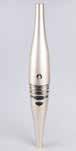
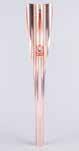
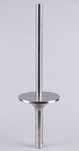
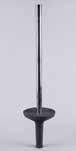
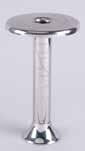
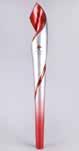
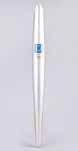
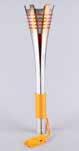
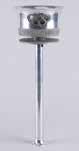
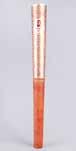
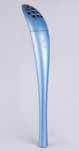
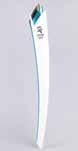
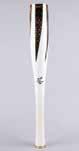
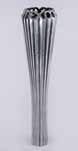
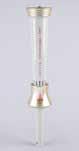
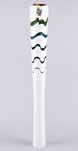
TORCHES
Unprecedented
collection of 25 relay torches commemorating nearly a century of Summer and Winter Olympic Games, spanning Berlin 1936 to Paris 2024 and highlighted by a rare Lake Placid
1980 Winter Games torch
3001. Olympic Torch Collection (25) - Honoring Summer and Winter Games from 1936 to 2024 from the Collection of Fred Raymon. Collection of 25 official Olympic torches commemorating nearly a century of Olympic history, spanning from the historic 1936 Summer Games of Berlin, Germany, through to the most recent 2024 Summer Olympics in Paris, France, and highlighted by a rare torch from the 1980 Winter Olympics in Lake Placid, New York. Introduced with the first Olympic torch relay at the 1936 Berlin Games, the torch has become one of the most enduring symbols of the Olympic movement, carried by thousands of runners as the Olympic flame journeys from Olympia, Greece, to each host city. Representing successive generations of Olympic design, innovation, and international competition, this remarkable collection traces the evolution of the Olympic torch across Summer and Winter Games over an 88-year period. In overall fine condition.
The Fred Raymon Collection
Starting Bid $10,000
THE TORCHES ARE AS FOLLOWS:
Berlin 1936 Summer Olympics Torch
London 1948 Summer Olympics Torch
Melbourne 1956 Summer Olympics Torch
Rome 1960 Summer Olympics Torch
Tokyo 1964 Summer Olympics Torch
Mexico City 1968 Summer Olympics Torch (Type 1)
Munich 1972 Summer Olympics Torch
Montreal 1976 Summer Olympics Torch
Lake Placid 1980 Winter Olympics Torch
Moscow 1980 Summer Olympics Torch
Seoul 1988 Summer Olympics Torch
Nagano 1998 Winter Olympics Torch
Sydney 2000 Summer Olympics Torch
Salt Lake City 2002 Winter Olympics Torch
Athens 2004 Summer Olympics Torch
Torino 2006 Winter Olympics Torch
Beijing 2008 Summer Olympics Torch
Vancouver 2010 Winter Olympics Torch
London 2012 Summer Olympics Torch
Sochi 2014 Winter Olympics Torch
Rio 2016 Summer Olympics Torch with Original Tube
PyeongChang 2018 Winter Olympics Torch with Original Tube
Tokyo 2020 Summer Olympics Torch with Original Tube
Beijing 2022 Winter Olympics Torch with Original Box
Paris 2024 Summer Olympics Torch
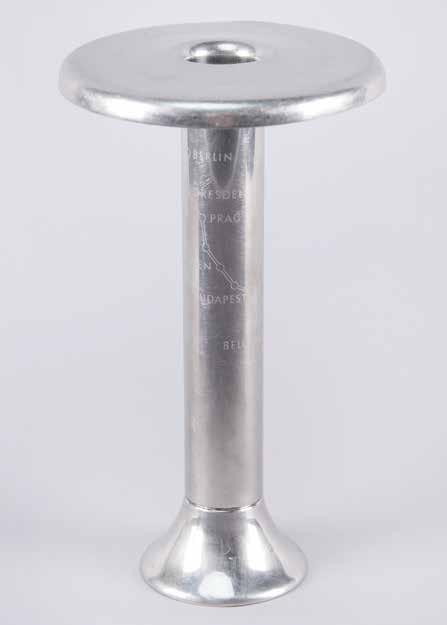
3002. Berlin 1936 Summer Olympics Torch with Official Torchbearer Participation Certificate. Official 1936 Berlin Olympics torch, comprised of steel, measuring 10.5” in length and 6” at its widest point, manufactured by Krupp. Engraved on the handle with a map of the torch relay route, the Olympic emblem, and inscribed, “Fackel-Staffel, Lauf, Olympia-Berlin, 1936.” The top of the torch is inscribed, “Organisations-Komitee fur die XI. Olympiade Berlin 1936, Als Dank Dem Trager.” The underside of the torch platform is inscribed, “Stiftung Der Fried Krupp A. G. Essen, Krupp Nirosta V2A Stahl.” The platform is slightly bent, and the torch bears light overall scuffs and scratches. Includes a rare official participation certificate from the 1936 Berlin Olympic torch relay issued to Hans Burian, with a lower approval signature of Theodor Lewald as president of the Olympic Organizing Committee. The certificate is archivally matted and framed to an overall size of 13.5 x 18.5. Accompanied by two other photos commemorating the torch relay of the Berlin Summer Games, which are individually matted and framed under archival glass to overall sizes of 13.75 x 11.5 and 14 x 16. The 1936 Summer Olympics torch relay was the first of its kind, transporting the Olympic flame from Olympia in Greece to the site of the Games in Berlin. Krupp produced a total of 3,840 torches, and 3,331 torchbearers participated in the relay. In total, it covered 3,187 km over twelve days. Representing the historically important 1936 Berlin Olympics as well as the establishment of the torch relay tradition, this is an iconic Olympic torch. Starting Bid $300
The torch from the first post-World War II Summer Games
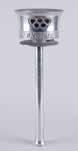
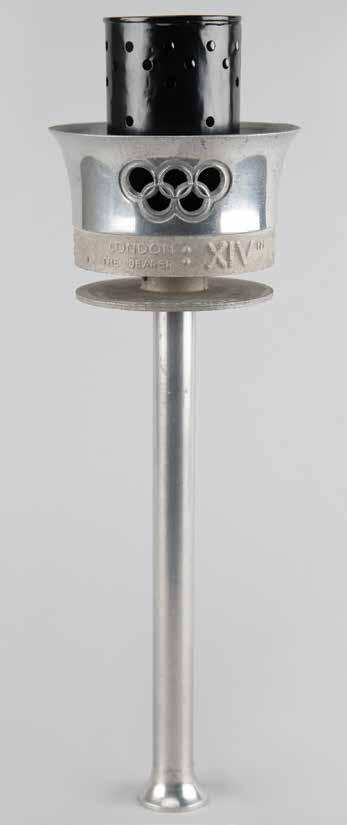
3003. London 1948 Summer Olympics Torch. Historic official 1948 London Olympics torch, comprised of aluminum alloy, measuring 16” in length and 5” at its widest point, designed by Ralph Lavers. The upper part is designed in the shape of a cauldron with three ‘cut-outs’ of the Olympic rings, encircled below by the inscription, “Olympia to London, with thanks to the bearer: XIVth Olympiad 1948.” Includes its black burner cup. The torch exhibits scattered light scuffs and dings.
The Olympic flame was lit in Olympia, Greece, on July 17, 1948, and traveled a total of 3,365 km before reaching the opening ceremony at Wembley Stadium on July 29. The 1948 Olympics in London represented the first Summer Games since 1936 after a twelve-year hiatus due to World War II. The total number of torches manufactured was 1,688. A desirable, classically designed torch from the second-ever Olympic torch relay. Starting Bid $500
The torch of the second Winter Games relay, which marked Italy’s Olympic debut
3004. Cortina 1956 Winter Olympics Torch. Official 1956 Cortina Winter Olympics torch, constructed of silvered metal, measuring 16.25˝ in length and 5.75˝ at its widest point, designed by Ralph Lavers. The torch was modeled after the one used for the 1948 London Olympics, with the upper part in the shape of a cauldron with three ‘cut-outs’ of the Olympic rings, encircled below by the inscription, “VII Giochi Invernali Cortina 1956.” Exhibits scattered areas of small dents and scuffing throughout, as typical.
The Olympic flame was lit at Rome’s Capitoline Hill on January 22, and made its way north via a unique mixture of plane, gondola, ice skates, roller skates, and manpower. The torch entered the Olympic Ice Stadium four days later, with participating speed skater Guido Caroli skating into the arena to light the cauldron. The Games are best known for the debut of Soviet athletes in a Winter Olympiad, and the first instance in which the Olympics were internationally televised; Caroli famously tripped over broadcast wires on his way to the cauldron. Starting Bid $1000
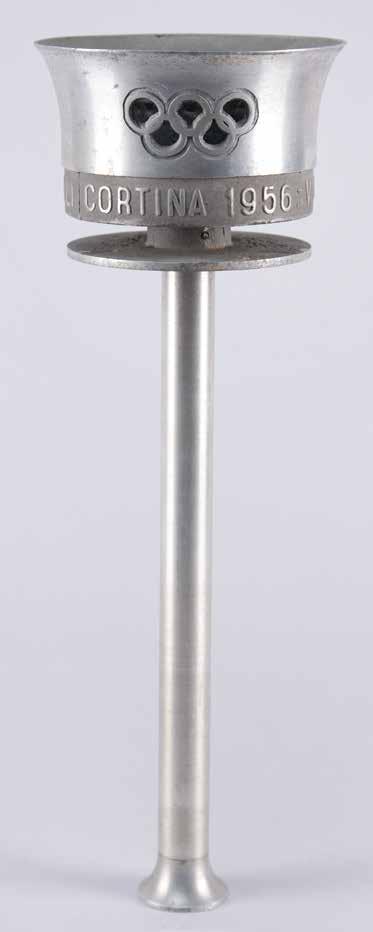
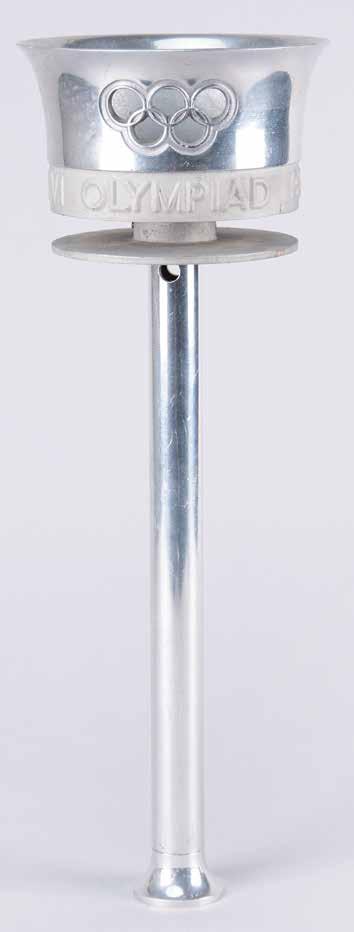
Official torch from the historic 1956 Melbourne Olympics, the first Olympic Games held outside Europe or North America
3005. Melbourne 1956 Summer Olympics Torch. Official 1956 Melbourne Olympics torch, comprised of aluminum alloy, measuring 16” in length and 5.5” at its widest point, designed by Ralph Lavers and manufactured by Waco Ltd. The design was modeled after the torch used for the 1948 London Olympics, with the upper part in the shape of a cauldron with three ‘cut-outs’ of the Olympic rings, encircled below by the inscription, “XVI Olympiad 1956: Olympia-Melbourne.” The burner is absent, and the torch bears overall scattered scuffs and scratches.
After its lighting in Olympia on November 2, 1956, the flame made its way through the Middle East and South Asia en route to Australia, where the relay ended at the opening ceremony on November 22. Altogether, the flame was carried by 3,181 torchbearers over 4,912 km on land. An iconic torch from the first Games to be held outside Europe or North America. Starting Bid $1000
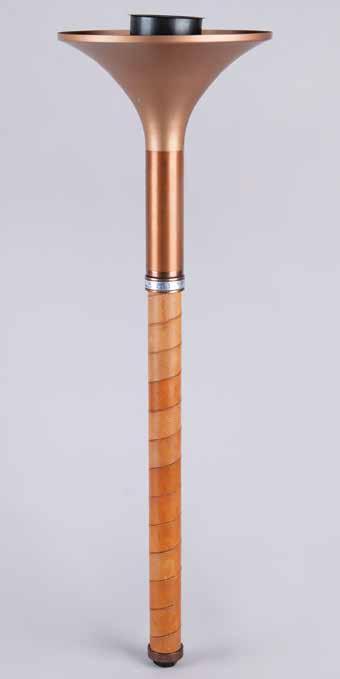
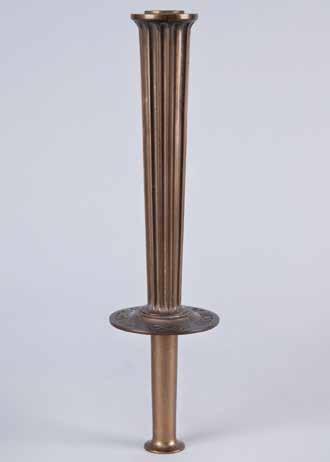
3007. Rome 1960 Summer Olympics Torch. Official Rome 1960 Summer Olympics torch, constructed of bronzed aluminum, measuring 15.5” in length and 3.75” at its widest point, manufactured by the Curtisa firm of Bologna. The torch’s designer, Amedeo Maiuri, was a renowned Italian archaeologist famous for his studies of the Roman site of Pompeii. Inspired by the designs and patterns of the host city’s ancient ruins and monuments, the torch is grooved with slender conical fluting along its candlestick frame, features consistent with the classical touch of the 1960 Games. The torch platform bears the engraving, “Giochi della XVII Olympiade,” and maker’s marks, “M. F.—Curtisa—Bologna, 3375,” can be found inscribed on the bottom of the handle. The torch bears trivial wear and dings to the upper and lower rims. Includes its rare original cylindrical presentation case, which exhibits scattered wear, including denting to the bottom cap. The Olympic flame was lit on August 12th in Olympia, Greece, and was carried a total of 1,863 km –excluding the flame’s voyage from Athens to Syracuse aboard the training ship Amerigo Vespucci – by over 1,500 torchbearers during its historic fourteen-day relay. The XVII Olympiad earns the distinction of being the first Summer Olympics to be telecast in North America. Starting Bid $500
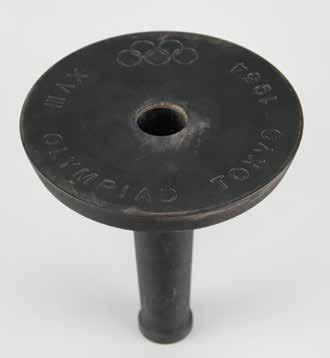
3009. Tokyo 1964 Summer Olympics Torch Handle.
Official 1964 Tokyo Olympics torch handle, composed of blackened aluminum alloy, measuring 7.5” in height and 6.75” in width. Manufactured by Nippon Light Metal Co., the bowl is engraved “XVII Olympiad Tokyo 1964” with a set of Olympic rings, and the underside of the handle is marked: “Nikkei Yanagi.” The bowl bears wear to the edges and scattered scuffs and marks. Accompanied by its original ‘Torch Holder’ box, which features scattered wear and scuffing, with one of the box flaps detached and another missing. The Olympic flame was carried for 51 days by 870 runners for 26,065 kilometers. Designed on the principle of the coal-mine safety lamp, the Tokyo Olympic torch was filled with priming powder and fumigant, a two-component ignition material that needed to be wind- and rain-resistant, and which could both easily ignite and extinguish. Its effect was similar to that of a flare, and it proved a safe and reliable instrument throughout its hemisphere-trotting relay. Although a typhoon and various plane issues caused a one-day delay late in the schedule, the triumphant final relay by Yoshinori Sakai through Tokyo’s National Olympic Stadium on October 10, 1964, served as a defining moment for a still-healing postwar Japan. Starting Bid $200
Scarce 1964 Tokyo Summer Olympics torch, complete with its original packaging
3008. Tokyo 1964 Summer Olympics Torch. Official 1964 Tokyo Summer Olympics torch, consisting of a blackened aluminum alloy bowl and a stainless steel cylinder, measuring 25.5” in length and 6.75” at its widest point. Manufactured by Nippon Light Metal Co., the bowl is engraved “XVII Olympiad Tokyo 1964” with a set of Olympic rings, and underside of handle marked: “Nikkei Yanagi.” The lower portion of the cylinder bears the Tokyo Games logo and reads “Showa Kaseihin Co., Ltd., 3-1964,” with upper section marked: “Olym[pic Torch],” partially charred and illegible. Exhibits burn marks and wear to the burner cylinder, and a few scattered marks to the easily scuffed black bowl. Complete with the the rarely seen original cardboard boxes for both piece: a long thin box marked “Olympic Torch” for the burner tube, and a cube-shaped box with the Tokyo 1964 emblem for the torch holder. Starting Bid $1000
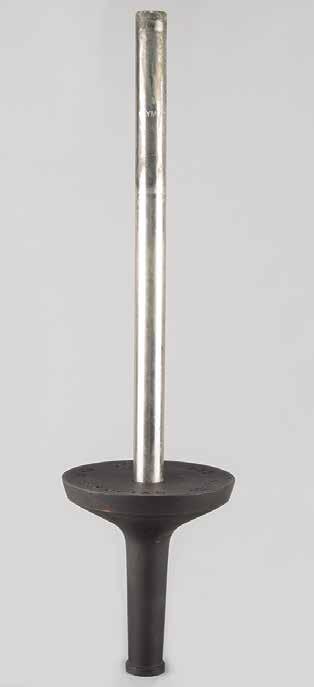
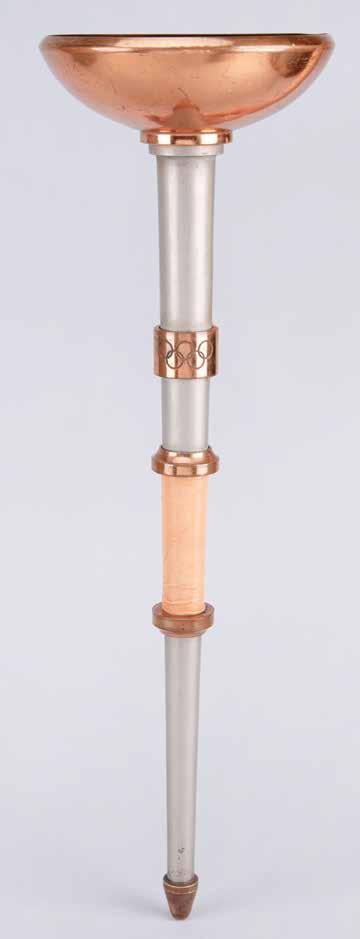
The fabled ‘Type 6’ torch of the Mexico City Games, a rare Spanish relay variant born from the Barcelona flame-transfer incident and virtually unknown for half a century
3011. Mexico City 1968 Summer Olympics
Rare ‘Type 6’ Torch with Spanish Torch Relay Participation Medal. Exceedingly rare official 1968 Mexico City Olympics ‘Type 6’ torch, constructed of steel with a central leather handle and three copper-tone rings, measuring 22.25˝ in length and 7.25˝ at its widest point. The uppermost ring is engraved with the Olympic rings and the date, “31-8-68”; this variation of the ‘Type 6’ torch features a plain copper-tone bowl, whereas other known examples bear the incised inscription “Mexico 68” on the bowl. The torch exhibits expected wear to the steel handle and copper-tone finishes, including rubbing, scuffs, and small dings.
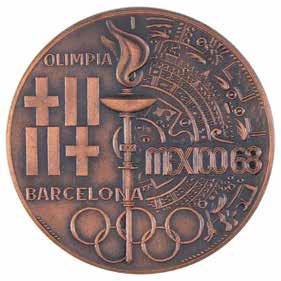
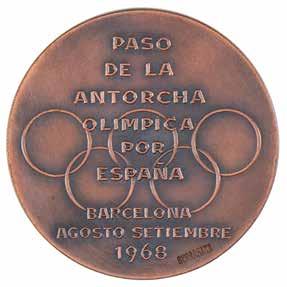
Included with the torch is an uncommon official torchbearer participation medal from the Mexico City 1968 Summer Olympics torch relay, bronze-tone, 50 mm, 63 gm, featuring on the obverse the iconic “Mexico 68” logotype, a lit Olympic torch above the Olympic rings, and pre-Columbian-inspired decorative motifs; the reverse bears raised Spanish text, translated: “Passage of the Olympic Torch Through Spain,” commemorating the relay’s transit through Barcelona during August–September 1968.
The existence of the ‘Type 6’ Olympic torch remained largely unknown until nearly fifty years after the Games, when Olympic researchers identified and authenticated the model through contemporary photographs and archival evidence documenting its emergency introduction during the Spanish leg of the relay. Aside from being the first Olympiad held in a Spanish-speaking nation, the Mexico City Games are notable for producing more relay torch variations than any other Olympic Games—a distinction born not from design ambition, but necessity. The original aluminum-alloy torch (Type 1) proved dangerously hot to handle, prompting successive modifications
that introduced amianthus-rope (Type 2) and leather-wrapped (Type 3) grips. Subsequent redesigns addressed additional overheating-related failures, including deformation of the torch top bearing the “Mexico 68” inscription, prompting the introduction of the Type 4 and Type 5 torches.
The creation of the Type 6 torch stemmed from an even more serious concern. During the Spanish leg of the relay, an explosion occurred during a flame-transfer ceremony in Barcelona when Olympian Gregorio Rojo received the Olympic flame from another torchbearer. Although those involved escaped with only minor injuries and the relay resumed shortly thereafter, the incident generated immediate concern among organizers. Contemporary reports attributed the detonation to fuel volatility and the “too-rapid contact of a lighted torch with an unlighted one.” In response, the Spanish Olympic Committee developed a safer and simplified replacement torch for use during portions of the relay in Spain: the now-famous ‘Type 6.’ Further evidence of its adoption survives in the accompanying torch relay medal, which clearly depicts the distinctive Type 6 design.
By the time the flame arrived in Mexico on October 6, having retraced Christopher Columbus’s voyage to the New World, the relay’s technical difficulties had been resolved. Six days later, on October 12, Mexican Olympian Enriqueta Basilio became the first woman in history to light an Olympic cauldron, concluding a remarkable 13,620-kilometer journey involving 2,778 torchbearers. One of the rarest and most historically significant Olympic torches ever produced, accompanied by its scarce Spanish torch relay participation medal, this is an exceptional museum-quality relic from one of the most innovative and eventful torch relays in Olympic history. Starting Bid $1000
Historic quartet of relay torches from the 1968 Summer Games of Mexico City—
Type 2, Type 3, Type 4, and Type 5
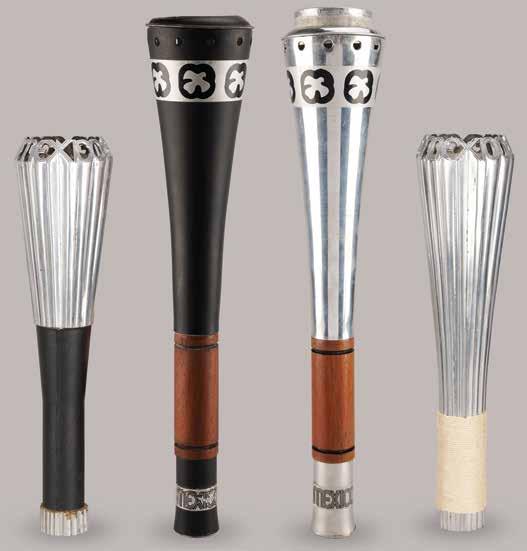
3010. Mexico City 1968 Summer Olympics Set of (4)
Torches - Types 2, 3, 4, and 5. Scarce and sought-after set of four official torches from the historic Mexico City 1968 Summer Olympics, comprising four of the storied six torch ‘types’ developed for the Games of the XIX Olympiad — Type 2, Type 3, Type 4, and Type 5. Read more about each torch online at www.RRAuction.com.
Aside from its distinction as being the first Spanish-speaking Olympiad, the Mexico City Games hold the honor of having the most styles of relay torches; a record obtained not for the sake of one-upmanship, but rather due to the faulty design of the original torch (Type 1), which, because of its aluminum alloy frame, overheated and made it impossible to carry.
Handles made of amianthus rope (Type 2) and leather (Type 3) provided temporary solutions until the torch’s new, slimmer design resulted in the torch top, with “Mexico 68,” melting. This too was addressed with the additions of the ‘Type 4’ and ‘Type 5’ torches.
The torch relay for the Mexico 1968 Summer Games recreated the route taken by Christopher Columbus to the New World, and began on August 23, 1968, in Olympia, Greece. It notably traveled through Columbus’s birthplace in Genoa, where he set sail from Palos in Spain, and the first land he reached in San Salvador. In all, there were 2,778 torchbearers on the 13,546 km route. Starting Bid $500
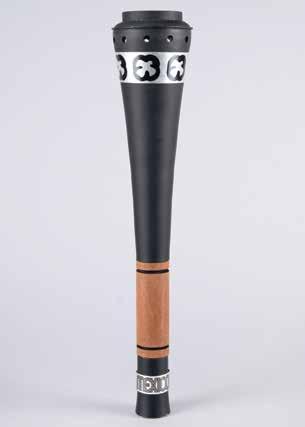
3012. Mexico City 1968 Summer Olympics ‘Type 5’ Torch.
Official ‘Type 5’ torch from the Mexico 1968 Summer Olympics, constructed of black aluminum and a wooden handle, measuring 20.5” in length and 4” at its widest point. The upper metal ring features a pattern of six doves, and the metallic label at the bottom reads “Mexico” twice. The base of the handle bears an affixed label that features the logo of the Games and names the designer, Manuel Villazon. The torch, which bears light wear and marks, includes its original pink-and-turquoise tube, which features some wear and rusting to the end caps; the upper cap is nearly detached from its tube section, which bears an affixed note and an ink ‘arrow’ mark instructing where to open the tube. Aside from its distinction as being the first Spanish-speaking Olympiad, the Mexico City Games hold the honor of having the most styles of relay torches; a record obtained not for the sake of one-upmanship, but rather due to the faulty design of the original torch (Type 1), which, because of its aluminum alloy frame, overheated and made it impossible to carry. Handles made of amianthus rope (Type 2) and leather (Type 3) provided temporary solutions until the torch’s new, slimmer design resulted in the torch top, with “Mexico 68,” melting. This too was addressed with the additions of the ‘Type 4’ and ‘Type 5’ torches. The torch relay for the Mexico 1968 Summer Games recreated the route taken by Christopher Columbus to the New World, and began on August 23, 1968, in Olympia, Greece. It notably traveled through Columbus’s birthplace in Genoa, where he set sail from Palos in Spain, and the first land he reached in San Salvador. In all, there were 2,778 torchbearers on the 13,546 km route. Starting Bid $300
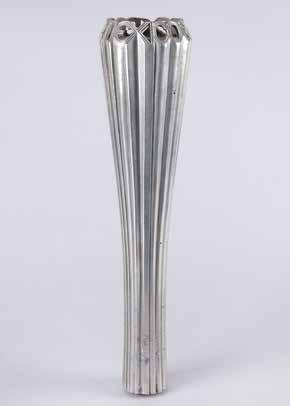
3013. Mexico City 1968 Summer Olympics ‘Type 1’ Torch.
Uncommon official ‘Type 1’ torch from the historic Mexico City 1968 Summer Olympics, which is comprised of white cast metal with a plain, unadorned handle, measuring 18” in length and 4.25” at its widest point. The white cast metal body is fully grooved and the top features “Mexico 68” twice around the rim. The robust torch bears scattered wear and instances of pitting (apparently from the casting process), and an area of erosion to a groove. The torch relay recreated the route taken by Christopher Columbus to the New World, beginning on August 23, 1968, in Olympia, Greece. It notably traveled through Columbus’s birthplace in Genoa, where he set sail from Palos in Spain, and the first land he reached in San Salvador. In all, there were 2,778 torchbearers on the 13,546 km route. Starting Bid $300
Rare, unused official torch of the Sapporo 1972 Winter Olympics
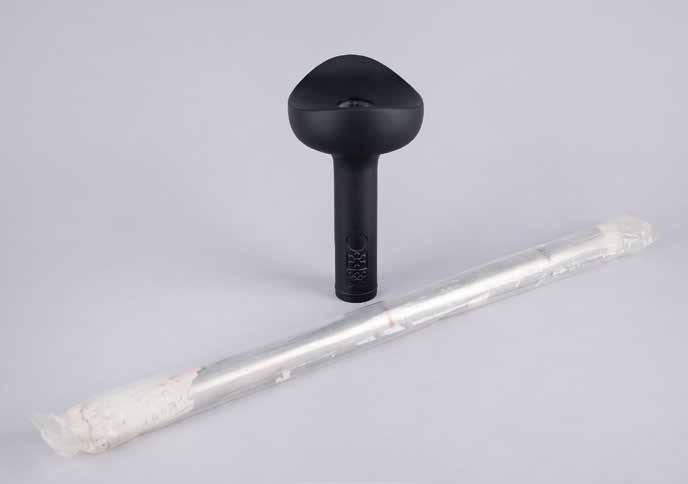
3014. Sapporo 1972 Winter Olympics Torch. Rare, unused official 1972 Sapporo Winter Olympics torch, consisting of a cast-blackened aluminum alloy bowl and a stainless steel combustion tube, measuring an overall 25.5˝ in length and 4.75˝ at its widest point, manufactured by Nippon Koki. The torch’s designer, Sori Yanagi, was a pioneer of Japanese industrial design, whose simplistic and pure use of lines and curves was regarded as both distinctly Japanese and universally appealing. Inspired by the shape of the Olympic cauldron, this classic torch features a slender black bowl, with the handle impressed with the Sapporo Games logo, and the bottom engraved “Nikkei” and “Yanagi”; lower portion of the tube also bears the Sapporo Games logo, with the manufacturer’s stamp below, “GD Nippon Koki Co., Ltd.” The tube is sealed in its original plastic, complete with its worn instruction sheet.
For the Sapporo relay, the torch was filled with priming and smoke-producing powder designed to burn for ten minutes for torches carried by runners and for fourteen minutes for those transported in cars. The Olympic flame was lit on December 28, 1971, in Olympia, Greece, and flown to Okinawa Island for the start of the Japanese relay, a massive undertaking that lasted 38 days and covered just under 19,000 km by an estimated 16,300 torchbearers—nearly all of whom shared a torch. Representing the first Winter Olympics to be held outside Europe and North America, the Sapporo Games proved to be an extravagant and groundbreaking event for the international athletic community. The Sapporo torch is highly sought after as one of the rarest Olympic torches, and this is the finest example we have offered. Starting Bid $1000
3015. Munich 1972 Summer Olympics Torch. Official 1972 Munich Olympics torch, comprised of metal and steel, measuring 29” in length and 8.5” at its widest, designed by Friedrich Krupp AG. The torch bears Olympic rings and the inscription “Spiele der XX Olympiad, Munchen 1972” on its handle, with the name of the designer engraved on the bottom. The Munich Games emblem designs a platform at the base of the combustion tube. Platform and handle feature scattered small scuffs and blemishes. Traveling a shade over 5,500 km over the course of 30 days, roughly 6,000 torchbearers were used to reach and light the Olympic flame at the opening ceremony on August 26, 1972. A coveted artifact commemorating Germany’s stalwart role in international sport. Starting Bid $200
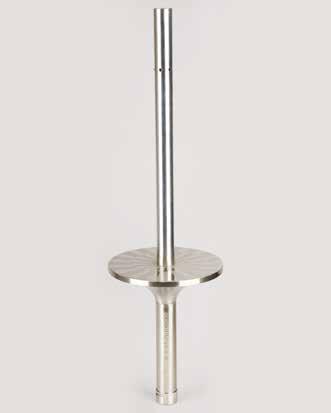
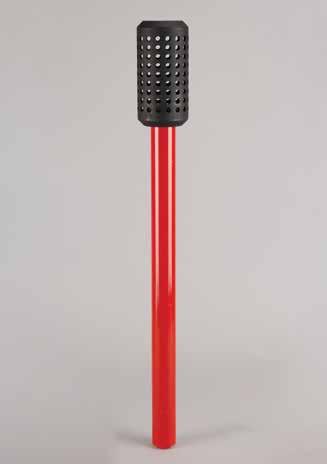
3017. Montreal 1976 Summer Olympics Torch. Iconic official 1976 Montreal Olympics torch, comprised of aluminum, measuring 26” in length and 3” at its widest point, designed by Georges Huel and Michel Daillaire. The simple yet distinct torch consists of a red handle emblazoned with the Montreal Olympics emblem, and a black ‘basket’ to carry the flame; the black color on top was intended to make the flame stand out. The body bears a handful of small chips and scuffs to the red finish. About 1,200 torchbearers participated in the relay, which lasted just four days from July 13 to July 17 and covered 775 km. Starting Bid $200
Distinctive ‘ski-jump’ torch issued for the 1976 Innsbruck Winter Olympics— one of only 100 produced
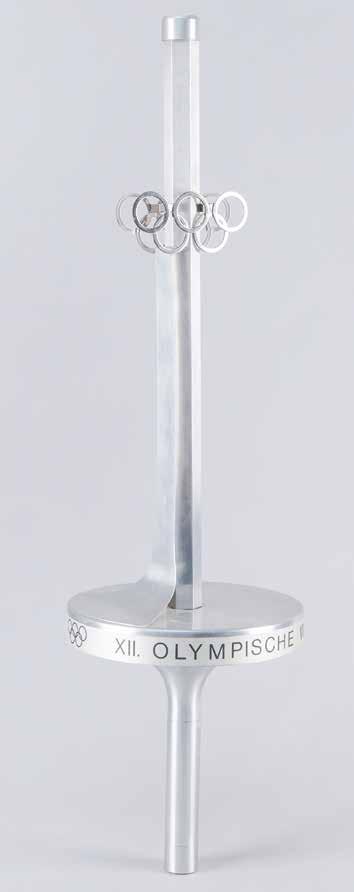
3016. Innsbruck 1976 Winter Olympics Torch. Extremely rare official 1976 Innsbruck Winter Olympics torch, constructed of aluminum alloy and steel, measuring 29” in length and 8.25” at its widest point, designed by Vereinigte Metallwerke Ranshofen Berndorf. The upper shaft of the torch is hexagonal and features a pair of Olympic rings in openwork, with an elegantly curved metal strip extending from the rings to the platform, representing a ski jump. The rim of the platform features a label inscribed with Olympic rings and “XII. Olympische Winterspiele Innsbruck 1976.” The handle’s base bears a manufacturer’s label, and the top retains its original cap. The shaft, platform, and handle exhibit some mild light marks and discoloration, and the underside of the platform bears a small nick.
The flame of the XII Olympic Winter Games was lit in Olympia, Greece, on January 30, 1976, and traveled a total of 1,618 km over the course of five days to Innsbruck’s Bergisel Stadium. The opening ceremony featured the lighting of two cauldrons, honoring both the current games and those the city hosted in 1964; the latter cauldron was lit by Austrian skier Christl Haas, who became the first woman to light a cauldron for a Winter Olympiad. Given that only 100 were made, this is a uniquely desirable Olympic torch with a wonderful Nordic skiing motif. Starting Bid $1000
The Olympic torch of the Lake Placid 1980 Winter Games— carried in
the relay before the ‘Miracle on Ice’
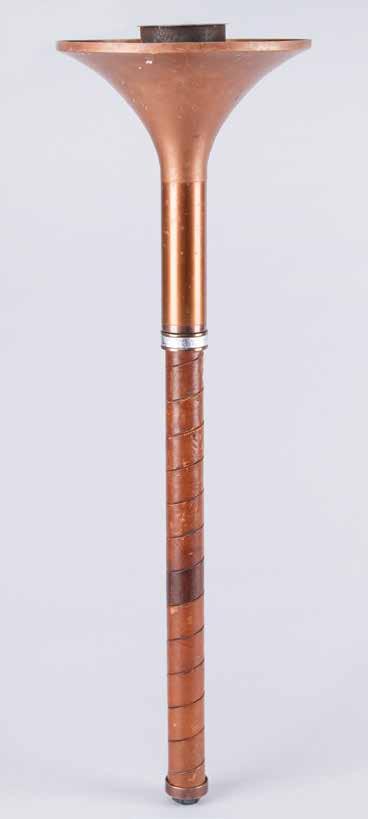
3018. Lake Placid 1980 Winter Olympics Torch. Lake Placid 1980 Winter Olympics torch, comprised of bronze-colored leather and metal, measuring 28.5” in length and 8.5” at its widest point, designed by Don McFarland and manufactured by Cleanweld Turner. The torch design and materials symbolized a blend of modern technology and a reference to Ancient Greece. A silver ring at the center of the handle displays the Lake Placid emblem and text, “XII Olympic Winter Gam[es], Lake Placid 1980.” The bottom brass ring, which is normally engraved with the torch number and maker’s information [Cleanweld / Turner, Sycamore, Illinois], only bears an etched “X” mark. The torch features scattered overall wear to its bowl, handle, and base, including scratches, scuffs, and spotting, and a missing section to the handle’s silver ring text. The burner bowl remains in place.
After being lit in Olympia on January 30, the Olympic flame traveled by air to Athens and then to Langley, Virginia, in the United States. The American leg of the relay was 1,600 km and designed to retrace the American Revolution Bicentennial Trail. Only 52 torchbearers participated, including one from every state, plus Washington, D.C., and Lake Placid. The Olympic cauldron was kindled at Lake Placid on February 8th. A mere 140 torches were manufactured for the Lake Placid Winter Olympics, one of the smallest production runs for any Olympic torch. They are therefore extremely rare and highly sought after. Starting Bid $1000
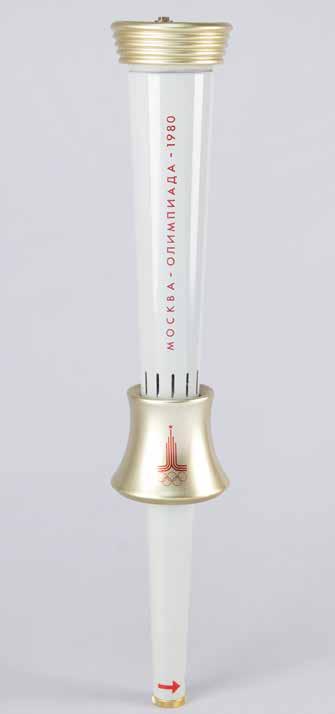
3019. Moscow 1980 Summer Olympics Torch. Official 1980 Moscow Olympics torch, comprised of aluminum, measuring 22” in length and 4” at its widest point, designed by Boris Tutschin. The gray body features red text in Cyrillic, “Moscow-Olympiad-1980,” and a gold-colored top of the handle bears the emblem of the Games and Olympic rings. The top is also accented with a golden ring, and the burner remains in place. A few trivial scuffs to the body and handle. In all, about 5,435 torchbearers participated in the relay, which lasted from June 19 to July 19. These Olympics were especially controversial due to the USSR’s recent invasion of Afghanistan, and the United States led 65 countries in a boycott of the Games. Starting Bid $300
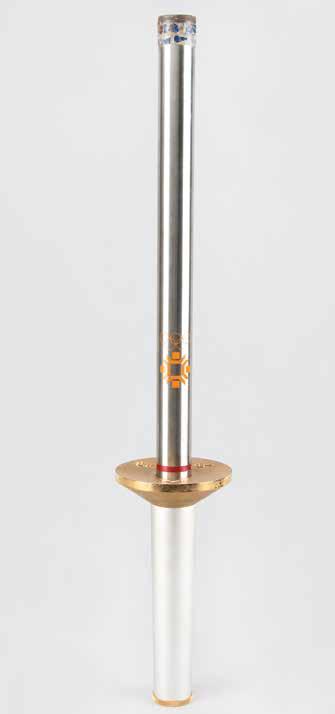
3020. Sarajevo 1984 Winter Olympics Torch. Official 1984 Sarajevo Olympics torch, comprised of lightweight metal with a long combustion tube, measuring 22.75” in length and 4” at its widest point, manufactured by the Mizuno Corporation of Japan. The handle is silver-colored and topped by a goldtone base inscribed, “Sarajevo ‘84,” with the Mizuno logo also raised in relief. The unused combustion tube bears the Olympic rings and emblem of the Sarajevo games. For the Sarajevo relay, the route was split into east and west routes so that the torch would pass through the whole country and promote the Olympic ideal of coexistence. In all, it was carried by 1,600 torchbearers over a distance of 5,289 km. This was the first Winter Olympics held in a Communist state. Starting Bid $300
The
regal relay torch of Calgary’s 1988
Winter
Olympics, one of only 150 made
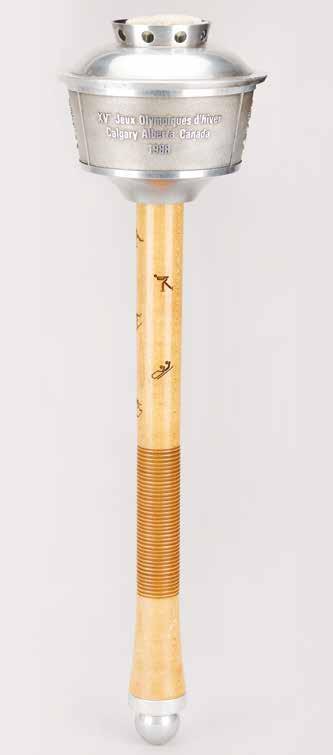
3021. Calgary 1988 Winter Olympics Torch. Official 1988 Calgary Winter Olympics torch used during the Olympic relay, comprised of aluminum with a maple handle, measuring 23.5˝ in length, emblazoned on the handle with pictograms of ten Winter Olympic sports. The top is inscribed, “XV Olympic Winter Games, Calgary Alberta Canada, 1988,” and the ball at the bottom is engraved with the Olympic motto, “Citius, Altius, Fortius.” This relay-used example, which bears light scuffs and evidence of use to the bowl and upper handle, has been resupplied with four original wicks above a canister. Includes its original black carrying bag.
Designed by the National Research Council of Canada, the torch was made to resemble the Calgary Tower, an iconic landmark in the Canadian city. The torch relay, called ‘Share the Flame,’ was an enormous event, with approximately 6,500 torchbearers drawn from an application pool of over six million. After the lighting ceremony in Olympia, the flame was flown to Newfoundland and then traveled 18,000 km through Canada over 88 days. Unlike many relays, the torches were shared and thus only about one hundred and fifty were manufactured. Starting Bid $500
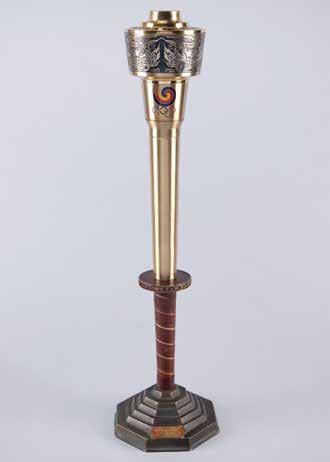
3022. Seoul 1988 Summer Olympics Torch. Beautifully designed official 1988 Seoul Olympics torch, constructed of metal, copper, leather, and plastic, measuring 20” in length and 4” at its widest point, designed by Lee Woo-Sung and manufactured by Korea Explosives Co. Ltd. The handle is wrapped in brown leather with a ring above, inscribed, “Games of the XXIVth Olympiad Seoul 1988,” in English and Korean. The upper portion of the torch bears a colorful Olympic ring emblem, and the top is engraved with an intricate dragon design symbolizing the harmony between East and West; based on the Chinese zodiac, the year 1988 was also the year of the dragon. The torch is mounted to an uncommon period presentation stand designed as an octagonal stepped metal base; a front tablet area bears adhesive remnants from a missing plaque. During the 22-day relay, the Olympic Flame traveled from the Greek capital of Athens to Korea’s southernmost point, Jeju Island, before making its way north to Seoul in a 4,167 km relay. Starting Bid $200
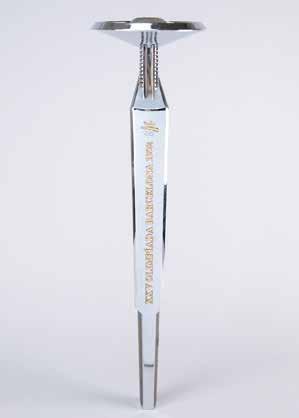
3024. Barcelona 1992 Summer Olympics Torch. Official 1992 Barcelona Olympics torch, comprised of aluminum and plastic, measuring 26” in length and 7” at its widest point, designed by Andre Ricard. The metal body is inscribed in gold text, “XXV Olimpiada Barcelona 1992,” and bears the emblem of the Games. The sliding red switch to reverse is engraved “003303.” Exhibits scuffing and scratches to the rubberized handle, as typical.
The massive fifty-day relay included nearly 9,500 torchbearers who carried the Olympic flame on foot and bicycle for a total of 5,940 km throughout Spain. The lighting of the cauldron at the opening ceremonies was especially memorable, as Paralympic archer Antonio Rebollo ignited the cauldron by shooting an arrow lit from the Olympic flame. From the personal collection of a lifelong collector, teacher, and traveler with a passion for world history. His collecting years ranged from the 1970s to the present day, meaning that several of the premier pieces have not been on the market in decades. Starting Bid $300
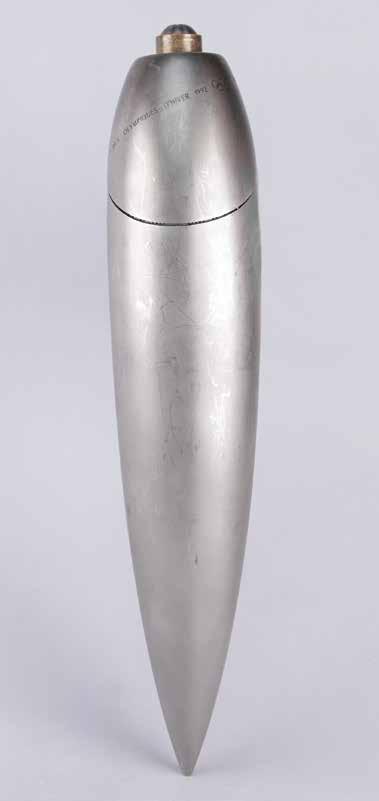
The rare ‘La Corne’—the iconic relay torch of the 1992 Albertville Winter Olympics, designed by Philippe Starck
3023. Albertville 1992 Winter Olympics Torch. Sought-after official 1992 Albertville Winter Olympics torch, consisting of a bulbous steel alloy body, measuring 16.5˝ long and 3˝ at its widest point, designed by Philippe Starck and familiarly known as ‘La Corne,’ or ‘The Horn.’ The sleek, modernist design resembles a bull’s horn or flame when turned upside down, and is engraved at the top with golden lettering, “XVIes Jeux Olympiques d’Hiver 1992,” followed by a small emblem of the five Olympic rings and serial number, “103:130.” Complete with its burner, lacking the original burner shroud/windscreen. The torch exhibits light scattered marks and scuffs from use.
After the Olympic flame was lit in Olympia, Greece, on December 13, 1991, it was transported from Athens to Paris aboard the supersonic Concorde. The relay route was designed to traverse as much of France as possible, passing through every regional capital, while its 57-day duration echoed the 57 events of the Albertville Games. Carried by 5,500 torchbearers, the flame traveled 5,700 km through the nation, including a procession along the Champs-Élysées and a visit to the childhood home of IOC founder Pierre de Coubertin. Unlike many Olympic relays, in which each torchbearer carries an individual torch, the Albertville torch was passed from runner to runner, resulting in far fewer torches being produced than in most Olympic relays. As a result, the Albertville torch remains one of the rarest and most sought-after Olympic torches of the modern era, with examples seldom offered at public auction. Starting Bid $1000
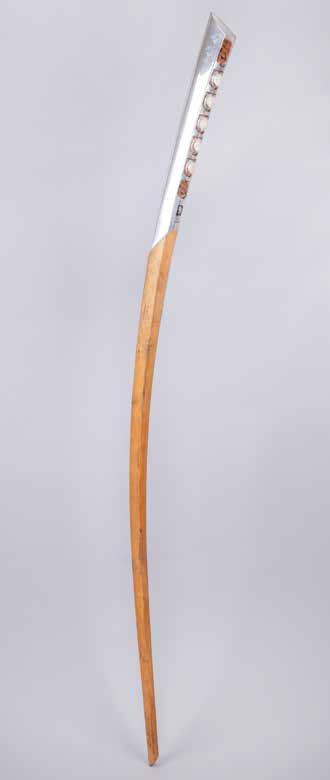
The imposing ‘Noble’ torch of Lillehammer ‘94— the largest relay torch in Olympic history
3025. Lillehammer 1994 Winter Olympics Torch. Unused official Lillehammer 1994 Winter Olympics torch, constructed of wood, iron, and copper, measuring an impressive 60” in length, designed by André Steenbuch Marandon and Paal Christian Kahrs, and manufactured by Paal J. Kahrs Arkitekter AS. Resembling that of a sheath knife, the torch is highlighted by its long birchwood handle that symbolizes Norwegian tradition, with the upper section consisting of a polished aluminum blade that conversely reflects the nation’s industrial modernity and technology. The base of the burner is engraved with the logo of the XVII Olympic Winter Games, and the upper and lower sections of the inner copper plate feature several event pictograms. To contrast its martial appearance, the torch’s supple, elongated shape and considerable length were chosen with the view of forming a harmonious extension between the torch and its bearer—its creators bestowed it with the poetic name ‘Noble.’ The bottom of the handle is marked “185.”
The torch bears a crack to where the burner meets the wood, the blade has a small ding and light scuffing, and the handle shows scattered soot marks—given the torch’s strikingly rugged design, none of the mentioned ‘flaws’ should be deemed as imperfections, nor do they detract from its overall awesome impression.
The flame of the XVIIth Olympic Winter Games was lit in Olympia, Greece, on January 16, 1994, and, with the use of 350 torches and 6,916 torchbearers, traveled 18,000 kilometers (11,000 miles) over the course of 27 days to the Lysgårdsbakkene Ski Jumping Arena in Lillehammer, Norway. It was the sixth Winter torch relay to have more than one route, which included a visit to the Arctic Circle and the premiere instance of a torch being passed between two parachutists. Before Prince Haakon lit the cauldron at the opening ceremony, Stein Gruben astounded spectators in spectacular and fiery fashion when he launched from the ski jump with the torch in hand. Nearly the height of a human being, this massive, highly sought-after Olympic artifact holds the unique distinction of being the longest and thinnest torch in Olympic history. Starting Bid $5000
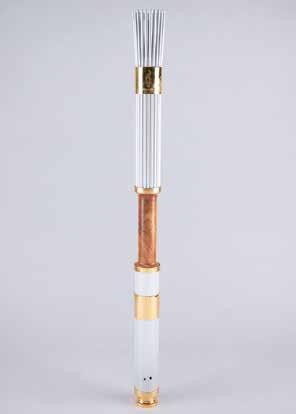
3026. Atlanta 1996 Summer Olympics Torch. Official 1996 Atlanta Summer Olympics torch, constructed of gold-plated brass, aluminum, and Georgian pecan hardwood, measuring 31.75” in length and 2” at its widest point. Designed by Peter Mastrogiannis, the wooden handle represents the connection of the flame between heaven and earth, and the torch’s twenty-two reeds, representing every host city of the Olympic Games since 1896, are gathered by bands at the top and bottom. The upper band displays the Atlanta Games logo and the quilt of leaves design, and the bottom band lists all Olympic cities and their dates since 1896. The bands bear slight scuffing, and there are two holes to the lower reed section from prior mounting.
The torch relay was run from April 27 to July 19, 1996, and covered 26,875 km across the United States by over 12,000 torchbearers. Its journey included a trek on the Pony Express, a ride on the Union Pacific Railroad, and the first instance in which an Olympic relay torch made its way into space when it was carried aboard Space Shuttle Columbia as part of STS-78. Starting Bid $200
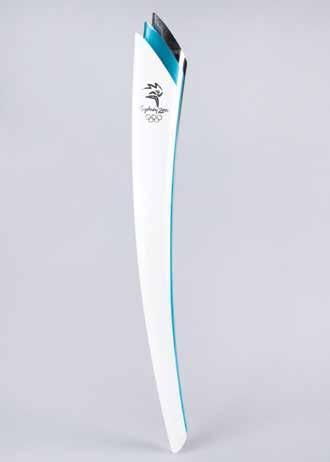
3027. Sydney 2000 Summer Olympics Torch. Official relay torch of the Sydney 2000 Summer Olympics, comprised of steel and aluminum, measuring 30.5˝ in length and 4˝ at its widest point, designed by Blue Sky Design and manufactured by G. A. & L. Harrington. The beautiful aesthetic of this torch drew inspiration from the Sydney Opera House, the blue of the Pacific Ocean, and the Australian boomerang. Both sides of the top of the torch prominently feature the emblem of the Sydney Olympics. The upper portion of the front white and blue sheaths bear light scuffing and scratches, as does the main aluminum body. The Sydney Games were lauded widely as the best ever held, and the torch relay was a massive undertaking, taking place over the course of four months and including a total of 13,400 torchbearers. Starting Bid $300
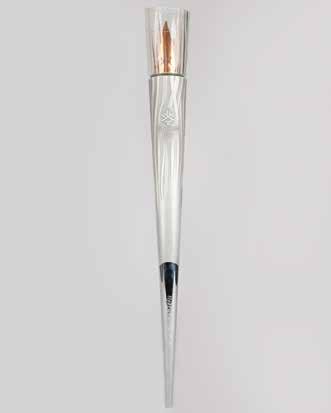
3028. Salt Lake City 2002 Winter Olympics Torch. Official 2002 Salt Lake City Winter Olympics torch, constructed of silvered metal, copper, and glass, measuring 32.5” in length and 3.5” at its widest point, designed by Axiom Design and manufactured by Coleman. The torch was modeled after an icicle and slightly curved to represent speed and fluidity, with a contrasting dull and polished finish on the handle to represent the meeting of modernity with the past. The handle is engraved with the motto of the games, “Light the fire within,” and a raised emblem of the games appears near the top. The torch bears some light scattered scuffs and marks. The Olympic flame was lit in Olympia, Greece, on November 19, 2001, and began the American leg of its journey on December 4 in Atlanta. The route passed through the past host cities in the United States—Atlanta, Lake Placid, St. Louis, Los Angeles, and Squaw Valley—over a 21,725 km route. Starting Bid $200
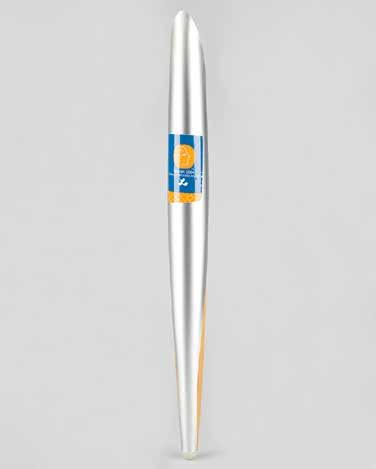
3029. Athens 2004 Summer Paralympics Torch. Official 2004 Athens Summer Paralympics torch, constructed of aluminum and olive wood, measuring 25.75˝ in length and 2.25˝ at its widest point, designed by Andreas Varotsos and manufactured by GA & L Harrington. The torch was modeled to reflect the simple and congruous lines of an olive tree leaf, with the union of wood and metal evoking the different colors found on either side of the leaf, and the ergonomic design representing the extension of the moving flame. The front of the aluminum sheath bears a label of the 2004 Paralympics emblem, which bears a few scratches. Starting Bid $200
The relay torch that marked the return of the Olympic Games to Athens
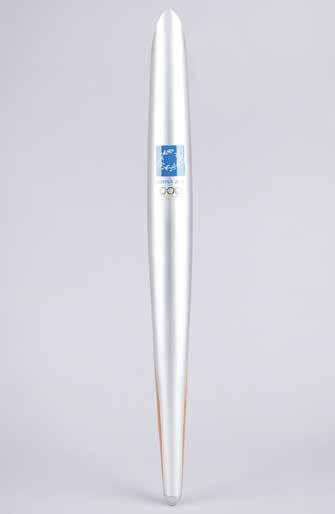
3030. Athens 2004 Summer Olympics Torch. Official 2004 Athens Summer Olympics torch, constructed of aluminum and olive wood, measuring 25.75” in length and 2.25” at its widest point, designed by Andreas Varotsos and manufactured by GA & L Harrington. The torch was modeled to reflect the simple and congruous lines of an olive tree leaf, with the union of wood and metal evoking the different colors found on either side of the leaf, and the ergonomic design representing the extension of the moving flame. The front of the aluminum sheath bears the Olympic rings and the Athens emblem. The Olympic flame was lit in Olympia, Greece, on March 25, 2004, and proceeded on a five-continent journey that witnessed the torch pass by all the cities that had hosted the Games since 1896, as well as marking the flame’s debut in Africa, India, and South America. In total, the torch covered over 84,000 km during its 141-day journey. Starting Bid $200
The award-winning relay torch of the Torino Winter Games
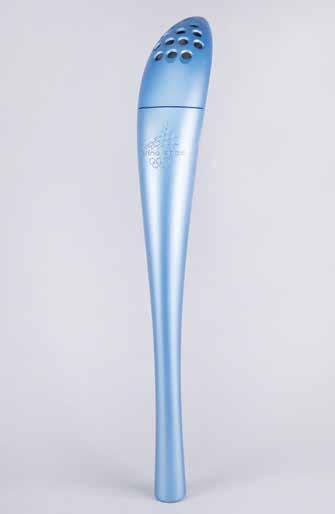
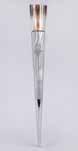
3031. Torino 2006 Winter Olympics Torch. Official 2006 Torino Winter Olympics torch, constructed of blue technopolymer-coated aluminum, measuring 31.25” in length and 4.5” at its widest point. Designed by Pininfarina, the shape of the torch was designed to appear like a ski tip, while also representing the monument and symbol of Turin, the Mole Antonelliana. Additionally, the design was intended to replicate the traditional wooden torch, giving the impression that the metal itself catches fire and burns. The middle portion of the torch bears an inscription of the Torino Games emblem with Olympic rings. Accompanied by its worn original shipping box. Starting on December 8, 2005, the Olympic torch relay lasted 75 days and traversed over 11,300 km. In all, a total of 10,001 torchbearers carried the flame until it entered the Olympic Stadium on February 10, 2006. This sleek and dynamic Olympic torch was awarded the Lorenzo il Magnifico award, the highest prize from the Florence Biennale of Contemporary Art. Starting Bid $200
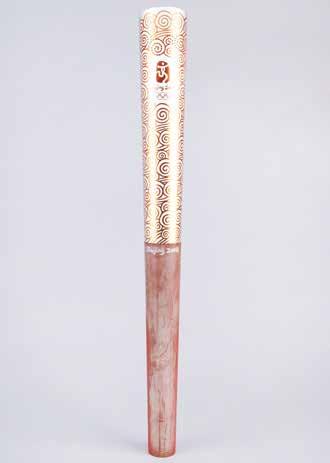
3032. Beijing 2008 Summer Olympics Torch. Official 2008 Beijing Summer Olympics torch, constructed of anodized aluminum and rubber, the torch measures 28.5” in length, 3” at its widest point, and was designed by Lenovo China and Aerospace Science & Industry, and manufactured by Zhongshan Vatti Gas Appliance Stock Co., Ltd. The curved shape of the torch embodies that of both a parchment scroll and a cloud, the latter an ancient decorative element from Chinese art that is found on buildings, sculptures, and furniture. The upper portion of the torch is covered in etched patterns of ‘propitious clouds’ and bears the Beijing logo and Olympic rings; its red color symbolizes the spirit of celebration, enthusiasm, and good fortune. The lower handle portion is inscribed “Beijing 2008,” and is layered with a fine rubber-based varnish, a finish specifically designed to improve grip and replicate the contact of human skin as if the torchbearer were holding a friend’s hand. Exhibits wear and large areas of discoloration to the rubberized handle.
The Olympic flame of the 2008 Olympics was lit on March 24th and was carried across the globe by a total of 21,800 torchbearers. For 130 days, the flame traversed over 85,000 miles, passing through every continent sans Antarctica, and even made its way to the summit of Mount Everest in a specially designed safety lamp. Starting Bid $200
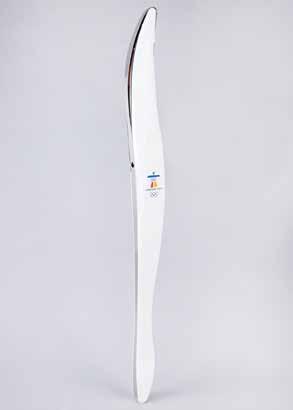
3033. Vancouver 2010 Winter Olympics Torch. Official 2010 Vancouver Winter Olympics torch, constructed of stainless steel, aluminum, and sheet molding, measuring 37” in length and 3” at its widest point. Manufactured by Bombardier, the shape and contours of the torch represent the lines made by snow and ice sports. The top is engraved with the bilingual motto, “With Glowing Hearts / Des plus brilliants exploits,” with a Canadian maple leaf ‘cut-out’ on the opposing side. The two white panels bear the Vancouver Games logo. Complete with its original torch relay carrying bag.
The torch was lit in Olympia on October 22, 2009, and from October 30, 2009, until February 12, 2010, the Olympic Flame was carried by over 12,000 runners for over 100 days over a course of 45,000 km of Canadian soil—the longest national relay ever held. An attractive example of the Vancouver relay torch. Starting Bid $200
Golden relay torch from the 2012 Games of London, the first city to host the modern Olympics three times
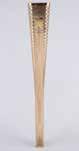
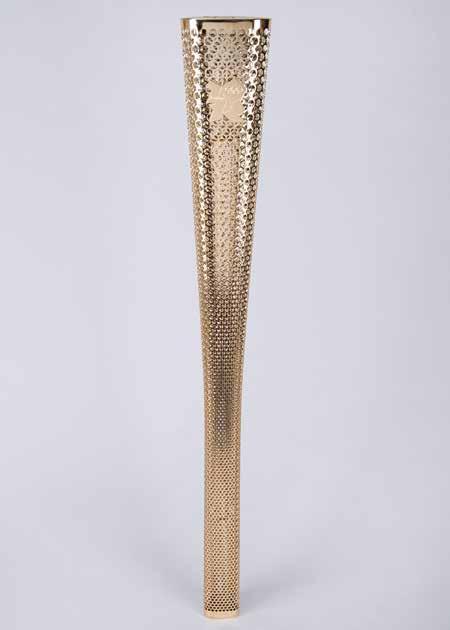
3034. London 2012 Summer Olympics Torch. Beautiful unused official 2012 London Olympics torch, comprised of metal and aluminum, measuring 31.5” in length and 4.25” at its widest point, designed by Edward Barber and Jay Osgerby, and manufactured in collaboration by Tecosim, LPG Gas, Bullfinch and Premier Sheet Metal. The gold-colored torch body consists of two envelopes of aluminum alloy perforated with 8,000 circles, a number which matches with both the amount of torchbearers and the United Kingdom relay miles, and features a golden metal logo of the Games near the top. The triangular shape refers to the multiples of three found in the Olympic movement’s values of excellence, friendship, and respect, the Olympic motto of ‘Citius, Altius, Fortius,’ and London’s hosting of the Games for the third time.
The Olympic flame was lit in Olympia on May 10, 2012, and embarked on an eightday journey across Greece and Crete before flying over to London. Commencing in Land’s End in Cornwall on May 19, the UK portion of the relay was designed so that 95 percent of the population of the United Kingdom, the Isle of Man, Jersey, and Guernsey would be a maximum of one hour from the torch route. After seventy days and 15,775 total km, the massive relay touched down in London’s Olympic Stadium on July 27. A truly regal and gorgeous example of an Olympic torch, and a work of art that earned the Design of the Year Award at London’s Design Museum. Starting Bid $300
Rare safety lamp from the 2014 Sochi Winter Games, the first Russian Olympics since Moscow 1980
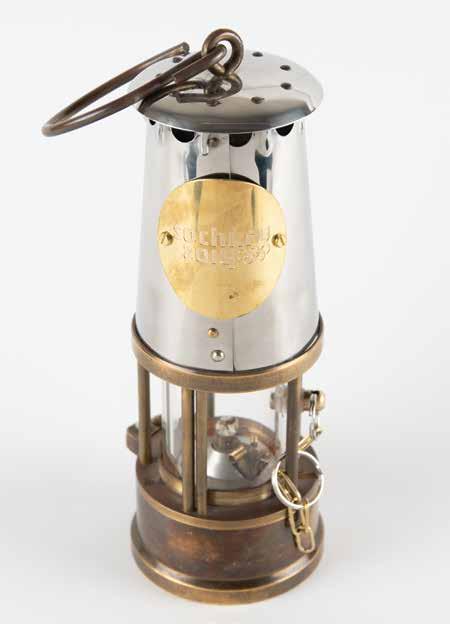
3035. Sochi 2014 Winter Olympics Safety Lantern. Very desirable safety lamp from the Sochi 2014 Winter Olympics, 10” in height and 3.5” in diameter, manufactured by the Protector Lamp and Lighting Co., of Eccles, Manchester, which has produced Olympic lanterns for the last 30 years. The safety lamp consists of a lower globe and brass frame, which features plates to the front and back; the front features the Sochi Games emblem, and the back bears the maker plate, which identifies the lamp as “Type 6, M & Q, Safety Lamps, Approval No. B/28.” The globe and frame house the interior lamp chimney and burner, with the base marked “97/”; the frame and plates exhibit scattered light scuffing and wear. The design is a modified miner’s lamp, which enables the Olympic flame to be safely transported by aircraft.
The Olympic flame was lit in Olympia, Greece, on September 13, 2013, and made its way onto Russian soil on October 7, traveling through all eighty-three regions of the Russian Federation during its fivemonth and 65,000 km relay. Additionally, other specially designed Sochi torches reached the North Pole, the summit of Mount Elbrus, submerged 13 meters into Lake Baikal, and another even entered outer space, with cosmonauts Oleg Kotov and Sergei Rayazansky passing the torch outside the International Space Station. Starting Bid $500
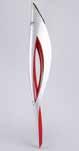
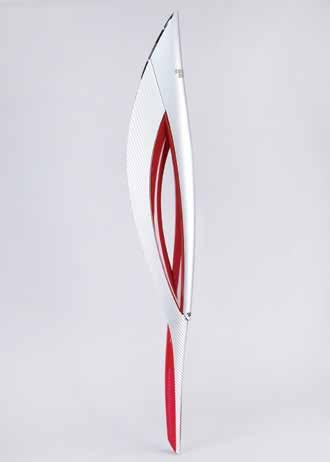
3036. Sochi 2014 Winter Olympics Torch. Official 2014 Sochi Winter Olympics torch, constructed of aluminum and various polymers, measuring 37.5” in length and 5.75” at its widest point, developed by a team of designers led by Vladimir Pirozhkov and Andrei Vodyanik. The torch was modeled after the feather of the Firebird, a magical figure from Russian folklore associated with light, fortune, and renewal, and later immortalized in Igor Stravinsky’s celebrated ballet. The torch’s silver finish symbolizes winter ice, while its vivid red interior evokes the warmth and energy of the Olympic flame. A strip of clear tape has been placed over the lower front cover plate.
The Olympic flame was lit in Olympia, Greece, on September 29, 2013, and arrived on Russian soil on October 7 to begin a five-month, 65,000-kilometer relay through all eighty-three regions of the Russian Federation. Among the most ambitious torch relays in Olympic history, specially designed Sochi torches reached the North Pole, were carried to the summit of Mount Elbrus, descended to a depth of thirteen meters in Lake Baikal, and even traveled into outer space, where cosmonauts Oleg Kotov and Sergei Ryazansky passed the torch during a spacewalk outside the International Space Station. Inspired by the legendary Firebird feather, the Sochi torch remains one of the most distinctive relay designs of the modern Olympic era. Starting Bid $200
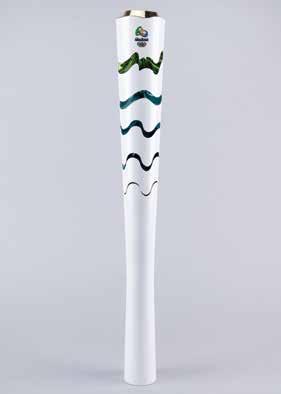
3037. Rio 2016 Summer Olympics Torch. Official 2016 Rio de Janeiro Summer Olympics torch, constructed of recycled aluminum and colored resin, measuring 27” in length and 3.5” at its widest point, designed by Sao Paulo studio Chelles & Hayashi and manufactured by Recam Laser. The torch features a white body that automatically expands upon being lit to reveal multicolored segments drawn from the hues of the Brazilian flag, representing the natural wonders surrounding the host city. The Rio Olympic emblem also adorns the top, and the bottom of the handle bears an affixed label, “201.”
The torch relay began in Olympia on April 21, and concluded on August 5 at Maracanã Stadium in Rio de Janeiro, after visiting over three hundred of Brazil’s towns and cities. A record number of countries participated in the Rio Games, including first-time entrants Kosovo and South Sudan. Ten thousand and nine hundred athletes participated in 306 medal events in 45 sports disciplines. Starting Bid $200
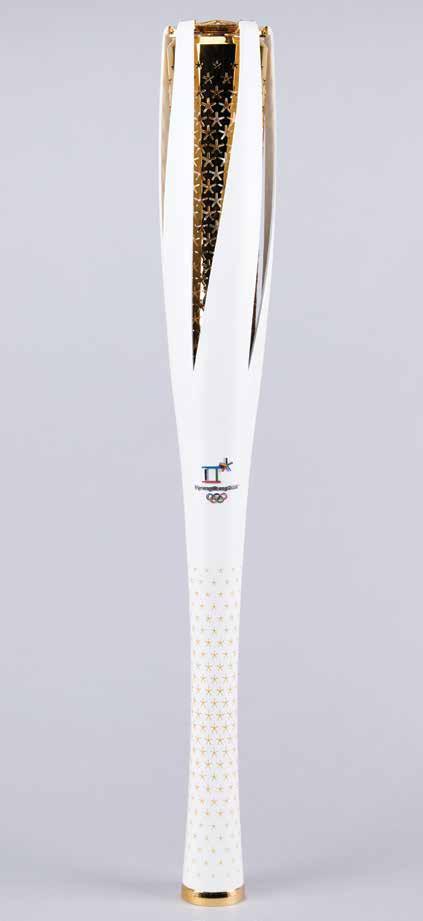
3038. PyeongChang 2018 Winter Olympics Torch. Official 2018 PyeongChang Winter Olympics torch, constructed of a white metal exterior shell with a gold-colored metal interior, measuring 27.5˝ in length and 3.25˝ at its widest point, designed by Young Se Kim of INNO Design and produced by Hanwha Corporation. At the top, the exterior shell is divided into five vertical branches to form a pentagonal shape, representing the sporting passion and spirit that unite the five Olympic continents. A colorful raised PyeongChang 2018 emblem decorates the body of the torch, and the handle is embellished with gold-colored geometric motifs inspired by the Korean alphabet, Hangul. The white and gold colors used in the design represent the snow and ice of the Winter Games, as well as the Olympic flame, and correspond with the color scheme of the PyeongChang relay. The 700-millimeter length of the torch represents the altitude of PyeongChang, which lies 700 meters above sea level. The torch was specially engineered so that the flame could burn continuously despite inclement weather, generating an air tunnel that supplies additional oxygen to the flame, while a pentagonal opening at the base allows water to drain.
The flame lighting ceremony for the 2018 Games was held in Olympia, Greece, on October 24, 2017. Following an eight-day and 2,100-kilometer journey around Greece, the flame arrived on Korean soil in Incheon on November 1st to commence a 101-day relay covering 2,018 kilometers across South Korea, a deliberate reference to the year of the Games. The relay toward PyeongChang Olympic Stadium featured approximately 7,500 torchbearers and was designed to showcase the nation’s technological achievements, cultural heritage, and natural beauty before culminating in the lighting of the Olympic cauldron on February 9, 2018. An elegant and highly symbolic Olympic torch that successfully blends Korean cultural traditions with modern industrial design. Starting Bid $200
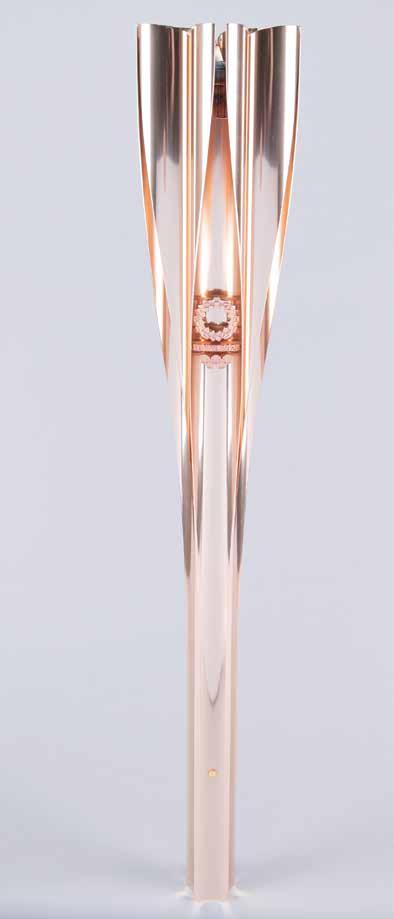
3039. Tokyo 2020 Summer Olympics Torch. Official Tokyo 2020 Summer Olympics torch, constructed of recycled aluminum from temporary housing used after the Fukushima, Japan, disaster in 2011. Designed by Tokujin Yoshioka and inspired by Japanese cherry blossoms, the torch measures 28˝ long and 4.5˝ at its widest point. Finished in a ‘sakura’ rose-gold color, the torch has a fluted design featuring five petal-shaped columns around the tip, with the “Tokyo 2020” wreath emblem and Olympic rings on the front. The five separate flames from the ‘flower petals’ come together as one at the center of the torch to give off a brilliant light known as the ‘Path of Hope.’ Complete with its original base cap and storage cylinder.
The Olympic flame was lit in a traditional ceremony in Olympia, Greece, on March 12, 2020, and the relay continued for one day, traveling through Amaliada, Pyrgos, Kyparissia, and Kalamata, before arriving in Sparta. On March 13th, the Hellenic Olympic Committee announced that the remainder of the relay would be canceled to avoid attracting large crowds amidst the coronavirus contagion. The handover ceremony took place at Panathenaic Stadium in Athens on March 19th, and the flame was subsequently flown to Japan, where it remained lit for a year in anticipation of the postponed Games. The relay resumed in Japan in March 2021 and was completed with the opening ceremony on July 23, 2021. An elegant torch representing the ‘flame of recovery’ and the resilience of the Olympic spirit. Starting Bid $500
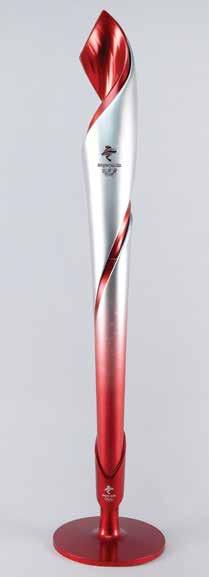
3040. Beijing 2022 Winter Olympics Torch and Display Base. Official 2022 Beijing Winter Olympics torch, constructed of a resin-coated carbon fiber composite, measuring 33” in length and 4” at its widest point. Manufactured by Sinopec Shanghai Petrochemical Company and designed by Li Jianye and his team, the torch was inspired by the natural flowing beauty of plants and flowers, a theme that meshed with Beijing’s green approach to the torch’s materials and combustion fuel – carbon fiber composite, a new material made of petroleum products, and hydrogen gas, a special fuel that proved both smoke-free and environmentally friendly. The flora-like spiral construction resulted in a floating ribbon look, and its beautiful replication of movement led to its being given the name ‘Flying’ [Fei Yang]. The torch utilizes an open design with a stunning red and silver color scheme, a metaphor for ice and fire, meant to symbolize how the torch will bring ‘light and warmth to this world of ice and snow’ – this color combination, and even the torch’s design, relates to its 2008 predecessor and ceremonial cauldron. ‘Flying’ is exceptionally light yet durable, having been created with high-tech 3D knitting technology to form a body seven to nine times harder than steel. The upper portion of the body bears the Beijing 2022 emblem, the lower portion features 1,268 laser-engraved convex clouds and low-relief snowflake patterns, and the torch’s centralized swirling red line represents the winding Great Wall, the Olympic ski slopes, and ‘humanity’s relentless quest for light, peace, and excellence.’ Includes the original presentation case, which bears light soiling to lower portion, and wear to corners and top end, its commemorative certificate, and its beautifully made display base that includes its shipping box and certificate of authenticity, which are numbered “8792.” The flame for the Beijing 2022 Winter Olympics was lit at the site of the Ancient Olympia in Greece on October 18, 2021, and was passed to the Beijing 2022 Organizing Committee the following day before it departed for the Chinese mainland. Due to the COVID pandemic and the measures put in place to meet the prevention and control requirements, it was decided to reduce the length and duration of the traditional relay route, as well as the number of relay runners, which totaled around 1,200. Shortened to only three days, the Olympic torch relay resumed on February 2nd, when it began its journey through the three Olympic zones, the city of Zhangjiakou and the main sights of Beijing, which became the first city to host both the Summer and Winter Olympic Games. The relay concluded on the 4th in Beijing National Stadium at the end of the opening ceremony. A fusion of artistry and high technology, this stunningly beautiful Olympic torch evokes Beijing’s ambitious plan for a safe and sustainable Winter Olympiad. Starting Bid $200
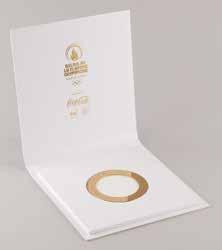
3041. Paris 2024 Summer Olympics Torchbearer Relay Ring
(Limited Edition). Limited edition torchbearer’s ring issued for the Paris 2024 Summer Olympics, measuring 4˝ in diameter, housed in its original magnetic presentation folder, an unnumbered example of 10000 issued. Presented only to official torchbearers, the ring is handsomely engraved in French: “Paris 2024, Porteur de la Flamme, Paris 2024, Eclaireur des Jeux.” In fine condition. Accompanied by its original French-language presentation certificate bearing the facsimile signatures of Tony Estanguet and Thomas Bach, in part (translated): “We are very proud to count you among the bearers of the Paris 2024 Torch Relay. By handing you the heart of the torch, we are entrusting you with a part of the history of the Games. This ring represents the bond that unites the Pathfinder community and testifies to your commitment to this adventure. Now it’s up to you to share the emotions and experience you have experienced to transmit and perpetuate the values “”and spirit of the Games, embodied by this unique and unprecedented symbol.” Starting Bid $200
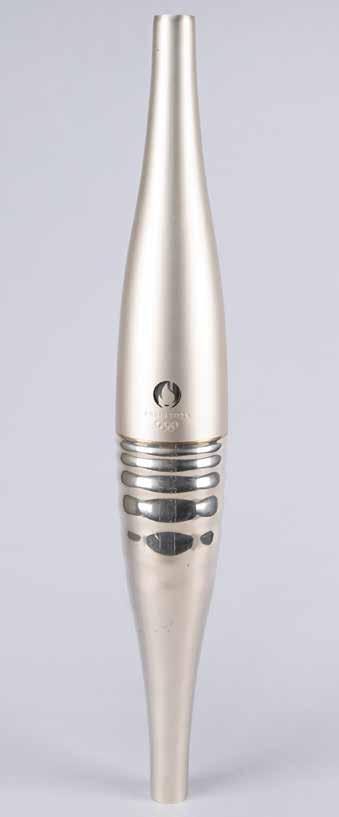
Paris 2024 Summer Olympics relay torch, designed by Mathieu Lehanneur—an iconic work of art inspired by the River Seine
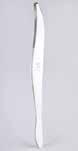
3042. Paris 2024 Summer Olympics Torch. Official Paris 2024 Summer Olympics torch, constructed of recycled steel, designed by Mathieu Lehanneur and manufactured by ArcelorMittal, featuring a perfectly symmetrical, flowing design that draws inspiration from three themes of Paris 2024: equality, water, and peacefulness. The torch measures 27.5˝ long and 4˝ at its widest point: the upper half sports a matte finish on a plain surface, with the Paris 2024 insignia and five Olympic rings below; the lower half features a reflective finish on a rippled surface, inspired by the serenity of the water on the majestic River Seine. The torch bears scattered light marks and scuffs.
The Olympic flame was lit in a traditional ceremony in Olympia, Greece, on April 16, 2024, and carried through Greece for more than 3,100 miles to Athens, where it boarded the Belem, a three-masted sailing ship, to cross the Mediterranean Sea to Marseille, where it embarked on its epic journey across France. The relay route took the Olympic flame through some of France’s most iconic places and architectural masterpieces, such as the Lascaux caves, the Alésia archaeological site, the medieval city of Carcassonne, the Palace of Versailles, and many other famous sites. The Olympic cauldron was lit in dramatic fashion on July 26, 2024, at the opening ceremony of the Paris 2024 Summer Olympics, marking the end of the historic Olympic torch relay and the beginning of the Games. Starting Bid $1000
‘Essential’—the revolutionary, iridescent relay torch of the Milano Cortina 2026 Winter Olympics, a triumph of Italian design
3043. Milano Cortina 2026 Winter Olympics Torch. Official Milano Cortina 2026 Winter Olympics torch, constructed primarily of recycled aluminium-brass alloy, with a grip insert of ultra-light bionaphtha-based polymer, measuring 33.5˝ in length and 3˝ at its widest point, with the silver-tone Milano Cortina emblem present to the upper frame. Developed by Eni, in collaboration with Versalis, and designed by Studio Carlo Ratti Associati, with engineering and production handled by the Cavagna Group, the torch is a tribute to the excellence of Italian design and craftsmanship, striking a harmonious balance between technology, innovation, and sustainability, the latter being at the very heart of its creation — the torch is designed to be reused and refilled up to ten times, significantly reducing the total number required for both relays. It is powered by bio-LPG produced from renewable raw materials, including used cooking oils and agricultural waste, at Eni’s Enilive biorefinery in Sicily. It also features an open design that, for the first time, reveals its technological components, which are visible through a vertical slit running along the body of the torch.
Bestowed with the poetic name ‘Essential,’ the lightweight torch bears a reflective, iridescent finish in blue-green hues, ‘Shades of Sky’ colors inspired by Italy’s ever-changing landscapes, which evoke movement, hope, and transformation. Its exterior utilizes Physical Vapor Deposition (PVD) technology, which lends the torch a radiant, dynamic effect that allows it to blend with its surroundings, contingent on the light conditions. ‘Essential’ was designed in a bronze tone for the Paralympics, its regal color representing ‘Mountains of Light,’ which honors the inner strength and courage of Paralympic athletes. Complete with its original turquoise carrying tube.
The official torch relay began on November 26, 2025, launching a symbolic journey from Greece to Italy ahead of the 2026 Olympic Winter Games. The Greek leg featured more than 450 torchbearers carrying the flame across 2,200 kilometers, with stops at twelve major ski resorts and 36 welcoming ceremonies over nine days that celebrated Greece’s cultural and winter-sport heritage. The relay culminated at Athens’ Panathenaic Stadium, where the Olympic cauldron was lit and the flame formally entrusted to Italian organizers.
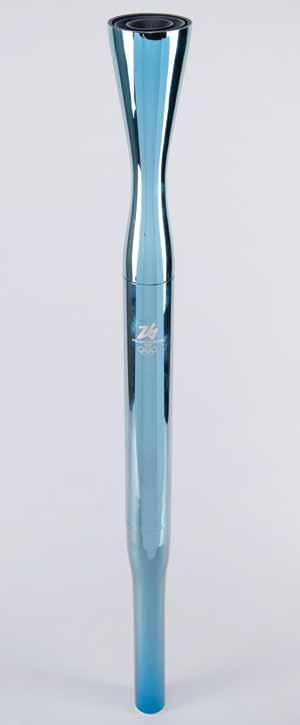
On December 4, the flame arrived in Rome at the Quirinal Palace, marking its ceremonial transfer to the host nation. The Italian relay officially commenced two days later at the Stadio dei Marmi, tracing a nationwide route spanning all 20 regions and 110 provinces. After traveling through the mainland and visiting Sardinia and Sicily, the flame continued its journey through Italy’s cities, towns, and alpine communities, carried by thousands of torchbearers, before concluding at San Siro Stadium in Milan, where the Olympic flame lit the cauldron during the Opening Ceremony on February 6, 2026. Starting Bid $1000
WINNER’S MEDALS
Second-place bronze medal from the pioneering Athens 1896 Olympic Games
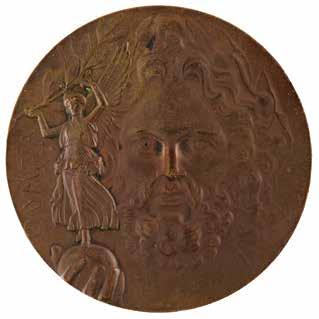
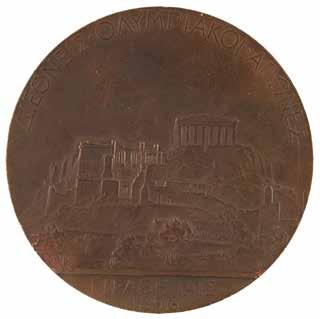
3045. Athens 1896 Olympics Bronze ‘Second Place’ Winner’s Medal. Winner’s medal from the Athens 1896 Olympics. Bronze, 50 mm, 60 gm, by Jules Clement Chaplain. The front depicts a relief portrait of Zeus holding Nike, the goddess of Victory, in the palm of his hand, with text along left side, “Olympia”; the reverse bears a detailed view of the Acropolis of Athens topped by the Parthenon, with raised Greek characters to upper and lower portion (translated), “International Olympic Games in Athens, 1896.” Stamped “Bronze” on the edge.
For the first Modern Olympics, first place champions were awarded silver medals, second place winners earned these bronze medals, and third place finishers went home empty-handed. It was not until 1904 that the traditional gold, silver, and bronze sequence was introduced. Winner’s medals from the historic debut of the Olympic Games remain scarce, with just 150 bronze second-place prizes originally struck for the Games. Starting Bid $5000
3046. Paris 1900 Olympics Silvered Bronze Winner’s Medal for Shooting. Winner’s medal for shooting from the Paris 1900 Olympics. Silvered bronze, 38 mm x 57 mm, 54 gm, by Frederic Vernon, Paris. The front, inscribed “Republique Francaise, Exposition Universelle, Paris 1900,” features a winged goddess scattering laurels over the grounds of the Exposition; the reverse identifies the event as shooting, “Concours de Tir, VIIme Concours National” [The 7th National Shooting Competition], and depicts a victorious athlete upon a podium. Stamped “Bronze” on the edge. Starting Bid $200
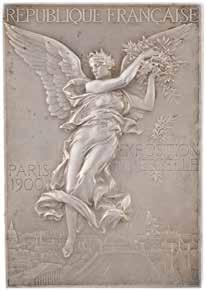
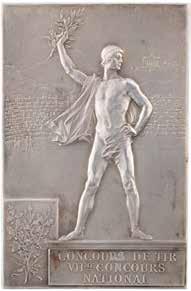
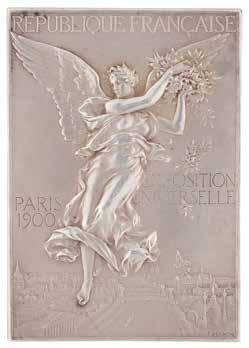
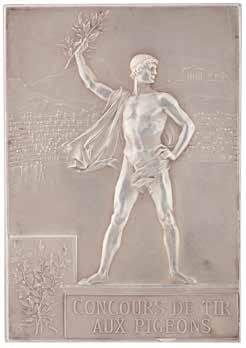
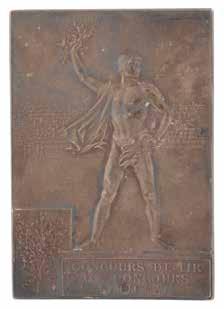
3047. Paris 1900 Olympics Silvered Bronze Winner’s Medal for Pigeon Shooting. Winner’s medal issued for the Paris 1900 Olympics. Silvered bronze, 42 mm x 60 mm, 57 gm, by Frederic Vernon, Paris. The front, inscribed “Republique Francaise, Exposition Universelle, Paris 1900,” features a winged goddess scattering laurels over the grounds of the Exposition; the reverse identifies the event as pigeon shooting, “Concours de Tir aux Pigeons,” and depicts a victorious athlete upon a podium. Stamped “Bronze” on the edge.
From ‘The Evolution of the Early Olympics’ by Robin Voigt, published by the International Society of Olympic Historians: ‘One of the most questionable sports was live pigeon shooting. It took place only once in Olympic history in the 1900 Summer Games in Paris, although the IOC denies it was ever an official event. Birds were released from cages into the air and the participants had to shoot down as many as possible. When the shooter missed two birds he was eliminated. The winner was the participant who shot down the most birds by the end of the competition. More than 300 defenseless pigeons were killed that day—blood and feathers showered over the spectators, and dead and injured birds lay on the ground, a testament to the carnage that had taken place. This was the first and only time in Olympic history when animals were deliberately killed in the name of sport. Not surprisingly the event was discontinued.’ Starting Bid $200
3048. Paris 1900 Olympics Bronze Winner’s Medal for Shooting. Winner’s medal for shooting from the Paris 1900 Olympics. Bronze, 42 mm x 60 mm, 57 gm, by Frederic Vernon, Paris. The front, inscribed “Republique Francaise, Exposition Universelle, Paris 1900,” features a winged goddess scattering laurels over the grounds of the Exposition; the reverse identifies the event as shooting, “Concours de Tir, VIIme Concours National” [The 7th National Shooting Competition], and depicts a victorious athlete upon a podium. Stamped “Bronze” on the edge. Starting Bid $200
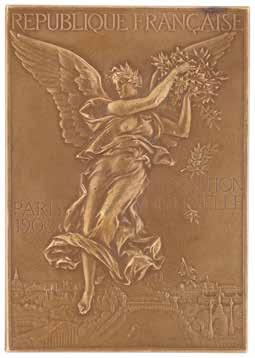
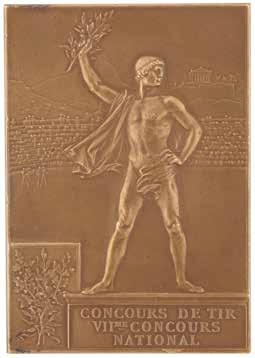
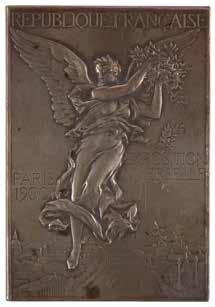
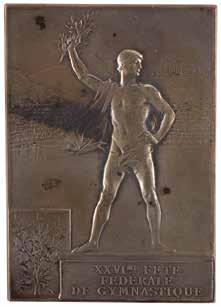
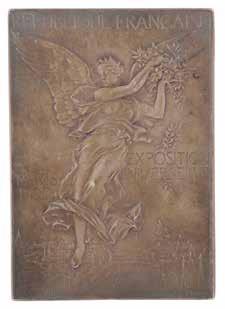
3049. Paris 1900 Olympics Silvered Bronze Winner’s Medal for Gymnastics (Fete Federale). Winner’s medal issued for the Paris 1900 Olympics. Silvered bronze, 57 gm, 42 mm x 60 mm, by Frederic Vernon, Paris. The front, inscribed “Republique Francaise, Exposition Universelle, Paris 1900,” features a winged goddess scattering laurels over the grounds of the Exposition; the reverse identifies the event as gymnastics, “XXVIme Fete Federale de Gymnastique,” and depicts a victorious athlete upon a podium. Stamped “Bronze” on the edge.
Held between July 29 and 30, 1900, the Fete Federale gymnastics event consisted of 16 exercises, with each exercise capable of earning the participant a maximum of 20 points, and a possible
total maximum score of 320 points. The events were mostly gymnastic in nature—parallel bars, rings, floor exercise, and so on—but also included a number of athletics events and a weightlifting competition. From the personal collection of a lifelong collector, teacher, and traveler with a passion for world history. His collecting years ranged from the 1970s to the present day, meaning that several of the premier pieces have not been on the market in decades. Starting Bid $200
3050. Paris 1900 Olympics Silver Winner’s Medal for Shooting. Winner’s medal from the Paris 1900 Olympics. Silver, 55 gm, 42 mm x 60 mm, by Frederic Vernon, Paris. The front, inscribed “Republique Francaise, Exposition Universelle, Paris 1900,” features a winged goddess scattering laurels over the grounds of the Exposition; the reverse identifies the event as trap shooting, “Concours de Tir, VIIme Concours National [The 7th National Shooting Competition],” and depicts a victorious athlete upon a podium. Stamped “Argent” on the edge. Starting Bid $200
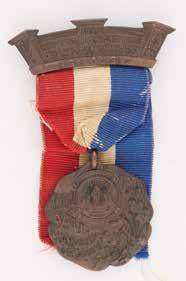
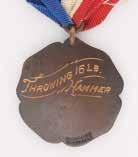
3051. St. Louis 1904 Olympics Bronze AAU Winner’s Medal for 16-Pound Hammer Throw. Winner’s medal from the St. Louis 1904 Olympics, awarded by the Amateur Athletic Union (AAU) in the hammer throw. Bronze, 23 gm, 34 mm, by Dieges & Clust, New York. The front of the medal depicts the allegorical ‘Head of Peace’ above “St. Louis, U.S.A. 1904,” and “1904 AAU Handicap Games, St. Louis”; the reverse is engraved with the name of the event, “Throwing 16 lb. Hammer.” Suspended by a red, white, and blue ribbon from its bronze bar, inscribed: “1904 Universal Exposition, Olympic Games, St. Louis.” Starting Bid $200
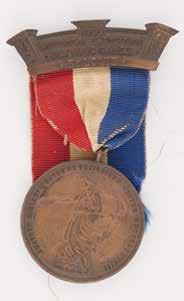
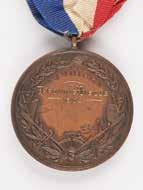
3052. St. Louis 1904 Olympics Bronze AAU Winner’s Medal for Junior Discus. Winner’s medal from the St. Louis 1904 Olympics, awarded by the Amateur Athletic Union (AAU) in the junior discus throw. Bronze, 36 gm, 36 mm, by Dieges & Clust, New York. The front of the medal depicts an allegorical woman extending a wreath, encircled by the legend: “Amateur Athletic Union of the United States MDCCCLXXXVIII”; the reverse reads, “Junior, Throwing Discus, 1904,” within a wreath. Suspended by a red, white, and blue ribbon from its bronze bar, inscribed: “1904 Universal Exposition, Olympic Games, St. Louis.” Starting Bid $200
3053. Athens 1906 Intercalated Olympics First-Place Team Winner’s Medal. First-place team winner’s medal from the Athens 1906 Intercalated Olympics. Silver, 32 mm, 15 gm. The front features the image of a seated Nike over the Greek legend, “Olympia”; the reverse features a Greek legend in six lines within a laurel wreath. Suspended from its blue-and-white silk ribbon.
Individual winners at Athens 1906 were awarded the standard trio of gold medals for first place, silver medals for second, and bronze for third. Winners in team events, however received silver medals for first and bronze medals for second; third-place finishers in team events did not receive medals. Team events in 1906 included soccer, tug of war, gymnastics, shooting, fencing, and rowing. Starting Bid $300
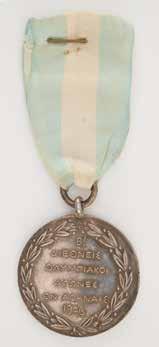
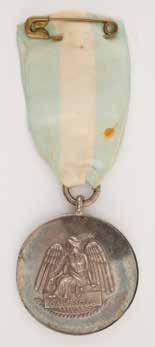
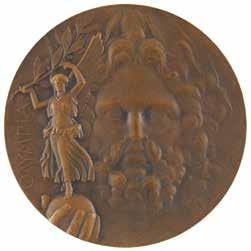
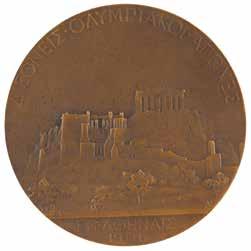
3054. Athens 1906 Intercalated Olympics Bronze Winner’s Medal.
Winner’s medal from the Athens 1906 Intercalated Olympics. Bronze, 50 mm, 58 gm, by Jules Clement Chaplain. The front depicts a relief portrait of Zeus holding Nike, the goddess of Victory, in the palm of his
hand, with text along the left side, “Olympia”; the reverse bears a detailed view of the Acropolis of Athens topped by the Parthenon, with raised Greek characters to the upper and lower portion (translated), “International Olympic Games in Athens, 1906.” Stamped “Bronze” on the edge.
Winner’s medals from the 1906 Athens Games share the same design as those from the 1896 Athens Olympics, with the ceremony year serving as the lone distinction. The 1906 Athens Games were considered the Olympics by the press and participants—which included 854 athletes from twenty countries—but they were never officially sanctioned by the International Olympic Committee. Starting Bid $500
Immaculate gold medal from the 1906 Intercalated Olympics in Athens, the only intermediate Games ever held
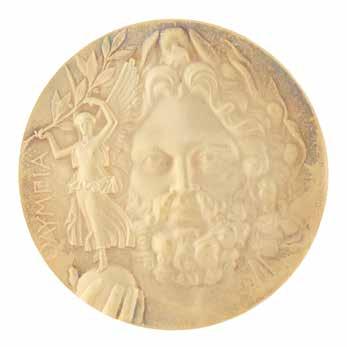
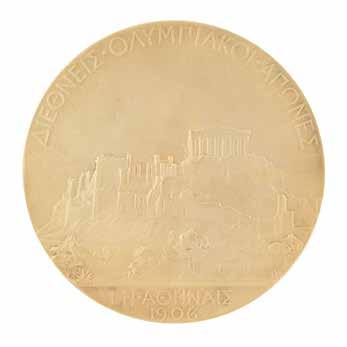
3055. Athens 1906 Intercalated Olympics Gold Winner’s Medal. Remarkable winner’s medal issued for the Athens 1906 Intercalated Olympics. Gilt silver, 51 mm, 62 gm, by Jules Clement Chaplain, Paris. The front features a portrait of Zeus holding Nike, the goddess of victory; the reverse features a view of Athens within a Greek legend. Stamped “Argent” on the edge. Complete with its form-fitting hinged red leather case.
The winner’s medals for the 1906 Athens Games share the same design as the Athens Olympics from 1896, with the ceremony year serving as the lone distinction. The 1906 Athens Games were considered the Olympics by the press and participants, which included 854 athletes from 20 countries, but they were never officially sanctioned by the International Olympic Committee. This is a stunning example of the rare and beautiful gold medal from the unofficial fourth Olympic Games. Starting Bid $1000
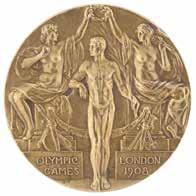
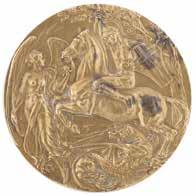
3057. London 1908 Olympics Bronze Winner’s Medal for Sailing. Winner’s medal awarded for sailing at the London 1908 Olympics. Bronze, 33.5 mm, 19 gm, designed by Bertram Mackennel; manufactured by Vaughton & Sons, England. The front, inscribed, “Olympic Games, London 1908,” features a victorious athlete being crowned with a laurel wreath by two seated females; the reverse depicts St. George, the patron saint of England, slaying a dragon as a goddess looks on. The edge is engraved with the name of the event, “Second Prize, 12 Metre Yacht Race.” The 12 Metre yachting event at the London 1908 Olympics was staged not in London but at Hunter’s Quay, Scotland, under the auspices of the Clyde Corinthian Yacht Club. Held on August 11–12, the competition drew just two boats, both representing Great Britain, with 20 sailors competing over a 26-nautical-mile course from Hunter’s Quay around marks at Inverkip, Dunoon, and Kilcreggan. The winning yacht was Hera, helmed by T. C. Glen-Coats, while second place went to Mouchette, helmed by Charles MacIver. Because only two yachts entered, the contest was an all-British duel, with Hera winning both races and Mouchette finishing second in each. For second place, the helmsman and mate of the Mouchette received silver medals but the eight crewmen received bronze medals. Starting Bid $200
First-place prize medal from the
“8 Metre Yacht Race,” won by Great Britain’s ‘Cobweb’
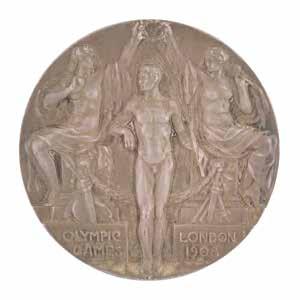
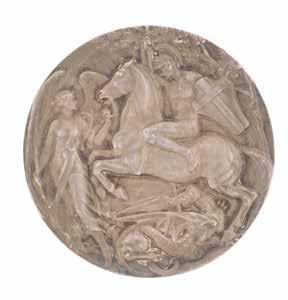
3058. London 1908 Olympics Silver Winner’s Medal for Sailing. Winner’s medal awarded for sailing at the London 1908 Olympics. Silver, 33.5 mm, 19 gm, designed by Bertram Mackennel; manufactured by Vaughton & Sons, England. The front, inscribed, “Olympic Games, London 1908,” features a victorious athlete being crowned with a laurel wreath by two seated females; the reverse depicts St. George, the patron saint of England, slaying a dragon as a goddess looks on. The edge is engraved with the name of the event, “Winner, 8 Metre Yacht Race.” Complete with its hinged red leather Vaughton presentation case, gilt-stamped on top: “Olympic Games, Winner. 8 Metre Yacht Race. London. 1908.” The 8 Metre sailing event at the 1908 Summer Olympics was contested at the Royal Victoria Yacht Club, Ryde, from July 27–29, 1908, with five boats from three nations competing over three scheduled races. Great Britain’s Cobweb, helmed by Blair Cochrane with crewmen Charles Campbell, John Rhodes, Henry Sutton, and Arthur Wood, won the event with two first-place finishes; notably, those crewmen were awarded silver medals, while Cochrane received the gold as helmsman/owner. Sweden’s Vinga placed second, and Great Britain’s Sorais finished third. Starting Bid $500
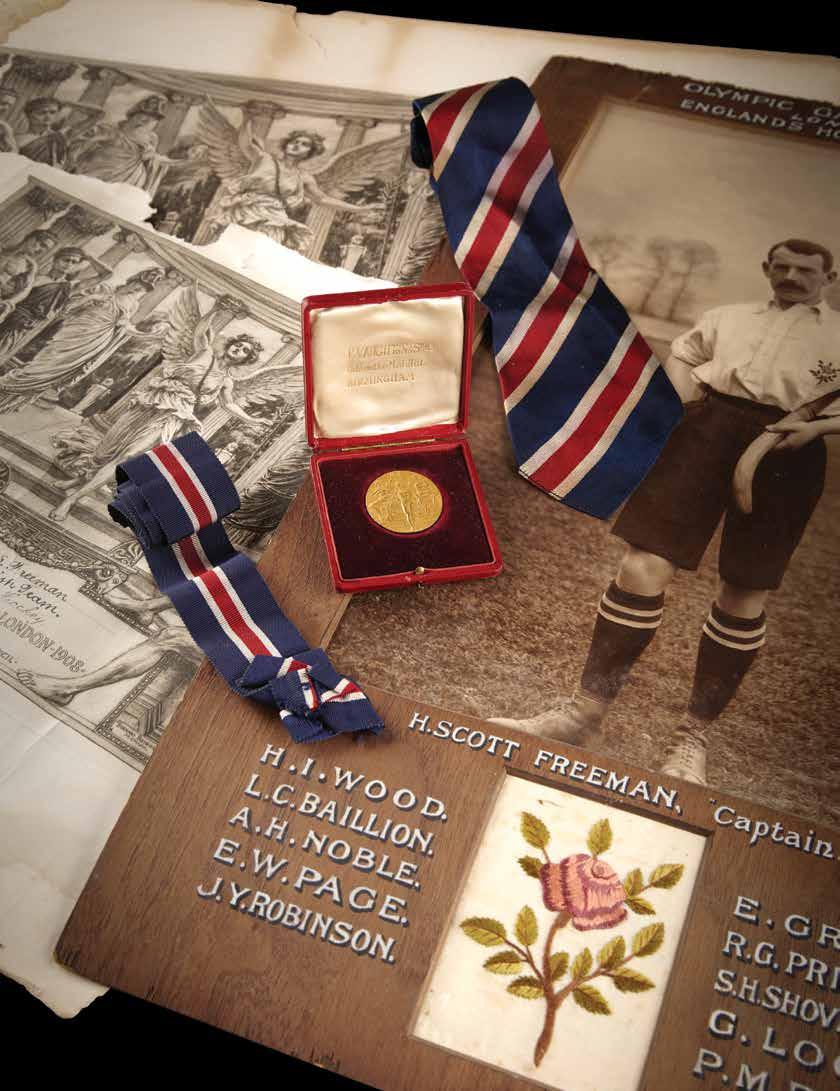
Beautiful solid gold winner’s medal from the London 1908 Olympics, awarded to team captain Harry Scott Freeman for leading England to victory in the first Olympic field hockey tournament
3056. London 1908 Olympics Gold Winner’s Medal for Field Hockey - Awarded to England Captain Harry Freeman. Exceedingly rare winner’s medal awarded to Harry Scott Freeman, captain of the gold medal-winning English field hockey team at the London 1908 Olympic Games. Gold, 34 mm, 28 gm, designed by Bertram Mackennal, Birmingham; manufactured by Vaughton & Sons, England. The front, inscribed, “Olympic Games, London 1908,” features a victorious athlete being crowned with a laurel wreath by two seated females; the reverse depicts St. George, the patron saint of England, slaying a dragon as a goddess looks on. The edge is stamped with Vaughton mint marks and engraved with the placing and event, “Winner, Hockey.” Includes its original red leather presentation case with bold gilt lettering: “Olympic Games, Winner, Hockey, London, 1908.”
Includes two official winner’s medal diplomas issued to Harry Freeman, 20.75 x 14.75 and 25 x 19.75, both decorated with elaborate classical scenes centered on the winged figure of Victory surrounded by athletes, musicians, and Greco-Roman figures. The diplomas are inscribed, respectively, “H. S. Freeman, Member of the English Team, Winner of First Prize for Hockey, at the Olympic Games London 1908” and “To H. S. Freeman, Winner of First Prize for Hockey at the Olympic Games London 1908.” Both bear printed signatures of William Henry Grenfell, 1st Baron Desborough, the founding Chairman of the British Olympic Association. Accompanied by a large 10.5 x 16.75 matte-finish portrait of Freeman with his field hockey stick, which includes its original hand-painted presentation mat identifying Freeman as “Captain,” listing other members of “England’s Hockey Team,” and bearing an embroidered rose patch, the very kind pictured on Freeman’s shirt pocket. Also
included is a silk tie and boater hat band attested as having been issued to team members. The diplomas show considerable wear, including tears and staining; however, most of the flaws are confined to the outer borders and could be readily matted out for display.
Solid gold medals were awarded at only four Olympic Games – 1900, 1904, 1908, and 1912 – making this an especially desirable relic from the formative years of the modern Olympic movement. The London 1908 field hockey tournament marked the sport’s Olympic debut and was contested by six teams, with England defeating Ireland, 8–1, in the final. Olympic medal-awarding practices at the time did not necessarily provide gold medals to every member of a victorious team. Contemporary examples from other team events at the 1908 Games demonstrate that designated representatives, such as captains or first mates, were sometimes awarded the gold medal on behalf of the winning side, while other team members received silver winner’s medals. As captain of the championship English side, Harry Scott Freeman received this gold winner’s medal, a remarkable survivor from hockey’s first Olympic competition.
Harry Scott Freeman (1876–1968) was a fullback for Staines Hockey Club, Middlesex, and England, and was chosen to captain the English side at the 1908 Olympic Games. Following his Olympic triumph, Freeman retired from international competition but remained a prominent figure in the sport, continuing to captain Staines and Middlesex and later serving as Honorary Treasurer of the Hockey Association and as a member of the International Hockey Board. Starting Bid $2500
First-place gilt silver medal awarded to an American trap shooter at the 1912 Olympic Games in Stockholm
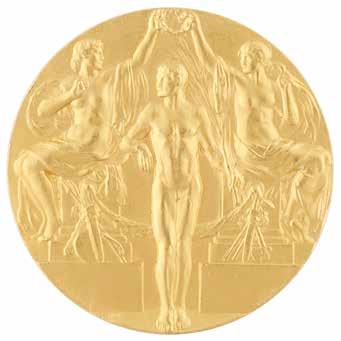
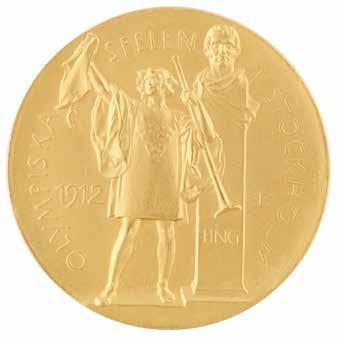
3059. Stockholm 1912 Olympics Gold Winner’s Medal for Shooting (Team Trap). Winner’s medal issued for the Stockholm 1912 Olympics. Gilt silver, 33 mm, 27 gm, by Erik Lindberg and Bertram Mackennal. The front depicts a victorious athlete holding a palm branch as he is crowned with a laurel wreath; the reverse depicts a herald proclaiming the start of the Olympic Games with a bust of Ling, founder of Swedish gymnastics, to his rear. The edge is engraved with the name of the recipient, “Frank Hall,” who won the gold medal as a member of the American team in the men’s team trap (clay pigeons) competition. Solid gold medals – the last to be awarded at any Olympiad – were awarded to the first-place winners of individual events and a select few team/doubles/equestrian competitions, while gilt silver examples were given to the winners of team events. The Fred Raymon Collection Starting Bid $1000
3060. Stockholm 1912 Olympics Silver Winner’s Medal. Winner’s medal from the Stockholm 1912 Olympics. Silver, 18 gm, 33 mm, by Bertram Mackennal and Erik Lindberg; manufactured by C. C. Sporrong & Co., of Stockholm, Sweden. The front depicts a victorious athlete with palm branch being crowned with a laurel wreath by two seated females; the reverse, encircled with the text, “Olympiska Spelen I Stockholm,” features a herald proclaiming the opening of the Olympic Games, with a bust of Ling, the founder of Swedish gymnastics, in the background. The front of the medal, designed by Mackennal, was originally used on the winner’s medals for the 1908 London Summer Olympics. Complete with its attractive red leather presentation case, gilt-stamped on the lid with the emblem of the Stockholm 1912 Olympics and “II Pris.” Starting Bid $300
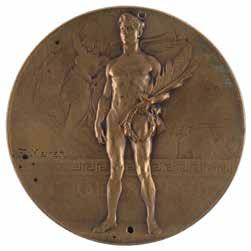
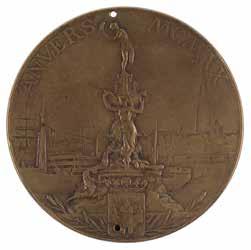
3063. Antwerp 1920 Olympics Bronze Winner’s Medal. Winner’s medal issued for the Antwerp 1920 Olympics. Bronze, 60 mm, 81 gm, by Josue Dupon. The front shows a victorious athlete holding a laurel wreath and palm branch, with a statue of Renommee in the background, inscribed “VII Olympiade”; the reverse depicts the Brabo fountain above the Antwerp shield, with the Cathedral of Our Lady and city looming in the background, inscribed above, “Anvers MCMXX.” Tiny holes have been drilled into the top and bottom edges. A total of 29 nations attended the VII Olympiad in Antwerp, Belgium, with Hungary, Germany, Austria, Bulgaria, and the Ottoman Empire all banned from competing due to their involvement in World War I and the cancelation of the 1916 Games. In spite of such political unrest, the return of the Games debuted a trinity of enduring Olympic traditions—the voicing of the Olympic Oath, the symbolic release of doves, and the initial flying of the Olympic flag. From the personal collection of a lifelong collector, teacher, and traveler with a passion for world history. His collecting years ranged from the 1970s to the present day, meaning that several of the premier pieces have not been on the market in decades. Starting Bid $200
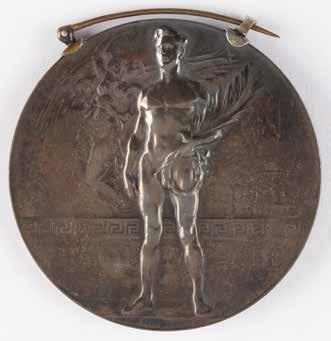
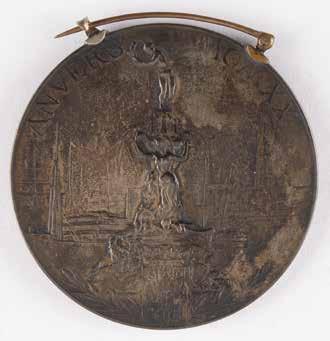
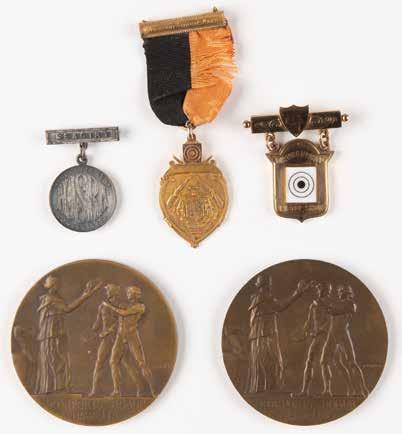
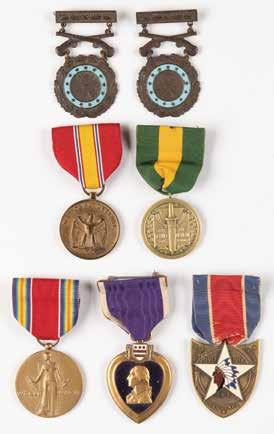
The return of the Summer Games— first-place winner’s medal from the 1920 Antwerp Olympics, presented to an elite American marksman and veteran of both World Wars
3061. Antwerp 1920 Olympics Gold Winner’s Medal for Shooting. Winner’s medal awarded to American shooter Lt. Col. Louis J. Harant at the Antwerp 1920 Olympics. Gilt silver, 60 mm, 87 gm, by Josue Dupon. The front shows a victorious athlete holding a laurel wreath and palm branch, with a statue of Renommee in the background, inscribed “VII Olympiade”; the reverse depicts the Brabo fountain above the Antwerp shield, with the Cathedral of Our Lady and city looming in the background, inscribed above, “Anvers MCMXX.” The bottom edge is stamped “A” for Argent, and a pin has been soldered neatly to the top edge for display purposes. Accompanied by a contemporary replacement medal case.
Louis Harant (1895–1986) was a 35-year veteran of the United States Army who holds the distinction of having served in the Mexican Border War, World War I, and World War II. After WWI, Harant served in the Army of German Occupation, where he performed as an instructor in machine gun, rifle, and pistol marksmanship with the 5th Machine Gun Battalion in Weitersburg, and the 17th Field Artillery Regiment at Fort Ehrenbreitstein. In the summer of 1919, he participated as a member of the U.S. Rifle and Pistol Team in the Inter-Allied Competitions, a precursor to the 1920 Summer Games that were held on the outskirts of Paris, France. The Americans swept all four shooting events.
By this point, Harant had proven himself to be one of the most skilled shooters in the entire United States Army. This stature led to his selection for the U.S. shooting team, which was assembled to compete at the 1920 Olympics in Antwerp, Belgium. On August 3, 1920, Harant competed in both the individual 30-meter military pistol event and the 30-meter team rapid fire pistol event. Although he struggled in the former, ultimately
placing fourth, he excelled in the team event, which was won convincingly by the Americans, a five-man squad of elite marksmen that was led by Harant’s team-leading 268 points.
The winner’s medal is accompanied by a dozen medals and decorations from Harant’s legendary military and shooting career, which includes his Purple Heart, a Mexican Border War Medal, two 23rd Infantry badges (1921 and 1922), a WWI 2nd Division Regulars medal, a WWII Freedom medal, a WWII National Defense medal, a 23rd Infantry Distinguished Pistol Shot badge (1921), a Seagirt/NJSRA (New Jersey State Rifle Association) ‘Ninety Per Cent Competitor’ badge, a 10K top prize Adjutant Generals Match medal (110th Field Artillery), and Harant’s two first-place bronze medals from the 1919 Inter-Allied Games for Team Pistol Shooting.
Hosting the Olympics in 1920 was a challenging endeavor so close to the end of the war. Because of financing problems for the Games, many shortcuts had to be taken; one of them was reducing the amount of gold plating on the first-place winner’s medals. Unfortunately, most of the gilding wore off almost immediately, and, as is often the case, many of the medals appear almost silver.
A total of 29 nations attended the VII Olympiad in Antwerp, Belgium, with Hungary, Germany, Austria, Bulgaria, and the Ottoman Empire all banned from competing due to their involvement in World War I and the cancellation of the 1916 Games. Despite such political unrest, the return of the Games debuted a trinity of enduring Olympic traditions—the voicing of the Olympic Oath, the symbolic release of doves, and the initial flying of the Olympic flag. Starting Bid $1000
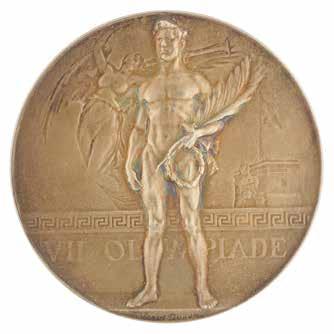
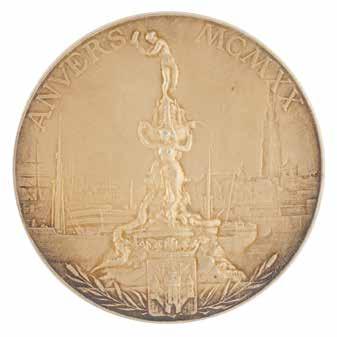
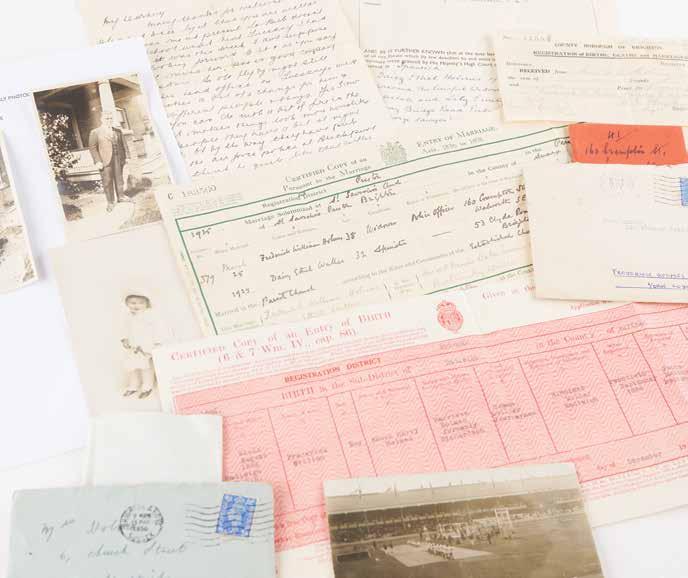
First-place prize from the last Olympic tug-of-war competition— awarded to City of London policeman Frederick Holmes
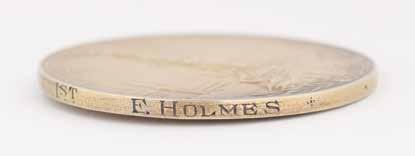
3062. Antwerp 1920 Olympics Gold Winner’s Medal for Tug of War. Winner’s medal awarded to British tug of war competitor Frederick W. Holmes at the Antwerp 1920 Olympics. Gilt silver, 60 mm, 89 gm, by Josue Dupon. The front shows a victorious athlete holding a laurel wreath and palm branch, with a statue of Renommee in the background, inscribed “VII Olympiade”; the reverse depicts the Brabo fountain above the Antwerp shield, with the Cathedral of Our Lady and city looming in the background, inscribed above, “Anvers MCMXX.” Bottom edge is stamped “A” for ‘Argent,’ with a custom engraving commemorating the event: “Tug of War, City of London Police, 1st, F. Holmes.” Includes its original maroon Hoosemans presentation case, the top of which is marked in gilt, “1st Prix, VII Olympiade, Anvers 1920.”
Accompanied by an assortment of related ephemera, including: a real photo postcard of the tug of war competition held at the Antwerp 1920 Games; a certified copy of Holmes’s birth certificate; a certified copy of Holmes’s marriage certificate; Holmes’s death certificate; a handwritten letter by Holmes to his wife; his Oddfellows Lodge booklet; and three vintage family photos.
Frederick W. Holmes helped carry Great Britain to gold in the men’s tug of war at the 1920 Summer Olympics in Antwerp, a compact but memorable competition held on August 17–18 with 40 athletes from five nations. Holmes was one of eight British pullers on a team made up entirely of City of London Police officers, and Britain dominated the event, defeating the United States, Belgium, and the Netherlands by 2–0 scores on its way to first place. The victory was historically significant because 1920 marked the final appearance of tug of war on the Olympic program, making Holmes not only an Olympic champion but one of the last gold medalists in the sport’s Olympic history. Starting Bid $1000
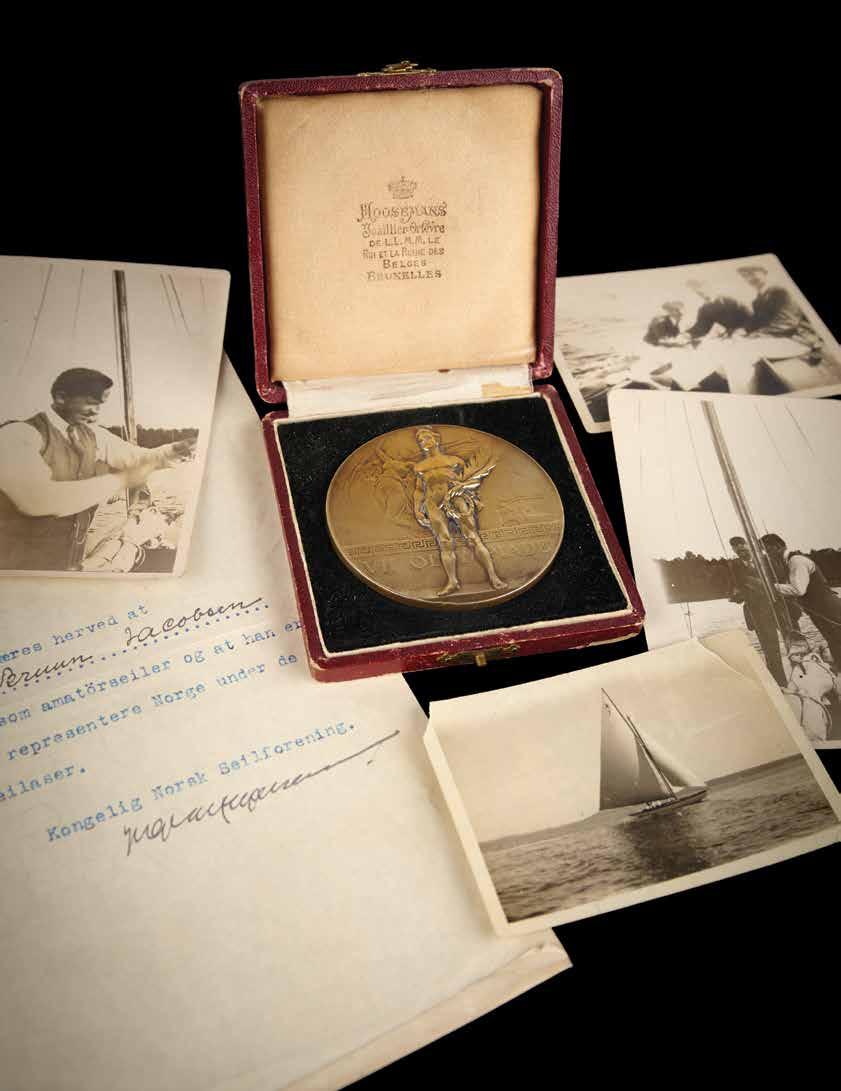
Beautiful golden winner’s medal of the 1920 Antwerp Olympics with original presentation case, presented to Norwegian sailor Alf Jacobsen,
a member of the first-place crew of the yacht Irene in the 8-metre class regatta
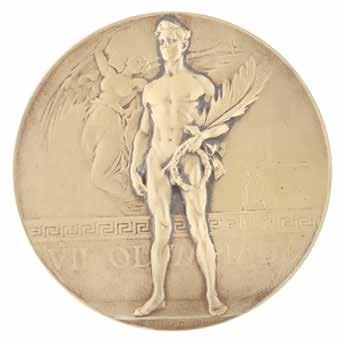
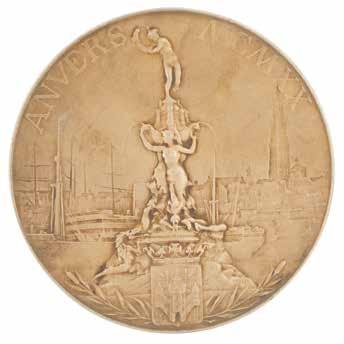
3064. Antwerp 1920 Olympics Gold Winner’s Medal for Sailing. Winner’s medal awarded to Norwegian sailor Alf Jacobsen at the Antwerp 1920 Olympics. Gilt silver, 60 mm, 89 gm, by Josue Dupon. The front shows a victorious athlete holding a laurel wreath and palm branch, with a statue of Renommee in the background, inscribed “VII Olympiade”; the reverse depicts the Brabo fountain above the Antwerp shield, with the Cathedral of Our Lady and city looming in the background, inscribed above, “Anvers MCMXX.”
Bottom edge is stamped “A” for Argent. Includes its original maroon Hoosemans presentation case, the top of which is marked in gilt, “1st Prix, VII Olympiade, Anvers 1920.”
Accompanied by four period photographs, 3.25 x 2.25 to 2.75 x 4.25, three of which appear to show the recipient, Jacobsen, working on his sailboat, and a typed Olympic qualification letter from the secretary of the Royal Norwegian Yacht Club, dated from Kristiania (Oslo) on June 5, 1920, in full (translated): “This is hereby to certify that Mr. Alf Bruun Jacobsen is approved as an amateur sailor and that he has been selected to represent Norway during the Olympic sailing competitions.” Norwegian sailor Alf Jacobsen (1885–1948) was a crew member of
the Norwegian boat Irene, which won the gold medal in the 8 metre class (1907 rating) at the 1920 Summer Olympics.
Hosting the Olympics in 1920 was a challenging endeavor, so close to the end of the war. Because of financing problems for the Games, many shortcuts had to be taken; one of them was reducing the amount of gold plating on the first-place winner’s medals. For many, most of the gilding wore off almost immediately, and, as is often the case, many of the medals appear almost silver. This example, however, has retained a beautiful golden sheen not commonly seen on these rare and coveted medals.
A total of 29 nations attended the VII Olympiad in Antwerp, Belgium, with Hungary, Germany, Austria, Bulgaria, and the Ottoman Empire all banned from competing due to their involvement in World War I and the cancellation of the 1916 Games. Despite such political unrest, the return of the Games debuted a trinity of enduring Olympic traditions: the voicing of the Olympic Oath, the symbolic release of doves, and the initial flying of the Olympic flag. An exceptional first-place medal of the utmost historical interest and rarity. Starting Bid $1000
3065. Antwerp 1920 Olympics Bronze Winner’s Medal and Participation Medal. Desirable pairing of a bronze winner’s medal and participation medal from the Antwerp 1920 Olympics:
- Handsome winner’s medal issued for the Antwerp 1920 Olympics. Bronze, 60 mm, 81 gm, by Josue Dupon. The front shows a victorious athlete holding a laurel wreath and palm branch, with a statue of Renommee in the background, inscribed “VII Olympiade”; the reverse depicts the Brabo fountain above the Antwerp shield, with the Cathedral of Our Lady and city looming in the background, inscribed above, “Anvers MCMXX.”
- Participation medal issued for the Antwerp 1920 Olympics. Bronze, 60 mm, 76 gm, by Pierre Theunis. The front depicts a dramatic image of a flying Victory crowning a charioteer on biga; the reverse features Nike standing before a burning censer and crowning a trio of victorious athletes, with Antwerp in the background, and raised text, “VIIme Olympiade-Anvers, MCMXX.”
Starting Bid $300
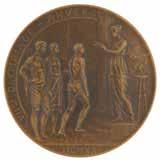
Bronze winner’s medal of the first Winter Olympics
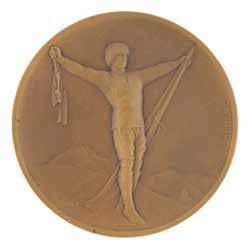
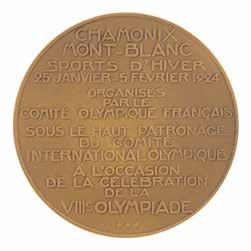
3066. Chamonix 1924 Winter Olympics Bronze Winner’s Medal. Sought-after medal from the Chamonix 1924 Winter Olympics, which was issued as the bronze medal to third-place winners and also used as the participation medal of the Games. Bronze, 56 mm, 69 gm, by Raoul Benard, Paris. The front features a victorious athlete holding ice skates and skis high in the air with the Alps in the background; the reverse is inscribed at length in French, “Chamonix Mont-Blanc Sports D’Hiver, 25 Janvier-5 Fevrier 1924, Organises par le Comite Olympique Francais sous le haut patronage du Comite International Olympique a l’occasion de la celebration de la VIII Olympiade [Chamonix Mont-Blanc Winter Sports, 25 January-5 February 1924, Organized by the French Olympic Committee under the patronage of the International Olympic Committee on the occasion of the celebration of the VIII Olympiad].” The edge is stamped “Bronze.” Housed in its original hinged presentation case.
The 1924 Chamonix Games were the very first Winter Olympics and a total of sixteen nations were represented. The participation medal of the Chamonix 1924 Winter Games is identical to the Olympiad’s third place bronze winner’s medal, a unique distinction across all Olympic medals; it subsequently exists as one of the very rarest commemoration prizes, equal to other coveted participatory rarities from Olympic Games in St. Louis (Summer 1904), Lake Placid (Winter 1932), and Stockholm (Summer 1956). Only 294 athletes participated, making any Chamonix medal very rare. Starting Bid $1000
Chamonix 1924 first-place prize medal— a glorious gold from the first Winter Olympic Games
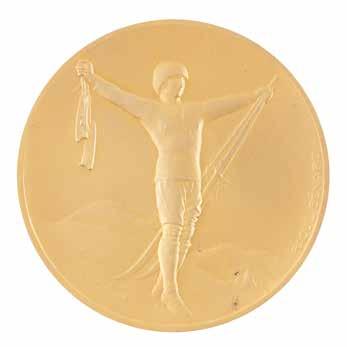
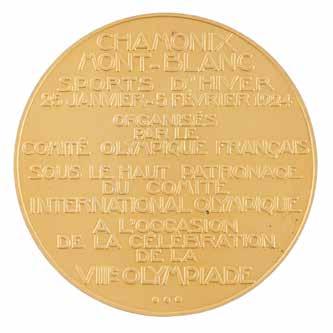
3067. Chamonix 1924 Winter Olympics Gold Winner’s Medal. Outstanding winner’s medal from the Chamonix 1924 Winter Olympics. Gilt silver, 55 mm, 75 gm, by Raoul Benard, Paris. The front features a victorious athlete holding ice skates and skis high in the air with the Alps in the background; the reverse is inscribed at length in French, “Chamonix Mont-Blanc Sports D’Hiver, 25 Janvier–5 Fevrier 1924, Organises par le Comite Olympique Francais sous le haut patronage du Comite International Olympique a l’occasion de la celebration de la VIII Olympiade [Chamonix Mont-Blanc Winter Sports, 25 January-5 February 1924, Organized by the French Olympic Committee under the patronage of the International Olympic Committee on the occasion of the celebration of the VIII Olympiad].” Stamped “2Argent” on the edge. Complete with its black leather presentation box.
The 1924 Chamonix Games were the very first Winter Olympics and sixteen nations were represented. Only 294 athletes participated, making any Chamonix medal very rare-first place winner’s medals are, of course, the most desirable. According to the official medal count, only 33 first place gold winner’s medals were awarded. Starting Bid $5000
Bronze medal from the 1924 Paris Summer Games, the first winner’s design to incorporate the Olympic rings
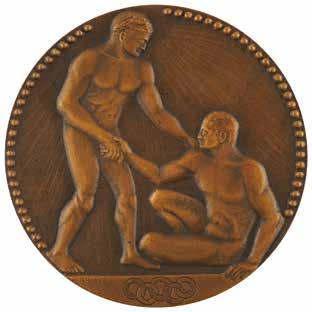
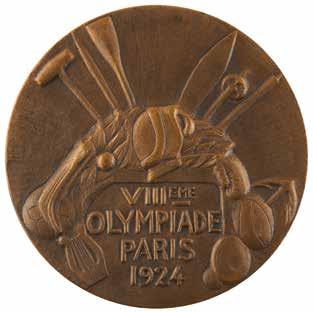
3068. Paris 1924 Summer Olympics Bronze Winner’s Medal. Winner’s medal from the Paris 1924 Summer Olympics. Bronze, 55 mm, 74 gm, by Andre Rivaud, Paris. The front depicts a triumphant athlete extending his hand to a fallen opponent, with the designer’s name “A. Rivaud” etched below his foot, and the Olympic rings at the bottom; the reverse, inscribed, “VIIIeme Olympiade, Paris 1924,” depicts a harp and various pieces of sporting equipment. Stamped “Bronze” on the edge. The winner’s medals for this Olympics were the first to incorporate the Olympic rings into the design. Only 304 of these attractive third-place bronze medals were awarded at the Games. Starting Bid $500
Scarce bronze winner’s medal from St. Moritz 1928, the first true Winter Olympics
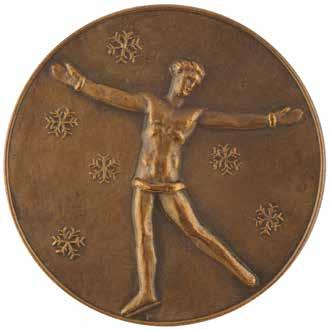
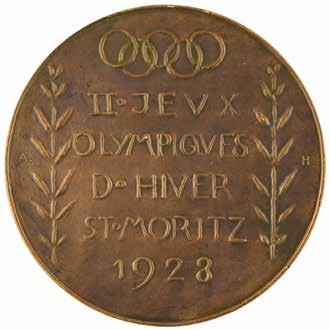
3069. St. Moritz 1928 Winter Olympics Bronze Winner’s Medal. Exceptionally rare winner’s medal from the St. Moritz 1928 Winter Olympics. Bronze, 50 mm, 62 gm, by Arnold Hunerwadel. The appealing front depicts a figure skater surrounded by snowflakes; the reverse reads, “Il Jeux Olympiques d’Hiver, St. Moritz, 1928,” with Olympic rings at the top and laurel branches on either side. The Olympics at St. Moritz were just the second Winter Games held, with only 495 athletes participating. This was one of about 25 bronze medals issued at the 1928 Winter Games and one of only 80 total winners’ medals that were presented during the entire proceedings. Starting Bid $500
3070. Garmisch 1936 Winter Olympics Bavarian Curling Gold Winner’s Plaque (Demonstration Sport). Winner’s medal awarded in the Bavarian curling demonstration event at the Garmisch 1936 Winter Olympics. Gilt silver, 57 mm x 87 mm, 125 gm. The plaque features a large enameled color logo showing Kreuzeck mountain with Olympic the rings surrounded by a silver wreath, with the prize legend engraved below: “Eiswettschiessen der IV. Olympischen Winterspiele, 1936 Garmisch Partenkirchen, National, Damen-Mannschaftskampf, 1 Platz.” Reverse bears the maker’s mark of Carl Poellath, Schrobenhausen.
Bavarian curling, or ice stock sport [eisstockschießen], appeared at the 1936 Winter Olympics in Garmisch-Partenkirchen as a demonstration sport, with events held on Lake Riessersee. Similar to curling, competitors slid handled ‘stocks’ across the ice in target, distance, and team competitions, including international men’s events and German national events for men and women. Although it drew spectators and returned as a demonstration sport in 1964, it never became an official Olympic medal event. Starting Bid $200
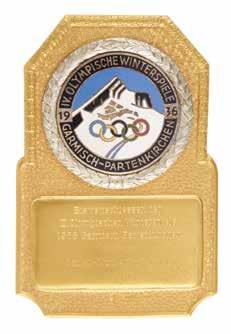
3071. Berlin 1936 Summer Olympics Bronze Winner’s Medal. Winner’s medal from the Berlin 1936 Summer Olympics. Bronze, 55 mm, 76 gm, by Giuseppi Cassioli. The front, inscribed, “XI. Olympiad, Berlin, 1936,” features a ‘Seated Victory’ with the Colosseum in the background; the reverse portrays a winner carried by several jubilant athletes. The bottom edge is stamped, “B. H. Mayer, Pforzheim.” With just 320 bronze prizes struck for the ‘36 Games, this is a scarce, desirable example. Starting Bid $200
Historic first-place winner’s medal from the controversial Berlin 1936 Summer
Olympics—
from the collection of Javier Gómez-Navarro,
Vice-President of the Organizing Committee of the Barcelona 1992 Summer Olympics
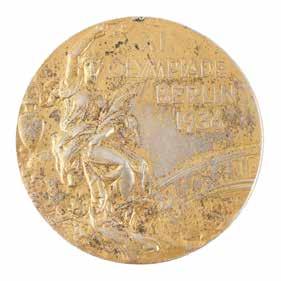
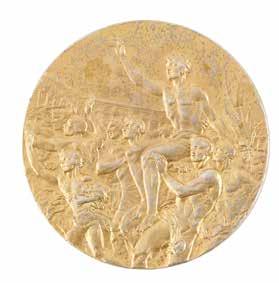
3072. Berlin 1936 Summer Olympics Gold Winner’s Medal - From the Collection of Olympic Executive Javier Gómez-Navarro. Rare winner’s medal for the Berlin 1936 Summer Olympics, deriving from the collection of Javier Gómez-Navarro, Vice-President of the Organizing Committee of the Barcelona 1992 Summer Olympics. Gilt silver, 57 mm, 74 gm, by Giuseppe Cassioli. The front, inscribed, “XI. Olympiad, Berlin, 1936,” features a ‘Seated Victory’ with the Coliseum in the background; the reverse portrays a winner carried by jubilant athletes; and the bottom edge engraved, “B. H. Mayer, Pforzheim, 990.” The medal bears two small dings to the top edge, and notable wear and loss to the gilt. A historic first-place winner’s medal from the controversial 1936 Berlin Olympics. Javier Gómez-Navarro (1945–2024) was a Spanish politician, businessman, and sports administrator whose career was closely intertwined with the modernization of Spanish sport and tourism. Gómez-Navarro served as Spain’s Secretary of State for Sport from 1987 to 1993, during which time he helped reform the nation’s sporting infrastructure and worked with the private sector to transform professional sports clubs into limited companies. He also served as Vice-President of the Organizing Committee of the Barcelona 1992 Summer Olympics, playing a key role in the planning and execution of the Games that helped redefine Barcelona’s international image and showcased Spain on the world stage. In recognition of his contributions to the Olympic Movement and the success of the Barcelona Games, Gómez-Navarro received the Olympic Order in Gold from the International Olympic Committee in 1992. He later served as Spain’s Minister of Trade and Tourism from 1993 to 1996. Starting Bid $1000
“Citius
Altius Fortius”—attractive bronze third-place medal from the ‘48 Winter Games in St. Moritz
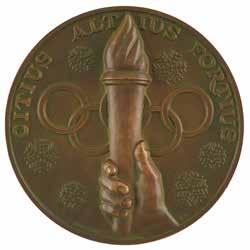
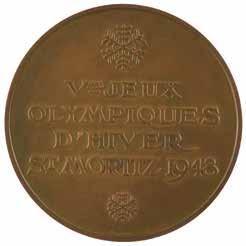
3073. St. Moritz 1948 Winter Olympics Bronze Winner’s Medal. Winner’s medal from the St. Moritz 1948 Winter Olympics. Bronze, 60 mm, 104 gm, by Paul Andre Droz. The front depicts a hand holding the Olympic torch against a background with snowflakes and Olympic rings, with motto above, “Citius Altius Fortius”; the reverse features two raised snowflakes and the raised text, “Vmes Jeux Olympiques D’Hiver St. Moritz 1948.” Complete with its hinged presentation case, gilt-stamped with the Olympic rings on the lid. The St. Moritz Games were the first to be celebrated following World War II, and were bestowed with the moniker, ‘The Games of Renewal.’ Due to their roles in the preceding war, both Japan and Germany were not invited to compete; they subsequently rejoined the Winter Games in 1952. A total of 123 athletes won medals at the 1948 Games, with 46 earning bronze. Starting Bid $500
Stunning silver medal from the London 1948 Olympics, the first Summer Games after World War
II
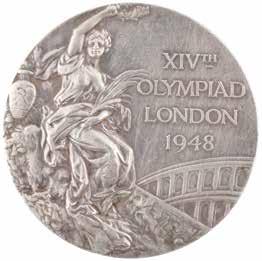
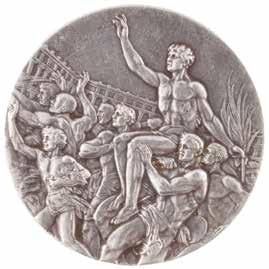
3074. London 1948 Summer Olympics
Silver Winner’s Medal. Beautiful winner’s medal from the London 1948 Summer Olympics. Silver, 51 mm, 68 gm, by Giuseppe Cassioli. The front is inscribed, “XIVth Olympiad, London, 1948,” and features a ‘Seated Victory’ with the Coliseum in the background; the reverse portrays a winner being carried by a parade of jubilant athletes. With just 300 minted and 136 awarded, these lustrous second-place silver winners’ medals from the Games of the XIV Olympiad are as scarce as they are stunning. Starting Bid $500
Scarce silver winner’s medal from the Finnish Summer Games of 1952
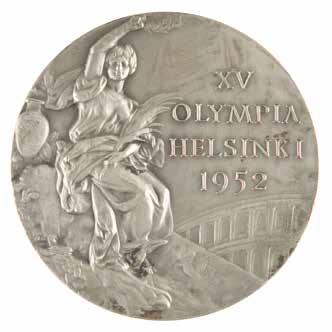
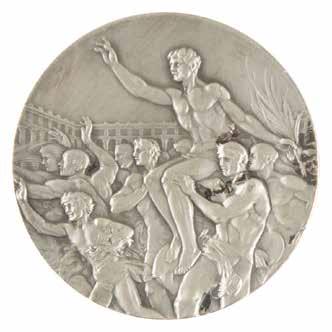
3075. Helsinki 1952 Summer Olympics Silver Winner’s Medal. Appealing winner’s medal from the Helsinki 1952 Summer Olympics. Silver, 51 mm, 68 gm, by Giuseppe Cassioli. The front, inscribed, “XV Olympia, Helsinki, 1952,” features a ‘Seated Victory’ with the Coliseum in the background; the reverse portrays a winner carried by jubilant athletes. Factory marks on the edge, “916H” and “Y6,” designate the silver content and mint. Includes its original dark blue presentation case. Only 320 of these silver second-place medals were awarded at the Helsinki games, making this an uncommon and sought-after example. Starting Bid $500
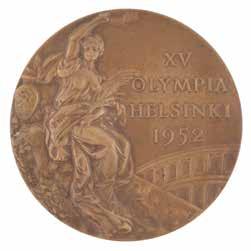
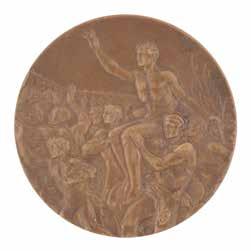
3076. Helsinki 1952 Summer Olympics Bronze Winner’s Medal. Winner’s medal from the Helsinki 1952 Summer Olympics. Bronze, 51 mm, 60 gm, by Giuseppe Cassioli. The front, inscribed, “XV Olympia, Helsinki, 1952,” features a ‘Seated Victory’ with the Coliseum in the background; the reverse portrays a winner carried by jubilant athletes. An uncommon and sought-after example from the Olympics that marked the emergence of the Cold War on the world sporting stage, highlighted by the Soviet Union’s Olympic debut and the return of Germany and Japan to international competition after World War II. Starting Bid $300
Melbourne 1956 Summer Olympics silver medal awarded to a defender on the Yugoslavian national football team
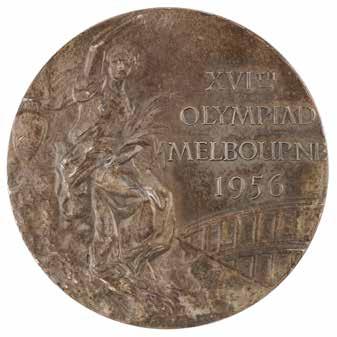
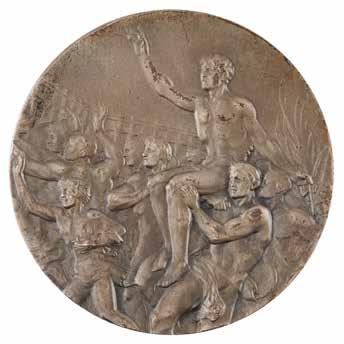
3077. Melbourne 1956 Summer Olympics Silver Winner’s Medal for Football. Winner’s medal awarded to Yugoslavian defender Ivan Sˇantek for football at the Melbourne 1956 Summer Olympics. Silver, 51 mm, 67 gm, by Giuseppe Cassioli; manufactured by K. G. Luke. The front, inscribed, “XVIth Olympiad, Melbourne, 1956,” features a ‘Seated Victory’ with the Colosseum in the background; the reverse portrays a winner with a palm branch being carried by jubilant athletes. Includes the original white plastic case by K. G. Luke/Casecraft, with red “XVIth Olympiad” label on the cover, which exhibits chipping to the front lid panel. This prize medal design had been adopted from the Amsterdam 1928 Summer Games, with the only alteration for 1956 being a change in wording to reflect the year and location.
There were 280 of these silver medals produced, with 273 of them being awarded. The consignor notes that the recipient of this example was soccer star Ivan Sˇantek, who was a member of the silver medal–winning Yugoslavian national football team. After blowing out the competition in the quarter-finals (9-1 against the USA) and semi-finals (4-1 against India), Yugoslavia lost 1-0 to the Soviet Union in the championship match. Starting Bid $500
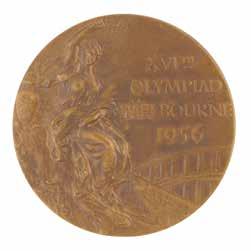
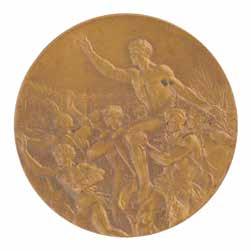
3078. Melbourne 1956 Summer Olympics Bronze Winner’s Medal with Original Presentation Case. Third-place winner’s medal from the Melbourne 1956 Summer Olympics. Bronze, 51 mm, 63 gm, by Giuseppe Cassioli; manufactured by K. G. Luke. The front, inscribed, “XVIth Olympiad, Melbourne, 1956,” features a ‘Seated Victory’ with the Colosseum in the background; the reverse portrays a winner with a palm branch being carried by jubilant athletes. Includes its original white plastic case by K. G. Luke/Casecraft, which is in atypically pristine condition. This medal’s obverse follows Giuseppe Cassioli’s celebrated design first introduced for the Amsterdam 1928 Summer Games, with the inscription modified to reflect the XVI Olympiad in Melbourne. The Melbourne Games were the first Olympiad ever staged in the Southern Hemisphere and the first held outside Europe and North America. Due to Australia’s strict animal quarantine regulations, the equestrian competitions were conducted separately in Stockholm, Sweden, making the 1956 Olympics the only Games in history held across two countries. A scarce and highly attractive third-place medal from one of the most distinctive Olympiads of the modern era. Starting Bid $500
Sample bronze winner’s medal for biathlon from the VIII Olympic Winter Games
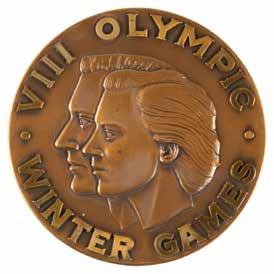
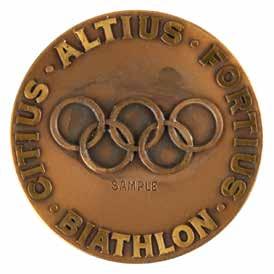
3079. Squaw Valley 1960 Winter Olympics Sample Bronze Winner’s Medal for Biathlon. Rare sample bronze winner’s medal from the Squaw Valley 1960 Winter Olympics. Bronze, 57 mm, 90 gm, by Herff Jones, Indiana. The front features embossed heads of male and female athletes in profile, with bold text: “VII Olympic, Winter Games”; and the reverse is encircled with raised text of the Olympic motto, “Citius, Altius, Fortius,” and the sport, “Biathlon,” and the center stamped “Sample” below the Olympic rings in relief. Edge is engraved, “H. J. CO.” The Squaw Valley 1960 Winter Olympics hosted the first appearance of modern biathlon in the Olympic Games. The sport was added to the Olympic program after organizers elected not to construct a bobsleigh run for the Games, making Squaw Valley the only Winter Olympics not to feature a bobsleigh competition. Biathlon consisted of a single event held at McKinney Creek Stadium in Tahoma, California, on February 21, 1960. Thirty athletes from nine nations competed, with Sweden’s Klas Lestander, Finland’s Antti Tyrväinen, and the Soviet Union’s Aleksandr Privalov taking the gold, silver, and bronze medals, respectively. Starting Bid $500
Shimmering gold first-place prize medal issued for fencing at the Tokyo 1964 Summer Games
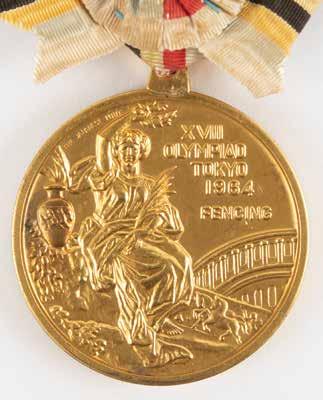
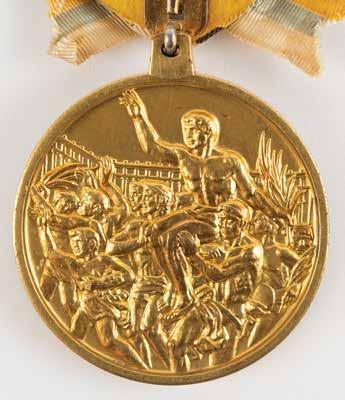
3080. Tokyo 1964 Summer Olympics Gold Winner’s Medal for Fencing. Winner’s medal issued for a fencing event at the Tokyo 1964 Summer Olympics. Gilt silver, 63 mm, 102 gm, by Toshikaka Koshiba (based on the classic design of Giuseppe Cassioli); manufactured by the Japanese Mint. The front is inscribed, “XVII Olympiad Tokyo 1964, Fencing,” and features a ‘Seated Victory’ with the Colosseum in the background; the reverse depicts a victorious athlete being carried by several jubilant athletes. The medal is complete with its original ribbon with Olympic colors and its attractive black lacquer box, the lid of which features the emblem of the Games and one golden dot indicating first place. The ribbon appears to have split and been re-sewn to the medal’s felt-backed hanger, exhibiting some overall wear and toning; the case’s clasp is missing.
Eight fencing events were contested at the 1964 Summer Olympics, with men competing in both individual and team events for each of the three weapon types (épée, foil and sabre), and women competing only in individual and team foil events. Hungary dominated the medal table with four first-place fencing finishes; the Soviet Union won three events, and Poland won one. Starting Bid $1000
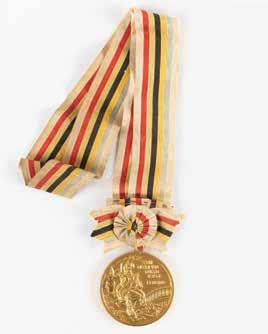
Olympic gold medal for women’s volleyball won by the Soviet Union at Mexico City in 1968
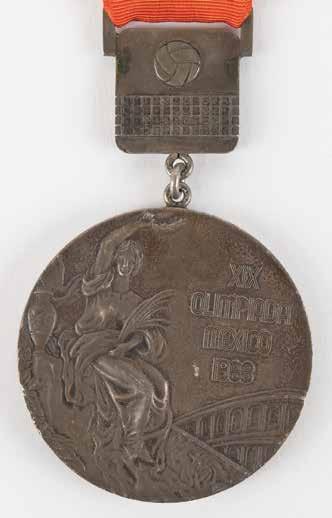
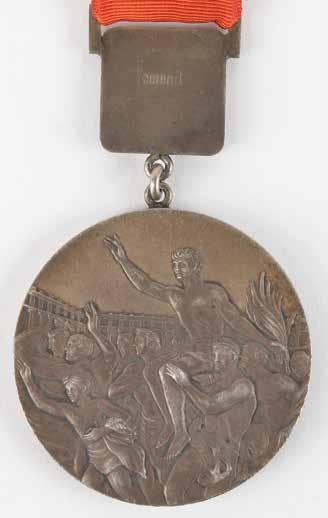
3081. Mexico City 1968 Summer Olympics Gold Winner’s Medal for Women’s Volleyball. Winner’s medal issued for women’s volleyball at the Mexico City 1968 Summer Olympics. Gilt silver, 60 mm, 125 gm, originally designed by Giuseppe Cassioli. The front is inscribed, “XIX Olimpiada Mexico 1968,” and features a ‘Seated Victory’ with the Colosseum in the background; the reverse depicts a victorious athlete with a palm branch being carried by several jubilant athletes. A small plaque attached to the top of the medal bears the volleyball pictogram of a ball and net, engraved “Femenil [Women’s]” on the reverse, suspended from the original orange ribbon. The medal retains only traces of the gold plating, typical of the issue.
The Soviet Union’s women’s volleyball team won the gold medal at the 1968 Olympics in Mexico City, solidifying their position as a powerhouse in the sport. They defeated Japan, who had previously taken gold in 1964, in a thrilling final that showcased the Soviets’ strategic teamwork and athletic precision. This victory not only underscored the Soviet Union’s strength on the global stage but also contributed to the growing popularity of women’s volleyball, which had debuted as an Olympic sport in 1964. Starting Bid $1000
Very rare complete winner’s medal set for basketball from the 1968 Summer Games in Mexico City, with its original presentation box and winners’ pins
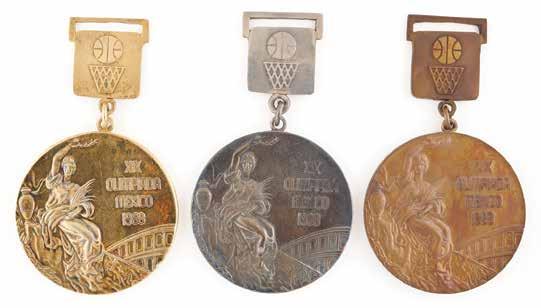
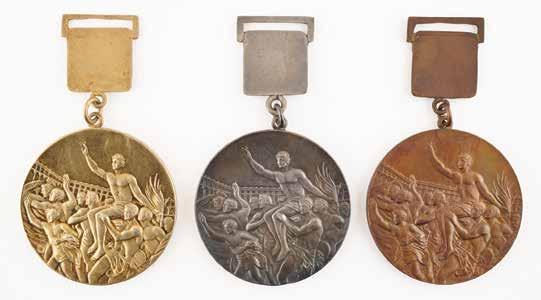
3082. Mexico City 1968 Summer Olympics Set of Gold, Silver, and Bronze Winner’s Medals with Pins in Presentation Box. Rare and magnificent complete set of unawarded gold, silver, and bronze winner’s medals for basketball from the Mexico City 1968 Summer Olympics. Based on the classic design by Giuseppe Cassioli, the medals measure 60 mm in diameter and weigh 125 gm (gilt silver), 124 gm (silver), and 110 gm (bronze). The front of each medal, inscribed, “XIX Olimpiada Mexico 1968,” features a ‘Seated Victory’ with the Colosseum in the background; the reverse of each medal depicts a victorious athlete with a palm branch being carried by several jubilant athletes. Small plaques attached to the top of the medals feature a pictogram of a basketball over a netted basketball hoop. Ribbons are not included. The medals are housed in a handsome velvet-lined black leather presentation box, with white text inside the lid: “XIX Olimpiada, Mexico, 1968.” Also includes a set of winner’s pins in gold, silver, and bronze, featuring miniature duplicates of the larger Mexico City winner’s medals, suspended from small upper plaques featuring pictograms for the rowing event. A fabulous, complete presentation of winners’ medals from the historic 1968 Summer Olympic Games in Mexico City. Starting Bid $1000
Bronze winner’s medal from the historic 1972 Summer Olympics in Munich, Germany
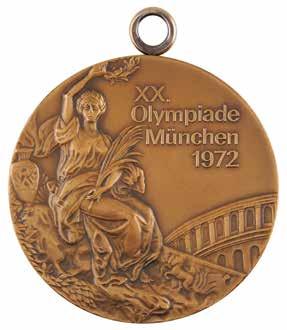
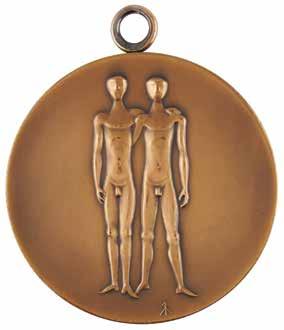
3083. Munich 1972 Summer Olympics Bronze Winner’s Medal. Unawarded winner’s medal from the Munich 1972 Summer Olympics. Bronze, 66 mm, 133 gm, designed by Gerhard Marcks and manufactured by the Bavarian Mint. The front is inscribed, “XX. Olympiade Munchen 1972,” and depicts the ‘Seated Victory’ with the Colosseum in the background; the reverse portrays the mythological twins Castor and Pollux, the patrons of competitive sport and friendship, with the artist’s monogram below. The edge, which would normally feature the engraved name of the event, remains blank, and its chain is no longer present. This was the first winner’s medal since 1928 to feature a new design on the reverse, replacing the traditional depiction of a victorious athlete carried by a jubilant crowd. Starting Bid $300
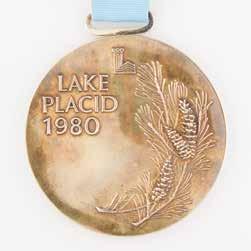
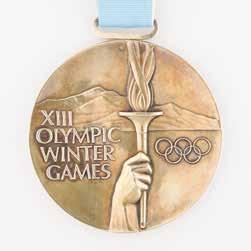
3084. Lake Placid 1980 Winter Olympics
Silver Winner’s MedalUnawarded. Unawarded silver winner’s medal from the Lake Placid 1980 Winter Olympics. Silver, 80 mm, 216 gm, by Tiffany and Co. of New York. The front, inscribed “XIII Olympic Winter Games,” depicts a raised hand holding the Olympic torch against a mountain backdrop, with the Olympic rings to the right side; the reverse, inscribed “Lake Placid 1980,” features a small Lake Placid Games emblem and a large pine branch with cones. Inscribed on the bottom edge, “Tiffany & Co., Sterling Silver, 1979.” The medal, which bears tarnishing, retains its original white-and-blue ribbon, and includes its beautiful original blue Tiffany & Co. drawstring bag. Starting Bid $200
Unawarded bronze winner’s medal from the Lake Placid 1980 Winter Olympics
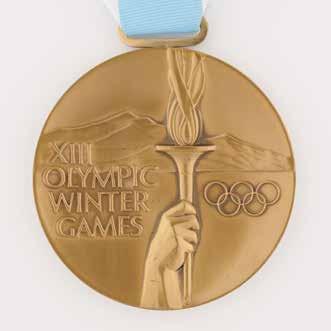
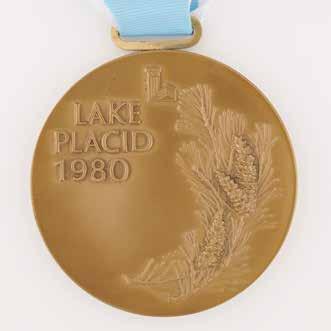
3085. Lake Placid 1980 Winter Olympics Bronze Winner’s Medal. Unawarded winner’s medal from the Lake Placid 1980 Winter Olympics. Bronze, 80 mm, 180 gm, by Tiffany and Co. of New York. The front, inscribed “XIII Olympic Winter Games,” depicts a raised hand holding the Olympic torch against a mountain backdrop, with the Olympic rings to the right side; the reverse, inscribed “Lake Placid 1980,” features a small Lake Placid Games emblem and a large pine branch with cones. Inscribed on the bottom edge, “Tiffany & Co., Bronze, 1979.” Complete with the original white-and-blue ribbon and hinged navy blue leather Tiffany & Co. presentation case. With beautiful Tiffany’s craftsmanship and striking designs, only 73 of these bronze medals were awarded at Lake Placid. A scarce and highly sought-after winner’s medal from these memorable Olympic Games. Starting Bid $500
3086. Lake Placid 1980 Winter Olympics
Sample Bronze Winner’s Medal. Sample winner’s medal from the Lake Placid 1980 Winter Olympics. Bronze, 80 mm, 216 gm, by Tiffany and Co. of New York. The front, inscribed “XIII Olympic Winter Games,” depicts a raised hand holding the Olympic torch against a mountain backdrop, with the Olympic rings to the right side; the reverse, inscribed “Lake Placid 1980,” features a small Lake Placid Games emblem and a large pine branch with cones. Stamped on the edges, “Bronze” and “Sample.” The medal lacks its loop, ribbon, and Tiffany & Co. hallmark. Starting Bid $200
Shooting bronze from the boycotted 1980 Moscow Olympics
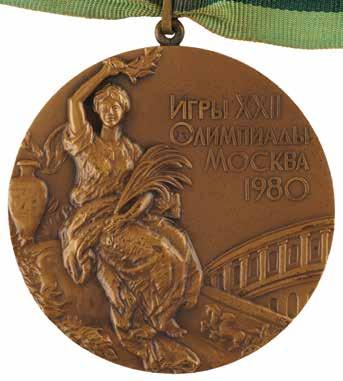
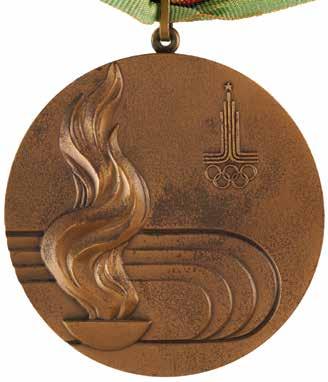
3087. Moscow 1980 Summer Olympics Bronze Winner’s Medal for Shooting. Winner’s medal awarded for a shooting event at the Moscow 1980 Summer Olympics. Bronze [tombac], 60 mm, 120 gm, by Ilya Postol, Moscow. The front, inscribed in Cyrillic, features a ‘Seated Victory’ with the Colosseum in the background; the reverse features the Moscow Olympic emblem and Olympic flame. The bottom edge is engraved “СТРЕЛКОВЫЙ
in Cyrillic to indicate the associated sport, shooting. Complete with its original colorful ribbon.
The United States led sixty-five countries in a boycott of the 1980 Moscow Summer Games to protest the Soviet invasion of Afghanistan. Between the important historical events surrounding the 1980 Moscow Olympics and the scarcity of these winner’s medals, they hold a special international appeal and are sought by collectors worldwide. Starting Bid $500
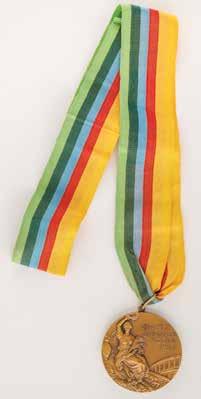
Silver basketball medal from the politically charged Moscow 1980 Summer Games
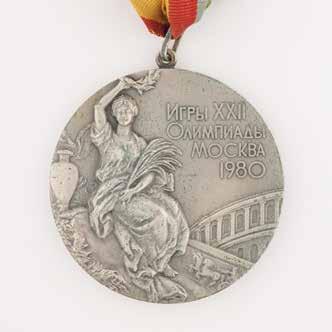
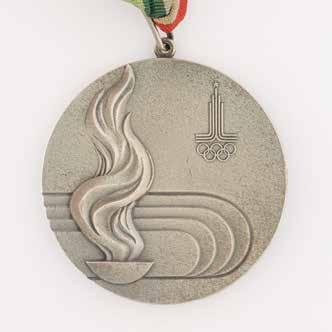
3088. Moscow 1980 Summer Olympics Silver Winner’s Medal for Basketball. Winner’s medal awarded for basketball at the Moscow 1980 Summer Olympics. Silver, 60 mm, 125 gm, by Ilya Postol, Moscow. The front, inscribed in Cyrillic, features a ‘Seated Victory’ with the Colosseum in the background, the reverse features the Moscow Olympic emblem and Olympic flame, and the bottom edge is engraved “БАСКЕТБОЛ,” which translates to ‘Basketball.’ Complete with its original multicolored ribbon and hinged case, which has a damaged hinge and latch, is chipped on the edge, retains old rubber band residue on top and bottom.
Basketball at the 1980 Moscow Olympics was shaped by the U.S.-led boycott, which kept the American teams out and weakened both tournaments. The men’s event ran from July 20–30, with Yugoslavia winning gold, Italy silver, and the Soviet Union bronze; in the women’s tournament, the Soviet Union won gold, followed by Bulgaria and Yugoslavia. The absence of the United States made the competition politically charged and historically unusual. Starting Bid $500
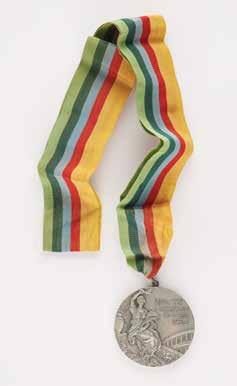
Bronze medal in women’s all-around gymnastics, won by a Romanian at the 1984 LA Olympics
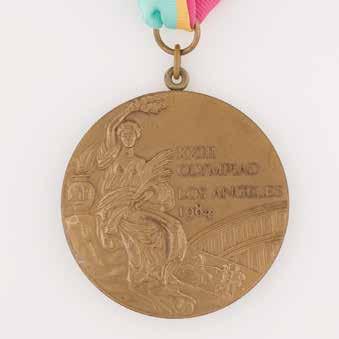
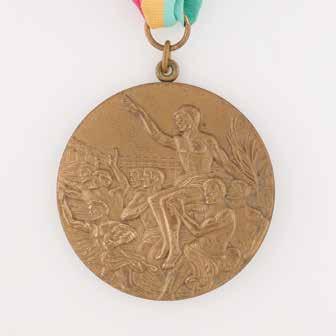
3089. Los Angeles 1984 Summer Olympics Bronze Winner’s Medal for Gymnastics. Winner’s medal awarded to Romanian gymnast Simona Pa˘uca˘ at the Los Angeles 1984 Summer Olympics. Bronze, 63.5 mm, 116 gm, designed by Dugald Stermer and struck by Jostens, Indianapolis. Inspired by the original design by Giuseppe Cassioli, the front of the medal is inscribed, “XXIII Olympiad, Los Angeles 1984,” and features a ‘Seated Victory’ with the Colosseum in the background, and the reverse portrays a victorious athlete being carried by a jubilant crowd. The edge is inscribed with the name of the event, “Gymnastics, All-Around, Women.” Suspended from its original magenta, vermillion, and yellow ribbon and complete with its blue velvet presentation case, which has a broken hinge.
Simona Pa˘uca˘ was one of Romania’s standout gymnasts at the 1984 Los Angeles Olympics. She won gold with Romania in the women’s team competition, tied teammate Ecaterina Szabó for gold on balance beam, and earned bronze in the women’s individual all-around. Her beam title was especially notable because both Romanians finished with the same top score, giving Romania a rare shared Olympic gold in the event. Starting Bid $500
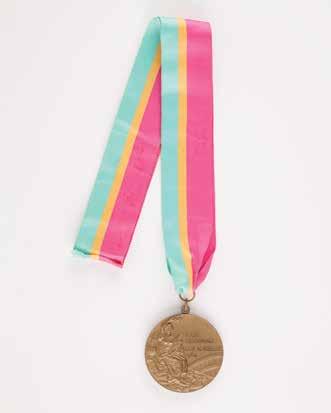
Second-place Seoul silver awarded to the 1988 Yugoslavia women’s national basketball team
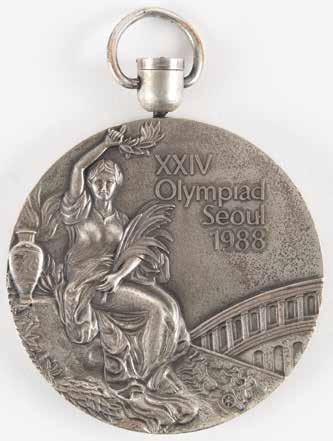
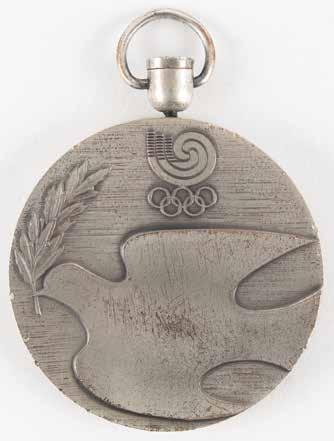
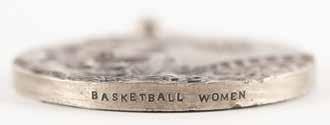
3090. Seoul 1988 Summer Olympics Silver Winner’s Medal for Women’s Basketball. Winner’s medal issued for women’s basketball at the Seoul 1988 Summer Olympics. Silver, 61.3 mm, 140 gm, by the Korea Security Printing and Minting Corporation. The front features the traditional medal design by Giuseppe Cassioli of a ‘Seated Victory’ with the Colosseum in the background, and raised lettering, “XXIV Olympiad, Seoul, 1988”; the reverse features a sleek modern design by the Seoul Organizing Committee portraying a soaring dove of peace with a laurel branch in its beak, with the Seoul Olympic emblem above. Inscribed along the bottom edge with the name of the event: “Basketball, Women.” The medal is missing its ribbon and exhibits moderate surface scuffing.
The Yugoslavia women’s national basketball team had a strong showing at the 1988 Summer Olympics in Seoul, finishing in second-place silver medal position. Led by a talented roster that included standout players like Danira Nakic´ and Razija Mujanovic´, the team easily advanced through the tournament, losing only to the undefeated United States. Starting Bid $500
Second-place Seoul silver awarded to Brazil’s men’s soccer team
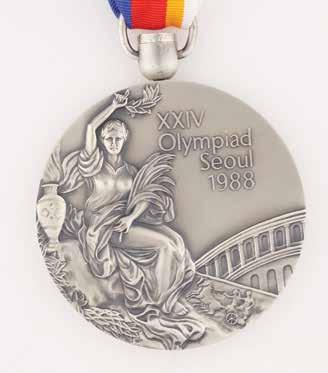
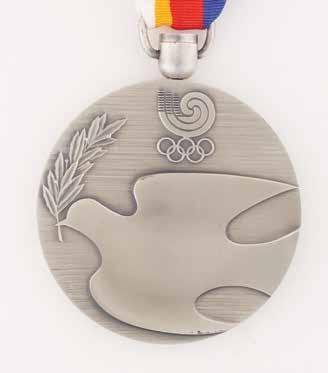
3091. Seoul 1988 Summer Olympics Silver Winner’s Medal for Men’s Football. Winner’s medal awarded in men’s football at the Seoul 1988 Summer Olympics. Silver, 61.3 mm, 140 gm, by the Korea Security Printing and Minting Corporation. The front features the traditional medal design by Giuseppe Cassioli of a ‘Seated Victory’ with the Colosseum in the background, and raised lettering, “XXIV Olympiad, Seoul, 1988”; the reverse features a sleek modern design by the Seoul Organizing Committee portraying a soaring dove of peace with a laurel branch in its beak, with the Seoul Olympic emblem above. Inscribed along the bottom edge with the name of the event: “Football, Men.” Complete with its original ultramarine, red, orange, and white ribbon, and its purple velvet presentation case with cardboard box.
Brazil’s iconic men’s national football team won the silver medal at the 1988 Seoul Olympics, reaching the final before losing 2–1 to the Soviet Union. The squad featured future stars such as Romário, Bebeto, Taffarel, Jorginho, Mazinho, and Neto, and Romário was the tournament’s standout scorer with seven goals in six matches. It was Brazil’s second straight Olympic silver in men’s football. Starting Bid $500
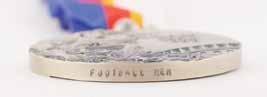
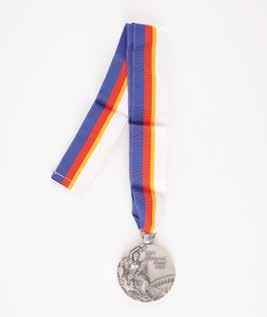
Sought-after silver winner’s medal from the memorable Barcelona Summer Games
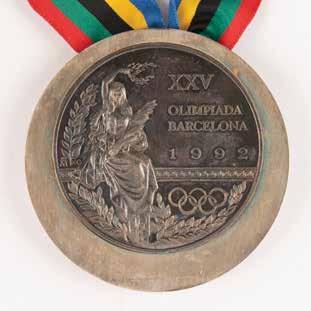
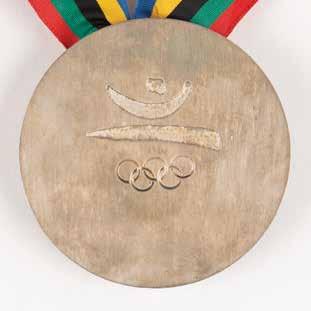
3092. Barcelona 1992 Summer Olympics Silver Winner’s Medal. Winner’s medal issued for the Barcelona 1992 Summer Olympics. Silver, 75 mm, 269 gm, by Xavier Corbero; manufactured by Fábrica Nacional de Moneda y Timbre. The front depicts a seated Victory in Modernist style holding a winner’s crown and palm branch with Olympic rings and raised text: “XXV, Olimpiada Barcelona, 1992”; and the reverse featuring the Games logo of a stylized man leaping over the Olympic rings. Includes a cut segment original ribbon with Olympic colors, still attached to the medal. The medal exhibits overall tarnishing.
The 1992 Summer Olympics were the last competition to be staged in the same year as the Winter Olympics, and the first summer games since the end of the Cold War. In the wake of the Soviet Union’s dissolution in 1991, the Baltic nations of Estonia, Latvia and Lithuania sent their own teams for the first time since 1936, with the twelve other former Soviet republics competing as the Unified Team, a collective that led the Olympiad with a total of 112 medals. Starting Bid $500
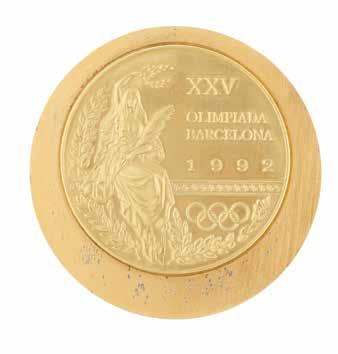
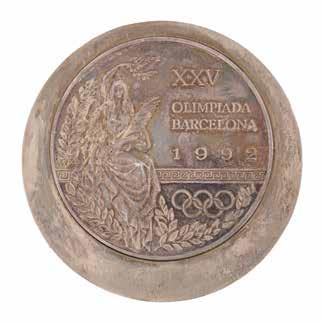
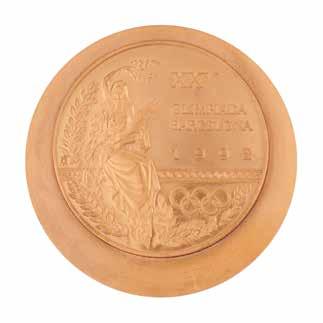
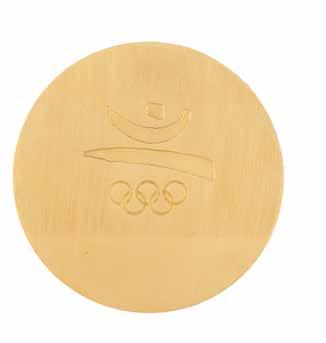
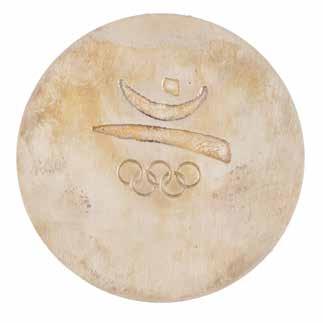
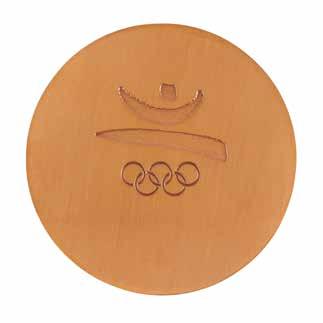
Honorary Gold, Silver, and Bronze winners’ medal set from the Barcelona 1992 Summer Olympics, presented to Organizing Committee
Vice-President Javier Gómez-Navarro
3093. Barcelona 1992 Summer Olympics Winner’s Medal Set - Presented to Javier Gómez-Navarro, Vice-President of the Barcelona Olympic Organizing Committee. Complete set of gold, silver, and bronze winners’ medals from the Barcelona 1992 Summer Olympics, presented to Javier Gómez-Navarro, Vice-President of the Barcelona Olympic Organizing Committee (COOB ‘92), by the designer of the medals, Xavier Corbero. The set contains gilt silver (232 gm), silver (267 gm), and bronze (229 gm), each 70 mm in diameter, manufactured by Fábrica Nacional de Moneda y Timbre. The obverses depict a seated Victory rendered in a Modernist style, holding a victor’s crown and palm branch above the Olympic rings, with raised text: “XXV Olimpiada Barcelona 1992”; the reverse sides feature the Games logo of a stylized man leaping over the Olympic rings. Unlike winners’ medals from other Olympic Games, examples from Barcelona do not indicate the sport or event. The medals are housed in their attractive contoured hardwood display case, 11.25˝ x 4˝ x 1˝, with a lustrous lacquered finish and a gilt Barcelona 1992 Olympic emblem to the lid. The gold and silver medals bear instances of nicks to edges, small scratches, and discoloration. Ribbons are not included.
The 1992 Summer Olympics were the last competition to be staged in the same year as the Winter Olympics, and the first Summer Games since the end of the Cold War. In the wake of the Soviet Union’s dissolution in 1991, the Baltic nations of Estonia, Latvia, and Lithuania sent their own teams for the first time since 1936, with the twelve other former Soviet republics competing as the Unified Team, a collective that led the Olympiad with a total of 112 medals.
Javier Gómez-Navarro (1945–2024) was a Spanish politician, businessman, and sports administrator whose career was closely intertwined with the modernization of Spanish sport and tourism. Gómez-Navarro served as Spain’s Secretary of State for Sport from 1987 to 1993, during which time he helped reform the nation’s sporting infrastructure and worked with the private sector to transform professional sports clubs into limited companies. He also served as Vice-President of the Organizing Committee of the Barcelona 1992 Summer Olympics, playing a key role in the planning and execution of the Games that helped redefine Barcelona’s international image and showcased Spain on the world stage. In recognition of his contributions to the Olympic Movement and the success of the Barcelona Games, Gómez-Navarro received the Olympic Order in Gold from the International Olympic Committee in 1992. He later served as Spain’s Minister of Trade and Tourism from 1993 to 1996. Starting Bid $1000
“XXVI Olympiad Atlanta 1996”— silver gymnastics medal from the Centennial Olympic Games
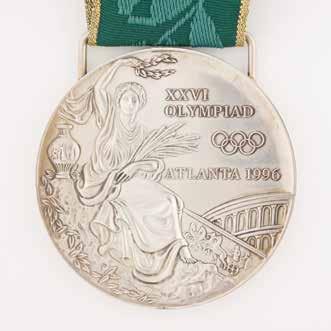
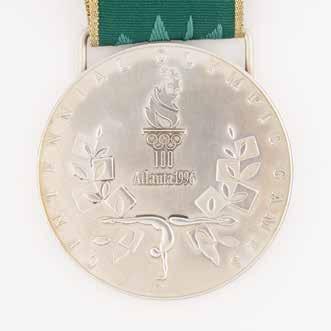
3094. Atlanta 1996 Summer Olympics Silver Winner’s Medal for Gymnastics (Unawarded). Desirable unawarded winner’s medal for gymnastics from the Atlanta 1996 Summer Olympics. Silver, 70 mm, 175 gm, by Malcolm Grear Designers; manufactured by Reed and Barton. The front, inscribed “XXVI Olympiad Atlanta 1996” with Olympic rings, shows a ‘Seated Victory’ holding a laurel wreath and palm branch, with the Colosseum looming in the background; the reverse, inscribed “Centennial Olympic Games,” features the Atlanta logo and a stylized ‘Quilt of Leaves’ olive branch with the pictogram for gymnastics below. The bottom edge of the unawarded medal is not engraved. Suspended from its original green-and-gold ribbon, embroidered with laurel leaves and “Atlanta 1996,” and housed in its handsome laser-etched “Atlanta 1996” wooden case. From the personal collection of a lifelong collector, teacher, and traveler with a passion for world history. His collecting years ranged from the 1970s to the present day, meaning that several of the premier pieces have not been on the market in decades. Starting Bid $500
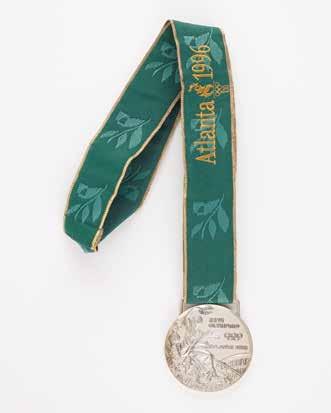
Gold medal from Cuba’s dominant baseball run at the Atlanta 1996 Summer Olympics
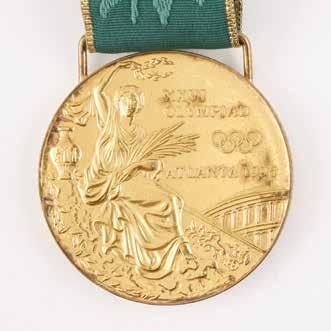
3095. Atlanta 1996 Summer Olympics Gold Winner’s Medal for Baseball. Winner’s medal awarded to a member of the triumphant Cuban baseball team at the Atlanta 1996 Summer Olympics. Gilt silver, 70 mm, 185 gm, by Malcolm Grear Designers; manufactured by Reed and Barton. The front, inscribed “XXVI Olympiad Atlanta 1996” with Olympic rings, shows a ‘Seated Victory’ holding a laurel wreath and palm branch, with the Colosseum looming in the background; the reverse, inscribed “Centennial Olympic Games,” features the Atlanta logo and a stylized ‘Quilt of Leaves’ olive branch pictogram of a baseball player. The medal is engraved on the bottom edge with the name of the sport: “Baseball.” Exhibits a few minor surface scuffs. Includes the original green-and-gold ribbon and its attractive wooden display case, which is laser-cut on the lid with the centennial host logo and lined on the interior in black felt, and exhibits several surface marks and dings.
The Cuban baseball team at the 1996 Atlanta Games were simply dominant. As the reigning gold medalists of the 1995 Pan American games, Cuba went 7-0 in preliminary play with an average of 13.8 runs a game before trouncing Nicaragua in the semi-finals by the score of 8-1. Cuba met a talented Japanese squad in the final game and used a 4-run sixth inning to break a 6-6 tie en route to a 13-9 win and their second straight Olympic gold medal. Starting Bid $500
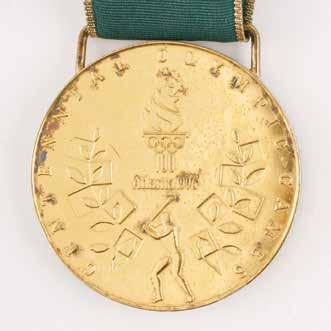
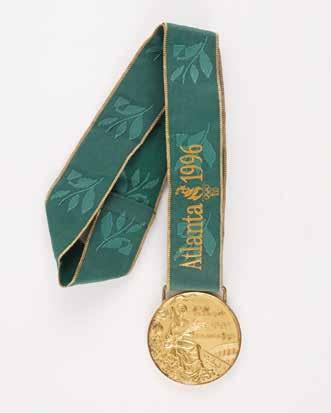
Sydney 2000 silver medal in Greco-Roman wrestling
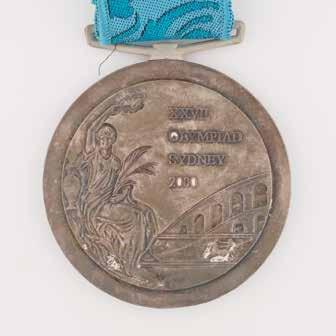
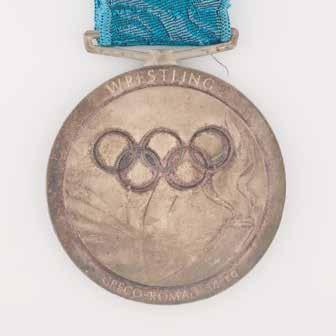
3096. Sydney 2000 Summer Olympics Silver Winner’s Medal for Wrestling. Winner’s medal awarded to Cuban wrestler Lázaro Rivas at the Sydney 2000 Summer Olympics. Silver, 68 mm, 185 gm, by Wojciech Pietranik and Brian Thompson; manufactured by the Royal Australian Mint. The front depicts a ‘Seated Victory’ with the Colosseum in the background; the reverse portrays the Olympic rings over the iconic Sydney Opera House, with the Sydney Olympic torch at right, inscribed above and below, “Wrestling, Greco-Roman, 54 KG.” The front and reverse bear uneven toning that is typical of Sydney silver winner’s medals. Complete with the original blue ribbon embroidered in silver with the legend, “Sydney 2000.”
At the 2000 Sydney Olympics, Greco-Roman wrestling was contested at the Sydney Convention and Exhibition Centre as part of a 16-event Olympic wrestling program. In the men’s 54 kg Greco-Roman class, Cuba’s Lázaro Rivas earned the silver medal, finishing behind South Korea’s defending champion Sim Kwon-Ho, while Kang Yong-Gyun of North Korea took bronze. Rivas’s podium finish was a proud moment for Cuban wrestling and part of Cuba’s strong showing in the sport at Sydney 2000. Starting Bid $500
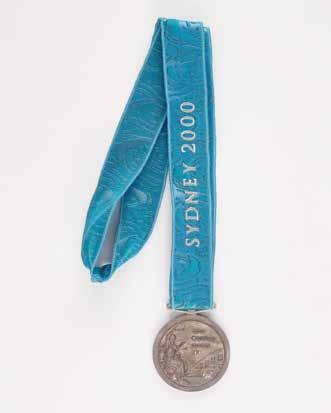
Cuban taekwondo star Yanelis Labrada’s silver winner’s medal from the Athens 2004 Summer Olympics
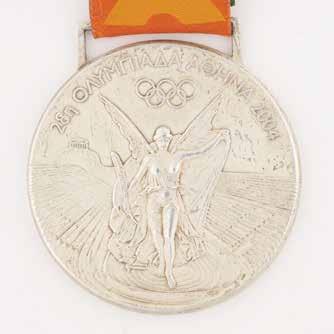
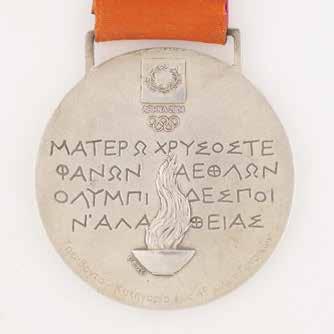
3097. Athens 2004 Summer Olympics Silver Winner’s Medal for Taekwondo. Winner’s medal awarded to Cuban taekwondo practitioner Yanelis Labrada at the Athens 2004 Summer Olympics. Silver, 60 mm, 138 gm, by Elena Votsi and Kostas Kazakos; manufactured by Efsimon. The front depicts the winged goddess of Victory soaring into the Panathinaikos Stadium, with Greek characters and Olympic rings above; the reverse features the Eternal Flame of Olympia, the opening lines of Pindar’s Eighth Olympic Ode, and the 2004 Summer Games logo, with the sport engraved in Greek lettering along the bottom, “Ταεκβοντό - Κατηγορία έως 49 κιλών Γυναικών [Taekwondo - Women’s Under-49 kg Category].” Completed by the original multicolored ribbon and wooden presentation box with its metal slipcase. The 2004 Athens winner’s medals replaced the long-held ‘seated Victory’ design by Giuseppe Cassioli, rectifying the mistake of using a depiction of the Roman Colosseum rather than a Greek venue.
The women’s flyweight taekwondo competition at the Athens 2004 Summer Olympics was held on August 26th at the Faliro Coastal Zone Olympic Complex and featured athletes in the under-49 kilogram division. Representing Cuba, Yanelis Labrada advanced through a strong field to reach the Olympic final, defeating bronze medalist Yaowapa Boorapolchai of Thailand in the quarterfinals and Euda Carías of Guatemala in the semifinals. Labrada ultimately claimed the silver medal after falling to Chen Shih-hsin of Chinese Taipei in the championship bout by a score of 5-4, earning Cuba its second consecutive Olympic silver medal in women’s flyweight taekwondo. Starting Bid $1000
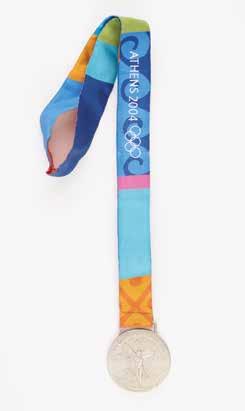
Bronze winner’s medal from the Athens 2004 Summer Games—presented to Danish shot putter Joachim Olsen before a doping scandal elevated him to silver
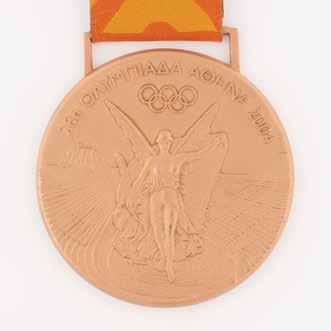
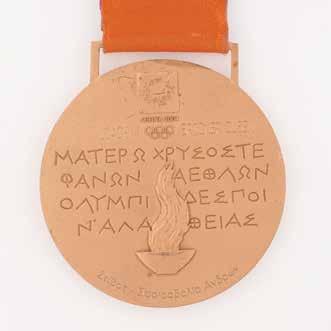
3098. Athens 2004 Summer Olympics Bronze Winner’s Medal for Men’s Shot Put - Awarded to Denmark’s Joachim Olsen Before His Elevation to Silver. Winner’s medal awarded to Danish shot putter Joachim Olsen at the Athens 2004 Summer Olympics. Bronze, 60 mm, 118 gm, by Elena Votsi and Kostas Kazakos; manufactured by Efsimon. The front depicts the winged goddess of Victory soaring into the Panathinaikos Stadium, with Greek characters and Olympic rings above; the reverse features the Eternal Flame of Olympia, the opening lines of Pindar’s Eighth Olympic Ode, and the 2004 Summer Games logo, with the sport engraved in Greek lettering along the bottom, “Στίβος – Σφαιροβολία Ανδρών [Athletics – Men’s Shot Put].” The upper field has been neatly engraved with the athlete’s name, “Joachim Brøchner Olsen,” a personalization not present on standard Athens 2004 winner’s medals and presumably added after presentation. Given Olsen’s subsequent elevation from bronze to silver following the IOC’s 2013 medal reallocation, the inscription may have served to identify and preserve the medal’s association with his original podium finish in Athens. Completed by the original multicolored ribbon and wooden presentation box with its metal slipcase. The 2004 Athens winner’s medals replaced the long-held ‘seated Victory’ design by Giuseppe Cassioli, rectifying the mistake of using a depiction of the Roman Colosseum rather than a Greek venue. The men’s shot put competition at the Athens 2004 Summer Olympics was held at the Ancient Olympia stadium on August 18 and later became one of the most consequential medal revisions of the Games. Ukrainian thrower Yuriy Bilonoh and American Adam Nelson both recorded best marks of 21.16 meters, with Bilonoh awarded gold on the second-best-throw tiebreaker; Nelson, who had fouled his remaining attempts, took silver. Denmark’s Joachim Olsen placed third with a throw of 21.07 meters and received this bronze medal at the Athens podium ceremony. In December 2012, Bilonoh was stripped of his gold medal after the reanalysis of stored samples revealed a doping violation, and the IOC redistributed the medals in March 2013: Nelson was elevated to gold, Olsen to silver, and Spain’s Manuel Martínez to bronze. This medal thus represents Olsen’s original bronze award from the Athens ceremony before the official reallocation altered the final standings of the event.Starting Bid $500
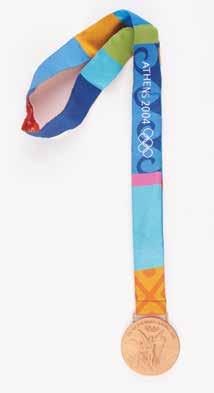
Russia’s first gold of Torino: Dementyev’s 2006 Olympic cross-country skiing medal
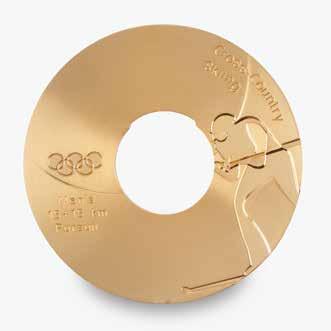
3099. Torino 2006 Winter Olympics Gold Winner’s Medal for Cross-Country Skiing. Beautiful, large gold winner’s medal awarded to Russian cross-country skier Yevgeny Dementyev at the Torino 2006 Winter Olympics. Gilt silver, 467 gm, 106 mm, designed by Quatrini and minted by Ottaviani International. The front features a fluid geometric design of the emblem of the Games at the bottom; the reverse has a polished pictogram of a hockey player below the engraved sport, “CrossCountry Skiing,” with the left side engraved, “Men’s 15+15 km Pursuit,” below the Olympic rings. The edge is engraved in Italian, French, and English: “XX Giochi Olimpici Invernali, XX Jeux Olympiques d’Hiver, XX Olympic Winter Games.” The uniquely designed medal has a hole at the center, through which the red, gold, and fuchsia ribbon is tied; the central hole was designed to suspend directly over the heart of the winning athlete as a unique symbol of life, energy, and human emotion. Complete with its original wood-and-plastic curved display case and cardboard storage box. A beautiful and impressive first-place Olympic prize—at the time, the Torino winner’s medal was the largest ever issued. Yevgeny Dementyev of Russia won the gold medal in the men’s 30 kilometre pursuit in cross-country skiing at the 2006 Winter Olympics in Turin, held on February 12 at Pragelato. The race combined 15 km in classical style with 15 km in freestyle, with athletes stopping between sections to change skis. After a dramatic start that included Frode Estil’s fall and a mass collision, the lead pack stayed close until the final stretch. Dementyev surged ahead late to beat Norway’s Estil by just 0.6 seconds, finishing in 1:17:00.8 and giving Russia its first gold medal of the Games. Starting Bid $500
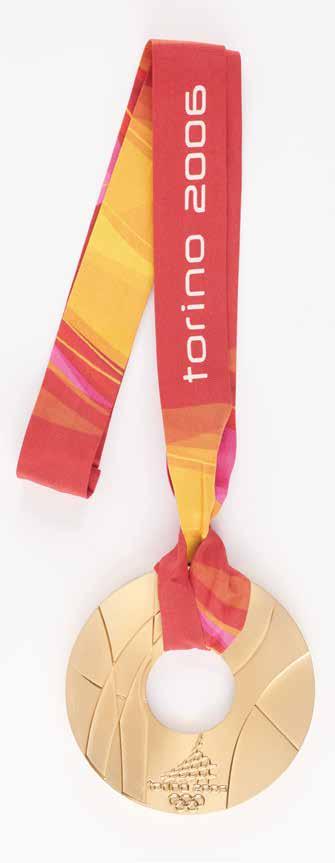
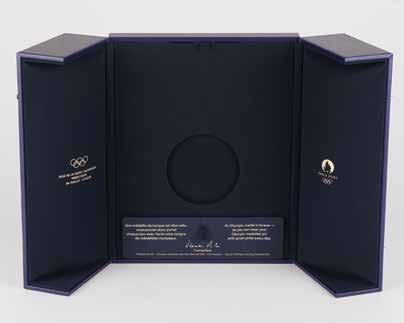
3100. Paris 2024 Summer Olympics Winner’s Medal Case. Official presentation case for the winner’s medals of the Paris 2024 Summer Olympics, accompanied by its original protective outer box, certificate of authenticity, and manufacturerissued informational and care documents. The folding presentation case, 8.5˝ x 11˝ x 3˝, is bound in textured purple leather with gilt Olympic rings to the exterior and opens in a triptych format to reveal a fitted circular recess designed to house a Paris 2024 winner’s medal. The interior is embellished with gilt Paris 2024 and Olympic insignia, and retains the original presentation card bearing the facsimile signature of IOC President Thomas Bach. Includes the original winner’s medal certificate and official descriptive and care documentation produced for Olympic medal recipients. Also included is the original blue textured protective presentation box with gilt Olympic rings. The medal and accompanying Olympian lapel pin are not present. In fine overall condition.
Designed by the Parisian jewelry house Chaumet, the first jeweler ever commissioned to design Olympic medals, and produced by Monnaie de Paris, the medals of the Paris 2024 Olympic Games incorporated one of the most distinctive elements ever used in Olympic medal design: a hexagonal piece of original iron from the Eiffel Tower, preserved following renovation works undertaken during the twentieth century and donated by the Société d’Exploitation de la Tour Eiffel (SETE) for inclusion in the medals. Presented exclusively to medal-winning athletes, these cases served as the official repositories for some of the most celebrated prizes in world sport. Starting Bid $200
PARTICIPATION MEDALS
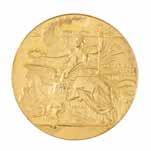
3104. Athens 1896 Olympics Gilt Bronze Participation Medal. Starting Bid $200
3105. Athens 1896 Olympics Bronze Participation Medal. Starting Bid $200
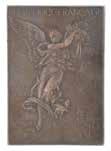
3106. Paris 1900 Olympics Silvered Bronze Participation Medal for Physical Exercises. Starting Bid $200
Exceptionally rare 1904 St. Louis official’s participation medal, with elusive ribbon and “Hon. Official” badge
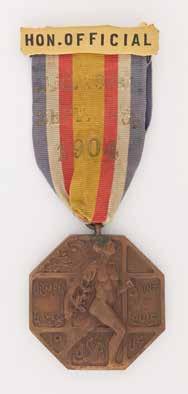
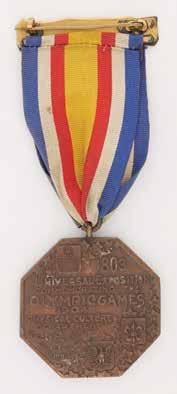
3107. St. Louis 1904 Olympics Honorary Official Participation Medal/Badge. Extremely rare official’s participation medal/badge issued for the St. Louis 1904 Olympics. Copper, 40 mm, by Dieges & Clust, New York. The front, inscribed, “Olympic Games, St. Louis, USA, 1904,” features an idealized nude athlete mid-stride with a laurel branch in his hand; the reverse features the lengthy text, “1803, Universal Exposition Commemorating the Olympic Games, 1904, Physical Culture Department, Frederick J. V. Skiff, Director of Exhibits,” encircled by ivy leaves with the shield emblems of St. Louis, France, and USA. Issued only to officials to be worn as a badge, the medal is suspended from a multicolored ribbon faintly marked, “Aug. 29–31, Sept. 1–3, 1904,” with the upper badge engraved: ”Hon. Official.” The ribbon exhibits minor soiling and fading to the gilt text. The 1904 St. Louis is the rarest and most coveted of all Olympic participation medals, with this example all the more desirable given the rare presence of its ribbon and badge. Starting Bid $500
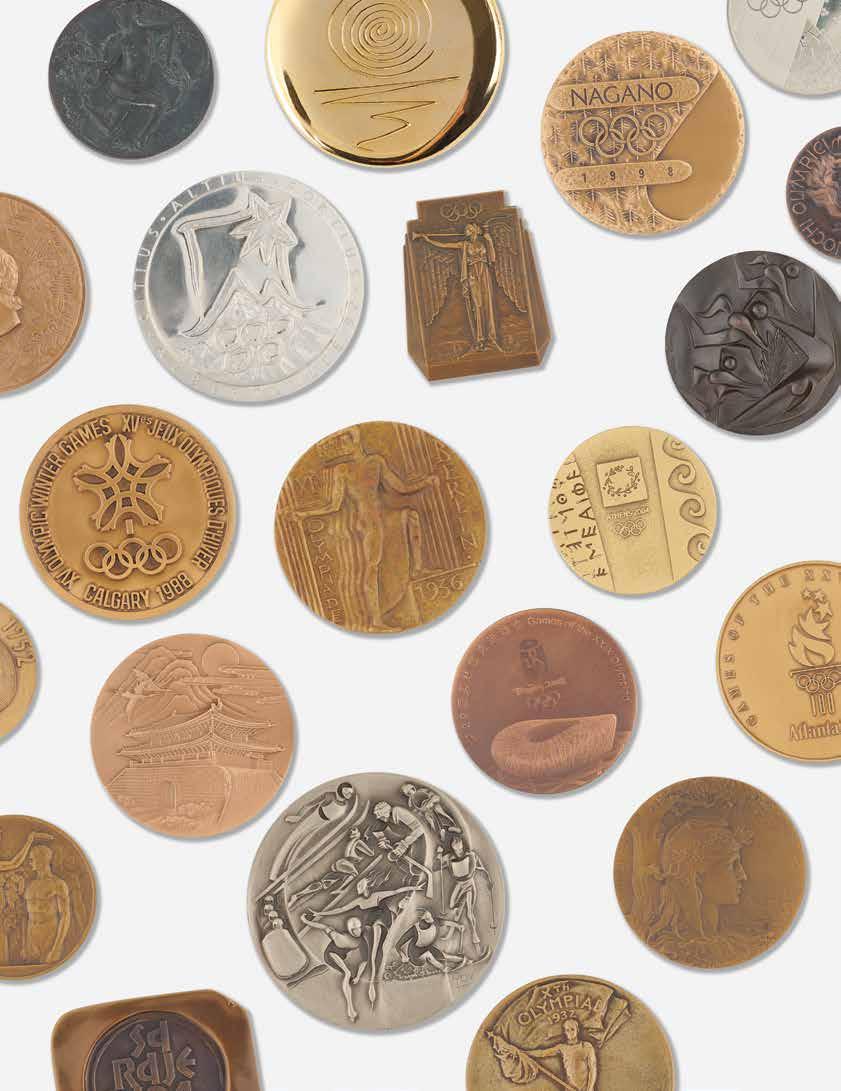
Over a century of Olympic tradition— coveted collection of 50 participation medals from Olympic Games ranging from 1896 Athens to 2018 PyeongChang, including a rare medal from the Lake Placid 1932 Winter Olympics
3103. Olympic Collection of (50) Participation Medals from the Collection of Fred Raymon. Superb collection of 50 medals associated with the Summer and Winter Olympics, consisting almost entirely of participation medals ranging from the first modern Olympic Games in Athens (1896) to the last Korean-hosted Games held in PyeongChang (2018). Covering over a century of Olympic tradition, this collection is highlighted by a rare medal from the 1932 Lake Placid Winter Games—only 700 of these seldom-seen medals were struck. In overall fine condition, with various wear to cases.
The list includes:
1. Athens 1896 Olympics Bronze Participation Medal with Case
2. Paris 1900 Exposition Universelle Non-Athletic Bronze Award Medal
3. Athens 1906 Olympics Gilt Bronze Participation Medal
4. London 1908 Olympics Pewter Participation Medal
5. Stockholm 1912 Olympics Silver Participation Medal
6. Antwerp 1920 Olympics Bronze Participation Medal
7. Paris 1924 Summer Olympics Bronze Participation Medal
8. St. Moritz 1928 Winter Olympics Bronze Participation Medal
9. Amsterdam 1928 Summer Olympics Bronze Participation Medal
10. Lake Placid 1932 Winter Olympics Bronze Participation Medal
11. Los Angeles 1932 Summer Olympics Bronze Participation Medal
12. Garmisch 1936 Winter Olympics Bronze Participation Medal
13. Berlin 1936 Summer Olympics Bronze Participation Medal
14. London 1948 Summer Olympics Bronze Participation Medal
15. St. Moritz 1948 Winter Olympics Bronze Participation Medal
16. Helsinki 1952 Summer Olympics Bronze Participation Medal
17. Oslo 1952 Winter Olympics Copper Participation Medal
18. Cortina 1956 Winter Olympics Bronze Participation Medal
19. Melbourne 1956 Summer Olympics Bronze Participation Medal
20. Stockholm 1956 Summer Olympics Bronze Participation Medal
21. Rome 1960 Summer Olympics Bronze Participation Medal
22. Squaw Valley 1960 Winter Olympics Bronze Participation Medal
23. Innsbruck 1964 Winter Olympics Bronze Participation Medal with Case
24. Tokyo 1964 Summer Olympics Copper Participation Medal
25. Grenoble 1968 Winter Olympics Bronze Participation Medal
26. Mexico City 1968 Summer Olympics Copper Participation Medal
27. Munich 1972 Summer Olympics Steel Participation Medal
28. Sapporo 1972 Winter Olympics Bronze Participation Medal
29. Montreal 1976 Summer Olympics Copper Participation Medal
30. Lake Placid 1980 Winter Olympics Nickel-Silver Participation Medal with Case
31. Moscow 1980 Summer Olympics Tombac Participation Medal
32. Sarajevo 1984 Winter Olympics Bronze Participation Medal with Case
33. Seoul 1988 Summer Olympics Bronze Participation Medal
34. Calgary 1988 Winter Olympics Bronze Participation Medal with Case
35. Barcelona 1992 Summer Olympics Copper Participation Medal
36. Barcelona 1992 Summer Olympics Gold VIP Participation Medal
37. Albertville 1992 Winter Olympics Chrome-Plated Steel Participation Medal with Case
38. Lillehammer 1994 Winter Olympics Copper Participation Medal
39. Atlanta 1996 Summer Olympics Bronze Participation Medal with Case
40. Nagano 1998 Winter Olympics Bronze Participation Medal with Case
41. Sydney 2000 Summer Olympics Silver-colored Participation Medal with Case
42. Salt Lake City 2002 Winter Olympics Bronze Participation Medal with Case
43. Athens 2004 Summer Olympics Bronze Participation Medal
44. Torino 2006 Winter Olympics Pewter Participation Medal with Case
45. Beijing 2008 Summer Olympics Bronze Participation Medal with Case
46. Vancouver 2010 Winter Olympics Silvered Participation Medal with Case
47. London 2012 Summer Olympics Cupronickel Participation Medal
48. Sochi 2014 Winter Olympics Polished Steel Participation Medal with Case
49. Rio 2016 Summer Olympics Alloy Copper Participation Medal with Case
50. PyeongChang 2018 Winter Olympics Cupronickel Participation Medal with Case
The Fred Raymon Collection. Starting Bid $1000
Rare St. Louis 1904 Olympics athlete’s participation medal—from the first Olympics held on American soil
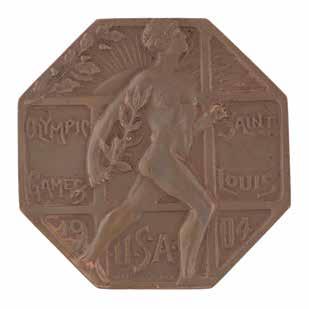
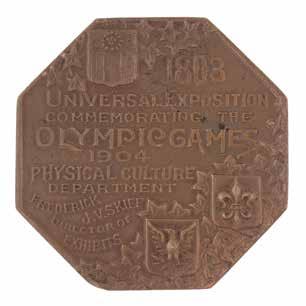
3108. St. Louis 1904 Olympics Rare Athlete’s Participation Medal. Extremely rare athlete’s participation medal issued for the St. Louis 1904 Olympics. Copper, 40 mm, 31 gm, by Dieges & Clust, New York. The front, inscribed, “Olympic Games, St. Louis, USA, 1904,” features an idealized nude athlete mid-stride with a laurel branch in his hand; the reverse features the lengthy text, “1803, Universal Exposition Commemorating the Olympic Games, 1904, Physical Culture Department, Frederick J. V. Skiff, Director of Exhibits,” encircled by ivy leaves with the shield emblems of St. Louis, France, and USA. This particular medal is without an upper loop and bears an entirely plain edge, traits indicative of medals presented to participating athletes. St. Louis 1904 is the rarest and most coveted of all Olympic participation medals, and this is a choice example. Starting Bid $1000
3109. London 1908 Olympics Silvered Bronze Participation Medal. Starting Bid $200
3110. Antwerp 1920 Olympics Bronze Participation Medal. Starting Bid $200
3111. Paris 1924 Summer Olympics Bronze Participation Medal. Starting Bid $200
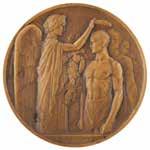
3112. Paris 1924 Summer Olympics
Bronze Participation Medal. Starting Bid $200
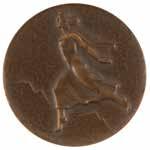
3113. St. Moritz 1948 Winter Olympics
Bronze Participation Medal. Starting Bid $200
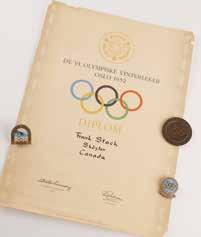
3115. Oslo 1952 Winter Olympics Copper Participation Medal, Participant Badge, and Diploma - From the Collection of Canadian Speed Skater Frank Stack. Starting Bid $200
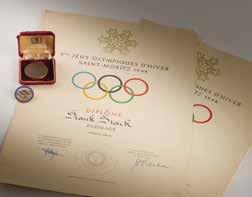
3114. St. Moritz 1948 Winter Olympics Bronze Participation Medal, Competitor’s Badge, and (2) DiplomasFrom the Collection of Canadian Speed Skater Frank Stack. Starting Bid $200
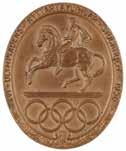
3116. Stockholm 1956 Summer Olympics Bronze Participation Medal. Starting Bid $200
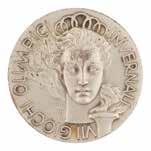
3117. Cortina 1956 Winter Olympics Silver Participation Medal. Starting Bid $200
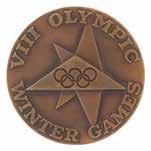
3118. Squaw Valley 1960 Winter Olympics Bronze Participation Medal. Starting Bid $200
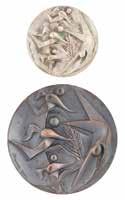
3119. Tokyo 1964 Summer Olympics (2) Participation Medals. Starting Bid $200
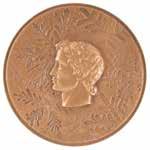
3120. Grenoble 1968 Winter Olympics Bronze Participation Medal. Starting Bid $200
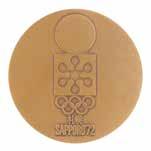
3121. Sapporo 1972 Winter Olympics Bronze Participation Medal. Starting Bid $200
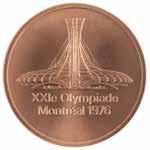
3122. Montreal 1976 Summer Olympics Copper Participation Medal. Starting Bid $200
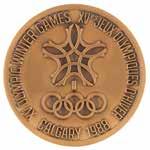
3123. Calgary 1988 Winter Olympics Bronze Participation Medal. Starting Bid $200
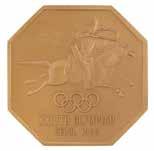
3124. Seoul 1988 Summer Olympics Press Participation Medal. Starting Bid $200
3125. Barcelona 1992 Summer Olympics ‘Unfinished’ Copper Participation Medal. Starting Bid $200
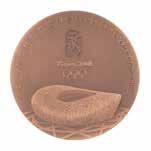
3126. Beijing 2008 Summer Olympics Bronze Participation Medal. Starting Bid $200
OFFICIALS, BADGES, AND PINS
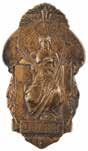
3129. Paris
Universelle Jury Lapel Badge. Starting Bid $200
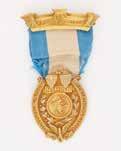
Committee Member’s Badge. Starting Bid $200
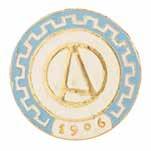
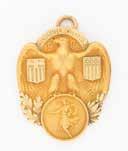
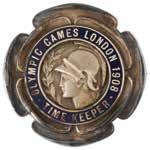
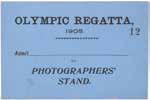
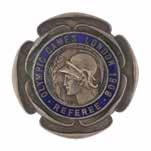
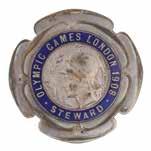
1900 Exposition
3131. Athens 1906 Intercalated Olympics American Olympic
3134. London 1908 Olympics ‘Time Keeper’ Badge. Starting Bid $200
3133. Athens 1906 Intercalated Olympics American Olympic Committee Official’s Badge. Starting Bid $200
3132. Athens 1906 Intercalated Olympics Athlete’s Participation Badge. Starting Bid $200
3135. London 1908 Olympics Photographer’s Press Pass. Starting Bid $200
3137. London 1908 Olympics Steward Badge. Starting Bid $200
3136. London 1908 Olympics Referee Badge. Starting Bid $200
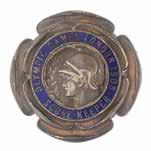
3138. London
Starting Bid $200
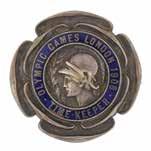
3139.
Starting Bid $200
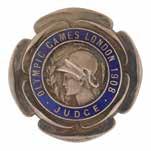
Starting Bid
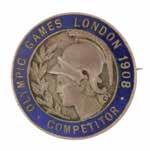
3142. London
Starting Bid $200
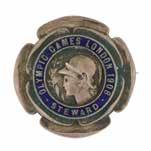
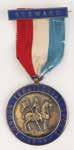
Starting Bid
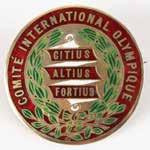
3145. International Olympic Committee 1910 Member’s Badge. Starting Bid $200
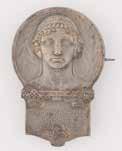
Starting
1908 Olympics Scorekeeper Badge.
3147. Stockholm 1912 Olympics Competitor’s Badge. Starting Bid $150
3146. Stockholm 1912 Olympics English Interpreter Pin.
Bid $200
3144. London Territorial Sports 1909 Steward Badge. Starting Bid $200
3143. London 1908 Olympics Steward Badge.
$200
1908 Olympics Competitor Badge.
3140. London 1908 Olympics Judge Badge.
$200
London 1908 Olympics Timekeeper Badge.
Exceedingly rare gold-plated ‘Honorary Committee’ badge from the 1908 London Games
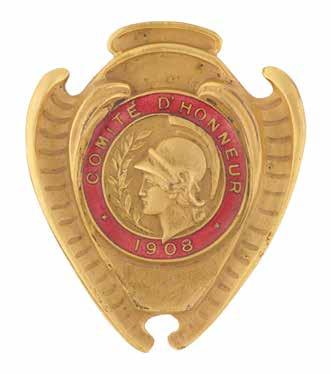
3141. London 1908 Olympics Committee of Honor Badge. Elusive ‘Comité D’Honneur’ badge from the London 1908 Olympic Games. Gold-plated, 46 mm x 57mm. The badge depicts the head of Athena facing a laurel branch and encircled by a red enameled border with the text, “Comité D’Honneur, 1908.” The reverse is stamped “Olympic Games, London,” and bears a Vaughton of Birmingham maker’s mark. The Comité D’Honneur of the 1908 London Olympic Games consisted of a total of 63 people from 19 different countries, a prestigious group that included IOC members and other VIPS. The mark worn by these is available in a silver version with blue enamel and a more elusive gilt version with red enamel. A rare and attractive badge from an Olympic Games that extended for over six months—the longest in modern history. Starting Bid $500
Silvered Stockholm 1912
“Lawn-Tennis” badge—an
Olympic rarity, published in ‘Official Olympic Participant Badges’
3149. Stockholm 1912 Olympics Tennis Badge. Extremely rare tennis badge from the Stockholm 1912 Olympics. Silvered, 50 mm in diameter, engraved “1912” at center, and encircled: “Olympiska Spelen, Lawn-Tennis.” Retains its original pin-and-loop closure on the back. Exhibits substantial wear to the original mirror-finish. This exact badge is pictured in ‘Official Olympic Participant Badges,’ a comprehensive collector’s guide by Hans Elbel and Oleg Vorontsov (pp. 22).
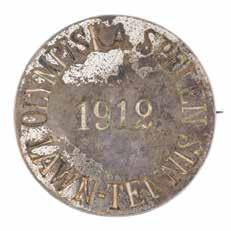
At the 1912 Summer Olympics in Stockholm, tennis featured eight events split between two tournaments: indoor covered-court matches on wood from May 5–12 and outdoor clay-court matches from late June to early July. France led the medal table with three golds, while Great Britain performed strongly with six medals overall. Notable champions included André Gobert of France in men’s indoor singles, Edith Hannam of Great Britain in women’s indoor singles, Charles Winslow of South Africa in men’s outdoor singles, and Marguerite Broquedis of France in women’s outdoor singles. The outdoor tournament was affected by a scheduling conflict with Wimbledon, which kept many leading British players away. Starting Bid $500
3148. Stockholm 1912 Olympics 50th Anniversary Participant’s Badge (1962). Starting Bid $150
3150. Stockholm 1912 Olympics (6) Badges. Starting Bid $200
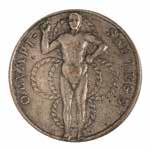
3151.
3152.
3153.
Paris 1924 Summer Olympics Official’s Badge. Starting Bid $200
Paris 1924 Summer Olympics Athletics Jury Badge. Starting Bid $200
Los Angeles 1932 Summer Olympics Danish Fundraising Pin. Starting Bid $200
A ‘Holy Grail’ of Winter Olympic collecting: Chamonix 1924 IOC official’s badge from the first Winter Games
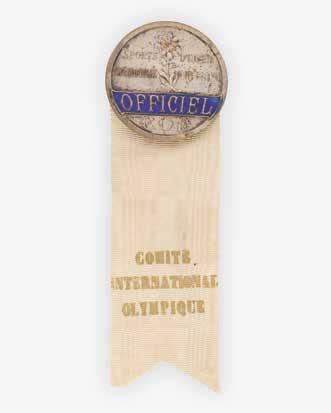
3156. Chamonix 1924 Winter Olympics International Olympic Committee Official’s Badge. Excessively rare Chamonix 1924 Winter Olympics official’s badge with original cream-colored silk moire ribbon, the badge measuring 41 mm in diameter and the ribbon measuring 95 mm long. The badge features a depiction of a flower and is engraved with the text, “Sports D’Hiver, Chamonix, Mont Blanc, 1924,” with “Officiel” against a blue enameled background, and “C.O.F.” below. Reverse of the badge is stamped, “1625.” The ribbon features gilt lettering identifying it as an IOC official’s badge, “Comite International Olympique.”
The first Winter Olympics ever held, the 1924 Chamonix Games were of enormous significance, featuring fifteen events in five sports: bobsleigh, curling, ice hockey, skating, and skiing. Chamonix badges are the rarest of all Winter Olympic badges and represent a ‘holy grail’ for Olympic badge collectors. An enormously desirable, exemplary piece of Olympic history. Starting Bid $500
3154.
3157.
3158. Amsterdam 1928 Summer Olympics National Olympic Committee President and Jury Member’s Badge. Starting Bid $200
Paris 1924 Summer Olympics Competitor’s Participation Badge. Starting Bid $200
Chamonix 1924 Winter Olympics Competitor’s Badge. Starting Bid $200
‘International Olympic Committee’ badge from the St. Moritz 1928 Winter Olympics—the first true Winter Games
3159. St. Moritz 1928 Winter Olympics ‘I.O.C.’ Badge. Rare ‘International Olympic Committee’ badge from the St. Moritz 1928 Winter Olympics, 12 gm, 31 mm, featuring a blue border with encircling text, “2es Jeux Olympiques d´hiver St.Moritz 1928 IXe Olympiade,” and a central design of the Olympic rings below a black banner, “C.I.O.” Stamped on the reverse, “66.” Housed in its original presentation case, stamped inside the lid: “Huguenin Frères & Co., Medailleurs, Le Locle (Suisse).” Starting Bid $300
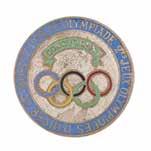
3160. St. Moritz 1928 Winter Olympics Competitor´s Badge. Starting Bid $200
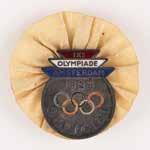
3161. Amsterdam 1928 Summer Olympics Official’s Badge. Starting Bid $200
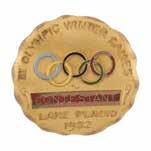
3162. Lake Placid 1932 Winter Olympics Contestant Badge. Starting Bid $200
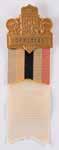
3163. Los Angeles 1932 Summer Olympics Official’s Badge. Starting Bid $200
3164. Los Angeles 1932 Summer Olympics Set of (3) Winner’s Medals Pins. Starting Bid $200
Scarce gilt IOC badge from the 1932 Los Angeles Games— one
of 28 issued
3166. Los Angeles 1932 Summer Olympics International Olympic Committee Badge. International Olympic Committee badge from the Los Angeles 1932 Olympic Games. Gilt bronze, 40 mm x 40 mm, manufactured by Whitehead & Hoag of Newark. The badge features the Olympics rings over shield and laurel branch, with the legend “Xth Olympiad Los Angeles,” and tablet below engraved, “I.O.C.” Suspended below the badge is a short ribbon in the five colors of the Olympic rings, which exhibits slight fraying; a short white ribbon, split at the end, backs the multicolored one. An extremely scarce Olympic badge as one of just 28 issued. Starting Bid $500
3170. Garmisch 1936 Winter Olympics Athlete’s Badge. Starting Bid $200
3167. Los Angeles 1932 Summer Olympics Japanese ‘Triumphal Return’ Commemorative Belt Buckle. Starting Bid $200
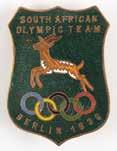
3169. Berlin 1936 Summer Olympics South African Olympic Team NOC Badge. Starting Bid $200
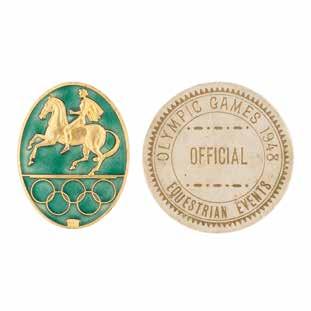
3171. London 1948 and Stockholm 1956 Summer Olympics Equestrian Official’s Badges. Starting Bid $200
3172. St. Moritz 1948 Winter Olympics Official’s Badge. Starting Bid $200

3173. FILA (Wrestling) Order Badge. Starting Bid $150
3174. Helsinki 1952 Summer Olympics Gold
Starting Bid $200
Rare IOC badge from the Oslo 1952 Winter Olympics
3175. Oslo 1952 Winter Olympics International Olympic Committee Badge. Rare International Olympic Committee badge from the Oslo 1952 Winter Olympics. Silvertone, 31 mm x 37 mm, featuring the official emblem of the VI Olympic Winter Games, with a colorful enameled design featuring the Olympic rings superimposed over Oslo City Hall silhouetted against a blue background, above a tablet engraved “C.I.O.” The reverse of the badge is marked, “R. Gaudernack, Sandvika/ Oslo, Norway.” Starting Bid $500
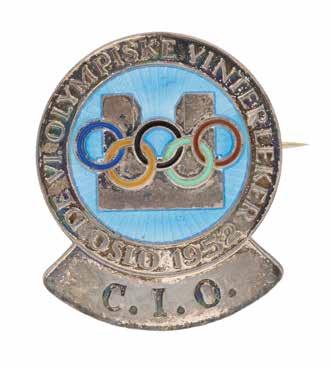
Medal Winner’s Pin.
3178. Cortina 1956 Winter Olympics Collection of (16) Badges. Starting Bid $200
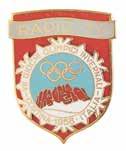
3179. Cortina 1956 Winter Olympics Radio-TV Badge. Starting Bid $200
3176. Melbourne 1956 Summer Olympics NOC Secretary Badge. Scarce National Olympic Committee badge issued for the Melbourne 1956 Summer Olympics, 38 mm x 114 mm, with Olympic rings, torch, and image of Australia, and enameled navy blue border with silver text: “Olympic Games, Melbourne 1956.” Reverse bears a “K. C. Luke, Melbourne” maker mark and is engraved “440.” Suspended from the bottom of the badge is a silver ribbon marked “N.O.C.,” and a shorter ribbon in the five Olympic colors that features a blue enamel pin marked “Secretary.” Starting Bid $300
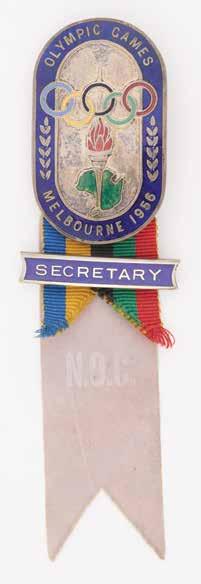

3180. Tokyo 1964 Summer Olympics Official’s Badge for Wrestling. Starting Bid $200
3181. Tokyo 1964 Summer Olympics Official Delegate’s Badge. Starting Bid $200
3182. Tokyo 1964 Summer Olympics IOC Session Badge. Starting Bid $200
Rare IOC official’s badge from the Innsbruck 1964 Winter Olympics
3185. Innsbruck 1964 Winter Olympics IOC Official’s Badge. Rare International Olympic Committee official’s badge from the Innsbruck 1964 Winter Olympics, measuring 29 mm x 42 mm, featuring the “Innsbruck 1964” Olympic logo centered on an orange background, with tablet below marked “IOC.” In fine condition. Starting Bid $500
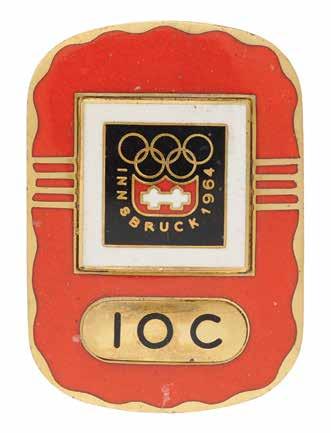
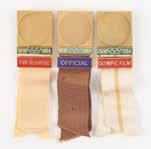
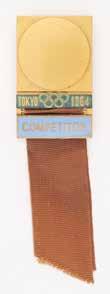
3186. Tokyo 1964 Winter Olympics Competitor Badge. Starting Bid $200
3184. Tokyo 1964 Summer Olympics (3) Credential Badges. Starting Bid $200
3183. Tokyo 1964 Summer Olympics ISF President Badge. Starting Bid $200
3188. Innsbruck 1964/1976 Winter Olympics Unissued ID Booklets Lot of (3). Starting Bid $100
3189. Tokyo 1964 Summer Olympics Official Special Delegate’s Badge. Starting Bid $200
3190. Tokyo 1964 Summer Olympics ID Booklet. Starting Bid $100
3192. 65th IOC Official’s Session Badge, Tehran (1967). Scarce official’s badge from the 65th International Olympic Committee session held in Tehran, Iran, in 1967, measuring 50 mm x 50 mm, featuring the colorful Olympic rings at center over raised text: “Tehran 1967, 65 Session 2–11 May.” The badge is flanked by gilt Persian warriors, with enameled “I.O.C.” badge suspended at the bottom.
Issued for the IOC’s 1967 Tehran session, this scarce delegate badge commemorates the meeting at which the International Olympic Committee formally established its Medical Commission, laying the groundwork for the anti-doping program debuted at the 1968 Olympic Games. Starting Bid $300
3191. 64th IOC Session Badge, Rome (1966). Starting Bid $200
3193. Mexico City 1968 Summer Olympics Athletics Assistant’s Badge. Starting Bid $200
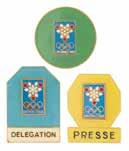
3194. Grenoble 1968 Winter Olympics (3) Badges for Public Service, Delegation, and Press. Starting Bid $200
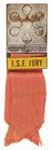
3196. Sapporo 1972 Winter Olympics Biathlon Jury Badge. Starting Bid $200
3197. Sapporo 1972 Winter Olympics Skiing Official’s Badge. Starting Bid $200
3198. Sapporo 1972 Winter Olympics ‘Olympic Film’ Badge. Starting Bid $200
3199. Sapporo 1972 Winter Olympics (4) Badges. Starting Bid $200
3200. Sapporo 1972 Winter Olympics Advisor Badge and ID Card Issued to a Soviet Delegate. Starting Bid $200
3201. Sapporo 1972 Winter Olympics Attache Badge and ID Card. Starting Bid $200
3202. Sapporo 1972 Winter Olympics (3) Badges for Photo, Press, and Team Official.
Starting Bid $200
3203. Munich 1972 Summer Olympics OBG (Olympic Construction Company) Badge. Starting Bid $200
3204. Munich 1972 Summer Olympics (2) Badges for Athlete and Team Official. Starting Bid $200
3205. Montreal 1976 Summer Olympics Team Official ID Card.
Starting Bid $75
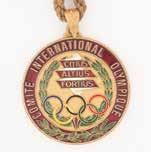
3206. International Olympic Committee (IOC) Badge of Office.
Starting Bid $200
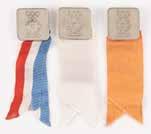
3207. Sarajevo 1984 Winter Olympics (3) Badges. Starting Bid $200

3208. Summer Olympics (1984-2012) ID Lot of (8). Starting Bid $200
3209. IOC Silver Olympic Order
Starting Bid $200

3211. 132nd IOC Session Badge in PyeongChang, South Korea (2018). Starting Bid $200
Pin.
The IOC’s highest honor—Olympic Order in Gold presented to Javier Gómez-Navarro, vice president of the Barcelona 1992 Olympic Organizing Committee
3210. Olympic Order in Gold - Presented to Javier Gómez-Navarro, Vice-President of the Barcelona 1992 Olympic Organizing Committee. Rare Olympic Order in Gold presented to Javier Gómez-Navarro, the Vice-President of the Organizing Committee of the Barcelona 1992 Summer Olympics. The golden collar-style award measures approximately 8.75˝ x 12.75˝, and features the Olympic rings at center, flanked by linked olive leaves leading into a golden chain. The reverse of the rings bears an engraved maker mark from Bertoni of Milan. In very fine condition. Accompanied by a photocopy of the Olympic Order certificate presented to Gómez-Navarro in January 1993. Established in 1975, the Olympic Order is the highest award of the IOC and is issued to recognize particularly distinguished contributions to the Olympic Movement. It was originally issued in three grades—gold, silver, and bronze—with the gold class reserved for the most distinguished contributions to the Olympic Movement. Javier Gómez-Navarro (1945–2024) was a Spanish politician, businessman, and sports administrator whose career was closely intertwined with the modernization of Spanish sport and tourism. Gómez-Navarro served as Spain’s Secretary of State for Sport from 1987 to 1993, during which time he helped reform the nation’s sporting infrastructure and worked with the private sector to transform professional sports clubs into limited companies. He also served as Vice-President of the Organizing Committee of the Barcelona 1992 Summer Olympics, playing a key role in the planning and execution of the Games that helped redefine Barcelona’s international image and showcased Spain on the world stage. He later served as Spain’s Minister of Trade and Tourism from 1993 to 1996. Starting Bid $1000
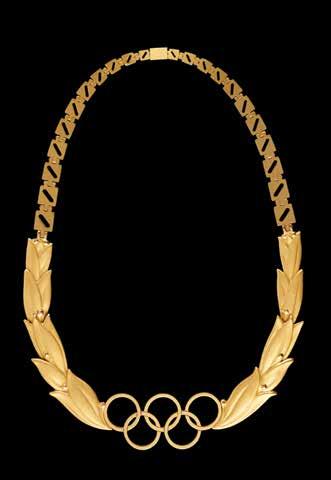
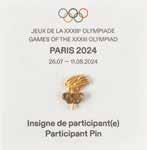
3214. 145th IOC Session Press Badge in Milan, Italy (2026). Starting Bid $200 3213. Paris 2024 Summer Olympics Participation Pin. Starting Bid $200 3212. PyeongChang 2018 Winter Olympics Athlete’s Participation Pin. Starting Bid $100
POSTERS
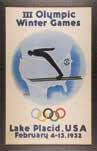
3215. Lake Placid 1932 Winter Olympics Poster (24.5˝ x 39.5˝).
Starting Bid $200
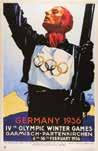
3216. Garmisch 1936 Winter Olympics Poster (Reproduction) - 25.5˝ x 39.75˝. Starting Bid $100
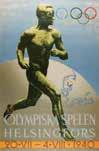
3217. Helsinki 1940 Summer Olympics Poster [Canceled Games].
Starting Bid $200
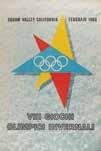
3218. Squaw Valley 1960 Winter Olympics Poster (24.75˝ x 37˝).
Starting Bid $200
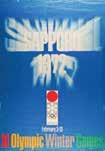
3219. Sapporo 1972 Winter Olympics Poster (28.5˝ x 40.75˝).
Starting Bid $200
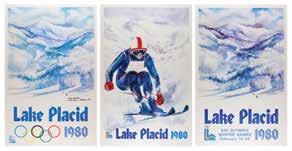
3221. Lake Placid 1980 Winter Olympics (3) Posters by John Gallucci - Each approx. 24˝ x 36˝.
Starting Bid $200

3220. Lake Placid 1980 Winter Olympics Poster Signed by John Gallucci (Ltd. Ed. #721/1000) - 23.75˝ x 36.5˝. Starting Bid $200
3222. Tokyo 2020 Summer Olympics and Paralympics (2) Posters (28.5˝ x 40.5˝).
Starting Bid $200
PROGRAMS, TICKETS, REPORTS
Rare official report from 1896 Athens—the first modern Olympic Games
3223. Athens 1896 Olympics Official Report (Greek-and-French Language). Very rare complete Greek-and-French language official report for the Athens 1896 Olympics, the first international Olympic Games held in modern history. Published by C. Meissner & N. Kardadouris and edited by Charles Beck of Athens and H. Le Soudier of Paris. Presented in its original lithograph cardboard covers with quarter cloth binding, the report, 10.5 x 13, contains two volumes: the first (101 pages) is entitled “Part One, The Olympic Games In Antiquity,” and the second (109 pages) is entitled “Part Two, The 1896 Olympic Games.” The volumes offer numerous pictures and illustrations to support the ample information on both the ancient Olympic Games and the historic 1896 Olympiad. Includes a custom cloth-bound clamshell case. In good to very good condition, with light dampstaining scattered wear to covers and spine, including scuffs and scratches, a partial separation to opening page of volume one, and a few sections becoming loose from binding. Starting Bid $300
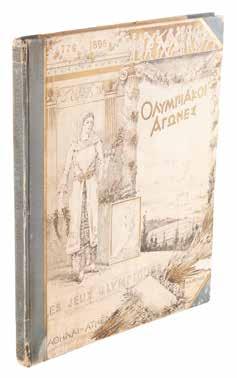
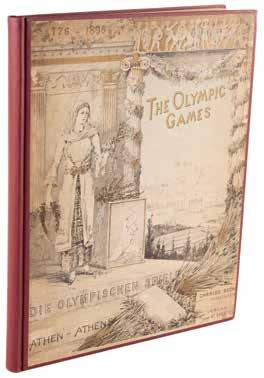
Scarce official report from 1896 Athens—the first modern Olympic Games
3224. Athens 1896 Olympics Official Report (German-andEnglish Language). Sought-after complete German-and-English official report for the Athens 1896 Olympics, the first international Olympic Games held in modern history. Published by C. Meissner & N. Kardadouris and edited by Charles Beck of Athens and H. Le Soudier of Paris, the two-volume report has been custom-bound into a single book with the original lithograph cardboard covers applied to the boards, 10.5 x 13, with the first volume (107 pages) entitled “Part One, The Olympic Games In Ancient Times,” and the second volume (117 pages) entitled “Part Two, The Olympic Games in 1896.” The volumes contain numerous pictures and illustrations to support the ample information on both the ancient Olympic Games and the historic 1896 Olympiad. In very good condition, with some scattered foxing to textblock. Surviving copies of this dual-language (German and English) report from the first modern Olympic Games are exceedingly rare. This particular example, which has been impressively preserved for nearly 130 years, stands as a true Olympic relic of museum-quality stature. Starting Bid $300
3225. St. Louis 1904 Olympics Program (July 23, 1904). Starting Bid $100
Starting Bid $200
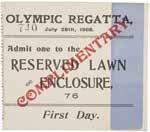
3228. London 1908 Olympics ‘Complimentary’ Ticket Stub for the Olympic Regatta. Starting Bid $200
3229.
Starting Bid $200
3230. London 1908 Olympics Rowing Regulation Booklet. Starting Bid $200
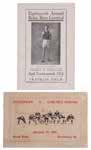
Starting
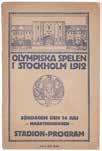
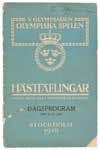
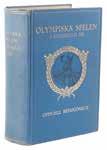
3231. Jim Thorpe (2) Early Carlisle Indian School Programs.
Bid $200
London 1908 Olympic Games Rowing and International Regatta Archive.
3227. Athens 1906 Intercalated Olympics Official Report.
3234. Stockholm 1912 Olympics Official Report. Starting Bid $200
3233. Stockholm 1912 Olympics Equestrian Program. Starting Bid $200
3232. Stockholm 1912 Olympics Program for the Marathon and Decathlon (Jim Thorpe). Starting Bid $200
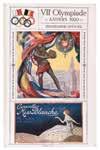
3235. Antwerp 1920 Olympics Daily Program. Starting Bid $100
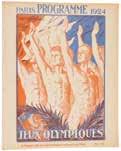
3236. Paris 1924 Summer Olympics Program for Fencing (June 27, 1924). Starting Bid $150
3237. Paris 1924 Summer Olympics Program for Fencing (June 28, 1924). Starting Bid $150
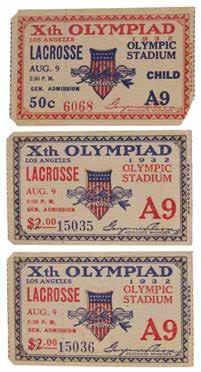
3238. Los Angeles 1932 Summer Olympics (3) Lacrosse Tickets. Starting Bid $200
3239. Los Angeles 1932 Summer Olympics Programs. Starting Bid $200
3240. Berlin 1936 Summer Olympics Baseball Ticket. Starting Bid $200
3241. London 1948 Summer Olympics Collection of (18) Football / Soccer Programs. Starting Bid $200
3242. London 1948 Summer Olympics Collection of (29) Programs for Basketball, Swimming, and Wrestling. Starting Bid $200
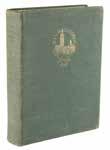
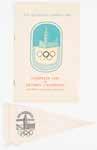
3244.
1948 Summer Olympics Pennant and Medalist List Booklet. Starting Bid $100
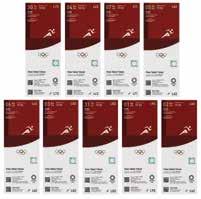
3246. Tokyo 2020 Summer Olympics (9) Tickets: Athletics. Starting Bid $200
3245. Nagano 1998 Winter Olympics Official Report. Starting Bid $200
London
3243. London 1948 Summer Olympics Official Report. Starting Bid $150
AUTOGRAPHS
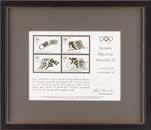
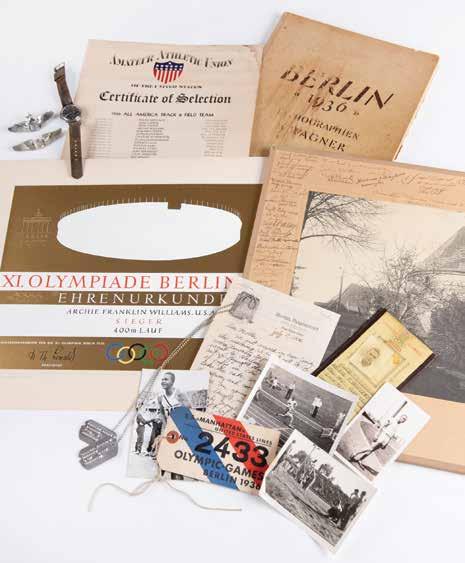
3248. Jesse Owens Signature. Starting Bid $200
3247. Jim Thorpe Signature. Starting Bid $200
3249. Archie Williams: Extensive Archive of a 1936 Berlin Olympic Gold Medalist and Tuskegee Airman. Starting Bid $300
3274. Jesse Owens Signed Philatelic Souvenir. Starting Bid $200
3250. Olympic Discus and Decathlon Medalists (6) Signed Discuses. Starting Bid $200
3251. Muhammad Ali Signed Boxing Glove. Starting Bid $200
3252. Lake Placid 1980 Winter Olympics ‘Miracle on Ice’ Multi-Signed (20) Oversized Photograph. Starting Bid $200
3253. Miracle on Ice Multi-Signed (7) Hockey Stick. Starting Bid $200
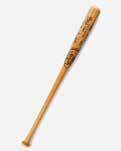
3254. Los Angeles 1984 Summer Olympics Team USA Signed Baseball Bat. Starting Bid $200
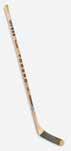
3255. Calgary 1988 Winter Olympics Team USA MultiSigned (9) Hockey Stick. Starting Bid $200
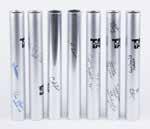
3256. Olympic Athletes (7) Signed Batons. Starting Bid $200
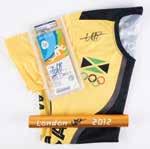
3257. Usain Bolt (3) Signed ItemsJersey, Baton, and Ticket. Starting Bid $200
3258. Usain Bolt (3) Signed Photographs. Starting Bid $200
3259. Pele: 1958 FIFA World Cup Ticket Stub from Pele’s Debut. Starting Bid $200
SOCCER
3260. Pelé Signed Vintage Soccer Ball. Starting Bid $200
3261. FIFA World Cup (6) Participation Medals - South Africa 2010 to Qatar 2022. Starting Bid $200
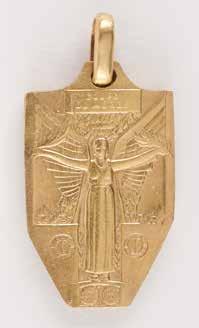
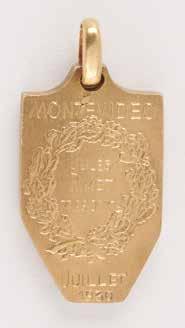
3262. FIFA Gold Presentation Medal Awarded to President Jules Rimet at the Inaugural World Cup (Uruguay, 1930). Exceptional gold presentation medal awarded to FIFA President Jules Rimet in connection with the first FIFA World Championship, held in Montevideo, Uruguay, in July 1930. Gold, 24 gm, 22 mm x 36 mm, with the front featuring an Art Deco design with a winged allegorical figure standing before radiating lines and the dates “1928–1930,” and the reverse bears a wreath with engraved text: “Montevideo / Jules Rimet / Presidente / Juillet 1930,” identifying the recipient as the FIFA president whose vision brought the World Cup into existence. Accompanied by a signed letter of authenticity from Laura Franco Baich, Director of the 1930 World Cup Museum in Montevideo, stating that the medal was awarded by FIFA to organizing authorities of the First World Championship and presented to Jules Rimet. A remarkable relic directly linked to the birth of the world’s most celebrated sporting competition. Read more online at www.RRAuction. com. Starting Bid $1000
OLYMPIC SOUVENIRS
Rare gilt-bronze commemorative medal issued for the 1894 Paris Olympic Congress that gave rise to the IOC and modern Olympic Games— from the collection of Javier Gómez-Navarro, Vice-President of the Organizing Committee of the
Barcelona 1992 Summer Olympics
3264. Paris 1894 First Olympic Congress Gilt Bronze Commemorative Medal - From the Collection of Olympic Executive Javier Gómez-Navarro. Rare gilt bronze commemorative medal issued for the inaugural Olympic Congress, held in Paris in June 1894, from the collection of Javier Gómez-Navarro, Vice-President of the Organizing Committee of the Barcelona 1992 Summer Olympics. Gilt bronze, 51 mm, 64 gm, by Huguenin. The obverse features a cluster of oak and laurel leaves surrounding a central tablet bearing the raised date “23 Juin 1894,” while the reverse displays additional foliage and the French inscription (translated): “The International Congress of Paris Proclaims the Restoration of the Olympic Games.” Encapsulated and graded by NGC as “MS 66.” Most known examples of this historic medal are struck in bronze, making gilt bronze specimens exceptionally rare; the only other known gilt bronze example is preserved in the Royal Collection Trust. On June 16, 1894, the first Olympic Congress convened in the auditorium of the Sorbonne University in Paris. A week later, on June 23rd, Pierre de Coubertin’s vision became a reality when delegates unanimously adopted a resolution to revive the Olympic Games. The Congress led directly to the establishment of the International Olympic Committee, with Coubertin serving as its general secretary before later becoming president, and to the selection of Athens as host of the first modern Olympic Games in 1896. Commemorating the historic gathering that gave rise to both the IOC and the modern Olympic movement, this medal stands among the earliest and most significant relics of Olympic history. A rare opportunity to own the first medal of the modern Olympic tradition. Javier Gómez-Navarro (1945–2024) was a Spanish politician, businessman, and sports administrator whose career was closely intertwined with the modernization of Spanish sport and tourism. Gómez-Navarro served as Spain’s Secretary of State for Sport from 1987 to 1993, during which time he helped reform the nation’s sporting infrastructure and worked with the private sector to transform professional sports clubs into limited companies. He also served as Vice-President of the Organizing Committee of the Barcelona 1992 Summer Olympics, playing a key role in the planning and execution of the Games that helped redefine Barcelona’s international image and showcased Spain on the world stage. In recognition of his contributions to the Olympic Movement and the success of the Barcelona Games, Gómez-Navarro received the Olympic Order in Gold from the International Olympic Committee in 1992. He later served as Spain’s Minister of Trade and Tourism from 1993 to 1996. Starting Bid $1000
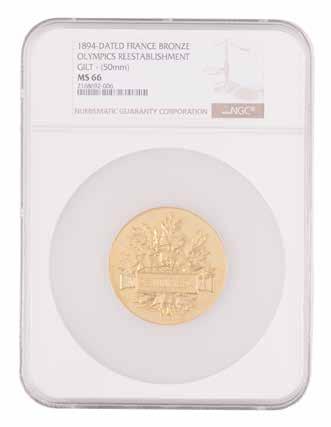
Striking patinated bronze figural trophy awarded to IOC founder Ferenc Kemény by Pierre de Coubertin in 1904— honoring one of the earliest champions of the revived Olympic Games
3265. Paris 1900 Olympics Bronze Presentation Trophy Awarded to IOC Founder Ferenc Kemény by Pierre de Coubertin (1904). Beautiful patinated bronze presentation trophy awarded to Dr. Ferenc Kemény of Hungary, a founding member of the International Olympic Committee, in recognition of his contributions to the reestablishment of the Olympic Games. Presented in Paris in 1904 by Baron Pierre de Coubertin, co-founder and second president of the International Olympic Committee, the trophy commemorates the 1900 Summer Olympics in Paris, the second Olympic Games of the modern era.
Designed by Polish sculptor Henryk Kossowski and entitled “IIe Olympiade Paris 1900,” the award stands 26.25˝ in height, weighs 17 pounds, and depicts an allegorical female figure standing atop a cloud-form base and holding a laurel wreath aloft in her right hand. The sculpture bears the artist’s signature to the base, which features an engraved plate reading: “IIe Olympiade Paris 1900, Par Kossowski.”
The trophy is mounted on a marble base, 7.5˝ in diameter, which bears an engraved presentation plaque reading: “Le trophée et le diplôme d’honneur du C.O.I. ont été offerts à M. Dr. Kemény Ferenc (Hongrie), membre fondateur du C.O.I., pour le rétablissement des Jeux Olympiques, Baron Pierre de Coubertin, Paris 1904.” In fine condition. Ferenc Kemény (1860–1944) was among Pierre de Coubertin’s earliest collaborators in the effort to revive the Olympic Games and was appointed an original member of the International Olympic Committee at its founding in 1894. A leading Hungarian educator and sports administrator, Kemény helped establish the Hungarian Olympic Committee and played a central role in securing Hungary’s participation in the first modern Olympic Games in Athens in 1896. Presented by Coubertin in 1904 and expressly honoring Kemény ‘for the reestablishment of the Olympic Games,’ this trophy represents a rare surviving tribute exchanged between two of the principal architects of the modern Olympic movement. Few surviving Olympic artifacts can claim such close associations with the founders whose efforts established the framework of the modern Olympic movement. Starting Bid $1000
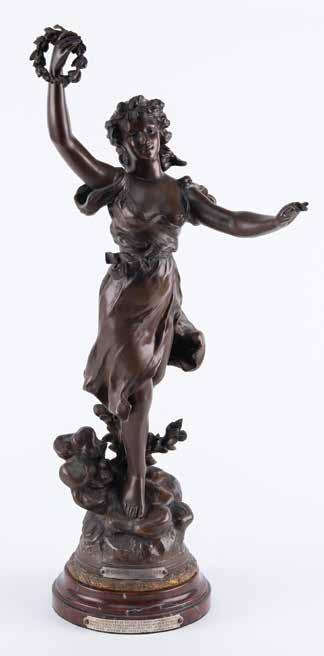
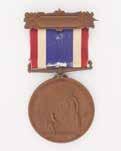
3263. British National Olympian Association Medal for Promoting Physical Education (Pre-1896). Starting Bid $200
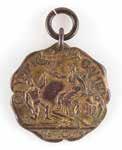
3268. Stockholm 1912 Olympics American Team ‘Try-Out’ Medallion. Starting Bid $200
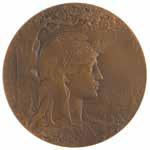
3266. Paris 1900 Exposition Universelle/ Summer Olympics Bronze Commemorative Medal. Starting Bid $200
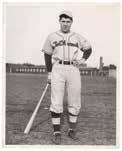
3269. Jim Thorpe: Carl Phillips Thorpe Original Photograph“Property of Jim Thorpe”. Starting Bid $100
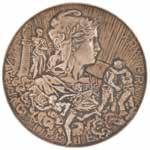
3267. Paris 1900 Exposition (and Olympic Games) Commemorative Medal. Starting Bid $200
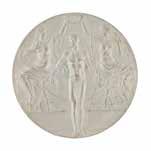
3270. Stockholm 1912 Olympics Aluminum Souvenir Winner’s Medal. Starting Bid $200
3271. Paavo Nurmi’s Antwerp 1920 Olympic 10,000-Meter Victory Trophy Presented by Pierre de Coubertin. Antwerp 1920 Olympics presentation trophy presented to Paavo Nurmi for his gold medal victory in the 10,000 meters by Baron Pierre de Coubertin. The heavy sculptural trophy, weighing approximately 22 pounds and measuring 11.75˝ x 9.75˝ x 7.25˝, depicts a crouching runner in the starting position, the figure apparently cast in patinated metal and mounted to a rectangular marble base. The top of the plinth is incised by the sculptor, “Adolf Wagner v. d. Mühl, 1920.” Affixed to one side of the marble base is an engraved French presentation plaque, in full: “Le trophée offers à M. Paavo Nurmi pour sa victoire au 10000 mètres aux Jeux Olympiques Anvers 1920. Baron Pierre de Coubertin, Anvers 1920,” translated: “The trophy offered to Mr. Paavo Nurmi for his victory in the 10,000 meters at the Antwerp 1920 Olympic Games. Baron Pierre de Coubertin, Antwerp 1920.” The opposite side bears an affixed plaque reading: “Olympiska Spelen Antwerpen 1920.” In very good to fine condition, with scattered surface wear to the figure and plinth, and small chips and scratches to the marble base, which is slightly loose. Read more online at www.RRAuction.com. Starting Bid $1000
3272. Los Angeles 1932 Summer Olympics Souvenir Bracelet. Starting Bid $200
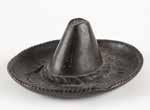
3273. Los Angeles 1932 Summer Olympics Souvenir Sombrero Ashtray. Starting Bid $200
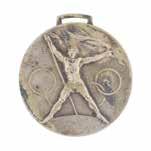
3278. Berlin 1936 Summer Olympics Japanese Team Medal. Starting Bid $200
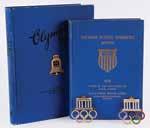
3275. Berlin 1936 Summer Olympics (4) Items - Card Badges and Reports. Starting Bid $200
3277. Berlin 1936 Summer Olympics Bakelite Stadium Model. Starting Bid $200
3276. Berlin 1936 Summer Olympics Crystal Pokal for the Boxing Tournament. Crystal Pokal issued for the boxing tournament of the Berlin 1936 Summer Olympics, measuring 15.5˝ in height with a removable domed, bell-shaped lid. The finely crafted presentation cup is intricately cut throughout with dense geometric starburst and crosshatch designs, featuring a frosted wheel-engraved scene of two Olympic boxers in competition to the central reserve. The vessel is additionally engraved “Olympia 1936” and “Berlin Boxturnier,” identifying it with the boxing events held during the Games of the XI Olympiad in Berlin. The base of the chalice is etched with the words, “Ehrenpreis des Osterreichischen Olympia Fonds [Honorary Award of the Austrian Olympic Fund].” The removable domed lid is similarly cut with faceted decoration and topped by a frosted, engraved Reichsadler finial. In fine condition, with expected light surface wear. Starting Bid $300
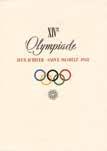
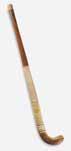
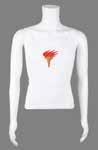
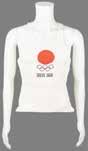
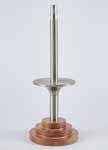
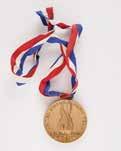
3285. Munich 1972 Summer Olympics Souvenir Lighter. Starting Bid $100
3284. Tokyo 1964 Summer Olympics Torch Relay Uniform Top. Starting Bid $200
3283. Melbourne 1956 Summer Olympics Official Torchbearer Tank Top Shirt. Starting Bid $200
3282. Melbourne 1956 Summer Olympics Souvenir Field Hockey Stick. Starting Bid $200
3281. Jim Thorpe Memorial Committee Death Notice Card. Starting Bid $200
3280. St. Moritz 1948 Winter Olympics Organizing Committee Invitation to Participate. Starting Bid $200
3279. Helsinki 1940 Summer Olympics Souvenir Glass Bowl. Starting Bid $200
3286. Moscow 1980 Summer Olympics Athlete’s Bib. Starting Bid $100
3287. Moscow 1980 Summer Olympics US Boycott Medal. Starting Bid $200
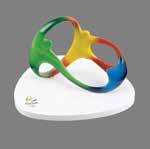
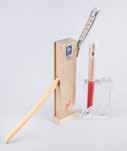
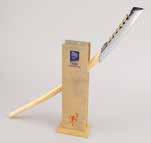
3294.
Athens 2004 Summer Olympics and Paralympics Torchbearer Uniforms and Volunteer/Staff Apparel Collection. Starting Bid $200
3293. Athens 2004 Summer Olympics Official High Priestess Flame-Lighting Ceremonial Wardrobe. Starting Bid $200
3292. Lillehammer 1994 Winter Olympics Miniature Torch. Starting Bid $200
3291. Lillehammer 1994 and Beijing 2008 Miniature Souvenir Olympic Torches. Starting Bid $200
3290. Rio 2016 Summer Olympics Winner’s Presentation Gift. Starting Bid $200
3289. Moscow 1980 Summer Olympics Athlete’s Bib. Starting Bid $200
3288. Moscow 1980 Summer Olympics Torch Relay Uniform. Starting Bid $150
3296. London 2012 Summer Olympics Winner’s Medal Presentation Tray. Starting Bid $200
3295. Athens 2004 Summer Olympics Official High Priestess FlameLighting Ceremonial Dress. Official ceremonial dress worn by the High Priestess during the Athens 2004 Olympic flame-lighting ceremony. Handmade of heavy beige fabric with dramatic vertical pleating, short sleeves, and a flowing full-length skirt terminating in a fringed hem, the gown is rendered in a classical Greek style and evokes the ancient ceremonial attire worn during the Olympic flamelighting ritual at Olympia. The interior collar bears a handwritten inscription in Greek, likely identifying the costume maker or production atelier. In fine condition, with areas of fraying or loose fabric.
The duty of the High Priestess at Olympia is to perform the lighting of the Olympic flame by invoking Apollo, the Greek god of light. Among the pillars, in the ruins of the Temple of Hera, beneath Kronos Hill, a parabolic mirror is used to concentrate the rays of the sun and spark a flame, igniting the Olympic torch held by the High Priestess. From this torch, the flame is passed, or kissed, to the lekythos bowl, which is carried into the ancient stadium and used as a conduit to light the first torch of the Olympic relay. Starting Bid $300
Beijing 2022 Winter Olympics Official Hockey Game Puck. Starting Bid $200
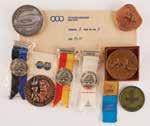
3300. Mediterranean Games Lot of (12) ItemsDated 1955-2005. Starting Bid $200
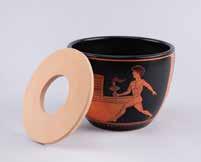
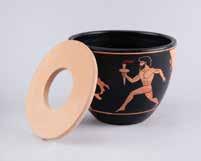
3297.
3298. Paris 2024 Summer Olympics Torch Lighting Ceremony Bowl. Starting Bid $300
3299. Milano Cortina 2026 Winter Olympics Torch Lighting Ceremony Bowl. Starting Bid $300
DIPLOMAS
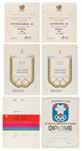
3303. Olympic Summer and Winter (6) Diplomas Starting Bid $200
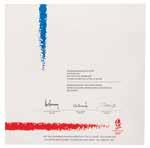
3304. Albertville 1992 Winter Olympics
Participation Diploma. Starting Bid $200
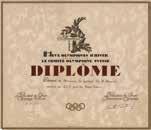
3306. St. Moritz 1928 Winter Olympics
Participation Diploma for IOC Member Charles H. Sherrill. Starting Bid $200
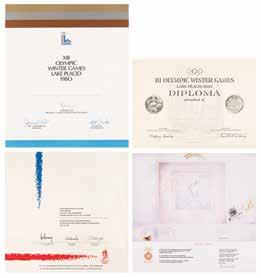
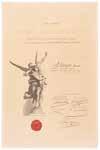
3305. Paris 1900 Olympics
Participation Diploma for Shooting. Starting Bid $200
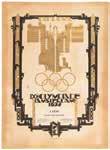
3307. Amsterdam 1928 Summer Olympics Participation Diploma. Starting Bid $200
3308. Winter Olympics Participation
Diplomas (4) for Lake Placid 1932, Lake Placid 1980, Sarajevo 1984, and Albertville 1992. Starting Bid $200
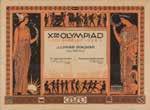
3309. Los Angeles 1932 Summer Olympics Participation Diploma. Starting Bid $200
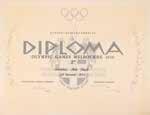
3310. Melbourne 1956 Summer Olympics Silver Medal Winner’s Diploma for Pole Vault. Starting Bid $200
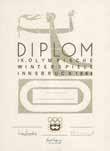
3311. Innsbruck 1964 Winter Olympics Gold Medal Winner’s Diploma for Cross-Country Skiing. Starting Bid $200
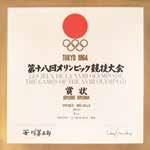
3312. Tokyo 1964 Summer Olympics Participation Diploma for Athletics. Starting Bid $200
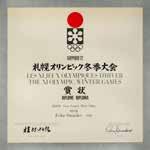
3314. Sapporo 1972 Winter Olympics Winner’s Diploma. Starting Bid $200
3313. Mexico City 1968 Summer Olympics (4) Participation Diplomas. Starting Bid $200
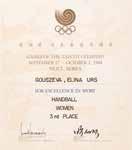
3315. Seoul 1988 Summer Olympics Bronze Medal Winner’s Diploma for Handball. Starting Bid $200
Conditions of Sale
ANYONE EITHER REGISTERING TO BID OR PLACING A BID (“BIDDER”) ACCEPTS THESE CONDITIONS OF SALE AND ENTERS INTO A LEGALLY, BINDING, ENFORCEABLE AGREEMENT WITH R&R AUCTION COMPANY OF MASSACHUSETTS, LLC (“RR AUCTION”) TOGETHER WITH BIDDER, THE “PARTIES”).
This Agreement contains important provisions that control rights and liabilities, and specifically has provisions governing how disputes are handled as well as LIMITATIONS OF LIABILITY that can be imposed upon RR Auction, WAIVER OF JURY and ARBITRATION PROVISIONS. This acknowledgement is a material term of these Conditions of Sale and of the consideration under which RR Auction agrees to these terms. PLEASE READ CAREFULLY.
The following terms and conditions (“Conditions of Sale”) constitute the sole terms and conditions under which RR Auction will offer for sale and sell the property on its website, and/or described in the catalog of items for auction (the “Catalog”). These Conditions of Sale constitute a binding agreement between the Parties with respect to the auction in which Bidder participates (the “Auction”). By bidding at the Auction, whether in person, through an agent or representative, by telephone, facsimile, online, absentee bid, or by any other form of bid or by any other means, Bidder acknowledges the thorough reading and understanding of all of these Conditions of Sale, all descriptions of items in the Catalog, and all matters incorporated herein by reference, and agrees to be fully bound thereby.
Section 1
The Parties1.1 RR Auction and Auction
This Auction is presented by RR Auction, a d/b/a/ of R&R Auction Company of Massachusetts, LLC, as identified with the applicable licensing information on the title page of the Catalog or on the www.RRauction. com Internet site. The Auction is conducted under these Conditions of Sale. Announcements and corrections from the podium at live auctions and those made through the Conditions of Sale appearing on the Internet at RRauction.com supersede those in the printed Catalog.
1.2 Bidder
Bidder shall mean the original Bidder on the property offered for sale by RR Auction and not any subsequent owner or other person who may acquire or have acquired an interest therein. If Bidder is an agent, the agency must be disclosed in writing to RR Auction prior to the time of sale, otherwise the benefits of the warranty shall be limited to the agent and not transferable to the undisclosed principal.
The rights granted to Bidder under these Conditions of Sale are personal and may not be assigned or transferred to any other person or entity, whether by operation of law or otherwise without the express written assent of RR Auction. Bidder may not transfer, assign, or otherwise convey these Conditions of Sale or any of the rights herein, and such purported transfer, assignment, or conveyance shall be null and void. No third party may rely on any benefit or right conferred on any Bidder by these Conditions of Sale, and no third party is intended as a beneficiary of these Conditions of Sale.
Bids will not be accepted from minor persons under eighteen (18) years of age without a parent or legal guardian’s written consent containing an acknowledgment of the Conditions of Sale herein and indicating their agreement to be bound thereby on behalf of the Bidder.
All Bidders must meet RR Auction’s qualifications to bid. Any Bidder who is not a client in good standing of RR Auction may be disqualified at RR Auction’s sole option and will not be awarded lots. Such determination may be made by RR Auction in its sole and unlimited discretion, at any time prior to, during, or even after the close of the Auction. RR Auction reserves the right to exclude any person from the Auction.
If an entity places a bid, then the person executing the bid on behalf of the entity agrees to personally guarantee payment for any successful bid and
agrees to be bound by these Conditions of Sale in addition to company for whom the Bidder is acting
By accepting the Conditions of Sale, Bidder personally and unconditionally guarantees payment.
Section 2
Bidding Privileges
2.1 In order to place bids, Bidders who have not established an account with RR Auction must either furnish satisfactory credit information (including two collectibles-related business references) or supply additional information if requested, well in advance of the Auction. Bidders who are not members of RRAuction.com should pre-register before the close of the Auction to allow adequate time to contact references. Privileges will be granted at the sole discretion of RR Auction. Additionally, Bidders who have not previously established credit or who wish to bid in excess of their established credit history may be required to provide a cash deposit prior to RR Auction’s acceptance of a bid. Check writing privileges and immediate delivery of merchandise may also be determined by pre-approval of credit based on a combination of criteria: RRAuction.com history, related industry references, bank verification, a credit bureau report and/or a personal guarantee for a corporate or partnership entity in advance of the Auction venue.
2.2 Bidder providing any false or misleading information provided in connection with the registration shall be a material breach of the Conditions of Sale and in addition to any other remedies at law shall excuse RR Auction from performance under these Conditions of Sale, including the right to any refund.
2.3 Bidding privileges may be revoked without notice, for any reason, at the sole discretion of RR Auction .
Section 3
Buyer’s Premium
3.1 The Bidder acknowledges and agrees that a 25% buyer’s premium will be added to the hammer price on all individual lots sold in timed and live Auctions. . For payment other than by cash, delivery will not be made unless and until full payment has been received by RR Auction, i.e., check or wired funds have fully cleared. Unless otherwise agreed in writing, signed by RR Auction, payment in full is due within thirteen (13) calendar days of the Auction or within twelve (12) calendar days of the invoice date, whichever is earlier. Bidder’s failure to pay any payment in full when due required shall constitute a material breach, and in addition to other damages available under contract or law, at RR Auction’s election, RR Auction may cancel the sale and require full premium still be due along with interest at 1.5% per month from the date of breach, or at the maximum legally allowable rate.
Section 4
Bidding
4.1 Each Bidder’s determination of its bid should be based upon its own examination of the item(s) and independent investigation, rather than any reliance as to what is represented in the Catalog, online or elsewhere. Bidder affirms that it regards any statements made by RR Auction concerning the item as solely opinion and that Bidder is making its own inspection and independent evaluation of the goods, and is not relying upon any description or statements by RR Auction (including as to quality, authenticity, provenance, ownership, liens existing, on goods legality, or value) in making its determination to bid on or purchase an item. In any purchase or sale, the value of the item(s) is determined by the price. THE BIDDER HEREBY ASSUMES ALL RISKS CONCERNING ANY AND ALL PURCHASES TO THE FULLEST EXTENT UNDER APPLICABLE LAW.
4.2 RR AUCTION IS NOT RESPONSIBLE FOR ERRORS IN BIDDING. A Bidder should make certain to bid on the correct lot and that the bid is the maximum (plus the Buyer’s Premium) that the Bidder is willing and able to pay. Since other Bidders (by mail, facsimile, online, and in person) will be present, and since a re-offering could damage the momentum of the sale, once the hammer has fallen and RR Auction has announced the winning Bidder, such Bidder is unconditionally bound to pay for the lot,
even if the Bidder has made a mistake.
4.3 All prospective Bidders who examine lots in person prior to the sale shall personally assume all responsibility for any damage they cause in so doing. RR Auction shall have sole discretion in determining the value of the damage caused, which shall be promptly paid by the prospective Bidder.
4.4 Title to any lot remains with Consignor, any secured party of the Consignor, or assignee of Consignor, as the case may be, until the lot is paid for in full by Bidder and Bidder has fully satisfied any outstanding financial obligations to RR Auction (including as it concerns any other lots). RR Auction reserves the right to require payment in full before delivering any lot to the successful Bidder.
4.5 It is the Bidder’s responsibility and obligation to have the lots fully insured while in their possession. Bidder assumes any and all risk of loss upon the earlier of shipment to Bidder or in Bidder’s possession.
4.6 Bidder grants to RR Auction or its assigns the right to offset any sums due, or found to be due by RR Auction, and to make such offset from any past, subsequent or future consignment, or items acquired by Bidder in possession or control of RR Auction or from any sums due to Bidder by RR Auction. Bidder further grants RR Auction a lien consisting of a senior security interest (or purchase money security interest to the extent applicable) in such sums or items to the fullest extent applicable, authorizes RR Auction to file documents concerning the interest, and Bidder agrees to execute any further documents as may be reasonably necessary to grant RR Auction such security interest. Bidder agrees that RR Auction and its assigns shall be a secured party with respect to items bought by Bidder and in the possession of RR Auction, to the extent of the maximum indebtedness, plus all accrued fees and expenses, until the indebtedness is paid.
4.7 By bidding in this sale, Bidder personally and unconditionally guarantees payment. The authorized representative of any corporate Bidder who is present at the sale shall provide RR Auction or its agent, prior to the commencement of the bidding (or at the time of registration), with a statement signed by a principal, director or officer that they he or she personally and unconditionally guarantees any payment due RR Auction.
4.8 RR Auction may at its sole and absolute discretion, make loans or advances to Consignors and/or prospective Bidders.
Section 5
Bidding Options
5.1 Non-Internet bids (including but not limited to in-person, facsimile, phone and mail bids) are treated similarly to floor bids in that they must be on-increment. Any in-person, facsimile, phone, or mail bids that do not conform to a full increment will be rounded up or down to the nearest full increment and this revised amount will be considered Bidder’s high bid.
5.2 When identical bids are submitted, preference is given to the first received. To ensure the greatest accuracy, written bids should be entered on the standard printed bid sheet and be received at RR Auction’s place of business at least twenty-four (24) hours before the Auction start. RR Auction is not responsible for executing mail bids or facsimile bids received on or after the day the first lot is sold, nor Internet bids submitted after the published closing time; nor is RR Auction responsible for proper execution of bids submitted by telephone, mail, facsimile, e-mail, Internet, or in person once the Auction begins.
5.3 In all Auctions, bids on an item must raise the current high bid by at least 10%, or as specified on a per-Auction basis. Bids will be accepted in whole dollar amounts only. No “buy” or “unlimited” bids will be accepted. In a live sale, bids on an item can change at the discretion of RR Auction.
5.4 RR Auction reserves the right to accept or decline any bid. Bids must be for an entire lot and each lot constitutes a separate sale. All bids are per lot unless otherwise announced. Live auction lots will be sold in their numbered sequence unless RR Auction directs otherwise. It is unlawful and illegal for Bidders to collude, pool, or agree with another Bidder to pay less than the fair value for lot(s). For live auctions, RR Auction will have final discretion in the event that any dispute should arise between Bidders. RR Auction will determine the successful Bidder, cancel the sale,
or re-offer and resell the lot or lots in dispute. RR Auction will have final discretion to resolve any disputes arising after the sale and in online auctions. If any dispute arises, RR Auction’s sale record is conclusive.
Section 6 Payment
6.1 Subject to fulfillment of all of the Conditions of Sale set forth herein, upon the sooner of (1) the passing of title to the offered lot pursuant to these Conditions of Sale, or (2) possession of the offered lot by the Bidder, Bidder thereupon (a) assumes full risk and responsibility (including without limitation, liability for or damage to frames or glass covering prints, paintings, photos, or other works), and (b) will immediately pay the full purchase price or such part as RR Auction may require. In addition to other remedies available to RR Auction by law, RR Auction reserves the right to impose from the date of sale a late charge of 1.5% per month of the total purchase price if payment is not made in accordance with the conditions set forth herein. All property must be removed from RR Auction’s premises by the Bidder at his/her expense not later than sixty (60) business days following its sale and, if it is not so removed, RR Auction may send the purchased property to a public warehouse for the account, at the risk and expense of the Bidder.
6.2 Payment is due upon closing of the Auction session, or upon presentment of an invoice. RR Auction reserves the right to void an invoice if payment in full is not received within thirteen (13) calendar days of the Auction or within twelve (12) calendar days of the invoice date. In cases of nonpayment, RR Auction’s election to void a sale does not relieve the Bidder from their obligation to pay RR Auction its fees (seller’s and Buyer’s Premium) on the lot and any other damages pertaining to the lot.
6.3 All sales for total invoices greater than $1,000 are strictly for cash in United States dollars (including U.S. currency, bank wire, cashier checks, eChecks, and bank money orders), and are subject to all reporting requirements.
6.4 All deliveries are subject to good funds; funds being received in RR Auction’s account before delivery of the Purchases; and all payments are subject to a clearing period. RR Auction reserves the right to determine if a check constitutes “good funds”: checks drawn on a U.S. bank are subject to a ten (10) calendar day hold, and ten (10) business days when drawn on an international bank. Clients with pre-arranged credit status may receive immediate credit for payments via e-Check, personal or corporate checks.
6.5 In the event that a Bidder’s payment is dishonored upon presentment(s), Bidder shall pay the maximum statutory processing fee set by applicable state law. If Bidder attempts to pay via check and the financial institution denies the transfer from Bidder’s bank account, or the payment cannot be completed using the selected funding source, Bidder agrees to complete payment.
6.7 If RR Auction refers any unpaid invoice to an attorney for collection, the Bidder agrees to pay and shall be liable for RR Auction’s attorney’s fees, court costs, and other collection costs incurred by RR Auction in addition to the invoice amount and interest the greater of 1.5% per month or at the maximum legally allowable rate from date of invoice to collection. If RR Auction assigns collection to its house counsel, such attorney’s time expended on the matter shall be compensated at a rate comparable to the hourly rate of independent attorneys.
6.8 RR Auction shall have a lien against the merchandise purchased by the Bidder (as well as to the extent it is a consignor any other monies owed or due to Bidder) to secure payment of the Auction invoice. RR Auction is further granted a lien and the right to retain possession of any other property of the Bidder then held by RR Auction or its affiliates to secure payment of any Auction invoice or any other amounts due RR Auction or affiliates from the Bidder. With respect to these lien rights, RR Auction shall have all the rights of a secured creditor, including but not limited to the right of sale. In addition, with respect to payment of the Auction invoice(s), the Bidder waives any and all rights of offset he might otherwise have against RR Auction and the consignor of the merchandise included on the invoice (the Consignor”). If a Bidder owes RR Auction or its affiliates on any account, RR Auction and its affiliates shall have the right to offset such unpaid account by any credit balance due Bidder, and it may secure by possessory lien any unpaid amount by any of the Bid-
der’s property in their possession.
6.9 All checks, cashiers checks, bank checks, or money orders are payable to R&R Auction Company of Massachusetts, LLC. RR Auction clients with an invoice totaling $1,000 or under will have the option to pay by VISA, Mastercard, Discover or Paypal. All Paypal payments must be sent to FinanceDepartment@rrauction.com. Authorize.net, a third-party service provider contracted by RR Auction for processing on-line payments, charges a nonrefundable service fee of 3%, which will be added to your final invoice should you pay by credit/debit card.
Section 7 Sales Tax
RR Auction is a remote seller and we are now required to collect Sales/ Use Tax from our bidders. The states that we have nexus in we will be required to collect and remit sales tax on your behalf. Each state has different requirements to meet nexus. When RR Auction has achieved a certain monetary and/or invoice threshold in each state we will apply sales tax to your total invoice. The states that are affected are: ARIZONA, ARKANSAS, CALIFORNIA, COLORADO, CONNECTICUT, FLORIDA, GEORGIA, ILLINOIS, INDIANA, IOWA, KANSAS, KENTUCKY, MAINE, MARYLAND, MASSACHUSETTS, MICHIGAN, MINNESOTA, NEBRASKA, NEVADA, NEW JERSEY, NEW YORK, NORTH CAROLINA, OHIO, OKLAHOMA, PENNSYLVANIA,RHODE ISLAND, TENNESSEE, TEXAS, UTAH, VIRGINIA, WASHINGTON, WISCONSIN
If we have not achieved nexus in a particular state it is still your responsibility to pay sales tax on your purchases.
The sales tax rate is determined by the State, Country, and City where purchases are shipped to. If you decide to pick up your purchases at our New Hampshire location you will not be required to pay sales tax. The State of New Hampshire does not have a general sales and use tax. All purchases picked up at our Massachusetts location will be taxed at the current rate of 6.25%.
If you have a resale number please email Sue@RRAuction.com or fax to (603) 732-4288 a copy of your state resale certificate and you will be exempt from paying sales tax.
Section 8
Delivery; Shipping; and Handling Charges
Bidder is liable for shipping and handling and providing accurate information as to shipping or delivery locations and arranging for such. RR Auction is unable to combine purchases from other auctions or affiliates into one package for shipping purposes. Lots won will be shipped in a commercially reasonable time after payment in good funds for the merchandise and the shipping fees is received or credit extended, except when third-party shipment occurs. Bidder agrees that service and handling charges related to shipping items which are not pre-paid may be charged to a credit card on file with RR Auction.
Successful international Bidders shall provide written shipping instructions, including specified Customs declarations, to RR Auction for any lots to be delivered outside of the United States. NOTE: Declaration value shall be the item’(s) hammer price and RR Auction shall use the correct harmonized code for the lot. Domestic Bidders on lots designated for third-party shipment must designate the common carrier, accept risk of loss, and prepay shipping costs.
All duties, customs, and any other import charges are the responsibility of the bidder.
Section 9
Title
Title shall not pass to the successful Bidder until all invoices of Bidder (including those pertaining to the item(s) at issue) and amounts owed to RR Auction are paid in full. It is the responsibility of the Bidder to provide adequate insurance coverage for the items once they have been delivered to a common carrier or third-party shipper.
Section 10 Rights Reserved
RR Auction reserves the right, at any time before, during or after an auction has ended to: withdraw any lot before or at the time of the Auction, cancel any bid, and/or to postpone the Auction of all or any lots or parts thereof, for any reason. RR Auction shall not be liable to any Bidder in the event of such withdrawal, cancellation, or postponement under any circumstances. RR Auction reserves the right to refuse to accept bids from anyone at any time.
Section 11
Conducting
the Auction
11.1 RR Auction reserves the right to postpone the Auction or any session thereof for a reasonable period of time for any reason whatsoever, and no Bidder or prospective Bidder shall have any claim as a result thereof, including consequential damages.
11.2 RR Auction’s Discretion: RR Auction shall determine opening bids and bidding increments. RR Auction has the right in its absolute discretion to reject any bid in the event of dispute between Bidders or if RR Auction has doubt as to the validity of any bid, to advance the bidding at its absolute discretion and to determine the successful Bidder in the event of a dispute between Bidders, to continue the bidding or to reoffer and resell the lot in question. In the event of a dispute after the sale, RR Auctions record of final sale shall be conclusive. RR Auction also may reject any bid if RR Auction decides either that any bid is below the reserve of the lot or article or that an advance is insufficient. Unless otherwise announced by RR Auction at the time of sale, no lots may be divided for the purpose of sale.
11.3 Reserves
Lots may be subject to a reserve which is the confidential minimum price below which the lot will not be sold. Consignors may not bid on their own lots or property. RR Auction may, from time to time, bid on items that it does not own. RR Auction may execute bids consecutively or otherwise up to one bid increment below the reserve.
11.4 Off-Site Bidding
Bidding by telephone, facsimile, online, or absentee bidding (advance written bids submitted by mail) are offered solely as a convenience and permitted subject to advance arrangements, availability, and RR Auction’s approval which shall be exercised at RR Auction’s sole discretion. Neither RR Auction nor its agents or employees shall be held liable for the failure to execute bids or for errors relating to any transmission or execution thereof. In order to be considered for off-site bidding in any manner, Bidders must comply with all of these Conditions of Sale and the terms contained on the Registration Form.
11.5 Estimate Prices:
In addition to descriptive information, each item in the Catalog sometimes includes a price range which reflects opinion as to the price expected at auction (the “Estimate Prices”). In other instances, Estimate Prices can be obtained by calling RR Auction at (603) 732-4280. The Estimate Prices are based upon various factors including prices recently paid at auction for comparable property, condition, rarity, quality, history and provenance. Estimate Prices are prepared well in advance of the sale and subject to revision. Estimates do not include the Buyer’s Premium or sales tax (see under separate heading).
11.6 Owned or Guaranteed Property:
RR Auction generally offers property consigned by others for sale at public auction; in very limited occasion, lots are offered that are the property of RR Auction.
11.7 Before the Auction:
Bidder may attend pre-sale viewing for all of RR Auction’s auctions at no charge. All property to be auctioned is usually on view for several days prior to the sale. Bidder is encouraged to examine lots thoroughly. Bidder may also request condition reports (see below). RR Auction’s staff are available at viewings and by appointment.
11.8 Maximum Bids In All Auctions:
To maximize Bidder’s chance of winning, RR Auction strongly encourages the use of maximum bids. RR Auction will then bid for Bidder until the lot reaches Bidder’s specified maximum. Maximum bids are strictly confidential. Placing arbitrary, non-incremental bids on lots with prior maximum bids may result in these lots being sold for less than 10% above the under Bidder’s bid.
11.9
Successful Bids:
The fall of RR Auction’s hammer indicates the final bid. RR Auction will record the paddle number of the Bidder. If Bidder’s salesroom or absentee bid is successful, Bidder will be notified after the sale by mailed or emailed invoice.
11.10
Unsold Lots:
If a lot does not reach the reserve, it is bought-in. In other words, it remains unsold and is returned to the Consignor. RR Auction has the right to sell certain unsold items after the close of the Auction. Such lots shall be considered sold during the Auction and all these Terms and Conditions shall apply to such sales including but not limited to the Buyer’s Premium, return rights, and disclaimers.
11.11 Bidding in Timed Auction:
Bidder may open, monitor, and/or raise bids at any time before the close of a lot through www.rrauction.com. RR Auction offers a callback service the day of the Auction, but Bidder is responsible for supplying a correct telephone number(s) where Bidder can be reached until the Auction closes. Bidder must request this service in writing. RR Auction will make reasonable efforts to ensure that Bidders who request a callback are contacted if outbid; however, RR Auction does not guarantee this service and it is merely a courtesy and not an enforceable right. The auctioneer may also execute a bid on behalf of the consignor to protect the reserve, either by entering a bid in response to salesroom, telephone or absentee bids. Under no circumstances will the auctioneer place any bid on behalf of the consignor above the reserve. The auctioneer will not specifically identify bids placed on behalf of the consignor to protect the reserve.
To ensure proper registration, those Bidders intending to bid via the Internet must visit www.RRauction.com and register accordingly at least one full day prior to the actual auction. Winning bidders will be notified by RR Auction. RR Auction is not responsible or liable for any problems, delays, or any other issues or problems resulting out of use of the Internet generally or specifically, including but not limited to transmission, execution or processing of bids.
Any Bidder may bid on any lot prior to 6 pm EST/EDT. At that time, an extended bidding period goes into effect. If Bidder has not bid on a lot before 6 pm EST/EDT, Bidder may not bid on that lot after 6 pm EST/EDT. Only those Bidders who have placed bids on a lot before 6 pm EST/EDT will be allowed to bid on that lot after 6 pm EST/EDT. If Bidder is the only Bidder on a lot at 6 pm EST/EDT, that lot is awarded to Bidder. During the extended bidding period, a lot will remain open only to those who bid on that lot prior to 6 pm EST/EDT. All lots WITHOUT an opening bid at 6 pm EST/EDT will remain OPEN to ALL Bidders until 7 pm EST/EDT or until they receive their first bid. These lots will close immediately upon receipt of a bid or at 7 pm EST/EDT, whichever comes first. For all lots that are active after 7 pm EST/EDT, bidding will remain open until 30 minutes pass without a bid being placed on THAT lot (the “30 Minute Rule”). The 30 Minute Rule is applied on a PER LOT BASIS; each lot in the Auction closes individually based on bidding activity after 7 pm EST/EDT. On a PER LOT BASIS, the 30 minute timer will reset each time a bid is placed after 7 pm EST/EDT. If Bidder is the high Bidder, raising Bidder’s maximum bid will NOT reset the timer. RR Auction reserves the right to close the Auction at any time at its sole discretion.
11.12 Bidding - Internet Live Auction:
Bidder may open, monitor, and/or raise bids at any time before the close of a lot through www.rrauction.com. RR Auction offers a callback service the day of the Auction, but Bidder is responsible for supplying a correct telephone number(s) where Bidder can be reached until the Auction closes. Bidder must request this service in writing. RR Auction will make reasonable efforts to ensure that Bidders who request a callback are contacted if outbid; however, RR Auction does not guarantee this service and it is merely a courtesy and not an enforceable right.
To ensure proper registration, those Bidders intending to bid via the Internet must visit www.RRauction.com and register accordingly at least one full day prior to the actual auction. Winning bidders will be notified by RR
Auction. RR Auction is not responsible or liable for any problems, delays, or any other issues or problems resulting out of use of the Internet generally or specifically, including but not limited to transmission, execution or processing of bids.
During live internet or live auction, property is auctioned in consecutive numerical order, as it appears in the catalog. The auctioneer will accept bids from those present in the salesroom or absentee bidders participating by telephone, internet or by written bid left with RR Auction in advance of the auction. The auctioneer may also execute a bid or bids (successively or otherwise) on behalf of the consignor to protect the reserve, either by entering a bid in response to salesroom, telephone or absentee bids. Under no circumstances will the auctioneer place any bid on behalf of the consignor above the reserve. The auctioneer will not specifically identify bids placed on behalf of the consignor to protect the reserve. All auctions for lots are with reserve unless specifically stated otherwise.
During live Auctions, internet bids can be placed in real time through one or more of the following Third Party services: www.liveauctioneers.com, www.invaluable.com and www.icollector.com. RR Auction is not responsible or liable for any problems, delays, or any other issues or problems resulting out of use of the Internet generally or specifically, including but not limited to transmission, execution or processing of bids. RR Auction treats any third-party site bids as floor or telephone bids. Floor bids and telephone bids are always considered first over third party sites bids, and floor bids are considered earlier than telephone bids. All RR Auction lots purchased through the third-party sites carry an additional Buyer’s Premium.
11.13 Miscellaneous:
Agreements between Bidders and Consignors to effectuate a non-sale of an item at Auction, inhibit bidding on a consigned item to enter into a private sale agreement for said item, or to utilize RR Auction’s Auction to obtain sales for non-selling consigned items subsequent to the Auction, are strictly prohibited. If a subsequent sale of a previously consigned item occurs in violation of this provision, RR Auction reserves the right to charge Bidder the applicable Buyer’s Premium and Consignor a Seller’s Commission as determined for each auction venue and by the terms of the seller’s agreement.
Acceptance of these Terms and Conditions qualifies Bidder as a client who has consented to be contacted by RR Auction in the future. In conformity with ”do-not-call” regulations promulgated by the Federal or State regulatory agencies, participation by the Bidder is affirmative consent to being contacted at the phone number shown in his application and this consent shall remain in effect until it is revoked in writing. RR Auction may from time to time contact Bidder concerning sale, purchase, and auction opportunities available.
11.14 Rules of Construction: RR Auction presents properties in a number of collectible fields, and as such, specific venues have promulgated supplemental Terms and Conditions. Nothing herein shall be construed to waive the general Conditions of Sale by these additional rules and shall be construed to give force and effect to the rules in their entirety.
Section 12
RR Auction’s Remedies
Failure of the Bidder to comply with any of these Conditions of Sale or the terms of the Registration Form is an event of material breach or default. In such event, RR Auction may, in addition to any other available remedies specifically including the right to hold the defaulting Bidder liable for the Purchase Price or to charge and collect from the defaulting Bidder’s credit or debit accounts as provided for elsewhere herein: (a) cancel the sale, retaining any payment made by the Bidder as damages (the Bidder understands and acknowledges that RR Auction will be substantially damaged should such default occur, and that damages under sub-part (a) are necessary to compensate RR Auction for such damages); (b) resell the property without reserve at public auction or privately; (c) charge the Bidder interest on the Purchase Price at the rate of one and one-half percent (1.5%) per month or the highest allowable interest rate; (d) take any other action that RR Auction, in its sole discretion, deems necessary or appropriate to preserve and protect RR Auction’s rights and remedies. Should RR Auction resell the property, the original defaulting Bidder shall be liable for the payment of any deficiency in the purchase price and
all costs and expenses associated there with, including but not limited to warehousing, sales-related expenses, reasonable attorney fees and court costs, commissions, incidental damages and any other charges due hereunder which were not collected or collectable. In the event that such Bidder is the successful Bidder on more than one lot and pays less than the purchase price for the total lots purchased, RR Auction shall apply the payment received to such lot or lots that RR Auction, in its sole discretion, deems appropriate. If RR Auction does not exercise such discretion, the lots to which the payment shall be applied will be in descending order from the highest purchase price to the lowest. Any Bidder failing to comply with these Conditions of Sale shall be deemed to have granted RR Auction a security interest in, and RR Auction may retain as collateral such security for such Bidder’s obligations to RR Auction, any Bidder’s property in RR Auction’s possession or to which title has not yet passed to Bidder. RR Auction shall have the benefit of all rights of a secured party under the Uniform Commercial Code (U.C.C.) as adopted by the Commonwealth of Massachusetts.
Section 13 Warranties
13.1 RR Auction does not provide any warranties to Bidders, whether expressed or implied, beyond those expressly provided in these Conditions of Sale. All property and lots are sold ”as is” and “where is”. By way of illustration rather than limitation, neither RR Auction nor the Consignor makes any representation or warranty, expressed or implied, as to merchantability or fitness for intended use, condition of the property (including any condition report), correctness of description, origin, measurement, quality, rarity, importance, exhibition, relevance, attribution, source, provenance, date, authorship, condition, culture, genuineness, value, or period of the property. Additionally, neither RR Auction nor the Consignor makes any representation or warranty, expressed or implied, as to whether the Bidder acquires rights in copyright, trademark, or other intellectual property (including exhibition or reproduction rights) related to the item, or whether the property is subject to any limitations or other rights. RR Auction does not make any representation or warranty as to title.
13.2 All descriptions, photographs, illustrations, and terminology including but not limited to words describing condition (including any condition reports requested by Bidder, see also Terminology), authorship, period, culture, source, origin, measurement, quality, rarity, provenance, importance, exhibition, and relevance, used in the Catalog, bill of sale, invoice, or anywhere else, represent a good faith effort made by RR Auction to fairly represent the lots and property offered for sale as to origin, date, condition, and other information contained therein; they are statements of opinion only. They are not representations or warranties and Bidder agrees and acknowledges that he or she shall not rely on them in determining whether or not to bid or for what price. Price estimates (which are determined well in advance of the Auction and are therefore subject to revision) and condition reports are provided solely as a convenience to Bidders and are not intended nor shall they be relied on by Bidders as statements, representations or warranties of actual value or predictions of final bid prices.
13.3 Bidders are accorded the opportunity to inspect the lots and to otherwise satisfy themselves as to the nature and sufficiency of each lot prior to bidding, and RR Auction urges Bidders to avail themselves accordingly.
13.4 All lots sold by RR Auction are accompanied by an Auction Certificate (“AC”). On any lot presented with an AC issued by RR Auction, the certification is only as to its attribution to the person or entity described or to the lot’s usage and only as explicitly stated therein (the “AC”), to the exclusion of any other warranties, express or implied, including but not limited to those pursuant to the Uniform Commercial Code. The AC inures only to the original Bidder (as shown in RR Auction’s records). Bidder may not transfer, assign, or otherwise convey the AC and such purported transfer, assignment, or conveyance shall be null and void.
Section 14 Firearms
RR Auction complies with all Federal and State rules and regulations relating to the purchasing, registration and shipping of firearms. A Bidder is required to provide appropriate documents and the payment of associated fees, if any. Bidder is responsible for providing a shipping address that is suitable for the receipt of a firearm.
Section 15 Unauthorized Statements
Under no circumstances is any employee, agent or representative of RR Auction authorized by RR Auction to modify, amend, waive or contradict any of these Conditions of Sale, any term or condition set forth on a registration form, any warranty or limitation or exclusion of warranty, any term or condition in either the Registration Form or these Terms and Conditions regarding payment requirements, including but not limited to due date, manner of payment, and what constitutes payment in full, or any other term or condition contained in any documents issued by RR Auction unless such modification, amendment, waiver or contradiction is contained in a writing signed by all parties. Any statements, oral or written, made by employees, agents or representatives of RR Auction to Bidder, including statements regarding specific lots, even if such employee, agent or representative represents that such statement is authorized, unless reduced to a writing signed Bidder and by an authorized officer of RR Auction by all parties, are statements of personal opinion only and are not binding on RR Auction, and under no circumstances shall be relied upon by Bidder as a statement, representation or warranty of RR Auction.
Section 16 Bidder’s Remedies
16.1 Except as stated expressly herein, Bidder’s sole and exclusive remedy related to or pertaining to items it bids upon, views, or purchases from RR Auction, and any claims by Bidder related to authenticity, ownership, condition, title or value, shall be against Consignor only.
16.2 This section sets forth the sole and exclusive remedies of Bidder as against RR Auction (inclusive of its affiliates, officers, managers, employees or agents), or in any way arising out of, related to, or in connection with these Conditions of Sale, , and is expressly in lieu of any other rights or remedies which might be available to Bidder by law. Time is of the essence with respect to these procedures.
16.3 Title to Items
The Bidder hereby accepts the benefit of the Consignor’s warranty of title and any other representations and warranties made by the Consignor for the Bidder’s benefit. In the event that Bidder demonstrates in writing, satisfactory to the sole discretion of RR Auction, that there was a breach of the Consignor’s warranty of title concerning a lot purchased by Bidder, RR Auction may make demand upon the Consignor to pay to Bidder the Purchase Price (including any premiums, taxes, or other amounts paid or due to RR Auction). Should the Consignor not pay the Purchase Price to Bidder within thirty days after such demand (if any made), RR Auction may disclose the identity of the Consignor to Bidder and may assign to Bidder all or some of RR Auction’s rights against the Consignor with respect to such lot or property. Upon such disclosure and/or assignment, all responsibility and liability of RR Auction, if any, with respect to said lot or item shall automatically terminate related to or arising from these Conditions of Sale or such transaction operating as a complete waiver and general release by Bidder as to RR Auction and its agents, contractors, and affiliates, as to any and all claims concerning or related to the item, if any . RR Auction shall be entitled to retain the premiums and other amounts paid to RR Auction by Consignor only. The rights and remedies provided herein are for the original Bidder only and they may not be assigned or relied upon by any transferee or assignee under any circumstances.
16.4 Authenticity Challenge Process
(1) If Bidder wishes to dispute or challenge the Authenticity of the lot or item (including asserting that it is incorrect), Bidder must adhere to the following procedure: Within 30 days of the Auction Date, Bidder must present written evidence to RR Auction, that the lot is not authentic as determined by a known expert in the field (and one recognized by RR Auction within its discretion) and send the physical item or lot at issue to RR Auction along with all evidence relied upon by Bidder for contesting the Authenticity. (“Authenticity Challenge Process”) “Authenticity” shall mean a gross discrepancy in the between the description, genuiness, or attribution of the item as represented by RR Auction in the Catalog or at the auction, and the item. If RR Auction concurs that the lot is not Authentic as
was represented (it is sole discretion), Bidder’s sole and exclusive remedy as against RR Auction (inclusive of its affiliates, agents, employees, and contractors) shall be a refund of the purchase price of the subject item paid by Bidder, with no other costs, liabilities or amounts recoverable by Bidder. If RR Auction does not agree with the assertion by Bidder, then the Parties shall follow the dispute resolution procedures of these Conditions of Sale. Strict adherence to the Authenticity Challenge Process is a condition of standing for Bidder to initiate suit or claim.
(2) So long as Bidder has complied with the Authenticity Challenge Process, any claim, suit or action, by Bidder concerning an AC or Certification of Authenticity, or related to the authenticity of the item must, without any exception, be brought within one (1) year of Auction Date and is subject to the other limitations and conditions stated in the Conditions of Sale.
16.5 Other Issues. Any dispute or claim by Bidder against RR Auction (or its affiliates, directors, employees, officers, agents, or contractors)) other than Authenticity, concerning any item or lot bid upon, or purchased, including value, title, condition, bidding process, or description must be asserted (if at all) in the following manner:
(1) If the description of any lot in the Catalog is materially or grossly incorrect (e.g., gross cataloging error), or there is any other gross material issue pertaining to the item or lot, the item or lot may be returned if returned within five (5) calendar days of receipt, and received by RR Auction no later than twenty-one (21) calendar days after the Auction Date with explanation in writing.. If there is any discrepancy between the description in the Catalog and a certificate of auction, then the description in the certificate of auction (“Lot Challenge Process”). This paragraph shall constitute Bidder’s sole right with respect to the return of items, and no refunds shall be given for any items not returned to and received by RR Auction within the period of time stated herein or not materially or grossly in deviation from the description. Such a refund is subject to RR Auction’s sole discretionary review, and any request for refund must be made concurrently with returning the physical item or lot to RR Auction. Any item not returned within said frame will constitute acceptance of the item and a waiver and release of any and all claims by Bidder pertaining to the item other than with respect to authenticity; and
(2) Provided that the Bidder has engaged in the Lot Challenge Process, any claim concerning such must be brought no later than one (1) year of the Auction Date for the item or lot at issue and is subject to the other limitations and conditions stated in the Conditions of Sale.
NO RETURN OR REFUND OF ANY AUCTION LOT WILL BE CONSIDERED OR PROVIDED EXCEPT AS PROVIDED IN THESE CONDITIONS OF SALE AND BIDDERS OR AS MAY BE REQUIRED BY LAW. FAILURE TO COMPLY WITH SUCH SHALL BE A COMPLETE DEFENSE TO ANY CLAIMS BY BIDDER RELATED TO THE CONDITIONS OF SALE, ANY AUCTION OR BID.
16.6 LIMITATION OF LIABILITY. For any and all claims by Bidder arising out of or related to this Agreement, Bidder’s viewing, bid, or purchase of items, or any agreement between the Parties, or otherwise, Bidder agrees that to the fullest extent such can be limited under the law, Bidder shall have no right to recover and hereby waives any and all rights to recover from against RR Auction or its affiliates, directors, employees, officers, agents, or contractors, consequential or indirect damages, lost profits damages, punitive, exemplary, statutory (or multiplier damages), physical or emotional distress damages, general or special damages of any kind (beyond amounts actually paid by Bidder for item(s) at issue), and in the event of recovery of any damages whatsoever, such shall be limited by the amounts actually paid by Bidder to RR Auction for the item(s) at issue in such claim, or if no money was paid to RR Auction by Bidder for items at issue, or there items are at issue, the amount of $150.00.
Section 17
RR Auction’s Additional Services
For Bidders who do not remove purchased property from RR Auction’s premises, RR Auction, in its sole discretion and solely as a service and accommodation to Bidders, may arrange to have purchased lots packed, insured and forwarded at the sole request, expense, and risk of Bidder. RR Auction assumes no and disclaims all responsibility and liability for
acts or omissions in such packing or shipping by RR Auction or other packers and carriers, whether or not recommended by RR Auction. RR Auction assumes no and disclaims all responsibility and liability for damage to frames, glass or other breakable items. Where RR Auction arranges and bills for such services via invoice, RR Auction will include an administration charge.
Section 18
Headings
Headings are for convenience only and shall not be used to interpret the substantive sections to which they refer.
Section 19 Entire Agreement
Except to the extent Bidder is also a consignor (in which case the terms of the consignment agreement shall also govern), these Conditions of Sale constitute the entire agreement between the Parties together with the terms and conditions contained in the auction Registration Form. They may not be amended, modified or superseded except in a signed writing executed by all parties. No oral or written statement by anyone employed by RR Auction or acting as agent or representative of RR Auction may amend, modify, waive or supersede the terms herein unless such amendment, waiver or modification is contained in a writing signed by all parties.
If any section of these Conditions of Sale or any term or provision of any section is held to be invalid, void, or unenforceable by any court or arbitrator of competent jurisdiction, the remaining parts of the agreement and remainder of the sections or terms and provisions of the section and all sections shall continue in full force and effect without being impaired or invalidated in any way.
Section 20
Governing Law and Enforcement
20.1 The Parties agree that all agreements between the Parties including but not limited to these Conditions of Sale are entered into in Boston, Massachusetts, no matter where Bidder is situated and no matter by what means or where Bidder was informed of the Auction and regardless of whether catalogs, materials, or other communications were received by Bidder in another location.
20.2 The Parties agree that these Conditions of Sale, any other related agreement(s), along with all claims between the Parties, including those arising out of or related to such are governed by the laws of the Commonwealth of Massachusetts, without regard for its conflict of laws principles. The Parties agree that any dispute between the Parties, including but not limited to those related to or arising out of these Conditions of Sale, or related to or arising out of any other related agreement(s) shall be submitted to confidential binding arbitration (the ”Arbitration”) before a single Arbitrator of the American Arbitration Association (the “AAA”) The Parties agree that the Arbitration shall be conducted pursuant to the commercial rules of the AAA in Boston, Massachusetts, unless the Consumer Arbitration Rules apply, in which case, such rules and venue will govern. In the event that the Parties cannot agree on the selection of the Arbitrator, then the Arbitrator shall be selected by the AAA. The prevailing Party in the Arbitration shall also recover all of its related fees and costs, whether before or after the formal institution of the Arbitration, including but not limited to its reasonable attorneys’ fees and costs, if RR Auction prevails, such recovery, in addition to all remedies available at agreement or law, shall include the Buyer’s Premium as defined in these Conditions of Sale. Federal arbitration law, including the Federal Arbitration Act apply to this agreement to arbitrate and its related provisions. The arbitration and all related proceedings shall be held strictly confidential and all documents and discovery shall be held confidential and not used, published or disclosed publically or to anyone outside the Parties or expert consultants or counsel who shall agree to hold such confidential.
20.3 The Parties consent to the Commonwealth of Massachusetts as exclusive jurisdiction and venue for all claims between the Parties except as provided specifically herein and may seek confirmation of the decision in the Arbitration pursuant to the Federal Arbitration Act in any Court of competent jurisdiction, including the courts of the Commonwealth of Massachusetts or the United States District Court for the District of Massachusetts. To the extent such is necessary under the law, RR Auction
may enforce the Arbitration award against Bidder and any related Party in any court of competent jurisdiction. Nothing in this Agreement shall be construed as RR Auction consenting to jurisdiction or venue in any location outside of the Commonwealth of Massachusetts.
THE PARTIES MAY NOT BRING CLAIMS AGAINST EACH OTHER AS A CLASS OR CLASS MEMBER IN ANY CLAIMED CLASS, OR IN A REPRESENTATIVE ACTION UNLESS OTHERWISE AGREED. UNLESS OTHERWISE AGREED, THE CLAIMS AGAINST EACH OF THE OTHER CANNOT BE CONSOLIDATED OR JOINED WITH MORE THAN ONE ADDITIONAL PERSON OR ENTITIES’ CLAIMS. NO INJUNCTIVE OR DECLARATORY RELIEF SOUGHT BY BIDDER IF ANY, CAN AFFECT OR BE ORDERED TO AFFECT ANY OTHER BIDDERS OR PERSONS.
20.4 Except as provided specifically in these Conditions of Sale in Bidder’s Remedies against RR Auction (along with its affiliates, directors, agents, officers, employees, and contractors) for any dispute, claim, cause of action related to or arising out of these Conditions of Sale or any other related agreement(s), brought by Bidder must be brought within the earlier of the Auction Date as it pertains to the item(s) at issue or no later than one (1) year of the acts, omissions or circumstances occurred giving rise to the alleged claim, without exception. This provision is intended as a full, complete and absolute bar to and release of any claims by Bidder initiated after one (1) year of such acts, omissions or circumstances. The Parties agree further that these waiver provisions are intended to be binding in the event of any dispute, specifically including but not limited to third party claims and cross-actions brought by Bidder. These provisions are consideration for the execution of these Conditions of Sale.
20.5 To the fullest extent under applicable law and except as specifically stated herein Bidder hereby holds harmless, releases and discharges RR Auction and its agents, officer’s directors, affiliates, successors, and assigns from any and all claims, liabilities, obligations, promises, agreements, damages, causes of action, suits, demands, losses, debts, and expenses of any nature whatsoever, known or unknown, suspected or unsuspected existing prior to these Conditions of Sale. Bidder agrees to the Conditions of Sale and upon each instance that Bidder participates in any auction, bids, or otherwise agrees to such terms and reaffirms this release as of the date of so participating or agreeing unless Bidder otherwise provides clear written notice to RR Auction prior to so bidding.
20.6 The Bidder hereby agrees that RR Auction shall be entitled to present these Conditions of Sale to a court in any jurisdiction other than set forth in this paragraph as conclusive evidence of the Parties agreement, and the Parties further agree that the court shall immediately dismiss any action filed in such jurisdiction.
20.7 Liquidated Damages for Specific Breaches
In the event that Bidder provides false information in connection with registering for bidding, fails to correct or update information or breaches the Conditions of Sale by failing to pay the purchase price when due after becoming the winning bidder, as liquidated damages associated with such breaches, R&R may obtain from Bidder the greater of (1) 150% the reserve of the item (if any); (2) the amount bidder bid; or (3), the full amount that bidder would have otherwise paid. Bidder will also be liable for an additional 20% of such amount to account for additional administrative costs, shipping, additional advertising, and other damages and liabilities fees that are difficult to calculate on an item-by-item basis.
20.8 Indemnity. Bidder agrees to defend, indemnify, hold harmless RR Auction (along with its officers, directors, agents, contractors, and affiliates) from and against any and all claims, costs, fees, damages, and liabilities arising out of or related to these Conditions of Sale, view of items, or lots, bidding, or participation in any auction by RR Auction, and/or or in any way connected to any item you viewed, bid upon or purchased through RR Auction.
Section 21: State-by-State Law Issues
This Auction is being conducted in and the sale shall take place in the State of Massachusetts. Notwithstanding, the foregoing, should these terms and conditions violate the law of any State should that state’s law be found to govern, or any provision herein determined to be invalid, the clause itself and the remainder of the Agreement shall be valid to the
fullest extent allowed. Also, to the extent other states law apply to any transaction arising out of the Agreement (without admitting such), RR Auction states:
For Residents of California:
SALE OF AUTOGRAPHED COLLECTIBLES: AS REQUIRED BY LAW, A DEALER WHO SELLS TO A CONSUMER ANY COLLECTIBLE DESCRIBED AS BEING AUTOGRAPHED MUST PROVIDE A WRITTEN EXPRESS WARRANTY AT THE TIME OF SALE. THIS DEALER MAY BE SURETY BONDED OR OTHERWISE INSURED TO ENSURE THE AUTHENTICITY OF ANY AUTOGRAPHED COLLECTIBLE SOLD BY THIS DEALER.
A written express warranty is provided with each autographed collectible, as required by law. This dealer may be surety bonded or otherwise insured to ensure the authenticity of any autographed collectible sold by this dealer.
Section 22 Glossary of Condition terms
Information provided to prospective Bidders with respect of any lot, including any pre-sale estimate, whether written or oral, and information in any catalogue, condition or other report, commentary or valuation, is not a representation of fact but rather a statement of opinion held by RR Auction.
Use of the following terms constitutes an opinion as follows:
VERY FINE describes an item believed to be in virtually flawless condition, and is used sparingly for items of exceptionally attractive appearance.
FINE is the most common statement of condition, and applies to most items that we offer. It describes items that we believe to show expected handling wear, generally acceptable random flaws (such as light creases, small bends, etc.), and an overall appearance that is pleasing to the majority of collectors.
VERY GOOD describes an item that we believe exhibits more moderate flaws (such as toning, light staining, professional reinforcements or repairs, etc.). Most collectors would be comfortable with items in very good condition, and this would be the expected condition for many formats (early presidential documents, for example).
GOOD describes an item which we believe to have obvious visible flaws, including heavy wear, missing portions, or repairs that affect appearance; generally items in this condition are offered only if an item is otherwise believed to be exceedingly rare or important.
Bidder may call and request further details and information about RR Auction’s opinions concerning any item via phone or email which shall provided in RR Auction’s discretion.
Certificate of Auction, Certificate of Authenticity and Goods Acquired:
Bidder warrants that Bidder (and its agents, assigns, successors, and affiliates) shall not purposely deface, destroy, dismember, cut-up into parts the item or Lot purchased at auction from RR Auction and in the event such shall occur whether purposefully or accidently, Bidder (and its agents, assigns, successors, and affiliates) shall refrain from advertising, promoting, or marketing the item as having been purchased from RR Auction and shall in no event display, expressly claim, or imply that the item was certified or auctioned in such state by RR Auction. As liquidated damages for such breach, Bidder agrees to be liable to RR Auction for the greater of the amount of three (3) times the hammer price of the item along with all other fees and costs as otherwise provided in this Terms of Sale.

For 50 years, relationships have been the backbone of RR Auction. We have made it a priority to keep our consignors informed and involved, encouraging them to share their voices, to instill their knowledge, and to forge a partnership based on our shared passion for history. With a mutual desire to achieve greatness, these relationships are at the heart of our success.