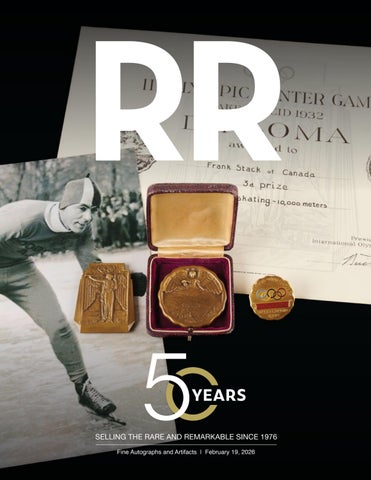
Fine Autographs and Artifacts | February 19, 2026
Hundreds of more items are listed online at www.RRAuction.com | 1
THANK YOU FOR BEING PART OF THIS 50 YEAR JOURNEY
T
his year marks fifty years since I started RR Auction. It’s hard to believe. Back in 1976, I was a kid in Boston with a love of collecting and no real sense of where it would all lead. My grandfather handed me $1,800 to get things going. He never asked a question and never asked for it back. He just believed in me. That belief is what set everything in motion.
Over the years, we’ve also handled some remarkable pieces in space exploration. We’ve represented several of the moonwalkers themselves and the things they carried with them, Dave Scott from Apollo 15, Gene Cernan, the last man on the moon, and Alan Bean, Charlie Duke, and others. Space-flown hardware and mission-used artifacts have been a meaningful part of our story, and I never take for granted the trust those astronauts placed in us.
What began as a one-man operation selling baseball memorabilia and simple autographs grew slowly, one step at a time. I spent ten years working out of my parents’ basement, doing whatever it took to keep the business alive. I typed up my own little mail-bid catalogs and mailed them out myself. I didn’t have much, but I cared about doing things the right way, learning as I went, and treating people well.
In the world of technology, we share something meaningful with Apple, we both started in 1976. It’s been something special to help tell that early Apple story through the documents and artifacts from those first months in the garage, the early checks, contracts, and Steve Jobs’s actual Apple-1 prototype. This January, we’re offering Apple Check #1, the first check the company ever issued.
Carla, my wife at the time, was always there to help me from the very beginning when I was just trying to make things work. In 1986, I hired Bill White as our first team member, and he’s still with the company today, almost forty years later. And in 1996, Elizebeth Otto joined the consignment department, and she’s still here too. I’m proud of the people who have stood by this company, and I’m just as proud that my children and other family members have worked here at one point or another, including my son Bobby, who now serves as our COO. Watching him help lead the business has meant a great deal to me. We became known as specialists in documents and manuscripts. Since 1976, we’ve handled pieces that span the full stretch of written history, from Einstein to Edison, from Henry VIII to Henry David Thoreau, and from Beethoven to Bob Dylan. At the heart of it all are the handwritten letters and manuscripts. They tell the story in the writer’s own words, and that’s always been the foundation of this company. And as the country marks its 250th anniversary this summer, we’ll be offering a full set of all the signers of the Declaration of Independence, including Button Gwinnett. For someone who started out selling single autographs, bringing all the Founders together again carries a certain weight.
Along the way, some things have come through our doors that I never expected. We sold the $28 million seat on Jeff Bezos’s first Blue Origin flight. We handled Jim Sanborn’s Kryptos archive, tied to one of the great modern codebreaking puzzles. And we even revealed and sold a previously unknown JFK film taken in Dealey Plaza. These aren’t the kinds of things you picture selling when you’re typing up catalogs in your parents’ basement, but they’ve become part of the story nonetheless. And the truth is, the moments that stay with me aren’t the big headlines. They’re the times when we helped someone change their life, often by exceeding their financial expectations. When a consignor’s item, whether it was an Elon Musk archive, an Einstein letter, or a family heirloom, made a difference for them. That has always been at the center of this company. RR Auction has always been about people. Consignors. Buyers. The people who referred us to someone who needed help. And the staff who worked hard behind the scenes. None of this would have happened without them. And through it all, I think about my grandfather’s gesture, the quiet belief he showed when he handed me that $1,800. He didn’t make a big deal out of it. He just always believed in me. Half a century later, everything we’ve built has come from that same kind of belief. People believed in what we were trying to do. They gave us a chance. They sent others our way. For that, we are grateful.
WITH GRATITUDE, BOB EATON FOUNDER, RR AUCTION
OLYMPICS
Bidding closes February 19, 2026
Bob Eaton CEO, Acquisitions bob.eaton@rrauction.com
Jeff Cafferelli Consignment Director jeff.cafferelli@rrauction.com
Evan Mugford Writer, Researcher evan.mugford@rrauction.com
Carla Eaton Owner, Auctioneer carla.eaton@rrauction.com
Fiona Lenaire Consignor Customer Service Manager fiona.lenaire@rrauction.com
Sarina Carlo Head of Production sarina.carlo@rrauction.com
Bobby Livingston Executive Vice President, Public Relations bobby.livingston@rrauction.com Bobby Eaton VP, Business Development Auctioneer, MA/Lic. #3214 bobby.eaton@rrauction.com Sue Recks Customer Service Manager Accounts Receivable sue.recks@rrauction.com
Cecily Gruce Inventory Manager Customer Service cecily.gruce@rrauction.com Grace Maggio Executive Assistant grace.maggio@rrauction.com Kevin Lessard Shipping Manager kevin.lessard@rrauction.com
Melissa Adams Accounting Executive melissa.adams@rrauction.com
Matt Klein Filemaker Developer and IT Administrator matt.klein@rrauction.com
Amey Fuller Staff Accountant amey.fuller@rrauction.com
Bill White Lead Autograph Appraiser bill.white@rrauction.com
Elizebeth Otto Consignment Director elizebeth.otto@rrauction.com
Dan McCarthy Writer, Researcher dan.mccarthy@rrauction.com
Nikki Brickett Photographer nikki.brickett@rrauction.com Joe Boucher Production Assistant joe.boucher@rrauction.com Suzy Torres Photographer suzy.torres@rrauction.com
Special Thanks: Olympics Expert Jonathan Becker
Robert S. Eaton Sr. 1940–2001
Torches
The torch from the first post-World War II Summer Games 3001. London 1948 Summer Olympics Torch.
Historic official 1948 London Olympics torch, comprised of aluminum alloy, measuring 16” in length and 5” at its widest point, designed by Ralph Lavers. The upper part is designed in the shape of a cauldron with three ‘cut-outs’ of the Olympic rings, encircled below by the inscription, “Olympia to London, with thanks to the bearer: XIVth Olympiad 1948.” Includes its black burner cup. The torch exhibits scattered light scuffs and dings. The Olympic flame was lit in Olympia, Greece, on July 17, 1948, and traveled a total of 3,365 km before reaching the opening ceremony at Wembley Stadium on July 29. The 1948 Olympics in London represented the first Summer Games since 1936 after a twelve-year hiatus due to World War II. The total number of torches manufactured was 1,688. A desirable, classically designed torch from the second-ever Olympic torch relay. Starting Bid $500
www.RRAuction.com | 3
Italy’s Olympic debut—historic 1956 Cortina torch of the second Winter Games relay 3002. Cortina 1956 Winter Olympics Torch. Official
1956 Cortina Winter Olympics torch, constructed of silvered metal, measuring 16.25˝ in length and 5.75˝ at its widest point, designed by Ralph Lavers. The torch was modeled after the one used for the 1948 London Olympics and the 1956 Melbourne Olympics, with the upper part in the shape of a cauldron with three ‘cut-outs’ of the Olympic rings, encircled below by the inscription, “VII Giochi Invernali Cortina 1956.” Charred remains of the original wooden burner remain in the cauldron; handle and bowl show scattered areas of small dents and scuffing. The ‘Olympic’ flame was lit at Rome’s Capitoline Hill on January 22, and made its way north via a unique mixture of plane, gondola, ice skates, roller skates, and manpower. The torch entered the Olympic Ice Stadium four days later, with participating speed skater Guido Caroli skating into the arena to light the cauldron. The Games are best known for the debut of Soviet athletes in a Winter Olympiad, and the first instance in which the Olympics were internationally televised; Caroli famously tripped over broadcast wires on his way to the cauldron. Starting Bid $1000
4 |
February 19, 2025
The Olympics go down under in 1956—official Melbourne torch from the first Australian Games 3003. Melbourne 1956 Summer Olympics Torch. Official 1956 Melbourne Olympics torch, comprised of aluminum alloy, measuring 16” in length and 5.5” at its widest point, designed by Ralph Lavers and manufactured by Waco Ltd. The design was modeled after the torch used for the 1948 London Olympics, with the upper part in the shape of a cauldron with three ‘cut-outs’ of the Olympic rings, encircled below by the inscription, “XVI Olympiad 1956: Olympia-Melbourne.” The burner is absent, and the torch bears overall light scattered scuffs and marks. After its lighting in Olympia on November 2, 1956, the flame made its way through the Middle East and South Asia en route to Australia, where the relay ended at the opening ceremony on November 22. Altogether, the flame was carried by 3,181 torchbearers over 4,912 km on land. An iconic torch from the first Games to be held outside Europe or North America. Starting Bid $1000
www.RRAuction.com | 5
3004. Rome 1960 Summer Olympics Torch. Official 1960 Rome Summer Olympics torch, constructed of bronzed aluminum, measuring 15.5” in length and 3.75” at its widest point, manufactured by the Curtisa firm of Bologna. The torch’s designer, Amedeo Maiuri, was a renowned Italian archaeologist famous for his studies of the Roman site of Pompeii. Inspired by the designs and patterns of the host city’s ancient ruins and monuments, the torch is grooved with slender conical fluting along its candlestick frame, features consistent with the classical touch of the 1960 Games. The torch platform features the engraving, “Giochi della XVII Olympiade,” and maker’s marks, “M. F.—Curtisa—Bologna, 3198,” can be found inscribed on the bottom of the handle; the underside of the platform and handle bear some wear and scratches. The torch includes the rare presence of its original, slightly singed wax-coated wick. The Olympic flame was lit on August 12 in Olympia, Greece, and was carried a total of 1,863 km—excluding the flame’s voyage from Athens to Syracuse aboard the training ship Amerigo Vespucci—by over 1,500 torchbearers during its historic fourteen-day relay. The XVII Olympiad earns the distinction of being the first Summer Olympics to be telecast in North America. Starting Bid $500
6 |
February 19, 2025
The torch that heralded Asia’s first Olympics— a desirable example from the Tokyo 1964 Summer Games 3005. Tokyo 1964 Summer Olympics Torch. Official
1964 Tokyo Summer Olympics torch, consisting of a blackened aluminum alloy bowl and a stainless steel cylinder, measuring 25.5” in length and 6.75” at its widest point. Manufactured by Nippon Light Metal Co., the bowl is engraved “XVII Olympiad Tokyo 1964” with a set of Olympic rings, and underside of handle marked: “Nikkei Yanagi.” The lower portion of the cylinder bears the Tokyo Games logo and reads “Showa Kaseihin Co., Ltd., 3-1964.” Exhibits burn marks, dings, and wear to the burner cylinder, and several scattered marks to the easily scuffed black bowl. The Olympic flame was carried for 51 days by 870 runners for a total of 26,065 kilometers. The Tokyo Olympic torch was filled with priming powder and fumigant, a two-component ignition material that needed to be wind and rain resistant, and which could both easily ignite and extinguish. Its effect was similar to that of a flare, and it proved a safe and reliable instrument over the course of its hemisphere-trotting relay. Although a typhoon and various plane issues caused a one-day delay late in the schedule, the triumphant final relay by Yoshinori Sakai through Tokyo’s National Olympic Stadium on October 10, 1964, served as a defining moment for a still healing post-war Japan. This torch bowl beautifully represents the moment the fifth ring of the Olympiad touched down on Asian soil. The Summer Olympics returned to Tokyo for the 2020 Games (hosted in 2021), making it the first Asian city to host two Summer Games. Starting Bid $500
www.RRAuction.com | 7
3008. Mexico City 1968 Summer Olympics ‘Type 5’ Torch.
Official ‘Type 5’ torch from the Mexico 1968 Summer Olympics, constructed of black aluminum and a wooden handle, measuring 20.5” in length and 4” at its widest point. The upper metal ring features a pattern of six doves, and the metallic label at the bottom reads “Mexico” twice. The base of the handle bears an affixed label that features the logo of the Games and names the designer, Manuel Villazon. The torch bears scattered wear, including scuffs and adhesive remnants.
3006. Tokyo 1964 Summer Olympics Torch Handle. Official 1964 Tokyo Olympics torch handle,
composed of blackened aluminum alloy, measuring 7.5” in height and 6.75” in width. Manufactured by Nippon Light Metal Co., the bowl is engraved “XVII Olympiad Tokyo 1964” with a set of Olympic rings, and the underside of the handle is marked: “Nikkei Yanagi.” The bowl bears wear to the edges and scattered scuffs and marks. Accompanied by its original ‘Torch Holder’ box, which features scattered wear and scuffing, with one of the box flaps detached and another missing. The Olympic flame was carried for 51 days by 870 runners for 26,065 kilometers. Designed on the principle of the coal-mine safety lamp, the Tokyo Olympic torch was filled with priming powder and fumigant, a two-component ignition material that needed to be wind- and rain-resistant, and which could both easily ignite and extinguish. Its effect was similar to that of a flare, and it proved a safe and reliable instrument throughout its hemisphere-trotting relay. Although a typhoon and various plane issues caused a one-day delay late in the schedule, the triumphant final relay by Yoshinori Sakai through Tokyo’s National Olympic Stadium on October 10, 1964, served as a defining moment for a still-healing postwar Japan. Starting Bid $200
8 |
February 19, 2025
Aside from its distinction as being the first Spanish-speaking Olympiad, the Mexico City Games hold the honor of having the most styles of relay torches; a record obtained not for the sake of oneupmanship, but rather due to the faulty design of the original torch (Type 1), which, because of its aluminum alloy frame, overheated and made it impossible to carry. Handles made of amianthus rope (Type 2) and leather (Type 3) provided temporary solutions until the torch’s new, slimmer design resulted in the torch top, with “Mexico 68,” melting. This too was addressed with the additions of the ‘Type 4’ and ‘Type 5’ torches. The torch relay for the Mexico 1968 Summer Games recreated the route taken by Christopher Columbus to the New World, and began on August 23, 1968, in Olympia, Greece. It notably traveled through Columbus’s birthplace in Genoa, where he set sail from Palos in Spain, and the first land he reached in San Salvador. In all, there were 2,778 torchbearers on the 13,546 km route. Starting Bid $200
Historic quartet of relay torches from the 1968 Summer Games of Mexico City— Type 2, Type 3, Type 4, and Type 5 3007. Mexico City 1968 Summer Olympics Set of (4) Torches - Types 2, 3, 4, and 5. Scarce and sought-after set
of four official torches from the historic Mexico City 1968 Summer Olympics, comprising four of the storied six torch ‘types’ developed for the Games of the XIX Olympiad — Type 2, Type 3, Type 4, and Type 5. The torches are as follows: Type 2 — white cast metal with a wrapped rope handle, measuring 18˝ in length and 4.25˝ at its widest point. The body is grooved, and the top features “Mexico 68” twice around the rim. Some scattered marks, dings, and pitting to body (apparently from the casting process), and small cracks to the base cap. Type 3 — white cast metal and a black leather handle, measuring 17.5˝ in length and 4.25˝ at its widest point. The body is grooved, and the top features “Mexico 68” twice around the rim. Scattered marks and dings to body, and adhesive remnants to top of handle base. Includes the original pink-and-turquoise tube, which shows overall wear; the upper lid is no longer present.
label. Includes the original pink-and-turquoise tube, which exhibits scattered light wear and paper loss.
Type 4 — silver aluminum with a wooden handle, measuring 20.75˝ in length and 4˝ at its widest point. The upper metal ring features a pattern of six doves, and the metallic label at the bottom reads “Mexico” twice. The base of the handle bears an affixed label which features the logo of the Games and names the designer, Manuel Villazon, and manufacturer, Productos Victor S.A. The torch bears light scattered wear, including adhesive remnants to the upper ring.
Aside from its distinction as being the first Spanish-speaking Olympiad, the Mexico City Games hold the honor of having the most styles of relay torches; a record obtained not for the sake of one-upmanship, but rather due to the faulty design of the original torch (Type 1), which, because of its aluminum alloy frame, overheated and made it impossible to carry. Handles made of amianthus rope (Type 2) and leather (Type 3) provided temporary solutions until the torch’s new, slimmer design resulted in the torch top, with “Mexico 68,” melting. This too was addressed with the additions of the ‘Type 4’ and ‘Type 5’ torches.
Type 5 — black aluminum with a wooden handle, measuring 20.5” in length and 4” at its widest point. The upper metal ring features a pattern of six doves, and the metallic label at the bottom reads “Mexico” twice. The base of the handle bears an affixed label that features the logo of the Games and names the designer, Manuel Villazon. The torch bears light scattered scuffs and marks, with notable rubbing to the lower emblem
The torch relay for the Mexico 1968 Summer Games recreated the route taken by Christopher Columbus to the New World, and began on August 23, 1968, in Olympia, Greece. It notably traveled through Columbus’s birthplace in Genoa, where he set sail from Palos in Spain, and the first land he reached in San Salvador. In all, there were 2,778 torchbearers on the 13,546 km route. Starting Bid $500 www.RRAuction.com | 9
Unused official torch of the 1972 Winter Olympics held in Sapporo, Japan 3009. Sapporo 1972 Winter Olympics Torch. Rare, unused official 1972
Sapporo Winter Olympics torch, consisting of a cast-blackened aluminum alloy bowl and a stainless steel combustion tube, measuring an overall 25.5˝ in length and 4.75˝ at its widest point, manufactured by Nippon Koki. The torch’s designer, Sori Yanagi, was a pioneer of Japanese industrial design, whose simplistic and pure use of lines and curves was regarded as both distinctly Japanese and universally appealing. Inspired by the shape of the Olympic cauldron, this classic torch features a slender black bowl, with the handle impressed with the Sapporo Games logo, and the bottom engraved “Nikkei” and “Yanagi”; lower portion of the tube also bears the Sapporo Games logo, with the manufacturer’s stamp below, “GD Nippon Koki Co., Ltd.” The torch and bowl bear light scattered scuffs. For the Sapporo relay, the torch was filled with priming and smoke-producing powder designed to burn for ten minutes for torches carried by runners and for fourteen minutes for those transported in cars. The Olympic flame was lit on December 28, 1971, in Olympia, Greece, and flown to Okinawa Island for the start of the Japanese relay, a massive undertaking that lasted 38 days and covered just under 19,000 km by an estimated 16,300 torchbearers—nearly all of whom shared a torch. Representing the first Winter Olympics to be held outside Europe and North America, the Sapporo Games proved to be an extravagant and groundbreaking event for the international athletic community. The Sapporo torch is highly sought after as one of the rarest Olympic torches, with this being the first unused example we have offered. Starting Bid $1000
10 |
February 19, 2025
3010. Munich 1972 Summer Olympics Torch. Official 1972 Munich Olympics torch, comprised of metal and steel, measuring 29” in length and 8.5” at its widest, designed by Friedrich Krupp AG. The torch bears Olympic rings and the inscription “Spiele der XX Olympiad, Munchen 1972” on its handle, with the name of the designer engraved on the bottom. The Munich Games emblem designs a platform at the base of the combustion tube. Platform and handle feature scattered small scuffs and blemishes. Traveling a shade over 5,500 km over the course of 30 days, roughly 6,000 torchbearers were used to reach and light the Olympic flame at the opening ceremony on August 26, 1972. A coveted artifact commemorating Germany’s stalwart role in international sport. Starting Bid $200
3011. Montreal 1976 Summer Olympics Torch. Iconic
official 1976 Montreal Olympics torch, comprised of aluminum, measuring 26” in length and 3” at its widest point, designed by Georges Huel and Michel Daillaire. The simple yet distinct torch consists of a red handle emblazoned with the Montreal Olympics emblem, and a black ‘basket’ to carry the flame; the black color on top was intended to make the flame stand out. The body bears a handful of small chips and scuffs to the red finish. About 1,200 torchbearers participated in the relay, which lasted just four days from July 13 to July 17 and covered 775 km. Starting Bid $200
www.RRAuction.com | 11
12 |
February 19, 2025
Scarcely known variant of the official 1980 Moscow Olympics torch— one of only 20 examples specially designed for and used in the opening flame-lighting ceremonies held in the stadiums of Moscow, Leningrad, Minsk, and Kiev 3012. Moscow 1980 Summer Olympics ‘Stadium’ Torch - One of 20 Exclusively Designed for the Olympic Flame-Lighting Ceremonies Held in Moscow, Leningrad, Minsk, and Kiev. Rare, virtually unknown variant of the official 1980 Moscow Olympics torch, one of 20 examples specially designed and used in four opening flamelighting ceremonies held in stadiums located in Moscow, Leningrad, Minsk, and Kiev. This special stadium torch, comprised of aluminum alloy, measures 20˝ in length and 4.75˝ at its widest point, and is outwardly similar to the more commonly seen ‘normal’ relay torch, of which around 6,200 examples were produced under the direction of the 1980 Soviet Olympic Committee. Among the differences, the relay torch utilized a liquid gas system; this stadium torch was equipped with solid fuel, a distinction that allowed the torch to stay lit under the most dire weather conditions. Due to the extreme heat of the stadium torch’s flame, the golden ring found atop the relay torch was omitted from the design; engineers believed that the intense heat from the Olympic cauldron would melt/damage the ring. Additionally, the torch’s body is shiny metallic with vertically engraved red lettering in Cyrillic, “Moscow-Olympiad 1980,” whereas the relay torch was a light gray with painted lettering. The gold-tone cup of the relay torch and its gray handle are not present on the stadium torch, whose handle cup is of a more muted gold, and the handle itself bears a deep metallic bronze finish; like the body lettering, the emblem of the Games and Olympic rings are engraved onto the handle cup. The base of the stadium’s torch handle is capped with a hard, clear stopper, unlike its counterpart, which terminates with a gold-tone, rotatable endcap. The torch bears slight wear, such as scattered light dings and scratches. Per Olympic historian Oleg Vorontsov, in a decade of investigation, only seven out of these 20 special stadium torches have been accounted for, all of which reside in museums or private collections. During the 1980 Moscow Olympics, a little-known special solid-fuel stadium torch—produced in only 20 examples—was introduced for cauldron-lighting ceremonies in Moscow, Leningrad, Minsk, and Kiev. Unlike the standard liquid-gas relay torch used by the thousands, this stadium variant was engineered for absolute reliability: its pyrotechnic fuel burned in any weather, even underwater, and its construction avoided the fragile upper aluminum section of the standard model.
Each host city received the flame from Moscow by train in two safety lamps, along with two special torches prepared in advance because the solid fuel required a lengthy ignition process. These torches appear in the hands of the athletes who performed the ceremonial lightings: in Moscow, triple jump legend Viktor Saneyev secretly entered the stadium already carrying the pre-lit torch and passed the flame to basketball gold medalist Sergey Belov for the cauldron lighting on July 19, 1980. In the football sub-centres, Yevgeny Belyayev lit the cauldron at Leningrad’s Kirov Stadium, Alexander Medved lit it at Minsk’s Dinamo Stadium—his special torch famously burned through a metal bucket afterward—and Leonid Litvinenko used the special torch inside Kiev’s Republican Stadium after carrying the ordinary torch in the city relay earlier the same day. The consistent use of the special torch in these stadium ceremonies reveals the Organizing Committee’s concern with eliminating any risk of flame failure at the decisive moment. Whereas the regular relay torch could be extinguished by heavy weather, the solid-fuel stadium torch guaranteed a robust, wind- and rain-proof flame for the public lighting of the cauldron. The only exception occurred in Tallinn, host of the Olympic sailing regatta, where the cauldron was lit not by an Olympian but by junior world ice-yachting champion Vaiko Vooremaa. Because he arrived by boat, had no running segment, and because the small cauldron and tight ceremony schedule made it impractical to pre-ignite the slow-firing pyrotechnic torch, Tallinn instead used the standard relay model. Thus, the 20 special torches—created solely for stadium use—served as a carefully engineered safeguard for the Games’ most symbolically important moments, appearing briefly but critically in the hands of some of the Soviet Union’s greatest athletes on a single day, July 19, 1980. The lone mention of this stadium torch can be found on page 264 of the Official Report of the Organizing Committee of the Games of the XXII Olympiad: ‘It was first proposed to use pyrotechnic components as fuel for the torch. However, tests had shown that the high burning temperature and the build-up of waste called for great care in the use of the torch. This first proposition was only used in the creation of a variant of the torch which was to be carried around the stadiums (20 of this type were produced).’ Starting Bid $25,000
www.RRAuction.com | 13
3013. Moscow 1980 Summer Olympics Torch.
Official 1980 Moscow Olympics torch, comprised of aluminum, measuring 22” in length and 4” at its widest point, designed by Boris Tutschin. The gray body features red text in Cyrillic, “Moscow-Olympiad-1980,” and a gold-colored top of the handle bears the emblem of the Games and Olympic rings. The top is also accented with a golden ring. Burner remains in place. A few dings and scuffs to the body and handle top. In all, about 5,435 torchbearers participated in the relay, which lasted from June 19 to July 19. These Olympics were especially controversial due to the USSR’s recent invasion of Afghanistan, and the United States led 65 countries in a boycott of the Games. Starting Bid $200
14 |
February 19, 2025
3014. Sarajevo 1984 Winter Olympics Torch. Official 1984 Sarajevo Olympics torch, comprised of lightweight metal with a long combustion tube, measuring 22.75” in length and 4” at its widest point, manufactured by the Mizuno Corporation of Japan. The handle is silver-colored and topped by a goldtone base inscribed, “Sarajevo ‘84,” with the Mizuno logo also raised in relief. The unused combustion tube bears the Olympic rings and emblem of the Sarajevo games. For the Sarajevo relay, the route was split into east and west routes so that the torch would pass through the whole country and promote the Olympic ideal of coexistence. In all, it was carried by 1,600 torchbearers over a distance of 5,289 km. This was the first Winter Olympics held in a Communist state. Starting Bid $300
3015. Los Angeles 1984 Summer Olympics Torch. Official 1984 Los Angeles Olympics torch, brass-finished with tan leather handles, measuring 22.25” in length and 4.75” at its widest point, manufactured by Turner Industries and engraved “1983 LAOOC,” with a pair of Los Angeles Games logos on the base of the handle. The black burner remains in place, though slightly bent, for an overall length of 23”. The bowl is engraved along the top, “Citius, Altius, Fortius, “ with the rings between each word, and the L.A. Memorial Coliseum Stadium below. The torch bears evidence of relay use. Complete with its original black vinyl carrying bag, as well as an “Operating and Safety Instructions” booklet. The fire was lit in Olympia, Greece, on May 7, 1984, and arrived the following day in New York. On its 15,000 km journey, the torch was carried through 33 states over 82 days to Los Angeles by over 3,600 runners. A handsomely designed torch from an Olympic Games that wasn’t without its share of controversy—fourteen Eastern Bloc countries, including the Soviet Union, Cuba, and East Germany, boycotted the Games; Iran and Libya also boycotted, although for different political reasons. Starting Bid $200
www.RRAuction.com | 15
Supremely desirable 1988 Calgary torch with rare relay Mother Flame Lamp 3016. Calgary 1988 Winter Olympics Torch and Mother Flame Lamp. Exceptionally rare official 1988
Calgary Olympics torch, comprised of aluminum with a maple handle, measuring 23.5˝ in length, emblazoned on the handle with pictograms of ten Winter Olympic sports. The top is inscribed, “XV Olympic Winter Games Calgary Alberta Canada 1988,” and the ball at the bottom is engraved with the Olympic motto, “Citius, Altius, Fortius.” This example is unused and retains its four original wicks above a canister. Also includes its original black carrying bag and stand, as well as one of the few miner’s lamps, manufactured by Koehler, that was used during the torch relay to carry the “Mother Flame.” The Mother Flame was originally lit at the Panathenaic Stadium in Athens during the hand-over ceremony from the Greek leg of the torch relay to the Calgary Organizing Committee. The flame in this miner’s lamp was used to transport and potentially relight the flame during the cross-Canada relay, if the flame ever went out on one of the torches. A mere handful of Olympic Mother Flame Carriers exist from the relay and the only other confirmed example is housed in a Calgary gallery. The torch was designed to resemble the Calgary Tower, an iconic landmark in the Canadian city. The torch relay was an enormous event, with approximately 6,500 torchbearers drawn from an application pool of over six million. After the lighting ceremony in Olympia, the flame was flown to Newfoundland and then traveled 18,000 km through Canada over 88 days. Unlike many relays, the torches were shared and thus only about one hundred and fifty were manufactured. These items come from the collection of one of the organizers of the 1988 Olympic torch relay and was with the relay for 60 of the 88 days it took place, running with many notable attendees including Ben Johnson and Canadian Olympic sprinter Angella Taylor-Issajenko. A choice example of the much sought-after Calgary torch, enhanced by the inclusion of its exceedingly rare associated Mother Flame Miner’s Lamp. Starting Bid $2,500
16 |
February 19, 2025
3019. Lillehammer 1994 Winter Olympics Miniature Torch. Attractive miniature version of the official torch of the
3017. Barcelona 1992 Summer Olympics Torch.
Official 1992 Barcelona Olympics torch, comprised of aluminum and plastic, measuring 26” in length and 7” at its widest point, designed by Andre Ricard. The metal body is inscribed in gold text, “XXV Olimpiada Barcelona 1992,” and bears the emblem of the Games. The sliding red switch to reverse is engraved “000378.” Exhibits some scuffs and scratches to the rubberized handle, and some scattered pitting to the chrome body. The massive fifty-day relay included nearly 9,500 torchbearers who carried the Olympic flame on foot and bicycle for a total of 5,940 km throughout Spain. The lighting of the cauldron at the opening ceremonies was especially memorable, as Paralympic archer Antonio Rebollo ignited the cauldron by shooting an arrow lit from the Olympic flame. Starting Bid $200
Lillehammer 1994 Winter Olympics, constructed of wood and metal, measuring 24” in length. Resembling a sheath knife, the torch is highlighted by its birchwood handle, which symbolizes Norwegian tradition, and the upper section consists of a polished blade that conversely reflects the nation’s industrial modernity and technology. The inner copper plate features several pictograms of winter sporting events. To contrast its martial appearance, the torch’s supple, elongated shape and considerable length were chosen with the view of forming a harmonious extension between the torch and its bearer—its creators bestowed it with the poetic name ‘Noble.’ Includes its original wooden display stand, 12.5˝ in height, a promotional Lillehammer torch relay pin, and its original cardboard box, which bears scattered wear and a missing end flap. The flame of the XVIIth Olympic Winter Games was lit in Olympia, Greece, on January 16, 1994, and, with the use of 350 torches and 6,916 torchbearers, traveled 18,000 kilometers (11,000 miles) over 27 days to the Lysgårdsbakkene Ski Jumping Arena in Lillehammer, Norway. It was the sixth Winter torch relay to have more than one route, which included a visit to the Arctic Circle and the premiere instance of a torch being passed between two parachutists. Before Prince Haakon lit the cauldron at the opening ceremony, Stein Gruben astounded spectators in spectacular and fiery fashion when he launched from the ski jump with the torch in hand. Starting Bid $200
www.RRAuction.com | 17
The imposing ‘Noble’ torch of the 1994 Lillehammer Winter Games— the largest relay torch in Olympic history 3018. Lillehammer 1994 Winter Olympics Torch. The mighty official torch of the Lillehammer 1994 Winter Olympics, constructed of wood, iron, and copper, measuring an impressive 60” in length, designed by André Steenbuch Marandon and Paal Christian Kahrs, and manufactured by Paal J. Kahrs Arkitekter AS. Resembling a sheath knife, the torch is highlighted by its long birchwood handle, which symbolizes Norwegian tradition, and the upper section consists of a polished aluminum blade that conversely reflects the nation’s industrial modernity and technology. The base of the burner is engraved with the logo of the XVII Olympic Winter Games, and the upper and lower sections of the inner copper plate feature several event pictograms. To contrast its martial appearance, the torch’s supple, elongated shape and considerable length were chosen with the view of forming a harmonious extension between the torch and its bearer—its creators bestowed it with the poetic name ‘Noble.’ The bottom of the handle is marked “13.” The torch exhibits general wear from use, including scuffs and scratches to the blade area. The flame of the XVIIth Olympic Winter Games was lit in Olympia, Greece, on January 16, 1994, and, with the use of 350 torches and 6,916 torchbearers, traveled 18,000 kilometers (11,000 miles) over 27 days to the Lysgårdsbakkene Ski Jumping Arena in Lillehammer, Norway. It was the sixth Winter torch relay to have more than one route, which included a visit to the Arctic Circle and the premiere instance of a torch being passed between two parachutists. Before Prince Haakon lit the cauldron at the opening ceremony, Stein Gruben astounded spectators in spectacular and fiery fashion when he launched from the ski jump with the torch in hand. Nearly the height of a human being, this massive, highly sought Olympic artifact holds the unique distinction of being the longest and thinnest torch in Olympic history. Starting Bid $2,500
18 |
February 19, 2025
3021. Atlanta 1996 Summer Olympics Torch. Official 1996 Atlanta
3020. Atlanta 1996 Summer Paralympics ‘WhyNot’ Canadian Marathon (2) Torches. Two official relay torches
from the WhyNot Marathon, the first Canadian Marathon for the Paralympics, which started on May 27, 1996, and covered more than 11,000 kilometers and 700 communities before concluding on July 24, 1996; the WhyNot Marathon torch was presented to members of Canada’s Paralympic Team in Atlanta the following month’s Summer Games. The torches, which closely emulate that of the official 1988 Calgary Winter Olympics torch, are comprised of brass with a maple handle, both measure 24” in length, and are emblazoned on the handle with emblems for the Rotary Clubs of Canada, the Canadian Paralympic Committee, and the Canadian Foundation for Physically Disabled Persons. The torch bowls bear affixed “WhyNot” labels and contain their original used fuel canisters with wicks. Both torches bear evidence of use. The lighting of the Eternal Flame of Hope at Metro Square in Toronto marked the beginning of the two-month WhyNot Marathon that celebrated the achievements of disabled people. Hundreds of thousands of Canadians participated as marathoners, torchbearers, sponsors, fundraisers, volunteers, and enthusiastic supporters. In all, there were over 8,000 torch carriers, 150,000 runners, 300 Rotary Clubs, 12,000 Rotarians, 7,500 Royal LePage agents, and 200 Paralympic athletes participating. The Marathon was organized by the CFPDP along with Rotary Clubs in their communities and Royal LePage employees and associates across Canada. Starting Bid $200
Summer Olympics torch, constructed of gold-plated brass, aluminum, and Georgian pecan hardwood, measuring 31.75” in length and 2” at its widest point. Designed by Peter Mastrogiannis, the wooden handle represents the connection of the flame between heaven and earth, and the torch’s twenty-two reeds, representing every host city of the Olympic Games since 1896, are gathered by bands at the top and bottom. The upper band displays the Atlanta Games logo and the quilt of leaves design, and the bottom band lists all Olympic cities and their dates since 1896; the bands bear slight scuffing. The metal ‘reeds’ are bent slightly inward at the top, making this example of the torch appear straighter than those with the typical flared end. The torch relay was run from April 27 to July 19, 1996, and covered 26,875 km across the United States by over 12,000 torchbearers. Its journey included a trek on the Pony Express, a ride on the Union Pacific Railroad, and the first instance in which an Olympic relay torch made its way into space when it was carried aboard Space Shuttle Columbia as part of STS-78. A highly appealing relay torch from the Centennial Olympic Games. Starting Bid $200
www.RRAuction.com | 19
Exquisite unused torch from the Nagano 1998 Winter Games
3022. Nagano 1998 Winter Olympics Torch. Unused official 1998 Nagano Olympics torch, comprised of aluminum and cotton, measuring 21.5” in length and 4.75” at its widest point. Manufactured by the Katsura Co., and designed by the Nagano Olympic Games Organizing Committee, the torch was inspired by pine branch torches called taimatsu that were used in the past in Japan. The hexagonal shape of the body represents snow crystals, with the silver color chosen to resemble a wintry landscape; when turned upsidedown, the torch resembles a Bonsho bell found in Buddhist temples. The six silver-colored vertical bands are adorned with raised pictograms of 15 sporting events, as well as the Nagano Games logo and text in both English and French, “The XVIII Olympic Winter Games, Nagano 1998.” The five red rings mounted to the top bear gold-colored Olympic rings, and the yellow rope wrapped to the lower handle is a reference to a traditional element of Japanese design. Includes its original cardboard box with slipcase. The Olympic flame arrived in Tokyo on December 23, 1997, and was soon split into three flames at a ceremony in the Yoyogi Athletic Park on January 4, 1998. They were taken by plane to three destinations — the Eastern Japan route (Hokkaido), the Pacific Ocean route (Kagoshima), and the Sea of Japan route (Okinawa) — and, upon entering Nagano Prefecture from the north, south, and east, the flames were reunited in Central Square on February 6th. The relay lasted a total of 51 days, traveled over 3,400 km, and featured over 6,900 torchbearers. The Games themselves were highly successful and witnessed the introduction of women’s ice hockey, curling, and snowboarding. Additionally, National Hockey League players were allowed to participate in the men’s ice hockey event. A scarce and brilliant Olympic torch that gracefully blends Japanese tradition with a modern touch. Starting Bid $500
20 |
February 19, 2025
3023. Sydney 2000 Summer Olympics Torch. Official
relay torch of the Sydney 2000 Summer Olympics, comprised of steel and aluminum, measuring 30.5˝ in length and 4˝ at its widest point, designed by Blue Sky Design and manufactured by G. A. & L. Harrington. The beautiful aesthetic of this torch drew inspiration from the Sydney Opera House, the blue of the Pacific Ocean, and the Australian boomerang. Both sides of the top of the torch prominently feature the emblem of the Sydney Olympics. The upper portion of the front white sheath bears light scuffing, and the main aluminum body bears some light scratches. The Sydney Games were lauded widely as the best ever held, and the torch relay was a massive undertaking, taking place over the course of four months and including a total of 13,400 torchbearers. A beautiful torch from the XXVII Olympiad. Starting Bid $200
3024. Salt Lake City 2002 Winter Olympics Torch.
Elegant official 2002 Salt Lake City Winter Olympics torch, constructed of silvered metal and copper, measuring 31.5” in length and 3.5” at its widest point, designed by Axiom Design and manufactured by Coleman. The torch was modeled after an icicle and slightly curved to represent speed and fluidity, with a contrasting dull and polished finish on the handle to represent the meeting of modernity with the past. The handle, which bears an affixed “141” label, is engraved with the motto of the games, “Light the fire within,” and a raised emblem of the games appears near the top. The torch bears some light scattered scuffs from use. The Olympic flame was lit in Olympia, Greece, on November 19, 2001, and began the American leg of its journey on December 4 in Atlanta. The route passed through the past host cities in the United States—Atlanta, Lake Placid, St. Louis, Los Angeles, and Squaw Valley—over a 21,725 km route. Starting Bid $200
www.RRAuction.com | 21
3025. Salt Lake City 2002 Winter Olympics Torch - From the Collection of IOC Member Phillip W. Coles. Official 2002 Salt Lake City Winter Olympics torch presented to longtime IOC member Phillip W. Coles, constructed of silvered metal and copper, measuring 31.5” in length and 3.5” at its widest point, designed by Axiom Design and manufactured by Coleman. The torch was modeled after an icicle and slightly curved to represent speed and fluidity, with a contrasting dull and polished finish on the handle to represent the meeting of modernity with the past. The handle is engraved with the motto of the games, “Light the fire within,” and a raised emblem of the games appears near the top. The torch bears some light scattered scuffs from use; the upper glass bowl is no longer present. The Olympic flame was lit in Olympia, Greece, on November 19, 2001, and began the American leg of its journey on December 4 in Atlanta. The route passed through the past host cities in the United States—Atlanta, Lake Placid, St. Louis, Los Angeles, and Squaw Valley—over a 21,725 km route. Starting Bid $200
22 |
February 19, 2025
3026. Athens 2004 Summer Paralympics Torch. Official 2004
Athens Summer Paralympics torch, constructed of aluminum and olive wood, measuring 25.75˝ in length and 2.25˝ at its widest point, designed by Andreas Varotsos and manufactured by GA & L Harrington. The torch was modeled to reflect the simple and congruous lines of an olive tree leaf, with the union of wood and metal evoking the different colors found on either side of the leaf, and the ergonomic design representing the extension of the moving flame. The front of the aluminum sheath bears a label of the 2004 Paralympics emblem, which bears a few scratches. Starting Bid $200
The award-winning relay torch of the Torino Winter Games
3027. Athens 2004 Summer Olympics Torch. Official 2004 Athens Summer Olympics torch, constructed of aluminum and olive wood, measuring 25.75” in length and 2.25” at its widest point, designed by Andreas Varotsos and manufactured by GA & L Harrington. The torch was modeled to reflect the simple and congruous lines of an olive tree leaf, with the union of wood and metal evoking the different colors found on either side of the leaf, and the ergonomic design representing the extension of the moving flame. The front of the aluminum sheath bears the Olympic rings and the Athens emblem. The Olympic flame was lit in Olympia, Greece, on March 25, 2004, and proceeded on a five-continent journey that witnessed the torch pass by all the cities that had hosted the Games since 1896, as well as marking the flame’s debut in Africa, India, and South America. In total, the torch covered over 84,000 km during its 141-day journey. Starting Bid $200
3028. Torino 2006 Winter Olympics Torch. Official 2006 Torino Winter Olympics torch, constructed of blue technopolymer-coated aluminum, measuring 31.25” in length and 4.5” at its widest point. Designed by Pininfarina, the shape of the torch was designed to appear like a ski tip, while also representing the monument and symbol of Turin, the Mole Antonelliana. Additionally, the design was intended to replicate the traditional wooden torch, giving the impression that the metal itself catches fire and burns. The middle portion of the torch bears an inscription of the Torino Games emblem with Olympic rings. Exhibits light wear from use. Starting on December 8, 2005, the Olympic torch relay lasted 75 days and traversed over 11,300 km. In all, a total of 10,001 torchbearers carried the flame until it entered the Olympic Stadium on February 10, 2006. This sleek and dynamic Olympic torch was awarded the Lorenzo il Magnifico award, the highest prize from the Florence Biennale of Contemporary Art. Starting Bid $200
www.RRAuction.com | 23
3029. Beijing 2008 Summer Olympics Torch. Official 2008 Bei-
jing Summer Olympics torch, constructed of anodized aluminum and rubber, measuring 28.5” in length and 3” at its widest point, designed by Lenovo China and Aerospace Science & Industry, and manufactured by Zhongshan Vatti Gas Appliance Stock Co., Ltd. The curved shape of the torch embodies that of both a parchment scroll and a cloud, the latter an ancient decorative element from Chinese art that is found on buildings, sculptures, and furniture. The upper portion of the torch is covered in etched patterns of ‘propitious clouds’ and bears the Beijing logo and Olympic rings; its red color symbolizes the spirit of celebration, enthusiasm, and good fortune. The lower handle portion is inscribed “Beijing 2008,” and is layered with a fine rubber-based varnish, a finish specifically designed to improve grip and replicate the contact of human skin as if the torchbearer were holding a friend’s hand. The torch bears slight evidence of use, including wear to the handle. The Olympic flame of the 2008 Olympics was lit on March 24th and was carried across the globe by a total of 21,800 torchbearers. Over the course of 130 days, the flame traversed over 85,000 miles, passing through every continent except Antarctica, and even making its way to the summit of Mount Everest in a specially designed safety lamp. Starting Bid $200
24 |
February 19, 2025
3030. Vancouver 2010 Winter Olympics Torch.
Official 2010 Vancouver Winter Olympics torch. Constructed of stainless steel, aluminum, and sheet molding, the torch measures 37” in length and 3” at its widest point. Manufactured by Bombardier, the torch features a shape and contours that represent the lines made by snow and ice sports, and it’s engraved with the motto “With Glowing Hearts / Des plus brilliants exploits,” with the Canadian maple leaf ‘cut-out’ on the opposing side. The two white panels bear the Vancouver Games logo, and the body bears a trivial few scuffs and marks. Includes its uncommon stainless steel display stand, which features etched text, “Vancouver 2010.” The base is missing its rubber rim. The torch was lit in Olympia on October 22, 2009, and from October 30, 2009, until February 12, 2010, the Olympic Flame was carried by over 12,000 runners for over 100 days over a course of 45,000 km of Canadian soil—the longest national relay ever held. Starting Bid $200
3031. London 2012 Summer Olympics Torch. Beautiful official 2012 Lon-
don Olympics torch, comprised of metal and aluminum, measuring 31.5” in length and 4.25” at its widest point, designed by Edward Barber and Jay Osgerby, and manufactured in collaboration by Tecosim, LPG Gas, Bullfinch and Premier Sheet Metal. The gold-colored torch body consists of two envelopes of aluminum alloy perforated with 8,000 circles, a number which matches with both the amount of torchbearers and the United Kingdom relay miles, and features a golden metal logo of the Games near the top. The triangular shape refers to the multiples of three found in the Olympic movement’s values of excellence, friendship, and respect, the Olympic motto of ‘Citius, Altius, Fortius,’ and London’s hosting of the Games for the third time. Attached at the top is a tag commemorating day 22 of the torch relay, which saw the Olympic flame carried through the Scottish Highlands from Glasgow to Inverness. Accompanied by the original box and a certificate of authenticity from the London 2012 Organising Committee. The Olympic flame was lit in Olympia on May 10, 2012, and embarked on an eightday journey across Greece and Crete before flying over to London. Commencing in Land’s End in Cornwall on May 19, the UK portion of the relay was designed so that 95 percent of the population of the United Kingdom, the Isle of Man, Jersey, and Guernsey would be a maximum of one hour from the torch route. After seventy days and 15,775 total km, the massive relay touched down in London’s Olympic Stadium on July 27. A truly regal, gorgeous example of an Olympic torch, and a work of art that earned the Design of the Year Award at London’s Design Museum. Starting Bid $300
www.RRAuction.com | 25
Rare safety lamp from the 2014 Sochi Winter Games, the first Russian Olympics since Moscow 1980
3032. Sochi 2014 Winter Olympics Safety Lantern. Very desirable safety lamp from the Sochi 2014 Winter Olympics, 10” in height and 3.5” in diameter, manufactured by the Protector Lamp and Lighting Co., of Eccles, Manchester, which has produced Olympic lanterns for the last 30 years. The safety lamp consists of a lower globe and brass frame, which features plates to the front and back; the front features the Sochi Games emblem, and the back bears the maker plate, which identifies the lamp as “Type 6, M & Q, Safety Lamps, Approval No. B/28.” The globe and frame house the interior lamp chimney and burner, with the base marked “97/”; the frame and plates exhibit scattered light scuffing and wear. The design is a modified miner’s lamp, which enables the Olympic flame to be safely transported by aircraft. The Olympic flame was lit in Olympia, Greece, on September 13, 2013, and made its way onto Russian soil on October 7, traveling through all eighty-three regions of the Russian Federation during its five-month and 65,000 km relay. Additionally, other specially designed Sochi torches reached the North Pole, the summit of Mount Elbrus, submerged 13 meters into Lake Baikal, and another even entered outer space, with cosmonauts Oleg Kotov and Sergei Rayazansky passing the torch outside the International Space Station. Starting Bid $500
26 |
February 19, 2025
3033. Sochi 2014 Winter Olympics Torch. Official 2014 Sochi Winter
Olympics torch, constructed of aluminum and various polymers, measuring 37.5” in length and 5.75” at its widest point, developed by a team of designers led by Vladimir Pirozhkov and Andrei Vodyanik. The torch was modeled after the feather of a Firebird or phoenix, which symbolizes good luck or fortune in Russian folklore, and was immortalized in Igor Stravinsky’s eponymous ballet. The torch’s silver color represents winter ice, and the red, the traditional color of Russian sport, denotes the fires kindling in the mountains around the resort. Includes its original box.
The Olympic flame was lit in Olympia, Greece, on September 13, 2013, and made its way onto Russian soil on October 7, traveling through all eighty-three regions of the Russian Federation during its five-month and 65,000 km relay. Additionally, other specially designed Sochi torches reached the North Pole, the summit of Mount Elbrus, submerged thirteen meters into Lake Baikal, and another even entered outer space, with cosmonauts Oleg Kotov and Sergei Rayazansky passing the torch outside the International Space Station. Inspired by the feather that bestows good luck in its purest form upon its bearer, this is a wonderful and uniquely designed torch. Starting Bid $200
www.RRAuction.com | 27
The torch of the first Korean Winter Olympics 3034. Pyeongchang 2018 Winter Olympics Torch. Official 2018 PyeongChang Winter Olympics torch, constructed of a white metal exterior shell with a gold-colored metal interior, measuring 27.5” in length and 3.25” at its widest point, designed and manufactured by Young-se Kim, Inno Design / Groupe Hanhwa. At the top, the exterior shell is divided into five vertical branches to form a pentagonal shape, representing the sporting passion and spirit that unites the five Olympic continents (Africa, Europe, the Americas, Asia, and Australia). A colorful raised PyeongChang 2018 emblem decorates the body of the torch, and the handle is printed with golden stars. The white and gold colors used in the design represent the snow and ice of the Winter Games, as well as the Olympic flame, and correspond with the color scheme of the PyeongChang relay. The 700-millimeter length of the torch represents the altitude of PyeongChang, which lies 700 meters above sea level. The torch is specially designed so that the flame can burn continuously despite inclement weather: it generates an air tunnel that sends more oxygen to the flame, and a pentagonal hole at the bottom of the torch allows water to drain. Complete with its velvet drawstring bag and attractive carrying tube. The flame lighting ceremony for the 2018 Games was held in Olympia, Greece, on October 24, 2017. Following an eight-day and 2,100-kilometer journey around Greece, the flame arrived on Korean soil in Incheon on November 1st, to commence the 101-day relay toward PyeongChang Olympic Stadium, where the Olympic cauldron was lit on February 9, 2018. The relay aimed to highlight the country’s leading technologies, traditional culture, and most spectacular sites and featured about 7,500 torchbearers in total. A truly stunning Olympic torch that features a harmonious union of traditional and modern aesthetics. Starting Bid $200
28 |
February 19, 2025
The stunning ‘Path of Hope’ torch from the Tokyo 2020 Summer Olympic Games 3035. Tokyo 2020 Summer Olympics Torch. Official Tokyo 2020 Summer Olympics torch, constructed of recycled aluminum from temporary housing used after the Fukushima, Japan, disaster in 2011. Designed by Tokujin Yoshioka and inspired by Japanese cherry blossoms, the torch measures 28˝ long and 4.5˝ at its widest point. Finished in a ‘sakura’ rose-gold color, the torch has a fluted design featuring five petal-shaped columns around the tip, with the “Tokyo 2020” wreath emblem and Olympic rings on the front. The five separate flames from the ‘flower petals’ come together as one at the center of the torch to give off a brilliant light known as the ‘Path of Hope.’ Complete with its original storage cylinder, cap, and instruction booklet. The Olympic flame was lit in a traditional ceremony in Olympia, Greece, on March 12, 2020, and the relay continued for one day, traveling through Amaliada, Pyrgos, Kyparissia, and Kalamata, before arriving in Sparta. On March 13th, the Hellenic Olympic Committee announced that the remainder of the relay would be canceled to avoid attracting large crowds amidst the coronavirus contagion. The handover ceremony took place at Panathenaic Stadium in Athens on March 19th, and the flame was subsequently flown to Japan, where it remained lit for a year in anticipation of the postponed Games. The relay resumed in Japan in March 2021 and was completed with the opening ceremony on July 23, 2021. An elegant torch representing the ‘flame of recovery’ and the resilience of the Olympic spirit. Starting Bid $500
www.RRAuction.com | 29
‘Flying’ — the eco-friendly torch of the Beijing 2022 Winter Games 3036. Beijing 2022 Winter Olympics Torch and Display Base. Official 2022 Beijing Winter Olympics torch, constructed of a resin-coated carbon fiber composite, measuring 33” in length and 4” at its widest point. Manufactured by Sinopec Shanghai Petrochemical Company and designed by Li Jianye and his team, the torch was inspired by the natural flowing beauty of plants and flowers, a theme that meshed with Beijing’s green approach to the torch’s materials and combustion fuel—carbon fiber composite, a new material made of petroleum products, and hydrogen gas, a special fuel that proved both smoke-free and environmental-friendly. The flora-like spiral construction resulted in a floating ribbon look, and its beautiful replication of movement led to its being given the name ‘Flying’ [Fei Yang]. The torch utilizes an open design with a stunning red and silver color scheme, a metaphor for ice and fire, meant to symbolize how the torch will bring ‘light and warmth to this world of ice and snow’—this color combination, and even the torch’s design, relates to its 2008 predecessor and ceremonial cauldron. ‘Flying’ is exceptionally light yet durable, having been created with high-tech 3D knitting technology to form a body seven to nine times harder than steel. The upper portion of the body bears the Beijing 2022 emblem, the lower portion features 1,268 laser-engraved convex clouds and low-relief snowflake patterns, and the torch’s centralized swirling red line represents the winding Great Wall, the Olympic ski slopes, and ‘humanity’s relentless quest for light, peace, and excellence.’ The upper right of the torch bears a small area of scuffing. Includes the original presentation case, which bears noticeable wear to corners and top end, its commemorative certificate, and its beautifully made display base that includes its shipping box and certificate of authenticity, which are both numbered “1790.”
The flame for the Beijing 2022 Winter Olympics was lit at the site of the Ancient Olympia in Greece on October 18, 2021, and was passed to the Beijing 2022 Organizing Committee the following day before it departed for the Chinese mainland. Due to the COVID pandemic and the measures put in place to meet the prevention and control requirements, it was decided to reduce the length and duration of the traditional relay route, as well as the number of relay runners, which topped off at around 1,200. Shortened to only three days, the Olympic torch relay resumed on February 2nd, when it began its journey through the three Olympic zones, the city of Zhangjiakou and the main sights of Beijing, which became the first city to host both the Summer and Winter Olympic Games. The relay concluded on the 4th in Beijing National Stadium at the end of the opening ceremony. A fusion of artistry and high technology, this stunningly beautiful Olympic torch evokes Beijing’s ambitious plan for a safe and sustainable Winter Olympiad. Starting Bid $500
30 |
February 19, 2025
Scarce safety lantern from the celebrated Paris 2024 Summer Olympics 3037. Paris 2024 Summer Olympics Safety Lantern. Sought-after safety lamp from
the Paris 2024 Summer Olympics, 10” in height and 3.5” in diameter, manufactured by the Protector Lamp and Lighting Co., of Eccles, Manchester, which has produced Olympic lanterns for the last 30 years. The safety lamp consists of a lower globe and brass frame, which features a plate on the front with the Paris 2024 emblem. The design is a modified miner’s lamp, which enables the Olympic flame to be safely transported by aircraft. The lantern bears light wear from use. The Olympic flame was lit in a traditional ceremony in Olympia, Greece, on April 16, 2024, and carried through Greece for more than 3,100 miles to Athens. From there it boarded the Belem—a three-masted sailing ship—to cross the Mediterranean Sea to Marseille, where it embarked on its epic journey across France. The relay route took the Olympic flame through some of France’s most iconic places and architectural masterpieces, such as the Lascaux caves, the Alésia archaeological site, the medieval city of Carcassonne, the Palace of Versailles, and many other famous sites. The Olympic cauldron was lit in dramatic fashion on July 26, 2024, at the opening ceremony of the Paris 2024 Summer Olympics, marking the end of the historic Olympic torch relay and the beginning of the Games. Starting Bid $300
www.RRAuction.com | 31
Rare Paris 2024 Summer Olympics relay torch, an iconic work of art from the most recent Olympic Games 3038. Paris 2024 Summer Olympics Torch. Rare official Paris 2024 Summer Olympics torch, constructed of recycled steel, designed by Mathieu Lehanneur and manufactured by ArcelorMittal, featuring a perfectly symmetrical, flowing design that draws inspiration from three themes of Paris 2024: equality, water, and peacefulness. The torch measures 27.5˝ long and 4˝ at its widest point: the upper half sports a matte finish on a plain surface, with the Paris 2024 insignia and five Olympic rings below; the lower half features a reflective finish on a rippled surface, inspired by the serenity of the water on the majestic River Seine. Includes its original cardboard tube. The Olympic flame was lit in a traditional ceremony in Olympia, Greece, on April 16, 2024, and carried through Greece for more than 3,100 miles to Athens, where it boarded the Belem—a three-masted sailing ship—to cross the Mediterranean Sea to Marseille, where it embarked on its epic journey across France. The relay route took the Olympic flame through some of France’s most iconic places and architectural masterpieces, such as the Lascaux caves, the Alésia archaeological site, the medieval city of Carcassonne, the Palace of Versailles, and many other famous sites. The Olympic cauldron was lit in dramatic fashion on July 26, 2024, at the opening ceremony of the Paris 2024 Summer Olympics, marking the end of the historic Olympic torch relay and the beginning of the Games. Starting Bid $1000
32 |
February 19, 2025
3039. Paris 2024 Summer Olympics Torchbearer Relay Ring (Limited Edition). Limited edition torchbearer’s ring issued for the Paris
2024 Summer Olympics, measuring 4˝ in diameter, housed in its original magnetic presentation folder, an unnumbered example of 10000 issued. Presented only to official torchbearers, the ring is handsomely engraved in French: “Paris 2024, Porteur de la Flamme, Paris 2024, Eclaireur des Jeux.” In fine condition. Accompanied by its original French-language presentation certificate bearing the facsimile signatures of Tony Estanguet and Thomas Bach, in part (translated): “We are very proud to count you among the bearers of the Paris 2024 Torch Relay. By handing you the heart of the torch, we are entrusting you with a part of the history of the Games. This ring represents the bond that unites the Pathfinder community and testifies to your commitment to this adventure. Now it’s up to you to share the emotions and experience you have experienced to transmit and perpetuate the values and spirit of the Games, embodied by this unique and unprecedented symbol.” Starting Bid $200
www.RRAuction.com | 33
‘Essential’—the stunning, reflective relay torch of the Milano Cortina 2026 Winter Olympics, the first to be offered at auction 3040. Milano Cortina 2026 Winter Olympics Torch. Official Milano Cortina 2026 Winter Olympics torch, constructed of recycled aluminum-brass alloy and bio-naphtha-based polymer. Developed by Eni, in collaboration with Versalis, and designed by Studio Carlo Ratti Associati, with engineering and production handled by the Cavagna Group, the torch measures 33.5˝ in length and 3˝ at its widest point, and features the Milano Cortina emblem to the upper frame. A tribute to the excellence of Italian design and craftsmanship, the torch strikes a harmonious balance between technology, innovation, and sustainability, the latter being at the very heart of its creation — the torch is designed to be reused and refilled up to ten times, significantly reducing the total number required for both relays. It also features an open design that, for the first time, reveals its technological components, which are visible from the narrow windows on the reverse. Bestowed with the poetic name ‘Essential,’ the lightweight torch bears a reflective, iridescent finish in blue-green hues, ‘Shades of Sky’ colors inspired by Italy’s ever-changing landscapes, and which evoke movement, hope, and transformation. Its exterior utilizes Physical Vapor Deposition (PVD) technology that lends the torch a radiant, dynamic effect that allows it to blend with its surroundings, depending on light conditions. ‘Essential’ was designed in a bronze tone for the Paralympics, its regal color representing ‘Mountains of Light,’ which honors the inner strength and courage of Paralympic athletes. Complete with its original turquoise carrying tube. Starting Bid $500
34 |
February 19, 2025
Ceremonial lekythos bowl from the official flame lighting of the 2026 Milano Cortina Winter Olympics 3041. Milano Cortina 2026 Winter Olympics Lighting Ceremony Bowl. Greek lekythos
ceramic bowl used in the official flame lighting ceremony of the Milano Cortina 2026 Winter Olympics, which was held at the birthplace of the Olympic Games in Olympia, Greece, on November 26, 2025. The glazed black bowl measures 6.25˝ in diameter, 4.5˝ in height, and features hand-painted designs and figures, including a torch runner, the Coubertin Monument, two wrestlers, the Krypte tunnel, and maps of Italy and Greece with marked locations of Cortina, Rome, and Olympia. The bowl contains its interior ceramic ring. In very fine condition. Among the pillars, in the ruins of the Temple of Hera, beneath Kronos Hill, a reflective bowl is used to catch the rays of the sun and spark a flame sent by Apollo, the Greek god of sun and light. The flame is used to ignite the Olympic torch held by the High Priestess, and from this torch, the flame is passed, or kissed, to the lekythos bowl, which is carried into the ancient stadium and used as a conduit to light the first torch of the Olympic relay. Because of poor weather forecasts at Ancient Olympia, organizers opted to light the Olympic flame early during a dress rehearsal on November 24, 2025, as a precautionary measure. When the sun briefly broke through the clouds, the High Priestess successfully lit a backup flame using the traditional parabolic mirror. The flame was kept continuously alight in a safety lamp until it was used to light the Olympic torch at the Archaeological Museum of Olympia, where the official torch relay began on November 26, 2025. The Greek leg of the relay involved more than 450 torchbearers, who carried the flame over 2,200 kilometers (1,400 miles) across the country. The route included stops at twelve of Greece’s largest ski resorts, as well as a total of 36 welcoming ceremonies held over nine days, featuring cultural events and public celebrations. After lighting the cauldron at the historic Panathenaic Stadium in Athens, the flame was formally handed over to Italian organizers and flown to Italy. It arrived at Rome’s Quirinal Palace on December 4th, marking the symbolic transfer to the host nation, with the Italian relay officially beginning two days later from the Stadio dei Marmi. Once in Italy, the flame traveled through several regions before visiting the islands of Sardinia and Sicily, and then returning to the mainland. The route is planned to visit all 20 regions of Italy and 110 provinces, engaging thousands of participants and communities nationwide, before concluding at San Siro Stadium in Milan, where the flame will light the Olympic cauldron during the Opening Ceremony of the Games on February 6, 2026. Starting Bid $300
www.RRAuction.com | 35
Winner’s Medals
Second-place bronze medal from the pioneering Athens 1896 Olympic Games
3043. Athens 1896 Olympics Bronze ‘Second Place’ Winner’s Medal. Winner’s medal from the Athens 1896 Olympics. Bronze, 50 mm, 60 gm, by Jules Clement Chaplain. The front depicts a relief portrait of Zeus holding Nike, the goddess of Victory, in the palm of his hand, with text along left side, “Olympia”; the reverse bears a detailed view of the Acropolis of Athens topped by the Parthenon, with raised Greek characters to upper and lower portion (translated), “International Olympic Games in Athens, 1896.” Stamped “Bronze” on the edge. For the first Modern Olympics, first place champions were awarded silver medals, second place winners earned these bronze medals, and third place finishers went home empty-handed. It was not until 1904 that the traditional gold, silver, and bronze sequence was introduced. Winner’s medals from the historic debut of the Olympic Games remain scarce, with just 150 bronze second-place prizes originally struck for the Games. Starting Bid $5,000
36 |
February 19, 2025
Coveted first-place medal from the debut of the modern Olympic Games, housed in its rare original case
3044. Athens 1896 Olympics Silver ‘First Place’ Winner’s Medal with Case. Superb first-place winner’s medal from the Athens 1896 Olympics. Silver, 50 mm, 67 gm, by Jules Clement Chaplain. The front depicts a relief portrait of Zeus holding Nike, the goddess of Victory, in the palm of his hand, with text along left side, “Olympia”; the reverse bears a detailed view of the Acropolis of Athens topped by the Parthenon, with raised Greek characters to upper and lower portion (translated), “International Olympic Games in Athens, 1896.” Stamped “Argent” on the edge. Complete with its circular red leather presentation case, lined in navy blue velvet. At the inaugural modern Olympic Games in Athens, first-place winners were awarded silver medals and second-place finishers earned bronze prizes; there was no award for a third-place result. Any winner’s medal from the historic debut of the 1896 Olympic Games remains exceedingly rare, and this is a magnificent example housed in its red leather presentation case. It is a historic piece as the premiere instance of a first-place Olympic medal, which still stands among the most sought-after accolades in the realm of sport. Starting Bid $10,000
www.RRAuction.com | 37
3045. Paris 1900 Olympics Silver Winner’s Medal for Shooting. Winner’s medal from a high school and college shooting competition hosted alongside the Paris 1900 Olympics. Silvered bronze, 42 mm x 60 mm, 59 gm, by Frederic Vernon, Paris. The front, inscribed “Republique Francaise, Exposition Universelle, Paris 1900,” features a winged goddess scattering laurels over the grounds of the Exposition; the reverse identifies the sport as shooting, “IXme Championnat de Tir des Lycées et Collèges [9th High School and College Shooting Championship]” and depicts a victorious athlete upon a podium with a stadium and the Acropolis in the background. Stamped “Bronze” on an edge. Starting Bid $200
3046. Paris 1900 Olympics Bronze Winner’s Medal for Shooting. Winner’s
medal from a higher education shooting competition hosted alongside the Paris 1900 Olympics. Bronze, 42 mm x 60 mm, 54 gm, by Frederic Vernon, Paris. The front, inscribed “Republique Francaise, Exposition Universelle, Paris 1900,” features a winged goddess scattering laurels over the grounds of the Exposition; the reverse identifies the sport as higher education shooting, “Xme Championnat de Tir des Ecoles Superieures [10th Higher Education Shooting Championship],” and depicts a victorious athlete upon a podium with a stadium and the Acropolis in the background. Stamped “Bronze” on an edge. Starting Bid $200
38 |
February 19, 2025
3047. Paris 1900 Exposition Universelle Non-Athletic Silvered Bronze Award Medal. Non-athletic award medal
issued for the Paris 1900 Exposition Universelle, which played host to that year’s Olympics. Silvered bronze, 63.5 mm, 100 gm, by Jules-Clement Chaplain. The front depicts a profile view of Marianne, the national symbol of the French Republic; the reverse bears an athlete with a torch riding on the back of Nike, the goddess of victory, with tablet below issuing the medal to “Picot.” Stamped on the edge with the Paris mint’s cornucopia symbol and “Bronze.” Since participation medals from this Olympics are quite rare, these non-athletic award medals are often used as a placeholder in participation medal collections. With its classic Art Nouveau style, this uncommon award exists as one of the most aesthetically pleasing of all Olympic-related medals. Starting Bid $200
3048. Paris 1900 Olympics Silvered Bronze Winner’s Medal for Swimming. Rare winner’s
medal from the Paris 1900 Olympics. Silvered bronze, 38 mm x 57 mm, 48 gm, by Frederic Vernon, Paris. The front, inscribed “Republique Francaise, Exposition Universelle, Paris 1900,” features a winged goddess scattering laurels over the grounds of the Exposition; the reverse identifies the event as swimming, “Concours de Natation,” and depicts a victorious athlete upon a podium. Stamped “Bronze” on the bottom edge, the upper section of which bears an added suspension loop for display purposes. A scarce and desirable winner’s medal for a popular Olympic tradition—76 participants from 12 countries competed in the seven swimming events of the 1900 Paris Games. Of these athletes, all men (women’s swimming would debut in Stockholm 12 years later), 11 earned silver second-place medals, with Hungary’s Zoltán Halmay and Austria’s Otto Wahle winning two each. Starting Bid $200 www.RRAuction.com | 39
3049. Paris 1900 Olympics Silvered Bronze Winner’s Medal for ‘Concours D’Exercices Militaires Preparatoires’. Winner’s medal from the Paris 1900 Olympics. Silvered bronze, 42 mm x 60 mm, 56 gm, by Frederic Vernon, Paris. The front, inscribed “Republique Francaise, Exposition Universelle, Paris 1900,” features a winged goddess scattering laurels over the grounds of the Exposition; the reverse identifies the event as military preparatory exercises, “Concours D’Exercices Militaires Preparatoires,” and depicts a victorious athlete upon a podium. Stamped “Bronze” on the edge. Starting Bid $200
Matching trio of silver winners’ medals from the Paris 1900 Olympics, each issued to a participant of the ‘School Athletic Games Competitions’ 3050. Paris 1900 Olympics Set of (3) Silver Winners’ Medals for School Athletic Games Competitions. Impressive matching set of three win-
ners’ medals from the Paris 1900 Olympics. Each silver, 42 mm x 60 mm, 55 gm, by Frederic Vernon, Paris. The fronts are inscribed “Republique Francaise, Exposition Universelle, Paris 1900,” and feature a winged goddess scattering laurels over the grounds of the Exposition; and the reverse of each identifies the event, “Concours Scolaires de Jeux Athletiques [School Athletic Games Competitions],” and depicts a victorious athlete upon a podium. Each medal is stamped “Argent” on the edge, and two medals exhibit tarnishing. Includes an original green paper box and the bottom sections of two other boxes, all bearing varying degrees of wear. Starting Bid $300
40 |
February 19, 2025
3051. Paris 1900 Exposition Universelle Non-Athletic Bronze Award Medal. Non-
athletic award medal issued for the Paris 1900 Exposition Universelle, which played host to that year’s Olympics. Bronze, 63.5 mm, 100 gm, by Jules-Clement Chaplain. The front depicts a profile view of Marianne, the national symbol of the French Republic; the reverse bears an athlete with a torch riding on the back of Nike, the goddess of victory, with tablet below issuing the medal to “G. Petit.” Stamped on the edge with the Paris mint’s cornucopia symbol and “Bronze.” Exhibits a dark patina. Since participation medals from this Olympics are quite rare, these non-athletic award medals are often used as a placeholder in participation medal collections. With its classic Art Nouveau style, this uncommon award exists as one of the most aesthetically pleasing of all Olympic-related medals. Starting Bid $100
3052. St. Louis 1904 Louisiana Purchase Exposition (4) Non-Athletic Award Medals. Appealing set of four bronze non-athletic award medals issued at the 1904 Louisiana Purchase Exposition, designed by Adolph A. Weinman and struck by the US Mint at Philadelphia. All feature the same design set within a different border: the front depicts Columbia, with arms spread wide holding the United States flag, beside a youthful maiden representing the Louisiana Purchase Territory; against a rising sun, the girl is disrobing the cloak of France, with raised text and date encircling the image, “Universal Exposition–Saint Louis–United States of America, MCMIV.” The reverse shows a large eagle with wings spread above a tablet, marked as “Bronze Medal,” “Silver Medal,” “Gold Medal,” and “Grand Prize.” Two dolphins below symbolizing the nations’ eastern and western boundaries, the Atlantic and Pacific oceans. Weinman later designed the Walking Liberty half-dollar and Mercury dime. Starting Bid $200
www.RRAuction.com | 41
3053. St. Louis 1904 Louisiana Purchase Exposition Gilt Bronze Commemorative Medal. Scarce ‘com-
memorative medal’ issued at the 1904 Louisiana Purchase Exposition. Gilt bronze, 70 mm x 70 mm, 143 gm, designed by Adolph A. Weinman and struck by the US Mint at Philadelphia. The front depicts Columbia, with arms spread wide holding the United States flag, beside a youthful maiden representing the Louisiana Purchase Territory; against a rising sun, the girl is disrobing the cloak of France, with raised text and date encircling the image, “Universal Exposition–Saint Louis–United States of America, MCMIV.” The reverse shows a large eagle with wings spread above a tablet, “Commemorative Medal, Louisiana Purchase Exposition,” with two dolphins below symbolizing the nations’ eastern and western boundaries, the Atlantic and Pacific oceans. Weinman later designed the Walking Liberty half-dollar and Mercury dime. Starting Bid $200
3054. St. Louis 1904 Louisiana Purchase Exposition ‘Grand Prize’ Non-Athletic Award Medal. Appeal-
ing ‘grand prize’ medal issued at the 1904 Louisiana Purchase Exposition. Gilt bronze, 65 mm x 75 mm, 146 gm, designed by Adolph A. Weinman and struck by the US Mint at Philadelphia. The front depicts Columbia, with arms spread wide holding the United States flag, beside a youthful maiden representing the Louisiana Purchase Territory; against a rising sun, the girl is disrobing the cloak of France, with raised text and date encircling the image, “Universal Exposition–Saint Louis–United States of America, MCMIV.” The reverse shows a large eagle with wings spread above a tablet, “Grand Prize, Louisiana Purchase Exposition,” with two dolphins below symbolizing the nations’ eastern and western boundaries, the Atlantic and Pacific oceans. Housed in its original case, marked on the lid: “Universal Exposition, 1904, Saint Louis.” Weinman later designed the Walking Liberty half-dollar and Mercury dime. Starting Bid $200
42 |
February 19, 2025
3055. St. Louis 1904 Louisiana Purchase Exposition ‘Gold Medal, Philippine Exhibit’ NonAthletic Award Medal.
Attractive non-athletic ‘gold medal’ from the St. Louis 1904 Louisiana Purchase Exposition. Gilt bronze, 70 mm x 70 mm, 155 gm, designed by Adolph A. Weinman and struck by the US Mint at Philadelphia. The front depicts Columbia, with arms spread wide holding the United States flag, beside a youthful maiden representing the Louisiana Purchase Territory; against a rising sun, the girl is disrobing the cloak of France, with raised text and date encircling the image, “Universal Exposition–Saint Louis–United States of America, MCMIV.” The reverse shows a large eagle with wings spread above a tablet, “Gold Medal, Philippine Exhibit, Louisiana Purchase Exposition,” with two dolphins below symbolizing the nations’ eastern and western boundaries, the Atlantic and Pacific oceans. Weinman later designed the Walking Liberty half-dollar and Mercury dime. Starting Bid $300
3056. St. Louis 1904 Olympics Silver AAU Winner’s Medal for Flying Rings. Second-place winner’s medal from the St. Louis 1904 Olympics, awarded
by the Amateur Athletic Union (AAU) in “Flying Rings.” Silvered, 41 gm, 44 mm, by Dieges & Clust, New York. The front of the medal depicts the goddess Fortuna on her Rota Fortunae [Wheel of Fortune] and holding a crown of laurels, encircled with raised text: “Amateur Athletic Union of the United States, MDCCCLXXXVIII”; the reverse is engraved with the name of the event, “Flying Rings,” which is surrounded by sports equipment and the winged foot of Mercury, with text to the upper portion: “Champion.” The reverse also bears the Dieges & Clust maker’s mark. Sewn to a new red, white, and blue ribbon that backs the frayed and torn original, suspended from its silver badge with embossed text: “1904, Universal Exposition, Olympic Games, St. Louis.” Starting Bid $200
www.RRAuction.com | 43
Silver medal from the unofficial 1906 Athens Games, portraying Zeus and Nike 3057. Athens 1906 Intercalated Olympics Silver Winner’s Medal. Winner’s
medal from the Athens 1906 Intercalated Olympics. Silver, 50 mm, 63 gm, by Jules Clement Chaplain. The front depicts a relief portrait of Zeus holding Nike, the goddess of Victory, in the palm of his hand, with text along the left side, “Olympia”; the reverse bears a detailed view of the Acropolis of Athens topped by the Parthenon, with raised Greek characters to the upper and lower portion (translated), “International Olympic Games in Athens, 1906.” Stamped “Argent” on the edge. The winner’s medals for the 1906 Athens Games share the same design as the Athens Olympics from 1896, with the ceremony year serving as the lone distinction. The 1906 Athens Games were considered the Olympics by the press and participants, which included 854 athletes from twenty countries, but they were never officially sanctioned by the International Olympic Committee. A beautiful winner’s medal from the unofficial fourth Olympic Games. Starting Bid $300
3058. Athens 1906 Intercalated Olympics First-Place Team Winner’s Medal. First-
place team winner’s medal from the Athens 1906 Intercalated Olympics. Silver, 32 mm, 15 gm. The front features the image of a seated Nike over the Greek legend, “Olympia”; the reverse features a Greek legend in six lines within a laurel wreath. Suspended from its blue-and-white silk ribbon.
As in the 1904 St. Louis Olympics, individual winners at Athens 1906 were awarded the standard trio of gold medals for first place, silver medals for second, and bronze for third. Winners in team events, however received silver medals for first and bronze medals for second; third-place finishers in team events did not receive medals. Team events in 1906 included soccer, tug of war, gymnastics, shooting, fencing, and rowing. Starting Bid $300
44 |
February 19, 2025
3059. Athens 1906 Intercalated Olympics Bronze Winner’s Medal. Winner’s medal from the Athens 1906 Intercalated Olympics. Bronze, 50 mm, 58 gm, by Jules Clement Chaplain. The front depicts a relief portrait of Zeus holding Nike, the goddess of Victory, in the palm of his hand, with text along the left side, “Olympia”; the reverse bears a detailed view of the Acropolis of Athens topped by the Parthenon, with raised Greek characters to the upper and lower portion (translated), “International Olympic Games in Athens, 1906.” Stamped “Bronze” on the edge. Winner’s medals from the 1906 Athens Games share the same design as those from the 1896 Athens Olympics, with the ceremony year serving as the lone distinction. The 1906 Athens Games were considered the Olympics by the press and participants—which included 854 athletes from twenty countries—but they were never officially sanctioned by the International Olympic Committee. Starting Bid $500
3060. Stockholm 1912 Olympics Aluminum Souvenir Winner’s Medal. Rare
souvenir winner’s medal from the Stockholm 1912 Olympics. Aluminum, 33 mm, 16 gm, by Erik Lindberg and Bertram Mackennal. The front depicts a victorious athlete with a palm branch being crowned with a laurel wreath by two seated females; the reverse, encircled with the text, “Olympiska Spelen I Stockholm,” features a herald proclaiming the opening of the Olympic Games, with a bust of Ling, the founder of Swedish gymnastics, in the background. The front of the medal, designed by Mackennel, was originally used on the winner’s medals for the 1908 London Olympics. Aluminum winner’s medals were sold as souvenirs during the 1912 Games. However, despite their open availability to the public, souvenir winner’s medals from Stockholm remain quite scarce today. Starting Bid $200
www.RRAuction.com | 45
46 |
February 19, 2025
The return of the Summer Games— first-place winner’s medal from the 1920 Antwerp Olympics, presented to an elite American marksman and veteran of both World Wars 3061. Antwerp 1920 Olympics Gold Winner’s Medal for Shooting. Winner’s medal awarded to American shooter
Lt. Col. Louis J. Harant at the Antwerp 1920 Olympics. Gilt silver, 60 mm, 87 gm, by Josue Dupon. The front shows a victorious athlete holding a laurel wreath and palm branch, with a statue of Renommee in the background, inscribed “VII Olympiade”; the reverse depicts the Brabo fountain above the Antwerp shield, with the Cathedral of Our Lady and city looming in the background, inscribed above, “Anvers MCMXX.” The bottom edge is stamped “A” for Argent, and a pin has been soldered neatly to the top edge for display purposes. Accompanied by a contemporary replacement medal case. Louis Harant (1895–1986) was a 35-year veteran of the United States Army who holds the distinction of having served in the Mexican Border War, World War I, and World War II. After WWI, Harant served in the Army of German Occupation, where he performed as an instructor in machine gun, rifle, and pistol marksmanship with the 5th Machine Gun Battalion in Weitersburg, and the 17th Field Artillery Regiment at Fort Ehrenbreitstein. In the summer of 1919, he participated as a member of the U.S. Rifle and Pistol Team in the Inter-Allied Competitions, a precursor to the 1920 Summer Games that were held on the outskirts of Paris, France. The Americans swept all four shooting events. By this point, Harant had proven himself to be one of the most skilled shooters in the entire United States Army. This stature led to his selection for the U.S. shooting team, which was assembled to compete at the 1920 Olympics in Antwerp, Belgium. On August 3, 1920, Harant competed in both the individual 30-meter military pistol event and the 30-meter team rapid fire pistol event. Although he struggled in the former, ultimately
placing fourth, he excelled in the team event, which was won convincingly by the Americans, a five-man squad of elite marksmen that was led by Harant’s team-leading 268 points. The winner’s medal is accompanied by a dozen medals and decorations from Harant’s legendary military and shooting career, which includes his Purple Heart, a Mexican Border War Medal, two 23rd Infantry badges (1921 and 1922), a WWI 2nd Division Regulars medal, a WWII Freedom medal, a WWII National Defense medal, a 23rd Infantry Distinguished Pistol Shot badge (1921), a Seagirt/NJSRA (New Jersey State Rifle Association) ‘Ninety Per Cent Competitor’ badge, a 10K top prize Adjutant Generals Match medal (110th Field Artillery), and Harant’s two first-place bronze medals from the 1919 Inter-Allied Games for Team Pistol Shooting. Hosting the Olympics in 1920 was a challenging endeavor so close to the end of the war. Because of financing problems for the Games, many shortcuts had to be taken; one of them was reducing the amount of gold plating on the first-place winner’s medals. Unfortunately, most of the gilding wore off almost immediately, and, as is often the case, many of the medals appear almost silver. A total of 29 nations attended the VII Olympiad in Antwerp, Belgium, with Hungary, Germany, Austria, Bulgaria, and the Ottoman Empire all banned from competing due to their involvement in World War I and the cancellation of the 1916 Games. Despite such political unrest, the return of the Games debuted a trinity of enduring Olympic traditions—the voicing of the Olympic Oath, the symbolic release of doves, and the initial flying of the Olympic flag. Starting Bid $1,000
www.RRAuction.com | 47
Desirable third-place prize from the historic return of the Olympic Games after World War I
3062. Antwerp 1920 Olympics Bronze Winner’s Medal. Sought-after winner’s medal issued for the Antwerp 1920 Olympics. Bronze, 60 mm, 81 gm, by Josue Dupon. The front shows a victorious athlete holding a laurel wreath and palm branch, with a statue of Renommee in the background, inscribed “VII Olympiade”; the reverse depicts the Brabo fountain above the Antwerp shield, with the Cathedral of Our Lady and city looming in the background, inscribed above, “Anvers MCMXX.” Complete with its original hinged presentation case, gilt-stamped on the lid: “3me Prix, VII Olympiade, Anvers 1920.” The box exhibits moderate wear to the exterior, with edgewear to the lid and one of the lower side panels missing. A total of 29 nations attended the VII Olympiad in Antwerp, Belgium, with Hungary, Germany, Austria, Bulgaria, and the Ottoman Empire all banned from competing due to their involvement in World War I and the cancelation of the 1916 Games. In spite of such political unrest, the return of the Games debuted a trinity of enduring Olympic traditions—the voicing of the Olympic Oath, the symbolic release of doves, and the initial flying of the Olympic flag. An exceptional third place prize of the utmost historical interest. Starting Bid $300
48 |
February 19, 2025
Elusive bronze medal from the first Winter Olympic Games, held at the foot of Mont Blanc in Chamonix, France
3063. Chamonix 1924 Winter Olympics Bronze Winner’s Medal. Exceedingly rare medal from the Chamonix
1924 Winter Olympics, which was issued as the bronze medal to third-place winners and also used as the participation medal of the Games. Bronze, 56 mm, 68 gm, by Raoul Benard, Paris. The front features a victorious athlete holding ice skates and skis high in the air with the Alps in the background; the reverse is inscribed at length in French, “Chamonix Mont-Blanc Sports D’Hiver, 25 Janvier–5 Fevrier 1924, Organises par le Comite Olympique Francais sous le haut patronage du Comite International Olympique a l’occasion de la celebration de la VIII Olympiade [Chamonix Mont-Blanc Winter Sports, 25 January-5 February 1924, Organized by the French Olympic Committee under the patronage of the International Olympic Committee on the occasion of the celebration of the VIII Olympiad].” The edge is stamped “Bronze.” One of the finest Chamonix bronze medals to come to auction. The 1924 Chamonix Games were the very first Winter Olympics and a total of sixteen nations were represented. The participation medal of the Chamonix 1924 Winter Games is identical to the third place bronze winner’s medal, a unique distinction across all Olympic medals; it subsequently exists as one of the very rarest commemoration prizes, equal to other coveted participatory rarities from Olympic Games in St. Louis (Summer 1904), Lake Placid (Winter 1932), and Stockholm (Summer 1956). Only 294 athletes participated, making any Chamonix medal very rare. Starting Bid $1,000
www.RRAuction.com | 49
Bronze medal from the 1924 Paris Summer Games, the first winner’s design to incorporate the Olympic rings 3064. Paris 1924 Summer Olympics Bronze Winner’s Medal. Winner’s medal from
the Paris 1924 Summer Olympics. Bronze, 55 mm, 74 gm, by Andre Rivaud, Paris. The front depicts a triumphant athlete extending his hand to a fallen opponent, with the designer’s name “A. Rivaud” etched below his foot, and the Olympic rings at the bottom; the reverse, inscribed, “VIIIeme Olympiade, Paris 1924,” depicts a harp and various pieces of sporting equipment. Stamped “Bronze” on the edge. The winner’s medals for this Olympics were the first to incorporate the Olympic rings into the design. Only 304 of these attractive third-place bronze medals were awarded at the Games. Starting Bid $500
Solid silver medal from the 1924 Summer Games of Paris 3065. Paris 1924 Summer Olympics Silver Winner’s Medal. Hand-
some winner’s medal awarded at the Paris 1924 Summer Olympics. Silver, 55 mm, 79 gm, by Andre Rivaud, Paris. The front depicts a fallen opponent being helped by a triumphant athlete, with the designer’s name “A. Rivaud” etched below his foot, and the Olympic rings at the bottom; the reverse, inscribed, “VIIIeme Olympiade, Paris 1924,” depicts a harp and various pieces of sporting equipment. Stamped “Argent” on the edge. The winner’s medals for these Olympic Games were the first to incorporate the iconic Olympic rings into the design. Only 304 of these attractive second-place silver medals were issued, with this being an especially fine example. Starting Bid $500
50 |
February 19, 2025
Scarce bronze winner’s medal from St. Moritz 1928, the first true Winter Olympics 3066. St. Moritz 1928 Winter Olympics Bronze Winner’s Medal. Excep-
tionally rare winner’s medal from the St. Moritz 1928 Winter Olympics. Bronze, 50 mm, 62 gm, by Arnold Hunerwadel. The appealing front depicts a figure skater surrounded by snowflakes; the reverse reads, “Il Jeux Olympiques d’Hiver, St. Moritz, 1928,” with Olympic rings at the top and laurel branches on either side. The Olympics at St. Moritz were just the second Winter Games held, with only 495 athletes participating. This was one of about 25 bronze medals issued at the 1928 Winter Games and one of only 80 total winners’ medals that were presented during the entire proceedings. Starting Bid $500
Scarce 1928 silver medal awarded to a speedy British cyclist 3067. Amsterdam 1928 Summer Olympics Silver Winner’s Medal for Cycling. Outstanding winner’s
medal awarded to British cyclist Jack Lauterwasser for his performance at the Amsterdam 1928 Summer Olympics. Silver, 55 mm, 69 gm, by Giuseppe Cassioli; manufactured by the Dutch State Mint of Utrecht, Netherlands. The front, inscribed, “IXe Olympiade, Amsterdam, 1928,” features a ‘Seated Victory’ with the Colosseum in the background; the reverse portrays a winner carried by jubilant athletes. Additionally engraved along the bottom edge with the winner’s name, “J. J. Lauterwasser.” Lauterwasser was selected for the 1928 Amsterdam Olympics and cycled there from London to compete. Owing to an unusual circumstance, he ended up with both bronze and silver medals for the same race: the 168 km team time trial event, which aggregated individual times. Originally, the British team—Lauterwasser, Frank Southall, and John Middleton—placed third, but they were moved to second after Italy’s disqualification. Lauterwasser had already returned home with his bronze; the silver was later sent to him, and he was never asked to return the bronze. He reportedly kept both medals in a biscuit tin. Starting Bid $500
www.RRAuction.com | 51
52 |
February 19, 2025
Rarely encountered bronze winner’s medal from the Lake Placid 1932 Winter Olympics, awarded to prolific Canadian speed skater Frank Stack, complete with his participation medal, contestant badge, and official diplomas 3068. Lake Placid 1932 Winter Olympics Bronze Winner’s Medal for Speed Skating - From the Collection of Frank Stack, with Participation Medal, Contestant Badge, and Diplomas. Historical collection
of Olympic awards and artifacts from the estate of Canadian speed skater Frank Stack and his involvement at the Lake Placid 1932 Winter Olympics, which includes Stack’s bronze winner’s medal in the 10,000-meter skating event, his bronze participation medal, gilt contestant badge, and three participant diplomas awarded to Stack for the 10,000-meter (3rd), 500-meter (4th), and 1,500-meter (4th) skating events. The collection is as follows:
Exceedingly rare winner’s medal from the Lake Placid 1932 Winter Olympics, awarded to Canadian speed skater Frank Stack for his third-place finish in the 10,000-meter skating event. Bronze, 54 mm, 86 gm, by Robbins Co., Attleboro. The front depicts a winged goddess holding a laurel wreath and rising over a rural New York landscape and the site of the Olympic Games; the reverse features laurel branches and the Olympic rings, with central raised text: “III Olympic Winter Games, Lake Placid, 1932.” The edge bears the maker’s mark, and the medal includes a period presentation case. Winner’s medals from the Third Olympic Winter Games are virtually unobtainable, with a reported 45 examples struck, an appreciably small number due to the low athlete count (252) and event list (14 in four sports, with seven disciplines); in contrast, the Beijing 2022 Winter Olympics featured 109 events in seven sports (15 disciplines). This winner’s medal represents our first from the American debut of the Winter Games. Scarce participation medal from the 1932 Lake Placid Winter Olympics. Bronze, 60 mm x 48 mm, 81 gm. The front depicts the winged figure of Fame blowing into a long horn against a wintry landscape, with the Olympic rings above; the reverse, inscribed “III Olympic Winter Games Lake Placid 1932,”
features six shields depicting winter events, with scenes of curling and dogsledding below. The top edge is inscribed by the manufacturer, “Robbins, Co., Attleboro.” A beautifully designed Olympic medal from America’s premiere Winter Games, an award made all the more desirable by its scarce quantity—only 700 of these seldom-seen medals were struck. Rare gilt contestant badge issued for the Lake Placid 1932 Winter Olympics, 36 mm, 17 gm, featuring enameled Olympic rings at center with “Contestant” inscribed in a red tablet below, encircled by the text, “III Olympic Winter Games, Lake Placid, 1932.” The reverse is numbered “244” and marked “Robbins Co., Attleboro,” and retains its screw-back closure. Three official partly printed diplomas from the “III Olympic Winter Games, Lake Placid 1932,” each 14 x 10, awarded to “Frank Stack of Canada,” for “Speed skating – 10,000 meters,” “Speed skating – 500 meters,” and “Speed skating – 1500 meters.” Each diploma is signed below in ink by Godfrey Dewey as president of the III Olympic Winter Games Committee, and Henri de Baillet-Latour as president of the International Olympic Committee. Accompanied by a printed photo of Stack on the medal podium (pictured right). Frank Stack (1906–1987) was one of Canada’s most accomplished speed skaters, having competed in the 1932, 1948, and 1952 Olympics. He began skating at 13, became Western Canadian Junior Champion (1919–23) and Senior Champion (1924–29), and won North American Indoor titles in 1931, 1932, and 1938. After semi-retiring in 1954, he returned in 1966 at age 60 and earned five podiums at the Canadian Indoor Championships. Stack also coached, preparing Canada’s teams for the 1952 and 1960 Olympics. He was inducted into the Canadian Speed Skating Hall of Fame (1965), Canada’s Sports Hall of Fame (1974), and the Manitoba Sports Hall of Fame (1981). Stack Street in Winnipeg is named in his honor. Starting Bid $1,000
www.RRAuction.com | 53
Gold medal from the historic Los Angeles 1932 Summer Olympics
3069. Los Angeles 1932 Summer Olympics Gold Winner’s Medal with Box. Scarce winner’s medal issued for the Los Angeles 1932 Summer Olympics. Gilt silver, 55 mm, 97 gm, designed by Giuseppe Cassioli, minted by Whitehead & Hoag. The front, inscribed, “Xth Olympiad, Los Angeles, 1932,” features a ‘Seated Victory’ with the Coliseum in the background; the reverse portrays a winner carried by jubilant athletes. The medal exhibits uniform wear to the gilt on the obverse and edges. Complete with its Whitehead & Hoag paper box, with tape-repaired splits to the lid. A highly sought example of this classic design, extremely rare with its original box. The Olympic Games will make their historic return to Los Angeles in 2028, elevating the desirability of this beautiful first-place prize. Starting Bid $1,000
54 |
February 19, 2025
Bronze prize medal from Berlin’s controversial 1936 Summer Games, includes original presentation case and a third-place winner’s diploma presented to a Swedish runner
3070. Berlin 1936 Summer Olympics Bronze Winner’s Medal with Original Case and Third-Place Diploma.
Winner’s medal awarded at the Berlin 1936 Summer Olympics. Bronze, 55 mm, 79 gm, by Giuseppi Cassioli. The front, inscribed, “XI. Olympiad, Berlin, 1936,” features a ‘Seated Victory’ with the Colosseum in the background; the reverse portrays a winner carried by several jubilant athletes. The bottom edge is stamped, “B. H. Mayer, Pforzheim.” The medal bears a few small scratches and an area of discoloration. A scarce winner’s medal given that just 320 bronze prizes were struck for the 1936 Games. Includes its scarce hinged presentation case, gilt-stamped on the lid with an emblem of the 1936 Berlin Olympic Bell; the case bears light overall wear. Accompanied by an official third-place winner’s diploma from the Berlin 1936 Summer Olympics, 19.25 x 15, presented to Swedish runner Henry Jonsson, who placed third in the men’s 5000-meter event. The diploma, which reads, “John Henry Jonsson, Schweden, Dritter, 5000m - Lauf,” is framed to an overall size of 24.5 x 20.5. Starting Bid $300
Rare uniface variant of the winner’s medal from the first post-WWII Olympic Games 3071. St. Moritz 1948 Winter Olympics Uniface Bronze Winner’s Medal. Unusual uniface winner’s medal issued as a sample or display variant for the St. Moritz 1948 Winter Olympics. Bronze, 60 mm, 80 gm, by Paul Andre Droz. This uniface medal features the front design only, with the French legend, “Vmes Jeux Olympiques D’Hiver, St. Moritz 1948,” situated between two snow crystals. The mint, “Hugenin,” is engraved below. The reverse is blank, but on awarded examples would feature a torchbearer’s hand with the Olympic motto.
The St. Moritz Games were the first to be celebrated following World War II, and were bestowed with the moniker, ‘The Games of Renewal.’ Due to their roles in the preceding war, both Japan and Germany were not invited to compete; they subsequently rejoined the Winter Games in 1952. Starting Bid $500
www.RRAuction.com | 55
Amazing “specimen” set of gold, silver, and bronze medals created for the first post-WWII Olympics— the St. Moritz 1948 Winter Games 3072. St. Moritz 1948 Winter Olympics Collection of (3) Winner’s Medals: Gold, Silver, and Bronze. Outstanding set of three scarce winner’s medals from the St. Moritz 1948 Winter Olympics, featuring gold, silver, and bronze examples—a remarkable, rarely seen offering. All are marked as unawarded “Specimen” examples. Includes: Gold winner’s medal created for the St. Moritz 1948 Winter Olympics. Gilt bronze, 60 mm, 98 gm, by Paul Andre Droz. The front depicts a hand holding the Olympic torch against a background with snowflakes and Olympic rings, with motto above, “Citius Altius Fortius”; the reverse features two raised snowflakes and the raised legend, “Vmes Jeux Olympiques D’Hiver St. Moritz 1948.” Both sides bear the “Huguenin” mint mark, with the torch side also stamped “Specimen.” Silver winner’s medal created for the St. Moritz 1948 Winter Olympics. Silvered bronze, 60 mm, 98 gm, by Paul Andre Droz. The front depicts a hand holding the Olympic torch against a background with snowflakes and Olympic rings, with motto above, “Citius Altius Fortius”; the reverse features two raised snowflakes and the raised legend, “Vmes Jeux Olympiques D’Hiver St. Moritz 1948.” Both sides bear the “Huguenin” mint mark, with the legend side also stamped “Specimen.” Bronze winner’s medal created for the St. Moritz 1948 Winter Olympics. Bronze, 60 mm, 98 gm, by Paul Andre Droz. The front depicts a hand holding the Olympic torch against a background with snowflakes and Olympic rings, with motto above, “Citius Altius Fortius”; the reverse features two raised snowflakes and the raised legend, “Vmes Jeux Olympiques D’Hiver St. Moritz 1948.” Both sides bear the “Huguenin” mint mark, with the legend side also stamped “Specimen.” The St. Moritz Games were the first to be celebrated following World War II, and were bestowed with the moniker, ‘The Games of Renewal.’ Due to their roles in the preceding war, both Japan and Germany were not invited to compete; they subsequently rejoined the Winter Games in 1952. Given the low quantity of struck winner’s medals, as well as the historical significance of the period, this incredibly rare complete set is of the utmost desirability. Starting Bid $500
56 |
February 19, 2025
“Citius Altius Fortius”—attractive bronze thirdplace medal from the ‘48 Winter Games in St. Moritz 3073. St. Moritz 1948 Winter Olympics Bronze Winner’s Medal. Winner’s medal from
the St. Moritz 1948 Winter Olympics. Bronze, 60 mm, 104 gm, by Paul Andre Droz. The front depicts a hand holding the Olympic torch against a background with snowflakes and Olympic rings, with motto above, “Citius Altius Fortius”; the reverse features two raised snowflakes and the raised text, “Vmes Jeux Olympiques D’Hiver St. Moritz 1948.” Complete with its hinged presentation case, gilt-stamped with the Olympic rings on the lid. The St. Moritz Games were the first to be celebrated following World War II, and were bestowed with the moniker, ‘The Games of Renewal.’ Due to their roles in the preceding war, both Japan and Germany were not invited to compete; they subsequently rejoined the Winter Games in 1952. A total of 123 athletes won medals at the 1948 Games, with 46 earning bronze. Starting Bid $500
Classic silver medal from the 1948 London Olympic Games, complete with its presentation case 3074. London 1948 Summer Olympics Silver Winner’s Medal.
Winner’s medal issued for the London 1948 Summer Olympics. Silver, 51 mm, 65 gm, by Giuseppe Cassioli. The front, inscribed, “XIVth Olympiad, London, 1948,” features a ‘Seated Victory’ with the Coliseum in the background; the reverse portrays a winner carried by jubilant athletes. Includes its scarce original blue leather presentation box by John Pinches, London, with faded gilt-stamping on the lid: “The Olympic Games, London, 1948.” These second-place winner’s medals are quite scarce, with only 300 minted. Starting Bid $500
www.RRAuction.com | 57
58 |
February 19, 2025
Gold winner’s medal from the historic ice hockey tournament of the 1952 Oslo Winter Games, awarded to Team Canada’s leading goal scorer 3075. Oslo 1952 Winter Olympics Gold Winner’s Medal for Ice Hockey. Exceptionally rare winner’s medal
awarded to Canadian ice hockey player William ‘Billy’ Gibson at the Oslo 1952 Winter Olympics. Gilt silver, 71 mm, 136 gm, designed by V. Falireus/Knut Yran, and minted by Thorvald Marthinsen of Tonsberg, Norway. The front features a raised torch set in the Olympic rings within a French legend with Olympic motto, “Jeux Olympiques, Citus - Altius - Fortius,” with Greek lettering in the background, “Olympia”; the reverse, inscribed “De VI. Olympiske Vinterleker, Oslo 1952,” features a silhouette of Oslo City Hall and three snowflakes. Stamped on the edge, “Th. Martinsen Norway Sterling.” Impressively matted with sundry artifacts related to Gibson’s Olympic experience and sporting career, including: a copper participation medal from the Oslo Winter Games; a set of seven gold-tone “1952 Olympics Games, Canada” buttons from Gibson’s Olympic suit; a participant’s badge from the Oslo Games; an official Swiss National Olympic Committee pin issued for the Helsinki 1952 Summer Olympics; a bronze presentation medal from the Swedish newspaper Dagens Nyheter; two vintage embroidered patches commemorating Canada’s victory at the 1952 Winter Games; and a group of 12 international athletic pins presented to Gibson during his playing career. Framed together to an overall size of 28 x 19.5. Accompanied by a printed copy of Gibson’s first-place winner’s diploma, and by a printed team photo of the Olympic champion Edmonton Mercurys, which pictures Gibson in the upper right. William ‘Billy’ Gibson (1927–2006) was a standout Canadian ice hockey forward who began playing with the Lethbridge Maple Leafs of the Western Canada Senior Hockey League in 1947. With the Maple Leafs, he captured a gold medal at the 1951 World Championships, a performance that earned him a spot with the Edmonton Mercurys for the 1952 Winter Olympics. There, Gibson emerged as Canada’s top scorer, netting 15 goals in eight games and helping secure the country’s last Olympic hockey gold for the next five decades. He returned to Lethbridge for a final season with the Native Sons in 1953 and later spent a year as a player/coach with the Maple Leafs
in 1958–59. His achievements earned him induction into the Alberta Sport Hall of Fame with his Olympic teammates in 1968, as well as a personal place in the Lethbridge Hall of Fame. The Edmonton Mercurys, a Canadian intermediate-level senior ice hockey team based in Edmonton, Alberta, during the 1940s and 1950s, served as the Canadian men’s national ice hockey team at the 1952 Winter Olympics Gold Medal in Oslo, Norway. The squad entered the tournament, which also served as the 19th World Championships and the 30th European Championships, with no small amount of pressure. Canada had dominated Olympic ice hockey for the past 30 years, securing gold medal finishes in all five previous Olympic tournaments. The Mercurys won the first three games by a combined score of 39-4, and ultimately cruised undefeated into the final game against the United States (6-1-0). Although the game ended in a tie, 3-3, it was enough to award the Mercurys with another gold, the U.S. with the silver, and Sweden with the bronze, but the results weren’t without controversy. The Soviet news agency Tass argued that the final between Canada and America was fixed so that Czechoslovakia could not finish second. The Mercurys squad, headed by coach Lou Holmes, consisted of Frank Sullivan, John Davies, Bob Dickson, Bob Meyers, Ralph Hansch, Bob Watt, Eric Paterson, George Abel, Gord Robertson, Bill Dawe, Louis Secco, Al Purvis, Dave Miller, Don Gauf, Gord Stagryn, Tom Pollock, and, the recipient of this medal, Bill Gibson, who was the team’s leading goal scorer. Only 48 gold medals were manufactured for the Oslo Winter Games, 44 of which were awarded to first-place winners. It stands as one of the rarest of all modern Olympic gold medals, and of winners’ medals in general. This Oslo gold medal — just the second that we have ever offered — marked the end of an era of Canadian dominance in amateur hockey; Canada would not capture another Olympic gold until the 2002 Salt Lake City Games, nearly 50 years later. Starting Bid $5,000
www.RRAuction.com | 59
Scarce silver winner’s medal from the Finnish Summer Games of 1952
3076. Helsinki 1952 Summer Olympics Silver Winner’s Medal. Appealing winner’s medal from the Helsinki 1952 Summer Olympics. Silver, 51 mm, 68 gm, by Giuseppe Cassioli. The front, inscribed, “XV Olympia, Helsinki, 1952,” features a ‘Seated Victory’ with the Coliseum in the background; the reverse portrays a winner carried by jubilant athletes. Factory marks on the edge, “916H” and “Y6,” designate the silver content and mint. Includes its original dark blue presentation case. Only 320 of these silver second-place medals were awarded at the Helsinki games, making this an uncommon and sought-after example. Starting Bid $500
60 |
February 19, 2025
Melbourne 1956 Summer Olympics silver medal awarded to a defender on the Yugoslavian national football team
3077. Melbourne 1956 Summer Olympics Silver Winner’s Medal for Football. Winner’s medal awarded to Yu-
goslavian defender Ivan Sˇantek for football at the Melbourne 1956 Summer Olympics. Silver, 51 mm, 67 gm, by Giuseppe Cassioli; manufactured by K. G. Luke. The front, inscribed, “XVIth Olympiad, Melbourne, 1956,” features a ‘Seated Victory’ with the Colosseum in the background; the reverse portrays a winner with a palm branch being carried by jubilant athletes. Includes the original white plastic case by K. G. Luke/Casecraft, with red “XVIth Olympiad” label on the cover, which exhibits chipping to the front lid panel. This prize medal design had been adopted from the Amsterdam 1928 Summer Games, with the only alteration for 1956 being a change in wording to reflect the year and location. There were 280 of these silver medals produced, with 273 of them being awarded. The consignor notes that the recipient of this example was soccer star Ivan Sˇantek, who was a member of the silver medal–winning Yugoslavian national football team. After blowing out the competition in the quarter-finals (9-1 against the USA) and semi-finals (4-1 against India), Yugoslavia lost 1-0 to the Soviet Union in the championship match. Starting Bid $1,000
www.RRAuction.com | 61
Sample bronze winner’s medal for biathlon from the VIII Olympic Winter Games
3078. Squaw Valley 1960 Winter Olympics Sample Bronze Winner’s Medal for Biathlon. Rare sample bronze winner’s medal from the Squaw Valley 1960 Winter Olympics. Bronze, 57 mm, 90 gm, by Herff Jones, Indiana. The front features embossed heads of male and female athletes in profile, with bold text: “VII Olympic, Winter Games”; and the reverse is encircled with raised text of the Olympic motto, “Citius, Altius, Fortius,” and the sport, “Biathlon,” and the center stamped “Sample” below the Olympic rings in relief. Edge is engraved, “H. J. CO.” The Squaw Valley 1960 Winter Olympics hosted the first appearance of modern biathlon in the Olympic Games, which consisted of one event that was held at McKinney Creek Stadium, Tahoma, California, on February 21, 1960. 30 athletes from nine nations competed, with Sweden’s Klas Lestander, Finland’s Antti Tyrvainen, and the Soviet Union’s Aleksandr Privalov taking the top three prizes. Starting Bid $500
62 |
February 19, 2025
Speed skating gold medal from the Innsbruck Winter Games
3079. Innsbruck 1964 Winter Olympics Gold Winner’s Medal for Speed Skating. Rare winner’s medal awarded
for speed skating at the Innsbruck 1964 Winter Olympics. Gilt silver, 70 mm, 167 gm, by M. Coufal, Vienna. The front, inscribed, “Olympische Winterspiele IX,” features the Innsbruck Olympic emblem; the reverse identifies the sport as speed skating, “Eisschnellauf,” with raised text, “Innsbruck 1964,” over a large jagged mountain. The medal’s ribbon is not included. The bottom edge is stamped with a silver hallmark. Held at the Eisschnelllaufbahn Innsbruck between January 30th and February 7th, the men’s and women’s speed skating events of the Innsbruck Winter Games were dominated by the Soviet Union, a team that amassed nearly half of the 25 winner’s medals, including a field-leading five gold medals. This attractive example, one of only 70 first-place medals issued at Innsbruck, represents just our second gold medal from the IX Olympic Winter Games. Starting Bid $1,000
www.RRAuction.com | 63
Shimmering gold first-place prize medal issued for fencing at the Tokyo 1964 Summer Games
3080. Tokyo 1964 Summer Olympics Gold Winner’s Medal for Fencing. Winner’s medal issued for a fencing event at the Tokyo 1964 Summer Olympics. Gilt silver, 63 mm, 102 gm, by Toshikaka Koshiba (based on the classic design of Giuseppe Cassioli); manufactured by the Japanese Mint. The front is inscribed, “XVII Olympiad Tokyo 1964, Fencing,” and features a ‘Seated Victory’ with the Colosseum in the background; the reverse depicts a victorious athlete being carried by several jubilant athletes. The medal is complete with its original ribbon with Olympic colors and its attractive black lacquer box, the lid of which features the emblem of the Games and one golden dot indicating first place. The ribbon appears to have split and been re-sewn to the medal’s felt-backed hanger, exhibiting some overall wear and toning; the case’s clasp is missing. Eight fencing events were contested at the 1964 Summer Olympics, with men competing in both individual and team events for each of the three weapon types (épée, foil and sabre), and women competing only in individual and team foil events. Hungary dominated the medal table with four first-place fencing finishes; the Soviet Union won three events, and Poland won one. Starting Bid $1,000
64 |
February 19, 2025
Olympic gold medal for women’s volleyball won by the Soviet Union at Mexico City in 1968
3081. Mexico City 1968 Summer Olympics Gold Winner’s Medal for Women’s Volleyball. Winner’s medal
issued for women’s volleyball at the Mexico City 1968 Summer Olympics. Gilt silver, 60 mm, 125 gm, originally designed by Giuseppe Cassioli. The front is inscribed, “XIX Olimpiada Mexico 1968,” and features a ‘Seated Victory’ with the Colosseum in the background; the reverse depicts a victorious athlete with a palm branch being carried by several jubilant athletes. A small plaque attached to the top of the medal bears the volleyball pictogram of a ball and net, engraved “Femenil [Women’s]” on the reverse, suspended from the original orange ribbon. The medal retains only traces of the gold plating, typical of the issue. The Soviet Union’s women’s volleyball team won the gold medal at the 1968 Olympics in Mexico City, solidifying their position as a powerhouse in the sport. They defeated Japan, who had previously taken gold in 1964, in a thrilling final that showcased the Soviets’ strategic teamwork and athletic precision. This victory not only underscored the Soviet Union’s strength on the global stage but also contributed to the growing popularity of women’s volleyball, which had debuted as an Olympic sport in 1964. Starting Bid $1,000
www.RRAuction.com | 65
Mexico City 1968 Summer Olympic bronze medal awarded in Greco-Roman wrestling
3082. Mexico City 1968 Summer Olympics Bronze Winner’s Medal for Greco-Roman Wrestling . Winner’s medal issued for men’s GrecoRoman wrestling at the Mexico City 1968 Summer Olympics. Bronze, 60 mm, 87 gm, originally designed by Giuseppe Cassioli. The front is inscribed, “XIX Olimpiada Mexico 1968,” and features a ‘Seated Victory’ with the Colosseum in the background; the reverse depicts a victorious athlete with a palm branch being carried by several jubilant athletes. A small plaque attached to the top of the medal bears a wrestling pictogram, with the reverse engraved: “Grecorromana peso welter [Greco-Roman welterweight].” Includes the detached and split original burgundy ribbon. The medal itself exhibits some overall tarnishing and surface wear. Mexico City winner’s medals with their original pictogram plaque are quite uncommon—we have offered only three other bronze examples. Starting Bid $500
66 |
February 19, 2025
Very rare complete winner’s medal set for basketball from the 1968 Summer Games in Mexico City, with its original presentation box and winners’ pins
3083. Mexico City 1968 Summer Olympics Set of Gold, Silver, and Bronze Winner’s Medals with Pins in Presentation Box. Rare and magnificent complete set of unawarded gold, silver, and bronze winner’s medals for basket-
ball from the Mexico City 1968 Summer Olympics. Based on the classic design by Giuseppe Cassioli, the medals measure 60 mm in diameter and weigh 125 gm (gilt silver), 124 gm (silver), and 110 gm (bronze). The front of each medal, inscribed, “XIX Olimpiada Mexico 1968,” features a ‘Seated Victory’ with the Colosseum in the background; the reverse of each medal depicts a victorious athlete with a palm branch being carried by several jubilant athletes. Small plaques attached to the top of the medals feature a pictogram of a basketball over a netted basketball hoop. Ribbons are not included. The medals are housed in a handsome velvet-lined black leather presentation box, with white text inside the lid: “XIX Olimpiada, Mexico, 1968.” Also includes a set of winner’s pins in gold, silver, and bronze, featuring miniature duplicates of the larger Mexico City winner’s medals, suspended from small upper plaques featuring pictograms for the rowing event. A fabulous, complete presentation of winners’ medals from the historic 1968 Summer Olympic Games in Mexico City. Starting Bid $1,000
www.RRAuction.com | 67
Our first gold winner’s medal from the 1972 Winter Olympics of Sapporo, Japan—stunning gilt silver top prize medal for speed skating
3 0 8 4 . S a p p o ro 1 9 7 2 W i n t e r Olympics Gold Winner’s Medal for Speed Skating. Rare winner’s medal
awarded for speed skating at the Sapporo 1972 Winter Olympics. Gilt silver, 64 mm x 83 mm, 181 gm, designed by Kazumi Yagi and Ikko Tanaka and struck by the Mint Bureau of the Finance Ministry (Tokyo). The front features a vertical and raised curving line next to recessed concentric ovals, designs meant to denote a ski slalom trail and a speed skating stadium and to produce feelings of peace and security; the reverse features the embossed emblem of the XI Olympic Winter Games; and the attached upper plaque features a pictogram of a skater to the front, and the reverse features the name of the sport: “Speed Skating.” The medal includes its original blue ribbon with Olympic stripes. Complete with its original blue velvet case, which contains its accompanying gold medal winner’s pin; the case’s inner hinge is loose on the right side. Our first example of the beautiful gold winner’s medal from the 1972 Winter Olympics. Speed skating at the Sapporo 1972 Winter Olympics took place from February 4 to 12 at the Makomanai Open Stadium, where 118 competitors from 18 nations competed in eight events. This edition of the Games marked the first time electronic timing was used, recording results to the hundredth of a second. The Netherlands topped the medal table, with four golds and nine overall, led by Ard Schenk’s three gold medals (1,500, 5,000, and 10,000-meter events); Erhard Keller of West Germany won gold in the 500-meter event. Winners from the women’s events were Anne Henning (500-meter) and Dianne Holum (1,500-meter) of America, Monika Pflug (1,000-meter) of West Germany, and Stien Kaiser (3,000-meter) of the Netherlands. Starting Bid $1,000
68 |
February 19, 2025
3085. Sapporo 1972 Winter Olympics Gold Pattern Winner’s Medal Prototype. Prototype
of a gold winner’s medal for “Slalom” at the Sapporo 1972 Winter Olympics. Gilt silver, 64 mm x 58 mm, 144 gm, designed by Kazumi Yagi and Ikko Tanaka and struck by the Mint Bureau of the Finance Ministry (Tokyo). The front features a vertical and raised curving line next to recessed concentric ovals, designs meant to denote a ski slalom trail and a speed skating stadium and to produce feelings of peace and security; the reverse features the embossed emblem of the XI Olympic Winter Games with an event engraved neatly to the lower right: “Slalom.”Starting Bid $200
Unawarded gold medal from the Munich 1972 Summer Olympics
3086. Munich 1972 Summer Olympics Gold Winner’s Medal. Highly sought-after unawarded winner’s medal from the
Munich 1972 Summer Olympics. Gilt silver, 66 mm, 158 gm (without chain) or 211 gm (with chain), by Gerhard Marcks; manufactured by the Bavarian Mint. The front is inscribed, “XX. Olympiade Munchen 1972,” and depicts the ‘Seated Victory’ with the Colosseum in the background; the reverse portrays the mythological twins Castor and Pollux, the patrons of competitive sport and friendship, with the artist’s monogram below. The medal bears overall toning, and the loop to the upper edge has snapped cleanly at the base; the detached loop is present. Complete with its original golden chain, hinged plastic presentation box, and cardboard slipcover, which bears staining and marks to the top. This was the first winner’s medal since 1928 to feature a new design on the reverse, replacing the traditional depiction of a victorious athlete carried by a jubilant crowd. Starting Bid $1000
www.RRAuction.com | 69
3087. Munich 1972 Summer Olympics Silver Winner’s Medal. Unawarded winner’s medal from the Munich 1972 Summer Olympics. Silver, 66 mm, 152 gm (without chain) or 205 gm (with chain), designed by Gerhard Marcks and manufactured by the Bavarian Mint. The front is inscribed, “XX. Olympiade Munchen 1972,” and depicts the ‘Seated Victory’ with the Colosseum in the background; the reverse portrays the mythological twins Castor and Pollux, the patrons of competitive sport and friendship, with the artist’s monogram below. The edge, which would normally feature the engraved name of the event, remains blank. Complete with its original silver chain. This was the first winner’s medal since 1928 to feature a new design on the reverse, replacing the traditional depiction of a victorious athlete carried by a jubilant crowd. Starting Bid $500
70 |
February 19, 2025
3088. Munich 1972 Summer Olympics Bronze Winner’s Medal. Unawarded winner’s medal from the Munich 1972 Summer Olympics. Bronze, 66 mm, 133 gm (without chain) or 183 gm (with chain), designed by Gerhard Marcks and manufactured by the Bavarian Mint. The front is inscribed, “XX. Olympiade Munchen 1972,” and depicts the ‘Seated Victory’ with the Colosseum in the background; the reverse portrays the mythological twins Castor and Pollux, the patrons of competitive sport and friendship, with the artist’s monogram below. The edge, which would normally feature the engraved name of the event, remains blank. Complete with its original bronze chain. This was the first winner’s medal since 1928 to feature a new design on the reverse, replacing the traditional depiction of a victorious athlete carried by a jubilant crowd. Starting Bid $300
www.RRAuction.com | 71
Sought-after 1976 Innsbruck silver medal won by Czech ice hockey legend Ivan Hlinka
3089. Innsbruck 1976 Winter Olympics Silver Winner’s Medal for Ice Hockey. Rare winner’s medal awarded to Czech ice hockey player Ivan Hlinka at the Innsbruck 1976 Winter Olympics. Gilt silver, 72 mm, 159 gm, by M. Coufal, Vienna. The front, inscribed, “Olympische Winterspiele XII, Innsbruck 1976,” features the Innsbruck Olympic emblem; the reverse identifies the sport as hockey, “Eishockey,” and portrays the Bergisel ski jump with the Alps in the background. Stamped “A925” on the edge. Complete with its original red-and-white ribbon. Accompanied by a certificate of authenticity signed by Hlinka’s widow. Widely regarded as one of the most important figures in Czech ice hockey history, Ivan Hlinka (1950–2004) was a powerful center with a style similar to Phil Esposito, who spent most of his career with HC Litvínov and also played two NHL seasons with the Vancouver Canucks. A longtime Czechoslovak national team member, Hlinka helped his country earn a bronze medal at the 1972 games in Sapporo and, as evinced by this offered medal, a silver in Innsbruck. After retiring as a player, he turned to coaching, leading the Czech national team to gold at the 1998 Winter Olympics in Nagano and spending two seasons with the Pittsburgh Penguins. The 1976 Winter Olympic ice hockey tournament served as a showcase for the rivalry between the USSR and Czechoslovak national teams. In the gold-medal game, Czechoslovakia was up 2–0 after the first period. In the second, the score was tied by Vladimir Shadrin and Vladimir Petrov. Eight minutes before the end of the game, Eduard Novák scored the third goal for the Czechoslovak team. But rapid-fire goals by Aleksandr Yakushev and Valeri Kharlamov—in the span of a minute—led to the 4-3 victory of the USSR. The Czech team earned silver medals for their valiant effort against the powerhouse Soviet squad, which won gold for the fourth consecutive Olympiad. Starting Bid $1000
72 |
February 19, 2025
Shooting bronze from the boycotted 1980 Moscow Olympics
3090. Moscow 1980 Summer Olympics Bronze Winner’s Medal for Shooting. Winner’s medal awarded for a
shooting event at the Moscow 1980 Summer Olympics. Bronze [tombac], 60 mm, 120 gm, by Ilya Postol, Moscow. The front, inscribed in Cyrillic, features a ‘Seated Victory’ with the Colosseum in the background; the reverse features the Moscow Olympic emblem and Olympic flame. The bottom edge is engraved “СТРЕЛКОВЫЙ СПОРТ” in Cyrillic to indicate the associated sport, shooting. Complete with its original colorful ribbon. The United States led sixty-five countries in a boycott of the 1980 Moscow Summer Games to protest the Soviet invasion of Afghanistan. Between the important historical events surrounding the 1980 Moscow Olympics and the scarcity of these winner’s medals, they hold a special international appeal and are sought by collectors worldwide. Starting Bid $500
www.RRAuction.com | 73
Third-place prize for trap shooting, won by an American at the 1984 LA Olympics
3091. Los Angeles 1984 Summer Olympics Bronze Winner’s Medal for Shooting. Winner’s medal awarded to
American shooter Daniel Carlisle for the Los Angeles 1984 Summer Olympics. Bronze, 63.5 mm, 116 gm, designed by Dugald Stermer and struck by Jostens, Indianapolis. Inspired by the original design by Giuseppe Cassioli, the front of the medal is inscribed, “XXIII Olympiad, Los Angeles 1984,” and features a ‘Seated Victory’ with the Colosseum in the background, and the reverse portrays a victorious athlete being carried by a jubilant crowd. The edge is inscribed with the name of the event, “Shooting, Olympic Trap.” Suspended from its original magenta, vermillion, and yellow ribbon. A scarce, attractive medal won by an American at this memorable USA-hosted Olympics. Starting Bid $500
74 |
February 19, 2025
Gold, silver, and bronze winner’s medal set from Calgary ‘88, the first Canadian Winter Olympics 3092. Calgary 1988 Winter Olympics Gold, Silver, and Bronze Winners’ Medals Display. Wonderful
set of sample winners’ medals from the Calgary 1988 Winter Olympics, which were presented to John Nixon, chairman of the Bobsleigh Committee of the XV Olympic Winter Games, which famously saw the debut of a national bobsleigh team from Jamaica. The set features gorgeous examples of gold, silver, and bronze winner’s medals, which are presented together in a dual-paned wooden display case prepared by the mint (Jostens, Inc.), measuring to an overall size of 13.5˝ x 7.25˝ x 3.25˝, with plaques affixed to the top, “Official Sport Medal, XV Olympic Winter Games” and “John Nixon, In Appreciation.” The fronts of the Olympic medals depict combined profiles of a laureated athlete and a First Nations indigenous person whose headdress is formed by winter sporting equipment. All have bilingual text on the reverse, “XVes Jeux Olympiques d’hiver, XV Olympic Games, Calgary 1988,” and a stylized snowflake/maple leaf emblem of the Games and the Olympic rings at center. Accompanied by a bronze volunteer participation medal from the Calgary Games, with its original gray presentation case and booklet. These official winner’s medal displays were created in extremely limited quantities and were presented exclusively to members of the Calgary Winter Olympic Organizing Committee; this being just the third we have seen offered at public auction. These medals would be highly desirable individually; to have the complete set together, in its original display case, is truly spectacular—this is a bona fide Olympic treasure from the first Canadian Winter Olympics. Starting Bid $500
www.RRAuction.com | 75
Second-place Seoul silver awarded to the 1988 Yugoslavia women’s national basketball team
3093. Seoul 1988 Summer Olympics Silver Winner’s Medal for Women’s Basketball. Winner’s medal issued
for women’s basketball at the Seoul 1988 Summer Olympics. Silver, 61.3 mm, 140 gm, by the Korea Security Printing and Minting Corporation. The front features the traditional medal design by Giuseppe Cassioli of a ‘Seated Victory’ with the Colosseum in the background, and raised lettering, “XXIV Olympiad, Seoul, 1988”; the reverse features a sleek modern design by the Seoul Organizing Committee portraying a soaring dove of peace with a laurel branch in its beak, with the Seoul Olympic emblem above. Inscribed along the bottom edge with the name of the event: “Basketball, Women.” The medal is missing its ribbon and exhibits moderate surface scuffing. The Yugoslavia women’s national basketball team had a strong showing at the 1988 Summer Olympics in Seoul, finishing in second-place silver medal position. Led by a talented roster that included standout players like Danira Nakic´ and Razija Mujanovic´, the team easily advanced through the tournament, losing only to the undefeated United States. Starting Bid $500
76 |
February 19, 2025
The peerless bronze-and-crystal winner’s medal of the Albertville 1992 Winter Games 3094. Albertville 1992 Winter Olympics Bronze Winner’s Medal. Magnificent winner’s medal from the
Albertville 1992 Winter Olympics. Bronze and Lalique crystal glass, 92 mm, 174 gm, designed under the direction of Marie-Claude Lalique; manufactured by Lalique. The front features a crystal design of the Olympic rings over a mountainous valley, with the border inscribed with the Games emblem, laurel branch, and legend, “Albertville 92, XVI Jeux Olympiques D’Hver / XVI Olympic Winter Games”; the reverse features the etched side of the same mountain valley design with a plain border. Complete with its original silver ribbon with Olympic color stripes and the attractive gray leatherette presentation case with a velvet-lined interior. The 1992 Winter Olympics were the last competition to be staged in the same year as the Summer Olympics, and the first Winter Games since the end of the Cold War. An attractive and innovative third-place prize from France’s historic hosting of the XVI Winter Olympics. Starting Bid $200
Impressive bronze medal from the 1992 Barcelona Olympics
3095. Barcelona 1992 Summer Olympics Bronze Winner’s Medal. Scarce winner’s medal issued for the Barcelona 1992 Summer Olympics. Bronze, 70 mm, 224 gm, by Xavier Corbero (Fábrica Nacional de Moneda y Timbre). The front depicts a seated Victory in Modernist style holding a winner’s crown and a palm branch with Olympic rings and raised text: “XXV, Olimpiada Barcelona, 1992”; and the reverse features the Games logo of a stylized man leaping over the Olympic rings. Includes a replacement ribbon. The 1992 Summer Olympics were the last competition to be staged in the same year as the Winter Olympics and the first summer games since the end of the Cold War. In the wake of the Soviet Union’s dissolution in 1991, the Baltic nations of Estonia, Latvia, and Lithuania sent their own teams for the first time since 1936, with the 12 other former Soviet republics competing as the Unified Team, a collective that led the Olympiad with a total of 112 medals. Starting Bid $300
www.RRAuction.com | 77
Sought-after silver winner’s medal from the memorable Barcelona Summer Games
3096. Barcelona 1992 Summer Olympics Silver Winner’s Medal. Winner’s medal issued for the Barcelona 1992
Summer Olympics. Silver, 75 mm, 269 gm, by Xavier Corbero; manufactured by Fábrica Nacional de Moneda y Timbre. The front depicts a seated Victory in Modernist style holding a winner’s crown and palm branch with Olympic rings and raised text: “XXV, Olimpiada Barcelona, 1992”; and the reverse featuring the Games logo of a stylized man leaping over the Olympic rings. Includes a cut segment original ribbon with Olympic colors, still attached to the medal. The medal exhibits overall tarnishing. The 1992 Summer Olympics were the last competition to be staged in the same year as the Winter Olympics, and the first summer games since the end of the Cold War. In the wake of the Soviet Union’s dissolution in 1991, the Baltic nations of Estonia, Latvia and Lithuania sent their own teams for the first time since 1936, with the twelve other former Soviet republics competing as the Unified Team, a collective that led the Olympiad with a total of 112 medals. Starting Bid $500
78 |
February 19, 2025
A bronze masterpiece—the stunning winner’s medal of the Nagano 1998 Winter Games, awarded to a high-flying Olympic ski jumper 3097. Nagano 1998 Winter Olympics Bronze Winner’s Medal for Ski Jumping. Gorgeous winner’s
medal awarded for ski jumping at the Nagano 1998 Winter Olympics. Bronze, 82 mm, 233 gm, by Takeshi Ito; manufactured by Kiso Kurashi Craft Center. The front depicts a central cloisonne design of the official games emblem, olive branches to either side, an ornamental lacquer upper portion with silver text, “The XVIII Olympic Winter Games,” and a dazzling rising sun composed of fine gold powder; the reverse bears raised text to the lower rim, “The XVIII Olympic Winter Games, Nagano 1998,” with the main Kiso lacquer body showing the games logo and Olympic rings in sparkling gold, and a small ski jumping event pictogram set within a brilliant depiction of the Shinshu Mountains in the morning sun. Includes its blue and yellow winner’s ribbon, as well as the original blue velvet presentation case with its medal information booklet. A total of six bronze medals were awarded to athletes in the ski jumping events at the 1998 Nagano Games, which included Masahiko Harada of Japan in the large hill individual event, Andreas Widholzl of Austria in the normal hill individual event, and the Austrian team of Widholzl, Reinhard Schwarzenberger, Martin Hollwarth, and Stefan Horngacher in the large hill team event. Among the most beautiful of all Olympic medals, the winner’s prize of the Nagano 1998 Games is a true work of medallic art and craftsmanship. Described by the Nagano Organizing Committee as ‘an expression of Nagano and Japan,’ the medal was intricately and thoughtfully conceived through traditional Nagano materials and techniques, such as lacquer, cloisonne, and engraving. The Nagano bronze medal remains appreciably rare, with a total of only 162 athletes across 14 different sports having received one during the closing victory ceremonies. Starting Bid $1,000
www.RRAuction.com | 79
Scarce silver winner’s medal awarded to a Cuban baseball player
3098. Sydney 2000 Summer Olympics Silver Winner’s Medal for Baseball. Rare winner’s
medal awarded to a Cuban baseball player at the Sydney 2000 Summer Olympics. Silver, 68 mm, 185 gm, by Wojciech Pietranik and Brian Thompson; manufactured by the Royal Australian Mint. The front depicts a ‘Seated Victory’ with the Colosseum in the background; the reverse portrays the Olympic rings over the iconic Sydney Opera House, with the Sydney Olympic torch at right, inscribed above, “Baseball.” The front and reverse bear uneven toning that is typical of Sydney silver winner’s medals. Complete with the original blue ribbon embroidered in silver with the legend, “Sydney 2000.” Cuba won silver in the 2000 Summer Olympics baseball tournament after being shut out by the U.S. in the championship game; this was just the second game the Cuban team ever lost during Olympic play. The star of the team was Jose Contreras, who defected from the country to play in the Major Leagues two years later. A highly desirable silver winner’s medal, enhanced by its status as a piece of baseball memorabilia. Starting Bid $1000
80 |
February 19, 2025
Torino’s magnificent silver winner’s medal
3099. Torino 2006 Winter Olympics Silver Winner’s Medal. Stunning unawarded winner’s medal for ice dancing
from the Torino 2006 Winter Olympics. Silver, 470 gm, 108 mm, designed by Quatrini and minted by Ottaviani International. The front features a fluid geometric design of the emblem of the Games at the bottom; the reverse has a polished pictogram of the sport—figure skating—and is engraved with the event, “Mixed Ice Dancing.” The edge is engraved in Italian, French, and English: “XX Giochi Olimpici Invernali, XX Jeux Olympiques d’Hiver, XX Olympic Winter Games.” The uniquely designed medal has a hole at the center, through which the red, gold, and fuschia ribbon is tied. Complete with its original wood-andplastic curved display case and cardboard box, which is creased. At the time, the Torino winner’s medal was the largest ever issued. Starting Bid $1000
www.RRAuction.com | 81
The stately silver medal from the XX Olympic Winter Games
3100. Torino 2006 Winter Olympics Silver Winner’s Medal for Men’s Speed Skating - Unawarded. Large un-
awarded silver winner’s medal from the Torino 2006 Winter Olympics. Silver, 513 gm, 105 mm, designed by Quatrini and minted by Ottaviani International. The front features a fluid geometric design of the emblem of the Games at the bottom; the reverse has a polished pictogram of an athlete below the sport, “Speed Skating,” and is engraved with the event, “Men’s 1000 m.” The edge is engraved in Italian, French, and English: “XX Giochi Olimpici Invernali, XX Jeux Olympiques d’Hiver, XX Olympic Winter Games.” The uniquely designed medal has a hole at the center, through which the red, gold, and fuchsia ribbon is tied; the central hole was designed to suspend directly over the heart of the winning athlete, a design meant to symbolize life, energy, and human emotion. Complete with its original wood-and-plastic curved display case. A beautiful and impressive second-place Olympic prize—at the time, the Torino winner’s medal was the largest ever issued. Starting Bid $2,000
82 |
February 19, 2025
Beautiful silver-and-jade winner’s medal from the 2008 Beijing Games
3101. Beijing 2008 Summer Olympics Silver Winner’s Medal for Boxing, with Case and Box.
Winner’s medal awarded for boxing at the Beijing 2008 Summer Olympics. Silver with inlaid jade, 70 mm, 186 gm, by Medal Design Group, China Central Academy of Fine Arts, Elena Votsi. Created from ancient Chinese jade patterns, the medal consists of silver and jade, symbolizing nobility and virtue. Jade has been regarded as a virtue since ancient times, and the embodiment of Chinese traditional values of ethics and honor. The front depicts the standing goddess of Victory against panoramic imagery of the Panathinaikos Arena, with the text above reading: “XXIX Olympiad Beijing 2008”; and the reverse features the Beijing Games emblem surrounded by inlaid jade and the outer circle engraved with the sport, “Boxing, Bantam weight 54.” The design inspiration of the medal hook derives from jade ‘Huang,’ a ceremonial jade piece decorated with a double dragon pattern, and ‘Pu,’ the reed mat pattern. Complete with its original red-and-orange silk ribbon, red lacquered rosewood presentation case, and traditional Chinese brocade box. Starting Bid $1,000
www.RRAuction.com | 83
Silver winner’s medal awarded at the Rio 2016 Summer Olympics
3102. Rio 2016 Summer Olympics Silver Winner’s Medal for Women’s Judo. Winner’s medal awarded for women’s
judo at the Rio 2016 Summer Olympics. Silver, 85 mm, 495 gm, produced by the Brazilian Mint. The front features stylized laurel leaves—an ancient Greek symbol of victory—surrounding the Rio 2016 Olympic logo; the reverse features a traditional portrait of Nike, the Greek goddess of victory, over Panathenaic Stadium with the Acropolis in the background, inscribed above, “XXXI Olimpiada Rio 2016.” The bottom edge is engraved with the name of the event, “Judo / Women’s,” as well as the weight class. Complete with its colorful original ribbon, and housed in an official wooden presentation case, engraved on the lid with the logo of the Rio Games. The medal exhibits moderate to heavy surface wear, and the box lid is broken at the rotating hinge but remains secured by its magnetic clasp. As the first Olympiad to take place in South America, the Rio 2016 Summer Olympics sought to emphasize sustainability as a key element of its platform. The medals awarded to winning athletes embodied this goal, and were constructed using sustainable and recycled materials: the gold was certified as being mercury-free; about 30% of the silver for the medals was derived from leftover mirrors, solder, and X-ray plates; and the ribbons have a composition of 50% recycled plastic bottles. The Brazilian Mint produced 2,488 medals in total—812 golds, 812 silvers, and 864 bronzes. Starting Bid $1,000
84 |
February 19, 2025
Spectacular silver winner’s medal awarded at the postponed Tokyo 2020 Summer Olympics
3103. Tokyo 2020 Summer Olympics Silver Winner’s Medal for Women’s Judo.
Exquisite silver winner’s medal awarded for women’s judo at the Tokyo 2020 Summer Olympics. Silver, 86 mm, 550 gm, by Junichi Kawanishi. The front of the medal features text across the top, “Games of the XXXII Olympiad Tokyo 2020,” above the Olympic rings and a winged Nike flying over Panathinaikon Stadium with the Acropolis in the background; the reverse features the emblem of the Tokyo Games set against a ‘polished stone’ background with surrounding curved lines that represent different patterns of light and the energy of the athletes and their supporters. The bottom edge of the medal is engraved with the name of the event, “Judo / Women’s,” as well as the weight class. Retains its original multicolored ribbon, which bears traditional Japanese design motifs found in ichimatsu moyo (harmonized chequered patterns) and kasane no irome (traditional kimono layering techniques) in a modern format. Complete with its original wooden presentation case with magnetic lid, accompanying cardboard box, and the associated silver winner’s pin. The medal exhibits some minor surface wear, primarily to the reverse. Starting Bid $1000
www.RRAuction.com | 85
Featuring iron from the Eiffel Tower, a magnificent bronze medal from Paris 2024
3104. Paris 2024 Summer Olympics Bronze Winner’s Medal for Women’s Canoeing.
Fabulous bronze winner’s medal awarded in women’s canoeing at the Paris 2024 Summer Olympics. Bronze, 85 mm, 455 gm, designed by the House of Chaumet/ LVMH and manufactured by the Paris Mint. The front of the medal features an inlaid hexagonal piece of original ‘puddle iron’ from the Eiffel Tower in a Chaumet-inspired claw setting, engraved with the Paris 2024 emblem at center, surrounded by radiant ridges creatively representing the radiance of France and the athletes of the 2024 Games; the reverse boasts a traditional image of the Greek goddess of Victory, Nike, over the Panathenaic Stadium, with “Jeux de la XXXIII Olympiade - Paris 2024” overhead. Inscribed along the bottom edge with the name of the women’s canoeing event for which it was awarded. Complete with its original dark blue silk ribbon, featuring a design motif of the crosspieces of the Eiffel Tower, and housed in its impressive purple leather case, along with its accompanying bronze winner’s pin. A stunning, iconic prize medal from the unforgettable Paris 2024 Summer Olympics. Starting Bid $1,000
86 |
February 19, 2025
Rare surviving trio of official invitation letters from Athens 1896, the first international Olympic Games in modern history
3105. Athens 1896 Olympics (3) Official Invitation Letters from the Inaugural Modern Games. Rare set of three official invitation letters for the 1896 Olympics, the first international Olympic Games in modern history, which were held in Athens, Greece, from April 6–15, 1896. The letters, each one page and addressed to the Minister of Maritime Affairs (“Mr. Lavidas”), were sent by Timoleon Filimon, the General Secretary of the Athens Games, and Tryfon Moutzopoulos, the Mayor of Piraeus, who hosted events at the port city’s Karaiskakis Stadium. The first two handwritten invitations are from Filimon, with one from March 22, 1896, requesting Lavidas to attend the unveiling of the statue of Georgios Averof in front of Panathenaic Stadium, in addition to the subsequent celebration; the second invitation, sent two days later on March 24th, notes that Lavidas and his wife will be seated close to the Royal family for the full duration of the Games, and that a ‘season pass’ is enclosed (not present). Both are signed at the conclusion by Filimon and feature Olympic Organizing Committee stamps, numbered “1096” and “1113.” The third letter is a personal invitation from Mayor Moutzopoulos, dated March 25, 1896 (the opening day of the Games), inviting Lavidas and his family to attend the celebrations that will be held on Friday, March 29th, at 9 AM, to be attended with the king, the royal family, and all high-level official dignitaries and foreigners. Signed at the conclusion by Moutzopoulos, whose official mayoral stamp is present to the left. In overall fine condition. Original documents from the 1896 Olympics are decidedly rare, with examples sent by high-ranking officials all the more desirable. Preserved for more than a century, these invitations provide a direct and tangible link to Athens 1896, offering insight into the ceremonies and organization surrounding the first modern Olympic Games. Starting Bid $500
www.RRAuction.com | 87
88 |
February 19, 2025
Participation Medals Over a century of Olympic tradition— coveted collection of over 40 participation medals from Olympic Games ranging from 1896 Athens to 2010 Vancouver, including a rare medal from the Lake Placid 1932 Winter Olympics 3108. Olympic Collection of (40+) Participation Medals Dated from 1896 Athens to 2010 Vancouver. Marvelous collection of 41 medals associated
with the Summer and Winter Olympics, consisting almost entirely of participation medals ranging from the first modern Olympic Games in Athens (1896) to the last Canadian-hosted Games held in Vancouver (2010). Covering over a century of Olympic tradition, this collection is highlighted by a rare medal from the 1932 Lake Placid Winter Games—only 700 of these seldom-seen medals were struck. In overall fine condition, with various wear to cases. The list includes:
1. Athens 1896 Olympics Bronze Participation Medal 2. Paris 1900 Exposition Universelle Internationale Silvered Bronze Commemorative Medal 3. Athens 1906 Olympics Gilt Bronze Participation Medal 4. London 1908 Olympics Pewter Participation Medal 5. Stockholm 1912 Olympics Silver Participation Medal 6. Antwerp 1920 Olympics Bronze Participation Medal 7. Paris 1924 Summer Olympics Bronze Participation Medal 8. St. Moritz 1928 Winter Olympics Bronze Participation Medal 9. Amsterdam 1928 Summer Olympics Bronze Participation Medal 10. Lake Placid 1932 Winter Olympics Bronze Participation Medal 11. Los Angeles 1932 Summer Olympics Bronze Participation Medal 12. Garmisch 1936 Winter Olympics Bronze Participation Medal 13. Berlin 1936 Summer Olympics (Brown) Bronze Participation Medal 14. London 1948 Summer Olympics Bronze Participation Medal 15. St. Moritz 1948 Winter Olympics Bronze Participation Medal 16. Helsinki 1952 Summer Olympics Bronze Participation Medal 17. Oslo 1952 Winter Olympics Copper Participation Medal 18. Cortina 1956 Winter Olympics Bronze Participation Medal 19. Melbourne 1956 Summer Olympics Bronze Participation Medal 20. Rome 1960 Summer Olympics Bronze Participation Medal 21. Tokyo 1964 Summer Olympics Copper Participation Medal
22. Grenoble 1968 Winter Olympics Bronze Participation Medal with Case 23. Munich 1972 Summer Olympics Steel Participation Medal 24. Sapporo 1972 Winter Olympics Bronze Participation Medal with Case 25. Montreal 1976 Summer Olympics Copper Participation Medal with Case 26. Innsbruck 1976 Winter Olympics Silvered Bronze Participation Medal with Case 27. Lake Placid 1980 Winter Olympics Nickel-Silver Participation Medal with Case 28. Moscow 1980 Summer Olympics Tombac Participation Medal 29. Los Angeles 1984 Summer Olympics Bronze Participation Medal with Case 30. Sarajevo 1984 Winter Olympics Bronze Participation Medal 31. Seoul 1988 Summer Olympics Bronze Participation Medal with Case 32. Calgary 1988 Winter Olympics Bronze Participation Medal with Case 33. Barcelona 1992 Summer Olympics Copper Participation Medal with Pouch 34. Albertville 1992 Winter Olympics Chrome-Plated Steel Participation Medal 35. Lillehammer 1994 Winter Olympics Copper Participation Medal with Box 36. Atlanta 1996 Summer Olympics Bronze Participation Medal with Case 37. Nagano 1998 Winter Olympics Bronze Participation Medal with Case 38. Salt Lake City 2002 Winter Olympics Bronze Participation Medal 39. Salt Lake City 2002 Winter Olympics Bronze Volunteer Participation Medal 40. Beijing 2008 Summer Olympics Bronze Participation Medal with Case 41. Vancouver 2010 Winter Olympics Silvered Participation Medal with Case Starting Bid $500
View additional images online.
www.RRAuction.com | 89
3109. Olympic Collection of (17) Participation Medals.
Collection of 17 medals associated with the Summer and Winter Olympics, consisting almost entirely of participation medals ranging from the second modern Olympic Games in Athens (1906) to the last Canadian-hosted Games held in Vancouver (2010), covering over a century of Olympic tradition. In overall fine condition, with various wear to cases, and verdigris to the Roman medal. 1. Athens 1906 Olympics Gilt Bronze Participation Medal 2. Antwerp 1920 Olympics Bronze Participation Medal 3. St. Moritz 1928 Winter Olympics Bronze Participation Medal 4. Los Angeles 1932 Summer Olympics Bronze Participation Medal 5. Garmisch 1936 Winter Olympics Bronze Participation Medal 6. Berlin 1936 Summer Olympics (Green Brown) Bronze Participation Medal 7. London 1948 Summer Olympics Bronze Participation Medal with Case 8. St. Moritz 1948 Winter Olympics Bronze Participation Medal with Case 9. Stockholm 1956 Summer Olympics Bronze Participation Medal 10. Rome 1960 Summer View additional images online. Olympics Bronze Participation Medal 11. Squaw Valley 1960 Winter Olympics Bronze Participation Medal 12. Grenoble 1968 Winter Olympics Bronze Participation Medal with Case 13. Sapporo 1972 Winter Olympics Bronze Participation Medal with Case 14. Lake Placid 1980 Winter Olympics Nickel-Silver Participation Medal 15. Seoul 1988 Summer Olympics Press Participation Medal with Case 16. Albertville 1992 Winter Olympics Chrome-Plated Steel Participation Medal 17. Vancouver 2010 Winter Olympics Silvered Participation Medal with Case Starting Bid $500
90 |
February 19, 2025
3110. Participation and Commemorative medal collection From the Collection of James Worrall. Starting Bid $200
3111. Winter Olympics (4) Participation Medals. Starting Bid $200
3112. Athens 1896 Olympics Gilt Bronze Participation Medal. Starting Bid $200
The rarest of all Olympic participation medals—1904 St. Louis
3113. Athens 1896 Olympics Bronze Participation Medal. Starting Bid $200
3114. Paris 1900 Olympics Silvered Bronze Participation Medal for Physical Exercises.
3115. St. Louis 1904 Olympics Athlete’s Participation Medal. Extremely rare athlete’s participation medal issued for the St. Louis 1904 Olympics. Copper, 40 mm, 31 gm, by Dieges & Clust, New York. The front, inscribed, “Olympic Games, St. Louis, USA, 1904,” features an idealized nude athlete mid-stride with a laurel branch in his hand; the reverse features the lengthy text, “1803, Universal Exposition Commemorating the Olympic Games, 1904, Physical Culture Department, Frederick J. V. Skiff, Director of Exhibits,” encircled by ivy leaves with the shield emblems of St. Louis, France, and USA. This particular medal is without an upper loop and bears an entirely plain edge, traits indicative of medals presented to participating athletes. St. Louis 1904 is the rarest and most coveted of all Olympic participation medals. Starting Bid $1000
Starting Bid $200
www.RRAuction.com | 91
3116. London 1908 Olympics Judge’s Silvered Bronze Participation Medal.
3117. London 1908 Olympics Bronze Participation Medal.
3119. London 1908 Olympics Gilt Bronze Participation Medal.
3120. London 1908 Olympics Silvered Bronze Participation Medal.
3121. London 1908 Olympics Judge’s Participation Medal.
3122. Stockholm 1912 Olympics (2) Pewter Participation Medals.
3123. Antwerp 1920 Olympics Bronze Participation Medal.
3124. Paris 1924 Summer Olympics Participation Medal and Diploma.
Starting Bid $200
Starting Bid $200
Starting Bid $200
92 |
February 19, 2025
Starting Bid $200
Starting Bid $200
Starting Bid $200
3118. London 1908 Olympics Silvered Bronze Participation Medal. Starting Bid $200
Starting Bid $200
Starting Bid $200
Bronze participation medal of the 1932 Lake Placid Olympics— America’s first Winter Games 3125. Paris 1924 Summer Olympics Bronze Participation Medal. Starting Bid $200
3126. Lake Placid 1932 Winter Olympics Bronze Participation Medal.
3127. Los Angeles 1932 Summer Olympics Bronze Participation Medal.
Scarce participation medal from the 1932 Lake Placid Winter Olympics. Bronze, 60 mm x 48 mm, 83 gm. The front depicts the winged figure of Fame blowing into a long horn against a wintry landscape, with the Olympic rings above; the reverse, inscribed “III Olympic Winter Games Lake Placid 1932,” features six shields depicting winter events, with scenes of curling and dogsledding below. The top edge is inscribed by the manufacturer, “Robbins, Co., Attleboro.” A beautifully designed Olympic medal from America’s premiere Winter Games, an award made all the more desirable by its scarce quantity—only 700 of these seldom-seen medals were struck. Starting Bid $300
Starting Bid $200
3128. Garmisch 1936 Winter Olympics Bronze Participation Medal.
3129. Berlin 1936 Summer Olympics (3) Participation Medals. Starting Bid $200
Starting Bid $200
www.RRAuction.com | 93
3130. St. Moritz 1948 Winter Olympics Bronze Participation Medal. Starting Bid $200
3131. St. Moritz 1948 Winter Olympics Bronze Participation Medal, Competitor’s Badge, and (2) Diplomas - From the Collection of Canadian Speed Skater Frank Stack. Olympic
3132. London 1948 Summer Olympics Bronze Participation Medal and Diploma.
artifacts from the estate of Canadian speed skater Frank Stack and his involvement at the St. Moritz 1948 Winter Olympics, which include Stack’s bronze participation medal, his competitor’s pin badge, and two official diplomas awarded to Stack for the 500-meter and 1,500-meter skating events. Read more online at www.RRAuction.com. Starting Bid $200
Starting Bid $200
3133. London 1948 Summer Olympics Silvered Bronze Participation Medal. Starting Bid $200
94 |
February 19, 2025
3134. London 1948 Summer Olympics Bronze Participation Medal. Starting Bid $200
3135. London 1948 Summer Olympics Gilt Bronze Participation Medal Starting Bid $200
3136. Oslo 1952 Winter Olympics Copper Participation Medal, Participant Badge, and Diploma From the Collection of Canadian Speed Skater Frank Stack. Starting Bid $200
3137. Helsinki 1952 Summer Olympics Bronze Participation Medal.
3138. Helsinki 1952 Summer Olympics Torchbearer Plaque.
3140. Stockholm 1956 Summer Olympics Bronze Participation Medal.
3141. Melbourne 1956 Summer Olympics Participation Medal.
Starting Bid $200
Starting Bid $200
Starting Bid $100
Starting Bid $200
3139. Melbourne 1956 Summer Olympics Bronze Participation Medal. Starting Bid $200
3142. Squaw Valley 1960 Winter Olympics Participation Medal - PCGS MS68. Starting Bid $200
www.RRAuction.com | 95
3143. Squaw Valley 1960 Winter Olympics Bronze Participation Medal, Diploma, and Pin - From the Collection of Canadian Speed Skater Frank Stack.
3144. Rome 1960 Summer Olympics Participation Medal.
3145. Grenoble 1968 Winter Olympics (2) Participation Medals.
3146. Grenoble 1968 Winter Olympics Bronze Participation Medal.
Starting Bid $200
Starting Bid $200
Starting Bid $200
Starting Bid $200
3147. Sapporo 1972 Winter Olympics Bronze Participation Medal. Starting Bid $200
96 |
February 19, 2025
3148. Munich 1972 Summer Olympics Steel Participation Medal. Starting Bid $200
3149. Montreal 1976 Summer Olympics Copper Participation Medal. Starting Bid $200
3151. Los Angeles 1984 Summer Olympics (2) Participation Medals.
3150. Lake Placid 1980 Winter Olympics Participation Medal.
Starting Bid $200
Starting Bid $200
3152. Calgary and Seoul 1988 Winter and Summer Olympics (2) Participation Medals. Starting Bid $200
3154. Torino 2006 Winter Olympics Gold Participation Medal. Starting Bid $200
3153. Albertville 1992 Winter Olympics Chrome-Plated Steel Participation Medal. Starting Bid $200
3155. Beijing 2008 Summer Olympics Bronze Participation Medal. Starting Bid $200
3156. London 2012 Summer Olympics Cupronickel Participation Medal. Starting Bid $200
www.RRAuction.com | 97
Diplomas Rare winner’s diploma from the Zappas Olympics, a precursor to the modern games
3157. Zappas 1889 Olympics Winner’s Diploma. Scarce partly-printed DS in Greek, one page, 18˝ x 18˝, June 1889. An official winner’s diploma from the Zappas Olympics of 1889, which was issued to influential Greek painter Georgios Roilos, “exhibitor of the Athenian municipality in Attika of Voiotia for…[his] distinguished portrait.” Signed in the lower right corner by the president of the Olympian committee, “A. Valetas.” Mounted to an overall size of 24.75˝ x 21.5˝. In very good to fine condition, with scattered creasing and edgewear, including tears and paper loss, most significantly to the full extent of the left edge, which has been artistically restored with ink; the document’s bold lettering and beautiful engravings continue to shine brightly in spite of its 134-year-old age. Diplomas from the Zappas Olympics, important precursors to our modern games, are exceedingly rare and virtually unobtainable, this being the first and only example that we have ever offered. Starting Bid $500
98 |
February 19, 2025
3158. Paris 1900 Olympics Participation Diploma for Shooting. Starting Bid $200
3159. Paris 1924 Summer Olympics Participation Diploma. Starting Bid $200
3160. St. Moritz 1928 Winter Olympics Participation Diploma for IOC Member Charles H. Sherrill. Starting Bid $200
3161. Amsterdam 1928 Summer Olympics Participation Diploma.
3162. Winter Olympics Participation Diplomas (4) for Lake Placid 1932, Lake Placid 1980, Sarajevo 1984, and Albertville 1992.
3163. Los Angeles 1932 Summer Olympics Participation Diploma.
3164. Berlin 1936 Summer Olympics Silver Winner’s Medal Diploma Presented to a Legendary Swiss Gymnast.
Starting Bid $200
Starting Bid $200
Starting Bid $200
Starting Bid $200
3165. St. Moritz 1948 Winter Olympics Silver Medal Winner’s Diploma for Cross-Country Skiing. Starting Bid $200
www.RRAuction.com | 99
3166. London 1948 Summer Olympics Silver Medal Winner’s Diploma for Wrestling.
3167. Helsinki 1952 Summer Olympics Participation Diploma for Gymnastics.
3168. Melbourne 1956 Summer Olympics Silver Medal Winner’s Diploma for Pole Vault.
3169. Innsbruck 1964 Winter Olympics Gold Medal Winner’s Diploma for Cross-Country Skiing.
3170. Tokyo 1964 Summer Olympics Participation Diploma for Athletics.
3171. Mexico City 1968 Summer Olympics (4) Participation Diplomas.
3172. Sapporo 1972 Winter Olympics Winner’s Diploma.
3173. Seoul 1988 Summer Olympics Bronze Medal Winner’s Diploma for Handball.
3174. Albertville 1992 Winter Olympics Participation Diploma.
Starting Bid $200
Starting Bid $200
Starting Bid $200
100 |
February 19, 2025
Starting Bid $200
Starting Bid $200
Starting Bid $200
Starting Bid $200
Starting Bid $200
Starting Bid $200
Official Badges and Pins Rare Olympic Order in Silver from the collection of a longtime IOC member and stalwart of Australian sport
3175. Olympic Order in Silver - From the Collection of IOC Member Phillip W. Coles. Rare Olympic Order in Silver from the collection of Phillip
W. Coles, housed in its original hinged blue leather case by Bertoni, 11.75˝ x 15.5˝ x 1.5˝, featuring the silver Olympic rings on the lid. The silver collar-style award measures approximately 8.75˝ x 12.75˝, and features the Olympic rings at center, flanked by linked olive leaves leading into a silver chain.
Established in 1975, the Olympic Order is the highest award of the IOC and is issued to recognize particularly distinguished contributions to the Olympic Movement. It was originally issued in three grades—gold, silver, and bronze— with gold reserved primarily for heads of state or exceptional circumstances. From the Phillip W. Coles Collection Starting Bid $300
3176. Paris 1900 Exposition Universelle Jury Lapel Badge. Starting Bid $200
3177. St. Louis 1904 Olympics Judge’s Badge. Starting Bid $200
3178. St. Louis 1904 Olympics Chief Inspector’s Badge for the Public Schools Athletic League Championships. Starting Bid $200
www.RRAuction.com | 101
3179. Athens 1906 Intercalated Olympics Athlete’s Participation Badge.
3180. London 1908 Olympics Competitor’s Badge.
3181. London 1908 Olympics ‘Time Keeper’ Badge.
3182. London 1908 Olympics Photographer’s Press Pass.
3183. London Territorial Sports 1909 Steward Badge.
3184. Stockholm 1912 Summer Olympics Miniature Competitor’s Pin.
Starting Bid $200
Starting Bid $200
Starting Bid $200
Starting Bid $200
3185. Stockholm 1912 Olympics (6) Badges. Starting Bid $200
102 |
February 19, 2025
Starting Bid $200
Starting Bid $200
3186. Antwerp 1920 Olympics International Olympic Committee Cardboard Badge. Starting Bid $200
3187. Chamonix 1924 Winter Olympics Competitor’s Badge. Starting Bid $200
3191. Amsterdam 1928 Summer Olympics Official’s Badge. Starting Bid $200
3189. Paris 1924 Summer Olympics Official’s Badge. Starting Bid $200
3192. Amsterdam 1928 Summer Olympics Competitor’s Badge. Starting Bid $200
3190. Paris 1924 Summer Olympics Weightlifting Jury Official’s Badge with Ribbon. Starting Bid $200
3193. Amsterdam 1928 Summer Olympics National Olympic Committee President and Jury Member’s Badge. Starting Bid $
‘International Olympic Committee’ badge from the St. Moritz 1928 Winter Olympics— the first true Winter Games 3194. St. Moritz 1928 Winter Olympics ‘I.O.C.’ Badge. Rare ‘International Olympic Committee’ badge from the St. Moritz 1928 Winter Olympics, 12 gm, 31 mm, featuring a blue border with encircling text, “2es Jeux Olympiques d´hiver St.Moritz 1928 IXe Olympiade,” and a central design of the Olympic rings below a black banner, “C.I.O.” Stamped on the reverse, “5.” Starting Bid $500
www.RRAuction.com | 103
3195. Amsterdam 1928 Summer Olympics Competitor’s Badge.
3196. Amsterdam 1928 Summer Olympics Press Badge.
3197. Los Angeles 1932 Summer Olympics Japanese NOC Badge.
3198. Los Angeles 1932 Summer Olympics Competitor’s Badge for Wrestling.
3199. Los Angeles 1932 Summer Olympics Press Badge.
3201. Berlin 1936 Summer Olympics Judge’s Badge for Boxing.
3202. Garmisch 1936 Winter Olympics Press Badge.
Starting Bid $250
Starting Bid $200
Starting Bid $200
3200. Berlin 1936 Summer Olympics Participant’s Badge for Athletics. Starting Bid $200
104 |
February 19, 2025
Starting Bid $200
Starting Bid $200
Starting Bid $200
Starting Bid $200
The historic ‘International Olympic Committee’ pin badge from the St. Moritz 1948 Winter Games, presented to fourth IOC President J. Sigfrid Edström, the man who revived the Olympic tradition following World War II 3203. St. Moritz 1948 Winter Olympics International Olympic Committee President Badge - Presented to 4th IOC President J. Sigfrid Edström.
Exceptionally rare ‘International Olympic Committee’ pin badge issued to fourth IOC President J. Sigfrid Edström at the St. Moritz 1948 Winter Olympics. Minted by Huguenin and designed by Walter Herdeg, the pin weighs 9 gm, measures 32 mm, and features the Olympic rings in colorful enamel against a gold-tone St. Moritz sun, which is encircled by a white enamel border with legend text: “V. Jeux Olympiques D’Hiver, St. Moritz 1948, President C. I. O.” Official IOC accoutrement from the V Winter Games, the first Olympics to be celebrated after World War II, remains rare and highly sought by collectors. This coveted example, presented and worn by J. Sigfrid Edström, a figure who played a vital role in reviving the Olympic Movement after the war, exists as a marvelous token of sporting history and perseverance. Starting Bid $500
3204. London 1948 Summer Olympics Equestrian Official’s Badge. Starting Bid $200
3205. London 1948 Summer Olympics Canoeing Official’s Participation Badge. Starting Bid $200
3206. London 1948 Summer Olympics Competitor’s Participation Badge. Starting Bid $150
www.RRAuction.com | 105
3207. Helsinki 1952 Summer Olympics International Gymnastic Federation Secretary Badge.
3208. Helsinki 1952 Summer Olympics Nurse Badge. Starting Bid $200
3209. 49th IOC Session in Athens, 1954. IOC Session Medal.
3210. Cortina 1956 Winter Olympics Collection of (16) Badges.
3211. Stockholm 1956 Summer Olympics Competitor’s Badge.
3212. Cortina 1956 Winter Olympics NOC Badge.
3213. Cortina 1956 Winter Olympics Organizing Committee Badge.
3214. Stockholm 1956 Summer Olympics Official’s Badge.
3215. Melbourne 1956 Summer Olympics Participant’s Badge for Boxing.
Starting Bid $200
Starting Bid $200
Starting Bid $200
106 |
February 19, 2025
Starting Bid $200
Starting Bid $200
Starting Bid $200
Starting Bid $200
Starting Bid $200
3216. Rome 1960 Summer Olympics Timekeeper’s Badge. Starting Bid $200
3219. 1963 Baden Baden IOC Member Badge. Starting Bid $200
3222. Tokyo 1964 Summer Olympics ID Booklet. Starting Bid $100
3217. Rome 1960 Summer Olympics ‘Support Aide’ Badge.
3218. Rome 1960 Summer Olympics ‘Chef de Mission’ Badge.
3220. Tokyo 1964 Summer Olympics Team Official’s Badge.
3221. Tokyo 1964 Summer Olympics Official Special Delegate’s Badge.
3223. Innsbruck 1964/1976 Winter Olympics Unissued ID Booklets Lot of (3).
3224. Tokyo 1964 Summer Olympics ‘Special Delegate’s’ Badge.
Starting Bid $200
Starting Bid $200
Starting Bid $100
Starting Bid $200
Starting Bid $200
Starting Bid $200
www.RRAuction.com | 107
3225. Tokyo 1964 Summer Olympics NOC Badge. Starting Bid $200
3226. Tokyo 1964 Summer Olympics Official’s Badge for Modern Pentathlon.
3227. Tokyo 1964 Summer Olympics Official’s Badge for Wrestling.
3228. Tokyo 1964 Summer Olympics Official Delegate’s Badge.
3229. Mexico City 1968 Summer Olympics Wrestling Judge Badge.
3230. Sapporo 1972 Winter Olympics International Ski Federation Technical Official’s Badge for Skiing.
Starting Bid $200
3231. Sapporo 1972 Winter Olympics Biathlon Jury Badge. Starting Bid $200
Starting Bid $200
Starting Bid $200
3232. Munich 1972 Summer Olympics OBG (Olympic Construction Company) Badge. Starting Bid $200
108 |
February 19, 2025
Starting Bid $200
Starting Bid $200
3233. Munich 1972 Summer Olympics Chef de Mission Badge. Starting Bid $200
3234. Munich 1972 Summer Olympics Medical Committee Badge. Starting Bid $200
3235. Sapporo 1972 Winter Olympics Organizing Committee Official Badge. Starting Bid $200
3236. Montreal 1976 Summer Olympics Team Official ID Card. Starting Bid $75
3239. George Bush Athens 2004 Summer Olympics ID Card. Unis-
2i
3237. Montreal and Innsbruck 1976 Summer and Winter Olympics (2) Official’s Badges. Starting Bid $200
3238. Summer Olympics (1984-2012) ID Lot of (8). Starting Bid $200
sued file copy of George Bush’s guest accreditation pass for the Athens 2004 Summer Olympics, manufactured at the same time as those issued to athletes, media, and dignitaries, 4.5 x 6.75, complete with its colorful “Athens 2004” lanyard. The laminated pass features a passport-style identification photo of George Bush, listing him as a “Guest of Honour, OCOG Athens 2004,” with designations authorizing access to all venues, Olympic family areas, and the honour stand. The pass features an “Athens 2004” hologram at the lower right, and holographic bands in the laminate, security provisions designed to render falsification extremely difficult. On April 20, 2004, four months before the Olympics were to start, the Greek newspaper Kathimerini reported: ‘Former US President George Bush gave organizers of the troubled Athens 2004 Olympics a vote of confidence yesterday, saying he and his wife will be in the Greek capital during the Games. In a letter sent to Games chief Gianna Angelopoulos-Daskalaki, Bush, the father of current US President George W. Bush, said organizers were doing an ‘outstanding job,’ despite international criticism of the Games’ security plans and overall preparations. ‘I am 100 percent confident that your great country, you yourself and your committee are all doing an outstanding job. The Olympics belong to Greece, and Greece will do well by the Olympics,’ Bush wrote in the letter.’ Starting Bid $500
www.RRAuction.com | 109
3240. Michael Phelps Athens 2004 Summer Olympics ID Card. Unissued file
copy of Michael Phelps’s athlete accreditation pass for the Athens 2004 Summer Olympics, manufactured at the same time as those issued to the athletes, 4.5 x 6.75, complete with its colorful “Athens 2004” lanyard. The laminated pass features a passport-style identification photo of “Michael Phelps III,” listing him as an “Athlete, United States of America,” with designations authorizing access to the Olympic Village, Residential Zone, Special Transport Network (T4), and Competition/Athlete Prep Areas. The pass features an “Athens 2004” hologram at the lower right, and holographic bands in the laminate, security provisions designed to render falsification extremely difficult. Michael Phelps emerged as the standout swimmer of the 2004 Athens Olympics, winning six gold medals and eight medals overall. His versatility was on full display as he medaled in events ranging from freestyle to butterfly to individual medley. The Athens Games marked his global breakthrough, establishing him as one of the most dominant swimmers in Olympic history. Starting Bid $500
3241. Lebron James Athens 2004 Summer Olympics ID Card. Unissued file copy of Lebron James’s athlete accreditation pass for the Athens 2004 Summer Olympics, manufactured at the same time as those issued to the athletes, 4.5 x 6.75, complete with its colorful “Athens 2004” lanyard. The laminated pass features a passport-style identification photo of Lebron James, listing him as an “Athlete, United States of America,” with designations authorizing access to the Olympic Village, Residential Zone, Special Transport Network (T4), and Competition/Athlete Prep Areas. The pass features an “Athens 2004” hologram at the lower right, and holographic bands in the laminate, security provisions designed to render falsification extremely difficult. LeBron James made his Olympic debut in 2004 as one of the youngest players on Team USA, joining the squad at just 19 years old. Despite his rising stardom, he played limited minutes under head coach Larry Brown, averaging only 5.8 points per game. Team USA ultimately finished with a bronze medal— their first Olympic disappointment with NBA players—marking a challenging but formative international experience for LeBron, who would go on to win gold in Beijing, London, and Paris. Starting Bid $500
3242. Hungarian NOC Collection of (29) Summer and Winter Olympics Pins. Starting Bid $200
110 |
February 19, 2025
3243. IOC and Olympic Collection of (39) Pins and Badges - From the Collection of IOC Member James Worrall. Starting Bid $200
3244. Hungarian Olympic Team Collection of (13) Pins. Starting Bid $200
Massive collection of nearly 1000 NOC pins, representing over 190 countries, the majority commemorating the Centennial Olympic Games of 1996 in Atlanta
3246. National Olympic Committee (NOC) Massive Collection of (994) Pins. Enormous collection of 994 National Olympic Committee (NOC) pins, the majority of which were issued for the Atlanta 1996 Summer Olympics, containing at least one pin from each participating country of the Centennial Olympic Games. The pins, which range in size from 6 mm x 6 mm to 76 mm in diameter, include some duplicates and are displayed in groups on separate sheets. In overall fine condition. An impressive and exhaustive array of hard-to-find pins from the Centennial Olympic Games. Countries represented: Afghanistan, Albania, Algeria, American Samoa, Andorra, Angola, Antigua and Barbuda, Argentina, Armenia, Aruba, Australia, Austria, Azerbaijan, Bahamas, Bahrain, Bangladesh, Barbados, Belarus, Belgium, Belize, Benin, Bermuda, Bhutan, Bolivia, Bosnia and Herzegovina, Botswana, Brazil, British Virgin Islands, Brunei Darussalam, Bulgaria, Burkina Faso, Burundi, Cambodia, Cameroon, Canada, Cape Verde, Cayman Islands, Central African Republic, Chad, Chile, People’s Republic of China, Colombia, Comoros, Congo, Cook Islands, Costa Rica, Croatia, Cuba, Cyprus, Czech Republic, Djibouti, Dominica, Dominican Republic, Egypt, El Salvador, Ecuador, Equatorial Guinea, Estonia, Ethiopia, Fiji, Finland, France, Gabon, Gambia, Georgia,
Germany, Ghana, Great Britain, Greece, Grenada, Guam, Guatemala, Guinea, Guinea-Bissau, Guyana, Haiti, Honduras, Hong Kong, Hungary, Iceland, India, Indonesia, Iran, Iraq, Ireland, Israel, Italy, Ivory Coast, Jamaica, Japan, Jordan, Kazakhstan, Kenya, Kuwait, Kyrgyzstan, Lao People’s Democratic Republic, Latvia, Lebanon, Lesotho, Liberia, Libya, Liechtenstein, Lithuania, Luxembourg, Macedonia, Madagascar, Malawi, Malaysia, Maldives, Mali, Malta, Mauritania, Mauritius, Mexico, Moldova, Monaco, Mongolia, Morocco, Mozambique, Myanmar, Namibia, Nauru, Nepal, Netherlands, Netherlands Antilles, New Zealand, Nicaragua, Niger, Nigeria, Norway, Democratic People’s Republic of Korea, Oman, Pakistan, Palestine, Panama, Papua New Guinea, Paraguay, Peru, Philippines, Poland, Portugal, Puerto Rico, Qatar, Romania, Russia, Rwanda, St. Kitts and Nevis, St. Lucia, St. Vincent and the Grenadines, San Marino, Sao Tome and Principe, Saudi Arabia, Senegal, Seychelles, Sierra Leone, Singapore, Slovakia, Slovenia, Solomon Islands, Somalia, South Africa, South Korea, Spain, Sri Lanka, Sudan, Suriname, Swaziland, Sweden, Switzerland, Syria, Tajikistan, Chinese Taipei, Tanzania, Thailand, Togo, Tonga, Trinidad & Tobago, Tunisia, Turkmenistan, Turkey, Uganda, Ukraine, United Arab Emirates, United States of America, Uruguay, Uzbekistan, Vanuatu, Venezuela, Virgin Islands, Vietnam, Western Samoa, Yemen, Yugoslavia, Zaire, Zambia, and Zimbabwe. Starting Bid $500
www.RRAuction.com | 111
3245. Early Olympics (3) Team USA Insignia from the 1920s-1930s.
3247. Olympic Pins (18).
3249. Los Angeles 1932 Summer Olympics Danish Fundraising Pin.
3250. Los Angeles 1932 Summer Olympics (4) Pins.
3252. Stockholm 1956 Summer Olympics Visitor’s Pin.
3253. Rome 1960, Tokyo 1964, and Mexico City 1968 Summer Olympics Participation Pins - From the Collection of IOC Member Phillip W. Coles.
Starting Bid $200
Starting Bid $200
Starting Bid $200
Starting Bid $200
Starting Bid $200
Starting Bid $200
112 |
February 19, 2025
3248. Stockholm 1912 Olympics Stickpin. Starting Bid $200
3251. Cortina 1944 Winter Olympics Pin [Canceled Games]. Starting Bid $250
3254. Tokyo 1964 Summer Olympics ‘Soviet Olympic Committee’ Medal and Pin Collection. Starting Bid $200
Posters
3255. Garmisch 1936 Winter Olympics Poster (Reproduction) - 25.5˝ x 39.75˝.
3256. Helsinki 1940 Summer Olympics Poster [Canceled Games].
3257. Squaw Valley 1960 Winter Olympics Poster (24.75˝ x 37˝).
3258. Sapporo 1972 Winter Olympics Poster (28.5˝ x 40.75˝).
3259. Atlanta 1996 Summer Olympics (4) Posters.
3260. Tokyo 2020 Summer Olympics and Paralympics (2) Posters (28.5˝ x 40.5˝).
Starting Bid $100
Starting Bid $200
Starting Bid $200
Starting Bid $100
Starting Bid $200
Starting Bid $200
www.RRAuction.com | 113
Programs, Tickets, Reports
3261. St. Louis 1904 Olympics Program (July 23, 1904).
3262. St. Louis 1904 Olympics Program (July 21, 1904).
3263. St. Louis 1904 Olympics Program (August 8, 1904).
3264. St. Louis 1904 Olympics Program (August 15, 1904).
3265. Athens 1906 Intercalated Olympics Official Guidebook.
3266. Athens 1906 Intercalated Olympics Program.
3267. Rome 1960 Summer Olympics Complete ‘Sportens Stjarnor’ Hemmets Journal with Muhammad Ali ‘Rookie Card’.
3268. London 1908 Olympics Rowing Regulation Booklet.
3269. Stockholm 1912 Olympics Equestrian Program.
Starting Bid $100
Starting Bid $100
Starting Bid $200
114 |
February 19, 2025
Starting Bid $100
Starting Bid $200
Starting Bid $200
Starting Bid $100
Starting Bid $200
Starting Bid $200
3270. Antwerp 1920 Olympics Daily Program.
3271. Paris 1924 Summer Olympics Program for Fencing (June 27, 1924).
3272. Paris 1924 Summer Olympics Program for Fencing (June 28, 1924).
Starting Bid $200
3274. London 1948 Summer Olympics Pennant and Medalist List Booklet.
3275. London 1948 Summer Olympics Invitation from the British Olympic Association and Olympic Organizing Committee. Starting Bid $200
3276. Athens 1896 Olympics Official Report (Greek-andFrench Language).
3277. Athens 1896 Olympics Official Report (German-andEnglish Language)
3278. Athens 1906 Intercalated Olympics Official Report.
Starting Bid $200
3273. Los Angeles 1932 Summer Olympics Programs.
Starting Bid $300
Starting Bid $150
Starting Bid $100
Starting Bid $300
Starting Bid $150
Starting Bid $200
www.RRAuction.com | 115
3279. Stockholm 1912 Olympics Official Report.
3280. Stockholm 1912 Olympics Illustrated Report.
3281. Stockholm 1912 Olympics Report.
3282. London 1948 Summer Olympics Official Report.
3283. Stockholm 1956 Summer Olympics Equestrian Report.
3284. Stockholm 1956 Summer Olympics Report.
3285. Nagano 1998 Winter Olympics Official Report.
3286. Athens 1906 Intercalated Olympics Ticket and Program.
3287. London 1908 Olympics ‘Complimentary’ Ticket Stub for the Olympic Regatta.
Starting Bid $200
Starting Bid $150
Starting Bid $200
116 |
February 19, 2025
Starting Bid $200
Starting Bid $200
Starting Bid $200
Starting Bid $200
Starting Bid $200
Starting Bid $200
3288. London 1908 Olympics Ticket for the Olympic Regatta.
3289. Paris 1924 Summer Olympics Press Ticket.
Starting Bid $200
Starting Bid $200
3291. Lake Placid 1932 Winter Olympics Ticket for Bobsled. Starting Bid $100
3290. Los Angeles 1932 Summer Olympics ‘Football’ Admission Pass. Starting Bid $100
3292. Los Angeles 1932 Summer Olympics (3) Lacrosse Tickets. Starting Bid $200
Autographs 3294. Miracle on Ice Multi-Signed (19) Photograph with Russian Uniform Fragments Attested as Olympic-Worn by Goalie Vladislav Tretiak at the Lake Placid 1980 Winter Olympics. Collection of items from a ‘Welcome Home’ ceremony saluting the gold medal-winning U.S. National Hockey Team from the Lake Placid 1980 Winter Olympics, held at the Magique Club in New York City on April 29, 1981, which is highlighted by a framed color 10 x 8 photo of the ‘Miracle on Ice’ American hockey roster, affixed to its original presentation mount, which is signed in black ballpoint and felt tip by 19 members of the team: Coach Herb Brooks, Mike Eruzione, Steve Christoff, Rob McClanahan, Eric Strobel, Buzz Schneider, Bill Baker, Mark Wells, Mark Pavelich, Dave Silk, Dave Christian, Phil Verchota, John Harrington, Bob Suter, Neal Broten, Mike Ramsey, and Jack O’Callahan. Also signed by Assistant Coach Craig Patrick and Manager Ralph Jasinski. An unknown hand has added an inscription below to Rodney Hilton Brown, president of Hilton Fine Arts, Ltd., the official fine arts publisher of the Amateur Hockey Association of the United States (AHAUS) and the 1980 Winter Olympics. Patriotically matted and framed with a bronze medallion to an overall size of 22 x 24.5. Starting Bid $200
www.RRAuction.com | 117
Olympic Souvenirs From the Games The elusive ‘Chac Mool’ souvenir jaguar— the unofficial mascot of the Mexico City Games
3296. Mexico City 1968 Summer Olympics ‘Chac Mool’ Mascot Soft Toy. Extremely rare Chac Mool soft toy souvenir from the Mexico City 1968Summer Olympics. The small pink jaguar measures 11˝ x 8.75˝ x 5˝, has light green eyes, and is covered with yellow dots and flowers. A golden ribbon with the Mexico City Games emblem is tied in a bow around her neck. In fine condition. Even though the 1968 Mexico City Olympics didn’t have an official mascot, a Chac Mool plush jaguar became a crowd favorite. The pink cat, cute but fierce, showed up in Olympic souvenir shops and catalogues, and its name—Chac Mool— comes from a Mayan term meaning ‘great jaguar.’ The toy was based on the Red Jaguar Throne hidden inside the Temple of Kukulcan at Chichén Itzá. The real throne is a striking red limestone jaguar with jade eyes, jade spots, and shell fangs, its open mouth meant to convey power. In ancient times, it served as a ruler’s seat, symbolizing the jaguar’s deep connection to strength, authority, the night, and the underworld in Maya mythology. Starting Bid $500
118 |
February 19, 2025
3297. Sports Emmy Award for Outstanding Live Sports Special (Salt Lake City 2002 Winter Olympics). Starting Bid $200
3295. Paris 2024 Summer Olympics Priestess Dress and Sandals. Starting Bid $200
3298. International Olympic Committee (IOC) ‘Sport and Universality’ Marble-andBronze Sculpture Award by Rosa Serra. Starting Bid $200
3299. Paris 1900 Exposition Universelle/Summer Olympics Bronze Commemorative Medal. Starting Bid $200
3300. Paris 1900 Exposition (and Olympic Games) Commemorative Medal. Starting Bid $200
www.RRAuction.com | 119
Starting Bid $200
3302. St. Louis 1904 Louisiana Purchase Exposition Bronze Commemorative Medal.
3303. London 1908 Olympics Original Marathon Photograph of Dorando Pietri.
3304. Stockholm 1912 Olympics Souvenir Brooch.
3305. Paris 1924 Summer Olympics Ashtray.
3306. Amsterdam 1928 Summer Olympics Chronometer Stopwatch.
3301. Paris 1900 Exposition Universelle Service Card.
Starting Bid $100
3307. Amsterdam 1928 Summer Olympics Brass Wall Plate. Starting Bid $100
120 |
February 19, 2025
Starting Bid $200
Starting Bid $100
3308. Los Angeles 1932 Summer Olympics Souvenir Bracelet. Starting Bid $200
Starting Bid $150
Starting Bid $200
3309. Los Angeles 1932 Summer Olympics Japanese ‘Triumphal Return’ Commemorative Belt Buckle. Starting Bid $200
3310. Lake Placid 1932 Winter Olympics Souvenir Program. Starting Bid $150
3313. Helsinki 1940 Summer Olympics Souvenir Glass Bowl. Starting Bid $200
3316. FILA (Wrestling) Order Badge. Starting Bid $150
3311. Los Angeles 1932 Summer Olympics Ring. Starting Bid $150
3314. St. Moritz 1948 Winter Olympics Organizing Committee Invitation to Participate.
3312. Berlin 1936 Summer Olympics Sternflug-Berlin Badge. Starting Bid $200
Starting Bid $200
3315. London 1948 Summer Olympics Competitor Identity Card for Swedish Wrestler Tor Nilsson.
3317. Melbourne 1956 Summer Olympics Official Torchbearer Tank Top Shirt.
3318. Melbourne 1956 Summer Olympics Handkerchief.
Starting Bid $200
Starting Bid $200
Starting Bid $100
www.RRAuction.com | 121
3319. Squaw Valley 1960 Winter Olympics Souvenir Tray.
3320. Tokyo 1964 Summer Olympics Torch Relay Uniform Top. Starting Bid $200
3321. Tokyo 1968 Summer Olympics Japanese NOC Miniature Participation Medal Set.
3322. Munich 1972 Summer Olympics Athlete’s Bib.
3323. Moscow 1980 Summer Olympics Torch Relay Uniform.
3324. Moscow 1980 Summer Olympics Athlete’s Bib.
3325. Moscow 1980 Summer Olympics Athlete’s Bib.
3326. Lake Placid 1980 Winter Olympics Athlete’s Bib.
3327. 1980’s Olympic Clothing Collection and USA Team Documents from Olympian Diane Moyer.
Starting Bid $100
Starting Bid $100
Starting Bid $150
Starting Bid $150
Starting Bid $200
Starting Bid $200
Starting Bid $200
Starting Bid $200
122 |
February 19, 2025
3328. 1980’s Olympic Collection of Flags, Postcards, Books, Magazines, Pins and Stamps from the Collection of Diane Moyer. Starting Bid $100
3329. The National Sports Festival - Colorado Springs Commemorative Medal Collection from Olympian Diane Moyer. Starting Bid $100
3331. International Amateur Athletic Federation (IAAF) 70th Anniversary Medal (1982) with Case Signed by President Primo Nebiolo. Starting Bid $200
3330. 1980 United States Olympic Team Ring - Lake Placid and Moscow. Attractive stainless steel ring issued to
members of the 1980 United States Olympic Team. The ring, size 12, 14 gm, features a head with a U.S. Olympic shield over a flaming relay torch and encircled with text, “United States Olympic Team, 1980.” The shanks bear matching emblems of “USA” and the Olympic rings within a laurel wreath. The inside is stamped, “Artcarved, Siladium,” and bears the etched initials, “DCB.”
3332. Calgary 1988 Winter Olympics Apparel Collection (Coats, Hats, Pants, Sweaters). Starting Bid $200
A historically fascinating Team USA ring that combines Olympic spirit with Cold War tension. In February of that year, the Lake Placid Winter Games featured the ‘Miracle on Ice,’ a massive upset victory of the U.S. men’s hockey team over the Soviet Union. Roughly five months later, the United States led sixtyfive countries in boycotting the 1980 Moscow Summer Games to protest the Soviet invasion of Afghanistan. Starting Bid $300
www.RRAuction.com | 123
3333. Albertville 1992 Winter Olympics Lalique Glass Paperweight. Starting Bid $100
3334. French IOC 90th Anniversary Medal Presented to Prime Minister Pierre Mauroy. Starting Bid $200
3336. London 2012 Summer Olympics Winner’s Medal Presentation Tray. Starting Bid $200
3338. Olympic Committee Dishware and Glassware (9) Items - From the Collection of IOC Member James Worrall. Starting Bid $100
124 |
February 19, 2025
3335. Salt Lake City 2002 and Vancouver 2010 Winter Olympics Bolo Tie and Wallet - From the Collection of IOC Member Phillip W. Coles. Starting Bid $100
3337. Tokyo 2020 Summer Olympics Game-Used Baseball. Starting Bid $100
3339. Olympic Collection of (40) Commemorative Medals - From the Collection of IOC Member James Worrall. Starting Bid $100
3340. Olympic Collection of (37) Commemorative Coins - From the Collection of IOC Member James Worrall. Starting Bid $200
3341. Olympic Lot of (19) Commemorative Items (Sunglasses, Bells, Pins, and More) - From the Collection of IOC Member James Worrall. Starting Bid $100
3342. Tie Collection From the Collection of James Worrall.
3343. International Golden Gloves (2) Officials’ Badges from 1939 and 1940 - Chicago vs Europe.
3344. International Olympic Committee (IOC) Medal.
3345. Mediterranean Games Lot of (12) Items - Dated 1955-2005.
Starting Bid $100
Starting Bid $100
Starting Bid $200
Starting Bid $200
www.RRAuction.com | 125
Conditions of Sale ANYONE EITHER REGISTERING TO BID OR PLACING A BID (“BIDDER”) ACCEPTS THESE CONDITIONS OF SALE AND ENTERS INTO A LEGALLY, BINDING, ENFORCEABLE AGREEMENT WITH R&R AUCTION COMPANY OF MASSACHUSETTS, LLC (“RR AUCTION”) TOGETHER WITH BIDDER, THE “PARTIES”). This Agreement contains important provisions that control rights and liabilities, and specifically has provisions governing how disputes are handled as well as LIMITATIONS OF LIABILITY that can be imposed upon RR Auction, WAIVER OF JURY and ARBITRATION PROVISIONS. This acknowledgement is a material term of these Conditions of Sale and of the consideration under which RR Auction agrees to these terms. PLEASE READ CAREFULLY. The following terms and conditions (“Conditions of Sale”) constitute the sole terms and conditions under which RR Auction will offer for sale and sell the property on its website, and/or described in the catalog of items for auction (the “Catalog”). These Conditions of Sale constitute a binding agreement between the Parties with respect to the auction in which Bidder participates (the “Auction”). By bidding at the Auction, whether in person, through an agent or representative, by telephone, facsimile, online, absentee bid, or by any other form of bid or by any other means, Bidder acknowledges the thorough reading and understanding of all of these Conditions of Sale, all descriptions of items in the Catalog, and all matters incorporated herein by reference, and agrees to be fully bound thereby.
Section 1 The Parties1.1 RR Auction and Auction This Auction is presented by RR Auction, a d/b/a/ of R&R Auction Company of Massachusetts, LLC, as identified with the applicable licensing information on the title page of the Catalog or on the www.RRauction. com Internet site. The Auction is conducted under these Conditions of Sale. Announcements and corrections from the podium at live auctions and those made through the Conditions of Sale appearing on the Internet at RRauction.com supersede those in the printed Catalog. 1.2 Bidder Bidder shall mean the original Bidder on the property offered for sale by RR Auction and not any subsequent owner or other person who may acquire or have acquired an interest therein. If Bidder is an agent, the agency must be disclosed in writing to RR Auction prior to the time of sale, otherwise the benefits of the warranty shall be limited to the agent and not transferable to the undisclosed principal. The rights granted to Bidder under these Conditions of Sale are personal and may not be assigned or transferred to any other person or entity, whether by operation of law or otherwise without the express written assent of RR Auction. Bidder may not transfer, assign, or otherwise convey these Conditions of Sale or any of the rights herein, and such purported transfer, assignment, or conveyance shall be null and void. No third party may rely on any benefit or right conferred on any Bidder by these Conditions of Sale, and no third party is intended as a beneficiary of these Conditions of Sale. Bids will not be accepted from minor persons under eighteen (18) years of age without a parent or legal guardian’s written consent containing an acknowledgment of the Conditions of Sale herein and indicating their agreement to be bound thereby on behalf of the Bidder. All Bidders must meet RR Auction’s qualifications to bid. Any Bidder who is not a client in good standing of RR Auction may be disqualified at RR Auction’s sole option and will not be awarded lots. Such determination may be made by RR Auction in its sole and unlimited discretion, at any time prior to, during, or even after the close of the Auction. RR Auction reserves the right to exclude any person from the Auction. If an entity places a bid, then the person executing the bid on behalf of the entity agrees to personally guarantee payment for any successful bid and
agrees to be bound by these Conditions of Sale in addition to company for whom the Bidder is acting By accepting the Conditions of Sale, Bidder personally and unconditionally guarantees payment. Section 2 Bidding Privileges 2.1 In order to place bids, Bidders who have not established an account with RR Auction must either furnish satisfactory credit information (including two collectibles-related business references) or supply additional information if requested, well in advance of the Auction. Bidders who are not members of RRAuction.com should pre-register before the close of the Auction to allow adequate time to contact references. Privileges will be granted at the sole discretion of RR Auction. Additionally, Bidders who have not previously established credit or who wish to bid in excess of their established credit history may be required to provide a cash deposit prior to RR Auction’s acceptance of a bid. Check writing privileges and immediate delivery of merchandise may also be determined by pre-approval of credit based on a combination of criteria: RRAuction.com history, related industry references, bank verification, a credit bureau report and/or a personal guarantee for a corporate or partnership entity in advance of the Auction venue. 2.2 Bidder providing any false or misleading information provided in connection with the registration shall be a material breach of the Conditions of Sale and in addition to any other remedies at law shall excuse RR Auction from performance under these Conditions of Sale, including the right to any refund. 2.2 Bidding privileges may be revoked without notice, for any reason, at the sole discretion of RR Auction . Section 3 Buyer’s Premium 3.1 The Bidder acknowledges and agrees that a 25% buyer’s premium will be added to the hammer price on all individual lots sold in timed and live Auctions. . For payment other than by cash, delivery will not be made unless and until full payment has been received by RR Auction, i.e., check or wired funds have fully cleared. Unless otherwise agreed in writing, signed by RR Auction, payment in full is due within thirteen (13) calendar days of the Auction or within twelve (12) calendar days of the invoice date, whichever is earlier. Bidder’s failure to pay any payment in full when due required shall constitute a material breach, and in addition to other damages available under contract or law, at RR Auction’s election, RR Auction may cancel the sale and require full premium still be due along with interest at 1.5% per month from the date of breach, or at the maximum legally allowable rate. Section 4 Bidding 4.1 Each Bidder’s determination of its bid should be based upon its own examination of the item(s) and independent investigation, rather than the any reliance as to what is represented in the Catalog, online or elsewhere. Bidder affirms that it regards any statements made by RR Auction concerning the item as solely opinion and that Bidder is making its own inspection and independent evaluation of the goods, and is not relying upon any description or statements by RR Auction (including as to quality, authenticity, provenance, ownership, liens existing, on goods legality, or value) in making its determination to bid on or purchase an item. In any purchase or sale, the value of the item(s) is determined by the price. THE BIDDER HEREBY ASSUMES ALL RISKS CONCERNING ANY AND ALL PURCHASES TO THE FULLEST EXTENT UNDER APPLICABLE LAW. 4.2 RR AUCTION IS NOT RESPONSIBLE FOR ERRORS IN BIDDING. A Bidder should make certain to bid on the correct lot and that the bid is the maximum (plus the Buyer’s Premium) that the Bidder is willing and able to pay. Since other Bidders (by mail, facsimile, online, and in person) will be present, and since a re-offering could damage the momentum of the sale, once the hammer has fallen and RR Auction has announced the winning Bidder, such Bidder is unconditionally bound to pay for the lot,
even if the Bidder has made a mistake. 4.3 All prospective Bidders who examine lots in person prior to the sale shall personally assume all responsibility for any damage they cause in so doing. RR Auction shall have sole discretion in determining the value of the damage caused, which shall be promptly paid by the prospective Bidder. 4.4 Title to any lot remains with Consignor, any secured party of the Consignor, or assignee of Consignor, as the case may be, until the lot is paid for in full by Bidder and Bidder has fully satisfied any outstanding financial obligations to RR Auction (including as it concerns aby other lots). RR Auction reserves the right to require payment in full before delivering any lot to the successful Bidder. 4.5 It is the Bidder’s responsibility and obligation to have the lots fully insured while in their possession. Bidder assumes any and all risk of loss upon the earlier of shipment to Bidder or in Bidder’s possession. 4.6 Bidder grants to RR Auction or its assigns the right to offset any sums due, or found to be due by RR Auction, and to make such offset from any past, subsequent or future consignment, or items acquired by Bidder in possession or control of RR Auction or from any sums due to Bidder by RR Auction. Bidder further grants RR Auction a lien consisting of a senior security interest (or purchase money security interest to the extent applicable) in such sums or items to the fullest extent applicable, authorizes RR Auction to file documents concerning the interest, and Bidder agrees to execute any further documents as may be reasonably necessary to grant RR Auction such security interest. Bidder agrees that RR Auction and its assigns shall be a secured party with respect to items bought by Bidder and in the possession of RR Auction, to the extent of the maximum indebtedness, plus all accrued fees and expenses, until the indebtedness is paid. 4.7 By bidding in this sale, Bidder personally and unconditionally guarantees payment. The authorized representative of any corporate Bidder who is present at the sale shall provide RR Auction or its agent, prior to the commencement of the bidding (or at the time of registration), with a statement signed by a principal, director or officer that they he or she personally and unconditionally guarantees any payment due RR Auction. 4.8 RR Auction may at its sole and absolute discretion, make loans or advances to Consignors and/or prospective Bidders. Section 5 Bidding Options 5.1 Non-Internet bids (including but not limited to in-person, facsimile, phone and mail bids) are treated similarly to floor bids in that they must be on-increment. Any in-person, facsimile, phone, or mail bids that do not conform to a full increment will be rounded up or down to the nearest full increment and this revised amount will be considered Bidder’s high bid. 5.2 When identical bids are submitted, preference is given to the first received. To ensure the greatest accuracy, written bids should be entered on the standard printed bid sheet and be received at RR Auction’s place of business at least twenty-four (24) hours before the Auction start. RR Auction is not responsible for executing mail bids or facsimile bids received on or after the day the first lot is sold, nor Internet bids submitted after the published closing time; nor is RR Auction responsible for proper execution of bids submitted by telephone, mail, facsimile, e-mail, Internet, or in person once the Auction begins. 5.3 In all Auctions, bids on an item must raise the current high bid by at least 10%, or as specified on a per-Auction basis. Bids will be accepted in whole dollar amounts only. No “buy” or “unlimited” bids will be accepted. In a live sale, bids on an item can change at the discretion of RR Auction. 5.4 RR Auction reserves the right to accept or decline any bid. Bids must be for an entire lot and each lot constitutes a separate sale. All bids are per lot unless otherwise announced. Live auction lots will be sold in their numbered sequence unless RR Auction directs otherwise. It is unlawful and illegal for Bidders to collude, pool, or agree with another Bidder to pay less than the fair value for lot(s). For live auctions, RR Auction will have final discretion in the event that any dispute should arise between Bidders. RR Auction will determine the successful Bidder, cancel the sale,
or re-offer and resell the lot or lots in dispute. RR Auction will have final discretion to resolve any disputes arising after the sale and in online auctions. If any dispute arises, RR Auction’s sale record is conclusive. Section 6 Payment 6.1 Subject to fulfillment of all of the Conditions of Sale set forth herein, upon the sooner of (1) the passing of title to the offered lot pursuant to these Conditions of Sale, or (2) possession of the offered lot by the Bidder, Bidder thereupon (a) assumes full risk and responsibility (including without limitation, liability for or damage to frames or glass covering prints, paintings, photos, or other works), and (b) will immediately pay the full purchase price or such part as RR Auction may require. In addition to other remedies available to RR Auction by law, RR Auction reserves the right to impose from the date of sale a late charge of 1.5% per month of the total purchase price if payment is not made in accordance with the conditions set forth herein. All property must be removed from RR Auction’s premises by the Bidder at his/her expense not later than sixty (60) business days following its sale and, if it is not so removed, RR Auction may send the purchased property to a public warehouse for the account, at the risk and expense of the Bidder. 6.2 Payment is due upon closing of the Auction session, or upon presentment of an invoice. RR Auction reserves the right to void an invoice if payment in full is not received within thirteen (13) calendar days of the Auction or within twelve (12) calendar days of the invoice date. In cases of nonpayment, RR Auction’s election to void a sale does not relieve the Bidder from their obligation to pay RR Auction its fees (seller’s and Buyer’s Premium) on the lot and any other damages pertaining to the lot. 6.3 All sales for total invoices greater than $1,000 are strictly for cash in United States dollars (including U.S. currency, bank wire, cashier checks, eChecks, and bank money orders), and are subject to all reporting requirements. 6.4 All deliveries are subject to good funds; funds being received in RR Auction’s account before delivery of the Purchases; and all payments are subject to a clearing period. RR Auction reserves the right to determine if a check constitutes “good funds”: checks drawn on a U.S. bank are subject to a ten (10) calendar day hold, and ten (10) business days when drawn on an international bank. Clients with pre-arranged credit status may receive immediate credit for payments via e-Check, personal or corporate checks. 6.5 In the event that a Bidder’s payment is dishonored upon presentment(s), Bidder shall pay the maximum statutory processing fee set by applicable state law. If Bidder attempts to pay via check and the financial institution denies the transfer from Bidder’s bank account, or the payment cannot be completed using the selected funding source, Bidder agrees to complete payment. 6.7 If RR Auction refers any unpaid invoice to an attorney for collection, the Bidder agrees to pay and shall be liable for RR Auction’s attorney’s fees, court costs, and other collection costs incurred by RR Auction in addition to the invoice amount and interest the greater of 1.5% per month or at the maximum legally allowable rate from date of invoice to collection. If RR Auction assigns collection to its house counsel, such attorney’s time expended on the matter shall be compensated at a rate comparable to the hourly rate of independent attorneys. 6.8 RR Auction shall have a lien against the merchandise purchased by the Bidder (as well as to the extent it is a consignor any other monies owed or due to Bidder) to secure payment of the Auction invoice. RR Auction is further granted a lien and the right to retain possession of any other property of the Bidder then held by RR Auction or its affiliates to secure payment of any Auction invoice or any other amounts due RR Auction or affiliates from the Bidder. With respect to these lien rights, RR Auction shall have all the rights of a secured creditor, including but not limited to the right of sale. In addition, with respect to payment of the Auction invoice(s), the Bidder waives any and all rights of offset he might otherwise have against RR Auction and the consignor of the merchandise included on the invoice (the Consignor”). If a Bidder owes RR Auction or its affiliates on any account, RR Auction and its affiliates shall have the right to offset such unpaid account by any credit balance due Bidder, and it may secure by possessory lien any unpaid amount by any of the Bid-
der’s property in their possession.
Rights Reserved
6.9 All checks, cashiers checks, bank checks, or money orders are payable to R&R Auction Company of Massachusetts, LLC. RR Auction clients with an invoice totaling $1,000 or under will have the option to pay by VISA, Mastercard, Discover or Paypal. All Paypal payments must be sent to FinanceDepartment@rrauction.com. Authorize.net, a third-party service provider contracted by RR Auction for processing on-line payments, charges a nonrefundable service fee of 3%, which will be added to your final invoice should you pay by credit/debit card.
RR Auction reserves the right, at any time before, during or after an auction has ended to: withdraw any lot before or at the time of the Auction, cancel any bid, and/or to postpone the Auction of all or any lots or parts thereof, for any reason. RR Auction shall not be liable to any Bidder in the event of such withdrawal, cancellation, or postponement under any circumstances. RR Auction reserves the right to refuse to accept bids from anyone at any time.
Section 7 Sales Tax RR Auction is a remote seller and we are now required to collect Sales/ Use Tax from our bidders. The states that we have nexus in we will be required to collect and remit sales tax on your behalf. Each state has different requirements to meet nexus. When RR Auction has achieved a certain monetary and/or invoice threshold in each state we will apply sales tax to your total invoice. The states that are affected are: ARIZONA, ARKANSAS, CALIFORNIA, COLORADO, CONNECTICUT, FLORIDA, GEORGIA, ILLINOIS, INDIANA, IOWA, KANSAS, KENTUCKY, MAINE, MARYLAND, MASSACHUSETTS, MICHIGAN, MINNESOTA, NEBRASKA, NEVADA, NEW JERSEY, NEW YORK, NORTH CAROLINA, OHIO, OKLAHOMA, PENNSYLVANIA,RHODE ISLAND, TENNESSEE, TEXAS, UTAH, VIRGINIA, WASHINGTON, WISCONSIN If we have not achieved nexus in a particular state it is still your responsibility to pay sales tax on your purchases. The sales tax rate is determined by the State, Country, and City where purchases are shipped to. If you decide to pick up your purchases at our New Hampshire location you will not be required to pay sales tax. The State of New Hampshire does not have a general sales and use tax. All purchases picked up at our Massachusetts location will be taxed at the current rate of 6.25%. If you have a resale number please email Sue@RRAuction.com or fax to (603) 732-4288 a copy of your state resale certificate and you will be exempt from paying sales tax. Section 8 Delivery; Shipping; and Handling Charges Bidder is liable for shipping and handling and providing accurate information as to shipping or delivery locations and arranging for such. RR Auction is unable to combine purchases from other auctions or affiliates into one package for shipping purposes. Lots won will be shipped in a commercially reasonable time after payment in good funds for the merchandise and the shipping fees is received or credit extended, except when third-party shipment occurs. Bidder agrees that service and handling charges related to shipping items which are not pre-paid may be charged to a credit card on file with RR Auction. Successful international Bidders shall provide written shipping instructions, including specified Customs declarations, to RR Auction for any lots to be delivered outside of the United States. NOTE: Declaration value shall be the item’(s) hammer price and RR Auction shall use the correct harmonized code for the lot. Domestic Bidders on lots designated for third-party shipment must designate the common carrier, accept risk of loss, and prepay shipping costs. All duties, customs, and any other import charges are the responsibility of the bidder. Section 9 Title Title shall not pass to the successful Bidder until all invoices of Bidder (including those pertaining to the item(s) at issue) and amounts owed to RR Auction are paid in full. It is the responsibility of the Bidder to provide adequate insurance coverage for the items once they have been delivered to a common carrier or third-party shipper. Section 10
Section 11 Conducting the Auction 11.1 RR Auction reserves the right to postpone the Auction or any session thereof for a reasonable period of time for any reason whatsoever, and no Bidder or prospective Bidder shall have any claim as a result thereof, including consequential damages. 11.2 RR Auction’s Discretion: RR Auction shall determine opening bids and bidding increments. RR Auction has the right in its absolute discretion to reject any bid in the event of dispute between Bidders or if RR Auction has doubt as to the validity of any bid, to advance the bidding at its absolute discretion and to determine the successful Bidder in the event of a dispute between Bidders, to continue the bidding or to reoffer and resell the lot in question. In the event of a dispute after the sale, RR Auctions record of final sale shall be conclusive. RR Auction also may reject any bid if RR Auction decides either that any bid is below the reserve of the lot or article or that an advance is insufficient. Unless otherwise announced by RR Auction at the time of sale, no lots may be divided for the purpose of sale. 11.3 Reserves Lots may be subject to a reserve which is the confidential minimum price below which the lot will not be sold. Consignors may not bid on their own lots or property. RR Auction may, from time to time, bid on items that it does not own. RR Auction may execute bids consecutively or otherwise up to one bid increment below the reserve. 11.4 Off-Site Bidding Bidding by telephone, facsimile, online, or absentee bidding (advance written bids submitted by mail) are offered solely as a convenience and permitted subject to advance arrangements, availability, and RR Auction’s approval which shall be exercised at RR Auction’s sole discretion. Neither RR Auction nor its agents or employees shall be held liable for the failure to execute bids or for errors relating to any transmission or execution thereof. In order to be considered for off-site bidding in any manner, Bidders must comply with all of these Conditions of Sale and the terms contained on the Registration Form. 11.5 Estimate Prices: In addition to descriptive information, each item in the Catalog sometimes includes a price range which reflects opinion as to the price expected at auction (the “Estimate Prices”). In other instances, Estimate Prices can be obtained by calling RR Auction at (603) 732-4280. The Estimate Prices are based upon various factors including prices recently paid at auction for comparable property, condition, rarity, quality, history and provenance. Estimate Prices are prepared well in advance of the sale and subject to revision. Estimates do not include the Buyer’s Premium or sales tax (see under separate heading). 11.6 Owned or Guaranteed Property: RR Auction generally offers property consigned by others for sale at public auction; in very limited occasion, lots are offered that are the property of RR Auction. 11.7 Before the Auction: Bidder may attend pre-sale viewing for all of RR Auction’s auctions at no charge. All property to be auctioned is usually on view for several days prior to the sale. Bidder is encouraged to examine lots thoroughly. Bidder may also request condition reports (see below). RR Auction’s staff are available at viewings and by appointment. 11.8 Maximum Bids In All Auctions: To maximize Bidder’s chance of winning, RR Auction strongly encourages
the use of maximum bids. RR Auction will then bid for Bidder until the lot reaches Bidder’s specified maximum. Maximum bids are strictly confidential. Placing arbitrary, non-incremental bids on lots with prior maximum bids may result in these lots being sold for less than 10% above the under Bidder’s bid. 11.9 Successful Bids: The fall of RR Auction’s hammer indicates the final bid. RR Auction will record the paddle number of the Bidder. If Bidder’s salesroom or absentee bid is successful, Bidder will be notified after the sale by mailed or emailed invoice. 11.10 Unsold Lots: If a lot does not reach the reserve, it is bought-in. In other words, it remains unsold and is returned to the Consignor. RR Auction has the right to sell certain unsold items after the close of the Auction. Such lots shall be considered sold during the Auction and all these Terms and Conditions shall apply to such sales including but not limited to the Buyer’s Premium, return rights, and disclaimers. 11.11 Bidding in Timed Auction: Bidder may open, monitor, and/or raise bids at any time before the close of a lot through www.rrauction.com. RR Auction offers a callback service the day of the Auction, but Bidder is responsible for supplying a correct telephone number(s) where Bidder can be reached until the Auction closes. Bidder must request this service in writing. RR Auction will make reasonable efforts to ensure that Bidders who request a callback are contacted if outbid; however, RR Auction does not guarantee this service and it is merely a courtesy and not an enforceable right. The auctioneer may also execute a bid on behalf of the consignor to protect the reserve, either by entering a bid in response to salesroom, telephone or absentee bids. Under no circumstances will the auctioneer place any bid on behalf of the consignor above the reserve. The auctioneer will not specifically identify bids placed on behalf of the consignor to protect the reserve. To ensure proper registration, those Bidders intending to bid via the Internet must visit www.RRauction.com and register accordingly at least one full day prior to the actual auction. Winning bidders will be notified by RR Auction. RR Auction is not responsible or liable for any problems, delays, or any other issues or problems resulting out of use of the Internet generally or specifically, including but not limited to transmission, execution or processing of bids. Any Bidder may bid on any lot prior to 6 pm EST/EDT. At that time, an extended bidding period goes into effect. If Bidder has not bid on a lot before 6 pm EST/EDT, Bidder may not bid on that lot after 6 pm EST/EDT. Only those Bidders who have placed bids on a lot before 6 pm EST/EDT will be allowed to bid on that lot after 6 pm EST/EDT. If Bidder is the only Bidder on a lot at 6 pm EST/EDT, that lot is awarded to Bidder. During the extended bidding period, a lot will remain open only to those who bid on that lot prior to 6 pm EST/EDT. All lots WITHOUT an opening bid at 6 pm EST/EDT will remain OPEN to ALL Bidders until 7 pm EST/EDT or until they receive their first bid. These lots will close immediately upon receipt of a bid or at 7 pm EST/EDT, whichever comes first. For all lots that are active after 7 pm EST/EDT, bidding will remain open until 30 minutes pass without a bid being placed on THAT lot (the “30 Minute Rule”). The 30 Minute Rule is applied on a PER LOT BASIS; each lot in the Auction closes individually based on bidding activity after 7 pm EST/EDT. On a PER LOT BASIS, the 30 minute timer will reset each time a bid is placed after 7 pm EST/EDT. If Bidder is the high Bidder, raising Bidder’s maximum bid will NOT reset the timer. RR Auction reserves the right to close the Auction at any time at its sole discretion. 11.12 Bidding - Internet Live Auction: Bidder may open, monitor, and/or raise bids at any time before the close of a lot through www.rrauction.com. RR Auction offers a callback service the day of the Auction, but Bidder is responsible for supplying a correct telephone number(s) where Bidder can be reached until the Auction closes. Bidder must request this service in writing. RR Auction will make reasonable efforts to ensure that Bidders who request a callback are contacted if outbid; however, RR Auction does not guarantee this service and it is merely a courtesy and not an enforceable right. To ensure proper registration, those Bidders intending to bid via the Internet must visit www.RRauction.com and register accordingly at least one full day prior to the actual auction. Winning bidders will be notified by RR Auction. RR Auction is not responsible or liable for any problems, delays,
or any other issues or problems resulting out of use of the Internet generally or specifically, including but not limited to transmission, execution or processing of bids. During live internet or live auction, property is auctioned in consecutive numerical order, as it appears in the catalog. The auctioneer will accept bids from those present in the salesroom or absentee bidders participating by telephone, internet or by written bid left with RR Auction in advance of the auction. The auctioneer may also execute a bid or bids (successively or otherwise) on behalf of the consignor to protect the reserve, either by entering a bid in response to salesroom, telephone or absentee bids. Under no circumstances will the auctioneer place any bid on behalf of the consignor above the reserve. The auctioneer will not specifically identify bids placed on behalf of the consignor to protect the reserve. All auctions for lots are with reserve unless specifically stated otherwise. During live Auctions, internet bids can be placed in real time through one or more of the following Third Party services: www.liveauctioneers.com, www.invaluable.com and www.icollector.com. RR Auction is not responsible or liable for any problems, delays, or any other issues or problems resulting out of use of the Internet generally or specifically, including but not limited to transmission, execution or processing of bids. RR Auction treats any third-party site bids as floor or telephone bids. Floor bids and telephone bids are always considered first over third party sites bids, and floor bids are considered earlier than telephone bids. All RR Auction lots purchased through the third-party sites carry an additional Buyer’s Premium. 11.13 Miscellaneous: Agreements between Bidders and Consignors to effectuate a non-sale of an item at Auction, inhibit bidding on a consigned item to enter into a private sale agreement for said item, or to utilize RR Auction’s Auction to obtain sales for non-selling consigned items subsequent to the Auction, are strictly prohibited. If a subsequent sale of a previously consigned item occurs in violation of this provision, RR Auction reserves the right to charge Bidder the applicable Buyer’s Premium and Consignor a Seller’s Commission as determined for each auction venue and by the terms of the seller’s agreement. Acceptance of these Terms and Conditions qualifies Bidder as a client who has consented to be contacted by RR Auction in the future. In conformity with ”do-not-call” regulations promulgated by the Federal or State regulatory agencies, participation by the Bidder is affirmative consent to being contacted at the phone number shown in his application and this consent shall remain in effect until it is revoked in writing. RR Auction may from time to time contact Bidder concerning sale, purchase, and auction opportunities available. 11.14 Rules of Construction: RR Auction presents properties in a number of collectible fields, and as such, specific venues have promulgated supplemental Terms and Conditions. Nothing herein shall be construed to waive the general Conditions of Sale by these additional rules and shall be construed to give force and effect to the rules in their entirety. Section 12 RR Auction’s Remedies Failure of the Bidder to comply with any of these Conditions of Sale or the terms of the Registration Form is an event of material breach or default. In such event, RR Auction may, in addition to any other available remedies specifically including the right to hold the defaulting Bidder liable for the Purchase Price or to charge and collect from the defaulting Bidder’s credit or debit accounts as provided for elsewhere herein: (a) cancel the sale, retaining any payment made by the Bidder as damages (the Bidder understands and acknowledges that RR Auction will be substantially damaged should such default occur, and that damages under sub-part (a) are necessary to compensate RR Auction for such damages); (b) resell the property without reserve at public auction or privately; (c) charge the Bidder interest on the Purchase Price at the rate of one and one-half percent (1.5%) per month or the highest allowable interest rate; (d) take any other action that RR Auction, in its sole discretion, deems necessary or appropriate to preserve and protect RR Auction’s rights and remedies. Should RR Auction resell the property, the original defaulting Bidder shall be liable for the payment of any deficiency in the purchase price and all costs and expenses associated there with, including but not limited
to warehousing, sales-related expenses, reasonable attorney fees and court costs, commissions, incidental damages and any other charges due hereunder which were not collected or collectable. In the event that such Bidder is the successful Bidder on more than one lot and pays less than the purchase price for the total lots purchased, RR Auction shall apply the payment received to such lot or lots that RR Auction, in its sole discretion, deems appropriate. If RR Auction does not exercise such discretion, the lots to which the payment shall be applied will be in descending order from the highest purchase price to the lowest. Any Bidder failing to comply with these Conditions of Sale shall be deemed to have granted RR Auction a security interest in, and RR Auction may retain as collateral such security for such Bidder’s obligations to RR Auction, any Bidder’s property in RR Auction’s possession or to which title has not yet passed to Bidder. RR Auction shall have the benefit of all rights of a secured party under the Uniform Commercial Code (U.C.C.) as adopted by the Commonwealth of Massachusetts. Section 13 Warranties 13.1 RR Auction does not provide any warranties to Bidders, whether expressed or implied, beyond those expressly provided in these Conditions of Sale. All property and lots are sold ”as is” and “where is”. By way of illustration rather than limitation, neither RR Auction nor the Consignor makes any representation or warranty, expressed or implied, as to merchantability or fitness for intended use, condition of the property (including any condition report), correctness of description, origin, measurement, quality, rarity, importance, exhibition, relevance, attribution, source, provenance, date, authorship, condition, culture, genuineness, value, or period of the property. Additionally, neither RR Auction nor the Consignor makes any representation or warranty, expressed or implied, as to whether the Bidder acquires rights in copyright, trademark, or other intellectual property (including exhibition or reproduction rights) related to the item, or whether the property is subject to any limitations or other rights. RR Auction does not make any representation or warranty as to title. 13.2 All descriptions, photographs, illustrations, and terminology including but not limited to words describing condition (including any condition reports requested by Bidder, see also Terminology), authorship, period, culture, source, origin, measurement, quality, rarity, provenance, importance, exhibition, and relevance, used in the Catalog, bill of sale, invoice, or anywhere else, represent a good faith effort made by RR Auction to fairly represent the lots and property offered for sale as to origin, date, condition, and other information contained therein; they are statements of opinion only. They are not representations or warranties and Bidder agrees and acknowledges that he or she shall not rely on them in determining whether or not to bid or for what price. Price estimates (which are determined well in advance of the Auction and are therefore subject to revision) and condition reports are provided solely as a convenience to Bidders and are not intended nor shall they be relied on by Bidders as statements, representations or warranties of actual value or predictions of final bid prices. 13.3 Bidders are accorded the opportunity to inspect the lots and to otherwise satisfy themselves as to the nature and sufficiency of each lot prior to bidding, and RR Auction urges Bidders to avail themselves accordingly. 13.4 All lots sold by RR Auction are accompanied by an Auction Certificate (“AC”). On any lot presented with an AC issued by RR Auction, the certification is only as to its attribution to the person or entity described or to the lot’s usage and only as explicitly stated therein (the “AC”), to the exclusion of any other warranties, express or implied, including but not limited to those pursuant to the Uniform Commercial Code. The AC inures only to the original Bidder (as shown in RR Auction’s records). Bidder may not transfer, assign, or otherwise convey the AC and such purported transfer, assignment, or conveyance shall be null and void. Section 14 Firearms RR Auction complies with all Federal and State rules and regulations relating to the purchasing, registration and shipping of firearms. A Bidder is required to provide appropriate documents and the payment of associated fees, if any. Bidder is responsible for providing a shipping address that is suitable for the receipt of a firearm.
Section 15 Unauthorized Statements Under no circumstances is any employee, agent or representative of RR Auction authorized by RR Auction to modify, amend, waive or contradict any of these Conditions of Sale, any term or condition set forth on a registration form, any warranty or limitation or exclusion of warranty, any term or condition in either the Registration Form or these Terms and Conditions regarding payment requirements, including but not limited to due date, manner of payment, and what constitutes payment in full, or any other term or condition contained in any documents issued by RR Auction unless such modification, amendment, waiver or contradiction is contained in a writing signed by all parties. Any statements, oral or written, made by employees, agents or representatives of RR Auction to Bidder, including statements regarding specific lots, even if such employee, agent or representative represents that such statement is authorized, unless reduced to a writing signed Bidder and by an authorized officer of RR Auction by all parties, are statements of personal opinion only and are not binding on RR Auction, and under no circumstances shall be relied upon by Bidder as a statement, representation or warranty of RR Auction. Section 16 Bidder’s Remedies 16.1 Except as stated expressly herein, Bidder’s sole and exclusive remedy related to or pertaining to items it bids upon, views, or purchases from RR Auction, and any claims by Bidder related to authenticity, ownership, condition, title or value, shall be against Consignor only. 16.2 This section sets forth the sole and exclusive remedies of Bidder as against RR Auction (inclusive of its affiliates, officers, managers, employees or agents), or in any way arising out of, related to, or in connection with these Conditions of Sale, , and is expressly in lieu of any other rights or remedies which might be available to Bidder by law. Time is of the essence with respect to these procedures. 16.3 Title to Items The Bidder hereby accepts the benefit of the Consignor’s warranty of title and any other representations and warranties made by the Consignor for the Bidder’s benefit. In the event that Bidder demonstrates in writing, satisfactory to the sole discretion of RR Auction, that there was a breach of the Consignor’s warranty of title concerning a lot purchased by Bidder, RR Auction may make demand upon the Consignor to pay to Bidder the Purchase Price (including any premiums, taxes, or other amounts paid or due to RR Auction). Should the Consignor not pay the Purchase Price to Bidder within thirty days after such demand (if any made), RR Auction may disclose the identity of the Consignor to Bidder and may assign to Bidder all or some of RR Auction’s rights against the Consignor with respect to such lot or property. Upon such disclosure and/or assignment, all responsibility and liability of RR Auction, if any, with respect to said lot or item shall automatically terminate related to or arising from these Conditions of Sale or such transaction operating as a complete waiver and general release by Bidder as to RR Auction and its agents, contractors, and affiliates, as to any and all claims concerning or related to the item, if any . RR Auction shall be entitled to retain the premiums and other amounts paid to RR Auction by Consignor only. The rights and remedies provided herein are for the original Bidder only and they may not be assigned or relied upon by any transferee or assignee under any circumstances. 16.4 Authenticity Challenge Process (1) If Bidder wishes to dispute or challenge the Authenticity of the lot or item (including asserting that it is incorrect), Bidder must adhere to the following procedure: Within 30 days of the Auction Date, Bidder must present written evidence to RR Auction, that the lot is not authentic as determined by a known expert in the field (and one recognized by RR Auction within its discretion) and send the physical item or lot at issue to RR Auction along with all evidence relied upon by Bidder for contesting the Authenticity. (“Authenticity Challenge Process”) “Authenticity” shall mean a gross discrepancy in the between the description, genuiness, or attribution of the item as represented by RR Auction in the Catalog or at the auction, and the item. If RR Auction concurs that the lot is not Authentic as was represented (it is sole discretion), Bidder’s sole and exclusive remedy
as against RR Auction (inclusive of its affiliates, agents, employees, and contractors) shall be a refund of the purchase price of the subject item paid by Bidder, with no other costs, liabilities or amounts recoverable by Bidder. If RR Auction does not agree with the assertion by Bidder, then the Parties shall follow the dispute resolution procedures of these Conditions of Sale. Strict adherence to the Authenticity Challenge Process is a condition of standing for Bidder to initiate suit or claim.
RR Auction assumes no and disclaims all responsibility and liability for acts or omissions in such packing or shipping by RR Auction or other packers and carriers, whether or not recommended by RR Auction. RR Auction assumes no and disclaims all responsibility and liability for damage to frames, glass or other breakable items. Where RR Auction arranges and bills for such services via invoice, RR Auction will include an administration charge.
(2) So long as Bidder has complied with the Authenticity Challenge Process, any claim, suit or action, by Bidder concerning an AC or Certification of Authenticity, or related to the authenticity of the item must, without any exception, be brought within one (1) year of Auction Date and is subject to the other limitations and conditions stated in the Conditions of Sale.
Section 18
16.5 Other Issues. Any dispute or claim by Bidder against RR Auction (or its affiliates, directors, employees, officers, agents, or contractors)) other than Authenticity, concerning any item or lot bid upon, or purchased, including value, title, condition, bidding process, or description must be asserted (if at all) in the following manner:
Section 19 Entire Agreement
(1) If the description of any lot in the Catalog is materially or grossly incorrect (e.g., gross cataloging error), or there is any other gross material issue pertaining to the item or lot, the item or lot may be returned if returned within five (5) calendar days of receipt, and received by RR Auction no later than twenty-one (21) calendar days after the Auction Date with explanation in writing.. If there is any discrepancy between the description in the Catalog and a certificate of auction, then the description in the certificate of auction (“Lot Challenge Process”). This paragraph shall constitute Bidder’s sole right with respect to the return of items, and no refunds shall be given for any items not returned to and received by RR Auction within the period of time stated herein or not materially or grossly in deviation from the description. Such a refund is subject to RR Auction’s sole discretionary review, and any request for refund must be made concurrently with returning the physical item or lot to RR Auction. Any item not returned within said frame will constitute acceptance of the item and a waiver and release of any and all claims by Bidder pertaining to the item other than with respect to authenticity; and (2) Provided that the Bidder has engaged in the Lot Challenge Process, any claim concerning such must be brought no later than one (1) year of the Auction Date for the item or lot at issue and is subject to the other limitations and conditions stated in the Conditions of Sale. NO RETURN OR REFUND OF ANY AUCTION LOT WILL BE CONSIDERED OR PROVIDED EXCEPT AS PROVIDED IN THESE CONDITIONS OF SALE AND BIDDERS OR AS MAY BE REQUIRED BY LAW. FAILURE TO COMPLY WITH SUCH SHALL BE A COMPLETE DEFENSE TO ANY CLAIMS BY BIDDER RELATED TO THE CONDITIONS OF SALE, ANY AUCTION OR BID. 16.6 LIMITATION OF LIABILITY. For any and all claims by Bidder arising out of or related to this Agreement, Bidder’s viewing, bid, or purchase of items, or any agreement between the Parties, or otherwise, Bidder agrees that to the fullest extent such can be limited under the law, Bidder shall have no right to recover and hereby waives any and all rights to recover from against RR Auction or its affiliates, directors, employees, officers, agents, or contractors, consequential or indirect damages, lost profits damages, punitive, exemplary, statutory (or multiplier damages), physical or emotional distress damages, general or special damages of any kind (beyond amounts actually paid by Bidder for item(s) at issue), and in the event of recovery of any damages whatsoever, such shall be limited by the amounts actually paid by Bidder to RR Auction for the item(s) at issue in such claim, or if no money was paid to RR Auction by Bidder for items at issue, or there items are at issue, the amount of $150.00. Section 17 RR Auction’s Additional Services For Bidders who do not remove purchased property from RR Auction’s premises, RR Auction, in its sole discretion and solely as a service and accommodation to Bidders, may arrange to have purchased lots packed, insured and forwarded at the sole request, expense, and risk of Bidder.
Headings Headings are for convenience only and shall not be used to interpret the substantive sections to which they refer.
Except to the extent Bidder is also a consignor (in which case the terms of the consignment agreement shall also govern), these Conditions of Sale constitute the entire agreement between the Parties together with the terms and conditions contained in the auction Registration Form. They may not be amended, modified or superseded except in a signed writing executed by all parties. No oral or written statement by anyone employed by RR Auction or acting as agent or representative of RR Auction may amend, modify, waive or supersede the terms herein unless such amendment, waiver or modification is contained in a writing signed by all parties. If any section of these Conditions of Sale or any term or provision of any section is held to be invalid, void, or unenforceable by any court or arbitrator of competent jurisdiction, the remaining parts of the agreement and remainder of the sections or terms and provisions of the section and all sections shall continue in full force and effect without being impaired or invalidated in any way. Section 20 Governing Law and Enforcement 20.1 The Parties agree that all agreements between the Parties including but not limited to these Conditions of Sale are entered into in Boston, Massachusetts, no matter where Bidder is situated and no matter by what means or where Bidder was informed of the Auction and regardless of whether catalogs, materials, or other communications were received by Bidder in another location. 20.2 The Parties agree that these Conditions of Sale, any other related agreement(s), along with all claims between the Parties, including those arising out of or related to such are governed by the laws of the Commonwealth of Massachusetts, without regard for its conflict of laws principles. The Parties agree that any dispute between the Parties, including but not limited to those related to or arising out of these Conditions of Sale, or related to or arising out of any other related agreement(s) shall be submitted to confidential binding arbitration (the ”Arbitration”) before a single Arbitrator of the American Arbitration Association (the “AAA”) The Parties agree that the Arbitration shall be conducted pursuant to the commercial rules of the AAA in Boston, Massachusetts, unless the Consumer Arbitration Rules apply, in which case, such rules and venue will govern. In the event that the Parties cannot agree on the selection of the Arbitrator, then the Arbitrator shall be selected by the AAA. The prevailing Party in the Arbitration shall also recover all of its related fees and costs, whether before or after the formal institution of the Arbitration, including but not limited to its reasonable attorneys’ fees and costs, if RR Auction prevails, such recovery, in addition to all remedies available at agreement or law, shall include the Buyer’s Premium as defined in these Conditions of Sale. Federal arbitration law, including the Federal Arbitration Act apply to this agreement to arbitrate and its related provisions. The arbitration and all related proceedings shall be held strictly confidential and all documents and discovery shall be held confidential and not used, published or disclosed publically or to anyone outside the Parties or expert consultants or counsel who shall agree to hold such confidential. 20.3 The Parties consent to the Commonwealth of Massachusetts as exclusive jurisdiction and venue for all claims between the Parties except as provided specifically herein and may seek confirmation of the decision in the Arbitration pursuant to the Federal Arbitration Act in any Court
of competent jurisdiction, including the courts of the Commonwealth of Massachusetts or the United States District Court for the District of Massachusetts. To the extent such is necessary under the law, RR Auction may enforce the Arbitration award against Bidder and any related Party in any court of competent jurisdiction. Nothing in this Agreement shall be construed as RR Auction consenting to jurisdiction or venue in any location outside of the Commonwealth of Massachusetts. THE PARTIES MAY NOT BRING CLAIMS AGAINST EACH OTHER AS A CLASS OR CLASS MEMBER IN ANY CLAIMED CLASS, OR IN A REPRESENTATIVE ACTION UNLESS OTHERWISE AGREED. UNLESS OTHERWISE AGREED, THE CLAIMS AGAINST EACH OF THE OTHER CANNOT BE CONSOLIDATED OR JOINED WITH MORE THAN ONE ADDITIONAL PERSON OR ENTITIES’ CLAIMS. NO INJUNCTIVE OR DECLATORY RELIEF SOUGHT BY BIDDER IF ANY, CAN AFFECT OR BE ORDERED TO AFFECT ANY OTHER BIDDERS OR PERSONS. 20.4 Except as provided specifically in these Conditions of Sale in Bidder’s Remedies against RR Auction (along with its affiliates, directors, agents, officers, employees, and contractors) for any dispute, claim, cause of action related to or arising out of these Conditions of Sale or any other related agreement(s), brought by Bidder must be brought within the earlier of the Auction Date as it pertains to the item(s) at issue or no later than one (1) year of the acts, omissions or circumstances occurred giving rise to the alleged claim, without exception. This provision is intended as a full, complete and absolute bar to and release of any claims by Bidder initiated after one (1) year of such acts, omissions or circumstances. The Parties agree further that these waiver provisions are intended to be binding in the event of any dispute, specifically including but not limited to third party claims and cross-actions brought by Bidder. These provisions are consideration for the execution of these Conditions of Sale. 20.5 To the fullest extent under applicable law and except as specifically stated herein Bidder hereby holds harmless, releases and discharges RR Auction and its agents, officer’s directors, affiliates, successors, and assigns from any and all claims, liabilities, obligations, promises, agreements, damages, causes of action, suits, demands, losses, debts, and expenses of any nature whatsoever, known or unknown, suspected or unsuspected existing prior to these Conditions of Sale. Bidder agrees to the Conditions of Sale and upon each instance that Bidder participates in any auction, bids, or otherwise agrees to such terms and reaffirms this release as of the date of so participating or agreeing unless Bidder otherwise provides clear written notice to RR Auction prior to so bidding. 20.6 The Bidder hereby agrees that RR Auction shall be entitled to present these Conditions of Sale to a court in any jurisdiction other than set forth in this paragraph as conclusive evidence of the Parties agreement, and the Parties further agree that the court shall immediately dismiss any action filed in such jurisdiction. 20.7 Liquidated Damages for Specific Breaches In the event that Bidder provides false information in connection with registering for bidding, fails to correct or update information or breaches the Conditions of Sale by failing to pay the purchase price when due after becoming the winning bidder, as liquidated damages associated with such breaches, R&R may obtain from Bidder the greater of (1) 150% the reserve of the item (if any); (2) the amount bidder bid; or (3), the full amount that bidder would have otherwise paid. Bidder will also be liable for an additional 20% of such amount to account for additional administrative costs, shipping, additional advertising, and other damages and liabilities fees that are difficult to calculate on an item-by-item basis. 20.8 Indemnity. Bidder agrees to defend, indemnify, hold harmless RR Auction (along with its officers, directors, agents, contractors, and affiliates) from and against any and all claims, costs, fees, damages, and liabilities arising out of or related to these Conditions of Sale, view of items, or lots, bidding, or participation in any auction by RR Auction, and/or or in any way connected to any item you viewed, bid upon or purchased through RR Auction. Section 21: State-by-State Law Issues This Auction is being conducted in and the sale shall take place in the State of Massachusetts. Notwithstanding, the foregoing, should these
terms and conditions violate the law of any State should that state’s law be found to govern, or any provision herein determined to be invalid, the clause itself and the remainder of the Agreement shall be valid to the fullest extent allowed. Also, to the extent other states law apply to any transaction arising out of the Agreement (without admitting such), RR Auction states: For Residents of California: SALE OF AUTOGRAPHED COLLECTIBLES: AS REQUIRED BY LAW, A DEALER WHO SELLS TO A CONSUMER ANY COLLECTIBLE DESCRIBED AS BEING AUTOGRAPHED MUST PROVIDE A WRITTEN EXPRESS WARRANTY AT THE TIME OF SALE. THIS DEALER MAY BE SURETY BONDED OR OTHERWISE INSURED TO ENSURE THE AUTHENTICITY OF ANY AUTOGRAPHED COLLECTIBLE SOLD BY THIS DEALER. A written express warranty is provided with each autographed collectible, as required by law. This dealer may be surety bonded or otherwise insured to ensure the authenticity of any autographed collectible sold by this dealer.
Section 22 Glossary of Condition terms Information provided to prospective Bidders with respect of any lot, including any pre-sale estimate, whether written or oral, and information in any catalogue, condition or other report, commentary or valuation, is not a representation of fact but rather a statement of opinion held by RR Auction. Use of the following terms constitutes an opinion as follows: VERY FINE describes an item believed to be in virtually flawless condition, and is used sparingly for items of exceptionally attractive appearance. FINE is the most common statement of condition, and applies to most items that we offer. It describes items that we believe to show expected handling wear, generally acceptable random flaws (such as light creases, small bends, etc.), and an overall appearance that is pleasing to the majority of collectors. VERY GOOD describes an item that we believe exhibits more moderate flaws (such as toning, light staining, professional reinforcements or repairs, etc.). Most collectors would be comfortable with items in very good condition, and this would be the expected condition for many formats (early presidential documents, for example). GOOD describes an item which we believe to have obvious visible flaws, including heavy wear, missing portions, or repairs that affect appearance; generally items in this condition are offered only if an item is otherwise believed to be exceedingly rare or important. Bidder may call and request further details and information about RR Auction’s opinions concerning any item via phone or email which shall provided in RR Auction’s discretion. Certificate of Auction, Certificate of Authenticity and Goods Acquired: Bidder warrants that Bidder (and its agents, assigns, successors, and affiliates) shall not purposely deface, destroy, dismember, cut-up into parts the item or Lot purchased at auction from RR Auction and in the event such shall occur whether purposefully or accidently, Bidder (and its agents, assigns, successors, and affiliates) shall refrain from advertising, promoting, or marketing the item as having been purchased from RR Auction and shall in no event display, expressly claim, or imply that the item was certified or auctioned in such state by RR Auction. As liquidated damages for such breach, Bidder agrees to be liable to RR Auction for the greater of the amount of three (3) times the hammer price of the item along with all other fees and costs as otherwise provided in this Terms of Sale.
Types of Olympic Memorabilia PARTICIPATION MEDALS Olympic participation medals have their origins with the first Modern Games held in Athens in 1896. Officially called ‘commemoratives,’ these medals are presented to all athletes and officials as remembrances of the Games. Although usually struck in bronze, there have been medals struck in steel, copper, pewter, and other metals as well. These medals can be quite beautiful and feature different designs for each Olympic Games. Highly prized by collectors, participation medals range from very common in availability to exceedingly rare.
OLYMPIC POSTERS Although posters were used to promote the Olympic Games from the very beginning, it was not until the 1912 Stockholm Games that the first ‘official’ Olympic posters were produced. Originally, Olympic posters were a much-needed vehicle for advertising and were affixed to walls, displayed in shop windows, and exhibited in train stations worldwide. While only one type of poster was produced for the 1912 Games, more recent Games have seen literally dozens of varieties. Many Olympic posters are beautiful works of art, and while many are quite common, the posters from the early years of the Games are very rare and valuable.
OLYMPIC DIPLOMAS Olympic diplomas are certificates presented to both Olympic winners and participants, a tradition dating back to the first Modern Olympics in 1896. The diploma designs are truly unique with wonderful graphics, often with bright and vidid colors, reflecting the eras in which they were made. In current Olympic Games, the first eight places receive special ‘winner’s diplomas’ in addition to the participation diplomas given to all athletes and officials; today the two types of diplomas generally differ in design, although that was not always the case. Winner’s diplomas tend to carry a value less than their corresponding winner’s medals, despite being just as rare. As with all Olympic memorabilia, the prices of diplomas have been rising steadily and those from earlier Games are especially desirable.
OLYMPIC TORCHES One of the most dramatic events of an Olympic Games is the Olympic torch relay, which involves thousands of people and covers much of a host country’s geography. No other aspect of an Olympic Games is seen in person by as many people, and it is one of the few chances for an average person to have a sense of involvement with the Games. At times, the relay has also traveled into space, the summit of Mt. Everest, and beneath the sea! The first Olympic Games to have an Olympic Torch relay was the 1936 Summer Olympic held in Berlin, Germany. The flame was ignited by the sun in Olympia, Greece, site of the ancient Olympics, and carried by a relay of runners and torches to Berlin where the flame ignited a huge cauldron at the Olympic stadium. The relay proved to be such a success that it became an integral part of the Olympic Games. The quantity of torches produced for a particular Olympic varies greatly: for some Games only 10 or so torches are made, while for others 10,000 or more are produced. Although some collectors prefer one type or another, the values of Olympic torches do not tend to vary based upon their use in the relay.
“WINNER’S” OR PRIZE MEDALS The ultimate goal for any Olympian is to stand upon the podium and receive a medal as one of the top three finishers in an event. Officially called ‘prize medals,’ the Olympic Games’ highest awards —bronze, silver, and gold—are equally prized by collectors. While the Olympic champion is referred to as having received a ‘gold’ medal, the medal is in fact made of silver then gilded with at least six grams of gold. In only four Olympics were gold medals actually stuck in solid gold: 1900, 1904, 1908, and 1912. When the Olympic Games were revived and the first Modern Games held in Athens in 1896, only the first two places were honored with medals, the Olympic champion receiving a silver medal and the runner-up receiving a bronze. At the Paris Olympics of 1900 as many as fifteen of the top finishers received medals. In 1904, at the St. Louis Olympics, for the first time the top three finishers were awarded gold, silver, and bronze. This same order of finish is still used today.
WE ARE CURRENTLY SEEKING CONSIGNMENTS FOR MANY OF OUR EXCITING SALES REMARKABLE RARITIES SPACE EXPLORATION MARVELS OF MODERN MUSIC
www.RRAuction.com
|
(603) 732-4280
|
Boston, Massachusetts