Fine Autographs and Artifacts Featuring WWII | June 10, 2026
ATTENTION
:
Please mail all payment checks to:
R & R Auction Company of Massachusetts, LLC
1 State Route 101A, Suite 3
Amherst, New Hampshire, 03031
UPCOMING
Marvels of Modern Music
June 18, 2026
Fine Autographs & Artifacts
Now accepting consignments
Spirit of ’76: America’s 250th
Anniversary Auction
Now accepting consignment
Steve Jobs and the Apple Revolution
Now accepting consignment
Remarkable Results
Now accepting consignment
Space Exploration
Now accepting consignment
June 10, 2026
At 6 p.m. on Wed. June 10th t he one-hour extended bidding period begins followed immediately by the 30 Minute Rule. All times in RR Auction guidelines and instructions are stated according to the Eastern (U.S.) time zone.
Bob Eaton CEO, Acquisitions bob.eaton@rrauction.com
Joe Boucher Production Assistant joe.boucher@rrauction.com
Robert S. Eaton Sr. 1940–2001
World War II
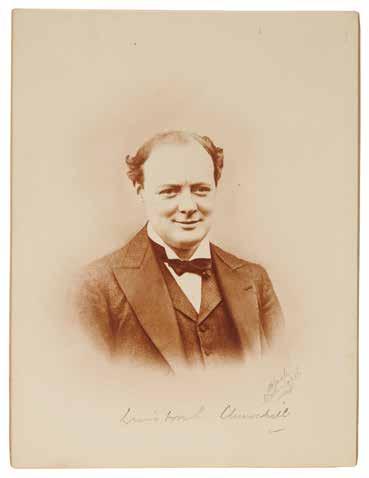
Extremely early, circa 1915, portrait of Winston Churchill by A. H. Poole of Waterford, signed for his WWI driver during his tenure as Minister of Munitions
1. Winston Churchill Rare Early Signed Photograph (c. 1915, A. H. Poole of Waterford). Early circa 1915 matte-finish 6.25 x 8.25 portrait of Churchill smiling in a fine head-and-shoulders pose by A. H. Poole of Waterford, signed across the bottom in ink, “Winston S. Churchill.” Also bears the pencil signature of the Poole studio. Flushmounted on bevelled board with studio’s printed note to verso (‘… this photograph is delicately finished by hand…’), and loosely enclosed in Poole’s original printed wrappers. In fine condition. Accompanied by a brief provenance note, indicating that this photograph was signed for Edith Nancy Bennett, who drove Churchill and Sir Arthur Duckham during the First World War. At this period, Churchill was serving as Minister of Munitions during the First World War, with Duckham acting as an industrial adviser assisting in the coordination of fuel resources and wartime production. A very rare, early portrait of Churchill; we have been unable to locate another example, either signed or unsigned. The National Library of Ireland holds Poole’s archive, including the negative of this photograph, which they, or Poole’s archive, date to February 1915.
Winston Churchill’s impact on Britain’s wartime munitions effort combined early technological foresight with later administrative effectiveness: as early as 1915, while at the Admiralty, he helped establish and fund the Landship Committee, which developed the first tank prototypes and laid the foundation for their adoption by the Army in September 1916, maintaining close involvement even while out of office. Upon his appointment as Minister of Munitions in July 1917, he assumed responsibility for overseeing the nation’s armaments production system, where he emphasized efficiency, expanded output of artillery, aircraft, and tanks, and encouraged industrial collaboration with the United States. Under his direction, the Ministry became highly productive, and by April 1918, was able to deliver twice as many guns and airplanes as had been lost in the German spring offensive while replacing tanks with newer, improved models, ensuring that British forces were better supplied during a decisive phase of the war.
Sir Arthur McDougall Duckham (1879–1932) was a pioneering British engineer and industrialist whose innovations in gas engineering, particularly the recovery of valuable byproducts such as benzol, proved of major commercial and strategic importance in the early twentieth century. During the First World War, he placed his expertise at the service of the government, rising through a succession of senior roles within the Ministry of Munitions, where he worked under Winston Churchill, who memorably praised him as ‘that gallant, ardent, generous spirit that was Arthur Duckham.’ A respected figure in both industry and public life, Duckham later became the first President of the Institution of Chemical Engineers, cementing his legacy as a leading force in the development of modern chemical engineering. Starting Bid $1000
“My heart bleeds for you”—Churchill writes to his valet’s widow from Khartoum
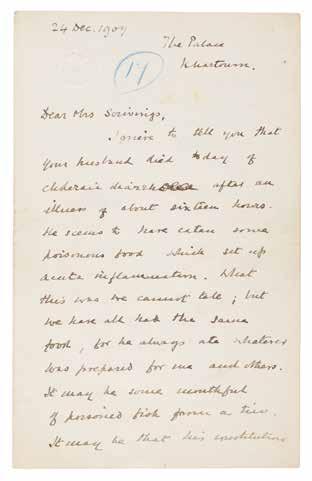
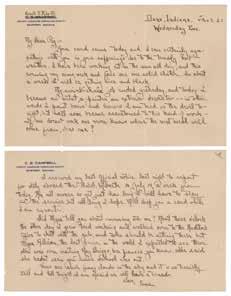
2. Winston Churchill Autograph Letter Signed on the Death of His Valet in Khartoum: “He seems to have eaten some poisonous food”. ALS signed “Winston S. Churchill,” four pages on two adjoining sheets, 5 x 8, blindstamped Colonial Office letterhead, December 24, 1907. Handwritten letter to “Mrs. Scrivings,” sent from “The Palace, Khartoum.” In part: “I grieve to tell you that your husband died today of choleraic diarrhoea after an illness of about sixteen hours. He seems to have eaten some poisonous food which set up acute inflammation. What this was we cannot tell; but we have all had the same food, for he always ate whatever was prepared for me and others. It may be some mouthful of poisoned fish from a tin. It may be that his constitution was less strong than outs, as he had not been taking any exercise, owing to a sprained ankle…He did not suffer any pain worse than a very bad attack of sickness & diarrhoea, & his end was peaceful & swift. As he had been a yeoman, he was buried with full military honours this evening. The Dublin Fusiliers carried him to his grave in the Khartoum cemetery & he now lies in that distant Soudan for which so many good Englishmen have given their lives doing their duty…My heart bleeds for you & For your poor children. It will be my duty
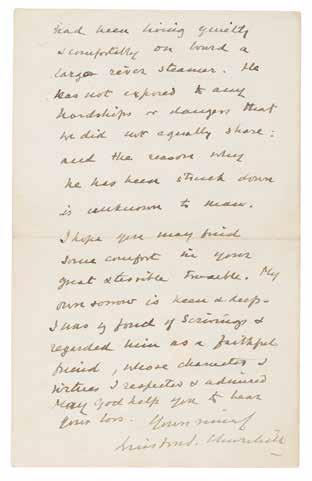
to make adequate provision for your future & their’s; & you need not worry on those matters. We will talk of them when I return. We had left the unhealthy regions of Uganda, and for ten days your husband had been living quietly & comfortably on board a large river steamer. He was not exposed to any hardships or dangers that we did not equally share…I hope you may find some comfort in your great & terrible trouble. My own sorrow is keen & deep. I was very fond of Scrivings & regarded him as a faithful friend, whose character & virtues I respected & admired. May God help you to heal your loss.” In fine condition.
Churchill wrote this letter during his tour of British East Africa and Sudan as Under-Secretary of State for the Colonies, a journey he would later chronicle in his 1908 book My African Journey. Traveling through Uganda and up the Nile in the autumn of 1907, he arrived in Khartoum in December—a city with deep personal significance, as Churchill had fought there as a young cavalry officer at the Battle of Omdurman in 1898. The death of his valet George Scrivings from contaminated food cast a tragic shadow over the final days of the expedition. Starting Bid $200
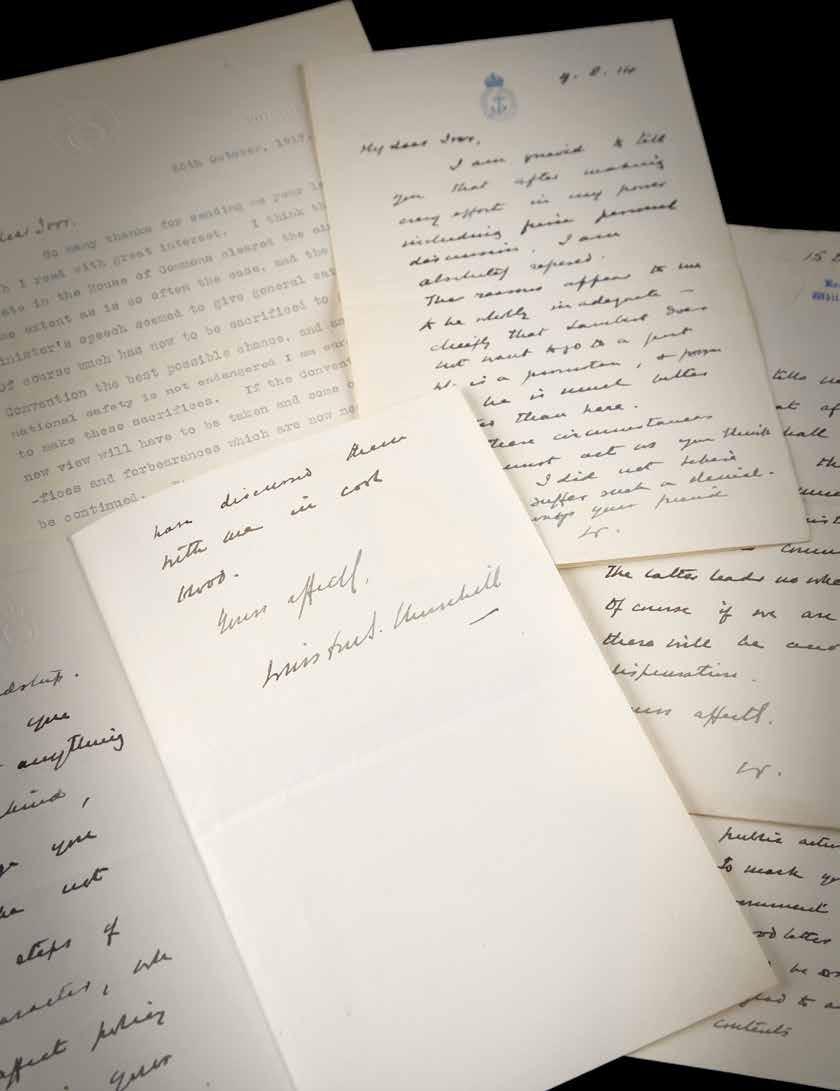
Winston Churchill urges his first cousin “not to take any steps of a public character… until at any rate you have discussed them with me in cool blood”—five “Private” and “Confidential” handwritten and typed letters from Churchill, tendering political counsel and offering insight into the 1917-1918 Irish Convention
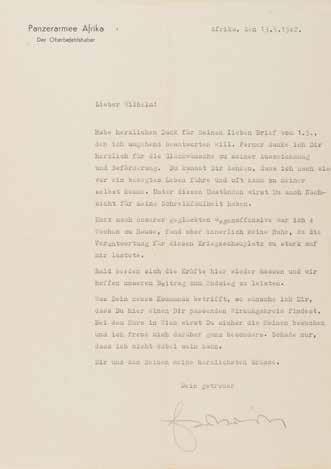
3. Winston Churchill (5) “Secret” Autograph and Typed Letters Signed, Offering Candid Political Advice to His First Cousin, with (9) Related Letters from Randolph Churchill, Alfonso XIII, and George V. World War II-dated TLS in German, signed “Erwin,” one page, 8.25 x 11.75, personal ‘Panzer Army Africa, Commander-in-Chief’ letterhead, May 13, 1942, thirteen days before he launched the Battle of Gazala, the most spectacular offensive of his career and the campaign that would culminate in the fall of Tobruk and his elevation to Generalfeldmarschall. Addressed from “Africa,” a letter to a fellow officer named “Wilhelm,” apparently a comrade from Rommel’s earlier service, who was at the time attending a course in Vienna. In full (translated): “Many heartfelt thanks for your kind letter of May 1st, which I wish to answer at once. I also thank you sincerely for your congratulations on my decoration and promotion. You can imagine that I continue to lead a very active life and often scarcely have time for myself. Under these circumstances, you will also understand my lack of diligence in writing. Shortly after our successful counteroffensive, I was at home for four weeks, but found no inner peace, as the responsibility for this theater of war weighed too heavily upon me. Soon the forces here will clash again, and we hope to make our contribution to final victory. As for your new command, I wish that you find a sphere of activity here that suits you well. During the course in Vienna, you will surely visit my family, and I am especially pleased about that. It is only a pity that I cannot be there. My warmest regards to you and your family.” In fine condition, with a partial separation to the horizontal fold.
Rommel’s letter refers to two major honors conferred in rapid succession in early 1942. On January 20th, he was awarded the Knight’s Cross of the Iron Cross with Oak Leaves and Swords, placing him among the earliest recipients of that distinction, which had only been instituted the previous July. Shortly thereafter, he launched his January counteroffensive, which reversed the setbacks of Operation Crusader and drove British forces back across Cyrenaica. Ten days later, on January 30th, Rommel was promoted to Generaloberst (Colonel General) in formal recognition of his successes commanding Panzer Army Afrika.
The letter’s most historically revealing passage describes a period of home leave taken shortly after the counteroffensive: four weeks in Germany during which Rommel confesses he found no inner peace. The weight of his command followed him home. This leave aligns with the February-March 1942 lull between the counteroffensive and the coming summer campaign and is consistent with his known visit to Hitler’s Wolf’s Lair on March 20, 1942, where the Swords were formally presented, and Rommel pressed, largely without success, for the reinforcements he believed essential for a decisive push into Egypt. Writing in mid-May, Rommel signals that a clash is imminent, noting that “soon the forces here will clash again, and we hope to make our contribution to final victory.” Within a fortnight, he would strike. The Battle of Gazala opened on May 26th, Tobruk fell on June 21st, and Hitler promoted him to Generalfeldmarschall the following day. The letter thus sits at the precise hinge point between Rommel’s two defining acts of 1942: the January counteroffensive that made his reputation undeniable and the summer offensive that made it legendary. Starting Bid $1000
“You would have been wiser to hold it under the auspices of the Free Trade League”
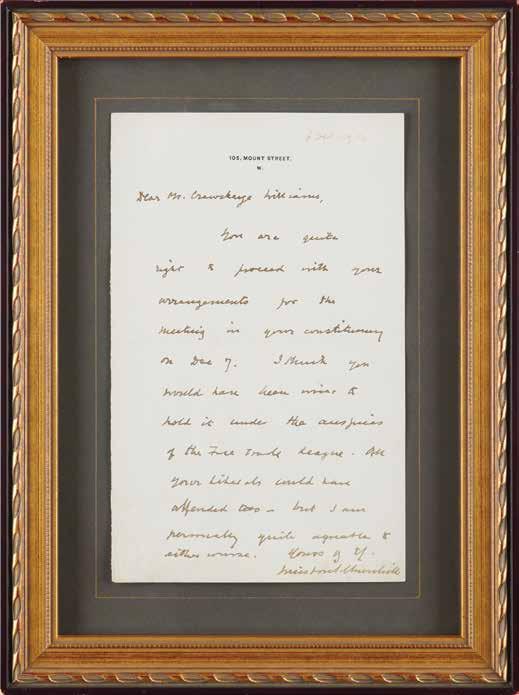
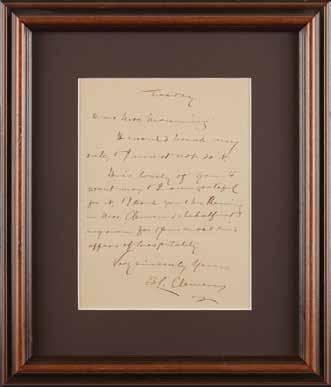
4. Winston Churchill Autograph Letter Signed: “You would have been wiser to hold it under the auspices of the Free Trade League”. ALS signed “Winston S. Churchill,” one page, 5 x 8, 105 Mount Street letterhead, October 6, 1904. Handwritten letter to “Mr. Crawshaye Williams,” in part: “You are quite right to proceed with your arrangements for the meeting in your constituency on Dec. 7. I think you would have been wiser to hold it under the auspices of the Free Trade League. All your Liberals could have attended too—but I am personally quite agreeable to either course.” Mounted, matted, and framed to an overall size of 8.75 x 12.75. In fine condition. The letter’s reference to the Free Trade League speaks directly to the defining political battle of Churchill’s early career, as he broke with his own Conservative Party over Joseph Chamberlain’s protectionist tariff reform campaign, staking his political future on the free trade cause. Starting Bid $200
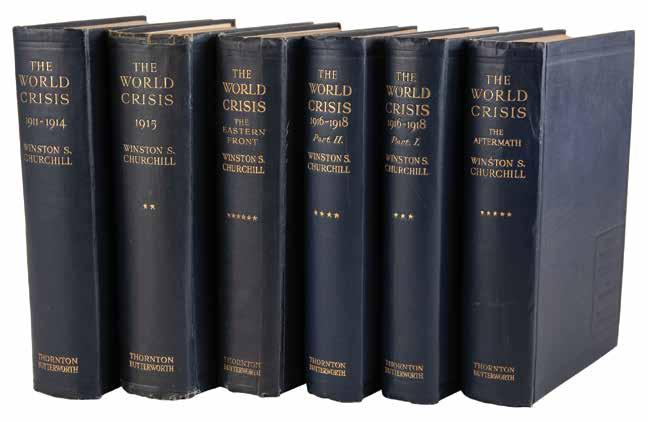
5. Winston Churchill: First Edition Set of His Magnum Opus, The World Crisis (6 Volumes). Complete first edition book set: The World Crisis, comprising five works in six volumes. First editions. London: Thornton Butterworth Limited, 1923–1931. Hardcovers bound in the publisher’s original blue cloth with gilt-lettered spines, 6.5 x 9.5, with volume titles as follows: Vol. I: 1911–1914 (536 pages), Vol. II: 1915 (557), Vol. III: 1916–1918, Part I (292), Vol. IV: 1916–1918, Part II (296). Vol. V: The Aftermath (474), and Vol. VI: The Eastern Front (368). Overall book condition: VG/None, with an errata slip tipped into Vol. IV, light mottled foxing to textblocks (mostly confined to edges and endpapers), ownership inscriptions inside Vols. II and V, some rubbing to extremities, and the tipped-in frontispiece of the final volume partially detached. Churchill’s history of the First World War is widely considered to be his magnum opus. His American biographer William Manchester wrote: ‘His masterpiece is The World Crisis, published over a period of several years, 1923 to 1931, a six-volume, 3,261-page account of the Great War, beginning with its origins in 1911 and ending with its repercussions in the 1920s. Magnificently written, it is enhanced by the presence of the author at the highest councils of war and in the trenches as a battalion commander.’ Skilled as a writer, orator, and historian, Churchill would receive the Nobel Prize in Literature in 1953 ‘for his mastery of historical and biographical description as well as for brilliant oratory in defending exalted human values.’ Starting Bid $300
Churchill warns of Britain’s dangerous unpreparedness as Nazi Germany rearms before World War II
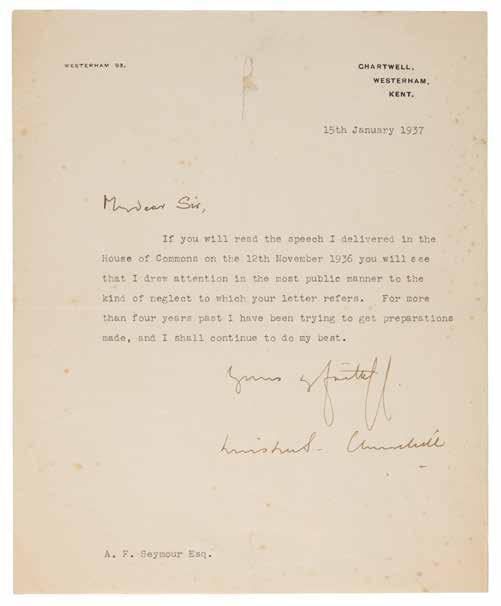
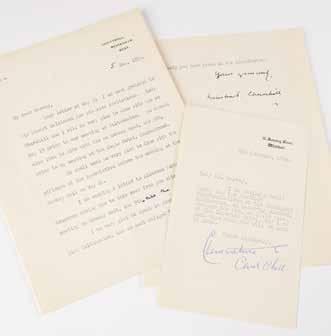
6. Winston Churchill Typed Letter Signed on Britain’s Failure to Rearm in the Face of Accelerating German Military Expansion (1937). TLS, signed “Yours faithfully, Winston S. Churchill,” one page, 8 x 9.75, Chartwell, Westerham letterhead, January 15, 1937. Letter to A. F. Seymour, with Churchill handwriting the greeting at the top, “My dear sir.” In full: “If you will read the speech I delivered in the House of Commons on the 12th November 1936 you will see that I drew attention in the most public manner to the kind of neglect to which your letter refers. For more than four years past I have been trying to get preparations made, and I shall continue to do my best.” In very good to fine condition, with scattered light foxing, and a repaired tear to the top center.
Churchill’s referenced House of Commons speech—where he had “drawn attention in the most public manner to the kind of neglect” mentioned in Seymour’s letter— was a forceful warning to Great Britain. In it, he urged the nation to stop ignoring the rapid growth and increasingly aggressive posture of Germany’s military power, asserting that ‘from the beginning of 1933, when Herr Hitler came into power, it was general public knowledge in this country that serious rearmament had begun in Germany….Owing to past neglect, in the face of the plainest warnings, we have now entered upon a period of danger…The era of procrastination, of half-measures, of soothing and baffling expedients, of delays, is coming to its close. In its place we are entering a period of consequences.’ Despite Churchill’s best efforts “to get preparations made,” the United Kingdom would soon face incredible hardships in the face of Nazi tyranny. Insightful content from the man whose leadership during World War II proved invaluable. Starting Bid $1000
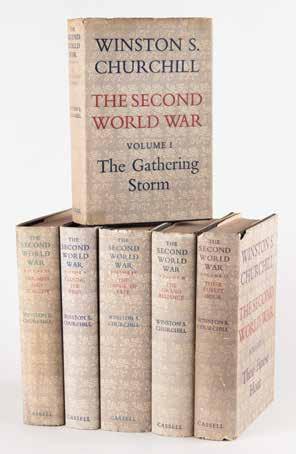
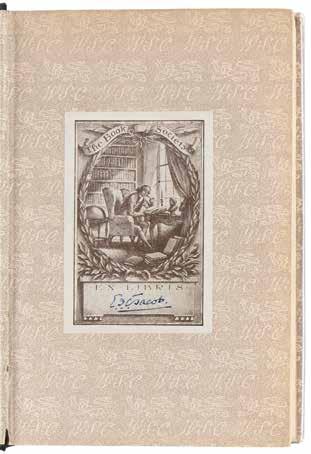
8. Winston Churchill: First Edition Set of The Second World War (6 Volumes), Signed by His Military Assistant Secretary Ian Jacob. Desirable book set: The Second World War, Volumes I-VI. First editions. London: Cassell and Co. Ltd., 1948-1954. Hardcovers with dust jackets, 6 x 8.5, with volume titles as follows: The Gathering Storm (640 pages), Their Finest Hour (684), The Grand Alliance (818), The Hinge of Fate (917), Closing the Ring (673), and Triumph and Tragedy (716). Signed on a bookplate affixed to the first free end page of Vol. I in fountain pen by Lieutenant General Sir Edward Ian Claud Jacob, “E. I. C. Jacob.” Known as Ian Jacob (1899–1993), he served as the Military Assistant Secretary to Winston Churchill’s war cabinet and was later a distinguished BBC broadcasting executive. Loosely laid into Vol. V are a “With the Compliments of the Author” slip and a facsimile Churchill signature. Overall book condition: VG/VG-, with some toned tape repairs and sunning to the jacket of Vol. I, and mottled foxing to textblock edges.
As Britain’s prime minister for most of the Second World War, Winston Churchill had an unparalleled perspective on the conflict. After leaving office in 1945, he produced this remarkable account, which holds a very high place in the ranks of nonfiction books of the 20th century. The comprehensive series was a major success in both Great Britain and the United States, and was largely responsible for his being awarded the 1953 Nobel Prize for Literature ‘for his mastery of historical and biographical description as well as for brilliant oratory in defending exalted human values.’ Starting Bid $200
Churchill drafts his epic History of the English-Speaking Peoples, documenting the 17th-century “rivalry of England & Holland upon the seas”
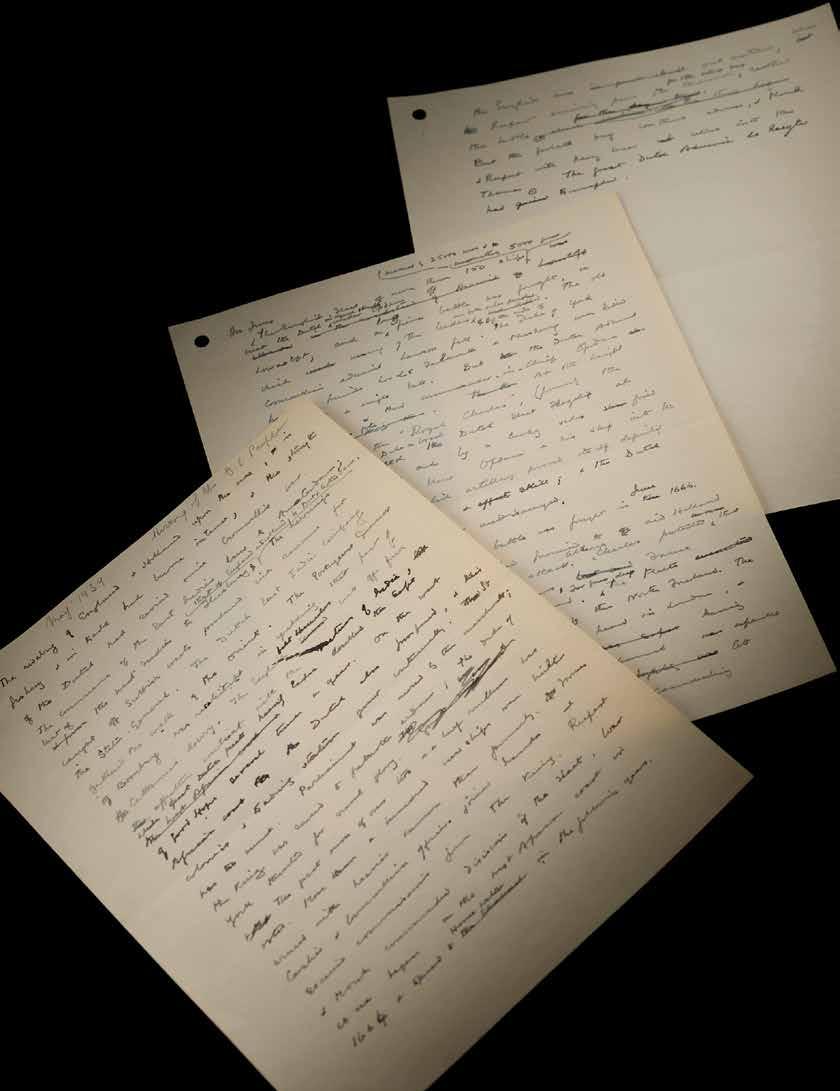
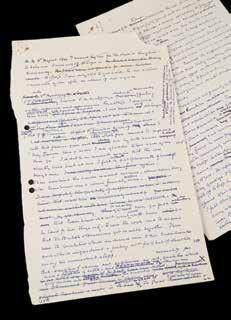
7. Winston Churchill Handwritten Working Draft for A History of the English-Speaking Peoples, Documenting the “rivalry of England & Holland upon the seas”. Three pages of Winston Churchill’s original handwritten working draft of his epic four-volume A History of the EnglishSpeaking Peoples, 8 x 10, identified and dated at the head in pencil by Churchill’s secretary Kathleen Hill, “May 1939, History of the E. S. People.”
In this passage, Churchill focuses on the Anglo-Dutch rivalry of the 1660s, beginning: “The rivalry of England & Holland upon the seas, in fishing & in trade had become intense, & the strength of the Dutch had revived since Cromwell’s war. The commerce of the East Indies drew to Amsterdam; that of the West Indies to Flushing; that of England & Scotland to Dort & Rotterdam. The herrings caught off Scottish coasts produced rich revenues for the States-General. The Dutch East India Company gathered the wealth of the Orient. The Portuguese Governor of Bombay was recalcitrant in yielding that part of Catherine’s dowry….
On the West African coast the Dutch also prospered, & their colonies & trading stations grew continually. It was too much. Parliament was moved by the merchants; the King was roused to patriotic ardour; the Duke of York thirsted for naval glory… More than a hundred new ships were built, armed with heavier cannon than previously. Former Cavalier & Cromwellian officers joined hands & received commissions from the King. Rupert & Monk commanded divisions of the Fleet. War at sea began on the West African coast in 1664, and spread to home waters in the following year.
In June the English fleet of more than 150 ships, manned by 25,000 men & mounting 5,000 guns, met the Dutch in equal strength off Lowestoft, and a long, fierce battle was fought, in which many of the leaders on both sides perished…
An even larger battle was fought in June 1666. Louis XIV had promised to aid Holland if she were the victim of attack. Although Charles protested that the Dutch were the aggressors, France declared war upon England. For four days the English and Dutch fleets battled off the North Foreland. The sound of the guns was heard in London…
The English were out matched, when Rupert arriving from the Channel for the third day, restored the battle. But the fourth day continued adverse, & Monk & Rupert with heavy losses retired into the Thames. The great Dutch Admiral de Ruyter had triumphed.” Churchill makes several revisions and corrections throughout the text. In fine condition.
Skilled as a writer, orator, and historian, Churchill would receive the Nobel Prize in Literature in 1953 ‘for his mastery of historical and biographical description as well as for brilliant oratory in defending exalted human values.’ These working manuscript pages come from one of Churchill’s most ambitious and longgestating literary projects. A History of the English-Speaking Peoples was primarily conceived and largely written during his ‘wilderness years’ in the late 1930s, heavily interrupted by World War II, and finally published between 1956 and 1958. The ambitious, comprehensive work covers the period from the Roman conquest of Britain in 55 B.C. to the beginning of the First World War. Starting Bid $1000
Churchill writes to De Gaulle, reflecting on their wartime alliance:
“All that we were able to achieve is now plunged in the greatest peril I have ever known”
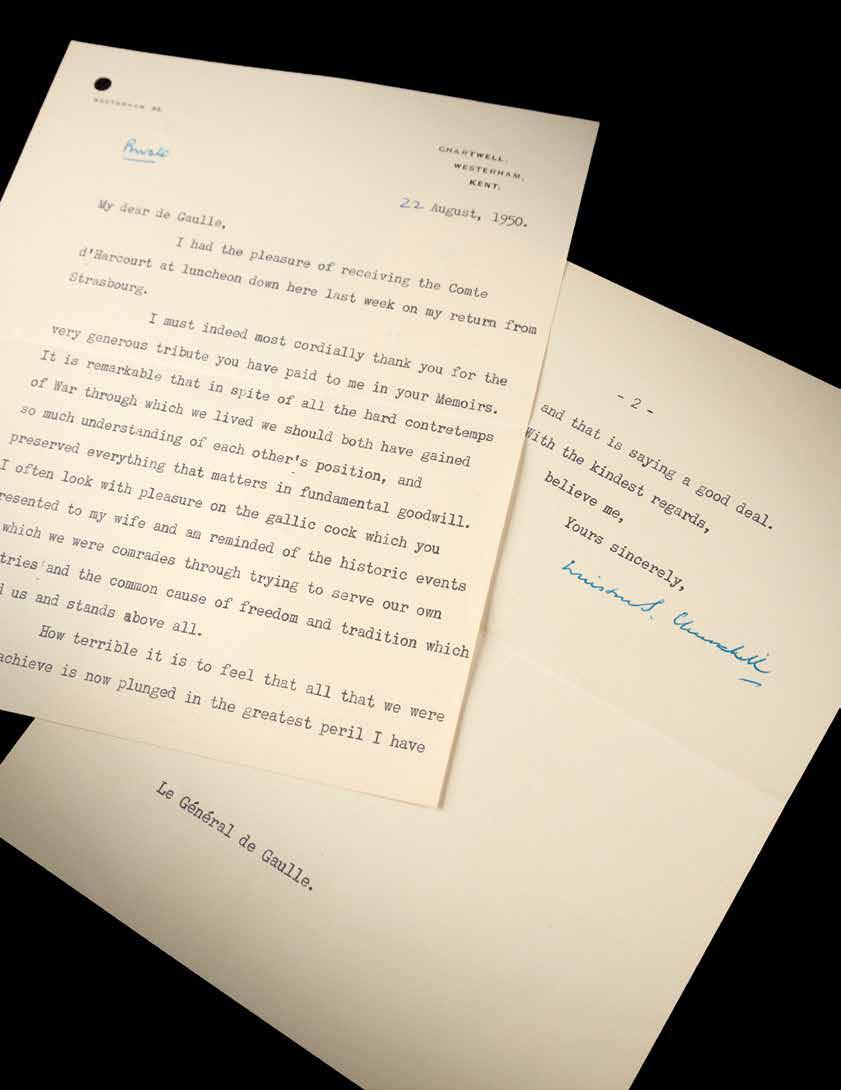
9. Winston Churchill Typed Letter Signed to Charles de Gaulle on Their Wartime Alliance and “the greatest peril I have ever known”. TLS, signed “Winston S. Churchill,” two pages, 7.5 x 9.5, Chartwell letterhead, August 22, 1950. Letter to Charles de Gaulle, marked “Private,” in full: “I had the pleasure of receiving the Comte d’Harcourt at luncheon down here last week on my return from Strasbourg.
I must indeed most cordially thank you for the very generous tribute you have paid to me in your Memoirs. It is remarkable that in spite of all the hard contretemps of War through which we lived we should both have gained so much understanding of each other’s position, and preserved everything that matters in fundamental goodwill. I often look with pleasure on the gallic cock which you presented to my wife and am reminded of the historic events in which we were comrades through trying to serve our own countries and the common cause of freedom and tradition which united us and stands above all.
How terrible it is to feel that all that we were able to achieve is now plunged in the greatest peril I have ever known, and that is saying a good deal.” In fine condition, with a single file hole to the upper left corner.
The relationship between Winston Churchill and Charles de Gaulle was one of the most consequential—and at times fraught—alliances of the Second World War. When France fell to Nazi Germany in 1940, Churchill became one of the earliest and most important supporters of de Gaulle, recognizing him as the leader of the Free French forces despite his
limited authority and uncertain standing. Broadcasting from London, de Gaulle rallied French resistance with Churchill’s backing, and the two men worked together to sustain the idea of a sovereign France continuing the fight alongside Britain. Churchill’s support was instrumental in giving de Gaulle both legitimacy and a platform during the war’s darkest early years.
Yet their partnership was never without tension. Both men were fiercely independent, deeply patriotic, and determined to defend their nations’ interests, which often led to clashes over strategy, authority, and France’s postwar role. Churchill sometimes found de Gaulle obstinate and unyielding, while de Gaulle viewed British (and especially American) leadership with suspicion, fearing France would be sidelined. Despite these disagreements—what Churchill diplomatically refers to here as “hard contretemps of War”—the two leaders maintained a mutual respect rooted in their shared resistance to Nazi domination and their commitment to national honor.
By 1950, when this letter was written, both men were reflecting on their wartime experiences with a sense of hard-earned perspective. Churchill’s remarks capture the paradox of their relationship: enduring disagreements tempered by “fundamental goodwill,” and a recognition that their joint efforts had served a larger cause beyond personal or political differences. His closing note of concern underscores the anxieties of the early Cold War era, suggesting that the fragile peace they helped secure was already under threat—lending the letter an added layer of historical poignancy. Starting Bid $5000
10. Winston Churchill Typed Letter Signed: “Am most obliged to you for all the help you have given in the Constituency”. TLS signed “Yours sincerely, Winston S. Churchill,” two pages, 7.5 x 9.5, Chartwell letterhead, May 5, 1955. Letter to John E. Harvey, in full: “Your letter of May 3: I am most grateful to Sir Stuart Mallinson for his kind invitations. Lady Churchill and I will be very glad to dine with him on May 19 prior to our meeting at Walthamstow. We should also like to dine with him on Monday next, the 9th, prior to my meeting at the Eagle Hotel, Snaresbrook. We shall both be very glad to dine with the officers of the Association before the meeting at the Hawkey Hall on May 16.
I am sending a letter to Alderman Forbes tomorrow asking him to take over from you after our meeting on Monday next, the 9th till the 26th. I am very glad to speak in your support at East Walthamstow, and am most obliged to you for all the help you have given in the Constituency.” In fine condition. Accompanied by a TLS to Harvey by Clementine Churchill, inviting him to a “small party for the Woodford representatives.” Also includes a full letter of authenticity from PSA/DNA for Winston Churchill’s autograph. Starting Bid $200
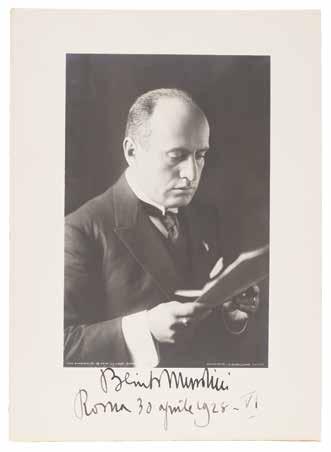
14. Benito Mussolini Signed Photograph. Vintage mattefinish 8 x 11 photo of Mussolini by Pandimiglio of Rome, boldly signed in the lower border in fountain pen, “Benito Mussolini, Roma 30 aprile 1928—VI.” Affixed to a same-size mount and in very fine condition. Accompanied by a full letter of authenticity from JSA. Starting Bid $200
Mussolini
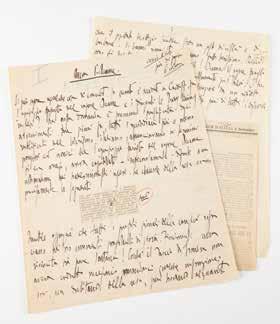
defends the Fascist movement in an early propaganda piece: “When the English went on board the Accame, instead of finding pirates, and found authentic sailors, real workers”
15. Benito Mussolini Handwritten Manuscript for His Fascist Newspaper, Il Popolo d’Italia - Weeks Before His March on Rome and Rise to Power. Unsigned handwritten manuscript in Italian by Benito Mussolini, three pages, 9 x 11, being his draft of a piece published in the Italian newspaper ‘Il Popolo d’Italia’ on September 6, 1922. Headed “The Accame Again,” the manuscript full text is available online at www.RRAuction.com. In fine condition. Drafted just weeks before Mussolini’s March on Rome and the collapse of Italy’s liberal government, this manuscript captures the Fascist leader at a pivotal moment in his rise to power in 1922. Written for Il Popolo d’Italia—the newspaper Mussolini founded and used as the chief propaganda organ of the Fascist movement—the piece reflects his effort to portray Fascism not as a lawless militia movement, but as a disciplined nationalist force defending Italian workers and prestige against socialism and foreign interference. The controversy surrounding the steamship Emanuele Accame emerged amid escalating clashes between Fascists and organized labor, with British trade unionists threatening action against a Fascist-aligned Italian crew. Mussolini seizes on the incident to attack the press, ridicule labor organizations, and frame the ultimate British decision not to boycott the ship as an international vindication of Fascism. The manuscript is especially revealing for its aggressive rhetoric and political messaging, illustrating how Mussolini used journalism as a weapon in consolidating support during the volatile final months before he became Prime Minister of Italy. From the personal collection of a lifelong collector, teacher, and traveler with a passion for world history. His collecting years ranged from the 1970s to the present day, meaning that several of the premier pieces have not been on the market in decades. Starting Bid $200
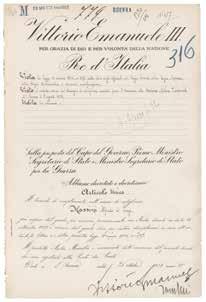
16. Benito Mussolini and Vittorio Emanuele III Document SignedRemoving an Officer’s Rank for Disciplinary Reasons. Manuscript DS in Italian, signed “Mussolini” and “Vittorio Emanuele,” one page, 9.75 x 14.5, October 25, 1928. Royal decree issued from San Rossore removing a reserve artillery officer from rank for disciplinary reasons. In part (translated): “On the proposal of the Head of Government, Prime Minister, Secretary of State, and Minister Secretary of State for War, We have decreed and do decree: Sole Article—Second Lieutenant of the reserve, in the artillery branch, Massini Alfredo of Luigi…is removed from his rank for disciplinary reasons.” The decree notes his prior suspension by order dated September 16, 1928, and cites Article 7 of the law of March 11, 1926. Boldly signed at the conclusion in ink by Benito Mussolini and King Vittorio Emanuele III. In very good to fine condition, with creasing, and small binding slits, to the edges. From the personal collection of a lifelong collector, teacher, and traveler with a passion for world history. His collecting years ranged from the 1970s to the present day, meaning that several of the premier pieces have not been on the market in decades. Starting Bid $200
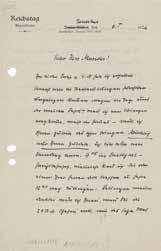
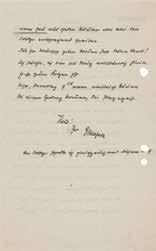
17. Gregor Strasser Autograph Letter Signed. German politician and early leader of the Nazi Party (1892-1934), who, along with his younger brother Otto, was a leading member of the party’s left-wing faction, which brought them into conflict with the dominant faction led by Adolf Hitler, resulting in Gregor’s murder in 1934. The brothers’ strand of the Nazi ideology is known as Strasserism. ALS in German, signed “Gr. Strasser,” one page both sides, 5.5 x 9, Reichstag letterhead, January 8, 1926. Untranslated handwritten letter to Eugen Munder, thanking him for his support and emphasizes the importance of perseverance and solidarity in the face of ongoing struggles. He notes that despite a recent mishap that has temporarily confined him, he remains committed to his work and hopes to meet again soon. In fine condition, with file holes to the left edge. From the personal collection of a lifelong collector, teacher, and traveler with a passion for world history. His collecting years ranged from the 1970s to the present day, meaning that several of the premier pieces have not been on the market in decades. Starting Bid $200
“In order not to succumb in what is often such an ugly little struggle with ugly little people, one must have the awareness that others stand at one’s side”
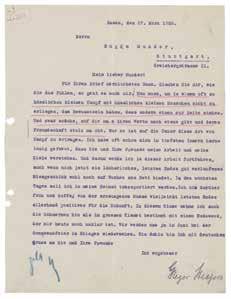
18. Gregor Strasser Typed Letter Signed, Reflecting on “an ugly little struggle with ugly little people”. German politician and early leader of the Nazi Party (1892-1934), who, along with his younger brother Otto, was a leading member of the party’s left-wing faction, which brought them into conflict with the dominant faction led by Adolf Hitler, resulting in Gregor’s murder in 1934. The brothers’ strand of the Nazi ideology is known as Strasserism. TLS in German,, one page, 8.5 x 11, March 17, 1926. Addressed from Essen, a letter to Eugen Munder, in full (translated): “My warmest thanks for your letter. Believe me, just as you feel it, so do I. In order not to succumb in what is often such an ugly little struggle with ugly little people, one must have the awareness that others stand at one’s side, indeed, people whose worth one values and whose friendship inspires pride. Only in this way can this kind of struggle be endured in the long run.
I have often felt deep, heartfelt satisfaction that you and your friends understand my work and my goals. And therefore I will continue in this work, even though a rather ridiculous mishap, though it ultimately turned out well, will probably keep me confined to bed for weeks. In the coming days I am to be transported back to my home. I am glad of this and hope that this enforced rest may, in the end, yield something positive for the future.
In this spirit, I also accept the pain as something determined in the greater scheme, Kismet, with a final purpose that is still unclear to me today. We shall see each other again in June at the midsummer celebration in Ebingen. Until then, I remain, with German greetings to you and your friends.” In fine condition, with file holes to the left edge. From the personal collection of a lifelong collector, teacher, and traveler with a passion for world history. His collecting years ranged from the 1970s to the present day, meaning that several of the premier pieces have not been on the market in decades. Starting Bid $200
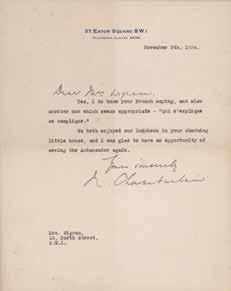
19. Neville Chamberlain Typed Letter Signed to Ava Wigram, a Prominent Political Hostess. TLS signed “Yours sincerely, N. Chamberlain,” one page, 8 x 10, 37 Eaton Square letterhead, November 5, 1934. Letter to Ava Wigram, written while serving as Chancellor of the Exchequer under Stanley Baldwin, during a period of economic recovery and growing concern over European instability. In full: “Yes, I do know your French saying, and also another one which seems appropriate – ‘Qui s’explique se complique.’ [‘The more you explain, the more you complicate things’] We both enjoyed our luncheon in your charming little house, and I was glad to have an opportunity of seeing the Ambassador again.” Chamberlain adds the salutation in his own hand. In fine condition, with faint toning to the upper left quadrant.
Ava Anderson, Viscountess Waverley (née Bodley; formerly Wigram, 1895-1974), was a prominent English political hostess central to government circles during World War II, noted by Winston Churchill for her ‘contact with gt: affairs.’ She was first married to Foreign Office official Ralph Follett Wigram (1890–1936), later described by Churchill as a ‘great unsung hero’ for exposing German rearmament, and subsequently to John Anderson, 1st Viscount Waverley, a senior War Cabinet member and Home Secretary for whom the Anderson air-raid shelters are named. From the personal collection of a lifelong collector, teacher, and traveler with a passion for world history. His collecting years ranged from the 1970s to the present day, meaning that several of the premier pieces have not been on the market in decades. Starting Bid $200
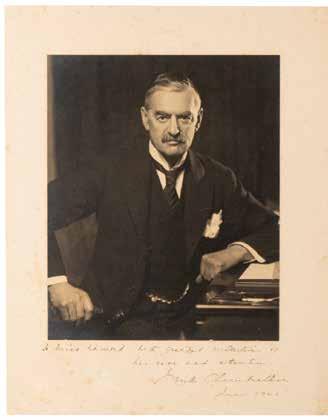
20. Neville and Anne Chamberlain (2) Signed Photographs. British politician (1869–1940) who served as prime minister from 1937 to 1940, and is remembered for his foreign policy of appeasement toward Nazi Germany; by signing the Munich Agreement in 1938, he allowed Hitler to annex Czechoslovakia’s Sudetenland in what is now recognized as one of the major early steps toward World War II.Vintage matte-finish 7 x 8.75 photo of Prime Minister Neville Chamberlain in a suit and tie, affixed to its original 10 x 12.5 mount, signed and inscribed on the mount in fountain pen, “To Miss Lamont, with grateful recollections of her care and attention, Neville Chamberlain, June 1940,” shortly after his resignation as prime minister on May 10, 1940. Accompanied by an unmounted 7 x 9 example of the same portrait, signed on the reverse in fountain pen by his wife, “Taken at 10 Downing St. on March 10th 1938, Anne Chamberlain,” identifying the date and location of the original sitting. In very good to fine condition, with scattered light foxing and staining, and a small area of border surface loss, to the Neville-signed portrait. Starting Bid $200
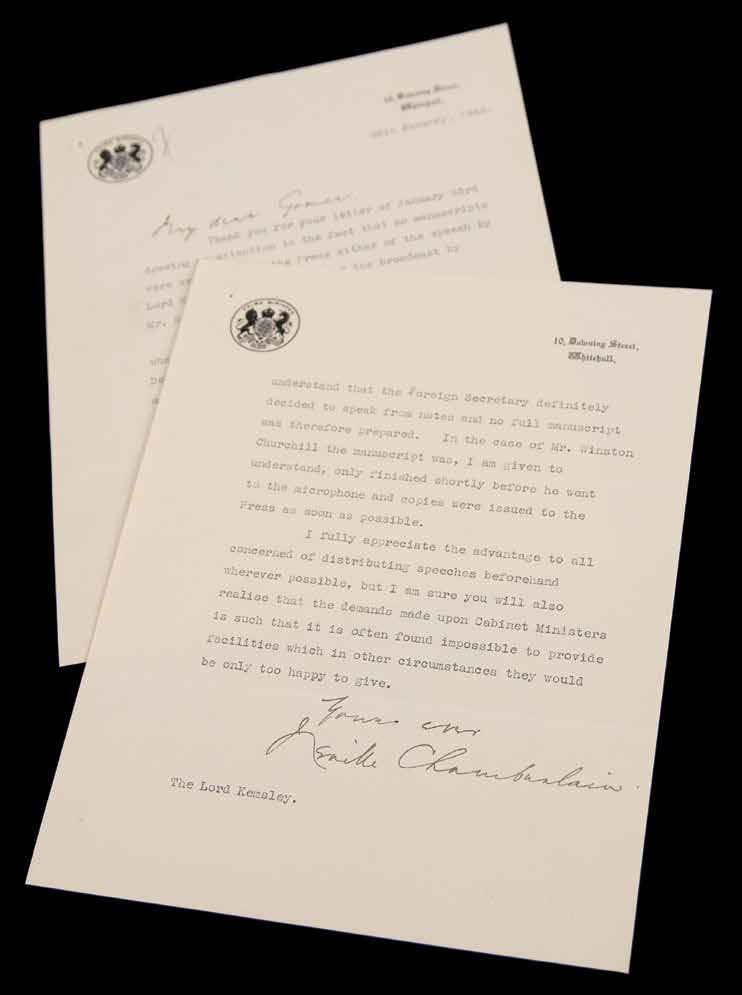
Prime Minister Chamberlain refers to Churchill’s famous ‘House of Many Mansions’ address at the outset of WWII: “In the case of Mr. Winston Churchill the manuscript was, I am given to understand, only finished shortly before he went to the microphone”
21. Neville Chamberlain WWII-Dated Typed Letter
Signed on Churchill’s ‘House of Many Mansions’ Address. World War II–dated TLS signed “Yours ever, Neville Chamberlain,” two pages, 7.5 x 9.5, Prime Minister, 10 Downing Street letterhead, January 25, 1940. Letter to newspaper publisher Gomer Berry, 1st Viscount Kemsley, referring to Winston Churchill’s famous ‘House of Many Mansions’ speech. In full: “Thank you for your letter of January 23rd drawing my attention to the fact that no manuscripts were available for the Press either of the speech by Lord Halifax on Saturday or of the broadcast by Mr. Winston Churchill on Saturday night.
I know you will appreciate the fact that wherever possible the Ministers concerned or their Departments do their best to provide the Press with manuscripts, knowing full well the difficulties under which newspapers are produced in these days. At the same time, I am sure you will fully sympathise with Ministers when, on occasion, it is found physically impossible to render this service, and also when, in some circumstances, the speaker himself decides to speak from notes rather than from a fully prepared document.
As regards Lord Halifax’s speech, I understand that the Foreign Secretary definitely decided to speak from notes and no full manuscript was therefore prepared. In the case of Mr. Winston Churchill the manuscript was, I am given to understand, only finished shortly before he went to the microphone and copies were issued to the Press as soon as possible.
I fully appreciate the advantage to all concerned of distributing speeches beforehand wherever possible, but I am sure you will also realise that the demands made upon Cabinet Ministers is such that it is often found impossible to provide facilities which in other circumstances they would be only too happy to give.” In fine condition.
Chamberlain refers to Winston Churchill’s speech of January 20, 1940, known as the ‘House of Many Mansions’ address, which was broadcast from London during the early months of World War II. Speaking as First Lord of the Admiralty, Churchill framed the conflict not merely as a military contest, but placed it in stark moral terms. He painted a grim picture of the plight of small neutral nations: ‘Every one of them is wondering which will be the next victim on whom the criminal adventurers of Berlin will cast their rending stroke.’ He hailed Finland’s resistance to Russian invasion as a spotlight on the rot of totalitarian regimes: ‘Everyone can see how Communism rots the soul of a nation; how it makes it abject and hungry in peace, and proves it base and abominable in war.’ Churchill warned that if Britain and France were to capitulate, ‘nothing would remain for the smaller States of Europe…but to be divided between the opposite, though similar, barbarisms of Nazidom and Bolshevism.’
Yet he ended on a note of hope. Churchill foresaw a time when ‘victorious nations…will plan and build in justice, in tradition, and in freedom a house of many mansions where there will be room for all.’ In doing so, Churchill situated the war not as an isolated British struggle but as a fight for the very idea of civilization, whose outcome would determine whether a pluralistic Europe could survive.
Churchill, whose famous oratory strengthened British resolve in the face of Nazi terror, would soon supplant Chamberlain as prime minister. On May 10, 1940, Chamberlain resigned following growing criticism of his failed policy of appeasement and the disastrous Allied campaign in Norway. As Germany launched its invasion of France and the Low Countries that same day, King George VI turned to Winston Churchill to form a new government. Churchill, long a critic of appeasement, was seen as the leader best suited to rally the nation in its darkest hour, declaring upon taking office that he had nothing to offer but ‘blood, toil, tears, and sweat.’ Starting Bid $1000
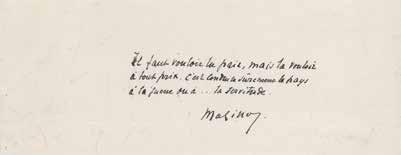
22. Andre Maginot Autograph Quote Signed - “To desire peace at any price will surely bring the country to war”. French civil servant, soldier, and Member of Parliament (1877-1932), most notably remembered for the formation of the Maginot Line after WWI, which comprised a series of permanent concrete forts and field positions along France’s border with Germany. Scarce AQS in French signed “Maginot,” handwritten on an off-white 11.5 x 4.5 sheet, which reads, in full (translated): “It is important to desire peace, but to desire peace at any price will surely bring the country to war…or to servitude.” In fine condition, with a horizontal fold under the signature.
After Maginot persuaded Parliament to contribute 3.3 billion francs for his envisioned line of defense in 1930, he took ill at the end of December 1931 and passed away weeks later, never seeing the completion of his lofty goal. During WWII, the Germans would prove a more foreboding adversary than the fortress could withstand, circumventing the line through hills and marshlands that had been formerly impenetrable. From the personal collection of a lifelong collector, teacher, and traveler with a passion for world history. His collecting years ranged from the 1970s to the present day, meaning that several of the premier pieces have not been on the market in decades. Starting Bid $200
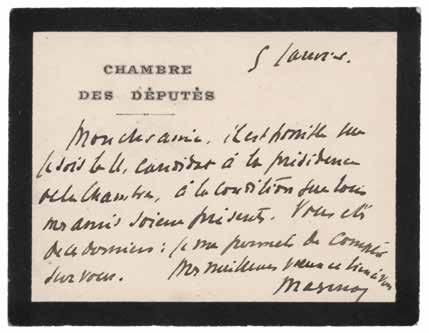
23. Andre Maginot Autograph Letter
Signed - “I take the liberty of counting on you”. ALS in French, signed “Maginot,” one black-bordered page, 4 x 3.25, Chamber of Deputies stationery card, January 5, [1927]. Handwritten letter to a friend, pertaining to Maginot’s 1927 bid to win the presidency of the Chamber of Deputies, which he lost to Fernand Bouisson on January 11th. In part (translated): “It is possible that I will be a candidate to the presidency of the Chamber on the 11th, provided that all my friends are present. You are one of them: I take the liberty of counting on you.” In fine condition.
Maginot began his political career in the Chamber of Deputies in 1910. Recognized for his valor while stationed at the front in his native Lorraine during World War I, Maginot returned to politics after the war, and, as minister of war from 1922-1924, advocated for increased spending to defend France, arguing that the Treaty of Versailles did not offer adequate protection against the possibility of future German aggression.
With the Senate and Chamber of Deputies’ agreement on a budget on April 29, 1926, Maginot finally obtained government funding to construct a series of fortifications, which came to be known as the Maginot Line, comprising mostly concrete structures impervious to aerial attacks. The Maginot Line, however, failed to prevent Germany’s 1940 invasion of France, as the Wehrmacht circumvented it to the north and invaded France through the Ardennes Forest and the Low Countries. From the personal collection of a lifelong collector, teacher, and traveler with a passion for world history. His collecting years ranged from the 1970s to the present day, meaning that several of the premier pieces have not been on the market in decades. Starting Bid $200
Keynes rejects a propaganda role with the ‘Nordische Gesellschaft’
24. John Maynard Keynes
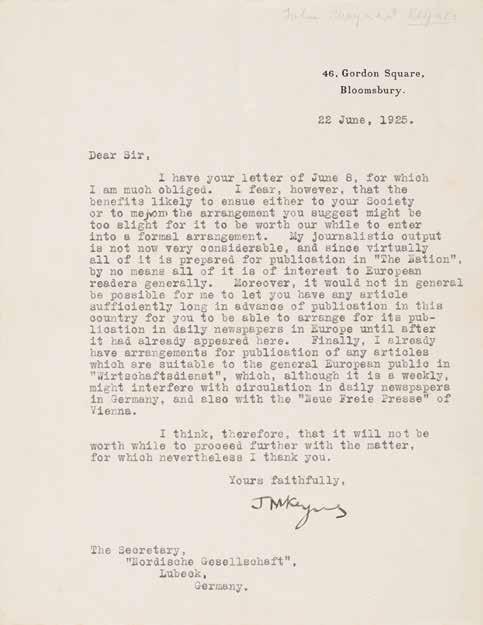
Typed Letter Signed, Rejecting a Propaganda Role with the ‘Nordische Gesellschaft’. Highly influential British economist (1883–1946) who was the chief British representative at the 1944 Bretton Woods conference that established the International Monetary Fund. TLS signed “J. M. Keynes,” one page, 7 x 9, 46 Gordon Square letterhead, June 22, 1925. Letter to the secretary of the Nordische Gesellschaft (Nordic Society) in Lübeck, replying to an invitation to participate in the economic propaganda of the society, whose purpose was to reinforce cultural and political co-operation between Germanic and Scandinavian countries. The Nordische Gesellschaft would later become a central institution for Alfred Rosenberg, theorist and ideologue of the Nazi government; Heinrich Himmler was a member of the board of directors.
In part: “I have your letter of June 8, for which I am much obliged. I fear, however, that the benefits likely to ensue either to your Society or to me from the arrangement you suggest might be too slight for it to be worth our while to enter into a formal arrangement. My journalistic output is not now very considerable, and since virtually all of it is prepared for publication in ‘The Nation,’ by no means all of it is of interest to European readers generally. Moreover, it would not in general be possible for me to let you have any article sufficiently long in advance of publication in this country for you to be able to arrange for its publication in daily newspapers in Europe until after it had already appeared here. Finally, I already have arrangements for publication of any articles which are suitable to the general European public in ‘Wirtschaftsdienst’, which, although it is a weekly, might interfere with circulation in daily newspapers in Germany, and also with the ‘Neue Freie Presse’ of Vienna.” In fine condition, with some extremely faint foxing. Starting Bid $500
De Gaulle prepares to lead
the
French resistance while exiled in London:
“I hope for France’s sake and for your sake, General, that you will be able to escape disaster, reach overseas France and continue the war. At the moment, there is no armistice that would be honourable”
25. Charles de Gaulle WWII-Dated Autograph Letter
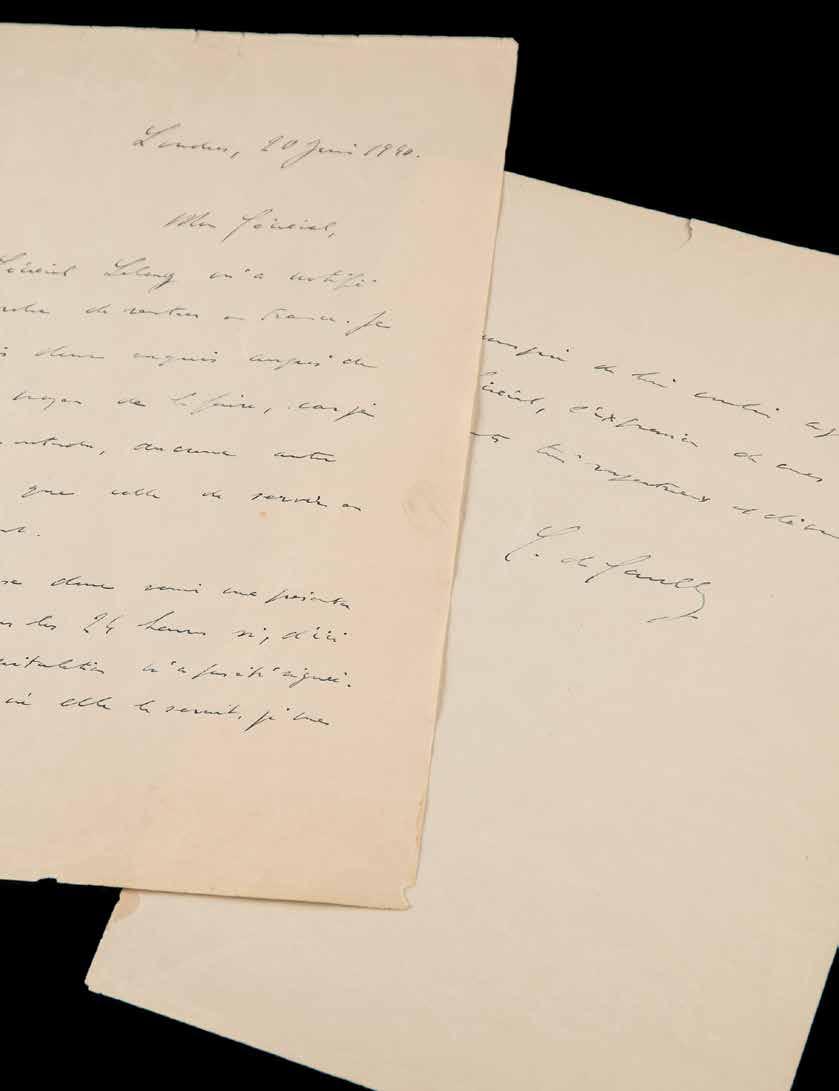
Signed to Gen. Weygand, from Exile in London on June 20, 1940: “I shall join any French resistance movement that may be organised”. World War II–dated ALS in French, signed “C. de Gaulle,” four pages on two sheets, 9 x 12.5, June 20, 1940. Handwritten letter to French General Maxime Weygand, penned just after de Gaulle arrived in London as he began to organize what would be the Free French. Weygand was the newly appointed Minister of National Defence in what would become the Vichy government in July 1940. Weygand, cleverly using de Gaulle’s old classmate General Pierre Lelong as an intermediary, had sent de Gaulle a message saying he must return to Paris or otherwise be considered a treasonous deserter from the (Vichy) French army.
In his reply, de Gaulle writes that he will gladly return to Paris on the condition that the French government continue its fight against Nazi tyranny. Should the Petain government surrender, de Gaulle threatens to continue to fight the Germans from exile. The timing is highly significant: de Gaulle had given his ‘Appeal of 18 June’ two days earlier, marking the beginning of the French Resistance, and here he lays out his philosophy for what would become the Free French movement. With this letter, de Gaulle is also effectively signing his own death warrant with the Petain government: Vichy tried de Gaulle in absentia and sentenced him to death for treason on August 2, 1940.
In full (translated): “General Lelong has informed me of your order to return to France. I have therefore enquired of him how to do so, as I have, of course, no other resolution than that
of serving in combat. I therefore intend to come and present myself to you within 24 hours if, by then, the capitulation has not been signed.
In the event that it is, I shall join any French resistance movement that may be organised. In London in particular, there are military elements, and no doubt others will come who are determined to fight, whatever happens in France. I feel I must tell you very simply that I hope for France’s sake and for your sake, General, that you will be able to escape disaster, reach overseas France and continue the war. At the moment, there is no armistice that would be honourable.
I would add that my personal relations with the British government, and in particular with Mr. Churchill, could enable me to be useful to you and to any other high French personality who would like to put himself at the head of the continued French resistance. Please accept, General, the expression of my most respectful and devoted feelings.” In fine condition, with light creasing, and some small edge tears and chips.
De Gaulle would make good on his threat. The Petain government surrendered in the Armistice of 22 June 1940, and de Gaulle remained in England to establish a government-in-exile while supporting the resistance in Nazi-occupied France. De Gaulle’s Free French Forces joined the Allied nations in their fight against the Axis powers, serving in essentially every major campaign from North Africa to Indochina and making substantial contributions to the liberation of France, and, ultimately, the victory of the Allies in World War II. Starting Bid $1000
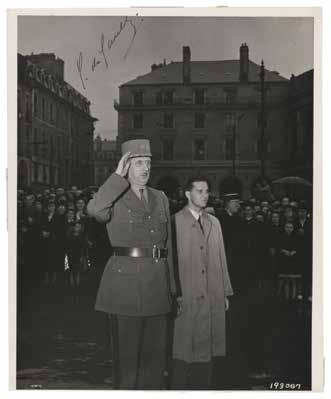
26. Charles de Gaulle Signed Photograph. Dramatic vintage matte-finish 8 x 9.75 photo of Gen. Charles de Gaulle saluting in the town square of Rennes, France, on August 21, 1944, signed in fountain pen, “C. de Gaulle.” Reverse bears a U.S. Army credit stamp and caption. In fine condition, with a trimmed bottom border, and light silvering to the perimeter of the image. Starting Bid $200
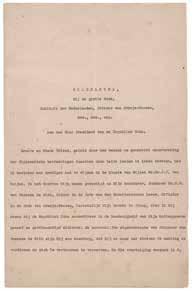
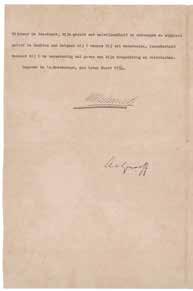
28. Queen Wilhelmina Document Signed. DS in Dutch, signed “Wilhelmina,” one page both sides, 8.5 x 13, March 1, 1934. Diplomatic credential letter sent to the President of the Republic of Cuba, Carlos Mendieta, in full (translated): “Great and Good Friend, guided by the desire that no interruption whatsoever may occur in the diplomatic relations between our two countries, I have decided to appoint a successor in place of the late Mr. Dr. J. H. van Roijen.
For this purpose, I have chosen my chamberlain, Jonkheer Mr. H. M. van Haersma de With, Knight of the Order of the Netherlands Lion, Officer in the Order of Orange-Nassau, most recently my Envoy at Prague, whom I hereby accredit to the Republic of Cuba in the capacity of my Envoy Extraordinary and Minister Plenipotentiary.
The personal qualities of Jonkheer van Haersma de With assure me that he will strive to merit your esteem and to win your confidence. In this conviction, I request of you, Mr. President, I request you to receive my envoy with goodwill and to give full credence to what he shall communicate to you in my name, in particular when he conveys to you the assurance of my high esteem and friendship.” Signed at the conclusion by Wilhelmina as Queen of the Netherlands, and countersigned by Foreign Minister Andries de Graeff (1872–1957). Includes a TLS from her husband and consort, Duke Henry of Mecklenburg-Schwerin, signed “Prince of the Netherlands,” dated March 18, 1926. In fine condition, with a minor split to the end of the central horizontal fold. From the personal collection of a lifelong collector, teacher, and traveler with a passion for world history. His collecting years ranged from the 1970s to the present day, meaning that several of the premier pieces have not been on the market in decades. Starting Bid $200
De Gaulle weighs in on Europe’s new order:
“The League of Nations is no longer a source of security, but rather a venue where negotiations are conducted solely with an eye to our own national interests”
27. Charles de Gaulle
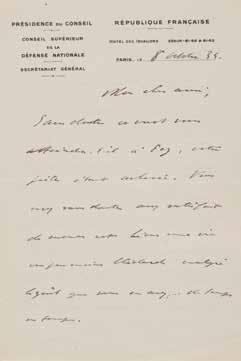
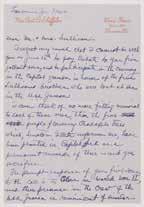
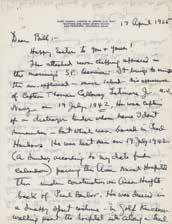
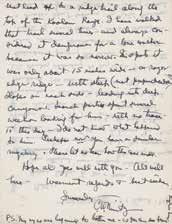
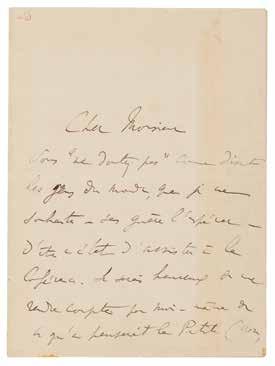
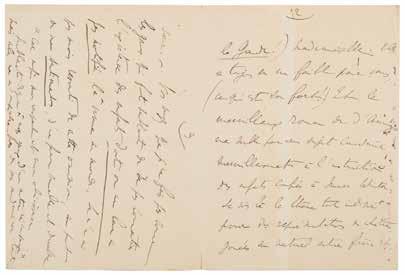
Autograph Letter Signed on Europe’s New Order: “The League of Nations is no longer a source of security”. ALS in French, signed “C. de Gaulle,” four pages on two adjoining sheets, 5.25 x 8, Republique Francaise, Hotel des Invalides letterhead, October 8, 1934. Handwritten letter to “Mon cher ami,” in part (translated): “No doubt, this note will be awaiting you in Fez, once your time out in the field has come to an end. You will likely be quite pleased to lead a life a little less ‘out in the sticks’ this winter—despite the fondness you have for it from time to time. There is so much that is ‘new’ in the world at this moment that the ‘new’ has ceased to be remarkable, and one might sincerely say ‘nothing new’ to summarize these impressions. All the same, regarding domestic affairs, I see that the marked rallying of the Radicals to what must surely be called ‘national unity’ constitutes a decisive element of stability. This is significant, and it comes at just the right moment, for tempers were beginning to run a little too high. As for foreign affairs, we are witnessing the dismantling of the tenets of French policy as they have been practiced since the war.
The League of Nations is no longer a source of security, but rather a venue where negotiations are conducted solely with an eye to our own national interests. Poland is drifting away from us. Yugoslavia is seeking a new path. Even Romania is preparing to part ways with us. By way of consolation, we have the self-serving assistance of the Russians and the affected courtesies of Mussolini. I would very much like to see a coherent French policy begin to take shape. When shall we see you again? Pironeaux is in Belgrade. The professional army is making great strides…At Marsouche…where I served as an umpire, we were deeply struck by the manifest incompetence of the reserve division.” In very fine condition.
Written amid the political upheaval of 1934, this letter reflects France’s mounting instability during the Great Depression and the rise of extremist movements across Europe. De Gaulle comments on the fragile “national unity” emerging in French politics following the Stavisky Affair and the formation of a National Union government, while expressing concern over the erosion of France’s foreign alliances and the shifting balance of power abroad.
His remarks on the “professional army” are especially significant, aligning with the ideas he had just advanced in his influential military treatise Vers l’armée de métier (Toward a Professional Army), published earlier that year. In it, de Gaulle argued for a modern, mechanized force in place of outdated defensive strategies—views that would later prove prophetic in the face of World War II. Starting Bid $300
FDR drafts a cautionary 1941 message to Congress: “If the Nazis conquer Russia, the Nazi military machine will be a more dangerous and covetous neighbor than we have ever had before”
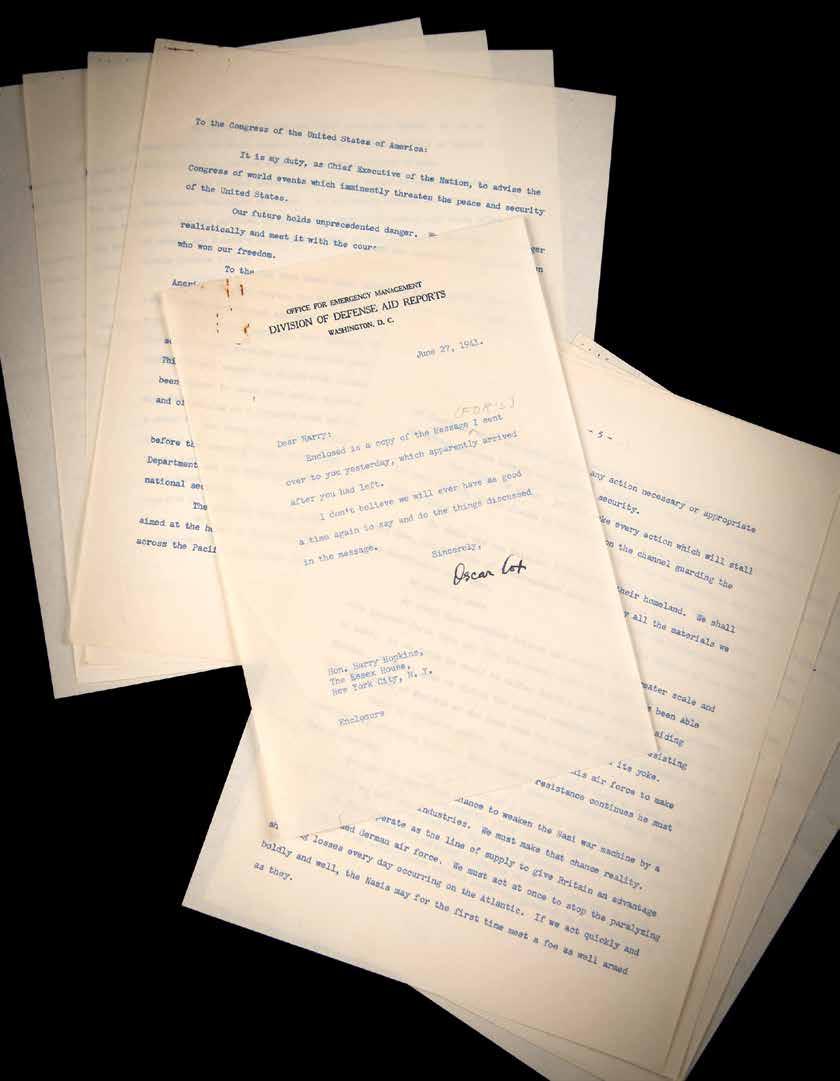
29. Franklin D. Roosevelt: Typescript Draft
of an Undelivered Message to Congress on Nazi Aggression Against Russia (1941). World War II-dated TLS signed “Oscar Cox,” one page, 6.25 x 9.25, Office for Emergency Management, Division of Defense Aid Reports letterhead, June 27, 1941. Letter to FDR confidante, advisor, and emissary Harry Hopkins, in full: “Enclosed is a copy of the Message I sent over to you yesterday, which apparently arrived after you left. I don’t believe we will ever have as good a time again to say and do the things discussed in the message.”
The accompanying enclosure, an eight-page typescript draft of a message to Congress prepared by President Franklin D. Roosevelt, on paper watermarked with the presidential seal, carries remarkable commentary on the dangerous world situation and the associated risks for the United States. Roosevelt ponders the fate of Alaska in the event of Russian surrender to Nazi Germany, justifying American aid to Russia and Great Britain—authorized by the Lend-Lease Act— and calling for further resolutions from Congress. Notably, we find no record of this message having ever been delivered.
The message, in small part: “Only a week ago, Nazi Germany, without warning and in violation of solemn treaty promises less than two years old, attacked the Russian people. This brutal assault is filled with lessons for those countries who have not been forced to learn from bitter experience. The folly of appeasing tyrants and of relying on a tyrant’s word has once again been demonstrated.
But there is no time to review the mistakes of the past. I bring before the Congress today, after consultation with the officers of the War Department and the Navy Department, matters of immediate concern to our national security. The greatest pincers movement in the history of the world is being aimed at the heart of the American people. The jaws of the pincers are aimed across the Pacific and across the Atlantic in a gigantic plan of encirclement. On the Pacific flank the Nazis drive into Russia. We can be sure that if the Nazis conquer Russia their next steps will be against India and China, for the domination of the continent of Asia.
Even without those steps, the Nazi attack on Russia threatens the Western Hemisphere at Alaska. At the Bering Straits the mainland of Russia and the mainland of Alaska face each other across only sixty miles of water, and Russia’s Big Diomede Island is only four miles from our Little Diomede Island. Alaska is a rich prize in itself; a territory nearly one-fifth as large as the United States containing vast
mineral resources. But, what is strategically more important to the defense of the Western Hemisphere, Alaska is a land-bridge across the Pacific from Asia to the North American continent. On the Pacific, it is democracy’s Northernmost bridgehead. If the Nazis conquer Russia, the Nazi military machine will be a more dangerous and covetous neighbor than we have ever had before. Imagine a sweep of the Nazi war machine into Russia similar to the sweep across France a year ago. Imagine another so-called armistice agreement, making Russia a new Nazi vassal state. Imagine, then, great squadrons of the Nazi fighters and bombers, gliders and parachutists drawn up armed forces opposite Alaska in battle array. We cannot wish away these possibilities with talk. We must act to keep the Pacific battle-line away from Alaska and the Western Hemisphere.
On the Atlantic flank the danger is no less. The drive against Russia is Hitler’s way of preparing for a mighty attack on the British Isles and Africa, and then on across the Atlantic to the Western Hemisphere. The defeat of Russia would free the Nazis from any threat from the East and loose their fullest blows against the West. It would strengthen four-fold the Nazi drive toward the British Isles and our shores by giving vast supplies of food and oil and raw materials to the Nazi war machine.
This is the menace to us from the German aggression against Russia. It is a menace which may speedily unfold. But if we act before it unfolds, there is hope, strong hope, that Hitler’s onslaught upon the world will fail before it reaches our shores.
As long as Russian resistance continues, the Nazi forces are divided on two fronts. As long as Russian resistance continues, Germany’s defense against British attacks on Nazi war industries will be weakened. If Russian resistance is strengthened, and if the British take action with increased aid from us, a terrible blow can be dealt to the Nazis’ hope of world conquest.
The Nazi attack on Russia is our greatest danger; it is also our greatest opportunity. We must seize the opportunity before the danger overwhelms us.” The typescript has one minor handwritten correction, evidently in Cox’s hand. In overall fine condition, with a rusty paperclip mark to the top of the letter.
Oscar Cox (1905–1966) served as general counsel of both the LendLease Administration and the Office of Emergency Management during World War II. Starting Bid $200
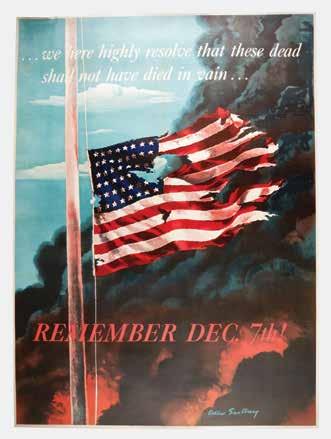
33. World War II Poster: ‘Remember Dec. 7th’ (1942) - 39.75˝ x 55.5˝. Large original World War II-era 39.75 x 55.5 poster featuring artwork by Allen Saalburg promoting wartime unity and remembrance, reading below in bold red text, “Remember Dec. 7th!” with a quotation above from Lincoln’s Gettysburg Address, “…we here highly resolve that these dead shall not have died in vain…” Published in 1942 by the Office of War Information (OWI Poster No. 14) and distributed by the U.S. Government Printing Office. Professionally conservationmounted and linen-backed to a slightly larger size. Rolled and in fine condition. The dramatic composition symbolizes the aftermath of Pearl Harbor, with rising smoke and a tattered American flag representing the attack’s destruction and sacrifice. Following the Japanese bombardment of the U.S. Naval base at Pearl Harbor on December 7, 1941, the United States entered the Second World War and rapidly mobilized for global conflict; posters such as this were designed to stir nationalism and reinforce public resolve. By invoking Abraham Lincoln’s Gettysburg Address, the design draws a direct parallel between the sacrifices of the Civil War and those of a new generation, offering both consolation and a call to duty. The artist, Allen Saalburg (1899-1987), was an accomplished illustrator and printmaker. He studied at Pratt Institute and the Art Students League in New York, later exhibiting in Paris at the BernheimJeune Gallery. After returning to New York in 1930, he worked on murals and theatrical set design, receiving commissions from the Federal Art Program for projects in Central Park and the Bronx Zoo, as well as private commissions including installations for Bloomingdale’s and the Home Building Pavilion at the 1939 New York World’s Fair. Starting Bid $200
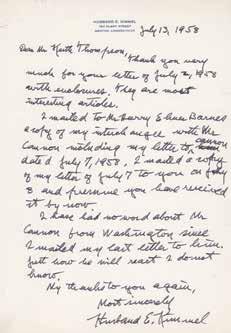
34. Husband E. Kimmel Autograph Letter Signed on Pearl Harbor Debate. American naval admiral (1882-1968) who commanded the Pacific Fleet at the time of the attack on Pearl Harbor. ALS, one page, 7.25 x 10.5, personal letterhead, July 13, 1958. Handwritten letter to Keith Thompson, in full: “Thank you very much for your letter of July 2, 1958 with enclosures. They are most interesting articles. I mailed to Mr. Harry Elmer Barnes a copy of my interview with Mr. Cannon including my letter to Cannon dated July 7, 1958. I mailed a copy of my letter of July 7 to you on July 8 and presume you have received it by now. I have had no word about Mr. Cannon from Washington since I mailed my last letter to him. Just how he will react I do not know. My thanks to you again.” In fine condition. Read more online at www.RRAuction.com. From the personal collection of a lifelong collector, teacher, and traveler with a passion for world history. His collecting years ranged from the 1970s to the present day, meaning that several of the premier pieces have not been on the market in decades. Starting Bid $200
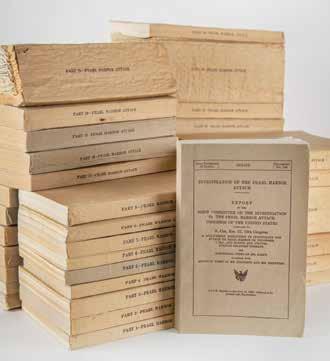
35. Pearl Harbor: Hearings and Report of the Joint Committee on the Investigation of the Attack (40 Volumes). Scarce, complete 40-volume set covering the Senate’s investigation of the attack on Pearl Harbor, comprising the 39 volumes of “Hearings before the Joint Committee on the Investigation of the Pearl Harbor Attack,” plus the resulting “Report of the Joint Committee on the Investigation of the Pearl Harbor Attack.” Paperbacks, 5.75 x 9, published in Washington, D.C., by the Government Printing Office, 1946.
Includes: Parts 1-11: Hearings, Nov. 15, 1945-May 31, 1946; Parts 12-20: Joint Committee exhibits nos. 1-179; Parts 22-25: Proceedings of Roberts Commission; Part 26: Proceedings of Hart inquiry; Parts 27-31: Proceedings of Army Pearl Harbor Board; Parts 32-33: Proceedings of Navy court of inquiry; Part 34: Proceedings of Clarke investigation; Part 35: Proceedings of Clausen investigation; Parts 36-33: Proceedings of Hewitt inquiry; Part 39: Reports, findings, and conclusions of Roberts Commission, Army Pearl Harbor Board, Navy court of inquiry, and Hewitt inquiry, with endorsements; and ‘Part 40,’ the Congressional Committee Report and Conclusions.
Also includes a first edition of Investigations of the Attack on Pearl Harbor: Index to Government Hearings, compiled by Stanley H. Smith, published by the Greenwood Press in 1990. In overall very good condition, with some wear, creasing, and minor stains to wrappers. Starting Bid $200
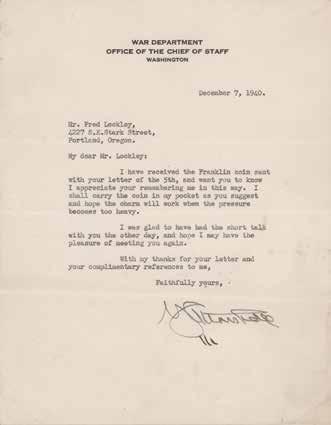
36. George C. Marshall War-Dated Typed Letter Signed on a Gifted Coin - “Hope the charm will work when the pressure becomes too heavy”. World War II-dated TLS signed “G. C. Marshall,” one page, 7 x 9, War Department, Office of the Chief of Staff letterhead, December 7, 1940. Letter to journalist Fred Lockley, in full: “I have received the Franklin coin sent with your letter of the 5th, and want you to know I appreciate your remembering me in this way. I shall carry the coin in my pocket as you suggest and hope the charm will work when the pressure becomes too heavy. I was glad to have had the short talk with you the other day, and hope I may have the pleasure of meeting you again. With my thanks for your letter and your complimentary references to me.” In fine condition.
Fred Lockley (1871-1958) was an American journalist known for his widely syndicated Oregon Journal column, ‘Impressions and Observations of a Journal Man.’ A prolific writer and interviewer, he chronicled the American West through conversations with pioneers, laborers, and notable figures, including Thomas Edison, Booker T. Washington, and Jack London. From the personal collection of a lifelong collector, teacher, and traveler with a passion for world history. His collecting years ranged from the 1970s to the present day, meaning that several of the premier pieces have not been on the market in decades. Starting Bid $200
“I found no inner peace, as the responsibility for this theater of war weighed too heavily upon me”— the Desert Fox writes from Africa, thirteen days before launching the Battle of Gazala
37. Erwin Rommel War-Dated Typed Letter Signed, Two Weeks Before the Battle of Gazala - “Soon the forces here will clash again, and we hope to make our contribution to final victory”. World War II-dated TLS in German, signed “Erwin,” one page, 8.25 x 11.75, personal ‘Panzer Army Africa, Commander-in-Chief’ letterhead, May 13, 1942, thirteen days before he launched the Battle of Gazala, the most spectacular offensive of his career and the campaign that would culminate in the fall of Tobruk and his elevation to Generalfeldmarschall. Addressed from “Africa,” a letter to a fellow officer named “Wilhelm,” apparently a comrade from Rommel’s earlier service, who was at the time attending a course in Vienna. In full (translated): “Many heartfelt thanks for your kind letter of May 1st, which I wish to answer at once. I also thank you sincerely for your congratulations on my decoration and promotion. You can imagine that I continue to lead a very active life and often scarcely have time for myself. Under these circumstances, you will also understand my lack of diligence in writing. Shortly after our successful counteroffensive, I was at home for four weeks, but found no inner peace, as the responsibility for this theater of war weighed too heavily upon me. Soon the forces here will clash again, and we hope to make our contribution to final victory. As for your new command, I wish that you find a sphere of activity here that suits you well. During the course in Vienna, you will surely visit my family, and I am especially pleased about that. It is only a pity that I cannot be there. My warmest regards to you and your family.” In fine condition, with a partial separation to the horizontal fold.
Rommel’s letter refers to two major honors conferred in rapid succession in early 1942. On January 20th, he was awarded the Knight’s Cross of the Iron Cross with Oak Leaves and Swords, placing him among the earliest recipients of that distinction, which had only been instituted the previous July. Shortly thereafter, he launched his January counteroffensive, which reversed the setbacks of Operation Crusader and drove British forces back across Cyrenaica. Ten days later, on January 30th, Rommel was promoted to Generaloberst (Colonel General) in formal recognition of his successes commanding Panzer Army Afrika.
The letter’s most historically revealing passage describes a period of home leave taken shortly after the counteroffensive: four weeks in Germany during which Rommel confesses he found no inner peace. The weight of his command followed him home. This leave aligns with the February-March 1942 lull between the counteroffensive and the coming summer campaign and is consistent with his known visit to Hitler’s Wolf’s Lair on March 20, 1942, where the Swords were formally presented, and Rommel pressed, largely without success, for the reinforcements he believed essential for a decisive push into Egypt.
Writing in mid-May, Rommel signals that a clash is imminent, noting that “soon the forces here will clash again, and we hope to make our contribution to final victory.” Within a fortnight, he would strike. The Battle of Gazala opened on May 26th, Tobruk fell on June 21st, and Hitler promoted him to Generalfeldmarschall the following day. The letter thus sits at the precise hinge point between Rommel’s two defining acts of 1942: the January counteroffensive that made his reputation undeniable and the summer offensive that made it legendary. Starting Bid $1000
Commanding Panzer Army Africa, Rommel awards the Iron Cross to three
soldiers in January 1942, days after launching his El Agheila counteroffensive in North Africa
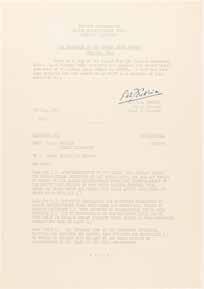
38. Erwin Rommel War-Dated Document
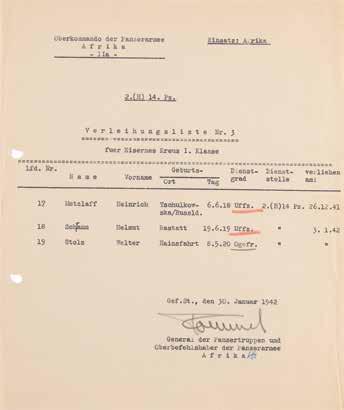
Signed (January 30, 1942) - Awarding the Iron Cross to Three Panzer Army Africa Soldiers. World War II-dated partly-printed DS, signed in pencil, “Rommel,” one page, 9 x 10.5, January 30, 1942. Official “Verleihungsliste Nr. 3” (Award List No. 3) issued by the Oberkommando der Panzerarmee Afrika, documenting recipients of the Iron Cross, 1st Class. The typed list records three soldiers of 2.(H) / 14th Panzer Regiment – Heinrich Metzlaff, Helmut Schramm, and Walter Stolz – with ranks, birthplaces, and award dates spanning December 26, 1941, to January 3, 1942. Signed at the conclusion by Erwin Rommel as “General der Panzertruppen und Oberbefehlshaber der Panzerarmee Afrika.” In fine condition.
Dated January 30, 1942, this document originates from a pivotal moment in the Western Desert Campaign. Just days earlier, on January 21, Erwin Rommel had launched a renewed offensive from El Agheila, regaining the initiative after the setbacks of Operation Crusader. Over the following weeks, Axis forces advanced across Cyrenaica, retaking Benghazi and reestablishing momentum in North Africa. The capture of Tobruk in June 1942 and the subsequent advance into Egypt would soon follow.
Rommel’s offensive culminated in the First Battle of El Alamein in July 1942, where Axis forces were halted. A renewed attempt to break through in late August failed at the Battle of Alam el Halfa, and by October–November 1942, the Second Battle of El Alamein forced a sustained Axis retreat across North Africa. After the Allied landings in French North Africa in November 1942 and the collapse of Axis positions in Tunisia, Rommel departed the African theater in March 1943, returning to Germany on medical leave. From the personal collection of a lifelong collector, teacher, and traveler with a passion for world history. His collecting years ranged from the 1970s to the present day, meaning that several of the premier pieces have not been on the market in decades. Starting Bid $200
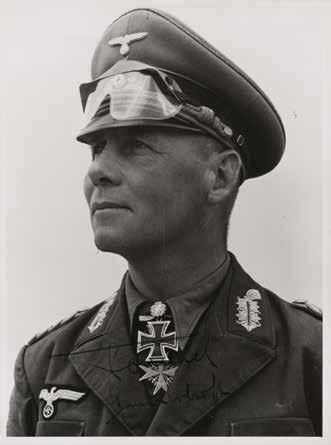
39. Erwin Rommel Signed Photograph. Vintage glossy 7 x 9.5 head-and-shoulders photo of Erwin Rommel in uniform, signed in fountain pen, “Rommel, Generaloberst.” In fine condition, with a small crease to his left cheek. Accompanied by a full letter of authenticity from PSA/DNA. Starting Bid $200
The leader of Popski’s Private Army inscribes his
memoir to the woman who typed it
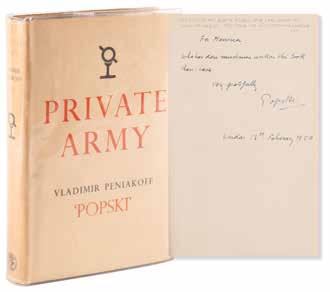
40. Vladimir Peniakoff Signed Book - Private Army. British Army officer (1897–1951) who founded and commanded No. 1 Demolition Squadron, PPA, colloquially known as ‘Popski’s Private Army,’ one of several special forces raiding units formed in the Western Desert during the Second World War. Signed book: Private Army. First edition. London: Jonathan Cape, 1950. Hardcover with dust jacket, 5.75 x 8.25, 512 pages. Signed and inscribed on the first free end page in ink, “For Menina, who has done much more work on this book than I have, very gratefully, Popski, London, 13th February 1950.” Collector’s notation to the signed page notes that the recipient was Mrs. Menina RussellKing (1921-2014), who typed the book’s manuscript and who was the secretary to publisher Jonathan Cape. In very good to fine condition, with soiling to the dust jacket, and sunning to the jacket’s spine. Starting Bid $200
Royal Air Force ‘Dambusters’
flying log book, recording the May 1943 raid on Ruhr Valley dams— signed by Wing Commander Guy Gibson and fellow No. 617 Squadron pilots, five killed in action
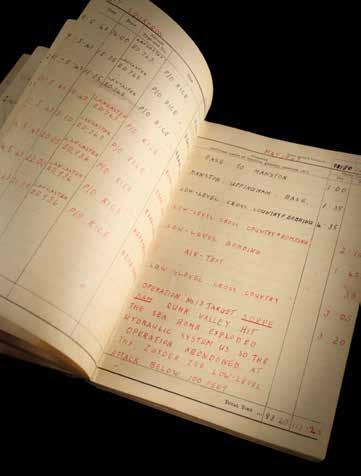
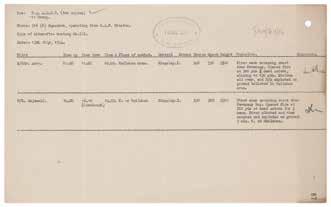
41. The Dambusters Multi-Signed Royal Air Force Logbook (1942–43), with Guy Gibson, Melvin Young, and David Maltby. Historic World War II–dated hardbound log entitled “Royal Air Force, Form 1767, Observer’s and Air Gunner’s Flying Log Book,” 5.25 x 8, annotated on the first page, “No. 617 Squadron,” the squadron famously known as ‘The Dambusters,’ with Stephen Burns’s air gunner certification filled out below.
The log book is filled with entries from September 15, 1942, to December 20, 1943, recording aircraft types, pilots, duties, and remarks—noting combat, aircraft/weapon malfunctions, and bombing targets. The most notable entry comes on May 16, 1943, recording pilot Geoffrey Rice’s participation in Operation Chastise, commonly known as the Dambusters Raid: “Operation No. 13 Target Sorpe Dam Ruhr Valley hit the sea bomb exploded hydraulic system us so the operation abandoned.” The book is signed throughout by famed ‘Dambusters’ pilots, including: Guy Gibson, Melvin Young (2), David Maltby (3), A. M. Paape (2), George William Curry, David Shannon (2), William Reid Suggitt (2), and Geoffrey Leonard Cheshire. Remarkably, five of these heroic pilots—Gibson, Young, Maltby, Suggitt, and Paape—were killed in action during World War II. In very good to fine condition, with expected overall wear.
This Royal Air Force Observer’s and Air Gunner’s Flying Log Book sits squarely within one of the most celebrated—and technically daring—episodes of the Second World War: the 1943 ‘Dambusters’ raid carried out by No. 617 Squadron RAF. Formed in early 1943 under the command of Wing Commander Guy Gibson, the squadron was tasked with executing Operation Chastise, a precision attack on Germany’s Ruhr Valley dams using Barnes Wallis’s innovative ‘bouncing bomb.’
The log’s entries, spanning late 1942 through the end of 1943, capture the buildup to and aftermath of this mission, reflecting the intense training, hazardous sorties, and evolving tactics of RAF Bomber Command at a moment when strategic bombing was central to Allied efforts to cripple German industrial capacity. In Operation Chastise, the 617 Squadron successfully bombed and breached the Möhne and Edersee dams, causing catastrophic flooding of the Ruhr valley and of villages in the Eder valley; the Sorpe Dam, referenced in the logbook, sustained only minor damage.
Beyond its operational record, the logbook is distinguished by the presence of multiple signatures from celebrated figures of 617 Squadron, including Guy Gibson, David Maltby, and Melvin Young—men who became emblematic of the courage and sacrifice associated with the Dambusters raid. The fact that several of these signatories were later killed in action highlights the staggering human cost borne by RAF aircrews, whose casualty rates were among the highest of any Allied service branch. A remarkable piece of World War II history. Starting Bid $1000
“The
Boys Die Young”—Dambusters leader
Guy Gibson’s handwritten list of
titles
for Enemy Coast Ahead,
possible
sent seven weeks before he was killed in action
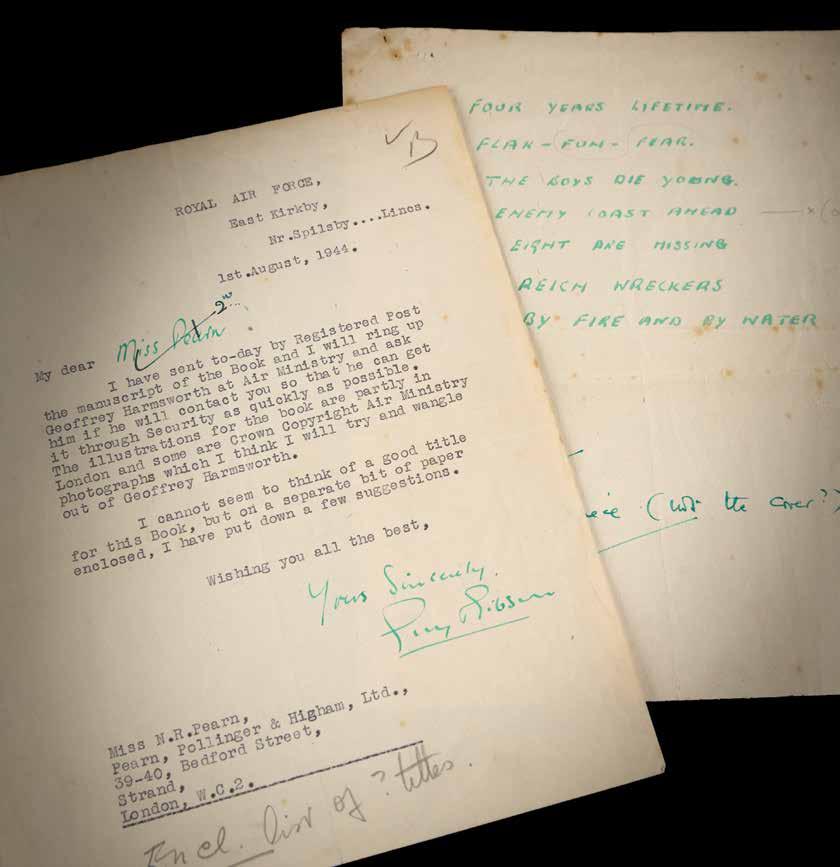
42. Guy Gibson War-Dated Typed Letter Signed on His Autobiography, Enemy Coast Ahead, with Handwritten ‘Book Title’ List. The first Commanding Officer of the Royal Air Force’s No. 617 Squadron (1918–1944), whose ‘Dam Busters’ raid in 1943 destroyed two large dams in the Ruhr area of Germany. He was awarded the Victoria Cross and, in June 1943, became the most highly decorated serviceman in the country. Gibson completed over 170 war operations before dying in action at the age of 26. World War II-dated TLS signed “Yours sincerely, Guy Gibson,” one page, 7 x 8.75, British Royal Air Force (RAF) emblem letterhead, August 1, 1944. Letter to literary agent Nancy R. Pearn, co-founder of the London firm Pearn, Pollinger & Higham, Ltd., which represented authors including Graham Greene, Paul Scott, and James Herriot. In full: “I have sent to-day by Registered Post the manuscript of the Book and I will ring up Geoffrey Harmsworth at Air Ministry and ask him if he will contact you so that he can get it through Security as quickly as possible. The illustrations for the book are partly in London and some are Crown Copyright Air Ministry photographs which I think I will try and wangle out of Geoffrey Harmsworth. I cannot seem to think of a good title for this Book, but on a separate bit of paper enclosed, I have put down a few suggestions.” Gibson adds the salutation in his own hand.
Included with the letter is the referenced enclosure, which contains a list of seven possible book titles penned in the hand of Gibson. The titles are as follows: “1. Four Years Lifetime. / 2. Flak – Fun – Fear. / 3. The Boys Die Young. / 4. Enemy Coast Ahead / 5. Eight Are Missing / 6. Reich Wreckers / 7. By Fire and By Water.” A pencil notation to the right, likely in the hand of Pearn, reads, “(A stock phrase?),” with a line extending to the title “Enemy Coast Ahead.” Annotated below: “Photo as frontispiece? (not the cover?).” The agent’s tentative aside stands in contrast to the title’s eventual fate: Enemy
Coast Ahead would be retained and become one of the most recognizable memoirs of RAF Bomber Command. Read in hindsight, several of the discarded alternatives, most notably “The Boys Die Young,” carry an unintended weight given the author’s fate only weeks later. In very good to fine condition, with folds, creases, and scattered foxing.
Written just seven weeks before his death in September 1944, the letter captures Gibson at the moment he was finalizing a personal account of his wartime service, selecting a title for a book he would not live to see published. By the summer of 1944, Wing Commander Guy Gibson, already renowned for leading the Dambusters raid, was serving in a staff role at RAF East Kirkby after completing multiple operational tours. Restless and eager to return to combat as Allied forces advanced following D-Day, he had resumed flying duties in July while assisting with operational planning at No. 55 Base. The day after writing this letter, he was posted to No. 54 Base at RAF Coningsby, where he continued to pursue limited operational flying amid concern that the war might end before he could fully return to action.
Enemy Coast Ahead is Gibson’s autobiographical account of his World War II service in RAF Bomber Command, written in 1944 when he was just 25 years old. Covering his career from the outbreak of war through 1943, including two full operational tours, night-fighter duty, and his leadership of Operation Chastise, the work stands as a firsthand narrative of the air war over Europe. Following Gibson’s death, the book was first serialized in the Sunday Express beginning in December 1944 and was published in book form by Michael Joseph in February 1946. Retaining the very title tentatively queried in this letter, it secured its place as a lasting account of RAF operations in World War II. Starting Bid $1000
The legless RAF ace Douglas Bader inscribes his own biography to a fellow from Sussex
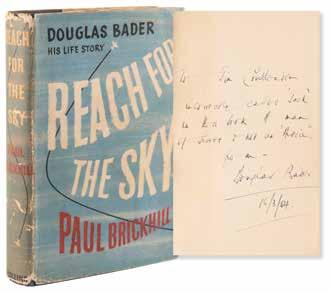
43. Douglas Bader Signed Book - Reach for the Sky. British pilot (1910-1982) who lost both his legs in 1931 but continued to fly in WWII with the use of artificial limbs. Signed book: Reach for the Sky. Fifth impression. London: Collins, July 1954. Hardcover with dust jacket, 5.75 x 8.25, 384 pages. Signed and inscribed on the first free end page in ink, “To Jim Crittendon, incorrectly called ‘Jack’ in this book. A man of Sussex & not an ‘Aussie,’ from – Douglas Bader 15/3/54.” In very good to fine condition, with a block of light toning to the left side of the signed page, and toning, chipping, and general wear to the dust jacket. Starting Bid $200
44. Arthur Harris War-Dated Signed ‘Combats in the Air’ Form Confirming a Downed German ‘Albatross Scout’ Aircraft - “The hun immediately side-slipped and dived out of control”. Rare World War I-dated DS, signed in pencil, “A. T. Harris,” one page, 7.5 x 11.75, official British Army “Combats in the Air” form, August 21, 1917. Typed report for 2nd Lieutenant E. L. Smith of No. 45 Squadron, Royal Flying Corps, recording an aerial engagement over the Southeast sector of the Ypres Salient in Belgium while flying a Sopwith 2-seater with observer Gunner Grenner, armed with one Vickers and one Lewis gun, at a height of 5,000 feet. The hostile aircraft is identified as an “Albatross Scout.” The report, in part: “At 9.30 a.m. an Albatross Scout dived down on to our tail. On reaching us he turned his nose and opened fire. Gunner Grenner opened fire immediately firing about a drum, tracers were seen to enter the fuselage. The hun immediately side-slipped and dived out of control. Although the Observer was hit he continued to fire on him till his drum was finished. This was confirmed by the 48th French Squadron at BERGUES, who witnessed the whole fight and were at the time stalking this particular enemy machine. They state that this machine after going down partially out of control some little distance eventually dived and broke to pieces crashing on the other side of the lines.” Signed at the conclusion by Arthur Harris as the commanding officer of No. 45 Squadron. In fine condition, with trimmed edges. Air Marshal Sir Arthur ‘Bomber’ Harris (1892-1984) began his military career in the First World War, serving first with the 1st Rhodesia Regiment before transferring to the Royal Flying Corps in 1915. By 1917, he had emerged as a capable combat leader on the Western Front, serving as a flight commander and later commanding officer of No. 45 Squadron, flying Sopwith 11⁄2 Strutters and Camels. Credited with five aerial victories, Harris gained early experience in offensive air operations and leadership under combat conditions, forming the foundation of the aggressive airpower doctrine he would later employ as head of RAF Bomber Command during the Second World War. From the personal collection of a lifelong collector, teacher, and traveler with a passion for world history. His collecting years ranged from the 1970s to the present day, meaning that several of the premier pieces have not been on the market in decades. Starting Bid $200
“Opened fire at 300 yds”— Polish Mustang pilots intercept V-1 flying bombs over the south coast of England, July 1944
45. Operation Diver ‘V-1 Flying Bomb’ Combat Report - No. 316 (Polish) Fighter Squadron, July 1944. World War II-dated original typed combat report for two pilots of the No. 316 (Polish) Fighter Squadron, operating RAF Mustang Mk. III fighters from RAF Friston during the V-1 campaign against Britain. The report, one page, 13 x 8, dated July 13, 1944, and addressed to H.Q. A.D.G.B. [Air Defence of Great Britain], records an interception over the Hailsham and Pevensey Bay area, with operational details including times, course, speed, and height. The report preserves two narrative combat entries in full:
“First seen crossing coast at 300 yds ahead, course 350 and height 2000 at 300 yds dead astern. Opened fire at 300 yds, and F.A. exploded on ground. Pieces believed in Hailsham area.” “First seen crossing coast over Pevensey Bay. Opened fire at 300 yds. Diver climbed and then crashed on ground 3 miles N. of Hailsham.” These accounts describe the successful engagement of a German V-1 (‘Diver’) flying bomb shortly after it crossed the English coast, a typical interception profile carried out at low altitude and high speed. Polish squadrons of the RAF, including No. 316, played a key role in Operation Diver, the air defense of Britain against V-1 attacks, with Mustang Mk. III fighters proving particularly effective against the fast-moving pilotless weapons. In fine condition, with some light toning to the right edge. Starting Bid $200
46. Hap Arnold War-Dated Signed Typed Letter of Condolence. World War II-dated TLS signed “H. H. Arnold,” one page, 7 x 9, Headquarters, Army Air Forces (Office of the Commanding General) letterhead, October 17, 1944. Letter to William M. Hess, in full: “With greatest regret I have learned of the untimely death of your son, First Lieutenant Robert Dale Hess, which occurred in a hospital in India on September 11, 1944, as a result of injuries he received while flying in the service of his Country. In his cadet record, which has been called to my attention, I find that Lieutenant Hess applied himself with diligence to both academic work and flying assignments at Foster Field. As a pilot he was praised by superiors for the courage and skill he demonstrated in performing duties, and with his passing we have suffered the loss of a fine officer who was determined to give his best to the Army Air Forces. I hope you will be comforted by the memory of your son’s enviable military reputation and the fact that he died for our cause. I extend my heartfelt sympathy to you and other members of the family.” In fine condition. From the personal collection of a lifelong collector, teacher, and traveler with a passion for world history. His collecting years ranged from the 1970s to the present day, meaning that several of the premier pieces have not been on the market in decades. Starting Bid $200
47. Hap Arnold Typed Letter Signed - “I certainly enjoyed an unofficial reunion with Mr. Churchill”. TLS signed “H. H. Arnold,” one page, 6.75 x 9, Headquarters, Army Air Forces (Office of the Commanding General) letterhead, February 1, 1946. Letter to Colonel F. W. Clark, in full: “Just a line to express my appreciation to you for the cordial hospitality you extended to me and the members of my staff on our recent visit to Miami. It was a great pleasure to see you again and I certainly enjoyed an unofficial reunion with Mr. Churchill.” Arnold adds a handwritten postscript: “Hope to see you again when things are not so hectic – H.H.A.” In fine condition. Read more online at www.RRAuction.com. From the personal collection of a lifelong collector, teacher, and traveler with a passion for world history. His collecting years ranged from the 1970s to the present day, meaning that several of the premier pieces have not been on the market in decades. Starting Bid $200
48. Hap Arnold Typed Letter Signed on Donating His WWII Uniform and Personal Artifacts. TLS signed “H. H. Arnold,” one page, 8 x 10.25, Headquarters, Army Air Forces letterhead, September 27, 1945. Letter to Frank P. K. Barker, the president of the Commissioners of Lower Merion Township of Ardmore, Pennsylvania, in full: “Just a line to acknowledge your letter of September 21st, and to tell you that I will be glad to send one of my uniforms and other personal mementos of World War II for the archives of the Lower Merion Township. I note that you have been designated by the Board of Commissioners to accept such trophies, and therefore will arrange for these souvenirs to be sent to you personally.
I am wondering, however, what kind of a uniform would be best for the display you talk about. Going down through the ages, the blue uniform will last longer and look better but it was not used during the war. As time goes on, the olive drab uniform will begin to look like hell. It will take on a greenish tint as the years go by. The display of the blue cape, the blue hat with all the gold braid on it, and the blue uniform with all the ribbons on it would be far more effective as far as the general public is concerned.
I am also wondering just how you are going to display these things. As I told you, I have my name plate that I use on my desk. I have the flag which I have had on my desk all during the war, and I am thinking of sending you two chronometers that I used to maintain the correct time during the whole war, one giving Greenwich time and one giving local time. These are in a case. If you will give me more information as to just how and in what particular part of some building you are going to display these things, I will know better what to send you. Please be more explicit.” In fine condition, with discoloration along the mailing folds. Accompanied by the original mailing envelope. From the personal collection of a lifelong collector, teacher, and traveler with a passion for world history. His collecting years ranged from the 1970s to the present day, meaning that several of the premier pieces have not been on the market in decades. Starting Bid $200
Military archive of Staff Sergeant William F. Stuckey, top turret gunner aboard
‘The Dreamer,’ a B-24 Liberator of the 2nd Bombardment Division
49.
World War II: William F. Stuckey’s B-24 ‘The Dreamer’ A-2 Bomber Jacket and (30) Mission-Used Bomb Fuse Pins with Military Archive Including Award Citations, Photographs, and Patches. WWII USAAF 8th Air Force B-24 A-2 bomber jacket belonging to Staff Sergeant William F. Stuckey, top turret gunner aboard ‘The Dreamer’ (754th Bomb Squadron, 458th Bomb Group), a Consolidated B-24 Liberator of the 2nd Bombardment Division who flew approximately 32 combat missions over Nazi-occupied Europe during the Normandy campaign and was awarded the Distinguished Flying Cross for “ward[ing] off many enemy attacks” from his gun position. This handsome russet-brown leather issue jacket features a knit waistband and cuffs, a single front zipper with collar snaps, and classic wartime construction. The jacket, size 38, was made by Perry Sportswear Inc. of Newburgh, New York, under contract no. W535 AC-23377, with original label present.
The right chest exhibits an extensive hand-painted mission tally of approximately 32 yellow bomb symbols, signifying a completed heavy bomber combat tour, while the left chest bears an applied leather name strip, “W. F. STUCKEY,” above an embroidered emblem patch of the 754th Bombardment Squadron. The reverse is prominently embellished in light blue paint with the aircraft name “The Dreamer” above a stylized silhouette of a B-24 Liberator, and the left shoulder retains the original Eighth Air Force patch, confirming service with the strategic bombing force operating from England, specifically with the 754th Bomb Squadron of the 458th Bomb Group based at RAF Horsham St. Faith. The interior lining is clearly stenciled “W. F. STUCKEY / 18119071.” Included with the jacket is a remarkable set of 30 original B-24 bomb fuse safety pins, each retaining its handwritten tag annotated by Stuckey with mission number, date, and target location, forming a chronological record of his combat sorties over France and Germany. Although the tags are present for all 32 missions, two pins are missing for missions 12 (Mulhouse, France, May 25, 1944) and 28 (Ludwigshafen, Germany, July 31, 1944). These tags effectively serve as a firsthand ‘flight diary,’ directly corresponding to the painted mission tally on the jacket and providing rare, mission-by-mission documentation of his operational service. These pins are further complemented by Stuckey’s wartime “A Soldier’s Diary” book, with four pages featuring his handwritten entries for each mission, including dates, targets, and flight durations, effectively duplicating and expanding upon the information recorded on the tagged pins. The diary also includes a personal note marking V-E Day (May 8, 1945), in which Stuckey notes that he “was on furlough” at the time of Germany’s surrender. In overall fine condition, with light wear to the jacket consistent with age and use. Accompanied by a substantial archive of original wartime documents directly related to Stuckey, including his Honorable Discharge and Enlisted Record, as well as multiple Headquarters Eighth Air Force and 2nd Bombardment Division General Orders awarding the Air Medal with three Oak Leaf Clusters, culminating in the Distinguished Flying Cross (August 10, 1944). Also included is a group of ten WWII-era U.S. Army and Army Air Forces insignia patches, comprising AAF shoulder sleeve insignia, enlisted rank chevrons, and unit emblems; Stuckey’s original WWII dog tags; U.S. Army Air Forces aircrew and aerial gunner qualification wings; and an AAFTS instructor insignia. Additional material includes a group of WWII-era U.S. sales tax tokens from states like Mississippi, Louisiana, and Utah; a group of WWII-era foreign currency, including a ‘short snorter’ signed by an unidentified aircrew; a WWII U.S. Army pocket compass by Wittnauer with ‘U.S.’-stamped case; and five period glossy photographs, including images of Stuckey in service, one depicting him with his flight crew while wearing the offered A-2 jacket with its distinctive bomb tally visible to the right chest. Starting Bid $200
50. U.S. Army Air Forces Norden M-9B Bombsight with W.L. Maxson Type X-1 Reflex Sight. U.S. Army Air Forces Norden M-9B bombsight assembly with W.L. Maxson Type X-1 reflex sight, a sophisticated gyrostabilized fire-control instrument used in American heavy bombers during World War II, including the B-17, B-24, and B-29. Developed by Carl L. Norden in the 1920s and refined throughout the war, the system integrates a gyroscopic stabilization platform, internal mechanical analog computer, and central optical eyepiece, with the Type X-1 reflex sight mounted above for initial target acquisition. The bombsight bears a data plate that reads: “U.S. Army Air Forces, Bomb Sight / Type: M9B / Serial No.: N-10933 M / Order No.: AC 9165 / Carl L. Norden, Inc.” The reflex sight data plate reads: “U.S. Army Air Forces, Reflex Sight / Serial No.: 1895 / Type: X-1 / Order No.: W-33-038-AC-4995 / Manufactured by the W.L. Maxson Corp.” The bombsight is mounted on a wooden display base to an overall size of 16˝ x 15˝ x 10.5˝ and a weight of 42 pounds.
The bombsight features an array of calibrated dials and scales used by the bombardier to input altitude, airspeed, and heading, enabling the instrument to determine the precise release point, compensating for variables such as wind drift and ground speed. A viewing window permits monitoring of the gyroscope and bubble level for proper calibration. During operation, the bombardier aligned the moving sight indicator with the target; when the two coincided, the system automatically triggered bomb release while interfacing with the aircraft’s autopilot during the final bombing run.
Includes an original “Bombsight Equipment Data Book” (WD AAF Form No. 45, March 1, 1945), marked “Restricted” and assigned to Bombsight Type M9-B, Serial No. V5118, with the opening “Operating Time” log dated to April 23, 1956, with directional tolerance readings (N=7-2, S=8-2, E=8-3, W=7-3) and MOD-1 notation. A complex example of WWII-era aviation instrumentation, illustrating the integration of optics, gyroscopic stabilization, and analog computation in a key precision-bombing system of World War II. From the personal collection of a lifelong collector, teacher, and traveler with a passion for world history. His collecting years ranged from the 1970s to the present day, meaning that several of the premier pieces have not been on the market in decades. Starting Bid $200
“Keep us flying!”—U.S. Treasury poster of Tuskegee Airman Robert W. Deiz from 1943, printed during World War II to promote the purchase of war bonds
52. World War II Poster: ‘Keep Us Flying! (1943, Tuskegee Airman)20˝ x 27.75˝. Rare original World War II-era 20 x 27.75 poster featuring a portrait of Tuskegee Airman Robert W. Deiz by artist Betsy Graves Reyneau, showing him in his flight suit between bold text, “Keep us flying!” and “Buy War Bonds.” Issued as an official U.S. Treasury poster in 1943 (WFD 874) and distributed by the U.S. Government Printing Office. Professionally conservation-mounted and linenbacked to a slightly larger size. Rolled and in fine condition.
Unusual among wartime posters, the identity of the serviceman depicted is known, lending the image a specific historical and personal dimension. Robert W. Deiz (1919–1992) was a U.S. Air Force officer and accomplished combat pilot who flew more than 90 missions during the Second World War and continued his military career for two decades. The poster highlights Deiz as a representative of the Tuskegee Airmen, the first Black military pilots in United States history, trained in Tuskegee, Alabama, and recruited from across the country during a period defined by segregation and Jim Crow laws. Their distinguished combat record and discipline in the air made them enduring symbols of achievement and service.
The artist, Betsy Graves Reyneau (18881964), was an accomplished painter and social activist who devoted much of her work to issues of equality and representation. Arrested in 1917 as part of the women’s suffrage movement, she later lived in France, where she aided Jewish citizens during the early years of Nazi occupation. Returning to the United States during the war, she used her government commission to produce imagery that highlighted the contributions of Black Americans, later continuing this focus through portraits of significant historical figures. Starting Bid $500
Fleet Admiral Nimitz honors the Sullivan brothers in a letter to their parents: “When their country needed their help they promptly gave their services—and, unfortunately, their lives”
55. Chester Nimitz Autograph Letter Signed to the Parents of the Sullivan Brothers: “When their country needed their help they promptly gave their services—and, unfortunately, their lives”. ALS signed “C. W. Nimitz, Fleet Admiral, USN,” three pages on two adjoining sheets, 5 x 7.5, Wood Farms letterhead, no date. Handwritten letter to “Mr. & Mrs. Sullivan,” parents of the five Sullivan brothers who served together on the light cruiser USS Juneau, all of whom were killed in action in the Naval Battle of Guadalcanal. In part: “I regret very much that I cannot be with you on June 12th to pay tribute to your five gallant sons, and to participate in the ceremony in the Capitol grounds in honor of the five Sullivan brothers who were lost at sea in the U.S.S. Juneau. I can think of no more fitting memorial to each of these men than the five purple flowering Crabapple trees which, Senator Gillette informs me, have been planted in Capitol Park as a permanent reminder of their—and your sacrifice...When their country needed their help they promptly gave their services—and, unfortunately, their lives. I hope and pray that your great sorrow will be lessened by the knowledge that they gave their all in the service of their country and that their country is grateful for that service. With deepest sympathy in your great loss, and with profound respect.” In fine condition.’ Starting Bid $200
Nimitz seeks answers in the “un-explained— never solved—disappearance of Captain Thomas Calloway Latimore, Jr., U.S. Navy”
56. Chester Nimitz Autograph Letter Signed on the Unsolved Mystery of a Naval Officer’s Disappearance Near Pearl Harbor. ALS signed “C. W. Nimitz,” one page both sides, 8 x 10.5, personal letterhead, April 17, 1965. Handwritten letter to “Bill,” in part: “Happy Easter to you & yours! The attached news clipping appeared in this morning’s S.F. Examiner. It brings to mind the un-explained—never solved—disappearance of Captain Thomas Calloway Latimore, Jr., U.S. Navy, on 19 July 1942. He was captain of a destroyer tender whose name I don’t remember—but which was based in Pearl Harbor. He was last seen on 19 July 1942 (a Sunday according to my date finder calendar) passing the Aiea Naval Hospital then under construction on Aiea Heights back of Pearl Harbor. He was dressed in a snappy sport costume—in golf knickers—walking past the hospital site along a trail that lead up to a ridge trail along the top of the Koolan Range. I have walked that trail several times—and always considered it dangerous for a lone walker because it was so narrow. In spots it was only about 15 inches wide—a razor edge ridge—leading into deep canyons. Search parties spent several weeks looking for him—with no trace. To this day—I do not know what happened to him. Perhaps now you have a similar mystery & please let me know how this case ends.” In fine condition. Read more online at www.RRAuction.com. Starting Bid $200
57. William F. Halsey War-Dated Autograph Letter Signed on the 37th Division’s Success in New Georgia and Bougainville - “Keep the rats dying”. World War II-era ALS signed “W. F. Halsey,” one page, 6 x 10, United States Navy letterhead, no date [circa early 1944]. Handwritten letter to Major General Robert S. Beightler, in full: “My warmest appreciation + admiration for your splendidly successful handling of your magnificent 37th Division in New Georgia + Bougainville. Keep the rats dying. Good luck and a hearty ‘Well Done.’” In fine condition.
Major General Robert S. Beightler commanded the 37th Infantry Division (Ohio National Guard) throughout World War II, a rare distinction. Under his leadership, the division played a key role in the Pacific campaigns at New Georgia and Bougainville, fighting in difficult jungle conditions to defeat entrenched Japanese forces and secure strategic ground. His effectiveness in these operations earned praise from Admiral William F. Halsey, commander of the South Pacific Area, who commended the “splendidly successful handling” of the division. From the personal collection of a lifelong collector, teacher, and traveler with a passion for world history. His collecting years ranged from the 1970s to the present day, meaning that several of the premier pieces have not been on the market in decades. Starting Bid $200
58. Douglas MacArthur War-Dated Signature. World War II-dated fountain pen signature and inscription, “Good luck, Lucy, Douglas MacArthur,” penned at the bottom of an 8.75 x 11 typed V-Mail letter from autograph collector Lucy Duncan, dated July 17, 1943. Duncan addressed her letter to “Gen. Douglas MacAthur, United Nations Headquarters, Melbourne, Australia.” In fine condition. Accompanied by the original mailing envelope. MacArthur signed this letter during the Southwest Pacific campaign as Allied forces conducted operations in New Guinea in the summer of 1943, a key phase in the advance toward the eventual liberation of the Philippines. From the personal collection of a lifelong collector, teacher, and traveler with a passion for world history. His collecting years ranged from the 1970s to the present day, meaning that several of the premier pieces have not been on the market in decades. Starting Bid $200
59. Douglas MacArthur Typed Letter Signed Addressing the Tokyo War Crimes Tribunal and “the Nurnberg trial”. TLS, one page, 7.5 x 9.75, General Headquarters, Supreme Commander for the Allied Powers, Office of the Supreme Commander letterhead, July 10, 1948. Letter to Maury Maverick concerning the International Military Tribunal for the Far East in Tokyo, commonly known as the Tokyo War Crimes Tribunal, in full: “I have received and read with considerable interest your letter of 30 June about the trial now going on in Tokyo before the International Military Tribunal for the Far East. I appreciate the great interest you are taking in it and the obviously large amount of time and thought which you have given to certain of the principles involved, both in this and in the Nurnberg trial.
I am convinced, however, that a visit to Tokyo for the purpose you outlined would be fruitless. The principles established to guide the action of the court were adopted by the Far Eastern Commission in April 1946, and that body is the only one with adequate authority to make any alteration in them. It would seem highly doubtful that the Commission would see fit, after the passage of so much time and at this stage of the proceedings, to take such action. It is to them, however, that the argument and proposals you have in mind should be presented. Without a change in their basic directives on this subject, there is nothing that could be done along this line in Tokyo. With renewed appreciation for your continued interest in occupation affairs, and for your kind personal messages.” Double-matted and framed with a photograph of MacArthur to an overall size of 19 x 15.5. In fine condition.
An insightful postwar letter from General Douglas MacArthur concerning the International Military Tribunal for the Far East, the Allied court established in Tokyo after World War II to prosecute Japanese military commanders, government officials, and other leaders accused of war crimes committed during the conflict. Following Japan’s surrender in September 1945, MacArthur was appointed Supreme Commander for the Allied Powers and became the central authority overseeing the American-led occupation and reconstruction of Japan. In January 1946, he issued the Tokyo Charter, the document that formally created the tribunal and established the legal procedures and classifications of crimes under which defendants would be tried, paralleling the better-known Nuremberg Trials held in Germany after the war. Written during the final months of the proceedings, this letter finds MacArthur emphasizing that the tribunal’s governing principles rested with the Far Eastern Commission, despite his own major role in creating and administering the court. A revealing look at the layered authority behind MacArthur’s administration of the Tokyo war crimes trials. Starting Bid $200
61. Montgomery of Alamein World War II-Dated Signed Photograph - Pre-D-Day Studio Portrait. World War II–dated vintage matte-finish 6 x 8 photo of Bernard Law Montgomery in uniform, affixed to its original 8.25 x 12 studio mount, signed on the mount in bold fountain pen, “B. L. Montgomery, General, 24/4/44”—six weeks before D-Day, while commanding 21st Army Group preparing Operation Overlord, and before his September 1, 1944 promotion to Field Marshal. Also signed on the mount in pencil by the studio, “Vandyk, London.” Reverse bears a Vandyk credit stamp. In fine condition, with scattered light scratching to the mount. Starting Bid $200
Historic archive of Field Marshal Montgomery’s signed top-secret operational directives from D-Day to Victory in Europe, 1944–45
62. Field Marshal Bernard Law Montgomery’s Top-Secret Battle Orders for the Liberation of Europe, May 1944-June 1945 - (28) Documents from the Papers of Major-General Miles Graham. One of the most important surviving private archives of Allied high command operational papers from the Second World War: a near-sequential sequence of top-secret battle directives issued by Field Marshal Bernard Law Montgomery during the campaign from Normandy to the fall of Nazi Germany, preserved from the personal files of Major-General Miles Graham, Montgomery’s senior administrative officer at 21st Army Group. Covering every major phase of the Northwest Europe campaign—from D-Day and Operation Cobra to Market Garden, the Ardennes, the Rhine crossing, and the final advance into Germany— the archive provides an offensive-by-offensive documentary record of how victory in Western Europe was planned, directed, and executed at the highest level.
The comprehensive collection consists of 28 original World War II–dated “Top Secret” battle orders and briefs, totaling approximately 116 pages, including 21 signed in ink by Bernard Law Montgomery. These orders were circulated in limited numbers to no more than twenty members of the senior Anglo-American leadership of the war in Western Europe—the named recipients are a small and immediately recognizable circle including Churchill, Eisenhower, Bradley, Patton, Dempsey, Crerar, Bedell-Smith, Alan Brooke, de Guingand, LeighMallory, Cunningham, Simpson, with the staff officers Graham, Poole, and Belchem. Most retain Graham’s contemporary ‘seen’ initials, acknowledging receipt.
Most significantly, these are operational documents, issued in their day by Field Marshal Montgomery and his staff, carrying throughout Montgomery’s unmistakable command voice: his personality runs through them with directness, certainty, the occasional flash of impatience, and an unmistakable sense of a single mind in command.
As Supreme Commander of the Allied Expeditionary Force, General Eisenhower delegated to Montgomery the conduct of all Allied ground forces in the field from D-Day until 1 September 1944, the date on which the United States 12th Army Group under Bradley and the 6th Army Group under Devers were fully deployed in France and Eisenhower assumed direct ground command himself.
For those eighty-eight days, a British general directed American armies in the field—a circumstance which had not occurred since the eighteenth century, and which speaks to the trust that existed between the two commanders. The directives of this period are accordingly of unusual significance, and the archive contains the fullest sequence of them known to remain in private hands.
In June 1944 he explains the Allied design in Normandy: “to draw the main enemy forces in to the battle on our Eastern flank…so that our
affairs on the Western flank could proceed the easier.” By late July, as Operation Cobra opened, that logic had sharpened into urgency: “it is ports that we require, and quickly,” especially Cherbourg, Brittany, and later Antwerp.
The archive is especially vivid during the Falaise campaign. On August 4, Montgomery declares that the Allies had “unloosed the shackles” and “knocked away the ‘key rivets,’” leaving the German front ready to “disintegrate completely.” Two days later he states the aim plainly: “We will proceed relentlessly, and rapidly, with our plans for his destruction.” By August 20, after the German armies had been shattered between the Seine and Loire, he calls the moment “the beginning of the end of the war,” but warns there is “no time to relax, or to sit back and congratulate ourselves.”
The documents also reveal strategic overconfidence and strain. The December 16 directive, issued on the eve of the Ardennes offensive, wrongly asserts that Germany “cannot stage major offensive operations,” making it one of the archive’s most striking intelligence failures. Yet after the Ardennes, Montgomery returns to the central objective: “The main objective of the Allies on the western front is the Ruhr.”
The final wartime orders regain their sweeping momentum. For Operation Plunder, the Rhine is “the last great river barrier,” and Montgomery demands that all go “all out.” After the crossing, he announces: “We have won the Battle of the Rhine,” and urges armored forces to go “‘flat out’ for the Elbe.” The last battle order, April 22, turns from pursuit to occupation, warning commanders to avoid clashes with Soviet forces. The postwar papers close the arc: Montgomery’s priority becomes “food, housing, freedom from disease,” and the transformation from battlefield command to military government.
In overall very good to fine condition, with expected wartime handling wear including folds, filing holes, staple rust, occasional edge wear, and toning.
Comparable command-level operational archives of the Second World War are today overwhelmingly preserved in institutions such as the Imperial War Museum, the U.S. National Archives, and the Liddell Hart Centre for Military Archives. Complete private holdings of this scale and continuity—especially retaining original Montgomery signatures across the campaign chronology—are virtually unknown to the market.
Taken together, the archive constitutes a remarkable chronicle of the Allied liberation of Western Europe, preserving Montgomery’s operational thinking in real time across the decisive final year of the war. Few surviving private archives capture the conduct of modern coalition warfare at such proximity to supreme command, and fewer still do so across the entire campaign from Normandy to occupied Germany. Starting Bid $10000
From the desert to V-E
Day: an exceptional archive of Field Marshal Montgomery’s signed wartime personal messages to the Eighth Army and 21 Army Group, 1942–1945
63. Field Marshal Bernard Law Montgomery’s Signed Wartime Personal Messages to the Eighth Army and 21 Army Group — “Forward to Victory”: A NearComplete Archive from El Alamein to the Defeat of Germany, 1942–1945. Exceptional archive of Field Marshal Bernard Law Montgomery’s signed wartime “Personal Messages” to the Eighth Army and 21 Army Group, an almost complete and deeply historic collection tracing Montgomery’s command from the desert crisis before El Alamein through the defeat of Germany and the aftermath of victory in Europe. Comprising Montgomery’s stirring battle messages, a privately printed presentation volume, and related material, the archive preserves the voice of Britain’s most celebrated field commander at the very moments his armies helped alter the course of World War II.
The archive includes 39 items signed by Montgomery, including 16 of the 17 Eighth Army messages collected in Forward to Victory—with two additional rare Eighth Army messages not in the book—followed by a near-complete run of signed 21 Army Group messages. Most were signed during the war, with a few signed in postwar years; three messages are also duplicated within the collection.
The Eighth Army sequence opens with Montgomery’s exceedingly rare August 31, 1942 “Special Message to Officers and Men of Eighth Army,” issued during the desert battle against Rommel at Alam el Halfa, boldly declaring: “The Eighth Army bars the way,” and vowing, “there will be no withdrawal and no surrender.” It continues with his October 23, 1942 message before El Alamein, in which Montgomery announces: “We are ready now. The battle which is now about to begin will be one of the decisive battles of history. It will be the turning point of the war.” With characteristic directness, he tells his men that victory will depend on their determination “to fight and to kill—and finally, to win.”
From there, the archive follows the Eighth Army’s relentless advance across North Africa. In his Christmas 1942 message, Montgomery reflects that “it is wonderful what has been achieved since the 23rd October,” while his January 12, 1943 message before Tripoli declares: “Nothing has stopped us since the battle of Egypt began… Nothing will stop us now.” After Tripoli’s capture, Montgomery hailed the 1,400-mile pursuit from Alamein as “probably without parallel in history.” His March 1943 messages are especially vivid, describing the enemy as “caught like a rat in a trap,” promising to give Rommel “a very ‘bloody nose,’” and exhorting the Eighth Army: “Forward to Tunis! Drive the enemy into the sea!” The North African campaign culminates in Montgomery’s May 14, 1943 message, celebrating the enemy’s complete removal from Africa: “There was no Dunkirk on the beaches of Tunisia,” he writes, adding that it would be a lifelong honor to say, “I marched and fought with the Eighth Army.” The archive then carries forward into Sicily and Italy, with Montgomery’s July 10, 1943 message announcing that “the time has now come to carry the war
into Italy,” and his September 2, 1943 message calling the Eighth Army “the first troops of the Allied Armies to land on the mainland of the continent of Europe.” In his final January 1, 1944 farewell to the Eighth Army, Montgomery writes movingly: “I am leaving officers and men who have been my comrades during months of hard and victorious fighting… I will miss you more than I can say.”
The 21 Army Group material is equally compelling, beginning with Montgomery’s June 5, 1944 message on the eve of D-Day: “The time has come to deal the enemy a terrific blow in Western Europe.” He describes the coming invasion as “the honour of striking a blow for freedom which will live in history,” and by June 10 could report that the Allied armies had secured “a good and firm lodgehead on the mainland of France.” His subsequent Normandy messages trace the hard-won development of the campaign: Cherbourg in the west, Caen in the east, “and much territory in between,” followed by the decisive destruction of German forces in the “Normandy pocket,” which Montgomery called “definite, complete and decisive.”
The archive then follows the Allied advance through France, Belgium, Holland, and into Germany. In September 1944, Montgomery writes that the Allies “stand at the door of Germany,” proclaiming the triumphant cry: “Forward into Germany.” His February 7, 1945 message presents the campaign in boxing terms: “we now come to the last and final round; and we want, and will go for, the knock-out blow.” On March 23, as the Rhine crossing began, he urges: “Over the Rhine, then, let us go.” The sequence culminates in Montgomery’s May 8, 1945 V-E Day message, a dignified tribute to sacrifice and Allied unity: “We have won the German war. Let us now win the peace.” The archive is filled out by a hardbound privately-printed “Collection of General Montgomery’s Personal Messages to the Eighth Army, El Alamein–Ortona, 23 October 1942–31 December 1943,” printed and bound by Printing and Stationery Services, 21 Army Group, signed and inscribed on the first free end page in fountain pen, “To: Tate Spooner, in memory of our days together in the Eighth Army. B. L. Montgomery, Field-Marshal, Berlin, 27-8-1945”; signed messages from Oliver Leese (May 1944; August 1944; October 1, 1944) and Richard L. McCreery (October 12, 1944; April 1945; May 3, 1945); and an ALS signed “B. L. Montgomery,” one page, Headquarters, 21 Army Group letterhead, May 27, 1945, in part: “Thank you for your note. I send you a couple of photographs; and also a signed copy of my last message. I hope you keep well.” A superb and nearly comprehensive Montgomery archive, uniting rare signed field messages and other materials into an extraordinary documentary record of Allied command in the Second World War. From Alam el Halfa and El Alamein to Tripoli, Tunis, Sicily, Normandy, the Rhine, and V-E Day, the collection offers an almost unparalleled signed chronicle of Montgomery’s unmistakable voice—brisk, confident, combative, inspirational, and historic.
Starting Bid $10,000
64. Bernard Montgomery, J. Lawton Collins, and Matthew Ridgway Signed Photograph - Battle of the Bulge HQ, December 1944. Vintage matte-finish 3.75 x 5.75 photo of the Allied leaders conferring at their Belgian headquarters in December 1944, amidst the Battle of the Bulge, signed in fountain pen, “B. L. Montgomery, Field-Marshal,” “J. Lawton Collins,” and “M. B. Ridgway.” Reverse bears an “Official War Office Photograph” credit stamp. In very fine condition.
On December 20, 1944, in response to the German Ardennes offensive, Gen. Dwight D. Eisenhower temporarily placed the U.S. First and Ninth Armies under British Field Marshal Bernard Montgomery’s command to stabilize the northern shoulder of the Bulge. The decision was controversial among American commanders, particularly General Omar Bradley, who saw it as a slight to U.S. leadership and resented the shift in authority. While Montgomery’s methodical approach helped organize the defense, the episode fueled lingering inter-Allied tensions despite contributing to the eventual containment of the German advance. Starting Bid $200
65. George S. Patton Early Autograph Letter Signed on West Point Life and Studies - “I think I must be terribly stupid for I have studied pretty hard”. Early ALS signed “Geo. S. Patton, Jr.,” five pages on two sheets, 5 x 6.5, United States Military Academy, West Point, New York letterhead, no date. Handwritten letter to his Aunt Nannie, in part: “Last night we all went to a lecture…given by a war correspondent. The lecture was illustrated by a large number of pictures taken by speaker— many of these were very good but the lecture itself was exceedingly poor at the very beginning he carefully informed us that he always carried a pair of the most powerful glasses made and from the amount of knowledge he achieved he must have always stayed sufficiently in rear to test their power to the utmost for he apparently knew nothing of the fighting he gave however several illustrative insidents [sic] he said that once he came on four batteries of Russian artillery firing very rapidly and with nearly all their ammunition gone and that the colonel in command asked him if he could see or knew what he was shooting at for he himself had not the least idea. He was also at the battle of Syoyang and said that instead of the Japs crossing the river under a heavy fire and storming the banks that the battle took place three and a half miles beyond the river and that the Japs crossed the river entirely unopposed. While instead of hand to hand fighting the Russians did not see a Jap the whole day while the enemy’s artillery which caused them the most loss was firing over two ranges of hills and was directed from a station six miles off to the left of the battle…think that my stand is vile and now it’s even worse we had the general transfer in french today…I have gotten a considerable no of demerits alas so am feeling rotten which is only natural. I think I must be terribly stupid for I have studied pretty hard.” In fine condition. Read more online at www.RRAuction.com. From the personal collection of a lifelong collector, teacher, and traveler with a passion for world history. His collecting years ranged from the 1970s to the present day, meaning that several of the premier pieces have not been on the market in decades. Starting Bid $200
Patton honors fallen soldiers at the Battle of the Bulge—a scarce signed photo taken three days after Bastogne relief
66. George S. Patton Signed ‘Battle of the Bulge Memorial’ Photograph to Col. Rufus S. Bratton. Vintage glossy 4 x 5 photo of Gen. George S. Patton standing at attention beside Col. Rufus S. Bratton, both gazing upward at a helmet hung from a post—a memorial to the Third Army’s war dead—taken at Third Army headquarters planning office on December 29, 1944, three days after the relief of Bastogne, signed and inscribed in fountain pen, “To Col. Rufus Bratton, from G. S. Patton, Jr.” The wall behind them displays the Third Army situation board. Reverse bears a credit stamp, “Photo by Signal Corps U.S. Army, 166th Signal Photo Co.,” with typed classification: “Confidential, Until Reclassified by censor.” In fine condition, with moderate-to-poor signature contrast.
Bratton was the Far Eastern Section Chief of the War Department’s Military Intelligence Division on December 7, 1941, who famously received the decoded ‘14-part message and tried to warn Pearl Harbor before the attack—an episode later fictionalized in Tora! Tora! Tora!. Starting Bid $200
Patton’s question mark—the general signs “3rd Army” as his only home during his 1945 Victory Tour
67. George S. Patton Signed Servicemen’s Roster, c. June 1945, Noting “3rd Army” as His Home. World War II service roster, 8 x 10, done in a standard bound lined composition book, boldly signed in blue pencil on the twenty-sixth page, “G. S. Patton, Jr., 3rd Army,” adding a question mark under the column entitled “Home until date.” Patton signs alongside 850+ other ordinary servicemen registering arrivals and destinations, dated June and July 1945— likely signed during Patton’s June 1945 ‘Welcome Home Tour,’ when he arrived at Bedford Airport, Massachusetts on June 7th and visited Boston, Denver, and Los Angeles before returning to Europe. The emotional resonance of the entry lies in its contrast with the ordinary servicemen surrounding him. While the other men list hometowns and dates of leave, Patton gives his “address” simply as “3rd Army”—revealing that, even amid America’s victory celebrations, home for Patton was not a place, but his command. The question mark beneath his return date is especially poignant in hindsight: rather than remaining in the United States, Patton returned to occupied Germany shortly thereafter. He would be relieved of Third Army command in October 1945 and die only months later following an automobile accident in December. More than a simple autograph, the roster captures a fleeting and deeply human moment for one of World War II’s most legendary commanders—celebrated at home, yet already bound for the uncertainties awaiting him overseas. In very good to fine condition, with creasing and wear to the covers; inner pages are all clean and unaffected. Starting Bid $200
68. Mark W. Clark (3) Signed Items - Typed Letter, Quote, and Photograph. United States Army officer (1896–1984) who fought in World War I, World War II, and the Korean War. Three items signed in ink or felt tip by Mark W. Clark: a TLS from 1950, in part: “It is always good to hear from the men who served in Italy, and I shall always be appreciative of the great contributions they made toward our ultimate victory”; a TQS, which reads: “‘There were gay crowds on the streets, many of them waving flags, as our infantry marched through the capital. Flowers were stuck in the muzzles of the soldiers’ rifles and of guns on the tanks’”; and an 8 x 10 photo of Clark seated at his desk. In overall fine condition. From the personal collection of a lifelong collector, teacher, and traveler with a passion for world history. His collecting years ranged from the 1970s to the present day, meaning that several of the premier pieces have not been on the market in decades. Starting Bid $200
69. Mark W. Clark Typed Letter Signed, Criticizing Postwar Demobilization - “It gave the Russians the opportunity to grab parts of Europe”. United States Army officer (1896–1984) who fought in World War I, World War II, and the Korean War. TLS signed “Mark Clark,” one page, 8.5 x 11, personal The Citadel (The Military College of South Carolina) letterhead, August 10, 1982. Letter to educator John R. Siegel, in full: “Your letter of August 6 with its enclosure has been received. I’m happy to sign the statement you enclosed and it is returned herewith. With reference to your question, that’s a tough one to answer, for I was not familiar at the time with the actions in the Pacific, for example, or in Normandy. I was too concerned with the fighting in Italy. I dislike being a ‘Monday morning Quarterback.’ When you have read the enemy’s memoirs, one may be too prone to criticize the actions of others.
I’ll give you a general answer to your question. I think the United States demobilized too fast after the end of the war. Naturally, we were anxious to get the men home, but it gave the Russians the opportunity to grab parts of Europe, such as Romania, Hungary, Czechoslovakia, Poland, etc. Another questionable decision had to do with who took Berlin. We would have been in a much better position after the war, had the allies done so. They were in a better position than the Russians, but we were used to appeasing the Russians at that time, and still continue to do so.
Another mistake the allies made, in my opinion, was after the capture of Rome, and Ike was well along in France, to go into Southern France. I did not think it was necessary, even though I was the Commander Designate. I felt we should have turned to the East and with the help of Tito and the Yugoslavs, which help was offered, move to the East, and my Army Group from Italy would have been in Vienna, Budapest and other important places before the Russians. Sorry I can’t be of more assistance with your questions.” In fine condition. From the personal collection of a lifelong collector, teacher, and traveler with a passion for world history. His collecting years ranged from the 1970s to the present day, meaning that several of the premier pieces have not been on the market in decades. Starting Bid $200
Eisenhower praises the homefront:
“We are all
fighting together for the defeat of Nazi tyranny”
70. Dwight D. Eisenhower World War II–Dated Typed Letter Signed: “We are all fighting together for the defeat of Nazi tyranny”. World War II–dated TLS, signed “Dwight D. Eisenhower,” one page, 6 x 8, Supreme Headquarters, Allied Expeditionary Force letterhead, August 14, 1944. Letter to Mrs. Alexander Good of Westphalia, Missouri, in fill: “I was indeed delighted to get your letter and to hear that everyone in your village is doing his duty toward furthering the war effort. It is most encouraging to me to get a letter such as yours, because it is additional evidence to me that we are all fighting together for the defeat of Nazi tyranny.” In very good to fine condition, with light creasing.
Written just over two months after D-Day, this August 14, 1944 letter comes at a pivotal moment when Allied forces under General Dwight D. Eisenhower were pushing inland through France following the Normandy invasion. This letter reflects the broader wartime culture of shared sacrifice and patriotic duty, highlighting how even small American communities were seen as integral to the ultimate Allied victory in World War II. From the personal collection of a lifelong collector, teacher, and traveler with a passion for world history. His collecting years ranged from the 1970s to the present day, meaning that several of the premier pieces have not been on the market in decades. Starting Bid $200
71. Dwight D. Eisenhower Signed Photograph by Yousuf Karsh. Exceptional vintage matte-finish 8 x 10 portrait photo of General Dwight D. Eisenhower by Yousuf Karsh, depicting him wearing his U.S. Army garrison cap with five-star insignia, signed and inscribed in the lower border in fountain pen, “To Mike Elizalde – Philippine Ambassador to the U.S.A. – with best wishes from his old friend – Dwight D. Eisenhower.” Affixed to a same-size cardstock mount and in fine condition, with light toning, and some trivial staining, in the borders.
Joaquin Miguel ‘Mike’ Elizalde (1896–1965) was a Filipino businessman and diplomat who served as Resident Commissioner of the Philippines to the United States from 1938 until World War II. Appointed by President Manuel Quezon, he worked to safeguard the Philippine economy ahead of independence and advocated for Filipino laborers in America. During the war, he helped organize the Philippine government-in-exile in the United States and effectively managed its diplomatic presence in Washington. Following Philippine independence in 1946, he became the nation’s first ambassador to the United States, serving until his later years. Starting Bid $200
Twenty-one years after V-E Day, Eisenhower writes to his SHAEF chief of intelligence—the British officer who handled Ultra and negotiated Germany’s surrender—granting him permission to quote from their wartime conversations
72. Dwight D. Eisenhower Typed Letter
Signed to His Former British Chief Intelligence Officer. TLS signed “D.D.E.,” one page, 7.25 x 10.5, personal letterhead, August 23, 1966. Letter to General Sir Kenneth Strong of the Ministry of Defense, in full: “I am delighted that your book will come out within the year. I shall be looking forward to reading it with great interest. If the quotations you are using from me are something that I have already made in public you are at liberty to use them as you please. The only question in this case is that if you quote anything from CRUSADE IN EUROPE the copyright belongs to Doubleday and Company, but if you merely send a copy of anything out of that book to me I will assure Doubleday’s agreement. If any of your quotations are from casual conversations between us perhaps you should send them to me, not because of any possibility of refusal on my part but merely to see that the wording is correct, so far as I can remember.” In very good to fine condition, with scattered creasing in the margins.
Major-General Sir Kenneth W. D. Strong (1900-1982) was a senior British intelligence officer who played a central role in Allied strategy during World War II, serving as chief intelligence adviser (G-2) to General Dwight D. Eisenhower at Allied Force Headquarters and later at SHAEF, where he contributed to the planning of D-Day and the negotiations for Germany’s unconditional surrender. After the war, he became a leading figure in British intelligence administration, serving as head of the Political Warfare Executive, director of the Foreign Office’s Political Intelligence Department, and founding director of the Joint Intelligence Bureau, ultimately rising to Director General of Intelligence at the Ministry of Defence.
Published in 1967, Intelligence at the Top: The Recollections of an Intelligence Officer is General Strong’s memoir of his service as a senior British intelligence officer during World War II, focusing on his role as chief intelligence adviser to General Dwight D. Eisenhower in both the Mediterranean and at SHAEF. The book offers a high-level account of how intelligence, particularly Ultra decrypts and other strategic sources, was gathered, assessed, and applied to Allied planning and operations, including the D-Day invasion. Starting Bid $200
Weeks before he led XXX Corps through Market Garden, Brian Horrocks writes of his return to Normandy and a chance meeting with Eisenhower: “His whole face seemed to expand into that famous grin”
73. Brian Horrocks Handwritten Manuscript on Dwight D. Eisenhower. British Army officer (1895-1985) and commander of XXX Corps in World War II, who served under Bernard Montgomery in North Africa and Europe and was regarded as one of his most effective corps commanders. A veteran of two earlier conflicts and twice a prisoner of war, he was wounded in 1943 before returning to command in Europe. After the war, he became a military historian, author, broadcaster, and Black Rod in the House of Lords. Handwritten manuscript by Lieutenant-General Brian Horrocks containing his recollections of Dwight D. Eisenhower and serving under Montgomery of Alamein during World War II, unsigned, four pages (penned on both sides of two 8 x 13 notebook pages), no date. Although unconfirmed, the manuscript’s tone and subject matter are consistent with passages in Horrocks’s 1960 memoir A Full Life, and may reflect related autobiographical material. The manuscript, in part: “On the 3rd August 1944, I arrived by car from the United Kingdom to take over command of 30 Corps in Normandy…I was delighted to get back to an active command again after an absence of over a year…I was walking…F. M. Montgomery headquarters in Normandy, feeling rather depressed and apprehensive. For, although I was glad to be back in the fold after a year, it all seemed very strange. Suddenly, out of the military caravan stepped the familiar figure of General Eisenhower. When he saw me, his whole face seemed to expand into that famous grin, and shaking me by both hands he said, ‘Say, Jarocks, there is no one I am gladder to see back again than you.’ I didn’t for a moment [believe] that this was strictly true, but at once I felt better…I have mentioned this small incident because above everything else, Eisenhower was a warm, friendly, selfless man…Those were the qualities which endeared him to his subordinates and which engendered a feeling not far from devotion among his immediate staff.” In fine condition, with corner loss to the first page, and rusty staple and paperclip impressions. Starting Bid $200
74. Franklin D. Roosevelt Typed Letter Signed and Stanisław Mikołajczyk Signed Photograph. Two items: TLS as president, signed “Franklin D. Roosevelt, one page, 7 x 8.75, White House letterhead, July 13, 1944. FDR writes to Jan Ciechanowski, Ambassador of Poland. Vintage matte-finish 8.75 x 11 portrait of Stanisław Mikołajczyk, prime minister of the Polish government-in-exile during World War II, by Yousuf Karsh, signed and inscribed in the lower border in fountain pen in Polish by Mikołajczyk, and also signed in pencil by Karsh. Reverse bears “Copyright Karsh Ottawa” and “Dec 24 1944” stamps. Starting Bid $200
75. World War II Poster: ‘Let’s bring him home quicker’ (Stetson, 1943) - 29.25˝ x 38.35˝. Original World War II-era 29.25 x 38.35 poster featuring artwork by John Gannam showing a serviceman lifting his child upon returning home from the war, with bold text to the upper and lower borders: “Let’s bring him home quicker / Loose talk lengthens the war / Keep it under your Stetson.” Published by the John B. Stetson Co. in 1943, the poster was produced by Stetson as part of its wartime public service campaign, reflecting the company’s decision to devote its advertising resources to the national cause. The slogan “Keep it under your Stetson” cleverly links the brand’s iconic headwear with the broader government effort to curb “careless talk,” echoing widely circulated warnings such as “Loose lips sink ships,” a nationwide initiative cautioning Americans against unguarded conversation that might aid the enemy. Professionally conservation-mounted and linen-backed to a slightly larger size. Rolled and in fine condition. The artist, John Gannam (1907-1965), was an accomplished American illustrator whose work appeared in major magazines like Cosmopolitan and Good Housekeeping. Starting Bid $200
76. World War II Poster: ‘The Less Said, the Less Dead’ (1944, Stetson) - 29˝ x 39˝. Original World War II-era 29 x 39 poster from Stetson’s “Keep it Under Your Stetson” campaign, featuring artwork by Robert Riggs of a soldier mourning a fallen comrade in a Pacific theater setting below a cautionary message, “The Less Said, the Less Dead,” a warning against the dangers of sharing sensitive information about troop movements. Professionally conservation-mounted and linen-backed to a slightly larger size. Rolled and in fine condition.
Unlike many wartime posters issued directly by the U.S. government, this example was produced in 1944 by the John B. Stetson Company as part of its widely circulated public service campaign, reflecting the role of private industry in supporting wartime messaging. The slogan “Keep it under your Stetson” became a familiar national catchphrase, comparable in recognition to ‘Loose lips sink ships,’ reinforcing the importance of discretion on the home front. This is the larger format version of the poster.
The artist, Robert Riggs (1896-1970), was an American illustrator and painter best known for his dynamic depictions of boxing and circus scenes, in addition to his wartime work. Stetson, founded in 1865 by John B. Stetson in Philadelphia, rose to prominence through its association with the American West and is widely credited with popularizing the cowboy hat, remaining an enduring name in American apparel. Starting Bid $200
77. World War II Poster: ‘It’s My Right to Fight for America’ (1944) - 15.75˝ x 20˝. Rare original World War II-era 15.75 x 20 poster encouraging enlistment in the 442nd Infantry Regiment, featuring a design by Robert M. Jones that pictures a Japanese American soldier set to throw a grenade, positioned against a pink background between upper and lower text, “It’s My Right to Fight for America.” Produced for distribution in Hawaii in 1944, the poster was designed to recruit Japanese Americans into military service during the war, appealing to patriotism amid a fraught and discriminatory national climate. Rolled and in fine condition, with a central horizontal fold.
Following the attack on Pearl Harbor and the issuance of Executive Order 9066, more than 127,000 Japanese American citizens were forcibly placed into internment camps on the mainland, while those in Hawaii, where a large percentage of the population was of Japanese descent, faced intense pressure to assimilate and serve. Posters such as this sought to drive enlistment among these communities, positioning military service as both duty and demonstration of loyalty. The 442nd Infantry Regiment, composed primarily of second-generation Japanese American soldiers (‘Nisei’), would become the most highly decorated unit of its size in United States military history. Formed in 1944, it initially drew approximately 2,700 soldiers from Hawaii and 1,500 from mainland internment camps, eventually growing to roughly 12,000 men. Its members were collectively awarded the Congressional Gold Medal, along with more than 4,000 Purple Hearts and 4,000 Bronze Star Medals in recognition of their extraordinary service and sacrifice. The artist, Robert M. Jones (1913-1994), was an American graphic designer, printmaker, and illustrator who contributed to wartime visual campaigns for the U.S. government. He later served as art director for Columbia Records from 1945 to 1953, succeeding Alex Steinweiss, and continued his career with RCA Victor and other labels. Over the course of his career, he received six Grammy Awards for his record cover designs. Starting Bid $300
78. World War II Poster: ‘Be a Cadet Nurse’ (1944) - 20˝ x 27.75˝. Original World War II-era color 20 x 27.75 poster featuring artwork by Jon Whitcomb showing two cadet nurses, reading: “Be a Cadet Nurse: The Girl with a Future.” A banner along the bottom offers a free lifetime education for qualifying high school graduates. Published in 1944 by the U.S. Public Health Service/Federal Security Agency (NE Poster No. 3, Distributed by OWI). In fine condition, with standard intersecting folds. Starting Bid $200
79. Band of Brothers: Robert Sink Signed Photograph. United States Army officer (1905–1965) who fought during World War II and the Korean War, most famous for his WWII command of the 506th Parachute Infantry Regiment, part of the 101st Airborne Division immortalized in the miniseries Band of Brothers. Vintage glossy 7 x 9.5 photo of Sink in uniform, signed and inscribed in fountain pen, “Ft. Lewis, Wa., 7 Sept. 54, To Col. Fred L. Plahte—With thanks and warm regards, Rt. Sink, Maj. Gen. U.S. Army.” In fine condition, with a small surface scuff near the right edge. Starting Bid $200
“‘Nuts’ is the word I used immediately when I learned that the Germans were demanding our surrender”
82. Anthony McAuliffe Autograph Quotation Signed: “’Nuts’ is the word I used immediately when I learned that the Germans were demanding our surrender”. AQS signed “A. C. McAuliffe,” one page, 7.25 x 10.5, personal letterhead, April 22, [1966]. Handwritten quote and explanatory note to Mr. Joseph DeFilipps of Deerfield, Illinois, in full: “’Nuts’ is the word I used immediately when I learned that the Germans were demanding our surrender.” In fine condition. Accompanied by the original mailing envelope, addressed in McAuliffe’s hand. In December 1944, during the Battle of the Bulge—part of the Allied invasion of Northwest Europe—American forces defended the small French town of Bastogne, a vital road junction, against Hitler’s Ardennes offensive. Acting American divisional commander of the 101st Airborne Division, Brigadier General Anthony C. McAuliffe, without higher orders, made the decision to hold the town against the powerful German advance.
On December 22, 1944, the German commander wrote to McAuliffe, demanding that he give up: ‘There is only one possibility to save the encircled U.S.A. troops from total annihilation: that is the honorable surrender of the encircled town.’ McAuliffe’s fearless reply—’Nuts!’— followed by the 101st Airborne’s masterful defense of Bastogne has become the stuff of legend. Even the arrival of two German reserve divisions failed to dislodge the Americans, and the 101st was finally relieved by General George S. Patton’s 3rd Army on December 26, 1944. McAuliffe was subsequently promoted to Major General. Starting Bid $300
Original typescript of the German surrender ultimatum from Bastogne, December
22, 1944—the demand behind McAuliffe’s ‘Nuts!’
80. Anthony McAuliffe: Original Typescript of the German Surrender Ultimatum Issued at Bastogne, December 22, 1944 - The Demand Behind McAuliffe’s ‘Nuts!’. Historic original typescript of the German surrender demand issued at Bastogne, one page, 8 x 10.5, December 22, 1944.
Addressed to the “U.S.A. Commander of the encircled town of Bastogne,” and signed in type by “The German Commander,” this was one of two copies sent with the original demand letter, which prompted McAuliffe’s famous reply: ‘Nuts!’ It was retained by Gen. Gerald J. Higgins of the 101st Airborne Division.
The typescript reads: “The fortune of war is changing. This time the U.S.A. forces in and near Bastogne have been encircled by strong German armored units. More German armored units have crossed the river Ourthe near Ortheuville, have taken Marche and reached St. Hubert by passing through Hompre-Sibret-Tillet. Libramont is in German hands.
There is only one possibility to save the encircled U.S.A troops from total annihilation: that is the honorable surrender of the encircled town. In order to think it over a term of two hours will be granted beginning with the presentation of this note.
If this proposal should be rejected one German Artillery Corps and six heavy A. A. Battalions are ready to annihilate the U.S.A. troops in and near Bastogne. The order for firing will be given immediately after this two hours’ term. All the serious civilian losses caused by this artillery fire would not correspond with the wellknown American humanity.” In fine condition, with trivial pin holes of paper loss along the intersecting folds.
Accompanied by an annotated interview signed by Higgins, which explains the history of the piece: “I believe when I spoke to you that you mentioned this was one of two copies accompanying the original sent by the Germans. Could you relay the events leading to the comment of ‘NUTS’ as to the reply? AM of 22nd Dec. having staff conference & Major from Glider Regt. brought in surrender request—handed to McAuliffe—read & thre on table & said Nuts—wrote Nuts on original & returned to Germans by Glider Major. LTC Kinnard suggested Nuts as formal reply. After meeting McAuliffe kept 1 copy & gave 1 to Higgins.” Includes an additional notarized letter of provenance from Gordon Henger, who purchased the document from Higgins.
This historic document reflects the dramatic moment that prompted one of World War II’s most famous quotations. On December 22, 1944, during the Battle of the Bulge, German forces surrounded Bastogne and demanded the surrender of the outnumbered American troops. Acting commander Brigadier General Anthony McAuliffe responded with the now-legendary single word, ‘Nuts!’—a colloquial expression of defiance meaning an outright refusal. Delivered back to the Germans, the reply both confused and stunned them, but ultimately symbolized the determination of U.S. forces, who held their position until reinforcements arrived. Starting Bid $300
McAuliffe consults on a screenplay about the Battle of the Bulge: “These scenes, celebrating a supposed German surrender, are ridiculous and unbelievable. Nothing like this ever happened. Why not stick to the facts to attain the same effect?”
81. Anthony McAuliffe Typed Memorandum Signed re: a Hollywood Script on the Battle of the Bulge: “The 101st arrived at Bastogne after dark, December 18”. United States Army general (1898–1975) who commanded the force defending Bastogne, Belgium, during the Battle of the Bulge in World War II, most famous for his brief reply to a German surrender ultimatum: ‘Nuts.’ TLS signed “A. C. McAuliffe,” three pages, 8 x 10.5, June 8, 1948. McAuliffe prepares a memorandum for the “Director, Public Information Division” with his “Comments on Battleground, Original Screen Play by Robert Pirosh.” In part: “My general reaction is favorable. This is a simple yet powerful and moving story. The characteristics are generally good and the soldier conversation excellent. There are a number of historical errors which I shall discuss in numbered paragraphs that follow:
1. Page 22. RP 32. The peaceful scene here depicted is not at all accurate. The 101st arrived at Bastogne after dark, December 18. As the 101st moved in, American stragglers from cut-up units, with some military vehicles, were trying to get out. Accompanying them were panicky Belgian civilians with carts, goods, cows, children and dogs. Roads were packed. Confusion was great. This should make a great mob scene in a movie, and true. Anyone who was there will never forget it. 2. Pages 112 and 115…These scenes, celebrating a supposed German surrender, are ridiculous and unbelievable. Nothing like this ever happened. Why not stick to the facts to attain the same effect? When the Germans approached with the white flag, Americans came out of their holes, shaved, cleaned up and exposed themselves in the open for the first time. A shot could be made of sudden shelling and the men diving for their foxholes. 3. Page 24. RP 37. The scene with German plane strafing the truck column is not historically true and is most improbable. If the Germans had known of this move they would not have dropped leaflets. Suggest a conversation showing the German knowledge of the 101st move… 4. The story has the men ignorant of the breakthrough and even that they are in Belgium. All knew at Camp Mourmelon that there had been a German breakthrough. I think all knew that they were in Belgium. 5. Page 125…All German bombing was after dark. I suggest this should be the Christmas morning (3:00 A.M.) German tank and infantry attack from the West, our rear. 6. This play follows the formula by making all lieutenants dumb dopes. Lt Wall is not at all typical. In the paratroopers there was a close comradeship between lieutenants of Infantry and their men, and everyone knew that the percentage of casualties among Infantry lieutenants was much higher than among any other group…
7. Page 109…This is a preposterous scene and should be stricken. Planes could not fly in fog and if they could their first mission would be re-supply for Bastogne. Remember, the Air Force did a great job for us there. 8. Page 15…Shoulder patchers were not removed for move to Bastogne. I think all should wear them throughout, as they did actually… I have several general suggestions as follows: 1. There is no clear delineation between the periods of low supply and full supply. On December 22 the ammo and food were very low. Air Force dropped supplies on December 23 and on subsequent days. We were well supplied thereafter. Suspense could be built up by showing ammo and food diminishing. It would make parachuting scene more effective and could provide striking contrast between combat scenes before and after resupply. 2. After the hospital was captured on December 19, we used Belgian women volunteers to assist with the wounded. Among these was a registered nurse named Rene LeMaire. She was capable, efficient and most helpful. She was killed on Christmas Eve when the Germans dropped a bomb on an improvised hospital in town. It strikes me she could add a great deal to the hospital scenes in the play, a ‘cute’ scene something like the scene between Henry V and Katherine in Shakespeare’s Henry V. 3. After snow fell, all units borrowed sheets, white tablecloths, etc., from Belgians to camouflage soldiers and tanks. Some items were of fine linen, hand-embroidered. This suggests possibility of scene showing a grandmother parting with heirlooms or Belgian girl sadly rifling her hope chest.” He goes on to offer a few more detailed comments on the screenplay.
In fine condition, with toning along the edges.
Written by Robert Pirosh and directed by William Wellman, the World War II drama Battleground was released in 1949. It follows the Battle of the Bulge through the eyes of a weary squad of American infantrymen trapped near Bastogne, focusing on the daily hardships of the soldiers—cold, hunger, fear, and dwindling supplies—rather than grand strategy or heroics. Featuring an ensemble cast including Van Johnson, John Hodiak, and Ricardo Montalban, it presents a gritty, realistic portrayal of combat life. Widely acclaimed for its authenticity, Battleground earned six Academy Award nominations and won for Best Screenplay and Best Cinematography. McAuliffe, the hero of the defense of Bastogne during the Battle of the Bulge, was eager to assist Pirosh in the film’s creation, and attended its premiere in Washington, D.C. Starting Bid $1000
Eisenhower writes from SHAEF on the death of FDR— five days before V-E Day
85. Dwight D. Eisenhower War-Dated Typed Letter Signed on the Death of President Roosevelt - Written Five Days Before V-E Day. World War II-dated TLS, one page, 6 x 8, Supreme Headquarters, Allied Expeditionary Force, Office of the Supreme Commander letterhead, May 3, 1945. Letter to Edgar J. Rubie, in full: “Thank you for your letter and condolences on the death of the President. It was most kind of you to write and I am truly appreciative.” In very good to fine condition, with overall creasing. Written just weeks after the death of President Franklin D. Roosevelt on April 12, 1945, and only days before Victory in Europe (V-E) Day on May 8, 1945, marking the end of the war in Europe. Starting Bid $200
Germany
surrenders
in 1945—
“all offensive ops will cease from receipt this signal”
86. World War II: Mimeographed Field Order for Ceasefire in North Western Europe (1945). Mimeographed field order signed in facsimile by Major General R.F.K. Belchem, head of Field Marshall Montgomery’s operations staff at Luneburg Heath, one page, 7.25 x 9.5, [May 4, 1945]. The announcement of the ceasefire in North Western Europe, issued in conjunction with Germany’s surrender. In full: “GO 411A SECRET . all offensive ops will cease from receipt this signal . orders will be given to all tps to cease fire 0800 hrs tomorrow Saturday 5 May . full terms of local german surrender arranged today for 21 ARMY GP front follow . emphasise these provisions apply solely to 21 ARMY GP front and for the moment excl of DUNKIRK . ack.” In fine condition, with some small stains.
This field order was issued at a decisive moment in the final days of World War II in Europe, just hours after German forces in northwest Germany, Denmark, and the Netherlands agreed to surrender to Field Marshal Bernard Montgomery at Lüneburg Heath on May 4, 1945. It reflects the immediate implementation of that localized capitulation, ordering a ceasefire for the British-led 21st Army Group even before Germany’s formal, unconditional surrender took effect across all fronts on May 8, 1945 (V-E Day). Starting Bid $200
“Remember those of our comrades who fell in the struggle”
87. Montgomery of Alamein War-Dated Document Signed and Dated to ‘Victory in Europe Day’ (May 8, 1945). World War II-dated DS from Montgomery of Alamein, signed at the head in red fountain pen, “B. L. Montgomery, Field-Marshal,” one page, 7.75 x 11.75, May 1945, with Montgomery adding “8” to the date to reflect ‘Victory in Europe Day.’ Historic printed document headed “21 Army Group, Personal Message from the C-in-C (To be read out to all Troops),” in part: “On this day of victory in Europe I feel I would like to speak to all who have served and fought with me during the last few years…I would ask you all to remember those of our comrades who fell in the struggle…And we who remain have seen the thing through to the end; we all have a feeling of great joy and thankfulness that we have been preserved to see this day…In the early days of this war the British Empire stood alone against the combined might of the axis powers. And during those days we suffered some great disasters; but we stood firm: on the defensive, but striking blows where we could. Later we were joined by Russia and America; and from then onwards the end was in no doubt. Let us never forget what we owe to our Russian and American allies; this great allied team has achieved much in war; may it achieve even more in peace…It has been a privilege and an honour to command this great British Empire team in western Europe. Few commanders can have had such loyal service as you have given me. I thank each one of you from the bottom of my heart…And so let us embark on what lies ahead full of joy and optimism. We have won the German war. Let us now win the peace.” The document also bears Montgomery’s facsimile signature at the conclusion. In fine condition, with a small stain at the center. Starting Bid $200
WWII-dated souvenir of General Dwight D. Eisenhower’s total ceasefire order, ‘‘The Surrender of the German Armed Forces,’ signed by Major General George Erskine
88. George Erskine Signed Souvenir Copy of ‘The Surrender of the German Armed Forces’. British Army officer (1899-1965) and veteran of both World Wars. During the Second World War, he commanded the 7th Armoured Division from 1943 to 1944. World War II-dated souvenir copy of ‘The Surrender of the German Armed Forces, 9th May, 1945,’ one page, 8 x 11.5, prepared and printed under the instruction of Major General George Erskine, who has signed below his typed preamble, “G. W. E. J. Erskine.” Read his prefatory statement online a www.RRAuction.com Affixed to a slightly larger cardstock mount and in fine condition.
Prepared by Maj. Gen. Erskine for his personal staff, this souvenir copy contains the fourth and final message sent by Eisenhower after the German surrender, which had been signed in Reims at 0241 hours. It was, however, arguably the most significant— the first three were addressed to American and British chiefs of staff, briefly confirming the fulfillment of their mission and encouraging the coordination of a tri-government announcement. This dispatch, Eisenhower’s fourth message, represents the first announcement of the end of the war made to the three million soldiers still serving as part of the Allied Expeditionary Force. Starting Bid $200
After five years of German occupation, the only British soil Hitler ever held finds out the war
is over—V-E Day broadside from The Guernsey Star, May 8, 1945
89. V-E Day: The Guernsey Star Newspaper Broadside (May 8, 1945) - “The War Is Over for Guernsey”. Uncommon ‘V-E Day’ broadside issued with The Guernsey Star newspaper on May 8, 1945, announcing the end of German occupation in the Channel Islands, featuring the banner headline, “The War Is Over for Guernsey, German Officers Inform Bailiff of Surrender, Historic States Meeting at Mid-Day To-Day.” The single-page news broadside, 12 x 19.5, issued as a “Good News Issue,” reports that German officers had informed the Bailiff of surrender, stating that “the war has, so far as Guernsey was concerned, had ended,” and notes that island residents could listen to Prime Minister Winston Churchill’s address at 3 o’clock, after which “flags can be flown in Guernsey as a sign of rejoicing.” The text further recounts the formal notification delivered at the Royal Court House and the convening of an emergency States meeting to communicate the momentous news. In fine condition. Issued the same day as Victory in Europe (V-E) Day, this ephemeral broadside captures the precise moment of liberation for Guernsey, one of the only British territories occupied by German forces during World War II. Starting Bid $200
By Stalin’s directive—a top-secret 1944 plan to defend three liberated Eastern European capitals
90.
Joseph Stalin World War
II-Dated
Document Signed for the Defense of Liberated Eastern Europe. World War II–dated DS in Russian, signed “J. Stalin,” three pages, 8.25 x 11.75, September 28, 1944. Document marked “Top Secret,” addressed to the “Supreme Commander in Chief, Marshal of the Soviet Union, Comrade Stalin,” detailing the exact weapons to be used for the defense of major cities of Eastern Europe following their liberation: Tallinn, Riga, and Warsaw. In part (translated): “In accordance with your personal instructions, I am submitting for your approval a plan for the release of anti-aircraft defense assets to cover Tallinn, Riga, and Warsaw.” Endorsed at the head in blue indelible pencil by Joseph Stalin.
Equipment listed includes: 72 85mm weapons, 96 small-caliber anti-aircraft guns, 33 antiaircraft machine guns, 46 searchlights, and 6 ‘Pegmantit’ radar stations for the defense of Tallinn; 202 85mm guns, 174 small-caliber anti-aircraft guns, 98 anti-aircraft machine guns, 3 ‘Pegmantit’ radar stations, and 64 aircraft for the defense of Riga; and 204 85mm guns, 195 small-caliber anti-aircraft guns, 42 anti-aircraft machine guns, 2 ‘Pegmantit’ radar stations, and 64 aircraft for the defense of Warsaw. The document further outlines allocations of fuel and reassignment of certain regiments, and is signed at the conclusion in ink by Nikolai Voronov, commander of artillery forces of the Red Army during World War II. In fine condition, with light soiling and small stains.
This top-secret 1944 document offers a rare, granular look into the operational mechanics of the Soviet war effort at a defining moment in World War II. Dated during the final push into Nazi-occupied Eastern Europe, it reflects not only the scale of Soviet military planning but also the centralized authority under Joseph Stalin. The fact that the report was prepared “in accordance with your personal instructions” and personally endorsed by Stalin reveals his direct involvement in strategic decisions, illustrating how the liberation of key cities—Tallinn, Riga, and Warsaw—required carefully coordinated air defense systems to protect against German counterattacks. Such documentation reveals the Soviet emphasis on overwhelming material superiority, detailing precise allocations of artillery, radar, aircraft, and logistical support.
The timeline of the liberation of these cities further reinforces the document’s importance as part of the Red Army’s coordinated late-war offensives. Tallinn, the capital of Estonia, was liberated from German occupation on September 22, 1944, just days before this report was finalized, indicating that Soviet planners were already consolidating defensive control immediately after its capture. Riga, the capital of Latvia, was liberated shortly thereafter on October 13, 1944, during the Baltic Offensive. Warsaw’s situation was more complex: although the city had risen against German occupation during the Warsaw Uprising in August 1944, it was ultimately captured and largely destroyed by German forces before being liberated by the Red Army on January 17, 1945. Starting Bid $1000
Drawn in the shadow of defeat: von Friedeburg’s seating chart for the German surrender at Lüneburg Heath
91. Hans-Georg von Friedeburg Hand-Drawn Seating Chart for the German Surrender at Lüneburg Heath (May 4, 1945). Hand-drawn seating chart for the signing of the German instrument of surrender at Lüneburg Heath on May 4, 1945, accomplished in pencil on an off-white 11.75 x 8 card by Hans-Georg von Friedeburg, German Commander of the Marine High Command. Von Friedeburg writes the name and rank of each member of his delegation—”v. Friedeburg,” “Wagner,” “Freidel,” “Pollek,” and “Kinzel”—indicating each seating position with an “X,” with Field Marshal Bernard Law Montgomery denoted merely by an abbreviation of his rank, “F. M.” In fine condition. Read more online at www.RRAuction.com. Starting Bid $500
Exceedingly rare 1942 Dutch telephone directory— the final public record of Anne Frank and her family within a vanishing Jewish world
92. Anne Frank: Dutch Telephone Directory (1942) - The Final Public Record of Anne Frank and Her Family Within a Vanishing Jewish World. Historic Dutch telephone directory issued in January 1942, entitled “Naamlijst voor den Interlocalen Telefoondienst [Telephone Directory for the Interlocal Service],” 8 x 11.25, listing Anne Frank’s father’s Amsterdam address and phone number, “90441 Frank, Otto, Merwedepl. 37, Z.,” as well as the address and phone number of the business premises that would soon become the Secret Annex, “37059 Opekta Mij. N.V. Ned. Prinsengr. 263, C.” In very good to fine condition, with toning and soiling to the covers, and moderately heavy damage to the spine; inner pages are generally clean and completely unaffected. Read more online at www. RRAuction.com. Starting Bid $200
12-year-old Oskar Schindler writes to
his cousin in America
93. Oskar Schindler
Autograph Letter
Signed as a 12-YearOld. German industrialist and humanitarian (1908–1974) who is credited with saving the lives of 1,200 Jews during the Holocaust, protecting them through employment in his enamelware and ammunitions factories. ALS in German, signed “Oskar,” one page both sides, 5.25 x 8.25, January 9, 1920. Handwritten letter by the 12-year-old to Schindler to his cousin Emilie Tyrolt, in the United States, thanking her for a “lovely Christmas card” and describing his efforts at school. In part (translated): “I received your lovely Christmas card, for which I thank you most sincerely. Enclosed, I am sending you a picture of my little sister—you will hopefully still remember the ‘Pitzbub.’ As you may have already heard, I am attending ‘Realschule.’ There is a great deal to learn there, as they really put us through the wringer. But that doesn’t matter; as the saying goes: ‘Patience brings roses; fooling around brings torn trousers.’” The integral leaf carries a handwritten postscript from his mother Franziska, née Luser (1884–1935), to the same recipient. In fine condition. Accompanied by an original cabinet photograph of Oskar and Elfriede Schindler, taken in February 1920, from the studio of A. Papouschek, Zwittau. Starting Bid $2500
Lifesaving Raoul Wallenberg
‘Schutz-Pass’ issued to a Hungarian woman in Nazi-occupied
Budapest
94. Raoul Wallenberg Signed Schutz-Pass Document (September 15, 1944). Scarce DS in German and Hungarian, quickly signed with an ink scribble “R” (as he commonly did on documents of this type), one page, 8.25 x 13.25, September 15, 1944. Blue and gold two-language Schutz-Pass issued to Emil Tanzer. Upper left provides her personal information including her 1888 birth date, height, eye and hair color. Adjacent to her personal information is Tanzer’s signature and affixed photograph. Bottom portion bears printed statements in German and Hungarian, hastily signed in the lower left corner by Wallenberg, and countersigned by Swedish Minister to Budapest, Carl Ivan Danielsson. In very good to fine condition, with scattered light foxing and staining. A similar example of Wallenberg’s rushed signature can be found in the book Fleeing from the Fuhrer by William Kaczinski and Charmian Brinson.
Wallenberg arrived in Hungary in July 1944 as the country’s Jewish population was under siege. Nearly every other major Jewish community in Europe had already been decimated, and the Nazis were dispatching more than 10,000 Hungarian Jews to the gas chambers daily. With time of the essence, he devised and distributed thousands of these ‘Schutz-Passes’—officiallooking, but essentially invalid, Swedish passports granting the Hungarian bearer immunity from deportation. Nazi officials readily accepted the paperwork.
Thus, with his simple, nondescript scribble on this offered page, Wallenberg saved the life of Emil Tanzer—just as he had done with tens of thousands of other Jews in Hungary. An announcement that any Jew, even those holding foreign citizenship, would be interred led to the urgency of Wallenberg’s plan to save as many lives as he could. An important reminder of one heroic man’s tireless efforts to outwit the Nazis and save countless lives. From the personal collection of a lifelong collector, teacher, and traveler with a passion for world history. His collecting years ranged from the 1970s to the present day, meaning that several of the premier pieces have not been on the market in decades. Starting Bid $1000
“The town without a name”—Churchill’s chief scientific adviser thanks the commander of Los Alamos for hosting his secret 1944 visit
95. Frederick Lindemann, 1st Viscount Cherwell Typed Letter Signed on His Secret 1944 Visit to Los Alamos, “the town without a name”. British physicist (1886-1957) and Winston Churchill’s chief scientific adviser during World War II. He contributed to radar and infrared guidance research, advocated strategic bombing policy, and later played a key role in establishing Britain’s Atomic Energy Authority. World War II-dated TLS signed “Yours very sincerely, Cherwell,” one page, 6 x 9, United Kingdom Treasury Delegation letterhead, October 21, 1944. Letter to Lt. Col. Whitney Ashbridge, the former military commander of the Army Post at Los Alamos during the Manhattan Project, in full: “Before I leave Washington I should like once more to thank you and Mrs. Ashbridge for your great kindness to me in the town without a name. I shall always remember my dinner at your house with the extraordinarily interesting Indian dance afterwards, and also our wonderful drive down to Albuquerque. Not least I must thank you for ensuring that I obtained such comfortable accommodation, and food to fit my fads. I should be grateful if you would convey my thanks to those more immediately concerned, and remain once more with my warmest thanks and regards to your wife and yourself.” Lindemann adds the salutation and the word “Albuquerque” in his own hand. In fine condition. Starting Bid $200
“Not many knew what was happening, some of these did not appreciate the position and some were not at all pleased with me”
96. James Chadwick Autograph Letter Signed to Leslie Groves, Director of the Manhattan Project. ALS signed “J. Chadwick,” one page both sides, 8 x 10, 16 Grange Court, Pinehurst, Cambridge letterhead, January 16, 1970. Handwritten letter to General Leslie Groves, director of the Manhattan Project, to whom Chadwick reported during the war, reflecting on belated recognition of his atomic-era service and expressing gratitude for both Groves’s friendship and the U.S. award of the Medal for Merit presented by President Truman. In full: “Your letter gave me great pleasure. It was most kind of you to write and to send me the congratulations of yourself and Mrs Groves on the award of the C.H. [Companion of Honour]. It was a great surprise when I heard from the Prime Minister that he proposed to recommend me to H.M. The Queen for this award. I had thought that I had long passed the age for anything of this kind. It may be, as you say, that my services during the war were not recognised here; not many knew what was happening, some of these did not appreciate the position and some were not at all pleased with me. That caused me no great concern either then or later. But I had two rewards for which I shall always be grateful. First, I would put your trust and friendship; and secondly, the award of the Medal for Merit by President Truman, presented to me by you. Aileen joins me in sending our warmest regards to you and to Mrs. Groves and our hope that we may see you both next summer — if the Lord spares us, as they say in the Hebrides.” In fine condition. Starting Bid $300
The man who pushed America to build the bomb writes two months after Hiroshima—
“We can only work to see that it is used, not to make war, but to prevent it forever”
97. Mark Oliphant Autograph Letter Signed on Atomic Bombs - “We can only work to see that it is used, not to make war, but to prevent it forever”. Australian physicist and humanitarian (1901-2000) who played an important role in the first experimental demonstration of nuclear fusion and in the development of nuclear weapons. ALS signed “M. L. Oliphant,” one page, 5 x 8, personal University of Birmingham letterhead, November 12, 1945. Handwritten letter to an Australian scientific colleague named Dr. Paterson, roughly three months after the atomic bombings of Hiroshima and Nagasaki, in full: “I am overwhelmed by the kindness of your letter & the beautiful scarf sent by your wife. I have never seen anything so exquisitely finished & woven. It will not only keep me warm but will also continually renew my faith in the job I have to do. Thank you very much indeed. The pictures of V.J. day celebrations in Adelaide were very welcome. In these days of air-letters without enclosures it is seldom that I receive such cuttings. I can understand how strongly you feel about the bomb; we can only work to see that it is used, not to make war, but to prevent it forever.” In fine condition.
Mark Oliphant was a central figure in the early push toward the atomic bomb, emerging from the Birmingham team behind the 1940 Frisch–Peierls memorandum, which first demonstrated the practical feasibility of a uranium weapon. As a member of the MAUD Committee, he helped confirm that such a bomb could be built within a few years. Frustrated by the lack of urgency in the United States, Oliphant traveled there in 1941 and personally pressed the case, forcefully convincing key figures, including Ernest Lawrence and Robert Oppenheimer, of the need to act. By placing the memorandum directly in their hands at Berkeley and urging immediate attention, he helped set in motion the American effort that became the Manhattan Project.
He later joined the British Mission to the Manhattan Project, working closely with Lawrence at Berkeley while remaining in contact with Oppenheimer, who, as director of Los Alamos, attempted to recruit him. Oliphant chose instead to lead efforts in electromagnetic uranium separation at the Radiation Laboratory, a less visible but essential component of the bomb’s development. While his collaboration with Oppenheimer reflected the interplay between theoretical insight and experimental development at the heart of the project, Oliphant grew increasingly uneasy as it became clear that the United States intended to retain exclusive control over nuclear technology after the war.
Oliphant, who was on holiday in Wales with his family when he first heard of the atomic bombing of Hiroshima and Nagasaki, later remarked that he felt ‘sort of proud that the bomb had worked, and absolutely appalled at what it had done to human beings.’ Starting Bid $200
Eight months before Trinity, the director of the Manhattan Project writes from the War Department on “Restricted” letterhead, thanking the former Los Alamos post commander for handling a high-level visit
98. Leslie Groves War-Dated Typed Letter Signed at the Height of the Manhattan Project (October 31, 1944).
World War II-dated TLS signed “L. R. Groves,” one page, 8 x 10.5, Ward Department, Office of the Chief Engineers letterhead, October 31, 1944. Stamped “Restricted,” a letter to Lt. Col. Whitney Ashbridge, former commander of the Army Post at Los Alamos during the Manhattan Project, then stationed with the Engineer Officer Replacement Pool at the Army Service Forces Training Center in Fort Leonard Wood, Missouri. In full: “The recent visitor at your last station has indicated to me his great appreciation of the courtesies extended to him upon that visit and of the great pains taken, particularly by you, to make his visit both pleasant and profitable. The manner in which this appreciation was expressed reflects great credit upon you. I appreciate the manner in which you handled this affair. I am sorry that it was not possible for me to see you before your departure, but I hope that I will have an opportunity to see you some time in the future.” In fine condition.
Throughout 1944, General Leslie R. Groves directed the Manhattan Project through its critical transition from research to full-scale production and weaponization. He oversaw the rapid expansion of major facilities at Oak Ridge and Hanford, including the completion and operation of the Alpha II electromagnetic ‘racetrack’ buildings by October 1944, which significantly increased the output of enriched uranium. At the same time, Groves coordinated work at Los Alamos as the laboratory moved toward solving the engineering challenges of a workable atomic bomb. He also chaired the Combined Development Trust, established by the United States, Britain, and Canada to secure uranium supplies worldwide, most notably acquiring over 3 million pounds of uranium ore from the Belgian Congo.
By late 1944, these efforts had brought the program to a decisive stage. Production sites were fully operational, and Los Alamos was intensifying final design work, even as Allied intelligence concluded that Germany’s atomic program had not advanced beyond the laboratory. Despite this, wartime urgency remained high: during the Battle of the Bulge in December 1944, President Franklin D. Roosevelt inquired about the possibility of deploying an atomic bomb against Germany, with Groves informing him that a workable weapon was six months away. Trinity, the first detonation of a nuclear weapon, occurred roughly eight months later on July 16, 1945. Starting Bid $1000
“After leaving Santa Fe, I discussed the situation in detail with General Groves who also feels that you did an excellent job at that place”—Manhattan Project special assistant
Elmer Kirkpatrick writes to the former commander of Los Alamos
99. Elmer E. Kirkpatrick War-Dated Typed Letter
Signed as Special Assistant to Manhattan Project Director Leslie Groves. United States Army Quartermaster Corps and Army Corps of Engineers officer (1905-1990) who worked on the Alaska Highway, the Canol project, and the Manhattan Project during World War II. World War II-dated TLS signed “Kirk,” one page, 7.25 x 10.5, personal United States Army letterhead, November 2, 1944. Letter to Lt. Col. Whitney Ashbridge, former commander of the Army Post at Los Alamos during the Manhattan Project, in part: “On my return from my last voyage to the field, I learned that you were temporarily at your home awaiting a new assignment. I wish you every success on your coming work and wish to congratulate you on the manner in which you carried out your duties at your last station.
After leaving Santa Fe, I discussed the situation in detail with General Groves who also feels that you did an excellent job at that place. I expressed to him your thoughts of not wanting to spend the entire war at Santa Fe and felt that you had taken a beating that any C.O. would have to take down there just about as long as anyone should have to. It was further recommended that the policy of rotation be applied to officer personnel as well as enlisted.
It happened that quite soon after my return from Santa Fe, it was possible to secure an officer who could fill your shoes. As you must know, just any person could not be assigned to that command. Special qualifications were necessary. We were afraid that if we passed up that opportunity, another person adapted to the work would not become available. Give my best to your wife and family and I hope that you have a pleasant leave with them. I have not been informed as to what your new assignment is but hope that it pleases you.” In very good to fine condition, with scattered light foxing, and a rusty paperclip impression to the upper left corner.
In September 1944, Kirkpatrick became a special assistant to Manhattan Project director Major General Leslie R. Groves. He was sent to the Pacific island of Tinian as liaison to the Twentieth Air Force, responsible for base development in support of Project Alberta and the 509th Composite Group, and served as alternate to Brigadier General Thomas F. Farrell, Groves’s deputy for operations. The facilities would later serve as the forward operational base for the 509th Composite Group, where the atomic bombs were completed, armed, and prepared for delivery before the missions against Hiroshima and Nagasaki. For his services, he was awarded a second Legion of Merit and the Commendation Ribbon. Starting Bid $200
“This letter is to acknowledge your contribution to the development of the atomic bomb”—
Oppenheimer thanks a Women’s Army Corps master sergeant who served 26 months at Los Alamos, two months after Hiroshima
100. Robert Oppenheimer Typed Letter Signed to a WAC Master Sergeant at Los Alamos on Her “contribution to the development of the atomic bomb”. TLS signed “J. R. Oppenheimer,” one page, 8.5 x 11, P.O. Box 1663, Santa Fe, New Mexico letterhead, October 1, 1945. Letter to M/Sgt. Jean L. Waiter, in full: “This letter is to acknowledge your contribution to the development of the atomic bomb. The striking success of this project was made possible only by the work and sacrifices of the Military Personnel. According to your Group Leader, you are to be especially commended for twenty-six months’ service in the work of the laboratory. You spent fifteen months working in electronics where you used your sound, common sense and the technical knowledge in this field with which you came to the laboratory. For the past nine months, you have had a position involving a multitude of duties and responsibilities. These duties ranged from technical work, much of which was new to you, to work equivalent to that of an executive secretary. Your technical knowledge made it possible for you to relieve the senior members of your group of much routine work with which, however, a non-technical secretary would have been unable to cope. All these things you have done cheerfully and well. Your willingness to work long hours when the work was pressing is to be commended particularly highly because, for much of your time here, you had rather extensive duties in connection with the WAC [Women’s Army Corps] detachment in addition to your technical duties. Your constant attention to detail, spirit of cooperation with other members of the groups, and your versatility have contributed greatly to the success of the work. You are encouraged to use this letter as a reference.” In fine condition.
An exceptional letter from the director of the Los Alamos Laboratory, dated two months after the atomic bombings of Hiroshima and Nagasaki and a month after the close of World War II. Oppenheimer writes a gracious letter to a Women’s Army Corps (WAC) master sergeant assigned to Los Alamos, whose work combined electronics and administrative responsibilities in support of the Manhattan Project. He acknowledges the difficulty of the position, with its blend of technical and administrative demands, and commends her long hours, versatility, and service both in electronics work and in connection with the WAC detachment.
The Women’s Army Corps, established on July 1, 1943, as the women’s branch of the U.S. Army (evolving from the Women’s Army Auxiliary Corps of 1942), played a vital supporting role in the Manhattan Project. At sites such as Los Alamos, WAC personnel carried out essential administrative, communications, and technical duties, freeing scientists and engineers to focus on atomic research and development. Though often working behind the scenes, their contributions were integral to the day-to-day operations and ultimate success of the program. Oppenheimer mailed numerous letters of gratitude to former Los Alamos employees, some of which reemphasized the ‘absolute secrecy’ of the work, a mandate initiated by President Franklin D. Roosevelt, and a chief concern of General Leslie R. Groves. Anyone on the grounds of Los Alamos needed a purpose and a pass, information was compartmentalized, all employees were required to sign secrecy oaths, and signs and billboards across the facility admonished workers: ‘What you see here, what you do here, what you hear here, when you leave here, let it stay here!’ Secrecy proved a daunting task for the Manhattan Project, which, at its peak in June 1944, employed about 129,000 workers. Starting Bid $1000
Three weeks after the atomic bombings of Hiroshima and Nagasaki, Interim Committee member James Conant writes to the wife of the Los Alamos Army post commander, expressing relief and justification— “Without taking Winston Churchill’s words too literally we can believe that a great many American lives were saved and that is sufficient for most of us”
102. James B. Conant
Autograph Letter Signed on the Atomic Bomb“Without taking Winston Churchill’s words too literally we can believe that a great many American lives were saved”. World War IIdated ALS, one page both sides, 5.75 x 9.5, Ravine House in the White Mountains (Randolph, New Hampshire) letterhead, August 29, 1945. Handwritten letter to Mrs. Ashbridge, the wife of Lt. Col. Whitney Ashbridge, former military commander of the Army Post at Los Alamos during the Manhattan Project, written just weeks after the atomic bombings of Hiroshima and Nagasaki. Conant writes candidly of his “personal sense of relief now it is all over,” adding: “Without taking Winston Churchill’s words too literally we can believe that a great many American lives were saved and that is sufficient for most of us.” He further reflects on Ashbridge’s role at Los Alamos, remarking: “I am sorry he was not at Los Alamos to see the climax of the effort to which he devoted himself so wholeheartedly at the outset.” In fine condition. Accompanied by the original hand-addressed mailing envelope signed in the return address field, “J. B. Conant.”
James Bryant Conant (1893–1978), president of Harvard University and a key member of the Interim Committee, stood among the small circle of civilian officials overseeing the Manhattan Project and recommending the use of the atomic bomb against Japan. His remark that he was “in a rather strategic position to receive unfavorable comment if the expenditure of money had been in vain” offers a strikingly candid acknowledgment of the immense financial, political, and moral stakes surrounding the project.
Conant’s reference to Churchill likely alludes to the former prime minister’s August 16, 1945, House of Commons speech defending the bombings as a measure that spared Allied lives. Written to the wife of one of Los Alamos’s key early military figures, this letter provides a rare and revealing glimpse into how a senior architect of the atomic age privately justified the bomb’s use in the immediate aftermath of Hiroshima and Nagasaki. Starting Bid $300
101. Enrico Fermi Typed Letter Signed on Institute for Nuclear Studies Letterhead. Physicist (1901–1954) who became the first to split the atom and received the 1938 Nobel Prize for Physics for his developments in harnessing nuclear power. TLS signed “E. Fermi,” one page, 8.5 x 11, University of Chicago Institute for Nuclear Studies letterhead, March 26, 1948. Letter to the chemist Bernard Jaffe, in full: “Concerning the sketch in which you are interested, you may probably obtain some information on it by writing to Dr. W. H. Zinn, Director of the Argonne National Laboratories, The University of Chicago, Chicago, Illinois.” In fine condition.
Enrico Fermi, a pioneering physicist, played a key role in the development of nuclear energy and was instrumental in achieving the first controlled nuclear chain reaction at the University of Chicago in 1942. After World War II, helped to establish the Institute for Nuclear Studies (now the Enrico Fermi Institute) at the university, where he conducted groundbreaking research in particle physics and quantum theory. The institute became a major center for advanced scientific research, fostering innovations in nuclear physics and cosmology. Starting Bid $300
The former commander of Los Alamos signs orders linking the two most critical sites of the Manhattan Project—Los Alamos and Oak Ridge— at the height of wartime atomic operations
103. Whitney Ashbridge War-Dated Document SignedTransportation Request between Los Alamos and Oak Ridge (October 1944). United States Army Corps of Engineers officer (1904-1980) who served as the commander of the Army Post at Los Alamos during the Manhattan Project. World War II-dated DS, one page, 8 x 10.5, United States Engineer Office (Santa Fe, New Mexico) letterhead, October 19, 1944. Official wartime memorandum addressed to the District Engineer at Oak Ridge, Tennessee, with subject “Transmittal of Transportation Requests,” confirming the transmission of two books of transportation requests, with detailed serial ranges, and requesting acknowledgment of receipt at Fort Leonard Wood, Missouri. Signed at the conclusion by Whitney Ashbridge as “Lt Col, Corps of Engineers.” The document bears a ‘Dispatched’ Army Engineer Office stamp dated the following day. In fine condition. An uncommon administrative document linking two of the most critical sites of the Manhattan Project – Los Alamos (via the Santa Fe Engineer Office) and Oak Ridge – during the height of wartime operations, signed by Lt. Col. Whitney Ashbridge, who served as post commander at Los Alamos. Starting Bid $200
104. Oak Ridge: Joseph H. Rush Typed Letter Signed - “Most of us who worked on the atomic project are not great men and women; we just happened to be working on a great job”. American physicist (1911-2006) who contributed to the Manhattan Project during World War II. After early work as a radio operator and academic positions in physics, he joined the Clinton Engineer Works at Oak Ridge in 1944, where he participated in the uranium enrichment effort central to the development of the atomic bomb. Following the war, Rush remained engaged in atomic policy, serving as secretary-treasurer of the Federation of American Scientists and advocating for civilian control of nuclear energy. TLS signed “J. H. Rush,” one page, 8.5 x 11, November 27, 1945. Addressed from Oak Ridge, Tennessee, a letter to Ben Kohn of Boy Scout Troop No. 326, in full: “I hope you will excuse the delay in replying to your letter, which arrived in my absence. Your request for an autograph is most complimentary. I think, however, that as a Scout you will understand when I say that you would not want to mix pebbles with a collection of pearls. It is a part of Scout training to learn to see things as they are, and not to be too much impressed by glamor or publicity. What I want you to see is that most of us who worked on the atomic project are not great men and women; we just happened to be working on a great job, and I don’t think we should like to have our names listed as ‘great scientists’ any more than a hod-carrier would want to be called a great architect because he had worked on the Washington Cathedral. I thank you for your letter, and hope your troop will not have too much trouble in completing a list of outstanding leaders. Remember: more people will read a short list than a long one!” In fine condition, with a block of light toning to the upper right. Starting Bid $200
and its crew, signed in blue felt tip by three: Paul Tibbets, Tom Ferebee, and Dutch Van Kirk. In fine condition. Starting Bid $200
105. Enola Gay Signed Photograph. Cardstock 10 x 8 composite photo of the Enola Gay
Historic ‘short snorter’ signed by the crews of the Enola Gay and Bockscar—
obtained in August 1945 by tail gunner Bob Caron
106. Enola Gay and Bockscar Crew-Signed Short SnorterAutographs Obtained in 1945 by Tail Gunner Bob Caron. Remarkable ‘short snorter’ series 1935A “HAWAII” overprint $1 silver certificate (serial P 35453390 C), signed within days of the bombings by the combat crews of both atomic missions—including all 12 Enola Gay crewmen and 12 of the 13 Bockscar crewmen (missing only Lt. Philip M. Barnes, USN).
The front is annotated in ink, “Aug. 6, 1945, Atomic Bomb $1 on Hiroshima, Japan,” and is signed in ink by all twelve of the Enola Gay crew: Col. Paul Tibbets, Capt. William S. ‘Deak’ Parsons, Capt. Robert Lewis, Lt. Morris Jeppson, Maj. Thomas Ferebee, Capt. Theodore Van Kirk, Pvt. Richard Nelson, Sgt. Joe S. Stiborik, SSgt. Wyatt E. Duzenbury, Sgt. Robert H. Shumard, SSgt. Robert Caron, and Lt. Jacob Beser.
The reverse is annotated in ink, “Atomic Bomb #2 on Nagasaki, Aug. 8, 1945,” and is signed in ink by twelve of the thirteen Bockscar crew: SSgt. Edward K. Buckley, SSgt. Raymond C. Gallagher, Sgt. Albert T. ‘Pappy’ DeHart, Lt. Jacob Beser, Sgt. Abe M. Spitzer, Lt. Fred J. Olivi, Cdr. Frederick Ashworth, MSgt. John D. Kuharek, Capt. Charles D. Albury, Maj. Charles W. Sweeney, Capt. James F. Van Pelt, Jr., and Capt. Kermit K. Beahan. In very good condition, with overall wear and soiling.
Originally owned by SSgt. George R. ‘Bob’ Caron, tail gunner of the Enola Gay, who personally collected the signatures. Accompanied by a color copy of Caron’s original 1982 letter of provenance, explaining that this bill was “signed by the crews of the Enola Gay and Bocks Card, the B-29’s that dropped the atomic bombs on Hiroshima and Nagasaki, within a few days after the bombings…Beser’s signature on both sides was added some years later as I must have forgotten to get his at the time. I understand Parson’s signature is rare as he died in 1950. Shumard died in 1965 and Buckley more recently. I understand others are rare as their whereabouts are unknown or don’t sign autographs.”
This extraordinary ‘short snorter’ captures a fleeting and profoundly consequential moment at the close of World War II, linking together the crews responsible for the only use of atomic weapons in combat. The underlying note—a Hawaii overprint silver certificate—carries its own wartime significance, having been specially issued after the attack on Pearl Harbor in 1941 for circulation in the Pacific theater. This example is transformed into something far rarer: a contemporaneously signed ‘short snorter’ executed by the airmen of the Enola Gay and Bockscar within days of the Hiroshima and Nagasaki missions. The near-complete roster of both crews, combined with Caron’s direct provenance, elevates this piece to exceptional historical significance—representing not only a unique convergence of autographs, but a tangible connection to the end of World War II and the dawn of the atomic age. Starting Bid $5000
107. Aileen Chadwick War-Dated Autograph Letter Signed Five Days After Nagasaki - “There is no doubt Japan must give in no matter how long they try to stall saving face”. World War II-dated ALS from Aileen Chadwick, the wife of British experimental physicist James Chadwick, who received the Nobel Prize in Physics in 1935 for his discovery of the neutron. In 1941, he drafted the MAUD Report, which spurred U.S. atomic bomb research, and he later led the British team that worked on the Manhattan Project. Four pages on two sheets, 7 x 10.25 and 8 x 10, 1625 Q Street letterhead, August 14, 1945. Lengthy handwritten letter to Mrs. Ashbridge, the wife of Lt. Col. Whitney Ashbridge, the military commander of the Army Post at Los Alamos during the Manhattan Project, penned days after the atomic bombings of Hiroshima and Nagasaki, at a moment when the world was still grappling with the unprecedented scale and consequences of the event. The letter, in part: “How nice of you to write. We do both thank you very much. Jimmy is so busy I doubt if he can write personally, but I know he will if he can find a minute. We have thought of you so much and wish the Colonel could have been there for the final, but I am sure he was pleased. Yes, I can now admit that I know much more than most people, not technical details of course, but quite enough to turn me into a first-class liar. How glad I am I can emerge from obscurity and not have to appear slightly idiotic.
In spite of the uncomfortable feeling that this was a terrible thing to make, we are overjoyed at success and there is no doubt Japan must give in no matter how long they try to stall saving face. I hope it will mean your Whitney can soon return. I wonder how he finds Manila. We shall be here for some time yet, though we have hopes of returning this winter. We moved in May, and while this house is all stairs, it is very conveniently situated and family comfortable. Jimmy is very tired and dislikes being front-page news in one way, but in another, of course, he is proud. We have all been interviewed, but thank goodness my interview has not appeared, though I fear it has at home.” In fine condition. Accompanied by the original hand-addressed mailing envelope, postmarked from Washington, D.C., on August 17, 1945. Starting Bid $200
The ‘atomic spy’ on Harwell letterhead—Klaus Fuchs writes a routine letter from inside the office where he was betraying the Manhattan Project to the Soviets
108. Klaus Fuchs Typed Letter Signed on ‘Atomic Energy Research Establishment’ Letterhead. TLS signed “K. Fuchs,” one page, 6.5 x 8, Theoretical Physics Division, Ministry of Supply, Atomic Energy Research Establishment letterhead, February 27, 1948. Letter to noted mathematician Professor G. N. Watson of the University of Birmingham, in full: “Mr. Scott who is working in the theoretical division at Harwell has come across an error in your book ‘Modern Analysis’ in connection with Whittaker functions. He was interested in these functions in connection with the relativistic theory of the electron. I enclose a note by Scott. I should be very pleased to have your opinion. Perhaps Mr. Scott might see you sometime when he is in Birmingham.” In very good to fine condition, with irregular toning and scattered foxing. The Atomic Energy Research Establishment (Harwell), founded in 1946 as Britain’s principal postwar nuclear research center under the Ministry of Supply, brought together leading atomic scientists from the wartime program. Klaus Fuchs headed its Theoretical Physics Division, continuing advanced work in nuclear and reactor theory following his contributions to the Manhattan Project. A Course of Modern Analysis, colloquially known as Whittaker and Watson, is a landmark textbook on mathematical analysis written by Edmund T. Whittaker and George N. Watson, first published by Cambridge University Press in 1915. The first edition was Whittaker’s alone, but later editions were co-authored with Watson. Starting Bid $200
111.Iwo Jima Flag-Raisers Signed ‘7th War Bond’ Poster (18.5˝ x 26˝). Official color 18.5 x 26 U.S. Treasury poster issued for the 7th War Loan drive, featuring artwork of the Iwo Jima flag raising, signed in ink, “Ira H. Hayes, Pfc. U.S.M.C.,” “John H. Bradley, PhM2/c, U.S. Navy,” and “Pfc. R. A. Gagnon.” Printed at the bottom is “U.S. Government Printing Office: 1945-O-637980.” Impressively double-matted and framed to an overall size of 26 x 33.5. In fine condition, with intersecting folds, as issued.
The iconic moment caught in AP photographer Joe Rosenthal’s photograph was not appreciated until his film was processed on Guam several days later. When the dramatic importance of the flag-raising photograph was understood, the Marines set out to find the servicemen depicted. Hayes, Bradley, and Gagnon were identified as the three survivors and given a domestic reassignment to help raise funds for the Seventh
War Loan drive. The trio toured the nation for two months with the flag and raised over $26 billion, twice the original goal.
We now know that Hayes is the only one of the three actually seen in Rosenthal’s photograph. Bradley had participated in an earlier flag-raising on Mount Suribachi and was long believed to appear in the image until later research showed that figure to be Marine Harold Schultz. Gagnon participated in the second flag-raising, delivering a larger replacement flag to the summit, but is not seen in Rosenthal’s famous photograph, initially mistaken for Harold Keller. These identities were not conclusively established until the 21st century. Nevertheless, this triple-signed photograph presents a phenomenal union of three unlikely heroes who, along with their fallen comrades, became the collective ‘face’ of World War II in the United States. Starting Bid $200
112.Iwo Jima: Joe Rosenthal Signed Photograph. American photographer (1911–2006) who received the Pulitzer Prize for his iconic World War II photograph of the flag raising atop Mount Suribachi during the Battle of Iwo Jima. A 8.25 x 11 magazine photo of the combat photographer embedded with American troops during World War II, signed in black felt tip, “Joe Rosenthal.” In very fine condition. Starting Bid $200
113. Iwo Jima: Franklin Sousley Signature. United States Marine (1925–1945) who was killed in action during the Battle of Iwo Jima in World War II, remembered as one of the six who raised the second U.S. flag on top of Mount Suribachi on February 23, 1945, as shown in Joe Rosenthal’s iconic photograph. Vintage fountain pen signature, “Lots of love, Franklin,” on an off-white 5.75 x 2.25 slip. In fine condition, with light toning from prior display. Starting Bid $200
114. Iwo Jima: Ira Hayes Hand-Addressed and Signed Envelope. American soldier (1923–1955) who served in the United States Marine Corps during World War II, best known as one of the six men who appeared in the iconic photograph ‘Raising the Flag on Iwo Jima’ by photographer Joe Rosenthal. Hand-addressed and signed mailing envelope, 9.5 x 4, addressed by Hayes to “D. Marino, 3620 Fletcher Drive, Los Angeles, 41, California,” and signed as part of the return address, “Mr. Ira H. Hayes, P.O. Box 906, Bapchule, Arizona.” Postmarked in October 1946. In fine condition. Starting Bid $200
115. Iwo Jima: Rene Gagnon War-Dated Autograph Letter Signed, Sending Home Good News - “I’ll be able to get my furlough next month”. United States Marine Corps corporal (1925–1979) who participated in the Battle of Iwo Jima during World War II. He is generally (but incorrectly) remembered as one of the six flag-raisers who helped raise the second U.S. flag atop Mount Suribachi on February 23, 1945. World War II-dated ALS signed “Rene,” one page both sides, 7.25 x 10.5, February 12, 1944. Addressed from Charleston, South Carolina, a handwritten letter from Gagnon as a Private First Class in the U.S. Marine Corps, sent to his hometown sweetheart, Pauline Harnois, whom he would marry upon his return from the war. In part: “I’ve got good news. They put up the list of the men that are shipping out, and I’m not going with this bunch, that means that I’ll be able to get my furlough next month. Boy I just can’t imagine how nice it will be to get back to you, even if it’s only for a few days. We’ll make them count for years. I just can’t wait to get back for good, and the way things are going now it won’t be long darling.” In fine condition. Accompanied by the original hand-addressed mailing envelope, with Gagnon incorporating his signature into the return address field, “P.F.C. R. A. Gagnon, U.S.M.C.” From the personal collection of a lifelong collector, teacher, and traveler with a passion for world history. His collecting years ranged from the 1970s to the present day, meaning that several of the premier pieces have not been on the market in decades. Starting Bid $200
116.
Iwo Jima Flag-Raisers Oversized Signed
Colorized Print. Iconic vintage colorized 11 x 14 photo of six United States Marines raising the American flag atop Mount Suribachi during the Battle of Iwo Jima, taken by Joe Rosenthal of the Associated Press on February 23, 1945, mounted inside a 13 x 20 folder from the Boston Record-American newspaper, signed below the image ink by three survivors of the battle, “Pfc. R. A. Gagnon, U.S.M.C.,” “John H. Bradley, PhM2c, U.S. Navy,” and “Ira H. Hayes, Pfc., U.S.M.C.”. In fine condition, with some light creasing to the top margin, a light notation to the margin above the print, and some toning to the outside of the presentation folder.
This striking large-format colorized presentation of Joe Rosenthal’s immortal Iwo Jima photograph transforms one of the most reproduced images of the 20th century into a vivid and highly displayable piece. Unlike the standard black-and-white prints that defined wartime publication, the carefully applied colorization brings renewed immediacy to the scene—the deep reds of the flag, the earthen tones of Mount Suribachi, and the contrasting uniforms lending a sense of depth and realism that bridges the distance between 1945 and the present day.
Captured on February 23, 1945, during one of the Pacific Theater’s most grueling campaigns, Rosenthal’s photograph quickly became a symbol of perseverance and ultimate victory. Its power was such that it helped drive the Seventh War Loan campaign, rallying a nation behind the war effort. This example is further elevated by the presence of three key figures associated with that legacy—Rene Gagnon, John Bradley, and Ira Hayes—whose signatures represent the human story behind the image and the enduring mythology that followed. Starting Bid $200
‘Raising the Flag on Iwo Jima’— oversized example of Joe Rosenthal’s iconic photograph signed by three surviving servicemen
117. Iwo Jima FlagRaisers Oversized Signed Photograph. Iconic vintage matte-finish 11 x 14 photo of six United States Marines raising the American flag atop Mount Suribachi during the Battle of Iwo Jima, taken by Joe Rosenthal of the Associated Press on February 23, 1945, signed in ink by three survivors of the battle, “Ira H. Hayes, Pfc., U.S.M.C.,” “John H. Bradley, PhM2c, U.S. Navy,” and “Pfc. R. A. Gagnon, U.S.M.C.” In fine condition. The iconic moment caught in AP photographer Joe Rosenthal’s photograph was not appreciated until his film was processed on Guam several days later. When the dramatic importance of the flag raising photograph was understood, the Marines set out to find the servicemen depicted. Hayes, Bradley, and Gagnon, were identified as the three survivors and given a domestic reassignment to help raise funds for the Seventh War Loan drive. The trio toured the nation for two months with the flag and raised over $26 billion, twice the original goal. We now know that Hayes is the only one of the three actually seen in Rosenthal’s photograph. Bradley had participated in an earlier flag-raising on Mount Suribachi and was long believed to appear in the image until later research showed that figure to be Marine Harold Schultz. Gagnon participated in the second flag-raising—delivering a larger replacement flag to the summit—but is not seen in Rosenthal’s famous photograph, initially mistaken for Harold Keller. These identities were not conclusively established until the 21st century. Nevertheless, this triple-signed photograph presents a phenomenal union of three unlikely heroes who, along with their fallen comrades, became the collective ‘face’ of World War II in the United States. Starting Bid $200
The pen with which Great Britain signed the end of World War II—Admiral Fraser’s personal Eversharp
Skyline, visible in the surrender film and later identified by Winston Churchill as “the pen of the unconditional surrender of JAPAN”
119. World War II: Admiral Fraser’s Eversharp
Skyline Pen Used to Sign the Japanese Instrument of Surrender Aboard the USS Missouri. An extraordinary World War II surrender artifact: British Admiral Bruce Fraser’s personally-owned black Eversharp Skyline fountain pen, featuring a dark barrel and 14K gold-filled radial-pattern cap and 14K nib, the screw-cap engraved, “Japanese Surrender 1945.” Fraser used this pen, on behalf of His Majesty King George VI and the United Kingdom, to sign the Japanese Instrument of Surrender aboard the USS Missouri in Tokyo Bay on September 2, 1945.
Fraser was one of the Allied representatives assembled on the Missouri’s deck for the formal surrender of Japan. A towering naval figure, he had served as Commander-in-Chief, Home Fleet, during the destruction of the German battleship Scharnhorst at the Battle of the North Cape in 1943, commanded the British Pacific Fleet from 1944 to 1946, and later served as First Sea Lord. At the surrender ceremony, he signed for Great Britain after General Douglas MacArthur, Admiral Chester W. Nimitz, and General Hsu Yung-chang of China, flanked by Vice-Admiral Sir Bernard Rawlings and Rear Admiral Sir Patrick Brind.
The contemporary film record provides unusually strong visual evidence for the pen’s use. After Nimitz signs for the United States, the camera shows three American desk pens still lying on the table. When the film cuts to Fraser seated at the surrender table, he is already uncapping a fountain pen of his own—while those desk pens remain untouched. The pen in his hand, with its dark barrel and gold-filled radial-pattern cap, photo-matches the present Eversharp Skyline. Fraser then signs the first copy of the Instrument of Surrender—the official Allied copy—with this personal pen.
The sequence is critical. Only after completing his first signature with the Eversharp does Fraser reach for the American desk pens: he examines one, sets it down, then uses a second Waterman to sign the Japanese copy of the surrender document, all while retaining his own Eversharp in his left hand. When Fraser rose and, in imitation of MacArthur’s presentation of pens to Wainwright and Percival, handed pens to his own witnesses, the gesture prompted General Jimmy Doolittle’s dry aside: ‘I see the British are still lend-leasing our equipment.’ The quip referred to the American table pen, which MacArthur’s aides quickly retrieved; Fraser’s own Eversharp remained his personal property and returned home with him.
This footage resolves an important point of provenance: the pen was not merely one of the table pens available for general use, but Fraser’s own fountain pen, brought by him to the ceremony and used for Great Britain’s signature on the Allied record copy of the Japanese surrender. The surrender table was evidently supplied with multiple writing options—desk pens, inkwell pens, and personal pens—rather than a single uniform set of ‘surrender pens.’ Fraser’s deliberate use of his own Eversharp places this object at the center of Britain’s formal assent to the final act of World War II. The pen’s identity is further anchored by its immediate post-surrender history. Three days after the ceremony, on September 5, 1945, Fraser used the Eversharp to write a personal letter to Winston Churchill, who had recently left office after the July 1945 general election. Churchill replied by secret coded signal, thanking Fraser for the letter written ‘with the pen of the unconditional surrender of JAPAN,’ adding that Fraser’s wartime service had always commanded his ‘highest respect and admiration.’ The letter was carried within a commemorative envelope from the surrender ceremony, postmarked onboard the USS Missouri and HMS Duke of York, which today resides in the Churchill Archive.
Also includes Fraser’s later pair of Admiral of the Fleet epaulettes, by Gieves of London, including ‘G.VI.R.’ A.D.C. badges, one with hinge-buckle device for wearing. Fraser was promoted to Admiral of the Fleet, the highest rank of the Royal Navy, on October 22, 1948, while serving as First Sea Lord and Chief of the Naval Staff. In that capacity, he assisted in the establishment of NATO.
Accompanied by a display stand for the pen, a glossy photograph of Fraser signing the Instrument of Surrender, and a hardcover first edition of his biography, Fraser of North Cape by Richard Humble, which mentions his retention of the pen and the letter he wrote to Churchill (pp. 279).
Provenance:
1. Admiral of the Fleet Baron Fraser of North Cape (1888–1981) — owned and used by him at the surrender
2. Spink, London, November 1998 — within a group of Fraser’s military effects
3. Jason Pilalas — acquired at the Spink 1998 sale; held in his collection of Royal Navy material until his death
4. Noonans Mayfair, 11 March 2025 — Naval Medals from the Collection of the Late Jason Pilalas: Part II
5. Present consignor — acquired at the Noonans Part II sale, 11 March 2025
Starting Bid $50000
120. Hideki Tojo Signed Photograph with American Escort Officers. Japanese military officer and politician (1884–1948) who served as prime minister of Japan during most of World War II and was directly responsible for the attack on Pearl Harbor; he was later tried for war crimes, convicted, and hanged on December 23, 1948. Scarce vintage glossy 4 x 5 photo of Hideki Tojo with his American escort officers, signed in fountain pen by all three, “Hideki Tojo,” “A. S. Kenworthy,” and “Mike Frisch.” Kenworthy adds the location and date: “Tokyo, Japan, 3 July ‘46.” In fine condition.
Accompanied by a provenance statement, in full: “This autograph of Heideki Tojo was obtained 8 July 1946 while I, Richard K. Benjamin, was a member of the Tokyo Provost Marshal’s Office, United States 8th Army, during the occupation of Japan by the United States after World War II. The officer on Tojo’s right is Lt. Col. Aubrey S. Kenworthy who was in charge of security at the War Crime Trials in Tokyo. The officer on Tojo’s left is Capt. Mike Frisch, Commanding Officer of the Criminal Investigation Department (CID) attached to the Provost Marshal’s Office. The photograph had been taken earlier in the holding room for alleged war criminals, several of whom were present at the time awaiting testimony. My visit to the holding room to obtain the autograph was arranged by Frisch and Kenworthy.” Starting Bid $200
Nuremberg on the eve of trial: Shawcross-signed tribunal indictment paired with a prison roster listing Göring, Hess, Ribbentrop, Keitel, and other leading figures of the Third Reich
123. Hartley Shawcross Signed Nuremberg Indictment for Nazi Propagandist Julius Streicher, with Nuremberg Prison Roster Signed by Burton C. Andrus. DS, signed “Hartley Shawcross,” two pages, 8 x 11.75, marked as “filed, Nov. 14, 1945.” Document headed, “International Military Tribunal. The United States of America, the French Republic, the United Kingdom of Great Britain And Northern Ireland, and the Union of Soviet Socialist Republics—against—Hermann Wilhelm Göring and Others (Defendants),” concerning the indictment of Nazi propagandist Julius Streicher.
In part: “The Chief Prosecutor of the United Kingdom of Great Britain and Northern Ireland respectfully opposes the application for an adjournment of Counsel for the Defendant Streicher for the following reasons:— 1) Counsel for the Defendant Streicher accepted that position on 27 Oct. 1945. 2) The Indictment against the said Defendant and others was published on 18 Oct. 1945 and served on the Defendant Streicher shortly thereafter. 3) The said Counsel has therefore had a considerable time to familiarise himself with the contents of the Indictment...4) This Chief Prosecutor further respectfully reminds the Court that the said Counsel has got a week from the filing of this Answer until the commencement of the Trial...5) If oral evidence is called relating to the part alleged to have been played by the said Defendant and the said Counsel is not ready to cross-examine, he will be able to ask for a postponement of his cross-examination.
6) It is therefore respectfully submitted that this Application is premature, and that the time for applying for an adjournment to assist Counsel for the said Defendant is when a difficulty actually arises at the Trial. 7) This Chief Prosecutor respectfully reminds the Tribunal of the words of General Nikitchenko, then its President, uttered at Berlin on 18th October 1945:—’It must be understood that the Tribunal which is directed by the Charter to secure an expeditious hearing of the issues raised by the charges will not permit any delay either in the preparation of the defence or of the Trial.’”
Each page is affixed to a slightly larger cardstock sheet; on the reverse of the second page is a Nuremberg Prison roster signed by commandant Burton C. Andrus, “B. C. Andrus,” dated October 19, 1945, listing each internee, their cell number, and the time that their indictment was served. Among the prisoners listed are Rudolf Hess, Hermann Goering, Alfred Jodl, Karl Doenitz, Joachim von Ribbentrop, and Wilhelm Keitel. In fine condition. Starting Bid $500
Refuting “the accusation of crimes against humanity”—Göring summons a witness for his Nuremberg defense
124. Nuremberg Trials: Hermann Goring Document Signed, Summoning Rudolf Lehmann as a Witness to Refute “the accusation of crimes against humanity”. Partly-printed DS in German, signed “Hermann Göring,” one page, 8 x 12.75, November 30, 1945. Document headed (translated), “The International Military Tribunal, Defendant’s Application for Summons for Witness,” made while preparing his defense for the Nuremberg trials. Göring and his defense lawyer, Otto Stahmer, request testimony from Dr. Rudolf Lehmann, Ministerial Director in German High Command, who had knowledge of the following facts: “a) concerning the military breaches of International Law by the countries in a state of war with Germany. b) concerning the conception of Law and the administration of Law of the accused Göring with regard to war crimes within the sphere of the companies under the accused. The Witness shall confirm that Göring as supreme Law Lord of the Luftwaffe always insisted on the most severe punishment of the members of the Wehrmacht under him.” In fine condition, with minor archival reinforcements to the file holes at the top edge. Accompanied by a contemporary English translation.
This document comes from the preparatory phase of the Nuremberg Trials, when Hermann Göring—the most infamous surviving Nazi and the main target of the International Military Tribunal—was organizing his defense. As head of the Luftwaffe and a central figure in the Nazi regime, Göring sought to portray himself as a conventional military leader and bureaucrat rather than a principal architect of Nazi crimes. In this request to summon Dr. Rudolf Lehmann, his defense attempts to argue both that Allied powers had also breached
international law and that Göring maintained strict legal discipline within his command, even claiming he enforced severe punishment for violations by his subordinates. This reflects a broader strategy to recast his actions within the framework of accepted wartime conduct.
Ultimately, these arguments were unconvincing. The Tribunal found overwhelming evidence of Göring’s central role in the Nazi system, from consolidating power in the early regime to overseeing economic exploitation and participating in policies tied to persecution and genocide. Despite his efforts to defend his record, he was convicted on all four counts and sentenced to death. Göring’s case became a defining example of Nuremberg’s central principle: that top leaders could be held personally accountable for aggressive war and crimes against humanity, regardless of attempts to justify their actions as lawful or necessary.
Lehmann, the witness Göring sought to call, was himself a senior legal official within the German High Command (OKW), serving as Ministerial Director and playing a key role in the Wehrmacht’s legal administration. After the main Nuremberg Trial, Lehmann was tried in the subsequent High Command Trial (1947–1948), where he was found guilty of war crimes for his involvement in implementing and legitimizing unlawful orders, including those related to execution of prisoners of war. His conviction reinforced the broader Nuremberg principle that legal officials who enabled or justified violations of international law could be held criminally responsible alongside military and political leaders. Starting Bid $500
At Nuremberg,
Göring denies responsibility for “illegal” concentration camps and rebukes Kristallnacht,
the
Night of Broken Glass:
“When in the morning of 10th November, he got to know of it he made grave reproaches to Goebbels and raised a complaint with Hitler”
125. Nuremberg Trials: Hermann Goring Document Signed, Denying Prior Knowledge of Kristallnacht: “When in the morning of 10th November, he got to know of it he made grave reproaches to Goebbels and raised a complaint with Hitler”. Partly-printed DS in German, signed in pencil, “Hermann Göring,” one page both sides, 7.75 x 12.75, January 15, 1946. Document headed (translated), “The International Military Tribunal, Defendant’s Application for Summons for Witness,” made while preparing his defense for the Nuremberg trials. Göring and his defense lawyer, Otto Stahmer, request testimony from Paul Körner—then imprisoned at Nuremberg—who had knowledge of the following facts: “a) Goering instituted the Concentration Camps in 1933 merely in the interest of the security of the state in order to arrest those who were a danger to the state. Already in 1934 by order of the Fuehrer he handed over the supervision of the camps to Himmler. b) During the period in which he was responsible for the camps in Prussia, he made it a point that the inmates were properly cared for. Complaints regarding ill-treatment were immediately checked and shortcomings were rectified. Wherever, here and there, illegal camps were instituted by the SS and the SA these were immediately closed down by Goering. c) Goering had no prior knowledge of the actions taken against the Jews in the night of 9th to 10th November 1938. When in the morning of 10th November, he got to know of it he made grave reproaches to Goebbels and raised a complaint with Hitler. d) Of all measures and arrangements which the defendant had taken in his capacity as Plenipotentiary for the Four Year Plan.” Affixed to a slightly larger sheet, with a section of the rear excised for viewing the complete text. In fine condition. Accompanied by a contemporary English translation.
Kristallnacht, or the ‘Night of Broken Glass,’ occurred on November 9–10, 1938, when Nazi forces and sympathizers carried out a coordinated attack against Jews across Germany and Austria. Synagogues were burned, Jewish-owned businesses and homes were vandalized and ransacked, and tens of thousands of Jewish men were arrested and sent to concentration camps. The name derives from the shattered glass that littered streets after the widespread destruction. This event marked a dramatic escalation in Nazi anti-Jewish policies, signaling the transition from discrimination and intimidation to organized, state-sponsored violence that would culminate in the Holocaust. Göring had indeed complained to Hitler about the pogrom—but only because he planned to confiscate Jewish property, and was livid that it had been destroyed.
Hermann Göring—the most infamous surviving Nazi and the main target of the International Military Tribunal—stood trial at Nuremberg as a chief architect of Germany’s war of aggression and the regime’s crimes against humanity. As Reichsmarschall and head of the Luftwaffe, he was accused of orchestrating war plans, exploiting occupied territories, and overseeing institutions that enabled mass murder, including the concentration camps. Throughout the trial, Göring attempted to portray himself as a loyal bureaucrat who acted in the interest of the state and was unaware of the full extent of atrocities, seeking witness testimony to support his claims. Despite his defenses and attempts to manipulate the proceedings, he was convicted on multiple counts, including crimes against peace, war crimes, and crimes against humanity. Sentenced to death, he committed suicide by ingesting cyanide the night before his scheduled execution. Starting Bid $1000
Preparing his defense at Nuremberg, Göring claims that he “had no knowledge of the atrocities committed against Jews and the brutalities committed in concentration camps”
126. Nuremberg Trials: Hermann Goring Document Signed, Requesting His Secretary’s Testimony: “He had no knowledge of the atrocities committed against Jews and the brutalities committed in concentration camps”. Partly-printed DS in German, signed in pencil, “Hermann Göring,” one page, 7.75 x 12.75, January 15, 1946. Document headed (translated), “The International Military Tribunal, Defendant’s Application for Summons for Witness,” made while preparing his defense for the Nuremberg trials. Göring and his defense lawyer, Otto Stahmer, request testimony from his chief secretary, Gisela Limberger, who had knowledge of the following facts: “a) To the end, numerous appeals for help were addressed to Goering by persons who, either were in concentration camps themselves or whose relatives had been sent there. In each case Goering investigated the matter, tried to help and secured release in many cases. b) During the course of the year, he also helped a great many Jews who appealed to him for help. c) He had no knowledge of the atrocities committed against Jews and the brutalities committed in concentration camps.” Affixed to a slightly larger sheet, with a section of the rear excised for viewing the complete text. In fine condition. Accompanied by a contemporary English translation.
Hermann Göring—the most infamous surviving Nazi and the main target of the International Military Tribunal—stood trial at Nuremberg as a chief architect of Germany’s war of aggression and the regime’s crimes against humanity. As Reichsmarschall and head of the Luftwaffe, he was accused of orchestrating war plans, exploiting occupied territories, and overseeing institutions that enabled mass murder, including the concentration camps. Throughout the trial, Göring attempted to portray himself as a loyal bureaucrat who acted in the interest of the state and was unaware of the full extent of atrocities, seeking witness testimony to support his claims. Despite his defenses and attempts to manipulate the proceedings, he was convicted on multiple counts, including crimes against peace, war crimes, and crimes against humanity. Sentenced to death, he committed suicide by ingesting cyanide the night before his scheduled execution.
Interestingly, after World War II, his secretary, Gisela Limberger, was detained by U.S. authorities and interrogated by the Art Looting Investigation Unit (ALIU). She provided detailed accounts of the acquisition and management of looted artworks, including those from Jewish collectors and dealers. Her testimony contributed to understanding the scale of Nazi art plundering and the networks involved. Starting Bid $1000
Rare signed photograph of Göring in the prisoners’ dock at the Nuremberg International Military Tribunal
127. Nuremberg Trials: Hermann Goring Signed Photograph, Shown in the Prisoners’ Dock at the International Military Tribunal. Vintage glossy 7.75 x 9.5 candid photo of defendant Hermann Göring in the prisoners’ dock at the International Military Tribunal trial of Nazi war criminals at Nuremberg, his head resting on his hand, signed in fountain pen, “Hermann Göring.” In fine condition, with scattered light creasing and moderate-to-poor signature contrast.
From the personal collection of Günter Alexander Peis (1927–2012), the youngest accredited reporter at the Nuremberg Trials at age 19, who scooped the world press by approximately one hour reporting the October 16, 1946 executions from a rooftop skylight. Accompanied by a vintage glossy 3 x 3 deckle-edge photograph of the deceased Göring, who took a cyanide capsule prior to his scheduled execution on October 16, 1946. Starting Bid $1000
Mounting his defense at Nuremberg, Jodl
seeks testimony on his “relation to the Fuehrer” and “Himmler’s speeches about concentration camps and ghettos”
128. Nuremberg Trials: Alfred Jodl Document Signed, Summoning a POW Witness to testify on his “relation to the Fuehrer” and “Himmler’s speeches about concentration camps and ghettos”. Partly-printed DS in German, signed “A. Jodl,” one page, 7.75 x 12.5, November 14, 1945. Document headed (translated), “The International Military Tribunal, Defendant’s Application for Summons for Witness,” made while preparing his defense for the Nuremberg trials. Jodl and his defense lawyer, Franz Exner, request testimony from Lt. Col. Waizenegger, “presumably in an American POW camp,” who had knowledge “on my relation to the Fuehrer; on the impression one was forced to get from Himmler’s speeches about concentration camps and ghettos,” as part of his defense to “relieve me from the blame of co-responsibility for these conditions.” Affixed to a slightly larger sheet and in fine condition; another witness summons, accomplished in pencil in an unknown hand, is affixed on the reverse. Accompanied by a contemporary English translation.
At the Nuremberg Trials, General Alfred Jodl, Chief of the Operations Staff of the Wehrmacht High Command, was charged with planning and waging wars of aggression and with war crimes and crimes against humanity. As one of Hitler’s closest military advisors, Jodl had signed key orders authorizing the invasion of multiple countries and the harsh treatment of civilians and prisoners. During his defense, he claimed that he had merely followed orders and acted as a soldier bound by duty, without political authority or freedom to dissent. The international tribunal rejected this argument, holding him responsible for the criminal conduct of the German war machine. Jodl was convicted on all counts and executed by hanging on October 16, 1946. Starting Bid $300
Jodl’s final statement to the International Military Tribunal at Nuremberg:
“One’s duty to fellow countrymen and fatherland transcends every other”
129.
Nuremberg Trials: Alfred Jodl Typed Manuscript Signed, His Final Statement to the Tribunal: “One’s duty to fellow countrymen and fatherland transcends every other”. Typed manuscript in German, signed twice, “A. Jodl” (one, signed with a faulty pen, struck through), two pages, 8 x 11.75, August 31, 1946. Headed “Schlussausführungen [Concluding Remarks],” Jodl’s final speech prepared for delivery to the International Military Tribunal as a summation of his defense; surviving courtroom film exists of Jodl reading this exact statement.
In full (translated): “It is my unshakeable belief that histories written in the future will come to an objective and correct evaluation of the senior military commanders and those who worked with them. For they, and the whole German armed forces, faced an impossible task, namely, to conduct a war which they did not want under a supreme commander whose confidence they did not possess, and in whom they themselves felt only a limited trust with methods which often contradicted their principles of generalship, and their traditional and tried experience with troops and police units which did not come fully under their authority, and with an intelligence service which was partly working for the enemy. And all this, in the clear realization that the war would decide the existence or annihilation of the beloved fatherland.
They were not serving the infernal powers nor a criminal, but their people and their fatherland. As far as I am concerned, I believe that no man can be better employed than when he strives for the highest of the goals which are attainable in his situation. That, and nothing else, has always bean the guideline of my conduct. And for that reason, I shall—whatever sentence you, as my judges, pass on me—leave this court with my head held as high as when I entered it, many months ago.
Whoever calls me a traitor to the honorable tradition of the German army, or asserts that I remained at my post for selfish personal reasons, I term a traitor to the truth. In a war like this one, in which hundreds of thousands of women and
children were wiped out by blanket bombing, and among the partisans all yes, all—methods were used that seemed useful to them, stern measures, even when these could appear to be questionable under international law, are no crime before the tribunal of morality and conscience.
For I believe and declare that one’s duty to fellow countrymen and fatherland transcends every other. To fulfill that duty was to me an honor and the supreme law. May this duty, in some happier period of the future, be replaced by a still higher one—by duty to humanity.” In fine condition, with light toning and a couple tiny edge tears.
Delivered on August 31, 1946, just weeks before the International Military Tribunal at Nuremberg would deliver its verdicts, Jodl’s speech reflects the broader effort by senior Wehrmacht leaders to recast their roles in World War II amid mounting evidence of Nazi crimes.
Jodl, who served as Chief of the Operations Staff of the German High Command (OKW), frames himself and his fellow officers as apolitical professionals trapped in an “impossible” situation under Hitler’s leadership—a narrative that would later feed into the controversial ‘clean Wehrmacht’ myth. His emphasis on duty to the fatherland, denial of criminal intent, and moral justification of harsh wartime measures must be understood against the prosecution’s case linking the German military to war crimes. The international tribunal rejected this argument, holding him responsible for the criminal conduct of the German war machine. Jodl was convicted on all counts and executed by hanging on October 16, 1946.
That surviving film shows Jodl delivering these exact words underscores the document’s historical poignancy, situating it not only as a personal defense statement but also as part of the larger historical record of how Nazi Germany’s military elite sought to explain—and defend—their actions in the face of international justice and the emerging postwar order. Starting Bid $1000
“In 1942 Hitler and Himmler evidently still believed in the solution of the Jewish question by resettlement, while in 1944 they apparently decided to reach a ‘final solution’ of the Jewish question by destroying the Jews”
131. Nuremberg Trials: Baldur von Schirach mination Camps: “Observed nothing on this visit which pointed toward cruel treatment of the inmates, toward atrocities and mass executions”. Partly-printed DS in German, signed “v. Schirach,” one page both sides, 8 x 12, April 15, 1946. Document headed (translated), “The International Military Tribunal, Defendant’s Application for Summons for Witness,” made while preparing his defense for the Nuremberg trials. Schirach and his defense lawyer, Fritz Sauter, request testimony from Siegfried Ueberreiter— then imprisoned at Nuremberg—who had knowledge of the following facts: “1.) The visit of the defendant v. Schirach to the concentration camp Mauthausen, mentioned by the witness Marsalek in his affidavit…did not take place in the fall of 1944 but in the year 1942, at a time when the treatment of Jews in concentration camps was different from that of 1944. 2.) This visit to the concentration camp of Mauthausen was made in the company of about 20 people…The conditions at the concentration camp Mauthausen were quite different in 1942 from what they were in 1944, since in 1942 Hitler and Himmler evidently still believed in the solution of the Jewish question by resettlement, while in 1944 they apparently decided to reach a ‘final solution’ of the Jewish question by destroying the Jews. Therefore, Himmler’s orders to Ziereis of March 1945 are of importance, since, at the time these orders were issued, the circle of listeners did not draw the conclusion that they intended to destroy the Jews, but exactly the contrary.”
On the reverse, three more points are made: “3.) The visitors, especially v. Schirach, observed nothing on this visit which pointed toward cruel treatment of the inmates, toward atrocities and mass executions. On the contrary, the installations of the camp made an orderly impression and the explanations which the camp commander gave on this conducted tour were such, that all participants of this inspection trip, especially the
defendant v. Schirach had a good impression of the conditions in the camp. 4.) Especially, did the visitors see or hear nothing of a gas chamber which is mentioned on page 3 of the affidavit of the witness Marsalek…5.) Besides, the statements on the bottom of page 4…are partly untrue, partly incomplete. When Reichsfuehrer SS Himmler issued orders at the end of March 1945, he did not mention one word that the Jews occupied with building fortifications, should be transported on foot to Mauthausen. In no way did he express or hint that these Jews should be brought to destruction during the transport or after the trip. On the contrary, he declared at the time, that these Jews should be fed perfectly, that they should receive the largest rations and that attention should be paid that they are in especially good physical condition.” The document carries several stamps of the “International Military Tribunal.” Affixed to a slightly larger sheet, with a section of the rear excised for viewing the complete text. In fine condition. Accompanied by a contemporary English translation.
At the Nuremberg Trials, Baldur von Schirach faced charges of crimes against humanity, primarily for his role as Gauleiter and Reichsstatthalter of Vienna, where he oversaw the deportation of tens of thousands of Jews to concentration and extermination camps. Schirach’s defense sought to minimize his responsibility, portraying himself as an administrator who followed orders and claiming ignorance of the full scope of the Nazi regime’s atrocities. Unlike most other defendants, Schirach used his trial as an opportunity to denounce Hitler and the Holocaust, declaring it ‘the greatest, the most devilish mass murder known to history.’ He emphasized the timing of his actions, arguing that early deportations occurred before the ‘Final Solution’ was fully implemented. Despite these efforts, the Tribunal found him guilty of crimes against humanity, sentencing him to 20 years in prison. Starting Bid $1000
Irony at Nuremberg—Keitel seeks Churchill’s nephew as a witness for the defense
130. Nuremberg Trials: Wilhelm Keitel Document Signed, Summoning Winston Churchill’s Nephew as a Witness. Partly-printed DS in German, signed in pencil, “W. Keitel,” one page, 7.75 x 12.25, November 24, 1945. Document headed (translated), “The International Military Tribunal, Defendant’s Application for Summons for Witness,” made while preparing his defense for the Nuremberg trials. Keitel and his defense lawyer, Otto Nelte, request testimony from Giles Romilly, “nephew of the former Prime Minister Churchill… last in a German War Prisoners’ Camp,” who had knowledge of the following facts: “1) That the German Troops landed in Narvik and English Troops were on the way to Narvik for landing. 2) That the war prisoners were well treated in German War Prisoners’ Camps.”
The document states that these are relevant to Keitel’s defense, as they demonstrate: “1) That the Highest German leadership in Norway must have landed in Narvik in order to prevent English landing. 2) That the O.K.W. has done everything according to the rules of the Geneva Convention in handling War Prisoners which were in their sphere.” In fine condition. Accompanied by a contemporary English translation.
This document was created during the early stages of the Nuremberg Trials, when Field Marshal Wilhelm Keitel—Chief of the German High Command (OKW)—was preparing his defense against charges of crimes against humanity, crimes against peace, criminal conspiracy, and war crimes. Keitel and his attorney sought Romilly’s testimony to support claims that Germany’s 1940 invasion of Norway was a preemptive action against an impending British landing at Narvik, and that German forces treated Allied prisoners in accordance with the Geneva Convention. Giles Romilly—war correspondent and nephew of Winston Churchill—had been captured at Narvik in May 1940, held as a prisoner of war in Oflag IV-C (Colditz Castle), and ultimately escaped during a transfer in April 1945.
The document reflects a broader defense strategy employed by Nazi leadership at Nuremberg: to justify acts of aggression as military necessity and to deny systemic wrongdoing by emphasizing selective evidence of lawful conduct. While such arguments were ultimately rejected by the tribunal, this piece offers a revealing glimpse into Keitel’s attempt to recast Germany’s wartime actions within a legal framework as he faced judgment for his role in the Nazi regime. He was found guilty on all counts of the indictment and executed by hanging on October 16, 1946. Starting Bid $300
132. Nuremberg Trials: Signatures of (7) Nazi Defendants, Obtained by an International Military Tribunal Security Guard. Scarce ink signatures of seven defendants of the Nuremberg trials, penned on two beige 2.75 x 3.75 notebook pages; the first is signed by Alfred Jodl, Alfred Rosenberg, and Albert Speer; and the second is signed on the front by Karl Dönitz, and on the reverse by Julius Streicher, Hjalmar Schacht, and Erich Raeder. In overall fine condition. Accompanied by a period International News photo of the various Nazi defendants in their prisoners box during the verdict hearing on September 30, 1946. Read more online at www.RRAuction.com. Starting Bid $200
133. Yuri V. Pokrovsky Signed Photograph - Soviet Deputy Chief Prosecutor at Nuremberg. Soviet Deputy Chief Prosecutor at Nuremberg who presented Yugoslavia/Greece aggression cases, the Katyn massacre, and interrogated Friedrich Paulus. Scarce vintage matte-finish 9.5 x 8.25 photo of Colonel Yuri V. Pokrovsky, Soviet Deputy Chief Prosecutor at Nuremberg, signed in the lower border in fountain pen in Cyrillic. Reverse bears the credit stamp of Tom Bayless, a U.S. Army photographer assigned to cover the Nuremberg Trials. In very good to fine condition, with scattered silvering and creases (one touching his right cheek). Starting Bid $200
Amidst the Chinese Civil War, Zhou Enlai toes the line while seeking US-backed relief: “The Communist Liberated Areas did recently make criticisms upon certain erroneous aspects of the United States policy towards China. But I know for sure that there has been no anti-American propaganda in general”
134. Zhou Enlai Typed Letter Signed on US Policy Toward China: “I know for sure that there has been no anti-American propaganda”. TLS signed in Chinese by Zhou Enlai, one page, 8.25 x 10.5, Chinese Communist Party, Delegation Office letterhead, August 30, 1946. Letter to J. Franklin Ray, Jr., Acting Director of the United Nations Relief and Rehabilitation Administration (UNRRA) China Office, in full: “Your letter dated 17 August has been received. I am aware that the Communist Liberated Areas did recently make criticisms upon certain erroneous aspects of the United States policy towards China. But I know for sure that there has been no anti-American propaganda in general. It is hereby hoped that you would differentiate between these two points, so as to avoid any possible misunderstanding and misinterpretation.
We welcome and respect U. N. R. R. A. personnel in Communist Liberated Areas all the time. We will never change this attitude or discriminate against U. N. R. R. A. personnel notwithstanding the criticisms upon the erroneous aspects of the American policy in China.
In order to afford more guarantee against any unforeseen incidents, I have asked Yenan authorities to instruct the various Communist local governments to this effect.” In fine condition, with light toning from prior display.
The UNRRA was an international agency founded to organize the administration of relief measures such as food, fuel, clothing, and medical supplies to countries that had been hit especially hard during World War II. However, the end of WWII brought about the resumption of the Chinese Civil War in which the Nationalist and Communist factions battled for control. Although the UNRRA was supposed to be an apolitical
humanitarian organization, it seemed that the vast majority of aid was falling into the hands of the Nationalists. Supply trucks bound for areas held by the Communists were also frequently intercepted by the Nationalists, who either seized the goods being transported or simply prevented them from reaching the Communist areas. According to Zhou Enlai, the Communists controlled all or part of nineteen provinces yet received less than one percent of all UNRRA shipments into China.
George C. Marshall spent most of 1946 in China in a fruitless attempt to broker peace between the Nationalists and Communists and to achieve a democratic resolution. During this time, relations between the United States and the Chinese Communists grew increasingly strained. Here, Zhou addresses these tensions while reassuring the UNRRA of the CCP’s continued support for its humanitarian mission. Zhou distinguishes between targeted criticisms of U.S. foreign policy and broader anti-American sentiment, emphasizing that the CCP would not obstruct or discriminate against UNRRA personnel despite political differences.
Following the failure in negotiations between the Chinese Communist Party and the Nationalists (Kuomintang), Zhou turned his focus from diplomatic to military affairs, working directly under Mao as his chief aide. Using the techniques of guerrilla warfare, the Communists were ultimately able to overwhelm Chiang Kai-shek’s Nationalist troops, seizing Beijing and Tianjin in 1949. With the establishment of the People’s Republic of China on October 1, 1949, Chou was appointed as both Premier of the Government Administration Council and Minister of Foreign Affairs. He would play a leading role in developing China’s foreign policy and economy in the second half of the 20th century. Starting Bid $2500
136. Vasily Stalin Document Signed. Son of Josef Stalin who served in the Soviet Air Force during World War II (1921–1962). Partly-printed DS in Russian, signed “V. Stalin,” one page both sides, 8 x 11.75, December 29, 1948. Military certification of Lieutenant Colonel Grigory Tkachenko as Head of the Political Department, 324th Fighters’ Air Force Division. Signed at the conclusion in fountain pen by Vasily Stalin as Guards General Major of Air Forces beside a blue ink stamp. In fine condition, with minor edge chipping. From the personal collection of a lifelong collector, teacher, and traveler with a passion for world history. His collecting years ranged from the 1970s to the present day, meaning that several of the premier pieces have not been on the market in decades. Starting Bid $200
137. World War II Poster: ‘Build for the Future’ (1945, George Washington Carver) - 18.5˝ x 26˝. Original World War II-era 18.5 x 26 poster promoting the purchase of Victory Bonds, with artwork by William Charles Kautz of a gold-tone central portrait plaque of George Washington Carver against a brick wall with vine, with upper and lower text, “Build for the Future / Buy Victory Bonds.” The plaque features a quote by Carver, which reads: “Without vision there is no hope. Protect your country…and your future.’” Issued as an official U.S. Treasury poster in 1945 (WFD 61) and distributed by the U.S. Government Printing Office. Professionally conservation-mounted and linen-backed to a slightly larger size. Rolled and in fine condition. Created during a period defined by Jim Crow laws and racial segregation, the poster’s inclusion of Carver stands as a notable and uncommon representation of Black achievement in wartime American poster design, highlighting themes of perseverance, contribution, and national unity.
George Washington Carver (1864-1943) was a pioneering American scientist and agricultural innovator, widely recognized for his work promoting crop diversification and sustainable farming practices. Born into slavery, he rose to prominence through his research and advocacy, encouraging the cultivation of peanuts and other alternative crops to restore soil health and support struggling farmers. By the time of the Second World War, Carver had become a widely respected national figure whose legacy carried into the civil rights movement. Starting Bid $200
138. Ernie Pyle Early Autograph Letter Signed, Preparing for “duty aboard the U.S.S. Wilmette”. Pulitzer Prize-winning American journalist (1900–1945) who was best known for his wartime columns about ordinary GIs; he was killed during the Okinawa Campaign. Early ALS signed “Ernie,” two pages, 8.5 x 5.5, July 7, 1921. Addressed from Dana, Indiana, a handwritten letter to Peg, in full: “Your card came today and I can certainly sympathize with you in your sufferings due to the terribly hot weather. I have been working out in the sun all day, and this evening my arms, neck and face are one solid blister. In about a week I will be getting nice and black.
My swivel-chair job ended yesterday, and today I became an artist, a painter, an exterior decorator—in other words I paint barns and houses. I am tired as the devil tonight, but will soon become accustomed to this kind of work. If one doesn’t work one never knows where the next meal will come from, does one?
I received my last official notice last night to report for duty aboard the U.S.S. Wilmette on July 14, a week from today. I’m not aware as yet just how long I will have to stay in the service, but not long I hope. Will drop you a card while I am enroute.
Did Myra tell you about running into me? About three o’clock the other day I grew tired working and walked over to the Auditor’s office to chat with the girls, and who should be sitting there but Myra Allison, the last person in the world I expected to see there. She was over visiting Ray Briggs, her fiancé, you know. She said she hadn’t seen you since school was out. There are such funny clouds in the sky and it is so terribly still and hot tonight, I am afraid we will have a tornado.” Pyle crosses out the name on the letterhead and writes his own, “Ernest T. Pyle!!!” In fine condition.
Pyle joined the Naval Reserve during World War I in October 1918 at the age of 17. He served three months of active duty aboard the gunboat/training ship USS WILMETTE until the war ended, then finished his enlistment in the reserve until he was discharged in September 1921 with the rank of Petty Officer Third Class. From the personal collection of a lifelong collector, teacher, and traveler with a passion for world history. His collecting years ranged from the 1970s to the present day, meaning that several of the premier pieces have not been on the market in decades. Starting Bid $200
139. Ernie Pyle (3) Signed Items - Checks and Autograph Note. Pulitzer Prize-winning American journalist (1900–1945) who was best known for his wartime columns about ordinary GIs; he was killed during the Okinawa Campaign. Three items signed by Ernie Pyle: two Union Trust Company checks, 7.75 x 3, both filled out and signed by Pyle, “Ernest T. Pyle,” both payable to “Cash” for $40, October 18, 1930, and February 28, 1931; and a World War II-dated ANS, one page, 4 x 2, December 11, 1944, which reads: “Dear Sergeant, I haven’t started yet, but am about ready to go. Good luck to you.” In overall fine condition, with small tape stains to the edges of the note. From the personal collection of a lifelong collector, teacher, and traveler with a passion for world history. His collecting years ranged from the 1970s to the present day, meaning that several of the premier pieces have not been on the market in decades. Starting Bid $200
141. World War II U.S. Navy Destroyer Collection with John Steinbeck Typescript and (26) Period Photographs. Collection of documents and original photographs illustrating U.S. Navy destroyer service during World War II. The documents, both typed and manuscript, are highlighted by a two-page typescript essay by John Steinbeck, entitled “Destroyer Most Gallant Fighting Ship of All,” which was later published as ‘A Destroyer.’ During the summer and early autumn of 1943, Steinbeck wrote wartime dispatches from England and the Mediterranean for the New York Herald Tribune, drawing on time spent aboard the USS Knight (DD-633), a destroyer engaged in diversionary operations in the Gulf of Gaeta before the Allied invasion at Salerno. Because of wartime censorship, the vessel in the original November 24th article was identified only as “the destroyer X.” Steinbeck’s dispatches were later collected in Once There Was a War (1958). Read more online at www. RRAuction.com. Starting Bid $200
140. Montgomery of Alamein Autograph Letter Signed on Safeguarding His Home at Isington Mill. ALS, one page both sides, 7 x 9, Allied Powers Europe, Deputy Supreme Commander letterhead, January 31 [circa 1959]. Handwritten letter to Parker, presumably his driver, Sergeant Tom Parker, in full: “It seems I was lucky to get away from London Airport on Wednesday last; the fog closed in soon afterwards and no aircraft took off for two days. I have been thinking about the security of the Mill. At night, my side of the house is very isolated on all three levels – dining room, my flat, and top flat. I would like you to visit the two police constables concerned; the one in Bentley and the one at Bucks Horn Oak. Fix up some plan between them which will ensure that the Mill is visited every night at two times – about midnight and again at about 3 a.m. I will gladly give each of them a special present when I get back, if they will do this for me. Then, also, Mrs. Hunt and John must have a good look round my side of the house before going to bed and ensure that all the windows are securely fastened, doors locked, and so on. The weather here is very fine, with hot sunshine all day. I caught a bad cold on arrival but am getting the better of it. Let me know about the police, etc.” The letterhead is crossed over, indicating that this letter should date to after 1958, when he stepped down from his post as Deputy Supreme Commander of Allied Powers Europe. In fine condition. Isington Mill was Field Marshal Bernard Law Montgomery’s longtime country residence, located in the village of Isington near Alton in Hampshire, England. He acquired the former watermill property in 1947, shortly after the Second World War, and it served as his principal private home for the remainder of his life. From the personal collection of a lifelong collector, teacher, and traveler with a passion for world history. His collecting years ranged from the 1970s to the present day, meaning that several of the premier pieces have not been on the market in decades. Starting Bid $200
145. John Christen Johansen Original Oil Painting of a WWII Combat Medic. Outstanding original painting of World War II combat medic Arthur Meeker Walker by Danish-American portraitist John Christen Johansen, accomplished in oil on 21.75 x 27.75 stretched canvas, signed and dated in the lower left corner in paint, “John C. Johansen, 1945.” Walker is portrayed in his uniform, wearing his garrison cap, with the insignia of the China-Burma-India Theater and the medical caduceus painted in the upper right. Displayed in a period frame to an overall size of 29.5 x 35.5. In very good to fine condition, with some surface wear. Read more online at www.RRAuction.com. Starting Bid $200
Presidents and First Ladies
As Commander-in-Chief of the Continental Army, George Washington signs his franking signature to mail sent to Theodorick Bland, “a Delegate in Congress,” during the latter stages of the American Revolution
150. George Washington Signed Free Frank, Addressed to a Virginia Delegate in the Final Years of the Revolutionary War. Extremely desirable franking signature, “Go: Washington,” on a 6.25 x 3.5 mailing panel addressed in the hand of David Humphreys, Washington’s aide-de-camp, “For, Col’o The’o Bland, a Delegate in Congress, Philadelphia,” with George Washington adding his franking signature to the lower left. Addressed to Theodorick Bland during his service in the Continental and Confederation Congresses (1780-1783), when the national legislature was meeting in Philadelphia, the piece can be dated to the later years of the Revolutionary War, when Washington and his aides were in regular correspondence with congressional delegates. Archivally matted and framed under Tru Vue UV-protective glass with an engraved portrait (bearing a facsimile signature) to an overall size of 11.25 x 18.75. In very good to fine condition, with some faint staining, and a couple of small repairs. Accompanied by a full letter of authenticity from JSA.
Theodorick Bland (1742–1790) was a Virginia planter, physician, and Revolutionary War officer who served as a delegate to the Continental and Confederation Congresses from 1780 to 1783, where he was involved in coordinating military efforts and strengthening the financial stability of the war. A cavalry officer who rose to the rank of colonel, Bland worked closely with General George Washington, who in 1778 entrusted him with supervising the relocation of the captured British and German ‘Convention Army’ from Massachusetts to Virginia; Bland subsequently served as commandant of the prisoner encampment near Charlottesville, restoring order and discipline among both guards and prisoners. A prominent Anti-Federalist, he later served in the Virginia House of Delegates and was elected to the First U.S. House of Representatives, where he died in office in 1790. David Humphreys (1752–1818) was a Revolutionary War colonel and aide-de-camp to George Washington, serving from June 23, 1780, until the end of the war as one of Washington’s principal secretaries and a trusted member of his inner circle, responsible for drafting correspondence and transmitting orders on his behalf. He later served as secretary and intelligence agent to Benjamin Franklin in Paris, U.S. minister to Portugal and Spain, and as a prominent literary figure and member of the Hartford Wits. As Washington’s speechwriter during his presidency, he is often regarded as the nation’s first presidential speechwriter. Starting Bid $1000
President Jefferson reassures New England towns afflicted by the Embargo of 1807:
“No person has seen with more concern than myself, the inconveniences brought on our country...by the circumstances of the times in which we happen to live”
151. Thomas Jefferson Letter Signed as President on the Embargo Act of 1807: “The belligerent powers have beset the high way of commercial intercourse with edicts which...expose our commerce and mariners...a prey to their fleets and armies”. LS as president, signed “Th: Jefferson,” one page both sides, 8 x 9.75, September 23, 1808. Partly-printed letter to the “Inhabitants of the Town of Winchendon, in legal town-meeting assembled,” addressing concerns raised about the Embargo Act of 1807. In part: “No person has seen with more concern than myself, the inconveniences brought on our country…by the circumstances of the times in which we happen to live….For years we have been looking as spectators on our brethren of Europe, afflicted by all those evils which necessarily follow an abandonment of the moral rules which bind men and nations together. Connected with them in friendship and commerce, we have happily so far kept aloof from their calamitous conflicts….At length however, all regard to the rights of others having been thrown aside, the belligerent powers have beset the high way of commercial intercourse with edicts which…expose our commerce and mariners…a prey to their fleets and armies. Each party indeed would admit our commerce with themselves, with the view of associating us in their war against the other; but we have wished war with neither.”
Jefferson explains that he cannot lift the embargo except in “the event of such peace or suspension of hostilities between the belligerent powers of Europe, or of such change in their measures affecting neutral commerce as may render that of the United States sufficiently safe in the judgment of the President.” Jefferson fills in the town’s name and date, signing at the conclusion. Professionally cleaned and restored to near-fine condition.
In the years following the Revolutionary War, the young United States held claim to neutral shipping rights while at sea. In 1803, Britain and France went to war, with America caught squarely in the middle. By 1807, both powers had outlawed American trade with their opponent. In addition, British naval ships continuously seized American cargo ships and pressed their crews into serving the Royal Navy. In an effort to counteract this, President Thomas Jefferson, through his DemocraticRepublicans in Congress, placed an embargo on American shipping in December 1807 intended to halt the interference of the two European powers, but only managed to wreck the American economy. The embargo was particularly unpopular in New England, where trade was a cornerstone of the local economy. In the end, Jefferson repealed the Embargo Act shortly before leaving office in March 1809. Starting Bid $1000
152. Zachary Taylor Document Signed at Fort Crawford. Manuscript DS, signed “Z. Taylor, Col., 1st Reg’t U.S.I., Comd’g,” one page, 7.25 x 12.25, September 1832. Accounting record signed at Fort Crawford, issued to “the estate of R. Graham, deceased,” amounting to $7.50 for “advertising…for four weeks successively ‘a reward of fort five Doll’s for three soldiers who deserted from the Army…William Robinson, Stephen Burnett and Jeremiah Maine…advertising Matthew Beckett the murderer of Sgt. John Coffin…fifteen Doll’s reward.” Boldly signed at the conclusion in ink by Zachary Taylor as Fort Crawford’s commander, certifying the account as accurate and approved by his order. In fine condition.
Taylor was promoted to colonel of the 1st Infantry Regiment in April 1832 as the Black Hawk War began in the West. It was initiated when Sauk leader Black Hawk crossed the Mississippi River with a group of allies, seemingly hoping to reclaim land taken over by the United States in the disputed 1804 Treaty of St. Louis. Fighting came to a head in late August when Chief Black Hawk surrendered to Col. Taylor at Fort Crawford. Starting Bid $200
“Dewey
Defeats Truman”— the Chicago Tribune’s iconic electoral blunder
153. Harry S. Truman: ‘Dewey Defeats Truman’ Chicago Tribune Newspaper - An Iconic Front Page. The iconic front page of the Chicago Daily Tribune of November 3, 1948, four pages, 17 x 24, featuring the infamous erroneous banner headline: “Dewey Defeats Truman.”. In fine condition, with intersecting folds and a small corner tip tear to the rear page. When the decision to print this paper was made, returns were coming in very slowly and time was running out before the deadline for the edition. The Tribune staff decided anyway to proclaim that Thomas E. Dewey would be the next President.
Dewey had been heavily favored to win the 1948 presidential election in the face of Truman’s declining popularity. Meanwhile, by early November at the Tribune, a temporary but necessary typewriter-based typesetting method (results visible in front-page body text) was requiring more printing time than usual and was now under strain against early-reporting election needs. The Republican-leaning Tribune, along with their specially hired election prognosticator, judged it safe to put out its early morning issue before a sufficient vote count had been completed. But after the newspaper was delivered to the street, more returns came in and showed that Truman would in fact be reelected.
The already delivered ‘error’ newspapers were gathered for return by staff members sent out to pick them up from newsstands and homes in the Chicago area. Original, entirely complete editions of this newspaper are becoming increasingly scarce, and rarely found in such fine condition. Starting Bid $200
“Now I know when you think of Marines you don’t think of music. Marines storming the beach probably comes to mind instead. Most Americans aren’t aware that the Marine band is one of the foremost musical groups in the country”
154. Ronald and Nancy Reagan Autograph Letter Signed as President on the Marine Corps Band: “Most Americans aren’t aware that the Marine band is one of the foremost musical groups in the country”. ALS as president, signed “Ronald Reagan” and “Nancy,” one page, 6.75 x 8.75, White House letterhead, August 8, 1983. Handwritten letter to the Sisco family, “Miss Sam, Miss Bertha & Buzzy,” in full: “Thought about you a few nights ago knowing your love for music. It was the 185th anniversary of the Marine Corps band. Now I know when you think of Marines you don’t think of music. Marines storming the beach probably comes to mind instead. Most Americans aren’t aware that the Marine band is one of the foremost musical groups in the country. The band gave a two hour concert at Kennedy Center. The music was magnificent. Yes there were stirring Sousa marches but also there were great symphonic scores beautifully performed. You as the music lover you are would have been thrilled to hear them.” In very fine condition. Reagan carried on an extensive correspondence with the Sisco sisters—Bertha and Samueline—and their mentally handicapped brother Joseph, nicknamed ‘Buzzy,’ sending them nearly one hundred letters, sketches, and photos between 1972 and 1987; Reagan was introduced to the family when he purchased goods from their leather shop in northern California. Starting Bid $200
155. Four Presidents Signed Photograph. Color semiglossy 8 x 10 photo of Presidents Nixon through Reagan gathered at the White House prior to departing for Anwar Sadat’s funeral in 1981, signed on its original presentation mount in black ink, “Ronald Reagan, 5/14/90,” “Gerald R. Ford, 2/22/90,” and “Richard Nixon, 1-20-90,” and in black felt tip, “J. Carter, 4/10/90.” Matted and framed to an overall size of 18 x 22. In fine condition, with slight fading to the image, and heavier fading to Ford’s signature. Starting Bid $200
American Politicians and Leaders Notables
Secretary of the Treasury Hamilton clarifies enforcement of the 1790 Tonnage Act— a
cornerstone of the young nation’s
revenue system
201. Alexander Hamilton Letter Signed as Treasury Secretary - Circular on the 1790 Tonnage Act, a Cornerstone of Early Federal Finance. LS as Secretary of the Treasury, signed “A. Hamilton,” one page, 8 x 10, August 20, 1790. Issued from the “Treasury Department,” a circular letter communicating an important detail of the recently instituted duties on maritime imports, which constituted the primary revenue-producing aspect of Hamilton’s financial plan for the new nation: “The Act of July last imposing duties on the Tonnage of Vessels, provides for the restitution of the foreign duty which has been incurred by Ships or Vessels of the United States by reason of their not having a Certificate of Registry or Enrollment and a License, when trading Coastwise or engaged in the fisheries. This refund is to be made in each instance, at the custom house where the duty was paid and in such manner that the American Tonnage duty of Six Cents is to be retained for the United States and the extra sum of forty four cents, to which foreigners only are liable, is to be repaid.” Includes a custom presentation folder. An excellent example of Hamilton’s unflagging willingness to arrange and manage even the most minute administrative details of the new revenue system. In fine condition, with some faint staining.
Crafted to avoid any perception of ‘taxation without representation,’ the Articles of Confederation rendered the federal government essentially powerless to collect revenue; only states could levy taxes, and the national government relied upon disbursements from its states for funding. The result was a weak and underfunded central government. The United States
Constitution, backed by Federalists like Alexander Hamilton and James Madison, sought to correct these problems by allowing the central government to regulate commerce and collect taxes.
The primary source for these funds became duties collected at the nation’s customs houses, situated at America’s ports of entry. Collectors of customs were nominated by President George Washington, who often chose to reward loyal and distinguished service in the Revolutionary War with these sought-after appointments. These officials formed the backbone of the earliest federal administrative system, operating under the direction of the Treasury Department.
Earlier that month, on July 4, 1790, Congress had passed the Tonnage Act, complementing the earlier Tariff Act of 1789, and forming a central pillar of Hamilton’s revenue program. Designed to favor American carriers, the law levied a 50¢ per ton duty on foreign vessels, while American-owned ships were charged just 6¢ per ton. In this letter, Secretary of the Treasury Hamilton clarifies a crucial point in its enforcement, directing that American vessels improperly charged the higher foreign rate due to a lack of documentation be refunded the excess. Issued as a circular to customs officials, the letter reflects the practical implementation of the nation’s first federal revenue system and Hamilton’s close oversight of its operation. An important piece of early American financial history. Starting Bid $1000
World Leaders and Politicians
Atatürk
at
the apex of power— a striking 1935 signed presidential portrait of the
203. Mustafa Kemal
Ataturk Oversized Signed
Photograph by Izzet Kaya. Turkish army officer, statesman, and writer (1881–1938) credited as the founder of the Republic of Turkey. Scarce vintage matte-finish 7.5 x 11 photo of Mustafa Kemal Ataturk dressed in formal attire at the height of his presidency, affixed to its original 9.75 x 13 mount, signed in the upper left in fountain pen, “K. Ataturk.” Also signed on the mount by the photographer, “Izzet Kaya, 1935.” In very good to fine condition, with discoloration to the image, and some damage to the bottom of the mount which could easily be matted out.
Photographed by Izzet Kaya (the pseudonym of Crimean-born photographer Jules Kanzler), this portrait dates to the mature phase of Mustafa Kemal Atatürk’s presidency, a period defined by sweeping secular and nationalist reforms that transformed the remnants of the Ottoman Empire into the modern Republic of Turkey. By this time, Atatürk had consolidated political authority and was internationally recognized as a pivotal modernizer. A remarkable portrait signed by the ‘Father of the Turks.’ Starting Bid $2500
‘Father of the Turks’
The face of Revolution—an exceedingly rare signed example of Vladimir Lenin’s first portrait as head of the Soviet state
204. Vladimir Lenin Signed Photograph by Moisei Nappelbaum - An Exceedingly Rare Example of the Soviet Revolutionary’s Seminal Portrait. Exceedingly rare vintage matte-finish 3 x 4.25 head-and-shoulders photo of Vladimir Lenin, signed in ink with a variant spelling of his birth name in French, “Vladimir Oulianoff, 26/V 1920.” Displayed in its original 5 x 6.75 mat, signed in the lower right corner in pencil by the photographer, “Nappelbaum.” In very good to fine condition, with some faint surface scuffs, light silvering to the darker areas of the image, and Nappelbaum’s signature indistinct against the dark brown mat.
Moisei Solomonovich Nappelbaum (1869–1958) was one of the most important portrait photographers of prerevolutionary Russia and the early Soviet Union, elevating studio portraiture into a refined form of art photography through his careful lighting and painterly retouching techniques. His most famous work, this portrait of Vladimir Lenin, was taken at the Smolny Institute in St. Petersburg in January 1918, during a pivotal historical moment. Lenin had only recently consolidated power following the Bolshevik Revolution of October 1917, which overthrew the Provisional Government and marked the beginning of Soviet rule. As leader of the Bolsheviks, Lenin was in the process of transforming a revolutionary movement into a governing regime, navigating civil unrest, economic collapse, and the early stages of the Russian Civil War. Nappelbaum’s portrait is widely regarded as a seminal photograph, considered the first official image of Lenin as head of the new Soviet state. Unlike later, more propagandistic depictions, this image presents Lenin with a striking immediacy and humanity, capturing his intellectual intensity and the burden of leadership at a moment of profound uncertainty. The present print shows typical graphic retouching by the artist, particularly in the background and lapel areas, reflecting Nappelbaum’s distinctive artistic approach. The photograph not only helped define Lenin’s visual identity for a rapidly changing nation but also set a precedent for Soviet political portraiture in the years that followed.
By tradition, this photograph was presented by Lenin to the English socialist politician George Lansbury (1859–1940), who had visited the Soviet Union in early 1920 and met with Lenin in Moscow. Later that same year, Lansbury published a widely received account of his journey, ‘What I Saw in Russia,’ in which he gave a highly flattering portrayal of Lenin. Starting Bid $10,000
Religious Figures
221. Pope Leo XIV Signed Photograph. Scarce color satin-finish 6 x 8.25 photo of the future Pope Leo XVI as cardinal, signed in black felt tip, “R. F. Prevost.” In very fine condition. Consignor notes that the autograph was obtained in person in Rome during a cardinal reunion. Even during his time as Cardinal, his signature was considered challenging to obtain as he often refused to sign autographs. Prior to becoming Cardinal in 2023, he served for a few years in a mostly unknown diocese in Peru and was not in public spotlight. An extremely scarce autograph of the first American pope. Starting Bid $200
Activists and Social Leaders
226. Florence Nightingale Autograph Letter Signed on Irrigation in India. ALS, signed “Florence Nightingale,” four pages on two adjoining sheets, 5 x 8, 10 South Street letterhead, March 22, 1883. Handwritten letter to a gentleman, in part: “It is so long since I have heard from you. I fear that you have forgotten, as have not I, the profit & pleasure which I hoped to draw from the opportunity I so eagerly seized of your valued acquaintance.
It is, I think, more than a year since I sent you a map, but you very kind invitation, of India with the irrigated lands of coloured, which I had had prepared by Stanford—and which you were so very good as to say that you would revise & correct. I also sent a map done by hand, of which I have no copy, of the irrigation works of Lind, & a map of the tanks around Madras. I crave to hear from you: But would you be so good as to desire that these maps shall be returned to me, (as I want them for a paper of mine which is about to be read,—almost immediately) and may I earnestly hope that they will be returned with your remarks appended to them?
Both you & I are more than occupied. But you had promised me that you would kindly make an appointment some day a few days beforehand to see me about 5 o’clock . With every wish for your success in every branch of your good work, for poor India.” In very good to fine condition, with a vertical strip of toning to each page. Read more online at www.RRAuction.com. Starting Bid $200
“Where
Do We Go from Here?”— MLK Jr. inks a publishing contract for the German translation of his final book
224. Martin Luther King, Jr. Document Signed for a German Translation of Where Do We Go from Here. DS, signed “Martin L. King, Jr.,” three pages, 8.5 x 14, May 22, 1967. Memorandum of agreement between King and Econ Verlag relating to the international publication of his last book, “Where Do We Go from Here: Chaos or Community?,” granting “World German-language rights” for the sum of $1,500 plus royalties. The German title, “Wohin führt unser Weg?,” has been added near the top in blue ballpoint. The contract stipulates that the “Copyright notice shall read: (c) 1967 by Martin Luther King, Jr.,” and that the translation into German is to be completed and published within 18 months from the date of the agreement. Signed at the conclusion in blue ballpoint by Martin Luther King, Jr., and also initialed by him, “MLK,” on each of the first two pages. Countersigned by his personal secretary, Dora E. McDonald, as a witness. In fine condition.
Where Do We Go from Here: Chaos or Community?, released in English in June 1967, was the fourth and final book written by Martin Luther King, Jr., composed during a period of deliberate retreat to Jamaica, where King sought the solitude necessary to reflect on the state of the civil rights movement. In its pages, King grapples with the movement’s hard-won gains—including the landmark Voting Rights Act of 1965—while confronting the persistent challenges of poverty, racial injustice, and the question of how a broad-based social movement could sustain meaningful influence across both political parties. One chapter draws directly from his Nobel Peace Prize acceptance lecture, delivered at the University of Oslo in December 1964. Completed just one year before his assassination, the book stands as King’s final and most searching meditation on the future of America. Starting Bid $1000
A
page from Malcolm X’s controversial 1963 Playboy interview:
“I’ve never seen a sincere white man, not when it comes to helping black people”
225. Malcolm X Signed Page for Alex Haley’s Playboy Interview: “I’ve never seen a sincere white man, not when it comes to helping black people” (PSA NM-MT 8). Page 19 from the original typescript of Alex Haley’s 1963 interview of Malcolm X for Playboy magazine, one page, 8.5 x 11, signed “Malcolm X” in the bottom margin (with a marginal line indicating his approval of the contents). In full:
“[Haley] Mr. Malcolm, our time draws short. The editors of Playboy have given you an unprecedented forum to express the full range of the views of your organisation. As you were told at the outset, your statements, whatever they were, were made with very little contradiction on our part. The purpose was to set before the public, once and for all, a complete record of your beliefs, without censoring. We feel that it is in the public interest that America knows what your organisation stands for. The editors of Playboy would like to know what you think of their having given you this forum.
[Malcolm X] I think you want to sell magazines. I’ve never seen a sincere white man, not when it comes to helping black people. Usually things like this are done by white people to benefit themselves. The white man’s primary interest is not to elevate the thinking of black people, or to awaken black people, or white people, either his interest is to make money, exploitation. You’ll sell more books, that’s the primary objective of all publishers.
[Haley] Mr. Malcolm, a few issues ago Playboy printed what many readers considered to be the radical opinions about racial matters of the famed jazz trumpeter Miles Davis. What he said, alongside this interview, was bland. Even the Davis article cost us many subscription cancellations—yet we dare print yours because we believe people in America need to know what you are spreading in America.
[Malcolm X] Truth is the greatest attracting power that there is today. You probably gained lot of subscriptions. Any magazine that is bold enough to print the naked truth will increase its circulation million-fold. People like light. It attracts.” In fine condition. Encapsulated and graded by PSA/DNA as “NM-MT 8.”
Playboy’s May 1963 interview with Malcolm X was one of the most famous of Haley’s career and gave most readers their first in-depth look at Malcolm X’s teachings and personality. Supporters and critics viewed the Muslim minister in very different terms. Admirers saw him as a courageous advocate for the rights of African-Americans and condemned crimes against black Americans; detractors accused him of preaching racism, black supremacy, and violence. Nevertheless, he has been described as one of the greatest and most influential African-American leaders in history. Within a year of granting this interview, with America still gripped by ever-growing racial tension, the once-combative black nationalist Malcolm X had repudiated almost every stance in the interview. He had broken with the Nation of Islam movement, fallen out with its leader, Elijah Muhammad, renounced black supremacy, and embraced racial equality and human rights. He was assassinated in Harlem in 1965. The Marc and Mary Perkins Collection. Starting Bid $500
Face to face with Gandhi—a scarce dual-signed photograph from his December 1945 meeting with the Governor of Bengal
135. Mohandas Gandhi and Richard Casey Signed Photograph. Vintage glossy 8 x 6.25 photo of Mohandas Gandhi seated with Sir Richard Casey, Governor of Bengal, during their meeting at Calcutta in December 1945, signed in fountain pen in Gujarati and English, “M. K. Gandhi.” Also signed in thick fountain pen by Casey, “R. G. Casey.” Nicely mounted, matted, and framed to an overall size of 15.25 x 13.5. In fine condition.
Richard Casey (1890–1976) was made Governor of Bengal by Winston Churchill in January 1944, in the immediate aftermath of the great famine, and against a background of increased nationalist agitation. He “was shocked by British racial snobbery, and he tried to break down walls between Government House in Calcutta and the local community” (Australian DNB), partly through the organization of a series of face-to-face meetings held between himself and Gandhi in
Calcutta in December 1945, at one of which our photograph was taken. In later life Casey served as Governor-General of Australia from 1965 to 1969.
From the collection of Arthur Hughes, Indian Civil Service, Labour Commissioner and Registrar of Trade Unions, Bengal (mentioned in the King’s Birthday Honours list for 1943), and later Senior Master at Doon School; by descent to the second last owner. Arthur Hughes and his brother Jack were present in Calcutta at the time of the meeting with Gandhi. Arthur was working for the Civil Service, as correctly stated, and managed to find a role for his younger brother as he left the Gurkhas, with whom he was serving in Bengal at the time. Jack was assigned as Richard Casey’s assistant, which launched his career in the Civil Service and he was awarded an OBE in 1959. Starting Bid $1000
Scientists and Inventors
In honoring “the paramount importance of Planck’s life work,” Bohr hopes to recognize “Compton, Dirac, Fermi, Franck, Pauli, Rabi, Stern, from whom so many significant contributions to the Planck quantum theory have come”
233. Niels Bohr Typed Letter Signed on Max Planck and Other Contributors to Quantum Theory. Danish physicist (1885–1962) who was awarded the 1922 Nobel Prize in Physics for his theory of atomic structure. TLS in German, signed “Niels Bohr,” one page, 8.75 x 11.25, Institut for Teoretisk Fysik letterhead, February 3, 1949. Letter to the publisher W. Keiper in Berlin. In part (translated): “I have your friendly letter asking if I was satisfied with the proposed dedication in your edition of Planck’s recollections. It is hard for me to answer the question posed, because it seems to me that a dedication to certain organizations or persons hardly projects the paramount importance of Planck’s life work to the science of our time. Anyway, I might like to know, on the one hand, if you have already received from the Nobel Foundation and other named persons the approval of the dedication and it would therefore be associated with difficulties…On the other hand, after the eight names among the many [Nobel] award-winners for Physics selected, you omit entirely others such as Compton, Dirac, Fermi, Franck, Pauli, Rabi, Stern, from whom so many significant contributions to the Planck quantum theory have come.” In very good to fine condition, with two files holes to the left edge, and a stain in the closing area.
Written just four years after the end of World War II, this letter captures Niels Bohr’s active role in shaping both the scientific and moral legacy of modern physics during a period of reconstruction in Europe. Bohr, a central architect of quantum theory alongside Max Planck, was deeply invested in how the history of the field—and Planck’s foundational contributions—would be presented to future generations. His comments reflect not only his intellectual rigor but also his diplomatic sensitivity to the international scientific community, many of whom had been divided by the war. The letter offers a revealing glimpse into postwar efforts to reestablish collaboration and properly acknowledge the figures who advanced quantum mechanics. Starting Bid $500
Born frames the history of “quantum field theory”— “He constantly plays me off against Bohr, Heisenberg, and von Weizsäcker, as if I had said something superior to what they said”
234. Max Born (5) Autograph Letters Signed on Quantum Field Theory, Mentioning Bohr, Heisenberg, and von Weizsäcker. Five ALSs in German, each signed “M. Born,” totaling ten pages on six sheets, 4 x 5.75 to 6 x 9, April 25, 1960–November 25–1962.
Born writes to the physicist Ernst Lamla, regarding Alfred Landé’s “re-foundation” of quantum mechanics. On April 25, 1960, he writes that the matter is (translated): “embarrassing to me, and from which I have been suffering for years. For he constantly plays me off against Bohr, Heisenberg, and von Weizsäcker, as if I had said something superior to what they said. In truth, it seems to me that he has misunderstood everything—both what B[ohr], H[eisenberg], and W[eizsäcker] actually said, and my own views on the matter. I have just been corresponding with Heisenberg about this, and he shares my opinion. Landé has remained stuck at an earlier stage of the theory; he has not pursued the subject further, knows nothing of quantum field theory, and believes that my old formulations remain valid even today. The only truth in this is that, back then—35 years ago—my ideas were somewhat ‘modified’ by the Copenhagen group (as we called them at the time), and this is what annoyed him. But today, that is all ancient history. The embarrassing part is that he singles me out for praise while ridiculing and disparaging the others. What he himself contributes to the subject is quite meager. The fact that many people agree with him and request offprints merely demonstrates that the number of the less gifted exceeds that
of the truly discerning.” Born, however, advised Lamla not to simply reject the paper, but rather to accept it on the condition that “the attacks against his opponents” be omitted.
In a postcard of August 15, 1961—written during an extended stay at a clinic in Göttingen—Born expresses his thanks for two articles that had been sent to him.
On January 2, 1962, he inquires about an essay on color: “What you heard from Weizsäcker is quite correct: I have a strong desire to set down in writing my thoughts on the ‘problem of color’—specifically in the form of a philosophical inquiry. And I had planned to speak on this subject at the Lindau Conference (at the end of June). However, this has once again become doubtful, as I have fallen ill again—suffering, euphemistically speaking, from a circulatory disorder; yet my doctor takes this matter so seriously that I am obliged to follow strict medical orders.”
On May 6, 1962, he follows up, expressing gratitude for the willingness “to consider the possibility of publishing my lecture on color.”
The final letter, November 25, 1962, concerns the correction of galley proofs: “I have requested a revision (preferably with the figures inserted into the text), as the figures constitute a somewhat complex matter that I would very much like to verify personally.” In overall fine condition. Starting Bid $1000
Radiometric results from Marie Curie’s “Institut du Radium” laboratory— a 1934 mesothorium assay certificate
235. Marie Curie Document Signed - Radioactivity
Results from Curie’s Lab. Polish-born French physicist (1867–1934), she and her husband Pierre discovered two new elements, polonium and radium, in 1898. In 1911 she won the Nobel Prize for Chemistry. She died of leukemia brought about by her work with radioactive material. Partly-printed DS in French, signed “M. Curie,” one page, 8.25 x 12.25, February 23, 1934. Certificate from Curie’s laboratory at the Institut du Radium, headed “Dosage mésothorium par le rayonnement γ,” issued for an “appareil” (glass tube) containing mesothorium,
possibly mixed with a small quantity of radium. The document states that its gamma radiation corresponded to “76,34 milligrammes de radium élément.” In fine condition.
Signed by Marie Curie only months before her death, this scarce certificate attests to her continued personal supervision of radiometric analyses at the Radium Institute until her final months. A poignant piece that illustrates her lifelong dedication to the precise measurement and study of radioactive materials—even at the cost of her own health.Starting Bid $1000
Darwin observes a “mainly insectivorous” plant during his experiments with flesh-eating flora
236. Charles Darwin Autograph Letter
Signed on Experiments with Carnivorous Plants. ALS signed “Ch. Darwin,” two pages on two adjoining sheets, 5 x 7.75, Down, Beckenham, Kent letterhead, September 7, [1874]. Handwritten letter to British architect William Cecil Marshall, regarding his observations on Pinguicula, commonly known as butterwort, a genus of carnivorous flowering plants. In full: “I am very grateful to you. Your observations are excellent, & are put most clearly & will be very useful to me. I have picked off 16 seeds from this lot! The plant is certainly to a certain extent graninivorous also somewhat graminivorous, though mainly insectivorous. The rain, I know washes off the secretion & with it captured insects (& as you say seeds), which are retained by the incurved edges, which then become more incurved. It is a pretty experiment to put a row of flies or cabbage seeds on one margin of a flat leaf & see how the edge of the side curls over in from 12 to 24 hours.” In fine condition.
Recorded by the Darwin Correspondence Project as Letter no. 9627F.
Darwin’s fascination with carnivorous plants culminated in Insectivorous Plants (1875), a landmark work in which he applied the principles of natural selection to explain the remarkable adaptations of flesh-eating flora. Drawing on years of meticulous experimentation, Darwin documented in precise detail how various species capture and digest prey—whether through ingenious snap-trap mechanisms or adhesive secretions—and probed the physiological triggers behind their responses. In characteristic fashion, he subjected specimens to an array of stimuli, including meat, glass, and hair, ultimately demonstrating that only the movement of living animal prey reliably elicited a reaction—a compelling testament to nature’s efficiency and the conserving logic of evolution.
The volume was illustrated with the collaborative efforts of Darwin and his sons George and Francis, underscoring the familial nature of his scientific enterprise. First issued in a print run of 3,000 copies, Insectivorous Plants was translated into multiple languages and enjoyed wide circulation, later appearing in a posthumous second edition in 1888, carefully edited and annotated by Francis Darwin. The work stands as a cornerstone of Darwin’s broader mission to illuminate the transformative power of natural selection across the full spectrum of the living world. Starting Bid $1000
Darwin
arranges for a barnacle fossil to be “drawn for publication by the
Palæontographical Society”
237. Charles Darwin Autograph Letter Signed, Arranging for a Barnacle Fossil to be “drawn for publication by the Palæontographical Society”. ALS signed “C. Darwin,” four pages on two adjoining sheets, 4.5 x 7.25, “Thursday 8th” [August 8, 1850]. Handwritten letter to Nathaniel Thomas Wetherell, underscoring Darwin’s belief in the scientific significance of the study of Cirripedia (barnacles). In full: “I fear that you will think me a sad trespasser on your kindness & forbearance, when I tell you that I have not actually completed my description of Loricula; but I shall do it directly & write now to obtain your permission to take (myself) your specimen to Mr. James De C. Sowerby to [be] drawn for publication by the Palæontographical Society.—I have received Mr. [John Wickham] Flower’s specimens, & some from Denmark but none are related to the Loricula, which is as perplexing as ever to me.—Immediately that Mr. Sowerby has with your permission figured the Loricula (& I shall take it up in a fortnight) it shall be returned to you.—Is there any safe place where I could leave it in London for you, or shall I return it by a messenger?—I believe I did once before ask you, whether you have any other fossil Cirripedia.—To save you the trouble of answering, I will assume, without I hear to the contrary that Mr. Sowerby may figure it.” He adds a postscript: “I assure you that it has not been idleness which
has delayed me, but numbers of specimens of other fossil Cirri[pe]des.” In very good to fine condition, with creasing, soiling, and professional repairs to small areas of paper loss.
During the period of 1846 to 1854 Darwin spent time studying barnacles (Cirripedia), publishing a monograph entitled Living Cirripedia in 1851. We are able to date this letter precisely because August 1850 was the only month with a “Thursday 8th” in the period between the Palaeontographical Society’s decision to publish Fossil Cirripedia and the publication of the first volume of this work in 1851, in which Loricula pulchella is described (Fossil Cirripedia (1851): 81-6).
James de Carle Sowerby drew all the figures of the specimens in the first volume of Fossil Cirripedia. At the time of writing, Darwin does not seem to have known that George Brettingham Sowerby, Jr., had described and figured this particular specimen in 1843. However, since that time Wetherell had cleared away more material from the specimen, revealing features not seen by G. B. Sowerby, Jr., and a new drawing was made for Darwin’s description (Fossil Cirripedia (1851): 81).
Published by the Darwin Correspondence Project, University of Cambridge, as letter no. DCP-LETT-1267. Starting Bid $1000
Significant pairing of Darwin autographs tipped into his grandfather’s biography— once the property of Virginia Woolf
238. Charles Darwin Autograph Letter Signed and Signature in Book on His Grandfather, Erasmus Darwin - Once the Property of Virginia Woolf. ALS signed “Charles Darwin,” one page both sides, 5 x 8, Down, Beckenham, Kent letterhead, January 13, 1881. Handwritten letter to the writer and critic Sir Leslie Stephen, responding to Stephen’s reassurances after having been attacked by the novelist Samuel Butler. In full: “Your note is one of the kindest which I have ever received, & your advice shall be strictly followed. It was very good of you, busy as you are, to take so much trouble for me; but your trouble will not be thrown away, in so far as when in the dead of the night the thought comes across me how I have been treated, I will resolutely try to banish the thoughts, & say to myself that so good a judge as Leslie Stephen thinks nothing of the false accusation. The Litchfields & some of my other children are intensely curious to read your judgment.” He adds a postscript: “I have written on opposite page my name if you think fit to paste it into the Life of E.D.; but I much wish that you would name one or more of the books, written wholly by myself, which I could treat in the same manner for you.”
Indeed, the dedication, “From Charles Darwin, with kindest regards, Jan. 13th 1881,” has been cut out and mounted on the flyleaf of a biography of Erasmus Darwin by Ernst Krause, published in London by John Murray in 1879. The letter is folded and tipped in before the following page. Underneath the affixed signature, Sir Leslie Stephen has penned an explanation: “The letter upon the next page refers to a silly attack made upon Darwin by Butler of ‘Erewhon’ etc. I had given Darwin the obvious advice to take no more notice of the
creature, D. having already made a sufficient acknowledgment of a trifling error. For details see ‘Academy’ of the period. C.D. afterwards sent me the ‘Origin of the Species’ & the ‘Voyage of the Beagle.’ L.S.”
Both pieces are inside a handsome edition of Erasmus Darwin, translated from German by W. S. Dallas, with a preliminary notice by Charles Darwin. London: John Murray, 1879. Hardcover bound in full brown morocco with gilt edges, 5.25 x 7.5, 216 pages. The letter is folded at the edges and in fine condition; the signature is in fine condition, with some adhesive residue to edges; and the book is in very good condition, with wear to the hinges and edges.
The physician Erasmus Darwin (1731–1802), Charles’s grandfather, espoused an early theory of evolution all his own, which he sketched, obliquely, in a question at the end of a long footnote to his popular poem ‘The Loves of the Plants’ (1789). Samuel Butler rejected Charles Darwin’s theory of natural selection. In his 1879 book ‘Evolution, Old and New’ he accused Darwin of having borrowed heavily from and distorted the Comte de Buffon, Erasmus Darwin, and Jean-Baptiste Lamarck, trying to reinstate these earlier thinkers and with them, the design argument.
Provenance: By descent to Leslie Stephen’s daughter, the writer Virginia Woolf (1882-1941), who left it to her husband, the writer Leonard Woolf (1880-1969). Woolf had the book auctioned at Sotheby’s a year before his death (sale of Feb. 29/20, 1968, lot 279); acquired by a northern Swedish collector, whose descendants returned it to the trade. Starting Bid $1000
Edison receives his Congressional Gold Medal:
“The presentation ceremonies were very impressive”
239. Thomas Edison Typed Letter Signed on His Receipt of the Congressional Gold Medal. TLS signed “Thos. A. Edison,” one page, 8 x 10, From the Laboratory of Thomas A. Edison letterhead, October 27, 1928. Letter to Congressman Randolph Perkins of New Jersey, in full: “The introduction by you in the House of Representatives of a Bill to award a gold medal to me culminated last Saturday night in the presentation of the medal which was subsequently conferred by Congress. The presentation ceremonies were very impressive, and I am greatly appreciative of the honor thus conferred on me. I cannot let this occasion pass without expressing to you the deep gratification I feel in your advocacy of the measure through which I have been awarded such a distinguished mark of approbation.” Affixed to a same-size
mount and in very good to fine condition, with lightly trimmed edges, and slightly irregular overall toning. On May 28, 1928, the House of Representatives approved H.J. Res. 243 to award Thomas A. Edison a Congressional Gold Medal. The bill, introduced by Randolph Perkins and supported by Treasury Secretary Andrew W. Mellon, highlighted Edison’s many international honors and the lack of comparable U.S. recognition. It passed with little opposition, though Representative Fiorello La Guardia successfully removed a provision allowing the sale of replica medals. President Calvin Coolidge signed the measure on May 29, 1928. Edison received the medal on October 20, 1928, at his West Orange, New Jersey laboratory, with Coolidge speaking via a radio link from the White House. Starting Bid $500
Crisply signed etching of Albert Einstein by an NYC emigré painter
240. Albert Einstein Signed Etching by Isadore Joseph Muller (c. 1930s). Exemplary 7.75 x 10 drypoint etching of Albert Einstein in a forward-facing pose, perfectly capturing the visage of the world’s most illustrious scientific researcher, signed in the lower border in fountain pen by the subject, “Albert Einstein,” and also signed in pencil by the artist, “I. J. Muller.” The etching also carries the artist’s facsimile monogram inherent to the print. In fine condition. An ideal
Einstein portrait, crisply signed by the Nobel laureate.
Isadore Joseph Muller (1876–1943) was born in Budapest and studied at the Munich Royal Academy. In 1924, he emigrated to America, where he opened a studio near NYC’s Central Park and created numerous portraits, including those of Franklin D. Roosevelt, Wiley Post, Ignacy Jan Paderewski, and Albert Einstein. Starting Bid $1000
Einstein
aims to save a
Lithuanian
poet in 1939: “He currently serves as Cantor for the Jewish community in Berlin and, due to Nazi brutality, will be killed in short order unless we succeed in saving him”
241. Albert Einstein Typed Letter Signed, Aiming to Rescue a Jewish Poet Trapped in Berlin: “Due to Nazi brutality, he will be killed in short order unless we succeed in saving him”. TLS in German, signed “A. Einstein,” one page, 8.5 x 11, blindstamped personal Princeton letterhead, May 17, 1939. Letter to Solomon Goldman, president of the Zionist Organization of America, in full (translated): “You have surely already heard of the distinguished poet Arno Nadel, who has also gained renown for his collection of Jewish folk songs and as a composer. He currently serves as Cantor for the Jewish community in Berlin and, due to Nazi brutality, he will be killed in short order unless we succeed in saving him. I am enclosing some biographical notes regarding him. Do you not believe that there might be a possibility of finding a position for this meritorious man here—for instance, as a Cantor? If you see any way to assist, please do not hesitate to call upon me.” In very good to fine condition, with a light paperclip impression to the top edge, minor edge chipping, and a short split to the end of the central horizontal fold.
This remarkable letter reflects the urgent humanitarian appeals made by prominent Jewish intellectuals on behalf of those endangered under Nazi rule in the years immediately preceding World War II. Writing from Princeton, Einstein leverages his influence to advocate for Arno Nadel, a respected but vulnerable Jewish cultural figure trapped in Berlin, emphasizing both his artistic merit and the life-threatening danger he faced. Tragically, despite the appeal, Nadel met a tragic fate: although he briefly survived imprisonment at Sachsenhausen and even obtained English emigration papers, his deteriorating health and the tightening grip of Nazi policies ultimately led to his deportation to Auschwitz, where he perished in 1943. The letter thus stands as a testament to Einstein’s personal intervention and a poignant reminder of the many lives that could not be saved. Starting Bid $1000
On the eve of WWII, Einstein considers Jewish immigration to Palestine—“solvable
only through compromise between both nationalities”
242. Albert Einstein Typed Letter Signed on Jewish Immigration to Palestine (1939). TLS in German, signed “A. Einstein,” one page, 8.5 x 11, blindstamped personal Princeton letterhead, March 3, 1939. Letter to Solomon Goldman, president of the Zionist Organization of America, in full (translated): “I included the phrase in my telegram— ”Immigration Issue Solvable Only Through Compromise Between Both Nationalities”—for the following reason: What we must fear, first and foremost, is the disenfranchisement and plundering of the people and the assets that currently represent our work of reconstruction. Eliminating this threat must be our absolute top priority. There is absolutely no doubt that this threat must be taken very seriously. If the resolution of this constitutional issue is encumbered by rigid conditions regarding immigration, then not only is future immigration jeopardized, but our entire current asset base is also placed at risk. That is why, with a heavy heart, I wrote that final phrase. Personally, I do not consider it prudent to omit it.
Naturally, I can imagine that you may have a clearer overview of the entire situation than I do; therefore, I authorize you to omit the phrase, provided that you are prepared to assume full responsibility for doing so.
I have no objection to a dinner being organized on the occasion of my 60th birthday—provided that it serves a practical purpose. However, I would be unable to attend in person, as I have had to decline personal participation in all other such instances, and it would be quite absurd to make an exception in this particular case.” In fine condition, with a short split to the end of the central horizontal fold.
Written just months before the outbreak of World War II, and in the shadow of escalating Nazi persecution following events like Kristallnacht (November 1938), the “immigration issue” Einstein references concerns Jewish migration to British Mandate Palestine—a matter fiercely debated among Zionist leaders and constrained by British policy. Einstein, a prominent but often independent-minded Zionist, consistently favored binational cooperation between Jews and Arabs over exclusivist nationalism. His cautious phrasing about “compromise between both nationalities” reflects his humanitarian outlook and his concern that rigid demands for unrestricted immigration might provoke political backlash endangering existing Jewish institutions and assets in Palestine. The letter also reveals internal tensions within the Zionist movement, as Einstein defers—albeit reluctantly—to Goldman’s potentially superior situational awareness. More broadly, it captures a moment when Jewish leadership was grappling with urgent rescue efforts amid tightening international borders, making strategic decisions under existential pressure just before the Holocaust would fully unfold. Starting Bid $1000
Einstein pens a dense mathematical postcard to his ‘Unified Field Theory’ collaborator
243. Albert Einstein Autograph Letter Signed - A Mathematical Working Letter to Unified Field Theory Collaborator Chaim Herman Müntz. ALS in German, signed “A. Einstein,” one page both sides, 4 x 5.75, July 15, 1929. Handwritten letter to German mathematician Chaim Herman Muntz, beginning, in part (translated): “Here is an example of how to prove compatibility: Assume that the equations are compatible. The 12 equations can certainly be fulfilled.” He writes out several mathematical expressions, concluding: “If, in a single step, the X4 terms vanish—that is, if they disappear everywhere—then all equations are satisfied. However, in my opinion, the fact that the temporal continuation is satisfied by these equations would require a specific proof.” In fine condition.
Einstein began his correspondence with Muntz in 1927, and in 1928 was writing to him on ‘distant parallelism,’ an extension of Riemannian geometry in which new mathematical objects, called ‘tetrads’ are introduced, which allow for the comparison of the direction of vectors at distant points of the spacetime. This letter is affiliated with those investigations, which Einstein felt to be important as a mathematical attempt at a unified field theory—the incorporation of electromagnetism and gravitation in a single field theory. Although he published a number of papers on the subject from 1928 to 1931, the work is considered inaccurate and not recognized by physicists of today.
During this period Einstein was working closely with colleagues Herman Muntz and Cornelius Lantz on formalizing the ‘Unified Field Theory of Gravitational Force and Electromagnetism.’ Einstein’s article ‘On Unified Field Theory’ was presented on January 10, 1929, and published on January 30, 1929, by the Prussian Academy of Sciences. In the article he discloses the final stages of the development of this theory, and it reveals critical stages in the solution that he presents. The theory tried to achieve one unified formula that would unite the electromagnetic and gravitational fields and present them as different manifestations of a single universal force. At the article’s close, Einstein expresses appreciation for Muntz’s assistance: ‘It is my pleasant duty to thank Dr. H. Müntz for his laboriously precise calculation of the centrally symmetric problem on the basis of Hamilton’s principle the results of his calculation suggested to me the method used here.’ Starting Bid $1000
244. Lise Meitner Autograph Note Signed to Otto Hahn. ANS in German, signed “Lise,” penned on the reverse of a 3.5 x 5.5 postcard of the Königsstuhl (King’s Chair) chalk cliff on the Stubbenkammer in Jasmund National Park on the island of Rügen, August 18, 1931. A handwritten note by Lise Meitner at the bottom of a letter penned and signed by Walter Meitner, her younger brother, who both offer friendly words to Professor Otto Hahn. Lise’s note (translated): “Very warm greetings. We’re here for three days.” Walter’s letter: “I have not yet given up the plan of a raid [surprise visit] and will in any case announce myself in due course.” The postcard also bears a signed handwritten note from Lise’s close friend, German scientist Elisabeth Schiemann, which reads: “Greetings! Just a little more sun.” In fine condition. Accompanied by Meitner’s personal mailing envelope from the Kaiser Wilhelm Institute for Chemistry, addressed in her own hand to Professor Otto Hahn, but postmarked in Berlin, Germany, on May 23, 1929. Otto Hahn collaborated closely with Lise Meitner over decades of pioneering research in radioactivity, their partnership culminating in the discovery of nuclear fission, with Hahn conducting the key chemical experiments and Meitner providing the theoretical explanation Starting Bid $200
Rare handwritten letter from Dmitri Mendeleev, appealing to the director of the Imperial Public Library to employ the “son of an artist at a porcelain factory”
245. Dmitri Mendeleev Autograph Letter Signed - Coveted Handwritten Letter from the Russian Chemist and Inventor. Russian chemist and inventor (1834–1907) who formulated the Periodic Law and created a predictive version of the periodic table of elements. ALS in Russian, signed “D. Mendeleev,” one page, 8.25 x 10.5, December 23, 1890. Handwritten letter addressed to the director of the public library, Afanasy Fedorovich Bychkov (1818-1899), in full (translated): “Since I once, on behalf of Mr. Tamarin, not in vain bothered you to get a place in the Public Library, I have now decided to make a similar request. I hope that this time, too, you will not refuse to [appoint] Alexander Alekseevich Vasiliev, son of an artist at a porcelain factory, to the vacant position of junior duty officer. I believe that he will live up to the recommendations. Please accept the assurance of my deepest respect and readiness to serve.” In fine condition. Afanasy Fedorovich Bychkov (1818–1899) was a Russian historian, archaeographer, bibliographer, and paleographer. He was elected an academician of the St. Petersburg Academy of Sciences in 1869, served as director of the Imperial Public Library from 1882 to 1899, and became a member of the State Council in 1890. He held the rank of Actual Privy Councilor. Starting Bid $500
“We hope for a normal winter, insofar as the sad political conditions allow it”— revealing set of three postwar handwritten letters from Max Planck sent to his nephew and grandniece, offering support and delivering news of his youngest son, Hermann, “he is developing very slowly, both physically and mentally, but things are at least progressing somewhat”
247. Max Planck (3) Autograph Letters Signed to Family Members from “Onkel Max”. Collection of three ALSs in German from Max Planck, dated 1921, 1925, and 1945, two of which are addressed to his nephew, Dr. Max Schirmer, and the third to his grandniece, Annemarie. The two handwritten letters to Schirmer, 4.5 x 7 and 5.5 x 8.75, were sent from Berlin-Grunewald, and signed “Onkel Max” and “O[nkel]. Max.” The earlier letter, four pages on two adjoining sheets, October 16, 1921, reads, in part (translated): “Your letter of August 23 unfortunately reached me very late, as I left on my vacation in mid-August and did not return home until the end of September. I want to reply to you at once, however, and above all express my great joy that your ailments, as you write, are being completely improved by the massage, and that you may rest with the prospect of being spared another trip to Berlin for treatment…A week ago we had the pleasure of hosting Erich and Anna Priger, who were here for a family gathering, for several days, and in doing so we were able to renew our ties and revive many fond old memories…Marga and I had a pleasant and restful holiday, first in Tyrol, in the Ötztal, then at Lake Tegernsee, and finally in Thuringia, on the occasion of the physicists’ meeting in Jena. Our Hermann is now in the Sexta (school level); he is developing very slowly, both physically and mentally, but things are at least progressing somewhat. Thus we hope for a normal winter, insofar as the sad political conditions allow it.”
The second letter, one page both sides, April 30, 1925, in part: “The original group photograph that you sent me with your kind greetings on the 26th vividly transported me back to the comfortable and atmospheric days we were able to spend in your hospitable home. Many thanks! I find the picture quite successful; if you are not satisfied with your own appearance, this may perhaps partly be attributed to the well-known fact that on such occasions one is always most critical of oneself. I think you too are very well captured. The bridal couple appears the most lively, which is entirely as it should be. Marga will also be very pleased with this charming keepsake from…She is already in Munich, where she traveled directly from Fulda, while I myself will also be going there in the next few days to attend the opening
celebrations of the Deutsches Museum…Before that, I will make a brief visit to Aunt…while passing through Leipzig and will tell her in more detail about the christening and all the particulars. I know that she is very interested in all this.”
The third ALS, signed “Max Planck,” one page, 6 x 8.25, personal letterhead, October 18, 1945, is untranslated and sent to his grandniece. In it, Planck thanks her for her letter, sends his congratulations on her marriage, and expresses the hope of seeing her husband, who is apparently unemployed, in Göttingen soon. In overall very fine condition. Accompanied by an original mailing envelope addressed in Planck’s own hand, postmarked at Berlin-Wilmersdorf on April 30, 1925.
Max Planck’s personal correspondence offers a revealing glimpse into the private life of a figure more often defined by his scientific achievements. Writing in 1921 to his nephew and signing warmly as “Onkel Max,” Planck reflects on health, travel, and recent family visits, situating himself in the routines of domestic life during a period of uncertainty in postwar Germany. Particularly notable is his candid remark about his young son Hermann, then in school: “he is developing very slowly, both physically and mentally…Thus we hope for a normal winter, insofar as the sad political conditions allow it.”
Seen in context, the letter falls within a period already marked by personal loss. Planck’s first wife had died in 1909, and within the following decade, he lost three of his children: his son Karl in the First World War, and his daughters Grete and Emma in 1917 and 1919. By the early 1920s, only Erwin and Hermann remained. The reference to Hermann’s development thus carries added weight in light of the family’s reduced circumstances. That sense of loss would deepen further in later years: his son Erwin was executed by the Nazis in 1945 for his involvement in the plot against Hitler, and Hermann would be the only child to outlive him, and then only briefly. Taken together, the group reflects Planck’s sustained engagement with his family across decades shaped by success and personal loss. Starting Bid $300
Handwritten notes from Pasteur’s early investigations into the silkworm epidemic
246. Louis Pasteur Handwritten Notes on the Silkworm Epidemic. Handwritten manuscript in French by Louis Pasteur, unsigned, one page, 7 x 9, May 24, 1858. Notes on the work of Monsieur Rets entitled ‘Present state of studies of silkworms in the Vivrais,’ in part (translated): “This is what I notice in this note: The few Italian species which, up to now, had resisted the illness and last year had given good results, have now contracted it. They had been left from the early stages by the breeders…Designation of the species give the best guarantees…nonetheless there is no sign of any other disease than that of the little ones…The worms submitted to sulfur and carbon treatment are well up to the present. The worms are vigorous, healthier, steadier.” In fine condition.
Beginning in 1855, a widespread epidemic among silkworms nearly brought the French silk industry to ruin, as healthy eggs had to be obtained from sources further and further east. The present manuscript pre-dates Pasteur’s concentrated efforts to battle the disease, which began in earnest as the crisis reached its peak in 1865. Pasteur, then serving as the professor of geology, physics, and chemistry at the École des Beaux-Arts in Paris, was asked by the Department of Agriculture to head a commission to investigate the devastating disease infecting the worms. Within five years, he had determined that temperature, humidity, ventilation, quality of the food, sanitation and adequate separation of the broods of newly hatched worms all played a role in susceptibility to the disease, and was able to create new methods breeding that would preserve healthy eggs and prevent contamination. An important topic in Pasteur’s career, his research with the silkworms helped shape his future concepts on the influence of environment on contagion, leading to his most significant contributions in the study of causes and prevention of disease. Starting Bid $500
Intellectuals
“A direct victory over a brutal fate”—
Freud comments on a child’s mysterious seizure and the redemptive power of psychoanalysis
251. Sigmund Freud Autograph Letter Signed on the Psychoanalytic Treatment of a Child: “A direct victory over a brutal fate”. ALS in German, signed “Freud,” one page both sides, 8.75 x 11.25, personal letterhead, July 28, 1927. Handwritten letter to the American journalist and statesman Arthur Sweetser (1888–1968) on an alarming incident involving Sweetser’s son, Harold, commenting on a “sinister illness” that recently caused him to have a seizure when playing with other children; and offering thanks for the positive attitude Sweetser has nonetheless retained towards the psychoanalytic treatment his son had received.
In part (translated): “The mysterious illness of your little Harald—his sudden snatching away from a circle of playing children…coalesced into a terrifying and humiliating tableau, leaving us utterly paralyzed….By making so much of the natural care Harald found here—by not emphasizing the futility of the analytic work, but rather holding fast to the uplifting image it had created…you have dispelled the darkness and helped the human soul achieve a direct victory over a brutal fate.” Freud further acknowledges the receipt of a check for $1,000 to support the “Internationaler Psychoanalytischer Verlag,” and thanks Sweetser for writing a letter to the Rockefeller Foundation in support of psychoanalysis. In fine condition. Starting Bid $1000
“Va bene, patienza!”—
rare Nietzsche letter from Sorrento, written as he forged a new philosophy
253. Friedrich Nietzsche Autograph Letter Signed from Sorrento, Italy, During His Composition of ‘Human, All Too Human’. ALS in German, signed “Friedrich Nietzsche,” one page both sides, 5.25 x 8.25, no date but circa February 1877. Handwritten letter by Nietzsche from Sorrento, Villa Rubinacci, to his friend, the writer and painter Reinhart von Seydlitz in Davos, Switzerland, inviting him to join Nietzsche and Malwida von Meysenbug in Sorrento. In part (translated): “My dear good friend, nothing but a query—apart from my most cordial thanks for your letter. Are you in sufficient health to make plans for the spring? I hope and wish so with all my heart. You would still find me in Sorrento. My two friends and companions [the philosopher Paul Rée and his student Albert Brenner] will be leaving me at the end of March, and I remain with Miss von Meysenbug…My eyes are worse, my head not significantly better—thus, to employ an ancient Italian phrase (first used by a Papal nepot when the bailiffs came to lead him to his death), ‘Va bene, patienza!’—The days
are of exceptional beauty; there is here a mixture of ocean, forest, and mountain climate, and numerous semi-darkened, quiet pathways. Many plans cross our minds (those of Miss v. M. and myself), and you always figure in them.” In fine condition. During his 1876–77 sojourn on the gulf of Naples, Nietzsche was working on ‘Menschliches, Allzumenschliches [Human, All Too Human],’ a pivotal work marking his break from the metaphysical and Wagnerian influences of his earlier thought and his turn toward Enlightenment-style skepticism and aphoristic philosophy. This period also coincided with a gradual but decisive estrangement from Richard Wagner, whose artistic and ideological direction—particularly the overt nationalism and religiosity of Parsifal—had begun to trouble Nietzsche deeply. On November 6th, Richard and Cosima Wagner abruptly quit Sorrento for Rome, marking their final personal encounter with Nietzsche and symbolizing the end of a once-intense intellectual alliance that had profoundly shaped his early career. Starting Bid $2500
Notorious Figures
Mata Hari writes on on dance, Diaghilev, and her indispensable
“moonlight effects”
259. Mata Hari Autograph Letter Signed on Dance and Diaghilev: “I am quite ready to perform one of my classical dances”. Dutch-born dancer (1876–1917), nee Margaretha Geertruida Zelle, whose renown as a performer was permanently overshadowed by her activities as a German spy during World War I, which led to her execution by firing squad at the age of 41. ALS in French, signed “Mata Hari,” four pages on two adjoining sheets, 5.25 x 8.5, Milan Grand Hotel letterhead, no date. Handwritten letter to Monsieur de Mortier, referring to famed impresario Sergei Diaghilev. In part (translated): “Here is the signed contract for Mr. Diaghilev; you may send me his signature later. As for Berlin, I am quite ready to perform one of my classical dances there; however, I fear that I may lack the plant-based décor and the moonlight effects that are indispensable to me. It therefore depends entirely on the venue and the resources available for the evening. As for the ‘Ivan the Terrible’ dance, I have found a charming friend here in Preobajenska, who gave me such invaluable pointers regarding the Boyarina costume that this dance—despite the fact that such dances have been seen before—truly stands out from the ordinary.”
She further proposes the “Habanera,” based on a painting by Goya: “They are writing truly delightful articles about me here. At first, they were a bit bewildered that I differed so greatly from their traditions; now, however, they have come to understand and admire me greatly.” In fine condition. Accompanied by an export certificate from the French Ministry of Culture. Starting Bid $1000
Space
279. Apollo 11 (3) Signed Photographs - Uninscribed NASA WSS Lithos. Three official color 8 x 10 NASA lithographs of the Apollo 11 crewmen in their white space suits, individually signed in black felt tip: “Best wishes, Neil Armstrong,” “Buzz Aldrin, Apollo XI LMP, July 24th 1969, ‘Contact Light,’ ‘Beautiful View,’ ‘Magnificent Desolation,’” and “Micheal Collins, Apollo XI CMP, July 16 - 24, 1969.” In overall fine to very fine condition, with a small crease near the top edge of the Armstrong photo. Accompanied by full letters of authenticity from PSA/DNA. A coveted set of uninscribed Apollo 11 WSS lithos. Starting Bid $300
Art, Architecture, and Design
The architect explains his masterpiece— Eiffel signs a booklet on his “Tour de 300 mètres”
339. Gustave Eiffel Signed Booklet on the Eiffel Tower“Conférence de M. Eiffel sur la Tour de 300 mètres”. Booklet entitled “Conférence de M. Eiffel sur la Tour de 300 mètres,” published in Paris by Paul Dupont in 1889, 6.5 x 5.75, 36 pages with 7 illustrations (one fold-out), signed and inscribed on the front cover in ink, “Offert: Mad’elle Marguerite Cruyt, par G. Eiffel.” The booklet contains Eiffel’s lecture discussing the design, structural challenges, and construction process of the 300-meter tower built as the centerpiece for the 1889 World’s Fair, plus images of its construction. In very good to fine condition, with soiling, toning, and slight edge chipping to the cover. Accompanied by the original mailing envelope and a transmittal letter from Eiffel’s secretary.
Issued the same year the Eiffel Tower debuted at the Exposition Universelle, this scarce presentation booklet captures Gustave Eiffel’s own contemporary account of his most ambitious achievement. Personally signed and inscribed by Eiffel, it reflects both the technical pride and public curiosity surrounding the revolutionary iron structure, which at the time stood as the tallest man-made construction in the world. Starting Bid $500
Christopher Wren balances the books at Royal Hospital Chelsea
341. Christopher Wren Document Signed for Expenses at “His Majesties Royal Hospital near Chelsea”. Distinguished and influential British architect (1632–1723) who played a leading role in the rebuilding of London following the devastating Great Fire of 1666, and whose St. Paul’s Cathedral takes a place among the greatest designs in the history of architecture. Manuscript DS, signed “Chr. Wren,” one page, 9.25 x 14.75, July 1699. Document headed “Abstract of the Expense of Provisions in His Majesties Royal Hospital near Chelsea for the Month of July 1699, There appeares to be due these following summes,” enumerating monies owed to a butcher, baker, brewer, cheesemonger, and steward, amounting to a total of £4112.13.2. Signed at the conclusion in ink by Wren and two others, with those owed certifying their receipt of the funds below. In fine condition, with light toning and soiling, and a couple of minor edge tears.
The Royal Hospital was founded by King Charles II, who authorized its construction in 1681 to offer care for old or injured soldiers of the monarchy. The acclaimed architect’s structure still stands. Wren’s design for the original building was intended to house 412 veteran soldiers and their officers, with additional part accommodating a Great Hall, chapel, kitchen, infirmary, and officers’ quarters. Work was completed in 1692, five years before Wren’s landmark St. Paul’s Cathedral re-opened. It’s worth noting that the financial theme of this document dates to a period in which the very existence of the project was threatened, as mismanagement and embezzlement by the paymaster-general appointed by King James II delayed construction and hampered the admission of patients. For his part, however, Wren saw to it that financial matters within his creation ran as smoothly as possible. Starting Bid $300
340. James Ensor Autograph Letter Signed and Signed Mailing Envelope. Belgian painter and printmaker (1860-1949) who was an important influence on expressionism and surrealism. Two items signed by the celebrated artist:
- ALS in French, signed “J. Ensor,” one page, 8.25 x 10.75, January 21, 1927. Untranslated handwritten letter explaining that a painting referred to as “La gamme d’amour” was not executed as a decoration for his ballet of the same name, and that it was in fact painted in 1915 under the title “Le masque arraché.” In fine condition, with torn file holes to the left edge. Accompanied by a certificate of authenticity from University Archives.
- Hand-addressed 5.5 x 4.25 mailing envelope addressed by Ensor to “Monsieur E. Van den Bosch, 85 rue Solvyns, Anvers,” and signed as part of the return address on the flap, “Envoi de J. Ensor, 27 rue de Flandre, Ostende.” Postmarked at Ostend, Belgium, January 10, 1928. In fine condition. Starting Bid $200
Comic Art and Animation
349. Walt Disney Signed Photograph. Vintage matte-finish 8 x 10 photo of Walt Disney posing beside his beloved miniature poodle, Lady, boldly signed and inscribed in thick black ink, “To Helen, Best Wishes, Walt Disney.” In fine condition, with unobtrusive creases across his right knee. Starting Bid $500
An Easter present from Hans Christian Andersen: “They enter the Poet King’s castle, where they shall seek you out and find their happiness”
364. Hans Christian Andersen Signed Book - Nye Eventyr [New Fairy Tales]. Signed book: Nye Eventyr [New Fairy Tales]. First edition. Copenhagen: C. A. Reitzel, 1847. Paperback, 4.75 x 7, 72 pages. Signed and inscribed inside the front wrapper in ink in Danish (translated): “My very dearest friend William Oehlenschlaeger. Here are my youngest five children: I believe they shall find a home with you. They enter the Poet King’s castle, where they shall seek you out and find their happiness. H. C. Andersen, on Easter morning.” Autographic condition: very good, with staining and old repairs to the signed page. Book condition: G/None, with binding repaired, preserving the inscribed upper cover only, remargined and reinforced in places, paper somewhat browned throughout, as common. Housed in a modern half morocco case with flat gilt spine and marbled covers.
The first collection in Andersen’s second series of “New Fairy Tales,” containing the tales “The Old Street Lamp,” “The Neighbouring Families,” “The Darning Needle,” and “Little Tuk,” as well as the famous, bleak tale of “The Shadow.” It was Andersen’s custom to send copies of his fairy tales to his friends’ and relatives’ children. The poet and romantic playwright Adam Gottlob Oehlenschläger (1779–1850), revered by Heine, was the author of the Danish national anthem. Oehlenschläger had met the 17-year-old Andersen in 1822 and supported the struggling young man from the beginning; Andersen’s early writings are informed by a desire to imitate the work of his much-admired mentor.
Provenance: 1) William Oehlenschlaeger; 2) Bent W. Dahlström, Danish publisher (his bookplate on inside of morocco case and lower wrapper); 3) collection of Pierre Bergé. A charming association piece. Starting Bid $1000
Mark Twain drafts a stage version of The Adventures of Tom Sawyer: “Enter Tom & Huck”
365. Samuel L. Clemens Handwritten Notes for a Stage Adaptation of Tom Sawyer: “Enter Tom & Huck”. Unsigned handwritten manuscript notes by Samuel Clemens for a never-performed stage version of ‘Tom Sawyer,’ three pages, 5.5 x 9, no date but circa 1884, offering a treatment for the dramatic scene in which Tom, Huck, and Becky encounter Injun Joe in the cave. The notes read, in part: “Enter Tom & Huck. Find bag. ‘No use now—got to starve.’ Tom says ‘No.’ Examine—money all there. Discover girls asleep. Wake them. Talk. We’ll save you. Gives them his crust & some bats…Devilish face of Joe peeks out—will hive those boys—steals behind boys. Girls see him & scream. Boys jump up & stand paralyzed. Then they jump for the rock & the dodging begins for life & death, the girls looking over. (Maybe Tom trips him.) ‘Now, Huck.’ They fly—Joe pursues, the girls scream.” In fine condition. Housed in a handsome custom-made full morocco presentation portfolio, with gilt-stamped spine and title.
As early as 1875, Clemens had asked his friend William Dean Howells to dramatize the then still-unpublished Adventures of Tom Sawyer. Howells refused, but Clemens pressed ahead, composed a synopsis of his own to secure copyright and subsequently wrote at least some of the play. While these plans ultimately fell through, in 1883 the author once more attempted to translate his book into a stage success. This time, he managed to complete a dramatic version, and the play was duly copyrighted on February 1, 1884. Although Clemens ‘was so pleased with this piece of work that even before he had finished it he was pondering on the cast which might properly perform it and trying to dictate terms,’ the great theatre manager Augustin Daly did not take long to reject the chance to stage ‘Tom Sawyer,’’ and after this ‘one hears no more about the author’s attempting to dramatize his novel’ (cf. Mark Twain’s Hannibal, Huck, and Tom, ed. Walter Blair, pp. 250-252).
These are three out of a total of 26 pages of working notes for the play, constituting the last three of a ten-page group termed ‘C’ by their editor, Walter Blair. At the time of Blair’s editorial work, the notes were dispersed among several libraries: all but one of this ten-page group (C1-3 and C5-10) were then among the Mark Twain Papers at Bancroft Library, UCA, Berkeley (while C4 rests in Yale University Library). The three pages at hand form a sub-unit that provides a later plan for Act IV, in which Tom and Becky, lost in the cave, encounter Injun Joe.
Twain’s efforts to dramatize The Adventures of Tom Sawyer reflect his entrepreneurial instincts and his desire to expand his literary reach beyond the printed page. The cave episode, one of the novel’s most suspenseful sequences, was particularly well-suited to theatrical adaptation. These notes reveal Twain thinking in explicitly theatrical terms—blocking movement, pacing action, and emphasizing moments of fear and surprise—demonstrating his awareness of stagecraft conventions of the era. Although the 1884 dramatization ultimately failed to reach production, these surviving notes provide valuable insight into Twain’s creative process and his engagement with another artistic medium. Starting Bid $1000
366. Samuel L. Clemens Autograph Letter Signed. ALS signed “S. L. Clemens,” one page, 5.5 x 7.5, no date. Handwritten letter to “Mrs. Manning,” in full: “It would break my rule, & I must not do it. It is lovely of you to want me, & I am grateful for it, & I thank you & Mrs. Manning in Mrs. Clemens’s behalf & my own for your most kind offers of hospitality.” Matted and framed to an overall size of 10.5 x 12.75. In fine condition. Starting Bid $200
Philip K. Dick discusses the comprehension of reality, citing Plato, Heidegger, and Kant
367. Philip K. Dick Typed Letter Signed on VALIS: “Call it kosmos or call it Logos, it was a rational structure ordering reality”. TLS signed “Love, Phil,” two pages, 8.5 x 11, September 10, 1981. Lengthy letter to science fiction author Patricia Warrick, in part: “My unusual experiences in the spring of 1974 amounted to an evolution on my part to a new, higher, and historically evolved way of comprehending reality; it, I believe, will be the way human beings will someday ordinarily view and experience themselves and world. My experience will some day not be construed as unusual and certainly not psychotic. Of course what I saw was disorienting! I was seeing in a radically new way! The only ‘psychotic’ part was the shock to me to discover that world—and myself as well—was/were not what I had always thought.” In fine condition, with two tape-repaired tears to the second page. Accompanied by the original mailing envelope.Starting Bid $200
“F. Scott Fitzgerald, (an old friend— in fact none older)”
368. F. Scott Fitzgerald Signature: “(an old friend—in fact none older)”. Fountain pen signature, “F. Scott Fitzgerald, (an old friend—in fact none older),” on an off-white 4.5 x 3 slip. Nicely matted and framed with a portrait to an overall size of 8 x 12. In fine condition. A large, clean signature, with a sentiment characteristic of Fitzgerald’s charm and wit. Starting Bid $200
Hemingway lends his Lancia to Bill and Annie Davis, authorizing them to drive “any where in Europe”
370. Ernest Hemingway Autograph Letter Signed, Lending His Lancia Car to Expatriate Friends. ALS, one page, 5.25 x 7, Hotel Ritz, Paris letterhead, no date. Handwritten letter “To Whom It May Concern,” in full: “By this letter I give authority and permission to N. W. Davis or Anne Bakewell Davis to drive and take charge of my car Lancia (Italia #UD4-6554) any where in Europe.” Matted and framed with two images to an overall size of 13 x 11. In fine condition.
Nathan William ‘Bill’ Davis was wealthy American expatriate and close friend of Ernest Hemingway, who hosted Hemingway and his wife Mary at his estate, “La Consula,” near Málaga, Spain, during the summer of 1959. Hemingway used this home as a base to write The Dangerous Summer, often working at a stand-up desk there. Starting Bid $200
“Make up your mind definitely that I can’t write, don’t want to write and am a complete shit”
369. Ernest Hemingway Autograph Letter Signed, Teasing a Friend and Critic: “Make up your mind definitely that I can’t write, don’t want to write and am a complete shit”. ALS, one page both sides, 8.25 x 10.75, July 23, 1936. Handwritten letter to Abner Green, replying to a letter of July 9th, which forwarded an article on American principles and complimented Hemingway’s story ‘The Horns of the Bull.’ Hemingway writes, in full: “Just received your letter of July 9. Enclosing DeCasseres item and your comments on Esquire story and piece. Listen chicken shit take it easy. Anything not down your alley stinks. As for the item on the paintings ‘manageing to pick the Hemingway name out of the dirt somewhat.’ Get this. The only time the H. name is in the dirt is when little pricks like you and your pals put it there. Only it doesn’t stay there. You stay there. Now you can take it as well as dish it out: So buck up McWalsey and don’t think you’ve found a formula for getting action out of me by panning me. Certainly look forward to getting out of the goddamned tropics for a while, though imagine will be a warm ride west. Listen Abnericious your admiration for my occasional good writings is too much of a load for me to carry. I’m going to have to purify the party. Make up your mind definitely that I can’t write, don’t want to write and am a complete shit and be comfortable with your friends again. That’s where you belong. Don’t hold out against it. It’s not worth the effort.
In the meantime I’ll do what I can about the Right of azylum but don’t be snotty to me unless you could back it up to my face. Anybody is a horse’s ass to ans[wer] any kind of a letter but trying to keep a disappointed punk of an admirer from his [na]tural disappointment is no way to pass over time. Get on the band wagon Abner. Don’t try to hold out. You’ll be much happier with the boys.” Handsomely mounted, matted, and framed with a portrait of Hemingway to an overall size of 23.5 x 19.75; a window in the backing allows the reverse to be viewed. In very good to fine condition, with areas of paper loss affecting a few words of text. Accompanied by Green’s retained carbon copy of his letter to Hemingway.
Correspondence between Ernest Hemingway and the leftist activist and writer Abner Green began in December 1935 after Green—writing under the pen name Paul Harris—published an open letter to Hemingway in The American Criteria. In the piece, Green criticized Hemingway’s contributions to Esquire, urging the celebrated author to devote his public voice to more consequential political and humanitarian causes. The letter was subsequently distributed by the American Committee for the Protection of the Foreign Born, an advocacy group working to defend immigrants threatened with deportation. Hemingway’s engagement with the appeal led to a friendly relationship with Green, and he ultimately agreed to serve as Co-Chairman of the Committee of Sponsors supporting the organization. Starting Bid $500
James Joyce hopes to see lyric tenor John McCormack in 1924—a remarkable intersection of Irish culture
371. James Joyce Autograph Letter
Signed to Irish Tenor John McCormack: “Shall be very disappointed if we do not hear you”. ALS, signed “James Joyce,” one page, 5 x 8, Euston Hotel, London letterhead, October 3, 1924. Handwritten letter to “MacCormack,” the celebrated Irish lyric tenor John McCormack, in part: “They tell me here the house is sold out for Sunday evening. Could your secretary by any means book 4 seats for me—I am here with my wife, son and daughter. We return to Paris on Monday but shall be very disappointed if we do not hear you.” In fine condition, with a rusty paperclip impression to the top edge. Housed in a custom-made cloth presentation folder.
The young James Joyce, possessed of a charming light tenor voice, gave serious consideration to a career in music. In 1904, encouraged by McCormack, he took some lessons, entered the tenor competition at the Feis Ceoil, an annual music festival in Dublin, winning the bronze medal. He would, it seems, have won gold, but for his refusal to attempt the compulsory sight-reading exercise. The high point of Joyce’s musical career came on August 27, 1904, when he shared a platform with McCormack and J.C. Doyle at the Antient Concert Rooms; for one song, he accompanied himself at the piano.
Joyce soon lost interest in making singing his career, but he always kept a close eye on his old friend McCormack’s progress. According to Joyce biographer Richard Ellmann, Nora Barnacle used to remark in later years, ‘Jim should have stuck to music instead of bothering with writing.’ Some of his experiences on stage surely informed the short story ‘A Mother,’ from his 1914 collection Dubliners, which focuses on a domineering mother who pushes her daughter into a series of piano concerts to gain social status. He also refers to McCormack in his masterpiece, Ulysses, using the same misspelling of his last name seen here, when Bloom says: ‘O yes, we’ll have all topnobbers. J. C. Doyle and John MacCormack I hope and. The best, in fact.’
This letter captures a remarkable intersection of two towering Irish cultural figures, revealing Joyce not only as a literary giant but as a once-aspiring musician closely connected to McCormack. Their shared history—from performing together in Dublin to Joyce’s later literary reference to “MacCormack”—underscores an artistic kinship that bridges Ireland’s rich musical and literary traditions. Starting Bid $1000
Kafka as critic: “Despite having once served as the art critic for the ‘Karpathenpost,’
I possess—as do many people, I suspect— absolutely no innate, ‘primary’ eye for the visual arts”
372. Franz Kafka Handwritten Draft Letter on Painting: “I possess—as do many people, I suspect— absolutely no innate, ‘primary’ eye for the visual arts”. Influential Czech-born writer (1883–1924) whose man-turned-insect story Metamorphosis (1915) and novel The Trial (1925) have earned a permanent and prominent place in the canon of modern literature. Unsigned handwritten draft of letter in German by Franz Kafka, two pages both sides, 5.5 x 9, January 1922. Handwritten draft of a letter to “Fräulein Irene,” Irene Bugsch, who was part of Kafka’s inner circle of friends during his convalescence at the sanatorium in Tatranské Matliare. She had applied in the autumn of 1921 for admission to the Dresden Academy of Fine Arts and had been supported in this endeavor by Kafka—who, however, considered her completely devoid of talent.
In part (translated): “So, you weren’t at home for Christmas after all. Naturally, I would have been delighted to see you (and so would my sister, who awaits news from you with almost as much eagerness as I do); and back in Matlar, people would have been happy to see you—they would have even decorated your little room upstairs—but would it have been a good thing? Are you already sufficiently ‘firmly rooted’ in Dresden to risk exposing yourself to the allure of your homeland? One believes one has earned something, that one possesses something, only to arrive in a different environment and realize that one has nothing at all—that it was all premature, that it was merely an illusion. Especially when that ‘different environment’ happens to be one’s old homeland, with its terrifying power.
In the end, you might never have left Matlar again (though, admittedly, Klopstock is still there to send you packing). And besides: up to now—at least as far as one can judge from a distance (though, admittedly, one sees nothing at all from a distance, and it is very foolish to write like this)—you have achieved almost everything without a struggle: such academic successes—and they are successes, there is no doubt about
that—successes both in your studies and in your dealings with people… and yet you already want to reward yourself by going home? Not yet, dear Fräulein Irene—not until Rade looks at one of your drawings and says: ‘Well, that is absolutely dreadful.’ Of course, if you were to wait for that to happen, you might never make it home at all…
That postcard brings home to me once again what a tremendous leap—not in terms of quality (that is not for me to judge), but in terms of sheer distance—you, my dear, poor Fräulein, have had to make in such a short time: a leap, for instance, from the exhibition of Captain Holub all the way to this very postcard. Women are capable of more than men. Incidentally, I do not offer myself as a point of comparison here; for despite having once served as the art critic for the ‘Karpathenpost,’ I possess—as do many people, I suspect—absolutely no innate, ‘primary’ eye for the visual arts. The only thing I love in paintings is the love they have awakened in people who do possess that primary eye (insofar as I am able to grasp the nature of those people). And that takes time…
I am, for instance, almost indifferent to a painting by Klee. The colors probably wouldn’t make much difference. Oh, Rade—even though he likely doesn’t care for Klee at all.” In very good to fine condition, with light creasing and soiling.
Captain Anton Holub, a Czech officer, was—like Kafka and his friend Klopstock—a patient at the sanatorium in Tatranské Matliare and dabbled as a musician and artist; in April, Kafka had anonymously, and not entirely seriously, reviewed an exhibition of Holub’s landscape paintings in the German-language newspaper ‘Karpathen-Post’ (Vol. 42, No. 17, dated April 23, 1921), which he references here. He also makes mention of Carl Rade, a professor at the academy who headed specialized classes for porcelain painting, textile art, and fashion design, as well as the influential abstract artist Paul Klee. Starting Bid $5000
‘Lawrence of Arabia’ draws and annotates a map of Palestine’s Crusader castles
373. T. E. Lawrence Hand-Drawn Map of the Crusader Castles of Palestine. British archaeologist, soldier, adventurer, and writer (1888-1935) immortalized in the epic 1962 screen biography Lawrence of Arabia. He attained international renown for his role as British liaison in the Arab Revolt of 1916-1918, which he recounted in his best-selling memoir Seven Pillars of Wisdom. Hand-drawn map of Palestine accomplished by T. E. Lawrence, one onionskin page, 14.75 x 19.75, traced from a map made by H. Pirie-Gordon in 1908 and reproduced, after redrawing, as a large folding map in the first edition of Crusader Castles (1936), Lawrence’s influential study of 12th-century Crusader castles and their relation to Western military architecture. Lawrence captions the map in the right margin: “Palestine, Shewing the chief routes & the intervisibility of the Central & Southern System. A line [purple] from one place to the other shows that the two are mutually visible. [Yellow line] Chief Routes. From C.H.C. Pirie-Gordon, 1908.” Lawrence extensively annotates the map, covering it with the names of towns and castles, further annotating the routes and sight lines in yellow and purple pencil. In very good to fine condition, with intersecting folds, scattered light foxing, and some small losses and edge separations, with reinforcement backing strip at the top edge.
This map traces its origin to H. Pirie-Gordon— traveler, scholar, journalist, and intimate of the enigmatic Baron Corvo—who drafted the original during an 1908 horseback journey through Syria and Palestine. Lawrence encountered Pirie-Gordon in London in May 1909, at a pivotal moment: the young Oxford undergraduate was actively preparing for his own Syrian expedition, undertaken on foot and alone that summer, to survey Crusader fortifications for his BA thesis. For that demanding solo trek, Lawrence carried with him Pirie-Gordon’s annotated maps as his guide through the region.
Returning to Oxford in the autumn of 1909, Lawrence completed the writing of his thesis over the winter months—possibly the period during which these careful tracings were made. The thesis earned him his degree and secured a traveling fellowship that led directly to his celebrated archaeological work at Carchemish. It was first published in 1936, expanded with letters home, under the title Crusader Castles; for that edition, the map offered here was redrawn for publication. Pirie-Gordon himself recounts his meeting with Lawrence and the loan of his maps in a contribution to the landmark tribute volume T. E. Lawrence by His Friends (pp. 73–75). Starting Bid $1000
Literary letter from Proust to Montesquiou— from author to the inspiration for In Search of Lost Time’s Baron de Charlus
374. Marcel Proust Autograph Letter Signed to Robert de Montesquiou, the Inspiration for a Character in ‘In Search of Lost Time’. ALS in French, signed “Marcel Proust,” four pages on two adjoining sheets, 5.25 x 7, no date. Handwritten letter to the French aesthete, Symbolist poet, art collector, and dandy Robert de Montesquiou, who served as the inspiration for Baron de Charlus in Proust’s magnum opus, In Search of Lost Time, discussing his attendance at a conference and a novel by Gabriele D’Annunzio.
In full (translated): “You ‘do not doubt’—as people of the world are wont to say—that I wish (though I scarcely hope for it) to be in a position to attend the Conference. I would be delighted to discover for myself what the Little (nay, the Great!) Mademoiselle might think of it. She has always had a soft spot for us (which, indeed, is her greatest strength!). And D’Annunzio’s marvelous novel seems to me—by virtue
of its subject matter—wonderfully suited to the instruction of the children entrusted to Miss Winter. I see in it the perfect theme for those theatrical performances enacted in situ between brother and sister. You see that I do not behave like those people who pretend to be unaware of the existence of children whose birth has not been formally announced to them. I have, nonetheless, felt this omission—to the detriment of my own sentiments—in a manner both cruel and enduring; ‘for, after all, my respect and my obedience seem to my own eyes worthy of a different reward.’ Yet that does not prevent me from admiring them greatly all the same!” In fine condition, with somewhat irregular light toning.
Recorded as Letter CXCVI in Correspondance Générale de Marcel Proust: Lettres a Robert de Montesquiou, 1893–1921 (Paris: Librairie Plon, 1930). Starting Bid $1000
Salinger writes on Eastern philosophy, nutrition, legal actions, and contemporary politics: “The No Nukes bunch. Quiche and Volvo liberals, right. Liberals all, shitheads mostly”
Image shown intentially blurred.
375. J. D. Salinger Typed Letter Signed on Aging, Identity, and Politics: “The No Nukes bunch. Quiche and Volvo liberals, right. Liberals all, shitheads mostly”. TLS signed “Jerry,” two pages, 5.5 x 8.5, August 9, 1982. Salinger writes to Janet Eagleson, a friend and sometime houseguest at his New Hampshire home, opening with some comments on aging. In part: “The more I age, senesce, the more convinced I am that our chances of getting through to any intact sets of reasons for the way things go are nil...The only valid datum, anywhere, I suspect, is the one the few gnanis [practicioners of Gnani yoga, aka “yoga of wisdom”] adamantly put forward: that we’re not who or what we thing [sic] we are, not persons at all, but susceptible to myriad penalties for thinking we’re persons and minds.”
He offers some updates on his family and life in New Hampshire, and reflects caustically on politics and contemporary liberal culture: “I agree with you, of course, about the No Nukes bunch. Quiche and Volvo liberals, right. Liberals all, shitheads mostly, I agree absolutely.” He closes with a mention of “legal action,” stemming from a claim by journalist Stephen Kunes that he had conducted an interview with Salinger—which, naturally, never took place. Kunes attempted to peddle the fictional interview to People magazine, whereupon Salinger sued him for a variety of fraudulent activities. Though Salinger’s literary activities following his withdrawal from public life in the early 1960s remained shrouded in mystery, many of the interests he reveals in the letter-among them Eastern philosophy, nutrition, and film-have been well documented. Both pages are dramatically doublematted and framed (by removable corner tabs) with a portrait of Salinger and many artistic extras, a photo of the cover Catcher In The Rye, and a biographical plaque, to an overall size of 38.5 x 25. In very fine condition. Starting Bid $1000
“It’s not this Paris that I promised you”— Sartre writes his lover from war-torn
Europe, recommending books by Nietzsche, Heidegger, Plato, and Freud
376. Jean-Paul Sartre Autograph Letter Signed with Recommended Reading: Nietzsche, Heidegger, Plato, and Freud. ALS in French, signed “J. P. Sartre,” two pages both sides, 8.25 x 10.25, no date but circa June 1940. Letter to his mistress, the French theatre actress Wanda Kosakiewicz. In part (translated): “No, of course, I do not complain, I’m not mad at all and if I had been I would not think about it anymore, I have only one desire, but it is vain, it is to hold you in my arms; I have too many worries for you: your radio and then this bombardment of Paris that I learned this morning. New York announces on the radio a thousand victims, 250 dead and six or seven hundred wounded. Fortunately today I received a letter from you telling me that you are leaving. But I dare not rejoice, my sweet little girl, because I know what sinister life you will find in Laigle…I’m gnawing a bit because I wanted so much to get you out of Laigle and now you’re back forced and forced and it’s me who sends you there…I imagine that Paris will become more and more sinister, it’s not this Paris that I promised you. The one where I wanted to see you live, it is with the old moons in our memories…I love you stronger than ever. I understand very well what you mean when you write that the relationship between people seem to you reduced to nothing and I see how it can be done. But me, it’s the opposite, it exasperates them on the contrary and I feel fierce to keep them. My love, whatever may happen catastrophic, you are my life and I will not be deprived of my life…
For books, I can not remember the list I gave you, but I’ll do another one. These are often a bit difficult but interesting books. Schopenhauer: The World as Will and Representation, Nietzsche: The Will for Power / The Genealogy of Morals, Heidegger: What is Metaphysics, Scheler: Nature and Form of Sympathy, Freud: Three Essays of Psychoanalysis / Psychoanalysis / The Dream, Delbos: Figures and Doctrines of Philosophers, Bergson: The Creative Evolution, Plato: The Banquet - PhaedrusPhaedo - The Republic…It may seem a little off-putting and obscure at first but whatever you understand, you can only progress and then of course you just have to ask me for explanations.
This bombing worried me yesterday. I’m happy to think you’re leaving. My parents will get the hell out of it too and the Beaver [Simone de Beauvoir] will be evacuated if it gets too hard…My sweet little Wanda, you know I think you’re becoming a person, slowly and surely. You are a thousand times better from this point of view, in this war, than I would have dared to hope for it last year. What it takes is that you are a person without losing anything of your authenticity and it seems to me that this is just how it happens…You have never been so precious to me. I love you passionately. I’m dying to not be able to hold you in my arms and kiss you all over your body.” In fine condition, with a few short edge tears. Accompanied by an export certificate from the French Ministry of Culture. Starting Bid $1000
“You will oblige me not to speak of it”: Tolstoy’s cautious 1905 letter on Georgia’s revolution
377. Leo Tolstoy Autograph Letter Signed on the Revolutionary Movement in Georgia. ALS in French, signed “Leon Tolstoy,” one page, 4.25 x 6.5, February 8, 1905. Handwritten letter from the early days of unrest in the Russian Empire, sending one of his many visitors a postscript to the topics discussed during a visit concerning the revolutionary movement in Georgia. After the visit, Tolstoy remembered that a correspondence he had written about the events in Georgia could jeopardize the cause, and he therefore asked the recipient to keep silent about it. He writes, in full (translated): “The idea came to me after your departure that correspondence on the movement taking place in Georgia, especially from me, could jeopardize the cause. You will oblige me not to speak of it.” In fine condition, with light creasing and some small stains.
In his diary, Tolstoy noted the visit of the Georgian revolutionary M. K. Kipiani on January 29, 1905, who informed Tolstoy about the widespread anti-government opposition in Georgia and the people’s takeover of government affairs. Besides working on several books, Tolstoy was particularly occupied at that time with his general critique of the government, ‘Edinoe na Potrebu,’ which was also published in English that same year (‘The One Thing Needful’). Starting Bid $1000
Classical Music
Dvorak quotes from ‘In Nature’s Realm’
392. Antonin Dvorak Autograph Musical Quotation Signed on Calling Card - ‘In Nature’s Realm’. Esteemed Czech composer (1841–1904) of orchestral and chamber music, best known for his Symphony No. 9, ‘From the New World.’ AMQS on the reverse of one of Dvorak’s personal 4.75 x 2.75 calling cards, simply imprinted on the front with his name and Prague address. Dvorak pens four bars on a single stave, a quotation from the concert overture ‘In Nature’s Realm,’ neatly dated and signed in ink, “Antonin Dvorak, Prage, 2/10/1894. Composed in 1891, the work is the first part part of a trilogy of overtures, with the ‘Carnival Overture’ and ‘Othello.’ In fine condition.
Provenance: Sotheby’s, 17 May 1990, lot 102; bought by the Greek-Italian film director and screenwriter George Pan Cosmatos (1941–2005); his sale, Sotheby’s, 31 March 1998, lot 128. Starting Bid $1000
“I’m doing famously,” writes Gustav Mahler to his sister in late July 1897, but notes that the “opening performance (tomorrow) of Lohengrin is still in question”—handwritten letter from the great composer, dated roughly two months before taking over as director of the Vienna State Opera
393. Gustav Mahler Autograph Letter Signed on a Delayed Performance of Wagner’s ‘Lohengrin’ - Two Months Before His Appointment as Director of the Vienna Hofoper. ALS in German, signed “Gustav,” one page, 5 x 8, July 31, 1897. Handwritten letter to his younger sister, Justine, in full (translated): “Already difficulties upon difficulties. Because of the flooding, all railway lines are blocked and the members cannot arrive. The opening performance (tomorrow) of Lohengrin is still in question. I am now in the city, Stadiongasse. The weather and above all the company in Pötzleinsdorf (Friederike, Miss Hauer, Ludwig and his wife) is not to be missed. I’m doing famously. I write every day. Through a friend I am having 300 florins sent to you in any case. With warmest greetings to you all.” Mounted and framed to an overall size of 8 x 11. In fine condition, with a stain near to the upper left corner area.
Written in late July 1897, from Stadiongasse in Vienna, this letter captures Gustav Mahler at a pivotal moment in his career, as he prepared to assume a leading role at the Vienna Hofoper. Earlier that year, after conducting Richard Wagner’s Lohengrin in May, Mahler was forced to take several weeks of sick leave, during which he was cared for by his sister, Justine, and his longtime companion, the violist Natalie Bauer-Lechner. He recuperated in Pötzleinsdorf, just outside the city, before returning to Vienna in late July. His assurance to Justine that he is “doing famously” speaks directly to that recent recovery.
Now back in the capital and residing on Stadiongasse, a rejuvenated Mahler writes that he is composing daily, but notes with frustration that the “opening performance (tomorrow) of Lohengrin” is in doubt due to flooding that has disrupted travel. Wagner’s music had long been central to Mahler’s artistic life, dating to his youth in Vienna when he heard Wagner conduct Lohengrin at the Court Opera on March 2, 1876, an experience
that left a lasting impression. He would remain closely associated with Wagner’s works, whose influence, along with that of Bruckner and Mozart, encouraged Mahler to expand the scale of his symphonic writing and deepen its expressive range.
In these same weeks, he was preparing Vienna’s first uncut presentation of the Ring cycle, given from August 24 to 27, to widespread acclaim. On October 8, 1897, Mahler was formally appointed director of the Hofoper, succeeding Wilhelm Jahn and assuming one of the most prominent posts in European music.
The consignor notes that this letter was given to Egon Gartenberg by Mrs. Maria Rose, curator of Mahler memorabilia at the University of Western Ontario, on the occasion of Gartenberg’s lecture on Gustav Mahler, then the subject of his latest book, and has remained in the family by descent.
Egon Gartenberg (1911-1982) was an Austrian-born music historian, lecturer, impresario, and Holocaust survivor whose life bridged European musical culture and American civic life. Educated at the Austrian State Academy of Music and the Vienna Academy of Commerce, he combined formal musical training with business acumen from an early age. In 1938, following the Nazi annexation of Austria, he narrowly escaped persecution, ultimately emigrating to the United States in 1940. Alongside his business career as a jeweler, Gartenberg pursued his enduring passion for music. He lectured widely, conducted performances, and served as an associate professor of music at Penn State Mont Alto. He also wrote as a music critic for the Public Opinion and was a committed Mahler scholar, who authored several books, including Vienna: Its Musical Heritage, Johann Strauss: The End of an Era, and Gustav Mahler: The Man and His Music, a copy of which is included with the lot. Starting Bid $500
Classic Entertainment
397. Judy Garland and Tommy Noonan Signed Photograph. Vintage glossy 10 x 8 Warner Bros. publicity photo for the classic 1954 film A Star is Born, signed and inscribed in fountain pen, “To Pierre, luck, Judy Garland” and “To Peter, luck, Tommy Noonan.” In fine condition, with small tack holes to corners. Starting Bid $200
The King of Cool’s ‘Castle’—escrow portfolio for Steve McQueen’s Brentwood estate, signed 10 times
398. Steve McQueen Los Angeles Property Escrow Portfolio Signed (10) Times. United California Bank escrow portfolio for a property transaction involving Steve McQueen and his wife, Neile Adams McQueen, 8.5 x 14, July 1–September 25, 1963, signed throughout a total of ten times by McQueen, “Steven T. McQueen.” Signed documents include escrow instructions, California Real Estate Association deposit receipts, “first refusal” agreements, and a letter terminating escrow. Also includes photostat copies of municipal property records and official descriptions of the property, located at 27 Oakmont Drive—a home known to McQueen as ‘The Castle.’ In fine condition. Starting Bid $200
“It’s a pleasure to work with you”— Marilyn presents her portrait to a bit-part actor
399. Marilyn Monroe Signed Photograph to Bit-Part Actor Dick Ryan: “It’s a pleasure to work with you”. Vintage circa 1953 glossy 7.75 x 9.75 photo of Marilyn Monroe laughing in a low-cut top, as captured by 20th Century Fox photographer Frank Powolny, nicely signed and inscribed in blue ballpoint to bit-part actor Dick Ryan, “To Rick, It’s a pleasure to work with you, Marilyn Monroe.” In fine condition. Encapsulated in a PSA/DNA authentication holder. The recipient, Dick Ryan, who sometimes went by ‘Rick,’ worked in Hollywood from the 1940s to the 1980s. The Marc and Mary Perkins Collection. Starting Bid $1000
The summer of Norma Jeane—fabulous limited edition suite of 18 oversized photographs prints from David Conover’s iconic 1945 photo shoot with the future Marilyn Monroe
400. Marilyn Monroe: David Conover Limited Edition Suite of (18) Photographic Prints - ‘Norma Jeane / Marilyn Monroe: The Discovery Photographs, Summer 1945’. Beautiful limited edition ‘Norma Jeane / Marilyn Monroe: The Discovery Photographs, Summer 1945’ portfolio featuring a suite of 18 photographic prints of Norma Jeane from her iconic early photo shoots with Army photographer David Conover in the summer of 1945. Published by Norma Jeane Enterprises in 1990, the prints measure 20 x 24 and 24 x 20 and contain 14 color glossy variants, each produced on fiber-base photo process paper, and four black-andwhite matte-finish silver gelatin prints, each individually handprocessed. This gorgeous set was issued as part of the ‘Publishers Proof’ series, with the reverse of each print bearing a copyright label from Ontario Limited that identifies this set as No. 12 of a limitation of 37. Includes its original blue cloth-bound presentation clamshell folder, 21˝ x 25.5˝, with gold embossed lettering on the cover. In overall fine to very fine condition, with a missing lower left corner tip to one b/w print. Each print is accompanied by a full letter of authenticity from PSA/DNA, which identifies each print as a ‘Type II’ photograph and a “laterissued 1990 restrike that was made off the original transparency featuring an image originally taken by David Conover in 1945.”
Norma Jeane Baker married James ‘Jimmie’ Dougherty at age 16 in June 1942, moving to California with him the next year. At the age of 17, Norma Jeane Dougherty worked 10-hour days at the Radioplane Company in Burbank, California, a World War II defense plant that tasked her with checking and spraying parachutes. In June 1944, Army photographer David Conover arrived at Radioplane to snap morale-boosting pictures of female workers for the First Motion Picture Unit. He discovered the bubbly redhead and took several photos of her holding a propeller; the images and resulting attention spurred Jeane to quit her job at the factory in January 1945, and, not long after, sign on with the Blue Book Modeling Agency. Mismatched and ‘dying of boredom’ in her marriage to Dougherty—who was against her having a career—she filed for divorce in 1946. By the fall, Norma Jeane had become Marilyn Monroe, newly divorced and on the payroll at 20th Century Fox. Starting Bid $500
401. Frank Sinatra Signed Oversized Photograph. Glossy 11 x 14 close-up photo of Frank Sinatra smiling in an early pose, signed in felt tip. In fine condition. Originally obtained by in-person specialist Mike Wehrmann. Starting Bid $200
Sports
462. Muhammad Ali Archival Print by Brian Hamill (Ltd. Ed. #1/25)30.5˝ x 22.75˝. Striking limited edition 30.5 x 22.75 museum-quality archival pigment print of Muhammad Ali featuring a ringside image taken by photographer Brian Hamill, showing the fighter in his personalized boxing robe, numbered and signed in the lower right corner in black felt tip by the artist, “Brian Hamill, 1/25.”. In very fine condition. Starting Bid $200
463. Bobby Fischer and Boris Spassky Signed 1972 ‘Match of the Century’ Commemorative Cover. Commemorative cover postmarked at Reykjavík, Iceland, on September 1, 1972, the day that Spassky resigned during the World Chess Championship final, signed in black felt tip by Bobby Fischer and Boris Spassky. In fine condition.
The 1972 World Chess Championship match between American challenger Bobby Fischer and Soviet champion Boris Spassky, held in Reykjavik, Iceland, became one of the most famous events in chess history, often dubbed the ‘Match of the Century.’ Beyond the board, it symbolized Cold War tensions, as Fischer represented the United States against the long-dominant Soviet chess establishment. The match was filled with drama: Fischer initially forfeited Game 2 over disputes about cameras, fell behind early, then mounted an extraordinary comeback with creative and aggressive play. Ultimately, Fischer won the match 121⁄2–81⁄2, ending decades of Soviet dominance in world chess and sparking a surge of interest in the game worldwide. Starting Bid $200
464. Jack Johnson Signed Postcard. Fantastic 3.5 x 5.5 British postcard featuring a great full-length portrait of the boxer, captioned “Jack Johnson, Champion of the World, (Ask Any Fair-Minded Critic),” signed and inscribed in fountain pen “From a friend, To a friend, Jack Johnson.” In very good to fine condition, with light overall soiling and scuffing. Starting Bid $300
51. World War II Fighter Aces (18) Signed Playing
Starting Bid $250
60. Pappy Boyington Author's Presentation Copy
118. Tomoyuki Yamashita Signed Booklet - "Scenario for Instrument of S... Starting Bid $200
157. Abraham Lincoln Book: Lincolniana: In Memoriam
161. Andrew Johnson Document Signed as President for a "Rebel Pardon" Starting Bid $200
165. Grover Cleveland Document Signed as President, Sending a Letter t... Starting Bid $200
158. Abraham Lincoln (3) Early 1865 Books on the Assassination and Aft...
162. U. S. Grant Document Signed as President, Sending a Letter to the... Starting Bid $200
166. Theodore Roosevelt Signed Hand-Cut Silhouette by Beatrix Sherman
159. Abraham Lincoln Book: History of an Attempt to Steal the Body of ...
163. Rutherford B. Hayes Document Signed as President, Appointing John... Starting Bid $200
167. Theodore Roosevelt Signed White House Card Starting Bid $200
156. Abraham Lincoln (3) Early Books on the Assassination and
160. Abraham Lincoln (3) Limited Edition Books on the Assassination an...
164. Grover Cleveland Document Signed as President, Appointing a Speci... Starting Bid $200
168. Woodrow Wilson Document Signed as President, Appointing a Lieuten... Starting Bid $200
169. Warren G. Harding Document Signed as President, Appointing a Cons... Starting Bid $200
173. John F. Kennedy Typed Letter Signed Starting Bid $200
177. Jimmy Carter (2) Typed Letters Signed Starting Bid $200
181. Ronald Reagan Typed Letter Signed as President: "I am proud to ha... Starting Bid $200
170. Dwight D. Eisenhower Early Signed 'U.S. Army Honorable Discharge'...
174. Gerald Ford Typed Letter Signed on a Presidential Group Photo wit... Starting Bid $200
178. Jimmy Carter Typed Letter Signed to Pittsburgh Steelers HOFer Ter...
182. Ronald Reagan Autograph Letter Signed Starting Bid $200
171. Jacqueline Kennedy (2) Typed Letters Signed to Her Favored Fabric... Starting Bid $200
175. Gerald Ford Signed Mock Check Starting Bid $200
179. Jimmy Carter Signed Free Frank-Style Mailing Envelope Starting Bid $200
183. Ronald Reagan Signed 'Inauguration Day' Cover Starting Bid $200
172. Jacqueline Kennedy Autograph Letter Signed on a Favored Fabric Se... Starting Bid $200
176. Gerald Ford Signed Souvenir Typescript on JFK Assassination: "Lee... Starting Bid $200
180. Ronald Reagan Signed Check Starting Bid $200
184. Ronald Reagan Signed Photograph Starting Bid $200
185. Ronald Reagan Signed White House Christmas Card (1982) Starting Bid $200
189.
186.
190.
Starting Bid
187. Ronald
Signature Starting Bid $200
191.
188.
Starting Bid $200
192.
Starting
Ronald Reagan Document Signed as
Reagan
Ronald Reagan: Collection of (11) Cartoonist Caricature Drawings
Ronald and Nancy Reagan Signed Photograph Starting Bid $200
Bill Clinton Autograph Letter Signed - "I will always be proud of...
$200
Bill Clinton (4) Signed First Day Covers Starting Bid $200
Bill Clinton Autograph Letter Signed as President
Bid $200
193. George W. Bush (4) Signed Items Starting Bid $200
194. George W. Bush Autograph Note Signed: "I'm never too busy to writ...
195. Donald Trump (2) Signed UFC MMA Gloves
197. Donald Trump 2025 U. S. Capitol-Flown
198. Joe Biden Signed Photograph Starting Bid $200
199. Joe Biden Signature Starting Bid $200
200. White House 1950 Renovation (2) Stones Starting Bid $200
202. Independence Hall Wood Relic - Limited Edition
205. Moshe Dayan (2) Signed 'Memorial Day’ Form Letters - 1969 and 197... Starting Bid $200
209. Lajos Kossuth Autograph Letter Signed Starting Bid $200
213. Antonio Lopez de Santa Anna Signed Mortgage Bond Starting Bid $200
206. Moshe Dayan Typed Letter Signed Starting Bid $200
210. Jawaharlal Nehru Typed Letter Signed - "Get in touch with the Gan... Starting Bid $200
214. Mikhail Tukhachevsky Document Signed Starting Bid $200
207. Benjamin Disraeli Autograph Letter Signed to
211. Jawaharlal Nehru Typed Letter Signed on Revisions to His Autobiog... Starting Bid $200
208. Francisco Franco Signed Photograph Starting Bid $200
212. Jawaharlal Nehru Typed Letter Signed Starting Bid $200
217. Nicholas II (4) Coronation Cups: The ‘Khodynka Cup of Sorrows’ Starting Bid $200
218. Princess Diana Signed Christmas Card (1990)
215. Alexander II Signed Imperial Decree (1863)
219. Queen Elizabeth II Signature Starting Bid $200
216. King Frederick William I of Prussia Letter Signed (1738) Starting Bid $200
220. Queen Victoria Signature Starting Bid $200
222. Dalai Lama Signed Photograph Starting Bid $200
229. Jane Goodall Signed Photograph Starting Bid $200
248. Vint Cerf Signed Sketch - "Internet ca. 1977" Starting Bid $200
Edmund Hillary Signed $5
Reserve Bank of
Zealand Bill Starting Bid $200
223. Pope Pius X Autograph Congratulating the Prince-
230. John T. Scopes Autograph Letter Signed on a Review of His Autobio... Starting Bid $200
249. Lise Meitner Signed Photograph - Pioneering Physicist Who Explain... Starting Bid $200
227. Frederick Douglass Document Signed Starting Bid $200
231. John D. Rockefeller, Henry Flagler, and Jabez A. Bostwick Signed ... Starting Bid $200
250. Louis Pasteur Autograph Note Signed on Calling Card
228. Monhandas Gandhi (2) Oversized Original Photographs Starting Bid $200
232. Jensen Huang Signed Trading Card Starting Bid $200
254. Carl Jung Typed Letter Signed on His Commentary for 'The Tibetan ... Starting Bid $200
Seth
Signed
Starting Bid $200
255.
Dollar
New
256. Lusitania: William Thomas Turner Signed Postcard
257. Titanic: Coal Piece Recovered from Wreck Site
258.
Bullock
Stock Certificate for the Arizota Mining Comp...
260. Al Capone Original Funeral Photograph - PSA Type I Starting Bid $200
261. Prohibition: 1923 Liquor Prescription for Whiskey Starting Bid $200
262. Matthew C. Perry Autograph Letter Signed,
263. Turner Ashby Civil War-Dated Document Signed Starting Bid $200
264. Roy Brown Autograph Letter Signed on the War"A much longer str...
268. George McElroy WarDated Signed ‘Combats in the Air’ Form Confirm... Starting Bid $200
272. Alfred Dreyfus Autograph Letter Signed Starting Bid $200
265. Ferdinand Foch Autograph Letter Signed Starting Bid $200
269. Sgt. Alvin C. York Typed Letter Signed Starting Bid $200
266. Mick Mannock WarDated Signed ‘Combats in the Air’ Form Confirmin... Starting Bid $200
270. Louis-Alexandre Berthier Letter SignedBattlefield Orders Issue... Starting Bid $200
267. James McCudden WarDated Signed ‘Combats in the Air’ Form Confirm... Starting Bid $200
271. Jean-Baptiste Kleber Military Pay Document Signed (1793) Starting Bid $200
273. Charles 'Chinese' Gordon Autograph Letter Signed from China
274. Walter Reed Signature Starting Bid $200
275. Roland Garros Autograph Letter Signed
276. Graf Zeppelin Tail Fin Fabric Relic Starting Bid $200
281. Paul Haney Autograph Letter Signed on O'Hair's Apollo 8 Genesis R... Starting Bid $200
285. NASA: Jack King and Hugh Harris (2) Signed Photographs Starting Bid $200
289. George M. Low Signed Booklet - 'The Apollo Program' Starting Bid $200
386. Andrew Marvell: The Works of Andrew Marvell, Esq., Poetical, Cont...
Typed Letter Signed on the Gone With the Wind M... Starting Bid $200
Carl Sandburg Signed Television Contract - "Bell
Dr. Seuss Signed $2 Dollar Bill Starting Bid $200
John Updike Signed Broadside Poem - 'Not Cancelled Yet' Starting Bid $200
391. Walt Whitman Signed Check Starting Bid $200
402. Actors and Actresses (30) Signed Document Collection Starting Bid $200
406.
O... Starting Bid $200
410.
394. Leonard Bernstein Autograph Musical Quotation Signed - 'Maria' Starting Bid $200
403. Actors and Actresses (100+) Autograph Book, with
407. Brigitte Bardot Signed Photograph Starting Bid $200
411. Charlie Chaplin Typed Letter Signed Starting Bid $200
395. Anton Bruckner Handwritten Note on Calling Card
396.
404. Desi Arnaz (2) Documents Signed for the Purchase of a Beverly Hil...
408. Ingrid Bergman and Jack Benny Signed $1 Dollar Bill Starting Bid $200
412.
Starting Bid $200
405. Back to the Future: Michael J. Fox and Christopher Lloyd Signed O... Starting Bid $200
409. Mel
Signed Oversized PhotographBlazing Saddles Starting Bid $200
413.
Jascha Heifetz (3) WarDated Typed Letters Signed
Back to the Future: Michael J. Fox and Christopher Lloyd Signed
Brooks
Mel Brooks Signed Oversized PhotographYoung Frankenstein Starting Bid $200
Buster Crabbe Signed Photograph and Signed Check
Olivia de Havilland Collection of (27) Typed Letters Signed on He...
414.
Signed Oversized Photograph Starting Bid $200
418. Jackie
Signed Legal Document (1950) Starting Bid $200
422.
415.
Starting Bid $200
419.
Starting Bid $200
416.
Starting Bid $200
424.
Starting Bid $200
417.
Starting Bid $200
Clint Eastwood
Clint Eastwood Signed Oversized Photograph
Clint Eastwood Signed Photograph
Michael J. Fox Oversized Signed Photograph
Gleason
Cary Grant Document Signed for the Sale of His
420. Alec Guinness Signed Photograph Starting Bid $200
421. Edmund Gwenn Autograph Letter Signed
Tom Hanks Signed 'Road to Perdition' Movie Poster (27˝ x 40˝) Starting Bid $200
423. Harry Potter: Daniel Radcliffe Signed Photograph
Edith Head Signed Oversized Original Fashion Sketch for "The 'Air...
425. Audrey Hepburn Signed Photograph Starting Bid $200
426. Audrey Hepburn Signed Photograph Starting Bid $200
427. Katharine Hepburn (3) Typed Letters Signed Starting Bid $200
428. Audrey Hepburn and Rex Harrison Signed Photograph Starting Bid $200
429. The Horse Whisperer Multi-Signed (6) Movie Poster - 26.75˝ x 39.7... Starting Bid $200
430. Harry Houdini Signature Starting Bid $200
434. Vivien Leigh Signed Photograph Starting Bid $200
438. Dean Martin Signed Television Contract - "The Pat Boone Show" (19... Starting Bid $200
442. Walter Matthau Document Signed to Host Saturday Night Live Starting Bid $200
431. Bruce Lee and Van Williams Original Photograph for The Green Horn... Starting Bid $200
435. Mervyn LeRoy Oversized Signed Photograph Starting Bid $200
439. Dean Martin and Jerry Lewis Signed Oversized Photograph Starting Bid $200
443. McHale's Navy: Flynn and Conway Signed Photograph Starting Bid $200
432. Bruce Lee Original Golden Harvest Publicity Photograph - PSA Type... Starting Bid $200
436. Juliette Lewis Signed Album - Future Deep Starting Bid $200
440. Groucho Marx Signed Album - An Evening with Groucho (promotional) Starting Bid $200
for The Asphalt
- PSA T... Starting Bid $200
433. Bruce Lee Original Photograph for The Green Hornet - PSA Type I Starting Bid $200
437. Jayne Mansfield Signed Television Contract - "The Pat Boone Show"...
441. Groucho
and Gummo
Signed Television Contracts for 'T...
Starting Bid $200
(2)
Marx (1)
444. Marilyn Monroe Original Photograph
Jungle
445. Marilyn Monroe Original Photograph - PSA Type I
446. Marilyn Monroe Original Photograph for Clash by Night - PSA Type ... Starting Bid $200
450. Gwyneth Paltrow Signed Photograph Starting Bid $200
Starting Bid $200
447. Monty Python Signed Album - The Worst of Monty Python's Flying Ci... Starting Bid $200
451. Raiders of the Lost Ark: Ronald Lacey Signature Starting Bid $200
455. Dorothy
Signed Photograph Starting Bid $200
448. Monty Python Signed CD - Live at Drury Lane Starting Bid $200
452. Basil Rathbone Signed Television Contract - "The Perry Como Show"... Starting Bid $200
456.
449. Musicians and Singers
Signed Document Collection Starting Bid $200
453. Robert Redford Signed Nature Documentary Contract - 'Following th... Starting Bid $200
(29)
454. Star Trek: William Shatner and Leonard Nimoy Signed Oversized Pho...
Stratten
Barbra Streisand Twice-Signed Television Contract - "Singer Pres...
457. Gene Tierney Signed Photograph Starting Bid $200
458. TV Stars (31) Signed Document Collection Starting Bid $200
459. Robert Wadlow Signed
460. John Williams Signed Poster - Boston Pops (20˝ x 28˝) Starting Bid $200
461. Robin Williams Signed Photograph Starting Bid $200
466.
Starting Bid $200
469.
Starting Bid $200
Starting Bid $200
467.
Starting Bid $200
468.
472.
465. Hank Aaron Signed Baseball
Muhammad Ali Signed Oversized Photograph
Muhammad Ali Signed Photograph
Tom Brady Patriots vs. Jets NFL Ticket (September 23, 2001) - PSA... Starting Bid $200
Roger Federer (10) Signed Promo Card
470. Enzo Ferrari Typed Note Signed
471. Casey Stengel Signed Television Contract - "Perry Como’s Kraft Mu... Starting Bid $200
Colin Powell Signature Starting Bid $200
Conditions of Sale
ANYONE EITHER REGISTERING TO BID OR PLACING A BID (“BIDDER”) ACCEPTS THESE CONDITIONS OF SALE AND ENTERS INTO A LEGALLY, BINDING, ENFORCEABLE AGREEMENT WITH R&R AUCTION COMPANY OF MASSACHUSETTS, LLC (“RR AUCTION”) TOGETHER WITH BIDDER, THE “PARTIES”).
This Agreement contains important provisions that control rights and liabilities, and specifically has provisions governing how disputes are handled as well as LIMITATIONS OF LIABILITY that can be imposed upon RR Auction, WAIVER OF JURY and ARBITRATION PROVISIONS. This acknowledgement is a material term of these Conditions of Sale and of the consideration under which RR Auction agrees to these terms. PLEASE READ CAREFULLY.
The following terms and conditions (“Conditions of Sale”) constitute the sole terms and conditions under which RR Auction will offer for sale and sell the property on its website, and/or described in the catalog of items for auction (the “Catalog”). These Conditions of Sale constitute a binding agreement between the Parties with respect to the auction in which Bidder participates (the “Auction”). By bidding at the Auction, whether in person, through an agent or representative, by telephone, facsimile, online, absentee bid, or by any other form of bid or by any other means, Bidder acknowledges the thorough reading and understanding of all of these Conditions of Sale, all descriptions of items in the Catalog, and all matters incorporated herein by reference, and agrees to be fully bound thereby.
Section 1
The Parties1.1 RR Auction and Auction
This Auction is presented by RR Auction, a d/b/a/ of R&R Auction Company of Massachusetts, LLC, as identified with the applicable licensing information on the title page of the Catalog or on the www.RRauction.com Internet site. The Auction is conducted under these Conditions of Sale. Announcements and corrections from the podium at live auctions and those made through the Conditions of Sale appearing on the Internet at RRauction.com supersede those in the printed Catalog.
1.2
Bidder
Bidder shall mean the original Bidder on the property offered for sale by RR Auction and not any subsequent owner or other person who may acquire or have acquired an interest therein. If Bidder is an agent, the agency must be disclosed in writing to RR Auction prior to the time of sale, otherwise the benefits of the warranty shall be limited to the agent and not transferable to the undisclosed principal.
The rights granted to Bidder under these Conditions of Sale are personal and may not be assigned or transferred to any other person or entity, whether by operation of law or otherwise without the express written assent of RR Auction. Bidder may not transfer, assign, or otherwise convey these Conditions of Sale or any of the rights herein, and such purported transfer, assignment, or conveyance shall be null and void. No third party may rely on any benefit or right conferred on any Bidder by these Conditions of Sale, and no third party is intended as a beneficiary of these Conditions of Sale.
Bids will not be accepted from minor persons under eighteen (18) years of age without a parent or legal guardian’s written consent containing an acknowledgment of the Conditions of Sale herein and indicating their agreement to be bound thereby on behalf of the Bidder.
All Bidders must meet RR Auction’s qualifications to bid. Any Bidder who is not a client in good standing of RR Auction may be disqualified at RR Auction’s sole option and will not be awarded lots. Such determination may be made by RR Auction in its sole and unlimited discretion, at any time prior to, during, or even after the close of the Auction. RR Auction reserves the right to exclude any person from the Auction.
If an entity places a bid, then the person executing the bid on behalf of the entity agrees to personally guarantee payment for any successful bid and agrees to be bound by these Conditions of Sale in addition to company for whom the Bidder is acting
By accepting the Conditions of Sale, Bidder personally and unconditionally guarantees payment.
Section 2 Bidding Privileges
2.1 In order to place bids, Bidders who have not established an account with RR Auction must either furnish satisfactory credit information (including two collectibles-related business references) or supply additional information if requested, well in advance of the Auction. Bidders who are not members of RRAuction.com should pre-register before the close of the Auction to allow adequate time to contact references. Privileges will be granted at the sole discretion of RR Auction. Additionally, Bidders who have not previously established credit or who wish to bid in excess of their established credit history may be required to provide a cash deposit prior to RR Auction’s acceptance of a bid. Check writing privileges and immediate delivery of merchandise may also be determined by pre-approval of credit based on a combination of criteria: RRAuction.com history, related industry references, bank verification, a credit bureau report and/or a personal guarantee for a corporate or partnership entity in advance of the Auction venue.
2.2 Bidder providing any false or misleading information provided in connection with the registration shall be a material breach of the Conditions of Sale and in addition to any other remedies at law shall excuse RR Auction from performance under these Conditions of Sale, including the right to any refund.
2.3 Bidding privileges may be revoked without notice, for any reason, at the sole discretion of RR Auction .
Section 3
Buyer’s Premium
3.1 The Bidder acknowledges and agrees that a 25% buyer’s premium will be added to the hammer price on all individual lots sold in timed and live Auctions. . For payment other than by cash, delivery will not be made unless and until full payment has been received by RR Auction, i.e., check or wired funds have fully cleared. Unless otherwise agreed in writing, signed by RR Auction, payment in full is due within thirteen (13) calendar days of the Auction or within twelve (12) calendar days of the invoice date, whichever is earlier. Bidder’s failure to pay any payment in full when due required shall constitute a material breach, and in addition to other damages available under contract or law, at RR Auction’s election, RR Auction may cancel the sale and require full premium still be due along with interest at 1.5% per month from the date of breach, or at the maximum legally allowable rate.
Section 4
Bidding
4.1 Each Bidder’s determination of its bid should be based upon its own examination of the item(s) and independent investigation, rather than any reliance as to what is represented in the Catalog, online or elsewhere. Bidder affirms that it regards any statements made by RR Auction concerning the item as solely opinion and that Bidder is making its own inspection and independent evaluation of the goods, and is not relying upon any description or statements by RR Auction (including as to quality, authenticity, provenance, ownership, liens existing, on goods legality, or value) in making its determination to bid on or purchase an item. In any purchase or sale, the value of the item(s) is determined by the price. THE BIDDER HEREBY ASSUMES ALL RISKS CONCERNING ANY AND ALL PURCHASES TO THE FULLEST EXTENT UNDER APPLICABLE LAW.
4.2 RR AUCTION IS NOT RESPONSIBLE FOR ERRORS IN BIDDING. A Bidder should make certain to bid on the correct lot and that the bid is the maximum (plus the Buyer’s Premium) that the Bidder is willing and able to pay. Since other Bidders (by mail, facsimile, online, and in person) will be present, and since a reoffering could damage the momentum of the sale, once the hammer has fallen and RR Auction has announced the winning Bidder, such Bidder is unconditionally bound to pay for the lot, even if the Bidder has made a mistake.
4.3 All prospective Bidders who examine lots in person prior to the sale shall personally assume all responsibility for any damage they cause in so doing. RR Auction shall have sole discretion in determining the value of the damage caused, which shall be promptly paid by the prospective Bidder.
4.4 Title to any lot remains with Consignor, any secured party of the Consignor, or assignee of Consignor, as the case may be, until the lot is paid for in full by Bidder and Bidder has fully satisfied any outstanding financial obligations to RR Auction (including as it concerns any other lots). RR Auction reserves the right to require payment in full before delivering any lot to the successful Bidder.
4.5 It is the Bidder’s responsibility and obligation to have the lots fully insured while in their possession. Bidder assumes any and all risk of loss upon the earlier of shipment to Bidder or in Bidder’s possession.
4.6 Bidder grants to RR Auction or its assigns the right to offset any sums due, or found to be due by RR Auction, and to make such offset from any past, subsequent or future consignment, or items acquired by Bidder in possession or control of RR Auction or from any sums due to Bidder by RR Auction. Bidder fur-
ther grants RR Auction a lien consisting of a senior security interest (or purchase money security interest to the extent applicable) in such sums or items to the fullest extent applicable, authorizes RR Auction to file documents concerning the interest, and Bidder agrees to execute any further documents as may be reasonably necessary to grant RR Auction such security interest. Bidder agrees that RR Auction and its assigns shall be a secured party with respect to items bought by Bidder and in the possession of RR Auction, to the extent of the maximum indebtedness, plus all accrued fees and expenses, until the indebtedness is paid.
4.7 By bidding in this sale, Bidder personally and unconditionally guarantees payment. The authorized representative of any corporate Bidder who is present at the sale shall provide RR Auction or its agent, prior to the commencement of the bidding (or at the time of registration), with a statement signed by a principal, director or officer that they he or she personally and unconditionally guarantees any payment due RR Auction.
4.8 RR Auction may at its sole and absolute discretion, make loans or advances to Consignors and/or prospective Bidders.
Section 5 Bidding Options
5.1 Non-Internet bids (including but not limited to in-person, facsimile, phone and mail bids) are treated similarly to floor bids in that they must be on-increment. Any in-person, facsimile, phone, or mail bids that do not conform to a full increment will be rounded up or down to the nearest full increment and this revised amount will be considered Bidder’s high bid.
5.2 When identical bids are submitted, preference is given to the first received. To ensure the greatest accuracy, written bids should be entered on the standard printed bid sheet and be received at RR Auction’s place of business at least twenty-four (24) hours before the Auction start. RR Auction is not responsible for executing mail bids or facsimile bids received on or after the day the first lot is sold, nor Internet bids submitted after the published closing time; nor is RR Auction responsible for proper execution of bids submitted by telephone, mail, facsimile, e-mail, Internet, or in person once the Auction begins.
5.3 In all Auctions, bids on an item must raise the current high bid by at least 10%, or as specified on a per-Auction basis. Bids will be accepted in whole dollar amounts only. No “buy” or “unlimited” bids will be accepted. In a live sale, bids on an item can change at the discretion of RR Auction.
5.4 RR Auction reserves the right to accept or decline any bid. Bids must be for an entire lot and each lot constitutes a separate sale. All bids are per lot unless otherwise announced. Live auction lots will be sold in their numbered sequence unless RR Auction directs otherwise. It is unlawful and illegal for Bidders to collude, pool, or agree with another Bidder to pay less than the fair value for lot(s). For live auctions, RR Auction will have final discretion in the event that any dispute should arise between Bidders. RR Auction will determine the successful Bidder, cancel the sale, or re-offer and resell the lot or lots in dispute. RR Auction will have final discretion to resolve any disputes arising after the sale and in online auctions. If any dispute arises, RR Auction’s sale record is conclusive.
Section 6 Payment
6.1 Subject to fulfillment of all of the Conditions of Sale set forth herein, upon the sooner of (1) the passing of title to the offered lot pursuant to these Conditions of Sale, or (2) possession of the offered lot by the Bidder, Bidder thereupon (a) assumes full risk and responsibility (including without limitation, liability for or damage to frames or glass covering prints, paintings, photos, or other works), and (b) will immediately pay the full purchase price or such part as RR Auction may require. In addition to other remedies available to RR Auction by law, RR Auction reserves the right to impose from the date of sale a late charge of 1.5% per month of the total purchase price if payment is not made in accordance with the conditions set forth herein. All property must be removed from RR Auction’s premises by the Bidder at his/her expense not later than sixty (60) business days following its sale and, if it is not so removed, RR Auction may send the purchased property to a public warehouse for the account, at the risk and expense of the Bidder.
6.2 Payment is due upon closing of the Auction session, or upon presentment of an invoice. RR Auction reserves the right to void an invoice if payment in full is not received within thirteen (13) calendar days of the Auction or within twelve (12) calendar days of the invoice date. In cases of nonpayment, RR Auction’s election to void a sale does not relieve the Bidder from their obligation to pay RR Auction its fees (seller’s and Buyer’s Premium) on the lot and any other damages pertaining to the lot.
6.3 All sales for total invoices greater than $1,000 are strictly for cash in United States dollars (including U.S. currency, bank wire, cashier checks, eChecks, and bank money orders), and are subject to all reporting requirements.
6.4 All deliveries are subject to good funds; funds being received in RR Auction’s account before delivery of the Purchases; and all payments are subject to a clearing period. RR Auction reserves the right to determine if a check constitutes “good funds”: checks drawn on a U.S. bank are subject to a ten (10) calendar day hold, and ten (10) business days when drawn on an international bank. Clients with pre-arranged credit status may receive immediate credit for payments via e-Check, personal or corporate checks.
6.5 In the event that a Bidder’s payment is dishonored upon presentment(s), Bidder shall pay the maximum statutory processing fee set by applicable state law. If Bidder attempts to pay via check and the financial institution denies the transfer from Bidder’s bank account, or the payment cannot be completed using the selected funding source, Bidder agrees to complete payment.
6.7 If RR Auction refers any unpaid invoice to an attorney for collection, the Bidder agrees to pay and shall be liable for RR Auction’s attorney’s fees, court costs, and other collection costs incurred by RR Auction in addition to the invoice amount and interest the greater of 1.5% per month or at the maximum legally allowable rate from date of invoice to collection. If RR Auction assigns collection to its house counsel, such attorney’s time expended on the matter shall be compensated at a rate comparable to the hourly rate of independent attorneys.
6.8 RR Auction shall have a lien against the merchandise purchased by the Bidder (as well as to the extent it is a consignor any other monies owed or due to Bidder) to secure payment of the Auction invoice. RR Auction is further granted a lien and the right to retain possession of any other property of the Bidder then held by RR Auction or its affiliates to secure payment of any Auction invoice or any other amounts due RR Auction or affiliates from the Bidder. With respect to these lien rights, RR Auction shall have all the rights of a secured creditor, including but not limited to the right of sale. In addition, with respect to payment of the Auction invoice(s), the Bidder waives any and all rights of offset he might otherwise have against RR Auction and the consignor of the merchandise included on the invoice (the Consignor”). If a Bidder owes RR Auction or its affiliates on any account, RR Auction and its affiliates shall have the right to offset such unpaid account by any credit balance due Bidder, and it may secure by possessory lien any unpaid amount by any of the Bidder’s property in their possession.
6.9 All checks, cashiers checks, bank checks, or money orders are payable to R&R Auction Company of Massachusetts, LLC. RR Auction clients with an invoice totaling $1,000 or under will have the option to pay by VISA, Mastercard, Discover or Paypal. All Paypal payments must be sent to FinanceDepartment@ rrauction.com. Authorize.net, a third-party service provider contracted by RR Auction for processing on-line payments, charges a nonrefundable service fee of 3%, which will be added to your final invoice should you pay by credit/debit card.
Section 7 Sales Tax
RR Auction is a remote seller and we are now required to collect Sales/Use Tax from our bidders. The states that we have nexus in we will be required to collect and remit sales tax on your behalf. Each state has different requirements to meet nexus. When RR Auction has achieved a certain monetary and/or invoice threshold in each state we will apply sales tax to your total invoice. The states that are affected are: ARIZONA, ARKANSAS, CALIFORNIA, COLORADO, CONNECTICUT, FLORIDA, GEORGIA, ILLINOIS, INDIANA, IOWA, KANSAS, KENTUCKY, MAINE, MARYLAND, MASSACHUSETTS, MICHIGAN, MINNESOTA, NEBRASKA, NEVADA, NEW JERSEY, NEW YORK, NORTH CAROLINA, OHIO, OKLAHOMA, PENNSYLVANIA,RHODE ISLAND, TENNESSEE, TEXAS, UTAH, VIRGINIA, WASHINGTON, WISCONSIN
If we have not achieved nexus in a particular state it is still your responsibility to pay sales tax on your purchases.
The sales tax rate is determined by the State, Country, and City where purchases are shipped to. If you decide to pick up your purchases at our New Hampshire location you will not be required to pay sales tax. The State of New Hampshire does not have a general sales and use tax. All purchases picked up at our Massachusetts location will be taxed at the current rate of 6.25%.
If you have a resale number please email Sue@RRAuction.com or fax to (603) 732-4288 a copy of your state resale certificate and you will be exempt from paying sales tax.
Section 8
Delivery; Shipping; and Handling Charges
Bidder is liable for shipping and handling and providing accurate information as to shipping or delivery locations and arranging for such. RR Auction is unable to combine purchases from other auctions or affiliates into one package for shipping purposes. Lots won will be shipped in a commercially reasonable time after payment in good funds for the merchandise and the shipping fees is received or credit extended, except when third-party shipment occurs. Bidder agrees that
service and handling charges related to shipping items which are not pre-paid may be charged to a credit card on file with RR Auction.
Successful international Bidders shall provide written shipping instructions, including specified Customs declarations, to RR Auction for any lots to be delivered outside of the United States. NOTE: Declaration value shall be the item’(s) hammer price and RR Auction shall use the correct harmonized code for the lot. Domestic Bidders on lots designated for third-party shipment must designate the common carrier, accept risk of loss, and prepay shipping costs.
All duties, customs, and any other import charges are the responsibility of the bidder.
Section 9
Title
Title shall not pass to the successful Bidder until all invoices of Bidder (including those pertaining to the item(s) at issue) and amounts owed to RR Auction are paid in full. It is the responsibility of the Bidder to provide adequate insurance coverage for the items once they have been delivered to a common carrier or third-party shipper.
Section 10
Rights Reserved
RR Auction reserves the right, at any time before, during or after an auction has ended to: withdraw any lot before or at the time of the Auction, cancel any bid, and/or to postpone the Auction of all or any lots or parts thereof, for any reason. RR Auction shall not be liable to any Bidder in the event of such withdrawal, cancellation, or postponement under any circumstances. RR Auction reserves the right to refuse to accept bids from anyone at any time.
Section 11
Conducting the Auction
11.1 RR Auction reserves the right to postpone the Auction or any session thereof for a reasonable period of time for any reason whatsoever, and no Bidder or prospective Bidder shall have any claim as a result thereof, including consequential damages.
11.2 RR Auction’s Discretion: RR Auction shall determine opening bids and bidding increments. RR Auction has the right in its absolute discretion to reject any bid in the event of dispute between Bidders or if RR Auction has doubt as to the validity of any bid, to advance the bidding at its absolute discretion and to determine the successful Bidder in the event of a dispute between Bidders, to continue the bidding or to reoffer and resell the lot in question. In the event of a dispute after the sale, RR Auctions record of final sale shall be conclusive. RR Auction also may reject any bid if RR Auction decides either that any bid is below the reserve of the lot or article or that an advance is insufficient. Unless otherwise announced by RR Auction at the time of sale, no lots may be divided for the purpose of sale.
11.3 Reserves
Lots may be subject to a reserve which is the confidential minimum price below which the lot will not be sold. Consignors may not bid on their own lots or property. RR Auction may, from time to time, bid on items that it does not own. RR Auction may execute bids consecutively or otherwise up to one bid increment below the reserve.
11.4 Off-Site Bidding
Bidding by telephone, facsimile, online, or absentee bidding (advance written bids submitted by mail) are offered solely as a convenience and permitted subject to advance arrangements, availability, and RR Auction’s approval which shall be exercised at RR Auction’s sole discretion. Neither RR Auction nor its agents or employees shall be held liable for the failure to execute bids or for errors relating to any transmission or execution thereof. In order to be considered for off-site bidding in any manner, Bidders must comply with all of these Conditions of Sale and the terms contained on the Registration Form.
11.5 Estimate Prices:
In addition to descriptive information, each item in the Catalog sometimes includes a price range which reflects opinion as to the price expected at auction (the “Estimate Prices”). In other instances, Estimate Prices can be obtained by calling RR Auction at (603) 732-4280. The Estimate Prices are based upon various factors including prices recently paid at auction for comparable property, condition, rarity, quality, history and provenance. Estimate Prices are prepared well in advance of the sale and subject to revision. Estimates do not include the Buyer’s Premium or sales tax (see under separate heading).
11.6 Owned or Guaranteed Property:
RR Auction generally offers property consigned by others for sale at public auction; in very limited occasion, lots are offered that are the property of RR Auction.
11.7 Before the Auction:
Bidder may attend pre-sale viewing for all of RR Auction’s auctions at no charge. All property to be auctioned is usually on view for several days prior to the sale. Bidder is encouraged to examine lots thoroughly. Bidder may also request condition reports (see below). RR Auction’s staff are available at viewings and by appointment.
11.8 Maximum Bids In All Auctions:
To maximize Bidder’s chance of winning, RR Auction strongly encourages the use of maximum bids. RR Auction will then bid for Bidder until the lot reaches Bidder’s specified maximum. Maximum bids are strictly confidential. Placing arbitrary, non-incremental bids on lots with prior maximum bids may result in these lots being sold for less than 10% above the under Bidder’s bid.
11.9 Successful Bids:
The fall of RR Auction’s hammer indicates the final bid. RR Auction will record the paddle number of the Bidder. If Bidder’s salesroom or absentee bid is successful, Bidder will be notified after the sale by mailed or emailed invoice.
11.10 Unsold Lots:
If a lot does not reach the reserve, it is bought-in. In other words, it remains unsold and is returned to the Consignor. RR Auction has the right to sell certain unsold items after the close of the Auction. Such lots shall be considered sold during the Auction and all these Terms and Conditions shall apply to such sales including but not limited to the Buyer’s Premium, return rights, and disclaimers.
11.11 Bidding in Timed Auction:
Bidder may open, monitor, and/or raise bids at any time before the close of a lot through www.rrauction.com. RR Auction offers a callback service the day of the Auction, but Bidder is responsible for supplying a correct telephone number(s) where Bidder can be reached until the Auction closes. Bidder must request this service in writing. RR Auction will make reasonable efforts to ensure that Bidders who request a callback are contacted if outbid; however, RR Auction does not guarantee this service and it is merely a courtesy and not an enforceable right. The auctioneer may also execute a bid on behalf of the consignor to protect the reserve, either by entering a bid in response to salesroom, telephone or absentee bids. Under no circumstances will the auctioneer place any bid on behalf of the consignor above the reserve. The auctioneer will not specifically identify bids placed on behalf of the consignor to protect the reserve.
To ensure proper registration, those Bidders intending to bid via the Internet must visit www.RRauction.com and register accordingly at least one full day prior to the actual auction. Winning bidders will be notified by RR Auction. RR Auction is not responsible or liable for any problems, delays, or any other issues or problems resulting out of use of the Internet generally or specifically, including but not limited to transmission, execution or processing of bids.
Any Bidder may bid on any lot prior to 6 pm EST/EDT. At that time, an extended bidding period goes into effect. If Bidder has not bid on a lot before 6 pm EST/ EDT, Bidder may not bid on that lot after 6 pm EST/EDT. Only those Bidders who have placed bids on a lot before 6 pm EST/EDT will be allowed to bid on that lot after 6 pm EST/EDT. If Bidder is the only Bidder on a lot at 6 pm EST/ EDT, that lot is awarded to Bidder. During the extended bidding period, a lot will remain open only to those who bid on that lot prior to 6 pm EST/EDT. All lots WITHOUT an opening bid at 6 pm EST/EDT will remain OPEN to ALL Bidders until 7 pm EST/EDT or until they receive their first bid. These lots will close immediately upon receipt of a bid or at 7 pm EST/EDT, whichever comes first. For all lots that are active after 7 pm EST/EDT, bidding will remain open until 30 minutes pass without a bid being placed on THAT lot (the “30 Minute Rule”). The 30 Minute Rule is applied on a PER LOT BASIS; each lot in the Auction closes individually based on bidding activity after 7 pm EST/EDT. On a PER LOT BASIS, the 30 minute timer will reset each time a bid is placed after 7 pm EST/EDT. If Bidder is the high Bidder, raising Bidder’s maximum bid will NOT reset the timer. RR Auction reserves the right to close the Auction at any time at its sole discretion.
11.12 Bidding - Internet Live Auction:
Bidder may open, monitor, and/or raise bids at any time before the close of a lot through www.rrauction.com. RR Auction offers a callback service the day of the Auction, but Bidder is responsible for supplying a correct telephone number(s) where Bidder can be reached until the Auction closes. Bidder must request this service in writing. RR Auction will make reasonable efforts to ensure that Bidders who request a callback are contacted if outbid; however, RR Auction does not guarantee this service and it is merely a courtesy and not an enforceable right.
To ensure proper registration, those Bidders intending to bid via the Internet must visit www.RRauction.com and register accordingly at least one full day prior to the actual auction. Winning bidders will be notified by RR Auction. RR Auction is not responsible or liable for any problems, delays, or any other issues or problems resulting out of use of the Internet generally or specifically, including
but not limited to transmission, execution or processing of bids.
During live internet or live auction, property is auctioned in consecutive numerical order, as it appears in the catalog. The auctioneer will accept bids from those present in the salesroom or absentee bidders participating by telephone, internet or by written bid left with RR Auction in advance of the auction. The auctioneer may also execute a bid or bids (successively or otherwise) on behalf of the consignor to protect the reserve, either by entering a bid in response to salesroom, telephone or absentee bids. Under no circumstances will the auctioneer place any bid on behalf of the consignor above the reserve. The auctioneer will not specifically identify bids placed on behalf of the consignor to protect the reserve. All auctions for lots are with reserve unless specifically stated otherwise.
During live Auctions, internet bids can be placed in real time through one or more of the following Third Party services: www.liveauctioneers.com, www.invaluable. com and www.icollector.com. RR Auction is not responsible or liable for any problems, delays, or any other issues or problems resulting out of use of the Internet generally or specifically, including but not limited to transmission, execution or processing of bids. RR Auction treats any third-party site bids as floor or telephone bids. Floor bids and telephone bids are always considered first over third party sites bids, and floor bids are considered earlier than telephone bids. All RR Auction lots purchased through the third-party sites carry an additional Buyer’s Premium.
11.13 Miscellaneous:
Agreements between Bidders and Consignors to effectuate a non-sale of an item at Auction, inhibit bidding on a consigned item to enter into a private sale agreement for said item, or to utilize RR Auction’s Auction to obtain sales for non-selling consigned items subsequent to the Auction, are strictly prohibited. If a subsequent sale of a previously consigned item occurs in violation of this provision, RR Auction reserves the right to charge Bidder the applicable Buyer’s Premium and Consignor a Seller’s Commission as determined for each auction venue and by the terms of the seller’s agreement.
Acceptance of these Terms and Conditions qualifies Bidder as a client who has consented to be contacted by RR Auction in the future. In conformity with ”donot-call” regulations promulgated by the Federal or State regulatory agencies, participation by the Bidder is affirmative consent to being contacted at the phone number shown in his application and this consent shall remain in effect until it is revoked in writing. RR Auction may from time to time contact Bidder concerning sale, purchase, and auction opportunities available.
11.14 Rules of Construction: RR Auction presents properties in a number of collectible fields, and as such, specific venues have promulgated supplemental Terms and Conditions. Nothing herein shall be construed to waive the general Conditions of Sale by these additional rules and shall be construed to give force and effect to the rules in their entirety.
Section 12
RR Auction’s Remedies
Failure of the Bidder to comply with any of these Conditions of Sale or the terms of the Registration Form is an event of material breach or default. In such event, RR Auction may, in addition to any other available remedies specifically including the right to hold the defaulting Bidder liable for the Purchase Price or to charge and collect from the defaulting Bidder’s credit or debit accounts as provided for elsewhere herein: (a) cancel the sale, retaining any payment made by the Bidder as damages (the Bidder understands and acknowledges that RR Auction will be substantially damaged should such default occur, and that damages under subpart (a) are necessary to compensate RR Auction for such damages); (b) resell the property without reserve at public auction or privately; (c) charge the Bidder interest on the Purchase Price at the rate of one and one-half percent (1.5%) per month or the highest allowable interest rate; (d) take any other action that RR Auction, in its sole discretion, deems necessary or appropriate to preserve and protect RR Auction’s rights and remedies. Should RR Auction resell the property, the original defaulting Bidder shall be liable for the payment of any deficiency in the purchase price and all costs and expenses associated there with, including but not limited to warehousing, sales-related expenses, reasonable attorney fees and court costs, commissions, incidental damages and any other charges due hereunder which were not collected or collectable. In the event that such Bidder is the successful Bidder on more than one lot and pays less than the purchase price for the total lots purchased, RR Auction shall apply the payment received to such lot or lots that RR Auction, in its sole discretion, deems appropriate. If RR Auction does not exercise such discretion, the lots to which the payment shall be applied will be in descending order from the highest purchase price to the lowest. Any Bidder failing to comply with these Conditions of Sale shall be deemed to have granted RR Auction a security interest in, and RR Auction may retain as collateral such security for such Bidder’s obligations to RR Auction, any Bidder’s property in RR Auction’s possession or to which title has not yet passed to Bidder. RR Auction shall have the benefit of all rights of a secured party under the Uniform Commercial Code (U.C.C.) as adopted by the
Commonwealth of Massachusetts.
Section 13 Warranties
13.1 RR Auction does not provide any warranties to Bidders, whether expressed or implied, beyond those expressly provided in these Conditions of Sale. All property and lots are sold ”as is” and “where is”. By way of illustration rather than limitation, neither RR Auction nor the Consignor makes any representation or warranty, expressed or implied, as to merchantability or fitness for intended use, condition of the property (including any condition report), correctness of description, origin, measurement, quality, rarity, importance, exhibition, relevance, attribution, source, provenance, date, authorship, condition, culture, genuineness, value, or period of the property. Additionally, neither RR Auction nor the Consignor makes any representation or warranty, expressed or implied, as to whether the Bidder acquires rights in copyright, trademark, or other intellectual property (including exhibition or reproduction rights) related to the item, or whether the property is subject to any limitations or other rights. RR Auction does not make any representation or warranty as to title.
13.2 All descriptions, photographs, illustrations, and terminology including but not limited to words describing condition (including any condition reports requested by Bidder, see also Terminology), authorship, period, culture, source, origin, measurement, quality, rarity, provenance, importance, exhibition, and relevance, used in the Catalog, bill of sale, invoice, or anywhere else, represent a good faith effort made by RR Auction to fairly represent the lots and property offered for sale as to origin, date, condition, and other information contained therein; they are statements of opinion only. They are not representations or warranties and Bidder agrees and acknowledges that he or she shall not rely on them in determining whether or not to bid or for what price. Price estimates (which are determined well in advance of the Auction and are therefore subject to revision) and condition reports are provided solely as a convenience to Bidders and are not intended nor shall they be relied on by Bidders as statements, representations or warranties of actual value or predictions of final bid prices.
13.3 Bidders are accorded the opportunity to inspect the lots and to otherwise satisfy themselves as to the nature and sufficiency of each lot prior to bidding, and RR Auction urges Bidders to avail themselves accordingly.
13.4 All lots sold by RR Auction are accompanied by an Auction Certificate (“AC”). On any lot presented with an AC issued by RR Auction, the certification is only as to its attribution to the person or entity described or to the lot’s usage and only as explicitly stated therein (the “AC”), to the exclusion of any other warranties, express or implied, including but not limited to those pursuant to the Uniform Commercial Code. The AC inures only to the original Bidder (as shown in RR Auction’s records). Bidder may not transfer, assign, or otherwise convey the AC and such purported transfer, assignment, or conveyance shall be null and void.
Section 14
Firearms
RR Auction complies with all Federal and State rules and regulations relating to the purchasing, registration and shipping of firearms. A Bidder is required to provide appropriate documents and the payment of associated fees, if any. Bidder is responsible for providing a shipping address that is suitable for the receipt of a firearm.
Section 15
Unauthorized Statements
Under no circumstances is any employee, agent or representative of RR Auction authorized by RR Auction to modify, amend, waive or contradict any of these Conditions of Sale, any term or condition set forth on a registration form, any warranty or limitation or exclusion of warranty, any term or condition in either the Registration Form or these Terms and Conditions regarding payment requirements, including but not limited to due date, manner of payment, and what constitutes payment in full, or any other term or condition contained in any documents issued by RR Auction unless such modification, amendment, waiver or contradiction is contained in a writing signed by all parties. Any statements, oral or written, made by employees, agents or representatives of RR Auction to Bidder, including statements regarding specific lots, even if such employee, agent or representative represents that such statement is authorized, unless reduced to a writing signed Bidder and by an authorized officer of RR Auction by all parties, are statements of personal opinion only and are not binding on RR Auction, and under no circumstances shall be relied upon by Bidder as a statement, representation or warranty of RR Auction.
Section 16
Bidder’s Remedies
16.1 Except as stated expressly herein, Bidder’s sole and exclusive remedy related to or pertaining to items it bids upon, views, or purchases from RR Auc-
tion, and any claims by Bidder related to authenticity, ownership, condition, title or value, shall be against Consignor only.
16.2 This section sets forth the sole and exclusive remedies of Bidder as against RR Auction (inclusive of its affiliates, officers, managers, employees or agents), or in any way arising out of, related to, or in connection with these Conditions of Sale, , and is expressly in lieu of any other rights or remedies which might be available to Bidder by law. Time is of the essence with respect to these procedures.
16.3
Title to Items
The Bidder hereby accepts the benefit of the Consignor’s warranty of title and any other representations and warranties made by the Consignor for the Bidder’s benefit. In the event that Bidder demonstrates in writing, satisfactory to the sole discretion of RR Auction, that there was a breach of the Consignor’s warranty of title concerning a lot purchased by Bidder, RR Auction may make demand upon the Consignor to pay to Bidder the Purchase Price (including any premiums, taxes, or other amounts paid or due to RR Auction). Should the Consignor not pay the Purchase Price to Bidder within thirty days after such demand (if any made), RR Auction may disclose the identity of the Consignor to Bidder and may assign to Bidder all or some of RR Auction’s rights against the Consignor with respect to such lot or property. Upon such disclosure and/or assignment, all responsibility and liability of RR Auction, if any, with respect to said lot or item shall automatically terminate related to or arising from these Conditions of Sale or such transaction operating as a complete waiver and general release by Bidder as to RR Auction and its agents, contractors, and affiliates, as to any and all claims concerning or related to the item, if any . RR Auction shall be entitled to retain the premiums and other amounts paid to RR Auction by Consignor only. The rights and remedies provided herein are for the original Bidder only and they may not be assigned or relied upon by any transferee or assignee under any circumstances.
16.4 Authenticity Challenge Process
(1) If Bidder wishes to dispute or challenge the Authenticity of the lot or item (including asserting that it is incorrect), Bidder must adhere to the following procedure: Within 30 days of the Auction Date, Bidder must present written evidence to RR Auction, that the lot is not authentic as determined by a known expert in the field (and one recognized by RR Auction within its discretion) and send the physical item or lot at issue to RR Auction along with all evidence relied upon by Bidder for contesting the Authenticity. (“Authenticity Challenge Process”) “Authenticity” shall mean a gross discrepancy in the between the description, genuiness, or attribution of the item as represented by RR Auction in the Catalog or at the auction, and the item. If RR Auction concurs that the lot is not Authentic as was represented (it is sole discretion), Bidder’s sole and exclusive remedy as against RR Auction (inclusive of its affiliates, agents, employees, and contractors) shall be a refund of the purchase price of the subject item paid by Bidder, with no other costs, liabilities or amounts recoverable by Bidder. If RR Auction does not agree with the assertion by Bidder, then the Parties shall follow the dispute resolution procedures of these Conditions of Sale. Strict adherence to the Authenticity Challenge Process is a condition of standing for Bidder to initiate suit or claim.
(2) So long as Bidder has complied with the Authenticity Challenge Process, any claim, suit or action, by Bidder concerning an AC or Certification of Authenticity, or related to the authenticity of the item must, without any exception, be brought within one (1) year of Auction Date and is subject to the other limitations and conditions stated in the Conditions of Sale.
16.5 Other Issues. Any dispute or claim by Bidder against RR Auction (or its affiliates, directors, employees, officers, agents, or contractors)) other than Authenticity, concerning any item or lot bid upon, or purchased, including value, title, condition, bidding process, or description must be asserted (if at all) in the following manner:
(1) If the description of any lot in the Catalog is materially or grossly incorrect (e.g., gross cataloging error), or there is any other gross material issue pertaining to the item or lot, the item or lot may be returned if returned within five (5) calendar days of receipt, and received by RR Auction no later than twenty-one (21) calendar days after the Auction Date with explanation in writing.. If there is any discrepancy between the description in the Catalog and a certificate of auction, then the description in the certificate of auction (“Lot Challenge Process”). This paragraph shall constitute Bidder’s sole right with respect to the return of items, and no refunds shall be given for any items not returned to and received by RR Auction within the period of time stated herein or not materially or grossly in deviation from the description. Such a refund is subject to RR Auction’s sole discretionary review, and any request for refund must be made concurrently with returning the physical item or lot to RR Auction. Any item not returned within said frame will constitute acceptance of the item and a waiver and release of
any and all claims by Bidder pertaining to the item other than with respect to authenticity; and
(2) Provided that the Bidder has engaged in the Lot Challenge Process, any claim concerning such must be brought no later than one (1) year of the Auction Date for the item or lot at issue and is subject to the other limitations and conditions stated in the Conditions of Sale.
NO RETURN OR REFUND OF ANY AUCTION LOT WILL BE CONSIDERED OR PROVIDED EXCEPT AS PROVIDED IN THESE CONDITIONS OF SALE AND BIDDERS OR AS MAY BE REQUIRED BY LAW. FAILURE TO COMPLY WITH SUCH SHALL BE A COMPLETE DEFENSE TO ANY CLAIMS BY BIDDER RELATED TO THE CONDITIONS OF SALE, ANY AUCTION OR BID.
16.6 LIMITATION OF LIABILITY. For any and all claims by Bidder arising out of or related to this Agreement, Bidder’s viewing, bid, or purchase of items, or any agreement between the Parties, or otherwise, Bidder agrees that to the fullest extent such can be limited under the law, Bidder shall have no right to recover and hereby waives any and all rights to recover from against RR Auction or its affiliates, directors, employees, officers, agents, or contractors, consequential or indirect damages, lost profits damages, punitive, exemplary, statutory (or multiplier damages), physical or emotional distress damages, general or special damages of any kind (beyond amounts actually paid by Bidder for item(s) at issue), and in the event of recovery of any damages whatsoever, such shall be limited by the amounts actually paid by Bidder to RR Auction for the item(s) at issue in such claim, or if no money was paid to RR Auction by Bidder for items at issue, or there items are at issue, the amount of $150.00.
Section 17
RR Auction’s Additional Services
For Bidders who do not remove purchased property from RR Auction’s premises, RR Auction, in its sole discretion and solely as a service and accommodation to Bidders, may arrange to have purchased lots packed, insured and forwarded at the sole request, expense, and risk of Bidder. RR Auction assumes no and disclaims all responsibility and liability for acts or omissions in such packing or shipping by RR Auction or other packers and carriers, whether or not recommended by RR Auction. RR Auction assumes no and disclaims all responsibility and liability for damage to frames, glass or other breakable items. Where RR Auction arranges and bills for such services via invoice, RR Auction will include an administration charge.
Section 18
Headings
Headings are for convenience only and shall not be used to interpret the substantive sections to which they refer.
Section 19
Entire Agreement
Except to the extent Bidder is also a consignor (in which case the terms of the consignment agreement shall also govern), these Conditions of Sale constitute the entire agreement between the Parties together with the terms and conditions contained in the auction Registration Form. They may not be amended, modified or superseded except in a signed writing executed by all parties. No oral or written statement by anyone employed by RR Auction or acting as agent or representative of RR Auction may amend, modify, waive or supersede the terms herein unless such amendment, waiver or modification is contained in a writing signed by all parties.
If any section of these Conditions of Sale or any term or provision of any section is held to be invalid, void, or unenforceable by any court or arbitrator of competent jurisdiction, the remaining parts of the agreement and remainder of the sections or terms and provisions of the section and all sections shall continue in full force and effect without being impaired or invalidated in any way.
Section 20
Governing Law and Enforcement
20.1 The Parties agree that all agreements between the Parties including but not limited to these Conditions of Sale are entered into in Boston, Massachusetts, no matter where Bidder is situated and no matter by what means or where Bidder was informed of the Auction and regardless of whether catalogs, materials, or other communications were received by Bidder in another location.
20.2 The Parties agree that these Conditions of Sale, any other related agreement(s), along with all claims between the Parties, including those arising out of or related to such are governed by the laws of the Commonwealth of Mas-
sachusetts, without regard for its conflict of laws principles. The Parties agree that any dispute between the Parties, including but not limited to those related to or arising out of these Conditions of Sale, or related to or arising out of any other related agreement(s) shall be submitted to confidential binding arbitration (the ”Arbitration”) before a single Arbitrator of the American Arbitration Association (the “AAA”) The Parties agree that the Arbitration shall be conducted pursuant to the commercial rules of the AAA in Boston, Massachusetts, unless the Consumer Arbitration Rules apply, in which case, such rules and venue will govern. In the event that the Parties cannot agree on the selection of the Arbitrator, then the Arbitrator shall be selected by the AAA. The prevailing Party in the Arbitration shall also recover all of its related fees and costs, whether before or after the formal institution of the Arbitration, including but not limited to its reasonable attorneys’ fees and costs, if RR Auction prevails, such recovery, in addition to all remedies available at agreement or law, shall include the Buyer’s Premium as defined in these Conditions of Sale. Federal arbitration law, including the Federal Arbitration Act apply to this agreement to arbitrate and its related provisions. The arbitration and all related proceedings shall be held strictly confidential and all documents and discovery shall be held confidential and not used, published or disclosed publically or to anyone outside the Parties or expert consultants or counsel who shall agree to hold such confidential.
20.3 The Parties consent to the Commonwealth of Massachusetts as exclusive jurisdiction and venue for all claims between the Parties except as provided specifically herein and may seek confirmation of the decision in the Arbitration pursuant to the Federal Arbitration Act in any Court of competent jurisdiction, including the courts of the Commonwealth of Massachusetts or the United States District Court for the District of Massachusetts. To the extent such is necessary under the law, RR Auction may enforce the Arbitration award against Bidder and any related Party in any court of competent jurisdiction. Nothing in this Agreement shall be construed as RR Auction consenting to jurisdiction or venue in any location outside of the Commonwealth of Massachusetts.
THE PARTIES MAY NOT BRING CLAIMS AGAINST EACH OTHER AS A CLASS OR CLASS MEMBER IN ANY CLAIMED CLASS, OR IN A REPRESENTATIVE ACTION UNLESS OTHERWISE AGREED. UNLESS OTHERWISE AGREED, THE CLAIMS AGAINST EACH OF THE OTHER CANNOT BE CONSOLIDATED OR JOINED WITH MORE THAN ONE ADDITIONAL PERSON OR ENTITIES’ CLAIMS. NO INJUNCTIVE OR DECLARATORY RELIEF SOUGHT BY BIDDER IF ANY, CAN AFFECT OR BE ORDERED TO AFFECT ANY OTHER BIDDERS OR PERSONS.
20.4 Except as provided specifically in these Conditions of Sale in Bidder’s Remedies against RR Auction (along with its affiliates, directors, agents, officers, employees, and contractors) for any dispute, claim, cause of action related to or arising out of these Conditions of Sale or any other related agreement(s), brought by Bidder must be brought within the earlier of the Auction Date as it pertains to the item(s) at issue or no later than one (1) year of the acts, omissions or circumstances occurred giving rise to the alleged claim, without exception. This provision is intended as a full, complete and absolute bar to and release of any claims by Bidder initiated after one (1) year of such acts, omissions or circumstances. The Parties agree further that these waiver provisions are intended to be binding in the event of any dispute, specifically including but not limited to third party claims and cross-actions brought by Bidder. These provisions are consideration for the execution of these Conditions of Sale.
20.5 To the fullest extent under applicable law and except as specifically stated herein Bidder hereby holds harmless, releases and discharges RR Auction and its agents, officer’s directors, affiliates, successors, and assigns from any and all claims, liabilities, obligations, promises, agreements, damages, causes of action, suits, demands, losses, debts, and expenses of any nature whatsoever, known or unknown, suspected or unsuspected existing prior to these Conditions of Sale. Bidder agrees to the Conditions of Sale and upon each instance that Bidder participates in any auction, bids, or otherwise agrees to such terms and reaffirms this release as of the date of so participating or agreeing unless Bidder otherwise provides clear written notice to RR Auction prior to so bidding.
20.6 The Bidder hereby agrees that RR Auction shall be entitled to present these Conditions of Sale to a court in any jurisdiction other than set forth in this paragraph as conclusive evidence of the Parties agreement, and the Parties further agree that the court shall immediately dismiss any action filed in such jurisdiction.
20.7 Liquidated Damages for Specific Breaches
In the event that Bidder provides false information in connection with registering for bidding, fails to correct or update information or breaches the Conditions of Sale by failing to pay the purchase price when due after becoming the winning bidder, as liquidated damages associated with such breaches, R&R may obtain from Bidder the greater of (1) 150% the reserve of the item (if any); (2) the amount bidder bid; or (3), the full amount that bidder would have otherwise paid. Bidder will also be liable for an additional 20% of such amount to account for additional administrative costs, shipping, additional advertising, and other dam-
ages and liabilities fees that are difficult to calculate on an item-by-item basis.
20.8 Indemnity. Bidder agrees to defend, indemnify, hold harmless RR Auction (along with its officers, directors, agents, contractors, and affiliates) from and against any and all claims, costs, fees, damages, and liabilities arising out of or related to these Conditions of Sale, view of items, or lots, bidding, or participation in any auction by RR Auction, and/or or in any way connected to any item you viewed, bid upon or purchased through RR Auction.
Section 21: State-by-State Law Issues
This Auction is being conducted in and the sale shall take place in the State of Massachusetts. Notwithstanding, the foregoing, should these terms and conditions violate the law of any State should that state’s law be found to govern, or any provision herein determined to be invalid, the clause itself and the remainder of the Agreement shall be valid to the fullest extent allowed. Also, to the extent other states law apply to any transaction arising out of the Agreement (without admitting such), RR Auction states:
For Residents of California:
SALE OF AUTOGRAPHED COLLECTIBLES: AS REQUIRED BY LAW, A DEALER WHO SELLS TO A CONSUMER ANY COLLECTIBLE DESCRIBED AS BEING AUTOGRAPHED MUST PROVIDE A WRITTEN EXPRESS WARRANTY AT THE TIME OF SALE. THIS DEALER MAY BE SURETY BONDED OR OTHERWISE INSURED TO ENSURE THE AUTHENTICITY OF ANY AUTOGRAPHED COLLECTIBLE SOLD BY THIS DEALER.
A written express warranty is provided with each autographed collectible, as required by law. This dealer may be surety bonded or otherwise insured to ensure the authenticity of any autographed collectible sold by this dealer.
Section 22
Glossary of Condition terms
Information provided to prospective Bidders with respect of any lot, including any pre-sale estimate, whether written or oral, and information in any catalogue, condition or other report, commentary or valuation, is not a representation of fact but rather a statement of opinion held by RR Auction.
Use of the following terms constitutes an opinion as follows:
VERY FINE describes an item believed to be in virtually flawless condition, and is used sparingly for items of exceptionally attractive appearance.
FINE is the most common statement of condition, and applies to most items that we offer. It describes items that we believe to show expected handling wear, generally acceptable random flaws (such as light creases, small bends, etc.), and an overall appearance that is pleasing to the majority of collectors.
VERY GOOD describes an item that we believe exhibits more moderate flaws (such as toning, light staining, professional reinforcements or repairs, etc.). Most collectors would be comfortable with items in very good condition, and this would be the expected condition for many formats (early presidential documents, for example).
GOOD describes an item which we believe to have obvious visible flaws, including heavy wear, missing portions, or repairs that affect appearance; generally items in this condition are offered only if an item is otherwise believed to be exceedingly rare or important.
Bidder may call and request further details and information about RR Auction’s opinions concerning any item via phone or email which shall provided in RR Auction’s discretion.
Certificate of Auction, Certificate of Authenticity and Goods Acquired:
Bidder warrants that Bidder (and its agents, assigns, successors, and affiliates) shall not purposely deface, destroy, dismember, cut-up into parts the item or Lot purchased at auction from RR Auction and in the event such shall occur whether purposefully or accidently, Bidder (and its agents, assigns, successors, and affiliates) shall refrain from advertising, promoting, or marketing the item as having been purchased from RR Auction and shall in no event display, expressly claim, or imply that the item was certified or auctioned in such state by RR Auction. As liquidated damages for such breach, Bidder agrees to be liable to RR Auction for the greater of the amount of three (3) times the hammer price of the item along with all other fees and costs as otherwise provided in this Terms of Sale.