ATTENTION
:
Please mail all payment checks to:
R & R Auction Company of Massachusetts, LLC
1 State Route 101A, Suite 3
Amherst, New Hampshire, 03031

:
Please mail all payment checks to:
R & R Auction Company of Massachusetts, LLC
1 State Route 101A, Suite 3
Amherst, New Hampshire, 03031
Fine Autographs and Arti facts
F eaturing Revolutionary War
Part Tw o
July 15, 2026
Olympics Memorabilia
July 23, 2026
Fine Autographs & Artifacts
Now accepting consignments
Steve Jobs and the Apple Revolution
Now accepting consignment
Remarkable Results
Now accepting consignment
Space Exploration
Now accepting consignment
July 8, 2026
At 6 p.m. on Wed. July 8th t he one-hour extended bidding period begins followed immediately by the 30 Minute Rule. All times in RR Auction guidelines and instructions are stated according to the Eastern (U.S.) time zone.
Seventy-six lots. The 250th anniversary of the United States, in the words of the people who lived it.
Washington. Franklin. Hancock. Jefferson. Adams. Madison. Hamilton. Lafayette. Benedict Arnold. King George III.
The manuscripts that lit the fuse. The order that sent men to die. The secret codes, the battle plans, the betrayals. The money begged from France to keep the cause alive. The peace, hard won. And the fragile, defiant country that rose from all of it.
Heroes and traitors. Kings and rebels. The voices of America and the enemies who tried to break it, gathered together in a remarkable sale celebrating the birth of the United States.
Bob Eaton CEO, Acquisitions bob.eaton@rrauction.com
Carla Eaton Owner, Auctioneer carla.eaton@rrauction.com
Bobby Livingston Executive Vice President, Public Relations bobby.livingston@rrauction.com
Bobby Eaton VP, Business Development Auctioneer, MA/Lic. #3214 bobby.eaton@rrauction.com
Sue Recks Customer Service Manager Accounts Receivable sue.recks@rrauction.com
Melissa Adams Accounting Executive melissa.adams@rrauction.com
Amey Fuller Staff Accountant amey.fuller@rrauction.com
Elizebeth Otto SVP of Consignments & Acquisitions elizebeth.otto@rrauction.com
Jeff Cafferelli Consignment Director jeff.cafferelli@rrauction.com
Fiona Lenaire Consignor Customer Service Manager fiona.lenaire@rrauction.com
Cecily Gruce Inventory Manager Customer Service cecily.gruce@rrauction.com
Grace Maggio Executive Assistant grace.maggio@rrauction.com
Kevin Lessard Shipping Manager kevin.lessard@rrauction.com
Matt Klein Filemaker Developer and IT Administrator matt.klein@rrauction.com
Bill White Lead Autograph Appraiser bill.white@rrauction.com
Dan McCarthy Writer, Researcher dan.mccarthy@rrauction.com
Evan Mugford Writer, Researcher evan.mugford@rrauction.com
Sarina Carlo Head of Production sarina.carlo@rrauction.com
Nikki Brickett Photographer nikki.brickett@rrauction.com
Joe Boucher Production Assistant joe.boucher@rrauction.com
Robert S. Eaton Sr. 1940–2001
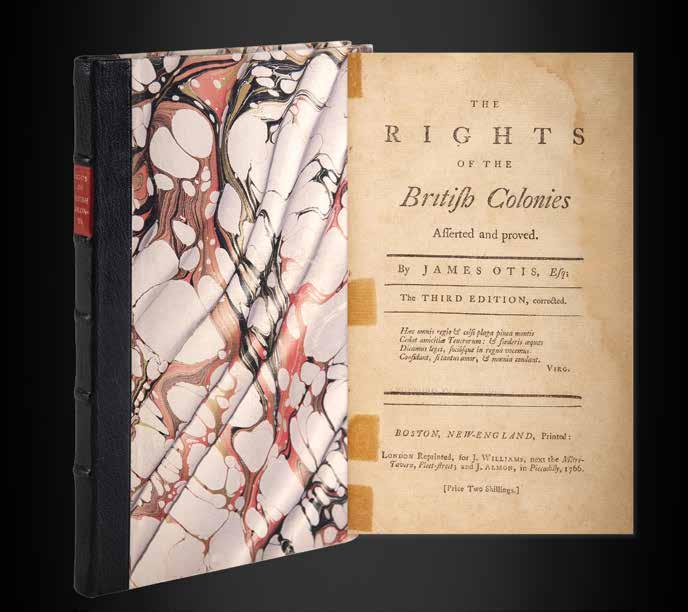
LOT 8001
James Otis: The Rights of the British Colonies Asserted and Proved (Third Edition, 1766)
Important book: The Rights of the British Colonies Asserted and Proved by James Otis. Third edition, corrected. Boston, New-England, Printed: London Reprinted, for J. Williams, and J. Almon, 1766. Hardcover rebound in quarter-leather with marbled boards, 5.25 x 8.25, 120 pages. Book condition: G+/None, with dampstaining to extremities of textblock, tape stains to edges of the title page and final page, and a few handwritten notes and corrections to margins.
Few pamphlets of the Revolutionary era proved as consequential as James Otis’s The Rights of the British Colonies Asserted and Proved. First published in 1764 in response to the Sugar Revenue Act, Otis’s forceful argument against taxation without colonial representation helped ignite the political controversy that would culminate in the American Revolution. Widely read and debated on both sides of the Atlantic, the work articulated the colonists’ constitutional grievances and established Otis as one of the earliest and most influential voices of resistance to British parliamentary authority.
Starting Bid $200
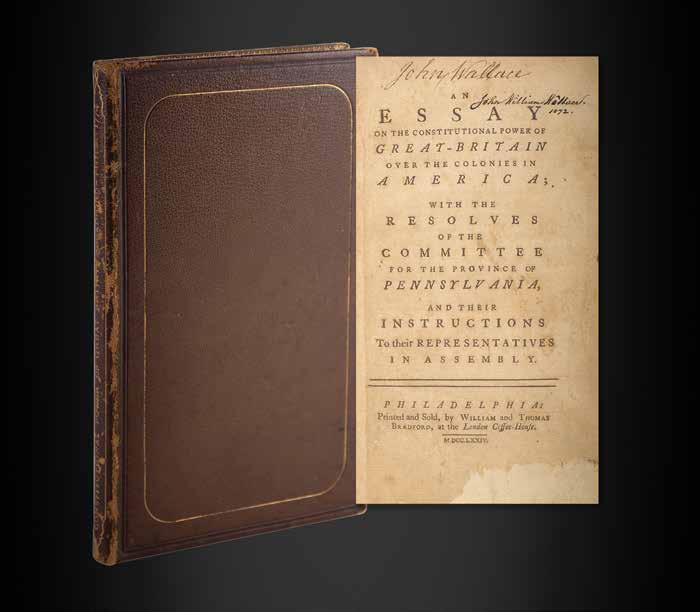
John Dickinson: An Essay on the Constitutional Power of Great-Britain over the Colonies in America (First Edition, 1774)
An important Revolutionary tract: An Essay on the Constitutional Power of Great-Britain over the Colonies in America; with the Resolves of the Committee for the Province of Pennsylvania, and their Instructions to the representatives in Assembly. First edition. Philadelphia: Printed and sold by William and Thomas Bradford at the London Coffee-House, 1774. Hardcover rebound in full brown morocco, 5.25 x 8.5, 127 pages. Book condition: G+/None, with edgewear, scuffing to spine, repaired loss to the lower right corner of the title page, small tears and losses to a few other pages, and ownership inscriptions of John and John William Wallace on the title page.
Dickinson had already established a reputation as a brilliant lawyer in 1765, when he wrote his first tract against the Stamp Act, and his Letters From a Farmer in Pennsylvania published in 1768, put him at the forefront of the patriot movement, he still hoped for conciliation as events moved away from him, however, and by 1774 he was the leader of the conservative patriots. In 1774 he became chairman of the Philadelphia Committee of Correspondence, and this pamphlet consists of three papers he drew up which were adopted by the Committee in July of that year. They state the principles upon which the colonies based their claim to redress, instructions to the Congressional delegates to be chosen by the Assembly, and a treatise on the constitutional power of Great Britain to tax the colonies.
References: Evans 13247; Howes D326; Sabin 20040.
Starting Bid $300
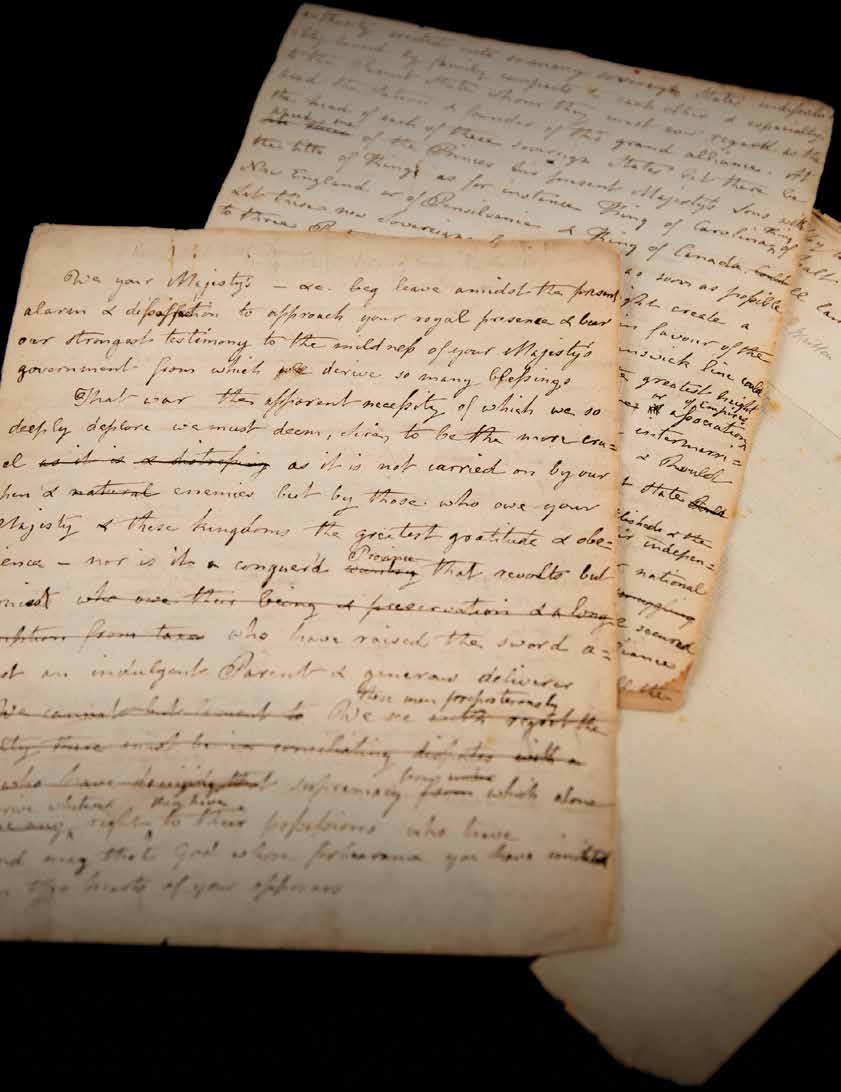
Amidst “alarm & disaffection” in the colonies, a proposal to King George III for preserving America as three sovereign states, “the first containing the southern, the second the New England Provinces, & the third Canada”
[King George III] Baptist Noel Turner Autograph Draft Proposal for Settling the American Colonies (c. 1775)
Revolutionary War–era unsigned handwritten draft, five pages three sheets, 7.5 x 10, no date but circa 1775. Handwritten draft proposal by pamphleteer, poet, and scholar Baptist Noel Turner (1739–1836), rector of Wing in Rutlandshire and Denton in Lincolnshire, addressed to King George III. Amidst “the present alarm & disaffection” in the colonies, Turner offers his solution, in part: “That war the apparent necessity of which we so deeply deplore we must deem, Sire, to be the more cruel as it is not carried on by our open & natural enemies but by those who owe your Majesty & these kingdoms the greatest gratitude & obedience—nor is it a conquer’d Province that revolts but Colonies who have raised the sword against an indulgent Parent & generous deliverer…The scheme I propose for the settlement of America should we ever become Arbiters there again is indeed of a nature so bold & extraordinary that I sometimes fancy it too romantick…Let us suppose then America to be divided into several verbi grati three grand divisions the first containing the southern, the second the New England Provinces, & the third Canada. Let these be declared by Parliament independent on Great Britain & each other & at the same time be by the King’s authority erected into so many
sovereign States indissolubly bound by family compacts to each other & especially to the Parent State whom they must ever regard as the head, the Patron & founder of this grand alliance.”
He goes on to discuss the governance of these autonomous regions: “At the head of each of these sovereign States let there be placed some of the Princes his present Majesty’s Sons with the title of Kings as for instance King of Carolina, King of New England or of Pennsylvania, & King of Canada. Let these now Sovereigns be allianced as soon as possible to three Protestant Principles which might create a strong alliance & diversion at present in favour of the settlement…such an encrease of the Brunswick line could not fail one would think of exalting to the greatest height the glory & prosperity of the British Empire.”
He further addresses questions of independence, republicanism, and taxation: “Such an alliance would be an effectual check to republicanism in all the States tho’ as they would partake of the spirit of the British Constitution, it could not I should hope be dangerous to real liberty.” In very good to fine condition, with light soiling chipping, and toning to edges; the short paragraph on the last page is clipped and affixed to a same-size sheet.
Starting Bid $200
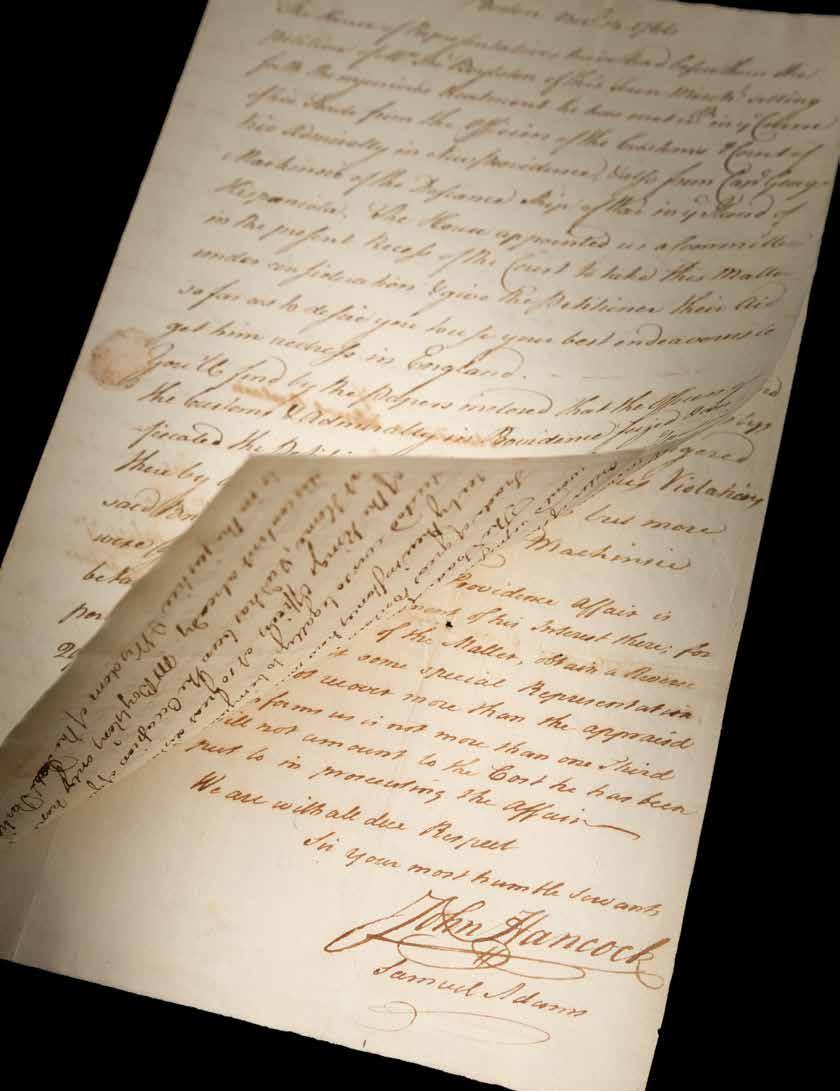
A decade before the Revolution, Hancock and Adams jointly warn that
“his Majesty’s well-disposed subjects in America” were being driven to disaffection by “notorious Violations of their Property”
John Hancock and Samuel Adams Letter Signed on American Radicals’ Disaffection with British Colonial Policies and “notorious Violations of their Property” (1766)
Remarkable LS signed “John Hancock” and “Samuel Adams,” three pages on two adjoining sheets, 7.5 x 12.5, November 15, 1766.
Letter to Dennis Diberdi, a London agent, petitioning on behalf of Boston merchant Thomas Boylston, whose brig Recovery had been unjustly seized by customs officers and commandeered to Jamaica by a Captain Mackenzie despite violating no law.
In part: “The House of Representatives have had before them the petition of Mr. Tho. Boylston of this Town, Mercht., setting forth the injurious treatment he has met with in ye Course of his Trade from the Officers of the Customs & Court of Vice Admiralty in New Providence, & also from Capt. George Mackinsie of the Defiance, Ship of War, in ye Island of Hispaniola. The House appointed us a Committee, in the present Recess of the Court, to take this Matter under consideration & give the Petitioner their Aid so far as to desire you to use your best endeavours to get him redress in England. You’ll find by the Papers inclosed that the Officers of the Customs & Admiralty in Providence seized & confiscated the Petitioner’s Brig Recovery & Cargo, which put in there by distress. The pretence was that the Master of said Brig was not furnished with a certificate that bonds were given to deliver any foreign matter that should be taken on board during the Voyage in some English port, agreeable to Act of Parliament, which was to take place 29th of Sept. 1765. But as it appears that the Vessel cleared out the 1st day of said Sept. & sail’d near a month before said Act took place, with all necessary Papers, & had never been in any English port from the Time of her sailing till she arrived at New Providence, & there bond was offered agreeable to the Act, & even the duty tender’d by said Master, it seems to be an apparent misapplication of the Act of Parliament to the injury of the Subject, where complaint merits the attention of Government.
The other Grievance mention’d by the Petitioner is that his Vessel was violently taken from the Port of Monti Christi, where a Cargo was provided for her by an English Factor, the Master dispossessed of his Brig & confined by said Mackinsie, & finally sent to Jamaica, to the damage of Mr. Boylston, as he alleges, upwards of two thousand pounds Sterg. In Jamaica, Capt. Mackinsie, convinced of the illegality of these proceedings, exploited Bonds of the Master to secure himself from being prosecuted by the said Master or Owner. In this instance the Subject is deprived of his property without the least pretence to
Law. No breach of the Act of Trade is urged to justify the proceeding, & if such grievances are not redress’d, the American Trade so beneficial to Great Britain will be greatly discouraged...The Trade of America, you are sensible, is really the Trade of Great Britain, the profits of which center there. You’ll see by these instances how much our trade is exposed, though conducted ever so legally, to be injured by the misconduct of the King’s Officers at so great distance from the Government at Home, & which has been the Occasion of great uneasiness & discontent already. Mr. Boylston’s only hope of redress is in the justice & Wisdom of the Parliament, especially in the affair of Capt. Mackinsie, who he’s informed is utterly unable to make him restitution for the great injury he has done him... It is of great importance to the Nation itself that the Government should be apprised how much their interest suffers by too frequent discouragement of their Trade of this kind in this part of the World, & the minds of his Majesty’s well-disposed subjects in America endangered of being disaffected by such notorious Violations of their Property as in these Cases, but more especially in the Case of Capt. Mackinsie.”
Adams adds eight lines at the conclusion in his own hand: “The Grievance in the Providence Affair is aggravated by the low appraisement of his Interest there; for should he, upon a Rehearing of the matter, obtain a Reverse of the Decree, yet without some special Representation of the Case, he will not receive more than the appraised Value, which he informs is not more than one Third of the real, & will not amount to the Cost he has been & expects to be put to in prosecuting the Affair.” In fine condition. Accompanied by an impressive custom-made full morocco clamshell case with gilt-lettered spine and front board. Written in the uneasy aftermath of the Stamp Act crisis, this 1766 letter captures the transition from colonial protest over taxation to a broader constitutional grievance over arbitrary imperial power. John Hancock and Samuel Adams were then rising figures in Massachusetts politics, and their appeal on behalf of Thomas Boylston framed a commercial dispute as evidence of a larger danger: that royal officers and customs courts could deprive Americans of property without lawful process. The language anticipates the ideological core of the Revolution, linking trade, property rights, and loyalty to the Crown while warning that repeated abuses would alienate “his Majesty’s well-disposed subjects in America.” Coming a decade before independence, the document shows Hancock and Adams not yet calling for separation, but already articulating the colonial argument that British authority, when exercised through distant and unaccountable officials, threatened the rights of Englishmen in America.
Starting Bid $10,000
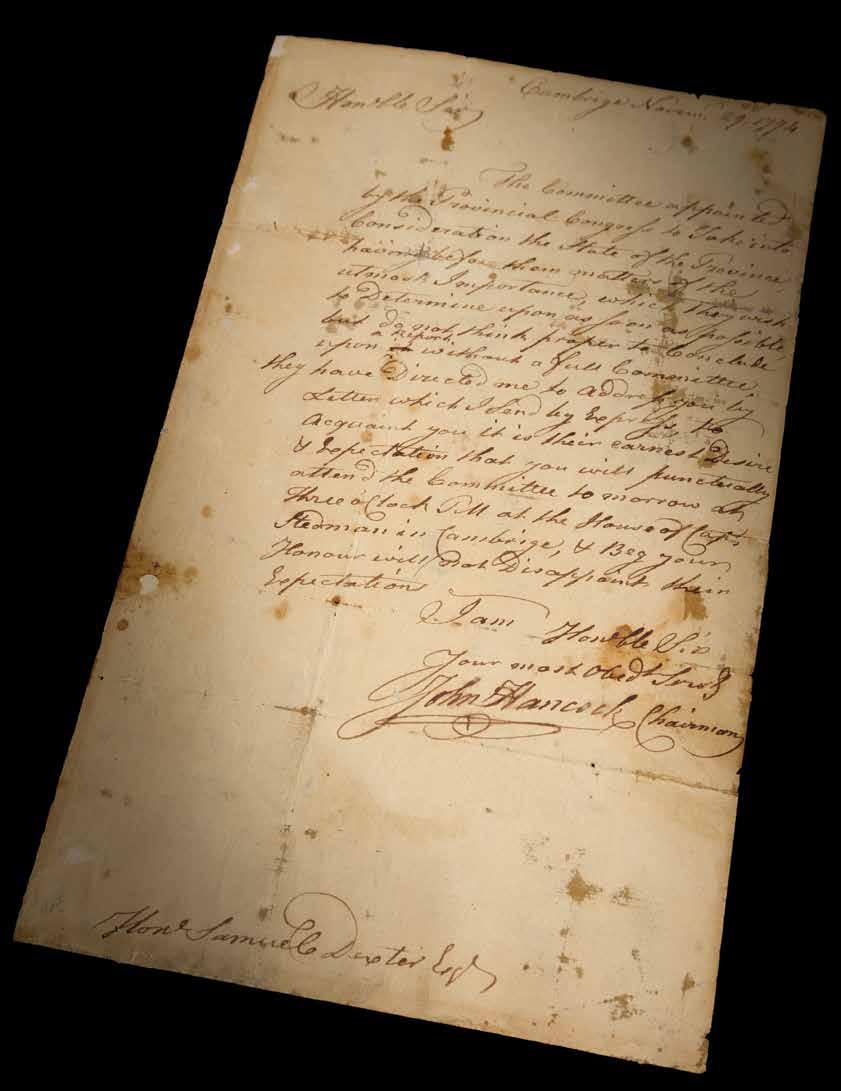
Written less than five months before
Hancock urgently summons a Massachusetts Provincial Congress delegate to a Cambridge committee meeting to deliberate on matters “of the utmost Importance,” as Patriot leaders quietly build a revolutionary government in defiance of British authority
John Hancock War-Dated Autograph Letter Signed as Chairman of the Massachusetts Provincial Congress, Urgently Summoning a Delegate to a Committee Meeting in Cambridge (1774)
Revolutionary War-era ALS signed “John Hancock, Chairman,” one page, 7.25 x 12, November 29, 1774. Addressed from Cambridge, a handwritten letter to Samuel Dexter, in full: “The Committee appointed by the Provincial Congress to Take into Consideration the State of the Province, having before them matters of the utmost Importance, which they wish to Determine upon as soon as possible, but I do not think it proper to Conclude upon a Report without a full Committee. They have directed me to Address you by Letter which I send by Express, to Acquaint you it is their earnest Desire & Expectation that you will punctually attend the Committee tomorrow at Three o’Clock PM at the house of Cap’t Steadman in Cambridge, & beg your honor will not disappoint their expectations.” In very good to fine condition, with scattered stains, a partial separation to the center horizontal fold, and small professional repairs.
Written during one of the most volatile transitional moments of the American Revolution, the letter finds Hancock organizing an alternative government in defiance of royal authority. Following Parliament’s passage of the Coercive Acts and the Massachusetts Suffolk Resolves of September 1774, which declared those acts unconstitutional and called for organized resistance, the Massachusetts Provincial Con-
gress emerged as a de facto revolutionary governing body, meeting at Cambridge while British troops occupied Boston. By the time Hancock wrote this letter, the First Continental Congress had already endorsed the Suffolk Resolves, and Patriot leaders in Massachusetts were beginning to translate political resistance into practical governmental and military organization.
The recipient, Samuel Dexter Sr. (1726–1810), was a Massachusetts merchant, politician, and delegate to the Provincial Congress, and Hancock’s urgent summons reflects the importance of the committee’s ongoing deliberations on matters “of the utmost Importance.” Already one of the most prominent Patriot leaders in Massachusetts and a principal target of General Thomas Gage’s administration, Hancock here appears exercising the executive authority that would soon carry him to the presidency of the Continental Congress in 1775. Although the exact committee referenced in the letter is uncertain, the Provincial Congress at this time was actively addressing military preparedness, provincial governance, supply organization, and resistance to British authority in the months immediately preceding the outbreak of armed conflict at Lexington and Concord. The meeting location at the house of “Cap’t Steadman” in Cambridge appears to reference one of the taverns or private houses frequently used by Patriot committees and Provincial Congress members during this formative period of revolutionary organization.
Starting Bid $1,000
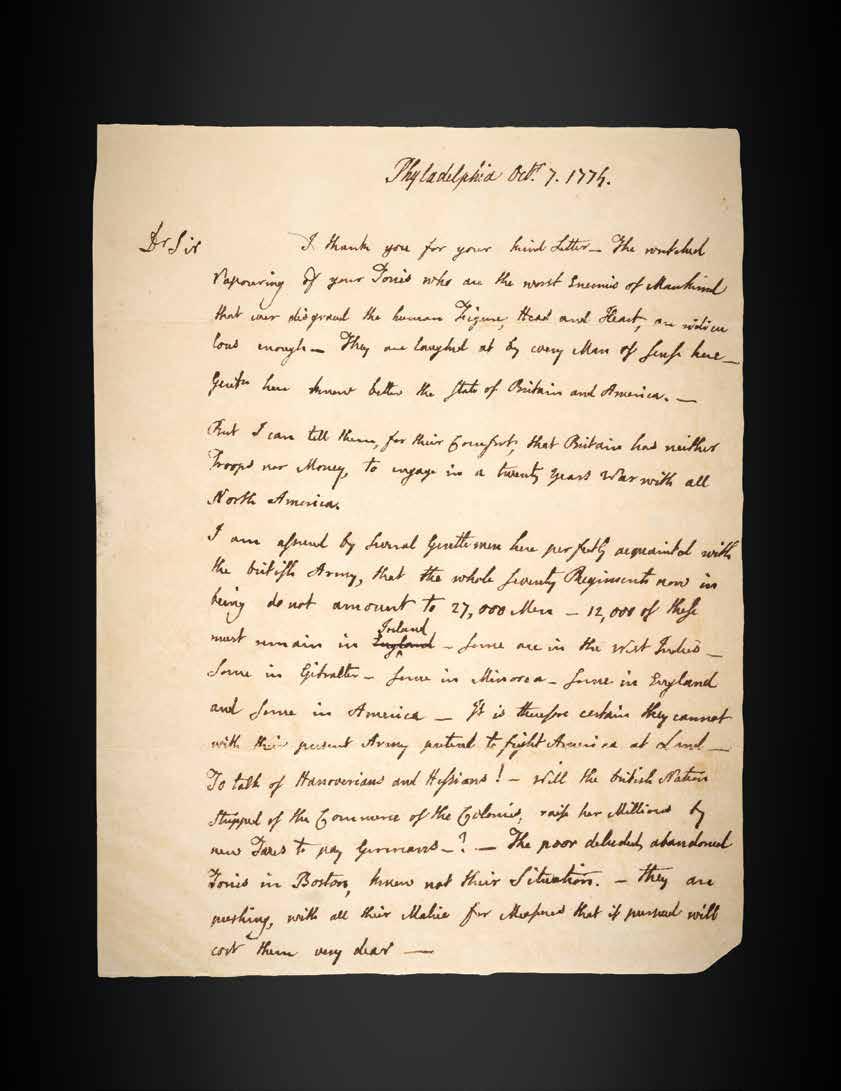
“Britain
John Adams Handwritten Letter on the Eve of Revolution, Declaring that “Britain has neither Troops nor Money” to fight America while calling Boston Tories “Enemies of Mankind”
Unsigned pre-war handwritten letter by John Adams, one page, 6.25 x 8.25, October 7, 1774. Written while serving as a Massachusetts delegate to the First Continental Congress, this extraordinary draft letter captures John Adams at his most impassioned, unleashing fierce condemnation of British authority in language so inflammatory that it was either deemed too dangerous to send or intentionally left unsigned. Had such a letter been intercepted by British authorities bearing Adams’s signature, its contents could have been construed as treasonous—and potentially served as his death warrant.
In full: “I thank you for your kind Letter. The wretched Vapouring of your Tories who are the worst Enemies of Mankind that ever disgraced the human Figure, Head and Heart, are ridiculous enough. They are laughed at by every man of sense here. Gent[leme]n here know better the state of Britain and America. But I can tell them, for their Comfort, that Britain has neither Troops nor Money, to engage in a twenty years War with all North America. I am assured by several Gentlemen here perfectly acquainted with the British Army, that the whole seventy Regiments now in being do not amount to 27,000 Men. 12,000 of these must remain in Ireland. Some are in the West Indies. Some in Gibraltar. Some in Minorca. Some in England and some in America. It is therefore certain they cannot with their present Army pretend to fight America at Land. To talk of Hanoverians
and Hessians! Will the British Nation stripped of the Commerce of the Colonies, raise her Millions by new Taxes to pay Germans? The poor deluded, abandoned Tories in Boston, know not their situation. They are pushing, with all their Malice for Measures that if pursued will cost them very dear.” In fine condition.
Adams writes just one month into the First Continental Congress, convened in Philadelphia in response to Parliament’s Intolerable Acts, which were passed to punish Massachusetts for the Boston Tea Party. Delegates from twelve colonies had gathered for the first time on September 5, 1774, representing a wide range of political convictions—from conservative loyalists to radical patriots—and debated how the colonies should respond if Britain refused to repeal the Acts. By the time Congress adjourned on October 26, it had taken significant steps toward Adams’s desired outcome: a complete boycott of British goods, the training of local militias, and the first real movement toward American independence.
Adams wrote three other known letters on this same date—to Abigail Adams, William Tudor, and General Thomas Gage—each addressing the political crisis, but none with the same unguarded fury and indignation found in this epistle. This letter powerfully reflects the rawness of his revolutionary temperament: its force lies in its immediacy, offering a vivid glimpse of Adams before independence was declared, already convinced that Britain lacked the troops, money, and resolve to subdue North America.
Starting Bid $10,000
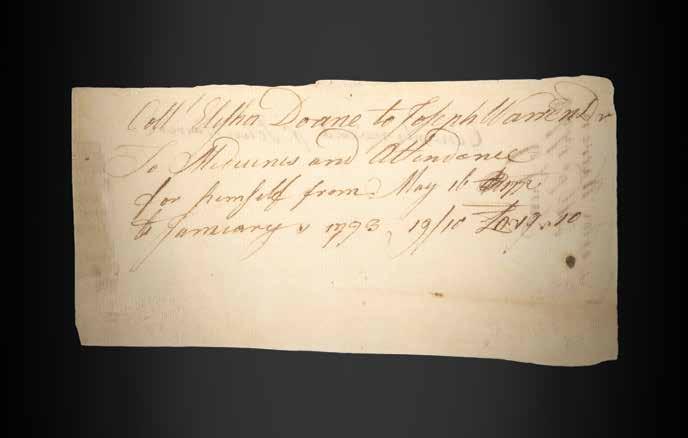
LOT 8007
Joseph Warren Autograph Document SignedMedical Bill to Col. Elisha Doane for Medicines and Attendance, Endorsed by His Brother Dr. John Warren
Boston physician, orator, and patriot (1741–1775) who was a pivotal figure in the early revolutionary agitation in Massachusetts and was killed in combat at the Battle of Bunker Hill. Scarce third-person ADS by Joseph Warren, one page, 6 x 3.25, January 1773. Warren pens a request for remittance of his services to Col. Elisha Doane, in full: “Col. Elisha Doane to Joseph Warren Dr., To Medicines and Attendance for himself from May 16, 1772 to January 3, 1773, £0.19.10.”
Docketed on the reverse in another hand, “Doctor Warren, Bill pd 1773 Jan’y 9,” and further endorsed by Warren’s brother, Dr. John Warren, founder of the Harvard Medical School: “Contents received, John Warren.” Lightly silked for preservation and in fine condition, with a stain to the left edge.
An outstanding medical-related Warren document, desirable not only for its direct connection to Joseph Warren’s Boston practice, but also for its exceptional dual Warren association. Written just two years before his heroic death at Bunker Hill, the piece captures Warren in his civilian role as a working physician, billing Colonel Elisha Doane—one of Massachusetts’s wealthiest and most influential citizens—for months of medicines and attendance. Further endorsed by his brother Dr. John Warren, later a founder of Harvard Medical School, this small bill unites two of early America’s most important medical patriots in a single Revolutionary-era document.
Starting Bid $1,000
Joseph Warren: Manuscript Draft Eulogy for the Patriot General Killed at Bunker Hill, Published in the Pennsylvania Magazine During Thomas Paine’s Editorship (1775)
Revolutionary War-era manuscript eulogy memorializing Major General Joseph Warren following his death at the Battle of Bunker Hill on June 17, 1775, apparently an original author’s draft whose text was later published in the “Monthly Intelligence” section of the Pennsylvania Magazine shortly after Warren’s death. The manuscript, four pages on two adjoining sheets, 7.5 x 12.25, with the final paragraph on a separate 8 x 5.25 sheet, is handwritten in ink on period laid paper bearing an “FL” watermark. The manuscript displays numerous small corrections and revisions throughout the text, suggesting either a working draft or an early contemporary transcription prepared for publication or circulation. Also present are pinpoint-dot initials of “WBE” and “WP,” both of uncertain significance.
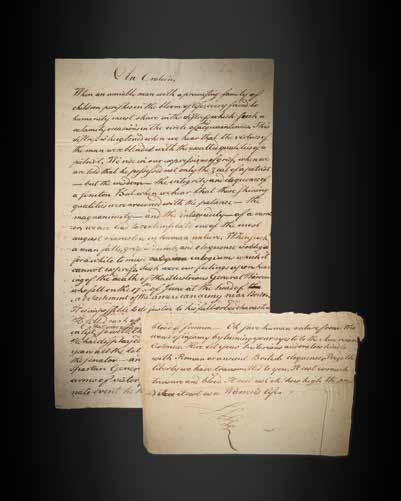
The eulogy begins, in part: “When an amiable man with a promising family of children perishes in the bloom of life, every friend to humanity must share in the distress which such a calamity occasions in the circle of his acquaintances. This distress is heightened when we hear that the virtues of the man were blended with the exalted qualities of a patriot. We rise in our expressions of grief, when we are told that he possessed not only the zeal of a patriot – but the wisdom – the integrity and the eloquence of a senator. But when we hear that these shining qualities were crowned with the patience – the magnanimity – and the intrepidity – of a warrior, we are led to contemplate one of the most august characters in human nature. When such a man falls, grief is dumb, and eloquence is obliged for a while to muse eulogiums which it cannot express.”
It concludes: “O! Posterity! – posterity! You will often look back to this memorable æra. – You will treasure the exploits of rebels and traitors from the loyal people of America to their just originals. You will unfold every part of that despotism which has been contrived for the British empire – you will show pious kings misled by arbitrary ministers, and pious ministers misled by arbitrary kings. – You will show that even the monarchs of Britain have shed tears in the…prevailing upon their subjects to accept their hateful commissions, and at the same time have exulted in the society of a few paracides at the prospect of seeing a continent deluged with the blood of freemen. – Oh! save human nature from the worst of infamy by turning your eyes to the American Colonies. Here let your historians and orators kindle with Roman or ancient British eloquence. Prize the liberty we have transmitted to you. It cost us much treasure and blood. It cost us (oh! how high the prize) it cost us a Warren’s life.” In fine condition, with a small area of paper loss, affecting a few words of text. Joseph Warren, physician, politician, and major general of the Massachusetts militia, emerged as one of the most important Patriot leaders of the early American Revolution. A central organizer of resistance in Boston alongside Samuel Adams and Paul Revere, Warren played a leading role in Revolutionary communications, intelligence, and militia organization in the months preceding Lexington and Concord. Although appointed a major general shortly before the Battle of Bunker Hill, Warren chose to fight as a volunteer on June 17, 1775, where he was killed during the British assault on Breed’s Hill. His death transformed him into one of the first great martyrs of the American cause, inspiring an outpouring of commemorative sermons, poems, broadsides, and patriotic eulogies throughout the colonies. The manuscript corresponds closely to the text of a eulogy published in the “Monthly Intelligence” section of the Pennsylvania Magazine in 1775, during the period in which Thomas Paine served as editor of the publication. Structured as a sweeping patriotic oration addressed in turn to senators, soldiers, parents, and posterity, the eulogy reflects the influence of classical republican rhetoric that shaped Revolutionary political literature in the opening months of the American Revolution. The emotionally charged language portrays Warren as the embodiment of republican virtue while denouncing British military authority as ‘arbitrary power’ and ‘ministerial tyranny,’ exhorting Americans across every station of life to continue the struggle for independence in the wake of his death.
Starting Bid $200
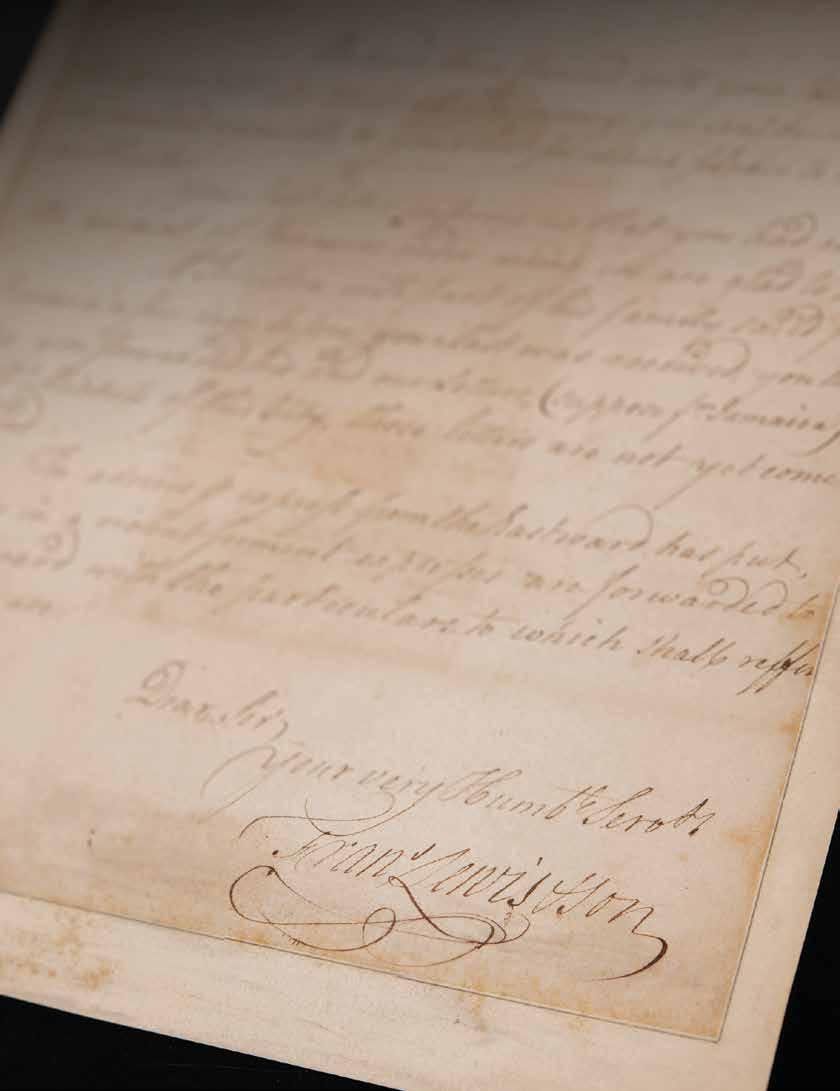
In April 1775, the New York Declaration signer reacts to news of the Battles of Lexington and Concord:
“The advices p[er] express from the Eastward has put this City in a violent ferment”
LOT 8009
Francis Lewis Revolutionary War-Dated Autograph Letter Signed on NYC’s Reaction to the Battles of Lexington and Concord: “This City in a violent ferment” (April 26, 1775)
Signer of the Declaration of Independence from New York (1713–1802). Revolutionary War-dated ALS signed “Fra’s Lewis & Son,” one page, 7.5 x 8.75, April 26, 1775. Handwritten letter to Philadelphia merchant to William Pollard, in full: “We have been favored with your letters of the 30 & 31 ult’o also 20 April. The money you sent by Mr. Rotch we received agreeable to your list for which please to accept our thanks. Your last letter informs us that you had receiv’d the amount of Kenneer’s order which we are glad to he[ar].
Mr. Johnston with part of his family sailed f[or] Jamaica a few days before your last was received; you there say you forwarded his and our Letters, (suppose f’m Jamaica) by a Mr. Mitchell of this city, those letters are not yet come to hand. The advices p[er] express from the Eastward has put this City in a violent ferment[;] expresses are forwarded to to [sic] the So[uth]ward with the particulars to which shall reffer [sic] you.” Addressed on the reverse in Lewis’s hand. Professionally inlaid into a slightly larger sheet and in very good to fine condition, with scattered light staining.
The April 26th date places this letter just one week after the Battles of Lexington and Concord, fought on April 19, 1775—the opening armed conflict of the American Revolution. Lewis’s reference to “advices per express from the Eastward” having thrown Philadelphia into “a violent ferment” vividly captures the speed and force with which news of the bloodshed spread through the colonies. The dispatches moving “to the Southward with the particulars” reflect the urgent colonial communication network that transformed local resistance in Massachusetts into a continental crisis.
On April 23, 1775, a broadside was printed and distributed in New York City, headlined: ‘The following interesting Advices were this Day received here by two Vessels from Newport and by an Express by Land.’ It contained transcriptions of communications from Rhode Island Supreme Court Chief Justice Stephen Hopkins and other leaders of Providence conveying the first reports of the conflict: ‘About 1200 of the regular troops have proceeded from Boston toward Concord; and having fired on the inhabitants, and killed a number of them at Lexington, are now actually engaged in butchering and destroying our brethren in the most inhuman manner.’ In his 1995 reference History Comes to Life, Kenneth Rendell places Lewis’s autograph material into the ‘very rare’ category among the Signers; as choice example from the dawn of the American Revolution, this is a particularly desirable example.
Starting Bid $2,500
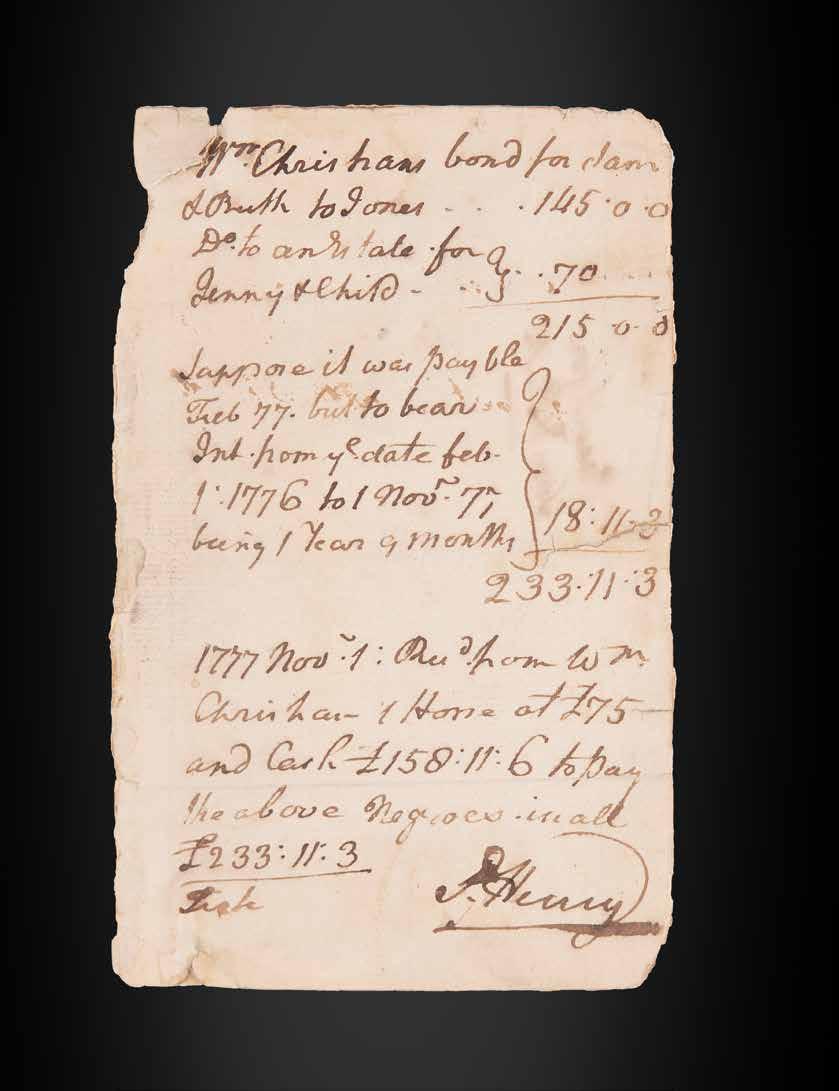
Patrick Henry Autograph Document Signed, Valuing an Enslaved Woman and Child in a Financial Settlement During the Revolutionary Era (1776–1777)
ADS, signed “P. Henry,” one page, 3.75 x 6, November 1, 1777. Handwritten document recording a financial settlement between Henry and his brother-in-law, Colonel William Christian of Virginia, a decorated officer who had served under Washington and was married to Henry’s sister Anne. Christian held a bond comprising two obligations: a debt of £145 owed to a party named Jones, and a valuation of £70 for an enslaved woman named Jenny and her child, together £215. Henry then calculates simple interest accrued from 1 February 1776 to 1 November 1777—a period of one year and nine months—adding £18.11.3 and bringing the total to £233.11.3. Below, in a settlement notation dated 1 November 1777, Henry records receipt of a horse valued at £75 and cash of £158.11.6, the account thereby discharged in full. He signs at the conclusion, adding “Teste,” Latin for ‘I witness.’ Mounted to a same-size card and in very good to fine condition, with trimming to the edges; the upper left corner tip is detached, and held in place with a small piece of old tape on the back.
The named woman, Jenny, may correspond to an enslaved woman of the same name listed among the enslaved people in Henry’s Scotchtown household as early as 1768, though the identification cannot be confirmed. Her child goes unidentified entirely—subsumed into a single line item, appraised as a unit.
The dating gives the document particular historical force, the interest period beginning on February 1, 1776. By that spring, Patrick Henry—who had electrified the Virginia Convention the previous March with the cry ‘Give me liberty, or give me death!’—was serving on the committee charged with drafting Virginia’s Declaration of Rights, the document that would proclaim to the world that all men are ‘by nature equally free and independent.’ By summer, those words had found their echo in Philadelphia: ‘all men are created equal.’ The interest period closes 1 November 1777, sixteen months after independence was declared. Jenny and her child are present throughout, as collateral.
Henry’s own writings show that he recognized the moral contradiction of slavery, even while continuing to participate in the institution. In a 1773 letter, he described slavery was a practice he could not justify and that it was ‘repugnant’ to Christianity, while admitting that he remained bound by the ‘general inconvenience’ of life in Virginia without enslaved labor. None of this anguish altered the arithmetic in Henry’s calculations: Jenny—woman, mother, person—entered the ledger at seventy pounds.
Autograph documents of Patrick Henry are uncommon, and one that bears so directly, and so candidly, on the institution of slavery—reducing a named woman and her child to a line in a debt settlement, in the very year Henry was inscribing the language of universal liberty onto Virginia’s founding charter—is a document of singular historical resonance.
Starting Bid $500
Five years after the ‘Midnight Ride,’ William Dawes supplies the Revolution: a 1780 rations certificate for New Hampshire recruits bound for “Gen’l Poor’s Brigade”
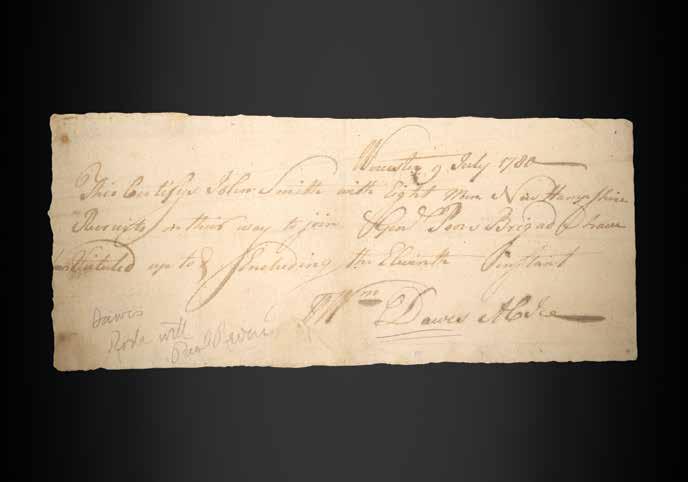
William Dawes Revolutionary War-Dated Autograph Document Signed, Issuing Rations to Continental Army Recruits Five Years After His Midnight Ride with Paul Revere
American soldier (1745–1799) who famously rode with Paul Revere on the night of April 18, 1775, to alert Massachusetts minutemen of the approach of British regulars prior to the Battles of Lexington and Concord. Revolutionary War–dated ADS, signed “Wm. Dawes,” one page, 8 x 3.25, July 9, 1780. Handwritten military document issued while serving as a quartermaster for the Continental Army in Worcester, Massachusetts. In full: “This Certifies John Smith with Eight Men New Hampshire Recruits on their way to join Gen’l Poor’s Brigade have been Victualed up to & Encluding the Eleventh Instant.” Affixed to a slightly larger sheet and in fine condition, with some light soiling.
This war-dated certificate reflects the everyday logistics behind the Continental Army, documenting rations issued to John Smith and eight New Hampshire recruits as they traveled to join “Gen’l Poor’s Brigade”—the command of Brigadier General Enoch Poor, the respected New Hampshire officer who had served at Saratoga, Valley Forge, and Monmouth. Poor had earned Washington’s confidence through steady service at some of the war’s most demanding engagements and by 1780 commanded one of the Continental Army’s most battletested New Hampshire brigades.
Dawes signed comparatively little of historical consequence, and Revolutionary War–dated documents bearing his autograph are extremely rare.
Starting Bid $2,500
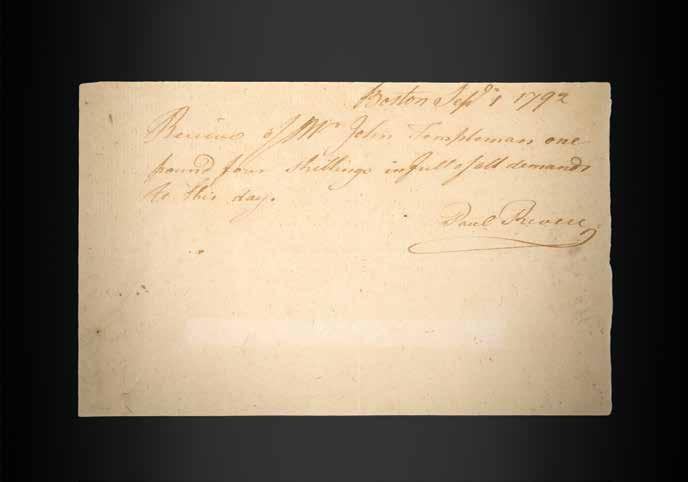
Paul Revere Autograph Document Signed, Receiving Payment from a Wealthy Patron of His Silver Shop
American patriot and silversmith (1735–1818) whose 1775 ‘midnight ride’ to warn of an impending British invasion later became one of the most celebrated incidents of the Revolutionary War. ADS, signed “Paul Revere,” one page, 6.25 x 4, September 1, 1792. Handwritten document, in full: “Received of Mr. John Templeman one pound four shillings in full of all demands to this day.” In fine condition.
This 1792 receipt dates to Paul Revere’s post-Revolutionary career, when he resumed work as a silversmith and expanded into increasingly ambitious industrial ventures. As a respected Boston craftsman and
manufacturer, Revere pioneered copper plating and copper spikes for shipbuilding, casting church bells and bronze cannon, and establishing major copper-rolling works in Canton, Massachusetts.
Here, he receives payment from John Templeman, a wealthy Boston merchant and important patron of Revere’s silver shop. Templeman and his wife, Mehitable, were loyal customers who commissioned numerous household objects from Revere, including a 1792–93 silver tea service now held by the Minneapolis Institute of Art. As a routine acknowledgment of payment, the document offers a tangible link between Revere’s everyday commercial dealings and the elite Boston clientele who helped sustain his reputation as one of early America’s foremost silversmiths.
Starting Bid $2,500
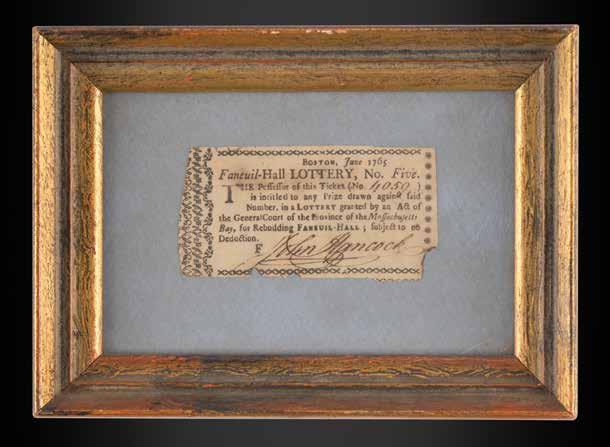
Scarce lottery ticket crisply signed at the conclusion in ink, “John Hancock,” one page, 3.25 x 1.75, for the “Faneuil-Hall Lottery” held in Boston in June 1965. In full: “The Possessor of this Ticket (No. 4059) is intitled to any Prize drawn against said Number, in a Lottery granted by an Act of the General Court of the Province of the Massachusetts Bay, for Rebuilding Faneuil-Hall; subject to Deduction.” Mounted and framed to an overall size of 7 x 5. In fine condition. Accompanied by a full letter of authenticity from JSA.
In colonial times, lotteries were a highly regarded method of financing worthwhile projects—such as the rebuilding of Faneuil Hall, the famous Boston marketplace and meeting hall that had been destroyed in a 1761 fire. At the time, such money-making efforts were viewed as being akin to investments, and were endorsed by local leaders—as evidenced here, with Hancock signing as one of Boston’s five selectmen. Interestingly, Hancock came to disdain a public lottery as a method of fundraising, concluding that it encouraged gambling while producing meager results. Although thousands of such tickets were printed in Colonial America, not all were signed by Hancock, and only a small percentage of those signed examples have survived the centuries.
Starting Bid $1,000
LOT 8014
George Washington Signed 1768 Mountain Road Lottery Ticket - One of About 25 Examples Known
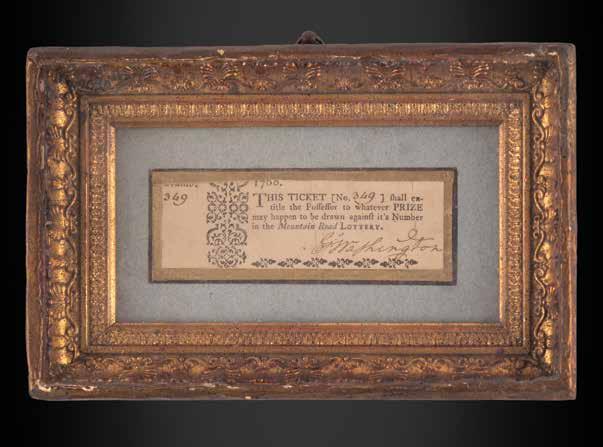
Historic lottery ticket neatly signed at the conclusion in ink, “G:o Washington,” one page, 3.75 x 1.25, for the “Mountain Road Lottery” held in 1768. In full: “This ticket [No. 349] shall entitle the Possessor to whatever Prize may happen to be drawn against it’s Number in the Mountain Road Lottery.” These lottery tickets were printed several at a time on larger sheets before being cut. Mounted within an antique frame to an overall size of 7.5 x 4.75. In fine condition. Accompanied by a full letter of authenticity from JSA.
A 1938 newspaper clipping affixed to the frame’s reverse attests to its provenance: “The first session of the sale of the Erskine Hewitt collection was held last night at the Parke-Bernet galleries, 742 Fifth Avenue. There will be seven sessions. The first offerings were historical Americana from the Hewitt collection. Proceeds of the sale totaled
$4,447, and the item that brought the most money was a lottery ticket dated 1768, signed by George Washington. The lottery was run for the building of a mountain road in Virginia. The ticket was bought last night by a private collector of Americana, for $280.”
With Captain Thomas Bullitt and others, Washington conceived a lottery as a way to raise funds to build a road through the Allegheny Mountains in Virginia and to construct a resort in the area now known as The Homestead, Hot Springs, Virginia. The effort ultimately met with little success, hampered by competition from other lotteries, and in 1769 King George III prohibited lotteries altogether. Though 6,000 Mountain Road Lottery tickets were intended for sale, surviving examples are remarkably few, with only about 25 known today. This is an unusually desirable and displayable Washington autograph format—scarce and directly tied to his early interests in the development of Virginia.
Starting Bid $1,000
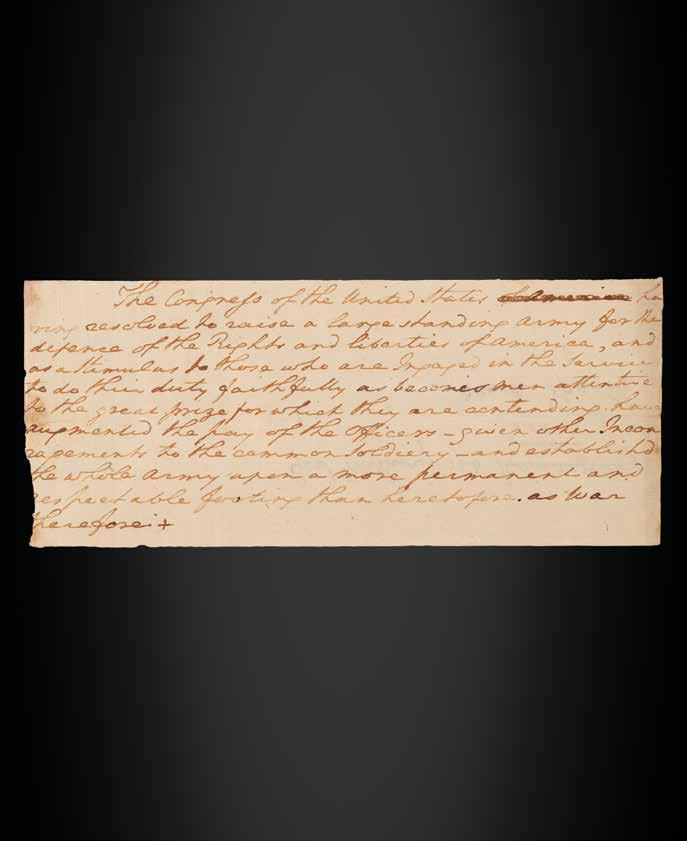
“For the defence of the Rights and liberties of America”— Washington supports the establishment of a standing army in 1777
George Washington Revolutionary War-Era Handwritten Manuscript Fragment on Raising “a large standing army for the defence of the Rights and liberties of America”
Significant unsigned Revolutionary War–era handwritten manuscript by George Washington, one page, 7.75 x 3.25, no date but circa 1777. Washington writes, in part: “The Congress of the United States having resolved to raise a large standing army for the defence of the Rights and liberties of America, and as a stimulus to those who are Ingaged in the service to do their duty faithfully as becomes men attentive to the great prize for which they are contending have augmented the pay of the officers—given other Incouragements to the common soldiery—and established the whole army upon a more permanent and respectable footing than heretofore.” Annotated on the reverse in ink by American historian and educator Jared Sparks, “Gen’l Washington’s handwriting, 1777, Jared Sparks.” In fine condition, with some minor edge staining and minor paper loss to the lower left, slightly affecting a few words.
In June 1775, Congress established the Continental Army and appointed George Washington to command it, placing him at the head of a force that was still more improvised than permanent. Over the next two years, Washington struggled with the same problems again and again: short enlistments, uneven discipline, shortages of pay and
supplies, and the difficulty of keeping men in the field long enough to sustain a war against Britain. This circa 1777 manuscript reflects that turning point. Washington’s reference to Congress resolving “to raise a large standing army” and to put the service on a “more permanent and respectable footing” speaks to the urgent effort to move beyond temporary militia-style service and create a reliable national army capable of defending “the Rights and liberties of America.”
The manuscript is especially compelling because it captures Washington’s practical view of what independence required. Although many Americans feared standing armies as instruments of tyranny, the experience of war made clear that liberty could not be secured by patriotic feeling alone. Soldiers needed pay, encouragement, structure, and confidence that their service was part of a larger national cause. Washington’s words connect those material concerns with the “great prize” for which the army was fighting, showing how he understood military organization as essential to the success of the Revolution itself. The later notation by Jared Sparks—who infamously cut up Washington’s first inaugural address for distribution to autograph seekers—places the piece within the formative period when the Continental Army was being transformed from a fragile wartime force into the backbone of American independence.
Starting Bid $1,000
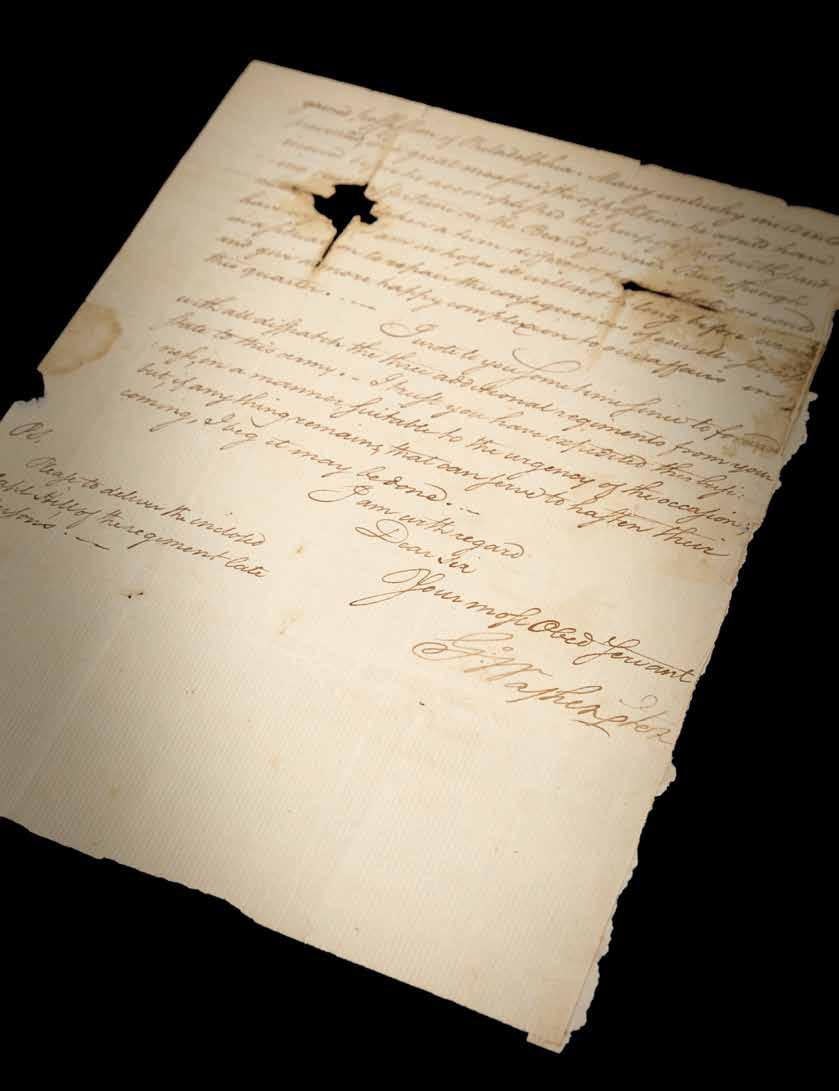
Washington writes candidly of ‘our misfortune on the Brandywine,’ the British occupation of Philadelphia, and the capture of enemy prizes at sea
George Washington War-Dated Letter Signed, Penned in the Hand of Alexander Hamilton Four Days Before the Battle of Germantown, Addressing the Philadelphia Campaign, Burgoyne’s Northern Collapse, and the Road to Saratoga (1777)
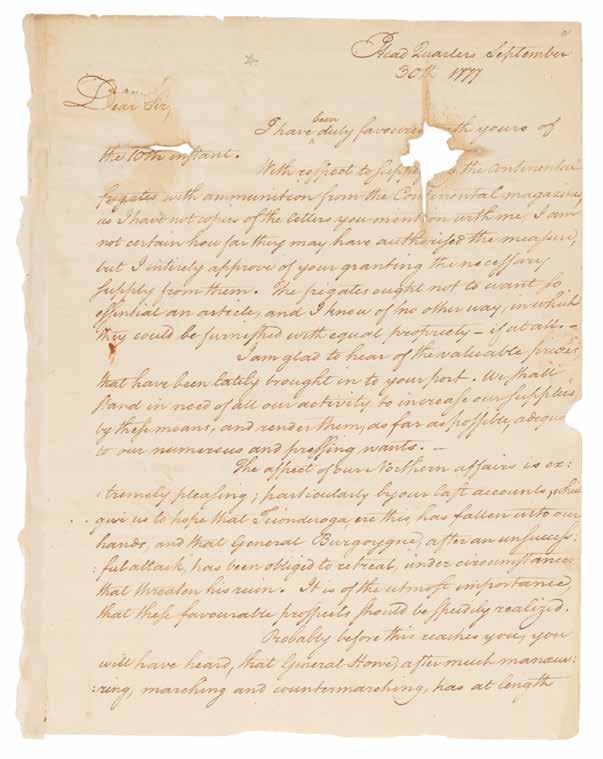
Revolutionary War-dated LS signed by George Washington, “Go: Washington,” and penned in the hand of his trusted aide-de-camp, Alexander Hamilton, one page both sides, 7.5 x 9.75, September 30, 1777. Addressed from Washington’s “Headquarters” near the Skippack Road encampment in Pennsylvania, northwest of Philadelphia and west of Germantown, the letter was sent to Major General William Heath during the critical Philadelphia campaign of 1777. Written only days before the Battle of Germantown, it concerns Continental military supplies, British movements, Burgoyne’s failing northern campaign, and troop mobilization. In full:
“I have been duly favoured with yours of the 10th inst. With respect to supplying the Continental frigates with ammunition from the Continental magazines, as I have not copies of the letters you mention with me, I am not certain how far they may have authorized the measure, but I entirely approve of your granting the necessary supply from them. The frigates ought not to want so essential an article and I know of no other way in which they could be furnished with equal propriety – if at all.
I am glad to hear of the valuable prizes that have been lately brought into your port. We shall stand in need of all our activity to increase our supplies by these means, and render them, as far as possible, adequate to our numerous and pressing wants. The aspect of our Northern affairs is extremely pleasing; particularly by our last accounts, which give us to hope that Ticonderoga, ere this, has fallen into our hands, and that General Burgoyne, after an unsuccessful attack, has been obliged to retreat, under circumstances that threaten his ruin. It
is of the utmost importance, that these favourable prospects should be speedily realized. Probably before this reaches you, you will have heard, that General Howe, after much maneuvering, marching and countermarching, has at length gained possession of Philadelphia. Many unlucky incidents prevented, in a great measure, the opposition he would have received before he accomplished his purpose notwithstanding our misfortune on the Brandywine. But though matters [have] taken a turn different from what we could have wished, I am in hopes it will not be long before we are in a situation to repair the consequences of our ill-success and give a more happy complexion to our affairs in this quarter.
I wrote to you some time since to forward with all dispatch the three additional regiments from your state to this army. I trust you have expedited this business, in a manner, suitable to the urgency of the occasion, but if anything remains, that can serve to hasten their coming, I beg it may be done.” A postscript reads: “Please to deliver the inclosed to Capt. Hill of the regiment late Patterson’s.” In very good to fine condition, with two areas of paper loss affecting approximately five to eight words of text, all either partially legible on the manuscript or reconstructable from context; Washington’s bold signature is completely unaffected The letter was published in The Writings of George Washington (Vol. VI), on pages 286–287, where it is identified as having been addressed to Major General William Heath, and also appears in The Papers of Alexander Hamilton (Vol. I), edited by Harold C. Syrett, and in The Papers of George Washington, Revolutionary War Series, Vol. XI. Significantly, the Hamilton Papers entry describes the manuscript as ‘LS, in writing of H,’ confirming that the letter was penned in Hamilton’s hand not merely through modern manuscript analysis but through the editorial attribution of Hamilton’s own collected papers. Although Heath is not named in the surviving manuscript itself, the identification is supported by Washington’s references within the text to letters received from the recipient concerning Continental naval supply matters.
Continued on the next page.

Continued from previous page.
Washington also assesses the deteriorating northern campaign, reporting that Burgoyne had been ‘obliged to retreat, under circumstances that threaten his ruin’
— a prediction borne out three weeks later at Saratoga, the American victory that brought
Written during one of the most consequential phases of the Revolutionary War, the letter captures Washington confronting simultaneous crises in both the northern and middle colonies during the autumn campaign of 1777. Penned entirely in the hand of Alexander Hamilton, then just 22 years old and serving as one of Washington’s aides-decamp, having joined headquarters only six months earlier, the letter was composed at a moment when General John Burgoyne’s Saratoga campaign was deteriorating in the north following the costly engagement at Freeman’s Farm. Washington’s hope that “Ticonderoga, ere this, has fallen into our hands” reflects the incomplete and overly optimistic intelligence reaching headquarters in real time; the fort, which American forces had abandoned to Burgoyne in July, had not in fact been retaken. His further remark that Burgoyne had been “obliged to retreat, under circumstances that threaten his ruin” proved far closer to the mark, anticipating the British disaster that would culminate at Saratoga on October 17th, a victory that directly prompted France to enter the war as an American ally and fundamentally altered the course of the Revolution.
Heath himself occupied an important place within the military developments discussed in the letter. Serving as Washington’s trusted commander of the Eastern Department from Boston, he coordinated military affairs throughout New England during the Saratoga campaign and, beginning in November 1777, assumed custody of the Convention Army, the roughly 5,000 British and German troops captured after Burgoyne’s defeat.
Washington’s passing reference to the “valuable prizes that have been lately brought into your port” carries more weight than its brevity suggests. By the autumn of 1777, the Continental Navy remained a modest force, wholly incapable of challenging British naval supremacy on the open ocean, but American privateers and naval vessels operating along the Atlantic seaboard were capturing British merchant ships and bringing their cargoes into port as prizes, an increasingly important supplementary source of military goods and provisions at a moment when the official supply system was faltering. Washington’s acknowledgment that “we shall stand in need of all our activity to increase
our supplies by these means” illustrates the increasing importance of captured British material in offsetting the army’s mounting shortages, a dependence that would only deepen as the Continental Army approached the severe supply crisis of Valley Forge two months later.
When Washington referred to “our misfortune on the Brandywine,” he was describing the largest single-day battle of the Revolutionary War, some 30,000 combatants engaged across the Pennsylvania countryside in eleven hours of fighting, a defeat that cost the Continental Army roughly a tenth of its strength in a single day. Yet even while acknowledging the setback, Washington expressed confidence that the army would soon “repair the consequences of our ill-success and give a more happy complexion to our affairs in this quarter.” The letter was written from Washington’s Skippack headquarters, where preparations were already underway for the surprise assault on the British at Germantown, launched four days later on October 4, 1777. Though the attack ended in defeat, its boldness impressed observers in Europe and, together with the American victory at Saratoga, helped persuade France to enter the war as America’s ally. French foreign minister Vergennes remarked upon Washington’s willingness to attack a victorious enemy with an army ‘raised within the year,’ declaring that it ‘promises everything.’ Few documents place the commanderin-chief so directly within the campaign that transformed the course of the Revolution.
Equally significant are Washington’s references to Continental naval logistics, captured British prizes, ammunition shortages, and urgent requests for reinforcements, all reflecting the mounting strains on Continental resources that would become increasingly severe just two months later when Washington’s army entered Valley Forge for the brutal winter encampment of 1777–1778. Letters combining such substantial military, political, naval, and strategic content from this pivotal moment of the Revolution are seldom encountered, particularly those additionally distinguished by Hamilton’s wartime authorship and Washington’s signature.
Starting Bid $100,000
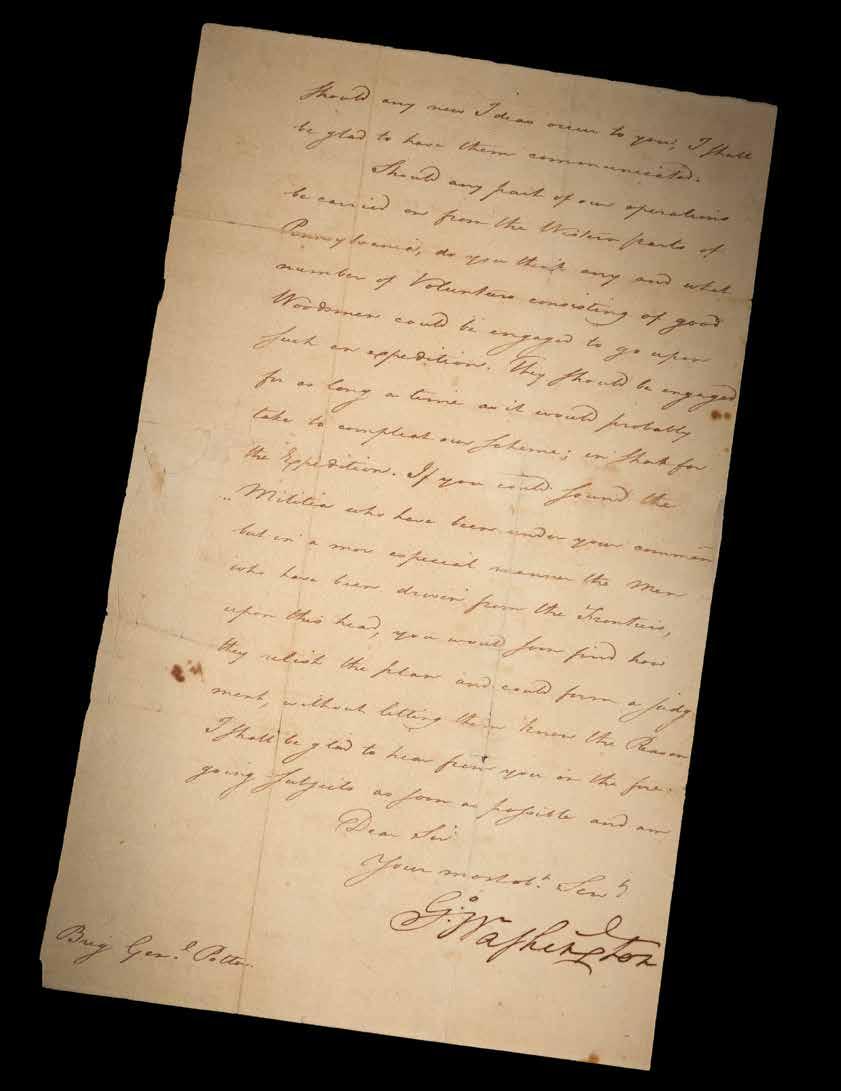
“I have turned my thoughts and taken some measures towards carrying on an expedition against the Indians of the Six Nations”—Washington secretly outlines his strategic plan for a war “to be carried on against the Savages”
George Washington Revolutionary War-Dated Letter Signed to Brig. Gen. Potter, Planning a War “to be carried on against the Savages... against the Indians of the Six Nations”
Revolutionary War–dated LS signed “Go: Washington,” one page both sides, 7.5 x 12.5, March 2, 1779. Letter to Brig Gen. James Potter of the Pennsylvania militia, Washington’s most experienced frontier commander who had stood by him at Valley Forge. Penned in the hand of aide-de-camp Tench Tilghman and boldly signed at the conclusion by George Washington, the letter solicits intelligence and volunteers for a planned offensive campaign against the Six Nations Iroquois Confederacy along the western frontier.
In full: “I have recd. your favr. without date containing your Ideas of the kind of War necessary to be carried on against the Savages for the more effectual Security of our Frontier; with your opinion of the most practicable Route of penetrating the Indian Country. Your Ideas correspond in a good measure with my own and should the situation of Affairs on the Coast admit, I have t[ur]ned my thoughts and taken some measures towards carrying on an expedition against the Indians of the Six Nations, whenever the State of the Grass-Waters and other circumstances will admit. I communicate thus much to you in confidence, because the more suddenly a Blow of this kind can be struck especially against Indians, the more well the weight of it be felt.
I am obliged to you for the information you have already given me, and should you come to the knowledge of my thing further which you may deem material, or should any new Ideas occur to you, I shall be glad to have them communicated. Should any part of our operations be carried on from the Western parts of Pennsylvania, do you think any and what number of Volunteers consisting of good Woodsmen could be engaged to go upon such an expedition. They should be engaged for as long a time as it would probably take to compleat our scheme; in short for the Expedition. If you could sound the Militia
who have been under your command but in a more especial manner the men who have been driven from the Frontiers, upon this head, you would soon find how they relish the plan and could form a judgment, without letting them know the Reason. I shall be glad to hear from you on the foregoing subjects as soon a possible.” Complete with the detached address leaf. In very good to fine condition, with discreet overall professional silking to both sides and a small area of repaired loss affecting one word. Accompanied by an impressive custom-made full morocco clamshell case with gilt-lettered spine and quote on the front board.
This letter anticipates what became the 1779 Sullivan Expedition, the major Continental campaign against the British-allied nations of the Iroquois Confederacy. The Six Nations—Mohawk, Oneida, Onondaga, Cayuga, Seneca, and Tuscarora—had long held strategic importance in the struggle for control of North America, and during the Revolution their loyalties divided: the Oneida and Tuscarora largely supported the American cause, while much of the league, led by Mohawk leader Joseph Brant, fought for Britain from the Niagara frontier.
In retaliation for frontier raids and the destruction of isolated American settlements, Washington ordered Gen. John Sullivan to lead a force of roughly 4,000 men into Iroquois country, destroying villages, fields, orchards, and granaries and defeating the allied Native and Loyalist forces near present-day Elmira, New York. Washington’s request here for intelligence, routes, and “Volunteers consisting of good Woodsmen” thus represents an early and confidential planning stage for one of the Revolution’s most consequential frontier campaigns, which devastated the Six Nations’ homeland and helped secure the American frontier.
Published in The Writings of George Washington from the Original Manuscript Sources, 1745-1799, Volume 14, ed. John C. Fitzpatrick. Washington: U.S. Government Printing Office, 1939, pp. 175–176.
Starting Bid $20,000
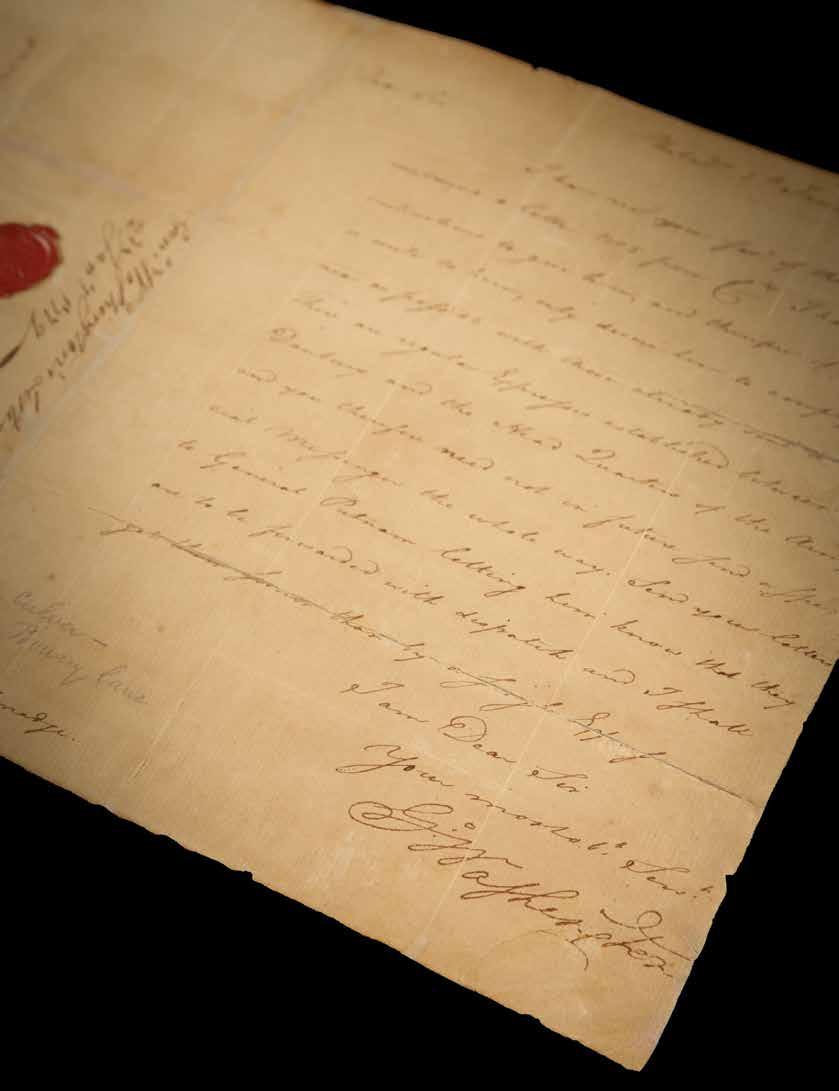
Addressed from Philadelphia in early 1779, General George Washington writes to his chief of intelligence, Major Benjamin Tallmadge, establishing Connecticut courier routes of the Culper Ring while referencing founding spy
Abraham Woodhull—signed by Washington at the conclusion and again in frank on the original address panel
George Washington War-Dated Letter Signed to Major Benjamin Tallmadge with Original Franked Address Panel, Directing Culper Ring Intelligence Courier Routes and Referencing Founding Spy Abraham Woodhull (1779)
Revolutionary War-dated LS signed “Go: Washington,” one page, measuring 13.75 x 9.5, with integral mailing panel bearing Washington’s franking signature, “Go: Washington,” January 2, 1779. Addressed from Philadelphia, a letter from Washington to Major Benjamin Tallmadge, penned in the hand of aide-de-camp Tench Tilghman and signed prominently at the conclusion by Gen. Washington. In full: “I have recd your favr of the 23d ulto inclosing a letter No. 5 from C–. I have no new instructions to give him and therefore if you see or write to him only desire him to comply as near as possible with those already sent to him. There are regular Expresses established between Danbury and the Head Quarters of the Army and you therefore need not in future send a special Messenger the whole way. Send your letters to General Putnam letting him know that they are to be forwarded with dispatch I shall get them sooner than by a single Express.” The integral page with address panel bears the original red wax seal and is addressed to “Major Tallmadge, 2’d Reg’t Dragoons, Fairfield, Connecticut,” with Washington adding his bold franking signature to the lower left. The abbreviated reference “C—” is Samuel Culper, the alias used by Abraham Woodhull of Setauket, Long Island, the founding spy of what would become the Culper Ring. A later pencil notation beside the reference identifies the correspondent as ‘Mr. Culver in the Bowery Lane,’ a misidentification by a later hand, but a curious survival in its own right. Professionally restored to near fine condition, with repairs to fold splits and areas of minor paper loss.
The recipient, Major Benjamin Tallmadge, was Washington’s chief of intelligence and the organizer of the spy network remembered as the Culper Ring, operating in British-occupied New York from late 1778 through the end of the war. By the time of this letter, Tallmadge had activated Abraham Woodhull of Setauket, Long Island, under the alias Samuel Culper, and Washington was already receiving his numbered intelligence reports. ‘No. 5 from C—’ is the fifth such report. The network would grow to include Robert Townsend (Culper, Jr.) in New York City and Caleb Brewster running whaleboats across Long Island Sound, and would later produce the intelligence that exposed Benedict Arnold’s treason.
The letter dates to a difficult period for the Continental Army following the 1778 campaign season, with British forces firmly entrenched in New York City and Washington placing growing emphasis on intelligence gathering, courier systems, and rapid military communications. The courier system Washington is establishing in this letter, regular dragoon expresses between Danbury and headquarters, with General Israel Putnam as the relay, is the very route by which Culper intelligence would travel out of New York for the next four years: from Woodhull in Setauket, by whaleboat across Long Island Sound under Caleb Brewster, through Fairfield and Danbury to Washington’s headquarters. He is not issuing routine logistical instructions here; he is hardening the infrastructure of his most important spy network. The surviving integral address panel, original red wax seal, and bold Washington franking signature further preserve the letter’s wartime postal character.
Starting Bid $10,000
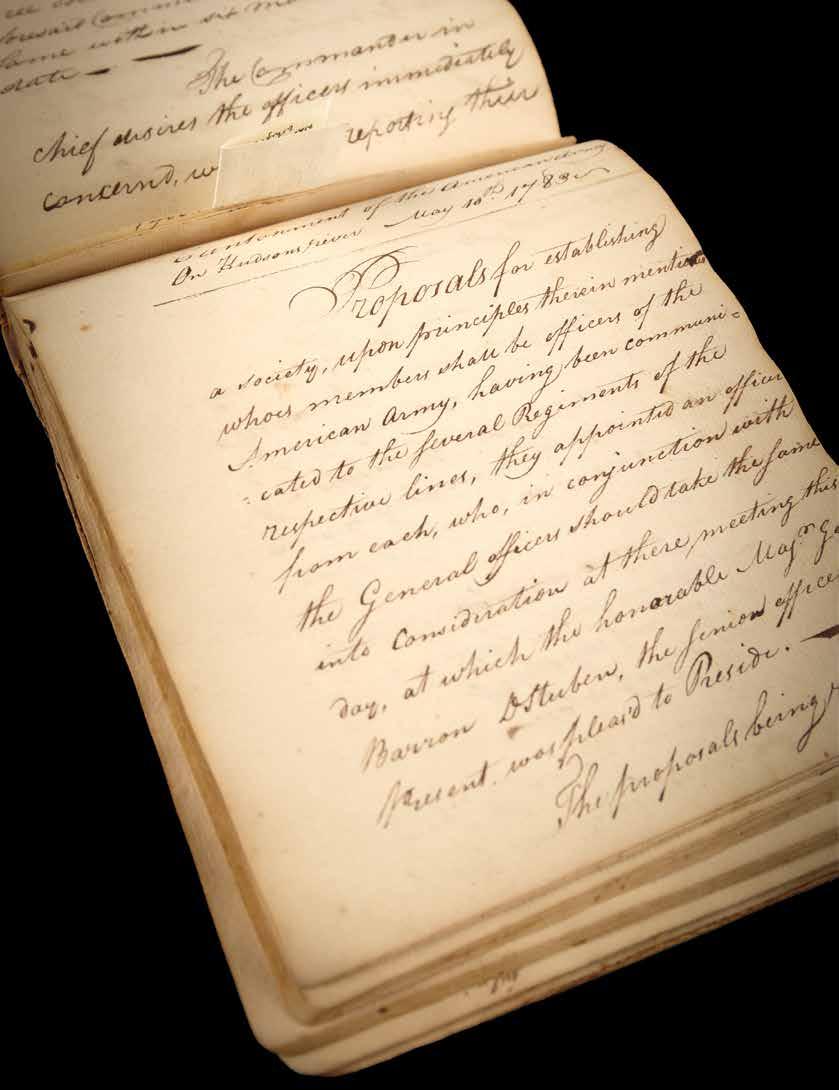
1783, an orderly book of the 3rd Massachusetts Regiment documents the end of the Revolution—from Washington’s Newburgh Address to the proclamation of peace and the establishment of the Society of the Cincinnati
Washington Headquarters: Orderly Book of the 3rd Massachusetts Regiment with the Newburgh Address and Proclamation of Peace (1782-1783)
Revolutionary War-dated manuscript orderly book, 7.75 x 6, maintained at American headquarters in Newburgh, New York, from October 1782 through June 1783. The volume was kept by Joseph Williams, quartermaster of the 3rd Massachusetts Regiment, and later apparently belonged to a Major Buffington. Written in a neat contemporary hand throughout, the orderly book comprises approximately 120 quarto leaves and preserves a remarkable record of the Continental Army during the closing months of the Revolutionary War, documenting unrest within the army, the formal announcement of peace with Great Britain, and the founding of the Society of the Cincinnati.
The earliest pages contain quartermaster receipts for military supplies signed by Maynard and Jos. Miller, together with transportation orders directing troop movements from Verplanck’s Point under Colonel Pickering. The volume also preserves extensive contemporary transcripts relating to the so-called Newburgh Conspiracy, including George Washington’s Newburgh Address of March 15, 1783, delivered to officers angered by Congress’s failure to provide long-promised pay and pensions. Appealing to their patriotism and restraint, Washington warns against the “insidious designs of our Enemies” and urges the officers to reject anonymous calls for action, praising their “unexampled patriotism and patient virtue.” The journal further contains the anonymous address to which Washington replied, extracts from General Orders issued at Headquarters, Newburgh, March 11, 1783, concerning anonymous letters circulated among the officers, and related orders issued by General Gates concerning the officers’ meeting later addressed by Washington.
Additional entries record resolutions of support presented by the army to Congress, Congressional resolutions of thanks to army personnel, and correspondence from the President of Congress to Washington announcing the attainment of a treaty of peace, with mentions of Count d’Estaing and the Marquis de Lafayette. Most significantly, the orderly book preserves headquarters orders issued at Newburgh on April 18, 1783, formally announcing the end of hostilities between the United States and Great Britain: “The commander in chief orders the cessation of Hostilities between the United States of America and the King of Great Britain to be publicly proclaimed tomorrow at 12 o’clock.” The orders continue with celebratory instructions directing “An extra Ration of Liquor to be issued to every man tomorrow to drink perpetual [sic] peace, independence and happiness to the United States of America.”
The closing pages, issued from the “Cantonment of the American Army on Hudsons river, May 10th,” record lengthy proposals for the establishment of the Society of the Cincinnati, with references to Generals Knox, Hand, Huntington, and von Steuben, and noting the adoption of the eagle as the symbol of the Cincinnati. Established by Continental Army officers in 1783, the Society of the Cincinnati became an enduring hereditary organization commemorating the service and ideals of the Revolutionary generation. Includes a custom-made slipcase bound in red cloth boards with dark red leather spine, both with gilt-stamped text. In very good condition, with heavy wear to the covers, damage to the spine, and the front cover and some pages detached but present.
A remarkable headquarters record spanning the final military and political chapter of the American Revolution, preserving in one continuous wartime volume Washington’s response to unrest within the army, the official announcement of peace, and the establishment of the Society of the Cincinnati.
Starting Bid $1,000
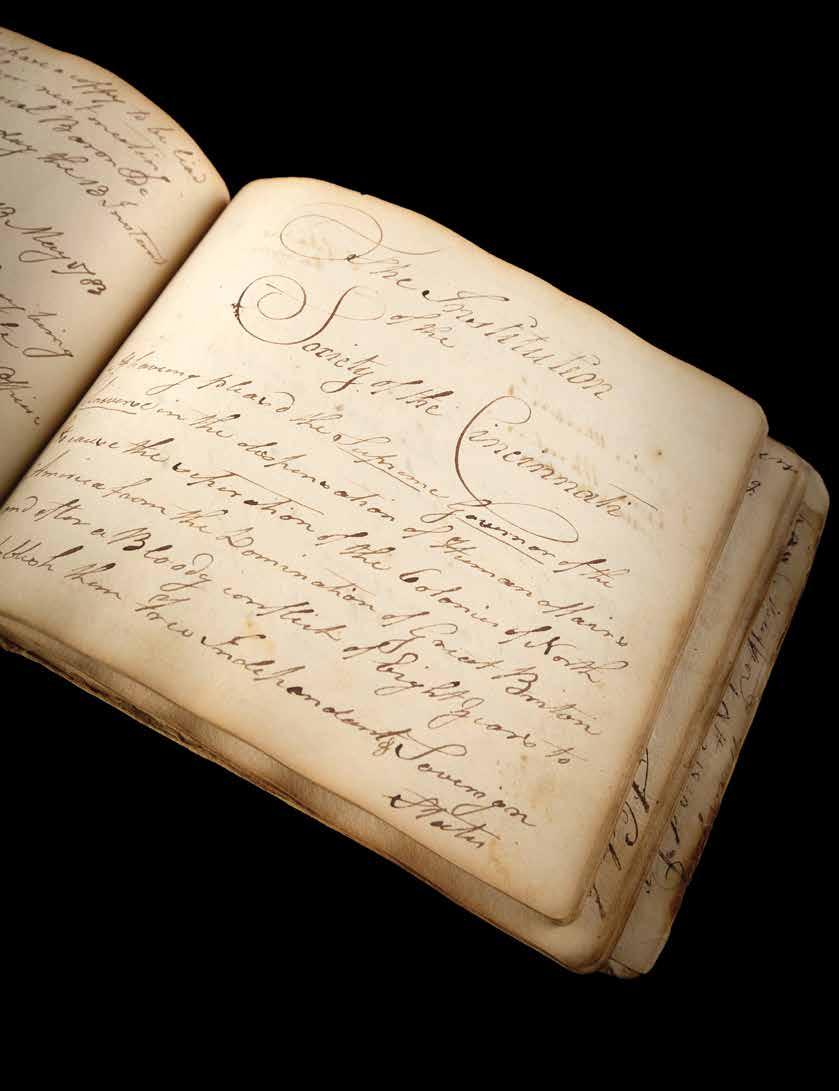
Recorded at Washington’s Newburgh headquarters between October 1782 and June 1783, an orderly book of the 4th Massachusetts Regiment documenting the Revolution’s final chapter—from the official cessation of hostilities to the establishment of the Society of the Cincinnati
Washington Headquarters: Orderly Book of the 4th Massachusetts Regiment with the Proclamation of Peace and Founding Texts of the Society of the Cincinnati (1782-1783)
Revolutionary War-dated manuscript orderly book, 7.75 x 6, maintained at Continental Army headquarters in Newburgh, New York, from October 1782 through June 1783. Written throughout in a single contemporary hand, the volume records the proceedings of the 4th Massachusetts Regiment during the closing months of the Revolutionary War and through the formal cessation of hostilities with Great Britain. The Society of the Cincinnati has advised that the hand may be that of Ensign Africa Hamlin, an original member of the Society who served in the Continental Army from the beginning of the Revolution through November 1783.
Approximately halfway through the volume appears a section headed “Cantonment of the American Army On Hudson’s River 10th of May 1783,” preserving the founding proposals for the Society of the Cincinnati. In part: “Proposals for establishing a society upon principles therein mentioned whose numbers shall be of the officers of the American Army, having been communicated to the several regiments of the respective lines…The proposals being read fully, considered paragraft [sic] by paragraft and the amendments agreed to — Major General Knox, Brigadier General Hand, Brigadier General Huntington and Capt. Shaw were chosen to revise the same…” The volume further contains a lengthy transcription headed “The Institution of the Society of the Cincinnati,” including the Society’s constitution,
qualifications for membership, references to the Roman statesman Lucius Quintus Cincinnatus, for whom the organization was named, a roster of foreign members including Counts d’Estaing, de Grasse, and Rochambeau, articles of the Society’s constitution, and a description of the Society’s medal with a letter of thanks to Pierre Charles L’Enfant, who designed it.
Toward the beginning of the book appears a headquarters proclamation issued at Newburgh announcing the formal end of hostilities between the United States and Great Britain: “Headquarters, New Burgh, 18th Sept. 83. The Commander in Chief orders the cessation of hostilities between the United States of America and the King of Great Britain…” followed by Washington’s address to the troops concerning the peace settlement. The proclamation concludes: “The Q. Master General will without delay procure such a number of discharges to be printed as will be sufficient for the men inlisted for the war…An extra ration of liquer will be issued to every man to drink perpetual peace, Independency and Happiness of the United States of America.”
Additional entries contain transcripts relating to the Newburgh Addresses, including material concerning unrest among Continental Army officers over pay and treatment by Congress. Major John Armstrong is specifically mentioned among those voicing grievances later addressed by Washington. Housed in a custom-made slipcase of red cloth boards with dark red leather spine and gilt-stamped text. In very good condition, with heavy wear to the covers and dampstaining to some pages.
Starting Bid $1,000
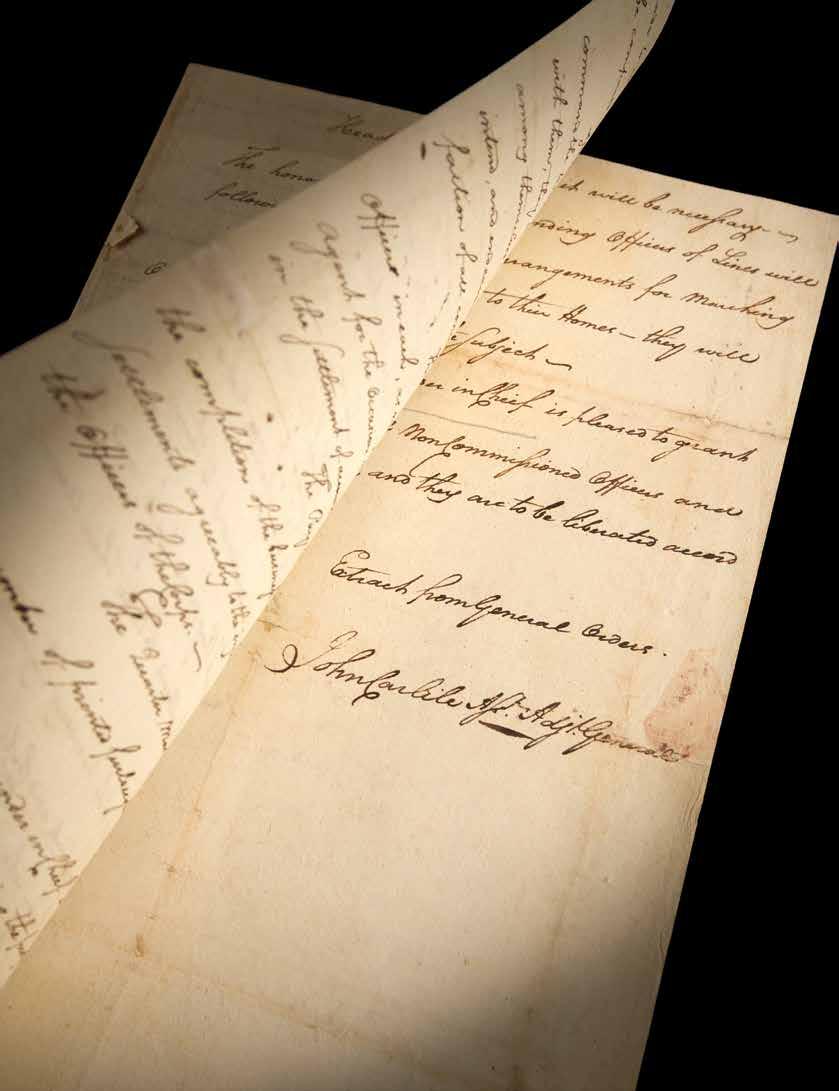
From Washington’s headquarters at Newburgh, an assistant adjutant general communicates Congress’s resolution for disbanding the Continental Army in 1783:
“Generals and Commanding Officers of Lines will be pleased to make the interior arrangements for marching the troops of their respective states to their Homes”
George Washington: John Carlile Revolutionary War-Dated Autograph Document Signed from Washington’s Headquarters, Announcing Congress’s Order to Disband the Continental Army
Revolutionary War–dated ADS signed “John Carlile, Asst. Adjt. General,” three pages on two adjoining sheets, 8 x 13.25, June 2, 1783. Handwritten extract of general orders, sent from Washington’s headquarters at Newburgh, New York, to Brigadier General Moses Hazen at Pompton, New Jersey, setting out the resolution of Congress for the demobilization of Continental troops and providing Washington’s detailed instructions for the implementation of the order. In part: “Resolved, That the Commander in Chief be instructed to grant furloughs to the noncommissioned officers and soldiers in the service of the United States, inlisted to serve during the War, who shall be discharged as soon as the definitive treaty of Peace is concluded— together with a proportionable number of commissioned officers of the different grades—and that the Secretary at War and Commander in Chief take the proper measures for conducting those troops to their respective Homes in such a manner as may be most convenient to themselves and to the state through which they may pass, and that the men thus furloughed be allowed to take their arms with them…
The Commander in Chief wishes to give every facility in his power towards carrying the proposed measure into effect with as great con-
venience and satisfaction to the troops as possible—for this purpose the contractors are directed to lay up adequate supplies of Provisions at the several Posts and places on the Rout where it will be necessary.
Generals and Commanding Officers of Lines will be pleased to make the interior arrangements for marching the troops of their respective states to their Homes—they will receive further instruction on the subject. The Commander in Chief is pleased to grant a full and unconditional pardon to all Noncommissioned Officers and Privates now in confinement, and they are to be liberated accordingly.” In very good to fine condition, with scattered toning and staining, a few small repairs, and some minor paper loss.
The demobilization of the Continental Army began in 1783, even before the final signing of the Treaty of Paris in September. With the preliminary peace agreement reached in late 1782 and a formal cessation of hostilities announced in early 1783, Congress and General George Washington began preparing to dissolve the wartime army. Tensions ran high, as many soldiers had gone unpaid for months or years, leading to incidents like the Newburgh Conspiracy, where officers considered pressuring Congress for their due. Washington’s calm intervention preserved civilian control over the military and helped guide a gradual, orderly demobilization, setting a powerful precedent for the new republic.
Starting Bid $1,000
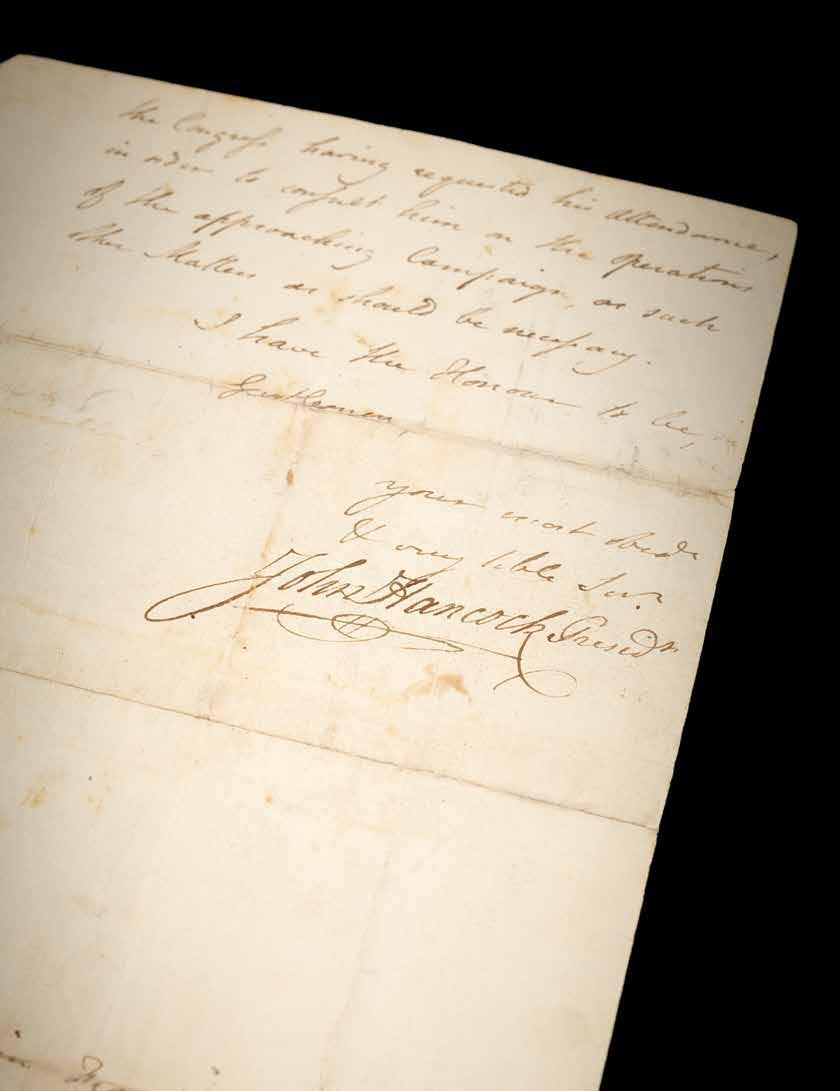
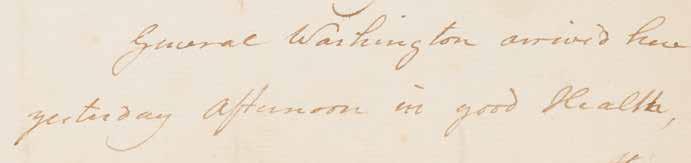
“General Washington arrived here yesterday afternoon in good Health”— as president of Continental Congress in May 1776, John Hancock updates Benjamin Franklin on proceedings in support of the patriot cause
LOT 8022
John Hancock Revolutionary War-Dated Letter Signed to Benjamin Franklin, Samuel Chase, and Charles Carroll, Announcing George Washington’s Arrival at Philadelphia in 1776 and the Exhaustion of the Congressional Treasury
Revolutionary War–dated LS, signed “John Hancock, Presid’t,” one page both sides, 7.75 x 12.5, May 24, 1776. Letter addressed to future Declaration signers Benjamin Franklin, Samuel Chase, and Charles Carroll, in full: “By the enclosed Resolve of Congress, which
I do myself the Honour of transmitting, you will perceive that every step has been taken to procure hard Money, that could be devised. I have forwarded to General Schuyler by this Conveyance the Sum of Sixteen Hundred & sixty two Pounds one shilling and three Pence, in Hard Money, which was all that was in the Treasury. General Washington arrived here yesterday afternoon in good Health, the Congress having requested his attendance, in order to consult him on the operations of the approaching Campaign, as such other Matters as should be necessary.” In very good to fine condition, with light staining, unobtrusive repairs to folds, and a couple small edge tears.
Continued on the next page.

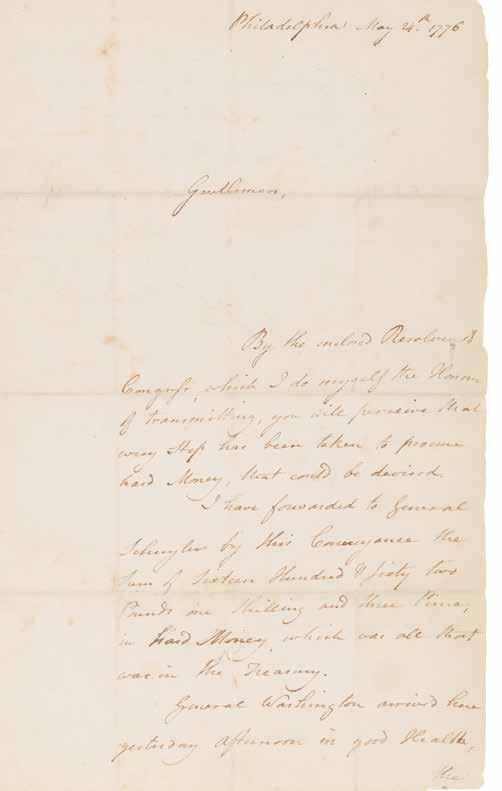
Continued from the previous page
At the time of this letter, Hancock was serving as president of the Continental Congress during one of the most consequential—and precarious—moments of the American Revolution. Written less than three weeks before Congress appointed the Committee of Five to draft the Declaration of Independence, the letter places Hancock at the intersection of wartime finance, military strategy, and the failing American effort in Canada. The addressees—Benjamin Franklin, Samuel Chase, and Charles Carroll of Carrollton—were then serving as congressional commissioners to Canada, charged with persuading Canadians to support the American cause; accompanying them was Carroll’s cousin, Rev. John Carroll, a Jesuit priest later to become the first Catholic bishop in the United States, whose presence reflected Congress’s hope of appealing to Catholic French Canadians. Hancock’s statement that he forwarded “all that was in the Treasury” to General Philip Schuyler was not rhetorical flourish, but literal fact. The Franklin Papers note that on May 18 and 22, 1776, Congress ordered sent to Canada ‘all that remained in the treasury,’ together with whatever additional hard money could be procured; the precise sum Hancock records—£1,662, 1 shilling, and 3 pence—represented the specie then available for the northern campaign.[1] The result is an extraordinary written admission from the president of Congress: at a critical moment in the war, the Continental treasury had been scraped bare and dispatched northward in an urgent attempt to sustain operations around Canada.
The drama was heightened by the fact that the Canada mission was already collapsing as Hancock wrote. In their own May 10th letter, Franklin, Chase, and Carroll reported to Hancock that British warships had reached Quebec on May 6th; American forces, unable to resist, fled in ‘the utmost precipitation and confusion,’ losing all their cannon, about 500 muskets, and approximately 200 sick men left behind.[2] Franklin himself, seventy years old and ill, had undertaken the arduous mission with grave doubts, writing earlier that the journey ‘at my Time of Life may prove too much for me.’[3] By the time Hancock’s letter was sent, the last hard money in Congress’s treasury was being forwarded toward a campaign that was already unraveling,
addressed to commissioners who had firsthand knowledge of the disaster. Hancock’s reference to Washington’s arrival in Philadelphia adds another layer of importance. Washington had arrived on May 23, 1776—“yesterday afternoon,” as Hancock reports—at Congress’s request to consult on “the operations of the approaching Campaign.”
This was Washington’s first consultation with Congress since receiving command of the Continental Army in June 1775, and the ensuing discussions helped shape a series of congressional resolutions on which Washington would base many decisions for the coming campaign.[4] Washington remained in Philadelphia until June 4, when he wrote that he was preparing to return to New York after coming ‘at the request of Congress to settle some matters relative to the operations of the ensuing Campaign.’[5] A remarkable, historically significant Hancock letter, published in The Papers of Benjamin Franklin [6], uniting the president of Congress, George Washington, three future signers of the Declaration of Independence, the empty Continental treasury, and the collapse of the Canadian campaign at a pivotal moment in America’s fight for independence.
Sources:
[1] Founders Online, “John Hancock to the Commissioners to Canada, 24 May 1776,” including Franklin Papers note citing JCC, IV, 365–6, 375–8.
[2] Founders Online, “The Commissioners to Canada to John Hancock, 10 May 1776.”
[3] Franklin to Josiah Quincy quotation, as cited in Journal of the American Revolution.
[4] The Papers of George Washington, Revolutionary War Series, Vol. 4, editorial introduction; the May 23 arrival is supported by Hancock’s May 24 wording in the letter itself.
[5] Founders Online, “George Washington to Burwell Bassett, 4 June 1776.”
[6] Founders Online, The Papers of Benjamin Franklin, Vol. 22, ed. William B. Willcox, Yale University Press, 1982, pp. 438–439.
Starting Bid $25,000
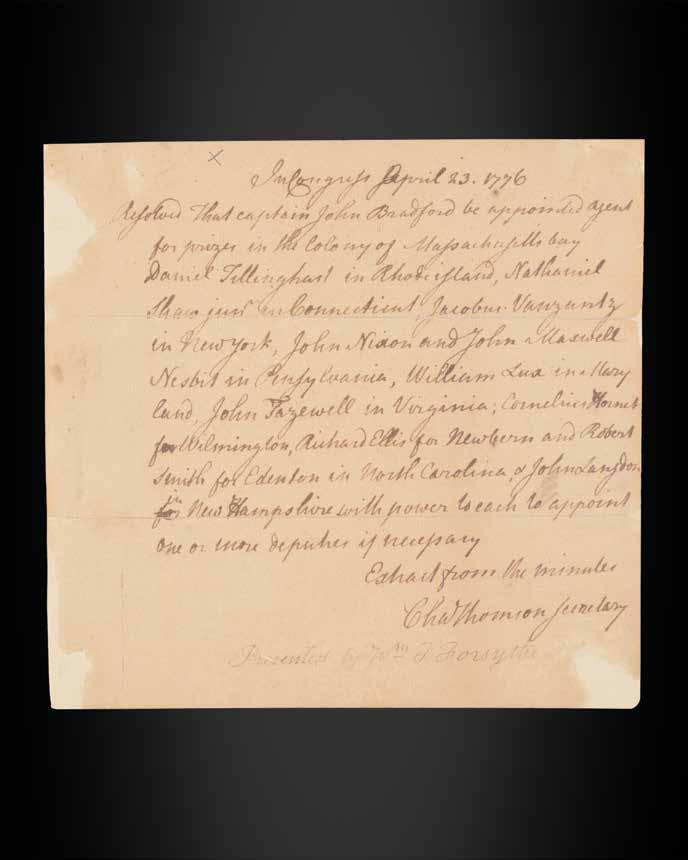
“Extract from the minutes” of the
Congress, appointing naval agents for distribution of privateering prizes in 1776
LOT 8023
Charles Thomson Revolutionary War-Dated Autograph Document Signed, Appointing Naval Agents for Privateering Prizes (1776)
Patriot leader (1729–1824) in Philadelphia during the American Revolution and the secretary of the Continental Congress (1774–1789) throughout its existence; Thomson was the only person to sign the Dunlap Broadside of the Declaration alongside John Hancock. ADS, signed “Chas. Thomson, Secretary,” one page, 8 x 7.5, April 23, 1776. Handwritten “extract from the minutes” of Continental Congress, in full: “Resolved That captain John Bradford be appointed agent for prizes in the Colony of Massachusetts bay, Daniel Tillinghast in Rhode island, Nathaniel Shaw jun’r in Connecticut, Jacobus Vanzantz in New York, John Nixon and John Maxwell Nesbit in Pennsylvania, William
Lux in Maryland, John Tazewell in Virginia, Cornelius Harnet for Wilmington, Richard Ellis for Newbern and Robert Smith for Edenton in North Carolina & John Langdon in New Hampshire with power to each to appoint one or more deputies if necessary.” In very good to fine condition, with fold separations and areas of paper loss repaired and reinforced by professional silking to both sides.
In April 1776, the Continental Congress and Marine Committee appointed agents in various colonies to manage, appraise, and sell captured British ships and cargo. These agents, such as John Bradford in Boston, distributed the resulting prize money to privateers and naval crews.
Starting Bid $300
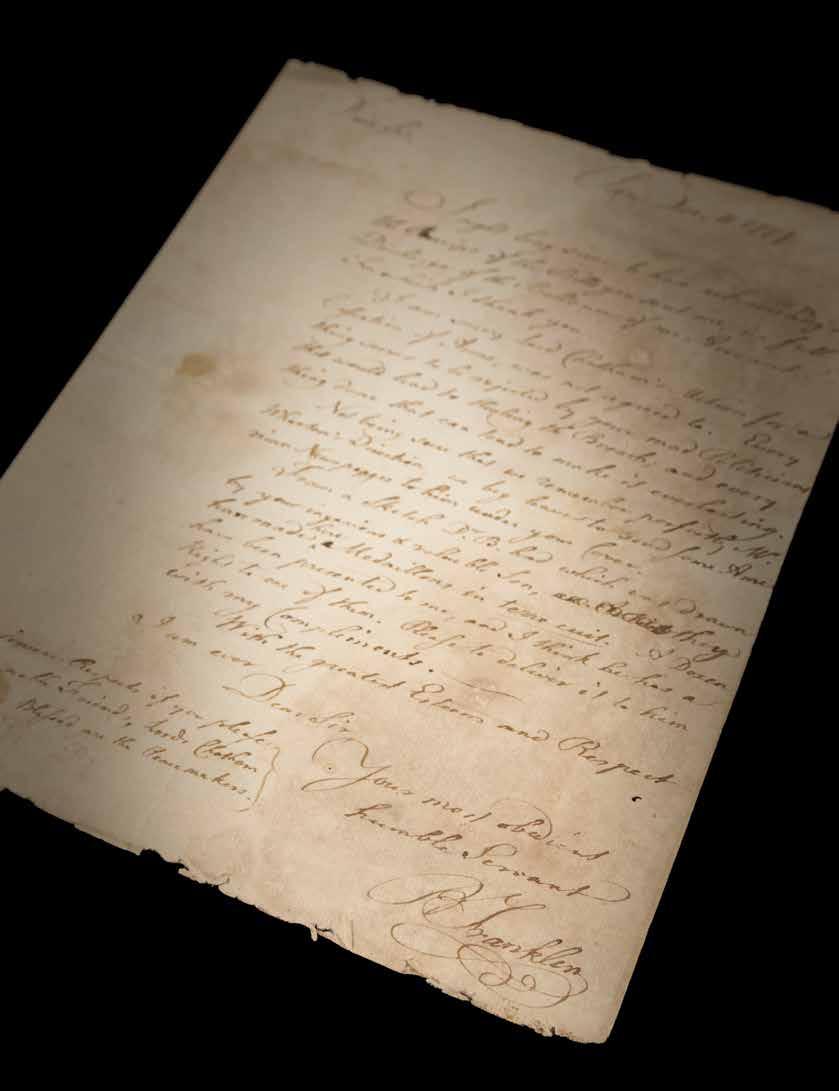
Benjamin Franklin Revolutionary War-Dated Autograph Letter Signed on Peace Negotiations with Great Britain: “Every thing seems to be rejected by your mad Politicians that would lead to Healing the Breach” (1777)
Revolutionary War–dated ALS signed “B. Franklin,” one page, 7.25 x 9.25, December 11, 1777. Handwritten letter to Thomas Walpole, bemoaning the failure of Lord Chatham’s efforts to find a basis of conciliation with the American colonies and to bring an end to the Revolutionary War. In full: “I ought long since to have acknowledg’d the Receipt of the Bills you sent me, in full Discharge of the Balance of our Account. For which I thank you. I am sorry Lord Chatham’s Motion for a Cessation of Arms, was not agreed to. Every thing seems to be rejected by your mad Politicians that would lead to Healing the Breach; and every thing done that can tend to make it everlasting. Not being sure that we remember perfectly Mr. Wharton’s Direction, we beg leave to send some American Newspapers to him under your Cover.
From a Sketch Dr. B. had which was drawn by your ingenious and valuable Son, they have made here Medallions in terre cuit [terra-cotta]. A Dozen have been presented to me, and I think he has a Right to one of them. Please to deliver it to him with my Compliments.” He adds a postscript at the lower left: “My sincere Respects if you please to your noble Friends, Lords Chatham and Cambden. Blessed are the Peacemakers.” Addressed on the integral leaf in Franklin’s own hand, which carries a fine red-wax impression of Franklin’s seal. In very good to fine condition, with soiling and staining, not affecting readability.
Franklin wrote this letter from Paris, where he was serving as an American commissioner seeking French support for the Revolutionary cause. Composed just weeks after Lord Chatham’s November 20, 1777 speech in the House of Lords urging conciliation with the colonies, the letter captures Franklin’s frustration that British leaders had rejected another possible path toward peace. His postscript to “Lords Chatham and Cambden,” both sympathetic to the American position, culminates in the biblical phrase “Blessed are the Peacemakers,” underscoring Franklin’s hope for reconciliation even as the war deepened.
The recipient, Thomas Walpole (1727–1803), was the son of Horatio, 1st Baron Walpole, and a relative of the writer and wit Horace Walpole. A prominent London lawyer, he had worked closely with Franklin on the Grand Ohio Company, which sought to acquire and develop a large tract of land west of present-day Virginia.
The letter’s reference to “Medallions in terre cuit” offers a remarkable additional point of interest: Franklin is here acknowledging the creation of one of the most famous and widely circulated portraits of himself—the 1777 terra-cotta medallion by Jean-Baptiste Nini. The “ingenious and valuable Son” was Thomas Walpole the Younger, then about twenty-two years old, whose profile drawing of Franklin served as the source image for the medallion; “Dr. B.” was Edward Bancroft, Franklin’s secretary in Paris, who had carried the sketch into Franklin’s French circle. The medallions were produced at Nini’s workshop at the Château de Chaumont-sur-Loire, the estate of Jacques-Donatien Le Ray de Chaumont, Franklin’s important pro-American host and patron.
The finished medallion, inscribed “B. FRANKLIN / AMERICAIN / NINI / F 1777,” became one of the defining images of Franklin in France: the fur-capped American sage, instantly recognizable and politically useful in a Parisian society fascinated by the American cause. This portrayal resonated with the French public, leading to widespread production of the medallion in various sizes and materials. Franklin humorously noted in a letter to his daughter that his likeness had become as familiar as that of the moon, with numerous reproductions adorning items like snuffbox lids and rings. Nini’s medallion not only commemorated Franklin’s presence in France but also symbolized the burgeoning Franco-American alliance during the Revolutionary era.
Published in The Papers of Benjamin Franklin, vol. 25, October 1, 1777, through February 28, 1778, ed. William B. Willcox. New Haven and London: Yale University Press, 1986, pp. 272–273; Nini’s medallion is reproduced on the jackets of the Yale edition.
Starting Bid $10,000
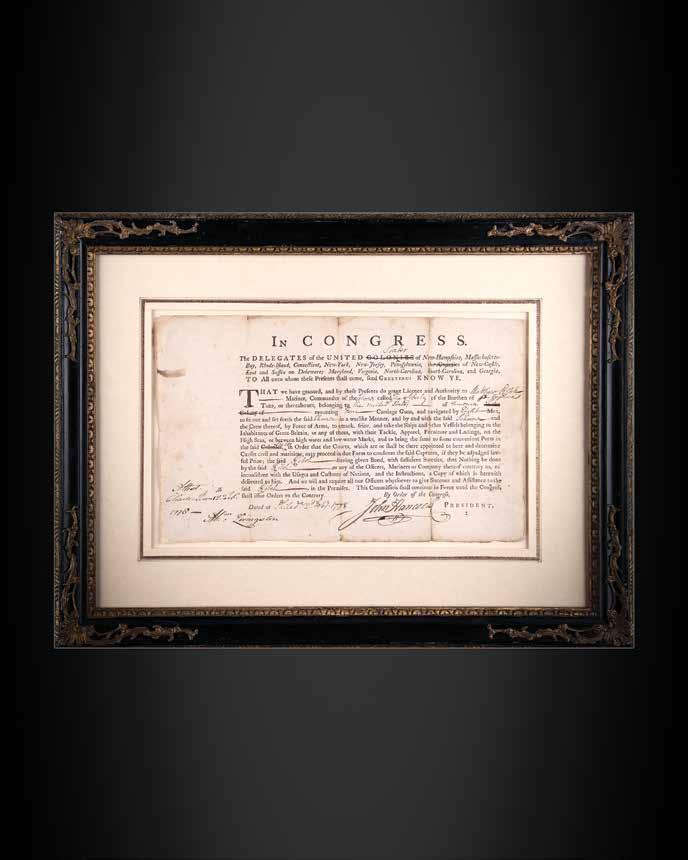
Prominently signed as president of the Continental Congress, John Hancock commissions a schooner named “Liberty” to “attack, seize, and take the Ships and other Vessels belonging to the Inhabitants of Great-Britain”—with “Colonies”
corrected by hand to “States” following American Independence
John Hancock War-Dated Document Signed, Commissioning the Schooner Liberty for Privateering Against Great Britain - “Colonies” Amended to “States” Reflecting American Independence
Revolutionary War-dated partly-printed DS, one page, 13 x 8, February 2, 1778 (Philadelphia). Letter of marque issued by the Continental Congress to “Matthew Ritch, Mariner,” commissioning him commander of the schooner Liberty for privateering operations against British vessels. Signed at the conclusion in ink by John Hancock as president of the Continental Congress. The document reads, in part: “The Delegates of the United States…have granted, and by these Presents do grant Licence and Authority to Matthew Ritch – Mariner, Commander of the Schooner called The Liberty of the Burthen of forty five Tons, or thereabouts, belonging to the United States of America mounting Four Carriage Guns, and navigated by Eight Men, to fit out and set forth the said Schooner in a warlike Manner, and by and with the said Schooner and the Crew thereof, by Force of Arms, to attack, seize, and take the Ships and other Vessels belonging to the Inhabitants of Great-Britain, or any of them, with their Tackle, Apparel, Furniture and Ladings, on the High Seas.” Archivally mounted and framed to an overall size of 20.5 x 15.5. In fine condition.
Notably, the document preserves several period manuscript revisions reflecting the changing language of the American Revolution. The printed word “Colonies” is struck through and replaced with “States” in multiple places, and the phrase “Colony of” is similarly crossed out. Although independence had been declared in 1776 and the name “United States of America” adopted in 1777, many official printed forms still used outdated colonial terminology in early 1778. These handwritten corrections, made before the document left Philadelphia, provide a striking record of the new nation redefining itself in real time.
Congress authorized privateering during the Revolutionary War in recognition that the Continental Navy alone could not effectively challenge British maritime supply lines. Individual vessels were licensed by letters of marque, commissions of the form Hancock signs here, to attack and seize British merchant ships and bring their prizes before admiralty courts established in the states. Privateering became a major component of the American war effort at sea, disrupting British commerce and forcing the diversion of naval resources to convoy protection. The schooner Liberty, at forty-five tons and four carriage guns, was a modest participant in that campaign, but her commission reflects the standard instrument through which Congress prosecuted economic warfare against the Crown.
Starting Bid $1,000
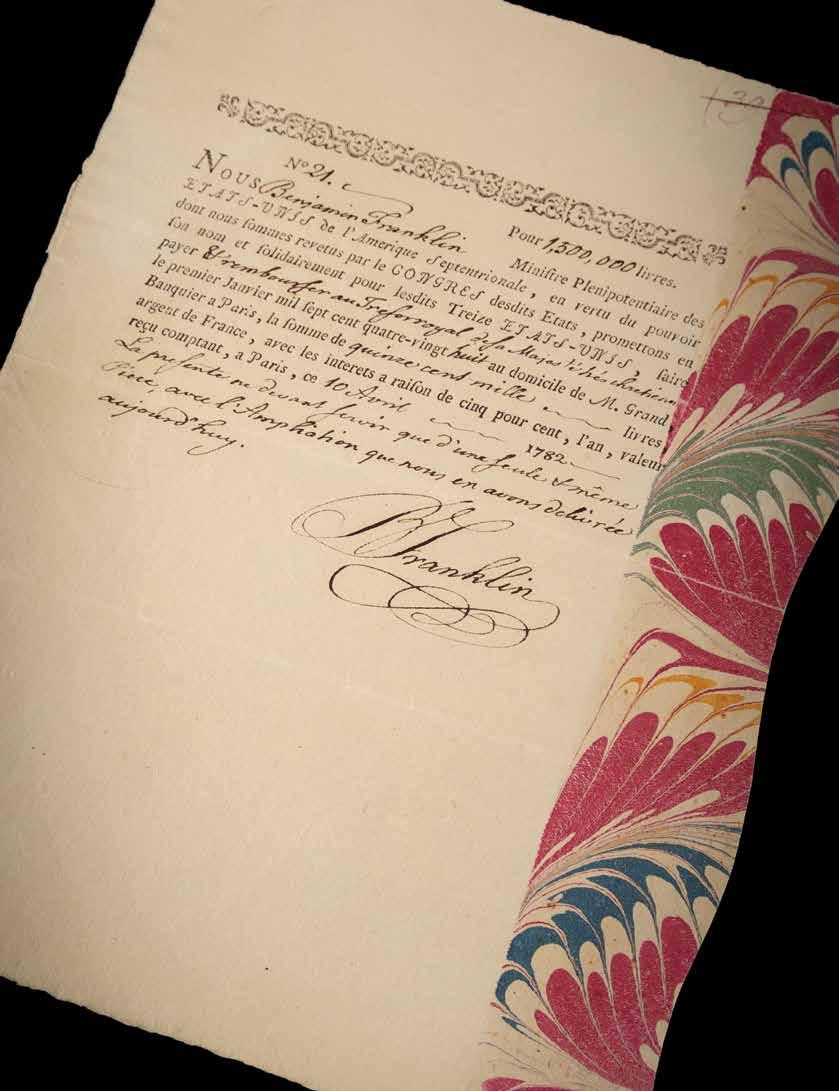
“I, Benjamin Franklin, Minister Plenipotentiary of the United States… promise in its name…to make payment and reimburse the Royal Treasury of His Most Christian Majesty”—twice signed and completed in Franklin’s hand, a pristine 1782 promissory note constituting the first installment of the final
French loan of the Revolution
Benjamin Franklin Twice-Signed 1,500,000-Livre Promissory Note Binding the United States to Repay France for Funding the Revolutionary WarPrinted on Franklin’s Own Press (1782)
Revolutionary War-dated twice-signed partly-printed DS in French, filled out neatly in the hand of Benjamin Franklin, who signs the document at the conclusion, “B. Franklin,” and at the onset in the third-person, “Benjamin Franklin,” one page, 7.5 x 9.75, April 10, 1782. Extraordinary promissory note produced at Franklin’s celebrated Passy press outside Paris, accomplished entirely in his hand as Minister Plenipotentiary of the United States, binding the young republic to repay the Royal Treasury of King Louis XVI the sum of 1,500,000 silver livres with annual interest at five percent. Printed on fine paper with an elaborate marbled strip along the right scalloped margin and an upper decorative border surmounted by fleur-de-lis ornaments, the document reads, in part (translated): “I, Benjamin Franklin, Minister Plenipotentiary of the United States of North America, in virtue of power vested in me by the Congress of the said States, promise in its name…to make payment and reimburse the Royal Treasury of His Most Christian Majesty.” Franklin additionally appends a three-line handwritten rider beneath the text in his neat, formal hand. In very fine condition.
Not listed by Luther S. Livingston in Franklin and his Press at Passy (Grolier Club, 1914), though the identical typographical ornaments appear in Livingston no. 20, this extraordinarily rare financial instrument, numbered “21” at the top, is one of only four comparable Franklin-issued Revolutionary War loan documents dated between February 15, 1781, and April 10, 1782, sold from the celebrated Perc S. Brown collection at Parke Bernet in 1966, with the present example representing the largest sum among them. A remarkable artifact documenting the French loans that sustained the American cause during the Revolution, it stands as one of the clearest surviving records of Franklin’s
diplomatic success in securing vital foreign support for the United States. France’s entry into the American Revolution was the product of careful diplomacy and strategic calculation on both sides. Even before the formal alliance, French foreign minister Charles Gravier, comte de Vergennes, had covertly supplied aid to the Continental Army through the fictitious trading firm Rodrigue Hortalez et Cie, organized by Pierre-Augustin Caron de Beaumarchais. The American victory at Saratoga in October 1777 proved decisive: convinced that the United States could survive as a viable military and political ally, France formally recognized the new nation with the Treaty of Amity and Commerce and the Treaty of Alliance signed on February 6, 1778.
Franklin, who arrived in Paris in December 1776 as part of a three-man diplomatic commission, became Minister Plenipotentiary in 1778 and emerged as the leading American architect of the Franco-American alliance. Beyond securing French recognition and military support, he negotiated the loans that kept the Continental Army financially solvent during the war, executing promissory notes on behalf of Congress that bound the United States to repayment with interest. Dated April 10, 1782, and committing the United States to repay 1,500,000 silver livres to the Royal Treasury of Louis XVI, the present document corresponds to the first of three 1782 receipts later enumerated in the July 16, 1782, contract between France and the United States, together forming the final 6,000,000-livre French loan of the Revolution.
By April 1782, the military outcome of the Revolution was effectively decided: Cornwallis had surrendered at Yorktown six months earlier, and preliminary peace negotiations were already underway in Paris. The offered document was therefore not simply a wartime expedient, but part of the financial bridge by which Franklin helped carry the United States from military victory to recognized nationhood. It stands among the most tangible surviving records of Franklin’s diplomatic and financial achievement during the Revolution.
Starting Bid $25,000
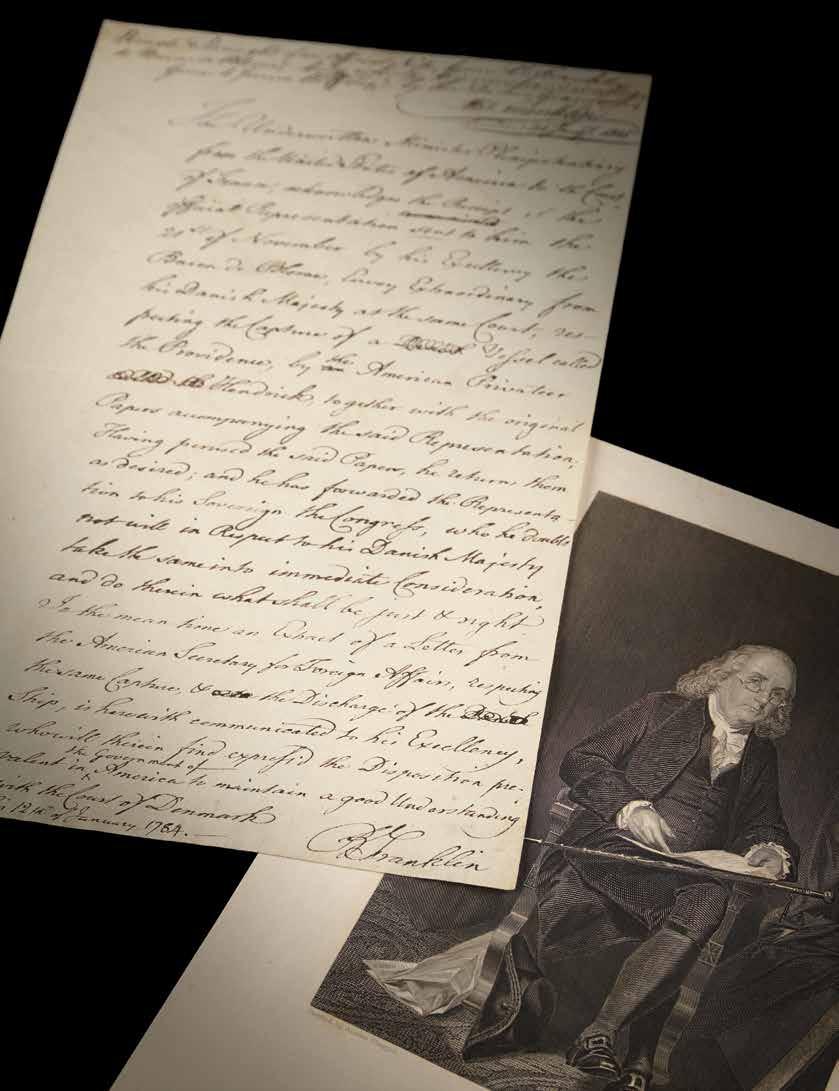
Franklin responds to Denmark’s envoy over the capture of a Danish vessel by an American privateer, assuring the baron that Congress
“will do therein what shall be just & right”
Benjamin Franklin Autograph Letter Signed to Denmark’s Envoy, Addressing the Capture of a Danish Vessel by an American Privateer (1784)
Exquisite ALS signed “B. Franklin,” one page, 7.5 x 12.5, January 12, 1784. Handwritten rough draft of a letter from Franklin to Baron de Blome. In full: “The Underwritten Minister Plenipotentiary from the United States of America to the Court of France, acknowledges the Receipt of the official presentation sent to him the 21st of November by his Excellency the de Blome, Envoy Extraordinary from his Danish Majesty at the same Court, respecting the capture of a Vesell called the Providence by the American Privateer Hendrick, together with the original papers accompanying the said Representation; Having perused the said papers, he returns them as desired; and he has forwarded the Representation to his Sovereign the Congress, who he doubts not will in respect to his Danish majesty take the same into immediate Consideration and do therein what shall be just & right. In the meantime an Extract of a Letter from the American Secretary for Foreign Affairs respecting the same capture & the discharge of the Ship, is herewith communicated to his Excellency who will therein find expressed the Disposition prevalent in The Government of America to maintain a good understanding with the Court of Denmark.”
A note of provenance is written at the top by Franklin’s grandson, William Temple Franklin: “Rough draft of an official note from Dr. Franklin to Baron de Blome, being entirely in his own hand writing. Given to James Wolff, Esq., by the Doctor’s Grandson, W. T. Franklin,
London 21st Jany 1815.” Housed in a custom quarter-bound red cloth clamshell case with dark red leather spine and gilt-stamped spine title. In exceptionally fine, clean condition, with a lightly trimmed left edge.
Franklin is replying to a diplomatic complaint from Baron de Blome, envoy from the Danish court, regarding the capture of the vessel Providence by the American privateer Hendrick. Although Franklin assures the baron that Congress will “do therein what shall be just & right,” he had long supported the use of privateering during the Revolution, helping authorize commissions issued to merchant captains to seize British ships and cargoes in the absence of a powerful American navy. In this case, the privateer maintained that although the vessel carried Danish papers and a Danish crew, both ship and cargo were in fact British property.
Written in January 1784, just as Congress ratified the Treaty of Paris formally ending the Revolutionary War, the letter reflects the unresolved diplomatic and legal consequences of American privateering operations. Denmark had remained neutral during the conflict, and Franklin’s careful response underscores the new nation’s effort to preserve favorable relations with European trading powers while navigating disputes arising from wartime seizures at sea. The reference to “the discharge of the Ship” further reflects ongoing international disputes over the treatment of neutral vessels and the authority of American prize courts in the immediate aftermath of independence.
Starting Bid $10,000
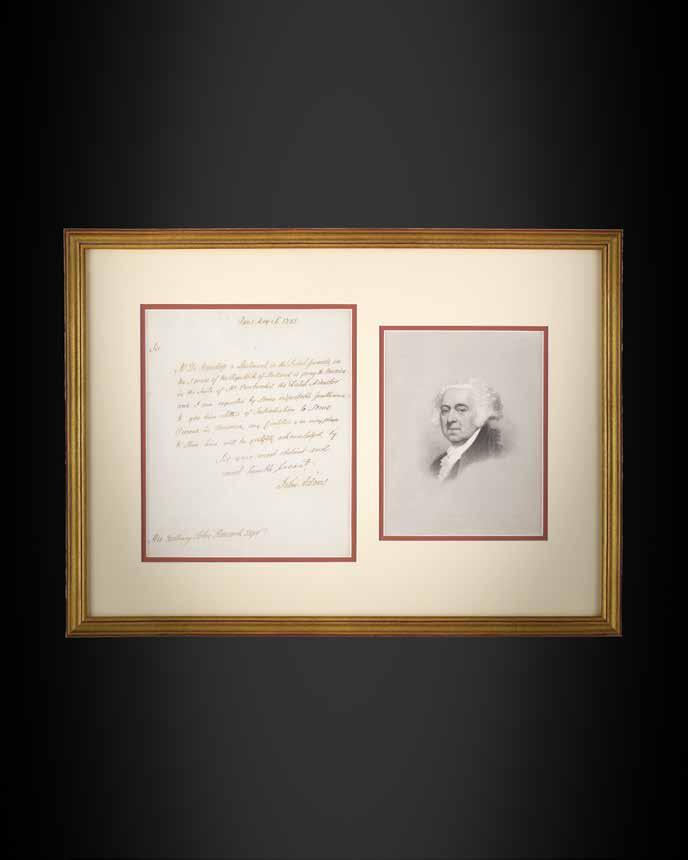
John Adams Revolutionary War-Dated Autograph Letter
Signed to John Hancock, Written While Finalizing the Treaty of Paris Ending the Revolutionary War
Revolutionary War–dated ALS signed “John Adams,” one page, 7.25 x 9.25, May 26, 1783. Significant handwritten letter to “His Excellency John Hancock,” sent from Paris while awaiting the final signing of the Treaty of Paris. In full: “Mr. De Hogendorp, a Lieutenant in the Dutch Guards, in the Service of the Republick of Holland, is going to America in the Suite of Mr. Vanberkel the Dutch Minister and I am requested by some respectable Gentlemen to give him Letters of Introduction to some persons in America. Any civilities you may please to show him will be gratefully acknowledged.” Handsomely archivally doublematted and framed with an engraved portrait to an overall size of 19.5 x 14.25. In fine to very fine condition.
Provenance: Christie’s, Property from a California Collector, June 18, 2007.
John Adams traveled to the Dutch Republic and settled in Amsterdam in mid-1780, where he hoped to transform a pro-American sentiment into a substantial loan, thereby lessening American reliance on France. However, fearing reprisal from the British, the Dutch government refused to even meet with him for more than eight months. In spite of these political difficulties, Adams never relented. When news of America’s triumph at Yorktown reached Europe, Adams petitioned at The Hague for official recognition of American independence, and continued to badger them for a loan. As a result of these efforts, on April 19, 1782, the Netherlands became the second nation in Europe, after France, to recognize the sovereignty of the United States. Adams was then able to negotiate a loan of five million guilders, a treaty of amity and commerce, and establish the first American embassy on foreign soil.
On March 4, 1783, Dutch politician Pieter Johan van Berckel was made the first minister plenipotentiary to the United States of America.
In writing to congratulate him on the appointment, Adams offered some guidance: ‘My Advice would be to land at Boston, & take the Journey to Philadelphia, while you send your Frigate round by Sea to that City—This will give you an Opportunity of seeing a great part of the United States, and of becoming acquainted with many principal Characters. I will be answerable for your cordial Reception every where. His Excellency the Governor of Massachusetts, Mr. Hancock, and his Honor the President of the Senate, Mr. Samuel Adams, will receive You at Boston—Governor Trumbull at Connecticut—General Washington and Governor Clinton at New York—Governor Livingston at New Jersey. I would by all means advise You to pass through New York and New Jersey, where You will find Multitudes charmed at the Sight of a Dutch Minister more than any other in the World.’
With this letter, he introduces Gijsbert Karel van Hogendorp, a member of van Berckel’s delegation, to his old friend, Governor John Hancock. During his travels in America, van Hogendorp would befriend Thomas Jefferson and spend time in the company of the Washingtons at Mount Vernon. Van Hogendorp would return to the Netherlands and hold several offices as an influential liberal statesman.
At the same time he was connecting his Dutch friends to their American counterparts, Adams was hard at work negotiating the Treaty of Paris as part of a delegation that included Benjamin Franklin and John Jay. The treaty to officially end the Revolutionary War was drafted on November 30, 1782, and finally signed at the Hôtel d’York in Paris on September 3, 1783, by Adams, Franklin, Jay, and British negotiator David Hartley.
Autograph letters from Adams to Hancock are exceedingly rare: in 1987, R. A. Ryerson, editor of the Adams Papers, identified this as one of only 13 extant letters of Adams to Hancock. Nine of these are in the Adams Papers, three are owned by other institutions, and only one other item—an account statement—remained in private hands at that date.
Starting Bid $2,500
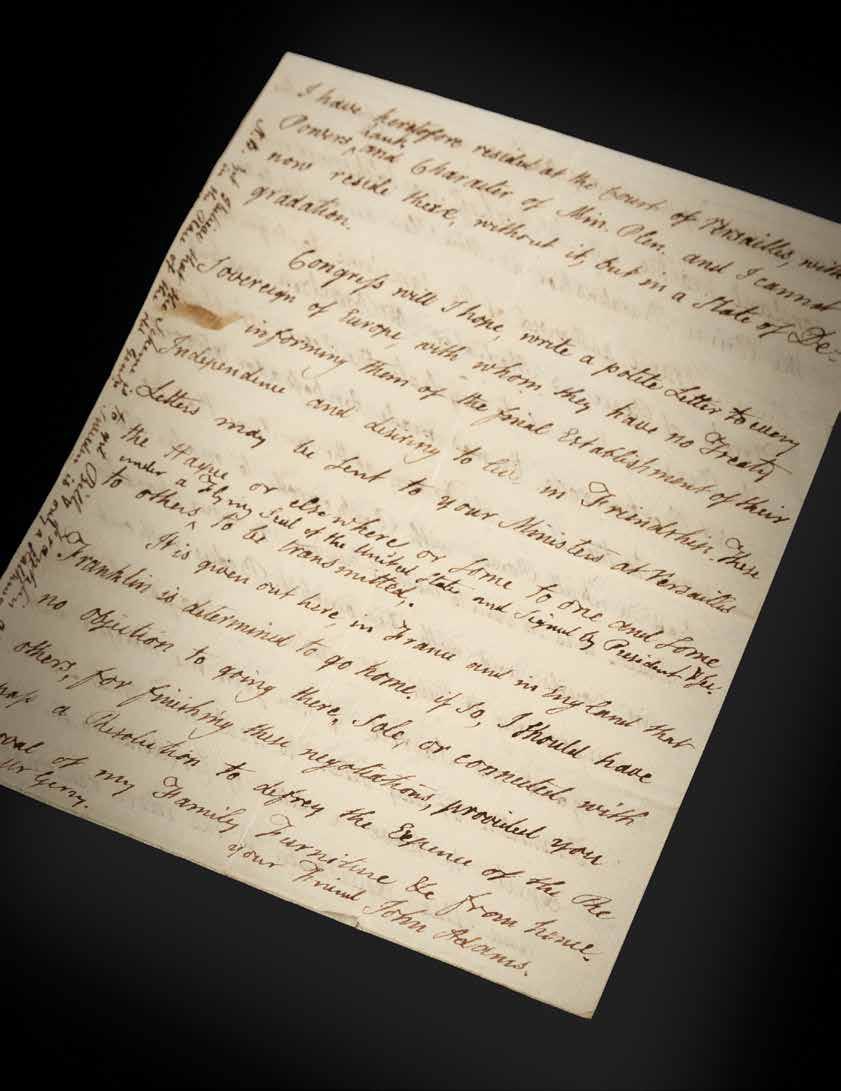
the
of
weighing the roles of
and John Jay while candidly warning that without proper accreditation American ministers would exist “in a State of Degradation”
John Adams Autograph Letter Signed from The Hague, Addressing Benjamin Franklin, John Jay, and the Organization of American Diplomacy Following the Treaty of Paris (1784)
ALS, four pages on two adjoining sheets, 7.25 x 8.75, June 27, 1784. Addressed from “The Hague,” an important diplomatic letter to Elbridge Gerry concerning the organization of American diplomacy in Europe following the Treaty of Paris and the formal recognition of the United States’ independence. Adams discusses Congress, John Jay, Henry Laurens, Francis Dana, Benjamin Franklin, negotiations with the European maritime powers, diplomatic accreditation, and the future structure of the American foreign service. In full:
“I received your Favours by Mr. Reed and by Col’l Herman, and am much obliged to you for your friendly sentiments and instructive communications.
Your Plan of a commission to treat with the maritime powers, has not it seems been adopted and the departure of Mr. Jay, for New York, has now rendered it, impracticable. Congress we are told is adjourned. Mr. Jay and Mr. Laurens, as well as Mr. Dana may be present at the Session in October and what will be the Result of the Advice of all, I cannot pretend to conjecture.
If Congress persists in the Plan of negotiating at Paris, with England and the other maritime powers they must send a Commission. Nothing can be done without Powers. But to Whom? To Franklin and me? Or will they send any new Hands? In my opinion the Method of negotiating at Paris had better be broken up and a Minister sent
to England with Power to negotiate with some of the other Powers, as well as the Court of St. James’s, and Power sent to the Minister at Versailles, or to him at the Hague to treat with the rest, or part to one and part to the other. But if you continue to negotiate with all at Paris, you should accredite to the King, all the Ministers you employ. This is absolutely necessary in order to keep up, the respect to your Ministers which is their due. Without it, they are not entitled to any of the Prerogatives of the Law of Nations.
Accordingly this is the constant practice. e.g. Mr. Markoff, was lately joined with the Prince Baratinskoi, as Min. Plen. accredited to the King of France, authorized at the Sametime, to Sign the Treaty of Peace, as Mediator. Mr. Brantzen, was sent to Paris, by Holland to negotiate the Peace, jointly with Mr. Berkenrode. He was made Ambassador Extraordinary to the King of France, at the sametime that he had a Full Power with Berkenrode to make the Peace. It is in vain to think of keeping up your Character in Courts and with Diplomatic Bodies without conforming to their old established Usages, which they regard as Sacred. If you join me, therefore with Franklin or any other, to treat in France, I shall expect to have a Letter of Credence to the King. And this Expectation is the more reasonable as I have heretofore resided at the Court of Versailles, with the Powers, Rank and Character of Min. Plen. and I cannot now reside there, without it, but in a State of Degradation.
Congress will, I hope, write a polite Letter to every Sovereign of Europe, with whom they have no Treaty informing them of the final Establishment of their Independence and desiring to live in Friendship. These Letters may be Sent to your Ministers at Versailles the Hague or elsewhere or Some to one and Some to others under a Flying Seal of the United States and Signed by President Lee to be transmitted.
Continued on the next page.

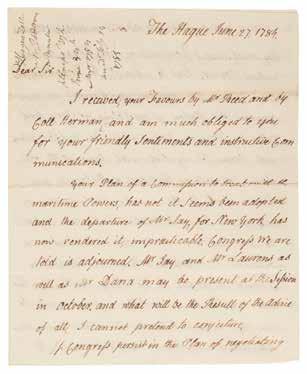
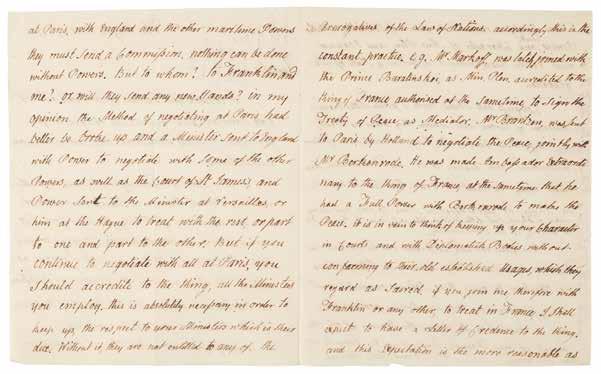
Continued from previous page.
Benjamin Franklin’s grandson as a political opportunist, while pressing Congress to fund his family’s relocation as Abigail sailed from Boston to reunite with her husband after nearly four years apart
It is given out here, in France and in England that Franklin is determined to go home. If so, I should have no objection to going there, Sole, or connected with others, for finishing these negotiations, provided you pass a Resolution to defrey the Expense of the Removal of my Family Furniture etc. from home.” Adams adds a postscript along the left margin: “N.B. Yet I believe that the Scheme is to get Billy Franklin appointed in the Place of the old gents. Sweden is only a stalking horse.”
Written in the aftermath of the Treaty of Paris, formally ending the Revolutionary War, the letter captures John Adams at the center of the United States’ earliest efforts to establish itself within the diplomatic system of Europe. Adams had been posted to The Hague since 1782, when he achieved one of the most significant diplomatic triumphs of the Revolutionary era, securing Dutch recognition of American independence and negotiating crucial loans from Dutch banking houses that helped sustain the Continental war effort. Writing from The Hague in June 1784, Adams addresses the unresolved structure of American foreign policy, ongoing treaty negotiations with the European maritime powers, and Congress’s uncertainty regarding the future roles of its leading diplomats abroad. The letter references many of the principal architects of early American diplomacy – John Jay, Henry Laurens, Francis Dana, Benjamin Franklin, and Elbridge Gerry – while reflecting Adams’s strong views on diplomatic authority, accreditation, and international protocol.
Particularly significant are Adams’s extended remarks on the necessity of formal ministerial credentials and recognition by European courts. Insisting that American representatives conform to the “old established Usages” of European diplomacy, Adams argues that without proper accreditation American ministers would exist “in a State of Degradation.” The letter vividly documents the practical challenges faced by the young republic as it attempted to secure equal standing among the established monarchies of Europe following independence. Those challenges were compounded by the structural limitations of the Articles of Confederation, which gave Congress limited authority
over foreign policy and no reliable power to enforce treaty obligations or regulate commerce, the same congressional indecision and lack of coherent foreign policy direction that Adams’s letter repeatedly reflects. Adams also notes the recent departure of John Jay for New York, where Jay would assume the role of Secretary of Foreign Affairs under the Confederation government, leaving a significant vacancy in the American diplomatic presence in Europe. Within weeks of this letter, Thomas Jefferson would arrive in Paris to join Franklin and Adams as the third American commissioner for commercial treaty negotiations, beginning to fill the diplomatic void Adams describes.
The concluding postscript contains unusually candid political commentary concerning William Temple Franklin, Benjamin Franklin’s grandson and longtime diplomatic secretary, whom Adams dismissively calls “Billy Franklin.” Adams writes: “I believe that the Scheme is to get Billy Franklin appointed in the Place of the old gents. Sweden is only a stalking horse.” The remark appears to reflect Adams’s suspicion that proposed diplomatic initiatives involving Sweden were being used indirectly to advance William Temple Franklin’s diplomatic prospects following Benjamin Franklin’s anticipated retirement from European service. The passage offers a glimpse into the factional rivalries and personal tensions that frequently shaped American diplomacy during the Confederation era. Adams’s closing reference to “the Removal of my Family Furniture” carries personal resonance as well, as Abigail Adams and their daughter had sailed from Boston that same month to join him in Europe after a separation of nearly four years, ending one of the most celebrated epistolary partnerships in American history.
Letters of this depth and political candor from Adams’s European diplomatic service are highly desirable, particularly those combining notable content on American foreign policy, Congress, European negotiations, diplomatic protocol, and Franklin family politics during the formative years of the United States government.
Starting Bid $10,000
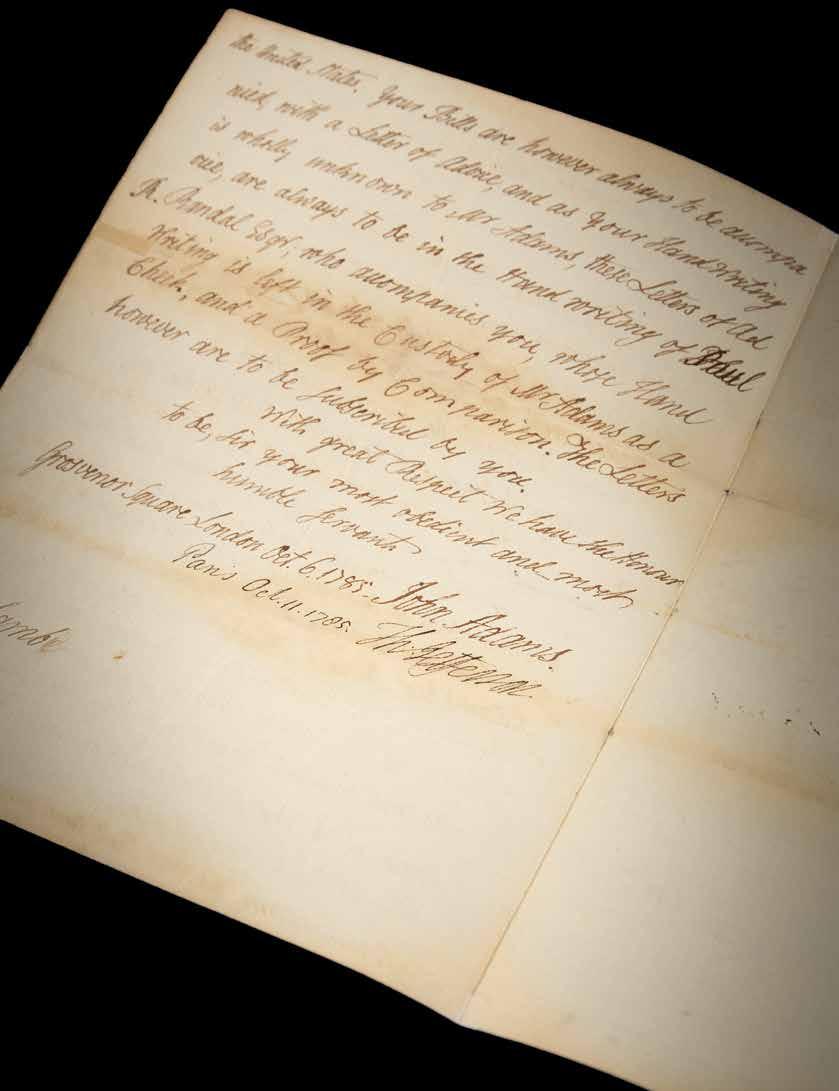
John Adams writes from London and Thomas Jefferson countersigns five days later in Paris, jointly authorizing Captain
John Adams Autograph Letter Signed with Thomas Jefferson Countersignature, Authorizing Negotiations with the Barbary Powers as American Sailors Were Held Captive in North Africa (1785)
Important Confederation-era ALS signed by John Adams in London on October 6, 1785, and countersigned five days later in Paris by Thomas Jefferson (“Th: Jefferson”) on October 11, 1785, one page both sides, 7.75 x 9.75. Addressed from Grosvenor Square, the letter authorizes Connecticut merchant and sea captain John Lamb to negotiate with the Barbary powers and draw funds for the ransom of American seamen held captive in North Africa. Issued just over two years after the Treaty of Paris formally ended the Revolutionary War, the document reflects one of the earliest diplomatic crises confronting the newly independent United States as American shipping came under threat from Algiers, Tunis, and Tripoli.
In full: “Grosvenor Square London Westminster October 6. 1785. Sir / The United States of America, in Congress Assembled on the 14th day of February last resolved, that the Ministers of the United States who are directed to form Treaties with the Emperor of Morocco and the Regencees of Algiers Tunis & Tripoli be empowered to apply any Money in Europe belonging to the United States to that use: As you are appointed to proceed to Algiers [“Tunis and Tripoli” struck through] as Agent for forming such Treaty with the Emperor you are hereby authorized & empowered to draw Bills of Exchange to the amount of a sum not exceeding twenty thousand Dollars, at one or two usances, upon ‘John Adams Esqr Minister Plenipotentiary of the United States of America at the Court of Great Britain, residing in Grosvenor Square, at the corner between Duke Street & Brook Street,’ who will regularly accept & pay the same either at the house of R & C Puller in London or of Wilhem & Jan Willink & Nicholas & Jacob Staphorst at Amsterdam. Your Bills are however to be always accompanied with a letter of Advice in your own hand writing to Mr Adams, a duplicate of which you will also send by some other conveyance.” Signed neatly
at the conclusion by both Adams and Jefferson. In fine condition, with light toning along the folds.
Issued by the two future presidents at the peak of their European diplomatic partnership – Adams as Minister Plenipotentiary in London and Jefferson as Minister Plenipotentiary in Paris – this document was signed at separate capitals on different days, a practice the diplomatic historian Hunter Miller described as ‘highly unusual’ in eighteenthcentury treaty-making. The notable strikethrough of “Tunis and Tripoli” reflects a humanitarian pivot: just weeks before this document was signed, Algerian corsairs had captured the Boston schooner Maria on July 25, 1785, off Cape St. Vincent, followed five days later by the Philadelphia ship Dauphin west of Lisbon. Twenty-one American sailors, including the seventeen-year-old James Leander Cathcart, who would spend the next eleven years as a slave and eventually serve as chief Christian clerk to the Dey of Algiers, were carried into captivity. Adams and Jefferson narrowed Lamb’s mission to Algiers because that was where their fellow citizens were enslaved.
Lamb’s mission ultimately failed: he arrived in Algiers in March 1786 to find the Dey demanding nearly three times the $20,000 authorized here. The 21 sailors would remain enslaved for a full decade; the final ransom in 1796 cost $642,000 plus annual tribute and a 36-gun frigate. Adams and Jefferson would later split sharply on how to respond to the Barbary crisis, with Jefferson favoring naval force, and Adams favoring tribute, a policy fork that this very document opens, and which culminated in the First Barbary War during Jefferson’s presidency. Dual-signed documents by Adams and Jefferson are among the most desirable artifacts in American autograph collecting, and operational orders from their joint commission are particularly uncommon.
A prior catalog description states that this letter was previously known only through a retained copy recorded in Adams’s contemporary letterbook and later resurfaced in a collection assembled in 1902.
Starting Bid $10,000
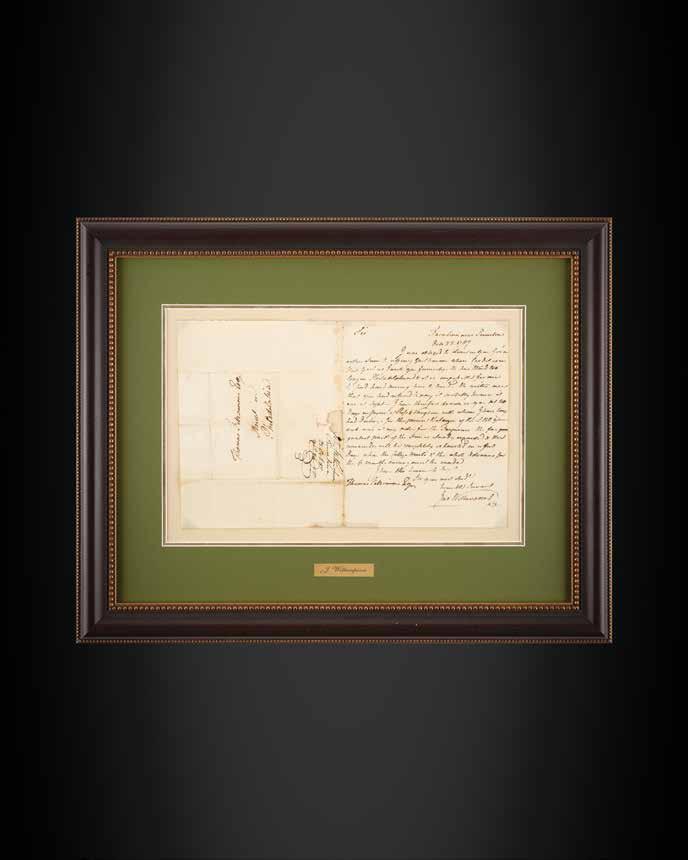
In October 1787, just one month after the signing of the Constitution, John Witherspoon appeals to Thomas FitzSimons for relief from scarce specie and exhausted funds needed to reopen Princeton College during the fragile final months of the Confederation era
John Witherspoon Autograph Letter Signed to Constitution Signer Thomas FitzSimons, Written One Month After the Signing of the Constitution, Discussing Hard-Money Shortages and Princeton Finances (1787)
Signer of the Declaration of Independence from New Jersey (17231794), who served as an influential president of Princeton University and went on to sign the Articles of Confederation. ALS signed “Jno. Witherspoon,” one page, measuring 12.75 x 8 open, (“near Princeton”) October 23, 1787. Handwritten financial letter to Pennsylvania merchant, Congressman, and Constitutional Convention delegate Thomas FitzSimons, written only one month after the signing of the United States Constitution in Philadelphia. Writing concerning a disputed financial draft, hard-money shortages, and funds needed before the College reconvened, Witherspoon explains the difficulties of obtaining specie and requests payment through his longtime commercial associates, in full: “I was obliged to draw on you for another sum to all my gentlemen whose credit is in New York, as I wrote you formerly. He has staid too long in Philadelphia, and it is impossible for me to find hard money here to send. He writes me that you had refused to pay it probably because it was at sight – I have therefore drawn on you at 20 Days in favour of Ross & Vaughan with whom I have long had dealings for the precise Balance of the £150 you wrote me at my order for the Fergusons the far greater part of the sum is already expended & the remainder will be completely exhausted in a few days, when the College meets & the whole Advance for the 6 months ensuing must be made.” Professionally matted and framed to an overall size of 20.75 x 16.5. In fine condition, with a small area of seal-related paper loss to the integral address leaf.
John Witherspoon, Presbyterian minister, educator, and signer of the Declaration of Independence, served as president of the College of
New Jersey, now Princeton University, beginning in 1768 and remained closely associated with the institution until his death in 1794. During his presidency, he strengthened the college’s finances, library, and curriculum, helping shape its role in Revolutionary-era public life. Thomas FitzSimons, a prominent Philadelphia merchant and former delegate to the Confederation Congress, represented Pennsylvania at the Constitutional Convention and signed the Constitution on September 17, 1787; he later served in the First Congress beginning in 1789.
Written during the uncertain weeks immediately following the Constitutional Convention, the letter vividly reflects the unstable credit conditions and specie shortages that plagued the Confederation period before the establishment of a stronger national financial system under the new federal government. Witherspoon’s references to difficulties obtaining “hard money,” delayed drafts, exhausted balances, and advancing funds before the reopening of the College provide a revealing glimpse into the practical financial pressures confronting American institutions and merchants in the fragile post-Revolutionary economy, the same systemic financial weaknesses that Federalist advocates were citing in October 1787 as among the strongest arguments for ratifying the new Constitution. At the moment Witherspoon wrote this letter, the Constitution’s fate remained uncertain, with ratification debates erupting across the states and the Federalist Papers just beginning to appear; New Jersey, where Witherspoon resided and Princeton was located, would ratify unanimously just two months later in December 1787, with Witherspoon among its supporters. Letters connecting prominent founders in the immediate aftermath of the Constitutional Convention are highly desirable, particularly those combining financial, educational, and institutional content from the formative months of the early republic.
Starting Bid $500
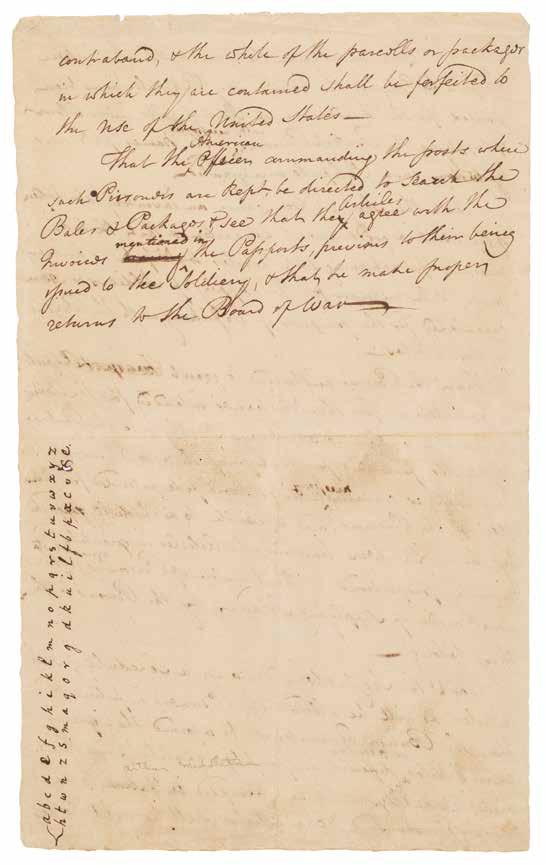

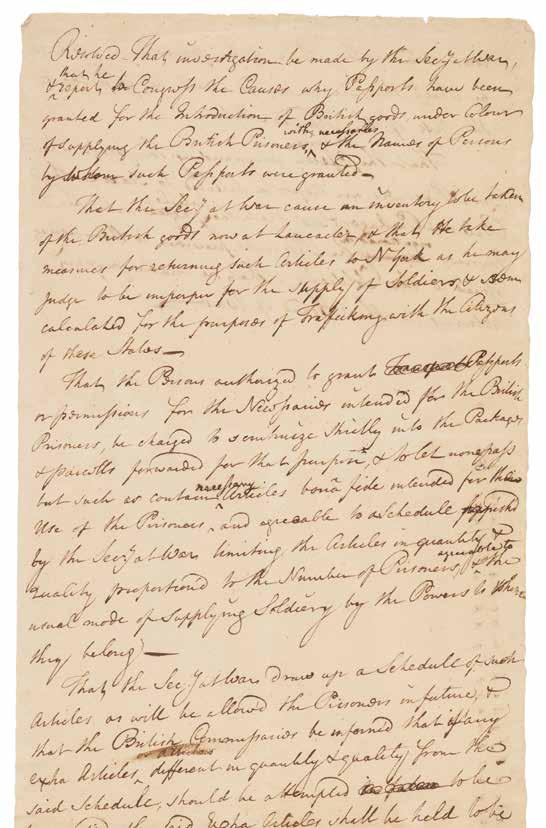
Arthur Middleton Handwritten Revolutionary War-Era Congressional Resolution on Maintenance of Prisoners of War, with Secret Cipher Key
Signer of the Declaration of Independence from South Carolina (1742–1787). A radical Whig, Middleton was one of the more vocal members of the South Carolina’s Council of Safety and was known for his ruthless treatment of Loyalists. Middleton was imprisoned in 1780 when the British captured Charleston and spent a year in custody in St. Augustine. Rare Revolutionary War-era unsigned handwritten document by Arthur Middleton, one page both sides, 8.25 x 13.5, no date but circa June 1782. Handwritten resolution by Arthur Middleton, a representative of South Carolina in the Second Continental Congress, regarding the investigation of passports authorizing the importation of British goods for use by prisoners of war, and concerning the inventory and control of goods imported for prisoners by enforcing a contraband list. In part: “Resolved, That investigation be made by the Sec’y at War & that he report to Congress the Causes why Passports have been granted for the Introduction of British goods under Colour of supplying the British Prisoners with necessaries & the Names of Persons by whom such Passports were granted.
That the Sec’y at War cause an inventory to be taken of the British goods now at Lancaster, & that He take measures for returning such Articles to N. York as he may judge to be improper for the supply of Soldiers, & some calculated for the purposes of Trafficking with the Citizens of these States. That the Persons authorized to grant Passports or permissions for the Necessaries intended for the British Prisoners be charged to scrutinize strictly into the Packages & parcells forwarded for that purpose, & to let none pass but such as contain necessary Articles bona fide intended for the Use of the Prisoners and agreeable to a Schedule pick’d by the Sec’y at War limiting the Articles in quantity & Quality proportion’d to the Number of Prisoners & agreeable to the usual mode of supplying Soldiery by the Powers to where they belong.
That the Sec’y at War draw up a Schedule of such Articles as will be allow’d the Prisoners in future, & that the British Commissaries be inform’d that, if any extra Articles different in quantity & quality from the said Schedule should be attempted to be forwarded, the said Extra Articles shall be held to be contraband, & the whole of the parcells or packages in which they are contained shall be forfeited to the use of the United States.
That the American Officers commanding the posts where such Prisoners are Kept, be directed to Search the Bales & Packages & see that the Articles agree with the Invoices mentioned in the Passports, previous to their being issued to the Soldiery, & that he make proper returns to the Board of War.”
A mono-alphabetic cipher key is written vertically on verso, likely in holograph; cipher keys were used frequently during the Revolutionary War by spies, diplomats, and others to prevent important communications from being understood by the enemy. Most keys were simple substitutions, like that denoted on the present document, in which one could create an encrypted message by finding, for each alphabetic letter in the original message, the matching letter in the top row of the key, and writing down the letter found just below it. The recipient could decode the message by employing the identical key in reverse. In fine condition.
Examples of Arthur Middleton’s autograph are extremely rare, and he is often cited as the third-rarest signer of the Declaration of Independence following Gwinnett and Lynch. Most are enumerated in ‘A Census of Important Middleton Documents’ in Joseph E. Fields’s article, ‘The Autographs of Arthur Middleton’; this resolution listed as No. 42. [Taylor, ed., Manuscripts: The First Twenty Years (Westport, 1984), 86-104.]
Starting Bid $1,000
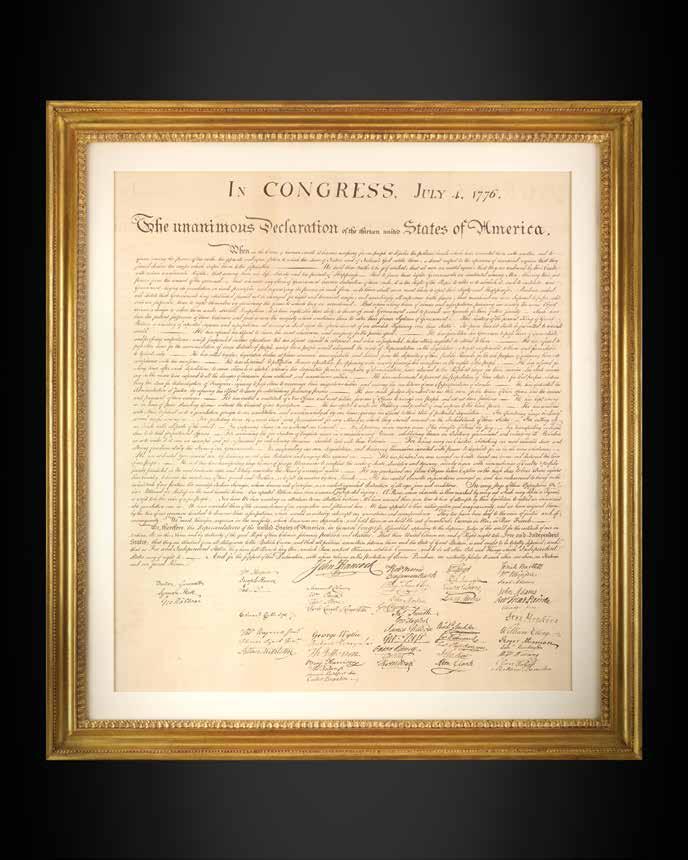
“In Congress, July 4, 1776”— an iconic Force print of the Declaration of Independence
LOT 8033
Declaration of Independence: Force Print from W. J. Stone’s Copperplate (c. 1833)
Striking rice paper engraving of the Declaration of Independence, 25 x 28.25, printed from Stone’s copperplate in 1833 for inclusion in Peter Force’s American Archives. The Declaration famously begins, “In Congress, July 4, 1776. The Unanimous Declaration of the Thirteen United States of America.” Handsomely cloth-matted and framed to an overall size of 32 x 36. In fine condition, with intersecting folds (as issued) and expected mild mirroring of ink.
By 1820, the original Declaration of Independence had seriously deteriorated due to inappropriate handling and storage, creating an immediate need for a facsimile reproduction. Commissioned by John Quincy Adams, William J. Stone engraved a copperplate by lifting ink directly from the original and creating a perfect copy. He printed 201 before placing the plate in storage for safekeeping.
Peter Force was later commissioned by Congress to print a series of books-now known as the American Archives-featuring the founding documents of the United States. For the occasion, the Stone engraving was removed from storage and used to produce new copies on rice paper, distinguished from the original by an engraving in the lower left corner “W.J. Stone S.C. Washn.” The prints of the Declaration were later folded and issued in the first volume of the fifth series of books.
After printing, the plate was again retired, now residing with the original Declaration at the National Archives. Congress authorized the printing of 1500 copies of American Archives, but subscriptions for the elaborate edition were disappointing, and in the end many fewer copies—perhaps only 500—were issued. Most were folded and bound into Volume I, Series Five. A magnificent and extremely well-preserved example.
Starting Bid $1,000
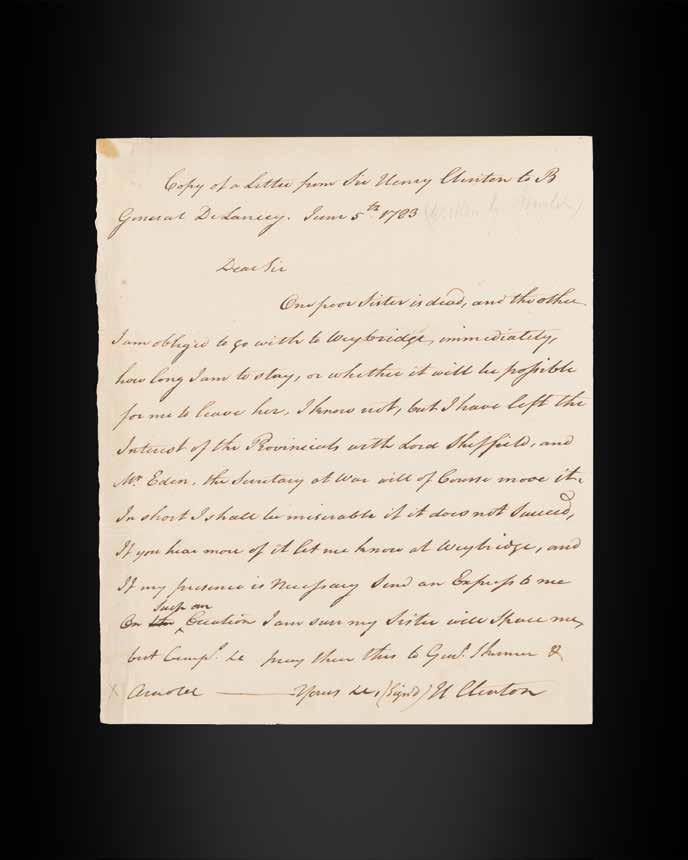
LOT 8034
“Shew this to Genl. Skinner & Arnold”—the traitor records a copy of Henry Clinton’s letter
Benedict Arnold Revolutionary War–Dated Handwritten Letter (Copy of Henry Clinton’s Letter to Oliver De Lancey)
Revolutionary War–dated letter by Henry Clinton copied entirely in the hand of Benedict Arnold (incorporating his surname, “Arnold,” within the text), one page, 7.25 x 8.75, June 5, 1783. Headed, “Copy of a Letter from Sir Henry Clinton to B. General De Lancey, June 5th, 1783,” the text reads, in part: “Dear Sir, Our poor sister is dead, and the other I am obliged to go with to Weybridge, immediately, how long I am to stay, or whether it will be possible for me to leave her, I know not, but I have
left the Interest of the Provincials with Lord Sheffield, and Mr. Eden, the Secretary at War will of course move it. In short I shall be miserable if it does not succeed. If you have more of it let me know at Weybridge, and if my presence is necessary send an Express to me…pray shew this to Genl. Skinner & Arnold.” In fine condition, with light show-through along the left edge from an old mounting strip on the reverse. This letter is of particular interest as it connects three American-born Loyalist generals—Benedict Arnold, Oliver De Lancey, and Cortland Skinner. During this period, hostilities had ceased in order to allow final peace arrangements to be made.
Starting Bid $300
Lord Jeffrey Amherst Revolutionary War–Dated Document
Signed, Issuing Arms to the First Hessian Troops Sent to America (1776)
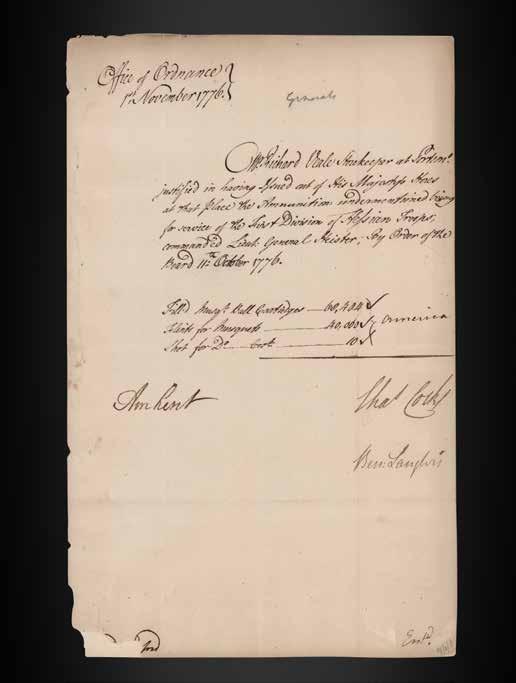
Commander-in-chief of the British army during the Revolutionary War (1717–1797) whose reputation was damaged due to allegations that he conducted an early form of germ warfare against Native Americans, a group he held in extremely low regard, using the deadly smallpox virus. Revolutionary War–dated manuscript DS, signed “Amherst,” one page, 7.75 x 12.5, October 11, 1776. Document issued by the “Office of Ordnance,” in which Amherst approves the issue of arms and ammunition to the first Hessian troops sent to America. In full: “Mr. Richard Veale Storekeeper at Portsmo. justified in having issued out of His Majesty’s Stores at that place the Ammunition undermentioned being for service of the First Division of Hessian Troops; commanded by Lieut. General Heister, By Order of the Board, 11th October 1776. Fill’d Musq’t Ball Cartridges—68,484, Flints for Musquets—40,000, Shot…10,” all bound for America. Signed at the conclusion in ink by Lord Amherst, and countersigned by two others. In fine condition, with partial separation along the hinge, and some minor paper loss to the lower left corner. General Leopold Philip de Heister was chosen to command the Hessian corps rented out to the British for service in the Revolution; he landed on Long Island with two full brigades on August 25, 1776, three days after the arrival of Gen. William Howe with the British troops.
Starting Bid $200
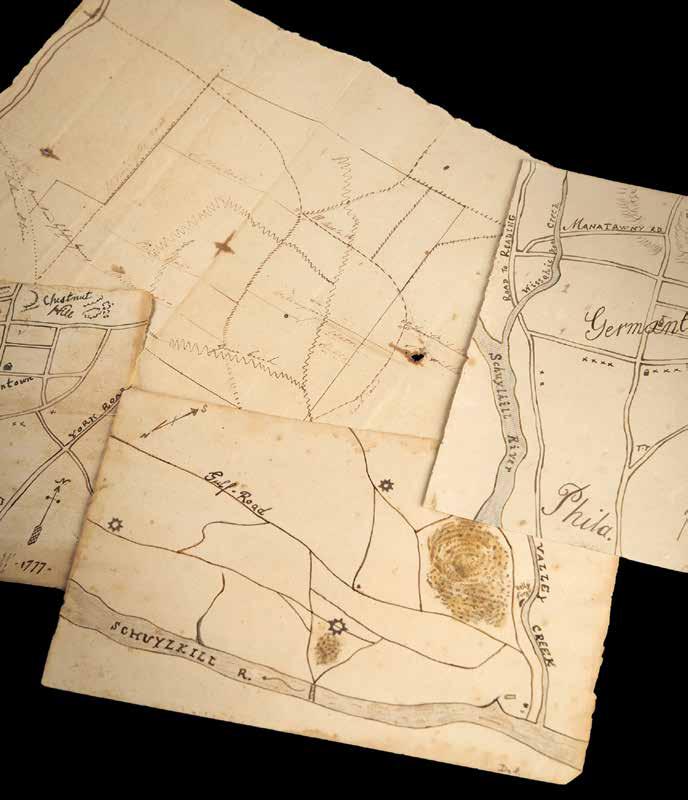
Four contemporary hand-drawn maps of Revolutionary War battlefield sites and encampments, ranging in size from 6.5 x 8 to 16 x 13, including: one of the Brandywine battlefield; two of Germantown and ChestnutHill, site of a major engagement during the Philadelphia campaign in 1777; and one of the encampment at Valley Forge in 1777–1778. In overall very good to fine condition.
Starting Bid $200
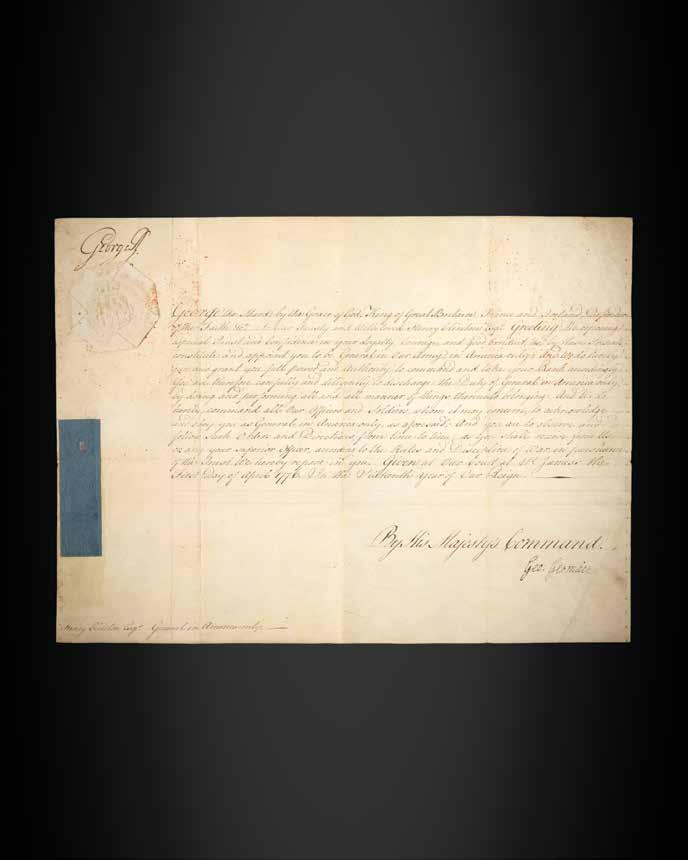
Less than three months before the Declaration of Independence, King George III and war minister Lord George Germain sign a royal military commission appointing Sir Henry Clinton “General in America only,” a deliberate limitation reflecting the British Army’s careful management of command and seniority during the American war
King George III Signed Royal Military Commission, Countersigned by Lord George Germain, Appointing Sir Henry Clinton “General in America only” (April 1, 1776)
Revolutionary War-dated manuscript DS, signed “George R.,” one page, 16.25 x 12, April 1, 1776. Issued at the Court of St. James’s, an official military commission appointing Lieutenant General Sir Henry Clinton as “General in America only” during the opening year of the Revolutionary War. The document grants Clinton authority to “discharge the Duty of General in America only, by doing and performing all and all manner of things thereunto belonging,” while directing him to observe “such Orders and Directions from time to time as you shall receive from Us, or any your superior Officer, according to the Rules and Discipline of War.” Signed boldly in the upper left corner by King George III, and countersigned at the conclusion by Lord George Germain. The left side retains the original paper seal and blue paper revenue stamp. In fine condition.
Issued less than three months before the adoption of the Declaration of Independence, the commission dates to a pivotal moment in Britain’s military effort to suppress the American rebellion. Countersigned by Lord George Germain, Secretary of State for the American Colonies from 1775 to 1782, the document bears the signature of the British minister principally responsible for directing the Crown’s wartime
strategy against the colonies. At the time the commission was issued, Britain still believed the rebellion could be subdued through military force, and preparations were underway for the massive British campaigns of 1776 following the evacuation of Boston only weeks earlier.
The designation “General in America only” points to a deliberate feature of British military commission practice during the Revolutionary War period. By limiting Clinton’s command and seniority to the North American theater, the Crown prevented the commission from altering rank precedence elsewhere in the British Army while still granting Clinton wide authority in the colonies. The specific language of the limitation makes the document an unusually explicit surviving example of how the British Army managed command structure, seniority, and political tensions among its senior officers during the American Revolution.
Tensions between Clinton and General Sir William Howe would soon emerge over military strategy and operational authority, frustrations subtly reflected in the commission’s directive that Clinton obey “such Orders and Directions from time to time as you shall receive from Us, or any your superior Officer.” Two years later, following Howe’s resignation, Clinton succeeded him as commander-in-chief of British forces in North America, overseeing major campaigns including the capture of Charleston and subsequent southern operations.
Starting Bid $2,500
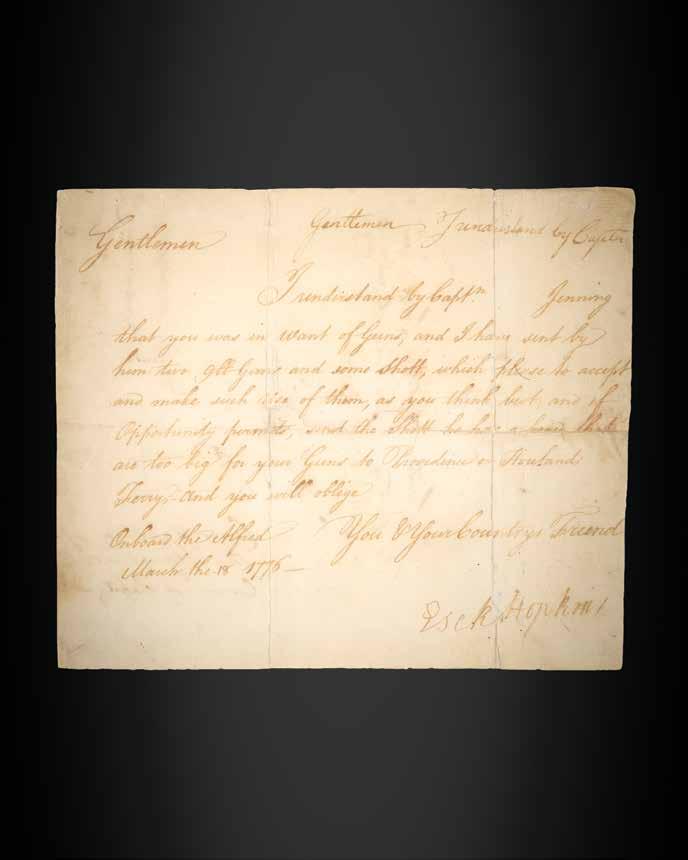
“I have sent by him two 9 lb guns and some shot”—the first Commander in Chief of the Continental Navy writes aboard the Alfred following the New Providence expedition, redistributing captured British artillery to the undefended ports of New England
Esek Hopkins War-Dated Letter Signed from ‘Onboard the Alfred,’ Requesting Cannon for the Defense of New England Ports
Famed Rhode Island commodore (1718–1802) who served as Commander in Chief of the Continental Navy during the American Revolutionary War. Revolutionary War-dated LS, one page, 7.75 x 6.5, March 18, 1776. Addressed from “Onboard the Alfred,” a letter to the Dartmouth Committee of Safety written shortly after Hopkins’s successful New Providence expedition in the Bahamas, the Continental Navy’s first amphibious assault, and among the earliest American naval actions conducted beyond the mainland. Writing after learning that New Bedford and Dartmouth lacked sufficient coastal defenses against possible British naval attack, Hopkins requests artillery captured during the expedition, in part: “I understand by Captain Jenning that you was in want of Guns, and I have sent by him two 9 lb guns and some Shott, which please to accept and make such use of them, as you think best; and if Opportunity permits, send the Shott he has or fears that are too big for your guns to Providence or Howlands Ferry, and you will oblige.” In very good to fine condition, with professional repairs to splitting along the folds.
Esek Hopkins was appointed the first Commander in Chief of the Continental Navy by the Continental Congress in December 1775,
assuming command of the small fleet organized during the opening months of the American Revolution. In February 1776, rather than proceeding directly against British naval forces in the Chesapeake Bay and along the Carolina coast as originally ordered, Hopkins led the Continental Navy’s expedition against New Providence in the Bahamas, capturing substantial quantities of cannon, mortars, ammunition, and military supplies badly needed by the American forces. The operation is widely regarded as the Continental Navy’s first amphibious assault and among the earliest offensive naval actions undertaken by the United Colonies beyond the mainland.
Written aboard Hopkins’s flagship, Alfred, on March 18, 1776, shortly after the fleet’s return voyage north, the letter concerns the redistribution of captured artillery and military stores to local patriot authorities in Dartmouth, Massachusetts. Hopkins writes in part: “I have sent by him two 9 lb guns and some shot, which please accept and make such use of them as you think best.” The letter directly reflects the urgent wartime shortages facing the Revolutionary cause during the conflict’s opening year, when captured British military supplies often represented the colonies’ principal source of artillery, ammunition, and naval stores. Hopkins’s naval career later became controversial, and he was removed from command in 1778.
Starting Bid $1,000
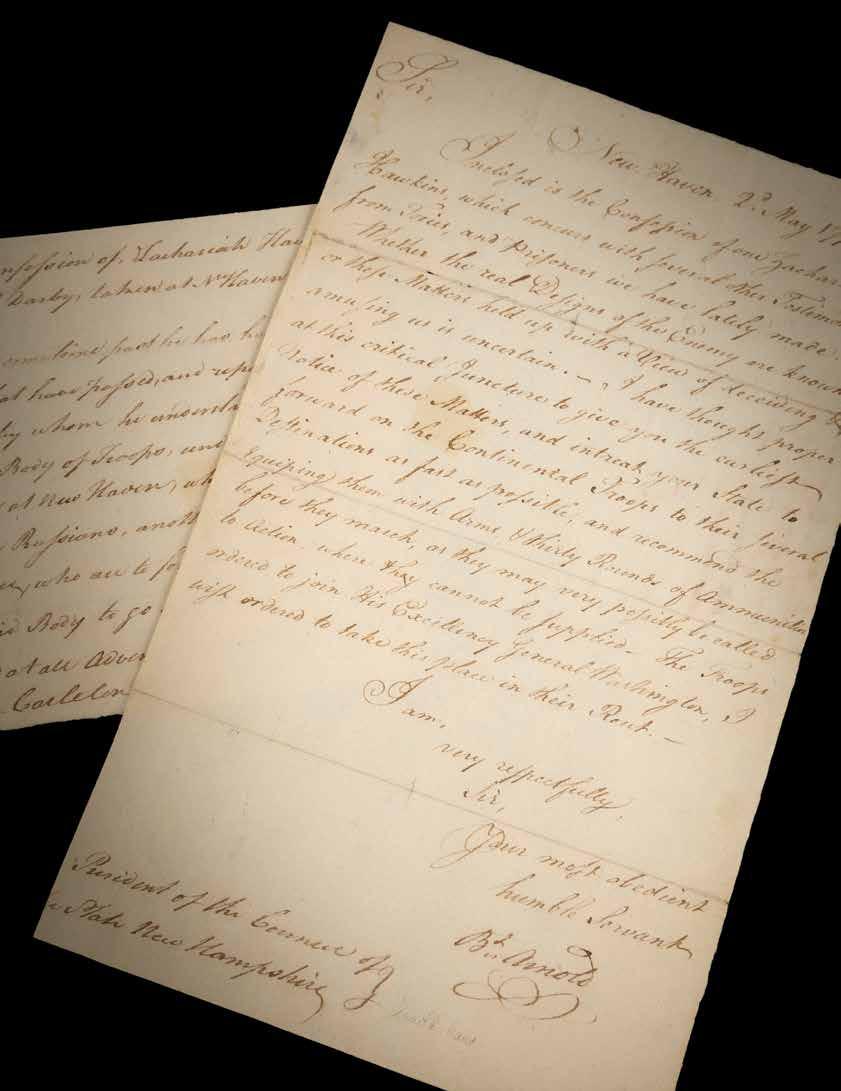
to warn of Loyalist activity and
plans, forwarding a confession he himself recorded— three years before becoming the most infamous traitor in American history
Benedict Arnold War-Dated Letter Signed with Handwritten Loyalist Confession Warning of Enemy Infiltration - Written Three Years Before His Own Defection to the British
Revolutionary War-dated LS from Benedict Arnold with a handwritten confession concerning suspected Loyalist Zachariah Hawkins and British military movements in the Northeast. The LS, signed “B’t Arnold,” one page, 7.5 x 12.25, May 2, 1777. Addressed from New Haven, Connecticut, a letter sent to Meshech Weare as the “President of the Council of the State of New Hampshire,” in full: “Enclosed is the confession of one Zachariah Hawkins, which concurs with several other testimonies from Tories, and prisoners we have lately made. Whether the real designs of the Enemy are known, or these matters held up with a view of deceiving & amusing us is uncertain. I have thought proper at this critical juncture to give you the earliest notice of these matters, and intreat your State to forward on the Continental Troops to their several destinations as fast as possible, and recommend the equipping them with arms, & thirty pounds of ammunition before they march, as they may very possibly be called to action, where they cannot be supplied. The Troops ordered to join His Excellency General Washington, I wish ordered to take this place in their Rout.”
Included with the letter is the original manuscript confession referenced by Arnold, penned in his hand, unsigned, one page, 7.5 x 6, May 2, 1777, headed, “The Confessions of Zachariah Hawkins a Tavern keeper at Darby, taken at New Haven 2d May 1777.” The document reads: “That for sometime past he has harboured a number of Tories, that have passed, and repassed, to and from the Enemy, by whom he understands the Enemy intend landing a body of troops under the Command of Governor Brown at New Haven, who are to be dress’d
in green & pass for Russians, another body at or near Connecticut River who are to form a junction at Hartford, a third body to go by the way of the Fish Kills and at all adventures form a junction with Governor Carleton at Albany.” Housed in a custom quarter-bound red cloth clamshell case with dark red leather spine and gilt-stamped spine title. In overall fine condition, with trimmed edges.
Written during a critical stage of the Revolutionary War preceding Burgoyne’s 1777 campaign from Canada, the documents reflect the Continental Army’s heavy reliance upon prisoner interrogations, Loyalist surveillance, and rapidly transmitted intelligence concerning possible British troop movements in the Northeast. Arnold himself expresses skepticism as to whether Hawkins’s information represented genuine military planning or deliberate misinformation intended “of deceiving & amusing us,” a concern reinforced by several questionable elements within the confession itself, including references to “Governor Brown” and a proposed junction with Governor Carleton at Albany. Nevertheless, Arnold considered the intelligence serious enough to urge the immediate mobilization and arming of New Hampshire troops destined for Washington’s army.
The documents acquire additional historical resonance in light of Arnold’s later defection to the British in 1780. At the time of this correspondence, Arnold remained one of Washington’s most energetic field commanders, warning against Loyalist activity and urging the rapid mobilization of Continental troops against possible British operations in the Northeast. Within three years, however, he would secretly negotiate with British authorities to surrender West Point, permanently altering his place in American history.
Starting Bid $2,500
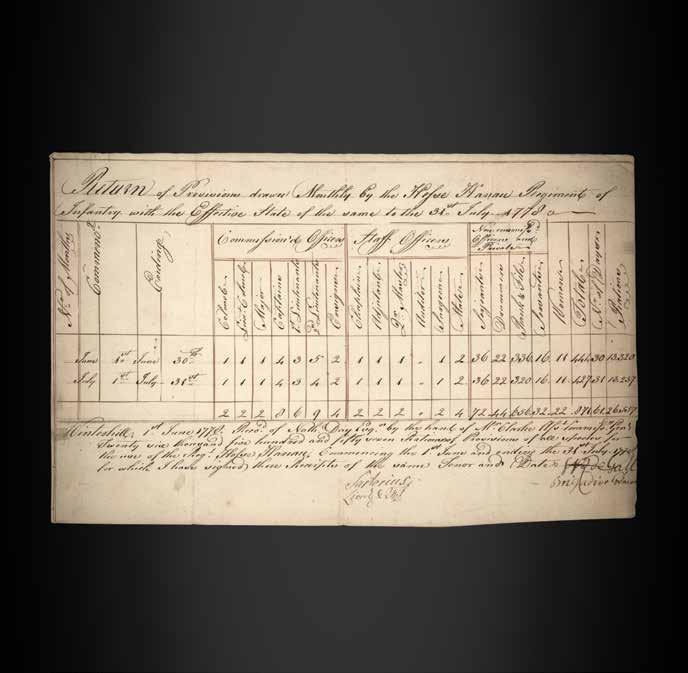
Revolutionary War–dated manuscript DS, signed “W. de Gall, Brigadier General,” one page, 12 x 7.5, July 31, 1778. Document headed “Return of Provisions drawn Monthly by the Hesse Hanau Regiment of Infantry,” while held captive as part of Burgoyne’s Convention Army at Winter Hill, Massachusetts. The muster roll lists a total of 444, including eleven women and sixteen servants, drawing a combined total of over 26,000 rations in a two-month span. In fine condition.
Burgoyne’s ‘Convention Army,’ which surrendered to American forces after the decisive Battles of Saratoga in 1777, included a significant number of Hessian troops—German soldiers hired by the British to supplement their forces. These Hessians, primarily from Brunswick and Hesse-Hanau, had fought alongside British regulars throughout the campaign, enduring difficult marches and harsh wilderness conditions. When General John Burgoyne capitulated to General Horatio Gates, the entire force—British, Loyalist, and German—was taken prisoner under the terms of the Convention of Saratoga, which promised their return to Europe. However, the Continental Congress later voided the agreement, and the Hessians, along with the rest of the Convention Army, remained in captivity until war’s end.
Starting Bid $200
New
interstate coordination of military pensions and relief for widows and soldiers’ families, insisting such measures be administered “as nearly as possible upon one uniform System throughout the whole”
George Clinton War-Dated Letter Signed to Delaware Governor Caesar Rodney, Urging Uniform Interstate Provisions for Continental Soldiers and Their Families (1780)
Revolutionary War-dated LS signed “Geo: Clinton,” one page, 7.75 x 12.5, March 11, 1780. Addressed from Albany, a letter from New York Governor George Clinton to Delaware Governor Caesar Rodney concerning financial provisions and relief for Continental soldiers and the families of those killed in service. In full: “The Legislature of this State have had under their Consideration the act of Congress recommending it to the several States to make proper Provision for their respective Troops serving in the army of the United States to take Place at the Expiration of the War but have deferred taking their final Measures upon the Subject till they are informed what Provision has been made in the other States of the Union being sollicitous that this Business may be conducted, particularly with Respect to the Allowances to be made to the Troops, as nearly as possible upon one uniform System throughout the whole.
I have therefore to request the Favor of your Excellency to inform me what Steps have been taken in the State over which you preside in Consequence of that Recommendation and whether any and what Provision has been made for the Widows and Children of such Officers and Soldiers as die while in the Service and I shall be much obliged if I may be favored with your answer on this Subject in Season to lay it before the Legislature on the 1st of June next to which Time they stand adjourned.” In very good to fine condition, with small repairs, a few stains, and three old tape remnants along the left edge. Read more online at www.RRAuction.com.
Starting Bid $200
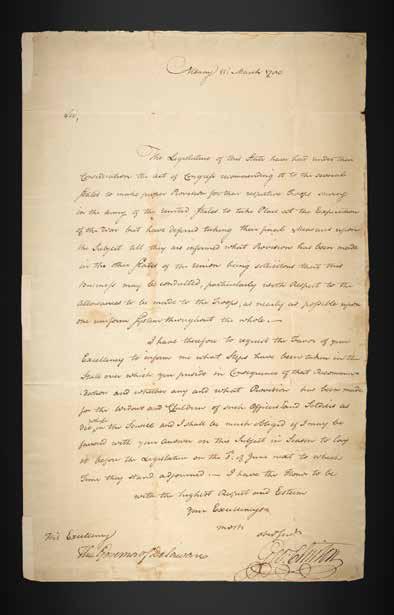
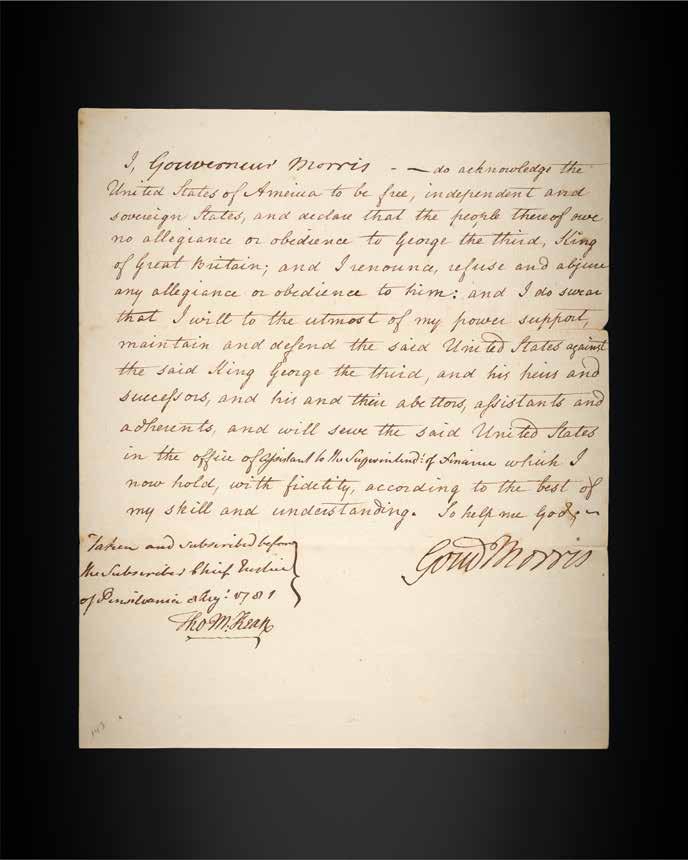
Gouverneur Morris subscribes an oath of allegiance renouncing “any allegiance or obedience” to King George III, witnessed by Thomas McKean as Chief Justice of Pennsylvania, at the height of the Revolutionary War’s financial crisis and weeks before the British surrender at Yorktown
Gouverneur Morris Twice-Signed Oath of Allegiance Renouncing King George III, Witnessed and Countersigned by Thomas McKean (August 8, 1781)
Revolutionary War-dated manuscript DS, signed twice by Gouverneur Morris and countersigned by Thomas McKean, one page, 7.5 x 9, August 8, 1781. Oath of allegiance subscribed by Gouverneur Morris, acknowledging the independence and sovereignty of the United States and renouncing allegiance to King George III. The oath reads in full: “I, Gouverneur Morris – do acknowledge the United States of America to be free, independent and sovereign States, and declare that the people thereof owe no allegiance or obedience to George the third, King of Great Britain; and I renounce, refuse and abjure any allegiance or obedience to him: and I do swear that I will to the utmost of my power support, maintain and defend the said United States against the said King George the third, and his heirs and successors, and his and their abettors, assistants and adherents, and will serve the said United States in the office of Assistant to the Superintendent of Finance which I now hold, with fidelity, according to the best of my skill and understanding. So help me God.” Morris has signed prominently at the conclusion (“Gouv. Morris”), incorporated his signature at the start of the oath, “Gouverneur Morris,” and added his title to the main body of the text, “Assistant to the Superintendent of Finance.” The document is countersigned by McKean (“Tho. M:Kean”), who at the time was serving as Chief Justice of Pennsylvania. In fine condition.
A leading statesman of the Revolutionary and Early National periods, Gouverneur Morris served in the Continental Congress and later helped organize the nation’s wartime finances under Superintendent of Finance Robert Morris. At the time this oath was signed, Morris
had moved from New York to Pennsylvania to accept appointment as Assistant to the Superintendent of Finance, helping administer efforts to stabilize the finances of the struggling Confederation government during the acute financial crisis of 1781.
By the summer of that year, the Continental dollar had effectively collapsed, Congress lacked independent taxing authority, and the army faced mounting unrest over unpaid wages. Robert Morris’ appointment as Superintendent of Finance in May 1781 represented Congress’s urgent attempt to rescue the American war effort from fiscal collapse, with Gouverneur Morris joining him almost immediately in that effort. Signed only weeks before the Yorktown campaign, the oath dates to the very moment American officials were struggling to sustain the Continental cause financially during the decisive final phase of the war. Morris would later become one of the principal architects of the United States Constitution, drafting much of its final language, including the celebrated preamble beginning ‘We the People.’
The document also bears the signature of Thomas McKean, signer of the Declaration of Independence, then simultaneously serving as President of Congress and Chief Justice of Pennsylvania. McKean’s dual service in both offices at the same time reflected the institutional fluidity and overlapping governmental responsibilities characteristic of the Revolutionary period. Oaths of allegiance of this nature were required of many officials serving the Revolutionary cause, but surviving examples signed by major founders are uncommon, particularly those explicitly renouncing allegiance to George III while affirming service to the newly independent United States.
Starting Bid $300
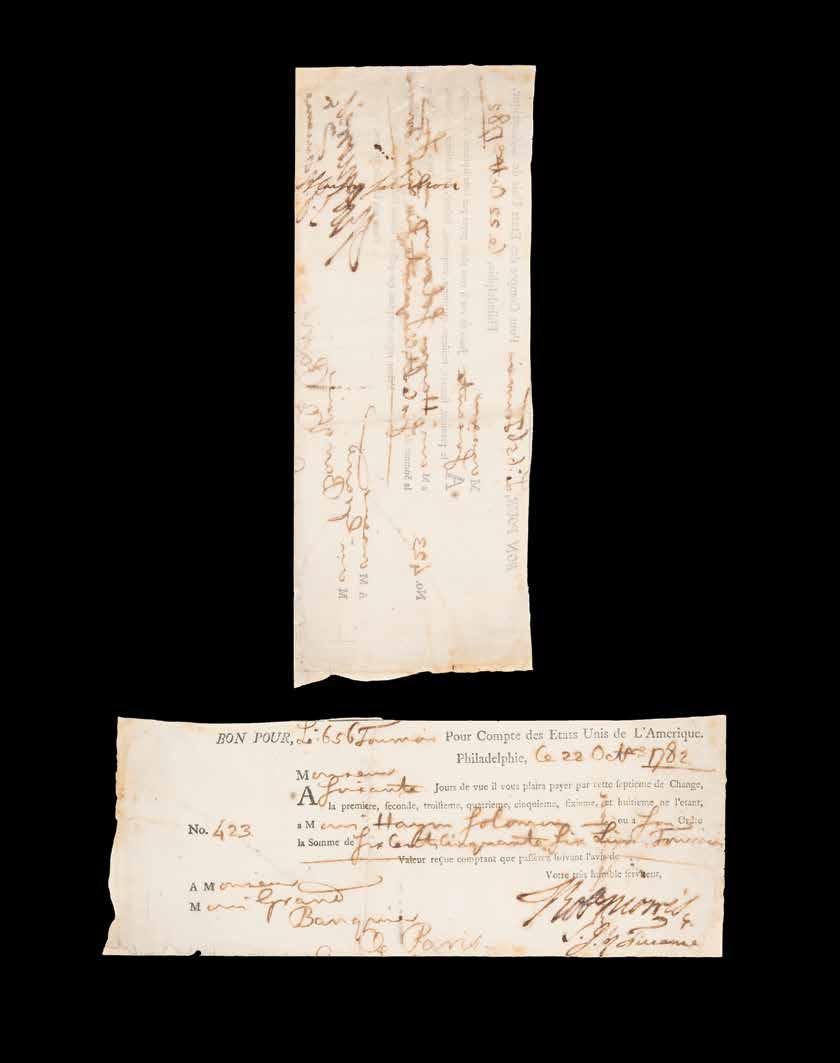
LOT 8043
Haym Salomon and Robert Morris Signed Bill of Exchange for Financing the Revolutionary War (October 22, 1782)
Exceedingly rare Revolutionary War-dated partly-printed DS, in French, signed “Haym Salomon” and “Rob’t Morris, S. I. of Finance,” one page, 9.75 x 3.75, October 22, 1782. A seventh bill of exchange issued in Philadelphia, Pennsylvania, to Haym Salomon for 656 Livres Tournois, payable at the Grand Bank of Paris, with the upper right annotated “Pour Compte des Estats Unis de L’Amerique.” Signed at the conclusion by Robert Morris as the Superintendent of Finance, and countersigned on the reverse by Salomon. In fine condition, with an unobtrusive professional repair to a vertical tear, and show-through front writing on the front rendering Salomon’s signature indistinct but completely legible. An extraordinary historic American financial instrument coveted equally by autograph specialists, numismatists, and historical enthusiasts—Salomon’s legacy as one of the principal financiers of the American cause has been memorialized with plaques, historical markers, and statues across the country, including Chicago’s Heald Square Monument that portrays Salomon standing alongside General George Washington and frequent collaborator Robert Morris.
Exchanges of this type were the method used when unpredictable modes of transportation were used to ship the exchange forms domestically and abroad, often on multiple vessels in case of loss or capture. In nearly all cases with American bills of exchange such as this, the ‘First’ was usually paid, redeemed, or retired before any subsequent ones would be redeemed. Copious record-keeping was necessary, and paying out a rich sum like this was taken seriously at all points of potential redemption. Additionally, such instruments were issued to pay the interest on the domestic debt of the United States and to allow it to draw on its gold reserves in Europe to raise immediate specie in order to purchase supplies and prosecute the War for Independence. Such bills of exchange ‘were the eighteenthcentury equivalent of modern checks; they enabled persons having funds available in other places to raise money for local use’ (Edgar J. McManus, in American National Biography).
By the time British troops marched into New York in September 1776, Haym Salomon had cast his lot with the Patriot cause. Not long after the occupation began, British General James Robertson had him arrested on suspicion of spying and confined to the grim Provost prison. It was a place notorious for its cruelty. Yet fate intervened. Hessian commander General Leopold Philip von Heister, recognizing in Salomon a rare gift—fluency in a host of European languages—secured his release, putting him to work as an interpreter and supplier of provisions. Though officially in the service of the Hessians, Salomon carried on his own business, advertising in the New York papers goods for ships—wine and vinegar, bread and rice—sold from his shop on Broad Street.
But beneath this appearance of loyalty to the British cause, Salomon was quietly at work for the Americans. He aided prisoners, American and French alike, in slipping their bonds and making their way to freedom. In 1778, his activities caught up with him. Arrested again, accused of plotting to burn British ships in New York Harbor, he was convicted of espionage and, by report, sentenced to hang. Somehow—exactly how remains unknown—he escaped. Crossing through New Jersey, he reached Philadelphia two weeks later, where in time he would become indispensable to the American cause.
Working closely with Robert Morris, Superintendent of Finance, Salomon proved himself one of the Revolution’s great financiers. Between 1781 and 1784, through tireless fundraising and generous personal loans, he provided the staggering sum of more than $650,000—about $15 million today—to keep Washington’s army in the field. His finest hour came in August 1781, with the fate of the war in the balance. Washington’s troops, bound for Yorktown, were near mutiny for want of food, uniforms, and supplies; Congress’s treasury was empty. When Morris told Washington there was no money, Washington’s reply was immediate: ‘Send for Haym Salomon.’ Within days, Salomon had raised $20,000 through the sale of bills of exchange—enough to move the army south. Yorktown would be the decisive battle of the Revolution, and Haym Salomon had made it possible.
Starting Bid $2,500
A 1782 Connecticut Treasury pay order issued to
Leason, a free Black soldier
“who hath served in the Connecticut Line of the Continental Army,” documenting the service of a veteran of Germantown, Fort Mifflin, Monmouth, and Valley Forge
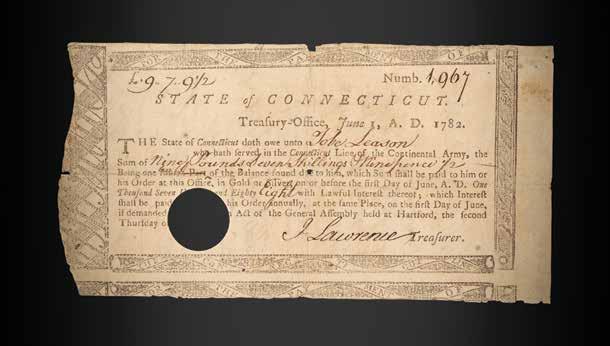
John Lawrence War-Dated Signed Connecticut Pay Order, Issued to a Free Black Soldier and Veteran of Germantown, Monmouth, and Valley Forge (1782)
Revolutionary War-dated partly-printed DS, signed “J. Lawrence,” one page, 8 x 4, June 1, 1782. State of Connecticut Treasury Office pay order for £9.7.91⁄2 payable to Jobe Leason “who hath served in the Connecticut Line of the Continental Army,” signed at the conclusion in ink by Treasurer John Lawrence. The reverse bears a signature reading “Jobe Leason,” possibly in the hand of the recipient himself, though attribution remains uncertain. In fine condition, with a cancellation hole affecting some printed text.
Research identifies Job Leason (1756–1828) as a free Black Revolutionary War soldier from Windham, Connecticut, who served in Colonel John Chandler’s Regiment of the Connecticut Line from April 1777 to April 1780, reenlisting in 1781 under Colonel Ebenezer Huntington.
Leason saw action at Germantown, Fort Mifflin – the site of a brutal six-week British siege in the autumn of 1777 that the Continental Army’s defenders held at tremendous cost – and Monmouth, and endured the winter encampment at Valley Forge alongside his brother Jesse Leason, another African American soldier of the Connecticut Line.
Leason’s service reflects the significant contribution of African American soldiers to the Revolutionary War effort; approximately 5,000 Black men served in the Continental Army and state militias, and Connecticut’s Continental Line included a notably high proportion of Black soldiers among its ranks. Issued by the Connecticut Treasury Office on June 1, 1782, the pay order represents a tangible surviving record of Leason’s military service and compensation during the closing years of the Revolutionary War.
Starting Bid $200
Issued just months after the Treaty
Jr., and fellow New York leaders as delegates to the Continental Congress
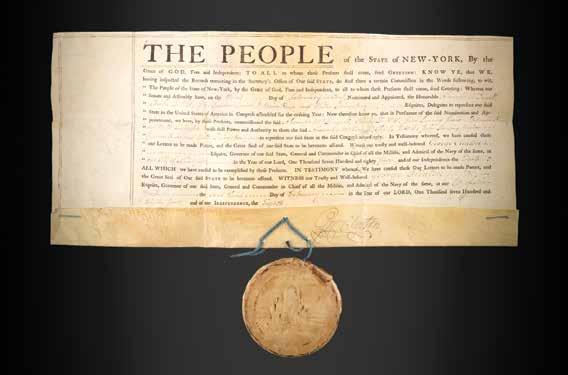
George Clinton Document Signed as Governor of New York, Appointing Delegates to the Continental Congress (February 3, 1784)
Partly-printed DS, signed “Geo: Clinton,” one page, 16 x 7.25, February 3, 1784. Official State of New York commission appointing delegates to the Continental Congress, issued under the authority of Governor George Clinton and completed in manuscript. The document certifies the appointment of Alexander McDougall, Charles DeWitt, John Lansing, Jr., Ephraim Paine, and Walter Livingston as “Delegates to represent our said State in the United States of America in Congress assembled for the ensuing Year.” Signed prominently along the bottom fold by George Clinton; the lower portion retains the original ‘Great Seal of the State of New York’ dark wax pendant, which is attached by its original blue cord. In very good to fine condition, with light staining to the document, and some damage to the hefty seal.
George Clinton (1739–1812), Revolutionary War general, longtime governor of New York, and future vice president of the United States under both Thomas Jefferson and James Madison, was among the most
powerful political figures of the Early Republic. Serving as governor of New York from 1777 to 1795 and again from 1801 until assuming the vice presidency in 1805, Clinton oversaw the state during the closing years of the Revolution and the uncertain postwar Confederation period. The commission documents New York’s appointment of representatives to the Continental Congress at a pivotal transitional moment, only months after the formal end of the Revolutionary War, following the Treaty of Paris in 1783. The delegates named in the document included several major political and military figures of Revolutionary New York. Alexander McDougall had served as a Continental Army general under George Washington; John Lansing, Jr., would later attend the Constitutional Convention before departing in opposition to the proposed Constitution; Charles DeWitt was a longtime New York politician and militia officer active in both the Continental and state governments during the Revolution; Ephraim Paine was a prominent New York landowner and legislator associated with the state’s AntiFederalist faction; and Walter Livingston belonged to the influential Livingston family that played a central role in Revolutionary and Early Republic governance.
Starting Bid $300
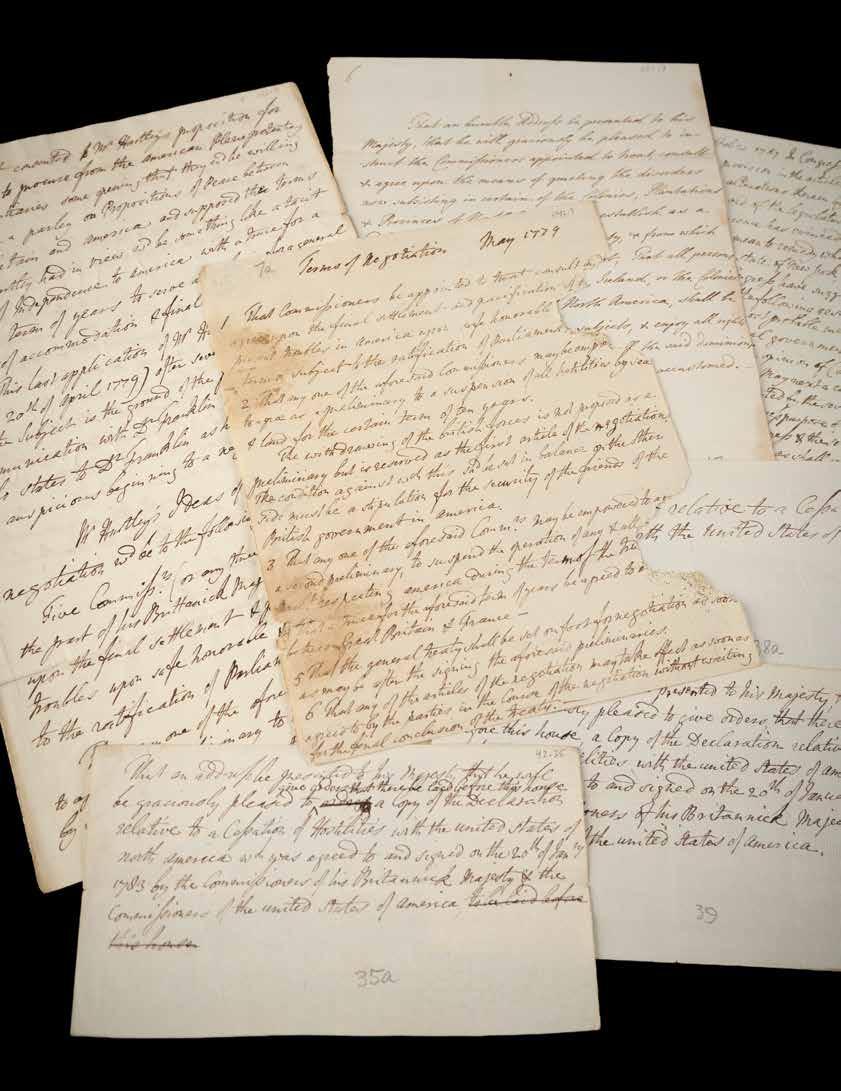
David Hartley the Younger (7) Revolutionary War-Era Handwritten Manuscripts on Peace Negotiations by Britain’s Sole Signatory to the Treaty of Paris
Seven handwritten documents by English statesman David Hartley the Younger (1732–1813), appointed by King George III as His Britannic Majesty’s Minister Plenipotentiary to negotiate with the United States on matters of American independence and related post–Revolutionary War issues. Hartley is best remembered as one of the signers of the 1783 Treaty of Paris, the historic agreement that formally ended the American Revolutionary War and recognized the independence of the United States. The archive totals eight pages, ranging in size from 7 x 4 to 8 x 12.75, most undated but circa 1778–1783.
These documents trace the difficult diplomatic passage from Britain’s attempt to preserve imperial unity to its reluctant recognition of American independence. Written largely during the closing years of the Revolutionary War and its aftermath, they show David Hartley working at the center of peace efforts, proposing suspensions of hostilities, terms of negotiation, protections for Loyalists, and formal parliamentary access to the declaration ending hostilities with the United States. Especially significant are Hartley’s 1778 appeal to King George III concerning the status of Americans as natural-born subjects, his 1779 “Terms of Negotiation,” and his later motions relating to the January 20, 1783 cessation of hostilities—papers that directly anticipate the Treaty of Paris, which Hartley signed for Great Britain later that year. The inclusion of Hartley’s handwritten copy of Congress’s 1787 resolution calling for the Constitutional Convention further extends the archive’s importance beyond the Revolution, linking Britain’s peace negotiator to the early constitutional development of the newly independent United States.
Highlights include: - Handwritten draft of a letter to King George III, April 10, 1778, requesting that he establish a pre-treaty proclamation stating that all persons born in America shall be considered as natural born subjects. In full: “That an humble Address be presented to his Majesty, that he will graciously be pleased to instruct the Commissioners appointed to treat, consult & agree upon the means of quieting the disorders now subsisting in certain of the Colonies, Plantations & Provinces of North America, to establish as a Fundamental, previous to any treaty, & from which they shall not have liberty to depart, that all persons born in either in Great Britain, Ireland, or in the Colonies Provinces & Plantations of North America, shall be considered as natural born subjects, & enjoy all rights & privileges
as such, throughout all the said dominions in common, in the manner heretofore accustomed.” - Handwritten manuscript headed, “Terms of Negotiation, May 1779,” in part: “1. That Commissioners be appointed to treat consult and agree upon the final settlement and pacification of…present troubles in America upon safe honorable… terms subject to the ratification of Parliament…2. That any one of the said Commissioners may be empo[wered] to agree as a preliminary to a suspension of all hostilities by sea & land for the certain term of ten years. The withdrawing of the British forces is not proposed as a preliminary but is reserved as the first article of the negotiation. The condition against w[hi]ch this sh[oul]d be set in balance on the other side must be a stipulation for the security of the friends of the British government in America.” - Handwritten manuscript incorporating his surname in the third-person, in part: “Lord North consented to Mr. Hartley’s proposition for endeavoring to procure from the American Plenepotentiary or plenepotentiaries some opening that they w[oul]d be willing to commence & parley on Propositions of Peace between Great Britain and America and supposed the terms w(hi)ch Mr. Hartley had in view w[oul]d be something like a tacit cession of Independence to America with a truce for a certain term of years to serve as a basis for a general treaty of accommodation & final Settlement. This last application of Mr. Hartley to Lord North (on the 20th of April 1779) after several previous conferances on the subject is the ground of the present confidential communication with Dr. Franklin as he did to Lord North that an auspicious beginning to a negotiation is ‘dimidicum facte’ Mr. Hartley’s Ideas of the probable course of the negotiation w[oul]d be to the following Effect. Five Commiss[ioner]s (or any three of them) to be appointed on the part of his Brittanick Maj[est]y to treat consult and agree upon the final settlement & pacification of the present troubles upon safe honorable & permanent terms subject to the ratification of Parliament. That any one of the aforesaid Commiss[sioner]s may be empowered to agree as a preliminary to a Suspension of all Hostilities by Sea & Land for a certain term of five or seven years.” - Handwritten motion for the presentation of copy of the cessation of hostilities, in full: “That an address be presented to his Majesty that he will be graciously pleased to give orders that there be laid before this house a Copy of the Declaration relative to a Cessation of Hostilities with the United States of North America w[hi]ch was agreed to and signed on the 20th of Jan[ua]ry 1783 by the Commissioners of his Britannic Majesty & the Commissioners of to United States of America.”In overall very good to fine condition, with paper loss to the “Terms of Negotiation” document affecting several areas of text.
Starting Bid $1,000
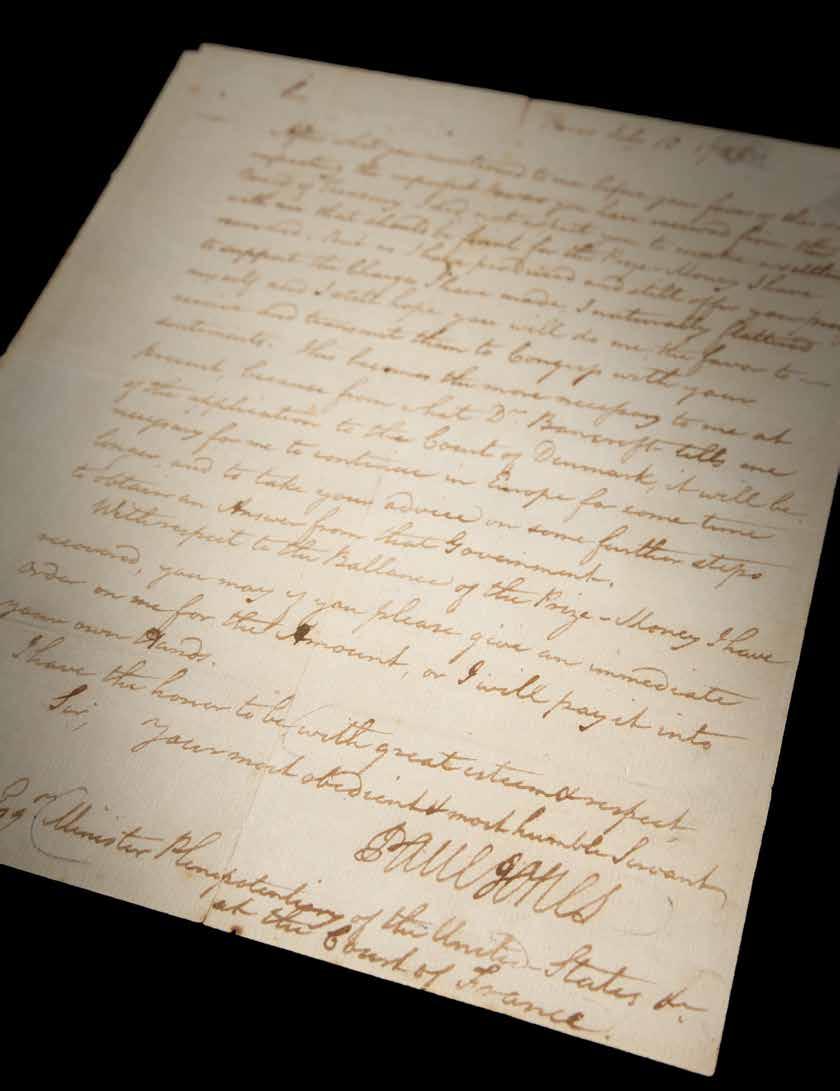
“Three
owed to his Revolutionary War squadron, including the unresolved claim against the
John Paul Jones Autograph Letter Signed to Thomas Jefferson, Pressing for “Prize-Money” Claims Attached to His Revolutionary War Naval Victories
Important American naval commander (1747–1792) during the Revolutionary War, who earned acclaim for his raids against the British while aboard the Bonhomme Richard. ALS signed “Paul Jones,” one page, 7.25 x 9, July 10, 1786. Handwritten letter to “His Excellency Thomas Jefferson, Esq’r, Minister Plenipotentiary of the United States at the Court of France,” detailing his ongoing efforts to secure prize money for the capture of several British ships during the Revolutionary War. In full: “After what you mentioned to me before your favor of this date respecting the imperfect powers you have received from the Board of Treasury, I did not expect you to make a settlement with me that should be final for the Prize-Money I have recovered. But as I have produced and still offer you proofs to support the charges I have made, I naturally flattered myself and I still hope you will do me the favor to receive and transmit them to Congress with your sentiments. This becomes the more necessary to me at present, because from what Dr. Bancroft tells me of the application to the Court of Denmark, it will be necessary for me to continue in Europe for some time longer, and to take your advice on some further steps to obtain an answer from that Government. With respect to the Ballance of the Prize-Money I have recovered, you may if you please give an immediate order on me for that amount, or I will pay it into your own hands.” In fine condition.
The prize-money claim at the heart of this letter grew out of John Paul Jones’s famous 1779 North Sea cruise during the American Revolu-
tion, which culminated in the dramatic capture of HMS Serapis by the badly damaged Bonhomme Richard off Flamborough Head on September 23, 1779. That victory made Jones the young republic’s most celebrated naval hero, but the aftermath proved far less glorious: the proceeds from captured vessels became tangled in the overlapping authority of Congress, French officials, American diplomats, and private agents. By 1786, Jones was still in Europe trying to recover money he believed due to himself and his crew, and Thomas Jefferson—then U.S. minister in Paris—was one of the few American representatives positioned to help transmit claims to Congress and press them diplomatically.
Jones’s reference to Dr. Bancroft and the “Court of Denmark” points to the long-running dispute over the Alliance prizes, British vessels captured in 1779 and taken into Bergen, Norway, then under Danish rule, where they were returned to Britain rather than condemned for the Americans’ benefit. Edward Bancroft had been enlisted to assist with the Danish claim, and correspondence among Jones, Jefferson, and John Adams shows the matter being shifted between London and Paris depending on where Danish representatives could be reached.
This historic letter captures Jones in the weary postwar role of claimant and negotiator, pressing the new nation to honor the financial obligations attached to its naval victories as Jefferson attempted to navigate the uncertain machinery of American diplomacy under the Confederation government.
Starting Bid $5,000
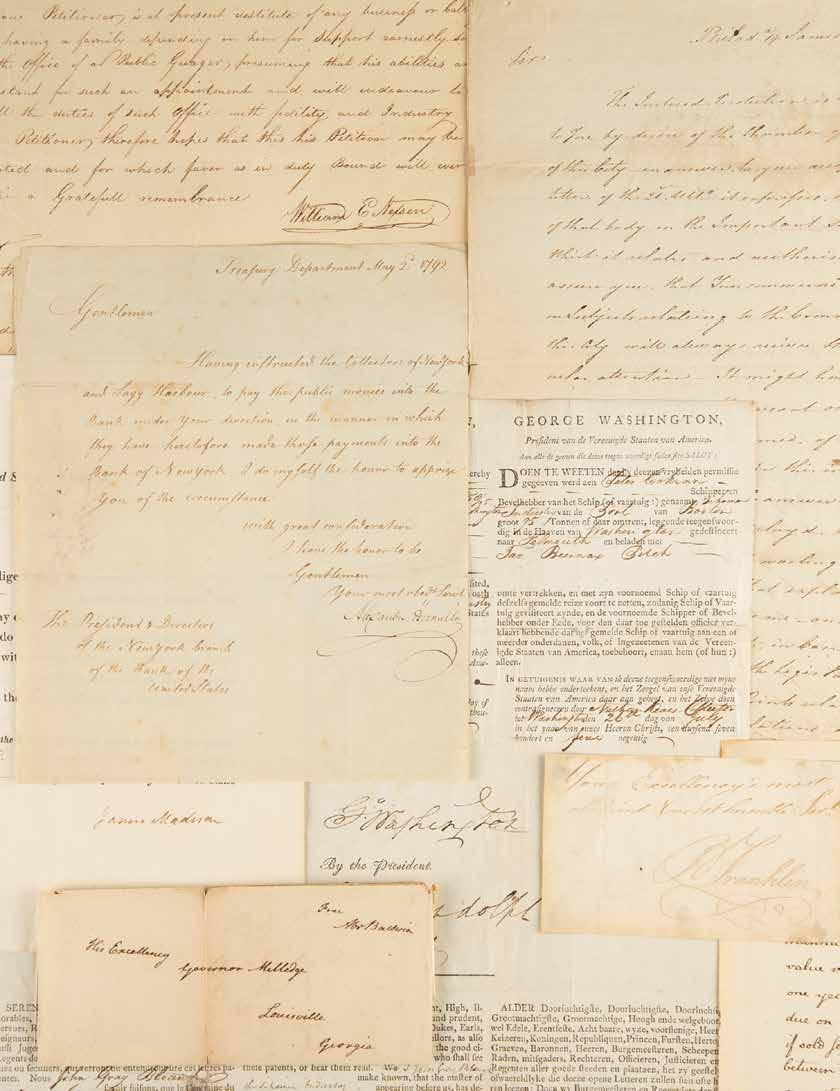
LOT 8048
Constitution Signers: Complete Set of (40) Autographs with Founding Fathers George Washington, Benjamin Franklin, Alexander Hamilton, and James Madison
Complete collection of the signers of the American Constitution, a seminal document in American politics and law that continues to serve as a touchstone for debates and discussions on issues of governance, rights, and the role of bureaucracy in society. The lifeblood of the American government, the Constitution has played a pivotal role in shaping the United States into the nation it is today, outlining the balance of power, forming the basis for all subsequent laws therein, and serving as a model for democratic governance worldwide.
This remarkable collection includes manuscript material from all 40 men who penned their names to the historic document, which includes all 39 state delegates and the one witness to the final draft. The formats offered consist of 14 ALSs, one LS, three ADSs, 15 DSs, one clipped signature, three pieces of signed paper currency, one free-franked address leaf from Abraham Baldwin (considered one of the rarest signatures in this set), and a stunning three language ship’s passport signed by President George Washington. This set also contains an additional ALS by the Secretary to the Constitutional Convention, William Jackson, who signed the document as a witness to the final edits of the Constitution, culminating in a total of 40 manuscript items in this first-class collection.
Read a more comprehensive description online at www.RRAuction.com.
Starting Bid $10,000
George Washington
Benjamin Franklin
Alexander Hamilton
James Madison
Abraham Baldwin
Richard Bassett
Gunning Bedford, Jr.
John Blair
William Blount
David Brearley
Jacob Broom
Pierce Butler
Daniel Carroll
George Clymer
Jonathan Dayton
John Dickinson
William Few
Thomas Fitzsimons
Nicholas Gilman
Nathaniel Gorham
Jared Ingersoll
William Jackson
Daniel of St. Thomas Jenifer
William Samuel Johnson
Rufus King
John Langdon
William Livingston
James McHenry
Thomas Mifflin
Gouverneur Morris
Robert Morris
William Paterson
Charles Cotesworth Pinckney
Charles Pinckney
George Read
John Rutledge
Roger Sherman
Richard D. Spaight
Hugh Williamson
James Wilson
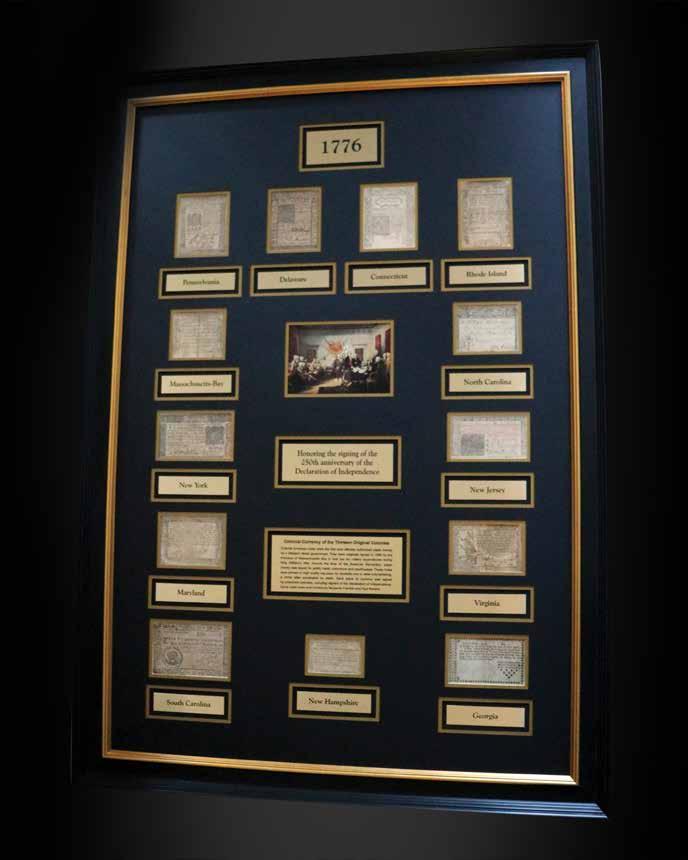
Currency from each of the 13 original colonies, ranging in size from 1.25” x 2.25” to 3” x 4.5”. Notes range in denomination from one fourth dollar to six dollars and three pence to thirty shillings, with one bill (South Carolina) being for twenty five pounds and one bill (Virginia) being for six Spanish Milled dollars. Each bill is dated from 1776: New Hampshire (June 28), New York (March 5), Massachusetts (June 18), Pennsylvania (April 25), Connecticut (June 19), Rhode Island (September 1), Maryland (August 14), New Jersey (March 25), Delaware (January 1), North Carolina (April 2), South Carolina (March 6, Virginia (October 7), and Georgia (unspecified). Each note bears one, or multiple, authoritative signatures at the conclusion of the ornately designed slip. Matted and framed with an image of the signing of the Declaration of Independence, and a brief descriptive plaque entitled ‘Paper Money from the Thirteen Original Colonies,’ to an overall size of 28 3/4 x 41 1/4. In very good condition, with mild toning, scattered light soiling, typical cancellation through Connecticut, Rhode Island and Massachusetts notes, and irregular edges. Protective anti Reflective Museum Optium 99% UV filtering Plexiglass contains the entire frame and each note has been archivally encapsulated in mylar for
protection, which is fully reversible.
Before the Revolutionary War, the British Parliament passed the Currency Acts of 1751, 1764, and 1773 to control colonial paper money to protect their merchants from depreciated colonial currency. By not allowing the currency to be used for “legal tender” to pay public and private debts, this created a money crisis for the colonials who had little access to gold and silver for coinage except for foreign coins like the Spanish dollar. When the war broke out, the colonies were freed from the monetary restrictions, allowing the Continental Congress to print paper money to help fund the war effort. Each state as well issued its own unrestricted currency, contributing to a rapid depreciation of both state and Continental money. To address this problem, the Constitution, ratified in 1788, banned the right of independent states to coin and print money. Assembling a reasonably priced collection of paper money from all 13 colonies is difficult. This set will surely please collectors of early American history.
Starting Bid $500
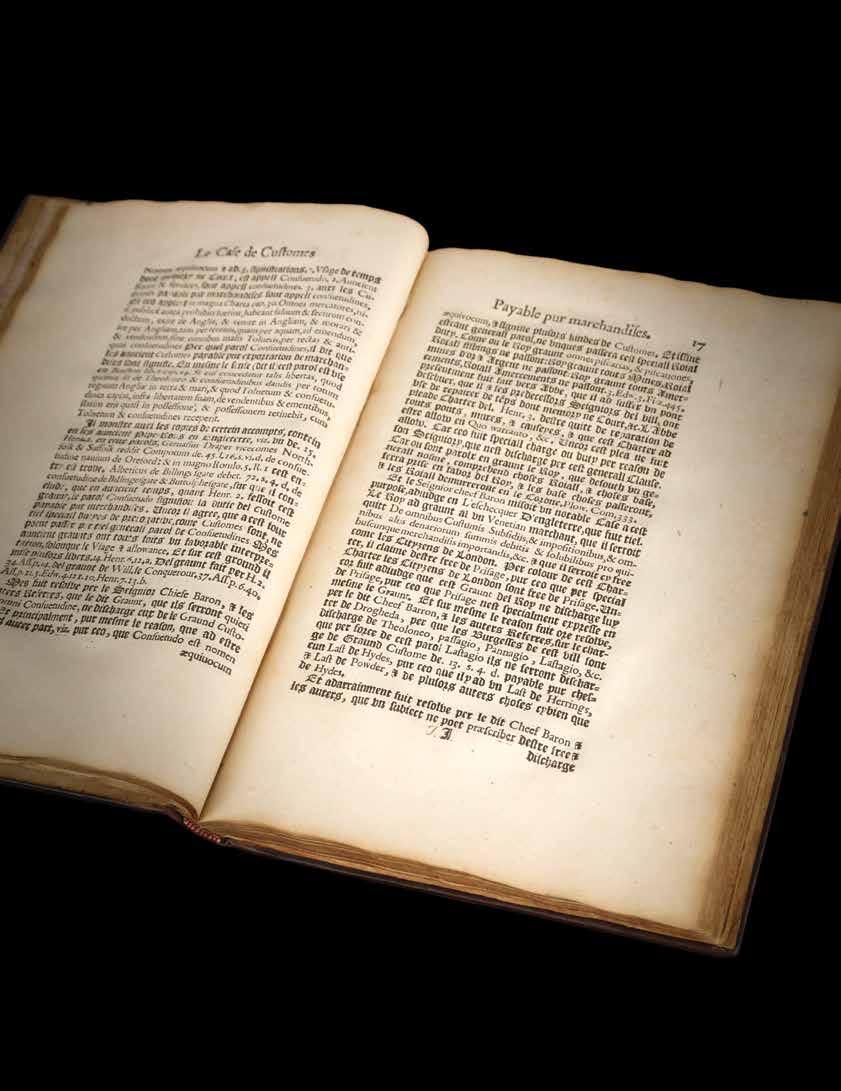
Thomas Jefferson’s Copy of Sir John Davies’ Le Premier Report (Dublin, 1615), Retaining His Characteristic “TJ” Ownership Markings, Descended from the Library of Sir John and Peyton Randolph
Thomas Jefferson’s personally owned copy of Sir John Davies’ foundational Irish law reports, Le Premier Report des Cases & Matters en Ley resolves adiudges en les Cours del Roy en Ireland, published in Dublin by John Franckton in 1615. Contemporary blind-stamped calf folio, 7.5 x 11, 97 leaves, with raised bands, later professionally rebacked and restored at the spine, retaining the 1677 analytical table/ index, Une Exact Table al Report de Sir John Davys, bound at the rear, and housed in a custom quarter morocco clamshell presentation case. Noted as the first published collection of Irish case law, the work contains reports of ten cases argued between 1604 and 1612 during Davies’ tenure as crown law officer in Ireland, including nine cases in Law French and one in English. The volume bears Jefferson’s characteristic manuscript ownership markings formed from the printer’s signature letters, with a cursive “T” added to the “I” signature leaf (page 17), forming part of his customary ‘TJ’ identification system. The corresponding “J” signature leaf (page 37) was removed at an unknown date, though the offset ink impression of Jefferson’s missing marking remains visible on the facing page; a facsimile replacement leaf has been professionally tipped in. The opening free endpapers contain extensive manuscript biographical notes on Davies in the hand of Sir John Randolph, who has signed at the conclusion. Accompanied by a cut signature of Peyton Randolph, the Virginia attorney general and future president of the First Continental Congress, from whose estate Jefferson acquired the Randolph family law library in 1775. Book condition: VG/None, with expected wear consistent with age and use.
The volume descended through one of colonial Virginia’s most important legal dynasties. Sir John Randolph (1693-1737), speaker of
the Virginia House of Burgesses and among the colony’s foremost attorneys, assembled an extensive legal library intended to support his projected history of Virginia law. The library passed to his son, Peyton Randolph, and following the latter’s death in 1775, Jefferson acquired a substantial portion of the Randolph legal library, incorporating many of its volumes into his own growing collection.
Jefferson obtained the book at a formative moment in both his legal and political career. Having completed his legal training under George Wythe and established himself as a practicing attorney and Burgess, he was rapidly emerging as one of Virginia’s leading political thinkers; within a year, he would draft the Declaration of Independence. Jefferson relied heavily upon his books throughout his public life, corresponding with figures including James Madison and Wythe regarding legal and political texts, and frequently lending volumes to friends, attorneys, and scholars. One such loan likely spared this copy from inclusion in the 1815 sale of Jefferson’s approximately 6,500-volume library to Congress, acquired to rebuild the Library of Congress after its destruction during the War of 1812.
Jefferson’s ownership markings represent one of the most recognizable and ingenious identification systems employed by any early American bibliophile. Rather than inscribing his full name, Jefferson utilized the printer’s signature letters placed at the foot of gatherings to guide binders during assembly. Using the 23-letter Latin alphabet standard in early modern printing, he added a cursive “T” to the “I” signature leaf – the Latin equivalent of “J” – and a cursive “J” to the “T” signature leaf, thereby creating his initials “TJ” across corresponding gatherings. The survival here of Jefferson’s original “T” marking together with the offset impression from the missing “J” leaf provides especially strong evidence of the book’s place within Jefferson’s library.
Starting Bid $10,000

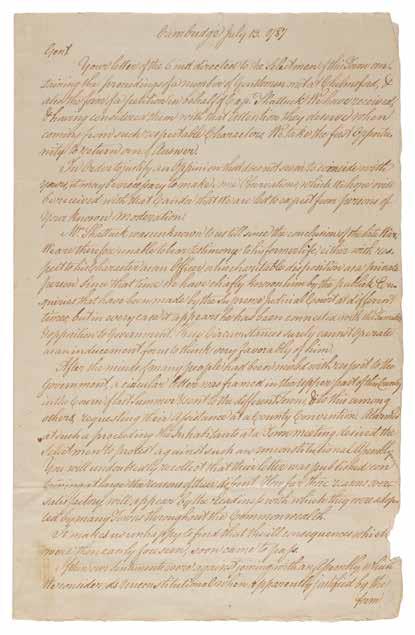
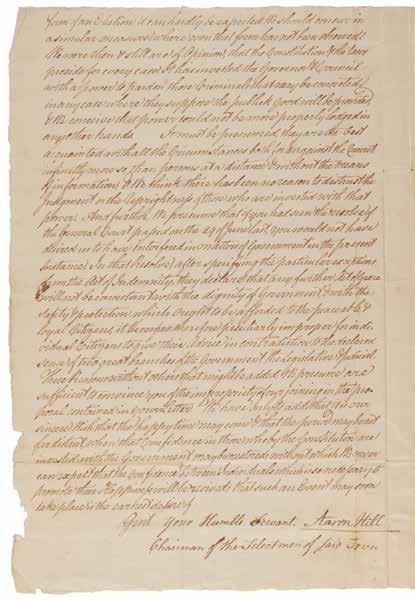
LOT 8051
Shays’ Rebellion: Aaron Hill Letter Signed for the Selectmen of Cambridge - “We were then & still are of opinion, that the Constitution & The laws provide for every case”
LS signed “Aaron Hill, Chairman of the Selectmen of Said Town,” one page both sides, 8.25 x 13, July 13, 1787. Written in the aftermath of the 1786–1787 Shays’ Rebellion uprising in western Massachusetts, Hill and the Cambridge selectmen refuse to join an extra-governmental appeal, defending the established authority of the Governor and Council, the courts, and the legislature. In part: “After the minds of many people had been misled with respect to the Government, a circular letter was framed in the upper part of this county in the course of last summer & sent to the different Towns, & to this among others, requesting their assistance at a county convention. Alarmed at such a proceeding the Inhabitants at a Town meeting desired the selectmen to protest against such an unconstitutional Assembly. You will undoubtedly recollect that their letter was published containing at large the reasons of their dissent. How far those reasons were satisfactory, will appear by the readiness with which they were adopted by many Towns throughout the Commonwealth.
It makes us unhappy to find that the ill consequences which were then easily foreseen, soon came to pass. If then our sentiments were against joining with an Assembly, which we consider as unconstitutional when apparently justified by the form of an Election, it can hardly be expected we should concur in a similar measure where even that form has not been observed. We were then & still are of opinion, that the Constitution & The laws provide for every case. It has invested the Governor & Council with a power to pardon those criminals that may be convicted in any case where they suppose the publick good will be promoted, & we conceive that power could not be more properly lodged in any other hands.
It must be presumed, they are the best acquainted with all the circumstances both for & against the Convict; infinitely more so, than persons at a distance & without the means of information; & we think there has been no reason to distrust the Judgment on the Uprightness of those who are invested with that power. And further, we presume that if you had seen the resolve of the General Court passed on the 29 of June last, you would not have desired us to have interfered in matters of Government in the present Instance. In that Resolve, after specifying the particular exceptions from the Act of Indemnity, they declared that any further Act of Grace will not be consistent with the dignity of Government, & with the safety & protection which ought to be afforded to the peaceable & loyal citizens to give their advice in contradiction to the declared sense of two great branches of the Government, the Legislative & Judicial.
These reasons without others that might be added, we presume are sufficient to convince you of the impropriety of our joining in the proposal contained in your Letter. We have only to add that it is our sincere wish that the happy time may come & that the period may be not far distant, when that confidence in those who by the Constitution are invested with the Government, may be restored; without which we never can expect that the confidence between Individuals which is so necessary to promoted their Happiness, will be revived.”
In fine condition.
A compelling 1787 Massachusetts letter from the immediate aftermath of Shays’ Rebellion, boldly affirming constitutional government over popular conventions and warning against further leniency where it might undermine “the dignity of Government” and the security of “peaceable & loyal citizens.”
Starting Bid $200
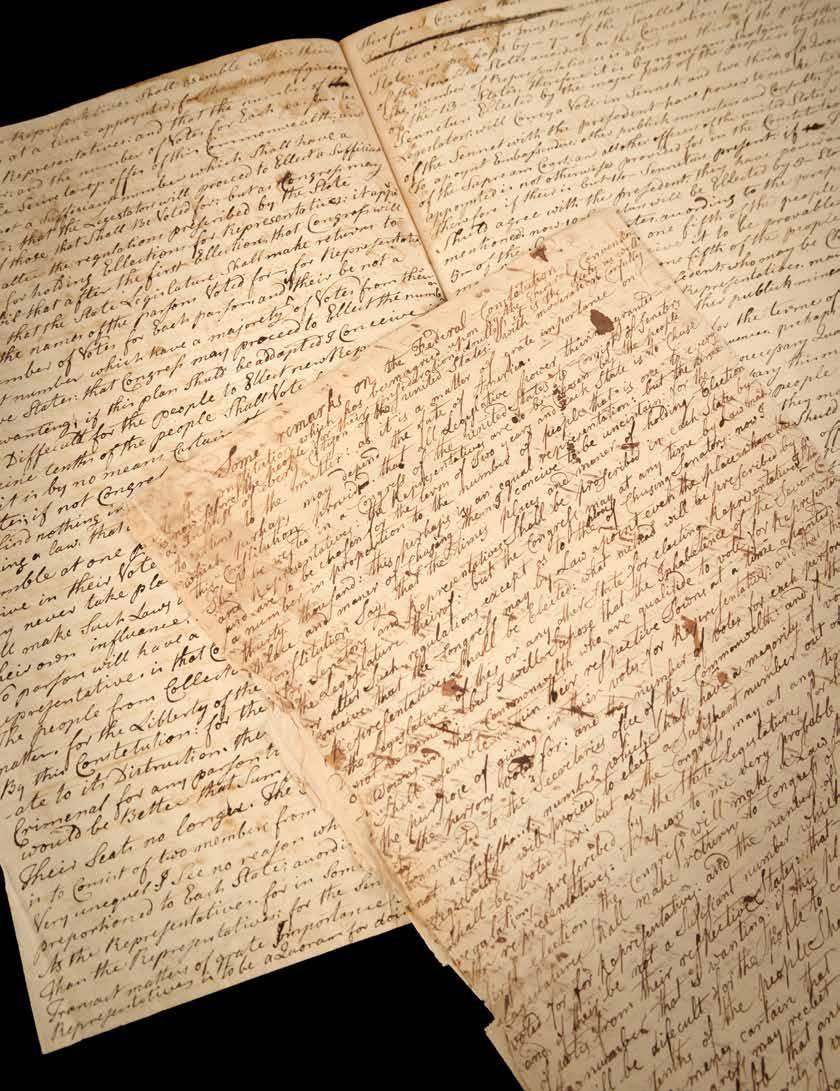
“How is this an equal representation when fifty slaves has as grate a Representation in Congress as thirty free men, and they them selves are allow no part in choosing”
Constitution: Manuscript Draft of a Treatise on the Constitution and Bill of Rights (c. 1787), Taking Aim at Slavery and the ‘Three-fifths Compromise’
Manuscript draft of a treatise contemplating the proposed Constitution of the United States, eight pages on two sets of adjoining sheets, 8 x 12.5, no date but circa 1787. Headed “Some remarks on the Federal Constitution,” the draft begins: “As the Constitution which has been agreed upon by the Federal Convention is now before the people for their consideration; doubtless it is the duty as well as the interest of every citizen of the United States; with moderation carefully to attend to the matter; as it is a matter of grate importance on which perhaps may depend the fate of America.”
The manuscript takes issue with the idea of “equal representation” in Congress, referring to the ‘Three-fifths Compromise,’ in small part: “How is this an equal representation when fifty slaves has as grate a Representation in Congress as thirty free men, and they them selves are allow no part in choosing. In the Southern States gentlemen keep a number of slaves for the Bennefit of Cultevating and carrying on their farms and plantations which slaves they consider as so much personal estates. In the northern states, gentlemen and farmers keep
horses and oxen for the bennefit of Cultevating and carrying on their farms…now I query whether the horses & oxen in the northern states mighten’t as justly have been reconed in order to the just preportioning of the Representatives, as the slaves are reconed in the Southern States.” In very good to fine condition, with scattered light staining, and minor edge loss.
This manuscript reflects the charged atmosphere of the ratification debates that followed the Constitutional Convention of 1787, when the proposed federal framework was scrutinized by citizens far beyond the formal political elite. Written in the idiom of an engaged but critical observer, it grapples directly with one of the most contentious compromises of the new Constitution: representation tied to enslaved populations. The author’s pointed comparison between enslaved people in the South and livestock in the North underscores the moral tensions embedded in the ‘Three-fifths Compromise,’ revealing how deeply controversial the measure was among contemporaries. As such, the document offers a valuable window into the popular constitutional discourse of the late 1780s, illustrating how concerns about equity, property, and political power shaped early American opinion on the proposed national government.
Starting Bid $300
1784 Continental Congress resolution appropriating $100,000 for America’s first permanent seat of government
Charles Thomson Document Signed as Secretary of the Continental Congress, Appropriating $100,000 for the Establishment of Permanent
Patriot leader (1729–1824) in Philadelphia during the American Revolution and the secretary of the Continental Congress (1774–1789) throughout its existence; Thomson was the only person to sign the Dunlap Broadside of the Declaration alongside John Hancock. Manuscript DS, signed “Cha. Thomson Sec’y,” one page, 7.75 x 12.75, December 20, 1784. Headed, “By The United States in Congress Assembled,” a resolution passed by the Continental Congress. In part: “That it is expedient the Congress proceed to take measures for procuring suitable buildings to be erected for their accommodation… [and] That a sum not exceeding one hundred thousand Dollars be appropriated for the payment of the expence of erecting such buildings, provided always that hotels or dwelling houses for the members of Congress representing the different States shall not be understood as included in the above appropriation.” In very good to fine condition, with a short fold split to the left edge, and tears and paper loss to the top edge.
Following the Revolutionary War, the itinerant Continental Congress—having convened in Philadelphia, Baltimore, Lancaster, York, Princeton, Annapolis, and Trenton—sought a permanent seat of government worthy of the new nation. On December 20, 1784, Congress overturned a previous decision to establish alternating capital locations on the banks of the Delaware and Potomac Rivers, instead appropriating $100,000 for the construction of permanent capital buildings, signifying the commitment to establish a central and stable seat of government for the new nation.
Starting Bid $200
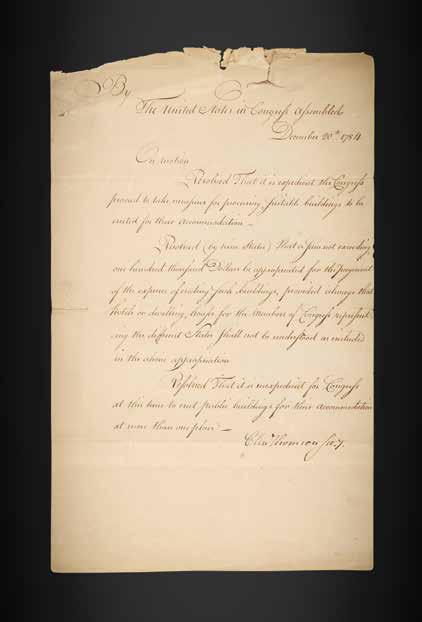
LOT 8054
Constitution: Manuscript Meeting Minutes of the Constitutional Convention of Connecticut (c. 1787)
Manuscript document, three pages on two adjoining sheets, 8 x 12.5, no date but circa 1787. A portion of the minutes of the Constitutional Convention of the State of Connecticut, written in brief note-like fashion, largely concerning the disposition of lands owned by Tories and those loyal to the United States. In part: “Whether the Rents & Profits of the Estates of these British subjects which arose during the war can be recovered the Claimants. No. Whether the debts due to absentees are not to be considered or confiscated with their other personal Estate. Whether it would not be generous to allow them to recover the principle without interest. Whether an Act of general Indemnity to those who took the personal Estates of Absentees by order of Government ought not to be passed…Leased by orders of government for which doings & or any of the Constitution or frame of government then Province or Colony as the Estate of such absentee deemed to be confiscated as the estate of such Claimers & ceastion of hostilities.” In fine condition. This manuscript captures Connecticut’s post-Revolutionary reckoning with Loyalist property and wartime confiscation, issues left unsettled even after independence had been won. Written in terse, working-note form, it reflects the state’s effort to balance legal claims, political retribution, and public fairness: whether British subjects or absentees could recover rents, debts, or principal from confiscated estates, and whether those who acted under government authority during the war should be indemnified. As such, it offers a revealing glimpse into the practical consequences of the Revolution, when new state governments had to convert wartime measures against Tories into a durable civil and constitutional order.
Starting Bid $200
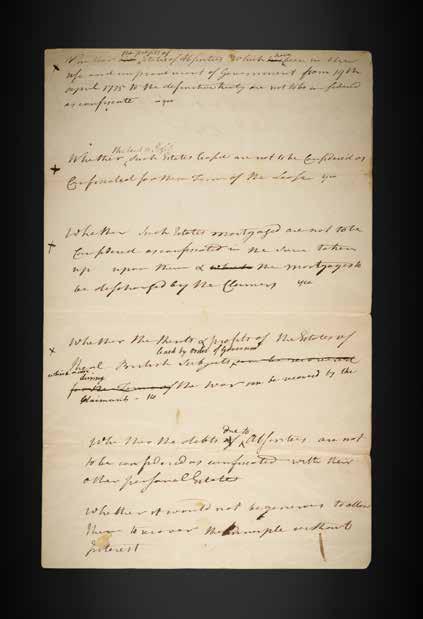
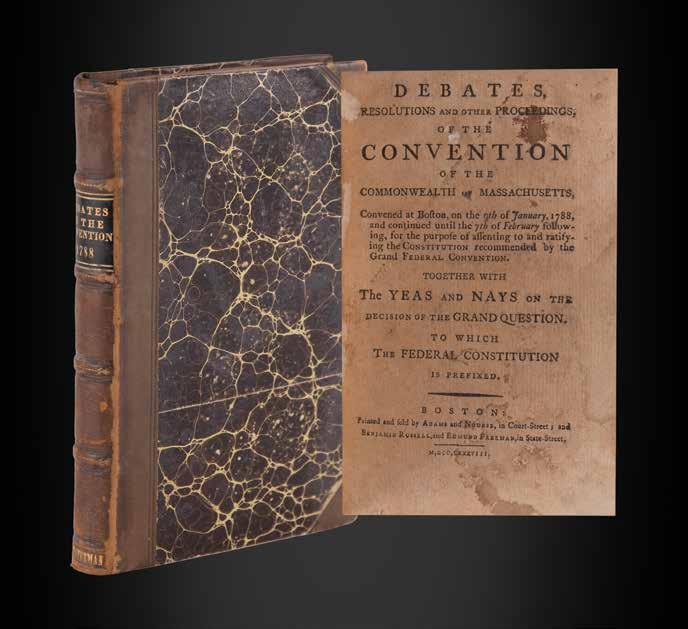
LOT 8055
US Constitution: Debates, Resolutions and Other Proceedings of the Convention of the Commonwealth of Massachusetts (First Edition, 1788)
Historic book: Debates, Resolutions and Other Proceedings of the Convention of the Commonwealth of Massachusetts, Convened at Boston, on the 9th of January, 1788, and continued until the 7th of February following, for the purpose of assenting to and ratifying the Constitution recommended by the Grand Federal Convention. First edition. Boston: Printed and sold by Adams and Nourse, in CourtStreet; and Benjamin Russell, and Edmund Franklin, in State-Street, 1788. Hardcover bound in 19th-century quarter-calf with marbled boards, spine in five compartments with gilt-lettered title, 5 x 7.25, 219 pages. Book condition: VG-/None, with blotchy staining to title page and some of the textblock, rubbing to leather, and the bookplate
of Thomas Waterman (dated “Boston, 12 March 1855”) affixed to the front pastedown.
This first edition records one of the decisive episodes in the ratification of the U.S. Constitution: the Massachusetts convention of January–February 1788. Massachusetts was the sixth state to ratify, but only after a bitter contest resolved by the ‘Massachusetts Compromise,’ under which delegates approved the Constitution while recommending amendments—a strategy that helped pave the way for the Bill of Rights. Presided over by John Hancock and shaped by figures such as Samuel Adams, the convention endorsed ratification on February 6, 1788, by the narrow vote of 187 to 168, making this volume an important contemporary record of a moment when the survival of the new federal system remained uncertain.
Starting Bid $200
organizes
Congressional districts and calls for the selection of “candidates for an Elector of the President and Vice-President of the United States”
John Hancock
Broadside for the Selection of Massachusetts’ Electors in the First Presidential Election
Scarce and historic broadside issued by John Hancock as governor of Massachusetts, one page, 13.25 x 15.75, November 19, 1788. A resolution for the districting of the Commonwealth of Massachusetts and selection of electors in the first presidential election, dividing the Commonwealth into “eight districts for the purpose of choosing eight persons to represent the people…in the Congress of the United States…they shall also give in their votes for two persons… as candidates for an Elector of the President and Vice-President of the United States.” Printed at the conclusion are the names of Samuel Phillips, Theodore Sedgwick, John Hancock, and John Avery. Printed in Boston by Adams & Nourse. In very good condition, with partial splits to intersecting folds (some reinforced on the reverse with archival tape), tattered edges, and foxing to the upper left.
Starting Bid $200
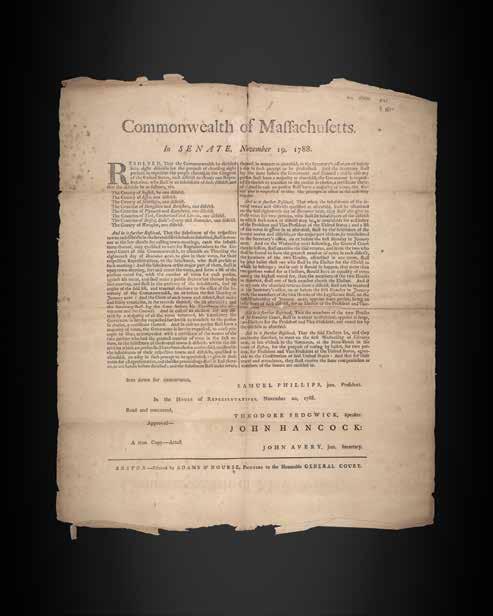
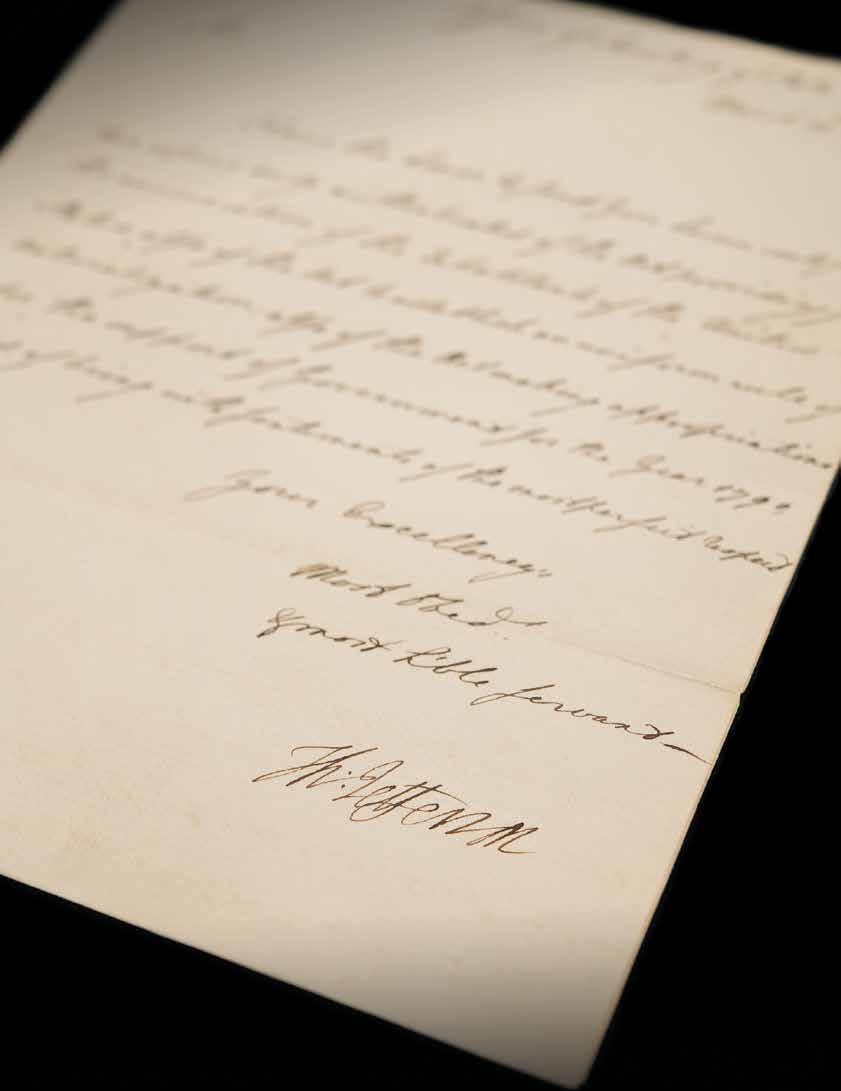
Thomas Jefferson communicates “an uniform rule of Naturalization”— the first laws for the granting of United States citizenship to immigrants, which limited naturalization to ‘free white persons of good character’
LOT 8057
Thomas Jefferson Letter Signed Communicating Acts for the First United States Census and Rules for Granting Citizenship to Immigrants
LS signed “Th: Jefferson,” one page, 7.75 x 10, March 31, 1790. Handwritten letter to Samuel Huntington, “His Excellency the Gov’r of Connecticut,” in part: “I have the honor to send you herein enclosed two copies duly authenticated of the Act providing for the enumeration of the Inhabitants of the United States; also of the Act to establish an uniform rule of Naturalization; also of the Act making appropriations for the support of Government for the year 1790.” Docketed on the reverse in Samuel Huntington’s hand: “Mr. Secretary Jefferson, March 31st, 1790, rec’d April 14, 1790, answer’d same day.” In fine condition.
With this letter, Secretary of State Thomas Jefferson communicated significant acts of the First United States Congress to Governor Samuel Huntington of Connecticut: namely, the act calling for the nation’s first census and the act setting the first rules for the granting of United States citizenship to immigrants, which limited naturalization to ‘free white persons of good character.’
The Census Act of 1790, passed on March 1, 1790, authorized the first U.S. census, mandating that U.S. Marshals conduct the enumeration of the population, collecting data on the number of free white males, free white females, other free persons, and slaves—numbers essential to determining proportional representation in Congress. The first census, conducted on August 2, 1790, recorded a population of 3,929,214.
Starting Bid $5,000
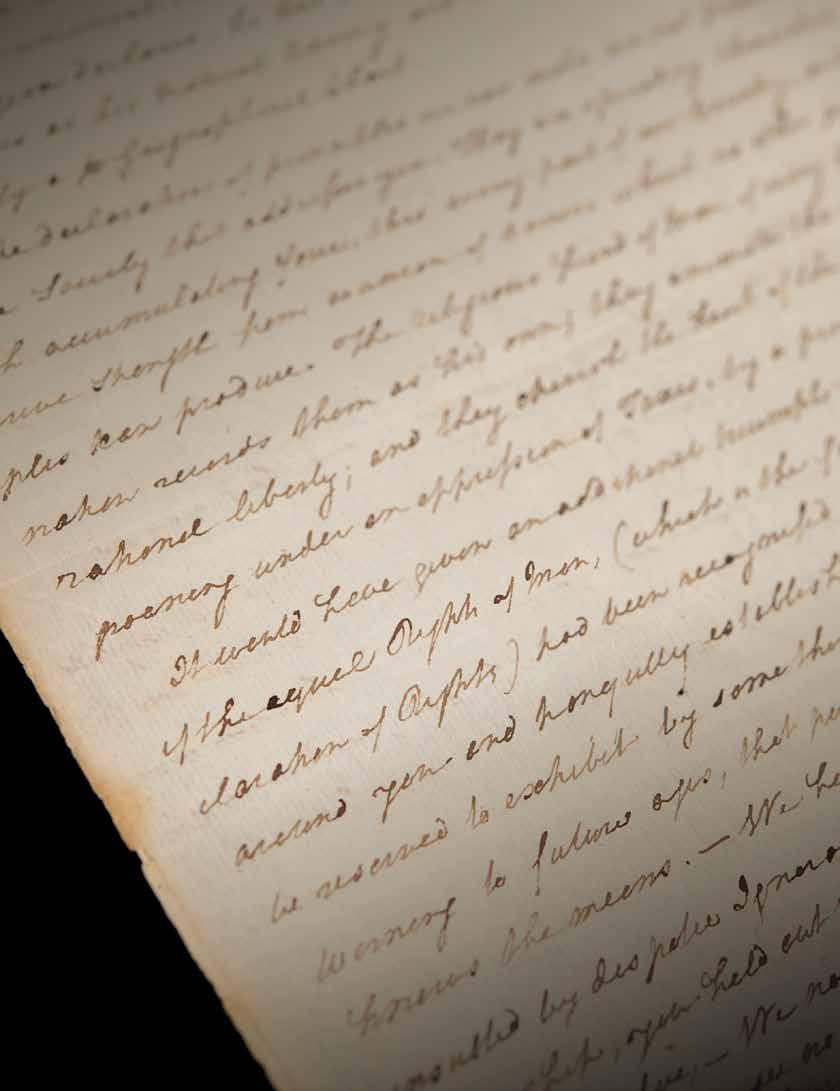
Thomas Paine promotes the ‘Rights of Man’ in the aftermath of France’s “glorious revolution”—“It would have given an additional triumph to our congratulations if the equal Rights of Man, (which is the foundation of your Declaration of Rights), had been recognized by the Governments around you a tranquilly established in all”
Thomas Paine Handwritten Manuscript on Revolutions and the Rights of Man: “We can scarcely conceive a more diabolical System of Government than has been generally established over the World”
Historic handwritten manuscript by Thomas Paine, unsigned, one page both sides, 8 x 10, no date but circa 1791–1792. Paine pens an open letter to “Brothers and fellow Citizens of the World,” embracing the ideals of the French Revolution and expressing his principled views on the natural rights of man. In part: “The cordial and affectionate reception with which you have honored our worthy country men Mr. Thomas Cooper and Mr. John [sic, for James] Watt Members of the society of Manchester and united with our Society, has been communicated to me by…those Gentlemen and received with that glow of happiness that spontaneously flows from the heart.
In offering you our Congratulations on the glorious revolution your Nation has accomplished we speak a language which only sincerity can dictate. The formality of Courts, dull in every thing but mischief and intrigue affords no Example to us. To do our thoughts Justice we give to the heart the Liberty it delights in and hail you as brothers.
It is not among the least of revolutions which Time is unfolding to an astonished World, that our Nations, nursed…in reciprocal hatred should so suddenly break their common chain and rush into Amity. The principles that can produce such effects is not the offspring of any earthly court, and whilst it exhibits to us the expensive iniquity of former politics it enables us with bold felicity to say we have done with them. In contemplating the political Condition of Nations we can scarcely conceive a more diabolical System of Government than has been generally established over the World. To feed the avarice and gratify the wickedness of ambition, the brotherhood of the human race has been destroyed as if the several Nations of the Earth had been created by rival Gods.Instead of that universal benevolence which the morality of every known religion declares, he has been politically bred to consider his Species as his natural Enemy and to define virtues and Crimes by a Geographical Chart.
The declaration of principles we now make are not peculiar to the Society that addresses you. They are spreading themselves with accumulating force, thro’ every part of our Country, and derive Strength from an union of Causes which no other principles can produce. The religious friend of man, of every denomination, records them as his own; they animate the lever of national liberty; and they cherish the heart of the poor, now…under an oppression of Taxes, by a prospect of relief.
It would have given an additional triumph to our congratulations if the equal Rights of Man, (which is the foundation of your Declaration of Rights), had been recognized by the Governments around you, and tranquilly established in all…We have beheld your peaceable principles insulted by despotic Ignorance. We have seen the Right hand of fellowship, you held out to the World, rejected…We now behold you as a Nation provoked into defence and we can see no mode of defence equal to that of establishing the general freedom of Europe…we wish you success and in saying this we speak with the voice of Thousands.” In fine condition, with minor wear to the edges.
This remarkable manuscript by Thomas Paine reflects his fervent support for the French Revolution and his broader Enlightenment ideals of universal liberty and human rights. Written during the peak of revolutionary fervor in France—and following the publication of Paine’s influential treatise The Rights of Man—this open letter addresses “Brothers and fellow Citizens of the World,” signaling Paine’s belief in transnational solidarity against tyranny. At the time, Paine had aligned himself with revolutionary France—he would even become a member of the National Convention—while in Britain he faced persecution for his radical ideas. His rejection of monarchies and corrupt court politics, and his embrace of fraternity among nations formerly divided by war, mirrors the revolutionary optimism that briefly flourished in Europe. The letter’s emphasis on natural rights, social equality, and resistance to despotic governments encapsulates Paine’s vision of a global democratic awakening, forged not by conquest, but by shared principles and moral clarity.
Starting Bid $5,000
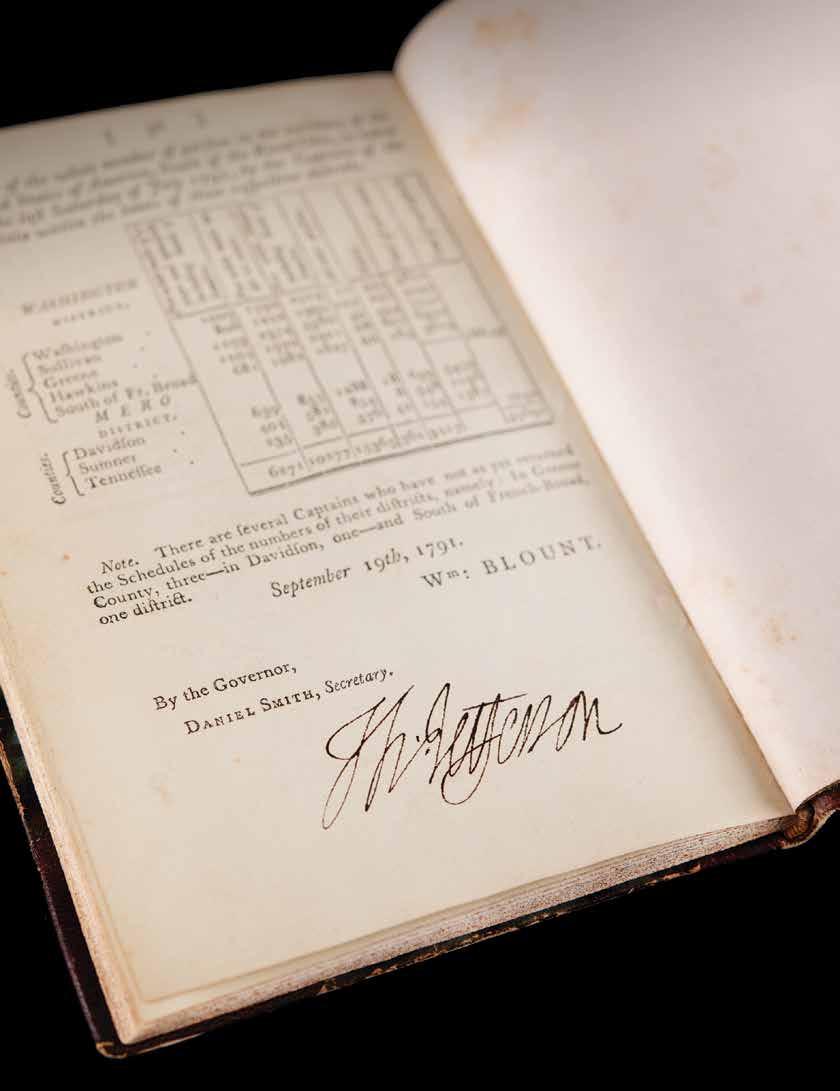
Thomas Jefferson Signed First Edition of the 1791 U.S. Census, Accounting for Free Whites and Slaves - “Return of the Whole Number of Persons within the Several Districts of the United States”
Signed book: Return of the Whole Number of Persons within the Several Districts of the United States, According to ‘An Act Providing for the Enumeration of the Inhabitants of the United States.’ First printing. Philadelphia: Printed by Childs and Swaine, 1791. Hardcover bound in 19th-century half morocco with marbled boards, 5 x 7.25, 56 pages. Boldly signed on the last page in ink as Secretary of State, “Th: Jefferson.”

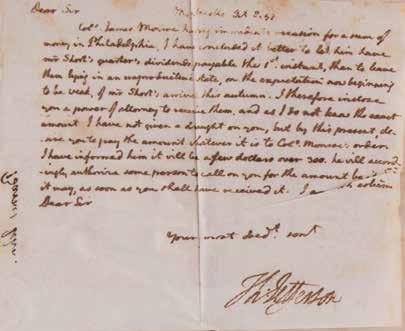
Tipped into the rear is a press copy of an autograph letter by Jefferson to John Barnes, dated at Monticello, October 8, 1797, regarding a financial matter involving James Monroe. Jefferson’s letter begins: “Colo. James Monroe having immediate occasion for a sum of money in Philadelphia, I have concluded it better to let him have Mr. Short’s quarter’s dividends payable the 1st. instant, than to leave them lying in an unproductive state.”
Autographic condition: very fine. Book condition: VG/None, with rubbing to the spine and covers, light staining and foxing to the free end pages, and the bookplate of “T. J. Coolidge, Jr.” affixed to the front pastedown; interior pages are all clean and unaffected. In most copies the delayed returns for South Carolina are tipped to page 54; in this copy that slip is not bound in, leaving the page blank; lower margins of pages 34, 42 and 43 shaved by the binder.
Provenance: Property from a Direct Descendent of Thomas Jefferson, Christie’s, June 21, 2013.
The first United States census was an essential act of nation-building: a constitutional mechanism for apportioning representation, measuring the young republic’s people, and translating the Revolution’s political ideals into functioning federal administration. Printed in Philadelphia in 1791 in a small official edition for government distribution, this “Return of the Whole Number of Persons” recorded the population of the thirteen states and Southwest Territory by county and town, breaking down results into legally consequential categories—free white males, free white females, “all other free persons,” and enslaved people.
Jefferson’s signature as Secretary of State certified the accuracy of these statistics, giving the volume the authority of the federal government at the very moment the United States was defining how power would be allocated amongst the states. Few such copies were printed, and not all were signed by Jefferson, making this example both a foundational demographic record and a tangible artifact of early American governance.
Starting Bid $10,000

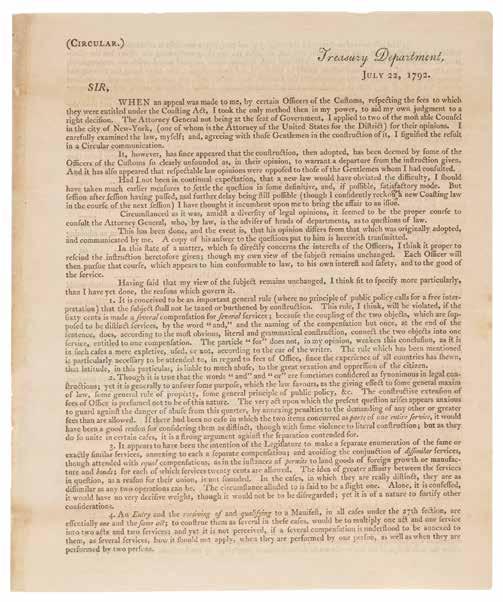
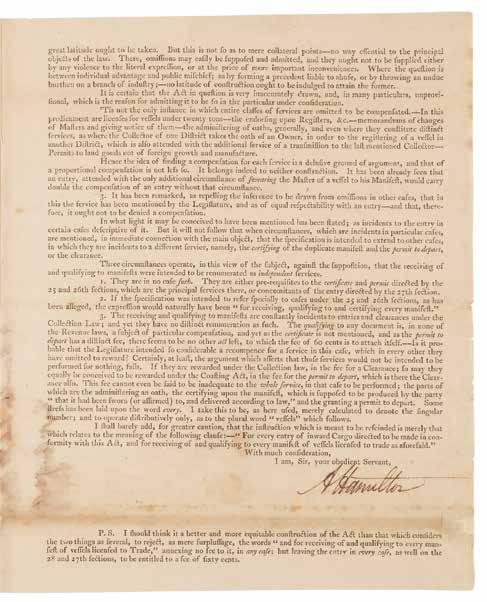
“My own view of the subject remains unchanged”—Hamilton navigates a dispute over customs officer fees under the Coasting Act, withdrawing his directive while defending his legal interpretation
DS, signed “A. Hamilton,” three pages on two adjoining sheets, 7.5 x 9, July 22, 1792. Printed Treasury Department circular issued to all collectors of customs. In part: “When an appeal was made to me, by certain Officers of the Customs, respecting the fees to which they were entitled under the Coasting Act, I took the only method then in my power, to aid my own judgment to a right decision. The Attorney General not being at the seat of Government, I applied to two of the most able Counsel in the city of New-York, (one of whom is the Attorney of the United States for the District) for their opinions. I carefully examined the law, myself; and, agreeing with those Gentlemen in the construction of it, I signified the result in a Circular communication…
Had I not been in continual expectation, that a new law would have obviated the difficulty, I should have taken much earlier measures to settle the question in some definitive, and, if possible, satisfactory mode. But session after session having passed, and further delay being still possible (though I confidently reckon on a new Coasting law in the course of the next session) I have thought it incumbent upon me to bring the affair to an issue…
In this state of a matter, which so directly concerns the interests of the Officers, I think it proper to rescind the instruction heretofore given; though my own view of the subject remains unchanged. Each Officer will then pursue that course, which appears to him conformable to law, to his own interest and safety, and to the good of the service. Having said that my view of the subject remains unchanged, I think fit to specify more particularly, than I have yet done, the reasons which govern it.” In very good to fine condition, with light toning, unobtrusive tape repairs, a couple of short edge tears, and nearly complete separation along the hinge.
Hamilton had introduced a revenue system for the federal government based on customs duties and excise taxes that began to be implemented in 1790, and was obviously still undergoing revisions at this point in time two years later. This document comes from shortly after Hamilton deftly managed to resolve the Panic of 1792, precipitated by a crash in the price of securities in combination with overextended credit. Hamilton was able to introduce measures to restore confidence in the markets and used the Treasury to buy back securities; his actions stabilized the economy within just one month, avoiding a prolonged recession.
Starting Bid $1,000
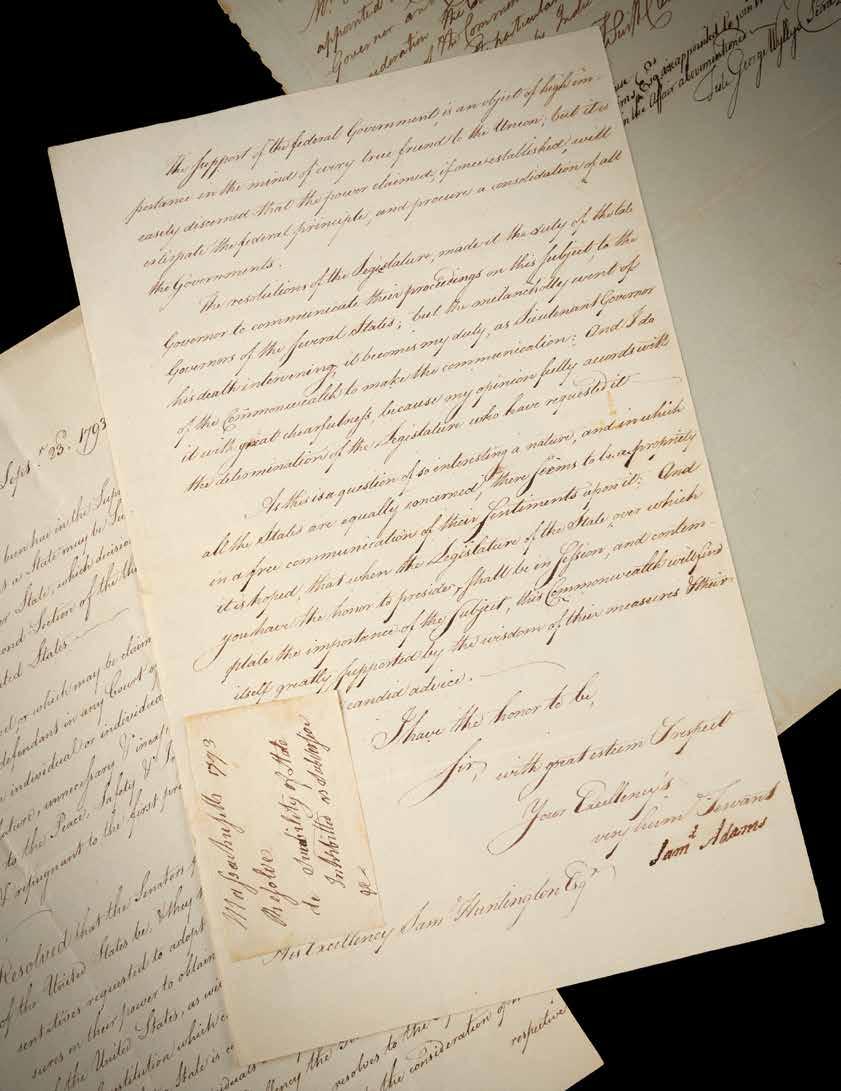
Samuel Adams Letter Signed on His First Day as Governor of Massachusetts on “the first principles of a Federal Government,” Lashing Out Against Judicial Overreach in Support
LS signed “Sam’l Adams,” one page both sides, 8 x 12.75, Boston, October 9, 1793. Written on his first day as Acting Governor of Massachusetts, Adams transmits to Samuel Huntington, governor of Connecticut, a powerful circular letter arguing for the “first principles of a federal government” in direct response to Chisholm v. Georgia, the Supreme Court decision that prompted the Eleventh Amendment.
In part: “The claim of a judiciary authority over a State possessed of sovereignty was of too much moment to be submitted to without the most serious deliberation. The Legislature of this Commonwealth has treated the subject with an attention, commensurate to the importance of the power demanded; And, as you will please to observe by their proceedings, have Resolved, that it is unnecessary & inexpedient; and in its exercise dangerous to the peace, safety & independence of the several States, and repugnant to the first principles of a Federal Government…the power claimed, if once established, will extirpate the federal principle, and produce a consolidation of all governments.”
Adams urges coordinated action, noting that the states “are equally concerned” in preserving their sovereignty, laments the loss of John Hancock on the previous day: “The resolutions of the Legislature, made it the duty of the late Governor to communicate their proceedings on this subject, to the Governors of the several States; but the melancholly event of his death intervening, it becomes my duty, as Lieutenant Governor of the Commonwealth to make the communication.” In fine condition.
The letter is accompanied by a contemporary manuscript “true copy” of the Commonwealth’s resolution passed September 23, 1793, signed by John Avery (with secretarial signature of then-governor John Hancock), and a manuscript document from the Connecticut House of Representatives, signed by George Wyllys, appointing William Williams to a committee to “take into consideration the Communications from the Lieutenant Governor of the Commonwealth of Massachusetts.”
The Commonwealth’s resolution, in part: “Resolved that a power claimed or which may be claimed of compelling a State to be made defendant in any court of the United States at the suit of an individual or individuals is, in the opinion of this Legislature, unnecessary & inexpedient, & in it’s exercise dangerous to the Peace, Safety & Independence of the several States & repugnant to the first principles of a Federal Government, Therefore, Resolved, that the Senators from this State in the Congress of the United States be, & they hereby are, instructed, & the Representatives requested to adopt the most speedy and effectual measures in their power to obtain such amendments in the Constitution of the United States, as will remove any clause or article of the said Constitution which can be construed to imply or justify a decision that a State is compellable to answer in any Suit by an individual or individuals in any Court of the United States.”
Emerging from the Revolution as one of the foremost champions of colonial rights and republican self-government, Samuel Adams remained deeply suspicious of any authority that threatened to consolidate power at the expense of the states. His alarm in this letter reflects one of the earliest constitutional crises of the new federal republic: the Supreme Court’s 1793 decision in Chisholm v. Georgia, which held that a state could be sued in federal court by a citizen of another state. To Adams and the Massachusetts legislature, this ruling struck at the very structure of federalism, reducing sovereign states to ordinary defendants before a national judiciary and opening the door to what Adams called a “consolidation of all governments.”
The moment was made still more dramatic by the death of Governor John Hancock the previous day, leaving Adams, on his first day as Acting Governor, to carry forward Massachusetts’s protest and urge coordinated resistance among the states. The controversy quickly produced a rare and decisive constitutional response: Congress proposed the Eleventh Amendment in 1794, and it was ratified in 1795, establishing that the judicial power of the United States does not extend to suits against a state by citizens of another state or by citizens or subjects of a foreign state.
Starting Bid $1,000
“We are under way—and sailing with a fair
John Jay Autograph Letter Signed, Writing Home While En Route to London to Negotiate the Jay Treaty
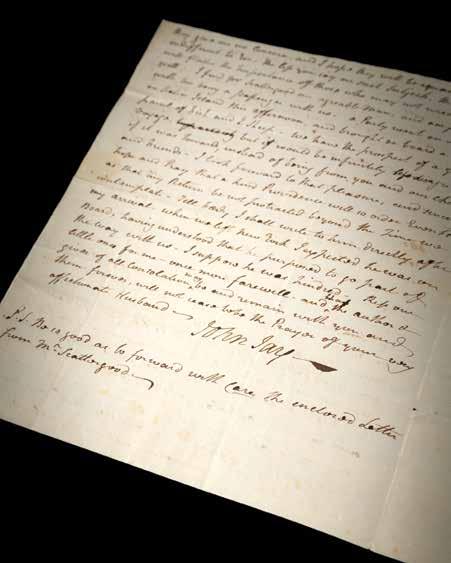
ALS, one page both sides, 8 x 10, May 13, 1794. Handwritten letter from Boston to his wife, Sarah Livingston Jay, whom he affectionately calls “My Dear Sally.” Jay writes from on board the ship Ohio, at the start of his journey to London, where he would negotiate what became known as the Jay Treaty. In psrt: “It is now ten oC’k at night. We are under way—and sailing with a fair Breeze. The Pilot who is conducting the vessel, will be the Bearer of this. I wrote to you this morning and was soon afterwards facd. with yours—which Peter immediately answered. I thank you for it, and you will oblige me exceedingly, by embracing every opportunity of writing to me during my absence... I have seen this Days news paper & the Ph[iladelphi] a Democratic Resolutions published in them. They give me no concern—and I hope they will be equally indifferent to You. The less you say on such Subjects, the less you will flatter the Importance of those who may not wish me well...We have the prospect of a good voyage, but it would be infinitely less disagreable if it was towards, instead of being from, you and our children and Friends. I look forward to that pleasure, and sincerely hope and Pray that a kind Providence will so order Events as that my Return be not protracted beyond the Time we contemplate.” In fine condition, with a small area of seal-related paper loss to the integral address leaf. In 1794 the United States faced its most important foreign crisis since the Revolution, and as Chief Justice, John Jay was selected by George Washington to negotiate a settlement with Great Britain concerning that country’s continued occupation of posts in the northwest, pending private debts to English creditors, and the British plunder of neutral American shipping during their hostilities with France. The importance to the young America of maintaining peace and financial stability was enormous, and Jay spent the summer of 1794 in London negotiating with Lord Grenville to reach an agreement. The result of his work, the Jay Treaty, which was signed on November 19, 1794, created a system to settle financial claims between the two nations, provided for the removal of British troops from the Northwest Territory, established commissions to settle boundary disputes on the northern frontier, and extended free trade and navigation guarantees to the English on the Mississippi River. It was submitted to the United States Senate for its advice and consent on June 8, 1795, and ratified by a two-thirds majority on June 24, 1795. The Treaty, however, aroused a storm of protest in the United States among the Jeffersonian Republicans, who denounced it as a sellout by pro-British Federalists. Mobs burned Jay in effigy, and opponents denounced him as a traitor. Before the negotiations, Jay at one time had been considered a leading candidate to succeed Washington, but the unpopular treaty ruined whatever chances he had for the presidency. New York Federalists, however, elected him governor after his return from England.
Starting Bid $200
Monroe defends his record on the Jay Treaty:
“Whether I contributed in any degree to divert the French government from opposing the ratification of that treaty, or taking its measures after it was ratified, I will not pretend to say”
James Monroe Handwritten
Manuscript Draft on International Affairs and the Jay Treaty
Unsigned handwritten draft manuscript by James Monroe, one page both sides, 7.5 x 12, no date but on paper watermarked “1794.” A partial handwritten draft of what became his ‘View of the Conduct of the Executive, in the Foreign Affairs of the United States, Connected with the Mission to the French Republic, During the Years 1794, 5, and 6.’ In part: “Whether I contributed in any degree to divert the French government from opposing the ratification of that treaty, or taking its measures after it was ratified, I will not pretend to say. This is submitted for others to determine. If I did I am not boastful of it, since as our administration did not take advantage of that delay, to heal the breach in time, it was of no real service to my country. Well however do I know after the French gov’t had rejected my council, and taken a different course, that I was viewed by it for sometime in a questionable light, nor were the motives of my conduct justly appreciated by that government until after I was censored by my own.
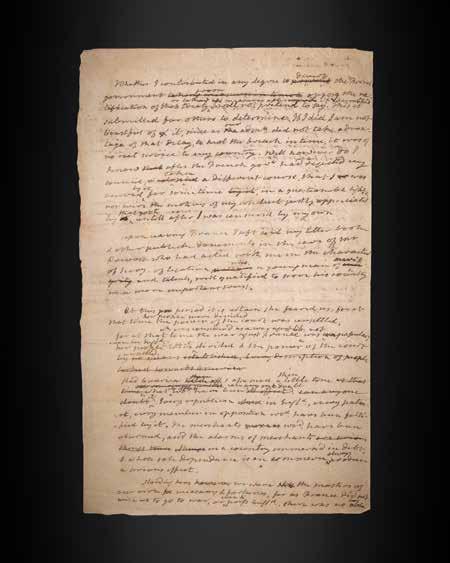
Upon leaving France, I left my letter-book & other publick documents in the care of Mr. Prevost who had acted with me in the character of Secretary-of-Legation, a young man of merit and talents, well qualified to serve his country in a more important trust…The contrast between the situation we might have enjoyed and that which we have held and now hold is a very striking one. It can’t ever be contemplated without remorse by any true friend of his country.” In fine condition, with some trivial dampstaining at the bottom edge.
This dispute over Jay’s Treaty of 1794 culminated in aligning the pro-English against the pro-French factions in the House of Representatives in the Spring of 1796. It was the first great polarization in national party politics and remained significant until the conclusion of the War of 1812. The position Monroe took here was essential to his progress towards the presidency.
Starting Bid $200
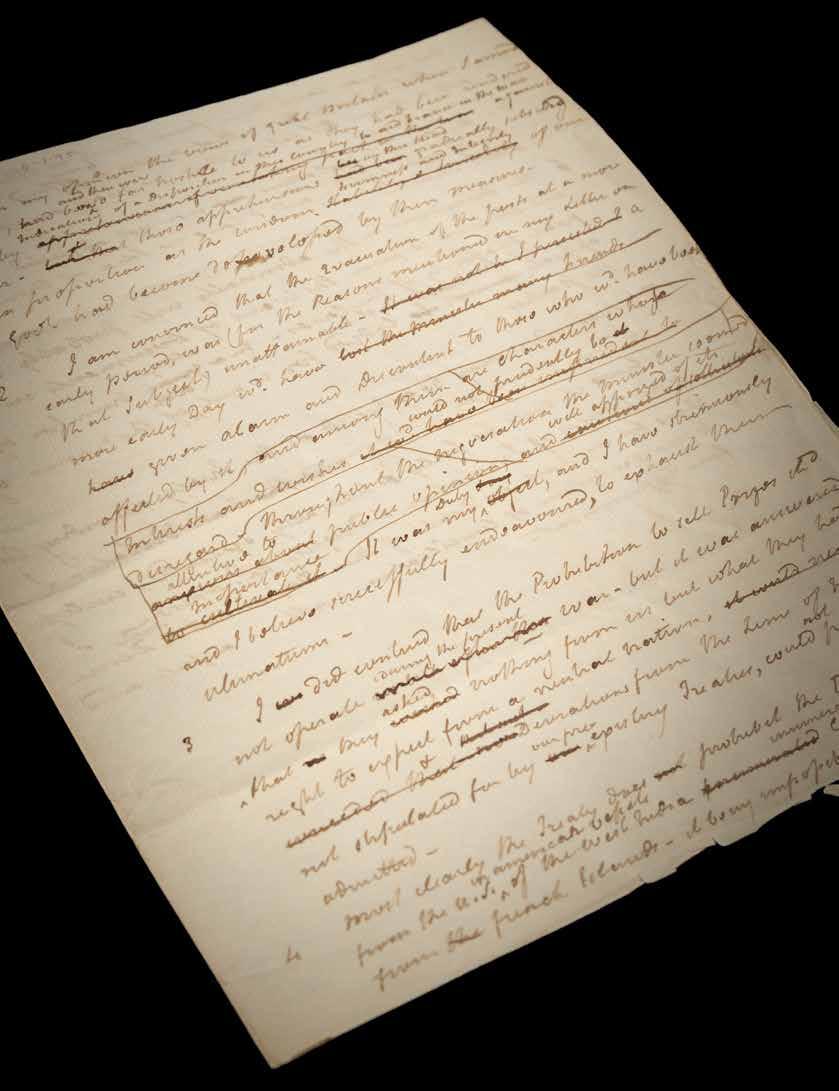
“I believe it will be fairly and literally executed, unless new courses of irritation and disgust should arise”
John Jay Handwritten Letter Draft, Defending His Treaty with Great Britain: “I believe it will be fairly and literally executed, unless new courses of irritation and disgust should arise”
Historic unsigned handwritten draft of a letter by John Jay, three pages on two adjoining sheets, 8 x 10, June 1, 1795. Handwritten draft giving his defense of his treaty with Great Britain, prior to its ratification by the United States Senate. In part: “Your reasons for not thinking it advisable to leave Philadelphia at present are I think conclusive. In the course of the next week I hope to be with you and then to give you more full and satisfactory answers to the questions contained in your letter than the following concise ones, viz.
To the 1st Qu.: In my opinion the views of Great Britain when I arrived there had been and then were so far hostile to us, as they had been rendered so by indications of a disposition in this country to aid France in the war against her. Their apprehensions on this head gradually subsided in proportion as the wisdom, firmness and integrity of our government had become developed by their measures.
2. I am convinced that the evacuation of the posts at a more early period was (for the reasons mentioned in my letter on that subject) unattainable. A more early day would have given alarm and discontent to those who would have been affected by it, and among these are characters whose interests and wishes would not prudently be disregard[ed]. Throughout the negotiations the Minister seemed attentive to public opinion and well apprised of its importance. It was my duty, and I have strenuously and I believe successfully endeavored, to exhaust their ultimatum.
3. I did contend that the prohibition to sell prizes should not operate during the present war, but it was answered that they asked nothing from us but what they had a right to expect from a neutral nation, and deviations from the lien of impartiality not stipulated for by our pre-existing treaties could not possibly be admitted.
4. Most clearly the Treaty does prohibit the re-exportation from the U. S. in American vessels of the West Indies commodities enumerated in the treaty they brought from French Islands it being impossible to distinguish—but we may carry them from French or other islands (not British) to Europe. That article being offered as a privilege and a boon. I take it that we may accept it or not as we please.
5. The Danish spoliations were not adjusted when our treaty was signed, and I have no idea of their obtaining better terms.
6. The discussion in the admiralty will probably be tedious, and the more so from the want of documents in the great majority of the cases. In a large number of them appeals and claims have not yet been lodged for want even of the names of the parties.
7. Such orders may be expected as the Treaty according to its true intent and meaning shall dictate. I believe it will be fairly and literally executed, unless new courses of irritation and disgust should arise. I have for my part no doubt of their disposition and sincere desire to give the system of conciliation with us a full and fair Experiment.” Jay makes substantial revisions throughout the text, striking through and rewriting several lines. In fine condition. Accompanied by a custommade quarter-leather presentation folder.
In 1794 the United States faced its most important foreign crisis since the Revolution, and as Chief Justice, John Jay was selected by George Washington to negotiate a settlement with Great Britain concerning that country’s continued occupation of posts in the northwest, pending private debts to English creditors, and the British plunder of neutral American shipping during their hostilities with France. The importance to the young America of maintaining peace and financial stability was enormous, and Jay spent the summer of 1794 in London negotiating with Lord Grenville to reach an agreement.
The result of his work, the Jay Treaty, which was signed on November 19, 1794, created a system to settle financial claims between the two nations, provided for the removal of British troops from the Northwest Territory, established commissions to settle boundary disputes on the northern frontier, and extended free trade and navigation guarantees to the English on the Mississippi River. It was submitted to the United States Senate for its advice and consent on June 8, 1795, and ratified by a two-thirds majority on June 24, 1795. The Treaty, however, aroused a storm of protest in the United States among the Jeffersonian Republicans, who denounced it as a sellout by pro-British Federalists. Mobs burned Jay in effigy, and opponents denounced him as a traitor. Before the negotiations, Jay at one time had been considered a leading candidate to succeed Washington, but the unpopular treaty ruined whatever chances he had for the presidency. New York Federalists, however, elected him governor after his return from England.
Starting Bid $1,000
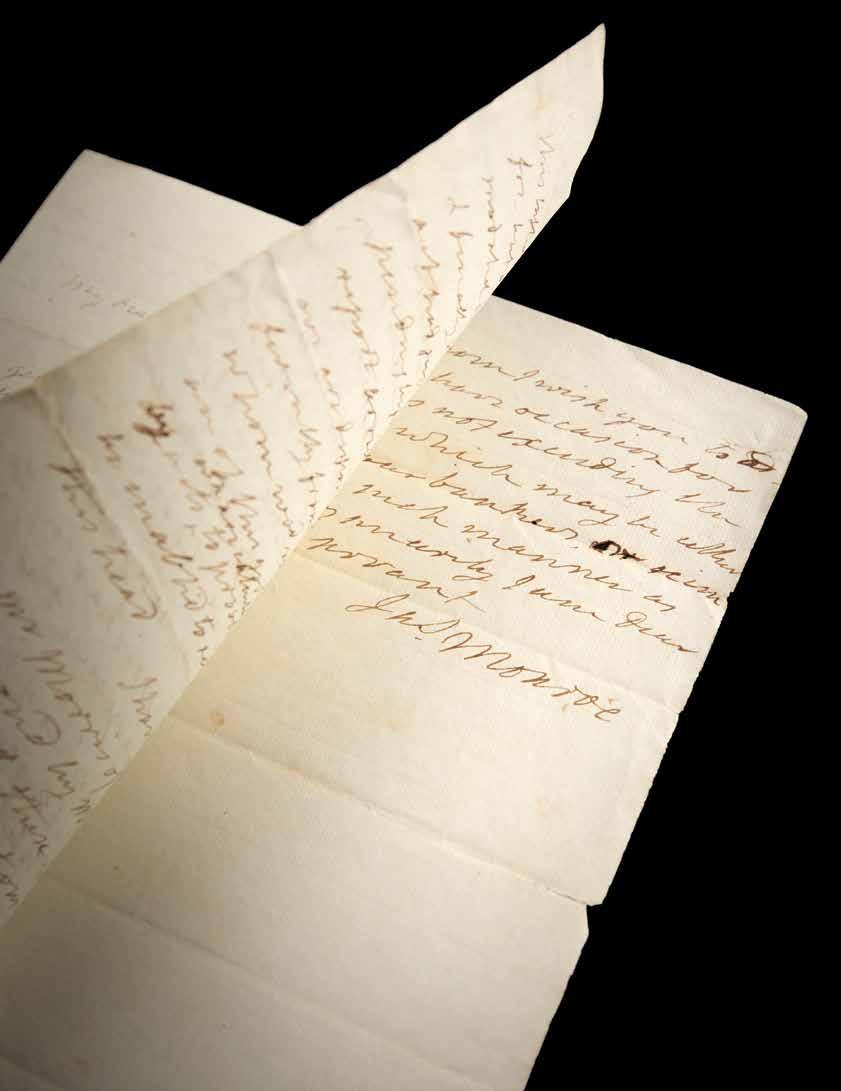
“Reports of what has been concluded between that gent’n & the B[ritish] admn makes it of great importance that I should be advised on the subject”
James Monroe Autograph Letter Signed on Rumors of the Jay Treaty: “Reports of what has been concluded between that gent’n & the B[ritish] admn makes it of great importance that I should be advised on the subject”
ALS signed “Jas. Monroe,” three pages on two adjoining sheets, 8 x 9.75, January 17, 1795. Handwritten letter to Thomas Pinckney, reporting on his progress—or lack thereof—in negotiations with the French. Monroe had gone to France in June of 1794 as minister, with special responsibility for improving the rather strained relations between America and France. At the same time, John Jay was negotiating in London for a treaty with the English, and Pinckney was seeking one with Spain. Jay’s Treaty had been signed in November 1794 and when news of it reached the French government, Monroe’s difficulties increased greatly, as he complains here. Apparently he himself had not received definite word of the accord at this date, demanding that he be “advised on the subject.”
In part: “I have prevailed on Mr. Purvyance a gent’n of integrity & very respectable character of Baltimore to bear this to you & likewise a letter to Mr. Jay. The ill effect which the reports of what has been concluded between that gent’n & the B[ritish] admn makes it of great importance that I should be advised on the subject and for this purpose have I dispatch’d Mr. Purvyance. I have been the more induc’d to it from the consideration that I have no cypher Mr. Morris having taken his with him, and in consequence that I shall not only not be able to comprehend the communication promised in that mode by Mr. Jay, but may hereafter be subjected to like inconveniences. I have therefore also to request that you will commit to Mr. P. a copy of yours.
This gov’t [France] acts from its feelings only. Upon my first arrival there was a sentiment prevailing we were not cordial to them on the contrary that we were gradually winding & inclining to Engl’d. Whilst this lasted I c[oul]d make but little progress in our affairs but as soon
as it was removed I was accommodated in all things—first one then another & finally the ex[ecutio]n of the treaty itself. This last act had just passed the committee & was depending before the Convention when the report [of the Jay Treaty] arrived. If they credit the idea that we are disposed to have them they will act differently from other nations in similar circumstances, the latter of whom wo[uld] rather court us; but ‘tis the disposition of this gov’t to precipitate the separation by acts w[hich] are calculated to provoke it. I hope therefore I shall be enabled to remove all apprehension on this head.
I have written twice latterly, once by Mr. Morris of Phil’a & upon this subject & the second by Mr. Bunker. I hope you have rec’d these. You have no conception of the precautions it is necessary for me to observe: but when you reflect on the jealously entertained of what was supposed to be transacting in London you will the more easily comprehend it.” In fine condition. Accompanied by a custom-made full morocco presentation folder with gilt-titled spine.
Written amid the diplomatic crosscurrents of the mid-1790s, this letter captures James Monroe at a moment of acute tension in the young republic’s foreign policy. Serving as U.S. minister to Revolutionary France, Monroe was tasked with repairing relations badly strained by American neutrality and suspicions of a growing Anglo-American alignment. Unbeknownst to him in full detail, John Jay had just concluded the controversial Jay Treaty with Great Britain, rumors of which inflamed French anxieties and threatened to undo Monroe’s painstaking efforts to secure French goodwill. Writing to Thomas Pinckney—himself engaged in delicate negotiations with Spain—Monroe laments the corrosive effect of rumors from London, underscoring the volatility of the French revolutionary government. The letter vividly illustrates the fragile balance the United States sought to maintain between rival European powers and the personal strain placed on its diplomats during a defining period in early American foreign relations.
Starting Bid $1,000
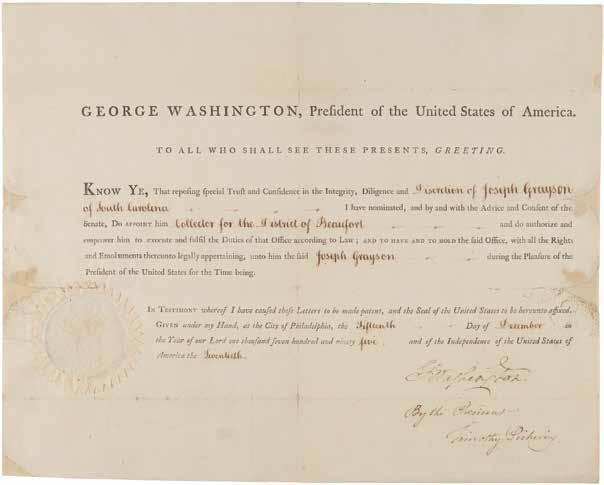
LOT 8066
George Washington Document Signed as President, Appointing a Customs Collector in South Carolina
Partly-printed DS as president, signed “Go: Washington,” one page, 15.5 x 12.5, December 15, 1795. President Washington appoints a collector of customs: “Know Ye, That reposing special Trust and Confidence in the Integrity, Diligence and Discretion of Joseph Grayson of South Carolina, I have nominated, and by and with the Advice and Consent of the Senate, Do appoint him Collector for the District of Beaufort.” Boldly signed at the conclusion in ink by President George Washington, and countersigned by Secretary of State Timothy Pickering. The white paper seal affixed at the lower left remains intact. In very good to fine condition, with a few small stains, and professional repairs to fold splits and small areas of edge loss.
This 1795 appointment reflects the federal government’s effort under President George Washington to build and regulate the young nation’s revenue system. Customs duties were the chief source of federal income in the 1790s, and collectors of customs held important local offices responsible for overseeing imports, enforcing tariff laws, and protecting government revenue at American ports. By appointing Joseph Grayson as collector for the District of Beaufort, South Carolina, Washington was filling a key post in a commercially active coastal region tied to Atlantic trade. Notably, the document also illustrates the constitutional process for federal appointments, noting that Grayson had been nominated by the president and confirmed “by and with the Advice and Consent of the Senate.”
Starting Bid $1,000
Memorial pendant containing locks of hair attributed to George and Martha Washington, descended through the family of Major General Benjamin Lincoln, who accepted the British surrender at Yorktown on Washington’s behalf
George Washington Memorial Portrait Pendant with Locks of Hair Attributed to George and Martha Washington, Descended Through the Family of Major General Benjamin Lincoln
Oval gilt-metal memorial pendant of George Washington, the reverse retaining a glazed compartment with carefully arranged locks of hair attributed to George and Martha Washington. The oval pendant, which measures 1.75˝ x 2.25˝, contains an obverse portrait of Washington in Continental Army uniform against a pale sky background, while the reverse displays two distinct coils of hair mounted beneath glass, one notably darker and one lighter in color, consistent with the family attribution to both George and Martha Washington. In fine condition, with wear to the pendant.
According to family history preserved by the consignor, the pendant descended through the family of Major General Benjamin Lincoln (1733–1810), one of George Washington’s most trusted Revolutionary War commanders, who famously accepted the British surrender at Yorktown on Washington’s behalf in October 1781. The pendant was reportedly discovered among materials preserved at the Lincoln family’s ancestral home in Hingham, Massachusetts.
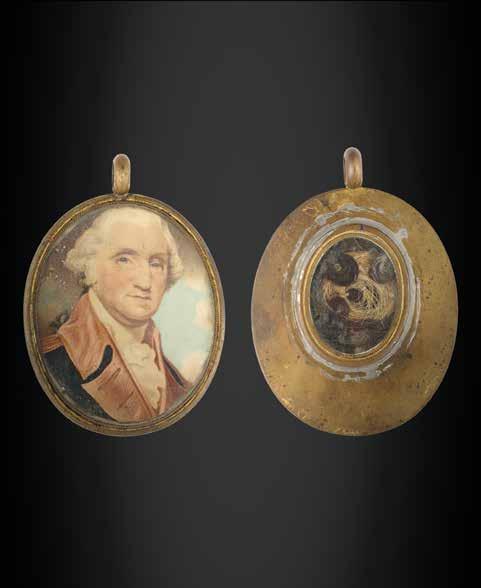
Images shown larger than actual size.
The carefully preserved arrangement of the two locks reflects the period tradition of commemorative hairwork objects associated with prominent historical figures and the culture of relic preservation that surrounded the founding generation during the late eighteenth and early nineteenth century.
Starting Bid $1,000
LOT 8068
Book of Common Prayer with Fore-Edge Paintings of George Washington, Martha Washington, and Revolutionary War Scenes
Handsome book with desirable double fore-edge paintings: The Book of Common Prayer, and Administration of the Sacraments, and Other Rites and Ceremonies of the Church, according to the use of The United Church of England and Ireland. Oxford: Printed at the Clarendon Press by Dawson, Bensley, and Cooke, 1809. Hardcover bound in full long-grain morocco, gilt-rolled, with gilt-stamped and letter panelled spine, 5.25 x 8.75, featuring rare double fore-edge paintings of patriotic imagery, with portraits of George and Martha Washington, as well as scenes of the American Revolution. Book condition: VG/None, with wear to joints and edges, an ownership inscription to first free end page, and the bookplate of “Mrs. Sophia Horne, 1810” affixed to the front pastedown. Accompanied by the original catalog card from noted booksellers Zeitlin & Ver Brugge, Los Angeles.
Starting Bid $300
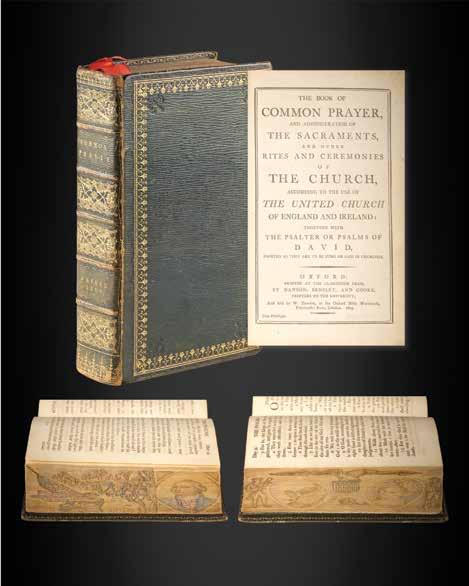
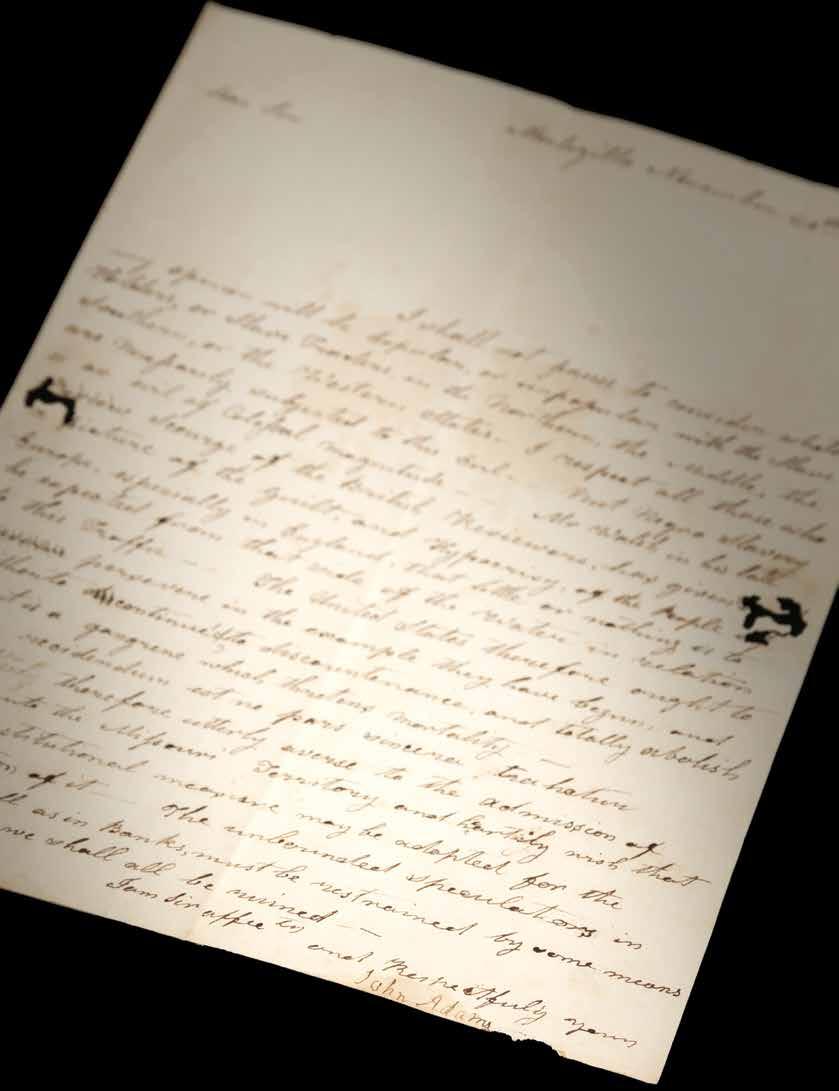
“Negro Slavery is an evil of Colossal Magnitude”—Adams declares himself “utterly averse” to admitting slavery into the Missouri Territory, written months before the Missouri Compromise debate reached its crisis point
LOT 8069
John Adams Letter Signed, Declaring “Negro Slavery an Evil of Colossal Magnitude” Months Before the Missouri Compromise
LS signed “John Adams,” one page, 8 x 10, November 20, 1819. Letter to Boston journalist William Tudor, the co-founder of the North American Review and the Boston Athenæum. Adams forcefully expresses his unequivocal opposition to the extension of slavery into the Missouri Territory during the most divisive political debate of the era.
In full: “I shall not pause to consider whether my opinion will be popular or unpopular with the Slave Holders, or Slave Traders, in the Northern the Middle, the Southern, or the Western States—I respect all those who are necessarily subjected to this Evil.—But Negro Slavery is an evil of Colossal magnitude.—Mr. Walsh in his late Scourge of the British Reviewers, has given such a picture of the Guilt, and Hypocrisy, of the People of Europe, especially in England that little or nothing is to be expected from that side of the Water in relation to this Traffic.
The United States therefore ought to persevere in the example they have begun, and hitherto continued to discountenance, and totally abolish it—it is a gangrene which threatens Mortality—ense recidendum est ne pars sincera trahatur [it must be cut out by the sword, lest the sound part be drawn down with it]—I am therefore utterly averse to the admission of Slavery into the Missouri Territory, and heartily wish that every Constitutional measure may be adopted for the preservation of it.—The unbounded speculations in Land, as well as in Banks, must be restrained by some means or other—or we shall all be ruined.”
Addressed on the integral leaf in another hand, and franked in the
lower left, “J. Adams.” In very good to fine condition, with seal-related paper loss to the integral address leaf, and two areas of other paper loss affecting several words of text. Accompanied by a custom-made quarter-morocco presentation folder.
This powerful 1819 letter captures John Adams at the center of the national crisis over Missouri’s admission to the Union, a debate that would culminate in the Missouri Compromise of 1820. Although Adams had long lived with the contradictions of the founding generation— opposing slavery in principle while accepting constitutional limits on federal power—his language here is unusually forceful, calling “Negro Slavery” an “evil of Colossal magnitude” and likening its spread to a “gangrene.” In doing so he quotes from Ovid’s Metamorphoses, expressing that an ‘incurable wound must be cut away with the sword, lest the healthy part be infected,’ demonstrating his classical education and strengthening the gangrene metaphor.
Written to William Tudor as Congress debated whether Missouri should enter as a slave state, the letter shows Adams aligning himself against the extension of slavery into the western territories and urging “every Constitutional measure” to prevent it. His position anticipated the central sectional conflict that the Missouri Compromise only temporarily contained: Missouri was admitted as a slave state, Maine as a free state, and slavery was barred north of latitude 36°30′ in the remaining Louisiana Purchase territory. Adams’s stark warning underscores how clearly he recognized slavery’s expansion as a mortal threat to the republic.
Starting Bid $20,000
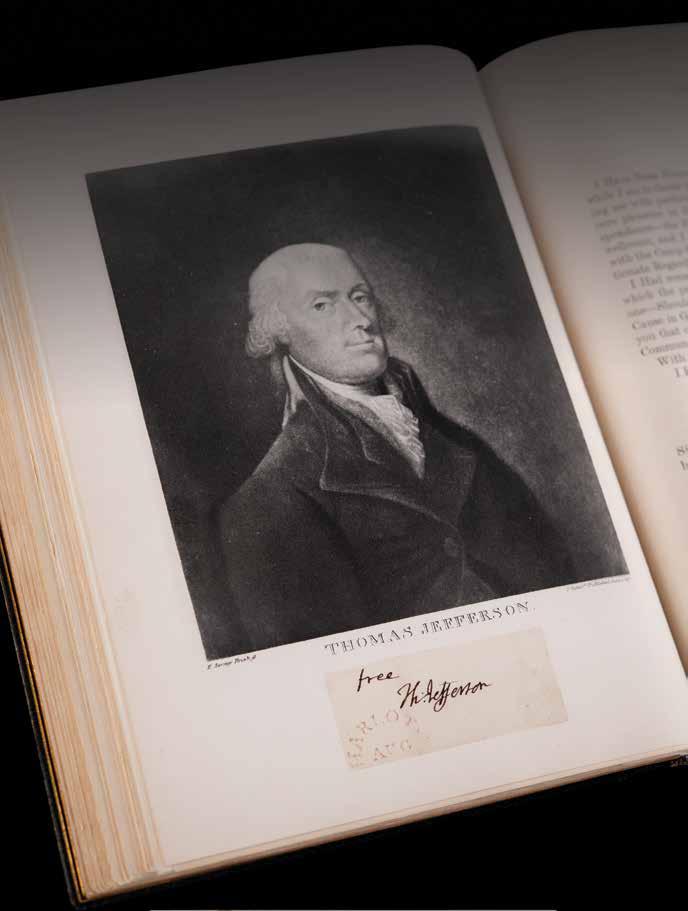
Thomas Jefferson Franking Signature and Marquis de Lafayette Autograph Letter
Signed in Custom-Bound BookLafayette in Virginia
Unique extra-illustrated book featuring bound-in autographs of Jefferson and Lafayette: Lafayette in Virginia. First edition. Baltimore: The Johns Hopkins Press, 1928. Hardcover bound in blue crushed morocco gilt by Donnelley, covers with a border of fillets and a decorative roll, gilt-lettered spine in six compartments, 8 x 10.5, 64 pages, extra-illustrated with 35 engraved portraits of subjects referred to in the book, plus a clipped Thomas Jefferson free frank signature and an ALS by the Marquis de Lafayette, dated September 26, 1822. In Lafayette’s letter, he excuses his long absence from the United States, in part (translated): “We are…engaged in a general struggle of the rights of mankind…Italy is still under the insolent and bloody yoke of detested masters…Under these circumstances friends of liberty cannot withdraw their attendance.” He goes on to give some details of his family, noting that he has just been “raised…to the title of great grandfather,” and regrets that public affairs do not permit him to enjoy his family and home as much as he would like. He ends with a comment on “the horrors committed in Greece by the ferocious Musulmans.” In fine condition, with Lafayette’s letter silked on the reverse and minor wear to the spine.
Starting Bid $200

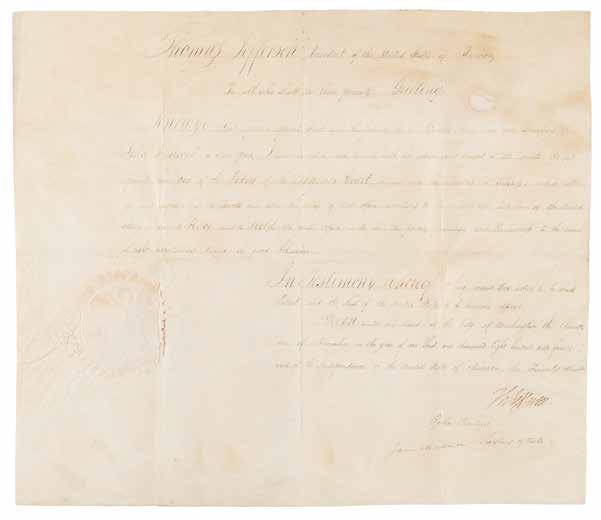
One year after the Louisiana Purchase, Thomas Jefferson and James Madison appoint Aaron Burr’s stepson to the Superior Court of the Territory of Orleans, bringing American law to a territory long governed under French and Spanish tradition
Thomas Jefferson and James Madison Document
Signed as President and Secretary of State, Appointing Aaron Burr’s Stepson to the Superior Court of the Territory of Orleans After the Louisiana Purchase (1804)
Vellum manuscript DS signed “Th: Jefferson” as president and “James Madison” as secretary of state, one page, 15.5 x 13.5, Washington, December 11, 1804. President Jefferson appoints New York lawyer John Bartow Prevost as one of the judges of the Superior Court of the Territory of Orleans, the newly organized American territory created from the Louisiana Purchase. Signed neatly at the conclusion by Jefferson and countersigned by Madison. In very good to fine condition, with scattered light staining, a small repaired area of vellum loss, and slight overall fading to the handwritten text, none of which affect either of the clean signatures.
The appointment dates to the earliest civil reorganization of the Louisiana Purchase under Jefferson’s administration. Acquired from France in 1803, the Louisiana Purchase doubled the size of the United States and required the rapid establishment of American civil and judicial authority across the vast newly acquired territory. The
Territory of Orleans, formed on October 1, 1804, from the southern portion of the purchase, represented the first major subdivision of the acquisition and served as the precursor to the state of Louisiana. To establish American legal authority in the former French and Spanish possessions, Congress created the Superior Court of the Territory of Orleans in 1804 as the territory’s highest judicial body. Judges appointed to the court faced the challenge of administering American authority within a population long governed under French and Spanish civil law traditions. Jefferson himself had privately questioned whether the Constitution expressly authorized the acquisition of foreign territory, but proceeded with the purchase, recognizing its strategic and commercial importance to the United States.
Jefferson here appoints John Bartow Prevost, a New York lawyer who was also the stepson of Vice President Aaron Burr through Burr’s marriage to Theodosia Bartow Prevost. The appointment came amid the political fallout following Burr’s 1804 duel with Alexander Hamilton and shortly before Burr’s western conspiracy would dominate national attention. Prevost later resigned from the Superior Court.
Starting Bid $2,500
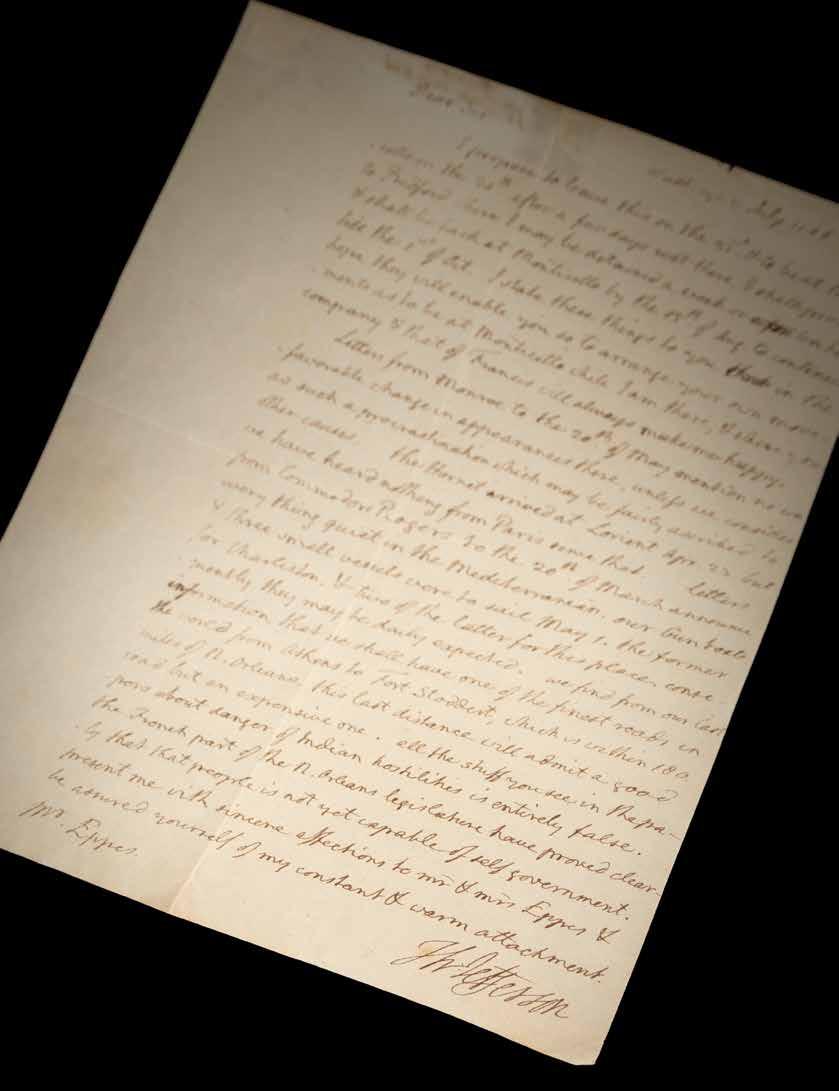
“Not yet capable of self government”— writing from the White House to his sonin-law in July 1806, President Jefferson surveys the post-Louisiana
dismisses reports of
as “entirely false,” and declares the French population of the Territory of Orleans unfit for self-rule
LOT 8072
Thomas Jefferson Autograph Letter Signed as President, Discussing Western Expansion and Dismissing Reports of Indian Hostilities as “entirely false”
ALS as president signed “Th: Jefferson,” one page, 7.75 x 9.75, July 11, 1806. Addressed from Washington, a handwritten letter to his son-in-law, Congressman John Wayles Eppes, discussing travel plans, diplomacy abroad, naval affairs in the Mediterranean, internal improvements in the Southwest, and political conditions in the Territory of Orleans. In full: “I propose to leave this on the 21st & to be at Monticello on the 24th after a few days rest there I shall proceed to Bedford where I may be detained a week or ten days & shall be back at Monticello by the 15th of Aug. to continue till the 1st of Oct. I state these things to you in the hope they will enable you so to arrange your own movements as to be at Monticello while I am there, & where your company & that of Francis will always make me happy.
Letters from Monroe to the 20th of May mention no unfavorable change in appearances there, unless we consider as such a procrastination which may be fairly ascribed to other causes. The Hornet arrived at L’Orient Apr. 23. but we have heard nothing from Paris since that. Letters from Commodore Rogers to the 20th of March announce every thing quiet in the Mediterranean. Our gunboats & three small vessels were to sail May 1. The former for Charleston, & two of the latter for this place, consequently they may be daily expected. We find from our last information that we shall have one of the finest roads in the world from Athens to Fort Stoddert, which is within 180 miles of N. Orleans. This last distance will admit a good road but an expensive one. All the stuff you see in the papers about danger of Indian hostilities is entirely false. The French part of the N. Orleans legislature have proved clearly that that people is not yet capable of self government. Present me with sincere affections to Mr & Mrs Eppes & be assured yourself of my constant & warm attachment.” In fine condition, with a small repaired edge tear, and a slight area of staining, in the salutation area.
The referenced “Commodore Rogers” is Commodore John Rodgers (1772–1838), commander of the United States squadron in the Mediterranean during the peace-enforcement phase that followed the First Barbary War. Jefferson’s report that Rodgers found “every thing quiet in the Mediterranean,” together with news of the arrival of the Hornet at Lorient, concerns the continued deployment of American naval forces overseas in the aftermath of the 1805 Treaty of Tripoli, when the United States maintained a squadron abroad to protect its commercial interests and uphold the newly secured peace with the Barbary States.
Written during Jefferson’s second presidential term, the letter offers a wide-ranging and personal survey of American political and diplomatic affairs in 1806. Jefferson writes to John Wayles Eppes, Virginia congressman and widower of Jefferson’s daughter Maria, arranging family visits to Monticello and Bedford while also discussing international developments involving James Monroe in Europe, American naval deployments in the Mediterranean, and road construction and western communications in the Southwest. His reference to “one of the finest roads in the world from Athens to Fort Stoddert” describes the Federal Road, one of the major infrastructure projects of his presidency, which would become the primary route opening the Old Southwest to American settlement following the Louisiana Purchase. Jefferson also comments directly on political conditions in the Territory of Orleans, dismissing newspaper reports of impending Native American hostilities as “entirely false” while sharply criticizing the “French part of the N. Orleans legislature,” whom he declares “not yet capable of self government.” The remarks reflect Jefferson’s confidence in continued American expansion into the Southwest alongside his frustration with resistance to American political authority in the newly acquired former French and Spanish territory. They also illustrate the broader tensions confronting his administration as it attempted to impose American political institutions upon a culturally and legally distinct population only a few years after the Louisiana Purchase.
Starting Bid $5,000
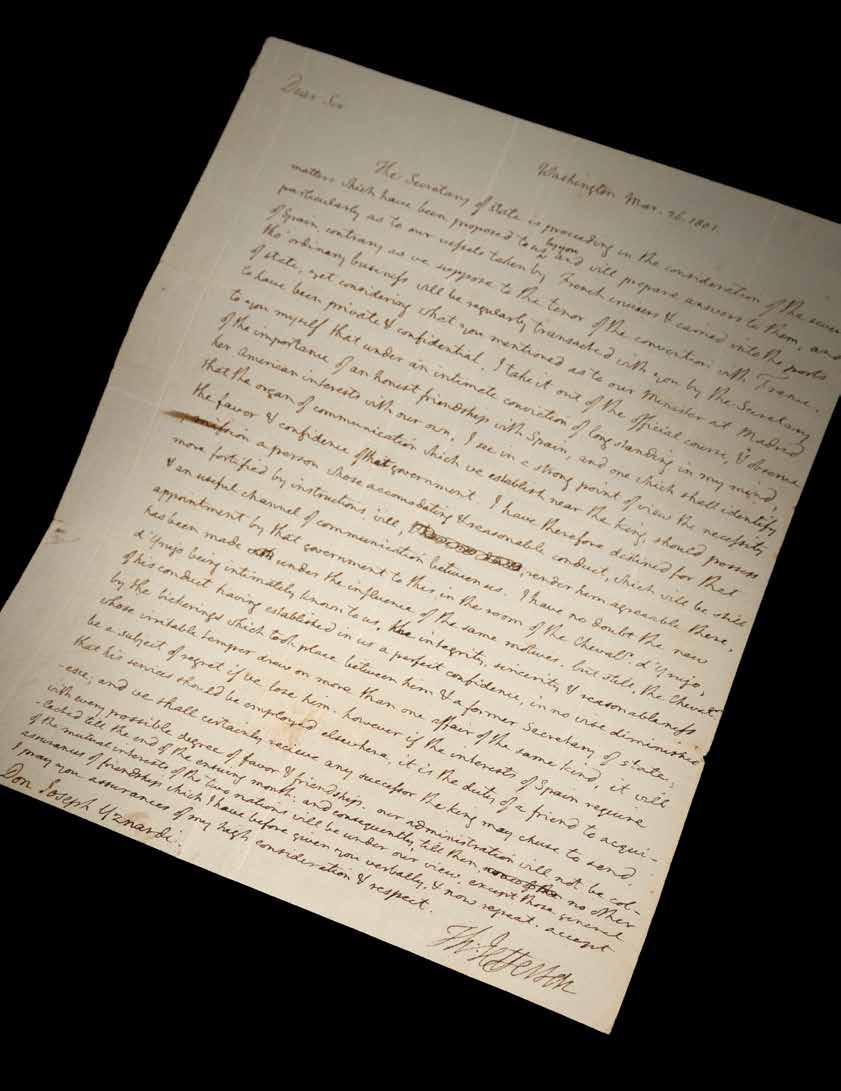
Thomas Jefferson Autograph Letter Signed as President, Bypassing Secretary of State James Madison to Personally Assure Spain’s Representative of “an honest friendship with Spain”
ALS as president, signed “Th: Jefferson,” one page, 8.25 x 10, March 26, 1801. Addressed from Washington, a handwritten letter to Don Joseph Yznardi, Spain’s Chargé d’Affaires, in full (spelling retained): “The Secretary of state [James Madison] is proceeding in the consideration of the several matters which have been proposed to us by you, and will prepare answers to them, and particularly as to our vessels taken by French cruisers & carried into the ports of Spain, contrary as we suppose to the tenor of the convention with France. tho’ ordinary business will be regularly transacted with you by the Secretary of state, yet considering what you mentioned as to our Minister at Madrid to have been private & confidential, I take it out of the official course, & observe to you myself that under an intimate conviction of long standing in my mind, of the importance of an honest friendship with Spain, and one which shall identify her American interests with our own, I see in a strong point of view the necessity that the organ of communication which we establish near the king, should possess the favor & confidence of that government. I have therefore destined for that mission a person [Charles C. Pinckney] whose accomodating & reasonable conduct, which will be still more fortified by instructions, will render him agreeable there, & an useful channel of communication between us. I have no doubt the new appointment by that government to this, in the room of the Chevalr. d’Yrujo, has been made under the influence of the same motives. But still, the Chevalr. d’Yrujo, being intimately known to us, the integrity, sincerity & reasonableness of his conduct having established in us a perfect confidence, in no wise diminished by the bickerings which took place between him & a former Secretary of state [Timothy Pickering], whose irritable temper drew on more than one affair of the same kind, it will be a subject of regret if we lose him. However, if the interests of Spain require that his services should be employed elsewhere, it is the duty of a friend to acquiesce; and we shall certainly recieve any successor the king may chuse to send, with every possible degree of favor & friendship. our administration will not be collected till the
end of the ensuing month: and consequently, till then, no other of the mutual interests of the two nations will be under our view, except those general assurances of friendship which I have before given you verbally, & now repeat. accept I pray you assurances of my high consideration & respect.” In fine condition, with mild show-through from docketing on reverse.
The disputes referenced in Jefferson’s letter arose during a delicate period in early American diplomacy, as the United States sought to preserve stable relations with Spain following the 1795 Pinckney Treaty, which established boundaries between the United States and Spain’s North American territories and secured American navigation rights on the Mississippi River. Spain’s continued presence in Louisiana and Florida made those western interests acutely sensitive; control of the Mississippi was essential to American commerce and westward settlement, and any deterioration in relations with Madrid threatened to close the river to American trade.
Tensions nevertheless persisted over maritime commerce, the enforcement of treaty provisions, and the seizure of American vessels by French privateers operating in Spanish ports, an issue Jefferson directly references here in discussing “our vessels taken by French cruisers & carried into the ports of Spain.” Jefferson also alludes to the strained relationship between Spanish minister the Chevalier d’Yrujo and former secretary of state Timothy Pickering, whose “irritable temper,” Jefferson remarks, “drew on more than one affair of the same kind.”
Written just three weeks after Jefferson’s inauguration, the letter reflects the new administration’s effort to improve the tone of American diplomacy. Jefferson emphasizes his desire for “an honest friendship with Spain,” praises d’Yrujo’s “integrity, sincerity & reasonableness,” and expresses regret at the possibility of his recall. Notably, Jefferson chose to address part of the matter personally rather than entirely through Secretary of State James Madison, stressing the sensitivity he attached to relations with Spain at the opening of his presidency.
Starting Bid $2,500
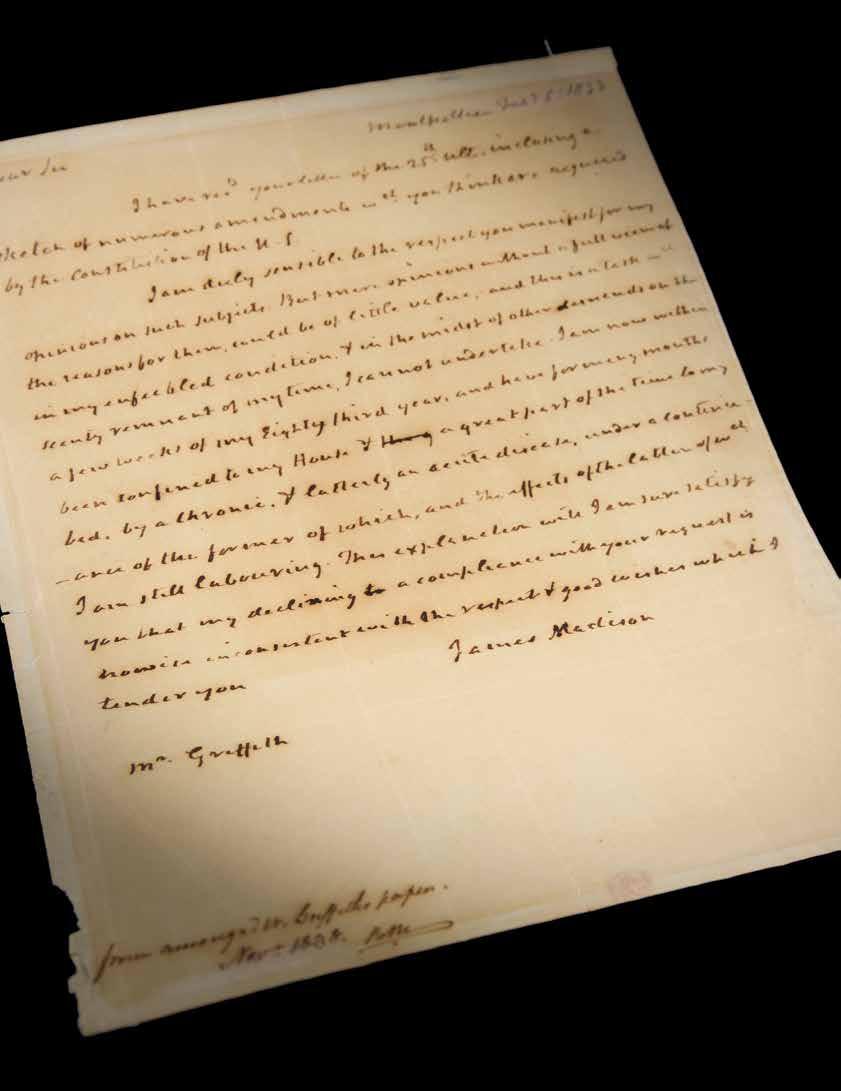
The pivotal framer declines to opine on “numerous amendments wch you think are required by the Constitution of the U.S.”
LOT 8074
James Madison
Autograph Letter Signed on US Constitution, Declining to Opineon “Numerous Amendments”
ALS, one page, 7.75 x 9.75, February 5, 1833. Handwritten letter to “Mr. Griffith,” in part: “I have rec’d your letter..inclosing a sketch of numerous amendments wch you think are required by the Constitution of the U.S. I am duly sensible to the respect you manifest for my opinions on such subjects. But mere opinions without a full view of the reasons for them, could be of little value, and this is a task wch in my enfeebled condition & in the midst of other demands on the scanty
remnant of my time, I cannot undertake. I am now within a few weeks of my eighty third year, and have for many months been confined to my house & a great part of the time to my bed, by a chronic & latterly an acute disease…This explanation will I am sure satisfy you.” In fine condition, with some trivial edge loss, and toning from prior display. A scarce and important handwritten letter by the ‘Father of the Constitution,’ whose wisdom and political advice continued to be sought well into his old age. That Madison should mention the famous document in any context is remarkable.
Starting Bid $1,000
Substantial 2.5-inch-long lock of Thomas Jefferson’s hair, attested by noted autograph dealer Charles Hamilton as having been originally obtained by Jefferson’s personal physician, Dr. Robley Dunglison
Thomas Jefferson Lock of Hair (2.5˝ in length) - Originally Procured by His Personal Physician, Robley Dunglison
Significant lock of hair from the head of Thomas Jefferson, measuring approximately 2.5˝ in length, affixed to the top of a certificate of authenticity from noted autograph dealer Charles Hamilton, who writes: “I certify that the strands of hair at the top of this page were removed by me from the lock of hair which accompanied the original of the authentication here reproduced.” Above is a copy of the original notarized statement of authenticity by Charles Perry Fisher, dated April 15, 1929, who writes: “The lock of hair of Thomas Jefferson was the property of Doctor Robley Dunglison, a friend of Jefferson; it became the property of his son Dr. Richard J. Dunglison, my step-father, and eventually became my property.” Matted and framed with a color portrait of Jefferson bearing a facsimile signature to an overall size of 21.25 x 15.5. In fine condition.
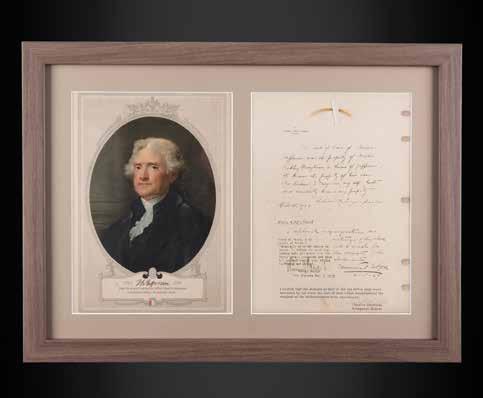

Robley Dunglison was an EnglishAmerican physician, medical educator, and author (1798-1869) who served as the first full-time professor of medicine in the United States at the newly founded University of Virginia from 1825 to 1833. He authored numerous medical textbooks and is regarded as the ‘Father of American Physiology’ following the publication of his landmark work Human Physiology in 1832. Dunglison was the personal physician to Thomas Jefferson, James Madison, and James Monroe; he also consulted in the treatment of Andrew Jackson and attended Jefferson during his final illness and death.
Starting Bid $200
Lafayette corresponds with America’s Founding Fathers: “He will forward the Letter to the president, and one to Mr. Jefferson”
Marquis de Lafayette
Autograph Letter Signed, Corresponding with Jefferson, Monroe, and the President
ALS in English, signed “L.f.,” one page, 4.75 x 7, no date. Handwritten letter to a gentleman, sent from “La grange.” In full: “Inclosed I send you two letters for Mrs. Crawford and Monroe calculated to be delivered to and by you. A bundle of letters sent by the post to the Havre will no doubt wait there for you. It is probable that my son who goes to town Tuesday may yet find you. If not he will forward the Letter to the president, and one to Mr. Jefferson if there remains behind you an opportunity to send it.” In fine condition, with professional repairs to paper loss at all four corners.
Written from Lafayette’s country estate of La Grange in France, this letter reflects his enduring ties to America and its leading statesmen after the Revolution. In arranging the forwarding of letters to James Monroe, Thomas Jefferson, and the American president, Lafayette reveals the active transatlantic political and personal network he maintained between France and the United States.
Starting Bid $200
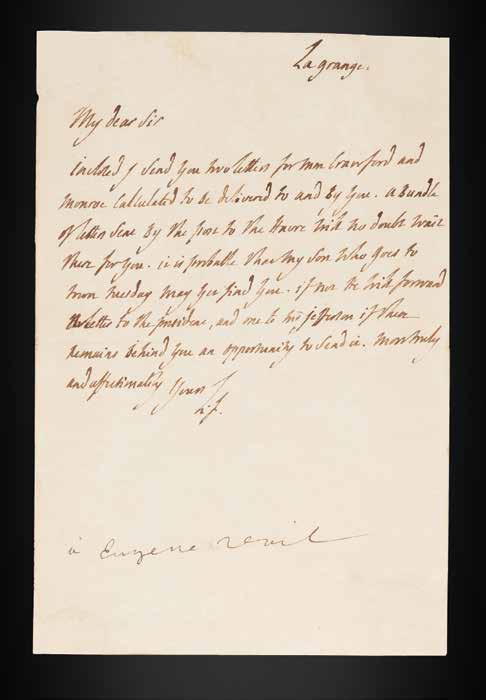
ANYONE EITHER REGISTERING TO BID OR PLACING A BID (“BIDDER”) ACCEPTS THESE CONDITIONS OF SALE AND ENTERS INTO A LEGALLY, BINDING, ENFORCEABLE AGREEMENT WITH R&R AUCTION COMPANY OF MASSACHUSETTS, LLC (“RR AUCTION”) TOGETHER WITH BIDDER, THE “PARTIES”).
This Agreement contains important provisions that control rights and liabilities, and specifically has provisions governing how disputes are handled as well as LIMITATIONS OF LIABILITY that can be imposed upon RR Auction, WAIVER OF JURY and ARBITRATION PROVISIONS. This acknowledgement is a material term of these Conditions of Sale and of the consideration under which RR Auction agrees to these terms. PLEASE READ CAREFULLY.
The following terms and conditions (“Conditions of Sale”) constitute the sole terms and conditions under which RR Auction will offer for sale and sell the property on its website, and/or described in the catalog of items for auction (the “Catalog”). These Conditions of Sale constitute a binding agreement between the Parties with respect to the auction in which Bidder participates (the “Auction”). By bidding at the Auction, whether in person, through an agent or representative, by telephone, facsimile, online, absentee bid, or by any other form of bid or by any other means, Bidder acknowledges the thorough reading and understanding of all of these Conditions of Sale, all descriptions of items in the Catalog, and all matters incorporated herein by reference, and agrees to be fully bound thereby.
Section 1
The Parties1.1 RR Auction and Auction
This Auction is presented by RR Auction, a d/b/a/ of R&R Auction Company of Massachusetts, LLC, as identified with the applicable licensing information on the title page of the Catalog or on the www.RRauction. com Internet site. The Auction is conducted under these Conditions of Sale. Announcements and corrections from the podium at live auctions and those made through the Conditions of Sale appearing on the Internet at RRauction.com supersede those in the printed Catalog.
1.2 Bidder
Bidder shall mean the original Bidder on the property offered for sale by RR Auction and not any subsequent owner or other person who may acquire or have acquired an interest therein. If Bidder is an agent, the agency must be disclosed in writing to RR Auction prior to the time of sale, otherwise the benefits of the warranty shall be limited to the agent and not transferable to the undisclosed principal.
The rights granted to Bidder under these Conditions of Sale are personal and may not be assigned or transferred to any other person or entity, whether by operation of law or otherwise without the express written assent of RR Auction. Bidder may not transfer, assign, or otherwise convey these Conditions of Sale or any of the rights herein, and such purported transfer, assignment, or conveyance shall be null and void. No third party may rely on any benefit or right conferred on any Bidder by these Conditions of Sale, and no third party is intended as a beneficiary of these Conditions of Sale.
Bids will not be accepted from minor persons under eighteen (18) years of age without a parent or legal guardian’s written consent containing an acknowledgment of the Conditions of Sale herein and indicating their agreement to be bound thereby on behalf of the Bidder.
All Bidders must meet RR Auction’s qualifications to bid. Any Bidder who is not a client in good standing of RR Auction may be disqualified at RR Auction’s sole option and will not be awarded lots. Such determination may be made by RR Auction in its sole and unlimited discretion, at any time prior to, during, or even after the close of the Auction. RR Auction reserves the right to exclude any person from the Auction.
If an entity places a bid, then the person executing the bid on behalf of the entity agrees to personally guarantee payment for any successful bid and
agrees to be bound by these Conditions of Sale in addition to company for whom the Bidder is acting
By accepting the Conditions of Sale, Bidder personally and unconditionally guarantees payment.
2.1 In order to place bids, Bidders who have not established an account with RR Auction must either furnish satisfactory credit information (including two collectibles-related business references) or supply additional information if requested, well in advance of the Auction. Bidders who are not members of RRAuction.com should pre-register before the close of the Auction to allow adequate time to contact references. Privileges will be granted at the sole discretion of RR Auction. Additionally, Bidders who have not previously established credit or who wish to bid in excess of their established credit history may be required to provide a cash deposit prior to RR Auction’s acceptance of a bid. Check writing privileges and immediate delivery of merchandise may also be determined by pre-approval of credit based on a combination of criteria: RRAuction.com history, related industry references, bank verification, a credit bureau report and/or a personal guarantee for a corporate or partnership entity in advance of the Auction venue.
2.2 Bidder providing any false or misleading information provided in connection with the registration shall be a material breach of the Conditions of Sale and in addition to any other remedies at law shall excuse RR Auction from performance under these Conditions of Sale, including the right to any refund.
2.3 Bidding privileges may be revoked without notice, for any reason, at the sole discretion of RR Auction .
Section 3
3.1 The Bidder acknowledges and agrees that a 25% buyer’s premium will be added to the hammer price on all individual lots sold in timed and live Auctions. . For payment other than by cash, delivery will not be made unless and until full payment has been received by RR Auction, i.e., check or wired funds have fully cleared. Unless otherwise agreed in writing, signed by RR Auction, payment in full is due within thirteen (13) calendar days of the Auction or within twelve (12) calendar days of the invoice date, whichever is earlier. Bidder’s failure to pay any payment in full when due required shall constitute a material breach, and in addition to other damages available under contract or law, at RR Auction’s election, RR Auction may cancel the sale and require full premium still be due along with interest at 1.5% per month from the date of breach, or at the maximum legally allowable rate.
Section 4
Bidding
4.1 Each Bidder’s determination of its bid should be based upon its own examination of the item(s) and independent investigation, rather than any reliance as to what is represented in the Catalog, online or elsewhere. Bidder affirms that it regards any statements made by RR Auction concerning the item as solely opinion and that Bidder is making its own inspection and independent evaluation of the goods, and is not relying upon any description or statements by RR Auction (including as to quality, authenticity, provenance, ownership, liens existing, on goods legality, or value) in making its determination to bid on or purchase an item. In any purchase or sale, the value of the item(s) is determined by the price. THE BIDDER HEREBY ASSUMES ALL RISKS CONCERNING ANY AND ALL PURCHASES TO THE FULLEST EXTENT UNDER APPLICABLE LAW.
4.2 RR AUCTION IS NOT RESPONSIBLE FOR ERRORS IN BIDDING. A Bidder should make certain to bid on the correct lot and that the bid is the maximum (plus the Buyer’s Premium) that the Bidder is willing and able to pay. Since other Bidders (by mail, facsimile, online, and in person) will be present, and since a re-offering could damage the momentum of the sale, once the hammer has fallen and RR Auction has announced the winning Bidder, such Bidder is unconditionally bound to pay for the lot,
even if the Bidder has made a mistake.
4.3 All prospective Bidders who examine lots in person prior to the sale shall personally assume all responsibility for any damage they cause in so doing. RR Auction shall have sole discretion in determining the value of the damage caused, which shall be promptly paid by the prospective Bidder.
4.4 Title to any lot remains with Consignor, any secured party of the Consignor, or assignee of Consignor, as the case may be, until the lot is paid for in full by Bidder and Bidder has fully satisfied any outstanding financial obligations to RR Auction (including as it concerns any other lots). RR Auction reserves the right to require payment in full before delivering any lot to the successful Bidder.
4.5 It is the Bidder’s responsibility and obligation to have the lots fully insured while in their possession. Bidder assumes any and all risk of loss upon the earlier of shipment to Bidder or in Bidder’s possession.
4.6 Bidder grants to RR Auction or its assigns the right to offset any sums due, or found to be due by RR Auction, and to make such offset from any past, subsequent or future consignment, or items acquired by Bidder in possession or control of RR Auction or from any sums due to Bidder by RR Auction. Bidder further grants RR Auction a lien consisting of a senior security interest (or purchase money security interest to the extent applicable) in such sums or items to the fullest extent applicable, authorizes RR Auction to file documents concerning the interest, and Bidder agrees to execute any further documents as may be reasonably necessary to grant RR Auction such security interest. Bidder agrees that RR Auction and its assigns shall be a secured party with respect to items bought by Bidder and in the possession of RR Auction, to the extent of the maximum indebtedness, plus all accrued fees and expenses, until the indebtedness is paid.
4.7 By bidding in this sale, Bidder personally and unconditionally guarantees payment. The authorized representative of any corporate Bidder who is present at the sale shall provide RR Auction or its agent, prior to the commencement of the bidding (or at the time of registration), with a statement signed by a principal, director or officer that they he or she personally and unconditionally guarantees any payment due RR Auction.
4.8 RR Auction may at its sole and absolute discretion, make loans or advances to Consignors and/or prospective Bidders.
Section 5
Bidding Options
5.1 Non-Internet bids (including but not limited to in-person, facsimile, phone and mail bids) are treated similarly to floor bids in that they must be on-increment. Any in-person, facsimile, phone, or mail bids that do not conform to a full increment will be rounded up or down to the nearest full increment and this revised amount will be considered Bidder’s high bid.
5.2 When identical bids are submitted, preference is given to the first received. To ensure the greatest accuracy, written bids should be entered on the standard printed bid sheet and be received at RR Auction’s place of business at least twenty-four (24) hours before the Auction start. RR Auction is not responsible for executing mail bids or facsimile bids received on or after the day the first lot is sold, nor Internet bids submitted after the published closing time; nor is RR Auction responsible for proper execution of bids submitted by telephone, mail, facsimile, e-mail, Internet, or in person once the Auction begins.
5.3 In all Auctions, bids on an item must raise the current high bid by at least 10%, or as specified on a per-Auction basis. Bids will be accepted in whole dollar amounts only. No “buy” or “unlimited” bids will be accepted. In a live sale, bids on an item can change at the discretion of RR Auction.
5.4 RR Auction reserves the right to accept or decline any bid. Bids must be for an entire lot and each lot constitutes a separate sale. All bids are per lot unless otherwise announced. Live auction lots will be sold in their numbered sequence unless RR Auction directs otherwise. It is unlawful and illegal for Bidders to collude, pool, or agree with another Bidder to pay less than the fair value for lot(s). For live auctions, RR Auction will have final discretion in the event that any dispute should arise between Bidders. RR Auction will determine the successful Bidder, cancel the sale,
or re-offer and resell the lot or lots in dispute. RR Auction will have final discretion to resolve any disputes arising after the sale and in online auctions. If any dispute arises, RR Auction’s sale record is conclusive.
6.1 Subject to fulfillment of all of the Conditions of Sale set forth herein, upon the sooner of (1) the passing of title to the offered lot pursuant to these Conditions of Sale, or (2) possession of the offered lot by the Bidder, Bidder thereupon (a) assumes full risk and responsibility (including without limitation, liability for or damage to frames or glass covering prints, paintings, photos, or other works), and (b) will immediately pay the full purchase price or such part as RR Auction may require. In addition to other remedies available to RR Auction by law, RR Auction reserves the right to impose from the date of sale a late charge of 1.5% per month of the total purchase price if payment is not made in accordance with the conditions set forth herein. All property must be removed from RR Auction’s premises by the Bidder at his/her expense not later than sixty (60) business days following its sale and, if it is not so removed, RR Auction may send the purchased property to a public warehouse for the account, at the risk and expense of the Bidder.
6.2 Payment is due upon closing of the Auction session, or upon presentment of an invoice. RR Auction reserves the right to void an invoice if payment in full is not received within thirteen (13) calendar days of the Auction or within twelve (12) calendar days of the invoice date. In cases of nonpayment, RR Auction’s election to void a sale does not relieve the Bidder from their obligation to pay RR Auction its fees (seller’s and Buyer’s Premium) on the lot and any other damages pertaining to the lot.
6.3 All sales for total invoices greater than $1,000 are strictly for cash in United States dollars (including U.S. currency, bank wire, cashier checks, eChecks, and bank money orders), and are subject to all reporting requirements.
6.4 All deliveries are subject to good funds; funds being received in RR Auction’s account before delivery of the Purchases; and all payments are subject to a clearing period. RR Auction reserves the right to determine if a check constitutes “good funds”: checks drawn on a U.S. bank are subject to a ten (10) calendar day hold, and ten (10) business days when drawn on an international bank. Clients with pre-arranged credit status may receive immediate credit for payments via e-Check, personal or corporate checks.
6.5 In the event that a Bidder’s payment is dishonored upon presentment(s), Bidder shall pay the maximum statutory processing fee set by applicable state law. If Bidder attempts to pay via check and the financial institution denies the transfer from Bidder’s bank account, or the payment cannot be completed using the selected funding source, Bidder agrees to complete payment.
6.7 If RR Auction refers any unpaid invoice to an attorney for collection, the Bidder agrees to pay and shall be liable for RR Auction’s attorney’s fees, court costs, and other collection costs incurred by RR Auction in addition to the invoice amount and interest the greater of 1.5% per month or at the maximum legally allowable rate from date of invoice to collection. If RR Auction assigns collection to its house counsel, such attorney’s time expended on the matter shall be compensated at a rate comparable to the hourly rate of independent attorneys.
6.8 RR Auction shall have a lien against the merchandise purchased by the Bidder (as well as to the extent it is a consignor any other monies owed or due to Bidder) to secure payment of the Auction invoice. RR Auction is further granted a lien and the right to retain possession of any other property of the Bidder then held by RR Auction or its affiliates to secure payment of any Auction invoice or any other amounts due RR Auction or affiliates from the Bidder. With respect to these lien rights, RR Auction shall have all the rights of a secured creditor, including but not limited to the right of sale. In addition, with respect to payment of the Auction invoice(s), the Bidder waives any and all rights of offset he might otherwise have against RR Auction and the consignor of the merchandise included on the invoice (the Consignor”). If a Bidder owes RR Auction or its affiliates on any account, RR Auction and its affiliates shall have the right to offset such unpaid account by any credit balance due Bidder, and it may secure by possessory lien any unpaid amount by any of the Bid-
der’s property in their possession.
6.9 All checks, cashiers checks, bank checks, or money orders are payable to R&R Auction Company of Massachusetts, LLC. RR Auction clients with an invoice totaling $1,000 or under will have the option to pay by VISA, Mastercard, Discover or Paypal. All Paypal payments must be sent to FinanceDepartment@rrauction.com. Authorize.net, a third-party service provider contracted by RR Auction for processing on-line payments, charges a nonrefundable service fee of 3%, which will be added to your final invoice should you pay by credit/debit card.
Section 7 Sales Tax
RR Auction is a remote seller and we are now required to collect Sales/ Use Tax from our bidders. The states that we have nexus in we will be required to collect and remit sales tax on your behalf. Each state has different requirements to meet nexus. When RR Auction has achieved a certain monetary and/or invoice threshold in each state we will apply sales tax to your total invoice. The states that are affected are: ARIZONA, ARKANSAS, CALIFORNIA, COLORADO, CONNECTICUT, FLORIDA, GEORGIA, ILLINOIS, INDIANA, IOWA, KANSAS, KENTUCKY, MAINE, MARYLAND, MASSACHUSETTS, MICHIGAN, MINNESOTA, NEBRASKA, NEVADA, NEW JERSEY, NEW YORK, NORTH CAROLINA, OHIO, OKLAHOMA, PENNSYLVANIA,RHODE ISLAND, TENNESSEE, TEXAS, UTAH, VIRGINIA, WASHINGTON, WISCONSIN
If we have not achieved nexus in a particular state it is still your responsibility to pay sales tax on your purchases.
The sales tax rate is determined by the State, Country, and City where purchases are shipped to. If you decide to pick up your purchases at our New Hampshire location you will not be required to pay sales tax. The State of New Hampshire does not have a general sales and use tax. All purchases picked up at our Massachusetts location will be taxed at the current rate of 6.25%.
If you have a resale number please email Sue@RRAuction.com or fax to (603) 732-4288 a copy of your state resale certificate and you will be exempt from paying sales tax.
Section 8
Bidder is liable for shipping and handling and providing accurate information as to shipping or delivery locations and arranging for such. RR Auction is unable to combine purchases from other auctions or affiliates into one package for shipping purposes. Lots won will be shipped in a commercially reasonable time after payment in good funds for the merchandise and the shipping fees is received or credit extended, except when third-party shipment occurs. Bidder agrees that service and handling charges related to shipping items which are not pre-paid may be charged to a credit card on file with RR Auction.
Successful international Bidders shall provide written shipping instructions, including specified Customs declarations, to RR Auction for any lots to be delivered outside of the United States. NOTE: Declaration value shall be the item’(s) hammer price and RR Auction shall use the correct harmonized code for the lot. Domestic Bidders on lots designated for third-party shipment must designate the common carrier, accept risk of loss, and prepay shipping costs.
All duties, customs, and any other import charges are the responsibility of the bidder.
Section 9
Title
Title shall not pass to the successful Bidder until all invoices of Bidder (including those pertaining to the item(s) at issue) and amounts owed to RR Auction are paid in full. It is the responsibility of the Bidder to provide adequate insurance coverage for the items once they have been delivered to a common carrier or third-party shipper.
Section 10 Rights Reserved
RR Auction reserves the right, at any time before, during or after an auction has ended to: withdraw any lot before or at the time of the Auction, cancel any bid, and/or to postpone the Auction of all or any lots or parts thereof, for any reason. RR Auction shall not be liable to any Bidder in the event of such withdrawal, cancellation, or postponement under any circumstances. RR Auction reserves the right to refuse to accept bids from anyone at any time.
the Auction
11.1 RR Auction reserves the right to postpone the Auction or any session thereof for a reasonable period of time for any reason whatsoever, and no Bidder or prospective Bidder shall have any claim as a result thereof, including consequential damages.
11.2 RR Auction’s Discretion: RR Auction shall determine opening bids and bidding increments. RR Auction has the right in its absolute discretion to reject any bid in the event of dispute between Bidders or if RR Auction has doubt as to the validity of any bid, to advance the bidding at its absolute discretion and to determine the successful Bidder in the event of a dispute between Bidders, to continue the bidding or to reoffer and resell the lot in question. In the event of a dispute after the sale, RR Auctions record of final sale shall be conclusive. RR Auction also may reject any bid if RR Auction decides either that any bid is below the reserve of the lot or article or that an advance is insufficient. Unless otherwise announced by RR Auction at the time of sale, no lots may be divided for the purpose of sale.
Lots may be subject to a reserve which is the confidential minimum price below which the lot will not be sold. Consignors may not bid on their own lots or property. RR Auction may, from time to time, bid on items that it does not own. RR Auction may execute bids consecutively or otherwise up to one bid increment below the reserve.
Bidding by telephone, facsimile, online, or absentee bidding (advance written bids submitted by mail) are offered solely as a convenience and permitted subject to advance arrangements, availability, and RR Auction’s approval which shall be exercised at RR Auction’s sole discretion. Neither RR Auction nor its agents or employees shall be held liable for the failure to execute bids or for errors relating to any transmission or execution thereof. In order to be considered for off-site bidding in any manner, Bidders must comply with all of these Conditions of Sale and the terms contained on the Registration Form.
11.5 Estimate Prices:
In addition to descriptive information, each item in the Catalog sometimes includes a price range which reflects opinion as to the price expected at auction (the “Estimate Prices”). In other instances, Estimate Prices can be obtained by calling RR Auction at (603) 732-4280. The Estimate Prices are based upon various factors including prices recently paid at auction for comparable property, condition, rarity, quality, history and provenance. Estimate Prices are prepared well in advance of the sale and subject to revision. Estimates do not include the Buyer’s Premium or sales tax (see under separate heading).
11.6 Owned or Guaranteed Property:
RR Auction generally offers property consigned by others for sale at public auction; in very limited occasion, lots are offered that are the property of RR Auction.
11.7 Before the Auction:
Bidder may attend pre-sale viewing for all of RR Auction’s auctions at no charge. All property to be auctioned is usually on view for several days prior to the sale. Bidder is encouraged to examine lots thoroughly. Bidder may also request condition reports (see below). RR Auction’s staff are available at viewings and by appointment.
11.8 Maximum Bids In All Auctions:
To maximize Bidder’s chance of winning, RR Auction strongly encourages the use of maximum bids. RR Auction will then bid for Bidder until the lot reaches Bidder’s specified maximum. Maximum bids are strictly confidential. Placing arbitrary, non-incremental bids on lots with prior maximum bids may result in these lots being sold for less than 10% above the under Bidder’s bid.
11.9
The fall of RR Auction’s hammer indicates the final bid. RR Auction will record the paddle number of the Bidder. If Bidder’s salesroom or absentee bid is successful, Bidder will be notified after the sale by mailed or emailed invoice.
11.10
If a lot does not reach the reserve, it is bought-in. In other words, it remains unsold and is returned to the Consignor. RR Auction has the right to sell certain unsold items after the close of the Auction. Such lots shall be considered sold during the Auction and all these Terms and Conditions shall apply to such sales including but not limited to the Buyer’s Premium, return rights, and disclaimers.
11.11 Bidding in Timed Auction:
Bidder may open, monitor, and/or raise bids at any time before the close of a lot through www.rrauction.com. RR Auction offers a callback service the day of the Auction, but Bidder is responsible for supplying a correct telephone number(s) where Bidder can be reached until the Auction closes. Bidder must request this service in writing. RR Auction will make reasonable efforts to ensure that Bidders who request a callback are contacted if outbid; however, RR Auction does not guarantee this service and it is merely a courtesy and not an enforceable right. The auctioneer may also execute a bid on behalf of the consignor to protect the reserve, either by entering a bid in response to salesroom, telephone or absentee bids. Under no circumstances will the auctioneer place any bid on behalf of the consignor above the reserve. The auctioneer will not specifically identify bids placed on behalf of the consignor to protect the reserve.
To ensure proper registration, those Bidders intending to bid via the Internet must visit www.RRauction.com and register accordingly at least one full day prior to the actual auction. Winning bidders will be notified by RR Auction. RR Auction is not responsible or liable for any problems, delays, or any other issues or problems resulting out of use of the Internet generally or specifically, including but not limited to transmission, execution or processing of bids.
Any Bidder may bid on any lot prior to 6 pm EST/EDT. At that time, an extended bidding period goes into effect. If Bidder has not bid on a lot before 6 pm EST/EDT, Bidder may not bid on that lot after 6 pm EST/EDT. Only those Bidders who have placed bids on a lot before 6 pm EST/EDT will be allowed to bid on that lot after 6 pm EST/EDT. If Bidder is the only Bidder on a lot at 6 pm EST/EDT, that lot is awarded to Bidder. During the extended bidding period, a lot will remain open only to those who bid on that lot prior to 6 pm EST/EDT. All lots WITHOUT an opening bid at 6 pm EST/EDT will remain OPEN to ALL Bidders until 7 pm EST/EDT or until they receive their first bid. These lots will close immediately upon receipt of a bid or at 7 pm EST/EDT, whichever comes first. For all lots that are active after 7 pm EST/EDT, bidding will remain open until 30 minutes pass without a bid being placed on THAT lot (the “30 Minute Rule”). The 30 Minute Rule is applied on a PER LOT BASIS; each lot in the Auction closes individually based on bidding activity after 7 pm EST/EDT. On a PER LOT BASIS, the 30 minute timer will reset each time a bid is placed after 7 pm EST/EDT. If Bidder is the high Bidder, raising Bidder’s maximum bid will NOT reset the timer. RR Auction reserves the right to close the Auction at any time at its sole discretion.
Bidder may open, monitor, and/or raise bids at any time before the close of a lot through www.rrauction.com. RR Auction offers a callback service the day of the Auction, but Bidder is responsible for supplying a correct telephone number(s) where Bidder can be reached until the Auction closes. Bidder must request this service in writing. RR Auction will make reasonable efforts to ensure that Bidders who request a callback are contacted if outbid; however, RR Auction does not guarantee this service and it is merely a courtesy and not an enforceable right.
To ensure proper registration, those Bidders intending to bid via the Internet must visit www.RRauction.com and register accordingly at least one full day prior to the actual auction. Winning bidders will be notified by RR
Auction. RR Auction is not responsible or liable for any problems, delays, or any other issues or problems resulting out of use of the Internet generally or specifically, including but not limited to transmission, execution or processing of bids.
During live internet or live auction, property is auctioned in consecutive numerical order, as it appears in the catalog. The auctioneer will accept bids from those present in the salesroom or absentee bidders participating by telephone, internet or by written bid left with RR Auction in advance of the auction. The auctioneer may also execute a bid or bids (successively or otherwise) on behalf of the consignor to protect the reserve, either by entering a bid in response to salesroom, telephone or absentee bids. Under no circumstances will the auctioneer place any bid on behalf of the consignor above the reserve. The auctioneer will not specifically identify bids placed on behalf of the consignor to protect the reserve. All auctions for lots are with reserve unless specifically stated otherwise.
During live Auctions, internet bids can be placed in real time through one or more of the following Third Party services: www.liveauctioneers.com, www.invaluable.com and www.icollector.com. RR Auction is not responsible or liable for any problems, delays, or any other issues or problems resulting out of use of the Internet generally or specifically, including but not limited to transmission, execution or processing of bids. RR Auction treats any third-party site bids as floor or telephone bids. Floor bids and telephone bids are always considered first over third party sites bids, and floor bids are considered earlier than telephone bids. All RR Auction lots purchased through the third-party sites carry an additional Buyer’s Premium.
11.13 Miscellaneous:
Agreements between Bidders and Consignors to effectuate a non-sale of an item at Auction, inhibit bidding on a consigned item to enter into a private sale agreement for said item, or to utilize RR Auction’s Auction to obtain sales for non-selling consigned items subsequent to the Auction, are strictly prohibited. If a subsequent sale of a previously consigned item occurs in violation of this provision, RR Auction reserves the right to charge Bidder the applicable Buyer’s Premium and Consignor a Seller’s Commission as determined for each auction venue and by the terms of the seller’s agreement.
Acceptance of these Terms and Conditions qualifies Bidder as a client who has consented to be contacted by RR Auction in the future. In conformity with ”do-not-call” regulations promulgated by the Federal or State regulatory agencies, participation by the Bidder is affirmative consent to being contacted at the phone number shown in his application and this consent shall remain in effect until it is revoked in writing. RR Auction may from time to time contact Bidder concerning sale, purchase, and auction opportunities available.
11.14 Rules of Construction: RR Auction presents properties in a number of collectible fields, and as such, specific venues have promulgated supplemental Terms and Conditions. Nothing herein shall be construed to waive the general Conditions of Sale by these additional rules and shall be construed to give force and effect to the rules in their entirety.
Section 12
RR Auction’s Remedies
Failure of the Bidder to comply with any of these Conditions of Sale or the terms of the Registration Form is an event of material breach or default. In such event, RR Auction may, in addition to any other available remedies specifically including the right to hold the defaulting Bidder liable for the Purchase Price or to charge and collect from the defaulting Bidder’s credit or debit accounts as provided for elsewhere herein: (a) cancel the sale, retaining any payment made by the Bidder as damages (the Bidder understands and acknowledges that RR Auction will be substantially damaged should such default occur, and that damages under sub-part (a) are necessary to compensate RR Auction for such damages); (b) resell the property without reserve at public auction or privately; (c) charge the Bidder interest on the Purchase Price at the rate of one and one-half percent (1.5%) per month or the highest allowable interest rate; (d) take any other action that RR Auction, in its sole discretion, deems necessary or appropriate to preserve and protect RR Auction’s rights and remedies. Should RR Auction resell the property, the original defaulting Bidder shall be liable for the payment of any deficiency in the purchase price and
all costs and expenses associated there with, including but not limited to warehousing, sales-related expenses, reasonable attorney fees and court costs, commissions, incidental damages and any other charges due hereunder which were not collected or collectable. In the event that such Bidder is the successful Bidder on more than one lot and pays less than the purchase price for the total lots purchased, RR Auction shall apply the payment received to such lot or lots that RR Auction, in its sole discretion, deems appropriate. If RR Auction does not exercise such discretion, the lots to which the payment shall be applied will be in descending order from the highest purchase price to the lowest. Any Bidder failing to comply with these Conditions of Sale shall be deemed to have granted RR Auction a security interest in, and RR Auction may retain as collateral such security for such Bidder’s obligations to RR Auction, any Bidder’s property in RR Auction’s possession or to which title has not yet passed to Bidder. RR Auction shall have the benefit of all rights of a secured party under the Uniform Commercial Code (U.C.C.) as adopted by the Commonwealth of Massachusetts.
Section 13 Warranties
13.1 RR Auction does not provide any warranties to Bidders, whether expressed or implied, beyond those expressly provided in these Conditions of Sale. All property and lots are sold ”as is” and “where is”. By way of illustration rather than limitation, neither RR Auction nor the Consignor makes any representation or warranty, expressed or implied, as to merchantability or fitness for intended use, condition of the property (including any condition report), correctness of description, origin, measurement, quality, rarity, importance, exhibition, relevance, attribution, source, provenance, date, authorship, condition, culture, genuineness, value, or period of the property. Additionally, neither RR Auction nor the Consignor makes any representation or warranty, expressed or implied, as to whether the Bidder acquires rights in copyright, trademark, or other intellectual property (including exhibition or reproduction rights) related to the item, or whether the property is subject to any limitations or other rights. RR Auction does not make any representation or warranty as to title.
13.2 All descriptions, photographs, illustrations, and terminology including but not limited to words describing condition (including any condition reports requested by Bidder, see also Terminology), authorship, period, culture, source, origin, measurement, quality, rarity, provenance, importance, exhibition, and relevance, used in the Catalog, bill of sale, invoice, or anywhere else, represent a good faith effort made by RR Auction to fairly represent the lots and property offered for sale as to origin, date, condition, and other information contained therein; they are statements of opinion only. They are not representations or warranties and Bidder agrees and acknowledges that he or she shall not rely on them in determining whether or not to bid or for what price. Price estimates (which are determined well in advance of the Auction and are therefore subject to revision) and condition reports are provided solely as a convenience to Bidders and are not intended nor shall they be relied on by Bidders as statements, representations or warranties of actual value or predictions of final bid prices.
13.3 Bidders are accorded the opportunity to inspect the lots and to otherwise satisfy themselves as to the nature and sufficiency of each lot prior to bidding, and RR Auction urges Bidders to avail themselves accordingly.
13.4 All lots sold by RR Auction are accompanied by an Auction Certificate (“AC”). On any lot presented with an AC issued by RR Auction, the certification is only as to its attribution to the person or entity described or to the lot’s usage and only as explicitly stated therein (the “AC”), to the exclusion of any other warranties, express or implied, including but not limited to those pursuant to the Uniform Commercial Code. The AC inures only to the original Bidder (as shown in RR Auction’s records). Bidder may not transfer, assign, or otherwise convey the AC and such purported transfer, assignment, or conveyance shall be null and void.
RR Auction complies with all Federal and State rules and regulations relating to the purchasing, registration and shipping of firearms. A Bidder is required to provide appropriate documents and the payment of associated fees, if any. Bidder is responsible for providing a shipping address that is suitable for the receipt of a firearm.
Under no circumstances is any employee, agent or representative of RR Auction authorized by RR Auction to modify, amend, waive or contradict any of these Conditions of Sale, any term or condition set forth on a registration form, any warranty or limitation or exclusion of warranty, any term or condition in either the Registration Form or these Terms and Conditions regarding payment requirements, including but not limited to due date, manner of payment, and what constitutes payment in full, or any other term or condition contained in any documents issued by RR Auction unless such modification, amendment, waiver or contradiction is contained in a writing signed by all parties. Any statements, oral or written, made by employees, agents or representatives of RR Auction to Bidder, including statements regarding specific lots, even if such employee, agent or representative represents that such statement is authorized, unless reduced to a writing signed Bidder and by an authorized officer of RR Auction by all parties, are statements of personal opinion only and are not binding on RR Auction, and under no circumstances shall be relied upon by Bidder as a statement, representation or warranty of RR Auction.
16.1 Except as stated expressly herein, Bidder’s sole and exclusive remedy related to or pertaining to items it bids upon, views, or purchases from RR Auction, and any claims by Bidder related to authenticity, ownership, condition, title or value, shall be against Consignor only.
16.2 This section sets forth the sole and exclusive remedies of Bidder as against RR Auction (inclusive of its affiliates, officers, managers, employees or agents), or in any way arising out of, related to, or in connection with these Conditions of Sale, , and is expressly in lieu of any other rights or remedies which might be available to Bidder by law. Time is of the essence with respect to these procedures.
The Bidder hereby accepts the benefit of the Consignor’s warranty of title and any other representations and warranties made by the Consignor for the Bidder’s benefit. In the event that Bidder demonstrates in writing, satisfactory to the sole discretion of RR Auction, that there was a breach of the Consignor’s warranty of title concerning a lot purchased by Bidder, RR Auction may make demand upon the Consignor to pay to Bidder the Purchase Price (including any premiums, taxes, or other amounts paid or due to RR Auction). Should the Consignor not pay the Purchase Price to Bidder within thirty days after such demand (if any made), RR Auction may disclose the identity of the Consignor to Bidder and may assign to Bidder all or some of RR Auction’s rights against the Consignor with respect to such lot or property. Upon such disclosure and/or assignment, all responsibility and liability of RR Auction, if any, with respect to said lot or item shall automatically terminate related to or arising from these Conditions of Sale or such transaction operating as a complete waiver and general release by Bidder as to RR Auction and its agents, contractors, and affiliates, as to any and all claims concerning or related to the item, if any . RR Auction shall be entitled to retain the premiums and other amounts paid to RR Auction by Consignor only. The rights and remedies provided herein are for the original Bidder only and they may not be assigned or relied upon by any transferee or assignee under any circumstances.
(1) If Bidder wishes to dispute or challenge the Authenticity of the lot or item (including asserting that it is incorrect), Bidder must adhere to the following procedure: Within 30 days of the Auction Date, Bidder must present written evidence to RR Auction, that the lot is not authentic as determined by a known expert in the field (and one recognized by RR Auction within its discretion) and send the physical item or lot at issue to RR Auction along with all evidence relied upon by Bidder for contesting the Authenticity. (“Authenticity Challenge Process”) “Authenticity” shall mean a gross discrepancy in the between the description, genuiness, or attribution of the item as represented by RR Auction in the Catalog or at the auction, and the item. If RR Auction concurs that the lot is not Authentic as
was represented (it is sole discretion), Bidder’s sole and exclusive remedy as against RR Auction (inclusive of its affiliates, agents, employees, and contractors) shall be a refund of the purchase price of the subject item paid by Bidder, with no other costs, liabilities or amounts recoverable by Bidder. If RR Auction does not agree with the assertion by Bidder, then the Parties shall follow the dispute resolution procedures of these Conditions of Sale. Strict adherence to the Authenticity Challenge Process is a condition of standing for Bidder to initiate suit or claim.
(2) So long as Bidder has complied with the Authenticity Challenge Process, any claim, suit or action, by Bidder concerning an AC or Certification of Authenticity, or related to the authenticity of the item must, without any exception, be brought within one (1) year of Auction Date and is subject to the other limitations and conditions stated in the Conditions of Sale.
16.5 Other Issues. Any dispute or claim by Bidder against RR Auction (or its affiliates, directors, employees, officers, agents, or contractors)) other than Authenticity, concerning any item or lot bid upon, or purchased, including value, title, condition, bidding process, or description must be asserted (if at all) in the following manner:
(1) If the description of any lot in the Catalog is materially or grossly incorrect (e.g., gross cataloging error), or there is any other gross material issue pertaining to the item or lot, the item or lot may be returned if returned within five (5) calendar days of receipt, and received by RR Auction no later than twenty-one (21) calendar days after the Auction Date with explanation in writing.. If there is any discrepancy between the description in the Catalog and a certificate of auction, then the description in the certificate of auction (“Lot Challenge Process”). This paragraph shall constitute Bidder’s sole right with respect to the return of items, and no refunds shall be given for any items not returned to and received by RR Auction within the period of time stated herein or not materially or grossly in deviation from the description. Such a refund is subject to RR Auction’s sole discretionary review, and any request for refund must be made concurrently with returning the physical item or lot to RR Auction. Any item not returned within said frame will constitute acceptance of the item and a waiver and release of any and all claims by Bidder pertaining to the item other than with respect to authenticity; and
(2) Provided that the Bidder has engaged in the Lot Challenge Process, any claim concerning such must be brought no later than one (1) year of the Auction Date for the item or lot at issue and is subject to the other limitations and conditions stated in the Conditions of Sale.
NO RETURN OR REFUND OF ANY AUCTION LOT WILL BE CONSIDERED OR PROVIDED EXCEPT AS PROVIDED IN THESE CONDITIONS OF SALE AND BIDDERS OR AS MAY BE REQUIRED BY LAW. FAILURE TO COMPLY WITH SUCH SHALL BE A COMPLETE DEFENSE TO ANY CLAIMS BY BIDDER RELATED TO THE CONDITIONS OF SALE, ANY AUCTION OR BID.
16.6 LIMITATION OF LIABILITY. For any and all claims by Bidder arising out of or related to this Agreement, Bidder’s viewing, bid, or purchase of items, or any agreement between the Parties, or otherwise, Bidder agrees that to the fullest extent such can be limited under the law, Bidder shall have no right to recover and hereby waives any and all rights to recover from against RR Auction or its affiliates, directors, employees, officers, agents, or contractors, consequential or indirect damages, lost profits damages, punitive, exemplary, statutory (or multiplier damages), physical or emotional distress damages, general or special damages of any kind (beyond amounts actually paid by Bidder for item(s) at issue), and in the event of recovery of any damages whatsoever, such shall be limited by the amounts actually paid by Bidder to RR Auction for the item(s) at issue in such claim, or if no money was paid to RR Auction by Bidder for items at issue, or there items are at issue, the amount of $150.00.
Section 17
RR Auction’s Additional Services
For Bidders who do not remove purchased property from RR Auction’s premises, RR Auction, in its sole discretion and solely as a service and accommodation to Bidders, may arrange to have purchased lots packed, insured and forwarded at the sole request, expense, and risk of Bidder. RR Auction assumes no and disclaims all responsibility and liability for
acts or omissions in such packing or shipping by RR Auction or other packers and carriers, whether or not recommended by RR Auction. RR Auction assumes no and disclaims all responsibility and liability for damage to frames, glass or other breakable items. Where RR Auction arranges and bills for such services via invoice, RR Auction will include an administration charge.
Headings are for convenience only and shall not be used to interpret the substantive sections to which they refer.
Except to the extent Bidder is also a consignor (in which case the terms of the consignment agreement shall also govern), these Conditions of Sale constitute the entire agreement between the Parties together with the terms and conditions contained in the auction Registration Form. They may not be amended, modified or superseded except in a signed writing executed by all parties. No oral or written statement by anyone employed by RR Auction or acting as agent or representative of RR Auction may amend, modify, waive or supersede the terms herein unless such amendment, waiver or modification is contained in a writing signed by all parties.
If any section of these Conditions of Sale or any term or provision of any section is held to be invalid, void, or unenforceable by any court or arbitrator of competent jurisdiction, the remaining parts of the agreement and remainder of the sections or terms and provisions of the section and all sections shall continue in full force and effect without being impaired or invalidated in any way.
20.1 The Parties agree that all agreements between the Parties including but not limited to these Conditions of Sale are entered into in Boston, Massachusetts, no matter where Bidder is situated and no matter by what means or where Bidder was informed of the Auction and regardless of whether catalogs, materials, or other communications were received by Bidder in another location.
20.2 The Parties agree that these Conditions of Sale, any other related agreement(s), along with all claims between the Parties, including those arising out of or related to such are governed by the laws of the Commonwealth of Massachusetts, without regard for its conflict of laws principles. The Parties agree that any dispute between the Parties, including but not limited to those related to or arising out of these Conditions of Sale, or related to or arising out of any other related agreement(s) shall be submitted to confidential binding arbitration (the ”Arbitration”) before a single Arbitrator of the American Arbitration Association (the “AAA”) The Parties agree that the Arbitration shall be conducted pursuant to the commercial rules of the AAA in Boston, Massachusetts, unless the Consumer Arbitration Rules apply, in which case, such rules and venue will govern. In the event that the Parties cannot agree on the selection of the Arbitrator, then the Arbitrator shall be selected by the AAA. The prevailing Party in the Arbitration shall also recover all of its related fees and costs, whether before or after the formal institution of the Arbitration, including but not limited to its reasonable attorneys’ fees and costs, if RR Auction prevails, such recovery, in addition to all remedies available at agreement or law, shall include the Buyer’s Premium as defined in these Conditions of Sale. Federal arbitration law, including the Federal Arbitration Act apply to this agreement to arbitrate and its related provisions. The arbitration and all related proceedings shall be held strictly confidential and all documents and discovery shall be held confidential and not used, published or disclosed publically or to anyone outside the Parties or expert consultants or counsel who shall agree to hold such confidential.
20.3 The Parties consent to the Commonwealth of Massachusetts as exclusive jurisdiction and venue for all claims between the Parties except as provided specifically herein and may seek confirmation of the decision in the Arbitration pursuant to the Federal Arbitration Act in any Court of competent jurisdiction, including the courts of the Commonwealth of Massachusetts or the United States District Court for the District of Massachusetts. To the extent such is necessary under the law, RR Auction
may enforce the Arbitration award against Bidder and any related Party in any court of competent jurisdiction. Nothing in this Agreement shall be construed as RR Auction consenting to jurisdiction or venue in any location outside of the Commonwealth of Massachusetts.
THE PARTIES MAY NOT BRING CLAIMS AGAINST EACH OTHER AS A CLASS OR CLASS MEMBER IN ANY CLAIMED CLASS, OR IN A REPRESENTATIVE ACTION UNLESS OTHERWISE AGREED. UNLESS OTHERWISE AGREED, THE CLAIMS AGAINST EACH OF THE OTHER CANNOT BE CONSOLIDATED OR JOINED WITH MORE THAN ONE ADDITIONAL PERSON OR ENTITIES’ CLAIMS. NO INJUNCTIVE OR DECLARATORY RELIEF SOUGHT BY BIDDER IF ANY, CAN AFFECT OR BE ORDERED TO AFFECT ANY OTHER BIDDERS OR PERSONS.
20.4 Except as provided specifically in these Conditions of Sale in Bidder’s Remedies against RR Auction (along with its affiliates, directors, agents, officers, employees, and contractors) for any dispute, claim, cause of action related to or arising out of these Conditions of Sale or any other related agreement(s), brought by Bidder must be brought within the earlier of the Auction Date as it pertains to the item(s) at issue or no later than one (1) year of the acts, omissions or circumstances occurred giving rise to the alleged claim, without exception. This provision is intended as a full, complete and absolute bar to and release of any claims by Bidder initiated after one (1) year of such acts, omissions or circumstances. The Parties agree further that these waiver provisions are intended to be binding in the event of any dispute, specifically including but not limited to third party claims and cross-actions brought by Bidder. These provisions are consideration for the execution of these Conditions of Sale.
20.5 To the fullest extent under applicable law and except as specifically stated herein Bidder hereby holds harmless, releases and discharges RR Auction and its agents, officer’s directors, affiliates, successors, and assigns from any and all claims, liabilities, obligations, promises, agreements, damages, causes of action, suits, demands, losses, debts, and expenses of any nature whatsoever, known or unknown, suspected or unsuspected existing prior to these Conditions of Sale. Bidder agrees to the Conditions of Sale and upon each instance that Bidder participates in any auction, bids, or otherwise agrees to such terms and reaffirms this release as of the date of so participating or agreeing unless Bidder otherwise provides clear written notice to RR Auction prior to so bidding.
20.6 The Bidder hereby agrees that RR Auction shall be entitled to present these Conditions of Sale to a court in any jurisdiction other than set forth in this paragraph as conclusive evidence of the Parties agreement, and the Parties further agree that the court shall immediately dismiss any action filed in such jurisdiction.
In the event that Bidder provides false information in connection with registering for bidding, fails to correct or update information or breaches the Conditions of Sale by failing to pay the purchase price when due after becoming the winning bidder, as liquidated damages associated with such breaches, R&R may obtain from Bidder the greater of (1) 150% the reserve of the item (if any); (2) the amount bidder bid; or (3), the full amount that bidder would have otherwise paid. Bidder will also be liable for an additional 20% of such amount to account for additional administrative costs, shipping, additional advertising, and other damages and liabilities fees that are difficult to calculate on an item-by-item basis.
20.8 Indemnity. Bidder agrees to defend, indemnify, hold harmless RR Auction (along with its officers, directors, agents, contractors, and affiliates) from and against any and all claims, costs, fees, damages, and liabilities arising out of or related to these Conditions of Sale, view of items, or lots, bidding, or participation in any auction by RR Auction, and/or or in any way connected to any item you viewed, bid upon or purchased through RR Auction.
This Auction is being conducted in and the sale shall take place in the State of Massachusetts. Notwithstanding, the foregoing, should these terms and conditions violate the law of any State should that state’s law be found to govern, or any provision herein determined to be invalid, the clause itself and the remainder of the Agreement shall be valid to the
fullest extent allowed. Also, to the extent other states law apply to any transaction arising out of the Agreement (without admitting such), RR Auction states:
For Residents of California:
SALE OF AUTOGRAPHED COLLECTIBLES: AS REQUIRED BY LAW, A DEALER WHO SELLS TO A CONSUMER ANY COLLECTIBLE DESCRIBED AS BEING AUTOGRAPHED MUST PROVIDE A WRITTEN EXPRESS WARRANTY AT THE TIME OF SALE. THIS DEALER MAY BE SURETY BONDED OR OTHERWISE INSURED TO ENSURE THE AUTHENTICITY OF ANY AUTOGRAPHED COLLECTIBLE SOLD BY THIS DEALER.
A written express warranty is provided with each autographed collectible, as required by law. This dealer may be surety bonded or otherwise insured to ensure the authenticity of any autographed collectible sold by this dealer.
Information provided to prospective Bidders with respect of any lot, including any pre-sale estimate, whether written or oral, and information in any catalogue, condition or other report, commentary or valuation, is not a representation of fact but rather a statement of opinion held by RR Auction.
Use of the following terms constitutes an opinion as follows:
VERY FINE describes an item believed to be in virtually flawless condition, and is used sparingly for items of exceptionally attractive appearance.
FINE is the most common statement of condition, and applies to most items that we offer. It describes items that we believe to show expected handling wear, generally acceptable random flaws (such as light creases, small bends, etc.), and an overall appearance that is pleasing to the majority of collectors.
VERY GOOD describes an item that we believe exhibits more moderate flaws (such as toning, light staining, professional reinforcements or repairs, etc.). Most collectors would be comfortable with items in very good condition, and this would be the expected condition for many formats (early presidential documents, for example).
GOOD describes an item which we believe to have obvious visible flaws, including heavy wear, missing portions, or repairs that affect appearance; generally items in this condition are offered only if an item is otherwise believed to be exceedingly rare or important.
Bidder may call and request further details and information about RR Auction’s opinions concerning any item via phone or email which shall provided in RR Auction’s discretion.
Bidder warrants that Bidder (and its agents, assigns, successors, and affiliates) shall not purposely deface, destroy, dismember, cut-up into parts the item or Lot purchased at auction from RR Auction and in the event such shall occur whether purposefully or accidently, Bidder (and its agents, assigns, successors, and affiliates) shall refrain from advertising, promoting, or marketing the item as having been purchased from RR Auction and shall in no event display, expressly claim, or imply that the item was certified or auctioned in such state by RR Auction. As liquidated damages for such breach, Bidder agrees to be liable to RR Auction for the greater of the amount of three (3) times the hammer price of the item along with all other fees and costs as otherwise provided in this Terms of Sale.
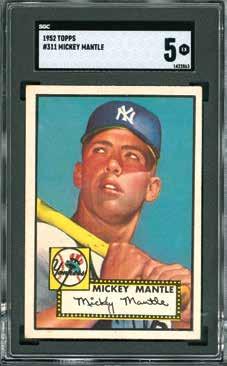
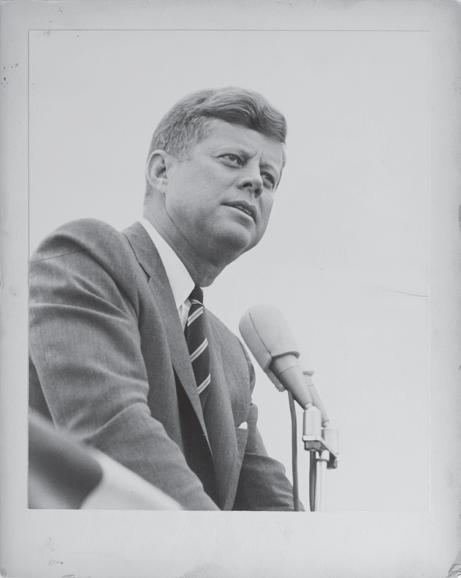
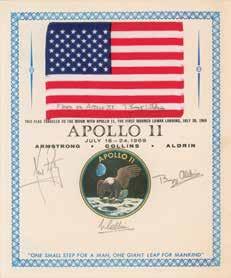
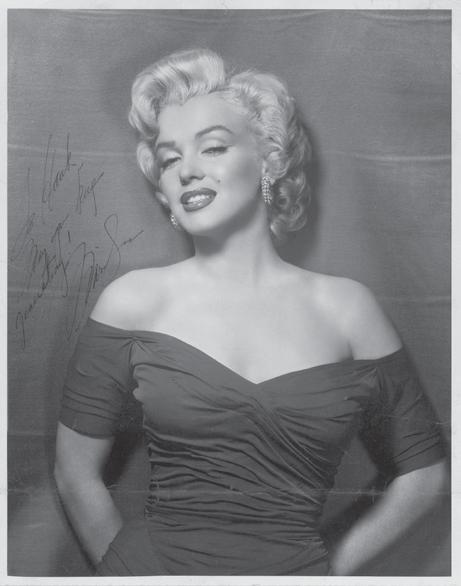

For 50 years, relationships have been the backbone of RR Auction. We have made it a priority to keep our consignors informed and involved, encouraging them to share their voices, to instill their knowledge, and to forge a partnership based on our shared passion for history. With a mutual desire to achieve greatness, these relationships are at the heart of our success.