OCTOBER 14 - 21, 2026
THE DEFINITIVE SOURCE FOR GRAND JUNCTION BUSINESS & COMMUNITY NEWS SINCE 1994
VOLUME 33, ISSUE 41
THEBUSINESSTIMES.COM
GJ restructuring budget to address long-term deficit Brandon Leuallen
G
The Business Times
rand Junction is restructuring how it funds city services, reducing General Fund subsidies, reallocating expenses and consolidating operations as City Manager Mike Bennett and the Grand Junction City Council work to address a structural budget deficit that has developed over several years. The changes are part of a multiyear effort that began with the 2026 budget and continues in Bennett’s recommended $317.4 million budget for 2027. The proposal reflects a shift toward controlling recurring expenses, making greater use of dedicated funding sources and prioritizing essential services under the City Council’s strategic plan. The city entered the budget process in 2026 facing a $6 million structural deficit, meaning the cost of maintaining existing services would exceed projected recurring revenue by that amount without adjustments. “We have to live within our means, and we have to adjust our expenses to our revenues,” Bennett told council members during an Oct. 5 budget workshop. Since 2021, city revenues have increased approximately 30 percent, while expenses have grown 53 percent. See story Page 5
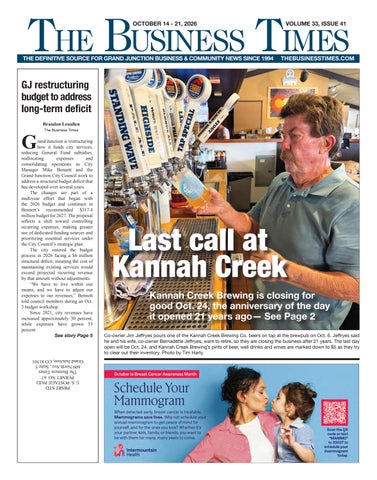
Last call at Kannah Creek
Kannah Creek Brewing is closing for good Oct. 24, the anniversary of the day it opened 21 years ago— See Page 2
Co-owner Jim Jeffryes pours one of the Kannah Creek Brewing Co. beers on tap at the brewpub on Oct. 6. Jeffryes said he and his wife, co-owner Bernadette Jeffryes, want to retire, so they are closing the business after 21 years. The last day open will be Oct. 24, and Kannah Creek Brewing’s pints of beer, well drinks and wines are marked down to $5 as they try to clear out their inventory. Photo by Tim Harty.
PRSRT STD U.S. POSTAGE PAID PERMIT NO. 67 The Business Times 609 North Ave., Suite 5 Grand Junction, CO 81501
The Business Times
Page 2
OctOber 14 - 21, 2026
Kannah Creek says it’s closing time Oct. 24 marked the start and now will mark the end for Kannah Creek Brewing’s 21-year run Tim Harty
Jim pointed out even if Kannah Creek had remained profitable during and after the pandemic, heir hand-crafted beers “if you’re doing 5 percent, are on sale, be it a pint or you’re about industry standard.” a growler, because all of Kannah The microbrewing Creek Brewing Company’s landscape has changed, too. inventory has to go. There’s plenty of competition Jim and Bernadette Jeffryes these days in the Grand Valley, can’t take it with them when and that wasn’t the case on Oct. they retire, and retired they 24, 2005, when Kannah Creek soon will be, as Oct. 24 has Brewing opened. been designated the final day The suggestion that The of Kannah Creek Brewing. And Rockslide Brew Pub was around that has special meaning for the at that time prompted a quick, couple. They opened Kannah “Yeah, and that’s it,” from Jim. Creek at 1960 N. 12th St. on that Bernadette pointed out day 21 years ago. Palisade Brewing existed back They could have closed then, too, but it didn’t have the sooner, but they liked the idea of restaurant side of things yet. waiting until that anniversary hit Palisade Brewing has an to shut things down. interesting connection to Kannah “We just got to a point Creek, because Jim worked there where we’re like, ‘We just can’t before he decided to try his hand do it anymore,’” Bernadette said. at his own brewery. “It’s a tough business and takes a “I just knew I wanted to lot of time and energy, and we’re open my own place,” he said, ready to put our time and energy “so when we found this place somewhere else, you know? for lease, we decided to make We’re in our early seventies, the jump and go ahead and do a well, almost mid seventies, brewpub. So that was fun. That getting there, so we don’t want was exciting at that point.” to be doing this when we’re 80.” He acknowledged it also was Bernadette said she and Jim “a little scary,” because at that have been trying to sell Kannah time “it was a real Budweiser/ Creek Brewing Co. for a couple Coors Light town.” years, but “we just haven’t found “Craft beer wasn’t big in the right person to take it over.” this town yet,” Bernadette said, So, no sale materialized, and “so I think we really brought it was time to give up on that. something to the community. “It’s just a tough time, the … I think we brought good beer economy, inflation” Bernadette into the town. It took a little said, adding studies show people time, a couple years to take off, are drinking less alcohol in but after people realized what general these days. we had going here, it did really And Jim said of the food well.” factor in the brewpub equation, They were going well “Restaurants are just a tough enough to warrant an expansion Kannah Creek owners Bernadette Jeffryes, left, and Jim Jeffryes each drink a beer while relaxing business.” as Kannah Creek opened a Plus, the Jeffryes don’t own on the Kannah Creek Brewing Co. patio on Oct. 6. They said they tried to sell the business for a second location, Edgewater the building, so there was no couple years, but interested buyers usually were more interested in the restaurant side of the busi- Brewery, at 905 Struthers Ave. building and land to package ness than the brewery. They finally gave up on the sale for the sake of retiring. Photo by Tim Harty. in 2013. with the business. The Jeffryes were able to Still, things could have sell Edgewater in early 2025 Kannah Creek Brewing Prepares For Final Day gone a much different way, a to an ownership group that better way, if not for that pesky returned brewing capability to Kannah Creek Brewing Company, 1960 N. 12th St. is closing its doors for good on Oct. 24, COVID-19 pandemic that kicked the building and opened WestCo ending a 21-year run in Grand Junction. off the 2020s. Brewing Co. For that final day, which is a Saturday, Kannah Creek plans to have some live music on the “We’re just now, this year, Meanwhile, the original patio, do some giveaways and, of course, drink some beer. getting back in the black after Kannah Creek location remained Until that day arrives, Kannah Creek is selling $5 pints of beer, well drinks and wines, trying COVID,” Jim said. “So that’s for sale, but interested buyers to get rid of all of its inventory. kind of tough for people to see weren’t taking a shine to the when they’re asking for your duality of a brewpub. financials for the last five years, and you’re losing a little money or just breaking even. “We had some people interested in the restaurant, they just weren’t interested in the They want to see you making, like, giant profits. That’s why they want to buy it.” brewery side of it,” Bernadette said. Of course, giant profit margins are not the way of restaurants and brewpubs, as See KANNAH CREEK BREWING COMPANY on Page 4
T
The Business Times
OctOber 14 - 21, 2026
me
The Business Times
Page 3
Page 4
The Business Times
Kannah Creek Brewing Company
OctOber 14 - 21, 2026
Continued from Page 2 Jim said the brewing is a special thing, but when people aren’t familiar with it, they’re often afraid of it. Bernadette added brewing is a craft and a special niche at this point, but for those willing to take a risk, there is a reward. “You do have a good profit margin on the beer,” she said, “so it’s a good part of the business.” With the final day fast approaching, there’s plenty to do, so when Oct. 24 is in the books, Jim knows what he’ll do on the morning of Oct. 25. “We’re gonna sleep in on that day,” he said. Bernadette added she hopes they’re not recovering from a hangover. Then, they’ll probably watch some football, maybe do some barbecue. Well, that thought was nice while it lasted, as Bernadette said they’ll hang out for day, “and then we’ve got to come back on Monday and Tuesday and get everything tidied up. Do a lot of deep cleaning and all that stuff, so there’ll be some work to do still with that last week.” Further review led her to add they need to “get the books closed and get our guys to do the taxes and just get it all done, done, done. All that, it’ll take a few months. But that’s all right. Our day to day will be very different.” “Yeah, not as intense,” Jim said. Jim Jeffryes, left, and Bernadette Jeffryes stand in front of the sign for Kannah Creek Brewing Co., which they founded and When there’s nothing more to do owned for 21 years at 1960 N. 12th St. in Grand Junction. Photo by Tim Harty. with Kannah Creek Brewing Company, they may not miss the day to day of Jim summed up the Kannah Creek experience with: “Well, it definitely was a big operating a business, but there will be things they miss. adventure. Lots of ups and downs. We rode it out. We knew it wouldn’t be simple. And Asked what they will miss most, Jim said, “I think the people.” once it started getting a little more simple, we opened Edgewater. And that turned out to And Bernadette offered, “It feels good to be a good employer, you know, and make be, probably a mistake in the long run, but … ” good beer, and make good food, and have people come in and have a good time. All that “But we sold it and did all right,” Bernadette said. feels really good. You’ll miss that part, you know, being part of the community and stuff.” And Jim finished the thought with, “That was still a good time doing that. But it was “We’ll be part of the community,” Jim added, “but just in a different way now. We’re a lot of work.” participants and not drivers.”
County commission receives proposed 2027 budget
Mesa County’s proposed 2027 budget was presented to the Board of County Commissioners during its Oct. 6 public hearing. The county said in a news release that its leaders spent months evaluating programs, reducing lower-priority spending and making organizational changes to improve long-term financial stability. The proposed budget focuses on maintaining core public services and continuing planned investments in roads, facilities and technology Todd Hollenbeck while reducing budgeted contracts and staffing levels and using reserves to address the difference between ongoing revenue and expenses. According to the news release, the proposed plan reduces the countywide budgeted staffing level by 61 positions, or about 5 percent, from 1,249 to 1,188 employees. The change is not 61 layoffs. The total includes vacant and previously frozen positions, organizational changes and reductions to filled positions related to lost grant funding or budget reductions. “Our residents depend on us to make responsible decisions now, so we can continue providing essential
services in the years ahead,” Mesa County Administrator Todd Hollenbeck said. “This proposal takes a disciplined approach to staffing and spending while continuing important investments in roads, facilities and workforce. Reserves give us time to make thoughtful changes, but they cannot permanently cover an ongoing gap.” Across all funds, the proposed budget includes: • $252 million in revenue. • $283.9 in expenditures. • A planned $31.9 million use of existing fund balances. These gross figures, according to the news release, include transfers and charges between departments for internal services and a $5.4 million Taxpayer’s Bill of Rights refund from 2025 revenues, which will be refunded via property-tax credits in 2027. Residents identified returning TABOR refunds as a priority in the recent community survey. A large portion of the planned use of fund balance is tied to capital projects, including $19 million carried forward from projects approved in 2026 that were not yet under contract, the news release said. Capital projects may also use revenue collected in prior years, dedicated funding and grants. The general fund supports 22 departments and accounts for about 35 percent of the county budget. It includes:
• $94.9 million in revenue. • $100.7 million in expenditures. • A planned $5.7 million use of the fund balance. General fund expenditures are about $200,000 lower than the 2026 adopted budget, while revenue is projected to increase by $3.2 million, according to the news release. However, recurring expenses continue to exceed recurring revenue. Rising costs for contracts, software, equipment, maintenance and employee health insurance remain major budget pressures. State and federal funding also remains uncertain. The proposed budget may change as insurance costs, property values, grants and capital-project estimates become final, the news release said. Department budget appeals and updated economic information may also affect the final recommendation. The Board of County Commissioners is scheduled to consider the final 2027 budget for adoption on Nov. 17. Residents can review the proposed budget on the county’s Finance webpage. Residents may submit public comments to mcadmin@ mesacounty.us or share them during the unscheduled business portion of a regular commissioners’ public hearing. Hearings begin at 9 a.m. Tuesdays at 544 Rood Ave. in Grand Junction.
OctOber 14 - 21, 2026
City of GJ Budget Continued from Page 1 Rising labor and health-insurance costs, expanding public-safety demands and financial commitments associated with previous investments have contributed to the imbalance. Previous city leadership pursued substantial investments in infrastructure, facilities and Mike Bennett development intended to stimulate future growth, and some investments have produced results, while others have generated less revenue than expected, leaving the city and its taxpayers with substantial debt Jay Valentine payments that continue to pull from the general fund. The current approach places greater emphasis on aligning recurring expenses with recurring revenues rather than relying on speculative future growth or reserves to sustain existing commitments.
Reallocating expenses to appropriate funds One significant change involves shifting approximately $2.1 million in labor expenses from the general fund to the city’s capital fund. According to Bennett previously, some employee time spent managing or completing certain capital projects was paid through the general fund rather than included in the projects’ costs. Under the proposed approach, those expenses would be assigned to the capital projects they support, providing a more complete accounting of project costs while reducing the burden on the general fund. Bennett said the change reflects a financial management best practice the city intends to continue. “But that relieved the general fund of 2.1 million. But it also constrains or adds cost to the capital fund 2.1 million,” Bennett said. The reallocation improves the general fund’s position without reducing overall city expenditures. The city is also proposing to stop using general-fund money to reimburse its water and sewer utilities for connection fees waived on qualifying affordable-housing developments. Council previously approved eliminating general-fund reimbursements for other categories of affordable-housing impact fees. The new recommendation would extend that approach to water and sewer connection fees. The utilities would absorb the lost connection-fee revenue, although qualifying developments would generate ongoing monthly utility revenue. The meeting cited a recently approved 48-unit Rural Homes development in the Salt Flats project with approximately
The Business Times
$593,340 in water and sewer connection fees, illustrating the financial significance of the proposed policy. Downtown and tourism funding reductions Two prominent areas facing reductions in general-fund support are the Downtown Development Authority and Visit Grand Junction. The recommended budget includes a $500,000 reduction in an annual city contribution to the DDA, which also receives funding through sales and property tax increment financing. Grand Junction Chief Financial Officer Jay Valentine said the reduction would come from an annual contribution associated with debt payments for the Las Colonias development and Two Rivers Convention Center improvements rather than reducing the DDA’s existing tax increment financing arrangements. Valentine said city officials had discussed the proposed funding reduction with Downtown Development Authority Director Brandon Stam and reviewed the organization’s long-term financial projections. “We’ve gone through his long-term financial plan, and they’re still very sound with the revenues that they have,” Valentine said. Visit Grand Junction is also preparing for the elimination of approximately $864,000 in annual general-fund support associated with the city’s former vendorfee arrangement. The reduction is being phased into the tourism organization’s operations, with its full effect expected by 2028. Bennett emphasized that lodging-tax revenue dedicated to tourism marketing will remain available to Visit Grand Junction. The reduction affects the additional general-fund contribution, not the voter-approved lodging-tax revenue. Visit Grand Junction Director Elizabeth Fogarty acknowledged that reducing marketing expenditures could affect visitation and tax revenue, but she said the organization is adjusting its strategy to minimize those effects. “We can’t completely overcome a reduction that will inevitably happen, but it’s important that we offer this,” Fogarty said. Bennett said Grand Junction has attracted interest from hotel developers although construction costs and financing conditions have slowed investment decisions. He said Grand Junction is approaching the practical limits of its existing hotel capacity, with occupancy rates nearing 80 percent during some periods. He noted the remaining rooms are not necessarily the types that typically attract visitors, limiting the effectiveness of additional tourism marketing without new hotel development. The organization is placing greater emphasis on attracting additional hotel development, which would expand lodging-tax collections and provide a more sustainable source of future funding. See CITY OF GJ BUDGET on Page 8
Page 5
Page 6
The Business Times
OctOber 14 - 21, 2026
BIC marks 40 years of growing the American Dream
Born out of Mesa County’s boom-and-bust economy, the Business Incubator Center helps local entrepreneurs build businesses, support families and create lasting jobs
The Business Incubator Center grew out of a community searching for a more stable economic future after years of boom-and-bust cycles tied to uranium, coal and oil shale. The 1982 oil shale collapse, known as Black Sunday, became a breaking point. Forty years later, about 35 percent of businesses operating in Mesa County have received assistance from the incubator, according to Business Incubator Center CEO Dalida Sassoon Bollig. Barbara Creasman, who worked in policy and research for Mesa County and helped write an early grant supporting the effort, recalled that those cycles had shaped the region long before the oil-shale bust. Some residents accepted the swings as part of life here. Others looked toward the next boom as an opportunity. But a larger question remained: How could people earn a steady living, put down roots and thrive through the region’s economic ups and downs? The incubator began as a loan fund and expanded to help people already living in Mesa County build successful businesses, create jobs and earn a living here. Forty years after its founding, the center continues that work through business guidance, financing, workspace and other resources to help companies start, stabilize and grow. And its marking that history on its 40th anniversary day, Oct. 16, by hosting Entrepreneur Exchange 2026 (EN/EX 26) from 11 a.m. to 1
The downtown building at 304 W. Main St. in Grand Junction housed the Business Incubator Center in its early years. Local businessman and incubator co-founder George Wheeler offered space for $1 per square foot, helping the program open with two tenants in 1987. Wheeler also helped found the Western Colorado Community Foundation. The incubator traces its founding to 1986, the same year Mesa County’s revolving loan fund began lending to local businesses. Photo courtesy of the Business Incubator Center.
p.m. at the Grand Junction Convention Center. For Kathy Hall, the center’s board president and a former Mesa County commissioner, its beginnings reflect a community willing to work through its own problems. “One of the reasons that I absolutely am so devoted to this community and love this community so much is because when we have difficulties, or we have a problem where we need to fix our community, we go to work and do it,” Hall said. Establishing those services required more than a shared desire to improve the economy. Early supporters worked through questions about government’s role, the risks of lending to small businesses and which industries should receive assistance. Responding to the bust Creasman remembered returning from a family vacation when Exxon announced its withdrawal from the oil-shale project. Her husband worked in construction, and uncertainty quickly affected work in the community. The consequences extended beyond companies directly involved in energy development. Local businesses depended on residents having money to spend, and the downturn affected the broader economy. Creasman recalled downtown occupancy remained about 60 percent when she began working at the Downtown Development Authority in 1988. See BIC on Page 9
enter obs
OctOber 14 - 21, 2026
The Business Times
Page 7
Page 8
City of GJ Budget Continued from Page 5 Consolidating services and evaluating properties The recommended budget also includes operational changes intended to reduce staffing and facility expenses while making greater use of existing city assets. One proposal would move activities currently offered at the city-owned senior center into the new Community Recreation Center, where officials say additional programming and meeting spaces would be available. Bennett said the consolidation would allow the city to better utilize the recreation center rather than continuing to operate overlapping facilities. Selling surplus city properties was another possibility raised during the workshop, although officials noted the city charter requires voter approval for certain property sales. Council member Anna Stout suggested evaluating potential property sales could demonstrate fiscal responsibility to voters before the city considers asking for additional revenue. The city is proposing to close City Hall to walk-in traffic on Fridays while continuing phone, online and appointment-
The Business Times
based services. Bennett said maintaining existing counter hours could otherwise require an estimated $500,000 to $800,000 in additional staffing expenses. The budget proposes eliminating 13 positions, including 10 vacant positions and three filled positions, although officials said some affected employees have opportunities to transfer to other city jobs. Bennett said the reductions were selected strategically rather than applying identical percentage cuts across departments. Rising costs and remaining challenges Despite the reductions, personnel and benefit expenses continue increasing. The recommended budget includes $3.1 million across city funds for compensation adjustments following a classification and compensation study. The city is also proposing changes to its self-insured employee health plan, including adjustments to copays and out-of-pocket limits, expected to save between $2 million and $4 million annually. Public safety remains a major financial challenge.
OctOber 14 - 21, 2026
The recommended budget includes six additional police officers and three fire battalion chiefs, while the city continues exploring a regional fire protection district as a potential long-term solution. For 2027, the city plans to use $2.3 million from generalfund reserves and another $2.3 million from the First Responder Fund balance to bridge remaining public safety funding gaps. Bennett cautioned that those reserves provide temporary relief rather than eliminating the underlying imbalance. Without a longer-term solution, he estimated the remaining structural gap could exceed $5 million in 2028 as recurring costs continue increasing. The city plans to continue examining capital projects, enterprise-fund expenses and potential utility-rate increases at its Oct. 26 budget workshop before beginning formal consideration of the 2027 budget in November. “We have to live within our means. We have to set ourselves up for financial sustainability,” Bennett said. “If we don’t do that, we have more difficult decisions to make than the ones that are still difficult now.”
The Business Times 609 North Ave., Suite 5 Grand Junction, CO 81501 (970) 424-5133 www.thebusinesstimes.com The Business Times is published twice monthly and distributed throughout Grand Junction, Fruita and Palisade. Advertising rates and deadlines are available upon request. Opinions expressed in this publication are those of the writers and don’t necessarily reflect the views of the publisher, editor or advertisers. Copyright © 2025 — All rights reserve
OctOber 14 - 21, 2026
BIC
The Business Times
nal police the city strict as a
m generalResponder ing gaps. provide nderlying
mated the n in 2028
l projects, increases ng formal
ave to set t said. “If s to make Community members, including local business owners, gather outside the Business Incubator Center’s former downtown location circa 1990. Photo courtesy of the Business Incubator Center. Continued from Page 6 Her work for Mesa County included examining why county government should become involved in particular initiatives and how those efforts could address local needs. Sassoon Bollig described an informal “kitchen table group” that came together in 1985. Business owners and representatives of local governments visited companies, reviewed financial information and projections, and helped owners work through the challenges they faced. The work was initially done by volunteers. Those efforts developed into the Western Colorado Business Development Corporation, the nonprofit established in 1986 and known today as the Business Incubator Center. Early board members did more than attend meetings. They helped guide the organization while providing hands-on assistance to businesses. Helping businesses already here Creasman emphasized the importance of building an organization around the needs of the existing community. While other economic development organizations pursued business recruitment from outside the area, the incubator’s focus was on helping local residents and companies become more successful. Those residents had already chosen to live in Mesa County. Supporting their businesses could help them earn a living, employ others and remain here. That purpose also shaped the incubator’s broad approach. Rather than specialize in technology, food production or another industry, it needed to serve the variety of businesses already operating in Mesa County. “You gotta look at what you need,” Creasman said. Someone helping businesses across industries could not rely solely on expertise in a particular product or trade. The organization needed to connect owners
with knowledge and resources appropriate to their circumstances. An entrepreneur might understand how to make a product or provide a service but need help with financial management, marketing or expansion. “Nobody’s an expert in everything,” Creasman said. Financing and business assistance The revolving loan fund began shortly before the incubator, providing financing for local businesses. Money repaid by borrowers could then be loaned to other businesses, allowing the resources to continue circulating. But evaluating loans also revealed needs that money alone could not resolve. Officials had to consider whether an owner had the skills and information needed to carry out a plan successfully. Providing business assistance alongside financing became a natural progression, improving a company’s chances of succeeding while strengthening the prospects that its loan would be repaid. Many early borrowers were already operating businesses. They might need equipment, want to expand or be trying to resolve problems affecting their performance. Creasman helped write the early grant that supported the effort. Center leaders described $75,000 in initial grant funding, although the grant’s date and specific purpose remain to be confirmed. Working through resistance Creasman recalled some resistance to the early efforts, including concerns about accepting grant funding and the obligations attached to it. County commissioners had to approve the work. Part of her job was explaining the proposal and addressing questions from officials who were unfamiliar with the concept. The loan fund provided a more concrete starting point than the broader question of how an incubator would help many different kinds of businesses. See BIC on Page 10
Page 9
Page 10
The Business Times
BIC
Continued from Page 9 Creasman also recalled reluctance to assist retail businesses. At the time, economic development discussions emphasized manufacturing and primary jobs. She believed locally owned retailers mattered to Grand Junction’s role as a regional shopping and service destination. People traveling to the community for medical care, shopping or other needs could spend money at local businesses. Especially with the city of Grand Junction’s primary income being sales-tax revenue. Mesa County’s involvement also allowed the work to reach beyond Grand Junction to Fruita, Palisade and unincorporated areas, she recalled.
OctOber 14 - 21, 2026
outdoor apparel company known for clothing with built-in mittens and face coverings. Founded locally by brothers Dirk and Seth Anderson, Loki expanded into international markets, beginning with Japan in 1999. Palisade-based Pear Blossom Farms began using the incubator’s food-production facilities in 1994, receiving help with equipment and manufacturing regulations before establishing its own facility. Its sauces, syrups, preserves and other specialty foods reach customers nationwide. The center’s reach also includes familiar local destinations. Trail Life Brewing received financing through the incubator’s Business Loan Fund to help establish its downtown brewery. Ristorante
Laura Bradford oversees production of patient drapes at ProSafe Products in a photograph published in The Business Times on Nov. 24, 2004. Barbara Creasman recalled Bradford’s business as one of the Business Incubator Center’s first tenants. Original story and photo by Phil Castle. A place to grow Local businessman George Wheeler helped establish the incubator and the Western Colorado Community Foundation. He provided the incubator’s first space in his downtown warehouse at a reduced lease rate of $1 per square foot. Having a building allowed the organization to combine business assistance with space where entrepreneurs could operate. Hall helped seek startup funding while working for U.S. Sen. William Armstrong. Later, as a commissioner, she supported funding and helped establish the Rural Technology Corporation to manage former Department of Energy property, where the incubator relocated. Creasman recalled Laura Bradford’s ProSafe Linen as one of the incubator’s first tenants. According to the Business Incubator Center, other businesses that it assisted over the years include Loki, a Grand Junction
Pantuso’s owners used business classes and coaching to strengthen operations, improve bookkeeping and develop a food truck. Fruita’s Imondi Wake Zone turned to the loan fund after its owners were denied financing by 17 banks. They also took the incubator’s Bookkeeping Boot Camp as they worked to establish their waterrecreation business. Other examples include Pronto Bronto, which used the commercial kitchen for food preparation and storage, and 579 Construction, which received startup financing, business-planning assistance, and office and storage space on campus. The American Dream and families For Sassoon Bollig, the incubator’s work is ultimately about helping people pursue the American Dream: building businesses that allow them to support their families, create jobs and build a future in their community. See BIC on Page 14
OctOber 14 - 21, 2026
The Business Times
Page 11
Page 12
The Business Times
OctOber 14 - 21, 2026
OctOber 14 - 21, 2026
The Business Times
Page 13
Page 14
The Business Times
BIC
Continued from Page 9 Entrepreneurs carry the risks and responsibilities of that work. The incubator provides guidance and resources to help them make sound decisions and grow sustainably. “They’re the ones taking the risks,” Sassoon Bollig said. Helping those companies grow and sell products beyond the local market brings money into the community and creates opportunities beyond the individual owner. Building the next 40 Years Part of the center’s work is making sure owners understand that assistance is available to them. Although “Business Incubator Center” is more recognizable than its legal name, Western Colorado Business Development Corporation, “incubator” can suggest services only for startups. The organization also helps established businesses address financial challenges, purchase equipment, expand and plan their next stage of growth. Sassoon Bollig said workforce availability and access to capital are among the biggest challenges businesses face today. Although people are moving to the area, she said the community needs more residents of working age, making the retention of entrepreneurs, businesses and jobs particularly important. Businesses have also navigated disruptions from the pandemic and
OctOber 14 - 21, 2026
changes in government administrations. At the same time, she sees renewed interest in local production and manufacturing. The incubator helps owners connect with technology, financing, coaching and other resources to pursue those opportunities. Capital is harder to obtain, and rural communities can feel those constraints first, Sassoon Bollig said. Despite the center’s loan fund and relationships with banks and investors, she said more financing is needed. Individual companies also need supporting businesses and resources around them. One of the incubator’s goals now is to move beyond filling isolated gaps toward helping build stronger industries with greater capacity. Looking ahead, Sassoon Bollig wants to extend that work into surrounding communities through partnerships and collaboration, allowing growth in one part of the region to help strengthen neighboring areas. Asked what it means to see local business owners overcome challenges and succeed, Hall became emotional as she described why the work matters to her. She said the community’s natural beauty cannot make up for being unable to support a family. “The important thing, in a really good life, is being able to have an economy to feed your family,” Hall said. F
Marking 40 Years of Business Assistance The Business Incubator Center is hosting a special celebration Oct. 16 to honor the people who have helped shape the Western Slope over the past 40 years. The event is called Entrepreneur Exchange 2026 (EN/ EX 26), and it will take place from 11 a.m. to 1 p.m. at the Grand Junction Convention Center in downtown Grand Junction. EN/EX26 brings together entrepreneurs, business leaders, innovators and civic partners for a luncheon and awards program to celebrate and recognize the outstanding entrepreneurs and community leaders that shape the future of the Western Slope. Entrepreneurial Awards will be presented for: visionary leadership; innovation; community impact and legacy recognitions; and outstanding entrepreneurs. The event also will feature a keynote speaker focused on entrepreneurship and economic resilience and a BIC 40 Years of Impact presentation.
OctOber 14 - 21, 2026
ations. At d interest facturing. nect with and other nities. and rural onstraints spite the tionships aid more
so need resources or’s goals ated gaps ndustries
lig wants rounding hips and n one part ghboring
see local enges and al as she o her. s natural unable to
ally good onomy to
The Business Times
Page 15
The Business Times
Page 16
Don’t dump in the desert 73% of Mesa County is public land and open space.
OctOber 14 - 21, 2026
Munro inducted into Green Industry Hall of Fame
So what belongs in those areas? Wildlife
Tires & mattresses
Dirt, plants, & rocks
Appliances
Outdoorsy people
Trash & anything else left behind
Don’t poison the ground. Bring those items to the landfill for safe disposal. Not sure if it’s trash or recycling? Use our EZ Recycling Tool to find local disposal options.
Do Right. Dispose Properly. (970) 256-9543
MesaCountyRecycles.com Mesa County Solid Waste • 3071 US-50 • Grand Junction, CO 81503
Allen Munro
Munro Companies founder Allen Munro, a longtime leader in irrigation innovation, was inducted into the Green Industry Hall of Fame on Oct. 3 at Black Gold Golf Course in Yorba Linda, Calif. According to a news release, the recognition honors his more than six decades of contributions to the irrigation industry, including his enduring focus on innovation, entrepreneurship and service to irrigation professionals. “Allen’s career has been defined by a genuine commitment to developing simple, professional-grade irrigation-pumping solutions that make a difference for the end user,” said Katie Powell, president of Munro Companies. “His leadership, technical insight and dedication to developing reliable solutions have shaped Munro and contributed meaningfully to the irrigation industry as a whole. This Hall of Fame induction is a well-deserved recognition of that impact.” Allen Munro’s history in the pump and irrigation business began in 1965, when he and his father, Jack Munro, opened Munro Supply in Grand Junction. The company quickly established a reputation as a regional pump authority, later expanding into the engineering and fabrication of pump stations in 1972 and launching its first line of Munro lawn pumps in 1985, the news release said. Today, Munro serves irrigation professionals with pumps, pump controls, advanced pump stations and pump-related accessories designed to support durable, efficient water management. The company continues its long-standing mission of bringing professional-grade, problemsolving products to market for the irrigation industry, the news release said. The Green Industry Hall of Fame recognizes individuals whose work, leadership and dedication have made lasting contributions to the green industry. Allen Munro’s induction reflects a career devoted to advancing practical irrigation solutions, strengthening relationships across the industry and supporting the professionals responsible for managing water resources every day. For more information about Munro, visit munropump.com. To learn more about his Hall of Fame recognition, visit www. greenindustryhalloffame.org/inductees/ allen-munro.
OctOber 14 - 21, 2026
The Business Times
Page 17
Building business value starts long before a sale For many business owners, selling represents the culmination of years or even decades of hard work. Yet one of the most common mistakes is waiting until a sale feels imminent to begin preparing. The best time to prepare your business for a future transition is today, or at the very least, sooner rather than later. Even if selling is still several years away, the steps that make a business more attractive to buyers are often the same steps that make it stronger, more profitable and easier to operate now. A business sale can take one to two years, and some companies need an additional two to three years of preparation before they are truly ready for the market. The process may take even longer when financial, operational or legal details have not been addressed in advance. Keeping your end goal in mind and planning for your Brian exit from the start gives you time to make thoughtful improvements Bray instead of rushed corrections. Begin with the financial picture. Buyers and lenders want organized, supportable records that clearly show revenue, expenses, cash flow and profitability. Clean financial statements also help identify predictable revenue, recurring customers and realistic opportunities for growth. When personal and business expenses are mixed, records are inconsistent or adjustments are difficult to explain, buyers may perceive more risk and have greater difficulty determining value. Next, look at how dependent the company is on you. If the owner holds every key customer relationship, approves every decision or performs most of the specialized work, a prospective buyer may feel they are purchasing a job rather than an independent business. Developing employees, documenting processes and delegating responsibilities can create a stronger operation and a smoother transition. Your workforce is also part of the story. Maintain an accurate employee census that includes roles, tenure, compensation and benefits. Buyers need to understand who keeps the business running, whether key employees are likely to remain and where knowledge or leadership gaps may exist.
Physical and operational assets deserve equal attention. Maintain equipment and organize records for furniture, fixtures and equipment, commonly called FF&E. Review inventory levels and valuation methods, and understand whether real estate is included in the sale, leased separately or held by another entity. Deferred maintenance, obsolete inventory or unclear asset ownership can create questions during due diligence and delay a transaction. Market realities matter as well. Industry, geography, company size, customer concentration and licensing requirements can narrow the pool of qualified buyers. A realistic price supported by performance is essential. Strong preparation cannot eliminate every timing variable, but it allows an advisor to position the opportunity clearly and begin identifying likely buyer groups early. Owners should also review contracts, leases, licenses, permits and vendor or customer agreements. Confirm which items are current and whether they can transfer to a new owner. A valuable contract that cannot be assigned – or an expired permit discovered late in the process – can affect financing, timing and buyer confidence. Taken together, these steps reduce uncertainty. They give buyers a clearer view of what they are acquiring and make the business easier to evaluate, finance and transfer. They may also expand the buyer pool and support more favorable terms. Ultimately, getting a business ready to sell is not simply about creating a listing. It is about building value. Predictable revenue, a capable team, reliable systems, maintained assets and clean documentation make a company more resilient today and more marketable tomorrow. Whether your exit is two years away or 10, start with the end in mind. Preparation cannot guarantee a quick sale, but it can prevent avoidable delays and put you in a stronger position when the right buyer arrives. Your business deserves a strategy, not just a listing. F Brian Bray is a business broker with Bray Business Advisors Group.
Page 18
The Business Times
OctOber 14 - 21, 2026
OctOber 14 - 21, 2026
The Business Times
Page 19
Leaders unlock growth by having courage to change Change is one of the few guarantees in business and life. It arrives whether we’re ready or not. Sometimes gradually, sometimes with force. Markets evolve, technology advances, teams shift and external conditions such as politics or weather can reshape our plans overnight. Many people cling to the familiar, because it feels safe, but resisting change is a false refuge. It limits potential, blocks opportunity and keeps us stuck in patterns that no longer serve us. The real reason people resist change isn’t the external disruption; it’s the internal transformation it demands. Change forces us to confront our habits, beliefs and comfort zones. We worry about what might go wrong, how difficult the transition will be, or whether we’re capable of navigating the unknown. Even when our current situation is draining or unproductive, we often hold onto it simply because it’s familiar. Marcus Comfort, even when it’s painful, can be a powerful anchor. This Straub fixation on discomfort blinds us to the benefits of change. We become so focused on the potential hardship that we overlook the upside, such as the new possibilities, renewed energy and alignment with our goals and values. To thrive, we must shift our perspective. Meaningful change isn’t a threat; it’s an opening. It’s a doorway to growth, clarity and a more fulfilling way of living and leading. The first step in embracing change is honest self-appraisal. When we pause long enough to examine our reality, our results, our emotional patterns, our daily frustrations, we often discover that resisting change is costing us more than we realized. That discomfort, once acknowledged, becomes a catalyst. Many people wait until they hit a breaking point before they finally say, “I can’t do this anymore.” But what if we didn’t wait? What if we got honest sooner and used that clarity to make proactive decisions instead of reactive ones? If your reflection reveals dissatisfaction in your business, relationships, health or overall well-being, it’s time to reconsider your relationship with change. Shifting your mindset from fear to curiosity, from dread to hope, empowers you to take meaningful action. This shift isn’t abstract or philosophical; it’s deeply practical. It positions you to make decisions that elevate your circumstances and restore your sense of purpose and joy.
In my coaching and consulting work, I help individuals and teams identify the thought and behavior patterns that quietly sabotage their success. People often work against themselves without realizing it by holding onto beliefs or habits that conflict with their goals. Once we uncover these patterns, we replace them with new, empowering ones that support positive change. The process is rooted in clarity, intention and action. Consider a common scenario in business: a technically skilled team member who is emotionally toxic. Their attitude erodes morale, damages customer relationships and undermines the culture you’re trying to build. If you or your team feel a sense of dread when interacting with this person, that’s a signal that something needs to change. Yet many leaders avoid addressing the issue, because it’s uncomfortable. Hiring and training someone new takes time and energy. There’s fear of confrontation, backlash or legal complications. But here’s the truth: The longer you tolerate a damaging situation, the more it costs you in productivity, reputation and emotional bandwidth. When you shift your focus from the difficulty of the change to the benefits it will bring, the path forward becomes clearer. You begin to see the value of a healthier team dynamic, improved customer satisfaction and a more energized workplace. That vision fuels courage and makes the effort worthwhile. This principle applies beyond business. If your health is declining, your relationships feel stagnant, or your personal goals are slipping away, resistance to change is holding you back. Awareness is the first step. Action is the next. Seek support, make a plan and commit to the changes that will move you toward a more fulfilling life. Change becomes easier when we choose to see it through a lens of possibility. Instead of viewing it as a disruption, we can see it as a recalibration, a chance to align more closely with our values, aspirations and potential. Human beings are remarkably resilient. When we open our minds to new ideas and take decisive action, we unlock creativity and strength we didn’t know we had. Ultimately, thriving in business and life requires a willingness to evolve. Not to chase change for its own sake, but to respond to it with clarity, courage and intention. When we embrace change, we don’t just survive; we grow, we lead, and we inspire others to do the same. F Marcus Straub owns Life is Great Coaching in Grand Junction. Reach Straub at (970) 2083150, marcus@ligcoaching.com or through the website located at www.ligcoaching.com.
The Business Times
Page 20
OctOber 14 - 21, 2026
When the ballot is this big, government only gets bigger Along with the always added less efficient and more wasteful. Did you look at your ballot that arrived in your mailbox this past week? Seriously, there are 45 different candidates, judges, initiatives or power and tax grabs apparently in serious need of your vote to get implemented into Colorado law or lawmaking on top of the 500 to 1,000 new laws these hacks already put into place legislatively in the past year. I never know the exact amount of laws passed each year, because they introduce and pass so many pieces of legislation each session, most of them in what voters are required to believe are desperate attempts to fix what’s wrong with all of the laws these “do-gooders” passed over many preceding sessions. And let’s just say since Pontius Polis and the democrats have been in the almost “super-majority,” the number has increased exponentially and hasn’t helped most voters a scintilla. Craig Hall It hasn’t brought spending down a penny, either. And just in case you haven’t perused your ballot, you could just open the other ballot envelope addressed to the voter who hasn’t lived in your house since well before you moved in that Jena refused to take off the rolls. Stop it, you know damned well it’s still happening, even if your sources are the “letters from LaVista Correctional Facility” by Mesa County Martyr Tina Peters, even though she’s never found an ounce of fraud. Just also note that none of the above changes the fact that our ballot is too big, and all it will do is grow government and your tax bill. Because if it’s on the ballot, it means one of two things: A tax increase or something for the state to spend more money on that always brings about, you guessed it, another tax increase on the next ballot. Oh, all with a TABOR workaround. And while this ballot might have more ovals to fill in, it really doesn’t make it any harder for me to fill out. And I know this is going to sound sophomoric to many who are reading, but I already have eliminated a good percentage of ovals before I do the “map unfolding” (seriously, it’s a trifold this year) of all things so important in “moving Colorado forward.” Yes, that’s sarcasm. I fully realize Colorado is heading in only one direction, and doing so with a busted transmission. I’m just waiting for it to fall off, all while taking full advantage of easy columns to pen. How do I accomplish such a vetting you ask? Simple. I eliminate all democrat ovals and yes ovals which increase taxes or work around TABOR. I also never vote to retain a judge, mainly because I never want to see one at their place of business ever again. That is until I attend a battle over my will, and then I’ll only be there in spirit and humor. Trust me, the judge who’s presiding will thank me for being there only in spirit. After all, my humor is an acquired taste, and judges don’t seem to share it. Then again, many, not just judges, aren’t thanking me for writing my humor on this topic today in person. But if it makes you think, or in this case take a closer look at your “War and Peace”-sized ballot, I’ve done my job whether you like it or not. But to some specifics on the ballot. Now you may say I’m soft on crime with my attitude toward judges, because there is a measure on the ballot for tougher sentences for child traffickers. You’d be wrong. I absolutely want all child traffickers arrested and punished harshly. I just don’t think the state should need it to be a constitutional thing. Because if they can put it in, in time, someone elected will want to take it out. Also, why would any judge who cares about public safety or kids need a state law to require them to do something they should do to the “nth” degree for anyone guilty of such a crime?
Support Local
Life in prison is not enough, and it should be the obvious sentence for these folks. We don’t need a law, and this being on the ballot just distracts. Let judges do their job without the state-mandated sentence. Something tells me if the judges were given autonomy, they’d be even harsher. But since they don’t exercise autonomy, I don’t vote for them. Separation of powers is still a thing, no? But what about rogue judges, Craig? Exactly. Let’s have more of them on the side of law and order. I don’t care what any political party or special-interest group thinks when it comes to criminal law. If it’s based on two tablets in Exodus, it’s got proper perspective to me. As for other measures on the ballot, many of them should be in place with common sense, which means we shouldn’t need an amendment, because they are rights, or should or shouldn’t be done based, again, in common sense. But alas, politics isn’t overflowing in common sense any longer. For instance, even if something is voted and amended into our constitution, it really has little to no power. From the minute the vote is decided, the other side (and there is always another side in today’s politics) will be working on a workaround, lawsuit or they will just flat out ignore the laws they don’t like or support. After all, they’ve been doing this on the federal level since before the ink dried on our Constitutional parchment. And most of what’s been written into nationwide constitutions since the original parchment dried hasn’t been good for the people. And we all instinctively know it. So just to cover a couple of more “measures” on our junk-bond, AAA TripTik of a ballot (guessing I’ll have to get to a few more next column), let’s talk government underfunding. Let’s just put it this way: Our state has plenty of money. It just always spends more than it has on things it shouldn’t be doing, or worse, does very poorly. Which brings us to the latest “tax the rich” proposal along with – to NO ONE’s surprise – another tax increase for “education,” aka the latest payoff to the teacher’s unions. Just say NO. Again, our state has plenty of money. It’s just really bad or really good at laundering it. Depends on whether you’re on the receiving end of things. How else can an entity have increased spending almost 250 percent since 2000? To help, that’s going from about $12 Billion per year to over $35 Billion today. It’s beyond time we say no and leave TABOR alone. Oh, and just in case our city and School District 51 think I’m leaving the tax increases they are asking for AGAIN alone, think again. This same rule of voting applies to you. And it’s not because I hate kids (well, I do dislike more than a few) or don’t think education is important (although much of what we “teach” today isn’t) or don’t think our city should supply the people with quality and efficient services (just don’t sit in private rooms looking over architectural models of your grand visions for Grand Junction like you-know-who). The real problem here is if we keep giving you more money, you’ll keep asking for it. And before you scream “underfunding,” try living within your means. Your underfunding problem isn’t with the taxpayers; it’s with your overlords. So, while I won’t tell you who or what to vote for, just make sure you make your vote count – and that the vote counted is just yours. That should give you some direction on what or who not to vote for. Because in today’s elections, it’s what or who you didn’t vote for that seems to matter more. And saying that allows me to say that you can say, “I didn’t tell ya.” In Truth and freedom. F Craig Hall is owner and publisher of The Business Times. Reach him at 424-5133 or publisher@thebusinesstimes.com
Support Business
The local business and community news you want to know delivered weekly to your business, office or home. LOCAL NEWS / OPINION / CONTRIBUTORS / BUSINESS BRIEFS LETTERS TO THE EDITOR / COMMUNITY NEWS AND EVENTS
$50/year for 52 papers/year
TheBusinessTimes.com/subscribe
ger
OctOber 14 - 21, 2026
The Business Times
Page 21
Page 22
The Business Times
OctOber 14 - 21, 2026
n “Run for Rivers” Fun Run returns to Riverfront Trail
n Cocktail-tasting fundraiser returns to Dinosaur Journey
The second annual Run for Rivers will take place Nov. 7 at 10 a.m. along the scenic Riverfront Trail in Grand Junction. This family-friendly fundraiser features a 5K run/ walk and a 1K Fun Run for kids, alongside popular family activities, including a nature scavenger hunt and a hands-on art project. The run will start and finish at the Confluence Center of Colorado, 2596 Dos Rios Drive in Grand Junction, situated at the confluence of the Colorado and Gunnison Rivers in the Dos Rios area near downtown Grand Junction. “This event has become a wonderful fall tradition for runners, walkers and families to enjoy our beautiful riverfront trails while supporting the crucial work happening at the Confluence Center,” said Jenn Moore, executive director of EUREKA! McConnell Science Museum. For more information and to register, go to www.confluencecenterco.org/events-2-1. All registered 5K participants will receive a commemorative race T-shirt. The Run for Rivers is made possible thanks to the generous support of community sponsors, including Mt. Garfield Wealth Management Group, Grand Junction Sports Commission, One Riverfront, RiversEdge West, and EUREKA! McConnell Science Museum.
Museums of Western Colorado presents Dinos on the Rocks: Prehistoric Fun Meets Craft Cocktails. From 6:00 – 9:00 p.m., Dinosaur Journey will transform for an adults-only night at the museum featuring original cocktails and mocktails from local competitors, heavy appetizers, music, a silent auction, Liquor Pull, and after-hours access to the museum. Guests will taste their way through the competition and cast their votes for Best Cocktail, Best Mocktail and Most Creative, with the winning bars & restaurants taking home Dinos on the Rocks’ signature dinosaur claw awards. “Dinos on the Rocks gives people a completely different way to experience Dinosaur Journey,” said Mollie Shepardson, Director of Development & Communications. “It’s such a fun night out that celebrates some of the creative businesses in our community while raising important support for the Museums.” General Admission tickets are $40 and include tastings, heavy appetizers, and one full-size drink token. VIP tickets are $70 and include quick entry, a dedicated VIP entrance, two full-sized drink tokens and an MWC gift. The event is for guests 21 and older. Proceeds from Dinos on the Rocks support the Museums of Western Colorado and its exhibits, educational programs and opportunities for discovery throughout the year. Tickets and event information are available through the Museums of Western Colorado website at mowc.co.
n Science Museum hosts Fiesta Hispana EUREKA! McConnell Science Museum, 1400 N. Seventh St., will host Fiesta Hispana, an evening celebrating Hispanic culture, community achievements and bilingual education on Nov. 1, 4-8 p.m. Admission is free to Fiesta Hispana, which features traditional dance performances, live music, local food and special community awards. Attendees also will have the opportunity to explore the museum’s interactive exhibits and discover the various bilingual and STEAM educational programs EUREKA! offers throughout the year. Gilberto Ramirez, Spanish program coordinator at EUREKA! Said Fiesta Hispana is “a great way for families to see firsthand how our bilingual initiatives make hands-on science and learning accessible to everyone.” For more details about Fiesta Hispana, visit www.eurekasciencemuseum.org or call 970-254-1626.
n Museum hosts ‘Evening with the Authors’ Oct. 15 The Museums of Western Colorado will host Evening with the Authors, featuring Western Colorado authors David P. Bailey and Janielle Westermire, from 6–8 p.m. on Oct. 15 at the Museum of the West, 452 Ute Ave. Bailey’s latest book, “Navigating Western Colorado: Early Expeditions and the Birth of Transportation on the Frontier,” released in July, explores the trails, pathways and early transportation routes that shaped Western Colorado. From Ute and Spanish trails to mountain men’s pathways and military wagon roads, Bailey traces how people navigated the region’s challenging landscape and how those early routes helped pave the way for modern transportation. Bailey spent 28 years as a history curator at the Museum of the West and has built a career researching and sharing Western Colorado history. His documentary work has included collaborations with National Geographic, the History Channel, Travel Channel, Mysteries at the Museum and the BBC. Westermire, a Western Colorado native, will share “Faith Finds a Home,” a children’s story inspired by the animals on her family farm. The book explores what it means to be a family and reminds young readers that families can be formed through love and belonging, not only by birth. Admission is $5 for nonmember adults and free for children and Museums of Western Colorado members. For more information, visit MuseumsOfWesternCO.org.
Business Bites n Ava Health opening Homestead on Grand Mesa
Ava Health CEO Christopher Bennett wrote in his weekly “Letters from the Resistance” column that its Homestead facility, which has 32 beds for subacute mentalhealth stabilization, medical detox and residential treatment, will open Oct. 19. Ava Health renovated a building that formerly served as a yoga retreat on 40 acres on Grand Mesa. He said it is “the only subacute mental-health stabilization and the only mental-health residential treatment on the Western Slope,” and it will more than double regional medical-detox capacity. • Store NOT closing: Big 5 Sporting Goods had a recent clearance sale to clear out some inventory, but the store manager said its sign on the front of the building gave many customers the wrong impression. Because the sign said “Inventory Liquidation,” the manager said customers were asking if Big 5 was going out of business. It is not closing, he said, and that clearance sale ended Oct. 7. • Animal ER gets new home: Animal ER of the Western Slope moved into its new location, 2558 Patterson Road, in Grand Junction. It said in a news release the new facility is larger, “giving us more room and better resources to care for your pets when they need us most. Same team, same commitment, more space to do it well.” • Making a splash at new location: Rimrock Pools & Spas relocated to 552 25 Road, Suite C, former home of One Source Lighting, which closed earlier this year. Rimrock Pool & Spas previously operated at 2586 U.S. Highway 6&50. • Showing off expanded store: Marking its expansion into the other half of the building it has long occupied at 529 Bogart Lane, Frame Depot is hosting its “Expandaversary Party” there on Oct. 17. It will have a live radio remote from 10 a.m. to 1 p.m. and will have Poppy popcorn and Tea with Tae for customers to sample.
Share your news! Has your business recently hired? Or did someone retire? The Business Times welcomes submissions for free publication in Business Briefs. Email stories and headshots to stories@ thebusinesstimes.com or submit a news release online at www.thebusinesstimes.com.
(970) 424-5133 www.thebusinesstimes.com
frights & toffee delights. ENSTROM.COM
OctOber 14 - 21, 2026
ourney
un Meets
nly night rs, heavy useum. for Best nts taking
Dinosaur ons. “It’s ommunity
zers, and cated VIP ts 21 and
orado and he year. Western
from the e mental-
40 acres d the only an double
e to clear ding gave uidation,” . It is not
to its new w facility they need
o 552 25 this year.
r half of osting its 10 a.m. to
hts.
The Business Times
Page 23
Page 24
The Business Times
OctOber 14 - 21, 2026