SEPTEMBER 16 - 23, 2026
VOLUME 33, ISSUE 37
THE DEFINITIVE SOURCE FOR GRAND JUNCTION BUSINESS & COMMUNITY NEWS SINCE 1994
CMU hosts River District’s annual seminar Brandon Leuallen The Business Times
W
ater managers, agricultural producers, elected officials and Colorado River experts will gather in Grand Junction on Sept. 18 to discuss the effects of a major drought year and what could lie ahead for the Colorado River Basin. The Colorado River District’s 2026 Annual Water Seminar, titled “The River Ahead,” will take place from 8:30 a.m. to 3:30 p.m. at Colorado Mesa University. The event is open to the public, with in-person and virtual attendance available. According to the Colorado River District, the program will focus on drought, interstate negotiations, agricultural water supplies, drinkingwater systems and efforts to protect Western Slope water. The seminar follows the U.S. Department of the Interior’s Aug. 21 adoption of operating guidelines for 2027 and 2028 and a broader 10-year decision-making framework for Lake Powell and Lake Mead. According to the department, the framework allows Colorado River Basin negotiations to continue and provides opportunities to incorporate future agreements among basin states, tribes and other water users into later operating guidelines. See story Page 5
THEBUSINESSTIMES.COM
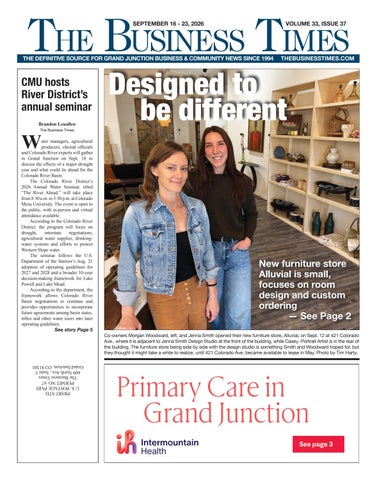
Designed to be different
New furniture store Alluvial is small, focuses on room design and custom ordering — See Page 2 Co-owners Morgan Woodward, left, and Jenna Smith opened their new furniture store, Alluvial, on Sept. 12 at 421 Colorado Ave., where it is adjacent to Jenna Smith Design Studio at the front of the building, while Casey.-Portrait Artist is in the rear of the building. The furniture store being side by side with the design studio is something Smith and Woodward hoped for, but they thought it might take a while to realize, until 421 Colorado Ave. became available to lease in May. Photo by Tim Harty.
PRSRT STD U.S. POSTAGE PAID PERMIT NO. 67 The Business Times 609 North Ave., Suite 5 Grand Junction, CO 81501
The Business Times
Page 2
SePtember 16 - 23, 2026
Furniture store different by design
Alluvial can provide furniture brands that weren’t available in Grand Junction previously Tim Harty
J
The Business Times
enna Smith and Morgan Woodward started eyeing the commercial space at 421 Colorado Ave. this spring when they heard it might become available. It looked perfect for what they wanted to do. Smith could move her existing business, Jenna Smith Design Studio, into one of the building’s two front units, because her growing business needed the extra space. And the other front unit? That would be perfect for a small furniture store that would operate in tandem with the design studio, and Woodward would be the primary owner. The dream became reality soon after, as the day in May those units were listed on Facebook Marketplace, Smith and Woodward immediately contacted the landlord, Casey Dittmer, who operates Casey.-Portrait Artist in the rear of the building. And they landed the lease. Jenna Smith Design Studio moved into its unit right away, while the furniture store needed several months to get set up. The wait ended Sept. 12, when furniture store Alluvial opened its doors to the public with a grand opening. “Our initial, organic business plan really melded together,” Woodward said. “We had talked for some time, but we knew exactly where we aligned on what this would look like. And so, here we are.” Alluvial isn’t your typical furniture
store. Forget thoughts of the sprawling warehouse-style furniture stores with hundreds of chairs, couches, beds, tables, etc., on display. Alluvial is different by design, because it’s about design. The space is small, and the amount of furniture that can be displayed is minimal, so Smith said they have to be smart about what they stock. Hence, there’s a livingroom set, a bedroom set, a dining set, chairs, bookshelves and other home décor that can be purchased, but more over they represent the building blocks for designing rooms in a home. In that case, it’s not just about a piece of furniture on the sales floor. Alluvial, Woodward said, is a furniture store where “you can come in and say, ‘Hey, I want a new couch, and I don’t know where to put my art. Can you help?’ And those are services I’ll provide, and it’s really amazing how many people just want that extra little stuff. You know, what we call styling or curating.” Woodward as the primary owner of Alluvial – Smith has a smaller ownership stake – will be the primary operator. That also makes her chief consultant, working with customers to identify their needs and budget, then offer options. Chances are the furniture will need to be ordered, and Alluvial will be able to provide items that weren’t available in Grand Junction previously. See ALLUVIAL on Page 6
Morgan Woodward, primary owner of new furniture store Alluvial, sits in one of the store’s chairs in the middle of the showroom. Behind her are shelves filled with home-decor items for sale. Photo by Tim Harty.
MORE ABOUT ALLUVIAL Store name appropriate for two-river town Alluvial primary owner Morgan Woodward explained how she and co-owner Jenna Smith came up with the store name by providing a geography lesson that made a lot of sense. “We wanted to land on something that tied into the valley, but we didn’t want to repeat the word valley, so to speak,” she said. “So, do you know what alluvial is? An alluvial is a geological event that happens when river bends just continue to kind of bend and move. It creates a fan of sediment and rock and all of those things, and that’s typically where you see gold and those type of minerals and things.” And how would that apply to a furniture store? “It’s for treasure-type things found,” she said. “We kind of wanted to steer it into, like, we’re representing the Grand Valley, but also you’re finding unique pieces that you hope to keep for good – treasure.” Working within your budget While Alluvial aims to provide higher-end furniture to customers who want that, Woodward and Smith emphasize their store is for everyone. When seeking options for a customer, Woodward said, “It will truly be based on the individual’s budget. I want to make sure I conform to what people can afford. … I’m not just tapping into that kind of higher-end level. I’ll have pieces that the everyday person can walk in and purchase as well.” Smith added, “If people come in, they go, ‘This is my budget,’ we can find something in your budget. … I’m not gonna show you the $30,000 couch when your budget’s 2,000, right? So, we work with everyone’s budget to make sure that they just get some good quality furniture.” And customers will find a lot of the home décor and art on display tables
and shelves throughout the store is accessible. “So, people can come off the street and buy something,” Smith said. “You know, it’s a hard thing. Furniture is not an impulse decision. Maybe for some people, maybe they find a chair that they really like, but for the most part, people that walk in are gonna buy the little things. They’re not gonna be walking out with the bed.” You can trust their delivery guy Woodward said when people order furniture through Alluvial, sometimes it takes up to two weeks for it to arrive. And when it requires delivery, she coordinates that, and she said, “I have a local moving crew that’s really awesome. She’s referring to JOG Moving, owned by Jomas Gibson. Woodward said Gibson’s company is small, and he keeps it small on purpose. “He’s very, I would say, probably the best kind of white-glove moving service,” she said, adding Gibson is very personable and makes sure things don’t get bumped around, and his level of service is hard to find in the Grand Valley. “He’s got great reviews online too. People really support him.” Deserves praise, and not because she’s a relative Woodward said Smith’s sister, Katelyn Pierce, is an artist who has been extremely supportive of Alluvial. For example, she designed the store’s logo. And some of her work, such as quilts and quilted pillows, can be found around the store. “I want to highlight her,” Woodward said. “She takes local, like, flowers, and she excretes the dye from the plants and then dyes it on her quilting. It’s a really amazing process.” Pierce’s business is Seed Stitchery Co., and she’s been in business less than a year, to which Smith said, “She just does this as a hobby, honestly, and just got really good at it.”
September 16 - 23, 2026
gn
he store’s me-decor
The Business Times
page 3
The Business Times
Page 4
Keepin’ it glassy
SePtember 16 - 23, 2026
Fruita business takes on glass restoration in train-depot project Tim Harty
The Business Times
A friend looking out for a friend led to a pretty plum project for Fruita-based T&C Customs Unlimited. Carlee Burnett happily shared on social media on Aug. 27 that she and her husband, Terry Burnett, the T and the C in the business name, were chosen to do the glass restoration in Grand Junction’s Union Station Depot. And for that, they can thank Cynthia Duff, co-owner of West Winds Gallery of Fine Art in downtown Grand Junction and “a very, very dear friend of ours,” Carlee said. “She had sent me the information and said, ‘You guys should apply to do this,’ and she gave me Dustin’s number.” That’s Dustin as in Union Station Depot co-owner Dustin Anzures, who is restoring the old train depot to its former glory, plus doing a hospitality-centered redevelopment with plans for a full-service restaurant, trackside patio, upstairs cocktail lounge, retail space and a public social lounge in the main hall. Carlee said she texted Anzures, and he called her immediately, leading to a meeting about how T&C Customs Unlimited would approach the glasswork restoration, which is extensive. “And that was that,” Carlee said of getting the job. What that means going forward is T&C Customs Unlimited has a project that Carlee figures will keep it busy for about “a year or so, maybe. We’re just gonna kind of take it a day, week, window at a time and see what develops.” She said the goal is to “keep as much of the original glass the same as possible, because they are 120 years old. Some of the windows have been busted out by people throwing bricks and various things through them, so there are a few windows that’ll need to be fully replaced. “And if some of the lead work has deteriorated, then we’ll actually pull those windows apart, clean them fully, re-lead them with new lead. And Terry is going to be doing all of the painting. So, (the owners) have a carpenter that’s going to strip these all down, and it requires a special kind of linseed oil-based paint, so (Terry is) going to be doing that and then individually repainting and rebuilding them.” Some windows, Carlee added, are still in really great condition and will require mere cleaning or touch-up. “The original work was really well done,” she said, then pointed to a window panel sitting on a work bench in the workshop in the back of their home. “This one looks like a great piece. So, obviously the wood would need to be stripped down and painted, but as far as the glass panel itself, unless we get in there and there’s some issues along the edges, I will probably just clean it up, maybe re-mud some of it, patina, and call it good.” Carlee said her specialty at T&C Customs
Unlimited is glasswork, and Terry does some of that, too, but he’s also an accomplished metal worker and custom painter and puts the “Unlimited” in the business name. “He’s a literal jack of all trades. Literally,” she said. Because the building is historical – it was listed on the National Register of Historic Places in 1992, according to gjuniondepot.com – that designation yielded some grant money for its restoration, and those grants come with strings attached. “There’s very specific guidelines that they have to follow,” Carlee said, “so we’re kind of bound by those guidelines.” That’s also a cool element about the job, though, as she said, “We get to be a piece of history with this project, which is such a huge honor.” Carlee also called it “1,000 percent a heart project,” adding, “Dustin and his team that I’ve met and the members of their board, it is all heart in restoring this and giving new life to this building, which for us is really cool. “You know, I’ve been in the Grand Valley most of my life, and (the depot has) been vacant most of my life. And we’ve seen so many cool buildings in town just get demolished. So, the fact that they’re going to bring this back to life is gonna be incredible. It’s gonna be an amazing community space. … They really have the community in mind at the center of it, which I think is fantastic.”
Andy Mue
Rebecca
Terry Burnett, left, and Carlee Burnett, the husband-and-wife owners of T&C Customs Unlimited, sit at a work table in their home’s workshop with a window panel from the Union Station Depot in front of them. Photo by Tim Harty.
ABOVE — Interior view of some of the windows in Union Station Depot that need to be restored. BELOW — This stained-glass window of a Native American on a horse is not an original window in Grand Junction’s Union Station Depot, and grant requirements will lead to it being replaced. However, T&C Customs Unlimited plans to design a creative way to display it inside the depot. Photos courtesy of T&C Customs Unlimited.
A Union Station Depot interior view of some of the windows that T&C Customs Unlimited will work on restoring. “Some are complete and just need to be cleaned, re-mudded and painted. Some we will have to completely build all together,” T&C Customs Unlimited co-owner Carlee Burnett said. Photo courtesy of T&C Customs Unlimited.
September 16 - 23, 2026
The Business Times
Water seminar examines drought, agriculture, Colorado River negotiations and statewide policy
Continued from Page 1 Peter Fleming, general counsel for the Colorado River District, will provide an overview of the post-2026 negotiations and federal decisionPeter Fleming making process before moderating a panel on Colorado River operations. Panelists will include JB Hamby, chairman of the Colorado River Board of California and California’s Colorado River Andy Mueller commissioner; Navajo Nation General Counsel Bidtah Becker; and Colorado River District General Manager Andy Mueller. According to the Colorado River District, the Rebecca Briesmoore panel will examine the priorities and experiences of different Colorado River water users and potential solutions being pursued. Rebecca Briesmoore, the Colorado River District’s senior water-resources engineer, will provide an overview of this year’s water conditions in a presentation titled “Hydrology in a Flash.” Colorado State Climatologist Russ Schumacher will follow with a presentation about the unusual 2026 runoff season, places where historical models no longer match current conditions and new forecasting tools being used by water managers, according to the agenda. Mueller will deliver the seminar’s keynote address on risks facing Western Slope water users, including risks to agriculture, aging water infrastructure, interstate pressure and the need for locally developed solutions. U.S. Sen. Michael Bennet and U.S. Rep. Jeff Hurd, who represents Colorado’s 3rd Congressional District, are scheduled to participate in a lunchtime discussion about
federal agriculture and natural-resource policies. According to the agenda, their conversation will include work to advance the Shoshone Water Rights Preservation Project and secure federal investment in it. The proposed acquisition of the senior Shoshone water rights is intended to protect Colorado River flows benefiting Western Slope agriculture, communities, recreation and the environment. The seminar also will feature two candidates for governor. Independent candidate Greg Lopez is scheduled to speak with River District Chief of Strategy Amy Moyer at 12:50 p.m. Colorado Attorney General Phil Weiser, the Democratic nominee for governor, will speak with Grand Junction Daily Sentinel Publisher Jay Seaton at 1:20 p.m., according to the agenda. State Engineer Jason Ullmann, director of the Colorado Division of Water Resources, will discuss what administering more than 150,000 water rights required of the division during the difficult 2026 water year. He also will outline the agency’s priorities heading into water year 2027. An agriculture panel will feature Mendi Figueroa, land stewardship liaison for the Community Agriculture Alliance; Luke Gingerich, J-U-B Engineers’ regional lead for surface-water resources; and Reid Fishering, owner of Mountain Quality Farms. According to the Colorado River District, panelists will discuss limited irrigation supplies, strategic reservoir releases and ways to strengthen agricultural resilience. The final panel will examine how drought affected municipal-drinking-water providers. Participants will include Andrea Lopez of the Ute Water Conservancy District, Lauren Snyder of the Eagle River Water and Sanitation District and Kremmling Town Manager Jen MacPherson. Doors open at 8 a.m., and closing remarks are scheduled for 3:15 p.m. A networking event will follow from 3:35 to 5 p.m. Advance in-person registration costs $35, while students may attend free with a student ID. Walk-in registration costs $45. Virtual registration costs $15 and includes the livestream and a recording of the program. Registration and the complete agenda are available through the Colorado River District’s website.
News, views and advice you can use Subscribe today to the journal that means business in the Grand Valley. (970) 424-5133 F www.thebusinesstimes.com
page 5
What if you want to talk to a real person?
What if you’re not sure your home and car are protected? What if you want to talk to a real person about it? Choose to bundle your home & auto and I’ll help you make sure your coverage is just what you need. Call, click or stop by for a quote today.
LaVonne Gorsuch Ins Agcy Inc LaVonne Gorsuch, Agent
501 Highway 50 Grand Jct, CO 81503-1907
Bus: 970-243-1117 www.lavonnegorsuch.com lavonne.gorsuch.gopp@statefarm.com
Availability and amount of discounts and savings vary by state. State Farm Mutual Automobile Insurance Company, State Farm Indemnity Company, State Farm Fire and Casualty Company, State Farm General Insurance Company, Bloomington, IL State Farm County Mutual Insurance Company of Texas, State Farm Lloyds, Richardson, TX
Like a good neighbor, State Farm is there.® ^
^
State Farm Florida Insurance Company, Winter Haven, FL
Page 6
Wood
The Business Times
Continued from Page 2 “We knew for several years that there was a need and want for more furniture brands and options in Grand Junction,” Woodward said. “I mean, there’s several places here, but having custom-order furniture packages … people seem very interested in that. Going into a warehouse is nice, but just having another option on some kind of higher-end custom pieces is really nice, just to have that option.” Art is another important element, and Woodward said Alluvial has about 10 artists lined up to provide items for home décor. Among them is local woodworker John Howard, who built the beautiful piece that serves as the store’s checkout counter. One way Alluvial will entice customers to come back is by having a rotating showroom. Different looks and styles will be brought in. Frequency of rotation remains to be determined and will depend on a variety of factors, but Woodward said seasonal changes make sense. “We’ll be just kind of evolving,” she said. Woodward and Smith also are open to suggestions, and Woodward said they’ll ask, “What more do you want to buy or see? What would you like to come in and buy more of?” But be realistic about what you request. Woodward said there’s a trend for some nice homes that get showcased in a parade-of-homes-style event to have furnishings from big-box stores. There will be items that “everyone has it, and it’s either from Target or TJ Maxx …” When people see that, she hopes they’ll think Jenna Smith stands in the middle of Jenna Smith Deinstead, “Hey, I’m hoping I can go to Alluvial and sign Studio’s store at 421 Colorado Ave. in downtown Grand Junction. Photo by Tim Harty. find something really cool.”
SePtember 16 - 23, 2026 MORE ABOUT JENNA SMITH DESIGN STUDIO Entrepreneurial spirit surfaces Jenna Smith and Morgan Woodward worked together at Fixture Studio in Grand Junction, and there they started formulating ideas about one day operating their own businesses, even operating them side by side as they’re doing now at 421 Colorado Ave. Smith was the first to make the move, founding Jenna Smith Design Studio in December 2024. As she says on her website, www.jennasmithdesign. com, her business is a boutique, full-service, interior-design studio “specializing in custom new construction, large-scale renovations, and fully furnished homes.” And her stated goal is to “create timeless, highly functional spaces that feel as beautiful as they are livable – homes that reflect the people who live in them for years to come.” Grew up so fast Smith was flying solo when she started Jenna Smith Design Studio in a space above Goat & Clo-
ver Tavern and Rebel Treasures, both at 336 Main St. in downtown Grand Junction. That changed quickly, necessitating the hiring of two designers and a search for a larger space that she found one block over, on Colorado Avenue. Smith relocated there in May. “I started in a little shoe box, and I loved that little shoe box,” she said. “I think about that old office a lot.” Time to chase those dreams Smith said it was funny when she announced she was leaving Fixture Studio after working there several years. “Everyone was like, ‘Did something happen?’ Nothing happened. I just had goals of my own,” she said. “It was my first job out of college. It’s like that wasn’t going to be endgame for me, and I always wanted to start a business by the time I was 30. Started it when I was 29. So, it just was a lot of dreams and things were happening, and it was good.”
September 16 - 23, 2026
The Business Times
page 7
Page 8
Alexandra Mize
The Business Times
SePtember 16 - 23, 2026
CAVE hires Mize as executive director The Colorado Association for Viticulture & Enology announced Alexandra Mize has been named the organization’s new executive director, following a nationwide search. According to a Sept. 8 news release from CAVE, Mize brings experience in beverage-industry advocacy, public affairs, organizational strategy, tourism, sustainability and stakeholder engagement. She will lead CAVE’s statewide efforts to support and unite Colorado’s grape growers and wineries through advocacy, education, marketing, industry development and collaboration while working to further establish Colorado as a nationally recognized American wine region. “Ali stood out not only because of the depth and diversity of her experience, but because she immediately understood both the challenges facing our industry and the tremendous opportunity in front of us,” said Kevin Webber, president
of the CAVE Board of Directors. “She brings the strategic leadership, coalition-building experience and outside perspective we believe CAVE needs for its next chapter. We have an ambitious vision for the future of Colorado wine, and the board believes Ali is the right leader to help bring our industry together and turn that vision into action.” Mize began her career managing Fulbright, an educational and cultural-exchange program, on behalf of the United States’ Tri-Mission in Belgium before joining the Kentucky Distillers’ Association as the trade group’s first director of social responsibility. At the Kentucky Distillers’ Association, Mize developed an industry-wide responsibility strategy that became an aspirational element of Kentucky bourbon culture while supporting advocacy efforts that helped advance new legislative privileges for the industry, including by-the-drink distillery sales, vintage spirits retail sales and interstate shipping. She subsequently built and scaled corporate-responsibility programs across the luxury-retail and outdoor-recreation industries, serving as vice president of sustainability at Neiman Marcus Group and Alterra Mountain Company. Mize has a master’s degree in international business from Tufts University’s Fletcher School of Law & Diplomacy and a bachelor’s degree in political science from Western Kentucky University’s Honors College. She resides in Evergreen, Colo., with her husband, John, and their dog, Daisy. Mize will be based on Colorado’s Front Range, while CAVE will maintain and staff its Palisade office and its presence on the Western Slope. The structure is designed to strengthen CAVE’s statewide reach and better serve Colorado’s grape growers and wineries across the state. “Colorado wine already generates close to $5.72 billion in total economic activity and attracts 545,800 tourist visits each year,” Mize said. “With the right infrastructure, partnerships and legislation in place, we’ll be able to build on this success and secure Colorado’s reputation as a distinctive American wine region.” Mize succeeds Cassidee Shull, who announced earlier this summer she would step down following nearly 15 years as CAVE’s executive director. During Shull’s tenure, CAVE expanded its statewide educational and advocacy efforts, elevated Colorado Mountain Winefest to national recognition, grew the VinCO conference, launched Colorado Cru, and helped increase national awareness of Colorado wine. “Cassidee has devoted nearly 15 years to CAVE and to advancing Colorado wine, and the organization Ali is stepping into reflects that commitment,” Webber said. “We are incredibly grateful for Cassidee’s leadership and everything she has done for our growers, wineries, members and partners. This transition is about building upon that foundation while looking ambitiously toward what Colorado wine can become.” F
September 16 - 23, 2026
The Business Times
page 9
Page 10
The Business Times
SePtember 16 - 23, 2026
Crawford Commons 60-unit project moving forward Brandon Leuallen The Business Times
The site of Housing Resources of Western Colorado’s proposed Crawford Commons development in Clifton is shown near the canal. The project is planned to include 60 homes in its first phase, while Mesa County plans to construct a regional stormwater detention facility on the property as part of its 32½ Road Phase 2 improvements. Photo courtesy of Mesa County.
A regional stormwater detention facility is moving forward in Clifton on property where Housing Resources of Western Colorado plans to develop the proposed Crawford Commons affordable-housing project, according to representatives from Mesa County and Housing Resources. Mesa County commissioners approved an updated agreement with Housing Resources for the construction, ownership and maintenance of the stormwater facility on property near 32 1/2 Road and Friendship Drive. Mesa County Senior Engineer Daniel Larkin said the county donated the property to Housing Resources in 2008 with the intention that housing would eventually be developed there and a regional stormwater detention pond would be constructed. Neither project has been built. Larkin said the new agreement replaces the 2008 agreement and changes how responsibilities for the detention facility will be divided. Under the agreement, Mesa County will construct the pond as part of its 32 1/2 Road Phase 2 roadway-improvement project, while Housing Resources will continue to own the property and maintain the pond, with some exceptions involving county infrastructure. Housing Resources Executive Director Emilee Powell said the organization is moving forward with plans for Crawford Commons after receiving a 9% LowIncome Housing Tax Credit award. She credited support from Mesa County and the planned infrastructure improvements with helping the project secure the taxcredit award. “I have no doubt that the support of the county, not only on that application, but being able to show the support with 32-and-a-half Road, the detention pond, the donation and access to the Crawford Commons project was a big part of that approval,” Powell said. Powell said Housing Resources hopes to close on the project’s tax-credit financing and debt in spring 2027 and begin construction as soon as possible afterward. “So we’re moving full steam ahead,” Powell said. According to Powell, the current plan calls for 60 housing units in the first phase, with space on the property reserved for a potential second phase. Powell said the revised stormwater agreement also better divides responsibilities between the county and Housing Resources. “The nice change in this donationagreement amendment is to switch the roles so that the county builds the detention pond and we maintain it,” Powell said. “Which is flip-flop to what was originally proposed, but fits both of our capacities much better, I think, than the original plan.” Commissioners approved the stormwater agreement 2-0.
September 16 - 23, 2026
detention n Clifton Resources develop Commons ording to unty and
approved Housing wnership ormwater Road and
er Daniel e property with the ntually be ormwater nstructed.
greement d changes detention nder the construct ad Phase ct, while tinue to the pond, g county
e Director zation is Crawford % Lowward. She unty and ovements the tax-
upport of plication, port with on pond, Crawford rt of that
Resources tax-credit and begin fterward. m ahead,”
rrent plan rst phase, ved for a
ormwater divides unty and
donationwitch the detention well said. originally capacities nal plan.” d the
The Business Times
page 11
The Business Times
Page 12
SePtember 16 - 23, 2026
SPARK Summit returns with focus on leadership, AI, business growth Brandon Leuallen The Business Times
Business owners and leaders from across Western Colorado will gather Sept. 23 at Colorado Mesa University for the second annual SPARK Summit, featuring presentations on leadership, artificial intelligence, financial strategy and business growth. The conference brings high-level business training and speakers from around the country directly to Grand Carl Lubbe Craig Weber Junction, giving Western Colorado companies and organizations access to conference-level training without the expense and time required for out-of-town travel. Organized by the C-Suite Initiative, the one-day summit will feature nine speakers and 14 keynote and breakout sessions in CMU’s Meyer Ballroom, according to organizers. The program is organized around three areas: artificial intelligence and scalability; growth, leadership and performance; and executive finance. The summit will open with a keynote presentation by Dr. Rick Perea of ThinkOne on achieving better Kelly Johnston Rick Perea performance by helping individuals and teams remain focused and composed under pressure. Craig Weber, author of “Conversational Capacity,” will deliver the lunch keynote. Weber’s presentation will examine how leaders and teams can have productive conversations about difficult subjects, particularly when emotions are high or participants disagree. Denise “DT” Thomas, known as the Effective Communication Coach, will close the summit with a presentation about turning leadership insights into measurable action. Her session will focus on intentional leadership, accountability, communication and aligning an organization’s daily behavior with its stated values. Participants will also be able to choose from several smaller master-class sessions throughout the day. Artificial intelligence will be one of the major subjects at this year’s summit. Travis Hurst of Native GTM will lead sessions on building an AI “employee” and using AI tools to reduce time spent on repetitive administrative work. Dr. Elisa Janson Jones of Sovereign+ will demonstrate how businesses can use a
combination of AI and non-AI tools to turn spoken explanations into written standard-operating procedures. The session is intended to help companies document institutional knowledge that might otherwise be lost when an experienced employee leaves, changes positions or becomes unavailable. Other sessions will address more traditional challenges facing growing businesses. Kelly Johnston of JFS LLC will lead an executive finance session examining the differences among Denise Thomas Elisa Janson Jones revenue, profit margins and available cash. The presentation will also cover the financial effects of pricing, staffing, productivity, fixed costs and business expansion. Ross McDaniel of Fencepost will present a marketing framework for local businesses centered on visibility, competency, social proof and referrals. The session will include strategies involving Google Business Profiles, brand messaging and the use of Reddit content in AI-driven searches. Carl Lubbe will lead sessions on employee Ross McDaniel Travis Hurst development and applying curiosity-based tools to business and leadership problems. One of Lubbe’s sessions will use questions submitted by audience members to work through real business challenges in real time. The summit begins with registration at 8 a.m., followed by the first keynote at 8:30 a.m. Three rounds of master classes will be offered throughout the day, and the final keynote begins at 3:45 p.m. A reception allowing attendees to connect with speakers and other business leaders will follow the scheduled program at 5 p.m. The C-Suite Initiative grew from a 2023 meeting between business coaches Kristin Donahue and Bob Bever, who discussed the need for additional leadership and businessdevelopment resources in Western Colorado. More than 100 business leaders attended the 2025 SPARK Summit, according to the organization. Registration for the 2026 summit costs $500 per person and includes a light breakfast, lunch and an hors d’oeuvres reception. Additional information, including the full list of sessions and speakers, is available at thecsi.biz.
September 16 - 23, 2026
rn spoken -operating ompanies otherwise s, changes
traditional
executive s among ash. The effects of d business
present a centered referrals. g Google he use of
employee tools to mitted by
8:30 a.m. ote begins ess leaders
es Kristin business-
ing to the
fast, lunch ssions and
The Business Times
page 13
Page 14
The Business Times
SePtember 16 - 23, 2026
St. Mary’s purchases new cancer-care tech
Intermountain Health St. Mary’s Regional Hospital this summer received more than $2 million of new equipment and technology to improve care and comfort of cancer-care patients. St. Mary’s Cancer Centers of Colorado, 750 Wellington Ave. in Grand Junction, purchased a new computed tomography (CT) scanner that offers several enhancements over the center’s existing scanner. The new model, a
better treatment plans for patients. The new CT machine also removes metal artifacts – such as a pacemaker, dental implants, or the hardware in a shoulder, hip or knee replacement – from the images it produces. When those artifacts are removed from the scan, the physicians and dosimetrists can see structures more clearly and create more accurate treatment plans. Previously, patients went to the hospital to have a CT scan with contrast. The cancer center has expanded the technology that improves how radiation treatments are delivered. Vision RT Surface Guided Radiation Therapy allows the radiation therapist to continually monitor the position of patients throughout treatment. The technology detects even the slightest movement of the patient in real time and can stop the treatment until the patient is positioned correctly. The cancer center has used this type of technology since 2015. Now, with the latest version added to the linear accelerator, they can serve more patients who have a wider range of cancer diagnoses. “Perhaps most important for patients is the ability to now wear an April Grumley, manager of oncology services and ra- open-face mask during diation oncology, shows the current and former masks treatment,” Grumley that some patients use during a radiation treatment said. Previously, patients at Intermountain Health St. Mary’s Cancer Centers of wore a full-face mask that Colorado. Behind Grumley is the cancer center’s new attaches to the patient’s CT scanner, which uses some of the center’s newest board and keeps them technology, including the Siemens go.Sim CT simula- from moving throughout tor. Photo courtesy of Intermountain Health St. Mary’s the treatment, which Hospital. often lasts as long as 15 minutes. Siemens SOMATOM go.SIM CT The final piece of equipment the Simulator, has access to the latest tools, St. cancer center acquired literally makes a Mary’s Hospital said in a news release. small degree of change with the patient but Physicians rely on having clear has a big impact on the precision of their images of a patient’s cancerous tumor, treatment, Grumley said. The 6 Degrees so the dosimetrist can create plans of of Freedom Treatment Couch can tilt in how radiation can target that tumor, six directions enabling greater precision the news release said. Intermountain in placing the patient, improved treatment Health manager of oncology services and accuracy for difficult treatment sites, and radiation oncology April Grumley said it is better alignment between the daily imaging important to be as precise as possible when and treatment delivery. “This new equipment and technology delivering radiation, so only the tumor is impacted and surrounding tissue and is a major advancement for our patients in Western Colorado and shows our organs are protected. One of the new tools provides the commitment to bringing the most advanced ability to do a CT scan with contrast. This capabilities to the Grand Valley,” Grumley is a standard imaging procedure in which said. The new technology will benefit a dye is injected into the body, and it allows the dosimetrist to better see critical patients diagnosed with several types of anatomy and certain tumors. This helps the cancer including head and neck, brain and dosimetrist be more precise and develop lung.
s h
September 16 - 23, 2026
.
removes acemaker, are in a nt – from e artifacts hysicians res more treatment nt to the ontrast. enter has chnology s how reatments Vision Guided py allows therapist monitor patients reatment. y detects slightest he patient and can ent until ositioned cancer this type nce 2015. he latest to the tor, they patients der range oses. most atients is w wear an k during Grumley , patients mask that patient’s ps them roughout which ng as 15
ment the makes a atient but n of their Degrees an tilt in precision treatment sites, and y imaging
chnology r patients ows our advanced Grumley
l benefit types of brain and
The Business Times
page 15
Page 16
The Business Times
SePtember 16 - 23, 2026
Suicide prevention can start in the workplace When we talk about workplace safety, our minds usually jump to hard hats or slick floors. However, the latest data from Mesa County Public Health shows just how important it is to expand our definition of employee wellbeing to include mental health. Mesa County Public Health, along with the Mesa County Coroner’s Office and the Mesa County Suicide Prevention Coalition, recently released the 2025 Annual Suicide Report. While the report highlights ongoing community efforts, several key findings hit close to home for business owners, managers and team leaders: • Men face disproportionate risk: The suicide fatality rate among men in Mesa County was more than three times higher than among women. With men making up a large portion of Sarah local trades, agriculture, construction and technical industries, Gray this isn’t just a community statistic, it’s a workplace reality. • Young workers are struggling: Youth and young adults accounted for more than one-third of all suicide-related emergency department visits. For employers hiring entry-level talent, apprentices or young adults, providing a supportive environment is more critical than ever. • Strain on local systems: Following the loss of critical local resources, including the closure of West Springs Hospital, suicide-related emergency-room visits increased. This places an even higher premium on proactive, everyday community support. • Positives to build on: Substance involvement at the time of death has significantly decreased over the last two years. Also, local youth are reporting a stronger sense of belonging. “This report doesn’t just show the impact of suicide in Mesa County, it shines a light on the prevention work already under way,” said Jennifer Daniels, Mesa County Public Health Behavioral Health Division director and lead for the
Mesa County Suicide Prevention Coalition. “It’s an open invitation for our entire community to step up and join these life-saving efforts.” How local businesses can take action Suicide prevention isn’t just for medical professionals. As employers and coworkers, we are uniquely positioned to notice when a team member is struggling. Equipping everyday community members with tools and confidence to support each other is key. Here are ways your business can help build a safer, healthier workforce: • Promote the 988 Lifeline: Post the 988 Colorado Mental Health Line in break rooms and safety bulletin boards. Let your team know that calling or texting 988 offers immediate, confidential support. • Encourage early connections: Resources such as Grand Valley Connects help residents navigate support systems before a situation becomes a crisis. Ensure your human resources department or leadership team knows where to point employees when they need help. • Normalize open conversations: Normalizing conversations about stress and mental health reduces stigma. “I hope community members will take a moment to look through the report,” Daniels said. “It highlights how far our prevention efforts have come and creates a safe space for us to talk openly about suicide during moments of calm, rather than only in times of grief.” To read the full data and explore prevention initiatives, visit the Mesa County Public Health Suicide Prevention webpage at mesacounty.us/public-health. If you or someone on your team is struggling with thoughts of suicide or selfharm, immediate help is available. Call or text 988 to reach the Colorado Mental Health Line. F Sarah Gray is a communication specialist with Mesa County Public Health. For additional information, call (970) 248-6900 or visit mesacounty.us/public-health.
September 16 - 23, 2026
The Business Times
page 17
Page 18
The Business Times
SePtember 16 - 23, 2026
September 16 - 23, 2026
The Business Times
page 19
A sustainable Mesa County: Looking at every dollar There have been a lot of conversations about Mesa County’s budget lately, and I think people deserve to understand not only what we are doing, but why. Government budgets can get complicated quickly. We start talking about TABOR, reserves, intergovernmental revenue, vacancy savings and unfunded mandates, and pretty soon we’ve made something unnecessarily difficult to understand. At its core, the principle is simple: Ongoing expenses should be supported by ongoing revenues. Getting there is more complicated, particularly when a significant portion of county government is affected by decisions made in Denver and Washington. This has not been a sudden exercise for Mesa County. It has been a multiyear process of improving our financial systems, reducing expenses, evaluating programs and asking fundamental questions Bobbie about how county government operates. Last year, we made a roughly 10 percent across-the-board Daniel budget reduction, offered voluntary separation packages and looked throughout the organization for additional savings. We also drew approximately $8 million from reserves. Importantly, the financial pressure from state unfunded mandates was nearly equivalent to what we had to draw from reserves. I think that context matters. When the state requires counties to provide or expand services without providing sufficient funding to pay for them, those costs do not disappear. Local government — and ultimately local taxpayers — has to absorb them somewhere. Reserves can help manage those pressures temporarily. They cannot become a permanent funding source for recurring expenses. The roughly 10 percent reduction last year was an important step. This year, because we began earlier and have better financial information, we have an opportunity to go deeper than a uniform percentage and examine the actual programs, services, costs and revenues behind the numbers. That is why we started the 2027 budget process in March. Mesa County began a priority-based review of programs based on statutory requirements, community reach, cost, scope and scale to residents. That work identified approximately roughly $4 million in programming, efficiencies and potential reductions. Preliminary requests from departments and elected offices then exceeded our conservatively projected available revenue by approximately $12.5 million. That distinction is important. Mesa County did not suddenly “lose” $12.5 million, nor does that number mean the county has a $12.5 million operating deficit today. Department heads and independently elected offices submit budget requests based on anticipated staffing, programs, mandates and operational needs. Our job during the budget process is to reconcile those requests with the revenue we can responsibly project will actually be available. Right now, we are intentionally conservative on the revenue side. Sales-and-use-tax collections have recently performed somewhat better than budget, which is encouraging. But we do not know what the economy will deliver until actual collections come in. Building permanent expenses around optimistic revenue assumptions would be easy. It would not be prudent. As we receive better revenue information this fall, the picture will become clearer. Until then, we budget conservatively and adjust based on real information rather than build a budget around money we hope will arrive. At the same time, state and federal funding is changing. That matters because some of our largest departments rely heavily on those outside dollars. Approximately 80 percent of Mesa County Human Services funding comes from state and federal sources. Public Health also receives significant outside funding tied to specific programs. When Washington or Denver ends a grant, reduces an allocation or changes a program, Mesa County cannot automatically replace those dollars locally. Programs that rely heavily on outside funding eventually have to adjust to the funding actually available. That is why we are looking at this budget from every angle. We are asking whether programs are mandated, how many people they serve, what outcomes they produce and whether another county program, community organization or private-sector provider is already doing similar work. We are examining vacancies before filled positions. We are reviewing purchasing, contracts, fees and administrative functions for duplication and opportunities to work more efficiently. We are also examining our physical footprint. If Mesa County owns property that is no longer necessary to deliver county services, we should ask whether taxpayers should continue paying to operate, maintain and eventually improve it. That includes significant assets such as Faith Heights. If county property can be responsibly transitioned or sold, those proceeds could be directed toward high-priority, one-time needs rather than creating another recurring obligation. One-time money should generally solve one-time problems — capital investments, reducing liabilities or strengthening reserves — rather than create permanent expenses that require another
funding source tomorrow. Another major piece of this work has been happening somewhat quietly for the past three years: modernizing Mesa County’s financial infrastructure. Three years ago, we began transitioning from our former Eden financial system to Workday, an integrated financial and human-resources platform. For a period, we operated both systems as we transitioned, and last year we completed the move to Workday across the organization. That may sound like a software change. It is much more than that. Instead of different parts of county government operating through separate systems and processes, we now have a much clearer countywide financial picture built around a common platform. If a grant pays for an employee position, we should be able to clearly associate that position with its funding source and know when that funding ends. A temporary grant should not quietly become a permanent general-fund obligation because the connection between the funding and the position was difficult to see. If multiple departments are purchasing the same product or service, we should be able to identify that and leverage Mesa County’s combined purchasing power. Employees have greater transparency into compensation and the county’s contribution toward their benefits. Purchasing approvals and contracts can follow more consistent processes. Our governing boards, elected officials, management and finance teams can work from a clearer and more consistent financial picture. That is transparency, but it is also efficiency. Now that the system is in place, we can begin realizing more of those efficiencies. That is part of the reason we are mapping financial processes and consolidating certain finance functions into a stronger countywide team. External audits over several years have identified opportunities to improve consistency in internal controls, reconciliations, supervisory review and documentation. As we strengthen financial controls while we reduce duplication, and improve backup coverage, we are creating a stronger team. TABOR adds another layer. Mesa County’s estimated 2026 TABOR refund is approximately $5.4 million. Our responsibility is to plan and operate responsibly to deliver that refund to our citizens. There are also realities we cannot control: inflation; health care costs; interest rates; federal priorities; and state mandates that arrive without sufficient funding. What we can control is our response. Last year, a 10 percent across-the-board reduction was one of the tools we used to respond quickly and responsibly. This year, starting earlier gives us an opportunity to be more precise. Rather than relying on one tool, we can look individually at programs, vacancies, properties, purchasing, administrative functions and funding sources. We should understand every dollar: where it comes from, what obligation is attached to it, what result it produces and whether there is a better way to accomplish the same goal. And behind all of those dollars are people. Mesa County has talented elected officials, department heads and employees who genuinely have a heart for service. Organizational change is not an indictment of the people who have served us well. In many cases, we are asking good people to adapt to circumstances they did not create, and we owe them honesty, respect and thoughtful leadership through that process. This work is not about finding one big cut or balancing one year’s spreadsheet. It is about creating a more transparent, efficient and sustainable Mesa County — one that understands its true costs, lives within its means, protects high-priority services and can adapt when circumstances change. We cannot control every decision coming out of Denver or Washington, and we cannot predict every turn in the economy. We have to do more often with less, and that is a challenge that brings creative solutions and often hard choices. As we look at every dollar, every property, every vacancy, every program and every process we control, we ask a simple question: Can we do this better? F Bobbie Daniel is a Mesa County commissioner, representing District 2.
Share your opinion!
The Business Times welcomes submissions for publication in the opinion section. Email submissions to publisher@thebusinesstimes.com. Please include full contact information with submission.
(970) 424-5133 www.thebusinesstimes.com
Page 20
The Business Times
SePtember 16 - 23, 2026
25 years later, and there’s still evil in the air
Then again, there’s evil everywhere inside the atmosphere we know as planet Earth. You can choose not to believe it or hide it or mask it, but for those of us who see it, it’s not going anywhere. September 11 just happens to be one of the most glaring reminders of evil in our time, but it appears to be losing its impact on humanity as time goes by. I’m sure this being the 25th anniversary will produce some traction, but I predict that to be short-lived at best. In a world of 1/10 of a second attention grabbing, what’s something that’s so last century? To me, a seminal moment. To all too many, a reason to point fingers, cast blame and attack those who call out evil for what it is. So naturally, that’s what I’m gonna do; call out evil. Feel free to point, cast and attack, you’ll just prove my point. Here’s a couple of examples of why September 11th is seminal in my life. The first being sarcastic as it’s the anniversary date of my marriage to the first ex-Mrs. Hall and the many adjectives that could be Craig Hall used to describe that union, evil being tops among them. Or I could tell you about something very blessed that occurred that day as it was the day after we confirmed we were pregnant with our oldest daughter – as the second ex-Mrs. Hall and I sipped coffee, watching the Twin Towers on fire and collapse. As the world goes throughout history in everyone’s life, blessings intertwined with evil certainly occurs now and again. But when it comes to the evil part, for me, that’s top-ofmind 24/7/365 with an occasional 366. And no, this column won’t be about the millstone-worthy mom in Massachusetts. It’s about a September story the media reported in which it not only buried the lede, it ignored it entirely. But what’s the mainstream media to do when sensationalism is too good to pass up, yet fully investigating it brings it to a place it despises with every fiber of its being? You already know the answer. Show the video, people and pics that bring the clicks. Such is the case of another September flight you’ve heard about, yet are woefully ignorant to what Paul Harvey would say is “the rest of the story.” The flight in question is American Airlines Flight 618, on September 3rd, 2026. Never
heard of it? You have. Just think about the pics and video of a passenger duct taped to their seat and say, “Oh yeah, that dude.” As reported in the mainstream, the passenger was “unruly” while “directing vulgar language at flight attendants,” including using the “N-word and being very hostile and spewing venom,” in an incident that turned “physical with other passengers.” Don’t get me wrong, all of that behavior on a flight deserves a roll or two of duct tape and as many zip ties as necessary. And while this story is about the other passengers on this flight, at its core the story is about two passengers. The demonically possessed one and the unlucky guy in the seat next to him. You see, the unlucky guy’s name in Jonathan Cahn, a Messianic rabbi and author of dozens of books, some about evil in our time. And it wasn’t about two men having a twohour talk on religion, it was about two men having a two-hour conversation that turned to religion, and apparently one on them wanted to change the subject in an evil, violent way. That’s when America’s now least-favorite Realtor dropped the façade (according to Cahn, literally and physically) and went all “The devil made me do it” (I can’t believe I used that two columns in a row) on Flight 618. It should also be noted that Cahn’s laptop was open to the cover of his new book, “The Altar of Pergamon,” and that was the first thing Passenger 666 decided to go after. Curious, no? I pray this column is more: Curious? YES! To help those who live and die by the word of the MSM, that’s Satan’s altar. And when the snake on the plane couldn’t destroy the laptop, it went to take a bite out of the laptop’s owner, as well as the helpful guys doing the “taping” of the incident. But you’ll never hear any of this in the MSM, just the secular take. Even though I’m sure Jonathan would be happy to chat. As the Good Book says: Ignoring evil will get you killed. So will calling evil good. September 11 proved it. As did Flight 618. Evil’s not going anywhere. In Truth and Freedom. F Craig Hall is owner and publisher of The Business Times. Reach him at 424-5133 or publisher@thebusinesstimes.com
The significant issue with Significant Trees
Mature trees matter in Grand Junction. They provide shade, reduce heat, improve neighborhoods and add character to a community built in a high desert. But that was never the question. The Grand Junction City Council recently considered whether to repeal the city’s Significant Trees provision. Since then, much of the discussion has focused on whether council supports protecting mature trees. That misses the point. The real question was whether the regulation adopted to protect trees was actually protecting them. After more than three years, the evidence showed it wasn’t. Worse, the regulation may have created an incentive to remove some trees before the city could protect them. The provision was adopted in 2022, just a few months before I Cody Kennedy was first elected. It required certain development and redevelopment projects to identify and preserve qualifying mature trees, with replacement or other mitigation when trees could not be preserved. The intent was admirable. The results were not. One example used in the Housing Affordability Code Task Force presentation was the Railyard development, which predated the current ordinance. A mature tree stood where part of the multifamily project was planned. Preserving it would have meant reducing or redesigning the housing on that site. Other trees were preserved, but that one was not. A tree can be worth preserving while still conflicting with how a property can reasonably be used. During the council hearing, I asked staff what the provision had actually accomplished. The staff report initially identified one tree as having been preserved, but questioning revealed the project was exempt from the Significant Trees requirement. The city manager ultimately acknowledged the code had not resulted in the preservation of trees. A regulation should be judged by what it accomplishes, not by how admirable its stated purpose sounds. There was another problem built into the code itself: Significant Trees applied during the development process. A property owner could remove trees before submitting an application, and staff acknowledged the city had no recourse under this provision once the trees were gone. The staff report recognized the same problem. A tree-preservation ordinance should not create an incentive to remove trees. We can’t know how often that happened, but good public policy still has to account for the incentives government creates. Regulatory burden isn’t measured only in dollars. It also includes time, uncertainty, redesign, delay and whether a project remains feasible at all.
Examining burdens like these is exactly why City Council created the Housing Affordability Code Task Force: to reduce regulatory burdens; streamline processes; and eliminate barriers to development. Significant Trees was a development regulation. Reviewing it wasn’t mission creep; it was the mission. The task force was never limited to regulations where an exact dollar amount could be attached to the price of a home. Regulatory burdens are cumulative, which is why we asked it to examine the code piece by piece. Property rights matter here as well. A privately owned tree doesn’t become public property simply because the public benefits from it. If preserving a mature tree provides a broader community benefit, government should look for ways to encourage and help the owner preserve it rather than creating a system where removing it may be the easier choice. Grand Junction’s Comprehensive Plan supports preserving our tree canopy, and so do I. But the plan establishes goals; it doesn’t require the city to keep a particular regulation when experience shows the regulation isn’t accomplishing them. The Grand Junction Planning Commission found the task force’s recommendation consistent with the Comprehensive Plan and recommended its approval. Repealing Significant Trees also did not eliminate Grand Junction’s existing tree and landscaping requirements. New development remains subject to landscaping requirements that include trees along street frontages, in parking areas and in buffers. The code also gives credit for preserving existing trees. Rather than abandon tree preservation, we now have an opportunity to approach it differently. Stronger preservation credits, flexibility in site design, technical assistance and cost-sharing are worth considering, along with a truly voluntary Heritage Tree program that gives property owners additional reasons to preserve exceptional trees. We already use a similar approach with ash trees. The city helps qualifying privateproperty owners pay for treatments, because healthy ash trees contribute to our urban canopy. The trees remain private property, but the city shares some of the cost, because the community shares in the benefit. Generations of Grand Junction residents, farmers, businesses and property owners planted, watered and cared for much of the canopy we enjoy today. We should continue that tradition with policies that give people reasons to preserve mature trees rather than reasons to remove them. Development regulations shouldn’t be symbolic gestures. They should accomplish something. Trees are significant. That’s precisely why we should have policies that actually save them. Cody Kennedy is the District A representative on the Grand Junction City Council.
September 16 - 23, 2026
The Business Times
page 21
Page 22
The Business Times
n Ellis, Hayden appointed to Fruita Chamber board The Fruita Area Chamber of Commerce Board of Directors recently appointed two individuals, Rick Ellis and Shenna Hayden, to fill vacant director positions. Ellis is the publisher of Fruita Living Magazine, and Hayden is the executive director of Museums of Western Colorado. Meanwhile, three candidates have been nominated by the Fruita Chamber’s nominating committee to serve on the board of directors for Rick Ellis Shenna Hayden three-year terms beginning in January 2027, and chamber members have until Sept. 18 to nominate additional candidates by petition. The nominating committee’s three nominees are: Ryanne Buck of Bighorn Engineering; Russell Klase III of Reckless Brewing Company; and Tim Navin of Sparks Fly Studio. If there are no nominees by petition, the three committee nominees automatically join the board. If one or more valid petitions are received, all candidates nominated by the committee and via petition will be placed on a ballot for chamber members in good standing to vote.
n Collbran community invited to town hall Sept. 22 Collbran residents are invited to meet with Mesa County leaders, hear updates and ask questions during a Sept. 22 town hall meeting at Plateau Valley School, 56600 Colorado Highway 330. The Board of Mesa County Commissioners and other county leaders will meet with the community to discuss local issues, share updates and answer questions. The town hall begins at 6 p.m. and is open to the public.
n Mesa County plans improvements for B 1/2 Road Mesa County Public Works announced plans for a full reconstruction and improvement project on B 1/2 Road, spanning two miles between 30 Road and 32 Road. The corridor was highlighted during Mesa County’s recent Community Survey as a priority area requiring significant repairs, the county said in a news release. Following a joint site evaluation done by Mesa County Road and Bridge personnel and county engineering staff, initial assessments considered short-term repairs targeting the severely degraded section east of 31 Road, which would cost an estimated $300,000. However, the Mesa County Public Works team determined that consolidating available Highway Users Tax Fund resources with Capital Improvement Plan funding would yield a more sustainable, long-term solution, the news release said. Rather than executing piecemeal repairs, Public Works is prioritizing a comprehensive $2 million project covering the entire two-mile stretch. Scope of work for the comprehensive plan includes targeted structural reconstruction of bad sections, shoulder widening to enhance safety, and a full asphalt overlay. The project has been incorporated into the recommended six-year Capital Improvement Plan budget submitted to the Mesa County Commission for approval later this year. Engineering design work is scheduled to begin in 2027 with construction following in 2028.
n Fundraiser supports bilingual STEAM education EUREKA! McConnell Science Museum invites the community to Cena Bajo la Luna (Dinner Under the Moon), an outdoor dinner and concert that directly supports local bilingual educational programs and community outreach. Guests will be served a curated dinner from the chef of Pali Thai, accompanied by a performance by classical guitarist Javier de los Santos. The fundraiser takes place Sept. 27, 5 p.m. to 8:30 p.m., at Colorado State University’s Western Campus, 3170 B 1/2 Road,
SePtember 16 - 23, 2026
Grand Junction. Tickets can be purchased online at eurekasciencemuseum.org/events. Local businesses and individuals interested in sponsorship opportunities can contact Gilberto Ramirez at gmacias@eurekasciencemuseum.org. Proceeds from ticket sales and sponsorships will directly fund EUREKA!’s Spanishlanguage initiatives, including the fuTUros program, the AmiGOs Mobile Preschool, and ongoing bilingual STEAM (Science, Technology, Engineering, Art, and Math) programming.
n Mosquito-control district launches tire-disposal program The Grand River Mosquito Control District approved a new abandoned-tire-disposal program designed to help property owners remove tires that can collect standing water and create ideal breeding places for mosquitoes. The program provides financial assistance to eligible property owners for the proper recycling or disposal of abandoned tires located on qualifying residential, noncommercial and vacant or non-operational industrial properties within the district’s service boundaries. The program does not apply to commercial automotive facilities, active tire dealerships, agricultural operations or active industrial yards. Under the program, the district will reimburse 75 percent of eligible recycling or disposal fees and provide a one-time $30 transportation reimbursement for up to nine tires per property, per calendar year. Properties with more than nine tires, or those requiring bulk tonnage disposal, may request an on-site inspection. If an active mosquito-larvalbreeding infestation is documented, the district manager may approve a one-time funding extension for up to 25 standard-size tires on a case-by-case basis. Eligible tires include passenger car, SUV, light truck and large heavy-equipment tires. Tires must be sufficiently free of excessive mud, water, vegetation, concrete and internal debris, so they can be safely handled and accurately counted or weighed by facility personnel. Property owners seeking reimbursement must complete the district’s pre-approval application before disposing of the tires. For more information about the abandoned-tiredisposal program, eligibility requirements, and to download the appropriate forms, visit grmcd.org/tire-disposal-program. For questions, contact the Grand River Mosquito Control District at 970-257-0191 or email officeadmin@grmcd.org.
n Clifton Motor Vehicle relocates to Community Campus Mesa County Clifton Motor Vehicle opened Sept. 14 in its new location, the Clifton Community Campus at 3270 D 1/2 Road. The move from its former location in the Peach Tree Shopping Center keeps motorvehicle services available in Clifton while allowing the county to use a county-owned building rather than continue renting space. Hours of operation and service will remain the same, Monday through Friday, 8 a.m. to 4:30 p.m. Residents will continue to be able to access motor-vehicle services, including vehicle registration, title services, license plates and related transactions. Mesa County Facilities remodeled the new motor-vehicle section of the Community Campus building, setting up a seating area, workstations and room for all the staff that previously worked at the Peachtree location.
Business Bites Graff Dairy property still in plans: When Jordan and Maddison Burge bought Graff Dairy on Sept. 1, they purchased the business, not the building and land that they could have packaged with it. However, attaining the property is in their plans, as Jordan said, “We do plan on purchasing it in a minimum of two years after we’re able to get Graff Dairy back to its former glory.” Fruita Pizza Hut building sold: According to the Mesa County Assessor website, M&S Properties I LLC sold the property at 1041 U.S. Highway 6&50 in Fruita, formerly a Pizza Hut restaurant, on Aug. 12 to Jose Alvarez and Alma Edulia Diaz Garcia for $1,030,000. Pizza Hut closed its restaurant there permanently in early summer.
September 16 - 23, 2026
events. an contact
SpanishPreschool, nd Math)
am
e-disposal ing water
he proper mmercial oundaries. alerships,
ycling or nine tires requiring to-larvale funding
quipment crete and eighed by
-approval oned-tirerms, visit
7-0191 or
he Clifton
ps motorty-owned
ay, 8 a.m. including
ommunity staff that
ge bought that they as Jordan get Graff
r website, formerly Garcia for
The Business Times
page 23
Page 24
The Business Times
SePtember 16 - 23, 2026