AUGUST 19 - 26, 2026
THE DEFINITIVE SOURCE FOR GRAND JUNCTION BUSINESS & COMMUNITY NEWS SINCE 1994
Dirt moving begins for Wells Fargo new branch Tim Harty
G
The Business Times
round work has begun for a new Wells Fargo Bank branch at 1211 Wellington Ave., just south of the City Market grocery store at 12th Street and Patterson Road. Wells Fargo plans to build a 4,755-square-foot structure, according to a Mesa County building permit that was issued Feb. 3. The property is owned by Sessions Holdings LLC, which also owns the adjoining property directly to the south at 1201 Wellington Ave., where Jersey Mike’s Subs, MOD Pizza and HOTWORX fitness studio reside. According to the Mesa County Assessor’s website, Sessions Holdings LLC purchased the 1211 Wellington Ave. property from Twelfth Wellington Cache LLC for $3.7 million on June 11. The building permit’s Description of Work Planned says: “New ground up bank building and site work.” The owner/tenant listed is Wells Fargo. The project valuation is listed at $388,056. The architect/engineer is listed as SGDesign Inc. The Business Times requested an interview with Wells Fargo, which declined to comment at this time. Wells Fargo has a branch at 2808 North Ave., where the fourstory building is listed for sale. That property is owned by United Bank of Grand Junction NA c/o Wells Fargo Bank and Deloitte Tax LLP.
VOLUME 33, ISSUE 32
THEBUSINESSTIMES.COM
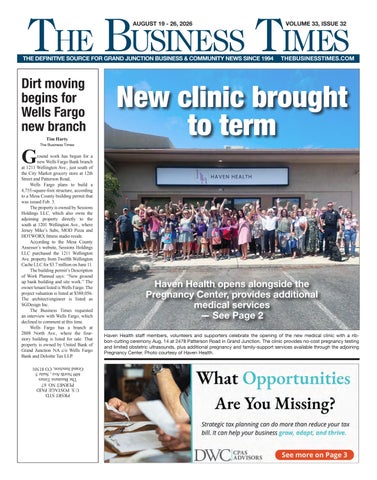
New clinic brought to term
Haven Health opens alongside the Pregnancy Center, provides additional medical services — See Page 2 Haven Health staff members, volunteers and supporters celebrate the opening of the new medical clinic with a ribbon-cutting ceremony Aug. 14 at 2478 Patterson Road in Grand Junction. The clinic provides no-cost pregnancy testing and limited obstetric ultrasounds, plus additional pregnancy and family-support services available through the adjoining Pregnancy Center. Photo courtesy of Haven Health.
PRSRT STD U.S. POSTAGE PAID PERMIT NO. 67 The Business Times 609 North Ave., Suite 5 Grand Junction, CO 81501
The Business Times
Page 2
august 19 - 26, 2026
Haven for health plus pregnancy planning
Pregnancy Center’s planning and preparation made the Haven Health medical clinic possible Brandon Leuallen
Gallob said the organization discusses pregnancy options with clients while remaining consistent with its Christian mission. “We want to give them as many resources and as much education as possible to be aven Health celebrated the opening of its new medical clinic Aug. 14 at 2478 able to make the best decision for their circumstances,” Gallob said. Patterson Road, Suite 3, with an open house, tours and a ribbon-cutting ceremony. The Pregnancy Center’s Earn While You Learn program allows participating mothers The clinic began as a medical service within the Pregnancy Center of Grand Junction to earn up to $500 toward supplies. Participants may earn $250 before their baby is born and now operates as a separate medical arm alongside the nonprofit’s longtime pregnancy and another $250 afterward by completing educational programs. and family-support programs. The assistance may be used for cribs, diapers, wipes, bottles, nursing products, Haven Health opens postpartum supplies and other necessities. Participants can create a wish list and select Haven Health is the new medical arm of the Pregnancy Center, which has served the items that fit their family’s needs. Grand Junction community since 1984. The organization also operates a monthly car-seat clinic funded by a donor. Families receive The clinic provides pregnancy testing and limited obstetric ultrasounds at no cost. a car seat along with instruction on installing it correctly and safely securing their child. Testing and treatment for sexually transmitted infections are also planned as future services. Its Hug of the Heart Boutique provides maternity supplies, clothing and other Pregnancy Center necessities for babies up Executive Director Jaime to 18 months old. Families Gallob said the organization may make an appointment had discussed opening a to shop at no cost once every medical clinic for years, but four weeks. wanted to ensure it had the The Pregnancy Center financial stability, staffing distributed 49,680 diapers and professional oversight and completed about 1,950 necessary to make the client appointments during transition responsibly. 2025, according to Gallob. The process accelerated The organization also after the organization received more than $100,000 purchased its Patterson worth of in-kind donations Road location in 2021, during the year, although giving it space to expand. Gallob said she believes that is a conservative estimate. In 2024, the center held its Housing instability is first fundraising gala to help among the most significant support the transition. The organization challenges facing the center’s hired a national consultant clients, Gallob said. Staff in January 2025 to guide members connect clients it through the process with other community of becoming a medical organizations when they need clinic. That work included housing, insurance or services developing policies and beyond those provided by the procedures, training Pregnancy Center. staff and completing an “We would say that approximately 150-item Carrie Martin, RN, BSN, performs an ultrasound on Haven Health Operations Director Kaitlyn Maurer, who probably the biggest is pregnant. Haven Health provides pregnancy testing and limited obstetric ultrasounds at no cost. Photo crisis for our clients is checklist. The center also hired courtesy of Haven Health. homelessness and not having a registered nurse who stable housing,” Gallob said. received specialized ultrasound training, including training in Mississippi and additional Clients share their experiences instruction from local registered diagnostic medical sonographers. The clinic operates In testimonials shared by the organization, three women described how the Pregnancy under the oversight of a medical director. Center helped them navigate unexpected pregnancies, consider their options and prepare The organization completed its conversion to a medical pregnancy clinic in October for parenthood. 2025 and began offering limited obstetric ultrasounds under medical oversight, Gallob said. A woman named Vanessa said she was young, frightened and worried she would be When the neighboring suite became available, the organization leased and remodeled judged when she first visited the center. She initially came looking for information about the space to create Haven Health, a separate clinic connected to the Pregnancy Center. having an abortion, because she did not believe she was prepared to become a parent. The arrangement allows the organization to distinguish between medical care and its At the center she met with a staff member named Cindy, who discussed parenting existing support services while keeping both available to clients. and adoption with her and later accompanied her to her first ultrasound, because Vanessa Haven Health accepts walk-ins, although appointments are preferred. Staff members did not have anyone else to go with her. generally try to schedule clients the same day or the following day. “I felt super welcomed, super cared for, super cared about,” Vanessa said. “There was Haven Health is open for walk-ins and appointments from 9:30 a.m. to 5 p.m. no judgment the way I was so scared about.” Tuesdays and Wednesdays and from 9:30 a.m. to 7:30 p.m. Thursdays. Mondays are Vanessa said she had little experience or guidance to prepare her for parenting, appointment-only. and she believes she would have been lost without the support she received through the Pregnancy Center continues its work Pregnancy Center. She ultimately decided to continue her pregnancy and said becoming While Haven Health provides medical services, the Pregnancy Center of Grand a mother gave her something to work toward. Junction will remain open and continue the educational and material-support programs it “Something that was so foreign and so scary just became such a joy in my life, something has provided for years. to actually look forward to, something to push for, something to strive for,” Vanessa said. The Pregnancy Center will continue offering pregnancy education, parenting support, Destiny also came to the center during her first pregnancy looking for guidance. She adoption-agency information and referrals, maternity and infant supplies, support for knew she wanted to continue the pregnancy but was nervous and uncertain about what men and post-abortion support programs. steps she needed to take. Neither Haven Health nor the Pregnancy Center performs or refers for abortions. See PREGNANCY on Page 4
H
The Business Times
ng
sible
August 19 - 26, 2026
The Business Times
PAge 3
Page 4
Pregnancy
The Business Times
august 19 - 26, 2026
She said she now has a career path Continued from Page 2 Carrie Martin, RN, BSN, stands beside the ultrasound equipment used to and is looking forward to building a During her first ultrasound, Destiny provide limited obstetric ultrasounds at Haven Health’s new medical clinic in better future for herself and her son. learned she was already 18 weeks pregnant. Grand Junction. Photo courtesy of Haven Health. Private donations, volunteers “Just seeing that was really like, support the work ‘Whoa, we have this, and we need to care The Pregnancy Center is a privately for it, and we need to take care of him,’” funded 501(c)(3) nonprofit. It does not Destiny said. “We’re already halfway accept government funding and instead there, pretty much.” depends on financial contributions, Sam, a volunteer, helped Destiny fundraising events, volunteers and develop a plan before she told her family. donations of supplies such as diapers The plan included beginning to save and wipes. money, continuing her education and Gallob said private funding allows participating in the center’s Earn While the organization to maintain its Christian You Learn classes. identity and, with a client’s permission, When her family asked whether she share its faith as part of its services. had a plan, Destiny was able to explain the Community members can support steps she had already taken and what she the organization through one-time intended to do next. or monthly financial contributions, “Just having that initial support, I its fundraising gala and donations of think, was really helpful, especially in the needed supplies. The organization also beginning when I was just trying to figure holds community events and offers tours out what to do,” Destiny said. for people interested in learning about Allison said she took a homevolunteer or partnership opportunities. pregnancy test and was shocked by the Volunteers handle many of the result. She called Planned Parenthood, but was told it could not see her immediately, and she was directed to the Pregnancy Center. tasks that allow the Pregnancy Center and Haven Health to offer their services at no cost. Their responsibilities include sorting donations, stocking the boutique and washing Allison said she was nervous when she arrived, but found the center welcoming and safe. She considered several options, including abortion, because the pregnancy happened donated clothing before it is distributed. Gallob estimated volunteers complete about 50 loads of laundry each week using the organization’s two washing machines. quickly, and she did not believe she was at the right stage of her life to raise a child. Volunteers also greet and meet with clients to provide support and resources, teach “I didn’t feel pressured at all,” Allison said. “It was more like, ‘Do you think you parenting classes, organize and manage special events and lead post-abortion support groups. have enough information? What else do you need from us?’” Gallob estimated the work provided by volunteers saves the organization about Allison decided to continue the pregnancy. Her son is now 9 months old, and she said becoming a mother motivated her to pursue a more stable career. She had been working in $3,040 each week in labor costs. The Pregnancy Center’s regular hours are 9:30 a.m. to 5 p.m. Tuesdays and retail, but enrolled in cosmetology school after deciding to raise her child. “I am extremely happy with the decision to keep my baby,” Allison said. “He’s made Wednesdays and 9:30 a.m. to 7:30 p.m. Thursdays. Appointments may be scheduled by calling 970-241-7474 or texting 970-500-5139. me into a better person.”
August 19 - 26, 2026
The Business Times
GJ homeless-service providers report results, seek continued city funding
Julie stands in the kitchen of her new apartment after 12 years without stable housing. The Joseph Center’s Golden Girls program helped her work toward permanent housing. Photo courtesy of the Joseph Center. Brandon Leuallen The Business Times
The City of Grand Junction established a three-year funding program in 2025 to help local organizations expand homelessness prevention, stabilization, shelter and housing services. The request for proposals allowed organizations to seek up to $500,000 and submit budgets covering as many as three years. Funding remains subject to annual City Council approval, available city resources and demonstrated program performance. According to a presentation by City of Grand Junction Housing Manager Ashley Chambers during an Aug. 3 City Council workshop, nine organizations submitted requests totaling $3.65 million. Three proposals were selected for interviews, and City Council approved a combined $425,000 for the recipients on Nov. 19, 2025. Grand Valley Catholic Outreach received $75,000, Hilltop Community Resources received $250,000, and the Joseph Center received $100,000. The organizations are seeking a combined $475,000 for 2027 after reporting expanded shelter capacity, eviction-prevention efforts and progress moving people into permanent housing. Hilltop, working in partnership with United Way of Mesa County, is requesting $300,000 for the second year. Hilltop reported serving 229 people between January and mid-July through its Latimer House and Connections programs. The organization expanded its youngadult shelter from five bedrooms to 11, providing capacity for between 11 and 33 people, depending on how the rooms are used. It also established a five-room bridge shelter for people who have secured permanent housing but must wait before moving in. The bridge shelter allows participants to remain sheltered and continue receiving case management rather than return to homelessness while waiting for housing to become available.
Hilltop’s Latimer House served 126 survivors of domestic violence and their children. Eleven adults and 10 children moved from the safe house into permanent housing during the reporting period. The Connections program served 103 people. Among those who left the program, 21 entered permanent housing, and 13 moved into transitional or temporary housing. United Way’s Outreach and Service Coordinator reached 315 unduplicated clients between January and mid-July. The program connected five people with permanent housing, 13 with employment, workforce training or public benefits, and 47 with medical, mental-health or nutrition services. The program sends staff into parks and encampments to provide limited supplies and connect people with established community services. Council member Cody Kennedy questioned whether city funding should focus more directly on addiction treatment, behavioral-health services and permanent housing rather than delivering supplies to encampments. United Way Executive Director Cassidy Lujan said water and other basic supplies are used as an initial point of contact to help people become stable enough to engage with service providers. “If someone is worried about where their next water source is going to come from, they’re not going to be looking to schedule an appointment,” Lujan said. “The main goal of our programming is to reduce barriers to housing.” Grand Valley Catholic Outreach assisted 48 households containing 108 people between February and June. The organization reported that 92 percent remained housed one month after receiving assistance. Catholic Outreach Financial Aid Director Scott Montgomery said the renters served by the program spend an average of 92 percent of their income on rent. See HOMELESS SERVICES on Page 8
PAge 5
The Business Times
Page 6
august 19 - 26, 2026
Relocation to Colorado Avenue came quicker than expected for CommWest Tim Harty
to our IP address, which is tied to our router, which is tied to our location. So, getting it seamlessly moved from there to here with When Martin Jensen and Anson Pierce Spectrum, without any interruption of service bought CommWest from Nate Wallace this for our customers, was stressful to me. And it past November, they knew at some point they’d happened pretty flawlessly.” probably look for a different store location for the Jensen expressed gratitude to both business than 560 S. Commercial Drive, Unit 4. landlords – John Gordon at 560 S. Commercial But it wasn’t Priority No. 1. Or two, or Drive and John Hildebrand at 441 Colorado three… Ave. – for being “super helpful.” Jensen said It wasn’t something that was likely to Gordon allowed CommWest to start a sixhappen in the first year of ownership of the month lease in January instead of a long-term technology-solutions business. lease. And when CommWest needed one more Or, it wasn’t likely until a perfect location month at its former home, Gordon agreed to it. came to their attention. Then, there was no Jensen said there was a time when the ignoring it. Priorities got reconfigured quickly, Commercial Drive address made a lot of sense, and Jensen and Pierce found themselves because CommWest was more about installing moving downtown. commercial phone systems when the business CommWest opened its doors at 441 started a little more than 20 years ago, and it Colorado Ave. on Aug. 1, a month after CommWest owners Martin Jensen, left, and Anson Pierce stand in front of one needed warehouse space. former tenant Realty ONE Group Western of several signs hanging on the walls of the lab room in CommWest’s new loBut he said CommWest, while still doing Slope vacated the space to move into its new cation at 441 Colorado Ave. in downtown Grand Junction. Photo by Tim Harty. phone and communications systems, has home at 750 Main St. evolved into a different business that doesn’t Minus the right-place, right-time scenario require the warehouse space. Jensen doubts there would have been an upheaval of CommWest’s first-year plans. “We do a lot more supporting businesses with IT and cybersecurity, and so we don’t “I don’t think we would have done it as quickly,” Jensen said of the location change. need a giant warehouse,” Jensen said. “We’ve got a shop here, we’ve got some space, but “We just bought the business, right? And so, we would have done it eventually, probably, but it’s more of an office space, so it’s better for our team.” I don’t know if we would have done it as quickly, just because it’s a lot of change all at once.” Jensen said CommWest isn’t the kind of business that needed to be in downtown One of the appeals of 441 Colorado Ave. was its configuration. It was set up with a Grand Junction, but being there has it perks, as he said, “It lets me go to Kiln (Coffee). I lot of offices, and those offices had large windows, helping provide an open feel about the can walk to Kiln.” place. And there was no need to do any renovation or buildout. Jensen added, “I think for us, we’re not a retail business, so we don’t need retail The building essentially was move-in ready, and CommWest spent the month of frontage, you know? We service our customers more than they come to us. But this July moving. Care needed to be taken in moving equipment without disrupting service to (location) is premier. I mean, being on Colorado Avenue is fantastic for us, and when we CommWest’s customers, and Jensen said the staff met the challenge. get our signage up, I think it’s nice for us to have a presence in the community and be “It was a little bit of a stressful month, getting it all moved over,” he said. “Getting visible in the community. So, I like that for us to be here and be visible and be part of the our phones and IP, like, we support everyone remotely, and so their systems are tied core downtown of Grand Junction.” The Business Times
West
August 19 - 26, 2026
The Business Times
PAge 7
Page 8
Homeless Services
Dawn unlocks the door to her new home after moving from homelessness into permanent housing with help from the Joseph Center. Photo courtesy of the Joseph Center.
The Business Times
Continued from Page 5 To qualify, households must earn no more than 80 percent of the area median income, face an imminent risk of homelessness and have some source of income that could allow them to remain housed after receiving assistance. “Our eviction-prevention program prevents those already housed from joining the ranks of the homeless,” Montgomery said. He said Catholic Outreach reviews each applicant’s income and expenses and helps households identify ways to increase income or reduce costs. The program only intervenes in evictions involving unpaid rent. Montgomery said it is generally too late to stop an eviction once a judge has ruled for the landlord and issued a writ of restitution. Catholic Outreach’s $75,000 request for 2027 would be used entirely for direct rental payments to landlords, with no funding allocated for personnel or operating expenses. The Joseph Center is requesting another $100,000 to support its expanded Golden Girls transitional-housing program, Family Center, day services, workforce readiness, child care, case management and behavioral-health-recovery services.
august 19 - 26, 2026
The Golden Girls program increased from four beds to 16 after the organization purchased two buildings with federal pandemicrelief funding previously awarded by the city. Joseph Center founder and Executive Director Mona Highline said 48 women have entered the program since October 2025, with 23 moving into permanent housing. Eight obtained housing without rental subsidies. The Family Center served 26 families during its first year. Six moved into permanent housing. Highline highlighted that five of the six did not require housing subsidies. Highline said the Joseph Center also has spent more than $30,000 this year preventing evictions and helping people cover their first month’s rent. The organization received more than 50 requests for eviction assistance during each of the previous two months and is increasingly working with residents in their 80s who face displacement. HomewardBound update HomewardBound of the Grand Valley provided a separate update on its 112-bed Pathways Family Shelter after closing its North Avenue shelter in February. Its funding request is separate from the city’s three-year request for proposals program. HomewardBound Board Chair Brittany Bear and Chief Operating Officer Chris Masters said a separate $185,000 city allocation for 2025-26 allowed the organization to keep the North Avenue shelter open through February, consolidate operations at its 29 Road shelter and implement a new service model. The organization reduced its annual operating budget from $2.6 million to $1.7 million and staffing to 18.5 full-timeequivalent positions. See HOMELESS SERVICES on Page 10
August 19 - 26, 2026
The Business Times
PAge 9
Page 10
The Business Times
Homeless Services
august 19 - 26, 2026august
Continued from Page 8 Between March and June, Pathways recorded 8,416 occupied bed nights, with nightly occupancy ranging from 60 to 90 people. Case managers completed work plans for 95 percent of clients and submitted more than 225 housing applications or referrals. HomewardBound reported placing 57 clients into housing, its highest housing-placement rate in the organization’s history. HomewardBound is requesting $225,000 from Grand Junction for 202627 and $260,000 for 202728. It is also requesting contributions from Fruita, Palisade, De Beque and Mesa County. The organization wants local governments within Mesa County to collectively Linda rings the bell at the Joseph Center to celebrate provide approximately 20 moving into her new home after receiving support percent of shelter-operating through the Joseph Center’s Golden Girls program. costs within two years while Photo courtesy of the Joseph Center. it raises the remaining 80 percent from private donations, foundations, partnerships and other sources. Kennedy said committing the city to a percentage of HomewardBound’s operating expenses as a funding model would be a “nonstarter” for him. He said city funding should be strategically directed toward programs that produce measurable progress toward permanent housing rather than for organizations to use simply for operations not directly tied to measurable progress. Council member Ben Van Dyke questioned why Grand Junction should assume such a large share of the cost when HomewardBound describes Pathways as the largest shelter between Denver and Salt Lake City, serving a 12-county region. Council member Scott Beilfuss said he was impressed by HomewardBound’s transition to its new operating model and encouraged other council members to tour the Pathways facility to see its work firsthand. Bear said HomewardBound has begun requesting financial support from other local governments within Mesa County, and she argued that people generally do not move to Grand Junction specifically for shelter services. “What we’ve heard is they’re coming here for jobs, and the jobs just don’t work out, or the jobs still can’t get them to first and last month’s rent,” Bear said. Bear added that nearby Bureau of Land Management property provides places to camp that may be more accessible than those in some surrounding communities. Mayor Laurel Lutz reminded council members that HomewardBound’s presentation was scheduled as an operational update, not a formal funding request. The Aug. 3 workshop was a preliminary step in the funding process for 2027. Council did not approve any allocations and will consider the requests during upcoming budget discussions before adopting the 2027 city budget later this year.
August 19 - 26, 2026
Page 8 rch and recorded d nights, ccupancy 0 to 90 managers plans for ents and han 225 ions or ardBound 57 clients highest rate in history. und is 00 from or 2026for 2027equesting m Fruita, que and
on wants s within llectively ately 20 operating ars while ining 80
operating ng should s toward ot directly
ume such est shelter
dBound’s o tour the
ther local t move to
work out,
places to s. sentation
. Council ng budget
The Business Times
PAge 11
Page 12
The Business Times
July real estate sales almost identical year over year July 2026’s 270 residential real estate sales in Mesa County were one less than the 271 sales in July 2025, while active listings were 24.3 percent higher year over year for July with 971, according to data gathered by Bray & Co. Real Estate. July’s home sales were 27 more than June 2026, and July’s active listings increased by 59 from June 2026. July’s median price of $428,500 was down 1 percent year over year, while the average of 66 days on the market was six more than June 2026 and eight days more than July 2025. Year-to-date sales totals through July have decreased by 7.8 percent, dipping from 1,726 at this time last year to 1,592, while total sales volume has dropped 8.1 percent, with a total of $749.5 million compared to $815.6 million in 2025. The most popular price range for residential sales remains $300,000 to $399,000 with 463 sales year to date (as of July 31), followed by 376 sales in the $400,000–$499,000 range, 333 sales in the $500,000–$749,000 range and 159 sales in the $200,000-$299,000 range. Year-to-date sales of residential
properties for $1 million or more is 59, with 12 of those sales coming in July. Through July 31 this year, the most popular area to buy is North Grand Junction with 221 sales, followed by Grand Junction City at 199, Orchard Mesa and Southeast Grand Junction at 185 apiece, Northeast Grand Junction and Fruita at 180 apiece and Redlands at 166. Clifton has 108 sales so far in 2026, and Loma/Mack/Northwest/West has 68. Single-family building permits are down 7.1 percent yearto-date at 381, compared with 410 a year ago. Average months of inventory currently sit at 3.6 months, a decrease of 0.2 from June. North Grand Junction currently has the most active listings with 149, followed by Fruita with 126, Redlands with 122, Grand Junction City with 98, Northeast Grand Junction with 90, Southeast Grand Junction with 82, Orchard Mesa with 75, Clifton with 56, and Loma/Mack/Northwest/West and East Orchard Mesa/Palisade with 51 apiece.
august 19 - 26, 2026
CASA announces personnel moves, new location
In its August newsletter, CASA of Mesa County announced several position changes among its personnel and an upcoming move to a larger location. Krista Jackson was promoted to program director, a position vacated by Kim Harris, who made a lateral move to a new position at CASA: program support and development director. And Jackson’s former Krista Jackson position of advocate coordinator is being filled by Kaci Cole. Jackson will oversee program operations, volunteer supervision, case coordination, training and program development. CASA said in the newsletter Kim Harris that Jackson’s “dedication, experience and leadership have already made a meaningful impact, and we are confident she will continue to strengthen our advocacy program for the children we Kaci Cole serve.” About Harris and the new position that was created, the newsletter said, “Kim’s extensive knowledge and commitment to CASA will continue to benefit the organization as she focuses on organizational development, volunteer engagement, training and providing additional support wherever it is needed.” Cole is a former elementary school teacher who with CASA of Mesa County will “work closely with our CASA volunteers by providing guidance, support, case coordination, documentation assistance and ongoing advocacy resources.” On Aug. 31 through Sept. 4, CASA of Mesa County will temporarily close its current location (2139 N. 12th St., Unit 5), so it can move into Suite A-119 of Independence Plaza at 1048 Independent Ave. CASA’s office space will increase from 1,239 square feet to 2,398 square feet. The newsletter said the additional space will provide a more spacious conference area for training and in general will allow everyone to work more comfortably and collaboratively. Plus, CASA will begin offering visitation spaces for families. F
ces ves, n
August 19 - 26, 2026
CASA of position and an ion. moted to director, vacated Harris, a lateral a new CASA: support elopment And former advocate is being ci Cole. will program volunteer case ation, program t. CASA ewsletter Jackson’s ation, and have made a impact, confident continue hen our program ldren we
Harris created, extensive ASA will on as she lopment, ng and herever it
ementary ASA of ely with providing dination, ongoing
4, CASA close its St., Unit A-119 of ependent
increase uare feet. nal space onference will allow ably and ill begin milies.
The Business Times
PAge 13
Page 14
The Business Times
august 19 - 26, 2026
26, 2026august 19 - 26, 2026
The Business Times
Page 15
Why the Mesa Vibe Check matters for your bottom line When we talk about the economic health of Mesa County, we often focus on growth, what’s happening in the housing market and consumer spending. But for local employers, quality of life for their teams is incredibly important: Can our employees find affordable housing? Do they have reliable child care? Is our community a place where people want to stay and raise a family? At Mesa County Public Health, we know that a strong local economy relies on a healthy, supported workforce. That’s why we’re encouraging business leaders and employees to participate in the newly launched Mesa Vibe Check. The Mesa Vibe Check is an anonymous, quality-of-life assessment open to all adults in Mesa County through Sept. 30. It is completely anonymous, quick to complete and easy to take on a Sarah Gray phone or computer. “Our primary goal is to learn about priorities for residents and identify hidden issues related to their quality of life, because a healthier community begins by truly listening to the people who call it home,” said Alice Ireland, Mesa County Public Health data and informatics manager. While it’s designed to gather community feedback, the questions also represent key drivers of local business success, including: • Housing affordability, local safety, trails and overall community livability. These factors heavily influence whether workers stay or relocate. • Access to quality healthcare, mental-health programs, and dependable child care, which directly affects absenteeism, turnover and workplace productivity. “Ultimately, this data guides us to evaluate key initiatives and prioritize resources where they will have the greatest impact as we head into our next Community Health Needs Assessment in 2027,” Ireland said. The Community Health Needs Assessment is a comprehensive report that is completed every three years in partnership with local hospitals and other organizations. It provides a snapshot of all of the factors that contribute to the overall health of people in Mesa County. As business leaders, your voice, and the collective voice of your team, matters.
Here is how you can support this effort: • Take the Mesa Vibe Check yourself, and share your own perspective as a local employer or resident. • Pass the link along to your employees in your internal communications, staff newsletters or break-room flyers. • Stay informed. Participants can opt in to receive the final report, giving you valuable local data to inform your own organizational planning. A thriving business environment starts with a thriving community. Let’s make sure the business perspective, and the needs of our workforce, are fully represented. Take the 5-minute Mesa Vibe Check today by going online to: bit.ly/mesa-vibe-check. F Sarah Gray is a communication specialist with Mesa County Public Health. For additional information, call (970) 248-6900 or visit mesacounty.us/public-health.
Page 16
The Business Times
august 19 - 26, 2026
I guess I’m going to hell in a handbasket
Just a little short rant* because Commander Cody deserved the space below. And according to head coach of the Indiana Fever, Stephanie White, I’m already on my way. In White’s own inclusive and loving way, she’s told me, and millions of WNBA fans to, “Go to Hell!” Right before grabbing her woe-isme statement and storming off. As Dan Rather would say when not looking for those National Guard memos, “Courage.” As Craigy would say, “That’s the least courageous thing White could have done.” I mean, how courageous is it to Craig Hall
OPINION
take a (woke) stand no one would come back at you for and then insult those who think differently and walk off in a huff? But that’s the “W” for ya. And you thought President Bush made a joke out of one letter. Well, Coach, the road to hell is paved with good intentions, and there’s a highway to hell and only a stairway to heaven. And you’re on the down escalator. So, right back atcha. Oh, and I’m passing you on the way UP. Stephanie, fans can all see right through what you are doing and what you’re missing – kinda like that foul on Sophie. Maybe it’s time you realize folks think and do and say differently from your universe of love and inclusion. They
have their own. Fans just want to watch basketball, even the kind the WNBA serves up. They don’t want to get caught up in any of that funky stuff going down in the city. So, before your next insulting tirade, take a reality-based stand instead of spewing words that sound like good intentions yet only divide. Again, your fan base just wants to tune into the game. Something most never did until a couple of years ago. That’s where you need love and inclusion. In Truth and freedom. *This li’l rant was in no way influenced by my not-sosecret crush on Sophie Cunningham. Craig Hall is owner and publisher of the Business Times. Reach him at (970) 424-5133 or publisher@thebusinesstimes.com.
Providing context to the HomewardBound ‘non-starter’ comment
During the August 3rd Grand Junction City Council workshop, I called HomewardBound’s proposed funding model a “non-starter.” That comment was in response to a specific funding request HomewardBound presented to Council that evening. Beyond the workshop itself, there is some important history behind my response that I felt was worth sharing with our community. That history includes conversations I was directly involved in last year as HomewardBound faced a serious financial crisis. That context matters, because the Cody Kennedy funding request presented to Council on August 3rd was very different from the circumstances under which the City had previously provided financial assistance to HomewardBound. To understand that distinction, it helps to start with what happened during the rest of the workshop. My comment wasn’t in opposition to HomewardBound, and it certainly wasn’t in opposition to helping people experiencing homelessness. It was a response to a very specific proposal: HomewardBound wants local governments to collectively fund approximately 20 percent of its annual operating budget every year going forward, with Grand Junction’s contribution increasing from $185,000 to $225,000 next year and eventually $260,000 annually. This funding model is what I called a non-starter. The distinction matters, particularly because of what happened during the rest of the workshop. Before HomewardBound presented, Council heard from Grand Valley Catholic Outreach, Hilltop Community Resources and the Joseph Center. Those organizations were selected through a competitive, three-year City RFP (Request for Proposal) designed to provide funding for specific homelessness services and produce measurable outcomes. I personally support all three organizations, and I was very positive about much of what we heard. Catholic Outreach told Council how they were using City dollars to prevent evictions before people become homeless. Importantly, they don’t simply hand someone a check; they review household finances, provide budgeting assistance, work directly with landlords and track whether families remain housed. The Joseph Center reported significant success moving women and families into permanent housing, including some who no longer require housing subsidies. Some of these stories are well-documented on the Joseph Center’s social media. I encourage you to take a moment to hear these heartwarming stories. Hilltop reported significant progress in emergency and transitional housing, case management and a bridgehousing program designed to keep people from returning to the street while permanent housing is being secured. They are also working with United Way to extend the impact of the City funds they have received. Those presentations demonstrated exactly why the City used an RFP in the first place. We can identify the
Op-Ed by Cody Kennedy
services we want to fund, establish expectations and then ask whether taxpayers are getting the outcomes we intended as we consider the next year’s funding request. HomewardBound was different. They had requested an opportunity to give Council an organizational update. During that update, however, they pivoted and presented an ongoing funding request to Council. Eventually Mayor Laurel Lutz reminded everyone that the item had been publicly noticed as a HomewardBound update, “not a funding request,” and redirected the discussion. There is another important piece of context. The City’s previous $185,000 contribution to HomewardBound came from previously budgeted but unspent funds and was provided for a specific purpose: helping keep HomewardBound’s shelters operating through the coldest part of the winter while North Avenue remained open and the organization transitioned toward consolidation at Pathways. It was never a commitment to provide permanent annual funding, much less a starting point for increasing annual operating subsidies. I know that history particularly well because I was directly involved in those discussions. Last November, when I was mayor, I sat down with Mayor Pro Tem Laurel Lutz, City Manager Mike Bennett, then-City Attorney John Shaver, and HomewardBound’s leadership team for an extensive discussion about the organization’s finances, shelter operations and the path forward. The financial situation HomewardBound described to us was serious. They explained that operating both the North Avenue shelter and Pathways was unsustainable. North Avenue had to close or, as we were told during that meeting, “the organization will fold.” The plan was to get through the coldest part of the winter, close North Avenue, consolidate operations at Pathways, reduce costs, restructure the organization and build a financially sustainable one-shelter model. That was the context in which the City ultimately provided crisis-specific financial assistance. We were trying to help HomewardBound get through a specific financial crisis and keep North Avenue operating through the winter while the organization transitioned to a model it believed it could sustain. In fact, one of the most important things HomewardBound told us on the morning of November 17th, 2025, was that simply finding more money wasn’t the solution. Discussing the restructuring, Dan Prinster, then interim CEO, said, “I felt it was incumbent upon me not to just say, ‘Oh, you’re short cash. Let’s go find the cash.’ It’s figuring out where we go in the future.” I agreed then, and I still do. That November conversation was not about establishing a permanent municipal operating subsidy. The focus was getting through the immediate crisis, consolidating to Pathways and creating a sustainable organization for the future. In our recent workshop, Council member Robert Ballard raised essentially the same concern, asking whether the $185,000 had ever been intended as recurring annual funding. The answer is simply that there was no multi-year City commitment establishing $185,000 as an annual baseline.
Yet HomewardBound’s presentation treated that $185,000 as the baseline, proposing $225,000 next year and $260,000 thereafter as part of a broader goal of having local governments fund approximately 20 percent of its operations. That’s why the context matters. I supported helping HomewardBound through a financial crisis because I wanted the organization and the services it provides to continue for the benefit of those they serve. Turning that crisis-specific assistance into the baseline for an increasing annual operating subsidy is a very different proposition. Beyond the funding request, it’s important to note that HomewardBound reported some genuinely encouraging changes. It has reduced its annual budget from approximately $2.6 million to $1.7 million, consolidated operations to the Pathways shelter, increased case-management requirements and reported the highest housing-placement rate in its history. I sincerely commend them for that. In many respects, those changes are exactly what we were talking about last November. HomewardBound has made difficult decisions, reduced its costs and changed its operating model. This is significant progress, and it deserves to be acknowledged. But an organization doing good work does not automatically create an obligation for taxpayers to fund its general operations. If the City supports specific services through an RFP, we know what outcome we’re trying to achieve and can hold organizations accountable. General operating support is different. Is an additional City appropriation paying for another case manager? Another shelter bed? Housing placement? Administrative overhead? Existing obligations? Payroll? Paying off debt? With an RFP, we can answer those questions before we appropriate the money. Those aren’t hostile questions. They’re the questions Council should ask before spending public money. And the implication that this position somehow reflects opposition to nonprofit organizations or homelessness services doesn’t survive even a casual examination of my record. I personally give to Catholic Outreach, the Joseph Center and Hilltop. Last year, I donated all of my after-tax income from serving on City Council to United Way of Mesa County to fund unhoused services. I mention this because there is an important distinction between private generosity and public responsibility. I am free to give my money to organizations whose work I believe in. As a Council member, when I’m voting to spend your money, I have a fiduciary responsibility to demand a clearer public purpose, measurable outcomes and accountability. The City has its own financial challenges. Our strategic plan prioritizes core responsibilities, including public safety, streets, utilities, and parks and recreation. There isn’t an unlimited pool of discretionary money sitting around waiting to be distributed. So yes, I called the expectation that the City should assume an increasing, ongoing share of an outside organization’s general operating budget a non-starter. And knowing the history of how we got here only reinforces my position. Cody Kennedy is a Grand Junction City Council member.
August 19 - 26, 2026
The Business Times
PAge 17
Page 18
The Business Times
n Veritas attorneys chosen to lead area bar associations Veritas Injury Lawyers announced two of its attorneys stepped into influential leadership roles in the area, the firm said in a news release. Joseph H. Azbell has become President of the Mesa County Bar Association, and managing shareholder Keller A. Caubarreaux has been selected to serve as Region 6 Vice President of the Colorado Bar Association. Azbell, who took on his new role July 1, Joseph H. Azbell Keller Caubarreaux said, “Serving as president of the Mesa County Bar Association is one of the greatest honors of my career. Our local bar does incredible work supporting attorneys and expanding access to justice in our community, and I’m thrilled to help build on that momentum.” Caubarreaux took on his Region 6 VP duties in April after being selected for it by the Colorado Bar Association’s Leadership Selection Committee. Region 6 encompasses the Four Corners, Mesa County, Seventh Judicial District, and Southwestern Colorado Bar Associations, spanning much of Colorado’s Western Slope.
n Gerber Group joins The
Agency Grand Junction
The Agency Grand Junction announced the addition of The Gerber Group, a real-estate team with decades of combined experience. The Gerber Group includes Kristie Gerber, Carol Gerber and Ian Gallegos Left to right, Carol Gerber, Kristie Gerber, Ian Gallegos. and has been working together for more than 12 years and has built a reputation for exceptional client service, particularly among seniors navigating important housing transitions. The team holds the Senior Real Estate Specialist (SRES) designation, with Carol Gerber recognized as the longest-standing SRES designee in Grand Junction, The Agency said in a news release. “For more than a decade, our mission has been to raise the standard of client care,” Kristie Gerber said. “The Agency’s boutique approach, innovative marketing and commitment to delivering white-glove service at every price point perfectly align with our values.” The Gerber Group was formerly known as The Mesa Group with Keller Williams Colorado West Realty. The Agency Grand Junction opened in February under the leadership of managing partners Dave Kimbrough and Jan Kimbrough-Miller. To learn more about The Agency, visit www.theagencygrandjunction.com.
august 19 - 26, 2026
n County approves contract to replace A/C in Justice Center
During an Aug. 11 public hearing, the Mesa County Commission approved a $2.2 million contract for the replacement of air conditioning units on the Mesa County Justice Center. The Roof Top Units will be installed by Comfort Air of Grand Junction, which was awarded the $2,223,684 contract. The units provide heating and cooling to the building. The current units are 26 years old, and getting parts to repair them has become more difficult in recent years. The industry standard life expectancy for RTUs is 20 years. The installation is scheduled to be done at the end of February 2027.
n Grand Valley nonprofits receive El Pomar grants
El Pomar Foundation trustees approved $251,000 allocated to 30 nonprofit organizations and government entities in the Northwest region during the foundation’s June trustees meeting. Grand Valley nonprofits receiving grants for general operating support were: Center for Enriched Communication, $30,000; GJ Blackout, $5,000; Good Samaritan Clinic of Western Colorado; $5,000; Grand Valley Youth Football, $5,000; John McConnell Math and Science Center of Western Colorado, $5,000; and Western Colorado Community Foundation, $10,000. Grand Valley nonprofits receiving grants for direct human-service needs were: Clifton Christian Church Food Bank, $5,000; Community Food Bank, $7,500; and Western Slope Center for Children, $7,500. Other grants to Grand Valley nonprofits were awarded to: Health Solutions West Foundation, $7,500 for Health Solutions West; Grand Valley Catholic Outreach, $6,000 for Stop Eviction Program; Housing Resources of Western Colorado, $5,000 for renter and homeowner support; Joseph Center, $5,000 for GAP Program; and Western Colorado Community Foundation, $5,000 for commissioned art project.
Business Bites • Take 5 Oil Change coming to GJ: The former auto-repair building at 2260 North Ave. (northwest corner of 23rd Street and North Avenue intersection) has been demolished. In its place, a Take 5 Oil Change will be built. According to a Mesa County building permit that was issued May 11, the description of work calls for a new build for a one-story, 1,778 square-foot, express-oil-change-service building. Founded in Louisiana in 1984, Take 5 Oil Change says on its website, www.take5. com, it offers stay-in-your-car express oil changes that usually wrap up in about 10 minutes. Data company ScrapeHero reported as of June 10 this year there are 1,350 Take 5 Oil Change locations across the nation. • Hildebrand joins GJARA: Angela Hildebrand, president of Elevate Property and HOA Management Services, was inducted into the Grand Junction Area Realtor Association during its quarterly luncheon in June. Hildebrand, who also has more than 26 years of experience as a certified public accountant, manages Elevate with her husband, John Hildebrand, the company’s vice president.
Center
2.2 million enter. which was building. ome more ears.
nonprofit undation’s
re: Center Clinic of nell Math ommunity
eds were: 500; and
ons West h, $6,000 for renter Colorado
0 s been a County build for
ww.take5. about 10 ,350 Take
Property a Realtor re than 26 husband,