As western Colorado continues to experience drought conditions and elevated wildfire danger, fires have burned across the region this summer, including along the Colorado River corridor and in neighborhoods in Mesa County. Some have been sparked by lightning, others by downed power lines, and authorities say some have been intentionally set.
The Two Rivers Wildfire Coalition says one of the most effective ways to protect a home begins long before smoke appears on the horizon.
While many people picture homes catching fire as flames reach the structure, Two Rivers Wildfire Coalition Executive Director John Rizza said most homes are actually ignited by wind-blown embers that can travel well ahead of the main fire. Rizza shared a list of tips and resource guides with The Business Times for hardening homes and properties against wildfire risk.
“Most homes ignite by embers, not the fire front,” Rizza said. “You can find photos where the house is gone, but the trees around it are still green.”
Those embers can accumulate on roofs, decks and in gutters or be pulled into attic and crawl space vents, igniting a home from the inside. Rizza said research has shown that reducing places where embers can enter and removing combustible debris buildup from on and around a home can significantly improve a structure’s chances of surviving a wildfire.
See story Page 5
Equipped to slash and burn
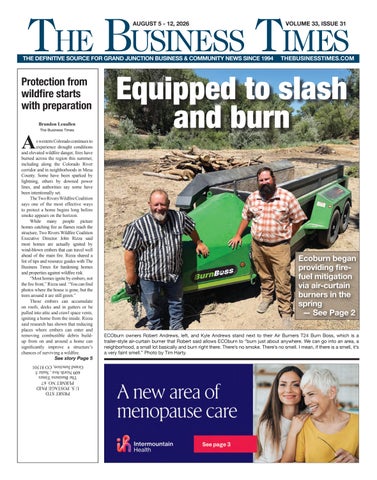
ECOburn owners Robert Andrews, left, and Kyle Andrews stand next to their Air Burners
Ecoburn began providing firefuel mitigation via air-curtain burners in the spring — See Page 2
T24 Burn Boss, which is a trailer-style air-curtain burner that Robert said allows ECOburn to “burn just about anywhere. We can go into an area, a neighborhood, a small lot basically and burn right there. There’s no smoke. There’s no smell. I mean, if there is a smell, it’s a very faint smell.”
Photo by Tim Harty.
Fighting fire fuels with fire
ECOBurn uses air-curtain destructors to burn large amounts of wood quickly and without smoke
Tim Harty The Business Times
Sheep grazing led their inquisitive minds to ask a burning question. Research begot an answer that engaged their problem-solving mentality. Then, their entrepreneurial spirit produced their latest business venture: ECOburn.
Robert Andrews and his son, Kyle Andrews, now burn wood and vegetative waste for a living, providing fire-fuel mitigation from the likes of tree deadfall in a park, large slash piles or a giant, dying, shade tree that a property owner needed to take down before a windstorm dropped half of it on the house.
They spell out the vision of ECOburn on their website, www.ecoburnllc.com, by saying it “specializes in removing excessive fire fuels by decreasing the volume of combustible vegetative waste. We employ systems designed to effectively reduce smoke emissions by up to 97 percent, ensuring a cleaner burn and a healthier environment.”
Those systems also reduce the overall mass by 98 percent, leaving ash and biochar, the latter of which they deem a value-added benefit for its ability to absorb six times its weight in water and serve as a soil amendment.
The Andrews tout ECOburn’s services as a costeffective way for local communities, property owners and businesses to dispose of downed trees and slash piles, saying it’s significantly less expensive than having the wood hauled to the landfill or reduced to wood chips. Robert Andrews says ECOburn’s cost will often be less than half of those other methods.
Slash piles are what got the gears going in the Andrews’ heads, and they can thank their sheep for the inspiration. They have several other businesses based out of Robert’s home in Mack – High Country Environmental Grazing; New Liberty Wool Pellets; and Ewe So Soft (sheep-milk lotions and soaps) – in which sheep play a starring role. So, the animal’s involvement in a seemingly unrelated business actually makes sense.
The Andrews have anywhere from 250 to 350 sheep, depending on the time of the year, and the grazing operation has led to the uncovering of “tons and tons of material that is prone to potential wildfire,” Kyle Andrews said. “We discovered that there are tons of locations that are very similar, where somebody maybe cut a tree down 30 or 40 years ago and just said, ‘We’ll just leave it there, and we’ll get to it at some point.’”
Robert added those people are prone to saying they will get to it next week, next month, “then it’s 30 years later, and it’s been overgrown.
“So, we found a lot of these things that looked like small hills and stuff like that that were actually overgrown piles of slash that had just been taken over by bindweed or kochia, things like that.”
He added those slash piles “were just tinder dry.”
That led the Andrews to ask: How can we address that? What’s the next step? How can we eliminate that potential hazard?
“Naturally,” Kyle said, “you try to discover the most appropriate and direct way to go about it. Not necessarily easiest way, but the most efficient way. And so, in doing so, we sat down for a while and discussed what other options are out there.”
That led to research that led the Andrews to air
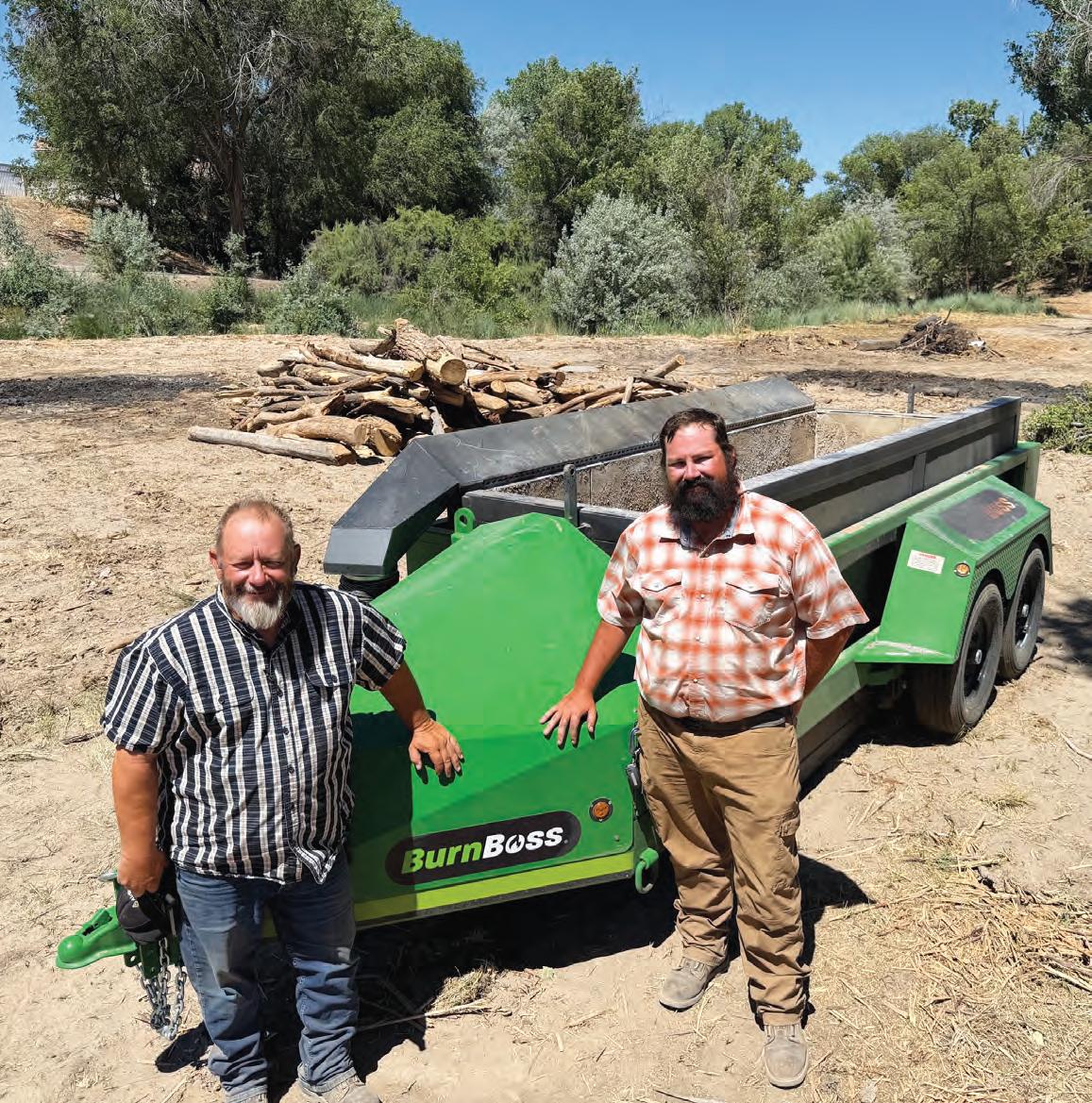
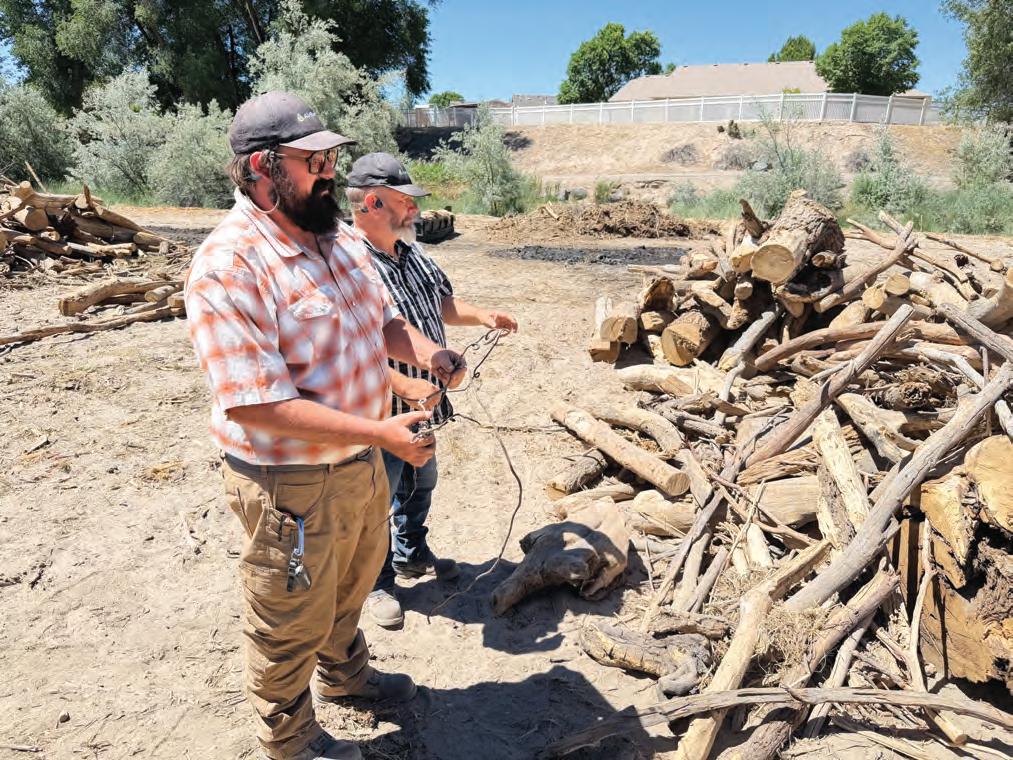
ABOVE — Kyle Andrews, front, and Robert Andrews stand next to a pile of slash at Little Salt Wash Park in Fruita on June 10. Robert said ECOburn’s air-curtain burners can reduce that pile to ashes and biochar in about an hour. Photo by Tim Harty
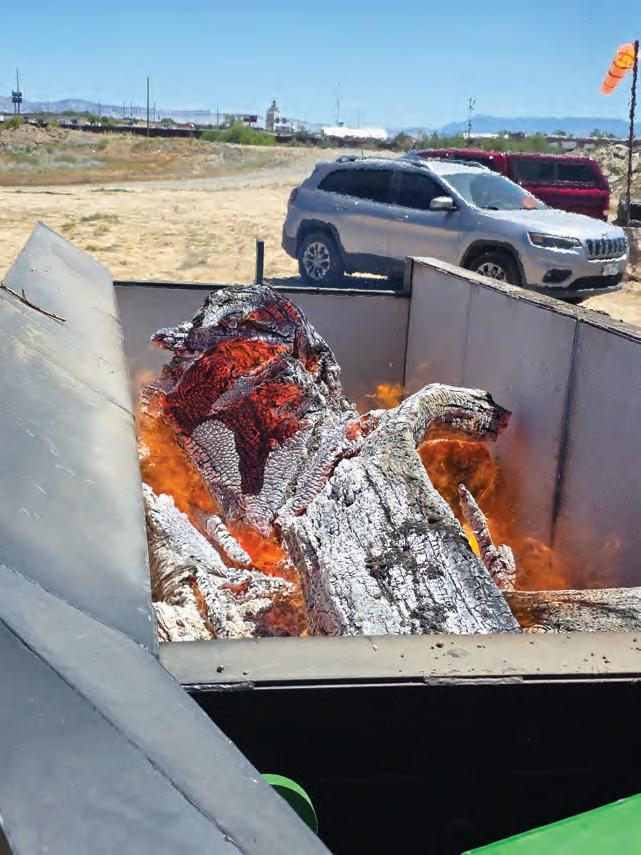
BELOW — Wood burns in the Air Burners T24 Burn Boss, the smaller of the two air-burning systems ECO burns uses. Photo courtesy of ECOburn.
burners, or air-curtain destructors, and their use and why they’re necessary in certain environments.
“And here it’s a perfect location to get them in, implement them into a project and allow for them to be seen,” Kyle said. “We want the community to see them and their effectiveness.”
What the community won’t see is much smoke, as the air curtain that is created by a diesel engine and a fan creates a vortex that keeps the flames and the smoke inside the metal walls of the system.
“The only thing that comes out is heat,” Robert said, adding the wood inside “burns 1,800 to 2,400 degrees, hotter than a crematory.” He added the materials burn 40 times faster in the air-curtain destructor than they would in open burning.
The Andrews say the journey to where ECOburn is now, doing work for the City of Fruita at The Launch mixed-use development and Little Salt Wash Park, officially began in January of this year.
“That is when we got everything started,” Robert said. “We did significant amounts of research, talking with the systems manufacturer, talking with other people running systems throughout the country.”
They talked to different entities, such as the Colorado State Forest Service, U.S. Forest Service, Colorado Parks and Wildlife, and local parks and recreation departments through Grand Junction, Palisade and Fruita, and asked all of them: Is this a need based on what you’re seeing?
Robert said the response was: “Absolutely. They all agree across the board.”
See ECOburn on Page 4
ECOburn
Continued from Page 2
Then, the Andrews talked with large land owners who have been affected by wildfires in the past, and Robert said they were voicing how expensive it is to have a mulcher or masticator come in, and they were concerned about the short-term effects of it on the overall environment. He said a lot of those landowners have slash piles that they’re trying to get funding to get rid of, so he told them how an air-curtain destructor would be a more cost-effective alternative for them and have value-added benefits such as biochar.
“So, we had a huge amount of support,” Robert said.
And one more reason the Andrews believe ECOburn will be needed is Colorado will fully implement new rules in 2029 to limit methane emissions in the state’s landfills. That will limit the green waste people can take to the landfill, so it will have to be disposed in another way.
Once the Andrews were convinced they had customers waiting for a business like ECOburn, their research led them to Florida-based Air Burners Inc. to purchase two systems: the T24 Burn Boss, which is a trailer and can burn one to two tons of vegetative waste per hour; and the S116R, which is a roll-off version, much larger in size and capable of burning two to four tons per hour.
More About ECOburn
Got vegetative waste to burn?
Find out more about ECOburn on its website, www.ecoburnllc.com, or call the business at 970-260-2130 or email ecoburnllc@gmail.com.
Marine experience carries over ECOburn’s father-son owners Robert Andrews and Kyle Andrews both served in the U.S. Corps, which prepared them well for running a business like ECOburn, which specializes in removing excessive wildfire fuels.
Robert was a career Marine who retired after 26 years, and Kyle spent five years in the Marines.
The S116R from Air Burners Inc. is a roll-off air-curtain burner that Air Burners says is “designed for the high temperature burning of forest slash, agricultural green waste, land clearing debris, storm debris and other waste streams.” It is the larger of two air-burning systems that ECOburn uses, and it can burn two to four tons of wood in an hour. Photo courtesy of ECOburn.
ECOburn received those systems in late April, and the Andrews have been burning ever since, thanks in large part to the City of Fruita, which immediately provided work to the new business.
It was the Andrews’ sheep that exposed Fruita’s need in the first place, before ECOburn was formed, as the sheep had been brought in to graze at The Launch and Little Salt Wash Park.
“When we grazed The Launch area,” Robert said, “we uncovered a ton of deadfall and slash piles that had been there, and we started asking that question of, ‘Well, what now? How do you get rid of it? What do you do with it?’”
Then, they started grazing the Little Salt Wash bike trail, where tall growth hid a lot of giant logs and such that Robert said had been there dating back to a mitigation program 30 to 35 years ago.
Kyle said he and Robert had a conversation with the City of Fruita to identify how best to remove the logs, some of which were two to three tons.
“It’s too big to fit in a chipper,” Kyle said. “It’s too big to set anywhere else. Can’t take it to the landfill. Can’t get equipment in there. So what do we do with it?”
The answer, of course, was: Start a company that can take an air-curtain-destructor burning system in there.
And ECOburn will be there for a while.
“We have a semi permanent site over there that we’ll have for the next six months to a year,” Robert said, “where the city’s bringing us stuff, and different businesses, land clearing, development and the rolloff businesses are bringing us stuff there.”
“We were both chemical, biological, radiological, nuclear (CBRN) defense specialists, and essentially what that means is: Anything that can and possibly could hurt you, those aspects we dealt with, hazardous materials, all that,” Kyle said. “We also built a lot of hazardous-materials and fire-type stuff, dealing with: How do you respond to it? How do you prevent against that? The defense aspect of it.
“And so we learned a lot about what doesn’t belong, what doesn’t need to be around … for certain areas. But as we went through, we found that there’s certain parts of that that will apply to a lot more than just what we did.”
Kyle augmented his military experience with an education from the University of Missouri, where he got a bachelor’s degree in agricultural-systems technology and agribusiness management, plus a certificate in precision agriculture. So, he said he learned “about all the different threats that agriculture faces, and one of those is fire and potential fire fuels within agriculture.”
Host a neighbordhood burn party…?
ECOburn expects to get business from people who balk at the cost to have their vegetative waste hauled to the landfill or masticated and spread on their property.
Robert Andrews characterized chipping as fairly expensive and said it has the additional drawback of being bad for the soil.
“It’s a great, quick solution, but the secondary and tertiary impacts of that are significant,” he said. “And again, it’s very cost-prohibitive for most people.”
It’s not that ECOburn is inexpensive, though, so the Andrews suggest homeowners get together with neighbors to offset costs.
“If you split that between four, five, six neighbors for the day, each of you might pay a couple-hundred dollars,” Robert said. “You have that potential fire hazard gone, and at the same time you get some nice biochar out of it if you want to keep it. And if you don’t,
we’ll take it with us.”
… Or see if trash hauler can help Robert Andrews said another alternative for homeowners is using a local waste-hauling business like Dumpster Dan or RonSon Roll Offs, both of which ECOburn is contracting to bring the vegetative waste to ECOburn.
“They can come drop off a Dumpster. You fill it up with your woody material. They’ll come pick it up, and they bring it to us in Fruita,” Robert said.
Big thank-you to the BIC
Like many new businesses in the Grand Valley do, ECOburn turned to the Business Incubator Center for help getting started.
“They supported us 100 percent, and they provided a significant amount of funding for us to purchase the system,” Robert Andrews said.
The funding came in the form of loans, which the incubator could provide when other lenders would not.
“We looked at traditional lenders, things like that, and because it’s unique, nobody was really sure how to handle that,” Robert said.
Plans for growth
ECOburn is looking to take on several large projects, and if those materialize, it may experience an early growth spurt.
“That’s our goal,” Robert said, “is once people see the value in the service is that we can continue to grow, and then we can have teams, a system, and a couple of crew members throughout the state, different locations, continuing fire-fuels mitigation, beetle-kill mitigation, things like that on an ongoing basis.”
If ECOburn takes off, the Andrews have a dilemma, as they and family members operate three other small businesses. The solution will be hiring people.
“Part of working with the Business Incubator is we believe that we’ll be able to bring on three to five full-time employees here within about six months,” Robert said. “That’s our goal. And then as we can expand operations to different areas, we hope to have basically a three-person team, say one up around the Vail-Eagle area, one up around the Aspen-Glenwood area. One or two on the Front Range, and so on and so on.”
For the Andrews’ other businesses, particularly High Country Environmental Grazing, Robert said in the past they’ve hired some people parttime to check on the water, check on the sheep a couple times a day. This year, he said, “I think we’re gonna go ahead and hire somebody full time, basically checks on the flocks. You know, they’re a shepherd.”
Protecting your Mesa County property from wildfire before the flames arrive
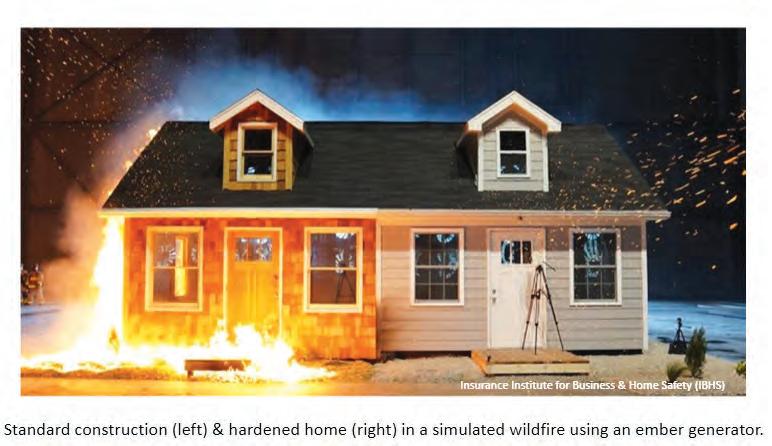
During a simulated ember storm, a standard home (left) burns while a wildfire-hardened home (right) remains intact in a demonstration by the Insurance Institute for Business & Home Safety. Research has found that home-hardening measures can significantly reduce wildfire risk. Photo courtesy of the Insurance Institute for Business & Home Safety, provided by the Two Rivers Wildfire Coalition.
Continued from Page 1
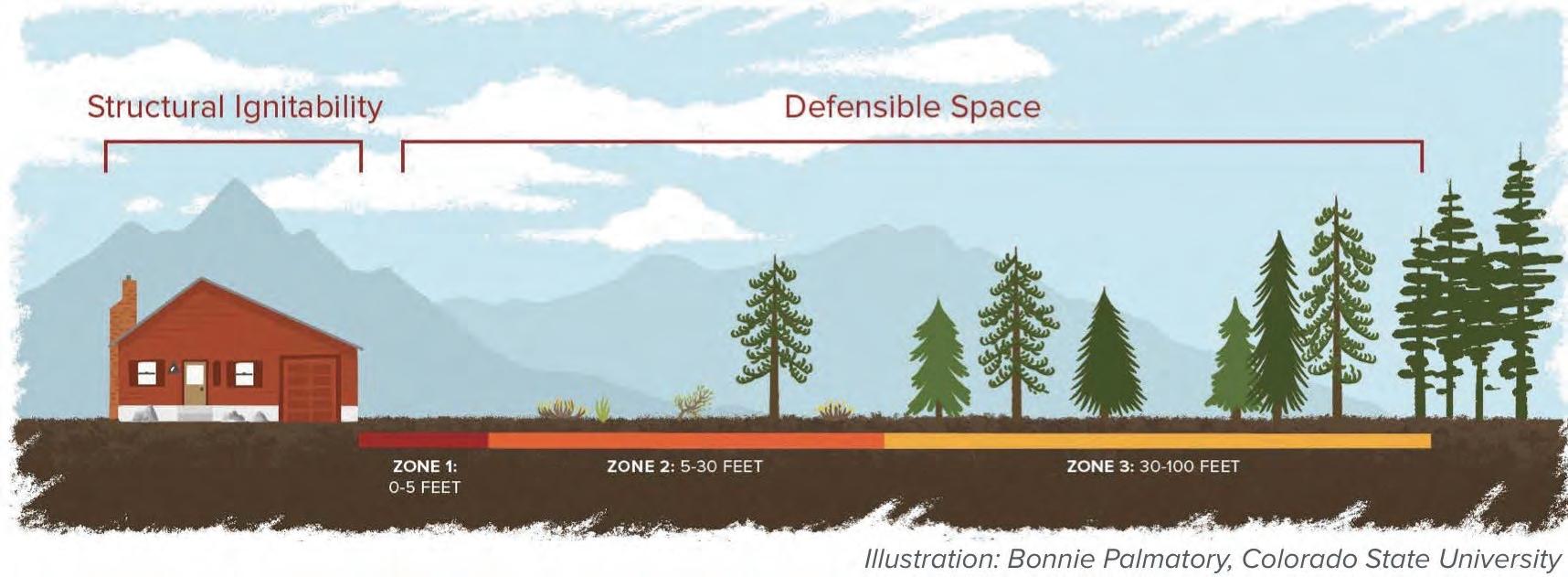
In addition to hardening homes against embers, Rizza recommends creating three defensive zones around a home, known as the Home Ignition Zone. Each zone focuses on reducing vegetation and other combustible materials at increasing distances from the structure to slow the spread of fire and improve a home’s chances of survival. Rizza said property owners can also use a variety of mitigation methods, including livestock in some situations, to help reduce wildfire fuels.
Wildfire risk extends into the valley
Many residents associate wildfire danger with the forests surrounding Mesa County, but Rizza said the Grand Valley also faces significant risks, particularly along river corridors.
Dense vegetation, dead plant material and human activity along waterways can create hazardous fuel conditions near homes and recreation areas.
“People think we don’t really have high wildfire danger here in the valley,” Rizza said. “Our river corridors are actually pretty hazardous places.”
Focus on the Home Ignition Zone
Rather than relying on firefighters to save every structure during a fast-moving wildfire, Rizza said homeowners should prepare their properties in advance.
“Our focus is on passive defense,” he said. “We want the house and property ready to go when a fire gets there, because resources are spread so thin during large wildfires that active firefighting is not the norm for most houses.”
The coalition encourages homeowners to reduce wildfire risk by starting at the home and working outward through the Home Ignition Zone.
Rizza shared the Colorado State Forest Service’s Home Ignition Zone Guide with The Business Times as a resource for homeowners. The guide defines the Home Ignition Zone as the home and the area surrounding it, taking into account the potential of the structure to ignite and the
quality of the defensible space around it.
The first five feet surrounding a home are considered the most critical. Rizza recommends removing combustible vegetation and materials immediately adjacent to the structure and using noncombustible landscaping whenever possible.
From about 5 to 30 feet, homeowners should keep vegetation “lean, clean and green.” That includes mowing grasses, removing dead vegetation, spacing trees appropriately and pruning lower branches that can act as “ladder fuels,” allowing fire to climb from the ground into tree canopies.
Beyond that area, property owners should continue thinning vegetation and reducing fuel loads for at least 100 feet from the home whenever possible. On steep slopes or in areas where prevailing winds push fire toward a structure, Rizza said extending those treatments even farther can provide additional protection.
“We’re trying to disconnect fuels,” Rizza said. “Whether it’s tall trees or shrubs underneath them, we want to reduce those pathways that allow fire to spread.”
Harden your home against embers
Rizza said creating defensible space is only part of wildfire preparation. Because wind-driven embers ignite many homes before the main fire arrives, he recommends “hardening” the home itself to reduce the number of places where embers can ignite or enter the structure.
Rizza also shared the University of Nevada, Reno Extension’s Wildfire Home Retrofit Guide with The Business Times as a resource for homeowners. The guide notes embers can travel more than a mile ahead of a wildfire under the right conditions and often accumulate on roofs, in gutters, on decks and around vents before igniting a structure.
The guide recommends keeping roofs and gutters free of leaves, pine needles and other combustible debris, protecting attic and crawl space vents with ember-resistant metal mesh, screening chimneys with spark arrestors and sealing gaps where embers could enter the home. See WILDFIRE on Page 6
Wildfire
Continued from Page 5
Homeowners replacing roofs, siding, windows or decking should also consider fire-resistant materials whenever practical, especially during planned remodeling projects.
Rizza said homeowners do not have to complete every improvement at once. Many of the most effective steps, such as cleaning roofs and gutters, removing dead vegetation near the home and replacing older vent screens with ember-resistant materials, are relatively inexpensive. Making incremental upgrades over time, while maintaining defensible space around the property, can substantially improve a home’s chances of surviving a wildfire.
Livestock can help reduce vegetation
Mechanical thinning isn’t the only tool available.
Rizza said goats, sheep and cattle can be an effective way to maintain vegetation after initial clearing projects are completed, particularly on larger properties.
The City of Grand Junction has used goats to reduce vegetation in portions of its river corridor, while larger grazing projects have helped maintain treated areas that would otherwise require repeated mowing or mechanical work.
“They act like little lawn mowers,” Rizza said.
“They’re a great maintenance tool in the right situations.”
Janie VanWinkle, a longtime Mesa County rancher, said in an interview with The Business Times that cattle can also reduce the fine fuels that allow wildfire to spread quickly across a landscape. Grazing lowers grasses and other vegetation, including cheatgrass, that dry out and can rapidly carry fire when winds increase.
VanWinkle said she has seen the benefits firsthand. She recalled a fire near Whitewater that slowed after reaching fields her cattle had recently grazed. She has observed similar patterns during other wildfires, with grazed areas often experiencing less severe fire behavior than areas with heavier fuel loads.
While grazing is not a standalone solution, she said it is another tool for reducing vegetation and helping landscapes better withstand wildfire.
Working together lowers costs
The coalition also encourages neighbors to organize projects together. Rather than treating one property at a time, grouping multiple neighboring properties into a single project can reduce contractor costs and make larger mitigation efforts more affordable.
The organization provides property assessments,
technical recommendations and education for homeowners, homeowners associations and community groups. It also helps connect landowners with contractors and, when funding is available, financial-assistance programs for eligible projects.
Following a wildfire, the coalition also assists property owners with erosion, invasive weeds, damaged trees and post-fire recovery planning.
How to get help
The Two Rivers Wildfire Coalition serves Mesa County and works with private property owners to reduce wildfire risk. Homeowners can request information or schedule a property assessment through the coalition’s website. The site includes information about defensible space, the Home Ignition Zone, educational resources and an online contact form for requesting assistance. The coalition also offers presentations for neighborhoods, community organizations and homeowner associations.
Rizza said wildfire mitigation is most effective when homeowners begin preparing before fire season arrives.
“It takes everybody working together,” he said. “The more we can prepare ahead of time, the better chance we have of protecting homes and our communities.”
North Ave., Suite 5 Grand Junction, CO 81501 (970) 424-5133 www.thebusinesstimes.com
The Colorado State Forest Service’s Home Ignition Zone concept encourages homeowners to begin wildfire mitigation at the structure itself and work outward through three zones of defensible space. Managing vegetation and reducing combustible materials closest to the home can significantly improve its chances of surviving a wildfire. Illustration by Bonnie Palmatory, Colorado State University, courtesy of the Colorado State Forest Service.
Grand Junction Chamber highlights visits by state, federal officials
The Grand Junction Area Chamber of Commerce recently hosted officials from the Colorado Public Utilities Commission and the U.S. Department of Labor for separate meetings designed to connect government leaders with Western Colorado businesses.
The Chamber said the visits gave state and federal officials an opportunity to hear firsthand how public policy, energy regulation and workforce initiatives affect employers throughout the region.
The Colorado Public Utilities Commission meeting brought together business leaders, elected officials and utility representatives to discuss affordability, reliability and the cumulative impact of public policy on employers, workers and households across the Western Slope.
The PUC is the state agency that regulates investor-owned utilities, including Xcel Energy and Black Hills Energy. Commissioners, who are appointed by the governor and confirmed by the Colorado Senate, make decisions on utility rates, major infrastructure projects and other regulatory matters.
According to the Grand Junction Chamber, participants examined how regulatory and legislative decisions collectively influence the cost of doing business and the region’s economic competitiveness.
The U.S. Department of Labor visit included tours of Innovative Textiles and Enstrom Candies, where officials learned about workforce development, manufacturing innovation and employee training. Company leaders highlighted investments in technology, transferable skills and employee development that have supported business growth while creating opportunities for workers.
Candace Carnahan, executive director of the Grand Junction Area Chamber of Commerce, said hosting meetings like these is an important part of the Chamber’s advocacy efforts, because they give state and federal officials the opportunity to hear directly from the businesses affected by the policies they help shape.
The chamber said bringing decision makers to the Western Slope in meetings like these helps ensure local employers have a voice in discussions that affect the regional economy while strengthening communication between government leaders and the business community.
Late fees reduced on some overdue parking tickets until Sept. 1; GJ resumes use of parking boots
The City of Grand Junction announced it is providing residents and visitors an opportunity to resolve outstanding parking citations at a reduced cost before its Parking Boot Program resumes Sept. 1.
Until Aug. 31, the city is offering a Parking Citation Amnesty Period, allowing individuals with eligible, overdue, parking citations to pay significantly reduced late fees.
During the amnesty period, parking citations that have reached the maximum late fee will be reduced from $100 to $45. The original $25 citation remains, while the maximum $75 late fee will be temporarily reduced to $20, providing a financial incentive for individuals to voluntarily resolve outstanding citations.
The Parking Boot Program allows the city to immobilize, or “boot,” vehicles belonging to individuals with multiple unpaid parking citations that have remained unresolved. A vehicle becomes eligible for booting when it has three unpaid parking citations issued within a 24-month period and the third citation has remained unpaid for at least 30 days after the late fee is assessed.
The city said in a news release that the program existed for many years, but it has not been enforced since 2022. During that time, nearly 4,000 parking citations have gone unpaid, resulting in approximately $372,740 in outstanding fines and fees. The city has updated its processes and is resuming the program to ensure parking regulations are enforced consistently and fairly.
To make participation as convenient as possible, Grand Junction Municipal Court will hold extended hours on: Aug. 10 and Aug. 24, 7:30 a.m. to 7 p.m. each day. The City’s Municipal Court also plans to participate in Mesa County’s Warrant Day on Aug. 29, with additional payment opportunities from noon to 3 p.m. at City Hall.
PrimeHealth+ sells Montrose clinic to River Valley Family Health Center
PrimeHealth+, the Federally Qualified Health Center for Mesa County, announced it sold its Montrose clinic site to River Valley Family Health Center in Montrose.
According to a news release from PrimeHealth+, the sale was completed July 24.
Both parties provide primary care integrated with mental health, dental and pharmacy services to a wide spectrum of commercially insured, Medicaid, Medicare and uninsured patients.
PrimeHealth+ acquired what was previously called The PIC Place as a safetynet clinic in Montrose County in January 2024. According to the news release, the reason for the merger was to find a financially sustainable model for that safety-net clinic.
PrimeHealth+ acquired the site, hired The PIC Place employees and continued to serve the patients in Montrose and surrounding areas out of that site.
“The merger idea came as a surprise as PrimeHealth+ had never intended to expand its footprint beyond Mesa County,” PrimeHealth+ CEO Kay Ramachandran said. “But we found the safety-net clinic in a financial bind, and when they approached us, we knew it was the right thing to do. We are a very mission-based organization, and we have spent the last two years stabilizing the site operationally and financially.”
After more than two years of running and supporting the Montrose site, PrimeHealth+ Board Chair Clay Marshall said the board of directors and leadership at PrimeHealth+ felt strongly that it was time to hand over the site to River Valley Family Health Center.
“We have a strong mission alignment with them, and our decision, we feel, will better serve the community of Montrose for years to come,” Marshall said. “It has been our privilege to have served the residents of Montrose County in the short period we have been there.”
Kaye Hotsenpiller, CEO of River Valley Family Health Center, said the transaction is more than the purchase of a building. It is an investment in the health and future of the Montrose community.
“We are excited about the possibilities this space creates for River Valley and grateful for the continued trust and support of the communities we serve,” she said.
The 35th Annual Colorado Mountain Winefest, taking place Sept. 19 at Riverbend Park in Palisade, has been reimagined as an elevated Food & Wine experience that’s designed for true wine enthusiasts.
In a July 29 news release, event organizers said this year’s event marks the most significant evolution in Winefest’s 35-year history. Attendance has been intentionally reduced to just 1,400 guests,
with winery owners and winemakers.
• On-site priority parking and complimentary shuttles throughout Palisade.
• A completely digital event guide through the Drink Colorado Wine mobile app, providing winery information, tasting notes, event maps, schedules and more while reducing paper waste.
Wine enthusiasts will have the opportunity to taste wines from many of
allowing for a more spacious and unhurried experience, shorter lines, more personal interactions with winemakers, additional seating and a relaxed atmosphere designed for savoring every pour and every bite.
“After 35 years, we challenged ourselves to create an experience that truly reflects where Colorado wine is today,” said Cassidee Shull, executive director of the Colorado Association for Viticulture & Enology. “Guests will discover an event that’s more curated, more immersive and more focused on celebrating the incredible quality of Colorado wines alongside outstanding local food.”
Unlike previous years, food is now included with every ticket, the news release said. Throughout the festival, guests will enjoy unlimited culinary offerings from the CMU Tech Culinary Department, each thoughtfully designed to complement Colorado wines and encourage exploration of unique pairings.
Additional enhancements include:
• Unlimited culinary tastings included with every admission.
• A curated selection of Colorado wineries, showcasing award-winning wines from across the state.
• More shaded seating, gathering spaces and opportunities to connect directly
Colorado’s premier wineries, including producers from the Grand Valley, West Elks, Four Corners and other wine-growing regions across the state. From crisp whites and vibrant rosés to elegant reds and innovative blends, Winefest offers one of the largest showcases of Colorado-grown wines anywhere in the country.
Participating wineries may be viewed at ColoradoWinefest.com.
This year, guests may also enjoy tastings of Colorado Cru wines at the festival. Colorado Cru was launched earlier this year and is a winemaker-led collection of 100 percent Colorado-grown blends, highlighting the distinctive character of Colorado’s viticultural landscape and signature winemaking style. Colorado Cru aims to elevate recognition of Colorado wine, strengthen the region’s wine identity and foster local pride in the state’s rich viticultural heritage.
To learn more about Colorado Cru, visit WineColorado.org/colorado-cru.
More than just a wine festival, Colorado Mountain Winefest provides live entertainment, interactive experiences, educational opportunities and artisan vendors.
Tickets are available now at ColoradoWinefest.com.
Guests at a previous Colorado Mountain Winefest clink their wine glasses. Photo courtesy of Colorado Association for Viticulture & Enology.
St. Mary’s offering new treatment for pancreatic cancer in Western Colorado
Intermountain Health Cancer Centers of Colorado at St. Mary’s Regional Hospital announced it is the first cancer center in western Colorado approved to offer select patients with pancreatic cancer access to daraxonrasib.
survival of patients with advanced pancreatic cancer treated in the second-line setting compared to standard chemotherapy.
Daraxonrasib is a novel therapy that is changing expectations for one of the deadliest cancers, Intermountain Health said in a July 29 news release.
“We are thrilled to have early access to a promising and desperately needed therapy for our patients with pancreatic cancer,” said Dr. Ned Jones, an Intermountain Health hematologist/oncologist.
Pancreatic cancer is often diagnosed at an advanced stage, Jones said, when the disease is typically incurable. Even for patients diagnosed with early-stage pancreatic cancer, many will not be cured.
According to the American Cancer Society, about 67,000 Americans are diagnosed with pancreatic cancer each year, and more than 52,000 die from the disease. It is the third leading cause of cancer deaths in the United States.
Jones pointed to results presented at the American Society of Clinical Oncology annual meeting this year where clinical trial data for daraxonrasib demonstrated unprecedented improvements in survival outcomes. The therapy nearly doubled overall
According to the news release, the study did not investigate patients with localized disease or advanced pancreatic cancer treated in the upfront/first-line setting. In those settings, daraxonrasib is only currently used as part of a clinical trial.
Daraxonrasib remains an investigational therapy and has not received full approval from the U.S. Food and Drug Administration (FDA), the news release said. An Expanded Access Program provides a pathway for certain eligible patients who have exhausted appropriate standard treatment options to receive the investigational therapy outside of a clinical trial.
Access requires a physician request and is reviewed on a case-by-case basis according to program eligibility requirements. Currently, the medication has been tested through all phases of clinical trials to evaluate safety and efficacy.
Jones said physicians at Intermountain St. Mary’s remain vigilant in following emerging research and novel treatment options.
By offering daraxonrasib in Grand Junction, Intermountain Health is helping patients across western Colorado obtain cutting-edge care closer to home without leaving the region.
“This is about more than a new drug. It’s about giving patients more time and more options,” said Dr. Alicia Swink, regional oncology senior medical director for Intermountain Health. “For a long time, pancreatic cancer has been one of the toughest cancers we face. Seeing new advancements like this gives us real hope.”
Crime Victim Compensation Board seeks volunteer
The 21st Judicial District Attorney’s Office is accepting applications for a volunteer to serve on the Crime Victim Compensation Board. The threemember board reviews applications from victims of crime and determines how money from the Crime Victim Compensation Fund is distributed.
Members are appointed by the district attorney, but the board operates independently.Members meet monthly and twice a year to review administrative, program and financial matters. The time commitment is approximately six to 15 hours per month, depending on the number and complexity of applications.
The selected volunteer will serve from Sept. 1, 2026, through Aug. 31, 2029. The position is unpaid, but reasonable and necessary expenses related to board service may be reimbursed.
Applicants must: live in Mesa County; have experience with issues affecting crime victims; be able to follow state law and the board’s bylaws, policies and procedures; not work for the District Attorney’s Office or Judicial Department within the 21st Judicial District; and not be an attorney actively practicing criminal law in the 21st Judicial District.
Applicants must submit a completed application, a letter explaining their interest in serving and a current resume by Friday, Aug. 14. Submit materials to Crime Victim Compensation Administrator Jennifer Ballagh by email at jennifer.ballagh@mesacounty. us or in person at the District Attorney’s Office, 125 N. Spruce St., second floor, in Grand Junction.
Ned Jones Alicia Swink
Naloxone kiosks are important investment in community
Prevention is more than effective public-health practice, it is smart fiscal policy. By stopping crises before they start, we ensure our people, businesses and economy thrive.
Mesa County Public Health’s Naloxone Kiosk Program demonstrates how powerful this proactive approach can be.
According to our newly released 2026 Naloxone Kiosk Impact Report, the toll of the opioid crisis on our local community has been steep. Local drugoverdose deaths have more than tripled since the early 2000s. Between 2020 and 2024, 198 residents died from overdoses. Approximately 82 percent of those fatalities were unintentional.
Mesa County also consistently experiences higher rates of nonfatal-overdose emergency-department visits than the Colorado average. In 2024, the local rate was 239.3 visits per 100,000 residents, compared to 182.2 statewide.
To combat this trend, Mesa County Public Health deployed naloxone kiosks as a low-barrier intervention, partnering with the Western Colorado Area Health Education Center to keep them stocked and maintained.
The program is funded through the CDC’s Overdose Data to Action framework via the Colorado Department of Public Health and Environment. OD2A specifically supports overdose prevention programs, outreach by people with lived experience, and equal health outcomes to reduce disparities in overdose deaths.
These kiosks provide free, anonymous access to naloxone, which is often known by the brand name Narcan. It is a safe, easy-to-administer, nasal spray that rapidly
reverses opioid overdoses with virtually no side effects.
From an economic perspective, the return on investment for this program is profound. Based on a nationwide study mentioned in our report, every dollar spent on distributing naloxone in communities is estimated to save about $2,742. These savings come from reducing expensive health-care needs and preventing deaths.
The widespread use of the program also shows that there is a strong interest and need for it within our community. Since launching in December 2024, residents have accessed more than 9,500 boxes of naloxone, which averages to 17 life-saving kits a day.
“It’s exciting to grow this program, especially after hearing from community members who have used this naloxone to save a life,” said Chhavi Attri, Mesa County Public Health community health planner. “The community support has been tremendous. Our goal is to keep expanding our reach as resources allow.”
A key factor in this success is the program’s zerobarrier design. By removing ID checks, intake forms and payment requirements, the kiosks successfully bypass the social stigma that often limits access to life-saving care. Dual instructions in English and Spanish further ensure accessibility across many demographics.
This initiative goes beyond public-health statistics and translates directly to workplace safety and civic preparedness. Transit workers, social workers and general staff are increasingly utilizing these kiosks to keep kits on hand. They are treating them with the same operational necessity as jumper cables or first-aid kits.
There are 17 kiosks strategically placed across Mesa County, including transit facilities, libraries and the Colorado Mesa University campus. Kiosks are intentionally
placed in trusted public spaces to provide barrier-free and stigma-free access to naloxone. Choosing central, familiar locations ensures that anyone can quickly and safely get this life-saving resource for themselves or someone else.
Residents can access free naloxone at any of these locations:
• Grand Junction – Colorado Health Network, 1001 Wellington Ave.; Colorado Mesa University University Center, 1455 N. 12th St.; CMU Tech Kayenta Hall, 2530 Blichmann Ave.; MCPH Clinic 510 29 1/2 Road; Mesa County Criminal Justice Services, 436 S. Seventh St.; Mesa County Sheriff’s Office Detention Lobby, 215 Rice St.; WCAHEC, 2938 B North Ave.; Lifespan Psychiatry, 2140 N. 12th St.; Lighthouse Program, 1060 Orchard Ave.; GVT West Transfer Facility, 612 24 1/2 Road; Hilltop on Main Street, 359 Main St.; and the Orchard Mesa Library, 230 E. Lynwood St.
• Clifton – Clifton Library, 3270 D 1/2 Road, Bulding A; and the GVT Clifton Transfer Facility, 3199 I-70 Business Loop.
• Fruita – Family Health West, 401 Kokopelli Drive, Unit 2.
• Palisade – Palisade Library, 119 W. Third St.
• Collbran – Collbran Library, 111 Main St.
“We are grateful to our partners at WCAHEC for keeping our kiosks stocked, tracked and well maintained,” Attri said. “We couldn’t provide this incredible resource without their support.”
To read the full 2026 Naloxone Kiosk Impact Report and learn more about substance-use prevention and treatment resources, visit our website at mesacounty.us/public-health.
Ultimately, a thriving local economy relies on a healthy, resilient and safe community. By supporting and utilizing this program, Mesa County is proving that saving lives is one of the highest-yield investments we can make.
Sarah Gray is a communication specialist with Mesa County Public Health. For additional information, call (970) 248-6900 or visit mesacounty.us/public-health.
Sarah Gray
Another Congressional hearing, and a whole lot of nothing
Don’t get me wrong, there’s a whole lot of there, there when it comes to “America’s doctor,” aka Anthony Fauci. But after watching another D.C. dog and pony show, I’m more convinced than ever that no matter how much evidence there is against anyone who’s a member of the club you and I are not allowed in, it’s that nothing will happen to said member.
And Anthony Fauci is a member with elite status. He’s apparently untouchable. Interesting for a man with so much blood on his hands over the decades. Hey folks, there are plenty of books you can read to learn all about it. There’s no pot of gold (or even a bowl of Lucky Charms) at the end of this guy’s rainbow. He’s more like the evil leprechaun of the movies of the 1990s.
Who knew his Covid calamity would be a sequel of his AIDS act back in the day? If you’re like me, you didn’t even realize he was one of the bad guys during that “epidemic” until folks started making the observations and connections about Fauci’s “second verse, same as the first” money making, power grabbing, celebrity status, schemes and machinations as the “nation’s doctor” when it came to Covid.
Remember, Joseph Mengele was the “nation’s doctor” before that whole Nazi problem became epidemic.
But back to Washington, D.C.’s most famous theatre. No, not Ford’s or the Trump/ Kennedy Center (yeah, I went there for good reason), but rather the one that has seen more characters put on a show than all the theaters in the nation: The Halls of Congress. Heck, they love acting so much they even bring in “Hollywood’s best and brightest” to testify about problems facing the citizens (which government probably created) even though the actors will never face those problems themselves outside of studying for a role. And it’s all done in between cries of, “Reclaiming my time” when it isn’t going their way. Because as anyone knows, someone elected to Congress only needs five minutes to understand everything and then make another stupid law about whatever it is they weren’t paying attention to while the other side of the aisle was abusing their five minutes.
And we elect these fools to control every aspect of our lives. It’s insanity. Which is why we had Fauci the Facetious in front of the fools for nothing but frivolity and folly. I’d use a few more “F” words for this fraud foisted upon the people, but I’m really trying to clean up the sarcasm and attitude in my writing. It’s just the government makes it so F’in difficult.
How else can one explain the lead actor in our nation’s latest “dramedy” having only one line? You know it by heart at this point as Fauci said it more than 100 times. Say it with me, “On the advice of counsel, I respectfully decline to answer based upon my rights under the Fifth Amendment of the Constitution.” And the republicans let him get away with it. They could have at least responded with the previously implied F word followed by “you.”
But like with all congressional hearings, nothing happened. That’s despite a few clever presentations from a couple of senators exposing more truth about Lucky the Leprechaun.
You know, it wasn’t that long ago where Lucky said the following, “Well, if I become a punching bag, I’m a punching bag. But I am happy to testify before any congressional oversight committee. I have nothing to hide. I can explain and validate
everything that I’ve done….I’m going to do what I need to do, and that is cooperate fully, because we have nothing to hide at all.”
Quite the flip from this arrogance to taking the Fifth.
I wonder what the F happened to cause this flip? That’s right, the truth finally got its boots on. Too bad the only ones wearing them were feckless republicans. Because republicans are gonna republican, which is to pontificate and point, and then perfectly prostrate themselves. Sure, Rand Paul said he was going to look into doing something about something or other and contempt or lying to Congress (like lying in Congress isn’t an everyday occurrence), but we all know how the dance number goes when doing the Potomac two-step.
But there was something else republicans let Lucky the Leprechaun get away with. You see, Fauci did testify before Congress the other day, and the testimony was a doozy. Ol’ Lucky lathered this litany in an opening statement which ended with, “The only conclusion I can reach is that the sole reason he (Paul) is calling me before this committee is to get me to say something, anything, that could vindicate his repeated public pledges that I end up, in his words, quote, behind bars.”
Lucky continued, “Any reasonable person who has followed his unhinged obsession with me would readily come to the to the same conclusion. Therefore, although it pains me to do so because of the respect I have for the legislative branch of government and my decades-long record of cooperating with Congress, under the advice of my attorneys, I will invoke my right under the Fifth Amendment of the Constitution to refrain from answering your questions.”
Play victim much?
And not one republican questioned him on that load, which is a big problem. Bigger problem, half the country bought that fertilizer. Don’t think so? Just jump on Facebook and check the comments defending this guy. People actually think he’s a hero. I assure you, this man is anything but. He does belong behind bars.
As for Rand Paul up on his high castle, he just hid behind the bulwarks. Just leveled some Monty Python-worthy farting in Fauci’s general direction and then clopped off. Let’s be honest, the mandates and edicts and insanity Fauci forced on the people did more to divide this country than almost anything in its history, even adding Trump’s name to the Kennedy Center. This hearing simply added to the pile. After all, division is power in D.C.
I hope these are the last words we ever hear from Anthony Fauci, because they summarize him personally and his career perfectly. A narcissistic, megalomaniac who was never told he was wrong, who was given immense power while being funded by rich elitists and politicos to have their products and control forced onto free people.
To help Little Anthony, that’s why Rand Paul came after you. For the evil you’ve done for decades at the bidding of your benefactors and government overlords. Paul just doesn’t realize it’s a fool’s errand.
The worst part of all of this? Fauci’s gonna get away with it and probably get a book deal. And Congress will be on to its next Shakespearian “much ado about nothing” of a hearing.
In Truth and freedom.
F
Craig Hall is owner and publisher of The Business Times. Reach him at 424-5133 or publisher@thebusinesstimes.com
Craig Hall
n Mineral-lease district taking applications for grants
The Mesa County Federal Mineral Lease District opened applications for the fall 2026 grant cycle with $700,000 available in grant funding.
The traditional grant program supports large-scale projects such as new public works or other capital projects, as well as public-service projects that address health, safety and welfare impacts from federal-mineral-leasing activities. These are financial requests of $50,000 or more.
The mini grant program can award up to $50,000 for smaller-scale projects.
Find the full grant application and additional information about the Mesa County Federal Mineral Lease District at www.mesafml.org/current-grant-cycle.
Applications will be accepted until Sept. 4 at 3 p.m. Applicant presentations will take place during the Sept. 16 board-of-directors meeting, which is open to the public and will take place at the Home Loan Building, 205 N. Fourth St. in Grand Junction. Fall awards will be selected as early as Oct. 16.
n Stray Grass concert to benefit stray pets
The Stray Grass for Stray Pets benefit concert will take place Aug. 22 at 7 p.m. as part of Grande River Vineyard’s Live in the Grapevines concert series.
Join Roice-Hurst Humane Society and Grand Valley acoustic Americana band Stray Grass for an evening of live music, wine and food from Slider Shack and Hawaii Street Food at Grande River Vineyards, 787 Grande River Drive in Palisade. Doors open at 6 p.m., and music starts at 7 p.m.
Each ticket sold supports Roice-Hurst’s shelter pets and programs. Tickets cost $25 in advance and $30 at the gate and can be purchased online at rhhumanesociety.org/event/straygrass.
n United Way of Mesa County announces grant awardees
United Way of Mesa County announced the 2026-27 grant recipients from its Community Impact Fund, a yearly grant that supports Mesa County health and human service nonprofits.
This grant cycle, United Way of Mesa County is supporting 26 programs run by 20 local nonprofits, an increase from past years. Grant amounts range from $2,000
to tens of thousands of dollars depending on program need and available funds.
“The Community Impact Fund Grant not only financially supports dozens of the county’s most utilized and capable nonprofit programs, but it creates long-lasting ties of partnership that leads to multi-organizational collaboration and major change,” United Way of Mesa County Executive Director Cassidy Lujan said. “We are endlessly grateful for our community partners, grantees, and supporters that work tirelessly to make Mesa County the place we want to live with our families, friends and neighbors.”
The grant awardees this year are:
Clifton Christian Church Food Bank; the Christ Center; Colorado Discover Ability; Community Food Bank; Counseling and Education Center; Doors 2 Success; Dyslexia Foundation of Western Colorado; Foster Alumni Mentors; Friends of Youth and Nature; the Gift of Love Inc.; Grand Valley Catholic Outreach; Harmony Acres Equestrian Center; Hilltop Community Resources; HopeWest; Mesa County Libraries Foundation; Mutual Aid Partners; Pro Bono Project of Mesa County Inc.; Riverside Education Centers; Toilet Equity; and Western Slope Center for Children.
To learn more about the Community Impact Fund, visit unitedwaymesacounty.org/community-impact-fund.
n Warrant-forgiveness event set for Aug. 29
The 21st Judicial District is hosting a Warrant Forgiveness Day on Aug. 29 with the goal of helping people who have active warrants get a new court date and potentially resolve their entire case.
The event will take place from noon to 3 p.m. at the Mesa County Justice Center, 125 N. Spruce St., and at the Grand Junction Municipal Court, 250 N. Fifth St. The two locations are for different types of warrants. No arrests will be made at this event.
For the following qualifying warrants, visit the Mesa County Justice Center on August 29: misdemeanor; petty offense; traffic offense; felony 5; felony 6; drug felony 4; and probation violation within the preceding offenses.
Anyone with a municipal case should go to the Grand Junction Municipal Court location that same day. Grand Valley Transit (GVT) is offering free rides to anyone using
their buses to get to this event.
The State Probation Department and Mesa County Criminal Justice Services Department will assist with resource navigation and program concerns at the event.
The following warrants are not eligible, and people with these types of cases should not go to either location: other felonies not listed; domestic-violence offenses; sex offenses; victim’s rights cases; and out-of-county warrants.
“We want to help people get back on track with their court responsibilities, so that they can focus on stability, leading them to success in their lives,” Mesa County Court Judge Scott Burrill said.
At last year’s forgiveness day, 89 warrants were cleared, 36 cases were resolved, and no arrests were made during the event. Anyone with questions about whether their warrant qualifies can email the Public Defender’s Office at junction@coloradodefenders.us.
n El Pomar gives more than $1.2 million for state needs
In response to challenges facing Colorado communities, from catastrophic wildfires to ongoing economic hardship, El Pomar Foundation activated multiple funds to address immediate needs and provide disaster relief across the state.
According to a July 29 news release from El Pomar, it activated its Wildland Fire and Freda Hambrick funds, providing $215,000 in grants to support agencies and organizations on the front lines of wildfire response. These resources help provide relief for displaced families and animals, as well as supplies and support for first responders, volunteers and firefighters.
El Pomar also activated its Colorado Assistance Fund to meet additional human-service needs statewide, distributing $1 million to address needs such as: direct human-service needs for families in crisis; food security and nutrition programs, including food banks and pantries; housing assistance; behavioral and mental-health-care services; family and community resource centers that provide wraparound and emergency support; and emergency assistance for youth and seniors.
Find more information about El Pomar’s Wildland Fire and Freda Hambrick funds at www.elpomar.org/grantmaking/el-pomars-funds. El Pomar’s Grants Office can also be reached for questions at Grants@ElPomar.org.
Mesa County assist with event. and people location: offenses; sex warrants. with their stability, County Court warrants were were made whether their Office at state needs communities, hardship, to address the state.
El Pomar, Hambrick funds, agencies and response. These families and responders, Assistance Fund to distributing human-service nutrition housing services; provide emergency Wildland www.elpomar.org/grantOffice can also