Chase Bank plans to enter the Grand Junction market with a new building next to Natural Grocers on former Mesa Mall land at 2405 Patterson Road, which once was home to Sutherlands Home Improvement Center.
EVC-WDG Mesa LLC, which renovated the former Sutherland’s building into three units, one of which is occupied by Natural Grocers, owns the plot of land where the bank will be built. Dirt moving has begun at the site, which is in the northeast corner of the plot and is bordered by Patterson Road on the north side and a Mesa Mall access road (where Market Street and Patterson intersect) on the east side.
A Mesa County building permit that was approved on March 27 lists JP Morgan Chase as the owner/tenant of the planned building. The permit’s description of work planned reads in part: “New construction retail bank establishment with drive-thru ATM and trash enclosure.” The project is listed as 3,421 square feet, and the valuation is listed at $3,200,000.
On the south end of the EVCWDG Mesa LLC plot, a different building permit shows a freestanding building will be constructed for a 5,036-square-foot Sherwin Williams paint store. The project valuation is listed at $970,000.
Permits also were pulled on the 2405 Patterson Road property for light poles, stormwater discharge and signage.
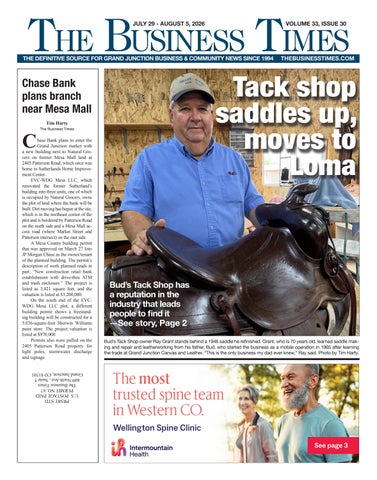
Bud’s Tack Shop has a reputation in the industry that leads people to find it See story, Page 2
Tack shop saddles up, moves to Loma
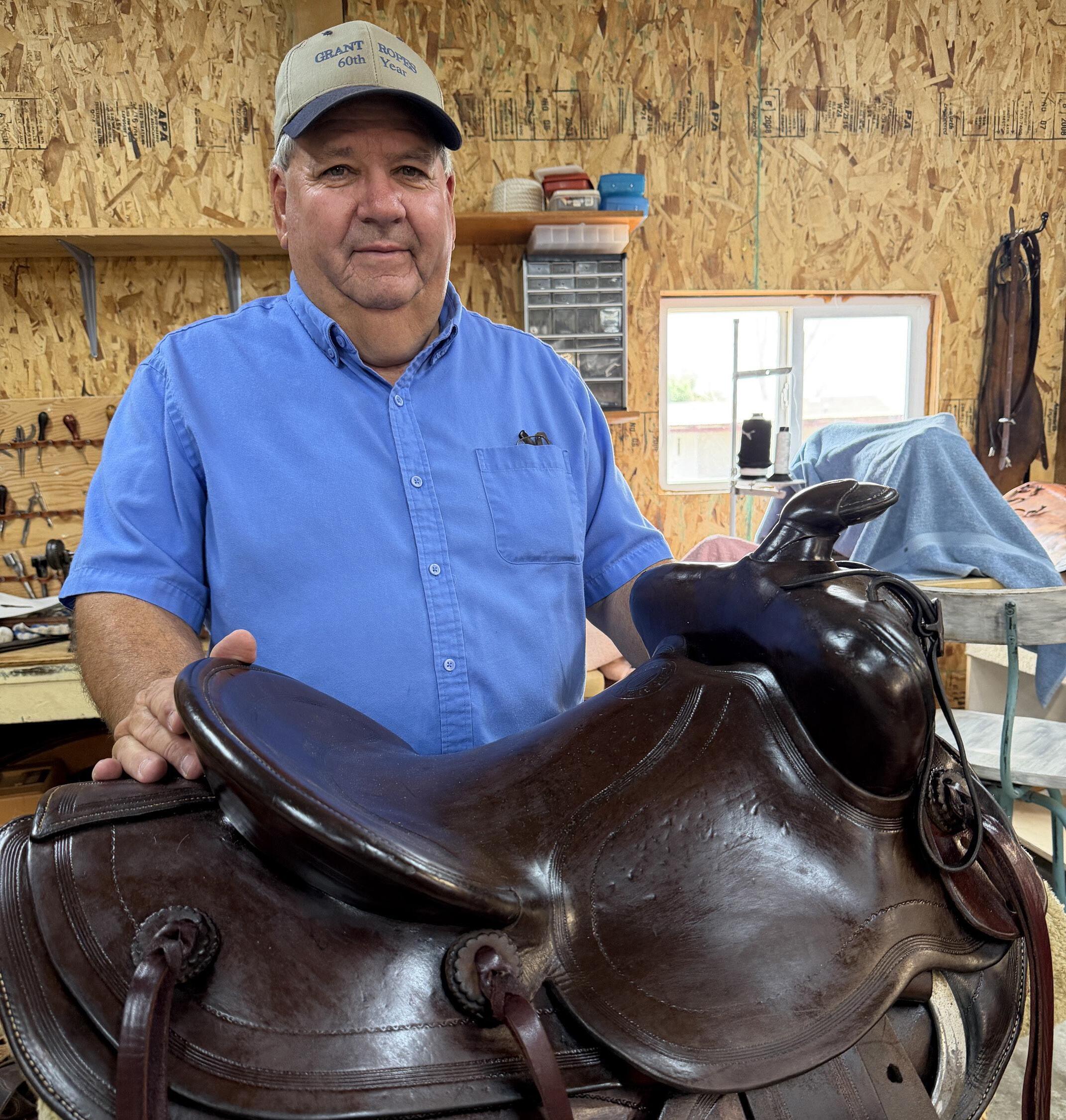
Bud’s Tack Shop owner Ray Grant stands behind a 1946 saddle he refinished. Grant, who is 70 years old, learned saddle making and repair and leatherworking from his father, Bud, who started the business as a mobile operation in 1965 after learning the trade at Grand Junction Canvas and Leather. “This is the only business my dad ever knew,” Ray said.
Photo by Tim Harty.
Handling anything that goes on a horse
Bud’s Tack Shop used to go to its customers; now they come to Bud’s from far and wide
Ahome-based business that’s off the beaten path sounds like a good way to get mired in obscurity. But when that business has a reputation based on seven decades of excellence, people will find it.
And it’s not just locals doing the finding. People around the nation and the world know about the saddle and leather repair that gets done at Bud’s Tack Shop. Bud Grant is no longer around, but his son Ray Grant is, and Ray learned the trade from the master and finds himself still doing it at age 70.
The location changed, though. Ray and his brothers inherited Bud’s home and tack shop at 1176 17 1/2 Road in Fruita, and they decided this year they will sell it. And while it’s on the market, Ray’s son, Bryce Grant, bought a place at 1516 M 3/8 Road near Loma, where he lives and a large shop now houses Bud’s Tack Shop as well as Bryce’s business: Bryce Grant Custom Leather.
The two businesses opened there on June 22. They now have double the space compared to the Fruita location.
“We’re still settling in and trying to find places for everything,” Ray said. “Even though it’s double the size, we sure filled it up in a hurry.”
Inside, Ray said, he does the same things that Bud’s Tack Shop has been doing since 1965. But the work stays there for the most part, as he no longer does the mobile work that put Bud’s Tack Shop in front of people and built a loyal clientele. Instead, they have to come to him. Or ship their items to him.
Ray said his father worked for 20 years at Grand Junction Canvas and Leather, but when the owner died, Bud decided not to buy the business. Rather, he struck out on his own with a mobile, saddle-making and repair business.
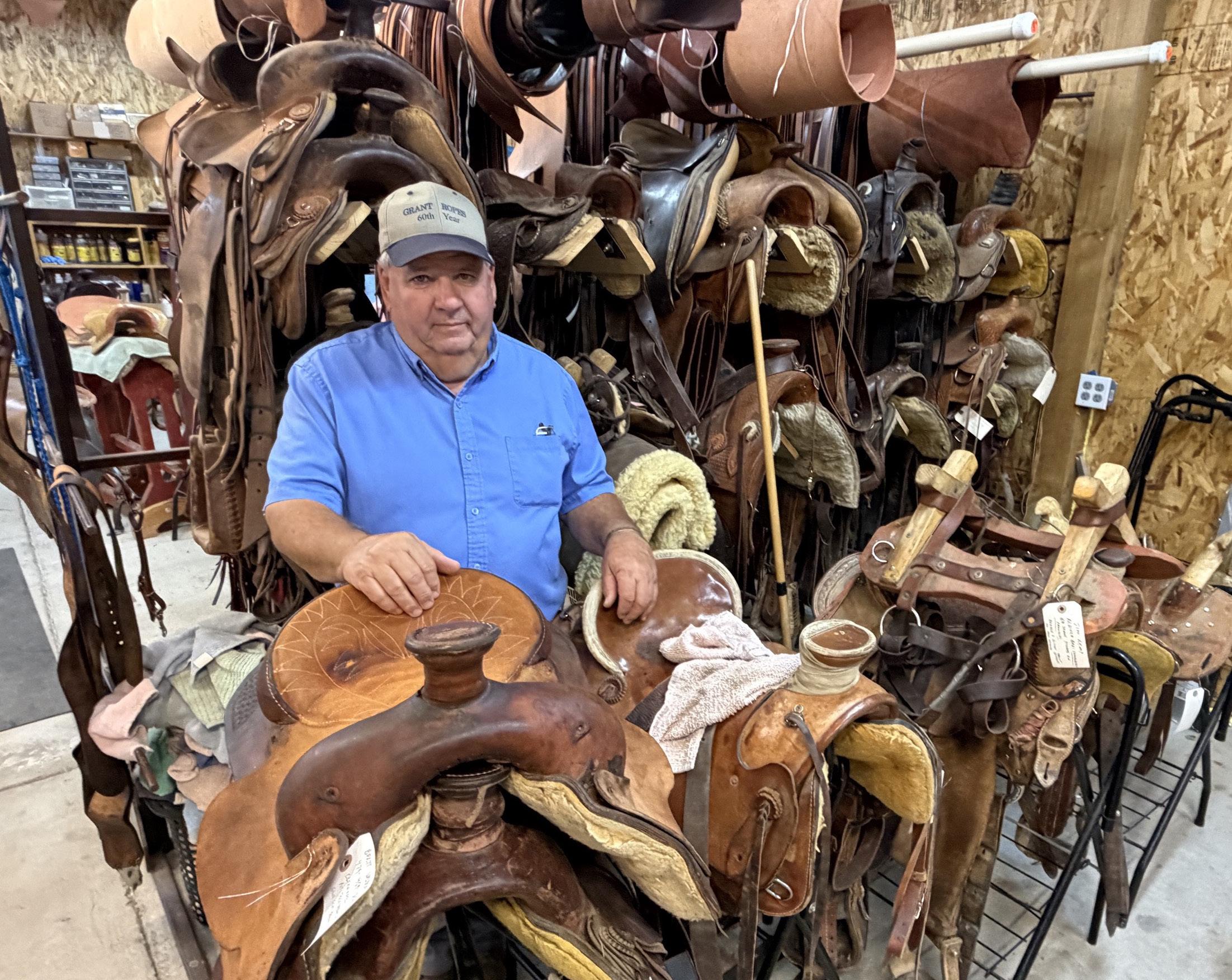
ABOVE — Ray Grant stands in front of a rack filled with saddles that have been dropped off or shipped to Bud’s Tack Shop for repair or restoration.
“He decided to go on the road and be mobile. His main business when he started was calling on ranchers and things like that,” Ray said. “He had a regular route. Like, you go to Collbran one day, Meeker the next, stuff like that, and call on the ranchers.”
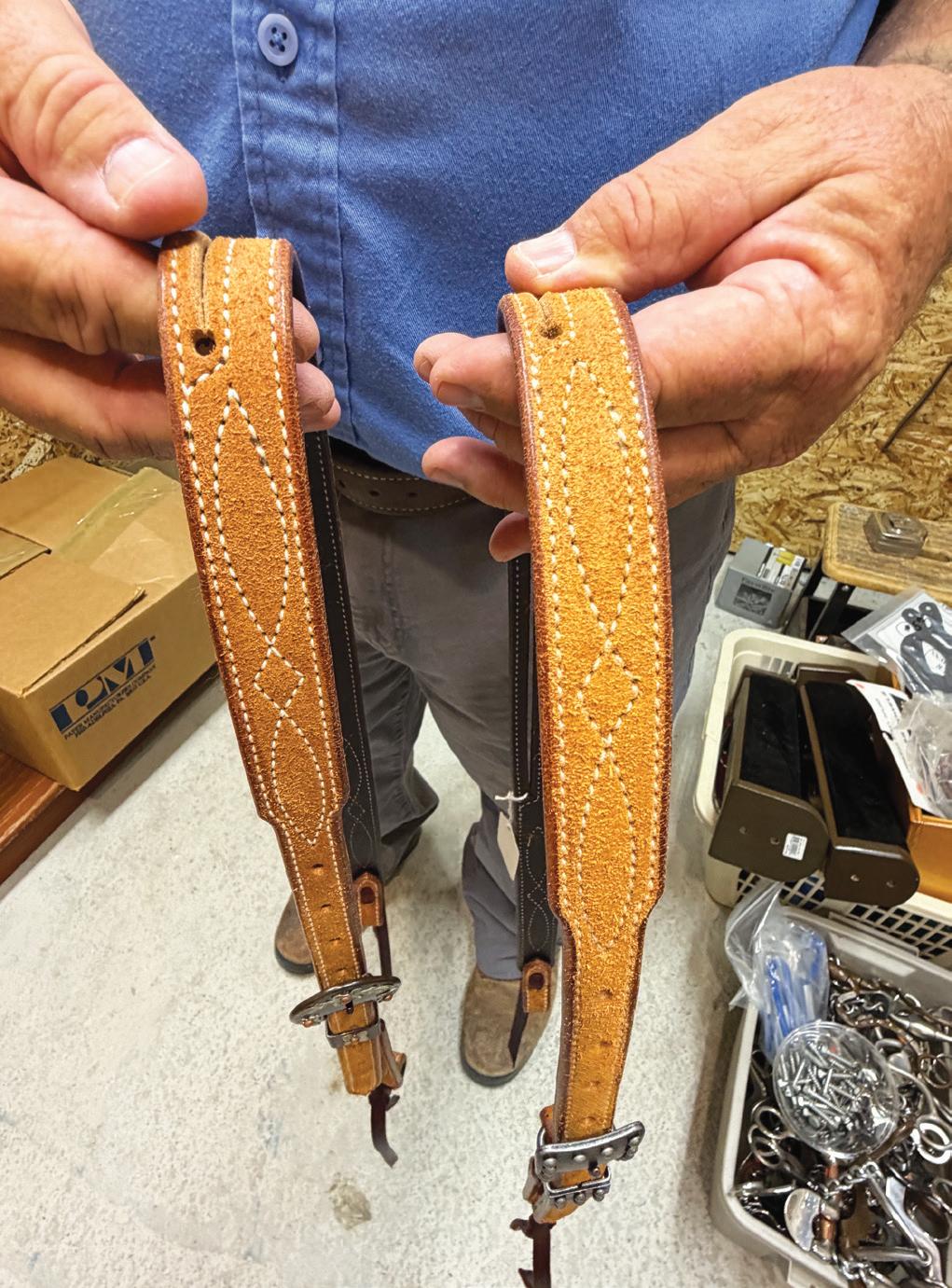
BELOW — Grant, holding bridles made at the tack shop, said, “Our goal is to make everything we sell.” Photos by Tim Harty.
Then, he pointed to a saddle from the 1940s that he finished restoring the day before.
And the business expanded to the point it had three trailers at one time, and Bud’s Tack Shop hit the rodeo circuit.
“We did all the major rodeos in the Western U.S.,” Ray said. “Our main thing got to be big team ropings. They got to be huge.”
Ray said Bryce ropes and goes to rodeos, but that’s not for Ray anymore.
“I’ve traveled enough,” he said.
His main focus of the business now is saddle repair and leather repair.
For an example, he pointed to a saddle and said, “This saddle here, it was all tore up, got in a big wreck. … We make all of it, completely rebuild it. I mean, this goes clear down to the base layer.”
Ray said restoration of old saddles is common, and he pointed to one he said is from the early 1900s.
“It’ll get the same treatment,” he said. “It’ll go down to almost nothing.”
He compared the saddles to hot rods that people buy and restore. There’s a similar mentality.
Another reason to restore saddles is purely economic.
“Part of what is fueling our business now is new saddles are so expensive,” Ray said. “A custom-made saddle will run you, starting price at $6,000 now. So, if you got a good saddle that’s working fine for you and stuff, people are much more willing to spend, say, a thousand dollars to refurbish it.”
During an interview at his new shop on June 30, Ray estimated he had 35 saddles there.
“All these saddles in here, they’re in here for repair,” he said. “We usually run three to four months behind, all the time. It’s always busy.”
If people are willing to wait, that means they believe the wait is worth it. They know and trust his work.
“That’s why we do a lot of family heirlooms and things like that,” he said. “They know that I like the old stuff, and I take my time and do it right, you know, ’cause I grew up with that.”
See BUD’S TACK SHOP on Page 11
STORY AND PHOTOS BY TIM HARTY
Grand Junction’s trees help curb the heat island effect
Brandon Leuallen
The Business Times
Standing beneath a group of mature trees across from the City of Grand Junction Parks and Recreation office at Lincoln Park, City Forester Rob Davis pointed an infrared thermometer at two patches of grass only a few feet apart.
Grass in direct afternoon sunlight measured about 97 degrees while nearby shaded grass registered about 76 degrees. Asphalt in a nearby parking lot reached about 148 degrees before dropping to about 90 degrees beneath the shade of the trees.
The readings showed roughly a 72-degree difference in surface temperature between shaded grass in the park and unshaded asphalt just a few feet away
The simple demonstration illustrated what city officials say is one of the most effective tools available for reducing the urban heat island effect: large shade trees.
The demonstration mirrored findings from Grand Junction’s recently completed urban heat island study, which documented significant temperature differences across the city and identified tree canopy as one of the most effective long-term strategies for keeping neighborhoods cooler as the community continues to grow.
Davis said many people think of trees as landscaping, but he sees them differently.
“Trees are not landscaping,” he said. “Trees are infrastructure.”
Davis also encouraged residents to strike a balance during the drought by conserving water while continuing to care for established shade trees that have taken decades to grow.
Mapping the city’s heat
In the summer of 2024, Grand Junction participated in the National Oceanic and Atmospheric Administration’s Urban Heat Island Mapping Campaign, joining communities across the country in measuring how temperatures vary throughout a city
According to the study, “Urban heat islands are developed areas that experience higher temperatures than their surroundings. Buildings, roadways and other infrastructure absorb and re-emit the sun’s heat. When these man-made structures are highly concentrated and there is limited greenery, pockets of heat form to create the heat island effect.”
Volunteers drove predetermined routes, equipped with temperature sensors, during one of the hottest days of the summer, collecting thousands of air-temperature readings used to map where heat concentrates across Grand Junction.
The study found air temperatures varied by as much as 13.8 degrees across the city, depending on location.
Neighborhoods with established tree canopy, parks and other green spaces generally recorded cooler temperatures than commercial corridors, industrial areas, large parking
While the NOAA project measured air temperature, Davis’ infrared thermometer illustrated how much hotter surfaces can become. Those elevated surface temperatures contribute to higher cooling costs, create more stressful conditions for pedestrians, increase heat exposure for pets and accelerate wear on pavement and other infrastructure.
More than a desert town
For many longtime residents, it can be easy to take Grand Junction’s tree canopy for granted.
Davis said historic photographs from the late 1800s and early 1900s show a much different community with relatively few large trees.
Today’s canopy exists because generations of residents invested decades planting and caring for trees that they would never see reach full maturity
Many of the mature ash trees surrounding the Parks and Recreation office are estimated to be 80 to 90 years old.
“It is our job to try to protect those and preserve them,” Davis said.
He said one of the biggest misconceptions people have is believing a mature tree can simply be replaced if it dies.
Depending on the species, it can take 50 years or more before a newly planted tree begins providing the amount of shade, cooling and environmental benefits produced by an established canopy tree.
“You can’t replace these overnight,” Davis said.
Trees as infrastructure
Davis believes communities should think about trees the same way they think about roads, bridges, water lines and parks.
“If there were no trees downtown, who would want to go down there and spend time?” Davis said. “They bring people. They make places comfortable.”
Businesses along shaded streets often benefit from increased pedestrian activity, while numerous studies have associated mature tree canopy with improved public health, higher property values and stronger community connections.
According to the U.S. Department of Energy, carefully positioned trees can reduce a household’s energy use for heating and cooling by up to 25 percent while also lowering annual energy costs.
“They’re probably one of the best air conditioners ever created,” Davis said.
Balancing water conservation and tree preservation
As western Colorado continues to face periodic drought and increasing pressure on water supplies, Davis said some residents mistakenly believe they should stop watering mature trees in an effort to conserve water.
“Don’t think of it as a waste of water,” Davis said. “Think about it as protecting something on your property, or adjacent to your property, that is incredibly valuable.”
He said that shade also slows evaporation, so grass does not need as much water
When selecting new trees, Davis recommends choosing climate-appropriate species suited to western Colorado while diversifying plantings, so neighborhoods are not dependent on a single tree species.
The city maintains an “All-Star Tree List” on its website to help residents select tree species well-suited to the Grand Valley’s climate.
Davis also gave a recommendation for those looking to eliminate grass altogether
See GJ TREES on Page 5
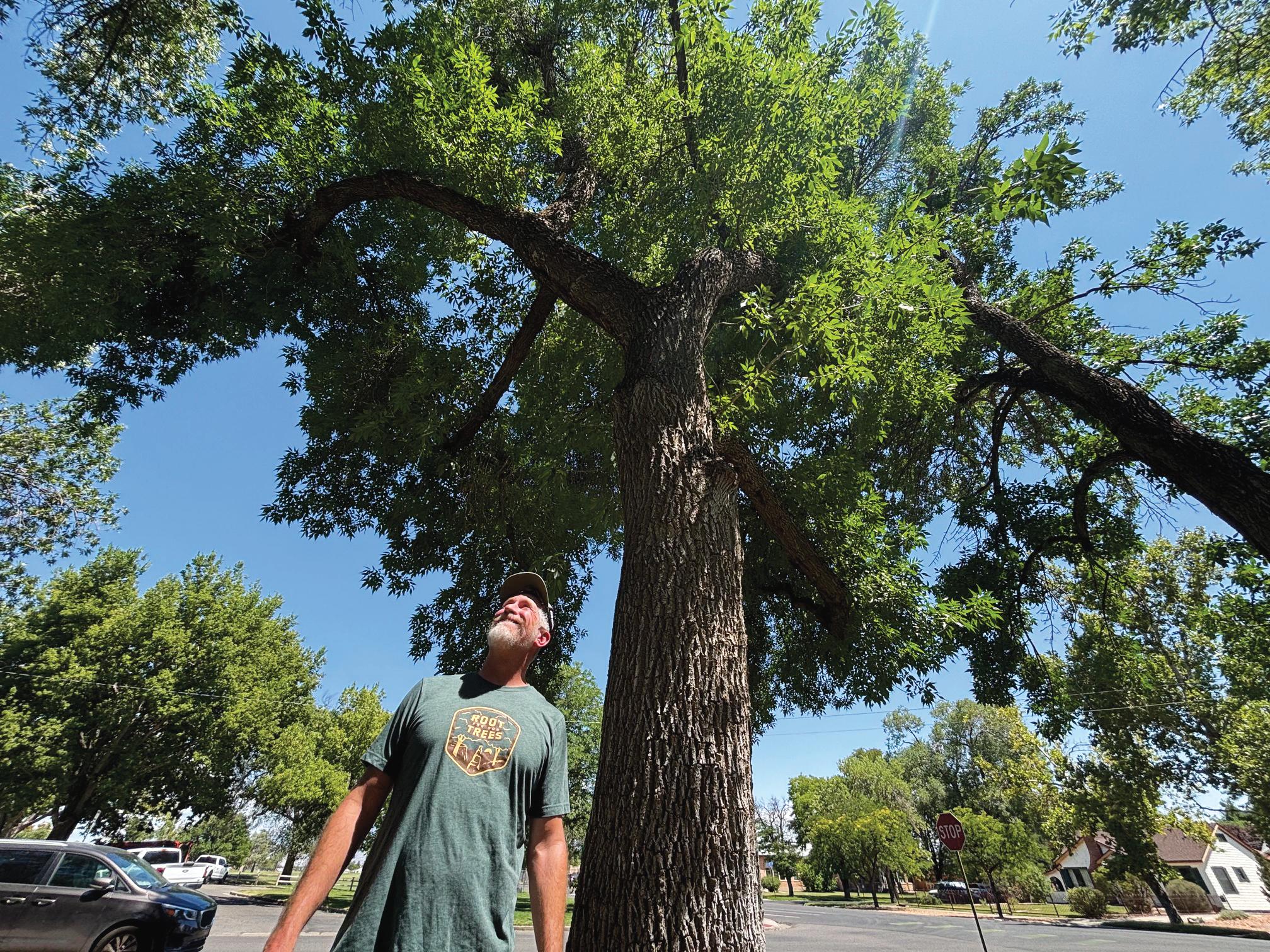
Grand Junction City Forester Rob Davis stands beneath a mature ash tree in Lincoln Park. Davis said preserving and expanding the city’s tree canopy is one of the most effective ways to reduce the urban heat island effect. Photo by Brandon Leuallen.
GJ Trees
Continued from Page 4
“If you’ve got a yard with big trees, if you’re gonna try to eliminate the grass, you need to be really thoughtful about how you continue to water,” Davis said. He recommended using organic mulch, perennials and shrubs with drip irrigation to distribute water throughout a tree’s root zone rather than relying on a single drip emitter near the trunk.
The hottest areas in town
The study found Grand Junction’s hottest areas were generally concentrated in commercial corridors, industrial districts and large retail centers where expansive parking lots, bare ground, rooftops and paved surfaces absorb heat throughout the day before releasing it well into the evening.
Davis said those findings were not surprising.
“It’s just gonna radiate heat,” he said. “That’ll make cities hotter than their surrounding rural areas.”
While the city’s Urban Forestry Management Plan includes canopy goals for all land uses, Davis said the city prioritizes investing water where trees provide the greatest public benefit.
“If we’re gonna invest water in trees, where will it have the biggest benefit?” Davis said. “That’s gonna be parks, residential neighborhoods.”
He said those areas provide shade where people gather and recreate while encouraging walking and other public-health benefits.
Davis said he would like to see more commercial and retail developments incorporate additional trees into parking lots.
“I would personally love to see more thoughtful design in our parking lots to increase plantable spaces,” he said, noting many shoppers already seek out the few shaded parking spaces on hot summer days.
The study also recommends: breaking up large expanses of pavement with landscaped islands, shade trees and other green infrastructure; preserving established trees during redevelopment; considering reflective paving and roofing materials; and using heat-mapping data to guide future planning.
trying to find that sweet spot” as it balances competing priorities.
Davis said homeowners and businesses also play an important role by planting climate-appropriate trees, protecting established shade trees and diversifying species to build a more resilient urban forest.
Residents with irrigated, public right-ofway adjacent to their property may qualify for the city’s free street tree program, in which the Forestry Division selects, plants and maintains the tree while the adjoining property owner provides the water needed to establish it. Each spring, the city also distributes free tree seedlings during Arbor Day and Southwest Arbor Fest.
Davis encourages residents to plant a variety of species to reduce the risk that a single insect or disease could devastate large portions of the city’s canopy.
“Don’t worry about being so matchymatchy,” he said. “Be a little more creative.”
Standing beneath established ash trees outside the Parks and Recreation office, Davis said they are reminders that today’s shade exists because previous generations invested decades caring for the city’s urban forest.
“I think that the critical part for us is that we have a lot of trees that have been here for decades, if not a century, that people have invested years and years of time to keep them healthy, to grow them and make them these valuable assets,” Davis said. “It is our job to
A handheld infrared thermometer records a surface temperature of about 75 degrees on shaded grass at Lincoln Park in Grand Junction. Just a few feet away, pavement in the middle of the street measured more than 70 degrees hotter in the sun. Photo by Brandon Leuallen.
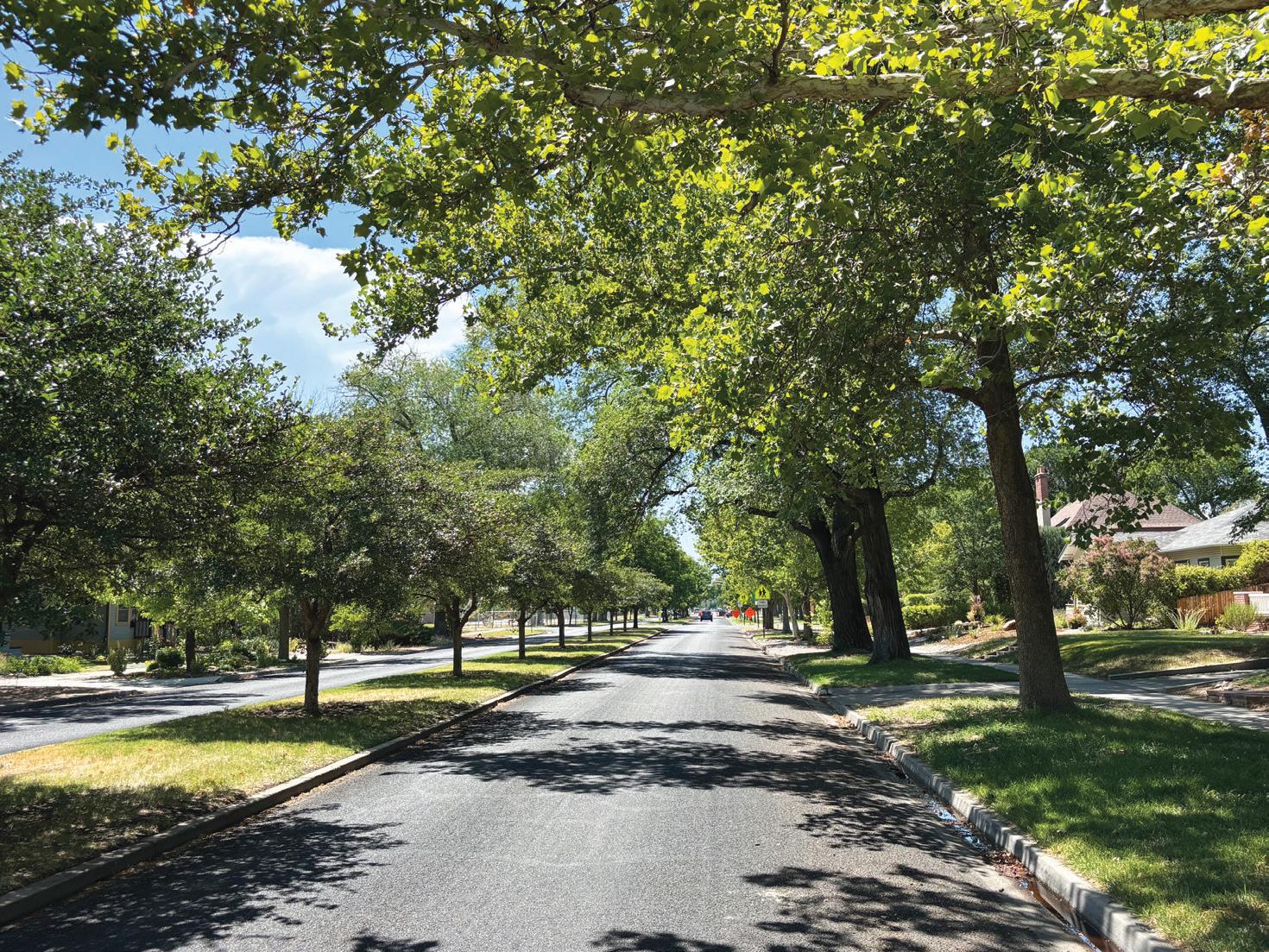
Mature trees shade Gunnison Avenue in Grand Junction. City Forester Rob Davis said expanding and preserving the city’s tree canopy can help cool streets and neighborhoods and reduce the urban heat island effect. Photo by Brandon Leuallen.
Palisade welcomes visitors with exceptional peach harvest
This year’s peach harvest has arrived early and is abundant and exceptional, according to the Town of Palisade and the Palisade Chamber of Commerce, who want to get that message out.
why it has become synonymous with worldclass peaches. And area fruit farmers are tireless, seasoned pros when it comes to meeting climate challenges.
A news release from the town and chamber said that although portions of Colorado have faced significant wildfire activity and ongoing drought concerns, the Palisade area has remained unaffected by active fires and continues to welcome visitors under blue skies and warm summer sunshine.
Visitors arriving over the coming weeks can enjoy orchard stands overflowing with fresh peaches, local wineries, farm markets, lavender fields, u-pick experiences, hiking and cycling, riverside recreation, and a thriving downtown filled with locally owned restaurants, boutiques, and artisan businesses.
The news release added Palisade is experiencing an exceptional peach harvest this year, with growers reporting an early, healthy and abundant crop.
The town and chamber also want to make clear the early-spring rumors of freeze damage to fruit crops were without merit. While many agricultural regions across the state experienced challenging weather, Palisade’s unique geography once again demonstrated
“Our growers never stop working to
protect this incredible agricultural legacy,” Palisade Chamber President and CEO Jessica Burford said. “While we’re certainly mindful of Colorado’s drought conditions and continue encouraging responsible water stewardship, we’re incredibly grateful that Palisade’s orchards have produced a beautiful harvest. We want visitors to know that Palisade is open, thriving and ready to welcome them.”
Palisade Town Manager Janet Hawkinson added, “Palisade has always been defined by its resilience, its agricultural heritage and the people who work tirelessly to preserve both. We want to thank the hard work of our firefighters this season. We have fires in the regional area, but the town is thriving in this year’s harvest.
“Coming soon is Peach Week, August 13-22. Come enjoy the peach harvest and all that makes our community so special. We invite visitors to experience our orchards, enjoy our local businesses and see firsthand why Palisade continues to be one of Colorado’s most cherished destinations.”
Treasurer reminds property owners to update mailing addresses
Mesa County Treasurer and Public Trustee Arna Hoffman is encouraging property owners to check and update their mailing addresses after the Treasurer’s Office received returned tax notices because of incorrect addresses.
Keeping a current mailing address helps ensure property owners receive propertytax notices, delinquent-tax information and other time-sensitive communications from the Treasurer’s Office. Delinquent-tax notices have been mailed, and the next step in the process is publication of delinquent taxes beginning in August before Mesa County’s annual tax-lien sale in October.
“We want property owners to receive the information they need before the process moves forward,” Hoffman said. “If your
mailing address has changed, please update it now, so you do not miss important notices about your property taxes.”
Property owners should check their mailing address if they have moved, changed or closed a P.O. box, receive mail somewhere other than the property address or manage property for a family member, trust or business. To check or update a mailing address, property owners should go to the Assessor’s Office web page and scroll down, then click the bold “change mailing address” link.
Property owners who believe they may owe delinquent taxes should contact the Mesa County Treasurer’s Office as soon as possible. For questions about delinquent taxes, contact the Mesa County Treasurer’s Office at 970-244-1824.
Former reductions enrollment
“These Board of
celebrated,
Mesa Institute staffing while
in the face
Wrenn Stabolepszy shows the contents of a box of peaches at Sweet Cheeks Organic Peaches, which is at 674 35 Road in Palisade and owned by her parents, Joachim and
Keri Stabolepszy. The Town of Palisade and its chamber of commerce are touting this year’s peach harvest as abundant and exceptional. Photo by Tim Harty.
School District 51 highlighted in report for cutting administration while improving student achievement
with worldfarmers are comes to
Mesa County Valley School District 51 was singled out in a new Common Sense Institute report as one of the few large Colorado school districts to reduce administrative staffing while improving student achievement, bucking several statewide trends.
working to
Cheeks OrganJoachim and this year’s
legacy,” CEO Jessica certainly mindful and continue stewardship, Palisade’s beautiful harvest.
Palisade is welcome them.”
Manager Janet has always agricultural tirelessly thank the hard We have the town is Week, August harvest and all special. We orchards, firsthand one of destinations.”
The report examined Colorado’s 15 largest school districts from the 2021-22 through the 2025-26 school years. It found District 51 reduced district administrator positions by 21.2 percent, the largest reduction among the state’s largest districts, while posting the largest combined improvement in SAT reading, writing and math proficiency.
District 51, Denver Public Schools and St. Vrain Valley Schools were the only three large districts to improve in both SAT subject areas during the study period. The report also found District 51 had more than 40 instructional staff members for every district administrator and was the only district to increase that ratio during the study period.
The report contrasted those results with statewide trends.
Between the 2021-22 and 2025-26 school years, Colorado added 263 public school administrators while student enrollment declined by 15,724 and the state lost 744 teachers. During roughly the same period, average per-pupil funding increased 27 percent, yet statewide PSAT and SAT performance declined in five of six measured reading, writing and math categories. The only improvement was in 11thgrade reading and writing.
The report also highlighted Colorado’s continued struggles in mathematics. In 2025, only 37.5 percent of ninth-grade students, 36.4 percent of 10th-grade students and 32.5 percent of 11th-grade students met or exceeded the state’s math expectations.
Former District 51 Board President Andrea Haitz said the district’s administrative reductions came after the board directed Supt. Brian Hill to identify budget reductions as enrollment declined and financial pressures mounted.
“These reductions were not easy,” Haitz wrote in a public statement. “The previous Board of Education gave Dr. Brian Hill the difficult directive to identify budget reductions in the face of declining enrollment and financial realities. That wasn’t a decision anyone celebrated, and it certainly wasn’t made lightly.”
Haitz credited Hill and his leadership team with carefully identifying where reductions could be made while protecting classroom instruction.
“Those decisions required careful analysis, countless conversations, and a focus on protecting classrooms and student learning as much as possible,” she wrote.
The Common Sense Institute concluded it found no discernible relationship between increasing administrative staffing and improved academic performance among Colorado’s largest school districts. The report recommends that, with Colorado facing limited budget flexibility, state and local education leaders should demonstrate how additional spending on administrative positions improves student outcomes before expanding administrative staffing.
The Common Sense Institute is a nonpartisan, Colorado-based, research organization. The report relied on staffing, enrollment, funding and student-achievement data from the Colorado Department of Education.
Andrea Haitz
Brian Hill
Tri-County Health changes name to Thrive Community Health
Tri-County Health Network will change its name to Thrive Community Health Network, effective Aug. 1. The new name reflects the nonprofit organization’s expansion from serving three counties to six counties across Colorado’s Western Slope.
The name “Thrive” also better represents the breadth of programs and services the organization provides throughout the region.
“Our new name, Thrive Community Health Network, better reflects both who we serve today and our vision for the future,” said Amy Rowan, co-executive director of community programs. “As our service area has grown beyond three counties to six, it is important that our identity clearly represents the communities we serve. We are still the same organization. Our mission, vision and values remain the same.”
A news release from Tri-County/ Thrive says the organization was founded 15 years ago with the mission to “collaborate with our communities to
improve health for everyone.” Thrive Community Health Network will continue to provide community health programs, care coordination, insurance enrollment and behavioral health resources under the new name, with no interruption to existing services or partnerships. The rebrand includes an updated logo, and an improved website is coming this fall.
“We are regularly mistaken for a public health department or government agency. By taking the word “county” out of the name, we hope to reduce that confusion in the community,” said Melanie Montoya Wasserman, co-executive director of advocacy and inclusion.
According to the news release, the organization will continue building partnerships across counties to efficiently address evolving community health needs and improve long-term health outcomes throughout the region.
“We have over 25 programs that have a wide range. Some are clearly health related, and others are more on that end of what we call social determinants of health, factors that greatly impact a person’s wellbeing,” Montoya Wasserman said. “We know that for someone to thrive, there are a myriad of factors that play into that. We may not be able to address all of them, but the ones that we do focus on have a big impact on people’s lives.”
For more information about Thrive Community Health Network, visit tchnetwork.org or call 970-708-7096.
True West survey seeks input about outdoor recreation
The Grand Valley Outdoor Recreation Coalition, with support from Community Builders, is launching True West, a community-engagement and planning effort that was introduced in November 2025, to help shape the future of outdoor recreation in Mesa County.
As part of the kickoff, community members are invited to take an online survey through Aug. 14. The survey asks about recreation habits, priorities, concerns, barriers and ideas for the future. Participants may also choose to enter a prize drawing.
Throughout the remainder of the summer and fall, community members will have additional opportunities to get involved through a series of campfire
sessions focused on specific user groups, community-visioning workshops and other engagement events.
“Whether you hike, bike, hunt, fish, paddle, climb, camp, ride OHVs, or simply enjoy spending time outdoors, your voice matters,” said Chandler Smith, executive director of the Grand Valley Outdoor Recreation Coalition. “This plan belongs to the community, and we encourage everyone to take the survey, so the priorities and investments we identify reflect the values and aspirations of the people who call Mesa County home.”
For more information or to take the survey, visit www.gvorc.org/master-planfeasibility-study or email info@gvorc.org
Melanie Montoya Wasserman
Amy Rowan
everyone.” Thrive continue programs, enrollment under the to existing rebrand improved mistaken for a government “county” out of confusion Montoya director of release, building efficiently health needs outcomes that have clearly health that end of of health, person’s Wasserman said. thrive, there into that. of them, have a big about Thrive Network, visit 970-708-7096.
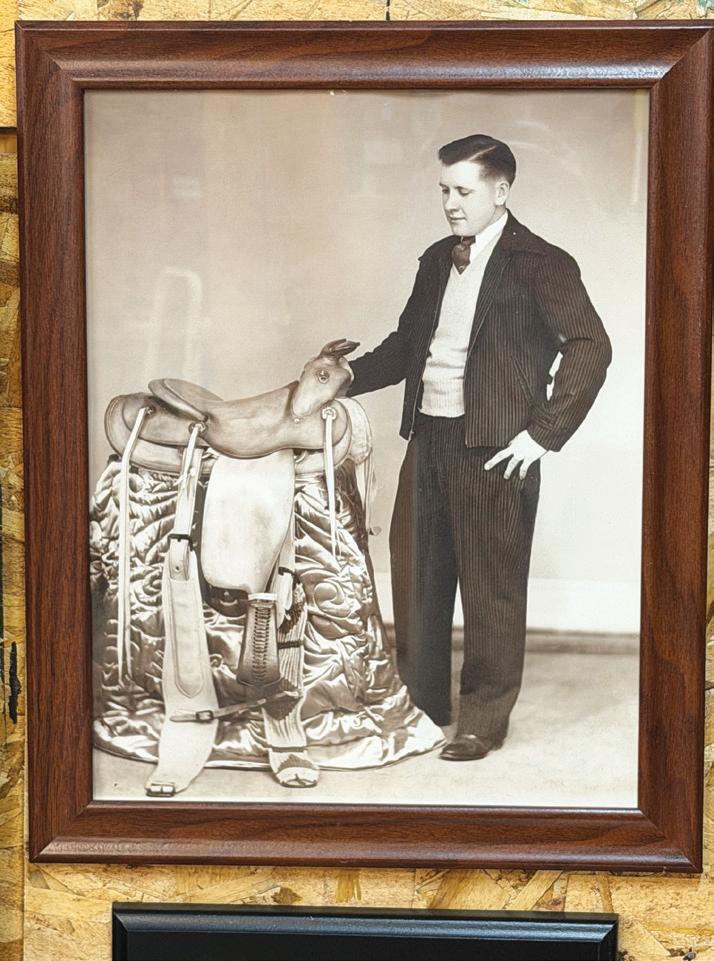
This framed Shop shows the first saddle
Bud’s Tack Shop
Continued from Page 2
“My dad was the most particular guy that ever lived when it came to a piece of leather, and he tried to instill that in us.”
Ray added, “We have people ship us stuff from California, Denver, all over, to repair and stuff, especially saddles. They’ll send quite a few saddles from California and places that know us, and that was part of the travel. We knew everybody that roped or rodeoed or anything forever. And we got around a lot. I mean, we really did.”
And people remembered that.
“We’ve just been here for a long time and tried to do good work and treat people good,” Ray said. “I’ve got customers that my dad dealt with 70 years ago. You know, same families and things. So, I guess we’ve
More About Bud’s Tack Shop
If it goes on a horse, they can make it
Saddle repair may be the bread and butter of the business for Bud’s Tack Shop these days, but owner Ray Grant said they do much more.
“We make bridles, chaps, anything that goes on a horse, any tack,” he said. “Horse tack is anything that goes on horse. We make any of it, custom-made any way they want it. And we do a lot of business with that.”
Between Ray and his son, Bryce Grant, “We can do about anything out of a piece of leather that can be done,” Ray said.
That led Ray to say more about Bryce, whose business, Bryce Grant Custom Leather, shares the workshop at 1516 M 3/8 Road near Loma. Leather is in the business name, but Bryce has branched into silversmithing, making custom buckles, engraving metal items and such.
It’s obvious in Ray’s voice that he’s a proud dad when he talks about Bryce, whose day job is director of the Center for Academic Support at Colorado Mesa University.
Ray said Bryce also is in the belt business and has a growing clientele.
“He’s on Etsy, and he ships them all over the world,” Ray said.
Makes sense, and cents, to go with good leather
Another reason the craftsmanship of the Grants stands out is they use high-quality leather.
“We’ve got three different suppliers down mainly in Kentucky,” Ray said. “There’s all kinds of quality of leather. You want to go for the best stuff. The best leather only costs maybe 20 percent more than the bad stuff. So, you go with the good stuff.”
Ray brought up the topic of belts again and lauded Bryce’s work, the tooling he does on belts, the flower
stamping.
“Just feel the leather and the way the edges are finished and everything,” Ray said. “If you notice the stitching, there’s no missed stitches or anything like that. He takes a lot of pride in what he does.”
Of course, Bryce’s belts cost more than the average belt that’s sold in a department store. Ray pointed to some and said they sell for $70 apiece, and they will “last you for a long, long, long time.”
Versatility, commitment, artistic touch make Dad proud
Ray pointed to a pair of chaps that Bryce was preparing, and said whatever they need, “zippers or buckles or things like that,” Bryce takes care of it.
Then, he pointed to a knife that Bryce engraved freehand.
“You have to have that artistic touch to do that stuff,” Ray said.
Bryce’s skill amazes Ray, because, “He works all day at the college and then comes home and works here. He puts in a lot of hours. … He’s growing his business, you know, he’s really getting stuff going, and that’s what you’ve got to do. You can’t sit on your butt and expect it to come to you.”
Known world-wide, even on the Isle of Man
But when you’ve done the work and established a standard of quality, business does start coming to you.
“He sends stuff to Germany, Australia, New Zealand, Great Britain, quite a bit of stuff,” Ray said.
Even people from obscure places have gotten wind of Bryce’s work, as Ray said, “He sent a belt the other day to the Isle of Man. I had to look that one up, where that was. It’s between Ireland and Scotland. It’s an island out in the middle there.”
This framed photo on the wall at Bud’s Tack Shop shows Bud Grant at age 16 in 1946 with the first saddle he made.
Getting the inside track on insider trading
Oh yes, Congress is serious about insider trading now. After all, they took a vote and there was “bi-partisan support” in the House of Representatives to “outlaw” this pox on Congress’ hard (yet obvious) earned reputation of “laws for thee but not for me.”
Someone tell those honorable hacks in the house they spelled outlaw wrong, because they obviously meant outsourced. Because when it comes to insider trading, your favorite congress critter will simply let ol’ Uncle Fraudenfranker place the stock orders for them. They just are trying to put a law into place where we all feel better in thinking “they” aren’t doing it. And it isn’t even a “law”…. it’s actually just a rule, or as Captain Barbossa would say, “They are more like guidelines.” Yes, Congress is trying to make you think it won’t insider trade when what it’s really doing is putting in a system where it, and only it, can be protected from prosecution for insider trading by proxy.
Martha Stewart was unavailable for comment; mainly because you were told to hate her, because she’s rich and did what she did. Funny how that doesn’t work for Congress when they are all doing the same thing Martha did, only trying to get rich. That’s what happens when there’s $7 TRILLION plus at your fingertips and you know where government is gonna spend it. It’s simply too big a temptation to pass up.
So when they get called out and you have Congress’ power, what is “your guy” to do? That’s right, write a law that makes it look to the people that you’re on the up and up, which allows you to do it on the down-low.
And that’s all this is. Just another example of our elected elites making a way for them to break the law while assuring government can come down harder on you if you even attempt to do what it is doing. After all, who has more inside info? The entity with trillions to spend or your neighbor who’s deciding whether to pay rent or go grocery shopping?
No wonder they come up with this bovine scat for the people. If you knew the truth, you’d despise them more than you ever even considered Martha’s mistakes.
I think I’ll add to my “It’s all money-laundering” with “and insider trading.”
Like my daily devotional from Max Lucado said this morning, “We validate our existence with a flurry of activity.” Just replace the “we” with “Congress.” If they can keep you occupied with the busy-ness and complications of everyday life on one hand, you’ll never see what they’re doing with the other. Why do you think Congress holds so many hearings and floor speeches where they address myriad, serious issues and problems in five-minute, talking-point pontifications that have nothing to do with getting to the heart of the matter in actually helping the citizens they are alleged to serve?
Here’s an example. You recall how we have been sold the line “Diversity is our strength?” Not that we need it, as most humans I know take each person as they come regardless of any criteria and assess from there. We already have rich, diverse lives. But government leaders sure keep us caught up in the minutiae of everything surrounding that. We fight about it literally every day. All the way to this reason why they want us to fight: Division among the citizenry is their strength.
Honestly, have you ever seen Congress make a law that benefits everyone? The question is rhetorical, because the answer is simple. It can’t. That’s why I propose the next, and only, law government writes is this: The people shall no longer refer to anyone elected as a “lawmaker” in the fervent hope these elitist asses stop writing laws. Especially ones they have no intention of obeying, which is basically all of them.
This is why term limits will never become law. I mean, you need years in office to
Support Local Support Business
really cash in on insider trading as it takes many forms. This is why the Save Act will never pass. First off, because the people don’t know what’s in it, because we need to be fighting over it. But more importantly because your congressperson doesn’t know what type of electioneering they might need to win the next round, so they only want something in place which protects their winning.
Do you honestly expect something different from a group that can’t even sanction its members for heinous behavior and paying off victims of sexual abuse with taxpayer dollars while keeping them secret?
Now, I realize this is simply a quick look at the antics of an outlaw organization. But what else do you need to have your Spidey senses go off on this web of deceit, cheating and money-grubbing we call Congress? Haven’t you ever looked at something or someone and just knew, “That ain’t right.” I see it every day. How else can you explain Congress having us fight over this or that few billion dollars, because we can’t afford it as a nation, when they are literally spending trillions every year?
Heck, in Colorado they’re trying to destroy our Taxpayer Bill of Rights under the guise of school “underfunding” when the state budget has DOUBLED the past 20 years or so. It’s not because the state doesn’t have the money for schools; it’s all about how lawless lawmakers buy votes with our money. Why can’t we have a state where education is fully funded and our taxpayer rights (that can be a whole other column) are still in place?
That’s right: politicians and unions and public education and their access to that money and power.
Again, this column only treads the surface as it meanders along the shoreline of the ocean that is government and its largesse. But passing silly, public-relations, ineffectual, anti-freedom laws and rules that your favorite politician will break tomorrow isn’t the answer. Nor are laws “legalizing” things for the people that are really written to assure the government gets to run this or that – think pot, gambling, drugs and tobacco and now voting, insider trading and “term limits.”
All one needs to do is look at the tribute paid (maybe I should add “tributes” to the stuff mentioned before) to government from all the “insider trading” involved in these “industries,” or the machinations involved that affect you and not them, and you just know in your gut something is wrong, very wrong.
The only way to get a government for the people, by the people is to reduce the size and scope of the government leviathan we already have. And that means removing the power. When you remove the power, the money will follow and so will the scam artists we call politicians. It would help if we all stopped going to them to solve every little problem we have. Because where we see a problem, they see a vote, power and money, the real problems in government.
As George Carlin once said, “It’s a big club, and you ain’t in it.” Now, I don’t want to be a member, but I’m all for shutting down the secret society. And that includes “your guy.”
We already wrote the laws needed in 1787. Maybe start there. You know, when government was small, and broke. Quite the opposite of today, except the broke part. But that only sucks for the law-abiding taxpayers. We just don’t have enough votes to stop it anymore.
In Truth and freedom.
F
Craig Hall is owner and publisher of The Business Times. Reach him at 424-5133 or publisher@thebusinesstimes.com
Craig Hall
n Workforce Center employee receives national award
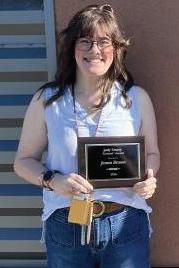
Jeana Brown, an employment services specialist at the Mesa County Workforce Center, received the Judy Emery “Genesis” Award from the National Disability Institute through the National Navigator Exchange.
The award honors individuals who demonstrate innovation, leadership and a lasting commitment to improving employment opportunities for people with disabilities. Named after Judy Emery, whose pioneering work helped establish the Disability Program Navigator model that has since been adopted nationwide, the award recognizes professionals whose ideas and dedication create meaningful change in workforce systems.
Brown works alongside job seekers, employers and community partners to reduce barriers to employment and ensure individuals with disabilities have access to the resources and support they need to succeed in the workforce.
“Jeana’s consistency and passion for her clients is exceptional,” said Heather Nara, director of the Mesa County Workforce Center. “She approaches every interaction with empathy, professionalism and a genuine desire to help others succeed. We are incredibly proud of her and grateful to see her receive this well-earned national recognition.”
New Board of Public Health member appointed
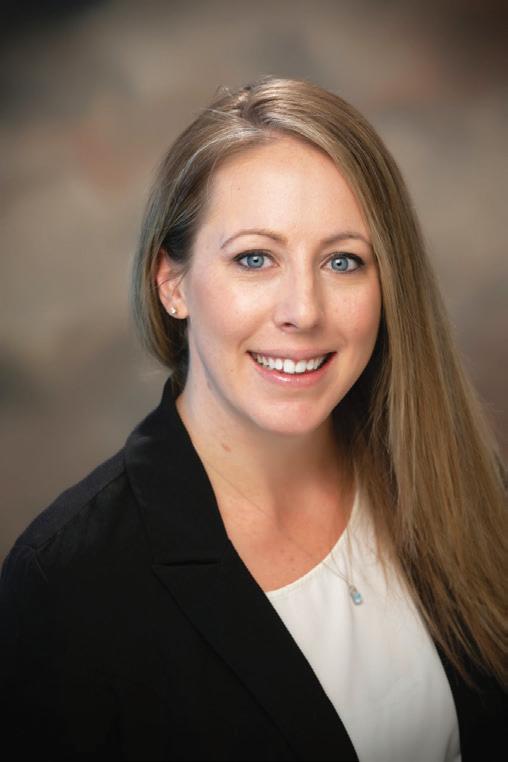
The Mesa County Commission appointed Brittany Bear to the seven-member Mesa County Board of Public Health. She will serve a five-year term running through April 30, 2031.
welcome. Vaccines will be available while supplies last.
Parents need to bring their insurance card and their child’s immunization record. If needed, nurses can check records to see which vaccines are needed. There are programs available for those without insurance.
To learn more about what types of vaccines are provided in at the public-health clinic, go online to www.mesacounty.us/departments-and-services/public-health/local-diseaseillness/vaccine-services.
n County clinic adds physician assistant Lewis as provider
Bear is a registered nurse with 18 years of experience working in hospitals, clinics and community health programs. She currently serves as the director of regional operations for care management at Intermountain Health, where she oversees hospital and emergency-department-care management across Colorado. Previously, she served as the director of care management and in several other management roles for SCL Health.
A Western Colorado native, Bear has lived in Mesa County for the past 22 years.
“I am deeply committed to improving the health, safety and well-being of our community,” Bear said. “I am passionate about advancing health equity, strengthening maternal and child health, improving behavioral health collaboration and ensuring that public-health decisions are grounded in evidence and reflect the lived realities of our rural community.”
n Hotchkiss rancher steps into presidency of cattlemen’s group
Mark LeValley, a fourth-generation livestock producer from Hotchkiss, was instated as the 121st president of the Colorado Cattlemen’s Association in late June during its 2026 convention in Loveland LeValley joined the CCA Board of Directors in 2016 after serving CCA since 1987 as the Game and Fish Committee chair, then Brand & Theft Committee lead. He also represented CCA with the National Cattlemen’s Beef Association in Washington, D.C.
LeValley’s wife, Robbie, served as president of CCA for the 2010-11 term.
The LeValleys own and operate LeValley Ranch, which soon will add a sixth generation to the family. The LeValley Ranch is a cow-calf and stocker operation comprised of private land and BLM allotments. LeValley Ranch, along with five other ranches, owns and operates Homestead Meats in Delta, offering custom USDA processing and direct sale of beef to consumers.
“I look forward to serving all of you and will do my best to represent all of Colorado,” Mark LeValley said at the convention.
The 2026-2027 CCA Board of Directors will include Northwest quarter representatives Lenny Klinglesmith of Meeker and Dan McCarty of Rifle and Southwest quarter representatives Andy Spann of Gunnison and Pete Stagner of Moffat.
n Back-to-school vaccine clinic set for Aug. 1
To help families prepare for the upcoming school year, Mesa County Public Health is partnering with the Colorado Department of Public Health and Environment to host a back-to-school vaccine clinic.
The vaccine clinic will take place Aug. 1 from 9 a.m. to 1 p.m. at the Mesa County Public Health Clinic, 510 29 1/2 Road. Appointments are preferred, but walk-ins are
Mesa County Public Health announced the addition of a new provider to its clinic team: Keelin Lewis, a physician assistant with a strong background in primary care. This addition means increased capacity for healthcare services for all Mesa County residents, the organization said in a news release.
The Mesa County Public Health Clinic said community members can look forward to: an increase in appointment slots and scheduling availability Monday through Friday; and the ability to offer care in English and Spanish, because Lewis is a bilingual provider.
Mesa County Public Health touts affordable, accessible care for everyone, and available services include: annual exams, which can include preventative screenings for chronic conditions, STI testing, and patient education on diet, weight and physical activity; services for people trying to conceive or prevent pregnancy; routine vaccines for children and adults; and travel vaccines customized to your destination.
For more information about the services, go online to www.mesacounty.us/ departments-and-services/public-health/public-health-clinic. Community members can schedule an appointment by calling the clinic at 970-248-6906.
Business Bites
Brass Rail back in business after 11-month closure
The Brass Rail Tavern, 476 28 Road, reopened July 6 after being closed for 325 days because of damage sustained when a vehicle crashed into the front of the building on Aug. 14 last year.
“It was nuts in here,” bartender Kim Knutt said of the first day back open, adding players in a pool leagues showed up and said, “We’re so happy to be back.”
Knutt, who has worked at The Brass Rail for 20 years, said, “It’s the same old Brass Rail,” and it will resume things such as karaoke on Friday nights and Denver Broncos football parties on Sundays this fall, something its patrons missed for the entirety of last season.
• No longer cost cutting: Cost Cutters closed its location in the Target wing of Mesa Mall recently. CBL Properties Vice President of Corporate Communications Stacey Keating wrote in an email that Cost Cutters’ lease expired, and it did not renew.
• Teriyaki Madness coming: Teriyaki Madness is renovating the building at 2691 Patterson Road in Village Fair shopping center. The location previously was home to a Which Wich sandwich shop.