JULY 22 - 29, 2026
VOLUME 33, ISSUE 29
THE DEFINITIVE SOURCE FOR GRAND JUNCTION BUSINESS & COMMUNITY NEWS SINCE 1994
Incubator seeks new leader for AgriWest Brandon Leuallen
T
The Business Times
he Business Incubator Center is searching for a new leader for its AgriWest initiative as founding Program Manager Janie VanWinkle prepares to conclude the 30-month fellowship that helped establish the regional agricultural program. VanWinkle’s final day with the Business Incubator Center will be July 31, marking the end of her Economic Recovery Corps fellowship through the International Economic Development Council. While her fellowship is ending, AgriWest will continue under the Business Incubator Center with a new part-time program manager focused on helping agricultural producers strengthen and grow their businesses. “I feel like we’ve done some good things,” VanWinkle said. “We’ve laid some really good groundwork.” AgriWest was created to strengthen western Colorado agriculture by: helping producers build stronger businesses; connecting different sectors of the agricultural industry; increasing collaboration with government and community organizations; and ensuring agriculture has a stronger voice in regional planning and economic development. See story Page 5
THEBUSINESSTIMES.COM
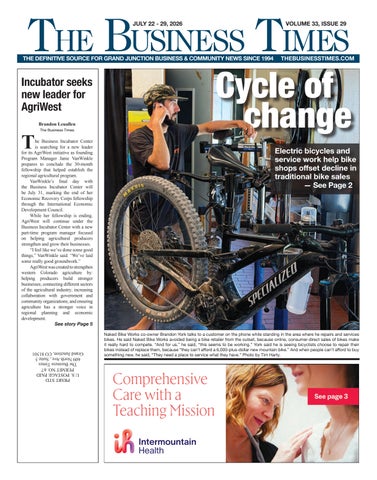
Cycle of change
Electric bicycles and service work help bike shops offset decline in traditional bike sales — See Page 2
Naked Bike Works co-owner Brandon York talks to a customer on the phone while standing in the area where he repairs and services bikes. He said Naked Bike Works avoided being a bike retailer from the outset, because online, consumer-direct sales of bikes make it really hard to compete. “And for us,” he said, “this seems to be working.” York said he is seeing bicyclists choose to repair their bikes instead of replace them, because “they can’t afford a 6,000-plus-dollar new mountain bike.” And when people can’t afford to buy something new, he said, “They need a place to service what they have.” Photo by Tim Harty.
PRSRT STD U.S. POSTAGE PAID PERMIT NO. 67 The Business Times 609 North Ave., Suite 5 Grand Junction, CO 81501
The Business Times
Page 2
July 22 - 29, 2026
Bike shops adapt to keep on ridin’ Electric-bike sales, service work among the ways local bike shops remain relevant Tim Harty
W
The Business Times
hen Chris Brown announced in mid-June he would soon close Brown Cycles, he shared his reason and applied it to more than his own downtown Grand Junction shop. “It’s not a sustainable business model, this thing we do in bike shops,” he said. Brown detailed what bike shops face nowadays, said they have to adapt or die, and he opted to close Brown Cycles after a 25-year run at 549 Main St. Of course, that outlook for the future of bike shops led The Business Times to check in with other bike shops in Grand Junction to see how they’re faring. And without a doubt, these are tougher times for the traditional bike shop. However, faced with the prospect of adapt or die, there is an adaptation that’s making a difference for local bike shops: selling electric bikes. Brown chose not to sell e-bikes, but other bike shops have made peace with breaking from tradition, and their owners say it’s helped their bottom line considerably. The Business Times interviewed owners or managers from five Grand Valley bike shops. Three other bike stores either didn’t respond to requests for an interview or politely declined. The Bike Shop, Bicycle Outfitters, Colorado Backcountry Biker, Colorado Electric Bikes and Naked Bike Works shared their experiences, and summaries of the conversations with them follow:
ABOVE — Bryan Miick, co-owner of The Bike Shop, 950 North Ave., Suite 108, stands in the middle of his store’s showroom. He said The Bike Shop The Bike Shop got its start in Grand Junction’s Coast to Coast Hardware store in 1989. 950 North Ave., Suite 108, Grand Junction Bryan Miick, co-owner of the Bike Shop, said BELOW — Brad Stewart also is a co-owner of a longtime Grand Junction bike shop, Bicycle Outfitters, 537 N. First St. He said the store has been Brown’s words about the bike-shop business model open 33 years, and Bicycle Outfitters has a Montrose location that has ring true. been open “a little over 10 years.” Photos by Tim Harty.
“Retail’s definitely tough,” he said, then provided a sizable list of reasons. Among them: the Covid-19 pandemic; inflation; tariffs; and too many bike shops in the Grand Valley. “Since the pandemic, things have definitely been different,” Miick said. “There used to be a relatively stable pattern of our cycle of our year. When the pandemic happened, people’s lives changed. I think their habits changed. What they do, how they buy has changed. “And in the pandemic, we went wild and sold everything we could get our hands on. After the pandemic, all those people that bought bikes during the pandemic, well, they don’t need a new one just yet. So, bicycle sales have been off.” And now people are dealing with higher gas prices, higher food prices, and Miick said, “Our customer is disposable income, what you have left after you’ve bought the essentials.” He said people may want a bicycle, but they don’t need a bicycle. They need food. They need to buy gas. They need to pay their mortgage or rent. Miick also mentioned the T-word, tariffs, and had plenty to say about their effect. His short answer is they will lead to increasing costs and force bike shops to decide if they want to raise prices or lessen their margins. He said another factor for area bike shops is “there are too many shops in town, no doubt about that.”
Miick added, “I don’t know the exact count, but per capita, most big cities have one shop for 500,000 people. I think there’s 10 or 11 shops between Palisade and Fruita and not 500,000 people. Oh, maybe 130,000.” He acknowledged the Grand Valley is a logical exception, though. “Cycling people come here for recreation,” Miick said. “They live here for recreation. And we have a great cycling culture here. That’s been road riding, mountain riding, casual riding around town. You can almost get from one end of town to the other faster on a bike than a car. It’s a great cycling culture.” But, there are still too many bike shops, so each one has to work to stand out. For The Bike Shop, Miick said that starts with bike repairs and service. “Our number one thing that we do here is service,” he said. “You cannot buy service online. And you cannot buy service from a big-box store. And our goal is to service your bike, get you turned around within a day. Usually quicker than that. ... We want to get the bike back to you as fast as possible, so you can continue riding it, not have it sitting here waiting for service.” Miick said electric bikes have helped where the decline in sales of traditional bikes have lagged. Still, he said, “Our annual revenues, compared to prepandemic, are way down, and that does create a little bit of a struggle.” More optimistically, he thinks The Bike Shop may have weathered the worst of things. “I’m going to say we’ve maybe leveled out on the Valley floor. And that’s good enough to be able to continue on with the business,” he said. “Definitely we’re watching our costs. We’re not working with as many employees as we would have had in the past. There’s things we’re doing to cut where we can cut, to absorb that and to rely more heavily on service dollars than sales dollars, if that makes sense.”
Bicycle Outfitters
537 N. First St., Grand Junction Like Miick, Bicycle Outfitters co-owner Brad Stewart detailed what the pandemic did in terms of the initial burst of sales of traditional bikes, then the fallout from vendors buying up way too much inventory and having to offload the glut on retail bike shops. That did traditional bike retailers no favors. Then, there’s competition from Amazon, Walmart, Target and the like, where people turn to buy standard bikes. Stewart said sales of traditional pedal bikes are down, but he’s offsetting it with the sale of electric bikes, which he estimated to be about 40 percent of his bike sales and growing. “It’s the way the market is going,” he said. But Stewart still sells standard bikes, as he said on June 15, “I just sold three, $9,000 bikes today without a motor on it. So, you never know.” Helping push electric-bike sales, he said, is a state tax credit of $225 that is given at the register. “Basically,” Stewart explained, “what that is, it’s state to business, meaning that if you go buy a bike online, you don’t get that $225. You only get it if you buy it from your dealer, your local dealer.” See BIKE SHOPS on Page 4
July 22 - 29, 2026
n’
The Business Times
Page 3
Page 4
Bike Shop
The Business Times
Continued from Page 2 Stewart said Bicycle Outfitters is doing well overall. “We typically sell three to five bikes a day, of whatever it may be (standard or electric),” he said. In addition to increasing electric-bike sales, he said its bike-rental business is doing well, and service work is up. “We’re up probably 10, 15 percent in the last couple years,” he said of service work, adding Bicycle Outfitters services all brands of bikes, not just the ones it sells. Stewart added, “You know, 2020 and ’21 were phenomenal years. I know that we will never do that again, but we’re not too far off of it. “But the e-bike, like I said, it brought in a whole new customer base, and we still have our regulars that we’ve always had, but we also get new ones.”
Colorado Backcountry Biker
150 S. Park Square, Fruita General Manager Gary Plante said in mid-June that Colorado Backcountry Biker’s year-to-date revenues were ahead of last year. “We’ve had a really good 2026 so far,” he said. Colorado Backcountry Biker, also known as CBB, has a few advantages just from it’s location, Fruita, and the city’s proximity to Colorado National Monument and mountainbike trails, plus the open road for road bikers. That goes for tourists and locals. Plante said CBB also brings in customers because of its customer service, and its rental business is as important as retail sales of bikes, pedal and electric. Plante said CBB’s rental business “has been pretty big,” and this year it is seeing bigger groups of rentals. In addition to the tourists, he said, “We’re seeing new faces. Even today (June 17), we had a couple guys come in that decided to switch their shops for whatever reasons. I think our shop has a really good local vibe. … So, it’s not just tourists coming through this door that we want to make sure we can help them get out on the trails … but our locals and the vibe that we create, we have a pretty tight-knit group of guys and gals here. It’s important.” Those are things that Plante said “you don’t get at every, not just bike shops, at every place you go, that kind of customer service that seems to be lacking in a lot of businesses these days. So, that’s very important to us.” Plante said electric-bike sales and rentals are on the rise at CBB, and “it’s not going to slow down.” “We keep getting more and more people interested,” Plante said. “If they haven’t tried one, they want to try one. And
July 22 - 29, 2026
sometimes after they try one, they don’t want to go back to the regular bike. So, that will just continue to be big. “Any shop that carries e-bikes will probably tell you the same thing, so you have to be on top of it. It’s an ever-changing technology, though. Motors change, batteries change, and as that happens, people want the newest and latest. So, you’re always trying to kind of stay ahead of the game. But e-bikes, there’s going to be a bigger volume of e-bikes next year than there was this year, and that will probably continue to trend.” Plante said CBB still sells more regular bikes than electric bikes, “so that’s a big part of our business, too. We’re not at a 50-50 mark or anything like that. But (electric bikes are) getting more popular as the years go by.” When Plante sums up what sells at Colorado Backcountry Biker, he goes back to customer service instead of specific products and services. “Before the sale even happens, you have to establish a good relationship with that customer,” he said. “Once they walk in the door and once they trust you, then you can move on to everything else.”
Colorado Electric Bikes
ABOVE — Gary Plante, general manager of Colorado Backcountry Biker in Fruita, stands in front of an Orbea OIZ racing bike. The lightweight, cross-country bike is made in Spain and is the store’s race bike. It retails for $12,600. BELOW — Colorado Electric Bikes co-owner Justin Manupella pets one of his family’s dogs, a Labrador retriever named Ben, flanked by two rows of electric bikes inside the store on June 16. Photos by Tim Harty.
2751 Riverside Parkway, Grand Junction What Brown experienced with retail of traditional bicycles doesn’t apply in any way to Colorado Electric Bikes, because it sells only electric bikes, and they’re a hot commodity. That’s what Justin Manupella, who co-owns Colorado Electric Bikes with his parents, Scott and Diane, and brother, Kyle, started with in Diane’s infra-red heater store in Delta, just a few electric bikes. Then, they moved it to Grand Junction, and in 2014 Colorado Electric Bikes rented space in the back of Brown Cycles. “He was very welcoming,” Justin said of Chris Brown. “He understood that (electric bikes) were gonna be something that was coming out, and he was willing to help. So, we love Chris.” Eventually Colorado Electric Bikes moved to a store on 25 Road, then made its way to 2751 Riverside Parkway, where it stocks more than 100 e-bikes. “I’ll be honest, we probably have too many bikes at the moment,” Justin said, adding what they stock are mostly Class 1 and Class 2 cruiser-style bikes, “because that really is the bulk of the bike industry as a whole right now, the cruisers. Basically, it really has gone that way.” See BIKE SHOPS on Page 7
July 22 - 29, 2026
The Business Times
AgriWest enters next phase as Business Incubator seeks new program manager
Rancher Janie VanWinkle, next to the flag, and Colorado Mesa University economics professor Nathan Perry present an AgriWest study at The Business Incubator Center. Photo courtesy of the Business Incubator Center. Continued from Page 1 During VanWinkle’s fellowship, the initiative: brought together producers from Mesa, Delta, Montrose, Garfield and Rio Blanco counties through the annual AgriWest Council; coordinated a regional agricultural economic-impact study; helped launch the School District 51 local-beef-purchasing program; organized educational events; and created opportunities for producers from different sectors to work together on common challenges among other initiatives. VanWinkle said the next chapter of AgriWest will build on that foundation. Rather than focusing primarily on building regional connections, the new program manager will concentrate on helping new producers start up and helping more established ones become stronger business owners by connecting them with the Business Incubator Center’s entrepreneurial resources. “I think what this next role will be is more bringing producers to the Incubator and letting the Incubator do what the Incubator does best,” VanWinkle said. “And that is provide entrepreneurial support.” According to the job description, the AgriWest program manager will: provide one-on-one business mentoring; organize educational workshops; develop partnerships; pursue grant funding; and help ensure the long-term sustainability of the initiative. The position also includes assisting multigenerational agricultural operations and firstgeneration producers entering the industry. VanWinkle said one of the biggest opportunities is helping producers recognize that successful farming and ranching require strong business management. “A lot of us in agriculture don’t see ourselves as a business,” she said. VanWinkle said many producers are experts at growing crops or raising livestock, but they could benefit from assistance developing business plans, understanding financial statements, evaluating growth opportunities and finding financing or grant opportunities. “It’s a pretty capital-intensive business,
and it’s pretty hard to get started in agriculture,” she said. She also sees opportunities for the next manager to expand efforts connecting beginning producers with experienced mentors, business resources and potentially land-access opportunities. “One of the challenges… is access into agriculture,” VanWinkle said, adding aspiring producers often cite access to land as one of their biggest barriers. While purchasing farmland is difficult because of high costs, she said leasing property and building relationships with landowners can provide a pathway into the industry. She said the flexibility of the new position will allow the next manager to pursue additional initiatives, including internships, mentorships and other programs that help new producers enter agriculture. “I think the sky’s the limit, and that’s one of the cool things about this position,” she said. The Business Incubator Center is seeking candidates with experience in agriculture, business, economic development or related fields, along with strong communication and relationship-building skills. While the job description outlines education and professional qualifications, VanWinkle said one quality stands above the rest. “From my perspective, the most important qualification is to have credibility within the ag community,” she said. She said the position could appeal to an experienced agricultural professional looking for an opportunity to give back or someone earlier in a career with strong agricultural connections and the ability to grow into the role. “For the right person, it’s a really unique opportunity,” she said. “But it’s going to take a unique person for it to be the right opportunity.” Bringing agriculture together Looking back on the past two-anda-half years, VanWinkle said one of AgriWest’s biggest accomplishments has been bringing together agricultural sectors that traditionally operated independently. See AGRIWEST on Page 8
Page 5
Page 6
The Business Times
Presiding over real-estate gold standard
July 22 - 29, 2026
Bray & Co. calls new president Jimmy Kleager ‘the right person in the right place at the right time’ Tim Harty
The Business Times
When Jimmy Kleager retired from the military in 2017 after 20 years, the former Lieutenant Colonel in the U.S. Army moved with his wife, Katie, to her hometown, Grand Junction. There, his mother-in-law, Sharon Vaughn, got him started in real estate. Vaughn, he said, is “very well respected” in the Grand Valley’s real-estate community, and she spoke often of Bray & Co. Real Estate, telling Kleager “it was this great brokerage” that she held in high regard. “I’ve always known Bray to be that gold standard,” he said. So, when Kleager got a call in December last year from Bray & Co. to see if he might be interested in becoming its next president, he said his reaction was, “Holy cow! Am I really getting asked to be the president of Bray?” He was, eventually. And now he is. Kleager officially started as president of Bray & Co. on July 20. He succeeds Michelle Urlacher, who is remaining with Bray & Co. and will focus on other areas, such as the company’s growing construction division, Build Works Group. Bray & Co. CEO Robert Bray said after the company did its due diligence, New Bray & Company Real Estate President Jimmy Kleager, left, and Robert Bray, the company’s CEO, stand at the Kleager was the choice for president. “I’ll keep it simple,” Bray said. “He’s front desk of Bray & Co.’s office building at 1015 N. Seventh St. in Grand Junction. Kleager officially started July 20. the right person, in the right place, at the Photo by Tim Harty. right time for Bray. That’s what it is.” Here’s the goals and objectives that I want to accomplish or that my boss is telling me Bray also said it’s interesting and funny how Kleager, who spent the previous eight years to accomplish. Here’s the resources he’s given me to accomplish that goal. And then I’m with Coldwell Banker, got on Bray & Co.’s radar. Bray said he knew Kleager “just kind of going to give them the initiative to go out and accomplish that. briefly and socially,” meeting him at board luncheons, Realtor luncheons in Grand Junction. “I like to tell them, ‘Hey, here’s the end state. Here’s what it looks like. Here’s what “We hired a national search firm and went on a national search, and we had candidates right looks like at the end. Here’s where we’re at. Here’s the curves in the road. Now, you that were given to us that lived here and there. Nobody initially lived in Grand Junction,” figure out how to get it done.’ said Bray, adding his preference is to find a local person. “In the end, the national search “When you create that initiative within the company, now the team gets to exercise firm found a local person. … And so it kind of went full circle with that.” their – I’m going to call it their big brains – their ideas to accomplish this common goal Bray said Bray & Co. in its 80 years has had “probably four to five presidents, not that we have at the end. All that falls right into what the military teaches us.” many,” and some have been Bray family members, such as Robert Bray himself. He said It is not lost on Kleager that he now gets to do this for Bray & Co., applying his skills he welcomes the outside perspective Kleager will bring at a time when the real-estate with a company that’s so deeply ingrained in the Grand Valley. market is going through many changes, such as higher interest rates and inventories that “It’s exciting to lead a team that’s on the bow wave of real estate and trying to be out are historically lower than the Grand Valley has been accustomed to seeing. in front, and not at the national, but really at the local level,” he said. “And being on the Kleager said he’s ready for the challenge, and his military background will be bow wave and seeing how we can help – they call it the American dream of people getting foundational in his approach to running an organization that has three primary, core in homes – and so I’ve got some big ideas as we move forward with that piece. And so it’s businesses: the residential and commercial real estate brokerage; residential and exciting to be part of a company that really can do it all.” commercial property management; and residential development. And Bray said he’s going to give Kleager “all the support I can and open all the Or, as Robert Bray put it: “He’s responsible for a lot of stuff.” doors, because there’s just a boatload of opportunity out there for this organization. And Kleager said he starts by acknowledging, “OK, I’m here. Here’s who I work for. Jimmy will be heading that up.”
July 22 - 29, 2026
time’
Bike Shop continued
The Business Times
Continued from Page 4 Nowhere to be found in the store, though, are e-motorcycles. Justin said for now Colorado Electric Bikes intends to stick to the cruisers, the pedal-assist electric bikes. Many of the e-bikes at Colorado Electric Bikes fall in the $1,500 to $2,500 range, and Justin said, “That gets you a really nice, bike-shop-quality, good-warranty bike.” As positive as the experience has been in recent years for Colorado Electric Bikes, Justin said inflation and its effect on customers is showing. “I have noticed that our average sale price of models has gone down, so I do think that the consumer is looking to spend less money right now,” he said. High gas prices could change that, as some people may look into an electric bike to ride to work instead of a gas-engine car. “I do see more and more people coming in like, ‘Hey, I need something practical and affordable to get to work and back,’” Justin said. “And that is actually why we sell the most of the Class 2 electric bikes that go up to 20 miles an hour and do have the throttle, because that allows people to get to work in the heat without really sweating too much in their work clothes.”
Page 7
“Just kind of want to keep it good, clean service, have it done quick, have it done well, and you’re back on your bike pretty quick. Not carrying a lot of retail in the shop, and/or bikes to sell, kind of helps us focus on the core of what we are, which is getting the bike in the stand and getting it going well again.” York said Naked Bike Works has been growing gradually in recent years, about 10 to 15 percent each year, but so far this year, “Numbers are little down. I would say overall, foot traffic’s a little down, sales are a little down.” But business is good enough to keep going. “Honestly,” York said, “this is more than we ever thought we would have. We just wanted to, you know, rebuild shocks and do tuneups.”
Naked Bike Works
502 Colorado Ave., Grand Junction Co-owner Brandon York started Naked Bike Works with Tegan Maree, who he calls “his lady” (and he’s “her man”), in their garage in 2020, knowing one thing for certain: The business would only service bikes, not sell them. They wanted nothing to do with selling bikes then, nor do they now after moving into their store in 2023, because Brandon said he learned enough working in other bike shops to steer clear. “I’ve been in this industry for 16 years or so, starting in retail shops, and I just feel like margins are getting slimmer as cost of retail prices are going up,” he said. “And you can just buy everything online at a discount now, and I just think that, for what we do here, we just do service and repair, specialize in rebuilding shocks, and I hope that we never sell bikes. … It’s kind of hard to compete with online sales, a lot of consumer direct, it’s just really hard to compete, and for us, this seems to be working.” He pointed to the brick wall in the waiting area of the store and said, “This is all the retail that we’ll probably ever have, on the walls, just your normal T-shirts and the tires. nd at the Like, we’re a repair shop, so we need parts on the walls to take right now for normal July 20. tuneup stuff.
elling me d then I’m
ere’s what Now, you
o exercise mon goal his skills
to be out ng on the le getting And so it’s
en all the tion. And
Naked Bike Works co-owner Brandon York takes a phone call while at the front counter of his bike-repair store in downtown Grand Junction on June 15. Photo by Tim Harty.
Page 8
AgriWest
Continued from Page 5 Council meetings have drawn orchardists, vineyard operators, livestock producers, row-crop farmers and agribusinesses representing operations of different sizes and production methods. “That’s probably one of the things I’m most proud of, to be honest with you, is helping the sectors come together and find their commonalities,” she said. She pointed to regional transportation planning as one example. VanWinkle credited Mesa County Commissioner Bobbie Daniel with helping connect AgriWest with the Regional Transportation Planning Office as officials developed the region’s 2050 transportation plan. Transportation planners had previously gathered feedback from groups such as pedestrians, bicyclists and motorcyclists, but they had never conducted a similar focus group specifically for agricultural producers.
The Business Times
The meeting brought together producers from across the Grand Valley who discussed issues ranging from moving farm equipment on public roads to transportation challenges shared across agricultural sectors. “It was one of the ‘aha’ moments of this experience for me,” VanWinkle said. Within weeks of the meeting, Mesa County installed a tractor warning sign on 17 Road after producers raised concerns about motorists encountering slow-moving farm equipment. “It’s a small thing, but it’s a sign,” she said. VanWinkle said those types of conversations have helped ensure agriculture is considered earlier in regional planning rather than after decisions have already been made. She believes AgriWest helped change how the broader community views agriculture. She recalled that after a recent wildfire, community members weren’t only asking whether families were safe, but also how the fire would affect livestock and agricultural
July 22 - 29, 2026
operations. She also said a local television reporter recently told her agricultural impacts have become a routine part of newsroom discussions whenever major stories develop. “I think because of AgriWest those things have happened the last two-and-a-half years,” she said. “A lot of what we’ve accomplished with this are a lot of little things that independently don’t really amount to a hill of beans, but collectively it has changed some culture, and that, I think, is success.” Council meeting scheduled The third annual AgriWest Council meeting is scheduled for July 29, 6 p.m., at the Community Building at the Mesa County Fairgrounds, 2785 U.S. Highway 50. The free event is open to agricultural producers, agribusinesses, agriculture-related organizations and interested community members. Dinner will be provided, and organizers ask attendees to RSVP in advance. The program will feature: VanWinkle’s presentation, Results Count: Changing the Culture around Western Colorado Agriculture; an update from Robert Sakata of the Colorado Department of Agriculture; a panel discussion featuring first-generation producers sharing their experiences about entering agriculture; and a presentation from Business Incubator Center CEO Dalida Sassoon Bollig, outlining what’s next for AgriWest. VanWinkle said the meeting will provide an opportunity to reflect on what the initiative has accomplished while introducing the next phase of the program. “This is an opportunity to really matter,” she said. “I think we’ve laid the groundwork.”
Ju 13
July 22 - 29, 2026
The Business Times
June real estate sales drop 13.5 percent year over year
ently told e part of velop. June 2026’s 243 residential real ngs haveestate sales in Mesa County were down “A lot of13.5 percent compared to 281 sales in tle thingsJune 2025, while active listings were 24 beans, butpercent higher year over year for June t, I think,with 912, according to data gathered by
Bray & Co. Real Estate. June’s 243 homes sold were six eeting isfewer than May 2026, and June’s active Buildinglistings increased by 80 from May 2026. way 50. June’s median price of $430,000 producers,was up 3.6 percent year over year, while ons andthe average of 60 days on the market was vided, andthree days fewer than May 2026, but three days more than June 2025. nWinkle’s Bray & Co. provided some context nging theto those numbers, writing in its report: griculture;“Mesa County has reached an almost Coloradoeight-year high in the number of active discussionresidential listings on the market. There s sharingare currently 912 active listings, making griculture;this the highest June inventory level Incubatorsince 2017 and the largest number of , outlininghomes on the market since September 2018. Even with the increase in available ing willhomes, inventory remains at just 3.8 on whatmonths, matching February 2026 and ed whilemarking the highest June inventory level program. since 2014, when inventory reached 4.0 y matter,”months.” undwork.” Year-to-date figures through June reflect a decrease from 2025 numbers. So far in 2026, units sold have decreased by 10.2 percent, dipping from 1,455 at this time last year to 1,306, while total sales volume has dropped 9.8 percent, with a total of $608.9 million compared to $675.5 million in 2025. Bray & Co. offered this analysis about what the numbers mean for Mesa County home buyers: “With inventory at its highest level in nearly eight years, buyers have more choices than they’ve had in quite some time. More available homes can mean less competition, additional time to evaluate options, and increased opportunities to negotiate on price, repairs or seller concessions. While mortgage rates continue to influence affordability, today’s market offers
buyers greater flexibility than we’ve seen over the past several years.” And for home sellers, Bray & Co. wrote: “Although there are more homes competing for buyers’ attention, wellprepared and appropriately priced homes continue to sell. Median home prices have increased 3.6 percent year over year, demonstrating that demand remains healthy despite slower sales activity. Sellers who price strategically, present their homes well, and market effectively are still finding success. With buyers having more options, proper pricing and strong presentation are more important than ever.” The most popular price range for residential sales remains $300,000 to $399,000 with 391 sales year to date (as of June 30), followed by 306 sales in the $400,000–$499,000 range, 268 sales in the $500,000–$749,000 range and 131 sales in the $200,000-$299,000 range. Year-to-date sales of residential properties for $1 million or more is 47, with 13 of those sales coming in June. Through June 30 this year, the most popular area to buy is North Grand Junction with 176 sales, followed by Grand Junction City at 169, Orchard Mesa at 159, Southeast Grand Junction at 152, Northeast Grand Junction at 150, Fruita at 141 and Redlands at 137. Clifton has 89 sales so far in 2026, and Loma/Mack/Northwest/West has 50. Single-family building permits are down 7 percent year-to-date at 329, compared with 353 a year ago. Average months of inventory currently sit at 3.8 months. North Grand Junction currently has the most active listings with 132, followed by Redlands with 123, Fruita with 115, Grand Junction City with 88, Northeast Grand Junction with 81, Southeast Grand Junction with 77, Orchard Mesa with 73, Loma/Mack/ Northwest/West with 57, Clifton with 53 and East Orchard Mesa/Palisade with 45. F
Page 9
Page 10
The Business Times
July 22 - 29, 2026
Azelby named medical director for Hospice & Palliative Care HopeWest announced it hired Dr. Chris Azelby as the new medical director of Hospice and Palliative Care. According to a news release from HopeWest, Azelby will direct clinical practices, continuing HopeWest’s legacy of exceptional care. For more than 35 years, HopeWest has Chris Azelby provided care across western Colorado and continues to do so through dementia support, PACE (Program of All-Inclusive Care for the Elderly), palliative care, hospice, and grief support for children and adults. “We are confident Dr. Azelby’s leadership will further support our team’s growth and align with our shared mission to provide outstanding care,” HopeWest President and CEO Deneen Silva said. “Her arrival marks an exciting opportunity for us to learn from her experience and continue advancing our goals together.” Azelby brings expertise in hospice operations, clinical leadership and
palliative-care delivery, the news release said. Throughout her career, including most recently as the regional medical director at Choice Hospice on the Front Range, Azelby demonstrated a commitment to operational excellence and patientcentered care, leading interdisciplinary teams and spearheading clinical training during significant periods of organizational growth. Azelby is a dual board-certified physician in geriatric and internal medicine, having completed her internal-medicine residency and fellowship in geriatric medicine at the University of Colorado. She earned her doctor-of-medicine degree from Rutgers, where she was recognized with honors and inducted into the Alpha Omega Alpha Honor Medical Society and the Gold Humanism Honor Society. “It is rare to be a part of an organization that values humanity above all else,” Azelby said about joining HopeWest. “I am excited to work alongside a team committed to preserving the nonprofit, community-first model of care at a time when corporate consolidation and private equity are increasingly reshaping hospice.”
GJ to host America 250/Colorado 150 Main Street Celebration
The City of Grand Junction will host a community celebration July 23 recognizing two historic milestones: the 250th anniversary of the United States and the 150th anniversary of Colorado statehood. The free event, Grand Junction 250/150: A Main Street Celebration, will take place during Market on Main from 5:30 to 9 p.m. at th and Main streets. The celebration is part of the statewide America 250–Colorado 150 commemoration and is intended to honor the city’s history while celebrating the people, partnerships and community spirit that have helped shape Grand Junction. The anniversaries being recognized have special significance for Colorado. The state was admitted to the Union on Aug. 1, 1876, exactly 100 years after the signing of the Declaration of Independence, earning
it the nickname the “Centennial State.” This year marks 150 years since Colorado achieved statehood, while communities across the country are commemorating America’s 250th anniversary. Activities will include live music, games, a Touch-a-Truck display, historic photographs, opportunities to meet city leaders and community members, and free Wave drinks for the first 250 attendees while supplies last. According to the city, the event is an opportunity for residents to reflect on the community’s past while looking ahead to its future together. The July event is the first of two major local celebrations planned this year. Grand Junction’s America 250/Colorado 150 commemoration will continue Oct. 10 at Las Colonias Park with Water Lights at Night and a commemorative drone show.
July 22 - 29, 2026
The Business Times
Page 11
Page 12
The Business Times
July 22 - 29, 2026
Colorado Association for Viticulture & Enology announces leadership transition
Colorado Association for Viticulture & Enology Executive Director Cassidee Shull will step down from her role, effective Oct. 31, concluding nearly 15 years of leadership dedicated to advancing Colorado’s grape-growing and winemaking community. CAVE made the announcement in a July 13 news release. Shull joined CAVE in 2012 at 23 years old, becoming one of the youngest executives to lead a statewide wine-industry association in the United States. During her nearly 15-year tenure, she helped guide the organization and Colorado’s wine industry through a period of significant growth, increased visibility and national recognition. Under her leadership, CAVE expanded statewide educational programming, strengthened industry advocacy efforts and helped Cassidee Shull secure the passage of multiple pieces of legislation benefiting Colorado grape growers, wineries and allied partners. These policy achievements improved operational conditions for wineries and strengthened the long-term sustainability of the state’s wine industry, the news release said. CAVE elevated Colorado Mountain Winefest to national prominence, including being named Best Wine Festival in the Nation by USA TODAY, and grew VinCO into one of the country’s premier conferences focused on cold-climate viticulture and enology. During Shull’s tenure, the organization modernized its statewide marketing and consumer-engagement strategies through the launch of the Drink Colorado Wine App, creating a year-round platform connecting consumers with Colorado wineries, wine trails
and events. CAVE also launched Colorado Cru, a statewide wine initiative designed to define and elevate signature Colorado wine blends, while continuing to expand scholarships, technical education, research partnerships and professional development opportunities across the industry. The news release said Colorado’s wine industry received unprecedented national attention during this period, with Colorado wineries, wines and wine destinations featured in leading food, wine and travel publications, helping establish Colorado as one of the nation’s emerging wine regions. In 2024, Shull was honored as Colorado Ag Leader of the Year, recognizing her contributions to advancing Colorado agriculture and the state’s wine industry. The CAVE Board of Directors will initiate a nationwide search for the organization’s next executive director. According to the news release, a search committee will oversee the recruitment process and ensure a thoughtful and seamless leadership transition. Shull will continue serving as executive director through Oct. 31, remaining focused Colorado Mountain Winefest, continued planning for VinCO, legislative advocacy, member services and ensuring the organization’s continued success. Board President Kevin Webber thanked Shull for her years of service and expressed confidence in CAVE’s future. “Cassidee’s leadership has helped transform both CAVE and the Colorado wine industry,” Webber said. “Her vision, dedication and collaborative leadership have strengthened our organization, elevated Colorado wine on the national stage and created opportunities that will benefit growers and wineries for years to come.” Reflecting on her decision and tenure, Shull said, “Serving CAVE and the Colorado wine industry has been the greatest honor of my professional life. When I accepted this role at 23 years old, I could never have imagined the journey ahead. Looking back, I am most proud of what this industry has accomplished together. Through education, advocacy, collaboration, and innovation, we’ve built an organization that is stronger than ever and helped elevate Colorado wine onto the national stage. Those accomplishments belong to our incredible staff, Melinda Tredway, as well as our growers, winemakers, members, volunteers, partners and board leaders who believed in the future of Colorado wine. “After many years of dedicated leadership, I have made the decision to conclude my tenure and step away from my role to take a sabbatical focused on rest, reflection and creating space for the next chapter of my life. I remain fully committed to CAVE through my final day and to supporting a successful transition for the organization and its next executive director.” The board said CAVE remains financially strong, strategically focused and well-positioned for continued success.
The Business Times 609 North Ave., Suite 5 Grand Junction, CO 81501 (970) 424-5133 www.thebusinesstimes.com The Business Times is published weekly and distributed throughout Grand Junction, Fruita and Palisade. Advertising rates and deadlines are available upon request. Opinions expressed in this publication are those of the writers and don’t necessarily reflect the views of the publisher, editor or advertisers. Copyright © 2026 — All rights reserved
ition
July 22 - 29, 2026
designed o expand elopment
national s featured ne of the
izing her
nization’s l oversee ion. g focused advocacy,
expressed
ado wine hip have d created
ion and AVE and been the onal life. years old, e journey ost proud mplished advocacy, e’ve built than ever e onto the lishments Melinda growers, olunteers, elieved in
dedicated cision to way from cused on e for the ain fully final day transition executive
remains focused d success.
The Business Times
Page 13
Page 14
The Business Times
July 22 - 29, 2026
July 22 - 29, 2026
The Business Times
Lead the market by leading yourself
In every industry, business owners tend to fall into one of two patterns when thinking about competition. Some become preoccupied with what others in their sector are doing, watching every move with frustration or resentment. Others discipline themselves to focus on improving their own company. Only one of these approaches leads to meaningful, sustainable success. When leaders spend their energy comparing themselves to competitors, they unintentionally limit their own progress. I’ve coached many business owners who became discouraged or even resentful when a competitor gained traction or won over a former customer. That mindset never produces growth. In fact, it often accelerates decline through lost customers, lost team members and eventually, lost confidence. You simply cannot build an exceptional company while staring at someone else’s. Marcus Every business in a given sector is competing for the loyalty of a finite Straub number of customers. But resentment doesn’t win loyalty. Excellence does. The most effective leaders redirect their attention to what they can control: how they lead; how their team performs; and how consistently their company delivers value. Being aware of the competition is wise. Being consumed by them is destructive. A healthier, more productive approach is to evaluate your own operations with honesty and discipline. How effective is your leadership? How well are your managers performing? How consistent is the quality of your product or service? Where are the gaps that need attention? When you focus on these questions and act on the answers, you create momentum that no competitor can take from you. This mindset becomes even more critical during challenging economic cycles. Customers scrutinize value more closely. They notice service quality. They remember how they were treated. This is your opportunity to stand out. Many business owners benefit from working with a qualified coach or consultant who can help identify blind spots and guide the implementation of improvements. But the real transformation happens when leaders commit to doing the work consistently and without distraction. Once opportunities for improvement are identified, the team must align, commit and follow through. Change only matters when it is executed fully and consistently.
Page 15
When that happens, customer satisfaction rises, loyalty strengthens, and growth follows. Leaders who adopt this self-accountable, internally focused approach often describe it as liberating. They stop wasting energy on comparison and redirect it toward building something excellent. They discover that they can accomplish far more with the resources they already have simply by using them more intentionally. This shift also sparks innovation. When a company stops reacting to competitors and starts investing in its own creativity, team members feel empowered to solve problems, propose ideas and take ownership. The culture becomes proactive rather than defensive. People are more willing to experiment, refine processes, and elevate the customer experience. Innovation thrives in environments where energy is directed toward possibility rather than rivalry. And perhaps most importantly, this philosophy strengthens the team itself. Team members thrive in environments where leadership is steady, appreciative and focused on growth rather than blame. When people feel valued and aligned with a shared purpose, they naturally elevate their performance, and the business rises with them. A cohesive team becomes a competitive advantage that no rival can easily replicate. Ultimately, focusing on what you can control doesn’t just improve your internal operations. It enhances your external reputation. Customers gravitate toward companies that demonstrate confidence, consistency and a commitment to excellence. They notice when a business is grounded, well-run and genuinely invested in delivering value. You stand out not by tearing others down, but by raising your own standards. The marketplace will always have competitors. Some will grow faster. Some will innovate sooner. Some will win customers you hoped to keep. But none of that determines your destiny. What determines your trajectory is how you lead, how you improve and how you differentiate through excellence. When you stop competing emotionally and start differentiating intentionally, you reclaim your energy, your creativity and your power. You build a business that stands out because it is strong from the inside out. And you discover that the most reliable path to winning in the marketplace is to lead the market by leading yourself. F Marcus Straub owns Life is Great Coaching in Grand Junction. Reach Straub at (970) 2083150, marcus@ligcoaching.com or through the website located at www.ligcoaching.com.
Page 16
The Business Times
July 22 - 29, 2026
I can tell you this: None of this ‘saving’ is about fixing election fraud Aren’t you tired of it? With democrats it’s all about “saving our democracy.” With republicans it’s all about passing the “SAVE America” act. Sadly, neither of these will save the one thing that needs saving in the United States, and that would be freedom. What they really come down to is one thing: power. Right now, democrats don’t have it, and republicans, even though they technically have it, don’t do anything with it related to individual freedom. After all, government is about growing in power and control and the riches that come with them. Don’t think so? Try this. Go find a leftist who wants Trump or Boebert or McConnell to have more power. OK, now flip it. Find the right winger who wants Schumer, Pelosi or Newsom to have more power. Which can only mean one thing. None of these folks or the town they play politics in should have any more power. As a matter of fact, I’d dare say removing all power and restoring individual freedom down to originalist intentions written in 1787 Craig Hall are the only answers to this problem our politicos have created. Let’s be even more honest. Both parties play the election-fraud game. It’s just that republicans think it’s being done in some high-tech secretive way, and democrats do it out in the open. For republicans, that’s how you get Tina Peters being a celebrity and President Trump’s ramblings of the past decade, including this last “speech.” Full disclosure, I didn’t watch it. I didn’t need to, because I could guess what the president was going to say. As for democrats, there are “super delegates” and ballot harvesting or my favorite, hundreds of thousands of “mail in” votes arriving in the dead of night or in the following week with just enough to put the democrat over the top. So, again, which party has the high ground on “gold standard” claims in our elections? That would be neither. There’s too much money and power and control at stake to not cheat. After all, the single biggest entity on the planet in terms of power and money is the government of the United States of America. And look at who we put in charge of it. And yes, Donald Trump is simply another cog in the machine of amassing power. I’m now convinced the most dangerous words in the English language aren’t Ronald
Reagan’s, “I’m from the government and I’m here to help,” but rather, “You should be president.” Once the movement begins, ol’ Machiavelli takes over, and no one believes the end justifies the means like your favorite politico. Maybe that’s why I don’t have one. Being from the Detroit area, I recall a time when all too many were saying Lee Iacocca should be president after he helped bail out Chrysler. Truth is, Iacocca simply did what any good businessman should do when given a lifeline of a giant federal subsidy; he made it work. But that wouldn’t make him a good president. Government doesn’t have a top-down business approach to operate. Without it, Iacocca’s leadership style would have failed, because business and politics didn’t mix well back then, and the people knew it. But now we’re at the other end of the business/politics spectrum with a businessman IN office. It’s hard to say it’s working out well for the people. This new dynamic is made exponentially more disastrous by Congress and the Supreme Court, both of which think their entities run the country. But the real problem lies in the fact that too much of the largesse in our nation comes from the “generosity” of the $7.5 trillion “business” known as the federal government. The fact is our government was never designed to be run like a business, because it was never designed to have this much power or be this big. The bigger problem? The megalomaniacal narcissists we put in charge – or think we do. In a way, we should be thanking Trump for exposing all of this. In another way we should be shunning him, and all of them, for exploiting all of this. What exactly did Trump ask the folks in Georgia to do to find those extra 12,000 votes he needed to keep his access to all that money and power back in 2020? That’s right. Commit voter fraud. And then he makes a speech about how rampant it is in our system. Of course it is, Donald. Until the money and power are gone, all the voters are gonna get is more fraud and doing whatever it takes to control them at the federal level. And no party, politician or outsider businessperson is immune. In Truth and freedom. F Craig Hall is owner and publisher of The Business Times. Reach him at 424-5133 or publisher@thebusinesstimes.com.
Policymakers failed Colorado businesses, must repair damage For years at the Grand Junction Area Chamber of Commerce, we have been sounding the alarm about Colorado’s slipping business competitiveness. I have listened to employers explain that the cost and complexity of doing business in Colorado is becoming unsustainable. Too often, those concerns have been dismissed as political disagreement or resistance to change. They shouldn’t have been. Last week, CNBC released its Candace Carnahan annual rankings of America’s Top States for Business, and Colorado suffered one of the steepest declines in the nation, falling 14 places from 11th to 25th overall. We are not just slipping. This is a landslide, and Colorado is in economic danger. As someone who has spent years working alongside employers of every size, I can tell you that this decline did not happen overnight. It is the result of countless policy decisions that, standing alone, were believed to have little consequence, but together have fundamentally altered the cost and complexity of doing business in Colorado. CNBC identified major weaknesses in business friendliness, infrastructure, workforce, access to capital, and the broader economy. Perhaps most alarming was our collapse in infrastructure, where Colorado fell from 11th to 32nd in the nation in a single year. At the same time, our cost of living now ranks 49th among all 50 states, creating challenges for employers and families alike. Housing is top of mind for nearly everyone, and for good reason. Employers cannot recruit talent if workers cannot afford to live where jobs exist. Young professionals cannot put down roots if homeownership remains out of reach. Families and businesses alike feel
the pressure. These are symptoms of a larger problem. Colorado businesses are navigating rising healthcare costs, workplace mandates, housing shortages, permitting delays, energy uncertainty, and an ever-growing web of regulations. Together, they are reshaping Colorado’s economic future. These rankings are concerning, but what should truly command our attention is the speed at which Colorado is losing ground. I have lost count of how many times I have heard some version of the same argument: “This one policy won’t break the backs of businesses.” Maybe not. But business leaders are not experiencing these decisions one at a time. A new fee here. Another mandate, regulation or compliance burden. Death by a thousand cuts is still death, even when each individual cut is dismissed as small or inconsequential. Colorado’s 14-place fall in CNBC’s rankings is evidence of the compounding impact of years of policy decisions. Together, they are making our state less affordable, less predictable and less competitive. Somewhere along the way, we began treating employers not as partners in solving Colorado’s challenges, but as the automatic funding source for every economic and social priority. We have come to assume that businesses will always absorb the next cost and obligation. The latest rankings suggest that assumption may no longer hold. Every policy has a cost. At some point, Colorado must ask itself a difficult question: How do we compete for jobs, talent and investment when other states continue to impose fewer costs and barriers on the employers who create them? Last year, the Grand Junction Chamber introduced
a simple principle to guide our advocacy efforts: Do no harm. We believed the priority was preventing policies that would weaken Colorado’s competitiveness and erode our advantages. Doing no further harm is no longer enough. Colorado must begin repairing the damage that has already been done. That means taking a hard look at the cumulative impact of state policy. It means carefully evaluating election candidates for a pro-business mindset and scrutinizing ballot measures for impacts that extend far beyond their titles and brief descriptions. Colorado remains an extraordinary place with resilient entrepreneurs, vibrant communities and a strong innovation economy. But innovation alone cannot overcome a policy environment that increasingly makes it harder to start a business, grow a company, create jobs and invest in the future. Reversing course will require more than chambers of commerce and trade associations sounding the alarm. Here in Mesa County and across Western Colorado, we must continue to be truth-tellers about our state’s economic realities. We must advocate for policies that encourage investment, innovation and opportunity, and remain champions for the employers and entrepreneurs whose success strengthens our communities. The conversation can no longer be about preserving Colorado’s competitiveness. We have already lost ground. The question now is whether we have the courage to reclaim it. F Candace Carnahan is president and CEO of the Grand Junction Chamber, representing more than 700 employers and 45,000 employees across Mesa County.
aud
July 22 - 29, 2026
The Business Times
Page 17
Page 18
The Business Times
n GJ Symphony to add new position: director of development
The Grand Junction Symphony Orchestra, in partnership with the Grand Junction Symphony Foundation, is looking to hire a director of development after creating the new position. According to a July 13 news release, the role is a key step in strengthening the organizations’ fundraising capacity as GJSO and the GJSF approach several major milestones in the seasons ahead. The position will: lead strategic fundraising across major, mid-level, and planned and legacy giving; build a long-term endowment and legacygiving program in coordination with the foundation; and ensure donor relationships remain coordinated and mission-aligned across both entities. “As we get ready for some major milestones, this is the first piece to a great puzzle that will define symphonic music in Grand Junction for years to come,” said Andrew Price, executive director of the Grand Junction Symphony Orchestra. The new position reflects a shared investment by GJSO and GJSF in the organizations’ long-term stability, and it supports the symphony’s work alongside Music Director Charles Latshaw and its board of directors to expand the orchestra’s reach and impact across the Western Slope. Interested candidates can apply online through Indeed or by visiting GJSO.org.
July 22 - 29, 2026
n RONIN golf tourney raises $11,468 for Mesa County Partners
RONIN Real Estate Professionals ERA Powered announced this year’s RONIN Rally Golf Tournament raised $11,468 to benefit Mesa County Partners, a local nonprofit dedicated to connecting adult mentors with youth throughout Mesa County. “We’ve always believed we don’t really sell houses,” said Mark Wingerter, broker/ owner of RONIN Real Estate Professionals ERA Powered. “We sell trust, relationships and the community people choose to call home. If there’s a need in our community, we believe it’s our responsibility to be part of the solution.” The funds raised will help Mesa County Partners continue recruiting, training and supporting volunteer mentors who provide guidance, encouragement and lasting relationships for local youth. The need for mentors continues to grow throughout Mesa County. “Over 100 youth are waiting for an adult mentor in our community,” said Paula Ramaekers, executive director of Mesa County Partners. Since the brokerage was founded in 2020, RONIN Real Estate Professionals ERA Powered has donated more than $30,000 to local nonprofit organizations through fundraising events, charitable initiatives and direct contributions.
n Montrose Regional Health’s Stewart honored n Grand Valley Transit benefits from oil and gas revenue
Montrose Regional Health announced Tiffany Stewart, caregiverengagement manager in human resources, received the 2026 Community Hospital Corporation Mike Williams Award, which recognizes hospital employees who demonstrate exceptional compassion, service and commitment to their colleagues and communities. Previously known as the Dan Wilford Award for Compassion and Community Service, the award was renamed to honor Mike Williams, Community Hospital Corporation’s first employee and longtime CEO, Tiffany Stewart who led the organization from 1996 to 2017. During his tenure, Williams helped nearly 100 hospitals strengthen operations and better serve their communities. “Being born and raised in Montrose, this community means everything to me,” Stewart said. “I’m truly honored to be recognized for serving this community alongside the amazing caregivers I work with every day. I’m incredibly grateful to be part of Montrose Regional Health.” Bill Milner, former director of human resources at Montrose Regional Health, nominated Stewart, and he wrote in the nomination: “Tiffany consistently exceeds expectations in her role and embodies the highest standards of community involvement and personal integrity. She takes the time to build trust and create a supportive environment for caregivers. Her strong work ethic, excellent communication skills and genuine concern for others make her a trusted and respected member of the team.”
n Program aims to help young artists with business side of art
BAM! (Business Art Mentorship Youth Program) is launching BAM! Entrepreneurs (BE): From Idea to Income, a new entrepreneurship program partnership with the Business Incubator. The program intends to equip young artists with the real-world skills, mentorship and resources needed to build sustainable creative businesses. The program will run on Saturdays from July 25 to Sept. 26, 10 a.m. to 1 p.m., at the Business Incubator Center, 2591 Legacy Way in Grand Junction. Participants explore the steps involved in developing a creative idea into a potential business or source of income. They also are introduced to the Business Incubator Center and learn about the resources and support available to entrepreneurs. Open to youth ages 14 to 21 years old, BAM! Entrepreneurs is a program in which participants develop, market and sell original creative products, such as paintings, prints, sculptures, stickers, gift items and other handmade goods. The program will provide the following: • Real entrepreneurial skills, taught through 10 hands-on workshops that cover branding, pricing, presentation, commissions and contracts. • Real market access, including the opportunity to build and sell a product line through local businesses and online platforms. • Real-world sales opportunities with participants learning how to bring their products to market and generate income from their work. For more information or registration details, visit www.bambizart.org/bam-entrepreneurs-be.
A new Grand Valley Transit route will stay in operation thanks to fees collected by the state of Colorado on oil and gas extraction, Mesa County said in a news release. Senate Bill 24-230, Oil & Gas Production Fees, passed in 2024 to bolster funds for transportation around Colorado. Mesa County is eligible for $232,505 in funding, which will be used to maintain GVT Route 12, the news release said. That was a pilot route connecting the West Transfer Facility on 24 1/2 Road to Stocker Stadium and 29 Road. Now, it will stay in operation as long as production-free funds are available. An additional grant from SB24-230 funds, which all go through the Colorado Department of Transportation’s Clean Transit Enterprise, was approved to add a new bus to the GVT fleet. At the same Mesa County Commission meeting, commissioners approved the acceptance of a $860,891 grant to purchase a transit bus. That figure may not be the final cost of the vehicle, but itis the amount applied for and secured for expanding the fleet. Grand Valley Transit will offer free trips on all fixed-routes and paratransit during the month of August this year. Find information on all GVT routes at www.mesacounty.us/gvt/routes-and-schedules/ detailed-route-information.
Business Bites
• Got the right Realtor: Warp Zone VR Adventures owner Nicole Bentley said finding a location for the store was a frustrating challenge, but working with Bray Commercial Realtor and business broker Andrea Haitz was an absolute delight. Bentley said Haitz was phenomenal throughout the process, and on a personal level Bentley said she’s known Haitz a long time and called her “just a fabulous person.” • Keeping on schedule: Leading up to the July 14 grand opening of The ARTery at 539 Colorado Ave. in downtown Grand Junction, Grand Valley Creative Alliance Executive Director Chip Walton said the renovation of the building went smoothly. He praised the project’s architect, Clare van Montfrans, and general contractor Sam Tilford of TIL Construction, saying, “They both have been phenomenal.” Walton said he oversaw projects in Denver that were similar to The ARTery, and he knows the pain of delays that push back opening dates several months and sometimes much more. He attributed The ARTery staying on schedule to van Montfrans and Tilford. “They’re both really awesome,” he said. “You know, all of their I’s were dotted, and T’s were crossed.” • Good reason to be on time: Walton added van Montrfans “is a pretty serious ceramic artist as well as an architect, so she had a unique and really helpful perspective.” And the sooner The Artery got done, the sooner she could use it. • Opening-day gratitude: The Sensory Store in its July 15 newsletter thanked the people who made its July 1 opening at 2412 Patterson Road, Suite 2, a success, offering: “Whether you stopped by to explore the store, ask questions, enjoy a hamburger or hotdog, or simply cheer us on, your presence made our grand opening a day we’ll never forget. Seeing the excitement on the faces of our guests reminded us exactly why we created The Sensory Store in the first place.”
July 22 - 29, 2026
artners
s RONIN nonprofit
r, broker/ ationships unity, we
, training nd lasting out Mesa
aid Paula
nals ERA s through
ue
y the state ill 24-230, Colorado. tain GVT er Facility as long as
Colorado ew bus to approved not be the g the fleet. during the
chedules/
ntley said with Bray
onal level on.” e ARTery Alliance othly. He m Tilford
ry, and he ometimes d Tilford. otted, and
y serious spective.”
anked the offering: burger or e’ll never y why we
The Business Times
Page 19
Page 20
The Business Times
July 22 - 29, 2026