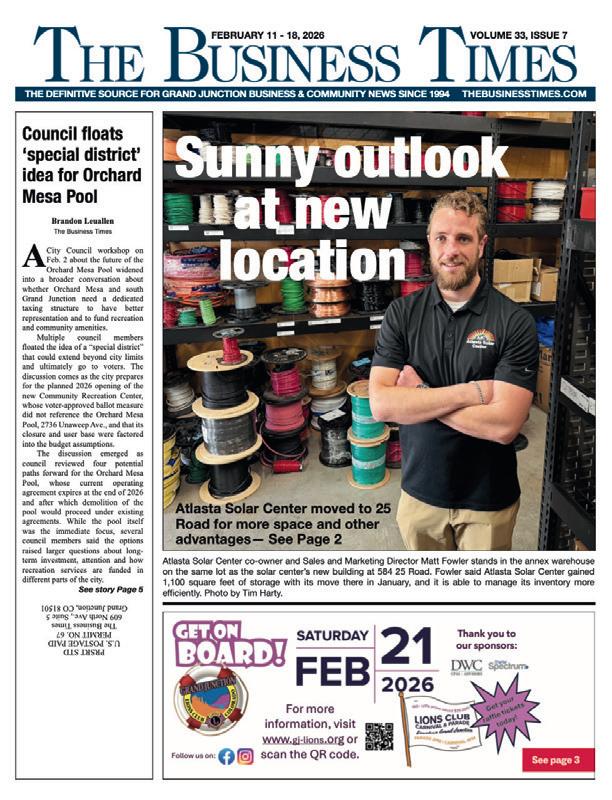
In the previous article in this ongoing series, “Is Mesa County a Magnet for Homelessness?”, The Business Times compared Point-inTime homelessness data from Mesa, Garfield, Eagle, Pitkin, Montrose and Delta counties. Despite accounting for only about 44 percent of the combined population of those six counties, Mesa County accounted for approximately 72 percent of the homeless individuals counted during the 2025 Point-in-Time count.
That disparity prompted a follow-up interview with Grand Junction Housing Manager Ashley Chambers and a series of questions about the unhoused data gathered by the city via survey and whether it fully explains why Mesa County’s homeless population is so disproportionate compared with neighboring communities.
Those questions were at the center of the interview, which lasted more than an hour and 15 minutes, and Chambers also provided a detailed written response from the City of Grand Junction. Throughout the interview, Chambers said homelessness in Mesa County is primarily a local housing and stabilization crisis, saying a significant share of homelessness is tied to a longstanding shortage of housing and housing resources for the populations most in need.
She said she believed relatively few people experiencing homelessness came from outside the area, although she acknowledged the city did not have independently verified data quantifying that number.
See story on Page 4
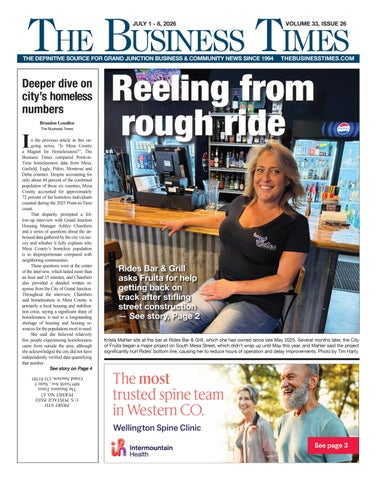
Reeling from rough ride
Rides Bar & Grill asks Fruita for help getting back on track after stifling street construction
See story, Page 2
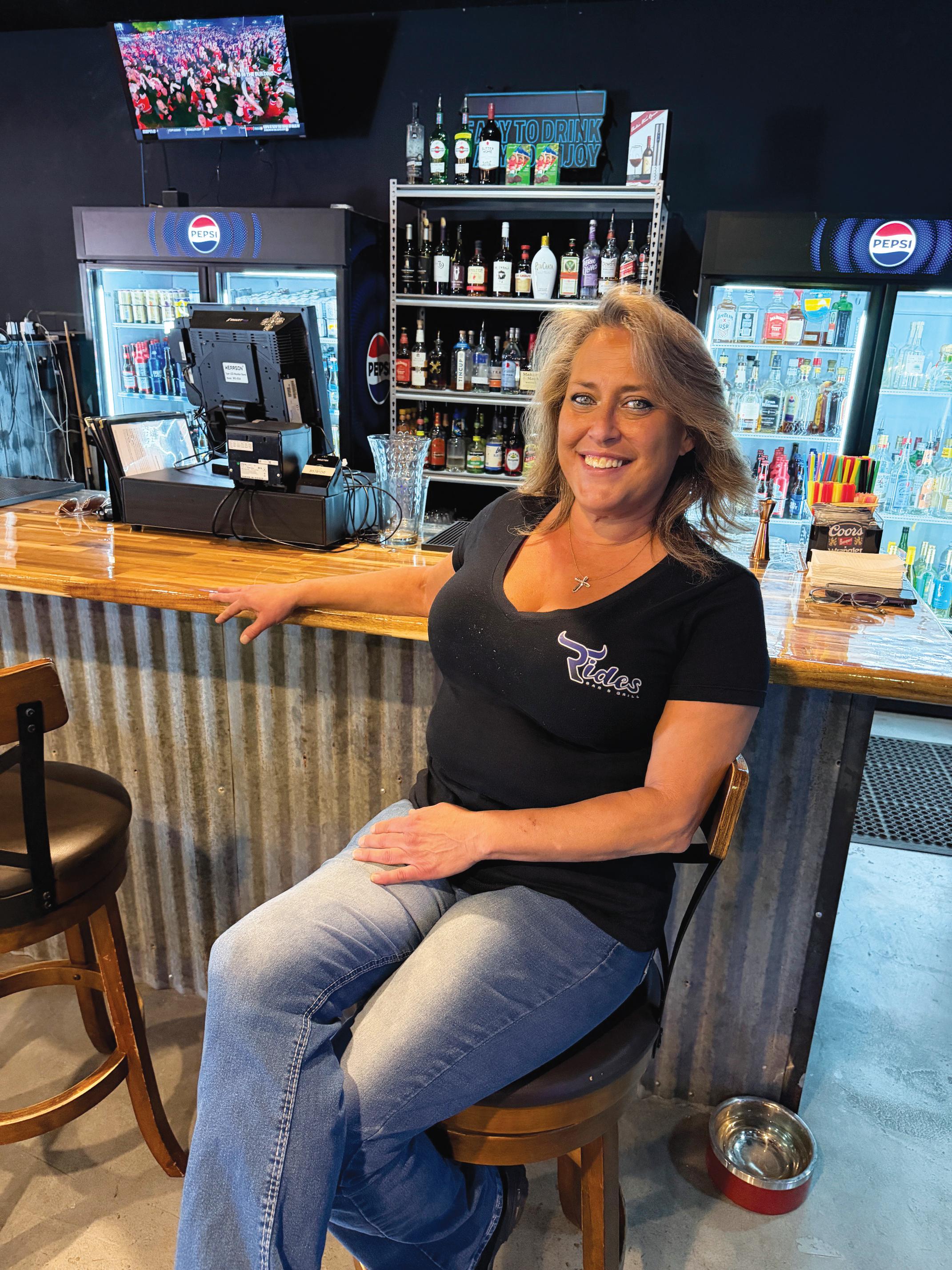
Krista Mahler sits at the bar at Rides Bar & Grill, which she has owned since late May 2025. Several months later, the City of Fruita began a major project on South Mesa Street, which didn’t wrap up until May this year, and Mahler said the project significantly hurt Rides’ bottom line, causing her to reduce hours of operation and delay improvements.
Photo by Tim Harty.
Fruita bar & grill resumes its ride
Battered by 8 months of street reconstruction, Rides owner let’s Fruita know: We are still here
Tim Harty The Business Times
t was late May, the 23rd to be exact, at 1:07 in the morning when Krista Mahler posted to Facebook a plea, if you will, to the good people of Fruita to support her business, now that they can actually get to it again.
She was nearing the one-year mark of her ownership of Rides Bar & Grill, 152 S. Mesa St., and the last eight of those 12 months had her adopting a daily ritual of looking into the street from her business and asking, “What now?”
She knew better than to ask. She wasn’t going to like the answer.
The South Mesa Street reconstruction project that began in the fall and lasted eight months instead of the three to six that originally had been communicated to Mahler, was a butt kicker for her bar and restaurant. When she thought nothing more could happen in terms of access to her business being affected by a torn-up street and large equipment, either active or parked in front of Rides, all Mahler needed to do was look again the next day.
So, when the dust settled on the Mesa Street project in late May, Mahler had a project of her own to begin: the reconstruction of her business. And it took some courage when she took to Facebook, but she posted her message in hopes more friendly faces will frequent her Fruita bar and grill in the coming months and put it on the road to recovery.
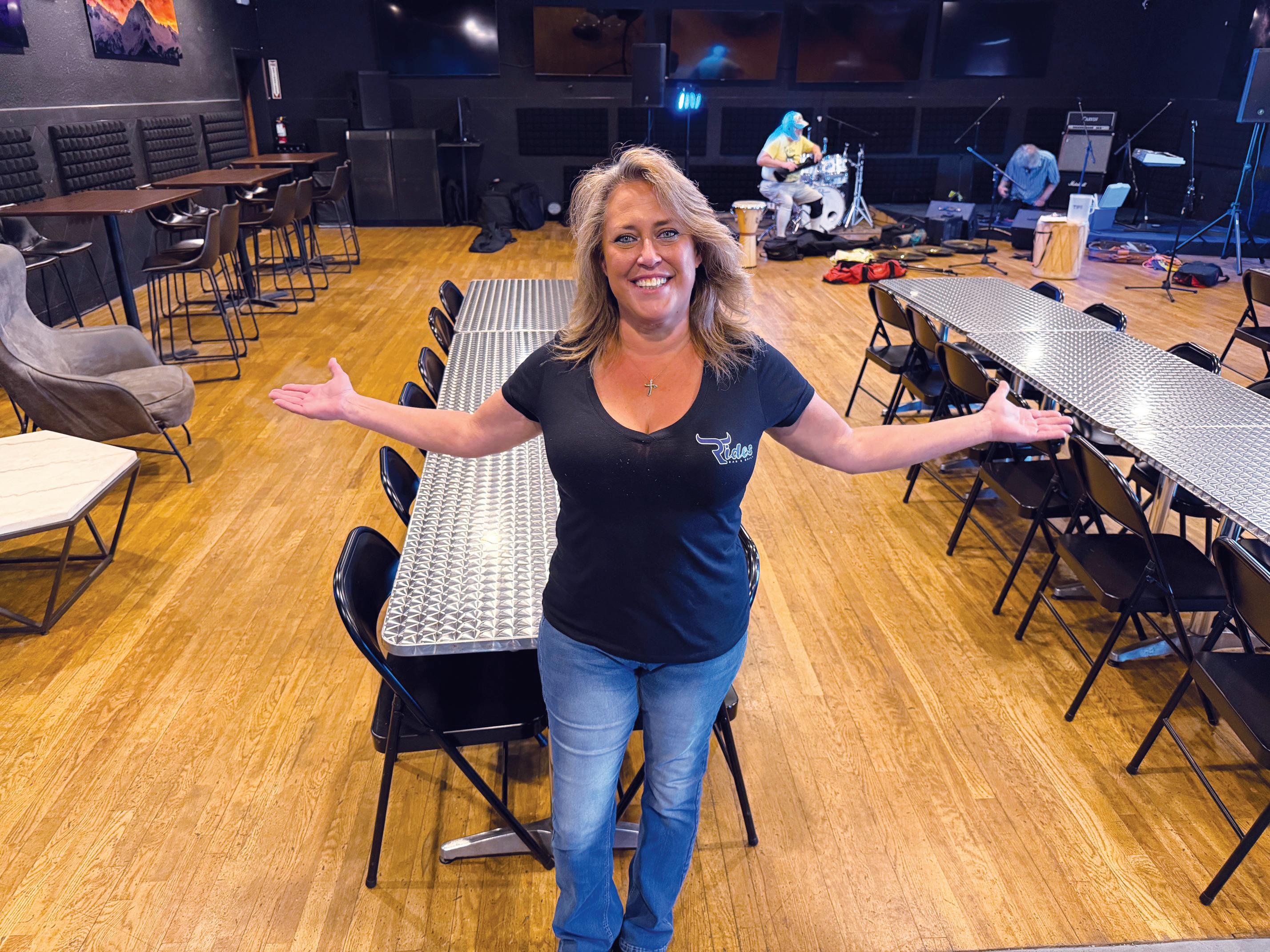
make room on the dance floor. In the background, musicians are setting up to perform later that night for the weekly Tuesday blues jam.
by Tim Harty.
CALLING ON FRUITA FOR HELP
Rides Bar & Grill owner Krista Mahler posted the following on Facebook on May 23 at 1:07 a.m.:
means many different bars closed.
“A lot of people were like, ‘Oh, nothing in that building ever survived,’” Mahler said. “And I wanted to let them know that we are surviving, that we will continue to keep fighting through all of this and keep trying to improve and provide the best offerings that we can, whether it be music or food, or a kitchen that’s open late at night when there’s nothing else open in this town after 10 o’clock.
“You know, I wanted to make sure that that was our big focus and that, yes, we are still here.”
And things are getting better, slowly.
Mahler has plans in mind, but some require increased revenues first in order to implement them, such as hiring more employees.
“We’re just still trying to refocus on drawing the people here and focus more on my kitchen to draw people out,” she said. “I don’t want this to just be a bar. I want this to be focused on as the restaurant as well, and the place where you can come and get a meal from noon until 2 a.m. on certain days.
“And right now, because of the construction and the financial impact, I’m still trying to build the team back up, and as the business continues to grow, then I can add more people. Right now, even though we have a restaurant that’s open all day, I don’t necessarily have dedicated servers, just because I can’t afford them. So as we continue to grow, that will be added on.”
She began the message with: “They say transparency is the foundation of a real neighborhood hangout, so I’m going to be completely vulnerable with you all.”
She then proceeded to tell of a massive vision for her business being deterred and the brutal uphill battle Rides endured to survive the South Mesa Street construction.
Mahler said it’s not like her to ask for help, but something drew her to say, “OK, just put it out there. Let people know that the construction’s over … and just the financial constraints of the impact of this construction for eight months was significant.
“Something just pulled on my heartstrings, and it took me about an hour to write that post. It’s not something I do very often.”
Mahler said Rides had to reduce its hours of operation, because decreased revenues forced her hand. And she hated to do it, because it plays into a perception about the building at 152 S. Mesa St., which has been home to many different bars over the years. And that
They say transparency is the foundation of a real neighborhood hangout, so I’m going to be completely vulnerable with you all.
When I took over Rides Bar & Grill – Fruita Colorado in June 2025, I had a massive vision for this place. I had an official logo I wanted to proudly hang out front to welcome you, and a plan for full, bustling hours. But the reality of surviving the South Mesa Street construction has been a brutal uphill battle. The dust, the detours, and the alley-only access didn’t just slow down foot traffic – the financial constraints of enduring this massive project have temporarily deterred that vision.
Because of that, I unfortunately don’t have our official logo out front yet. And unfortunately, due to those same constraints, we haven’t been able to regain our desired full hours of operation just yet.
It hurts not to have those pieces of the puzzle fully in place. But a business isn’t defined by a shiny sign or a perfect schedule – it’s defined by the people inside it and the grit of the person steering the ship.
I am working so incredibly hard every single day to ensure this space is ready for you. Whether you are a Fruita local born and raised, someone living in a nearby town, or someone just passing through our beautiful area – I want you to know that you are welcome, you are appreciated, and you have a seat at my bar.
So, please hang in there with me. Together, we can make this vision happen. We Are Downtown Fruita! Building a community hub where absolutely everyone is welcome. Come as you are – whether you’re covered in trail dust from a ride, wearing your work boots, or just looking for a friendly face.
I can’t wait to see you. Let’s finish this construction fight together.
Editor’s Note: This Facebook post is unedited aside from one spelling correction.
Mahler hasn’t been able to bring back lunch daily, but Rides is close to being able to consistently do it Friday through Sunday.
Mahler wants to get the taps back in action for serving beer. But again, can’t afford to do it yet. In the meantime, patrons buy beer in bottles and cans.
Mahler said a lot of things got put on hold in winter and spring, “because we were just trying to stay afloat.”
She said Rides will get the outdoor patio going again, and that should help.
Rides managed to host its Tuesday blues jam events throughout the South Mesa Street construction. Now, Mahler said she wants to grow Rides’ livemusic offerings to draw in more people.
“One of the things that I am looking to try to do is create a local space for new bands, like musicians that are just trying to get their start,” she said “So, I’d like to be kind of that place that we’ll give that first shot to somebody who’s new or up and coming. It doesn’t necessarily have to be people that are well-known. I just want to be the music spot.”
See RIDES BAR on Page 8
Rides Bar & Grill owner Krista Mahler stands in front of a large area that does double duty at her establishment. Tables and chairs are set up for dining, and they can be cleared away to
Photo
City answers questions about disproportionate homeless numbers
Continued from Page 1
At the same time, both Chambers and the written response acknowledge that Mesa County serves as the Western Slope’s primary regional hub not only for homeless services, but also for healthcare, behavioral health, transportation, employment and other essential services, and that this likely affects who is visible and counted.
While many anecdotes circulate throughout the community, The Business Times examined the available data and found that some claims could not be independently verified, while other data sources acknowledged limitations that make definitive conclusions difficult.
Throughout the interview, The Business Times questioned Chambers about those limitations, including the reliance on self-reported information and the lack of independently verified data supporting some of the conclusions being drawn about homelessness in Mesa County.
Better counting may affect regional comparisons
One of the central themes throughout the interview and the city’s written response was that Mesa County’s homelessness numbers may appear higher than surrounding communities in part because the community has invested significantly more effort into finding and counting people experiencing homelessness.
Chambers said many surrounding counties rely primarily on Homeless Management Information System (HMIS) data and do not conduct physical outreach counts, while Mesa County also uses coordinated outreach teams, shelter counts, volunteers and its By-Name List to identify people who might otherwise go uncounted.
The city’s written response echoes that point and in a section titled “More Robust Outreach and Identification Efforts” and adds that better counting is likely a primary cause in the rapid rise in Mesa County’s numbers in recent years. It says homelessness likely increased only slightly, and much of the apparent increase in recent years reflects a more effective system response and improved identification rather than a dramatic increase in people becoming homeless.
Mesa County as a regional hub
As previously reported by The Business Times, HomewardBound of the Grand Valley advertises itself as the region’s only year-round emergency shelter, serving a 12-county region spanning western Colorado and eastern Utah. The availability of services in Mesa County that are unavailable in many surrounding communities, including services that accept people from outside the local area, could be one factor contributing to Mesa County’s disproportionately large share of the region’s homeless population.
The city acknowledged Grand Junction’s role as a regional-service hub and expanded on that point by adding it is a regional hub for many services not directly homeless-related that may contribute as well. The document notes Mesa County serves as the Western Slope’s regional center not only for homeless services, but also for health care, behavioral-health services, substance-use treatment, veteran services, disability services, public transportation, employment opportunities,
Grand Junction for medical care, court proceedings, employment, behavioral-health treatment or other essential services. They also may move to the area looking for work opportunities. If they experience housing instability while accessing those systems, they may be identified through outreach teams, health-care providers, shelters or the coordinated-entry system and ultimately be counted in Mesa County’s homeless population.
During the interview Grand Junction Communications Manager Kelsey Coleman offered one example, noting someone may come to Grand Junction for medical treatment, court proceedings or another regional service, or be released from the local jail without a home to return to. In those situations, an individual may become part of Mesa County’s homeless population even though homelessness was not the reason they initially came to the community.
Are Mesa County’s homeless bused in?
Although Grand Junction has not conducted a long-term regional analysis of transportation into and out of Mesa County, Chambers said studies she is familiar with suggest transportation generally occurs in both directions, resulting in relatively little net migration and a comparatively small overall effect on local homelessness numbers.
Chambers described programs that help some people leave Grand Junction when they have a verified destination, such as family, employment or an accepted treatment program.
For example, she said, following changes at HomewardBound, 21 individuals used traveler-assistance programs to relocate to verified destinations.
She also clarified the program is not a way to just ship people out of town.
“We don’t send people anywhere,” Chambers said. “They have to have a family member, a job, like a drug treatment center that’s accepted them or something.”
Local ties remain the city’s primary finding
Despite acknowledging Mesa County’s regional role, Chambers emphasized the strongest finding from the city’s survey work is that the majority of respondents reported that they had lived in Mesa County before becoming homeless.
The report says, “Across both survey years, more than 80 percent of respondents reported living in the Grand Junction area at the time they became unhoused.”
The survey report also says that in 2024, approximately 68 percent reported living in Mesa County for more than one year. About 44 percent reported living in Mesa County for more than four years, and another 14 percent said they had lived here all their lives. It says that only about 16 percent reported living in Mesa County for less than one year.
One of the themes throughout the interview was that two different questions are often treated as though they are the same.
Because many residents believe most people experiencing homelessness came from outside the community, Chambers frequently addressed that perception during the interview.
The question examined by The Business Times was not whether the majority of people experiencing homelessness in
region’s homeless population and what factors may contribute to that disparity.
Questions about survey data, how responses affects results
One of the data questions raised by The Business Times involved the ratio of chronic to non-chronic respondents in the city’s unhoused survey compared with the larger Point-in-Time count.
A chart in the report shows the 2024 survey included 68 chronically homeless respondents (76 percent) and 21 non-chronic respondents (24 percent). By comparison, the 2024 Point-in-Time count identified 470 non-chronic individuals (65 percent) and 255 chronically homeless individuals (35 percent). In other words, the survey was weighted heavily toward chronically homeless respondents, while the Point-in-Time count showed that nearly two-thirds of the overall homeless population was classified as non-chronic. That difference became significant when discussing whether survey findings could be extrapolated to the broader Point-in-Time count.
According to the report, 19 survey respondents said they came to Mesa County because they were bused here or because services were available. Of those 19 respondents, seven were classified as chronically homeless and 12 as non-chronic. Because the survey included far fewer non-chronic respondents, non-chronic individuals reported coming to Mesa County for those reasons at a proportionally higher rate. If that pattern held true across the broader homeless population, it could indicate a higher overall percentage than the survey alone suggests.
The survey also found non-chronic respondents were more likely than the survey population as a whole to report moving to Mesa County within the previous year. While 16 percent of all respondents reported living in Mesa County for less than one year, that figure increased to 36 percent among non-chronic respondents. Non-chronic respondents were also much less likely to report being lifelong Mesa County residents.
The Business Times asked whether those findings could indicate that a larger share of the overall homeless population became homeless outside Mesa County than the survey report suggests. Chambers cautioned against drawing that conclusion, saying she believed the percentage would actually likely decrease if the survey findings were expanded to the full Pointin-Time count. However, when asked what data supported that expectation, she acknowledged the City did not have data confirming it and suggested HomewardBound might have additional information.
Survey Limitations
The city’s written response also explains what its survey was designed to measure and what it was not.
It says the survey relied on self-reported responses and “was not intended to serve as independently verified administrative records.” The document notes responses may be affected by recall bias, misunderstandings or underrepresentation of people not reached through outreach efforts.
The response also says the survey was not intended to serve as a definitive migration study. It did not: ask whether people would have come to Mesa County if services
Homeless
Continued from Page 4
specifically ask whether respondents had been referred or relocated by another community; or collect immigration or citizenship information.
The city noted that respondents may have come to Mesa County for multiple reasons, such as family, employment or services, and survey responses should not be interpreted as establishing a single cause.
However, neither the survey report nor the city’s written response discusses the possibility of response bias or whether respondents may have felt any incentive to describe themselves as local.
Comparing Mesa County to other studies
During the interview, Chambers encouraged looking at research from other communities examining whether homelessness is largely homegrown.
That prompted a review of the University of California-San Francisco’s California Statewide Study of People Experiencing Homelessness, which was also cited in the city’s 2023 Unhoused Needs Survey Report.
The study found that most participants reported becoming homeless in the county where they were ultimately interviewed, but approximately 25 percent reported becoming homeless somewhere else.
More specifically, About 10 percent reported becoming homeless outside California, while another 15 percent reported becoming homeless in a different California county. Those findings generally support Chambers’ broader point that homelessness is primarily local, while also demonstrating that national and regional migration does occur and has an impact on numbers.
Like Mesa County’s Unhoused Needs Assessment, the UCSF study relied heavily on self-reported survey and interview responses. The study does not indicate that participants’ previous locations were independently verified through administrative records.
Why PIT counts declined
For the question about why Point-in-Time counts declined not only in Mesa County, but across much of the Western Slope over the previous year as housing affordability challenges persisted across the region, the city’s response offered several possible contributing factors for why Mesa County’s numbers had gone down, but less about what contributed to the simultaneous regional decline. Especially as many counties do not perform physical counts and simply rely on Homeless Management Information System data.
If homelessness declined simultaneously across multiple counties despite those ongoing challenges, it raises the question of what other factors beyond housing affordability may also be influencing the numbers.
Under “Why PIT Counts May Have Declined Between 2025 and 2026,” the city lists several possible factors contributing to Mesa County’s decline, including the opening of 40 permanent supportive-housing units at Mother Teresa Place, coordinated outreach before HomewardBound’s shelter closure, movement into housing and treatment programs, and people dispersing after the shelter closed, making them harder to locate during the count.
The document also notes 29 individuals experiencing homelessness died during 2025, representing a 100 percent increase compared with prior years, and cautions that declining PIT counts should not automatically be interpreted as positive outcomes. Limited capacity despite more services
Another point emphasized in the city’s written response is that although Mesa County has more homeless resources than many neighboring communities, those resources are already operating near capacity.
Under the section titled “Neighbor-to-Neighbor outreach and service-awareness gaps,” the document says providers continue operating with limited capacity, extensive waiting lists and eligibility restrictions. Emergency shelter beds, permanent-supportive housing, treatment placements, housing vouchers and deeply affordable housing units are frequently fully utilized, according to the document.
While many homeless services are available to local residents and people from outside the area, Chambers said housing resources administered through the Grand Junction Housing Authority prioritize local residents, seniors and people with disabilities.
“Priority is given to locals,” Chambers said. She added, “The housing authority will tell you that it’s incredibly rare for people outside the community, because the wait list is three to four years long.”
“Every service is so overly and highly utilized that even if a bunch of people were coming here, they’d quickly find out there’s really not services here. And they probably move on their way to somewhere else because there’s just not the resources.”
The discussion also turned to whether regional homeless migration should be studied in greater depth.
Chambers said Mesa County has not conducted a long-term migration study, because the necessary data are spread across numerous organizations. She said such a project would require years of coordination among hospitals, shelters, nonprofits and other service providers. She noted the city’s most recent unhoused-needs assessment alone cost nearly $70,000.
Instead, Chambers questioned whether those resources would be better spent improving the homelessness response.
“Would it be valuable? Maybe,” she said. “But also, are there things that we can do that have the same impact without that time and energy commitment?”
She argued the better investment would be improving collaboration among service providers, strengthening outreach, expanding housing navigation and helping people move into permanent housing more quickly.
“If we improve those systems,” she said, “we have the same result as if we spent all this time running the same data.”
Chambers also invited The Business Times to accompany the city’s housing-outreach team during future outreach efforts to interview people experiencing homelessness. The Business Times plans to continue reporting on the issue. The full list of questions and the city’s written response will be published with
website.
Legacy Furniture’s success requires more room to grow
Tim Harty The Business Times
What Hazen Hackett thought would be a temporary rental of space to accommodate one project turned into a permanent move to accommodate his growing business.
That’s why Legacy Furniture now resides at 579 1/2 Commercial Drive after about a year-and-a-half at 1048 Independent Ave., Unit A-106, in Independence Plaza.
The move started with the need this spring for more space after receiving an order to make what he called a “huge” conference table for a business. In fact, the table had to be made in five pieces.
“It was too big to build in the other shop, so we had to rent this space at least to build it out,” said Hackett, who co-owns Legacy Furniture with his fiancee, Sheela Moore. “And we stayed.”
A move was going to come eventually, as Legacy Furniture went from being just Hackett and Moore to adding three employees. And it’s a family affair, as Hackett added his dad, Howard Hackett, and uncle Stanley Hackett as full-time help, while brother-in-law Mike Haley is part-time, working for Legacy Furniture when he’s not operating his Bonfire Oyster Co. food truck.
Hazen Hackett said after signing three contracts on June 12 he might need another hand.
He definitely has the room now, as 579 1/2 Commercial Drive is about 3,800 square feet total, with a 3,000-square-foot shop area, more than double what he had at Independence Avenue.
“This shop’s just able to be more organized. The other shop was, you know, everybody’s tripping over everybody’s feet. It wasn’t very efficient,” Hackett said.
The new space has a smaller
showroom, but the tradeoff is worth it for “getting the work out the door,” he said.
Commercial projects are driving the growth, and it began with the five-piece conference table. Now, Legacy Furniture, which specializes in flat, wood surfaces such as custom table tops, is working on a 14-footlong table for a new steakhouse in Denver.
“More businesses are coming to us,” Hackett said. “We still do plenty of residential, but we’ve moved totally away from doing cutting boards and coasters. We don’t have time to do any of that small stuff anymore, which is really nice.”
For example, Hackett said making four cutting boards requires the same amount of time as making one table. Those cutting boards sell for about $300 apiece. The table will sell for about $4,000 to $8,000. The math makes for an easy business decision.
Experience also has made him more savvy in sourcing materials and efficient in running the business.
“Just the longer we’re in business, we find better wood suppliers, and other struggles become less hard,” Hackett said. “Because it used to be on every order I’d go into panic mode. You know, who has walnut today? And that’s still relevant, but not as. Certain parts are getting easier.”
The business also can take on more difficult projects now than Hackett could’ve done a year ago.
“Like that conference table,” he said, “I would have told them no, that we weren’t ready. Now, I’m not afraid.”
Legacy also is continuously busy, as Hackett said he’s booked out a couple months.
He said customers will sign a contract that’s 20 weeks out, “and we’ll try to get it to them in eight to 10. We have quite a cushion to work, which feels good.”
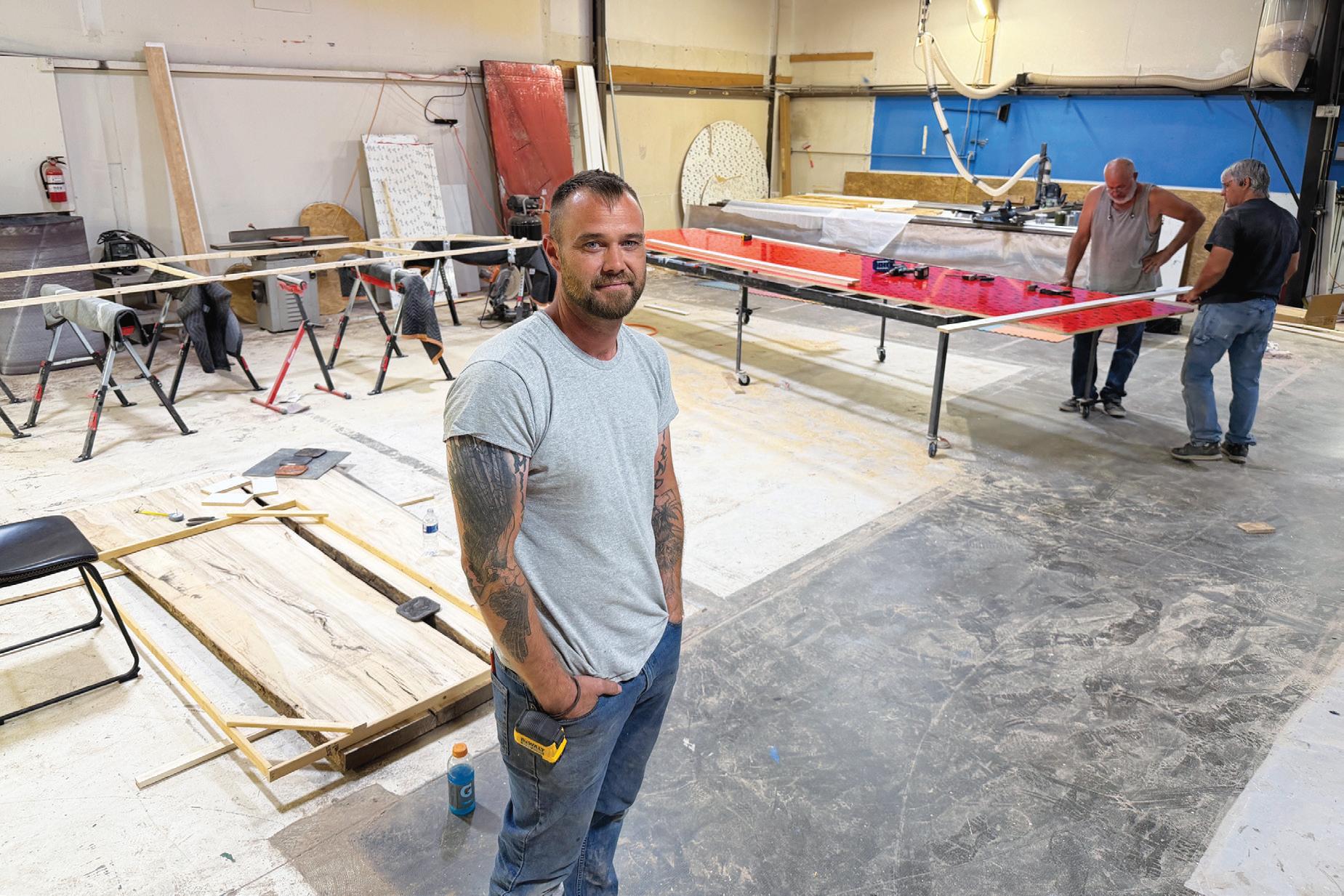
Co-owner Hazen Hackett stands in Legacy Furniture’s new, much-larger workshop at 579 1/2 Commercial Drive in Grand Junction. Photo by Tim Harty.
Rides Bar
Continued from Page 2
Everything she’s doing these days is with an eye toward growing the business, increasing revenues and investing back into Rides.
Ultimately, she wants Rides to be “a space for everyone” and have that be what defines it. She thinks an appropriate tagline for Rides would be: Come as you are. Everyone’s welcome.
“There’s so many rumors that run around that we’re a dive bar, that we’re a biker bar, that we’re a gay bar. We are none of those, but we are welcoming to all,” Mahler said. “One of my first reviews – I’ll never forget – online somebody said, ‘It’s a great bar, had a great time, but I think they’re confused as to what they want to be.’
“And I remember my initial response was: I’m not confused. I know exactly what I want to be. I want to be a bar for everyone.”
St. Mary’s Hospital earns redesignation as Comprehensive Stroke Center
Intermountain Health St. Mary’s Regional Hospital has been redesignated as a Comprehensive Stroke Center by DNV Healthcare USA Inc.
The designation signifies the highest level of stroke care available, recognizing hospitals that provide rapid diagnosis and treatment for the most complex stroke cases, including advanced imaging, specialized procedures and around-theclock care from highly trained teams.
The redesignation affirms that St. Mary’s Hospital provides the full spectrum of stroke care, from diagnosis and treatment to rehabilitation and education, Intermountain Health said in a news release.
“This redesignation reflects the commitment of our caregivers to provide exceptional care when every second counts,” said Bryan Johnson, market president for Intermountain Health in Western Colorado.
St. Mary’s Hospital was first designated as a Comprehensive Stroke Center in 2020.
A stroke is a medical emergency that requires immediate attention. As a Comprehensive Stroke Center, St. Mary’s provides: 24/7 access to stroke specialists; advanced imaging and diagnostic capabilities;
specialized procedures for complex stroke cases; and coordinated care from emergency response through rehabilitation
The designation also highlights the hospital’s focus on continuous improvement, quality outcomes and collaboration across care teams.
“Our teams work together every day to make sure patients receive the right care as quickly as possible,” said Dr. Logan McDaneld, medical director of St. Mary’s Neurology Stroke Program. “This recognition shows the strength of that teamwork and our dedication to the people we serve.”
Stroke is a leading cause of death and disability in the United States. Knowing the signs of stroke and acting quickly can make a significant difference. Community members are encouraged to remember the acronym BEFAST:
• Balance: Sudden loss of balance or coordination.
• Eyes: Sudden vision changes.
• Face drooping.
• Arm weakness.
• Speech difficulty.
• Time to call 911.
County transitions to online animal licensing
Mesa County Animal Services is transitioning to a new, online animallicensing system that changes how residents purchase and renew pet licenses. As part of the transition, veterinarians who previously sold animal licenses on behalf of Mesa County are no longer authorized to issue licenses as of June 22.
The new system is designed to make licensing more convenient for residents and help Animal Services manage licensing records more efficiently and accurately. Animal licenses help Animal Services identify lost pets and return them to their owners as quickly as possible.
Residents who live within Grand Junction city limits can now purchase or renew animal licenses online through the City of Grand Junction’s licensing portal.
Residents who live outside Grand Junction city limits will be able to purchase or renew animal licenses online beginning July 22. Additional information, including the website address, will be announced before the system becomes available.
Residents outside Grand Junction city limits whose animal licenses expire between May 25 and July 22 will not be penalized for an expired license during the transition period.
Earlier this year, Mesa County updated its animal-licensing process to support the transition to online licensing and eliminate situations in which some residents could be required to obtain licenses from more than one jurisdiction.
Grand Junction residents who need assistance with animal licensing should contact the Grand Junction Police Department.
Residents outside Grand Junction city limits who need assistance with animal licensing may visit Mesa County Animal Services after July 22 during regular business hours. Mesa County Animal Services hours are Monday through Friday, 11 a.m. to 4 p.m; and Saturday and Sunday, 11 a.m. to 1 p.m.
Residents with questions about animal licensing may contact Mesa County Animal Services for additional information.
A leader’s real work: Teach people to think for themselves
Business owners and managers often ask me a deceptively simple question: “How do you teach people to think?”
Marcus Straub
It’s a profound inquiry, because the ability or inability of a team to think independently determines the strength, resilience and long-term success of any organization.
Yet many leaders unintentionally train their teams not to think. They do this by providing answers instead of developing thinkers. It feels efficient in the moment, but over time it creates dependency, drains the leader’s time and energy and weakens the business from within.
Thinking is the process of using one’s rational mind to evaluate a situation, consider possible actions and determine the best path toward a desired outcome. For a company to operate at its highest level, team members must be taught and continually encouraged to think through situations rather than relying on others for answers or guessing at solutions. Independent thinking is not a luxury; it is a requirement for excellence.
Most leaders don’t intend to create dependency. They simply believe that giving the answer is faster. And in the moment, it is. But the long-term cost is steep. When leaders repeatedly supply solutions, team members stop developing the ability to analyze, evaluate and decide. The leader becomes the bottleneck, the fixer and the only source of clarity.
This dynamic increases the leader’s workload, slows the organization and erodes confidence on both sides. The team becomes hesitant and unsure; the leader becomes frustrated and overwhelmed. Everyone loses.
Independent thinking begins with psychological safety. Team members must feel safe asking questions, exposing what they don’t know, and working through uncertainty without fear of judgment or frustration.
This requires composure from the leader. No sighs, no eye-rolling, no irritation, no condescension. When a leader responds with calm curiosity, they create a learning environment where team members feel supported rather than scrutinized.
When people do not feel safe asking questions, they typically do one of two things: They guess; or they do nothing. Both lead to costly mistakes. Accounts are mishandled, customers become frustrated, time and resources are wasted, and the business suffers. Leaders then spend even more time repairing the damage. Time that could have been avoided by investing in teaching rather than correcting.
A key step in developing thinkers is encouraging team members to come to you with questions rather than assumptions. Help them understand that asking questions is not a sign of weakness; it is a sign of strength and responsibility.
Reinforce that their job is not to know everything; it is to use the resources available to them, including you, to gain clarity and make sound decisions.
When a team member approaches you with a situation, resist the urge to provide the answer. Instead, guide them through the thinking process. Ask open-ended questions such as:
• “What do you see happening here?”
• “What options have you considered?”
• “What outcome are you aiming for?”
• “What information do you still need?”
These questions help them slow down, analyze the situation and articulate their reasoning. If their understanding is incomplete or inaccurate, offer clarifying details, not the
solution. Then continue asking questions that help them connect the dots themselves.
This approach strengthens their ability to think, builds confidence and reduces future dependency.
Once a team member reaches a conclusion, ask them to teach it back to you. This step is essential. It reveals whether they truly understand the situation and reinforces the learning in a way that deepens retention.
If gaps remain, you can address them together. If they’ve grasped it, you can celebrate their progress and encourage them to apply the same thinking next time.
It’s important to remember that many individuals have spent a lifetime being told what to do, how to act and what to think. They have been conditioned to seek direction rather than develop their own judgment.
When leaders understand this conditioning, they can approach team development with greater empathy and patience. Over time, individuals begin to unlearn old patterns, access more of their potential and perform at higher levels.
Every interaction with a team member is a choice. You can either increase their dependency on you or empower them to think independently. One path makes you indispensable; the other makes your team unstoppable.
Investing in your team’s ability to think strengthens your business from within. It reduces your burden, elevates their confidence, improves decision-making and enhances customer experience.
When leaders commit to developing thinkers, everyone grows and the organization becomes far more capable than any one person could ever make it alone.
F
Marcus Straub owns Life is Great Coaching in Grand Junction. Reach Straub at (970) 208-3150, marcus@ ligcoaching.com or through the website located at www.ligcoaching.com.
I’ll admit it, I just don’t quite get World Cup soccer
I must admit for the first time in years, I actually watched a full soccer game. Or is it soccer match? I hear it depends on where one resides. And since I’m in the good ol’ USofA, it appears it was a game.
Craig Hall
And that would be the game between the United States and some country named “Turkiye,” which to my (non)astonishment was previously known as Turkey up until, for me, this current world cup.
I know, here come the comments where I’m just not worldly enough.
I’ll take that as a compliment, thank you very much. Frankly, I’m comfortable with my world knowledge, even though I’ve only traveled to two other countries in my time, and yes, they both border the United States of America. Just know I know a little about a lot of the other countries that don’t. And I bet all those countries know a little about America as well. After all, that’s literally the way of the world.
Fact is, people tend to know most about the country they live in. And since I live in the United States, I know this year my country, along with the two which border us, are hosting the World Cup soccer tournament. And since the host country has a team and the United States is my country, I watched the match (I do think saying match is cooler) mentioned above. I belabor this point for a reason: There’s only one reason I watched an entire soccer match.
And that was because when it comes to sports, I enjoy watching two teams: Anything involving the University of Michigan (and yes, I watch their sports I don’t fully understand, or particulary care for, like field hockey and lacrosse and water polo and even crew) and anything where team USA is involved. And I ALWAYS root, root, root for the home team, and if they don’t win, it’s a shame. Like on June 25 for the USA men’s soccer team.
Back to the point of my title for a second, however. Just know I don’t understand offsides (the concept, not how it’s called – because if it wasn’t a rule, think of the scoring) or what decides what’s a corner kick versus a throw in or extra time (more on that in a second) or why the clock never stops or what’s a foul one time and not the next (this is a problem in many sports) and probably a couple of other things, but those are what they are. After all, I only tune in once every few years.
That’s a lot of misunderstanding for a sport that only requires a field, whatever you fashion two goals out of and a ball, but I digress.
So, while I watched what was to this novice a fun match, I just don’t understand how it ended. According to my TV screen, there were allegedly SEVEN minutes of extra time at the end of the 45-minute second half. So, you can imagine why I am so confused when Turk-eee-i-yay scored in the EIGHTH-plus minute of extra time. I mean, was time suspended? Was there EXTRA extra time I didn’t know about? It is new math where 45 plus 7 now equals 53 or 54? Did the ref just decide it appeared Turkey had a “li’l sumthin’ goin’ on and I’m gonna let it play out and see what’s what?” Which turned out to be a goal after those seven minutes were up?
And yes, I know, in the grand scheme of things, that didn’t matter in making the “knockout round.” Well, in my humble opinion and what I think those who desire fair play (I know the irony of a Michigan Man saying that after Connor Stalions outsmarted the NCAA) think, a goal eight minutes into extra time would appear to
Support Local Support Business
have arrived after the declared seven minutes of extra time.
So now I have another reason to not get soccer. And be thankful I didn’t get into all the flopping that makes the NBA look like amateurs. Not saying the physical play wasn’t something fun to watch. Same for the talent of playing a match in constant motion on the pitch (oh yes, I’m more worldly than you think) was impressive. And these guys are in shape, unquestioned. Let’s just say I was as impressed as I was confused.
Truth told, sports in general are becoming more confusing to me as my time on this orb goes on. Many of you know I’m a big sports fan. But as the money gets bigger, so does my misunderstanding.
The major pro and college leagues in our country are becoming out of reach for everyday fans; certainly to attend, and increasingly to even watch on TV with games moving to streaming services. And while human error from both players and officials can be understood (with some emotion, I suspect), it’s the money that is damaging sports in our country more than anything else.
Let’s just be honest, the love of money ruins just about everything. And the vicious cycle between owners, players and yes, cities, drives it higher and higher You can’t name a sport in our country that isn’t out of control cost-wise to go see in person. Well, maybe the WNBA still is affordable, but it seems to take it all out on Caitlin Clark, the ONE player who is actually getting the whole league more money –for you or me, let alone a family.
Remember now, this is being written by a guy who thought a hundred bucks per season ticket for University of Michigan football was getting out of hand back in the 1990s. I also recall going to family night at Tiger Stadium with the six of us, and it cost maybe $25 bucks, including parking. But for the last 25 or 30 years, it’s a whole new ballgame.
Maybe that’s why the World Cup is still so popular, the attraction for the everyday fan coupled with national pride. And the Olympics are much the same way.
Then again, the cost to see those events now in person dwarfs taking in a Saturday afternoon at your favorite college football venue or a game for your favorite team. I mean, coming to America (or host country) takes on a whole new meaning if you have to stay for a few weeks or a month tracking your national team around the country.
Well, it’s certainly not for the faint of wallet.
Like I said, at some point it is always all about the Benjamins Which in the long run doesn’t bode well for Joe Q Fan. For now, I hope everyone can see it on television at least. But at some point, I think there’s a streaming package in its future.
So perhaps some of my old innocence of sport is why I was able to enjoy the soccer match. Soon enough, they’ll just be gladiators in the arena. And only the select few will have enough money for the thumbs up or down part of the program. And that makes me sad.
Because that’s the part of modern sport I fully understand.
In Truth and freedom.
F
Craig Hall is owner and publisher of The Business Times. Reach him at 424-5133 or publisher@thebusinesstimes.com
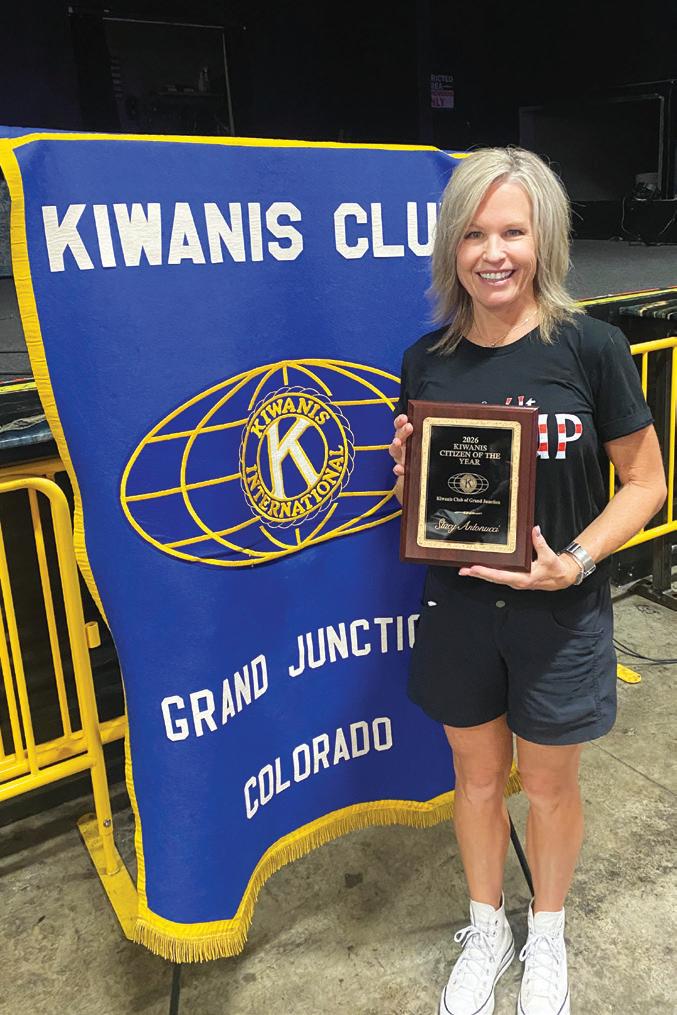
n Kiwanis honor annual Citizen of Year and Educator of Year
Stacy Antonucci, owner of nonprofit organization Steppin’ It Up, was honored by the Kiwanis Club of Grand Junction as Citizen of the Year.
The award is given annually to a Mesa County resident who contributes to the community, with an emphasis on projects that benefit children. The winner does not have to be a member of Kiwanis Club. The club tries to recognize people who quietly volunteer without seeking recognition and who have not previously received recognition they deserve.
The club also honored Betsy Martin of School District 51 as its Educator of the Year. This award is given to a Mesa County instructor who also contributes to the community and who normally doesn’t receive recognition for service in school.
The awards were bestowed during an event June 25 at Warehouse 25/Sixty Five.
n Statewide climate-resilience conversation coming to Grand Junction
The Here & Now Tour: Building Local Resilience to Climate Disaster will make its Western Slope stop in Grand Junction on July 8, 5:30 to 7:00 p.m. at The Monument Room in Mesa County Central Library, 443 N. Sixth St.
The free event is structured as a listening session, not a lecture or rally, and is open to all residents. The Here & Now Tour is a statewide initiative gathering Coloradans to share first-hand experiences with climate impacts and explore local solutions.
“Climate change is hitting our valley now in our droughts, our wildfire seasons, our shrinking snowpack and our strained water supplies,” said Jim Marshall, chair of the Cleantech Business Coalition. “This tour is designed to hear directly from Western Slope residents about what they’re experiencing and what real resilience would look like in our community.”
Organizers are inviting farmers, business owners, parents and neighbors of all backgrounds to share their perspectives and questions.
For more information go online to cleantechcoalition.com/upcoming-events.
n City seeks resident feedback through 2026 Community Survey
The City of Grand Junction is encouraging participation in its 2026 Community Survey, which is currently arriving in the mailboxes of 5,400 randomly selected households throughout the city.
Conducted every two years, the Community Satisfaction Survey provides feedback on community priorities, quality of life and satisfaction with city services. The results help inform strategic planning, budgeting, and future decision-making.
To ensure the survey results are reliable and accurately reflect the community, the city partners with RRC Associates, a Colorado-based research and consulting team with decades of experience conducting statistically valid surveys for local governments and organizations throughout the country.
This year, the survey includes questions about the future of Orchard Mesa Pool.
The additional questions are intended to help City Council better understand community priorities and resident perspectives as it evaluates potential future investments and funding considerations related to the facility.
In the coming weeks, the City will launch a separate, open, community-wide survey that will provide all Grand Junction residents an opportunity to share their perspectives. Once complete, survey findings will be reviewed by the Grand Junction City Council and staff and shared with the community.
n Housing Resources loan program gets $2.9 million infusion
Housing Resources of Western Colorado (Housing Resources) announced it received $2.9 million in recent months that will allow it to expand its Housing Rehabilitation Loan Program. The loan program provides low-interest, flexible loans to eligible homeowners to address structural deficiencies, improve health and safety, enhance accessibility and increase energy efficiency within their homes.
The Colorado State Housing Board approved $1.4 million on March 3, and on June 9 an additional $1.5 million was approved. With this funding, Housing Resources anticipates assisting approximately 50 families with critical home-rehabilitation projects.
In addition to increased funding, the program’s service area expanded beyond Mesa, Garfield and Rio Blanco counties to include Delta, Montrose and San Miguel counties.
“This additional funding and service-area expansion represents a significant opportunity to improve housing conditions, preserve existing homes and support healthier, safer communities throughout Western Colorado,” Housing Resources Director of Lending Wendy Genkov said. “We are grateful for this opportunity to further our mission and expand access to affordable housing resources across the region.”
The Housing Rehabilitation Loan Program is available to income-qualified homeowners who meet program-eligibility requirements. Applications will be accepted and reviewed on a rolling basis until all available funding has been allocated.
For more information about the Housing Rehabilitation Loan Program, visit hrwco.org.
n Fare-Free August for Grand Valley Transit
Grand Valley Transit will offer free trips on all fixed-routes and paratransit during the month of August this year.
GVT is designed to increase mobility options for residents in the Grand Valley. With free service in August, transit riders can experience cost savings, stress reduction, a safer ride and increased productivity, all while helping reduce congestion and improving Colorado’s air quality.
In recent years this fare-free campaign has been a part of a state-funded initiative, but funding for the program was not renewed for 2026 because of statewide budget cuts. Since the zero-fare program began in 2022, GVT and many other transit agencies around the state found the fare-free months to be broadly popular. GVT will continue to offer free fare this summer, but unlike the three-month promotional period in 2025, it will only be for the month of August.
Grand Valley Transit welcomes individuals who may have never used its transit services, inviting them to try riding the bus while it’s fare free this August. And as always, GVT welcomes seasoned transit riders to take advantage of this opportunity.