GJ City Council approves change for enforcement of camping ban
Brandon Leuallen The Business Times

Brandon Leuallen The Business Times
Last week, after nearly three hours of public comment and debate, the Grand Junction City Council voted 5-2 to remove from the city’s camping ordinance some language that prevented enforcement of a camping ban when no overnightshelter beds are available.
Grand Junction has prohibited camping on public property since 2019. However, city officials argued the recent closure of Homeward Bound’s North Avenue shelter and consolidation of services into the Pathways shelter reduced the availability of overnight shelter beds and made portions of the ordinance effectively unenforceable.
Under the previous language, officers were required to determine whether overnight shelter was available before enforcing the camping ban. City officials said that requirement became increasingly difficult to meet after the North Avenue shelter consolidated into the Pathways shelter.
Supporters argued the change is necessary to address growing public-safety, environmental and wildfire concerns associated with encampments on public property. Opponents questioned what will happen to people living in those camps, particularly those who may not qualify for available shelter beds or housing programs.
See story Page 5
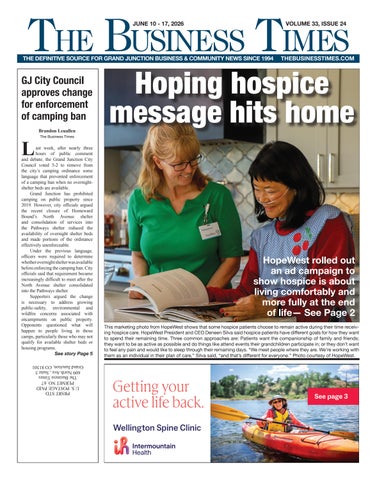
HopeWest rolled out an ad campaign to show hospice is about living comfortably and more fully at the end of life— See Page 2
This marketing photo from HopeWest shows that some hospice patients choose to remain active during their time receiving hospice care. HopeWest President and CEO Deneen Silva said hospice patients have different goals for how they want to spend their remaining time. Three common approaches are: Patients want the companionship of family and friends; they want to be as active as possible and do things like attend events their grandchildren participate in; or they don’t want to feel any pain and would like to sleep through their remaining days. “We meet people where they are. We’re working with them as an individual in their plan of care,” Silva said, “and that’s different for everyone.” Photo courtesy of HopeWest.

Tim Harty The Business Times
To everyone who thinks hospice care is simply where people go for their final couple weeks, or even final few days, just waiting to die, HopeWest politely offers this correction to that misconception:
Hospice is not about giving up. It’s about living comfortably and more fully when the end of life is nigh.
As a nonprofit provider of hospice care as well as palliative care, PACE (Program of All-Inclusive Care for the Elderly), grief support and dementia support, HopeWest occasionally sees the signs that remind it to remind others about what it does and why it’s important.
That’s why HopeWest launched an advertising campaign this spring to educate the people of Western Colorado about hospice care.
HopeWest president and CEO Deneen Silva said her organization often sees peaks and valleys in individuals’ length of stay in hospice, and when those stays are getting shorter, it’s time to start spreading the word again that earlier entry into hospice leads to higher-quality endings for the dying and their families.
“What research supports over and over and over is that earlier and more timely referrals (to hospice) for people experiencing a life-limiting or advanced illness, it really predicts the quality and the overall experience,” Silva said. “So, the earlier that somebody comes on board, the better the outcomes are medically, emotionally, psychologically. I mean, it’s a litany of things that enhances a person’s experience while they’re going through that.”
She added it doesn’t affect just that person. It affects their caregivers, their families, their community around them.

This marketing photo from HopeWest shows that some hospice patients want to enjoy the companionship of loved ones as much as possible during their remaining days. A television commercial that HopeWest has been airing shows hospice patients having fun in various ways, and HopeWest President and CEO Deneen Silva said, “That commercial, we’ve had more people say, ‘Holy cow, that’s what hospice is like?’... It’s gonna give you a new perception of what it really is all about.” Photo courtesy of HopeWest.
When HopeWest detects more people coming on board with shorter times in hospice, Silva said, “It really is a signal for us that we need to make sure we’re out there. We’re spreading the word, and we’re sharing all of the wonderful things and programs that Hope West provides.”
One of the additional things HopeWest points out is people need to educate themselves about hospice care sooner.
“Most people don’t shop for hospice proactively,” Silva said. “Hospice is shopped for, or hospice is sought, after there is a critical event in someone’s life. And that’s a very tricky time to seek out the best level of care.
“And so, what we try to tell people is: Know HopeWest before you need us. Learn about the programs that we offer, because oftentimes individuals who are facing acute or advanced illness, they’re kind of peaking and flowing themselves throughout the process. And so if hospice isn’t the right moment, we have other programs that can bring people under our umbrella of care and then lead them to where they need to go at the most timely point in their journey.”
There is no downside to being prepared and acting sooner on hospice care when the end is nearing for a loved one.
Acknowledging she has been a bedside nurse, a case manager and a hospice administrator, “so I’ve done a lot of different things in hospice,” Silva said, “Nobody ever says, ‘Oh, I wish I would have waited longer to have hospice services.’
“What I hear within three to five days is: How did I live without hospice services?”
Silva said driving home that message, that sooner is better for hospice care, is important, because the alternative is frustrating and undesirable.
In addition to noticing the shorter length of hospice stays, Silva said HopeWest’s ad campaign also was necessary to clarify what it does, which is much more than hospice.
“Hope West offers lots of different programs, and I think there started to be a little bit of confusion between each of the various programs,” she said.
When patients wait until they have just a couple weeks to live before getting hospice services, Silva said, “That’s not enough time. It’s just not enough time. And you cannot do that vital work where you can manage individuals’ physical symptoms, let alone their emotional and the mental-health issues that sometimes stem during this process. It’s important to have the time.
“And you can imagine when you’re caring for somebody in (their) home, that you need time to build rapport and trust, so that you get those outcomes that are desirable.”
Silva revisited the need to shop for hospice care in advance as an important step to maximize time with loved ones when a patient’s days are dwindling.
“In our culture, we don’t embrace death and dying,” she said. “I mean, it’s not what we do. If anything, we push it off. We don’t want to look at it until it’s flat in our faces, or our loved one is experiencing it, and that’s not the optimal time.
“So, the more that we can normalize and explain it – we’re here to support you, no matter where you are in this process – that means that someone might have the advantage of one day, two days, three days, four days more time, because we’re engaging earlier.”
Another reason to market what HopeWest does is Colorado has an increasing population of elderly residents. HopeWest said data shows:
• Colorado had the second-fastest-growing population over age 65 in the nation from 2010 to 2020.
• The Colorado Department of Local Affairs State Demography Office projects the trend of an aging Colorado population will continue into the next decade.
• The number of people 65 years of age and over is expected to grow 36 percent from 2020 to 2030.
That means more people heading toward a day when hospice care might be needed or wanted, so shopping in advance for hospice care is advised.
HopeWest’s data also said about one in six Americans fall into the Sandwich Generation, a group of people usually 40 to 60 years old who may one day be in a situation where they must care for aging parents. And they may have to do that while raising their own children.
Being a caregiver to an elderly parent is difficult for families, Silva said, and an endof-life scenario is more challenging and stressful.
“That’s why I think our services are so important,” she said, “because we can slide in there and we can provide that support and create that network of care globally around a person.”
This article only scratches the surface of what HopeWest does, and the same goes for its advertisements. The hope is people will see the advertisements, realize there is more worth learning, then take the steps that HopeWest knows will benefit patients and their families in the long run.
See HOSPICE on Page 4

Continued from Page 2
Silva mentioned a television commercial that HopeWest has been airing, then said, “That commercial, we’ve had more people say, ‘Holy cow, that’s what hospice is like?’”
The commercial shows happy people doing unexpected things with someone receiving hospice care.
“It’s gonna give you a new perception of what it really is all about,” Silva said. “And we want people to experience joy and laughter and happiness in their final days, weeks, months, whatever that time frame is. And it can be achieved.
“I do believe wholeheartedly that hospice can help you achieve that.”

things like

What does HopeWest do?
It provides hospice, palliative care, PACE (Program of All-Inclusive Care for the Elderly), grief support and dementia support.
What is HopeWest’s stated mission?
To profoundly change the way its communities experience aging, serious illness and grief – one family at a time.
What is hospice care?
HopeWest defines it this way: Hospice is end-of-life care that is provided by a group of specialists to help manage symptoms and pain, and it supports the patient and family during a very difficult time.
Forget preconceptions, this is what you should know
HopeWest wants people to know the truth about hospice care is:
• Earlier intervention positively impacts quality of life and leads to better outcomes for patients.
• It provides patients more control and supported experience.
• It offers support, so you can be present in life, live your best life during the time you have left.
• Patients still experience happiness and joy.
• It provides care for you wherever you call home.
• Patients still have primary care doctors and other providers.
• Patients can disenroll from services at any time.
Goal of providing exceptional care
HopeWest said its intent is to:
• Anticipate patient needs, ensure satisfaction and provide exceptional care.
• Transform overwhelming/ fearful time into one of comfort, healing and hope.
That includes:
• Helping patients and their families prepare for what will come next.
• Providing support around the clock, so patients and their families
get their questions answered.
• Providing respite for caregivers through its network of volunteers.
Already great and getting better
HopeWest said its hospice quality scores currently maintain four stars, and, “We are well on our way to becoming a 5-star hospice, with 93 percent of families saying they would recommend HopeWest.”
How to enroll
Call HopeWest at 970-2412212 or visit HopeWestCO.org and fill out its online contact form.
Then, HopeWest says, “We will take care of the rest.”
Making things easy on the wallet
HopeWest said its hospice care is covered by most major insurances and Medicare.
Also, as the Western Slope’s only nonprofit hospice provider, it will care for patients regardless of their ability to pay.
Also worth knowing about HopeWest
On an information sheet HopeWest provided to The Business Times, it says Hope West:
• Was built by the community, for the community, and it is grateful for the supporters who make HopeWest possible.
• Continues to provide the same exceptional care its community has trusted for nearly 35 years.
• Is the only hospice with a dedicated hospice care center in the region, allowing it to better serve patients when care in the home is challenging.
• Has 450 current employees and 1,085 active volunteers.
• Cared for more than 2,000 hospice patients across all service areas in 2025.
• Serves patients in Mesa, Delta, Montrose and Ouray counties and parts of Garfield and Rio Blanco counties.

Continued from Page 1
City officials emphasized that enforcement is not intended to begin with citations or arrests. Grand Junction Police Chief Matt Smith described a process that typically starts with outreach, conversations with individuals living in camps, referrals to service providers, notice before cleanups occur and opportunities for people to remove their belongings before crews arrive.
According to Smith, the city has been conducting organized encampment cleanups for more than a decade and has relied on outreach and voluntary compliance before taking enforcement action. Depending on the location and circumstances, encampments have historically been given anywhere from several days to nearly a month before cleanup crews arrive.
Still, throughout the nearly three-hour discussion, one question surfaced repeatedly from council members, service providers and residents: If camping enforcement increases, where will people go?
To better understand what options are available for individuals living in encampments, The Business Times spoke with Samantha Denard, a care advocate with The Joseph Center, 2511 Belford Ave. in Grand Junction.
According to Denard, the answer depends largely on the individual’s circumstances.
“We’re a circle of resources, so we’re not just going to give you one thing,” Denard said.
Denard said care advocates help assess an individual’s circumstances and connect them with the organizations and programs best suited to their needs. That can include everything from housing assistance and recovery programs to employment support, family-reunification efforts, transportation assistance and emergency financial aid.
She said organizations including The Joseph Center, Salvation Army, Catholic Outreach, Center for Independence, House with a Heart, Health Solutions, Women in Recovery, Oxford House, Ariel Clinical Services and Hilltop’s Foster Alumni Program, help clients in the community.
“A lot of the other resources in town, you just have to go out and seek them,” she said.
“They’re here, they’re available, but it’s whether or not people are going to use them.”
Barriers beyond shelter
Denard said one of the challenges service providers encounter is barriers to stability often extend beyond simply finding an available bed.
Food resources are available throughout the community, she said, but transportation can make accessing them difficult. Some individuals are also reluctant to leave encampments, because they worry about losing their possessions or returning to find their belongings stolen or removed either by other homeless individuals or the police.
Distance from services can also create challenges, particularly for people without reliable transportation. Housing is often another significant hurdle.
Denard said many individuals seeking
housing have prior evictions, criminal records, poor credit or other issues that make landlords hesitant to rent to them.
“On paper, they just don’t look very well,” she said.
Part of the Joseph Center’s role is advocating for clients with landlords and helping them navigate the housing process while providing ongoing support after placement.
“We can advocate for them, give them a chance in these houses and then see how they do and have that wraparound services,” Denard said.
Mental health and addiction
Mental-health and substance-abuse challenges frequently overlap, Denard said. Many individuals seeking assistance are dealing with mental illness and addiction, sometimes after using drugs or alcohol to cope with underlying mental health issues.
“We deal with a lot of people, they come to us and they tell us, ‘OK, we want to be sober.’ We try to see, can we send you to detox? Can we send you to programming first?” Denard said.
She said local providers often begin by connecting individuals with detox and recovery services before addressing longerterm housing and mental-health needs.
Health Solutions West provides local detox services, while some individuals are referred to treatment programs in Denver. Women in Recovery also provides services locally following detox treatment.
However, Denard said participation ultimately depends on the individual’s willingness to engage in services.
“We can preach to you all day about how we can help, but you have to want to accept it and take it and go from there,” she said.
Family reunification and returning home
The Joseph Center also assists with family-reunification efforts. Denard said staff work with parents seeking to reconnect with children and coordinate with other agencies that provide counseling and support services.
In some situations, organizations also help individuals reconnect with family members or support systems outside the Grand Junction area.
Mesa County’s traveler-aid program can assist certain individuals who have family or support networks elsewhere and need help returning home.
Limited options for some individuals
Denard said individuals with criminal histories often face additional barriers when seeking housing or treatment. Programs vary in their eligibility requirements, and some are able to work with clients who have criminal backgrounds, depending on the nature of their offenses. However, she said there remains a significant shortage of programs for men with criminal histories.
“To be honest, there is a lack of services for men who have criminal backgrounds,” Denard said.
At the same time, she noted some criminal records are connected to circumstances that happen after becoming homeless.
See CAMPING BAN on Page 7


Five years removed from leaving downtown Grand Junction, the Christi Reece Group is taking steps to return.
The real-estate agency’s downtown departure was a matter of getting a larger space in the Bonsai Design building in the Las Colonias Development, where it started a fiveyear lease in 2021. With the lease ending in May, its return downtown is tied to realizing a goal of owning the building where it operates.
That will be at 315 N. Seventh St., a 3,500-square-foot building that the Christi Reece Group purchased for $570,000.
“We’ve really enjoyed being down there and being part of the revitalization of the riverfront,” agency owner Christi Reece said of the Bonsai building. “But, you know, we’re in real estate, and we’ve just had a dream to own our own office building, and we’re excited for that to become a reality.”
The reality of operating the business in that building will take some time.
“It definitely needs some upgrades and repairs,” Reece said. “There’s some asbestos, and it needs a radon-mitigation system. And, you know, it just needs a little beautifying, so we’re going to make it look really great.
“We’re excited about putting a mural on the north side of the building, adding some windows in the front and on the south side, and making the interior more comfortable and modern for our staff and agents.”
of the redesign, plus “a lot of individual offices, and we’re going to put a new break room and kitchen in. So, we’ll have some new walls and take some walls out, so it’s going to transform quite a bit.”

The space will be slightly larger than the one the Christi Reece Group currently occupies in the Bonsai building, 1601 Riverfront Drive, Suite 103.
The office building at 315 N. Seventh St. is currently configured as two suites, and Reece said they will combine them into one. She said a big conference room will be part

Reece said one of the big advantages of returning downtown is “just being able to meet clients at coffee shops and restaurants, and lots of opportunities to walk around the block and show people the downtown area.
“There’s not a lot of food yet down at the riverfront, so that was always a challenge for the team – we had DoorDash come to our office a lot – so we’ll be excited to be back downtown for that.”
She added, “The other thing we’re excited about is that building has some parking in the back, because it can be challenging to find a building with parking downtown.”
Reece said the estimate for the renovated building to be ready is Spring 2027.
Most of the work will be done inside, as she said, “We’re not going to change the exterior much except for windows and paint and make it pretty.”
That’s short-term. Long-term is a different story, as Reece revealed, “We have a dream of putting a second story on it and having a rooftop deck and some more office space up there.
“But that will probably be Phase 2. I don’t think that’s going to happen in the initial remodel, because we just want to get in there as soon as possible. So, we’ll do the most important items and move in as soon as we can.”
What they do to the exterior initially will be aided by a grant from the Downtown Development Authority, which Reece said is “for exterior improvements that they offer to beautify downtown. So we’ll be taking advantage of that.”
She said the Business Incubator may deliver another grant for downtown core businesses, so “there’s a little bit of help for us to transform that building.”

Continued from Page 5
“A lot of their criminal background comes from being homeless,” she said. Preventing homelessness before it starts
While much of the public discussion centers on people already living in shelters or encampments, Denard said a large portion of The Joseph Center’s work focuses on preventing homelessness altogether.
When funding is available, the organization helps residents with rent, utilities, vehicle repairs and other emergency expenses that could otherwise lead to housing instability.
“A lot of what the Joseph Center does is prevention,” Denard said.
The organization regularly assists with rent payments, electric bills, water bills and other emergency needs intended to help individuals remain housed before a crisis escalates into homelessness.
“That’s where our funding is allocated,” she said. “It’s a preventative measure.” Employment and stability
Employment assistance is another part of the organization’s work. Denard said staff frequently contact employers directly on behalf of clients seeking jobs and work to connect them with opportunities throughout the community.
In some cases, advocates call businesses before sending a client to apply, helping create an opportunity for an interview and a fresh start.
“It’s my job to advocate for that person and try to get them a job,” Denard said. When does the amendment go into effect?
The ordinance will take effect 30 days after adoption.
During the council discussion, Smith indicated the city is expected to resume the same outreach and cleanup process it used prior to March, when the shelteravailability provision effectively halted enforcement in many public spaces.
The City of Grand Junction is now selling memberships for the new Community Recreation Center, 2836 Recreation Way, ahead of the facility’s anticipated grand opening in late 2026.
Memberships may be purchased in person at the Community Recreation Center’s membership-sales trailer located near the construction site. Directional signage will be posted along the construction fencing to guide visitors to the trailer.
The first 500 memberships purchased will receive a special gift. The memberships-sales trailer will be open Monday through Friday from 9 a.m. to noon and 1 p.m. to 4 p.m.
Reservations for facility rentals at the Community Recreation Center also are available. Community members interested in hosting events, meetings or activities at the facility are encouraged to explore the different facility-rental options online.
Membership pricing and additional information about the Community Recreation Center are available at gjpr.org/crc.
Community members with questions may visit the membership-sales trailer or contact the Grand Junction Parks and Recreation Office at 970-254-3866.





Enstrom Candies, a 97-yearold, family-owned Colorado company known for its worldfamous toffee, announced it has completed construction on its new 50,000-square-foot expansion facility located at the corner of 28 Road and Grand Avenue.
Enstrom Candies said in a June 1 news release the project, which broke ground Dec. 6, 2024, was completed in May. The company is in the process of moving inventory and transitioning teams into the new space, with operations expected to begin as early as this fall.
The facility will support continued growth by housing Enstrom’s warehouse, distribution center and office space for shipping, creative, marketing and design teams.
Enstrom Candies ships its products to all 50 states and more than 30 countries worldwide. Its products are available through national retailers including Costco, Dillard’s, QVC, Michaels, select high-end boutiques and independent mom-and-pop shops internationally.
In its news release, Enstrom Candies emphasized its retail
store, candy kitchens and corporate offices will remain in downtown Grand Junction.
Enstrom Candies co-owner and Vice President of Sales
Jim Simons, part of the fourth generation of the Enstrom family, said, “We’re excited about what this facility allows us to do. We’ve needed additional space for more than a decade, and this helps us better support our operations as we continue serving customers across the country and around the world.
“Beyond increasing efficiency in our operations and distribution, this expansion gives us the capacity to grow production in our downtown facilities with the additional space now available.”
The news release said the fourth generation of the Enstrom family plans to continue growing the business in Grand Junction, where it was founded. According to the Enstrom Candies website, enstrom.com, the building is designed to nearly double in size in the future as its needs grow.
Additional updates on the expansion will be shared on Enstrom Candies’ website and social media channels. Construction is done for Enstrom


The Fruita Farmers Market is returning for the 2026 season with an opening-day celebration June 13, 8:30 a.m. to noon, at Fruita Civic Center Park, 325 E. Aspen Ave.
Hosted by the Fruita Area Chamber of Commerce, the Fruita Farmers Market will take place every Saturday through Oct. 31, bringing together local agriculture, artisan goods, fresh foods and live entertainment.
Opening day will feature more than 80 local vendors along with a variety of family-friendly activities, including: a free bounce house provided by the Lower Valley Fire Department; a community paint event hosted by the City of Fruita; live music and entertainment; and the Farmer Fred Scavenger Hunt for kids at the Fruita Chamber tent, where participants can complete the hunt and redeem it for a free prize.
The Fruita Chamber said in a news release that the Fruita Farmers Market continues to serve as an important platform for supporting local agriculture, small businesses and regional makers while creating a vibrant community gathering space for residents and visitors.
“From our hard-working agricultural producers to our talented makers and entrepreneurs, this market helps strengthen connections

Fruita Chamber President and CEO Kayla Howell said. “We are thrilled to welcome everyone back for another incredible season and encourage the community to shop local and support the people who help our region thrive.”
The market participates in the SNAP (Supplemental Nutrition Assistance Program) and Double Up Food Bucks (DUFB) programs, helping increase access to fresh and local foods for families throughout the region. SNAP card holders can visit the Fruita Chamber tent during the market to utilize their benefits and shop directly with participating local vendors.
Community members can visit fruitafarmersmarket.org to: view the weekly live music lineup; search vendors and products; access the interactive weekly vendor map; and stay updated on upcoming market events and activities.
The Fruita Chamber said the Fruita Farmers Market is made possible by the support it receives from its partners: Atlasta Solar Center, the returning title sponsor of the event; US Bank, a long-time partner that is presenting the market’s free music all season; the City of Fruita; the Colorado Housing and Finance Authority; FCI Constructors; and Renewal By Anderson.

For additional information, visit fruitafarmersmarket.org.

Brandon Leuallen The Business Times
A preparedness and survival expo is coming to Grand Junction this summer, bringing vendors, demonstrations and seminars focused on emergency readiness, first aid, communications and self-reliance.
The Grand Junction Peaks & Plains Prepper Expo is scheduled for Aug. 29-30 at the Mesa County Fairgrounds.
Justin Anderson, show manager for the expo, said the Eaton, Colorado-based organization has been hosting similar events in Colorado for about three years and is expanding into other parts of the state.
Anderson said the expo is intended to help people become more prepared for unexpected emergencies.
“It’s a good thing for people to have, especially nowadays. … You have no idea what’s going to happen at any given moment,” Anderson said.
While the term “prepper” often brings to mind long-term doomsday scenarios, many of the products featured at the expo are intended for more common emergencies. Colorado residents have experienced wildfires, evacuations, power outages and severe winter storms in recent years.
Skills such as first aid, emergency communications, water purification and food storage are often promoted as ways to help households remain self-sufficient during short-term disruptions.
The event will feature vendors offering products ranging from first-aid supplies and emergency medical kits to water-filtration systems, food-storage products, survival gear, military-surplus equipment and off-grid living solutions. Many of the products serve dual purposes,
offering utility for emergency preparedness and outdoor recreation such as camping, hunting and backpacking.
Educational sessions are expected to cover preparedness basics, first aid and emergency communications, including an introduction to ham radio. Also known as amateur radio, ham radio allows operators to communicate without relying on cellular networks or the internet and is often used as a backup communication method during emergencies.
Two participants from the Discovery Channel television series Naked and Afraid are also expected to attend as guest speakers.
Other preparedness topics include water filtration, water storage and food storage. Water-filtration systems can help provide drinking water when normal supplies are disrupted, while freezedried and shelf-stable foods are designed to provide a backup food supply during emergencies.
According to promotional materials, the event will also highlight topics including homesteading, evacuation planning, search and rescue, fire safety and natural-disaster readiness.
Anderson said organizers are expanding beyond Colorado’s Front Range and wanted to bring the event to other parts of the state, including western Colorado.
In addition to vendor booths, attendees will be able to participate in demonstrations and interactive learning opportunities, including first-aid instruction and preparedness training.
“We want people to get educated more than anything,” Anderson said.
More information about the expo is available through the Peaks & Plains Prepper Expo website.
Community Hospital’s Grand Valley Oncology received certification by the QOPI Certification Program, a wholly owned subsidiary of the Association for Clinical Oncology and an affiliate of the American Society of Clinical Oncology.
The QOPI Certification Program builds on the Society’s Quality Oncology Practice Initiative, providing a three-year certification for outpatient hematology-oncology practices that meet nationally recognized standards for quality cancer care.
Grand Valley Oncology participated in a voluntary comprehensive on-site assessment against clearly specified standards that are consistent with national guidelines and was successful in meeting the standards and objectives of the QOPI Certification Program.
To become QOPI Certified, practices must meet standards in creating a safe care environment, ensuring appropriate staffing and competencies, establishing clear policies, developing treatment plans, obtaining patient consent and providing education, safely ordering, preparing, dispensing and administering chemotherapy, and monitoring patients after treatment for adherence, toxicity, complications, and overall well-being.
“When a practice earns QOPI certification, it demonstrates a strong commitment to delivering safe, high-quality cancer care,” Board Chair of the Association Lynn M. Schuchter said. “For patients, this certification adds confidence that their treatment team continually strives to deliver the best possible care.”
The QOPI Certification Program was launched in January 2010, and more than 300 practices are currently certified.



There are so many physical activities that can improve our health. Walking is one of the most beneficial ways to exercise. It is for nearly everyone, every fitness level and every age.
This simple exercise is filled with health benefits such as improving heart health, enhancing mental well-being, and helping maintain body weight. Because of the simplicity of walking, exercisers tend to stick with it, making it a life-long healthy fitness choice.
Walking can improve your health in many ways. Some of those benefits are improved metabolism, stronger bones, reduced depression, anxiety and stress.
We’ve all heard that walking 10,000 steps per day is the goal. You may be wondering where that figure comes from. Research studies show it isn’t a magic number, but a good indicator of how much
activity a person is achieving in a day.
An inactive person takes approximately 3,000 steps or less per day. Five miles of walking is approximately 10,000 steps. Unless you have a very active job, you probably won’t get that many steps in a day. In order to reach that goal of 10,000 steps, you would have to exercise for 30 to 60 minutes a day, which is the minimum daily recommendation by health authorities. All in all, it is a simple way to measure movement.
You can measure your steps in a variety of ways:
• Many smart phones now have the capability to measure your activity if you have your phone with you.
• Pedometers also measure steps and come with a variety of options that not only measure steps, but may also measure distance and calories burned.
• Fitness bands are the newest in technology to measure your steps. Most of them are wrist bands that sync to a phone app and have many features to help you in your fitness journey.
Keep in mind that you do not need to measure your steps to be successful. The most beneficial aspect of being able to measure your steps is that it gives you information. Being able to set a goal and have that goal measurable is when they become a valuable tool.
There are many ways to take your daily steps:
• Go for a walk, hike or a run.
• Attending an exercise class will boost your step count quickly. Try a dance class or any other cardio type class.
• You can even get steps taking a water class. If your step counter is not waterproof, you can count on an average of 2,500 steps are taken during a one-hour class.
Other ways to gain a few extra steps are to park away from your destination, take the stairs or take your dog for a walk. Without even knowing it, you are increasing your step count and reaping the benefits.
To increase your heart rate, boost your metabolism and burn more calories, try increasing the intensity of your efforts by walking on an incline or speed up your pace.
Another reason why walking is excellent exercise is that it is easy to do and stick with, because you don’t need a lot of special equipment. All you need is a positive attitude and a good pair of sneakers, and you are on your way. It all starts with a single step.
Are you ready to step in and step up?
F
Paula and Dale Reece own Crossroads Fitness Centers in Grand Junction with a downtown location at 225 N. Fifth St. and north location at 2768 Compass Drive. For more information, call (970) 242-8746 or visit the website crossroadsfitness.com.







Leadership is more than a title. It’s a responsibility expressed through behavior, tone and presence. Leadership leaves a trail sometimes visible, sometimes subtle, but always present.
Marcus Straub
Think of the leaders you’ve encountered who were irrational, dismissive or demeaning. Their behavior didn’t just frustrate you; it shaped the environment around them. Poor leadership is like a storm that rolls in without warning: It disrupts progress, erodes trust and forces everyone nearby to brace themselves instead of moving forward.
But here’s the part many people overlook: You are a leader, whether you claim the title or not. Leadership isn’t confined to offices or org charts. You lead in your home, your friendships, your community and every space you inhabit. Your actions, your tone, your choices and your presence influence how others think, feel and respond. Your children watch you. Your partner feels you. Your colleagues read you. Even strangers observe you. Because leadership is everywhere, the question isn’t whether you lead. It’s how you lead.
Strong leadership is like a lighthouse. It doesn’t force ships to move. It doesn’t shout orders across the water. It simply stands tall, steady and consistent, guiding others by example. A lighthouse doesn’t demand attention; it earns trust through reliability.
That’s what effective leaders do. They empower rather than control. They help people discover their
strengths, navigate their challenges and grow into their potential. They don’t create dependency or fear; they create confidence and clarity.
Ask yourself: Is your leadership a lighthouse or a storm?
Strong leaders embody qualities that uplift others: integrity; composure; fairness; emotional intelligence; and vision. These traits create environments where people feel safe to contribute, innovate and take ownership. The best leaders don’t chase credit or power. They cultivate collaboration, motivation and shared success.
Leadership is not about being the loudest voice in the room. It’s about being the most grounded one.
Every leader faces a moment where they must look in the mirror and ask, “What part of this situation is mine to own?”
Accountability is the quiet discipline that separates strong leaders from positional ones. Great leaders don’t wait for someone else to hold them to a standard. They hold themselves to it. They reflect honestly, take responsibility for their actions and commit to continuous improvement.
They look in the mirror before pointing a finger.
Instead of blaming circumstances or people, they own their choices. They acknowledge their weaknesses and work to strengthen them. They model the behavior they expect from others, and in doing so, they inspire trust and respect.
The mirror doesn’t lie. And strong leaders don’t look away.
Leadership isn’t theoretical. It shows up in the small moments, such as the tone you use when you’re frustrated, the patience you show when someone is learning, the way you respond when things don’t go your way.
Strong leaders stay solution-oriented. They don’t
dwell on problems or let obstacles define them. They identify opportunities, stay forward-focused and take proactive steps toward improvement.
They value time and relationships. They express gratitude. They approach each day with a “get-to” mindset rather than a “have-to” one.
Inside organizations, leadership sets the emotional temperature. When leaders operate with integrity and inspiration, people feel safe, valued and motivated. Collaboration strengthens. Innovation increases. Performance rises. Leadership is the engine behind culture, and culture is the engine behind success.
In a world marked by division, uncertainty and rapid change, strong leadership is not optional; it’s essential. The best leaders understand their strengths and weaknesses. They seek guidance, invest in development and evolve with intention.
Leadership is not a destination; it’s a lifelong practice.
If you want to elevate your leadership, start with two tools great leaders use: the mirror and the lighthouse. Look inward with honesty. Stand outward with consistency. Commit to becoming the leader others trust, respect and willingly follow.
Your leadership matters more than you realize. In business, in relationships and in everyday interactions, your ability to lead with integrity, vision and accountability shapes the world around you. Strengthen your leadership, inspire those around you, and become the steady light others can navigate by.
Marcus Straub owns Life is Great Coaching in Grand Junction. Reach Straub at (970) 208-3150, marcus@ ligcoaching.com or through the website located at www.ligcoaching.com.
Well, I’ll see clearer now in about an hour or so, because I’m sitting at my buddy Andy’s shop – Windshields Express – getting my windshield replaced as rocks tend to find me on my trips to Gypsum to pick up The Business Times. All part of my weekly routine in the ever-changing news biz I’ve been immersed in over the past quarter century.

And here you thought I don’t work for a living. I do, just as little as possible. Has to be some kind of personal reward for owning my own shop all this time.
And windshield time, along with listening to my “Jesus mix,” tends to be my thinking time, so now you know where all my crazy thoughts enter my cranium. And now I’m doing it weekly for the past couple of years, so there’s my problem, many would say. I tend to agree, but only in this sense: I write in the hopes I make folks think, not to tell anyone how to think.
I just hope I can do that in God’s perspective by stating the obvious. So, clear vision, it’s a thing over here in Craigy Land. I’m sure many will disagree with my vision(s), especially those who were shocked (and I’m guessing saddened) to find themselves agreeing with yours truly over the No. 1 problem facing Coloradans of all political leanings: The release of Public Enemy No. 1, Tina Peters.
And the fact we’re still talking about Tina is proof positive Pontius Polis played us perfectly.
Well, not me. I saw what our pompous pontificating potentate was performing in washing his hands of the whole mess as rabid republicans relished the release of their regally retained reprobate.
Tell me who’s got the bad vision? And enough with the forced alliteration, Craig.
And it’s with this bug-splattered, filthy, rock-chipped vision your favorite republicans got played. I know the proverb says look in the windshield and not the rear-view mirror, because you’re headed one way and not the other. But I’d argue the windshield is in desperate need of replacing, and the rear view has too many in Colorado (especially Mesa County) republican leadership stuck in 2020, with Tina as the anchor holding the party from actually moving into the future where reality lives outside of denial.
See what I did there?
And now you know the reason Pontius set Tina free. She’s like Herman’s Hermits as the second verse of Tina’s tantrums is the same as the first. And it only took Peters about a half hour after her release to appear on Steve Bannon’s crazy pillow-talk radio to say the democrats are gonna cheat, and she found the source of all voter fraud that’s ever happened in United States’ elections.
Only two problems there. It’s a fact democrats always cheat, so we already know that. And when it comes to searching and finding, Tina would have had as much success finding fraud had she stole badges for Stevie Wonder, Helen Keller and Roy Orbison; which is none.
If she’d found anything, we’d know it. Because the gold star mockumentary sure didn’t show us anything. And no matter how loudly or often republicans scream, “Grisly Griswold did it, too!” it will never prove Tina finally found fraud (sorry, had to).
And Pontius Polis knows this. Just like we all do. Especially those whose political persona will never let it be understood. But that’s a mental disorder for another column. Fact is, Polis was counting on exactly that: Mind-numb republicans, who’ve been
demanding Tina’s release, spouting off about her release even though the only denial they seem to posses is a misunderstanding of why Tina went to the hoosegow in the first place. To help them: It wasn’t because she exposed voter fraud.
No. 1, because she didn’t. And we know this because her handlers (who are the real criminals here, Tina was just the scapegoat – speaking of being played) would have presented the evidence well before Tina ever went to trial. Sounds like Trump in the Epstein files, no?
Most important, however, is the Tina was in prison because of HOW she went about trying to find, as Mitch McDeer would put it, “the secret files,” along with Tina’s own personal behavior and lack of remorse throughout this entire fiasco. Fact is, if a democrat had done the same, these same republicans would want to lock them up and throw away the key. You know, kind of the way they think of our Grisly Bear, Jena.
Hate to break it to the republican (m)asses … if Jena is guilty, so is Tina.
Just another way the rabid right is being played like a fiddle by our Nero in Denver
Here’s another. By releasing Tina when he did, our Pontius one has republicans distracted again as Tina begins her malarkey tour with the proverbial, “I told you so, she was innocent,” declarations galore. Which has republicans infighting. After all, Tina couldn’t get the votes to become party chair, and she certainly won’t garner any support outside of the sycophants who’ve been blinded all along.
I’m sure I’ll hear from them soon enough.
So now, instead of republicans being split on Tina’s innocence during her trial and incarceration, we have the same republicans split on the very same topics in her commutation. But let’s not play it up like she’s innocent. And most of the people know she’s not, republican power brokers aside. Well played indeed, Jared.
In the meantime, the two democrat gubernatorial candidates widen the gap over the preacher, the bully and lady no one has ever heard of more than Weiser’s front teeth and Bennet’s grasp of reality. Which means only one thing: Democrat sweeps statewide in 2026.
Added to this, republicans are running Carrot Top for secretary of state, whose latest prop was a Facebook post pic of himself with the Pontius one. Locally, we’ve got some kid who put on a blazer and red tie and thinks he’s become SuperTrump running for breakfast in America, and I don’t even know who the republicans are running for attorney general. Maybe Tina is the only thing to be excited about for republicans. Too bad it’s not in a good way.
The only thing these upcoming primaries will prove statewide is which democrat is going to win. Locally, it’ll still be republicans, but when the enemy has a super majority, it won’t matter much who we select to run, except for the fact we can say we know them and they are good people.
Now you know why Jared made Tina the face of this election cycle. Democrats will come out in droves to vote against her party as their candidates will say her name more often than they disparage Trump on the trail. And that’s sayin’ sumthin. And it splits republicans as a bonus, because some will say her name even more. I’d advise against it.
But what do I know? After all, I think she got what she deserved. More important, earned.
Same old democrats? You bet, because it works. Same old republicans? You bet, because it doesn’t. That’s Colorado politics for ya.
In Truth and freedom.
F
Craig Hall is owner and publisher of The Business Times. Reach him at 424-5133 or publisher@thebusinesstimes.com


The rising cost of employee healthcare benefits continues to be one of the top concerns facing employers of all sizes. Hence, the Grand Junction Area Chamber of Commerce is seeking input from employers throughout Mesa County to better understand the pressures associated with offering and managing employee-healthcare benefits and to identify opportunities for future education, advocacy and solutions.
Whether a local business employs two people or 200, currently offers health insurance or not, the chamber seeks that employer’s perspective. It encourages participation from businesses of all sizes, industries and communities to ensure the results reflect the realities facing employers across Mesa County.
Take the survey online at www.surveymonkey.com/r/DZMQL99. The GJ Chamber said survey responses will remain confidential, and results will be shared only in aggregate.

Families are invited to dig into a full day of prehistoric fun during Dinosaur Day at Dinosaur Journey on June 13 from 10 a.m. to 5 p.m.
Hosted by the Museums of Western Colorado, Dinosaur Day will feature interactive activities, educational stations, fossil-themed crafts, paleo lab tours, games and local community partners throughout the museum. Food will be available from Jukebox Jamboree Food Truck.
“Dino Day is one of our favorite ways to connect families with science in a handson, memorable way,” said Jannae Moon, public programs manager with Museums of Western Colorado. “This event is all about sparking curiosity and helping people of all ages experience the excitement of discovery together in the dinosaur museum.”
Dinosaur Day admission is $5 for children and $7 for adults. As this event serves as a fundraiser for the Museums of Western Colorado, memberships and regular admission discounts will not apply during the event. Tickets will be available for purchase at the door only.
Mesa County Animal Services is in need of help as kitten season increases demand for foster care and volunteer support. Each spring, shelters see a rise in young kittens, many brought in by well-meaning residents who believe they have been abandoned. In many cases, the mother cat is nearby and will return if the area is left undisturbed.
Mesa County Animal Services recommends if you find kittens, you should: Watch from a distance for four to six hours; keep people and pets away from the area; the mother is often nearby and will return, but if the mother does not return, contact local law enforcement before moving the kittens. Stepping in too quickly can separate kittens from their best chance of survival.
Mesa County Animal Services is currently in need of: foster volunteers, especially for bottle-fed kittens; and general volunteers to support daily shelter operations. Fostering allows kittens to stay in a home environment while receiving the care they need. The shelter provides guidance, supplies and support. Residents who find kittens are also encouraged to consider fostering them with support from Animal Services. To volunteer, foster or ask questions, email natalie.orton@ mesacounty.us, or call 970-255-5019.
Porch Light Health, a provider of outpatient addiction-treatment services with an office in Grand Junction, announced June 3 it launched Porch Light Health University and now offers online education for providers and medical/healthcare professionals who want to learn more about substance use/addiction, mental health and evidence-based treatment.
The curriculum can be accessed online via porchlighthealth.com and was created by addiction-medicine physicians who work in the trenches, Porch Light Health said in a news release. Porch Light calls the curriculum easy to understand and says it is designed for physicians, nurse practitioners, physician assistants, pharmacists, dentists, psychologists, social workers, counselors and other healthcare professionals. The curriculum provides practical training in addiction treatment and recovery support.
Porch Light Health University’s inaugural educational offering, Principles of Comprehensive Addiction Treatment: Mastering the Art and Science of Compassionate Healing of Substance Use Disorders, includes 10 online modules totaling 30.75 CE (continuing education) credits. Participants may enroll in the full bundle or take individual courses. The first module in the curriculum is being offered for free.
Porch Light Health serves communities across Colorado and New Mexico through more than 60 points of care. Its Grand Junction office is at 2478 Patterson Road, Suite 18.
Mesa County released its 2026 State of the County video, highlighting the work and decisions shaping the community and the services residents rely on.
The county said in a May 27 news release that the address touches on some of the county’s biggest priorities and challenges, including transportation improvements, behavioral-health support, protection of western Colorado water and the impact of unfunded state mandates.
Commissioners discuss projects, including the 29 Road Interchange and Orchard Avenue improvements, and speak about broader issues affecting Mesa County’s future, including agriculture, economic development, growth and public services. The video also highlights Grand Valley Connects, a program that helps residents navigate services such as counseling, housing support and insurance enrollment.
• Good Quote – This came from Bananas Fun Park owner Chris Burns when discussing the updates recently made to the park:
“I think if you’ve been to our facility, if you walk around, the place is beautiful. It’s to me the most beautiful seven acres in town. You will not find a weed. It’s clean. Its flowers are beautiful. It’s my own botanical gardens, and that’s important to keep that look up, to be clean.”
• Unhappy with the Governor – The National Federation of Independent Business wasn’t pleased when Gov. Jared Polis last week vetoed Senate Bill 26-134, which would have eliminated payment-card networks’ swipe fees on the sales-tax portion of transactions in Colorado.
NFIB Colorado Director Michael Smith said in a statement: “For many small-business owners, swipe fees have become one of the most expensive line items in their day-to-day operations, second only to labor. While Main Street is penalized for collecting taxes on the government’s behalf, credit-card companies are profiting off our state’s tax code. That’s not right. It’s disappointing that Gov. Polis has vetoed this common-sense reform.”

services with an University and who want treatment. created by in a news designed for psychologists, provides Principles of Compassionate 30.75 CE individual Mexico through Suite 18. work and some of improvements, impact of Orchard County’s future, video also services such Burns when to me the beautiful.
Business 26-134, which portion of small-business day-to-day taxes on the That’s not