Grand Junction is beginning to build enough housing to keep pace with population growth, much of it driven by in-migration, according to a draft regional-housing-needs assessment.
But the report presented to the Grand Junction City Council on May 25 says simply matching new growth will not immediately restore affordability, because the region is still working through years of housing undersupply.
The draft assessment found Mesa County needs 1,661 additional “catch-up” units to address existing shortages, including 717 ownership units and 944 rental units. That need is separate from the housing required for projected growth through 2036.
Root Policy Research Managing Director Mollie Fitzpatrick said recent housing production is now keeping pace with projected need by total volume, and in some measures is slightly above the annual “keepup” need. But she said that does not fully erase the existing supply gap or solve affordability problems at the lower end of the market.
See story on Page 5
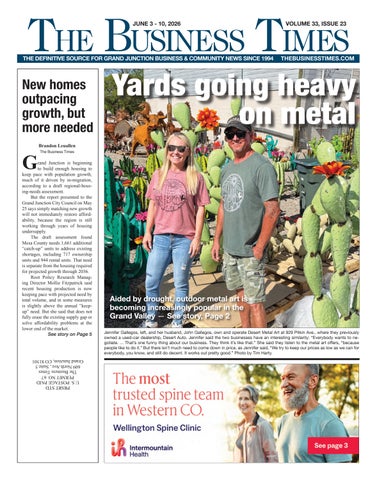
Yards going heavy on metal
Aided by drought, outdoor metal art is becoming increasingly popular in the Grand Valley — See story, Page 2
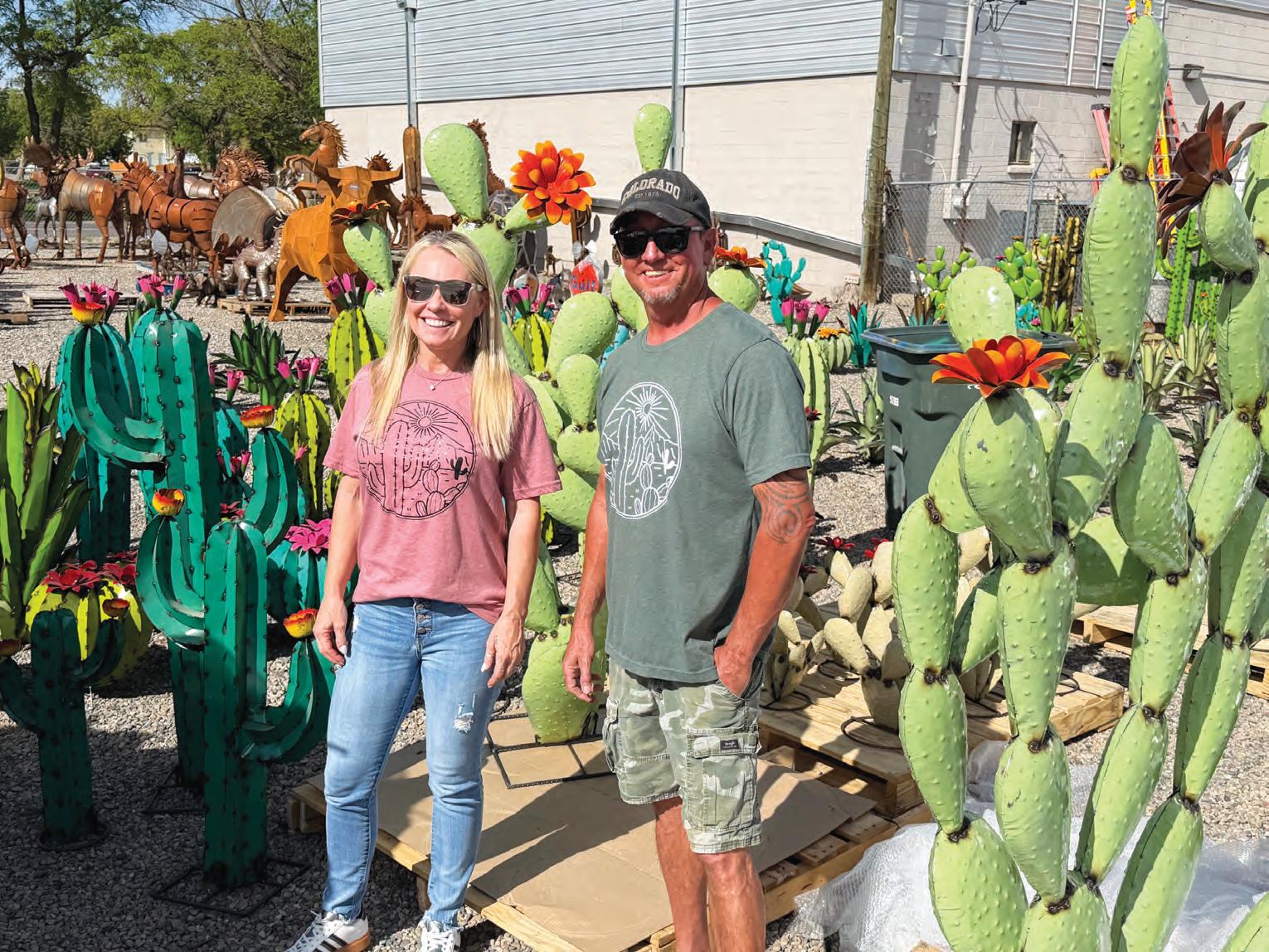
Gallegos, left, and her husband, John
own and operate Desert
at 929
Ave., where they previously owned a used-car dealership, Desert Auto. Jennifer said the two businesses have an interesting similarity: “Everybody wants to negotiate. ... That’s one funny thing about our business. They think it’s like that.” She said they listen to the metal art offers, “because people like to do it.” But there isn’t much need to come down in price, as Jennifer said, “We try to keep our prices as low as we can for everybody, you know, and still do decent. It works out pretty good.” Photo by Tim Harty.
Jennifer
Gallegos,
Metal Art
Pitkin
Metal art’s rise fueled by drought doubts
Metal art growing in popularity in the Grand Valley as waterless landscaping solution
Tim Harty The Business Times
Upland Gravel started selling outdoor metal art – various plants in vibrant colors; living creatures either colorful or rust-covered – after moving to 454 28 1/2 Road, right off the Interstate 70 Business Loop, in April 2023.
Since then, orders for more metal art tended to be a quarterly occurrence. So, when Upland Gravel’s husband-andwife owners, Nathan and Kris Rinderle, ordered a truckload of metal art in the first week of December 2025, they figured they’d be good through March. Instead, they were almost sold out when March arrived, and they had to replenish during the first week of that month.
Two weeks into April, it was time for another order. Then came May and the need for another order.
So much for the truckload every three months.
Metal art is in demand in the Grand Valley, where spring and a stretch of 80-degree temperatures arrived dismayingly early this year and got home owners thinking about their yards. The dry start to 2026 and anticipated consequences of extreme drought also got them thinking a colorful, permanent, metal flower won’t wilt and die because of a water restrictions.
One new problem looms, however. The Grand Valley isn’t the only place craving the metal creations. Kris Rinderle said when Upland Gravel tried to put in its May order, she was told she needed to wait until June, because demand is outpacing production.
Regardless, Upland Gravel has reveled in the revenue increases logged in its ledger in 2026. Sales in January were up about 20 percent year-over-year. February was up about 40 percent. Then came March and a 52 percent increase in sales.
“It was our busiest month we ever had,” Kris Rinderle said, and what followed was more impressive. April revenues rose 107 percent over the previous April. With four days left in May, it already was up 111 percent over May 2025.
While the rising numbers are for all items sold at Upland Gravel, Nathan Rinderle said metal art is “a big part of it, for sure.”
He added, “We have had a lot of people come in and say that they’re removing grass and that they’re going to xeriscape-type landscape for their houses. We’ve been hearing that quite a bit, and a lot of people have been coming in and saying, ‘We’re not planting stuff. We’re gonna do metal-art-type plants, a metal flower or something, instead of actually
planting plants this year.’ So, we have been seeing an uptick in our sales of people coming in and doing that.”
Other sellers of metal art are singing a similar song.
A little ways down the Interstate 70 Business Loop from Upland Gravel at 929 Pitkin Ave. is Desert Metal Art, where used-car dealer Desert Auto used to reside. If your inner detective just raised an eyebrow, he or she is right: Owners John and Jennifer Gallegos changed the name of their business and the product it sells.
“We’ve only been in the business three years,” John Gallegos said of the metal art, “and we were in the automotive business for 20 years. So, this was a little side gig that we were doing, but it’s got to a point where I can definitely say it’s replaced the car business for us.
“I wouldn’t say we’ve got the same gross profit off of it that we did in car sales, but it’s more accessible these days than used cars. The used-car market probably got better in the last couple years, but we switched over because, well, we’re getting close to retirement, too. This is something we can do even into retirement years.”
Similar to Upland Gravel, Desert Metal Art is seeing more sales of metal art and hearing similar reasons for the change.
“A lot of people are saying that they’re not gonna try and grow anything this year,” John Gallegos said. “They’re gonna use metal flowers, metal cactus, metal art, to kind of put in place of a live plant. A lot of people say, ‘Well, we got to do our part, because in the end, our farmers and our ranchers are the ones that really need our water.’
“Yeah, it’s definitely people are doing their part to try and conserve water. And yes, a lot of people are going to the xeriscape. And this definitely, definitely helps.”
John Gallegos noted a couple other stores that sold metal art went out of business in the past year. He can only speculate on their reasons, but he believes the remaining metal-art retailers are likely picking up some business from them.
While Jennifer Gallegos was being interviewed by The Business Times in mid-April, John Gallegos returned after helping a customer and said he just experienced what he had been speaking about earlier in the interview.
“Exactly what we were talking about,” John said of the customer’s reason for stopping at Desert Metal Art. “He said, ‘We’re gonna go with more metal art this year.’ He goes, ‘I think we’re gonna have water restrictions.’”
See METAL ART on Page 4
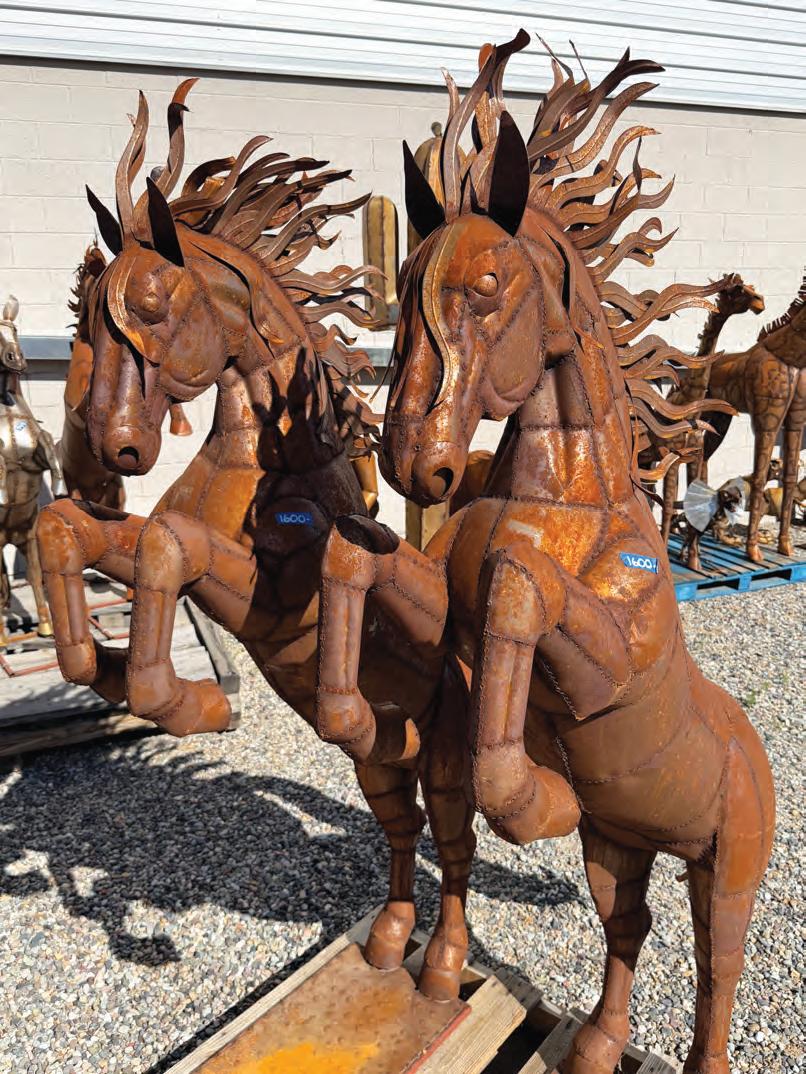
ABOVE — A pair of bucking horses displayed in a section filled with rusted-metal animals in Desert Metal Art’s lot at 929 Pitkin Ave. in downtown Grand Junction.
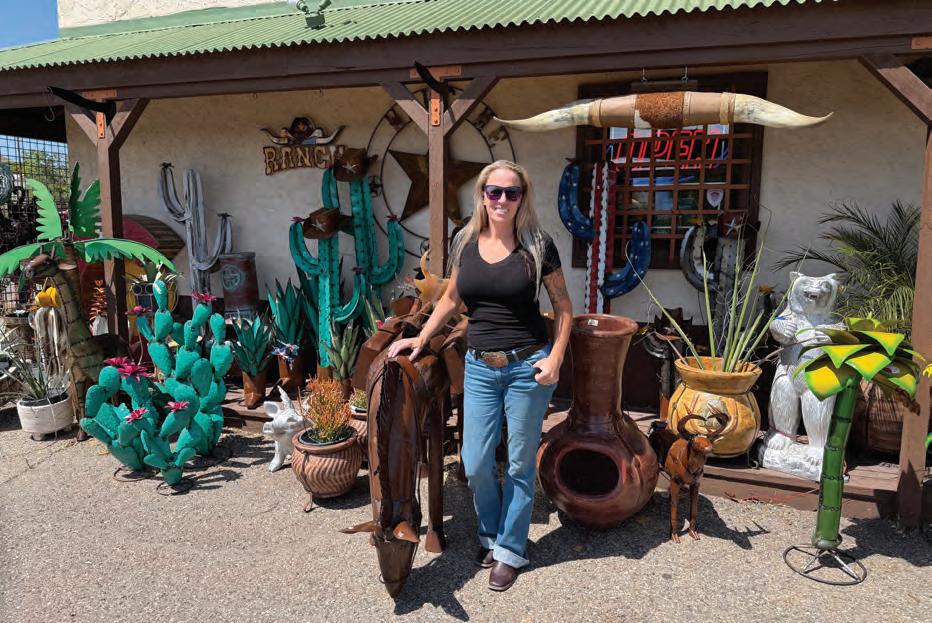
BELOW — Longhorn Trading Post co-owner Lynn Sutherland stands amongst some of the metal yard art on display in front of her store at 2898 U.S. Highway 50 on Orchard Mesa. Photos by Tim Harty.
Metal Art
Continued from Page 2
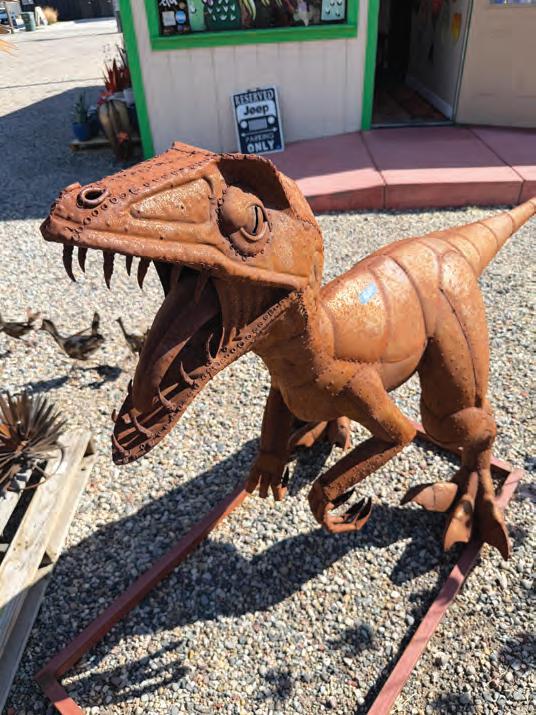
John Gallegos said Desert Metal Art’s location is another driver of visitors to the business. The tall, rusty, Bigfoot statue or equally rusty and hungry-looking velociraptor guarding the entrance to the parking lot draw eyes and inquiring minds.
“A lot of people like to just come and look at our stuff,” he said. “You know, we’re like, ‘Don’t come alone. It’s like a museum. Yeah, bring the kids, bring the family, look.’ And every once in a while, you’ll sell something cool.”
The owners of Desert Metal Art and Upland Gravel spoke of their locations being great for generating traffic at their stores. Likewise, it’s easy to notice Longhorn Trading Post at 2898 U.S. Highway 50, nestled nicely in the northwest corner where the highway and 29 Road intersect.
Longhorn Trading Post’s colorful metal art and a few statues made from other materials are lures that hook drivers who didn’t originally intend a visit to the store, which moved there in October 2024.
Longhorn Trading Post owner Lynn Sutherland owned and operated Colorado Graphx LLC in a store at Mesa Mall and also sold metal yard art from a kiosk inside the mall.
A year-and-a-half at the new location doesn’t provide Sutherland with two complete years to compare, but she did say sales in 2025 were up about 100 percent from 2024 (when three-fourths of the year was at Mesa Mall).
Sutherland believes the highly visible and accessible new location makes a difference in the metal-art sales. It may take another year or two to determine which factors make the biggest difference.
“We don’t know if it’s drought and people wanting to xeriscape, how much that might factor in,” she said. “That could
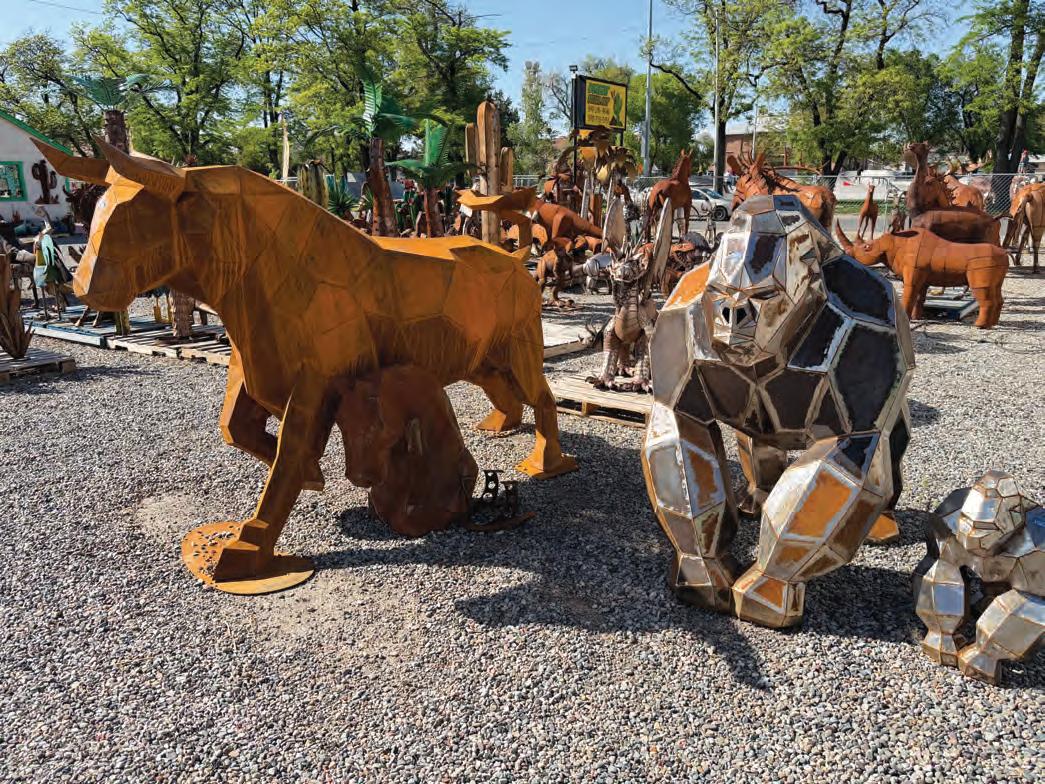
ABOVE — A large, rusted bull and a gorilla with a combination of rusted and shiny metal make an interesting display pairing in Desert Metal Art’s lot.
LEFT — A velociraptor stationed near the entrance of Desert Metal Art looks like he’s ready to eat.
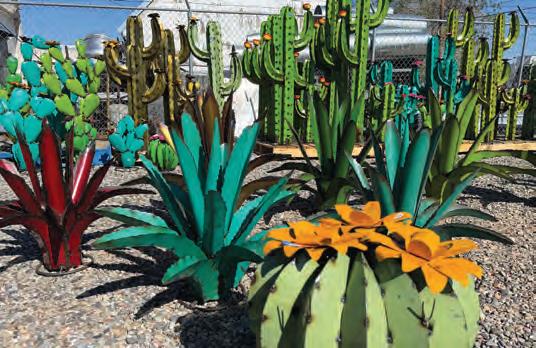
BELOW LEFT — Vibrant colors adorn the metal agave and cactus plants, which Desert Metal Art co-owner John Gallegos said are popular purchases.
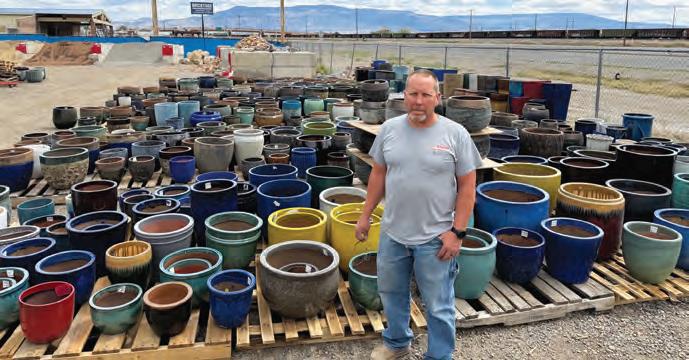
BELOW — Upland Gravel co-owner Nathan Rinderle stands among his store’s large selection of pottery, which he said some customers are buying and placing metal-art plants in them. Photos by Tim Harty.
MORE ABOUT LOCAL METAL-ART RETAILERS
People want rusty, $3,000 Bigfoot statues
The transformation of Desert Auto into Desert Metal Art began several years ago with a conversation between Desert Metal Art owners John and Jennifer Gallegos and a supplier who had a metal dinosaur on a trailer.
As John Gallegos recalls, Jennifer said, “We have to take a dinosaur back.” And he questioned the wisdom, wondering who would pay $600 for a metal dinosaur, and he didn’t like the idea of shelling out $600 and not knowing whether it would ever sell.
Ultimately, John said, “We brought it back and stuck it out there. We sold it in about three or four days. So, I’m like, ‘OK, let’s bring home some dinosaurs.’”
Then, John and Jennifer encountered a Bigfoot metal statue on the vendor’s trailer, thought it was cool and asked who was buying it. The answer was no one; the vendor brought it along in case somebody wanted it. Then, the answer became: Desert Metal Art is buying it. But again they needed to be convinced first.
John said he asked how much the Bigfoot statue cost, was told it would be about $3,000, then thought, “That’s too much money.” The vendor told him to place Bigfoot in front of his store and don’t bother with a sign, because the statue will sell itself.
“I said, ‘OK, we’ll try it,’” John said. “We brought it home. I kid you not, in less than a week we sold it. So, I call them up, and I said, ‘Can you guys bring more Bigfoots?’ They’re like, ‘How many you want?’ And I said, ‘I don’t know, maybe two.’ So, we brought back two ... We have sold 10. One customer bought three for his yard.
“So, yeah, it’s been fun. It has been fun.”
And for what sells the most, John pointed to some colorful metal flowers and cactuses and said, “This is probably our bread and butter right here.”
Business is rockin’ at Upland Gravel
When your business is named Upland Gravel, the primary product for sale is obvious. But Upland Gravel co-owner Nathan Rinderle said revenue is up across the board for the items it carries. Beyond decorative rock, the metal art is selling like never before, and people are buying the pottery.
It’s reflected in the numbers, as revenue in 2024 was up slightly from 2023, Upland Gravel’s first year at 454 28 1/2 Road. Rinderle said 2025 was better than 2024, “but it wasn’t drastic by any means.”
For 2026, however, he said, “This year has been exponentially higher. We’d been growing a little bit, but not like it has been this year.”
Rinderle said everything on the landscaping side of the business has seen increased sales, which led him to mention this about pottery and metal art: “People are putting pots in (their yards) and even using metal art in the pots instead of planting stuff in them.”
GJ housing production begins to outpace growth; shortage remains
Continued from Page 1
The report says Mesa County’s rental vacancy rate is 3.4 percent, and its owner-vacancy rate is 0.5 percent, both below the state’s undersupply benchmarks of 5 percent for rentals and 2 percent for owner-occupied housing.
The shortage is also not evenly distributed by price. The draft report identifies Grand Junction’s largest rental gap below 30 percent of area median income, or rents around $566 a month. On the ownership side, the largest mismatch is below 100 percent AMI, with homes affordable at roughly $280,000 or less.
Growth driven by migration, aging population, CMU
The assessment shows Mesa County added roughly 7,400 residents between 2019 and 2024, with Grand Junction accounting for most of that growth at roughly 6,000 additional residents.
The report says population growth has been driven by net migration, not births. Natural increase is negative, meaning deaths exceeded births during that time, and that overall trend is expected to continue.
Mesa County also has a higher share of residents age 65 and older than Colorado overall, while Grand Junction has a higher share of residents ages 18 to 24, reflecting the influence of Colorado Mesa University.
Those trends point to a housing market shaped by retirees, relocating households and college students, while younger families face more difficulty staying in the market. The assessment notes Grand Junction has a slightly lower share of people under 18 than the county and state, and Mesa County and Grand Junction saw a decline in households with children.
That comes as Colorado remains one of the more expensive states in the country. A Colorado Chamber of Commerce scorecard cited by The Gazette ranked Colorado as the third-most expensive state in the country in 2025 and 48th for housing affordability.
Starter homes remain tightest part of market
The latest Bray Report shows the strongest demand remains in the lower and middle portions of Mesa County’s ownership market.
In April, homes priced between $300,000 and $399,000 had the lowest inventory level in the report, with 73 sales, 124 active listings and 1.7 months of inventory. Homes priced between $200,000 and $299,000 had 1.8 months of inventory. There are currently no new market-rate homes being built in the $200,000 to $299,000 range locally.
By comparison, higher-priced homes had much more supply. Homes between $500,000 and $749,000 had 4 months of inventory, homes between $750,000 and $999,000 had 4.6 months, homes from $1 million to $1.249 million had 33 months, and homes above $1.25 million had 9.7 months.
The same report showed Mesa County’s April median sales price at $410,500, up 2.6 percent from April 2025, and active
listings increased 30.9 percent.
That creates a split market. Buyers looking for homes in the $300,000 to $400,000 range face the most competition, while more expensive homes are moving more slowly.
Incomes have not kept up with home prices
The housing-needs assessment says Mesa County home values remain about 25 percent to 30 percent below the Colorado average, but local prices have continued rising even as statewide values have moderated.
Between 2019 and 2024, the typical home value in Mesa County rose 53 percent, while median income increased 23 percent, according to the draft report.
That gap has changed what median-income households can buy. Fitzpatrick said a median-income household could generally afford a median-priced home in Mesa County for much of the period between 2008 and 2020. Higher interest rates and rising prices have widened the gap since then.
The result is more pressure on renters trying to become homeowners. In the resident survey, nearly half of renters said finding an affordable home to buy would make them feel more secure. Renters also identified help with a down payment and help getting a home loan as major needs.
Trying to reduce barriers to market-rate housing
Several council members emphasized that one of the city’s biggest roles is reducing barriers that slow market-rate housing construction.
Much of that work already has started.
Grand Junction created a Housing Affordability Code Task Force in 2025 specifically to review city regulations, zoning rules and development processes that increase housing costs or slow construction.
The task force was commissioned after builders, developers and housing organizations expressed concern that lengthy approvals, overlapping requirements and development regulations were increasing costs and limiting the amount of housing that could be built.
Recommendations from the task force already are being adopted after moving through the city process, including review by the planning commission and eventual council votes to amend city code.
The city also began working on broader planning and permitting reforms tied to Proposition 123, the statewide affordable-housing initiative approved by Colorado voters in 2022. Under Proposition 123, participating communities must create expedited review procedures for qualifying housing projects. Grand Junction committed to both increasing affordable-housing production and speeding up housing approvals in order to remain eligible for state funding.
As part of that effort, the city used Proposition 123 funding to support planning-capacity improvements and evaluate ways to streamline the development-review process for subsidized and market-rate housing.
Western Implement to start major store remodel midsummer
Hardware, farming and ranching equipment store Western Implement announced it will be doing a major renovation of its Grand Junction location, 2919 North Ave., beginning this summer.
According to a May 28 news release from Western Implement, the project will refresh and modernize the showroom and expand display space to better serve customers across western Colorado.
“As we continue to grow to better serve our customers, this remodel represents an important investment in both our store and our community,” Western Implement co-owner Dylan Coleman said. “We’re designing a more modern, convenient and enjoyable shopping experience while staying true to the values that have defined our family business for generations.”
According to the news release, the updated showroom will feature expanded departments, improved product displays, easier navigation and dedicated sections that highlight industry-leading brands such as Kubota, STIHL and many others. The goal is to make it easier for customers to explore products, compare equipment and find the right solutions for their farming, ranching and property needs.
Western Implement co-owner Tyler Coleman said the owners want the store to have an outdoor-power-equipment showcase and “make it more cohesive with our STIHL department and anything with an engine. We want to have that flow into our lawnmowers and all our outdoor power equipment and get that really showcased better.”
Tyler Coleman said Western Implement has been limited with its space at the front of the store, and it will open space by reducing inventory.
“We’re eliminating the clothing department,” he said. “And the tack and saddles, that will be transitioning away. … It feels like we kind of got our hands in a whole lot of different pots, so we’re kind of streamlining things.”
Tyler Coleman said the repair business will remain and see some improvements, and it will be shifted to the back, southeast corner of the building.
He added the renovation will start Aug. 1, and the target for completion is January. Western Implement will remain open throughout the project with no disruption in service.
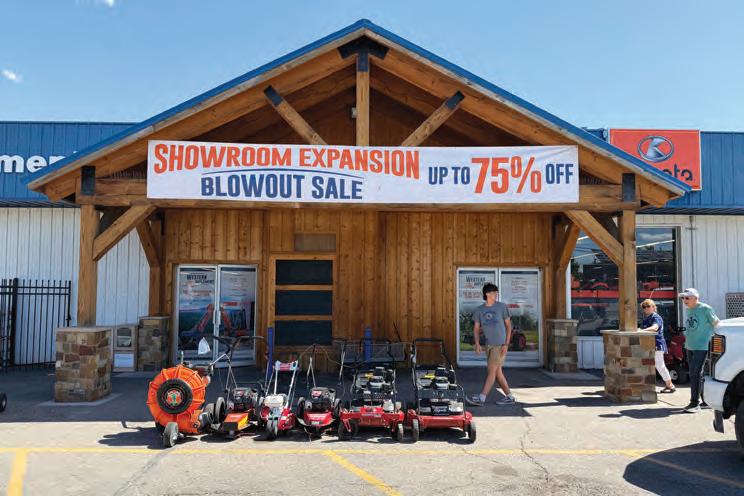
Leading up to the start of the remodeling, the store is having a sale. A large sign above the main entrance to the store says: “Showroom Expansion Blowout Sale.” Some items will be marked down as much as 75 percent.
Dylan Coleman said the look of the showroom is changing, but Western Implement’s commitment to its customers remains the same.
“We will continue to provide the same dependable service, knowledgeable staff and small-town, customer care that Western Implement has been known for since 1959,” he said.
Western Implement has been familyowned and operated in western Colorado for four generations. The news release said the store was founded in 1959 by Volney Coleman and his son Leroy, and the business is now led by brothers Jim and Gene Coleman, along with the next generation, Dylan and Tyler Coleman.
Customers can continue to visit the Grand Junction and Montrose locations for sales, service and support during normal business hours.
Western Implement, shown on May 28, has a large sign advertising a sale that is intended to reduce inventory as it prepares to renovate its showroom this summer. Photo by Tim Harty.
Housing
Fitzpatrick told council that while lo cal governments cannot control national interest rates or construction costs, they can examine what parts of the local approval process may unnecessarily add cost, delay or uncertainty to housing projects.
Zoning density also affects affordable housing
Housing Resources Director Emily Powell told The Business Times in an interview that portions of Grand Junction inside city limits still carry relatively low-density zoning, limiting how many smaller and lower-cost market-rate homes can be built.
Powell said some areas inside city limits still allow only about three to four units per acre, making it difficult to financially support lower-cost market-rate housing such as smaller-lot single-family homes, cottage courts, duplexes, triplexes and other forms of “missing middle” housing.
“You don’t want to be pushing out this kind of leapfrog development,” Powell said. “But they have these pockets that are low density, and they can’t really build anything particularly affordable if you’re at three units an acre, four units an acre.”
Powell said many cities historically used zoning systems based on the concept of “compatible use,” often resulting in lower-density neighborhoods surrounding urban cores.
For comparison, some newer entry-level subdivisions outside Grand Junction are being built at substantially higher densities. In Whitewater, builder Ron Abeloe of Chaparral West Inc. has developed single-family homes in Whitewater Village on lots ranging from roughly 4,100 to 7,000 square feet. Development signage at the project advertises homes “starting at $339,000.”
Powell also highlighted the political and financial risks involved with changing zoning. She said projects that require comprehensive-plan amendments or rezoning applications often face lengthy public processes, uncertainty and neighborhood opposition, all of which increase costs and risks for builders before construction even begins.
State energy codes add construction costs
Builders and housing organizations have raised concerns about Colorado’s newer energy-efficiency requirements, saying they add significant up-front costs to entry-level housing construction.
Powell said builders increasingly struggle
er-cost new homes in the $400,000 range and said recent state energy-code changes were estimated to add roughly $20,000 to
Those added costs become especially significant in the city’s most competitive entry-level market.
Powell said nonprofit and public-sector housing groups cannot build at the scale needed to solve the broader market shortage.
“We will never reach the kind of scale that we need to move the needle for the entire community,” Powell said. “It has to be profitable to build this lower-priced, entry-level housing.”
Subsidized housing in Denver showing higher vacancy rates
Council member Ben Van Dyke asked about reports from Denver that show higher vacancy rates in some subsidized units than market-rate units.
Fitzpatrick said that can happen when income-restricted units are built at price points that still do not match where the deepest need exists.
She pointed to 60 percent AMI units as one example, saying many households with the greatest housing need are below that income level unless vouchers or additional subsidies reduce rents further.
Reports from Denver have shown some higher vacancy rates in units restricted around 80 percent AMI, where rents can approach market prices closely enough that some renters may choose market-rate housing with roommates instead.
Council questions focus on pets, hotels, multifamily housing
Council member Anna Stout asked whether pet-related rental policies are keeping people out of housing, saying many units advertised as pet friendly still have restrictions or costs that make them difficult for renters with animals. She said only a small percentage of units may truly be accessible to renters with pets once fees, breed restrictions and other limitations are considered.
Council member Scott Beilfuss asked how hotel and motel conversions into studio apartments are affecting the market, along with the purchase of several mobile-home parks by one company.
Fitzpatrick said she will look further into the effect of motel conversions and said manufactured-housing communities are generally considered naturally occurring affordable housing, though affordability can be difficult to measure, because residents may own the home while still paying rent for the lot.
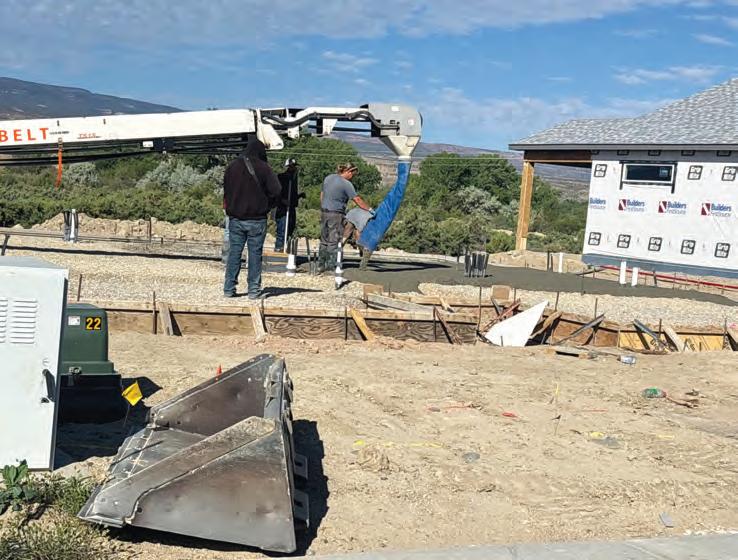
Workers pour concrete for a new local home. Photo by Brandon Leuallen.
Leuallen.
financially viable.
builder curarea’s low$400,000 range changes $20,000 to costs. especially competitive public-secthe scale shortage. scale that entire comprofitable to housing.” showing
Dyke asked show highsubsidized units happen when at price where the
AMI units households are below or addifurther.
have shown units restrictwhere rents closely enough market-rate hotels,
Stout asked are keepmany units have restricdifficult for only a small accessible breed restricconsidered.
Beilfuss asked into stumarket, several molook further conversions and communities naturally occurthough affordmeasure, because while still
THIS IS COOL!
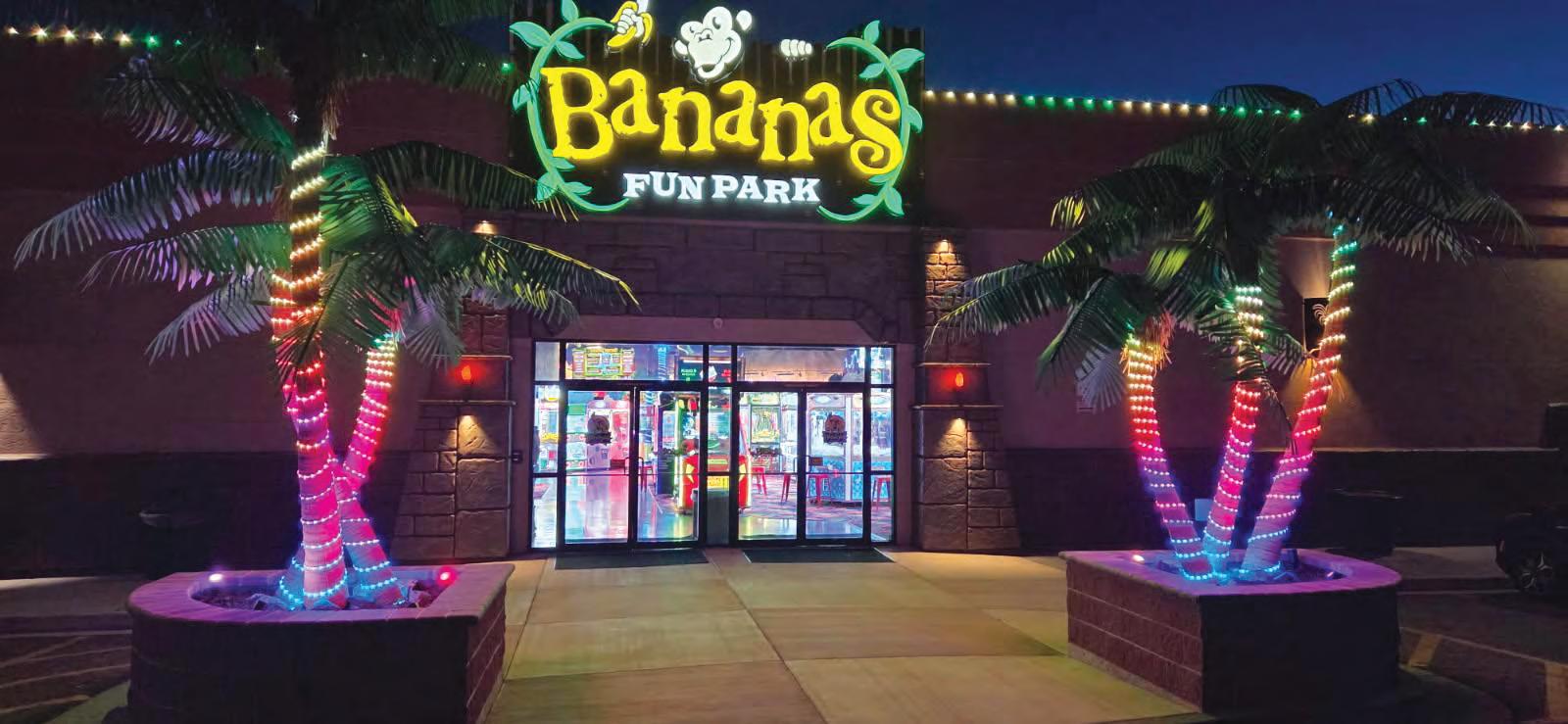
Brightly lit Bananas
If we at The Business Times see something business-related that we think is cool, we just might take a photo of it and run it in our newspaper. Why? Just because it’s cool. And it’s our prerogative.
Bananas Fun Park recently completed updates to its entrance and other items on the property, adding lots of palm trees and planters, and some of it is best viewed at night, such as the facade of the main building. The reason for doing it, according to Bananas Fun Park owner Chris Burns, was a matter of trying to keep things fresh.
“You know, 22 years later – boy, time goes quick, doesn’t it? – it was time,” he said. “Eventually you’ve got to replace things and try to upgrade, so that front entrance … we wanted a new, nice look that was bright and fun and all the things that go with the fun park. … Eventually you’ve just got to upgrade, and we always do
that, and we’re just trying to get better, so it looks beautiful.”
Burns said all of the work was done by local businesses, and there is more work to come.
“We’re working on the outside now,” he said, “and then probably in the next year we’ll do a whole new look in the inside, just a new look, brighter and maybe do some different theming a little bit. So, yeah, one step at a time.”
Bananas Fun Park also opened its water park two weeks ago, coinciding with the end of the School District 51 school year. Photo by Craig Hall.
There’s apparently no watering down this emergency
When it comes to emergencies, no one abuses emergency powers like our government. And it’s doubly worse when the government creates the emergency, and triply worse when it doubles down on those doubly worse emergencies it created. Think like the “double-secret” probation Dean Wormer at Faber College put on Delta House. I mean, they revoked their charter and took the whole bleeping bar! Just substitute essential workforce and your favorite restaurant or bar closing during Covid – although they did leave the pot shops and liquor stores open.
But the main point on the above isn’t the punishment “we the people” endured, it’s the crime contained in the “emergency.” And you gotta give the government credit, it keeps trying. But that’s also for nefarious reasons. You know, our “leaders” like to call the reason “the greater good,” while we all understand it’s just to accumulate more money and power from the people.
I mean. just look at the past couple of years. We all know respiratory emergencies lead the way, because you can control more folks with viruses than bullets. King of the hill was, of course, Covid. But even since Covid they’ve tried multiple viral “emergencies,” such as RSV, the “resurgence” of the flu, which all but disappeared during Covid, and the latest, the Hantavirus. Add to these “annuals” another Ebola emergency and the ever-present climate change, and, of course, the constant “threats to democracy” of anyone with conservative thoughts.
Regardless, the results are the same, more money and power to government.
Hate to break it to our “leaders,” almost to a one you are the biggest threat to democracy, although I wish you’d call it by its real name: Freedom. Besides, democracy is mob rule, which is never good for the individual. You know, the ones you swore an oath to protect against “democracy” in its true form. But I digress.
And do you know where freedom is most threatened? That’s right, in governmentdeclared emergencies. After all, nothing in my lifetime took away more freedom than Covid. Yet, these emergencies also affect our lives beyond freedom. And it’s usually in our wallets. After all, the basic design of government power is funded in confiscation of property, and the property it loves best is monetary. And you thought taxes were to help the people.
I mean, if government was designed to help the people, you’d think in our latest emergency here in Mesa County our government entities would be looking for a way to get folks more water. It’s not like droughts aren’t commonplace out here (heck we’ve been in one since I moved here in 2000) with some years worse than others. You’d think our government water lords would have a plan in place when a serious one occurs. That would be common sense, no?
And yet here we are, in a drought where the only solution the government can come up with is to charge us more for the water we use under the guise of “emergency drought rates.” Which is simply a progressive water rate based on usage. I remember getting a surprise bill one year under this same scheme a while back. Problem is, I don’t think anyone understands or can gauge when they go over the arbitrary amount now considered basic. It’s also patently unfair to those folks whose lawn-watering systems are not on irrigation, although I’m sure the government will find a way to even out the starving of those folks’ lawns as well. I’m also sure it’s not very effective.
So, raising prices on water is being used to change behavior, and it only affects certain people? Sounds like a typical government revenue raiser to me. After all, who has a monopoly on water? That’s right, the government. And yes, our local water
districts are government agencies, same as your electric or gas supplier. They “serve” at the pleasure of your local politicians. Those are the folks calling the shots when it comes to our utilities.
And to think, of all the rights our elected leaders claim they will “fight” for us to have, water isn’t one of them. If they did, they would have had a plan for a severe drought to make sure we all had all the water we needed for whatever we needed it for besides “we’re gonna charge you up the wazoo” if we decide you’re using too much. Not to mention someone will probably find a way to release a list of abusers, so protesters know whose lawn to take over.
But just to help them out, it will probably be a green one.
Let’s just think about another scenario involving water. Let’s say a different weather-related emergency occurred in an area where thunderstorms and tornadoes caused power outages, which affected supplies of water and other water-related items like ice. Can’t be too hard because it happens all the time. So, the people are in a situation where they need to stock up on water and ice to preserve their way of life.
Now let’s say you own a convenience store, and you’re smart enough to stock up on water and water-related items like ice to help the community when the emergency hits. But your smart planning has a run on your store, and folks are trying to buy up all your supplies, and in order to be able to assure supplies for as many folks as possible, you raise your rates of said supplies to limit buying power. Essentially this is what our government is doing with our water right now, no?
But what do the government and the politicians call the store owner? That’s right, a greedy, price-gouger. Some communities go as far as pressing charges and fining smart retailers like your local convenience-store guy. He’s not allowed to raise the rates. He’s supposed to find more water supplies and keep prices low.
It was the same with Covid and toilet paper. Or more recently with Biden’s chicken-killing spree with eggs. Now with Trump playing war games in Iran with gasoline – but it’s always something with gasoline. Where you should take note is when the government does it with supply and demand, it’s for the people. When private business does it, it’s greed.
The bigger problem, the government controls all the water across the United States, even the stuff in the clouds about to hit your roof. Don’t think so? Put a barrel on your downspout or build a pond on your property. The government will descend on you like white on rice, which you soon won’t be able to boil up, because it takes too much water.
So, here’s an idea or two for our suppliers and our political and community “leaders.” Find more water and keep the rates where they are. Maybe tell Denver and Vegas and LA to do the same and come up with their own solutions. Have a plan in place for the next, expected, severe drought besides filling your coffers. Here’s an idea, which will also shock California, fill more reservoirs. Literally save for a rainy day.
Because no matter how much you raise rates, it won’t create one more ounce of water.
I mean, with all the rights our overlords create out of thin air, why isn’t one of them water? It’s the wellspring of life. There’s literally no more important compound on the planet. One might say it’s priceless. Because it is. Then again, that’s why they raise the rates.
In Truth and freedom.
Craig Hall is owner and publisher of The Business Times. Reach him at 424-5133 or publisher@thebusinesstimes.com
Craig Hall
n Clifton Water to apply drought rates, beginning in June
The Clifton Water District said in a May 27 news release it will implement temporary water-conservation rates in response to ongoing drought conditions affecting the region. The new rates will take effect in June and will be reflected in monthly customer billings beginning in July.
According to the news release, the purpose of the adjusted rate structure is to encourage responsible water use across the community. There will be no change to the minimum monthly billing for the first 3,000 gallons of water. However, customers whose usage exceeds this baseline can expect an increase in their monthly bill, reinforcing the importance of conserving water whenever possible.
The Clifton Water District urges its customers to reduce water usage by taking such measures as limiting outdoor watering, repairing leaks and using water-efficient appliances.
For more information, such as the rates and a “temporary drought rate calculator,” go online to www.cliftonwaterdistrict.org.
n Drought leads City of Grand Junction to ban sale of fireworks
Due to ongoing severe to extreme drought conditions and elevated wildfire risk, the Grand Junction City Council approved a resolution prohibiting the sale, exchange, barter or trade of consumer fireworks within the City of Grand Junction, along with the issuance of temporary permits for fireworks sales. The restrictions remain in effect until lifted by order of the fire chief.
The ban impacts consumer fireworks sales and permitting, but professionally managed fireworks displays at Lincoln Park Sports Complex are currently still scheduled to move forward, pending weather and fire conditions.
Currently scheduled professional displays include: June 5, hosted by the Razorback Suckers; June 19, hosted by the Razorback Suckers; and July 4, hosted by the City of Grand Junction. The July 4 city celebration will commemorate the nation’s 250th anniversary and Colorado’s 150th anniversary.
All professional displays remain subject to changing fire conditions and direction from fire officials.
n Gravel contracts support road maintenance across Mesa County
The Mesa County Commission approved contracts last month with four local suppliers to provide gravel materials for Mesa County transportation projects in 2026, in an amount not to exceed $225,000. The materials will support ongoing road maintenance and repairs across Mesa County, helping crews respond to wear caused by traffic, weather and daily use.
Mesa County evaluated bids based on material cost, supplier location and the ability to meet operational needs in different parts of the county. The county said in a news release that using multiple local suppliers will help reduce hauling costs and improve access to materials based on road conditions and project location. Approved suppliers include: 3B Enterprises; Elam Construction; Moores Mining; and Parkerson Construction.
n Construction begins June 8 on Orchard Avenue safety
improvements
Construction on Phase 1 of the Orchard Avenue Safety and Connectivity Project will begin June 8. Work includes about 1,885 feet of roadway reconstruction, a new roundabout at 31 Road and replacement of the existing culvert and pedestrian bridge over Lewis Wash.
The improvements are designed to improve traffic flow, reduce conflict points for drivers and strengthen drainage and pedestrian infrastructure along the corridor. Mesa County is partnering with United Companies on the work, which is expected to continue through late December 2026.
Orchard Avenue will be closed during construction to allow crews to complete major infrastructure improvements more safely and efficiently. Work will generally take place Monday through Friday from 7 a.m. to 7 p.m., with some Saturday work as needed. Landscaping may continue into spring 2027.
Residents can receive project updates or ask questions by calling the project hotline at 970-549-2468 or emailing mcorchardaveproject@gmail.com.
n Community Hospital recertified as center of excellence for sports medicine and spine
Community Hospital recently earned The Joint Commission’s Gold Seal of Approval for Western Orthopedics and Sports Medicine and Grand Valley Spine and Pain accreditation by demonstrating continuous compliance with its performance standards.
The Gold Seal is a symbol of quality that reflects a health-care organization’s commitment to providing safe and quality patient care, Community Hospital said in a news release.
The certification, offered in collaboration with the American Academy of Orthopaedic Surgeons, focuses on the pre-surgical orthopedic consultation to the intraoperative, hospitalization or ambulatory surgical center admission, rehabilitation activities and follow-up visit with the orthopedic surgeon.
Community Hospital underwent a rigorous, unannounced review in March. During the visit, a Joint Commission reviewer evaluated compliance with four of Community Hospital’s orthopedics and spine programs, including Total Joint Replacement Surgery for hip, knee and shoulder as well as spine surgery. A thorough review of standards spanned several areas including environment of care, infection prevention and control, leadership, medication management, rights and responsibilities of patients and more. The reviewer also conducted thorough observations and interviews.
“Joint Commission certification recognizes health care organizations committed to striving for excellence and fostering continuous improvement in patient safety and quality of care,” said Ken Grubbs of The Joint Commission. “We commend Community Hospital for using The Joint Commission certification process to reduce variation in clinical processes and to strengthen its clinical program to drive safer, higher quality and more compassionate care for individuals served.”