City fulfills order for fewer rules on drive-thrus
Brandon Leuallen The Business Times
The Grand Junction City Council voted unanimously on May 20 to loosen zoning rules for drivethrough businesses after developers, engineers and commercial real estate representatives argued the city’s existing code made some projects difficult or impossible to build.
The amendment removes portions of the city’s zoning and development code that restricted how drive-through lanes could be designed and located on commercial properties. The changes passed 7-0 after weeks of debate at both the Planning Commission and City Council level.
Drive-throughs remain prohibited in downtown Grand Junction and within the 24 Road corridor overlay district. The amendment only affects areas where drive-through facilities already are allowed under city-zoning regulations.
Rather than outright banning drive-throughs citywide, as some municipalities have done to discourage car dependency and reduce emissions, Grand Junction instead imposed design restrictions that developers said made it difficult or impossible for many vehicle-oriented businesses to build workable drive-through layouts on certain properties.
See story Page 5
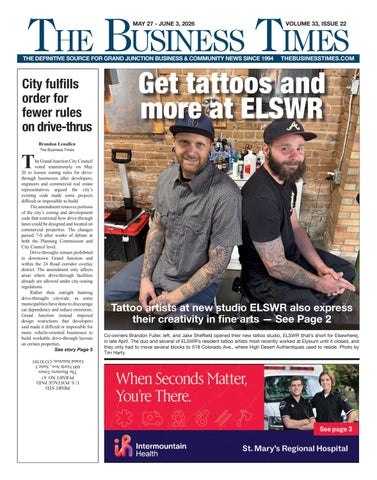
Get tattoos and more at ELSWR
Co-owners Brandon Fuller, left, and Jake
in late April. The duo and several
Sheffield opened their new tattoo studio, ELSWR (that’s short for Elsewhere),
of ELSWR’s resident tattoo artists most recently worked at Elysium until it closed, and they only had to move several blocks to 518 Colorado Ave., where High Desert Authentiques used to reside.
Photo by Tim Harty.
More than a tattoo studio
ELSWR looks to be your go-to shop for tattoos, fine art and soci
Tim Harty The Business Times
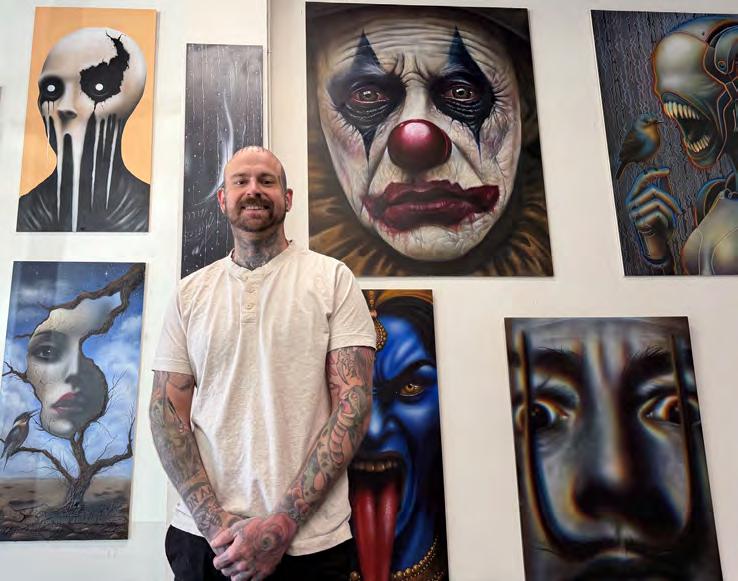
alk in the front door, look to your left, and a wall of paintings done by Garrett Mallekoote will literally stare back at you. Most of his work on display has faces and eyes, such as as the clown face resembling Joaquin Phoenix’s Joker.
Or look to your right and take note of the lounge area where a couch, loveseat and chair encircle a coffee table with a nice, large chess set centered on it, beckoning you to embrace your inner Gary Kasparov or Magnus Carlsen (two of the greatest to ever play game).
Then, look straight ahead into the heart of the long, open, rectangular, commercial space and gaze upon the work stations of the half-dozen tattoo artists who now reside at ELSWR (that’s short for Elsewhere) Tattoo Studio, 518 Colorado Ave. in downtown Grand Junction.
Initial impressions serve as a good representation of what co-owners Brandon Fuller and Jake Sheffield want to impart to customers.
• Of course, ELSWR is first and foremost a tattoo studio, which Fuller and Sheffield decided to open when they realized Elysium, the downtown Grand Junction tattoo studio where Sheffield had operated for the past eight or nine years, and Fuller for seven years, would be closing its doors.
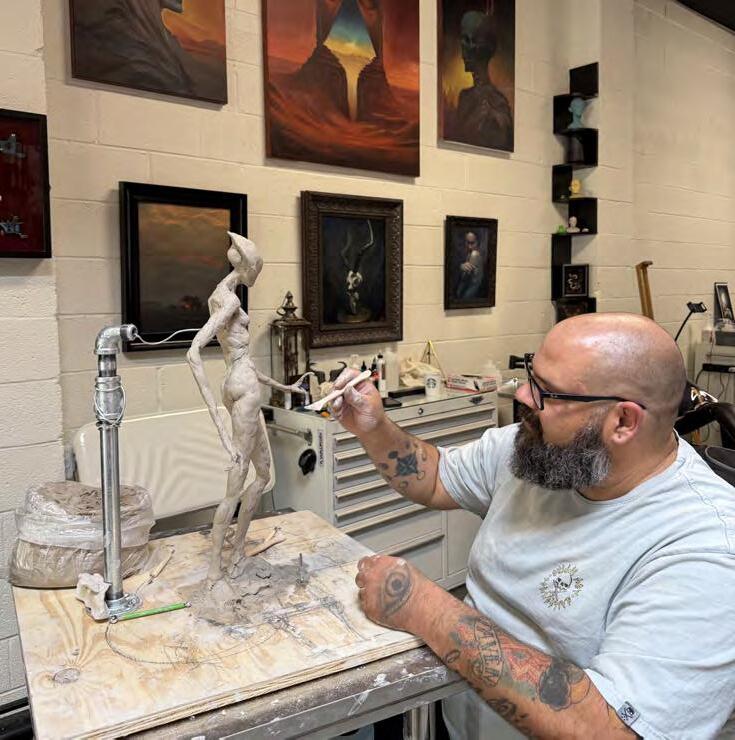
• It also makes sense that tattoo artists apply their creativity elsewhere, such as painting and sculpture, like what Paul Lunetta was doing on May 13 when, sans tattoo customer, he had time to work on a water-based clay figure. His goal is to make a resin cast of the sculpture and have the ability to make three-dimensional prints.
• And for its customers or tattoo aficionados who just want to hang out, they can do that at ELSWR.
Getting their own tattoo studio was a combination of Fuller and Sheffield being ready to do it and the imminent end of Elysium, which was housed in an old church, 535 N. Seventh St., that Elysium owners Arlo DiCristina and Ryan Ashley renovated, but now they are trying to sell it.
A few other Elysium alumni are joining Sheffield and Fuller at ELSWR, and they said that was an important piece allowing them to become business owners.
“The cohesiveness, the team that you’re working with in a tattoo shop, is one of the highest levels of importance,” Fuller said. “So we came over with people who have also spent seven, eight years at Elysium or more. And knowing that we’ve got that made all the difference, gave us confidence to move into a shop knowing we have a really good, talented, high-caliber crew of tattoo artists.
“And Jake being one of them and myself, this is just going to evolve, right? So we’re gonna have a lot of really talented people coming in, and we’re hoping to keep it that high caliber.”
Sheffield and Fuller opened the studio near the end of April before any art adorned the walls. Two weeks later, it was looking a lot more like the space they envisioned when they decided they wanted to open their own tattoo studio.
There’s more to do, though, as Sheffield said ELSWR likely will have a three to six-month window before having its grand opening.
“We’re just trying to see how long it’s gonna take to really get everything exactly how we want it before
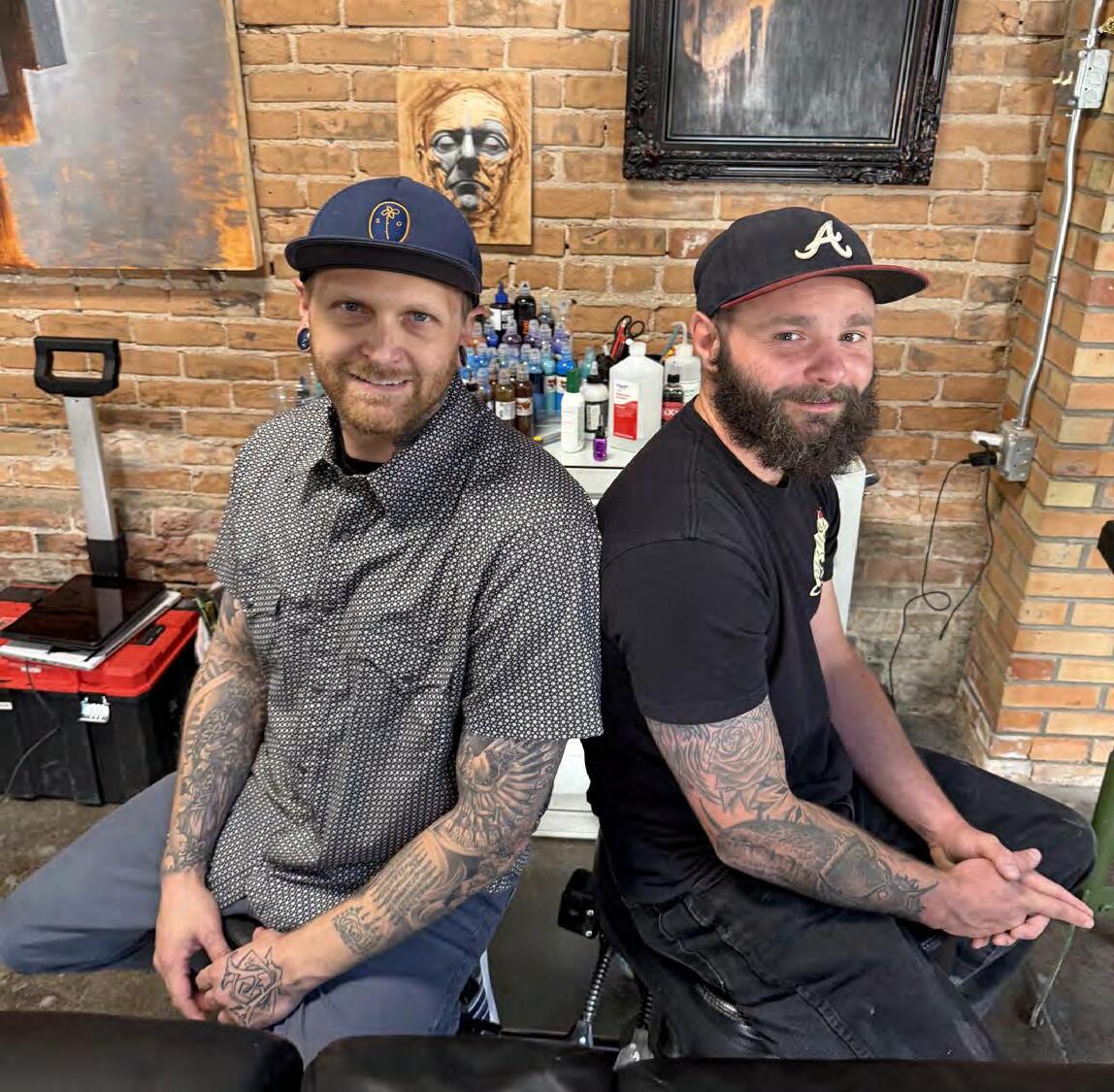
ABOVE — Jake Sheffield, left, and Brandon Fuller found a commercial space they said is perfect for ELSWR Tattoo Studio, 518 Colorado Ave. They like the long, rectangular layout for spacing of the tattoo artists’ work areas, and there’s plenty of wall space to display their paintings. Photo by Tim Harty.
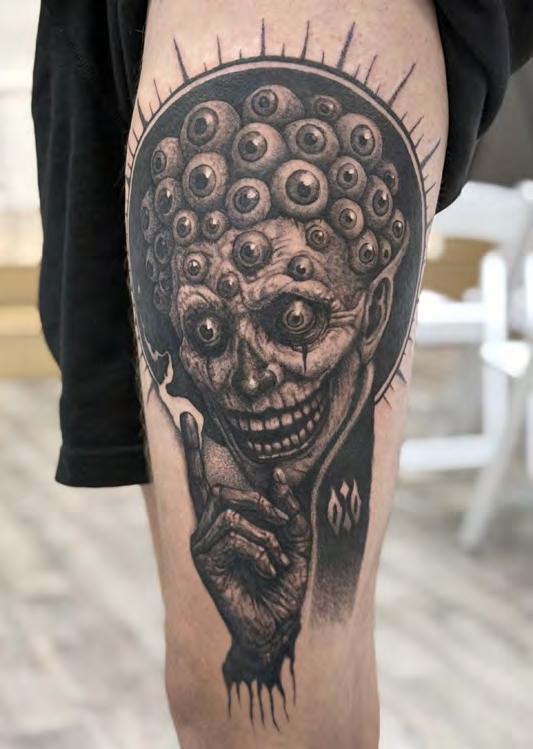
BELOW — Asked if he could provide a photo of a tattoo that he’s particularly proud of, Brandon Fuller sent this one. “I enjoyed doing it,” he said. “It was a custom design I did on a good client at a convention in Denver, where I took home a trophy for best tattoo of the day. I was able to create a custom design that fits the aesthetic I enjoy tattooing the most, which is more supernatural, black and gray, with the dark aesthetic something unique and larger scale.” Photo courtesy of Brandon Fuller.
we unveil everything,” he said.
In addition to the resident tattoo artists, ELSWR will have room for guest artists, and they said DiCristina definitely wants to do some tattooing there.
Ashley also is invited to tattoo at ELSWR, and Fuller said, “She told us she’s going to let us know, because her travel schedule is pretty intense right now, but we hope to see her around as well.”
Sheffield said the tattoo artists at ELSWR know people who tattoo all around the country, “and a lot of tattoo artists are nomadic kind of people, so we’ll have a lot of guests coming through from all over the U.S.”
Sheffield said ELSWR will be a fun place.
“We’ve worked together so long, so when people come in here, it’s not gonna be a bland time,” he said. “We have a lot of fun when we’re tattooing, since we all know each other so well.”
When it comes to the styles of the tattoo artists at ELSWR, Fuller described them as being “more into the fine-art world.”
“A lot of these tattoo shops are what you might consider traditional, American traditional … I think this shop in particular is more loaded with people that do realism and surrealism,” he said. “So, it’s a different genre of tattoo, sort of a cohesive-like genre of people who do more of the kind of realistic – there’s several subdivisions of that – but it’s not like an American traditional shop. It’s not just a walk-in shop.
See ELSWR on Page 4
ELSWR
Continued from Page 2
“You can come here and get a really big custom – we tattoo people for multiple days at a time, and you get a nice custom piece from us. It’s a little different, but we’re also engaging in being part of a street shop, because we want to be more involved in the public.”
Fuller added if he was promoting the business, he would just let people know that ELSWR is a custom tattoo shop that wants to remain a high-caliber one where customers have a great experience.
“Everybody hears ‘customer-service-oriented’ and ‘talented artists,’” he said. “We have been putting a lot of effort in this place, because we want to continue that, you know?”
Sheffield echoed the custom-tattoo sentiment and said, “I think everybody here will give that person a completely custom tattoo, something that other people don’t have, and take their time working with the idea and the design and not just getting them in and out. It’s not like a revolving door. It’s more like: We want you to have something special.”
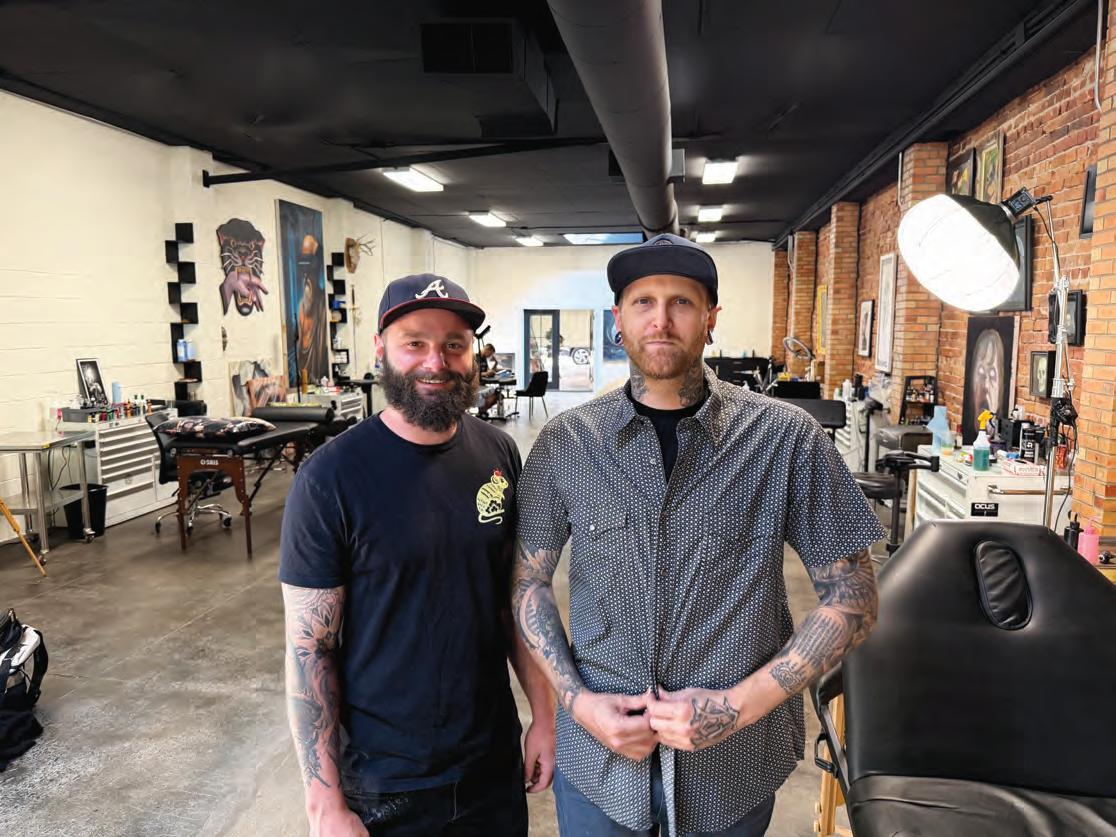
ABOVE — ELSWR resident tattooist Paul Lunetta, shown here working on a water-based clay sculpture, is like many of the tattoo artists at ELSWR in that his creativity and artistic ability extends to other mediums.
BELOW — Garrett Mallekoote, a resident tattoo artist at ELSWR, stands in front of several of his paintings that are displayed near the studio’s entrance. He said he leans toward airbrush or oil painting, and he also does large-scale murals, such as walls. Photos by Tim Harty.
More About ELSWR Tattoo Studio
The owners know what they’re doing ELSWR tattoo studio co-owners Jake Sheffield and Brandon Fuller paid their tattoo dues en route to opening their own studio.
Sheffield said he’s been tattooing for about 15 years. He said he got his start in Florida when he was about 17 years old, then tattooed in Michigan for “about four or five years, and he’s been in Grand Junction almost 10 years.
Fuller said he was born and raised in Southern California and had an interest in tattooing since he was young, admitting, “I would secretly give my friends tattoos here and there.”
He said he was in his mid-30s when he decided to finish up his art degree and get a tattoo apprenticeship. He said he worked at a shop in Laguna Beach, Calif., for a while and went to a large tattoo convention, where he met his current girlfriend, who so happened to be shop manager at Elysium Tattoo Studio in Grand Junction.
Fuller said he ended up in Grand Junction as a result, started tattooing at Elysium in 2019, and remained there until starting ELSWR with Sheffield.
Found their way to Colorado Avenue
Sheffield said he and Fuller kicked around the idea of opening their own tattoo studio for a couple years, “just to have our own space, our own place, just to do things how we saw fit, you know?”
He said they considered buying a house for the business, “but it just kind of didn’t seem right.”
Then, they learned about the available unit at 518 Colorado Ave., which previously was home to antique store High Desert Authentiques.
“We stumbled upon this place, and the landlord was willing to work with us,” Sheffield said. “She did a lot of upgrades and everything, and it just kind of made sense.”
The long, open rectangle that is the unit’s interior was perfect for what Fuller and Sheffield envisioned.
“That was one of the biggest things is finding the right layout,” Sheffield said. “Looking into some of the houses, they just aren’t set up for this kind of business. But finding this, there’s a giant rectangle. (The space between) each pillar is basically the perfect amount of room for a booth. There was already electrical around each one of those pillars, so it just seemed kind of like the perfect fit for a tattoo shop, oddly enough, because it never was anything like that.”
Fuller and Sheffield also liked the location on Colorado Avenue, as Sheffield called it “awesome” and added, “We had heard that there’s a lot of cool stuff happening on the street. There’s a lot of new restaurants; they got the dispensary over here; Moody’s (Underground) is opening up. ... It just seemed like a really good fit for a tattoo shop.”
Into the finer arts
ELSWR wants to be more than just a tattoo shop, and the resident tattoo artists’ love of fine art will be evident and highlighted.
“A few of us do 3D modeling and stuff like that, so people will be able to come in and possibly buy little statues, original paintings,” Sheffield said. “I don’t think there’s a lot of tattoo shops around here that also have a gallery. So, we’ll have a gallery up and running with some of that stuff, fine art, oil paintings.
“We’re gonna try to do a lot of stuff that’s a little different.”
That social-club feel
Part of doing stuff “that’s a little different” is the ELSWR artists’ penchant for socializing.
“We’re trying to make it comfortable in the sense that this is a place that you just want to come hang out,” Fuller said. “Because we have a pretty deep clientele base, and we love seeing it. And now they can stop by more frequently and just say hello, hang out, maybe probably get their next tattoo.
“So, we just want to be welcoming and the best experience for somebody looking for a custom tattoo or a smaller tattoo. Just try to keep it a high-level place.”
Sheffield added, “We want to also be a little bit like a social club. You don’t have to come in just for a tattoo. You can just come in and hang out.”
Willing to share their expertise
Sheffield and Fuller said they eventually want to offer seminars from time to time, as they’ve experienced their value first-hand.
“It doesn’t even have to be necessarily for tattooers,” Fuller said, “because a lot of us paint. There might be seminars where, say, you were into painting, you could come and hang out with us for a night, do a painting.
“We also have a lot of resources in that world, because of what we do that kind of overlap. … It’s down the road for us, but we want to be able to provide more accessibility to our work as well.”
The Taco tion’s zoning ported during ing a side the front by the city ilar site designs buildings
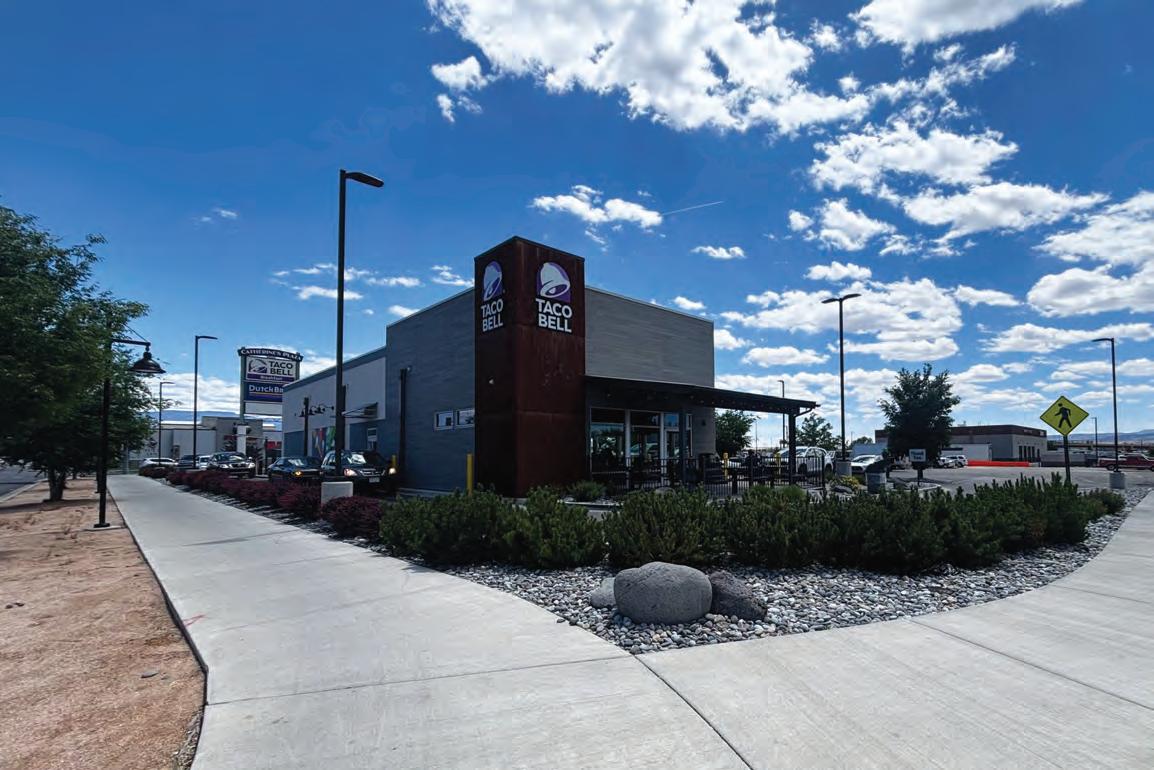
The Taco Bell at 29 Road and North Avenue was cited by members of Grand Junction’s zoning code committee as an example of a drive-through design they supported during the city’s code rewrite process. Pedestrians access the entrance using a side sidewalk and marked crosswalk, while the drive-through wraps around the front of the building. Developers later argued the final code language adopted by the city did not reflect the committee’s recommendation and would make similar site designs difficult or impossible while also reducing space available behind buildings for parking and circulation. Photo by Brandon Leuallen.
Continued from Page 1
Developers and engineers argued the restrictions especially impacted national restaurant chains and other businesses whose operations depend heavily on vehicle access and drive-through traffic.
The issue exposed a broader philosophical divide over the city’s development direction, particularly around walkability, urban design and automobile dependence.
While supporters argued the rules had become impractical barriers to economic development, opponents on the Planning Commission warned the city was moving away from long-term goals tied to pedestrian-oriented design and reducing reliance on vehicles.
Grand Junction Planning Manager Thomas Lloyd said city staff received “ongoing feedback” from the development community over roughly the past year regarding challenges created by the regulations.
“We’ve received a lot of talk and feedback just that this is making site design pretty challenging,” Lloyd told City Council, “especially on more challenging lots, lots that have triple frontage or double frontage.”
The amendment removes language requiring drive-through facilities to be “designed and located to avoid impairing pedestrian mobility to or from the principal structure or creating risks to pedestrian safety.”
Lloyd said staff viewed the language as too subjective and difficult to administer, because pedestrian-related standards are already addressed elsewhere in city code through transportation-engineering-design standards, access standards and pedestrianconnection requirements.
The ordinance also removes a rule prohibiting drive-through lanes from being located between the front of a building and the adjacent public right-of-way.
According to staff, developers argued the requirement created major design problems on corner lots, irregularly shaped parcels and sites with multiple street frontages.
Supporters of the amendment also argued the restriction could unintentionally increase pedestrian-conflict points by forcing some businesses to create separate entrance
and exit driveways that pedestrians would then have to cross.
Lloyd said the changes are intended to provide more flexibility while still maintaining other pedestrian and urban-design standards elsewhere in city code.
“Building orientation and where it’s located can also be from an urban-form standpoint encouraged in other ways,”
Lloyd said.
Questions emerge over how rule got into code
During the Planning Commission debate, commissioners repeatedly questioned how the restriction was added during the city’s majorzoning-code-rewrite process and whether any evidence had ever been presented showing the regulation was necessary.
Planning Commissioner Ian Moore directly asked staff where the existing drivethrough language originated and whether it had been based on studies or documented problems.
“I’m trying to figure out what problem we were solving,” Moore said.
Lloyd responded that he did not know the original justification for the provision.
“I was not present here at that time, so I am unsure of kind of the specific reasoning behind it,” Lloyd said. “It maybe seemed like a good idea at the time.”
Planning Commission Chair Sandra Weckerly, who served during the city’s larger zoning-code-rewrite process, said commissioners had never been presented with reports or evidence showing pedestrian incidents in drive-through lanes were a local issue requiring regulation.
“We never did see any reports or backup or reasoning,” Weckerly said.
She said Planning Commission members repeatedly asked city staff over the years whether the city had documented pedestrian injuries in drive-through lanes, and they never were presented with examples.
Planning Commissioner Keith Ehlers said he personally reviewed available trafficincident information looking for examples of vehicle and pedestrian conflicts in drivethrough lanes, and he did not find any documented incidents.
Downtown GJ reinstated as Enterprise Zone
Status unlocks tax incentives for businesses
The Business Incubator Center, administrator of the Mesa County Enterprise Zone, announced Downtown Grand Junction has officially been reinstated into the Mesa County Enterprise Zone following approval of a boundary amendment by the Colorado Economic Development Commission.
According to a news release from the Business Incubator Center, the amendment restores Census Tract 3 to Enterprise Zone eligibility for the next 10 years. Tract 3 includes the downtown corridor between First and Seventh Streets and from Pitkin Avenue to North Avenue.
The news release said the change was made possible through newly released 2024 Census data confirming the tract now meets the State of Colorado’s qualifying thresholds for economic distress.
“Enterprise Zone redesignation is a signal to entrepreneurs and investors that a community is open for business and willing to back that up with real incentives,” Business Incubator Center CEO Dalida Sassoon Bollig said. “So when the redesignation left parts of Mesa County out, including Downtown Grand Junction, we got to work. We ran the analysis, made the case to OEDIT and successfully brought those areas back in.
“For the businesses that ended up outside the new boundaries, we also advocated for robust grandfathering through 2035, so they wouldn’t lose ground. The Enterprise Zone now reflects what our regional economy actually looks like, and that’s how it should be.”
Beginning immediately, qualifying businesses operating within the newly reinstated area may be eligible for a range of Colorado state-income-tax credits tied to investments in their operations. Eligible activities can include:
• New job creation.
• Employee training costs.
• Equipment and capital purchases.
• Research and development activities.
• Rehabilitation of qualifying vacant buildings.
Among the available incentives is the Vacant Building Rehabilitation Credit, which covers 25 percent of qualifying rehabilitation costs for buildings that are vacant for two years or longer, as well as the Job Creation Tax Credit, which provides $1,100 per new employee.
These incentives, the news release said, are available to qualifying for-profit businesses of various sizes and stages that are making investments in their businesses and the local economy.
Businesses interested in utilizing Enterprise Zone credits must complete annual pre-certification through the Colorado Office of Economic Development and International Trade (OEDIT) portal before undertaking qualifying activities.
Business owners are encouraged to precertify immediately for the 2026 tax year and consult with the Mesa County Enterprise Zone office to determine eligibility and maximize available incentives.
Information, eligibility maps, and certification links are available online at the Business Incubator Center Enterprise Zone page.
Questions regarding eligibility and precertification may be directed to Kristin Rau, Mesa County’s enterprise zone administrator, by emailing mcezadmin@gjincubator.org.
The Business Incubator Center said it also recognizes and appreciates the support of the Downtown Development Authority in the successful application to the Colorado Economic Development Commission.
Businesses are encouraged to explore opportunities to potentially stack Enterprise Zone incentives with DDA incentive programs to maximize investment opportunities.
Hearing clinic’s event features FDA-approved tinnitus treatment
Western Colorado Hearing Clinic is hosting Lenire Week, June 1–5, in Grand Junction and Glenwood Springs to educate patients about tinnitus and introduce Lenire, the first and only FDAapproved treatment designed to reduce tinnitus symptoms.
As part of the weeklong event, Dr. Ross O’Neill, founder and inventor of Lenire, will be a special guest speaker during two, free, patienteducational seminars. Community members experiencing tinnitus, commonly described as ringing in the ears, are invited to attend a seminar or schedule a personalized
appointment during one of several Lenire Day events.
“Tinnitus can have a tremendous impact on a person’s quality of life, affecting sleep, concentration, communication and emotional well-being,” said Dr. Jennifer Bebee, owner of Western Colorado Hearing Clinic. “We are excited to bring Lenire Week to our communities and provide local patients access to the latest FDA-approved treatment option available for tinnitus.”
Lenire is a non-invasive neuromodulation device that combines sound therapy delivered through headphones with mild electrical stimulation to the tongue. This bimodal-treatment approach targets the underlying neural activity associated with tinnitus and is designed to help reduce symptom severity over time.
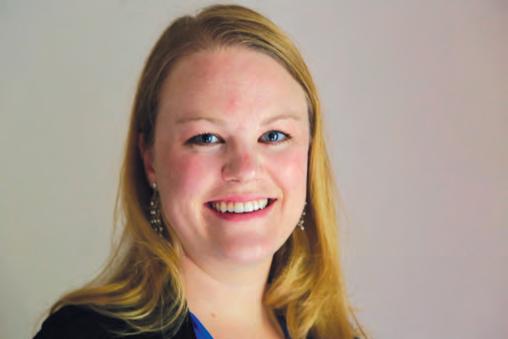
Jennifer Bebee
Drive Thrus
Continued from Page 5
“I could not find any instances of a pedestrian-vehicle conflict within a drive-through lane in the last 10 years within the city of Grand Junction,” Ehlers said during the Planning Commission discussion.
The discussion highlighted broader frustrations among some commissioners and development representatives regarding portions of the city’s major-zoning-code rewrite adopted in 2023 and implemented in early 2024.
Civil engineer Mark Austin later told City Council that members of the original zoning-code committee believed they had agreed on a more flexible drive-through-design concept during the rewrite process.
Austin said the committee had specifically discussed and supported the design of the Taco Bell at 29 Road and North Avenue as an example balancing pedestrian access with practical site design.
“And that’s what we literally thought was going to be adopted with the new code language,” Austin said. “But unfortunately it wasn’t.”
Austin said the language ultimately adopted in the zoning code became far more restrictive than committee members expected, and he said he still did not know how the final language diverged from what the committee
believed it had agreed upon.
“We’re here tonight to try to get that fixed,” Austin said. Debate centers on walkability vs. development flexibility
Throughout the debate, both sides largely agreed there was little evidence presented showing frequent pedestrian injuries occurring in drive-through lanes locally.
Instead, much of the disagreement centered on broader planning philosophy, specifically whether city code should actively push developers toward pedestrian-oriented urban design even when businesses argue those requirements make projects harder to build.
Moore said he was frustrated by the removal of the language entirely, arguing the city was attempting to reduce automobile dependence through its long-term planning policies.
“We’re specifically actually trying to reduce our reliance on vehicles,” Moore said during the Planning Commission discussion.
Moore described the proposal as “death by a thousand cuts” for the city’s pedestrian planning efforts.
“Each little incidence … increases the resistance to take that trip,” he said, referring to walking and biking access around drive-through developments.
Planning Commissioner Orin Zyvan also opposed the proposal, arguing the city had spent years attempting to
move toward “more dense urban form, more walkable city centers” and slower traffic design.
Zyvan said removing the restrictions entirely conflicted with portions of the city’s comprehensive plan focused on walkability and multimodal transportation.
Planning Commissioner Ian Thomas supported removing the broader, subjective, pedestrian-safety language but proposed keeping requirements for more direct pedestrian access between buildings and sidewalks.
“I think a small corridor for direct pedestrian access to the front of a building … is more than reasonable,” Thomas said. Other commissioners argued the code changes simply corrected regulations that had become unnecessarily restrictive.
Planning Commissioner Robert Quintero said government had “created a problem that doesn’t exist.”
Planning Commissioner Gregg Palmer said the amendment was necessary if Grand Junction wanted to remain “welcoming and business friendly.”
Developers argue restrictions hurt investment
Several members of the commercial development community spoke in favor of the amendment during Planning Commission and City Council meetings.
Commercial real estate broker Sid Squirrell with Bray Commercial said the rules made it difficult to develop sites for businesses such as Starbucks and Chick-fil-A.
“These changes are absolutely necessary so that we can continue to do business and that these tenants can continue to have drive-throughs, which is absolutely necessary for their business,” Squirrell told the Planning Commission.
Austin said the current code would have prohibited several existing projects in Grand Junction, including Chick-fil-A and some Taco Bell, Starbucks, Dutch Bros. and McDonald’s locations.
He said many drive-through projects are allowed only one access point under city transportation standards, making it difficult to comply with the existing code while also meeting stacking, circulation and parking requirements.
Commercial real estate agent Kelsey Heath told council a proposed restaurant project at 2658 Tracy Ann Road in Orchard Mesa was terminated earlier this year because of the drive-through requirements.
“The requirement that drive-through lanes cannot be located between the facade of the building and the adjacent public rightof-way makes it impossible … to design and build a properly stacked restaurant drive-through on the property,” Heath said.
Council member Cody Kennedy said he personally heard from developers about projects that no longer were financially viable under the current regulations. Kennedy said the city must balance multiple priorities, but business development, jobs and tax revenue remain important considerations.
Council member Ben Van Dyke said the city received multiple emails from developers and site planners over the past year asking for the regulations to be reconsidered.
“We really need to get behind these businesses and really incentivize development,” Van Dyke said.
Despite the debate at the Planning Commission level, no council members voiced opposition before the ordinance passed unanimously.
Fear not, Palisade peaches weren’t frozen out
Palisade orchards largely escaped freeze damage that hit some other Western Slope fruit producers
Brandon Leuallen
The Business Times
After parts of the Western Slope faced an unusually warm early spring followed by late frosts in some areas, some orchard owners in Palisade say customers were left with the wrong impression about the region’s signature peach crop.
Lance Davis, who owns Davis Family Farms with his wife, Becky “Nana” Davis, in Palisade, said reports about widespread crop damage elsewhere on the Western Slope led many people to believe Palisade peaches also had been heavily impacted.
“Somebody, some news place put out a thing that said Western Slope wiped out of peaches,” Davis said. “We thought, ‘Well, we need to get word out that isn’t really the truth.’”
According to Davis, some orchards in areas including Hotchkiss, Cedaredge, Paonia, Delta and Olathe experienced more significant losses from spring freezes, while his orchard and most of Palisade largely avoided severe damage.
“Palisade got close, but didn’t lose a lot of its crop or most of its crop or anything,” Davis said. “There were little spots here and there, but everybody, for the most part, has got a full crop this year.”
The distinction matters for local growers whose businesses depend heavily on summer tourism and fruit sales. Palisade peaches are one of the Western Slope’s most recognizable agricultural products and attract visitors from across Colorado during harvest season.
Davis and his wife have operated their orchard for 26 years and have approximately 5,000 peach trees with staggered varieties designed to ripen throughout the season.
“We have a different variety come on every five to 10 days, so we have a good growing set,” Davis said.
The Davis Family Farms’ peach varieties include
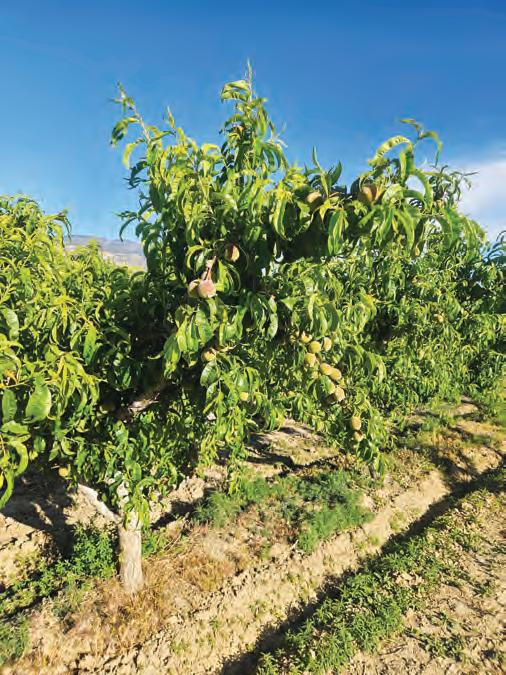
Peach trees at Davis Family Farms in Palisade. Orchard owner Lance Davis said most Palisade orchards largely avoided the freeze damage that impacted some other Western Slope fruit-growing regions this spring. Photo courtesy of Lance Davis.
Rich May, Fay Elberta, Desiree, Early Red Haven, Garnet Beauty, Red Haven, John Boy, Glohaven, Contender, Cresthaven, J.H. Hale, O’Henry and Autumn Star. Davis said staggering the varieties allows the orchard to maintain a steady harvest window throughout the summer.
Davis said not only are harvests looking strong on his orchard, but this year’s crop is also arriving significantly earlier than normal because of the warm spring weather.
“We’re way ahead right now,” he said. “It’s early because of the early weather.”
Davis said he expects cherries in the region could begin harvest around May 25, roughly two weeks earlier than normal. Early peach varieties could also begin appearing for sale by the second week of June if weather conditions remain favorable.
“I wouldn’t be a bit surprised if we start seeing peaches this year around the second week of June,” Davis said.
The timing of spring freezes can affect orchards differently depending on variety and bloom timing. Davis said one misconception is that later-season peaches necessarily bloom later.
“Sometimes your later varieties actually bloom first,” he said. “Our O’Henrys and our Autumn Stars actually bloom first.”
Despite blooming earlier and potentially facing more exposure to spring cold snaps, Davis said those varieties also came through the season well and are expected to produce strong crops alongside the rest of the orchard.
The Davises sell peaches directly from their farm in Palisade and distribute fruit to other parts of Colorado during the season. They also operate a roadside market in Steamboat Springs and attend local farmers markets. Their farm operation, known as Davis Family Farms and Nana’s Fruit and Jam Shack, also sells jams, fruit products and other locally grown produce.
More information is available through Palisade Peach Shack.
For growers like Davis, clarifying the condition of this year’s crop is important not only for customers, but also for maintaining confidence in one of Palisade’s bestknown agricultural industries.
“We just wanted people to know that Palisade peaches are still here,” Davis said.
Public Health hires medical director
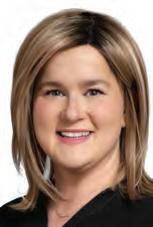
Mesa County Public Health announced Dr. Kathryn Spangler will be its new medical director, effective June 1.
Spangler is a hospitalist at Intermountain Health St. Mary’s Regional Hospital, where she has worked the past seven years. Mesa County Public Health said in a news release that Spangler’s leadership roles included the associate chief hospitalist and interim medical director for the St. Mary’s Medical Group.
“I am really looking forward to making a positive impact in our community and improving the health of Mesa County,” Spangler said. “I have collaborated with several people from public health in the past. I’ve seen their dedication firsthand and am excited to work alongside them.”
Spangler is a Grand Junction High School alum and graduated with a degree in chemical and biochemical engineering from Colorado School of Mines. She earned a master’s degree in public health before attending the University of New Mexico for medical school. She completed her residency at the University of Utah.
“Her clinical expertise, public health knowledge and leadership experience make her a perfect fit for our agency,” Mesa County Public Health Executive Director Erin Minnerath said of Spangler. “We know she will be an incredible asset to our staff and provide invaluable support as we work to serve Mesa County.”
Spangler will serve as the Mesa County Public Health’s primary medical advisor, providing expert guidance and overseeing infectious-disease response. She will provide clinical leadership and quality assurance for the agency’s reproductive health services and regional laboratory.
Spangler succeeds Dr. Kevin Fitzgerald, who retired after serving as medical director since 2021. His leadership was instrumental in navigating health challenges in Mesa County such as the COVID-19 pandemic and measles outbreak in 2025.
“We want to share our deepest gratitude for Dr. Fitzgerald,” Minnerath said. “After years of dedicated service to Mesa County, he is heading into a welldeserved retirement. He has been an incredible leader and a mentor to so many of us. We are grateful for the legacy of care he leaves behind.”
Kathryn Spangler
hires
director
announced its new hospitalist at Regional the past Public Health Spangler’s associate medical Medical Group. to making community and County,” collaborated with health in the firsthand them.” Junction High a degree engineering Mines. She public health of New completed Utah. public health experience agency,” Executive Spangler. incredible asset to support as the Mesa medical guidance and response. She and quality reproductive laboratory. Kevin serving 2021. His navigating County such measles deepest Minnerath service to into a wellbeen an so many legacy of care
Listening: The skill that transforms every relationship
Communication sits at the heart of every meaningful relationship at work, at home and in our communities. Yet the most essential part of communication is also the most overlooked: listening.
Marcus Straub
Most people hear the words being spoken, but they don’t fully take in the intent, emotion or meaning behind them. Instead, they prepare their next point, defend their position, or wait for their turn to speak.
When listening breaks down, everything else follows. Misunderstandings multiply. Trust erodes. Teams disengage. Clients drift. Couples disconnect. Families grow distant. Nearly every form of relational dysfunction can be traced back to one core issue: Someone didn’t feel heard.
Think about the relationships in your own life. The ones that feel strong, supportive and energizing likely involve people who really listen. They make space for your thoughts. They stay present. They don’t rush to fix, judge or redirect. In contrast, the relationships that feel strained or draining often involve poor listening, where one or both people feel dismissed, interrupted or invisible.
A few simple questions reveal how central listening is to connection:
• Do you feel valued when someone listens with full attention?
• Do you trust people more when they engage deeply in conversation?
• Do you feel respected when someone listens without interrupting?
• And perhaps most importantly: Do you offer others
the same quality of listening you expect?
Listening well is not complicated, but it does require intention. Most of us unintentionally sabotage our ability to listen through what can be called “listening blocks,” habits that pull us out of presence and into our own heads. These include:
• Rehearsing: Planning your response instead of absorbing theirs.
• Placating: Agreeing just to keep the peace, without truly engaging.
• Derailing: Changing the subject or joking to avoid discomfort.
• Judging: Forming opinions before hearing the full story.
• Sparring: Searching for points of disagreement.
• Multitasking: Splitting your attention between the speaker and something else.
• Drifting: Letting your mind wander away from the moment.
• Identifying: Turning their story into your story.
• Being right: Listening only to defend your viewpoint.
• Advising: Jumping into solutions instead of understanding the experience.
Most people recognize themselves in at least a few of these. The good news is that awareness alone begins to shift the pattern. Once you notice the blockers, you can choose differently.
Stephen R. Covey captured the heart of the issue when he wrote, “Most people do not listen with the intent to understand; they listen with the intent to reply.”
That shift from replying to understanding is the difference between transactional conversations and transformative ones.
When people feel heard, everything changes. Trust deepens. Collaboration improves. Conflict softens. Creativity expands. Whether you’re leading a team, serving clients, raising a family or nurturing a partnership,
listening is the skill that elevates every interaction.
In business, listening is not just a “soft skill,” it’s a competitive advantage. Organizations where people feel heard are more innovative, more resilient and more aligned. Employees stay longer. Clients feel valued. Leaders make better decisions, because they’re informed by real perspectives, not assumptions.
In personal relationships, listening is the foundation of emotional safety. People want to feel understood, acknowledged and accepted. When you listen with presence and empathy, you create space for honesty, vulnerability and connection.
The practice of listening well is simple, but it requires consistency. A few habits make a profound difference:
• Be present: Put away distractions. Give your full attention.
• Don’t interrupt: Let the speaker finish their thought.
• Ask clarifying questions: Show curiosity and ensure understanding.
• Practice empathy: Listen for the emotion beneath the words.
• Pause before responding: Let their message land before you speak.
• Validate their experience: Acknowledge their feelings and perspective.
Listening is one of the most powerful tools you have to strengthen relationships, build trust and create meaningful connection. It costs nothing, yet its impact is immeasurable.
If you want to build a thriving business, lead a highperforming team or cultivate deeper personal relationships, start with this: Listen like it matters. Because it does.
Marcus Straub owns Life is Great Coaching in Grand Junction. Reach Straub at (970) 208-3150, marcus@ligcoaching.com or through the website located at www.ligcoaching.com.
Kicking up my feet for this one, your friendly (eventual) D.C. review
Ah yes, part deux of Travels with Craigy: The events after the flight back east. And I’ll get to those in a minute, but first let’s talk about why this column is more relaxed than my last. Because my doc said I need to put my feet up. Yes, who knew vacation could be so much work and pain? Well, I do now.
As my friend Mollie who I ran into today said after I gave her the details of my previous week’s exploits, “Who knew you had to come back to Junction to cool off?” Hence, this posture.
So, what began as cold and overcast in Michigan, through Ohio, into West Virginia, through the panhandle of Virginia, finally warmed in North Carolina for our arrival. You may ask me why I’d fly to Michigan to just make an all-day drive down to North Carolina the next day, and I’ll be happy to tell you. To me, there’s a lot to be said about a road trip with best buddies, and Davey Boy, Chaz and Mules are three of the best I have. It was quite an entertaining ride, because when we get together, no topic is taboo. As a matter of fact, I think many of the answers are simply said for effect, not in addition to the subject at hand. Oh, the places we go. And that’s just how it should be. I’d dare say the quickest, longest ride we’ve done. The tone for the weekend being set.
So, after a comfortable day of golf on Day 1, things sure heated up. And by heat, I literally mean the temperature for the rest of my stay. Hence, the leg rest my doc says I need – after all, lower-leg swelling is something we in the open-hearts club tend to be very sensitive about. As it turns out, the cure is one of my favorite things to do, relaxing in my recliner with my feet up, this time a touch more elevated.
But back to the weather while skipping past the golf for the most part. Let’s just say the next two days of 90-plus-degree golf in North Carolina were simply an appetizer for the next (swelled) leg(s) of traversing D.C. in 100-degrees-plus. And if you’ve been to Washington, D.C., (this was my first trip) you already know the plus in 100-plus is because all you walk on is either concrete or asphalt.
So, it’s my own as-phalt for the swollen legs, aching feet and blistered toes.
First, let me say it was all worth it. But I’d also have to describe our nation’s capital as extraordinary, impressive, grand, too big, and in some areas somewhat disappointing. Just like most places I visit, except with D.C. those adjectives come at a cost of trillions more than any city I’ve ever visited. Oh, and in this early heat wave, I believed one of the attractions we were bound to come upon would be the gates of hell. In a way, if you know me at all, I think our nation’s capital is at least the gates, if not the actual destination.
So, the impressive: The monuments. My goodness. Especially the one dedicated to my personal-favorite American hero who gave us the greatest four minutes in American history in Gettysburg, the Lincoln Memorial. Seeing Abe Lincoln larger than life is the only way to see him, because he is. Yes, I teared up. And yes, it’s the one memorial I had to get a picture of me in front of. The Washington Monument stands above all, and even though Jefferson was covered in scaffolding, his place earns this honor as well. Same goes for all the war memorials.
I’d say pretty much everything Smithsonian makes the grand scale. We hit three museums: The Museum of Natural History, Museum of American History, and the Air and Space Museum. All excellent. Just wasn’t time for more.
On the too big scale is every darn office building that houses our oversized department of this or that unconstitutional thing our government shouldn’t be involved in. I mean seriously, the Department of Education building is nearly 650,000 square feet, and named after someone who, like all of them, should never have a building named after them. Why can’t public servants just serve and go away? Oh, because that’s not why the elected ones serve. But as I’ve said for years, cornerstones and microphones lead their ego.
Seriously, every department building was a city block except the Capitol building, which
Support Local Support Business
is an absolute monolith proving bigger isn’t better. I’d find something designed like the prisons in “Mayor of Kingstown” more fitting (Stop it, you know what I think of most of them). The fact that the massive building can’t even hold 535 people who want to run every aspect of our lives along with their staffs at the size it is (and needs how many more monoliths?) should worry every American. Although, it does kind of hint why D.C. costs us trillions every year.
I almost put the Capitol building into the unimpressive category because of its performance in not doing the business of the people, but the building is impressive, so it’s impressively too big. That’s it.
As for unimpressive, I’d go down the road to the Trump/Kennedy Center and Watergate. The center is just a white, nondescript building rivaling our Avalon add-on, and Watergate is kinda cool, but only because of the botched burglary. It is also big. Ho hum. I’d have to put The White House here as well, as we couldn’t get within a mile of it. Who knew in the 21st Century we couldn’t have a plan to protect our federal buildings in place, except Nancy Pelosi and Chuck Schumer, of course?
As for extraordinary, that’s reserved for the National Archives, where I got to see the second and third most important things ever composed after the Holy Bible – The Declaration of Independence and Constitution of the United States of America – up close and personal. Both were very moving to see and in my opinion should never have been added to. Just so you know, I think putting the first 10 Amendments on parchment was a mistake, as our elected betters and bureaucrats have been working to subvert them since before the ink dried.
But I digress.
My other extraordinary was the most moving time on our tour: Arlington National Cemetery. Words can’t describe the feeling. If the miles of tombstones, the Tomb of the Unknown Soldier and the Guard doing his rotation in front and JFK’s eternal flame doesn’t move you to patriotism for the greatest country God ever blessed, just move out now. Sorry, not sorry.
And now you know why my dogs are barking. All that, dear readers, was the equivalent of about two half marathons over two days.
I will say one more thing that impressed me. The number of student tours, foreigners and kids at every stop we made. It’s a trip every American should make, and I can’t believe it took me 64 years. But I made it, finally. And I’d go back in a heartbeat, as there was so much more to see. I’d also be remiss to mention the hundreds of employees we came across who were pleasant and helpful for anything we needed or questions we had. Those are some good players in our bureaucracy.
One last thing, I needed some entertainment on my Baltimore to Denver to GJ trip home, so I bought a (turns out) cool little book titled “Who is Government?” It’s eight stories about federal employees who did some extraordinary things with their careers. Well, it’s seven good stories and an opinion piece. But I really enjoyed the stories. Ironic, no?
All in all. A good time with the boys. Especially since they were as curious about what we toured as I was. I can see the genius in the design of Washington, D.C. I just wish our founders designed something to keep the nongeniuses out and true, commonsense, good, public servants in.
That’s right, they did. It’s the ones we “choose” who bring in the bad. After all, out of 2 million who work for the feds, the author of my book could only find eight good ones. I’m sure there are more. But they are the real minorities in Washington. Still worth the trip as long as remnants of our founding principles, and folks who aspire to them, exist.
In Truth and freedom.
FCraig Hall is owner and publisher of The Business Times. Reach him at 424-5133 or publisher@thebusinesstimes.com
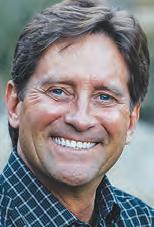
Craig Hall
n Community Hospital named one of state’s top recommended hospitals
Becker’s Healthcare recently compiled its 2026 list of hospitals that patients are most likely to recommend in every state, and Community Hospital is one of two hospitals in Mesa County to be honored.
Becker’s uses Hospital Consumer Assessment of Healthcare Providers and Systems data from the Centers for Medicare and Medicaid Services to determine the hospitals it will recognize. Its rating is based on survey data collected from hospital patients between July 1, 2024 and June 30, 2025.
“Being one of only two hospitals in our community to earn this recognition underscores our commitment to providing outstanding care to our patients and our community,” Community Hospital President and CEO Chris Thomas said.
The Centers for Medicare and Medicaid Services is part of the Department of Health and Human Services. For more information, visit CMS.gov.
n VA Grand Junction Medical Center receives top marks in 2026 CMS report
VA Grand Junction Medical Center received a 5-star rating in the Centers for Medicare & Medicaid Services’ annual Overall Hospital Quality Star Rating report, the medical center said in a news release.
VA Grand Junction Medical Center received the honor for the fourth consecutive year, and according to the news release it is the sole recipient of a 5-star rating in Grand Junction.
CMS’ Overall Hospital Quality Star Ratings are based on five categories: mortality; safety of care; readmission; patient experience; and timely and effective care. A higher star rating, out of five, indicates better performance along these quality measures.
“Receiving a 5-star rating from CMS is a reflection of the dedication our entire team brings to caring for veterans every day,” said Mathew Tekansik, interim director of VA Grand Junction Medical Center. “This rating underscores our commitment to delivering safe, timely and high-quality care, and we are proud to contribute to VA’s continued nationwide excellence.”
n Second nonprofit-board workshop set for June 10
After Third Sector Innovations’ June 9 board-training session filled quickly, it decided to offer a second workshop designed to educate new and seasoned board members about the roles and responsibilities of nonprofit-board service.
The second training session will take place June 10, 4:30 to 8:30 p.m., at the Redlands Community Center, 2463 Broadway in Grand Junction.
Registration costs $40 for the first representative of an organization and $25 for each additional participant of the organization, and the fee includes all materials and light
dinner/snacks.
Third Sector Innovations is a nonprofit consulting and support firm based in Grand Junction and Littleton. For more than 30 years, the firm has helped nonprofits grow organizational capacity and sustainability. Third Sector Innovations founding partner Illene Roggensack will facilitate this workshop, which will include participation by some of the Western Slope’s leading nonprofit board members.
Training topics will include: the purpose of nonprofit boards; new-member orientation; nonprofit budgets and financial statements; board meetings and retreats; working with staff and interactions with the community; officer positions, leadership planning and committee work; board-member makeup, retention and recognition; and other important “dos and don’ts.”
For more information or to register, go online at communityimpactcouncil.org/copyof-events, or call 970-314-3970.
n Gallery opens exhibition with event marking Summer Solstice
West Winds Gallery, 504 Main St. in downtown Grand Junction, will celebrate the arrival of summer with “Art of the West,” a special Summer Solstice exhibition opening June 20 from 5 to 8 p.m.
The exhibition honors the beauty, energy and spirit of the American West through the work of three artists: impressionist painter Nanette Oleson; plein air painter Monica Esposito; and master wood turner John Koch.
Guests are invited to enjoy an evening of fine art, meet the artists, and celebrate the longest day of the year. The exhibition will remain on view through July 28.
in Grand nonprofits grow founding partner by some new-member retreats; leadership recognition; and communityimpactcouncil.org/copycelebrate the exhibition opening West through painter Monica celebrate the