Homelessness and subsidized housing in GJ get $62 million in past 4 years
Brandon Leuallen The Business Times
The City of Grand Junction says approximately $19 million in direct city funding and grants has leveraged an additional roughly $43 million in outside-partner investment tied to housing and homelessness projects since 2022.
According to the city’s funding breakdown, direct city funding and grants included:
• $5,043,495 for Grand Junction Housing Authority projects.
• $3.2 million for the Salt Flats Project.
• $2 million for Pro HousingLAP grants.
• $1,846,765 for Grand Valley Catholic Outreach.
• $1,302,025 for the Resource Center.
• $1,161,667 for Housing Resources of Western Colorado.
• $1,152,133 for remaining ADU and unassigned 2024 housing funds.
• $1,123,825 for Housing Division operations and programming.
• $947,707 for the Joseph Center.
• $367,500 for HomewardBound.
• $359,713 in nonprofit and Community Development Block Grant funding.
• $300,000 for Hilltop Family Resources.
• $217,014 for Habitat for Humanity.
See story Page 5
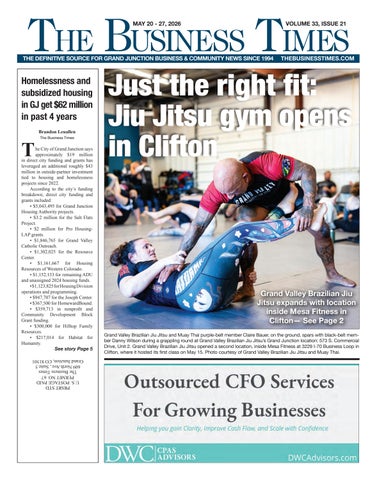
Just the right fit: Jiu Jitsu gym opens in Clifton
Grand Valley Brazilian Jiu Jitsu expands with location inside Mesa Fitness in Clifton— See Page 2
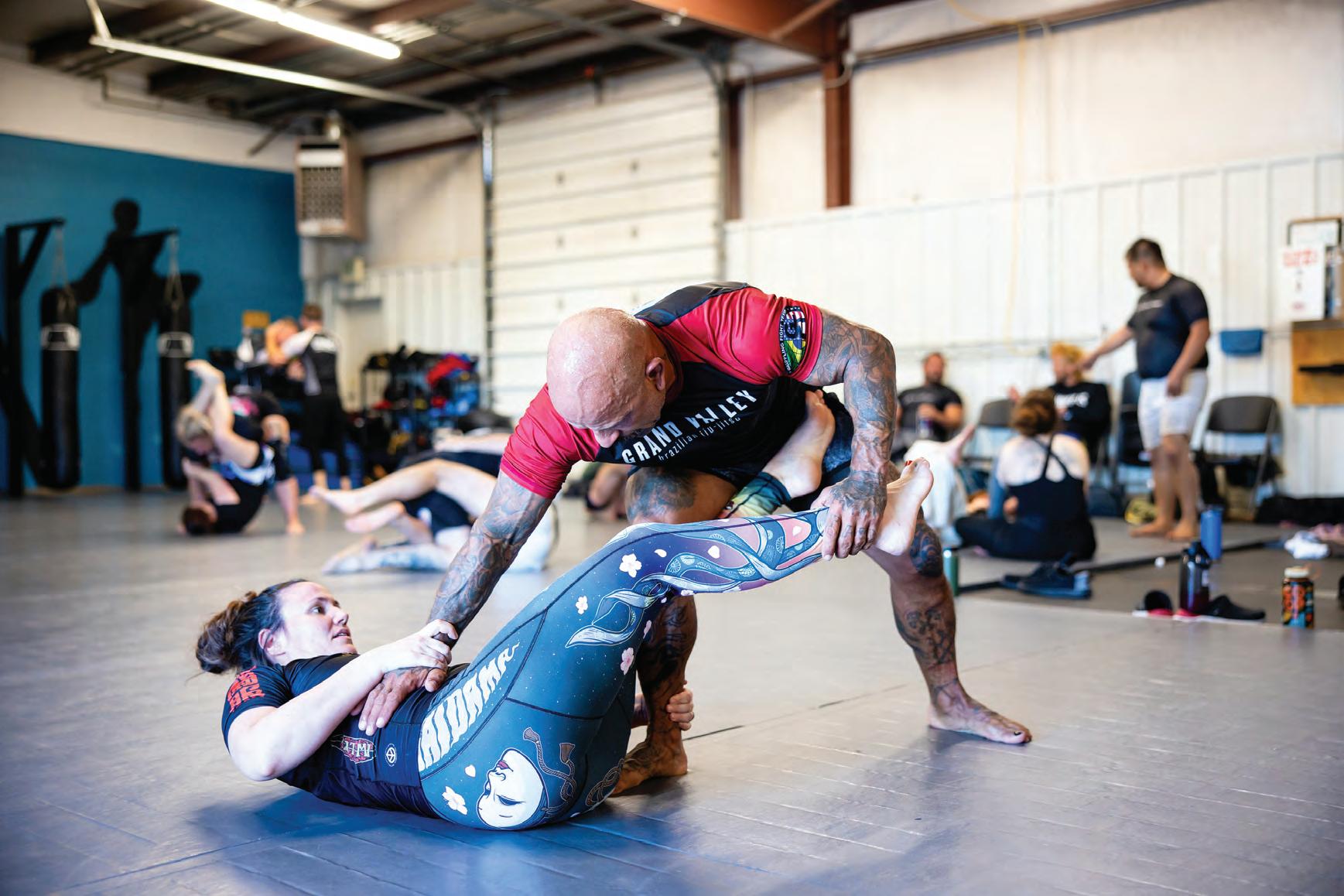
Grand Valley Brazilian Jiu Jitsu and Muay Thai purple-belt member Claire Bauer, on the ground, spars with black-belt member Danny Wilson during a grappling round at Grand Valley Brazilian Jiu Jitsu’s Grand Junction location: 573 S. Commercial Drive, Unit 2. Grand Valley Brazilian Jiu Jitsu opened a second location, inside Mesa Fitness at 3229 I-70 Business Loop in Clifton, where it hosted its first class on May 15. Photo courtesy of Grand Valley Brazilian Jiu Jitsu and Muay Thai.
ABOVE —
BELOW— Students William, left, and Arlyn practice during a class at Grand Valley Brazilian Jiu Jitsu’s Grand Junction location at 573 S. Commercial Dr, Unit 2. Photos courtesy of Grand Valley Brazilian Jiu Jitsu and Muay Thai.
Jiu Jitsu gym finds perfect fit in Clifton
Grand Valley Brazilian Jiu Jitsu and Mesa Fitness foresee mutually beneficial relationship in Clifton
Tim Harty The Business Times
Kevin Lewis said it wasn’t that long ago that he thought the way for Grand Valley Brazilian Jiu Jitsu and Muay Thai to grow was to buy a huge, state-ofthe-art building.
He looked into it and said he was oh so close to closing a deal to do just that. But Lewis said he’s a person that listens to the universe, and the universe sent him a different message. So, he backed away from the deal.
“It just didn’t feel right,” he said.
By contrast, the day he walked into Mesa Fitness at 3229 I-70 Business Loop in Clifton to look at a commercial space that was available, he got a different vibe, one that said, “Ah, this feels like the move that needs to be made.”
This time, he followed through, and Grand Valley Brazilian Jiu Jitsu now has a second location on the east end of the Grand Valley to go with the one Lewis opened in 2013 at 573 S. Commercial Drive, Unit 2, in Grand Junction.
The Clifton location started its soft opening with a class on May 15, and Lewis said he expects to go to a full schedule in the first or second week of June. He already has the first tier of members that he sought, about 30, and the first 90 “founding” members get a discounted rate.
He said the Clifton location will be self-sustaining once it has about 45 to 50 members, and he said it will be able to accommodate about 150 to 200 members, compared with the approximately 300 members at the Grand Junction location. And gym memberships are good for both
Lewis said everything made sense and fell into place for the Clifton location. He and his wife, Nadia, own the original Grand Valley Brazilian Jiu Jitsu and Muay Thai, and they discussed the idea of opening a location near the east end with Israel Almeida, a coach at the Commercial Drive location. Almeida agreed to be a business partner at a new location. Then, Kevin Lewis started looking for a place to put it.
“I saw this (space) in Mesa Fitness open up for rent, and I was like, ‘Oh, man, this is kind of too good to not do it,’” he said.
The timing and location were right, as
Lewis said the Clifton and Palisade area doesn’t offer much for martial arts. And he said a lot of people on the east end of the valley would rather avoid driving into Grand Junction at the end of their workday for martial-arts training for themselves or their kids.
“I just think the opportunity is there to have it there, when there’s nothing out there martial-art-wise,” Lewis said of the Clifton location. “There’s a Taekwondo school right down from where I’m gonna be at. Other than that ... there really ain’t nothing out there.”
And Lewis said people from Clifton and Palisade have told him they wished his gym was closer.
“I think it’s a community that needs it,” he said, “and I’m gonna give it to them.”
What members will get, Lewis said, is “true world-class training,” and that sets Grand Valley Brazilian Jiu Jitsu and Muay Thai apart.
All three of the Clifton location owners are black belts in jiu jitsu.
Kevin Lewis said he’s coached world champions and is in a hall of fame for coaching.
Almeida, who is from Brazil, still competes and has won world championships. “Israel’s won a bunch of them,” Kevin Lewis said.
And Nadia Lewis is a multi-time medalist in master-division competition at International Brazilian Jiu-Jitsu Federation tournaments.
Kevin Lewis added, “A lot of people say, ‘Oh, we’re world class,’ and stuff like that. Well, what is world class? You know, anybody can say they’re world class. But you truly are getting world-class training with us.
“And so that’s definitely one of the main differences between us and any other gyms between Denver and Salt Lake City. … No one else offers what we offer you jiu jitsu-wise, or for as long as we have.”
Another area where Lewis believes Grand Valley Brazilian Jiu Jitsu sets itself apart is its culture.
“It doesn’t matter how good you are –you could be a world champion, you could be whatever – if the culture isn’t good and people don’t feel welcome, they’re not gonna come,” Lewis said.
See JIU JITSU on Page 8
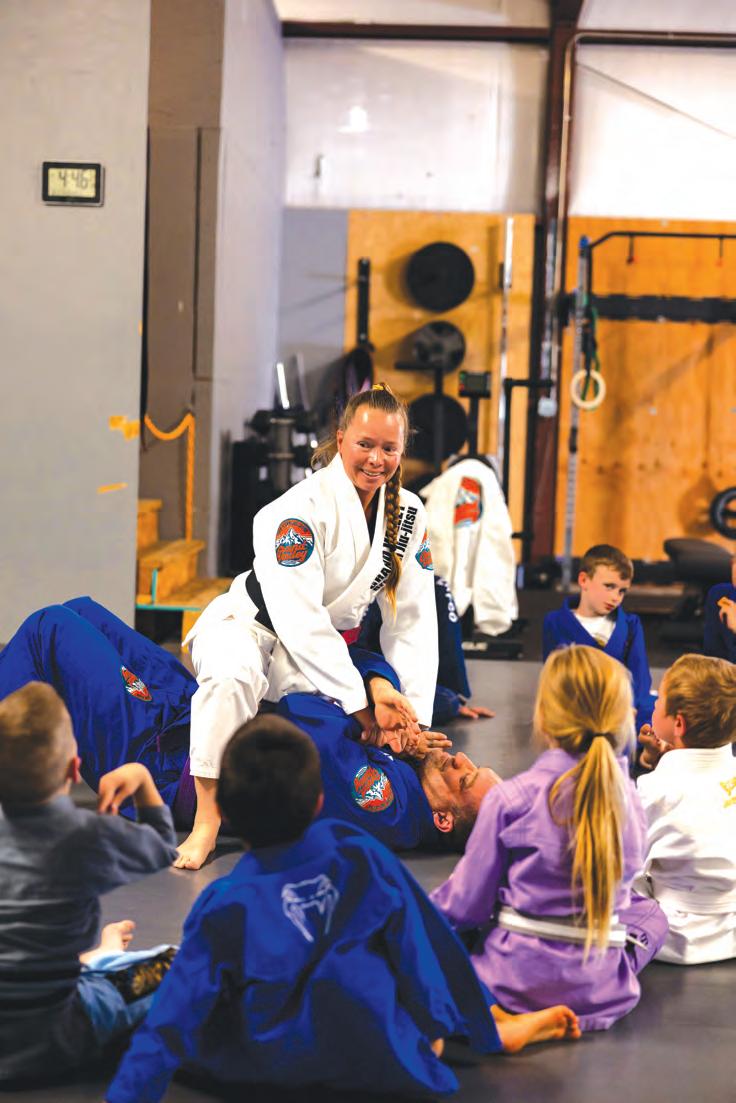
Grand Valley Brazilian Jiu Jitsu and Muay Thai co-owner and instructor Nadia Lewis demonstrates an armbar technique on assistant coach Richard Maturino for the kids in her class to practice.
Clifton
City Council moves toward camping-ban amendment
Brandon Leuallen The Business Times
Since 2022, Grand Junction has seen more than $62 million invested in subsidized housing and homelessness-related initiatives through a combination of city funding and partner investment.
During a May 4 workshop, city officials also said roughly $460,000 in taxpayer dollars had been spent cleaning up homeless encampments along the river corridor since 2022, removing approximately 119 tons of debris from campsites along the Colorado and Gunnison rivers.
Also during the workshop, City Council directed staff to move forward with a proposed amendment to the city’s camping ordinance that would remove language currently limiting enforcement when overnight shelter space is unavailable.
The discussion centered around two major developments: The 2024 U.S. Supreme Court decision in City of Grants Pass v. Johnson; and the recent consolidation of the HomewardBound North Avenue shelter into the Pathways shelter on 29 Road, which reduced the number of emergency-shelter beds available in the city.
Grand Junction Police Chief Matt Smith emphasized during the May 5 workshop that camping along the Colorado and Gunnison river corridors has involved longstanding environmental impacts and public-safety concerns that predated the consolidation of the North Avenue shelter into the Pathways shelter, and they have remained an ongoing issue
Interim City Attorney Jeremiah Boies told council the city’s current ordinance was originally written around the 2019 Ninth Circuit case Martin v. City of Boise, which found it unconstitutional to enforce camping bans when no overnight shelter was available.
“The important caveat and the reason for this discussion is there’s an exception to our ability to enforce the camping ordinance contained within there, and that was based on Ninth Circuit case law,” Boies said.
Boies said the Supreme Court’s 2024 Grants Pass ruling overturned that earlier precedent.
prohibited camping on public property while including several exceptions, including one tied to overnight-shelter availability.
The staff report states the shelter-availability language was specifically added to reflect the legal standards established in the Martin v. Boise ruling before it was overturned by the Supreme Court in 2024.
The ordinance was later reenacted in 2022 after council removed an original sunset clause.
According to the May 10, 2022, memorandum from then-Police Chief Doug Shoemaker that was included in the city’s ordinance materials, Grand Junction police made more than 1,000 contacts related to illegal camping over a two-year period while issuing citations in only a small number of cases.
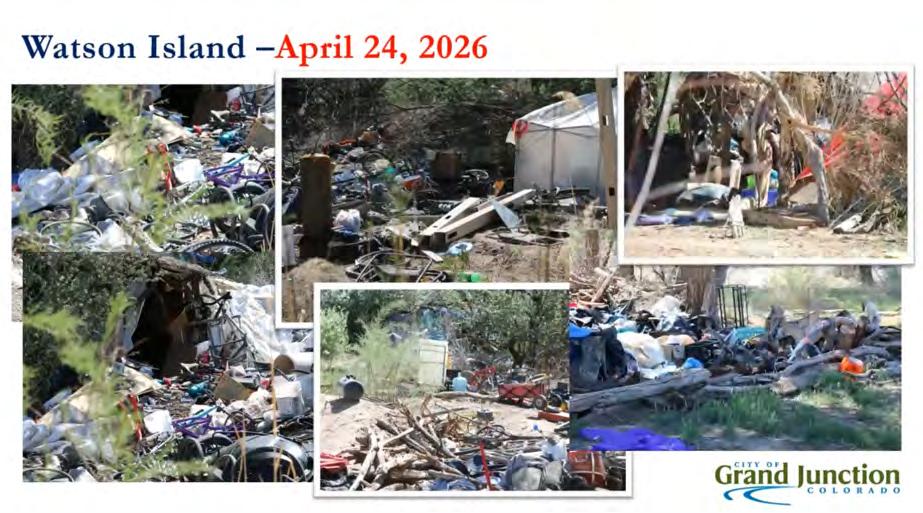
A City of Grand Junction presentation shown during the May 5 city council workshop displayed photographs of homeless encampments and debris at Watson Island taken April 24, 2026. City officials said the city has spent more than a decade attempting to clean up and manage camps along the Colorado and Gunnison river corridors because of ongoing environmental, public safety and cleanup concerns.
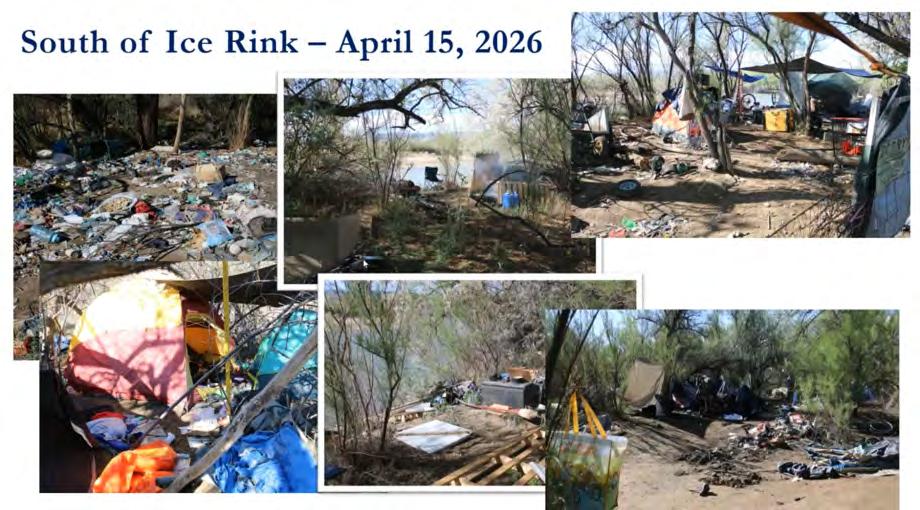
Photographs shown by Police Chief Matt Smith during the City of Grand Junction’s May 5 workshop depicted homeless encampments and debris south of River City Sportplex along the river corridor on April 15, 2026. City officials said the city has spent roughly $460,000 cleaning up river encampments since 2022 while removing approximately 119 tons of debris. Photos courtesy of City of Grand Junction.
“In that case, they overturned the Ninth Circuit previous holding and found that there was no constitutional violation for enforcing a camping ban on public property when there was no overnight shelter available,” Boies said.
Under the city’s current ordinance, enforcement cannot occur if overnight-shelter space is unavailable. Boies said the closure of Homeward Bound has effectively made the ordinance difficult or impossible to enforce in many situations.
“We’re essentially in a position where our camping ordinance becomes effectively unenforceable, because most of the time there is no overnight shelter available,” he said.
Ordinance dates back to 2019
According to the city’s May 4 staff report discussing potential amendments to Ordinance No. 4833, the ordinance was originally adopted on April 17, 2019, and
The memo says enforcement generally occurred only after individuals ignored requests to leave or “refused other assistance in getting permanent housing.”
River encampments predate shelter closure
Smith gave council a historical overview of the city’s homeless-encampmentresponse efforts, which he said began in 2011 after outreach teams identified growing concerns involving public safety, public health, environmental contamination, wildlife impacts and wildfire risk.
“The homeless outreach team and that team were really bridging the gap between our homeless community, nonprofitservice providers that were out in the camps pretty frequently,” Smith said. “And they identified some issues.”
Smith said the city initially attempted smaller cleanup efforts internally before eventually hiring specialized contractors capable of handling hazardous waste, needles, propane tanks, mattresses and other debris commonly found in camps.
“As a result, in 2011, we started doing camp cleanups,” Smith said.
Smith presented photographs from multiple areas along the Colorado and Gunnison river corridors, including Watson Island, Railroad Island, the Point and areas south of the ice rink, showing tents, needles, debris, propane tanks, garbage and waste near waterways.
“Some of these camps, we’ve cleaned up five or six times in the same sites over the years,” Smith said.
He said the city removed approximately 119 tons of material from riverfront encampments between 2022 and 2025 at a cost of roughly $460,000.
Smith said the city’s cleanup strategy has largely focused on voluntary compliance rather than arrests or citations.
“Our primary goal is to gain compliance and to get the camp cleaned up, get them someplace where they can be, and then link them up with services if we can, and if they want services,” Smith said.
See HOMELESS on Page 12
City details millions in housing and homelessness spending
Continued from Page 1
The City of Grand Junction Housing Initiatives page says: “This funding encompasses capital projects, operational support for service providers, emergency assistance during COVID, funding for housing and homeless projects, matching and securing grants for housing initiatives, and actively expanding the City’s role in addressing housing and houselessness issues.”
Grand Valley Catholic Outreach received approximately $1,846,765 in city-related housing and homelessness funding, according to the City of Grand Junction’s housing-investment breakdown. Much of that funding appears tied to the organization’s downtown permanentsupportive-housing project near the Catholic Outreach campus area.
Grand Valley Catholic Outreach officially opened the 40-unit Mother Teresa Place permanent-supportivehousing complex near Fourth Street and Ute Avenue on April 24, 2025. The project was developed specifically for chronically homeless individuals and combines subsidized housing with supportive services.
Catholic Outreach also operates several major homeless-service programs in Grand Junction, including the day shelter on North Seventh Street, meal services, showers, laundry access, mail services and outreach assistance for homeless individuals.
Another major subsidized-housing development currently under construction is The Current, a 54-unit project being developed by the Grand Junction Housing Authority.
The project is located just west of the newly completed 24 Road corridor near Community Hospital and the nearby Club Car Wash commercial area. According to development materials, the four-story project will include 38 onebedroom apartments and 16 two-bedroom apartments for households earning between 30 percent and 60 percent of area median income.
The project is also expected to receive
eight project-based housing vouchers intended to help serve low-income residents.
Another major long-term subsidized and workforce-housing effort tied to the city’s housing strategy is the Salt Flats redevelopment area located near the I-70 Business Loop and 28 Road east of downtown Grand Junction.
The redevelopment area is projected to support between approximately 324 and 550 future housing units, depending on final density and phased development approaches. The plans envision a mix of workforce, market-rate and subsidized housing integrated into a larger mixed-use redevelopment district near downtown and the Colorado River.
As of May 2026, major vertical construction had not yet begun on the Salt Flats redevelopment area, with the project still in pre-development and infrastructureplanning phases.
Subsidized housing costs keep rising
While subsidized housing typically reduces monthly housing costs for renters, developing subsidized housing has historically cost more to build than many market-rate projects.
According to the City of Grand Junction’s proposed linkage-fee presentation from Nov. 19, 2024, the rounded, weighted cost per unit for subsidized housing projects the city has participated in was approximately $388,000 per apartment.
At roughly $388,000 per apartment, some subsidized-housing units are approaching or exceeding the price of some newly built single-family homes currently selling at full-market value in Grand Junction.
At that rate: A 50-unit project would represent roughly $19.4 million in development cost; 100 units would equal roughly $38.8 million; and 500 units would exceed $194 million.
For additional details and project breakdowns see the City of Grand Junction Housing Initiatives webpage: www.gjcity.org/353/Housing.
More to the Story
Sometimes, for various reasons, The Business Times isn’t able to print everything it wanted to present in a story. When that happens and we feel the need to provide what the original story was missing, we’ll bring you “More to the Story.”
Intermountain Health targets end of 2027 to open Fruita clinic
In the May 6 edition’s story about Intermountain Health’s plans to build a primary-care clinic in Fruita, Intermountain Health’s executive with in-depth knowledge about the project was not available for an interview.
However, Intermountain Health Medical Group’s Western Colorado executive director, Joya Boyd, did an interview with The Business Times on May 13, and provided Intermountain Health’s perspective on the project. So, here it is now:
Boyd said the property at 502/524 Kokopelli Blvd. in Fruita, which Intermountain Health forerunner SCL Health purchased in February 2023, was done with the understanding it eventually wanted to offer health care in Fruita.
“Part of what we do is have very thoughtful and targeted strategic-growth plans,” Boyd said. “We know that primary care is such an important aspect to everyone, and it’s an entry point into health care. And so anytime we can expand primary care in Mesa County and surrounding areas, we want to do so.
“We’re fortunate enough that we’ve been able to now proceed forward with the next phase of this project, which has actually been designing the clinic and being able to see it kind of come to fruition.”
Boyd said the Fruita primary-care clinic has been in the design phase for several months, and Intermountain Health anticipates being able to begin construction by the end of this year. She said the goal is to open the clinic by the end of 2027.
The timing of the project, Boyd said, reflects the population growth Intermountain is seeing in Fruita and “being thoughtful of providing services that might not
Boyd said the information about the building and the clinic’s services remains the same as what was in the General Project Report submitted to the City of Fruita in 2025.
The clinic being constructed during Phase 1 will be 15,500 square feet, and the nearly three-acre property will have 68 parking spaces.
The Fruita Clinic will house eight providers, including four primary-care providers, two dedicated walk-in providers and two rotating specialists. Its rotating specialty services will include obstetrics, general cardiology and orthopedics. The facility will have on-site imaging, including X-ray and ultrasound, and dedicated treatment rooms.
The General Project Report mentioned Intermountain Health’s current plans accommodating a future Phase 2 expansion, and Boyd said when and how the clinic expands depends on the needs of the community.
For the time being, Intermountain Health wants to address primary care, and Boyd said it’s important to reiterate Intermountain regards primary care in high regard.
“Our quality of care that we provide within our primary
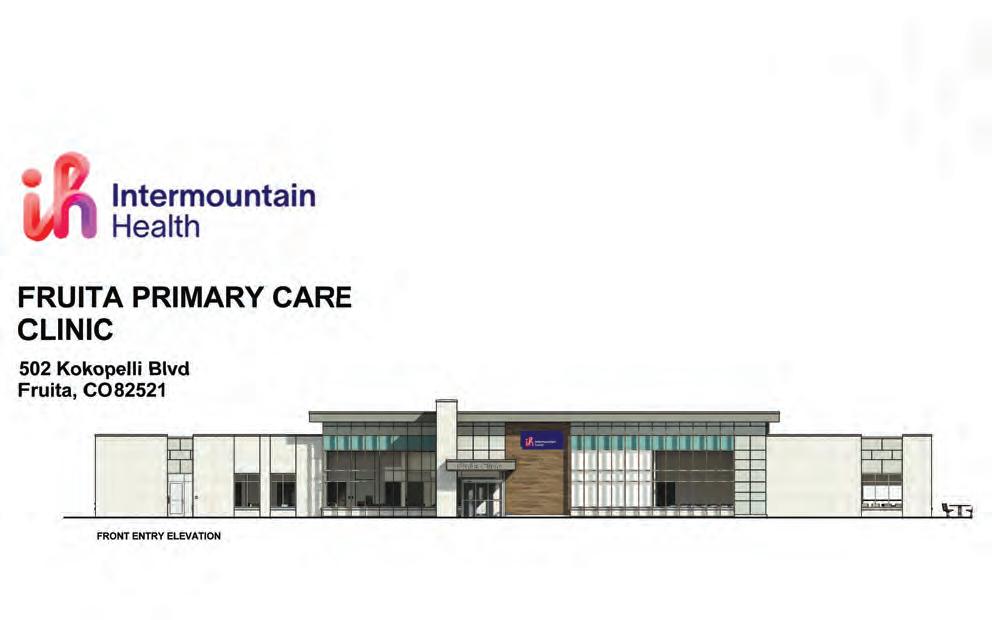
Artist rendering of future Intermountain Health Fruita Primary Care Clinic. Illustration courtesy of Intermountain Health.
we’re getting people into services within primary care, and we could focus on preventative health screenings, your annual wellness visits, ensuring that you’re getting the colonoscopies and the mammograms and those diagnostic screenings, that we’re going to be preventing and lowering cost of care overall for everyone.
“I think that’s always an important point to make. We’re really proud of the quality of care we provide in our primary-care space and feel that the Fruita community will benefit from those services.”
Starting with that will help Intermountain Health determine which other services the community can benefit from having, and Intermountain can take that into account for its design work for Phase 2.
Boyd said Intermountain’s entrance into the Fruita market is really about “meeting the growth trajectory in the community and complementing with services that aren’t always readily available.
“For example, we know cardiology is an important service for the community members that we’re attracting. That 65-plus population needs those services, and they’re sometimes really hard to get into, and so trying to complement with those other
care, and screenings, your getting the diagnostic lowering
to make. provide in our community will
Intermountain Health can benefit into account the Fruita trajectory in the that aren’t important service
That 65-plus sometimes really those other
Jiu Jitsu
Continued from Page 2
“So the culture, when you walk in the doors, everybody’s friendly. Everybody has fun. Everybody’s sweating. Everybody’s smiling.”
And people train hard. Many compete, as Lewis said a group of about 20 Grand Valley Brazilian Jiu Jitsu members went to a recent event in Denver to compete.
Lewis touts Grand Valley Brazilian Jiu Jitsu’s coaches, too, for solidifying the culture, and that’s another selling point, as Lewis said, “You can go find jiu jitsu anywhere nowadays. You can just look on YouTube, and it’s there.”
And most jiu jitsu gyms are going to have a lot of similarities, so the question becomes: What’s the difference.
“For us,” Lewis said. “I think it’s the experience and the attention to detail from the coaches. For sure.”
More About Grand Valley Brazilian Jiu Jitsu
Benefitting both businesses
One of the advantages Grand Valley Brazilian Jiu Jitsu and Muay Thai co-owner Kevin Lewis really likes about being located in the same building as Mesa Fitness, 3229 I-70 Business Loop in Clifton, is the potential for crossover between customers of the two businesses.
That’s appealing to Mesa Fitness, too, as General Manager Paul Manzella wrote in an email interview, “We are already seeing crossover between the two businesses, as many of their members are existing Mesa Fitness members. We anticipate that this relationship will continue to grow, creating additional value for members of both organizations.”
Grand Valley Brazilian Jiu Jitsu was the kind of tenant Mesa Fitness was looking for after the space became available.
“We are very intentional about our partnerships and would not lease space to a business unless we believed it was a strong fit,” Manzella wrote. “Grand Valley Brazilian Jiu Jitsu aligns well with our overall mission of promoting health, fitness, and active lifestyles, making it a natural complement to Mesa Fitness.”
Like it was made for them
When Lewis first viewed the available unit at Mesa Fitness, he was pleased with what he saw: a wide-open space that was essentially move-in ready for a business like Grand Valley Brazilian Jiu Jitsu.
“It was turnkey, basically, because it’s blue and gray, like our colors,” Lewis said. “Everything was kind of just, ‘All right, just put some mats on the floor.’ It’s kind of just set, ready to go.”
Watching the kids grow up
Lewis said the classes he teaches are primarily for kids.
“I love the kids’ programs,” he said. “I teach the little ones, ones that are like the biggest pains in the butt, but I just love teaching the kids.”
Watching kids transform and gain confidence and purpose from jiu jitsu is extremely rewarding.
“I’ve seen kids that come in – 4 years old, shy, crying – and get on the mat, and now they’re still here training with me, and they’re strong 12-yearolds that are confident, that can handle themselves,” Lewis said. “And it’s all because of jiu jitsu, because it puts kids – and it puts adults – puts you in those uncomfortable situations that you realize you can’t fold, and that you have more in you than what you’re giving and putting out.
“And just with that, you get what? You gain a lot of confidence in things like that.”
Great for the grown-ups, too
It’s not just kids who evolve and reap great rewards. Many adults come to love jiu jitsu for its benefits physically and mentally. Lewis said jiu jitsu can change your life, and he speaks from experience.
“It changed my life,” he said. “It does for a lot of people, you know? I think a lot of it has to do with what it does for people.
“I’ve seen it change a lot of lives, a lot of lives. I’ve just seen it help, I couldn’t tell you how many people. It’s a fun, amazing experience, you know, to be involved in that.”
Lewis said he was a police officer for about 15 years, the last few in Grand Junction, and when he started jiu jitsu, it provided stress relief.
“You can come in, you don’t have to worry about anything outside the doors, the bills, the fight with the wife that morning, the kids not wanting to get up and do whatever,” he said. “You come in here, and it puts you actually in the moment of something. And that moment is not getting choked out, not getting an armbar, not getting smashed. You know what I mean?
“It’s hard nowadays to be in the moment of things. … You come in here, and it’s like, even if it’s just an hour, it’s amazing what it does to the brain and stuff, just to be in the moment.”
Homeless
Continued from Page 4
Some camps described as operating “like mini cities”
Council member Scott Beilfuss said some encampments along the river have developed internal leadership and communication structures over time as outreach workers and nonprofit organizations built relationships with homeless residents.
“Many of the camps are run like mini cities, and there’s leadership, and there’s coordination,” Beilfuss said.
Beilfuss said outreach groups and volunteers have spent years building trust with people living in the camps and helping coordinate cleanup efforts.
“We identified from some of our meetings that they need water, toilets and Dumpsters. Pretty simple,” Beilfuss said.
Council member Jason Nguyen questioned whether the city could reduce environmental damage and cleanup costs by providing sanitation infrastructure such as Dumpsters and toilets.
“We’re spending half a million on picking up 120 tons of trash,” Nguyen said. “Could we just provide Dumpster service and maybe not have to do that?”
City Manager Mike Bennett said the city has occasionally provided temporary Dumpsters and portable toilets during cleanup operations, but it has avoided permanent infrastructure, because camping is prohibited in those areas.
“And so we had not taken measures that would encourage camping where camping is not allowed,” Bennett said.
Bennett also said the city lacks the staffing and operational capacity to manage sanctioned camping areas along the river corridor.
“With our current resources and with the departments and services that we actually have, we are not capable of managing, overseeing and running camps,” Bennett said.
Council debates where homeless residents would go
Beilfuss raised concerns about where displaced campers would realistically go if enforcement increases while shelter capacity remains limited.
“We don’t have additional places in town right now, and we haven’t for a long time,” Beilfuss said.
Beilfuss pointed to the growing number of elderly and disabled individuals living in camps and said a number of homeless residents are not violent offenders or addicts.
“There are people that want to work, and some of them do have jobs, and that’s where they live,” Beilfuss said.
Council member Laurel Lutz, who since the May 4 workshop was voted in as Grand Junction’s mayor, said she supports moving forward with the ordinance amendment, but she also wants the city to continue broader discussions about homelessness strategy and interim housing solutions.
“What’s going to happen is they’re just going to migrate around, and you’re going to be cleaning up in a circle,” Lutz said.
Majority supports moving ordinance forward
Council member Ben Van Dyke said he did not view the proposed amendment as anti-homeless, but rather as restoring tools law enforcement has historically used while addressing environmental and public-safety concerns.
“I don’t think it’s very compassionate to encourage and allow for extended camping or camping that is unsanitary or dangerous or poses risks to others, especially when we’re talking about fire hazards down by the river and stuff,” Van Dyke said.
Van Dyke also pointed to the impacts encampments can have on nearby residents, businesses and public spaces.
“We’re talking about places that are adjacent to homes, to family businesses, restaurants and so on,” Van Dyke said. “And these people all are taxpayers as well and deserve to share these spaces without being adjacent to some of the other more hazardous conditions, sanitary or otherwise, that exist in homeless camps, especially if they’ve been there for a significant period of time.”
Council ultimately gave staff majority support to prepare a formal ordinance amendment for future readings and public hearings.
Council members Scott Beilfuss and Jason Nguyen did not support moving the amendment forward. Council member Anna Stout was not in attendance.
Support came from council members Lutz, Van Dyke, Cody Kennedy and Robert Ballard, who participated remotely.
Lack of clear verified data found in report
To gain a deeper understanding of the data surrounding homelessness in Grand Junction, particularly the homeless individuals living in camps along the river corridor, The Business Times reviewed the City of Grand Junction’s 2025 Unhoused Needs Survey Report.
According to the report, the city surveyed 90 individuals over a 2 1/2-week period during 2024 using a 44-question survey that was updated from a previous 2023 version. The report says the survey was designed to help the city better understand “gateways into and barriers to exiting houselessness in Grand Junction.”
While the report references individuals staying in encampments and unsheltered situations, it does not appear to provide a detailed breakdown showing how many surveyed individuals were specifically living along the Colorado and Gunnison river corridors in camps similar to those shown in Police Chief Matt Smith’s workshop presentation.
Many of the survey findings were based on self-reported responses from surveyed individuals, and the report does not indicate that individual responses were independently verified. The full list of survey questions also was not included in the report reviewed by The Business Times.
The Business Times will follow up in the coming weeks on issues and data related to river encampments and the broader homelessness discussion in Grand Junction.
ordinance forward Dyke said amendment restoring historically environmental and compassionate to camping dangerous especially when down by said. the impacts residents, that are businesses, Dyke said. taxpayers as these spaces the other sanitary or homeless camps, there for a majority ordinance and public Beilfuss and moving member attendance. members and Robert remotely. in report understanding of homelessness in homeless the river reviewed the Unhoused
the city 1/2-week 44-question previous the survey city better barriers to Junction.” individuals unsheltered provide a how many specifically Gunnison to those Smith’s findings were responses from report does responses The full list included Business follow up in data related broader Junction.
Delegation transforms owners into true leaders
Business owners rarely start companies because they dream of working longer hours, carrying every burden or becoming the bottleneck in their own success. They start businesses to create freedom, wealth, happiness and control over their destiny. They want the ability to travel, rest, contribute to their communities and enjoy a life that feels meaningful.
Marcus Straub
Yet many owners never reach that vision, not because they lack passion, but because they lack the mindset, skills, systems and people required to build a business that can thrive without their constant involvement.
Many owners unintentionally trap themselves in the center of everything. They become the only person who can solve problems, make decisions or keep the business moving. When the owner is the sole engine of the company, the business can never run without them.
The path out of this trap begins with hiring people who bring competence, character and a positive attitude and then investing in their ongoing development. A strong team is not found; it is built.
Another common barrier is the owner’s fear of letting go. Micromanagement often comes from a belief that no one else can do the job as well as the owner. While every owner brings a unique perspective, it is simply not true that others cannot perform at the same level or even better. Letting go becomes far easier when the right people are in place, trust is intentionally cultivated, and delegation becomes a practiced skill rather than a reluctant act.
Delegation itself is an art. It is not merely handing off tasks; it is empowering people with responsibility, clarity and authority. Effective delegation includes clear expectations, defined outcomes, timelines, resources and follow-up. When owners master these components, they discover that delegation is not a burden, it is a multiplier. It strengthens the business, elevates the team and frees the owner to focus on what truly matters.
Sometimes the challenge is not the owner’s mindset, but the capability of the managers. Delegation reveals whether managers can actually run the business. If they cannot, owners face a choice: Develop them or replace them. Both paths require courage, but avoiding the decision keeps the owner stuck in daily operations indefinitely.
Even the best people cannot succeed without structure. Many businesses struggle because they lack clear processes, systems and procedures. A business without structure relies on memory, improvisation and constant owner involvement. A business with structure becomes predictable, teachable and scalable. Simple, practical systems allow the team to handle expected situations consistently and confidently. Structure is not bureaucracy, it is freedom.
Ultimately, the goal is to build a team capable of running the business in the owner’s absence. When the owner is no longer the only person who can make things work, the fear of stepping away dissolves. A team-driven business distributes responsibility, strengthens resilience and creates a healthier environment for everyone involved.
Many companies already operate this way: Managers lead, teams execute, and owners provide vision, direction and innovation. This model is not a fantasy. It is a reality for owners who commit to developing people, implementing systems and embracing a leadership mindset.
Delegation is the cornerstone of this transformation. It allows owners to shift from being operators to becoming leaders. When owners stop drowning in daily tasks, they gain the space to think strategically, innovate and pursue long-term opportunities. Without that space, growth stalls and burnout rises.
Delegation also builds a culture of trust. When employees are given meaningful responsibilities, they feel valued and motivated. They take greater ownership of their work, contribute ideas and develop pride in their role. This sense of empowerment increases morale, productivity and loyalty, three ingredients that strengthen any business.
In addition, delegation fuels professional growth. When team members take on new responsibilities, they develop new skills and prepare themselves for future leadership roles. This creates a pipeline of capable people who can step up when needed, ensuring continuity and stability.
Delegation also reduces risk. When knowledge and responsibility are spread across a team, the business is no longer vulnerable to a single point of failure, especially the owner. In times of crisis, having multiple skilled individuals allows the company to adapt quickly and maintain momentum.
Clear delegation also improves time management. Defined roles and responsibilities streamline workflow, reduce confusion and increase efficiency. When everyone knows what they are accountable for, deadlines are met more consistently, and operations run more smoothly.
But delegation must be intentional. Owners must communicate clearly, provide
resources and offer feedback. Delegation is not abandonment; it is guided empowerment. When owners embrace this mindset, they gain the freedom to pursue the life they envisioned when they first started their business. Their companies become stronger, their teams become more capable, and their leadership becomes more impactful.
F
Marcus Straub owns Life is Great Coaching in Grand Junction. His personalized coaching and consulting services help individuals, business owners, executives and companies build teams, organizations and lives filled with happiness and success. Straub is winner of the International Coach of the Year Award and author of “Is It Fun Being You?” He’s available for free consultations regarding coaching, speaking and trainings. Reach Straub at (970) 208-3150, marcus@ligcoaching.com or through the website located at www.ligcoaching.com.
Flying about the country still amazes me
Comin’ atcha from 35,000 feet today. Yup, I’m doing something I’ve never done before, writing my column as I travel back East for another trip involving, you guessed it, golf with the boys. I suppose it’s now time to say golf with the OGs, cause the enamel length in this group has us looking like a pride of saber tooth tigers.
Not sure if I used pride (meaning group and not sure if it’s used for tigers as well) correctly there. Regardless, other than actual survival and some darned good careers, pride is a term seldom used as we chase the little white ball.
Anyhow, we’ve hit cruising altitude again (always have the up and down into Denver to connect, not much cruising in a 40-minute flight) and soon enough, in under four hours of total flying time, I’ll be back home in Michigan.
Think about that. And yes folks, that routinely happens in America. Sure, it happens in other countries, but not nearly to the extent of the millions who do it daily in the good ‘ol USofA. And that’s with our government working 24/7 trying to screw it up no matter which party is in power. Let’s face it, name the last thing government got involved in that made things better, faster or easier?
After all, all government can actually do is throw money at something or overregulate it. Travel is no exception at any level, but especially with airlines.
So, as I peck away here on United flight 1877 to Detroit, one thought keeps occurring to me: Damn, it’s really uncomfortable typing on a laptop on my tray table not in its upright position. I know many will say, “Use a tablet, Craig!” But that doesn’t work with an old school curmudgeon who only wants a computer to turn on and peck out a column or Excel file and perhaps scroll aimlessly on Facebook.
Heck, I just want my cell phone to text and call and occasionally find some random fact I feel compelled to look up. Then again, my mailing list is on a 15-year-old laptop still running Microsoft Works.
Don’t mock it, our lives would be incredibly simpler and less anxious if that’s all these darned devices did. So no, I don’t have or want a tablet. This setup will suffice. And my back will recover and alligator arms will once again regain their reach. Besides, the headphones are connected ,and I’m in “do not disturb” mode. Focused, as only I can be.
Really, as normal, things have gone smoothly as they tend to do when I fly. I can really only recall one time I had a flight canceled, and even on that occasion a wonderful, patient employee at the check-in counter still got me to Orlando for my eldest’s dance competition the next morning (it took a red eye) when three others had told me there was no way I could be at Disney before the next evening.
And kudos to those employees who always have made flying such a great experience for me. How many can say that? Then again, I don’t do it for a living. I am sure that has much to do with my perspective. If I only had the same perspective behind the steering wheel. Just understand, even though I must look like a crazed lunatic at times, I’m not talking to myself, I’m talkin’ to YOU. And you don’t listen.
OK, back on topic for the aviation mode of transportation.
I’m convinced all the folks I run into who work for the airlines are freedom lovers who Iove their job (except pilots, they are just off a bit naturally). You’d have to, because all travelers just don’t have the sunny disposition of yours truly. And while you may say you’ve never seen that in me, you have seen them. And to be honest, those who are really hostile are few and far between. Then there are – how can I put this politely? – the clueless.
Stop, you’ve seen them. You know who they are.
Harsh? You tell me. After all, how big does the sign in the overhead need to be to tell us to put your carry-on luggage on their sides when uploading? Admit it, there’s no bigger problem in the airline industry than the curse of the carry-on. You know who these people are. Actually, if government wanted to make a rule that planes must have one carry-on space per passenger, I wouldn’t argue. Then again, I like it when given the option to check my carry-on and be allowed to board earlier. I can get my setup set up. Again, I’m no pro, but it also isn’t my first rodeo. So, when the main cabin chimed in a little before our departure to say we “had to top off the oil” and will be delayed, I went into my “it’s outta my hands” mode. Because, you know what, it is. I mean, I don’t know where to find the dipstick on an airplane, although my behavioral-therapist observational techniques say it was a guy a few rows ahead.
Anyways, we were informed it would take about 15 minutes to run over some oil. Wait, is GJT’s maintenance shed in Loma? And then a few minutes to “top things off.” OK, so a little delay. I can handle it. But then came this from our pilot: “What usually takes the longest amount of time is the paperwork.”
What? Just when you thought it should be easy for the guy who knows where to pour the oil into the plane should be able to put said oil into the plane and replace the cap and close the hood and with a tap of the tin tell us, “Good to go,” in steps the government.
Because who else would have a paperwork delay for checking the oil?
The rest of us would have signed for the oil, poured it up to the fill line and stored the remainder for another day when it was needed again.
Kinda like we’d do with anything in real life. But not the government. After all, how many bureaucrats does it take to top off your plane with oil? I’m gonna guess at least a half dozen, and that might be just to write the entire procedure.
Even with all that, the delay did not take as long as predicted. I made my connection with ease, will be in Detroit a tad early and my luggage and clubs made the plane. All in all, a good day in the friendly skies.
Now, if we could get these folks to understand the A seat is by the window (like the display shows) and armrests should be shared. That’s for the guy next to me. But once the computer is put up, that won’t matter either. Hope I don’t snore.
I wish you safe and timely travels. Like mine were today.
In Truth and freedom.
Support Local Support Business
F
Craig Hall is owner and publisher of The Business Times. Reach him at 424-5133 or publisher@thebusinesstimes.com
Craig Hall
n Artist Andrea Downs chosen for Fruita Co-op tower project
The City of Fruita selected Andrea Downs as the artist for the Co-op Tower banner project, which will bring new artwork to one of Fruita’s most visible landmarks.
Downs was one of three finalists, joined by Sasha Primo and Bailey Murphy. The selection followed a competitive process led by an evaluation committee made up of representatives from Fruita City Council, City staff, the Arts and Culture Board, and the Fruita Tourism Advisory Council.
The Co-op Tower is a retired grain silo that reflects Fruita’s agricultural roots and the community Fruita has become. The new artwork will balance two important perspectives. The eastfacing banner will reflect Fruita’s tourism identity, including outdoor recreation and mountain biking, while the west-facing banner will focus more on Fruita’s culture, values and community spirit.
The east-facing side of the Co-op Tower will feature a cyclist in the foreground adventuring in Fruita, and depicted in the background is a medley of the Colorado National Monument, the Colorado River, Kokopelli Trail and other open spaces where locals and visitors love to explore.
The west-facing side will feature Fruita’s prehistory and Greta, a local dinosaur sculpture. On the banner Greta will be surrounded by a collection of botanical paintings and drawings made by Fruita residents, who can submit their work individually, and Downs will host one or two “paint parties” in the Mulberry Plaza, where people can create their botanical pieces.
“The Co-op Tower has been a spiritual lighthouse for me since 2007, a beacon in the desert,” Downs said. “When I see it, I know I am home. I am filled with gratitude to be able to interact with the iconic structure in a way that will incorporate contributions from my treasured and beloved Fruita community.”
More information about the Co-op Tower project and future community participation opportunities will be shared at fruita.org.
n St. Mary’s Hospital sees baby boom as U.S. birth rates decline
At a time when birth rates continue to fall across much of the United States, Intermountain Health St. Mary’s Regional Hospital is seeing a significant increase in deliveries.
St. Mary’s Regional Hospital said in a news release it is experiencing a 15 percent increase in births compared with the previous year, while new data from the Centers for Disease Control and Prevention show that national birth rates remain in decline.
The growth is being driven by families from across the greater Grand Junction area who are choosing to deliver at St. Mary’s Regional Hospital, the news release said. St. Mary’s provides childbirth services that support a wide range of medical needs and birth plans, from uncomplicated pregnancies to high-risk care. That includes options for unmedicated or low-intervention labor, pain relief medications, Cesarean sections and advanced care when complications arise.
Care is provided by a coordinated team of certified nurse-midwives, OB-GYNs, nurses and specialty staff who support mothers, babies and families throughout pregnancy, labor, delivery and recovery.
According to the news release, St. Mary’s Regional Hospital is also home to the only Level III Neonatal Intensive Care Unit (NICU) in Western Colorado, offering specialized care for premature infants and newborns with complex medical conditions. The NICU is equipped to support babies who may require assistance with breathing, feeding or other medical interventions.
n Grant supports treatment services in Mesa County jail
The Mesa County Commission approved a $674,000 grant agreement between the Colorado Department of Human Services Behavioral Health Administration and the Mesa County Sheriff’s Office.
The funding supports jail-based behavioral health services, including substance-usedisorder treatment, opioid-use-disorder treatment and mental-health services for people in custody, the county said in a news release. According to the Sheriff’s Office, the programs provided services to about 450 people through its substance-use-disorder program and about 200 people through its opioid-use-disorder program in 2025.
Colorado law requires county-operated detention facilities to provide substance-use and mental-health treatment services. Mesa County provides those services in partnership with its contracted medical provider, NaphCare Inc. The grant helps cover the cost of continuing these programs during state fiscal year 2027.
n Ice Cream with a Cop returns to Enstrom’s on June 3
Following the success of two Ice Cream with a Cop events in 2025, the Grand Junction Police Department and Enstrom Candies are partnering again to bring the community together for sweet treats and meaningful conversations. The GJPD invites community members of all ages to attend “Ice Cream with a Cop” on June 3, 11:30 a.m. to 1 p.m., at Enstrom Candies, 701 Colorado Ave.
The event offers residents an opportunity to meet and interact with GJPD officers in a relaxed and informal setting. Attendees may have the chance to connect with patrol officers, SWAT operators, motor officers, and possibly K9 Loki while enjoying a scoop of ice cream.
Business Bites
The Mesa County Workforce Center reminds job seekers who created their resumes using the workforce center’s previous resume builder, Career Coach, that the Lightcast Career Coach and Resume Builder platform will no longer be available after May 31.
To avoid losing your resume or saved documents, log in and retrieve your files before the deadline.
Mock-ups of Fruita Co-op Tower banners, courtesy of City of Fruita.
decline
Intermountain 15 percent Centers for decline. area who are Mary’s provides uncomplicated low-intervention labor, arise. OB-GYNs, pregnancy, only Level specialized care for equipped to interventions.
between the and the substance-usepeople in programs program and substance-use partnership the cost of Junction community community 1 p.m., at officers in a patrol officers, ice cream.