Mesa County has launched a new public crash data dashboard designed to help residents, planners and law enforcement better understand where crashes are occurring, what factors are contributing to them and how future safety improvements may be prioritized.
The interactive dashboard, developed by Mesa County’s Regional Transportation Planning Office using Colorado Department of Transportation crash datasets, allows users to filter crashes by year, severity, location, age group, roadway type, weather conditions and other factors. Users can also zoom into specific corridors, intersections or neighborhoods and analyze trends across the county.
Rachel Peterson, senior transportation planner with Mesa County’s Regional Transportation Planning Office, said the tool grew out of Mesa County’s Safety Action Plan, which was formally adopted in November 2024 after the county received federal-grant funding to study crashes more holistically.
“We wanted to be transparent with our community first and foremost,” Peterson said. “But we also wanted to kind of humanize the data. Sometimes you’ll see just numbers pushed out into the community, and I think this dashboard helps serve as a visual acknowledgement for victims and their families.”
See story Page 5
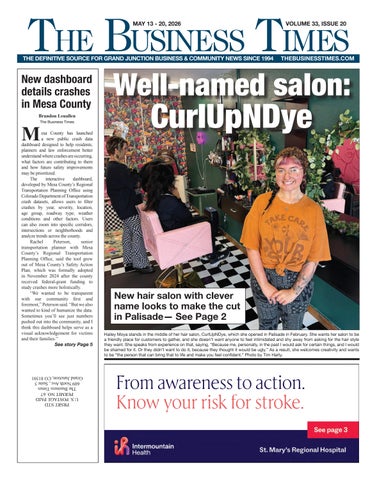
Well-named salon: CurlUpNDye
New hair salon with clever name looks to make the cut in Palisade—
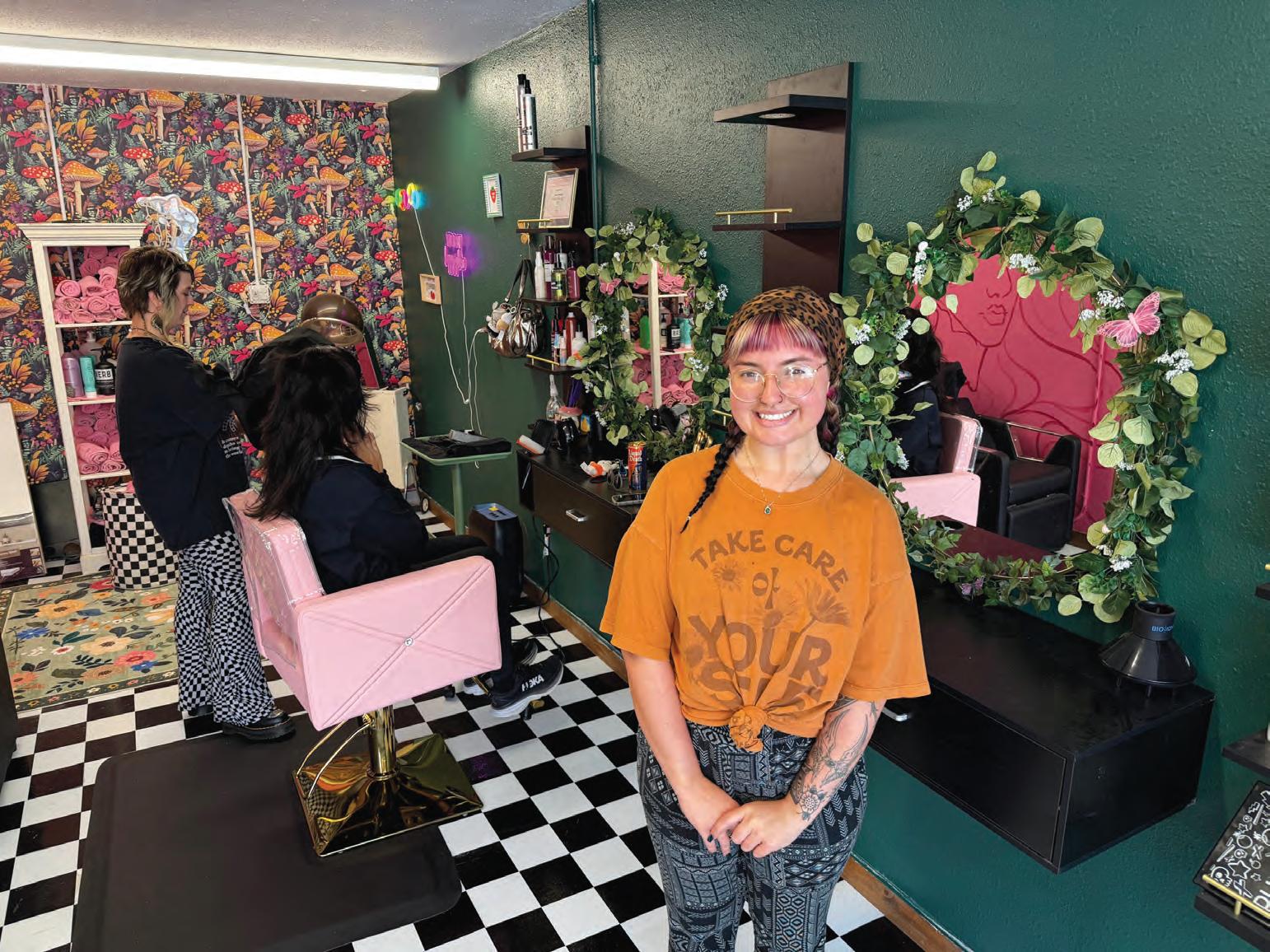
Hailey Moya stands in the middle of her hair salon, CurlUpNDye, which she opened in Palisade in February. She wants her salon to be a friendly place for customers to gather, and she doesn’t want anyone to feel intimidated and shy away from asking for the hair style they want. She speaks from experience on that, saying, “Because me, personally, in the past I would ask for certain things, and I would be shamed for it. Or they didn’t want to do it, because they thought it would be ugly.” As a result, she welcomes creativity and wants to be “the person that can bring that to life and make you feel confident.” Photo by Tim Harty.
In addition to clever name, salon brings variety, expertise
CurlUpNDye owner saw Palisade as a place that could use a hair salon like hers
Tim Harty The Business Times
Feeling nostalgic for the days when Farrah Fawcett’s hair ruled the fashion world? Better yet, do you want to leave the salon with an old-fashioned razor-cut shag?
Hailey Moya can do that for you.
Are you a military man looking for a high and tight?
Moya can do that, too.
Do you need color? Extensions? Vivids?
Moya, Moya, Moya!
Her specialty as a hairstylist isn’t any one thing. It’s everything. And if that’s what you need from your stylist, she’s got her own little shop now at 309 W. Eighth St. in Palisade, CurlUpNDye, which sits between the Palisade DinoMart convenience store and Diorio’s Pizza & Subs.
“I would say I can do anything,” Moya said. “I was working at Walmart for the longest time, so whatever walked in, you had to take. So, I can do men’s high-andtight fades, but I can also do the old classic razor Farrah Fawcett shag.
“I love my colors. I love extensions, making hair longer. But I feel like I mainly find myself honing in and loving the most: vivids and extensions, like very fun, colorful, like you’re-walking-outcompletely-different-than-how-you-camein kind of thing.”
She’s closing in on seven years as a hairstylist, and Moya started CurlUpNDye while renting a booth at a salon near the Mesa Mall.
She said opening her own business is something she always wanted, but there was no compulsion, no nagging, “Let’s do this right now,” ringing between her ears.
Instead, Moya said, “It kind of just stumbled onto my plate at the right time.”
She saw the open commercial space in November, began talking to the landlords, and come Jan. 1, they gave her the keys to the unit.
“I thought, ‘Oh, that’s the universe saying this is the new year. This is the new chapter for you,” she said. “So I thought it worked out perfectly that way.”
A month of renovation followed, and Moya opened CurlUpNDye there on Feb. 1.
Like many a person who moved their business, Moya had good reasons for loading up all of her hairstyling stuff and setting it up in a quaint little commercial unit on the main drag in Palisade.
But optimism’s roommate in many business owners’ brains is doubt, and Moya wondered how many of her clients would follow her to Palisade. Her booth near Mesa Mall drew people from the west side of the Grand Valley. Would they drive the extra miles and follow her to the far eastern end?
The answer: Yes.
“I was expecting, you know, moving away from one side of the valley, all the way to the opposite side, I was gonna lose business,” Moya said. “But it’s been the opposite, and
it’s been amped up. So far since moving, I’ve only lost one client, but she was an older gal and she lived right next to my old salon, so it was convenient for her. Other than that, I think I’ve gained close to 20 new people since being here, which is incredible.”
Also incredible? “I’m booked up til June,” Moya said on April 29. “I’ve never had that happen before.”
It makes sense, though. One of the reasons Moya chose to open in Palisade is she believed there was a need for hairstylists with her skills. She said another hairstylist opened a salon in Palisade about a month before her. Otherwise, she said, “I think before that Palisade had no one. I think there were a couple of older mom-and-pop-shop salons, but they strictly just did haircuts.”
Moya acknowledged that is only her perception, not research-substantiated fact, and she means no disrespect to anyone.
Undisputed, however, is the opportunity she believed Palisade provided.
“I saw a big, untouched market,” she said, “so I thought, ‘That’s perfect.’ And it gives me an even bigger chance to step out, being more on the, like, funky, whimsical, alternative side, too.”
Moya wants customers to know that, because if funky, whimsical and alternative is what they want, then that’s what they should get.
See CurlUpNDye on Page 8
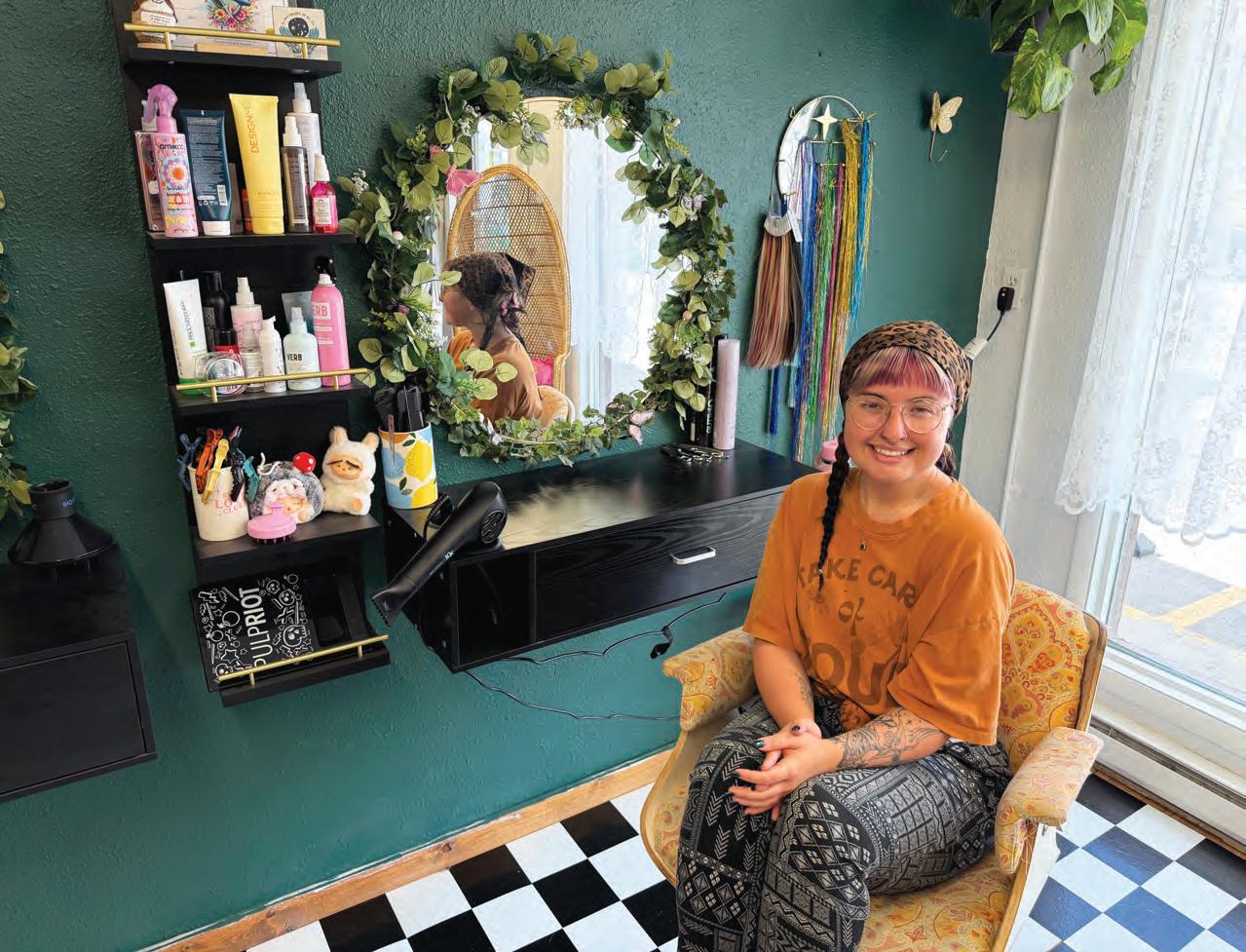
Hailey Moya sits at one of the styling stations in her Palisade hair salon, CurlUpNDye. Moya touts her versatility and mentioned the razor-cut shag as an example, saying it isn’t getting taught in beauty schools any more. “I can do the old classic razor Farrah Fawcett shag,” she said. “I still love the old-fashioned razor-cut shags, because that is such an untouched skill nowadays.” Photo by Tim Harty.
GJ City Council pushes back on Urban Trails Committee after bike parking letter
Brandon Leuallen The Business Times
Grand Junction City Council reached consensus during a workshop discussion that it will not appoint a member of the Urban Trails Committee to the Housing Affordability Code Task Force, then went a step further by agreeing to begin drafting a letter outlining expectations for the committee’s role.
The discussion followed an April 23 letter from the Urban Trails Committee opposing proposed changes to the city’s bicycle-parking requirements. The committee said the Housing Affordability Code Task Force’s recommendations would reduce minimum short- and long-term bicycle parking requirements in Grand Junction Municipal Code 21.08.020. The committee argued secure bicycle storage is important for residents and employees who rely on bicycles for transportation.
The issue stems from ongoing discussions over whether the city should continue requiring longterm bicycle storage in apartment complexes, commercial buildings and other developments as part of Grand Junction’s zoning and development code.
Planning Commission previously debated long-term bike parking requirements
Disagreement over the rule was also on display back in a Jan. 13 Planning Commission hearing regarding proposed amendments to Grand Junction’s bicycleparking requirements under Section 21.08.020 of the zoning and development code.
Principal Planner Daniella Acosta Stine told the Planning Commission the Housing Affordability Code Task Force had proposed eliminating all long-term bicycle-parking requirements and removing bicycle-parking requirements for many residential, industrial and nonresidential uses. Long-term bike parking differs from outdoor bike racks that someone can use temporarily outside of a building. These often are inside their own building and secured in a shared space that only the bike owners can access.
there cost approximately $4,800 each.
Developer John Gargasz, principal of Liberty Apartments and a Housing Affordability Code Task Force member, estimated long-term bicycle-parking requirements would add roughly $56,000 to the 72-unit Liberty Apartments affordable-housing project.
“That’s about $750 a unit,” Gargasz said.
Gargasz described housing affordability as “death by 1,000 cuts,” arguing that many smaller code requirements collectively increase housing costs.
Developers also argued that dedicated bike storage consumes valuable land and building space that could otherwise be used for additional apartments, parking, storage or
Several developers testified that tenants with expensive bicycles typically bring them inside their apartments rather than using shared bike-storage areas.
Apartment developers report enclosed bike rooms mostly unused
One of the most detailed examples came from Brian Shiu, director of development for Anthony Properties, which developed The Railyard behind Rimrock Walmart, The Slate on 25 and The Landing on Horizon in Grand Junction.
Shiu said Anthony Properties voluntarily built enclosed bicycle storage at The Railyard because of its proximity to downtown and the Lunch Loops trail system.
Continued Peterson dashboard public-awareness
“We thought with the emphasis that there is on cycling in Grand Junction, that we should build some enclosed bicycle storage,” he said.
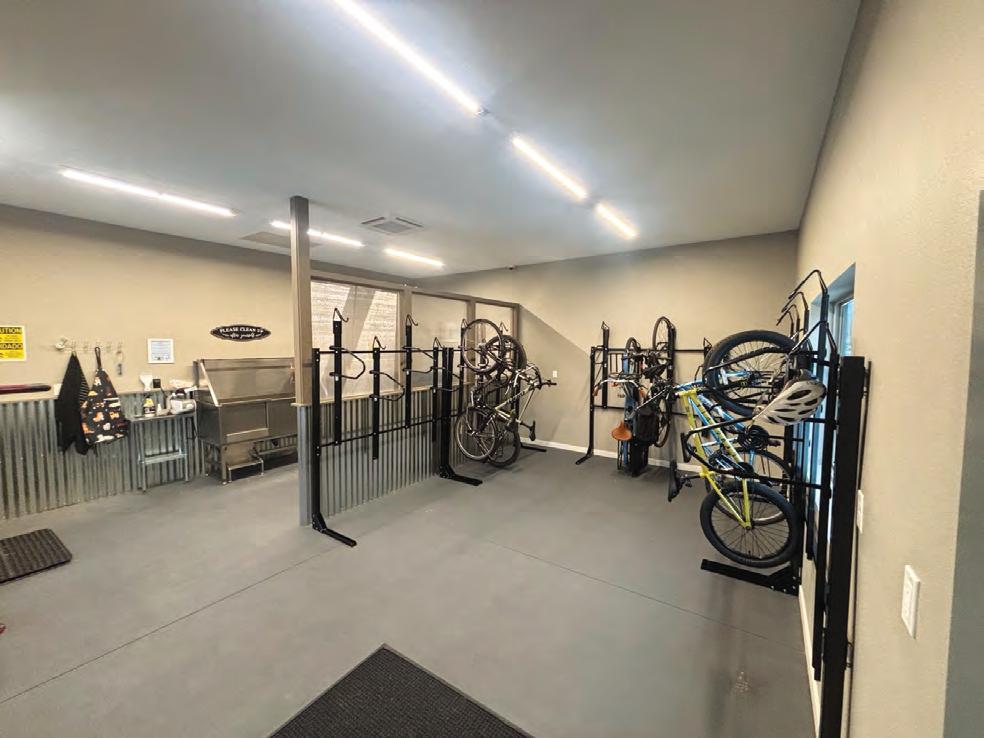
A secure long-term bicycle-storage building at the Railyard apartment complex in Grand Junction was built voluntarily in 2021 as a resident amenity and has gone largely unused, but similar facilities are now required under portions of the city’s zoning code for many apartment developments. Developers argued enclosed bicycle-storage buildings add substantial costs, because they require separate foundations, permits, utilities and construction expenses that are ultimately distributed across apartment rents. The Railyard complex houses approximately 310 residents, but only six of the remaining 20 bicycle-storage spaces are currently in use. Photo by Brandon Leuallen.
“The request would reduce the number of use types subject to the bicycle-parking requirements, and remove certain design and location standards,” Acosta Stine said.
Under the task force proposal:
• Long-term bicycle-parking requirements would be eliminated entirely.
• Short-term bicycle parking would remain only for select uses such as retail, office, recreation, and food and beverage businesses.
City staff opposed the full proposal and instead recommended a compromise that would:
• Retain bicycle-parking requirements.
• Reduce required ratios.
• Simplify standards.
• Remove some prescriptive-design requirements.
Staff argued completely removing the requirements conflicted with the city’s comprehensive plan and multimodal-transportation goals.
Developers describe low usage, added costs
A major focus during the Planning Commission hearing was testimony from developers and engineers who said long-term bicycle-storage requirements are increasing housing costs while seeing little use from tenants.
Civil engineer and Housing Affordability Code Task Force member Mark Austin said developers frequently question why short-term and long-term bike-parking requirements exist.
“Most of the time when I explain to applicants that we have two different types of bicycle parking requirements, they look at me like I’ve got three eyes,” Austin said.
Austin said requiring covered or enclosed bicycle parking creates additional engineering and permitting costs.
“If we put a shelter over the top of whatever this bicycle, long-term bicycle parking is, it now becomes a structure,” Austin said. “It’s got to have a structural stamp for a foundation. It’s got to have a building permit.”
Austin also cited the city’s recreation-center project, saying bicycle-locker units
The company built: a fully enclosed bicycle storage building; controlled access; security cameras; and 40 indoor bike spaces.
But Shiu said the facility was largely unused.
“Much to our surprise, they didn’t get used,” he said.
According to Shiu:
• Half the bike racks were later moved to The Slate on 25.
• Only 3 of 20 spaces at The Railyard were reportedly being used.
• Only 3 of 20 spaces at The Slate on 25 were reportedly being used
“We turned the one at The Railyard into a pet washing station,” Shiu said.
When Anthony Properties later developed The Landing on Horizon, Shiu said the company decided not to build enclosed bike storage at all.
“There’s no question that our residents have bicycles,” Shiu said. “But it’s very clear to us that what they’re doing is taking them up into their own units.”
Developer McKenzie Thorn described similar experiences at Struthers Residences and other projects. Thorn said Struthers includes 24 garage-style bicycle-storage units.
“At best we’re 40 percent rented on those,” Thorn said.
Civil engineer Mark Austin also referenced Linden Avenue Apartments and Fruita Mews, saying secure bicycle storage at those developments also saw little use.
Developers argued that long-term bicycle storage should remain voluntary rather than mandated by code requirements, saying apartment complexes and commercial developments could still choose to offer secure bike storage as a competitive amenity if tenant demand increases.
Several developers said the market would naturally incentivize projects to add bike storage if residents wanted and used it, without requiring every project to build the infrastructure upfront.
Planning commissioners divided on future of requirements
Planning commissioners appeared sharply divided over whether long-term bicycleparking requirements should be eliminated entirely or revised further.
Commissioner Keith Ehlers said the discussion was not simply “pro-bike” or “antibike,” but rather a question of who pays for transportation infrastructure and whether the current requirements are functioning effectively.
“We know 100 percent that cost of housing and cost of commercial related to all of these things is going up as a result of that,” Ehlers said.
Other commissioners argued the city risks undermining long-term multimodaltransportation goals if the requirements are removed entirely.
See URBAN TRAILS on Page 10
“It helps a really powerful from grant areas,” she How The submitted agencies of Revenue refines and crashes occurred and organizes visual and dashboard.
“It’s can kind are and occurred,” Peterson reset button, beginning. The crash data updated with there is before yearly and released According 2,400 crashes portion of 710 minor 17 fatalities. Major corridors The of crashes major corridors: • Interstate
North
Patterson
Interstate crashes. • U.S. The intersections crashes.
North Avenue
Mesa County launches public crash dashboard to map trends, guide safety efforts
Continued from Page 1
Peterson said the county also hopes the dashboard becomes a practical planning and public-awareness tool.
“It helps inform decisions, and it’s just a really powerful tool for all sorts of things from grant applications to enforcement areas,” she said.
How data is collected, updated
The dashboard compiles crash reports submitted by local law-enforcement agencies through the Colorado Department of Revenue and CDOT. Mesa County then refines and standardizes the data, verifies crashes occurred within county boundaries and organizes the information into a more visual and interactive format than the state dashboard.
“It’s more refined, and visually you can kind of see where those coordinates are and where those crashes actually occurred,” Peterson said.
Peterson said if you get stuck, use the reset button, and you can go back to the beginning.
The dashboard currently contains crash data through 2024 and will soon be updated with the 2025 data. Peterson said there is generally about a six-month lag before yearly crash data is fully processed and released publicly by CDOT.
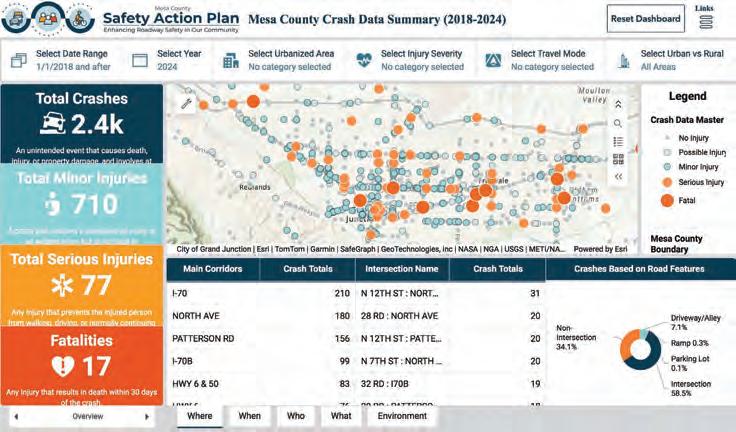
According to the dashboard, roughly 2,400 crashes occurred within the mapped portion of Mesa County in 2024, including 710 minor injuries, 77 serious injuries and 17 fatalities.
Major corridors and intersections stand out
The data showed that about 30 percent of crashes in 2024 occurred along five major corridors:
• Interstate 70 — 210 crashes.
• North Avenue — 180 crashes.
• Patterson Road — 156 crashes.
• Interstate 70 Business Loop — 99 crashes.
• U.S. Highway 6 and 50 — 83 crashes.
The dashboard also shows intersections account for a majority of crashes. The intersection of 12th Street and North Avenue recorded the highest number
of crashes in 2024 with 31, followed by several intersections with about 20 crashes each.
Peterson said the county has identified several high-priority locations through what it calls a “high injury network,” which focuses on roadway segments and intersections with elevated crash rates.
“We narrowed it down to nine locations that were on the high injury network that we could do capital-improvement projects on,” Peterson said.
Most of those locations are within Grand Junction’s urbanized area, she said.
The county plans to use the data to support future grant applications, evaluate capital improvement priorities and guide education and enforcement efforts.
Peterson said Mesa County recently received a Safe Streets and Roads for All federal grant that will help fund new speed feedback signs, public outreach efforts and additional roadway safety analysis. Impairment, vulnerable road users emerge as major concerns
One of the most significant trends identified through the dashboard involves impaired driving.
Peterson said impairment was a factor in nearly 67 percent of fatal crashes in 2024, compared with about 43 percent the year before.
While impairment-related crashes make up a much smaller share of total crashes overall, Peterson said the concentration within fatal crashes stood out sharply.
The dashboard also highlighted the impact on what transportation planners call “vulnerable road users,” including pedestrians, bicyclists and motorcyclists.
According to Peterson, nearly half of traffic fatalities between 2022 and 2025 involved vulnerable road users, a rate higher than the statewide average. Dashboard data with years 2022, 2023 and 2024 selected shows 13 of those fatalities involved motorcycles, with about 23.1 percent involving impairment and 61.5 percent involving speeding.
See MESA COUNTY on Page 6
A screenshot of Mesa County’s public crash data dashboard webpage.
Mesa County
Continued from Page 5
Fourteen fatalities involved pedestrians, with roughly 58 percent involving impairment and 25 percent categorized as driver error. Three fatalities involved bicycles or pedal bikes.
Rear-end and broadside crashes were among the most common crash types identified in the dashboard, particularly in urban areas where intersections and congestion create more vehicle-conflict points.
Dashboard includes limitations
Peterson emphasized that while the dashboard offers extensive filtering and mapping capabilities, it does have limitations: Crash locations are approximate; some data may be incomplete; and the “Why” section relies on officer-reported contributing factors rather than definitive legal determinations of fault.
The county also notes the dashboard is intended as a planning and analysis tool rather than a legal record of responsibility. County hopes dashboard influences driver behavior
Peterson said the county hopes the dashboard will ultimately encourage residents to think more carefully about how their own driving behavior affects roadway safety.
“The big goal of this crash-data dashboard is not just being a tool to check your neighborhood,” Peterson said. “We hope it will foster a shared responsibility mindset where folks start thinking about how their decisions while commuting might impact others.”
She added many crashes reflected in the dashboard were preventable.
“Specific choices while you’re commuting, like speeding or distraction, can have consequences,” Peterson said.
Legislative Wrap-Up Breakfast on May 19
Colorado’s legislative session has concluded, and the Grand Junction Area Chamber of Commerce is hosting a Legislative Wrap-Up Breakfast on May 19, 8 to 9:30 a.m., at the Colorado Mesa University Ballroom, to discuss what the Colorado Legislature’s actions mean for Mesa County businesses moving forward.
State Sen. Janice Rich, State Rep. Rick Taggart and State Rep. Matt Soper will be on hand to discuss the highlights of the 2026 legislative session, the priorities that shaped debate at the Capitol, and the ongoing efforts to keep business competitiveness top of mind in Colorado.
The breakfast also will feature special guest speaker DJ Summers from the Common Sense Institute. Summers will provide insight into recent reports examining Colorado’s economic trajectory, workplace losses, TABOR impacts and the growing pressures surrounding the state budget.
Pre-registration is required, and space is limited. To register, go online to business.gjchamber.org/ap/Events/Register/ XqFxjzeI7CDCz.
Cost of admission is $35 for Grand Junction Chamber members and $55 for nonmembers. The CMU Ballroom is at 1100 North Ave.
Fruita City Council accepting applications for council vacancy
The City of Fruita City Council is accepting applications to fill one vacant council-member position. Applications will be accepted until May 22, 3 p.m., and the Fruita City Council will conduct in-person interviews for the position on June 3. Find the application online at www. fruita.org/citycouncil.
The vacancy stems from James Williams resigning from the council, effective May 6. Williams was elected in the April 2026 election for a four-year term. Williams’ successor will fill the council seat until the next municipal election in April 2028.
Applicants must be 21 years or older and must be a registered voter residing in Fruita City Limits.
Council members are required to attend Fruita City Council meetings held on the first, third and fourth Tuesday nights of the month, in addition to special meetings. The position also requires attendance at one to three board or commission meetings per month, plus other regional events. Council members receive $350 per month for their service to the community.
News, views and advice you can use
(970) 424-5133
CurlUpNDye
Continued from Page 2
“I think my biggest thing that I’m discovering about CurlUpNDye is I want it to be a place where people who were always so intimidated to like say, ‘Hey, this is what I want. Can you do this?’ ... I want to be the person that can bring that to life and make you feel confident,” she said.
With her versatility comes an invitation to everyone.
“I like being a vast or, I would say, a wide-service-selection salon,” Moya said. “I don’t hone in on just one thing. I have military men that come in every 3 weeks. I have my little old ladies that come in once a week. But then I got my girls who come in once a year, or people I’ve never met
CurlUpNDye is at 309 W. Eighth St., Suite 7, in Palisade.
To see photos of owner/stylist Hailey Moya’s work or make an appointment, go online to haileymoya1.glossgenius.com/services.
CurlUpNDye is active on social media such as Instagram and Facebook.
Inspiration for the name
A search of the Colorado Secretary of State website shows several other variations of Curl Up and Dye, one going as far back as 1986, but Moya said she came up with the name on her own. However, to register a Limited Liability Company name she could use, she had to remove the spaces between the words.
“I didn’t see it in a Julia Roberts movie. I didn’t get it from anyone else. I thought I was being very authentic with the name,” she said.
And two of her passions – hairstyling and heavy metal music –made the connection.
Photo from the CurlUpNDye portfolio on it’s website, haileymoya1.glossgenius.com/services.
Congratulations Kileigh Sperber!
ANB Bank is pleased to announce the promotion of Kileigh Sperber to Community Bank President of ANB Bank’s Downtown Grand Junction Banking Center.
Sperber brings over 26 years of banking experience to her new role with a longstanding presence in the Colorado market. Her extensive banking experience and knowledge enable her to evaluate the needs of each customer’s unique business and ensure they are utilizing the best products, giving them the edge to succeed.
Stop by and visit with Kileigh today.
“I love everything alternative – I love metal music especially – so I kind of wanted a name that would look really cool in the metal chicken scratch, where it’s like, ‘Bah!’ like that. So, I’m like: curl up and dye. I curl hair, and I dye it, but it’s also like a metal scream, like, ‘Curl up and die!’ And like, that’s sick, so I just clashed that together. So, that’s why I came up with it.”
131 North 6th Street 970-255-3882
Another pretty cool name
The young hairstylist who rents a booth inside CurlUpNDye has a cool name to rival the business: Dessa Lavender Sims.
Moya said she taught an alternative cutting class at a beauty school last year, met Sims there, and Sims followed her to Palisade, and Moya said, “I’m very lucky to have her.”
Duo soon to become a quartet
Moya said CurlUpNDye will be getting a nail technician in about two months. Then, Moya has another hair stylist lined up to join them once she gets licensed.
Proximity and less craziness
Moya said she saw a need for hair stylists in Palisade, but a couple other factors made it the right choice for her to get her own storefront.
First, she said, “I live in Clifton, on the cusp of Clifton and Fruitvale, so I was really excited to not have to drive 25 minutes to get to work anymore.”
And second: “I feel like Palisade, it’s very quiet, and it’s very away from the hustle and bustle of Grand Junction and what it’s becoming. So, I wanted to take a break from the craziness of Junction and point my business in a direction of like, ‘Let’s start grounding ourselves.’ And Palisade is a perfect place for that. Just a nice little, steady slowdown.”
Where everybody knows your name Moya may love everything alternative, but old-fashioned has an allure as well.
“I love to spin on the vintage, because I grew up in all the older-lady salons, where they come in once a week for their perm sets. They’re all talking to each other and everyone’s just friends. That’s what I want this place to be,” Moya said.
Urban trails
Continued from Page 4
Commissioner Ian Moore speculated that required parking structures that are unused by those currently with bikes could be used in the future as city-wide bike infrastructure increases.
“It takes a while to get the network up to the point where, ‘Oh, my friend bikes to work. Oh, so I might try that,’” Moore said.
Moore argued the larger transportation system must function together.
“The entire route, the entire bike-pedpath plan together has to work,” he said.
Former City of Grand Junction Mobility Planner Henry Brown argued during public comment that transportation costs borne by residents can outweigh the development costs associated with bicycle infrastructure.
“The ability to get by with a single car versus having to finance, fuel, maintain and carry insurance for a second vehicle may amount to over $10,000 per year,” Brown said, citing American Automobile Association estimates.
Brown also challenged some of the cost figures discussed during the meeting, arguing that the estimated costs presented by developers appeared inconsistent.
“We heard initially that it was $4,800 a unit,” Brown said. “That quickly went down six times to $750.”
Austin later responded that Brown had the two separate figures backwards.
Austin said the roughly $700 figure came from earlier code-committee discussions he was involved in about installing shared, secure-bike parking as a requirement when staff had suggested bike parking would not significantly increase costs. And the $4,800 figure reflected actual current pricing from FCI Construction for the new recreation center’s individual bicycle lockers.
“The $4,800 number is the real cost,” Austin said. “That is an actual number from FCI Construction for what these bike lockers cost at the rec center.”
Part of the broader debate centered on whether builders should be required to install secure long-term bike storage speculatively in hopes that future bike usage increases as Grand Junction expands its multimodal infrastructure, even though many bike users currently prefer storing bicycles inside their own units.
Housing Affordability Code Task Force member Mike Foster argued developers would not voluntarily overbuild vehicle-parking spaces that may or may not be needed, because doing so would unnecessarily increase project costs and rents.
Foster argued the same principle should apply to long-term bicycle-parking requirements.
“If you over-vehicle-park a project, then you’re increasing the cost,” Foster said. “If you over-bike-park a project, you’re increasing the cost.”
Foster also argued current residents are effectively being asked to absorb higher housing costs now for transportation infrastructure that advocates hope may
become more heavily utilized years into the future as bike connectivity improves.
Planning Commissioner Orynn Zyvan said he was not ready to support removing the long-term bicycle-parking requirements, because, while the commission had heard extensive testimony from apartment developers saying the systems were not being utilized, it had not heard similar testimony from commercial, industrial and other businesses that would also be affected by the code changes.
“One last piece of discussion would be just not heard from the commercial, the business side of this,” Zyvan said. “Like, what does this mean for businesses?”
Ultimately, the Planning Commission deadlocked on competing motions and forwarded the issue to City Council without a formal recommendation.
Council rejects UTC request for seat on housing task force
During the May 5 City Council workshop, council members rejected a request from the Urban Trails Committee to add a UTC representative to the Housing Affordability Code Task Force.
City Manager Mike Bennett said the request came after the UTC saw the reduction in bicycle-parking recommendations continuing to move forward through the task-force process.
Several council members said UTC members could still attend meetings, provide comments or be invited to discussions without formally adding another representative to the task force.
Council member Robert Ballard said adding members from one advisory board onto another could create broader complications.
“I think that’s a really dangerous precedent to set just across all of our boards and commissions,” Ballard said.
Mayor Cody Kennedy also raised concerns about a UTC letter citing U.S. Census data claiming roughly 29 percent of Grand Junction workers do not use a personal vehicle to commute.
Kennedy said the figure combined all non-car commuters together even though the bike-parking debate impacts a much smaller percentage of bicycle commuters.
“It was like that 2 percent disguising itself as 29 percent was my concern,” Kennedy said.
Kennedy said he became concerned after reviewing UTC meeting recordings and hearing comments about “waiting this council out” until future council membership changes.
Council later discussed drafting a “letter of expectation” or a course-correction letter, clarifying the UTC’s advisory role and expectations moving forward.
Interim City Attorney Jeremiah Boise noted the UTC was created by council and could have its bylaws or resolution revised by council if needed.
Council member Ben Van Dyke said stronger actions could eventually be considered if tensions continue, including potentially discussing disbanding the committee.
Minnerath officially installed as Public Health director
Erin Minnerath was named executive director of Mesa County Public Health, the Mesa County Board of Public Health announced May 6, the same day she officially began her new role. The board’s decision follows its decision in early April to name Minnerath the sole finalist for the position after a nationwide search that began in February and yielded more than 40 candidates from across the country. Minnerath had been doing the executive director’s job on an interim basis after Xavier Crockett resigned as executive director, effective Dec. 31.
“We are thrilled to welcome Erin as the new leader of our agency,” Board of Public Health Chair Marguerite Tuthill said. “Her unwavering dedication to promote and protect community health is matched only by her commitment to our staff. Erin truly embodies our core values, and we look forward to the growth she will bring to this next chapter of public service.”
Minnerath joined Mesa County Public Health in April 2024 as deputy director and oversaw the Health Protection, Health Promotion, and Behavioral Health divisions. She also served as incident commander during the agency’s measles response in the fall of 2025. Prior to joining MCPH, she led the Infection Prevention Team at St. Mary’s Regional Hospital, providing guidance throughout the COVID-19 pandemic.
“It is a privilege to lead such a talented and passionate team,” Minnerath said. “Having seen firsthand the dedication of our incredible staff, I am eager to build upon our agency’s strong foundation. Our staff is the backbone of this community’s wellbeing. We will continue to innovate and evolve to meet the unique health challenges of Mesa County.”
F The Business Times 609 North Ave., Suite 5 Grand Junction, CO 81501 (970) 424-5133 www.thebusinesstimes.com
Commercial volume is up despite transactions being down
The first quarter of 2026 painted a nuanced picture for commercial real estate in Mesa County. While total sales volume climbed year-over-year, fewer transactions closed, which is a pattern that signals a continued shift toward larger, higher-value deals reshaping the market’s composition.
Here’s what the data tells us, and what it means for buyers, sellers, and investors active in our region:
Volume up, transactions down
Q1 2026 recorded $57.5 million in total commercial sales volume, a 5 percent increase over Q1 2025’s $54.7 million. Yet the number of individual transactions fell sharply, from 45 sales in Q1 2025 to just 32 this quarter, a 29 percent year-over-year decline.
Meanwhile, the first quarter this year had 11 commercial building permits issued, which is up from six in Q1 2025.
The divergence between volume and transaction count is meaningful. It indicates that while deal flow has slowed, the deals that are closing are larger, which is a trend consistent with cautious capital deployment in a higher-rate environment, where institutional and well-capitalized buyers are driving activity.
Notable transactions this quarter
Several marquee deals defined the quarter and reflect the breadth of activity across property types:
• La Quinta Hotel, 2761 Crossroads Blvd., 108-unit hotel sold for $12 million on Jan. 6.
• Grand Vista Hotel, 2790 Crossroads Blvd. – 158-unit hotel sold for $8.14 million on Feb. 13.
• Escalante Creek Canyon, 4,105 acres acquired by the Bureau of Land Management for $12.05 million on Feb. 27.
• Clifton Chipotle, 3233 I-70 Business Loop, net-lease retail sold for $2.6 million on Jan. 15.
• 619 Main St., 6,250 sq. ft. downtown office sold for $1,512,000 on Jan. 21.
The pair of hospitality transactions on Crossroads Boulevard totaled more than $20
million, which underscores continued investor confidence in Mesa County’s lodging sector. The BLM land acquisition is the quarter’s largest single deal and reflects ongoing federal conservation interest in the region.
Active listings and leasing activity
Current market activity is seasonally steady. Mesa County has 173 active commercial listings and 176 active leases, up 4.1 percent and 4.2 percent, respectively, compared to Q1 2025. However, both figures represent a meaningful pullback from the elevated levels seen at year-end 2025, when active listings peaked at 257 (a 33 percent drop) and lease activity dipped just under 1 percent.
The post-holiday inventory contraction is typical, and the year-over-year gains in active listings suggest the pipeline remains healthy heading into the spring selling season.
Building permits signal development momentum
Perhaps the most encouraging signal this quarter comes from the permitting desk: 11 commercial building permits were issued in Q1 2026, up from just 6 in Q1 2025, an 83 percent year-over-year increase. Notable permits include a new Grand Junction Federal Credit Union branch at 546 Warrior Way and new modular buildings for the Roice-Hurst Humane Society at 362 28 Road.
Permit activity is a leading indicator of future supply and business investment. A near-doubling of permits suggests growing confidence among local businesses and developers in Mesa County’s near-term economic outlook.
Looking ahead
Mesa County’s commercial market enters Q2 2026 with a mixed but ultimately constructive backdrop. Volume growth, robust permit issuance, and year-over-year listing gains all point toward an active market.
The transaction count decline warrants monitoring, but in the context of larger average-deal sizes, it reads less as weakness and more as market maturation. We’ll be watching lease absorption, new listings, and permit conversions closely as the year progresses. F
Darah Galvin is a data analyst at Bray Commercial Real Estate.
Darah Galvin
Now it’s the REAL, illegal aliens; I guess the other scares aren’t working
I guess this is what we get when the “virus of the day” just doesn’t get the masses in an uproar of weeping and whaling and gnashing of teeth. And what you get is a column of “much ado about nothing” to boot. Aren’t my random musings just so darn entertaining? Well, here goes another. You be the judge.
I must ask, aren’t you tired of it? I don’t think Jesus had these government-created emergencies in mind when He said in Matthew 11:28, “Come to me, all you who are weary and burdened, and I will give you rest.” Then again, being omnipotent, maybe He did. After all, our government seems to be outpacing the Romans in using fact and fiction, and fact-based fiction for tyrannical control, thankfully crucifixions aside.
But let’s not give them any ideas. The government-crisis crosses we bear are bad enough. And yes, I know this all too well. Only thing missing are the holes in my wrists and feet. And no, this is in no way a comparison to my Lord and Savior, so don’t start typing. Well, except for you who only read enough to let your fingers do the talking regardless of what I write. I appreciate the affirmation I’m dead on for the subjects in my columns.
So, here’s where we are: The coming Ice Age didn’t work; the hole in the ozone didn’t work; Silent Spring didn’t work; running out of oil didn’t work; overpopulation didn’t work; global warming didn’t work; climate change didn’t work; “insert virus here” hasn’t worked except for, sadly, that Covid one did for a couple of years, hence the “hanta” dropping (see what I did there?) into our lives, which is being met with a collective yawn from folks who’ve simply had enough scat from the government rat pack.
I mean, if they really wanted hantavirus to work, wouldn’t they roll out the evil leprechaun known as Anthony Fauci and his gravel tones of our coming demise? After all, he’s been predicting the next virus, and he luckily has been developing a Mengele-potion cure-all for decades. But alas, hantavirus will only be a distraction. Seriously, it’s already got leftists double masking as I type. And have you seen the progressive minions blaming the “outbreak” cruising into our lives on Robert Kennedy Jr.’s firing of inspectors for the Love Boat? But hanta’s all pretty much over before it started, because our government has “Maverick up on ready five” with its latest version of the illegal-alien invasion: actual aliens.
David Hannum should have been referring to government when he said, “There’s a sucker born every minute.” The fact that most folks think PT Barnum said that speaks volumes about how Abraham Lincoln did not say, “You can fool all of the people some of the time, and some of the people all of the time, but you cannot fool all of the people all of the time.”
In case you are wondering, I identify with the last part. Strongly. Here’s why, and James Madison actually said it, “The truth was that all men having power ought to be distrusted to a certain degree.” Now you know my starting point with anyone ever elected, even those I consider friends right here in River City, and I refer to this ditty, also not from Honest Abe for my reasoning: “Nearly all men can stand adversity, but if you want to test a man’s character, give him power.” Let’s be honest, the folks we elect anymore are flunking.
There was a pretty good Robert Redford movie that came out in 1992 called “Sneakers.” I don’t recall exactly what it was all about, but I do remember it was about computers, the Internet and the online, digital world and the dangers therein from government. But I do recall distinctly its main message: Too many secrets.
And for the sake of your Chuck Taylors, they meant the shadow government. You don’t really believe the government and the idiots speaking for and about it on talk shows and the floor of Congress are letting you really see how the sausage is made, do you? They have to keep that recipe a secret. It’s not just bad; it’s considerably worse.
Yup, I’m the kind of fool who believes government should have no secrets. The reasoning is simple. Anything the government keeps secret from the people is used for control. Why else would it go to great lengths to keep us from the truth, or in my case in publishing a newspaper, from the facts? It’s why we go to great lengths to quote and source and attribute as thoroughly as possible in every story in The Business Times. Facts matter. Attribution matters. The TRUTH matters.
After all, “The truth will set you free,” and that’s from a guy I quote all the time. He’s always worth quoting, and He never ran for office or sought power. He just spoke truth. It’s why He came. Not that it has much effect on the government He said that to, or on any government before or since.
But back to government, which is the real antagonist and always has been to those who desire freedom. It’s also the master when it comes to secrets.
Oh, you’d like some examples? OK, how about the Kennedy assassination files (or any assassination files), any mass-shooter information, closed congressional hearings, grand jury testimony, Vietnam (all of it), weapons of mass destruction in Iraq, Watergate (a nothing burger at its core, but they could use it to get Nixon), the Clintons, the Epstein files, McCarthyism, Teapot Dome, anything Trump, 9/11 and Jan 6 (think about how they’re thought about), the aforementioned Covid, and pretty much anything else the government puts out nowadays, including the thousands of new laws passed in Colorado in just the past few legislative cycles along with so many River City follies here in Grand Junction?
Tell me you trust all of it. You can’t.
Fact is, the distrust of those we’ve elected is genuine. And that’s because it’s intentional. Which is the entire point when it comes to power. Power in politics can only be derived when the citizens are divided. And no one has perfected dividing the people like your local, county, state or federal politician. And yes, both parties thrive on it.
To reprise and paraphrase my favorite movie quote from Sonny Corleone, “There’s a lotta money in that political stuff, Pop.”
Now I’m not saying everyone elected is lying to the people or on a power trip or out to “get theirs” from the treasury. Well, I pretty much am federally and in most state positions, especially on the left where they are just more devout to the cause than the right. But what I am saying is pay attention to what they aren’t saying when they are saying all the other stuff, which is usually a bunch of stuff to change the topic from all the other stuff they were saying to divide the people barely a week ago.
In today’s case, it’s the aliens. Of which our federal government must consider illegal, with all the hiding of them at the super-secret (yet we all know about it) place called Area 51, which appears the feds are ready to 86. Honestly, I don’t know if aliens have the legs of a Covid epidemic, especially since they’ve been walking among us since the middle of the last century. Side note, do aliens even have legs, or did the government make that part up, too? And if there’s so many of them, why do all the drawings look alike and look like the ones in the movies, where they all have legs?
Regardless, it’s just another secret the government is letting us in on while creating more secrets about what’s it’s actually doing, which is always amassing more power while raiding the treasury. That’s all the government is good at anymore. And that’s the best-kept, out-in-the-open secret of all.
Trust nothing and question everything.
In Truth and freedom.
Craig Hall is owner and publisher of The Business Times. Reach him at 424-5133 or publisher@thebusinesstimes.com
Craig Hall
n Kiwanis accepting sponsorships for June 6 Pancake Day
The annual Kiwanis Pancake Day and Fun Fest will take place June 6, 8 to 11 a.m. at the Mesa County Fairgrounds.
Kiwanis Club of Grand Junction is now accepting corporate sponsorships for this year’s event. Corporate sponsorships range from $275 to $2,500 and include sponsor promotion at the event and Pancake Day tickets.
Proceeds from Pancake Day are donated to local nonprofit organizations that help children. Recipients in the past have included Colorado Discoverability, Girl Scouts, HopeWest, STRIVE, Special Olympics of Grand Junction, Kids Aid Backpack Program, Harmony Acres Equestrian Center and Riverside Education Center. In the past 10 years, the Kiwanis Foundation has invested more than $1 million into Mesa County organizations.
Pancake Day includes a silent auction, live music and activities for children and the whole family. Individual tickets at the door cost $10, and kids age 12 years and under get in free.
For more information, call Pancake Day Chair and President-elect Audrey Kiser at 970-812-2731 or email audrey@westslopedata.com; or call Kiwanis President Stephanie Garcia-Hagen at 970-640-2760 or email stephanie@mesabenefits.com
For information about joining Kiwanis, go online to kiwanis-gj.org.
n Palisade community-coffee event features regional leaders
The Palisade Chamber of Commerce invites community members, business professionals and local leaders to attend Your Community Over Coffee, an engaging morning of connection, conversation, and collaboration.
The interactive event will take place May 28, 8 to 10 a.m., at Maison La Belle Vie, 3575 G Road in Palisade. Coffee and fresh pastries will be available.
Attendees can participate in roundtable discussions as Your Community Over Coffee provides attendees the opportunity to engage directly with decision-makers and gain insight into the issues shaping Mesa County and beyond.
For more information or to register, contact the Palisade Chamber of Commerce.
n Commissioners available at Glade Park town-hall meeting
Glade Park residents are invited to meet with county leaders, hear updates and ask questions at a town-hall meeting May 27, 6 p.m., at Glade Park Church and Community Center, 1521 S. 16 1/2 Road.
The Board of Mesa County Commissioners and other county leaders will meet with the Glade Park community. The meeting is open to the public and gives residents a chance to engage directly with county leadership.
n Fruita Foundation hosts Monumental Lights Gala
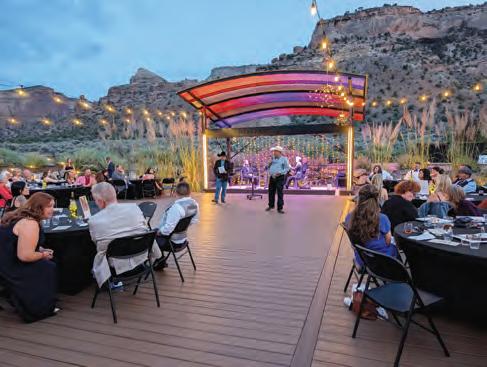
The Fruita Foundation will host its annual Monumental Lights Gala on June 5, 6 to 9 p.m., at Monument Vista Place at the base of the Colorado National Monument.
This year’s event will directly support the Foundation’s mission of strengthening the community through education, workforce development and cultural preservation. Funds raised will benefit local scholarships, the expansion of youth entrepreneurship opportunities, and the upcoming launch of the Kids in Business program, an initiative designed to equip young people with real-world business experience.
The event will feature: catering by local entrepreneurs Jacob and Grace Sebesta of GJ Fusion; craft beverages from Reckless Brewing Company, including their “What the Fundraiser” beer, which gives back to the Foundation; and live entertainment from Hot Tub Jazz, a jazz quartet led by Scott Betts.
In 2025, the Monumental Lights Gala raised more than $8,400 to support student entrepreneurship and scholarships. This year, the Foundation aims to expand its impact further by investing in the next generation of Fruita’s workforce and business leaders.
“This event is about more than one night, it’s about building a stronger future for Fruita,” Fruita Foundation Board President Laura Smith said. “Every ticket purchased is an investment in our youth, our businesses and our community.”
Tickets are limited and community members are encouraged to reserve their seats early at fruitachamber.org/fruita/foundation.
Business Bites
Becker’s honors Montrose Hospital CEO Mengenhausen again
Montrose Regional Health CEO Jeff Mengenhausen was recently named to Becker’s 2026 list of 146 Rural Hospital and Health System Presidents and CEOs to Know. Becker’s Hospital Review editors researched and accepted nominations for the annual list. Mengenhausen has appeared on the list each year since 2022.
Fruita Foundation Monumental Lights Gala 2025.
of youth program, experience. Sebesta of “What the from Hot support student its impact leaders. future for purchased is their seats again Becker’s to Know. the annual 2025.