Intermountain plans to build primary-care clinic in Fruita
Tim Harty The Business Times
Intermountain Health plans to build a primary-care clinic in Fruita, according to a “General Project Report for IMH MGWC Fruita Primary Care Clinic” that it submitted to the City of Fruita in 2025.
The report’s Major Site Plan summarized Intermountain Health’s plans “to construct a 15,500-squarefoot medical office building located at 502/524 Kokopelli Boulevard in Fruita, Colorado.”
The adjoining lots are vacant, and the Mesa County Assessor’s website shows Sisters of Charity of Leavenworth Health System Inc. (SCL Health) purchased each lot in February 2023, paying $550,000 for the 1.47 acres at 502 Kokopelli Blvd. and $1,500,000 for the 1.43 acres at 524 Kokopelli Blvd. Each sale was recorded by the Mesa County Clerk and Recorder on Feb. 9, 2023.
SCL Health merged with Intermountain Healthcare in 2022 and formed Intermountain Health, which operates Intermountain Health St. Mary’s Regional Hospital in Grand Junction.
See story Page 5
How much watering do lawns actually need?
Overwatering: It’s not just a drought-year issue
Even in normal years, many lawns get too much water, which wastes water and can harm lawns
Brandon Leuallen The Business Times
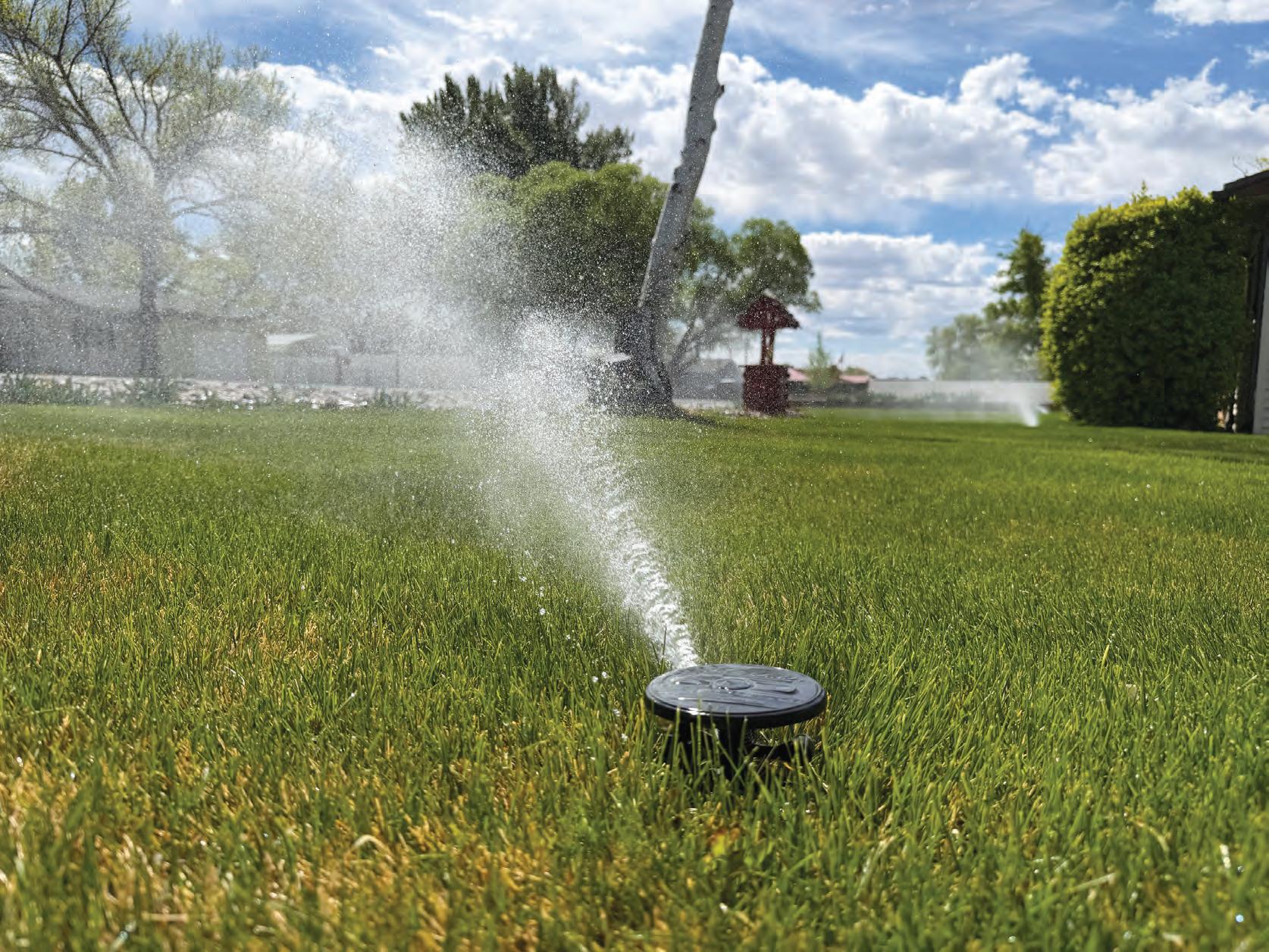
hile drought conditions often bring increased attention to water use, a local irrigation professional says many homeowners overwater their lawns even in normal years, creating long-term problems for turf health and water conservation.
In an interview with The Business Times, Matt Morgan, owner of 2 Brothers Landscaping in Grand Junction, drew on his 18 years in business in the Grand Valley and said overwatering is not only unnecessary but can weaken lawns.
“Roots need air as much as they do water,” Morgan said. “When we overwater like that, we suffocate the root system by not letting the air get down in between waterings.”
Morgan said frequent, shallow watering keeps the top layer of soil saturated, preventing oxygen from reaching the roots and leading to shallow root systems.
“So where it can’t breathe, there won’t be roots,” he said. “It really creates a very shallow root system.”
That becomes especially problematic during drought conditions. Lawns that have been overwatered are less able to survive when water becomes limited.
“If it’s used to that much water and all of a sudden the water goes away, it’s going to be done,” Morgan said. “If you get it used to less water, it’s going to survive less water and it’s going to survive the drought much, much better.”
across the Grand Valley, which can vary significantly.
Areas with sandy soil, such as the Redlands, drain quickly, while clay-heavy areas in the valley retain moisture longer. Because of that, he avoids recommending exact watering times.
Instead, he suggests a simple test.
“If you can still stick a screwdriver down in there readily, then it’s moist enough,” he said. “If you pull it out and it’s got stuff stuck to it, then it’s too wet. If you can’t get it shoved in, then it’s too dry.”
Watering when it rains
Deep watering, less often
Morgan recommends watering deeply, but less frequently instead of watering daily.
“Longer run times, less often is a lot healthier than watering every day anyway,” he said.
In normal conditions, he recommends watering no more than three times per week. During drought conditions, many water providers are asking residents to cut back further.
“Right now, I say no more than three times a week, but in drought conditions like this, all of the water purveyors are asking us to do two,” Morgan said. “Make it survive. It doesn’t have to thrive this year.”
He added that lawns can make it through a drought year even if they are not lush.
“Just keep it alive, even if it’s a little bit on the verge of dormancy,” he said.
Soil and conditions vary
Morgan said watering schedules should be adjusted based on soil type and conditions
One of the most visible examples of water waste is irrigation systems running during or immediately after rainfall, something Morgan said often comes down to homeowners simply not shutting their systems off.
“Maybe it rained on the weekend, but we were gone for the weekend, so it just ran because we weren’t home,” he said.
When significant rain does occur, however, he said it’s important for homeowners to adjust their systems accordingly.
One option is to install a rain sensor designed to automatically shut off irrigation systems during significant rainfall. Morgan said rain sensors can shut off irrigation during rainfall, but are used less locally because most storms aren’t large enough to trigger them.
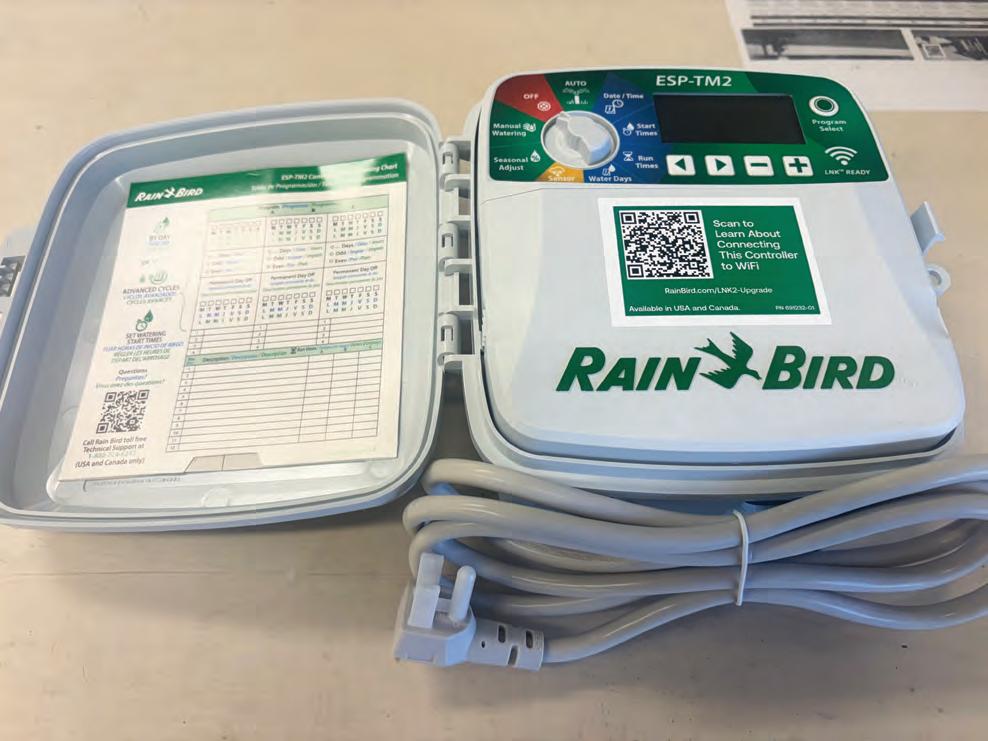
“It’s great when we actually get a good rain, because then you don’t have to remember to go shut it off yourself,” Morgan said. He said what he has seen that is effective is for homeowners to utilize WiFi-enabled irrigation controllers, which allow them to turn systems off remotely if the lawn has enough water and even if weather changes while they are away.
“We’re more prone to get on our phone and say, ‘Oh yeah, I need to turn my clock off,’ than we are to actually walk out there,” he said.
Mowing height and fertilizer?
In addition to watering practices, Morgan said mowing height plays a key role in maintaining healthy lawns, especially during hot or dry conditions.
“During this time of year you really should be mowing at about 2.5 to 3 inches, and about 3.5 or more in the summer when it’s hot,” he said.
Longer grass helps shade the soil and retain moisture.
“You don’t want to be cutting short because it will heat the ground up and you’ll lose your moisture faster,” he said.
A Rain Bird irrigation controller on display at Western Implement in Grand Junction offers Wi-Fi capability, al lowing homeowners to adjust watering schedules remotely from their phone whether at home or away. Photo by Brandon Leuallen.
Fruita Chamber bestows annual awards
Trailblazer Pizza named Fruita Business of the Year
The Fruita Area Chamber of Commerce recognized outstanding businesses, organizations and individuals with awards in mid-April during its 2025 Annual Banquet, including Fruita Business of the Year Trailblazer Pizza Co.
The Fruita Chamber said in a news release its award winners exemplify leadership, community involvement and a commitment to strengthening the local economy.
“These award recipients represent the very best of Fruita,” Fruita Chamber President and CEO Kayla Howell said. “Each of them plays a unique role in making our community stronger. Whether through service, entrepreneurship, advocacy, or simply showing up and giving back. Together, they reflect the heart and momentum of our business community.”
Volunteer of the Year: Robbin Gibbons
Robbin Gibbons was recognized for her unwavering dedication and service to the Fruita community. Known for consistent presence at local events and willingness to support behind-the-scenes efforts, Gibbons exemplifies what it means to give back.
Her impact is especially visible during events such as the Fruita Fall Festival, where she volunteers for post-event cleanup, helping
Trailblazer Pizza Co.
Trailblazer Pizza Co. was honored for its strong local roots, community involvement and early impact on the local business landscape.
Her influence extends beyond her individual involvement, as she regularly encourages others, including colleagues, friends and family, to engage with the chamber. In 2025, Kristin further demonstrated her commitment by stepping into a mid-year vacancy on the
leadership and support of both the Fruita Chamber and the broader community.
Since opening, Reckless Brewing Company has transformed a longtime Fruita gathering space into a vibrant hub for connection. The business is actively involved in local events, including the Fruita Fall Festival, and it consistently supports chamber initiatives through sponsorships, donations and volunteerism.
Their commitment to giving back is further demonstrated through collaborations such as a recent fundraiser beer created in partnership with the Fruita Foundation, with proceeds supporting community initiatives. Reckless Brewing Company also contributed to this year’s annual banquet by providing catering and beverage services.
Business Incubator Center
The Business Incubator Center was recognized in celebration of its 40 years of supporting entrepreneurs and driving economic development across the Western Slope. Through impactful programs and partnerships, the BIC has cultivated an ecosystem that supports businesses at every stage. Locally, its FWorks coworking space in Fruita provides entrepreneurs, freelancers and small business owners access to affordable workspace, educational opportunities and a collaborative environment. The organization remains an active chamber member and a key partner in strengthening the regional economy.
For more information about the Fruita Area Chamber of Commerce and its programs, events, and initiatives, visit www.fruitachamber.org.
Trailblazer Pizza Co. owners Caleb Umberger, left, and Brooklyn Reuwsaat, middle, are joined on stage by Fruita Chamber Senior Vice President Allie Daniel after Trailblazer Pizza Co. was named the Fruita Business of the Year.
Reckless Brewing Company owner Russell Klase, pictured with Fruita Chamber Presi dent and CEO Kayla Howell, accepts the Member Business of the Year Award.
Kristin Lee, left, hoists the Ambassador of the Year trophy while sharing the stage with previous Fruita Chamber Ambassador of the Year Rick Ellis.
Business Incubator Center CEO Dalida Sassoon Bollig, joined on stage by Fruita Chamber Board of Directors Chair Nate Anderson, accepts the Nonprofit of the Award for the Business Incubator Center.
Fruita clinic designed to deliver full spectrum of primary and walk-in care
Continued from Page 1
The site plan shows Intermountain Health proposes to construct a medicalgroup clinic, and “the initial phase of development will establish a comprehensive 8-provider clinic, with site and building planning accommodating a future Phase 2 expansion.”
The plan also says, “Fruita Clinic will deliver a full spectrum of primary and walkin care, complemented by rotating specialty services in obstetrics, general cardiology, and orthopedics. The facility program includes four primary-care providers, two dedicated walk-in providers, and two rotating specialists, supported by on-site imaging, including X-ray and ultrasound, and dedicated treatment rooms.”
The plan lists primary access to the facility will be from Kokopelli Boulevard, and a second access will be from Mesa Avenue. The project calls for 68 parking spaces.
The project report notes a water-quality facility is proposed at the southwest corner of the site, and it will discharge to the stormwater infrastructure in Kokopelli Boulevard.
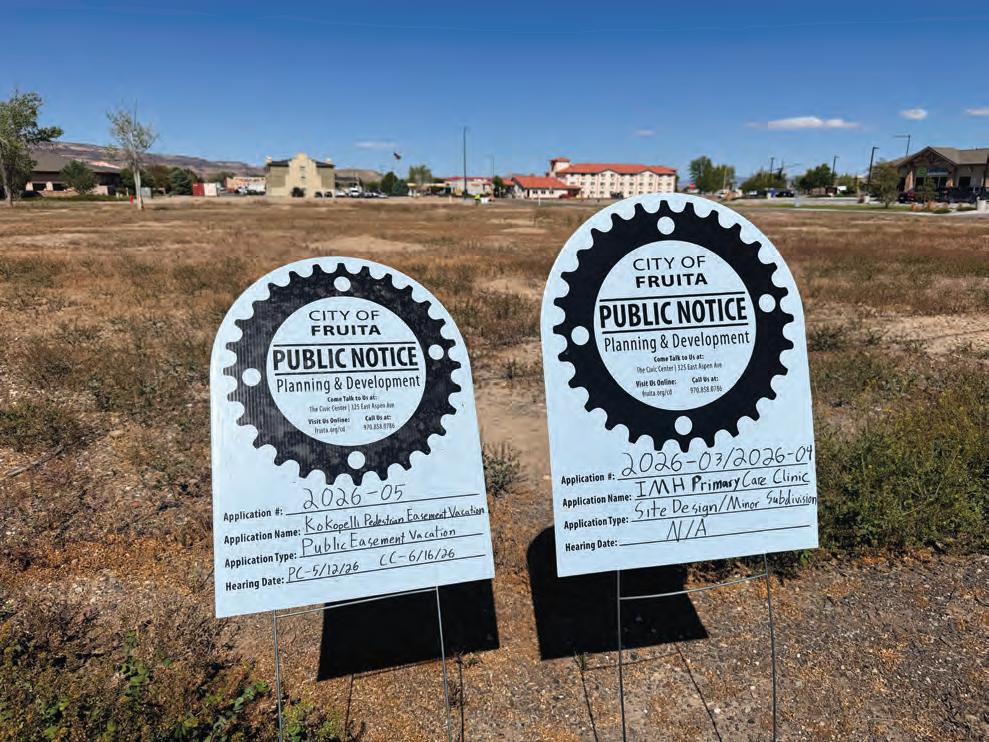
A small, City of Fruita Planning
and Development sign on the 502/524 Kokopelli Blvd. property provides public notice about a requested pedestrianeasement vacation. The sign lists a Fruita Planning Commission hearing date of May 12, 2026, and a Fruita City Council hearing date of June 16, 2026.
On March 27, architect Altus Architectural Studios submitted a permit application for a commercial building at 502 Kokopelli Blvd. under project name “Intermountain Health Fruita Primary Care Clinic.”
The Business Times requested comment from Intermountain Health about the proposed Fruita clinic, but Intermountain Health Media Relations said the person who could comment about the project was out of the office during the days prior to The Business Times’ publishing deadline.
The General Project Report said, “The applicant anticipates starting construction in the Summer of 2025 and finishing the project in fall of 2026.” Intermountain Health Media Relations acknowledged those dates are outdated, and details about the building may have changed.
These signs at 502/524 Kokopelli Blvd. in Fruita provide public notice about upcoming hearings for the Fruita Planning Commission and Fruita City Council, regarding vacating a pedestrian easement on the properties where Intermountain Health plans to build a primary care clinic. Photo by Jackie Young.
For-profit Sensory Store makes sense for local nonprofit
Tim Harty The Business Times
Many nonprofit organizations rely on grants and donations to fund their operations. And that’s often just to keep the doors open.
It’s also an approach rife with uncertainty, and when people’s pocketbooks are getting pinched, competition for donated dollars increases.
When it comes to The Arc of Mesa County, Executive Director Lincoln Folkers doesn’t want the nonprofit, which advocates for and supports people with intellectual and developmental disabilities (IDD), to merely survive. He wants it to thrive. And he’d like some certainty when it comes to funding it.
As a result, The Arc of Mesa County, 845 Grand Ave., is being proactive and opening a for-profit business, The Sensory Store, to fund the nonprofit business. Folkers said renovation of the store’s space at 2412 Patterson Road, Unit 2, between Cafe Rio and Canyon View Dental, is going smoothly, and he hopes for a soft launch in the middle of June and a grand opening around July 1.
Folkers said The Arc of Mesa County was looking at how to create a “more sustainable future for ourselves, where our funding is adequate and we’re not constantly going to grant tours and things like that, trying to get more money every year.”
They came up with the concept of The Sensory Store, which is wholly owned by The Arc of Mesa County.
“And so,” Folkers said, “when you start thinking of sensory, there are a lot of people with disabilities, and even people who don’t have visible disabilities, who oftentimes need sensory support. And so, in those sensory supports, you’ve seen all the fidget toys and the plush dolls or the plush stuffed animals, if you will. But The Sensory Store’s a lot more than just the fidgets and the chewables and the plush toys and things like that.”
Folkers said The Sensory Store can become a hub for the educators and physical
therapists and others who work with IDD people, providing items they need to do their jobs. He said The Sensory Store will be a better alternative than buying those items online “and wondering if they’re really getting what they’re going to need to support the people that they do services for. We will have those things in store, so they’ll actually be able to come in and put their hands on it, touch it, feel it, see if it works for them, and then they can buy through us, and they can even order through us online.”
He added, “It’s a very well and very closely curated list of items that we will carry in store, so that people have the options to come in and experience those firsthand before they buy them.”
The Sensory Store also will provide jobs for the people The Arc of Mesa County supports. Folkers estimates the store will have 15 to 18 part-time employees and two or three full-time employees. In addition to a store manager, the store will employ a job coach “who will work with the people with disabilities to make sure that they have the supports that they need to be successful in what we do.”
The store will be retail, and Folkers said it will do some business-to-business sales.
“We want to work with doctors offices and physical therapy clinics, OT (occupational therapy) clinics, speech therapists, things like that,” Folkers said.
He also reiterated, “This store will not be just for people with disabilities. There’s something in this store for everybody. ... It’s gonna be someplace that people are gonna enjoy to come and shop. … Everybody’s gonna want to come and see this. It’s gonna be a fantastic experience to come shop in. And I’m super excited to get it open.”
If all goes well at The Sensory Store, The Arc of Mesa County may put more stores in other communities.
“We have requests, three of them in the state of Colorado and two of them in Utah, to come plant Sensory Stores in those locations,” Folkers said. “You know, it’s not something that we’re prepared to do today, obviously. But like I’ve told everybody that’s asked ... as soon as we prove this model out, we know what works … and I’m confident that we can replicate it, we’ll go.”
Some growth for The Arc of Mesa County is more certain, and necessary, such as a new office on 24 Road.
“We’re growing, and when you start growth, you outgrow the spaces that you’re in,” Folkers said. “There was an opportunity to buy land (where) Coloramo built that big, beautiful bank building, and there was six or seven lots up there, and we found one that worked for the size that we need. So, we decided to go ahead and purchase the land, with plans of building within two to three years to move our office space out there.”
Lincoln Folkers
Lady beetles of many kinds in abundance after mild winter
Brandon Leuallen The Business Times
If it seems like there are more ladybugs around this spring, local entomologists say that observation is on target.
With a mild winter and an early abundance of food sources, lady beetle populations appear to be higher than usual across the Western Slope.
“With our really mild winter that we’ve had this last year, the lack of cold temperatures, there’s many insects that have overwintered more successfully,” said Melissa Schreiner, an entomologist with the Colorado State University Extension in the Tri-River Area. “Lady beetles are absolutely something I have been observing more of this year.”
Schreiner said she has observed higher numbers during early-spring insect surveys in desert ecosystems around Grand Junction and across the area.
The boost in beetle populations is tied not only to survival through the winter, but also an increase in available prey.
brown with mottled patterns. Many are so small or differently colored that they go unnoticed as lady beetles.
Despite their variety, most share the same role as predators in the ecosystem.
“They mostly just eat other softbodied insects,” Schreiner said. “They’re famous for eating aphids.”
Lady beetles often lay their eggs near aphid populations, ensuring their larvae have an immediate food source after hatching.
A beneficial insect with few downsides Schreiner said the vast majority of lady beetles found in Colorado are native and beneficial, helping naturally control pest populations without the need for chemical treatments.
“There’s very few of them that cause problems,” she said.
One exception is the multicolored Asian lady beetle, a nonnative species that can sometimes become a nuisance when it gathers indoors in search of stable temperatures and occasionally bites people.
“There are lots of aphids that have overwintered, which is likely because there are a lot of food sources around,” Schreiner said.
More than just red with black spots
While the classic red beetle with black spots is the most recognizable, Schreiner said there is far more diversity than many people realize.
“Lady beetles, or ladybugs, they’re true beetles, and we have thousands of described species,” she said. “They vary from really small sizes, like a pinhead, to maybe like a coffee bean in size, and they’re all different colors, and they can have various patterns.”
Some species are black with cream markings, others are solid red, orange or even
“It’s kind of like the Goldilocks insect. It likes to be inside and have the perfect temperature,” Schreiner said. “They can congregate there.”
She also noted one rare species that can be found in Colorado, the Mexican bean beetle, eats dry beans.
“That’s really the only one that eats plants, Almost every single other lady beetle, thousands of them, eat other insects. So they’re well-known predators,” Schreiner said. Even so, she noted that most encounters with lady beetles, whether indoors or outdoors, are harmless.
Overall, the increase this year reflects a favorable balance of weather and food availability. “They have better years than others,” Schreiner said. “This is a good one for them.”
LEFT: A seven-spotted lady beetle (Coccinella septempunctata) moves across a corn lily. This is one of the more recognizable species commonly seen in North America. Photo by Cate Collins. TOP RIGHT: A twenty-spotted lady beetle (Psyllobora vigintimaculata) rests on pavement. This smaller species is one of many native lady beetles found in Colorado. Photo by Melissa Schreiner. BOTTOM RIGHT: A sigil lady beetle (Hyperaspis sp.) rests on mesh fabric. Many species are small and less recognizable but still play an important role as predators. Photo by Melissa Schreiner.
Dashboard driving decisions for Visit Grand Junction
Brandon Leuallen The Business Times
Visit Grand Junction is using a cutting-edge data-dashboard system to track visitor behavior, monitor tourism trends and more precisely target potential travelers as it works to grow visitation in a measured way.
The organization relies on an extensive network of dashboards and data sources to guide decisions, moving beyond traditional advertising approaches and guesswork into a deeply analytical, real-time strategy.
Through March 2026, the data reflects that growth, as the city has outperformed Colorado and the United States. Grand Junction’s 4.25 percent lodging-tax collections were up 8.1 percent year to date compared with the same period in 2025. Hotel occupancy increased 6.1 percent, average daily rate rose 5.5 percent, and revenue per available room climbed 12.4 percent.
Looking at a 12-month rolling period from April 2025 through March 2026, lodging-tax collections increased 2.7 percent, occupancy rose 4.8 percent, average daily rate increased 2.2 percent, and revenue per available room grew 6.8 percent compared with the previous 12-month period.
“We’ve got really good momentum in tourism,” Visit Grand Junction Executive Director Elizabeth Fogerty said. “Despite the state kind of having some challenges, we’re not just eking ahead of the state. The state’s in the negative, and we’re in the positive, and by a fairly large amount.”
Tracking tourism in real time
At the center of that performance is a system of 235 dashboards fed by 172 data sources that continue to grow. Those sources include private data such as Google Analytics, public data from sources such as the Bureau of Labor Statistics and Federal Aviation Administration, and purchased datasets such as hotel and flight information.
The dashboards allow Visit Grand Junction to track tourism performance daily, rather than relying only on monthly or annual reports.
“We’re looking at it daily,” Fogerty said. “If we don’t see the increase, then we know to start adjusting things.”
That approach allows the organization to test strategies, monitor results and quickly shift marketing efforts when needed.
The data also informs how Visit Grand Junction defines a visitor. To avoid inflating numbers, the organization only counts people who travel at least 50 miles to Mesa County, stay for at least four hours and do not visit more than three times in a month.
“We distrust our data more than we trust it, and that’s a really good strategy,” Fogerty said.
Finding unexpected markets
That approach has helped identify unexpected origin markets.
Fogerty said Albuquerque, N.M., emerged several years ago as a consistent source of visitors, even though it was not initially on the organization’s radar.
“That’s where the amazing thing with this data is,” she said. “We’re now paying attention to a city we never would have, because it wouldn’t have shown up if we weren’t tracking the origin market.”
The dashboards allow staff to break down visitor data by city, income level, travel habits, time of year and length of stay, giving a detailed picture of who is coming to Grand Junction and why.
That information helps determine where to focus marketing efforts with responsible and efficient use of taxpayer dollars, particularly given budget limitations.
“If we had an unlimited budget, we would just market to all cities,” Fogerty said. “But we don’t, so we have to work within that.”
Building a team around data
Visit Grand Junction has built a team of specialists focused on analyzing and applying data, reflecting a shift from traditional destination marketing toward a more technical, data-driven approach.
Daniel Short, a business analyst with Visit Grand Junction, used his laptop computer to demonstrate the dashboards, walking through how multiple data sources are layered together to form a clearer picture of visitor behavior.
He said the dashboards also allow the team to track how visitors interact with the organization’s website after clicking on ads, adding another layer to understanding behavior.
“Since that Albuquerque example, with attribution, we want to see where they access on our webpage,” Short said. “We can see that, so we look at what they’re consuming.”
Fogerty said the data used by the organization is anonymized and grouped into behavioral categories rather than tied to specific individuals. She said the organization receives aggregated information, not personal identities, allowing staff to analyze trends without tracking a specific person.
See VISIT GJ on Page 12
Elizabeth Fogerty, executive director of Visit Grand Junction, and Daniel Short, business analyst, outside the Visit Grand Junction office. The organization uses a cutting-edge data dashboard system to track and attract visitors. Photo by Brandon Leuallen
If we at The Business Times see something business-related that we think is cool, we just might take a photo of it and run it in our newspaper. Why? Just because it’s cool. And it’s our prerogative.
Community celebrates Fruita Thrift Shop’s 75th anniversary THIS IS COOL!
People gather in front of Fruita Thrift Shop, 142 S. Park Square in Fruita, as the Fruita Area Chamber of Commerce hosted a ribbon-cutting event on May 1 to celebrate the thrift store’s 75th anniversary.
The Fruita Chamber said in a news release the celebration will extend to a variety of activities throughout the month of May, such as a community scavenger hunt designed to engage shoppers of all ages. Visitors are encouraged to stop by often or follow Fruita Thrift Shop on Facebook to stay up to date on special promotions and events.
The Fruita Thrift Shop is a fully volunteer-led organization, and every donation it receives is reinvested directly into the community, the news release said.
“This milestone is a testament to the power of community,” said Kayla Howell, president and CEO of the Fruita Area Chamber of Commerce. “The Fruita Thrift Shop represents what makes Fruita special: neighbors helping neighbors; generosity in action; and a commitment to making a lasting impact.”
Photo by Jackie Young.
Overwatering
Continued from Page 2
He also recommends limiting fertilizer use during drought conditions to avoid stressing grass.
“Be conservative with your fertilizer this year, so you’re not pushing growth that you can’t water,” Morgan said.
Leaks and misaligned sprinklers
Beyond watering schedules, Morgan said system issues such as leaks or poorly adjusted sprinkler heads can also contribute to unnecessary water use.
He said it’s common to see sprinklers spraying sidewalks, driveways or streets, often due to heads being out of alignment or systems not being properly maintained.
“Keep them covering well, keep them well adjusted, so that they run efficiently,” Morgan said.
He said the goal is to achieve uniform coverage across the lawn, so homeowners aren’t compensating for dry spots by running systems longer than necessary.
“Get it uniformly covering well, and then that way you can get good coverage and efficient water use,” he said.
GUIDELINES FOR SUMMER WATERING AND MOWING
Matt Morgan, owner of 2 Brothers Landscaping, offers the following tips for a healthy lawn:
Watering frequency
• Normal conditions: No more than 3 times per week
• Drought conditions: 2 times per week
• Water deeply and less often, not daily
• Aim to keep soil moist, not saturated
Mowing height
• Maintain grass at 2.5 to 3 inches
• Increase to around 3.5 inches or more in hot summer months
• Avoid cutting too short to help retain moisture and reduce heat stress
Fertilizer
• Use fertilizer conservatively during hot or dry conditions
• Avoid pushing growth that can’t be supported with limited water
• Reduce applications during drought to prevent stress or burn
County parks target 80 percent reduction in irrigation-water usage
Mesa County is adjusting how it manages landscaping at parks and public spaces in response to ongoing drought conditions.
The approach reduces water use by up to 80 percent while focusing resources where they have the greatest community impact, the county said in an April 29 news release.
Mesa County Facilities and Parks manages 26 locations that rely on irrigation, and 11 of those locations use domestic water. In a typical year, those sites use about 9 million gallons of water, the news release said.
This year, the County is implementing a drought-mitigation strategy in which:
• Irrigation at some locations will be reduced or paused.
• Turf in certain areas will be allowed to go dormant.
• Water use will be prioritized for trees, shrubs and high-use spaces such as sports fields at Long Family Memorial Park.
These adjustments are expected to save about 7.5 million gallons of water, the news release said.
Mesa County also is focusing on irrigation efficiency, using tools such as soil-moisture sensors and system
adjustments to deliver water only where and when it is needed.
At some locations, irrigation schedules will be reduced significantly, with watering occurring less frequently than in a typical season, the news release said.
Residents may notice parks looking different. Grass may appear brown or dry in some areas. The change is intentional as Mesa County conserves water responsibly.
The focus is on protecting long-term assets like tree canopy and maintaining spaces that serve the most residents, while reducing reliance on treated drinking water for irrigation, the news release said.
Some smaller or lower-use areas will not be irrigated to help conserve water, support regional agricultural needs and ensure public resources are used where they have the greatest impact.
This approach prioritizes the areas residents use most while evaluating how to manage lower-use spaces more sustainably over time, the news release said.
If drought conditions continue, Mesa County may shift further, focusing longterm resources on spaces that can be sustained and serve the community most effectively.
to avoid growth that you or poorly streets, often efficiently,” homeowners coverage and
Visit GJ
Continued from Page 8
Targeting visitors more precisely
Visit Grand Junction uses the data to target specific groups of travelers based on behavior and interests, such as outdoor recreationists, food enthusiasts or artists.
Ads are deployed to selected audiences and compared against similar groups that do not receive the ads. That allows the organization to measure whether marketing directly influenced visitation.
“We can prove that our ad caused a visit,” Fogerty said.
Once someone clicks on an ad, Visit Grand Junction tracks how they interact with its website. Visitors are directed to relevant pages, such as events or activities, rather than a homepage, and their browsing behavior helps inform future marketing.
If a user clicks on an arts-related ad but spends more time on restaurant content, future ads may shift toward culinary experiences.
“We’re watching a behavior and trying to match it,” Fogerty said.
The organization also uses a third-party attribution partner to verify results, in addition to reports from its advertising vendors.
“We would rather have a third-party attribution partner that does not deploy ads
monitoring all of it,” Fogerty said. Adjusting to changing conditions and responsibility
The dashboard system also allows Visit Grand Junction to respond quickly to external factors such as weather, gas prices and broader travel trends.
“We are really agile,” Fogerty said. “We don’t put an ad out for the season and hope it works.”
The goal is not just to increase visitation, but to shape it responsibly. A current focus for Visit Grand Junction is encouraging weekday travel, longer stays and spending across lodging, retail, restaurants and activities.
That approach is intended to increase hotel occupancy during the week and avoid the overcrowding seen in other Colorado destinations.
“We don’t want overtourism,” Fogerty said. “We are proactive, not reactive.”
Fogerty said the use of data has changed how tourism marketing is evaluated, allowing Visit Grand Junction to demonstrate results more clearly.
“For a long time, marketing was ‘spray and pray,’” she said. “Now we can actually show what’s working.”
has a new Aircraft Rescue and Fire Fighting (ARFF) vehicle, strengthening the airport’s emergency-response capabilities, the airport announced in an April 27 news release.
The new vehicle, an Oshkosh Striker 3,000, significantly enhances the airport’s firefighting capacity, as the apparatus carries 3,000 gallons of water, double the capacity of the airport’s existing ARFF vehicles. It also carries 500 pounds of drychemical agent and is equipped with 420 gallons of fluorine-free firefighting foam.
The total cost of the vehicle was $1,239,004, with $900,000 funded through a grant from the Colorado Division of Aeronautics and the remainder funded locally by the airport.
“This new fire truck represents a major investment in both safety and sustainability at our airport,” Airport Authority Board Chair Linde Marshall said. “With support from the Colorado Division of Aeronautics, we’re enhancing our fleet and our emergency-response capabilities while also being one of the first adopters
foam. It’s clear we have a dedicated team who seek opportunities to position the airport for success. This ARFF truck addition is just another example of the wins we celebrate at the airport frequently.”
David Ulane, director of the Colorado Division of Aeronautics, said, “The Colorado Division of Aeronautics is committed to enhancing the safety of our statewide aviation system, and our grant funding for projects like this new ARFF vehicle is but one example of this. We’re proud to support the Grand Junction Regional Airport with this important acquisition as they partner with us to ensure the highest level of safety for their airport and the traveling public.”
The Grand Junction Regional Airport Authority Aircraft Rescue and Fire Fighting Department is trained to respond to aircraft emergencies. The ARFF team works in collaboration with the Grand Junction Fire Department and other agencies to provide adequate emergency response at and near the Grand Junction Regional Airport.
Grand Junction Regional Airport’s new Aircraft Rescue and Fire Fighting vehicle.
said. conditions and also allows quickly to gas prices Fogerty said. season and increase responsibly. A Junction travel, longer lodging, retail, increase and avoid Colorado overtourism,” Fogerty reactive.” data has marketing is Junction clearly. was ‘spray can actually
vehicle.
Experiencing worry and growth, at the same time
It’s a strange season to be paying attention. The headlines arrive heavy, energy markets are absorbing the largest oil-supply disruption in modern history, and the World Bank now projects global energy prices will rise 24 percent in 2026.
Meanwhile, the job market is shifting. According to a recent report by Challenger, Gray and Christmas, layoff announcements in January 2026 hit their highest level for that month since 2009. Inflation is sticky, interest rates are stubborn, and the federal funding picture for rural communities is anything but settled.
None of that lands lightly. And yet, the picture on the ground is more balanced than the headlines would suggest.
The MetLife and U.S. Chamber of Commerce Small Business Index registered 68.4 in the fourth quarter of 2025, down slightly from a record high of 72.0 the previous quarter, but still well above where it sat earlier in the year.
Tom Sullivan, senior vice president of Small Business Policy at the U.S. Chamber, characterized the moment plainly. Small businesses are showing resilience, he said, even amid significant uncertainty. That assessment matches what’s visible in communities across Western Colorado, where new businesses are still opening, existing businesses are still expanding, and entrepreneurs are still betting on this region.
That is worth pausing on, because it isn’t what the national mood would predict.
The story being told about the broader economy is one of contraction. Workers checking out, employers tightening, consumers pulling back. Some of that is real, but the steadier story, the one playing out on Main Streets across America, is harder to capture in a headline.
It looks like a couple of restaurateurs in the Grand Valley deciding that downtown Grand Junction is worth a second location, betting on the space and the city and themselves. It looks like a rancher on the Western Slope diversifying because the old model isn’t working anymore. It looks like a young person who chooses to come back to Mesa County, not because the macro environment made it easy, but because they decided this place was worth it.
These are not small acts. Rather, they are the specific, repeated decisions that determine whether a community grows or stagnates over the long term. They are the kind of resilience that doesn’t show up in quarterly reports, but compounds quietly into something durable and long-lasting.
That doesn’t mean the worry is misplaced. It isn’t, of course. Cost pressure is real. Margins are thinner than they were two years ago. Some businesses that looked stable are finding the ground less firm than they expected. Conversations with business owners across Western Colorado include genuine concern alongside genuine optimism, often in the same sentence. That isn’t contradiction; it’s how mature business owners actually think about uncertain markets.
The healthier framing isn’t worry versus growth. It’s how to keep growing through worry, and how to do it in a way that builds something worth having.
There’s a useful idea worth borrowing from how strong communities have always navigated difficult seasons. Resilience isn’t built by chasing every opportunity at any cost. It’s built by diversifying revenue, deepening relationships, watching cash flow carefully, investing in people, and staying clear about what the business actually is and who it actually serves.
The same is true for communities. The places that thrive long-term are not the ones that bet everything on a single industry, a single employer or a single policy environment. They are the ones that build a foundation broad enough to absorb the inevitable shocks without breaking.
Western Colorado has assets that suit this moment. We have areas that can be invested in for future growth. We have diversified industries spanning agriculture, energy, outdoor recreation, healthcare, manufacturing and a growing professional-services sector. We have a workforce with deep knowledge across trades, and a community college ready to serve them. We have geographic and natural assets that aren’t going anywhere. And we have a tradition of communities that know how to be useful to one another when the broader systems get noisy.
What ties all of that together is something less measurable but no less real. That is hope. Not the naive kind that ignores difficulty, but the practical kind that keeps people showing up, planning the next thing and investing in places they have decided to call home. Hope is the ordinary, repeated decision to keep building. It is what convinces someone to start a business when starting one has never been simple. It is what builds a community over decades, one ordinary decision at a time.
The leaders worth following in this moment understand this. They are not the loudest in the room. They are the ones who can hold complexity without flinching. Who can acknowledge that times are heavy and still make a payroll, sign a new lease, mentor an entrepreneur, write a check to a local nonprofit, plant next year’s crop. Who can say no to growth that comes at the wrong cost, and yes to the slower, harder work of building something that lasts.
That kind of leadership is happening in Western Colorado right now. Not in headlines, mostly, but in the steady, often unglamorous decisions that shape what kind of place this becomes 10 and 20 years from now.
The worry is real, and the growth is real. The opportunity in this moment is to build the kind of businesses, the kind of communities and the kind of leaders that can hold both at once and keep moving forward with vision intact.
That isn’t just hope. That’s the work of building something worth having. And I’m here for it.
FThink of functional-fitness training as life training
Think of the activities and movements that you do every day. These movements include things such as getting into and out of your car, reaching for an item on the top shelf at the grocery store or bending down to pick up a child.
Most of time, we don’t even think about these movements – until we can’t do them with ease. This is where functional-fitness exercises can help by training your muscles to do these everyday activities efficiently and safely.
The idea of functional-fitness training has become popular in training regimens. Personal trainers are including this type of training into their client’s workouts. These types of exercises train your muscles to work together to simulate common movements in your everyday life.
This is different from conventional strength training where you work on an isolated muscle group. Combining a variety of muscle groups such as your upper and lower body working at the same time may be the same movement you make while lifting something off the floor.
The exercise that can be performed for this movement would include a squat and then a bicep curl.
There are seven basic movements that the human body can perform: pull, push, squat, lunge, hinge, rotation and gait. All exercises are just variations of these movements. When performing all of these movements, you will be able to exercise all of the major muscle groups in your body.
Functional fitness exercises concentrate not only on the upper and lower muscle groups, but also on the core muscles. The core muscles are all the muscles in your middle from your chest to your pelvic bone.
By strengthening these core muscles, you gain flexibility and stability of your body. As your core begins to strengthen, your balance and posture also improve. Having strong core muscles helps reduce injury, helps with stability and improves overall health.
Functional fitness exercises are low-impact and can be performed by most everyone, from a beginner to an athlete.
Some functional exercises that focus on balance may include step-ups and lunges. Try a lunge where you step back instead of forward with hand weights. An exercise to try for core strength is sit-ups with a medicine ball that you move from side to side.
There are many props you can use such as weights,
kettle bells, fitness balls and aerobic steps. Many exercises can be performed without equipment, using only the resistance of your body weight.
These multi-joint and multi-muscle exercises are also used by athletes. Sports-specific training can benefit from functional training as well.
Personal trainers often use a Bosu (both sides utilized) ball. This ball is a half circle on one side, and the other side is flat. You can stand on the flat side of the ball where your core must be engaged to balance yourself. Holding a medicine ball that is weighted and moving it from one side of your body to the other while standing on the ball simulates the movement in a golf swing.
This can be used for many other sports as well, such as basketball and hockey.
The benefits of functional fitness training are numerous. Think of it as “life training.” Functional-fitness training creates a balance between your muscles, and it prepares you for your daily real-life situations.
F
Paula and Dale Reece own Crossroads Fitness Centers in Grand Junction with a downtown location at 225 N. Fifth St. and north location at 2768 Compass Drive. For more information, call (970) 242-8746 or visit the website crossroadsfitness.com.
Dalida Sassoon Bollig is chief executive officer of the Business Incubator Center, 2591 Legacy Way, Grand Junction.
Dalida Sassoon Bollig
Paula Reece
“Subverting” reading the “daily” should be a civic duty, not headline disinformation
Let me help you with a reference. And I’m going to ask you to do the opposite of what my headline for this column says to do. In this case I’d prefer you embrace the local “daily” this one time to prove my point and seek out and read what was written. It’s important. It’s also a better reason why the county should never give our local “daily” one red cent when it comes to printing legal notices – or any news needing accuracy, for that matter.
Truthfully, you shouldn’t need to read beyond the headline. But I encourage my readers to plow through this pablum, which should have a publisher’s name on the byline instead of one of his minions. I mean, when I have something to say in The Business Times, I put my name on it. But that’s just me. Same as that ONE TIME I made public comments at a county commission meeting – which I attended, and judging by the “daily’s” reporting, its “reporter” did not – on April 28, 2026. I was actually there specifically to be quoted.
But our local “daily” couldn’t even get those in context. I urge you all to read for yourselves both sides to the story. This time with the rare case where the truth doesn’t meet somewhere in the middle, but is rather heavily to one side. So, to help my readers, the story I am referring to was printed in the “Daily” Sentinel in its April 29, 2026, edition by Sam Klomhaus and titled, “Mesa County looking to subvert legal notices requirement.”
Once you read both sides, you’ll have all you need to know. But I’m going to expound on this anyway. I just don’t know if I can keep all that’s wrong, inaccurate or defamatory in the story to around 1,000 words (I can’t, this will be longer than normal). After all, there’s usually plenty of fodder for the target(s) when a newspaper is writing a hit piece at the behest of the publisher. Must be why I’ve never told any of my reporters what story to cover, or who to go after, in my 26 years at the helm.
Who knew a retail guy who came from a family of educators would be better at publishing than an attorney from a publishing family? Then again, who thought the publishing family would prove the retail guy’s argument for him? Two newspapers going in two different directions.
But back to that headline, created for effect and coercion from the minutes of the April 28 commissioner’s meeting. Let’s start with the obvious: The word “subvert.” To help Sam (and his publisher) the most, we’ll just go to the Devil and Daniel Webster.
Subvert means to undermine, overturn, or destroy an established system, authority or institution, often through sneaky or indirect means. It involves corrupting morals or weakening principles from within, effectively “turning something over from below.”
There’s no question the depths this news “story” was conjured from. So, Sam got the assignment right. But the true subversion regarding the printing of legal notices is in the details of the story from the recipient of the county’s state-mandated largesse, not on the dais. After all, if Sam was at the meeting and listening or read the entire transcript for full context and understanding instead of cherry-picked gotchas, he would have heard the commissioners state how important the posting and transparency of legal announcements to the citizens is to the county commission.
But where’s the fun in accuracy when so much money is on the line?
Isn’t it incredible how in today’s political climate things are seen so differently. The “daily” sees subversion and intent to not print legal notices – going as far as writing, “Critics of Davis’ stance have said giving governments sole control over their legal notices would make it easier for those entities to hide information from the public” – while not stating who those “critics” were (I’m thinking he interviewed his boss). Meanwhile, I saw county commissioners saying the exact opposite while trying to find a way to print what is mandated in a more cost-effective manner.
That’s it. That’s the story. Well, not the whole story. Plenty of “misinformation” yet to cover. Some of it is very personal.
How about the ol’ adage that legals are paid for by “entities other than the government such as law firms and banks?” You know, two entities leftist publications tell readers to hate. Boogeymen. This half-truth is where legacy media is expert at “misinformation.” For the record, I don’t believe in misinformation, only information citizens must figure out for themselves. That said, they are paid for by fees the county collects. And as we all know, the word “fees” is just another way our state, run by a certain publisher’s best pal, subverts calling confiscation “taxes.”
And who pays ALL taxes in the end? Yup, you and me.
What about trying to say Commissioner Cody Davis said “the other publication does not meet the legal definition of a newspaper under Colorado law?” What Davis said was The Business Times doesn’t meet all the requirements of this century-old, continually-updated law to publish legal notices. He didn’t imply my newspaper was illegal, although the “daily” just did. Exactly how is The Business Times illegal? Is it the fact we don’t need laws mandating people spend ad dollars with us when they don’t want to, or could do it more affordably elsewhere? Because THAT should be illegal.
On to my personal favorites from this personal plea of “your local (non) daily needs
the money,” in its attempt to slander your favorite publisher. How about this ditty? “Craig Hall, publisher of The Business Times, the other respondent, spoke at the County Commissioners (sic) meeting Tuesday, saying he bid for the legal notices because he wanted the revenue.”
No $#!T. I’d love to have the business in providing this service to our county. But as the “daily” is wont to do, it left out the whole quote, because it didn’t serve its purpose, which is to subvert readers knowing its role in this payola scheme.
Here’s the full statement I read to the commission on my bid:
“I won’t lie, I bid on this for the revenue. Revenue which I could use to continue to build my business. But I’ll add this point. Even though I bid because the law says these notices must be published in a newspaper, I don’t think Mesa County should have to put them in print at all. After all, the publishing business has changed dramatically over the past century since this original law was passed.
Simply put, the county should be able to post these notices online as it does literally ALL of its business in today’s environment of transparency. The limited audience for legal notices can find the notices via online searches, be alerted via email (or through associations they are members of, handwritten in) that they’ve been posted and even the Colorado Press Association runs a website where all notices must be uploaded by law even after publication … for a fee, of course.”
Of course, that doesn’t help the “daily’s” case whatsoever. Here’s the other question to the “daily”: Why are you bidding? It sure isn’t out of altruism or public service. Because if it was, you’d have been printing these for free instead of the millions you’ve garnered over the decades. You’ve been more than happy to cash in on this gravy train, changing the law as time goes to benefit you and your Fourth Estate fat cats.
But the “daily’s” minion saved his best for last. And yes, it’s a personal shot. It’s also a dud. Here it is: “Hall noted that he does not read The Daily Sentinel.” Damn right I don’t. Mainly because of stories the quality of this one. Why is this line even in the story?
Careful down South on Seventh, the collective yawn from that yarn is about to swallow most of Mesa County whole. Hey, Jay (Seaton), this may come as a shock, but over 90 percent of the county doesn’t read the “daily.” So much for your claim in getting these all-important notices out “en masse” in the only “legal” newspaper in the county. Then again, our local commie rag known as “The Revolutionist” might just qualify with the Post Office as “legal,” according to you and your competitioneliminating lawmaker buddies in Denver.
I wonder, after losing nearly two-thirds of your print readership in the 26 years I’ve been here, does your pricing reflect it? It doesn’t appear to be, if your $250,000 bid is any indication. Charge more, reach fewer, doesn’t seem a good sales tag. The fact is these postings only reach a select few and have since the day The Daily Sentinel (and other legacy newspapers) used the Colorado Press Association to get the law written to open the spigot.
It’s time to shut the water off on this pay-to-play scheme that maybe at one time had some validity. Think of the untold millions wasted over the years, especially lately. The folks who need this information would find a way to get it, no matter where the information was being made available. Problem is, those who now rely on the money more than ever can’t have that. This “story” and other editorials in your paper over the years have proven that.
So, for the record, yes, I’d love to have this business, because I can do the job more affordably with the same benefit to our community. You can quote me, although I’m sure it will be out of context.
In Truth and freedom.
FCraig Hall is owner and publisher of The Business Times. Reach him at 424-5133 or publisher@thebusinesstimes.com
Craig Hall
n OM Lions Club hosts Mother’s Day pancake breakfast
The Orchard Mesa Lions Club will host its 47th annual Mother’s Day Pancake Breakfast at the Mesa County Fairgrounds, Building C, 2785 U.S. Highway 50, on Mother’s Day, May 10, 7 a.m. to 11 a.m.
Tickets are $10 per person, $5 for kids between ages 6 and 12, and active military members get in free.
The all-you-can-eat breakfast will have pancakes, scrambled eggs, link sausage, orange juice, coffee and water. Tickets are available from Orchard Mesa Lions, local True Value Hardware stores and at the gate.
n Coldwell Banker rewards Espinoza with 2 new roles
Coldwell Banker Distinctive Properties and Coldwell Banker
Commercial Prime Properties announced Melissa Espinoza has been named employing broker for the state of Colorado and sales manager for Coldwell Banker Commercial Prime Properties.
Espinoza is a lifelong Colorado resident and has been a licensed real estate professional since 2015. Over the past five years as a managing broker, she built a reputation for principled leadership, agent development and driving sustainable growth, Coldwell Banker said in a news release.
Shannon Conklin, president and COO of Coldwell Banker
Distinctive Properties said Espinoza’s passion for helping other
“She genuinely cares about helping them grow and succeed while maintaining a high standard of professionalism and results,” Conklin said. “Melissa doesn’t just manage, she elevates.”
Espinoza will lead compliance, risk management and production growth, and she will oversee contract education, onboarding and ongoing training across Coldwell Banker Distinctive Properties’ offices in Vail, Steamboat Springs, Grand Junction, Montrose and Telluride. As sales manager for Coldwell Banker Commercial Prime Properties, she will support recruiting efforts and expand the commercial platform.
n City Council members available to talk at May 11 town hall
The City of Grand Junction invites residents to attend a spring Town Hall meeting with members of the Grand Junction City Council, offering an opportunity to hear updates on key projects and priorities and ask questions directly of elected officials.
According to an announcement posted by the city on EngageGJ, the Town Hall is scheduled for May 11 from 5:30 to 7:30 p.m. at the Grand Junction High School auditorium. The event is open to the public and does not require registration.
The city’s EngageGJ event page said the Town Hall is intended to provide a space for community members to engage with council outside of regular meetings and be part of broader discussions on city initiatives.
More information is available at EngageGJ.org.
n Community Hospital nurses honored at Nightingale event
Community Hospital announced 11 of its nurses were nominated for Nightingale Awards and honored during an April 11 event.
They are: registered nurses Madi DeCarlo, Dana Garver, Siera Hancock, Avery Hill, Deb Spomer and Karen Tucker; Tajmara Eaton, DNP, APRN, CPNP-AC/PC; Joe Gerardi, MHA, RN; Daryl Linsao, MSN, RN; Audrey Kramer, ACNP-BC; and Mikala Trumbo, CNM.
Each of these nurses were nominated by their peers and leaders for the Nightingale Award. The 2026 Nightingale awards recognize nurses in nine categories with additional subcategories. By structuring the program in this manner, many more nurses are being recognized for excellence in nursing in Colorado.
Garver and Gerardi, who is Community Hospital’s chief operating officer and chief nursing officer, were selected as 2026 Luminary Award recipients for the Western Region in their respective categories. Both were selected out of 57 total nominees for the Nightingale Luminary Award for the Colorado Western Region. Garver and Gerardi, along with 10 other finalists from western Colorado will travel to Denver in May for the statewide Nightingale Luminary Awards Gala, where 16 nurses will be selected for the Colorado Nightingale Nurse of the Year Award.
“Our nurses work tirelessly each and every day to ensure the highest quality care possible for our patients,” said Chris Thomas, president and CEO for Community Hospital. “These remarkable nurses exemplify professional engagement and community involvement. We are extremely proud of their commitment to excellence in the profession of nursing.”
The Nightingale Award for Excellence in Human Caring was founded in 1985 to honor nurses who best exemplify the philosophy and practice of Florence Nightingale, a 19th Century nursing pioneer who epitomized the art of caring.
n GVP accepting applications for electric lineworker scholarship
Grand Valley Power is accepting applications for the CMU Tech Electric Lineworker Scholarship. The one-time, $2,000 scholarship is awarded for enrollment in the CMU Tech Electric Lineworker program.
Applications will be accepted through June 1 and are available at all high school counseling offices, Colorado Mesa University’s financial-aid webpage under the Outside Scholarship Resources tab, or at gvp.org/scholarship-program.
A committee of electric lineworkers appointed by the management of Grand Valley Power will review and determine an awardee for the scholarship.
Grand Valley Power has awarded more than $338,500 in scholarships to local youth for education and training since 1996. For questions about the scholarship program or requirements, please email scholarships@gvp.org or call 970-242-0040.
n Some tickets still available for Grand Mesa Songwriter Festival
The Cedaredge-based Grand Mesa Arts & Events Center (GMAEC) will host the third annual Grand Mesa Songwriter Festival on June 5-7.
The festival will feature the music of 22 singer-songwriters and will be headlined by Rodney Crowell, a multi-Grammy Award winner and inductee into the Nashville Songwriter’s Hall of Fame.
Weekend passes to attend Crowell’s one-night-only concert already are sold out. However, tickets are still available for “Rounds Only” and Sunday workshops. The Rounds Only Pass allows the purchaser access to the songwriter rounds on Friday and Saturday only. It does NOT include access to the headliner show on Saturday night at GMAEC or the Sunday Morning songwriter meet and greet.
This year’s downtown Cedaredge venues include GMAEC’s Bank of Colorado Theater and the Art Garage as well as The Pondy Dance Hall, the River Burch Gallery, Feels Like Coming Home, and Starr’s Guitars, plus the 290 Building, which once served as the town’s Odd Fellows Hall.
For ticketing information, songwriter bios and festival schedule, visit the website: grandmesasongwriterfestival.com. For further information and GMAEC hours, call 970856-9195.
Clarifications/Corrections
In an article on Pages 1 and 4 of The Business Times’ April 29 edition, regarding Mesa County now being without a USDA-inspected meat-processing facility, it reported Mountain Meats is no longer a USDA-inspected processing facility. It had been Mesa County’s only federally inspected meat-processing facility that provided slaughter and processing until it recently decided not to continue with the USDA designation.
To be clear, Mountain Meats remains open and processes meat in Fruita. Mountain Meats also has a meat-processing plant in Craig, and that one remains USDA-inspected and is available to Mesa County customers who want USDA inspection.
• Correction: A story on Page 8 of the April 29 edition of The Business Times should have said the Crawford Row townhomes at the Dos Rios development are southwest of Grand Junction’s downtown.
Business Bite
Gas station near Whitewater opening soon
The Golden Gate Petroleum convenience store on U.S. Highway 50 near Whitewater is projected to open in mid-May.
Not only will it be the closest place for Whitewater residents to buy gas, it will serve Krispy Krunchy Chicken. The chicken won’t be available on the first day open. Golden Gate Petroleum Colorado Utah District Manager Adriane Smith-Maloney said serving Krispy Krunchy Chicken usually comes in the second week after a Golden Gate store opens.
Golden Gate originally targeted opening in October 2025, but Smith-Maloney said, “Some delays in overall planning did set us back a bit.”
Melissa Espinoza
quality care Hospital. involvement. nursing.” 1985 to Nightingale, a scholarship Lineworker the CMU high school the Outside Grand Valley local youth program or
Festival host the headlined Nashville sold out. workshops. The Friday and night at Colorado Gallery, once served website: call 970regarding reported been Mesa slaughter and Mountain USDA-inspected
Times should southwest of Whitewater will serve Golden Gate serving Krispy opens. Smith-Maloney said,